
CFD · CHECKED 10 OCT 2026
Daman Markets review.
UAE investment firm offering CFD/FX trading through MT5 under a CMA licence
RISKY
OUT OF 10
Daman Markets is a UAE-based CFD broker trading via MT5, with Daman Markets Financial Services LLC holding a genuine, active CMA Category 1 licence. Fee and minimum-deposit figures are inconsistently published across its own site, and its Client Agreement gives the broker wide one-sided discretion over withdrawals, margin calls and termination, with no independent reviews to check the record against.
Each criterion is scored 1 to 10 from primary sources. The overall score is their unweighted mean. How scoring works.
| Founded | 1998 |
|---|---|
| Headquarters | AE |
| Minimum deposit | $100 |
| Maximum leverage | 1:500 |
| Account opening | 1-3 |
| Platforms | MetaTrader 5 (MT5) |
- Regulated in the UAE by CMA under licence No. 20200000356, active on the register
- DM Classic account is commission-free with spread-based pricing
- DM Pro commission is consistently stated at $17 per million traded
- MT5 available on desktop, web and mobile
- Comes with Acuity NewsIQ, AssetIQ, Research Terminal and an Economic Calendar
- Publishes a phone number and a Dubai World Trade Centre office address
- Second licence claim (Daman Securities LLC) actually belongs to a different entity
- Site shows two different minimum deposits, $250 and $100, on the same page
- Inactivity fee amount is undisclosed, only referenced as "on the Fee Schedule"
- Single-platform broker: MT5 only, no alternative platform offered
- Instrument list is inconsistent across pages: futures vs metals
- No stated hours for the phone support line
Overview
TrueBroker is a free broker safety checker, and this page is our review of Daman Markets, scored 4.2 out of 10 across regulation, fees, platform, support and reviews.
Daman Markets is the trading name of Daman Markets Financial Services LLC, a company incorporated in the United Arab Emirates. Its own Client Agreement and Risk Disclosure Statement name this entity directly, give a UAE registration number of 2389524 and a commercial license number of 1393481, and list a physical address on the 14th floor of the World Trade Center, Dubai, with a further postal address at Sheikh Rashid Tower, Dubai World Trade Centre.
What the register shows about Daman Markets
We searched the UAE Capital Market Authority (CMA / SCA) register directly for this firm, running a positive control against a company already known to be listed so that an empty result would mean absence rather than a broken search. Daman Markets Financial Services LLC appears on that register as CP-0001473, status Active, listed since 2025, with damanmarkets.com given as its website. That is the site reviewed here, so the company itself is confirmed. The Category 1 license number the firm quotes on its own pages, CMA License No. 20200000356, is not something the register publishes in that form; the register shows a CP code instead, so the company is confirmed and the license number is not. The two other numbers on the firm’s terms page, registration number 2389524 and commercial license number 1393481, sit with an authority we simply have no register for under the name “United Arab Emirates” as stated, so neither has been checked. That is a gap in what we hold, not a finding against the firm.
A second, older company with a similar name
The single most important thing to flag before anything else is that an earlier published review of this broker described a different company entirely. That review named the operator as Daman Securities LLC, said it was founded in 1998, and gave its regulator as the UAE Securities & Commodities Authority under Category 1 License No. 604020. None of that matches Daman Markets Financial Services LLC’s own Client Agreement, which never mentions a 1998 founding date or a “Daman Securities LLC” entity. Searching the same CMA/SCA register for that license turned up a real, active listing, CP-0000085, status Active, listed since 2005, but for Daman Securities LLC with damansecurities.ae given as its website. That is a different domain from damanmarkets.com, the site under review here. So the earlier review’s regulator, license number and founding date all belong to a separate, older, unrelated company that happens to share the word “Daman.” A reader relying on that earlier account would look up the wrong license number entirely.
What Daman Markets offers day to day
Beyond the entity question, Daman Markets runs MetaTrader 5 as its platform, on desktop, web and mobile, and lists forex, commodities, indices, US-listed CFD stocks, crypto and futures among its markets. Two live account types are described on its own pages: DM Classic, with a $100 minimum deposit, 0% commission and spreads built into the price, and DM Pro, with a $20,000 minimum deposit and commission quoted from $17 per million USD traded. A demo account is also offered, with a settable virtual balance between $1,000 and $100,000 and an expiry after 1,000 days.
A clean result on the sanctions and warning lists we hold
We checked this firm’s name against 797 warning-list entries mirrored from CySEC and the FCA and found no match on either list. That covers only the two regulators whose lists we mirror, not every regulator worldwide, but within that scope it is a clean result worth recording alongside the register findings above.
Key Takeaways
Daman Markets Financial Services LLC is on the UAE Capital Market Authority (SCA) register as CP-0001473, status Active, listed since 2025, with damanmarkets.com given as its website, which is the site reviewed here. The register publishes that CP code rather than the CMA License No. 20200000356 the firm quotes on its own terms page, so the company is confirmed and the specific licence number is not. We ran a positive control against the same register before treating that gap as meaningful, so an empty or partial match means what it says rather than a broken search.
A second, different Daman on the same register
Our earlier review describes the broker as “Daman Securities LLC,” founded 1998, regulated under SCA Category 1 License #604020. We searched the register for that entity too: DAMAN SECURITIES LLC is listed as CP-0000085, status Active, since 2005, but its website on the register is damansecurities.ae, not damanmarkets.com. That is a real, actively licensed company, just not the one operating the site under review. A reader relying on our earlier review would end up citing the correct regulator but the wrong legal entity, the wrong licence number, and a company that isn’t the one taking their deposit.
Two further numbers on Daman Markets’ own terms page, registration number 2389524 and commercial license number 1393481, both given under the heading “United Arab Emirates,” were not checked. We hold no register entry for an authority named simply “United Arab Emirates,” so this is a gap in our directory rather than a finding about the firm either way.
What Daman Markets charges
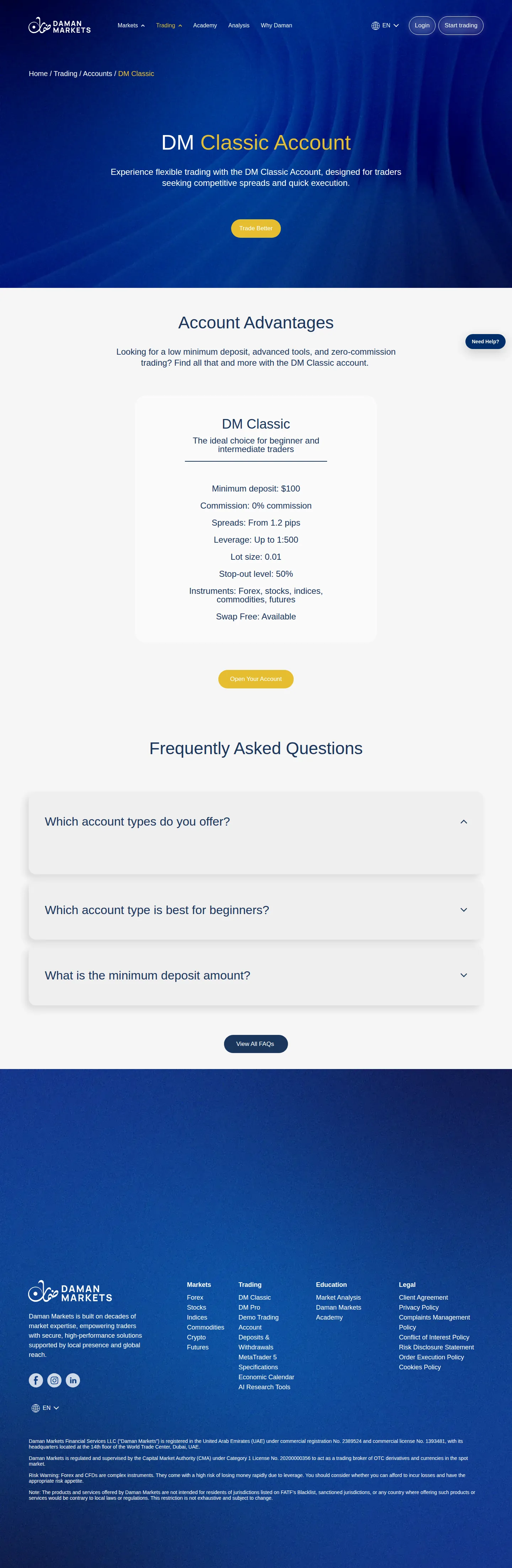
- DM Classic runs on 0% commission with the cost built into the spread, from 1.2 pips, leverage to 1:500, and a swap-free option. Its minimum deposit is stated as $100 in the account page body and FAQ, repeated three times, and again as $100 in the fees-page FAQ, but the same account page’s own title tag reads “$250 Min Deposit.” Both figures come from Daman Markets’ own site; which one is current cannot be settled from the text we fetched.
- DM Pro requires $20,000 minimum, charges from $17 per million USD traded, spreads from 0.0 pips, leverage capped at 1:100, and drops the swap-free option. That $17 figure appears consistently across the firm’s own pages. Our earlier review quotes a conflicting $35 figure and flags the discrepancy itself (Website shows conflicting information ($17 vs $35)) without the firm’s own pages ever showing $35, so we treat $17 as what Daman Markets currently publishes.
- An inactivity fee applies after six continuous months without trading, deducted monthly from the account balance until trading resumes or the account is closed; the terms page states the amount sits in a separate fee schedule rather than in the clause itself, so we cannot report a figure.
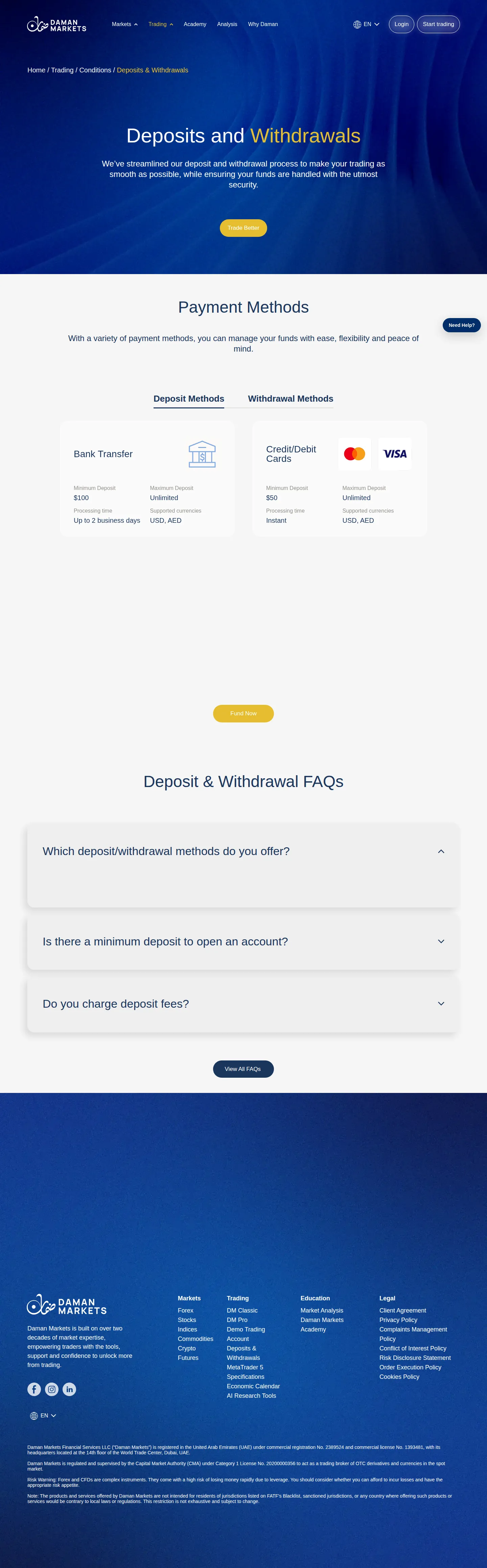
- Deposits and withdrawals: bank transfer ($100 minimum, up to 2 business days each way), Skrill and Neteller ($10 minimum, instant both ways), cards ($50 minimum deposit instant, $10 minimum withdrawal taking 1 to 5 business days), and Apple Pay / Google Pay for deposits only ($50 minimum, instant).
What the Daman Markets client agreement does to a client
We read the client agreement itself rather than a summary of it, and several numbered clauses bind the client harder than the marketing pages suggest. Clause 9.1 excludes the company from liability for loss arising from the agreement or from closing out positions “even if such loss is a reasonably foreseeable consequence,” carving out only the company’s own fraud, and 9.1.2 excludes special damages, lost profit, goodwill or business opportunity entirely. Clause 11.14 lets the company set off any positive balance across a client’s accounts against what the client owes it, while the client has no reciprocal right of set-off. Clause 8.3 suspends a client’s withdrawal rights outright during any “continuing event of default,” and clause 6.5 lets the company “withhold or refuse to make payment at our discretion” pending KYC or source-of-funds documentation. Clause 4.2.4 sets the auto stop-out at 50% of margin but reserves the right to change that percentage “in our sole discretion from time to time,” and clause 4.2.3 treats a colour change on the trading screen as adequate margin-call notice “irrespective whether or not the client is logged in.” Clause 8.1 lets the company terminate immediately on a list of discretionary “Events of Default,” where a client only gets the 30-business-day no-cause route. Clause 11.19 puts the agreement under UAE law, and 11.20 sends unresolved disputes to UAE courts unless both sides separately agree to Dubai International Arbitration Centre arbitration, meaning a client anywhere in the world is contractually routed away from their home courts. Clause 6.3 confirms no interest is paid on client money held in segregated accounts.
Platform and support
Trading runs on MetaTrader 5 across desktop, web and mobile, with Acuity’s NewsIQ, AssetIQ, Research Terminal and Economic Calendar layered in, and the FAQ claims over 80 technical indicators. Support channels on the terms page are a Dubai postal address, a UAE phone number, and two email addresses, support@damanmarkets.com and compliance@damanmarkets.com.
Licenses & Regulation
Daman Markets Financial Services LLC names itself as the entity behind this site, damanmarkets.com, in the Client Agreement, and states it holds Category 1 License No. 20200000356 from the UAE Capital Market Authority (CMA), authorizing it to conduct trading broker activity in OTC derivatives and currencies in the spot market, meaning CFDs and forex. We searched the UAE Capital Market Authority (SCA) register directly, running a positive control first so an empty result would mean absence rather than a broken search, and found Daman Markets Financial Services LLC listed as CP-0001473, status Active, on the register since 2025, with damanmarkets.com given as its website. That confirms the company. The register lists it by a CP code, not by the licence number the firm quotes on its own pages, so the number itself is not confirmed by what we could check.
A second entity, a different regulator, and a site that isn’t this one
The earlier published review describes the broker as Daman Securities LLC, founded 1998, holding Category 1 License #604020 from the UAE Securities and Commodities Authority (SCA), covering on-exchange trading and clearing, global markets brokerage, and OTC derivatives and FX spot dealing. None of that appears on the firm’s own Client Agreement, which names only Daman Markets Financial Services LLC and the CMA licence above, not Daman Securities LLC or a 1998 founding date. We searched the register for Daman Securities LLC as well and it is there too, listed as CP-0000085, status Active, since 2005, but its website on the register is damansecurities.ae, not the damanmarkets.com site this review covers. So the register confirms both companies exist and both are Active, but it ties them to two different websites, and the licence number and 1998 founding date carried over from the earlier review belong, on the register’s own evidence, to the .ae site rather than the one being reviewed here.
The firm’s terms also give a UAE company registration number, 2389524, and a commercial license number, 1393481, both for Daman Markets Financial Services LLC. We hold no register entry for an authority listed simply as “United Arab Emirates,” so neither of those two numbers has been checked against anything. That is a gap in what we hold, not a finding about the firm.
What the CMA licence covers, and where it stops
The Category 1 licence, on the firm’s own wording, authorizes Daman Markets Financial Services LLC to act as a trading broker of OTC derivatives and currencies in the spot market, covering CFDs and forex. The Client Agreement itself carries terms that sit inside that licensed relationship rather than outside it: clause 9.1 excludes the company from liability for loss arising from the agreement or from closing out positions “even if such loss is a reasonably foreseeable consequence,” except where it comes from the company’s own fraud, and excludes special damages, loss of profit, goodwill or business opportunity outright. Clause 11.19 sets UAE law as governing law, and clause 11.20 sends unresolved disputes to arbitration at the Dubai International Arbitration Centre only if both sides agree, otherwise to the exclusive jurisdiction of UAE courts, regardless of where the client lives. Clause 1.3.4 leaves reclassification from Professional back to Ordinary Investor status, which would restore regulatory protections, entirely to the company’s own discretion.
Warning lists and the broader picture for Daman Markets
We checked this firm against 797 warning-list entries mirrored from CYSEC and FCA, and it appears on none of them. That is a genuine clean result, but it only covers the two regulators we mirror, not every regulator worldwide, and it says nothing about whether the CMA licence number itself checks out beyond what the register already told us. Put together, the register work confirms that a company called Daman Markets Financial Services LLC is Active on the UAE regulator’s list and tied to the site under review, while the licence number quoted on the firm’s own pages, the separate Daman Securities LLC entity carried over from the earlier review, and the two unchecked UAE registration numbers all remain either unconfirmed or outside what we could verify.
How to Trade
Daman Markets, regulated as Daman Markets Financial Services LLC under UAE Capital Market Authority (CMA) License No. 20200000356, offers CFDs across forex, commodities, indices, stocks, crypto and futures, run on a single platform, MetaTrader 5. The account structure and the contract terms behind it are worth reading in full before funding anything, because several of the terms that bind an open position sit entirely in the broker’s own hands.
What Daman Markets offers to trade
The firm’s markets page lists forex with more than 50 currency pairs traded 24/5, commodities including gold, silver and oil, indices described as exposure to “entire stock markets in a single trade,” popular US-listed CFD stocks, crypto CFDs on Bitcoin, Ethereum and others, and futures contracts on oil, indices and commodities. Which of these apply to which account type is not entirely consistent across the firm’s own pages: The firm’s UAE home page lists DM Classic and DM Pro instruments as “Forex • Commodities • Metals • Indices • Stocks” with no Futures, while the firm’s UAE accounts page and the firm’s UK accounts page list “Forex, stocks, indices, commodities, futures” with no explicit Metals line. We read both pages; they simply do not agree with each other, so a trader wanting metals or futures access on a specific account should confirm it before funding rather than relying on either page alone.
DM Classic and DM Pro, the two account types
DM Classic carries a $100 minimum deposit (repeated three times on the firm’s UAE accounts page and again on the firm’s UAE fees page, though the same accounts page’s own title tag reads “$250 Min Deposit,” a mismatch the page itself does not resolve), 0% commission with the cost built into the spread instead, spreads quoted from 1.2 pips, leverage up to 1:500, a 0.01 lot minimum, a 50% stop-out level, and a swap-free option. DM Pro requires a $20,000 minimum deposit and charges a per-lot commission stated on the firm’s own pages as From $17 per mil/mill USD, against spreads from 0.0 pips, leverage capped at 1:100, the same 0.01 lot minimum and 50% stop-out level, but no swap-free option. Our earlier review of this broker quotes a conflicting DM Pro commission of $35 per million and flags the discrepancy itself (Website shows conflicting information ($17 vs $35)); we did not find $35 anywhere on the firm’s own fetched pages, which consistently show $17, so we’re passing on the $17 figure and noting that the higher number traces back to that earlier review, not to anything Daman Markets currently publishes. A free demo account is also available, funded with a virtual balance selectable from $1,000 to $100,000, running on full MT5, and expiring after 1000 days.
Trading on MetaTrader 5
Daman Markets runs execution on MetaTrader 5 only, offered on desktop, web and mobile. The platform page describes customizable charting across multiple timeframes, one-click trading, market signals, and 30-plus language support, and the firm’s own FAQ states MT5 provides “over 80 technical indicators.” MT5 is also bundled with Acuity’s NewsIQ, AssetIQ, Research Terminal and Economic Calendar tools. No secondary platform, such as MT4 or a proprietary web terminal, appears in the material we read.
The rules that bind an open position
Several clauses in the Client Agreement sit on the broker’s side of the ledger more than a trader might expect. Clause 4.2.4 sets the automatic stop-out level at 50% of Margin, but adds “or such other percentage as prescribed by us in our sole discretion from time to time,” and states the Company is not liable for the resulting losses. Clause 4.2.3 defines an adequate margin call notification as a colour change on the platform from black to red, or “any other visual, audible or written notification,” and specifies this counts “irrespective whether or not the client is logged in on trading platform or any other system or not.” In practice, a client can be treated as validly warned of a margin call they never saw because they were logged out when it appeared, and the 50% cushion before forced liquidation is not fixed by the contract but adjustable by the firm at will.
Clause 11.14 (Set-Off) lets the Company apply any positive balance in any of a client’s accounts against amounts owed to it, across accounts and currencies, while the same clause bars the client from exercising any equivalent right against the firm. Clause 9.1 (General Exclusion) removes the Company’s liability for loss or damage arising from the agreement or from closing out positions “even if such loss is a reasonably foreseeable consequence,” carving out only the Company’s own fraud, and Clause 9.1.2 excludes liability for lost profit, goodwill or business opportunity entirely. Clause 8.1 lets the Company terminate the agreement and close a client’s account immediately, without notice or a court order, under a list of Events of Default defined largely at its own discretion (wording includes “we reasonably believe” and “we consider necessary or desirable”), while a client wanting to leave without cause has to give 30 business days’ notice under Clause 8.1.1. Taken together, these terms mean the mechanics that actually decide whether a losing position gets closed out, and when, are set and can be changed by Daman Markets rather than fixed in advance for the client.
Account Types
Daman Markets sells two live account types, plus a demo. DM Classic is the entry tier: minimum deposit $100, 0% commission, spreads from 1.2 pips, leverage up to 1:500, minimum lot size 0.01, stop-out level 50%, and a swap-free option. The commission is not actually absent; the firm’s FAQ on its accounts page says the cost is built into the spread instead of charged as a separate line item.
DM Pro is the higher tier: minimum deposit $20,000, commission from $17 per million USD traded, spreads from 0.0 pips, leverage capped lower at 1:100, the same 0.01 minimum lot and 50% stop-out level, and no swap-free option. Our earlier review of this broker quotes a conflicting commission figure of $35 per million for the same account, but that review flags the conflict itself rather than resolving it, and the firm’s own pages we fetched (the root page and the accounts page) show only the $17 figure. We report the $17 figure because that is what the firm’s own text supports.
A Demo Trading Account is free, needs no deposit, and can be set to any virtual balance from $1,000 up to $100,000, running on MT5 with full platform access. It expires after 1000 days, and only one demo is permitted per account type on offer.
What Daman Markets’ own pages don’t agree on
The account pages contradict each other on basic numbers. The accounts page carries a title reading “$250 Min Deposit,” yet the same page’s body and FAQ state “Minimum deposit: $100” three separate times, and the fees page FAQ also gives $100. We can’t tell from this text which figure the firm currently intends to charge.
The instrument lists per account also don’t match between pages. The root page lists DM Classic and DM Pro instruments as “Forex, Commodities, Metals, Indices, Stocks,” with no Futures named. The accounts page and a second regional accounts page list “Forex, stocks, indices, commodities, futures,” with no Metals named. Whether Futures or Metals actually sit inside either account is not something the firm’s own site states consistently.
What buys access to leverage and spread
The gap between the two live accounts is the trade-off on offer: DM Classic asks for a $100 minimum and gives up tighter spreads and higher leverage (1:500) in exchange for a flat 1.2-pip-plus spread; DM Pro asks for a $20,000 minimum, a $17-per-million commission, and caps leverage at 1:100, in exchange for spreads quoted from 0.0 pips. Neither account page states a maximum deposit or a cap on lot size beyond the 0.01 minimum.
Every account sits inside a contract that lets Daman Markets change the stop-out level unilaterally. Clause 4.2.4 of the Client Agreement sets Auto Stop-Out at 50% of Margin, “or such other percentage as prescribed by us in our sole discretion from time to time,” and the same clause states the Company is not liable for losses that follow. A client choosing between DM Classic and DM Pro on the strength of the published 50% figure is choosing a number the firm can move at will.
Negative Balance Protection
Daman Markets Financial Services LLC’s Client Agreement sets its own stop-out and liability terms for both the DM Classic account (leverage up to 1:500) and the DM Pro account (leverage up to 1:100), and we read those clauses directly on the firm’s UAE terms page rather than taking a summary of them.
How Daman Markets triggers a stop-out
Clause 4.2.4 sets automatic closure of open positions when Equity falls to or below 50%… or such other percentage as prescribed by us in our sole discretion from time to time of Margin, and states the Company is not liable for the resulting losses. The 50% figure printed on the account pages for DM Classic and DM Pro is therefore a default the firm can move, not a fixed floor a client can rely on.
Clause 4.2.3 covers what counts as a margin call warning before that happens: a colour change on the trading platform from black to red, or “any other visual, audible or written notification,” is treated as adequate notice, and the clause specifies this applies “irrespective whether or not the client is logged in on trading platform or any other system or not.” A client who was not watching the platform when the colour changed has, under this wording, still been notified.
Who absorbs the loss once it happens
Clause 9.1 (General Exclusion) states that Daman Markets and its directors, officers, employees, agents and Affiliates are not liable for loss, damage, cost or expense arising from the Client Agreement or from closing out positions, “even if such loss is a reasonably foreseeable consequence,” with the single carve-out being loss that arises directly from the Company’s own fraud. Clause 9.1.2 excludes liability for special damages, loss of profit, goodwill or business opportunity outright, and clause 9.1.3 limits liability for death or personal injury to cases of the Company’s wilful negligence. Read together, a client whose account is stopped out through the firm’s own delay or system error has almost no contractual route to recover that loss.
Clause 9.5 adds an indemnity running the other way: the client must cover the Company “on a full indemnity basis” for losses, liabilities, costs and legal fees relating to the client’s Accounts or Positions, including costs the Company incurs enforcing its own rights against the client. That exposure is not capped at the account balance.
Set-off, withheld withdrawals, and what Daman Markets’ terms don’t say about negative balance protection
Clause 11.14 (Set-Off) lets the Company combine or apply any positive Balance in any of a client’s accounts against amounts the client owes it, across accounts and currencies, while the client “may NOT exercise any right of set-off” against amounts the Company owes them. Clause 8.3 (Payment) adds that the Company is not obliged to honour a withdrawal request for all or part of a client’s Account Equity “if there is a continuing event of default until such event of default is remedied or until the liquidation date.” Clause 6.3 confirms separately that “no interest is due or payable with respect to Client Money,” so funds held while any of this plays out earn the client nothing.
The clauses we read describe the stop-out trigger, the margin call notice standard, the liability exclusions and the set-off and withholding rights in detail. They say nothing about negative balance protection, meaning a written guarantee that a client’s losses on leveraged CFD and forex positions cannot exceed the funds deposited. We did not find such a clause in the sections of the Client Agreement covering margin, stop-out or client money, and the fee material we read does not address it either. That is a gap in what we found in the pages fetched, not a statement that no such protection exists.
Trading Instruments
Daman Markets lists six asset classes on its markets page: forex (50+ currency pairs), commodities including gold, silver and oil, indices, US-listed stocks as CFDs, crypto CFDs such as Bitcoin and Ethereum, and futures on oil, indices and commodities.
What Daman Markets actually documents per account
The account pages break instruments down by account type, and the two account-detail listings do not match each other. Both the DM Classic and DM Pro pages on the firm’s UAE accounts page and the firm’s UK accounts page list “Forex, stocks, indices, commodities, futures” for those accounts, with no explicit mention of metals. The root page, the firm’s UAE home page, instead lists “Forex • Commodities • Metals • Indices • Stocks” for the same two account types, with no futures. Whether futures or metals are actually available on a given account cannot be confirmed from the firm’s own site, since the two listings disagree.
Accounts and what they cost to trade on
DM Classic asks a $100 minimum deposit, charges 0% commission with spreads from 1.2 pips, offers leverage up to 1:500, a 0.01 lot size, a 50% stop-out level, and a swap-free option. DM Pro asks a $20,000 minimum deposit, charges commission from $17 per million USD with spreads from 0.0 pips, caps leverage at 1:100, keeps the same 0.01 lot size and 50% stop-out level, and does not offer a swap-free option. Our earlier review that TrueBroker did not fetch itself flags a conflicting DM Pro commission figure of $35 per million, but flags this itself as inconsistent with the site, and the firm’s own pages we read show only $17 per million, so we treat $17 as what the firm currently documents.
A demo account is free, offers up to $100,000 in virtual funds with the balance settable anywhere from $1,000 to $100,000, gives full access to MT5, expires after 1000 days, and is limited to one demo account per account type.
Separately, the firm’s UAE accounts page carries its own internal mismatch on entry cost: the page title reads “Trade Forex & CFDs with Zero Commission | $250 Min Deposit,” while the page body and FAQ repeat “$100” for DM Classic three times, and the firm’s UAE fees page’s FAQ also gives $100. Which figure is current cannot be settled from this text alone.
Platform access to those instruments
All instruments trade through MetaTrader 5, offered on desktop, web and mobile, with customizable charting, multiple timeframes, one-click trading, and the firm’s FAQ claiming “over 80 technical indicators.” MT5 is integrated with Acuity’s NewsIQ, AssetIQ, Research Terminal and Economic Calendar tools. No second platform is documented in the pages we fetched.
Who cannot access these instruments
Daman Markets’ own root page states its services are not intended for residents of FATF Blacklist jurisdictions, sanctioned jurisdictions, or any country where offering the products would be contrary to local law, and adds that this list is “not exhaustive and subject to change.” A roster of eighteen named restricted countries, set out in full further down this review, comes only from our earlier review TrueBroker did not verify against the firm’s own pages, and does not appear on the firm’s own site as fetched.
Education & Analysis
Daman Markets Financial Services LLC lists exactly one trading platform on the pages we fetched: MetaTrader 5. Everything in this section is drawn from that platform page and the account and market pages that describe what runs on it, not from any hands-on testing of the platform itself, which is not among the checks we performed.
What Daman Markets says MT5 does
The platform page describes MetaTrader 5 as available on desktop, web and mobile, with “customizable charting, competitive pricing, multiple timeframes, advanced indicators” and “30+ languages,” plus market signals, fast execution and one-click trading. The site’s own FAQ, on the same page, puts a number on the indicator claim: MT5 “offers over 80 technical indicators.” That figure is MetaTrader’s standard indicator library rather than anything Daman Markets built itself, but it is the number the firm chooses to publish, and it is the only concrete figure in the charting claims.
The same page states MT5 is “integrated with Acuity tools,” naming four specifically: NewsIQ, AssetIQ, a Research Terminal, and an Economic Calendar. The page does not explain what each of these does beyond the name, so a trader deciding whether the research layer is worth relying on has only the labels to go on, not a description of coverage, update frequency, or whether they sit inside the MT5 terminal or as a separate portal.
What the account pages say is tradable on it
The instrument lists attached to the two live account types do not match each other. The firm’s UAE home page describes both DM Classic and DM Pro as covering “Forex • Commodities • Metals • Indices • Stocks,” with no mention of futures. The firm’s UAE accounts page and the firm’s UK accounts page describe the same two accounts as covering “Forex, stocks, indices, commodities, futures,” with no separate line for metals. The markets page goes further still, listing forex (50+ currency pairs), commodities including gold, silver and oil, indices, US-listed CFD stocks, crypto described as CFDs (Bitcoin, Ethereum “and others”), and futures on oil, indices and commodities. Between these three pages, whether metals sit inside “commodities” or are a separate class, and whether futures are actually available on the two named account types, is not something the firm’s own site states consistently.
Daman Markets’ demo account and the platform
The demo account page ties directly back to MT5: it offers “full access to MT5” with a simulated balance the client can set anywhere from $1,000 to $100,000, up to a cap of $100,000 in virtual funds, and the account expires after 1,000 days. The page limits a client to one demo account per account type offered, so a trader wanting to test both DM Classic and DM Pro conditions would need to open one demo of each rather than reusing a single demo account across both.
What the pages don’t cover
The pages we fetched describe only MetaTrader 5 as the trading platform and say nothing about MetaTrader 4, cTrader, TradingView integration, or any proprietary web terminal. That is what the firm’s own material covers, not a claim that no other platform exists; it reflects the pages we were able to fetch rather than a survey of everything Daman Markets might offer. The same applies to the Acuity tools: the platform page names NewsIQ, AssetIQ, the Research Terminal and the Economic Calendar, but does not set out what data each one draws on, so a reader cannot judge from this material alone whether the research layer adds meaningfully to the charting already built into MT5’s terminal.
Special Offers
The pages we fetched for Daman Markets describe how the two live account tiers are priced and what the inactivity and payment terms are. None of that material is a promotions page, a deposit-bonus page, or a discount code, so this section reports pricing structure and account conditions rather than any offer, and says plainly where our evidence is silent rather than treating that silence as proof nothing exists.
How Daman Markets prices its two account tiers
DM Classic is quoted with 0% commission on the firm’s UAE home page, with the FAQ on the firm’s UAE accounts page explaining that the cost is built into the spread instead, quoted from 1.2 pips. DM Pro carries a commission “from $17 per mil USD” or “from $17 per mill USD”, against spreads quoted from 0.0 pips, and requires a $20,000 minimum deposit. Neither tier’s page material frames these numbers as introductory, promotional, or time-limited. Our earlier review we are not treating as first-hand flagged an internal conflict of its own, citing both $17 and $35 per million for DM Pro commission and noting the website shows conflicting figures. Our own fetched pages consistently show $17, not $35, and our earlier review itself does not stand behind the $35 figure.
DM Classic’s minimum deposit is also inconsistent on the firm’s own site: the body and FAQ of the firm’s UAE accounts page repeat “$100” three times, and the firm’s UAE fees page’s FAQ also gives $100, but that same page’s title reads “Trade Forex & CFDs with Zero Commission | $250 Min Deposit.” We hold both figures from the firm’s own pages and cannot say which one is current.
The demo account
Daman Markets offers a Demo Trading Account at no cost, described on the firm’s UK accounts page as carrying up to $100,000 in virtual funds, with the demo balance settable anywhere from $1,000 to $100,000 and full access to MT5. The demo expires after 1000 days, and the page limits a client to one demo account per account type offered. This is a trial facility for testing the platform, not a cash offer, and the page does not describe it as one.
The inactivity fee that works against a client, not for one
Rather than a discount, the one recurring charge tied to account activity that we found in the firm’s terms runs the other way. The firm’s UAE terms page states that an inactivity fee is charged per month once there has been no trading activity on the account for a continuous period of six months, deducted from the account balance until trading resumes or the account is closed. If the balance falls below the fee amount, the account may be closed. The terms point to the website and Fee Schedule for the actual figure rather than stating it, so we cannot give the amount here.
Payment method conditions
The fee page lists minimums and timing per method rather than any deposit-linked incentive. Bank transfer runs $100 minimum for both deposit and withdrawal, unlimited maximum, up to two business days each way. Skrill and Neteller both run a $10 minimum, unlimited maximum, and are instant in both directions. Credit and debit cards require a $50 minimum deposit processed instantly, but withdrawal minimum drops to $10 with a variable maximum and a stated one to five business days to clear. Apple Pay and Google Pay are both listed as deposit only, $50 minimum, unlimited maximum, instant. None of these entries mention a match, rebate, or fee waiver tied to method or amount; they read as processing terms, not promotional terms.
What we did not find
The evidence set behind this review does not include a promotions or offers page for damanmarkets.com. That is a statement about which pages we fetched, not a finding that Daman Markets runs no promotions, since a page we did not fetch could exist without appearing here. What we can say is that every pricing reference we do hold, DM Classic’s spread-based cost, DM Pro’s per-million commission, and the inactivity fee, is framed in the firm’s own terms and account pages as standard cost structure rather than as a limited-time or conditional incentive.
Opening an Account
Daman Markets Financial Services LLC offers two live trading accounts and a demo account, and the paperwork that follows opening one is governed by the Client Agreement we read at the firm’s UAE terms page, not by a separate onboarding page.
Account types and minimum deposit
DM Classic carries a stated minimum deposit of $100, repeated three times in the body and FAQ of the firm’s UAE accounts page and again in the FAQ on the firm’s UAE fees page. That page’s own title, however, reads “Trade Forex & CFDs with Zero Commission | $250 Min Deposit”, so the firm’s own material gives two different opening figures for the same account, and we can’t say from this text which one currently applies. DM Pro requires $20,000 to open, carries commission from $17 per million USD instead of DM Classic’s 0% spread-based pricing, and drops leverage from up to 1:500 on DM Classic to up to 1:100. Both accounts list a stop-out level of 50% and a minimum lot size of 0.01; DM Classic offers a swap-free option, DM Pro does not.
A demo account needs no deposit at all. It comes with a virtual balance the client can set anywhere from $1,000 to $100,000, full access to MT5, and expires after 1000 days; the firm permits one demo account per account type it offers.
What Daman Markets asks for during verification
Clause 6.5 of the Client Agreement (Client Money) states the firm “may withhold or refuse to make payment at our discretion until you have provided all required KYC documentation,” and separately that it “may hold or reject any payment to your trading account” where it wants more information about the source of funds. Both powers are written as sitting with the firm’s discretion, not tied only to a legal minimum for anti-money-laundering compliance, so a client’s own positive balance can go unpaid until the firm is satisfied on paperwork it defines.
Opening an account also means accepting a client classification under Clause 1.3 of the Agreement. Clause 1.3.4 specifies that a request to move back to Ordinary Investor status from a Professional or Counterparty classification, the step that would restore standard regulatory protections, is granted only “at the Company’s sole discretion.” A client placed in a higher-risk category at onboarding cannot undo that placement unilaterally later.
Who can’t open an account
Daman Markets’ own root page states its services are not intended for residents of FATF Blacklist jurisdictions, sanctioned jurisdictions, or any country where offering the products/services would be contrary to local laws, and adds that this list is “not exhaustive and subject to change”, so the firm reserves the right to exclude additional countries without naming them in advance.
An earlier review of this broker rather than reading first-hand, reported a named roster of eighteen excluded countries, listed in full in the prohibited-countries section below. That specific list does not appear on any of the firm’s own pages we fetched, so we can report only that the earlier review named it, not that it reflects Daman Markets’ current published restrictions.
Beyond residency, the Agreement gives the firm broad power to end an account it has already opened. Clause 8.1 lets either side terminate without cause on 30 business days’ notice, but lets the firm terminate immediately and without a court order under a list of “Events of Default” defined largely by its own judgment, and the wording in the clause includes “we reasonably believe” and “we consider necessary or desirable.” A client who clears verification and funds an account is still opening it subject to that asymmetry.
Deposits & Withdrawals
Daman Markets Financial Services LLC publishes a payment schedule on its fee page listing six funding rails, each with its own minimum, maximum and timing. We read that page rather than a summary of it, and the figures below come straight from it.
| Method | Currencies | Deposit | Withdrawal |
|---|---|---|---|
| Bank Transfer | USD, AED | min $100, no stated max, up to 2 business days | min $100, no stated max, up to 2 business days |
| Skrill | USD | min $10, no stated max, instant | min $10, no stated max, instant |
| Neteller | USD | min $10, no stated max, instant | min $10, no stated max, instant |
| Credit/Debit Cards | USD, AED | min $50, no stated max, instant | min $10, max variable, 1-5 business days |
| Apple Pay | USD, AED | min $50, no stated max, instant | not offered for withdrawal |
| Google Pay | USD, AED | min $50, no stated max, instant | not offered for withdrawal |
Card withdrawals sit apart from the rest of the schedule: deposits by card clear instantly, but a card withdrawal is quoted at 1 to 5 business days with a “variable” cap rather than a fixed one, and Apple Pay and Google Pay are listed as deposit-only, with no withdrawal route back through either method. Anyone funding through a mobile wallet has to plan on pulling money out through a different rail.
The minimum deposit Daman Markets quotes is not consistent across its own pages
The account page’s own title reads “Trade Forex & CFDs with Zero Commission | $250 Min Deposit,” but the body text and FAQ on that same page state “Minimum deposit: $100” for the DM Classic account three separate times, and the fee page’s FAQ also gives $100. We read both pages directly and the two figures do not reconcile. A prospective client sizing a first deposit against the DM Classic tier cannot tell from the firm’s own site whether $100 or $250 is the number that applies.
What can hold a withdrawal up once it is requested
The Client Agreement we read gives Daman Markets broad discretion over when a withdrawal actually gets paid. Clause 6.5 states the company “may withhold or refuse to make payment at our discretion until you have provided all required KYC documentation,” and separately “may hold or reject any payment to your trading account” if it wants more information on the source of funds. That is a discretionary hold tied to documentation requests, not a fixed processing window.
Clause 8.3 goes further: the firm “shall not be obligated to honour a withdrawal request for all or part of the Equity in your Account if there is a continuing event of default until such event of default is remedied or until the liquidation date.” “Event of default” is defined elsewhere in the agreement in broad, largely firm-judged terms, so a dispute the firm classifies that way suspends withdrawal rights on the account entirely, not just on the disputed portion.
Clause 11.14 (Set-Off) lets the company apply any positive balance in any of a client’s accounts against amounts the client owes it, across accounts and currencies, while the same clause states the client may not exercise any equivalent right of set-off against amounts the company owes them. The offset works in one direction only.
Inactivity fee and idle balances
The terms provide for a monthly inactivity fee once an account has gone six continuous months with no trading activity. The fee is deducted directly from the account balance for as long as the account stays inactive, and if the balance drops below the fee amount the account can be closed. The terms point to the website and fee schedule for the actual amount rather than stating a figure in the clause itself, and we did not find that figure published on the pages we fetched.
Clause 6.3 of the same agreement states plainly: “No interest is due or payable with respect to Client Money.” Cash sitting in a Daman Markets account, whether waiting to be traded or waiting to be withdrawn, earns nothing while it sits.
Regulatory status behind the funds
We searched the UAE Capital Market Authority (CMA/SCA) register directly, running a positive control first so an empty result would mean absence rather than a broken search. Daman Markets Financial Services L.L.C is on that register as CP-0001473, status Active, listed since 2025, with damanmarkets.com given as its website, which is the site this review covers. The register publishes that CP code rather than the CMA License No. 20200000356 the firm quotes on its own pages, so the company is confirmed on the register and the specific licence number is not. A separate entity, Daman Securities LLC, also appears on the same register under a different CP code and a different website (damansecurities.ae); our earlier review named that entity and a 604020 SCA licence as if it were the broker behind damanmarkets.com, which the register does not support. We also checked 797 warning-list entries mirrored from CYSEC and FCA, and damanmarkets.com matches none of them, though that covers only the two regulators we mirror, not a global sweep.
Customer Support
The contact details for Daman Markets Financial Services LLC in the pages we fetched are a postal address and a phone line in the Client Agreement, plus two email addresses: support@damanmarkets.com, which the site links from most of its pages, and compliance@damanmarkets.com for complaints. None of those pages say anything about live chat, support hours, or a ticketing system, so none of that can be confirmed either way from what we hold.
How to reach Daman Markets
The Client Agreement lists a phone number, +971 4 605 9221, and a postal address at Sheikh Rashid Tower, Dubai World Trade Centre, Dubai, UAE, with the firm’s principal place of business given separately as the 14th floor of the World Trade Center, Dubai, UAE. Two email contacts appear in the same document: support@damanmarkets.com for general correspondence and compliance@damanmarkets.com for complaints to the Compliance team.
Where a complaint ends up if it is not resolved
Clauses 11.19 and 11.20 of the Client Agreement set the escalation path once an internal complaint fails: the agreement is governed by UAE law, and a dispute goes to arbitration under the Dubai International Arbitration Centre only if both the client and Daman Markets agree to it. Where the two sides do not agree to arbitration, clause 11.20.3 gives the courts of the United Arab Emirates exclusive jurisdiction. The same clause does preserve one route that costs nothing: 11.20.2 states that “Nothing in this Clause prevents you from referring a complaint to the relevant regulatory authority or from seeking relief through the competent courts of the United Arab Emirates,” so a client can take an unresolved complaint to the regulator rather than only to a court. Daman Markets serves clients under geo-targeted copies of this same agreement, so a client based outside the UAE who cannot get Daman Markets to agree to DIAC arbitration is left pursuing an unresolved complaint in UAE courts rather than courts in their own country.
Clause 11.17, “Our Records”, also shapes how a complaint gets decided: “Unless proven otherwise, our records will be evidence of your dealings with us,” and the client agrees not to object to those records being submitted even where they are not originals… or documents produced by a computer. A client disputing an execution, a balance, or a support interaction is arguing against records the agreement already treats as correct by default.
What the agreement says about money while a complaint is open
Two clauses in the same document bear directly on a client trying to get funds back while something is in dispute. Clause 6.5 states that Daman Markets “may withhold or refuse to make payment at our discretion until you have provided all required KYC documentation,” and separately “may hold or reject any payment to your trading account” if it wants more information on the source of funds. Clause 8.3 goes further on withdrawals specifically: “we shall not be obligated to honour a withdrawal request for all or part of the Equity in your Account if there is a continuing event of default until such event of default is remedied or until the liquidation date.” Read together, these two clauses mean a client who raises a complaint that Daman Markets classifies as touching KYC, source of funds, or an “event of default” can have withdrawal of their own balance suspended until the firm considers the matter closed.
The liability terms behind any dispute with Daman Markets
Clause 9.1, the General Exclusion, removes most grounds a client would have to be compensated for a support or execution failure: Daman Markets and its directors, officers, employees, agents and affiliates are not liable for loss arising from the Client Agreement or from closing out positions, “even if such loss is a reasonably foreseeable consequence,” except where the loss arises directly from the Company’s fraud. Clause 9.1.2 excludes liability for special damages, loss of profit, goodwill or business opportunity entirely, and clause 9.1.3 limits liability for death or personal injury to cases of the Company’s wilful negligence. Clause 9.5 adds an indemnity running the other way: the client must cover Daman Markets “on a full indemnity basis” for losses, liabilities, costs and legal fees connected to the client’s account or positions, including costs the firm incurs enforcing its own rights against that client.
None of the pages we fetched describe a service-level commitment on response times, an ombudsman route, or a complaints procedure beyond the compliance email and the arbitration/courts clause above. We are reporting what the Client Agreement contains on this point; where it is silent, that silence is ours to note, not a finding about what Daman Markets does or does not offer its clients.
Prohibited Countries
Daman Markets Financial Services LLC restricts its own client base to a stated category rather than a country list. The firm’s UAE terms and conditions say its services are not intended for residents of FATF Blacklist jurisdictions, sanctioned jurisdictions, or any country where offering the products or services “would be contrary to local laws,” and the page notes that this list is “not exhaustive and subject to change.” That is the entirety of what the firm’s own pages give: a category-based exclusion, not a named list of countries a prospective client can check themselves against.
The country list only the earlier review names
An earlier published review names eighteen excluded countries, which in alphabetical order are Afghanistan, the Central African Republic, the Democratic Republic of Congo, Haiti, Iraq, Kenya, Lebanon, Libya, Mali, Myanmar, North Korea, Russia, Somalia, South Sudan, Sudan, Syria, Venezuela and Yemen, plus what it describes as “other jurisdictions.” We did not read this list on any Daman Markets page ourselves; it reached us second-hand, from that earlier review, and this specific roster does not appear anywhere in the firm’s own terms and conditions as fetched. Because it is second-hand, we are restating it here rather than quoting it or presenting it as something Daman Markets itself publishes.
That same earlier review is also the source of other claims that conflict directly with what the firm’s own Client Agreement says: it names the operating entity as “Daman Securities LLC,” founded in 1998 and regulated by the UAE Securities & Commodities Authority under Category 1 License #604020, while Daman Markets’ own Client Agreement and Risk Disclosure Statement name the entity as Daman Markets Financial Services LLC, regulated by the UAE Capital Market Authority under Category 1 License No. 20200000356. The register check we ran confirms the company behind damanmarkets.com as Daman Markets Financial Services LLC (CP-0001473), not Daman Securities LLC (CP-0000085), which is a separate, older UAE-registered firm with its own website. A source that got the regulator, the entity name and the license number wrong for the same firm is not one we can treat as a reliable source for a list of excluded countries either, so we are flagging it as unverified rather than dropping it silently.
What Daman Markets’ agreement tells us about its reach instead
The Client Agreement itself is geo-targeted: the version we read at the firm’s UAE terms page is one of several country-specific copies the firm publishes, and its governing-law clause (11.19-11.20) states that the agreement is governed by UAE law and that unresolved disputes go to arbitration under the Dubai International Arbitration Centre only if both sides agree, otherwise to the exclusive jurisdiction of the courts of the United Arab Emirates. That clause applies regardless of where the client is signing from, which tells a reader that the firm does maintain separate agreement copies for different markets, but it says nothing about which markets are open to new clients and which are not.
What we did and did not check for this section
We read the firm’s own terms and conditions in full for the restriction language quoted above. We did not find, on the pages fetched, an account-opening or KYC page that lists supported or excluded countries by name, so we cannot tell a reader from Daman Markets’ own material whether any specific country beyond the FATF/sanctions category is barred. A gap of that kind is a limit on what we fetched, not a finding that the firm accepts clients from everywhere else; anyone in a borderline jurisdiction should confirm directly with Daman Markets’ own onboarding process before assuming a country is open just because it is absent from either list above.
Conclusion
Daman Markets scores 4.2 overall, and the number is dragged down less by any one catastrophic failure than by a pattern: the parts of this operation a client can check tend to check out worse than expected, and the parts that would normally reassure a client are thin or absent.
What the register confirms and what it doesn’t
We searched the UAE Capital Market Authority (CMA/SCA) register directly, running a positive control first so an empty result would mean absence rather than a broken search. Daman Markets Financial Services LLC is on that register as CP-0001473, status Active, listed since 2025, with damanmarkets.com given as its website, which is the site this review covers. That is a real confirmation. But the register publishes a CP code, not the “CMA License No. 20200000356” the firm’s own terms quote, so the company is confirmed and the specific licence number is not. Separately, the register also lists CP-0000085, Daman Securities LLC, Active since 2005, website damansecurities.ae, a different site entirely from the one reviewed here. Our earlier review had described this broker as “Daman Securities LLC,” founded 1998, regulated under SCA Category 1 License #604020, which conflicts with the firm’s own Client Agreement naming “Daman Markets Financial Services LLC” and CMA regulation. Whatever the corporate relationship between the two Daman entities, a reader trusting that earlier review would end up with the wrong entity name, the wrong regulator label, and the wrong licence number for the site being reviewed. Two further numbers the firm’s own terms cite, a registration number and a commercial licence number, sit with an authority we don’t hold a register for, so they’re unchecked, a gap in our coverage rather than a finding against the firm. On the positive side, we checked this firm’s name against 797 warning-list entries mirrored from CYSEC and FCA and it appears on none of them, which only covers those two regulators but is still a clean result worth recording.
What Daman Markets charges, and where the numbers disagree with themselves
The published fee material describes DM Classic at 0% commission with the cost built into the spread, and DM Pro at commission “From $17 per mil USD” or “$17 per mill USD” depending on which page you read, against a $20,000 minimum deposit. Our earlier review flagged its own internal inconsistency between $17 and $35 for DM Pro, but its $35 figure is not corroborated anywhere in the firm’s own fetched pages, which consistently show $17. Separately, and on the firm’s own site alone, the minimum deposit for DM Classic is given as $100 three times in the account page’s body and FAQ, and as “$250 Min Deposit” in that same page’s title. There’s also an inactivity fee, charged monthly after six months of no trading activity, deducted from the balance until trading resumes or the account is closed, with no figure given beyond a promise that one exists in the Fee Schedule. None of this is disqualifying on its own, spreads and tiered commissions are standard, but a broker’s own pages disagreeing with themselves on a headline deposit figure is the kind of inconsistency that should not survive a proofread.
The Client Agreement
The terms we read bind the client more than they protect them. Clause 9.1 excludes the company from liability for loss arising from the agreement or closing out positions “even if such loss is a reasonably foreseeable consequence,” carving out only fraud, with special damages, lost profit and lost business opportunity excluded outright under 9.1.2. Clause 11.14 gives the company a one-way set-off right against a client’s balance across accounts and currencies, with no reciprocal right for the client. Clause 8.3 lets the company withhold a withdrawal entirely during any “continuing event of default,” and clause 6.5 lets it withhold or refuse payment “at our discretion” pending KYC, beyond what AML compliance alone would require. Clause 8.1 lets the company terminate immediately without notice on events of default defined by its own discretion (“we reasonably believe,” “we consider necessary or desirable”), while a client only gets the 30-business-day no-cause route. Clause 4.2.4 sets the auto stop-out at 50% of margin “or such other percentage as prescribed by us in our sole discretion,” and clause 4.2.3 treats a colour change on the platform as adequate margin-call notice “irrespective whether or not the client is logged in.” Clause 9.5 requires the client to indemnify the company on a full indemnity basis for costs arising from the company enforcing its own rights, and clause 11.17 presumes the company’s own records correct in any dispute unless the client proves otherwise. None of these clauses is unheard of in this industry, but stacked together they describe an agreement written for the company’s convenience first.
Where support and trust are thin
Contact channels amount to a Dubai postal address, a phone number, and two email addresses, support@damanmarkets.com and compliance@damanmarkets.com. That thinness, combined with the register mismatch on the licence number and the site’s own internal disagreements on deposit and commission figures, is consistent with the low support and reviews components of this score. The platform side is more straightforward: MT5 is offered across desktop, web and mobile with the usual charting and indicator set, plus Acuity research tools bundled in, which is the one part of this file that reads as a normal, checkable offering without contradiction.
Daman Markets scores 4.2 out of 10. The UAE regulator confirms the company and the website reviewed here, but publishes a CP code rather than the licence number the firm advertises, and independent track record is the weakest criterion at 2.8.
What we saw
Pages captured from Daman Markets’s own site when this review was written. Brokers change their terms; these are what we read.


Score history
Recomputed daily; every move is on the record. The current score is always the latest row.
| Date | Score | Move |
|---|---|---|
| 2026-09-13 | 5.3 | ▲ |
| 2026-09-12 | 5.0 | ▲ |
| 2026-09-05 | 4.2 | ▲ |
| 2026-07-25 | 4.0 | = |
| 2026-07-18 | 4.0 | ▲ |
| 2026-07-11 | 3.9 | · |
FAQ
Is Daman Markets regulated?
Yes. Daman Markets Financial Services LLC holds an active UAE CMA Category 1 licence (No. 20200000356). A second licence sometimes cited (Daman Securities LLC, SCA #604020) belongs to a different, unrelated entity.
What trading platform does Daman Markets offer?
MT5 only, available on desktop, web and mobile, with add-on tools such as Acuity NewsIQ, AssetIQ, a Research Terminal and an Economic Calendar.
What is the minimum deposit at Daman Markets?
The firm’s own site is inconsistent: the accounts page title states $250, while the body text and FAQ state $100 in three places.
What does Daman Markets charge in fees?
DM Classic is commission-free with spread-based pricing; DM Pro charges from $17 per million traded. The inactivity fee amount is not disclosed, only referenced as being “on the Fee Schedule.”
How can I contact Daman Markets support?
A phone number and a Dubai World Trade Centre office address are published, but no hours are given for the phone line; email goes to support@damanmarkets.com, with complaints to compliance@damanmarkets.com.
Are there independent reviews of Daman Markets?
No reliable independent track record exists; the only outside review found misidentifies the regulator, licence number and legal entity, so it cannot be relied on.
How this review works
Track Daman Markets live: score moves and red notices, in your pocket.