
CFD · CHECKED 10 OCT 2026
FXDD review.
CFD and forex broker whose claimed Belize FSC licence could not be verified on the register
RISKY
OUT OF 10
FXDD is a CFD and forex broker offering MetaTrader 4 and MetaTrader 5, its own mobile app, and copy-trading tools, with a quoted EURUSD round-turn cost of USD 4.06. It claims a Belize FSC licence, but that claim was checked against the live FSC register and FXDD did not appear on it, and no licence for the firm is confirmed on any register. Reviews are weak, at 2.15 stars across 66 ratings.
Each criterion is scored 1 to 10 from primary sources. The overall score is their unweighted mean. How scoring works.
| Founded | 2002 |
|---|---|
| Headquarters | BZ |
| Minimum deposit | $200 |
| Maximum leverage | 500:1 |
| Minimum spread | 0.4 |
| Account opening | 1-3 |
| Platforms | MT4/MT5, FXDD Copy Trading Platform, FXDD Community Platform, MT4/MT5 Multiterminal, WebTrader, Copy Trading Platform, MetaTrader 4, MetaTrader 5 |
- Round-turn cost of USD 4.06 on 1 lot EURUSD on the Premium account
- Minimum deposit of just USD 200
- Supports both MetaTrader 4 and MetaTrader 5
- Also offers MT4/MT5 Multiterminal, Copy Trading and Community platforms
- Has its own mobile trading app
- Reachable by email and a published phone number
- Claims a Belize FSC 'Securities Service Provider' licence absent from FSC's live register
- No licence for FXDD confirmed on any regulator register
- Peru RUC number is a tax registration, not a financial licence, unchecked
- Cyprus register hit HE251334 belongs to a third-party card processor, not FXDD
- Terms of business contain unfilled placeholder text for its registered address
- Terms cite an unrelated broker group's entity for payment processing
Overview
TrueBroker is a free broker safety checker, and this page is our review of FXDD, scored 5.4 out of 10 across regulation, fees, platform, support and reviews. Our previous score for this broker was 3.6 out of 10; this review restates the assessment from currently gathered evidence, with fees moving to 9 and platform to 8.3 on the strength of the fee schedule and platform detail found in FXDD’s own terms and account pages, while regulation sits at 1.5, support at 5.3 and reviews at 2.7.
FXDD’s own AE and GB terms and conditions describe FXDD as “a limited liability company formed under the laws of Belize” and a Securities Service Provider Licensee regulated and authorized by the Financial Services Commission (‘FSC’) in Belize. Separately, we searched the Financial Services Commission Belize LicenSys public register directly, reading all 120 current licence records with a control licensee (XM Global Limited) confirmed present, and no licensee matching “FXDD” appears on it. A licence that ended before LicenSys existed might not show up, so this is not proof of an unlicensed firm, but it means the Belize authorisation FXDD states on its own pages is not something we could verify on the regulator’s own list.
The same terms name a second entity, FXDD Trading SAC, registered in Peru under RUC NO. 20610077278, as the provider of negative balance protection and the subject of the site’s CFD loss rate warning. The page states this entity is “registered in Peru and authorized to offer foreign exchange services” but names no specific financial regulator, so we hold no register entry to check that number against. We also found the MFSA register did not return readable data for “FXDD” and the NFA BASIC register matches more than one firm under that name (NFA IDs 0271289 and 0397435), so neither could be settled by name alone. An earlier review states that FXDD’s MFSA and NFA licences both carry a “Suspicious Clone” status; we are restating that as the earlier review’s own finding, not something our own register search confirmed.
What FXDD’s terms say about the money
FXDD’s AE and GB terms and conditions, read directly rather than summarized, set out a long list of fees beyond spreads. A dormant account is charged USD 10 a month, or the remaining free balance if lower, after 90 days without trading, deposit, withdrawal or internal transfer activity. A chargeback, “on purpose or by mistake,” draws a USD 150 “research fee.” If FXDD terminates a client for a terms violation at its own discretion, it charges a USD 30 compliance processing fee, or takes the whole balance if it is under USD 30 and treats that as non-refundable, then adds a 5% payment processing fee on withdrawing whatever is left. A deposit FXDD confirms did not come from the account holder draws a USD 50 handling fee. Rollover and Fair Value Adjustment charges apply nightly on open positions, at triple rate on Wednesdays for currency and precious metal CFDs and on Fridays for cash indices, energies and stocks, and daily including weekends for crypto. The GB terms add that FXDD and its “Associates, Business Introducers or other third parties” may share commission, mark up or mark down remuneration that will not appear on the client’s own trade confirmations, and that FXDD keeps all interest earned on client credit balances for itself under clause 72.8.
The AU and GB account and platform pages add further charges: a $40 fee on each redemption beyond the first free one each month, a $25 fee for wire redemptions under $100, and on the GB fees page a separate $50 bank wire fee for redemptions under $7,000. An inactivity charge starts at $13 a month after 90 days without trading and rises to $23 a month past three years. VPS hosting, billed at $30, $40 or $85 depending on package, is charged retroactively the month after use if the client did not hold a $2,500 minimum deposit and trade the required lot volume throughout the prior month.
Contract terms that bind an FXDD client
Clause 97.4 of the AE and GB terms caps FXDD’s total liability for any claim at the total amount of revenues generated hereunder in the six months preceding the event giving rise to the claim, however large the client’s actual loss. Clause 107 sets Belize law and Belize courts as the forum for a client to bring a claim, while reserving FXDD’s own right to sue a client in any other court. Clause 94.4 deems a client to have ratified any FXDD action, including a disputed trade or fee, if no written complaint is filed within three business days. Clause 59.11 lets FXDD withdraw its advertised negative balance protection based on its own suspicion of arbitrage or abuse, then apply funds from a client’s other accounts to cover the resulting shortfall. Clause 29.9 lets FXDD close any account “at any time, at our sole discretion, and for any reason, without being obliged to provide any explanation.”
Platforms and instruments
FXDD’s AE platforms page describes an in house built WebTrader offering leverage up to 500:1, one click execution and EA support, alongside MetaTrader 4 and MetaTrader 5 referenced in the terms and account pages, an FXDD Mobile app with 180 or more technical indicators, and a Copy Trading Platform in which, per the GB terms, an “Investor” following a “Manager” can lose “even higher than the losses suffered by the Manager,” with FXDD disclaiming liability for those losses. The AE markets page lists forex, metals including gold, silver, copper, platinum and palladium, energies, single stock CFDs, indices at up to 100:1 leverage, and cryptocurrency CFDs at 4:1 leverage, with a USD 1 million exposure cap per client or related party group.
We searched 1,441 warning list entries mirrored from CYSEC, the FCA and FSC Mauritius, and FXDD appears on none of them. That check covers only the lists we mirror, not every regulator, so it is not a clean bill of health, but it is a finding our earlier review would not have.
Overview Table
| Headquarters | Belize (FXDD entity); FXDD Trading SAC registered at Jr Baca Flor 307, Int 701, Magdalena del Mar, Lima, Peru |
| Established | Not stated |
| Countries Served | Not stated as a positive list; excludes residents of the United States and a named list including Belarus, Cuba, Iran, Russia, Syria, Venezuela, Zimbabwe and others per the terms and conditions |
| Regulated By | Financial Services Commission (“FSC”), Belize, per FXDD’s own terms; not on the FSC Belize LicenSys public register as checked by us |
| Minimum Deposit | $200 (Standard and Premium accounts, per FXDD’s AE fees page) |
| Maximum Leverage | Up to 500:1 on WebTrader per FXDD’s AE platforms page; 100:1 on indices and 4:1 on cryptocurrencies per FXDD’s AE markets page |
| Total Instruments | Not stated as a total; forex, metals, energies, single stock CFDs, indices and cryptocurrency CFDs listed on FXDD’s AE markets page |
| Platforms | FXDD WebTrader, MetaTrader 4, MetaTrader 5, FXDD Mobile, Copy Trading Platform |
| Customer Support | Phone, email (support@fxdd.com), live chat, 24/5 Sunday 5:05 PM to Friday 4:55 PM EST per FXDD’s GB contact page |
| Languages | Not stated |
Facts List
- FXDD’s own AE and GB terms describe it as a Belize limited liability company and Securities Service Provider Licensee under the Financial Services Commission (“FSC”) in Belize.
- No licensee matching “FXDD” appears on the FSC Belize LicenSys public register, which we searched directly across all 120 current licence records.
- FXDD Trading SAC, registered in Peru under RUC NO. 20610077278, is named in FXDD’s page footers as the provider of negative balance protection; the page names no specific financial regulator for this registration.
- We searched 1,441 warning list entries mirrored from CYSEC, the FCA and FSC Mauritius, and FXDD matched none of them.
- The Standard account has a stated minimum deposit of $200, per FXDD’s AE fees page.
- Clause 97.4 of FXDD’s terms caps its total liability at the revenue it earned from a client in the prior six months.
- Clause 107 sets Belize law and Belize courts as the dispute forum for the client, while reserving FXDD’s right to sue the client elsewhere.
- A dormant account is charged USD 10 a month after 90 days of no activity, per FXDD’s AE and GB terms.
- A chargeback draws a USD 150 “research fee” regardless of whether it was made on purpose or by mistake, per FXDD’s GB terms.
- Card processing for FXDD is stated in clause 75.6 of its own terms as provided by Trading Point of Financial Instruments Limited, a Cyprus company we confirmed as HE 251334, Active, on the Cyprus Registrar of Companies via the CyprusRegistry.com mirror.
Key Takeaways
This review scores FXDD at 5.4 out of 10, up from the 3.6 this catalogue previously gave the firm. That change comes from our assessment this time round, not from any improvement at FXDD itself: the criteria and the evidence behind them both moved. The pull to the low side is regulation, scored 1.5. The pull to the high side is fees at 9 and platform at 8.3. Support sits at 5.3 and reviews at 2.7.
What the FXDD register checks actually showed
- We hold no register entry for the “Financial Services Commission (\”FSC\”)” that FXDD’s own terms cite as its Belize regulator, and no licence number is given on the page to look up, so that claim is unchecked by us rather than confirmed or denied.
- We did check Belize’s own Financial Services Commission LicenSys public register directly, reading all 120 current licence records with a working control licensee (XM Global Limited) present to confirm the search worked. No licensee matching FXDD appeared on it.
- MFSA did not return readable data for FXDD when we queried it, so that is a fetch failure on our side, not a finding about the firm.
- The NFA BASIC register returns more than one firm matching the name FXDD (NFA IDs 0271289 and 0397435), so that entry cannot be settled by name alone.
- The Peru registration FXDD Trading SAC cites, RUC NO. 20610077278, names no financial regulator on the page it appears on, only a tax and company number, and we hold no register for whichever Peruvian authority would oversee it. It is recorded as unchecked, not as a licence.
- The Cyprus company number HE251334 that FXDD’s own terms cite for card processing does confirm on the Cyprus Registrar of Companies, via the CyprusRegistry.com mirror, but it belongs to Trading Point of Financial Instruments Limited, a different company from FXDD, and a company registry entry is not a financial licence in any case.
- We searched 1,441 warning list entries mirrored from CySEC, the FCA and the FSC Mauritius, and FXDD appears on none of them. That is a clean result worth stating plainly, and it covers only those three regulators’ mirrored lists, not a global sweep.
What FXDD’s own terms say about who a client is actually contracting with
- The same Client Agreement defines FXDD throughout as a Belize limited liability company regulated by the Belize FSC, then states in its own footer that negative balance protection is provided by a separate entity, FXDD Trading SAC, registered in Peru. The agreement does not reconcile which entity is actually the contracting party for a given client.
- Clause 75.6 of that same agreement states that card processing is provided by “Trading Point of Financial Instruments Limited, incorporated in Cyprus (registration number HE251334),” a company name tied to an unrelated broker group rather than to FXDD’s stated Belize or Peru identity.
- Corporate account applications are mailed to FXDD Malta Limited in Malta, a third entity name that appears nowhere else in the terms reviewed.
- The Client Agreement’s own definitions clause still contains unfilled template text, “having its registered office at [FXDD registered address, to be confirmed by legal],” appearing twice, at clauses 1.1 and 9(87).
- The compliance contact number given in the terms is a New York area code, (212) 791 6475, despite the contracting entity being described as Belize regulated.
What FXDD charges, drawn from its own fee pages and terms
- The account pages list Standard and Premium accounts, both from a $200 minimum deposit.
- Rollover or swap is charged nightly on open positions at the interbank short term rate plus a mark up, at triple rate on Wednesdays for currency and precious metal CFDs, triple rate on Fridays for cash indices, cash energies and stocks, and daily including weekends for crypto, per the terms.
- A Fair Value Adjustment, including a daily admin fee component, applies to overnight positions on certain spot and cash instruments, at triple rate over a Friday close, per the terms.
- The terms set a dormant account fee of $10 a month, or the whole free balance if under $10, once an account sees no trading, withdrawal, deposit or internal transfer activity for 90 days.
- The terms set a $150 “research fee” charged on any chargeback, “on purpose or by mistake,” win or lose.
- The terms set a compliance processing fee of $30 (or the full remaining balance if under $30, treated as non refundable) plus a 5% payment processing fee on withdrawing what is left, charged if FXDD terminates a client at its own discretion for any violation of the terms.
- The terms set a $50 handling fee if FXDD determines a deposit came from someone other than the account holder, and a minimum $10 fee, plus termination, if a client’s registration or trading data, including IP address, matches another client’s.
- Separate from the terms, the AU and ID facing account pages give a $40 charge on each redemption after the first free one each month, a further $25 fee on wire redemptions under $100, and an inactivity charge starting at $13 a month once 90 days pass, rising to $23 a month past three years. The GB facing fee page instead gives a $50 wire redemption fee on redemptions under $7,000, a figure the AU and ID version of the same page does not carry.
- A separate platform page gives a VPS hosting fee of $30, $40 or $85 depending on package, charged retroactively the month after use if the client did not hold a $2,500 minimum deposit and trade a set lot volume throughout the prior month.
Terms that bind an FXDD client rather than just describing pricing
- Clause 97.4 caps FXDD’s total liability at whatever revenue it earned from that client in the six months before the incident, “however large” the client’s actual loss, in the agreement’s own capitalised wording.
- Clause 107 sends any client dispute to the courts of Belize while reserving FXDD’s right to sue a client “in any other court of competent jurisdiction,” an asymmetry the clause states outright.
- Clause 94.4 gives a client three business days to file a written complaint after a disputed event, after which the agreement deems the client to have ratified whatever FXDD did.
- Clause 59.11 lets FXDD withdraw its own advertised negative balance protection based on its “reasonable discretion” alone, with no independent proof required, and then set off the shortfall against a client’s other accounts.
- Clause 29.9 lets FXDD close a client’s account “at any time, at our sole discretion, and for any reason, without being obliged to provide any explanation.”
- Clause 58.5 has any client who posts to FXDD’s Community Platform grant FXDD a worldwide, unlimited licence to reuse that content in any medium “without the need for acknowledgment or compensation.”
- Clause 72.8 has FXDD keep all interest earned on client credit balances, with the client waiving any claim to it.
- Clause 63.3 states that FXDD and its introducing brokers “may share and/or benefit from commission, mark up, mark down or any other remuneration” and that details of that arrangement “will not be set out on the relevant Settlement/Trade Confirmations.”
Where the platform and support scores come from
- FXDD’s own platform pages describe MetaTrader 4 and 5, a proprietary WebTrader built “in house by FXDD developers” offering leverage up to 500:1, one click execution and EA support, plus an FXDD Mobile app with over 180 technical indicators and Trading Central analyst views.
- Support is reachable by phone, email and live chat, 24 hours a day five days a week, Sunday 5:05pm to Friday 4:55pm EST, per the contact pages, which give support@fxdd.com as the support email.
- The reviews score reflects our earlier review flagging FXDD’s MFSA and NFA licence claims as showing “Suspicious Clone” status, a claim we did not independently verify and report here only as that earlier review’s finding, not our own.
Licenses & Regulation
FXDD’s UAE and GB client agreements both describe the contracting firm as “a Securities Service Provider Licensee regulated and authorized by the Financial Services Commission (\”FSC\”) in Belize.” Neither document gives a licence number. We checked that claim against the FSC Belize LicenSys public register rather than take the sentence on trust: all 120 current licence records on the register were read, and no licensee matching “FXDD” appeared among them. A control search for a firm we knew to be listed, XM Global Limited, did turn up in the same register, so the absence is a result of the search working, not of it failing. FXDD’s central regulatory claim, the one both agreements lead with, is not confirmed on the regulator’s own record.
Which entity a client actually signs with
The same agreements name a second entity in their footers, “FXDD Trading SAC” of Peru, credited with providing negative balance protection “at its own cost” and cited as the subject of the firm’s CFD loss-rate warning (“69.7% of retail investor accounts lose money when trading CFDs with FXDD”), against a Peru RUC number, 20610077278. The footer states this entity is “registered in Peru and authorized to offer foreign exchange services,” but names no regulator, so we hold nothing to check that number against; that is a gap in our own register directory, not a finding about FXDD. A third entity, “FXDD Malta Limited,” is given as the postal address for corporate account applications. The agreements do not settle which of these three a given client is actually bound to: the body text defines “FXDD” throughout as the Belize company, and Chapter H’s negative-balance-protection clause attributes that protection to “FXDD,” yet the same page’s footer states it is “FXDD Trading SAC” that “provides clients with the benefit of Negative Balance Protection at its own cost.”
Two claims we could not check, and what an earlier review said about them
An earlier version of this review, using FXDD’s own material rather than a register check, recorded FXDD’s MFSA and NFA listings as carrying a “Suspicious Clone” status. We were not able to check either claim ourselves this round: the MFSA Financial Services Register did not return readable data for a search on “FXDD,” and the NFA’s BASIC register matches the name “FXDD” to more than one firm (NFA IDs 0271289 and 0397435), so a name-only search cannot say which record, if either, is the right one. Both sit as gaps in what we could verify here, not as confirmed findings either way.
The Cyprus registration on FXDD’s own card-processing clause
Clause 75.6 of the GB terms names the provider of card-processing services as “Trading Point of Financial Instruments Limited, incorporated in Cyprus (registration number HE251334).” We checked HE251334 against the Cyprus Registrar of Companies, via the CyprusRegistry.com mirror, and it confirms: Trading Point of Financial Instruments Limited, Limited Company, registered 19/06/09, status Active. That confirms the named company exists and is active; it is a company registry entry, not a financial regulator’s licence, and it confirms a different entity from FXDD itself, one handling card payments inside a document that otherwise describes FXDD as a Belize company.
FXDD against the warning lists
We searched 1,441 warning-list entries mirrored from CySEC, the FCA and FSC Mauritius, and FXDD matches none of them. We ran that search against a positive control on five registers first, using a firm we knew to be listed, so an empty result here means absence rather than a search that silently found nothing. The result covers only those three regulators’ mirrored lists, not a worldwide check.
What FXDD’s own agreement gets wrong about itself
The client agreement we read has not been fully finished before publication. Its recital and definitions clause each contain the literal placeholder “having its registered office at [FXDD registered address — to be confirmed by legal]” in place of an actual address, appearing twice, at clauses 1.1 and 9(87). That placeholder, alongside the entity confusion between Belize, Peru and Malta described above, is relevant to how much weight the rest of the document, including its regulatory claim, can carry.
This review scores FXDD’s regulation at 1.5 out of 10, the lowest mark among the criteria assessed here. Our previous review of this broker scored it 3.6 out of 10 overall; this review’s overall figure is 5.4. That move is ours: it reflects a reassessment against current evidence, not any change at the firm. The evidence behind the low regulation mark is specific: the firm’s central Belize FSC claim returned no match on the FSC’s own LicenSys register, its own agreement disagrees with itself about which entity, Belize or Peru, actually holds a client’s negative balance protection, and two further regulatory claims, MFSA and NFA, could not be checked at all this round.
How to Trade
FXDD’s terms describe trading across spot forex, CFDs on stocks, indices, precious metals and other commodities, physical shares, and cryptocurrencies. The firm’s own markets page lists gold and silver quoted in both USD and EUR terms, copper, platinum and palladium among the metals, crude oil and other energy commodities, single stock CFDs including Apple, Facebook, Amazon and Tesla, and index CFDs. Forex is described there as tradable 24/5. On the crypto side the same page names Bitcoin, Litecoin and Ethereum as tradable via MT4, MT5 and WebTrader. Shares are handled differently from the rest of the book: the agreement describes them as “physical shares admitted to trading on a regulated market or a multilateral trading facility,” dealt on an execution only, non advised basis and settled T+2 or T+3, rather than traded as CFDs.
How FXDD prices and executes
The agreement describes FXDD as trading CFDs on stocks, indices, metals and other commodities over the counter with itself as Market Maker and principal counterparty, and spot forex is handled through what the terms call “reception and transmission dealing services.” FXDD’s own fee page lists two live account types, Standard and Premium, both with a minimum deposit of $200, both commission structures aimed at Expert Advisor and scalper use, and both offered in USD, EUR, GBP or JPY base currency from 0.01 lots. An earlier review of the same firm reported spreads from 2.1 pips on Standard and from 0.4 pips with a minimal commission on Premium; we have not verified those spread figures against FXDD’s own pricing page and report them here only as a prior review’s figures, not the firm’s own wording. On the execution side, FXDD’s proprietary WebTrader, built in house according to the firm, is described as offering leverage up to 500:1, one click execution, Expert Advisor support and scripting, alongside MT4 and MT5 access and an FXDD Mobile app with 180 plus technical indicators and Trading Central analyst views.
Leverage and exposure limits that bind a position
FXDD’s markets page states a maximum leverage of 100:1 on index CFDs, and confines single stock CFDs to 5% of a client’s overall account leverage. Cryptocurrency CFDs are capped at 4:1 leverage, a 25% margin requirement. On top of the per instrument caps, the client agreement puts a hard ceiling on crypto exposure at “one (1) million USD per client or group of related parties,” and gives FXDD the right, under clause 33.11, to “cancel and/or consider as void all orders that have breached the maximum exposure limit.” The same markets page also reserves FXDD’s right to change leverage and margin requirements beyond those stated “should conditions warrant it,” with no notice period specified.
Rollover, Fair Value Adjustment and other charges tied to holding a position
FXDD’s terms and conditions describe a nightly Rollover Fee or swap, charged at the interbank short term rate with a mark up added, on any position left open overnight. That charge is applied at triple rate on Wednesdays for currency and precious metal CFDs, at triple rate on Fridays for cash indices, cash energies and stocks, and daily, including weekends, for crypto positions. A separate Fair Value Adjustment applies to overnight long or short positions in certain spot and cash instruments, made up of a price differential component plus what the terms call “a daily admin fee,” and it too is charged at triple rate for positions held over the Friday market close. Neither charge is quantified in the terms themselves; both are described as published on the Online Trading Facility rather than stated as a figure in the agreement.
What FXDD can do to a position or an account once it is open
Clause 59.11 of the terms carves an exception into FXDD’s advertised negative balance protection: on “any indication or suspicion, in FXDD’s reasonable discretion” of arbitrage, abuse, or coordinated internal hedging, FXDD can decline to apply that protection and instead transfer funds from a client’s other trading accounts to cover the shortfall. Clause 67.2 prohibits any software that FXDD determines, at its own discretion, to apply “artificial intelligence analysis” to trading, and allows FXDD to seize profits generated through such use and to charge extra fees on top. A related clause lets FXDD claw back “historic trading profits that we can document as having been gained through” abuse of liquidity, at any point during the client relationship, again on FXDD’s own documentation and judgment.
Copy trading and multi account tools
FXDD runs its own Copy Trading Platform, structured around Investors who authorize automatic replication of a Manager’s trades. The terms warn that an Investor’s losses “may exceed the Investment Amount he chose to allocate on the strategy and even higher than the losses suffered by the Manager,” and FXDD disclaims liability for losses in the Investor account. Subscriptions on the platform auto terminate if an Investor’s account equity falls below USD 1. Separately, the MT4/MT5 Multiterminal tool lets a client manage more than one of their own trading accounts from a single interface, but the terms restrict its use strictly to accounts belonging to that client. Clients using MetaTrader VPS hosting are billed retroactively, at $30, $40 or $85 depending on package level, for the month following use, unless they held a minimum $2,500 deposit and traded a minimum volume of 5, 7 or 10 standard lots round turn, by package tier, throughout the preceding month.
Account Types
FXDD’s own fee page for the UAE market lists two live account tiers, Standard and Premium. Both carry a minimum deposit of $200, trade from 0.01 lots, and come in individual, corporate and demo variants with a choice of USD, EUR, GBP or JPY as the account base currency. Standard is described as commission free, with price improvements on limit orders and no partial fills; Premium is built around a tighter spread with a separate commission charge instead. FXDD’s fee page does not itself spell out the pip numbers in the evidence we hold; those come from an earlier review of the same page, which put Standard spreads from 2.1 pips and Premium spreads from 0.4 pips with what it called a minimal commission fee. We flag that as second-hand rather than something we read directly on FXDD’s page.
That same earlier review is also where a discrepancy shows up: it recorded two different Premium commission figures for what should be the same pricing, $0.0598 per 1,000 units in one table and $0.0299 per 1,000 units in another. We cannot resolve which figure is correct from the evidence we hold, so we are not printing either one as FXDD’s stated commission. A reader comparing Premium’s cost to a competitor should get the current figure from FXDD directly rather than from either of those two numbers.
Who FXDD makes clear extra hoops for before opening an account
FXDD’s own terms for the GB-facing site require an Additional Risk Disclosure Document if any of four triggers apply: the applicant is under 18 or over 65, has income under $25,000, or lacks at least six months of futures, securities or forex trading experience. Swap-free accounts are handled as an exception rather than a standard option: FXDD’s terms restrict them “only to those clients who cannot use swaps owing to their religious beliefs”, and grant of one is subject to FXDD’s own approval. Corporate account applications are mailed to a different entity again, FXDD Malta Limited, at a Valletta address, according to the firm’s corporate account opening page, which also names FXDD Trading SAC, registered in Peru, as the counterparty providing negative balance protection. Which entity a client actually contracts with looks to depend on which account type they open, and FXDD’s own documents do not spell that mapping out.
What an FXDD account costs to hold, beyond the headline spread
FXDD’s terms and conditions set a dormant account fee of $10 a month, or the full free balance if it is under $10, once an account has gone 90 calendar days without trading, withdrawal, deposit or internal transfer activity; the GB terms add that the account is then “automatically regarded as archived” under clause 79. Positions held open overnight carry a rollover fee charged at the interbank short-term rate plus a mark-up, tripled on Wednesdays for currency and precious-metal CFDs and on Fridays for cash indices, cash energies and stocks to cover the weekend, and charged daily including weekends for crypto. A related Fair Value Adjustment, which FXDD’s terms describe as including a daily admin fee component, applies to overnight positions in certain spot and cash instruments on the same tripled-Friday basis. A separate fee schedule for the MetaTrader VPS service sets charges of $30, $40 or $85 depending on the package, billed the month after use if the client did not hold a $2,500 minimum deposit and did not trade a minimum of 5, 7 or 10 standard lots round-turn, depending on package level, throughout the preceding month.
Two further charges sit in the terms rather than on any pricing page: a $150 “research fee” that FXDD’s terms say applies if a client places a chargeback “on purpose or by mistake” on any deposit, and a $30 compliance processing fee if FXDD terminates the relationship for a violation of its terms, which takes the entire remaining balance if that balance is under $30 and adds a 5% payment processing fee on withdrawing whatever is left. None of these appear on the Standard/Premium comparison; they surface only in the contract a client agrees to when opening either account.
We searched the FSC Belize LicenSys register directly for a licensee matching FXDD and found none among its 120 current licence records, so the “Securities Service Provider Licensee” status printed on FXDD’s own account pages is not confirmed there. We also checked FXDD’s name against 1,441 warning-list entries mirrored from CySEC, the FCA and the FSC Mauritius, and it matches none of them. Weighing that alongside the fee and platform detail above against our previous write-up, this review scores FXDD 5.4 out of 10, up from a prior 3.6. That change is our own reassessment against the evidence gathered this time, not a claim that FXDD’s accounts themselves have changed.
Negative Balance Protection
The clause most directly on point is the negative balance protection carve-out itself. FXDD’s Belize terms state the firm reserve[s] the right, among others, NOT to apply our Negative Balance Protection policy where it has any indication or suspicion, in FXDD’s reasonable discretion, of any form of arbitrage… abuse… internal hedging in coordination with other parties and abuse of our ‘no negative balance’ (clause 59.11). That is the whole protection in one sentence: it exists, and FXDD alone decides when it stops existing, based on its own suspicion rather than any proven wrongdoing.
Who actually provides the protection FXDD advertises
The site footer attributes the guarantee to a specific entity: “FXDD Trading SAC provides clients with the benefit of Negative Balance Protection at its own cost.” The body of the Belize agreement, at clause 59.11, attributes the same policy to “FXDD” itself, the Belize company. The two documents from our evidence do not agree on which legal entity is actually on the hook. A client reading the footer sees a Peru-registered entity (RUC NO. 20610077278) named as the guarantor; a client reading the contract sees the Belize principal named instead. We hold no register entry that lets us check either entity’s standing on this point.
What happens once the carve-out applies
Clause 59.11 does not stop at withdrawing the guarantee. Once FXDD decides, at its own discretion, that suspected abuse has occurred, the same clause allows it to “transfer any or all funds you may have in a different trading account to set-off” the shortfall. That power is reinforced elsewhere in the Belize terms by a general lien and set-off provision letting FXDD “apply and/or transfer any or all Assets belonging to you between any of your accounts with us and combine or set off between accounts” without prior notice. Put together: a client who trips FXDD’s own suspicion threshold on one account can have balances pulled from every other account they hold with the firm to cover the negative balance, with no external check on the suspicion itself.
The liability cap that sits behind the guarantee
Separately from negative balance protection, the Belize agreement caps FXDD’s own liability for any claim: ANY LIABILITY ARISING UNDER THIS AGREEMENT WILL BE SATISFIED SOLELY FROM THE REVENUES GENERATED HEREUNDER. IN NO EVENT SHALL OUR LIABILITY HEREUNDER EXCEED THE TOTAL AMOUNT OF REVENUES GENERATED HEREUNDER IN THE SIX MONTHS PRECEDING THE EVENT GIVING RISE TO THE CLAIM (clause 97.4). That clause runs the other direction from negative balance protection, but it belongs in the same picture: even where FXDD is at fault for something else entirely, what a client can recover is tied to the fees FXDD earned from that client in the prior six months, not to the size of the loss.
Crypto exposure caps and voided orders
The Belize terms also cap crypto CFD exposure at “one (1) million USD per client or group of related parties” and reserve the right to “cancel/and or consider as void all orders that have breached the maximum exposure limit” (clause 33.11). “Group of related parties” is defined elsewhere in the same document by matching registration/trading data (incl. IP address) against other clients.
What FXDD Copy Trading changes for loss exposure
On the Copy Trading Platform, the Belize terms state that an “Investor” who auto-replicates a “Manager” can lose more than they put in: Investor losses “may exceed the Investment Amount he chose to allocate on the strategy and even higher than the losses suffered by the Manager,” and FXDD disclaims all liability for Investor account losses. A separate provision auto-terminates a copy-trading subscription once the investor’s account equity falls below USD 1, which caps the drawdown mechanically but only after it has already happened.
What we could not check
We searched the Financial Services Commission Belize LicenSys public register directly and found no licensee matching FXDD among all 120 current records, with a control licensee present to confirm the search worked. The register check for this does not tell us whether negative balance protection is backed by any regulatory capital requirement, because we hold no register entry for the “Financial Services Commission (‘FSC’)” as named on FXDD’s own pages, and the claim carries no licence number to look up. Nothing in the evidence we hold ties the negative balance protection guarantee to a regulator’s oversight of either the Belize or Peru entity.
Trading Instruments
FXDD’s own market and account pages, and its terms of service, describe forex, CFDs on stocks, indices, precious metals and other commodities, and CFDs on cryptocurrencies. The AE markets page names spot metals including gold, silver, copper, platinum and palladium, along with energies, single stock CFDs such as Apple, Facebook, Amazon and Tesla, and indices CFDs. The same page states single stocks carry 5% of overall account leverage, indices carry a maximum of 100:1, and cryptocurrency CFDs carry 4:1 leverage, equal to a 25% margin requirement. The terms of service add that shares are traded as “physical shares admitted to trading on a regulated market or a multilateral trading facility”, offered on an execution only, non advised basis, with the GB version of the same clause specifying settlement at T+2 or T+3.
What FXDD’s terms say about crypto and the offer generally
The AE and GB terms both state that FXDD “may, at its sole discretion, offer CFDs on Cryptocurrencies”, which makes crypto availability conditional rather than guaranteed. The same clause caps maximum exposure at USD 1,000,000 per client or group of related parties, and the GB terms add that crypto CFDs are tradable on weekends. Clause 33.11 gives FXDD the right to cancel or void any order that breaches that exposure cap, including across accounts FXDD treats as related by matching registration or trading data such as IP address. The terms also mark cryptocurrency, and by extension other instruments, as subject to “Unshortable/Unlongable/close only” restrictions at points FXDD does not further specify on the pages fetched.
Leverage FXDD can change without notice
The AE markets page states that FXDD “reserves the right to change the leverage and/or margin requirements beyond those indicated should conditions warrant it”, with no notice period given on that page. Read together with the per instrument figures above, a client trading indices at up to 100:1 or single stocks at 5% of account leverage is trading under terms FXDD can revise unilaterally.
Platforms carrying the instruments
FXDD’s own account and platform pages list MetaTrader 4 and MetaTrader 5, described on the AU/ID account page as the industry standard for FX and CFD trading with expert advisor and hedging support, plus a proprietary FXDD WebTrader that the AE platforms page says was “designed and built in house by FXDD developers”, offering leverage up to 500:1 for browser based access to what it calls Premium/ECN pricing. That 500:1 figure sits well above the 100:1 indices cap and 25% crypto margin requirement given on the AE markets page, so the leverage available appears to depend on account type and instrument rather than being a single firm wide number. The terms also reference an “MT4 Multiterminal” for managing more than one trading account, restricted under clause 67.8 (AE) to accounts belonging to the client themselves.
Copy trading widens the loss a client can take
The FXDD Copy Trading Platform lets an “Investor” authorize automatic replication of a “Manager”‘s trades, and the GB terms warn that Investor losses “may exceed the Investment Amount he chose to allocate on the strategy and even higher than the losses suffered by the Manager”. FXDD disclaims liability for Investor account losses on this platform. The AE terms add that Copy Trading subscriptions auto terminate once investor account equity falls below USD 1.
Two account tiers, described only by name on the pages fetched
FXDD’s AE fee page lists a Standard account and a Premium account, both with a minimum deposit from $200, both offering individual, corporate and demo variants, base currencies of USD, EUR, GBP or JPY, and trade sizes from 0.01 lots. The fee page describes Standard as commission free and EA and scalper friendly, and Premium as carrying “minimal commission fee” and the tighter spreads of the two tiers, though our evidence’s fetched fee page does not itself give a spread or commission figure for either tier; those numbers appear only in our earlier review, which we are not treating as FXDD’s own words here.
What the terms don’t resolve about the entity behind the instruments
The same AE and GB terms that describe this trading offer also carry an unfilled placeholder, “having its registered office at [FXDD registered address, to be confirmed by legal]”, in the clauses defining FXDD as counterparty, and name a card processing provider, Trading Point of Financial Instruments Limited, Cyprus company HE251334, that we confirmed as an active company on the Cyprus Registrar of Companies via the CyprusRegistry.com mirror but which is a different corporate group from the Belize and Peru entities the same terms otherwise name as FXDD. Those inconsistencies sit inside the same document that sets the instrument exposure caps, leverage change rights and copy trading terms described above, which is worth weighing against the depth of the product list itself.
Education & Analysis
FXDD’s own pages describe a fairly wide platform stack: MetaTrader 4 and MetaTrader 5, an in-house WebTrader, a branded mobile app, a copy-trading platform and a social “Community Platform,” plus paid VPS hosting for MetaTrader. This review scores the platform criterion 8.3 out of 10, the highest of the five criteria here, and the range of tooling described across FXDD’s own account and platform pages is what that figure reflects.
What FXDD’s own pages say about MT4, MT5 and WebTrader
The AU/ID account page describes MetaTrader 4 as “indisputed industry standard for FX and CFD trading,” and describes MetaTrader 5 as a multi-asset platform with charting tools, a strategy tester and pending orders. A separate platforms page describes “FXDD WebTrader” as a platform “designed and built in-house by FXDD developers,” used to access Premium/ECN pricing from a browser, with leverage up to 500:1, one-click execution, expert-advisor support and scripting. The GB terms page, however, lists “WebTrader” as a separate top-level navigation item from “FXDD Mobile” without saying whether it is MetaTrader’s own web terminal or the FXDD-built browser platform described on the AE page. We are reporting what each page says rather than resolving the difference, since the two descriptions do not obviously refer to the same thing.
The mobile app is described on a UK-facing platforms page as FXDD’s own branded iOS and Android app, carrying “180+ technical indicators,” “Trading Central Analyst Views,” cloud-based alerts and nine chart types. The client agreement also refers to “MT4 Multiterminal,” a tool that “allows the Client to manage more than one trading accounts,” and states in clause 67.8 (AE terms) and the equivalent GB clause that using it to manage accounts that do not belong to the client is prohibited.
Copy trading and the Community Platform
FXDD runs its own Copy Trading Platform on an Investor/Manager structure: an Investor authorises automatic replication of a Manager’s trades, and a subscription auto-terminates once the Investor’s account equity falls below USD 1. The GB terms document is explicit about what that structure means for the client: Investor losses “may exceed the Investment Amount he chose to allocate on the strategy and even higher than the losses suffered by the Manager,” and FXDD disclaims liability for Investor Account losses. A trader who copies someone else’s strategy through this tool can therefore end up worse off than the person they copied, with no recourse against FXDD for that outcome.
The Community Platform is described as a social and content feature open to registered real-account clients. Clause 58.5 of the AE terms states that by posting there, a client explicitly authorize[s] us to utilize, duplicate, store, exhibit, and/or disseminate all or portions of your content worldwide, without limitation, in any manner or medium, without the need for acknowledgment or compensation to you. Anything a client posts to that platform can be reused by FXDD in its own materials, anywhere, indefinitely, without payment or credit.
VPS hosting has conditions attached
A UK-facing platforms page lists VPS hosting for MetaTrader at three tiers, $30, $40 or $85 depending on the package. The fee is not simply a subscription: it is charged retroactively the month after use if the customer does not maintain a minimum deposit of $2,500 throughout the preceding month and does not trade a minimum of 5, 7, or 10 standard lots round-turn (per package level) in that month. A client who takes the VPS but falls short of either the deposit or the volume bar in a given month is billed for it after the fact rather than being told up front that the month wasn’t free.
Trading tools FXDD restricts rather than offers
Clause 67.2 of both the AE and GB terms bars use of “any software, which we determine, at our sole discretion, to have as its purpose to apply any kind of artificial intelligence analysis” to trade on the platform, and reserves the right to “seize any profits and/or revenues generated directly or indirectly by exercising any such prohibited trading activity and/or charge you with extra fees.” The clause sets no defined test for what counts as prohibited AI use; the determination is FXDD’s own. Separately, the multi-asset markets page states that FXDD “reserves the right to change the leverage and/or margin requirements beyond those indicated should conditions warrant it,” alongside the leverage caps it publishes there: up to 500:1 generally, 100:1 on indices, 5% margin on single stocks, and 25% margin (4:1 leverage) on cryptocurrency CFDs traded through MT4, MT5 or WebTrader. The leverage a client trades at on any given day is therefore whatever FXDD sets that day, not a fixed number guaranteed by the published table.
Special Offers
Our evidence for this review contains no promotions page, no bonus terms and no discount code from FXDD’s own site: nothing in the fee, account or terms pages we read describes a deposit match, a cashback scheme or a time-limited offer. What we do hold is FXDD’s fee and platform material describing how its accounts are priced and which charges get waived under specific conditions, so that is what this section reports.
FXDD’s two account tiers
FXDD’s fee page lists two live tiers, Standard and Premium, each with a minimum deposit of $200 and a minimum trade size of 0.01 lots, in base currencies USD, EUR, GBP or JPY. Standard is described as commission-free with price improvements on limit orders and no partial fills; Premium carries a “minimal commission fee” for tighter pricing. Both are pitched as suited to EAs and scalpers. An earlier review of FXDD that this write-up updates put Standard spreads from 2.1 pips and Premium spreads from 0.4 pips; we did not independently confirm those specific pip figures on the fetched fee page, so they are reported here as that earlier review’s numbers rather than as FXDD’s own quoted spread.
A “free” VPS with conditions attached
FXDD’s platform page lists VPS hosting at three package levels, priced at $30, $40 or $85. The charge is waived for a given month only if the client held a minimum deposit of $2,500 throughout the preceding month and traded a minimum volume in that same month, 5, 7 or 10 standard lots round-turn depending on the package. If either condition is missed, the fee is applied the following month rather than the month the shortfall occurred. Framed as a perk, this is a conditional fee waiver rather than a straightforward free service, and the backdated billing means a client can be charged for a month they believed the VPS was free.
One free withdrawal a month
FXDD’s AU/ID accounts page states the firm covers a client’s first withdrawal each calendar month; any additional redemption in the same month costs $40, and a wire redemption under $100 carries a further $25 charge, with a $100 minimum wire redemption. The GB version of the same fee material adds a separate $50 charge on bank wire redemptions under $7,000, a cost that does not appear on the AU/ID page describing the same “one free withdrawal” structure, so which fees apply to a redemption under $100 depends on which country’s version of the page a client was shown.
Self-reported awards, not a discount
Every localized FXDD page footer we read, including the UAE homepage, lists a set of “Recent Awards”: Forex Traders Summit 2023 “Best Customer Service Broker,” Dubai Forex Expo 2023 “Best FX Provider MENA,” Forex Ratings 2023 “Most Transparent Broker – Europe,” and Dubai Forex Expo 2021 “Most Reputable Forex Broker 2021”. These sit in the same footer as the legal terms rather than on a promotions page, and they are self-reported claims from third-party award programs rather than a client-facing discount or offer; we have not checked any of them against the award programs themselves.
Opening an Account
Opening an account with FXDD means picking between two live-account types set out on the fee page: Standard, with no commission and low spreads, and Premium, described as carrying the tighter spreads and a small commission per trade. Both list a minimum deposit of $200, both offer individual, corporate and demo variants, both trade from 0.01 lots, and both let the client choose a base currency of USD, EUR, GBP or JPY.
What FXDD asks before letting someone trade
The UK-facing terms set out conditions under which FXDD requires an Additional Risk Disclosure Document before a trading account can be opened: an applicant under 18 or over 65, an applicant with income below $25,000, or an applicant who cannot show at least six months of prior futures, securities or forex trading experience. The same terms require prospective clients to represent that they are not a politically exposed person, a warranty given at account opening under clauses 4.4(e) and 29.2(b) of the agreement we read.
Funding is restricted to money that belongs to the applicant. A $50 third-party deposit fee applies once FXDD confirms a deposit was not sent by the account holder. Cash and cheques are not accepted unless separately agreed. Bank wire and e-wallets are also listed as accepted funding methods.
The agreement also gives FXDD grounds to close what it treats as a duplicate account: if a client’s registration or trading data, including IP address, matches another client’s, the terms describe immediate termination of the business relationship alongside a fee of at least $10.
Who FXDD will not open an account for
Both the UAE-facing and UK-facing terms carry the same exclusion list. FXDD states it does not accept clients resident in the United States, and separately lists a further set of excluded countries: American Samoa, Angola, Belarus, Bermuda, Burundi, Cameroon, Central African Republic, Chad, the Congo, the Democratic Republic of the Congo, Cuba, Equatorial Guinea, Gabon, Iran, North Korea, Libya, the Marshall Islands, Puerto Rico, Russia, Sao Tome and Principe, Sudan, Syria, Venezuela, the US Virgin Islands, Yemen and Zimbabwe. The terms also exclude anyone under 18, or under the legal age of residence where they live, and exclude employees of a “Listed Company”, meaning a company whose securities trade on a recognized exchange.
Swap-free accounts are described as restricted rather than available on request: the terms state they are offered “only to those clients who cannot use swaps owing to their religious beliefs”, and remain subject to FXDD’s approval.
Opening a corporate account with FXDD
The UK-facing account pages give a postal address for corporate account applications, and that address is for FXDD Malta Limited in Valletta, Malta, distinct from the Belize entity the same terms otherwise identify as the contracting party and from FXDD Trading SAC, the Peru-registered entity the site footer names as the provider of negative balance protection. Which of these entities a corporate applicant actually contracts with is not made explicit on the pages we read.
Deposits & Withdrawals
FXDD’s terms and fee pages carry a long list of deposit and withdrawal conditions, and several of them work against a client who wants their money back cleanly.
Getting money in
Both the AE and GB terms also state that deposits will only be accepted from a payment method in the client’s own name, and if FXDD later confirms a deposit was sent by someone other than the account holder, it charges a USD 50 “handling fee.”
What FXDD charges to withdraw
The AU/ID version of the accounts page states that the first withdrawal each calendar month is free, and each additional redemption in the same month costs $40, with a minimum wire redemption of $100 and an extra $25 fee if the redemption falls under that. The GB version of the same fee page adds a further charge not present on the AU/ID text: a $50 bank wire fee on redemptions under $7,000, deducted from the trading account if funds are available there, or otherwise from the requested amount, on top of the $40 additional redemption and $25 sub $100 charges. Read together, the fee a client actually pays to withdraw depends on which country’s version of the site they were served, and a GB client redeeming a modest sum by wire could be facing the $50 wire fee, the $40 repeat withdrawal charge, and the $25 small amount surcharge, depending on how many conditions are triggered at once.
Fees that eat a balance from the inside
The Client Agreement’s dormant account clause, worded identically across the AE and GB terms, charges Dormant Accounts USD 10 per month, or the entire free balance if that balance is under USD 10. The GB terms add that the account is then “automatically regarded as archived.” Separately, the AU accounts page sets an inactivity charge that rises the longer an account sits idle: $13 a month under one year, $17 a month between one and two years, $20 a month between two and three years, and $23 a month beyond three years, triggered by 90 days without trading activity. A client who disputes a card charge through their own bank, even by mistake, is charged a USD 150 “research fee” under clause 76.1 of the GB terms (“if you place a chargeback (on purpose or by mistake) for any deposit”). And clause 102.5 of the GB terms sets out what happens if FXDD terminates the relationship for a violation it determines unilaterally: a USD 30 compliance processing fee, or the entire remaining balance if that balance is under USD 30 (“deemed non refundable”), plus a 5% payment processing fee on withdrawing whatever balance remains.
Terms that reach into how money moves
Clause 61.11 of the GB terms gives FXDD a general lien: it “may, in our absolute discretion and without notice to you, apply and/or transfer any or all Assets belonging to you between any of your accounts with us and combine or set off between accounts.” Clause 59.11 carves an exception into the negative balance protection FXDD advertises, reserving the right “among others, NOT to apply our Negative Balance Protection policy” on any indication or suspicion, at FXDD’s own reasonable discretion, of arbitrage or abuse, and the AE terms describe the same clause as allowing funds in a different trading account to be transferred to cover the shortfall. Clause 72.8 states FXDD is not obliged to pay interest on client credit balances, and that the client consent[s] to waive all rights to such interest, with FXDD named as “the beneficiary of all such interest.” None of these clauses are deposit or withdrawal mechanics in the narrow sense, but each one determines what a client can actually get back once money is in the account.
Who the client’s money actually sits with
The footer of the AE and GB pages states that negative balance protection is provided by “FXDD Trading SAC,” registered in Peru under RUC NO. 20610077278, while the body of the same Client Agreement defines the contracting party as “FXDD,” a Belize limited liability company regulated by the Financial Services Commission there, a claim we could not check on any register we hold. Corporate account applications, meanwhile, are mailed to FXDD Malta Limited’s address in Malta. We searched the Financial Services Commission Belize LicenSys public register directly, reading all 120 current licence records with a positive control licensee present to confirm the search worked, and found no licensee matching FXDD; LicenSys does note that a licence which ended before entry into the system may not appear. We also searched the MFSA, NFA, and Peru registers we hold entries for and could not settle FXDD’s status on any of them, for reasons specific to each search rather than a finding about the firm. Set against that, we searched 1,441 warning list entries mirrored from CYSEC, the FCA, and the FSC Mauritius, and FXDD appears on none of them, a result that covers only the lists we mirror. Our previous score for this broker was 3.6 out of 10; this review scores 5.4 out of 10, a shift driven mainly by fees scoring 9 and platform scoring 8.3 against the current evidence, against regulation at 1.5 and reviews at 2.7. That move reflects our assessment against this evidence, not any change at the firm itself.
Customer Support
The account terms pages we read for the UAE and GB versions of the site give the same UK/GB-style phone number, (212) 791-6475, describing it as reaching the “Compliance Department” for account questions. Corporate and custodial account applicants are told to write to sales@fxdd.com instead of the general support@fxdd.com address, per FXDD’s GB accounts page.
How to reach FXDD
The AE contact page lists email (support@fxdd.com), a phone number, +51-1707-3780, alongside a live chat option, and states these are reachable 24/5. The GB contact page states the same hours: Sunday 5:05 PM to Friday 4:55 PM EST. That is a standard forex-hours window, tracking when the FX market itself is open, not extended or reduced beyond it.
Every country version of the contact page we fetched gives support@fxdd.com as the support address.
Which FXDD actually answers a complaint
The compliance phone number given for support is a US area code (212) exchange. The client agreement itself defines “FXDD” as a Belize limited liability company regulated by Belize’s Financial Services Commission, but the same pages’ footers attribute negative balance protection, and the site-wide loss-rate warning, to “FXDD Trading SAC”, registered in Peru under RUC NO. 20610077278, at a registered address of Jr Baca Flor 307, Int 701, Magdalena del Mar, Lima. A separate physical address in La Victoria, Lima also appears on the AE contact page. Corporate account applicants, meanwhile, are told to mail their paperwork to FXDD Malta Limited, at an address in Floriana, Malta, with a Malta fax number given alongside it. A client who wants to escalate a complaint is working from a US phone number, a Peru-registered entity that the loss-rate warning names, a Belize-defined contracting party in the body of the agreement, and a Malta postal address for corporate accounts, without the terms explaining how those four line up.
What FXDD’s own terms do to a complaint
The GB and AE terms both set the same complaints clause, numbered 94.4 in the chapter structure we read: “All complaints must be reported to us, in writing, within three (3) Business Days from the occurrence of the event that gives rise to your complaint,” and failure to object inside that window “shall be deemed ratification by you of all actions undertaken by us prior to making your complaint.” Three business days is a short clock to notice a disputed execution, a stop-out, or a fee before it becomes contractually accepted.
If a complaint escalates to FXDD terminating the relationship, clause 102.5 (GB terms) / 102.5 (AE terms) charges a USD 30 “compliance processing fee,” taking the client’s entire remaining balance if it is under USD 30 and deeming that non-refundable, plus a 5% payment processing fee on withdrawing whatever balance is left. And if a dispute goes further than a complaint, clause 97.4 caps FXDD’s total liability “under this Agreement” at the revenue it earned from that client in the six months before the incident, however large the client’s actual loss, while clause 107 fixes Belize law and Belize courts as the forum for a client’s claim against FXDD, while reserving FXDD’s own right to sue “in any other court of competent jurisdiction.” A client raising a dispute is working against a three-day complaint window, a liability cap tied to FXDD’s own revenue rather than the client’s loss, and a jurisdiction clause that only binds the client’s side.
What we could not find
We tried a series of dedicated legal and regulatory URLs on fxdd.com, including /legal, /regulation, /risk-disclosure and /company/legal-documents, and every one of those returned a 404 or an empty page. That tells us those specific paths are not live on the site we crawled; it does not tell us FXDD has no risk-disclosure document anywhere, only that we did not find one at those addresses.
The AE and GB terms pages also carry unfilled template text in their own recitals, “having its registered office at [FXDD registered address — to be confirmed by legal],” appearing twice in the document that is supposed to govern a client’s rights, including the complaints and liability clauses quoted above.
Prohibited Countries
The wording is identical across the firm’s UAE terms page, the firm’s UK terms page and the firm’s UAE home page: FXDD does not accept residents of American Samoa, Angola, Belarus, Bermuda, Burundi, Cameroon, the Central African Republic, Chad, the Republic of the Congo, the Democratic Republic of the Congo, Cuba, Equatorial Guinea, Gabon, Iran, North Korea, Libya, the Marshall Islands, Puerto Rico, the Russian Federation, Sao Tome and Principe, Sudan, Syria, the United States, Venezuela, the U.S. Virgin Islands, Yemen and Zimbabwe.
What FXDD’s own terms say about US residents
Separately from the list, both the AE and GB versions of FXDD’s Client Agreement single out one jurisdiction by name in their own clause: “No trading accepted” from residents of the United States. The GB terms phrase the same exclusion as no trading accepted from “clients residing in the United States.”
Who else the agreement turns away
The same clause in FXDD’s terms (read on both the firm’s UAE terms page and the firm’s UK terms page) excludes two further groups that are not country-based. It bars minors: anyone under 18, or under the legal age of residence in their own country if that age is higher. And it bars a category tied to employment rather than nationality: FXDD’s terms state no trading is accepted from “clients who are employed by a Listed Company,” defined as a company whose securities are listed on a recognized exchange. The AE terms use near-identical wording, applying the same bar to clients “employed by a Listed Company.”
Where the list sits, and where it doesn’t
We read it on the AE terms page, the GB terms page, and the AE root/homepage footer, and the wording is the same word-for-word restatement in each. FXDD’s GB account-opening page adds a different kind of gate that sits alongside the country list rather than replacing it: an Additional Risk Disclosure Document is required before an FXDD Europe account can be opened if the applicant is under 18 or over 65, if their income is under $25,000, or if they lack at least six months of trading experience in futures, securities or forex. That is a disclosure requirement for a higher-risk applicant profile, not a nationality bar, and FXDD’s page does not say the account will be refused, only that the extra document is required first.
One entry on the list is worth flagging on its own terms: Puerto Rico appears in the same block as sanctioned and sanctions-adjacent jurisdictions like Cuba, Iran, North Korea, Syria and Russia, despite being a US territory whose residents are already covered by the separate US-residency exclusion. FXDD’s terms give no separate explanation for why the territory is listed apart from the general United States entry.
What this means for a prospective client
Nothing about this section comes from a regulator. A reader checking their own eligibility against FXDD should treat the country list, the US-residency clause, the age floor, and the listed-company employment bar as four separate tests in the same document, since FXDD’s terms present them as four distinct grounds for refusal rather than variations of one rule.
Conclusion
FXDD scores 5.4 out of 10 in this review, up from the 3.6 we gave it previously. The move is ours, not the firm’s: this review rests on registers and fee and terms pages we checked directly, and the mix of what moved and what didn’t is worth walking through rather than taking on faith.
Why FXDD’s regulation score stays low
Regulation is the weakest line here at 1.5 out of 10, and the register work explains why. FXDD’s own Terms and Conditions, in the AE version, describe the firm as “a limited liability company formed under the laws of Belize and regulated by the Financial Services Commission,” but name no licence number to check. We searched the Financial Services Commission Belize LicenSys public register directly, reading all 120 current licence records, and no licensee matching FXDD appears on it; a control search for XM Global Limited, a firm we know is listed, did return a result, so the search itself was working. A claimed MFSA check did not return readable data for FXDD, so that regulator is unchecked rather than cleared. A name search of the NFA BASIC register returned two different firms under NFA IDs 0271289 and 0397435, so it cannot be resolved by name alone. The Peru registration cited in both terms documents, RUC NO. 20610077278 for FXDD Trading SAC, names no financial regulator at all, only a tax/company number, so we could not check it against any authority. The one register hit that did confirm cleanly, Cyprus company HE251334, belongs to Trading Point of Financial Instruments Limited, not to FXDD itself. Set against that, we searched 1441 warning-list entries mirrored from CySEC, the FCA and FSC Mauritius, and FXDD’s name appears on none of them, which is worth noting as a clean result within the scope of those three lists.
Terms that bind an FXDD client
FXDD’s own Client Agreement caps the firm’s liability, at clause 97.4, to the total amount of revenues generated hereunder in the six months preceding the event giving rise to the claim regardless of the size of a client’s actual loss, and sends any dispute exclusively to the courts of Belize under clause 107, while reserving FXDD’s own right to sue a client in any jurisdiction it chooses. Clause 94.4 gives a client three business days to file a written complaint before FXDD treats its own prior actions as ratified. Clause 59.11 lets FXDD withdraw its advertised negative balance protection on its own suspicion of abuse, and clause 102.5 lets it keep a terminated client’s balance below USD 30 outright plus charge 5% on whatever it returns. The same AE terms document twice contains unfilled placeholder text, “[FXDD registered address — to be confirmed by legal],” in its own recitals.
What FXDD’s fee and platform pages show
Fees score 9 out of 10 here because the fee material we read is itemized rather than vague: a USD 10 monthly dormant-account charge after 90 days of inactivity, a USD 150 chargeback “research fee,” a USD 50 third-party deposit handling fee, VPS hosting that reverts to a paid $30-$85 charge if a client falls under a $2,500 balance or lot-volume threshold, and separate AU/ID and GB withdrawal fee schedules that differ from each other on the same account-type page. Platform scores 8.3 out of 10: FXDD’s own platform pages describe MetaTrader 4 and 5, a proprietary FXDD WebTrader built in-house with leverage up to 500:1, an FXDD Mobile app with over 180 technical indicators and Trading Central analyst views, and a Copy Trading Platform whose own terms warn that an investor’s losses may exceed the Investment Amount … and even higher than the losses suffered by the Manager.
Support and what our earlier review flagged
Support sits at 5.3 out of 10. FXDD’s contact pages list phone, email and 24/5 live chat, with support@fxdd.com as the support email. The reviews criterion sits at 2.7 out of 10, the lowest of the four non-licence criteria; the prior write-up from, not a register we checked ourselves, described FXDD’s MFSA and NFA status as “Suspicious Clone” and flagged two conflicting commission figures for the same Premium account, neither of which we independently verified here.
FXDD scores 5.4 out of 10: published fee and platform detail is unusually thorough, but no register we checked could confirm the Belize licence its own terms claim, and its Client Agreement caps FXDD’s liability to six months of client revenue while sending disputes to Belize courts alone.
What we saw
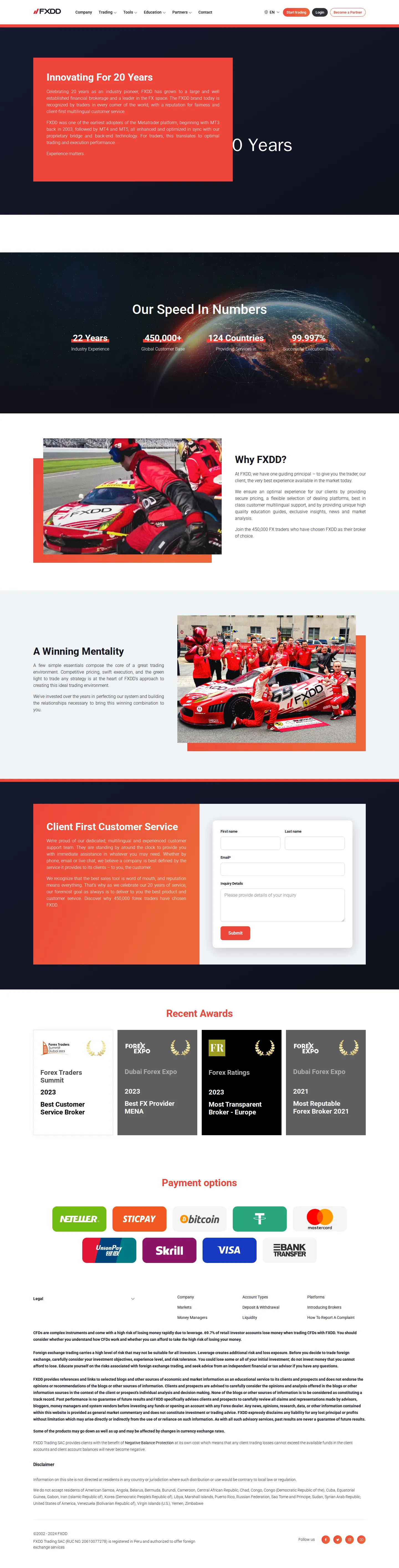
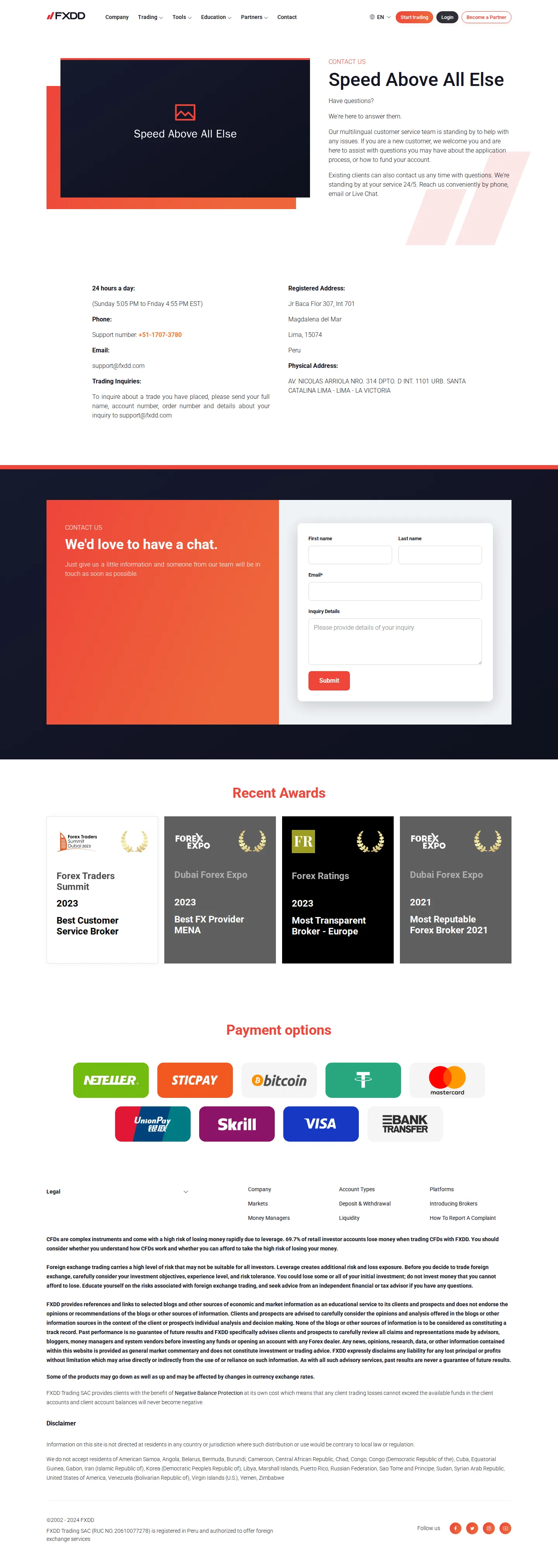
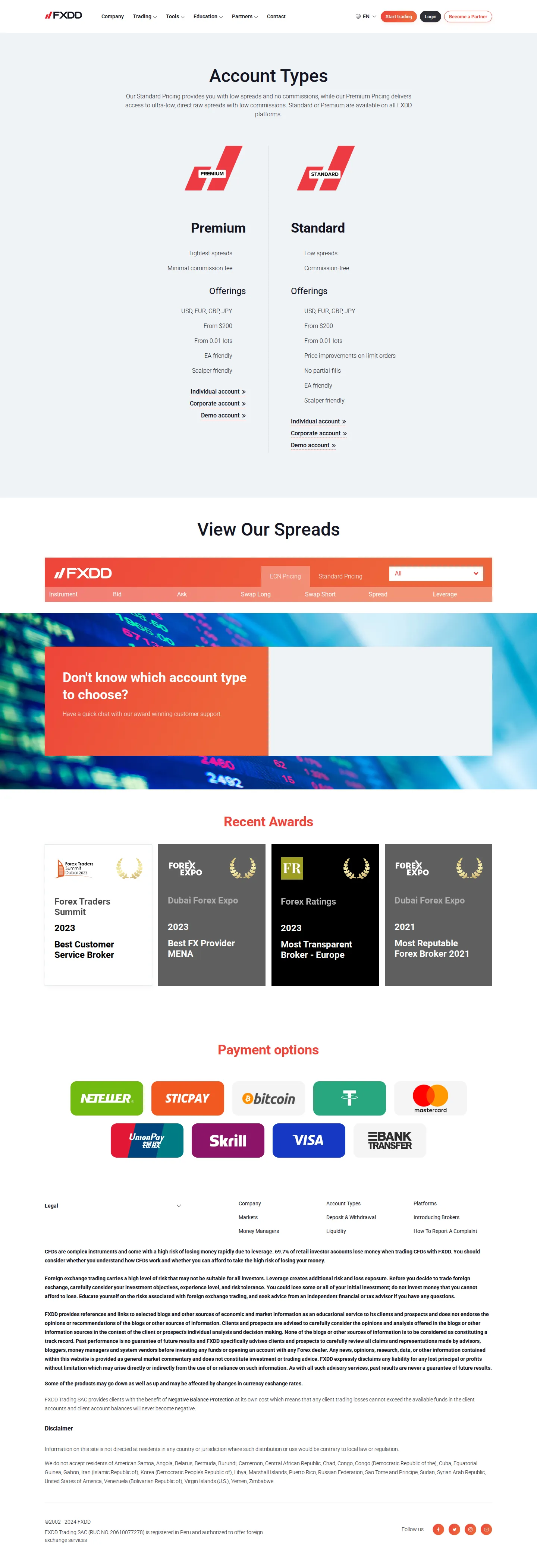
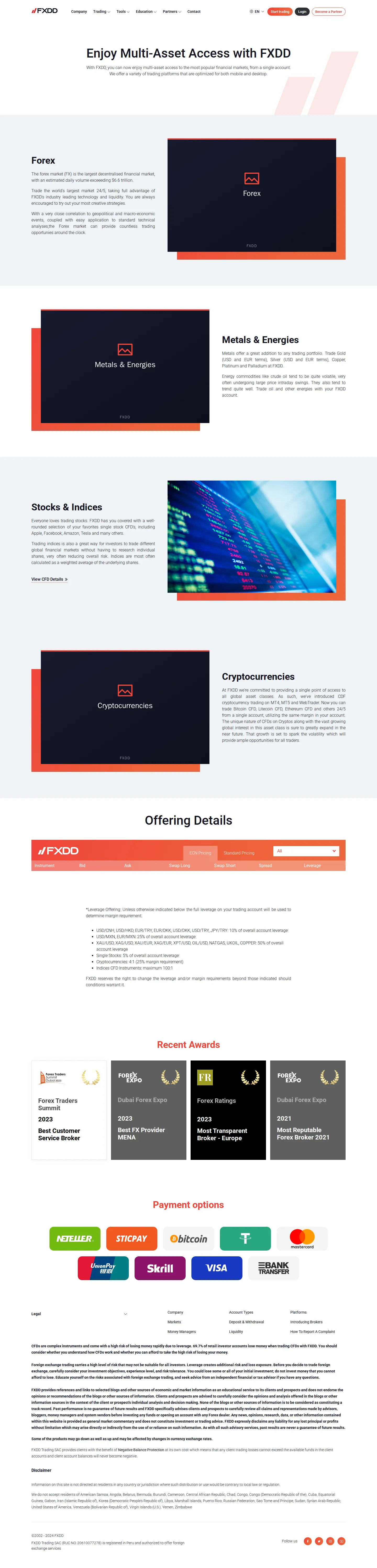
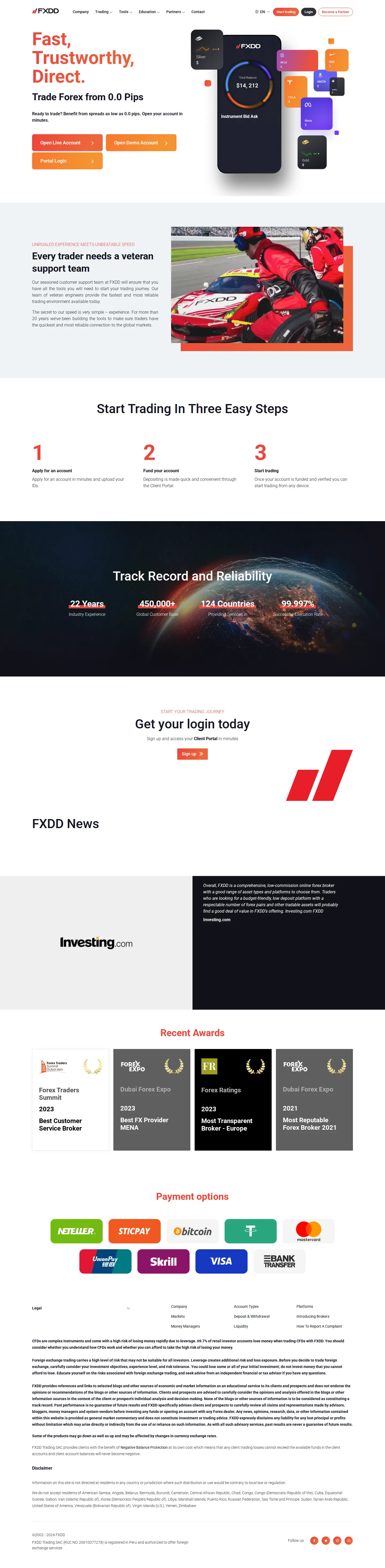
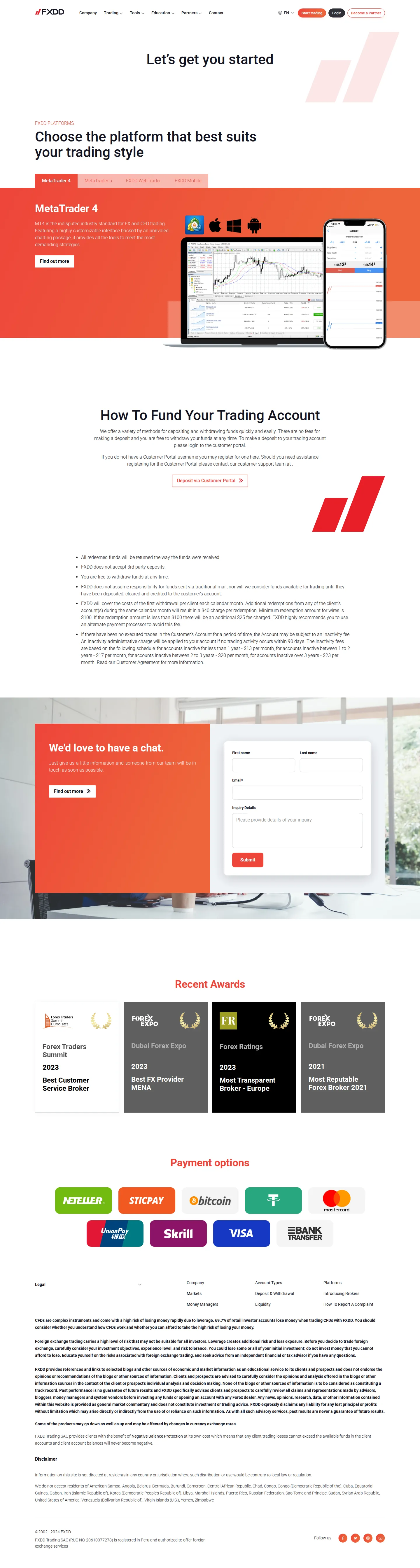
Pages captured from FXDD’s own site when this review was written. Brokers change their terms; these are what we read.
Score history
Recomputed daily; every move is on the record. The current score is always the latest row.
| Date | Score | Move |
|---|---|---|
| 2026-09-29 | 5.4 | ▲ |
| 2026-07-25 | 3.6 | ▼ |
| 2026-07-18 | 3.7 | ▲ |
| 2026-07-11 | 3.6 | · |
FAQ
Is FXDD regulated?
FXDD’s own materials claim a Belize FSC ‘Securities Service Provider’ licence, but that claim was checked against the live FSC register and FXDD was not found on it. No licence for FXDD is confirmed on any regulator register.
What does FXDD charge to trade?
FXDD quotes a round-turn cost of USD 4.06 on 1 lot of EURUSD on its Premium account, with a minimum deposit of USD 200.
What trading platforms does FXDD offer?
FXDD offers MetaTrader 4, MetaTrader 5, its own mobile app, an MT4/MT5 Multiterminal tool, and its Copy Trading and Community platforms.
How can I contact FXDD support?
FXDD can be reached by email and by a published phone number.
What do reviews say about FXDD?
FXDD has a blended rating of 2.15 stars across 66 ratings.
Is the Peru RUC number on FXDD's site a financial licence?
No, it’s a tax and company registration number, not a financial licence, and it has not been independently checked.
How this review works
Track FXDD live: score moves and red notices, in your pocket.