
CFD · CHECKED 10 OCT 2026
GO Markets review.
Australian and Cyprus-regulated broker offering MT4, MT5, cTrader and TradingView
OK-ISH
OUT OF 10
AD DISCLOSURE: IF YOU OPEN AN ACCOUNT THROUGH THIS LINK WE MAY EARN A COMMISSION. IT NEVER MOVES THE SCORE. HOW THIS WORKS
GO Markets is a CFD and forex broker regulated by ASIC in Australia (AFSL 254963) and CySEC in Cyprus (licence 322/17), with a third entity licensed in Mauritius. Spreads start from USD 6.00 round turn on EURUSD and the platform lineup covers MT4, MT5, cTrader and TradingView. The main reservation is a mixed review record, 3.78 stars across 763 ratings, and an unpublished minimum deposit.
Each criterion is scored 1 to 10 from primary sources. The overall score is their unweighted mean. How scoring works.
| Founded | 2006 |
|---|---|
| Headquarters | AU |
| Minimum deposit | $10 |
| Maximum leverage | 500:1 |
| Withdrawal fee | 0 |
| Account opening | 1-3 |
| Platforms | MetaTrader 4 (MT4), MetaTrader 5 (MT5), cTrader, TradingView, GO TradeX™ |
- Tier-1 ASIC licence AFSL 254963, GO Markets Pty Limited, clean since 2004
- Also regulated by CySEC under licence 322/17, entity GO Markets Ltd
- Three licences confirmed across three separate entities, not just one
- CySEC cover includes compensation up to 20,000 EUR and an ombudsman
- Leverage capped at 30:1 on major FX pairs under CySEC rules
- Negative balance protection applies under the CySEC-regulated entity
- FSC Mauritius licence confirmed but the licence number wasn't independently verified
- Minimum deposit not published
- Support entity and escalation path depend on which entity onboarded you
- Reviews are mixed: 3.78 out of 5 stars across 763 ratings
Overview
TrueBroker is a free broker safety checker, and this page is our review of GO Markets, scored 7.5 out of 10 across regulation, fees, platform, support and reviews. GO Markets Pty Limited is the Australian entity behind the brand, and the group also operates regulated offices in Cyprus and Mauritius. The Australian entity holds AFSL 254963, confirmed on the ASIC register as held by GO MARKETS PTY LTD, ABN 85081864039, since 10/03/2004. The company itself is separately confirmed on the ASIC Company Dataset published on data.gov.au, as at the snapshot of 2026 to 09 to 21, listing ACN 081 864 039, registered 05/03/1998, status registered.
Overview Table
| Headquarters | Melbourne, Australia (Level 7, 447 Collins Street, Melbourne, VIC, 3000), with a Sydney office and regulated offices in Cyprus and Mauritius |
|---|---|
| Established | Not stated in the evidence for GO Markets Pty Limited’s trading operations; the company registration itself shows 05/03/1998 |
| Countries Served | Not stated as a published list; the firm’s own root page states it does not offer services in jurisdictions subject to international sanctions or where this would breach local law |
| Regulated By | ASIC (AFSL 254963), CySEC (322/17), FSC Mauritius (SEC-2.1B Investment Dealer, licensed 08/07/2022) |
| Minimum Deposit | $10 USD, stated for the Micro account |
| Maximum Leverage | Up to 30:1 on Standard and GO Plus+ retail accounts; up to 500:1 via a tiered margin or Dynamic Margins model, but only for GO Professional clients who apply and meet selective criteria |
| Total Instruments | Not stated as a total count; the firm’s pages list Forex, Shares, Indices, Commodities, Cryptocurrencies, Bonds and ETFs, and Metals |
| Platforms | MetaTrader 4, MetaTrader 5 (including GO WebTrader), cTrader, TradingView integration, and the firm’s own GO TradeX mobile app |
| Customer Support | Live chat, email and phone across Australia, the UK, Mauritius and Cyprus offices |
| Languages | Not stated |
Facts List
- GO Markets Pty Limited holds AFSL 254963, confirmed on the ASIC register.
- GO Markets Ltd in Cyprus holds licence 322/17, confirmed on the CySEC register of Cypriot Investment Firms.
- GO Markets Pty Ltd (MU) holds an SEC-2.1B Investment Dealer licence in Mauritius, confirmed on the FSC Mauritius Online Public Register, though that register does not publish the licence number, so the number GB19024896 itself is not confirmed by it.
- A Seychelles Investment Dealer licence licence numbered SD043 appears in our earlier review, but the firm’s own current “About us” page lists regulated entities in Australia, Cyprus and Mauritius only.
- We searched 1441 warning list entries mirrored from CySEC, the FCA and FSC Mauritius, and the firm appears on none of them.
- The Micro account has a minimum deposit of $10 USD and offers leverage up to 500:1 with no commission, per the firm’s own accounts page.
- The Standard account offers leverage up to 30:1 with spreads from 0.8 pips and AU$0 commission; GO Plus+ offers spreads from 0.0 pips with an AU$3.00 per side commission on a standard FX lot.
- Platforms include MetaTrader 4, MetaTrader 5, cTrader, TradingView integration, and the firm’s own GO TradeX mobile app.
- The firm’s own risk warning states negative balance protection applies under ASIC’s CFD product intervention order, and that wholesale clients could lose more than their initial investment.
- Our earlier review’s claim that client funds are segregated from GO Markets’ operating funds could not be corroborated on any firsthand the firm page in the evidence checked here.
What the firm is and who runs it
The group trades under three regulated entities named in the firm’s own pages: GO Markets Pty Limited in Australia, GO Markets Ltd in Cyprus, and GO Markets Pty Ltd in Mauritius. GO Markets Pty Limited is the entity described as the CFDs issuer on the firm’s own root page, and it is the one holding the ASIC licence. The Cyprus and Mauritius entities carry their own separate licences rather than operating as branches of the Australian one. The firm’s root page also states that awards and Trustpilot reviews displayed there are attributed to the “GO Markets group of companies” rather than to any one of these entities individually, so a client contracting with, say, the Cyprus entity is not necessarily getting the track record shown for the group as a whole.
The one thing to check before opening an account with GO Markets
The leverage a retail client actually gets depends heavily on which entity and account type they end up on. GO Markets’ own accounts page caps Standard and GO Plus+ retail leverage at 30:1, with the higher tiered margin structure reaching up to 500:1 reserved for GO Professional applicants who meet selective criteria, which effectively means wholesale classification. An older earlier review had stated 1:500 leverage was available on Standard and GO Plus+ retail accounts directly, which the firm’s current own pages do not support. The distinction matters because the firm’s own risk warning ties negative balance protection to retail classification under ASIC’s product intervention order; wholesale clients, who are the ones who can actually reach the higher leverage, are told plainly that they could lose more than their initial investment.
What the firm charges to withdraw
The firm’s own deposits and withdrawals page states that third party payments and over the counter cash payments are strictly prohibited, and that the maximum a client can withdraw back to a debit or credit card is capped at the total previously deposited from that card, with any excess diverted to a bank account in the same name as the trading account. The same page states that clients may be asked for documents verifying the source of their funds or wealth at withdrawal or at any stage of the account, and that the firm may suspend or decline a withdrawal if that information is not provided or if there are regulatory concerns, with no turnaround time stated. Card and bank transfer withdrawals are stated to take 1 business day once processed, per the firm’s accounts page.
Key Takeaways
The score here is 7.5, driven by fees at 9 and platform at 8.4, with regulation and support at 7 and reviews the weak point at 6. What we found in the evidence supports that split: real multi-jurisdiction licensing with a clean warning-list check, competitive published pricing, a wide platform lineup, but contract terms that hand the firm discretion over withdrawals, and gaps between what an older, earlier review said and what the firm’s own current pages say.
Regulation: three confirmed licences, one we could not check
- The ASIC register confirms AFS licence 254963 is held by GO MARKETS PTY LTD, ABN 85081864039, since 10/03/2004.
- The CySEC register of Cypriot Investment Firms confirms licence 322/17 for GO Markets Ltd, by number, holder name and licence date, though the listing does not itself detail which specific investment services it covers.
- The FSC Mauritius Online Public Register confirms GO Markets Pty Ltd holds a SEC-2.1B Investment Dealer (Full Service Dealer excluding Underwriting) licence, granted 08/07/2022; the register publishes the licence type and date but not a licence number, so the number GB19024896 quoted in our earlier review is not itself confirmed by the register.
- The Seychelles FSA licence SD043, carried over from our earlier review, could not be checked: our search of the FSA Seychelles register returned unchecked for lack of an entity name to search on. GO Markets’ own current “About us” page also lists regulated entities only in Australia, Cyprus and Mauritius, with no Seychelles entry, so a reader should not treat SD043 as confirmed.
- We separately checked the Australian Business Register (via the ASIC Company Dataset snapshot of 2026-09-21) and confirmed GO MARKETS PTY LTD as a registered Australian proprietary company, ACN 081 864 039, since 05/03/1998; that is a company registration, not a financial-services licence, and doesn’t add to the licensing picture above.
- We searched 1,441 warning-list entries mirrored from CySEC, the FCA and FSC Mauritius, and the firm appears on none of them. That count covers only the three regulators we mirror, not every regulator worldwide.
What the firm charges
- The Standard account carries no commission and spreads from 0.8 pips, per GO Markets’ own accounts page; GO Plus+ drops spreads from 0.0 pips but adds a per-lot forex commission of AUD 3 / USD 2.5 / EUR 2 / GBP 2, with commodities, indices, cryptocurrencies and bonds commission-free on that account, per the same fee page.
- Share CFD commission varies sharply by market on GO Markets’ fee page: 2 cents per share in the US with no market data fee and no minimum commission; 0.08% in Australia with an AUD 22.00 market data fee; and 0.18% in Hong Kong with a HKD 120.00 market data fee and a minimum commission running from roughly HKD$50 up to CHF7 / USD$7 depending on currency.
- The Micro account opens from just $10 USD with no commission, per GO Markets’ own accounts page.
Withdrawal terms worth reading before funding an account
- GO Markets’ deposits and withdrawals page states plainly that third-party payments and over-the-counter cash payments are “strictly prohibited,” so a client cannot fund the account or take a withdrawal through someone else’s payment method or in cash.
- The same page caps card withdrawals at the total previously deposited from that card; anything above that gets redirected to a bank account in the trading account’s own name, adding a step for clients who have traded profits above their card deposits.
- GO Markets’ own page also reserves the right to ask for source-of-funds documentation at withdrawal or at any other stage, and to suspend or decline a withdrawal if that information isn’t provided or the firm has regulatory concerns, with no stated turnaround time attached.
Platform range
- GO Markets offers MetaTrader 4, MetaTrader 5 (including via GO WebTrader with no download), cTrader, free TradingView integration, and its own mobile app GO TradeX, per the firm’s platform pages, covering both desktop and mobile use cases without steering clients to a single proprietary system.
Where the current pages correct the record
- Our earlier review put retail leverage as high as 1:500 on Standard and GO+ accounts. GO Markets’ current own pages cap retail leverage at 30:1 for forex, 20:1 for indices and 5:1 for bonds/ETFs, with the 500:1 tiered-margin model reserved for GO Professional clients who apply and meet selective wholesale criteria. A reader going by the older figures would materially overstate the leverage, and the risk, available on an ordinary retail account.
- GO Markets’ own risk warning limits negative balance protection to retail clients under ASIC’s CFD product-intervention order; wholesale clients do not have it and, per the same risk warning, “could lose more than your initial investment.” Our earlier review had described the protection as applying to all trading accounts.
- Our earlier review’s claim that client funds are held segregated from GO Markets’ operating funds could not be corroborated on any the firm page in our evidence set, so that claim should be treated as unconfirmed rather than repeated as fact.
Support
- GO Markets lists live chat plus separate support and new-account email addresses and phone lines for Australia, the UK, Mauritius and Cyprus, alongside street addresses for its Melbourne, Sydney, Mauritius and Cyprus offices, per its own contact page.
Licenses & Regulation
GO Markets trades through three separate legal entities: GO Markets Pty Limited in Australia, GO Markets Ltd in Cyprus, and GO Markets Pty Ltd in Mauritius, according to the firm’s own contact and “about” pages. Each carries its own licence, and we checked each one against the regulator that issued it rather than taking the firm’s number at face value.
GO Markets Pty Limited and the ASIC licence
The Australian Securities and Investments Commission’s register confirms AFS licence 254963 is held by GO MARKETS PTY LTD, with the ABN recorded as 85081864039 and the licence dated from 10/03/2004. Separately, the ASIC Company Dataset published on data.gov.au, in the weekly snapshot we checked on 2026-09-21, shows the same company as ACN 081 864 039, ABN 85 081 864 039, an Australian proprietary company registered on 05/03/1998 with status “registered.” That company dataset is ASIC’s company register, not its licence register, so it confirms the company exists and is current but does not, on its own, confirm a licence; the AFS licence lookup does that separately, and both point to the same entity.
The Cyprus licence: GO Markets Ltd
The Cyprus Securities and Exchange Commission’s register of Cypriot Investment Firms confirms licence 322/17, matching the licence number, holder name and licence date. That register is specifically CySEC’s list of authorised CIFs, so the entry evidences a financial-services authorisation rather than mere company existence. It does not, however, set out which specific investment services or instruments the licence covers, so the scope of what GO Markets Ltd is authorised to do in Cyprus is not something the register itself spells out.
GO Markets Pty Ltd (MU) and the Mauritius licence
The Financial Services Commission of Mauritius’s Online Public Register lists GO Markets Pty Ltd holding an SEC-2.1B Investment Dealer (Full Service Dealer excluding Underwriting) licence, dated 08/07/2022. That register publishes the licence type and date but does not publish a licence number, so while the register confirms the company and this permission, it does not corroborate the number GB19024896 that appears in the material we reviewed.
A fourth licence we could not check
An earlier review of the firm reported a Seychelles Financial Services Authority licence, SD043. We were not able to check this against the FSA Seychelles register directly because no entity name was supplied for that lookup, so this licence is unverified rather than confirmed or denied. It is also worth noting that GO Markets’ own “About us” page lists regulated entities in Australia, Cyprus and Mauritius only; it does not name a Seychelles entity alongside them.
Warning-list search
We searched 1,441 warning-list entries mirrored from the CySEC, FCA and FSC Mauritius warning lists, and the firm does not appear on any of them. Before treating that as meaningful, we ran a positive-control search on five registers, using a firm known to be listed, to confirm an empty result reflects absence rather than a broken search. This clean result covers only the three regulators we mirror, not every regulator worldwide, and it is not itself a licence confirmation.
Retail and wholesale status matter to what protection applies
GO Markets’ own risk warning, published on its site, states that negative balance protection applies under ASIC’s product-intervention order, and separately warns that “if you are a wholesale client, you could lose more than your initial investment.” That means the protection against owing more than a deposited balance is tied to a client’s classification, not a blanket feature of every account. The same page states plainly that CFD traders “do not own or have any interest in the underlying assets,” which follows from CFDs being derivative contracts rather than share ownership.
Where the firm says it will not operate
GO Markets’ own root page states that it does not offer its services in any jurisdiction subject to international sanctions or where providing the service would breach local laws, and puts the responsibility on the client to confirm they are not subject to a local restriction. The page does not publish a list of excluded countries alongside that statement, so which specific jurisdictions this covers is not something we can report beyond the general clause itself.
How to Trade
GO Markets runs CFDs across forex, shares, indices, commodities, metals, cryptocurrencies, and bonds and ETFs, according to the firm’s own pages. Execution runs through MetaTrader 4, MetaTrader 5 (also available with no download via GO WebTrader), cTrader, TradingView (integrated free for all the firm clients), and the firm’s own mobile app, GO TradeX.
Account tiers and what they cost
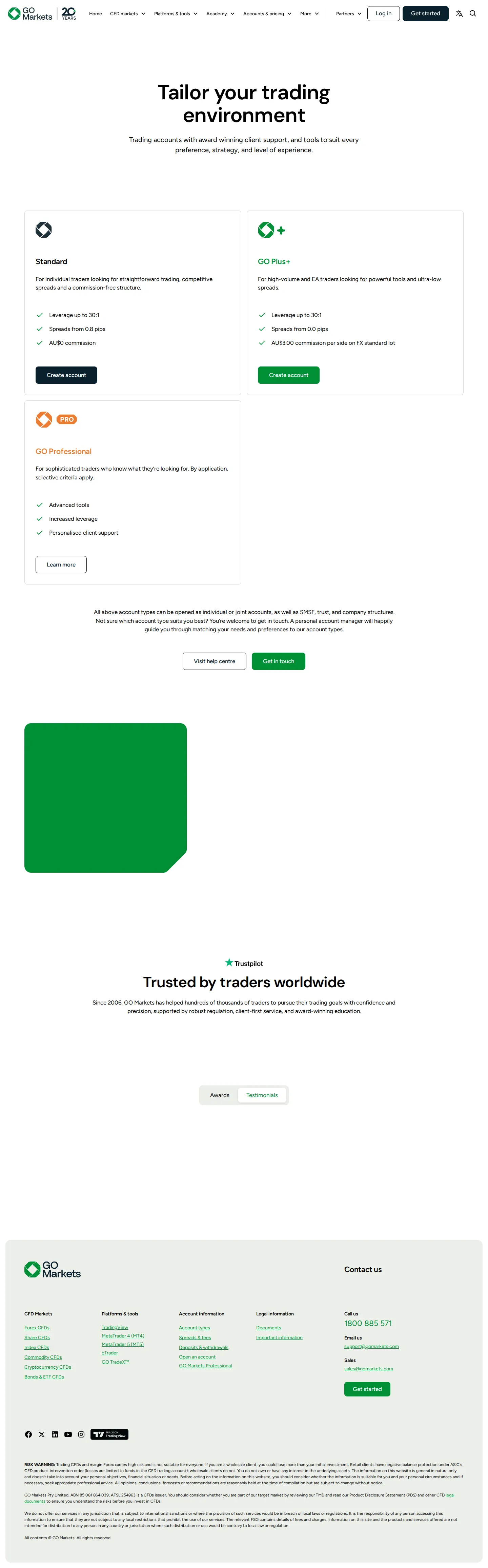
GO Markets’ accounts page lists a Standard account with leverage up to 30:1, spreads from 0.8 pips, and AU$0 commission, alongside a GO Plus+ account with the same 30:1 leverage cap but spreads from 0.0 pips and an AU$3.00 commission per side on a standard forex lot. A Micro account is open from $10 USD with leverage up to 500:1, no commission, and smaller contract sizes. There is also an Islamic, swap free account for traders who cannot receive or pay swaps. On the fee schedule for GO Plus+, forex commission runs per lot at AUD 3, CAD 3, CHF 2, EUR 2, GBP 2, HKD 20, NZD 3, SGD 3, or USD 2.5, while commodities, indices, cryptocurrencies, and bonds are commission free on that account.
Share CFD commission is geography specific on GO Markets’ own fee page. In the UK material it lists a US share CFD commission of 2 cents per share with no market data fee and no minimum commission, a Hong Kong share CFD commission of 0.18% with a HKD 120 market data fee and a minimum commission that varies by currency (HKD$50, AUD$10, EUR$6, GBP$6, CHF$7, USD$7, NZD$10, CAD$9, SGD$10), and an Australian share CFD commission of 0.08% with an AUD 22 market data fee and no minimum commission. The Hong Kong and Australian rebates both require 4 trades.
Leverage, and where GO Markets’ own pages contradict our earlier review
GO Markets’ current pages cap retail leverage at 30:1 for forex on the Standard and GO Plus+ accounts. Leverage up to 500:1, run through a tiered margin, Dynamic Margins model, is reserved for the GO Professional account, which is by application with selective criteria and is aimed at wholesale rather than retail clients. This matters because our earlier review stated that leverage up to 1:500 was available on the Standard and GO+ retail accounts, a figure GO Markets’ own current account pages do not support for a retail client. The Micro account is the exception on paper, listed with leverage up to 500:1 alongside no commission and smaller contract sizes.
The firm’s risk warning states plainly that a CFD trader does not own or have any interest in the underlying assets, so a share CFD position carries no dividend entitlement, voting rights, or other shareholder benefit despite tracking the market price. The same risk warning states that a wholesale client could lose more than their initial investment, which stands against the negative balance protection that applies to retail accounts under ASIC’s CFD product intervention order. Our earlier review’s statement that negative balance protection “applies to all trading accounts” is not what GO Markets’ own current risk warning says; the protection is scoped to retail clients, and wholesale clients are excluded from it.
Money in and out of a the firm account
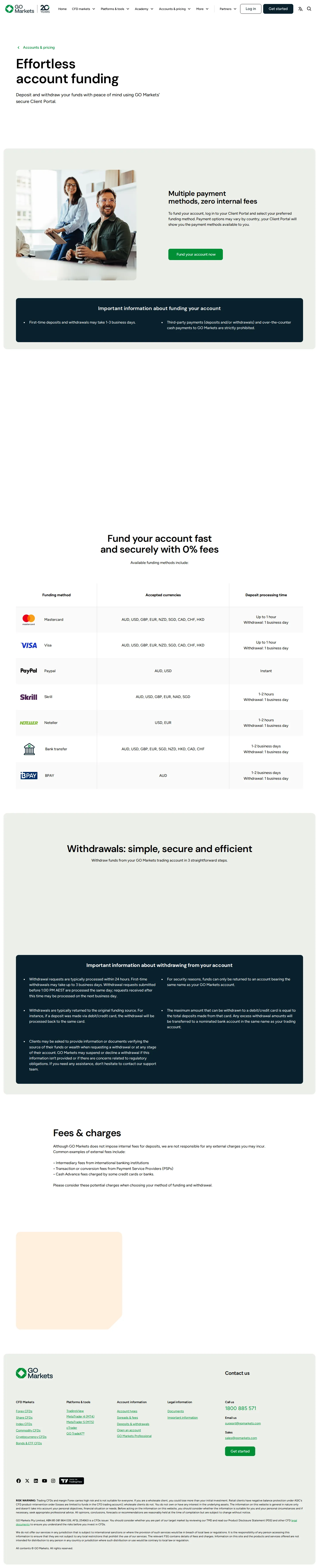
GO Markets’ accounts page lists deposit and withdrawal methods including Mastercard, Visa, PayPal, Skrill, Neteller, bank transfer, and BPAY, across a range of currencies including AUD, USD, GBP, EUR, NZD, SGD, CAD, CHF, and HKD depending on method. Card and e-wallet deposits are quoted at under an hour to 1 to 2 hours, PayPal is instant, bank transfer deposits take 1 to 2 business days, and withdrawals across all listed methods are quoted at 1 business day.
The same page states that third party payments, both deposits and withdrawals, and over the counter cash payments to the firm are strictly prohibited, so a client cannot fund the account or receive a withdrawal through someone else’s payment method or in cash. It also caps card withdrawals at the total amount previously deposited from that card; anything above that is redirected to a bank account in the same name as the trading account rather than paid back to the card. GO Markets’ own page further states that clients may be asked, at withdrawal or at any other stage of the account, to provide information or documents verifying the source of their funds or wealth, and that the firm may suspend or decline a withdrawal if that information is not provided or if there are regulatory concerns, with no turnaround time stated on the page.
Where trading is and is not offered
GO Markets’ own page states that it does not offer its services in any jurisdiction subject to international sanctions or where doing so would breach local laws, and puts the responsibility on the client to confirm they are not subject to local restrictions before trading. The firm does not publish a specific list of excluded countries on the pages checked. Rebates of up to 30% for high volume trading are described on GO Markets’ platforms page as available to wholesale clients only.
Account Types
GO Markets sells five account types off the same evidence page, and the differences are mostly about how the spread/commission mix works rather than about tiers of service.
Standard and GO Plus+
The Standard account carries leverage up to 30:1, spreads from 0.8 pips and AU$0 commission, according to GO Markets’ own accounts page. The GO Plus+ account trades the commission model the other way: leverage up to 30:1, spreads from 0.0 pips, and a AU$3.00 commission per side on a standard forex lot. The firm’s fee page breaks that GO Plus+ commission out further by currency: AUD 3, CAD 3, CHF 2, EUR 2, GBP 2, HKD 20, NZD 3, SGD 3 and USD 2.5 per lot, and states that commission applies to forex only, with commodities, indices, cryptocurrencies and bonds traded commission-free on GO Plus+.
Micro, GO Professional and Islamic accounts
The Micro account needs a $10 minimum deposit and carries no commission, according to the same accounts page, but trades in smaller contract sizes and comes with leverage up to 500:1. GO Professional sits apart from the other three: it is by application, with the accounts page describing “selective criteria” rather than an open sign-up, and it bundles advanced tools, a tiered margin (“Dynamic Margins”) model that reaches leverage up to 500:1, and personalised client support. That higher leverage is explicitly gated: the firm’s restrictions notes state the 500:1 tier is only available to GO Professional clients who apply and clear the selective criteria, not to retail Standard or GO Plus+ account holders. The Islamic account is described on the same page as a swap-free account for traders who cannot receive or pay swaps, without a separate spread or commission figure given.
What the firm charges on shares, beyond the account tiers
Share CFD trading runs on its own commission schedule, set by market rather than by account type, per the firm’s fee page. In the US it is 2 cents per share, with a market data fee of USD 0.00, no rebate, and no minimum commission. In Hong Kong it is 0.18%, with a HKD 120.00 market data fee, a rebate that requires 4 trades, and a minimum commission that varies by currency (HKD$50, AUD$10, EUR$6, GBP$6, CHF$7, USD$7, NZD$10, CAD$9, SGD$10). In Australia it is 0.08%, with a AUD 22.00 market data fee, the same 4-trade rebate condition, and no stated minimum commission.
The leverage figure worth checking against the account, not the marketing
GO Markets’ own market pages cap retail leverage at 30:1 for forex, 20:1 for indices and 5:1 for bonds and ETFs; the 500:1 figure belongs to GO Professional, a wholesale, by-application tier, not to Standard or GO Plus+. That distinction matters because an earlier version of this review described maximum leverage up to 1:500 as available on Standard and GO+ retail accounts. We are flagging that gap rather than repeating it: the firm’s current pages tie the higher figure to GO Professional only, and a reader should size a retail account to the 30:1 cap, not the 500:1 one.
Rebates outside the standard account tiers
GO Markets’ platforms page also lists rebates of up to 30% for high-volume traders, but restricts that offer to wholesale clients, the same classification GO Professional applicants fall under. It is a separate line from the per-trade share rebates above, and the page does not attach a figure or threshold to it beyond the 30% ceiling and the wholesale-only gate.
Negative Balance Protection
GO Markets splits its client base into retail and wholesale, and the risk warning on its own site treats the two very differently when it comes to what a trader can lose. The firm states plainly, in its risk warning: “If you are a wholesale client, you could lose more than your initial investment.” That sentence is written as a warning aimed specifically at wholesale-classified accounts, and its wording only makes sense if retail accounts sit on the other side of that line, protected from losing more than they put in. GO Markets spells out that contrast directly: “Retail clients have negative balance protection under ASIC’s CFD product-intervention order (losses are limited to funds in the CFD trading account); wholesale clients do not.”
What GO Markets’ risk warning actually says about losses
The same risk-warning section also tells clients, in a separate line: “You do not own or have any interest in the underlying assets.” That is the standard CFD position, restated in the firm’s own words rather than assumed: a client is trading the price movement of an instrument, not the instrument itself, so there are no dividends, no voting rights and no shareholder recourse to soften a loss, whatever the account type. Combined with the wholesale warning, the picture from GO Markets’ own page is that loss exposure is defined by classification (retail versus wholesale) rather than by account tier or platform choice.
An earlier version of this review reported that negative balance protection “applies to all trading accounts.” GO Markets’ current risk warning does not support that for wholesale-classified clients, who the firm tells directly that they could lose more than their initial investment; that earlier claim should be read as superseded by the firm’s own current wording rather than relied on.
Leverage caps as the practical brake on drawdown
Since the firm does not publish a stop-out percentage or a margin-call trigger level in the pages we read, the main lever the firm gives clients over how fast an account can run into trouble is the leverage cap tied to account type. GO Markets’ accounts page lists the Standard and GO Plus+ accounts at “Leverage up to 30:1,” and a separate markets page puts the actual retail ceilings at 30:1 for forex, 20:1 for indices and 5:1 for bonds and ETFs. The Micro account, by contrast, is listed on the same accounts page at leverage up to 500:1 with a $10 USD minimum deposit and smaller contract sizes, which caps the leverage multiplier’s dollar impact even where the ratio itself is high.
The higher end of leverage, up to 500:1 through what the firm calls a “tiered margin/Dynamic Margins model,” is reserved for the GO Professional account, and the firm’s accounts page states this is “by application, selective criteria apply.” A separate restriction listed on that same page confirms the scope: increased leverage up to 500:1 through the Dynamic Margins model is only available to GO Professional clients, by application with selective criteria, which by the firm’s own framing excludes ordinary retail applicants from that tier. The same page notes rebates of up to 30% for high-volume traders are similarly limited to wholesale clients only.
An earlier version of this review stated that maximum leverage of “1:500” was available on the Standard and GO+ retail accounts. GO Markets’ current account and markets pages instead cap those retail accounts at 30:1 for forex, with lower caps for indices and bonds/ETFs, and reserve 500:1 for GO Professional applicants. A trader reading the older figure would significantly overestimate how much exposure a standard retail account can actually carry, which matters directly for how large a drawdown that account can generate before it runs into trouble.
Where the drawdown mechanics are thin
What we read from the firm covers the classification split (retail versus wholesale) and the leverage ceilings by account type, but the pages in this evidence set do not go on to describe a stop-out level, a margin-call threshold, or the mechanics of how a position is closed once margin is breached. Anyone relying on this section for the operational detail of how a margin call unfolds should treat the account and risk-warning pages as covering eligibility and loss-exposure classification, not the moment-to-moment mechanics of a breach.
Trading Instruments
GO Markets’ UAE homepage lists CFDs across forex (major, minor and exotic pairs), shares from “ASX, NASDAQ and more,” indices including the S&P 500, DAX and FTSE, commodities such as gold, oil and wheat, and cryptocurrencies including Bitcoin and Ethereum. A separate markets page adds bonds and ETFs, describing treasury CFDs on major government bonds alongside index-tracking ETF CFDs. All of it is traded as a CFD: GO Markets’ own risk warning states plainly that “you do not own or have any interest in the underlying assets,” so a share or bond CFD carries the price exposure without dividends, voting rights or any other shareholder entitlement.
What the firm charges to trade shares
The firm’s fee page breaks share CFD commission out by market rather than quoting one flat rate. US shares run 2 cents per share, with no market data fee and no stated minimum commission. Hong Kong shares are priced at 0.18%, carrying a HKD 120.00 market data fee and a minimum commission that varies by account currency (HKD$50, AUD$10, EUR$6, GBP$6, CHF$7, USD$7, NZD$10, CAD$9 or SGD$10), with a rebate available only after 4 trades. Australian shares are cheaper at 0.08%, with an AUD 22.00 data fee and no stated minimum, again with the rebate gated behind 4 trades. Forex on the GO Plus+ account is priced separately, per lot, at rates from AUD 3 down to EUR/GBP 2 and USD 2.5, and the same fee page states this commission applies to forex only: commodities, indices, cryptocurrencies and bonds trade commission-free on GO Plus+.
Account tiers and what they change about tradeable size
GO Markets’ accounts page describes five tiers. Standard runs commission-free with spreads from 0.8 pips and leverage up to 30:1. GO Plus+ swaps that for spreads from 0.0 pips plus the AU$3.00-per-side commission on a standard forex lot, at the same 30:1 leverage cap. A Micro account drops the minimum deposit to $10 USD, charges no commission, and offers smaller contract sizes at leverage up to 500:1. GO Professional is by application only, with the accounts page noting “selective criteria apply,” and is where the higher leverage lives: a tiered margin, “Dynamic Margins” model reaching up to 500:1. An Islamic account is offered as a swap-free variant for traders who cannot receive or pay swaps. A separate platforms page notes rebates up to 30% for high-volume traders, restricted to wholesale clients.
The gap between the figures from our earlier review and GO Markets’ current pages
An earlier version of this review, reflected in our earlier review text, described maximum leverage of 1:500 as available on Standard and GO+ retail accounts. GO Markets’ current own pages do not support that: the accounts page caps Standard and GO Plus+ at 30:1, and the 500:1 tier is confined to GO Professional, which is by application and carries the “selective criteria apply” language rather than being open to retail clients generally. A related risk-warning gap sits alongside it: GO Markets’ own risk page states that negative balance protection, under ASIC’s CFD product-intervention order, applies to retail clients only, and that wholesale clients could lose more than [their] initial investment. Our earlier review had described negative balance protection as applying to all trading accounts. Both differences point the same way, toward treating the firm’s own current pages as the source for what a retail account can actually access, rather than the earlier figures.
Platforms carrying these instruments
The instruments trade across MetaTrader 4, MetaTrader 5 (also accessible through GO WebTrader with no download), cTrader, and TradingView, which the firm describes as integrated free for all clients. A GO TradeX mobile app is also listed, described on the firm’s platforms page as carrying full desktop functionality in a mobile-first design.
What isn’t established here
The evidence gathered for this review does not include a page-by-page asset list, so the specific number of forex pairs, shares or index CFDs on offer is not something we can report; the pages we read describe the categories and give named examples within each, not counts.
Education & Analysis
GO Markets offers five platforms across its country versions of the site: MetaTrader 4, MetaTrader 5, cTrader, TradingView and its own GO TradeX app. The firm’s platforms page describes MT4 as built for forex and CFD traders with what it calls an intuitive design and stability, while MT5 is positioned for multi-asset trading with advanced analysis and execution tools, accessible through GO WebTrader with no download required. cTrader is described on the same page as built for precision trading with intuitive charts and algorithmic capabilities. None of that is independently testable from the pages fetched; it is the firm’s own description of its own products.
Charting: TradingView bundled in, not a paid add-on
GO Markets’ platforms page states that TradingView integration is free for all the firm clients, and describes the offering as giving access to real-time charts, analysis tools and the TradingView trader community. That is a meaningful line item on its own: TradingView is a separately paid product for retail users elsewhere, and a broker bundling it in without an extra fee is a concrete, checkable claim rather than a vague one. The page does not specify whether the integration is a full TradingView account sync, a broker-hosted TradingView chart window, or something narrower, so what exactly a client gets when they click through is not established by what we fetched.
GO TradeX and mobile access
The firm’s own material describes GO TradeX as its own mobile trading app, delivering what the page calls full desktop platform functionality in a mobile-first design. That is a page describing the firm’s own product.
What GO Markets’ account pages do and don’t say about analysis tools
The account pages in this evidence set describe the Standard, GO Plus+, Micro, GO Professional and Islamic accounts entirely in terms of leverage, spreads and commission; none of the fetched account pages ties a specific platform or charting toolset to a specific account tier. So while the platforms page lists MT4, MT5, cTrader, TradingView and GO TradeX as available, the evidence here does not establish whether all five are available on every account type listed, or whether some combination is restricted by tier. Readers who want to trade Share CFDs, which the firm’s fee page prices per market (2 cents/share in the US commission table, 0.18% in Hong Kong, 0.08% in Australia, each carrying its own market data fee), should check with the firm directly which platform carries the data feed for a given exchange, since the fee page ties data charges to the instrument and region rather than to a chart or platform.
Algorithmic and precision trading
cTrader is marketed on GO Markets’ own platforms page specifically for its algorithmic capabilities, alongside the “precision trading” language. MT4 is the platform most associated industry-wide with Expert Advisors, but the evidence fetched here does not include a the firm page that itemises EA support, VPS provision, or automated-trading permissions account by account, so that is a gap in what we hold rather than something the firm has stated one way or the other.
What the platforms page leaves out
The platforms page names no proprietary desktop charting suite beyond GO TradeX; the figures it does give, “400+ technical indicators” and “110+ smart drawing tools”, are TradingView’s, and it names cTrader Copy Trading and a Signal Centre without saying what either costs or does in detail. Where the account and fee pages are specific down to the cent (GO Plus+ commission of AUD 3 / USD 2.5 / EUR 2 per lot on forex, for instance), the platform descriptions mostly stay at the level of adjectives: “intuitive,” “precision,” “advanced.” That contrast is worth naming for what it is: a fee schedule the firm has published in numbers, and a charting and tools offering the firm has described in marketing language on the same site, without the pages fetched here breaking the firm’s own tools down to the level of what order types or automation each platform actually supports.
Special Offers
The pages in our evidence set for the firm are account, fee and platform pages, not a promotions or bonus page, so this section reports what those pages actually describe rather than filling the gap with a supposed absence.
What GO Markets’ account pages describe instead of a bonus
GO Markets’ accounts page sets out five account types and prices each through spreads and commission rather than through any deposit match or credit. The Standard account is described as carrying leverage up to 30:1 with spreads from 0.8 pips and AU$0 commission. The GO Plus+ account is described as carrying leverage up to 30:1 with spreads from 0.0 pips and AU$3.00 commission per side on a standard forex lot. The Micro account is described with a $10 USD minimum deposit, leverage up to 500:1, no commission and smaller contract sizes. GO Professional is described as available by application, with selective criteria, advanced tools and a tiered margin or Dynamic Margins model reaching up to 500:1 leverage. An Islamic account is described as a swap free account for traders who cannot receive or pay swaps. None of these five descriptions frames the account itself, or opening one, as a promotional offer with a credit or bonus attached.
The one volume based reduction the pages do describe
GO Markets’ platforms page states that rebates of up to 30% for high volume traders are available, and restricts this to wholesale clients only, not retail clients. The fee page we read sets out separate share CFD commission schedules for the US, Hong Kong and Australia, and two of those three, Hong Kong and Australia, list a rebate that requires four trades in the relevant conditions; the US schedule lists the rebate as not applicable. Where a minimum commission applies, the fee page states it in the local currency for each schedule: for example HK$50, A$10, EUR6, GBP6, CHF7, US$7, NZ$10, CA$9 or S$10 under the Hong Kong schedule. GO Plus+’s per lot commission is set out by currency, for example AUD 3, USD 2.5 or EUR 2 per lot, and the same page states that commodities, indices, cryptocurrencies and bonds are commission free on GO Plus+, while forex carries the listed per lot charge. These are fee mechanics tied to trading volume and account type, not conditions attached to a promotional credit.
What the deposit and withdrawal terms say about moving money, not about matching it
The deposits and withdrawals page we read states that third party payments and over the counter cash payments to the firm are strictly prohibited, and that the maximum amount withdrawable to a debit or credit card is equal to the total deposits made from that card, with any excess transferred to a nominated bank account in the same name as the trading account. The same page states that the firm may ask a client to provide information or documents verifying the source of funds or wealth when a withdrawal is requested, or at any stage of the account, and that the firm may suspend or decline a withdrawal if that information is not provided or if there are regulatory concerns. These are conditions on getting a client’s own money out, not conditions on redeeming a bonus, and the review should not blur the two.
Where the record is silent
The evidence set for this review does not include a the firm promotions page, deposit bonus page or referral offer page in any of the geo variants fetched (Australia, UK or UAE facing). That means this review cannot state what promotional offers the firm runs, if any, in the reader’s region at the time of reading; it means only that the pages fetched for this review were account, fee, platform and contact pages, and none of them was a promotions page. A reader who wants to know whether a bonus is currently live should check GO Markets’ own site directly, since a page not being in our fetch set is not the same as a page not existing.
The warning list check, for completeness
Separately from promotions, we searched 1441 warning list entries mirrored from the CySEC, FCA and FSC Mauritius regulators and the firm appears on none of them. That result covers only the three mirrored lists, not every regulator, and it has no bearing on whether the firm runs a promotional program; it is reported here only because it is the one clean, checkable result this section can add rather than leaving the promotions question with nothing on the record at all.
Opening an Account
Account opening runs through GO Markets’ own signup flow rather than anything we tested directly; the evidence set here is the firm’s account-types and contact pages, so we describe what those pages state and flag where our review process could not corroborate a claim on the firm’s current site.
Account types on offer at GO Markets
GO Markets’ accounts page lists five account types. The Standard account carries leverage up to 30:1, spreads from 0.8 pips, and AU$0 commission. GO Plus+ carries the same 30:1 leverage cap but spreads from 0.0 pips with an AU$3.00 commission per side on a standard forex lot. A Micro account is listed separately with a minimum deposit of $10 USD, leverage up to 500:1, no commission, and smaller contract sizes than the standard accounts. An Islamic account is offered as a swap-free variant for clients who cannot receive or pay swaps. A fifth tier, GO Professional, is by application only, with the page stating “selective criteria apply” and describing advanced tools, a tiered margin or “Dynamic Margins” model reaching leverage up to 500:1, and personalised client support.
The 500:1 figure attached to GO Professional matters because it is not the leverage a retail applicant gets by default. GO Markets’ own pages state retail leverage is capped at 30:1 for forex, 20:1 for indices and 5:1 for bonds and ETFs, with the 500:1 tier reserved for GO Professional applicants who clear the by-application criteria; a separate note on the platforms page ties the higher rebates and margin model to wholesale clients specifically, alongside “up to 30% rebates for high-volume traders” restricted to wholesale clients only. An older, earlier review of this review had stated 1:500 leverage was available on Standard and GO Plus+ retail accounts; that no longer matches what GO Markets’ current pages show, and we’ve corrected it here rather than repeat it.
Who the firm will not open an account for
GO Markets’ own page states plainly that it does not offer its services in any jurisdiction subject to international sanctions or where provision of services would breach local laws or regulations, and puts the burden on the applicant: it is the client’s responsibility to make sure they are not subject to local restrictions before applying. The page does not name the excluded countries, so we can’t tell a reader which jurisdictions are shut out beyond that general sanctions and local-law standard; a reader who needs certainty on a specific country should ask the firm directly rather than infer it from this wording.
Wholesale classification carries its own consequence for anyone who ends up there: GO Markets’ risk warning states “if you are a wholesale client, you could lose more than your initial investment,” which the firm’s page ties to the ASIC negative-balance-protection order applying to retail accounts and not wholesale ones. An applicant weighing GO Professional against a retail tier is trading the 500:1 leverage ceiling for the loss of that protection.
Verification once the account is open: what the firm checks on withdrawal
GO Markets’ deposits and withdrawals page ties verification to money movement rather than describing a single onboarding checklist. It states that clients “may be asked to provide information or documents verifying the source of their funds or wealth when requesting a withdrawal or at any stage of their account,” and that the firm can suspend or decline a withdrawal if that information isn’t supplied or if the firm has concerns tied to its regulatory obligations. No turnaround time is given for that check, so a client whose withdrawal triggers it has no stated window for when funds become accessible again.
The same page prohibits funding or receiving funds through a third party: “third-party payments (deposits and/or withdrawals) and over-the-counter cash payments to GO Markets are strictly prohibited,” meaning the account, the funding method and the person named on both have to match. Card-funded accounts carry a related cap: the maximum a client can withdraw back to a debit or credit card is capped at the total previously deposited from that card, with anything above that redirected to a bank account in the same name as the trading account. That is an extra identity check bolted onto withdrawal rather than onboarding, and it adds a step and a delay for any client whose profits exceed their card deposits.
Where the firm can open the account: the entities behind the registration
GO Markets’ regulatory footprint spans three entities named on its own about and contact pages: GO Markets Pty Limited in Australia, GO Markets Pty Ltd in Mauritius, and GO Markets Ltd in Cyprus. The ASIC register confirms AFS licence 254963 as held by GO MARKETS PTY LTD, ABN 85081864039, since 10 March 2004, and the Australian Business Register’s company dataset separately confirms that same ABN against ACN 081 864 039, an Australian proprietary company registered 5 March 1998 and currently listed as registered; that second confirmation covers the company’s existence, not its licence. The Cyprus Securities and Exchange Commission’s register confirms licence 322/17 against GO Markets Ltd. The FSC Mauritius Online Public Register confirms the Mauritius entity holds an SEC-2.1B Investment Dealer (Full Service Dealer excluding Underwriting) licence dated 8 July 2022, though the register does not publish the licence number itself, so the number GB19024896 sits outside what that register confirmed. A Seychelles FSA licence number, SD043, appears in an older earlier review of this review but not on GO Markets’ current “About us” page, which lists only the Australian, Cypriot and Mauritian entities; we checked the firm against the Seychelles FSA register directly and could not run that check because no entity name was supplied for the lookup, so this licence is neither confirmed nor ruled out here. Which of these three confirmed entities actually opens a given applicant’s account will depend on where they sign up from, and each carries different terms: notably, whether negative balance protection applies at all depends on the entity and the client’s retail or wholesale classification, not on the account type chosen at signup.
We searched 1,441 warning-list entries mirrored from the CySEC, FCA and FSC Mauritius warning lists and the firm does not appear on any of them; that check covers only the lists we mirror, not every regulator globally, but it is a clean result worth recording for anyone weighing whether to open an account.
Deposits & Withdrawals
GO Markets lists seven funding rails on its own accounts page: Mastercard, Visa, PayPal, Skrill, Neteller, bank transfer and BPAY. Card and bank deposits (Mastercard, Visa, bank transfer) land within an hour to two business days depending on the method, and PayPal deposits are instant; Skrill and Neteller deposits are quoted at one to two hours. Most of these methods share the same withdrawal turnaround: one business day.
Currency coverage varies by rail. Cards and bank transfer cover the widest spread (AUD, USD, GBP, EUR, NZD, SGD, CAD, CHF, HKD), PayPal is limited to AUD and USD, Neteller to USD and EUR, and BPAY to AUD only, which matters if a client’s account currency doesn’t match what a given method supports.
What GO Markets’ terms attach to a withdrawal
The firm’s deposits and withdrawals page states plainly that “third-party payments (deposits and/or withdrawals) and over-the-counter cash payments to GO Markets are strictly prohibited.” A client can’t fund the account from someone else’s card or receive a payout to another person’s method, and cash isn’t accepted at all.
Card withdrawals are capped by what went in on that card. The same page states: “the maximum amount that can be withdrawn to a debit/credit card is equal to the total deposits made from that card. Any excess withdrawal amounts will be transferred to a nominated bank account in the same name as your trading account.” In practice, a client who has traded a card deposit into profit gets the deposited principal back on the card and the profit routed to a bank account instead, which means naming a bank account and clearing whatever verification that adds before the balance above the card cap actually pays out.
The same page also reserves broad discretion over the request itself: “clients may be asked to provide information or documents verifying the source of their funds or wealth when requesting a withdrawal or at any stage of their account. GO Markets may suspend or decline a withdrawal if this information isn’t provided or if there are concerns related to regulatory obligations.” No turnaround is stated for how long such a check can run, so a source-of-funds request sits as an open-ended condition on getting money out rather than a bounded delay.
What sits underneath the transfer costs
The published fee material we read covers trading commissions rather than a deposit or withdrawal fee schedule: share CFD commissions run from 0.08% in Australia to 0.18% in Hong Kong (with a minimum commission and a market data fee attached to the Hong Kong tier), 2 cents per share in the US, and on the GO Plus+ account a per-lot forex commission of roughly AUD/CAD/NZD/SGD 3, CHF/EUR/GBP 2, HKD 20 or USD 2.5, with commodities, indices, crypto and bonds commission-free on that account tier.
One point worth flagging on scope: awards and reviews displayed on GO Markets’ own pages are credited to the “GO Markets group of companies” rather than to a single regulated entity, and a client’s funding rails and account terms in practice depend on which entity in that group actually onboards them, GO Markets Pty Limited in Australia (AFSL 254963, confirmed on the ASIC register), GO Markets Ltd in Cyprus (licence 322/17, confirmed on the CySEC register), or GO Markets Pty Ltd in Mauritius (licence GB19024896, confirmed on the FSC Mauritius register, though that register publishes the licence type and date rather than the number itself). The deposit and withdrawal terms quoted above come from the firm’s own accounts page rather than from any one entity’s jurisdiction-specific agreement, so a client opening with a particular regional entity should check whether that entity’s own client agreement repeats these terms unchanged.
Customer Support
GO Markets splits its support desk by the entity that actually holds a client’s account. The contact page lists separate support and new-accounts email addresses for each regulated arm: support@gomarkets.com and newaccounts@gomarkets.com for the Australian entity, support.mu@gomarkets.com and newaccounts.mu@gomarkets.com for GO Markets Pty Ltd (MU) in Mauritius, and support@gomarkets.eu and newaccounts@gomarkets.eu for GO Markets Ltd in Cyprus, plus a general sales@gomarkets.com address. A client who signed up under the Cyprus entity and emails the Australian address, or the reverse, is writing to the wrong desk before the conversation even starts.
Phone coverage follows the same split: a toll-free Australian line (1800 885 571) and a second Australian number (+61 385 667 680), a UK number (+44 2036 377 618), an international/Mauritius line (+230 5869 0074), and a Cyprus line (+357 25023910). There’s also live chat through the website (“Start live chat”), and physical offices in Melbourne, Sydney, Mauritius and Limassol. GO Markets’ own markets page states that customer support runs 24/7.
What GO Markets’ support actually gates
The account tiers show support isn’t uniform across clients. The GO Professional tier, open only by application to those who meet its selective criteria, lists “personalised client support” as one of its features alongside the higher leverage and Dynamic Margins model available to that tier. Standard, GO Plus+, Micro and Islamic account holders aren’t offered that line item on GO Markets’ own accounts page, so a retail client’s support experience is not necessarily the one described for professional applicants.
The terms that bind a client who complains about money
The parts of GO Markets’ published terms most likely to matter to a client in a dispute sit in the deposits and withdrawals material, not in a stated complaints policy. Third-party payments are addressed directly: the firm states that “third-party payments (deposits and/or withdrawals) and over-the-counter cash payments to GO Markets are strictly prohibited,” which means a client can’t fund an account or receive a withdrawal through someone else’s card or account, or in cash, and any attempt will be rejected outright.
Card withdrawals are capped by what went in on that card: GO Markets’ own page states that “the maximum amount that can be withdrawn to a debit/credit card is equal to the total deposits made from that card,” with anything above that sent instead “to a nominated bank account in the same name as your trading account.” A client asking support to return profits to the card they funded with will be redirected to a bank transfer for the difference, which adds a step and a delay to what looks on paper like a simple withdrawal request.
The firm also reserves the right to stop a withdrawal from moving at all pending its own checks. Its deposits and withdrawals page states that clients “may be asked to provide information or documents verifying the source of their funds or wealth when requesting a withdrawal or at any stage of their account,” and that the firm “may suspend or decline a withdrawal” if that information isn’t provided or if it has concerns tied to its regulatory obligations. No turnaround time is stated for that review, so a client who is asked for source-of-funds documents has no published clock telling them when the money moves again, and the decision to release it sits with the firm.
What’s missing from what we read
None of the pages in this evidence set set out a numbered complaints procedure, an internal escalation path, or a stated response-time commitment for support tickets or withdrawal reviews. The 24/7 coverage claim and the channel list above describe how to reach the firm; they don’t describe what happens once a complaint is logged, beyond the withdrawal-specific holds already quoted. A client weighing this section should treat the contact list as confirmed and the source-of-funds and card-withdrawal clauses as the concrete constraints that apply once a complaint touches money.
Prohibited Countries
Nothing in the the firm pages we reviewed lists which countries’ residents it will not accept. The closest the firm’s own site comes is a general clause on its homepage: the firm does not offer its services in any jurisdiction subject to international sanctions or where providing its services would breach local laws or regulations, and the homepage puts the responsibility on the client to check they are not subject to local restrictions. That is a policy statement, not a named list of excluded countries, and it does not tell a reader from which countries the firm will actually decline an application.
No published country list on GO Markets’ own pages
An earlier version of this review recorded a methodology check against gomarkets.com itself: it searched the homepage, the legal pages, the terms and the legal-documents pages (via an Indonesian exit, checked 27 July 2026) and found no published restricted-country list anywhere on the site. That same earlier review had previously carried a list of excluded countries, including Iran, North Korea, Syria and Cuba, and removed it once it could not verify those names against anything the firm had actually published. We are reporting that as what the earlier review did and found, not as a check our review process ran itself, and it should be read as second-hand: absent our own fetch of a current restricted-country page, we cannot confirm whether the firm excludes those countries, any others, or none by name.
What the licensing footprint suggests, and its limits
GO Markets operates through three entities our review process confirmed on public registers: GO Markets Pty Limited holds AFSL 254963 on the ASIC register, GO Markets Ltd holds licence 322/17 on the Cyprus Securities and Exchange Commission register, and GO Markets Pty Ltd (MU) holds a SEC-2.1B Investment Dealer licence on the Financial Services Commission of Mauritius register, dated 08/07/2022. GO Markets Pty Limited is also on the Australian Business Register as ABN 85 081 864 039, a company record rather than a licence. None of these three confirmations amounts to a published statement of which countries the firm will or will not serve; a licence in Australia, Cyprus or Mauritius describes where the firm is authorised to operate from, not a list of jurisdictions its clients may not reside in.
An earlier review also cited a fourth licence, SD043 with the Financial Services Authority of Seychelles, but GO Markets’ own current “About us” page lists regulated entities in Australia, Cyprus and Mauritius only and does not mention Seychelles. We could not check SD043 against the FSA Seychelles register ourselves because no entity name was supplied for it. A reader should treat the Seychelles licence as unconfirmed rather than assume it still applies or that it shapes GO Markets’ current country eligibility rules.
The practical effect for a prospective client
With no restricted-country list on GO Markets’ own pages, a person outside a country carrying international sanctions has no published document from the firm to check their own eligibility against before applying. The homepage clause quoted above puts that determination on the client rather than on a stated list, and the onboarding process itself, which sits behind account opening rather than in the fetched pages, is presumably where any country-level exclusion would actually surface. Nothing in the pages the firm published for the jurisdictions we fetched names a country by name as excluded, so none should be read into this review.
Conclusion
GO Markets earns 7.5 out of 10 in this review, up from our previous score of 7.2, built from separate scores for regulation (7), fees (9), platform (8.4), support (7) and reviews (6). Each of those numbers rests on a specific piece of checking, set out below.
What the registers actually confirm about GO Markets
We searched five public registers directly: ASIC, CySEC, the FSC Mauritius, the FSA Seychelles and the Australian Business Register, running a positive control on each so that a clean result means absence rather than a broken search. The ASIC register confirms AFS licence 254963 is held by GO MARKETS PTY LTD (ABN 85 081 864 039, since 10 March 2004), and the ASIC company register separately confirms the same ABN as a registered Australian proprietary company since 5 March 1998. The CySEC register of Cypriot Investment Firms confirms licence 322/17. The FSC Mauritius Online Public Register confirms GO Markets Pty Ltd holds an SEC-2.1B Investment Dealer licence, effective 8 July 2022, though the register publishes the licence type and date rather than the licence number, so the company and its permission are confirmed while the number GB19024896 itself is not. The FSA Seychelles licence SD043, which the earlier review attributed to this firm, could not be checked on this pass because no entity name was supplied for that search, so we’re not in a position to confirm or deny it; notably, GO Markets’ own current “About us” page lists regulated entities in Australia, Cyprus and Mauritius only. We also searched 1,441 warning-list entries mirrored from CySEC, the FCA and the FSC Mauritius, and the firm appears on none of them.
Why fees score highest
GO Markets’ own account pages put the Standard account at AU$0 commission with spreads from 0.8 pips, and GO Plus+ at spreads from 0.0 pips against a per-lot commission of AUD 3 (or the equivalent in other base currencies) on forex, with commodities, indices, cryptocurrencies and bonds commission-free on that account. The firm’s published fee schedule sets share CFD commission at 2 cents per share in the US, 0.18% in Hong Kong (with a HKD 120 market data fee and a minimum commission that scales by currency), and 0.08% in Australia with a AUD 22 market data fee and no stated minimum.
Platform and instrument range behind the 8.4
GO Markets’ own platform pages list MetaTrader 4 and MetaTrader 5, cTrader, TradingView (integrated free for clients) and the firm’s own mobile app, GO TradeX. Its markets pages cover forex, share CFDs, indices, commodities, cryptocurrencies, metals and bond and ETF CFDs.
The withdrawal terms worth reading before funding an account
GO Markets’ deposits and withdrawals page states that third-party payments and over-the-counter cash payments are “strictly prohibited,” and that the maximum amount withdrawable to a debit or credit card is capped at the total previously deposited from that card, with any excess diverted to a nominated bank account in the trading account’s name. GO Markets’ deposits and withdrawals page also states clients “may be asked to provide information or documents verifying the source of their funds or wealth” at withdrawal or at any stage of the account, and that the firm “may suspend or decline a withdrawal” if that isn’t provided or if regulatory concerns arise, with no turnaround time stated. Separately, the firm’s own risk warning says a wholesale client “could lose more than your initial investment,” which contradicts our earlier review’s claim that negative balance protection covers all account types; GO Markets’ current wording ties that protection to retail clients under ASIC’s product-intervention order.
Support, and where GO Markets’ current pages disagree with the older review
GO Markets’ contact page lists live chat, phone lines for Australia, the UK, Mauritius and Cyprus, and separate support and new-account email addresses for each regulated entity. The reviews score sits lower than fees or platform partly because the awards and Trustpilot ratings shown on GO Markets’ own pages are credited to the “GO Markets group of companies” rather than to the specific regulated entity a client signs up with, and partly because our earlier review overstated retail leverage at up to 1:500 where GO Markets’ current pages cap retail forex leverage at 30:1, reserving 500:1 for GO Professional clients who apply and meet selective criteria.
GO Markets holds confirmed ASIC, CySEC and FSC Mauritius licences, charges no commission on its Standard account, and runs MT4, MT5, cTrader and TradingView across forex, shares, indices and crypto CFDs, but its terms let it freeze a withdrawal pending source-of-funds checks with no stated deadline. GO Markets scores 7.5 out of 10.
What we saw
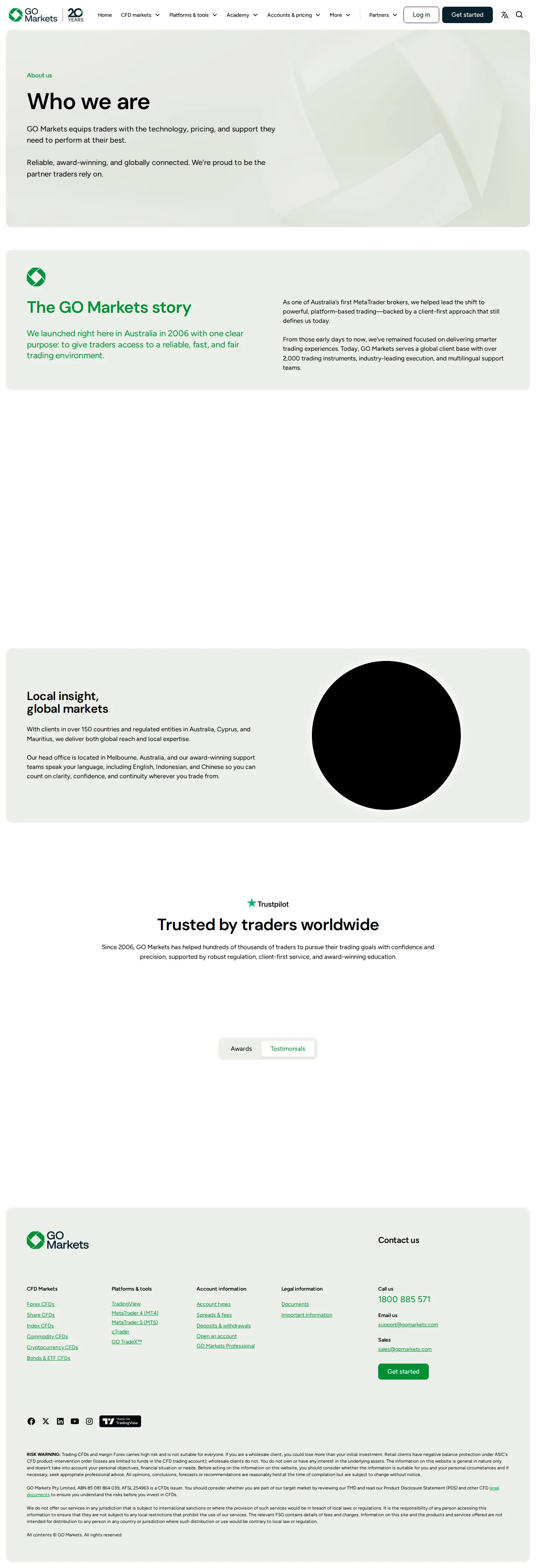
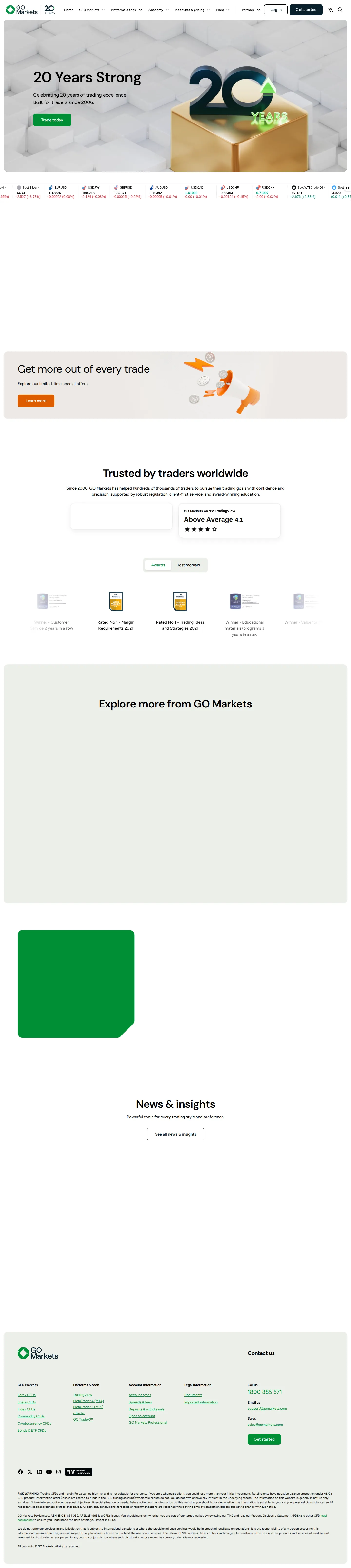
Pages captured from GO Markets’s own site when this review was written. Brokers change their terms; these are what we read.
Score history
Recomputed daily; every move is on the record. The current score is always the latest row.
| Date | Score | Move |
|---|---|---|
| 2026-10-08 | 7.5 | ▲ |
| 2026-07-25 | 7.2 | ▼ |
| 2026-07-18 | 7.3 | ▼ |
| 2026-07-11 | 7.5 | · |
FAQ
Is GO Markets regulated?
Yes. It holds a tier-1 ASIC licence (AFSL 254963) in Australia and a CySEC licence (322/17) in Cyprus, plus a Mauritius FSC licence.
What does GO Markets charge in spreads?
Spreads start from USD 6.00 round turn on 1 lot of EURUSD on the GO Plus+ account; the minimum deposit isn’t published.
What trading platforms does GO Markets offer?
MetaTrader 4, MetaTrader 5 (including the web terminal), cTrader, TradingView and its own mobile app.
Is GO Markets' Mauritius licence verified?
The licence is confirmed as issued in 2022, but the licence number itself wasn’t independently verified.
What do GO Markets reviews look like?
The blended rating is 3.78 stars across 763 ratings, a mixed record rather than a strong one.
Does GO Markets offer negative balance protection?
Yes, under the CySEC-regulated entity, which also caps leverage at 30:1 on major FX pairs and offers compensation cover up to 20,000 EUR.
How this review works
Track GO Markets live: score moves and red notices, in your pocket.