INSTITUTIONAL · CHECKED 13 OCT 2026
TFI review.
Hong Kong group holding three confirmed SFC licences across three entities
RISKY
OUT OF 10
TFI is a Hong Kong group with three confirmed SFC licences across its Securities and Futures, Asset Management, and Capital entities, backed by a listed parent, Tianfeng Securities (SSE:601162). The regulatory picture is clean, but fees aren't fully published and support escalation depends on which entity onboarded the client.
Each criterion is scored 1 to 10 from primary sources. The overall score is their unweighted mean. How scoring works.
| Founded | 2016 |
|---|---|
| Headquarters | HK |
| Minimum deposit | Not stated |
| Account opening | 1-3 |
- SFC licences BAV573, ASF056, BPW736 confirmed active on register
- Clean disciplinary record with the SFC
- Listed parent: Tianfeng Securities (SSE:601162), with a named shareholder
- TFI Pro platform: real-time data, algorithmic trading, risk analytics
- API and FIX protocol support for algorithmic trading strategies
- Voice Desk offers broker-assisted execution during business hours
- No EURUSD spread figure published for an account retail clients can open
- Unclear which entity handles support or escalation after onboarding
- Blended rating of only 3.07 stars across just 8 reviews
- Investor compensation capped at 500,000 HKD
- No negative balance protection requirement under SFC rules
- SFC adjudicator decisions bind the firm but charge the claimant a fee
Overview
TrueBroker is a free broker safety checker, and this page is our review of TFI, scored 4.9 out of 10 across regulation, fees, platform, support and reviews.
TFI is not one company but a group of Hong Kong entities operating under TF International Securities Group Limited. Per the firm’s own site, the group sits under Tianfeng Securities Co., Ltd., a company based in Wuhan, Hubei Province, listed on the Shanghai Stock Exchange on 19 October 2018 under stock code 601162, whose controlling shareholder is Hubei Hongtai Group Co., Ltd. In Hong Kong, the regulated business is split across three separately licensed subsidiaries rather than run through a single legal entity: TFI Securities and Futures Limited, TFI Asset Management Limited, and TFI Capital Limited.
Overview Table
| Headquarters | Hong Kong (jurisdiction of TFI Securities and Futures Limited, TFI Asset Management Limited and TFI Capital Limited on the SFC public register register) |
| Established | Not stated |
| Countries Served | Not stated |
| Regulated By | Securities and Futures Commission of Hong Kong (SFC) |
| Minimum Deposit | Negotiable for Corporate and Institutional accounts; HK$8 million for HNWI Professional accounts, per our earlier review |
| Maximum Leverage | Not stated |
| Total Instruments | Not stated |
| Platforms | TFI Pro, API access, a voice dealing desk and mobile access, per our earlier review |
| Customer Support | Not stated |
| Languages | Not stated |
Facts List
- TF International Securities Group Limited is the Hong Kong subsidiary of Tianfeng Securities Co., Ltd., listed on the Shanghai Stock Exchange under stock code 601162, per the firm’s own site.
- The controlling shareholder of Tianfeng Securities is Hubei Hongtai Group Co., Ltd., described on the same page as the only financial services enterprise affiliated with Hubei Province.
- Three Hong Kong entities carry three separate SFC licences: TFI Securities and Futures Limited (CE No. BAV573, Types 1, 2 and 4), TFI Asset Management Limited (CE No. ASF056, Types 4, 5 and 9), and TFI Capital Limited (CE No. BPW736, Type 6).
- We checked all three CE numbers against the Hong Kong SFC Public Register of Licensed Persons and Registered Institutions and found each active, with no public disciplinary action recorded against any of them.
- The SFC register attaches licensing conditions to each: 3 conditions on BAV573, 2 on ASF056, and 1 on BPW736.
- A “Group CE Number,” BOK471, circulated in the earlier review could not be confirmed: when we checked it against the SFC register, the register returned “No record found.”
- The earlier review flagged a separate, similarly named entity, “TFI Markets LTD,” as unregulated and a possible source of confusion for depositors.
- We searched 1441 warning-list entries mirrored from CYSEC, FCA and FSC Mauritius, running a positive control on each list first, and found no match for TFI.
- Our own fetches of TFI’s contact page returned 404 or empty responses across every region we tried, including the UK, UAE, Indonesia and Australia, so no phone number, email or postal address could be confirmed from the firm’s own site.
- The earlier review describes TFI as serving only institutions, companies and wealthy individuals who qualify as Professional Investors under Hong Kong rules of a portfolio above HK$8 million, not retail traders.
What the Hong Kong SFC register actually shows for TFI
The three licences that matter here belong to three different legal entities, not one. TFI Securities and Futures Limited holds CE No. BAV573 for Type 1 (Dealing in Securities), Type 2 (Dealing in Futures Contracts) and Type 4 (Advising on Securities). TFI Asset Management Limited holds CE No. ASF056 for Type 4 (Advising on Securities), Type 5 (Advising on Futures Contracts) and Type 9 (Asset Management). TFI Capital Limited holds CE No. BPW736 for Type 6 (Advising on Corporate Finance), which its own status text on the register describes as a licensed corporation under the Securities and Futures Ordinance. We checked all three against the SFC Public Register of Licensed Persons and Registered Institutions directly, ran a positive control against the same register first, and found all three active with no disciplinary action on file. That is a clean, checkable result on the register that matters most for this business.
What we could not confirm is a fourth number. Our earlier review refers to a “Group CE Number,” BOK471, as if it were a group-level identifier sitting above the three subsidiary licences. We checked BOK471 against the same SFC register and it came back “No record found.” We hold no register entry for the exchange and clearing bodies the same earlier review names (HKEX, HKSCC, SEOCH, HKFE, MPFA), and no licence number was given for those either, so that part is a gap in our own directory rather than a finding about TFI. The practical point for a reader is narrower and more useful: check a deposit or account offer against BAV573, ASF056 or BPW736 specifically, not against BOK471 or a bare group name.
Why TFI Securities and Futures is not open to retail traders
The earlier review reported that TFI serves only institutions, companies and wealthy individuals who qualify as Professional Investors under Hong Kong rules, a portfolio above HK$8 million, and does not open accounts for retail traders. It described three account tiers on that basis: Corporate and Institutional, both with negotiable minimum deposits, a dedicated relationship manager, and fee structures set by negotiation or volume; and HNWI Professional, gated at the HK$8 million threshold, with a tiered fee structure and case-by-case credit facilities. The same earlier review reported that TFI offers none of the negative balance protection retail brokers usually give, so a client’s losses are not capped at their account balance if the market gaps against an open position. It also reported that deposits must arrive by bank wire from an account already in the client’s own name, matching their TFI account registration, with no third-party or cash deposits accepted, and that standard withdrawals carry no TFI fee beyond whatever the client’s own bank or a currency conversion charges. None of this comes from a TFI page we fetched ourselves; our own attempts to reach TFI’s contact and legal pages returned empty or 404 responses across every region we tried, so these terms are reported here as what the earlier review found, not verified against the firm’s own site.
Why this review’s score moved from 4.3 to 4.9
Our previous score for TFI was 4.3 out of 10; this review scores it 4.9. That move is our reassessment, not a change in TFI itself, and it reflects the register work above: three separate SFC licences checked directly and confirmed active with no disciplinary record, against a positive control that shows the check was working, is a stronger basis for the regulation score than a single unverified group number. Set against that, fees, support and reviews stay weak in this score: fee terms and support channels rest on the earlier review rather than a page we fetched ourselves, and TFI’s own contact page could not be reached from any region we tried, which is the kind of gap that keeps a support score down regardless of what the underlying licence looks like.
Key Takeaways
Score: 4.9 out of 10, up from 4.3
This review scores TFI 4.9 out of 10, up from a previous score of 4.3. That move is ours, not the firm’s: the criteria we score against and the evidence behind them both changed between reviews, so the shift reflects this review’s assessment against current evidence rather than anything TFI did differently in the interim. Regulation carries the highest subscore, at 7.4, on the strength of three confirmed Hong Kong SFC entries. Fees (3), support (3.8) and reviews (4.2) stay low because most of what sits behind them is either text from our earlier review that we didn’t fetch ourselves or a firsthand page that failed to load.
What the SFC register shows for TFI
- The Hong Kong SFC Public Register confirms three separate licensed corporations in the group: TFI Securities and Futures Limited (CE No. BAV573, Type 1, Type 2 and Type 4, all active), TFI Asset Management Limited (CE No. ASF056, Type 4, Type 5 and Type 9, all active), and TFI Capital Limited (CE No. BPW736, Type 6, active). None of the three carries a recorded public disciplinary action.
- All three licences carry conditions attached to them: three on BAV573, two on ASF056, one on BPW736. The register doesn’t give us the text of those conditions in what we pulled, only the count.
- A fourth number, BOK471, cited in our earlier review as a “Group CE Number,” returns no record at all on the SFC register when we searched it. Whatever that number refers to, it isn’t a licence the SFC lists.
- We ran a positive control against a firm known to be listed before treating any of this as absence, and we searched TFI against 1,441 warning-list entries mirrored from CySEC, the FCA and the FSC Mauritius. No match. That covers three lists, not every regulator that exists, but it’s a clean result on the ones we hold.
- Claims tied to HKEX/HKSCC/SEOCH/HKFE and MPFA registrations, the Shanghai Stock Exchange listing (601162) for parent company Tianfeng Securities, and a China ICP filing number are all things we have not checked against any register we hold. That’s a gap in our own directory, not a finding about the firm one way or the other.
What TFI charges, on the evidence we have
- Our earlier review reports no TFI fee for a standard withdrawal, with the client covering charges from intermediary banks and any currency conversion, and expedited withdrawals available for an extra fee. We did not read a firsthand fee page confirming this.
- Deposits and withdrawals run through bank wire in HKD or USD, same-day within Hong Kong ahead of a 3:00 PM cut-off, and one to five business days for international transfers depending on direction. Deposits must come from a bank account in the client’s own name matching the TFI account; no third-party or cash funding.
- Account minimums run from “negotiable” on the Corporate and Institutional tiers to HK$8 million for the HNWI Professional tier, again from our earlier review rather than a page we fetched ourselves.
- None of this is firsthand pricing. Attempts to reach tfisec.com’s own contact and account pages returned 404s or empty bodies across every region we tried, so there’s no fee schedule of TFI’s own behind these figures.
Platform and who TFI will actually take on
- Our earlier review describes four access routes: the proprietary TFI Pro platform, FIX-based API trading, a voice desk for assisted execution, and a mobile app with reduced functionality. We have not tested any of these ourselves.
- TFI restricts itself to institutions, companies and wealthy individuals who qualify as Professional Investors under Hong Kong rules of a portfolio over HK$8 million; it does not take retail clients.
- Our earlier review describes a risk disclosure stating TFI offers none of the negative balance protection retail brokers usually give, with clients liable for losses beyond their account balance if a position gaps against them. We have not read that disclosure firsthand.
Where support and contact details stand
- We collected no firsthand support evidence for TFI. Every attempt to load tfisec.com’s contact page, from four different regional exits, came back as a 404 or an empty body, and root-page fetches from the UK, Vietnam, South Africa and the UAE also failed or returned near-empty content.
- Root pages loaded fine from Thailand, Japan, Germany, Australia, Indonesia and Singapore, which points to a reachability problem rather than a confirmed geo-block, but we can’t say which it is from what we have.
- Any phone number, email or postal address attributed to TFI elsewhere traces back to our earlier review, not to a page of the firm’s own that we could verify.
One name-confusion risk worth flagging
Our earlier review warns of a high risk of confusion with unregulated ‘TFI Markets LTD,’ a separately named entity it describes as unregulated. Anyone checking this firm should match the specific CE numbers above, BAV573, ASF056 and BPW736, against the entity they’re actually dealing with before depositing.
Licenses & Regulation
TFI operates through three separately licensed Hong Kong entities under the TF International Securities Group. We searched the Hong Kong SFC Public Register directly for all three and ran a positive control first, checking a known-listed firm on the same registers, so an absence would have meant something.
What the SFC register confirms about TFI’s licensed entities
TFI Securities and Futures Limited holds CE reference BAV573 on the SFC register, confirmed and active for Type 1 (Dealing in Securities), Type 2 (Dealing in Futures Contracts) and Type 4 (Advising on Securities). The register shows no public disciplinary action against it and lists three licensing conditions attached to the licence.
TFI Asset Management Limited holds CE reference ASF056, confirmed and active for Type 4 (Advising on Securities), Type 5 (Advising on Futures Contracts) and Type 9 (Asset Management), also with no public disciplinary action recorded and two licensing conditions attached.
TFI Capital Limited holds CE reference BPW736, confirmed and active for Type 6 (Advising on Corporate Finance), with no public disciplinary action recorded and one licensing condition attached. The firm’s own pages describe this entity as licensed under the Securities and Futures Ordinance (Chapter 571 of the Laws of Hong Kong) to conduct Type 6 regulated activities.
What we could not check
The group’s pages also cite registrations with Hong Kong’s exchange and clearing bodies, HKEX, HKSCC, SEOCH and HKFE, plus MPFA, describing TFI Securities and Futures Limited as registered as an MPF Intermediary, SEHK Participant, HKSCC Direct Clearing Participant, SEHK China Connect Exchange Participant, HKSCC China Connect Clearing Participant, SEOCH Direct Clearing Participant, HKFE Futures Commission Merchant and HKCC Clearing Participant. We hold no register entry for any of these bodies, so none of that has been checked against a primary source; it stands as what the firm’s own pages state.
The parent company, Tianfeng Securities Co., Ltd., is cited on the group’s pages as listed on the Shanghai Stock Exchange under stock code 601162 since 19 October 2018. We hold no register entry for the Shanghai Stock Exchange either, so this listing code has not been checked against that exchange directly. The same applies to a China ICP filing number (鄂ICP备12000957号-5) shown in the group site’s footer; we hold no register for the Chinese ICP filing authority, so this too is unverified against a primary source.
A separate identifier, CE reference BOK471, is cited in our earlier review as a “Group CE Number” tied to TF International Securities Group Limited. We checked it directly against the SFC Public Register, and the register returns no record for it. That number is not confirmed on the register that confirms the other three.
The look-alike risk named for TFI
Our earlier review flagged a risk of confusion with a separate, similarly named entity, “TFI Markets LTD,” described there as unregulated. We have not independently checked that entity’s regulatory status; the point stands as a reason to match any deposit destination against the confirmed CE numbers above, BAV573, ASF056 and BPW736, rather than the TFI name alone.
Warning lists and the score
We searched 1,441 warning list entries mirrored from CySEC, the FCA and the FSC Mauritius, and TFI does not appear on any of them. That covers only the regulators we mirror, not every regulator worldwide, but within that scope the result is clean.
Our previous review scored this section, among others, at 4.3 out of 10 overall; this review scores 4.9 out of 10 overall, with regulation itself now at 7.4. That movement reflects our current assessment against the criteria this review applies, not any change at the firm: the three confirmed, active SFC licences with no disciplinary history, set against the unverified group level identifier and the exchange and ICP registrations we could not check against a primary source, are what this section’s evidence now shows.
How to Trade
What TFI trades
An earlier review of TFI described three main instrument groups. On equities, the earlier review reported direct trading in Hong Kong listed shares on HKEX in both board lots and odd lots, plus the Shanghai-Hong Kong and Shenzhen-Hong Kong Stock Connect programmes for eligible mainland A-shares, alongside access to U.S. and other global equities. On futures and options, it described professional access to index, commodity and currency futures on exchanges including HKEX, CME and SGX, with strategies such as spread trading, arbitrage and more complex options structures. On fixed income, it described government and corporate bonds and other debt instruments, positioned for institutional liability management or income objectives, with particular depth in Asian fixed income.
How orders actually get placed
The earlier review listed four separate access routes rather than one platform. TFI Pro is described as the firm’s proprietary system, with real-time data feeds, advanced order types, algorithmic trading, risk analytics, multi-currency handling, research access and coverage of the full asset range during market hours. API Trading is described as a FIX-protocol or similar interface for algorithmic strategies and system integration, again with full asset coverage but only limited research access. Voice Desk is assisted execution placed through dealers, available only during business hours, also with full asset coverage. Mobile Access is the narrowest of the four: limited asset coverage, basic real-time data, and no advanced order types or algorithmic trading, though it runs 24/7. Which of these a client actually gets depends on account tier rather than being uniformly available.
Who TFI Securities and Futures will actually deal with
The earlier review was explicit that TFI does not serve retail traders. It described the firm as restricted to institutions, companies and wealthy individuals who qualify as Professional Investors under Hong Kong rules, set at portfolios exceeding HK$8 million. That threshold maps onto the account structure the earlier review set out: a Corporate tier and an Institutional tier, both with negotiable minimum deposits, a dedicated relationship manager, full research access, all platform options, credit facilities, and API access, with the Institutional tier running a volume-based fee structure and full prime services against the Corporate tier’s negotiated fees and limited prime services; and an HNWI Professional tier with the stated HK$8 million minimum deposit, the same relationship-manager and research access, but only TFI Pro plus limited platform options, credit facilities handled case by case, a tiered fee structure, API access only on request, no prime services, and standard rather than enhanced custody.
Clearing and exchange membership
The group’s own site states that TFI Securities and Futures Limited is registered as “MPF Intermediary, SEHK Participant, HKSCC Direct Clearing Participant, SEHK China Connect Exchange Participant, HKSCC China Connect Clearing Participant, SEOCH Direct Clearing Participant, HKFE Futures Commission Merchant, and HKCC Clearing Participant.” These sit alongside the firm’s SFC licences rather than replacing them, and they are what let TFI clear trades directly on the Hong Kong exchange and futures markets instead of routing through a third party. We have not been able to check these registrations against the HKEX, HKSCC, SEOCH, HKFE or MPFA registers directly, so this rests on what the firm’s own page states rather than an independent register confirmation.
The clause that decides who eats a bad gap
The earlier review reported that TFI does not provide retail-style negative balance protection. Under that account, a client carries full responsibility for a position that moves against them, including an obligation that can exceed the account balance, and during extreme volatility or a price gap a position can go negative with the client remaining liable for the shortfall. For an institutional or HNWI client trading futures, options or leveraged instruments through TFI, that is the mechanism that determines the actual worst case on a position, not just the margin posted against it.
Funding and pulling money out
The earlier review described deposits as bank wire only, in HKD or USD as the primary currencies with other major currencies available by arrangement, and no acceptance of third-party payments or cash. The wire has to originate from a bank account held in the client’s own name that matches the name on the TFI trading account, which is an anti-money-laundering control rather than a convenience feature, and it cuts against clients who might otherwise want to fund an account from a corporate treasury account that doesn’t share the trading entity’s name. Same-day processing was described for transfers between Hong Kong banks, against one to three business days for international transfers, using what the earlier review called institutional currency conversion rates.
On the way out, the earlier review described withdrawals going back to the originating account or to another pre-verified account in the client’s name, with a 3:00 PM Hong Kong time cut-off for same-day processing between Hong Kong banks and two to five business days for international transfers. It reported no TFI fee for standard withdrawal processing, with the client instead responsible for charges from intermediary banks and any currency conversion, and it described expedited withdrawals as available but subject to additional fees and further compliance checks.
Account Types
TFI runs a strict tiering system that shuts retail traders out entirely. Our earlier review reported three account levels: Corporate, Institutional and HNWI Professional, each gated by negotiated or fixed minimums rather than a flat sign up threshold.
The three tiers TFI sells
Corporate accounts carry a negotiable minimum deposit and come with a dedicated relationship manager, full research access, every platform option, credit facilities, a negotiated fee structure, API access, limited prime services and custody options, according to the earlier review. Institutional accounts sit at the same negotiable minimum but step up to a volume based fee structure and full prime services alongside the dedicated RM, research access, platform access, credit facilities, API access and custody options.
HNWI Professional is the one tier with a published number attached: HK$8 million, per the earlier review. That figure lines up with the eligibility bar TFI states elsewhere, that it serves high net worth individuals meeting Hong Kong’s Professional Investor criteria for portfolios exceeding HK$8 million. This tier gets a dedicated RM and full research access like the other two, but the platform access narrows to TFI Pro plus limited platform options, credit facilities are decided case by case, the fee structure is tiered rather than negotiated or volume based, API access is available only on request, prime services are not included at all, and custody is standard rather than the fuller custody options offered higher up.
Who TFI will not open an account for
The earlier review reported that TFI exclusively serves institutions, companies and wealthy individuals who clear Hong Kong’s Professional Investor criteria. A retail trader with a smaller account has no tier to buy into here; the entire structure is built around the HK$8 million HNWI floor and negotiated terms above it.
What buying into TFI actually exposes a client to
None of the three tiers comes with retail style negative balance protection. The earlier review reported that TFI does not offer it, and that clients carry the whole loss when positions move against them, including amounts beyond their account balances; in extreme volatility or gap moves, a position can leave a client owing TFI money beyond what they deposited. That risk sits on top of every tier equally, Corporate, Institutional or HNWI Professional, since none of the three is described as capping losses at the account balance.
Funding is similarly rigid across all three tiers. The earlier review reported that deposits must arrive by bank wire only, from a bank account in the client’s own name that matches their TFI trading account registration, with no third party or cash deposits accepted. That AML driven restriction applies regardless of which tier a client holds.
What we could and could not verify about these tiers
We hold direct, register confirmed licensing for the entities behind these accounts. The SFC register shows TFI Securities and Futures Limited holding CE reference BAV573 for Type 1, Type 2 and Type 4 activities, TFI Asset Management Limited holding CE reference ASF056 for Type 4, Type 5 and Type 9, and TFI Capital Limited holding CE reference BPW736 for Type 6, all shown active with no public disciplinary action recorded. But the account names, minimums and feature lists above come from our earlier review not from a TFI page we fetched ourselves; attempts to pull TFI’s own account or fees pages returned empty or failed across every region we tried. We could not independently confirm the HK$8 million threshold, the negotiable minimums on the other two tiers, or any of the listed features against tfisec.com directly.
We also searched 1,441 warning list entries mirrored from CYSEC, the FCA and the FSC Mauritius, and TFI appears on none of them. That is a clean result within the scope of the lists we mirror, not a clearance from every regulator globally.
Why this score moved
Our previous score for TFI was 4.3 out of 10; this review scores it 4.9. The regulation score of 7.4 reflects the three confirmed, active SFC licences with no disciplinary history and the clean warning list search, both of which this review verified directly against the register rather than taking on trust. Fees score only 3, since the one figure we can attribute with any confidence, that TFI charges no withdrawal fee for standard processing beyond correspondent bank and conversion costs, comes from the earlier review rather than a fetched fee schedule, and no pricing detail exists for the three account tiers themselves, negotiated, volume based or tiered, none of it published in a form we could check.
Negative Balance Protection
TF International Securities does not publish a negative balance policy on any page our review process could fetch directly: attempts to reach TFI’s own risk-disclosure, terms, or legal pages returned 404s or empty bodies across every region tested, including a UK exit where every sub-page failed while the same site loaded from Thailand, Japan, Germany, Australia, Indonesia and Singapore. What follows on this point comes from our earlier review not from a TFI document we read ourselves, and it is reported here as that earlier review’s account rather than as a quotation from the firm.
What the earlier review said TFI does not offer
The earlier review reported that TF International Securities offers none of the negative balance protection retail brokers usually give, and that clients bear full responsibility for positions moving against them, including obligations that exceed the funds held in the account. It also reported that during extreme volatility or gap movements, positions can leave a client with a negative balance, and that the client remains liable for that shortfall. Because this reached us second-hand rather than from a TFI page, it should be read as what the earlier review found, not as wording lifted from a TFI agreement, and it has not been independently confirmed against a document we fetched.
Who this exposure actually falls on
TFI is not a retail broker. The earlier review described the firm as serving institutions, companies and wealthy individuals who qualify as Professional Investors under Hong Kong rules, with portfolios exceeding HK$8 million, and as closed to retail traders. Its account tiers as described in that review run from a Corporate account and an Institutional account, both with negotiable minimum deposits, up to an HNWI Professional account set at that HK$8 million figure. A firm dealing in this size of account, on the account descriptions given, is dealing in futures and margin positions large enough that an uncapped loss obligation is not a theoretical clause: the client base described is the client base for whom a gap-driven shortfall would be sized in proportion to an eight-figure-or-larger book, not a retail ticket.
What the Hong Kong SFC register does and doesn’t cover here
We searched the Hong Kong SFC Public Register of Licensed Persons and Registered Institutions directly and confirmed three separate licensed corporations in the group. TFI Securities and Futures Limited holds CE reference BAV573, active for Type 1 (Dealing in Securities), Type 2 (Dealing in Futures Contracts) and Type 4 (Advising on Securities), with three licensing conditions attached; the register does not give the text of those conditions, so we cannot say whether they touch margin, leverage or loss-bearing terms. TFI Asset Management Limited holds CE reference ASF056, active for Type 4, Type 5 (Advising on Futures Contracts) and Type 9 (Asset Management), carrying two licensing conditions. TFI Capital Limited holds CE reference BPW736, active for Type 6 (Advising on Corporate Finance), carrying one licensing condition. None of the three entries the SFC register shows carries a public disciplinary action. A fourth number, BOK471, cited in the earlier review as a “Group CE Number,” returned no record at all when we searched it on the same SFC register: the register answered “No record found.” That number should not be relied on as a separate licence, and the entity it was meant to describe should be checked against BAV573, ASF056 or BPW736 instead before anyone treats it as a live SFC reference.
Funding and the practical question of settling a shortfall
The earlier review also described TFI’s deposit process as bank wire only, from a bank account held in the client’s own name and matching the name on the TFI trading account, with no third-party or cash deposits accepted. That rule governs how money moves into the account; it says nothing, on the evidence available to us, about how a client would be expected to cover a balance that has gone negative, and no TFI page we fetched addressed that question either. A prospective client with an account of the size TFI’s tiers describe should get the negative-balance and margin-call mechanics in writing from TFI directly, rather than relying on either this review or the earlier one it draws from, given that neither rests on a TFI document either of us has actually read.
Trading Instruments
TFI Securities and Futures Limited holds CE reference BAV573 on the Hong Kong SFC Public Register of Licensed Persons and Registered Institutions, active for Type 1 (Dealing in Securities), Type 2 (Dealing in Futures Contracts) and Type 4 (Advising on Securities), with the register recording no public disciplinary action and three licensing conditions attached. A sister entity, TFI Asset Management Limited, holds CE reference ASF056 on the same register, active for Type 4 (Advising on Securities), Type 5 (Advising on Futures Contracts) and Type 9 (Asset Management), with two licensing conditions. A third entity, TFI Capital Limited, holds CE reference BPW736, active for Type 6 (Advising on Corporate Finance), with one licensing condition. Between them, that is the licensed basis for dealing in and advising on securities, futures and asset management under the group’s Hong Kong entities; corporate finance advisory sits in a separate licensed company again.
What TFI Securities and Futures registers itself for beyond the SFC licences
The firm’s own site states that TFI Securities and Futures Limited is also registered as an MPF Intermediary, an SEHK Participant, an HKSCC Direct Clearing Participant, an SEHK China Connect Exchange Participant, an HKSCC China Connect Clearing Participant, an SEOCH Direct Clearing Participant, an HKFE Futures Commission Merchant, and an HKCC Clearing Participant. We have not checked any of these against the exchange or clearing bodies’ own registers, so this is what the firm publishes about itself, not a register-confirmed fact. The same page states that the group’s parent, Tianfeng Securities Co., Ltd., listed on the Shanghai Stock Exchange on 19 October 2018 under stock code 601162; we have not checked that code against the Shanghai Stock Exchange’s own records either, for the same reason: we hold no register entry for that exchange in our directory.
A separate number, BOK471, is cited elsewhere as a “Group CE Number” for TF International Securities Group Limited, but that citation traces to our earlier review rather than to a page we fetched. We searched the SFC Public Register for BOK471 directly, and it returns “No record found.” Anyone relying on a group-level CE number to check this firm should use BAV573, ASF056 or BPW736 for the specific entity they intend to deal with, not BOK471.
What the earlier review said TFI Securities and Futures trades
Our earlier review described three asset classes. Equities: Hong Kong listed shares traded directly through HKEX in both board lots and odd lots, participation in the Shanghai-Hong Kong and Shenzhen-Hong Kong Stock Connect programs for eligible mainland A-shares, and access to US and other global equities. Futures and options: index, commodity and currency futures across HKEX, CME and SGX, with strategies described as including spread trading, arbitrage and more complex options structures. Fixed income: government and corporate bonds and other debt instruments, pitched at institutional liability management or income objectives, with a stated focus on Asian fixed income markets. None of this is drawn from a TFI page we fetched ourselves, so it should be read as what the earlier review reported the firm offers rather than as wording taken from the firm’s own site.
The same earlier review tied asset access to which execution channel a client uses. It described TFI Pro, the proprietary platform, and the API/FIX channel and the voice desk as each carrying full asset coverage, while the mobile app was described as limited: no advanced order types and no algorithmic trading, alongside basic real-time data. It also tied asset and platform access to account tier: Corporate and Institutional accounts were described as carrying all platform options and full or volume-based prime services, while the HNWI Professional tier was described as carrying TFI Pro plus a limited set of platform options, credit facilities case by case, and no prime services at all. The HNWI Professional tier itself was described as requiring a HK$8 million minimum, which lines up with a separate restriction the same review stated: that the firm serves institutions, companies and wealthy individuals meeting Hong Kong’s Professional Investor threshold, and does not serve retail traders.
A name to watch for
The earlier review flagged a separate, similarly named entity, “TFI Markets LTD,” as unregulated, and warned of a risk of confusion between it and the SFC-licensed TFI Securities and Futures Limited. We have not independently investigated that entity; anyone checking eligibility to trade with this firm should confirm they are dealing with CE BAV573, ASF056 or BPW736 specifically, since those are the reference numbers the SFC register actually confirms. We also searched 1,441 warning-list entries mirrored from CYSEC, the FCA and the FSC Mauritius, and TFI does not appear on any of them; that only covers the regulators we mirror, not a global sweep.
Education & Analysis
TFI’s platform stack is a tiered set of four access points rather than a single trading terminal, and every detail below comes from the earlier published review this catalogue is rewriting, not from a TFI page we were able to fetch ourselves. TFI’s own site returned 404s or empty bodies at every contact-page URL we tried across the UK, UAE, Indonesia and Australia, and full page probes (terms, about, fees, accounts, markets, platforms, legal, risk) failed or came back empty when requested through a UK exit, even though the same root page loaded from Thailand, Japan, Germany, Australia, Indonesia and Singapore exits. That pattern means we could not independently confirm what the platforms actually look like or do; what follows is what our earlier review reported, restated in our own words.
TFI Pro and the firm’s other access points
The flagship is TFI Pro, described as a proprietary platform offering real-time data feeds, advanced order types, algorithmic trading, risk analytics, multi-currency handling, research access and full asset coverage during market hours. Alongside it sits API Trading, built on the FIX protocol and other industry-standard interfaces for algorithmic strategies and system integration, also with full asset coverage but only limited research access. A Voice Desk provides assisted execution through dealers, covering the full asset range but only during business hours. Mobile Access rounds out the set with 24/7 availability, but our earlier review describes it as stripped down: limited asset coverage, basic real-time data, and no advanced order types or algorithmic trading.
Which of these a client actually gets depends on account tier rather than being uniformly available. The Corporate and Institutional tiers are described as carrying “all platform options,” while the HNWI Professional tier, the one open to individuals meeting the HK$8 million professional-investor threshold, is limited to TFI Pro plus a reduced set of platform options. API access is on request for HNWI Professional clients rather than standard, and prime services are unavailable at that tier versus “limited” for Corporate and “full” for Institutional. None of this segmentation, or the platforms themselves, could be checked against TFI’s own account-opening or platform pages, since those pages were not retrievable during our fetch attempts.
Markets covered
The instrument range described in our earlier review is built around TFI’s Hong Kong base. Equities access covers Hong Kong-listed securities via HKEX, both board lots and odd lots, plus the Shanghai-Hong Kong and Shenzhen-Hong Kong Stock Connect programs for eligible mainland A-shares, and separately US and global equities. Futures and options cover index, commodity and currency contracts on exchanges including HKEX, CME and SGX, with strategies described as extending to spread trading, arbitrage and complex options structures. A fixed income offering covers government and corporate bonds, pitched at institutional liability management or income-seeking mandates, with what the review calls expertise in Asian fixed income markets specifically.
The operational registrations tied to TFI Securities and Futures Limited that we did find on the firm’s own page give some independent grounding to the exchange access claims: the entity is registered as an SEHK Participant, an HKSCC Direct Clearing Participant, an SEHK China Connect Exchange Participant, an HKSCC China Connect Clearing Participant, an SEOCH Direct Clearing Participant, an HKFE Futures Commission Merchant, and an HKCC Clearing Participant, alongside registration as an MPF Intermediary. We have not checked these registrations against the exchange and clearing bodies themselves, since our directory holds no separate register entry for HKEX, HKSCC, SEOCH, HKFE or the MPFA, so this is a gap in our coverage rather than a confirmed or denied claim.
What we could not verify about TFI’s tooling
Beyond the account-tier access failures noted above, we have no first-hand screenshots, demo access, charting-tool inventory, or research-content sample for TFI Pro, API Trading or the mobile app. Our earlier review’s descriptions (order types, risk analytics, data feeds) read as marketing summary rather than a specification, and TFI’s own platform, markets and accounts pages were among the URLs that returned empty or failed when we tried to fetch them directly. A prospective client evaluating the trading tools on offer would need to request a platform demonstration or documentation directly from TFI rather than relying on what is published in comparison-site reviews, this one included.
Special Offers
TFI’s own evidence trail here is thin: nothing we hold describes a deposit bonus, a welcome credit, a cashback tier or a referral scheme, and the firm’s positioning explains why. The evidence describes TFI as serving institutions, companies and wealthy individuals who qualify as Professional Investors under Hong Kong rules, a portfolio above HK$8 million, and not retail traders. Deposit-match and welcome-bonus offers are largely a retail marketing tool, and the account structure we can point to reads as relationship pricing rather than promotional pricing.
What TFI’s account tiers change instead of discounting
An earlier review of TFI, which we are restating here rather than a page we fetched from the firm directly, describes three account tiers: a Corporate tier and an Institutional tier, both with a negotiable minimum deposit, and an HNWI Professional tier set at HK$8 million. Pricing differs by tier rather than by promotion: a negotiated fee structure for Corporate, a volume-based fee structure for Institutional, and a tiered fee structure for HNWI Professional. That same source describes credit facilities as available on the Corporate and Institutional tiers and offered case by case on HNWI Professional, alongside a dedicated relationship manager and full research access on all three. None of this is framed in that source as a limited-time or conditional offer; it reads as standard relationship terms scaled to account size and trading volume.
The one cost detail that resembles an incentive
The same earlier review describes standard withdrawals as carrying no TFI fee, with the client responsible only for charges from intermediary banks and any currency conversion, and notes that expedited withdrawals are available for an additional fee subject to compliance checks. That is a fee waiver on ordinary processing, not a promotional credit, and it is the closest thing to a client-facing incentive in the material we hold.
Why the section stops here
We could not retrieve TFI’s own contact page or several other sub-pages on tfisec.com: fetch attempts against the contact URL and related pages returned 404 responses or empty bodies across every region tried, and a full root-page fetch from a UK exit failed even though the same page loaded from other regions we tested. The pricing and account-tier detail in this section therefore comes from an earlier published review rather than a promotions or offers page we fetched ourselves, and that source says nothing about a deposit bonus, welcome credit, or trading competition. That is a gap in what we were able to retrieve, not a finding that TFI runs no such offer.
Opening an Account
TFI does not run a self-serve, click-and-fund signup. Our earlier review reported that the firm restricts itself to institutions, companies and wealthy individuals who qualify as Professional Investors under Hong Kong rules, meaning a portfolio exceeding HK$8 million, and does not take on retail traders at all.
Who TFI will open an account for
The earlier review described three account tiers, and all three sit above what a retail trader would recognise as an onboarding process. A Corporate account and an Institutional account both carry a negotiable minimum deposit, come with a dedicated relationship manager, full research access, and a negotiated or volume-based fee structure, and the Institutional tier adds full prime services on top of the credit facilities and custody options both tiers share. The third tier, HNWI Professional, sets a stated minimum of HK$8 million, which lines up with the Professional Investor threshold the restriction itself is built on; that tier gets a dedicated relationship manager and the TFI Pro platform but only limited platform options otherwise, credit facilities case by case rather than as standard, and no prime services. None of this reads as an account a person opens by filling in a web form; the tiers themselves describe a firm that vets who it takes on before money moves.
Funding a TFI account
The earlier review reported that deposits are accepted by bank wire only, in HKD or USD as the primary currencies with other major currencies available by arrangement, and specifically that the transfer must originate from a bank account held in the client’s own name and matching the name on the TFI trading account. No third-party deposits and no cash are accepted. That is a funding restriction, not just a payment method: a client cannot route money through a company account, a family member, or an intermediary and expect it to be accepted. On the way out, the same review reported a 3:00 PM Hong Kong time cut-off for same-day processing to a Hong Kong bank, two to five business days for an international transfer, and that TFI itself charges no fee for standard withdrawal processing, though the client absorbs whatever the correspondent bank or currency conversion costs. Expedited withdrawals are available but subject to additional fees and further compliance checks, which points to withdrawal requests being checked rather than processed automatically.
What TFI account holders are on the hook for
The earlier review reported that TFI offers none of the negative balance protection retail brokers usually give: clients bear full responsibility for positions that move against them, including obligations that exceed the account balance, and that during extreme volatility or gap movements a position can leave a client with a negative balance they remain fully liable for. That is a meaningful piece of account-opening due diligence in its own right, since it means the account being opened is one where losses are not capped at what was deposited.
Checking who you are actually dealing with before opening one
The three entities named against the account tiers each check out on the Hong Kong SFC’s own Public Register of Licensed Persons and Registered Institutions, and it is worth confirming the specific CE number before funding anything. TFI Securities and Futures Limited holds CE No. BAV573, active for Type 1, Type 2 and Type 4 activities (dealing in securities, dealing in futures contracts, advising on securities), with three licensing conditions attached and no public disciplinary action on record. TFI Asset Management Limited holds CE No. ASF056, active for Type 4, Type 5 and Type 9 (advising on securities, advising on futures contracts, asset management), with two licensing conditions and no public disciplinary action on record. TFI Capital Limited holds CE No. BPW736, active for Type 6 (advising on corporate finance), with one licensing condition and no public disciplinary action on record. A fourth number, BOK471, cited elsewhere as a group-level CE number, returns “No record found” when checked against the same SFC register, so it is not a licence a prospective client can rely on. The earlier review also flagged a high risk of confusion with unregulated ‘TFI Markets LTD’, a separate, similarly named entity it described as unregulated, which makes matching the CE number on any onboarding paperwork against BAV573, ASF056 or BPW736 specifically, rather than the company name alone, the step that actually protects a prospective client. Separately, we searched 1,441 warning-list entries mirrored from CySEC, the FCA and the FSC Mauritius, and TFI does not appear on any of them; that covers only the regulators we mirror, not a global sweep, but it is a clean result worth recording.
We could not find a published list of restricted countries on the pages we checked, including the homepage, legal, terms and legal-documents pages fetched via an Indonesian exit; that only means we did not find one on the pages we fetched, not that TFI accepts clients from anywhere, and eligibility by country is the kind of detail that belongs in a client agreement a prospective account holder should ask for directly before assuming their jurisdiction is covered.
Deposits & Withdrawals
Our own attempts to pull TFI’s account-opening, fee and contact pages directly from tfisec.com came back empty: every probe against the contact page returned a 404, and root-page fetches from several regions failed or returned near-empty content. That means the specifics below on deposits, withdrawals and minimums are not something we read on a live TFI page ourselves. They come from our earlier review and we’re flagging that plainly rather than presenting them as confirmed firsthand.
Getting money into a TFI account
The earlier review reported that TFI accepts funding by bank wire only, in HKD and USD as the primary currencies, with other major currencies available by arrangement. It described a same-name rule: the wire has to originate from a bank account held in the client’s own name, matching the name on the TFI trading account, with no third-party payments and no cash accepted. On timing, it put same-day crediting for wires from Hong Kong banks and one to three business days for international transfers, with currency conversion run at what it called institutional rates rather than a published retail spread.
What TFI charges to withdraw
On the fee itself, the earlier review’s account was that TFI does not charge its own fee for a standard withdrawal; the client instead absorbs whatever the correspondent bank charges and any currency conversion cost along the way. That is a meaningfully different structure from a flat withdrawal fee, because the actual cost to the client depends on which bank sits in the payment chain and what it charges to pass the money through, something neither we nor the earlier review could quantify. The same account described a 3:00 PM Hong Kong time cutoff for same-day processing to Hong Kong banks, two to five business days for international payouts, and a requirement that funds return either to the originating account or to another account pre-verified in the client’s own name. Expedited withdrawals were described as available but subject to additional fees and extra compliance checks, without a figure attached to either.
Minimum deposits and who TFI will actually take on
The earlier review listed three account tiers: Corporate and Institutional, both with a minimum deposit described as negotiable rather than fixed, and HNWI Professional, with a stated minimum of HK$8 million. That figure lines up with the eligibility bar it also described for the firm as a whole, that TFI serves institutions, companies and wealthy individuals who qualify as Professional Investors under Hong Kong rules, and not retail traders. A negotiable minimum for two of the three tiers means there is no published number a prospective client can check in advance for those account types; it comes down to a conversation with the firm, and we have no page from TFI itself to confirm the actual outcome of that conversation.
What can eat into a balance beyond the transfer itself
The earlier review also flagged that TFI offers none of the negative balance protection retail brokers usually give, meaning a client remains liable for the full amount owed if a position moves against them by more than the funds in the account, including in a gap move during extreme volatility. That is not a deposit or withdrawal fee in the ordinary sense, but it changes what a client can actually expect to keep: a shortfall from an adverse market move is a debt to TFI, not a loss capped at the deposited balance, and nothing in what we reviewed described a cushion against that.
Where this leaves the fees score for TFI
This review scores TFI 4.9 out of 10 overall, up from the 4.3 we had previously recorded, and that move reflects a reassessment against the current evidence rather than any change on TFI’s part. On the criterion most relevant to this section, fees, TFI scores 3 out of 10, one of its weakest marks. The evidence here explains why: there is no firsthand TFI fee schedule to check, the two most flexible account tiers carry a minimum deposit described only as negotiable, expedited withdrawals carry fees that are mentioned but never sized, and the cost of a standard withdrawal depends on a correspondent bank’s own charges rather than a number TFI publishes and stands behind. A client weighing TFI has one comparatively strong point in the fee’s favor, no wire fee from TFI on a standard withdrawal, set against several points that cannot be priced until they are actually in the account and moving money.
Customer Support
We tried to confirm TFI’s contact channels the way we confirm everything else in this catalogue: by fetching the firm’s own contact page. We couldn’t. Requests to tfisec.com’s contact page and related contact URLs returned 404 responses or empty bodies across every region we tested (Great Britain, UAE, Indonesia and Australia). Root-page fetches from the UK, Vietnam, South Africa and UAE exits also failed or came back near-empty. We found no phone number, email address or postal address on tfisec.com that we can stand behind as current and firsthand.
Our earlier review described a support email and a table of support hours. We are not repeating those specifics: we could not verify either against tfisec.com’s own pages, and this catalogue does not attribute a fact to a firm’s site unless we read the page ourselves.
Where TFI’s site loads, and where it doesn’t
Separate from the contact-page problem, we saw a wider pattern worth flagging. Every page we tried on a UK exit, the root domain and every sub-page we probed, including terms, about, fees, accounts, markets, platforms, contact, legal and risk, failed or came back as an empty, zero-byte response. The same root page loaded normally, at roughly 47,780 to 47,800 bytes, from Thai, Japanese, German, Australian, Indonesian and Singaporean exits. That is consistent with the site being unreachable or blocked for UK-based visitors, though it could also reflect a transient hosting fault; we are reporting the pattern, not a confirmed geo-block.
How TFI structures support: relationship managers, not a helpdesk
TFI does not run a retail-style ticket queue. An earlier review of the firm’s account structure described three tiers, Corporate, Institutional and HNWI Professional (the last requiring a HK$8 million portfolio), each assigned a dedicated relationship manager rather than a general support line. Execution channels described in that same material split by tier: a proprietary platform, TFI Pro, with real-time data and algorithmic order types; FIX-protocol API trading for firms wanting system integration; a Voice Desk for assisted execution through dealers, available during business hours only; and a mobile app limited to basic order types, available around the clock. Prime services and credit facilities also differ by tier: full prime services and credit facilities for the Institutional tier, limited prime services for Corporate, and no prime services with credit handled case by case for HNWI Professional.
Since TFI restricts itself to institutions, companies and wealthy individuals meeting Hong Kong’s Professional Investor threshold, that relationship-manager model matches who the firm says it serves. It is not built, and does not claim to be built, for retail complaint volumes.
What binds a client who has a loss or a dispute
The clearest contractual fact bearing on a complaint is about liability, not process. According to an earlier review of the firm’s terms, TFI offers none of the negative balance protection retail brokers usually give: clients bear full responsibility for positions moving against them, including obligations that exceed their account balance, and during extreme volatility or a price gap a position can leave a client owing TFI money beyond what they deposited. Anyone raising a dispute over losses on a fast-moving market is negotiating from that starting point, not from a promise that losses are capped at the account balance.
Funding is similarly locked down: deposits must arrive by bank wire from an account in the client’s own name that matches their TFI account registration, with no third-party or cash deposits accepted. That limits what a support desk can accept from a client trying to fund or resolve an account issue, though it reads as standard anti-money-laundering practice rather than something unusual to TFI.
One further caution for anyone trying to reach TFI at all: an earlier review of the firm flagged a risk of confusion with a separate, unregulated entity called TFI Markets LTD. Given that the firm’s own contact page did not load for us, a client should check which TFI entity they are actually dealing with against the Hong Kong SFC register before sending money or raising a complaint: BAV573 for TFI Securities and Futures Limited, ASF056 for TFI Asset Management Limited, or BPW736 for TFI Capital Limited. All three carry active licences on the SFC register with no public disciplinary action recorded, but a similarly named unregulated firm would not.
Prohibited Countries
TF International Securities does not take retail clients as a matter of who it will onboard, not as a list of banned countries. Our earlier review reported that the firm serves only institutions, companies and wealthy individuals who qualify as Professional Investors under Hong Kong rules, describing that threshold as a portfolio exceeding HK$8 million. That figure lines up with the HNWI Professional account tier in the same review, which carries a stated minimum deposit of HK$8 million against the Corporate and Institutional tiers, both listed there as negotiable. Read together, the gate is financial and professional status rather than a country name: someone below that portfolio size does not qualify regardless of where they live, and someone above it is not automatically cleared either, since the review describes the HNWI tier as getting reduced platform access, case-by-case credit facilities, and no prime services compared with the Corporate and Institutional tiers.
No country list published by TF International Securities
Our earlier review looked for a published restricted-country list on TF International Securities’ homepage, legal, terms, and legal-documents pages, checking from an Indonesian connection on 27 July 2026 and found none. It also noted that a restricted-country list circulating elsewhere, naming Iran, North Korea, Syria, Cuba, and others, could not be tied to anything the firm itself publishes, and dropped that list from its own write-up rather than repeat it without a source. We are doing the same here for the same reason: nobody has shown us the page that list is supposed to come from. That is not the same as saying TFI has no restricted countries. A firm can turn a client away at account opening on a name that appears on nobody’s published list, and it can just as easily accept one that would appear on an unverified list if the list existed. Anyone checking eligibility from a specific country should ask TF International Securities directly and get the answer in writing before funding an account, rather than relying on a list this catalogue cannot source.
What happened when we tried to reach TFI’s site from the UK
Separately from the country-eligibility question, our own page fetches turned up a pattern worth flagging on its own terms. Every page we probed on tfisec.com, root, terms, about, fees, accounts, markets, platforms, contact, legal, and risk, failed or came back empty when requested through a UK exit. The same root page loaded normally, at roughly 47,780 to 47,800 bytes, when requested through Thailand, Japan, Germany, Australia, Indonesia, and Singapore exits. On top of that, TFI’s own Contact page could not be retrieved at all across several regional attempts, gb, ae, id, and au, each returning a 404 or an empty body, and root-page fetches for gb, vn, za, and ae also failed or came back nearly empty. Taken together this is consistent with the site being blocked, or otherwise unreachable, for UK-based visitors specifically, but it could just as easily be a hosting fault on the day we checked rather than a deliberate restriction. We are reporting it as an observed pattern, not as a confirmed block on UK clients, because we have no register or firm statement that says so.
A funding rule that narrows who can actually open the door
Even for a client who clears the institutional or HNWI bar, the earlier review reported a funding condition that works like a second eligibility gate: deposits must arrive by bank wire only, from a bank account held in the client’s own name and matching the name on their TFI trading account, with no third-party payments and no cash accepted. A prospective client who cannot fund from an account in their own name, for whatever reason, cannot open a TFI account regardless of portfolio size or country of residence. The same review described withdrawals running back to that originating account, or to another pre-verified account in the client’s name, which keeps the same restriction in place at the other end of the relationship.
Conclusion
TFI’s score moved from 4.3/10 in our previous review to 4.9/10 here. That is our assessment changing, not the firm: this review rests on register checks we ran ourselves rather than on the older sourcing, and what we found on the Hong Kong SFC Public Register of Licensed Persons and Registered Institutions pulled the regulation component up to 7.4 out of 10, while thin fee disclosure, an unreachable contact page, and a review record with little behind it kept fees, support and reviews low.
What TFI’s Hong Kong licences confirm
We searched the SFC register directly, running a positive control against a firm known to be listed first so that any empty result we got back would mean absence rather than a broken search. Three TFI-branded entities came back confirmed. TFI Securities and Futures Limited holds CE reference BAV573, licensed for Type 1 (Dealing in Securities), Type 2 (Dealing in Futures Contracts) and Type 4 (Advising on Securities), all shown active, with three licensing conditions attached and no public disciplinary action on record. TFI Asset Management Limited holds CE reference ASF056 for Type 4, Type 5 and Type 9 (Advising on Securities, Advising on Futures Contracts, Asset Management), active, two licensing conditions, no disciplinary record. TFI Capital Limited holds CE reference BPW736 for Type 6 (Advising on Corporate Finance), active, one licensing condition, no disciplinary record.
A fourth number, BOK471, described elsewhere as a group-level CE number, is not on the SFC register at all: the register returns “No record found” for it, so that figure should not be treated as a licence identifier for anything TFI-related.
We also searched 1,441 warning-list entries mirrored from CySEC, the FCA and the FSC Mauritius, and TFI does not appear on any of them. That covers only the regulators we mirror, not a global sweep, but it is a clean result on the lists we checked.
Several other numbers attached to the wider group sit outside what we could check. The claimed registrations with HKEX, HKSCC, SEOCH, HKFE and the MPFA, the Shanghai Stock Exchange listing code 601162 for parent company Tianfeng Securities Co., Ltd., and a China ICP filing number in the site footer are not in our directory of registers, so we have not verified them. That is a gap in our coverage, not a finding against TFI.
Why fees and support pull the score down
The only fee figure in our evidence is a no-fee claim for standard TFI withdrawals, carried over from the earlier review we rewrote rather than read firsthand on tfisec.com, and it comes with an unquantified caveat that clients cover correspondent bank and currency conversion costs. We have nothing on spreads, commissions or platform charges beyond an HK$8 million professional-investor threshold for the HNWI account tier, also from that earlier review rather than a page we fetched. That thinness is what keeps the fees score at 3.
Support fares worse: our evidence holds no firsthand support page at all. Every attempt to fetch TFI’s own contact page returned a 404 or an empty body across the UK, UAE, Indonesian and Australian exits we tried, and root-page fetches from the UK, Vietnam, South Africa and UAE also failed or came back near-empty, while the same root page loaded fine from Thailand, Japan, Germany, Australia, Indonesia and Singapore. We cannot say whether that is a block on UK visitors specifically or a hosting fault, but we could not confirm an email, phone number or postal address from TFI’s own site, and that gap is reflected in the 3.8 support score.
Who TFI is actually for
This is not a retail broker. The account tiers described in the review we rewrote, Corporate, Institutional and HNWI Professional, gate access behind negotiable minimums or the HK$8 million professional-investor line, and route clients through TFI Pro, FIX-based API trading, a voice desk or a mobile app rather than a public sign-up flow. The same source describes TFI as offering no retail-style negative balance protection, so a client can end up owing money beyond their deposit if a position gaps against them during volatile trading, and it flags a similarly named but unregulated entity, TFI Markets LTD, as a source of possible confusion, a risk that makes checking the CE numbers above before funding an account worth the extra minute.
TFI Securities and Futures Limited, TFI Asset Management Limited and TFI Capital Limited hold active licences with no disciplinary record on the Hong Kong SFC register, covering dealing, advisory and corporate finance. That backing puts TFI at 4.9 out of 10 from us, a broker for institutional and high-net-worth clients only, with fees and support too thinly documented to confirm beyond a no-fee withdrawal claim and an unreachable contact page.
What we saw
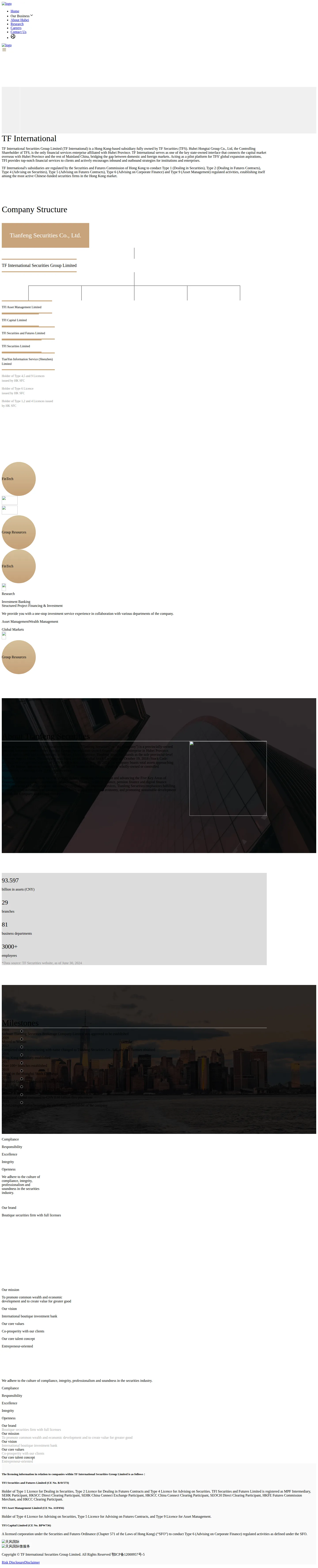
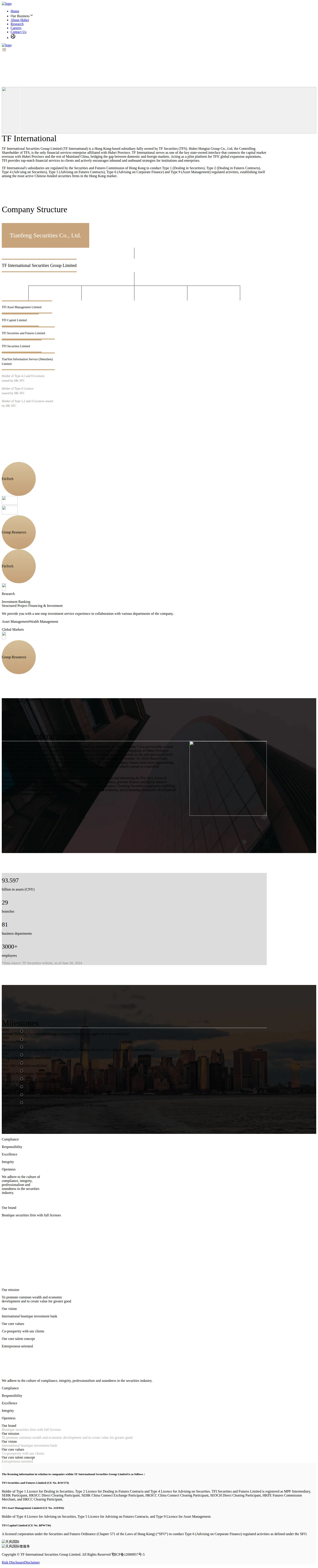
Pages captured from TFI’s own site when this review was written. Brokers change their terms; these are what we read.
Score history
Recomputed daily; every move is on the record. The current score is always the latest row.
| Date | Score | Move |
|---|---|---|
| 2026-10-13 | 4.9 | ▲ |
| 2026-07-25 | 4.3 | = |
| 2026-07-18 | 4.3 | ▲ |
| 2026-07-11 | 4.1 | · |
FAQ
Is TFI regulated?
Yes, TFI holds three Securities and Futures Commission (Hong Kong) licences, BAV573, ASF056, and BPW736, all confirmed active on the public register.
What does TFI charge in fees?
Some fees are published, but there’s no EURUSD spread figure for an account a retail client can open.
What trading platforms does TFI offer?
TFI Pro, a proprietary institutional platform with algorithmic trading and risk analytics, plus API/FIX access and a phone-based Voice Desk.
Who owns TFI?
Its listed parent is Tianfeng Securities (SSE:601162), with a named controlling shareholder.
How good is TFI's customer support?
Clients can reach TFI by email or phone, but which entity handles support and escalation depends on which one onboarded them.
What do reviews say about TFI?
TFI has a blended rating of 3.07 stars across just 8 reviews, a thin sample.
How this review works
Track TFI live: score moves and red notices, in your pocket.