
CFD · CHECKED 10 OCT 2026
Trive review.
CFD and forex broker with confirmed lower-tier licences and an unverified ASIC claim
RISKY
OUT OF 10
Trive is a CFD and forex broker holding confirmed lower-tier licences in the BVI, South Africa (FSCA) and Mauritius, running MT4, MT5 and a proprietary platform with TradingView and Trading Central integration. The biggest reservation is that its advertised ASIC licence isn't found on ASIC's register, alongside contradictory fee, headquarters and loss-rate figures across its own site.
Each criterion is scored 1 to 10 from primary sources. The overall score is their unweighted mean. How scoring works.
| Founded | 2011 |
|---|---|
| Headquarters | MT |
| Minimum deposit | No minimum on most accounts; from €2,500 on Prime |
| Maximum leverage | 2000:1 |
| Minimum spread | 0.5 |
| Account opening | 1 |
| Platforms | MetaTrader 4 (MT4), MetaTrader 5 (MT5), TradingView, Trive Trader, Trive Investor, Trading Central, MetaTrader 4 & 5 |
- BVI FSC dealing licence confirmed for Trive International Ltd on the register
- FSCA South Africa licence FSP No. 27231 confirmed for Trive South Africa (Pty) Ltd
- FSC Mauritius licence GB21026295 confirmed for Trive Financial Services Limited
- Offers MT4, MT5 and proprietary Trive Trader/Investor platforms
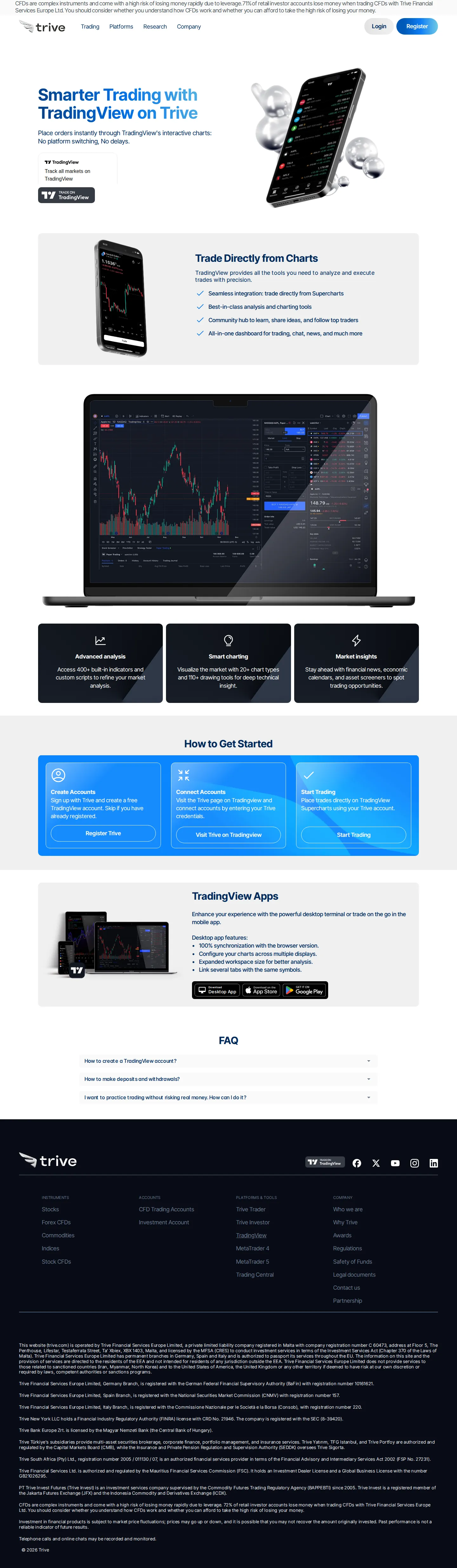
- TradingView Supercharts integration with 400+ indicators plus Trading Central analysis
- Fee schedule lists exact commissions: $10/lot, €5/lot, and 0.9% FX conversion
- ASIC AFSL 424122 is advertised but not found on ASIC's current register
- Firm gives conflicting headquarters locations: BVI, Malta and Netherlands
- BAPPEBTI licence only confirms for triveinvest.co.id, not trive.com
- Dedicated /fees, /pricing and /spreads pages 404 site-wide
- Advertised spreads (0.1 pips EURUSD) contradict account tables (0.5-1.2 pips)
- Same page shows e-wallet fee as both 0% and 1.5%
Overview
TrueBroker is a free broker safety checker, and this page is our review of Trive, scored 5.5 out of 10 across regulation, fees, platform, support and reviews.
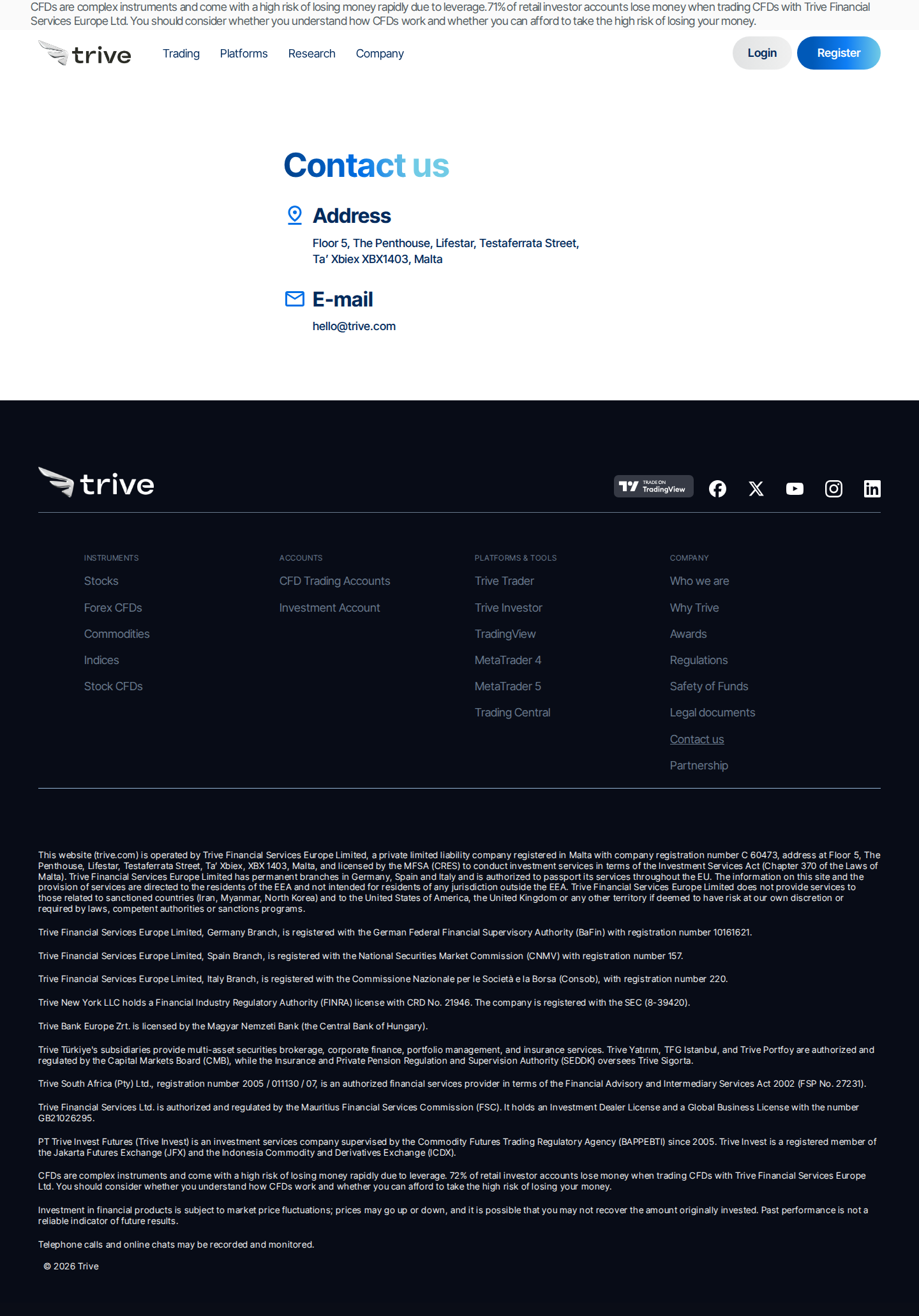
Trive is the trading brand of a group of separately regulated companies rather than a single legal entity. The site trive.com is run by Trive Financial Services Europe Limited, a Malta company that also operates branches in Germany, Spain and Italy, and its own contact page gives one postal address, Floor 5, The Penthouse, Lifestar, Testaferrata Street, Ta’ Xbiex XBX1403, Malta, and one support email, hello@trive.com. Separate group companies carry the Trive name into other jurisdictions: Trive New York LLC in the United States, Trive International Limited in the British Virgin Islands, Trive Bank Europe Zrt. in Hungary, Trive South Africa (Pty) Ltd., Trive Financial Services Ltd. in Mauritius, and PT Trive Invest Futures in Indonesia. A separate Australian entity, Trive Financial Services Australia Pty Ltd, held an Australian Financial Services Licence but no longer does; the licence was cancelled effective 1 July 2026, which we cover below.
Overview Table
| Headquarters | Floor 5, The Penthouse, Lifestar, Testaferrata Street, Ta’ Xbiex XBX1403, Malta |
| Established | Not stated |
| Countries Served | Not stated |
| Regulated By | MFSA (Malta, confirmed via the ESMA register rather than a direct MFSA lookup), BVI FSC, FINRA/FINRA BrokerCheck (US), Magyar Nemzeti Bank (Hungary), FSCA (South Africa), FSC (Mauritius) Mauritius, BAPPEBTI (Indonesia), BaFin (Germany); formerly ASIC (Australia), licence cancelled 1 July 2026 |
| Minimum Deposit | No stated minimum on the Classic, Standard, ECN Zero, Pro Leverage and Cent accounts; Prime requires a €2,500 deposit, Prime Plus €15,000 and VIP $2,000 |
| Maximum Leverage | Up to 2000:1 on the Pro Leverage account; 500:1 on Standard, VIP, ECN Zero and Cent; 1:30 on Classic, Prime and Prime Plus |
| Total Instruments | Not stated as a single figure; the firm’s stocks page advertises over 5,000 stocks, alongside forex, indices, commodities, stock CFDs and cryptocurrency CFDs |
| Platforms | MetaTrader 4, MetaTrader 5, TradingView, Trive Trader, Trive Investor, with Trading Central analytics integrated |
| Customer Support | Email (hello@trive.com); the site’s footer notes that phone calls and online chats may be recorded, but no phone number or live-chat channel is named on the pages we fetched |
| Languages | Not stated |
Facts List
- Trive scores 5.5 out of 10 overall, built from separate scores of 6.8 for regulation, 8.3 for fees, 7.9 for platform, 2.5 for support and 2 for reviews.
- We searched 930 warning-list entries mirrored from CYSEC, the FCA and FSC Mauritius, and Trive appears on none of them.
- A different site, trive-financial.com, is listed on the FCA register as Unauthorised; it is not the firm reviewed here, which operates trive.com.
- The ESMA register of investment firms shows Trive Financial Services Europe Ltd.’s Italy branch as an active investment firm supervised by the MFSA in Malta, authorised 11/12/2024, under LEI 213800UZ73DEF7ODRY83.
- The MFSA’s own Financial Services Register did not return a readable result when we searched for Trive Financial Services Europe Limited directly, so the firm’s quoted Malta licence number, CRES IF 5048, remains the firm’s own claim rather than one we confirmed against that register.
- ASIC’s current licensee dataset, 6,522 rows searched, contains no AFS licence 424122; ASIC’s own material states this licence, held by Trive Financial Services Australia Pty Ltd, was cancelled effective 1 July 2026 after the firm stopped taking new Australian clients in April 2025, and the firm has appealed the cancellation to the Administrative Review Tribunal.
- FINRA BrokerCheck lists Trive New York LLC under CRD 21946 and SEC file number 8-39420, status Active, approved since 29 April 1988, with one disclosure event on record.
- BaFin’s own company database lists Trive Financial Services Germany Branch under BaFin-ID 10161621 with a “Sonstige nach MiFID” permission dated 12/10/2022.
- The Mauritius FSC’s public register lists Trive Financial Services Ltd holding an SEC-2.1B Investment Dealer licence since 11/05/2021, though the register does not publish a licence number to check against the firm’s quoted GB21026295.
- BAPPEBTI’s Indonesia legality register lists the group’s futures entity, PT Trive Invest Futures, under website triveinvest.co.id, which is a different site from the one reviewed here, trive.com.
An Australian licence cancellation worth knowing before anything else
Before anything about fees or platforms, the clearest regulatory fact in our evidence concerns Trive’s now-defunct Australian arm. ASIC’s current licensee dataset, which we searched across 6,522 rows, has no record of AFS licence 424122. ASIC’s own material fills in why: Trive Financial Services Australia Pty Ltd was one of 52 licensed CFD issuers examined in a sector-wide ASIC review, agreed to stop onboarding new Australian clients in April 2025 after the review found deficiencies, and had its licence cancelled effective 1 July 2026 because, in ASIC’s words, Trive’s licence was cancelled because it was no longer carrying on a financial services business in Australia. Trive lodged an appeal against the cancellation with the Administrative Review Tribunal on 30 July 2026. A reader checking only the current ASIC database would see an absent licence with no context; the fuller record shows a licence that existed for over a decade and was cancelled for cause, not one that simply lapsed.
Trive’s wider regulatory footprint
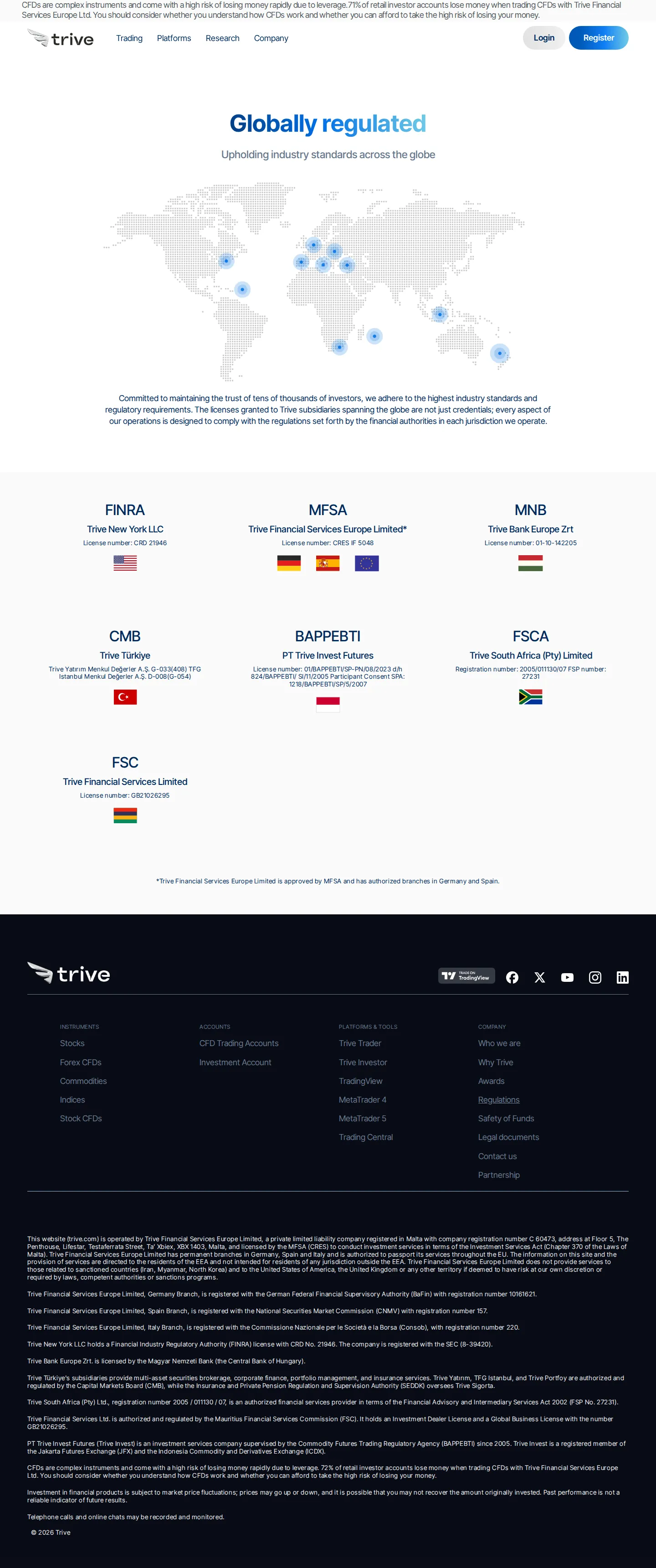
Outside Australia, several parts of the Trive group check out against public registers. FINRA BrokerCheck confirms Trive New York LLC under CRD 21946 and SEC broker-dealer file 8-39420, active since 1988. The BVI Financial Services Commission lists Trive International Ltd. as regulated for dealing as agent and as principal, though its export publishes no licence numbers, so the firm’s quoted BVI SIBA/L/14/1066 remains unverified against a number. Magyar Nemzeti Bank’s EBA Credit Institutions Register confirms Trive Bank Europe as a Hungarian credit institution authorised 23/04/2019, though the code and national reference on that register do not match the number the firm quotes. The FSCA confirms FSP 27231 as authorised and held by Trive South Africa (Pty) Ltd. Several other claims sit in a gap in what we could check rather than a finding either way: Türkiye’s Capital Markets Board, Spain’s CNMV (which can only be searched by Spanish tax number), and the Malta and South Africa company registries were not checked.
What Trive charges
Trive’s own accounts page lists eight CFD account tiers, from Classic (commission-free, spreads from 0.5 pips, 1:30 leverage, no stated minimum deposit) up to Prime Plus (€5 per lot commission, spreads from 0.1 pips, €15,000 minimum deposit), plus a separate Investment/stocks account offering over 5,000 stocks commission-free. The same accounts page sets a 0.9% currency conversion fee on CFD trading accounts, a €10 monthly maintenance fee once an account has been inactive for six months, and withdrawal fees of 1.5% on card and alternative-payment withdrawals from CFD accounts against 0.5% on the stocks account. Moving a stock portfolio out to another provider costs €100 outbound, against €0 inbound, per the stocks fee page. The swap-rates page carries its own caveat in the firm’s own words: “Note: Swap rates as of 07/07/2025. Subject to change at any time. Only the rates shown in the trading platform are binding.”
A lookalike domain to watch for
The FCA register lists a site named trive-financial.com as Unauthorised. That domain is not the firm reviewed here, which operates trive.com, and a reader searching for Trive should not confuse the two.
Key Takeaways
Why Trive scores 5.5 overall
- Regulation scores 6.8. The spread across the group is real: FINRA BrokerCheck confirms Trive New York LLC under CRD 21946 (SEC file 8-39420, approved firm status since 04/29/1988, with 1 disclosure event on file); the FSCA register confirms FSP 27231 for Trive South Africa (Pty) Ltd as Authorized; the FSC Mauritius register confirms Trive Financial Services Ltd holding an SEC-2.1B Investment Dealer licence since 11/05/2021; BaFin’s own database confirms the Frankfurt branch (BaFin-ID 10161621) with a “Sonstige nach MiFID” permission since 2022-10-12; and the EBA Credit Institutions Register confirms Trive Bank Europe as a Hungarian credit institution authorised 2019-04-23. Against that, the ASIC register does not carry AFSL 424122 among its 6,522 current licensees, and the evidence explains why: ASIC’s own statement records that this licence was cancelled effective 1 July 2026 after Trive was one of 52 CFD issuers examined in a sector-wide review, had already agreed to stop taking new Australian clients in April 2025 once deficiencies were found, and has since lodged an appeal with the Administrative Review Tribunal. A reader who only checked the current ASIC dataset would see an absence; the fuller record is a licence pulled for cause. The Malta regulator entry (MFSA, CRES IF 5048) could not be confirmed either way, since the register did not return readable data for the search, and the CNMV, CNMV register and SEDDK claims sit unchecked for want of a lookup method or a register we hold.
- Fees score 8.3, from the 0.8 pip typical spread Trive quotes for its commission free Classic account, a USD 8.00 EURUSD round turn. Trive’s own account page lists spreads from 0.5 pips on Classic, 0.3 pips on Prime, 0.1 pips on Prime Plus and 0.0 pips on ECN Zero (the last carrying a $10 per lot commission instead of a spread markup), and the stocks page states commission-free trading on the Investment Account with no custody, handling or clearing fees. Deposits are listed as fee-free across cards, e-wallets and bank transfers on the same account page.
- Platform scores 7.9. Trive offers MT4, MT5, TradingView and its own Trive Trader and Trive Investor apps, plus a Trading Central analysis add-on for MT4/MT5 users, according to the firm’s platform pages.
- Support scores 2.5 and reviews scores 2, the two weakest marks. The contact page we fetched lists a single Malta address and a single hello@trive.com email as the support channel, with no phone line or live-chat channel given, despite the group operating separately regulated entities across at least nine jurisdictions.
What Trive’s own pages contradict
- The mandatory retail-loss risk warning gives two different figures on the same pages: “71%” in the header banner and “72%” in the footer, on both the UK forex-CFD page and the UAE homepage.
- The Classic account’s headline spread differs by page: “Spreads from 0.5 pips” on the accounts page against “Typical spreads from 0.8” on the UAE homepage.
- The UK markets page states Trive “does not provide services to customers or investors from the UK,” yet the same domain serves a full UK-localised site with UK-specific spreads, accounts and risk disclosures, and the Malta-entity legal disclaimer on that same UK page separately restricts services to EEA residents while naming the UK as excluded.
Contract terms that bind a client
- Under “Trading as a Professional Client,” Trive’s own account page states: “Professional Clients do not benefit from all protections available to Retail Clients. This may include higher leverage, different margin close-out levels, the absence of negative balance protection and standardised risk warnings, and reduced access to certain conduct-of-business safeguards.” A client who elects Pro status gives up negative balance protection.
- The stocks fee page sets an outbound portfolio transfer fee of €100 against €0 inbound, and the accounts page applies a €10 monthly maintenance charge to any account inactive for six months.
- Withdrawal costs are not uniform across Trive’s own products: the accounts page lists a 1.5% fee on card and alternative-payment withdrawals from CFD trading accounts, against a 0.5% withdrawal fee on the separate Investment/stocks account.
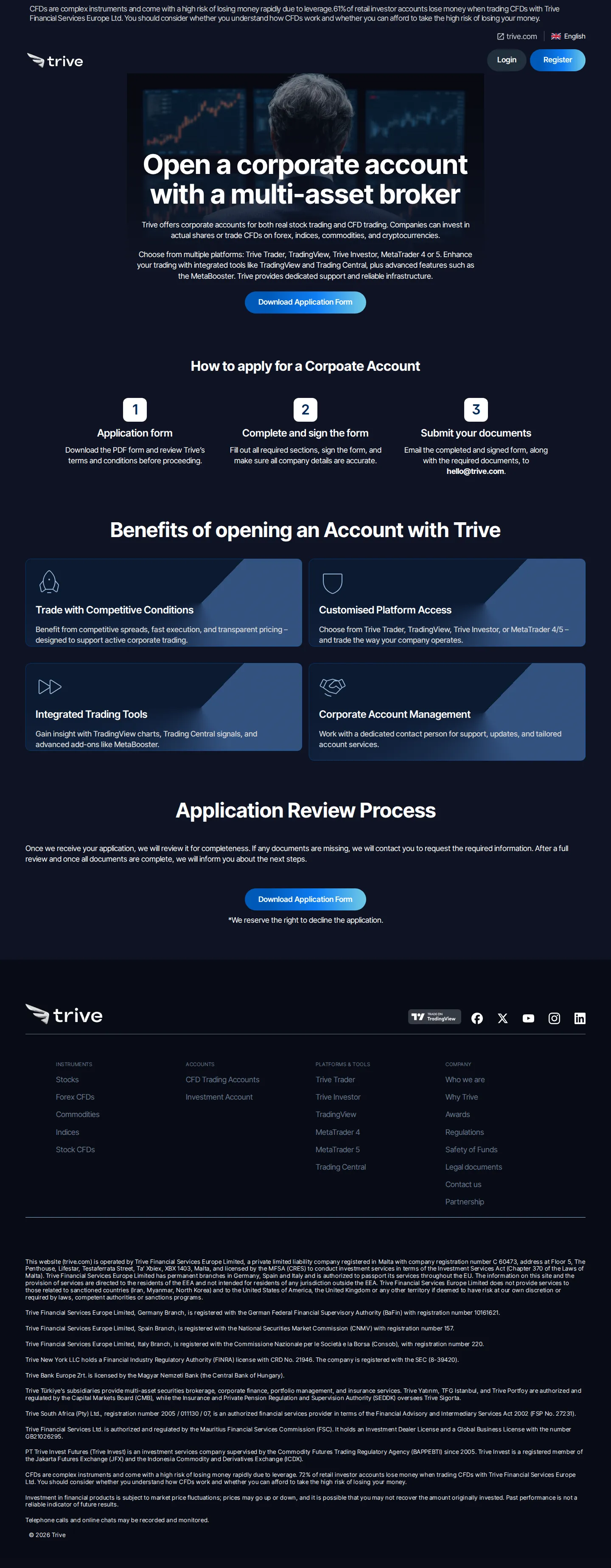
- The corporate account page reserves Trive’s right to decline a corporate application after the client has submitted the signed form and documents.
The lookalike risk around the Trive name
Our search of 930 mirrored warning-list entries from the FCA, CySEC and FSC Mauritius found no listing for the firm reviewed here. It did surface a separate site, trive-financial.com, which the FCA register carries as Unauthorised and describes as impersonating Trive; that domain is not trive.com and is not the entity under review, but it is a name a searching reader could easily confuse with the genuine site.
Licenses & Regulation
Trive is not one licensed entity but a group name spread across a long list of separately regulated companies, and the register checks come back mixed: some confirmed cleanly, some blocked, one cancelled outright, and several of the licence numbers Trive itself publishes do not match what the relevant register actually records.
What the registers confirm
The BVI Financial Services Commission lists Trive International Ltd. as regulated for Dealing as Agent and Dealing as Principal, though the BVI FSC’s own export publishes no licence numbers, so the number “BVI SIBA/L/14/1066” that Trive quotes remains the firm’s own claim rather than something we could match against the register. FINRA BrokerCheck carries Trive New York LLC under CRD 21946 and SEC broker-dealer file number 8-39420, with status ACTIVE, “Approved” since 29 April 1988, and one recorded disclosure event. The FSCA register shows FSP No. 27231 held by Trive South Africa (Pty) Ltd, status Authorized. The Mauritius FSC’s Online Public Register lists Trive Financial Services Ltd holding a SEC-2.1B Investment Dealer licence (full service dealer excluding underwriting), issued 11/05/2021, though that register publishes only the licence type and date, not a number, so the quoted number GB21026295 is confirmed to belong to the right company but not independently checked. BaFin’s company database carries Trive Financial Services Germany Branch as BaFin-ID 10161621, a branch (Zweigniederlassung) with a “Sonstige nach MiFID” permission dated 2022-10-12. The ESMA register of investment firms lists a Trive branch in Italy of a firm authorised in Malta as Active, supervised by the Malta Financial Services Authority, authorised 11/12/2024, LEI 213800UZ73DEF7ODRY83, though ESMA’s register does not publish national licence numbers, so the “220” Consob number Trive quotes is not something that register can verify. The EBA Credit Institutions Register lists Trive Bank Hungary as a credit institution authorised 2019-04-23, though its listed code and national reference do not match the “01-10-142205” number Trive publishes. On the commodities side, BAPPEBTI’s Indonesian legality register lists PT Trive Invest Futures under licence 824/BAPPEBTI/SI/11/2005, but gives triveinvest.co.id as its website rather than trive.com, the site under review here, and the number Trive itself quotes does not match that register entry either. Trive Invest Futures also appears on the Jakarta Futures Exchange and ICDX broker-member lists, which we confirmed are exchange memberships, not licences in their own right.
Where the checks came up short
Malta’s own Financial Services Register did not return readable data for Trive Financial Services Europe Limited when we searched it, so the CRES IF 5048 number Trive cites for its Malta entity is unchecked from our side, a gap in what we could fetch, not a finding about the firm. The CNMV register can only be queried by Spanish tax number, and no NIF was available for the Spain branch, so the “157” registration is likewise unchecked. Turkey’s Capital Markets Board activity permission lists (all 69 brokerage houses and 57 banks, including closed ones, with a control firm confirmed present) show no match for Trive Yatırım, TFG Istanbul or Trive Portfoy, and we hold no register at all for SEDDK, the insurance authority Trive names for Trive Sigorta; both are gaps in what we could check, not confirmations either way. Company registry numbers for Malta and South Africa were not looked up, since those registers require a manual browser search.
The one register result that isn’t a gap
ASIC’s current licensee dataset, all 6,522 rows, has no AFS licence 424122, the number Trive’s marketing quotes for its Australian entity. That is not a blocked fetch: the ASIC dataset lists current licensees, and 424122 is not in it. The reason follows from an ASIC statement covering the same licence: ASIC cancelled Trive Financial Services Australia Pty Ltd’s AFSL 424122 effective 1 July 2026, stating the licence was cancelled because the firm was no longer carrying on a financial services business in Australia. Trive was one of 52 licensed CFD issuers examined in an ASIC sector-wide review, had already agreed to stop taking new clients in April 2025 after ASIC found deficiencies, and lodged an appeal with the Administrative Review Tribunal on 30 July 2026. A reader checking the ASIC register alone would see only an absence; the fuller record is that the licence was cancelled for cause after a regulatory review, and Trive is contesting that cancellation.
The warning-list search and a name to watch for
We searched 930 warning-list entries mirrored from the FCA, CySEC and the Mauritius FSC, running a positive control against a known-listed firm first, and Trive does not appear on any of them. That check covers only the regulators we mirror, not every regulator worldwide. It did surface one entry worth flagging separately: the FCA register lists trive-financial.com as Unauthorised. The register does not use the word “clone” for this entry, but the practical point stands, that domain is not trive.com, the site reviewed here, and anyone searching for Trive should be careful which site they land on.
How to Trade
Trive’s own account pages set out eight CFD tiers under the trading account umbrella: Classic, Prime, Prime Plus, Standard, VIP, ECN Zero, Pro Leverage and Cent. The split runs along two lines. Classic, Prime and Prime Plus are commission free or charge a flat per lot rate and cap leverage at 1:30, with margin at 3.33 percent and stop out at 50 percent. Standard, VIP, ECN Zero, Pro Leverage and Cent run swap free and go up to 500:1 leverage (Pro Leverage goes to 2000:1), with stop out cut to 20 percent, except Pro Leverage which keeps 50 percent stop out despite the higher leverage cap. ECN Zero is the only tier that names both a spread floor of 0.0 pips and a commission, at $10 per lot.
What Trive lets a client trade
The firm’s own trading pages list forex, indices, commodities and stock CFDs, plus a separate Investment Account for buying stocks directly, described as commission free access to over 5,000 stocks. The commodities page adds that gold, silver, WTI and Brent are tradable both as continuous CFDs and as futures based CFDs, long and short, with leverage. A Corporate Account page adds cryptocurrency CFDs to the same list of forex, indices and commodities for company clients. Execution runs through MetaTrader 4, MetaTrader 5, TradingView and the firm’s own Trive Trader app, with Trading Central available as an add on inside MT4 and MT5.
Trive’s margin and stop out rules
The stop out level is the trigger that closes a position once the account runs short of margin, and it differs by tier: 50 percent on Classic, Prime, Prime Plus and Pro Leverage, but 20 percent on Standard, VIP, ECN Zero and Cent, according to the same accounts page. A lower stop out threshold gives a losing position more room to fall before Trive closes it, and combined with the higher leverage on those same tiers (up to 500:1, or 2000:1 on Pro Leverage), the swing on the account balance from a given price move is larger on the swap free tiers than on Classic or Prime.
Financing costs and the swap rate override
Trive’s swap rates page states that financing costs apply once a position stays open past 23:59 server time, GMT+3, and that a triple swap is charged on Wednesday or Friday, depending on the instrument, to account for the weekend, so a position held over that day is charged three days of financing in one hit. The same page carries a note dated 07/07/2025 that reads: “Note: Swap rates as of 07/07/2025. Subject to change at any time. Only the rates shown in the trading platform are binding.” That line means any swap figure published on the website is indicative only; what actually gets charged is whatever rate is live in the platform when the position is held, and it can differ from the published number without further notice.
Reclassifying as a Professional Client
Trive’s accounts page sets out an elective Professional Client (Pro) route, open to a retail client who already holds a Trive retail account and meets at least two of three tests: proven trading experience in sufficient size and frequency, a financial portfolio of cash and financial instruments above €500,000, or a relevant professional background in the financial sector. The application form is emailed to hello@trive.com for review. Trive’s accounts page carries this notice in full: “Professional Clients do not benefit from all protections available to Retail Clients. This may include higher leverage, different margin close-out levels, the absence of negative balance protection and standardised risk warnings, and reduced access to certain conduct-of-business safeguards (such as some appropriateness assessments and information disclosures).” The Pro tier’s own leverage table, on the same page, runs by instrument: majors (FX) 1:100, crosses (FX) 1:40 to 1:50, exotics (FX) 1:25 or lower, indices CFD 1:100, gold and silver CFD 1:100, commodities CFD such as WTI 1:100, stock CFD 1:5, and crypto CFD 1:2, with the page noting these are “subject to instrument specific terms and conditions and may change in line with market and regulatory requirements.”
Where the account pages disagree with each other
The Classic account’s headline spread is not consistent across Trive’s own pages: the UK accounts page states “Spreads from 0.5 pips,” while the firm’s ae-root page states “Typical spreads from 0.8” for the same tier. A client pricing the same account off two different Trive pages would land on two different numbers.
Corporate accounts and the discretion Trive keeps
The Corporate Account, aimed at companies wanting to hold real stock positions or trade CFDs on forex, indices, commodities and cryptocurrencies, is opened by downloading and submitting a signed PDF form and supporting documents to hello@trive.com rather than through the standard online flow used for individual accounts. The same page states plainly: “We reserve the right to decline the application,” so a completed application with documents attached is not a guarantee of an account.
Account Types
Trive’s fee page lists eight CFD account tiers, and the tiers split into two groups with very different leverage caps, sold on the same page without any explanation of why one client gets 1:30 and another gets 1:2000.
The 1:30 tiers: Classic, Prime and Prime Plus
Three tiers on that page cap leverage at 1:30 and set stop-out at 50%, margin at 3.33%. Classic has no stated deposit minimum, is commission-free, and the page gives spreads “from 0.5 pips.” Prime needs a minimum €2,500 deposit, is also commission-free, and drops the spread to “from 0.3 pips,” with a maximum trading volume of 100 lots per position. Prime Plus needs a minimum €15,000 deposit, charges a flat €5 per lot commission instead of a wider spread, and advertises spreads “from 0.1 pips,” with the same 100-lot cap. Trive’s Dubai-country version of the site gives a different headline number for the same Classic tier: “Typical spreads from 0.8”, against the 0.5 pips quoted on the UK fee page for the identical account name. Which figure applies depends on which of Trive’s own pages a prospective client happens to load.
The higher-leverage tiers: Standard, VIP, ECN Zero, Pro Leverage and Cent
The same fee page lists five further tiers, all capped at 20% or 50% stop-out and running leverage well above the 1:30 tiers. Standard is commission-free and swap-free, spreads “from 1.2 pips,” leverage 500:1, stop-out 20%, cap of 50 lots. VIP needs a minimum $2,000 deposit, is also commission-free and swap-free, spreads “from 0.6 pips,” leverage 500:1, stop-out 20%, cap of 100 lots. ECN Zero charges $10 commission per lot, is swap-free, spreads “from 0.0 pips,” leverage 500:1, stop-out 20%, cap of 50 lots. Pro Leverage is commission-free and swap-free, spreads “from 1.2 pips,” and is the outlier of the set at 2000:1 leverage with a 50% stop-out and a 50-lot cap. Cent is “No Swap Free,” spreads “from 1.2 pips,” leverage 500:1, stop-out 20%, a stated minimum trading volume of 0.10 lot and a maximum of 100 lots per position. None of these five carries a minimum deposit figure on the fee page beyond VIP’s $2,000.
Reclassifying to a Trive Pro account
Trive’s accounts page describes a “Trive Pro Account (Professional Client)” as a reclassification, not a product a client can open directly: a retail account has to exist first, and the client then emails an application to hello@trive.com for Trive to review. The page sets the bar at meeting at least two of three criteria: proven trading experience in sufficient size and frequency, a financial portfolio of cash and instruments worth more than €500,000, or a relevant professional background in the financial sector. The same page gives per-instrument leverage caps for the Pro tier once approved: majors (FX) 1:100, crosses (FX) 1:40 to 1:50, exotics (FX) 1:25 or lower, indices CFD 1:100, gold/silver CFD 1:100, other commodities CFD 1:100, stock CFD 1:5, and crypto CFD 1:2, all stated as “subject to instrument-specific terms and conditions and may change in line with market and regulatory requirements.” The page also carries a direct warning about what reclassification costs a client: “Professional Clients do not benefit from all protections available to Retail Clients. This may include higher leverage, different margin close-out levels, the absence of negative balance protection and standardised risk warnings, and reduced access to certain conduct-of-business safeguards.”
Stocks, and the Trive corporate account
Separately from the CFD tiers, Trive’s stocks page describes an Investment Account for buying shares directly, advertising access to “over +5,000 stocks” with no stated commission, handling, custody or clearing fee on that account. A corporate version of the account exists too: Trive’s UAE-geo accounts page describes a Corporate Account for real stock trading or CFD trading across forex, indices, commodities and cryptocurrencies, opened by downloading and submitting a signed PDF form and supporting documents to hello@trive.com, with the page stating plainly that “we reserve the right to decline the application.”
What sits underneath the headline pricing
The account tiers aren’t the only cost a client carries. The fee page puts a 0.9% currency conversion fee on CFD trading accounts, and the stocks page states the same 0.9% on the Investment Account. A dormant CFD or investment account is charged €10 a month once it has sat inactive for six months. Withdrawals are not priced the same across products: the fee page sets card and alternative-payment withdrawals from a CFD trading account at 1.5%, while the stocks page sets withdrawals from the Investment Account at 0.5%. Moving a stock portfolio into Trive costs nothing on the stocks page; moving one out costs €100. None of this appears on the account-tier comparison itself, only on the separate fee listing.
Negative Balance Protection
Trive’s own account-types page describes leverage and stop-out levels for each tier and states that negative balance protection applies to Retail Clients, while noting that Professional Clients may lose this protection upon reclassification. What the pages we fetched do say, directly, is that negative balance protection is something a client can lose. The Professional Client notice on the accounts page states: “Professional Clients do not benefit from all protections available to Retail Clients. This may include higher leverage, different margin close-out levels, the absence of negative balance protection and standardised risk warnings, and reduced access to certain conduct of business safeguards (such as some appropriateness assessments and information disclosures).” That sentence tells a retail client two things at once: that negative balance protection exists as a named protection somewhere in Trive’s framework, and that electing Professional status is the specific step that removes it.
Stop out levels by account
The account tiers carry different stop out percentages, and stop out is the mechanism that sits closest to a negative balance. Trive’s account page lists Classic, Prime and Prime Plus with a stop out of 50%, alongside Standard, VIP and ECN Zero at a stop out of 20%. Pro Leverage, despite offering leverage up to 2000:1, is listed with a 50% stop out. The Pro Account page for reclassified Professional Clients states its stop out level is set at 20%, lower than the 50% floor on several retail tiers, meaning a position is allowed to run further into losses before the platform forces a close.
What changes for Trive’s Professional Client accounts
The same accounts page sets out the route into Professional status: at least two of three tests have to be met, proven trading experience in sufficient size and frequency, a financial portfolio of cash and financial instruments exceeding 500,000 euros, or a relevant professional background in the financial sector. A retail account has to be opened first, and reclassification happens only after a completed application is emailed to hello@trive.com for review. The page frames the tradeoff plainly: in exchange for higher leverage and the 20% margin close out level, the client gives up standardised risk warnings and, in the words quoted above, the absence of negative balance protection becomes possible. Trive’s own Pro Account leverage table sets per instrument caps for this tier, including 1:100 on Majors FX, 1:100 on Indices and Gold/Silver CFDs, and lower ratios of 1:5 on Stock CFDs and 1:2 on Crypto CFDs, each marked as subject to change in line with market and regulatory requirements.
Financing charges that keep accruing on open positions
Trive’s swap rates page states that financing costs apply once a position remains open after 23:59 server time, and that a triple swap is charged on specific days, Wednesday or Friday depending on the instrument, to account for the weekend. These charges apply regardless of whether the position is moving toward a stop out level, and the same page warns that “Swap rates as of 07/07/2025. Subject to change at any time. Only the rates shown in the trading platform are binding,” meaning a client cannot rely on a published rate to estimate how fast a losing position’s costs are compounding against their margin.
What the retail tiers do not say
The Classic, Prime, Prime Plus, Standard, VIP, ECN Zero, Pro Leverage and Cent tiers on Trive’s account page are each described by spread, commission, leverage, stop out and trading volume limits, and none of those tier descriptions mentions negative balance protection one way or the other. Negative balance protection is also stated at the page level on that same account-types page, which confirms Retail Clients have it and notes Professional Clients may lose it upon reclassification, and the same protection is named in the Professional Client notice describing what a client gives up by opting out of retail status. That leaves a retail client able to see the stop out percentage for their tier and the page’s statement that negative balance protection applies to Retail Clients, but not a description of how that protection and the stop out mechanism interact when execution slippage carries an account past zero before the stop out can act.
Trading Instruments
Trive’s own pages list four tradable CFD categories under the site’s INSTRUMENTS navigation: forex, commodities, indices and stock CFDs, plus a separate Investment Account for stocks. The commodities page names gold, silver, WTI and Brent as tradable both as continuous CFDs and futures based CFDs, long and short with leverage. The corporate account page, aimed at company applicants, adds cryptocurrency CFDs to the list, saying companies “can invest in actual shares or trade CFDs on forex, indices, commodities, and cryptocurrencies.” That is the only page in the evidence that names crypto as a tradable instrument; the retail-facing instruments navigation on the accounts page does not list it separately.
Stocks versus CFDs on stocks
Trive draws a real line between two products that both involve shares. The stocks page advertises an Investment Account with access to “over +5,000 stocks” and states the account carries no commission, handling, custody or clearing fees. That account runs on the Trive Investor platform. Separately, the instruments navigation lists “Stock CFDs” as its own category, sitting alongside forex, commodities and indices CFDs rather than under the Investment Account. The evidence does not give a fee schedule specific to stock CFDs the way it does for the Investment Account, so what a client pays to hold a stock CFD position, as opposed to owning the stock through the Investment Account, is not established by what we read.
What Trive’s account pages say about leverage across instruments
Leverage varies by account tier rather than by instrument on the retail side: the accounts page gives Classic and Prime tiers a maximum of 1:30, while Standard, VIP, ECN Zero and Cent tiers go up to 500:1, and the Pro Leverage tier up to 2000:1. For clients who apply for Professional Client status, the accounts page breaks leverage down by instrument instead: Majors (FX) 1:100, Crosses (FX) 1:40 to 1:50, Exotics (FX) 1:25 or lower, Indices CFD 1:100, Gold/Silver CFD 1:100, Commodities CFD (its example is WTI) 1:100, Stock CFD 1:5, and Crypto CFD 1:2, with the page noting these are “subject to instrument-specific terms and conditions and may change in line with market and regulatory requirements.” That Pro leverage table is the only place in the evidence where Trive itself sets a leverage figure specifically for crypto CFDs.
A published spread figure that does not match itself
The evidence includes a direct contradiction inside Trive’s own pricing claims for the same Classic CFD account: the accounts page states “Spreads from 0.5 pips,” while a separate regional root page states “Typical spreads from 0.8.” Both describe the same tier. We are not asserting which figure is correct, only that Trive’s own published material disagrees with itself on the headline number a reader would use to compare cost across the instrument classes on offer.
What Trive does not document in what we read
None of the fetched pages carry an instrument list, a symbol sheet or a contract specification table setting out which specific forex pairs, indices, commodities or shares are tradable, what their minimum lot sizes are, or which exchanges the underlying stocks in the Investment Account are drawn from. The pages we fetched describe the categories on offer in broad terms, such as “majors, minors and exotics” for forex and “over +5,000 stocks” for the Investment Account, and say nothing more granular than that. Trading hours, out of hours availability and any instrument specific margin requirements outside the Pro leverage table above are likewise not covered in what we read. A trader deciding whether a specific pair, index or share is actually listed would need to check the platform itself, since the marketing pages we hold do not carry that detail.
Education & Analysis
Trive’s own platform pages describe a stack built around the MetaTrader suite, its own branded apps, and two third-party analysis layers bolted on top.
MetaTrader 4 and 5 at Trive
Trive’s platform page for MT4 lists 30 pre-installed technical indicators, available across desktop, web and mobile, with support for Expert Advisor automated trading and what the page calls a large third-party indicator and script community. The MT5 page lists a bigger toolset on the newer platform: 38 pre-installed technical indicators, 44 graphical objects, 21 timeframes and 6 order types, again across desktop, web and mobile, built on the MQL5 programming language. A separate accounts page repeats that MT4 and MT5 give traders “deep liquidity” across forex, indices, commodities and CFDs, with full sync between desktop, web and mobile versions.
Trive Trader, the firm’s own app
Alongside MetaTrader, Trive runs its own branded platform, Trive Trader, described on the platforms page as “One app to meet all your trading needs.” The accounts page goes further, pitching it as offering “professional-grade execution, advanced analytics, and low-cost trading,” with one-click trades and instant execution, and secure access on web and mobile. Trive’s own pages are marketing copy for this platform rather than a specification sheet: they do not give indicator counts, timeframe options or order types for Trive Trader the way they do for MT4 and MT5, so a reader cannot compare its charting depth against the MetaTrader figures above from what we fetched.
TradingView integration
Trive’s platforms page lists TradingView as an integrated charting option, with more than 400 built-in indicators and custom scripts, over 20 chart types and more than 110 drawing tools. The same page states that orders can be placed directly from TradingView’s Supercharts interface, and that TradingView has its own desktop app that stays in full sync with the browser version. This TradingView listing appears on both the UAE-geo platforms page and the Indonesia-geo platforms page we fetched, with the same indicator and drawing-tool counts repeated on each.
Trading Central as an add-on
Trive’s platform page names Trading Central as a third-party market analysis tool integrated for MT4 and MT5 users. It is also listed under the site’s “Platforms & Tools” navigation on the accounts page we fetched, alongside Trive Trader and Trive Investor, but the pages we read do not describe what the Trading Central integration actually surfaces inside the platform, such as signal types, report formats or coverage of instruments, beyond naming it as an available tool.
Trive Investor for the stocks account
For the separate Investment/stocks account, Trive uses a platform called Trive Investor, pitched on the stocks page under the line “Unlock the market with Trive Investor.” As with Trive Trader, the fetched pages describe this platform by name and marketing tagline rather than by listing its indicator set, chart types or order tools, so the stocks-side charting experience is less documented in what we read than the CFD side running on MT4, MT5 and TradingView.
Platform access varies by account type
Access to this toolset is not uniform across every Trive product. The Corporate Account page states that corporate clients get access to Trive Trader, TradingView, Trive Investor, MetaTrader 4/5 for real stock trading or CFD trading on forex, indices, commodities and cryptocurrencies, naming all five platforms/tools together. The individual CFD account pages we fetched present MT4, MT5 and Trive Trader as the trading platforms, with TradingView and Trading Central appearing separately under the site’s “Platforms & Tools” navigation rather than tied to a specific account tier. Beyond noting the “Platforms & Tools” navigation groups Trive Trader, Trive Investor and Trading Central together, we did not fetch a page that maps each individual account tier (Classic, Prime, Prime Plus, Standard, VIP, ECN Zero, Pro Leverage, Cent) to a specific list of which platforms it can access.
Special Offers
The pages we fetched for Trive lay out eight CFD account tiers, Classic, Prime, Prime Plus, Standard, VIP, ECN Zero, Pro Leverage and Cent, plus a separate Investment Account for stocks. Every one of them is described on the firm’s own account page in terms of spread, commission and leverage: Classic is “Commission Free” with “Spreads from 0.5 pips” and max leverage 1:30, Prime Plus carries a flat “Commission €5 / Lot” with “Spreads from 0.1 pips,” VIP is commission free with “Spreads from 0.6 pips” and 500:1 leverage, and ECN Zero charges “$10 Commission / Lot” against spreads “from 0.0 pips.” That page, and the Investment Account page describing commission-free stock trading with a 0.9% currency conversion fee, is what we read. Neither page mentions a deposit match, a welcome credit, a cashback tier, a referral bonus or any other promotional offer, and we found no promotions page among what we fetched. That is a account of what we did not come across in this run, not a finding that Trive runs no such scheme.
What Trive charges instead of what it discounts
Where the material we read does talk about money changing hands, it is fee schedules rather than incentives. The account page lists a maintenance fee of “€10 per month” applied once an account has sat inactive for six months. Withdrawal costs differ by product: the CFD trading account page prices withdrawals by credit card, debit card or “Alternative payment” at 1.5%, while the separate Investment/stocks account page prices withdrawals at 0.5%, a three-fold gap for what is, from a client’s side, the same act of taking money out. The stocks page also sets a Portfolio Transfer fee of “Inbound €0 / Outbound €100,” so moving a stocks portfolio into Trive costs nothing and moving one out costs €100. None of these figures are framed on the pages we read as a discount or a promotional rate; they are listed as the firm’s standing fee schedule, and we are reporting them as such.
The clone warning is not a Trive promotion
Our warning-list search covered 930 entries mirrored from the CYSEC, FCA and FSC Mauritius registers, and Trive itself matched none of them. One separate entry did surface: the FCA register lists trive-financial.com as Unauthorised, describing it as impersonating Trive. That is a warning about a different site trading on Trive’s name, not a promotional listing on trive.com, and readers searching for “Trive” offers should be able to tell the two domains apart before treating anything found under trive-financial.com as coming from the broker under review here.
Taken together, the material we hold on Trive is priced through spread and commission tiers, inactivity charges, and asymmetric deposit and withdrawal fees. It does not include a promotions or bonus page, so this section cannot describe conditions, wagering requirements or expiry terms for an offer we have not read.
Opening an Account
Trive lists eight account tiers on its own accounts page, and the pattern that runs through them is that the entry-level tiers carry no stated minimum deposit while the tighter-spread tiers do. Classic, Standard, ECN Zero, Pro Leverage and Cent are all listed with “No deposit limit,” while Prime asks for a minimum €2,500, Prime Plus a minimum €15,000, and VIP a minimum $2,000, according to the firm’s own account-comparison page. Classic and Prime are commission-free with spreads from 0.5 and 0.3 pips; Prime Plus charges €5 a lot with spreads from 0.1 pips; Standard, VIP and Pro Leverage run swap-free with leverage up to 500:1 (2000:1 on Pro Leverage); Standard and VIP carry a 20% stop-out level; ECN Zero charges $10 a lot with spreads from 0.0 pips.
Who Trive won’t open an account for
The firm’s own terms state plainly that “Trive Financial Services Europe Limited does not provide services to those related to sanctioned countries (Iran, Myanmar, North Korea) and to the United States of America, the United Kingdom or any other territory if deemed to have risk at our own discretion or required by laws, competent authorities or sanctions programs.” The same page adds that “the information on this site and the provision of services are directed to the residents of the EEA and not intended for residents of any jurisdiction outside the EEA.” A separate markets page states directly that “Trive does not provide services to customers or investors from the UK.” Notably, this exclusion sits on a UK-localised section of Trive’s own site that otherwise serves UK-specific spreads, account pages and risk disclosures, so a UK visitor reading the marketing pages is shown pricing and account detail while the legal text on an adjacent page says the firm won’t take them on.
Applying to trade as a Professional Client with Trive
Trive’s account page sets out a specific route to Professional Client (Pro) status rather than offering it at signup. A retail account has to be opened first; the client then completes a Pro application form and emails it to hello@trive.com for review. To qualify, the applicant has to meet at least two of three tests set by the firm: proven trading experience in sufficient size and frequency, a financial portfolio of cash and instruments worth more than €500,000, or a relevant professional background in the financial sector. The same page carries an “Important Notice” warning that Pro status is a trade-off, not just an upgrade: “Professional Clients do not benefit from all protections available to Retail Clients. This may include higher leverage, different margin close-out levels, the absence of negative balance protection and standardised risk warnings, and reduced access to certain conduct-of-business safeguards.” The Pro tier itself lists per-instrument leverage caps once reclassified: majors up to 1:100, FX crosses 1:40-1:50, exotics 1:25 or lower, indices and gold/silver up to 1:100, stock CFDs capped at 1:5, and crypto CFDs at 1:2, all stated as subject to change.
Opening a Trive corporate account
Trive’s corporate account is not a self-service sign-up either. The firm’s page describes it as built for real stock trading or CFD trading, with access to Trive Trader, TradingView, Trive Investor and MetaTrader 4/5 plus a dedicated contact person, but opening one means downloading a PDF application form and submitting it with supporting documents to hello@trive.com. The same page states outright that “we reserve the right to decline the application,” so submitting the paperwork does not guarantee the account gets opened.
Funding rules that apply once an account is open
Trive’s account terms restrict who money can move to and from once an account exists: third-party payments cannot be accepted, and withdrawals can only be returned to a bank account, e-wallet, or debit/credit card in the client’s own name. An account left inactive for six months is charged a €10 monthly maintenance fee under the same terms, which continues until the account is reactivated or the balance runs out.
Contact for account queries
The only contact details on the pages we read are a single Malta postal address, Floor 5, The Penthouse, Lifestar, Testaferrata Street, Ta’ Xbiex XBX1403, and the email hello@trive.com, which is also the address used for both the Pro reclassification and corporate account applications described above.
Deposits & Withdrawals
Deposit rails and withdrawal rails on Trive’s CFD trading account are not the same thing, and the firm’s own fee page is explicit about that split.
Getting money in
Trive’s fee page lists Mastercard, Visa, Neteller, Skrill, Sticpay, local bank-to-bank transfer, international bank transfer, and crypto (Tether on ERC20/TRC20/BEP20, and Binance Pay) as funding methods, and marks every one of them “No fee” for deposits. Local bank-to-bank transfer is scoped to a specific set of currencies, INR, CNY, THB, VND, KRW, ZAR and PHP, with the same page giving deposit timing of up to 3 working days for that route. International bank transfer, by contrast, is listed for USD, EUR and GBP with no fee stated.
What Trive charges to withdraw
The same fee page prices withdrawals differently by method, and the gap is not small. Card and alternative-payment withdrawals from the CFD trading account, Visa, Mastercard and “Alternative payment”, each carry a 1.5% withdrawal fee. That is a cost the firm’s own page attaches specifically to CFD account withdrawals, not to deposits, which stay free on the same methods. Local bank-to-bank transfer withdrawals, on the same page, run 1 to 3 working days.
Anyone holding an Investment (stocks) account instead of a CFD account sees a different number: Trive’s stocks page gives a 0.5% withdrawal fee for that product, a third of the CFD account’s card withdrawal rate. The two account types are not interchangeable on cost, and a reader comparing “Trive’s withdrawal fee” needs to know which account they mean.
Currency conversion, on both accounts
Both the CFD fee page and the stocks page state the same 0.9% currency conversion fee, charged when a client’s funding currency does not match their account currency. It applies identically whether the account is a CFD trading account or the Investment/stocks account, and it sits on top of whatever deposit or withdrawal fee already applies to the transaction.
Costs for sitting still or leaving
Trive’s fee page sets a €10-per-month maintenance fee that starts once an account has been inactive for six months, and keeps charging monthly until the account is reactivated or the balance runs out. Separately, the stocks page prices a portfolio transfer at €0 inbound and €100 outbound, meaning moving a stocks portfolio into Trive costs nothing but moving it back out to another provider costs €100. Both are Trive’s own published figures, not third-party estimates.
Who a withdrawal can go to
The “Other information” section of the fee page states that third-party payments cannot be accepted, and that withdrawals can only be returned to a bank account, e-wallet or debit/credit card in the client’s own name. In practice that means a client cannot route withdrawn funds to someone else’s account or card, and cannot fund the account from one either.
What we did not find priced
The fee page we read covers CFD trading account funding and withdrawal costs in a single table; it does not price wire fees separately from the method rows above, and it does not state a minimum withdrawal amount. Where the evidence is silent on a figure, we have not supplied one.
Customer Support
The only contact page we fetched for Trive Financial Services Europe Limited gives two channels: a postal address at Floor 5, The Penthouse, Lifestar, Testaferrata Street, Ta’ Xbiex XBX1403, Malta, and one email address, hello@trive.com. That single page serves the UAE, Australian, UK and Indonesian versions of the site alike, so a client anywhere routes their query through the same Malta address and the same inbox regardless of which page they landed on.
One inbox behind a group of separately regulated firms
Trive’s own pages describe a group built from a large number of separately licensed entities: the Malta firm with branches in Germany, Spain and Italy, Trive New York LLC under FINRA and the SEC, Trive Bank Europe Zrt in Hungary under the Magyar Nemzeti Bank, entities in Türkiye, Trive South Africa under the FSCA, Trive Financial Services Ltd in Mauritius under the FSC, and PT Trive Invest Futures in Indonesia under BAPPEBTI. Which of these entities actually opened a given client’s account determines which regulator’s complaints process and which compensation scheme, if any, applies to that client. The contact page we read does not split by entity or jurisdiction; it gives the one Malta address and the one hello@trive.com email for all of them.
What hello@trive.com is used for
Trive’s own account pages route more than general queries through that address. A retail client asking for Professional Client reclassification has to open a standard retail account first, then send a completed application form to hello@trive.com for review, and Trive’s page warns in the same section that “Professional Clients do not benefit from all protections available to Retail Clients,” including, it says, “the absence of negative balance protection and standardised risk warnings” and “different margin close-out levels” once that reclassification goes through. A prospective Corporate Account client is asked to download and submit a signed PDF form and supporting documents to the same address, and the page states plainly: “We reserve the right to decline the application.” Both processes put the firm in sole control of the outcome after the client has already handed over the paperwork, with no appeal channel described on either page.
Recorded calls and chats
A footer disclosure carried across Trive’s site states: “Telephone calls and online chats may be recorded and monitored.” That line tells us phone and live-chat channels exist somewhere in Trive’s support setup, even though the contact page we fetched lists neither a phone number nor a chat link; by using either channel a client consents to the call or conversation being recorded, per that same disclosure.
What the fee pages add about a dormant account
Trive’s fee schedule adds a further point that bears on anyone who stops trading rather than anyone who complains: a monthly maintenance fee of €10 applies once an account has been inactive for six months, charged repeatedly until the client reactivates the account or the balance runs out. Moving an investment portfolio out to another provider also carries an outbound transfer fee of €100, against no fee for transferring one in, under the same fee page.
Prohibited Countries
Trive’s own accounts and legal pages set the geographic limits plainly. The account-terms page for the Malta entity, Trive Financial Services Europe Limited, states that it “does not provide services to those related to sanctioned countries (Iran, Myanmar, North Korea) and to the United States of America, the United Kingdom or any other territory if deemed to have risk at our own discretion or required by laws, competent authorities or sanctions programs.” The same wording appears on the firm’s trading and accounts pages fetched for this review.
Iran, Myanmar and North Korea are named outright
Those three countries are the only ones Trive names as sanctioned in that clause. The firm gives itself room to add more: the same sentence lets it turn away “any other territory if deemed to have risk at our own discretion,” so the published list of three names is a floor, not a ceiling, and the firm’s own terms say the rest is up to Trive.
The United States and the United Kingdom, named separately
The same clause excludes the United States and the United Kingdom by name, alongside the sanctioned-country list. A separate Trive page, aimed at UK visitors, repeats this directly: “Trive does not provide services to customers or investors from the UK.” That statement sits on a page built for UK visitors, on a site that otherwise serves UK-localised content, including UK-specific spreads, account pages and risk disclosures. Trive’s own pages both bar UK residents and market to them in the same breath; that is a contradiction in the firm’s own published material, not a resolved policy one way or the other.
Everyone outside the EEA, on the entity that carries this disclaimer
The Malta entity’s terms go further than naming specific countries. The same accounts page states: “The information on this site and the provision of services are directed to the residents of the EEA and not intended for residents of any jurisdiction outside the EEA.” Read against the sanctioned-country and US/UK carve-outs in the same clause, Trive Financial Services Europe Limited’s own published position is that its site content is meant for EEA residents, with the US, UK, Iran, Myanmar and North Korea singled out on top of that, and a discretionary reservation to add any other territory the firm judges risky.
What this covers, and what it does not
This restriction clause is published on the pages carrying the Trive Financial Services Europe Limited (Malta) branding and terms. The evidence gathered for this review does not show whether the same wording, or a different one, governs onboarding through Trive’s other licensed entities, such as Trive International Limited in the BVI, Trive South Africa (Pty) Ltd, Trive Financial Services Ltd in Mauritius, or PT Trive Invest Futures in Indonesia, each of which sits on its own national register under its own permissions. A prospective client outside the EEA would need to establish which Trive entity, if any, is prepared to onboard them, since the EEA-directed wording above belongs to the Malta entity’s own pages, not to a statement covering the group as a whole.
A separate matter: a site with Trive’s name that is not Trive
Searching the warning lists mirrored from the FCA, CySEC and the Mauritius FSC, Trive itself appears on none of the 930 entries checked. One nearby entry is worth flagging for a different reason: the FCA register lists a site called trive-financial.com as Unauthorised, describing it as “impersonating Trive.” That is not a restriction on where Trive itself operates, and the firm under review here is not the one carrying that warning; it is a separate site trading on a similar name, and a reader searching for Trive should be careful not to land on it by mistake.
Conclusion
Trive’s file splits in two. The regulatory paperwork is real but scattered across a dozen national registers of very different weight, the platform lineup is genuinely built out, and the fee schedule is one of the more transparent ones this catalogue has read. Against that sits a support presence that barely shows up in what the firm itself publishes and a reviews score that drags the average down hard. That combination is what produces 5.5 overall, built from regulation 6.8, fees 8.3, platform 7.9, support 2.5 and reviews 2.
Where Trive is actually regulated, and where the paper thins out
The Trive group is not one company but many, and the registers back up several of them directly. The BVI FSC lists Trive International Ltd. as regulated for dealing as agent and dealing as principal. FINRA BrokerCheck shows Trive New York LLC under CRD 21946 and SEC broker-dealer file 8-39420, active, approved since 1988, with one disclosure event on file. The EBA Credit Institutions Register carries Trive Bank Hungary as a credit institution authorised in 2019. The FSCA lists FSP 27231 as held by Trive South Africa (Pty) Ltd, status Authorized. The Mauritius FSC register confirms Trive Financial Services Ltd holds an SEC-2.1B Investment Dealer licence from 2021, though it does not publish a licence number to check against the firm’s own GB21026295. BAPPEBTI’s Indonesia legality register, and separately the Jakarta Futures Exchange and ICDX membership lists, confirm PT Trive Invest Futures, though under the triveinvest.co.id site rather than the trive.com site under review here.
Two gaps matter more than the rest. The MFSA register would not return readable data for Trive Financial Services Europe Limited, the entity that actually operates trive.com and its EEA branches, so that licence is unchecked rather than confirmed. And ASIC’s current licensee dataset has no AFSL 424122 at all. An ASIC media release fills in why: ASIC cancelled the licence effective 1 July 2026 after a sector-wide review of 52 CFD issuers found deficiencies serious enough that Trive had already agreed in April 2025 to stop taking new Australian clients, stating Trive’s licence was cancelled because it was no longer carrying on a financial services business in Australia. Trive lodged an appeal with the Administrative Review Tribunal on 30 July 2026. A reader checking ASIC’s live database alone would see only an absence; the cancellation notice shows it was for cause, following a supervisory finding, not an administrative lapse. The CNMV, Turkey’s CMB and SEDDK entries in Trive’s own materials also remain unchecked, either because the register can only be queried by a Spanish tax number we don’t hold, or because we hold no directory entry for that authority at all.
Against that, the firm and its group clear a warning-list check: none of 930 entries mirrored from the CYSEC, FCA and FSC Mauritius lists match Trive. The FCA register does list a firm called trive-financial.com as Unauthorised, a different domain from the trive.com reviewed here, not a mark against this firm, but worth knowing before searching for the broker online.
What Trive charges to trade, and to leave
The fee material is unusually granular. The CFD account tiers run from Classic (no minimum, spreads from 0.5 pips, commission-free) up through Prime, Prime Plus, VIP and ECN Zero, with the trade-off moving from wider spreads and no commission toward tighter spreads plus a per-lot fee as the minimum deposit rises to €15,000 on Prime Plus. The Investment/stocks account is quoted at zero commission, custody and clearing fees. Currency conversion costs 0.9% on both the CFD and stocks accounts. Where the schedule turns less even is withdrawals: card and alternative-payment withdrawals from a CFD account cost 1.5%, while the same kind of withdrawal from the Investment account costs 0.5%, so the cost of taking money out depends on which Trive product holds it. Moving a stocks portfolio to another provider costs €100 outbound, while an inbound transfer is free, a fee that only bites on the way out. An account left inactive for six months is charged €10 a month until it is reactivated or the balance runs out.
Platforms carry the score; published support does not
The platform stack is the strongest part of the file: MetaTrader 4 and MetaTrader 5 side by side, TradingView with direct order placement from its charts, the firm’s own Trive Trader and Trive Investor apps, and Trading Central bolted on for market analysis. That range is what the 7.9 platform score reflects. Support is the opposite case: the contact page we read gives a single Malta office address and one email address, hello@trive.com, and that is the extent of what the firm’s own published contact material shows, which is thin for a group operating regulated entities on four continents and is consistent with the 2.5 support score.
One more inconsistency worth flagging for anyone comparing pages: a UK-localised Trive page states plainly that the firm “does not provide services to customers or investors from the UK,” while the same site serves a full UK-specific market page with UK spreads and account terms, and a separate Malta-entity disclaimer on that UK page also names the EEA as the intended audience and excludes the UK by name. A UK visitor reading the marketing pages and the legal footer on the same domain would get two different answers about whether they can open an account.
Trive holds confirmed licences in the US, BVI, Hungary, South Africa and Mauritius and publishes a detailed fee schedule, but its Australian licence was cancelled in 2026, with an appeal pending, and its support is one email address. That mix lands Trive at 5.5 out of 10.
What we saw
Pages captured from Trive’s own site when this review was written. Brokers change their terms; these are what we read.

Score history
Recomputed daily; every move is on the record. The current score is always the latest row.
| Date | Score | Move |
|---|---|---|
| 2026-09-19 | 5.5 | ▼ |
| 2026-09-13 | 5.9 | ▲ |
| 2026-09-12 | 4.8 | ▲ |
| 2026-09-07 | 4.2 | ▼ |
| 2026-07-25 | 5.4 | ▲ |
| 2026-07-18 | 5.2 | ▲ |
| 2026-07-11 | 5.1 | · |
FAQ
Is Trive regulated?
It holds confirmed licences in the BVI (FSC), South Africa (FSCA FSP 27231) and Mauritius (FSC), but its advertised ASIC licence isn’t found on ASIC’s register.
What platforms does Trive offer?
MT4, MT5 and its own Trive Trader/Investor platforms, plus TradingView Supercharts and Trading Central analysis tools.
What does Trive charge in fees?
Listed costs include 1.5% on card payments, 0.9% FX conversion, a €10/month dormancy fee, and $10/lot or €5/lot commissions, though its own pages give conflicting e-wallet fee figures.
Are Trive's advertised spreads accurate?
Its ‘ultra-low spread’ banner (0.1 pips EURUSD) doesn’t match the 0.5-1.2 pips shown in its own account tables.
How do I contact Trive support?
Only a Malta postal address and an email (hello@trive.com) are published; no phone number or support hours are listed.
Is Trive licensed in Indonesia?
A BAPPEBTI licence exists for PT Trive Invest Futures, but it confirms for triveinvest.co.id, not the trive.com site reviewed here.
How this review works
Track Trive live: score moves and red notices, in your pocket.