
CRYPTO · CHECKED 13 SEP 2026
Coincheck review.
Registered, segregated and eight years clean since 2018, but Japan residents only, no insurance, no proof of reserves, and an English site that describes a different firm.
OK-ISH
OUT OF 10
Coincheck is registered with Japan's FSA via the Kanto Local Finance Bureau, number 00014, since 11 January 2019. That forces customer money into trust, crypto into segregated cold storage and a priority repayment right, but there is no compensation scheme, no insurance and no proof of reserves. Accounts are for Japan residents aged 18 to 74 only, though the site is served worldwide. The order book is free; the dealer counter charges 0.1 to 5.0 percent and makes 74 percent of revenue. No leverage exists. Suits Japan resident spot buyers who read Japanese.
Each criterion is scored 1 to 10 from primary sources. The overall score is their unweighted mean. How scoring works.
| Founded | 2012 |
|---|---|
| Headquarters | JP |
| Minimum deposit | 0 JPY |
| Minimum spread | 0.1 |
| Withdrawal fee | JPY 407 (about USD 2.56 at August 2026 rates) |
| Account opening | 1 |
| Platforms | Coincheck web, Coincheck 販売所, Coincheck 取引所, Coincheck iOS app, Coincheck Android app, REST API, WebSocket API, Coincheck Prime OTC desk |
- Registered crypto asset exchange service provider, Kanto Local Finance Bureau No. 00014, verified on the FSA register in both languages
- Payment Services Act client asset regime: customer money in trust at JSF Trust and Banking, crypto segregated in per asset cold wallets
- Customer crypto matches to the yen on both sides of the balance sheet at 678,230 million yen, reconciled every business day
- Order book charges 0.000 percent maker and taker on most pairs, one of the cheapest spot venues anywhere
- The 2018 loss was made good from company funds and completed on 12 March 2018, under seven weeks after the theft
- No enforcement entry in the FSA casebook since 8 March 2018, in a file of 2,820 data rows current to 30 June 2026
- Passkey required to register a withdrawal bank account and to request a yen withdrawal, on top of mandatory two step login
- Circuit breaker bands, reference price rules and the itayose restart are published in full rather than left vague
- No inactivity fee, no dormancy fee and no account closure fee found on any fee page
- Statutory external dispute routes named, including three bar association centres and the JVCEA
- Accounts are available only to residents of Japan aged 18 to 74, yet the site and signup form are served identically worldwide
- No proof of reserves attestation on the site, in the help centre corpus or in the group Form 20-F
- No customer asset insurance and no compensation scheme found, and the firm says assets may be unreturnable if it fails
- The dealer counter charges 0.1 to 5.0 percent, up to 6.5 percent on some assets, and produces 74 percent of revenue
- All 21 legal PDFs on the English footer are the Japanese documents, one of them named _jp.pdf on the English route
- The English homepage describes four commercial bank accounts, hot wallet storage and margin on leveraged trading, matching neither the Japanese page nor the product
- No general telephone line and no general staffed chat; the only route is a form answered in roughly 1 to 2 business days
- No margin, leverage or derivatives, and no financial instruments registration that would allow them
- No OCO orders, no MetaTrader, no TradingView, no demo account and no market research or analysis
- A BTC/JPY circuit breaker trip halts the dealer counter for every listed pair, including scheduled buying
Overview
Coincheck will not open an account for you unless you live in Japan, and nothing on the website says so until you reach identity verification. We fetched coincheck.com from fourteen countries and the English homepage came back byte identical every time, md5 4bb5ee0468cc3df00cff09adcd90c603 once the per request CSRF token is normalised. The Japanese signup form was served to the United States, Germany, Indonesia, South Africa, India and Brazil as readily as to Japan. The refusal lands at KYC, where the help centre updated 6 August 2026 states that account opening is not accepted for anyone under 18, anyone 75 or over, or anyone resident outside Japan (「日本国外に居住」).
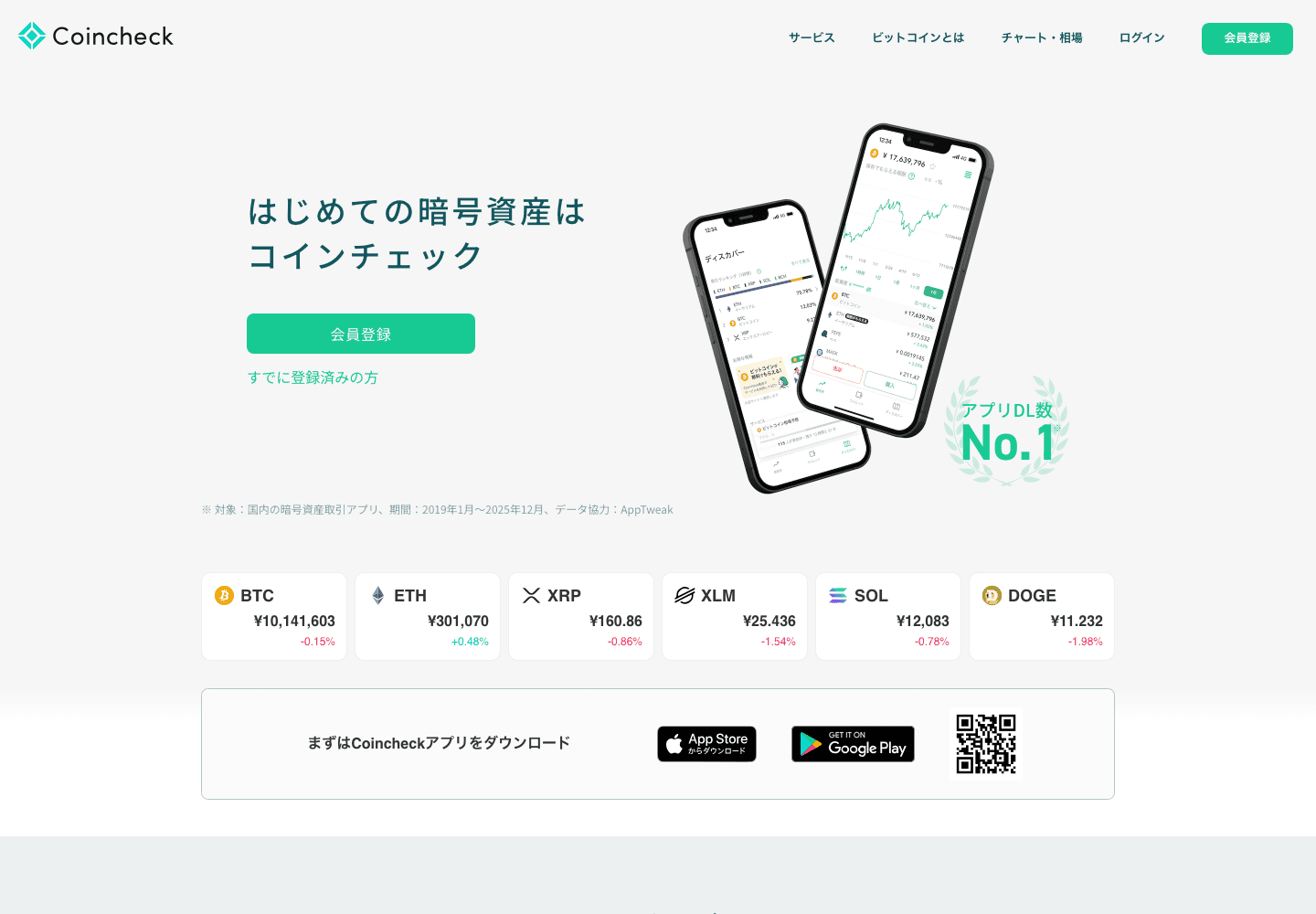
For a reader who does live there, the regulatory position is strong. Coincheck Kabushiki Kaisha (コインチェック株式会社) is registered as a crypto asset exchange service provider, Kanto Local Finance Bureau No. 00014, since 11 January 2019, which we read off the FSA’s own register in both languages as of 30 June 2026, row 18, corporate number 1010001148860. That registration is not an anti money laundering formality. The Payment Services Act forces customer money into a trust company, customer crypto into segregated cold storage, a matching own holding against the hot wallet portion, a priority repayment right and a periodic CPA review. The balance sheet at 31 March 2026 shows customer crypto of 678,230 million yen on both the asset and the liability side, matching to the yen.
What it does not include is any compensation scheme, deposit insurance or asset insurance. Coincheck’s risk disclosure of 8 July 2026 says it: if the company fails customer assets may not be returnable (「当社が破綻した場合には、お客様の資産を返還することができなくなり」). There is no proof of reserves attestation either.
Then there is 2018, which is told wrong more often than right. When customer NEM was taken on 26 January 2018 and every withdrawal on the platform stopped at 16:33 JST, Coincheck was not a registered exchange. The FSA’s own summary of 10 August 2018 calls it a deemed dealer under the transitional provision (「みなし仮想通貨交換業者の1社」), and the Kanto bureau’s order says the same. Registration came eleven and a half months later, after an on site inspection and two business improvement orders. Compensation was paid from company funds and completed on 12 March 2018. The FSA casebook, 2,820 data rows current to 30 June 2026, records nothing against Coincheck after 8 March 2018. Where this review is unkind is on English language disclosure, where all 21 legal PDFs are the Japanese files and the English homepage describes custody arrangements and a leveraged product that do not exist.
Tags: FSA registers, casebook and notices. Kanto Local Finance Bureau orders. the statute at e-Gov. the self regulatory member register. Coincheck Group N.V. Form 20-F to 31 March 2026. Coincheck’s own site, help centre, PDFs and dated announcements. measurements we made ourselves.
Overview Table
| Headquarters | SHIBUYA SAKURA STAGE SHIBUYA SIDE 27F, 1-4 Sakuragaokacho, Shibuya-ku, Tokyo 150-6227, Japan |
|---|---|
| Established | Incorporated 28 August 2012, with paid in capital of 385 million yen, on the company profile at page 19 of Coincheck’s own risk disclosure of 8 July 2026. The Coincheck branded business was launched that year by ResuPress K.K., which renamed itself Coincheck, Inc. in 2017 |
| Countries Served | Website served identically to all 14 countries tested. Accounts for residents of Japan only, aged 18 to 74 |
| Regulated By | Japan FSA via the Kanto Local Finance Bureau, crypto asset exchange registration No. 00014, granted 11 January 2019. JVCEA member 1017. No financial instruments registration |
| Minimum Deposit | No stated account minimum. Smallest dealer counter purchase 500 yen. Quick deposit floor 1,770 yen including the 770 yen fee |
| Maximum Leverage | None. No margin, leveraged or derivative product exists, and no registration permits one |
| Total Instruments | 34 on the dealer counter, 27 order book pairs, 29 in scheduled buying, ETH only for staking, 2 custody only. The FSA register lists 38 as of 30 June 2026 |
| Platforms | Web, iOS and Android (Japanese storefronts only), dealer counter (販売所), order book (取引所), REST and WebSocket APIs, PHP and Ruby libraries, OTC desk |
| Customer Support | Contact form only, answered in roughly 1 to 2 business days. Chat weekdays 10:00 to 17:00 JST for account opening and suspected unauthorised access only. Complaints line 03-4405-3842, weekdays 09:00 to 18:00 JST |
| Languages | Japanese and English on the site, chosen by URL path not by IP. Japanese only on every telephone line |
| Incident history | Three disclosed: the January 2018 NEM theft and platform wide withdrawal halt, the June 2020 domain registrar takeover, the April 2025 X account takeover. Only the first cost customers assets. Full dated record, with what the firm said, what the regulator ordered and what was done, is in Deposits and Withdrawals below |
Facts List
- Registered as a crypto asset exchange service provider (暗号資産交換業者) No. 00014 since 11 January 2019, one of 26 registered providers in Japan, 24 under the Kanto bureau.
- Customer money sits in a money trust at JSF Trust and Banking (日証金信託銀行株式会社), reconciled against the trust principal every business day.
- Customer crypto sits in cold wallets built per asset, each customer’s share identifiable in the data, reconciled every business day.
- The order book (取引所) charges 0.000 percent maker and taker on most pairs. The dealer counter (販売所) charges no commission but a spread equivalent of 0.1 to 5.0 percent, and 2.0 to 6.5 percent on certain assets.
- 74 percent of operating revenue to 31 March 2026 came from dealing, 10,351 million yen of 14,061 million yen. Fees received were 1,204 million yen.
- 2,674,981 verified accounts and 664,014 million yen of customer assets at the end of July 2026, on figures Coincheck labels unaudited.
- No margin, leverage or derivatives. Coincheck appears nowhere in the 2,111 row financial instruments business operator (金融商品取引業者) register.
- No proof of reserves attestation. The phrase occurs zero times in the group’s Form 20-F.
- Owned by Coincheck Group N.V., a Netherlands holding company on Nasdaq as CNCK since 11 December 2024, reached by merging with Thunder Bridge Capital Partners IV, a special purpose acquisition company. Monex Group holds 71 percent of the voting power and KDDI Corporation is the second largest holder on 14.9 percent.
- Account opening claimed at as fast as one day from document submission, and five minutes for the form itself.
Key Takeaways
- You must live in Japan. Residence, aged 18 to 74, checked at KYC. Nationality is not a bar and a Residence Card (在留カード) is accepted.
- The registration does specific work. Money in trust, crypto segregated and cold, performance guarantee crypto, priority repayment, periodic CPA review, traced to the statute rather than to a marketing page.
- It does not insure you. No compensation scheme, no asset insurance. The priority right ranks you ahead of other creditors over what is actually in the segregated pot; it does not fill a shortfall.
- 2018 happened before the licence. Coincheck was a deemed dealer. Two business improvement orders, an on site inspection, registration eleven and a half months later.
- The loss was made good fast, from the firm’s own money, completed 12 March 2018 at 88.549 yen a coin.
- The free venue is not where the money is made. The order book carries roughly ten times the volume at 0.000 percent. The dealer counter charges 0.1 to 5.0 percent and produced 74 percent of revenue.
- Coincheck can be your counterparty on both venues, and says so: it sometimes buys on its own order book, and its cover transactions may be executed there.
- No leverage at all. Wrong venue if you want it, one less risk category if you do not.
- The English site is not maintained to the Japanese standard. All 21 legal PDFs are the Japanese documents, and the English homepage names four banks, hot wallets and margin on leveraged trading.
- Support is thin by design. A form answered in roughly 1 to 2 business days, no general phone line, Japanese only when there is one.
Licences & Custody
Coincheck holds one registration and we checked it at source in both languages. The FSA publishes the list of crypto asset exchange service providers (暗号資産交換業者) in Japanese and English, both carrying the same as of date of 30 June 2026, so there is no currency gap between them. Coincheck is row 18: Kanto Local Finance Bureau No. 00014 (関東財務局長 第00014号), registered Heisei 31, 11 January (平成31年1月11日) which is 11 January 2019, Coincheck Kabushiki Kaisha (コインチェック株式会社), corporate number 1010001148860, 38 handled assets. There are 26 registered providers in Japan and 24 sit under the Kanto bureau. Positive controls on the same sheet, Money Partners Kabushiki Kaisha (株式会社マネーパートナーズ) No.00001 and bitFlyer Kabushiki Kaisha (株式会社bitFlyer) No.00003 both dated 2017-09-29, confirm the date arithmetic on the English file. The register’s own header limits what listing means: the authorities confirmed the assets fall within the statutory definition on the provider’s explanation, and they 「do not guarantee or endorse the value of these crypto-assets」.
Licence Table
| Authority | Location | License Number | Retail Services | Protection Level |
|---|---|---|---|---|
| Japan FSA, via the Director-General of the Kanto Local Finance Bureau (関東財務局長) | Tokyo, Japan | crypto asset exchange service providers No. 00014 (暗号資産交換業者 第00014号), granted 11 January 2019, verified as of 30 June 2026 | Spot crypto buying, selling and exchange for Japan residents; custody of crypto and yen; scheduled buying; lending; ETH staking; NFT; IEO | Payment Services Act client asset regime: money in trust (63-11(1)), crypto segregated and cold stored (63-11(2)), performance guarantee crypto (63-11-2), priority repayment (63-19-2), periodic CPA audit (63-11(3)). No compensation scheme, no deposit insurance, no asset insurance found |
| JVCEA, General Incorporated Association Japan Virtual and Crypto Assets Exchange Association (一般社団法人日本暗号資産等取引業協会), certified self regulatory association | Tokyo, Japan | Member 1017, listed for crypto asset exchange business (暗号資産交換業) only | Self regulatory rules, including the price movement measure the circuit breaker is adopted under | Rulebook and a complaints route on 03-3222-1061. Not a compensation body. 32 business members, 25 holding the exchange registration |
| Japan FSA, Financial Instruments Business Operators (金融商品取引業者) register | Tokyo, Japan | None held. We searched all 2,111 rows for Coincheck (コインチェック) and Coincheck and found no entry | Would be required for crypto derivatives, margin or leverage. Coincheck offers none | Not applicable. Positive control in the same file: Monex Securities Kabushiki Kaisha (マネックス証券株式会社) Kanto Local Finance Bureau (Financial Instruments Business) No. 165 (関東財務局長(金商)第165号), registered 2007-09-30, so the search works |
On self regulation, be precise. PSA Article 63-5(1)(vi) does not compel JVCEA membership outright; it requires registration to be refused where an applicant neither joins the certified association nor adopts equivalent internal rules. Coincheck has joined. Note too that Monex Securities appears in the JVCEA register separately for crypto asset derivatives trading business (暗号資産デリバティブ取引業) only. The derivatives permission in that corporate group sits with the securities company, not with Coincheck.
What the registration forces, and what it does not
We read the statute rather than a summary. Payment Services Act (資金決済に関する法律), Act No. 59 of 2009. Article 63-2 makes registration necessary to trade at all. Article 63-11(1) requires customer money to be separated from the firm’s own and entrusted to a trust company. Article 63-11(2) requires customer crypto to be separated and, apart from an ordinance carve out for operational convenience, held by a method posing little risk to users, meaning cold storage. Article 63-11-2 closes the gap that carve out opens: the firm must hold its own crypto, performance guarantee crypto-assets (履行保証暗号資産), of the same kind and quantity as the hot wallet portion, segregated and held the same way. Article 63-11(3) requires periodic audit of that management by a certified public accountant. Article 63-19-2 gives customers a right to repayment in priority to other creditors out of the segregated user crypto and the performance guarantee crypto, with Civil Code Article 333 applying.
Now the limit, because this is where readers over read the licence. None of it is a compensation scheme, and there is no deposit insurance for crypto in Japan. The priority right attaches to the segregated assets themselves. It ranks you ahead of other creditors over whatever is in that pot and does nothing about a shortfall in it. Coincheck states this in risk item Ⅷ of its own disclosure. Read it beside a term most customers never open: section 9(4) says that if deposited crypto is lost through leakage, destruction or damage of the private key and Coincheck judges sending the same kind difficult, it may send other crypto of equivalent value at a price Coincheck determines, or refund in money. That clause decides what a loss actually costs you, and the valuation is the firm’s.
On the audit, be exact about what exists. KPMG AZSA LLC audits Coincheck, Inc., 94 million yen of audit fees to 31 March 2026, plus 2 million yen of non audit fees for agreed-upon procedures on the segregated management of user assets and performance guarantee crypto-assets (「利用者財産及び履行保証暗号資産の分別管理に係る合意された手続業務」), agreed upon procedures on the segregation of user assets and performance guarantee crypto. Agreed upon procedures report findings against specified steps. They are not an audit opinion on segregation, and the group level equivalent is described the same way.
Entity by residence
For most brokers this table exposes an offshore onboarding entity. Coincheck’s answer is unusual, and that is the point: there is one entity, Coincheck Kabushiki Kaisha (コインチェック株式会社), and the same pages everywhere. The English homepage was byte identical from all fourteen countries after normalising the CSRF token, and the Japanese homepage identical across the nine tested but for live ticker values. Language follows the URL path, not the IP and not Accept-Language: /info/fee returned the identical English page under a Japanese Accept-Language header, both 105,834 bytes. There is no geo routing to unpick, so the column that matters is the last one.
| Country tested | Entity served | Site and signup | Account available | What you get |
|---|---|---|---|---|
| Japan | Coincheck, Kanto LFB No. 00014 | Served, HTTP 200 | Yes, if resident and 18 to 74 | Full service: both venues, yen rails, lending, staking, scheduled buying, NFT, IEO, apps |
| United States | Same entity, same page | Served; signup form too | No | Browsing and the form, then refusal at KYC. The 20-F asserts IP level restriction of US addresses |
| United Kingdom | Same entity, same page | Served | No | Browsing only. No UK entity, no UK permission, no UK facing page |
| Germany | Same entity, same page | Served; signup form too | No | Browsing and the form, then refusal at KYC |
| Singapore | Same entity, same page | Served | No | Browsing only |
| Indonesia | Same entity, same page | Served; signup form too | No | Browsing and the form, then refusal at KYC. The dead /id/ path serves the English homepage |
| India | Same entity, same page | Served; signup form too | No | Browsing and the form, then refusal at KYC |
| Brazil | Same entity, same page | Served; signup form too | No | Browsing and the form, then refusal at KYC |
| United Arab Emirates | Same entity, same page | Served | No | Browsing only |
| South Africa | Same entity, same page | Served; signup form too | No | Browsing and the form, then refusal at KYC. Our first attempt hit a proxy policy block, not an origin refusal; the retry matched everywhere else |
| Thailand | Same entity, same page | Served | No | Browsing only |
| Vietnam | Same entity, same page | Served | No | Browsing only |
| South Korea | Same entity, same page | Served | No | Browsing only |
| Australia | Same entity, same page | Served | No | Browsing only |
Two honest notes. We did not attempt to open an account, so the refusal at KYC is Coincheck’s stated policy rather than something we tested end to end. And the group tells investors something firmer than we measured: the 20-F says it has 「procedures to restrict access from IP addresses in jurisdictions outside of Japan, including the United States」, while conceding a VPN may defeat them. We saw no IP restriction at all on the public site or the registration form. Both can be true if the restriction sits on authenticated surfaces we could not reach, but as a description of the public site that wording is wider than what we observed.
Trading & Execution
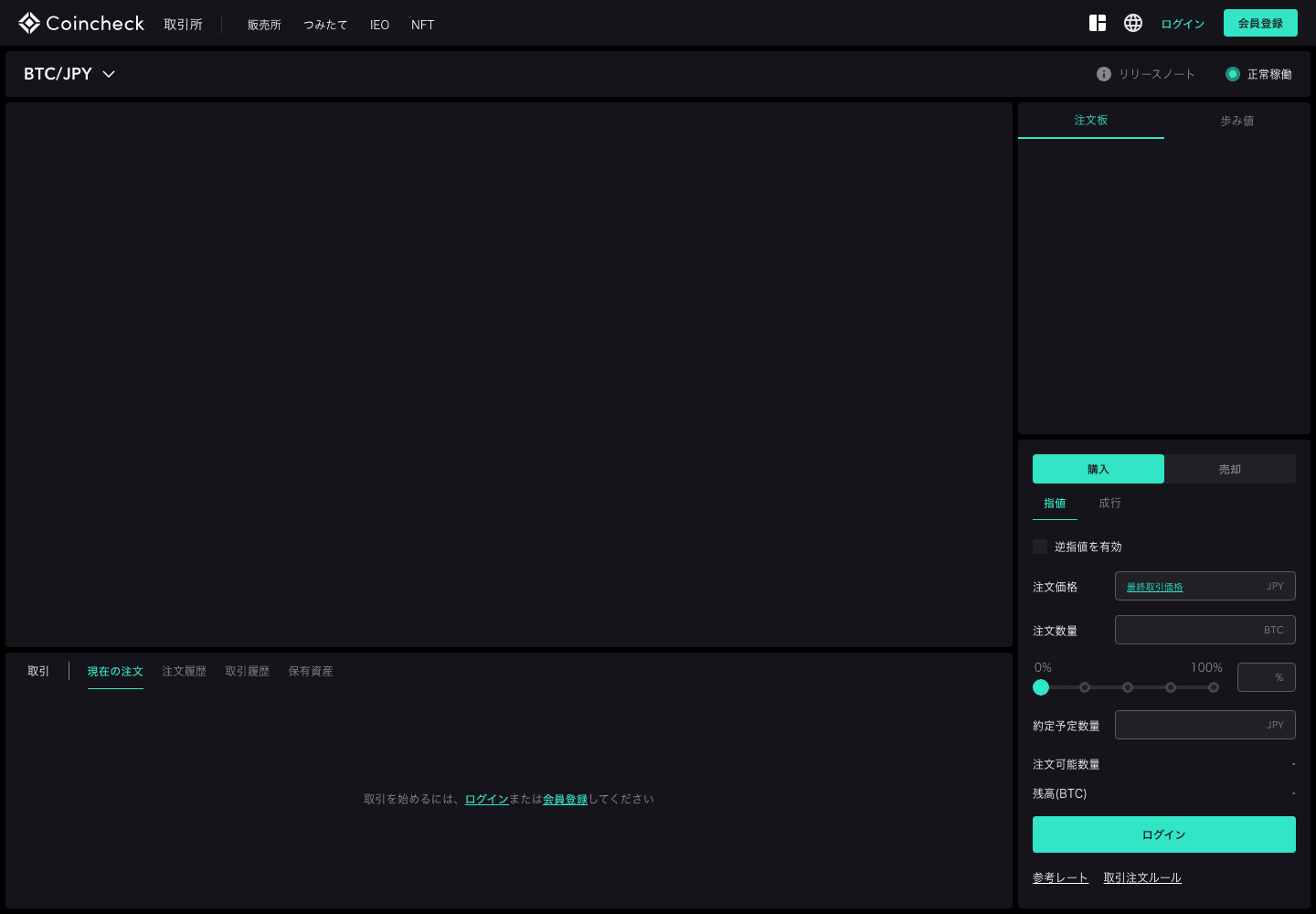
The finding that no crypto review should bury: Coincheck offers no margin, no leverage and no derivatives. There is no liquidation engine, no maintenance margin, no funding rate and no forced closeout, because there is no leveraged product to liquidate. This is not inferred from the marketing pages. Coincheck holds no financial instruments business registration, the permission a crypto derivatives product in Japan requires. We searched all 2,111 rows of the FSA’s Financial Instruments Business Operators (金融商品取引業者) register for Coincheck (コインチェック) and Coincheck and found nothing, with Monex Securities Co., Ltd. (マネックス証券株式会社) Kanto Local Finance Bureau (Financial Instruments Business) No. 165 (関東財務局長(金商)第165号) in the same file as a positive control. The register and the site agree. If you want leveraged crypto, this venue cannot sell it to you. If you do not, the risk category that dominates most trading reviews is simply absent, and what remains is custody, counterparty and price.
Two venues, one account
One verified account covers the Marketplace, the Exchange, the NFT Marketplace and IEO. The venues cost very different amounts. The Marketplace dealer counter (販売所) quotes you a price and takes no commission; the cost is a spread equivalent of 0.1 to 5.0 percent against the cover source or the Coincheck exchange price, rising to 2.0 to 6.5 percent on certain assets by volatility, and Coincheck says it may exceed both in fast markets. 34 assets, 500 yen minimum. The Exchange order book (取引所) is 0.000 percent maker and taker on most pairs, and 0.050 percent maker with 0.100 percent taker on six: ETC, IOST, FNCT, BRIL, BC and FPL. The itayose fee matches the maker fee. 27 pairs.
Volume shows which one customers use, and revenue shows which one pays. Coincheck’s monthly disclosure to 5 August 2026 gives exchange volume of 171,122, 129,229, 197,447 and 156,294 million yen for April to July 2026, against marketplace volume of 21,603, 16,790, 20,709 and 15,522 million yen, roughly ten to one. Yet dealing produced 10,351 million yen of 14,061 million yen of operating revenue to 31 March 2026, 74 percent, against 1,204 million yen of fees received. Coincheck’s own note says it: 「Historically, Coincheck’s total revenue has been derived primarily from transactions on Coincheck’s marketplace platform business.」 A tenth of the volume, three quarters of the revenue. That should shape how you use the place.
Who is on the other side
On the dealer counter, Coincheck. On the order book, usually another customer, but not always. Coincheck discloses that 「Coincheck sometimes is a buyer on the exchange platform to help support transaction activity on the marketplace platform.」 The 20-F glossary defines cover transactions as trades executed with a party on an external exchange 「which, for these purposes, includes for Coincheck the Exchange platform」 or an API connected market maker, to offset positions arising from Marketplace trades. So the firm hedges its dealer book partly on its own order book. Both facts are disclosed by Coincheck and neither is hidden. They do mean that “trading against other users” is an incomplete description.
Order types and execution
Limit (指値), market (成行) and stop (逆指値) orders. The stop takes a trigger price and an order price, and the help centre is candid that filling in both places a limit order at your order price once the trigger is hit, so it may not fill. OCO is explicitly not supported: OCO orders are not possible (「「OCO注文」はできません。」) If you rely on a paired take profit and stop, you manage it yourself. Trading runs 24 hours, 365 days, with no advertised maintenance window. The API is REST plus public and private WebSocket, HMAC-SHA256 signed, with official PHP and Ruby libraries. New order submission is capped at 4 requests per second with 429 beyond, per a help centre answer updated for a 12 February 2026 change; the transaction manual PDF still says 5 per second, so build to four.
The circuit breaker
Coincheck runs a Static Circuit Breaker adopted under JVCEA self regulatory rules on rapid price movement, and publishes the mechanics. A reference price is refreshed at the daily rollover of 09:00 JST and again at the trigger price each time the breaker fires. Around it sit price limit bands: a normal band of plus or minus 50 percent, a first expansion band of plus or minus 40 percent, a second of plus or minus 30 percent, and every later expansion continues at 30 percent. There is no cap on the number of expansions in a day, and the count and band reset at the date change. It fires when the best quote touches the band, when the price one tick inside the best is filled or cancelled leaving the best quote outside it, or when a trade prints outside it. Trading restarts by itayose (板寄せ), an itayose call auction, with the band widened. Market orders cannot execute in itayose status; stop orders execute in sequence at the auction price once it completes.
The knock on effect is what traders miss. If BTC/JPY trips the breaker, Coincheck halts BTC/JPY on the order book and the dealer counter for every listed pair. The clause is explicit: If trading of BTC on the Exchange spot market is suspended, execution processing and order acceptance for all crypto asset pairs on the crypto asset Marketplace will be suspended. (「取引所現物取引におけるBTCの取引が一時停止した場合は、暗号資産販売所における全ての暗号資産ペアの約定処理および注文受付が一時停止いたします。」) Scheduled buying runs through that same counter, so it stops with it, although the clause does not name it. Any other pair tripping it halts only that pair, on both venues where both list it. A violent move in bitcoin can therefore stop you selling something unrelated. It is documented and foreseeable, so plan for it rather than discover it.
Accounts & Fee Tiers
There are no account tiers. No bronze, silver or gold, no VIP ladder, no balance thresholds unlocking better pricing. One verified account covers the Marketplace, the Exchange, the NFT Marketplace and IEO. What varies is which venue you trade on and which asset you pick, and that gap is far wider than any tier structure would produce.
| Venue or service | Commission | Spread or rate | Notes |
|---|---|---|---|
| Dealer counter (販売所) | Free | 0.1 to 5.0 percent spread equivalent; 2.0 to 6.5 percent on certain assets; may exceed both in fast markets | 34 assets, 500 yen minimum. You trade against Coincheck |
| Exchange (取引所) order book, most pairs | 0.000 percent maker and taker | Market spread only | Itayose fee equals the maker fee |
| Exchange: ETC, IOST, FNCT, BRIL, BC, FPL | 0.050 percent maker, 0.100 percent taker | Market spread only | The six exceptions to the zero fee book |
| Coincheck scheduled buying (つみたて) | Direct debit and service fees free | 0.1 to 4.0 percent spread equivalent | 29 assets. 10,000 yen per currency to start, then 1,000 yen units, 1,000,000 yen total |
| Crypto lending (貸暗号資産) | None stated | Paid to you: 1 percent annualised for 14 days, 2 for 30, 3 for 90, 4 for 180, 5 for 365 | Minimum 10,000 yen equivalent, all listed assets except FLR |
| ETH staking | Coincheck keeps 30 percent | You receive 70 percent of eligible rewards, every 28 days on a Wednesday | ETH only |
| Coincheck NFT | Deposit and listing free | 10 percent of the sale price | Ethereum NFT withdrawal from 0.00125 ETH; Polygon free |
| Large-lot OTC trading desk (大口OTC取引) | Quoted | Quoted | Block trades. The English landing page is largely untranslated |
Read that as one instruction: the same bitcoin bought on the two venues can differ in cost by several percent, and nothing about your account changes it. Only the screen you use does.
Individual, corporate, and the fees that are not here
Both individual and corporate accounts are offered. Corporate scheduled buying is limited to direct debit from Rakuten Bank (楽天銀行), Sumishin SBI Net Bank (住信SBIネット銀行), GMO Aozora Net Bank (GMOあおぞらネット銀行) or PayPay Bank (PayPay銀行), and Mizuho Bank (みずほ銀行) is unsupported for anyone. Step 6 of onboarding is a tax residency self certification for CRS and CARF reporting. We found no inactivity fee, no dormancy fee and no closure fee on either fee page or in the help centre corpus, which is worth stating positively because it is not universal. We also found no card funding anywhere, which is a limitation rather than a saving: every route in is a bank rail, a convenience store payment or an on chain transfer.
What your account is a claim on
The balance sheet at 31 March 2026: total assets 750,590 million yen, with 50,024 million yen of customer money in trust and 678,230 million yen of customer crypto on the asset side, against 49,850 million yen of money held for customers and 678,230 million yen of crypto held for customers on the liability side. Customer crypto matches to the yen; money in trust exceeds the money liability by 174 million yen. Own crypto is 2,351 million yen, net assets 17,866 million yen, and the largest own holdings are 93 BTC at 996 million yen, 2,994 ETH at 974 million yen and 705,104 XRP at 147 million yen.
Two lines in the notes describe things happening to customer assets. Borrowed crypto of 1,949 million yen is booked under a loan for consumption (消費貸借) contract, the legal form that transfers title. And on staking: the majority of the crypto being staked is customer deposited (「ステーキングを行う暗号資産の大部分はユーザーから預託を受けたものであり」), with part of the reward passed on and booked as cost of sales. Neither is concealed. Both mean your assets are not always sitting inert in a cold wallet.
Proof of Reserves
This section normally covers negative balance protection. Coincheck offers no leveraged product, so a negative balance cannot arise from trading here. The equivalent question for an exchange is whether the assets are demonstrably there, so that is what we checked.
There is no proof of reserves attestation
We looked in four places and are stating the search so the claim can be judged. We searched coincheck.com across the pages we captured. We searched the group’s Form 20-F, where “proof of reserves” occurs zero times, and where “reserves” appears six times, every one about smart contract pools. We searched the 550 answer help centre corpus, 827 KB of text, for the English phrase and the Japanese renderings and got no hits, with the positive control residing outside Japan (「日本国外に居住」) returning 7 hits in the same file so we know the search works. And coincheck.com/reserves_lp, which sounds promising, is the scheduled buying (つみたて) landing page. No Merkle tree, no third party attestation, no signed wallet proof. If proof of reserves is your criterion, Coincheck does not meet it.
What exists instead, which is not nothing
Japan replaced the question with a statutory one, and the answer binds harder than most voluntary attestations. Customer money must sit in a trust company; Coincheck’s is a money trust at Nisshoukin Shintaku Ginko Kabushiki Kaisha (日証金信託銀行株式会社), per both the Japanese homepage and the 20-F. Customer crypto must be segregated and cold stored apart from an ordinance carve out, and Coincheck says it builds a cold wallet for every asset it handles with each customer’s share immediately identifiable in the data. Reconciliation is specified and frequent: customer money against the trust principal every business day, shortfall made up within 2 business days; customer crypto against the customer wallet every business day, per asset, shortfall cleared within 5 business days. The accounts show the result, customer crypto of 678,230 million yen matching on both sides.
Three limits on that comfort
First, the audit is narrower than it sounds: KPMG AZSA’s segregation work is an agreed upon procedures engagement, not an audit opinion, and the group’s audit related fees are described the same way. Second, the cold storage claim is more absolute in Japanese than in English. The Japanese disclosure says cold wallets, built for every handled asset. The 20-F says 「Most of our customers’ cryptocurrencies (usually over 90%) are held in cold wallets, and our policy target is that no more than 5% be held at any given time in hot wallets」, with the balance in staking protocols or on deposit with cover counterparties. Those are different statements; the filed document is the more precise one and it says roughly a tenth may be elsewhere at any time. One name check while you are here, because it catches people out: the 20-F names BitGo and Anchorage Digital as external custody providers, and they hold assets for 3iQ, a Canadian fund manager in the same group. They do not hold Coincheck’s customer crypto. Coincheck custodies that itself, and no third party custodian is named for it anywhere in the filing. Third, and this is the one to carry away, there is no insurance. We found no customer asset insurance on any page fetched; the 20-F treats it as hypothetical, referring to costs 「if we decide to take out an appropriate insurance policy in the future」; and the lending page says outright this service is not a deposit product and is not subject to deposit insurance (「本サービスは預金商品ではなく、預金保険の対象ではありません。」) Segregation plus daily reconciliation plus a priority claim is a good regime. It is not a guarantee, and nobody involved calls it one.
Listed Assets
Spot crypto only. The counts differ by venue and service, which is worth checking before you commit, because an asset you can buy on the dealer counter may have no order book.
| Service | Count | What is in it |
|---|---|---|
| dealer counter (販売所) | 34 | BTC, ETH, XRP, XLM, SOL, DOGE, SHIB, BCH, LTC, PEPE, TRX, CHZ, MATIC, SUI, AVAX, IOST, MASK, LINK, LSK, MANA, APE, FPL, IMX, SAND, DOT, FNCT, ETC, MONA, BRIL, GRT, AXS, WBTC, BC, XEM |
| order book (取引所) | 27 | BTC, ETH, ETC, LSK, XRP, XEM, BCH, MONA, IOST, CHZ, IMX, SHIB, AVAX, FNCT, DAI, WBTC, BRIL, BC, DOGE, PEPE, MASK, MANA, GRT, TRX, SOL, FPL, SUI |
| scheduled buying (つみたて) | 29 | Includes BTC, ETH, XRP, LTC, XLM, DOT, LINK, MATIC (POL), AXS, APE and WBTC |
| lending (貸暗号資産) | All listed except FLR | Terms of 14, 30, 90, 180 and 365 days |
| Staking | 1 | ETH only |
| Custody only, no trading | 2 | XYM and FLR |
Notice that DAI has an order book and no dealer counter listing, while eight assets have a dealer counter listing and no order book at all: LTC, XLM, MATIC, LINK, SAND, DOT, APE and AXS. We counted those from the live dealer counter list of 34 and the live order book fee table of 27 on 12 August 2026. For those the only route is the dealer counter and therefore the only price is the spread inclusive one. That is the practical cost of a thin book, and it applies to some of the most commonly bought names here.
The list moves, both ways
To 31 March 2026 Coincheck added PEPE, MASK, MANA and GRT in May 2025, FPL through its own IEO in November 2025 and TRX in January 2026; it removed MKR in September 2025, QTUM in January 2026, and ENJ and BAT in February 2026, giving a year end count of 34 excluding two transfer only assets. Four assets left in one financial year. Delisting is not rare here and it is a risk you carry.
The current one shows what happens to you when it does. On 15 July 2026 Coincheck published a statutory notice under PSA Article 63-20(3), signed by representative director Hasuo Satoshi (蓮尾聡), ending its handling of Blood Crystal (BC) on 26 August 2026. Judging conversion into yen difficult, it will custody deposited BC for five years and send it to an address you nominate on request. That is an orderly wind down in the statutory form, which is a good sign about process, and it also means the asset becomes something you must actively retrieve. One consequence shows the limit of any register: the FSA list current to 30 June 2026 still shows 38 assets including BC, while the firm’s own notice of 15 July removes it. A register is a snapshot with a lag, not a live feed.
Not available: no stocks, forex, commodities, indices, ETFs, futures, perpetuals, options or leveraged tokens, and the only fiat is the yen.
Research & Tools
Research is the thinnest part of the offering and we will not inflate it. Coincheck gives you the tools to place and monitor a trade. It does not give you a research desk.
What exists: the order book interface at /exchange_pro per pair, which the help centre notes is built for a desktop browser rather than a phone; charts at /exchange/charts and a closing price list at /exchange/closing_prices; public and private REST and WebSocket APIs, HMAC-SHA256 signed, with official PHP and Ruby libraries published under coincheckjp on GitHub; an exchange status endpoint that reports venue status and whether each pair is tradable, which is what you need to handle circuit breaker halts in code; price alerts and a morning alert in the apps; and a large help centre, 550 answers in the corpus we captured, that is genuinely detailed on mechanics.
What does not exist: no MetaTrader 4 or 5, no TradingView integration we could find, no in house market analysis, no daily or weekly note, no analyst commentary, no economic calendar, no sentiment indicator and no trading signals on any page we captured. There is no demo or paper trading account. The educational material is operational rather than analytical: it explains how to use the product.
Two education pages show the English problem sharply. coincheck.com/documents/howto is linked from the English footer as “Buy Bitcoin” and delivers 5,405 characters of Japanese body copy inside English chrome; coincheck.com/reserves_lp, the scheduled buying explainer, carries 2,356 Japanese characters and an English title only. If you are relying on English learning material here, most of it is not in English.
Three dating problems belong here too, all small, all the kind of thing that costs time rather than money. The transaction manual PDF caps new exchange orders at 5 times per second (秒間5回) while the help centre says up to 4 requests per second (秒間4リクエストまで) after a 12 February 2026 change. The download ranking footnote cites App Tweak data to December 2023 in English and to December 2025 in Japanese, so the English claim runs two years behind its own source. And the information security policy at /ja/info/security_policy carries its own date line of April 1, 2017 (2017年4月1日) and, on the page’s evidence, has not been revised since. That predates the 2018 incident. The controls have plainly changed a great deal and the risk disclosure was refreshed on 8 July 2026, but the published policy document has not been redated in nine years.
Earn, Staking & Lending
The yield products are lending, ETH staking and scheduled buying. All three are worth understanding first, because in two of them your asset stops being simply yours.
Lending (貸暗号資産)
You lend crypto to Coincheck for a fixed term for a usage fee (利用料) at an annualised rate: 1 percent for 14 days, 2 for 30, 3 for 90, 4 for 180 and 5 for 365. Minimum 10,000 yen equivalent, every listed asset except FLR. The important part is not the rate. The lending page states, “this is not a deposit product and is not deposit insured” (「本サービスは預金商品ではなく、預金保険の対象ではありません。」). Read that beside the accounts, which book borrowed crypto of 1,949 million yen at 31 March 2026 under a loan for consumption (消費貸借) contract. That is the legal form that transfers title. Crypto you lend is not segregated customer crypto for the term; it is Coincheck’s, and you hold a contractual claim for equivalent crypto back. Whether the Article 63-19-2 priority right still helps a lender in an insolvency is not something any document we have resolves, and we are flagging it rather than answering it.
ETH staking
ETH only. Coincheck keeps 30 percent of eligible rewards and pays you 70 percent, distributed every 28 days on a Wednesday. A 30 percent take rate is at the high end for an exchange, and it is disclosed plainly, which is the right way round. The note customers will not have read is in the financial statements: “the majority of the crypto being staked is customer deposited” (「ステーキングを行う暗号資産の大部分はユーザーから預託を受けたものであり」), with part of the reward passed on and booked as cost of sales. Set beside the 20-F’s statement that the non cold portion sits in staking protocols or with cover counterparties, that is the clearest available picture of where the non cold portion of customer assets actually is.
Scheduled buying, NFT and IEO
Coincheck’s scheduled buying service (Coincheck つみたて) is funded by direct debit with no debit fee and no service fee, but purchases run through the dealer counter at a spread equivalent of 0.1 to 4.0 percent. That is the real cost and it is not presented as a fee. 29 assets, 10,000 yen per currency to start, 1,000 yen increments, 1,000,000 yen ceiling across currencies; corporate accounts are limited to four banks and Mizuho Bank (みずほ銀行) is unsupported for anyone. The risk disclosure says a BTC halt on the order book stops settlement and order acceptance for every pair on the dealer counter. Scheduled buying runs through that counter, so it stops with it, although the clause does not name it.
The NFT marketplace charges nothing to deposit or list and takes 10 percent of a sale, with Ethereum NFT withdrawals from 0.00125 ETH and Polygon free. Customer assets in the monthly disclosure exclude NFTs, so the headline figure does not cover them. Coincheck also runs IEOs on its own platform, most recently FPL in November 2025. An IEO is a first sale of a new token by the venue that lists it, and the venue’s interests there are not the same as yours. We found no deposit bonus, welcome credit or rebate programme on any page we captured, though a campaigns subdomain linked from the footer was not enumerated.
Opening an Account
Eligibility is the whole story, so it goes first, verbatim from the help centre answer updated 6 August 2026:
個人・法人を問わず、以下に該当する方の口座開設は、現在受け付けておりません。
18歳未満 / 75歳以上 / 日本国外に居住 / 「特定在留カード」または「特定特別永住者証明書」を本人確認書類としてご利用のお客さま
For individuals and companies alike: resident in Japan, aged 18 to 74. The same wording appears in the app walkthrough. Nationality is not a bar. A residence card (在留カード) is accepted and Coincheck publishes a guide on entering alphabetic names for foreign nationals; only Specific Residence Card (特定在留カード) and Specific Special Permanent Resident Certificate (特定特別永住者証明書) are excluded as documents. A foreign national living in Japan is catered for. A Japanese national living in London is not.
Where the bar actually falls
Not at the network edge. We fetched /ja/registrations from the United States, Germany, Indonesia, South Africa, India, Brazil and Japan and got the same page each time, differing only in per request tokens. Anyone anywhere can reach and submit it. The refusal comes at identity verification (本人確認), where residence is checked. Residence is also policed afterwards: a customer who travels abroad gets a confirmation email and must submit destination, dates and purpose of travel and confirm their registered address on return, with possible verification by post. The apps are Japan only, “The Coincheck app (iOS/Android) is offered in Japan only and cannot be downloaded (including new installs and updates) from overseas” (「Coincheckアプリ(iOS/Android)は日本のみ提供しており、海外ではダウンロード(新規・更新含め)できません。」)
The steps
- Register and accept the terms.
- Submit personal details.
- Identity verification (本人確認) with an accepted document. Residence is decided here.
- Two step authentication, required at login.
- Bank account registration in your own name.
- Tax residency self certification for CRS and CARF reporting.
Coincheck claims “Open an account for free (in as little as 5 minutes)” (「無料で口座開設する(最短5分)」) for the form and review complete in as fast as one day from document submission. Both are best case claims by the firm and we tested neither, because opening an account was outside what we would do. On security, two step authentication is required at login and a passkey is required both to register a withdrawal bank account and to request a yen withdrawal. Requiring a passkey on exactly the two steps an account thief needs is sensible design and better than the sector norm.
Read this before you sign, if you read in English
Every one of the 21 legal and disclosure PDFs linked from the English footer is the Japanese document. We fetched both language routes and compared bytes. The English terms of service route redirects to a file whose own name ends _jp.pdf, md5 identical to the Japanese file at b1f228fd6de7d29dc93d26cc028d8b68; the privacy policy pair matches at 3fef43101b8de5b3287113c29a57e2f5. That covers the terms of service, the risk disclosure, the privacy policy, the lending terms, the scheduled buying terms, the NFT terms, the AML policy, the complaint and dispute handling policy and thirteen more. There is a counter example, the terms page at /info/terms is fully translated, but the binding PDFs are not. If you cannot read Japanese, you cannot read the contract you would be agreeing to, and you should not sign it.
Deposits & Withdrawals
Yen in and out runs on Japanese bank rails only. There is no card funding of any kind on either fee page or anywhere in the help centre corpus we searched, and withdrawals go only to a bank account in the customer’s own name.
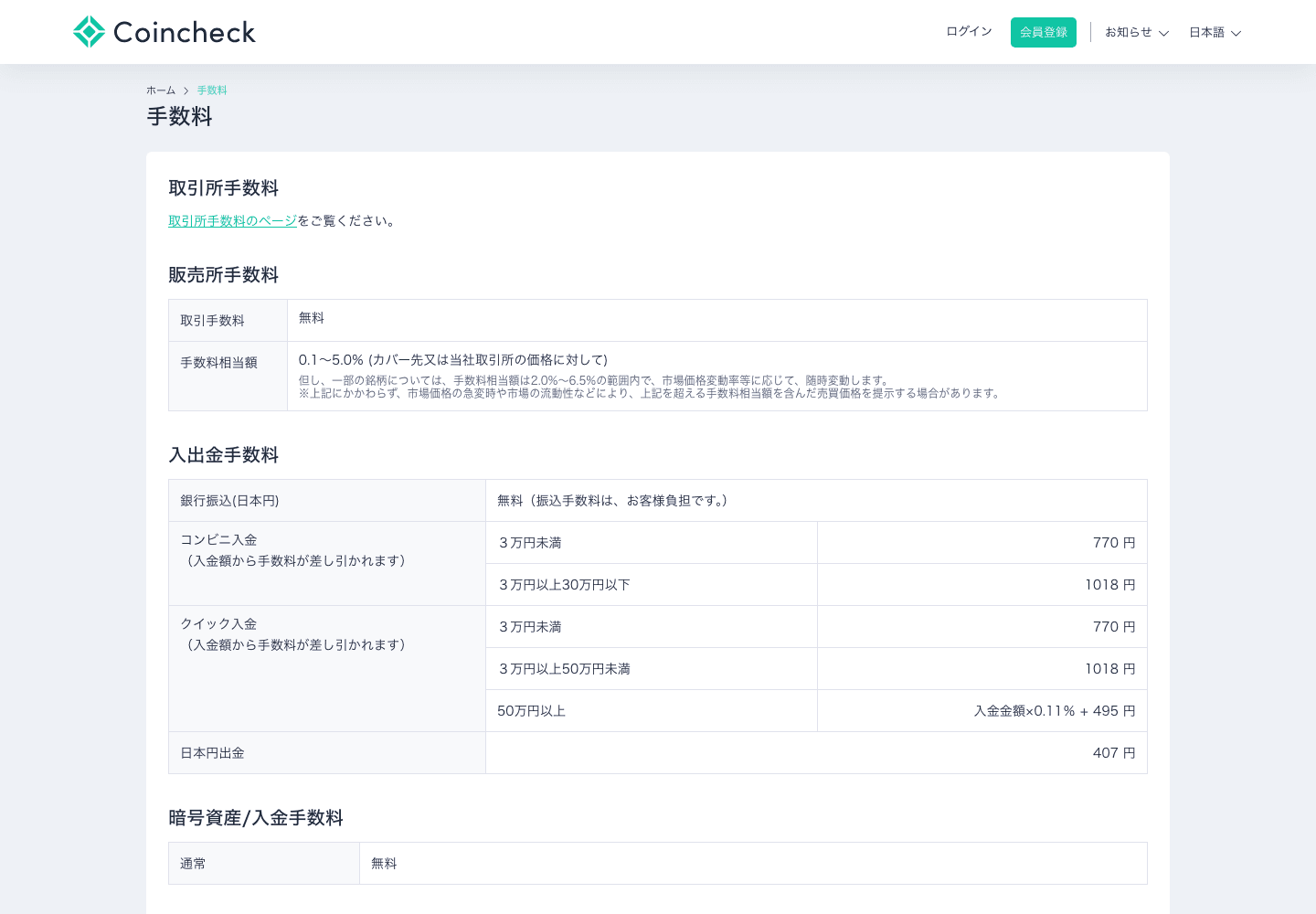
| Method | Fee | Limits |
|---|---|---|
| Bank transfer in (JPY) | Free from Coincheck; you pay your own bank’s fee | None stated |
| Quick deposit, instant bank (JPY) | 770 yen under 30,000 yen; 1,018 yen from 30,000 to 499,999 yen; amount times 0.11 percent plus 495 yen from 500,000 yen | 1,770 yen minimum (1,000 yen plus the 770 yen fee) to 999,999 yen per transaction; 10,000,000 yen per day to 23:59:59 |
| Convenience store deposit (JPY) | 770 yen under 30,000 yen; 1,018 yen from 30,000 to 300,000 yen | 1,770 yen to 300,000 yen per payment; 999,999 yen across any three days |
| Direct debit (scheduled buying only) | Free | 10,000 yen per currency to start, then 1,000 yen units, 1,000,000 yen total |
| Bank transfer out (JPY) | 407 yen | 50,000,000 yen per withdrawal, no daily cap. Own name account only; passkey required to register it and to request the withdrawal |
| Crypto deposit | Free | Per asset |
| Crypto withdrawal | Variable per asset, tracking network fees. BTC tiered 0.0005 to 0.016 BTC; ETH tiered 0.005 to 0.16 ETH. Free between Coincheck users | Per asset |
| Cards | Not offered | No card funding found anywhere |
The quick deposit fee is the one to watch: 770 yen on a 20,000 yen deposit is 3.85 percent before you buy anything. A plain bank transfer is free from Coincheck’s side and is the sensible default unless you need the money in immediately. The 407 yen withdrawal fee is unremarkable, and no daily withdrawal cap alongside a 50 million yen per transaction ceiling is generous. Coincheck complies with the Travel Rule using a solution it names as TRUST, so transfers to and from other exchanges carry originator and beneficiary information.
The incident record, dated
Withdrawals are where this firm’s history sits, because in 2018 the withdrawal rail was the thing that stopped. The table keeps three things apart deliberately: what Coincheck said, what the regulator ordered, and what was actually done. Those get blurred together constantly, and the blur always flatters somebody. One disclosure limit first: Coincheck’s dated announcements from 2018 no longer resolve on its own site, so the record of what it said at the time is quotable only from the Internet Archive.
| Date | What happened | Category | Source |
|---|---|---|---|
| 26 January 2018 | Customer NEM sent out by an intruder between 00:02 and 08:26 JST. Coincheck restricted NEM deposits, halted NEM sales and purchases at 12:38, halted NEM withdrawals at 12:52, and at 16:33 JST restricted all withdrawals from the platform, including yen. The FSA issued a report demand the same day. No other currency was affected | What the firm said and did; the regulator’s first step | Coincheck notices of 26 January 2018 via the Internet Archive; coincheck.com/ja/info/faq_nem; FSA document of 10 August 2018 |
| 28 January 2018 | Coincheck announced a reparations policy: approximately 260,000 users affected, total 523,000,000 XEM, repayment in yen into the Coincheck wallet at 88.549 yen a coin, being a weighted average XEM/JPY on Zaif between the trading halt at 12:09 JST on 26 January and the notice at 23:00 JST on 27 January, funded from company funds. Method and timing of application were not yet decided | What the firm said. An announced policy, not a payment | Coincheck blog post of 28 January 2018 via the Internet Archive |
| 29 January 2018 | First business improvement order, by the Director-General of the Kanto Local Finance Bureau under PSA Article 63-16. Five items: establish the facts and cause; respond appropriately to customers; strengthen governance over system risk management and clarify responsibility; build an effective system risk management framework with recurrence prevention measures; report in writing by 13 February 2018. The order describes Coincheck as a dealer under Supplementary Provisions Article 8, a deemed operator, not a registered one, and states 523 million XEM (5億2,300万XEM) with no yen figure | What the regulator ordered | Kanto Local Finance Bureau notice of 29 January 2018; FSA casebook row |
| 2 February 2018 | On site inspection commenced. The FSA announced the same day that it had, on 1 February, issued report demands to 16 registered and 15 deemed operators. Coincheck was in neither list, being the subject | What the regulator did | FSA document dated 2 February 2018 |
| 13 February 2018 | Yen withdrawals resumed. Coincheck states it paid out requests received to 15:00 on 11 February, about 40.1 billion yen, and says explicitly this was not the NEM compensation. The ordered written report was submitted the same day | What was actually done. Keep it apart from the compensation | Coincheck notices of 13 February 2018 via the Internet Archive |
| 8 March 2018 | Second business improvement order. Findings included failing to assess the risks in the crypto assets handled, including money laundering and terrorist financing risk, and a board that had not placed customer protection and risk management as its foremost issues, prioritising business expansion, with the statutory auditors also not functioning. It required a fundamental review of the management structure with assured effectiveness before resuming currently suspended transactions and before opening new customer accounts; appropriate reporting to the authorities on customer transactions and on compensation to customers; a written improvement plan by 22 March 2018; and monthly progress reports by the 10th | What the regulator ordered. Note the wording: a report about compensation. It did not order compensation to be paid | Kanto Local Finance Bureau notice of 8 March 2018; FSA casebook row |
| 12 March 2018 | Compensation completed, at 88.549 yen times the holding at 23:59:59 on 26 January: “Q. Has the compensation been completed? A. It was completed on 12 March 2018.” (「Q. 補償は完了したのか。 A. 2018年3月12日に完了しました。」) Note the mechanism, which is widely reported wrongly. It was not a bank transfer: “Compensation is not paid by transfer into a bank deposit account; it is carried out by a method that reflects the compensation amount (in Japanese yen) in the balance of the customer’s Coincheck account.” (「補償は預金口座への振込ではなく、お客様のCoincheckアカウントの残高に補償金額(日本円)を反映する方法で行います。」) The money was credited as a yen balance inside the customer’s Coincheck account, so getting it out required completing identity verification if not already done, paying the standard withdrawal fee and waiting in order of application, and Coincheck reserved the right to suspend the compensation without notice if a problem not then known emerged. Partial resumption of crypto withdrawals and sales the same day | What was actually done | coincheck.com/ja/info/faq_nem, live today; Coincheck notices of 12 March 2018 via the Internet Archive |
| 16 April 2018 | Monex acquisition completed. The 20-F records the price: 「In April 2018, Coincheck was acquired by Monex for ¥3.6 billion」 | What was actually done | Coincheck notices of 16 April 2018 via the Internet Archive; Form 20-F |
| 7 June 2018 | All currencies withdrawable and sellable again | What was actually done | Coincheck notice of 7 June 2018 via the Internet Archive |
| 30 October 2018 | New account registration reopened, nine months after the order that made it conditional, and already restricted to residents of Japan: “This reopening of new account registration applies to customers residing in Japan.” (「この度の新規口座開設再開は、国内居住のお客様が対象となります。」) The same release summarises the staged restart: yen withdrawals February 2018, crypto withdrawals and sales March to June 2018, then new accounts and some crypto deposits and purchases from 30 October | What was actually done | Coincheck notice of 30 October 2018 via the Internet Archive |
| 26 November 2018 | Full restoration of trading in every currency | What was actually done | Coincheck notice of 26 November 2018 via the Internet Archive |
| 11 January 2019 | Registration granted, crypto asset exchange service provider (暗号資産交換業者) Kanto Local Finance Bureau No. 00014 (関東財務局長 第00014号). Coincheck ceased to be a deemed operator, eleven and a half months after the theft | What the regulator did | FSA register verified as of 30 June 2026; Coincheck notice of 11 January 2019 via the Internet Archive |
| 2 to 4 June 2020 | Coincheck’s account at its domain registrar was taken over by a third party and the enquiry emails of roughly 200 customers were exposed. Coincheck halted crypto sending again, stating that yen deposits and withdrawals and crypto receiving, buying and selling continued as normal. No customer assets were lost | What the firm said and did. No regulator action recorded | Coincheck notices of 2 and 4 June 2020 via the Internet Archive |
| 28 April 2025 | A third party logged in to the company X account @coincheckjp from around 08:00. Coincheck suspended all services for the day, states the unauthorised access was dealt with by around 14:00 and that no impact on its systems was confirmed. No customer assets were lost | What the firm said and did. No regulator action recorded | Coincheck news item at corporate.coincheck.com/news/AWSPpjoO |
Three figures for one loss
They are on different bases and you should see all three. The Kanto bureau’s order of 29 January 2018 says 523 million XEM (5億2,300万XEM), and gives no yen value. Coincheck’s announcement of 28 January 2018 also says 523,000,000 XEM at 88.549 yen a coin, which computes to about 46.31 billion yen. Coincheck’s own later page, updated 16 October 2018 and still live, says 526,300,010 XEM, and the 2026 Form 20-F says 526.3 million NEM, or 46.6 billion yen. So the firm’s own coin count moved by about 3.3 million XEM, roughly 0.6 percent, by 8 March 2018, when Coincheck published the revised figure and noted “There has been a change from the figures originally announced.” (「当初公表した内容から変動がございます」), and it has stayed there since. Separately the FSA’s summary of 10 August 2018 values the leaked NEM at 58 billion yen with about 260,000 victims, and describes it as held “connected to the internet” (ネットに接続された状態で), which is the regulator saying hot wallet. The yen figures differ because the bases differ: Coincheck’s is its own compensation price of 88.549 yen a coin, the FSA’s is a market valuation of what left. We found no document reconciling them and we are not merging them.
Suspension, and the word the group uses
The 20-F says 「the JFSA required Coincheck to suspend its operations」. The regulatory record does not show that. The FSA casebook, 2,820 data rows current to 30 June 2026, carries exactly two Coincheck entries, both business improvement orders (業務改善命令), on 29 January and 8 March 2018. Neither is a business suspension order (業務停止命令). The same file records 369 suspension orders, counted on its disposition type (処分の種類) column, including against FSHO Kabushiki Kaisha (FSHO株式会社) and Bitstation Kabushiki Kaisha (ビットステーション株式会社) on the very same 8 March 2018 date, so it does record suspensions where they happened. The FSA’s 10 August 2018 chronology lists report demand, improvement order, on site inspection, improvement order, with no suspension anywhere. And the 8 March order refers to “resumption of transactions currently suspended” (「現在停止中の取引再開」), which Coincheck had suspended itself from 26 January. The order made resumption conditional on an overhaul; it did not itself suspend the business. We present both accounts and accuse nobody of lying. The practical outcome, a firm that stopped trading and could not restart without satisfying the regulator, is not far from what that sentence conveys to a lay reader. But the instrument matters, and the record says improvement order.
What is still not knowable
Two real limits. Coincheck declined to publish the remediation report it gave the regulator: “Q. Will the report on the business improvement order submitted to the Financial Services Agency not be made public? A. There are no such plans.” (「Q. 金融庁に提出した業務改善命令に係る報告書は公開されないのですか。 A. その予定はございません。」) And nobody publishes an audited figure for the compensation actually paid. Coincheck says it completed on 12 March 2018 and the 20-F says compensation was paid and the lawsuits about its calculation are all resolved, but no audited or regulatory document states the yen total, and Coincheck’s earliest published financial statement covers the year from 1 April 2018, which begins after the payment. Coincheck also says it reported the loss to the police, “We filed a report of the damage.” (「被害の届出を行いました」). We found no official document naming Coincheck as the victim in any prosecution, and we make no claim that anyone was convicted over this theft.
Customer Support
Support is deliberately narrow and Coincheck says so rather than pretending otherwise:
Inquiries to support are handled by email only. We’re sorry, but except in some cases, we do not provide staffed chat support or phone guidance. Please note that we have set up a telephone support desk only for matters concerning account opening. (サポートへのお問い合わせは、メールでの対応のみ行っています。恐れ入りますが、一部を除いて、チャットによる有人サポートやお電話によるご案内は提供していません。なお、口座開設に関する内容のみ、電話でのサポート窓口を設けています。)
Enquiries are handled by email only; apart from limited exceptions there is no staffed chat and no telephone guidance, with a phone window for account opening alone. The honesty counts for something. The service level is still thin.
| Channel | Hours | Scope |
|---|---|---|
| Web and in app contact form at /ja/info/help_contact | Accepted 24 hours; answered in roughly 1 to 2 business days | Everything. The only general support route |
| support@coincheck.com | Not stated | Listed on the Act on Specified Commercial Transactions (特定商取引法) disclosure. The help centre directs routine support to the form |
| Staffed chat | Weekdays 10:00 to 17:00 JST | Account opening and suspected unauthorised access only. Not general support |
| 03-4405-3842 | Weekdays 09:00 to 18:00 JST | Complaints and disputes only. Japanese only |
| 03-6416-5370 | Not stated | The company number on the statutory disclosure. Explicitly not for transaction or service enquiries |
| 03-6387-9445 | Weekdays 10:00 to 17:00 JST | Complaints about the Mercari linked service only. Japanese only |
Note what that adds up to. If a withdrawal has not arrived or an order behaved unexpectedly, there is no number to call. There is a form and a wait of one to two business days, for a venue holding 664,014 million yen of customer assets across 2,674,981 verified accounts at the end of July 2026, on preliminary figures Coincheck states are not audited by any independent registered public accountant. That is the main reason support does not score better here.
Every phone line is Japanese only, marked as Japanese support only (「日本語対応のみとなります」). The site offers Japanese and English by URL path, and in the app the display language follows the phone’s operating system setting and cannot be set separately. The help centre is mostly Japanese with a small “Help in English” subset, several of whose answers end by pointing at a Japanese only article. Given that you must live in Japan to hold an account, Japanese only phone support is defensible. It is still a hard stop for a foreign resident who does not read Japanese, and Coincheck actively onboards that population.
The self service is the strong part. We enumerated faq.coincheck.com through its sitemap and captured 550 answers, 827 KB of text. It documents what many venues leave vague: circuit breaker bands and reference price rules, fee application for maker, taker and itayose, the API rate limit and its 429 behaviour, why a stop order with both a trigger and an order price may not fill, what unfair trading means, and the residency checks after foreign travel. If you read Japanese you can answer most operational questions without contacting anyone, which is a real mitigant for a slow queue.
If it goes wrong, complaints and dispute resolution are disclosed under PSA Article 63-12 and Coincheck names four external routes: the Tokyo Bar Association Dispute Resolution Centre on 03-3581-0031, the Dai-Ichi Tokyo Bar Association Arbitration Centre on 03-3595-8588, the Dai-Ni Tokyo Bar Association Arbitration Centre on 03-3581-2249, and the JVCEA on 03-3222-1061. Named statutory external routes are meaningfully better than an internal complaints inbox. Two caveats: that statutory disclosure page is served on the English route as 1,043 characters of untranslated Japanese, and the 20-F records liability capped at no liability 「unless such damage or loss was caused by our gross negligence, willful misconduct or fraud」, with recovery limited under Japanese law to monetary compensation for actual damages.
Restricted Countries
Coincheck does not publish a list of prohibited countries. It publishes the inverse, which is stricter: one permitted country. Account opening is not accepted for anyone resident outside Japan (「日本国外に居住」), for individuals and companies alike. Every country other than Japan is therefore effectively restricted and no exception list exists.
This is not a recent retreat from foreign markets. When Coincheck reopened new account registration on 30 October 2018, after the second improvement order made it conditional, the reopening was already limited to residents of Japan: “This reopening of new account registration is limited to customers residing in Japan” (「この度の新規口座開設再開は、国内居住のお客様が対象となります。」) The rule is eight years old.
The bar is residence, not nationality, and the direction matters. A French, Brazilian or Vietnamese national living in Japan can open an account, with a residence card (在留カード) accepted and a guide for entering alphabetic names. A Japanese national living in London cannot. Two document types are excluded outright regardless of residence, Specific Residence Card (特定在留カード) and Specific Special Permanent Resident Certificate (特定特別永住者証明書). Age cuts at both ends, under 18 and 75 or over, so the eligible band is 18 to 74 and the upper limit is unusual and easy to miss.
Enforcement is at identity verification, not the network edge, and we tested that rather than assuming it. The site was served identically to all fourteen countries we fetched from, and /ja/registrations was served from the United States, Germany, Indonesia, South Africa, India and Brazil as readily as from Japan, differing only in per request tokens. Nothing blocked, nothing redirected, no geo notice. The one refusal during the fetch came from our own proxy provider’s content policy on a South African exit, not from Coincheck, and the retry matched everywhere else, so we record it as a proxy artefact and not as origin behaviour. Coincheck Group tells investors something firmer, that it restricts access from IP addresses outside Japan including the United States while noting a VPN may defeat it. We did not observe that on the public site or the signup form; it may operate on authenticated surfaces we could not reach, but as a description of what a non resident meets at coincheck.com it overstates the position.
Residency is rechecked in life, too: a customer who travels abroad gets a confirmation email and must submit destination, dates and purpose and confirm their registered address on return, with possible verification by post, and the apps cannot be downloaded or updated outside Japan. Two dead locale paths, /cn/ and /id/, still serve the English homepage with stale /id/ rules in robots.txt, which is leftover plumbing rather than a live offering. The practical advice is short. If you do not live in Japan this venue is not open to you, whatever the site appears to allow, and trying to work around a residence check on a regulated venue risks your funds being frozen at verification.
Conclusion
Overall 7 out of 10. Regulation 8, fees 9.5, platform 5.5, support 6.5, reviews 5.3. A solid score pulled down at the edges, and worth explaining because the headline hides a genuinely split picture.
The regulatory position is the best thing here and it is not a marketing claim. Registration No. 00014 with the Kanto Local Finance Bureau since 11 January 2019, read off the FSA’s own register in both languages, compels what most crypto venues choose or decline: money in a trust company, crypto segregated and cold stored, a matching own holding against the hot wallet portion, priority repayment and periodic CPA review. Customer crypto matches to the yen on both sides of the balance sheet at 678,230 million yen, reconciliation runs every business day with defined windows to fix a shortfall, two step authentication is mandatory and a passkey is required to add a withdrawal bank account and to withdraw yen. No enforcement entry after 8 March 2018 in a casebook of 2,820 data rows current to 30 June 2026. That is eight years and five months clean.
Regulation is 8 and not higher because the regime stops short of what customers assume. No compensation scheme, no deposit insurance, no asset insurance we could find; a priority right that ranks you ahead of other creditors over what is in the pot without filling it; a clause letting Coincheck settle a lost asset in different crypto or cash at a price it determines; and no proof of reserves attestation in the site, the 550 answer help centre corpus or the Form 20-F, where the phrase appears zero times.
On cost this is two products in one trench coat. The order book is 0.000 percent maker and taker on most pairs, and there is no inactivity, dormancy or closure fee. The dealer counter charges 0.1 to 5.0 percent, up to 6.5 percent on some assets, and produced 74 percent of revenue on roughly a tenth of the volume. Eight assets have no order book at all, LTC, XLM, MATIC, LINK, SAND, DOT, APE and AXS, so the expensive route is the only route for them, and quick deposit costs 770 yen on a small deposit. A customer who learns the order book pays very little. A customer who stays on the default screen pays a great deal, and the revenue split tells you which is common.
The platform is capable and narrow: two venues, a documented circuit breaker with published bands and an itayose restart, REST and WebSocket APIs with official libraries, 24 hour trading and a help centre unusually specific about mechanics. Against that, no OCO, no MetaTrader, no TradingView we could find, no demo account, no research of any kind, and a BTC/JPY breaker trip that stops the dealer counter for every listed pair, and with it scheduled buying, which runs through the same counter. Support is 6 because the only general route is a form answered in roughly 1 to 2 business days for a venue with 2,674,981 verified accounts, with no general phone line and Japanese only when there is one. The statutory external dispute routes are a genuine plus.
What holds the score down most is the gap between the Japanese product and the English presentation. All 21 legal PDFs on the English footer are the Japanese documents, one named _jp.pdf on the English route. The English homepage names customer trading accounts at four commercial banks, states that crypto may be held in a hot wallet connected to the internet, and tells readers that margin used on leveraged trading is not subject to segregated management, while the Japanese homepage and risk disclosure name a money trust at Nisshokin Shintaku Ginko Kabushiki Kaisha (日証金信託銀行株式会社) and cold wallets, and no leveraged product exists at all. Several English routes serve wholly Japanese bodies, /payment has no English page, and the English App Tweak footnote runs two years behind the Japanese one. None of this is fraud. It is an unmaintained English site for a product not sold to English speaking markets. But a reader taking those pages at face value would be misinformed about custody and would believe a leveraged product exists.
On 2018, the record reflects better on this firm than its reputation does. The theft happened while Coincheck was a deemed operator, before registration. Yen withdrawals restarted in eighteen days with about 40.1 billion yen paid, compensation from company funds completed in under seven weeks, full trading was restored in ten months and the licence arrived in under a year. Two disclosed incidents since, June 2020 and April 2025, each interrupted service and neither cost customers assets. Two qualifications belong with that. The compensation was credited as a yen balance inside each customer’s Coincheck account rather than wired to a bank, so customers had to complete identity verification if they had not, pay the standard withdrawal fee and wait their turn before the money was theirs to spend. And no audited total of what was paid exists, while Coincheck declined to publish the remediation report it filed. One continuity point, stated flatly as a fact and not an allegation: Koichiro Wada was chief executive at the time of the theft, and the Principal Shareholders table in the 2026 Form 20-F lists Koichiro Wada holding 9,700,464 ordinary shares, 5.1 percent of the listed parent, today.
Who this suits. Someone resident in Japan, aged 18 to 74, who reads Japanese, wants spot crypto without leverage, and will use the order book rather than the dealer counter. For that person a statutory client asset regime, a zero fee book and a clean eight year enforcement record is a strong offer. Who it does not suit. Anyone outside Japan, for whom the account is unavailable however far the signup form lets them get. Anyone who needs leverage or derivatives. Anyone who requires proof of reserves or asset insurance before depositing. Anyone who wants research, an OCO order, or a phone number to call at 2am. And anyone who cannot read Japanese, because the contract you would be agreeing to exists only in Japanese, and signing a document you cannot read is not a risk we would take on your behalf.
Score history
Recomputed daily; every move is on the record. The current score is always the latest row.
| Date | Score | Move |
|---|---|---|
| 2026-09-13 | 7.0 | ▲ |
| 2026-09-13 | 6.9 | ▼ |
| 2026-09-12 | 7.1 | · |
FAQ
Is Coincheck regulated and safe?
Coincheck is regulated. コインチェック株式会社 is registered as a crypto asset exchange service provider under Japan’s Payment Services Act, Director of the Kanto Local Finance Bureau No. 00014, granted 11 January 2019, which we verified on the FSA’s own register in Japanese and English as of 30 June 2026. It is also JVCEA member 1017. That registration requires customer money to be held in a trust company, customer crypto to be segregated and cold stored, a matching holding of the firm’s own crypto against the hot wallet portion, a right to be repaid ahead of other creditors, and periodic review by a certified public accountant. Safe is a different question. There is no compensation scheme, no deposit insurance and no customer asset insurance we could find, and Coincheck’s own risk disclosure says that if the company fails it may be unable to return customer assets. There is also no proof of reserves attestation: we searched the site, the 550 answer help centre corpus and the group’s Form 20-F, where the phrase occurs zero times.
Can I open a Coincheck account if I do not live in Japan?
No. Coincheck’s help centre, updated 6 August 2026, states that account opening is not accepted for anyone resident outside Japan, for individuals and companies alike, nor for anyone under 18 or aged 75 and over. Nationality is not the test: a foreign national living in Japan can open an account using a 在留カード residence card, while a Japanese national living abroad cannot. The confusing part is that nothing stops you starting. We fetched the site from fourteen countries and got the same pages every time, and the Japanese registration form was served from the United States, Germany, India, Brazil, Indonesia and South Africa as readily as from Japan. The refusal happens at identity verification, not at the network edge. Coincheck also rechecks residence after customers travel abroad, and its apps cannot be downloaded or updated outside Japan. The restriction is not new: it applied when new account opening reopened on 30 October 2018.
What actually happened in 2018, and could it happen again?
On 26 January 2018 an intruder sent out customer NEM and Coincheck halted every withdrawal on the platform, including yen, at 16:33 JST. Coincheck was not a registered exchange then; the FSA and the Kanto bureau both describe it as a deemed operator under the transitional provision. The regulator issued a report demand on 26 January, a business improvement order on 29 January, opened an on site inspection on 2 February and issued a second improvement order on 8 March. It ordered a report about compensation, not the payment of it. Coincheck paid anyway, from company funds, at 88.549 yen a coin, crediting the money as a yen balance inside each customer account rather than wiring it, and its own page says the payment completed on 12 March 2018. Yen withdrawals had already resumed on 13 February with about 40.1 billion yen paid out. Registration followed on 11 January 2019. Since then the FSA casebook records no further entry against Coincheck in 2,820 data rows current to 30 June 2026, and the two disclosed incidents since, a domain registrar takeover in June 2020 and a takeover of the company X account in April 2025, cost customers no assets. The custody rules are much stricter now. No exchange can be called immune.
What does trading on Coincheck actually cost?
It depends entirely on which screen you use, and the difference is several percent. The 取引所 order book charges 0.000 percent maker and taker on most pairs, and 0.050 percent maker with 0.100 percent taker on six: ETC, IOST, FNCT, BRIL, BC and FPL. The 販売所 dealer counter charges no commission but a spread equivalent of 0.1 to 5.0 percent, rising to 2.0 to 6.5 percent on certain assets and, Coincheck says, potentially beyond that in fast markets. Scheduled buying runs through the dealer counter at 0.1 to 4.0 percent. Some assets, including LTC, XLM, LINK, DOT, SAND, APE and AXS, have no order book at all, so the dealer counter is the only route. On funding, a bank transfer in is free from Coincheck’s side, quick deposit costs 770 yen under 30,000 yen, and a yen withdrawal costs 407 yen. There is no inactivity or closure fee.
Does Coincheck offer leverage or margin trading?
No, and the absence is structural rather than a product decision that could change tomorrow. There is no margin, leveraged or derivative product anywhere on the site, and Coincheck holds no financial instruments business registration, the permission a crypto derivatives product in Japan requires. We searched all 2,111 rows of the FSA’s 金融商品取引業者 register for both コインチェック and Coincheck and found no entry, with マネックス証券株式会社 present in the same file as a positive control. In the same corporate group the derivatives permission sits with the securities company, not with Coincheck. Note that the English homepage still carries risk wording about leveraged trading and margin, and that wording describes no product Coincheck sells.
How this review works
Track Coincheck live: score moves and red notices, in your pocket.