
CRYPTO · CHECKED 10 OCT 2026
Pintu review.
Indonesian crypto exchange offering rupiah spot trading, an advanced Pro order book and 25x perpetual futures, run by PT Pintu Kemana Saja under OJK permission S-15/D.07/2025.
OK-ISH
OUT OF 10
PT Pintu Kemana Saja holds OJK permission S-15/D.07/2025, a transfer letter recognising BAPPEBTI licence 01/BAPPEBTI/PFAK/08/2024, the first full crypto trader licence issued in Indonesia. Both check out on the regulators' own registers and OJK's channels carry nothing adverse. Disclosure is the weak half: the fees page calls retail trading free when the real cost is an unpublished spread, the only proof of reserves is a 2022 snapshot, and three documents give four answers on futures leverage. Suits Indonesian residents wanting a licensed domestic venue.
Each criterion is scored 1 to 10 from primary sources. The overall score is their unweighted mean. How scoring works.
| Headquarters | ID |
|---|---|
| Minimum deposit | IDR 11,000 |
| Maximum leverage | 1:50 |
| Withdrawal fee | Rp 4,500 (about USD 0.25 at August 2026 rates) |
| Account opening | 1 |
| Platforms | Pintu mobile app (iOS), Pintu mobile app (Android), Pintu Pro (web desktop), Pintu Pro (in-app), TradingView charting |
- OJK permission S-15/D.07/2025 verified on two separate OJK publications, the 25 May 2026 register and the December 2025 whitelist
- Holds Indonesian physical crypto asset trader licence number 01, granted 1 August 2024 and confirmed on BAPPEBTI's own archived register
- One legal entity serves every country, with a byte-identical page across eleven tested, so there is no offshore onboarding arm
- Member number 1 of the OJK-licensed CFX bourse and first on the clearing house KKI's member list
- Nothing adverse on three OJK announcement channels searched with controls that fire, and absent from the June 2026 Satgas PASTI blocked list
- Rupiah quoted throughout the retail book with a Rp 11,000 minimum order on 493 of 496 symbols, free deposits, a flat Rp 4,500 withdrawal fee and an in-app annual tax report
- Futures liquidation, insurance fund and auto deleveraging mechanics are documented in unusual detail, including the ADL selection criteria
- A named custodian holding its own OJK permission, plus a published bug bounty policy and information security policy
- Commissioned and published a signed reserves report from a licensed Indonesian public accountant, who checked custodian wallet transfers against a public block explorer rather than taking management's word
- A published phone line and a complaints route to the sector ombudsman LAPS SJK under POJK 22 of 2023
- The fees page tells retail users trading is free when the actual cost is a spread Pintu never publishes and says can change at any time
- The only attested proof of reserves measures 30 November 2022, we found no successor in nearly four years, and there is no Merkle tree
- The word for custodian appears nowhere in the roughly 50,000 character customer agreement, though the regulator-mandated summary names one
- A segregated account is referred to in two documents and identified in neither, with the value given as 'as stated on the Platform'
- Three Pintu documents give four different answers on futures leverage, and the binding trading rules do not describe the product being sold
- Key numbers in the binding futures trading rules are JPEG screenshots, one of them captured in November 2024 and never refreshed
- The OJK-mandated cost disclosure understates the bourse fee tenfold in its own worked example and mislabels a rupiah figure as Bitcoin
- Pintu Earn caps Pintu's liability for any loss at three months of accrued rewards, and never explains where the yield comes from
- Live binding documents still describe Pintu as supervised by BAPPEBTI, which lost jurisdiction over this activity in January 2025
- The futures counterparty changed in January 2026 and existing customers were migrated, personal data included, by deemed consent
Overview
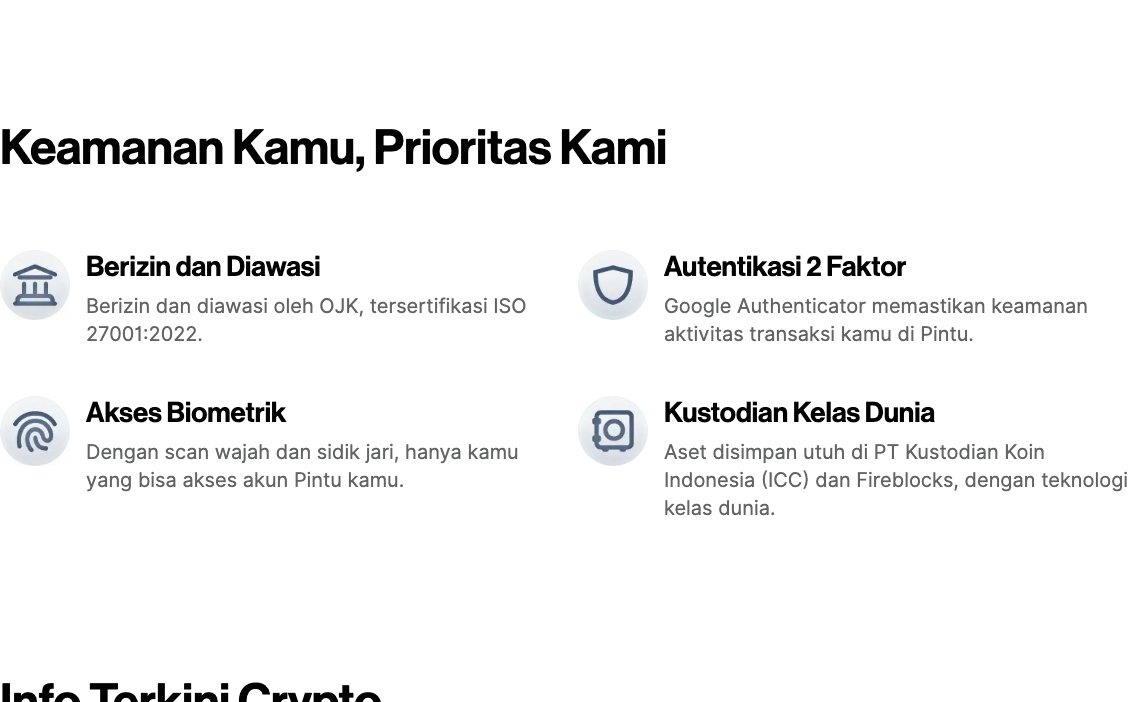
Pintu is an Indonesian crypto exchange run by PT Pintu Kemana Saja, and it is one of
the few exchanges anywhere whose licence you can trace to the day it was issued. Indonesia’s commodity
futures regulator BAPPEBTI gave it physical crypto asset trader licence number 01 on
1 August 2024, the first full licence of its kind in the country. When supervision of the whole sector
moved to the financial services authority OJK, Pintu was carried across with the rest of the incumbents
and received S-15/D.07/2025 on 1 February 2025. Both numbers check out on the
regulators’ own published records.
That is the strong half. The weaker half is what the firm publishes about cost. Pintu’s own fees page
tells a retail user, in one word, that trading is Gratis. It is not. There is no order book on
the retail app: you buy and sell against a price Pintu quotes, with the cost inside that price as a spread
the firm says “can change at any time” and never publishes as a number. A 0.21% sales tax and a bourse fee
of roughly 0.11% sit on top, and the fees page mentions neither.
Pintu also runs leveraged crypto perpetual futures, and the counterparty on that product changed on
9 January 2026. Until then the futures service was provided by PT Porto Komoditi Berjangka,
a commodity futures broker; since then it is PT Pintu Kemana Saja itself, under the OJK permission, with
existing customers moved across by deemed consent. The regulatory route for that was opened five weeks
earlier by POJK 23 of 2025, which brought crypto derivatives inside OJK’s perimeter. The site has not
caught up: the page listing which futures contracts are available still tells customers, in its own
rendered text, that availability “is determined by PT PORTO KOMODITI BERJANGKA”.
The product is otherwise straightforward and, unusually for this sector, honest about its own risks
where the regulator requires it to be. Pintu’s OJK-mandated product summary states plainly that futures
losses “can exceed the Margin or the initial funds” and that positions can be closed out without notice.
The clearing house names a real insurance fund with a stated cap. A custodian is named. What is missing is
a current proof of reserves. There is exactly one, an agreed-upon procedures report from an Indonesian
public accountant reporting crypto reserves at 112% of customer liabilities, and it measures 30 November
2022. We found no successor in nearly four years.
Overview Table
| Headquarters | Jakarta, Indonesia. OJK’s own whitelist prints the address as Trinity Tower Lantai 46, Jalan H R Rasuna Said Kav C22, Block IIB, Karet Kuningan, Setiabudi, Jakarta Selatan 12940. Pintu’s own terms give a different company address, The City Tower Lantai 27, Jalan M. H. Thamrin No. 81, Jakarta Pusat 10310 |
|---|---|
| Established | Not published. Neither Pintu’s about page nor its corporate page carries a founding date, and there is no copyright year range on the site |
| Countries Served | Indonesia. One entity, one website, and a byte-identical page served to all eleven countries we tested. US persons are barred by contract |
| Regulated By | OJK (Otoritas Jasa Keuangan), permission S-15/D.07/2025 of 1 February 2025. Predecessor: BAPPEBTI 01/BAPPEBTI/PFAK/08/2024 of 1 August 2024 |
| Minimum Deposit | Rp 50,000 |
| Maximum Leverage | 25x on futures per the help centre and the marketing page. The binding trading rules say 5x to 50x. Spot is unleveraged |
| Total Instruments | 496 tradeable symbols on the retail limit table, including 41 tokenised US equities and ETFs. 215 perpetual futures contract codes on Pintu’s published contract list |
| Platforms | Pintu mobile app (iOS, Android), Pintu Pro web and in-app, TradingView charting |
| Customer Support | Email help@pintu.co.id, in-app live chat, phone 021 39732222. Hours not published |
| Languages | Indonesian and English. A Russian locale is declared but serves the Indonesian page verbatim |
| Incident history | No security incident, outage or withdrawal halt was found in any admissible source, and OJK’s three announcement channels are silent about the firm with controls that fire. We did not systematically search a status page. See the dated record in Deposits & Withdrawals |
Facts List
- Licensed entity is PT Pintu Kemana Saja, and it is the counterparty on every product: retail spot, Pro Spot and futures.
- OJK permission S-15/D.07/2025 appears on two separate OJK publications, the 25 May 2026 register and the 19 December 2025 whitelist press release.
- The predecessor BAPPEBTI licence 01/BAPPEBTI/PFAK/08/2024 is confirmed both on BAPPEBTI’s own register as archived in January 2025 and in Pintu’s own terms.
- Member number 1 of the CFX bourse, SPAB-001/PFAK/BKN/03/2024 of 14 March 2024, and first on the clearing house KKI’s member list.
- Custodian named in the OJK-mandated product summary is PT Kustodian Koin Indonesia, which holds its own OJK permission S-5/D.07/2025.
- The word for custodian appears nowhere in the customer agreement, which runs to roughly 50,000 characters.
- One proof of reserves report exists, dated 15 December 2022 and measuring 30 November 2022. We found no successor.
- Retail trading cost is an embedded spread that is never quantified; the published fee for it is “Gratis”.
- Sales of crypto carry 0.21% PPh Pasal 22 under PMK 50/2025; purchases carry 0% VAT since 1 August 2025.
- Rupiah withdrawal costs Rp 4,500, waived by staking 100 PTU. Deposits are free and credit within one working day.
- Futures liquidation runs through the clearing house’s own account, backed by an insurance fund capped at 2.5% of the total liquidated position.
- Pintu is absent from OJK’s Satgas PASTI blocked entity list of June 2026, on which Binance is number 1.
Key Takeaways
The short version, for a reader deciding whether to put rupiah into this app.
- The licence is real and it is traceable. Not a claim on a footer: a numbered permission on the national regulator’s own register, with a numbered predecessor on the previous regulator’s register. Very few exchanges clear that bar.
- The licence recognises a permission Pintu already had. The S- letter of 1 February 2025 went to the whole transferred cohort on one day. It is a transfer instrument, not a fresh assessment. “Licensed by OJK since February 2025” is true and reads stronger than the paper supports.
- You cannot find out what a retail trade costs. The fees page says trading is free. The real cost is a spread Pintu builds into its quoted price and never publishes, plus a 0.21% sales tax and a bourse fee that the fees page does not mention.
- Pro Spot is the transparent surface. It has an order book and a published maker and taker ladder, 0.12% and 0.17%, currently waived in beta. If you care what you are paying, that is where to trade.
- The proof of reserves is real and it is from 2022. A named Indonesian public accountant reported crypto reserves at 112% of customer liabilities as at 30 November 2022. There has been no update since, and there is no Merkle tree, so you cannot check your own balance was counted.
- The futures counterparty changed in January 2026 from a commodity futures broker to Pintu itself, and existing customers were moved by deemed consent, personal data included.
- Three Pintu documents give four different answers on the maximum leverage on that futures product. The binding trading rules do not describe the product the marketing sells.
- Pintu Earn caps its own liability at three months of interest. If Earn assets are lost, that is the contractual ceiling on what you can recover from Pintu.
- Nothing adverse from the regulator. Three OJK announcement channels searched with controls that fire, and absence from the national blocked entity list.
- One entity, everywhere. There is no offshore arm quietly onboarding you. The company you contract with in Jakarta is the company on the register.
Licences & Custody
Pintu is licensed, and the licence survives being checked. That sentence does more work than it looks
like it does, because most exchanges cannot support it.
The licence chain
| Authority | Location | License Number | Retail Services | Protection Level |
|---|---|---|---|---|
| OJK (Otoritas Jasa Keuangan) | Indonesia | S-15/D.07/2025, dated 1 February 2025 | Pedagang Aset Keuangan Digital: spot crypto, and since POJK 23 of 2025 also crypto derivatives on an OJK approved bourse | Conduct supervision, consumer protection under POJK 22 of 2023, escalation to the sector ombudsman LAPS SJK. No investor compensation scheme and no deposit insurance |
| BAPPEBTI (superseded for this activity) | Indonesia | 01/BAPPEBTI/PFAK/08/2024, issued 1 August 2024 | Pedagang Fisik Aset Kripto, the predecessor permission recognised by the OJK letter above | Historic. BAPPEBTI no longer supervises this activity |
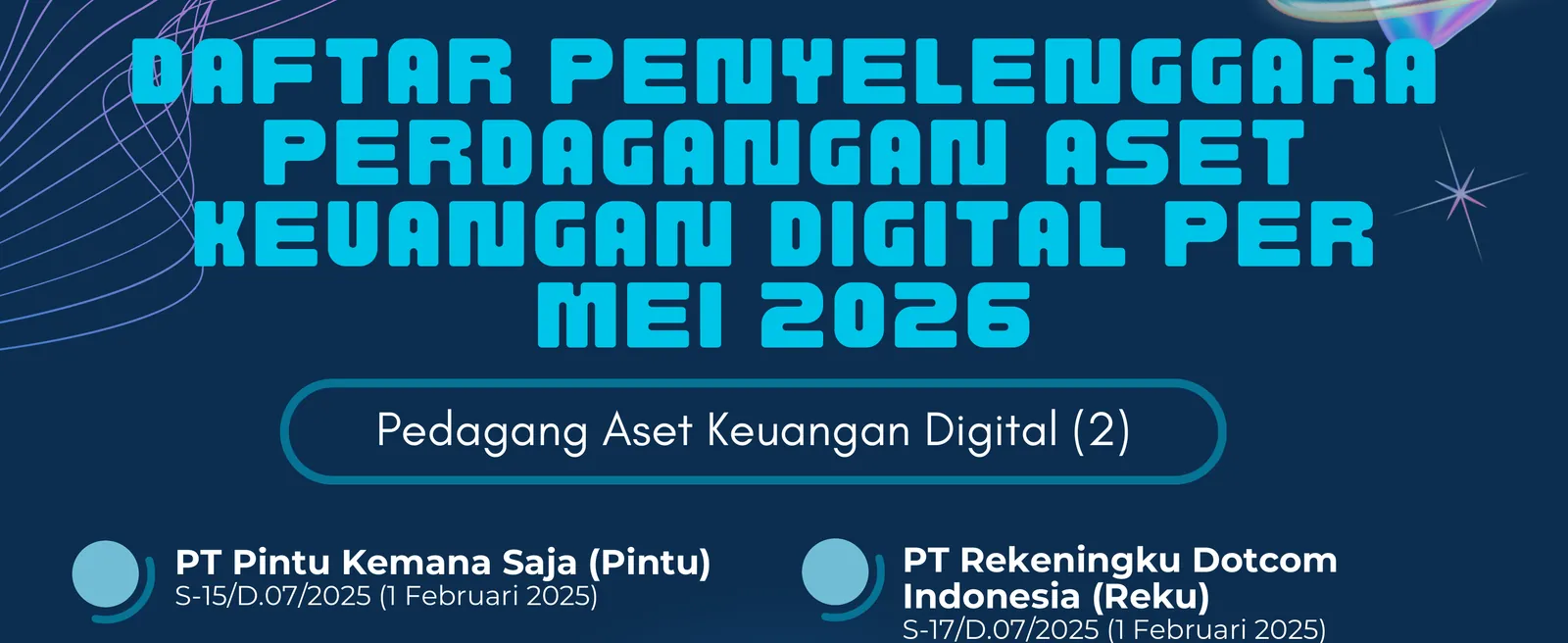
Both rows were verified today at source. The OJK permission appears on two independent OJK
publications: the register “Daftar Penyelenggara Perdagangan Aset Keuangan Digital Posisi 25 Mei 2026”,
where Pintu sits on page two under Pedagang Aset Keuangan Digital, and press release
SP 226/GKPB/OJK/XII/2025 of 19 December 2025, whose whitelist gives Pintu as entry 18 with its address
and the website pintu.co.id. The BAPPEBTI licence was recovered from BAPPEBTI’s own register as the
Internet Archive captured it on 6 January 2025, which returns the entity, the address, the licence number
and the issue date of 1 August 2024, and it matches to the character the number Pintu prints in its own
customer agreement.
Number 01 is not a rounding of anything. The same archived file lists Pluang at 02 and Tokocrypto at
03, ordered by name and sequential by issue date. Pintu was first through the door.
What the S- letter actually is
Supervision of digital financial assets including crypto moved from BAPPEBTI, the commodity futures
regulator under the Trade Ministry, to OJK, the financial services authority, under Law 4 of 2023 and
Government Regulation 49 of 2024. The memorandum of understanding transferring it was signed on
10 January 2025, numbered NK-01/D.07/2025 on OJK’s side and
HK.00.00.01/BAPPEBTI/NK/01/2025 on BAPPEBTI’s. Three weeks later, on 1 February 2025, every transferred incumbent received an
S- letter. Every authorisation granted after the transfer carries a KEP-
decision with its own later date: on the same register, Upbit is KEP-6/D.07/2025 of 17 March 2025, Luno
KEP-17/D.07/2026 of 25 May 2026, and the second bourse ICEx KEP-2/D.07/2026 of 5 January 2026.
So S-15/D.07/2025 recognises a licence Pintu already held. It is not a fresh
assessment of the firm by its new regulator. Pintu’s own product summary names the instrument accurately,
as a Surat Penegasan Persetujuan, a letter affirming approval. The marketing shorthand
“licensed and supervised by OJK” is true; it just describes something less searching than a reader is
likely to imagine. The transition period between the two regulators formally closed on 20 January 2026.
Entity by residence
For most exchanges this is where the review gets complicated. Here it does not, and that is a point in
Pintu’s favour worth stating plainly rather than dressing up. We fetched pintu.co.id from eleven countries
through in-country exits and compared the responses by SHA-256. All eleven returned one identical hash.
There is no offshore entity waiting for non-Indonesian visitors, because there is no second entity at
all.
One honest note on that method. The page is not perfectly deterministic: repeat fetches from Indonesia
alone can differ by a few bytes, because a yield figure rendered into the marketing copy changes between
requests. So the eleven-way byte match is stronger-looking evidence than it is entitled to be on its own,
and the conclusion does not rest on it. It rests on the registers. OJK’s whitelist, OJK’s register and
CFX’s member list all name one company and one website, and no second Pintu entity appears on any of
them.
| Where you appear to be | Entity you contract with | Regulator named | Page served |
|---|---|---|---|
| Indonesia | PT Pintu Kemana Saja | OJK | Identical, 199,514 bytes |
| Thailand, Vietnam, Singapore, Japan, India | PT Pintu Kemana Saja | OJK | Identical, byte for byte |
| UAE, South Africa | PT Pintu Kemana Saja | OJK | Identical, byte for byte |
| United Kingdom, Germany | PT Pintu Kemana Saja | OJK | Identical, byte for byte |
| United States | None. US persons are barred by contract | OJK | Identical marketing page, but accounts are refused and existing ones were deactivated on 22 November 2023 |
One caveat we will not paper over: that test proves the server rendered marketing page is the same
everywhere. It does not prove there is no gating inside the app, at signup, at identity verification or
at the API. What it does establish is that there is no second legal entity being shown to anyone.
Custody: who holds the coins
The counterparty is PT Pintu Kemana Saja. The custodian named in the RIPLAY Umum, the product summary
OJK requires an exchange to publish, is PT Kustodian Koin Indonesia, trading as ICC, in
the field headed Pengelola Tempat Penyimpanan Aset Keuangan Digital. ICC is not an arrangement
Pintu invented: it holds its own OJK permission, S-5/D.07/2025, on the same register. The clearing
institution named alongside it is PT Kliring Komoditi Indonesia.
Then it gets less tidy. The word kustodian appears zero times in the
customer agreement, roughly 50,000 characters of it, and so does Fireblocks. We checked that with positive controls in the same
file, searching for words we knew were there, and they matched, so the search was working. The custodian
is disclosed in the regulator-mandated summary and not in the contract you actually agree to. Meanwhile
the homepage renders a different formulation in its own body text: assets are stored “at PT Kustodian
Koin Indonesia (ICC) and Fireblocks”. Fireblocks is a wallet infrastructure vendor, it is not in the
RIPLAY’s custodian field, and it appears nowhere in the agreement.
Segregation is acknowledged twice and identified neither time. The customer agreement carries a row
headed “Nomor rekening yang terpisah Pedagang Fisik Aset Kripto yang telah disetujui oleh Kepala
Bappebti”, the segregated account number approved by the head of BAPPEBTI, and gives its value as
“Sebagaimana disebutkan pada Platform Pintu”, as stated on the Pintu Platform. The futures trading rules
have a section headed REKENING SEGREGATED which says margin goes to “Rekening Segregated Kami:
sebagaimana kami informasikan pada Platform”. In both places the concept is asserted and the account is
not named in the document.
Put plainly, for the reader who wants one sentence: a custodian is named by the regulator’s
disclosure and not by your contract, a segregated account is referred to but never identified, and what
you hold is a claim against PT Pintu Kemana Saja rather than title to identified coins held for you by a
third party.
Membership is not a licence to hold your money
Pintu is member number 1 of the CFX bourse, SPAB-001/PFAK/BKN/03/2024 of 14 March 2024, with the
website field on CFX’s own register reading pintu.co.id. It is listed first among the 22 members on the
clearing house KKI’s own members page. It has not moved to Indonesia’s second licensed bourse, ICEx,
whose admissions list carries six other firms and not Pintu.
All of that is worth recording and none of it is a permission to hold client money. Bourse membership,
clearing membership and a depository relationship are market structure requirements. They tell you the
trades clear somewhere sensible. They do not tell you anyone other than the exchange is holding your
coins.
The stale regulator problem
Nothing in this section is false about Pintu’s past. It was BAPPEBTI registered, and it was first.
What is wrong is that documents which still bind customers describe a regulator that stopped supervising
this activity nineteen months ago.
- The Pintu Earn terms, last modified in March 2024 and live today, open by stating
that Pintu is “a digital crypto asset trader officially registered with and supervised by the Commodity
Futures Trading Regulatory Agency (Bappebti)”. - The main customer agreement, modified 9 January 2026, still carries an operative
clause telling users that crypto assets on the platform “dapat sewaktu-waktu dicabut oleh Bappebti”, may
be withdrawn at any time by BAPPEBTI, and keeps BAPPEBTI in its definitions. Across that document
BAPPEBTI and OJK each appear four times. - That same agreement cites POJK 27 of 2024 and POJK 22 of 2023, and does not cite POJK 23 of 2025, the
December 2025 amendment. That is an observation about the document. We draw no compliance conclusion from
a missing citation. - The live page bundle still carries the strings “Terdaftar dan diawasi oleh BAPPEBTI dan Kominfo” and
a footer label reading “berizin dan diawasi oleh Otoritas Jasa Keuangan (OJK) dan/atau BAPPEBTI”, with
that “and/or” doing a lot of hedging. We could not establish whether either renders on a page a customer
sees, because this site’s footer is built in the browser, so their absence from the served HTML proves
nothing in either direction.
Set against that, the RIPLAY, the opening paragraph of the main agreement, the futures terms, the
futures trading rules and the current live footer disclaimer all name OJK correctly, and the homepage
renders “Berizin dan diawasi oleh Otoritas Jasa Keuangan (OJK)” in every country we tested. The pattern
is a firm whose newest documents are current and whose older ones were never revisited.
Nothing adverse on the record
We searched OJK’s three announcement channels, driving the regulator’s own search forms with the field
names taken from its returned markup. “Pintu Kemana Saja” returns nothing on any of them. The single hit
for “Pintu” alone is a press release about OJK opening a single-window licensing service, Layanan
Perizinan Satu Pintu, which uses the ordinary Indonesian word for door and has nothing to do with
this firm.
The controls matter more than the nulls. Searching the announcements list for “Pencabutan Izin”,
licence revocation, returns ten results with the newest dated 16 July 2026, so the search demonstrably
surfaces recent enforcement. Searching the press releases and the news list for “Aset Keuangan Digital”
returns ten and four results respectively. The instrument works, and it has nothing on this firm.
Pintu is also absent from OJK’s Satgas PASTI list of blocked digital asset traders published in June
2026, which we parsed to 228 numbered rows. Binance is number 1 on that list, KuCoin 2, Coinbase 3,
Bybit 4 and OKX 5, which gives some sense of what being on it means.
Trading & Execution
Pintu is three products wearing one brand, and they behave very differently. Which one you use decides
what you pay, what you can see, and how much you can lose.
The retail app: no order book
The main Pintu app has no order book. You tap buy or sell and the transaction executes against a price
Pintu quotes you, which the firm calls the harga final, the final price. Pintu’s own explanation
of how that price is formed is worth reading twice: “the difference between the sell price and the buy
price (spread) can also change at any time following market conditions, because Pintu collects the best
price references from various markets to form the final price.”
So the execution model is a quoted price from a single counterparty, with the venue’s compensation
inside the quote. That is a legitimate way to run a consumer app and it is what most Indonesian exchanges
do on their simple surface. It is also the reason the cost section of this review is as long as it is.
Pintu Pro: an order book and published rates
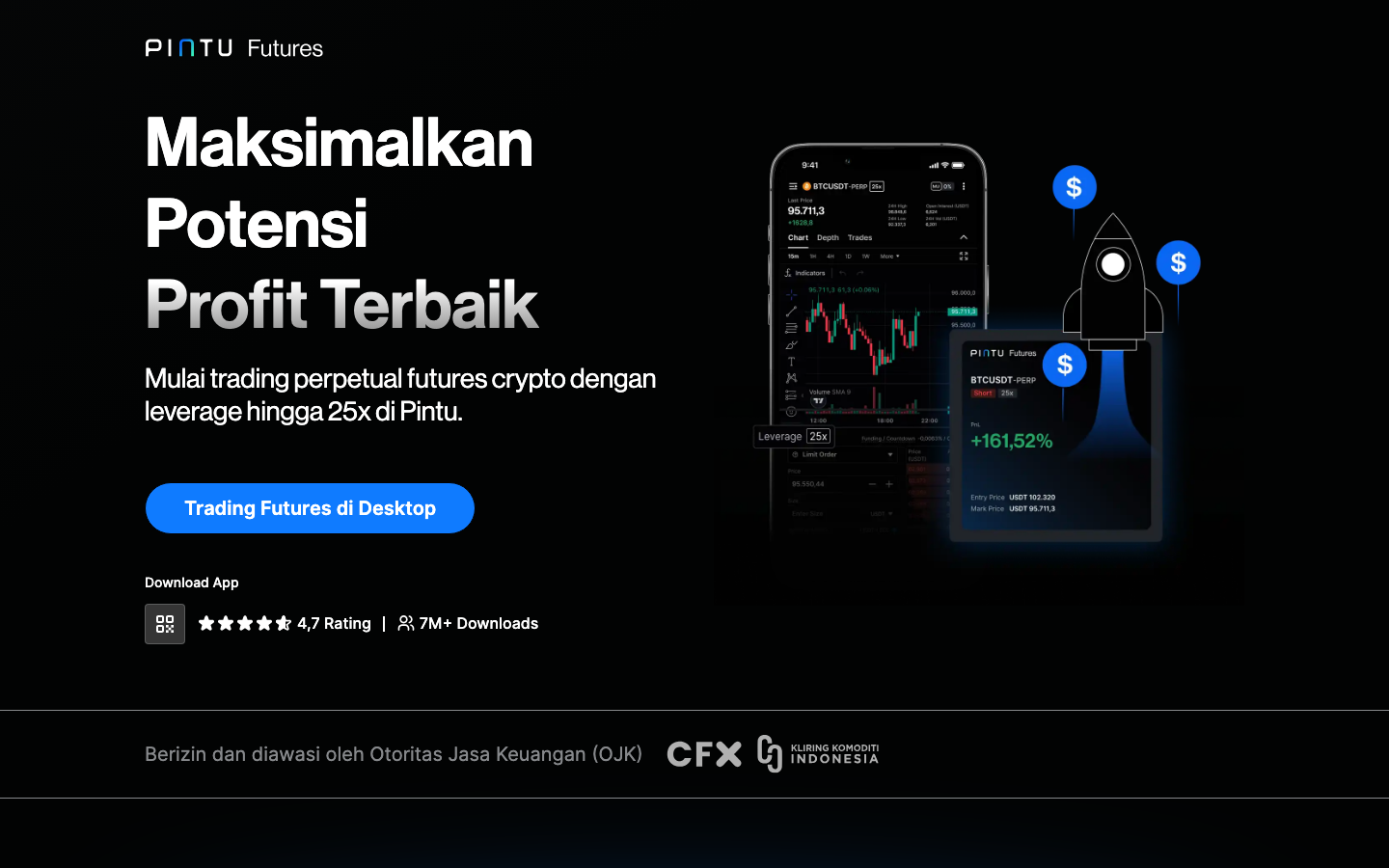
Pintu Pro is the advanced surface, available both in the app and on the desktop web. The RIPLAY
describes it as giving access to deeper liquidity, an order book, advanced charts, multiple order types
and portfolio monitoring. This is where a user who cares about execution should be, and it is where the
fees are actually published rather than embedded.
Futures: perpetual contracts, and who you are trading against
Pintu Futures trades crypto perpetual contracts with no expiry. The futures terms describe it as
“a perpetual contract that allows you to speculate on the price movement of Crypto Assets without a
maturity date”, and the RIPLAY is blunt that you own nothing underlying: “Pengguna tidak memiliki aset
yang mendasari kontrak”.
The counterparty question has a clear answer and it changed recently. Until 9 January 2026 the futures
service was “provided and processed by PT Porto Komoditi Berjangka”, a commodity futures brokerage
regulated by BAPPEBTI that deals in gold, crude oil and forex. Since that date the provider is
PT Pintu Kemana Saja itself, acting under OJK permission S-15/D.07/2025. The futures terms record the
change and the mechanism: continued use of the service after 9 January 2026 is deemed to be agreement to
the change of provider, to the new trading rules, and to the transfer of the customer’s personal data from
Porto to Pintu. A customer who did not agree was told to email help@pintu.co.id and stop using the
service.
The site has not caught up, and in one place that is a customer-facing problem rather than a cosmetic
one. Pintu’s published list of futures contract codes, the page a trader consults to see what is
available, still states in its own rendered body copy: “Ketersediaan kontrak yang bisa diperjual-belikan
pada platform Pintu diatur oleh PT PORTO KOMODITI BERJANGKA“, meaning that which
contracts are available to trade on the Pintu platform is determined by PT Porto Komoditi Berjangka. That
page was last modified in March 2025, ten months before the handover, so it is a page nobody revisited
rather than a live assertion, but it is served to customers today. Separately, the old provider’s
copyright line is still shipped in the inline dictionary of every page on the site; whether that one
renders anywhere we could not establish, because the footer is built in the browser.
The change of provider itself was not a workaround. POJK 23 of 2025, announced by OJK on 4 December 2025 as an amendment to
POJK 27 of 2024, expressly brought derivatives inside the definition of digital financial assets and
allowed a licensed trader to buy and sell derivatives on a customer’s instruction, on an OJK approved
bourse, without prior OJK approval, provided there is a cooperation agreement with the bourse and written
notification to OJK. The same rule requires margin to be held in a dedicated account and requires the
trader to run a knowledge test for customers before they trade derivatives. Pintu’s own futures terms and
trading rules do not mention a knowledge test, and we could not check the app itself, so whether one
exists in the signup flow is unresolved.
Structurally, the trades are not an in-house book. Orders go to the CFX bourse, which runs a live
perpetual derivatives market, and they clear at PT Kliring Komoditi Indonesia. CFX publishes a daily
summary of that market with contract prices, volumes and trade counts.
Margin, margin calls and liquidation
The mechanics are set out in the trading rules of 8 January 2026 in more detail than most exchanges
bother with, and they are worth working through because they decide when you lose the position.
Everything keys off a Margin Health Ratio, defined as position margin divided by the sum of available
margin and position margin. There are four states:
| State | Margin Health Ratio | What happens |
|---|---|---|
| Healthy | below 50% | Normal trading |
| Initial Margin Call | 50% to 75% | Warning issued through the clearing house and Pintu, asking for more margin |
| Final Margin Call | 75% to under 100% | The account may only reduce. New orders that would worsen the ratio are rejected until it falls back below 75% |
| Liquidation | 100% | Open orders are cancelled first to free margin. If the ratio stays at 100%, all open positions and the remaining margin balance are transferred to the clearing house |
What happens next is the part most exchanges gloss. The positions and the leftover margin move to the
Akun Likuidasi Kliring, an operational trading account owned by the clearing house, which
then works out of them by placing limit orders in the book. The stated purpose is to stop the customer’s
account being exposed to further market movement. Three outcomes follow:
- Liquidation with a surplus. The clearing house closes the position before the assigned
margin is exhausted, and what is left is added to the insurance fund. Note the direction of that: the
surplus does not come back to you. - Liquidation at a loss. The insurance fund absorbs the shortfall, up to a limit.
- Auto deleveraging. If the clearing house cannot exit within its own threshold, the
bourse applies ADL and closes the position against other customers on the opposite side.
The Dana Asuransi is run by the clearing house in a separate dedicated account, funded
by the clearing house itself, by its members, and by those liquidation surpluses. Read the cap carefully:
the money contributed by a given clearing member can only be used for that member’s own customers, and it
is the portion coming from the clearing house itself plus the liquidation surpluses that may cover losses
across all members’ customers, up to 2.5% of the total liquidated position. The clearing
house reserves the right to change that limit at any time by its own decision. The fund cannot be used to
finance the bourse’s or the clearing house’s operations.
On ADL, read the selection criteria carefully if you trade at size. The bourse picks
its counterparties by “the customer with the highest leverage and the largest potential profit”. In other
words, the traders who are most right are the ones whose positions get closed to resolve someone else’s
liquidation. The rules add that a customer hit by ADL “cannot protest to the Bourse or the Clearing
House”, having agreed to the terms in advance.
The RIPLAY does not soften any of this. Its risk column says derivatives are highly speculative,
that “losses can exceed the Margin or the initial funds”, and that positions may be liquidated
“including without notification, until the entire margin is exhausted”.
Mark price, funding and halts
Valuation, profit and loss and risk monitoring all run off a Mark Price rather than the last traded
price on Pintu, which is the right design because it is harder to manipulate. The index is a weighted
average of global exchange prices, updated every minute, converted to rupiah at the daily USD to IDR rate
for the rupiah margined contracts.
The trading rules name the venues that may feed that index: Binance, Bitfinex, BitMEX, Bybit, Coinbase,
Crypto.com, Gateio, HTX, Kraken, Kucoin, LBank and OKX, with the final selection and weights set by bourse
decision. There is an awkwardness here that a reader is entitled to know about. All twelve of
those venues appear on OJK’s own Satgas PASTI list of blocked digital asset traders published in
June 2026: Binance at number 1, KuCoin 2, Coinbase 3, Bybit 4, OKX 5, Gate 9, Crypto.com 10, Bitfinex 26,
BitMEX 140, HTX 147, LBank 154 and Kraken 179. Being blocked for offering unlicensed services to
Indonesians is a different thing from being unreliable as price data, a globally sourced index is the
standard defence against manipulation, and the index design belongs to CFX rather than to Pintu. But the
reference price that decides when an Indonesian customer gets liquidated is computed from venues the same
regulator’s task force has told Indonesians not to use, and that is worth knowing.
Funding is Premium plus a clamped Interest component, settled three times a day at 00:00, 08:00 and
16:00 UTC. It is paid directly between long and short holders and, in the rules’ own words, “the Exchange
does not charge anything” on it. If a contract is halted, open positions close at the time weighted
average price of the Mark Price from the moment of the halt.
The leverage figure three Pintu documents give four answers to
This is the one place where the futures documentation falls apart, and it falls apart on the most
consequential number in a leveraged product.
| Pintu source | Maximum leverage | Initial margin | Maintenance margin |
|---|---|---|---|
| Trading rules, prose, updated 8 January 2026 | “from 5x to 50x” | not stated here | not stated here |
| Trading rules, risk parameter table (a November 2024 image) | 5x only | 20% of order notional | 5% of position notional |
| Trading rules, formulas | implied | “2% or 20% depending on leverage” | “0.5% or 5% depending on leverage” |
| Trading rules, worked example (an image) | worked at 50x | 2% | 0.5% |
| Help centre, “What is Leverage in Pintu Futures?” | “up to 25x” | reduced “from 20% to 4%” | reduced “from 5% to 1%” |
| Marketing page /pro/futures | “leverage hingga 25x” | not stated | not stated |
Four of those six rows are the same document, the trading rules of 8 January 2026, disagreeing with
itself. The binding rules do not describe the leverage the product actually sells. Worse, the numbers in
that document are not text at all: the risk parameter table, the margin worked example and the fee
table are JPEG screenshots pasted into the page. We downloaded and read each of them, which is the only
way to see that the risk table a customer is pointed at shows a single 5x row and was captured in
November 2024, inside a document whose fee image was refreshed on 8 January 2026. Someone updated the
prices and left the risk parameters behind. The rules carry a second worked example too, headed “Contoh
Margin Health Ratio (5x leverage)”, so the document works its arithmetic at both 5x and 50x and never at
the 25x the product is sold on.
The document’s own title compounds it: “Kontrak Berjangka Aset Kripto Denominasi USDT dengan Margin
IDR”, USDT denominated contracts with rupiah margin, while the rules give mark price formulas for both a
rupiah margined and a USDT margined variant. Which one a customer gets today we could not check, because
the trading screen is built entirely in the browser and a static fetch returns an empty shell.
Accounts & Fee Tiers
An exchange does not have a menu of account types the way a CFD broker does. Pintu has one account
with three front ends and two verification levels, and the thing that actually varies with your status is
what you are allowed to do rather than what you pay.
The two verification levels
| Level | What it takes | What it unlocks |
|---|---|---|
| Pengguna Terdaftar (Registered) | An active email address and a password. You can also register with a Google or Apple account | A limited feature set. You cannot withdraw rupiah |
| Pengguna Terverifikasi (Verified) | Email, password, phone, full name, an identity document (KTP for Indonesian citizens; passport plus a KITAS or KITAP residence permit, or a home country identity card, for foreigners), an electronic copy of it, and a selfie. Identity data goes through facial recognition, liveness detection and biometric verification | Everything: deposits, trading, futures, and rupiah withdrawal to a bank account registered in your own name |
The RIPLAY sets out the personal data required in full, and it is more than a passport number: national
identity number, name, place and date of birth, mother’s maiden name, marital status, occupation, source
of income, average annual income, the purpose of opening the account, residential address per the identity
card, current domicile, and tax domicile. Verification takes “sekitar 1×24 jam hari kerja”, about one
working day, or longer if more checks are needed.
Minimum age is 17 for spot and 21 for futures, which is a real distinction and one of
the clearer signals in the documentation that the two products are not the same risk.
The fee ladder, such as it is
There is no volume tier ladder of the kind Binance or Kraken publish. The fee you pay is decided by
which surface you trade on, not by how much you trade. From the RIPLAY of 31 May 2026, which is the
regulator-mandated product summary and therefore the most authoritative fee statement Pintu makes:
| Surface | Maker | Taker | Tax on purchase | Tax on sale | Bourse fee |
|---|---|---|---|---|---|
| Spot (the retail app) | 0 | 0 | PPN 0% | PPh Pasal 22 0.21% | CFX 0.1111% |
| Pro Spot | 0.12% | 0.17% | PPN 0% | PPh Pasal 22 0.21% | CFX 0.1111% |
| Futures | 0.12% | 0.12% | not applicable | not applicable | CFX maker 0.0555%, taker 0.1665% |
Two footnotes that matter. First, Pro Spot is currently in beta with the trading fee waived
entirely: Pintu’s own copy is “Biaya trading gratis untuk pengguna BETA”. The 0.12 and 0.17 above
are the published rates, not necessarily the rates charged today, and a beta waiver is by nature
temporary. Second, the futures fee split is corroborated independently by the trading rules, which give it
as CFX taker 15 basis points and maker 5, against PT Pintu Kemana Saja 12 basis points on both sides. The
RIPLAY’s 0.0555% and 0.1665% are exactly those figures uplifted by 11%, which is Indonesian VAT, so the
two documents reconcile once you know the RIPLAY quotes the bourse fee VAT inclusive.
The zeroes in the Spot row are the problem, and they get their own section below.
Limits
The minimum order is Rp 11,000 for 493 of the 496 symbols on Pintu’s own limit table,
and Rp 12,000 for the other three. That is roughly the price of a bowl of noodles, and it is a genuine
accessibility feature rather than a marketing line. Per transaction maxima vary by asset:
Rp 1,000,000,000 for Bitcoin, Ethereum and USDT, Rp 180,000,000 for Pintu’s own PTU token, and a range in
between for everything else. Pintu points anyone above those limits at its OTC desk.
One inconsistency inside Pintu’s own material, which we report rather than resolve: the RIPLAY states
“Tidak terdapat maksimum nilai transaksi untuk Perdagangan Spot”, there is no maximum transaction value
for spot trading, while the fees page publishes a per-asset maximum for all 496 symbols. Both are Pintu’s
own documents and they disagree.
There is a Pintu VIP tier and an institutional offering. We did not check their terms,
so nothing is said about them here.
Proof of Reserves
The question this section exists to answer is simple: is there any evidence, produced by someone other
than Pintu, that the coins credited to customer balances actually exist?
Yes, once, and it is nearly four years old.
What exists
Pintu commissioned and published an Independent Accountant’s Report on Agreed-upon
Procedures, number 00003/2.1083/JT/05/1269-1/1/XII/2022, from KAP Arif & Glorius
of Jakarta, signed by Arif Wahyadi, public accountant licence AP.1269, and dated
15 December 2022. It reports the position as at 30 November 2022. We
downloaded the five page document, 7,395,338 bytes, from the link in Pintu’s own page markup and read it
page by page.
It is addressed, unusually and to Pintu’s credit, to “Management of PT Pintu Kemana Saja and
Platform Users of Pintu“. The procedures were not a paper exercise: the accountant obtained the
customer payables list straight out of Pintu’s enterprise system and observed an engineer extract it,
obtained the list of asset reserves held across custodian wallets, verified transfers between custodian
wallets by checking each transaction hash on a public block explorer, and examined the bank and payment
gateway statements behind the fiat balances. Its conclusion:
“The Company’s assets reserves are able to cover all customer payables balances for fiat and
each of crypto assets as of November 30, 2022 with ratio as follows: Crypto assets 112%, Fiat money
134%.”
What it is not
- It is not an audit opinion. The report says so in terms: “we do not enter into
engagements and we do not perform examinations with the objective of expressing an opinion based on the
management’s report. Accordingly, we do not express an opinion. Had we performed additional procedures,
other matters might have come to our attention that would have been reported to you.” Agreed-upon
procedures means the accountant did exactly the steps it was asked to do and no more. - It is not written for you. The same page states the report “is intended solely for the
information and use of the specific user as mentioned above and should not be used by those who have not
agreed to the procedures”. - It is a single attested snapshot, and it is stale. One report, at one date, nearly
four years before this review. On the same page Pintu committed to “sharing the reports of this audit to
verify that Pintu is safely storing users’ assets 1:1 within the next few weeks”. We found no successor. - There is no Merkle tree, so an individual customer has no way to verify that their own
balance was among the liabilities the accountant counted. The report tests the total, and you have to take
on trust that your number was inside it.
Pintu’s own position on proof of reserves, which is worth reading
The reason the exercise is framed the way it is comes from Pintu itself. On the page carrying the
report, Pintu argues that “Proof-of-Reserve” reports do not fully show a 1:1 balance between the assets a
company holds and what its users hold on the platform, and that it prefers the reserves to
liabilities ratio as a fuller picture of an exchange’s financial position, using “Proof of
Solvency” as its framing. That is a defensible view and an unusually explicit one, and it is the reason
the 112% and 134% figures are ratios rather than a 1:1 assertion.
The same page also publishes a self-reported reserves to liabilities snapshot, taken at
12:00 WIB on 15 November 2022, a month before the accountant’s report and on Pintu’s own authority rather
than anyone else’s: 115% across all tokens, and per asset BTC 106%, ETH 104%, USDT 155%, BNB 103%, MATIC
125%, PTU 110%, DOGE 103%, USDC 116%, ADA 101%, GALA 102%, with everything else above 101%. Keep the two
apart when you read them. The November snapshot is Pintu marking its own homework, and it is broken down
by asset; the December report is an outside accountant testing the totals, and it is not. Neither has been
repeated.
The same page carries a commitment a reader should weigh: “Pintu does not, has never, and will never
utilize customers assets to trade, lend, nor will we use assets as a form of collateral for loans.” That
is Pintu’s own English. It is a public statement on a blog post from December 2022 rather than a clause in
any binding document, and it sits alongside a yield product whose terms never explain where the yield
comes from. Both facts belong in a reader’s head at once.
A correction to our own method, recorded because it nearly cost us
An earlier draft of this review said no proof of reserves existed at all, on the strength of a search of
Pintu’s entire content estate for the phrase “proof of reserve” that returned fifty results, every one
about another company. That search returned fifty results, so it was working, and the conclusion was still
wrong. Pintu does not use the phrase. Its page says “proof of solvency” and renders
“Reserves to Liabilities”, and the report itself is a PDF sitting in the WordPress media library, which a
search over page and post text does not reach at all. A control that proves the index is populated does
not prove the query matched the subject’s own vocabulary, and it does not prove the search reached the
place the document lives.
The other claim, and why we are hedging that one
Pintu’s tokenised asset page ships a string in its own live page bundle, in both languages, reading:
“Proof of reserves is maintained at a 1:1 ratio and regularly audited by independent parties to ensure
transparency and trust”, under a heading “Regular Audits”. No auditor is named, no date is given and no
report is linked, and on a page about assets issued by third parties it is not clear whose reserves are
meant. The word “regularly” is doing work that the single 2022 report does not support. We could not
establish whether that string renders on a page a customer sees, because the blocks on that page are built
in the browser, so its absence from the served HTML proves nothing either way.
What sits alongside it
- A named depository. PT Kustodian Koin Indonesia holds its own OJK permission,
S-5/D.07/2025 of 1 February 2025, on the same register as Pintu’s. It is named in the RIPLAY as the
manager of the digital asset storage facility. - A clearing house. PT Kliring Komoditi Indonesia, permission S-6/D.07/2025, which also
runs the futures insurance fund. - An ISO 27001:2022 claim, made on the homepage. Pintu publishes no certificate number
and we did not search any certification body’s directory, so this is not checked rather than
unverified. Take it as a claim. - An insurance fund, for futures only. The Dana Asuransi covers losses beyond a
customer’s remaining margin after liquidation, subject to the caps set out in Trading & Execution and
changeable by the clearing house at any time. It protects the market’s settlement, not your balance, and
it has nothing to do with spot holdings.
The protections that explicitly do not apply
Indonesia has deposit insurance, the Lembaga Penjamin Simpanan, and Pintu’s own Earn terms state in
terms that assets placed in Pintu Earn “are not subject to the guarantee provisions determined by the
Lembaga Penjamin Simpanan”. The same document says Pintu is not a bank, that Earn is not a deposit or
savings account, and that Pintu does not act as your attorney, trustee or investment adviser and that
“there is no fiduciary relationship” between the parties. There is no investor compensation scheme
covering a crypto exchange failure in Indonesia, and the OJK permission does not create one.
None of this is unusual for a crypto exchange and none of it is hidden. It is simply the answer to the
question, and the answer is that if PT Pintu Kemana Saja failed, your position would be that of an
unsecured creditor with a claim, not an owner with identified property in someone else’s safekeeping. A
reserve ratio measured on one day in November 2022 is real evidence, and it is evidence about that day.
Listed Assets
Pintu lists a lot, and the counting depends on which of its own documents you read. We give both
numbers rather than forcing them to agree, because both are Pintu’s.
How many, and of what
| Measure | Count | Source |
|---|---|---|
| Tradeable symbols on the retail limit table | 496 | Counted directly from the hydrated payload behind pintu.co.id/fees |
| Crypto assets on the published asset list | 473 | Pintu’s own “Daftar Aset Kripto yang Diperdagangkan”, last modified June 2026 |
| of which tokenised US equities and ETFs | 41 | Same list, counted row by row. Issued by Backed Finance under the xStock brand and by Ondo Finance, so NVDAX, METAX, MSFTON for single stocks and SPYX, QQQX, TLTON, SLVON for funds |
| Perpetual futures contract codes | 215 | Counted from Pintu’s own “Daftar Kode Kontrak Berjangka Kripto”, 216 numbered rows, last modified March 2025. Which of them are quoted on any given day is a separate question we did not test |
| Marketing claim on the homepage | “300+ koin dengan Rupiah” | Understates the published list, which is the rare direction for a marketing claim to err in |
Everything on the retail app is quoted in rupiah, which is the single most useful thing about a
domestic exchange and the reason most Indonesian users are here rather than on a global venue. There is no
“buy USDT first, then buy the thing you actually wanted” second leg for the great majority of the book,
which is a real cost saving compared with exchanges that quote most of their pairs against a stablecoin.
Futures are the exception: those contracts are USDT denominated.
Tokenised equities, listed under a crypto permission
Forty-one of the listed assets are tokens that track US shares and funds, issued by Backed Finance and
Ondo Finance. Pintu also markets tokenised gold and silver. These trade under the same OJK digital asset
permission as Bitcoin, which is coherent with POJK 23 of 2025 expanding the definition of a digital
financial asset, and it is worth understanding what you are buying: a token issued by a third party whose
value references a share, not the share. Pintu’s own explainer on the tokenised asset page describes the
model accurately, that the underlying asset is “stored securely by a custodian institution, usually a
large financial institution” and the issuer then mints a token on a blockchain representing it. The
custodian in that sentence is the token issuer’s custodian, not Pintu’s, and the credit you are taking is
the issuer’s.
Listing and delisting, and who decides
This is the part where the Indonesian regime differs from most of the world, and in the customer’s
favour. Under POJK 23 of 2025 a trader is forbidden from trading any digital financial asset that
is not on the list determined by the Bourse. So Pintu cannot list what it likes: CFX maintains
the approved asset list and the approved derivative contract list, and Pintu’s futures trading rules point
at CFX’s published contract code list for exactly that reason. That is a meaningful constraint, and it is
the reason the book here is smaller than on an unlicensed global venue.
Delisting is where the customer’s obligation bites. The main agreement states that crypto assets on the
platform may be withdrawn at any time and that in that event the user is obliged to liquidate the affected
asset. The RIPLAY says the same in its risk column: an asset “can be halted or delisted at any time so
that the User may be required to liquidate it”. Note that this clause still names BAPPEBTI as the body
doing the withdrawing, which is one of the stale references discussed in the regulation section; the power
now sits with OJK and the bourse.
There is a published delisting notice practice, and Pintu carries delisting articles in its help
centre. We did not audit the notice periods given in past delistings, so nothing is claimed about how much
warning a customer typically gets.
What is not here
No margin trading on spot. No options. No lending market in the sense of a borrow book. No fiat pairs
other than rupiah. The leverage on offer is confined to the futures product.
Research & Tools
Pintu’s research and tooling is aimed squarely at a first-time Indonesian investor rather than a
professional, and judged against that audience it is better resourced than most exchanges bother with.
Charting and order tooling
Pintu Pro carries TradingView charting, an order book, a depth chart and multiple order
types including limit and stop orders. Futures adds take profit and stop loss orders and an initial margin
buffer toggle. The retail app is deliberately simpler: a price line, a buy button and a sell button, with
no order book to read, which is consistent with an execution model that has no order book behind it
either.
Tools that go beyond charts
- Laporan Pajak, an in-app tax report. You choose a tax year and either download the
report or have it emailed to you. For a market where crypto gains are taxed at source and reported
annually, this is a genuinely useful piece of infrastructure and Pintu’s help centre walks through it for
futures profits specifically. - Nabung Rutin, a recurring buy or dollar cost averaging scheduler, with its own
published terms. - Price alerts and a portfolio tracker.
- Share PnL, which generates a shareable profit and loss card. Read that for what it
is: an engagement feature that encourages users to broadcast wins, on a product where losses can exceed
the deposit. - Pintu Web3 Wallet, a self custody wallet with its own terms and privacy policy, and
Pintu OTC for trades above the per transaction limits.
Educational and market content
Pintu publishes an academy with a glossary, a market page with highlights, and a substantial news
operation. The volume is real: our search of its content estate for a single phrase returned fifty
articles about other companies’ reserve attestations alone, which tells you something about the depth of
the publishing operation even though it was not what we were looking for.
Two things to weigh against that. The content is oriented towards participation, as exchange content
almost always is, and it is not independent research. And the localisation is uneven in a way that
undercuts it: Pintu declares a Russian locale that serves the Indonesian page verbatim, right down to the
lang="id" attribute, and at least one help centre article on an Indonesian route renders its
body entirely in English. The article in question is the one explaining leverage on the futures product,
which is not the page you would choose to have appear in the wrong language.
What the documentation does well, and where it fails
Credit where it is due: the futures trading rules explain mark price construction with a worked
arithmetic example, set out the four margin health states with their thresholds, describe the liquidation
waterfall including what happens to a surplus, and explain auto deleveraging including the selection
criteria. That is more mechanical honesty than most venues publish, and a diligent reader can actually
work out when they will be closed out.
The failure is that the most important numbers in that document are pasted-in JPEG screenshots rather
than text. The leverage and margin parameter table, the margin health worked example and the fee table are
all images. They cannot be searched, they cannot be read by a screen reader, they cannot be copied into a
spreadsheet, and they go stale invisibly: the risk parameter image was captured in November 2024 and shows
a single 5x row, in a document whose fee image was replaced on 8 January 2026 and whose prose claims
leverage runs to 50x. We only established the mismatch by downloading the images and reading them.
Earn, Staking & Lending
The most consequential “offer” at any exchange is the yield product, because that is the one that
changes what you own. Here it is Pintu Earn, and its terms deserve more attention than
its interest rate.
How Pintu Earn works
You move crypto from your Main Wallet into a separate Earn Wallet. Assets sitting in the Earn Wallet
accrue a fixed annual percentage yield, compounded hourly, at a rate set per asset and
published in the app. The terms include Pintu’s own worked example: an effective 4% a year is 0.00000448%
an hour, so ten units become 10.0000448 after one hour. You can move assets back to the Main Wallet at any
time. Pintu may apply a floor below which nothing accrues and a ceiling above which the excess earns
nothing, and it gives worked examples of both. There is a Pintu Locked Earn variant with
its own terms, and a separate PTU Staking programme.
The three things the terms do not say
We read the Earn terms in full and searched for the clauses that decide
what a yield product actually is. The results, with positive controls that matched so we know the search
worked:
- No title transfer clause. Nothing says your coins become Pintu’s property while they
sit in Earn. That is better than several international yield products, which say so explicitly. - No lending or rehypothecation clause either. Nothing says Pintu may lend, pledge or
otherwise use the assets. - No explanation of where the yield comes from. Not a word. A fixed APY has to be paid
by somebody out of something, and the document that governs the product never says what.
Pintu has answered part of this, though not in the terms. On the blog post carrying its 2022 reserves
report it states, in its own English: “Pintu does not, has never, and will never utilize customers assets
to trade, lend, nor will we use assets as a form of collateral for loans.” That is an unambiguous
commitment and it deserves to be quoted. It is also a statement on a December 2022 blog post rather than a
clause in the document that governs the product, it is not repeated in the Earn terms, and it does not
explain how a fixed yield is funded if the assets are never deployed.
Silence is not the same as a title transfer, and we are not going to claim it is. But silence in the
binding document on all three points means a customer relying on the contract alone cannot tell whether
they are lending their coins to Pintu, whether the yield is a marketing subsidy, or whether it is
generated by deploying the assets somewhere. The only
“separate” language in the document refers to the Earn Wallet being accounted separately from the Main
Wallet, which is an accounting statement and not an asset segregation clause.
The liability cap, which is the sentence to read twice
The Earn terms limit Pintu’s liability for loss or damage arising in connection with Pintu Earn to
the amount of rewards you have earned from Pintu Earn in the three months before the event.
Work that through. If you hold the equivalent of Rp 100,000,000 in the Earn Wallet at 4% and something
goes wrong, three months of rewards is on the order of Rp 1,000,000. That is the contractual ceiling on
what you can recover from Pintu, and it is a hundred times smaller than the exposure.
Alongside it: Earn assets are expressly outside Indonesia’s deposit insurance, Pintu is expressly not a
bank and Earn is expressly not a deposit account, and there is expressly no fiduciary relationship. The
document is honest about every one of those. It is the combination of an unexplained yield, no segregation
promise and a three month liability cap that a reader should weigh.
The rate can change without notice
The APY “is available on the Pintu Earn page and may change at any time without written notice to you”.
So the number that persuaded you to move assets across is not a number you are entitled to be told has
changed. Check it rather than assume it.
The other offers
- Staking 100 PTU, Pintu’s own token, waives the Rp 4,500 rupiah withdrawal fee and the
fee on external crypto sends. That is a real saving and it is also a mechanism for locking users into
holding the exchange’s token, which carries its own price risk that the fee saving does not offset. - Pro Spot in beta with zero trading fee. The published rates are 0.12% maker and 0.17%
taker, so this is a genuine promotional waiver and it will presumably end. - A Pintu VIP tier exists. We did not check its terms and say nothing about it.
One note on the regulatory footing: the Earn terms are the document that still describes Pintu as
registered with and supervised by BAPPEBTI, the regulator that lost jurisdiction over this activity in
January 2025. That does not make the product unlicensed, since the entity offering it holds the OJK
permission. It does mean the governing document for the product that most needs current disclosure was
last touched in March 2024.
Opening an Account
Opening an account is fast, and the friction is all in the identity check rather than in the paperwork.
The steps
- Register. An active email address and a password, or sign up with a Google or Apple
account. At this point you are a Pengguna Terdaftar and you can look around, but you cannot withdraw
rupiah. - Verify. Upload an identity document. Indonesian citizens use a KTP; foreign nationals
use a passport together with a KITAS or KITAP residence permit, or an identity card issued by their home
country. You supply the electronic copy and a selfie holding the document. - Answer the profile questions. National identity number, full name and place and date
of birth exactly as on the card, mother’s maiden name, marital status, occupation, source of income,
average annual income, the purpose of opening the account, your address per the identity card, your
current domicile and your tax domicile. - Wait. The RIPLAY gives verification as “about 1×24 working hours”, longer if further
checks are needed. Data goes through facial recognition, liveness detection and biometric verification;
the agreement names PT Indonesia Digital Identity and VIDA as the electronic certificate and identity
vendors. - Register a bank account in your own name. Rupiah withdrawals only go to an account
belonging to the account holder, which is a standard and sensible anti money laundering control. - Fund it. Minimum deposit Rp 50,000, credited within one working day.
Age limits, and the one that is easy to miss
Spot trading requires you to be 17. Futures requires you to be 21.
The two limits sit in the same paragraph of the RIPLAY and they are the clearest statement in Pintu’s
documentation that the leveraged product is a different proposition from buying Bitcoin. Whether the app
enforces the higher limit at the point of enabling futures we could not check.
What you are agreeing to
Signing up binds you to a stack of documents rather than one: the platform terms and conditions, the
privacy policy, the Pintu Pro terms, and, if you enable it, the futures terms and the futures trading
rules. Enabling Earn adds its own terms. They are not consistent with each other on regulator naming or
on dispute routing, which the regulation section covers.
Two clauses worth knowing before you tick the box. First, changes bind you by silence:
if you do not respond to a change of terms within the review period, you are deemed to have accepted it,
and if you disagree your remedy is to stop using the platform with no compensation. That is how the
futures provider change was pushed through in January 2026. Second, the agreement disclaims liability for
unauthorised access to your account even where that access results from fraud or phishing by a
third party, and you are told never to disclose your password, PIN or one-time code to anyone
including anyone claiming to be Pintu. Read the second clause as what it is: the loss from a successful
social engineering attack sits with you.
Language
The main terms are published in Indonesian and English, and where they conflict the Indonesian text
prevails, with the English deemed automatically amended to match. That is standard Indonesian practice and
correctly disclosed. Note in passing that the English URL for the futures terms served the Indonesian text
when we fetched it, so an English speaking customer relying on the English version should check they are
reading it.
Deposits & Withdrawals
Rupiah in and rupiah out is the part of an exchange that a domestic user touches most, and Pintu’s is
cheap and unusually well documented.
Deposits
| Item | Detail |
|---|---|
| Minimum deposit | Rp 50,000 |
| Deposit fee | Free. Pintu’s own words: depositing rupiah for buying or selling crypto on the Pintu app is free of charge |
| Time to credit | Up to 1×24 hours. Beyond that, contact support |
| Rails | Bank transfer via BCA, BNI, BRI, Mandiri, Permata, Bank Neo Commerce, Artha Graha and Nobu Bank, plus QRIS |
| Crypto deposits | Supported. Sends from another Pintu user are free |
A caveat on the rails list: it comes from the titles of Pintu’s own published deposit guides, one per
bank, rather than from a single canonical list. The customer agreement itself enumerates none of them,
saying only “beberapa kanal pembayaran sebagaimana tersedia di Platform Pintu”, several payment channels
as available on the Pintu Platform. So treat the list as accurate at the time of writing rather than
exhaustive or permanent.
Withdrawals
| Item | Detail |
|---|---|
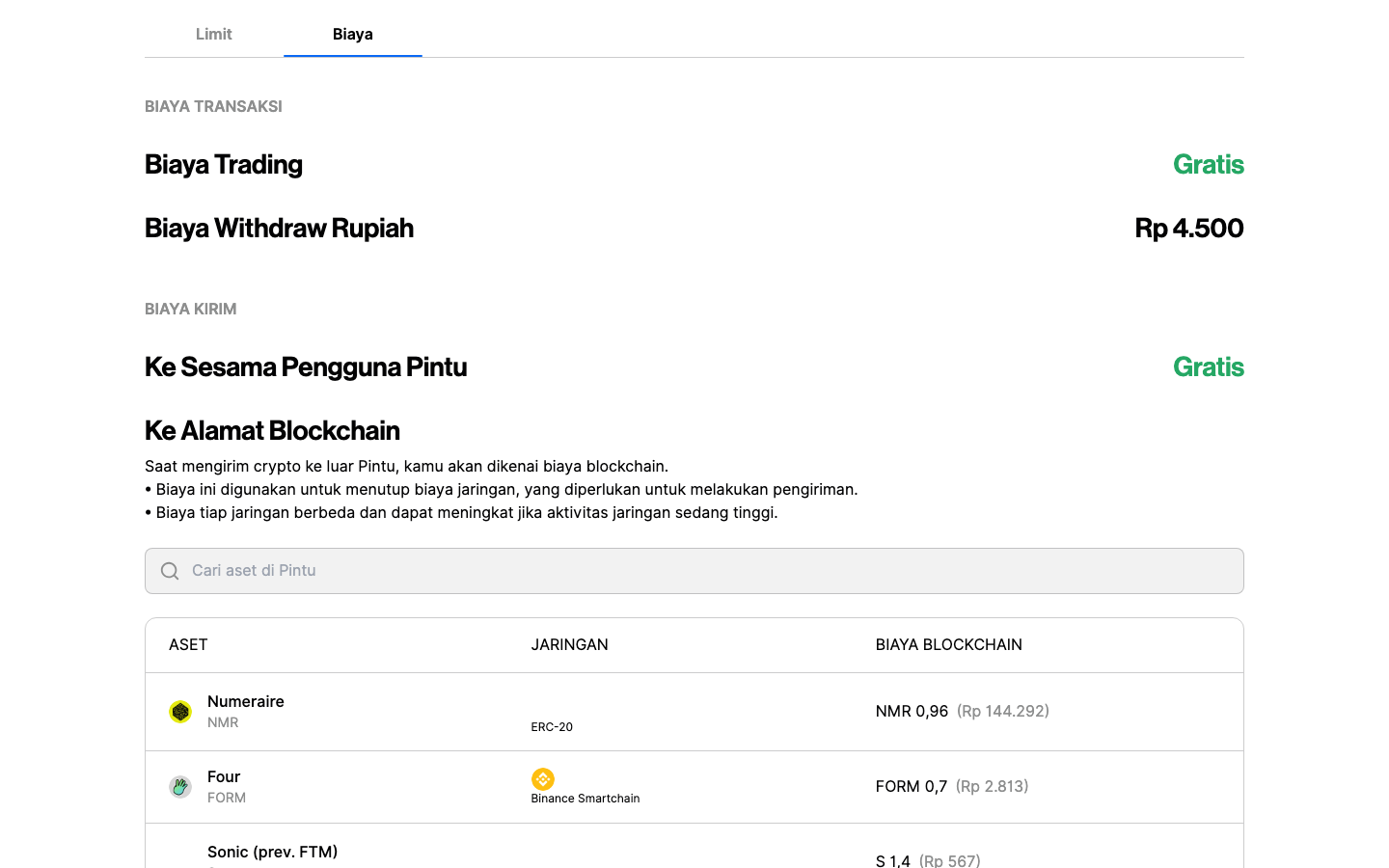
| Rupiah withdrawal fee | Rp 4,500 |
| Fee waiver | Free rupiah withdrawals and free external crypto sends if you stake at least 100 PTU |
| Rupiah withdrawal limit | None stated |
| Destination | A bank account registered in the account holder’s own name, added before withdrawal |
| Crypto to another Pintu user | Free |
| Crypto to an external wallet | The blockchain network fee only, which varies with congestion. Pintu states plainly that this “is not paid to Pintu but to the blockchain miners” |
| Withdrawal suspension | Pintu may suspend withdrawals on anti money laundering grounds at its own discretion, and may freeze or close an account where it identifies a Prohibited Action |
Rp 4,500 is a flat fee of well under a US dollar and there is no percentage element, which is
straightforwardly good. Blockchain sends being charged at network cost with an explicit statement that
Pintu keeps none of it is better disclosure than several larger exchanges manage.
One structural point: crypto transfers are final. The agreement says so, and it disclaims
responsibility for assets lost to a wrong address or a wrong network. That is true of every exchange and
of the technology itself, but the clause is unusually broad here, extending to delay or loss caused by an
insufficient blockchain fee.
Withdrawal halt history and incident record
We found no withdrawal halt, security incident, hack or unplanned outage. That
sentence needs its limits stated, because an absence is only worth as much as the search behind it. What
we did: searched OJK’s three announcement channels with controls that fire, parsed the national blocked
entity list, read the firm’s legal library and its published notices, and searched its content estate. What
we did not do: systematically review a status page, a downtime history or an incident log, and we did not
gather user reports because aggregator sites are not admissible evidence here. So the correct reading is
nothing found across the sources we searched, not a certified clean record.
What we can offer instead is a dated record of the events that have actually shaped this firm’s
regulatory and structural position, each with a source we hold:
| Date | Event | Source |
|---|---|---|
| 14 March 2024 | Admitted as bourse member number 1 of CFX, SPAB-001/PFAK/BKN/03/2024 | CFX’s own Anggota Bursa register |
| 1 August 2024 | Granted BAPPEBTI physical crypto asset trader licence 01/BAPPEBTI/PFAK/08/2024, the first issued in Indonesia | BAPPEBTI’s own register, as archived 6 January 2025 |
| 10 January 2025 | The memorandum of understanding transferring supervision of the sector from BAPPEBTI to OJK is signed, numbered NK-01/D.07/2025 and HK.00.00.01/BAPPEBTI/NK/01/2025 | OJK press release SP 13/GKPB/OJK/I/2026, which cites both numbers and that date |
| 1 February 2025 | Received OJK permission S-15/D.07/2025, the transfer letter issued to the whole incumbent cohort that day | OJK register, 25 May 2026 edition |
| 4 December 2025 | POJK 23 of 2025 issued, bringing crypto derivatives inside OJK’s perimeter and setting conditions including a customer knowledge test and a dedicated margin account | OJK press release SP 210/GKPB/OJK/XII/2025 |
| 19 December 2025 | Listed as entry 18 on OJK’s whitelist of licensed digital asset traders | OJK press release SP 226/GKPB/OJK/XII/2025 |
| 8 to 9 January 2026 | Futures terms and trading rules reissued; the futures service provider changes from PT Porto Komoditi Berjangka to PT Pintu Kemana Saja, with existing customers and their personal data migrated by deemed consent | Pintu’s own futures terms, section I |
| 20 January 2026 | The BAPPEBTI to OJK transition period formally ends | OJK press release SP 13/GKPB/OJK/I/2026 |
| 22 June 2026 | OJK’s Satgas PASTI publishes a list of 228 blocked digital asset traders. Pintu is not on it; Binance is number 1 | OJK info terkini, June 2026 attachment |
| 22 November 2023 | Accounts held by US citizens force deactivated at 08:00 WIB, with balances reclaimable in crypto or fiat | Pintu’s own published notice |
Read that table for what it shows: a firm that has been continuously inside the regulated perimeter
since before the perimeter moved, and that has never been the subject of a regulator announcement we can
find. For a sector where the base rate of enforcement action is not low, that is meaningful.
Customer Support
Support at an exchange matters most on the worst day, so the question is less about opening hours than
about whether there is a documented route to a human and a documented route to an authority when the
exchange itself is the problem.
Channels
| Channel | Detail |
|---|---|
| help@pintu.co.id for support. Also marketing@, career@ and bd@ for other purposes | |
| Live chat | In-app, referenced in the RIPLAY’s complaints section |
| Phone | 021 39732222, published in the customer agreement’s company profile table |
| Social | The RIPLAY names six as complaint channels: Instagram, X, Telegram, Discord, TikTok and LinkedIn. Pintu also operates Facebook and YouTube accounts, which the RIPLAY does not list |
| Self service | A large self-hosted help centre with topic categories covering deposits, withdrawals, KYC, security, tax, futures and Earn |
| Languages | Indonesian and English |
| Hours | Not published |
A published phone number is worth calling out. Most crypto exchanges do not have one, and a company
that prints its landline in its terms is making itself reachable in a way an email queue does not.
The two service levels Pintu does publish
Concrete commitments are rare in this sector, and Pintu makes two: identity verification takes about
one working day, and rupiah deposits credit within 1×24 hours with an instruction to contact support if
they do not. Both come from the RIPLAY and the fees page, so both are documented rather than promised in
marketing copy.
Complaints, and where they go when support fails
The customer agreement commits Pintu to handling complaints in compliance with POJK 22 of 2023
on Consumer and Public Protection in the Financial Services Sector, and names an operational and
customer support address in Jakarta for written complaints.
Escalation depends, oddly, on which product you are complaining about:
- Futures. Talk first, for 21 working days. If that fails, the dispute goes to the
resolution mechanism available at the Bourse. If that fails, to LAPS SJK, the alternative
dispute resolution body for the financial services sector, expressly under POJK 22 of 2023. Class actions
are barred: you agree to resolve disputes individually and not as part of a group or representative
action. - Pintu Earn. Straight to BANI arbitration in Jakarta, one arbitrator
appointed by the BANI chairman, final and binding.
The futures route is the better one for a consumer, because LAPS SJK is the sector ombudsman and is
designed for retail complaints. Commercial arbitration at BANI is a different and more expensive
proposition. Having the yield product routed away from the consumer ombudsman is a choice, and it is the
product with the three month liability cap.
One drafting wobble worth a line: the futures dispute clause routes to the Bourse and then to LAPS SJK,
then goes on to describe an arbitral award as final and binding without ever naming an arbitration
institution. It reads like a template that was partly localised.
Incident response
We have nothing to test this against, and we would rather say so than infer. No incident, outage or
withdrawal halt turned up in any admissible source, so there is no episode on which to judge how Pintu
communicates under pressure. What the firm does have is a published bug bounty policy, updated in June
2026, and a published information security management system and cloud security policy, both of which are
more than most exchanges publish and neither of which is evidence of how it behaves in a crisis.
Restricted Countries
Pintu is a domestic Indonesian exchange, and its restrictions are contractual rather than geographic.
That distinction is the whole of this section.
The United States, explicitly and in force
This is the one hard exclusion and it is documented in Pintu’s own words. On 22 November 2023
at 08:00 WIB Pintu deactivated accounts held by US citizens, and published a notice saying so.
Deactivated users could reclaim their balances in crypto or fiat by contacting help@pintu.co.id.
The customer agreement’s exclusion is broader than citizenship. It covers US citizens, people born in
the United States, US green card holders, people transacting through a US bank or financial account,
people with US tax obligations, and anyone acting for or on behalf of a US person. That is a FATCA-shaped
definition and it will catch people who do not think of themselves as American.
What the geographic test actually showed
We fetched pintu.co.id from eleven countries through in-country exits: Indonesia, Thailand, Vietnam,
Singapore, Japan, India, the United Arab Emirates, South Africa, the United Kingdom, Germany and the
United States. All eleven returned a byte-identical page, confirmed by SHA-256 rather than by file size.
The United States is served the full marketing site, identically to everyone else, while
being barred at the account level.
That is the opposite of the pattern that usually matters in these reviews. There is no geo-routing, no
country-specific entity switch, and no jurisdiction being quietly handed to an offshore company. There is
also no country-level block on the marketing site for anyone, which means the site being reachable from
your country tells you nothing about whether you may open an account.
The honest limit on that test: it establishes that the server-rendered page is the same everywhere. It
does not establish what happens at signup, at identity verification or at the API layer, because those are
inside an application we did not and would not attempt to enter.
Who can actually open an account
The verification requirements answer this more usefully than any country list. Indonesian citizens
verify with a KTP. Foreign nationals verify with a passport plus a KITAS or KITAP, the Indonesian
limited or permanent stay permits, or an identity card issued by their home country. Withdrawals go only
to a bank account in the account holder’s own name, which in practice means an Indonesian bank account.
The product is built for people resident in Indonesia, and someone outside it should assume they are not
the intended customer even where no explicit prohibition names their country.
Beyond the United States, we found no published list of prohibited countries, and we
are not going to construct one. The agreement makes the user responsible for ensuring that their use is
lawful where they are, which is the usual formulation and puts the burden on the customer.
Conclusion
Pintu is one of the better-evidenced exchanges we have looked at, and the reasons are structural rather
than promotional. Its licence is not a claim in a footer, it is a numbered permission on the national
regulator’s own register with a numbered predecessor on the previous regulator’s register, and it holds
Indonesian physical crypto asset trader licence number 01. It is member number 1 of the licensed bourse
and first on the clearing house’s member list. Three OJK announcement channels have nothing on it, with
controls that prove the searches work, and it is absent from the national blocked entity list on which
Binance sits at number 1. One company serves every country, so there is no offshore arm quietly onboarding
anyone.
Set against that are three things that keep it out of the higher bands.
The cost of a retail trade is unknowable. Pintu’s fees page tells a user that trading
is free. The RIPLAY, the disclosure OJK requires, records maker and taker of zero for that same product.
The real charge is a spread inside the quoted price, which Pintu says can change at any time and never
publishes as a number, plus a 0.21% sales tax and a bourse fee of roughly 0.11% that the fees page does
not mention. A customer who wants to know what they are paying has to move to Pro Spot, where there is an
order book and a published ladder. That is a strange arrangement: the transparent product is the advanced
one, and the beginner is the one who cannot see the price of anything.
The same disclosure has arithmetic problems we checked by hand. Its worked example deducts the bourse
fee at 0.0111% when its own table says 0.1111%, a factor of ten, and every downstream figure in the
example follows the wrong rate. It also prints a rupiah amount labelled as Bitcoin. These are careless
rather than sinister, and they are in the one document the regulator requires to be right.
The proof of reserves is one snapshot from 2022. It is a real document, from a named
and licensed Indonesian public accountant, reporting crypto reserves at 112% of customer liabilities and
fiat at 134% as at 30 November 2022, and the accountant checked custodian wallet transfers against a block
explorer rather than taking management’s word. But it is agreed-upon procedures rather than an audit
opinion, the accountant expressly declines to express one, there is no Merkle tree so no customer can
check their own balance was counted, and we found no successor in nearly four years. Set beside the
custody position described above, what a customer holds is a claim against PT Pintu Kemana Saja.
The futures documentation does not describe the futures product. The binding trading
rules say leverage runs from 5x to 50x, their risk parameter table is a November 2024 image showing a
single 5x row, their formulas offer 2% or 20% initial margin, and their worked example runs at 50x, while
the help centre and the marketing page both say 25x with 4% initial and 1% maintenance margin. Four
answers to the question that decides how fast you get liquidated. The mechanics that are
documented are unusually good, which makes the leverage mess harder to excuse rather than easier.
Two further things belong in a reader’s mind. The futures counterparty changed on 9 January 2026, from
a commodity futures broker to Pintu itself, and existing customers were moved across by deemed consent
including the transfer of their personal data. And Pintu Earn caps Pintu’s liability for any loss on that
product at three months of the interest it paid you, while never explaining where the yield comes from.
Who this suits. An Indonesian resident who wants a licensed domestic venue, rupiah
pairs without a stablecoin leg, a Rp 11,000 minimum order and a tax report at the end of the year is
well served here, and better served than by an offshore venue with no traceable permission and no local
recourse. Someone who intends to trade actively should use Pro Spot rather than the simple app, because
that is the only surface where the cost is visible. Someone considering the leveraged product should read
the trading rules first, including the images, and should understand that losses can exceed the deposit,
that liquidation can happen without notice, and that being right and highly leveraged is precisely the
profile auto deleveraging targets. Someone whose main concern is knowing that their coins are provably
there should note that no exchange evidence exists on that point, and weigh it.
Our score is 7.5 out of 10: workable, licensed, and let down by its own disclosure rather than by its
regulation. That number is the plain average of regulation 7, fees 8.7, platform 7.3, support 6.5 and an independent track record of
7.8. We do not use aggregator ratings, and Pintu’s own app store figures are marketing and contradict
each other on a single page.
Score history
Recomputed daily; every move is on the record. The current score is always the latest row.
| Date | Score | Move |
|---|---|---|
| 2026-09-13 | 7.5 | ▲ |
| 2026-09-12 | 7.2 | · |
FAQ
Is Pintu regulated and safe?
Pintu is regulated. PT Pintu Kemana Saja holds OJK permission S-15/D.07/2025 dated 1 February 2025, which we confirmed on two separate OJK publications, and before that BAPPEBTI licence 01/BAPPEBTI/PFAK/08/2024 of 1 August 2024, the first full crypto trader licence issued in Indonesia. It is a member of the licensed CFX bourse and the KKI clearing house, and it does not appear on OJK’s blocked entity list. Safety is a narrower question. The only reserves report is a 2022 snapshot, there is no deposit insurance and no investor compensation scheme, the custodian is named in the regulator-mandated product summary but not in the contract you sign, and what you hold is a claim against the company rather than title to identified coins.
What does it actually cost to buy crypto on Pintu?
On the main app, you cannot find out. Pintu’s fees page shows the trading fee as Gratis, and the firm’s explanation is that the cost is already inside the price it quotes you, as a spread that it says can change at any time with market conditions. That spread is not published as a number anywhere. On top of it, selling attracts 0.21% PPh Pasal 22 under PMK 50/2025 and there is a CFX bourse fee of roughly 0.11%, neither of which the fees page mentions. Buying attracts 0% VAT since 1 August 2025. Pintu Pro is the transparent alternative: it has an order book and published rates of 0.12% maker and 0.17% taker, currently waived while Pro is in beta.
Who is the counterparty on Pintu Futures, and how much leverage is there?
Since 9 January 2026 the counterparty is PT Pintu Kemana Saja itself, under the same OJK permission, trading on the CFX bourse and clearing at PT Kliring Komoditi Indonesia. Before that date the service was provided by PT Porto Komoditi Berjangka, a commodity futures broker, and existing customers were migrated by deemed consent including the transfer of their personal data. On leverage, Pintu’s own documents disagree: the help centre and the marketing page say up to 25x with 4% initial and 1% maintenance margin, while the binding trading rules of 8 January 2026 say 5x to 50x, contain a risk parameter table image from November 2024 showing only a 5x row at 20% and 5%, and work their example at 50x.
Does Pintu publish a proof of reserves?
Once, in 2022. KAP Arif & Glorius, an Indonesian public accountancy firm, signed an Independent Accountant’s Report on Agreed-upon Procedures on 15 December 2022 reporting Pintu’s position as at 30 November 2022: crypto reserves at 112% of customer liabilities and fiat at 134%. The accountant obtained the customer payables list from Pintu’s own systems, verified transfers between custodian wallets against a public block explorer, and examined the bank and payment gateway statements. Three caveats matter. It is agreed-upon procedures, not an audit, and the accountant states that it does not express an opinion. There is no Merkle tree, so you cannot check that your own balance was in the liabilities counted. And we found nothing following it in nearly four years. Pintu’s own position is that it prefers a reserves to liabilities ratio to a proof of reserves, which it argues does not show a true 1:1 picture.
Can I use Pintu from outside Indonesia?
Probably not, and definitely not if you are a US person. Pintu deactivated accounts held by US citizens on 22 November 2023, and its terms exclude US citizens, people born in the United States, green card holders, anyone transacting through a US bank or financial account, anyone with US tax obligations, and anyone acting for a US person. For everyone else there is no published country list, but verification requires an Indonesian KTP, or a passport plus a KITAS or KITAP residence permit, and rupiah withdrawals go only to a bank account in the account holder’s own name. The marketing site loads identically from every country we tested, including the United States, so the site being reachable tells you nothing about eligibility.
How this review works
Track Pintu live: score moves and red notices, in your pocket.