
CFD · CHECKED 13 SEP 2026
CEX Markets review.
CySEC-licensed Cyprus firm offering digital-asset CFDs on margin to EEA residents only, under the CEX.IO Broker brand.
RISKY
OUT OF 10
CEX Markets Ltd trades as CEX.IO Broker on cexbro.com and holds a genuine, current CySEC licence, 381/19, that covers the exact entity you would onboard with and includes contracts for differences. It offers 42 digital-asset CFD pairs at 0% commission with retail leverage capped at 1:2, and accepts clients from 26 EEA states only. Client funds are held segregated from the firm's own money at named credit institutions and the firm is an Investor Compensation Fund member. The real caveats are that it is your counterparty on every trade, its spreads are published nowhere, its platform is still badged BETA, and its privacy notice names an unrelated St Vincent company.
Each criterion is scored 1 to 10 from primary sources. The overall score is their unweighted mean. How scoring works.
| Founded | 2018 |
|---|---|
| Headquarters | CY |
| Maximum leverage | 1:500 |
| Withdrawal fee | None |
| Platforms | webtrader |
- CySEC licence 381/19 is current and covers CEX Markets Ltd itself, the same entity a client contracts with
- Instrument classes 1 to 10 are granted on execution as well as reception and transmission, so contracts for differences are properly authorised
- cexbro.com is the firm's single CySEC-approved domain, verifiable on the regulator's own approved-domains list
- Client funds are held in client-only accounts at two named credit institutions, segregated from the firm's own money
- Investor Compensation Fund membership is documented, covering the lower of 90% of claims and 20,000 euro
- Zero commission on opening, closing, deposit, withdrawal and overnight rollover across all 42 pairs
- Retail leverage held at 1:2 on cryptocurrencies, far below the risk most crypto CFD venues offer
- Withdrawal requests are processed within 24 hours regardless of payment method, per the Key Information Document
- Negative balance protection applies per account, so a loss in one sub-account cannot reach another
- Clean enforcement record across the CySEC registers we were able to search in full
- The firm is your counterparty on every trade and profits when your position loses, by its own description
- Spreads are published nowhere, and with commission at zero the spread is the entire cost of trading
- The Key Information Document's cost table lists every cost line with no figures at all
- The published Privacy Notice governs a different company, Digital Markets LLC of St Vincent and the Grenadines
- The platform still carries a BETA badge, six years after the licence was granted
- No mobile app is offered or linked, and no MetaTrader, cTrader or TradingView integration exists
- The Knowledge Base linked from every page points at support.cexbro.com, which does not resolve in DNS
- The footer still links a UK Temporary Permissions document for a permission that ended on 13 November 2022
- FY2025 figures report a nil client-money and nil client-order K-factor alongside a third consecutive widening loss
- Minimum deposit, minimum order size and professional-client leverage are not stated anywhere
Overview
CEX Markets Ltd trades as CEX.IO Broker from cexbro.com, and sells one thing: contracts for differences on digital assets, bought on margin. It is a Cypriot Investment Firm, licensed by CySEC under number 381/19, registered at 13 Kypranoros Street, Office 104, 1061 Nicosia, with Cyprus company number 389553. The brand looks like the CEX.IO crypto exchange because it genuinely is related to it: the Cyprus Department of Registrar of Companies records CEX.IO MARKETS LTD as the previous name of this same company under the same registration number, HE 389553, incorporated on 8 October 2018. That is registry proof of the group tie, not marketing.
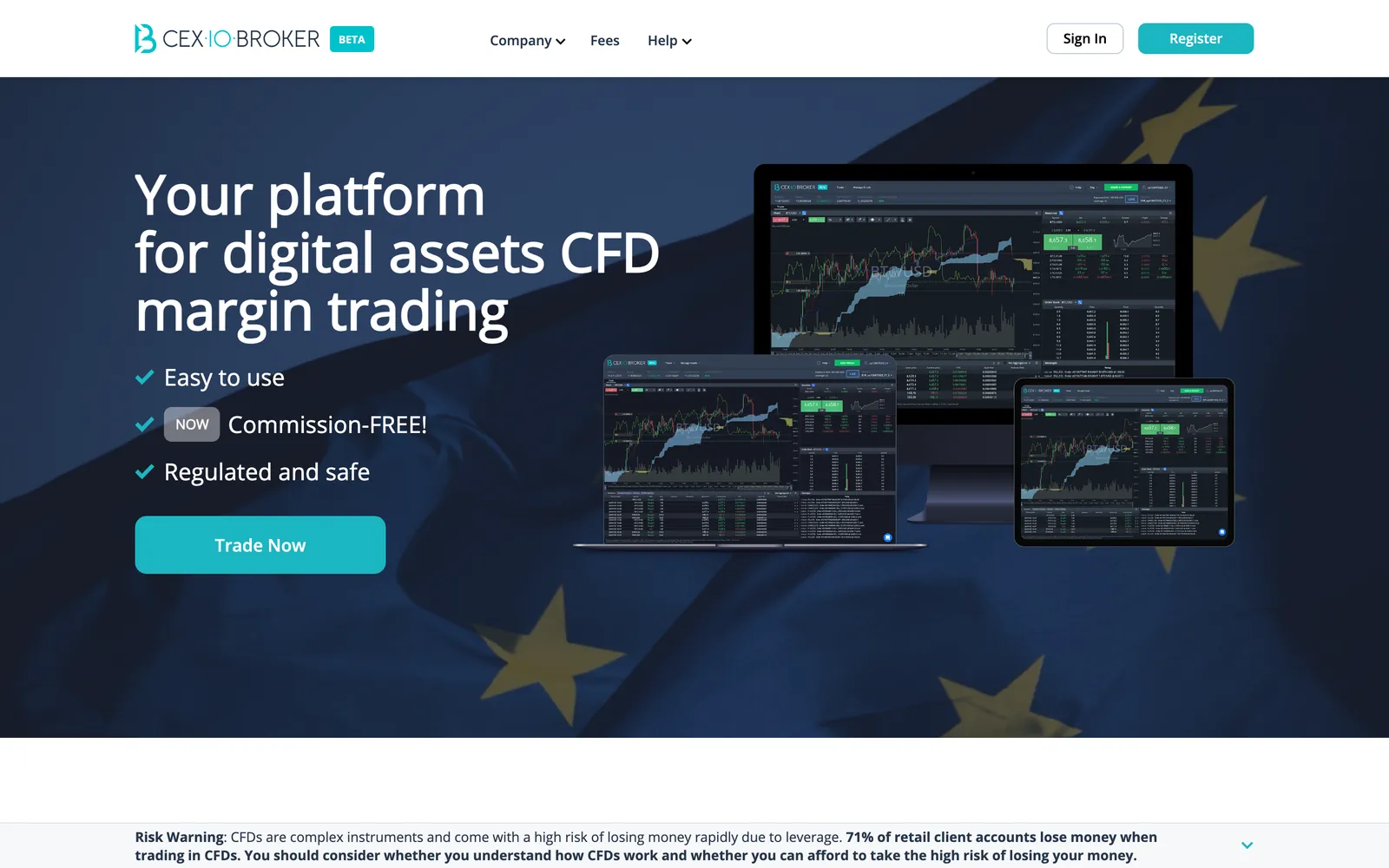
The firm’s own risk disclosure, shown on every page of the site and in every country we fetched it from, states that 71% of retail client accounts lose money when trading CFDs with this provider. That figure is the firm’s own, it is the single most useful number on this page, and everything below should be read against it.
The domain does not obviously match the company name, so we checked the tie from both directions before attributing anything. The site’s footer names CEX MARKETS LTD and licence 381/19. The regulator’s own record for that licence carries the e-mail info@cexbro.com and telephone +35722310999, and its Approved Domains field reads exactly cexbro.com. Row 39 of the CySEC List of Approved Domains reads the same. The identity is settled at the register, not taken from the site.
Who this firm is for is unusually narrow. Its own supported-countries page lists 26 EEA states and a further list of 227 countries it does not serve, which includes the United Kingdom. We fetched the site from Indonesia, Thailand, Vietnam, Azerbaijan, Singapore, Japan, India, the UAE, South Africa and Germany, and nine of those ten are on the not-supported list. Only Germany is served. The full marketing page, unchanged, is delivered to every country the firm refuses to onboard.
Leverage is 1:2 for retail clients on cryptocurrencies, or 50% initial margin, which is conservative for this asset class. Commission is zero on opening, closing, deposits, withdrawals and overnight rollover. The firm is a market maker and says so plainly in its own client agreement, which matters more than the pricing.
Overview Table
| Headquarters | Nicosia, Cyprus |
| Established | Incorporated 8 October 2018; licensed 22 November 2019 |
| Countries Served | 26 EEA states; 227 countries listed as not supported |
| Regulated By | CySEC, licence 381/19 |
| Minimum Deposit | Not published |
| Maximum Leverage | 1:2 retail on cryptocurrencies |
| Total Instruments | 42 digital-asset CFD pairs |
| Platforms | Proprietary browser terminal, still badged BETA |
| Customer Support | Live chat, support@cexbro.com, +357 22310999; hours not published |
| Languages | English only |
Facts List
- Legal entity: CEX Markets Ltd, formerly CEX.IO MARKETS LTD, Cyprus HE 389553
- CySEC licence 381/19, dated 22 November 2019 per the firm’s own Pillar III disclosure
- Instrument classes 1 to 10 on reception and transmission, execution, and dealing on own account
- Cross-border notifications to 25 EEA states; no third-country block on the register
- 42 tradable pairs, all digital assets, 36 quoted in USD
- All published fees are 0%, including rollover per 24 hours
- Retail leverage 1:2; professional leverage referenced but never stated
- Approved execution venues: Broctagon Prime Ltd and CEX.IO Ltd
- UK permission via the Temporary Permissions Regime ended 13 November 2022
- Board of five: Charalambos Christodoulides (CEO), Raffi Mahdessian (General Manager), Oleksandr Lutskevych (Executive Director), and Andreas Charalambides and Marios Athanasiou (both Independent Non-executive Directors)
Key Takeaways
The licence is real, current, and covers the right entity. That is worth stating first because it is the opposite of the usual pattern. Most brokers with a headline European licence onboard retail clients through an offshore company in Seychelles or Vanuatu, leaving the licence technically true and practically irrelevant. CEX Markets does not do that. CySEC 381/19 belongs to CEX Markets Ltd, cexbro.com is that licence’s only approved domain, and the register records no permission to serve countries outside the EU at all.
Your money is segregated, and the compensation cover is documented. Clause 10.1(a) of the client agreement keeps client funds in accounts that accept only client money, held separately from the firm’s own funds, at Alpha Bank Cyprus Ltd and IBS International Business Settlement in Lithuania. The firm is a member of the Investor Compensation Fund, stated in its own Investor’s Compensation Fund document and at clauses 10.1(b) and 3.5.7(k), with cover at the lower of 90% of cumulative covered claims and 20,000 euro. One nuance worth understanding: the Pillar III disclosure reports those accounts in the non-segregated category, but that is a capital calculation bucket under the K-CMH rules, which reserve the word for accounts carrying a specific national insolvency ring-fence. It is not a statement that client money sits with the firm’s own.
You are trading against your broker. CySEC has granted dealing on own account, and the firm confirms what that means: it is a market maker, it acts as principal, and its Key Information Document states that if your trade is profitable, it loses. Its own risk disclosure puts the retail loss rate at 71%.
Zero commission is not zero cost. Every published fee is 0%, and that is genuine. But the spread is published nowhere, the Key Information Document’s cost table is empty of figures, and the client agreement reserves the right to widen variable spreads. Since the firm is your counterparty, the undisclosed spread is the whole of what you pay.
It is still labelled BETA, and the numbers suggest few people are using it. The FY2025 disclosure reports a total K-factor requirement of zero, with client money held and client orders handled both nil, alongside a third consecutive widening annual loss.
Most readers cannot open an account here at all. The firm serves 26 EEA states and lists 227 entries it does not serve, including the UK, and it shows all of them the same marketing page.
Licenses & Regulation
CEX Markets Ltd holds one licence, and we verified it at the regulator’s own register rather than accepting the footer. CySEC licence 381/19 appears on the current register of Cypriot Investment Firms, with company registration 389553, the Kypranoros Street address, telephone +35722310999 and the e-mail info@cexbro.com. The firm is not in the Former Investment Firms list, so the licence has not been withdrawn or renounced.
| Authority | Location | License Number | Retail Services | Protection Level |
|---|---|---|---|---|
| CySEC | Cyprus | 381/19 | Digital-asset CFDs to retail and professional clients in 26 EEA states | MiFID II conduct rules, ESMA leverage caps, Investor Compensation Fund eligibility |
| FCA (lapsed) | United Kingdom | 927994 | None. No longer authorised since 13 November 2022 | None |
Read the instrument classes, not the category
CySEC records which numbered instrument classes each service covers, and class 9 is financial contracts for differences. A firm granted only classes 1 to 8 cannot offer CFDs at all, and a firm holding class 9 on reception and transmission but not on execution may only pass a CFD order to somebody else. CEX Markets holds classes 1 to 10 on all three core investment services: reception and transmission of orders, execution of orders on behalf of clients, and dealing on own account. So the CFD category is correct here, and the firm may both execute your order and act as principal against it.
Dealing on own account means the firm is your counterparty
That permission is not a technicality. The client agreement states at 3.1.2 that the Company is a market maker for CFDs, and at 3.5.1 that we act as a principal and not as an agent on your behalf. The Key Information Document is blunter still: you trade with us as our counterparty. We are your Principal to each trade. Therefore, if your trade is profitable, we lose. If your trade is loss making, we earn a profit. The Order Execution Policy names two approved execution venues, Broctagon Prime Ltd and CEX.IO Ltd, the second being an affiliate. Every CFD here is over the counter and none touches a regulated exchange.
Client money, and the word that means two things
Clause 10.1(a) of the client agreement sets out the arrangement: funds used for trading will be kept in accounts with credit institution(s) used to accept only Client’s funds and as such will be held segregated from the Company’s own funds. Clause 10.2.2 names them: Alpha Bank Cyprus Ltd, regulated by the Central Bank of Cyprus, and IBS International Business Settlement, supervised by the Central Bank of Lithuania. Clause 3.5.7(l) repeats the commitment and the Key Information Document says the same.
One line elsewhere looks like it contradicts that, and it is worth explaining rather than brandishing. The Pillar III disclosure states at section 5.5.1 that the Company only uses non-segregated client accounts. That sentence sits inside the calculation of the K-CMH capital factor, immediately after a passage defining segregated, for that purpose only, as accounts under Article 4 of Commission Delegated Directive (EU) 2017/593 where national law additionally ring-fences the money from the firm’s other creditors on insolvency. Reporting accounts outside that narrow definition is a capital-calculation classification, not an admission that client money is mixed with the firm’s own. The same sentence appears verbatim in the FY2023, FY2024 and FY2025 disclosures. Read together with clause 10.1(a), the statements reconcile.
Compensation cover
CEX Markets Ltd is a member of the Cyprus Investor Compensation Fund. Its own Investor’s Compensation Fund document opens by stating membership within the meaning of CySEC Directive DI87-07, and clauses 10.1(b) and 3.5.7(k) of the client agreement and the Key Information Document say the same. Cover is the lower of 90% of a covered client’s cumulative claims and 20,000 euro. Professional clients, eligible counterparties, institutional investors, the firm’s own managerial staff and shareholders holding 5% or more are all outside the definition of covered client. CySEC publishes no member roster, so the firm’s own documents rather than a register are the source here.
The United Kingdom, and what the TPR document is
The footer links a TPR Confirmation for CEX MARKETS LTD. TPR is the UK Temporary Permissions Regime, which let EEA firms passporting into the UK keep operating after 31 December 2020. That document was created on 6 January 2021 and states a start date with no end date. The FCA register records the outcome: FRN 927994, No longer authorised since 13 November 2022. The firm has held no UK permission of any kind since. The register gives no reason and we publish none. Notably, the UK also appears on the firm’s own not-supported list, so no reader in Britain can onboard here regardless.
Do not mistake the UK crypto registration for authorisation
A separate live FCA entry exists in this brand family: CEX.IO Markets UK LTD, FRN 1007192, Companies House 15140258, registered at 78-79 Pall Mall, London. It is an anti-money-laundering cryptoasset registration, effective 11 March 2026, and its permissions record is empty. It holds no investment permissions and no client-money permission, and it is a different company from CEX Markets Ltd. It is not FCA authorisation of this broker.
Enforcement record and lookalike names
We searched the CySEC registers we could crawl in full and found no entry for CEX Markets or 381/19 in any of them: board decisions, announcements, administrative sanctions, court decisions, warnings, the non-approved domains list of 708 entries and the crypto non-approved list of 164. Each of those parses was validated against firms that do appear, so they are checked negatives rather than empty results. The circular sub-registers were sampled rather than exhaustively crawled, so we record those as partially checked. We did not use the CySEC site search, which renders results in the browser and returns an identical page for every query. Separately, the FCA carries four unauthorised entities with similar names, including CEX-IO / cexlivetrading.org, CEXMININGS and CEXCapitals. None is labelled a clone of this firm, none uses cexbro.com, and on address and record type they appear unrelated. They are named here because a reader searching this brand will meet them.
How to Trade
Trading happens in a proprietary browser terminal. There is no MetaTrader 4, no MetaTrader 5, no cTrader and no TradingView integration anywhere in the site or its JavaScript, and the site neither offers nor links a mobile application, with no reference to the App Store or Google Play in any page or bundle we retrieved. We did not search those stores themselves, so we report what the firm publishes rather than an absence we did not test. The terminal is a React application carrying a BETA badge beside the logo. We confirmed that badge was still present on 29 July 2026 in every one of the ten country fetches that returned a page, from Indonesia, Thailand, Vietnam, Azerbaijan, Singapore, Japan, India, the UAE, South Africa and Germany.
What the terminal offers is genuinely more thoughtful than most crypto CFD venues. The firm advertises a multi-account structure of up to 10 separate trading accounts under one login, so different strategies can run without sharing margin. Margin is cross within a single trading account and isolated between accounts, which is a sensible arrangement: a blow-up in one strategy does not reach into the collateral of another. Multiple segregated positions may be open in the same instrument, including simultaneous positions in opposite directions, rather than being netted.
Order types are Market, Limit, Stop, OCO, Stop Loss and Take Profit. Technical analysis indicators and drawing tools are built into the chart, and the firm’s pitch is that analysis and execution happen in one place rather than across two applications. A WebSocket path exists in the client bundle. The homepage also claims full FIX, WebSocket and REST API support, but read that sentence carefully: it says CEX.IO offers that support, meaning the group’s exchange, and no broker-side API documentation is linked anywhere on cexbro.com. Treat API access as unevidenced for this entity.
How execution actually works
The Order Execution Policy states that the Company acts as an agent and as a principal on behalf of the Client, and lists two approved execution venues, Broctagon Prime Ltd and CEX.IO Ltd. Read alongside the client agreement’s admission that the firm is a market maker and the Key Information Document’s statement that the firm profits when your trade loses, the practical position is that you are trading against your broker on over-the-counter instruments, with an affiliate as one of the two venues behind it. That is lawful and it is disclosed. It is also the single most important thing to understand before funding an account here, because it shapes every price you are shown.
Margin and liquidation
Retail cryptocurrency positions require 50% initial margin, which is leverage of 1:2. The Leverage Policy also prints a table of ESMA caps for foreign exchange at 1:30, gold and major indices at 1:20, commodities at 1:10 and shares at 1:5, but none of those asset classes is offered here, so that part of the table is boilerplate rather than a description of the product. Professional clients are excluded from the policy and may be granted a higher leverage, with no figure ever stated. We leave that unquantified rather than guess.
A demo account is available with no registration at all, which is genuinely useful and rare. It lets the terminal, the order types and the margin behaviour be tested before any identity document changes hands, and given how little else about this firm can be verified from outside, taking that option first is reasonable.
Account Types
CEX Markets does not publish a tiered account menu. There is no Standard, Raw or VIP ladder, no minimum balance table and no fee schedule that varies by tier. There is one live trading environment, internally identified as live_cy, plus a demo. Within a live account the firm advertises the ability to run up to 10 separate trading accounts, but these are sub-accounts for strategy separation rather than commercial tiers: the fee schedule is identical across all 42 pairs and every published rate is 0%.
What does differ is client categorisation, and that is where the real distinction sits. The firm publishes an Information on Client Categorization document dated 18 May 2020, and the categories carry different protections under MiFID II. Retail clients get the ESMA leverage cap of 1:2 on cryptocurrencies, negative balance protection, and the full risk disclosure. Professional clients and eligible counterparties do not. The Leverage Policy states plainly that it does not apply to Professional clients and/or eligible counterparties, who may be granted a higher leverage.
That is the one place where the firm’s disclosure gets materially thinner, and it matters. Nowhere on the site or in the legal library is the professional leverage figure stated. A reader considering electing up professional status cannot find out what leverage they would receive, what margin would be required, or what protections they would surrender, without opening an account and asking. We record that as unpublished rather than estimating it, because an invented number here would be the most dangerous kind of error.
What is not stated anywhere
Several account facts that a reader would reasonably expect are absent from every page and every one of the thirteen legal documents we retrieved:
- Minimum deposit. Not stated. The client agreement at 5.9 says deposits may be made via the methods and in the currencies accepted by the Company from time to time and that details are shown on the Website. The website shows no such details.
- Minimum order size. Not stated for any of the 42 pairs.
- Account opening time. No service standard is published. The application’s own welcome pop-up tells new users that verification usually takes just a few minutes, which is a marketing string in the client bundle rather than a commitment, so we record it as indicative only.
- Inactivity fee. Clause 8.15 defines an Inactive account after one year and a Dormant account after five years, but attaches no charge to either state. We therefore record no inactivity fee, while noting the definitions exist and could acquire a fee later.
- Base currencies. Not enumerated. The pair list implies USD and EUR balances are possible, and clause 5.9 permits funding directly from a CEX.IO wallet for clients holding accounts with both companies.
One structural point about opening an account here at all: clause 3.1.2 of the client agreement states that to open the Account with us you should be registered with CEX.IO’s Platform. The broker account is not standalone. It sits on top of an exchange account with the affiliate, and the two share a login. Anyone unwilling to hold an account with the CEX.IO exchange cannot open one with the broker.
Negative Balance Protection
Retail clients of CEX Markets get negative balance protection, and it is documented in the contract rather than merely asserted in marketing. Clause 8.16 of the client agreement provides it for the benefit of the Company’s Retail Clients, and section 4 of the Leverage Policy restates it as ensuring that a client’s maximum loss never exceeds the clients’ available funds. This reflects the ESMA product intervention measures of 2018, which bind every CFD provider serving EU retail clients, so its presence is expected rather than exceptional. It is nonetheless written into the agreement itself, which is the stronger position for a client.
In practice it means this: if a digital-asset position gaps far enough that your loss exceeds the equity in the account, the deficit is written off rather than pursued as a debt. On the 42 crypto pairs listed here, which trade continuously and can move double digits in an hour, that matters more than it would on foreign exchange or equities. The 1:2 leverage cap, or 50% initial margin, makes it less likely to be reached at all, because BTC/USD would have to halve before margin is exhausted. Many crypto CFD venues outside the EEA offer 1:100 or more on the same instruments, so the conservative cap is arguably the more valuable of the two safeguards.
The detail that matters most is easy to miss. Clause 8.16 implements protection on a per account basis, not per client. Given that the firm advertises up to 10 separate trading accounts under one login, each one is ring-fenced on its own: a position that goes negative in one sub-account cannot pull down the balance of another. That is a genuinely useful property for anyone running several strategies, and it is the single strongest risk-control feature this broker offers.
Two limits to note. Clause 8.16 frames the protection as a retail-client benefit, so a client who elects up to professional status should not assume it travels with them. Separately, section 2 of the Leverage Policy states that the policy does not apply to Professional clients and/or eligible counterparties, who may be granted a higher leverage, and no figure for that higher leverage is published anywhere. We record it as unpublished rather than estimating it.
Finally, negative balance protection is not protection against the firm itself. It governs what happens when a trade goes badly. What happens if the company fails is a separate question, answered by the segregation arrangement at clause 10.1(a) and the Investor Compensation Fund cover of 20,000 euro, both covered under Licenses & Regulation.
Trading Instruments
CEX Markets offers 42 digital-asset CFD pairs and nothing else. There is no foreign exchange, no equities, no indices, no commodities, no exchange-traded funds and no bonds. The /markets path referenced in the site’s own sitemap returns a 404, so the fee table is the only complete enumeration the firm publishes, and that is what we counted.
The quote currencies break down as 36 pairs against USD, two against EUR (BTC/EUR and ETH/EUR), two against BTC (ETH/BTC and LTC/BTC), one against ETH (UNI/ETH) and one against USDT (UNI/USDT). The firm describes the coverage as major coins, alternative coins and DeFi tokens traded on margin, and positions it as a way to hedge or extend spot exposure held on the affiliated exchange.
The critical point about all 42 is that none of them gives you the coin. These are contracts for differences. You never own, buy, receive or can withdraw the underlying asset. The firm’s own FAQ puts it accurately: a CFD lets traders take a view on price movements without actually owning, buying or selling that asset. Anyone whose intention is to accumulate bitcoin is in the wrong product, and should be looking at spot rather than margin CFDs.
Because the firm is the counterparty on every one of these instruments, the price you trade is the price it quotes, not an exchange print. That makes the undisclosed spread the defining unknown of the whole instrument list, and we cover that in the fees discussion.
What the classes permit versus what is offered
There is a notable gap between authorisation and product here, and it runs in the generous direction. CySEC has granted CEX Markets instrument classes 1 to 10 across reception and transmission, execution, and dealing on own account. Class 9 is contracts for differences, but classes 1 to 8 cover transferable securities, money-market instruments, units in collective investment undertakings, and the various options, futures and swaps on securities, currencies, interest rates and commodities. The firm is licensed to offer a far broader range of instruments than the 42 crypto pairs it actually lists.
The Leverage Policy inadvertently confirms this, because it prints ESMA margin caps for foreign exchange, gold, indices, commodities and shares. None of those is available to trade. That table is regulatory boilerplate carried over into a document for a product line that does not exist, which is worth knowing when reading the firm’s paperwork generally: several documents describe a broader business than the site actually operates.
Education & Analysis
The education offering is in two halves, one of which works and one of which does not exist.
What works
Two static reference sections are live and genuinely usable. Candlestick Patterns at /trading-tips documents 29 patterns, and Chart Formations at /formations documents 23 formations. Both are competent cheat sheets of the kind a new technical trader actually refers back to, and both are reachable without an account. They are reference material rather than a course: there is no structured curriculum, no progression and no assessment.
Analysis tools live inside the trading terminal rather than on the marketing site. The firm advertises built-in technical indicators and drawing tools on the chart, with the stated aim of letting a user analyse and execute without switching applications. We could not evaluate the indicator set itself, since it sits behind a login, and the no-registration demo is the appropriate way for a reader to assess it directly.
What does not work
The Knowledge Base is dead, and it is linked from the header and the footer of every page on the site, plus three separate calls to action on the homepage and in the FAQ. Every one of those links points at support.cexbro.com. That hostname does not resolve: it returns NXDOMAIN from both 1.1.1.1 and 8.8.8.8, with the authority record coming back from cexbro.com’s own nameservers at Cloudflare. It is not a temporary outage or a block on our address. The subdomain is simply not published in DNS, while the site continues to invite users to it.
That matters more than a broken link normally would, because the Knowledge Base is where the firm says it explains trading mechanics, instruments, strategies and risks. The homepage states that the firm created it to help our users get a better understanding of trading and is continuously growing the Knowledge Base with more materials. The destination of that sentence has not resolved for as long as anyone outside the firm can check.
Market research
There is none. No daily or weekly commentary, no analyst notes, no economic calendar, no trading signals, no webinars and no video content. For a crypto CFD venue that is not unusual, and we do not treat its absence as a failing so much as a description of scope: this firm publishes a terminal and two cheat sheets, and expects clients to bring their own analysis. Readers who want research alongside execution will need a second source for it.
Special Offers
There is no deposit bonus, no deposit match, no cashback or rebate scheme, no volume-based loyalty tier, no referral programme and no trading contest anywhere on cexbro.com. For a CySEC-licensed firm that is the expected and correct position: CySEC prohibits Cypriot Investment Firms from offering trading bonuses and similar monetary inducements to retail clients, a restriction reinforced by the ESMA product intervention measures of 2018. A Cyprus broker advertising a 100% deposit bonus would be a warning sign, not a benefit, so the absence here counts in the firm’s favour rather than against it.
What CEX Markets promotes instead is a pricing claim. The homepage badge reads NOW Commission-FREE, and the fee schedule supports it: 0% on deposits, withdrawals, opening, closing, and rollover per 24 hours, applied identically across all 42 pairs from BTC/USD to UNI/ETH. The word NOW is doing real work in that badge. It describes a current state rather than a contractual term, and clause 8.7.2 of the client agreement reserves the firm’s right to widen its variable spreads, while the fee page itself is revisable at will. Zero commission today is not a commitment to zero commission tomorrow, and with the spread unpublished there is no second number to anchor against.
The most genuinely valuable thing on offer costs nothing and requires nothing. The demo account needs no registration at all: one click opens a simulated environment with paper money and, the firm says, conditions reflecting the live market. Given how much about CEX Markets cannot be settled from outside, including its spreads, its minimum deposit, its minimum order size and its professional leverage, a no-signup demo is the single most useful feature on the site and the sensible first step for any EEA reader evaluating it.
We found no affiliate or introducing-broker programme. TrueBroker holds no commercial relationship with CEX Markets Ltd, there is no affiliate link on this page, and nothing in this review is a paid placement.
Opening an Account
The first thing to establish is whether you can open one at all, because most readers cannot. CEX Markets serves 26 EEA states. Its own page lists 227 countries it does not support, and that list includes the United Kingdom, the United States and nine of the ten countries we fetched the site from. Registration is gated on residence, and the client-side application checks the visitor’s jurisdiction before letting an account proceed.
The second structural fact is that this is not a standalone broker account. Clause 3.1.2 of the client agreement states that to open the Account with us you should be registered with CEX.IO’s Platform, at cex.io. The homepage confirms the flow: users register or log in with existing CEX.IO account details. A broker account here is an extension of an exchange account with the affiliated company, and the two share credentials.
From the firm’s own three-step description, the sequence is: create or link a CEX.IO account and verify it, fund the account, then place orders. Verification is standard know-your-customer identity and address checking, and the application’s own code distinguishes a verified state from an address-verified state, which implies proof of address is a separate step from identity. No service standard is published for how long any of this takes, so we record account opening time as unstated rather than estimating it.
The jurisdiction routing, which happens in your browser
This is the part a server-side comparison alone would have missed. The HTML served from cexbro.com is the same in every country we tested, including the nine of them the firm refuses to serve. The country logic runs in the browser instead. The application bundle contains explicit jurisdiction handling: flags named isJurisdictionForbidden, isRestrictedCountryByIp, isRestrictedCountry and countryRestrictedError, a three-value jurisdiction map of CY, SVT and NONE, and a routine choosing which pop-up a visitor sees.
That routine has three outcomes. A jurisdiction resolving to none gets a stop. An unverified user gets a verification prompt. And a user whose address is verified and whose jurisdiction resolves to svt is shown the pop-up the code calls anotherBroker. Its text is in the bundle, so we can quote it rather than speculate. It is headed Unsupported Country! and reads: Thank you for visiting CEXBro.com! Please note that this site is directed for the EU residents ONLY. Let us know if you would like to proceed to the site for non-EU residents, with a button labelled Take me there.
The destination is hard-coded in the same bundle. The anotherBrokers map contains a single entry, svt pointing at the hard-coded non-EU broker address. Two things about that address are worth knowing. It is the site named throughout this firm’s published Privacy Notice, which governs Digital Markets LLC, a company incorporated in St Vincent and the Grenadines with company number 135 LLC 2019. And the hostname no longer resolves in DNS: we queried it against two independent public resolvers and got NXDOMAIN from both. So the non-EU hand-off this application still offers points at an address that is no longer there, and SVT lines up with St Vincent.
We did not open an account, so we cannot say what a user in that branch experiences beyond what the shipped code contains. We report the mechanism and the destination because both are in the bundle, and we draw no conclusion about the present relationship between the two companies.
Deposits & Withdrawals
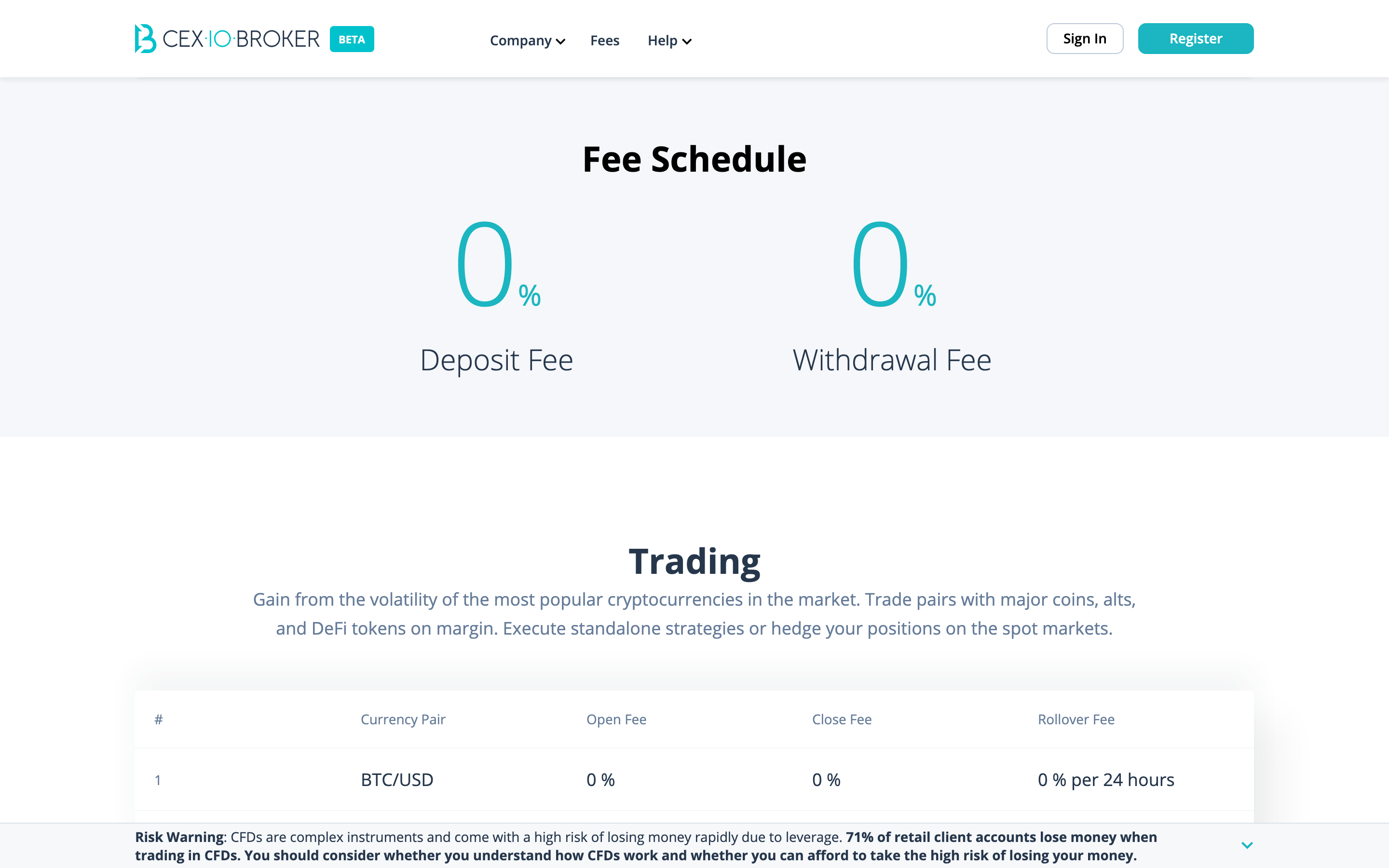
Every fee CEX Markets publishes is zero. The fee schedule shows 0% deposit fee and 0% withdrawal fee as its two headline figures, and the per-pair table shows 0% open fee, 0% close fee and 0% rollover per 24 hours across all 42 instruments. We verified this against the live page rather than the marketing claim.
The cost that is not published
Zero commission does not mean zero cost, and here the gap is unusually wide. Spreads are published nowhere: not on the fee page, not on the homepage and not in any of the thirteen legal documents. The Key Information Document is the clearest illustration. It contains a proper cost table with rows for Spread, Currency Conversion, Daily holding cost, Swap and Rollover, and every one of those rows is empty of figures. It refers the reader to a General Fees Document, and no document of that name exists in the firm’s legal library.
Clause 8.7.2 of the client agreement reserves the firm’s right to widen its variable spreads. Put that beside the fact that the firm is a market maker quoting its own prices and profits when clients lose, and the position is this: the only cost of trading here is the one number the firm does not disclose. We record the spread as unpublished rather than inferring it is competitive from the 0% commission, because those are different claims and only one of them is evidenced.
Payment methods
The firm’s disclosure here is thin, and partly attributed to the wrong company. The homepage states that CEX.IO supports Visa, Mastercard, bank transfers, and digital assets transactions, which describes the group’s exchange rather than the broker. Clause 5.9 of the client agreement says deposits may be made via the methods and in the currencies accepted by the Company from time to time and that detailed information is shown on the Website. The website shows no such information. On that basis we record cards, bank transfer and digital assets as the available rails, while noting the firm never confirms them for this entity specifically.
Three rules the client agreement does state clearly:
- Clause 5.9 permits funding directly from a CEX.IO wallet for clients holding accounts with both companies, which is likely the primary route in practice.
- Clause 5.3 refuses anonymous prepaid cards issued outside the EU.
- Clause 5.7 prohibits third-party payments, and withdrawals return to the account the money arrived from.
That last rule is standard anti-money-laundering practice and worth planning around: money cannot be withdrawn to a different name or a different account from the one that funded it.
Withdrawal timing, and what is not stated
One commitment is published, and it is a good one. The Key Information Document states: You can request to withdraw your money at any time. We will process all withdrawal requests within 24 hours irrespective of payment method. That is a clearer service standard than most brokers give.
Around it, several things are absent. No minimum or maximum withdrawal amount is stated, no deposit currency list exists, and no minimum deposit is given. We leave each null rather than filling them, and note the absence is a disclosure weakness rather than a neutral gap, since clause 5.9 promises deposit method and currency detail that the site does not actually carry.
Context from the FY2025 disclosure
The firm’s Pillar III disclosure for FY2025, which is prepared on the basis of its audited financial statements rather than being itself an audited document, reports its client-money K-factor as nil under both segregated and non-segregated headings, and reports client orders handled and daily trading flow as nil for both cash and derivatives, while stating that the Company has placed trades on its own account during the year. Read plainly, the audited figures describe a venue carrying essentially no client money and processing essentially no client orders, which is the most useful context available for how much withdrawal experience exists to draw on.
Customer Support
Support is reachable through three channels, and the firm publishes hours for none of them.
The primary route the site pushes is live chat. The homepage says: Click on the Chat Button in the lower right corner and get in touch. The widget is present on every page. Three e-mail addresses appear across the legal documents: support@cexbro.com for general queries and formal notices under clause 20, complaints@cexbro.com for the formal complaints procedure, and info@cexbro.com, which is also the contact CySEC lists on the register. A telephone number, +357 22310999, and a fax, +357 22310996, appear in the footer and on the Pillar III cover, and both match the regulator’s record.
No support hours are stated anywhere. Not on the site, not in the client agreement, not in the complaints procedure. For a product that trades continuously and where positions can be liquidated at any hour, the absence of a published service window is a real gap rather than a formality, and we could not close it from outside.
We record no social media accounts for this broker, because the site carries none: there is no Twitter, X, Facebook, LinkedIn, YouTube, Instagram or Telegram link in the header, the footer or any page we retrieved. For a firm whose only support channels are a chat widget and three e-mail addresses, that removes the informal route many traders use to raise a problem publicly.
Language
Support and the entire service are English only. There is no language switcher in the page, the application data carries a single locale with no alternatives, and the translation object in the client bundle resolves English alone. This is contractual, not incidental: clause 3.2 of the client agreement states that these Terms are supplied to you in English and we will continue to communicate with you in English.
That deserves weight given who the firm serves. It accepts clients from 26 EEA states, including Bulgaria, Greece, Hungary, Poland, Portugal and Romania, and offers them a complex leveraged product with all documentation, all support and all formal notices in English only. A retail client in Athens or Warsaw is contracting entirely in a second language.
Complaints
The firm publishes a Client Complaint Procedure, which carries no printed date and whose PDF metadata records 18 May 2020, routed to complaints@cexbro.com. Written notice goes to 13 Kypranoros Street, Evi Building, 1st Floor, Office 104, 1061 Nicosia. Beyond the firm, EEA clients have recourse to the Cyprus Financial Ombudsman and may complain to CySEC directly. That external route is the meaningful one, and it is a genuine advantage of dealing with a licensed Cyprus firm rather than an offshore entity.
The self-service channel does not exist
The Knowledge Base, which is the firm’s own designated place for users to answer their own questions, is unreachable. Every page links it at support.cexbro.com, and that hostname returns NXDOMAIN from multiple public resolvers. The single most common first line of support at any broker is therefore missing, and the site has not stopped advertising it. A user with a question at three in the morning has a chat widget of unknown staffing and nothing else.
Prohibited Countries
This is one of the few brokers that answers the question directly, in its own words, on its own page. CEX Markets publishes a supported-countries page stating: Currently CEX.IO BROKER operates the following countries, followed by 26 EEA states: Austria, Bulgaria, Croatia, Cyprus, Czech Republic, Denmark, Estonia, Finland, Germany, Greece, Hungary, Iceland, Ireland, Liechtenstein, Lithuania, Luxembourg, Malta, Netherlands, Norway, Poland, Portugal, Romania, Slovakia, Slovenia, Spain and Sweden.
It then states: The following countries are currently not supported by CEX.IO BROKER, followed by 227 entries. The list contains one duplicate, Kosovo, appearing twice. Because this is the firm’s own published restriction rather than an inference, it is the basis for this section.
The exclusions worth naming
Four EEA states are absent from the supported list: Belgium, France, Italy and Latvia. The reason is on the register rather than in any policy choice the firm needs to explain: its CySEC record shows cross-border notifications to 25 member states, and those four are simply not among them. There is no passport into Belgium, France, Italy or Latvia, so the firm could not serve them in any case. We name them because a reader in Paris or Milan will otherwise wonder, and we attribute no motive.
The United Kingdom is on the not-supported list, which is consistent with the FCA register showing this firm’s UK permission ended on 13 November 2022. The United States is also excluded, as is every country we tested from except Germany: Indonesia, Thailand, Vietnam, Azerbaijan, Singapore, Japan, India, the United Arab Emirates and South Africa are all listed as not supported.
A note on how we did not build this list
Every CySEC entity record can carry a block headed Provision of Services to Countries Outside EU, which looks like a restriction list and is the exact opposite: it names countries a firm may serve. Building a prohibited-countries section from it would invert the meaning. In this firm’s case the question does not arise, because its record carries no such block at all. CySEC records only Cyprus plus 25 EEA cross-border notifications, which aligns precisely with the EEA-only footprint the firm advertises.
One practical warning. The site serves the same marketing page, with the same Register button and the same 71% risk warning, to every country on the not-supported list. We confirmed that from nine excluded countries. Nothing on the homepage tells a visitor in Jakarta or London that they cannot open an account; the block comes later, in the browser, once jurisdiction is evaluated. A reader can spend a long time on this site before discovering it is not for them.
Conclusion
CEX Markets Ltd is a real, licensed Cypriot investment firm, and we want to be unambiguous about that because it is the question most readers arrive with. CySEC licence 381/19 is current, it belongs to the company you would actually contract with, cexbro.com is that licence’s only approved domain on the regulator’s own list, and the instrument classes granted genuinely cover contracts for differences on execution as well as reception and transmission. We searched eight CySEC enforcement sources in full and found nothing against it. This is not a scam and it is not a clone.
It is also not a firm we would describe as well documented, and that is most of what holds the score at 5.2.
What survives scrutiny, and what does not
Two things we initially read as contradictions turned out not to be, and we say so because getting them wrong would have been the more damaging error. The Pillar III line about non-segregated client accounts is a K-CMH capital classification and reconciles with clause 10.1(a), which keeps client funds in client-only accounts at Alpha Bank Cyprus and IBS Lithuania. And the firm’s Investor’s Compensation Fund document is published and downloads normally, confirming membership and the 20,000 euro cover in the firm’s own words.
What does survive is narrower but real. The published Privacy Notice governs another company, Digital Markets LLC of St Vincent and the Grenadines, points at broker.cex.io, which no longer resolves, and contains no GDPR content at all. That is the privacy policy of record for a CySEC firm serving 26 EEA states. The footer still links a UK Temporary Permissions document for a permission the FCA register shows ended on 13 November 2022. The Knowledge Base that every page advertises sits on a hostname that does not resolve. And the spread, the only real cost of trading here, is published nowhere.
What the FY2025 numbers say
The Pillar III disclosure, prepared on the basis of audited financial statements rather than itself audited, reports a total K-factor requirement of zero, with client money held and client orders handled both nil, while confirming the firm traded on its own account. It reports a third consecutive widening loss, from 284,000 euro in FY2023 to 336,000 in FY2024 to 361,000 in FY2025, with accumulated losses of 1,756,000 euro, and own funds of 878,000 euro against a 750,000 euro permanent minimum requirement, sustained during the year by fresh capital. The platform still carried a BETA badge in every capture we took on 29 July 2026, six years after the licence was granted; we can evidence its presence today, not its whole history. Read together, these describe a licensed firm that has not yet found its clients rather than one winding down, but a reader is entitled to know they would be an early user of a service in its seventh year of beta.
Who this suits
An EEA resident who already holds a CEX.IO exchange account, wants to hedge or extend spot crypto exposure with margin, values a hard 1:2 leverage cap and genuinely zero commission, and is comfortable that their counterparty profits when they lose, will find the proposition coherent. The regulatory perimeter is real and the recourse to CySEC and the Cyprus Financial Ombudsman is real.
Anyone who needs a mobile app, MetaTrader, research, non-English support, published spreads, a working knowledge base, or clarity about whether their money is segregated should look elsewhere. And most readers of this review simply cannot open an account here: 227 countries are excluded, including the UK and the US.
One methodological note, offered because it bears on how much of this we could establish. We attempted cexbro.com from eleven country exits and received pages from ten of them, including nine the firm refuses to serve. Those ten are not byte-identical: each carries its own Cloudflare email-obfuscation token, its own rendered server timestamp and a Cloudflare beacon, and two distinct response lengths appear. Once those per-response artefacts are normalised away, the substantive markup is the same in all ten, and no entity name, regulator, licence number or risk warning differs between them. The eleventh, the United Kingdom, returned only Bright Data proxy blocks and never an origin refusal, so it tells us nothing about the site and we draw nothing from it. The jurisdiction logic runs in the browser, and a purely server-side comparison would have reported no geographic variation at all and missed it. We also checked for content written to steer AI assistants, a growing practice in this industry, and found none: robots.txt is three plain lines, and there is no llms.txt or ai-instructions page. Nothing we fetched attempted to tell us what to conclude.
Score history
Recomputed daily; every move is on the record. The current score is always the latest row.
| Date | Score | Move |
|---|---|---|
| 2026-09-13 | 5.4 | ▲ |
| 2026-09-13 | 5.1 | ▲ |
| 2026-09-12 | 4.4 | · |
FAQ
Is CEX Markets regulated and safe?
CEX Markets Ltd is regulated. It holds CySEC licence 381/19, current on the register of Cypriot Investment Firms, covering reception and transmission of orders, execution of orders and dealing on own account across instrument classes 1 to 10, including class 9 contracts for differences. cexbro.com is the only domain CySEC approves for that licence, and we found no enforcement action against the firm in the CySEC registers we could search in full. On safety of funds: clause 10.1(a) of the client agreement keeps client money in accounts that accept only client funds, held separately from the firm’s own money at Alpha Bank Cyprus Ltd and IBS in Lithuania, and the firm is an Investor Compensation Fund member with cover at the lower of 90% of claims and 20,000 euro. The most important risk is not the licence but the product: the firm is your counterparty, it profits when your trade loses, and its own disclosure puts the retail loss rate at 71%.
Who is my counterparty when I trade with CEX.IO Broker?
CEX Markets Ltd itself. CySEC has granted it permission for dealing on own account, and the firm confirms what that means in plain terms. Its client agreement states at 3.1.2 that the Company is a market maker for CFDs and at 3.5.1 that it acts as principal and not as your agent. Its Key Information Document states that you trade with the firm as your counterparty and that if your trade is profitable, the firm loses, and if your trade loses, the firm profits. Its Order Execution Policy names two approved execution venues, Broctagon Prime Ltd and CEX.IO Ltd, the latter being an affiliated company. All the instruments are over the counter and none trades on a regulated exchange.
Which countries can open an account with CEX Markets?
Twenty-six EEA states only: Austria, Bulgaria, Croatia, Cyprus, Czech Republic, Denmark, Estonia, Finland, Germany, Greece, Hungary, Iceland, Ireland, Liechtenstein, Lithuania, Luxembourg, Malta, Netherlands, Norway, Poland, Portugal, Romania, Slovakia, Slovenia, Spain and Sweden. The firm publishes a further list of 227 countries it does not support, which includes the United Kingdom and the United States, and also excludes four EEA states, namely Belgium, France, Italy and Latvia. Note that the site serves the same marketing page and Register button to countries it will not accept, so the restriction is only applied later in the browser.
What does it actually cost to trade at CEX.IO Broker?
Every fee the firm publishes is zero: 0% deposit, 0% withdrawal, 0% to open, 0% to close and 0% rollover per 24 hours, across all 42 pairs. The cost that is not published is the spread, and since the firm is a market maker quoting its own prices with no commission, the spread is the entire cost of trading. It appears nowhere on the site or in any of the thirteen legal documents. The Key Information Document contains a cost table with rows for spread, currency conversion, daily holding cost, swap and rollover, all of them empty of figures, and refers readers to a General Fees Document that does not exist. The client agreement also reserves the right to widen variable spreads. Minimum deposit and minimum order size are likewise unpublished. On the other side, withdrawals are committed to within 24 hours irrespective of payment method.
What can I trade, and how much leverage is available?
Forty-two digital-asset CFD pairs and nothing else. There is no forex, no shares, no indices and no commodities, despite the Leverage Policy printing margin caps for those asset classes. Thirty-six pairs are quoted against USD, two against EUR, two against BTC, one against ETH and one against USDT. Retail leverage is capped at 1:2 on cryptocurrencies, meaning 50% initial margin, and retail clients get negative balance protection under the Leverage Policy and clause 8.16 of the client agreement. Professional clients are excluded from both the leverage cap and the negative balance protection, and the firm never states what leverage they receive. Because these are CFDs, you never own the underlying coin and cannot withdraw it.
How this review works
Track CEX Markets live: score moves and red notices, in your pocket.