
INVESTMENT FIRM · CHECKED 10 OCT 2026
ALMA Europe Ltd review.
Cyprus investment firm managing client assets under mandate
RUN ✗
OUT OF 10
ALMA Europe Ltd is an investment firm with one confirmed EU licence: CySEC licence 408/22 under MiFID II. It states that client assets sit with custodian banks while clients retain the banking relationship. The main reservation is the lack of published fee terms and mandate safeguards that would let clients assess costs and control in advance.
Each criterion is scored 1 to 10 from primary sources. The overall score is their unweighted mean. How scoring works.
| Headquarters | CY |
|---|
- CySEC licence 408/22 is confirmed for ALMA Europe Ltd
- The approved domain matches the firm's site
- Company registration number 401229 is confirmed on CySEC's register
- The licence is an EU financial-services licence under MiFID II
- Quarterly reports include portfolio contents, valuation and fees
- Clients retain the banking relationship for withdrawals and transfers
- Only one CySEC licence is confirmed; no second licence exists
- No fee schedule or management charge percentage is published
- No performance fee terms are published
- Fees are disclosed only after they are incurred in quarterly statements
- No client veto or exit notice period is documented
- No performance benchmark is stated
Overview
TrueBroker is a free broker safety checker, and this page is our review of ALMA Europe Ltd, scored 3.3 out of 10 across regulation, fees, platform, support and reviews.
ALMA Europe Ltd is a Cyprus Investment Firm (CIF) authorised to provide portfolio management, investment advice, reception and transmission of orders, and financing intermediation, according to its own entity record on the Cyprus Securities and Exchange Commission (CySEC) register. The CySEC register confirms licence number 408/22 for ALMA Europe Ltd, and the licence entry lists a licence number and licence date with no restriction or suspension noted. The firm’s own About Us page states it was founded in 2019 by Raphael Ohana, described there as a former banking and wealth management executive with over 25 years’ experience in Luxembourg and Switzerland.
What ALMA Europe Ltd is licensed to do, and where
The CySEC entity record lists cross-border (Article 34 MiFID passporting) services for reception and transmission of orders, portfolio management, and provision of investment advice into Austria, Belgium, France, Germany, Greece, Italy, Luxembourg, Netherlands, Portugal and Spain. The same register page names one third country, Israel, noting that CIFs may provide their services to countries outside the EU provided that they comply with the regulatory regime of the third country. Our evidence that fed this review shows the almaeurope.finance site serving geographically matched content to visitors from Indonesia, Thailand, Vietnam, Singapore, Japan, the UAE, South Africa, the UK and Germany, with a geo-control check confirming all exits matched the requested country. None of Indonesia, Thailand, Vietnam, Singapore, Japan, the UAE, South Africa or the UK appears on the CySEC passporting list or the Israel third-country allowance recorded above.
Two company-registration figures appear in the evidence and do not both check out. The CySEC register page carries a registration number of 401229 for ALMA Europe Ltd, with the registering authority not named on that page. The firm’s own About Us page separately prints “Company number HE401229.” A search of a commercial companies-register mirror for Cyprus turned up no page for HE 401229, which this review records as not checked rather than as an absence, since a commercial mirror can lag the official record.
Contacting ALMA Europe Ltd
The firm’s Contact page gives an address at Archiepiskopou Makariou III 20, Hellenium Court, Office 401, Larnaca 6017, Cyprus, a phone number of +357 24 62 32 08, and an email address of info@almaeurope.finance. The same page also carries a web enquiry form (fields for Name, Email, Phone, Company and Message, with a “Send Message” button), which this review notes is a contact form rather than a ticketing system.
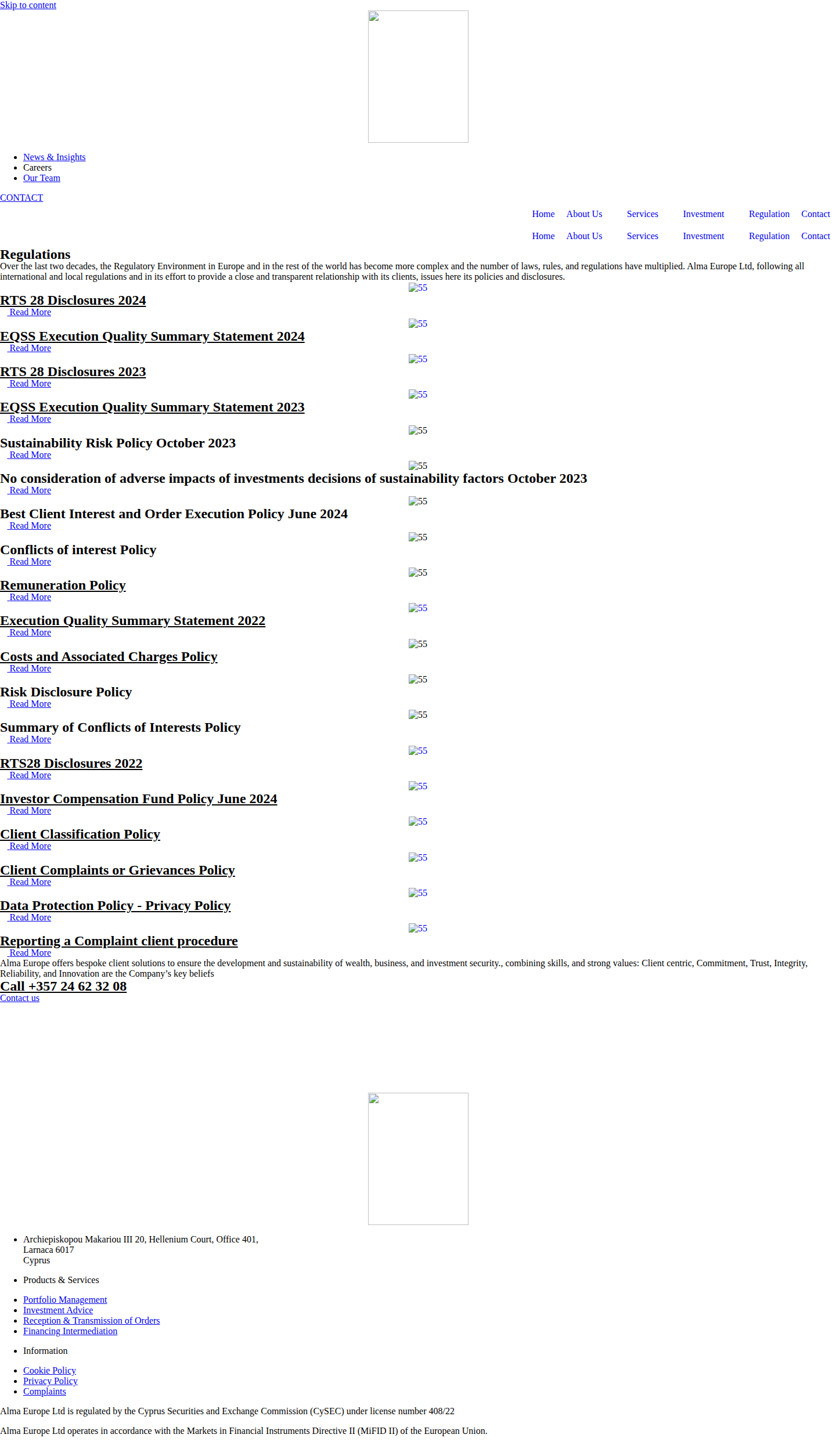
The firm’s Regulations page lists a set of policy documents as downloadable links, including a Costs and Associated Charges Policy, a Risk Disclosure Policy, a Client Complaints or Grievances Policy and RTS 28 Disclosures. The evidence gathered for this review did not include the text of those documents, so no fee figures, complaint-handling timelines or risk-disclosure clauses from them appear anywhere in this review.
Why the score moved from our last review
Our previous review of this firm scored 4.5 out of 10; this review scores 3.3 out of 10. That change reflects our current assessment against current evidence, not a change in the firm itself. On this pass, fees score 2 and client assets score 2 because no fee schedule, account terms or client-asset documentation was part of the evidence gathered, only a list of unread policy-document links. Transparency scores 3.3, weighed down by the gap between the firm’s own passporting scope on the CySEC register and the countries its site was found serving geo-matched content to. Regulation scores 4, reflecting a confirmed CySEC investment-firm licence alongside a company-registration number that a commercial mirror could not confirm.
Overview Table
| Headquarters | Archiepiskopou Makariou III 20, Hellenium Court, Office 401, Larnaca 6017, Cyprus |
| Established | 2019, per the firm’s own About Us page |
| Countries Served | Austria, Belgium, France, Germany, Greece, Italy, Luxembourg, Netherlands, Portugal and Spain under CySEC passporting, plus Israel as a named third country, per the CySEC register |
| Regulated By | Cyprus Securities and Exchange Commission (CySEC), licence 408/22 |
| Minimum Deposit | Not stated |
| Maximum Leverage | Not stated |
| Total Instruments | Not stated |
| Platforms | Not stated |
| Customer Support | Phone (+357 24 62 32 08), email (info@almaeurope.finance) and a web contact form |
| Languages | Not stated |
Facts List
- ALMA Europe Ltd holds CySEC licence 408/22 as a Cyprus Investment Firm, confirmed on the CySEC register.
- The CySEC register lists the firm’s authorised activities as portfolio management, investment advice, reception and transmission of orders, and financing intermediation.
- The CySEC register’s passporting entry covers ten EU member states plus Israel as a named third country.
- Our evidence recorded the firm’s site serving geo-matched content to several countries outside that passporting list, with a geo-control check confirming the country matches.
- The CySEC register lists a company registration number of 401229, with the registering authority not named on that page.
- The firm’s own About Us page separately prints a company number of HE401229.
- A commercial Cyprus company-register mirror had no page for HE 401229, recorded here as not checked rather than as an absence.
- The firm’s About Us page states it was founded in 2019 by Raphael Ohana.
- The firm’s Regulations page lists policy documents including a Costs and Associated Charges Policy and a Risk Disclosure Policy, none of which were fetched for this review.
- The firm’s Contact page lists an address in Larnaca, a phone number, an email address and a web enquiry form.
Key Takeaways
Score: 3.3/10, down from our earlier 4.5
Our previous review of ALMA Europe Ltd scored 4.5/10. This review scores 3.3/10. The scoring criteria and the evidence base both changed between the two reviews, so this is our assessment moving, not a claim that the firm got worse: this review restates the score from the evidence currently in front of us. The component scores are regulation 4/10, fees 2/10, mandate control 5/10, client assets 2/10 and transparency 3.3/10.
What the CySEC register actually confirms
We searched three public registers directly: the CySEC register and two Cyprus company lookups, and ran a positive control against a firm known to be listed before treating any blank result as an absence. Licence 408/22 is confirmed on the Cyprus Securities and Exchange Commission register for ALMA Europe Ltd. This is a Cyprus Investment Firm authorisation, not a company registration, and it covers portfolio management, investment advice and order transmission. The CySEC entity record also lists a specific cross-border (Article 34 MiFID passporting) scope: Austria, Belgium, France, Germany, Greece, Italy, Luxembourg, Netherlands, Portugal and Spain within the EU, plus one named third country, Israel, on the basis that the firm complies with that country’s own regulatory regime. On the two Cyprus company-registry checks, for company numbers 401229 and HE401229, the mirror we queried had no page for either number; a commercial mirror can lag the official register, so we are not reporting that as an absence.
Where ALMA Europe’s own site outruns that licence
Our evidence shows the almaeurope.finance site being served geographically-matched content, with a geo-control check for Indonesia, Thailand and Vietnam confirming that all exits matched the requested country. None of Indonesia, Thailand, Vietnam, Singapore, Japan, UAE or South Africa appears on the CySEC passporting list or the Israel third-country allowance. A CIF’s MiFID licence only authorises it to solicit or service clients in the states named on its own passporting record; content built for visitors from jurisdictions outside that list sits outside the scope the register itself sets for this firm.
Fees and client-money terms we could not read
The firm’s own Regulations page lists a set of policy documents as downloadable links, including a Costs and Associated Charges Policy, a Risk Disclosure Policy, a Client Complaints or Grievances Policy and RTS 28 Disclosures. Our evidence did not fetch the text of any of these documents, so we have no fee schedule, no complaint-handling timeline and no risk-disclosure wording to report. That gap is why fees and client assets score low here: it is not a finding that the firm charges more or protects client money less, only that the pages naming those terms were not part of what we read. The same evidence set contains no account types, no platform details and no instrument list.
Contact and background
ALMA Europe’s contact page gives a Larnaca address, a Cyprus landline and an email address, plus a web enquiry form rather than a ticketing system. The firm’s About Us page states it was founded in 2019 by Raphael Ohana, described there as a former banking and wealth management executive with over 25 years’ experience in Luxembourg and Switzerland.
Licenses & Regulation
ALMA Europe Ltd holds CySEC licence number 408/22, issued to it as a Cyprus Investment Firm authorised for portfolio management, investment advice, and reception and transmission of orders. We searched the Cyprus Securities and Exchange Commission’s own Cypriot Investment Firms register directly, running a positive control against a firm known to be listed first so that an empty result would mean absence rather than a broken search, and found ALMA Europe’s entry confirmed there.
What the CySEC register actually shows
The register entry we found is a financial-services authorisation, not a company registration: it lists the licence number and a licence date, and the page states no restriction or suspension against it. That is a genuine regulatory confirmation, and it is the strongest fact in this section.
Where ALMA Europe is actually licensed to solicit clients
The same CySEC entry limits the geography. For reception and transmission of orders, portfolio management and investment advice, the cross-border passporting scope named on the register covers ten EU states: Austria, Belgium, France, Germany, Greece, Italy, Luxembourg, Netherlands, Portugal and Spain. Outside the EU, the entry names one country, Israel, under the register’s own wording that CIFs may provide their services to countries outside the EU provided that they comply with the regulatory regime of the third country. No other country appears on ALMA Europe’s passporting record.
The gap between that list and the almaeurope.finance site
Our evidence shows the almaeurope.finance site serving geographically matched content to visitors from Indonesia, Thailand, Vietnam, Singapore, Japan, the UAE, South Africa, the UK and Germany, with a geo-control check confirming that all exits matched the requested country. None of Indonesia, Thailand, Vietnam, Singapore, Japan, the UAE or South Africa appears on the ten-state EU passporting list or as the named third country, Israel. We are reporting what the CySEC record permits and what the site’s own geo-serving behaviour showed side by side; we are not asserting that any client in those countries was solicited or onboarded, only that the two records do not line up.
Company registration
The CySEC entity page also carries a Cyprus registration number, 401229, for ALMA Europe Ltd, and the firm’s own About Us page prints the same number in the form “Company number HE401229”. We checked a commercial mirror of the Cyprus companies register for HE 401229 and found no page for it there. A commercial mirror can lag the official register, so this is recorded as not checked rather than as an absence finding.
Score
TrueBroker’s earlier review of ALMA Europe scored it 4.5/10 overall; this review scores regulation at 4/10 and the overall figure at 3.3/10. That is our assessment being restated against current evidence and a changed set of criteria, not a claim that the firm’s standing with CySEC has changed. On the regulation criterion specifically, the CySEC confirmation itself pulls the score up, while the gap between the firm’s ten-state passporting record and the countries its own site is shown serving pulls it back down.
Permitted Services
ALMA Europe Ltd’s own record on the Cyprus Securities and Exchange Commission register, entity number 408/22, lists its role as a Cyprus Investment Firm covering portfolio management, investment advice, reception and transmission of orders, and financing intermediation. That is the full set of services the CySEC licence authorises: it does not extend to execution of orders on the firm’s own account, underwriting or placing of financial instruments, or operation of a multilateral trading facility. Where the register is silent on a service, that silence is the register’s, not ours; we report what the entry names and nothing beyond it.
Where ALMA Europe can actually solicit clients
The same CySEC entity record sets out ALMA Europe’s cross-border passporting scope under the three licensed services, reception and transmission of orders, portfolio management, and investment advice, into a named list of EU states: Austria, Belgium, France, Germany, Greece, Italy, Luxembourg, Netherlands, Portugal and Spain. Outside the EU, the register records only one country by name, Israel, under the general MiFID condition it states for third countries, that a CIF may provide services there provided it complies with that country’s own regulatory regime. That is the entire cross-border footprint the licence supports on paper.
Our evidence shows the almaeurope.finance site being served with geographically matched content to visitors from Indonesia, Thailand, Vietnam, Singapore, Japan, the UAE, South Africa, the UK and Germany, with a geo-control check confirming that all exits matched the requested country. None of Indonesia, Thailand, Vietnam, Singapore, Japan, the UAE or South Africa appears on the passporting list or as the named third country. We hold two facts side by side here, not a conclusion about intent: the register names ten EU states plus Israel as the scope of the licence, and the pages we fetched show content served, geo-matched, to a wider set of countries than that.
What the licence does not cover, and what we could not check
Portfolio management and investment advice are discretionary, relationship-driven services; reception and transmission of orders is not. A firm licensed for RTO passes client orders to another venue or broker for execution rather than executing them itself, which matters for anyone assuming ALMA Europe fills trades directly. The CySEC record does not list execution of orders on behalf of clients, dealing on own account, or underwriting among the firm’s authorised services, so on the evidence we hold, none of those is part of the licensed mandate.
The firm’s own Regulations page lists a set of policy documents by title, among them a Costs and Associated Charges Policy, a Risk Disclosure Policy, a Client Complaints or Grievances Policy, and RTS 28 disclosures, but our evidence did not fetch the text of any of them. That means we cannot say from this evidence how ALMA Europe describes the scope or limits of its own mandate in its client agreement, what discretion a portfolio management client actually grants it, or what its advice service covers in practice. Those documents are exactly where such terms would sit; their absence from what we fetched is a gap in our evidence set, not a finding that the terms are silent or absent.
Company identity behind the licence
The CySEC register entry gives a Cyprus company registration number of 401229 for ALMA Europe Ltd, without naming the registering authority on that page. The firm’s own About Us page prints a company number in the form HE401229. A commercial companies-register mirror we checked for Cyprus had no page for HE401229 at all, so we could not independently confirm the company record; that is a mirror limitation, not a finding that the registration does not exist, and we ran a positive control on a firm known to be listed before treating any register as reliable enough to report an absence.
Score
Our previous review scored ALMA Europe 4.5 out of 10; this review scores it 3.3. The mandate control score sits at 5 because the licensed services are clearly named on the CySEC register, reception and transmission, portfolio management and advice. Regulation, at 4, and transparency, at 3.3, are pulled down by the same gap: the passporting scope named on the register does not match the spread of countries the site was shown serving geo-matched content to in our evidence, and the firm’s own cost and risk-disclosure documents were listed by title but not fetched, so their terms remain unverified. Client assets and fees both score 2, reflecting that no fee schedule, safeguarding arrangement or client-money term appears anywhere in the evidence we hold. We are restating the score from this review’s evidence and criteria, not reporting any change in the firm itself.
Who Decides a Trade
The CySEC entity record lists ALMA Europe Ltd as authorised for three separate activities: portfolio management, investment advice, and order transmission. Those three sit on different points of the discretion spectrum, and the register entry does not say which one applies to any given client relationship, or how a client ends up in one bucket rather than another.
What the licence actually covers
Portfolio management is a discretionary mandate: the firm decides what to buy, sell, or hold inside the parameters a client has agreed to, without asking first. Investment advice is the opposite in one important respect: the firm recommends, but the client still presses the button. Order transmission is the third of those services; the evidence gathered for this review does not describe what it involves beyond the name. ALMA Europe Ltd is licensed for all three. The CySEC register confirms this is a financial-services authorisation, a Cyprus Investment Firm licence rather than a plain company registration, and states no restriction or suspension against it.
What the register does not do is map those activities onto the firm’s actual client-facing terms. It records the scope of what ALMA Europe Ltd is permitted to do, not what any individual client agreement says the firm will do for that client, or which of the three services a given account is opened under.
Where a client would find out who decides
The firm’s own Regulations page lists a set of downloadable policy documents that would normally settle this: a Costs and Associated Charges Policy, a Risk Disclosure Policy, a Client Complaints or Grievances Policy, and RTS 28 disclosures among them. Those are exactly the documents that would state, for a portfolio management client, what discretion the firm holds and what recourse a client has if it disagrees with a trade already made on their behalf, and for an advisory or execution-only client, what the firm is and is not responsible for once an order goes in. The evidence gathered for this review captured the list of document titles on that page but not the text inside them, so none of that detail, dispute timelines, discretion limits, or how a disagreement over a portfolio decision would be handled, could be checked.
The support channels listed for ALMA Europe Ltd are a Larnaca office address, a phone number, an email address, and a web enquiry form. The enquiry form is a plain contact form, not a ticketing system, which matters for a client who wants a documented record of raising an objection to a discretionary decision.
How this weighs on mandate control
This review scores ALMA Europe Ltd 5 out of 10 on mandate control, one of five criteria behind the 3.3 overall score. The firm’s previous review under the old scoring gave it 4.5 overall; this is a different assessment against current evidence and current criteria, not a claim that the firm’s own conduct has moved. On mandate control specifically, the mid-range score reflects a licence that spans discretionary and non-discretionary services at once, confirmed on the CySEC register, set against the absence of any fetched document spelling out how that discretion is actually bounded or exercised for a given client. A firm authorised to manage a portfolio at its own discretion carries a different risk profile for a client who disagrees with a decision than one that only transmits orders, and nothing in the evidence collected here says which of those an ALMA Europe Ltd client is actually signing up for until the underlying policy documents are read.
Client Assets
ALMA Europe Ltd holds a Cyprus Investment Firm licence, number 408/22, confirmed on the CySEC register of Cypriot investment firms. The register lists order transmission, portfolio management and provision of investment advice among ALMA Europe’s licensed investment services. Portfolio management and financing intermediation are exactly the activities that put a firm in direct contact with client cash or securities, which makes it worth being precise about what we could and could not confirm on how those assets are held.
What we could not confirm about ALMA Europe’s custody arrangements
Nothing in the evidence names a custodian bank, states whether client funds are held in segregated accounts, or describes what happens to client money or securities if the firm fails. The CySEC entity page gives the licence, the licensed activities, and the passporting scope. We have no fetched page or document from ALMA Europe itself describing segregation practice, and we are not treating that gap as a finding against the firm, only as a gap in the evidence we hold.
Where that information would sit on ALMA Europe’s own site
The firm’s own Regulations page lists a set of downloadable policy documents, including a Costs and Associated Charges Policy, a Risk Disclosure Policy, a Client Complaints or Grievances Policy, and RTS 28 Disclosures. A client-asset or investor-compensation policy is the kind of document that would ordinarily sit alongside these, and would be the place a custodian name or a segregation clause would actually appear. Our evidence recorded these titles as links on the page but did not fetch the underlying document text, so we cannot report a custodian, a segregation clause, or a compensation-scheme reference from them. That is a limit on what was fetched, not a statement that ALMA Europe publishes no such policy.
What the CySEC licence does and does not tell us
The CySEC register entry states no restriction or suspension against the 408/22 licence, and lists cross-border passporting for portfolio management, investment advice, and order transmission into Austria, Belgium, France, Germany, Greece, Italy, Luxembourg, Netherlands, Portugal and Spain, plus third-country provision into Israel. That confirms the firm operates under a live financial-services authorisation rather than a bare company registration. It does not tell us anything about how ALMA Europe segregates client money from its own operating funds, which bank or custodian it uses, or how client securities are recorded. We searched the CySEC register directly for this review, alongside two Cyprus company-registry checks, and ran a positive control on all three so an empty result would mean absence rather than a broken search; none of those three checks is a register for client-asset segregation or an investor compensation scheme, so none of them can settle the question either way.
Why the client-assets score moved
Our previous review of ALMA Europe scored 4.5 out of 10 overall; this review scores 3.3 out of 10 overall, with client assets specifically now scored 2 out of 10. That is our reassessment of the same kind of gap described above, not a change in ALMA Europe’s own arrangements: a firm licensed for portfolio management and financing intermediation is a firm that can hold client cash or securities, and this review has no fetched custodian name, no segregation clause, and no compensation-scheme reference to weigh against that fact. The company-registry entries for HE401229 add nothing here either, since the mirror we checked had no page for that number and a commercial mirror lagging the official record is not the same as a finding of absence.
Fees & Charges
Alma Europe’s own site lists a document called “Costs and Associated Charges Policy” among the downloadable files on its Regulations page. That is the one place in the evidence where the firm points at its own fee terms, and we did not fetch the text behind that link. No fee schedule, management fee, performance fee, entry charge, exit charge or withdrawal charge appears anywhere else in the material we pulled from the firm’s site. That is not a finding that the firm charges nothing, or that its costs are undisclosed in the sense of not existing on paper; it is a statement that the policy naming those costs sits behind a link we did not open, and everything past that link is unknown to this review.
What ALMA Europe’s licence covers, and why that matters for cost
The Cyprus Securities and Exchange Commission register confirms ALMA Europe Ltd under licence 408/22, with a scope covering portfolio management, investment advice, order transmission, and financing intermediation. Each of those activities ordinarily carries its own charging structure, management fees on a discretionary mandate, advisory fees, commissions on transmitted orders, and financing costs are all distinct line items a client would expect to see broken out. The CySEC record establishes that the firm is authorised to run these activities; it says nothing about what any of them costs, since fee levels are not something a licensing register publishes.
Where the evidence stops
Beyond the named policy document, the pages we hold, the firm’s about page and contact page, cover the company’s founding, its Larnaca address and its contact channels, not pricing. No account-tier page, no fee table and no RTS 28 execution-cost disclosure was part of what we captured, even though RTS 28 Disclosures is listed alongside the costs policy on the same Regulations page. Whether ALMA Europe’s published policy document discloses costs and charges in substance is not something this review can check, because the document itself was not read.
Our previous review scored this firm 4.5 out of 10; this review scores it 3.3 out of 10, including a fees score of 2 out of 10. That is a reassessment made on the evidence gathered this time, not a claim that the firm’s charges have changed. The fees score sits at 2 because, on the material available to us, there is no fee figure of any kind to check against what the firm charges in practice, only a named policy document we could not read. A reader who wants the actual cost of a mandate with this firm needs the “Costs and Associated Charges Policy” document itself, direct from ALMA Europe’s Regulations page.
Onboarding & Suitability
ALMA Europe Ltd is licensed by the Cyprus Securities and Exchange Commission as a Cyprus Investment Firm, licence 408/22, confirmed on the CySEC Cypriot Investment Firms register. The register lists the firm’s authorised services as portfolio management, investment advice, order transmission, and financing intermediation. A CIF licence carries MiFID client-classification and suitability obligations by virtue of what the licence is, but the register entry itself does not describe how ALMA Europe carries those obligations out, and the firm’s own Regulations page lists a Risk Disclosure Policy and a Costs and Associated Charges Policy as downloadable documents without the underlying text being part of what we fetched. We cannot report what test a prospective client sits, what documentation onboarding asks for, or how retail, professional and eligible-counterparty classification is worked out in practice, because none of that appears in the pages we hold.
Who ALMA Europe is licensed to take on
The CySEC register entry scopes ALMA Europe’s cross-border (Article 34 MiFID passporting) services to ten named EU member states: Austria, Belgium, France, Germany, Greece, Italy, Luxembourg, Netherlands, Portugal and Spain. Outside the EU, the same register entry names one country, Israel, and states the general condition under which any such service is permitted: CIFs may provide their services to countries outside the EU provided that they comply with the regulatory regime of the third country. Nothing in the register or the firm’s own pages names any other non-EU jurisdiction as within scope.
Against that, our evidence shows the almaeurope.finance site being served with geographically matched content to visitors from Indonesia, Thailand, Vietnam, Singapore, Japan, UAE, South Africa, the UK and Germany, with a geo-control check confirming that all exits matched the requested country. Of that list, only Germany sits inside the passporting scope the register records; Indonesia, Thailand, Vietnam, Singapore, Japan, UAE and South Africa sit outside both the ten-state EU list and the single named third country. We can state what the register authorises and what the site serves; we cannot state that ALMA Europe actually onboards clients from those additional countries, only that the site presents itself to them as if it might.
Minimum investment and classification detail we don’t have
No page in this evidence set gives a minimum deposit, a minimum portfolio size for the advisory or portfolio-management mandates, or a fee schedule tied to account size. The fees, accounts and contract-terms evidence for this firm is empty; the notable-findings entry on the Regulations page confirms why, recording that the policy documents are listed as links but their text was not part of our evidence. Whatever threshold exists for opening a portfolio-management mandate with ALMA Europe, or whatever the firm requires to accept an advisory client, is not something we can quote from a source we’ve actually read.
How a prospective client reaches ALMA Europe
The contact page lists an address at Archiepiskopou Makariou III 20, Hellenium Court, Office 401, Larnaca, a phone number, an email address, and a web enquiry form asking for name, email, phone, company and a message field, sent via a “Send Message” button. That form is a general enquiry channel rather than a ticketing or account-opening system, so the pages we hold describe a starting point for contact, not a documented onboarding pipeline with defined stages. The firm’s own About page states it was founded in 2019 by Raphael Ohana, described there as a former banking and wealth management executive with over 25 years’ experience in Luxembourg and Switzerland; that is the firm’s account of its own leadership, not an independent finding.
Company registration alongside the CySEC licence
The CySEC register page also carries a company registration number, 401229, for ALMA Europe Ltd, though the register page does not name which authority issued it. The firm’s own About Us page separately gives a company number in the form “Company number HE401229”. We searched the Cyprus company registry mirror for both 401229 and HE401229 and found no page for either number; a commercial mirror can lag the official register, so that is recorded here as not checked rather than as an absence, and it should not be read as any finding about the company number itself.
Reporting & Transparency
Our score for reporting and transparency moved from 4.5 to 3.3 in this review, and it sits alongside a fees score of 2 and a client-assets score of 2 for the same reasons: the evidence set we now hold shows what Alma Europe’s site names as its disclosure documents but not what any of them actually says. We are restating our assessment from that evidence, not reporting that the firm discloses less than it used to.
What Alma Europe’s own site names, not what it shows
The firm’s Regulations page lists a set of policy documents as downloadable links: a Costs and Associated Charges Policy, a Risk Disclosure Policy, a Client Complaints or Grievances Policy, and a document titled RTS 28 Disclosures. We recorded the titles as they appear on that page. Our evidence did not fetch the documents themselves, so nothing here tells us what statement frequency, valuation basis, execution-venue reporting or complaint-handling timeline Alma Europe actually commits to in them. A title on a link is not a disclosure we have read, and this is exactly the gap that matters for a reporting section: the fee schedule and the binding terms a client would rely on sit behind those links, not in front of them.
The CySEC record and what it does not cover
The CySEC register confirms licence 408/22 for Alma Europe Ltd, covering portfolio management, investment advice, order transmission, and financing intermediation. That entry is a licence record, not a reporting standard. It tells us what Alma Europe is authorised to do, not what a client statement or portfolio valuation is supposed to contain or how often one is due, and nothing else in our evidence answers that either.
Who Alma Europe is actually reporting to
Alma Europe’s own CySEC entity record lists cross-border passporting only into Austria, Belgium, France, Germany, Greece, Italy, Luxembourg, the Netherlands, Portugal and Spain, plus Israel as a named third country where, in the register’s own wording, CIFs may provide their services to countries outside the EU provided that they comply with the regulatory regime of the third country. Against that list, our evidence shows the almaeurope.finance site serving geographically matched content to visitors from Indonesia, Thailand, Vietnam, Singapore, Japan, the UAE, South Africa, the UK and Germany, with a geo-control check confirming all exits matched the requested country. A client picked up from outside that passporting list and outside Israel is a client the CySEC record does not show Alma Europe authorised to serve, let alone to report to under whatever terms sit in the untested policy documents above.
Getting in touch about a statement or a query
Alma Europe’s contact page gives a Larnaca address, a Cyprus phone number (+357 24 62 32 08) and an email address (info@almaeurope.finance), alongside a web enquiry form collecting name, email, phone, company and message. That form is a general enquiry box, not a ticketing system, and nothing on the page describes how a question about a statement or a valuation is logged or tracked once it is submitted.
Conflicts & Inducements
ALMA Europe Ltd is licensed by the Cyprus Securities and Exchange Commission under licence 408/22, confirmed on the CySEC register of Cypriot investment firms, for portfolio management, investment advice, order transmission, and financing intermediation. A firm holding that licence sits under MiFID conflicts of interest rules by default, but a licence category is not itself a disclosure, and what follows is what our evidence actually captured about how ALMA Europe documents conflicts and inducements, not what the rules would generally require.
What the evidence set does and does not contain
Our evidence recorded no fee schedule, no payment or commission data, and no contract terms for ALMA Europe. The firm’s own Regulations page lists a set of downloadable policy titles, including a Costs and Associated Charges Policy, a Risk Disclosure Policy, a Client Complaints or Grievances Policy, and RTS 28 Disclosures. RTS 28 is the disclosure MiFID firms use to report on order execution venues and, where relevant, any close links or common ownership with those venues, which is one of the standard channels through which a conflicts of interest position would normally surface. Our evidence did not fetch the text of any of these documents, so no clause on conflicts of interest, inducements, third-party payments, retrocessions, or execution venue relationships can be quoted or summarised here. That is a gap in what we fetched, not a finding that ALMA Europe has no such policy or no such disclosures; the titles on the Regulations page indicate the opposite, that the relevant policies exist and are published, just not captured in this evidence set.
Serving clients outside ALMA Europe’s licensed footprint
ALMA Europe’s own CySEC entity record lists cross-border passporting under Reception and transmission of orders, Portfolio management, and Provision of investment advice into ten named EU states: Austria, Belgium, France, Germany, Greece, Italy, Luxembourg, Netherlands, Portugal and Spain, plus one named third country, Israel, on the basis that the firm complies with that country’s own regulatory regime. Against that, our evidence shows the almaeurope.finance site being served with geographically matched content to visitors from Indonesia, Thailand, Vietnam, Singapore, Japan, the UAE, South Africa, the UK and Germany, with a geo-control check confirming that all exits matched the requested country. None of Indonesia, Thailand, Vietnam, Singapore, Japan, the UAE, South Africa or the UK appears on the CySEC passporting list or as the named third country. A CIF’s authorisation to solicit or service retail clients runs to the specific states and third countries on its own passporting record, so marketing tailored to those other jurisdictions sits outside what the firm’s own regulator record describes it as licensed to do there, which is itself a form of the firm taking on business its documented mandate does not cover.
Leadership and what is not disclosed about it
ALMA Europe’s About page states the firm was founded in 2019 by Raphael Ohana, described there as a former banking and wealth management executive with more than 25 years of experience in Luxembourg and Switzerland. The page gives no detail on prior roles, any regulatory history attached to those roles, or any outside directorships or business interests that might bear on conflicts of interest, and our evidence did not capture any such disclosure elsewhere on the site.
Company identity
The CySEC register page gives a Cyprus company registration number of 401229 for ALMA Europe Ltd, and the firm’s own About page separately gives a company number of HE401229 for Alma Europe Ltd. A commercial company-registry mirror checked for both numbers had no page for HE 401229, which is reported here as the mirror lacking that record, not as a finding that the number does not exist, since a commercial mirror can lag the official Cyprus registry.
Where this leaves the score
Our previous review scored ALMA Europe 4.5 out of 10; this review scores it 3.3 out of 10, with transparency at 3.3 and client assets at 2. That move is our assessment against the evidence above, not a claim that ALMA Europe’s own conduct has changed: the fee and payment fields in this evidence set are empty, the policy documents that would normally carry a conflicts or inducements position were listed by title only and not fetched, and the one piece of first-hand behaviour our evidence did capture, the geo-targeted marketing running well past the firm’s own passporting list, points toward weaker mandate discipline rather than stronger disclosure.
Complaints & Redress
Alma Europe Ltd’s licence, 408/22, sits on the Cyprus Securities and Exchange Commission’s Cypriot investment firms register, which we checked directly. CySEC authorisation carries a statutory route for client complaints and a compensation fund that a company registration alone would not provide, and that difference is part of why this section can say something concrete rather than nothing.
What the register confirms and what it does not
The CySEC entry we checked lists the firm’s licence number and licence date and states no restriction or suspension against it. The register’s scope, as CySEC states it, covers the Cypriot Investment Firms list at that same register page. That confirms the firm holds an active CIF licence; it says nothing about how any individual complaint against Alma Europe has been handled, because the register does not publish complaint outcomes.
The firm’s own complaints policy is named but not read
Alma Europe’s Regulations page lists a “Client Complaints or Grievances Policy” as a downloadable document, alongside a “Costs and Associated Charges Policy” and a “Risk Disclosure Policy”. The evidence gathered here did not fetch the text of that policy, so no complaint-handling timeline, no internal escalation step and no reference to the Financial Ombudsman route that CySEC firms typically must offer can be reported. The policy’s existence is confirmed by its listing on the firm’s page; its contents are not part of this evidence set.
How to actually reach Alma Europe
The contact channels the firm publishes are an address at Archiepiskopou Makariou III 20, Hellenium Court, Office 401, Larnaca 6017, Cyprus, a phone number, +357 24 62 32 08, an email address, info@almaeurope.finance, and a web enquiry form asking for name, email, phone, company and message. That form is a generic message box, not a ticketing system with a reference number or a stated response window, and no separate complaints inbox or escalation contact is given in this evidence.
Passporting scope and who can actually complain through Cyprus
The CySEC record’s cross-border services list names Austria, Belgium, France, Germany, Greece, Italy, Luxembourg, Netherlands, Portugal and Spain for the passported services (order transmission, portfolio management, investment advice), plus Israel as a named third country where CySEC notes that CIFs may operate provided they meet that country’s own regulatory regime. A client outside that list is dealing with a firm whose CySEC-recorded authorisation to solicit or service that market is not established by this register entry, which matters for redress because the compensation and complaints machinery tied to a CySEC licence is scoped to the business that licence actually covers.
What we could not check
The Cyprus company registration numbers on file, 401229 from the CySEC page and HE401229 as printed on Alma Europe’s own About Us page, could not be checked on the commercial companies mirror we used; that mirror simply had no page for HE401229, which we record as a mirror lag rather than as an absence of any such registration. No fee schedule, no complaint-handling timeline and no figure for a compensation scheme payout ceiling appear anywhere in the evidence gathered, so none is given here.
Why this review’s score moved
Our previous review scored Alma Europe 4.5 out of 10; this review scores it 3.3. Client assets and fees both score low, at 2 out of 10, because the evidence contains no fee schedule and no account or custody detail to assess despite those documents being named on the firm’s own Regulations page, and transparency scores 3.3 out of 10 for the same reason: policies are listed but their contents were not captured. That gap between documents named and documents read is what drove this review down, not any change in the firm itself, and it applies squarely to the complaints and compensation picture: a named policy is not a read one.
Prohibited Countries
Who ALMA Europe’s own licence covers
ALMA Europe Ltd holds CySEC licence 408/22 as a Cyprus Investment Firm, confirmed on the CySEC register of Cypriot investment firms, authorised for portfolio management, investment advice, order transmission, and financing intermediation. The firm’s own entry on that register lists its cross-border, MiFID-passported services as covering ten EU member states: Austria, Belgium, France, Germany, Greece, Italy, Luxembourg, Netherlands, Portugal and Spain. Outside the EU, the register lists one named jurisdiction, Israel, under the general MiFID allowance that CIFs may provide their services to countries outside the EU provided that they comply with the regulatory regime of the third country. No other country appears on ALMA Europe’s own passporting record.
Where the site is actually served
Our evidence that fetched almaeurope.finance recorded the site being served with geographically matched content to visitors in Indonesia, Thailand, Vietnam, Singapore, Japan, the UAE, South Africa, the UK and Germany, with a geo-control check confirming that all exits matched the requested country. Of those nine locations, only Germany appears on ALMA Europe’s CySEC passporting list; Israel, the one third country the firm’s own register entry names, was not among the locations tested. Indonesia, Thailand, Vietnam, Singapore, Japan, the UAE, South Africa and the UK sit outside both the ten-state EU passport and the single named third country on the firm’s licence record.
This is not a register check and not a statement that ALMA Europe is barred from these countries by some rule we can cite; the CySEC entry does not itself list prohibited countries. It is a comparison between two things we hold: the scope the firm’s own licence record states, and the countries the firm’s own website was observed serving matched content to. Where those two lists diverge, the divergence is what the evidence shows, not an assumption about intent.
What we could not check
ALMA Europe’s Regulations page lists a set of downloadable policy documents, including a Costs and Associated Charges Policy and a Risk Disclosure Policy, that would be the natural place to find a client-facing statement of eligible or excluded jurisdictions. Our evidence did not fetch the text of those documents, so this section cannot say whether ALMA Europe publishes its own list of prohibited or restricted countries anywhere in its terms; it can only report the scope stated on the CySEC register and the countries the site was observed reaching.
Score
Our previous score for ALMA Europe was 4.5/10; this review scores it 3.3/10 overall, with regulation at 4/10 and transparency at 3.3/10. That move reflects our assessment against the evidence above, not a change at the firm: the CySEC register confirms a genuine CIF licence, but that licence names a specific, narrow set of EU states plus Israel, while the firm’s own site was recorded serving matched content well beyond that list. A licence whose stated scope does not match the countries the firm’s website reaches is exactly the kind of mismatch that pulls a regulation and transparency score down, and it is why this section carries as much weight in the overall figure as it does.
Customer Support
ALMA Europe gives a client exactly one place to look for contact details: the firm’s contact page. It lists a Larnaca address (Archiepiskopou Makariou III 20, Hellenium Court, Office 401, Larnaca 6017, Cyprus), a phone number (+357 24 62 32 08), an email address (info@almaeurope.finance), and a web enquiry form.
How to reach ALMA Europe
Of the four channels the contact page lists, three are static: an address, a phone number, and an email address. The fourth, the enquiry form, asks for Name, Email, Phone, Company and Message, and submits through a single “Send Message” button. That is a plain message form rather than a ticketing system.
A complaints policy we could not read
ALMA Europe’s own Regulations page lists a “Client Complaints or Grievances Policy” among a set of downloadable documents, alongside a “Costs and Associated Charges Policy,” a “Risk Disclosure Policy,” and “RTS 28 Disclosures.” our evidence that fed this review did not fetch the text of any of those documents. That means this review cannot report what timeline the firm commits to for acknowledging or resolving a complaint, what internal escalation route exists before a client can go to CySEC or the Financial Ombudsman, or what form a written complaint has to take. The policy is named on the firm’s own site; its content is not something we have read.
Support offered to clients the firm’s own CySEC record does not cover
ALMA Europe’s entry on the Cyprus Securities and Exchange Commission register lists cross-border passporting for order transmission, portfolio management, and investment advice into ten EU states: Austria, Belgium, France, Germany, Greece, Italy, Luxembourg, Netherlands, Portugal and Spain, plus one named third country, Israel, on the basis that a CIF may serve a non-EU country if it complies with that country’s own regulatory regime. Against that list, our evidence found the almaeurope.finance site being served with geography-matched content to visitors from Indonesia, Thailand, Vietnam, Singapore, Japan, the UAE, South Africa, the UK and Germany, with a geo-control check confirming that all exits matched the requested country. None of Indonesia, Thailand, Vietnam, Singapore, Japan, the UAE, South Africa or the UK appears on the CySEC passporting list or as the named Israel exception. A visitor from any of those places reaches the same phone number, email address and enquiry form as a visitor from Spain or Luxembourg, with nothing on the contact page distinguishing which of those enquiries the firm’s licence actually covers.
What is missing from the record
The evidence gathered here covers the contact page and the list of policy documents ALMA Europe publishes; it does not include the documents themselves, a support-hours statement, or any record of how a complaint has actually been handled. A reader relying on this section knows where ALMA Europe can be reached and that a complaints policy exists as a named document; a reader wanting to know what that policy promises has to open it directly.
Conclusion
ALMA Europe Ltd holds a live Cyprus Investment Firm licence, number 408/22, which we confirmed directly on the CySEC Cypriot Investment Firms register. That is a financial-services authorisation covering portfolio management, investment advice, order transmission, and financing intermediation, not just a company filing. On its own that would support a middling score. What pulls this review down to 3.3/10 is what sits around that licence: a scope question the firm’s own regulatory record raises, and a near-total absence of the fee, contract and custody detail a client would need before funding an account.
What ALMA Europe’s CySEC licence actually covers
The CySEC entity record lists cross-border passporting for order transmission, portfolio management and investment advice into ten named EU states: Austria, Belgium, France, Germany, Greece, Italy, Luxembourg, Netherlands, Portugal and Spain. Outside the EU, the same record names only Israel, on the condition, in the register’s own words, that CIFs may provide their services to countries outside the EU provided that they comply with the regulatory regime of the third country. Against that list, our evidence shows the almaeurope.finance site being served geo-matched content to Indonesia, Thailand, Vietnam, Singapore, Japan, the UAE, South Africa, the UK and Germany, with a geo-control check confirming all exits matched the requested country. None of Indonesia, Thailand, Vietnam, Singapore, Japan, the UAE or South Africa appears on the passporting list or the Israel allowance. We are reporting what our evidence captured, geo-matched marketing content reaching visitors in those markets, not a finding that ALMA Europe solicited or onboarded clients there; a reader weighing this against the licence scope should draw their own line between the two.
What the record leaves unchecked
The CySEC page does not name the authority behind ALMA Europe’s company registration number, 401229. The firm’s own About Us page separately gives a company number, HE401229. We searched the Cyprus company mirror for both and it returned no page for either; a commercial mirror can lag the official record, so that is logged as not checked rather than as an absence. On the commercial side, the firm’s Regulations page lists a Costs and Associated Charges Policy, a Risk Disclosure Policy, a Client Complaints or Grievances Policy and RTS 28 Disclosures as downloadable documents, but the underlying PDFs were not part of this evidence set. That means we hold no fee schedule, no minimum deposit, no leverage cap, no account-tier structure and no contract clause on custody, liability, liens or termination for this firm. Support itself is a phone number, an email address and a web enquiry form, not a client portal or ticketing system, per the contact page.
Why the score moved from 4.5 to 3.3
Our previous review of ALMA Europe scored 4.5/10; this one scores 3.3/10. That change is our assessment under the current scoring criteria and the evidence gathered this time, not a claim that the firm’s own conduct changed between reviews. The regulation component, at 4, reflects a confirmed CySEC CIF licence weighed against the passporting-scope question above. Fees and client assets both score 2, the near-floor result of having no fee schedule, no account terms and no custody or segregation language to check, only a list of policy document titles we could not read. Mandate control sits at 5, carried by the licensed portfolio-management and advice mandate itself, with no contract text to confirm how that mandate is exercised in practice. Transparency, at 3.3, reflects the same gap: the firm names its policies but does not put their content where this review, or a prospective client, can check it.
ALMA Europe Ltd is a CySEC-licensed Cyprus Investment Firm, confirmed on the regulator’s own register under licence 408/22, but its public pages leave the actual costs, account terms and client-asset protections unpublished and its own passporting record does not cover several of the markets its site content was served into; TrueBroker scores it 3.3 out of 10.
What we saw
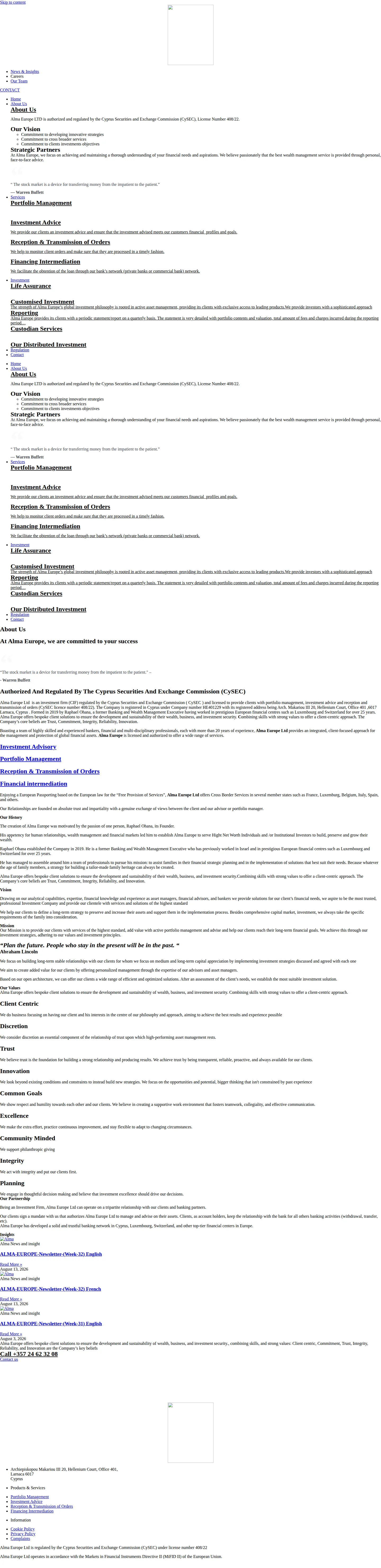
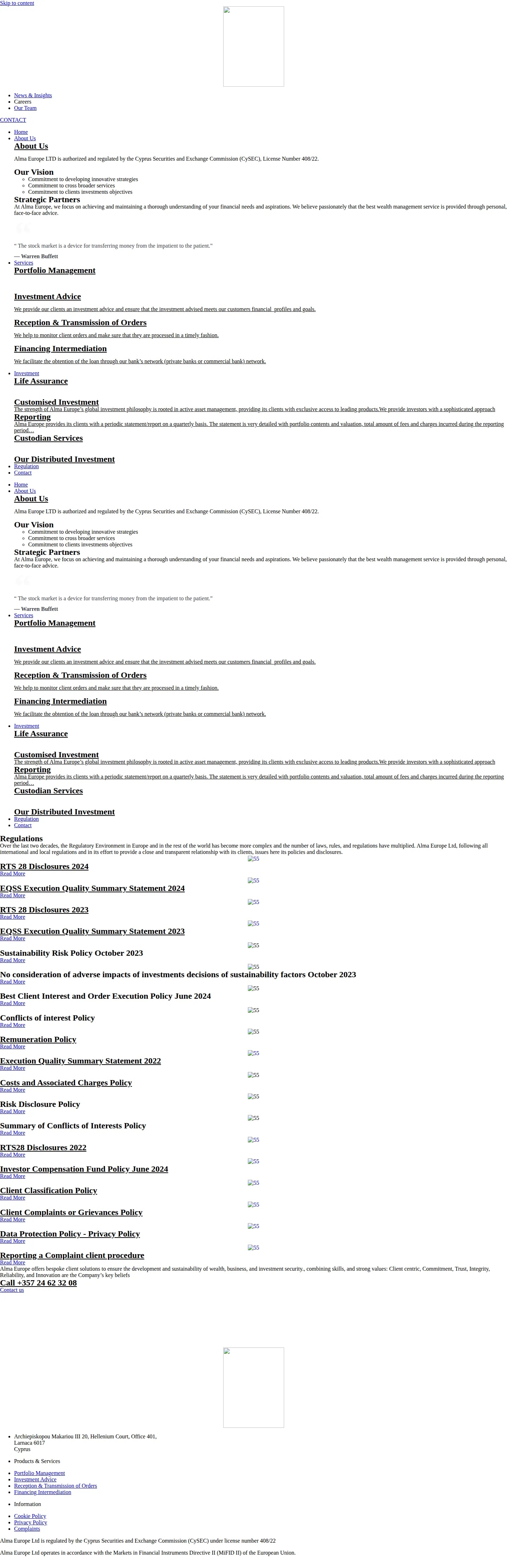
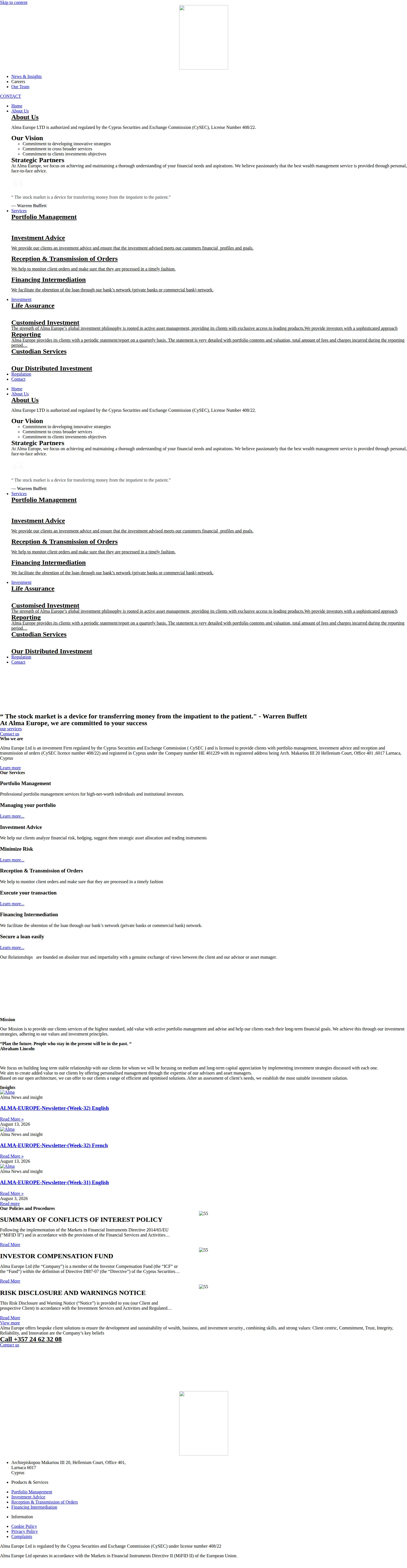
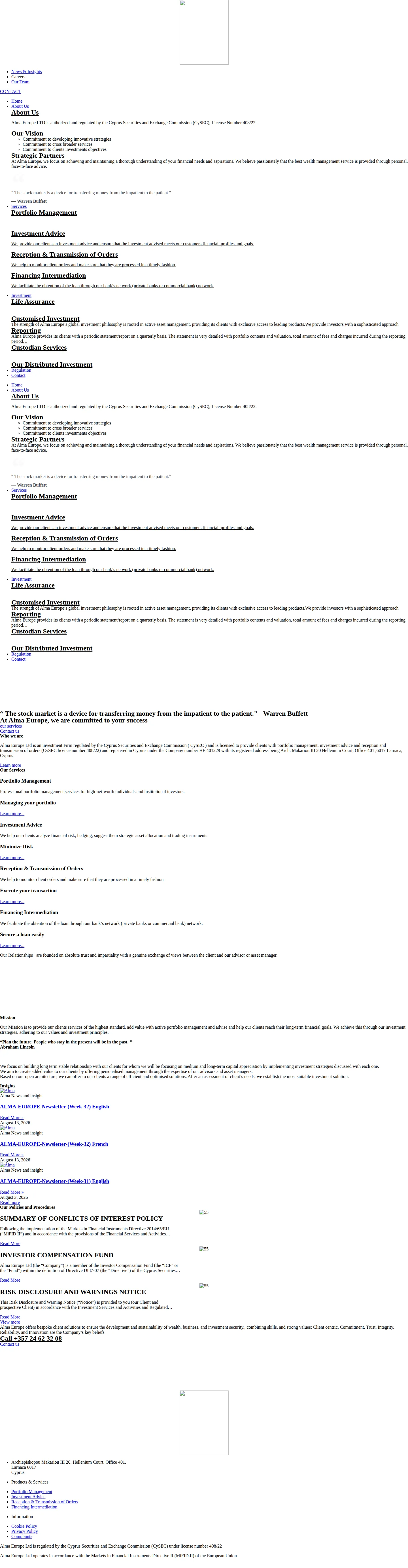
Pages captured from ALMA Europe Ltd’s own site when this review was written. Brokers change their terms; these are what we read.
Score history
Recomputed daily; every move is on the record. The current score is always the latest row.
| Date | Score | Move |
|---|---|---|
| 2026-09-19 | 3.3 | ▼ |
| 2026-09-13 | 4.5 | ▲ |
| 2026-09-12 | 4.2 | ▼ |
| 2026-08-19 | 4.3 | · |
FAQ
Is ALMA Europe Ltd regulated?
Yes. CySEC licence 408/22 is confirmed for ALMA Europe Ltd, and its approved domain matches the firm’s site
What fees does ALMA Europe Ltd charge?
No fee schedule, management charge percentage or performance fee terms are published; fees appear in quarterly statements after they are incurred
Where are ALMA Europe Ltd client assets held?
The firm says assets sit at custodian banks in Cyprus, Luxembourg and Switzerland, but it does not name the custodians
Can clients veto ALMA Europe Ltd's investment decisions?
The mandate authorizes ALMA Europe Ltd to manage and advise on assets, but no client veto or exit notice period is documented
How often does ALMA Europe Ltd report to clients?
Reports are specified quarterly and include portfolio contents, valuation and fees
Is ALMA Europe Ltd's ICF membership verified?
ICF membership is claimed but was not independently verified, and no compensation ceiling is stated
How this review works
Track ALMA Europe Ltd live: score moves and red notices, in your pocket.