
STOCK · CHECKED 13 SEP 2026
Atlantic Securities Ltd review.
Cyprus stockbroker on the Cyprus and Athens exchanges, and an introducing broker to Interactive Brokers for everything else.
RISKY
OUT OF 10
Atlantic Securities Ltd holds CySEC licence 005/03, verified on the regulator's own register, with www.atlanticfs.com listed as its only approved domain. It is an agency stockbroker on the Cyprus and Athens exchanges with no permission to deal on own account, so it cannot be your counterparty. For everything else it is an introducing broker: the global account is opened with Interactive Brokers Ireland Limited. Fees are published in full but are high, and a EUR 3,000 market abuse fine sits on the 2021 record. It suits Cyprus and Greek equity investors, not leveraged traders.
Each criterion is scored 1 to 10 from primary sources. The overall score is their unweighted mean. How scoring works.
| Founded | 2001 |
|---|---|
| Headquarters | CY |
| Withdrawal fee | EUR 3 (about USD 3.47 at August 2026 rates) |
| Platforms | BCiTrade web, BCiTrade desktop, Interactive Brokers platform, Interactive Brokers Client Portal |
- CySEC licence 005/03 is current and covers the exact legal entity a client contracts with for Cyprus and Athens business, with no offshore onboarding arm anywhere in the group
- The regulator's own approved domains list names www.atlanticfs.com against this licensee and nothing else, and the register publishes an atlanticfs.com email for the firm
- No permission to deal on own account, so the firm cannot be the counterparty to a client trade, and its execution annex names only regulated markets
- Fees are published to the cent on both the local and global tariffs, including the disclosure that Atlantic keeps the difference over Interactive Brokers' own rates
- Own funds of EUR 1,944,000 at 31 December 2025 against an own funds requirement of EUR 150,000, all common equity tier 1
- Investor Compensation Fund cover applies, at the lower of 90 per cent of the claim or EUR 20,000, and the complaints policy names the Financial Ombudsman of Cyprus as the external route
- Identical content served from all eleven countries we tested, with one entity, one licence and no geographic entity switching
- Withdrawals require an IBAN certificate and identity document, which makes payment to a third party account materially harder
- Twenty five years of continuous operation, with a parent company listed on the Cyprus Stock Exchange
- Global clients reach Interactive Brokers' platform and market access rather than a white labelled retail terminal
- The global account is opened with Interactive Brokers Ireland Limited, so the licence a client checks at the start is not the one governing their assets at the end
- CySEC fined the firm EUR 3,000 in October 2021 for failing to maintain effective arrangements for detecting suspicious orders and transactions
- Costs are high for a small portfolio: from 0.4 per cent plus a flat charge on the local exchanges, plus 0.12 per cent annual custody
- The firm charges its own Investor Compensation Fund contribution on to clients, at 0.1 per cent of eligible capital capped at EUR 20 plus EUR 1 a year
- No interest is paid on client money, stated directly in the firm's own client money policy
- The client money policy, order execution policy and client acceptance policy are published in Greek only, on an English only website
- No education, no research, no market analysis, no economic calendar and no charting package of the firm's own
- No demo account, no mobile application of its own, no live chat and no published support hours
- The international markets page says only exchange listed centrally cleared products are traded, while the firm's own costs disclosure prices CFD financing and short CFD borrow fees
- Minimum deposit, account opening turnaround and portfolio management fees are published nowhere, so the cost of the discretionary service cannot be assessed from the website
Overview
Atlantic Securities Ltd is a Nicosia stockbroker, not a retail CFD shop, and the distinction decides almost everything a reader needs to know about it. The firm was incorporated in Cyprus in April 2001 under certificate of incorporation HE119857, began trading in August 2001, and has held CySEC licence 005/03 since 12 May 2003. It is a member of the Cyprus Stock Exchange and a remote member of the Athens Exchange, it is a subsidiary of Atlantic Insurance Co. Public Ltd, a company listed on the Cyprus Stock Exchange, and it has twelve tied agents registered against its name on the CySEC register.
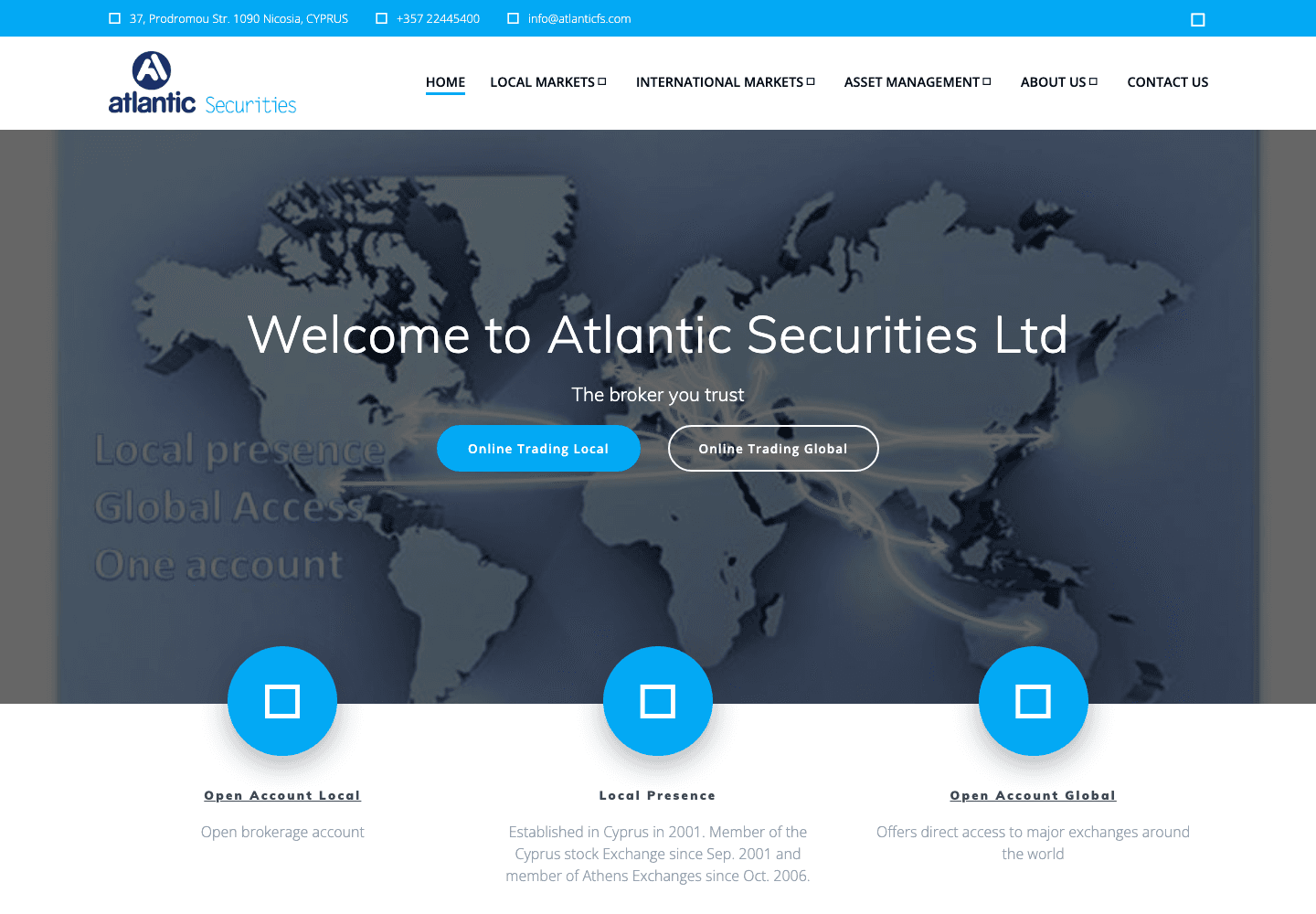
The single most important structural fact is that Atlantic Securities runs two very different businesses under one brand. For Cyprus and Greek shares and bonds, it is an exchange member executing your order on a regulated market. For everything else, it says so in its own words on two separate pages: “Atlantic Securities Ltd acts as an introducing broker for Interactive Brokers. By proceeding with account opening global, you will open an account with Interactive Brokers.” The global account is therefore not an Atlantic account at all. It is an account with Interactive Brokers Ireland Limited, which the Central Bank of Ireland lists under reference C423427. Atlantic sets the commission, Interactive Brokers collects it, and Atlantic receives the difference between what you paid and Interactive Brokers’ own rate. That arrangement is disclosed plainly, which is more than most introducing brokers manage, but it means the firm holding your global assets is not the firm whose licence you checked.
The second fact worth stating early is what the CySEC register does not grant. Atlantic Securities has no permission to deal on own account. Its authorised investment services are reception and transmission of orders, execution of orders on behalf of clients, and portfolio management. A firm without own account dealing cannot take the other side of your trade, and the firm’s own best execution annex names only three venues: Cyprus Stock Exchange shares, Athens Exchange shares, and Cyprus Stock Exchange bonds. All three are regulated markets. On the local business, your counterparty is the market, not Atlantic.
Overview Table
| Headquarters | 37 Prodromou Street, 1st Floor, CY-1090 Nicosia, Cyprus |
| Established | Incorporated April 2001, operating since August 2001, licensed May 2003 |
| Countries Served | No published country list. The site served identical content from all eleven countries we tested |
| Regulated By | CySEC, licence 005/03. Global accounts are opened with Interactive Brokers Ireland Limited, Central Bank of Ireland C423427 |
| Minimum Deposit | Not published |
| Maximum Leverage | Not published. No leverage figure appears anywhere on the site |
| Total Instruments | Cyprus and Athens listed shares and bonds, plus access described as 100 plus market centres through Interactive Brokers |
| Platforms | BCiTrade web and desktop for Cyprus and Athens, Interactive Brokers platform and Client Portal for global |
| Customer Support | Telephone +357 22 445 400 and email info@atlanticfs.com. No live chat, no published hours |
| Languages | Website is English only. Several core policy documents are published in Greek only |
Facts List
- CySEC licence 005/03, dated 12 May 2003, held by Atlantic Securities Ltd, company registration number 119857.
- The CySEC list of approved domains names www.atlanticfs.com as this licensee’s only approved domain, at row 25.
- CySEC’s register publishes info@atlanticfs.com as the firm’s own contact address, which ties the domain to the licence from the regulator’s side.
- Authorised services are reception and transmission of orders, execution of orders on behalf of clients, and portfolio management. Dealing on own account is absent.
- Own funds at 31 December 2025 were EUR 1,944,000, all common equity tier 1, against an own funds requirement of EUR 150,000.
- CySEC fined the firm EUR 3,000 by board decision of 11 October 2021 for a market abuse surveillance failing.
- Parent company is Atlantic Insurance Co. Public Ltd, listed on the Cyprus Stock Exchange.
- Twelve tied agents are registered to the firm on the CySEC register, six companies and six individuals.
- Investor Compensation Fund cover applies, at the lower of 90 per cent of the claim or EUR 20,000.
- The firm passes its own Investor Compensation Fund contribution on to clients, at 0.1 per cent of eligible capital, capped at EUR 20 plus EUR 1 a year.
Key Takeaways
- The licence is real, current, and covers the exact entity you would contract with for Cyprus and Athens business. We read it off the CySEC register rather than off the firm’s own claim, and the company registration number on the register, 119857, matches the HE119857 the site publishes.
- The domain is confirmed from the regulator’s side. CySEC’s approved domains list names www.atlanticfs.com against Atlantic Securities Ltd and nothing else. This matters more than usual here, because the name does not match the domain and because “Atlantic Securities” is a crowded name.
- Atlantic cannot be your counterparty. There is no dealing on own account on the licence, and the permanent minimum capital requirement it reports, EUR 150,000, is the level that applies to a firm without that permission.
- For anything outside Cyprus and Greece you are opening an Interactive Brokers Ireland account, not an Atlantic account. Atlantic tells you this in writing on two pages.
- This is not a CFD broker in the retail sense. It publishes no spreads, no leverage, no swap rates, and runs no leverage marketing of any kind.
- Costs are published to the cent on both sides of the business, which is unusually candid, but they are not cheap. Cyprus and Athens commission starts at 0.4 per cent plus a flat charge, and custody runs at 0.12 per cent a year.
- There is one regulatory blemish: a EUR 3,000 CySEC fine in 2021 over suspicious transaction detection systems. It concerns internal surveillance, not client money.
- The firm serves identical content worldwide. We fetched it from eleven countries and found one entity, one licence and no offshore arm, which is rare in this catalogue.
- Service is thin by modern standards: telephone and email only, no live chat, no published support hours, no demo account, and no mobile app of the firm’s own.
- Several documents that decide client rights, including the client money policy and the order execution policy, are published only in Greek.
Licenses & Regulation
We verified this firm against the Cyprus Securities and Exchange Commission’s own register rather than a directory. Atlantic Securities Ltd appears on the current register of Cypriot Investment Firms with licence number 005/03, licence date 12 May 2003, company registration number 119857, telephone +357 22 445 400 and email info@atlanticfs.com. We also checked the CySEC list of approved domains, the non approved domains list, the investor warnings list, the administrative sanctions list and the board decisions archive.
The register gives the permission detail that the marketing does not. Investment services are reception and transmission of orders, execution of orders on behalf of clients, and portfolio management. Each carries its own instrument scope, numbered against the MiFID financial instrument classes. Reception and transmission covers classes 1, 2, 3, 4, 5 and 9. Execution of orders covers only classes 1 to 5. Class 9, in CySEC’s own wording, is “financial contracts for differences”. So the firm may pass a CFD order to someone else, but it is not authorised to execute one, and it holds no permission to deal on own account at all. Its own regulatory capital disclosure corroborates this from a second direction: it reports a permanent minimum capital requirement of EUR 150,000, which is the tier that applies to a firm that is not authorised to deal on own account.
| Authority | Location | License Number | Retail Services | Protection Level |
|---|---|---|---|---|
| CySEC | Cyprus | 005/03 | Reception and transmission of orders, execution of orders on behalf of clients, portfolio management. Ancillary: safekeeping and custody, granting credits or loans, foreign exchange connected to investment services | Investor Compensation Fund, at the lower of 90 per cent of the claim or EUR 20,000 |
| FCA | United Kingdom | 611534 | None. Recorded as “Services (UK) of an Overseas Firm” and shown as no longer authorised with effect from 14 July 2021 | None. This entry is a lapsed pre Brexit passport and confers nothing today |
| Central Bank of Ireland | Ireland | C423427 | Held by Interactive Brokers Ireland Limited, the firm you actually contract with on a global account. Listed as a MiFID investment firm and as a crypto asset service provider under MiCAR | Irish rules apply to that account. We did not verify the Irish compensation cover level and make no claim about it |
Two points on that table deserve emphasis. The FCA entry is real and we found it by searching the register by name, which is how the skill requires it to be done. It belongs here because a reader who searches will find it and could easily read a lapsed passport as a live UK authorisation. It is not one, and to the firm’s credit the site makes no FCA claim anywhere. The same search returned four unauthorised firms using variations of the Atlantic Securities name, including Swiss Atlantic Securities AG, South Atlantic Securities, Fin-Atlantic Securities Inc and Pan Atlantic Securities. None of them is a clone of this firm, but their existence is the clearest possible argument for treating the domain, not the name, as the identity key.
On enforcement, the record is short but not empty. By board decision of 11 October 2021, announced 24 January 2022, CySEC imposed an administrative fine of EUR 3,000 on Atlantic Securities Ltd for non compliance with article 16(2) of Regulation (EU) 596/2014 on market abuse. The regulator’s finding was that the firm did not establish and maintain effective arrangements, systems and procedures for detecting suspicious orders and transactions, and specifically that its arrangements did not take due account of indicator A(b) in Annex I of that regulation. No judicial review was recorded. Three further Atlantic decisions in the same archive concern Atlantic Insurance Company Public Ltd, the listed parent, and are takeover bid exemptions rather than misconduct. We found no entry for this firm on the non approved domains list, the warnings list or the administrative sanctions list.
Financially the firm is comfortable against its requirement. Its 2025 disclosure under Regulation (EU) 2019/2033, published in April 2026 with a reference date of 31 December 2025, reports own funds of EUR 1,944,000, entirely common equity tier 1, against an own funds requirement of EUR 150,000. It classifies itself as a class 2 investment firm reporting quarterly.
How to Trade
There are two trading routes and they behave differently enough that a reader should decide which one they are actually buying before opening anything.
The local route covers the Cyprus Stock Exchange and the Athens Exchange. Atlantic is a member of the first and a remote member of the second, so orders are executed on those regulated markets. The firm’s order execution policy sets out the usual best execution factors, price, transaction costs, speed, likelihood of execution and settlement, order size and other relevant parameters, weighted against client categorisation and instrument characteristics. What makes the policy unusually informative is its Annex 1, which lists the execution venues by instrument class and lists exactly three: Cyprus Stock Exchange shares, Athens Exchange shares, and Cyprus Stock Exchange bonds. There is no internalisation, no systematic internaliser, and no market maker in that list. The policy does provide that where an order is executed outside a regulated market the firm will inform the client and obtain consent first.
The global route is different in kind. Atlantic acts as an introducing broker for Interactive Brokers, and the account is opened with Interactive Brokers Ireland Limited. Orders are placed on Interactive Brokers’ own platform and routed by Interactive Brokers. Atlantic’s role becomes reception and transmission of orders plus the commercial relationship, which is consistent with the permission set on its CySEC record. The firm describes the products it offers on this route as “stocks, futures, options, Forex and bonds in a single account”, and states that “We trade only exchange listed products that are cleared through central clearing houses.”
That last sentence sits awkwardly against the firm’s own Costs and Charges Disclosure, which is written around the Interactive Brokers account and does discuss contracts for difference: it explains that an open CFD position will pay or receive interest, and that share CFDs attract an additional stock borrow fee on short positions. The Fees Global schedule, meanwhile, prices no CFD line at all. We could not reconcile these three documents from published sources and we are not going to guess. What we can say with confidence is that Atlantic itself is not authorised to execute a CFD and cannot be the counterparty to one, so if a CFD were traded in a global account the counterparty would be Interactive Brokers Ireland, not Atlantic. A reader who specifically wants CFDs should ask before funding anything.
Order handling terms in the client agreement allow Atlantic to aggregate a client order with other client orders where it reasonably believes this will not disadvantage the client, with proportional allocation under its allocation policy. The terms also reserve the firm’s right to refuse execution. Instructions can be given by telephone, fax, email or other electronic means under a separate signed authorisation and indemnity, under which the firm may act on instructions without verifying the identity of the person giving them, and the client indemnifies it for doing so. That is a common arrangement at brokers of this vintage and it is a genuine risk that the client is asked to carry.
Account Types
Atlantic does not sell a tiered menu of accounts with escalating spreads. It sells access to two markets and a discretionary service, and the account you hold depends on which you choose.
The local brokerage account gives access to the Cyprus Stock Exchange and the Athens Exchange from a single account, with online access available at no additional cost according to the local markets page. Opening one costs EUR 30 for a natural person, EUR 70 for a legal person established in Cyprus and EUR 100 for a legal person established abroad. Creating the associated account at the central securities depository costs a further EUR 10. There is an administration fee of EUR 1 a year, an Investor Compensation Fund charge of 0.1 per cent of eligible capital capped at EUR 20 plus EUR 1, and custody at 0.12 per cent a year calculated monthly. Reactivating or closing an account costs EUR 10 for a natural person and EUR 20 for a legal person.
The global account is opened with Interactive Brokers Ireland Limited in one of three forms that Atlantic labels Individual, Institution and Universal. Atlantic’s account opening page directs applicants to read the Fees Global page first and says plainly: “If you are not satisfied with the cost and charges, please do not proceed with the account opening.” The associated paperwork is an Interactive Brokers pack, running to more than twenty documents including the Interactive Brokers Ireland Ltd Customer Agreement, the Retail Client Notification, the Client Assets Key Information Document, the Order Execution Policy, an EMIR delegated transaction reporting agreement and day trading and stop order disclosures.
The third route is asset management. Portfolio management is on the CySEC licence with the widest instrument scope of any of the firm’s permissions, covering classes 1 to 10, and the firm names two people running it, a head of asset management certified by both the Hellenic Capital Market Commission and CySEC, and a portfolio manager licensed by CySEC. The site describes the approach in general terms, asset allocation against stated goals and risk tolerance, and does not publish a management fee, a performance fee or a minimum investment. Anyone considering this route has to ask for the terms directly, because they are not on the website.
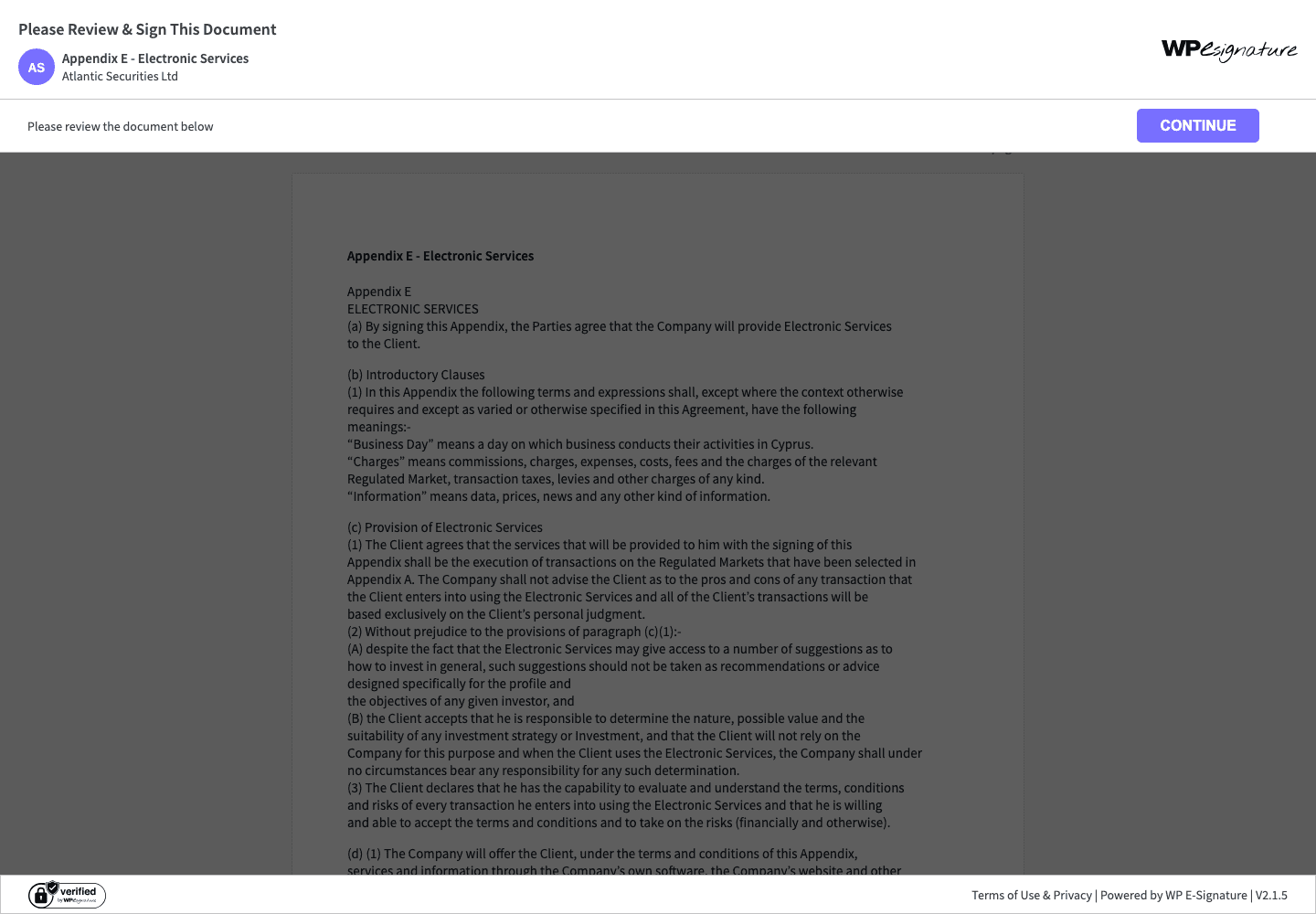
Electronic access is governed by a separate signed Appendix E covering electronic services. Its terms are worth reading before signing: the client agrees that the service provided is the execution of transactions on the regulated markets selected in Appendix A, that the company will not advise on the merits of any transaction, that all transactions are based exclusively on the client’s own judgment, and that any suggestions surfaced by the electronic service are not recommendations. This is an execution only relationship unless you separately engage the asset management arm.
There is no demo account, no practice mode and no simulated environment published anywhere on the site.
Negative Balance Protection
Negative balance protection is a CFD concept, and applying it here without translation would mislead. Atlantic does not deal on own account, publishes no leverage figure and runs no leveraged retail product of its own, so there is no house margin book against which a negative balance policy would operate. We found no negative balance protection statement anywhere on the site or in the client documents, and on the local business that absence is the correct answer rather than a gap.
Two real credit exposures do exist and neither is described as protected. The first is on the licence itself: the firm is authorised for the ancillary service of granting credits or loans to clients in relation to financial instruments where it is involved in the transaction, and that permission extends to instrument class 9 as well as classes 1 to 5. The second sits inside the Interactive Brokers account. Atlantic’s own Costs and Charges Disclosure states that Interactive Brokers charges interest when you borrow money, that this applies when you have taken out a margin loan, and that Interactive Brokers may charge interest on a credit balance held in a currency carrying a negative interest rate. Debit interest is charged at the frequency and rates set out under the Interactive Brokers interest and margin schedules.
Margin, liquidation and close out mechanics for the global account are therefore governed by the Interactive Brokers Ireland customer agreement rather than by anything Atlantic publishes. A reader who intends to use margin needs to read that document, because Atlantic’s own materials do not restate its terms.
The custody risk acknowledgements in the client agreement are more consequential than the margin position and deserve to be read in full before signing. The client acknowledges that instruments or funds may be held by a third party on behalf of Atlantic and that in such cases the client may not be fully protected against that third party’s insolvency, act or omission, and may not be covered by the Investor Compensation Fund. The client further acknowledges that assets may be held in an omnibus account, that they may not be separately identifiable from the third party’s or Atlantic’s own proprietary instruments, that accounts may be subject to the law of a jurisdiction outside the European Union with correspondingly different rights, and that a depository may hold a security interest, lien or right of set off over them. These are standard MiFID disclosures and Atlantic makes them properly, but they describe genuine ways in which client protection can fall short of the headline.
On client money, the firm’s policy states that all client funds are held in the company’s name for the client’s account with a bank the company selects from time to time, and that the company pays no interest on client money.
Trading Instruments
The instrument list splits along the same line as everything else at this firm.
On the local side the universe is what the two exchanges list. Atlantic is a member of the Cyprus Stock Exchange and a remote member of the Athens Exchange, and its order execution annex names Cyprus Stock Exchange shares, Athens Exchange shares and Cyprus Stock Exchange government and corporate bonds as its execution venues. This is a small, specific universe and it is the part of the business Atlantic actually operates itself.
On the global side the firm describes online access to stocks, futures, options, foreign exchange and bonds in a single account, and the homepage claims access to the two local exchanges plus “another 100+ market centers worldwide”. The Fees Global schedule gives a clearer picture of what is actually priced, because it lists a commission line per instrument type and currency: shares in euro, US dollar, Canadian dollar, Swiss franc, yen, forint, shekel, zloty, Singapore dollar, Hong Kong dollar, offshore renminbi, Australian dollar, Swedish krona, Norwegian krone and sterling, plus foreign exchange, futures, options, corporate, municipal and treasury bonds, euro denominated mutual funds and US mutual funds. That is the practical instrument list, and it is an exchange traded and fund list rather than a derivatives list.
Funds are a real part of the offering rather than an afterthought. Atlantic states that it is a registered distributor of Franklin Templeton funds and points to a dedicated Franklin Templeton Cyprus site for the fund details. Euro denominated mutual funds are priced at 0.20 per cent of trade value and US mutual funds at USD 30 per transaction.
What is absent is as informative as what is present. There is no cryptocurrency offering. There is no spot metals or energy product of the firm’s own. No spread is published for any instrument, because this is a commission model rather than a spread model. No leverage ratio appears anywhere on the site. And as covered in the trading section, whether contracts for difference are genuinely available through the Interactive Brokers account is contradicted between the firm’s own pages, so we have left it unresolved rather than assert either way.
We were unable to reach the contract search tool the site links for looking up an individual global instrument, so we cannot describe the breadth of the searchable universe beyond what the fee schedule implies.
Education & Analysis
This is the weakest part of the proposition and there is no way to dress it up. Atlantic Securities publishes no education section, no market analysis, no trading guides, no webinars, no glossary, no economic calendar and no research notes. The website is fifteen pages of company, legal and pricing information plus two platform entry points, and it does not attempt to teach anyone anything.
What analysis a client gets comes from the platforms rather than from the broker. Global clients reach Interactive Brokers’ Client Portal and trading platform, which carry that firm’s own research, news and market data tools. Atlantic’s Costs and Charges Disclosure confirms this is a paid arrangement rather than an included one: it states that charges imposed by the Interactive Brokers affiliate Global Financial Information Services for research, news and market data are charged additionally by Interactive Brokers on the client’s account, separately from the commission. Clients also sign a Global Financial Information Services Subscriber Agreement as part of the account opening pack. Local clients get the BCiTrade platform’s own web and desktop interfaces, plus a market order desktop tool and an account management view that the site notes does not support trading.
The firm does publish a genuine set of disclosure documents, and if the reader treats those as the education on offer they are better than most: a Costs and Charges Disclosure, cost and charges disclosure grids for fully paid stocks and for options, an after hours trading disclosure, a day trading risk disclosure, a stop order disclosure, a structured products risk disclosure and a risk disclosure covering ramp and dump scams. That last one is unusual and creditable. These are Interactive Brokers documents republished by Atlantic rather than the firm’s own writing, but they are substantive and they are given to clients before they trade.
There is no charting package of Atlantic’s own, no indicator library, no strategy backtesting and no copy trading. For the asset management client none of this matters, because the point of that service is that someone else does the analysis. For a self directed client, research has to come from somewhere else.
Special Offers
There are none, and the absence is worth reading as a signal rather than as a gap.
Atlantic Securities runs no deposit bonus, no welcome bonus, no rebate scheme, no cashback, no referral programme, no trading competition, no loyalty tier and no seasonal promotion. Nothing on any page we fetched, from any of the eleven countries we tested, offers an incentive to fund an account or to trade more. There is no affiliate programme advertised and no partner recruitment page.
For a Cyprus regulated firm this is the expected and correct position. Bonus and incentive schemes tied to trading volume have been restricted for CySEC regulated retail investment firms, and a firm offering them would be a warning sign rather than a bargain. The more telling point is that Atlantic does not market at all in the way a retail CFD brand does. There is no leverage headline, no “start from” deposit figure, no countdown, and no urgency of any kind.
The one thing that functions like an offer is a fee ceiling rather than a giveaway. On the Fees Global page the firm states that where the per share commission on the US and Canadian markets would exceed 1 per cent of trade value, the commission is capped at 1 per cent of trade value, and adds: “Above are the standard costs. You could pay less, but you would not pay more.” That is a cap on the published tariff and an acknowledgement that negotiated rates exist, not a promotion.
The firm also passes a cost to clients that many brokers absorb. Its Investor Compensation Fund policy explains that the contribution it must pay to the fund, 0.1 per cent of each covered client’s eligible capital up to EUR 20 a year, is charged on to the client’s brokerage account by 30 April each year, plus EUR 1. The firm’s reasoning is set out in the policy: it treats the contribution as a premium insuring the client’s own capital. Readers can judge that for themselves, but it is the opposite of an offer and it should be counted in the running cost.
Opening an Account
Account opening is a paper and signature process rather than an instant online funnel, and the firm does not pretend otherwise.
For the global account, Atlantic’s instruction is to contact a customer service officer on +357 22 445 400 to obtain the necessary information and to download the account opening forms from the website. Applicants choose between Individual, Institution and Universal forms. The documentation required is the original proof of identity, meaning a national identity card or passport, and a recent utility bill no more than six months old showing the applicant’s full name and permanent address. The firm explicitly excludes a P.O. Box utility bill and a mobile phone bill as proof of address. Before proceeding, the applicant is told to read the Fees Global page and not to continue if they are not satisfied with the costs.
Several documents are signed electronically through the site’s e-signature system rather than downloaded, including the electronic services appendix and an authorisation and letter of indemnity for acting on telecommunicated instructions. That indemnity is not a formality. Signing it authorises Atlantic to act on instructions received by telephone, fax, email or other electronic communication “without inquiry on ATLANTIC’s part as to the authority or identity of the person” giving them, and the client assumes responsibility and indemnifies the firm against losses arising from it. The document also requires the client to mark any repeated instruction clearly to avoid duplication, failing which the firm is released from liability for acting more than once on the same instruction.
Client categorisation is handled properly. The terms state that the firm categorises the client as a retail client by default, which affords the maximum protection available under Cyprus law, and that a client may request professional treatment in writing but that the firm is not obliged to grant it and must assess the request. Re categorisation does not happen automatically and is dealt with under a separate document.
What is not published is how long any of this takes. There is no stated account opening turnaround, no minimum deposit and no minimum initial investment anywhere on the site or in the documents we read, for either the brokerage account or the portfolio management service. We have left all three fields empty rather than estimate them. A reader should assume a manual review of several days rather than same day access, but that is an expectation, not a published commitment, and we cannot source it.
Opening fees are published: EUR 30 for a natural person, EUR 70 for a legal person established in Cyprus, EUR 100 for a legal person established abroad, plus EUR 10 to create the depository account.
Deposits & Withdrawals
Money moves by bank transfer and nothing else. There are no cards, no e-wallets, no Skrill or Neteller, and no cryptocurrency rails. For a firm whose clients are buying Cyprus and Athens listed equities and international shares through Interactive Brokers, that is the normal arrangement, but anyone expecting instant card funding should know before they start.
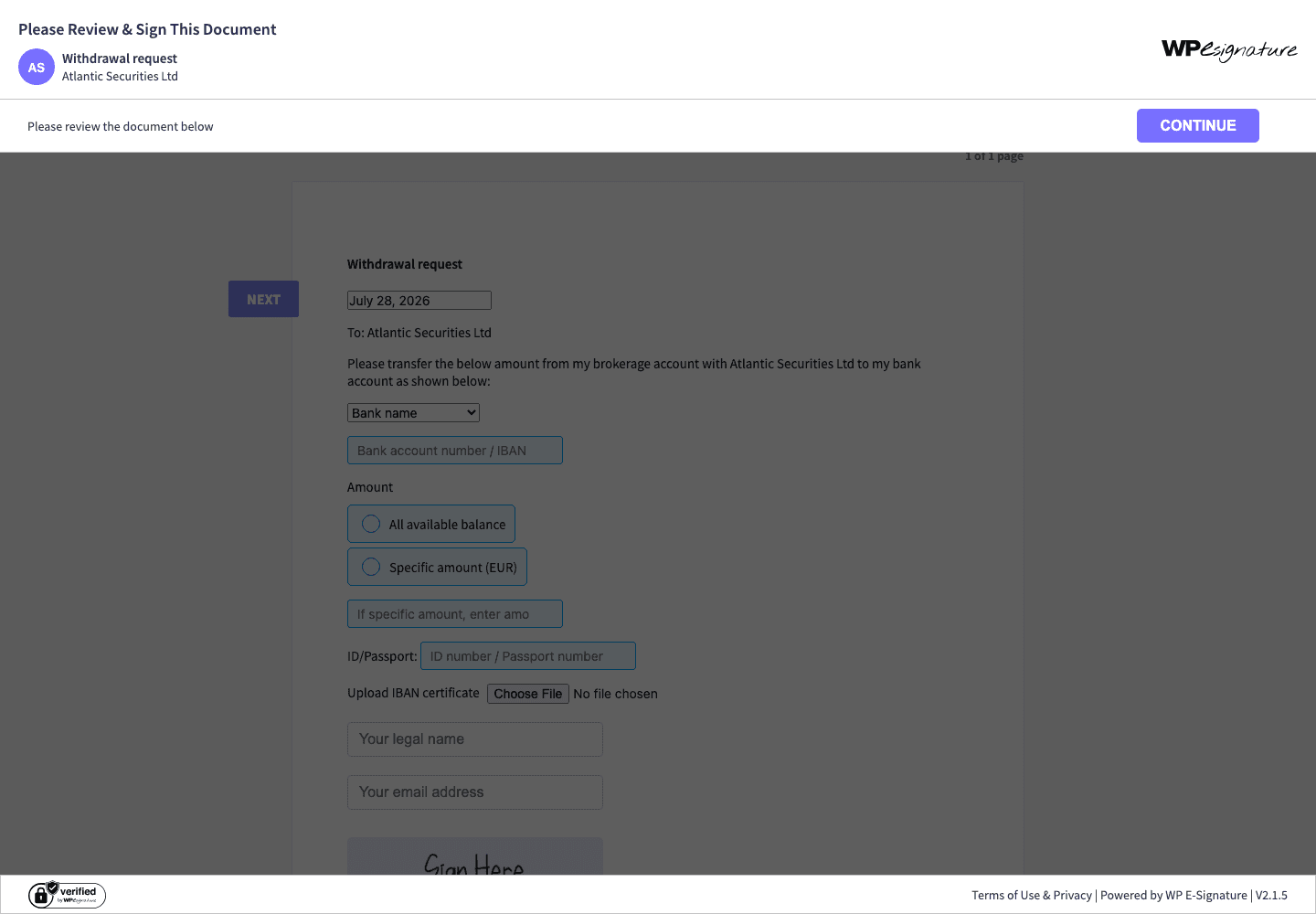
Withdrawals run through a signed request form on the site. The form asks the client to name the receiving bank from a fixed list, which covers Bank of Cyprus, the former Hellenic Bank, Eurobank Cyprus, Alpha Bank Cyprus, the former Astrobank, Ancoria Bank and Revolut. The client supplies an IBAN, chooses either the entire available balance or a specific amount in euro, provides an identity card or passport number, uploads an IBAN certificate, and signs electronically. Requiring an IBAN certificate is a meaningful anti fraud control: it makes payment to a third party account materially harder, which is the mechanism behind a large share of the withdrawal fraud this catalogue exists to warn about.
The published withdrawal fee is EUR 3 per request on the local tariff. No withdrawal minimum, no monthly free allowance and no processing time is published, and we have not invented any of them. No deposit fee is published either.
The wider fee picture is published in unusual detail, and readers should look at it before opening rather than after. On the Cyprus Stock Exchange the brokerage fee starts from 0.4 per cent of trade value plus a flat 30 cents per trade, with exchange and depository fees of 0.04 per cent. On the Athens Exchange the brokerage fee starts from 0.4 per cent plus a flat 25 cents, with exchange and depository fees of 0.0325 per cent, and a sales tax of 0.10 per cent on sale value from 2 January 2024, reduced from 0.20 per cent previously. An annual depository fee of 0.003 per cent of portfolio value is charged quarterly on both, and a transaction effected outside the market costs 0.30 per cent with a minimum of EUR 30.
Ancillary charges accumulate. Custody is 0.12 per cent a year calculated monthly. Transferring shares or bonds out of the Cyprus Stock Exchange costs EUR 5 per title to a maximum of EUR 20, while transferring dematerialised securities to another custodian costs EUR 50 per title. A Cyprus Stock Exchange statement is EUR 5, a certification EUR 5, a corporate action EUR 2 each, and a company search EUR 30. Issuing a legal entity identifier costs EUR 100 plus VAT with annual renewal at EUR 70 plus VAT.
On the global tariff, euro denominated shares cost 0.20 per cent with a EUR 5 minimum per executed order, US and Canadian shares 2 cents per share with a USD 5 or CAD 5 minimum, sterling shares 0.20 per cent with a GBP 10 minimum, Hong Kong dollar shares 0.20 per cent with a HKD 25 minimum, and Swiss franc shares 0.20 per cent with a CHF 15 minimum, among others. Foreign exchange costs 0.01 per cent with a EUR 3 minimum, futures and options 10 per contract, and bonds 0.20 per cent of trade value. Custody is again 0.12 per cent annually.
Atlantic states openly how it is paid on the global business: the fees shown include both Atlantic and Interactive Brokers charges, Interactive Brokers retains the fees from the client’s account and returns to Atlantic the difference between what was charged and Interactive Brokers’ own rate, and it links Interactive Brokers’ published commission page so the client can see the underlying rate. Very few introducing brokers show their markup this plainly, and it deserves credit even though it confirms the client is paying above the underlying rate.
No interest is paid on client money. The firm’s client money policy states this directly.
Customer Support
Support is a telephone number and an email address at a single Nicosia office, and there is nothing else published. The number is +357 22 445 400, the address is info@atlanticfs.com, and the office is at 37 Prodromou Street in Nicosia. There is no live chat, no ticketing system, no WhatsApp or Telegram channel, no support portal and no regional office.
Support hours are not published anywhere. Neither is a response time commitment for general enquiries. For a firm serving two exchanges in the same time zone this is less serious than it would be for a global operation, but a reader outside European hours has no way of knowing when someone will answer, and we are not going to guess on their behalf.
Language is a real limitation and it is easy to miss. The website is published in English only, with no language switcher and no alternate language versions declared. Several of the documents that decide client rights, however, are published only in Greek: the client money policy, the order execution policy, the client acceptance policy and the 2025 regulatory capital disclosure are all Greek language documents. A non Greek speaking client can read the marketing and the fee schedules but cannot read the policy governing how their money is held without arranging a translation. The terms and conditions, the investor compensation fund policy and the entire Interactive Brokers pack are in English.
Complaints handling is the strongest part of the service picture, because it is documented rather than implied. The firm’s complaints policy commits to sending an acknowledgement within five calendar days of receiving a complaint. If the complainant is not satisfied, the policy names the escalation routes explicitly: the Financial Ombudsman of the Republic of Cyprus and the Cyprus Securities and Exchange Commission, with links to both. A dedicated complaint form is published as a downloadable document. Having a named external adjudicator is a material protection and many firms in this catalogue do not name one.
The firm maintains twelve tied agents registered with CySEC, six companies and six named individuals, each authorised only for reception and transmission of orders in instrument classes 1 and 2. In practice this means a client may deal with an intermediary rather than with Atlantic directly. Tied agents are on the public register, which is the right level of transparency, but a client should confirm which entity they are actually speaking to.
The firm links one social media presence, a Facebook page. There is no published organisational chart of client facing staff beyond the two asset management professionals named on the team page.
Prohibited Countries
Atlantic Securities publishes no list of prohibited or restricted countries, and we are not going to manufacture one.
We checked the places such a list would appear. The client acceptance policy, which is the document a Cyprus investment firm uses to set out who it will and will not take on, names no country anywhere in its three pages. What it does instead is risk based. It classifies clients as low, normal or high risk, and places into the high risk category clients dealing remotely from high risk countries, clients from countries that inadequately apply Financial Action Task Force recommendations, and clients from countries known for high levels of corruption, organised crime or drug trafficking, without naming which countries those are. It also lists bearer share companies, trusts, pooled accounts in a third party name, politically exposed persons and online gambling operators as high risk categories.
Only two categories are refused outright, and neither is geographic: applicants who fail or refuse to provide the required identity evidence within a reasonable period, and applicants convicted of criminal offences relating to money laundering or terrorist financing. The policy also requires, as a condition of acceptance, that the client does not appear on European Union or United Nations sanctions and restrictive measures lists. Sanctions screening is a legal obligation rather than a commercial restriction, and it applies to every regulated firm.
The CySEC register carries a block on this firm’s record headed “Provision of Services to Countries Outside EU”. For Atlantic Securities that block is empty. It contains only CySEC’s own explanatory sentence, that Cypriot investment firms may provide services to countries outside the European Union provided they comply with the regulatory regime of the third country, and no country names at all. That block lists countries a firm may serve, not countries it excludes, so it could not have supported a restriction list even if it had been populated. The cross border services to member states block is likewise empty on this record.
We also tested whether the firm quietly restricts by geography in practice. We fetched the site through in country exits in Indonesia, Thailand, Vietnam, Azerbaijan, Singapore, Japan, India, the United Arab Emirates, South Africa, the United Kingdom and Germany. Every one of those vantages returned the same pages, naming the same Cyprus entity, the same licence number and the same Nicosia address, with no geographic gating and no alternative entity offered anywhere. On a repeat fetch the United Kingdom and Indonesian homepages were identical word for word.
The honest summary is that acceptance appears to be decided case by case under anti money laundering rules rather than by nationality, and that a prospective client outside Cyprus and Greece should ask directly rather than assume either way.
Conclusion
Atlantic Securities Ltd is a small, old fashioned, genuinely regulated Cyprus stockbroker that has been doing the same thing since 2001, and the main risk it presents to a reader is being mistaken for something it is not.
The verifiable facts are good. The CySEC licence, 005/03, is current and covers the exact legal entity a client contracts with for Cyprus and Athens business. The company registration number on the regulator’s record matches the one on the firm’s own site. The regulator’s approved domains list names www.atlanticfs.com and only that domain against this licensee, and the register publishes an atlanticfs.com email address for the firm, which settles the identity question from the regulator’s side rather than the firm’s. There is no offshore entity anywhere in the structure, no Seychelles or Vanuatu arm waiting to onboard the clients the Cyprus licence does not cover, and no second version of the website for readers outside Europe. We looked for one from eleven countries and found the same firm every time. Own funds of EUR 1,944,000 against a EUR 150,000 requirement, and a listed insurance parent, are the profile of a business that is not under strain.
Against that, three things should give a reader pause. The first is that the global account is not an Atlantic account. Anyone trading outside Cyprus and Greece contracts with Interactive Brokers Ireland Limited, which is a substantial and separately regulated firm, but the licence the client checked at the start is not the licence that governs their assets at the end. Atlantic discloses this clearly, twice, and also discloses that it keeps the difference between its tariff and Interactive Brokers’ own rates. That candour is genuinely unusual and it is still a markup.
The second is cost. Commission from 0.4 per cent plus a flat charge on the local exchanges, 0.12 per cent annual custody, EUR 30 to open, EUR 3 to withdraw, EUR 50 per title to move securities to another custodian, no interest paid on client money, and the firm’s compensation fund contribution charged on to the client, add up to an expensive place to hold a small portfolio. The pricing is published to the cent, which is a real virtue, but transparency about a high price does not make it a low one.
The third is the 2021 market abuse fine. EUR 3,000 is small and the failing was in transaction surveillance systems rather than in the handling of client money, but a firm whose arrangements for detecting suspicious orders were found wanting by its own regulator is a firm whose internal controls were not what they should have been at that date.
Who does it suit. Someone who wants Cyprus or Greek listed shares from a member of both exchanges, or someone who wants Interactive Brokers access with a Nicosia phone number and a local relationship attached, and who values a named external ombudsman and a twenty five year operating record above cost and technology. Who it does not suit: anyone looking for leveraged trading, anyone who wants a demo account, a mobile app, research or education, anyone who needs support outside Cyprus business hours or in a language other than English and Greek, and anyone cost sensitive enough that 0.4 per cent plus custody would matter.
Anyone who arrived here searching for a contracts for difference broker should read the trading section again. Atlantic cannot execute a CFD, cannot deal on own account and prices no CFD in either fee schedule, while one of its own disclosure documents does discuss CFD financing costs. That contradiction is unresolved on published evidence, and the safe reading is that this is not the CFD broker you were looking for.
Score history
Recomputed daily; every move is on the record. The current score is always the latest row.
| Date | Score | Move |
|---|---|---|
| 2026-09-13 | 5.3 | ▲ |
| 2026-09-12 | 5.2 | · |
FAQ
Is Atlantic Securities regulated and safe?
It is regulated. Atlantic Securities Ltd appears on the current CySEC register of Cypriot Investment Firms with licence number 005/03, dated 12 May 2003, company registration number 119857. We verified this against CySEC’s own register rather than a directory, and confirmed that www.atlanticfs.com is the only domain on CySEC’s approved domains list for this licensee. The firm is a member of the Investor Compensation Fund, which covers the lower of 90 per cent of a claim or EUR 20,000. On safety, two qualifications matter. CySEC fined the firm EUR 3,000 in October 2021 for not maintaining effective arrangements to detect suspicious orders and transactions, a market abuse control failing rather than a client money failing. And a global account is opened with Interactive Brokers Ireland Limited, not with Atlantic, so the protections that apply to it are Irish rather than Cypriot.
Does Atlantic Securities offer CFDs?
Not on the evidence we could verify, and its own documents disagree with each other. The CySEC register allows Atlantic to receive and transmit orders in instrument class 9, which CySEC defines as financial contracts for differences, but its permission to execute orders stops at class 5 and it cannot deal on own account at all. Its international markets page states that it trades only exchange listed products cleared through central clearing houses. Its Fees Global schedule prices no CFD. But its Costs and Charges Disclosure, which describes the Interactive Brokers account, does explain CFD financing interest and short share CFD borrow fees. We could not reconcile these from published sources. What is certain is that Atlantic itself could never be the counterparty to a CFD, so if one were traded the counterparty would be Interactive Brokers Ireland.
Who actually holds my money at Atlantic Securities?
It depends which account you open. On the local brokerage account, the firm’s client money policy states that funds are held in Atlantic’s name for the client’s account at a bank Atlantic selects, and that no interest is paid on client money. Securities are held under its safekeeping and custody permission. On a global account you contract with Interactive Brokers Ireland Limited, which the Central Bank of Ireland lists under reference C423427, and that firm holds the assets under Irish rules. In both cases the client agreement asks you to acknowledge that assets may be held by third parties, possibly in an omnibus account, possibly outside the European Union, and that in those circumstances you may not be fully protected against the third party’s insolvency or covered by the Investor Compensation Fund.
What does it cost to trade with Atlantic Securities?
On the Cyprus Stock Exchange, brokerage starts from 0.4 per cent of trade value plus a flat 30 cents per trade, with exchange and depository fees of 0.04 per cent. On the Athens Exchange it starts from 0.4 per cent plus a flat 25 cents, with exchange and depository fees of 0.0325 per cent and a 0.10 per cent sales tax on disposals. Globally, euro shares cost 0.20 per cent with a EUR 5 minimum per order and US shares 2 cents per share with a USD 5 minimum. Custody is 0.12 per cent a year on both sides. Add EUR 30 to open an account for an individual, EUR 3 per withdrawal request, an Investor Compensation Fund charge of up to EUR 21 a year, and EUR 50 per title to transfer securities to another custodian. No minimum deposit is published.
Which countries does Atlantic Securities refuse?
It publishes no list, and we found no country named anywhere. Its client acceptance policy is risk based rather than geographic: it treats clients from high risk jurisdictions, from countries that inadequately apply Financial Action Task Force recommendations, and from countries known for corruption or organised crime as high risk, without naming them. The only outright refusals are applicants who will not supply identity evidence and applicants convicted of money laundering or terrorist financing offences, alongside the standard European Union and United Nations sanctions screening. The CySEC register’s block headed Provision of Services to Countries Outside EU is empty for this firm, and in any case that block lists countries a firm may serve rather than countries it excludes. We fetched the site from eleven countries and found no geographic gating.
How this review works
Track Atlantic Securities Ltd live: score moves and red notices, in your pocket.