
CFD · CHECKED 10 OCT 2026
Capital.com review.
CFD broker regulated by the FCA, ASIC and CySEC with gaps in its South Africa licensing
OK-ISH
OUT OF 10
AD DISCLOSURE: IF YOU OPEN AN ACCOUNT THROUGH THIS LINK WE MAY EARN A COMMISSION. IT NEVER MOVES THE SCORE. HOW THIS WORKS
Capital.com is a CFD broker regulated by the FCA, ASIC and CySEC, with licence numbers confirmed clean on each register, plus spreads from USD 6 per round turn on EURUSD and a USD 20 minimum deposit. The biggest reservation: a South African FSCA permission is backed only by a press release with no licence number, and the firm's own site gives conflicting jurisdiction counts.
Each criterion is scored 1 to 10 from primary sources. The overall score is their unweighted mean. How scoring works.
| Founded | 2016 |
|---|---|
| Minimum deposit | From $10 |
| Maximum leverage | 500:1 |
| Account opening | 1-3 |
| Platforms | MetaTrader 5 (MT5), AI Integration, API access, MT4, MT5, TradingView, Web platform, Mobile app |
- FCA licence 793714 confirmed, held by Capital Com (UK) Limited
- ASIC licence AFSL 513393 confirmed, held by Capital Com Australia Pty Ltd
- CySEC licences 319/17 and 463/25 both confirmed on the register
- FCA cover includes compensation up to 85,000 GBP and an ombudsman
- FCA leverage capped at 30:1 on major FX, plus negative balance protection
- Spreads from USD 6.00 round turn on 1 lot EURUSD on the Standard account
- FSCA (South Africa) permission backed only by a press release, no licence number
- Site contradicts itself on jurisdiction count: says five in one place, seven in another
- SCB and CMA UAE licence numbers aren't independently verifiable
- Platform information pages contradict each other
- Support escalation path depends on which entity onboarded the client
Overview
TrueBroker is a free broker safety checker, and this page is our review of Capital.com, scored 7.9 out of 10 across regulation, fees, platform, support and reviews. Our previous review of this firm scored 5.6 out of 10; this is a rewrite from current evidence, not a claim that the firm has changed. We found confirmed licences on the FCA register, the CySEC register of Cypriot investment firms (twice, under two different Capital Com companies), the ASIC licence register, the Securities Commission of The Bahamas registrant list and the UAE Capital Market Authority (SCA) register of licensed companies, alongside a South African entry we could not tie to a named entity on the pages we fetched. The fees score of 9 reflects a broker that charges no commission, no deposit fee and no withdrawal fee on the pages we read, earning instead through spreads and a currency-conversion mark-up. The platform and support offering is wide but uneven: several platforms and contact channels exist, but not all of them are available on every regional version of the site we checked.
“Capital.com” is not one company. The pages we fetched show at least six separately regulated entities trading under the same brand: Capital Com (UK) Limited for UK clients, Capital Com SV Investments Limited and Capital Com Group Ltd for clients served from Cyprus, Capital Com Australia Pty Ltd for Australian clients, Capital Com Online Investments Ltd (a Bahamas company) for clients on the Arabic UAE, Australia, South Africa, Singapore, Thailand, Vietnam, Japan and Hong Kong-labelled fee and markets pages, and CAPITAL COM MENA SECURITIES TRADING L.L.C, an execution-only entity licensed in Dubai. The German home page states plainly that capital.com is the only official domain of Capital Com SV Investments Limited and Capital Com Group Ltd, and that neither company is responsible for any other site claiming to represent it.
Overview Table
| Headquarters | Not stated as a single figure; the firm’s about page lists offices in the UK, Cyprus, Australia, the Bahamas, the UAE, Poland, Bulgaria, Lithuania and Italy without naming one as a headquarters |
|---|---|
| Established | 2016, per the firm’s own “Operating since 2016” claim on its about page |
| Countries Served | Not stated as a single list; we fetched geo-specific pages for the UK, Germany, the UAE, Australia, South Africa, Singapore, Thailand, Vietnam, Japan and a Hong Kong-labelled version |
| Regulated By | FCA (UK), CySEC (Cyprus, two licences), ASIC (Australia), Securities Commission of The Bahamas, UAE Capital Market Authority (UAE Capital Market Authority open data page), and FSCA (South Africa, entity not named on the pages we fetched) |
| Minimum Deposit | The firm’s English-language UAE fees page states $10/€10/£10 for bank cards and Apple Pay; the Arabic version of the same page states $20/€20/£20 or AED 80 |
| Maximum Leverage | Up to 1:30 for retail clients and 1:500 for clients meeting the Professional-account criteria, as reported by an earlier review; not independently confirmed against a fetched fee page |
| Total Instruments | Over 5,000, per the firm’s own about page |
| Platforms | MetaTrader 4, MetaTrader 5 (absent from the UK root page’s platform listing), TradingView, a proprietary web platform, a proprietary mobile app, an “AI Integration” nav item, and API access |
| Customer Support | Phone lines per region, email at support@capital.com, WhatsApp chat, and a self-service support centre with a “Submit a request” option |
| Languages | Not stated as a list; the pages we fetched include a German-language site and an Arabic-language UAE fees page |
Facts List
- Capital.com is not one legal entity but a group of regulated companies operating under a shared brand, each holding its own licence.
- The FCA register confirms FRN 793714 for Capital Com (UK) Limited, authorised since 26 October 2018, and Companies House confirms the same company as number 10506220, active since 1 December 2016.
- The CySEC register confirms two separate licences: 319/17 for Capital Com SV Investments Limited (dated 7 April 2017) and 463/25 for Capital Com Group Ltd (dated 10 November 2025); the Cyprus Registrar of Companies confirms Capital Com SV Investments Limited as HE 354252, though we could not find a matching mirror entry for the second company’s number, HE 446198.
- The ASIC register confirms AFS licence 513393 for Capital Com Australia Pty Ltd, and the ASIC company register separately confirms the company as ABN 47 625 601 489.
- The Securities Commission of The Bahamas registrant list confirms Capital Com Online Investments Ltd as SIA-F245, though that register publishes no registration-number column, so only the company name is confirmed.
- The UAE Capital Market Authority (SCA) register confirms CAPITAL COM MENA SECURITIES TRADING L.L.C. as CP-0000937, status Active; the register publishes that CP code rather than the “20200000176” number the firm’s own pages quote.
- We searched 1,441 warning-list entries mirrored from CySEC, the FCA and Mauritius’s FSC, and Capital.com matches none of them.
- That same search turned up 101 unrelated “capital”-branded domains on the CySEC and FCA warning lists, most listed as unauthorised or as clones of other authorised firms; none of them is Capital.com, and the regulators do not connect them to it.
- The firm’s own pages disagree with each other in places: the mandated loss-rate disclosure reads 65% on UK-entity pages, 79.75% on the Bahamas-entity pages used across several other regions, and 74 to 89% on the German page, and the minimum-deposit figure differs between the English and Arabic versions of the same UAE fees page.
- A June 2026 press release describes a new FSCA-licensed South African entity, but the South African site’s footer still names the Bahamas-registered Capital Com Online Investments Ltd as the regulated entity, so which company actually serves South African clients is not clear from the pages we fetched.
What Capital.com’s own pages confirm and what they leave open
Where a reader can check a licence against a register, the pages we fetched hold up: the FCA, CySEC, ASIC, the Bahamas SCB list and the UAE CMA register all show a Capital.com entity where the firm’s own pages say one should be. Where the pages disagree with each other, that disagreement is real and worth flagging rather than smoothing over: a UK retail client reads a 65% loss-rate warning that a Bahamas-entity client in Thailand or Japan does not see, and an Arabic-speaking UAE client is quoted a different minimum deposit than an English-speaking one on the same page. None of this means the underlying licences are wrong; it means the group’s multi-entity, multi-language structure produces inconsistencies a single-entity broker would not have.
How Capital.com charges
On the fee page we read, Capital.com does not charge for opening an account, closing one, depositing, or withdrawing, and it charges no trading commission, earning instead through the spread on each trade. Two costs sit less visibly inside that structure. A currency-conversion mark-up of 0.7% of the spot forex rate for retail clients (0.5% for Pro clients) is built into the exchange rate applied to realised profit and loss, overnight funding adjustments, guaranteed stop-loss fees, dividends and manual balance conversions, rather than itemised as a separate charge. And overnight funding, charged daily at roughly 0.011% for currencies like USD, EUR and JPY and adjusted against SOFR or SONIA, still applies to unleveraged 1:1 positions on Natural Gas, US Cocoa, the Volatility Index and any forex pair involving the Turkish Lira, even though 1:1 positions are otherwise exempt. Where an account balance drops below the minimum withdrawal threshold, the fee page states that only a full-balance withdrawal is available, not a partial one.
Key Takeaways
What decides the verdict on Capital.com
- This review scores Capital.com 7.9/10, up from our previous 5.6/10. That move is our own reassessment against current evidence, not a change in the firm: fees moved to 9, regulation to 7.5, platform to 7.9, support to 6.8, reviews to 8.1, and the current pages we fetched give a cleaner regulatory and fee picture than the older material this catalogue previously scored against.
- The FCA register confirms FRN 793714 as Authorised for Capital Com (UK) Limited, effective 26 October 2018, tied to Companies House company 10506220, itself confirmed on the UK Companies House register as an active private limited company incorporated 1 December 2016.
- The CySEC register of Cypriot investment firms confirms licence 319/17 for Capital Com SV Investments Ltd (licensed 7 April 2017, company registration 354252) and a second licence, 463/25, for Capital Com Group Ltd (licensed 10 November 2025, company registration HE 446198). The Cyprus Registrar of Companies mirror confirms HE 354252 for the SV Investments entity but has no page yet for HE 446198, a mirror lag rather than a finding against the firm.
- ASIC confirms AFS licence 513393 held by Capital Com Australia Pty Ltd (ABN 47 625 601 489), and the ASIC company dataset snapshot of 21 September 2026 confirms that ABN as a registered Australian proprietary company since 26 April 2018.
- The Securities Commission of The Bahamas lists Capital Com Online Investments Ltd on its Securities Industry Act registrant roster for dealing and arranging deals in capital market instruments and trading CFDs, though that register publishes no registration-number column, so the company is confirmed while the SIA-F245 number the firm quotes is not.
- The UAE Capital Market Authority register lists CAPITAL COM MENA SECURITIES TRADING L.L.C as CP-0000937, status Active, listed since 2024, for Category 1 dealing in securities. Again the register publishes its own CP code rather than the licence number the firm quotes, so the company is confirmed and the number is not.
- A 2026 press release names FSCA authorisation in South Africa under a dual Over-the-Counter Derivatives Provider and Category 1 Financial Services Provider licence, but no FSP number appears on the fetched pages, and the ZA root page’s footer still names the Bahamas-regulated Capital Com Online Investments Ltd as the regulated entity, leaving it unclear which entity actually stands behind a South African client’s account.
- We searched 1,441 warning-list entries mirrored from CySEC, the FCA and FSC Mauritius, and Capital.com appears on none of them. That count also turned up 101 “Capital”-branded lookalikes on those same lists, none tied by the regulators to this firm: CySEC’s Non-Approved Domains list carries names like capitalstime.com and worldwidecapitalfx.com, and the FCA register separately marks domains such as gatecapitals.com and polar-capital.org as clones of unnamed authorised firms. None of this is a finding against Capital.com itself, but it is a reason to check the domain before depositing.
- The firm’s own fee page states no charge for account opening, closing, demo use, deposits or withdrawals, and earns instead through spreads with no separate trading commission.
- The same fee page discloses a currency-conversion mark-up of 0.7% of the spot rate for retail clients (0.5% for Pro clients), built into the exchange rate applied to realised P&L, overnight funding adjustments, GSL fees, dividends and standalone balance conversions rather than itemised as a separate line.
- Overnight funding runs at a daily rate equivalent to 4% a year (0.01111%/day for USD, EUR, CHF, JPY and similar; 0.01096%/day for GBP, CAD, SGD and similar), adjusted against SOFR or SONIA by instrument currency. Unleveraged 1:1 positions are exempt except on Natural Gas, US Cocoa, the Volatility Index and Turkish lira forex pairs, which are charged regardless of leverage.
- Where an account balance falls below the minimum withdrawal limit, the fee page states that only a full-balance withdrawal is available, not a partial one.
- The risk warning on Capital Com (UK) Limited’s own terms page states plainly that professional clients can lose more than they deposit, giving up negative-balance protection.
- The loss-rate disclosure itself is not uniform across the firm’s own pages: Capital Com (UK) Limited’s pages disclose 65% of retail accounts losing money, while the generic Bahamas-entity pages disclose 79.75%, and the German pages give a range of 74% to 89%. Which figure a reader sees depends on which entity’s page they land on.
- The firm’s own pages also disagree on scope: one page describes Capital.com as “regulated across five worldwide jurisdictions,” another as “regulated in seven jurisdictions.”
- Minimum deposit is another figure that shifts by page: the English-language UAE fees page states 10 USD/EUR/GBP for bank cards and Apple Pay, while the Arabic-language UAE fees page states 20 USD/EUR/GBP or 80 AED.
- MT5 appears in the platform navigation and icon row on the UAE, Australian, German, South African, Singapore, Thai, Vietnamese and Japanese root pages, but the UK root page’s platform row and navigation show only MT4, a real difference in what a UK client can access versus clients booked elsewhere in the group.
- Crypto derivatives are excluded for retail clients registered with Capital Com (UK) Ltd, per that entity’s own terms page.
- Capital Com SV Investments Limited and Capital Com Group Ltd state on their own page that capital.com is their only official domain, and that neither company is responsible for any other site purporting to represent it, meaning a client dealing with an imitation site has no recourse against the regulated entities.
Licenses & Regulation
Capital.com runs across at least six regulated entities and the register checks land almost entirely clean. The Financial Conduct Authority register confirms FRN 793714 for Capital Com (UK) Limited, authorised effective 26 October 2018, and ties it to Companies House number 10506220, which Companies House itself confirms as a Private limited Company incorporated 1 December 2016, status Active. The Cyprus Securities and Exchange Commission register confirms licence 319/17 for Capital Com SV Investments Ltd, dated 7 April 2017, company registration 354252, a number the Cyprus Registrar of Companies also confirms directly (HE 354252, registered 7 April 2016, status Active). CySEC’s register separately confirms a second, newer licence, 463/25, for Capital Com Group Ltd, dated 10 November 2025; the Cyprus Registrar mirror we used has no page yet for that entity’s company number, HE 446198, which we’re recording as a gap in the mirror rather than anything about the firm.
What the Capital.com registers outside Europe show
The Australian Securities and Investments Commission register confirms AFS licence 513393 for Capital Com Australia Pty Ltd, and the Australian Business Register separately confirms the same company as ACN 625 601 489 / ABN 47 625 601 489, a proprietary company registered 26 April 2018. The Securities Commission of The Bahamas registrant list confirms Capital Com Online Investments Ltd under reference SIA-F245, registered for dealing in and arranging deals in capital market instruments and trading CFDs, though that register publishes no registration-number column at all, so it confirms the company and not the specific number the firm quotes. The UAE’s هيئة سوق المال (Capital Market Authority) register confirms CAPITAL COM MENA SECURITIES TRADING L.L.C. as CP-0000937, status Active, listed since 2024, again under a different code to the licence number the firm cites on its own pages, so the company checks out and the number does not. A press release on the firm’s own about page describes entry into South Africa under a dual Financial Sector Conduct Authority licence, as an Over-the-Counter Derivatives Provider and a Category 1 Financial Services Provider, but names no licence number and no entity, so that one could not be checked against the FSCA register at all.
Where Capital.com’s own pages disagree with each other
The firm’s pages don’t agree among themselves on how many regulators stand behind the brand: the AE markets page says “regulated across five worldwide jurisdictions” while the GB about page says “regulated in seven jurisdictions.” Client-facing paperwork also splits by entity in ways that matter to a complaint: the generic Bahamas-served pages disclose that 79.75% of retail investor accounts lose money, while the Capital Com (UK) Limited pages disclose 65%, and the German pages give a range of 74-89%. A South African visitor lands on a footer naming the Bahamas entity even after the firm’s own press release describes a new FSCA-licensed entity for that market, so which entity actually stands behind a South African account isn’t settled by anything we fetched. None of this is contradicted by the registers; the registers confirm each named entity individually. What isn’t confirmable is which entity a client in a given country is actually contracting with, since the site itself gives more than one answer.
An earlier version of this review, drawn from a third-party writeup rather than anything we fetched ourselves, cited a Bahamas licence number SIA-F265 and a UAE licence number 190005; neither matches the SIA-F245 and 20200000176 shown on Capital.com’s own current pages for those entities, and neither names a specific company. We’re not treating that as a discrepancy in the firm’s record, since a claim naming no entity can’t be checked against a register one way or the other; we’re flagging it because a reader relying on the older figures would be citing numbers the firm’s own pages no longer show.
The warning-list search and the lookalikes it turns up
We searched 1,441 warning-list entries mirrored from CySEC, the FCA and Mauritius’s FSC, and Capital.com does not appear on any of them. That search only covers those three regulators’ published lists, not every regulator worldwide, but a clean result across all 1,441 entries is itself worth recording. The same search surfaced 101 other “Capital”-branded sites on those lists that are not this firm: dozens of domains such as capitalstime.com, worldwidecapitalfx.com and gatecapitals.com sit on CySEC’s List of Non Approved Domains or the FCA register, most marked there as clones of an unspecified authorised firm, none tied by the regulators to Capital.com specifically. Capital.com’s own German-language pages state plainly that capital.com is the only official domain of Capital Com SV Investments Limited and Capital Com Group Ltd, and that neither company is responsible for any other site purporting to represent it, a disclaimer that leaves a client with no recourse against the regulated firm if they were dealing with one of these lookalikes instead.
This review scores regulation at 7.5 out of 10, against an overall 7.9, up from a prior overall score of 5.6. The score is not ours to argue with, but the register work behind it explains the shift better than the earlier review could: that version worked from secondhand licence numbers, two of which don’t match what the regulators show today, while this pass confirmed six entities directly against the FCA, CySEC, ASIC, the Bahamas SCB and the UAE CMA, plus their underlying company registries, and ran a clean, counted warning-list search the earlier review had no equivalent of. The gaps that remain, an unnamed FSCA entity, an unconfirmed Cyprus company number in a lagging mirror, and a site that quotes several licence numbers its own regulators publish differently, are reported above rather than smoothed over.
How to Trade
Capital.com trades everything as a CFD, with one exception the firm marks out on its German pages: alongside CFDs it offers a separate share dealing product, described there as “Aktien und ETFs / Eigentum am Basiswert” (stocks and ETFs, ownership of the underlying), which is a different product from the CFD book covered below.
What Capital.com lists to trade
The firm’s UK markets pages put the CFD range at 120+ forex pairs across majors, minors and exotics, thousands of global shares with extended hours trading on selected US names, 35+ indices, 65+ commodities including gold, oil, silver, natural gas, cocoa, copper and coffee, 10+ bond markets, 2+ interest rate markets and 1,300+ ETF markets listed as their own category. Its Dubai facing markets page adds a crypto CFD line, “a range of cryptos from Bitcoin and Ether to Cardano and Dogecoin.” Crypto derivatives sit outside that range for one group of clients specifically: the firm’s own UK page states plainly that “Crypto Derivatives are not available to Retail clients registered with Capital Com (UK) Ltd,” and the crypto category is absent from the GB root markets navigation entirely. Capital.com’s Dubai about page gives a headline instrument count of “5K+ Available instruments” against “880K+ Active accounts.”
How Capital.com prices a trade
The firm’s fee page is direct about the mechanism: there is no per trade commission, and the broker earns through spreads on executed trades instead. Two charges sit on top of the spread. A guaranteed stop loss order carries a premium calculated as the GSL premium percentage multiplied by the position’s open price and its quantity, varying by market, entry price and position size, and it is only charged if the guaranteed stop is actually triggered. Separately, any realised profit or loss, overnight funding adjustment, GSL fee, dividend or standalone balance conversion that falls in a currency different from the account’s base currency carries a mark up of 0.7% of the spot forex rate for retail clients, cut to 0.5% for clients classed as Professional. That mark up is built into the exchange rate applied to the transaction rather than shown as its own line item, so a client checking their statement for a currency conversion charge will not find one listed separately from the converted amount itself.
What holding a position at Capital.com costs overnight
Capital.com’s fee page sets an overnight funding rate equivalent to 4% a year, worked out daily as 0.01111% per day for positions denominated in USD, EUR, CHF, JPY and similar currencies, or 0.01096% per day for GBP, CAD, SGD and similar, with the rate adjusted up or down against the SOFR or SONIA benchmark depending on the instrument’s currency. A client who opens a position at 1:1 leverage, meaning no borrowed exposure, is exempt from that daily charge on most markets. The exemption has named carve outs, though: the same fee page states that Natural Gas, US Cocoa, the Volatility Index and forex pairs involving the Turkish Lira are charged overnight funding regardless of leverage, so trading those four unleveraged does not avoid the fee the way it does everywhere else on the platform.
Withdrawal and account rules that bind a position
The same fee page sets a floor under partial withdrawals: where an account balance falls below the published minimum withdrawal limit, “only a full balance withdrawal is available,” meaning a client under that threshold cannot draw out part of what remains and must either take the whole balance or leave it in. Account tier matters to downside risk, too. Both the firm’s UK homepage and its UK terms page carry the same risk warning in the same words: “Professional clients can lose more than they deposit.” Retail status carries negative balance protection under the regulatory frameworks Capital.com operates in; opting into or qualifying for Professional status, which an earlier review this rewrite draws on describes as requiring a portfolio of at least 500,000 euros plus relevant trading experience, trades that protection away in exchange for higher leverage.
In the UAE, the entity handling execution, CAPITAL COM MENA SECURITIES TRADING L.L.C., is described on its own legal page as an execution only service provider that does not give investment advice, with any general market commentary it publishes carrying a disclaimer of legal responsibility for how a client uses it. A client trading through that entity is on their own for the trading decision itself, commentary from the platform notwithstanding.
Platforms and the limits Capital.com puts on its own AI tools
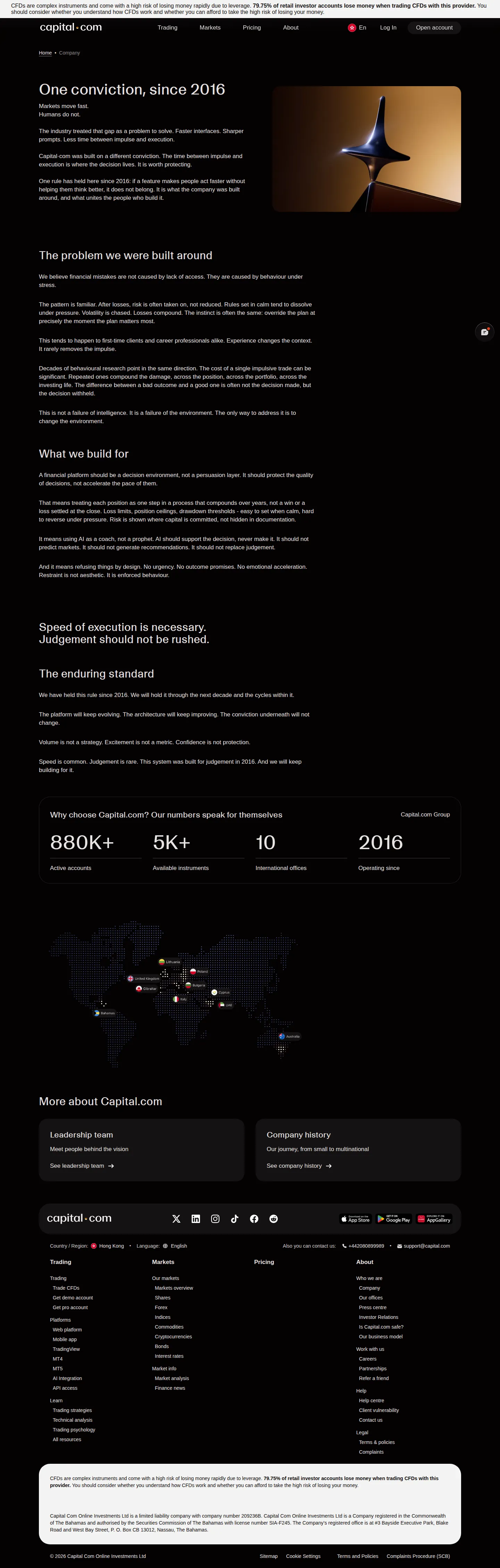
Execution runs through a choice of venues: MetaTrader 4 across every geography checked, MetaTrader 5 on the AE, AU, DE, ZA, SG, TH, VN and JP root pages (though absent from the GB root page’s platform row, which shows MT4 only), TradingView’s charting and social layer, and the firm’s own web and mobile apps, the mobile app pitched as covering “5,500+ CFD markets” with built in AI assistance. That AI assistance carries an explicit boundary on Capital.com’s own about page: “AI should support the decision, never make it. It should not predict markets. It should not generate recommendations.” Whatever the AI layer surfaces on screen, the firm’s own wording keeps the trade decision and the recommendation itself outside what it is built to do.
This review scores Capital.com’s platform criterion at 7.9 out of 10, up from an overall 5.6 in our previous review of this broker. That move is our assessment on this pass, not a claim that the firm changed, because both the criteria we scored against and the evidence we read changed between reviews. What is behind it on the trading side specifically: an itemised fee page naming the exact overnight rate and its named exemptions, a stated GSL mechanism, and a spread across product categories, forex, shares, indices, commodities, bonds, interest rates and ETFs, wide enough to describe in the firm’s own terms rather than by inference.
Account Types
The tier structure below (Standard, Plus, Professional, Islamic and Demo) comes from the earlier TrueBroker review of Capital.com, not from an account-types page we fetched ourselves this pass; treat the figures as what that prior write-up recorded rather than as something we read on capital.com. Our own fetch this time covered the fee mechanics rather than a dedicated accounts page, and those fee figures are attributed separately below.
The account tiers the earlier review recorded
The Standard account is described as opening from a $20 deposit, with spreads from 0.6 pips on major currency pairs, leverage up to 1:30 for retail clients, access to all tradable assets, and negative balance protection. The Plus account is described as requiring $3,000, buying tighter spreads from 0.1 pips and lower overnight financing rates, with negative balance protection carried over. The Professional account is described as gated by the ESMA professional-client criteria: a portfolio worth at least €500,000 plus relevant trading experience, in exchange for leverage up to 1:500 and spreads from 0.0 pips. The Islamic account is described as swap-free from the same $20 minimum as Standard, substituting wider spreads or fixed commissions for the overnight interest it removes. A Demo account with virtual funds and no deposit requirement rounds out the list.
One clause in that Professional tier is something we did check first-hand: Capital.com’s own UK risk warning, read on both its root page and its terms page, states plainly that “Professional clients can lose more than they deposit.” Stepping up to Professional buys tighter pricing and higher leverage by giving up the negative-balance protection that sits underneath every retail account.
What Capital.com’s own fee page charges around the accounts
We read Capital.com’s published fee page for its Bahamas-regulated entity, Capital Com Online Investments Ltd, which serves the UAE, South Africa, Singapore, Thailand, Vietnam and Japan fee pages we fetched. It lists no fee for opening an account, closing an account, running a demo account, or depositing. The minimum deposit on that English-language page is given as 10 USD/EUR/GBP for bank cards and Apple Pay, with wire transfers carrying a higher minimum of 50 EUR or the account’s base-currency equivalent. The Arabic-language version of the same firm’s UAE fee page gives a different figure for the same thing: 20 USD/EUR/GBP or 80 AED. Both are the broker’s own pages; they simply disagree with each other on what it costs to open an account.
Withdrawals carry no fee either, with a minimum withdrawal of 20 USD/EUR/GBP for bank cards. The fee page adds a condition worth flagging: where an account balance falls below that minimum withdrawal limit, only a full-balance withdrawal is available, so a client sitting on a small remainder cannot draw down part of it.
Capital.com charges no separate trading commission on any of these accounts; it earns through the spread on executed trades instead. Two further charges apply across the tiers rather than being unique to one: a currency-conversion mark-up, at 0.7% of the spot forex rate for retail clients and 0.5% for Pro clients, built into the exchange rate applied to realised profit and loss, overnight funding adjustments, guaranteed stop-loss fees, dividends and manual balance conversions rather than itemised as its own line; and an overnight funding fee, a daily rate equivalent to 4% a year (0.01111% a day for USD, EUR, CHF and JPY-denominated positions; 0.01096% a day for GBP, CAD and SGD), adjusted against the SOFR or SONIA benchmark for the instrument’s currency. A client who trades unleveraged specifically to dodge that overnight charge is not fully exempt: Capital.com’s fee page carves out Natural Gas, US Cocoa, the Volatility Index and any forex pair involving the Turkish lira, all of which incur the overnight fee regardless of leverage.
Guaranteed stops and the earlier review’s incentive programs
A guaranteed stop-loss order carries its own fee on Capital.com’s fee page, calculated as a premium percentage multiplied by the position’s open price and quantity, varying by market, entry price and position size, and only charged if the stop is actually triggered.
The earlier review also described two incentive programs that we have not independently verified this pass: a refer-a-friend scheme paying up to $250 every three months once a referred friend deposits at least $200 and completes three trades, and a rebate program for high-volume traders, with the example given of a 20% rebate on spreads for forex traders clearing over $150 million in monthly volume. Both are reported as what the prior write-up found rather than as something read on a current Capital.com page.
Negative Balance Protection
An earlier review of Capital.com reported that the broker’s Standard, Plus and Islamic accounts all carry negative balance protection, and that this protection drops away entirely on the Professional account. That earlier review also reported the leverage trade-off behind the split: Standard tops out at 1:30 for retail clients, while Professional goes up to 1:500. We did not fetch Capital.com’s own account-comparison page ourselves, so those figures come from that earlier review rather than from a page we read; the entry threshold it reported for Professional status was a portfolio worth at least €500,000 plus relevant trading experience.
What Capital.com’s own risk warning says about professional clients
Where we did read the firm’s own pages, the split holds up. Both Capital Com (UK) Limited’s terms page and its UK root page carry the identical sentence in their risk-warning section: “Professional clients can lose more than they deposit.” That is the firm’s own wording, not a paraphrase, and it sits alongside a second disclosure that a reader comparing account tiers should weigh: the percentage of retail accounts that lose money differs by which version of the site serves them. Capital.com’s UK pages disclose that 65% of retail investor accounts lose money trading spread bets and CFDs with the provider, while the pages serving the Bahamas-regulated entity disclose 79.75%, and the German pages give a range of 74% to 89%. We read these as three different figures on three pages the firm itself publishes, not as one statistic restated three ways; which number applies to a given trader depends on which regulated entity ends up carrying their account.
Guaranteed stop-loss orders: a fee, not a free backstop
Capital.com’s own fee page describes a guaranteed stop-loss order, or GSL, as a tool a client can attach to a position to cap the loss at a set level regardless of slippage or gapping. The page is explicit that this only costs anything if the order actually triggers, and it is not a flat fee: the charge is calculated as a GSL premium percentage multiplied by the position’s open price and its quantity, so the size of the charge moves with the market and the position rather than being fixed in advance. Read against the negative-balance question, a GSL is the mechanism Capital.com offers a retail client to stop a loss from running past a chosen point on a single position; it does not by itself say anything about what happens if losses run past the whole account balance, which is what negative balance protection covers instead.
What happens once the balance runs low or negative
The same fee page sets a specific rule for a balance that has shrunk close to zero: where an account balance falls below the minimum withdrawal limit for the chosen payment method, only a full-balance withdrawal is available, not a partial one. A client trying to pull out part of a small remaining balance cannot do so under that rule; the choice is to take everything out or leave it in the account. Two other charges on the same fee page keep working on the balance regardless of whether a position is winning or losing. Overnight funding is charged daily on leveraged positions held past the trading day, at rates Capital.com states as roughly 0.0111% per day for US dollar, euro, Swiss franc and yen-denominated markets and roughly 0.01096% per day for sterling, Canadian dollar and similar currencies, adjusted up or down against the SOFR or SONIA benchmark for the instrument’s currency. Capital.com’s fee page states that unleveraged, 1:1 positions are exempt from this charge, with a named exception: natural gas, US cocoa, the Volatility Index and any forex pair involving the Turkish lira are charged overnight funding regardless of leverage. Separately, a currency-conversion charge of 0.7% of the spot rate for retail clients, or 0.5% for clients classified Professional, is built into the exchange rate applied to realised profit and loss, overnight funding adjustments, GSL fees, dividends and manual balance conversions in a currency other than the account’s base currency. Capital.com’s page states this charge is folded into the rate rather than itemised as a separate line, which means a client checking their statement for what a currency conversion cost them will not find a standalone figure to check it against.
None of the pages we fetched for our evidence described what happens procedurally if a retail account’s balance actually goes negative, beyond the protection an earlier review reported for Standard, Plus and Islamic accounts. What we can confirm from Capital.com’s own pages is narrower: the risk warning that professional clients can lose more than they deposit, the GSL as a paid mechanism for capping loss on a single position, and the funding and conversion charges that continue to draw down a balance while a position stays open.
Trading Instruments
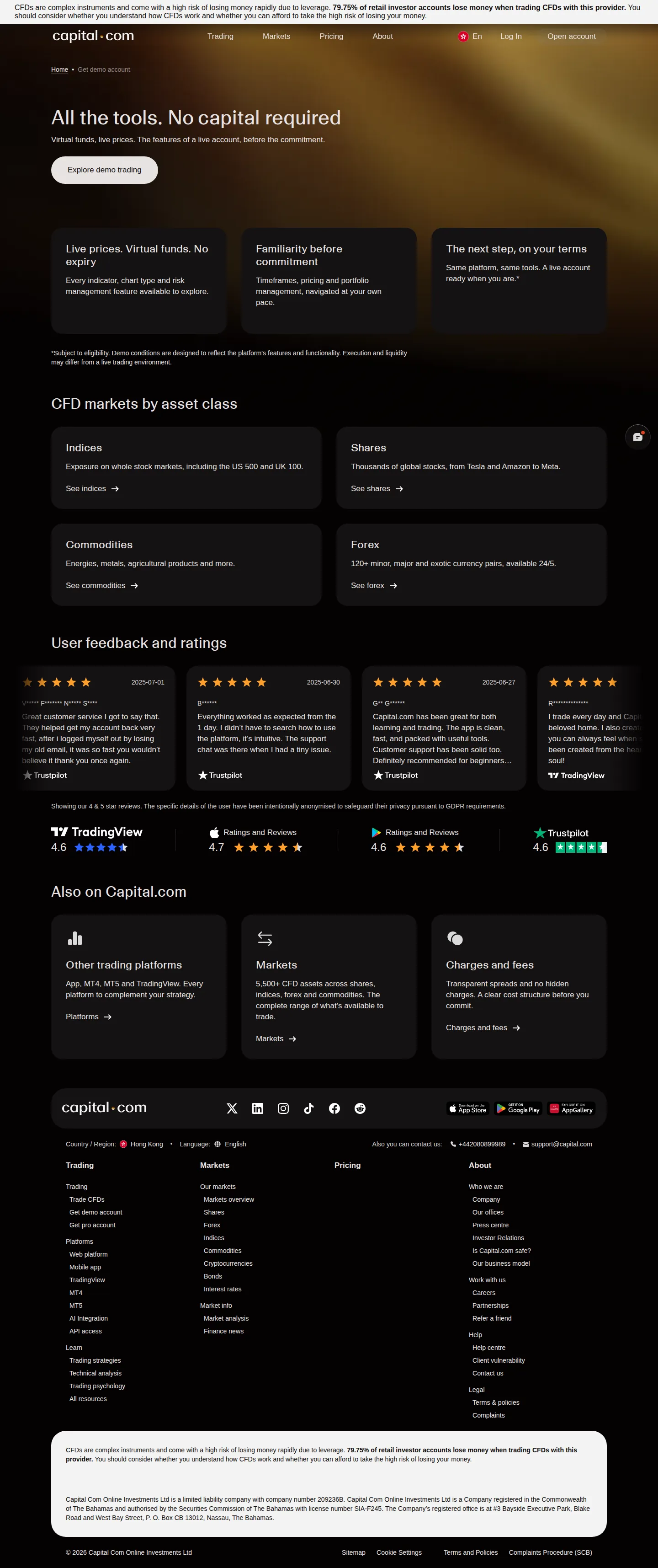
The markets navigation on Capital.com’s own country versions of the site spans forex, indices, commodities, shares, cryptocurrencies, bonds, interest rates and ETFs, all traded as CFDs rather than as underlying ownership (with one exception, below). The UK markets page gives forex as 120+ major, minor and exotic currency pairs, plus forex forwards. The same page counts “thousands” of global shares as CFDs across markets including Great Britain, the USA, Germany, Japan, Australia and Hong Kong, with extended-hours trading on selected US shares. The UK root page lists 35+ index markets, 65+ commodity markets including gold, oil, silver, natural gas, cocoa, copper and coffee, 10+ bond markets, 2+ interest-rate markets and 1,300+ ETF markets as its own category. The Arabic-language AE markets page names Tesla, Amazon and Meta as examples of the shares on offer, and describes the commodity range as covering energy, metals and agricultural CFDs.
Crypto: a large number with a carve-out
The German root page puts the crypto range at “450+ crypto CFD markets”, and the AE markets page describes “a range of cryptos from Bitcoin and Ether to Cardano and Dogecoin”. That range does not reach every client the group serves: the UK root page states plainly that “Crypto Derivatives are not available to Retail clients registered with Capital Com (UK) Ltd”, and crypto is absent from the GB root page’s own markets navigation. A UK retail client reading the group’s crypto count on a different country’s page is reading a number that does not apply to their own account.
A second product sits alongside the CFDs
Capital.com’s German page describes a share-dealing line separate from the CFD markets above: “Aktien und ETFs / Eigentum am Basiswert / In Aktien und ETFs investieren”, meaning shares and ETFs bought as direct ownership of the underlying rather than as a leveraged derivative. The Capital Com (UK) Limited terms page corroborates that a distinct product exists on the UK side too, referencing a “Key Information Document – ETFs”, a “Key Information Document – Spread Bets on ETFs”, and a risk warning that separately covers “shares and ETFs bought through a share dealing account”. The pages we fetched do not lay out fees, minimums or a full instrument list for this share-dealing product the way they do for the CFD markets, so what follows in this review concerns the CFD offering unless stated otherwise.
The UK root page also advertises a product it calls “1X”: a CFD structure the firm itself flags as unleveraged, while still describing it as a complex derivative product carrying loss risk. Trading it without leverage does not, on the firm’s own framing, make it a simple product.
What Capital.com says about its own scale
The Arabic-language AE “about” page states the group’s headline numbers as “880K+ Active accounts, 5K+ Available instruments, 10 International offices, 2016 Operating since”. That page’s own office listing, however, names offices in nine countries against the “10 International offices” figure quoted alongside it, a gap on the firm’s own page rather than something this review adds. These are the firm’s self-reported figures; nothing in the evidence available to this review independently verifies the account count, the instrument count or the number of offices.
Who cannot access the markets at all
The German root page states the site’s information is not intended for persons living in the United States, Canada and Belgium, or any other country outside the EEA. The UAE root page separately states that products and services are not available to countries subject to international bans or sanctions. Neither page we fetched publishes a named list of the sanctioned or banned countries it means.
Education & Analysis
Capital.com’s own pages show three trading surfaces sitting alongside each other rather than one clear default: the group’s proprietary web platform and mobile app, the MetaTrader line, and TradingView, all listed in the Platforms navigation across the country versions of the site we fetched.
What Capital.com’s own platform offers
The UK platforms page describes the browser-based web platform as carrying “100+ technical tools, built-in risk management and on-chart execution,” and the mobile app page pitches “5,500+ CFD markets. Built-in intelligence. One app,” with AI assistance built into the app itself. Both are Capital.com’s own products, separate from MetaTrader or TradingView, and both pages are the firm’s own marketing copy for the platform rather than an independent build report from us.
MetaTrader coverage is not the same in every market
Here the broker’s own pages disagree with each other by region. MT4 appears in the platform icon row and navigation on the country root pages we pulled. MT5 shows up the same way on the AE, AU, DE, ZA, SG, TH, VN and JP root pages, but it is missing from the icon row and navigation on the GB root page, which lists only MT4. It is also absent from two UK-entity pages, the firm’s UK terms page and the firm’s UK accounts page, both branded to Capital Com (UK) Limited (CCUK). So a client who signs up under the UK entity looking at what the site shows them is being shown MT4 without MT5, while a client under the Bahamas-regulated Capital Com Online Investments Ltd entity serving the AE English, ZA, SG, TH, VN and Japan pages sees both. Where MT4 or MT5 is available, the older review described the usual MetaTrader feature set: a familiar charting interface, technical indicators and automated trading through MQL4 expert advisors; we have not independently verified that description against the current MT4/MT5 builds.
TradingView and the newer nav items
TradingView is listed in the Platforms navigation on all the country versions of the site we fetched, described in the earlier review as integrated charting with social features such as idea sharing, again a claim we are restating rather than one we tested ourselves. Two further nav entries, “AI Integration” and “API access,” appear on the AU and GB pages, but the fetched text gives no further description of either beyond the nav label itself, so what those two features actually do is not something these pages tell us.
On AI specifically, a separate page states the firm’s own position plainly: “AI should support the decision, never make it. It should not predict markets. It should not generate recommendations.” That is a real limit the firm places on itself, and it is worth reading against the “Built-in intelligence” language on the mobile app page and the unexplained “AI Integration” nav entry elsewhere on the site; the pages we fetched do not reconcile what “AI Integration” or “built-in intelligence” mean in practice with the constraint the firm states in its own about page.
What we did not find on these pages
The fetched pages give us a nav-level inventory of what Capital.com offers across platforms, plus the firm’s own promotional description of its web and mobile products, but they do not include a walkthrough of the charting tools themselves, a list of available indicators or drawing tools, or copy-trading or signal features. Where that gap sits, we are reporting what the pages describe rather than asserting anything about features they simply do not mention.
How this feeds the score
Our previous review scored this broker 5.6/10 overall; this one scores it 7.9/10. The platform criterion here lands at 7.9/10, on the strength of Capital.com’s own platform pages describing a full-featured web and mobile build (built-in risk management, on-chart execution, 5,500+ markets), TradingView listed alongside it, and MetaTrader coverage that, while inconsistent between the UK and other regions, is present somewhere in the group for clients who want it. That platform inconsistency, MT5 missing from the UK entity’s own pages, is the kind of detail that keeps this from scoring higher and is why we flag it here rather than smoothing it over. The overall move from 5.6 to 7.9 reflects this review’s assessment against the evidence gathered now, including the register confirmations and fee disclosures covered elsewhere in this review, not any change in the firm’s own conduct.
Special Offers
The pages we fetched for Capital.com describe fees, not promotions. The fee page for Capital Com Online Investments Ltd (the Bahamas-regulated entity that serves the AE, ZA, SG, TH, VN and JP fee pages) sets out account opening, account closing, demo accounts, deposits and withdrawals as carrying no fee, and states that the broker’s revenue comes from the spread on executed trades rather than a commission. Nothing on that page, and nothing on the CCUK terms pages or the CAPITAL COM MENA SECURITIES TRADING L.L.C. pages we read, describes a deposit bonus, a welcome credit or a promotional tier. That describes what those particular pages cover; it is not a finding that no such offer exists anywhere on the site, only that we did not fetch a promotions page for this review.
A referral scheme and a volume rebate, reported by an earlier review
The review of Capital.com described a Refer-a-Friend Program paying up to $250 every three months, conditional on the referred friend depositing at least $200 and completing a minimum of three trades. The same earlier review described a Rebate Program for Active Traders, citing a 20% rebate on spreads for forex traders with monthly volumes above $150 million, with high-volume traders said to qualify for monthly cash rebates calculated across asset classes. Both figures reached us secondhand, from that earlier write-up rather than from any Capital.com page fetched for this review, so they are reported here as what the previous review found, not as terms we can attribute to the firm’s current pages. A reader who wants the live conditions, minimum volumes or payout schedule for either program should check Capital.com’s own site rather than rely on these carried-over numbers.
What Capital.com’s own fee page ties to trading instead of promotions
Where the fetched material gets specific, it is about the standing cost of trading, not a discount on it. A currency-conversion mark-up of 0.7% of the spot forex rate for retail clients, or 0.5% for Pro clients, is built into the exchange rate applied to realised profit and loss, overnight funding adjustments, guaranteed stop-loss fees, dividends and manual balance conversions, rather than itemised as a separate charge. Overnight funding is described as a daily rate of 4% a year, equivalent to 0.01111% a day for USD, EUR, CHF and JPY-denominated positions and 0.01096% a day for GBP, CAD and SGD-denominated ones, adjusted up or down against the SOFR or SONIA benchmark for the instrument’s currency. The same fee page carries one exemption worth flagging for anyone chasing a workaround rather than a promotion: 1:1 leverage, unleveraged CFD positions are exempt from overnight funding, except on Natural Gas, US Cocoa, the Volatility Index and forex pairs involving the Turkish lira, which are charged the fee regardless of leverage. A guaranteed stop-loss order carries its own premium, calculated against the position’s open price and size, and is only charged if the guaranteed stop is triggered.
The fee page also states that where an account balance falls below the minimum withdrawal limit, only a full-balance withdrawal is available, a condition that binds a client with a small remaining balance rather than one that rewards a large one. None of this reads as a promotional structure: it is priced through the spread, the funding rate and the conversion mark-up described above, and the fetched pages say nothing about a credit, bonus or matched deposit sitting alongside it.
Minimum deposit is itself unsettled across Capital.com’s own pages: the English-language AE fee page gives 10 USD/EUR/GBP for bank cards and Apple Pay and 50 EUR for wire transfers, while the Arabic-language AE fee page gives 20 USD/EUR/GBP or 80 AED. That is a discrepancy in the firm’s own published entry cost, not a promotional offer, and it is worth a prospective depositor checking the figure on the specific page and language version they are about to use before they fund an account.
Opening an Account
Opening an account with Capital.com starts online. The firm’s AE fees page, run by Capital Com Online Investments Ltd, lists account opening, closing and demo accounts as carrying no fee, and the broker earns through spreads rather than a signup charge.
Funding minimums, and where Capital.com’s own pages disagree
The English-language AE fees page gives a minimum deposit of 10 USD/EUR/GBP for bank cards and Apple Pay, with wire transfers needing at least 50 EUR or the equivalent in the account’s base currency. The Arabic version of the same fee page states a different figure: 20 USD/EUR/GBP, or 80 AED. Which number applies appears to depend on which language version of the site a prospective client lands on, and we have not been able to reconcile the two from the broker’s own material. On withdrawals, the same AE fees page sets a minimum of 20 USD/EUR/GBP for bank cards, and it states that where an account balance falls below the minimum withdrawal limit, only a full balance withdrawal is available: a client cannot take out a partial amount once the balance dips under that line.
Verification and the entity a client actually signs up with
Which regulated entity opens the account depends on the version of the site a visitor reaches. Capital Com (UK) Limited (FRN 793714, confirmed on the FCA register as authorised since 26 October 2018, Companies House number 10506220) serves the GB pages. Capital Com SV Investments Limited (CySEC licence 319/17, confirmed on the CySEC register of Cypriot investment firms, dated 7 April 2017) and Capital Com Group Ltd (CySEC licence 463/25, confirmed on the same register, dated 10 November 2025) serve the DE pages. Capital Com Australia Pty Ltd (AFSL 513393, confirmed on the ASIC register, ABN 47 625 601 489) serves the AU pages. CAPITAL COM MENA SECURITIES TRADING L.L.C., licensed by the UAE’s هيئة سوق المال (CMA) under licence 20200000176, confirmed on the UAE Capital Market Authority register as CP-0000937, serves the AE root page as an execution-only provider. And Capital Com Online Investments Ltd, authorised by the Securities Commission of The Bahamas under licence SIA-F245 (confirmed against the SCB’s registrant list, though that register publishes no licence-number column to check the number itself against), sits behind the AE, ZA, SG, TH, VN and JP fee and markets pages. A client signing up through the ZA-facing site should note that the firm’s own pages have not resolved which entity is meant to be responsible there: the broker announced, in a press release cited on its own about page, that it had entered South Africa under a dual FSCA licence as an Over-the-Counter Derivatives Provider and a Category 1 Financial Services Provider, yet the fetched ZA root page’s footer still names the Bahamas-regulated Capital Com Online Investments Ltd as the regulated entity. The pages we fetched do not name an FSCA number for the South African entity, and we have not been able to establish from them which regulator a South African client would actually be dealing with.
Who Capital.com will not open an account for
The DE root page states that the site’s information is not intended for persons living in the United States, Canada or Belgium, or any other country outside the EEA. The AE root page states that products and services are not available to residents of countries subject to international bans or sanctions. Within the accounts it will open, UK retail clients registered with Capital Com (UK) Ltd are barred from crypto derivatives specifically; the GB root page states plainly that “Crypto Derivatives are not available to Retail clients registered with Capital Com (UK) Ltd.”
Professional status, and what a Capital.com client gives up to get it
An earlier review of this broker, which we are restating rather than quoting since we have not read the underlying document, described Capital.com’s professional-account tier as requiring a portfolio worth at least €500,000 together with relevant trading experience, in line with ESMA’s professional-client criteria, in exchange for leverage up to 1:500 against the retail cap of 1:30. Capital.com’s own terms make the cost of that tier explicit: both the GB root page and the Capital Com (UK) Limited terms page carry the risk warning that “Professional clients can lose more than they deposit,” meaning the negative-balance protection that applies to retail accounts falls away once a client is reclassified as professional.
The mismatched risk warning a new client will see
The percentage figure Capital.com discloses for how many retail accounts lose money is not the same across its own pages: the GB root page states 65%, the German pages state a range of 74% to 89%, and the generic pages serving the AE English, AU, ZA, SG, TH, VN, JP and “Hong Kong”-labelled markets state 79.75%. A prospective client’s read on the odds they are told to expect depends on which version of the site brought them to the sign-up form.
The score for this section moved from an earlier 5.6 out of 10 to 7.9 out of 10 in this review. That is our assessment being restated against the current evidence and criteria, not a change in the firm: this review draws on licence numbers and fee pages confirmed directly against six regulators’ registers, plus a search of 1,441 warning-list entries mirrored from CySEC, the FCA and FSC Mauritius that returned no match for Capital.com itself, which the 5.6 score did not have behind it.
Deposits & Withdrawals
Capital.com’s own fee page for its Bahamas-regulated entity, Capital Com Online Investments Ltd, lists account opening, account closing, demo accounts and deposits as carrying no fee, and states withdrawals carry no fee either. The firm earns on the spread rather than on a deposit or withdrawal ticket, per that same page.
What Capital.com charges to move money in and out
The firm’s fee page gives a minimum deposit of 10 USD/EUR/GBP for bank cards and Apple Pay, with wire transfers needing at least 50 EUR or the equivalent in the account’s base currency; it notes the minimum varies by payment method. The same page sets minimum withdrawal at 20 USD/EUR/GBP for bank cards, again varying by method. Set against that, the Arabic-language version of the AE fees page gives a different figure: a minimum deposit of 20 USD/EUR/GBP or 80 AED. The firm’s own pages disagree with each other on the entry cost depending on which language version a prospective client lands on, and a reader should check the specific page in their own funding currency before assuming either number applies.
Payment methods
An earlier review of this firm, which we are restating rather than re-verifying against the firm’s own pages, described three funding rails: credit and debit cards (Visa, Mastercard, Maestro) crediting instantly; bank transfer, taking several business days; and e-wallets including Apple Pay, Giropay, iDEAL, Neteller, PayPal, Skrill, SOFORT and Trustly, also instant. That earlier review noted no broker-side fee on any of these, though the card and e-wallet providers themselves may apply their own charges that Capital.com does not control.
The withdrawal rule that catches a shrinking balance
Capital.com’s fee page carries a condition worth flagging on its own: where an account balance falls below the minimum withdrawal limit, only a full-balance withdrawal is available. A client whose balance drops under that threshold cannot take out a partial amount; they either withdraw everything or leave the remainder sitting in the account. Combined with the stated minimum withdrawal of 20 USD/EUR/GBP for cards, this means a balance that dips just under that figure stops being partially accessible until the client closes the position out entirely.
Currency conversion is priced into the rate, not itemised
The same fee page discloses a currency-conversion charge of 0.7% of the spot forex rate for retail clients, reduced to 0.5% for clients classified as Pro. It applies to realised profit and loss, overnight funding adjustments, guaranteed stop-loss fees, dividends, and standalone balance conversions whenever the amount is in a currency different from the account’s base currency. The page is explicit that this mark-up is built into the exchange rate used for the conversion rather than shown as a separate line item, so a client checking a statement for a currency-conversion fee will not find one listed; it is already folded into the number that came out the other side.
None of this is captured in a public register: deposit and withdrawal terms sit on the firm’s own fee page rather than in the regulatory record, so the figures above rest on what that page states, not on anything a regulator confirms or denies.
Customer Support
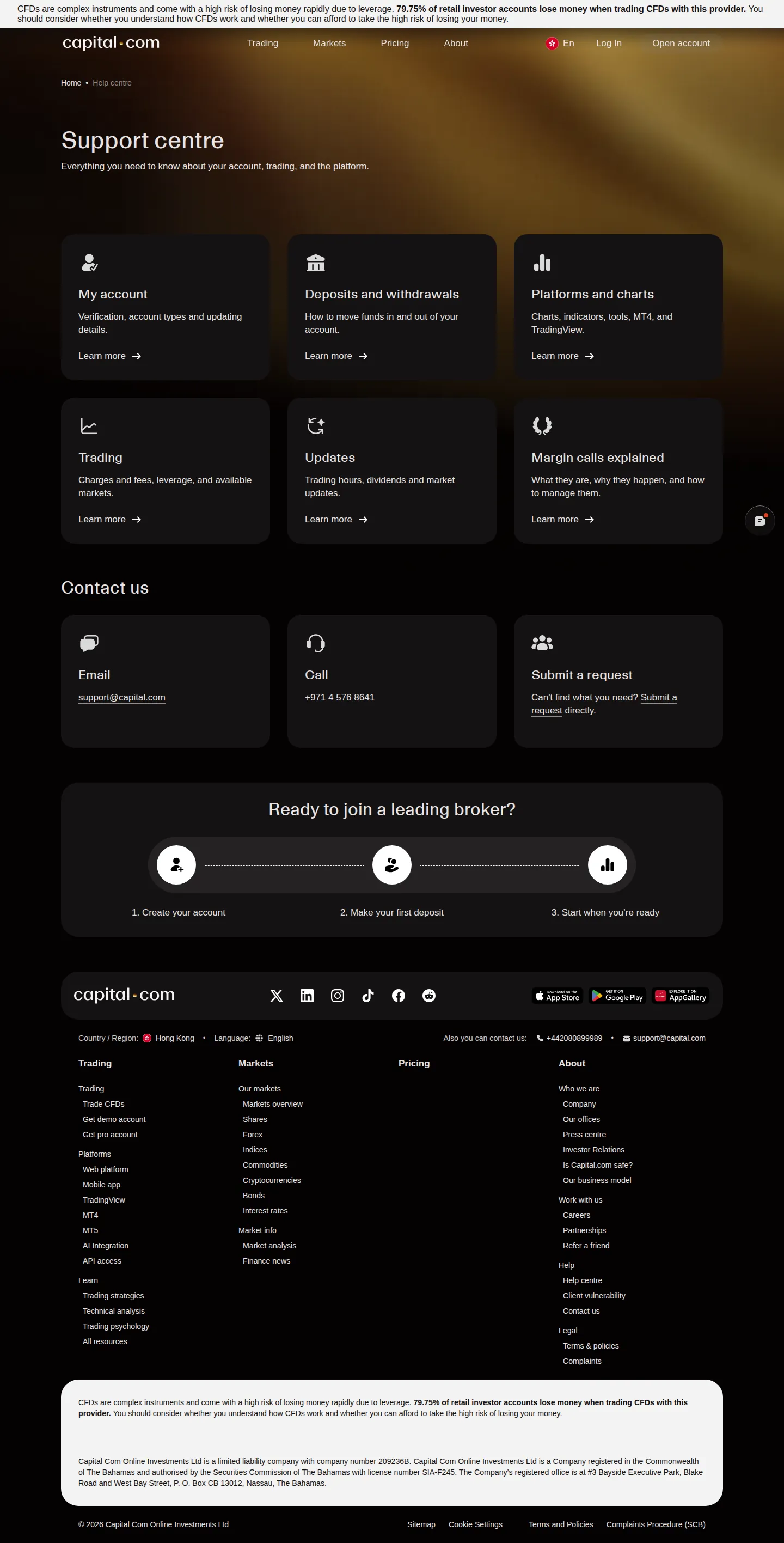
Capital.com splits its support contact details by regulated entity and country page rather than publishing one global number. The pages we fetched give phone numbers for Germany (+49 3046690292), the UK (+442030978888, repeated on the Capital Com (UK) Limited terms page), the UAE (+971 4 496 8000 on the root page and +971 4 576 8641 on the contact page), Australia (+61 3 8658 0539), and South Africa and the generic/Bahamas-entity contact page (both +442080899989). Email support is listed as support@capital.com on the German page and support.au@capital.com on the Australian page. The UK contact page also lists WhatsApp as a chat channel, and the UAE contact page points to a self-service support centre with a “Submit a request” ticket option. None of the pages we fetched state opening hours for phone, chat or email, so we cannot report how long a query sits before a human answers it.
Which Capital.com entity is actually answering
The phone numbers map to different regulated companies depending on where a client is signed up, and that matters because a complaint has to go to the entity that holds the account, not the group brand. The UK contact number is tied to Capital Com (UK) Limited (FCA-authorised, FRN 793714), the UAE numbers to CAPITAL COM MENA SECURITIES TRADING L.L.C. (licensed by the UAE’s هيئة سوق المال under licence 20200000176), and the generic/South African contact number to Capital Com Online Investments Ltd, registered in the Bahamas under the Securities Commission of The Bahamas (registrant status confirmed on the SCB list, though that register does not publish a registration-number column to check the SIA-F245 the firm quotes against). We noted that the South African root page’s footer still names the Bahamas entity as the regulated party even though a firm press release describes entry into South Africa under a dual FSCA licence as an OTC Derivatives Provider and Category 1 Financial Services Provider; the FSCA press release names no specific licence number on the pages we fetched. A South African client trying to work out which regulator to escalate a complaint to, the FSCA or the Bahamas SCB, cannot settle that from the footer alone.
Terms that limit what a complaint can rest on
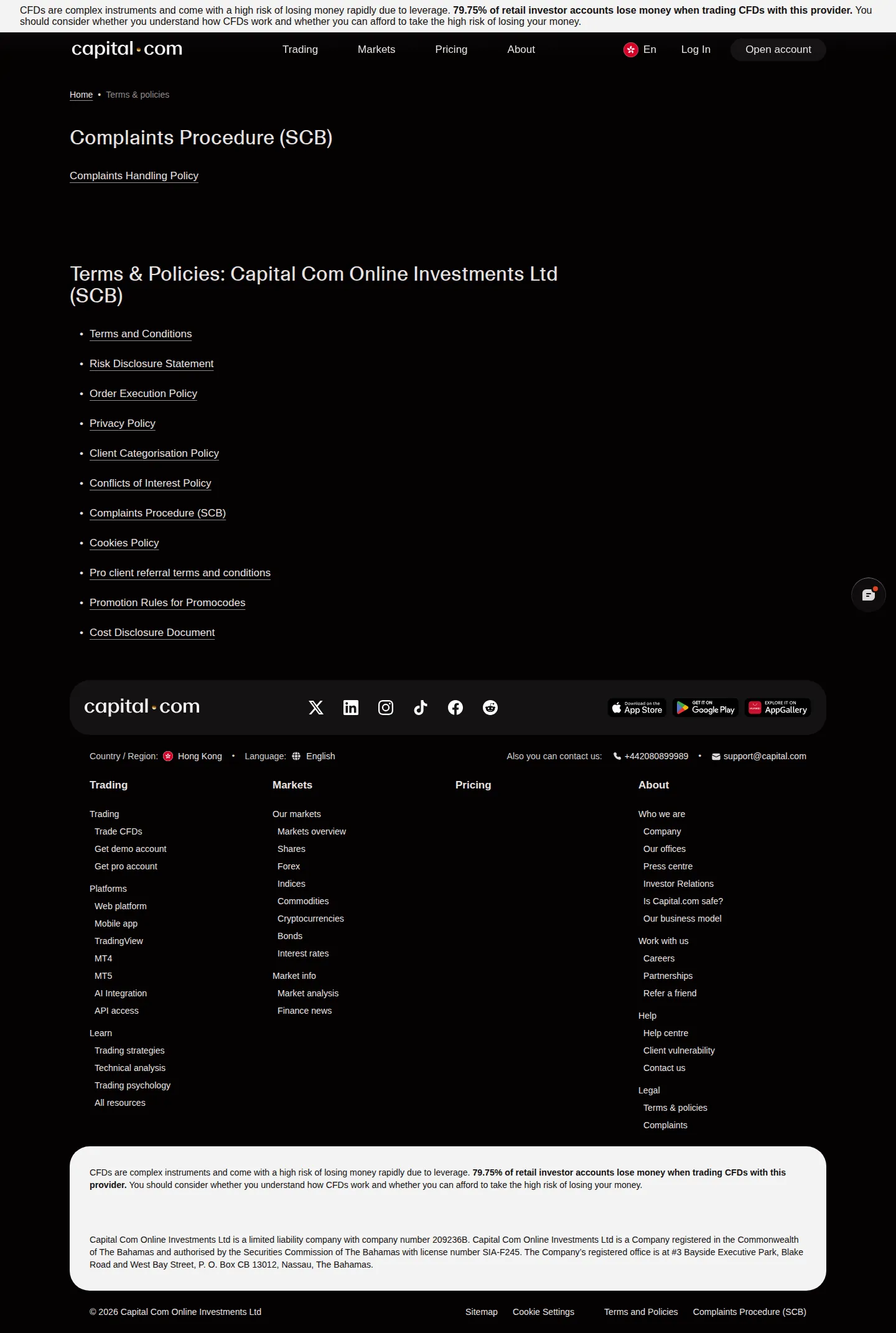
CAPITAL COM MENA SECURITIES TRADING L.L.C.’s legal disclaimer states it is an execution-only service provider that does not give investment advice, that its general market commentary is not advice or a recommendation, and that the company disclaims legal responsibility for any use of that content and its consequences. A UAE client contacting support about a trade made on the back of Capital.com’s own market commentary has, by this clause, no basis to hold the firm responsible for how that commentary was used. Separately, the German-language pages state that capital.com is the only official website domain of Capital Com SV Investments Limited and Capital Com Group Ltd, and that neither company is affiliated with or responsible for any other domain purporting to represent it. That disclaimer is worth taking seriously when contacting support: we searched 1,441 warning-list entries mirrored from CySEC, the FCA and FSC Mauritius and found no listing for Capital.com itself, but CySEC’s Non Approved Domains list alone carries dozens of unauthorised “Capital”-branded lookalikes such as capitalstime.com, capitalltraders.com and worldwidecapitalfx.com. CySEC does not name which broker any of these domains imitate, so none can be tied specifically to Capital.com, but a client searching for a support contact number should confirm they are on capital.com before handing over account details, since the firm’s own terms say it will not stand behind whatever happens on a different domain.
Where Capital.com can be reached in person
The firm’s about page lists office addresses in London (2nd Floor, 4 Orchard Place, SW1H 0BF), Limassol (Vasileiou Makedonos 8, KINNIS BUSINESS CENTER), Dubai (Office 14C, Emirates Towers Offices, Sheikh Zayed Road), Melbourne (Level 15, 357 Collins Street), Warsaw, Sofia, Vilnius and Milan, plus a registered office for the Bahamas entity at #3 Bayside Executive Park, Blake Road and West Bay Street, Nassau. That spread across nine named locations sits against a claim on the same site of “10 International offices,” a discrepancy worth flagging to a reader trying to count exactly how many physical points of contact exist.
Our previous review of Capital.com scored the broker 5.6 out of 10 overall; this review scores it 7.9. That is our assessment shifting, not a claim that the firm’s support operation changed: the earlier write-up leaned on secondhand licence numbers (SIA-F265 for the Bahamas entity, 190005 for the UAE entity) that do not match what the firm’s own current pages and the registers show (SIA-F245 and 20200000176), and this pass instead checked the regulators directly. On support specifically, this review scores Capital.com 6.8 out of 10, reflecting a firm that does publish working phone numbers, email addresses and a WhatsApp channel across every region we checked, set against unpublished hours, an execution-only liability disclaimer on its UAE entity, and a South African entity footer that has not caught up with the firm’s own FSCA announcement.
Prohibited Countries
Restrictions here come from three different pages our evidence fetched, and none of them are the same list.
What Capital.com’s own pages say about excluded countries
The German-language root page states that its content is not intended for persons living in the United States, Canada or Belgium, or any other country outside the EEA. Read literally, that puts most of the world outside the site’s intended audience, not just the three named countries, though the page frames this as an EEA-facing entity addressing non-EEA visitors generally rather than a discrete ban list.
Separately, the UAE root page states that the firm’s products and services are not available to countries subject to international bans or sanctions. That page does not name which countries it means, so the sanctions exclusion is confirmed as a policy but the countries it covers are not listed anywhere we fetched.
What an earlier check found, and what it didn’t find
An earlier version of this review reported a specific list of banned countries, including Iran, North Korea, Syria and Cuba, attributed to Capital.com’s own policy. That list could not be traced to anything the broker itself publishes, and a check of the homepage, legal, terms and legal-documents pages, run through an Indonesian exit on 27 July 2026, found no published restricted-country list (from the earlier review). We are not able to confirm that Iran, North Korea, Syria or Cuba are named anywhere in the firm’s own published material. The pages we fetched describe a sanctions exclusion and an EEA-outside exclusion in general terms, and say nothing about a country-by-country list.
Crypto and the UK
The one restriction that is specific and unambiguous concerns a product, not a country as such: “Crypto Derivatives are not available to Retail clients registered with Capital Com (UK) Ltd” (repeated at the firm’s UK terms page). That is a UK retail carve-out on a single asset class under the FCA-regulated entity, not a country ban on using the broker at all.
Professional-client access is its own gate
Separate from geography, qualifying for a Professional account depends on a portfolio value of at least €500,000 plus relevant trading experience under ESMA’s professional-client criteria (from the earlier review). A client who does not meet that threshold is confined to whatever retail terms apply in their entity, including the loss of the higher leverage and tighter spreads reserved for Professional status.
Which entity a client lands on changes what they’re told
Because Capital.com operates through separate regulated entities, the exclusion language a visitor sees depends on which country version of the site they load. The generic and Bahamas-entity (SCB) pages disclose that 79.75% of retail investor accounts lose money, while the Capital Com (UK) Limited pages disclose 65% for spread bets and CFDs “with this provider”. That is not a country ban, but it shows the entity a client is actually contracting with, and the terms that apply to them, are not uniform across the group, which matters when trying to work out which country restrictions apply to which entity.
What we can and cannot tell a reader
We hold three separate, narrower facts rather than one master list: an EEA-outside exclusion naming the US, Canada and Belgium, a sanctioned-countries exclusion naming no specific countries, and a UK retail carve-out on crypto derivatives (the firm’s UK terms page). A reader outside the EEA, in a sanctioned jurisdiction, or trying to trade crypto CFDs as a UK retail client should treat those three statements as what is actually documented. Anyone relying on a specific list of banned countries beyond the US, Canada and Belgium named on the German page is relying on something we did not find published by the firm.
Conclusion
Capital.com’s core regulatory picture holds up on direct checks: the FCA register confirms FRN 793714 for Capital Com (UK) Limited, the CySEC register confirms licence 319/17 for Capital Com SV Investments Limited and licence 463/25 for the newer Capital Com Group Ltd, the ASIC register confirms AFSL 513393 for Capital Com Australia Pty Ltd, the Securities Commission of The Bahamas lists Capital Com Online Investments Ltd under SIA-F245, and the UAE Capital Market Authority confirms CAPITAL COM MENA SECURITIES TRADING L.L.C. as CP-0000937. Companies House, the Cyprus Registrar of Companies and the Australian Business Register all confirm the underlying corporate entities. A search of 1,441 warning-list entries mirrored from CySEC, the FCA and FSC Mauritius turned up nothing against Capital.com itself, though the “Capital” name is a popular target for clone sites on both the CySEC non-approved-domains list and the FCA register; none of those listings name Capital.com and they should not be confused with it.
Where Capital.com’s own pages disagree with each other
Some of what pulls the regulation score below a clean pass is not a register problem but an internal one. The firm’s own pages give two different jurisdiction counts, “regulated across five worldwide jurisdictions” on the AE markets page against “regulated in seven jurisdictions” on the GB about page. The mandated loss-rate warning also varies by entity: the Capital Com (UK) Limited pages disclose that 65% of retail accounts lose money, while the generic Bahamas-entity pages disclose 79.75%, and the German pages give a range of 74%-89%. The minimum deposit itself is not consistent either: the English-language AE fees page states 10 USD/EUR/GBP, while the Arabic AE fees page states 20 USD/EUR/GBP or 80 AED. None of these is a register discrepancy; they are the firm’s own published pages disagreeing with each other, and a reader who lands on a different geo or language version of the site will be quoted different figures for the same thing.
What Capital.com charges
The fees section is where this review is strongest, because it rests on the published fee page rather than a summary of it. Capital.com’s AE fees page lists no account-opening, closing, demo, deposit or withdrawal fee, and states the broker earns through spreads rather than commission. It also discloses a currency-conversion mark-up, 0.7% of the spot rate for retail clients and 0.5% for Pro clients, built into the exchange rate applied to realised P&L, overnight funding adjustments, guaranteed stop-loss fees, dividends and manual balance conversions, rather than itemised as a separate charge. The overnight funding fee is set out at 0.01111% per day for USD, EUR, CHF and JPY-denominated positions and 0.01096% per day for GBP, CAD and SGD, adjusted against SOFR or SONIA. Unleveraged 1:1 positions are exempt from that fee, except specifically on Natural Gas, US Cocoa, the Volatility Index and Turkish Lira forex pairs, where it applies regardless of leverage, a carve-out worth knowing before assuming an unleveraged position is free to hold overnight. On withdrawals, the fees page states that where a balance falls below the minimum withdrawal limit, only a full-balance withdrawal is available, meaning a client cannot pull out a partial amount below that threshold.
Contract terms that bind a client
Capital.com’s terms carry a professional-account warning stated plainly: professional clients can lose more than they deposit, meaning that category gives up negative-balance protection in exchange for higher leverage. The UAE entity’s terms also disclaim any advisory role, stating it is an execution-only provider whose market commentary is not advice and that it carries no legal responsibility for a client’s use of it. The Cyprus-facing pages state that capital.com is the only official domain of Capital Com SV Investments Limited and Capital Com Group Ltd, and that neither company is responsible for any other site purporting to represent it, worth flagging given the volume of “Capital”-branded clone domains sitting on the CySEC and FCA warning lists.
Platforms and support
The platform offering itself is not uniform across entities either: MT5 appears in the navigation on the AE, AU, DE, ZA, SG, TH, VN and JP pages but is absent from the GB root page, which lists only MT4. Support runs through region-specific phone lines and email addresses for the UK, UAE, Australia and Germany entities, plus a self-service support centre and WhatsApp chat, without a single unified global contact point.
This review scores Capital.com 7.9 out of 10, up from a prior 5.6, a change in our assessment driven by weighing direct register confirmations across five regulators and reading the fee and contract-term pages first-hand rather than relying on secondhand figures, some of which (a Bahamas licence number and a UAE licence number cited in an earlier review) did not match what the firm’s current pages show. The regulation score of 7.5 reflects that confirmed multi-regulator coverage set against the firm’s own inconsistent jurisdiction counts and loss-rate disclosures; fees score 9 for a published, no-commission, spread-based structure with fees documented rather than summarized; platform scores 7.9 given the MT4/MT5 split by region; and support sits at 6.8 given the absence of a single global contact channel.
Capital.com holds confirmed licences with the FCA, CySEC, ASIC, the Bahamas SCB and the UAE CMA, charges no deposit or withdrawal fee and earns through spreads, and scores 7.9 out of 10 in this review.
What we saw
Pages captured from Capital.com’s own site when this review was written. Brokers change their terms; these are what we read.


Score history
Recomputed daily; every move is on the record. The current score is always the latest row.
| Date | Score | Move |
|---|---|---|
| 2026-10-07 | 7.9 | ▲ |
| 2026-07-25 | 5.6 | ▲ |
| 2026-07-18 | 5.4 | = |
| 2026-07-11 | 5.4 | · |
FAQ
Is Capital.com regulated?
Yes. It holds FCA licence 793714, ASIC licence AFSL 513393, and CySEC licences 319/17 and 463/25, all confirmed on official registers.
What does Capital.com charge in spreads?
Spreads start from USD 6.00 round turn on 1 lot of EURUSD on the Standard account.
What is the minimum deposit for Capital.com?
USD 20.
What trading platforms does Capital.com offer?
MetaTrader 4, MetaTrader 5, TradingView, its own web platform, its own mobile app, and an AI integration feature.
Is Capital.com regulated in South Africa?
It claims an FSCA permission, but this is only backed by a press release with no licence number to verify.
How do I contact Capital.com support?
By email, live chat, a ticket system, and a published phone number, with support in the client’s own language.
How this review works
Track Capital.com live: score moves and red notices, in your pocket.