
CFD · CHECKED 10 OCT 2026
CFI review.
CFD broker regulated across five jurisdictions, including the UK and Cyprus
OK-ISH
OUT OF 10
AD DISCLOSURE: IF YOU OPEN AN ACCOUNT THROUGH THIS LINK WE MAY EARN A COMMISSION. IT NEVER MOVES THE SCORE. HOW THIS WORKS
CFI is a CFD broker holding confirmed licences in the UK (FCA FRN 828955), Cyprus (CySEC 179/12), Seychelles, Vanuatu and Mauritius. Spreads are published at USD 6.00 round turn on EURUSD under Zero Commission. The biggest reservation is entity transparency: which CFI entity onboards you differs by country page, with different websites, risk warnings and support escalation attached.
Each criterion is scored 1 to 10 from primary sources. The overall score is their unweighted mean. How scoring works.
| Founded | 2012 |
|---|---|
| Maximum leverage | 500:1 |
| Account opening | 1-3 |
| Platforms | MetaTrader 5 (MT5), TradingView, CFI Trader Evolution, CFI Trading App / CFI Multi-Asset, MT5 |
- FCA licence FRN 828955 for the UK entity, confirmed active since 2019
- CySEC licence 179/12 for the Cyprus entity, confirmed on register
- Also licensed by Seychelles FSA, Vanuatu's VFSC and Mauritius FSC, all confirmed
- USD 6.00 round turn on 1 lot EURUSD under Zero Commission
- Offers MetaTrader 5 and TradingView alongside its own apps
- Branded CFI Trading App holds a 4.7 rating across 70K downloads
- UAE CMA register listing shows a different website, cfifinancial.com, not cfi.trade
- Legal entity and risk-warning percentages shown change depending on country page
- FCA licence covers only part of the brand, rest routed to entities it doesn't cover
- Minimum deposit is not published
- Support escalation and which entity answers depends on which one onboarded you
Overview
TrueBroker is a free broker safety checker, and this page is our review of CFI, scored 7.0 out of 10 across regulation, fees, platform, support and reviews. CFI is the trading brand of Credit Financier Invest, and the brand is not one company but a cluster of separately incorporated national entities: Credit Financier Invest Limited in the UK (Companies House 11634673, UK Financial Conduct Authority register FRN 828955), Credit Financier Invest (CFI) Ltd in Cyprus (CySEC 179/12), CFI Financial Markets LLC in the UAE, CFI International Ltd in Mauritius, and further entities the firm’s own regulations page names in Jordan, Lebanon, Bahrain, South Africa, Azerbaijan, Egypt, Palestine, Seychelles, Vanuatu and Colombia. A stated group parent, CFI Financial Group Holding Ltd, appears on the firm’s Australian legal page, but the regulations pages attribute each licence to a national subsidiary, not to that holding company, and its own jurisdiction is not stated.
Our previous review scored CFI 6/10; this review scores it 7.0/10. That move is our assessment, not a change in the firm, and the criteria and evidence behind it both changed since the last pass. Fees carry the highest mark of the five, 9/10, and the firm’s own UK Deposits & Withdrawals FAQ backs that: no minimum deposit to open a real trading account, no CFI-imposed fee on wire transfer deposits, and no CFI-imposed fee on card deposits below the £10,000 per-transaction cap. Regulation sits lower, at 6.3/10, because we could confirm the Cyprus, Seychelles, Vanuatu, Mauritius, FCA and UAE-company registrations directly on their public registers, while a long list of other licences the firm claims, in Jordan, Lebanon, Bahrain, Azerbaijan, Egypt, Palestine and Colombia, sit against authorities we hold no register for and could not check. Support scores lowest, 5.5/10, reflecting a split we found in the firm’s own pages: the UK contact page is titled “Contact us | 24/5 Support” while the AE/AU/ID contact page is titled “Contact us | 24/7 Support”.
Which CFI entity a reader is actually dealing with
The entity that serves a page changes depending on which part of the site is visited, not only which country. Indonesia’s root, accounts, platforms, legal and about pages show “Operated under Credit Financier Invest (CFI) Limited” (the Cyprus entity) with an “74% of retail investor accounts lose money” warning, while Indonesia’s markets page switches to “Operated under CFI International Ltd” (the Mauritius entity) with no percentage stated. The same split happens on Australia’s pages: root and markets show the Mauritius entity, while platforms, legal and about show the Cyprus entity. The UK entity’s own risk warning states a different figure again, 81% of retail investor accounts losing money, against the Cyprus entity’s 74%.
What CFI’s own registers confirm and what they do not
We searched 11 public registers directly, running a positive control on each first so an empty result means absence rather than a broken search. The Cyprus Securities and Exchange Commission register confirms licence 179/12, dated 25/09/2012, held by Credit Financier Invest (CFI) Ltd. The Seychelles Seychelles capital markets regulated entities register lists Credit Financier Invest International Limited as a regulated securities dealer, though the register does not publish licence numbers, so the firm’s own “SD107” is not itself confirmed. The Vanuatu VFSC Financial Dealers Licensee List confirms company number 700479, licence classes A, B and C, active since 30-Dec-22. The Mauritius Financial Services Commission online public register register confirms CFI International Ltd holds an SEC-2.1B Investment Dealer licence from 20/12/2018, again without publishing the licence number the firm quotes. The UAE Capital Market Authority register confirms CFI Financial Markets L.L.C as CP-0000894, active since 2023, but publishes that CP code rather than the “20200000154” the firm quotes, so the number is not confirmed. UK Companies House confirms Credit Financier Invest Limited as company 11634673, incorporated 22 October 2018, status Active, and the FCA register confirms FRN 828955 held by that same company, authorised effective 14/10/2019. We hold no register at all for the authorities named for the Jordan, Lebanon, Bahrain, Azerbaijan, Egypt, Palestine and Colombia entities, so those licence claims are unchecked rather than confirmed or disputed. We also searched 1441 warning-list entries mirrored from CySEC, the FCA and FSC Mauritius, and CFI appears on none of them.
Overview Table
| Headquarters | Not stated (the group’s stated parent, CFI Financial Group Holding Ltd, has no jurisdiction given on the firm’s Australian legal page; operating addresses include 16 Berkeley St, London W1J 8DZ for the UK entity and Giannou Kranidioti Street 2, Larnaca for the Cyprus entity) |
|---|---|
| Established | Not stated for the group; UK Companies House shows the UK entity, Credit Financier Invest Limited, incorporated 22 October 2018 |
| Countries Served | Per the firm’s own regulations and country versions of the site: UK, Cyprus, UAE, Australia, Singapore, Vietnam, Germany, Indonesia, Japan, Thailand, South Africa, Jordan, Lebanon, Bahrain, Azerbaijan, Egypt, Palestine, Seychelles, Vanuatu, Mauritius and Colombia |
| Regulated By | FCA (UK, confirmed FRN 828955), CySEC (Cyprus, confirmed 179/12), UAE licensed companies register (UAE, company confirmed), FSC (Mauritius, company confirmed), FSA (Seychelles, company confirmed), VFSC (Vanuatu, confirmed 700479); further claimed licences in Jordan, Lebanon, Bahrain, South Africa, Azerbaijan, Egypt, Palestine and Colombia are not checked against any register we hold |
| Minimum Deposit | None, per CFI UK’s Deposits & Withdrawals FAQ and the Zero Commission account details on the AE/AU/ID fee page |
| Maximum Leverage | Up to 1:500, for professional clients only, per the AE/AU/ID Zero Commission account details |
| Total Instruments | 8,500+ CFD Trading Products per the UK account-opening page; 15,000+ Trading Products per the AE/AU/ID account-opening page |
| Platforms | MetaTrader 5, TradingView, and the firm’s own proprietary app (CFI Trader Evolution on the UK site, CFI Trading App / CFI Multi-Asset on the AE/AU/ID and DE/ID/JP/TH/ZA sites) |
| Customer Support | Phone, WhatsApp, email and live chat; the UK contact page is titled “24/5 Support” while the AE/AU/ID contact page is titled “24/7 Support” |
| Languages | The MT5 platform is offered in 38 languages per CFI UK’s platforms page; a site-wide language count is not stated |
Facts List
- UK Companies House confirms Credit Financier Invest Limited as company 11634673, incorporated 22 October 2018, status Active.
- The FCA register confirms FRN 828955, held by Credit Financier Invest Limited, status Authorised, effective 14/10/2019.
- The CySEC register confirms CIF licence 179/12, dated 25/09/2012, held by Credit Financier Invest (CFI) Ltd in Cyprus (company reg. 303814).
- The UAE CMA register confirms CFI Financial Markets L.L.C as CP-0000894, status Active, listed since 2023, but shows that CP code rather than the “20200000154” the firm quotes.
- The VFSC Financial Dealers Licensee List confirms company number 700479, licence classes A, B and C, status Active, licensed since 30-Dec-22.
- The FSC Mauritius Online Public Register confirms CFI International Ltd holds an SEC-2.1B Investment Dealer licence, licensed 20/12/2018.
- We searched 1441 warning-list entries mirrored from CySEC, the FCA and FSC Mauritius, and CFI appears on none of them.
- CFI UK’s own Deposits & Withdrawals FAQ states no minimum deposit to open a real trading account and no CFI-imposed fee on wire transfer deposits.
- The UK entity’s risk warning states 81% of retail investor accounts lose money, against 74% quoted on the Cyprus entity’s pages.
- The firm’s own risk disclaimer states that Professional Clients “could sustain a loss in excess of your deposited funds even if a stop loss is used.”
Key Takeaways
The score: 7.0/10, up from 6/10
This review scores CFI 7.0/10, up from the 6/10 an earlier pass gave it. That move is this review’s own assessment against the current evidence, not a change in the firm: fees carry the highest mark at 9/10, built on CFI’s own deposit and withdrawal pages and its published account-fee page; platform sits at 7.5/10 on what CFI’s own navigation menus actually list; regulation is the drag at 6.3/10, because most of the licence numbers on CFI’s own regulations page could not be matched against a public register; and support is the weakest component at 5.5/10, on a contact page that states 24/5 UK coverage against other CFI material claiming 24/7, and on core contractual documents we could not locate.
Regulation: real licences, but a sprawling and inconsistently labelled group
- CFI’s UK entity, Credit Financier Invest Limited, is confirmed on both the FCA register (FRN 828955, authorised, effective 14/10/2019) and UK Companies House (company 11634673, incorporated 22 October 2018, status Active).
- CFI’s Cyprus entity, Credit Financier Invest (CFI) Ltd, is confirmed on the CySEC register of Cypriot Investment Firms under licence 179/12, dated 25/09/2012, with no adverse annotation.
- Three further claims came back confirmed with a caveat: the Seychelles FSA lists Credit Financier Invest International Limited as a regulated securities dealer, but the register does not publish licence numbers, so “SD107” is the firm’s own claim; the VFSC list confirms both the company (registration no. 700479) and its licence classes A, B and C for the Vanuatu entity; and the FSC Mauritius register confirms CFI International Ltd holds an SEC-2.1B Investment Dealer licence dated 20/12/2018, but again does not publish the number “C161178” that CFI quotes.
- The UAE claim only partly checks out: the SCA register confirms CFI Financial Markets L.L.C as an active licensee, but under a CP code (CP-0000894), not the licence number “20200000154” CFI quotes, and the register lists cfifinancial.com as the entity’s site rather than cfi.trade.
- Nine other licence claims on CFI’s own regulations page, covering Jordan, Lebanon, Bahrain, South Africa, Azerbaijan, Egypt, Palestine and Colombia, sit as unchecked: we hold no register for those authorities, so this is a gap in our directory rather than a finding against CFI.
- Pages fetched for the same country show different legal entities depending on which part of the site is visited: Indonesia’s root, accounts, platforms, legal and about pages name the Cyprus entity, while Indonesia’s markets page names the Mauritius entity instead, with different risk-warning wording on each. The same split shows up on Australia’s pages.
- An earlier review claimed CFI holds a DFSA licence via a DIFC entity. CFI’s own regulations pages, fetched from the UK, UAE and Australia sites, name only “CFI Financial Markets LLC” under the CMA, with no DFSA or DIFC entity mentioned anywhere in that material.
What CFI charges: no minimum, no deposit fee, spreads from the fee page
- CFI UK’s own Deposits & Withdrawals FAQ states there is no minimum required to open a real trading account, and that wire transfers carry no CFI-imposed fee, with any bank charges falling outside CFI’s control.
- Card deposits on the UK site also carry no CFI-imposed fee, capped at £10,000 per transaction unless the client contacts CFI directly for an exception.
- The Zero Commission account fee page lists no minimum deposit, $0 commission, an EUR/USD spread of 0.6 to 1.5 pips, leverage up to 1:500 restricted to professional clients, and a minimum trade volume of 0.01 lots.
- UK clients on the TradingView or CFI Trader Evolution platforms are charged differently: tight spreads plus £6 commission per round lot, rather than the spread-only pricing quoted for the Zero Commission account on the MENA/global template.
Platform: MT5, TradingView and CFI’s own app, not MT4 or cTrader
Every geo template we fetched, UK, the AE/AU/SG/VN group, and the DE/ID/JP/TH/ZA group, lists the same three platforms in its navigation: MetaTrader 5, TradingView, and CFI’s own proprietary app (branded CFI Trader Evolution on the UK site, CFI Trading App or CFI Multi-Asset elsewhere). An earlier review claimed MT4 and cTrader were also on offer; neither appears in any navigation menu we fetched from CFI’s own site.
Support and contract terms: a 24/5 and 24/7 mismatch, and documents we couldn’t reach
- CFI UK’s own Contact Us page is titled “Contact us | 24/5 Support”, while the AE/AU/ID contact page is titled “Contact us | 24/7 Support” for the same brand.
- Support channels we found on CFI’s own contact pages include phone, WhatsApp, live chat and dedicated email addresses for general enquiries, GDPR requests and impersonation reports (UK), plus separate phone and email lines for the Cyprus and Mauritius entities.
- We tried nine candidate URLs for CFI’s Terms & Conditions, Client Agreement and Risk Disclosure documents; all returned page-not-found or empty content on repeated fetches from a UK exit, despite CFI’s own risk warning directing readers to “read our full Risk Disclaimer”.
- What we could read states that Professional Clients “could sustain a loss in excess of your deposited funds even if a stop loss is used”, and that CFI excludes liability for losses arising from a client’s use of CFI’s own reports, commentary or analytical tools.
- Loss-rate disclosures differ by entity: CFI’s UK pages state “81% of retail investor accounts lose money”, while its Cyprus-entity pages state “74% of retail investor accounts lose money”, for what CFI’s own site presents as the same underlying product.
Reviews: a clean warning-list search
We searched 1,441 warning-list entries mirrored from CySEC, the FCA and FSC Mauritius, and CFI appears on none of them. That covers only the regulators we mirror, not every regulator worldwide, but it is a clean result across three of the authorities CFI itself cites as its regulators.
Licenses & Regulation
Our earlier pass on CFI scored regulation at 6/10; this review puts it at 6.3, and the move comes from actually pulling the registers rather than taking the firm’s licence list at face value. We searched eleven public registers directly, ran a positive control on each first so an absence would mean absence rather than a broken search, and checked 1,441 warning-list entries mirrored from CySEC, the FCA and FSC Mauritius. CFI appears on none of them, though that only covers the three lists we mirror, not every regulator that publishes one.
What actually checks out
CFI’s UK entity, Credit Financier Invest Limited, holds FRN 828955 on the FCA register, authorised and effective from 14 October 2019, and the same company sits on Companies House as number 11634673, a private limited company incorporated 22 October 2018 and currently active. The Cyprus entity, Credit Financier Invest (CFI) Ltd (company reg. 303814), holds CIF licence 179/12 on the CySEC register of Cypriot investment firms, dated 25 September 2012, with no adverse annotation. In Vanuatu, Credit Financier Invest (International) Limited (company number 700479) is on the VFSC Financial Dealers Licensee List with licence classes A, B and C and status Active since 30 December 2022; the register doesn’t say what those classes cover, so we report them as it lists them. The Seychelles FSA lists Credit Financier Invest International Limited as a regulated securities dealer, though the Seychelles register doesn’t publish licence numbers, so the firm’s own “SD107” is unconfirmed by the register itself. The Mauritius FSC’s public register shows CFI International Ltd holding an SEC-2.1B Investment Dealer licence (full service, excluding underwriting) from 20 December 2018, again, the register gives the licence type and date but not the number the firm quotes.
Where the UAE claim comes apart
CFI’s own regulations page names its UAE entity CFI Financial Markets LLC, regulated by the CMA under licence 20200000154. The UAE Capital Market Authority register does list CFI Financial Markets L.L.C., as CP-0000894, status Active since 2023, but it gives cfifinancial.com as the company’s website, not cfi.trade, the site under review here. The register also publishes a CP code rather than the licence number CFI quotes, so the company checks out and the number doesn’t. Separately, the same UAE register lists a different entry, Credit Financial Invest for Financial Brokerage, CP-0002114, with cfi.trade as its site, the pieces don’t line up into one confirmable claim.
What we couldn’t check at all
We hold no register for eight of the authorities CFI cites: JSC Jordan (via CCD), Banque du Liban, the Central Bank of Bahrain, the Central Bank of the Republic of Azerbaijan, Egypt’s FRA, the Palestine Capital Market Authority, the Colombian Financial Superintendence, and the Bahrain and Egyptian commercial registries. That’s a gap in our directory, not a finding against the firm, but it means roughly half of CFI’s claimed licences sit outside anything we could verify. The FSCA entry for South Africa is a near-miss rather than a gap: FSP 53711 is held by CFI FINANCIAL (PTY) LTD on the FSCA register, while CFI’s own page names the holder Credit Financier Invest Financial (PTY) Ltd. CFI is plainly the brand’s own shorthand for Credit Financier Invest, but the register doesn’t show the longer name, so it stays unconfirmed rather than matched.
The FCA claim’s own wording is the problem
Even FRN 828955, otherwise the cleanest entry here, has a naming snag. The FCA register holds that number under “Credit Financier Invest Limited,” full stop. CFI’s marketing names the holder “Credit Financier Invest Limited (CFI UK)”, agreeing on the company, adding a bracketed tag the register doesn’t carry. Given how many entities CFI runs under near-identical names (two separate companies called Credit Financier Invest International Limited, one Seychelles-regulated and one Colombia-regulated, for instance), that bracket is enough to leave which entity is being claimed unsettled from the firm’s own wording alone. We’re recording it as unchecked, not as a mismatch: a vague label isn’t the same defect as a clone.
Set against last time, the registers that do resolve, the FCA, CySEC, VFSC and FSC Mauritius entries, plus the clean warning-list sweep, are stronger grounds than we had before. But the UAE number failing to match its own register, and roughly half the group’s claimed licences sitting outside any register we can query, is exactly the kind of split a 6.3 reflects: real permissions in the jurisdictions that matter most to this site, alongside a regulatory footprint that outruns what we can confirm entity by entity.
How to Trade
CFI’s site does not offer one trading experience: what a client can trade, on what platform and at what commission depends on which legal entity is serving the page, and that entity itself sometimes changes between one page of the same country site and the next. That split runs through everything below, so we’ve flagged it where it bears on execution.
Instrument range differs by entity, not just by country
CFI’s own navigation menus, fetched directly, show three different instrument lists depending on which entity serves the visitor. The UK entity’s menu (Credit Financier Invest Limited) lists Forex, Stocks, Energies, Metals, Indices, ETFs and Futures, all as CFDs, and does not list Crypto or Bonds. The AE/AU/SG/VN template’s menu adds Crypto (CFDs), Bonds and a separate “Investing” section covering Options and MENA Stocks, none of which appear on the UK menu. A third template, served to DE/ID/JP/TH/ZA visitors, carries Forex CFDs, Stock CFDs, Energies CFDs, Metals CFDs, Indices CFDs, ETFs CFDs and Crypto CFDs and Bonds CFDs, but drops Futures entirely. The UK’s own account-opening page advertises “8,500+ CFD Trading Products” while the AE/AU/ID account-opening pages advertise “15,000+ Trading Products”, so the widely quoted instrument count describes a different roster depending on which entity actually onboards the client.
Platforms: MetaTrader 5, TradingView and CFI’s own app
Across every geo template we fetched, the platform menus list the same three options: MetaTrader 5, TradingView, and a CFI-branded proprietary app (CFI Trader Evolution in the UK, CFI Trading App or CFI Multi-Asset elsewhere). CFI UK’s platform page describes MT5 as carrying 38 built-in indicators, 21 timeframes, three chart types, 38 languages and expert-advisor automated trading, with desktop and mobile access confirmed by the FAQ; a browser-based MT5 WebTrader is not described in the pages we fetched. Our earlier review claims CFI also offers MT4 and cTrader, but neither platform appears in any of the firm’s own navigation menus we checked, on any of the geo templates.
The UK’s TradingView-linked account is, per CFI UK’s own platforms page, “subject to tight spreads plus £6 commission per round lot,” and the same page states “Spread Betting Instruments are not applicable on the CFI Trading View Accounts.” CFI Trader Evolution, the UK’s own multi-asset app (searchable as “CFI Multi-Asset” on the app stores), carries the same £6-per-round-lot commission language and is pitched as combining CFDs and spread betting in a single account.
What actually sits inside CFI’s Zero Commission account
The clearest account specification we found sits on CFI’s AE fee page, describing the Zero Commission account: base currencies USD and EUR, 15,000+ instruments, $0 commission (asterisked), EUR/USD spread “Between 0.6 – 1.5” (also asterisked), leverage “Up to 1:500 (professional clients only),” no minimum deposit, a minimum trade volume of 0.01 lots, algorithmic trading and expert advisors “Permitted*,” and platform access across MT5, Trader Evolution and TradingView. The same page states swap-free trading is “Not available” on this account. The UK entity separately lists a CFD Account and a Spread Betting account in its own Accounts menu, with no minimum deposit required to open a real trading account, per CFI UK’s Deposits & Withdrawals FAQ.
Rules that bind an open position at CFI
The 1:500 leverage figure on CFI’s fee page is restricted in the same breath to professional clients, not retail ones. What that professional classification costs a client shows up in the risk disclosure on CFI’s own pages: For ‘Professional Clients’ the possibility exists that you could sustain a loss in excess of your deposited funds even if a stop loss is used and therefore, you should not speculate with capital that you cannot afford to lose and be aware of trading risks. That wording sits in the footer of both the UK entity’s pages (Credit Financier Invest Limited) and the root page served to AE/AU/SG/VN visitors (Credit Financier Invest (CFI) Ltd, Cyprus), so it is not confined to one entity.
The retail-facing loss-rate warning itself differs by entity. CFI UK’s pages state “81% of retail investor accounts lose money when trading CFDs with this provider,” while the Cyprus entity’s pages, shown to AE/AU/ID visitors, state “74% of retail investor accounts lose money when trading CFDs with Credit Financier Invest (CFI) Ltd.” Both figures come from the firm’s own risk-warning text, not from a single group-wide disclosure.
CFI’s Mauritius-entity pages also carry a liability exclusion that covers a client’s use of the firm’s own market material: “The Client accepts that CFI will not accept liability for any loss or damage, including without limitation to, any loss of profit, which may arise directly or indirectly from use of or reliance on such information,” referring to CFI’s own reports, opinions, commentary, analytical tools and the third-party research it distributes. A client who trades on CFI’s own commentary or research and loses money carries that loss alone under this wording.
We tried nine likely URLs for CFI’s Terms and Conditions, Client Agreement and Risk Disclosure documents, including /terms, /terms-and-conditions, /client-agreement, /risk-disclosure and /risk-warning; each returned “Page not found” or empty content on repeated fetches from a UK exit. The clause-level detail on margining, close-out and liquidation that would normally sit in those documents was not reachable through any path we tried, despite the site’s own risk warning pointing readers to “our full Risk Disclaimer.”
Account Types
CFI does not sell one account. It sells a different lineup depending on which of the group’s legal entities is serving the page, and the firm’s own site does not always make clear which entity that is. The UK entity, Credit Financier Invest Limited, lists a CFD Account and a Spread Betting account in its Accounts menu, alongside a CFD-versus-Spread-Betting comparison page. The MENA and global template sites (AE, AU, SG, VN, DE, ID, JP, TH, ZA), served by the Cyprus or Mauritius entities depending on the page, list a Zero Commission account and a Dynamic Trader account instead. None of the pages fetched give a minimum deposit, spread or commission figure for the Dynamic Trader or the UK CFD/Spread Betting accounts individually; the only account with a published specification sheet is Zero Commission.
What CFI’s Zero Commission account actually specifies
CFI’s own fee page for the AE/AU/ID sites sets out the Zero Commission account in full: base currencies USD and EUR, over 15,000 instruments, commission of $0 (asterisked, meaning the figure carries a footnote elsewhere on the page), a EUR/USD spread quoted as “Between 0.6 – 1.5” (also asterisked), leverage up to 1:500 restricted to professional clients, no swap-free option, a minimum trade volume of 0.01 lots, algorithmic trading and expert advisors permitted, and access to MT5, Trader Evolution and TradingView with what the page calls “advanced indicators and plugins.” No minimum deposit is given on that page for this account.
What CFI UK charges instead
CFI UK’s own Deposits & Withdrawals FAQ states plainly that “there is no minimum required to open a real trading account.” Wire transfers carry no CFI-imposed fee, with the firm noting that “any charges incurred will depend on the corresponding bank.” Card deposits also carry no CFI-imposed fee, but the same page caps them at £10,000 per transaction, with an exception process available only by contacting the firm directly for anything larger. Trading costs on the UK platforms are not spread-only: CFI UK’s own platform pages describe both the TradingView-linked account and the CFI Trader Evolution account as “subject to tight spreads plus £6 commission per round lot.” The same pages note that spread betting instruments “are not applicable on the CFI Trading View Accounts,” so a UK client who wants to spread bet is routed to Trader Evolution rather than TradingView.
The instrument count differs by which account a client actually opens
CFI’s own account-opening pages advertise a different product range depending on entity: the AE, AU and ID pages cite “15,000+ Trading Products,” while the UK account-opening page cites “8,500+ CFD Trading Products.” The UK page also markets “3 Trading Platforms,” against “Multiple Trading Platforms” on the AE/AU/ID equivalent. A client comparing the headline instrument count across CFI’s marketing pages is not comparing the same account.
What binds a client once the account is open
CFI UK’s own risk warning, repeated on its root and legal pages, states: For ‘Professional Clients’ the possibility exists that you could sustain a loss in excess of your deposited funds even if a stop loss is used. That protection gap applies specifically to accounts opened under the Professional Client classification, which is also the only classification CFI’s fee page allows to access 1:500 leverage on the Zero Commission account. Deposits are processed on CFI UK’s own schedule too: the Deposits & Withdrawals FAQ states requests are processed “within the same working day” only if submitted and validated between 08:00 and 16:00 UK time on a working day, with anything outside that window held until the next working day.
Our score for CFI was 6 out of 10 in an earlier review; this review scores it 7.0 out of 10, and that move is our reassessment on current evidence rather than any change in the firm. The fees component of that score sits at 9 out of 10, and the material gathered for this section supports a favourable fee picture specifically: no minimum deposit to open a UK account, no CFI-imposed fee on wire or card deposits, and a Zero Commission account whose published spread and commission figures are visible on the firm’s own fee page rather than hidden behind a quote form. Regulation, by contrast, scores 6.3, reflecting the entity-by-entity inconsistency documented elsewhere in this review rather than anything specific to account pricing.
Negative Balance Protection
CFI’s own footer disclaimer draws a hard line between two categories of client when it comes to losing more than you put in. The same wording appears on the UK entity’s homepage and on its legal disclosure page: For ‘Professional Clients’ the possibility exists that you could sustain a loss in excess of your deposited funds even if a stop loss is used and therefore, you should not speculate with capital that you cannot afford to lose and be aware of trading risks. That sentence names Professional Clients specifically. The same footer says nothing equivalent about Retail Clients, so we cannot report from it whether retail negative balance protection is promised, only that the clause as written is scoped to the professional category.
Why that clause matters more at CFI than at a firm offering standard retail leverage
CFI’s Zero Commission account page gives leverage as “Up to 1:500 (professional clients only),” and the same line appears on the AE, AU and ID versions of that page. Retail clients trading CFDs in most jurisdictions CFI serves are capped well below that. The 1:500 figure is reserved for the same Professional Client category the loss-in-excess-of-deposit warning targets, so the clients who can access the highest leverage on CFI’s own account page are also the ones its own risk warning says can lose more than they deposited even with a stop loss in place.
The documents that would spell out margin call and stop-out levels were not reachable
We tried nine candidate URLs for CFI’s Terms and Conditions, Client Agreement, and Risk Disclosure documents, including /terms, /terms-and-conditions, /client-agreement, /risk-disclosure and /risk-warning. Every one returned “Page not found” or empty, unrendered content on repeated attempts from a UK exit. Those are the documents that would normally set out a stop-out percentage, a margin call trigger, and whether negative balance protection is guaranteed for retail clients rather than merely implied by its absence from a footer clause. We hold no such page for CFI, so we cannot report a stop-out level or a retail negative-balance guarantee one way or the other. That gap sits oddly against the same footer’s own instruction to “read our full Risk Disclaimer,” a document our fetches could not find.
CFI’s disclaimer on losses tied to its own research
A separate clause, carried on the footer of the Mauritius entity’s homepage, addresses a different route to loss: trading on CFI’s own material. It reads: “The Client accepts that CFI will not accept liability for any loss or damage, including without limitation to, any loss of profit, which may arise directly or indirectly from use of or reliance on such information,” referring to CFI’s own reports, opinions, commentary, analytical tools, or third-party research that CFI distributes. A client who loses money acting on CFI’s own market commentary or the analytical tools CFI supplies has no recourse to CFI for that loss under this clause, as CFI has written itself out of liability for it in advance.
What CFI’s own pages say about how many accounts lose money
CFI’s own risk disclosures put a number on how often retail clients lose, and the number is not the same across its own entities. The UK entity’s legal page states “81% of retail investor accounts lose money when trading CFDs with this provider.” The Cyprus entity’s fee page, serving the AE/AU/ID sites, states “74% of retail investor accounts lose money when trading CFDs with Credit Financier Invest (CFI) Ltd.” Both figures come from CFI’s own published pages, not from a regulator or from us, and they describe different legal entities within the same group rather than a single “CFI” loss rate.
Where this leaves a client working out their downside
What we can attribute directly to CFI is narrow: a professional-client warning that losses can exceed deposit even with a stop loss, a leverage cap of 1:500 reserved for that same professional category, a liability exclusion for losses tied to CFI’s own research and tools, and two different retail loss-rate percentages depending on which entity’s page is read. What we cannot attribute to CFI, because the pages that would state it were not reachable, is any retail negative-balance protection guarantee, any stated margin call trigger, or any stated stop-out level. A client relying on CFI’s site to answer those specific questions before funding an account would not find the answer there, at least not on the paths we tried.
Trading Instruments
CFI’s own site does not describe one tradable universe. It describes several, and which one a visitor sees depends on which legal entity’s template served the page. The UK entity’s account-opening page advertises “8,500+ CFD Trading Products” and lists Forex (CFDs), Stocks (CFDs), Energies (CFDs), Metals (CFDs), Indices (CFDs), ETFs (CFDs) and Futures (CFDs) in its navigation. The AE, AU and ID account-opening pages advertise “15,000+ Trading Products” instead, and the AE/AU/SG/VN navigation adds Crypto (CFDs) and Bonds, plus a separate “Investing” grouping covering Options and MENA Stocks that does not appear on the UK menu at all. The DE/ID/JP/TH/ZA template lists Forex CFDs, Stock CFDs, Energies CFDs, Metals CFDs, Indices CFDs, ETFs CFDs, Crypto CFDs and Bonds CFDs, but drops Futures, which the UK and AE/AU/SG/VN menus both carry.
What CFI’s UK clients can trade versus what CFI’s other entities offer
The practical effect is that “CFI” is not a single product shelf. A UK client contracting with Credit Financier Invest Limited gets Futures CFDs but no Crypto CFDs and no Bonds. A client routed to the Cyprus or Mauritius entity gets Crypto and Bonds but, on the DE/ID/JP/TH/ZA template at least, no Futures. None of the fetched pages reconcile the “8,500+” and “15,000+” figures into a single instrument count, and neither figure is broken down by asset class, so the numbers cannot be checked against the category lists sitting next to them on the same pages.
The Zero Commission account’s own numbers
The one account specification sheet in the evidence, for the Zero Commission account on CFI’s AE fee page, gives base currencies as USD and EUR, “15,000+” instruments, commission “$0*”, EUR/USD spread “Between 0.6 – 1.5*”, leverage “Up to 1:500 (professional clients only)”, no swap-free option, minimum trade volume 0.01, and algorithmic trading “Permitted*”. Three of those figures carry an asterisk on the page itself, meaning CFI’s own sheet flags them as conditional rather than flat numbers, without the condition spelled out on the page we read. The leverage line is the one restriction stated plainly: 1:500 is available to professional clients only, not to retail accounts opened on the same page.
Platforms CFI lists, and one an earlier review claimed that CFI does not
Across every geo template fetched, UK included, the platform navigation names the same three access points: MetaTrader 5, TradingView (run through a CFI account, with CFI’s UK pages noting “Spread Betting Instruments are not applicable on the CFI Trading View Accounts”), and CFI’s own app, branded CFI Trader Evolution in the UK and CFI Multi-Asset or CFI Trading App elsewhere. MT4 and cTrader, both named as available platforms in our earlier review of CFI, do not appear in any of the navigation menus we fetched from CFI’s own site. That is a gap between what an earlier write-up claimed and what CFI’s current pages list, not a statement that CFI has withdrawn those platforms, since we have not read a page where CFI itself addresses MT4 or cTrader either way.
Account types are named differently depending on which entity’s page loads
CFI’s UK navigation lists a CFD Account and Spread betting as separate product lines, with a comparison page between them; CFI’s MENA and global templates instead list Zero Commission and Dynamic Trader as the named accounts. The UK TradingView and CFI Trader Evolution accounts carry “tight spreads plus £6 commission per round lot,” a cost structure not repeated on the Zero Commission sheet quoted above, which prices instead through a $0 headline commission and a 0.6-1.5 pip EUR/USD spread. Reading the two account pages together, a UK client and an AE client are not being offered the same account under a different label; they are being offered differently structured accounts, and the fee mechanics on one page do not transfer to the other.
Education & Analysis
Score moves to 7.0/10 from 6/10 in this rewrite; the platform criterion sits at 7.5, and it is the platform roster, not any new claim about CFI’s tools, that carries this section.
What CFI actually lists as platforms
Across every geo template we fetched, UK, and the AE/AU/SG/VN and DE/ID/JP/TH/ZA groupings, the navigation menus converge on the same three names: MetaTrader 5, TradingView, and a firm-branded app. The UK site calls its own app CFI Trader Evolution; the MENA and global templates call the same slot the CFI Trading App or CFI Multi-Asset. Our earlier review claimed CFI also offers MT4 and cTrader. Neither platform appears in any navigation menu we fetched from the firm’s own site, on any of the geo templates, so that claim is not corroborated here.
MetaTrader 5
CFI’s own platforms page describes MT5 with 38 built-in indicators, 21 timeframes, 3 chart types, and support for 38 languages, plus Expert Advisor automated trading. The FAQ on that page confirms desktop and mobile access through the iOS and Android app stores. The page text we fetched does not describe a browser-based MT5 WebTrader, so we cannot say whether one is offered.
TradingView, and what it costs on CFI’s own account
CFI connects its TradingView integration to a specific account type rather than bolting it onto every account. The UK platforms page states that TradingView accounts are “subject to tight spreads plus £6 commission per round lot,” and separately notes that “Spread Betting Instruments are not applicable on the CFI Trading View Accounts.” That second line matters for a UK client comparing account types: choosing TradingView access means giving up the spread-betting product CFI otherwise offers through its CFD Account and Spread betting account lines.
CFI Trader Evolution, and the same commission language
The UK-branded CFI Trader Evolution platform combines CFDs and spread betting in a single account and is downloaded by searching “CFI Multi-Asset” on the Apple and Google app stores, per the firm’s own the firm’s UK platforms page. That page uses the identical commission wording as the TradingView account, “£6 commission per round lot”, so CFI is not pricing platform choice as a differentiator on the UK site; the charge structure tracks the account, not which charting software sits on top of it.
What CFI Financial Markets and the Mauritius entity show
Clients routed through the AE/AU/SG/VN template see the same platform triad under different labels: MT5, TradingView, and CFI Trader Evolution are all listed as the platforms attached to the Zero Commission account, per the firm’s UAE fees page. That page’s Zero Commission account spec sheet gives an EUR/USD spread of “Between 0.6 – 1.5*” and leverage “Up to 1:500 (professional clients only)”, both asterisked or qualified on the page itself. The homepage banner for this same regional grouping advertises 0% commission / 0.4 pip spreads, a figure that carries its own footnote stating it reflect[s] the performance of CFI Group entities and may vary across jurisdictions, so the banner number and the account-page number are not the same claim and a reader comparing them should use the account page.
The instrument set behind the charts differs by entity
What a client can actually chart and trade on any of these platforms is not uniform across CFI’s own site. The UK entity’s trading menu lists Forex, Stocks, Energies, Metals, Indices, ETFs and Futures, all CFDs, per the firm’s UK home page, but does not list Crypto or Bonds anywhere in the fetched UK navigation. The AE/AU/SG/VN and DE/ID/JP/TH/ZA menus add Crypto CFDs and Bonds CFDs and drop Futures. So a UK client opening MT5 or TradingView through CFI Trader Evolution is working from a materially narrower instrument list than a client onboarded through the Mauritius or Cyprus entity on the same MT5 or TradingView platform.
Algorithmic trading and indicators
The Zero Commission account sheet on the firm’s UAE fees page lists “Algorithmic/Expert advisors Permitted*” and “Additional services Advanced indicators and plugins” among its features, alongside the asterisk that recurs through the same page’s fee figures. The UK MT5 description separately confirms EA support as part of the base MetaTrader 5 offering rather than as an account-specific add-on.
Special Offers
We did not find a promotions page, bonus schedule or deposit-match offer on the pages we fetched. What we did find, spread across CFI’s own homepage banners and fee pages, is a set of headline pricing claims that function as the closest thing to an “offer” on the site, each one asterisked to a fuller disclosure that the banner itself does not carry.
The banners CFI puts on each geo homepage
CFI’s UK homepage banner leads with a spread of “0.0*”, the asterisk pointing to a separate charges and live-spread page rather than to a published per-account figure. The AE, AU, Singapore and Vietnam homepage carries a different headline: 0% commission / 0.4 pip spreads, with a footnote stating the figures “reflect the performance of CFI Group entities and may vary across jurisdictions.” A third template, served to Germany, Indonesia, Japan, Thailand and South Africa, headlines “0% commission*”, with its own asterisk pointing to separate charge disclosures for CFDs versus Physical Stocks. Three different geo templates, three different headline numbers, each carrying a caveat that the number on screen is not the full picture for a given account.
What CFI’s own account and fee pages say once you look past the banner
The Zero Commission account page (served on the AE/AU/ID template) gives the fuller version behind the “0%” banner: commission is “$0*” and the EUR/USD spread is quoted as “Between 0.6 – 1.5*”, with leverage up to 1:500 restricted to professional clients. Both figures carry their own asterisk, meaning even this account-level page is not the final word on cost, and we did not fetch the page those asterisks resolve to. Separately, the platform pages for CFI’s TradingView and CFI Trader Evolution accounts (UK entity) state that these accounts are “subject to tight spreads plus £6 commission per round lot”, a flat per-lot charge that sits alongside, rather than instead of, the spread. None of the pages we read frame the 0% commission or 0.0 spread banner as a limited-time promotion, a new-client discount, or a bonus tied to a deposit; the wording throughout is about standard account pricing, not a promotional offer with an expiry or a qualifying condition.
Deposit terms on CFI’s UK fee page
CFI UK’s Deposits and Withdrawals FAQ states plainly that “there is no minimum required to open a real trading account”. The same page lists no CFI-imposed fee on wire transfer deposits, noting only that “any charges incurred will depend on the corresponding bank”, and no CFI-imposed fee on credit or debit card deposits, up to a stated maximum of £10,000 per transaction (with the page noting an exception can be requested for larger amounts by contacting the company). These are pricing terms rather than a promotion: nothing on the page ties the zero deposit fee or the zero minimum to a time-limited campaign, a referral, or a qualifying trade volume. The page also carries a separate condition worth noting alongside these terms: deposit requests are processed the same working day only if submitted and validated within CFI UK’s stated working hours of 08:00 to 16:00 UK time, with anything outside that window, including weekends, held until the next working day.
What we did not find
The pages we fetched for CFI’s fee and account material describe pricing through spreads, per-lot commission and deposit-handling terms, and none of them describe a deposit bonus, a cashback scheme, a loyalty tier, a refer-a-friend credit, or any other promotional mechanic. That reflects the pages we pulled, not a conclusion that CFI runs no such scheme elsewhere on its site or through channels we did not fetch, such as regional landing pages or email campaigns. The nine candidate terms and conditions, client agreement and risk disclosure URLs we tried on the live site all returned “Page not found” or empty content on repeated attempts from a UK exit, so we also could not check whether any promotional terms are set out in a document we were unable to reach.
Opening an Account
Opening a live account with CFI starts, according to the firm’s own UK deposits and withdrawals FAQ, with no deposit hurdle at all: “there is no minimum required to open a real trading account.” That page also states no minimum or maximum applies to a wire transfer deposit, though “any charges incurred will depend on the corresponding bank” rather than CFI itself. A card deposit carries no CFI-imposed fee either, but is capped at £10,000 per transaction, with the page noting “exception applies for bigger deposits, contact” the firm directly.
Which CFI is actually opening the account
The entity that ends up on the other side of that account is not fixed. The firm’s own regulations page (fetched from the UK, UAE and Australian sites) names CFI Financial Markets LLC as the UAE entity, regulated by the CMA under licence 20200000154, and Credit Financier Invest (CFI) Limited as the Cyprus entity under CySEC licence 179/12, which the CySEC register confirms as licence number 179/12, dated 25/09/2012, with no adverse annotation. But which of those, or the Mauritius entity CFI International Ltd, a prospective client is dealing with depends on which page of the site they were on when they clicked through. The Indonesia pages we fetched showed the Cyprus entity, with an “74% of retail investor accounts lose money” warning, on the root, accounts, platforms, legal and about pages, but switched to the Mauritius entity, with a differently worded loss warning, on the markets page. The same split showed up for Australia. A reader working through the sign-up flow cannot tell from the site alone which company’s terms, and which regulator’s protection, will end up governing their account.
Who CFI will not open an account for
Each entity publishes its own version of the same exclusion. The UK entity’s contact page states: “We do not currently offer our investment /ancillary services to residents of certain jurisdictions such as but not only USA, Sudan, Syria, Republic of Korea and Belgium.” The Mauritius entity’s page gives a shorter list, USA, Sudan, Republic of Korea “and other countries, as those listed to FATF and MONEYVAL recommendations,” and the Cyprus entity’s page restores Syria to that list. None of the three pages we fetched names a complete, fixed set of excluded countries; each is worded as an open-ended example (“such as but not only”, “such as … and other countries”).
We also fetched the account-opening page itself through an Indonesian exit, and rather than a form, it returned: “Your account request cannot be completed. At this time, CFI cannot open accounts for residents of your country/region. Please check back with us in the future.” That block sat only on the accounts page; the same Indonesian exit loaded the root, platforms, legal, about and markets pages for that country without issue, meaning a visitor can read through the whole site, the accounts on offer, the platforms, the regulatory pages, before discovering at the final step that CFI will not actually take them on.
Account types on offer at CFI
What a new client can pick from also depends on which entity’s site they land on. The UK site’s Accounts menu lists a CFD Account and a Spread betting account, with the firm’s own comparison page setting the two against each other, and notes that spread betting is “not applicable on the CFI Trading View Accounts.” The AE, AU, SG and VN sites, along with the DE, ID, JP, TH and ZA sites, instead list a Zero Commission account and a Dynamic Trader account. The Zero Commission account’s own fee page gives its terms directly: no minimum deposit, base currencies USD and EUR, a EUR/USD spread of “Between 0.6 – 1.5*”, commission of “$0*”, a minimum trade volume of 0.01, and leverage “Up to 1:500 (professional clients only)”. That leverage cap is the one restriction on the account tied to client category rather than residency: retail clients do not get the 1:500 figure the marketing banners lead with.
Funding a Credit Financier Invest account
Timing matters once a deposit is placed. CFI UK’s own deposits page states: “CFI UK will process your deposit request within the same working day if it is submitted to the Company and validated internally within regular working hours (08:00 to 16:00 UK time). If your request is received outside normal working hours or working days, such as weekends (Saturday and Sunday), it will be processed the next working day.” A deposit made on a Friday evening or over a weekend sits unprocessed until the following Monday. Beyond the deposit and volume figures on the Zero Commission and UK card/wire pages, we did not find a published document on this pull setting out the identity-verification steps that follow account registration; the nine candidate URLs we tried for the firm’s Terms & Conditions, Client Agreement and Risk Disclosure (including /terms, /client-agreement and /risk-disclosure) all returned “Page not found” or empty content on repeated fetches from a UK exit, so the document that would normally spell out KYC requirements was not reachable to check.
Deposits & Withdrawals
The only deposit and withdrawal figures we could read came from the UK entity’s own Deposits & Withdrawals FAQ, published by Credit Financier Invest Limited, the Companies House-registered entity (company number 11634673) that the FCA register confirms holds FRN 828955. CFI operates the same brand through more than a dozen other named entities, in Cyprus, Mauritius, the UAE and elsewhere, and we did not fetch an equivalent deposits page for any of them, so what follows describes the UK entity’s terms only.
What CFI UK charges to deposit
CFI UK’s own FAQ states plainly that “there is no minimum required to open a real trading account.” For wire transfers, the same page states CFI does not impose its own fee and that “any charges incurred will depend on the corresponding bank,” with no minimum or maximum deposit amount stated for that method. Card deposits, by credit or debit card, carry no CFI-imposed fee either, but they are capped: “Maximum deposit amount £10,000 per transaction,” with an asterisked note that “exception applies for bigger deposits, contact backoffice.uk@cfi.trade.” A client who wants to fund an account with more than £10,000 by card in one go cannot simply do it; they have to write in and ask for an exception before the platform will process it.
The same FAQ sets out when a deposit actually lands: “CFI UK will process your deposit request within the same working day if it is submitted to the Company and validated internally within regular working hours (08:00 to 16:00 UK time). If your request is received outside normal working hours or working days, such as weekends (Saturday and Sunday), it will be processed the next working day.” A deposit made on a Saturday, in other words, sits unprocessed until Monday, regardless of the payment method used.
What we could not check on withdrawals
The page we fetched is titled Deposits & Withdrawals, but the specific figures it gave us, the no-minimum account opening, the no-CFI-fee wording, the £10,000 card cap, the same-day processing window, are all framed around deposits. We did not extract a matching set of published withdrawal-specific fee or processing figures from what we fetched, so we are not able to state a withdrawal fee, a withdrawal processing window, or a withdrawal cap for this entity. Nine candidate URLs for CFI’s Terms & Conditions, Client Agreement and Risk Disclosure documents, the pages that would ordinarily set out withdrawal mechanics and any account-inactivity or bank-return charges in full, returned “Page not found” or empty content on repeated attempts from a UK exit, so we could not read those either.
What sits behind the numbers
CFI’s own risk disclosure, carried on the UK entity’s pages, states that “81% of retail investor accounts lose money when trading CFDs with this provider,” a figure that is higher than the 74% quoted on the pages served by the Cyprus entity, Credit Financier Invest (CFI) Limited, for the same group brand. Separately, the UK entity’s disclaimer warns that for ‘Professional Clients’ the possibility exists that you could sustain a loss in excess of your deposited funds even if a stop loss is used, so a client classified as Professional is not shielded from owing more than they put in, whatever the deposit mechanics above look like on paper. None of this changes the deposit terms themselves, but it bears on what a deposited balance is actually exposed to once it is in the account.
CFI also offers a Zero Commission account on its AE-facing site, quoting a minimum deposit of “None,” base currencies of USD and EUR, and leverage “up to 1:500 (professional clients only),” but that page is served by the Cyprus entity and we have no equivalent UK figures to compare it against, nor a matching deposits and withdrawals page for that entity.
This review scores CFI’s fees at 9 out of 10, and the overall score moves to 7.0 out of 10 from the 6.0 out of 10 this catalogue previously assigned. That movement is this review’s assessment against the current evidence, not a claim that CFI changed anything: the UK deposit terms we could verify, no CFI-imposed charge on either wire or card deposits, no minimum to open an account, and a same-working-day processing commitment when a request lands inside the stated hours, are the kind of low-friction terms that push a fees score up. The £10,000 card cap and the gap in what we could confirm about withdrawals are the reasons that score is not higher still.
Customer Support
CFI runs support out of separate contact pages for separate legal entities, and what a client sees depends on which page they land on. CFI UK’s own Contact Us page lists a phone number, +44 (0)20 3907 4131, a WhatsApp line, +447554786519, live chat, and three separate email addresses split by purpose: uk@cfi.trade for general enquiries, gdpr.uk@cfi.trade for withdrawing marketing consent, and support.uk@cfi.trade for reporting impersonation or suspicious activity. The page also gives a head office address, 16 Berkeley St, London W1J 8DZ. The Cyprus entity, Credit Financier Invest (CFI) Ltd, which serves the AE, AU and ID sites, runs its own separate contact page with a different phone number, +357 24 400270, its own email, cyprus@cfi.trade, its own live chat, and an address in Larnaca. The Mauritius entity, CFI International Ltd, publishes a third phone number, +2304608266, from an Ebene address. A client dealing with CFI is, in practice, dealing with whichever of these three contact pages their entry point routed them to, not one unified desk.
What CFI’s own pages say about hours
The two main contact pages disagree on coverage. CFI UK’s contact page is titled “Contact us | 24/5 Support”, while the AE/AU/ID contact page is titled “Contact us | 24/7 Support”. Both are the firm’s own page titles, not third-party summaries, and they describe different coverage for the same brand depending on which entity’s site a visitor is on. A UK client working from the 24/5 page has no stated basis for expecting weekend cover; a client on the AE/AU/ID template is told the desk runs around the clock. We read both pages directly rather than relying on a summary, and the discrepancy sits in the pages themselves.
What happens after money moves
CFI UK’s Deposits and Withdrawals FAQ sets a concrete processing window rather than an open-ended promise: a deposit is worked “within the same working day if it is submitted to the Company and validated internally within regular working hours (08:00 to 16:00 UK time)”, and anything submitted outside that window, including weekends, waits until the next working day. That is a real constraint on a client who tops up an account on a Saturday expecting same-day access to funds. The same FAQ caps card deposits at “Maximum deposit amount £10,000 per transaction”, with the page noting only that an exception can be requested for larger amounts by contacting the company directly; the page does not name which address handles that request, and we have not treated it as confirmed which one does.
On the substance of how a complaint or a dispute would actually be handled, we could not get further than these FAQ pages. We tried nine candidate URLs for CFI’s Terms and Conditions, Client Agreement and Risk Disclosure documents, including the most obvious paths, and every one returned “Page not found” or came back empty on repeated fetches. That matters specifically for a support assessment: these are the documents that would normally set out complaint-handling procedures, response timeframes and what a client is entitled to if a dispute isn’t resolved at the support-desk level, and the site’s own risk warnings point readers toward a “full Risk Disclaimer” that we could not locate at any of the paths tried. We can report what the contact and FAQ pages say; we cannot report what the underlying agreement commits CFI to, because we were unable to read it.
The impersonation warning
CFI’s contact pages carry a notice headed “Stay Safe from Impersonators”, telling visitors the firm will not contact them from personal accounts or ask for passwords or ID documents over social media or messaging apps. Reporting a suspected impersonation on the UK site goes to the same support.uk@cfi.trade address used for general suspicious-activity reports, rather than a dedicated fraud line. The warning tells a reader the brand has had to flag this risk publicly; it does not tell us anything about how a reported case is then handled, since that sits in the documents we could not reach.
Our previous review scored CFI 6 out of 10 overall as a single blended figure. This review scores it 7.0 out of 10, built from five separate criteria: regulation 6.3, fees 9, platform 7.5, support 5.5, reviews 7.5. That change in structure, not a change at CFI, is why the two scores aren’t directly comparable. Support is the weakest of the five components, and the evidence above is why: two of the firm’s own contact pages give conflicting hours for what should be the same kind of coverage, and the documents that would set out what a client can actually expect from a complaint were not reachable at any of the nine URLs tried. The gap is in what we could check, not a claim about what CFI’s desk does or doesn’t deliver day to day.
Prohibited Countries
CFI’s own pages state restrictions differently depending on which legal entity is publishing them, and the wording is inconsistent even within the group.
What Credit Financier Invest Limited (CFI UK) excludes
The UK entity’s contact page states: “We do not currently offer our investment /ancillary services to residents of certain jurisdictions such as but not only USA, Sudan, Syria, Republic of Korea and Belgium.” The same wording appears on the UK entity’s legal page. The phrase “such as but not only” means the four named countries plus Belgium are examples, not a complete list; the firm’s own page does not name a closed set of excluded countries.
What CFI International Ltd (Mauritius) and Credit Financier Invest (CFI) Limited (Cyprus) exclude
The AE homepage, operated under the Mauritius entity CFI International Ltd, states: “We do not offer our investment /ancillary services to residents of certain jurisdictions such as USA, Sudan, Republic of Korea and other countries, as those listed to FATF and MONEYVAL recommendations.” Belgium and Syria, both named on the UK entity’s page, do not appear in this version. The Cyprus entity’s pages (served to au-platforms and ae-fees visitors) add Syria back in: “such as USA, Sudan, Syria, Republic of Korea and other countries, as those listed to FATF and MONEYVAL recommendations.” So the three versions of this disclosure, from three different CFI entities, name three different sets of countries, and all three tie the unnamed remainder to FATF and MONEYVAL lists rather than naming them.
A live geo-block observed on the account-opening page
Fetching CFI’s Indonesian account-opening page returned this message in place of the account form: “Your account request cannot be completed. At this time, CFI cannot open accounts for residents of your country/region. Please check back with us in the future.” That message does not name which country or region triggered it, and it appeared only on the account-opening page: the same Indonesian-routed fetch of the root, platforms, legal and about pages loaded normally, with full navigation and account information on display. A prospective client from that location could browse the entire site, including the account and platform detail, before hitting the block at the final step.
Entity mismatch behind the block
The geo-blocked account page and the normally-loading Indonesian pages are not served by the same legal entity. Indonesia’s root, accounts, platforms, legal and about pages show “Operated under Credit Financier Invest (CFI) Limited” (the Cyprus entity), while Indonesia’s markets page shows “Operated under CFI International Ltd” (the Mauritius entity), with different risk-warning wording attached to each. Which entity actually declined the Indonesian account request cannot be settled from the page that produced the block, since it names neither the entity nor the country.
What we could not check
We looked for a Terms and Conditions, Client Agreement, or Risk Disclosure document on CFI’s site that might set out a definitive prohibited-jurisdictions list; nine candidate URLs, including /terms, /terms-and-conditions, /client-agreement, /risk-disclosure and /risk-warning, all returned “Page not found” or empty content when fetched. The only exclusion wording available to us is the two lines quoted above, each qualified as covering “certain jurisdictions such as” a short named sample, from entity pages that already disagree with each other on which countries belong in that sample.
Conclusion
CFI moves from 6/10 to 7.0/10 in our assessment. The criteria and the evidence we checked both changed since our last pass; this is our current read of the current evidence, not a claim that CFI got better or worse. Fees carry the review at 9/10: CFI UK’s own deposits and withdrawals FAQ states there is no minimum required to open a real trading account, and no CFI-imposed fee on wire transfers or on card deposits, which are capped at £10,000 per transaction. Platform sits at 7.5/10, backed by MetaTrader 5, TradingView and the firm’s own Trader Evolution / Multi-Asset app across every geo template we fetched, though none of those templates lists MT4 or cTrader in their own navigation. Reviews land at 7.5/10 and regulation at 6.3/10, support the weakest single score at 5.5/10.
Why CFI’s regulation score sits at 6.3
The register work behind this score is a mixed picture, not a clean one. The Cyprus licence is the strongest thing on file: the CySEC register of Cypriot Investment Firms confirms licence 179/12 held by Credit Financier Invest (CFI) Ltd, company reg. 303814, with no adverse annotation. The FCA register confirms FRN 828955 as authorised, held by Credit Financier Invest Limited, effective 14 October 2019, alongside Companies House confirming company 11634673 as an active private limited company. The Vanuatu and Mauritius regulators each confirm the company named against them, though the VFSC and FSC Mauritius registers publish licence class and licence date rather than the licence number CFI itself quotes, and the FSCA register shows CFI Financial (PTY) Ltd where CFI’s own page names Credit Financier Invest Financial (PTY) Ltd, close enough to be plausible but not close enough to confirm. Set against that: the CMA register lists CFI Financial Markets LLC in the UAE under a CP code rather than the licence number CFI quotes, and gives cfifinancial.com as its site, not cfi.trade, the site under review here. Nine of the claimed licences, including Jordan, Lebanon, Bahrain, Azerbaijan, Egypt, Palestine and Colombia, sit against authorities we hold no register for, so they are unchecked rather than confirmed or denied. We searched 1,441 warning-list entries mirrored from CySEC, the FCA and FSC Mauritius, running a positive control against a known-listed firm first so an empty result would mean something; CFI appears on none of them.
What pulls CFI’s support and trust scores down
CFI’s own pages disagree with each other in ways that matter to a client trying to work out who they are actually dealing with. The same country, browsed page by page, shows different legal entities: Indonesia’s root, accounts, platforms, legal and about pages name the Cyprus entity with a 74% CFD loss-rate warning, while Indonesia’s markets page names the Mauritius entity with no percentage stated at all. The UK entity’s own pages quote an 81% loss rate. CFI’s UK contact page is titled “24/5 Support,” while the AE/AU/ID contact page is titled “24/7 Support,” a real gap for anyone expecting weekend cover. We tried nine candidate URLs for CFI’s terms and conditions, client agreement and risk disclosure, from a UK exit, and every one returned a page-not-found or empty response, so the documents that would set out governing law and liability terms were not reachable by us. One clause we could read, in CFI’s UK risk warning, states that for Professional Clients “the possibility exists that you could sustain a loss in excess of your deposited funds even if a stop loss is used.” Support channels themselves are ordinary and documented: phone, WhatsApp, live chat and email for the UK entity, separate phone and email lines for the Cyprus entity, nothing unusual either way.
Credit Financier Invest (CFI) trades under FCA authorisation (FRN 828955) in the UK and a CySEC licence (179/12) in Cyprus, both confirmed on their respective registers, charges no CFI-imposed fee on UK deposits, and appears on none of the 1,441 warning-list entries we checked; TrueBroker scores it 7.0 out of 10, held down by entity and disclosure inconsistencies across its own regional pages.
What we saw
Pages captured from CFI’s own site when this review was written. Brokers change their terms; these are what we read.

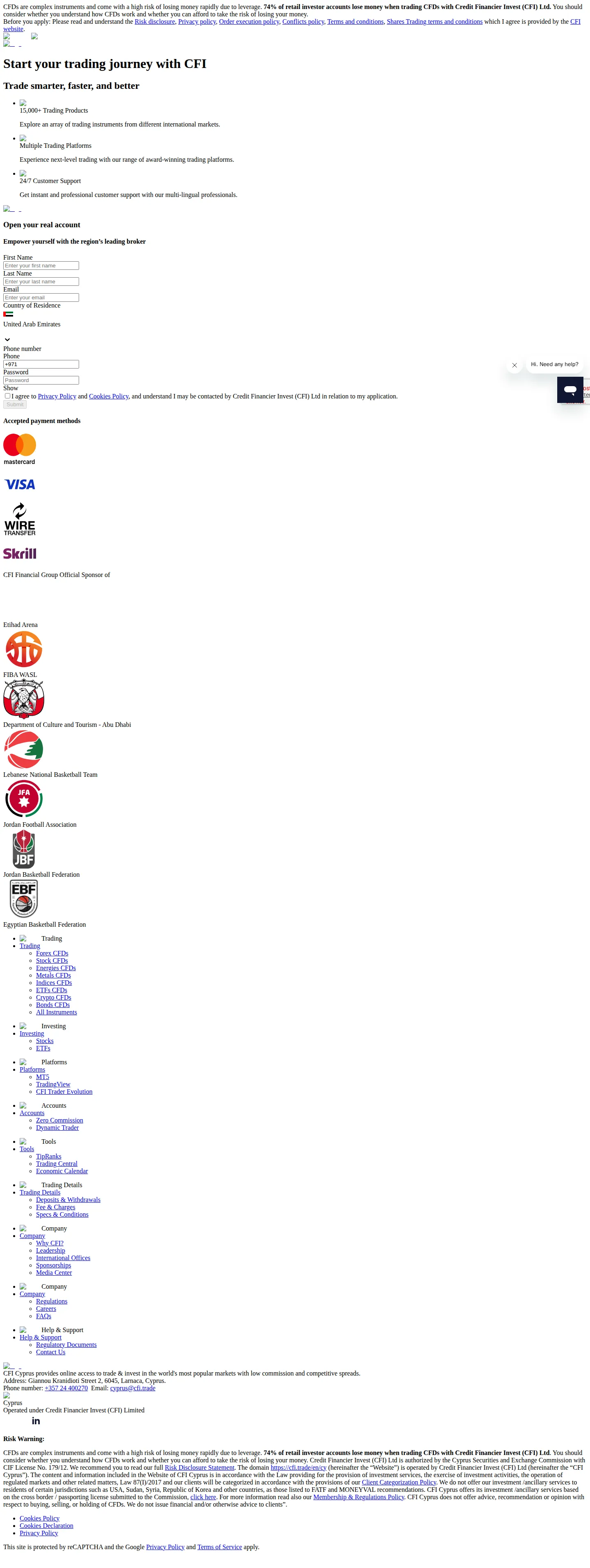
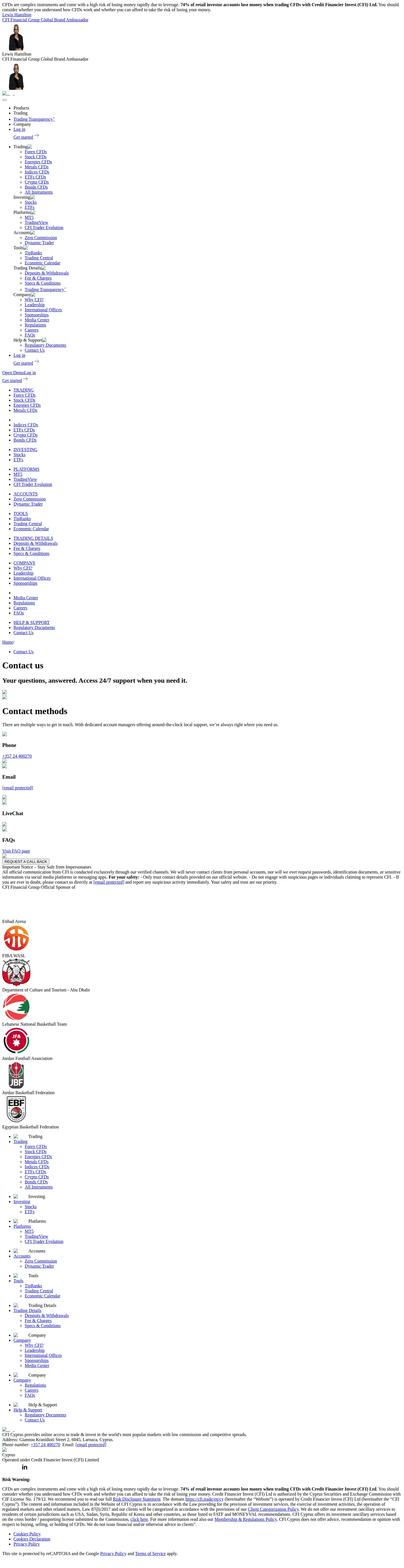
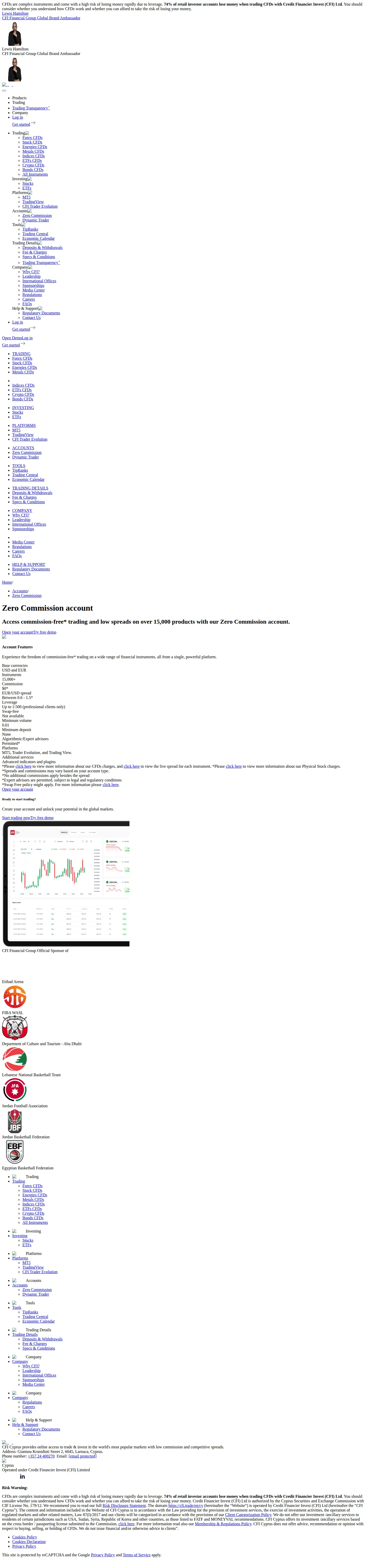
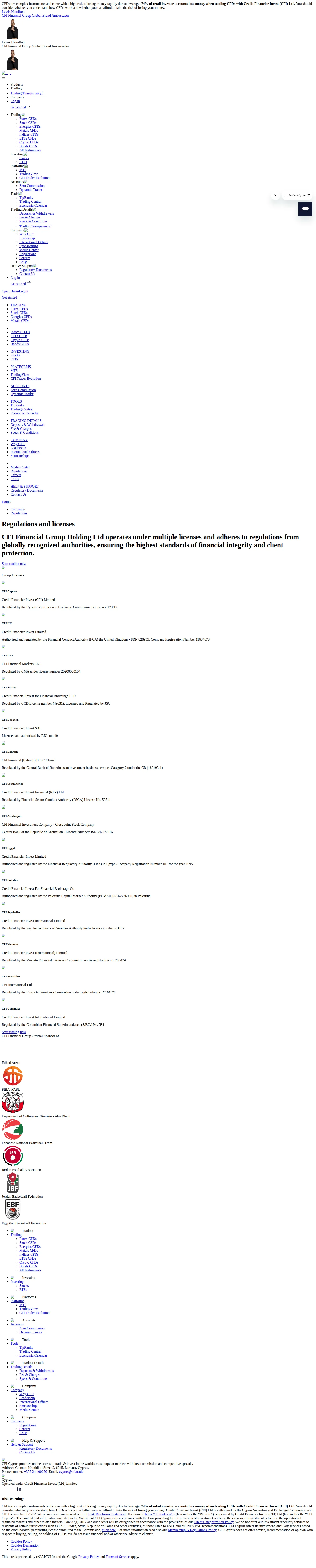

Score history
Recomputed daily; every move is on the record. The current score is always the latest row.
| Date | Score | Move |
|---|---|---|
| 2026-09-30 | 7.0 | ▲ |
| 2026-07-25 | 6.0 | ▲ |
| 2026-07-18 | 5.8 | ▲ |
| 2026-07-11 | 5.6 | · |
FAQ
Is CFI regulated?
Yes, CFI holds confirmed licences in the UK (FCA FRN 828955), Cyprus (CySEC 179/12), Seychelles, Vanuatu and Mauritius.
What does CFI charge?
CFI publishes a spread of USD 6.00 round turn on 1 lot EURUSD under its Zero Commission account; minimum deposit is not published.
What platforms does CFI offer?
CFI offers MetaTrader 5, TradingView, and its own branded apps, including CFI Trader Evolution in the UK and the CFI Trading App for MENA and global entities.
How can I contact CFI support?
CFI can be reached by email, live chat and a published phone number during published hours, though escalation depends on which entity onboarded you.
Is CFI's entity structure transparent?
Not fully: country pages show different legal entities and risk-warning percentages, and the UAE regulator’s register lists a different website than cfi.trade.
What do users say about CFI?
CFI has a blended rating of 4.40 stars across 3932 reviews.
How this review works
Track CFI live: score moves and red notices, in your pocket.