
CFD · CHECKED 10 OCT 2026
Cryptorocket review.
CFD and forex broker with no confirmed regulatory licence
RISKY
OUT OF 10
Cryptorocket is listed as a CFD and forex broker, but no licence or registration is confirmed on any regulator register. The only claim that it operates unregulated out of St Vincent and the Grenadines comes from our earlier review, while its own current pages describe a crypto wallet instead. Spreads and deposit minimums are competitive, but the regulatory picture is the biggest reservation.
Each criterion is scored 1 to 10 from primary sources. The overall score is their unweighted mean. How scoring works.
| Founded | 2018 |
|---|---|
| Minimum deposit | $10 |
| Maximum leverage | 500:1 |
| Minimum spread | 0.1 |
| Account opening | 1-3 |
| Platforms | CryptoRocket wallet (website, mobile app, web app) |
- Spread from USD 7 round turn on 1 lot EURUSD, Standard Account
- Minimum deposit of USD 10
- Offers its own web platform and its own mobile app
- No licences or registrations confirmed on any regulator register
- Only source calling it an unregulated CFD broker is our earlier review
- Current live pages describe a crypto wallet, not a CFD or forex business
- Own platform pages contradict each other
- Email is the only published support channel
- Blended rating of 2.41 stars across 49 reviews
Overview
TrueBroker is a free broker safety checker, and this page is our review of Cryptorocket, scored 4.3 out of 10 across regulation, fees, platform, support and reviews. The single most important thing to know before reading further: the two firsthand pages we could actually fetch for this firm, a UK root page and an Australian terms-of-service page, describe “CryptoRocket” as a non-custodial cryptocurrency wallet app, with no mention anywhere of CFDs, forex, leverage, spreads, commissions or MT4. Everything about “Cryptorocket” as a CFD/forex broker in this review, the account types, the leverage, the spreads, comes from an earlier published review, not from any page we read ourselves, and is marked as such below.
Overview Table
| Headquarters | St Vincent and the Grenadines, as stated by the earlier review; this is not confirmed on any page of the firm’s own that we fetched |
| Established | 2018, per the earlier review only |
| Countries Served | Not stated. The firm’s own Terms of Service instead list countries the service is closed to: Cuba, Iran, North Korea, Syria, and the Crimea, Donetsk and Luhansk regions of Ukraine, plus anyone on the Australian DFAT, UN, or US OFAC sanctions lists |
| Regulated By | Not stated in any evidence we hold. No licence and no registration appear in our records for this firm |
| Minimum Deposit | $10 for the Standard and Islamic accounts, per the earlier review only |
| Maximum Leverage | 500:1, per the earlier review only |
| Total Instruments | Not stated as a single total. The earlier review breaks this out as 55 forex pairs, 35 crypto pairs, 64 share CFDs, 11 index CFDs, plus an unspecified number of commodities |
| Platforms | MT4 across desktop, web and mobile, per the earlier review only. The firm’s own current pages describe a separate product, a self-custody CryptoRocket wallet app, and say nothing about MT4 or any CFD platform |
| Customer Support | legal@cryptorocket.com for legal notices and contact@cryptorocket.com for general support, both from the firm’s own Terms of Service. The earlier review’s own support-hours claims contradict each other, so we have not repeated a figure here |
| Languages | Not stated |
Facts List
- We searched 1441 warning-list entries mirrored from CYSEC, the FCA and FSC Mauritius, and Cryptorocket appears on none of them. That covers only the regulators we mirror, not a clean bill of health from every regulator worldwide.
- The name on the firm’s own current Terms of Service is “CryptoRocket,” described throughout as a non-custodial cryptocurrency wallet, not as a CFD or forex broker.
- The CFD-broker description of Cryptorocket, 55 forex pairs, 64 share CFDs, $10 minimum deposit, 500:1 leverage, $6-per-lot commission, all comes from our earlier review, not from any page we fetched ourselves.
- We read the firm’s own Terms of Service and found no mention of segregated client funds, negative balance protection, or a corporate ownership structure anywhere in it.
- The firm’s own fee terms, which we read directly, describe a flat 0.1% swap fee inside the wallet, free internal transfers between CryptoRocket users, and no CryptoRocket service fee for sending crypto out to an external address, on top of whatever gas or third-party fees apply.
- Section 11 of the firm’s own Terms caps CryptoRocket’s total liability to a client, for any twelve-month period, at the greater of the fees that client paid in the prior year or A$100.
- Section 15 of the firm’s own Terms puts governing law and exclusive jurisdiction in New South Wales, Australia, for any client anywhere, with a mandatory pre-litigation complaint to legal@cryptorocket.com and a 30-day wait before court proceedings.
- Section 14 of the firm’s own Terms lets CryptoRocket change the terms unilaterally, and lets it shorten or skip the usual 14-day advance notice for adverse changes by citing legal, security or regulatory reasons.
- The earlier review’s own restricted-countries check, run through an Indonesian exit, reported finding no country restrictions, but the pages it checked had not rendered any content; the firm’s own Terms, fetched through an Australian exit, do name restricted countries.
- The earlier review gives two contradictory support-hours claims, 24/7 in one place and 24/5, 9am to 6pm GMT+3, in another; we could not confirm either from the firm’s own pages.
Why Cryptorocket’s score moved from 5.6 to 4.3
Our previous score for this listing was 5.6 out of 10; this review scores it 4.3. The scoring criteria and the evidence behind them both changed between the two reviews, so this is a change in our assessment, not a claim that the firm itself got better or worse. The regulation score, 1 out of 10, reflects that our evidence holds no licence and no registration for either “Cryptorocket” the CFD broker or “CryptoRocket” the wallet operator, and that the two names describe different businesses in our own records rather than one firm we can pin down. The fees score, 8.6, rests on the fee terms we read directly for the wallet product: no CryptoRocket fee to send crypto out, free internal transfers, and a flat, disclosed 0.1% swap fee, a genuinely thin fee structure on the evidence we hold, even though it describes a wallet rather than the CFD trading account the earlier review scored. Platform sits at 5, split between an MT4 claim we could not confirm and a wallet app we could. Support sits at 4, weighed down by the contact-address mismatch and the contradictory hours claims noted above. Reviews sits at 3.1. Together these pull the overall figure down from the earlier 5.6, and the identity conflict between the two names is the fact that should weigh most heavily on a reader deciding whether to trust any of the rest.
Key Takeaways
What the register check and the evidence actually support
The regulation score on Cryptorocket is 1 out of 10. We found no licence and no registration for Cryptorocket in any evidence we hold. Our earlier review’s claim that the firm operates from St Vincent and the Grenadines is carried here as a claim from our earlier review, not as something we confirmed on a regulator’s site. We searched 1,441 warning-list entries mirrored from CYSEC, the FCA and the FSC Mauritius, and Cryptorocket matches none of them. That is a real finding, and it is the only clean result in this review, but it covers three lists, not a global check, and it is not a substitute for a licence.
Set against that 1/10, fees score 8.6. That gap is worth sitting with rather than smoothing over: the fee figures behind the CFD score come entirely from our earlier review ($6 per lot commission, spreads from 0.1 pips, no fees on card, wire or Bitcoin deposits), not from anything we read on the firm’s own pages. The only fee material we did read firsthand, the CryptoRocket wallet’s Terms and Conditions, describes a different product: a flat 0.1% in-app swap fee on top of spread, slippage and network costs, free outbound sends beyond the blockchain’s own gas fee, and free off-chain internal transfers between wallet users.
Two businesses under one name
Our earlier review describes an unregulated CFD/forex broker: MT4, 55 currency pairs, 64 share CFDs, 500:1 leverage, a Standard and an Islamic account each opening at $10. The firm’s own live pages we fetched, the firm’s UK home page and the firm’s Australian terms page, describe something else entirely: a non-custodial cryptocurrency wallet app for holding, sending and swapping Bitcoin, Ethereum, Solana, Base and Tron assets, with no mention of CFDs, forex, leverage, spreads, commissions or MT4 anywhere in them. We cannot reconcile these into one product. Anyone weighing the account types, leverage terms or negative-balance protection reported in our earlier review should know that none of it appears on the pages CryptoRocket currently publishes.
What CryptoRocket’s own terms bind a client to
The wallet’s Terms and Conditions we read firsthand are one-sided in the client’s disfavour. Section 11 caps CryptoRocket’s total liability to a client, across any twelve-month period, at whichever is higher of the fees that client paid in the prior year or A$100, and separately excludes all indirect, consequential and lost-opportunity damages. Section 12 requires the client to indemnify CryptoRocket, including its legal fees, for losses arising from the client’s own use of the service. Section 13 lets CryptoRocket suspend or terminate a client’s access “with or without notice” on broadly worded grounds. Section 14 lets CryptoRocket change the terms unilaterally and shorten or skip the 14-day advance notice it otherwise promises for adverse changes, citing legal, security or regulatory reasons. Section 15 sends any unresolved dispute, regardless of where the client lives, to the exclusive jurisdiction of the courts of New South Wales, after a mandatory pre-complaint step through legal@cryptorocket.com. Section 6 states plainly that funds sent to the wrong address, network or asset are “typically lost” and cannot be recovered by CryptoRocket, and Section 7 disclaims responsibility for the acts or outages of the third-party providers (Mercuryo, 0x, Jupiter, SunSwap) the wallet actually routes transactions through.
Support and reviews
Support scores 4/10. The only support contacts we found firsthand are legal@cryptorocket.com and contact@cryptorocket.com, on the wallet’s terms page, neither matching the support@cryptorocket.com address our earlier review lists. Our earlier review is also internally inconsistent about its own claimed hours, stating in one place that support runs 24/7 and in another that it runs 24/5 and is unavailable on weekends; neither version comes from a page we fetched. Reviews scores 3.1/10, reflecting that the account, platform and instrument detail behind this listing rests on an earlier review of a CFD broker that the firm’s current pages do not corroborate, alongside an unresolved claim, also from that earlier review, that Cryptorocket’s ownership structure and fund-segregation practices could not be independently verified.
Why the score moved from 5.6 to 4.3
Our previous score for Cryptorocket was 5.6 out of 10; this review scores it 4.3. That change reflects this review’s own assessment against the evidence above, not any change at the firm. The regulation score of 1/10 and the reviews score of 3.1/10 both rest on the same problem: the CFD-broker facts that would support a higher score come only from an earlier, unverified review, while the only pages we could fetch directly describe an unrelated wallet product with none of the licensing or track-record detail a CFD broker listing would need.
Licenses & Regulation
Cryptorocket’s own claim to be an online CFD/forex broker does not appear anywhere on the firm’s current live pages in our evidence. That description, along with the claimed founding year of 2018 and a base in St Vincent and the Grenadines, comes from our earlier review, not from anything we fetched ourselves. The only pages that rendered content firsthand describe a different business under a near-identical name: “CryptoRocket,” the operator of a non-custodial cryptocurrency wallet, referred to in its own terms as “we”, “us”, “our”, or “CryptoRocket”. Its terms cover a wallet app for holding, sending and swapping crypto, Rocket ID payments and merchant discovery. Nothing in that document mentions CFDs, forex, leverage, spreads, commissions or the MT4 platform that our earlier review describes in detail. We cannot say which of these two businesses a person signing up today would actually meet, or whether they are the same entity at all.
No licence or registration found for Cryptorocket
We found no licence and no registration for this firm in the evidence gathered for this review. Nothing in the pages we fetched names a regulator, a licence number, or a registered company behind either the “Cryptorocket” CFD brand described in our earlier review or the “CryptoRocket” wallet operator whose terms we read firsthand. A CFD broker’s regulatory status is normally the first thing worth checking against a named register; here there is no permission on record to check.
What our warning-list search on Cryptorocket showed
We searched 1,441 warning-list entries mirrored from CYSEC, the FCA and the FSC Mauritius, and Cryptorocket appears on none of them. That is a clean result as far as it goes, and it is one our earlier review did not have. It only covers the three regulators we mirror, not every regulator worldwide, and a clean warning-list search is not the same thing as holding a licence anywhere.
What CryptoRocket’s own terms say about restricted jurisdictions
Our earlier review’s own restricted-countries check, run through an Indonesian exit point on 27 July 2026 against cryptorocket.com’s homepage, legal, terms and legal-documents pages, reported finding “no statement restricting particular countries.” The firm’s terms of service that we fetched firsthand through an Australian exit point, last updated 20 April 2026, say otherwise: they bar use by anyone located in, ordinarily resident in, or a citizen of a country or region under blanket sanctions from the Australian government, the UN Security Council, US OFAC, the UK or the EU, and name Cuba, Iran, North Korea, Syria, and the Crimea, Donetsk and Luhansk regions of Ukraine as falling under that bar at the date of the terms, with the list subject to change as sanctions programmes change. The terms also bar anyone listed on the Australian DFAT Consolidated List, the UN Consolidated List, or the OFAC Specially Designated Nationals list, and require users to be at least 18 and to have legal capacity to enter a binding contract in their own jurisdiction. Separately, the terms note that some features may be switched off in particular jurisdictions for legal, tax or regulatory reasons, without notice.
Governing law and dispute resolution
Section 15 of CryptoRocket’s terms states the agreement is “governed by the laws in force in New South Wales, Australia,” and that the user and CryptoRocket “submit to the exclusive jurisdiction of the courts of New South Wales.” The same section requires a user to first contact legal@cryptorocket.com and allow up to 30 days before starting court proceedings. Whatever a user’s own location, any unresolved dispute under this contract routes through Australian courts after a mandatory pre-litigation step, which is a meaningfully different proposition from being supervised by a regulator in the user’s own market.
Why this review’s regulation score is lower
Our previous review of this broker scored regulation, alongside everything else, to an overall 5.6 out of 10. This review scores regulation at 1 out of 10 and lands at an overall 4.3. We are restating the score from the evidence gathered for this pass, not from any change in the firm itself. What drove the regulation score down here: no licence or registration turned up anywhere in the evidence, the entity our earlier review describes as a regulated-sounding CFD broker cannot be reconciled with the wallet operator whose terms we actually read, and the one jurisdictional fact we could verify firsthand, the sanctioned-countries list in CryptoRocket’s own terms, was missed entirely by our earlier review’s own country check. A clean result across 1,441 mirrored warning-list entries is worth noting, but it does not stand in for a licence, and none was found.
How to Trade
Cryptorocket’s own back-catalogue description, carried over from an earlier review of this firm, is of an unregulated forex and CFD broker set up in 2018, registered in St Vincent and the Grenadines, and trading through MetaTrader 4. We did not confirm any of this on the firm’s current live pages, and none of the details below that are marked as coming from that earlier review were verified firsthand.
The trading offer as the earlier review described it
That earlier review put the Standard account minimum deposit at $10, with a $6 per lot commission on top of spreads from 0.1 pips, leverage as high as 500:1, a minimum trade size of 0.01 lots and a maximum of 100 lots, scalping and hedging both allowed, and free VPS hosting. It described an Islamic account at the same $10 minimum, swap-free and otherwise identical to Standard, and a demo account loaded with $10,000 in virtual funds, valid for 30 days and extendable on request. On instruments, it listed 55 forex pairs, 35 crypto pairs (crypto/fiat and crypto/crypto), 64 share CFDs including Apple, Facebook, Google and Tesla, 11 index CFDs including the S&P 500, NASDAQ 100, FTSE 100 and DAX 30, and commodity CFDs in precious metals and energies, all executed through MT4 on desktop, web and mobile. We are restating this rather than reporting it as fact: it reached us from the earlier published review, not from a page we fetched ourselves.
What Cryptorocket’s own current pages show instead
The firm’s own Terms of Service, fetched through an Australian exit and last updated 20 April 2026, describe a different product: a non-custodial cryptocurrency wallet, referred to throughout as “we”, “us”, “our”, or “CryptoRocket”, covering “your access to and use of the CryptoRocket website, mobile and web applications”. That document makes no mention anywhere of CFDs, forex, leverage, spreads, per-lot commission, or MT4. The wallet holds and moves Bitcoin; Ethereum and ERC-20 tokens including USDT and USDC; Base (an Ethereum layer 2) and its supported ERC-20 tokens; Solana and SPL tokens including USDT and USDC; and Tron and TRC-20 tokens including USDT and USDC, on mainnet only. Users can send crypto to an external address, transfer to another CryptoRocket wallet user, or swap through an in-app aggregator, and can bring in fiat through a third-party on-ramp, Mercuryo, to buy crypto by card or bank transfer.
What Cryptorocket charges on the wallet side
The Terms set an in-app swap service fee of a flat 0.1%, charged on top of whatever spread, slippage, and gas or network fee the underlying liquidity aggregator or blockchain applies. Sending crypto out to an external address carries no CryptoRocket service fee, though the sender still pays the network’s own gas fee. Transfers between two CryptoRocket wallet users are free and, where the network supports it, settled off-chain. Swaps routed through third-party aggregators named in the Terms, including 0x, Jupiter and SunSwap, and the Mercuryo on-ramp, carry their own fees, set by those third parties and disclosed before the transaction is confirmed rather than by CryptoRocket itself.
Why platform scores where it does
The platform score of 5/10 reflects that split evidence base: we can describe a live, documented wallet app with a stated fee schedule, but we have nothing firsthand to confirm the MT4 CFD trading platform, leverage terms, or instrument list the earlier review attributed to this firm. A reader who came here expecting to trade CFDs on 500:1 leverage through MT4 would be evaluating a product we could not locate on Cryptorocket’s own current pages.
Terms that bind a Cryptorocket wallet user
Whatever the underlying business, the Terms we did read set out clauses that would bind anyone using the current CryptoRocket app. Section 6 states that “if you send funds to the wrong address, to an address on the wrong network, or in the wrong asset, those funds are typically lost and CryptoRocket cannot recover them for you.” Section 11 caps total liability for any 12-month period at the greater of the fees the user paid CryptoRocket in the prior year or A$100, and separately excludes liability for “any indirect, incidental, special, consequential, exemplary, or punitive damages, or for any loss of profits, loss of revenue, loss of business opportunity.” Section 7 disclaims responsibility for “the acts, omissions, outages, latency, slippage, quotes, sanctions screening decisions, know-your-customer (KYC) decisions, or compliance practices” of the third-party services it routes through, naming Mercuryo, 0x, Jupiter and SunSwap. Section 3 puts the burden on the user: “You are responsible for all activity that occurs under your account, whether or not authorised by you, except to the extent caused by our wilful misconduct or gross negligence.” None of these clauses mention margin, leverage, stop-outs, or negative balance protection, because the document they sit in is a wallet agreement, not a CFD trading agreement.
Account Types
Our earlier review described Cryptorocket as a CFD and forex broker running a three-tier account structure. We could not confirm any of it against a live page: the only pages from this firm that actually rendered content in our evidence describe a different product entirely, a non-custodial cryptocurrency wallet operated by an entity styled “CryptoRocket”, with no mention anywhere of CFD accounts, leverage, spreads, lot sizes or MT4. What follows separates the two clearly.
The account tiers the earlier review reported
Per our earlier review, Cryptorocket’s Standard Account opened with a $10 minimum deposit, spreads quoted from 0.1 pips, a $6 commission per lot, leverage up to 500:1 on MT4, a minimum trade size of 0.01 lots and a maximum of 100 lots, with scalping and hedging permitted and free VPS hosting thrown in. The same source described an Islamic Account at the same $10 minimum, swap-free and otherwise identical to the Standard tier, and a Demo Account loaded with $10,000 in virtual funds, valid for 30 days and extendable on request. None of these figures, account names or minimum deposits appear on any page we fetched from the firm directly, so we are reporting them as the earlier review’s findings, not as something Cryptorocket’s own site currently states.
What CryptoRocket’s own terms describe instead
The Terms of Service we read (last updated 20 April 2026) set up a self-custody wallet app, not a trading account. There is no account tier, no minimum deposit and no leverage figure in it. What it does set out is a fee structure for moving crypto: an in-app swap carries a flat 0.1% CryptoRocket service fee on top of whatever spread, slippage and gas or network fee the underlying liquidity aggregator charges. Sending crypto out of the wallet to an external address carries no CryptoRocket service fee, though the user still pays the relevant blockchain’s network fee. Internal transfers between two CryptoRocket wallet users are free and settle off-chain where supported. Network (gas) fees are set by the blockchain itself and are not disclosed as a figure in the terms, and any third-party fee, for example from the fiat on-ramp Mercuryo or the swap aggregators 0x, Jupiter and SunSwap named in the document, is set by that third party and disclosed before the transaction is confirmed, not collected by CryptoRocket. The wallet supports Bitcoin, Ethereum and ERC-20 tokens including USDT and USDC, Base and its supported ERC-20 tokens, Solana and SPL tokens including USDT and USDC, and Tron and TRC-20 tokens including USDT and USDC, mainnet only. This reads as a wallet fee schedule, not a trading-account fee schedule, and the terms say nothing about commissions per lot, spread markups on CFD instruments, or the account minimums our earlier review described.
Who Cryptorocket’s own terms say can hold an account
The same terms set eligibility conditions that would apply to any account or wallet opened under them: a user must be at least 18 and have legal capacity to enter a binding contract in their jurisdiction, must not be located in, ordinarily resident in, or a citizen of a country or region under blanket sanctions from the Australian government, the UN Security Council, US OFAC, the UK or the EU, and at the date of the terms this list named Cuba, Iran, North Korea, Syria, and the Crimea, Donetsk and Luhansk regions of Ukraine without limiting itself to that list. A user also must not appear on a consolidated sanctions list such as the Australian DFAT Consolidated List, the UN Consolidated List or the OFAC Specially Designated Nationals list. The terms add that some features may be switched off in particular jurisdictions for legal, tax or regulatory reasons without notice.
Put together, a reader who came to Cryptorocket for a $10 CFD account with 500:1 leverage and a $6-per-lot commission is relying entirely on an earlier review’s account of the business; the pages we could fetch from the firm today describe a crypto wallet with a 0.1% swap fee and no trading-account structure at all.
Negative Balance Protection
Negative balance protection is a margin-trading term: it describes whether a leveraged account gets closed out before losses exceed the money sitting in it. The evidence here does not let us answer that question cleanly, because our evidence holds two different descriptions of what this firm is: our earlier review says every Cryptorocket trading account carries negative balance protection, but neither publication attaches a stop-out level or a margin-call threshold to any account.
What our earlier review claimed, without a policy attached
The earlier published review describes a Standard Account and an Islamic Account, both opened with a $10 minimum, offering leverage up to 500:1 on MT4, with a minimum trade size of 0.01 lots and a maximum of 100 lots, and commissions of $6 per lot. At 500:1, a client’s market exposure runs five hundred times their margin, which is exactly the leverage tier where a negative balance protection policy matters most: it is the difference between losing a deposit and owing money back to the broker after a fast-moving market gaps through a stop-loss. Our earlier review says every Cryptorocket trading account carries negative balance protection, capping a client’s loss at the balance in the account, but it does not attach a margin-call level or a stop-out percentage to either account, swap-free Islamic account included, and none of the firm’s own current pages in our evidence mention leverage, margin, MT4, or CFD trading at all to fill that gap.
What Cryptorocket’s actual current pages say about loss instead
The only pages from this firm that rendered content describe a non-custodial cryptocurrency wallet, not a leveraged trading account, and its Terms of Service handle loss through a different set of clauses entirely. Section 11, Limitation of liability, caps CryptoRocket’s total liability to a client for any claim arising in a twelve-month period at whichever is higher of the fees that client paid CryptoRocket in the preceding twelve months or one hundred Australian dollars, and separately rules out any liability for indirect, incidental, special, consequential, exemplary or punitive damages, including lost trading or business opportunity. Section 6, on irreversible transactions, states that funds sent to the wrong address, the wrong network, or the wrong asset “are typically lost and CryptoRocket cannot recover them for you.” Section 3 puts responsibility for all account activity on the client, “whether or not authorised by you,” unless the client can show CryptoRocket’s own wilful misconduct or gross negligence caused it. Section 12 goes further and requires the client to indemnify CryptoRocket, covering its legal fees and losses, for claims arising from the client’s own use of the service.
None of that is a margin mechanism. A self-custody wallet does not extend credit the way a leveraged CFD account does, and the Terms describe no route by which CryptoRocket lends against a client position or a client could end up owing CryptoRocket money. What the clauses do establish is an asymmetric cap: CryptoRocket’s own exposure to a client is capped at one hundred Australian dollars or a year of the client’s fees, while the client’s exposure to loss, whether from a wrong-address transfer, a compromised account, or a third-party swap aggregator’s failure, is carried by the client with no cap stated anywhere. Section 7 disclaims responsibility for the “acts, omissions, outages, latency, slippage, quotes, sanctions screening decisions, know-your-customer (KYC) decisions, or compliance practices” of the third-party providers named in the Terms, Mercuryo, 0x, Jupiter and SunSwap, so a loss caused by one of those integrations falls on the client rather than the firm.
We searched 1,441 warning-list entries mirrored from CySEC, the FCA and the FSC Mauritius, and Cryptorocket matches none of them; that result is a clean one, but it speaks to warning-list status, not to loss limits, and it cannot stand in for the negative balance policy that neither publication in our evidence discloses.
Trading Instruments
What the earlier review said Cryptorocket traded
The earlier published review described Cryptorocket as a CFD and forex broker built around MetaTrader 4, listing 55 forex pairs across majors, minors and exotics with spreads quoted from 0.1 pips on EUR/USD, 64 share CFDs on US, UK and European names including Apple, Facebook, Google and Tesla, 11 index CFDs covering the S&P 500, NASDAQ 100, FTSE 100 and DAX 30, commodity CFDs on gold, silver, crude oil and natural gas, and 35 crypto CFD pairs spanning both crypto-to-fiat and crypto-to-crypto combinations. That same earlier review put commission at $6 per lot on the Standard and Islamic accounts and leverage as high as 500:1. None of these figures come from a page we fetched ourselves; they are the earlier review’s numbers, restated here rather than quoted, because we could not find any of them on a page CryptoRocket currently serves.
What CryptoRocket’s own terms actually describe
CryptoRocket’s terms of service, which we read directly, describe a different product. They cover, in the firm’s own words, “your access to and use of the CryptoRocket website, mobile and web applications” as a non-custodial cryptocurrency wallet built around a Rocket ID payments feature, merchant discovery, and an in-app swap function across a fixed set of networks. The networks the terms name are Bitcoin; Ethereum and ERC-20 tokens including USDT and USDC; Base, described as a layer-2 network, and its supported ERC-20 tokens; Solana and SPL tokens including USDT and USDC; and Tron and TRC-20 tokens including USDT and USDC. The terms specify mainnet only, with no testnet support. Nothing in this document mentions CFDs, forex, share or index CFDs, commodities, leverage, spreads, per-lot commission or MT4.
Swapping inside the CryptoRocket wallet
Swaps executed through the wallet carry a flat 0.1% CryptoRocket service fee on top of whatever spread, slippage and gas or network fee the underlying liquidity aggregator or network charges, according to the terms. Sending crypto out to an external address carries no CryptoRocket service fee, though the terms note the client still pays the network’s own gas fee, and internal transfers between two CryptoRocket wallet users are free and settled off-chain where supported. A separate fiat-to-crypto on-ramp, run through the third party Mercuryo, lets a client buy crypto with a card or bank transfer; the terms say Mercuryo’s own fees are disclosed before the transaction is confirmed and are paid to Mercuryo, not to CryptoRocket. The terms also name the swap-routing providers 0x, Jupiter and SunSwap, and state that CryptoRocket is not liable for the acts, omissions, outages, latency, slippage or quotes of any of these third-party services.
Who CryptoRocket will let hold these assets
The terms bar anyone located in, ordinarily resident in, or a citizen of a country or region subject to blanket sanctions administered by the Australian government, the UN Security Council, US OFAC, the UK or the EU, and name Cuba, Iran, North Korea, Syria, and the Crimea, Donetsk and Luhansk regions of Ukraine as covered by that list at the date of the terms, noting the list can change with sanctions programmes. The terms separately bar anyone listed on the Australian DFAT Consolidated List, the UN Consolidated List or the OFAC Specially Designated Nationals list, and require users to be at least 18 with legal capacity to enter a binding contract in their own jurisdiction. They also warn that certain features can be made unavailable, or disabled without notice, in specific jurisdictions for legal, tax or regulatory reasons.
The gap
Set side by side, the two descriptions cannot both be describing the same live offering: one is a leveraged CFD book spanning forex, shares, indices, commodities and crypto at up to 500:1 gearing, the other is a self-custody wallet limited to five blockchain networks with no CFD instrument, spread, commission or leverage figure anywhere in its own terms. We searched 1441 warning-list entries mirrored from CYSEC, the FCA and the FSC Mauritius and found no match for this firm on any of them, which is worth stating plainly since it is a clean result the earlier review did not have. That result says nothing, though, about which of the two product descriptions, broker or wallet, is the one a client would actually be signing up to today.
Education & Analysis
Cryptorocket’s platform story splits into two documents that describe two different businesses, and neither one gives a full account of any charting or analysis tooling.
The platform our earlier review describes
The earlier published review this rewrite draws on describes Cryptorocket as running MetaTrader 4 as its sole trading platform, available as a Windows and Mac desktop client, a browser-based WebTrader, and mobile apps for iPhone and Android. On top of MT4 it lists a Standard account with spreads from 0.1 pips, $6-per-lot commission, leverage up to 500:1, a minimum trade size of 0.01 lots and a maximum of 100 lots, scalping and hedging permitted, and free VPS hosting; an Islamic swap-free variant of the same account; and a demo account loaded with $10,000 in virtual funds for 30 days, extendable on request. None of this is something we read on a Cryptorocket page ourselves. It reached us second-hand, from our earlier review, and none of it appears anywhere on the firm’s own current pages.
What CryptoRocket’s own terms actually describe
The only firsthand document in our evidence that rendered content, the firm’s own Terms of Service fetched through an Australian exit, describes something else entirely: a non-custodial cryptocurrency wallet. It defines its platform as “your access to and use of the CryptoRocket website, mobile and web applications”, built around Rocket ID payments, merchant discovery, and in-app swaps. The wallet holds and moves Bitcoin; Ethereum and its ERC-20 tokens including USDT and USDC; the Base layer-2 network and its supported ERC-20 tokens; Solana and SPL tokens including USDT and USDC; and Tron and its TRC-20 tokens including USDT and USDC, on mainnet only, with no testnet support. In-app swaps carry a flat 0.1% CryptoRocket service fee on top of whatever spread, slippage, and gas or network fee the underlying liquidity aggregator or blockchain charges, and the terms name Mercuryo, 0x, Jupiter, and SunSwap as the third-party swap and on-ramp providers actually doing the routing. Sending crypto out to an external address carries no CryptoRocket fee beyond the network’s own gas cost, and transfers between two CryptoRocket wallet users settle free and off-chain where supported.
Nowhere in that document is there a mention of MT4, WebTrader, CFDs, forex pairs, leverage, spreads on a trading instrument, or any charting or technical-analysis feature. The terms are about custody, swaps, and payments, not about placing and managing leveraged trades.
Cryptorocket’s CFD claims against CryptoRocket’s live wallet terms
These two accounts cannot both describe the same live product. Our earlier review’s version of Cryptorocket is an unregulated CFD and forex broker built on MT4; the firm’s own current terms describe CryptoRocket as a self-custody wallet app with swap and payment features and nothing resembling a trading platform. A reader who came to this review looking for the charting tools, indicators, or order types that MT4 would normally supply is being asked to evaluate a product against a document that never mentions it. We have no firsthand page describing a Cryptorocket trading terminal at all, and no firsthand page confirming that any of our earlier review’s account terms, leverage figures, or platform choices still apply, or ever did.
We also could not find any wallet-side analysis or research feature described in the terms we fetched: no mention of price charts, portfolio analytics, market data feeds, or technical indicators inside the CryptoRocket app. That silence covers only the one document we read, the Australian-exit Terms of Service, and does not extend to whatever the app’s interface itself may or may not show; a terms-of-service document is not the place a wallet provider would normally describe its charting screens.
We searched 1441 warning-list entries mirrored from CYSEC, the FCA, and the FSC of Mauritius for either name, Cryptorocket or CryptoRocket, and found no match on any of the three lists. That result covers only the regulators we mirror and says nothing about platform quality or the accuracy of either account of what the firm runs.
Special Offers
Cryptorocket does not publish anything on its own current pages that reads as a promotion, welcome bonus, deposit match, or discount code. The only two pages in our evidence that actually rendered content, the wallet’s Terms of Service fetched through an Australian exit and a root page fetched through a UK exit, describe a non-custodial cryptocurrency wallet app, and neither mentions an offer tied to deposit size, trading volume, or account tier. That is what we hold: two firsthand pages, neither one an offers page, not a statement that no offer exists anywhere.
What the CryptoRocket wallet terms actually price
The Terms of Service we read set out a fee structure, but it is a wallet’s fee structure, not a trading incentive. Swaps run through the CryptoRocket wallet carry a flat 0.1% in-app service fee on top of whatever spread, slippage, and gas or network fee the underlying liquidity aggregator or blockchain charges. Sending crypto out to an external address carries no CryptoRocket service fee, only the network’s own gas fee. Internal transfers between two CryptoRocket wallet users are free and settle off-chain where supported. None of this is framed in the terms as a limited-time or promotional rate; it reads as the standing cost of using the wallet.
Where the wallet routes a user to a third party, the terms name the third party rather than CryptoRocket as the one setting the fee: a fiat on-ramp through Mercuryo, and swap aggregation through providers including 0x, Jupiter, and SunSwap. Section 7 of the terms states CryptoRocket “is not liable for the acts, omissions, outages, latency, slippage, quotes, sanctions screening decisions, know-your-customer (KYC) decisions, or compliance practices” of those third parties, and that their fees are disclosed before a transaction is confirmed but paid to them, not to CryptoRocket.
What the earlier review reported, not confirmed here
The earlier published review described a different business under a near-identical name, “Cryptorocket,” an unregulated CFD and forex broker offering a Standard account and an Islamic swap-free account, each with a $10 minimum deposit, and a demo account loaded with $10,000 in virtual funds valid for 30 days and, per that review, extendable on request. That earlier review also listed free VPS hosting as a feature of the Standard account. We did not read a page describing any of this ourselves; it comes from the earlier review’s account of the firm, not from anything on Cryptorocket’s current live pages, and it should be read as a claim that earlier publication made, not as a promotion we can point to on the firm’s own site today. A $10,000 demo balance and free VPS hosting, if they exist, function as standard account features rather than discretionary promotional offers in any case, since the earlier review did not describe either as time-limited or conditional on new sign-ups.
The identity gap behind the missing offers page
The gap here is not incidental. The pages that actually loaded content for our evidence describe a self-custody crypto wallet, Rocket ID payments, merchant discovery, in-app swaps across Bitcoin, Ethereum, Solana, Base, and Tron, with no mention anywhere of CFDs, forex, leverage, spreads, or MT4. The CFD-broker facts in the earlier review, including any bonus or account-tier claims, describe a product that does not appear on the firm’s current site as fetched for this review. A reader looking for a Cryptorocket trading promotion today has, on this evidence, a wallet app’s standing fee schedule to look at and an older review’s account of a broker to weigh against it, not a live promotions page from either version of the business.
Opening an Account
Getting an account open with Cryptorocket
The account details in this section come from the earlier published review, not from any page we fetched ourselves. That review describes a Standard Account and an Islamic Account, both opening with a $10 minimum deposit, and a Demo Account loaded with $10,000 in virtual money that runs for 30 days and can reportedly be extended on request. The Standard Account is described as carrying spreads from 0.1 pips, a $6 per lot commission, leverage up to 500:1, a minimum trade size of 0.01 lots and a maximum of 100 lots, with scalping and hedging both allowed and free VPS hosting included. The Islamic Account is described as the same account with swaps removed. None of this appears on any page we fetched directly, so treat it as what the earlier review reported rather than as something this firm’s own site currently states.
That gap matters here more than usual. The only pages in our evidence that actually rendered content, an Australian terms page and a UK root page, describe a different business entirely: a non-custodial cryptocurrency wallet app built around Rocket ID payments, merchant discovery and in-app swaps across Bitcoin, Ethereum, Solana, Base and Tron. Nothing on those pages mentions CFDs, forex, leverage, spreads, commissions or MT4. We cannot tell a reader how to open a CFD trading account with this firm today, because the account-opening mechanics we do have on hand describe a crypto wallet, not a broker.
What the wallet terms require of a user
Where we do have firsthand material, it is the CryptoRocket wallet’s own Terms of Service, and it sets out who may use the service rather than how a trading account is opened. A user must be at least 18 years old and have the legal capacity to enter a binding contract in their own jurisdiction. The terms also bar anyone located in, ordinarily resident in, or a citizen of a country or region under blanket sanctions from the Australian Government, the UN Security Council, US OFAC, the UK or the EU, and name Cuba, Iran, North Korea, Syria, and the Crimea, Donetsk and Luhansk regions of Ukraine as falling under that bar at the date of the terms, while noting the list can change as sanctions programmes change. Separately, the terms exclude anyone listed on a consolidated sanctions list such as the Australian DFAT Consolidated List, the UN Consolidated List or the OFAC Specially Designated Nationals list. The terms also warn that certain features may be switched off in specific jurisdictions for legal, tax or regulatory reasons, without notice.
Our earlier review’s own restricted-countries note is worth flagging directly. It says that after checking cryptorocket.com’s homepage, legal, terms and legal document pages through an Indonesian exit on 27 July 2026, it found “no statement restricting particular countries.” our evidence shows why: those Indonesia-exit pages loaded as empty 4,965 byte shells that never rendered their content, while the Australia-exit terms page rendered in full at 33,626 bytes and does contain the sanctioned-country list above. The “no list found” conclusion came from a page that had not actually loaded.
Verification and account access, and what is missing
The wallet terms make the user responsible for all activity on their account, authorised or not, unless CryptoRocket’s own wilful misconduct or gross negligence caused it, under section 3, Accounts and authentication. Beyond that responsibility clause, nothing in the firsthand pages sets out a KYC or identity verification process, document requirements, or a step by step signup flow. The firsthand pages also describe CryptoRocket’s own suspension and termination power rather than a user’s account opening path: under section 13, Suspension, termination, and account closure, “we may suspend, restrict, or terminate your access to any or all of the Services, with or without notice, if we reasonably believe” the stated grounds apply, which gives the firm broad, one-sided discretion over access once an account exists.
Our warning list search covered 1,441 entries mirrored from CYSEC, the FCA and the FSC Mauritius, and Cryptorocket matched none of them. That result only covers the three lists we mirror, not every regulator, and it says nothing about whether the CFD trading account described in our earlier review can currently be opened at all.
This review scores Cryptorocket 4.3 out of 10, down from our previous 5.6. The fees score sits at 8.6 on the strength of the wallet’s disclosed fee structure, but regulation scores just 1, reviews scores 3.1, platform sits at 5 and support at 4. Those lower marks reflect the same problem running through this whole section: we cannot verify from the firm’s own current pages that the CFD account opening process our earlier review describes still exists, and the wallet terms we can verify say nothing about opening a trading account at all.
Deposits & Withdrawals
Our evidence for this section splits into two accounts that do not describe the same business. Our earlier review talks about “Cryptorocket” as a CFD and forex broker taking card, wire and Bitcoin deposits into trading accounts. The firm’s own Terms of Service, fetched live from its Australian pages, describe “CryptoRocket” as a non-custodial cryptocurrency wallet with an in-app swap function, a Rocket ID payments feature and links to third-party on-ramp and swap providers. Nothing in the firsthand terms mentions a trading account, a spread, a commission or a withdrawal request queue. We report both pictures below and mark which is which, because a reader moving funds into this platform needs to know which product they are actually dealing with.
What our earlier review says about funding Cryptorocket
Per our earlier review, Cryptorocket accepted deposits by credit or debit card (Visa, Mastercard, instant, no fee from the broker), by wire transfer (2 to 5 business days, no fee from the broker) and by Bitcoin transfer (instant deposit, 2 to 5 business day withdrawal, no fee from the broker). None of this appears on any page we fetched firsthand for this review, and we did not read a deposits or withdrawals page ourselves to check the currencies, minimums or processing times the earlier review reported.
What CryptoRocket’s own terms say about moving crypto through the wallet
The firm’s Terms of Service, which we did read directly, describe a different set of charges attached to a self-custody wallet rather than a broker account. A swap executed inside the CryptoRocket app carries a flat 0.1% service fee on top of the spread, slippage and gas or network fee charged by the underlying liquidity aggregator or blockchain. Sending crypto out of the wallet to an external address carries no CryptoRocket service fee, but the user still pays whatever gas fee the relevant blockchain sets; CryptoRocket does not collect this and does not disclose a figure for it, since it is set by the network at the time of the transaction. Internal transfers between two CryptoRocket wallet users are free and settle off-chain where the terms say that is supported. A fiat-to-crypto on-ramp is available through the third party Mercuryo, and swaps can route through aggregators the terms name as 0x, Jupiter and SunSwap; fees for all of these are set by the third party, not by CryptoRocket, and the terms say they are disclosed before the transaction is confirmed.
The clause that matters most for anyone moving money: transactions are irreversible
Section 6 of the terms states plainly that “if you send funds to the wrong address, to an address on the wrong network, or in the wrong asset, those funds are typically lost and CryptoRocket cannot recover them for you.” Because the wallet is non-custodial, CryptoRocket is telling the user upfront that it has no technical ability to reverse or refund a misdirected transaction, on top of having no obligation to do so. A withdrawal or transfer error here is the client’s loss in full.
What happens if a payment rail fails
Section 7 of the terms disclaims CryptoRocket’s liability for “the acts, omissions, outages, latency, slippage, quotes, sanctions screening decisions, know-your-customer (KYC) decisions, or compliance practices” of the third-party services it names, including Mercuryo and the swap aggregators. If the on-ramp provider mishandles a deposit or a swap aggregator returns a bad price, CryptoRocket’s own position is that it carries no responsibility for that outcome. Separately, Section 11 caps CryptoRocket’s total liability to a client for any claim, across any twelve-month period, at whichever is higher of the fees that client paid CryptoRocket in the previous twelve months or one hundred Australian dollars, and rules out consequential losses such as lost trading or business opportunity entirely. A client whose deposit or withdrawal goes wrong through a fault on CryptoRocket’s own side, rather than a third party’s, is still capped at that figure.
Who cannot use the rails at all
The terms bar access to anyone located in, ordinarily resident in, or a citizen of a country or region under blanket sanctions from the Australian Government, the UN Security Council, US OFAC, the UK or the EU, naming Cuba, Iran, North Korea, Syria, and the Crimea, Donetsk and Luhansk regions of Ukraine as included at the time the terms were last updated, with the list subject to change as sanctions programmes change. The terms also bar anyone appearing on a sanctions list such as the Australian DFAT Consolidated List, the UN Consolidated List or the OFAC Specially Designated Nationals list, and state that particular features may be switched off in specific jurisdictions for legal, tax or regulatory reasons without notice.
What we could not confirm
We could not confirm a minimum deposit, a maximum withdrawal, a withdrawal processing time, a stated currency list, or whether the card, wire and Bitcoin rails our earlier review describes still exist in any form, because no deposits or withdrawals page for a trading account rendered on any firsthand page we fetched. The account-level figures in our earlier review, including the $10 minimum deposit and $6-per-lot commission tied to the Standard and Islamic accounts, come from that earlier review and were not something we read ourselves.
Customer Support
Cryptorocket’s own current pages give two support addresses: legal@cryptorocket.com for legal notices and contact@cryptorocket.com for general support, both listed on the firm’s Terms of Service page. That page describes a non-custodial cryptocurrency wallet, not a CFD broker, and it says nothing about live chat, phone support, callback service or support hours. No channel beyond those two email addresses appears anywhere in the firsthand material we hold.
An earlier published review of Cryptorocket reported a different picture: 24/7 live chat, email and callback support in some places, and elsewhere in the same document a 24/5 schedule running 09:00 Monday to 18:00 Friday GMT+3 with no weekend coverage. Those two claims contradict each other, and neither is confirmed by anything we fetched from the firm directly. The earlier review also gave the contact address as support@cryptorocket.com, an address that does not match either email the firm’s own Terms page currently lists. A reader following that old address would not be writing to what the firm now publishes as its contact point.
What Cryptorocket’s terms say about a complaint
The Terms of Service set a fixed procedure and a fixed ceiling before a dispute reaches a court. Under section 15, Dispute resolution and governing law, a client must first contact legal@cryptorocket.com and allow up to 30 days before starting court proceedings. Any claim that survives that step is governed by the laws of New South Wales, Australia, and the client submits to the exclusive jurisdiction of the courts of New South Wales, wherever in the world they are writing from.
Section 11, Limitation of liability, caps what a client can recover even if the complaint succeeds: “the total aggregate liability of CryptoRocket to you for all claims arising out of or in connection with the Services in any twelve (12) month period is limited to the greater of: (a) the fees you paid to CryptoRocket for the Services in the twelve (12) months immediately before the event giving rise to the claim; and (b) one hundred Australian dollars (A$100).” The same section rules out indirect, incidental, special, consequential, exemplary or punitive damages, and specifically loss of profits, revenue, business opportunity, data, goodwill or anticipated savings, even where CryptoRocket is at fault.
Section 7, Third-party services, extends that disclaimer to the outside providers the wallet routes through: CryptoRocket “is not liable for the acts, omissions, outages, latency, slippage, quotes, sanctions screening decisions, know-your-customer (KYC) decisions, or compliance practices” of the named partners Mercuryo, 0x, Jupiter and SunSwap. A complaint about a stuck on-ramp payment or a bad swap quote routed through one of those partners falls outside what CryptoRocket accepts responsibility for.
Section 6, Transactions are irreversible, tells a complaining client what support can and cannot fix: “If you send funds to the wrong address, to an address on the wrong network, or in the wrong asset, those funds are typically lost and CryptoRocket cannot recover them for you.” As a non-custodial wallet, the firm has no technical means to reverse that kind of error regardless of how a complaint is handled.
Section 3, Accounts and authentication, places the burden on the client for account activity: “You are responsible for all activity that occurs under your account, whether or not authorised by you, except to the extent caused by our wilful misconduct or gross negligence.” A client disputing unauthorised activity has to show wilful misconduct or gross negligence on CryptoRocket’s part, not simply that they did not authorise it.
What we checked and could not check
We searched 1,441 warning list entries mirrored from CYSEC, the FCA and the FSC Mauritius, and Cryptorocket appears on none of them. That result only covers the three regulators we mirror; it says nothing about any other regulator’s list. We read the firm’s Terms of Service in full rather than a summary of it, and that document is the only firsthand source behind the support channels and dispute terms above. We did not find any page describing a helpdesk, live chat widget, phone line or published support hours, so we cannot confirm or deny anything the earlier review said about response times or 24/7 coverage.
Our previous score for support on this broker was part of an overall 5.6 out of 10; this review scores support 4 out of 10 within a new overall score of 4.3. That move reflects our current assessment against the evidence now in front of us, not a change in what the firm itself does: two unverifiable email addresses and a set of contract terms that cap liability at A$100 or a year’s fees, require a 30 day pre-litigation wait, and route any unresolved dispute to New South Wales courts, against an earlier review’s unconfirmed and internally contradictory claims about live chat and support hours.
Prohibited Countries
CryptoRocket’s own Terms of Service, the only firsthand legal document in our evidence, names the countries and people it will not serve. The document we read describes a non-custodial cryptocurrency wallet, not the CFD/forex broker the earlier published review was written about, and that gap matters throughout this section: everything below comes from the wallet operator’s Terms, not from any page describing leveraged trading accounts.
The sanctioned countries CryptoRocket names
CryptoRocket’s Terms state that a user must not use the Services if they are located in, ordinarily resident in, or a citizen of a country or region subject to blanket sanctions administered by the Australian Government, the UN Security Council, US OFAC, the UK, or the EU. The Terms give a list that applies “at the date of the Terms” and say it may change as sanctions programmes change: Cuba, Iran, North Korea (DPRK), Syria, and the Crimea, Donetsk, and Luhansk regions of Ukraine. The Terms describe this list as illustrative rather than closed, using the phrase “without limitation” before naming these five.
Sanctioned-persons screening, not just sanctioned countries
Separately from the country list, CryptoRocket’s Terms bar anyone who is a person or entity listed on any applicable consolidated sanctions list, naming three by way of example: the Australian DFAT Consolidated List, the UN Consolidated List, and the OFAC Specially Designated Nationals list. This is a person-level check that would in principle catch a sanctioned individual or entity regardless of where they are located, on top of the country-level bar above.
Age and legal capacity
The same Terms require every user to be at least 18 years old and to have the legal capacity to enter a binding contract in their own jurisdiction. Anyone under that age, or anyone whose local law does not let them contract, is excluded by this clause regardless of country.
Features that can disappear without a country list
CryptoRocket’s Terms also warn that certain features of the Services may be unavailable in specific jurisdictions for legal, tax, or regulatory reasons, and that CryptoRocket may disable them without notice. The Terms do not name which jurisdictions or which features this could apply to, so this is a standing reservation of the right to restrict access rather than a published list a reader can check against their own country.
Where this leaves the “Cryptorocket” CFD broker
The earlier published review this catalogue is rewriting carried its own note on restricted countries: after reading the homepage and the legal, terms and legal-documents pages of cryptorocket.com from Indonesia on 27 July 2026, it reported finding “no statement restricting particular countries,” and said an earlier version’s country list could not be tied to anything the broker publishes. Those pages never rendered their content when we fetched them; the Terms of Service that did render fully, fetched through an Australian exit and last updated 20 April 2026, is the one that produces the Cuba, Iran, North Korea, Syria, and Crimea/Donetsk/Luhansk list above. Whether that list, or any of it, applies to the CFD/forex accounts, leverage, and MT4 platform our earlier review describes cannot be confirmed here: nothing firsthand in our evidence mentions CFDs, forex, or MT4 at all, and the entity behind the Terms we read identifies itself only as the operator of a self-custody wallet app. A reader relying on the CFD broker’s account terms should treat the country list above as belonging to a wallet product from the same brand, not as a confirmed restriction on any leveraged trading account.
What we did not find
We searched 1,441 warning-list entries mirrored from CYSEC, the FCA, and the FSC Mauritius, and Cryptorocket/CryptoRocket appears on none of them. That result covers only the regulators we mirror and says nothing about sanctions status; it is a separate check from the sanctioned-country and sanctioned-person clauses above, and neither confirms nor contradicts them.
Conclusion
A score built on two different businesses
This review rewrites an earlier one that scored Cryptorocket 5.6 out of 10 as an unregulated CFD and forex broker. This review scores it 4.3 out of 10, and the drop comes from the evidence itself changing, not from any claim that the firm has gotten worse. The material gathered this time consists mostly of CryptoRocket’s own Australian-facing Terms of Service, and that document describes a non-custodial cryptocurrency wallet app, not a CFD trading operation. It says nothing about MT4, forex pairs, leverage, spreads or lot commissions anywhere in its text. The account types, 500:1 leverage and $6-per-lot commission figures that shaped the earlier review all carry through here as facts from that earlier review, not from anything Cryptorocket’s own site currently shows us, and that gap between what was scored before and what we can now verify is the main driver of the four sub-scores below.
Why regulation lands at 1
The material gathered for this review carries no licence or registration entry for Cryptorocket at all. Our earlier review’s claim that the firm is based in St Vincent and the Grenadines and operates without a licence is restated here as that review’s reporting, not as something we confirmed on any firm page. We did search 1,441 warning-list entries mirrored from CYSEC, the FCA and the FSC Mauritius, and Cryptorocket matched none of them, which is a clean result worth stating plainly. A clean check against three warning lists is not the same as a licence, and the absence of any licence record in what we hold is what pulls this score to the floor.
What CryptoRocket’s own fee terms actually say
Fees score highest, at 8.6, and this is the one area where we read the firm’s own published material directly. CryptoRocket’s Terms of Service set an in-app swap fee at a flat 0.1%, charged on top of whatever spread, slippage or network gas fee the underlying liquidity aggregator applies. Sending crypto out of the wallet to an external address carries no CryptoRocket service fee, only the blockchain’s own gas fee, and transfers between two CryptoRocket wallet users are free where they can be settled off-chain. Fees from third parties named in the terms, including the Mercuryo on-ramp and swap routers 0x, Jupiter and SunSwap, are disclosed before the client confirms the transaction rather than being buried in it. None of this touches the $6-per-lot commission our earlier review describes for Standard and Islamic trading accounts, because that fee schedule belongs to a CFD product the current terms do not mention.
Platform and support: two mismatched pictures
Platform sits in the middle at 5 because the two sources describe different products: our earlier review’s platform is MT4 across desktop, web and mobile, while CryptoRocket’s own terms describe a wallet app for holding, sending and swapping Bitcoin, Ethereum and ERC-20, Solana, Base and Tron assets. Support scores 4. CryptoRocket’s own terms list legal@cryptorocket.com for legal notices and contact@cryptorocket.com for general contact, not the support@cryptorocket.com address our earlier review gives, and that review is separately inconsistent within itself about whether support runs 24/7 or only 24/5 from 9am Monday to 6pm Friday GMT+3.
Why reviews scores 3.1
The reviews score reflects terms that bind whoever actually uses the CryptoRocket wallet today. Section 11 caps CryptoRocket’s total liability in any twelve-month period at whichever is higher of the client’s own fees paid in the prior year or A$100, and excludes consequential losses such as lost business opportunity entirely. Section 12 requires the client to indemnify CryptoRocket for losses and legal costs arising from the client’s own use of the service. Section 15 sends any unresolved dispute to the exclusive jurisdiction of the courts of New South Wales, after a mandatory pre-litigation contact step, regardless of where the client is based. Section 14 lets CryptoRocket shorten or skip the 14-day advance notice it otherwise promises for adverse changes to the terms, citing legal, security or regulatory reasons. None of these clauses are unusual on their own for a self-custody wallet, but they sit awkwardly against our earlier review that scored this same name as a trading broker with none of this contractual detail in view.
Cryptorocket now scores 4.3 out of 10: the material we could verify describes a self-custody crypto wallet with disclosed, moderate fees and a liability cap of A$100, not the regulated forex and CFD broker the score once rested on.
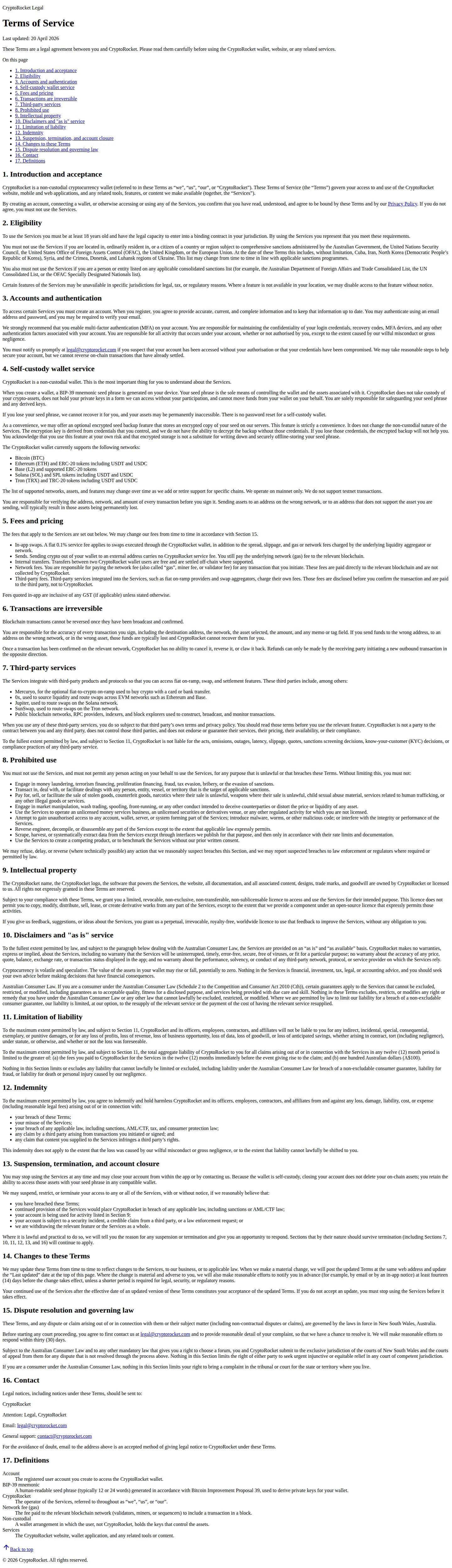
What we saw
Pages captured from Cryptorocket’s own site when this review was written. Brokers change their terms; these are what we read.
Score history
Recomputed daily; every move is on the record. The current score is always the latest row.
| Date | Score | Move |
|---|---|---|
| 2026-09-29 | 4.3 | ▼ |
| 2026-07-25 | 5.6 | ▼ |
| 2026-07-18 | 5.7 | ▼ |
| 2026-07-11 | 5.9 | · |
FAQ
Is Cryptorocket regulated?
No licence or registration for Cryptorocket is confirmed on any regulator register.
What country regulates Cryptorocket?
None confirmed. The claim that it operates unregulated from St Vincent and the Grenadines comes only from our earlier review, not a firsthand source.
What spread does Cryptorocket charge on EURUSD?
From USD 7 round turn on 1 lot EURUSD on the Standard Account.
What is the minimum deposit at Cryptorocket?
USD 10 on the Standard Account.
Does Cryptorocket have a mobile app?
Yes, it offers its own mobile app alongside its own web platform.
How is Cryptorocket rated by users?
It has a blended rating of 2.41 stars across 49 reviews.
How this review works
Track Cryptorocket live: score moves and red notices, in your pocket.