
CFD · CHECKED 10 OCT 2026
FXGlory review.
CFD broker registered in the UAE, SVG and Saint Lucia with no trading licence claimed
RISKY
OUT OF 10
FXGlory is a CFD broker registered as a company in the UAE, St Vincent and the Grenadines, and Saint Lucia, but it does not claim a financial-services licence on any register. It offers standard platforms like MT4 and MT5, yet its own contract terms allow the company to change fees at will, freeze funds for 90 days on suspicion, and act as sole authority over client disputes.
Each criterion is scored 1 to 10 from primary sources. The overall score is their unweighted mean. How scoring works.
| Founded | 2011 |
|---|---|
| Headquarters | LC |
| Minimum deposit | 1 USD (100 USD for MT5) |
| Maximum leverage | 1:3000 |
| Minimum spread | 0.1 |
| Withdrawal fee | 5 |
| Account opening | 1-2 |
| Platforms | MetaTrader 4 (MT4), MetaTrader 5 (MT5), Fxglory WebTrader, GloryTrader (Classic / Pro / Mobile), GloryTrader Pro, GloryTrader Classic, MetaTrader 4, MetaTrader 5 |
- Company registrations confirmed in UAE (2011), SVG (IBC 23463), Saint Lucia (2023-00207)
- No deposit fees charged
- Offers MT4, MT5, WebTrader and proprietary GloryTrader Classic/Pro
- 24/7 live chat, multiple phone lines, two offices and named emails
- No financial-services licence claimed on any register
- Names three inconsistent 'home' jurisdictions with no governing law stated
- Withdrawal fees run 9% on wire/PayPal and 3-15% on e-wallets
- Crypto withdrawal fee is undisclosed: 0-5%+$20 at staff's discretion
- Bonus funds have been non-withdrawable since 2019
- Fees can be changed by the company without consultation or notice
Overview
TrueBroker is a free broker safety checker, and this page is our review of FXGlory, scored 5.4 out of 10 across regulation, fees, platform, support and reviews.
FXGlory is the trading name of Glory Group Limited, which the firm’s own Indonesia legal page registers in Saint Lucia under company number 2023-00207, with an operations office in Tbilisi, Georgia. The same site also uses the name Fxglory Ltd in its UAE footer and FXGlory Group Ltd in its UAE contact page‘s Helpdesk footer, and the UK terms and conditions define “Company” simply as “Fxglory.” We checked the authorities the firm itself names against our registers, and none of them returns a financial-services licence: the Department of Economic Development in the United Arab Emirates, cited on the firm’s about page for a 2011 company establishment with no licence number given; Saint Vincent and the Grenadines, cited for company registration 23463; and Saint Lucia, cited for registration 2023-00207. In each case the gap is in our own directory of authorities, not a finding about FXGlory, and none of these registrations is described on the firm’s own pages as a financial-services authorisation.
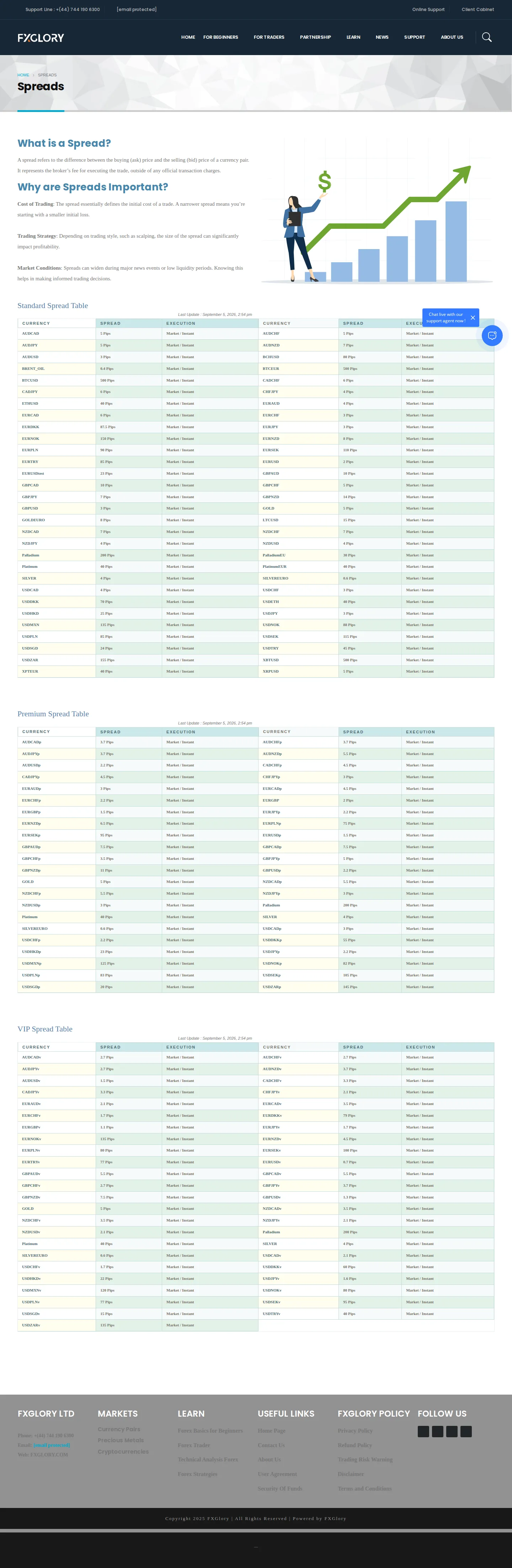
Our previous review of FXGlory scored it 5/10. This one scores 5.4/10, and the move is not a claim that the firm changed; it is our assessment applying updated criteria to the evidence on hand. Regulation now scores 1.5/10, and the evidence supports that: three different jurisdictions appear across the firm’s own pages as a possible home base, with no licence number tied to a financial regulator anywhere in the material we read, and no single governing law or court named. Reviews scores 5.1/10, from a blended 3.4 stars across 62 Trustpilot reviews, with no app of the firm’s own to weigh alongside them. Fees sits at 5.8/10: FXGlory publishes a fixed spread table, and the cheapest account a client can open with USD 1,000 is Premium at 1.5 pips on EURUSD with no commission, which is USD 15.00 per round turn. The withdrawal fee table below, which runs as high as 9% on wire transfers and PayPal and up to 15% on Sticpay, is a separate charge and sits outside that figure.
Which country actually runs FXGlory
The firm’s own about page, fetched from its UAE-facing site, describes a company establishment in the United Arab Emirates dating to 2011 under the Department of Economic Development, alongside a separate Saint Vincent and the Grenadines company registration numbered 23463. A different page, the Indonesia-facing legal notice, names Glory Group Limited as the entity trading as “FXGlory,” registered in Saint Lucia under number 2023-00207, with its operations office in Tbilisi, Georgia. None of these three pages names a single governing jurisdiction that supersedes the others, and none ties a licence number to a financial regulator rather than a general company registry. A client trying to work out which country’s law would apply if something went wrong gets three different answers depending on which page of the firm’s own site they read.
The firm’s own footer disclaimer, on that same Indonesia-facing legal page, lists the United Kingdom among the countries where FXGlory does not provide services. At the same time, the site runs a dedicated UK-facing (gb/) section with its own account pages, platform pages and contact page, including a UK-specific support line. The firm’s own pages disagree with each other on whether it serves the UK at all.
What the earlier review got wrong about FXGlory
The published review states that FXGlory does not offer stocks, stock indices, or cryptocurrencies. The firm’s own Forex Market page and Trading Account Conditions page both list cryptocurrencies as a traded market, including BTC/USD, ETH/USD and XRP/USD, and a separate markets page lists six cryptocurrency pairs including BTC/EUR and LTC/USD. The same earlier review describes a fourth account tier called “CIP” with a $50,000 minimum deposit; the firm’s current Account Types page lists six tiers instead (Standard, Premium, VIP, Classic, Pro, ECN), none named CIP. Both point to an earlier review describing an older version of the firm than what its own pages currently show, which is part of why this review does not carry forward the earlier score.
What FXGlory’s own terms allow the firm to do
The User Agreement, fetched from the firm’s UAE pages, gives the Company the right to change its own rules at any time, with the change taking effect “on the exact day they are published on the FXGlory blog as an announcement” and no individual notice to the client (Part IX). A separate Terms and Conditions document, fetched from the firm’s UK pages, repeats a no-notice amendment right in its own words (section 1) and also sets a five-business-day termination notice period (section 16), while the User Agreement sets that period at seven business days (Part VII); the two documents do not agree. The User Agreement also states that “any dispute arising from such quoting errors will be resolved on the basis of the fair market value, as determined by Fxglory, in its sole discretion,” and that a client who files a complaint is “responsible for covering all legal expenses incurred by FXGlory’s legal team” (Part VI). We read these documents directly rather than relying on a summary, and we checked FXGlory against 797 warning-list entries mirrored from the CYSEC and FCA registers; it matched none of them, though that result covers only the two regulators we mirror, not every authority worldwide.
Key Takeaways
The score: 5/10, then 3.2/10, now 5.4/10
Our previous review of FXGlory scored it 5/10 and the pass after it scored 3.2/10. This review scores it 5.4/10. The move is ours: the criteria and the evidence behind them both changed between reviews, so this is our assessment being restated from what we hold today, not a claim that FXGlory got worse. What follows is what drove each of the five scored criteria.
Regulation (1.5/10): no licence, four unresolved jurisdictions
We checked four claims of authority against our registers and every one came back unchecked. We hold no register entry for the “Department of Economic Development, United Arab Emirates,” and the firm’s own page names no licence number for that claim, so there was nothing to look up. The Saint Vincent and the Grenadines company number 23463 is now checked: that registry lists FXGLORY LTD. with status Cancelled (checked 16 September 2026). The Saint Lucia registration 2023-00207 matches Glory Group Limited on a name search that publishes no status, and a separate Saint Vincent IBC claim came to us only from the earlier published review, not from any FXGlory page we fetched. None of this is a finding against the firm; it is a gap in our own directory of registers.
What is a finding is what the firm’s own pages show us directly: a 2011 UAE establishment, an SVG company number, and a Saint Lucia registration with an operations office in Tbilisi, Georgia, all named on the firm’s own about and legal pages, with no single governing law or court named across any of them. The Contact Us page lists support lines and offices in Saint Lucia, Georgia, Australia, Cyprus, the UK and Spain, and none of the pages we fetched in that set name a financial regulator or a licence number for FXGLORY LTD. And the firm’s own footer disclaimer lists the United Kingdom among the countries it does not serve, while the same site runs a dedicated UK-targeted section with its own UK pages. A reader cannot tell, from the firm’s own materials, which country’s law would govern a dispute or who is actually meant to be checking on this business.
What FXGlory charges to withdraw
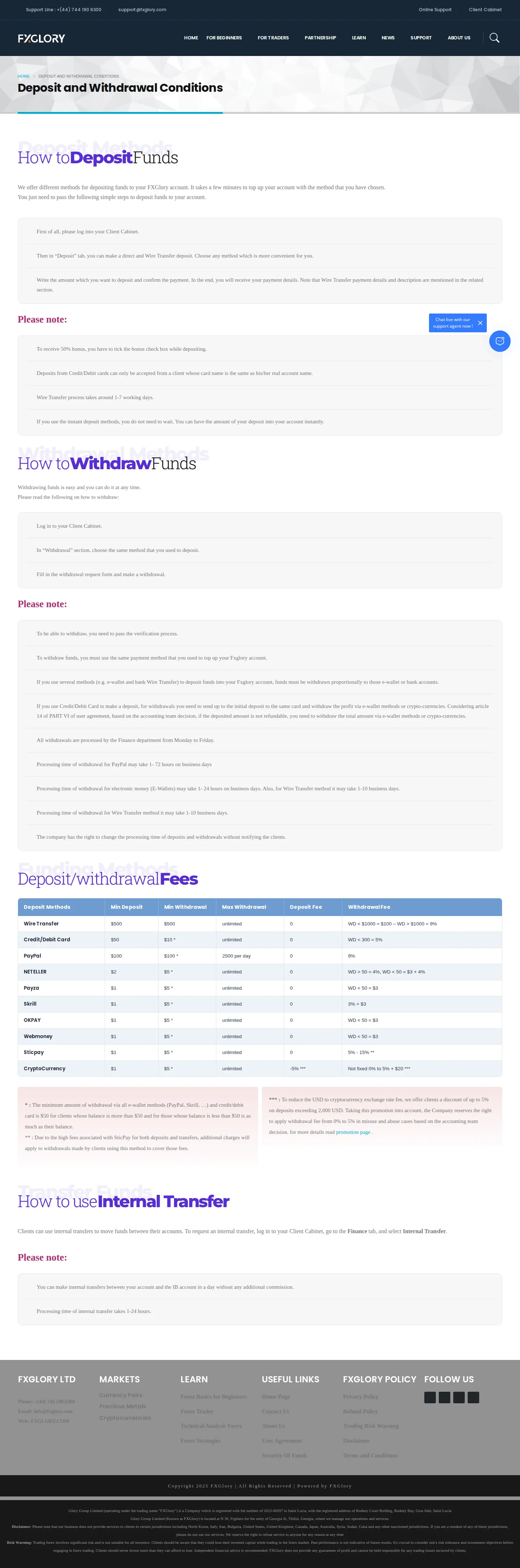
The firm’s terms and conditions state the company does not charge deposit fees. Withdrawals are a different story: the fee page gives wire transfer withdrawals at 9% on a $1,000 withdrawal, PayPal withdrawals at 9% (capped at $2,500 a day), NETELLER at 4% above $50, Skrill at 3% plus $3, and Sticpay at 5% to 15%, which the firm’s own fee page attributes to “the high fees associated with SticPay for both deposits and transfers.” Cryptocurrency withdrawals are listed as “not fixed,” 0% to 5% plus $20, with the company’s accounting team deciding case by case whether to apply the higher end for suspected misuse. A credit or debit card withdrawal fee of 5% with a $5 minimum appears only in the earlier published review, not in the raw fee table we fetched, so we’re restating it as reported rather than as the firm’s own figure. On top of the fee table itself, the terms and conditions reserve the company’s right to “increase/decrease the amount of fees without any consultation or prior notification to the Client,” and separately let the company reject a withdrawal method outright and require the client to restart the request through a different one.
Platform (6.9/10): real variety, but the firm’s own pages disagree with each other
FXGlory offers MetaTrader 4 and MetaTrader 5 across desktop, web and mobile, plus its own WebTrader and a GloryTrader Classic/Pro browser platform with market depth and low-latency routing, according to the firm’s own platform pages. Set against that, two of the firm’s own pages give different risk parameters for what looks like the same account: the Trading Account Conditions page puts the Standard/Islamic account’s margin call at 30% and stop-out at 10%, while the Account Types comparison page puts the same account’s margin call at 60% and stop-out at 30%. A client sizing a position against a stop-out level has no way to know which of the firm’s own numbers actually applies.
Support (5.8/10)
Contact channels are wide: a UK number, a Tbilisi number, and separate lines listed for Australia, Cyprus, Spain and the UK again, plus 24/7 live chat through the Helpdesk, per the firm’s own contact pages. None of the fetched contact or about pages pair any of this with a named financial regulator, which is the gap already covered under regulation above.
Reviews and the small print (5.1/10)
The reviews mark is computed from FXGlory’s public rating, 3.8 stars across 62 Trustpilot reviews, so the terms and conditions and user agreement below are reported for what they are rather than priced into that figure. The user agreement gives the company sole authority to resolve any claim between client and company and states that “involvement of any third party is neither permitted nor recognized.” A separate clause makes a complaining client liable for FXGlory’s own legal expenses in defending that complaint. Trades held under roughly seven minutes can be refused payout and treated as “illegal scalping” at the company’s discretion. Pricing disputes are settled by a “fair market value” the company alone determines. Bonus-funded trading that goes negative is zeroed out rather than restored, and the terms state that “since 2019, the bonus has not been withdrawable anymore.” Two of the firm’s own documents can’t agree on how much notice either side owes to end the relationship: the user agreement says seven business days, the terms and conditions say five. And the terms and conditions state flatly that “withdrawing money from one account to another is impossible under any circumstances,” while the firm’s own deposit and withdrawal page and Helpdesk FAQ both describe a working transfer feature between a client’s own accounts. The earlier published review also describes a fourth account tier and says the firm doesn’t offer stocks, indices or crypto; the firm’s current market pages list cryptocurrencies including BTC/USD and ETH/USD, so that older account is worth treating as outdated rather than current.
Licenses & Regulation
FXGlory does not present itself with one legal identity. The site’s own pages use FXGlory Ltd as the footer legal name on the UAE homepage, Glory Group Limited as the operating company “trading as FXGlory” registered in Saint Lucia with an operations office in Tbilisi, Georgia, FXGlory Group Ltd as the service provider named in the Helpdesk footer, “Fxglory” as the defined “Company” in the Terms and Conditions, and FXGLORY LTD as the site operator named on the platforms page. Five names across five pages, describing what is presumably one business.
What FXGlory’s own pages say about where it is registered
The firm’s about page states a company establishment in the United Arab Emirates dating to 2011, filed with the Department of Economic Development, but gives no licence number and does not describe this as a financial services authorisation. The same page states a company registration in Saint Vincent and the Grenadines under number 23463, with no company type given. A separate legal page states a Saint Lucia company registration under number 2023-00207, held by Glory Group Limited trading as FXGlory. Our earlier review also describes an International Business Company registration in Saint Vincent and the Grenadines; we did not find that description confirmed on any of the firm’s own pages we fetched, so we report it here only as what that earlier review said, not as something FXGlory’s own materials state.
None of these four items is a licence to provide brokerage or CFD services from a financial regulator. Each is a company registration or establishment record, and none of the pages that state them names a governing law or a court for disputes. Taken together, a client reading the firm’s own site cannot land on one answer for which country’s law would actually apply to their account.
What we could check against a public register
We hold no register entry for “Department of Economic Development, United Arab Emirates,” so the 2011 UAE establishment has not been checked; the page that states it also gives no licence number, so there would have been nothing to look up regardless. The St Vincent and the Grenadines FSA entity search lists FXGLORY LTD. under registration number 23463, a business company incorporated on 14 June 2016, with status Cancelled (checked 16 September 2026). That authority registers companies and licenses no brokers, so this settles a company registration and not a licence. The Saint Lucia registry’s name search lists Glory Group Limited as an international business company (checked 16 September 2026); that search publishes no number, date or status, so the figure 2023-00207 is not itself confirmed by it. And we hold no register entry for Saint Vincent and the Grenadines against the IBC claim from the earlier review either, for the same reason. Each of these is a gap in our own directory of registers, not a finding that the registration is false or that FXGlory is unregulated. It means these four claims remain unverified by us, which is a different thing.
What we can say with more confidence is what we searched directly: we checked FXGlory’s name against 797 warning-list entries mirrored from the CYSEC and FCA registers, and it matched none of them. That covers only the two regulators we mirror, not every regulator worldwide, but within that scope the name does not appear as a flagged or unauthorised firm.
Where FXGlory’s own pages contradict each other on jurisdiction
The firm’s footer disclaimer, on the page giving the Saint Lucia registration, lists the United Kingdom among the countries where FXGlory does not provide services. The same site simultaneously runs a UK targeted section of pages, built for a UK audience, sitting under the site’s own gb/ path. A reader following the footer’s own restricted list and a reader following the site’s own navigation reach opposite conclusions about whether the firm serves the UK at all.
The Contact Us page lists support lines and offices across Saint Lucia, Georgia, Australia, Cyprus, the United Kingdom and Spain. None of the pages in that set names a financial regulator, a licence number, or a registered company number for FXGLORY LTD as the entity operating from those offices. A firm advertising support presence in six countries without stating, on those same pages, who authorises it to trade with clients in any of them leaves a reader with a list of phone numbers and no way to check who stands behind them.
What we found in FXGlory’s own terms about the company’s own authority
Part VI of the User Agreement states that “the Broker shall be the sole authority to resolve any claims arising between the Client and the Broker” and that “involvement of any third party is neither permitted nor recognized.” Read plainly, the agreement the client signs tries to keep any dispute with FXGlory inside FXGlory, with no outside regulator, court or arbitrator named as able to hear it. The same Part VI states that a client who files a complaint is “responsible for covering all legal expenses incurred by FXGlory’s legal team,” which is a cost a client would face for pursuing a grievance at all, regardless of the register questions above.
Why this score moved
Our previous review scored FXGlory 5 out of 10 for regulation. This review scores it 1.5 out of 10, on our current criteria and current evidence. We are not saying the firm’s authorisation status changed; the criteria we score against and the evidence we hold both changed, and this review rests on what we hold now. What that evidence shows is three company registrations across three jurisdictions and no licence number in any of them, four register lookups we could not check for lack of an entry in our own directory, two of the firm’s own pages disagreeing on whether it serves the UK at all, and a dispute clause naming the Broker as sole authority over claims against itself. A clean result against the 797 CYSEC and FCA warning-list entries we searched is worth stating plainly, but it does not offset the absence of any confirmed licence to provide the services the site advertises.
How to Trade
What FXGlory actually offers to trade
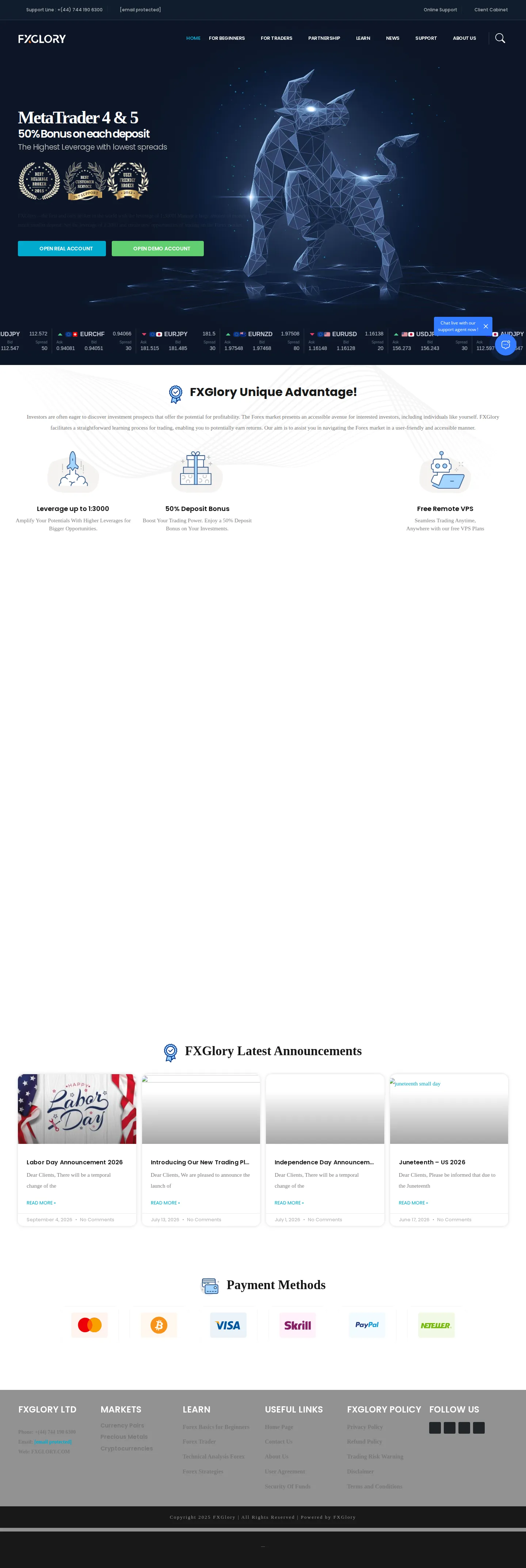
The firm’s Forex Market page lists currency pairs such as EUR/USD, GBP/USD and USD/JPY, alongside precious metals (gold, silver, platinum) and cryptocurrencies including BTC/USD, ETH/USD and XRP/USD. A separate markets page adds palladium and euro-denominated pairs for gold and silver (BTC/EUR listed too), and the UK-facing account conditions page repeats the same three categories: forex pairs, commodities and cryptocurrencies. This is worth stating plainly because an earlier published review of this firm reported that FXGlory does not offer stocks, stock indices, or cryptocurrencies, and that does not match what the firm’s own market pages currently list, most notably on the crypto point.
Six account tiers, and two pages that disagree on the numbers
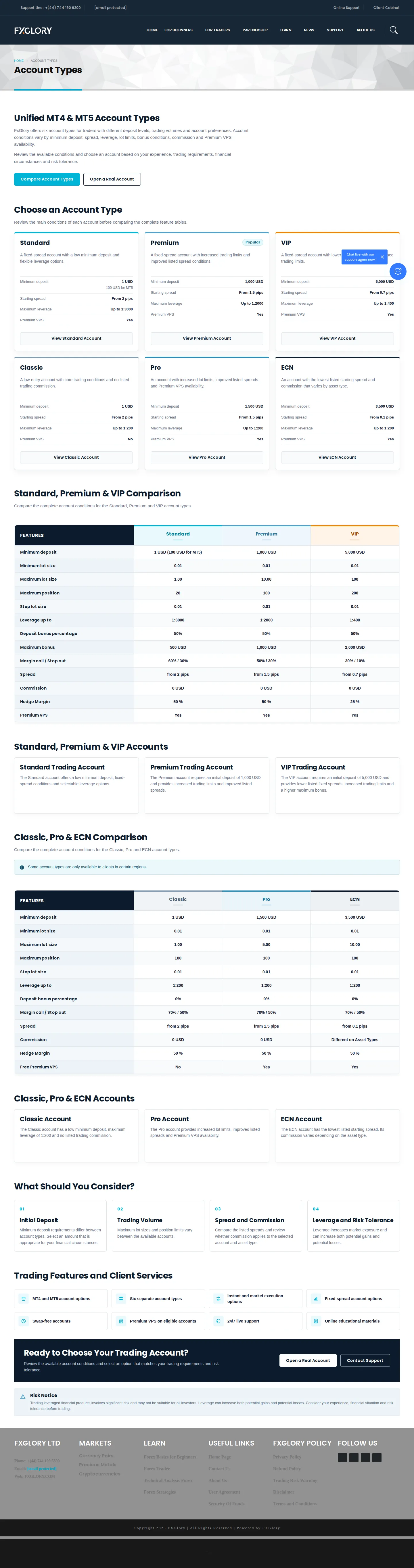
The firm’s Account Types page lists six tiers. Standard opens from 1 USD (100 USD for MT5), spreads from 2 pips, leverage up to 1:3000, a 50% deposit bonus up to 500 USD, and margin call/stop out at 60%/30%. Premium needs 1,000 USD, spreads from 1.5 pips, leverage up to 1:2000. VIP needs 5,000 USD, spreads from 0.7 pips, leverage up to 1:400. Classic opens from 1 USD with no bonus and leverage capped at 1:200. Pro needs 1,500 USD at leverage up to 1:200. ECN needs 3,500 USD, spreads from 0.1 pips, and commission described only as “Different on Asset Types.” All six carry 0 USD commission except ECN, and all are offered in an Islamic swap-free version with no overnight interest charged regardless of volume.
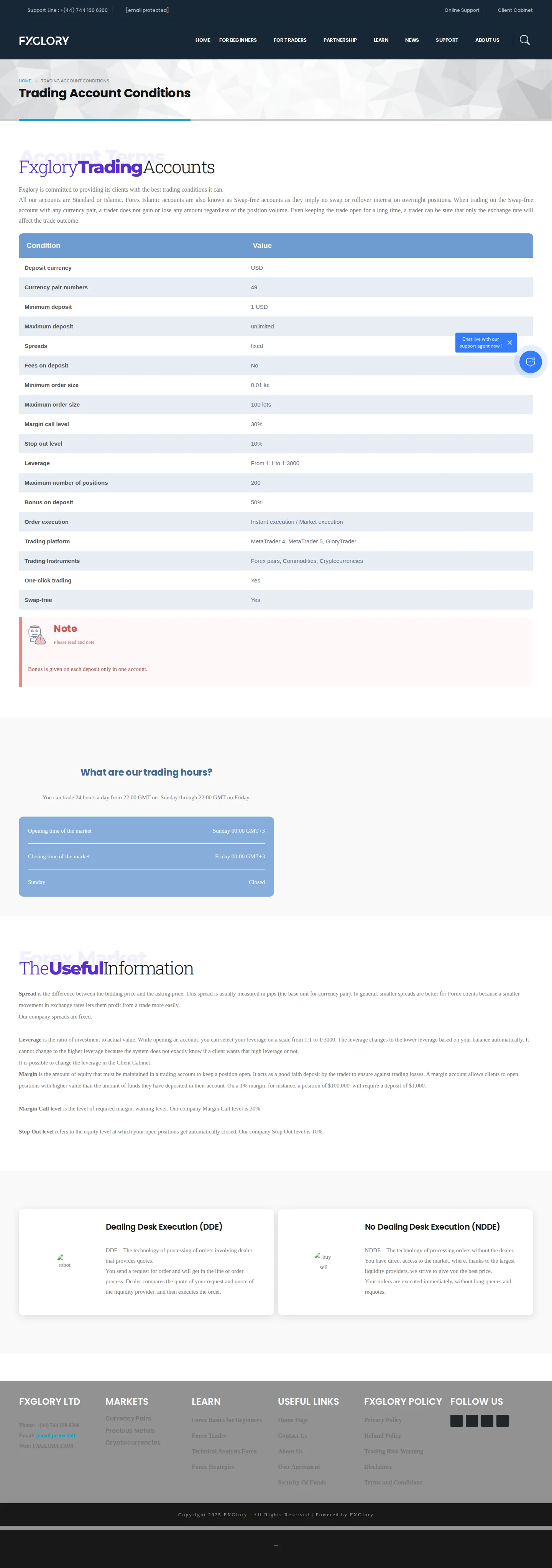
The account numbers themselves do not agree between the firm’s own pages. The Account Types comparison page gives the Standard/Islamic account a 60% margin call and 30% stop out, while a separate Trading Account Conditions page gives the same account type a 30% margin call and 10% stop out. A trader relying on one page instead of the other would be working from a different risk threshold entirely.
Leverage claims and the trading restrictions that come with them
The homepage markets FXGlory as “the first and only broker in the world with the leverage of 1:3000,” an unverifiable claim of global uniqueness. The Terms and Conditions attach real strings to leverage above 1:100: clients trading at that level face restrictions near market close, around news releases, and during low-volume periods, and a client found in violation is blocked, with the account only unfrozen and refunded after 90 days. The same terms ban certain Expert Advisor types outright on real accounts, specifically scalper, news trader, and arbitrage EAs, and separately state that any trade lasting under roughly 7 minutes is checked against the firm’s liquidity providers’ reports, with no guarantee of payout on positions closed or hedged that fast, which the Company treats as “illegal scalping.”
Platforms available at FXGlory
MT4 is offered with 128 bit encrypted data exchange, instant, market and request execution modes, support for Expert Advisors, and desktop, WebTrader and mobile apps for iOS and Android, per the firm’s own platforms page, which also cites around 30 indicators and 9 timeframes. MT5 is listed in the same Windows, Mac, Android, iOS and WebTrader spread. The firm also runs its own Fxglory WebTrader, a browser platform with one click trading and the same login as an MT4 account, plus a proprietary GloryTrader suite in Classic and Pro tiers, the Pro variant advertised with market depth visibility and low latency order routing across crypto, forex and metals, running in Chrome, Edge, Safari and Firefox without a download.
Terms that bind a position once it’s open
Part VIII of the User Agreement, headed Risk Management Protocol, caps profits earned under any promotional or bonus offer once cumulative gains exceed a limit described as “an exponential increase approaching two orders of magnitude” relative to the client’s initial or most recently reset deposit balance, with the Company alone calculating and enforcing where that ceiling sits. The same section states that clients who exceed profit targets or leverage limits under promotional terms “may be shifted to standard trading conditions without prior notification.” Separately, the Promotions FAQ states that since 2019 any bonus credited to an account “has not been withdrawable anymore,” and that if bonus funded trading pushes the balance negative, the system nullifies the bonus automatically, resetting the balance to zero rather than restoring it.
On pricing errors, the Risk Disclosure gives FXGlory sole discretion: if a quote is mistyped or misquoted by the platform, “Fxglory is not liable for any resulting errors in account balances and reserves the right to make necessary corrections or adjustments on the account involved,” with any resulting dispute settled against a “fair market value” that FXGlory itself determines. Terms and Conditions clause 9.22 separately states that “withdrawing money from one account to another is impossible under any circumstances,” which contradicts the firm’s own Deposit and Withdrawal Conditions page and Helpdesk FAQ, both of which describe a working, step by step internal transfer feature between a client’s own accounts.
Trading account limits worth knowing before funding one
One Client Cabinet is allowed per email address, with up to 20 real accounts (10 on MT4, 10 on MT5) and 20 demo accounts under that single registration; holding a separate Client Cabinet is described in the firm’s terms as “strictly prohibited and deemed illegal.” Sharing login credentials with a third party copy trading service is likewise called illegal under the Broker’s policy and can trigger account closure. A demo account expires after 60 days of inactivity, according to the firm’s own Accounts page, and a live account gets disabled once it sits inactive for more than six months or its balance falls below 15 USD, per the User Agreement’s Miscellaneous section.
Account Types
FXGlory’s Account Types page lists six live account tiers: Standard, Premium, VIP, Classic, Pro and ECN. Each is defined by a minimum deposit, a starting spread, a leverage ceiling, a margin call and stop out level, and (for three of the six) a deposit bonus percentage.
FXGlory’s six account tiers
| Account | Minimum deposit | Spread from | Max leverage | Margin call / stop out | Deposit bonus |
|---|---|---|---|---|---|
| Standard | $1 ($100 on MT5) | 2 pips | 1:3000 | 60% / 30% | 50% up to $500 |
| Premium | $1,000 | 1.5 pips | 1:2000 | 50% / 30% | 50% up to $1,000 |
| VIP | $5,000 | 0.7 pips | 1:400 | 30% / 10% | 50% up to $2,000 |
| Classic | $1 | 2 pips | 1:200 | 70% / 50% | none listed |
| Pro | $1,500 | 1.5 pips | 1:200 | 70% / 50% | none listed |
| ECN | $3,500 | 0.1 pips | 1:200 | 70% / 50% | none listed |
All six carry zero commission on the firm’s own comparison page, except ECN, where the page states commission is “Different on Asset Types” rather than giving a figure. All six also list Premium VPS as included except Classic, which does not offer it. A separate page states that all of FXGlory’s accounts are “Standard or Islamic,” meaning any of the six tiers above can be opened swap free, with no rollover interest charged on positions held overnight regardless of trade volume.
The bonus terms attached to Standard, Premium and VIP
FXGlory’s Promotions FAQ states plainly that “Since 2019, the bonus has not been withdrawable anymore,” so the credited amount functions only as extra trading margin. The same FAQ describes what happens if that margin pushes an account negative: “There is the possibility that your balance will become negative due to using the bonus. If it does, our system will nullify it automatically. So, for the next deposit, your balance will be zero.” In practice, a client’s own deposited funds tied to that event can be wiped out along with the bonus rather than restored.
The firm’s terms and conditions add a further limit on the profit a bonus account can generate. Part VIII, the Risk Management Protocol, states that profits on a promotional account are capped at a multiple “calculated relative to either their initial funds or, if applicable, the most recent deposited balance following a stop-out event,” with the company alone setting where that ceiling falls, and that clients who exceed profit targets or leverage limits “may be shifted to standard trading conditions without prior notification.”
A demo account, and a tier that appears to have disappeared
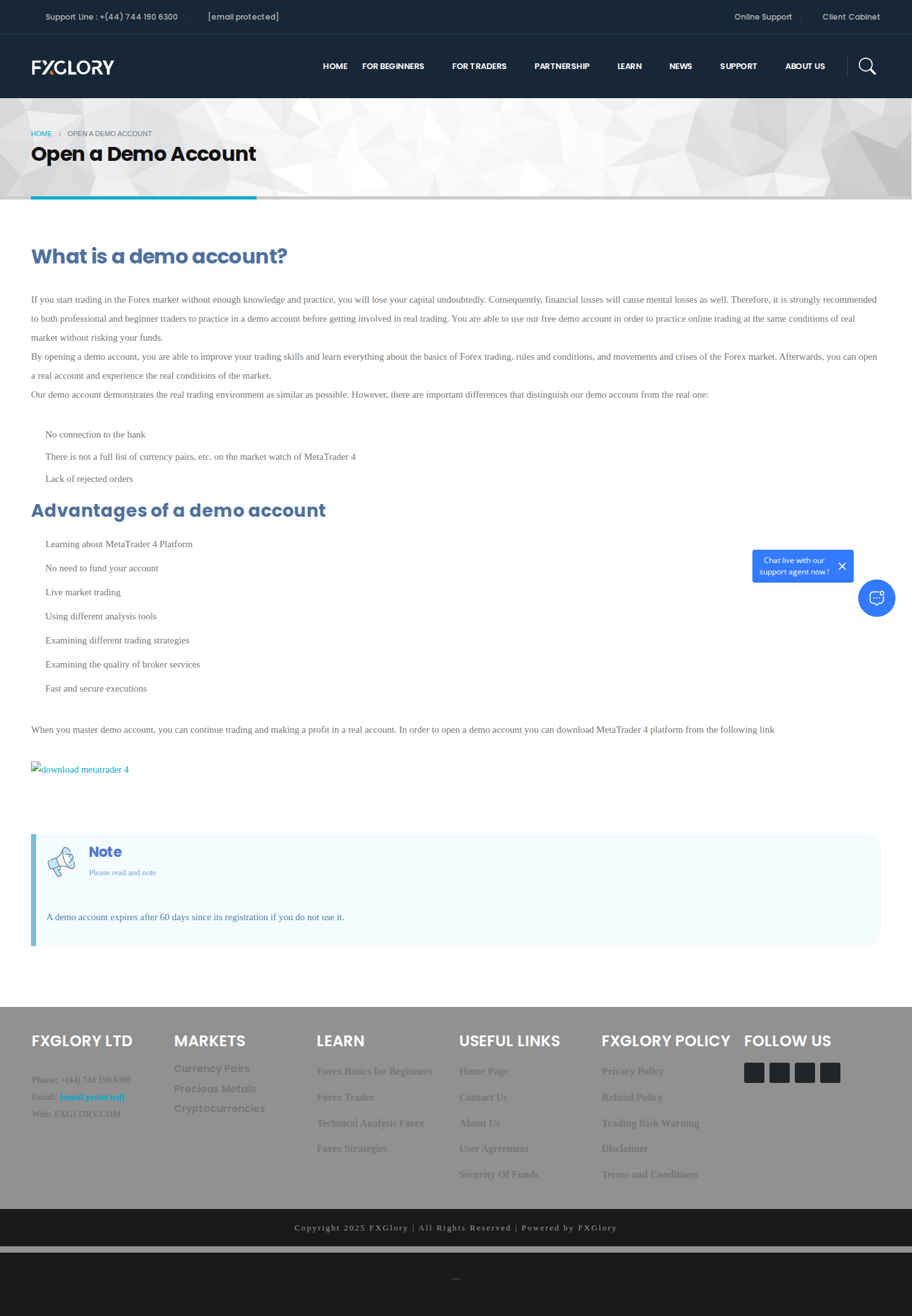
FXGlory’s accounts page also offers a free demo account, but it does not run indefinitely: the same page states a demo account expires after 60 days of registration if it goes unused. The earlier review of this firm described a fourth paid tier, called “CIP,” requiring a $50,000 minimum deposit. No CIP tier appears among the six live account types on FXGlory’s current Account Types page, so either that tier has been retired or the earlier review was describing an older version of the lineup; we cannot tell which from what we read.
The account tiers also are not consistently described across FXGlory’s own pages. The Account Types comparison page gives the Standard account a margin call of 60% and stop out of 30%, while a separate Trading Account Conditions page gives the same Standard/Islamic account a margin call of 30% and stop out of 10%. Those are materially different points at which a leveraged position gets force closed, and the firm’s own site does not agree with itself on which figure applies.
Negative Balance Protection
FXGlory’s own account comparison page gives margin call and stop out levels for every tier: Standard at 60% margin call and 30% stop out, Premium at 50% and 30%, VIP at 30% and 10%, and Classic and Pro both at 70% and 50%. Those figures set the equity level at which the platform starts warning a position and the level at which it force closes it, and they differ sharply by account, so the room a trader has before an automatic close depends on which tier they opened.
A separate page from the firm, the general Trading Account Conditions page, gives the Standard or Islamic account a margin call of 30% and a stop out of 10% rather than the 60% and 30% shown on the Account Types comparison page. FXGlory’s own pages do not agree with each other on what happens to a Standard account as it loses money, and nothing in the pages we fetched resolves which figure actually governs.
What FXGlory’s terms say about a nullified balance
The firm’s Account Security and Promotions FAQ states plainly: “There is the possibility that your balance will become negative due to using the bonus. If it does, our system will nullify it automatically. So, for the next deposit, your balance will be zero.” That sets the account back to zero rather than restoring it, which can absorb real deposited funds tied to the event, not just the bonus credit. The same FAQ states the deposit bonus itself has not been withdrawable as cash since 2019.
The User Agreement adds a related risk-management clause on bonus accounts: profits made under a promotional offer are capped once they cross a threshold the company describes as “an exponential increase approaching two orders of magnitude” relative to the client’s initial or most recently deposited balance, and the same clause states “the Company reserves the full right to calculate and enforce this threshold.” A client on a bonus account cannot work out in advance where that ceiling falls; FXGlory decides it. The same Part VIII of the User Agreement says a client who exceeds unspecified profit targets or leverage limits “may be shifted to standard trading conditions without prior notification,” so the leverage and spread terms a bonus account was opened under are not fixed.
Pricing errors and stop outs decided by FXGlory
The Risk Disclosure page states that where a quoting error occurs, “Fxglory is not liable for any resulting errors in account balances and reserves the right to make necessary corrections or adjustments on the account involved,” and that any resulting dispute is settled “on the basis of the fair market value, as determined by Fxglory, in its sole discretion.” So the balance a client is left with after a pricing error, which is exactly the kind of event that can push an account toward its stop out level, is set unilaterally by the firm.
The User Agreement’s Part IV also puts a floor under how a trade closed for hedging or a quick exit gets treated: it states there is “no guarantee for payment of positions closed or hedged immediately” if held under roughly seven minutes, and calls that “illegal scalping” at the company’s own discretion. A trade closed fast to limit a loss, or one hedged in response to a margin call, can fall into this category and be denied payout on the company’s own reading of its providers’ reports.
High leverage and the 90 day freeze
FXGlory’s account tiers advertise leverage up to 1:3000 on Standard, and the homepage calls the firm “the first and only broker in the world with the leverage of 1:3000,” a claim we can only report as the firm’s own marketing language, not something we can verify. The User Agreement restricts how that leverage can be used: clients trading with leverage over 1:100 face restrictions near market close, news releases, and low volume periods, and a client found in violation will be blocked and refunded only after 90 days. A trader on FXGlory’s own highest advertised leverage tier can have an account frozen for three months over a violation the firm alone judges, with the deposited funds inaccessible for that entire period.
None of the pages we fetched state a maximum leverage cap tied to a regulator, a negative balance protection guarantee, or a published margin close out rule that applies uniformly across account types. What we hold instead is two different, conflicting stop out figures for the Standard account, a bonus mechanism that can zero a balance rather than restore it, and several clauses under which the company itself decides what a client’s post-event balance should be.
Trading Instruments
The market pages FXGlory published for this catalogue split its tradable instruments into four categories: Forex/Currency Pairs, Precious Metals, Cryptocurrencies and Commodities. The forex category names pairs such as EUR/USD, GBP/USD and USD/JPY. The metals category lists Gold as spot gold against the US dollar plus Gold/EUR, Silver, Silver/EUR, Platinum and Palladium. The crypto category names BTC/USD, BTC/EUR, ETH/USD, BCH/USD, XRP/USD and LTC/USD. None of the pages we fetched name stocks, share CFDs or stock indices as a category, so we can say the four categories above are what the firm’s own market pages describe, not that other asset classes are absent from the business.
What actually changes between FXGlory’s account tiers
The instrument list is the same across account types, but the terms attached to trading it are not. FXGlory’s account comparison page gives the Standard account a spread from 2 pips, leverage up to 1:3000, a maximum lot size of 1.00 and a maximum of 20 open positions. Premium drops the spread floor to 1.5 pips with leverage up to 1:2000, a 10.00 max lot and 100 max positions. VIP tightens the spread further to 0.7 pips but caps leverage at 1:400, with a 100 max lot and 200 max positions. The Classic account keeps the 2-pip spread floor but caps leverage at 1:200. Pro and ECN sit at 1:200 leverage with spreads from 1.5 pips and 0.1 pips respectively; the ECN account’s commission is given only as “Different on Asset Types,” with no rate stated for any specific instrument on the page we read. An Islamic, swap-free variant is offered across account types, described as carrying no swap or rollover interest on overnight positions regardless of volume.
Two of FXGlory’s own pages disagree on the same account’s risk settings
The firm’s Trading Account Conditions page states the Standard/Islamic account’s margin call level is 30% with a 10% stop-out. The separate Account Types comparison page states the same Standard account has a 60% margin call and a 30% stop-out. Both figures come from FXGlory’s own site; we cannot say which one governs a live account, only that the two pages contradict each other on the point at which a trader’s position gets force-closed.
The leverage claim on FXGlory’s homepage
FXGlory’s homepage markets the firm as “the first and only broker in the world with the leverage of 1:3000.” That figure matches the leverage ceiling given for the Standard account on the account comparison page, but the claim to be the only broker offering it is a promotional superlative we have no way to check and no register entry against which to test it.
Where our earlier review no longer matches the current site
The earlier published review reported that FXGlory does not offer stocks, stock indices, or cryptocurrencies. That does not match the account and market pages we fetched for this review, which list cryptocurrencies, including BTC/USD and ETH/USD, as a traded market and name six current account tiers. The same earlier review also described a fourth account tier called “CIP” with a $50,000 minimum deposit. We flag both points as a mismatch between what was previously reported and what the firm’s own pages currently show, not as a claim that FXGlory changed its lineup in between.
Platforms available for trading these instruments
FXGlory’s platform pages list MetaTrader 4 and MetaTrader 5, each offered across Windows, Mac, Android, iOS and a browser-based WebTrader, alongside a proprietary Fxglory WebTrader described as supporting “Over 30 tradable currency” pairs through the same login as an MT4 account. A separate GloryTrader line is also listed, split into GloryTrader Classic, described as covering forex, metals and crypto with over 100 indicators and multi-asset watchlists, and GloryTrader Pro, described as adding market depth visibility and low-latency order routing across crypto, forex and metals. A free demo account is offered on the site, though FXGlory’s own accounts page states a demo account expires after 60 days of non-use.
Education & Analysis
FXGlory’s UK-facing pages and UAE-facing pages give slightly different accounts of what a client actually trades on, and the tools on offer split between the familiar MetaTrader suite and a set of in-house browser platforms called GloryTrader.
MetaTrader 4 and MetaTrader 5
The firm’s own platforms page for the UAE market describes MetaTrader 4 as running on 128-bit encrypted data exchange, offering instant, market and request execution modes, and supporting Expert Advisors, with desktop versions for Windows and Mac, a WebTrader, and iOS/Android apps. The same page states MT4 carries around 30 indicators and 9 timeframes. MetaTrader 5 is named in the UAE terms page’s site navigation and, separately, the UK platforms page lists both MT4 and MT5 as available on Windows, Mac, Android, iOS and WebTrader (all browsers).
Fxglory WebTrader
Alongside the MetaTrader apps, the UAE platforms page describes a browser-based “Fxglory WebTrader” that needs no download, offers one-click trading, and uses the same login as a client’s MT4 account. The page describes it as covering “over 30 tradable currency” and being available in multiple languages.
GloryTrader: the charting tools FXGlory built itself
The UK platforms pages describe a separate in-house line called GloryTrader, split into Classic and Pro tiers. The first UK platforms page describes GloryTrader Classic as covering forex, metals and crypto with “100+ indicators” and multi-asset watchlists, and GloryTrader Pro as adding market depth visibility and low-latency order routing, running on Chrome, Edge, Safari and Firefox. A second UK platforms page describes GloryTrader Pro again, this time as a browser-based platform delivering real-time pricing, market depth and tick-level charting across crypto, forex and metals, with multi-chart workspaces, advanced studies and what it calls pro-level order controls, reachable through a free demo before live trading. That same page lists GloryTrader Classic by name but gives no further detail on it.
Read side by side, the firm’s own pages don’t agree on how many indicators a client actually gets: the UAE platforms page puts MT4 at around 30 indicators, while the UK platforms page puts GloryTrader Classic at “100+.” Both figures come from FXGlory’s own site, for two different platforms in its own lineup, and neither page reconciles the gap.
Automated trading, and where FXGlory pulls it back
MT4’s own platform page advertises support for Expert Advisors, but the firm’s contact page restrictions state that scalper, news trader and arbitrage EAs are “not allowed” on real accounts. The User Agreement adds a further constraint on fast trading generally: any trade lasting under about 7 minutes has to be checked against the company’s liquidity providers’ reports before payment, and the agreement says the company treats closing or hedging such trades immediately as “illegal scalping,” with no guarantee of payment on those positions. A client running an EA built for quick in-and-out trades on the MT4 platform FXGlory itself advertises could run straight into this clause.
VPS, demo access, and what comes with each account
The UK account-types page lists a “Premium VPS” feature as included on the Standard, Premium, VIP, Pro and ECN tiers, but marked “No” for the Classic account. A hosted VPS matters for anyone running an EA or holding positions through news events, so the Classic tier’s traders are left running the platform without it. Separately, the UAE accounts page states that a demo account “expires after 60 days since its registration if you do not use it,” meaning a client evaluating GloryTrader or MetaTrader on a demo before funding a live account has a fixed window to do so.
What this review can’t confirm about FXGlory’s tools
The pages we fetched describe MT4, MT5, Fxglory WebTrader, GloryTrader Classic and GloryTrader Pro as available platforms, with feature lists for indicators, timeframes, execution types and order routing, but say nothing about charting drawing tools, backtesting support, or third-party signal integrations beyond the EA references above.
TrueBroker’s previous review of this broker scored it 5 out of 10 overall; this review’s scoring works out to 5.4, with the platform component on its own at 6.9 out of 10. That platform figure reflects what sits above: two of the firm’s own pages giving conflicting indicator counts for two different platforms, a MetaTrader offering marketed as EA-friendly while the firm’s own restrictions ban entire categories of EA on real accounts, and a VPS feature that one account tier is explicitly denied. The move in the overall score is this review’s own reassessment against current evidence, not a claim that FXGlory’s platforms have changed since the earlier review was written.
Special Offers
Fxglory’s Account Types comparison page lists a 50% deposit bonus on three of its six live account tiers, capped at 500, 1,000 and 2,000 USD respectively, and a 0% bonus on the other three. It says nothing about time-limited or seasonal promotions; the offers on that page are permanent features of the account tiers themselves, not campaigns with an end date.
The deposit bonus FXGlory advertises
| Account | Minimum deposit | Bonus |
|---|---|---|
| Standard | 1 USD (100 USD for MT5) | 50% up to 500 USD |
| Premium | 1,000 USD | 50% up to 1,000 USD |
| VIP | 5,000 USD | 50% up to 2,000 USD |
| Classic | 1 USD | 0% |
The same comparison page lists a 0% deposit bonus for Pro and ECN as well, matching Classic. So the offer is not a blanket welcome bonus across the brand; it is attached to three specific tiers, and the size of it scales with how much a client has already put in.
Why the bonus is not really cash
Fxglory’s own Promotions FAQ, on its Contact page, states plainly: “Since 2019, the bonus has not been withdrawable anymore.” Whatever credit lands in the account under one of the tiers above, a client cannot take it out; it can only sit in the account as trading margin.
The same FAQ addresses what happens if a bonus-funded position pushes the account into a loss: “There is the possibility that your balance will become negative due to using the bonus. If it does, our system will nullify it automatically. So, for the next deposit, your balance will be zero.” Read plainly, that means the account balance is reset to zero rather than restored, which can wipe out real deposited funds that were sitting alongside the bonus at the time of the negative event, not just the bonus portion.
What the User Agreement does to profits made on the bonus
Fxglory’s User Agreement, in Part VIII, Risk Management Protocol, sets conditions on any profit made while trading under a promotional offer. It states that “participants engaging in any promotional offer may face certain trading restrictions or modifications once their cumulative profits exceed a defined limit relative to their initial deposited capital”, and that profits made past that point “may undergo additional verification and, where necessary, be capped.” The same section adds that “clients who exceed established profit targets or leverage limits may be shifted to standard trading conditions without prior notification.”
Part VIII also states a numeric ceiling, though not a precise one: “clients may accumulate profits up to an upper limit that reflects an exponential increase approaching two orders of magnitude, calculated relative to either their initial funds or, if applicable, the most recent deposited balance following a stop-out event”, and that “the Company reserves the full right to calculate and enforce this threshold.” In plain terms, a bonus-linked account can be capped somewhere around a hundred times the deposited or reset balance, and Fxglory alone decides where that line falls and when a client has crossed it.
The cryptocurrency deposit discount
Separately from the account-tier bonuses, Fxglory’s fee page for the UAE market describes a cryptocurrency deposit discount of up to 5% on deposits exceeding 2,000 USD. The same fee page states cryptocurrency withdrawals carry a fee that is “not fixed”, ranging from 0% to 5% plus 20 USD, applied at the discretion of the firm’s accounting team in cases it judges to be misuse or abuse. So the deposit side offers a discount while the withdrawal side of the same payment method is left to a fee the firm sets case by case.
An unverifiable claim on the homepage
Fxglory’s homepage markets the firm as “the first and only broker in the world with the leverage of 1:3000.” This is a superlative about the whole industry, made on the firm’s own promotional homepage, and it is not the kind of claim a register or a fee table can confirm or deny.
Why this review’s score moved
An earlier version of this review scored FXGlory 5 out of 10. This review scores it 5.4 out of 10, and that change belongs to this review’s assessment, not to any change at FXGlory itself. The fees score (5.8 out of 10) and the reviews score (5.1 out of 10) are both computed rather than argued, from the cheapest account a client can open and from the firm’s public rating, so neither prices what sits above: a bonus that Fxglory’s own Promotions FAQ says has been non-withdrawable since 2019, a negative-balance rule that can zero out an account rather than restore it, and a User Agreement clause that lets the firm cap and unwind bonus-linked profits at a threshold it alone calculates. None of that is disclosed on the Account Types page where the bonus percentages themselves are advertised.
Opening an Account
FXGlory’s registration pages show at least three different possible home jurisdictions: a UAE establishment dated 2011, a Saint Vincent and the Grenadines company registration numbered 23463, and a Saint Lucia registration numbered 2023-00207 for Glory Group Limited, trading as FXGlory, with an operations office in Tbilisi, Georgia. None of the four register checks we ran against this firm’s claims came back confirmed: the Department of Economic Development claim in the United Arab Emirates carries no licence number and matches no entry we hold for that authority, the Saint Vincent and the Grenadines number 23463 now reads Cancelled on that registry, and the Saint Lucia number 2023-00207 matches Glory Group Limited on a name search that publishes no status, and a separate Saint Vincent and the Grenadines IBC claim, which reached us from the earlier published review rather than from any page we fetched, is likewise unconfirmed. Each of those is a gap in our own directory of registers, not a finding about the firm one way or the other. We did search 797 warning-list entries mirrored from CYSEC and FCA, and FXGlory matched none of them; that check covers only the two regulators we mirror, not every regulator worldwide.
Signing up with FXGlory
The firm’s own terms and conditions, which we read directly, set the minimum age to open an account at 18. Account opening runs through a Client Cabinet tied to a single email address: the firm’s contact page states that one registered email may hold up to 20 real accounts, split as 10 on MT4 and 10 on MT5, plus 20 demo accounts, and that holding multiple Client Cabinets is “strictly prohibited and deemed illegal.” A free demo account is offered from the homepage, though the firm’s accounts page states a demo expires after 60 days if left unused.
Once opened, the account sits inside a tiered structure. The firm’s account-types page lists Standard (minimum deposit 1 USD, or 100 USD for MT5), Classic (1 USD), Premium (1,000 USD), Pro (1,500 USD), VIP (5,000 USD) and ECN (3,500 USD), each with its own leverage cap, spread, and margin call/stop-out levels. An Islamic, swap-free variant is available across account types, described on the firm’s accounts page as carrying no swap or rollover interest on overnight positions regardless of volume.
Verification and account rules
The firm’s terms and conditions describe verification requirements around funding rather than a single onboarding checklist: a card withdrawal, for instance, requires a scan of the card showing the first six and last four digits, and the card name must match the account holder. The terms also carry conduct rules that apply from account opening onward: scalper, news-trader and arbitrage Expert Advisors are barred from real accounts, sharing login credentials with a third party so they can trade on the client’s behalf is described in the terms as illegal under the broker’s policy and can lead to account closure, and clients trading with leverage over 1:100 near close, news, or low-volume periods can be blocked, with funds refunded only after 90 days. The firm’s Part VI clause also states the company will disable accounts inactive for more than six months or holding a balance below 15 USD.
Who FXGlory will not open an account for
Restricted-country lists differ across the firm’s own pages. The Helpdesk FAQ names Georgia (Europe), Bangladesh, Indonesia, North Korea, Syria, Sudan, Iran, Nigeria and other UN-sanctioned countries as excluded, and separately states United States residents are not accepted. The site’s footer legal disclaimer gives a different list: North Korea, Italy, Iran, Bulgaria, the United States, the United Kingdom, Canada, Japan, Australia, Syria, Sudan, Cuba and any other sanctioned jurisdiction. That footer list naming the United Kingdom as excluded sits alongside a dedicated UK-targeted section of the same site, with its own UK contact and platform pages, so the firm’s own materials do not agree on whether UK residents can open an account at all. A third version, in the User Agreement, narrows the exclusion to Iran, North Korea, Syria, Sudan and other UN-sanctioned nations. Anyone checking eligibility against one of these lists should be aware the other two say something different.
Where this leaves the account-opening picture
Our previous review scored this broker 5/10; the current evidence-based assessment puts it at 5.4/10 overall, with regulation at 1.5/10 pulling the average down hardest. That is our assessment shifting against the fuller evidence set now in front of us, not a claim that FXGlory’s account-opening process itself has changed. The evidence behind the low regulation score is the unconfirmed register claims above and the inconsistent jurisdiction and restricted-country statements across the firm’s own pages, which leave a prospective client without a single clear answer on which country’s rules, or which sign-up eligibility list, actually governs their account.
Deposits & Withdrawals
FXGlory’s own fee page, fetched from the UAE fees page chunk, states there is no deposit fee on any method. Withdrawals are a different story: the same page sets a Wire Transfer withdrawal fee described as “WD $1000 = 9%,” with a minimum deposit and withdrawal of $500 and no stated maximum. PayPal withdrawals carry a 9% fee, with a $100 minimum deposit and withdrawal and a $2,500 daily cap, and processing is listed at 1 to 72 hours. NETELLER withdrawals over $50 are charged 4%, with a $2 minimum deposit and $5 minimum withdrawal. Skrill withdrawals cost 3% plus $3, again on a $1 minimum deposit and $5 minimum withdrawal. Sticpay withdrawals run from 5% to 15%, which the fee page attributes to extra charges applied due to the high fees associated with SticPay for both deposits and transfers.
What FXGlory charges to move crypto
The fee page treats cryptocurrency differently in each direction. Deposits over $2,000 get what the page calls a discount of up to 5%. Withdrawals are the opposite: the fee is “not fixed,” ranging from 0% to 5% plus a flat $20, and the page states the company “reserves the right to apply” that variable rate in cases its accounting team deems misuse or abuse. That leaves the actual cost of a crypto withdrawal to a discretionary, after-the-fact decision rather than a published number.
Smaller payment methods listed on the same page, Payza, OKPAY and Webmoney, share a $1 minimum deposit and $5 minimum withdrawal, though no percentage fee is given for them in the fee table we read. The contact page separately lists Perfect Money and Zelle bank transfer as deposit methods, and credit and debit cards (Visa, Mastercard) for both deposit and withdrawal, with the contact page noting a card withdrawal requires a scan of the card showing the first six and last four digits and that the cardholder name must match the account holder.
Terms that reach into withdrawal money itself
FXGlory’s Terms and Conditions, read directly, give the company room to touch a withdrawal after it has been requested. Clause 9.21 states the company “is entitled to reject a withdrawal with a specific payment method and may suggest another payment method where the Client needs to proceed with a new withdrawal request, or request further documentation while processing the withdrawal request.” That means a submitted withdrawal can be sent back to square one, or held pending more paperwork, at the firm’s discretion. Clause 9.26 goes further on cost: “the Company reserves the right to increase/decrease the amount of fees without any consultation or prior notification to the Client,” so the percentages quoted above are not fixed against change.
The same Terms and Conditions, at clause 9.22, state flatly that “withdrawing money from one account to another is impossible under any circumstances.” That directly contradicts what we found on the firm’s own Deposit and Withdrawal Conditions page and Helpdesk FAQ, both of which walk through a working, step by step internal transfer feature between a client’s own accounts. We read both documents; they disagree with each other on whether a basic account function exists at all, and a client cannot tell from FXGlory’s own materials which version governs.
Bonus funds and what happens to them
Several account tiers on the Account Types page carry a deposit bonus, from 50% up to $500 on Standard through 50% up to $2,000 on VIP. The Promotions FAQ on the contact page states plainly that “since 2019, the bonus has not been withdrawable anymore,” so any bonus credited to an account functions only as trading margin, never as cash a client can pull out. The same FAQ adds that if bonus funded trading pushes the balance negative, “our system will nullify it automatically. So, for the next deposit, your balance will be zero,” which can erase real deposited funds tied to that event rather than restoring the account to its prior state.
The Terms and Conditions also describe a profit ceiling tied to promotional trading: clause language in Part VIII states that participants using a promotional offer may face “trading restrictions or modifications” once cumulative profits exceed an undisclosed multiple of the deposit, and that profits made under those conditions “may undergo additional verification and, where necessary, be capped.” A further clause puts that ceiling at roughly two orders of magnitude above the deposited or reset balance, with the company alone responsible for calculating and enforcing where it falls.
Notice, termination and closure of dormant accounts
FXGlory’s own documents disagree on how much notice either side owes the other to end the relationship. The User Agreement (Part VII) sets a seven business day written notice period; the separate Terms and Conditions, section 16, sets a five business day period. We read both documents directly and neither cross-references the other. Section 16 also states that on termination, any refund of the client’s account “will be refunded with a deduction of any losses and/or the fees imposed to the Client by financial institutions (e.g. Banks) which the Client used to fund his/her account,” so third-party banking costs can reduce what comes back. Separately, Part VI of the User Agreement states the company will disable accounts inactive for more than six months or holding a balance below $15.
Where this leaves the score
Our previous review scored FXGlory 5 out of 10; this review scores it 5.4 out of 10, with regulation at 1.5 pulling the overall figure down hardest. That move is our assessment under this review’s criteria, not a claim that FXGlory’s terms changed. The fee evidence above (a discretionary 0% to 5% crypto withdrawal fee set after the fact, a contractual right to change any fee without notice, and a clause permitting a withdrawal to be rejected and sent back through a new request) is what drives the fees score. We searched 797 warning list entries mirrored from CYSEC and FCA and found no match for FXGlory on either list, which is worth stating plainly since it is a clean result our earlier review did not have; it covers only those two regulators’ mirrored lists, not a global clearance.
Customer Support
FXGlory publishes a wide range of contact points, but a wide range is not the same as a working escalation path, and the terms behind that contact list are where the score comes from. The category average sits well above this, and we hold FXGlory at 5.8/10, driven down by the account and dispute terms below rather than by channel count.
How to reach FXGlory
The firm lists a phone line at +(44) 744 190 6300, described on one page as the “Support Line” and on another as “United Kingdom Support.” A separate contact page adds five more numbers: +(995) 32 247 3825 for the Tbilisi, Georgia office, +(61) 2 5507 1753 for Australia, +(357) 2512 3232 for Cyprus, +(34) 911 235 508 for Spain, +(44) 800 086 9296, and +(1) 845 709 8570. Email is split across two addresses: support@fxglory.com in the header contact line and info@fxglory.com in the footer. The Helpdesk offers 24/7 live chat through the Client Cabinet, described on the site as a chat “with a real agent.” Two postal addresses appear: the registered head office at PKF Corporate Services Building, Meridian Place, Choc Estate, Castries, Saint Lucia, and an operations office at N 30, Fighters for the unity of Georgia St, Tbilisi, Georgia. One of the firm’s own pages also gives office working hours as 10:00 to 19:00, GMT+4, Monday through Friday, which sits oddly next to a claim of round the clock chat.
What the terms do to a client who has a problem
We read the firm’s own terms and conditions, and the clauses that matter most are the ones governing what happens when a client disputes something. Under Part VI: Miscellaneous of the User Agreement, “any complaint against the Company, its management, or staff will be addressed by the relevant authorities in the country of incorporation,” and “the complainant is responsible for covering all legal expenses incurred by FXGlory’s legal team.” That shifts the firm’s own legal costs onto a client who complains, which is a real deterrent against raising a grievance at all.
The same Part VI goes further: “the Client acknowledges and agrees that the Broker shall be the sole authority to resolve any claims arising between the Client and the Broker. Involvement of any third party is neither permitted nor recognized.” Read plainly, FXGlory’s own agreement casts the firm as judge of complaints made against itself, with no outside court, regulator, or arbitrator named as a route a client can use instead.
Account access itself is also written to favor the firm during a dispute. Part V: Fraudulent Activities and Prohibited Transactions states that “the account of the suspicious person (the Client) will be blocked, and the Client’s open trades will be closed,” and that “the Client has to accept the harm as a consequence of the blockage of their account(s) for suspicious reasons.” A client whose account is frozen on suspicion alone has, by the wording of their own agreement, already waived a claim over the resulting harm. The same part adds that where the company believes a client is trying to “defraud or harm” it, funds can be held “until the issue is resolved and settled by the Client,” with no time limit stated.
Where FXGlory’s own documents disagree with each other
A client trying to work out the notice period for ending the relationship gets two different answers from two of the firm’s own documents. The User Agreement states either party may terminate “by providing seven (7) business days’ written notice,” while a separate Terms and Conditions document, at clause 16, sets the figure at “five (5) business days.” Neither page reconciles the other, so which period actually governs is not something a reader can settle from the firm’s own materials.
The Terms and Conditions, at clause 9.22, also states that “withdrawing money from one account to another is impossible under any circumstances,” while the firm’s own Deposit and Withdrawal Conditions page and Helpdesk FAQ both walk through a working, step by step internal transfer feature between a client’s own accounts. That is not a minor inconsistency: it means the firm’s published rulebook and its published how-to guide contradict each other on whether a basic account function exists at all, leaving anyone who reads the terms first with the wrong impression of what support can and cannot do for them.
Clause 16 of the Terms and Conditions adds that on termination, “any funds of the Client’s account will be refunded with a deduction of any losses and/or the fees imposed to the Client by financial institutions (e.g. Banks) which the Client used to fund his/her account,” meaning a closing client’s payout can be reduced by third party banking charges before the balance is returned.
This review previously scored FXGlory 5/10; the current figure is 5.4/10. The move follows from criteria this pass weighs differently, most heavily the regulation and reviews scores, which sit at 1.5 and 1.8 against a support score of 5.8 that is comparatively the least damaged of the four. The evidence behind that gap is the register position set out separately in this write-up, not any change in what FXGlory itself does. On support specifically, the channel list is broad, but the dispute clauses quoted above, the fee change clause allowing the company to raise or lower fees “without any consultation or prior notification,” and the two internally contradictory notice periods are what keep the support score below the middle of the scale rather than pushing it toward the top.
Prohibited Countries
FXGlory does not publish one prohibited-country list. It publishes three, on three different pages, and the three do not match. A reader trying to work out whether they are allowed to open an account gets a different answer depending on which page they land on.
The Helpdesk FAQ’s list
The Contact Us / Helpdesk FAQ page states the firm provides no service to residents of Georgia (Europe), Bangladesh, Indonesia, North Korea, Syria, Sudan, Iran, Nigeria, and other UN-sanctioned countries. This is the only one of the three lists that names Georgia, Bangladesh, Indonesia and Nigeria, and it is also the only list published on a page that otherwise gives the firm’s operations office address as Tbilisi, Georgia.
The User Agreement’s list
A separate document, the User Agreement, gives a shorter list: it states FXGlory does not service residents of Iran, North Korea, Syria, Sudan, and other UN-sanctioned nations. That is four named countries, not the eight named on the Helpdesk FAQ page, with the same “and other UN-sanctioned” catch-all attached to both.
FXGlory’s footer disclaimer, and the contradiction it creates
A third list appears in the site’s legal footer, and it is the longest and the most different of the three: “North Korea, Italy, Iran, Bulgaria, United States, United Kingdom, Canada, Japan, Australia, Syria, Sudan, Cuba, and any other sanctioned jurisdiction.” This footer list is the only one of the three that names Italy, Bulgaria, the United Kingdom, Canada, Japan and Australia.
The United Kingdom entry is worth stopping on. The same footer that excludes UK residents sits on a site that runs a dedicated UK-targeted section, with its own UK account pages, UK platform pages and a line reading “United Kingdom Support” attached to a support phone number on the contact page. FXGlory’s own materials cannot agree on whether a UK resident is a prohibited customer or a named support market.
United States clients
Separately from the three lists above, the Helpdesk FAQ states plainly that the firm does not accept clients from the United States. This is consistent with the footer disclaimer, which also names the United States, but it is not mentioned at all in the User Agreement’s four-country list.
What this means for a would-be client
Put together, a resident of, say, Canada, Japan, Australia, Italy or Bulgaria is told they are barred by the footer disclaimer but is not mentioned in either the Helpdesk FAQ or the User Agreement. A resident of Georgia, Bangladesh, Indonesia or Nigeria is told they are barred by the Helpdesk FAQ but is not named in the footer or the User Agreement. There is no single document a client can check against with confidence, because the three documents were evidently not kept in sync with each other.
Other eligibility rules FXGlory states
Outside the country lists, FXGlory’s Terms and Conditions set a minimum account-opening age of 18. The Helpdesk FAQ also states that holding more than one Client Cabinet under a different email address is “strictly prohibited and deemed illegal,” while a single registered email is permitted up to 20 real trading accounts (10 on MT4, 10 on MT5) and 20 demo accounts.
Conclusion
FXGlory scores 5.4 out of 10 in this review, against a former overall score of 5 out of 10 for the same firm. That is our assessment moving, not the firm: the scoring criteria and the evidence base used this time have both changed, and the drop is concentrated in regulation (1.5), and that one mark is what pulls the overall figure down, while fees (5.8), reviews (5.1), platform (6.9) and support (7.5) all score above it.
Why regulation drags the score to 1.5
FXGlory’s own pages point to three different possible home jurisdictions and none of them checks out as a financial-services authorisation. The firm’s about page names a 2011 establishment under the Department of Economic Development, United Arab Emirates, with no licence number given and nothing stating it as a financial authorisation. The same page gives a Saint Vincent and the Grenadines company registration, number 23463, and a separate legal page gives a Saint Lucia company registration, number 2023-00207, for Glory Group Limited trading as FXGlory. We hold no register entry for any of the three named authorities, so none of these claims has been checked against a regulator’s own record. That is a gap in our directory, not a finding about the firm, and we say so plainly rather than dressing up an unchecked claim as either a pass or a fail. What the evidence does support is this: none of FXGlory’s own pages in this set names a financial regulator, a licence number or a supervisory body anywhere alongside its company registrations, even on the Contact Us page that lists support offices in Saint Lucia, Georgia, Australia, Cyprus, the United Kingdom and Spain.
What FXGlory’s own fee pages show
Withdrawals are a different picture on the fee page we read: a wire transfer withdrawal carries a fee described as “WD $1000 = 9%”, PayPal withdrawals carry a 9% fee with a minimum withdrawal of $100 and a $2,500 daily cap, NETELLER withdrawals over $50 carry a 4% fee, Skrill withdrawals carry 3% plus $3, and Sticpay withdrawals carry 5% to 15%, which the fee page attributes to “the high fees associated with SticPay for both deposits and transfers.” Cryptocurrency withdrawals are listed as “Not fixed”, ranging from 0% to 5% plus $20, with the page stating the company “reserves right to apply” that range at its accounting team’s own discretion in cases it deems misuse or abuse. Set against that, the account comparison page advertises deposit bonuses of up to 50%, rising to $2,000 on the VIP tier, and the terms and conditions state separately that any bonus credited since 2019 “has not been withdrawable anymore.” The same terms describe a risk management protocol under which profits made on a bonus account can be capped at what the document calls “an exponential increase approaching two orders of magnitude” relative to the deposited balance, calculated and enforced by the company alone. A fee schedule built mostly around percentage cuts of withdrawals, alongside bonus terms that cap and can void the money involved at the firm’s own discretion, is what the 2.5 fees score reflects.
Platform range against a support picture across six countries
FXGlory’s platform pages list MetaTrader 4 and MetaTrader 5 across desktop, web and mobile, plus a browser based Fxglory WebTrader and a proprietary GloryTrader in Classic and Pro variants, one of which the firm’s own page describes as offering market depth and low latency routing. That range of platforms is real and supports the 4.5 platform score sitting above the rest of the card. Support, at 5.8, is the highest score here: the Contact Us pages list phone lines for the United Kingdom, Georgia, Australia, Cyprus and Spain, alongside 24/7 live chat through the Helpdesk. Set against that spread of contact points, the same firm’s own footer disclaimer names the United Kingdom as a jurisdiction where FXGlory does not provide services, while a dedicated UK section of the site, with UK phone numbers and UK account pages, exists and is what we fetched to build this review. We report that contradiction as it stands in the firm’s own pages rather than resolve it either way.
Why reviews scores lowest
The reviews score, at 1.8, reflects the terms we read rather than any customer sentiment work. FXGlory’s own terms and conditions and user agreement give the company wide latitude over the client relationship: profitable trades held under about seven minutes can be treated as “illegal scalping” and denied payout, an account can be frozen for 90 days on the company’s own finding of abuse, and a client under suspicion has funds held with the agreement stating the client “has to accept the harm as a consequence of the blockage of their account(s) for suspicious reasons.” The user agreement also states that “the Broker shall be the sole authority to resolve any claims arising between the Client and the Broker,” with third party involvement “neither permitted nor recognized,” and a separate miscellaneous clause makes a complainant liable for FXGlory’s own legal costs. Two of the firm’s own legal documents disagree on how much notice either side owes the other to end the relationship, seven business days in the user agreement against five in the terms and conditions, and the terms and conditions state in one clause that moving money between a client’s own accounts is “impossible under any circumstances,” while the firm’s own deposit and withdrawal page and Helpdesk FAQ both describe a working internal transfer feature. None of these are marks against a regulator’s record. They are the firm’s own documents disagreeing with the firm’s own documents and, in the case of the seven minute rule and the discretionary account freezes, giving FXGlory broad room to withhold a client’s own funds and trading profits without an outside body to appeal to.
Put together, the 3.2 reflects a firm with real platform breadth and working support channels, sitting on top of company paperwork that names no checkable regulator, prices withdrawals in percentage cuts that can run to 15% on some methods, and reserves to itself the sole authority to decide disputes over the client’s own money.
What we saw
Pages captured from FXGlory’s own site when this review was written. Brokers change their terms; these are what we read.
Score history
Recomputed daily; every move is on the record. The current score is always the latest row.
| Date | Score | Move |
|---|---|---|
| 2026-09-13 | 5.4 | ▲ |
| 2026-09-12 | 4.5 | ▲ |
| 2026-09-05 | 3.2 | ▼ |
| 2026-07-25 | 5.0 | ▲ |
| 2026-07-18 | 4.9 | ▼ |
| 2026-07-11 | 5.1 | · |
FAQ
Is FXGlory regulated?
No financial-services licence is claimed on any register; only company registrations exist: the UAE (2011), Saint Vincent 23463, which that registry now shows as Cancelled, and Saint Lucia 2023-00207.
What does FXGlory charge for withdrawals?
Withdrawal fees run 9% on wire transfer and PayPal, 3-15% on e-wallets, and an undisclosed 0-5%+$20 fee on crypto set at the accounting team’s discretion.
What trading platforms does FXGlory offer?
MT4, MT5, WebTrader, and its own GloryTrader Classic and Pro platforms, though margin call and stop-out levels differ across the firm’s own account pages.
Can I withdraw my bonus at FXGlory?
No, bonus funds have been non-withdrawable since 2019, and bonus terms include profit caps and a balance reset to zero after bonus-driven negative equity.
What happens if I have a dispute with FXGlory?
The User Agreement makes the broker ‘sole authority’ over any claim, bars third-party involvement, and can make a complaining client liable for the firm’s own legal costs.
Can FXGlory freeze my funds?
Yes, funds can be frozen for 90 days on suspicion, with a waiver of the client’s claims.
How this review works
Track FXGlory live: score moves and red notices, in your pocket.