
CFD · CHECKED 10 OCT 2026
Pocket Option review.
CFD broker with its own trading apps but no licence disclosed on any register
RISKY
OUT OF 10
Pocket Option is a CFD-style broker running its own web, mobile and Mac trading platforms, plus a Telegram bot. No page on its site names a financial regulator or licence number, and no licence was confirmed on any official register, making it functionally unregulated on its own disclosures. It holds a blended 4.20-star rating across 71,600 reviews, though Trustpilot currently hides its score for a guidelines breach.
Each criterion is scored 1 to 10 from primary sources. The overall score is their unweighted mean. How scoring works.
| Founded | 2017 |
|---|---|
| Minimum deposit | $5 |
| Withdrawal fee | 0 |
| Account opening | 1-5 |
| Platforms | Web App, Android app / APK Download, macOS web app, Telegram bot |
- Runs its own web platform, mobile app and Mac client
- Also offers a Telegram bot and, in some regions, a Huawei app store download
- Publishes some fee information on its site
- Holds a blended 4.20-star rating across 71,600 reviews
- No page on pocketoption.com states a financial regulator or licence number
- No licence confirmed on any official register checked
- IFMRRC regulatory claim traces only to an old review, not current firm pages
- WebMoney's badge is an identity check, not a financial-services licence
- No EURUSD spread published for any account a retail client can open
- Support is reachable only through a ticket system
Overview
TrueBroker is a free broker safety checker, and this page is our review of Pocket Option, scored 4.7 out of 10 across regulation, fees, platform, support and reviews.
The single most important thing to know before anything else: none of the pocketoption.com pages we fetched, including the deep-crawled About, Contact, Legal and Platforms pages for Australia, the UK, the UAE and Indonesia, name any financial regulator or licence number anywhere. The only regulatory claim attached to this firm, a licence from the “International Financial Market Relations Regulation Center (IFMRRC)”, comes solely from the earlier published review, not from anything the broker itself publishes. We hold no register entry for that authority and the claim carries no licence number, so we could not check it either; that is a gap in our own directory, not a finding about the firm one way or the other.
Our previous review of Pocket Option scored it 3.5 out of 10; this review scores it 4.7 out of 10. That move is our assessment, not a change at the firm: the platform criterion came in relatively high at 7.4, reflecting that Pocket Option’s own pages show a browser-based Web App, a branded Android app distributed by both direct APK download and a Huawei app-store listing, a macOS web app on the GB, AE and Legal page variants, and a Telegram bot listed in the platforms footer. Regulation still scores 3, because the one regulatory claim in the record is second-hand and unverifiable against the firm’s own site; fees score 3 and support scores 4.8 for reasons set out below.
Overview Table
| Headquarters | Not stated |
| Established | Not stated |
| Countries Served | Not stated as a served list; the firm’s own pages state it does not serve Germany “at the present moment” and, per the firm’s South African home page, does not serve residents of the EEA, USA, Israel, UK, Philippines, Japan and Brazil |
| Regulated By | Claimed as IFMRRC-licensed in our earlier review text only; not corroborated on any fetched pocketoption.com page and not checked against any register we hold |
| Minimum Deposit | $5, per our earlier review’s account and payments data |
| Maximum Leverage | Not stated |
| Total Instruments | Not stated as a count; our earlier review lists forex, stock CFDs, commodities, cryptocurrencies, indices and binary options as categories offered |
| Platforms | Web App, Android app/APK download, macOS web app (GB/AE variants), Telegram bot |
| Customer Support | Support Desk, community chat/forum and a contact webform, per the firm’s UK contact page; no phone number or support email is published on that page |
| Languages | Not stated as a total; the firm operates localized-language site variants, though the risk disclosure header notice states English is the only legally binding version |
Facts List
- We searched 1441 warning-list entries mirrored from CYSEC, the FCA and FSC Mauritius, and Pocket Option matched none of them; this covers only those three mirrored lists, not every regulator.
- The sole regulatory claim for Pocket Option, an IFMRRC licence, appears only in our earlier review text and was not found on any fetched pocketoption.com page.
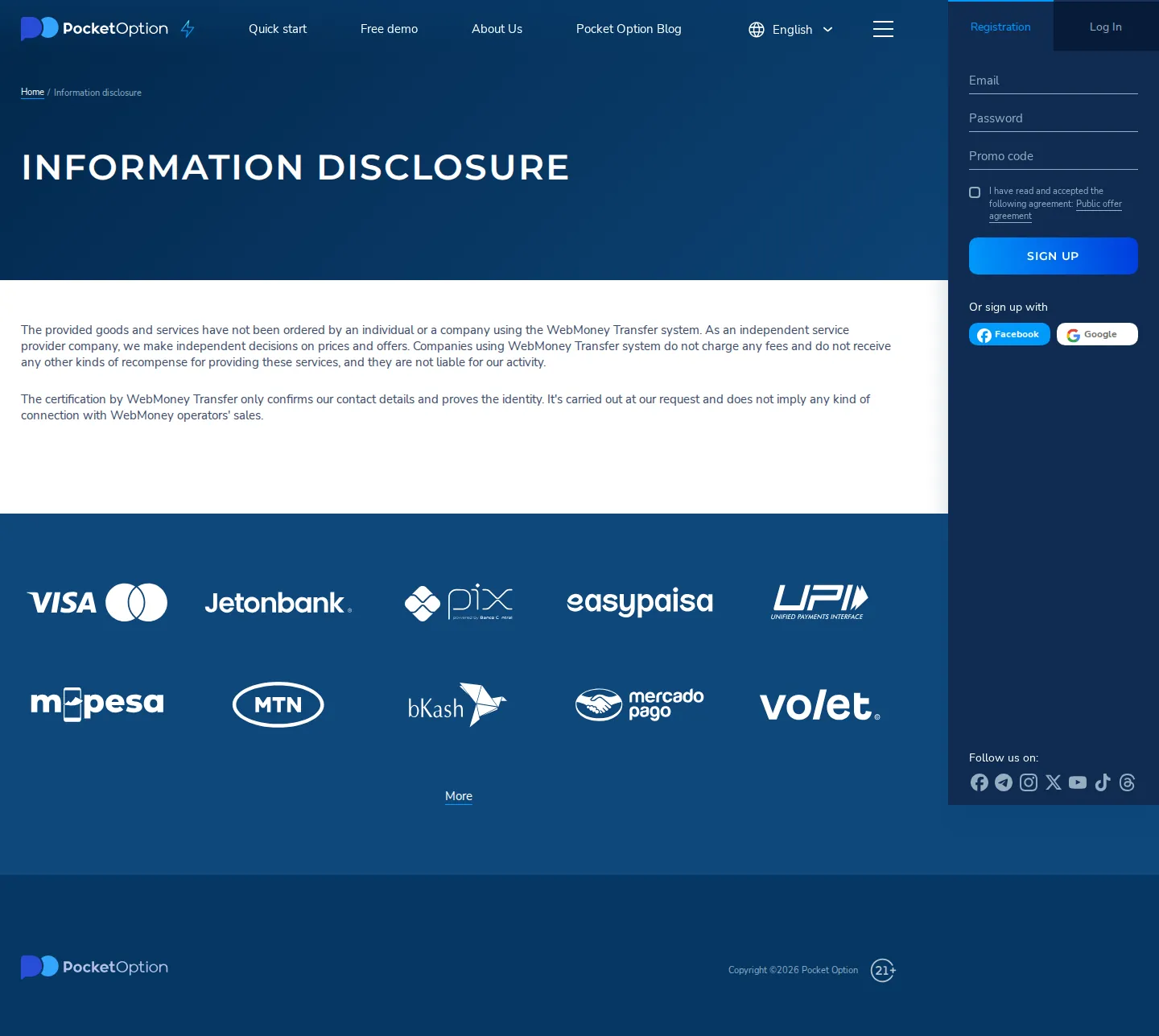
- The firm’s UK legal page shows a WebMoney Transfer registration, but the page itself states this certification “only confirms our contact details and proves the identity”, not a financial-services licence.
- The minimum deposit is $5 and the minimum withdrawal is $10, per our earlier review’s payments data, covering cards, e-wallets, crypto and bank wire.
- Our earlier review reports no deposit or withdrawal fee across Credit/Debit Cards, e-wallets, cryptocurrencies or bank wire transfer, with withdrawal processing of 1-5 business days depending on method.
- A welcome bonus of up to 100% on first deposit requires 50 times the deposit/bonus in trading volume within 30 days before it can be withdrawn, per our earlier review.
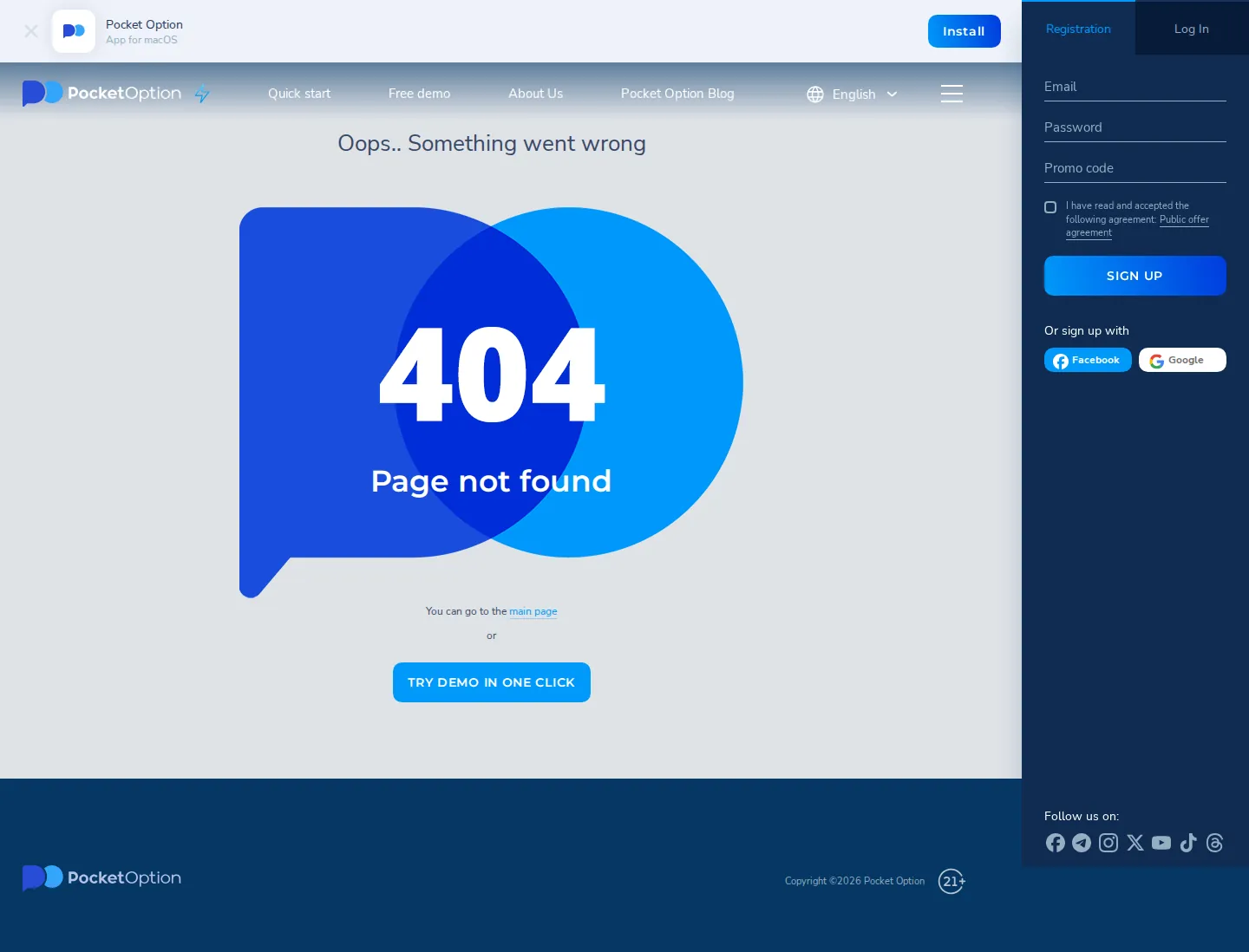
- Pocket Option’s negative balance protection is conditional: Pocket Option may investigate and refuse negative balance protection where it judges the negative balance was caused by a trader’s deliberate actions or by breaches of its terms, and the Terms and Conditions document that would define “violations” returned a 404 on every page we tried.
- The firm’s own risk disclosure (section 2.10, Counterparty risk) treats fund segregation as conditional: “If your funds are not properly segregated from the CFD provider’s funds, and the CFD provider faces financial difficulties, then there is a risk that you may not receive back any monies due to you.”
- The same risk disclosure, section 1.1, states that on a margin shortfall “the closing of your position/s by the Company” can occur and the client “will bear the responsibility for any losses or lack of funds connected therewith”.
- The firm’s UK home page and the firm’s Australian home page both carry the disclaimer that the site does not provide service to UK residents (among others), while the firm maintains dedicated GB and AU site variants reachable from those same countries.
What Pocket Option’s own pages do and do not confirm
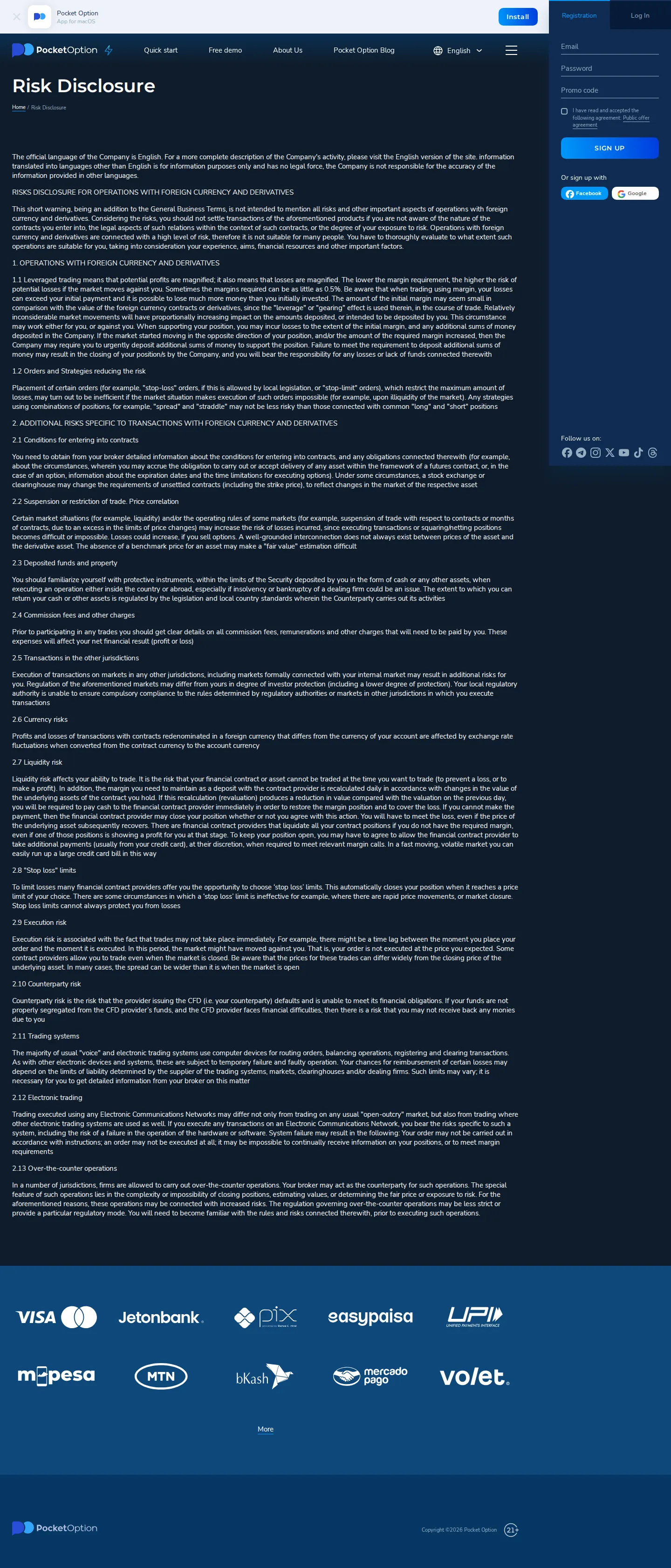
The Legal and Contact pages we fetched for Australia, the UK, the UAE and Indonesia describe a WebMoney Transfer identity certification but stop short of naming any financial regulator. The Risk Disclosure page for Australia is the most substantial legal document we could retrieve, and its own wording on liquidity risk states that “the financial contract provider may close your position whether or not you agree with this action. You will have to meet the loss, even if the price of the underlying asset subsequently recovers” (section 2.7). The same document notes that recovery for platform or system failures is capped by supplier liability limits that “may vary” (section 2.11), with no figure disclosed on the page itself. The header of that same risk disclosure also states that the official language of the Company is English… information translated into languages other than English is for information purposes only and has no legal force, which matters given the firm runs localized-language site variants.
Support channels at Pocket Option
The firm’s UK contact page lists a Support Desk, a community chat/forum, and a contact webform requiring an email address, a message and acceptance of the Privacy policy. The page does not publish a phone number, a support email address, or a response-time commitment.
Key Takeaways
Where the score lands
Pocket Option scores 4.7 out of 10 overall, up from a prior score of 3.5. That earlier number came from a previous version of this catalogue’s assessment; this review restates the score from current evidence rather than tracking any change at the firm. The move here is driven mainly by the platform criterion, which came in at 7.4: the firm runs a proprietary web app, a branded Android app with both an APK download and a Huawei store listing, a macOS web app, and a Telegram bot, none of which needs a download to get started on the browser version. That is a wider spread of access points than the regulation, fees and support scores reflect. Regulation sits at 3, fees at 3, support at 4.8, and reviews at 5.5.
Why regulation scores 3
Every page we fetched for this firm, including the deep-crawled about, contact, legal and platform pages for Australia, Great Britain, the UAE and Indonesia, was checked for a regulator name or licence number and none appeared. The only regulatory claim on record, that Pocket Option names as its regulator the International Financial Market Relations Regulation Center (IFMRRC), comes solely from the earlier published review and was not corroborated on any page we fetched. We hold no register entry for a body named IFMRRC, and the claim carries no licence number, so there is nothing in our directory to check it against; that is a gap in our coverage, not a finding about the firm. The other registration on file, a WebMoney Transfer certification named on the firm’s UK legal page, is not a financial regulator either; the page itself states the certification “only confirms our contact details and proves the identity” and implies no connection to WebMoney’s own operations. We hold no register entry for WebMoney Transfer as an authority either, so that claim is also unchecked by us. Set against that, we searched 1441 warning-list entries mirrored from CYSEC, the FCA and the FSC Mauritius, and Pocket Option matched none of them. That is a clean result worth stating plainly, and it is a check the earlier review did not have, but it only covers the three regulators we mirror, not a global sweep.
What Pocket Option’s own risk disclosure commits to
The firm’s Australia-facing risk disclosure page is the strongest first-hand document we have, and it does not read like promotional copy. Clause 1.1 (Leveraged trading) states that failure to meet a margin call “may result in the closing of your position/s by the Company, and you will bear the responsibility for any losses or lack of funds connected therewith.” Clause 2.7 (Liquidity risk) goes further: a provider “may close your position whether or not you agree with this action,” the client must “meet the loss, even if the price of the underlying asset subsequently recovers,” and some providers “liquidate all your contract positions if you do not have the required margin, even if one of those positions is showing a profit.” Clause 2.10 (Counterparty risk) treats client fund segregation as conditional rather than assured: “If your funds are not properly segregated from the CFD provider’s funds, and the CFD provider faces financial difficulties, then there is a risk that you may not receive back any monies due to you.” That sits in tension with the fund-safety language used elsewhere in the firm’s marketing. Clause 2.11 (Trading systems) adds that compensation for a platform failure depends on “the limits of liability determined by the supplier of the trading systems, markets, clearinghouses and/or dealing firms,” and that “such limits may vary,” meaning no fixed recovery figure is disclosed anywhere on the page. The same document’s header notice states that the official language of the Company is English and that translated versions are “for information purposes only and has no legal force,” despite the firm running fully localized sites in multiple languages.
Negative balance protection has a carve-out
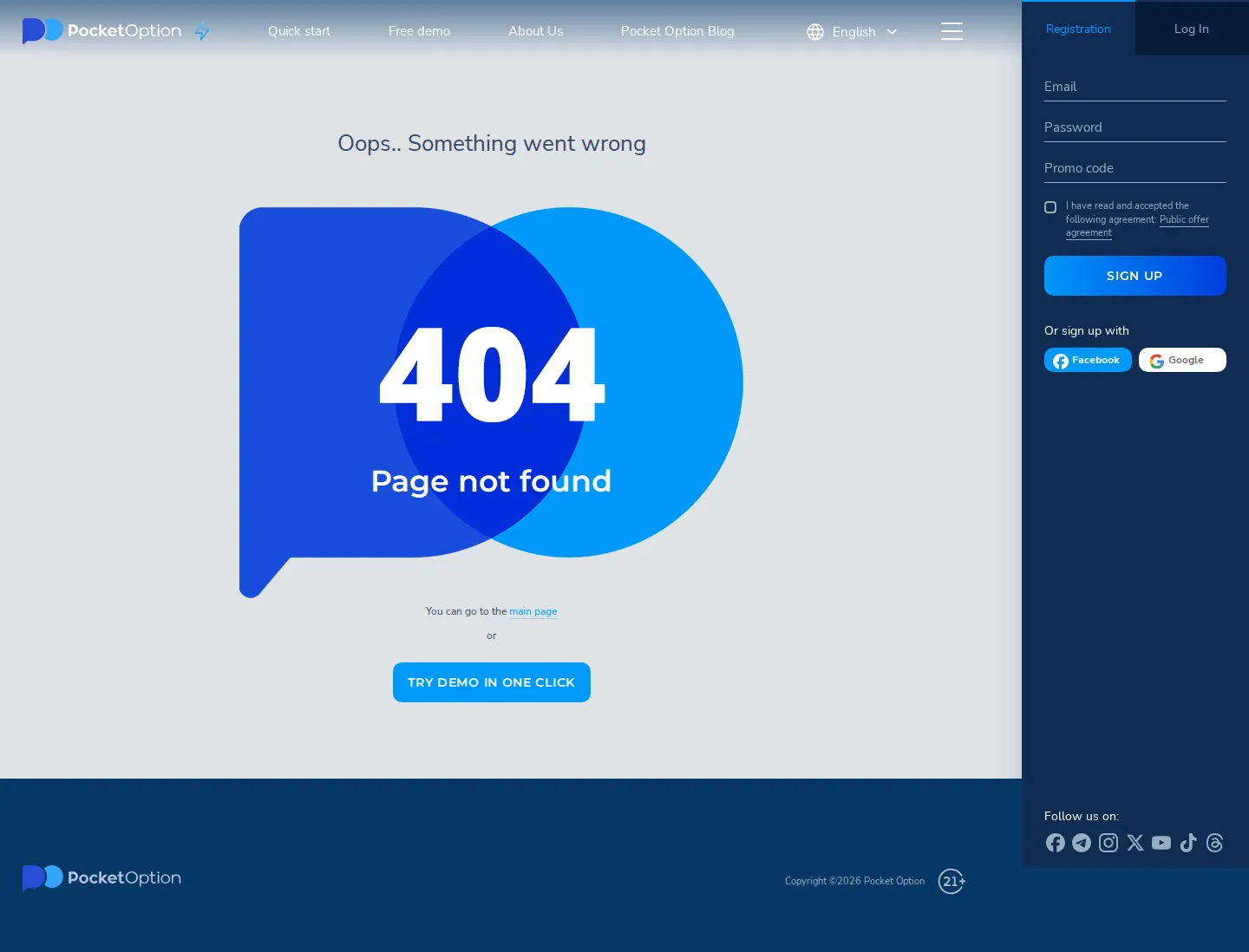
The earlier review reports that Pocket Option offers negative balance protection but reserves the right to withhold it: Pocket Option may investigate and refuse negative balance protection where it judges the negative balance was caused by a trader’s deliberate actions or by breaches of its terms. The document that would define what counts as a “violation” is the firm’s Terms and Conditions, and every attempt to retrieve that document, along with the trading-accounts and pricing pages, returned either a generic “Page not found” shell or a 0-byte body. That means the exact conditions attached to this protection, and to spreads and commissions generally, cannot currently be sourced from the binding contract, only from marketing pages.
Fees and account terms, as reported by the earlier review
None of the fee, account or payment figures below come from a page we fetched ourselves; they are restated from the earlier review. On that basis, Pocket Option is described as charging no deposit or withdrawal fee across cards, e-wallets, cryptocurrency and bank wire, with a $5 minimum deposit and $10 minimum withdrawal, and withdrawal processing of one to five business days depending on method. A single Standard account is described, with payouts advertised “up to 218%” and spreads called “competitive” without a figure attached. A welcome bonus of up to 100% on a first deposit of at least $50 is described as requiring 50 times the deposit or bonus amount in trading volume within 30 days before it can be withdrawn, a structure that can push a bonus-holder toward higher trading volume than they would otherwise choose, with forfeiture if the target is missed. Marketing copy’s “up to 218%” payout ceiling can be set against user reviews the earlier review found on Thai and South African pages describing realized payouts closer to 92%, which is a floor a reader should weigh against the advertised maximum.
Support, as it appears on Pocket Option’s own contact page
The firm’s Great Britain contact page lists a Support Desk, a community chat and forum, and a webform requiring an email address and message plus acceptance of the privacy policy. No phone number, no support email address and no published response-time commitment appear on that page, which is consistent with the 4.8 support score.
Access is geographically inconsistent
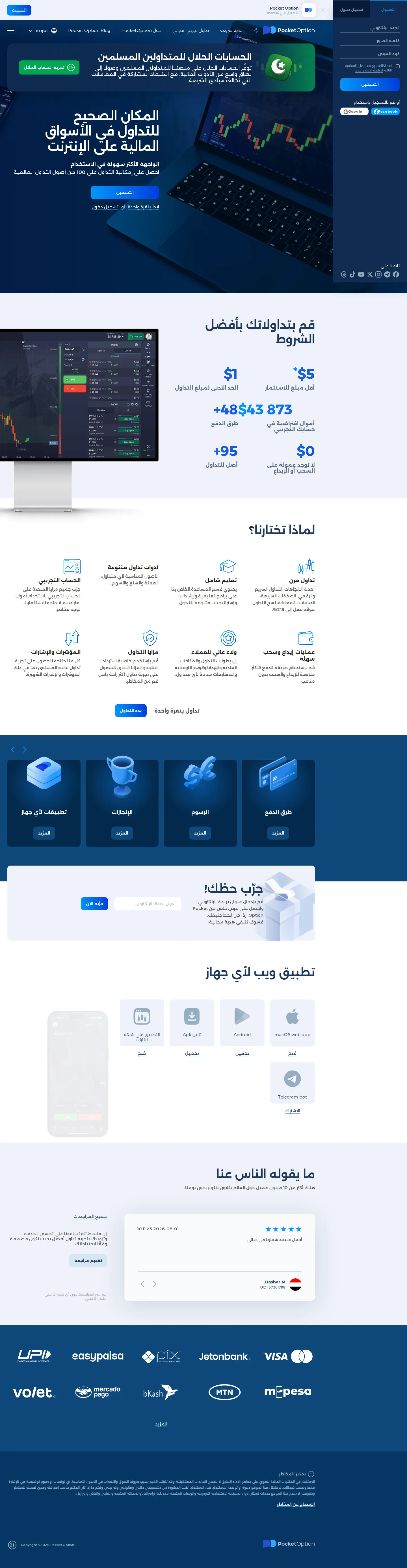
Pocket Option’s German page states the firm is unable to serve German citizens or residents “at the present moment,” and the South African page’s risk-warning footer lists the EEA, the USA, Israel, the UK, the Philippines, Japan and Brazil as regions the site “does not provide service to.” Both the UK and Australian localized root pages carry a version of that same restriction while the firm simultaneously maintains dedicated English-language sites reachable from those countries, an inconsistency that sits on the page itself rather than in our interpretation of it. Separately, the UAE-facing page promotes a “Halal Accounts for Muslim Traders” product without any UAE regulator or registration named on the About, Contact, Legal or Platforms pages we fetched for that market.
Licenses & Regulation
Pocket Option’s regulatory position rests on one claim that we could not check and one document that does not say what it needs to say. We deep-crawled the firm’s own about, contact, legal and platform pages for the Australian, British, Emirati and Indonesian versions of the site, and none of them names a financial regulator or a licence number anywhere. The only regulatory claim on file for this firm, that it is regulated by the “International Financial Market Relations Regulation Center (IFMRRC)”, comes solely from the earlier published review. It is not on pocketoption.com.
What Pocket Option’s own pages show
The firm’s UK legal page does carry one third-party mark: a WebMoney Transfer certification. The page itself states that this certification “only confirms our contact details and proves the identity” and implies no connection to WebMoney’s own operations. That is an identity check, not a financial-services licence, and we treat it as such.
Beyond that mark, the pages we fetched are silent. There is no licence number, no regulator name, and no compensation-scheme reference on any of the AU, GB, AE or ID pages we pulled, including the ones built specifically for those markets.
Why the IFMRRC and WebMoney claims are both marked not checked
We hold no register entry for either the International Financial Market Relations Regulation Center (IFMRRC) or WebMoney Transfer, so neither claim has been checked against a public register. Both claims also arrive without a licence or registration number, so there was nothing to look up even if we held the register. That is a gap in our own directory, not a finding one way or the other about Pocket Option.
What we could check is the warning-list search: we searched 1441 entries mirrored from the CYSEC, FCA and FSC Mauritius warning lists, and Pocket Option matched none of them. That is a clean result worth stating plainly, and it is a result our earlier review did not have. It only covers the three lists we mirror, not every regulator worldwide, so it says nothing about jurisdictions outside those three.
Where Pocket Option says it will not operate
The firm’s own pages do carry two country-level restrictions. The German-language root page states the site is unable to provide services to German citizens and residents “at the present moment”, and the South African-facing page’s risk-warning footer states the site “does not provide service to residents of” the EEA countries, the USA, Israel, the UK, the Philippines, Japan and Brazil.
That UK exclusion sits oddly next to the fact that the firm maintains a fully localized, English-language GB site, reachable from the UK, carrying the same disclaimer. The two statements are on the pages we fetched and they do not agree with each other; we report both rather than picking one.
The Emirati-facing page separately markets “Halal Accounts for Muslim Traders” as a dedicated UAE product, but none of the AE about, contact, legal or platform pages we fetched discloses any UAE regulator or registration to go with it.
The document that would settle this is not retrievable
Pocket Option’s own Terms and Conditions pages for AU, GB and ID all resolved to a generic “Page not found” shell when we fetched them, and separate attempts at /terms, /pricing, /spreads and /trading-accounts came back as empty bodies. That is the document that would normally state the contracting entity, its licence, and the jurisdiction governing the client agreement, and it was not accessible to us on any of the paths we tried.
The one legal document we could read, the risk disclosure, treats fund segregation as conditional rather than guaranteed: clause 2.10 states that “if your funds are not properly segregated from the CFD provider’s funds, and the CFD provider faces financial difficulties, then there is a risk that you may not receive back any monies due to you.” The same page’s header notice states that the official language of the Company is English and that translated versions “for information purposes only” carry no legal force, meaning a client reading any of the site’s other-language versions has no legal recourse if that version differs from the English original.
This review scores regulation at 3 out of 10, down from a previous review of this broker overall at 3.5 out of 10. The move to 4.7 overall reflects a rewritten scoring pass across all criteria, not a change in Pocket Option’s regulatory standing, which the evidence here does not show has moved in either direction.
How to Trade
The earlier review describes a single account type, with no tiered account structure, with access to forex, stocks, commodities, cryptocurrencies, indices and binary options, according to our earlier review. Marketing copy quoted in that earlier review describes forex as covering majors, minors and exotics such as EUR/USD, GBP/USD and USD/JPY with “competitive spreads and high liquidity,” stocks as CFDs on large companies such as Apple, Amazon, Tesla and Netflix, commodities as gold and silver plus oil and gas, cryptocurrencies as speculation on “Bitcoin, Ethereum, Litecoin, and Ripple” with no wallet needed, and indices as global indices including the DAX 30, FTSE 100, NASDAQ and S&P 500. None of those figures come from a page we fetched ourselves; we could not retrieve the firm’s own trading accounts or pricing pages to check spreads, commissions or contract specifications against them.
Binary options and the payout figure
Binary options sit alongside the CFD-style instruments, described in our earlier review as letting a trader call whether an asset’s price will rise or fall within a fixed time window for a payout of “up to 218%.” That is a ceiling, not a typical outcome: the evidence includes self-reported user reviews on Pocket Option’s Thailand and South Africa pages describing realized payouts around 92%, well below the advertised maximum.
What can force a position closed at Pocket Option
The firm’s own risk disclosure, fetched from its Australia-facing legal pages, sets out what happens when a leveraged position moves against a client. Clause 1.1 on leveraged trading states that “failure to meet the requirement to deposit additional sums of money may result in the closing of your position/s by the Company, and you will bear the responsibility for any losses or lack of funds connected therewith.” Clause 2.7 on liquidity risk goes further: the financial contract provider may close your position whether or not you agree with this action. You will have to meet the loss, even if the price of the underlying asset subsequently recovers… some financial contract providers liquidate all your contract positions if you do not have the required margin, even if one of those positions is showing a profit. Together these two clauses mean a margin shortfall can trigger closure of any open position, including one that is currently profitable, with no requirement for the client’s consent and no relief if the market later turns back in the client’s favor.
Negative balance protection has a carve-out
Our earlier review reports a negative balance protection policy stating that Pocket Option may investigate and refuse negative balance protection where it judges the negative balance was caused by a trader’s deliberate actions or by breaches of its terms. That leaves the protection conditional rather than absolute, and the document that would define what counts as a “violation” is not something we could check: every attempt to fetch the firm’s own terms and conditions pages, for Australia, Great Britain and Indonesia, returned a generic page not found result, and separate probes for a terms, pricing, spreads or trading accounts path all came back empty.
Fund segregation is conditional in the firm’s own wording
Clause 2.10 of the same risk disclosure, on counterparty risk, reads: “if your funds are not properly segregated from the CFD provider’s funds, and the CFD provider faces financial difficulties, then there is a risk that you may not receive back any monies due to you.” That is conditional phrasing on the firm’s own legal page, not a guarantee that segregation is in place, and it sits apart from the stronger fund-safety language used in the firm’s marketing.
Trading system failures and where liability ends
Clause 2.11, on trading systems, states that “your chances for reimbursement of certain losses may depend on the limits of liability determined by the supplier of the trading systems, markets, clearinghouses and/or dealing firms. Such limits may vary.” The disclosure does not put a figure on those limits anywhere we could find, so a client cannot work out in advance how much a platform or system failure would actually cost them to absorb.
Which language of the contract actually binds
A header notice on the same risk disclosure page states that the official language of the Company is English… information translated into languages other than English is for information purposes only and has no legal force, the Company is not responsible for the accuracy of the information provided in other languages. Pocket Option runs fully localized sites in languages including Arabic, Spanish and Thai, so a client trading from one of those local pages is still bound only by the English original if the two ever disagree.
Platforms available to trade on
Pocket Option’s Australia-facing site lists a proprietary browser-based Web App that needs no download, its own branded Android app distributed as an APK (with a Huawei app store link on the South Africa page), and a Telegram bot in the platforms navigation. The Great Britain and United Arab Emirates page variants also list a macOS web app with an install button, described there as cutting chart loading time and extending battery life by up to 25 percent, though that listing does not appear on the Australia site we checked.
Deposit minimum and Halal accounts
Our earlier review gives a $5 minimum deposit across card, e-wallet, cryptocurrency and bank wire methods, with no maximum stated. Separately, Pocket Option’s UAE-facing page markets “Halal Accounts for Muslim Traders” as a dedicated local product, but none of the AE about, contact, legal or platforms pages we fetched disclose a UAE regulator or licence backing that offering.
Account Types
Our earlier review describes Pocket Option’s account as a Standard Account with a $5 minimum deposit, covering forex, stocks, commodities and cryptocurrencies, with payouts described as “up to 218%.” There is no tiered structure of Basic, Silver, Gold or VIP accounts to compare, because the evidence does not describe one.
What the Standard Account includes
According to our earlier review, the Standard Account gives access to all asset classes the firm offers, comes with a free demo account loaded with $10,000 in virtual funds, and includes social and copy trading. Spreads are described in that same material from our earlier review only as “competitive,” with no pip figure attached, so there is nothing to quote. The firm’s own Trading Accounts and Pricing pages could not be retrieved: The firm’s Australian terms page and the firm’s Indonesian terms page both returned a generic “Page not found” shell, and separate probes for /terms, /pricing, /spreads and /trading-accounts came back with 0 byte bodies. That means the numbers in this section come from marketing copy carried over from the earlier review, not from a document we could read ourselves.
The 218% payout figure against what traders report
The “up to 218%” payout appears in our earlier review’s account description, and the firm’s own homepage repeats it as “Payouts of up to 218%”. It is a ceiling, not an average. A self reported user review on Pocket Option’s own South Africa page describes a realized payout closer to 92%. Nothing on the fetched pages ties the 218% figure to a specific asset, expiry or market condition, so a reader has no way to tell from the firm’s own site how often that ceiling is actually paid.
The welcome bonus attached to the account
Our earlier review reports a welcome bonus of up to 100% on a first deposit, available from a $50 minimum deposit, and requiring trading volume of 50 times within 30 days before withdrawal the bonus. That volume requirement is worth stating plainly: it locks the bonus behind a high turnover target on a tight deadline, which can push a trader toward opening more positions than they otherwise would just to clear it, and the bonus is forfeited if the target is not met in time.
Funding the account
Per our earlier review, deposits and withdrawals carry no stated fee across the four funding methods offered: credit and debit cards, e-wallets (Skrill, Neteller, WebMoney), cryptocurrencies (BTC, ETH, LTC), and bank wire transfer. The earlier review gives a $5 minimum deposit across all methods and a $10 minimum withdrawal, with no maximum stated for either. Withdrawal processing runs from 1 to 5 business days depending on method, against instant deposits for cards, e-wallets and crypto, and 1 to 5 business days for a wire deposit.
What the account does not come with, on the record we could check
No regulator or licence number appears anywhere on the pocketoption.com pages we fetched, including the deep crawled About, Contact, Legal and Platforms pages for Australia, the UK, the UAE and Indonesia. The only regulatory claim tied to the account, a licence from the International Financial Market Relations Regulation Center, comes solely from our earlier review text and was not corroborated on any page we pulled ourselves. A registration with WebMoney Transfer does appear on the firm’s UK legal page, but that page itself states the certification “only confirms our contact details and proves the identity,” and implies no connection to WebMoney’s own operations, so it has no bearing on the account’s regulatory standing. We searched 1441 warning list entries mirrored from CYSEC, the FCA and FSC Mauritius, and Pocket Option matched none of them; that is a clean result within the scope of those three lists, not a clearance from every regulator.
Our previous score for this broker’s account offering sat within an overall 3.5 out of 10; this review scores the account, priced under the same 4.7 out of 10 overall, with regulation at 3 and fees at 3. Both scores reflect the same gap running through this section: the account’s own pricing and terms pages return no content on the firm’s site, so the figures attached to the account, from the minimum deposit to the bonus volume requirement to the payout ceiling, rest on our earlier review rather than on a document we were able to read directly, and no regulator backs the account on the pages we did fetch.
Negative Balance Protection
Pocket Option’s own risk disclosure, fetched from its AU risk page, spells out what happens on a margin shortfall well before any negative balance question comes up. Clause 1.1 on leveraged trading states that failure to meet a request for additional funds “may result in the closing of your position/s by the Company, and you will bear the responsibility for any losses or lack of funds connected therewith.” Clause 2.7 on liquidity risk goes further: the financial contract provider may close your position whether or not you agree with this action. You will have to meet the loss, even if the price of the underlying asset subsequently recovers… some financial contract providers liquidate all your contract positions if you do not have the required margin, even if one of those positions is showing a profit. Read together, the firm can force close a client’s account on a shortfall, including positions that are currently profitable, and the client absorbs whatever loss results even if the market turns around afterward.
What Pocket Option’s negative balance protection actually covers
Our earlier review reported a specific carve out in Pocket Option’s negative balance protection: Pocket Option may investigate and refuse negative balance protection where it judges the negative balance was caused by a trader’s deliberate actions or by breaches of its terms. Restated plainly, the protection is not unconditional. The firm can open an investigation into how a negative balance arose and refuse to honor the protection if it decides the client’s own conduct, or a breach of the terms and conditions, caused it. We were not able to check what violations of the terms and conditions means in practice: separate probes for a generic terms, pricing, spreads or trading accounts URL all came back with 0 byte bodies. So the document that would define the boundary between an ordinary loss and a “violation” that voids protection is not something we could read.
Where the firm’s own disclosure pulls against its fund safety claims
Clause 2.10 on counterparty risk, from that same AU risk page, treats the safety of client funds as conditional rather than assured: “If your funds are not properly segregated from the CFD provider’s funds, and the CFD provider faces financial difficulties, then there is a risk that you may not receive back any monies due to you.” That sits awkwardly next to our earlier review’s separate claim that client funds are held in segregated, secure accounts under IFMRRC oversight, a regulator we could not check (see below). We are not asserting the firm fails to segregate funds; we are pointing out that Pocket Option’s own risk text does not confirm segregation is guaranteed, while a secondhand source claims it is.
The same page’s clause 2.11 on trading systems adds another limit on what a client can recover: “Your chances for reimbursement of certain losses may depend on the limits of liability determined by the supplier of the trading systems, markets, clearinghouses and/or dealing firms. Such limits may vary.” No figure or cap is given anywhere on the page, so a client cannot know in advance how much a platform or systems failure would actually be worth to them.
The bonus terms that sit next to the loss rules
Our earlier review also described a welcome bonus of up to 100% on a first deposit, conditional on trading 50 times the deposit or bonus amount within 30 days before any of it becomes withdrawable. Set against the margin call and liquidation language above, that volume requirement pushes a client who has taken the bonus toward more trading activity in a short window, which is the same period in which a margin shortfall would trigger forced closures under clause 1.1 and 2.7. We cannot say the bonus was designed to increase liquidation risk; we can say the two sets of terms, read together, create that pressure.
What we could and could not verify about the regulator behind these claims
The sole regulatory name attached to Pocket Option, the International Financial Market Relations Regulation Center (IFMRRC), comes only from our earlier review text and was not corroborated on any pocketoption.com page we fetched, including the deep crawled about, contact and legal pages for AU, GB, AE and ID. We hold no register entry for a body named IFMRRC, and the claim carries no licence number, so we had nothing to look up. That is a gap in our own directory, not a finding about the firm. We did search 1441 warning list entries mirrored from CYSEC, the FCA and FSC Mauritius, and Pocket Option matched none of them. That result covers only the three lists we mirror, not every regulator, but it is a clean result our earlier review did not have.
Our previous score for this broker was 3.5 out of 10; this review scores it 4.7 out of 10. The move is ours, not the firm’s, and it reflects a rescored platform criterion, now 7.4, based on the firm’s own web app, native Android app and macOS app pages we fetched directly, against a regulation score held at 3 and a fees score held at 3, both still resting on the same unverifiable licence claim and the unread terms and conditions described above.
Trading Instruments
Six instrument groups appear in the material reviewed for Pocket Option: forex, stock CFDs, commodities, cryptocurrencies, indices and binary options. The forex line names EUR/USD, GBP/USD and USD/JPY; the stock line names Apple, Amazon, Tesla and Netflix as CFDs, meaning traders take a position on the price without owning the shares; the commodities line covers gold, silver, oil and gas; the crypto line names Bitcoin, Ethereum, Litecoin and Ripple; the indices line names the DAX 30, FTSE 100, NASDAQ and S&P 500. None of this instrument list comes from a page we fetched ourselves; it reached us from the earlier published review this catalogue is rewriting, and we are restating it rather than quoting the firm’s own site.
That gap matters more here than it usually would, because the documents that would normally fix the details of an asset offering were not there to check. Pocket Option’s own Terms and Conditions, Trading Accounts and Pricing pages could not be retrieved: the AU terms page resolved to a generic “Page not found” shell, and separate probes for /terms, /pricing, /spreads and /trading-accounts came back as empty bodies. So there is no spread table, no commission schedule and no per-instrument contract specification we can point to. The “competitive spreads” language attached to forex, and the single “Standard Account” description with “competitive” (unquantified) spreads, both come from our earlier review rather than a page we read.
The payout figure and what users reportedly saw
The 218% payout ceiling appears on the firm’s own homepage as a general claim and in our earlier review as a Standard Account feature. Separately, the evidence notes self-reported user reviews on Pocket Option’s regional pages describing a realized payout around 92%, well under the advertised maximum. We did not verify either figure ourselves; the 218% is marketing copy relayed by the earlier review, and the 92% is what other users reported on the firm’s own regional pages, not a figure we measured. The distance between an advertised ceiling and what traders say they actually got is worth flagging on its own terms.
Binary options sit inside the same offering as CFDs
Pocket Option lists binary options alongside forex, stock, commodity, crypto and index CFDs as one undifferentiated product set, per our earlier review. Binary options and CFDs are structurally different instruments, one paying a fixed return on a correct direction call within a timeframe, the other tracking the underlying price move, and the site copy does not appear to separate the risk disclosures or account terms for the two. We have no page of our own confirming how, or whether, Pocket Option distinguishes them for a client opening a position.
What the firm’s own risk disclosure says instead
Where we could read Pocket Option’s own document, it was the risk disclosure, not a product page, and it complicates the asset picture rather than filling it in. Section 2.7, Liquidity risk, states that “the financial contract provider may close your position whether or not you agree with this action. You will have to meet the loss, even if the price of the underlying asset subsequently recovers,” and adds that some financial contract providers liquidate all your contract positions if you do not have the required margin, even if one of those positions is showing a profit. That clause applies across whichever of the six asset classes a client is holding: a forex, index or crypto CFD position can be closed without consent on a margin shortfall, profit or not. Section 1.1, Leveraged trading, adds that failing to meet a margin call “may result in the closing of your position/s by the Company, and you will bear the responsibility for any losses or lack of funds connected therewith.” Neither clause names which instruments carry leverage or at what ratio; that detail would live in the missing terms and pricing pages.
Halal accounts advertised in the UAE with no visible license behind them
The AE-localized page promotes “Halal Accounts for Muslim Traders” as a UAE-facing product sitting on top of the same asset list. No UAE financial regulator and no licence or registration number appears anywhere in the AE about, contact, legal or platforms pages we fetched. A trader in the UAE is offered a locally tailored account structure without anything on Pocket Option’s own site tying it to local regulatory oversight.
Regulation behind the assets on offer
The only regulator named anywhere in connection with Pocket Option’s trading offer is the International Financial Market Relations Regulation Center (IFMRRC), and that claim comes solely from our earlier review text; no fetched pocketoption.com page, including the deep-crawled about, contact, legal and platforms pages for AU, GB, AE and ID, corroborates it. We hold no register entry for a body named IFMRRC, so we could not check it, and the claim carries no licence number that would have given us something to look up. That is a gap in our own directory rather than a finding about the firm, but it means the asset classes described above are offered with no regulator we can verify standing behind them.
This review scores Pocket Option 4.7 out of 10 overall, up from our previous 3.5. The movement is our assessment against updated criteria and evidence, not a change in the firm. On regulation the score sits at 3, reflecting a single, unverifiable regulator claim and no licence detail on the firm’s own pages. Fees score 3, consistent with an asset offering whose spreads and commissions cannot be confirmed against any pricing document. Platform scores highest at 7.4, driven by the web app, Android app and macOS client described elsewhere in this review, none of which changes what can or cannot be confirmed about the assets themselves.
Education & Analysis
Platforms Pocket Option puts in front of traders
The firm runs a proprietary web app, browser based with no download required, according to the AU-localized page we fetched. Alongside it there is an Android app distributed as an APK download, and the South Africa page adds a Huawei app store listing for the same app. The GB and AE page variants, though not the AU or other pages we checked, also list a macOS web app with an install button, described there as cutting chart loading time and raising battery life by up to 25%. A Telegram bot appears in the platforms footer navigation across the country versions of the site we crawled. We did not find a MetaTrader 4 or MetaTrader 5 listing on any of the pages we fetched, so we cannot say whether either is offered.
Instruments and how the earlier review described them
The instrument list comes from the earlier published review, not from a page we fetched ourselves, so we are restating it rather than quoting the firm. That review described forex trading across major, minor and exotic pairs including EUR/USD, GBP/USD and USD/JPY, stock CFDs on companies such as Apple, Amazon, Tesla and Netflix, commodities covering precious metals and energy, cryptocurrency speculation on Bitcoin, Ethereum, Litecoin and Ripple, and indices exposure to benchmarks such as the DAX 30, FTSE 100, NASDAQ and S&P 500. It also described binary options with a stated payout of up to 218%. That 218% ceiling is worth holding against the payments evidence below: self-reported user reviews on the TH and ZA pages describe realized payouts closer to 92%, so the advertised maximum is a ceiling, not what several users say they actually received.
What we could not verify because the pricing pages were unreachable
Every attempt to retrieve the pages that would define this firm’s spreads, commissions and trading-account terms failed. The AU, GB and ID terms pages all resolved to a generic page not found shell, and separate probes for a terms page, a pricing page, a spreads page and a trading accounts page each came back with an empty body. That means the “competitive” spreads language attached to the single Standard Account in the earlier review, and the account’s headline payout figure, cannot be checked against the firm’s own binding pricing document. It also means the negative balance protection clause quoted below, which turns on what counts as a violation of the terms and conditions, references a document we were unable to open.
Analysis tools and the site’s own account setup
Beyond the web app, Android app, macOS app and Telegram bot listed above, the pages we fetched did not describe a separate charting or analysis toolset, an economic calendar, or third party signal integrations. The Standard Account, per the earlier review, comes with a free demo funded with $10,000 in virtual funds and includes social and copy trading. We have no firsthand page confirming spread figures, commission schedules or execution model for that account, for the reasons above.
Score and what moved it
Our previous review scored Pocket Option 3.5 out of 10; this one scores 4.7 out of 10. That is our assessment changing, not the firm, since both the scoring criteria and the evidence behind this review differ from what produced the earlier number. The platform criterion sits at 7.4, the highest of the group, which the evidence here supports: the firm operates a genuine multi-surface platform stack, web app, Android app, a macOS app on some geo variants, and a Telegram bot, all found directly on the firm’s own geo-localized pages rather than taken from our earlier review. Regulation stays weak at 3 and support middling at 4.8, which lines up with the platforms and terms pages we could not retrieve and the sole regulatory claim (IFMRRC) coming only from our earlier review text rather than any pocketoption.com page we fetched.
Special Offers
Pocket Option’s promotional claims come almost entirely from the earlier review this catalogue is rewriting, not from anything we fetched off pocketoption.com. We could not retrieve the firm’s own Terms and Conditions, Trading Accounts or Pricing pages: The firm’s Australian terms page, the firm’s UK terms page and the firm’s Indonesian terms page all returned a generic “Page not found” shell, and separate checks against /terms, /pricing, /spreads and /trading-accounts came back with 0-byte bodies. That means the document that would actually define a promotion’s conditions was not available to check against the marketing copy.
The welcome bonus, as the earlier review described it
The earlier review that this catalogue is rewriting reported a welcome (deposit) bonus of up to 100% on a first deposit, requiring a minimum deposit of $50, with the bonus withdrawable only after 50 times the deposit/bonus amount has been traded within 30 days. We are restating that figure from our earlier review, not from a page we fetched ourselves. Taken at face value, that condition locks bonus funds behind a high-volume trading requirement on a tight deadline, which can push a trader toward more or larger trades than they’d otherwise place, and the bonus is forfeited if the 50x target isn’t hit inside the 30 days.
Affiliate commission, also from our earlier review
The same earlier review described an affiliate program paying up to 50% of net revenue generated by referrals, open to all with monthly payouts and no stated earning cap. Again, this is restated from our earlier review rather than confirmed against a page we fetched, and we hold no detail on how “net revenue” is calculated, what triggers a payout, or whether any minimum referral activity applies.
What we could check independently
Separately from any bonus or affiliate structure, Pocket Option’s negative-balance protection is not unconditional. Per our earlier review’s account of the policy: Pocket Option may investigate and refuse negative balance protection where it judges the negative balance was caused by a trader’s deliberate actions or by breaches of its terms. The document that would define what counts as a “violation” under that clause is the same Terms and Conditions page that returned a 404 on every attempt we made to fetch it, so a trader has no way to check the boundaries of that carve-out against the firm’s own binding text.
The account structure itself carries no separate promotional tier that we found: the pages we fetched and our earlier review both describe a single Standard Account, open with a $5 minimum deposit, rather than a ladder of account types with different bonus terms attached to each.
Why the score moved
Our previous score for Pocket Option was 3.5/10; this review scores it 4.7/10. That change reflects our current assessment against the evidence gathered for this rewrite, not any change in what Pocket Option itself offers. The regulation score sits at 3, driven by the fact that no fetched pocketoption.com page, including the deep-crawled about, contact, legal and platform pages for AU, GB, AE and ID, states any financial regulator or licence number anywhere; the sole regulatory claim, a licence from the “International Financial Market Relations Regulation Center (IFMRRC),” comes only from our earlier review text and is marked unchecked in our register, since we hold no entry for that authority and the claim names no licence number to look up. The fees score of 3 reflects the bonus’s 50x volume condition and the inaccessible pricing/terms pages sitting alongside our earlier review’s no-fee deposit and withdrawal claims. Set against that, we searched 1,441 warning-list entries mirrored from CYSEC, the FCA and the FSC Mauritius, and Pocket Option matched none of them, a clean result that the earlier review did not have and that we count in the firm’s favor even though it only covers the three regulators we mirror.
Opening an Account
The earlier review described Pocket Option as running a single account type, funded with a minimum deposit of $5, and there is no separate application or tiered sign-up process described in that material: the account itself is the onboarding path. Because the firm’s own Terms and Conditions, Trading Accounts and Pricing pages could not be retrieved (the firm’s Australian terms page returned a generic “Page not found” shell, and separate probes for /terms, /pricing, /spreads and /trading-accounts came back as 0-byte bodies), we cannot report the identity-verification steps or document checklist from Pocket Option’s own binding text. What follows is limited to what the fetched pages and the earlier published review actually state.
Funding the account with Pocket Option
The earlier review reported a minimum deposit of $5 and a minimum withdrawal of $10, with no stated maximum on either side, across four payment routes: credit and debit cards, e-wallets (Skrill, Neteller), cryptocurrencies (BTC, ETH, LTC) and bank wire transfer. That same material from our earlier review described no deposit fee and no withdrawal fee on any of the four methods, with card and e-wallet deposits crediting instantly, card withdrawals taking one to three business days, e-wallet withdrawals instant, crypto withdrawals one to five business days, and bank wire the slowest at three to five business days for a withdrawal after a deposit window of one to five business days. None of this comes from a Pocket Option page we fetched ourselves; it is restated from the earlier review, not quoted from the firm.
Where Pocket Option will not open an account
Two restrictions appear on pages we fetched directly. The German-localized page states the site is unable to provide services to citizens and residents of Germany “at the present moment.” Separately, the risk-warning footer on the South Africa-localized page states the website “does not provide service to residents of” the EEA countries, the USA, Israel, the UK, the Philippines, Japan and Brazil. Notably, the UK and Australia each have their own dedicated, fully localized Pocket Option site reachable from those countries, so a UK visitor lands on a page built for them while that same site’s risk warning states the service is not provided to UK residents. We could not tie any broader country list (Iran, North Korea, Syria, Cuba and similar names sometimes cited elsewhere) to anything Pocket Option itself publishes, so it is left out here rather than reported as fact.
No regulator disclosed on the account opening pages
No page we fetched, including the deep-crawled About, Contact, Legal and Platforms pages for Australia, the UK, the UAE and Indonesia, names a financial regulator or a licence number anywhere on the site. The only regulatory claim attached to this broker, a licence from the “International Financial Market Relations Regulation Center (IFMRRC),” comes solely from our earlier review text, not from anything on pocketoption.com; we hold no register entry for that authority and the claim names no licence number, so it remains unchecked rather than confirmed. The GB legal page does reference a WebMoney Transfer certification, but that page itself states the certification “only confirms our contact details and proves the identity” and implies no connection to WebMoney’s own operations, so it is an identity check, not a trading licence. The UAE-facing site markets a “Halal Accounts for Muslim Traders” product without disclosing any UAE regulator, such as the SCA, on the AE about, contact, legal or platforms pages we fetched.
What binds a client once the account is open
The risk disclosure states in its section on leveraged trading that “failure to meet the requirement to deposit additional sums of money may result in the closing of your position/s by the Company, and you will bear the responsibility for any losses or lack of funds connected therewith.” The same document’s liquidity-risk section states that “the financial contract provider may close your position whether or not you agree with this action” and that a provider may “liquidate all your contract positions if you do not have the required margin, even if one of those positions is showing a profit.” A header notice on the same risk disclosure states that the Company’s official language is English and that “information translated into languages other than English is for information purposes only and has no legal force,” despite the firm running fully localized sites in multiple languages. A promotional welcome bonus, reported by the earlier review at up to 100% on a first deposit of at least $50, carries a requirement of 50 times the deposit or bonus in trading volume within 30 days before it becomes withdrawable, a condition the earlier review’s negative-balance-protection text separately describes as something Pocket Option may investigate and refuse if it judges a negative balance came from a client’s own violations of terms it does not define on any page we could retrieve.
This review scores Pocket Option 4.7 out of 10, up from our previous 3.5. The move reflects our current assessment against the evidence above, not any change on the firm’s part: the platform score of 7.4 is carried by the web app, mobile app and macOS app the firm’s own pages describe, while regulation sits at 3 because no fetched page names a licence and the sole regulator claim is unverifiable, and support sits at 4.8 because the Contacts page offers a support desk link, a community chat and a webform with no published phone number, email address or response-time commitment.
Deposits & Withdrawals
According to the earlier review of the firm, deposits and withdrawals on Pocket Option run through four rails: cards, e-wallets, crypto and bank wire; none of the four carries a deposit or withdrawal fee, the minimum deposit is $5 and the minimum withdrawal is $10, with no maximum stated for either. That earlier review also reported the processing side splits by method: card and bank-wire deposits and withdrawals are the slowest, while e-wallets and crypto move fastest.
What Pocket Option’s rails look like
- Credit/Debit Cards (Visa, Mastercard): instant deposit, withdrawal in 1-3 business days, no fee stated, $5 minimum deposit / $10 minimum withdrawal, per the earlier review.
- E-wallets (Skrill, Neteller, WebMoney): instant deposit and instant withdrawal, no fee stated, same $5/$10 minimums, per the earlier review.
- Cryptocurrencies (BTC, ETH, LTC): instant deposit, withdrawal in 1-5 business days, no fee stated, same $5/$10 minimums, per the earlier review.
- Bank Wire Transfer: the slowest of the four, 1-5 business days to deposit and 3-5 business days to withdraw, no fee stated, same $5/$10 minimums, per the earlier review.
WebMoney turns up twice in what we hold on this firm, in two different roles. As a payment rail it’s one of the e-wallet options above. Separately, the GB legal page we fetched shows a WebMoney certification badge, and the page itself states that certification “only confirms our contact details and proves the identity” of the operator, with no implied connection to WebMoney’s own payment operations. That is an identity check, not a financial licence, and it says nothing about the safety of funds moved through any of the four rails above.
The welcome bonus attaches strings to withdrawals
The earlier review reported a welcome bonus of up to 100% on a first deposit of at least $50. The condition attached to it, also from that earlier review, is a trading volume requirement of 50 times the deposit-plus-bonus amount within 30 days before any of the bonus becomes withdrawable. Read plainly, that ties a client’s ability to withdraw to a volume target, not to a time elapsed or a deposit held, and a client who accepts the bonus but doesn’t hit the 50x figure within the 30-day window has no stated path to withdraw it. We were not able to check this condition against the firm’s own terms and conditions pages, because the au-terms, gb-terms and id-terms pages we tried all returned a generic “Page not found” shell, and separate attempts at /terms, /pricing and /trading-accounts came back empty. So the 50x figure and its deadline rest on the earlier review, not on a document we read ourselves.
Negative balance protection has a carve-out
Pocket Option’s negative balance protection, per the earlier review, does not apply unconditionally: the firm may investigate and refuse negative balance protection where it judges a negative balance was caused by a trader’s deliberate actions or breaches of its terms. What counts as a violation would ordinarily be defined in the terms and conditions document, but as above, that document wasn’t retrievable from any page we fetched. A client relying on negative balance protection as a backstop is relying on a clause the firm can decline to honor at its own discretion, against a definition of “violation” we could not read.
What the risk disclosure says about getting money back
The firm’s own risk disclosure, which we did read, treats segregation of client funds as conditional rather than guaranteed. Its counterparty-risk clause (2.10) states: “If your funds are not properly segregated from the CFD provider’s funds, and the CFD provider faces financial difficulties, then there is a risk that you may not receive back any monies due to you.” That is an “if” clause on the document that governs the relationship, not a statement that segregation is in place. The same risk disclosure also caps recovery for platform or system failures without naming a figure: clause 2.11 says reimbursement “may depend on the limits of liability determined by the supplier of the trading systems, markets, clearinghouses and/or dealing firms,” and that “such limits may vary.” Neither clause is specific to withdrawal processing, but both bear directly on whether money a client is owed, including money mid-withdrawal, actually comes back.
Margin calls can force a position closed before a withdrawal
The same risk disclosure states, under leveraged trading (1.1): “Failure to meet the requirement to deposit additional sums of money may result in the closing of your position/s by the Company, and you will bear the responsibility for any losses or lack of funds connected therewith.” A related clause on liquidity risk (2.7) goes further, stating a provider may close positions “even if one of those positions is showing a profit” and that the client “will have to meet the loss, even if the price of the underlying asset subsequently recovers.” Either event changes the account balance a client would otherwise be withdrawing.
Score
Our previous review of Pocket Option scored 3.5 out of 10; this one scores 4.7 out of 10. We are not saying the firm changed; the assessment did, run against the evidence above, and the fees criterion here sits at 3 out of 10. That reflects a deposit/withdrawal fee structure with no fee stated on any of the four rails, set against a bonus with an undisclosed-terms 50x volume lock, a negative-balance-protection clause the firm can decline to honor, and a fund-segregation clause its own risk disclosure states only conditionally.
Customer Support
Pocket Option’s own contact page, fetched from the GB site, names three ways to reach the firm: a “Support Desk” link, a “Community Help / General Chat” area for connecting with other traders, and a contact form on the page itself. The page does not publish a phone number or a support email address anywhere on it, and the contact form asks only for an email and a message, plus acceptance of the privacy policy, with no stated response-time commitment attached to it.
What Pocket Option’s contact page does and doesn’t tell a complaining client
A client with a dispute has to route through the Support Desk link, the community chat, or the webform, since that is the full set of channels the GB contact page lists. None of the three carries a published turnaround time, so a client filing the form has no stated benchmark for when to expect a reply, and there is no direct line (phone or named support inbox) on the page for anything urgent, such as a position that has just been force-closed.
The terms that decide who wins a dispute
The firm’s own risk disclosure, fetched from the AU site, sets out what happens before a complaint would even be filed. Under “1.1 Leveraged trading” it states that “failure to meet the requirement to deposit additional sums of money may result in the closing of your position/s by the Company, and you will bear the responsibility for any losses or lack of funds connected therewith.” Under “2.7 Liquidity risk” the same document goes further: the financial contract provider may close your position whether or not you agree with this action. You will have to meet the loss, even if the price of the underlying asset subsequently recovers… some financial contract providers liquidate all your contract positions if you do not have the required margin, even if one of those positions is showing a profit. A client disputing a forced closure is disputing something the firm’s own disclosure already reserves the right to do without consent.
The same risk disclosure also caps what a client can recover for a platform or system failure without saying by how much: under “2.11 Trading systems” it states that “your chances for reimbursement of certain losses may depend on the limits of liability determined by the supplier of the trading systems, markets, clearinghouses and/or dealing firms,” and that “such limits may vary.” A client complaining about a system outage has no figure on the page to hold the firm to.
Negative balance protection, which would normally be the backstop for a client who ends up owing money after a bad move, carries its own carve-out. The earlier published review of Pocket Option reported the firm’s position that Pocket Option may investigate and refuse negative balance protection where it judges the negative balance was caused by a trader’s deliberate actions or by breaches of its terms. That leaves the firm as the party deciding whether its own client’s conduct counted as a “violation.” We tried to retrieve the Terms and Conditions document that would define what counts as a violation from the AU, GB and ID sites, and all three resolved to a generic “Page not found” shell; separate attempts to reach /terms, /pricing, /spreads and /trading-accounts also came back empty. The document a client would need to check before disputing a withheld negative-balance credit is not reachable on the firm’s own site.
Language and jurisdiction attached to any complaint
The same risk disclosure page carries a header notice stating that the official language of the Company is English… information translated into languages other than English is for information purposes only and has no legal force, the Company is not responsible for the accuracy of the information provided in other languages. Pocket Option runs fully localized sites, including Arabic- and Thai-language variants among others, but a client who reads a complaint procedure or a promotion’s terms in a translated version has no legal standing to hold the firm to that translated text if it differs from the English original.
There is also a tension worth flagging for anyone weighing whether their money is safe while a complaint is open: the same risk disclosure’s “2.10 Counterparty risk” clause states that “if your funds are not properly segregated from the CFD provider’s funds, and the CFD provider faces financial difficulties, then there is a risk that you may not receive back any monies due to you.” That is conditional wording on the firm’s own risk page, not a confirmation that client funds are segregated, and it sits alongside the separate registration on the GB legal page for a WebMoney Transfer certification that the page itself says “only confirms our contact details and proves the identity,” with no bearing on complaint handling or fund safety.
Prohibited Countries
Pocket Option’s own site does not publish a restricted-country list on any of the pages fetched for this review. Two firsthand statements exist, and both are narrower than a full prohibited-countries policy.
What Pocket Option’s German-facing page says
The German-language version of the site states that Pocket Option is unable to provide services to citizens and residents of Germany “at the present moment”, a wording that reads as a current operational gap rather than a fixed policy.
What the risk-warning footer says
Pocket Option’s South Africa-facing page carries a risk-warning footer stating that the website “does not provide service to residents of” the EEA countries, the USA, Israel, the UK, the Philippines, Japan and Brazil.
A page that undercuts its own restriction
The firm’s UK-facing pages carry the same “does not provide service to residents of” disclaimer naming the UK, on a page built specifically for UK visitors and reachable from the UK. Pocket Option maintains a dedicated English-language GB site at the same time as telling GB visitors on that site that the service isn’t available to them. We report both statements as they stand rather than resolve the conflict, because nothing on the pages we fetched explains it.
No terms and conditions to check against
Pocket Option’s own Terms and Conditions could not be retrieved for this review: The firm’s Australian terms page, the firm’s UK terms page and the firm’s Indonesian terms page all returned a generic “Page not found” shell, and separate requests to /terms, /pricing, /spreads and /trading-accounts returned empty bodies. Whatever document would set out a complete list of excluded jurisdictions, and the reasoning behind it, was not accessible to us. The Germany notice and the EEA/USA/Israel/UK/Philippines/Japan/Brazil list on the ZA page are the only country-specific restrictions we hold from Pocket Option’s own pages, and readers should treat any list beyond that as unconfirmed against a firsthand source.
A list we chose to drop
An earlier version of this section listed specific countries, including Iran, North Korea, Syria and Cuba, as excluded by Pocket Option. We could not tie that list to anything published on pocketoption.com, so we removed it rather than carry it forward. A trader checking their own country against that removed list would have been relying on something we could not verify; the two statements above are what we can stand behind.
Regulatory claims outside the register
The only regulator named in connection with Pocket Option, the International Financial Market Relations Regulation Center (IFMRRC), comes from our earlier review, not from any pocketoption.com page fetched for this review, including the deep-crawled about, contact, legal and platforms pages for Australia, the UK, the UAE and Indonesia. We hold no register entry for a body named IFMRRC, and the claim carries no licence number, so this is a gap in our directory rather than a finding about the firm, and it has no bearing on which countries can or cannot open an account.
Pocket Option does not appear on any of the 1441 warning-list entries we mirror from CYSEC, the FCA and the FSC Mauritius, checked 2026-09-24. That result covers only those three regulators’ lists, not a global sanctions or eligibility check, and it says nothing about which countries the firm chooses to serve.
This review scores Pocket Option 4.7/10 overall, up from our previous 3.5/10. The move is ours: this review restates the assessment from currently held evidence under an updated scoring approach, not a claim that Pocket Option’s country restrictions or regulatory position have changed.
Conclusion
Pocket Option scores 4.7 out of 10 in this review, up from the 3.5 we gave it previously. The move is ours, not the firm’s: we rescored against current evidence, and the split across criteria explains why the number sits where it does. Regulation comes in at 3, fees at 3, support at 4.8, reviews at 5.5, and platform at 7.4, and it is that last figure that pulls the overall score up from where it stood before.
Why platform is the strongest number here
The 7.4 platform score is the one line item with genuine firsthand support. The firm’s own geo-localized pages show a proprietary browser-based Web App that needs no download, a branded Android app distributed both as a direct APK and, on the ZA page, through the Huawei app store, a macOS web app shown on the GB and AE page variants that Pocket Option’s own copy says cuts chart loading time and extends battery life by up to 25%, and a Telegram bot listed in the platforms footer across country versions of the site. That is four distinct access points we could confirm by fetching the pages ourselves, and it is the main reason this review sits above the last one.
Why regulation still sits at 3
Every regulatory claim about Pocket Option traces back to one place: our earlier review, which names the International Financial Market Relations Regulation Center (IFMRRC) and a WebMoney Transfer certification. We could not corroborate the IFMRRC claim on any fetched pocketoption.com page, including the deep-crawled About, Contact, Legal and Platforms pages for Australia, the UK, the UAE and Indonesia. Neither authority carries an entry in the registers we hold, and the claim names no licence number, so there was nothing to look up either way; that is a gap in our directory, not a finding about the firm. The WebMoney certification itself is a third-party identity check, not a financial-services licence: the firm’s own GB legal page states it “only confirms our contact details and proves the identity” of the operator. Set against that, we searched 1441 warning-list entries mirrored from CYSEC, the FCA and the FSC Mauritius register and found no match for Pocket Option on any of them, which is worth stating because it is a check our earlier review never ran. A clean result on three lists is not a licence, and it does not offset the fact that no regulator is named on the firm’s own site.
What Pocket Option’s own risk disclosure says about client money
The firm’s Australia-facing risk disclosure is the one contract document we could read in full, and it undercuts some of the safety framing used elsewhere. Section 2.10, on counterparty risk, treats segregation as conditional rather than guaranteed: “If your funds are not properly segregated from the CFD provider’s funds, and the CFD provider faces financial difficulties, then there is a risk that you may not receive back any monies due to you.” Section 1.1 sets out that a margin shortfall lets the company close a client’s position and leaves the client liable for “any losses or lack of funds connected therewith,” and section 2.7 goes further, warning that positions can be closed “whether or not you agree with this action,” including ones “showing a profit.” Section 2.11 caps recovery for platform or system failures at limits the disclosure itself says “may vary,” without stating what they are. None of this is unusual language for a CFD risk warning, but it is worth reading as written rather than taking the marketing summary at face value.
Why fees and support pull the score down
The fee score of 3 reflects more than the advertised no-fee deposits and withdrawals. Pocket Option’s Terms and Conditions, Trading Accounts and Pricing pages were not retrievable on any of the AU, GB or ID domains we tried, all returning either a generic “Page not found” shell or a 0-byte body, so the spreads and commissions that actually apply cannot be checked against a binding document. The welcome bonus terms carried by our earlier review require 50 times the deposit in trading volume within 30 days before the bonus can be withdrawn, and the firm’s own negative-balance-protection language reserves the right to “investigate and potentially withhold” that protection where it judges a client’s actions caused the shortfall, again without a retrievable terms document to define what counts as a violation. Support scores 4.8, reachable only through a ticket style form: the GB contact page lists a support desk link, a community chat and a webform requiring only an email and message, with no phone number, no support email address, and no published response-time commitment anywhere on the page.
What the reviews score is weighing
The reviews figure of 5.5 sits in the middle because the evidence pulls two ways. Marketing copy advertises binary options payouts of “up to 218%,” but self-reported user reviews on the Thailand and South Africa pages describe realized payouts closer to 92%, a gap between the advertised ceiling and what traders say they actually receive.
Pocket Option offers a wide spread of trading platforms but discloses no regulator on its own website, keeps its pricing and terms documents unreachable, and scores 4.7 out of 10 in this review.
What we saw
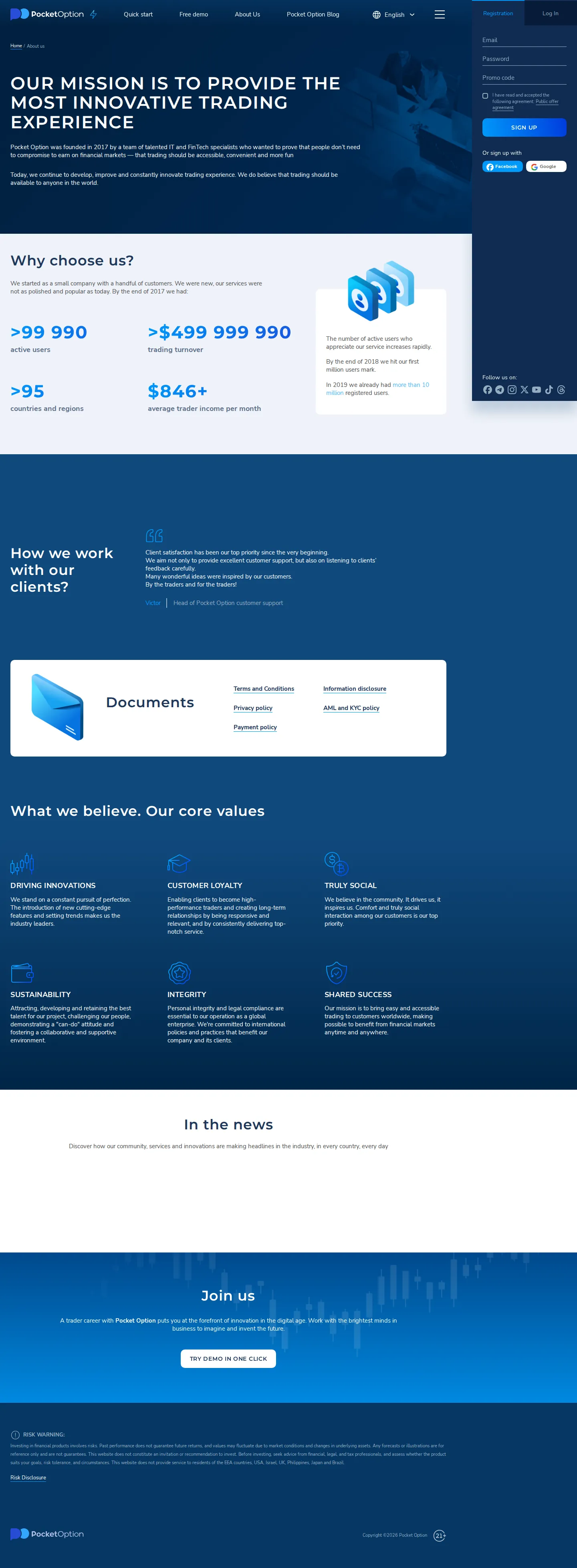
Pages captured from Pocket Option’s own site when this review was written. Brokers change their terms; these are what we read.
Score history
Recomputed daily; every move is on the record. The current score is always the latest row.
| Date | Score | Move |
|---|---|---|
| 2026-10-06 | 4.7 | ▲ |
| 2026-07-25 | 3.5 | ▼ |
| 2026-07-18 | 3.6 | ▼ |
| 2026-07-11 | 3.7 | · |
FAQ
Is Pocket Option regulated?
No page on pocketoption.com names a financial regulator or licence number, and no licence was confirmed on any official register.
What licence does Pocket Option hold?
None confirmed. An earlier claim of an IFMRRC licence traces only to a past review, not to the firm’s current pages.
What platforms does Pocket Option offer?
Its own web platform, a mobile app, a Mac client, a Telegram bot, and in some regions a Huawei app store download.
What does Pocket Option charge?
Some fees are published, but no EURUSD spread figure is available for any account a retail client can open.
How can I contact Pocket Option support?
Through a ticket system; no other support channel is listed in the findings.
What do reviews say about Pocket Option?
It has a blended 4.20-star rating across 71,600 reviews, though Trustpilot currently hides its score for a guidelines breach.
How this review works
Track Pocket Option live: score moves and red notices, in your pocket.