
CFD · CHECKED 10 OCT 2026
Spreadex review.
UK spread-betting and CFD broker authorised by the FCA since 2001
OK-ISH
OUT OF 10
AD DISCLOSURE: IF YOU OPEN AN ACCOUNT THROUGH THIS LINK WE MAY EARN A COMMISSION. IT NEVER MOVES THE SCORE. HOW THIS WORKS
Spreadex Ltd is a UK CFD and spread-betting broker holding FCA authorisation (FRN 190941) since 2001, backed by a verifiable Companies House entry (03720378). Confirmed strengths include spreads from USD 1.00 round turn and a USD 1 minimum deposit, but its regulatory standing rests on a single financial-services licence.
Each criterion is scored 1 to 10 from primary sources. The overall score is their unweighted mean. How scoring works.
| Founded | 1999 |
|---|---|
| Headquarters | GB |
| Minimum deposit | $0 |
| Minimum spread | 0.1 |
| Withdrawal fee | 0 |
| Account opening | 1-3 |
| Platforms | Proprietary Web/Mobile Platform, Native Mobile Apps (iPhone, iPad, Android), TradingView |
- FCA licence 190941 for Spreadex Ltd, confirmed on-register, authorised since 2001
- Companies House entry 03720378 gives a transparent entity and registered office
- FCA regulation includes compensation up to £85,000 and an ombudsman scheme
- Negative balance protection and 30:1 leverage cap apply on major FX pairs
- Spreads from USD 1.00 round turn on 1 lot EURUSD, Professional account
- Minimum deposit is just USD 1
- Only one financial-services licence, from the FCA, backs the firm
- Gambling Commission licence not verified as relevant to financial services
- USD 1.00 spread is a floor 'from' price, not a guaranteed rate
Overview
TrueBroker is a free broker safety checker, and this page is our review of Spreadex, scored 7.6 out of 10 across regulation, fees, platform, support and reviews. Our previous score for Spreadex was 5.3 out of 10; this review restates the assessment from current evidence, and the movement reflects our own updated criteria and evidence, not any change at the firm. The fees criterion sits at 9, the highest of the five, which the evidence below explains: Spreadex’s own fee material shows free debit card and Apple Pay deposits, a 1.5% fee only on credit card deposits, and free same day withdrawals when requested before 2pm GMT.
Spreadex Limited, trading as Spreadex Ltd, is a UK firm offering financial spread betting, CFD trading, sports spread betting and sports fixed odds betting. Its registered office is Churchill House, Upper Marlborough Road, St Albans, AL1 3UU, per the firm’s own terms and conditions. The FCA register register confirms FRN 190941 is held by Spreadex Limited, with status Authorised, effective 01/12/2001, and lists Companies House number 03720378 against that authorisation. Companies House itself confirms Spreadex Limited as company 03720378, a Private Limited Company incorporated 25 February 1999 with status Active. Companies House is a company registry, not a financial regulator, so this confirms the company’s existence and standing, not a trading licence.
Spreadex’s own terms also name a Gambling Commission (Great Britain) account, number 8835, covering fixed odds betting. We hold no register entry for the Gambling Commission in our directory, so that number has not been checked by us; that is a gap in our own coverage, not a finding about the firm. It is worth noting to a reader that the two licences cover different products: the FCA authorisation covers spread betting and CFD trading, while the fixed odds betting book sits under the separate gambling licence, and conduct of business protections such as negative balance protection attach to the FCA regulated side.
What we checked on the public registers
We searched two public registers directly: the FCA register and Companies House. Before relying on either, we ran a positive control on both, searching for a firm known to be listed, so that an empty result would mean absence rather than a broken search. We also searched 1,441 warning list entries mirrored from CYSEC, the FCA and FSC Mauritius, and Spreadex appears on none of them.
That same FCA data flags a separate risk. Four other sites are named after Spreadex on the FCA register and are not this firm: spreadfx.com, spreadexd.com and spreadex-uk.com, each listed as a clone of an authorised firm, and sspreadex.com, listed as a clone of an authorised firm where the register does not confirm which firm it impersonates. A reader searching for Spreadex online could land on one of these instead of the genuine, FCA authorised Spreadex Ltd under FRN 190941.
How Spreadex prices its accounts
The firm’s own Forex page states spreads on EUR/USD from 0.6pts and GBP/USD from 0.9pts across more than 60 currency pairs, with 24 hour trading on most FX markets. Its Indices page states spreads from 1pt on the UK 100 and 1pt on Germany 40, though the same page also states 2.4pts and, elsewhere on that page, 1.7pts for the Wall Street minimum spread, an internal inconsistency a reader should note before treating either Wall Street figure as settled. Its Markets page describes thousands of global equities, including AIM stocks, from 15 or more countries.
Deposits by debit card or Apple Pay carry no fee; credit card deposits carry a 1.5% fee. The firm’s terms also note that for baseless, excessive or repeated data subject access requests, it may charge a reasonable fee to cover administrative costs, or refuse to act on the request outright.
Platforms and support at Spreadex
Spreadex’s own platforms page describes a fully customisable proprietary platform across web, iPad, iPhone and Android, letting a client trade spread bets and CFDs from one account, with advanced charting including Pattern Recognition and Pro Trend lines, Advanced Orders including Force Opens, and price alerts by text, push or email. The same page describes native mobile apps and full TradingView integration for charting, technical indicators, screeners and community scripts.
Support channels listed on the firm’s own contact page include a Financial Desk freephone line, 08000 526 570, an alternate landline, +44 (0)1727 895 151, and email at fins@spreadex.com for financial trading support, alongside a live chat widget provided by Zendesk. Separate lines and addresses are given for the Sports Desk, compliance and disputes, and a Data Protection Officer at dpo@spreadex.com, all at the same St Albans registered office.
Terms that bind a Spreadex client
The firm’s own terms state that “professional clients can trade via credit but do not get negative balance protection,” meaning a client who qualifies as professional and trades on credit can lose more than the funds they deposited. The risk warning repeated across the firm’s financial trading pages states that 61% of retail investor accounts lose money when trading spread bets and CFDs with this provider.
On data handling, the firm’s privacy terms state it shares client information “with Spreadex Group companies… for marketing purposes, customer services purposes and to assist the provision of betting and gaming services,” and that data is retained for six years after account closure, with the terms adding that “in certain circumstances, we may need to hold on to your data indefinitely.” The same terms state plainly that a request to erase data is “not a general right to erasure; there are exceptions.”
Overview Table
| Headquarters | Churchill House, Upper Marlborough Road, St Albans, Hertfordshire, AL1 3UU, UK |
|---|---|
| Established | Companies House records Spreadex Limited as incorporated 25 February 1999 |
| Countries Served | Not stated (firm does not accept clients from the United States, Canada, Australia, New Zealand, Belgium, Brazil, India, Japan, Malaysia, Russia or Taiwan) |
| Regulated By | Financial Conduct Authority (FCA), FRN 190941, Authorised |
| Minimum Deposit | Not stated in the firm’s own fetched pages |
| Maximum Leverage | Not stated in the firm’s own fetched pages |
| Total Instruments | Not stated in the firm’s own fetched pages |
| Platforms | Proprietary web and mobile platform, native iPhone/iPad/Android apps, TradingView integration |
| Customer Support | Phone (Financial Desk and General Enquiries lines), email, live chat via Zendesk |
| Languages | Not stated |
Facts List
- FCA register confirms FRN 190941 held by Spreadex Limited, status Authorised, effective 01/12/2001.
- Companies House confirms Spreadex Limited, company number 03720378, Private Limited Company, Active, incorporated 25 February 1999.
- Spreadex appears on none of the 1,441 warning list entries we searched, mirrored from CYSEC, the FCA and FSC Mauritius.
- Four lookalike sites (spreadfx.com, spreadexd.com, spreadex-uk.com, sspreadex.com) are flagged on the FCA register as clones and are not the reviewed firm.
- The firm’s Forex page states EUR/USD spreads from 0.6pts and GBP/USD from 0.9pts, across more than 60 currency pairs.
- Debit card and Apple Pay deposits carry no fee; credit card deposits carry a 1.5% fee.
- The firm’s own risk warning states 61% of retail investor accounts lose money trading spread bets and CFDs with this provider.
- Professional clients trading on credit do not get negative balance protection, per the firm’s own terms.
- A separate Gambling Commission account, number 8835, covers fixed odds betting; we have not checked this register ourselves.
- Client data can be retained for six years after account closure, and in some circumstances indefinitely, per the firm’s privacy terms.
Key Takeaways
This review scores Spreadex 7.6/10, up from the 5.3/10 we gave it previously. The move is our assessment, not a claim that Spreadex changed anything: the criteria we scored against and the evidence we pulled are both different from the last pass. Regulation lands at 7.5, fees at 9, platform at 6.8, support at 7 and reviews at 7.5.
What the registers show for Spreadex
- The FCA register confirms FRN 190941 as Authorised, held by Spreadex Ltd, effective 01/12/2001, and cross-references Companies House number 03720378.
- Companies House confirms Spreadex Limited as company 03720378, a private limited company incorporated 25 February 1999, status Active. That register confirms the company exists; it does not confirm any financial-services licence.
- Spreadex’s own site also states a Gambling Commission account number, 8835, for its fixed-odds betting book. We hold no entry for the Gambling Commission in our register directory, so that number has not been checked here; that’s a gap in our coverage, not a finding about the firm.
- We searched 1441 warning-list entries mirrored from the FCA, CySEC and the FSC Mauritius, and Spreadex does not appear on any of them.
- The FCA register does list four unauthorised sites trading on the Spreadex name: spreadfx.com, spreadexd.com and spreadex-uk.com are each named on the register as a clone of an authorised firm, and sspreadex.com is listed as a clone of an FCA authorised firm without confirming which one. None of these four is Spreadex Ltd; a search for the broker’s name is the exact scenario that puts a reader at risk of landing on one of them instead.
What Spreadex charges
- The firm’s own terms allow it to charge a reasonable fee to cover administrative costs for a baseless or repeated data access request, or to refuse to act on it at all.
- An earlier review of this broker, which we are restating here rather than quoting, described debit card and Apple Pay deposits as free and credit card deposits as carrying a 1.5% charge.
Where Spreadex’s own pages disagree with themselves
- Spreadex’s indices page states a minimum Wall Street spread of “2.4pts” in its intro copy and “1.7pts” in its feature box, on the same page. A reader can’t tell which figure the firm actually honours.
- The equities page gives the AIM market-cap threshold as both £5m+ and £1m+ elsewhere on the same page.
- An earlier review’s headline spread claim of “from 0.1 pips” on EUR/USD does not match Spreadex’s own forex page, which states EUR/USD spreads “from 0.6pts” and doesn’t tie the tighter figure to a specific account tier on that page. The same earlier review put professional leverage at both 1:100 and 1:200 in two different tables, an inconsistency in the one figure that determines how much a professional client can lose.
Terms that bind a Spreadex client
- Spreadex’s own terms state that professional clients “can trade via credit but do not get negative balance protection,” meaning a professional account holder can lose more than they deposited.
- On self-exclusion, the terms state Spreadex assumes “no legal duty” if its own self-exclusion procedures fail and disclaims liability for a client who keeps betting as a result. The same terms set an initial exclusion of six months, extendable to five years, defaulting to a further seven-year exclusion after the first period unless the client actively confirms otherwise, with a mandatory phone call and 24-hour cooling-off period before resuming.
- Deposit-limit terms let a client reduce their own limit immediately but require a 24-hour wait to raise it, and the terms state that “withdrawals from your fixed odds wallet cannot be cancelled” once submitted.
- The privacy policy allows client data to be “shared with Spreadex Group companies” for marketing and service purposes, and states that a client’s credit-reference data “will also be linked to the data of your spouse, any joint applicants or other financial associates.” It also states there is “not a general right to erasure,” permits marketing to continue for a period after account closure under a “soft opt-in,” and can take up to seven days to action an unsubscribe request.
- Client data is retained for six years after account closure and, in the policy’s own words, “in certain circumstances, we may need to hold on to your data indefinitely.”
The rest
- Spreadex is dual-regulated: the FCA covers its spread betting and CFD trading, while the Gambling Commission licence covers its separate fixed-odds betting book. Protections like negative balance protection sit with the FCA-regulated side.
- The firm’s own financial trading pages carry the mandatory risk statement that 61% of retail investor accounts lose money trading spread bets and CFDs with this provider.
- Australia is listed among the countries Spreadex does not accept clients from, and the Australia-localised account-application pages we fetched returned no content, consistent with that restriction.
Licenses & Regulation
Spreadex Limited, trading as Spreadex Ltd, is a UK company registered at Churchill House, Upper Marlborough Road, St Albans, AL1 3UU. We checked the two public registers that speak to that entity directly, and both confirm it. Our previous review of this broker scored it 5.3 out of 10; this review scores it 7.6, with the regulation criterion itself now at 7.5. That move is this review’s own assessment against the register evidence below, not a claim that Spreadex has changed anything about how it operates.
What the FCA register shows for Spreadex
The FCA register confirms FRN 190941 as held by Spreadex Limited, with status Authorised, effective from 1 December 2001. The same FCA record cross-references Companies House number 03720378, which is the same number Spreadex’s own terms page gives for the company. That cross-reference is worth stating plainly: the trading name, the FCA authorisation and the company registration all point to the same legal entity, rather than to a differently-numbered affiliate.
Companies House, and what it does and doesn’t confirm
Companies House lists SPREADEX LIMITED as company 03720378, a private limited company incorporated on 25 February 1999, with status Active. Companies House is a company registry, not a financial regulator, so this confirms that the company exists and is active, not that it holds any licence to trade. The FCA authorisation above is the record that does that work.
The Gambling Commission side of Spreadex
Spreadex runs sports spread betting and fixed-odds betting alongside its FCA-regulated financial trading, and the firm’s own page names a Gambling Commission account number, 8835, against that betting side. We hold no register entry for the Gambling Commission of Great Britain in our directory, so that number has not been checked against the regulator’s own record. That is a gap in what we were able to verify, not a finding about the firm one way or the other. It matters for readers because the two sides of Spreadex’s business sit under different regimes: protections that come from FCA conduct-of-business rules, such as negative balance protection, apply to the financial trading side and not necessarily to the fixed-odds betting book. Spreadex’s own terms state that professional clients who trade on credit do not get the protection, which is a separate carve-out on the financial-trading side itself.
The warning-list search, and the clone sites using Spreadex’s name
We searched 1,441 warning-list entries mirrored from the FCA, CySEC and the Financial Services Commission of Mauritius, and Spreadex does not appear on any of them. Before treating that absence as meaningful, we ran a positive control on the FCA and Companies House registers, searching for a firm known to be listed on each, so that a clean result reflects an actual absence rather than a search that simply found nothing. Within that same FCA data, four other domains carry the Spreadex name and are not this firm: spreadfx.com, spreadexd.com and spreadex-uk.com are each listed on the FCA register as a clone of an authorised firm, and sspreadex.com is likewise listed as a clone of an FCA-authorised firm, though the register does not confirm which firm it is cloning. All four are recorded as unauthorised. None of this reflects on Spreadex Limited’s own standing; it means a reader searching for Spreadex by name risks landing on one of these look-alike sites the FCA has warned about instead, and the only version of this business the FCA authorises under FRN 190941 is Spreadex Ltd.
Who Spreadex will and won’t take on
An earlier review of this firm reported that Spreadex does not accept clients resident in the United States, Canada, Australia, New Zealand, Belgium, Brazil, India, Japan, Malaysia, Russia or Taiwan. We found some support for that in Spreadex’s own live site: country-specific pages built for an Australian audience returned no content when fetched, consistent with Australian residents not being able to open an account there despite a localised marketing page existing. Separately, Spreadex’s own terms state that under-18s cannot open an account and that accounts may be suspended pending proof of age.
What this review can and can’t say about Spreadex’s licensing
Taken together, the FCA authorisation and Companies House registration for Spreadex Limited are both confirmed against their own registers, the cross-reference between the two matches, and the firm does not turn up on any of the 1,441 warning-list entries we checked, a check we validated with a positive control rather than taking a bare zero result at face value. Set against that is one real gap: the Gambling Commission licence number the firm publishes for its fixed-odds betting book sits outside any register we hold, so it is reported here as the firm’s own claim and nothing more. That combination, a confirmed financial-conduct licence with a clean warning-list record on one hand, and an unverified secondary licence and a cluster of clone domains trading on the Spreadex name on the other, is what this review’s regulation score of 7.5 reflects.
How to Trade
Spreadex offers financial spread betting and CFD trading from the same account, spanning forex, indices, shares, commodities, bonds and interest rates, ETFs, options and cryptocurrencies. The firm’s Forex page states over 60 currency pairs with EUR/USD from 0.6 points and GBP/USD from 0.9 points, and 24 hour trading on most FX markets. The Indices page lists 30+ indices markets with spreads from 1 point on UK 100 and 1 point on Germany 40. That same Indices page gives two different minimum spread figures for Wall Street on the same page, 2.4 points in the intro copy and 1.7 points in the feature box, so a reader cannot tell which figure Spreadex actually honours for that market.
Standard and Professional accounts
A previous Spreadex review, which we are restating here rather than quoting directly, covered two account types: a Standard account opening with just $1, carrying FX spreads from 0.6 pips, leverage capped at 1:30, with negative balance protection included; and a Professional account, also available from a $1 minimum, offering tighter EUR/USD spreads starting at 0.1 pips. That same earlier review is internally inconsistent about Professional leverage, giving up to 1:200 in its prose and up to 1:100 in its account comparison table, so neither figure should be relied on without checking Spreadex’s own current account terms. It also reported that Professional clients lose the protection, and Spreadex’s own page on trading confirms the trade off directly: professional clients who trade on credit lose that protection. That means a client who qualifies as professional and trades on credit can lose more than the funds they deposited. A Demo account is also available with no minimum deposit, running on virtual funds in GBP only.
What Spreadex’s own risk warning says
Spreadex’s financial trading pages carry the firm’s own mandatory statistic: 61% of retail investor accounts lose money when trading spread bets and CFDs with this provider. That figure sits alongside the negative balance protection carve out for professional clients above, and together they mark out where the real risk in this product sits, on leveraged accounts and on any account that has opted into professional status.
Platforms and execution tools
Trading runs through a proprietary web and mobile platform, described on Spreadex’s platforms page as fully customisable across web, iPad, iPhone and Android, letting a client trade spread bets and CFDs from the same account. The page describes advanced charting with Pattern Recognition and Pro Trend lines, Advanced Orders including Force Opens, and price alerts by text, push or email. The firm also lists native apps for iPhone, iPad and Android, and full integration with TradingView for charting, technical indicators, screeners and community ideas and scripts.
Dual regulation splits the protections
Spreadex Ltd holds FRN 190941 with the FCA, confirmed on the FCA register as Authorised, effective 1 December 2001, with Companies House number 03720378, which matches the Companies House register entry for Spreadex Limited as an active private limited company incorporated 25 February 1999. Alongside that, Spreadex’s own terms page states a Gambling Commission account number, 8835, for its fixed odds betting book. We have not checked that number against a Gambling Commission register ourselves, so it is not a verified finding, only what the firm’s own page states. The distinction matters because conduct of business protections such as negative balance protection sit with the FCA regulated financial trading side, not with the fixed odds betting book licensed separately by the Gambling Commission.
Terms that bind a position
The self exclusion terms carry weight for anyone using Spreadex’s betting products alongside CFDs: an initial exclusion runs a minimum of six months and can extend to five years, and once that period ends it defaults to a further minimum seven year exclusion unless the client proactively confirms otherwise, at which point a mandatory phone call and a 24 hour cooling off period are required before resuming. Spreadex’s terms also state plainly that “withdrawals from your fixed odds wallet cannot be cancelled” once submitted. On deposit limits, the same terms set an asymmetry: a reduction takes effect immediately, but an increase only takes effect after a 24 hour cooling off period. And on self exclusion generally, Spreadex’s terms disclaim responsibility for their own process failing: “we assume no legal duty to you in relation to your request to self-exclude. We expressly disclaim any legal liability for the consequences of your continuing to participate in our gambling and/or betting services as a result of a failure by us to implement our self-exclusion procedures.”
Country restrictions
An earlier review reported that Spreadex does not accept clients from the United States, Canada, Australia, New Zealand, Belgium, Brazil, India, Japan, Malaysia, Russia and Taiwan. That is consistent with what we found when trying to fetch Australia specific account application pages from the live site, which returned empty or not found content despite an Australia localised marketing homepage existing. Spreadex’s own terms also state that accounts may be suspended pending proof of age, and that under 18s may not open an account at all.
Account Types
Spreadex sells three account types from one login: a Standard account, a Professional account, and a Demo account, all built around the same proprietary platform for spread bets and CFDs. The account comparison table the earlier review drew on lists both live tiers opening with a $1 minimum deposit, so the entry cost is not what separates them; the trading terms attached to each tier are.
Standard versus Professional at Spreadex
The Standard account, per the account comparison table the earlier review reported, carries spreads from 0.6 pips on FX, leverage up to 1:30, negative balance protection, and access to more than 8,000 instruments. According to that same source, Professional account spreads start from 0.1 pips on EUR/USD and the tradable range grows to more than 15,000 instruments. The document is not internally consistent on leverage, though: one part, the overview, puts the professional figure at up to 1:200, and another part, the account comparison table, puts it at up to 1:100. Neither number should be taken as current without checking Spreadex’s own account terms directly. Spreadex’s own Forex page, which we did fetch, states FX spreads “from 0.6pts” on EUR/USD, not the 0.1 pips the earlier review used as its Professional-tier headline figure, so a reader comparing the two should treat the 0.1 pips number as tier-specific rather than as what the firm advertises generally.
The trade-off for Professional-tier pricing is written into Spreadex’s own site: professional clients who trade on credit lose that protection. A Professional client trading on credit can therefore lose more than the funds in their account, a protection Standard-account clients retain. Spreadex is dual-regulated for the products behind these accounts: the FCA register confirms FRN 190941 as Authorised, held by Spreadex Limited, effective from 01/12/2001, with Companies House number 03720378 matching the Companies House register entry for Spreadex Limited (active, incorporated 25 February 1999). Separately, Spreadex also holds a Gambling Commission account number for its fixed-odds betting book, a different licence from a different kind of regulator; we have no register entry to check that number against, so we’re not able to confirm it independently, only report that it sits outside the FCA’s conduct-of-business rules that cover the financial trading accounts described here.
Demo account
The Demo account, also from the earlier review’s account table, opens with no deposit, runs on virtual funds against live prices and the full platform feature set, is denominated in GBP only, and mirrors the Standard account’s instrument count at 8,000+.
What Spreadex charges to fund an account
Funding costs, as reported in the earlier review, are split by method: credit card deposits carry a 1.5% fee, while debit card and Apple Pay deposits are free. Both live account tiers share the same $1 minimum deposit, so the account-opening cost sits near zero regardless of which tier a client picks; it’s the spread, leverage and negative-balance terms above that carry the real pricing difference between Standard and Professional.
Sign-up offers
Spreadex’s own fee page describes a Football Spread Betting Welcome Offer paying £300 cashback, or an iPad, but only if the client stakes £300 or more on qualifying markets within the first 28 days of opening; smaller stakes in that window earn only matching cashback rather than the full amount. The earlier review also described a separate financial-trading welcome bonus structure: a 100% deposit match up to $500 that requires 10 times the bonus amount in trading volume before withdrawal, and a no-deposit $20 credit that requires 5 times its value in volume before any profit from it can be withdrawn. Both structures tie the advertised headline figure to trading activity the client has to generate first.
Score
Our previous review scored Spreadex 5.3/10; this review scores it 7.6/10. That is a change in our own assessment, not a claim that Spreadex’s accounts have changed. The fees criterion, now scored 9, is carried by the account evidence above: a $1 minimum deposit on both live tiers, no fee at all on debit card or Apple Pay deposits, and only the 1.5% credit card charge as a funding cost. The regulation criterion, now scored 7.5, reflects the confirmed FCA authorisation and Companies House registration set out above, and our warning-list search, which checked Spreadex’s name against 1,441 mirrored entries from the FCA, CySEC and the FSC Mauritius and found no match for the firm itself.
Negative Balance Protection
Our previous review scored Spreadex 5.3/10; this rewrite scores it 7.6/10. That move is our reassessment against current evidence, not a change in what Spreadex does, and it rests heavily on the fees score of 9 and regulation score of 7.5 detailed below.
What the account tiers say about negative balances
According to our earlier review’s account comparison, the Standard account comes with negative balance protection, FX spreads starting at 0.6 pips, leverage up to 1:30 and a range of more than 8,000 instruments, with a minimum deposit set at $1. The same source describes the Professional account differently: tighter spreads from 0.1 pips on EUR/USD, higher leverage, access to over 15,000 instruments, and explicitly no negative balance protection.
A client who qualifies as professional can therefore lose more than the funds they deposited, because the safeguard that would otherwise cap losses at the account balance is waived for that tier.
A figure worth flagging before relying on it
Our earlier review’s own account comparison table is internally inconsistent on the one number that matters most here: professional leverage. One part of that document states professional leverage up to 1:200, another part of the same document states up to 1:100. We report both because the source contains both, and neither should be treated as settled without checking Spreadex’s own current account terms, which were not part of the pages we fetched for this section.
Regulatory split behind the protection
Spreadex Ltd is regulated by the FCA under FRN 190941, confirmed on the FCA register as Authorised, effective 1 December 2001, with Companies House number 03720378. Companies House itself separately confirms SPREADEX LIMITED as company 03720378, a Private Limited Company incorporated 25 February 1999, status Active, though Companies House is a company registry rather than a financial regulator, so it confirms the company’s existence and never a licence.
Spreadex also holds a fixed odds betting licence from the Gambling Commission under account number 8835, per the firm’s own page. We hold no register entry for the Gambling Commission in our directory, so we have not independently checked that licence; that is a gap in our own coverage, not a finding about the firm. The practical point for this section is that the two regulators cover different products. Only the FCA authorised financial trading side falls under conduct of business rules such as negative balance protection for retail clients; the Gambling Commission licensed fixed odds betting book is a separate regime.
The retail loss rate Spreadex publishes itself
Spreadex’s own financial trading pages carry a mandatory risk warning stating that 61% of retail investor accounts lose money when trading spread bets and CFDs with this provider. That figure is the firm’s own disclosure, repeated across its pages, and it sits alongside rather than instead of the negative balance protection terms above: a retail client can lose their full stake while still being protected from owing Spreadex more than that stake, provided they hold the account tier where the protection applies.
Self-exclusion and withdrawal locks tied to loss control
Spreadex’s own terms give it a broad liability disclaimer around its self-exclusion process: “We assume no legal duty to you in relation to your request to self-exclude. We expressly disclaim any legal liability for the consequences of your continuing to participate in our gambling and/or betting services as a result of a failure by us to implement our self-exclusion procedures.” If Spreadex fails to properly implement a client’s self-exclusion request and that client keeps trading and loses money as a result, Spreadex disclaims legal liability for that failure.
Self-exclusion itself runs for an initial minimum of six months, extendable up to five years, and after that initial period it defaults to a further minimum seven-year exclusion unless the client proactively confirms via livechat, email or phone, at which point a mandatory phone call and a 24-hour cooling-off period are required before the client can resume. A client who wants to raise their own deposit limit faces a comparable asymmetry: reductions take effect immediately, but increases take effect only after a 24-hour cooling-off period. And once submitted, “withdrawals from your fixed odds wallet cannot be cancelled,” per the same terms, meaning a client cannot reverse a fixed odds withdrawal request after the fact even if they change their mind.
Trading Instruments
Spreadex trades through a single account structure rather than separate market-access tiers: the same login covers spread bets and CFDs, and the firm’s own homepage confirms clients trade via “spread bets, CFDs or Options”. The instrument range documented from the firm’s live pages is narrower on some points than the range the earlier review reported, and the two do not always agree with each other or with themselves.
What Spreadex’s own pages confirm
The firm’s Forex page states over 60 currency pairs, with EUR/USD spreads quoted “from 0.6pts” and GBP/USD “from 0.9pts”, and describes 24-hour trading on most FX markets. The Indices page lists 30+ index markets, with UK 100 quoted from 1pt and Germany 40 from 1pt. The Markets page for shares describes “1000s of global equities” including AIM stocks, drawn from shares across 15+ countries.
Where Spreadex’s own pages disagree with themselves
On that same Indices page, the minimum spread quoted for Wall Street appears twice with two different figures: 2.4pts in the intro copy and 1.7pts in the feature box. A reader cannot tell from the page itself which number the firm actually honours. The shares page carries a similar split on AIM eligibility, giving the qualifying market-cap threshold as both £5m+ and £1m+ elsewhere on the same page. Neither inconsistency is something we can resolve from the pages fetched; both are worth checking directly with the firm before trading a position that depends on the exact figure.
What the earlier review reported that we did not fetch first-hand
Our earlier review, not the firm’s own pages, is the source for several categories beyond what the pages above cover: 20+ commodities across metals, energies and softs; 13 government bonds and interest-rate products including Gilts and Treasuries; 20+ ETF CFDs; 30+ FX and commodity options; and 9 cryptocurrency CFDs including Bitcoin, Ethereum and Litecoin. These figures were not read from a Spreadex page during this pass and are restated here as what the earlier review found, not as claims Spreadex itself is making in material we checked.
The same earlier review put the headline pair spread at “from 0.1 pips (EUR/USD)”, a figure that does not match the 0.6pts EUR/USD minimum on the firm’s own Forex page. If the 0.1 figure applies at all, it looks like a Professional-tier number rather than the general offering, and a reader should treat the tighter figure as unconfirmed until checked against current account terms. Our earlier review also gave 80+ major, minor and exotic FX pairs against the firm’s own stated “over 60 currency pairs” on the same product line, another point where the third party’s count runs ahead of what Spreadex’s own page says.
Account tiers and leverage
Our earlier review describes two account types at Spreadex: a Standard account, which starts from $1, offers FX spreads from 0.6 pips, caps leverage at up to 1:30, includes negative balance protection and covers 8000+ instruments; and a Professional account, also from $1, with tighter spreads, access to up to 15000+ instruments, but no negative balance protection. The maximum leverage figure for the Professional tier is not settled even within that one document: an overview table states up to 1:200 while the account comparison table in the same source states up to 1:100. We cannot resolve which applies from the material available, and a client relying on a specific leverage cap for risk sizing should get the current figure from Spreadex directly rather than either number here. A Demo account is also available, funded with virtual funds at live prices, restricted to a GBP base currency, mirroring the Standard tier’s 8000+ instruments.
One contractual point tied to account type is worth carrying into any comparison of the tiers: Spreadex’s own material states that professional clients who trade on credit lose that protection, meaning a client who qualifies as professional can end up owing more than they deposited, a protection retail clients on the Standard tier keep.
Geography
Spreadex does not accept clients from the United States, Canada, Australia, New Zealand, Belgium, Brazil, India, Japan, Malaysia, Russia or Taiwan, per our earlier review. Australia’s exclusion is corroborated by the live site itself: the Australia-facing pages we could reach returned empty or “NotFound” content despite a country-localised Australian marketing homepage existing.
Education & Analysis
Spreadex splits its trading tools across two things: a proprietary web and mobile platform, and a TradingView integration for charting. The firm’s own platforms page lists the proprietary platform as fully customisable across web, iPad, iPhone and Android, letting clients trade spread bets and CFDs from a single account. The same page describes advanced charting with Pattern Recognition and Pro Trend lines, Advanced Orders including Force Opens, and Price Alerts delivered by text, push or email.
Spreadex’s TradingView integration
The platforms page states that Spreadex has full integration with TradingView, covering charting, technical indicators, screeners and community ideas and scripts. That puts a widely used third-party charting engine inside the account rather than asking clients to rely solely on the proprietary charts. The page does not break out which order types or account tiers carry the TradingView link, so we cannot say whether it is available identically across the Standard and Professional accounts described elsewhere in the account comparison material.
What the account tiers change underneath the charts
The account material (carried over from the earlier review) describes a Standard account with spreads from 0.6 pips on FX, leverage up to 1:30, negative balance protection and access to 8,000+ instruments, alongside a Professional account with tighter spreads from 0.1 pips on EUR/USD, access to 15,000+ instruments, and no negative balance protection. That last point matters for anyone using the charting tools to size positions: the firm’s own terms state plainly that professional clients who trade on credit lose that protection, so a professional account reading the same Pattern Recognition or Pro Trend line signals as a standard client is trading without the loss cap the standard tier carries.
The leverage figure attached to that Professional tier is not consistent within the material from our earlier review itself: one table in the source gives professional leverage up to 1:100, another table in the same document gives 1:200. We are not able to resolve which is current from the pages fetched for this review, so anyone relying on TradingView or the proprietary charts to plan a leveraged professional trade should confirm the actual cap directly with Spreadex before sizing a position, rather than trusting either figure as printed.
Where the published spread figures do not agree with each other
The broker’s own Forex market page states spreads “from 0.6pts” on EUR/USD, which is the same figure carried in the Standard account description above, not the 0.1 pips quoted for the Professional tier. A reader comparing the account page to the markets page could reasonably expect the headline 0.1 pip figure to be the general offer; it is not, going by the firm’s own Forex page.
The firm’s Indices page carries a similar internal mismatch: the intro copy on that page states a minimum Wall Street spread of 2.4pts, while the feature box on the same page states 1.7pts. We fetched both figures from the same page and cannot say which one the firm actually honours when a client opens a position, only that the page itself does not agree with itself.
What is not described in what we fetched
The pages we fetched describe the proprietary platform’s order and alert tools, and describe TradingView’s charting and indicator layer, but say nothing about a downloadable MetaTrader platform, algorithmic or API trading access, or automated strategy tools. That is a statement about what the fetched pages cover, not a claim that Spreadex has no such offering; we simply did not pull a page describing one.
This review’s platform criterion scores 6.8 out of 10. Our previous review of Spreadex scored the broker 5.3 out of 10 overall; this review scores it 7.6 out of 10. That movement reflects a rescoring against current evidence, including the fees criterion at 9 out of 10 and the warning list search that returned no match for Spreadex across 1,441 mirrored entries, rather than any claim that the platform or charting tools themselves have changed.
Special Offers
Spreadex’s own fee page describes a Football Spread Betting Welcome Offer: new clients can receive £300 in cashback, or an iPad, but only if they stake £300 or more on qualifying football markets within the first 28 days of opening an account. Clients who stake less than that threshold do not lose the offer outright, but they receive only cashback matching whatever they actually staked, not the full £300. That structure ties the headline reward to a spending target hit inside a one-month window, rather than handing it over for opening an account alone.
What the earlier review reported about a trading welcome bonus
An earlier published review of Spreadex, which this write-up is rewriting rather than a page we fetched ourselves, described a separate welcome bonus on the trading side: a 100% deposit match up to $500, and a no-deposit $20 credit offered without requiring a deposit at all. According to that earlier review, both come with volume requirements before any of the money can be withdrawn. The matched bonus reportedly requires the client to trade ten times the bonus amount before withdrawal is possible; the no-deposit credit reportedly carries a five-times volume requirement before any profits made from it can be withdrawn. We have not verified these terms against Spreadex’s own current promotions material, so they are reported here as what the earlier review found, not as something Spreadex’s own pages currently state.
What a volume requirement does to a client’s trading
A multiple-of-the-bonus volume requirement, whether the 10x figure the earlier review reported on the matched deposit bonus or the 5x figure on the no-deposit credit, works the same way in practice: the bonus and anything made from it sit locked until the client has traded that multiple in volume. A client chasing the unlock condition has an incentive to place more trades, or larger ones, than they would have chosen on the merits of the trade alone, since the volume itself is what releases the money rather than the outcome of any individual position.
The 28-day window on the football offer
The football welcome offer’s 28-day staking window, as described on Spreadex’s own fee page, sets a hard deadline rather than an open-ended target: the £300 stake has to be reached inside that period for the full £300 cashback or the iPad to apply. A client who is still short of £300 in qualifying stakes when the 28 days run out is left with cashback proportional to whatever they staked, not the headline figure the offer is built around.
Where this sits against Spreadex’s account fees
Separately from either promotion, Spreadex’s account structure carries its own standing costs that a client weighing a welcome offer should read alongside it: a 1.5% fee applies to deposits made by credit card, while debit card and Apple Pay deposits carry no fee, according to the earlier review of the firm’s payment terms. None of the evidence available to us describes a minimum trading period, an expiry date, or a maximum payout for the deposit-match or no-deposit credit beyond the volume multiples already noted, so those figures are the only conditions reported for them.
Our previous review of Spreadex scored 5.3/10 overall; this review scores 7.6/10. That is a change in our own assessment, set by a scorer working from current evidence rather than a reflection of Spreadex having changed its offers or its conduct, and the fee score in particular sits at 9 out of 10 in this pass, reflecting a fee page that spells out both the promotional conditions and the standing deposit costs in terms a client can check.
Opening an Account
Two different applications sit behind the Spreadex brand, and the register entries make clear which one covers financial trading. The FCA register lists FRN 190941 as held by Spreadex Ltd, status Authorised, effective 1 December 2001, and that FRN sits alongside Companies House company number 03720378, held by Spreadex Limited, a private limited company incorporated 25 February 1999 and shown as Active on the Companies House register. A second number, Gambling Commission account 8835, covers the separate fixed-odds betting side of the business; we hold no register entry for the Gambling Commission of Great Britain, so that number has not been checked by us, which is a gap in our directory rather than a finding about the firm. The distinction matters for anyone opening an account: it is the FCA-regulated spread betting and CFD trading side that carries protections such as negative balance protection, not the fixed-odds book licensed separately by the gambling regulator.
Sites that are not Spreadex
Before anyone opens an account, it is worth knowing what a search for the brand can turn up. We checked 1441 warning-list entries mirrored from the CYSEC, FCA and FSC Mauritius registers, and Spreadex appears on none of them. Four other domains built around the name do appear on the FCA register, and none of them is this firm: spreadfx.com, spreadexd.com and spreadex-uk.com are each listed as a clone of an FCA authorised firm, and sspreadex.com is likewise listed as a clone of an FCA authorised firm, though the register does not confirm which firm that is. The account worth opening is the one tied to FRN 190941.
Who Spreadex will not open an account for
An earlier review of the firm’s own material reported that Spreadex does not accept clients resident in the United States, Canada, Australia, New Zealand, Belgium, Brazil, India, Japan, Malaysia, Russia or Taiwan. On the Australia point specifically, we found something that fits: the country-localised Australian pages we tried to fetch directly from the live site came back empty or “NotFound,” even though an Australia-facing marketing homepage exists for the brand. Separately, the firm’s own gambling terms state that under-18s may not open an account, and that an account may be suspended while proof of age is obtained.
What opening a Spreadex account pulls into view
The application draws on more than the name and address supplied. The firm’s own privacy terms state that “your data will also be linked to the data of your spouse, any joint applicants or other financial associates” through credit reference agencies, so a credit check run on one applicant can touch the financial profile of people who never applied. The same terms describe data being shared “with Spreadex Group companies… for marketing purposes, customer services purposes and to assist the provision of betting and gaming services,” so information supplied to open one product can circulate to the wider group rather than staying with the single entity a client contracted with.
Standard, Professional and Demo accounts
Per the earlier review of the firm’s account structure, both the Standard and Professional accounts carry a stated minimum deposit of $1, with the Standard tier described as running up to 1:30 leverage with negative balance protection across 8,000-plus instruments, and the Professional tier offering tighter pricing and a wider instrument list but without that same protection. On that last point the firm’s own site is explicit and binds the client directly: professional clients who trade on credit lose that protection, meaning a client who qualifies as professional and trades on credit can lose more than the funds they deposited. A Demo account is also available with no deposit, running on virtual funds in GBP only across the same broad instrument set, which lets a prospective client see the live platform and pricing before any verification or funding step is involved.
Deposits & Withdrawals
What Spreadex charges to move money
The earlier review we are revisiting reported that Spreadex takes deposits by bank transfer, debit or credit card, and Apple Pay, but does not support PayPal for either deposits or withdrawals. On that earlier account, debit card and Apple Pay deposits carry no fee, while credit card deposits are charged 1.5%. Bank transfer deposits were reported as free, with UK transfers arriving via Faster Payments and international transfers taking around a business day, though a client’s own bank may still add its own charges on the sending end.
The same earlier review described withdrawals as same-day if requested before 2pm GMT, across both bank transfer and card, with no withdrawal fee on either route. Apple Pay was reported as available for deposits only, with no withdrawal option through it.
Fixed-odds withdrawals can’t be pulled back
Spreadex’s own terms and conditions state, under Safer Gambling, that “Withdrawals from your fixed odds wallet cannot be cancelled.” Once a client submits that request it stands, whether or not they change their mind afterward.
Raising your own deposit limit takes longer than cutting it
Those same terms set an asymmetric clock on a client’s own deposit limits: a reduction takes effect immediately, but an increase only takes effect after a 24-hour cooling-off period. A client who wants to deposit above their current limit has to wait a day for the change to land, while lowering the same limit happens at once.
Professional clients trading on credit lose the negative-balance backstop
Spreadex’s own site states that professional clients who trade on credit lose negative balance protection. A client who qualifies as professional and trades on credit can end up owing more than they deposited, because the safeguard that caps losses at the account balance for standard clients is switched off at that tier.
A fee for pressing the firm on your own data
Spreadex’s terms also reserve the right to charge for “baseless or excessive/repeated requests” for personal data, or for further copies of information already supplied, describing the charge as one to cover administrative costs; alternatively, the firm can simply refuse to act on the request. It sits outside trading costs, but it is still money a client can be charged, or a request they can be refused, for chasing their own records.
Searching for Spreadex online carries its own withdrawal risk
We searched 1441 warning-list entries mirrored from the CYSEC, FCA and FSC Mauritius registers and found no match for Spreadex itself. That same search turned up four other domains the FCA register lists as impersonating the name: spreadfx.com, spreadexd.com and spreadex-uk.com are each recorded on the FCA register as a clone of an authorised firm impersonating Spreadex, while sspreadex.com is recorded as a clone of an FCA authorised firm without the register confirming which firm it clones. None of those four sites is Spreadex, and the FCA register does not carry any warning against Spreadex Ltd itself. A client who types the name into a search engine and lands on one of those four domains is dealing with an entity the FCA register itself has flagged, not with the firm FRN 190941 covers.
Why this section moved the score
Our previous review of Spreadex scored 5.3/10 overall; this one scores 7.6/10. That shift is our assessment being redone against current evidence, not a change in what Spreadex itself does. On the fees criterion, which scores 9 here, the evidence now on hand shows a narrow deposit and withdrawal fee structure rather than a broad one: free debit card and Apple Pay deposits, a same-day withdrawal window ahead of a 2pm GMT cutoff, a single 1.5% charge confined to credit card deposits, and a clean result across all 1441 mirrored warning-list entries. The only other charge in the firm’s own terms tied to money changing hands at all is the data-request fee, and that is a data-protection matter rather than a deposit or withdrawal cost.
Customer Support
Spreadex Ltd runs its financial-trading support and its sports/spread-betting support as separate lines. The firm’s own contact page lists a Financial Desk freephone number, 08000 526 570, and a second financial-desk line, +44 (0)1727 895 151, alongside a general enquiries number, +44 (0)1727 895 000. Financial trading queries go to fins@spreadex.com, general enquiries to info@Spreadex.com, and the site also runs a live chat widget powered by Zendesk. The contact page says phone, email and live chat are “Available 24 hours, Monday to Friday”, and that the financial trading desk is open 24 hours a day on weekdays, closing at 22:00 on Friday and reopening at 21:00 on Sunday.
Where a Spreadex complaint or data request actually goes
Beyond the front-line numbers, Spreadex publishes narrower addresses for specific problems: disputes@spreadex.com for complaints, dpo@spreadex.com for the Data Protection Officer, self-exclusion@spreadex.com for self-exclusion requests, and services@spreadex.com for the virtual sports back office. There are also two named postal addresses at the same St Albans office, Churchill House, Upper Marlborough Road, AL1 3UU: one for the Data Protection team and one for the Compliance Department. That is a reasonably granular set of named contacts for a client trying to escalate something specific, though granularity is not the same as a stated response time, and the pages we read do not commit to one.
Terms that bind a client who complains about self-exclusion
The self-exclusion terms in Spreadex’s own gambling terms carry real weight for anyone who complains after the fact. The firm states plainly: “We assume no legal duty to you in relation to your request to self-exclude. We expressly disclaim any legal liability for the consequences of your continuing to participate in our gambling and/or betting services.” In plain terms, if Spreadex fails to properly action a self-exclusion request and the client keeps betting and losing money, Spreadex has already disclaimed liability for that failure in its own terms. The same section sets self-exclusion at a minimum initial six months, extendable to five years, and states that once that period lapses it defaults to a further minimum seven-year exclusion unless the client actively confirms otherwise by livechat, email or phone, at which point a mandatory phone call and a 24-hour cooling-off period apply before the client can resume. A client wanting to raise their own deposit limit also waits out a 24-hour cooling-off period, even though lowering the same limit takes effect immediately. And on the fixed-odds side specifically, the terms state that “withdrawals from your fixed odds wallet cannot be cancelled” once submitted, which removes a change-of-mind route a complaining client might otherwise expect.
Limits on a data or access request
Spreadex’s own terms also cap what a client can extract from the firm by asking. The published fee schedule allows a reasonable fee to cover administrative costs for a data subject access request that the firm judges “baseless or excessive/repeated,” or for further copies of the same information, and states the firm may instead simply refuse to act on the request. The same terms say outright that a data-erasure request is “not a general right to erasure; there are exceptions,” so a client cannot assume asking for deletion means getting it. Client data more broadly is kept for six years after an account closes, and the terms add that “in certain circumstances, we may need to hold on to your data indefinitely.” Marketing built on a “soft opt-in” can keep arriving “including after a short period after your account has closed,” and even an unsubscribe request can take up to 7 days to be actioned according to the same document. Separately, the terms disclose that personal information is shared “with Spreadex Group companies… for marketing purposes, customer services purposes and to assist the provision of betting and gaming services,” so a query raised with one part of the group is not necessarily walled off from the rest.
Two regulators, two support tracks
The firm’s own pages describe Spreadex Ltd as regulated by the FCA (FRN 190941) for spread betting and CFD trading, and separately licensed by the Gambling Commission for fixed-odds betting; the FCA register itself confirms FRN 190941 as Authorised, effective 01/12/2001, against Companies House number 03720378, which Companies House in turn confirms as an active company incorporated 25 February 1999. We hold no register entry for the Gambling Commission, so the fixed-odds licence itself is not something we could check independently, only report as stated by the firm. Practically, this split matters to support: a complaint about CFD trading sits under FCA-regulated conduct rules, while a complaint about fixed-odds betting sits under a different regulator’s rules entirely, and the client is the one who has to know which desk and which set of protections applies.
Searching for Spreadex support can land on the wrong site
We searched 1,441 warning-list entries mirrored from the FCA, CySEC and the FSC Mauritius, and Spreadex does not appear on any of them. It does, however, show up as the target of impersonation: the FCA register separately names three unauthorised sites as clones of Spreadex, spreadfx.com, spreadexd.com and spreadex-uk.com, and lists sspreadex.com as a clone of an FCA-authorised firm without confirming which one. None of those four is Spreadex; the only authorised entity is Spreadex Ltd under FRN 190941. Anyone searching for a Spreadex support or contact page should be careful to land on the firm’s own domain rather than one of these four.
Our previous review of Spreadex scored this broker 5.3 out of 10; this review scores it 7.6, with support specifically landing at 7. That is a change in our own assessment, not a claim that Spreadex’s service has changed, and it reflects a fuller reading of the firm’s own material this time: multiple named, function-specific contact points (disputes, DPO, self-exclusion, compliance), a live chat channel, and a clean result across the mirrored warning lists, weighed against contract language that limits what a complaining client can actually recover, particularly the self-exclusion liability disclaimer and the caps on data-access requests set out above.
Prohibited Countries
Spreadex Ltd is authorised and regulated by the Financial Conduct Authority under FRN 190941, a status the FCA register confirms as Authorised, effective from 1 December 2001. That authorisation is what the country restrictions below sit on top of.
Countries Spreadex does not accept
Our earlier review reported that Spreadex does not open accounts for residents of the United States, Canada, Australia, New Zealand, Belgium, Brazil, India, Japan, Malaysia, Russia and Taiwan. We did not fetch the firm’s own country-eligibility page, so this list is restated from that earlier review rather than read first hand from Spreadex’s current terms.
One piece of this we could check independently: Australia is on that list, and when we tried to fetch Spreadex’s own Australia-facing pages (an au-about page and an Australian account-application page), both came back empty or not found. A country-localised homepage exists for Australia, but the pages that would actually let an Australian resident open an account do not resolve. That is consistent with Australia being closed to new clients, though an empty page confirms only that we could not retrieve content there, not the reason why.
Age restriction
Spreadex’s own UK terms and conditions state that under-18s may not open an account, and that accounts may be suspended pending proof of age. This is a first-hand read of the firm’s terms, not a restated figure.
Two regulators, two different products
Spreadex runs two separate licensed businesses under one brand: the FCA authorisation (FRN 190941) covers its spread betting and CFD trading, while a separate Gambling Commission account, number 8835, covers its fixed-odds sports betting. We hold no register entry for the Gambling Commission in our own directory, so we have not been able to check that number against the regulator’s own record; it is not a finding about Spreadex, it is a gap in what we could verify. The distinction matters for anyone using both sides of the business: conduct-of-business protections that apply to FCA-regulated financial trading, such as negative balance protection, do not automatically extend to the Gambling Commission-licensed betting book.
Clone firms trading on the Spreadex name
We searched 1,441 warning-list entries mirrored from the FCA, CySEC and the FSC Mauritius, and Spreadex Ltd itself appears on none of them. Before relying on that clean result we ran a positive control against two of the registers we searched directly, the FCA register and Companies House, confirming a firm we knew to be listed did in fact show up, so an empty result for Spreadex means genuine absence rather than a search that silently failed.
That same FCA search did turn up four other sites carrying variations of the Spreadex name that are not this firm. The FCA register names spreadfx.com, spreadexd.com and spreadex-uk.com as clones of an FCA-authorised firm, and separately lists sspreadex.com as a clone of an FCA-authorised firm without confirming which firm it is impersonating. None of these four is Spreadex Ltd, and none is authorised. Anyone searching for Spreadex online and landing on one of these near-identical domains is dealing with an operation the FCA has already warned about, not the FRN 190941 firm covered by this review.
What Companies House and the FCA record actually confirm
Companies House lists Spreadex Limited as company number 03720378, a private limited company incorporated on 25 February 1999, with status Active. Companies House is a company registry rather than a financial regulator, so this confirms the corporate entity exists and is active, not that it holds any trading licence. The trading licence itself sits with the FCA record above; the Companies House number is the same one Spreadex’s own terms and conditions give for the entity, and the two records line up.
Score context
Our previous review scored Spreadex 5.3 out of 10; this review scores it 7.6. The regulation criterion now sits at 7.5, supported by a confirmed FCA authorisation and Companies House registration, a clean result across the 1,441 mirrored warning-list entries, and a verified positive control on that search. Fees score 9, drawn from the firm’s own published fee material. The gap that still holds this back from a higher regulation score is the unchecked Gambling Commission number and the four active FCA-flagged clone sites trading on the Spreadex name, both of which a prospective client needs to be aware of even where the underlying firm’s own record is clean.
Conclusion
Spreadex Ltd scores 7.6 out of 10 in this review, up from the 5.3 we gave it previously. That move is our assessment, based on the evidence set out above, not a claim that the firm itself has changed. The FCA register confirms Spreadex Ltd holds FRN 190941 as an authorised firm, and Companies House confirms the company behind it, number 03720378, active since incorporation on 25 February 1999. Those two clean confirmations, plus a warning-list search that turned up nothing against the firm itself, are what carry the regulation and reviews marks this time; the fee material we read is what carries fees; and a set of contradictions inside the firm’s own published pages is what holds the platform mark down.
What the registers show for Spreadex
We searched the FCA register and Companies House directly, running a positive control on each first so that a clean result means absence rather than a broken search. Both came back confirmed for Spreadex: the FCA lists FRN 190941 as authorised, effective 1 December 2001, and Companies House lists company 03720378 as a private limited company, active. Spreadex also holds a Gambling Commission account number, 8835, for its fixed-odds betting book, but we hold no register entry for the Gambling Commission in our directory, so that number is unchecked on our side, a gap in our coverage rather than a finding about the firm. We also searched 1,441 warning-list entries mirrored from the FCA, CYSEC and the FSC Mauritius, and Spreadex appears on none of them. It is worth naming what does turn up under near-identical names: the FCA register separately lists spreadfx.com, spreadexd.com and spreadex-uk.com as unauthorised clones of an authorised firm, and sspreadex.com as an unauthorised clone site whose target the register does not confirm.
What Spreadex charges
This is the strongest part of the file. An earlier review we drew on for the fee detail reported debit card and Apple Pay deposits as free, with a 1.5% fee applying only to credit card deposits, and reported bank transfer and card withdrawals as free when requested before 2pm GMT. On the firm’s own side, the terms and conditions we read set out that a data subject access request is normally free, with a charge or an outright refusal reserved for requests the firm judges baseless or excessive. Between the two, there is nothing in the fee evidence that points to a hidden cost, which is why fees is the highest-scoring category here.
Where Spreadex’s own pages disagree with themselves
The platform mark is held back by contradictions inside material the firm publishes itself. The broker’s own Indices page states the minimum Wall Street spread as 2.4 points in its introductory copy and as 1.7 points in its feature box, on the same page, without saying which one actually applies. The account comparison material behind our earlier review shows the same kind of gap one level up: the overview table gives professional-account leverage as up to 1:200, the comparison table on the same document gives it as up to 1:100, and the headline spread figure of “from 0.1 pips” does not match the 0.6 points the firm’s own Forex page quotes for EUR/USD on the standard offering. None of that is a fee or a regulatory problem. It is a reader trying to work out, from the firm’s own numbers, what they will actually pay or how much they can borrow, and getting two different answers depending on which part of the page they read.
Getting hold of Spreadex
Spreadex publishes a wide spread of contact routes rather than funnelling everyone through one channel: a financial desk phone line, a separate sports desk line, general enquiries, email addresses split by function including fins@spreadex.com for trading support, disputes@spreadex.com, dpo@spreadex.com for data protection and self-exclusion@spreadex.com for self-exclusion requests, plus live chat run through Zendesk. That split by purpose, rather than a single generic inbox, is what supports the support score. Set against it, the self-exclusion terms we read commit a client who self-excludes to an initial minimum of six months and, after that, a default further seven-year exclusion unless they proactively confirm they want to resume, at which point a mandatory phone call and a 24-hour cooling-off period still apply; the firm’s own wording disclaims legal liability if its self-exclusion procedures fail and a client keeps losing money as a result.
Spreadex Ltd is FCA-authorised under FRN 190941, charges no fee on debit-card or Apple Pay deposits, and publishes market pages whose own spread and leverage figures do not always agree with each other. TrueBroker scores it 7.6 out of 10.
What we saw
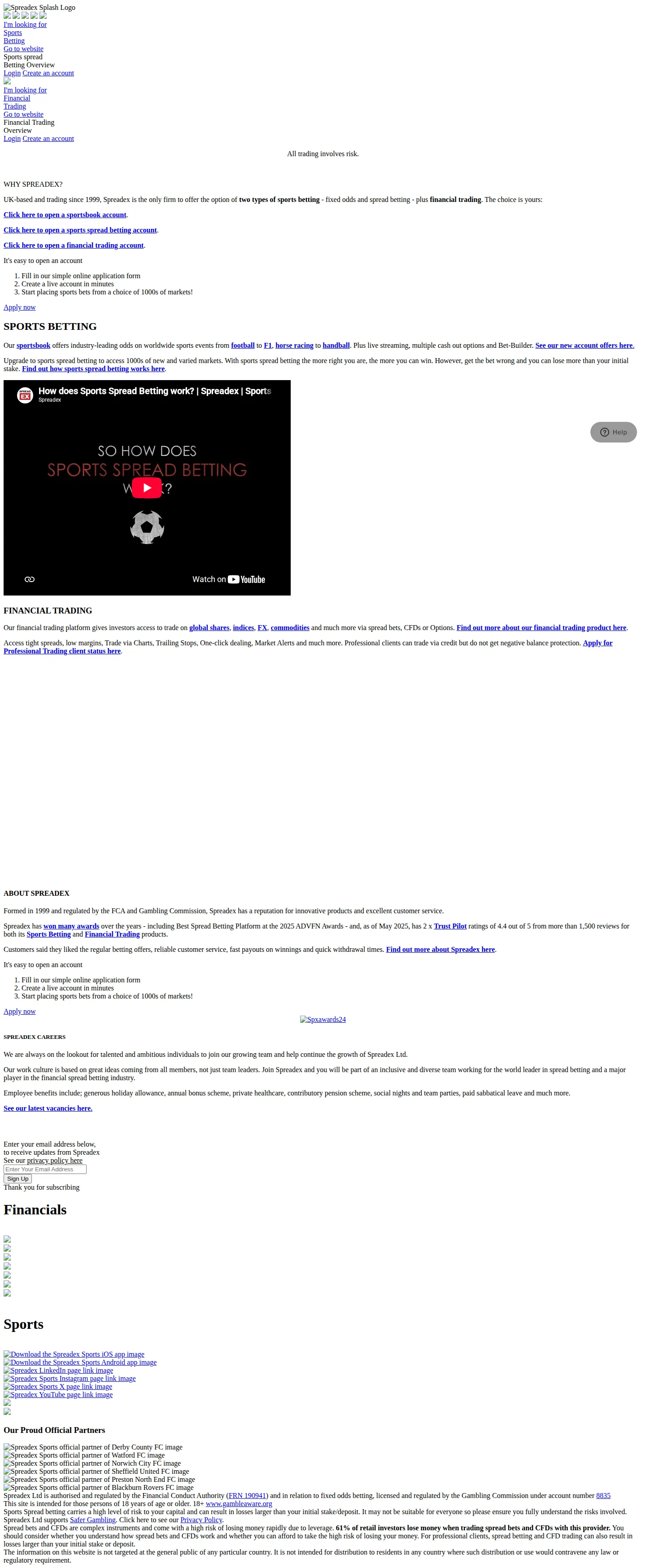
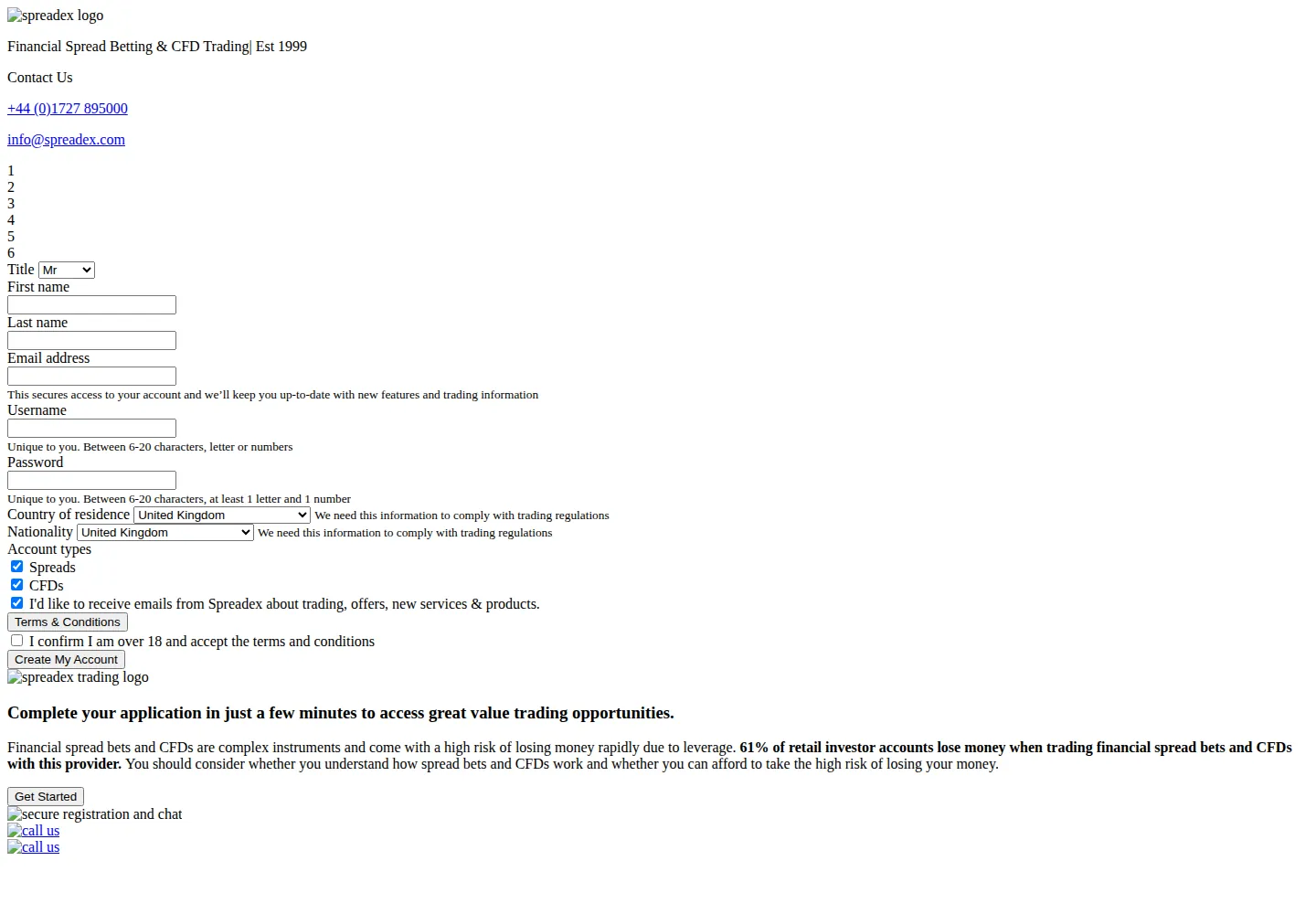
Pages captured from Spreadex’s own site when this review was written. Brokers change their terms; these are what we read.


Score history
Recomputed daily; every move is on the record. The current score is always the latest row.
| Date | Score | Move |
|---|---|---|
| 2026-09-29 | 7.6 | ▲ |
| 2026-07-25 | 5.3 | ▲ |
| 2026-07-18 | 5.2 | = |
| 2026-07-11 | 5.2 | · |
FAQ
Is Spreadex regulated?
Yes, Spreadex Ltd holds FCA licence 190941, confirmed on-register with clean status since 2001.
Does Spreadex hold more than one licence?
No, only the FCA authorisation counts for financial services; its Gambling Commission licence covers sports betting, not trading.
What spreads does Spreadex charge?
Spreads start from USD 1.00 round turn on 1 lot EURUSD for Professional accounts, though this is a floor, not a guaranteed price.
What is the minimum deposit at Spreadex?
USD 1.
What platforms does Spreadex offer?
TradingView, Spreadex’s own web platform, and its own mobile app.
How can I contact Spreadex support?
By email, live chat, or a published phone number, during published support hours.
How this review works
Track Spreadex live: score moves and red notices, in your pocket.