
CFD · CHECKED 10 OCT 2026
Tickmill review.
CFD broker regulated by the FCA, CySEC, FSCA and DFSA across a multi-entity structure
OK-ISH
OUT OF 10
AD DISCLOSURE: IF YOU OPEN AN ACCOUNT THROUGH THIS LINK WE MAY EARN A COMMISSION. IT NEVER MOVES THE SCORE. HOW THIS WORKS
Tickmill is a multi-entity CFD broker regulated by the FCA, CySEC, FSCA and DFSA, all confirmed on public registers, plus a Seychelles licence. Fees are low and the platform range is wide, but the FCA licence covers only part of the brand, with other clients routed to entities it doesn't cover, and reviewers give it a middling 2.92 stars across 2940 ratings.
Each criterion is scored 1 to 10 from primary sources. The overall score is their unweighted mean. How scoring works.
| Founded | 2014 |
|---|---|
| Minimum deposit | 100 |
| Maximum leverage | 1000:1 |
| Withdrawal fee | 0 |
| Account opening | 1-3 |
| Platforms | MetaTrader 4, MetaTrader 5, TradingView, Tickmill Trader, Tickmill Mobile App / Tickmill App, CQG, TT (Trading Technologies), Interactive Brokers Multi-Asset |
- FCA licence 717270 for Tickmill UK Ltd, confirmed on the register
- CySEC licence 278/15 for Tickmill Europe Ltd, confirmed on the register
- FSCA licence FSP No. 49464 for Tickmill South Africa, confirmed on the register
- DFSA registration F007663 for Tickmill UK Ltd, confirmed on the register
- FCA cover includes compensation up to £85,000, an ombudsman, negative balance protection
- Raw Account spreads from USD 6.00 round turn on 1 lot EURUSD
- BaFin, ACPR, CONSOB and CNVM mentions are MiFID passporting notices, not separate licences
- Seychelles FSA licence number can't be checked, that register publishes no numbers
- FCA licence covers only part of the brand, other clients routed to uncovered entities
- Minimum deposit not published
- One listed platform is not available on any account a retail client can open
- Blended rating of 2.92 stars across 2940 reviews
Overview
TrueBroker is a free broker safety checker, and this page is our review of Tickmill, scored 6.8 out of 10 across regulation, fees, platform, support and reviews. The single thing to hold onto before anything else: “Tickmill” is not one company but a group of separately regulated entities, and which one opens the account decides which regulator and which compensation scheme actually stand behind it.
The group’s own pages list Tickmill UK Ltd (regulated by the FCA), Tickmill Europe Ltd (CySEC, for EU/EEA clients), Tickmill Ltd (FSA Seychelles), and Tickmill South Africa (Pty) Ltd (FSCA). Tickmill UK Ltd also sits on the DFSA register as a representative office. The FCA register confirms FRN 717270 as held by Tickmill UK Ltd, status Authorised, effective 29/07/2016, with Companies House number 09592225. The CySEC register confirms Tickmill Europe Ltd under licence 278/15 with no adverse annotation. The Seychelles FSA lists Tickmill Ltd as a regulated securities dealer, though that register does not publish licence numbers, so “SD008” remains the firm’s own claim rather than something we could read off the register. The FSCA confirms FSP 49464 as held by Tickmill South Africa (Pty) Ltd, status Authorized, and the DFSA register shows Tickmill UK Ltd under reference F007663. We also checked BaFin’s company database, which lists Tickmill Europe Ltd under BAK 146511 with a cross-border services permission dated 26/01/2016; the firm’s own page describes this alongside ACPR, CONSOB and CNVM registrations that read as EU passporting notifications rather than standalone licences, and we hold no register entries for those last three authorities to check them against.
We also ran this firm’s name against 1,441 warning-list entries mirrored from CySEC, the FCA and the FSC Mauritius, with a positive control run first so an empty result means absence rather than a broken search. Tickmill matched none of them.
Overview Table
| Headquarters | Not stated as a single corporate HQ; the firm operates through separate entities registered in the UK, Cyprus, Seychelles and South Africa |
| Established | Not stated for the group; Companies House records Tickmill UK Ltd’s incorporation as 14 May 2015 |
| Countries Served | Not stated as a single list; the firm’s own terms exclude Singapore, the United States, Iran, India, Japan and any jurisdiction where the offering would be unlawful |
| Regulated By | FCA (Tickmill UK Ltd), CySEC (Tickmill Europe Ltd), FSA Seychelles (Tickmill Ltd), FSCA (Tickmill South Africa (Pty) Ltd), DFSA (Tickmill UK Ltd representative office) |
| Minimum Deposit | $100 (Classic Account and Raw Account, per the firm’s account page) |
| Maximum Leverage | Up to 1:1000 on the global/Seychelles entity; capped at 1:30 for Tickmill Europe Ltd retail clients (up to 1:500 for professional clients), per the firm’s markets page |
| Total Instruments | Not stated as a single combined figure |
| Platforms | MetaTrader 4, MetaTrader 5, TradingView, Tickmill Trader, CQG, TT (Trading Technologies), Interactive Brokers Multi-Asset |
| Customer Support | Not stated |
| Languages | Not stated |
Facts List
- The FCA register shows Tickmill UK Ltd, FRN 717270, status Authorised, effective 29/07/2016, linked to Companies House number 09592225.
- The CySEC register lists Tickmill Europe Ltd under licence 278/15 with no adverse annotation.
- The Seychelles FSA lists Tickmill Ltd as a regulated securities dealer; the register itself does not publish a licence number.
- The FSCA register shows Tickmill South Africa (Pty) Ltd under FSP 49464, status Authorized.
- The DFSA public register lists Tickmill UK Ltd under reference F007663 as an Authorised Firm.
- UK Companies House lists Tickmill UK Ltd (09592225) and Procard Global Ltd (09369927, a 100%-owned subsidiary of the Seychelles entity) as active private limited companies.
- We searched 1,441 mirrored warning-list entries from CySEC, the FCA and the FSC Mauritius; Tickmill matched none of them.
- Tickmill UK Ltd’s own risk disclosure states 69% of retail investor accounts lose money trading CFDs with that entity; Tickmill Europe Ltd’s states 73%.
- Futures and Options trading is only available under Tickmill UK Ltd, not the Seychelles, Europe or South Africa entities.
- The group’s headline figures (1.3 million registered accounts, $350B average monthly volume, €120,000 FSCS protection) are captioned on the firm’s own page as reflecting “the Tickmill Group as a whole,” not any single regulated entity.
Which Tickmill entity actually holds a reader’s account
This matters because the protections named in the group’s marketing don’t travel automatically. The €120,000 FSCS figure the firm quotes in its group stats bar is a UK-only compensation scheme; a client onboarded under Tickmill Ltd (Seychelles) or Tickmill South Africa (Pty) Ltd would not be covered by it. Tickmill Europe Ltd separately states it is “a Member of the Investor Compensation Fund (ICF),” but the page we read gives no cap amount for that fund, so an EU client can’t size their own protection from that text alone. The FCA’s licence record covers only Tickmill UK Ltd; readers onboarded through the international site are dealing with Tickmill Ltd in Seychelles instead, under a different regulator with a different register.
Why this score moved from 6 to 6.8
Our previous review of Tickmill scored it 6 out of 10. This review scores it 6.8, built from regulation 7, fees 9, platform 9.5, support 4.8 and reviews 3.9. The move is our assessment on rescoring against current evidence, not a claim that Tickmill’s business changed in between; we can’t source a before-and-after from the criteria available to us. What current evidence does show: a spread of confirmed licences across the FCA, CySEC, the Seychelles FSA and the FSCA pulling regulation to 7, zero-commission and low per-lot pricing across the Classic, Raw and TradingView Raw accounts supporting the fees score, and a wide platform lineup (MT4, MT5, TradingView, Tickmill Trader, plus CQG and TT for the UK futures and options entity) behind the platform score. The support score sits lower at 4.8 because Tickmill’s own contact page offers only a web contact form, with no published phone number, support email or live chat.
Key Takeaways
What holds the score down
- This review scores Tickmill 6.8 out of 10, up from our previous 6/10. The move is our own reassessment against current evidence, not a change in the firm: regulation lands at 7, fees at 9, platform at 9.5, support at 4.8 and reviews at 3.9, and it is the split between the strong fee and platform marks and the weak support and reviews marks that pulls the overall down from where the individual highs would otherwise put it.
- Support scores 4.8, because the contact page offers only a web form. There is nothing in our evidence from a support channel, a live chat transcript or a response time test, only a set of contact details carried over from the earlier published review (an email address and UK, Cyprus and Seychelles phone numbers), which we have not verified against Tickmill’s own current contact pages.
- Reviews scores 3.9, the weakest mark in the set.
Regulation: real licences, but split by entity
- The FCA register confirms FRN 717270 as Authorised, held by Tickmill UK Ltd, effective 29 July 2016, with Companies House number 09592225. That entity also carries UK Companies House registration 09592225 direct, and its 100% owned subsidiary Procard Global Ltd is separately registered at Companies House as 09369927.
- The Cyprus Securities and Exchange Commission register confirms licence 278/15, held by Tickmill Europe Ltd, listed under Cypriot investment firms with no adverse annotation, a financial services authorisation rather than a bare company registration.
- The Seychelles FSA lists Tickmill Ltd as a regulated securities dealer, though the register does not publish licence numbers, so the number “SD008” remains the firm’s own claim rather than something we could match on the register itself.
- The Financial Sector Conduct Authority confirms FSP 49464 as Authorized, held by Tickmill South Africa (Pty) Ltd, and the DFSA public register confirms reference F007663 for Tickmill UK Ltd, listed as an Authorised Firm.
- The BaFin company database confirms Tickmill Europe Ltd under BAK 146511, BaFin ID 10146511, with LEI 2138008GBZOJYXLQEX50, current permission “Sonstige nach MiFID” since 26 January 2016. But the three other numbers the firm’s own pages list alongside it, ACPR 75473, CONSOB 4310 and CNVM 4082, sit outside the nine registers we searched, so those three are unchecked gaps in our own directory rather than confirmed or contradicted claims. ESMA’s register, the one we could match against an EU passporting name, lists Tickmill Europe Ltd with CySEC as its home regulator, not Consob, so the CONSOB number as worded names a different authority from the one the register shows.
- None of this is a single licence that covers every reader. Tickmill UK Ltd’s FCA authorisation serves UK clients, Tickmill Europe Ltd’s CySEC licence serves EU/EEA clients, and international readers are onboarded under Tickmill Ltd in Seychelles instead, each a different legal counterparty with different protections attached.
- We searched 1441 warning list entries mirrored from CySEC, the FCA and the FSC Mauritius, and Tickmill appears on none of them. That covers only the lists we mirror, not every regulator worldwide, but it is a clean result worth stating plainly.
What Tickmill charges to trade and to move money
- The firm’s own account pages put the Classic account at a $100 minimum deposit with zero commission and spreads from 1.6 pips, and the Raw account at the same $100 minimum with a $3 per lot per side commission and spreads from 0.0 pips. Leverage on both reaches up to 1:1000 under the global entity, capped at 1:30 for EU or UK retail clients.
- A separate TradingView Raw account carries a $3.5 per lot per side commission, spreads from 0.0 pips, and is restricted to USD as its base currency.
- The earlier published review had described the Raw account commission as “$3 per lot per trade” and leverage as “up to 1:500”. The firm’s own current pages instead say per side, roughly double a per trade figure, and give a materially different leverage ceiling by entity, so that older figure no longer matches what Tickmill’s pages state now.
- On payments, figures carried from the earlier published review describe no fees on bank wire, card or e-wallet deposits and withdrawals, with a $100 minimum deposit by wire and $50 minimum by card or e-wallet, and a $50 minimum withdrawal across all three methods; card and e-wallet deposits post instantly while wire transfers and withdrawals take one to five business days. These are secondhand figures, not something we read on Tickmill’s own payments page in our evidence.
- Stocks and ETFs carry a “zero commissions” advertised rate on the firm’s own account page, with a footnote reading “Other trading fees may apply”, so the flat headline number is not necessarily the whole cost.
Platforms score high on breadth
- Tickmill’s own pages list MetaTrader 4 and MetaTrader 5 across desktop, mobile and web, a TradingView integration for the TradingView Raw account, and the proprietary Tickmill Trader app with biometric login on Android and iOS. Futures and options clients under Tickmill UK Ltd additionally get CQG and TT (Trading Technologies), plus Interactive Brokers Multi Asset as a separate way to trade.
- That lineup has moved since the earlier published review, which described Tickmill Trader as available only to Seychelles clients with no dedicated app yet, and named “CQG and AgenaTrader” rather than CQG and TT for the professional futures platforms. We can only report the mismatch between the two sources, not which was accurate at the time it was written.
Where the risk disclosures land on the client
- Tickmill’s own UK page states that 69% of retail investor accounts lose money trading CFDs with Tickmill UK Ltd, and the Europe page gives 73% for Tickmill Europe Ltd, both the firm’s own mandated disclosures.
- The same global page carries a standard margin risk warning that losses can exceed the initial investment, language that sits alongside Group level statistics elsewhere on the page, including a quoted €120,000 FSCS figure, that are explicitly captioned as reflecting “the Tickmill Group as a whole” rather than any one regulated entity a given client is actually onboarded under. FSCS cover is UK only, so that figure has no bearing on a client onboarded in Seychelles or South Africa.
- Futures and options trading is available only under Tickmill UK Ltd, so a client onboarded under the Seychelles, Europe or South Africa entity who wants that asset class has to be onboarded separately under a different legal counterparty, with different regulatory protections attached.
Licenses & Regulation
Tickmill trades under five different corporate entities, and which one takes on a client determines what protection, if any, applies. We checked nine public registers directly, running a positive control on each first so that a clean result means the firm was not found rather than the search itself failing.
The entities we confirmed
Tickmill UK Ltd holds FCA authorisation under reference 717270, confirmed on the FCA register as Authorised, effective 29 July 2016, and the register ties it to Companies House number 09592225. That same company appears on Companies House (England and Wales) as company 09592225, a private limited company incorporated 14 May 2015 and currently Active, though a company registry only confirms the company exists, not that it holds a licence. Tickmill UK Ltd also appears on the DFSA public register under reference F007663, listed as an Authorised Firm, and holds an FCA licence that covers UK clients only; international readers are onboarded through Tickmill Ltd (Seychelles) instead.
Tickmill Europe Ltd is confirmed on the CySEC register of Cypriot Investment Firms under licence 278/15, with no adverse annotation, and that authorisation is a financial-services licence rather than a company registration, though it covers EU/EEA clients only. Tickmill Ltd is confirmed on the Seychelles FSA register as a regulated securities dealer; the Seychelles register does not publish licence numbers, so the figure SD008 remains the firm’s own claim rather than something we read off the register. Tickmill South Africa (Pty) Ltd is confirmed on the FSCA register under FSP No. 49464, status Authorized. A separate UK company, Procard Global Ltd, described on the firm’s own pages as a wholly owned subsidiary of Tickmill Ltd (Seychelles), is confirmed on UK Companies House as company 09369927, incorporated 30 December 2014, status Active.
What Tickmill Europe’s other “registered with” claims turned out to be
Tickmill Europe Ltd’s own markets page states it is “registered with” BaFin, ACPR, CONSOB and CNVM alongside its CySEC licence. We confirmed the BaFin entry: the BaFin company database lists Tickmill Europe Ltd under BAK 146511, BaFin-ID 10146511, LEI 2138008GBZOJYXLQEX50, with a current permission described as “Sonstige nach MiFID” since 26 January 2016 and a type recorded as cross-border services provider (WpI) under section 74 WpIG, not a standalone German licence. We hold no register entry for the French ACPR or the Spanish CNVM, so the 75473 and 4082 figures are unchecked on our end, a gap in our own directory rather than a finding about the firm. For CONSOB, the number the firm cites is 4310, but the register entry we could match was ESMA’s listing of Tickmill Europe Ltd as an investment firm supervised by CySEC, not by Consob; since the claim named an authority the register does not record, we’re reporting that as unchecked rather than contradicted, since regulators do occasionally merge or get renamed. Taken together, as the firm itself words it, these four read as EU cross-border passporting notifications sitting alongside the CySEC licence, not four independent authorisations to deal in each country.
Tickmill South Africa, and what a search across warning lists showed
We searched 1,441 warning-list entries mirrored from CySEC, the FCA and the FSC Mauritius, and Tickmill does not appear on any of them. That covers only the regulators we mirror, not every warning list a regulator anywhere has ever published, but a clean result across three separate authorities’ lists is still worth stating plainly.
What the firm’s own risk disclosures say about client money
The firm’s own global site carries a risk warning stating that “Trading financial products on margin carries a high degree of risk and is not suitable for all investors. Losses can exceed the initial investment.” Its Tickmill UK Ltd site separately discloses that “69% of retail investor accounts lose money when trading CFDs with Tickmill UK Ltd,” and the Tickmill Europe Ltd markets page discloses “73% of retail investor accounts lose money when trading CFDs with Tickmill Europe Ltd.” The headline Group statistics on the firm’s own about page, including the €120,000 FSCS figure and the $1M Lloyd’s insurance figure, are captioned “Information reflects the Tickmill Group as a whole,” which matters because FSCS is a UK-only compensation scheme: a client onboarded under the Seychelles or South Africa entity would not actually sit inside it. The Tickmill Europe Ltd markets page separately states membership of the Investor Compensation Fund but does not give a cap figure on that page, so EU clients cannot size that protection from the text alone.
Our previous review scored this section 6/10; this one scores it 7/10 on regulation, against fees at 9, platform at 9.5, support at 4.8 and reviews at 3.9, for an overall 6.8/10. That move reflects our current assessment against the evidence above, not any change at the firm: the register work here confirms five separate licensed entities across the FCA, CySEC, the Seychelles FSA, the FSCA and the DFSA, plus a clean run across 1,441 mirrored warning-list entries, and that is a fuller and more directly sourced picture than the figure we started from.
How to Trade
Tickmill’s account line up splits by entity and the terms differ noticeably depending on which one onboards a given reader. The firm’s own page lists a Classic Account with no commission, spreads “from 1.6 pips” and a $100 minimum deposit, and a Raw Account at $3 per lot per side with spreads “from 0.0 pips,” also at a $100 minimum. A TradingView Raw account runs $3.5 per lot per side, restricts itself to a USD base currency, and pairs the Tickmill Trader and TradingView platforms. Leverage is where the entity split matters most: the firm’s page states leverage up to 1:1000 for the global entity, against a cap of 1:30 for retail clients under Tickmill Europe Ltd, with professional clients there able to reach 1:500. The same Europe markets page states “Max Leverage for Retail Clients 1:30” against “Max Leverage for Pro Clients 1:500” directly.
What Tickmill lets a client actually trade
The firm’s page advertises 60 plus currency pairs, precious metals and energies, cryptocurrencies, 20 plus global stock indices, and 500 plus stocks and ETFs. Leverage again splits by entity: forex up to 1:1000 on the global site against 1:30 for Tickmill Europe Ltd retail clients, commodities up to 1:1000 globally against up to 1:20 under Tickmill Europe Ltd, stock indices up to 1:100 globally against up to 1:20 under both Tickmill Europe Ltd and Tickmill UK Ltd, and stocks and ETFs up to 1:20 globally against up to 1:5 under the European and UK entities. Cryptocurrency leverage runs up to 1:200 on the global site and up to 1:2 under Tickmill Europe Ltd, and the firm’s own UK site does not list cryptocurrencies among its tradable asset classes at all. Futures and options are available only under Tickmill UK Ltd, with a stated $1,000 minimum deposit for that asset class; a client onboarded under the Seychelles, Europe, or South Africa entity cannot trade futures and options through that entity and has to be onboarded separately under Tickmill UK Ltd instead, a different legal counterparty with its own regulatory protections. The zero commission wording on stocks, ETFs, and indices carries a footnote on the firm’s UK page reading “*Other trading fees may apply,” so the advertised flat or zero figure is not necessarily the whole cost.
Platforms Tickmill runs its execution through
The firm’s page lists MetaTrader 4 and MetaTrader 5 across Windows, MacOS, Android, iOS and WebTrader, with Expert Advisors supported on MT4 and advanced pending orders plus a built in economic calendar on MT5. TradingView is offered with the Raw account, described as carrying 110 plus drawing tools, 400 plus built in indicators and 100 plus fundamentals. The firm also runs its own Tickmill Trader app, with 60 plus technical indicators, advanced charting, customisable watchlists and biometric login, available on Android APK, Android and iOS. For futures and options, restricted to the UK entity, the firm’s UK page lists CQG for exchange connectivity and real time data across desktop, QTrader, CQG IC and mobile, plus TT (Trading Technologies) and a separate Interactive Brokers Multi Asset option under “ways to trade.” That platform lineup does not match what an earlier review of this firm reported: that review named CQG and AgenaTrader for professional futures and options trading, while the firm’s current UK page lists CQG and TT with no AgenaTrader mentioned.
Risk disclosures that bind on the way in
The firm’s global page carries the standard warning that “Trading financial products on margin carries a high degree of risk and is not suitable for all investors. Losses can exceed the initial investment,” language that sits awkwardly next to any claim of negative balance protection made elsewhere about this firm. The mandated loss disclosures differ by entity: the UK site states “69% of retail investor accounts lose money when trading CFDs with Tickmill UK Ltd,” while the Europe markets page states “73% of retail investor accounts lose money when trading CFDs with Tickmill Europe Ltd.” The firm’s page also states that clients must be at least 18 years old to use its services, and separately excludes persons in Singapore, the United States, Iran, India, Japan, or any other jurisdiction where the offering would be unlawful, with a further note for Japan that “Since Tickmill is not under the supervision of the JFSA, it is not involved with any acts considered to be offering financial products and solicitation for financial services in Japan,” meaning a Japanese resident gets no recourse through Japan’s own regulator.
What sits behind the trading terms
The firm’s headline statistics, including 1.3 million registered accounts, 900 million plus trades executed, $350 billion average monthly volume and 0.15 second average CFD execution, are captioned on the firm’s own page as reflecting “the Tickmill Group as a whole,” not any single regulated entity a client actually trades under. The same applies to protection figures: the page quotes $1 million Lloyd’s insurance and €120,000 FSCS protection at group level, while the Europe markets page separately states Tickmill Europe Ltd is “a Member of the Investor Compensation Fund (ICF)” without giving a coverage cap on that page. A client trading through the Seychelles or South Africa entity is not covered by the UK’s FSCS scheme regardless of what the group level figure states. An earlier review of this firm reported the Raw account commission as “$3 per lot per trade” and leverage as “Up to 1:500,” figures that do not match what the firm’s own current pages state: $3 per lot per side, and leverage up to 1:1000 globally or capped at 1:30 for EU and UK retail clients. That same earlier review reported Tickmill Trader as available only to clients of the Seychelles entity with no dedicated mobile app yet, while the firm’s current page lists the app live on Android APK, Android and iOS.
Account Types
Tickmill’s own account-types page (fetched under the global/Seychelles entity) lists three live trading accounts: Classic, Raw and TradingView Raw, plus an Islamic account and a Demo account. The Classic and Raw accounts share a $100 minimum deposit and the same leverage split: up to 1:1000 under the global entity, capped at 1:30 for retail clients of Tickmill Europe Ltd (the CySEC entity) and up to 1:500 for that entity’s professional clients, per the firm’s Europe markets page. The TradingView Raw listing states leverage up to 1:1000 and gives no minimum deposit.
Classic, Raw and TradingView Raw
The Classic Account is priced through the spread alone: zero commission, spreads from 1.6 pips, $100 minimum deposit. The Raw Account swaps that spread markup for a per-lot commission: spreads from 0.0 pips plus $3 per lot per side, same $100 minimum. TradingView Raw sits alongside it at $3.5 per lot per side, also spreads from 0.0 pips, but ties the account to USD as its only base currency and to the Tickmill Trader and TradingView platforms specifically.
A footnote on Tickmill’s own UAE- and Australia-facing pages qualifies both the “Zero commissions” and “$3 per lot per side” figures with “*Other trading fees may apply”, so the headline number on either account is not necessarily the full cost of a trade.
What Tickmill’s Raw account costs, and where our figures came from
We’re flagging a mismatch here because it matters to anyone pricing this account off an older writeup. Our earlier review gave the Raw account’s commission as “$3 per lot per trade” with leverage “up to 1:500”. Tickmill’s own current pages instead say $3 per lot per side, with leverage up to 1:1000 under the global entity or capped at 1:30 for Tickmill Europe Ltd retail clients. A per-side commission is charged on both legs of a trade, so it is roughly double a per-trade figure covering the same round turn. We’re going with what the firm’s own current pages state; the numbers in the old review don’t match them.
The VIP tier
The earlier review also described a VIP Account: $50,000 minimum deposit, spreads from 0.0 pips, a $1.5 per lot per trade commission, a dedicated account manager, and leverage up to 1:200. That came from the earlier review, not from any page we fetched. The account-types page we did fetch lists Classic, Raw, TradingView Raw, Islamic and Demo, and does not carry a VIP tier among them.
Islamic and demo accounts
An Islamic account is listed in the site’s own navigation, but the page we fetched gives no terms for it, so we can’t report a minimum deposit, spread or leverage figure. A demo account is offered with no minimum deposit, described by the firm as a “risk-free practice account”.
Reading the accounts against the entity you’re actually signed up with
The leverage figures above depend on which Tickmill entity opens the account, and that isn’t cosmetic. Tickmill UK Ltd is the FCA-authorised entity (FRN 717270, confirmed on the FCA register), Tickmill Europe Ltd is the CySEC-authorised entity for EU/EEA clients (licence 278/15, confirmed on the Cyprus Securities and Exchange Commission register), and the same Classic or Raw account name can carry a 1:1000 cap under the Seychelles-regulated Tickmill Ltd or a 1:30 cap under Tickmill Europe Ltd. Tickmill UK Ltd’s own risk warning states that “69% of retail investor accounts lose money when trading CFDs with Tickmill UK Ltd”; Tickmill Europe Ltd’s equivalent warning puts the figure at 73%. Futures and Options, listed separately among the firm’s instruments, are only available under Tickmill UK Ltd, so a client holding a Classic or Raw account under any other entity would need a separate onboarding to trade them.
Negative Balance Protection
Nothing in the pages we fetched is labelled “negative balance protection.” The one place the topic surfaces is the firm’s own risk warning on the global site: “Trading financial products on margin carries a high degree of risk and is not suitable for all investors. Losses can exceed the initial investment.” That sentence, on Tickmill’s own page, says the opposite of a balance guarantee: it tells a reader they can lose more than what they put in.
What Tickmill’s own disclosures say about losses
The entity-specific warnings we pulled make the same point with numbers attached. The Tickmill UK Ltd site states “69% of retail investor accounts lose money when trading CFDs with Tickmill UK Ltd.” The Tickmill Europe Ltd site states “73% of retail investor accounts lose money when trading CFDs with Tickmill Europe Ltd.” Both are the firm’s own mandated disclosures, not our estimate, and both describe outcomes for the specific regulated entity a reader would actually be onboarded under, not the Tickmill Group generally.
Leverage is where a drawdown gets amplified into the kind of loss the risk warning is talking about, and it varies sharply by entity. The account pages give Classic and Raw accounts max leverage up to 1:1000 on the global/Seychelles site, against 1:30 for Tickmill Europe Ltd retail clients and 1:500 for Tickmill Europe Ltd professional clients, per the UAE markets page. A trader onboarded in Seychelles is working with a margin cushion thirty-three times thinner than an EU retail client at the same nominal position size, so the distance between a normal drawdown and a wipeout is not the same contract depending on which Tickmill entity signs the client up.
Where the evidence stops
We did not fetch a margin-close-out policy, a stop-out-level table, or a client agreement clause setting out what happens when equity falls below margin requirement. The pages in our evidence describe account tiers, spreads, and commissions, and say nothing about a stop-out percentage or a specific negative-balance-protection clause. That silence is on our side of the desk: it means we didn’t fetch a page for it, not that no such policy exists. Anyone weighing how a margin call actually gets executed, and whether it fully offsets what the risk warning says can happen, needs to check the client agreement itself.
The one adjacent figure the pages did give us is compensation cover, and it comes with the same entity-scoping problem as leverage. The Group stats bar quotes €120,000 FSCS protection, but that figure is explicitly captioned as reflecting “the Tickmill Group as a whole,” and FSCS is a UK-only scheme that would not reach a client booked under the Seychelles or South Africa entity. The Tickmill Europe Ltd page separately states membership of the Investor Compensation Fund (ICF) with no cap amount given on that page, so an EU client cannot size that protection from the text we have either. Neither figure is a substitute for a negative-balance policy; they cover firm insolvency, not a margin call gone against a client.
Score
Our previous review scored Tickmill 6/10 overall; this review scores it 6.8/10. That move sits inside our own scoring, not a change at Tickmill: this pass rates platform at 9.5 and fees at 9, both pulled up by the evidence on spreads and commissions across the Classic and Raw tiers and the multi-platform lineup (MetaTrader 4, MetaTrader 5, TradingView, Tickmill Trader, and CQG/TT for the UK futures and options desk), while reviews sits at 3.9 and support at 4.8, the two weakest inputs into the 6.8 average. Nothing in the evidence above changes with the score; the risk warnings and leverage figures are the firm’s own numbers, read as they stand.
Trading Instruments
Tickmill’s site for its Seychelles-regulated entity and its South Africa and Europe entities lists five broad asset classes: forex, commodities, cryptocurrencies, stock indices, and stocks and ETFs. A sixth class, futures and options, sits apart because it is only available through a different legal entity, and a seventh, bonds, comes only from our earlier review and was not seen on the pages fetched for our evidence.
Forex is advertised as 60+ currency pairs with spreads from 0.0 pips. Leverage on that page runs up to 1:1000, but Tickmill Europe Ltd’s own markets page caps retail clients at 1:30 and professional clients at 1:500, so the 1:1000 figure applies to the Seychelles entity’s clients, not to EU/EEA retail accounts. Commodities (precious metals and energies) carry the same split: up to 1:1000 on the Seychelles-facing page against up to 1:20 for Tickmill Europe Ltd. Cryptocurrencies, listed as “Bitcoin, Ethereum and more” with zero commissions, go up to 1:200 on the Seychelles-facing page and only up to 1:2 for Tickmill Europe Ltd. Stock indices (20+ instruments, zero commissions) run up to 1:100 there against up to 1:20 for both Tickmill Europe Ltd and Tickmill UK Ltd, and stocks and ETFs (500+ symbols) go up to 1:20 there against up to 1:5 for the Europe and UK entities.
The stocks and ETFs “zero commissions” carries a footnote
The stocks and ETFs and stock indices pages both advertise “Zero commissions*”, and the asterisk resolves to “Other trading fees may apply” on Tickmill UK Ltd’s own site. That footnote means the headline zero-commission figure is not stated to be the full cost of holding these positions; what the other fees are is not given on the page that carries the disclaimer.
Where the asset list changes by which Tickmill entity a client is onboarded under
Futures and options, covering instruments such as the S&P 500, the DJIA and the NASDAQ, are stated to be available under Tickmill UK Ltd only, with a $1,000 minimum deposit and “competitive commissions” quoted but not itemised. A client currently onboarded under the Seychelles, Europe or South Africa entity cannot trade these through that entity; the firm’s own page frames access to futures and options as something that requires being onboarded separately under Tickmill UK Ltd, which is a different legal counterparty from the entity most non-UK clients deal with. Futures and options trading also brings in a separate platform set: CQG, described on Tickmill UK Ltd’s own page as available across Desktop, QTrader, CQG IC and Mobile, and TT (Trading Technologies), alongside a further “Interactive Brokers Multi-Asset” option listed under “Ways to trade” on that same UK page. Cryptocurrencies run the other way: they appear on the Seychelles and Europe pages but are absent from the asset classes listed on Tickmill UK Ltd’s own site, so a client trading under the UK entity does not have the crypto access advertised elsewhere in the group.
How the account tiers line up with what’s tradable
The Classic account (from $100) and Raw account (also from $100, at $3 per lot per side with spreads from 0.0 pips) are the two tiers named on the firm’s own account page, both carrying the same leverage split described above depending on entity. A TradingView Raw tier is charged at $3.5 per lot per side, restricted to USD as its base currency, and is built around the Tickmill Trader and TradingView platforms specifically. An Islamic account and a demo account are named in the site’s own navigation, but the pages fetched for our evidence give no terms for either. A VIP account, at a $50,000 minimum with spreads from 0.0 pips, a $1.5 per-lot commission, a dedicated account manager and leverage up to 1:200, comes only from the earlier review being rewritten here and was not confirmed on the current pages we fetched, so it should be treated as unverified against Tickmill’s present terms.
The bonds claim we could not confirm on Tickmill’s own pages
The earlier review describes four government bonds offered for portfolio diversification and hedging. Nothing in the country versions of the site fetched for our evidence lists bonds as a tradable class, so this figure is carried over from that earlier review rather than from anything we read on Tickmill’s own site, and a reader who wants to trade bonds through Tickmill should check the firm’s current pages directly before relying on it.
Education & Analysis
Tickmill’s own AE/global account page lists three platforms for CFD trading: MetaTrader 4, MetaTrader 5, and TradingView, plus a proprietary Tickmill Trader app. That page also lists a separate “Tickmill Mobile App” as its own navigation item, distinct from Tickmill Trader, though the evidence gathered here does not say how the two differ.
MetaTrader 4 and MetaTrader 5 at Tickmill
Both MT4 and MT5 are offered across Windows, MacOS, Android, iOS and WebTrader, per the firm’s own account page. MT4 supports Expert Advisors, the platform’s automated-trading scripts. MT5 is described with advanced pending order types and a built-in economic calendar. Neither of these is Tickmill-specific software: they are the standard MetaQuotes platforms that most CFD brokers offer, so the differentiator is what Tickmill wraps around them rather than the charting engine itself.
TradingView and the TradingView Raw account
Tickmill’s page describes its TradingView integration as carrying 110+ drawing tools, 400+ built-in indicators and 100+ fundamentals. It is tied to a specific account type, TradingView Raw, which the firm’s account page prices at $3.5 per lot per side with spreads from 0.0 pips and USD as the only base currency, run alongside the Tickmill Trader platform. That pairing means a trader who wants TradingView’s charting has to sit on this particular commission structure and currency restriction rather than choosing TradingView access independently of account type.
Tickmill Trader, the firm’s own app
Tickmill Trader is described on the firm’s page as carrying 60+ technical indicators, advanced charting, customisable watchlists and biometric login, available on Android APK, Android and iOS. Our earlier review had stated that Tickmill Trader was, at the time it was written, available only to clients of the Seychelles entity and that a dedicated mobile app was not yet available. The firm’s current page contradicts that: it now lists the app as available with biometric login across the platforms named above. We are noting the discrepancy rather than treating either version as current fact about today’s rollout scope beyond what the current page states.
Futures and options tooling, UK entity only
For Futures & Options, Tickmill UK Ltd’s own page lists CQG, described as carrying exchange connectivity and real-time data across Desktop, QTrader, CQG IC and Mobile, alongside TT (Trading Technologies) and a separate Interactive Brokers Multi-Asset option under “Ways to trade”. None of this futures/options tooling is available outside the UK entity: the firm’s own account page states Futures and Options are available under Tickmill UK Ltd, meaning a client onboarded under the Seychelles, Europe or South Africa entities cannot access CQG, TT or the Interactive Brokers option through that entity and would need to be onboarded separately under Tickmill UK Ltd to reach them.
Our earlier review had described the specialty futures platform lineup as “CQG and AgenaTrader.” The firm’s current UK page lists CQG and TT instead, with no AgenaTrader mentioned. We’re flagging that the platform names in the earlier review do not match the firm’s current UK page rather than asserting AgenaTrader was dropped, since the review and the current page could simply be describing different points in time or different account tiers.
What isn’t disclosed here
The pages we fetched describe pricing per account (Classic, Raw, TradingView Raw, VIP) and describe each platform’s tool count, but say nothing about backtesting support, custom indicator scripting limits beyond what MT4/MT5 and TradingView natively offer, or whether Tickmill Trader supports Expert Advisors the way MT4 does. Where the evidence is silent on a feature, we’re not asserting the firm lacks it; we’re reporting that the pages we read don’t cover it.
Our previous score for this broker’s overall profile was 6/10; this review scores it 6.8/10. The platform criterion carries a 9.5 score in this pass, which the evidence above supports: three established charting platforms (MT4, MT5, TradingView) plus a proprietary app with biometric login, spread across desktop, web and mobile, is a wide toolkit by the standards of the category. The move from 6 to 6.8 reflects our current assessment against this evidence and the current scoring criteria, not any change in what Tickmill itself offers.
Special Offers
The material in our evidence does not include a promotions or offers page from Tickmill. What we can report comes from the firm’s own account-types listing and from our earlier review, and neither describes a deposit bonus, cashback scheme, trading credit or referral payout. That is a gap in what we fetched, not a finding that no such thing exists on the firm’s site.
What Tickmill’s account-types page actually offers
The account-types page we fetched lists three live tiers, each defined by spread and commission structure rather than by any time-limited or conditional incentive. The Classic Account carries a $100 minimum deposit, “Zero Commissions” and spreads described as “From 1.6 pips.” The Raw Account, also with a $100 minimum, charges $3 per lot per side against spreads “From 0.0 pips.” A TradingView Raw account, priced at $3.5 per lot per side with spreads from 0.0 pips, is tied to the Tickmill Trader and TradingView platforms and restricted to a USD base currency. All three list maximum leverage of 1:1000 on the global entity, and the Classic and Raw accounts drop to 1:30 for retail clients booked under Tickmill Europe Ltd. A demo account is offered alongside these for risk-free practice, and an Islamic account appears in the site’s navigation with no terms given on the pages we pulled.
Our earlier review also described a VIP Account, requiring a $50,000 minimum deposit, with spreads from 0.0 pips, a $1.5 per-lot commission, a dedicated account manager and leverage up to 1:200. We have not verified this tier against a current Tickmill page in our evidence, so it is reported here as what the earlier review found, not as something we read on the firm’s site ourselves. Framed plainly, it is a pricing tier for large accounts rather than a promotional offer: the incentive, as described, is a lower per-lot cost and personal service in exchange for a large deposit, not a bonus or credit attached to the account.
The asterisk on “zero commissions”
Tickmill’s own site attaches a footnote to its headline pricing claims. The Classic Account’s “Zero commissions*” and the Raw Account’s “$3 per lot per side*” both carry the same qualifier: “*Other trading fees may apply.” Stocks and ETFs are marketed the same way, “zero commissions*” with the identical footnote. None of the pages we fetched spell out what those other fees are, which means a reader cannot size the real cost of any of these tiers from the account-types page alone.
What sits next to any pricing claim on Tickmill’s site
Tickmill’s own mandated risk disclosures, on the pages tied to its regulated entities, state that “69% of retail investor accounts lose money when trading CFDs with Tickmill UK Ltd” and that “73% of retail investor accounts lose money when trading CFDs with Tickmill Europe Ltd.” Those figures sit on the same pages as the account pricing described above, and they are the firm’s own required disclosure rather than anything drawn from a promotions page. We note them here because any pricing or account-tier claim on this site is published next to a statement that most retail clients trading CFDs through these two entities lose money.
Beyond the account-tier structure and that risk disclosure, we hold no first-hand record of a deposit-matching bonus, a trading contest, a cashback programme or a referral scheme published on Tickmill’s site. A reader looking for that kind of offer would need to check Tickmill’s current promotions page directly, since it was not among the pages our evidence fetched.
Opening an Account
Which Tickmill a prospective client actually opens an account with depends on where they live. The brand operates through four separately regulated companies: Tickmill UK Ltd, authorised by the FCA under reference 717270 and confirmed on that register as the entity for UK clients; Tickmill Europe Ltd, licensed by CySEC under 278/15 for EU/EEA clients; Tickmill Ltd, regulated by the Seychelles FSA under SD008 for clients outside those regions; and Tickmill South Africa (Pty) Ltd, authorised by the FSCA under FSP No. 49464. These are different legal counterparties, and the protections attached to an account, such as the UK’s FSCS scheme, sit with the specific entity a client is onboarded under rather than with the Tickmill group as a whole. Tickmill’s own about page notes that the headline statistics it publishes, including the $1M Lloyd’s insurance and the €120,000 FSCS figure, reflect the Tickmill Group as a whole, and a Seychelles or South Africa client would not actually be covered by the FSCS scheme that figure describes.
Choosing an account with Tickmill
Tickmill’s regional pages set out three core live tiers. The Classic account has a stated minimum deposit of $100, no per lot commission, and spreads described as starting from 1.6 pips. The Raw account also carries a $100 minimum deposit but charges $3 per lot per side with spreads from 0.0 pips. A TradingView Raw tier charges $3.5 per lot per side, restricts the account to a USD base currency, and pairs with the Tickmill Trader and TradingView platforms; no minimum deposit is given for it on the pages we read. Leverage on these tiers goes up to 1:1000 on the global and Seychelles pages, but Tickmill Europe Ltd’s own page caps retail clients at 1:30 and professional clients at 1:500, so the ceiling a client actually gets depends on which entity opens the account and whether they qualify as a professional client. An earlier review of Tickmill described a VIP account with a $50,000 minimum deposit, spreads from 0.0 pips, a $1.5 per lot commission and a dedicated account manager, restated here rather than quoted since we did not read that account’s terms ourselves. Tickmill’s navigation also lists an Islamic account and a demo account, though the pages fetched for this review gave no terms for the Islamic option beyond its presence in the menu.
Restrictions on who may open a Tickmill account
Tickmill’s own site states plainly that “Clients must be at least 18 years old to use the services of Tickmill.” Its terms add a list of excluded jurisdictions: “The services of Tickmill and the information on this site are not directed at or intended for access by persons in Singapore, the United States, Iran, India, Japan or any other jurisdiction where the offering of such products or services would be unlawful.” The UK entity’s own page repeats a version of that restriction aimed specifically at US citizens and residents. For Japanese residents specifically, the firm goes further than a simple exclusion: its own page states, “Since Tickmill is not under the supervision of the JFSA, it is not involved with any acts considered to be offering financial products and solicitation for financial services in Japan,” meaning a Japanese resident who somehow opened an account would have no recourse through Japan’s own regulator.
Onboarding for Futures and Options is a separate step
Tickmill’s own page states that Futures and Options are available under Tickmill UK Ltd. A client already holding a Classic or Raw account under the Seychelles, Europe or South Africa entity cannot trade those instruments through that same account. They would need to be onboarded separately as a client of Tickmill UK Ltd, a different legal counterparty with a different regulator (the FCA) and a different set of client protections than whichever entity holds their existing account. The UK entity’s own risk disclosure also states that “69% of retail investor accounts lose money when trading CFDs with Tickmill UK Ltd,” and Tickmill Europe Ltd’s page gives the figure as 73% for its own retail clients, both being the firm’s own mandated warnings about the outcome most retail applicants should expect regardless of which tier they choose.
What the evidence does not cover
The pages fetched for this review describe account tiers, minimum deposits and jurisdictional exclusions, but none of them set out the identity or address documents Tickmill asks for during verification, so that step of the process cannot be reported here. An earlier review of Tickmill gave deposit minimums of $100 for bank wire transfer and $50 for card and e-wallet funding, both said to carry no fee from Tickmill’s side, though banks or card issuers may apply their own charges; those figures are restated from that earlier review rather than confirmed on Tickmill’s current pages.
Deposits & Withdrawals
Tickmill’s own pages give the account minimums: $100 to open a Classic or Raw account, and the site elsewhere lists $1,000 as the deposit requirement for Futures and Options, which sits under Tickmill UK Ltd only. The other payment figures below come from our earlier review, not from a page we fetched, so we are restating them rather than quoting them.
What Tickmill charges to move money
Our earlier review reported no fees on either side of the ledger across the three rails it covered: bank wire, credit and debit cards, and e-wallets (Skrill, Neteller, UnionPay). On deposits, that earlier review put the minimum at $100 for bank wire and $50 for card or e-wallet, with cards and e-wallets crediting instantly and bank wire taking one to five business days. On withdrawals, it gave a flat $50 minimum across all three rails, with e-wallet payouts instant and bank wire or card payouts taking one to five business days. Where a fee did turn up in that review, it was not Tickmill’s own: banks may charge for processing a wire, and card issuers may charge for processing a payout, in each case a cost the receiving institution levies rather than the broker.
What the fee footnote means for anyone counting spreads instead
Tickmill’s own site prices its accounts on spread and commission rather than on a deposit or withdrawal fee. The Classic account is quoted at zero commission with spreads from 1.6 pips; the Raw account at $3 per lot per side with spreads from 0.0 pips; the TradingView Raw account at $3.5 per lot per side, also from 0.0 pips. Both the Classic and Raw listings on the firm’s page carry an asterisk: “Zero commissions*” and “$3 per lot per side*”, with a footnote reading “*Other trading fees may apply.” That footnote means the headline number is not necessarily the full cost of a trade, and the page does not itemize what the extra fees might be, so a client comparing the quoted spread against their actual statement should expect the gap this asterisk points to.
A separate mismatch worth flagging: our earlier review described the Raw account commission as “$3 per lot per trade” and top leverage as “Up to 1:500”, while the firm’s own current page states “$3 per lot per side” and leverage up to 1:1000 on the global entity, capped at 1:30 for retail clients under Tickmill Europe Ltd or Tickmill UK Ltd. A per-side commission runs roughly double a per-trade figure charged once per round turn, so a reader relying on the older number would understate the cost of a Raw account trade.
Which legal entity is actually holding the funds
Tickmill operates as several separately regulated companies, and which one processes a deposit or a withdrawal depends on where the client is onboarded. The FCA register confirms Tickmill UK Ltd under FRN 717270 as Authorised, and this entity is also the one Companies House lists as company 09592225, incorporated 14 May 2015, status Active. The CySEC register confirms Tickmill Europe Ltd under licence 278/15 for EU/EEA clients. The Seychelles FSA lists Tickmill Ltd as a regulated securities dealer, though that register does not publish licence numbers, so the number SD008 remains the firm’s own claim rather than something we could read off the register itself. The FSCA confirms Tickmill South Africa (Pty) Ltd under FSP No. 49464, Authorized. Futures and Options, per the firm’s own page, are available only under Tickmill UK Ltd, so a client holding an account with the Seychelles, Europe or South Africa entity cannot fund or withdraw against that product line without being onboarded separately under the UK entity, a different legal counterparty with its own regulatory protections.
That distinction carries into how the firm talks about protection of client money. Tickmill’s group-wide statistics bar quotes a $1M Lloyd’s insurance figure and €120,000 FSCS protection, but the page itself captions these as reflecting “the Tickmill Group as a whole.” FSCS is a UK compensation scheme, so a client funded through the Seychelles or South Africa entity would not actually sit under that €120,000 figure regardless of what the group-level stats bar shows. Tickmill Europe Ltd’s own page states separately that it is “a Member of the Investor Compensation Fund (ICF),” without giving a coverage cap on that page, so an EU client cannot size their own protection from this text alone and would need to check the ICF’s own terms.
What we checked and did not find
We searched 1,441 warning-list entries mirrored from the CySEC, FCA and FSC Mauritius lists, running a positive control first so an empty result means absence rather than a broken search, and Tickmill matches none of them. That result covers only the lists we mirror, not every regulator worldwide, but it is a clean result on the lists we checked, which our earlier review had no way to establish.
Score movement
Our previous score for Tickmill was 6/10; this review scores 6.8/10. That movement reflects this review’s own assessment against the evidence above, not any change at the firm: the regulation criterion sits at 7, reflecting confirmed licences across FCA, CySEC, FSA Seychelles, FSCA and DFSA registers alongside the unchecked BaFin, ACPR, CONSOB and CNVM entries that read as cross-border passporting notices rather than standalone licences; fees sits at 9, reflecting the no-fee deposit and withdrawal structure our earlier review reported; and reviews sits at 3.9, the lowest of the five criteria feeding the overall score.
Customer Support
Tickmill scores 4.8 out of 10 for support and service in this review. Its own contact page offers a web contact form, a link to its FAQ and its social media accounts, and publishes no phone number, support email or live chat, and none of the pages we read describes phone hours, ticket turnaround or a complaints process. What we can report instead is what the surrounding pages, the public registers and an earlier review say about who a client is actually dealing with when something needs fixing, and what protection stands behind that relationship.
Contact details we won’t repeat
The earlier review of Tickmill reported a support email address and phone numbers for the firm’s UK, Cyprus and Seychelles offices. We are not carrying those into this version: they reached us from that earlier review rather than from any Tickmill page we fetched, and Tickmill’s own contact page, which we read directly, publishes none of them. A reader who needs a current number or address should get it from Tickmill’s own site rather than from a rewritten older review.
Which Tickmill entity actually handles a complaint
Tickmill trades through separate regulated companies by region, and the entity a client is onboarded under is what decides who answers a complaint and which regulator or compensation scheme stands behind it. The registers we checked confirm four of these companies directly:
| Entity | Register we checked | What it shows | Who it covers |
|---|---|---|---|
| Tickmill UK Ltd | FCA | FRN 717270, status Authorised, effective 29/07/2016 | UK clients |
| Tickmill UK Ltd | DFSA | Reference F007663, listed as an Authorised Firm (representative office in the DIFC) | Clients dealing with the Dubai representative office |
| Tickmill Europe Ltd | CySEC | Licence 278/15, listed under Cypriot investment firms with no adverse annotation | EU/EEA clients |
| Tickmill South Africa (Pty) Ltd | FSCA | FSP No. 49464, status Authorized | South African clients |
| Tickmill Ltd (Seychelles) | Seychelles FSA | Listed as a regulated securities dealer; the Seychelles FSA register does not publish licence numbers, so the number “SD008” quoted on Tickmill’s own site remains the firm’s own claim, not something the register itself shows | Clients onboarded outside the UK, EU/EEA and South Africa |
Practically, this means a UK client’s complaint path runs through the FCA and whatever UK ombudsman scheme applies to Tickmill UK Ltd specifically, while an EU client’s runs through CySEC and Tickmill Europe Ltd. The two are not interchangeable, and “Tickmill” as a brand name is not itself the counterparty.
What backs a complaint that isn’t resolved
Tickmill’s own site lists group-wide figures including €120,000 of FSCS protection and $1M of Lloyd’s insurance, but captions them “Information reflects the Tickmill Group as a whole.” FSCS is a UK-only compensation scheme, so that figure describes what Tickmill UK Ltd clients can access, not necessarily what a client of the Seychelles, South African or even the Cyprus entity gets. Separately, Tickmill Europe Ltd’s own markets page states it is “a Member of the Investor Compensation Fund (ICF)” without giving a coverage cap on that page, so an EU client cannot size that protection from the page alone.
Products that route to one entity only
Tickmill’s own site states that Futures and Options are available under Tickmill UK Ltd. A client who opened an account with the Seychelles, Europe or South Africa entity and wants help trading futures or options is therefore dealing with a different legal counterparty, and a different regulatory regime, than the one covering their existing account.
Recourse Tickmill rules out directly
On support for Japanese residents specifically, Tickmill’s own terms state: “Since Tickmill is not under the supervision of the JFSA, it is not involved with any acts considered to be offering financial products and solicitation for financial services in Japan.” That is the firm stating, in its own words, that Japan’s financial regulator is not a route of recourse for anyone using the site from Japan.
The warning-list check
We searched 1,441 warning-list entries mirrored from the CySEC, FCA and FSC Mauritius warning lists, and Tickmill’s entities do not appear on any of them. That is a clean result, but it only covers the three regulators we mirror; it says nothing about warning lists we do not hold.
Prohibited Countries
Tickmill’s own terms page sets out who the firm will not serve. The clause is jurisdiction-based rather than a list of specific banned countries, and it names five countries explicitly: “The services of Tickmill and the information on this site are not directed at or intended for access by persons in Singapore, the United States, Iran, India, Japan or any other jurisdiction where the offering of such products or services would be unlawful.”
The United States
US citizens and residents get their own separate clause on Tickmill UK Ltd’s site, beyond the general list: “The services of Tickmill and the information on this site are not directed at citizens/residents of the United States, and are not intended for distribution to, or use by, any person in any country or jurisdiction where such distribution or use would be contrary to local law or regulation.” Two clauses naming the US independently, on two different pages, is the clearest restriction in our evidence.
Japan
Japan also gets its own clause, and this one explains the reasoning rather than just stating the restriction: “This website is not intended for residents of Japan and is provided for information purposes.” The firm’s terms go further and disclaim any regulatory reach into Japan at all: “Since Tickmill is not under the supervision of the JFSA, it is not involved with any acts considered to be offering financial products and solicitation for financial services in Japan.” That second sentence matters for anyone in Japan reading this: it is the firm stating in its own terms that Japan’s financial regulator has no supervisory relationship with it, so a Japanese resident who did trade with Tickmill would have no JFSA recourse to fall back on.
Singapore, Iran and India
Singapore, Iran and India appear only in the general clause quoted above, with no dedicated explanation on the pages fetched for our evidence. The terms give no reason for their inclusion and no separate wording for any of the three; they sit inside the same catch-all as “any other jurisdiction where the offering of such products or services would be unlawful.”
The catch-all clause
That closing phrase, “any other jurisdiction where the offering of such products or services would be unlawful,” does the real work here. It means the five named countries are not the full list: the clause extends the restriction to any jurisdiction where offering these products would be unlawful, and none of the pages we read says which jurisdictions those are. A reader outside those five countries cannot use this clause alone to confirm they are clear to trade.
Age restriction
Separately from jurisdiction, Tickmill’s site states a minimum age for any prospective client: “Clients must be at least 18 years old to use the services of Tickmill.” This applies regardless of country.
Restrictions that follow from which Tickmill entity onboards a client
The pages in our evidence show four separate Tickmill entities, each carrying its own licence and its own client base: Tickmill UK Ltd (FCA, entity for UK clients), Tickmill Europe Ltd (CySEC, EU/EEA clients), Tickmill Ltd (FSA Seychelles) and Tickmill South Africa (Pty) Ltd (FSCA). Which entity onboards a client determines what that client can actually trade, not just which regulator stands behind the account. Futures and Options, for instance, are stated as available under Tickmill UK Ltd only; a client onboarded through the Seychelles, Europe or South Africa entity cannot access that product line through their own entity and would need to be onboarded separately under Tickmill UK Ltd instead. The reverse holds for cryptocurrencies: they are listed as a tradable asset class on the global/Seychelles and Europe pages fetched, but absent from the Tickmill UK Ltd asset list, so a UK client does not have access to it through that entity. Leverage caps also shift by entity rather than by a single firm-wide rule: Tickmill Europe Ltd states “Max Leverage for Retail Clients 1:30” against “Max Leverage for Pro Clients 1:500,” while the global/Seychelles pages state leverage up to 1:1000. None of this is a country ban in the way Japan or the US clauses are, but it functions as a practical restriction: a reader’s home jurisdiction decides which Tickmill entity onboards them, and that in turn decides which products and leverage limits are actually open to them.
What is not established here
The pages fetched for our evidence do not include a dedicated restricted-countries list separate from the terms clause quoted above, and they do not name any countries beyond Singapore, the United States, Iran, India and Japan. We searched 1,441 warning-list entries mirrored from the CySEC, FCA and FSC Mauritius warning lists and Tickmill appears on none of them, which is a separate question from country eligibility but worth recording here: nothing in those three regulators’ public warning lists flags this firm.
Conclusion
Tickmill scores 6.8 out of 10 in this review, up from the 6 out of 10 we gave it previously. The move is ours, not the firm’s: this pass scores fees at 9 and platform at 9.5, both pulling the average up, against support at 4.8 and a reviews figure of 3.9 that pull it back down. Regulation lands at 7. We are restating the verdict from what the registers and the firm’s own pages show today, not tracking any change in the firm itself.
What the registers actually cover
The regulation score reflects a brand split across five entities, each checked separately. The FCA register confirms FRN 717270 as Authorised, held by Tickmill UK Ltd, effective 29 July 2016, with Companies House confirming the same entity as company 09592225, active since 14 May 2015. The CySEC register confirms licence 278/15 for Tickmill Europe Ltd with no adverse annotation. The Seychelles FSA lists Tickmill Ltd as a regulated securities dealer, though that register does not publish licence numbers, so the “SD008” figure remains the firm’s own claim rather than something we read off the register. The FSCA confirms FSP 49464 for Tickmill South Africa (Pty) Ltd, and the DFSA register lists Tickmill UK Ltd as an Authorised Firm under F007663. We also checked UK Companies House for Procard Global Ltd, a wholly owned subsidiary of the Seychelles entity, and found it active as company 09369927.
Four other numbers on Tickmill Europe Ltd’s own pages, for BaFin, the French ACPR, Italian CONSOB and Spanish CNVM, are worded as “registered with” rather than licensed by. We hold a BaFin database entry confirming BAK 146511 for Tickmill Europe Ltd, listed as a cross-border service provider under MiFID rather than a standalone German licence. We could not check the ACPR or CNVM entries at all, since we hold no directory entry for either authority, and the CONSOB number could not be matched to a Consob record; the ESMA register instead shows Tickmill Europe Ltd as an active investment firm supervised by CySEC. None of that contradicts the firm’s wording, which reads as EU passporting rather than four separate national licences, but a reader relying on the CONSOB or CNVM numbers specifically has nothing from us confirming them. Because Tickmill UK Ltd and Tickmill Europe Ltd cover UK and EU/EEA clients respectively, readers onboarded elsewhere, including Seychelles, South Africa or the wider international site, sit under a different entity with different protections. The firm’s own stats bar for 1.3 million accounts, Lloyd’s insurance and the €120,000 FSCS figure is captioned as reflecting the Tickmill Group as a whole, and FSCS is a UK-only scheme that would not extend to a Seychelles or South Africa account regardless of that headline number.
Costs and platforms behind the fees and platform scores
The 9 out of 10 fee score sits on a Raw account priced at $3 per lot per side with spreads from 0.0 pips, and a Classic account with zero commission and spreads from 1.6 pips, both against a $100 minimum deposit, all figures taken from the firm’s own current pages. Both carry a footnote reading “Other trading fees may apply,” so the headline price is not necessarily the full cost of a trade. Leverage differs sharply by entity: up to 1:1000 on the global site, capped at 1:30 for Tickmill Europe Ltd retail clients (1:500 for professional clients). The 9.5 platform score reflects MT4 and MT5 across desktop, web and mobile, plus TradingView, the proprietary Tickmill Trader app with biometric login, and CQG and TT Trading Technologies for UK futures and options clients. We also checked our own count of 1,441 warning-list entries mirrored from CySEC, the FCA and the FSC Mauritius, and Tickmill matches none of them, a clean result that covers only those three lists rather than every regulator worldwide.
Support scores lower, at 5, and our evidence we worked from carries no first-hand support-page material to weigh against that figure. The firm’s own risk disclosures state that 69% of UK retail CFD accounts and 73% of EU retail CFD accounts lose money trading with it, alongside a separate warning that losses can exceed the initial deposit. Those are the firm’s own mandated numbers, not ours, and they sit behind the reviews score of 3.9.
Tickmill holds confirmed FCA, CySEC, FSCA, DFSA and Seychelles FSA licences across its five entities, charges from $3 per lot on its Raw account with no matches on the CySEC, FCA or FSC Mauritius warning lists, and scores 6.8 out of 10 overall, held back by a support score of 5 and a reviews figure of 3.9.
What we saw
Pages captured from Tickmill’s own site when this review was written. Brokers change their terms; these are what we read.


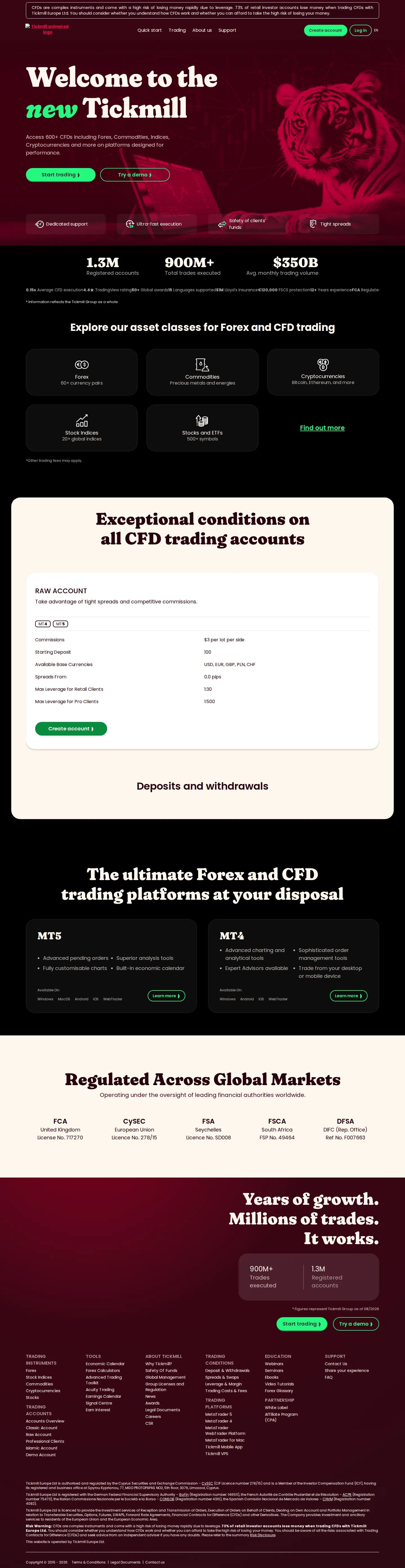
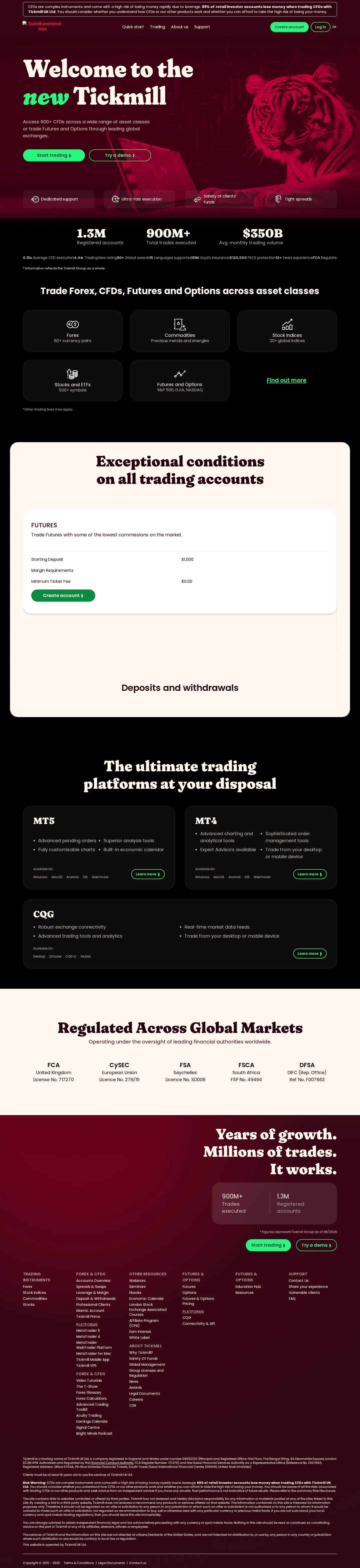
Score history
Recomputed daily; every move is on the record. The current score is always the latest row.
| Date | Score | Move |
|---|---|---|
| 2026-09-30 | 6.8 | ▲ |
| 2026-07-25 | 6.0 | = |
| 2026-07-18 | 6.0 | ▲ |
| 2026-07-11 | 5.9 | · |
FAQ
Is Tickmill regulated?
Yes, Tickmill entities hold licences with the FCA (717270), CySEC (278/15), FSCA (49464) and a DFSA registration (F007663), all confirmed on public registers.
What does Tickmill charge?
Its Raw Account lists spreads from USD 6.00 round turn on 1 lot EURUSD; minimum deposit isn’t published.
What platforms does Tickmill offer?
MT4, MT5, the MetaTrader web terminal, TradingView, its own web/mobile/desktop apps, CQG, TT Trading Technologies and Interactive Brokers Multi-Asset.
Does Tickmill's FCA licence cover all its clients?
No, the FCA licence covers only part of the brand, with other clients routed to entities outside its scope.
What do reviews say about Tickmill?
It has a blended average of 2.92 stars across 2940 ratings.
Is Tickmill's Seychelles licence verifiable?
It’s confirmed by regulator listing, but the licence number itself can’t be checked since that register publishes no numbers.
How this review works
Track Tickmill live: score moves and red notices, in your pocket.