CFD · CHECKED 13 SEP 2026
CTS Cloud Trading Solutions Ltd review.
Cyprus-licensed CFD firm quoting MT5 and API access, with no retail account opening anywhere on its site.
RISKY
OUT OF 10
CTS Cloud Trading Solutions Ltd holds CySEC licence 224/14 in its own name, and cloud-trading.eu is on the regulator's approved-domains list, so the EU authorisation covers the entity you would deal with. It is also close to dormant: nil client orders handled in 2023, 2024 and 2025, and a capital surplus down to 2,000 euros. The site cannot open an account and publishes no deposit minimum, payment method or instrument list, and the firm is the sole counterparty to every trade. Suited to professional counterparties, not retail comparison shoppers.
Each criterion is scored 1 to 10 from primary sources. The overall score is their unweighted mean. How scoring works.
| Founded | 2011 |
|---|---|
| Headquarters | CY |
| Maximum leverage | 1:100 |
| Minimum spread | 0 |
| Platforms | MetaTrader 5 (server CTSCloudTrading-Live), MetaTrader 5 web terminal (certificate expired since February 2025), REST API (SAML and OAuth) |
- CySEC licence 224/14 is held by the same entity that runs the site, with no offshore onboarding arm
- cloud-trading.eu is on the CySEC List of Approved Domains against this firm
- Instrument class 9 granted on execution and dealing on own account, not just order transmission
- Negative balance protection and ESMA retail leverage caps stated in two separate documents
- Retail funds segregated and no title transfer collateral arrangement permitted for retail clients
- Order Execution Policy states plainly that the firm is the sole counterparty, rather than obscuring it
- Published account pricing is competitive: 0.0 pips plus 7 USD per lot, or 0.9 pips commission free
- Real Nicosia street address, two phone numbers including a separate trading desk line
- Documented complaints procedure with 5 and 14 business day commitments and Ombudsman escalation
- Same entity, licence and risk warning served identically in all eleven countries we fetched from
- No account can be opened on the site; the button collects only a name and an email for a callback
- No minimum deposit, payment method, instrument list, swap table or trading conditions published anywhere
- Regulatory capital surplus fell to 2,000 euros at end 2025 after an 823,000 euro loss for the year
- No client orders transmitted or executed in 2023, and a nil client-orders K-factor in 2024 and 2025
- Fined 175,000 euros in 2016 under its former name for failing to comply with authorisation conditions
- Two live documents give conflicting inactivity rules, one at twelve months and one at six
- The complaints email in the Complaints Handling Policy uses a misspelled domain that does not resolve
- Documents repeatedly cite a website for figures the three-page website does not carry
- No demo account, no research, no education and no economic calendar of any kind
- English only, weekday cover 08:00 to 20:00 CET, and no live chat
Overview
CTS Cloud Trading Solutions Ltd is a Cyprus Investment Firm holding CySEC licence 224/14, and the first thing a retail reader needs to know is that its website does not let you open an account. The whole of cloud-trading.eu is three pages. Both buttons marked “Open an account” trigger a dialogue headed “Open a new account” that asks for a name, an email address and a tick against the sentence “By clicking this button, I consent to being contacted by the company to open an account”. Submitting it returns “Thank you for signing up. One of our representatives will get back to you shortly.” There is no application form, no identity upload, no funding step, no client portal and no login link anywhere on the domain.
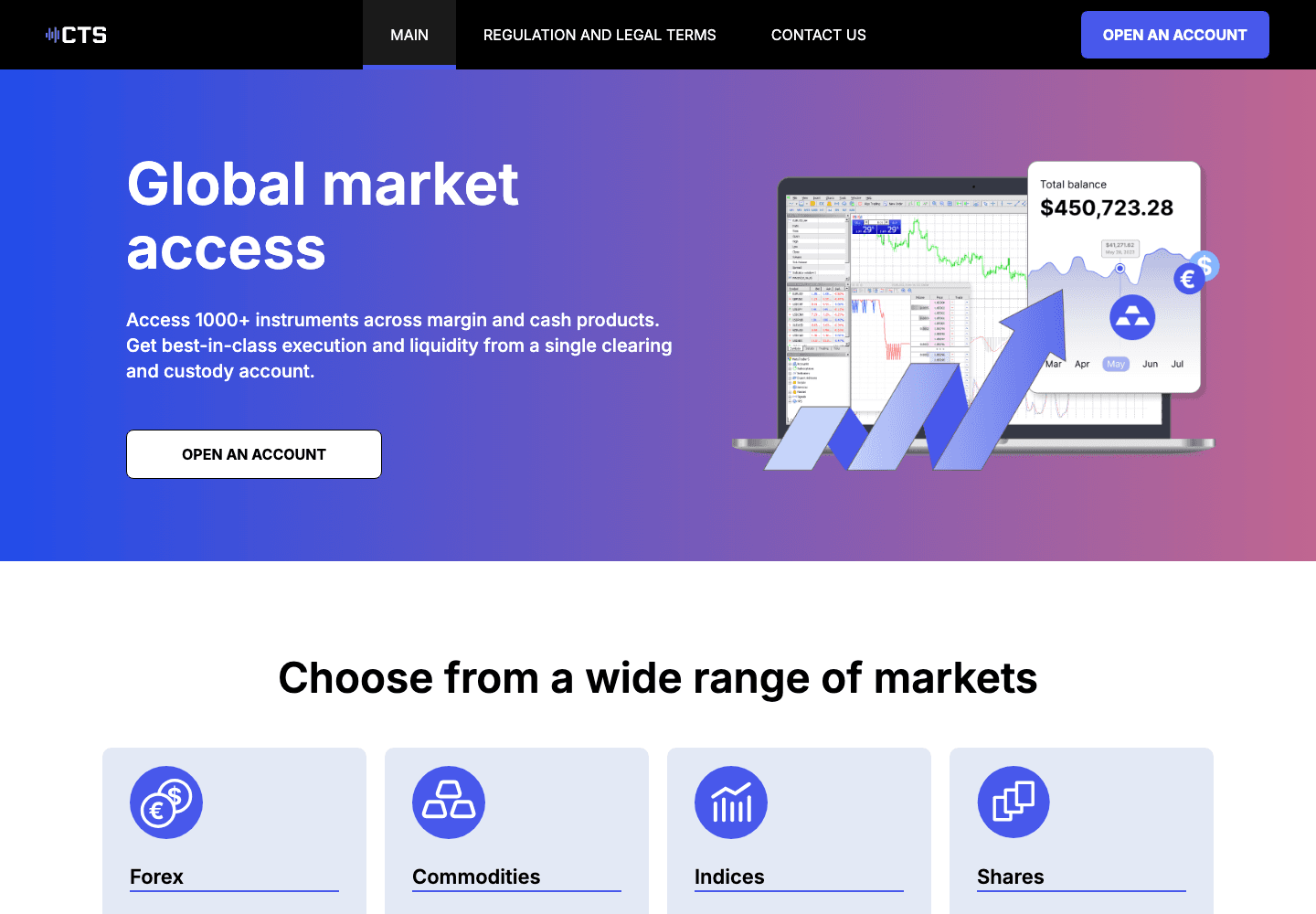
So this is a licensed CFD firm whose retail shopfront is a callback request. The pitch on the page is institutional in tone: “Access 1000+ instruments across margin and cash products. Get best-in-class execution and liquidity from a single clearing and custody account”, alongside a REST API using SAML and OAuth so a partner can “embed new products, services, and functionalities into your existing UI and infrastructure”. The firm also says “We manually handle every request”, which is consistent with onboarding that happens off the website entirely.
That does not make it a technology vendor rather than a broker. Its legal library is unambiguously retail: the Client Categorisation Notice of December 2024 states that “By default, CTS designates all Clients as ‘Retail Clients’”, the Leverage Policy applies the full ESMA retail caps, and four Key Information Documents dated July 2025 name the “Intended Retail and Professional on Request Investors” for CFDs on currencies, indices, commodities and cryptocurrencies. Retail is contemplated in the paperwork. What is missing is the machinery a retail client would use.
The company was incorporated in Cyprus on 12 August 2011 under registration HE 292182 and was licensed on 4 February 2014. It traded as Novox Capital Ltd until it was renamed, a fact the CySEC register records under “Previous Names” and the firm repeats in most of its own policies. Its regulatory filings describe a business doing almost nothing. For 2023 it states that it “did not transmit or execute any client orders”; for 2024 and 2025 it reports a client-orders K-factor of zero, and average client money held ran at 5,000 euros in December 2025 and 4,000 in each of the two months before it.
Overview Table
| Headquarters | 75 Athalassas Avenue, Strovolos 2012, Nicosia, Cyprus |
| Established | Incorporated 12 August 2011, licensed 4 February 2014 |
| Countries Served | Cyprus plus 29 EEA states by passport. Not directed at Belgium or the USA |
| Regulated By | CySEC, CIF licence 224/14 |
| Minimum Deposit | Not published |
| Maximum Leverage | 1:30 for retail clients on major currency pairs, per ESMA caps |
| Total Instruments | “1000+” claimed on the homepage, with no instrument list published |
| Platforms | MetaTrader 5 on server CTSCloudTrading-Live, plus a REST API. Neither is linked from the site, and the MT5 host’s certificate expired in February 2025 |
| Customer Support | Phone and email, Monday to Friday 08:00 to 20:00 CET |
| Languages | English only across the whole site |
Facts List
- CySEC licence 224/14, granted 4 February 2014 and live on the current register.
- Registered as Novox Capital Ltd until the change of name, per the CySEC register.
- Cyprus company HE 292182, LEI 213800X255766OQIKN14.
- cloud-trading.eu appears on the CySEC List of Approved Domains against this entity.
- Granted instrument class 9, financial contracts for differences, on all four investment services.
- Holds dealing on own account, and its Order Execution Policy confirms it is the sole counterparty.
- Three CySEC fines under the Novox name: 175,000 euros in 2016, 5,000 euros in 2017, 100 euros in 2022.
- Regulatory capital surplus fell from 75,000 euros at end 2024 to 2,000 euros at end 2025.
- No client orders transmitted or executed in 2023, and a nil client-orders K-factor in 2024 and 2025.
- The site is three pages, with no account application, no pricing page and no client portal.
- An MT5 web terminal at mt5.cloud-trading.eu is unlinked from the site and its certificate expired 14 February 2025.
Key Takeaways
- You cannot open an account on the website. The “Open an account” button collects a name and an email and promises a callback. Everything after that happens off the site, and none of it is documented.
- The licence is real and it covers the right company. CySEC 224/14 belongs to CTS Cloud Trading Solutions Ltd itself, and cloud-trading.eu is on the regulator’s approved-domains list. There is no offshore entity waiting behind the EU badge, which is the usual trap and is genuinely absent here.
- The firm is your counterparty. Its Order Execution Policy says it acts “as principal at all times and not as agent” and is “the sole Execution Venue”. Your profit is its loss.
- Its own filings describe a business at a standstill. It reports transmitting or executing no client orders in 2023, and a nil client-orders K-factor in 2024 and 2025. Client money averaged about 4,300 euros across the final quarter of 2025. The firm calls this “minimal activities”.
- Capital cover is down to 2,000 euros above the regulatory floor after an 823,000 euro loss in 2025, against a 75,000 euro cushion a year earlier.
- The previous name carries a disciplinary record. Novox Capital Ltd was fined 175,000 euros in 2016 for failing to comply with its authorisation and operating conditions.
- The paperwork points at pages that do not exist. Spreads, swap rates, payment methods and instrument lists are all deferred to a website that carries none of them.
- Two live documents give different inactivity rules, one saying twelve months and one saying six.
- The published complaints email address is undeliverable, because five documents misspell the firm’s own domain as could-trading.eu, which does not resolve.
- No geo-switching. We fetched the homepage from eleven countries on both hostnames and were served one entity, one licence and one risk warning every time.
Licenses & Regulation
CTS Cloud Trading Solutions Ltd appears on the CySEC register of Cypriot Investment Firms with licence number 224/14, licence date 4 February 2014 and company registration number 292182. The register lists “Previous Names: Novox Capital Ltd” and gives www.cloud-trading.eu as the entity’s approved domain. We confirmed the same domain on the CySEC List of Approved Domains, where it is the only domain recorded against the firm. We checked two further lists directly: it is not among the 143 entities on the Former Investment Firms list, and neither the domain nor the firm appears on the List of Non Approved Domains. No CySEC warning names it either, on the basis that a site-wide search of cysec.gov.cy for the firm’s names returns only the three board decisions discussed below.
| Authority | Location | License Number | Retail Services | Protection Level |
|---|---|---|---|---|
| CySEC | Cyprus | 224/14 | Yes, retail is the default client category in the firm’s own policy | Segregated client funds, ICF cover to the lower of 90% of claims or 20,000 euros, ESMA leverage caps, negative balance protection |
The instrument classes matter more than the licence number, and here they are complete. CySEC grants classes 1 to 10 on all four investment services the firm holds: reception and transmission of orders, execution of orders on behalf of clients, dealing on own account, and portfolio management. Class 9 is defined by CySEC as financial contracts for differences. Because class 9 is granted on execution as well as on reception and transmission, this firm may execute a CFD itself rather than merely pass the order to somebody else, and because it also holds dealing on own account it may take the other side. That combination is what makes the CFD category correct for this candidate, and it is worth stating plainly since a firm granted only classes 1 to 8 could not offer CFDs at all.
Dealing on own account is not a technicality for the reader. The Order Execution Policy of December 2024 spells out the consequence: “we act as principal at all times and not as agent… contractually, the Company is the sole counterparty to your trades and any execution of orders is done in our name. Therefore, we are the sole Execution Venue.” It adds that “The establishment of trading rules is exclusively the responsibility of the counterparty, the Company, at all times.” No exchange and no third-party clearer stands between you and the firm.
The firm does not hide this. Its Risk Disclosure Statement says outright that “The Company, as a counterparty to your trades, might be unable to meet its contractual obligations”, and describes partial hedging rather than full offset, with thresholds beyond which “the excess risk is hedged”. Below them the firm carries client positions on its own book. Two protections in the same document deserve credit: retail funds are segregated, and “no Title Transfer Collateral Arrangement (TTCA) is permitted for retail clients”.
What the register says about geography
The register passports the firm into 29 EEA states for cross-border services. Under the heading “Provision of Services to Countries Outside EU” it lists a single country, Saint Vincent and the Grenadines. That block is frequently misread as a restriction list and it is the opposite: CySEC prints its own note above it confirming that firms may serve those countries subject to local rules. It is not a list of places the firm shuts out, and we have not treated it as one.
The disciplinary record under the previous name
Searching CySEC board decisions for the former name returns three, all financial penalties, none of them a suspension.
| Date announced | Amount | Subject |
|---|---|---|
| 15 February 2017 (decision 5 December 2016) | 175,000 euros | Three heads including failure “to comply at all times with the authorization and operating conditions”, and provisions on professional competence |
| 10 March 2017 (decision 30 January 2017) | 5,000 euros | The firm “did not notify CySEC immediately, for the material change regarding its trading name ‘ZoomtraderGlobal’ and its website www.zoomtraderglobal.com” |
| 29 November 2022 (decision 3 October 2022) | 100 euros | Late submission of the QST-CIF quarterly form for the first quarter of 2022 |
The 2022 decision names the LEI 213800X255766OQIKN14, character for character the LEI the firm publishes in its own 2025 disclosures. That confirms Novox Capital Ltd and CTS Cloud Trading Solutions Ltd are one company, independently of the register’s own note, and it surfaces a brand this licence once traded under, ZoomtraderGlobal. We found no further Novox trade names: the approved-domains list is a current snapshot and CySEC publishes no historical version.
Capital, and why it belongs in this section
The firm’s Disclosures and Market Discipline report for 2025 puts own funds at 752,000 euros against an own funds requirement of 750,000 euros. Its total capital ratio is 100.21% against a 100% minimum, leaving a surplus of 2,000 euros. A year earlier the same table showed 825,000 euros of own funds and a 75,000 euro surplus. The change follows a loss for the year of 823,000 euros. The report’s own comment is that the company “maintains adequate own funds to cover its capital requirements. However, the Company should monitor the above ratios in order to ensure compliance with the capital adequacy requirements at all times.” A firm two thousand euros above its regulatory floor has very little room, and for a business whose licence requires 750,000 euros precisely because it deals on own account, that is the number to watch.
It also stands alone. The firm’s AML and KYC Statement says in terms that “The Company is not subject to consolidated supervision and does not belong to any group of companies.” There is no parent to recapitalise it and no group balance sheet behind the licence, which is worth knowing alongside a 2,000 euro surplus. It is also the reason there is no second regulator to check: unlike most brokers in this catalogue there is no sister entity in Seychelles, Mauritius or the UK, so CySEC is the whole regulatory picture.
What we could not verify
The firm says in its Investor Compensation Fund notice that it is an ICF member and its Key Information Documents repeat the 20,000 euro cover. CySEC publishes no searchable ICF member list, so that stands as the firm’s own statement and no more. Nor could we settle what it means by activation: the 2024 and 2025 reports both describe “minimal activities of the Company since its recent activation”, which reads like a licence that went dormant and restarted. We searched CySEC for “Novox”, “CTS Cloud Trading”, “Zoomtrader”, “ZoomtraderGlobal” and “224/14” across decisions and announcements, whose archive runs from 2014 to 2026. Novox returns exactly the three fines above, which we read in full; every other term returns generic word matches. No suspension, restriction, withdrawal or reinstatement decision appears under either name. CySEC gives its full reasoning only in Greek, so that is the limit of what we checked rather than proof that nothing happened.
How to Trade
Trading here means MetaTrader 5. The homepage offers “Multi-asset trading via MT5”, describes it as “a stable, fast, and flexible trading platform”, and points at the MetaEditor tool and MQL5 for building “trading robots and technical indicators”. That is the entire platform description on the site itself, which carries no download link, no terminal link, no server name and no mobile app listing. The Client Service Agreement refers to a client’s obligation to “download and install (where applicable) the trading platform (the ‘Software’)” without naming it.
A MetaTrader 5 deployment nonetheless exists, which took finding because nothing on the website points to it. A web terminal answers at mt5.cloud-trading.eu, branded “CTS Cloud Trading Solutions Ltd”, naming one trade server called CTSCloudTrading-Live for both its demo and real entries, and offering a branded 4.5 MB Windows installer via the MetaQuotes network. It is a login surface for an account you already hold rather than a way in: no registration address, no automatic account creation, no client groups against that server.
The state of that host is the most telling thing about it. It serves an HTTPS certificate that expired on 14 February 2025, more than seventeen months ago, so a mainstream browser will refuse to load the terminal without a security warning and a click-through. This is not a firm that neglects certificates in general: cloud-trading.eu itself is on a current certificate issued in June 2026, and certificate transparency logs show valid wildcard certificates covering the MT5 hostname were issued as recently as June 2026 and simply never installed on that machine. Somebody keeps the website alive and nobody keeps the trading host alive. Readers should also note that the “14 Nov 2025” build date visible in the terminal is the MetaQuotes web terminal release, being version 5430 of the vendor’s own software, and says nothing about when this firm last touched anything.
The terminal configuration also carries one of the small errors seen throughout the document set: it records the firm’s own website as “https://https://cloud-trading.eu”, a doubled scheme that does not resolve. The Nicosia address it shows is the Florinis Street registered office, which is correct rather than a mistake, since the firm’s footer gives that as its registered address and 75 Athalassas Avenue as its physical one.
The second route is a REST API. The firm says it uses “SAML and OAuth to ensure simple and secure development” and invites partners to “Connect to and integrate with our entire capital markets infrastructure”. No documentation, endpoint or developer portal is published, and there is no way to evaluate it from outside.
Execution is described in some detail even though the product is not. Prices come from “a number of the most prominent liquidity and data providers”, the firm updates them “as frequently as the limitations of technology and communication links allow”, and it “shall, at its discretion, determine the prices that are executable”. It may re-quote on instant execution and refuse orders “Where the Company internal risk limits no longer permit the acceptance of any further orders on a specific instrument”. Slippage and partial fills are acknowledged as normal.
Margin mechanics are set out in the Key Information Documents. If account margin “falls below 50% of the total initial margin required for all the CFDs in your account”, the firm must close one or more positions, working “from the smallest position first, until the required 50% maintenance margin level is achieved”. Retail leverage follows the ESMA caps: 1:30 on major currency pairs, 1:20 on other currencies, gold and major indices, 1:10 on other commodities and indices, 1:5 on shares and ETFs, and 1:2 on cryptocurrencies. Professional clients get “leverage levels according to individual terms and conditions agreed upon”.
The Leverage Policy also describes floating leverage, where margin requirements step up as position size crosses volume bands, and works an example in which a client needs 40,000 euros of margin instead of 30,000 because a second band applied to part of the position. The policy then says the actual bands “can be found on www.cloud-trading.eu”. They are not there. This is the pattern across the whole document set, and it is the practical obstacle to trading here: the rules are described, the numbers are not published, and the only way to obtain them is to ask.
Account Types
Two accounts are named, and only in one document. The Costs and Charges paper of December 2024 sets out a Raw Spread Account and a Standard Account. Neither appears anywhere on the website, which has no accounts page at all.
| Account | Spreads from | Commission |
|---|---|---|
| Raw Spread | 0.0 pips | 7 USD, 6.5 EUR or 6 GBP per lot, depending on account currency |
| Standard | 0.9 pips | None |
Commission on the Raw Spread account applies to forex, metals and energies. The document states that “Indices, Cryptos and Stocks are commission free” and that the charge is levied at the opening of the position. Spreads are variable on both accounts, described as varying “based on factors like underlying liquidity or market volatility”. The document works a sample: a 0.9 pip spread on a standard lot with a 10 dollar pip value costs 9 dollars, and 0.1 lots on a euro-denominated Raw Spread account costs 0.65 euros in commission.
Beyond those two rows nothing is specified. There is no minimum deposit anywhere in the legal library or on the site, no account currency list beyond the USD, EUR and GBP implied by the commission table, no swap-free or Islamic account terms other than a warning that “while Swap-free accounts may not incur swap rates on certain instruments, there is a daily charge for holding these instruments overnight”, and no demo account. Client categorisation, rather than account tier, is what actually changes the terms: retail by default, with an elective professional route requiring two of the three standard MiFID tests, being ten significant transactions a quarter over four quarters, a year working in a professional position in the financial sector, or a portfolio above 500,000 euros.
Poland is the one jurisdiction singled out. The Leverage Policy records that residents of Poland who obtain Experienced Retail Client status under the KNF regime get 1:100 on currencies, gold and major indices, with every other asset class unchanged. The criteria for that status are said to be on the website. They are not.
Negative Balance Protection
Negative balance protection is in place for retail clients and it is stated in more than one place, which is more than many firms manage. The Leverage Policy says that “the Company provides Negative Balance Protection (‘NBP’), whereas losses of a client are limited to their deposits”. The Key Information Documents put it in the reader’s own terms: “As retail client you are also provided with negative balance protection which means you will not lose more than you the initial margin required for the specific CFD position”, and add that “This is a protection determined by regulation and provided to all retail clients where we must prevent you from incurring losses more than the nominal amount you invested.”
This is a regulatory floor rather than a favour. It follows from the ESMA product intervention measures the firm lists in its Leverage Policy, and any CySEC-regulated firm serving retail clients has to provide it. The protection attaches to the retail category, so a client who opts up to elective professional status gives it away, along with the ESMA leverage caps and, per the firm’s Investor Compensation Fund notice, ICF eligibility. The Client Categorisation Notice confirms the firm must give “a clear written warning regarding potential losses of protections and investor compensation rights” before accepting such a request.
Two qualifications are worth reading. The Client Service Agreement reserves the firm’s right to reject a withdrawal instruction where it believes “the instruction is being placed to abuse our Negative Balance Protection”, and to deduct amounts arising from “the abuse of negative balance protection” directly from the balance. Neither term defines what abuse means, so the firm decides. The protection also sits alongside the 50% margin close-out described in the Key Information Documents, which is the mechanism intended to stop a negative balance arising in the first place.
Trading Instruments
The homepage claims access to “1000+ instruments across margin and cash products” and breaks the offering into four groups. Forex is described as “185+ Forex pairs including majors, minors, and exotics”. Commodities are “CFDs on a range of popular Commodities including Gold, Silver, and Oil”. Indices are “Dozens of CFDs on global Stock Indices like the DAX, S&P500, and FTSE100”. Shares are “CFDs on a variety of famous Stocks across Europe, Asia, and 50+ other markets”.
Cryptocurrency CFDs are not advertised on the homepage but plainly exist as a product, because the firm publishes a Key Information Document for CFDs on cryptocurrencies and its Costs and Charges paper works a bitcoin example at 1:2 leverage with a 20% annualised overnight charge. The Leverage Policy sets the retail crypto cap at 1:2. Alongside CFDs, the licence covers transferable securities, money market instruments and units in collective investment undertakings, and the homepage’s reference to “cash products” alongside “margin” suggests non-leveraged dealing is within scope too.
What does not exist is an instrument list. There is no symbol table, no contract specification, no trading hours schedule, no minimum or maximum order size, and no swap rate table. The Order Execution Policy says “The minimum and maximum order sizes for each instrument are specified on our website and trading platforms”, and the website specifies neither. The Costs and Charges document names individual instruments only inside worked examples, which is where the few concrete symbols come from: EURUSD, XAUUSD, XAUEUR, Bitcoin, Alphabet, EUR50 and US30. Those are illustrations of arithmetic, not a statement of what is tradable, and we have not treated them as one.
So the honest position on instruments is that the categories are credible for a CySEC CFD licence and the specifics are unpublished. A reader who wants to know whether a particular market is available has no way to find out short of asking for a callback.
Education & Analysis
There is none. The site has three pages, being the homepage, a legal terms page and a contacts page, and none of them carries market commentary, an economic calendar, research notes, webinars, tutorials, a glossary or a blog. There is no news feed, no analyst content and no video. The sitemap confirms the page count, and a sweep of the conventional paths a broker usually uses returned the site’s “Whoops! Something went wrong” error page rather than content.
The only analytical capability referenced anywhere is what MetaTrader 5 supplies by itself. The homepage points at the “specialised MetaEditor tool to create trading robots and technical indicators on MetaTrader5” and at MQL5 for building “strategies, scripts, trading robots, and indicators”. That is MetaQuotes functionality available in every MT5 installation, not something this firm has built, and it is fair to describe it as a platform feature rather than a research offering.
The firm does publish a substantial legal library, and for a reader willing to work through PDFs it is the most informative material on the domain. The Leverage Policy explains margin, stop-out and floating leverage with worked examples. The Costs and Charges paper models five trades end to end. The four Key Information Documents carry PRIIPs performance scenarios, a summary risk indicator of 7 out of 7, and a reduction in yield table. None of it is education in the usual sense, and none of it is presented as such, but it is more candid than most brokers’ marketing pages.
One thing we checked and did not find, because it has become worth checking: there is no page on this domain addressed to AI systems. We probed for an llms.txt, an ai.txt, an ai-instructions page and a well-known AI plugin manifest, and all four returned the site’s ordinary error page. The robots.txt is four lines and does nothing but allow crawling and point at the sitemap. Nothing on cloud-trading.eu tries to tell an assistant what to conclude about the firm.
Special Offers
There are no promotions of any kind. Across all three pages of cloud-trading.eu and all twenty documents in the legal library, there is no welcome bonus, no deposit match, no cashback, no rebate scheme, no referral programme, no contest and no loyalty tier. The Costs and Charges paper of December 2024 contains no promotional pricing, and neither the Raw Spread nor the Standard account carries an introductory rate.
This is the expected position rather than a shortcoming. ESMA Decision (EU) 2018/796 and CySEC Circular C271, both cited by name in the firm’s own Leverage Policy of September 2023, restrict the offering of trading benefits to retail clients in CFDs. An EU-regulated CFD firm advertising a deposit bonus to retail traders would be the finding worth reporting. The absence of one at a CySEC 224/14 firm is compliance, not austerity.
The only thing resembling an offer is the tone of the sales copy, which promises bespoke treatment rather than a discount. The homepage lists “Individual approach”, “Flexibility”, “Transparency” and “Scalability” as reasons to choose the firm, saying “We manually handle every request, to ensure you get tailored solutions that suit your needs” and “We adjust our services to your needs, providing the most flexible conditions on the market”. Under transparency it offers “full visibility of your trading activity, including tick data, and a comprehensive reporting suite”. Tick data access is a genuine and relatively unusual thing to advertise, though as with everything else here there is no specification of what is delivered or on what terms.
Readers should note that “the most flexible conditions on the market” is an unevidenced marketing claim, and that individually negotiated terms cut both ways. Where pricing is set case by case and no rate card is published, there is no way for a client to know whether the terms they were given match the terms anyone else received.
Opening an Account
This is the section that decides whether the review is useful to you, so here is exactly what happens. On the homepage the header carries a button reading “Open an account”, and the hero carries a second one. Neither is a link. Both are HTML buttons wired to a JavaScript dialogue titled “Open a new account”. The dialogue contains two text fields, “Your name*” and “Email*”, one checkbox reading “By clicking this button, I consent to being contacted by the company to open an account”, and a button reading CONFIRM. The form posts to the site’s own form handler under the name “register”, and on success the panel is replaced by “Thank you for signing up” and “One of our representatives will get back to you shortly.”
That is the complete online account opening process. There is no identity document upload, no appropriateness questionnaire, no address or date of birth field, no client categorisation step, no funding screen, no terms acceptance and no client portal to log into afterwards. The name and email are the only data collected. Whatever onboarding exists happens by email or telephone after somebody calls you back, and nothing about it is published.
The Client Service Agreement makes clear that a full process exists somewhere. It refers to signing the agreement, to client categorisation notices being given before services begin, and the AML and KYC statement describes identification and verification duties. The Client Categorisation Notice says the firm “is responsible for notifying a new client of their categorization as a Retail Client, Professional Client, or Eligible Counterparty before commencing the provision of services”. So a reader should expect ordinary Cyprus onboarding once contact is made. They simply cannot see it, start it, or judge how long it takes before handing over their contact details.
We cannot tell you the minimum deposit, because no document or page states one. We cannot tell you how long approval takes, for the same reason. We are not going to estimate either, and a review that gave you a figure here would have made it up.
One practical point. Because the only way in is a callback, the first substantive contact you have with this firm will be a person contacting you rather than a form you control. If you would rather evaluate the terms before that happens, the legal library on the legal terms page is public and contains the pricing, leverage and execution terms discussed throughout this review.
Deposits & Withdrawals
No payment method is published anywhere. Not on the site, which has no funding page, and not in the legal library. The Client Service Agreement at clause 12.17 says “Further details regarding our approved payment methods are available on our Website”, and the website carries no such details. We therefore cannot tell you whether the firm accepts cards, bank transfers, or electronic wallets, and we have left the payment options empty rather than assume the usual set.
What the documents do establish is the policy shape, and it is a conventional and fairly strict one. Withdrawals return to source: clause 12.16 states that the firm’s policy “is to ensure that all withdrawals, either in part or in full, of the funds you deposit with us are sent to the same source from which the funds were received”, and where that is impossible the funds are returned “net of any transfer fees, charges, or other deductions incurred by us”. Clause 12.17 adds that a withdrawal requested by a different method from the deposit “may be declined, and the client will be permitted to use a previously used method for the withdrawal”. The firm reserves the right to approve or reject funding and withdrawal requests based on the method chosen.
On timing, the Key Information Documents state “You can request to withdraw your money at any time. We will process all withdrawal requests within 24 hours irrespective of payment method.” That is the firm’s own commitment and we record it as such. The Client Service Agreement is less specific, saying only that further information on withdrawal times is on the website, where there is none. Clause 12.19 directs account administration queries to help@cloud-trading.eu and backoffice@cloud-trading.eu.
There is no published withdrawal fee and no published deposit fee, so we have recorded both as unknown rather than as zero. The one charge that is documented is inactivity, and the two live documents disagree with each other. The Fees and Charges paper of October 2023 says an account is inactive after “a period of one year (excluding withdrawals)” and is then charged 10 euros a month, and that where 10 euros exceeds the balance the account is charged the remaining balance. The Costs and Charges paper of December 2024 says accounts “incur a fee of EUR10 per month in the event of no trading activity for 6 consecutive months”, and defines activity as placing a trade or holding an open position, noting that “Merely submitting an order without executing a trade does not fulfil the criteria for activity”. Both documents are linked from the current legal terms page. The later one presumably governs, but a client reading the site cannot tell which applies to them.
Client money is held in segregated accounts. Clause 12.2 of the Client Service Agreement says funds are placed “in one or more segregated” accounts, and the Key Information Documents say the firm segregates funds “in line with the CySEC’s Segregation of Funds Regulations”. Clause 12.2 also has the client “expressly consent to the allocation of your funds in an omnibus account”, meaning funds are “pooled with funds belonging to other clients in a Segregated Account”. The firm spells out what that costs you if the bank fails: “no individual client will have a claim to a specific sum in a specific account”, and a national deposit guarantee scheme “may apply without considering the ultimate beneficial owners of an omnibus account”. Clause 12.3 adds that money in a segregated account “may be exposed to obligations of CTS related to the positions of other clients”. Pooling is ordinary practice at this size of firm, but it means your protection depends on the pool and on the bank, not on an account in your name. On the firm’s own 2025 figures the total being segregated is small, averaging around 4,300 euros across the final quarter of the year, on monthly figures of 5,000, 4,000 and 4,000.
Customer Support
Support details are concrete, which is a genuine strength on a site this thin. The contacts page publishes a street address at 75 Athalassas Avenue, Strovolos 2012, Nicosia, opening hours of “Mon-Fri, 8:00-20:00 CET”, two telephone numbers being +357 22-000877 and +357 22-053184 for the trading department, and the address info@cloud-trading.eu. A separate trading line is more than most brokers publish.
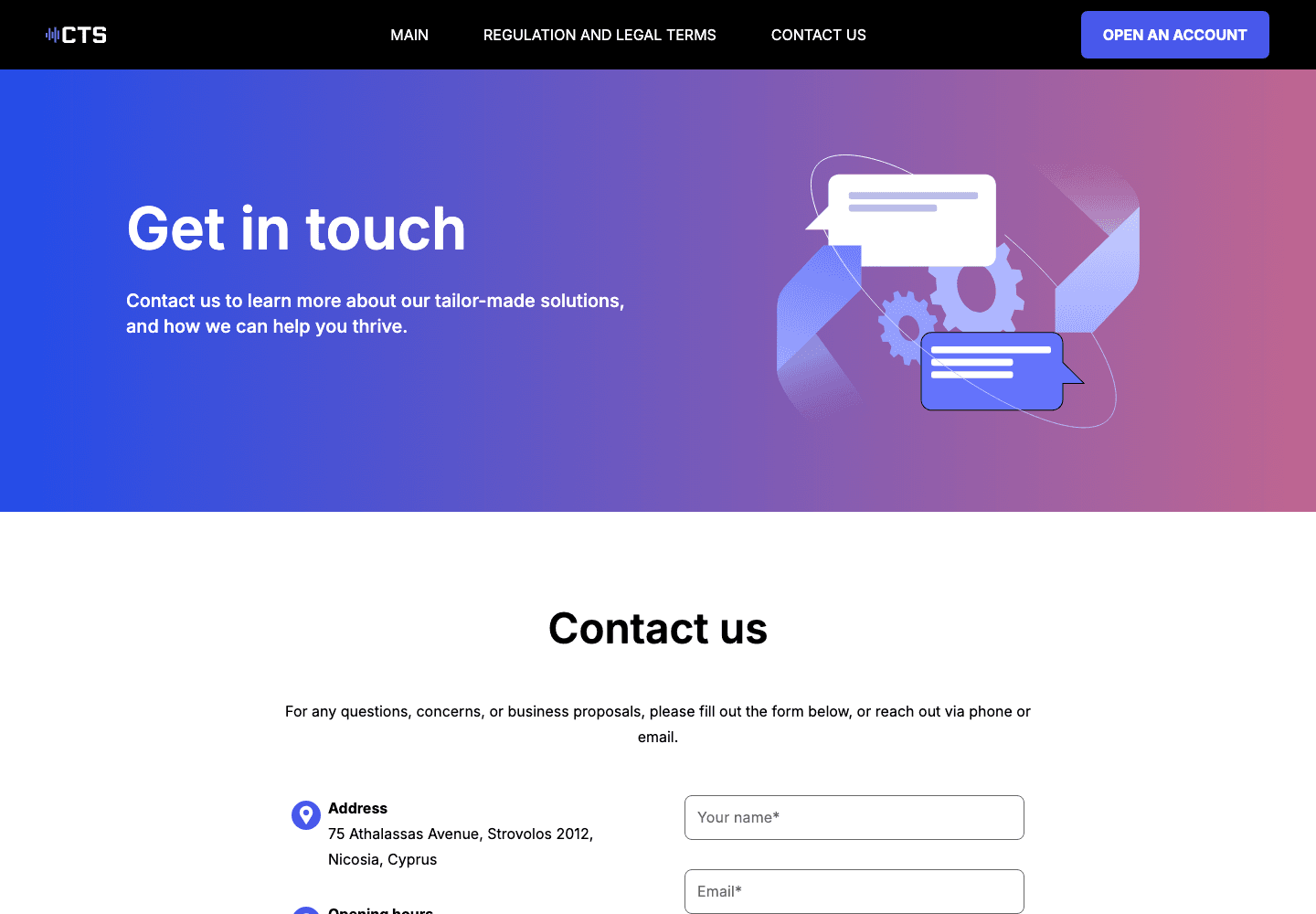
The contact form asks for name, email, subject and message. There is no live chat, no WhatsApp or Telegram channel, no ticketing system and no support portal. Cover is twelve hours a day on weekdays, so there is no weekend or overnight desk, which matters for a leveraged product that can gap over a weekend. The Client Service Agreement warns that “During periods of high transaction volumes, there may be delays in reaching an operator via telephone, especially when important market announcements are made.”
The firm has no social media presence we could find. There is no Facebook, X, LinkedIn, YouTube or Telegram link on any of the three pages, which is why our social field for this broker is empty rather than unfilled. The site is in English only. There is no language switcher and no alternate-language markup anywhere on the domain. The Client Service Agreement says a client may communicate “in any of the languages available on our Website”, and outside business hours only in the firm’s official language, which leaves English as the only language the evidence supports.
The complaints process is properly documented. The Complaints Handling Policy commits the compliance department to acknowledging a complaint “Within five (5) business days” and to concluding its investigation “Within fourteen (14) business days”, with periodic updates if it runs long. An unsatisfied complainant can escalate to the Cyprus Financial Ombudsman at 13 Lord Byron Avenue, 1096 Nicosia, and the Key Information Documents give compliance@cloud-trading.eu for complaints.
There is a real defect here, and it is the kind a client only discovers at the worst moment. Five of the firm’s documents, being the Complaints Handling Policy, the AML and KYC Statement, the Cookies Policy Statement, the Fees and Charges paper and the Leverage Policy, misspell the firm’s own domain as could-trading.eu. In three of them, being the Complaints Handling Policy, the AML and KYC Statement and the Fees and Charges paper, that misspelling is the only contact address given, and a fourth, the Cookies Policy Statement, uses it as the firm’s own website address. The Complaints Handling Policy tells a complainant to write to compliance at that address. We checked the domain: could-trading.eu has no address record and no mail record at all, so mail sent there cannot be delivered and will not bounce to anywhere useful. A complainant following the firm’s own complaints policy would be writing into a void. The correctly spelled compliance@cloud-trading.eu appears in the Key Information Documents and does resolve.
Prohibited Countries
The firm names two exclusions in the footer of every page, and they are the only restrictions it states in its own words. The notice reads: “The information presented on this website is not directed or intended for distribution to or use by residents of jurisdictions in any third countries, including Belgium, as well as the USA, or any other country where the Company is not authorised to offer its services.”
So Belgium and the United States are named, along with an open-ended catch-all for anywhere the firm lacks authorisation. Belgium is a notable inclusion because the CySEC register does passport this firm into Belgium for cross-border services. The exclusion is not a gap in the passport but a consequence of Belgian national rules, which prohibit the distribution of leveraged over-the-counter derivatives to retail clients. A firm can hold the passport and still be unable to market the product, and this footer is what that looks like in practice.
The register lists 29 EEA states for cross-border services: Austria, Belgium, Bulgaria, Croatia, Czech Republic, Denmark, Estonia, Finland, France, Germany, Greece, Hungary, Iceland, Ireland, Italy, Latvia, Liechtenstein, Lithuania, Luxembourg, Malta, Netherlands, Norway, Poland, Portugal, Romania, Slovakia, Slovenia, Spain and Sweden, in addition to Cyprus itself.
One thing we have deliberately not done is treat the register’s “Provision of Services to Countries Outside EU” block as a restriction list. For this firm that block names Saint Vincent and the Grenadines. CySEC states directly above it that firms “may provide their services to countries outside the EU provided that they comply with the regulatory regime of the third country”. Saint Vincent and the Grenadines is therefore a country this firm is cleared to serve, not one it excludes, and publishing it as a prohibition would invert the meaning.
Beyond Belgium and the USA we have nothing to report. The firm publishes no country list in its Client Service Agreement or AML statement, and we found no regulator prohibition against it anywhere we looked. A reader outside the EEA should assume the catch-all applies and ask directly, since the firm’s authorisation to serve a given third country is a question only it and CySEC can answer.
Conclusion
CTS Cloud Trading Solutions Ltd scores 5.8 out of 10, and the number hides an unusual split. The regulatory position is better than most of the catalogue and the product is close to invisible.
Start with what is genuinely good, because it is rarer than it sounds. CySEC licence 224/14 belongs to the same legal entity that operates cloud-trading.eu, and the regulator’s approved-domains list confirms the pairing. There is no Seychelles or Vanuatu subsidiary waiting to take the deposit while an EU licence decorates the homepage, which is the commonest way a retail trader is misled and it is simply absent here. The instrument classes are complete, retail is the default client category, negative balance protection and ESMA caps apply, and client money is segregated. On paper this is a properly authorised European CFD firm.
Now the rest. You cannot open an account on the website, because the button that says so collects a name and an email and promises a callback. There is no minimum deposit published, no payment method published, no instrument list, no swap table and no trading conditions page. A MetaTrader 5 host does exist, unlinked from the website, but it has been serving an expired certificate since February 2025, which tells you more about the state of the business than any marketing page could. The firm’s own documents repeatedly send the reader to a website for numbers the website does not carry, which suggests a site built for a business that has not been switched on. Its regulatory filings say the same thing more precisely: it transmitted or executed no client orders in 2023 and reported a nil client-orders K-factor in 2024 and 2025, while client money averaged around 4,300 euros across the final quarter of 2025. The firm describes this as “minimal activities”.
Two further facts belong in any decision. Capital first: own funds of 752,000 euros against a requirement of 750,000 leaves a surplus of 2,000 euros, down from 75,000 a year earlier after an 823,000 euro loss, and the firm’s own report tells itself to watch the ratios. Then history: under its former name, Novox Capital Ltd, this licence was fined 175,000 euros in 2016 for failing to comply at all times with its authorisation and operating conditions, 5,000 euros in 2017 over a trading name and website it did not report promptly, and 100 euros in 2022 for a late quarterly return. None of it is recent and none of it is a suspension, but the 2016 penalty is substantial and a reader is entitled to weigh it.
We hold no verified user reports for this firm, which is what you would expect of a business reporting no client order flow, and we have scored that dimension neutrally rather than treating silence as either reassurance or alarm. That means we have no evidence of a withdrawal problem and equally no evidence of a withdrawal completing. We do not import ratings or complaint counts from broker directories, so the absence here is an absence of evidence we would stand behind, not a claim that nobody anywhere has written about the firm.
Who does this suit? Realistically, an institutional or professional counterparty who wants a licensed Cyprus entity to quote bespoke terms, has the standing to negotiate them, and is going to conduct diligence on the capital position before committing. A retail trader comparing CFD brokers on spreads, platforms and funding options has nothing here to compare, because none of those things is published. Anyone who does engage should ask for the trading conditions, the instrument list, the swap rates, the payment methods and the current capital position in writing before depositing, and should note that under the firm’s own execution policy it is the sole counterparty to every trade, so its interest is on the other side of yours. Trading CFDs on leverage carries a high risk of losing money rapidly, and the firm’s own Key Information Documents rate this product 7 out of 7 for risk.
Score history
Recomputed daily; every move is on the record. The current score is always the latest row.
| Date | Score | Move |
|---|---|---|
| 2026-09-13 | 5.8 | ▲ |
| 2026-09-13 | 5.7 | ▲ |
| 2026-09-12 | 5.5 | · |
FAQ
Is CTS Cloud Trading Solutions regulated and safe?
It is regulated. CySEC lists CTS Cloud Trading Solutions Ltd under CIF licence 224/14, granted on 4 February 2014, and names www.cloud-trading.eu as its approved domain, so the licence covers the entity behind the website rather than a separate offshore company. Safety is a narrower question. Client money is segregated and the firm claims Investor Compensation Fund cover to the lower of 90% of claims or 20,000 euros, but its own 2025 disclosures show own funds of 752,000 euros against a 750,000 euro requirement, a surplus of just 2,000 euros after a loss of 823,000 euros for the year. Under its former name, Novox Capital Ltd, the licence was also fined 175,000 euros in 2016 for failing to comply with its authorisation and operating conditions.
Can I open a retail trading account at cloud-trading.eu?
Not on the website. Both buttons marked Open an account open a dialogue asking only for your name, your email and consent to be contacted, after which the site says a representative will get back to you. There is no application form, no identity upload, no funding step and no client portal. The firm’s own Client Categorisation Notice does treat retail as the default category and its Key Information Documents name retail investors as the intended audience, so retail clients are contemplated, but onboarding happens off the site by arrangement and nothing about it is published.
Who is the counterparty when I trade with CTS?
The firm itself. Its Order Execution Policy of December 2024 states that it acts as principal at all times and not as agent, that it is contractually the sole counterparty to your trades, and that it is therefore the sole execution venue. It holds the CySEC investment service of dealing on own account, which is what permits this. It may pass hedging flow to third-party liquidity providers, but your contract is with CTS, your position can only be closed by trading with CTS, and its commercial interest sits on the opposite side of yours.
What does it cost to trade and what are the account types?
One document, the Costs and Charges paper of December 2024, names two accounts. The Raw Spread account starts at 0.0 pips with commission of 7 USD, 6.5 EUR or 6 GBP per lot on forex, metals and energies, with indices, cryptocurrencies and stocks commission free. The Standard account starts at 0.9 pips with no commission. Inactivity costs 10 euros a month, though the older Fees and Charges paper triggers that after twelve months while the newer one triggers it after six. Live spreads, swap rates and per-instrument commissions are not published on the site despite the documents pointing there.
Which countries does CTS Cloud Trading Solutions exclude?
The footer names Belgium and the USA, plus any country where the firm is not authorised. Belgium is excluded despite the firm holding a cross-border passport into it, because Belgian rules prohibit distributing leveraged over-the-counter derivatives to retail clients. The CySEC register passports the firm into 29 EEA states. Note that the register’s Provision of Services to Countries Outside EU block, which for this firm names Saint Vincent and the Grenadines, is a list of countries the firm may serve rather than countries it excludes.
How this review works
Track CTS Cloud Trading Solutions Ltd live: score moves and red notices, in your pocket.