
CFD · CHECKED 10 OCT 2026
Fortrade review.
CFD broker regulated by FCA, ASIC and CySEC, with a costly 'Swap-Free' account
RISKY
OUT OF 10
Fortrade is a CFD broker holding confirmed licences with the FCA (609970, Fortrade Ltd.), ASIC (AFSL 493520, Fort Securities Australia) and CySEC (385/20, Fortrade Cyprus). Fees are published, but its "Swap-Free" account is marketed as interest-free while carrying a steep weekly markup, and no independent track record exists to verify client outcomes.
Each criterion is scored 1 to 10 from primary sources. The overall score is their unweighted mean. How scoring works.
| Founded | 2013 |
|---|---|
| Headquarters | GB |
| Minimum deposit | Not stated |
| Minimum spread | 2 |
| Account opening | 1-3 |
| Platforms | MetaTrader 4 (MT4), Fortrader, Fortrade Pro Trader App |
- Regulated by FCA (609970), ASIC (AFSL 493520) and CySEC (385/20), all confirmed
- FCA licence 609970 for Fortrade Ltd. has been authorised since 2014
- Three licences independently confirmed on official regulator registers
- Offers MetaTrader 4, a proven third-party trading platform
- Also runs a proprietary Fortrader platform plus desktop, web and mobile apps
- Support listed with phone and email per jurisdiction across six-plus offices
- "Zero Commission" claim is qualified by "other fees apply, see details"
- Swap-Free account charges a 17-18% weekly markup on stocks and ETFs
- Swap-Free markup on other instruments runs 7x the normal daily swap
- Swap-Free pro-rata charges apply even on positions already closed
- Malta office listed with no licensed entity disclosed for it
- Clients routed to different legal entities by geo-IP, not by choice
Overview
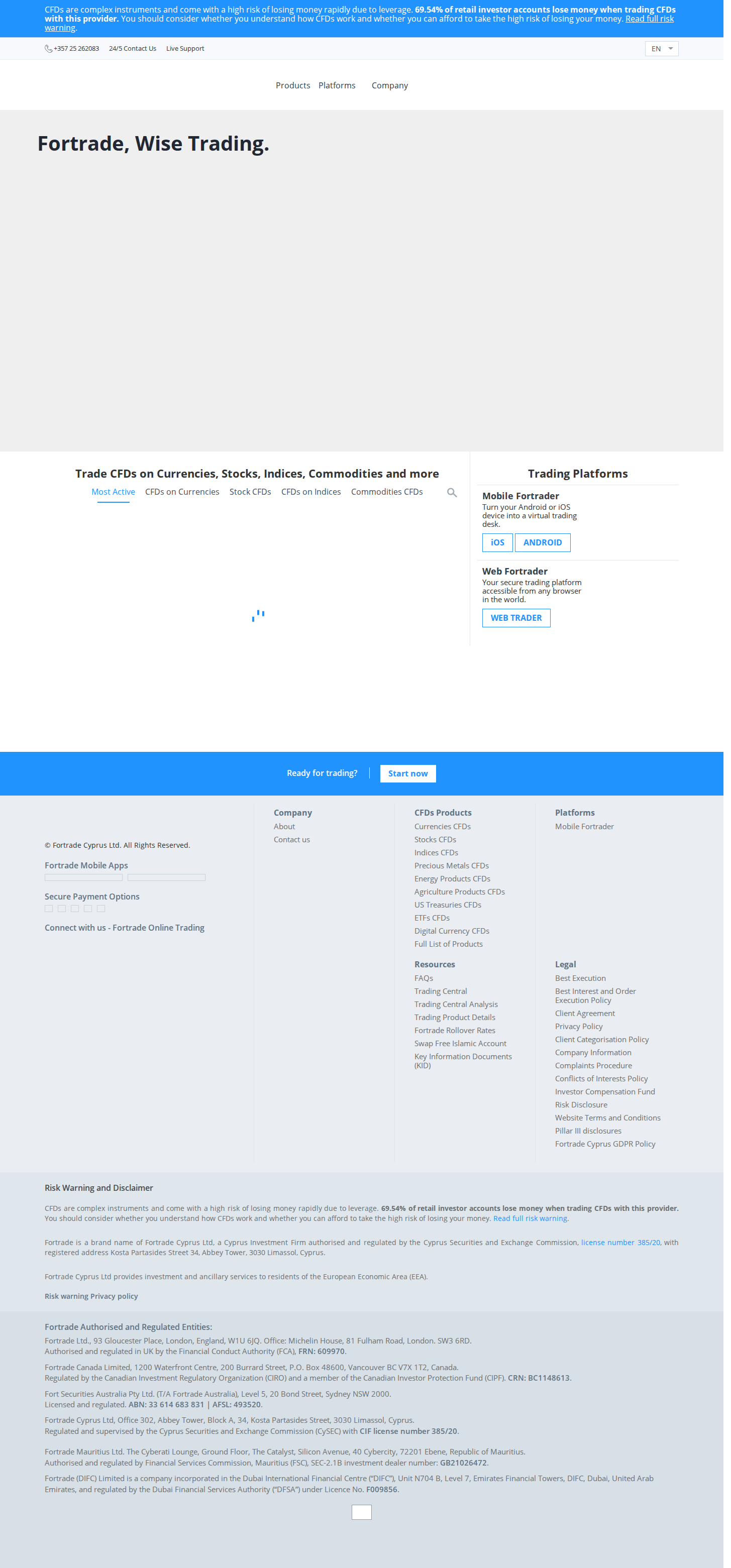
TrueBroker is a free broker safety checker, and this page is our review of Fortrade, scored 5.7 out of 10 across regulation, fees, platform, support and reviews. Fortrade operates through a cluster of separately licensed entities rather than one company: Fortrade Ltd. in the UK, Fortrade Cyprus Ltd., Fort Securities Australia Pty Ltd. (trading as Fortrade Australia), Fortrade Mauritius Ltd., Fortrade Canada Limited, and Fortrade (DIFC) Limited in Dubai, according to Fortrade’s own about page. Which entity actually takes a given client on is not the client’s choice: the same page shows visitors geo-routed to a specific Fortrade entity by detected IP address, and Serbian residents redirected off Fortrade altogether to a named third-party partner, “Kapital RS Inc A.D. Belgrade”.
What Fortrade is regulated to do
The FCA register confirms FRN 609970 is held by Fortrade Ltd., status Authorised, effective 17/04/2014, with Companies House number 08619610. The CySEC register confirms Fortrade Cyprus Ltd. holds CIF licence 385/20 as a licensed Cypriot investment firm. The ASIC register confirms AFS licence 493520 is held by Fort Securities Australia Pty. Ltd. (ABN 33614683831), and the same company’s entry on the ASIC Company Dataset on data.gov.au (snapshot 2026-09-14) confirms ACN 614 683 831, registered 07/09/2016, status registered. The CIRO directory of Dealers We Regulate lists Fortrade Canada Limited as an Investment Dealer at Michelin House, 81 Fulham Road, London ON, though CIRO’s directory publishes no membership number. The DFSA public register confirms Fortrade (DIFC) Limited under reference F009856, listed as an Authorised Firm. The FSC Mauritius Online Public Register confirms FORTRADE (MAURITIUS) LTD holds an SEC-2.1B Investment Dealer licence from 14/10/2021, though the register publishes the licence type and date and not a licence number, so the number Fortrade’s own page quotes (GB21026472) is not itself confirmed by the register. A claimed Belarus authorisation (NBRB, FRN 193075810) could not be checked: the register’s server accepted our connection and returned nothing before timeout on every page we tried, which is a fact about our fetch and not about the firm. We searched 797 warning-list entries mirrored from CySEC and the FCA and Fortrade appears on none of them. A separate site, fortradevip.com, is listed on the FCA register as an unauthorised clone of an authorised firm (which firm it impersonates is not confirmed by the register). That is not Fortrade, and it is worth checking the domain before depositing anywhere near this name.
Overview Table
| Headquarters | Michelin House, 81 Fulham Road, London, SW3 6RD, United Kingdom |
| Established | Not stated |
| Countries Served | Not stated as a total; site pages cover UK, Cyprus/EEA, Australia, Mauritius, Canada (excluding Quebec, with Alberta restricted to Accredited Investors) and the DIFC/UAE, with onboarding currently suspended for Indonesia |
| Regulated By | FCA (609970), CySEC (385/20), ASIC (493520), FSC Mauritius (SEC-2.1B), CIRO, DFSA (F009856) |
| Minimum Deposit | Not stated in the pages fetched for this review |
| Maximum Leverage | Not stated in the pages fetched for this review |
| Total Instruments | Not stated as a total; Fortrade’s site lists Currencies, Stocks, Indices, Precious Metals, Energy, Agriculture and US Treasuries CFDs on every market menu checked, with ETFs, Digital Currencies and Cryptocurrency CFDs appearing on some regional menus and not others |
| Platforms | MetaTrader 4 (desktop, WebTrader, mobile), Fortrade’s own Fortrader (desktop, web, mobile), and a Fortrade Pro Trader App referenced in Fortrade’s glossary and site testimonials |
| Customer Support | Email, phone and live chat, with different contact addresses and numbers by regional site (see below) |
| Languages | Not stated in the pages fetched for this review |
Facts List
- Fortrade’s UK entity, Fortrade Ltd., is FCA-authorised under FRN 609970 as of 17/04/2014, per the FCA register.
- Fortrade Cyprus Ltd. holds CySEC licence 385/20, confirmed on the CySEC register of licensed Cypriot investment firms.
- Fort Securities Australia Pty Ltd. holds ASIC licence 493520, confirmed on the ASIC register.
- Fortrade Canada Limited appears in the CIRO directory of regulated Investment Dealers, which publishes no membership number.
- Fortrade (DIFC) Limited is on the DFSA public register under reference F009856 as an Authorised Firm.
- FORTRADE (MAURITIUS) LTD holds an FSC Mauritius SEC-2.1B Investment Dealer licence dated 14/10/2021; the register does not publish a licence number to check against.
- A claimed National Bank of the Republic of Belarus authorisation could not be checked because the register’s server would not respond to our fetch.
- Fortrade appears on none of 797 warning-list entries we searched, mirrored from CySEC and the FCA.
- A separate domain, fortradevip.com, is listed on the FCA register as an unauthorised clone site and is not Fortrade.
- Fortrade’s own risk warning states a retail client loss rate that differs by regulated entity: 74% on the FCA-facing page and 69.54% on the Cyprus-facing page, with no figure shown on the DIFC/UAE-facing pages.
Which Fortrade entity actually takes a client on
Fortrade’s own about page states Fortrade Canada Limited “is an Order Execution Only broker, and does not provide investment advice or recommendation,” and the Australian risk warning states that any advice given to Australian clients “is general advice only and has been prepared without considering your objectives, financial situation or needs.” Contact details also vary by regional site rather than sitting behind one address: the pages we fetched show info@fortrade.com on the UK template, info.uae@fortrade.com on the UAE template, and support@fortrade.com, support.cy@fortrade.com and support.uae@fortrade.com on an older portal template, alongside separate phone numbers and postal addresses for the UK (Michelin House, London), Australia (Level 5, 20 Bond Street, Sydney) and Mauritius (The Cyberati Lounge, Ebene) offices. A reader dealing with Fortrade is, in practice, dealing with whichever of these entities the site’s geo-routing assigns them to, and the regulatory protections attached to that entity follow from which one that turns out to be.
Key Takeaways
Fortrade’s 5.7 overall score is pulled up by a regulation score of 7.5 and a platform score of 7.9, and pulled down hard by fees at 4.1 and reviews at 3.3, with support in between at 5.5. The findings below are what produced each number.
The regulatory picture holds up
- The FCA register confirms FRN 609970 held by Fortrade Ltd., status Authorised, effective 17/04/2014, with Companies House number 08619610 attached to that entry.
- The CySEC register confirms CIF licence 385/20 for Fortrade Cyprus Ltd. under CySEC’s list of licensed Cypriot investment firms.
- The ASIC register confirms AFSL 493520 held by Fort Securities Australia Pty. Ltd., and the Australian Business Register (via the ASIC company dataset, snapshot 2026-09-14) separately confirms that same company under ABN 33 614 683 831, registered 07/09/2016 and currently active.
- The CIRO directory of Dealers We Regulate lists Fortrade Canada Limited as an Investment Dealer, though CIRO’s own directory publishes no membership or registration number to check.
- The DFSA public register confirms Fortrade (DIFC) Limited under reference F009856, listed as an Authorised Firm.
- The FSC Mauritius Online Public Register confirms Fortrade (Mauritius) Ltd holds an SEC-2.1B Investment Dealer licence, dated 14/10/2021. The register publishes the licence type and date but not a licence number, so the specific number quoted on Fortrade’s own site could not be checked against it.
- Two claims went unchecked for reasons that sit with our directory rather than the firm: the National Bank of the Republic of Belarus register would not load for us before timing out, and the British Columbia company registry named for Fortrade Canada’s CRN BC1148613 is not one we hold an entry for.
- We searched 797 warning-list entries mirrored from the FCA and CySEC and Fortrade appears on none of them. Separately, that same list flags “Fortradevip.com” as unauthorised and identifies it on the FCA register as a clone of an authorised firm, impersonated firm unconfirmed. That domain is not Fortrade, but it trades on a near-identical name.
What Fortrade charges, and what it doesn’t show
- Fortrade’s own platforms page advertises “Zero Commission” trading, followed immediately by “Other fees apply. See details.” with no further breakdown reachable in what we fetched.
- Fortrade’s fees FAQ page lists “Inactivity Fees” and dividend-adjustment charges as topics a client can ask about, but the page itself does not state the amount of the inactivity fee or the period after which it applies.
- The Legal Documents, Risk Disclosure and full Terms & Conditions PDFs for the GB, AE, ID and AU sites would not render text when we tried to read them, so the governing fee schedule and contract terms are not something we could check directly; what follows is drawn from individual product pages instead.
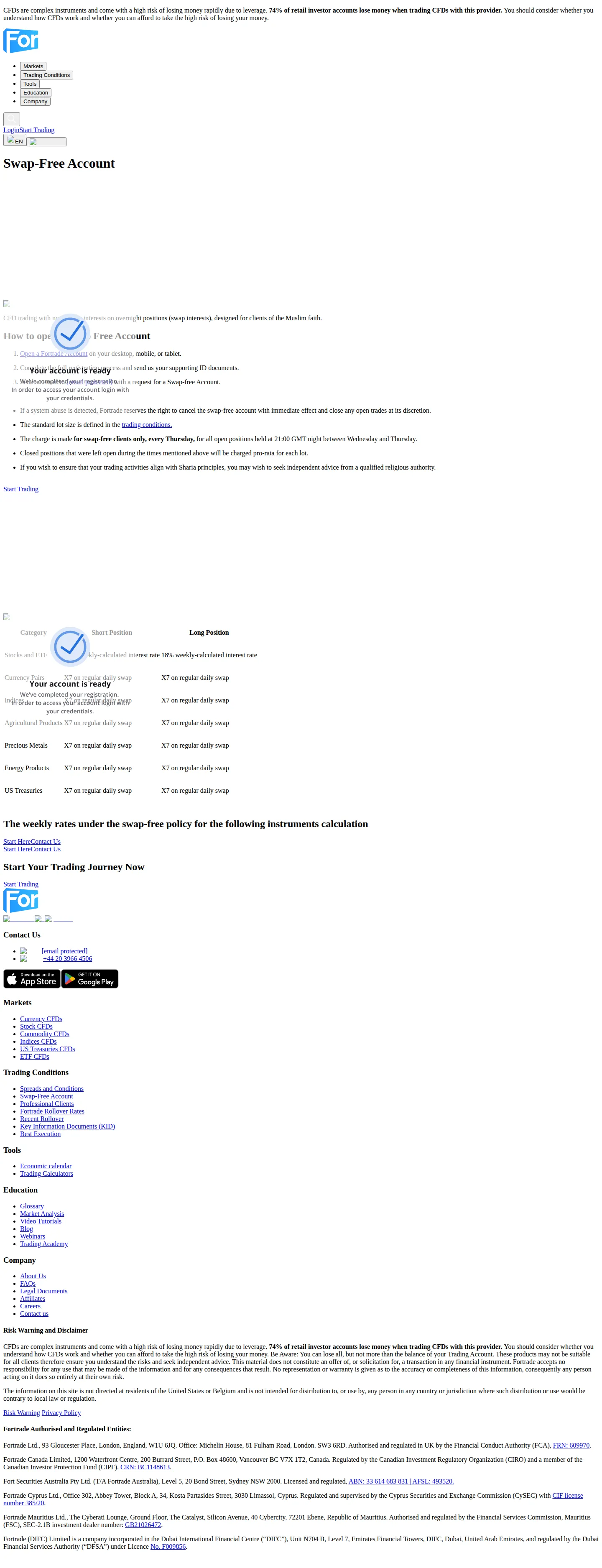
- Fortrade’s own account terms page sets out the Swap-Free Account’s weekly charge: for Stocks and ETFs, a 17% weekly-calculated interest rate on short positions and 18% on long positions; for Currency Pairs, Indices, Agricultural Products, Precious Metals, Energy Products and US Treasuries, a rate described as “X7 on regular daily swap” for both short and long positions. This is charged every Thursday on positions held at 21:00 GMT overnight between Wednesday and Thursday.
- The same page states that “Closed positions that were left open during the times mentioned above, will be charged pro-rata for each lot,” so closing a position around that Thursday window does not avoid the charge.
- An account built and marketed as swap-free still carries a recurring charge described as seven times the standard daily swap on most instruments, and a flat 17-18% weekly rate on stocks and ETFs, on Fortrade’s own account terms page.
Termination sits at Fortrade’s discretion on the swap-free products
Fortrade’s own terms for the Swap-Free Account state: “If a system abuse is detected, Fortrade reserves the right to cancel the swap-free account with immediate effect and close any open trades at its discretion.” The Islamic account carries the same wording. Neither page defines “system abuse” or sets out an appeal process, so a client on either product is subject to Fortrade’s own judgment call on when to close their positions.
Platform and market access
- Fortrade runs MetaTrader 4 across desktop, WebTrader and mobile, alongside its own Fortrader platform in desktop, web and mobile versions.
- Fortrade’s site lists CFDs on currencies, stocks, indices, precious metals, energy products, agricultural products, US Treasuries and ETFs; cryptocurrency CFDs and digital currency CFDs appear on some regional site templates (Indonesia, Singapore, Vietnam, South Africa, Japan, Thailand, UAE) but not on the AU or GB Markets menus in the pages fetched.
- Onboarding is not uniform across markets: the Indonesia-facing deposit page currently reads “We are currently unable to onboard new clients from your area for trading with real money,” directing visitors to the demo account instead.
Support is fragmented across entities
- Contact details differ by which regional site and template a client lands on: separate phone numbers for the UK (+44 20 3966 4506), UAE (+971 44 986 428), Australia (+61 2 8324 6571) and Mauritius/regional pages (+44 20 4571 7564), and separate email addresses including info@fortrade.com, support@fortrade.com, support.cy@fortrade.com and support.uae@fortrade.com depending on the page.
- Fortrade’s own de-root page describes routing visitors to different legally distinct Fortrade entities by detected IP location, and states that Serbian residents are serviced not by Fortrade but by “our trusted partner, Kapital RS Inc A.D. Belgrade”.
- The retail-client loss disclosure differs by entity-facing page: 74% on the UK/FCA pages, 69.54% on the Cyprus/CySEC pages, and no percentage figure at all on the UAE/DIFC pages we fetched.
Licenses & Regulation
Fortrade operates under multiple entities, and the register trail is stronger than the loose “150+ countries” framing on some of its pages suggests. Fortrade Limited, the UK entity, holds FCA reference number 609970, which the FCA register confirms as Authorised, effective 17/04/2014, with Companies House number 08619610 listed alongside it. Fortrade Cyprus Ltd holds CIF licence number 385/20, which the Cyprus Securities and Exchange Commission register confirms, listing the firm under its licensed Cypriot investment firms with a matching number that constitutes a financial-services authorisation rather than a bare company filing.
Fortrade’s regulatory footprint outside Europe
Fort Securities Australia Pty Ltd, trading as Fortrade Australia, holds AFS licence 493520, which the Australian Securities and Investments Commission confirms as held by that entity, ABN 33614683831, since 06/02/2019. The ASIC company register (via the ASIC Company Dataset on data.gov.au, snapshot of 2026-09-14) separately confirms the company itself: ACN 614 683 831, ABN 33 614 683 831, an Australian proprietary company registered 07/09/2016 with status “registered”. That company register confirms the entity exists, not that it holds the licence, and the licence line above is what covers that gap.
Fortrade Mauritius Ltd appears on the Financial Services Commission, Mauritius Online Public Register holding an SEC-2.1B Investment Dealer licence (Full Service Dealer excluding Underwriting), licensed 14/10/2021. The register publishes the licence type and date but not a licence number, so the number quoted on Fortrade’s own about page, SEC-2.1B investment dealer number GB21026472, is not something the register itself corroborates. Fortrade Canada Limited is listed in the Canadian Investment Regulatory Organization’s directory of Dealers We Regulate as an Investment Dealer, at Michelin House, 81 Fulham Road, London ON SW36RD; CIRO’s directory does not publish a membership or registration number for it. Fortrade (DIFC) Limited is on the Dubai Financial Services Authority’s public register of firms under reference F009856, listed as an Authorised Firm.
One claim we could not check at all: the firm’s own page names a National Bank of the Republic of Belarus authorisation, FRN 193075810, but the NBRB’s register of forex companies would not load for us, its server accepted the connection and returned nothing before timing out, on every page we tried from this network, including robots.txt. That is a statement about our fetch, not about whether the authorisation exists.
Numbers the registers don’t cover
Two identifiers on Fortrade’s own pages sit outside any register we could match them to. A Canadian company number, CRN BC1148613, is given for Fortrade Canada Limited alongside the CIRO line, but we hold no register entry for the British Columbia or Canadian corporate registry it would need to be checked against, so it stands unverified by us rather than confirmed or contradicted. The Australian Business Number, 33 614 683 831, given on Fortrade’s own pages matches what the ASIC company register separately shows for Fort Securities Australia Pty Ltd, as noted above, but where that ABN appears without a named authority attached to the claim, we treat it as unchecked against that specific claim rather than assume the match.
What the warning lists show
We searched 797 warning-list entries mirrored from the CySEC and FCA lists, and Fortrade appears on none of them. That coverage is limited to the two regulators we mirror, not a global sweep, but within it the result is clean. The same search did turn up a lookalike: fortradevip.com is listed on the FCA register as unauthorised, and the register describes it as a clone of an authorised firm without confirming which firm it clones. Fortrade itself is not the firm on that warning, but the naming similarity is close enough that anyone searching for Fortrade could land on the wrong site by mistake.
How Fortrade splits clients by geography
Fortrade’s own pages route visitors to different legally distinct entities by detected IP address. Serbian residents are not routed to a Fortrade entity at all: the site states services there are “provided through our trusted partner, Kapital RS Inc A.D. Belgrade,” a separate company. Fortrade Canada Limited’s own footer disclaimer states it “is authorised to provide CFD trading services in all provinces in Canada except Quebec,” and that “Residents of Alberta province are required to be Accredited Investors to trade CFDs.” The retail-client loss percentage shown in the risk warning also varies by which entity’s page a visitor lands on: 74% on the UK/FCA-facing pages we fetched, 69.54% on the Cyprus/CySEC-facing pages, and no percentage at all on the UAE/DIFC-facing pages. A client checking one region’s disclosure is not seeing the figure that applies to a different entity.
How to Trade
Fortrade offers CFDs across currency pairs, stocks, indices, precious metals, energy products, agricultural products and US Treasuries. Which markets a client actually sees depends on which site template they land on: cryptocurrency CFDs appear under the Markets menu on the Indonesia, Singapore, Vietnam, South Africa, Japan, Thailand and UAE sites but not on the UK Markets menu in the pages we fetched, and ETF CFDs appear on the UK site’s Markets menu in this evidence but not elsewhere. A reader trading from a different country should check the local site’s own product list rather than assume it matches what we describe here.
Platforms
Trading runs on MetaTrader 4, available as a desktop app for Windows and Mac, a WebTrader, and mobile apps for iOS and Android, with 30 built-in indicators, 24 graphical objects and support for Expert Advisors. Fortrade also runs its own in-house platform, Fortrader, in Desktop, Web and Mobile versions. A third name, the Fortrade Pro Trader App, turns up in Fortrade’s own glossary and in customer testimonials the firm publishes on its site, but the evidence here does not say how it relates to Fortrader or MT4.
Accounts and how Fortrade prices trades
Fortrade’s own platforms page states “Zero Commission” trading with the caveat “Other fees apply. See details.”, without further detail in the pages we fetched. The account structure and stated spreads come from our earlier review, not from a page we read ourselves: it reported a Standard Account with a $100 minimum deposit (recommended starting balance $500), leverage capped at 1:30, major pair spreads from 2 pips, negative balance protection, and access on MT4 and Fortrader. The same earlier review described a Demo Account with no minimum deposit and a virtual $10,000 balance, and an Islamic swap-free variant of the Standard Account also opened with $100.
The swap-free account is not free of charges
Fortrade’s own UK accounts page sets out a Swap-Free Account built for clients of the Muslim faith, opened by completing standard registration, submitting supporting ID documents and separately emailing a request. The account is billed as carrying no rollover interest on overnight positions, but the same page describes a recurring weekly charge that runs against that description. For Stocks and ETFs, a “weekly-calculated interest rate” of 17% applies to short positions and 18% to long positions. For currency pairs, indices, agricultural products, precious metals, energy products and US Treasuries, both short and long positions are charged “X7 on regular daily swap”, seven times the ordinary daily swap rate. Fortrade’s page states this charge is made “every Thursday, for all open positions held at 21:00 GMT night between Wednesday and Thursday”, and adds that “closed positions that were left open during the times mentioned above will be charged pro-rata for each lot”, so closing a position around that Wednesday-to-Thursday window does not avoid the charge. The same page also gives Fortrade a unilateral out: “If a system abuse is detected, Fortrade reserves the right to cancel the swap-free account with immediate effect and close any open trades at its discretion”, with no appeal process stated on the page.
Execution and advice
The footer risk warning on Fortrade’s German-facing pages describes Fortrade Canada Limited as “an Order Execution Only broker, and does not provide investment advice or recommendation”, meaning Canadian clients place and manage trades on their own judgment with no guidance from the firm on the trade itself. Fortrade’s Australian pages carry a parallel disclaimer: “Any advice contained on this website or provided to you by Fort Securities Australia Pty Ltd is general advice only and has been prepared without considering your objectives, financial situation or needs”, pushing the work of checking suitability onto the client. The UK pages go further on the information Fortrade publishes generally: “Fortrade accepts no responsibility for any use that may be made of the information and for any consequences that result. No representation or warranty is given as to the accuracy or completeness of this information, consequently any person acting on it does so entirely at their own risk.”
Who a trader is actually dealing with
Fortrade routes visitors to a specific group entity by detected IP address, so the terms and regulator that apply to a given account depend on where the client is connecting from rather than being fixed in advance. On the German-facing page we fetched, the same routing mechanism tells Serbian residents “our services for Serbian residents are provided through our trusted partner, Kapital RS Inc A.D. Belgrade”, a separate company, not Fortrade itself. On the deposit page served to Indonesia, the message reads “We are currently unable to onboard new clients from your area for trading with real money. However, you can still enjoy our platform. Access your Demo account to continue trading,” so real-money trading is not currently available to that audience regardless of what other pages advertise. The retail-client loss figure in Fortrade’s own risk warning also varies by which entity’s page a reader lands on: 74% on the UK/FCA-facing pages, 69.54% on the Cyprus/CySEC-facing pages, and no figure at all on the UAE/DIFC-facing pages.
Documents we could not check
The full Legal Documents, Risk Disclosure and Terms and Conditions PDFs for the UK, UAE, Indonesia and Australia sites failed to fetch in our evidence. The contract terms reported above come from footer text and individual product pages, not from those governing documents, so a trader relying on execution rules, order types, slippage or margin-call mechanics beyond what is described here should read the PDFs directly on Fortrade’s own site before funding an account.
Account Types
Fortrade sorts new clients into a Standard trading account, a swap-free account for clients who do not take or pay interest, and a demo. An earlier review of Fortrade reported that the Standard Account needs $100 to open and suggests funding it with $500, and carries leverage up to 1:30 and spreads quoted from 2 pips on major currency pairs, running on MT4 and Fortrade’s own Fortrader platform with negative balance protection. The same earlier review reported a Demo Account requiring no minimum deposit, loaded with a virtual $10,000 balance and running for an unlimited period on the same two platforms, and a separate account, which that review named the Islamic (Swap-Free) Account, with a minimum deposit of $100.
The swap-free account Fortrade describes on its own accounts page
Fortrade’s own accounts page describes a Swap-Free Account built for clients of the Muslim faith. It is opened by completing the standard registration process, supplying supporting ID documents, and separately emailing Fortrade to request the account, and the page states it trades at the standard lot size set out in Fortrade’s trading conditions.
The same page frames the account as carrying no overnight swap interest, then sets out a weekly charge that cuts against that framing. The charge “is made for swap-free clients only, every Thursday, for all open positions held at 21:00 GMT night between Wednesday and Thursday”: 17% weekly-calculated interest on short stock and ETF positions, 18% on long stock and ETF positions, and, on currency pairs, indices, agricultural products, precious metals, energy products and US Treasuries in both directions, a rate the page itself labels “X7 on regular daily swap”, seven times the standard daily swap. The page adds that “closed positions that were left open during the times mentioned above will be charged pro-rata for each lot”, so a position shut shortly after the Wednesday snapshot still draws a partial version of the same charge.
The page also reserves Fortrade the right to shut the account down without warning: “If a system abuse is detected, Fortrade reserves the right to cancel the swap-free account with immediate effect and close any open trades at its discretion.” It gives no definition of what counts as abuse and states no appeal route.
What Fortrade charges on top of the account itself
Fortrade’s platforms page advertises “Zero Commission” trading, followed by the line “Other fees apply. See details,” with a link through to further information; the fee page fetched for this review did not itself list what those other fees are. Fortrade’s own fees FAQ lists inactivity fees and dividend adjustments as items a client should expect, asking “When do Inactivity Fees apply, and what is the amount?” and “How will the inactivity fee be taken?”, but the page we read did not carry the answer, either the amount or the period after which inactivity starts being charged, so that figure is not something this review can put a number on.
An earlier review of Fortrade also reported terms for funding these accounts: card deposits processed instantly and free of charge, with withdrawals taking 1 to 15 business days and possible extra delay from the card issuer; bank wire deposits taking 1 to 7 business days with fees that depend on the sending bank, and bank wire withdrawals taking 1 to 7 business days with no fee charged by Fortrade itself, though the earlier review noted the receiving bank may charge around $40; and Skrill and Neteller deposits processed instantly and free, with withdrawals taking 1 to 2 business days.
Which Fortrade entity actually holds the account
Which of the group’s entities a client’s account sits under is decided by geo-IP routing rather than by client choice. Fortrade’s German-language site tells visitors “Based on your current location / IP address, you will be provided services by Fortrade Cyprus,” and Serbian residents are routed off Fortrade’s own platform entirely, to what the page calls “our trusted partner, Kapital RS Inc A.D. Belgrade.” The retail-client loss-rate figure shown next to the risk warning also changes with the entity: pages serving the UK/FCA entity state 74%, pages serving the Cyprus/CySEC entity state 69.54%, and the UAE/DIFC pages fetched for this review carry no such figure at all. Which entity opens a given account also decides which of those disclosures, and which account terms, actually apply.
Where account opening is currently restricted
The deposit page Fortrade serves to Indonesia-based visitors currently reads: “We are currently unable to onboard new clients from your area for trading with real money. However, you can still enjoy our platform. Access your Demo account to continue trading.” For a visitor landing on that page, the demo account is the only one on offer, regardless of which paid tier they came looking for. Fortrade Canada Limited’s own terms describe it as “an Order Execution Only broker” that “does not provide investment advice or recommendation,” and Fortrade’s site states that entity is authorised to offer CFD trading in all Canadian provinces except Quebec, with Alberta residents required to be Accredited Investors before they can open an account at all.
Negative Balance Protection
Fortrade’s own pages describe the Standard Account as carrying negative balance protection, per the earlier review of the broker’s account terms rather than any page fetched in our evidence. That marketed protection sits alongside a set of discretionary powers Fortrade’s on site terms give itself over swap-free accounts, which is the part of the loss-limit picture that comes from a document we actually read.
What Fortrade’s swap-free terms let the firm do
The Swap-Free Account terms on Fortrade’s UK accounts page state: “If a system abuse is detected, Fortrade reserves the right to cancel the swap-free account with immediate effect and close any open trades at its discretion.” The Indonesia-facing accounts page carries the equivalent clause for the Islamic account: “If a system abuse is detected, Fortrade reserves the right to cancel the Islamic account with immediate effect, and close any open trades at its discretion.” Neither clause defines what counts as system abuse, and neither states an appeal process. For a client on one of these accounts, that means Fortrade can force-close open positions on its own judgment call, which is itself a form of drawdown control the client does not run.
Charges that keep applying around the loss-limit window
The same UK accounts page ties a recurring charge to a fixed weekly snapshot: “The charge is made for swap-free clients only, every Thursday, for all open positions held at 21:00 GMT night between Wednesday and Thursday. Closed positions that were left open during the times mentioned above will be charged pro-rata for each lot.” The Indonesia accounts page states the identical pro-rata rule. So a position closed shortly after that Wednesday 21:00 GMT snapshot still draws a charge, even on an account marketed as free of overnight interest. The UK accounts page gives the rates behind that charge: stocks and ETFs are billed 17% weekly-calculated interest on short positions and 18% on long positions, while currency pairs, indices, agricultural products, precious metals, energy products and US Treasuries are billed at “X7 on regular daily swap”, seven times the standard daily swap rate, on both short and long positions. None of this is a stop-out or margin-call figure; it is a cost that keeps accruing against an open position regardless of how the account’s loss controls are set, and it lands hardest on positions carried through the Wednesday-to-Thursday window.
What the pages we fetched do not cover
Our evidence notes that the Legal Documents, Risk Disclosure, and Terms & Conditions PDFs for the GB, AE, ID and AU sites failed to fetch, returning no readable text. Those are the documents that would ordinarily set out margin call levels, stop-out percentages, and the mechanics of negative balance protection itself. What we hold instead is footer boilerplate and the swap-free product terms quoted above; a reader who wants Fortrade’s actual stop-out threshold or the full negative balance protection wording will need to go to the risk disclosure directly, since we could not read it in our evidence.
The loss-rate figure Fortrade itself publishes
Fortrade’s UK site states: “74% of retail investor accounts lose money when trading CFDs with this provider.” our evidence also records that this figure is entity-specific rather than one firm-wide number: the Cyprus/CySEC-facing pages give 69.54%, and the UAE/DIFC-facing pages carry no percentage at all. A client routed to the DIFC entity by Fortrade’s geo-IP system, described elsewhere in our evidence as directing visitors to different legal entities based on detected location, would not see any loss-rate disclosure on that path.
Account-level protection claim
The earlier review of Fortrade’s account terms describes the Standard Account, minimum deposit $100, as including negative balance protection alongside leverage up to 1:30 and spreads from 2 pips on major pairs. That description comes from the earlier published review TrueBroker is rewriting, not from a Fortrade page fetched for our evidence, so it is reported here as what that review found rather than as Fortrade’s own wording.
Trading Instruments
Fortrade’s product pages, fetched across its regional templates, list CFDs on currencies, stocks, indices, precious metals, energy products and agriculture products as a consistent core across sites. Beyond that core, coverage varies by which regional template a visitor lands on: the older German, Indonesian and UAE template’s Markets dropdown adds ETFs CFDs and Digital Currencies CFDs, while the newer UK and UAE landing-page template’s footer market list drops both. Cryptocurrency CFDs appear under the Markets menu on the ID, SG, VN, ZA, JP, TH and AE sites but not on the AU or GB Markets menus in this evidence. ETF CFDs are listed under Markets on the GB site. US Treasuries CFDs appear on both the AU and the original product-navigation lists. A reader in one country and a reader in another can be looking at genuinely different lists of what Fortrade will let them trade, depending on which entity’s site geo-routing has placed them on.
How Fortrade’s platforms carry these markets
The instruments trade through MetaTrader 4, available as desktop software for Windows and Mac, a WebTrader, and iOS/Android apps, with 30 built-in indicators, 24 graphical objects and support for Expert Advisors. Fortrade also runs its own in-house platform, Fortrader, in desktop (PC or Mac), web and mobile builds. A third name, the Fortrade Pro Trader App, turns up in Fortrade’s own glossary and in customer testimonials the firm publishes on its site, but our evidence has nothing describing what that app does or how it differs from Fortrader itself.
Where the advertised list and the documented account terms pull apart
The Standard Account (as reported by our earlier review, not confirmed on any page fetched for our evidence) is described as giving access to forex, stocks, indices and commodities with leverage up to 1:30 and spreads from 2 pips on major pairs. Fortrade’s own accounts page for the Swap-Free Account, read directly, sets out a different picture for anyone using that account type: the product is billed as carrying no rollover interest on overnight positions, aimed at clients of the Muslim faith, but the same page states a weekly charge still applies every Thursday to all open positions held at 21:00 GMT overnight between Wednesday and Thursday. That charge is 17% weekly-calculated interest on short stock and ETF positions, 18% on long stock and ETF positions, and, for currency pairs, indices, agricultural products, precious metals, energy products and US Treasuries, a rate described as “X7 on regular daily swap”, seven times the standard daily swap on both short and long positions. The same page adds that a position closed during that Wednesday-to-Thursday window is still “charged pro-rata for each lot” even though it was closed. So the range of instruments a swap-free client can hold is the same list quoted above, but the account’s own terms attach a recurring charge to most of that list that the “swap-free” name does not suggest.
Fortrade’s terms for that account also give the firm one-sided control over it: the accounts page states that “if a system abuse is detected, Fortrade reserves the right to cancel the swap-free account with immediate effect and close any open trades at its discretion,” with no appeal process set out on the page. That termination right sits on top of the instrument list rather than inside it, but it means access to the markets described above, for a swap-free client, can be withdrawn by Fortrade’s own determination of what counts as abuse.
The Trading Fees & Conditions FAQ that Fortrade publishes lists topics including “When do Inactivity Fees apply, and what is the amount?” and “How will the inactivity fee be taken?”, and separately references dividend adjustments, without the amounts or trigger periods appearing on the fetched page. That confirms an inactivity fee and dividend adjustments exist as mechanisms affecting anyone holding these instruments, but our evidence cannot say what either actually costs.
A further gap: the Legal Documents, Risk Disclosure and full Terms & Conditions PDFs for the GB, AE, ID and AU sites could not be read in our evidence, each returning zero characters of extractable text. The instrument and account findings above come from the individual product and account pages fetched directly, not from those governing legal documents, and readers relying on the full contract terms for exactly which instruments each account is entitled to trade should treat this section as based on what the site’s own product pages state, not on the underlying legal agreement.
Education & Analysis
Fortrade offers two trading platforms rather than the single-platform setup common among CFD brokers: MetaTrader 4 and an in-house platform called Fortrader. The firm’s German-language root page describes MT4 as available across Desktop (Windows/Mac), WebTrader and mobile apps for iOS/Android, with 30 built-in indicators, 24 graphical objects and support for Expert Advisors. Fortrader is offered in parallel across the same footprint: a Desktop version for PC or Mac, a browser-based Web Fortrader, and a Mobile Fortrader app for iOS/Android.
MT4 versus Fortrader: what the pages actually distinguish
Our evidence does not carry a page setting out feature differences between MT4 and Fortrader, so nothing here can be said about which platform carries more indicators, faster execution, or deeper charting tools. What is on record is only the existence of both, each fetched from the same German-facing root page. A third name, the “Fortrade Pro Trader App,” turns up in the firm’s own glossary and in customer testimonials published on Fortrade’s Australian terms page, but the pages in our evidence give no description of what that app does or how it relates to MT4 and Fortrader.
Instrument coverage behind the charts
What a trader can chart and trade depends on which country page is loaded, and our evidence shows real variation. The German, Indonesian and UAE root pages list Currency CFDs, Stock CFDs, Indices CFDs, Precious Metals CFDs, Energy Products CFDs, Agriculture Products CFDs, US Treasuries CFDs, ETF CFDs and Digital Currency CFDs. The Australian fee page’s Markets menu carries Currency, Stock, Commodity (split for swap-free purposes into Agricultural Products, Precious Metals and Energy Products), Indices and US Treasuries CFDs, but the evidence found no Cryptocurrency CFDs or ETF CFDs listed there. ETF CFDs turn up separately on the UK about page’s Markets menu, and Cryptocurrency CFDs on the Indonesian platforms page’s Markets menu. So the same brand shows a different market list depending on which country’s page a visitor lands on, and our evidence cannot say why, or whether the underlying tradable universe genuinely differs by entity or the pages are simply out of step with each other.
What Fortrade’s own fee page says, and does not say, about platform cost
Fortrade’s UK platforms page states “Zero Commission” on trading and adds the line “Other fees apply. See details,” but the fetched page carries no further detail behind that line. The UK fees FAQ page separately lists “Inactivity Fees” and dividend-adjustment charges among its topics, with questions such as “When do Inactivity Fees apply, and what is the amount?” and “How will the inactivity fee be taken?” appearing on the page, but the amounts and trigger periods behind those questions were not present in the fetched content. So the pages confirm an inactivity fee and dividend adjustments exist as line items on Fortrade’s own FAQ, without giving a reader the figures needed to work out what either actually costs.
The account tier feeding the charting tools
Fortrade’s own account-types page describes a Demo Account with a virtual starting balance of $10,000, live market prices, an unlimited demo period, and availability on both MT4 and Fortrader, which lets a prospective client trial either platform’s charting before funding a live account. The same page describes a Swap-Free Account, opened by completing standard registration plus supporting ID documents and emailing a request, using the standard lot size set out in Fortrade’s trading conditions; this account carries the swap-related charges detailed elsewhere in Fortrade’s own accounts page rather than any platform-access difference.
Legal documents behind the platforms were not readable
The Legal Documents, Risk Disclosure and full Terms & Conditions PDFs for the GB, AE, ID and AU sites all failed to fetch in our evidence, returning only 0 characters of text. That means any platform-specific terms, order-execution rules, or charting-tool disclaimers that live inside those governing documents were not reviewed here; what’s reported above about platforms and instruments comes from the product and account pages Fortrade publishes, not from the underlying legal documents.
Special Offers
We did not find a page in our evidence that Fortrade labels as a promotions, bonus, or referral offer for any of the regional sites we fetched. Before writing that off as “no promotions,” it needs saying plainly what we did fetch: Fortrade’s fee page, its account-type pages, and its platforms page, none of which describe a deposit match, welcome credit, cashback scheme, or referral program. That is a statement about what those pages contain, not a finding that no such offer exists anywhere on the site or for every client segment.
What Fortrade’s own pages describe instead of an offer
Fortrade’s platforms page advertises “Zero Commission” trading, followed immediately by its own qualifier: “Other fees apply. See details.” The page we fetched does not carry that further detail, so the claim of zero commission sits on the page unqualified beyond that one line, and we could not chase down what the “other fees” actually are from this material alone.
An earlier review of Fortrade, not a page we fetched ourselves, described a Standard Account opened with a minimum deposit of $100 (a recommended starting balance of $500), a Demo account with no minimum deposit and a $10,000 virtual balance, and an Islamic swap-free account also opened from $100. These are account tiers, not promotional offers, and none of the descriptions in that earlier review mention a bonus, credit, or matched deposit attached to opening any of them.
Fortrade’s swap-free account: marketed as free of interest, priced as a weekly charge
The closest thing in our evidence to a benefit pitched to a client turns out to carry a cost the pitch does not mention up front. Fortrade’s own account page sets out a Swap-Free Account “designed for clients of the Muslim faith,” described as CFD trading with no rollover interest (swap) on overnight positions. The same page then sets the actual charge: for Stocks and ETF short positions, a 17% weekly-calculated interest rate; for long positions, 18%; and for currency pairs, indices, agricultural products, precious metals, energy products and US Treasuries, a rate the page states as “X7 on regular daily swap” for both short and long positions, meaning seven times the standard daily swap rate Fortrade would otherwise charge. The page states this is charged “every Thursday, for all open positions held at 21:00 GMT night between Wednesday and Thursday,” and adds: “Closed positions that were left open during the times mentioned above will be charged pro-rata for each lot.” A client who closes a position shortly after that Wednesday-night snapshot is billed a pro-rated share of the charge regardless.
The same page reserves Fortrade the right to pull the product entirely at its own discretion: “If a system abuse is detected, Fortrade reserves the right to cancel the swap-free account with immediate effect and close any open trades at its discretion.” No definition of “system abuse” or appeal route appears on the page. A near-identical clause appears on Fortrade’s Indonesia-facing account page for what it calls the “Swap Free Islamic Account,” with the same 17%/18% weekly rates on stocks and ETFs and the same sevenfold swap charge on other instrument classes.
Documents we could not check
Fortrade’s Legal Documents, Risk Disclosure and Terms & Conditions PDFs for the GB, AE, ID and AU sites failed to fetch in our evidence (each returned, in our fetch log, “only 0 characters of text”). If Fortrade runs a bonus scheme, seasonal promotion, or referral program with its own written conditions, it would most plausibly sit in one of those documents or in a dedicated promotions page, and neither was something we were able to read. What is reported above is limited to the fee page, the account pages, and the platforms page actually fetched for this review; a reader looking for a live promotion should check Fortrade’s own site directly rather than take our evidence’s silence as an answer either way.
Opening an Account
Fortrade routes new applicants to a specific group entity by geo-IP before a form ever loads. Fortrade Cyprus Ltd. is displayed to some visitors purely on detected location (“Based on your current location / IP address, you will be provided services by Fortrade Cyprus”). A prospective client does not choose which Fortrade entity, and which regulator, will hold their account; the site’s routing decides that for them.
Serbian residents are not onboarded by Fortrade at all. The same page states that “our services for Serbian residents are provided through our trusted partner, Kapital RS Inc A.D. Belgrade”, anyone opening an account from Serbia is handed to a separate company under its own terms, not a Fortrade entity.
Country of residence can also close the door on real-money trading entirely. The deposit page shown to Indonesia-based visitors currently reads: “We are currently unable to onboard new clients from your area for trading with real money. However, you can still enjoy our platform. Access your Demo account to continue trading.” Whatever a marketing page claims about the number of countries served, this one jurisdiction is, on the page we fetched, restricted to a demo account only.
Two nationality and residency exclusions appear in the footer text across the UK and Australian pages: “The information on this site is not directed at residents of the United States or Belgium and is not intended for distribution to, or use by, any person in any country or jurisdiction where such distribution or use would be contrary to local law or regulation.” US and Belgian residents are excluded outright, and the same clause reserves Fortrade the right to treat any other jurisdiction as off-limits without naming which ones.
Canada carries its own province-level carve-out, published on the same page: “Fortrade Canada Limited is authorised to provide CFD trading services in all provinces in Canada except Quebec. Residents of Alberta province are required to be Accredited Investors to trade CFDs.” Quebec residents cannot open an account with the Canadian entity at all, and Alberta residents face an Accredited Investor qualification the rest of the country does not.
Account tiers on offer
Our evidence’s firsthand pages describe a Standard Account and a Swap-Free Account on Fortrade’s own accounts page; a Demo Account and further tier detail come from our earlier review, not from a page we fetched ourselves, so treat those figures as restated rather than confirmed firsthand. On that basis, the Standard Account is described with a minimum deposit of $100 (a $500 starting balance is recommended), leverage capped at 1:30, major pair spreads from 2 pips, and access to MT4 and Fortrade’s own Fortrader platform. The Demo Account is described as needing no deposit at all and running on a virtual $10,000 balance with no fixed time limit.
Fortrade’s Swap-Free account and what opening one actually requires
Fortrade’s own accounts page frames the Swap-Free Account as built “for clients of the Muslim faith” and describes it as CFD trading with no rollover interest charged on overnight positions. Opening one is not a checkbox at registration: the page states it is opened by completing standard registration plus supporting ID documents and emailing a request for a Swap-free Account, so an applicant has to register normally first, supply identity documents, and then separately email in to ask for the account to be converted or opened.
The same page then sets out charges that sit oddly against the “no interest” framing it opens with. A weekly charge is applied every Thursday to all open positions held at 21:00 GMT overnight between Wednesday and Thursday: for Stocks and ETFs, 17% weekly-calculated interest on short positions and 18% on long positions; for Currency Pairs, Indices, Agricultural Products, Precious Metals, Energy Products and US Treasuries, the charge is “X7 on regular daily swap”, seven times the ordinary daily swap rate, on both short and long positions. The same clause extends the charge to positions a client has already closed: “Closed positions that were left open during the times mentioned above, will be charged pro-rata for each lot.” Closing a trade around the Thursday snapshot does not exempt it from the charge.
Fortrade also reserves a unilateral right to shut the account down: “If a system abuse is detected, Fortrade reserves the right to cancel the swap-free account with immediate effect and close any open trades at its discretion.” The page does not define what counts as system abuse, and states no appeal process for a client whose account and open trades get closed under this clause.
Identity checks referenced but not detailed
The Swap-Free Account clause above is the only place in our evidence where Fortrade’s own pages describe a document requirement for opening an account, and it only names “supporting ID documents” without listing what is accepted. The PDFs for Fortrade’s Legal Documents, Risk Disclosure and full Terms & Conditions across the GB, AE, ID and AU sites all failed to fetch in our evidence, so the standard identity-verification steps and document list that would normally govern account opening for every client, not just Swap-Free applicants, could not be checked from the source document itself.
A lookalike domain to watch for when signing up
Searching 797 warning-list entries mirrored from the FCA and CySEC turned up no match for Fortrade itself. The same search did surface a separate domain, fortradevip.com, which the FCA register lists as an unauthorised clone of an authorised firm, though the register does not confirm which firm it is cloning. Fortradevip.com is not Fortrade, and the firm under review does not appear on either warning list; a reader typing the name from memory should confirm they have landed on Fortrade’s own domain before submitting any documents.
Deposits & Withdrawals
Fortrade takes deposits by credit and debit card, bank wire, Skrill and Neteller, according to the earlier published review. Card deposits post instantly with no fee charged by Fortrade, and Skrill and Neteller deposits are also instant and free by that same account. Bank wire deposits take 1 to 7 business days and may carry a fee that depends on the sending bank, again per that earlier review rather than any page fetched for our evidence.
What Fortrade charges to withdraw
The same earlier review reports that Fortrade does not charge its own fee on withdrawals for any of these four methods, but the rails behind them are not equally fast or equally free once the money leaves Fortrade. Card withdrawals take 1 to 15 business days and can be delayed further by the card issuer. Skrill and Neteller withdrawals clear in 1 to 2 business days. Bank wire withdrawals take 1 to 7 business days after approval, and while Fortrade itself charges nothing, the receiving bank can take out roughly $40 per withdrawal. That $40 figure and the processing windows above all come from our earlier review, not from a Fortrade fee page we read directly, so treat them as reported rather than confirmed against the firm’s own material.
The swap free label does not mean fee free
Fortrade’s own accounts page, read directly for this review, describes a Swap Free Account built for clients who cannot pay or receive overnight interest for religious reasons, and states a weekly charge still applies. The page says the charge is made for swap free clients only, every Thursday, for all open positions held at 21:00 GMT overnight between Wednesday and Thursday, and that closed positions left open during that window are billed pro rata for each lot. For Stocks and ETFs, the same page gives the rate directly: a 17% weekly calculated interest rate on short positions and 18% on long positions. For currency pairs, indices, agricultural products, precious metals, energy products and US Treasuries, the charge is set at seven times the regular daily swap on both short and long positions, which the page states as “X7 on regular daily swap”. A client who closes a position just after that Wednesday snapshot does not escape the charge; the pro rata clause catches it anyway. None of this is disclosed as a swap, interest or rollover fee in the ordinary sense, but it is a recurring charge tied directly to holding a position overnight, and it sits inside a product marketed as swap free.
The same account carries a separate condition worth holding money against. Fortrade’s own page states: “If a system abuse is detected, Fortrade reserves the right to cancel the swap free account with immediate effect and close any open trades at its discretion.” There is no appeal process described on the page. A client using this account type can have open positions force closed on Fortrade’s own determination of what counts as abuse, with no defined standard given.
Fees the fetched pages name but do not price
Fortrade’s own Trading Fees and Conditions FAQ, fetched directly for this review, lists topics including “When do Inactivity Fees apply, and what is the amount?” and “How will the inactivity fee be taken?”, along with references to dividend adjustment charges. The page confirms both an inactivity fee and dividend adjustments exist as line items in Fortrade’s fee structure, but the fetched version of the page does not carry the actual amount, the trigger period for inactivity, or the mechanics of a dividend adjustment. A reader cannot price either charge from what we hold; both are confirmed to exist and unconfirmed in size.
What we could not check
The Legal Documents, Risk Disclosure and Terms and Conditions PDFs for the UK, UAE, Indonesia and Australia sites all failed to fetch in our evidence, returning no readable text. That means the governing client agreement, the document most likely to set out withdrawal processing limits, minimum withdrawal amounts, third party payment restrictions or a formal fee schedule, was not available to check directly. The deposit and withdrawal figures above rest on our earlier review and on the two Fortrade pages we did read (the accounts page and the fees FAQ), not on the underlying legal documents.
Payment currencies for each of the four methods are not stated on any page in our evidence, and none of the fetched material gives a minimum or maximum withdrawal amount. Those gaps are gaps in what we hold, not a finding that no such limits exist.
Customer Support
Fortrade’s contact points are split across the entities that operate under its name, and which address or number reaches a client depends on which regional site or account they are on. The UK entity, Fortrade Ltd., lists info@fortrade.com and a UK phone number, +44 20 3966 4506, with a postal address of Michelin House, 81 Fulham Road, London, SW3 6RD. The UAE-facing pages give a separate email, info.uae@fortrade.com, and a separate phone line, +971 44 986 428, while an older full-portal template lists yet another set: support@fortrade.com for general enquiries, support.cy@fortrade.com for the Cyprus entity, and support.uae@fortrade.com for the DIFC entity. Australian clients are pointed to +61 2 8324 6571 (also shown as +61 283246571 on a call-selector element) and a postal address at Level 5, 20 Bond Street, Sydney NSW 2000, plus a “Write Us a Message” web form asking for name, email, phone number, topic and message. Mauritius-facing pages carry a different UK-format number again, +44 20 4571 7564, alongside a Mauritius postal address at The Cyberati Lounge, Ebene.
Reaching the right part of Fortrade
The UAE root page also advertises a “Chat with us” widget and describes the offering as “24/5 Contact Us” and “Live Support,” which means coverage runs the trading week rather than around the clock. Beyond naming the widget, the fetched pages give no detail on live chat response times, queue handling, or whether it is staffed from a single office or from each regional entity separately. The UK contact page adds one piece of process: For technical support issue add the phrase ‘technical support’ in your subject, which is a routing instruction built into the subject line of an email rather than a dedicated ticketing system. Given that a visitor’s entity is assigned automatically by detected IP address, and that Serbian residents are redirected off Fortrade entirely to a named partner, “our trusted partner, Kapital RS Inc A.D. Belgrade,” a client raising a support query is not always dealing with the entity, or even the company, they think they signed up with.
What a complaint runs into
None of the legal-documents PDFs referenced from the UK, UAE, Indonesia or Australia sites could be read in our evidence, so the underlying complaints-handling procedure, if one exists in the client agreement, was not available to check. What is available is a set of discretionary powers written into the account terms that would matter to anyone disputing a closure. On the Swap-Free Account, Fortrade’s UK page states plainly: “If a system abuse is detected, Fortrade reserves the right to cancel the swap-free account with immediate effect and close any open trades at its discretion.” The Islamic Account terms on the Indonesia-facing pages carry the identical power in near-identical wording. Neither page defines “system abuse” or sets out an appeal step, so a client contesting a closure is arguing against a standard the firm alone interprets.
The general disclaimer on the UK pages goes further on the firm’s own liability for what it publishes: “Fortrade accepts no responsibility for any use that may be made of the information and for any consequences that result. No representation or warranty is given as to the accuracy or completeness of this information, consequently any person acting on it does so entirely at their own risk.” The Australian entity’s risk warning narrows what support staff are actually permitted to give a client in the first place: “Any advice contained on this website or provided to you by Fort Securities Australia Pty Ltd is general advice only and has been prepared without considering your objectives, financial situation or needs.” Canadian clients get less still, since the footer describes Fortrade Canada Limited as “an Order Execution Only broker, and does not provide investment advice or recommendation.” A client escalating a dispute about advice received, in other words, is working against terms that already disclaim the advice as general or absent.
A support fee worth flagging separately
Fortrade’s own trading-fees FAQ page lists inactivity fees among its topics, with questions including “When do Inactivity Fees apply, and what is the amount?” and “How will the inactivity fee be taken?”, but the fetched page stops at the questions and does not give the trigger period or the amount. A client who goes quiet on their account cannot work out from this page alone what that silence will cost, and would need to raise it through one of the channels above to get a number.
A name to watch for when searching for help
Our search of 797 entries mirrored from the CySEC and FCA warning lists returned no match against Fortrade itself. It did turn up a separate domain, fortradevip.com, which the FCA register lists as an unauthorised clone of an authorised firm, without confirming which firm it clones. It is not Fortrade, and Fortrade’s own support channels above are the ones listed on Fortrade’s own pages, but the similarity of the name is exactly the kind of thing a client searching for “Fortrade support” online could click through to by mistake.
Prohibited Countries
The clearest statement of who Fortrade will not take on as a client comes from the firm’s own legal-documents page, which reads: “The information on this site is not directed at residents of the United States or Belgium and is not intended for distribution to, or use by, any person in any country or jurisdiction where such distribution or use would be contrary to local law or regulation.” The fee page fetched under the Australian version of the site carries the same restriction, so this is not a one-off notice buried in a single entity’s paperwork; it sits behind more than one Fortrade storefront.
Canada: Fortrade excludes Quebec and restricts Alberta
Fortrade Canada Limited carves out its own province-by-province limits, stated on the site as: “Fortrade Canada Limited is authorised to provide CFD trading services in all provinces in Canada except Quebec. Residents of Alberta province are required to be Accredited Investors to trade CFDs.” That means a Quebec resident cannot open a CFD account with the Canadian entity at all, and an Alberta resident can only do so if they qualify as an Accredited Investor, a bar not everyone in that province will clear. The same page describes Fortrade Canada Limited as “an Order Execution Only broker,” meaning it does not provide investment advice or recommendation to the clients it does accept there.
Serbia: routed to a partner, not to Fortrade
Serbian residents are not simply blocked; they are handed off. The page states: “our services for Serbian residents are provided through our trusted partner, Kapital RS Inc A.D. Belgrade.” Fortrade’s own entity list names Kapital RS Inc A.D. Belgrade as a third-party partner, not one of the group’s regulated entities, so a Serbian visitor who ends up trading is doing so with a separate company under whatever terms that company sets, not under Fortrade Ltd., Fortrade Cyprus Ltd. or any of the other Fortrade-branded entities covered elsewhere in this review. The routing that sends a visitor to a given entity, or to a partner such as Kapital RS, is generated automatically from the visitor’s detected location rather than fixed per country.
Indonesia: real-money accounts currently switched off
The deposit page served to visitors detected in Indonesia currently displays: “We are currently unable to onboard new clients from your area for trading with real money. However, you can still enjoy our platform. Access your Demo account to continue trading.” So for at least this jurisdiction, at the time this page was fetched, Fortrade was not accepting new funded accounts at all, only demo trading. Nothing in the pages fetched for this review says whether this is a temporary pause or a settled position, only that it was the state of the page when checked.
How Fortrade assigns a visitor to an entity
Across the pages fetched for this review, a visitor’s detected IP address determines which Fortrade entity, and therefore which regulator’s rulebook and which risk disclosure, applies to them. The German-language root page fetched for this review shows the routing text “Based on your current location / IP address, you will be provided services by Fortrade Cyprus” as an example of this mechanism in action. The practical effect for a reader is that the country restrictions above are not necessarily the whole list: a visitor from a jurisdiction not named in the pages fetched for this review may still be silently assigned to whichever Fortrade entity, or partner, the geo-IP logic selects, and the terms, leverage limits and risk warnings that follow from that assignment can differ from what a reader sees on a different country’s version of the site. The retail-client loss percentage shown in the risk warning is one example already on record: 74% on the UK/FCA-facing pages, 69.54% on the Cyprus/CySEC-facing pages, and no percentage figure at all on the UAE/DIFC-facing pages fetched for this review.
Conclusion
Fortrade’s group holds real, checkable authorisations in most of the markets it operates in. We searched the FCA, CySEC, ASIC, FSC Mauritius, CIRO and DFSA registers directly and confirmed the entity behind each: Fortrade Ltd. under FRN 609970 with the FCA, Fortrade Cyprus Ltd. under CIF licence 385/20 with CySEC, Fort Securities Australia Pty Ltd. under AFSL 493520 with ASIC, Fortrade (Mauritius) Ltd. as an SEC-2.1B investment dealer with the FSC, Fortrade Canada Limited in the CIRO directory of regulated dealers, and Fortrade (DIFC) Limited under licence F009856 on the DFSA register. The Belarus claim, an FRN with the National Bank of the Republic of Belarus, could not be checked; the bank’s server did not respond before our timeout on every page we tried, including robots.txt, so that is a gap in our fetch rather than a finding about the firm. We also searched 797 warning-list entries mirrored from CySEC and FCA and Fortrade appears on none of them. The same search did turn up fortradevip.com, which the FCA register lists as an unauthorised clone of an authorised firm; the register does not confirm which firm it clones, and it is not Fortrade itself, but anyone searching the Fortrade name should know that domain is a separate, warned-about site.
What pulls Fortrade’s score down
The regulation score of 7.5 reflects a firm regulated across six jurisdictions with confirmed register entries, not a single-licence operation. Fees, at 4.1, and reviews, at 3.3, are where the picture gets worse. The fee page we read describes a “Zero Commission” pitch immediately qualified by “Other fees apply. See details.”, with no further detail in the material we could fetch. The trading-fees FAQ we read lists inactivity fees and dividend-adjustment charges as topics without stating amounts, so a client cannot price the account from Fortrade’s own published page. The clearest fee finding is the swap-free account: Fortrade’s own account terms, read directly, charge a “weekly-calculated interest rate” of 17% on short stock/ETF positions and 18% on long ones every Thursday, and on currency pairs, indices, commodities and US Treasuries a multiple described as “X7 on regular daily swap”, seven times the standard daily swap. Closed positions caught in the Wednesday-to-Thursday 21:00 GMT window are still “charged pro-rata for each lot” per the same terms. An account marketed as interest-free carries a recurring charge that undercuts that framing, and it is Fortrade’s own wording, not ours.
The same account terms give Fortrade the right to act unilaterally: “If a system abuse is detected, Fortrade reserves the right to cancel the swap-free account with immediate effect and close any open trades at its discretion,” with no appeal process stated in the section we read. On the disclosure side, the UK entity’s own risk-warning footer states that Fortrade “accepts no responsibility for any use that may be made of the information and for any consequences that result,” putting the risk of relying on its own published material back on the client. The retail-loss figure that regulators require also depends on which entity’s page a visitor lands on: 74% on the UK/FCA pages, 69.54% on the Cyprus/CySEC pages, and no figure at all on the UAE/DIFC pages in the material we fetched. Visitors are also routed to different legal entities by detected IP address, and Serbian residents are handed off entirely to a named third party, “Kapital RS Inc A.D. Belgrade,” rather than served by Fortrade. None of the legal-documents, risk-disclosure or full terms-and-conditions PDFs for the GB, AE, ID or AU sites could be read in our evidence, so contract-term findings here rest on footer boilerplate and individual product pages, not the governing agreements themselves.
Support and platform
Support scores 5.5. Fortrade publishes several phone numbers and email addresses across its regional pages, but which one reaches a client depends on which entity’s page they used to sign up, and the UK contact page instructs clients to manually add the phrase “technical support” to their subject line to get routed correctly. Platform is the strongest score at 7.9: Fortrade offers MetaTrader 4 across desktop, web and mobile, plus its own Fortrader platform in the same three forms, giving traders a genuine choice of interface backed by a standard, widely used engine.
Fortrade is a multi-entity CFD broker with confirmed authorisation from the FCA, CySEC, ASIC, the FSC Mauritius, CIRO and the DFSA, and TrueBroker scores it 5.7 out of 10. What holds it back is a swap-free product that can charge up to seven times the standard swap, fee pages that defer detail, and disclosure that shifts by country.
What we saw
Pages captured from Fortrade’s own site when this review was written. Brokers change their terms; these are what we read.




Score history
Recomputed daily; every move is on the record. The current score is always the latest row.
| Date | Score | Move |
|---|---|---|
| 2026-09-29 | 5.7 | ▲ |
| 2026-09-13 | 5.2 | ▲ |
| 2026-09-13 | 5.1 | ▼ |
| 2026-09-13 | 5.2 | ▲ |
| 2026-09-12 | 5.0 | ▼ |
| 2026-09-05 | 5.1 | ▼ |
| 2026-07-25 | 5.8 | ▼ |
| 2026-07-18 | 5.9 | ▼ |
| 2026-07-11 | 6.0 | · |
FAQ
Is Fortrade regulated?
Yes. It holds confirmed licences with the FCA (609970, Fortrade Ltd.), ASIC (AFSL 493520, Fort Securities Australia) and CySEC (385/20, Fortrade Cyprus).
Does Fortrade charge commission?
It advertises “Zero Commission” but qualifies this by stating other fees apply, so trading isn’t cost-free.
What is Fortrade's Swap-Free account and is it really free?
It’s marketed as free of overnight interest but carries a 17-18% weekly markup on stocks/ETFs and 7x the normal daily swap on other instruments, including charges on positions already closed.
Does Fortrade have a licensed entity in Malta?
A Malta office is listed, but no corresponding licensed entity is disclosed.
Are all Fortrade clients treated the same regardless of location?
No. Clients are routed to different legal entities by geo-IP rather than choice, and loss-rate disclosures differ between entities (74% vs 69.54%).
Is there independent feedback on Fortrade?
No independent track record, third-party rating, or client-outcome evidence was found, only the firm’s own marketing claims.
How this review works
Track Fortrade live: score moves and red notices, in your pocket.