
CFD · CHECKED 10 OCT 2026
IG review.
Multi-jurisdiction CFD broker regulated by the FCA, DFSA and ASIC
OK-ISH
OUT OF 10
AD DISCLOSURE: IF YOU OPEN AN ACCOUNT THROUGH THIS LINK WE MAY EARN A COMMISSION. IT NEVER MOVES THE SCORE. HOW THIS WORKS
IG is a CFD and spread-betting broker holding three confirmed FCA licences, a DFSA licence and an ASIC AFSL, with a documented multi-platform offering spanning its own platform, MT4, MT5, TradingView and ProRealTime. Its fee disclosure is unusually detailed but contains internal contradictions, and no independent review score or complaint record exists to check its reputation against.
Each criterion is scored 1 to 10 from primary sources. The overall score is their unweighted mean. How scoring works.
| Founded | 1974 |
|---|---|
| Headquarters | GB |
| Minimum deposit | £250 (UK); varies by entity |
| Maximum leverage | 200:1 |
| Minimum spread | 0.6 |
| Withdrawal fee | 0 |
| Account opening | 1-3 |
| Platforms | MetaTrader 4, MetaTrader 5, TradingView, ProRealTime, L2 Dealer, Web platform, Mobile trading, IG online/web platform |
- Three FCA licences confirmed live: 195355, 944492, 114059
- DFSA licence F001780 confirmed with retail and client-asset-holding endorsements
- ASIC AFSL 515106 confirmed for IG Australia Pty Ltd
- Separate regulated entity documented per product line and jurisdiction
- Own web/mobile platform plus MT4, MT5, TradingView and ProRealTime charting
- L2 Dealer DMA with full order-book access and a documented API
- South African FSP 41393 registration confirmed lapsed
- BaFin, FINMA, MAS and CFTC/NFA claims sit outside the registers we hold, so they are unverified here
- Card-payment cost stated inconsistently: 1%/0.5% vs a separate 2.3% charge
- IG's own instrument count varies 15,000-21,000 across its pages
- Retail loss-rate figure differs between marketing banner and contract clause
- Unilateral right to add unpublished fees for out-of-scope services
Overview
TrueBroker is a free broker safety checker, and this page is our review of IG, scored 7.9 out of 10 across regulation, fees, platform, support and reviews. Our previous review scored IG 7/10; this review moves that to 7.9, driven by the platform score of 9.3 and fees score of 9, both weighed against the register work described below rather than against any change at the firm itself.
IG is not one company but a group of separately licensed entities trading under the same brand, and which one a client actually contracts with depends on the product and the client’s country. In the UK, share dealing, ISAs, SIPPs and Smart Portfolio accounts sit with IG Trading and Investments Ltd, CFD and US options/futures accounts with IG Markets Ltd, and spread betting with IG Index Ltd. We checked all three against the FCA register register: FRN 195355 (IG Markets Limited, Authorised since 1 December 2001, Companies House 04008957), FRN 114059 (IG Index Limited, Authorised since 1 December 2001, Companies House 01190902) and FRN 944492 (IG Trading and Investments Limited, Authorised since 23 December 2021, Companies House 11628764) all came back confirmed. Companies House itself confirms all three as active companies at those numbers.
Where IG is regulated outside the UK
Outside the UK, IG operates through a further set of entities we checked against their national registers. IG Limited, the DIFC-based entity serving the UAE, is confirmed on the Dubai Financial Services Authority register under reference F001780. IG Europe GmbH is confirmed in the BaFin company database under BAK 148759 (BaFin-ID 10148759), with current permissions including Finanzkommissionsgeschäft and, since November 2025, crypto-asset custody and exchange permissions under MiCA; it’s also on the Frankfurt commercial register (Handelsregister) as HRB 115624. IG Bank S.A. is confirmed on the FINMA list of authorised banks and securities firms as a Geneva-based bank, though FINMA’s own supervisory categories run from 1 (largest) to 5 (smallest) and IG Bank sits at category 5, marked under foreign control, which is a size measure and not a mark of standing. IG Australia Pty Ltd is confirmed on the ASIC register under AFS licence 515106, and separately confirmed on New Zealand’s Financial Service Providers Register as a licensed Derivatives Issuer under FSP 684191. IG Asia Pte Ltd is confirmed in the MAS Financial Institutions Directory Financial Institutions Directory as a Capital Markets Services Licensee. IG International Limited, the Bermuda-domiciled entity used for clients in Indonesia, Thailand, Vietnam, Azerbaijan and other markets outside the UK, EU, US and a handful of others, is confirmed on the Bermuda Monetary Authority‘s list for both investment business and digital assets business.
One entry did not confirm the way the firm’s own pages present it. IG Markets South Africa Limited is quoted on IG’s South Africa site as authorised under FSP No 41393, but the Financial Sector Conduct Authority register shows that licence’s status as Lapsed, not authorised. IG’s own South Africa homepage separately states that IG Markets South Africa Limited will no longer provide new domestic trading accounts and routes new applicants to IG International Limited instead, the Bermuda entity, which carries no equivalent FSCA-style domestic protection. We could not check the FSA (Japan) or FSCA-generic claims elsewhere in IG’s materials because no licence number was quoted to look up, and a Sweden-based branch claim for IG Europe GmbH did not appear on the ESMA register under that name.
What we found on the warning lists
We searched 1,438 warning-list entries mirrored from CYSEC, the FCA and the FSC Mauritius, and IG appears on none of them. That covers only the regulators we mirror, not a global sweep, but it is a clean result across three sources.
What IG’s own pages say it charges
IG’s UK fees page states stock trading commission is free for the first 1 to 100 trades a month across US, Germany, UK and Ireland shares, with FX conversion also free in that band; above 100 trades a month, the page lists a US rate of $5 per trade (minimum $5), a UK rate of 0.1% (minimum £8), and a 0.7% foreign exchange conversion spread. The same page lists UK Stamp Duty Reserve Tax at 0.50% on buys (minimum £5) and a PTM levy of £1.50 above a £10,000 threshold, both third-party charges rather than IG’s own. A physical share dematerialisation fee of £100 including VAT applies per certificate, while electronic transfers are free. The UK fees page also reserves the right to charge for any service “not set out in our product details,” an open-ended clause worth reading before assuming the published fee list is complete.
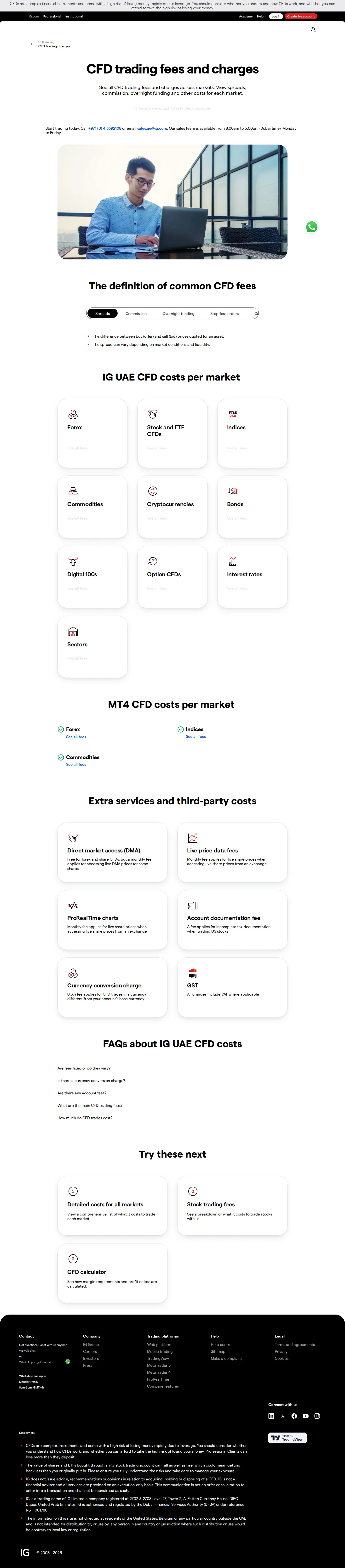
Regionally, the numbers diverge. The UAE fee page prices currency conversion on CFD trades at 0.5%, against 0.8% quoted for UK leveraged accounts elsewhere in our evidence, and states plainly that IG “won’t charge you any fees to maintain your account.” Interest on cash balances also comes with conditions: a footnote on IG’s own root page ties the advertised 3.75% AER variable rate to having held an open position or traded that calendar month, and a Thailand-site page caps the equivalent EUR rate at balances up to EUR 20,000 with a EUR 2,000 minimum monthly trading requirement to qualify at all.
Platforms and what IG Markets actually offers to trade
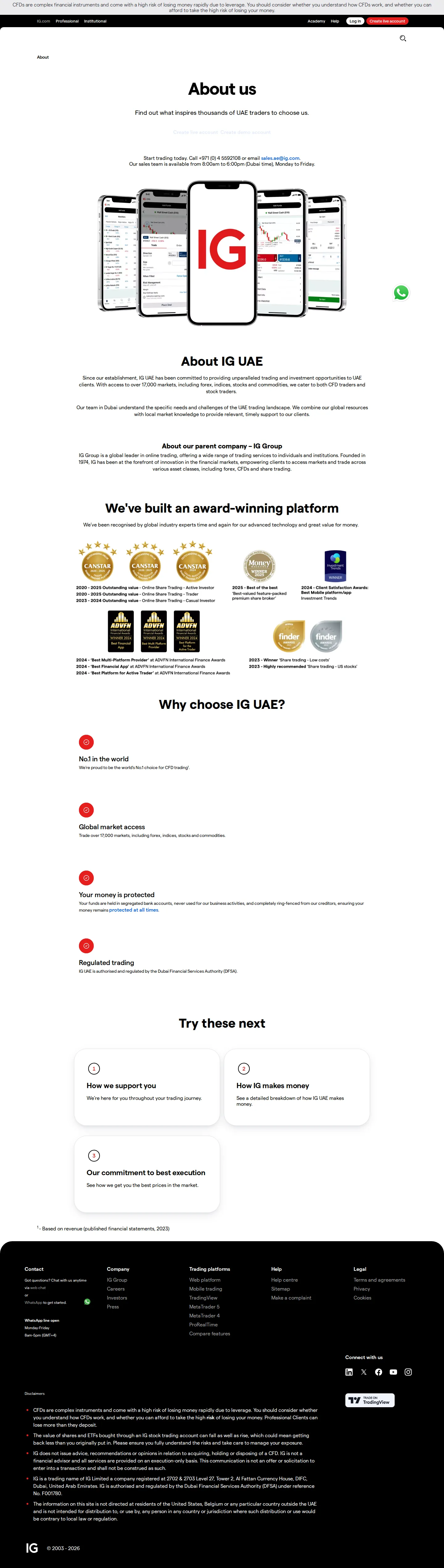
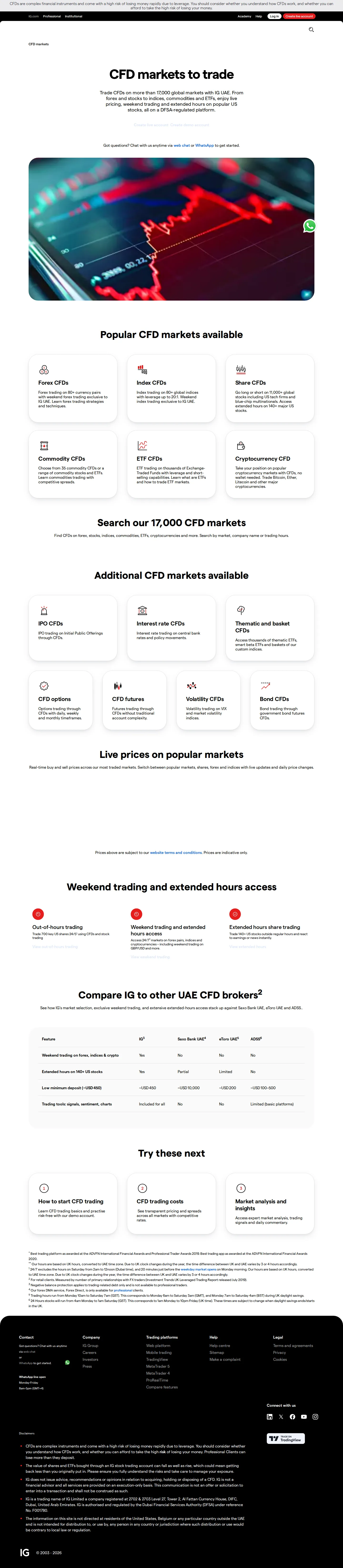
IG’s own account, platform and fees pages, read directly, show MetaTrader 4, MetaTrader 5, TradingView, ProRealTime and IG’s own web and mobile platforms across most regions, plus L2 Dealer for direct market access. Markets pages list forex, indices, shares, commodities, cryptocurrency CFDs, ETFs, bonds, options and futures, with the UAE markets page giving specific counts: 80+ currency pairs, 80+ indices, 11,000+ shares and 35 commodity CFDs. IG’s minimum deposit varies by the entity a client signs up with: the UK about page states £250, the European entity €300, Australia and Singapore $450, Switzerland CHF 2,500, and the UAE $300.
Support channels IG publishes
Support is entity-specific rather than a single global desk. The UAE/international contact page lists phone lines for new and existing clients, a WhatsApp channel open Monday to Friday 8am to 5pm (Dubai time), and live chat described as available 24 hours a day Monday to Friday. Germany lists a dedicated phone line and email (info.de@ig.com) with stated hours of 08:30 to 20:00 Monday to Friday, and Japan lists separate phone lines for new accounts, existing clients and an options desk.
Overview Table
| Headquarters | 88 Wood Street, London, EC2V 7QR, United Kingdom (IG Markets Ltd / IG Index Ltd registered office) |
| Established | Not stated in our evidence for the IG brand overall; IG Index Ltd is on Companies House as incorporated 18 November 1974 |
| Countries Served | Not stated as a single figure; our evidence shows dedicated entities/sites for the UK, EU (Germany), Switzerland, UAE, Australia, New Zealand, Singapore, Japan, South Africa, the US and a further “international” entity (IG International Limited) covering other markets |
| Regulated By | FCA (IG Markets Ltd FRN 195355, IG Index Ltd FRN 114059, IG Trading and Investments Ltd FRN 944492), DFSA (IG Limited, F001780), BaFin (IG Europe GmbH), FINMA (IG Bank S.A.), ASIC (IG Australia Pty Ltd, AFSL 515106), MAS (IG Asia Pte Ltd), Bermuda Monetary Authority (IG International Limited), NZ FSPR register (IG Australia Pty Ltd, FSP 684191) |
| Minimum Deposit | Varies by entity: £250 (UK), €300 (Europe), $450 (Australia/Singapore/NZ), CHF 2,500 (Switzerland), $300 (UAE), R4000 (South Africa), $250 (US) |
| Maximum Leverage | Up to 1:200 on IG International Limited and Professional IG Limited (UAE) accounts; UK retail caps stated elsewhere in our evidence at 1:30 (forex) and 1:20 (gold) |
| Total Instruments | Not stated as one consistent figure; our evidence notes IG’s own instrument count is given variously as 15,000, 16,000, 17,000, 19,000 and 21,000 across different IG pages |
| Platforms | IG’s own web and mobile platforms, MetaTrader 4, MetaTrader 5, TradingView, ProRealTime, L2 Dealer |
| Customer Support | Phone, email, live chat and WhatsApp, with channels, hours and lines varying by regional entity |
| Languages | Not stated as a single list in our evidence |
Facts List
- FCA confirms IG Markets Limited (FRN 195355), IG Index Limited (FRN 114059) and IG Trading and Investments Limited (FRN 944492) all as Authorised.
- Companies House confirms all three UK entities as active companies at 04008957, 01190902 and 11628764 respectively.
- The DFSA register confirms IG Limited under reference F001780.
- BaFin’s company database confirms IG Europe GmbH at BAK 148759, including recent MiCA crypto-asset permissions dated November 2025.
- FINMA confirms IG Bank S.A. as an authorised bank in Geneva, at its lowest supervisory size category (5 of 5).
- ASIC confirms IG Australia Pty Ltd under AFS licence 515106; New Zealand’s FMA-linked register confirms the same entity as a licensed Derivatives Issuer under FSP 684191.
- MAS confirms IG Asia Pte Ltd as a Capital Markets Services Licensee.
- The Bermuda Monetary Authority confirms IG International Limited for both investment business and digital assets business.
- The FSCA register shows IG Markets South Africa Limited’s licence FSP 41393 as Lapsed, while IG’s own South Africa site now routes new applicants to the Bermuda-based IG International Limited instead.
- We searched 1,438 mirrored CYSEC, FCA and FSC Mauritius warning-list entries and found no match for IG.
Key Takeaways
IG’s own footer, quoted on its UK terms page, discloses that 69% of retail investor accounts lose money trading spread bets and CFDs with the firm. IG International Limited’s site, which serves Indonesia, Thailand, Vietnam and Azerbaijan, carries a matching disclosure: 69% of accounts held by retail clients trading CFDs through this provider end up losing money. That figure, published by IG itself, is the starting point for weighing everything below.
Why this review moves from 7 to 7.9
Our previous score for IG was 7/10; this review scores it 7.9/10. The criteria and the evidence base have both changed since the last pass, so the move is our assessment being restated from current evidence, not a claim that IG has gotten better or worse. On regulation (8/10), we searched 44 public registers directly and ran a positive control on 45 of them before recording any absence. The FCA register confirms all three UK entities named in IG’s own terms: FRN 195355 held by IG Markets Limited, FRN 114059 by IG Index Limited, and FRN 944492 by IG Trading and Investments Limited, each shown as Authorised, and each entity’s Companies House number checks out (04008957, 01190902 and 11628764 respectively). The DFSA register confirms IG Limited at reference F001780. The ASIC register confirms AFS licence 515106 for IG Australia Pty Ltd, and the same firm’s New Zealand FSP684191 is confirmed as a licensed Derivatives Issuer on the FMA-recorded register. BaFin’s database confirms IG Europe GmbH at register number 148759 with current MiCA and WpIG permissions. FINMA’s list confirms IG Bank S.A. as a bank, category 5, marked under foreign control. MAS confirms IG Asia Pte Ltd as a Capital Markets Services Licensee. The Kanto Local Finance Bureau register confirms IG Securities Limited at No. 255. Against that, the FSCA register shows FSP 41393, held by IG Markets South Africa Limited, as Lapsed rather than authorised, and IG’s own South Africa homepage states that entity will no longer provide (new) domestic trading accounts, routing new applicants instead to the Bermuda-regulated IG International Limited. We also searched 1,438 warning-list entries mirrored from CYSEC, the FCA and the FSC Mauritius, and IG matches none of them.
What IG’s own terms say about the entity a client actually gets
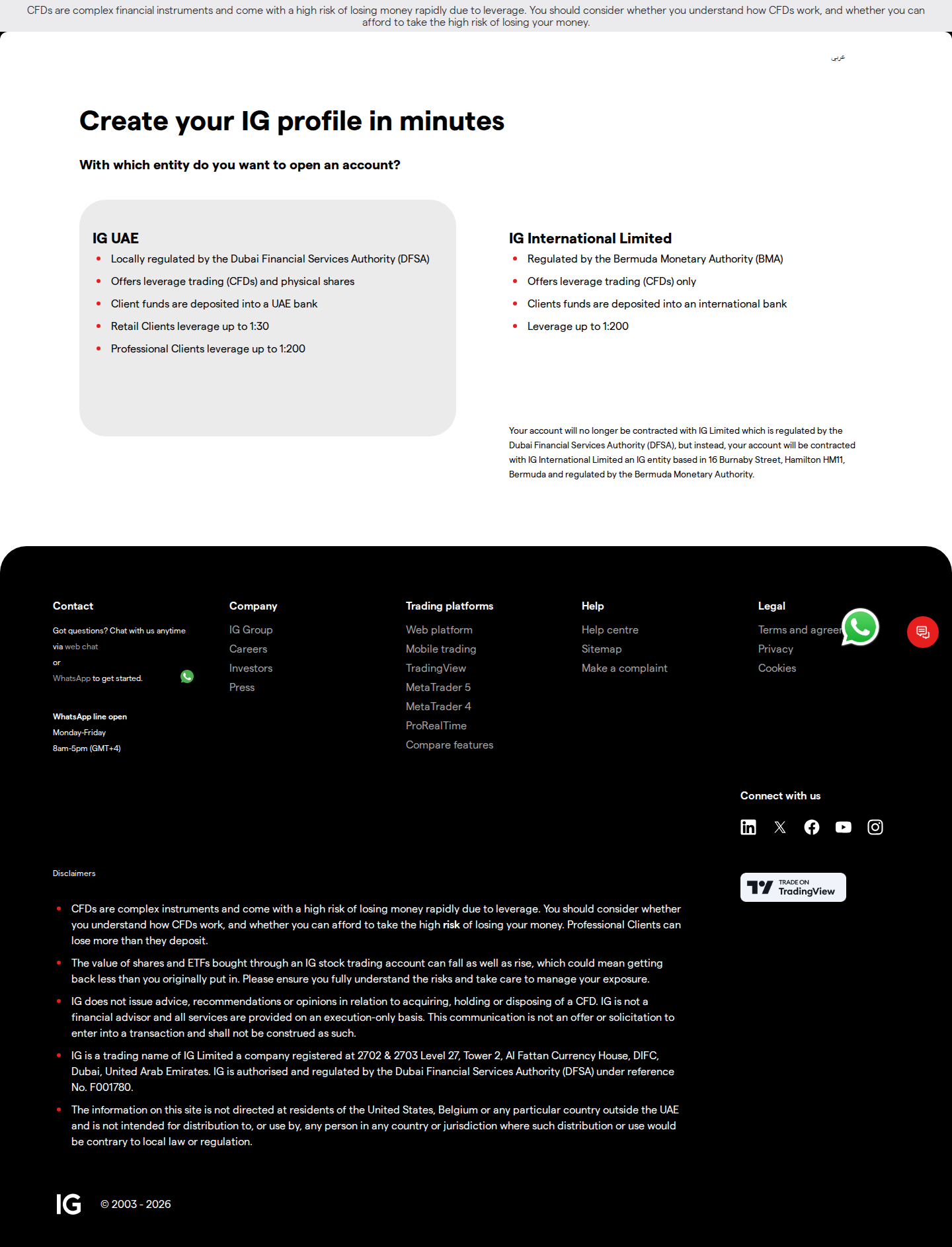
IG’s UK terms page states that share dealing and Smart Portfolio accounts, CFD accounts, and spread betting are each provided by a different legal entity: IG Trading and Investments Ltd, IG Markets Ltd and IG Index Ltd. For clients steered toward IG International Limited (Bermuda), our earlier review reports that no negative balance protection commitment could be found across the margin, charges, client-money, CFD-trading or terms pages it checked, while that same entity offers forex and gold leverage up to 1:200 against the UK retail caps of 1:30 and 1:20. IG’s own UAE accounts page confirms the mechanics of that shift in its own words: your account will no longer be contracted with IG Limited which is regulated by the DFSA, but instead, your account will be contracted with IG International Limited… regulated by the Bermuda Monetary Authority. We checked the Bermuda Monetary Authority register ourselves: it confirms IG International Limited is licensed for investment business and digital asset business, but names no statutory compensation cap. On this point our earlier review adds that client money there relies on trust law alone for protection, and that funds may sit in deposit accounts with a notice period or fixed term of up to 95 days. IG’s own website terms for that entity put disputes under English law and the English courts.
What IG charges
The fees score of 9/10 rests on IG’s own UK fees page, which lists stock trading commission as free for US, German, UK and Irish shares up to 100 trades a month, rising past that threshold to figures such as $5 per trade (US) or 0.1% with an £8 minimum (UK), plus pass-through items IG itself lists: UK stamp duty reserve tax at 0.50% on buys, the £1.50 PTM levy above £10,000, and a £100-per-certificate dematerialisation fee for physical shares. IG reserves further latitude for itself on that same UK fees page, framed in its own wording: “We may charge you a fee if we are required to perform a service on your behalf that is not set out in our product details.” Our earlier review also highlights a mismatch on IG’s international pages: its funding page prices Visa deposits at 1% and Mastercard deposits at 0.5%, whereas the charges page cites a 2.3% processing charge levied by an outside card provider, based on the amount transacted.
Platforms, support and what reviews can’t tell us
The platform score of 9.3/10 draws on IG’s own platform pages, which list its own web and mobile apps alongside MetaTrader 4, MetaTrader 5, TradingView, ProRealTime and L2 Dealer for direct market access; IG’s UK about page cites a 98.97% order fill rate with 100% of filled orders executed at the requested price or better for April to June 2024. Support (6.5/10) is documented site by site rather than as one global desk: IG’s own pages give a UK registered office at 88 Wood Street, London, a Dubai sales line open Monday to Friday, a Germany line open weekdays 08:30 to 20:00, and a Japan freephone line for new accounts; our earlier review notes that published 24-hour support windows differ by entity, with the UAE, international and South African desks each running different actual hours despite each being marketed as round-the-clock. The reviews score (6.6/10) is the softest of the set: nothing in what we fetched or in our earlier review constitutes a survey of client sentiment, so that figure reflects our own weighting of the regulatory and contractual record above rather than any customer-review data we hold.
Licenses & Regulation
IG operates through a spread of legal entities rather than one, and which one holds a client’s account depends on both product and country. In the UK, the FCA register confirms three separate authorisations: FRN 195355 for IG Markets Limited (CFD accounts, authorised since 1 December 2001, Companies House 04008957), FRN 114059 for IG Index Limited (spread betting, authorised since 1 December 2001, Companies House 01190902), and FRN 944492 for IG Trading and Investments Limited (share dealing, ISAs, SIPPs and Smart Portfolio, authorised since 23 December 2021, Companies House 11628764). All three companies also show as active on the Companies House register under those numbers. A fourth UK entity, IG Digital Assets Limited, carries FRN 1035380, but the FCA records its status only as “Registered” rather than authorised, which the register itself distinguishes from a financial-services permission; it is a money-laundering-supervision registration for cryptoasset activity, not a licence to conduct regulated business.
The entities behind IG’s other regional sites
Outside the UK, IG trades through a further set of separately regulated companies, and each register check landed differently. The DFSA public register confirms IG Limited under reference F001780 as an Authorised Firm for the Dubai site. The FINMA list of authorised banks and securities firms confirms IG Bank S.A. as a bank in Geneva, though FINMA sizes it in supervisory category 5 out of 5, a measure of size rather than standing, and the list publishes no licence number to quote. The BaFin company database confirms IG Europe GmbH under register number 148759 (BaFin-ID 10148759), current for permissions including Finanzkommissionsgeschäft and Eigenhandel since 2021, and, more recently, cryptoasset custody and exchange permissions under MiCA dated 21 November 2025. The Handelsregister Frankfurt separately confirms the company itself under HRB 115624. ASIC’s licence register confirms AFS licence 515106 for IG Australia Pty Ltd, and the New Zealand Financial Service Providers Register confirms the same entity holds a Derivatives Issuer Licence under FSP684191. The MAS Financial Institutions Directory confirms IG Asia Pte Ltd as a Capital Markets Services Licensee and Exempt Financial Adviser, and the Bermuda Monetary Authority list confirms IG International Limited for both investment business and Class F digital-assets business.
Two claims did not clear the same bar. The South African arm is the clearest gap: the FSCA’s own register shows FSP 41393, held by IG Markets South Africa Limited, with status Lapsed, not authorised, and IG’s own site now tells South African visitors that the entity “will no longer provide” new domestic trading accounts, routing new applicants instead to IG International Limited in Bermuda. Separately, we searched the BaFin database directly for “IG Europe GmbH” as named by the Swedish-branch claim and by a German site checked from a different angle, but a search built around the Swedish-branch wording returned nothing on the ESMA register of investment firms; since that register depends on what national authorities choose to report to ESMA, an empty result there is not evidence the branch lacks authorisation, only that it didn’t turn up in that particular index.
Where IG’s own claims outran what a register could confirm
A number of the regulators IG names on its comparison pages don’t publish anything we could check against a number. The Japan FSA’s list of registered Financial Instruments Business Operators names firms in Japanese only, and IG’s own page gives no registration number for IG Securities Limited to match against it; a separate Japan-market page, however, gave enough for a direct hit: the Kanto Local Finance Bureau register confirms Director-General of the Kanto Local Finance Bureau (Financial Instruments Business Operator) No. 255 (関東財務局長(金商)第255号) for IG Securities Kabushiki Kaisha (IG証券株式会社), registered 30 September 2007 as Type I Financial Instruments Business, alongside its corporate number on the Japan FSA operator list. The two Japanese trade-association memberships IG cites, the Financial Futures Association of Japan (member no. 1168) and the Japan Securities Dealers Association, sit outside any register we hold, so they stand as claims we could not verify either way. The FSCA claim for IG Markets South Africa Limited carried no numeric FSP number to check on its own comparison page, though the FSP number quoted elsewhere on IG’s site did check out, and badly. The same is true of IG US LLC, whose claim to NFA regulatory supervision supervision arrives with no number attached to it. A search of the NFA BASIC register does surface a US retail forex entity, tastyfx LLC, which holds NFA membership (ID 0509630, approved 15 October 2018) and is currently registered with the CFTC as both a Retail Foreign Exchange Dealer and an Introducing Broker; the trouble is that name doesn’t match the one IG’s own comparison page uses for the US.
We searched 1,438 warning-list entries mirrored from CYSEC, the FCA and the FSC Mauritius, having run a positive control against a firm known to be listed on 45 registers first so an empty result means absence rather than a broken search; IG matched none of them. That’s a clean result across the lists we mirror, not a clearance from every regulator worldwide.
This review’s regulation score moves to 8 out of 10, up from 7 in our prior review of this broker. The register work above is the reason: IG’s core UK trio (FCA, all three entities, all three Companies House filings) and its major overseas hubs (DFSA, FINMA, BaFin, ASIC, MAS, the Bermuda Monetary Authority) all confirm cleanly against IG’s own claims, and the warning-list search came back empty. Against that, the confirmed FSCA lapse in South Africa, the unverifiable Japan and US claims, and IG’s own contract terms describing itself as counterparty to client trades and reserving the right to reclassify UK clients as “elective professional” (removing negative balance protection under the terms of that reclassification) are the kind of detail that keeps this from scoring higher.
How to Trade
IG splits its markets across regulated entities rather than offering one uniform product set. The firm’s UK terms page lists forex, shares, indices, commodities, crypto, ETFs, bonds, futures and options under “what to trade,” with a note that options are complex instruments not suitable for most investors. Our earlier review’s figures put this at 80+ currency pairs, 80+ indices, 13,000+ shares across US, UK and German markets, 30+ commodity markets, 8 cryptocurrencies, vanilla and barrier options, 100+ ETFs, bonds and interest rate derivatives, plus Digital 100s. Those counts do not hold steady across IG’s own pages: one internal note records the same platforms page stating “$0 commission on all US shares up to 100 trades per month” in one block and “up to 50 trades per month” in a near-identical block further down, and another records IG’s own instrument count moving between 15,000, 16,000, 17,000, 19,000 and 21,000 depending on which page is read. Whatever the true figure, IG’s own marketing does not agree on it.
Which IG entity actually takes the trade
In the UK, three separate companies split the product line: IG Markets Ltd carries CFD, US options and futures accounts, IG Index Ltd carries spread betting, and IG Trading and Investments Ltd carries share dealing, ISAs, SIPPs and Smart Portfolio, per IG’s own terms page. Outside the UK the split runs by country rather than by product: IG International Limited (Bermuda) is the CFD-only entity behind ig.com/en, serving Indonesia, Thailand, Vietnam, Azerbaijan and other international visitors, and according to our earlier review offers no spread betting, share dealing, ISA, SIPP or Smart Portfolio at all. IG Europe GmbH takes German and EU clients, IG Bank S.A. takes Swiss clients, IG Australia Pty Ltd takes Australian clients, and IG Asia Pte Ltd takes Singapore clients. Which company a client actually contracts with, and so which regulator and which compensation scheme sits behind the account, depends on the product chosen and the client’s country of residence, not on a single “IG” relationship.
IG Markets Limited’s own audited accounts, as our earlier review reports them, state that IG Markets Limited is the counterparty to the OTC derivatives clients enter into and also takes the other side of trades for the rest of the IG group, matching opposing client positions against each other and hedging only the net exposure left over. A CFD or spread bet placed with IG is a contract against IG itself, priced by IG, not an order routed to an exchange order book.
Leverage and negative balance protection vary by entity
Leverage caps differ sharply depending on which IG company holds the account. The UAE accounts page gives Retail Clients of IG Limited (DIFC) leverage up to 1:30 and Professional Clients up to 1:200. All accounts with IG International Limited (Bermuda) go up to 1:200 regardless of classification, and our earlier review notes this is offered to a client base for which no negative balance protection commitment could be found on any of the pages it checked, including the margin page, charges page, client-money page, CFD trading page and terms index. IG’s own UK margin FAQ states that retail positions may be automatically closed when equity drops below 50% of the margin requirement, and separately that professional clients do not have negative balance protection, so a professional account can lose more than what was deposited. The same FAQ gives IG a standing right to act unilaterally on margin: “during periods of high market volatility, IG may temporarily increase margin requirements on certain markets,” and separately states the client remains fully responsible for monitoring your account and maintaining adequate funds regardless of whether you receive these [margin call] notifications.
Switching from IG Limited to IG International changes what protects the funds
IG’s own UAE account-opening page spells out what happens if a client picks the Bermuda-regulated option over the DFSA-regulated one: your account will no longer be contracted with IG Limited which is regulated by the, but instead, your account will be contracted with IG International Limited… regulated by the Bermuda Monetary Authority. The Bermuda Monetary Authority register lists IG International Limited under Investment Business (Licensed Entities) and Digital Assets Business (Class F), permitted to deal in, arrange deals in, and safeguard and administer investments, but not to manage investments or give investment advice. Our earlier review notes that no compensation scheme is named for IG International Limited: client money protection is described as trust-law protection under Bermuda Monetary Authority rules, with no stated statutory cap comparable to the UK Financial Services Compensation Scheme’s £85,000, and funds can be placed in deposit accounts with a notice period or fixed term of up to 95 days.
Platforms: IG’s own apps plus third-party feeds
IG runs its own web platform and a native mobile app, and layers on third-party platforms: MetaTrader 4, MetaTrader 5, TradingView, ProRealTime for advanced charting, and L2 Dealer for direct market access with full order book transparency. ProRealTime carries a separate charge once the free first month ends: our earlier review gives this as £30 a month in the UK (not charged for any month in which the account generates over £15 of spread and commission for IG) or $40 a month internationally (not charged if the client places four or more trades in the month). L2 Dealer itself carries no platform fee, but the international fee page adds a monthly charge for live DMA prices on some shares even though DMA execution is free for forex and share CFDs, per IG’s UAE fees page.
Reclassifying as a professional client changes the contract, not just a label
Per our earlier review, a UK client can become an “elective professional client” by meeting two of three tests: investments worth at least €500,000, 40 sizeable trades over the previous year, or at least a year working in the financial sector in a relevant role. IG’s own footnote on its international comparison page states plainly that negative balance protection doesn’t apply to an IG professional account. The same reclassification, per our earlier review, also lets IG assume a higher level of client knowledge when assessing appropriateness and lets IG prioritise speed or likelihood of execution over price under its best-execution policy. A retail client who reclassifies is trading a loss cap for higher leverage and loses the assumption that IG will seek the best price rather than the fastest fill.
Account Types
IG splits its UK products across three separate regulated entities: IG Markets Ltd runs CFD accounts, IG Index Ltd runs spread betting, and IG Trading and Investments Ltd runs share dealing, ISAs, SIPPs and the IG Smart Portfolio range. Outside the UK, IG runs the business through a different regulated entity in each country, and the account on offer, and its minimum deposit, changes with it.
What IG’s account comparison page quotes as minimum deposits
IG’s own “Compare our international offering” page lists a different opening minimum for each entity: £250 for the UK trading account, €300 for the Europe account offered outside the UK and Switzerland (which itself splits into IG trading, IG professional, IG options trading and IG turbo24 trading accounts), $450 for the Australia account (alongside a Limited risk account and a Share dealing account), CHF 2,500 for Switzerland (also with a Limited risk account), R4,000 for South Africa, $450 for Singapore, $450 for New Zealand, $300 for Dubai, ¥35,000 for Japan, and $250 for the US forex account. Our earlier review reported that the UK site states no fixed account minimum for the CFD or spread betting account itself, with card deposits starting from £1, and that the separate international CFD account reachable via ig.com/en (run by IG International Limited) takes $50 by card or no stated minimum by bank transfer.
The IG UAE and IG International split
IG’s UAE accounts page sets out two distinct contracting routes for a UAE resident. Opening an account with IG UAE (traded under IG Limited, on the DFSA register under reference F001780) keeps the client’s funds in a UAE bank and caps leverage at 1:30 for retail clients and 1:200 for professional clients, and adds access to physical shares alongside leveraged CFDs. Choosing the IG International Limited route instead moves the client out of DFSA regulation and into Bermuda Monetary Authority regulation, deposits funds with an international bank rather than a UAE one, drops physical share dealing, and raises leverage to 1:200 across the board. IG’s own account creation page states plainly that switching means your account will no longer be contracted with IG Limited which is regulated by the, but instead, your account will be contracted with IG International Limited… regulated by the Bermuda Monetary Authority.
Premium client status and elective professional reclassification
The earlier review described two upgrade paths that sit on top of the standard account types rather than replacing them. IG offers premium client status internationally by invitation once a client crosses a volume threshold; benefits include a dedicated account manager, larger volume-based rebates, priority phone access, invitations to events, interest paid on cash balances and various promotional offers, and the earlier review noted that IG describes the status as carrying no extra fees or charges and states that it leaves the client’s regulatory category unchanged. Elective professional client status in the UK is a formal reclassification: the earlier review reported it requires meeting two of three tests, investments of at least €500,000, forty sizeable trades over the previous twelve months, or at least a year working in the financial sector in a relevant role. IG’s own margin rates FAQ confirms the consequence directly: Professional clients do not have negative balance protection, so a reclassified client can owe IG money on a negative balance, a loss retail clients on the standard account types are protected against.
What sits on top of the account itself
Several charges attach to specific account activity rather than to opening the account. The earlier review reported a ProRealTime charting platform fee of £30 a month on the UK entity and $40 a month on the international entity, both with the first month free; the UK fee is not charged for any month in which the client generates over £15 of spread and commission for IG (reviewed automatically every three months), the international fee is not charged if the client places four or more trades in the month. The earlier review put currency conversion costs at 0.8% for leveraged UK accounts and 0.49% for UK share dealing, versus 1.0% for international CFD trades in a currency other than the account’s base currency. It also noted an overnight funding administration charge, charged in addition to the interbank rate, of 1.5% for FX and 3.4% for other asset classes on UK spread bets, falling to 1% and 3% respectively on UK CFDs. IG’s own stock trading charges page prices share dealing on a volume band: free commission on US, German, UK and Irish shares for up to 100 trades a month, rising past that point to $5 a trade (minimum $5) in the US, and 0.1% (minimum £8 in the UK, minimum €10 in Germany and Ireland) beyond it, with a 0.7% foreign exchange conversion spread applying once a client exceeds the 100 trade band. The same page reserves the right to charge further: “We may charge you a fee if we are required to perform a service on your behalf that is not set out in our product details,” a term with no fixed scope attached to it.
Negative Balance Protection
IG runs the loss-limiting mechanics most CFD brokers run: a margin call that warns a client before a position is closed, and a forced close-out if the client does not act. The detail sits in the margin rates FAQ IG published, and it is worth reading in full rather than taking the headline “protected” claim on faith.
How IG closes a losing retail position
The margin rates FAQ states that a retail client’s open positions may be automatically closed once account equity falls below 50% of the margin requirement on that account. The same page puts the burden of watching for that point squarely on the client: “You remain fully responsible for monitoring your account and maintaining adequate funds regardless of whether you receive these notifications.” A missed or delayed margin-call email does not excuse a client from the consequences of being under-margined; the close-out rule applies whether or not the alert lands in an inbox.
The same FAQ reserves IG the right to move the goalposts during a fast market: “During periods of high market volatility, IG may temporarily increase margin requirements on certain markets.” A client sized correctly against the published margin rate can find the requirement raised while the position is still open, which brings the 50% close-out threshold closer without the client having changed anything.
Where the retail floor stops applying
IG’s UK risk warning, on its UK terms page, states that clients classified as professional do not carry the same loss-limited position as retail clients and can lose more than they deposited. IG’s own comparison table of its international offering makes the same point in a footnote: Negative balance protection doesn’t apply to an IG professional account. The 50% equity close-out described above is a retail-account mechanic; once an account is reclassified as professional, that backstop is gone and so is the promise that a loss stops at the deposit.
An earlier review of this catalogue, which we are restating here rather than re-verifying against IG’s pages directly, described what UK clients give up by opting into elective professional status. Reclassification requires meeting two of three tests: a portfolio worth at least €500,000, 40 “significant size” trades in the past year, or a year’s employment in a relevant financial-sector role. In exchange for the higher leverage and looser appropriateness checks that professional status brings, that earlier review reported the client surrenders negative balance protection, becomes liable to pay IG if the account goes negative, and lets IG weight execution speed over price when filling orders.
IG International Limited and leverage without a stated floor
That same earlier review reported checking IG International Limited’s margin page, charges page, client money page, CFD trading page, terms-and-agreements index, website terms and CFD help centre for a stated commitment to negative balance protection, and found none across any of them. IG International Limited is the Bermuda-regulated entity that serves clients in Indonesia, Thailand, Vietnam, Azerbaijan and other markets reached through ig.com/en, and per that same review it offers retail leverage of up to 1:200 on major forex pairs and gold, well above the 1:30 forex and 1:20 gold caps that apply to UK retail clients under IG Markets Ltd. Higher leverage narrows the price move needed to wipe out a deposit; a stated floor stopping the loss there is the detail that matters most on that account, and it is the detail the earlier review said it could not find published anywhere for this entity.
The same earlier review, reading IG Markets Limited’s audited annual report, described the firm as the counterparty to the OTC derivatives its clients open and the primary hedging counterparty for other companies in the IG group, managing its own risk by netting client flow internally and hedging only what is left over. A client’s trade is priced and filled against IG itself rather than cleared on an exchange, which is the ordinary structure for CFD and spread bet dealing and the reason a negative balance is owed to IG directly rather than to a clearing house.
The scale of the risk IG itself discloses
IG’s own UK terms page states that 69% of retail investor accounts lose money when trading spread bets and CFDs with the firm. That figure, published by IG rather than estimated by us, is the standard mandated retail-risk disclosure for this product category and sets the baseline against which the close-out mechanics above operate: the 50% equity threshold and the margin-call system exist because most retail accounts in these products lose money, not despite it.
Trading Instruments
IG’s own market list, published across its UK, international and regional pages, sets out nine categories: forex, shares, indices, commodities, crypto, ETFs, bonds, futures and options. An earlier review of the same catalogue put figures on most of those categories: 80+ currency pairs with EUR/USD priced from 0.6 pips, 80+ global indices, 13,000+ shares across US, UK and German markets, 30+ commodity markets including gold, oil and agricultural products, 8 major cryptocurrencies, 100+ ETFs, government and corporate bonds, interest rate derivatives on major economies, and a binary style product called Digital 100s. Those are our earlier review’s numbers, not ones we read ourselves.
What IG’s own pages actually show us
The UAE markets page, which we did read directly, lists a similar but not identical set: 80+ forex pairs, 80+ indices with leverage up to 20:1, 11,000+ global stocks traded as share CFDs, 35 commodity CFDs, ETF CFDs with leverage and short selling, cryptocurrency CFDs on Bitcoin, Ether, Litecoin and other major coins with no wallet required, IPO CFDs, interest rate CFDs on central bank policy, thematic and smart beta ETF baskets, options CFDs on daily, weekly and monthly timeframes, futures CFDs, volatility CFDs on the VIX and other volatility indices, and bond CFDs traded through government bond futures. IG’s UAE root page gives a different shares figure again, 12,000+ international shares plus 700 US stocks tradable 24 hours a day five days a week, and separately claims zero commission UAE stock trading across 10,000+ shares and ETFs. A separate page in our evidence lists thousands of ETFs on the UK site and 5,400+ on the international site.
IG’s instrument count does not agree with itself
An earlier review of IG’s site found the firm’s own tradable market count varies between 15,000, 16,000, 17,000, 19,000 and 21,000 depending on which IG page is read, which undercuts the “17,000+ markets” figure used in the firm’s marketing. That claim reached us from the review, not from a page we fetched ourselves, so we report it as what that review found rather than as something we independently confirmed.
Crypto sits outside IG’s usual protections
Crypto trading is not treated the same as IG’s regulated CFD and spread betting markets. On the Australian site, the crypto offering run through IG Digital Assets Australia Pty Ltd is stated to be unregulated, outside investor protections, and not covered by the Australian Financial Complaints Authority scheme. IG’s UK crypto page carries its own risk warning in these words: Don’t invest unless you’re prepared to lose all the money you invest… protection is not guaranteed if things go wrong. That is a direct quote from the page we fetched. The UAE markets page, by contrast, advertises cryptocurrency CFDs on Bitcoin, Ether, Litecoin and other major coins as a standard tradable market, with no wallet needed, alongside forex, shares and commodities, without repeating that warning on the same page.
Access depends on which IG entity and account a client holds
Not every listed market is open to every client by default. IG’s own about page states that digital 100s trading requires professional account qualification, and its terms page separately notes that options are complex instruments not suitable for most investors. Spread betting itself is only offered by IG Index Ltd to UK residents; a page describing IG Europe GmbH’s offering states that spread betting is available to residents of Ireland only among its client base. Share dealing, ISAs, SIPPs and Smart Portfolios are provided through a third entity again, IG Trading and Investments Ltd, so which markets and account types a given client can reach depends on which of IG’s regulated entities they are contracted with, not on a single unified product list.
Education & Analysis
IG’s own terms page lists five own-brand areas alongside the third-party tools: a web platform, a mobile trading app, MetaTrader 4, ProRealTime and L2 Dealer, with MetaTrader 5 and TradingView listed as further third-party platforms. The UK platforms page repeats that line-up and adds a footnote crediting the web platform as “award-winning,” though the footnote itself was not part of the fetched evidence. The mobile app page lists Face ID login, deposits and withdrawals, and guaranteed stops as native app features, and states it needs an iPhone or iPad on iOS or Android 4.0.3 or later.
Charting: IG’s own tools versus ProRealTime
IG’s own web and mobile platforms carry the built-in charting; ProRealTime sits alongside them as the advanced third-party charting package, built by IT-Finance according to our earlier review. The earlier review put the UK price at £30 a month, with the first month free, and noted the fee is waived for any month in which the client’s spread and commission generate IG more than £15, a threshold checked every three months. The international site (ig.com/en) prices the same package at $40 a month, also free for the first month, but waives it on trading activity instead of revenue: four trades in the month, according to the same earlier review. IG’s UAE fee page lists a ProRealTime charge only as “monthly fee” with no figure attached, alongside a separate, equally unpriced monthly fee for accessing live DMA prices on some shares and another for live share price data generally. We did not find a number for any of those three UAE charges in the pages fetched.
L2 Dealer and direct market access
L2 Dealer is IG’s direct-market-access platform, described on the UK platforms page as trading against the exchange order book with full order book transparency. According to the earlier review, DMA itself comes with no platform fee; on the UK site, Forex Direct DMA is limited to professional clients, and on the international site DMA is free for forex and share CFDs, though a monthly fee applies for live DMA prices on some shares, matching the unpriced UAE charge noted above. Nothing in the pages fetched sets out order types, depth of book, or execution statistics specific to L2 Dealer itself; the execution-quality figures IG publishes (98.97% of orders filled, 100% of filled orders at the requested price or better, for April to June 2024, per its about page) are given for the broker’s fills generally, not broken out by platform.
MetaTrader, TradingView and the tastytrade platform
MetaTrader 4 gets a dedicated page structure wherever it’s listed: download, Mac version, demo account, VPS and web trading on the UK terms page, and the same set (what it is, indicators and add-ons, download, demo, iOS and Android) on the UAE terms page. MetaTrader 5 and TradingView are both listed as third-party platforms on the UK, UAE and other regional pages, with TradingView on the UAE root page described as letting a client chart, trade and connect with real-time data and, on the UK terms page, described as “trusted by a global community of over 100 million traders.” The earlier review reported that the IG tastytrade platform, for US options and futures, appears on the international platform list but not the UK one, consistent with the UK’s IG Markets Ltd not offering US options and futures accounts (that product sits with the same entity internationally).
What IG Prime and analysis tools we found no evidence for
The pages fetched don’t describe a research or analysis hub, a signals service, or named market-commentary tools for the UK or international sites; the only analytics-provider mention in the evidence is on a UAE platforms page, and it names two different suppliers, “PIA-First” in one section and “Acuity” in another, for what reads as the same fundamental forex signals feature. We can’t say from the pages fetched which supplier is actually correct, or whether IG runs research tools beyond charting and DMA that this evidence didn’t surface; our evidence notes that direct probes at /legal, /regulation, /regulatory, /licences, /licenses and /compliance on the UK site all came back 404 or empty, which speaks to how IG’s disclosures are organised by country footer rather than centralised, and says nothing about the platform or analysis stack.
Special Offers
IG runs at least two separate cash promotions across its entities, and an invitation-only loyalty tier on top of them. None of the three work the same way, and the conditions attached to each are worth more space than the headline number.
The £250 cashback on IG’s UK site
IG’s own UK website carries this promotional text: Get up to £250 cashback when you invest at least £200… Max reward on £10,000 investment… Cannot be used in conjunction with other offers. The wording ties the reward to the size of the investment, caps it at £250 regardless of how much more than £10,000 is put in, and rules out combining it with any other IG offer running at the same time. The page does not set out a minimum holding period, a clawback condition, or which account type the promotion applies to beyond “invest”, so a reader relying on this fragment alone should check the current terms before counting on the full £250.
Welcome Cashback for IG International clients
An earlier review of IG reported a separate scheme, Welcome Cashback, offered by IG International Limited (the Bermuda-regulated entity that serves markets such as Indonesia, Thailand, Vietnam and Azerbaijan through ig.com/en) rather than by the UK entities above. As that earlier review described it, new CFD clients of IG International Limited can receive up to US$150, paid as a rebate of the spread and commission charged in their first two calendar months of trading, credited within 45 days of the welcome period ending. Eligible markets are forex (excluding Forex Direct DMA), indices, commodities and shares; options are excluded. The earlier review said no separate registration is needed to take part, that the scheme has run since 10 October 2023, and that it is governed by English law.
The same earlier review flagged a condition worth repeating: Welcome Cashback does not stack with IG’s volume-based rebate scheme. A client who qualifies for both is paid whichever of the two is larger, not both added together, and whatever cashback is due is reduced by any amount owed to that client under a referral scheme. Anyone comparing the advertised “up to US$150” against what actually lands in the account should read it as a ceiling under the best-performing scheme, not a guaranteed top-up on whatever a volume rebate already pays.
IG’s Premium client tier
Separately, the earlier review described a Premium client status that IG offers by invitation once a client’s trading volume crosses an unstated threshold. Benefits reported for that tier include a personal account manager, higher volume-based rebates than a standard account receives, priority phone service, invitations to IG events, interest on cash balances, and access to promotional offers not available to other clients. The earlier review also reported that IG charges no additional fee for holding Premium status, and that reaching it does not change a client’s regulatory classification (Premium remains distinct from the elective professional reclassification IG offers separately, which does affect a client’s regulatory protections). Because this tier is invitation-based and the volume threshold was not published, there is no figure here to check against; what is documented is the shape of the benefit, not its trigger.
Conditional interest, not a bonus, but similarly gated
IG’s UK site also ties its advertised cash interest rate to trading activity rather than paying it unconditionally. A footnote on that site reads: “To earn interest in a calendar month, you must either hold an open position or have traded.” A client sitting on uninvested cash without a position or a trade that month earns nothing on it, whatever the headline rate. The same pattern shows up on IG’s Thailand-facing page for EUR balances, where the interest terms require a client to “either hold an open position(s) or have executed a trade(s) with an initial cumulative value of at least EUR 2,000” in that calendar month, and cap the interest to balances up to EUR 20,000 per client, so cash held above that ceiling earns nothing regardless of trading activity. Neither of these is a promotion in the sense the cashback offers are, but both attach the same kind of activity condition, and a client evaluating IG’s “up to” figures anywhere on the site should expect a similar gate until proven otherwise on the specific page they are reading.
Opening an Account
Which legal entity actually opens the account depends on both the product and the applicant’s country of residence, and IG splits this by contract rather than by brand. On the UK site, a CFD account is opened with IG Markets Ltd, a spread betting account with IG Index Ltd, and share dealing, ISA, SIPP or Smart Portfolio accounts with IG Trading and Investments Ltd, three separate FCA-authorised companies under the one IG website. Outside the UK the split runs by geography instead: IG International Limited (Bermuda) is the sole contracting entity behind ig.com/en and offers CFDs only, with no spread betting, share dealing, ISA, SIPP or Smart Portfolio option attached to that entity.
Minimum deposit by region on IG
IG’s own “Compare our international offering” table gives different opening minimums by country: £250 for a UK trading account, €300 for the Europe account (excluding UK and Switzerland, which also covers the professional, options and turbo24 variants), $450 for Australia, Singapore and New Zealand, CHF 2,500 for Switzerland, R4,000 for South Africa, $300 for Dubai, ¥35,000 for Japan, and $250 for the US forex account. Separately, the international CFD account opened through IG International Limited carries a $50 minimum by card and no stated minimum by bank transfer.
UAE applicants choose between two regulators
An applicant opening an account through IG’s UAE channel is offered a choice between IG Limited, regulated by the Dubai Financial Services Authority, and IG International Limited, regulated by the Bermuda Monetary Authority. IG’s own account-creation page states that picking the IG International option means the account will no longer be contracted with IG Limited which is regulated by the, but instead, your account will be contracted with IG International Limited… regulated by the Bermuda Monetary Authority. That switch moves client funds out of a UAE bank and into an international one, drops access to physical share dealing, and in exchange raises leverage from the DFSA retail cap of 1:30 up to 1:200.
South African applicants are routed to Bermuda
IG’s South Africa homepage states that IG Markets South Africa Limited will no longer provide new domestic trading accounts, and that new applications are instead supported by IG International. A South African resident who instead opens an international account with IG Markets Limited in the UK is told they must obtain tax clearance certificates for their foreign investment allowance before doing so.
Who IG won’t open an account for
Across the UK, UAE and other regional pages, IG states its site information and services are not directed at or intended for use by residents of the United States or Belgium, or any jurisdiction where distribution or use would be contrary to local law. Separately, tastyfx LLC excludes residents of Arizona and Ohio from its own US retail forex accounts. IG’s own accounts pages also note that an application cannot be completed through a given country site for some countries of residence, without listing which ones. Digital 100s trading is gated behind professional-account qualification rather than being open to a standard retail applicant.
Corporate accounts at IG
Corporate applicants face extra restrictions on top of the standard sign-up: funding is limited to bank transfer, American Express, prepaid cards, and other business or corporate cards, with cards issued from certain jurisdictions including the US all declined; third-party funding is refused outright; any card used must match the account holder’s own name and address; and a profile can have no more than three debit or credit cards linked to it.
Reclassifying as a professional client
A UK retail applicant can ask to be reclassified as an elective professional client, which requires meeting two of three tests: a portfolio worth €500,000, forty “significant” trades placed in the past year, or at least a year’s employment in a relevant financial-sector role. IG’s own footnote on its international comparison page confirms the consequence in one line: Negative balance protection doesn’t apply to an IG professional account. The reclassification also allows IG to assume a higher baseline of client knowledge when judging appropriateness, and to prioritise execution speed over price, as IG’s own professional-trading material sets out.
Closing and reopening an account
An IG account that has been closed cannot simply be switched back on: anyone returning is given a fresh account number and new login details, none of the prior trading history, settings or activity carries over, and identity verification has to be redone from scratch no matter how recently the original account was closed.
Deposits & Withdrawals
IG is not one company but a group of separately regulated entities, and which one holds a client’s account changes what funding and withdrawal actually cost. Companies House confirms IG Markets Ltd (04008957), IG Index Ltd (01190902) and IG Trading and Investments Ltd (11628764) as the three UK entities behind CFD, spread betting and share dealing accounts respectively, while clients routed to ig.com/en deal instead with IG International Limited, a Bermuda entity the Bermuda Monetary Authority lists as licensed for investment business.
What IG Markets and IG Index charge UK clients
An earlier review of IG’s UK charges page reported bank transfers as free with no stated minimum and a typical credit of three to five business days. Debit card deposits were reported as free up to £99,999 per transaction, and credit card deposits as free up to £30,000 per transaction. IG’s own about page separately lists debit card, credit card and PayPal as free UK funding methods, and its fees page states bank transfer is free although there may be a charge from your bank’s side. Account opening, closing, maintenance and inactivity were reported as free across investing, spread betting and CFD accounts on IG’s charges page. On withdrawals, the same earlier review put the UK minimum at £100 and the maximum at £20,000 per day where a card is used, with no daily limit stated for withdrawal by bank transfer.
Funding an IG International Limited account
Clients who fund through IG International Limited (the Bermuda entity used on ig.com/en for markets including Indonesia, Thailand, Vietnam and Azerbaijan) were, according to an earlier review, offered free bank transfers with no stated minimum, crediting within up to three business days; payments go into an HSBC account in Hong Kong or a Standard Chartered account in Singapore, with the beneficiary listed as 46 Reid Street, Hamilton HM12, Bermuda and registration number 54814, while Hong Kong clients were reported as able to pay via FPS using the proxy fps@ig.com. Debit card deposits via Visa and Mastercard were reported as free and instant, with a per-transaction ceiling of $99,999. Credit card deposits, by contrast, were reported to carry a fee: 1% on Visa, 0.5% on Mastercard, up to a $50,000 transaction limit. The same review flagged an unresolved discrepancy here: IG’s international charges page separately lists a 2.3% fee charged by a third-party card processor, calculated against the transaction amount, a figure IG’s own pages never squared against those card deposit rates. A client funding by credit card on that entity cannot get a single answer from IG’s own published material and would need to check the figure shown at the payment screen itself. Withdrawal minimums and maximums were reported to vary by currency: $150 minimum and $25,000 maximum per day in USD, £100 and £20,000 in GBP, €150 and €25,000 in EUR, $200 and $35,000 in AUD, $200 and $35,000 in SGD, and HK$1,250 with no maximum stated in HKD, again with no daily limit reported for withdrawal by bank transfer.
Charges that fall outside a straightforward deposit or withdrawal
IG’s UK fees page states a physical share dematerialisation fee of £100 (inclusive of VAT) per certificate, while electronic shares are transferred free of charge; the same page prices rematerialisation at $155 (inclusive of VAT) each, with a stated transfer window of three to six weeks assuming all documents are valid. That page also reserves the right to charge for anything outside its listed product details: “We may charge you a fee if we are required to perform a service on your behalf that is not set out in our product details.” For UAE clients, IG’s fees page prices currency conversion on CFD trades in a different currency from the account’s base currency at 0.5%, and separately notes an account documentation fee applies where tax documentation for US stock trading is incomplete, without stating an amount. The same UAE fees page states plainly that no fee applies simply for holding the account open: “No, we won’t charge you any fees to maintain your account.”
Where the published terms pull in different directions
An earlier review of IG’s international compare-offering page reported that deposit and withdrawal charges differ again by region within the same entity: non-APAC residents pay nothing, while APAC residents were reported to pay 1% on Visa credit card deposits, 0.5% on Mastercard, and 1% on PayPal, with debit card deposits free. The same comparison reportedly listed US deposits and withdrawals as free “except for withdrawal by wire ($25)”. Turning to corporate accounts, a separate earlier-review finding reported that funding is restricted to bank transfer only, with American Express, prepaid cards, other business or corporate cards, and cards issued in certain jurisdictions including the US all refused; third-party funding was likewise turned down unless the name and address matched the account holder’s own, and a profile could link no more than three debit or credit cards.
What backs a withdrawal if IG International fails
An earlier review reported finding no compensation-scheme commitment on any IG International Limited page it checked; client money protection there was described only as trust-law protection operating under Bermuda Monetary Authority rules, with client funds capable of being placed in deposit accounts with a notice period or fixed term of up to 95 days. That is a different footing from the UK entities, where the Financial Conduct Authority register confirms FCA authorisation for IG Markets Ltd (FRN 195355), IG Index Ltd (FRN 114059) and IG Trading and Investments Ltd (FRN 944492), all with Companies House-registered addresses in England and Wales. A client choosing, or being migrated to, the Bermuda-regulated entity for higher leverage is also choosing a different, and on this evidence less clearly capped, backstop for money sitting in the account awaiting withdrawal.
Customer Support
The pages we fetched show support organised by legal entity rather than as a single global helpdesk, so what a client gets depends on which IG company they signed up with.
How to reach IG, entity by entity
For the DIFC-regulated IG Limited (branded IG AE), the sales team can be reached on +971 (0) 4 559 2108 (00971 (0) 4 559 2108 for new clients, 00971 (0) 4 559 2104 for existing clients) from 8:00am to 6:00pm Dubai time, Monday to Friday, or by email at sales.ae@ig.com, with a separate helpdesk.ae@ig.com for account queries. The same UAE pages advertise a WhatsApp line, open Monday to Friday 8am to 5pm (GMT+4), with a notice that chats are recorded for quality assurance, and Live Chat described as available 24 hours a day, Monday to Friday.
IG Europe GmbH’s German-language service runs on 0800 181 8831 for existing customers and +49 69427299103 for prospective ones, by email at info.de@ig.com, Monday to Friday 08:30 to 20:00 Uhr. IG Securities Limited in Japan lists a freephone number for new accounts (0120-965-915, weekdays 9:00-18:00), a separate line for existing clients (0120-257-734), a dedicated options desk (0120-917-968), and sales.jp@ig.com. IG Markets South Africa Limited’s own page points clients to a Web Chat link and a WhatsApp channel rather than a phone number, and the Australian entity’s page describes Australian specialists reachable by live chat and WhatsApp, plus what it calls 24/7 virtual assistance.
One page we fetched under a UK-tagged path is titled “IG AE,” carries the Dubai sales number and sales.ae@ig.com, and shows the DFSA/IG Limited regulatory footer rather than anything FCA-specific. A visitor landing there by mistake would be looking at UAE contact details and a UAE regulator credit, not the FCA-regulated entity that actually holds their account.
A separate page states three different weekly support windows for what it frames as round-the-clock cover: the UAE entity at 24 hours except Saturday 2am to 12 noon (Dubai time), the international entity at 8am Saturday to 10pm Friday (GMT), and South Africa at 6am Saturday to 11pm Friday. “Round the clock” on that page turns out to mean three different actual schedules depending on which entity holds the account.
What IG’s own terms say if a complaint follows a margin call
IG’s margin rates FAQ states plainly: You remain fully responsible for monitoring your account and maintaining adequate funds regardless of whether you receive these [margin call] notifications. A client who complains that a margin call email never arrived is contracting away that complaint in advance, on IG’s own published page, before the position was ever closed out. The same FAQ reserves IG the right to raise margin requirements during periods of high volatility, and confirms that retail positions can be closed automatically once equity drops below 50% of the margin requirement, while professional clients carry no negative balance protection at all.
Our earlier review reported that IG International Limited, the Bermuda-regulated entity used for clients in Indonesia, Thailand, Vietnam, Azerbaijan and other ig.com/en visitors, puts disputes under English law and the non-exclusive jurisdiction of the English courts, and names no external ombudsman or free dispute-resolution body in its website terms. On that account, a client of this entity has no equivalent of the UK’s Financial Ombudsman Service to escalate to if support does not resolve a complaint, and would need to pursue the English courts instead. The same earlier review reported that client money protection for this entity rests on trust law under Bermuda Monetary Authority rules rather than any named compensation scheme, with funds potentially placed in deposit accounts with a notice period or fixed term of up to 95 days.
That earlier review additionally found no route back into a closed IG account: rather than reviving the old one, a returning client is issued a fresh account number and fresh login credentials, none of the prior trading history or settings carries across, and identity verification has to be redone no matter how little time has passed since closure. Anyone who closes an account mid-dispute and later wants to pick the relationship back up starts from zero rather than resuming where they left off.
Prohibited Countries
IG’s own website terms name two countries outright, and the same sentence turns up on multiple pages across multiple regional sites rather than in one central policy. Both the UK “about” page and the IG AE (Dubai) terms page contain the exact same disclaimer: it states that the information on the site is not aimed at people based in the United States or Belgium, or at residents of any other country outside the UAE, and that the site is not meant for anyone to distribute or use in a country or jurisdiction where doing so would breach local law or regulation. That wording does not spell out which other countries fall into the “outside the UAE” catch all; a reader outside the US, Belgium and the UAE has to judge for themselves whether their own country’s law blocks them from using the site.
South Africa: IG Markets South Africa’s domestic door is already shut
IG’s South African homepage states plainly that IG Markets South Africa Limited will no longer provide (new) domestic trading accounts, and that new applicants are instead routed to IG International Limited, the Bermuda-regulated entity in the group. The same page still describes IG Markets South Africa Limited as authorised and regulated by the Financial Sector Conduct Authority as an over-the-counter derivative provider and an authorised financial services provider, under FSP No 41393. The FSCA’s own register records something different: it holds FSP 41393 for IG MARKETS SOUTH AFRICA LIMITED with the status Lapsed. So a new South African applicant is routed to IG International Limited in Bermuda, and the South African licence the page still names is recorded on the register as lapsed.
The same South Africa page adds a separate condition for residents who go the other route and open an account with IG Markets Limited (the UK entity) instead of a domestic one: they must obtain tax clearance certificates for their foreign investment allowance before doing so. IG’s South Africa page also states that demo accounts there are limited to spread betting and CFD trading.
tastyfx: two US states carved out
Our earlier review reported that tastyfx LLC, the group’s NFA-registered US retail foreign exchange dealer and introducing broker, does not offer accounts to residents of Arizona or Ohio. We did not read a tastyfx page stating this ourselves, so we report it as the earlier review’s finding rather than as tastyfx’s own words. Separately, our own register check confirms tastyfx LLC is on the NFA BASIC register under NFA ID 0509630, with membership status “NFA Member Approved” and current registration as a Retail Foreign Exchange Dealer and Introducing Broker, which is the entity the state carve-out applies to.
Ireland-only spread betting under IG Europe GmbH
A page describing IG’s EU offering (part of the IG Europe GmbH contracting-entity set) states that “spread betting is available to residents of Ireland only.” For any other resident routed to IG Europe GmbH, that product is off the table regardless of what the rest of the site markets.
Funding restrictions tied to residency and account type
According to the earlier review, corporate accounts carry their own funding conditions: bank transfer is the only funding method open to corporate account holders; American Express, prepaid cards, and business or corporate cards are all declined, as are cards issued from certain jurisdictions, with the US cited as an example; funding from a third party is not permitted at all, since the payment method must be registered in the account holder’s own name and address; and no profile may have more than three debit or credit cards linked to it.
IG’s own UK accounts page separately acknowledges, without naming which countries, that an account cannot be opened through that site “for some countries of residence.” It does not list them, so this is a page confirming that unnamed residency exclusions exist, not a source for what they are.
What the register check adds, and what it does not
Our own search of 1,438 warning-list entries mirrored from CySEC, the FCA and the FSC Mauritius did not return a match for IG on any of those lists. That is a clean result on the specific lists we mirror, and it says nothing about country eligibility one way or the other; it is not evidence for or against any of the residency exclusions described above, which come from IG’s own pages and from the earlier review.
Conclusion
IG’s score moves from 7/10 in our last pass to 7.9/10 here. That is our assessment changing, not IG changing: this review rests on a direct search of 44 public registers plus a warning-list sweep, and the regulation and fees evidence that search turned up is stronger than what the previous score was built on. The move is not uniform. Regulation, fees and platform pull the average up; support and reviews hold it back.
What IG is licensed to do, and where that licensing stops
IG runs its UK business through three separate FCA-authorised entities, and all three checked out on the FCA register: IG Markets Limited (FRN 195355, authorised since 1 December 2001), IG Index Limited (FRN 114059, authorised since 1 December 2001) and IG Trading and Investments Limited (FRN 944492, authorised since 23 December 2021). Companies House confirms all three as active companies (04008957, 01190902 and 11628764 respectively). Outside the UK, the pattern holds up well: IG Limited is confirmed on the DFSA register under F001780, IG International Limited on the Bermuda Monetary Authority’s list, IG Bank S.A. on the FINMA list of banks, IG Australia Pty Ltd holds AFS licence 515106 with ASIC and a New Zealand derivatives issuer licence (FSP 684191) with the FMA, IG Asia Pte Ltd is on the MAS Financial Institutions Directory, tastyfx LLC is an NFA member (ID 0509630), IG Europe GmbH is confirmed on the BaFin/Bundesbank register under register number 148759, and IG Securities Kabushiki Kaisha (IG証券株式会社) is confirmed with the Kanto Local Finance Bureau under registration No. 255. A warning-list search covering 1,438 entries mirrored from CYSEC, the FCA and the FSC Mauritius turned up no match against IG.
One entity does not hold up: IG Markets South Africa Limited’s own root page identifies itself as a Financial Sector Conduct Authority intermediary under FSP number 41393, but the FSCA register shows that FSP’s status as Lapsed, not authorised. That sits alongside the firm’s own notice that IG Markets South Africa Limited “will no longer provide Trading Accounts” and that new South African applicants are routed instead to IG International Limited, the Bermuda-regulated entity. A South African client reading the local site’s FSP number and the FSCA register would get two different answers about whether that licence is live. Separately, the FCA register lists IG Digital Assets Limited (FRN 1035380) under a status of “Registered” rather than “Authorised” like the other three UK entities; the register gives no further detail on what that status permits.
What IG charges to trade and hold cash
On the UK fee page, stock trading commission is free for the first 100 trades a month across US, German, UK and Irish shares, with the FX conversion fee on those trades also free in that band; above 100 trades a month the page sets a $5-per-trade US rate, 0.1% (minimum £8) in the UK and 0.1% (minimum €10) in Germany and Ireland, plus a 0.7% conversion spread. The same UK fee page carries a clause worth flagging on its own: IG reserves the right to “charge you a fee if we are required to perform a service on your behalf that is not set out in our product details,” an open-ended charge for anything the published fee tables don’t cover. IG’s UAE fee page states plainly that there is no fees to maintain your account, but that same page also carries monthly charges for ProRealTime charts, live DMA prices and live exchange share prices, so “no maintenance fee” does not mean no recurring charges at all. Currency conversion costs vary by market and account: the UK fee pages point to 0.8% on leveraged accounts and 0.49% on share dealing, while the UAE fee page sets CFD currency conversion at 0.5%. ProRealTime itself carries a platform fee once the free first month ends, structured differently in the UK and internationally, with waiver conditions tied to trading activity or commission generated rather than a flat free tier.
IG’s platforms and what its own execution numbers say
The platform lineup is wide: IG’s own web platform and mobile app sit alongside MetaTrader 4, MetaTrader 5, TradingView, ProRealTime and the L2 Dealer DMA platform, and the UK account list runs to spread betting, CFDs, share dealing, an ISA, a SIPP and IG Smart Portfolio, with US options and futures and the tastytrade platform added on the international site. IG’s own about page states that 98.97% of orders were filled and 100% of successfully filled orders executed at the requested price or better across April to June 2024, a dated, checkable execution figure rather than a vague speed claim.
Where the picture gets thinner: support and consistency
Support channels are plentiful on paper, phone, WhatsApp and live chat across the UK, UAE, Germany, Japan and South Africa footers, but the coverage windows differ by entity: the UAE page states WhatsApp runs Monday to Friday, 8am to 5pm Dubai time, while the international entity’s stated hours and South Africa’s stated hours (drawn from other IG pages) don’t line up with each other or with a single round-the-clock claim. We also tried six direct paths for a consolidated legal or regulatory disclosure page (/legal, /regulation, /regulatory, /licences, /licenses, /compliance) and every one returned a 404 or an empty response, meaning a reader has to piece licensing information together from country-specific footers rather than one page. IG’s own pages are not internally consistent either: one platforms page states “$0 commission on all US shares up to 100 trades per month” in one block and “up to 50 trades per month” in a near-identical block further down, the firm’s stated FTSE index membership varies between FTSE 100 and FTSE 250 depending on which country page is read, and its headline tradable-markets count shifts between roughly 15,000 and 21,000 across different pages. None of that is a register finding, it’s just the firm’s own material disagreeing with itself, and it’s the kind of thing that keeps the reviews and support scores below where the regulatory and fee evidence would otherwise put them.
IG scores 7.9 out of 10: a broker whose core UK and major-market entities check out cleanly against the FCA, DFSA, ASIC, MAS, BaFin, FINMA and NFA registers and a 1,438-entry warning-list search with no hits, held back by a lapsed FSCA licence still described as active on IG’s own South African page and by fee and marketing pages that don’t always agree with each other.
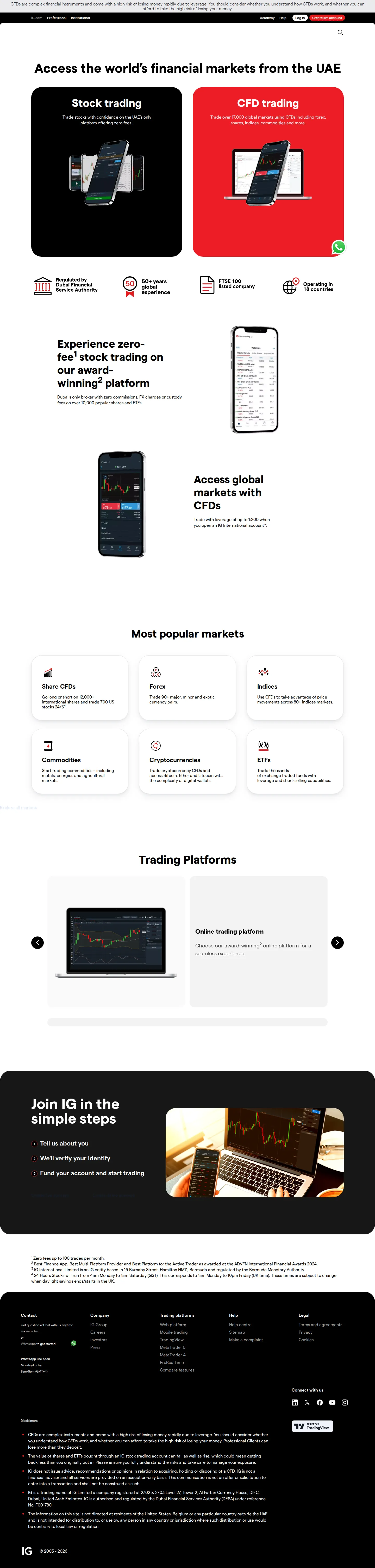
What we saw
Pages captured from IG’s own site when this review was written. Brokers change their terms; these are what we read.

Score history
Recomputed daily; every move is on the record. The current score is always the latest row.
| Date | Score | Move |
|---|---|---|
| 2026-09-18 | 7.9 | ▲ |
| 2026-09-15 | 7.0 | ▲ |
| 2026-09-14 | 6.9 | ▼ |
| 2026-07-25 | 7.4 | ▼ |
| 2026-07-18 | 7.5 | ▼ |
| 2026-07-11 | 7.6 | · |
FAQ
Is IG regulated?
Yes. IG holds three FCA licences (195355, 944492, 114059), a DFSA licence (F001780) and an ASIC AFSL (515106), all confirmed live on their registers.
Has IG had any licence problems?
Its South African FSP 41393 registration is confirmed lapsed, though that entity is being wound down.
What trading platforms does IG offer?
IG offers its own web and mobile platform, MT4, MT5, TradingView integration, ProRealTime charting, L2 Dealer DMA and a documented API.
Are IG's fees clearly disclosed?
Disclosure is extensive and granular, but contains contradictions, such as card-payment cost quoted as both 1%/0.5% and a separate 2.3% charge.
Does IG pay interest on uninvested cash?
No. Interest on idle cash is forfeited entirely in any month where no trades are made.
Does IG have independent reviews or complaint records?
No independent third-party review score or complaint record is available, only IG’s own marketing claims and audited financials.
How this review works
Track IG live: score moves and red notices, in your pocket.