
CRYPTO · CHECKED 13 SEP 2026
Kraken review.
US crypto exchange with quarterly proof of reserves covering client liabilities and verified FCA and CySEC records
RISKY
OUT OF 10
Kraken is among the most transparent large crypto exchanges we have assessed: quarterly proof of reserves covering client liabilities, verified FCA and CySEC records, published contracting entities, and a clean record on returning client funds across four regulator actions that concerned registration and sanctions screening rather than money. The catch is jurisdictional. Outside the UK, EEA, USA, Canada, Australia and Brazil your counterparty is Payward Trading Ltd in the British Virgin Islands, for which Kraken publishes no regulator at all. It suits order-book users in a jurisdiction where Kraken is actually registered; elsewhere it is a well run but unsupervised offshore counterparty, and there is no insurance anywhere.
Each criterion is scored 1 to 10 from primary sources. The overall score is their unweighted mean. How scoring works.
| Founded | 2011 |
|---|---|
| Headquarters | US |
| Maximum leverage | 1:10 |
- Quarterly proof of reserves that covers client liabilities via a Merkle tree, not just on-chain assets
- Publishes working code so a client can independently rebuild their own Merkle leaf and path
- Publishes its own list of what proof of reserves cannot prove, including hidden encumbrances and borrowed funds
- Four FCA records and one CySEC record verified by us against the registers, matching Kraken's own disclosures including company numbers
- Terms name the exact contracting entity for every region, which most exchanges do not publish at all
- No publicly reported loss of customer funds found in our checks, and no withdrawal halt located
- Publishes a restricted-countries list and long per-jurisdiction asset restriction lists rather than leaving them to be discovered
- Discloses that it may keep the spread on instant buys, and that it may benefit from token listings
- Bug bounty programme running nearly a decade, with the June 2024 deposit bug self-disclosed within days
- Roughly forty US state complaint routes published with agency addresses and portals
- Clients outside the UK, EEA, USA, Canada, Australia and Brazil contract with Payward Trading Ltd in the British Virgin Islands, for which Kraken publishes no regulator or licence number
- Kraken states in writing that it is not licensed or regulated in Singapore, and publishes no registration for Indonesia, Thailand, Vietnam, Azerbaijan, the UAE or South Africa
- Instant buy costs 1%, or 1.5% on custom orders, plus an undisclosed spread that Kraken may retain
- Instant buy volume does not count towards the fee tiers that would reduce its cost
- Tier 1 taker fee of 0.80% is high for the category on a small account
- No insurance, no compensation scheme and no ombudsman outside AFCA membership in Australia and US state routes
- Terms concede that a court may subject client digital assets to the claims of Kraken's creditors
- Opt-In Rewards transfers title away from the client, leaving only a contractual claim in insolvency, with returns delayed up to forty-five days
- Proof of reserves covers roughly seven assets and does not name the attesting accountant on the page
- India, Japan and the Philippines are prohibited outright, and Kraken has now exited Japan twice
Overview
Kraken is the trading brand of Payward, Inc., a Delaware-incorporated company that the US Treasury’s Office of Foreign Assets Control described in 2022 as “a Delaware-incorporated virtual currency exchange with operations in the United States and elsewhere”. The site footer carries the line “© 2011 – 2026 Payward, Inc.” and the homepage states “Since 2011”, “$2T+ Total transaction volume” and access to “600+ crypto pairs and 11,000+ stocks and ETFs”.
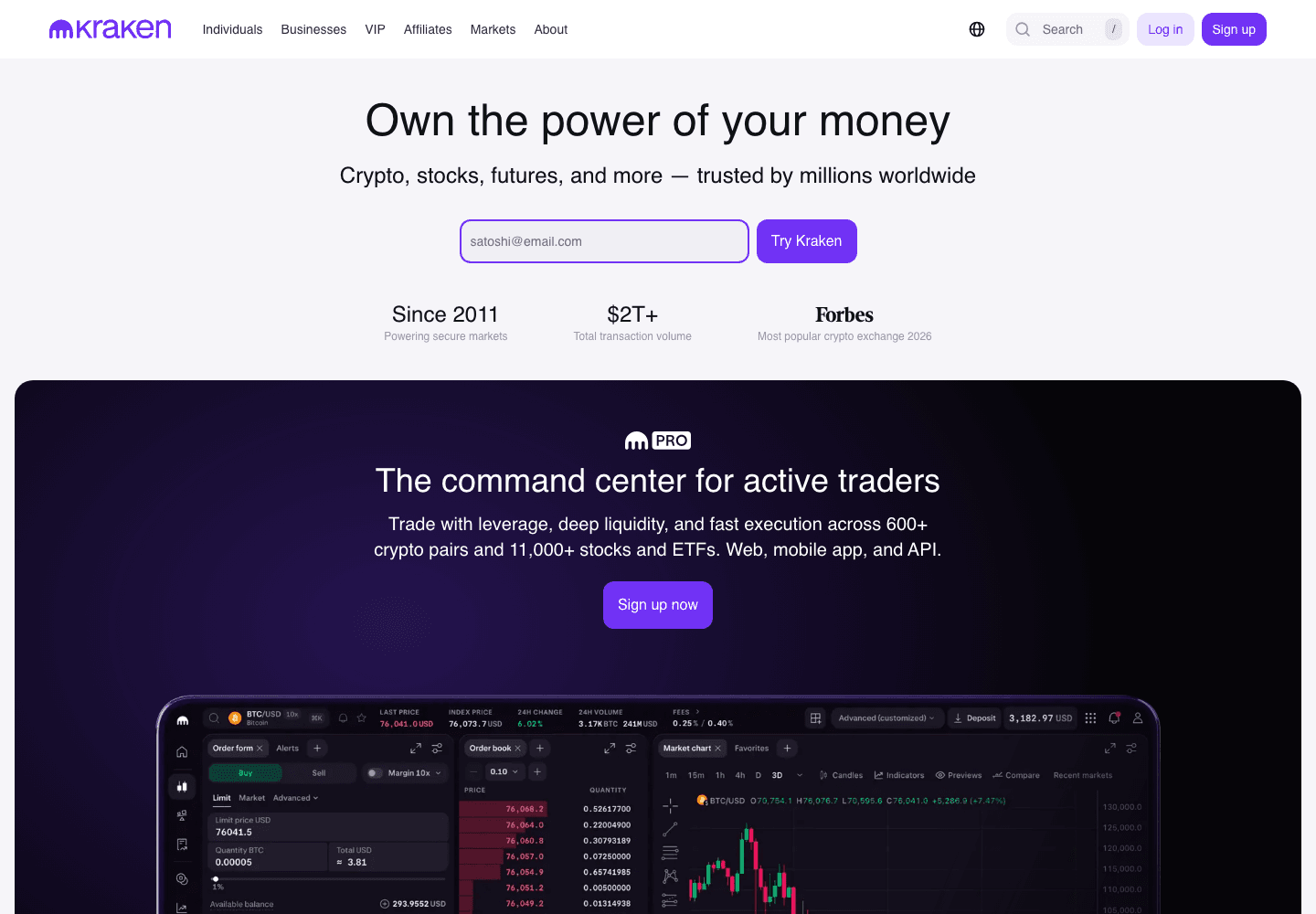
The single fact that matters most is which company you actually contract with, and it is not the one most reviews name. Kraken’s Global Terms of Service list the counterparty by country of residence. If you live in the United Kingdom you contract with Payward Ltd. If you live in the European Economic Area you contract with the Irish entities. If you live in the United States you contract with Payward Interactive, Inc. And if you live “anywhere else in the world where we make our services available (except Canada, or as noted below)”, your counterparty is Payward Trading Ltd, 2nd floor, Water’s Edge Building, Wickhams Cay II, Road Town, Tortola, VG1110, British Virgin Islands.
That covers Indonesia, Thailand, Vietnam, Azerbaijan, the United Arab Emirates, South Africa and most of the rest of the world. We fetched kraken.com from eleven countries and the difference is visible in the footer. From the United Kingdom the page names Payward Ltd and Payward Services Limited with their FCA reference numbers. From Germany it names Payward Europe Solutions Limited and Payward Global Solutions Limited and the Central Bank of Ireland. From Indonesia, Thailand, Vietnam, Azerbaijan, Singapore, India, the UAE and South Africa the footer names no local entity and no regulator at all, only Payward, Inc. and the US brokerage disclosure for Kraken Securities LLC.
Kraken’s own support page confirms the gap rather than hiding it. Under “Rest of World” it lists registrations for exactly four places: Argentina, Australia, Bermuda and Singapore. The Singapore entry reads, in full, “Kraken is not licensed or regulated in Singapore.” For Indonesia, Thailand, Vietnam, Azerbaijan, the UAE and South Africa, Kraken publishes no registration whatsoever. That is not an omission on our part. We checked and there is nothing there to report.
None of that makes Kraken a weak venue. Its verified permissions in the UK, Ireland, Cyprus, Australia, Canada, Bermuda, Argentina and the United States are real, and we confirmed several of them against the registers ourselves. The point is narrower and it is the point a reader in Jakarta or Ho Chi Minh City needs: the licences that make Kraken look well supervised largely do not attach to the company that will be holding your coins.
Overview Table
| Category | Information |
|---|---|
| Operating group | Payward, Inc. (Delaware, USA) |
| Established | 2011 (per site footer and homepage) |
| Entity serving most of the world | Payward Trading Ltd, British Virgin Islands |
| Registered by | FCA (UK), Central Bank of Ireland, CySEC (Cyprus), AUSTRAC and ASIC (Australia), OSC and FINTRAC (Canada), FinCEN and SEC/FINRA (USA), BMA (Bermuda), CNV (Argentina) |
| Custody model | Custodial. Title stays with the client per the Terms; cold and hot wallet mix operated by Kraken |
| Proof of reserves | Yes. Quarterly since March 2025, latest snapshot 31 March 2026, Merkle tree plus on-chain signatures by an independent accountant |
| Incident history | No customer-funds hack found in our checks. One self-disclosed deposit-system bug (19 June 2024). Four regulator actions: CFTC 2021, OFAC 2022, SEC 2023, SEC 2023 case dismissed 2025. One market exit with a forced withdrawal window (Japan, 31 January 2023) |
| Withdrawal halts found | None located. See the caveats in Deposits & Withdrawals |
| Spot fees (Kraken Pro) | 0.40% maker / 0.80% taker at tier 1, falling to 0.00% / 0.10% at $10M 30-day volume |
| Simple buy fee | 1% on instant and recurring trades, 1.5% on custom orders, plus a spread Kraken may retain |
| Pairs and markets | “600+ crypto pairs and 11,000+ stocks and ETFs” per the homepage |
| Platforms | Kraken app, Kraken Pro, Kraken Desktop, Krak, REST and WebSocket API, Kraken CLI |
| Customer support | Stated 24/7 by Kraken. Live chat and email |
| Insurance | None. “Your account and digital assets are not covered by insurance against losses” |
Facts List
- Trading brand of Payward, Inc.; site footer reads “© 2011 – 2026 Payward, Inc.”
- Clients outside the UK, EEA, USA, Canada, Australia and Brazil contract with Payward Trading Ltd in the British Virgin Islands.
- Payward Ltd is FCA registered as a cryptoasset business under the Money Laundering Regulations 2017, FRN 928768. We confirmed this on the FCA register: status Registered, business type “MLD cryptoassets”, Companies House 08593670, effective 23 November 2021. Registration is not authorisation.
- Payward Services Limited holds FCA authorisation as an Electronic Money Institution, FRN 1010381, Companies House 12861311. Confirmed on the register.
- Crypto Facilities Ltd (Kraken MTF) is FCA Authorised, FRN 757895, and CF Benchmarks Ltd is FCA Authorised for benchmark administration, FRN 847100. Both confirmed on the register.
- Payward Europe Digital Solutions (CY) Limited, formerly I.F. Greenfields Wealth Ltd, holds CySEC licence 342/17. Confirmed on the CySEC register, licence date 13 November 2017, company registration 356603.
- Two Irish entities hold MiCA CASP authorisations from the Central Bank of Ireland, registration numbers C468360 and C559106, passported across the EEA.
- Proof of reserves reviews are published for 31 December 2021, 30 June 2022, 31 May 2023, 30 November 2023, 30 September 2024, then quarterly from 31 March 2025 to 31 March 2026.
- Kraken publishes an explicit prohibited-regions list that includes India, Japan and the Philippines alongside the sanctioned jurisdictions.
- There is no deposit insurance and no compensation scheme anywhere in the group, and Kraken says so repeatedly in its own documents.
Key Takeaways
- Your counterparty depends on where you live, and for most of the world it is a British Virgin Islands company. Payward Trading Ltd serves everyone outside the UK, EEA, USA, Canada, Australia and Brazil, and it is regulated: the British Virgin Islands Financial Services Commission lists it as a Currently Regulated VASP under Custody Providers, publishing kraken.com as its website and “Kraken” as its trading name. Kraken’s own pages name no regulator for it, which is a disclosure gap rather than an absence of one.
- The registrations are real where they exist. We independently confirmed four FCA records and one CySEC record against the registers, and the details matched Kraken’s own disclosures exactly, including company numbers.
- Proof of reserves exists, runs quarterly, and covers liabilities as well as assets because client balances go into a Merkle tree that any client can verify their own leaf against. Scope is limited to a handful of assets and Kraken does not name the accountant on the page.
- We found no withdrawal halt. The nearest event, the January 2023 Japan exit, ran to a published schedule with withdrawal limits lifted, and Kraken stated it was “fully funded to ensure all affected clients can withdraw their assets in a timely manner”.
- Four regulator actions are on the record and none of them concerned a failure to return client money. They concerned unregistered margin trading, sanctions screening, unregistered staking, and unregistered exchange status.
- The convenience path is expensive. Instant buy costs 1% plus a spread that Kraken says it may keep and does not publish. Kraken Pro at 0.40% maker and 0.80% taker for a small account is also not cheap for the category.
- There is no insurance and no compensation scheme. Kraken states this in the Terms, in the Disclosures and in the UK footer.
- India, Japan and the Philippines are on Kraken’s own prohibited list, which will surprise readers in two of the largest crypto markets in Asia.
Licences & Custody
Kraken does not hold one licence. It holds a spread of registrations and authorisations across nine jurisdictions, each attached to a different legal entity, and the entity that matters to you is decided by your country of residence. Below is what Kraken publishes, cross-checked against the registers where a searchable register exists.
Entity by jurisdiction
| Authority | Location | Reference | Entity on the record | What it covers | Our check |
|---|---|---|---|---|---|
| FCA | United Kingdom | FRN 928768 | PAYWARD LTD. | Registration as a cryptoasset business under the Money Laundering Regulations 2017. Not authorisation, and no FSCS cover | Verified. Status Registered, “MLD cryptoassets”, Companies House 08593670, effective 23/11/2021 |
| FCA | United Kingdom | FRN 1010381 | PAYWARD SERVICES LIMITED | Authorised Electronic Money Institution. Fiat is held as e-money and safeguarded, not FSCS protected | Verified. Status Registered under EMD, Companies House 12861311 |
| FCA | United Kingdom | FRN 757895 | Crypto Facilities Ltd | Authorised Investment Firm, trading as Kraken MTF, for eligible clients only | Verified. Status Authorised, Companies House 09172128, effective 06/04/2017 |
| FCA | United Kingdom | FRN 847100 | CF Benchmarks Ltd | Benchmark administration | Verified. Status Authorised, Companies House 11654816 |
| CySEC | Cyprus | 342/17 | Payward Europe Digital Solutions (CY) Limited (ex I.F. Greenfields Wealth Ltd) | MiFID investment firm, derivatives and ancillary services | Verified. On the CySEC register, licence date 13/11/2017, company registration 356603, contact address at kraken.com |
| Central Bank of Ireland | Ireland, passported EEA | C468360 | Payward Europe Solutions Limited | MiCA Crypto Asset Service Provider: custody, exchange, order execution, reception and transmission, placing, transfer, portfolio management | Confirmed on the Central Bank of Ireland register, 12 September 2026. Listed as a Payment Services Directive 2 Institution and on the Register of Crypto-Asset Service Providers (MiCAR) |
| Central Bank of Ireland | Ireland, passported EEA | C559106 | Payward Global Solutions Limited | MiCA CASP, operating a trading platform for crypto assets | Confirmed on the Central Bank of Ireland register, 12 September 2026. Listed on the Register of Crypto-Asset Service Providers (MiCAR), authorised under Article 63 of Regulation (EU) 2023/1114 |
| Central Bank of Ireland | Ireland, passported EEA | C453020 | Payward Ireland Limited | E-Money Institution, fiat rails for the EEA | On the Central Bank of Ireland register under reference C453020, checked 12 September 2026. The register’s results page publishes no status column, so this confirms the registration and not that it is currently in good standing |
| AUSTRAC | Australia | ACN 163 237 634 | Bit Trade Pty Ltd | Registered Digital Currency Exchange and Independent Remittance Dealer. Kraken states it does not hold an Australian financial services licence for its digital currency exchange services | Not checked. AUSTRAC’s register was not reachable for us |
| ASIC | Australia | AFSL 545124, AR 001312156 | Beaufort Fiduciaries Pty Ltd, with Bit Trade as authorised representative | Derivatives, wholesale clients only | Confirmed on ASIC’s AFS licensee dataset, 12 September 2026: AFS licence 545124 is held by Beaufort Fiduciaries Pty Ltd, ABN 80162139871, since 9 May 2023 |
| OSC and provincial regulators | Canada | MSB M19343731 with FINTRAC | Payward Canada, Inc. | Registered Restricted Dealer | Not checked |
| FinCEN | United States | MSB 31000270997766, NMLS 1843762 | Payward Interactive, Inc. | Money services business plus roughly forty state money transmitter licences, each listed with its number | Not checked. The state-by-state table is published in full by Kraken |
| SEC and FINRA | United States | See BrokerCheck | Kraken Securities LLC, Kraken Adviser LLC | Broker-dealer and registered investment adviser for equities, US only | Not checked |
| Wyoming Division of Banking | United States | Not published on the page | Kraken Financial | Special Purpose Depository Institution for digital asset custody, eligible states only | Not checked |
| Bermuda Monetary Authority | Bermuda | 202403268 | Payward Digital Solutions Ltd | Class F Digital Asset Business licence | Not checked |
| CNV | Argentina | Not published on the page | Payward Trading Limited, Argentinian Branch | Virtual Asset Service Provider | Not checked |
| BVI FSC | British Virgin Islands | None published | Payward Trading Ltd | Everything, for every country not listed above | Verified 13 September 2026 on the regulator’s own register of regulated entities: Currently Regulated, Custody Providers – VASP and Virtual Assets Exchange. That register publishes no licence numbers, and Kraken publishes no BVI reference of its own |
Read the last row against all the others. Payward Trading Ltd is the contractual counterparty for clients across Southeast Asia, Central Asia, the Middle East and Africa, and it is the only entity in the list for which Kraken itself publishes no regulator, no reference number and no supervisory claim. Correction, 13 September 2026: an earlier version of this review left that standing as though the entity were unregulated. It is not. The British Virgin Islands Financial Services Commission lists Payward Trading Ltd. on its own register of regulated entities as Entity Type “Custody Providers – VASP”, Entity Status “Currently Regulated Entities”, approved for exchange between virtual assets, exchange between virtual assets and fiat currency, safekeeping and administration of virtual assets, and transfer of virtual assets. The register publishes www.kraken.com as the entity’s website and “Kraken” as its trading name, so the identification is the regulator’s rather than an inference of ours. That register publishes no licence number. We had not searched it, and our own rule is that a register is the source of truth and a firm’s silence is not evidence against it. Re-read on the same day, that register carries four currently regulated Payward entities, not one: Payward Trading Ltd., Payward Oceanic Ltd., Payward International Markets, Ltd. and Payward Commercial Ltd., each publishing www.kraken.com, between them covering custody, virtual asset exchange and virtual asset services. The BVI company is also, notably, one of the two entities the SEC charged in February 2023 over the staking programme, so it is not a dormant shell. It is an operating business with a US enforcement history and no published supervision.
Registrations we could not check, and did not treat as absent
We verified the four FCA records and the CySEC record directly. We did not reach searchable registers for the Central Bank of Ireland, AUSTRAC, ASIC, the OSC, FinCEN, NMLS, FINRA BrokerCheck, the Bermuda Monetary Authority or Argentina’s CNV within this review. Those are recorded above as “not checked”, not as “not found”. Kraken publishes specific reference numbers for most of them, which is what makes them checkable by anyone who wants to, and is more than most exchanges offer.
Custody model
Custody is custodial and pooled, not self-custody and not a named third-party sub-custodian for the main exchange. Kraken’s Terms state: “Digital Assets, including Received Assets (as defined in Annex A), held within your account are assets held in custody by us for you. Title to Digital Assets you hold within your account remains with you at all times and does not transfer to us, except as provided herein. None of the Digital Assets in your account or any other customer account are our property, are loaned to us, or are subject to the claims of our creditors.”
The same paragraph then says the quiet part out loud, and it deserves to be read twice: “However, a court may disagree with our treatment of your Digital Assets and subject them to claims of our creditors.” Kraken also states it will not “sell, transfer, loan, hypothecate, or otherwise alienate any Digital Assets in your account unless you instruct us to”, with carve-outs for bonded staking and for collateral posted against OTC options, where Kraken expressly reserves the right to “use, pledge, sell or otherwise rehypothecate” what you post.
There is one further trapdoor worth naming because it is opt-in and easy to click through. Under the Opt-In Rewards Program, assets that Kraken actually uses become “Utilized Opt-In Assets”, meaning “they have been borrowed from you by us, with title to and control of such assets passing to us on a non-custodial basis”. At that moment you stop being a custody client and become an unsecured creditor. Kraken’s own wording is that in an insolvency “participants will have a contractual claim in respect of the return of Utilized Opt-In Assets”. Opt-In Rewards are not available in the UK, Canada or Australia, and are Bitcoin-only in the EEA, which tells you what those regulators made of it.
On security infrastructure, Kraken states ISO/IEC 27001:2022 certification and a completed SOC 2 Type 1 examination, cold and hot wallet storage, and physical infrastructure “in secure cages under 24/7 surveillance by armed guards”. We did not independently verify the certifications. Note that SOC 2 Type 1 tests design at a point in time, not operating effectiveness over a period, which is what Type 2 covers.
Finally, and this applies everywhere: “Your account and digital assets are not covered by insurance against losses. They are not subject to Federal Deposit Insurance Corporation or Securities Investor Protection Corporation protections in the United States or the protections of any comparable organization anywhere in the world.” UK clients get the same message in the footer: cryptoasset services offered by Payward Ltd “are unregulated and not covered by the Financial Services Compensation Scheme”, and UK e-money is safeguarded rather than FSCS protected.
Trading & Execution
Kraken runs a central limit order book. Fees are quoted on a maker and taker basis, which only makes sense on an order book where you can post passive liquidity, and Kraken goes further than most by publishing a negative maker fee of -0.02% at the top tiers of its spot rebate schedule for selected lower-liquidity pairs, described as a structure “designed to improve market structure by stimulating passive liquidity, narrowing spreads, and enhancing overall book depth on recently underperforming pairs”. A venue paying makers to quote is a venue whose revenue comes from flow, not from your losses.
Does the venue trade against its users?
Partly, and Kraken is upfront about where. On the order book you trade against other clients. Away from the order book there are several first-party products where Kraken is your counterparty and says so:
- Instant Buy/Sell, recurring buys and convert. Kraken states: “the price you see includes a spread, the difference between the market rate and the rate you receive” and “Kraken may retain any excess spread from a transaction”. The spread size is not published and Kraken says it “may vary for similar transactions”.
- Request-for-quote pricing on certain services including Telegram chat trading, where “the quoted price is all-inclusive and already reflects Kraken’s spread and fees”.
- OTC options. The Terms say plainly: “You will bear credit exposure to Kraken as your bilateral counterparty under an over-the-counter transaction, rather than having the exposure intermediated by a centralized clearing organization.”
- Margin liquidations. Kraken “may liquidate positions automatically at the current index price of the market”, and these orders “do not go through the order book”. A 3% liquidation fee applies.
That is an honest disclosure set. It is also a real distinction the reader should act on: the order book is one product and the one-click buy button is a different product with a different, undisclosed cost.
Leverage and derivatives
Margin opening and rollover fees are published per asset, at 0.01% to 0.02% for Bitcoin and 0.02% to 0.04% for most others, with rollover charged every four hours and the rate locked at execution. Kraken states positions may be held for unlimited duration while margin requirements are met. The homepage advertises “Up to 10x leverage” on perpetuals with “No expiry. No forced rolls.” Perpetuals carry a 0.25% fee on notional to open and 0.25% to close, and Kraken notes they are “Currently available in certain geos”.
Derivatives access is heavily gated by residence. UK retail clients cannot trade derivatives at all. Canadian clients cannot trade derivatives or use margin. Australian derivatives are wholesale-only through an AFSL holder. That is a pattern worth reading the right way round: the restrictions appear precisely where a regulator is watching.
What we could not check
We could not retrieve Kraken’s Exchange Trading Rules document, which is where matching-engine priority, order-type behaviour and market-abuse rules would be specified. Our fetch of that page was refused by our own fetching provider on a content-category policy, not by Kraken, so this is our gap and not a finding against the venue. We also could not enumerate the incident history on Kraken’s status page, because the page renders its history client-side and the underlying feed was blocked to us. We therefore make no claim about historical uptime in either direction.
Account Types
Kraken does not sell tiered accounts the way a CFD broker does. There is one account, and what changes is which of four interfaces you use, what your residence permits, and which fee tier your volume or balance puts you in.
The four front ends
| Interface | What Kraken says it is for |
|---|---|
| Kraken app | “Smart investing made easy”. Buy, sell, convert, recurring buys, bundles, auto-invest, Kraken+ subscription |
| Kraken Pro | “Unleash your trading potential”. Order book, margin, futures, stocks and xStocks |
| Kraken Desktop | “Supercharged trading” |
| Krak | “Send, spend, grow”. Spend, grow and send cash and crypto |
Fee tiers are the real account structure
Kraken has moved to what it calls cross-platform fee tiers. Your tier “is based on the best of” three measures: 30-day spot volume, 30-day futures volume, or Assets on Platform. Holding a balance can therefore lower your trading fee without you trading at all. Tier 1 starts at $0 and runs to Pro 5 at $500M+ 30-day spot volume, $5B+ futures volume or $100M assets on platform.
Kraken states that volume generated with Instant Buy does not count towards the 30-day volume incentives, and that stablecoin and FX pair trading, plus purchases through the Buy Crypto widget and the Kraken app, do not contribute either. If you use the simple app you will stay on tier 1 indefinitely no matter how much you transact.
Kraken+
Kraken+ is a paid membership that waives trading fees “on up to $10,000 USD (or the local currency equivalent) in monthly trading volume for major currencies (USD, GBP, CAD, AUD, EUR, CHF)”. The waiver applies only to Buy, Sell and Convert on the app or web, and explicitly not to Spot, Futures, API or OTC on Kraken Pro. Kraken adds: “While trading fees are waived, spreads and card processing fees still apply.” Since the spread on those same products is undisclosed and Kraken may keep any excess, a zero-fee claim on a spread-priced product is worth reading carefully. We did not find the price of the Kraken+ subscription on the pages we fetched.
Verification
Kraken states that “Some account features are only available at certain verification levels” and, separately, that “Clients in Canada will need to verify their account”. We did not retrieve a published table of verification tiers and their limits, so we are not stating one.
Proof of Reserves
Kraken has run proof of reserves longer than almost anyone in the sector and publishes it as a standing feature rather than a crisis response. This is the strongest single item on its record and it is worth setting out precisely, including the limits.
What exists
| Item | What Kraken publishes |
|---|---|
| Latest snapshot | 31 March 2026 |
| Cadence | Quarterly since March 2025. Earlier reviews are dated 31 Dec 2021, 30 Jun 2022, 31 May 2023, 30 Nov 2023, 30 Sep 2024 |
| Who performs it | “an independent 3rd party accountant”. The firm is not named on the page. The report is hosted on a third-party attestation platform |
| Assets in scope | Stated as Bitcoin, Ether, Solana, USD Coin, Tether and Ripple. The ratio tiles also show ADA |
| Reserve ratios at 31 March 2026 | BTC 101.6%, ETH 100.9%, SOL 101.1%, USDC 105%+, USDT 105%+, XRP 101.3%, ADA 100.1% |
| Balances covered | Spot, on-chain staking, margin positions and, since May 2023, futures collateral with its own Merkle leaf |
Does it cover liabilities, or only assets?
It covers both, and that is the question most exchanges fail. The procedure aggregates every client balance into a Merkle tree, which is the liability side, then collects Kraken’s digital signatures proving control of on-chain addresses, which is the asset side, and the accountant “compares and verifies that these balances exceed or match the client balances represented in the Merkle tree”. Any client can then verify their own balance was in the tree. Kraken publishes the hashing steps in pseudocode and working examples in Python, Rust, Go and shell so that a client can rebuild their own Merkle leaf and path rather than trusting Kraken’s viewer. That is a genuinely high standard of transparency and very few venues match it.
The limits, in Kraken’s own words
Kraken publishes its own shortcomings section, which is unusual and to its credit. It states that a proof of reserves “cannot prove exclusive possession of private keys that may have theoretically been duplicated by an attacker”, that “the procedure cannot identify any hidden encumbrances or prove that funds had not been borrowed for purposes of passing the review”, that “keys may have been lost or funds stolen since the latest review”, and that “the accountant must be competent and independent to minimize the risk of duplicity on the part of the examinee or collusion amongst the parties”. Elsewhere Kraken adds: “There are no formally accepted rules or procedures that define a proof of reserves audit.”
Our own caveats
- Scope, not solvency. Roughly seven assets are in scope out of a listed universe Kraken describes as “600+ crypto pairs”. A ratio above 100% on BTC says nothing about the other several hundred tokens, and nothing about the group’s overall balance sheet.
- The accountant is not named on the page. Kraken’s own shortcomings text makes competence and independence of that accountant load-bearing, so declining to name them on the same page is a real gap. We did not open the hosted report to identify the firm and are therefore not naming one.
- A snapshot is a snapshot. The 31 March 2026 figure describes 31 March 2026.
- There was a cadence gap. Between 30 November 2023 and 30 September 2024 there is no published review, and another between September 2024 and March 2025. The quarterly rhythm only starts in March 2025.
Set against the rest of the sector, this is close to best practice. It is not an audit of Kraken’s solvency and Kraken does not claim it is.
Listed Assets
Kraken’s homepage states access to “600+ crypto pairs and 11,000+ stocks and ETFs”. The fee schedule confirms distinct markets for spot crypto, stablecoin and pegged token and FX pairs, USDG pairs, USDe pairs, margin, perpetuals, futures, US equities and tokenized equities branded xStocks. We did not find a single published count of listed assets as opposed to pairs, so we are not stating one.
Market segments Kraken publishes fees for
| Segment | Notes |
|---|---|
| Spot crypto | Maker and taker order book, cross-platform tier system |
| Stablecoin, pegged token and FX pairs | Applies to pairs like USDT/USD, DAI/USDT, TBTC/BTC, WBTC/BTC and EUR/USD. Flat 0.20% maker and taker at the bottom tier |
| USDG pairs | 0.00% maker, 0.01% taker, where USDG is the base currency |
| USDe pairs | Zero fee campaign stated to run until 30 June 2026 |
| Margin | Per-asset opening and rollover fees, charged every four hours |
| Perpetuals | 0.25% to open and 0.25% to close on notional |
| US equities and ETFs | “Zero commission”, US only, via Kraken Securities LLC |
| xStocks | Tokenized equities. No trading fee when bought with USDG or USD, otherwise the standard 1% instant buy fee, plus a possible spread |
| On-chain staking | No transaction fee to stake or unstake. 20% commission on rewards for flexible staking on assets with an unbonding period and for the Rewards program |
Who decides what is listed, and what gets taken away
Kraken discloses two conflicts on the listing side that most venues do not put in writing. First, on related parties: “There may be instances when an individual or individuals acting on Payward’s behalf is an investor, directly or indirectly, in certain tokens, and therefore may benefit from Kraken’s listing such tokens on the platform.” Second, on issuer payments: “Kraken may receive direct or indirect benefits associated with certain tokens it lists on the exchange due to agreements it enters into with issuers related to assisting with marketing, technical integration, provision of liquidity for, or other services relevant to particular tokens.” In both cases Kraken states that all tokens go through “the same strict review process and guidelines”. The review process itself is not published on the pages we fetched, so the disclosure is meaningful but the criteria are not verifiable.
On delisting, the Terms reserve the right in broad language: “Certain Digital Assets or services may not be available or may only be available in certain jurisdictions. We also may stop supporting certain Digital Assets or may stop providing certain services.” Changes “may be made at any time, with or without notice”.
Availability is aggressively fragmented by residence
This is the practical point. Kraken publishes long, explicit lists of assets that specific jurisdictions cannot deposit, hold or trade. UK clients cannot deposit or trade BDX, LCAP, TREMP, WAR and XMR, and cannot buy or sell HNT. EEA clients face a list of well over a hundred tickers, with a further subset restricted in Germany only. Canadian and US lists run to several hundred tickers each. Australian clients cannot deposit, hold or trade a list including DASH, XMR and ZEC. Kraken publishes all of these openly, which is the right behaviour, and it means the headline pair count is not what any individual reader will actually see.
Education & Analysis
Kraken publishes a large amount of free educational and market material. What we can verify is its existence and structure from the site itself, so that is what we describe.
- Learn section. The footer carries a “Crypto Education” column with explainers including “What is cryptocurrency?”, “What is Bitcoin?” and “What is Ethereum?”, plus a general “Learn crypto” hub and a set of buying guides.
- Price and market pages. Kraken publishes per-asset price pages, crypto categories, an “All crypto prices” index, “All crypto markets” and a “Price predictions” section. A reader should treat a price-prediction page on an exchange’s own site as marketing, not analysis.
- Comparison pages. Kraken hosts its own “Kraken vs Coinbase”, “Kraken vs Binance”, “Best Crypto Exchanges” and “Best Crypto Futures Platforms” pages. These are the venue writing about itself.
- Kraken Blog. Categorised by News, Security, Asset Listings, Margin, Economic Brief and regional sections. We saw dated market commentary posts including an “Economic Brief” on non-farm payrolls and CPI.
- Kraken Security Labs. Kraken states it tests third-party products and has “a track record of discovering and reporting security vulnerabilities to other crypto vendors, including Ledger and Trezor”.
- Developer material. A Kraken API centre, a developer site, and a Kraken CLI positioned for AI agents.
- Proof of reserves documentation. Worth naming here as education rather than marketing: the verification walkthrough includes working code in four languages so a client can rebuild their Merkle leaf independently.
What we did not find, and are therefore not claiming, is any independent research desk output, any published trade ideas with tracked outcomes, or any charting specification. On the marketing side, note that Kraken’s homepage cites a Forbes Advisor “best crypto exchanges” award for 2024 and a “Most popular crypto exchange 2026” claim. We have not verified either and, as a matter of policy, third-party award badges are not evidence we score on.
Special Offers
Kraken runs several promotional and rewards programmes. Some are ordinary marketing. At least one changes your legal position, and that is the one to read.
Programmes Kraken publishes
- Kraken+. Paid subscription waiving trading fees on up to $10,000 monthly volume through Buy, Sell and Convert on the app or web only. Spreads and card processing fees still apply. Not applicable to Kraken Pro spot, futures, API or OTC.
- USDe zero fee campaign. 0.00% maker and taker on orderbook USDe pairs, stated to run “until the 30th June, 2026”.
- USDG pairs. 0.00% maker and 0.01% taker where USDG is the base currency, described by Kraken as promoting USDG “within the Kraken ecosystem”.
- Spot maker rebate. Negative maker fees down to -0.02% on selected lower-liquidity pairs at higher tiers.
- Staking rewards. No fee to stake or unstake; a 20% commission on rewards for flexible staking on assets with an unbonding period.
- Kraken Points, Krakbacks, Kraken Drops and an affiliate programme. Kraken reserves the right to “withhold, adjust, reverse, or cancel Points at any time” at its sole discretion, and states that Points “do not constitute property and title to Points does not pass to you”. UK clients cannot get Krakbacks or take part in Kraken Drops.
The one that is not really a promotion
The Opt-In Rewards Program pays a yield, and it is the only offer here that moves your assets out of custody. Kraken’s own text distinguishes “Unutilized Opt-In Assets”, which “remain your property, and are held on a custodial basis and segregated from Kraken’s own assets”, from “Utilized Opt-In Assets”, which “have been borrowed from you by us, with title to and control of such assets passing to us on a non-custodial basis”. Returning utilised assets “may be subject to a delay of up to forty-five calendar days”. In insolvency, participants get “a contractual claim”. Kraken states it maintains “robust risk management and asset segregation practices”, which is a statement of intent rather than a protection.
This is a lending product presented in the rewards menu. It is not available in the UK, Canada or Australia, and in the EEA it is limited to Bitcoin. The pattern of where it is banned is the most useful piece of information about it.
We have no commercial relationship with Kraken and no affiliate link is set on this review.
Opening an Account
Account opening is self-service through kraken.com or the Kraken app. The eligibility rules that decide whether you can open one at all are set out in the Global Terms of Service, last updated 1 July 2026.
What you must be able to say is true
Kraken’s eligibility clause requires, among other things, that you “not have been restricted from using our services” and that you are not “located in, under the control of, or resident in” and, for an entity, not “directly or indirectly owned or controlled by any person located in, under the control of, or organized or resident in” any “sanctioned or embargoed jurisdiction (including Crimea, Cuba, Donetsk, Iran, Luhansk, North Korea, Russia, Belarus, and Syria), or any jurisdiction where we may have restricted use of any services”.
What contracting actually means
The step most readers skip is the one that decides everything else. By opening the account you agree to the Terms with a specific company, chosen by your country of residence. For most of the world that company is Payward Trading Ltd in the British Virgin Islands. You also agree to Kraken’s Exchange Trading Rules by the same act, and the Terms state they “may change at any time and without notice”, with continued use counting as consent. Dispute resolution under the Global Terms is by arbitration, and Kraken warns that “the manner in which you can seek relief may be limited”.
Verification and holds
- Kraken states that some account features are only available at certain verification levels.
- New UK retail accounts are subject to “a mandatory 24-hour cooling-off period before trading can begin”, which Kraken attributes to UK regulatory requirements.
- Certain funding routes trigger a withdrawal hold on the whole account, not just the deposited amount: 72 hours for ACH, PayPal, debit or credit card and digital wallet purchases, and 7 days for cash deposits via ACH Plaid. Kraken states this “applies to all crypto and fiat withdrawals”. US debit and credit card purchases in USD “may always be subject to the 72-hour hold, not just the first transaction”.
- Kraken states clients in Canada must verify their account.
Where you cannot open one
See the Restricted Countries section. Kraken publishes a prohibited-regions list that includes India, Japan and the Philippines as well as the sanctioned jurisdictions, and separately notes that clients in Yemen, Lebanon, Myanmar and Pakistan may be able to create an account but restricted from funding it. We did not retrieve the source page for that last item within this review and flag it as unverified rather than dropping it silently.
We did not test the onboarding flow and we do not state an account opening time.
Deposits & Withdrawals
This is the section that decides a crypto review, so we have been strict here about what we can and cannot show.
Withdrawal halt history
We found no evidence of Kraken halting client withdrawals. That statement is worth qualifying precisely, because a clean-looking record can be an artefact of not looking properly.
What we checked: Kraken’s own status page and its incident feed, its blog, its legal disclosures, its terms, and the enforcement records of the CFTC, the SEC and OFAC. What we could not check: the status page renders its incident history client-side and the underlying feed was refused to our fetching provider on a robots policy, so we could not enumerate historical incidents. We therefore cannot claim Kraken has never had an outage or a temporary funding pause, and we do not.
The nearest thing to a forced withdrawal event is documented and went the right way. On 24 January 2023 Kraken confirmed it would “cease its operations in Japan and deregister from the Financial Services Agency (JFSA) as of January 31, 2023”. Deposits were switched off from 9 January, trading stayed open so clients could convert, and, in Kraken’s words, “withdrawal limits have been removed for the month of January to ensure you can remove your assets from Kraken”. Kraken also stated: “Kraken is fully funded to ensure all affected clients can withdraw their assets in a timely manner.” Anything left after 1 February was converted to yen and lodged with the Legal Affairs Bureau, after which clients had to recover it from the Bureau rather than from Kraken. Staked ETH could not be unstaked before the Ethereum Shanghai upgrade, so those clients were given a further one-month window afterwards. That is a wind-down handled to a published schedule with the limits lifted, which is the opposite of a halt, and it is the second time Kraken has left Japan, the first being in 2018.
Security and enforcement record
| Date | Event | Source |
|---|---|---|
| 28 September 2021 | CFTC order against Payward Ventures, Inc. d/b/a Kraken. $1.25 million civil penalty for offering margined retail commodity transactions in digital assets off-exchange to non-eligible-contract-participant US customers and acting as an unregistered futures commission merchant | CFTC press release 8433-21 |
| 28 November 2022 | OFAC settlement with Payward, Inc. Kraken remitted $362,158.70 for apparent violations of sanctions against Iran, “due to Kraken’s failure to timely implement appropriate geolocation tools”, and agreed to invest a further $100,000 in sanctions compliance controls | OFAC recent action 20221128 |
| 9 February 2023 | SEC charged Payward Ventures, Inc. and Payward Trading Ltd. over the staking-as-a-service programme. The two entities agreed to stop offering it and to pay $30 million in disgorgement, prejudgment interest and civil penalties | SEC press release 2023-25 |
| 20 November 2023 | SEC sued Payward, Inc. and Payward Ventures, Inc. for operating as an unregistered securities exchange, broker, dealer and clearing agency | SEC litigation release 25896 |
| 27 March 2025 | SEC filed a joint stipulation to dismiss that case with prejudice, stating the decision “rests on its judgment that the dismissal will facilitate the Commission’s ongoing efforts to reform and renew its regulatory approach to the crypto industry, not on any assessment of the merits” | SEC litigation release 26278 |
| 19 June 2024 | Kraken disclosed that it “patched an isolated bug in our deposit and funding systems” which “allowed certain users, for a short period of time, to artificially increase the value of their Kraken account balance without fully completing a deposit”. Kraken states the issue was mitigated “in less than an hour” and that “No client assets were impacted or vulnerable leading up to this disclosure”, and that the researchers who found it exploited it “for financial gain before reporting it” | Kraken blog, 19 June 2024 |
Read as a set: four regulator actions in four years, none of which concerned a failure to return client money. Three were about operating without the right registration and one was about sanctions screening. That is a materially different risk profile from an exchange with a funds-return problem, and the distinction is the whole point of this section.
We found no publicly reported breach in which Kraken lost customer funds. We did not find a Kraken page asserting a clean record either, so we state it as the result of our search rather than as a fact Kraken publishes.
Fiat rails
| Currency | Route | Availability Kraken states | Minimum | Deposit fee |
|---|---|---|---|---|
| USD | SWIFT (Customers Bank) | Worldwide, subject to provider limits | 100 USD | Free |
| USD | SWIFT (Bank Frick) | Worldwide, subject to provider limits | 4 USD | 3 USD |
| EUR | SEPA and SEPA Instant (Plaid, Banking Circle, Ivy, Bank Frick) | SEPA area | 1 EUR | Free |
| EUR | SEPA and SEPA Instant (Openpayd) | Worldwide, subject to provider limits | 1 EUR | Free |
| EUR | Debit card | EEA | 10 EUR | 0.25 EUR + 3.75% |
| EUR | iDeal | Netherlands | 10 EUR | Free |
| GBP | Faster Payments (Plaid, Banking Circle, Openpayd) | UK, and worldwide for Openpayd subject to provider limits | 1 to 2 GBP | Free |
| GBP | Debit card | UK only | 10 GBP | 0.25 GBP + 3.75% |
| CAD | e-Transfer, domestic wire, Apaylo bill pay, debit card | Canada only | 1 to 100 CAD | Free to 0.25 CAD + 3.75% |
| AUD | Bank transfer / Osko, PayPal, RTGS | Australia only | 1 to 100 AUD | Free to 33 AUD |
The shape of that table is the story. Almost every cheap rail is tied to a specific country or to SEPA. For a reader in Indonesia, Vietnam, Azerbaijan or South Africa the realistic fiat routes are SWIFT through Bank Frick or Customers Bank, or Openpayd where the provider permits it, and Kraken notes that Bank Frick fees “may vary depending on the geographic location used to register your Kraken account”. Kraken also states that “Our funding providers may, at their own discretion, deny funding to certain geographical locations” and that some regions cannot use cards at all. Debit card funding at 3.75% plus a fixed charge is expensive on any measure.
Withdrawal fees and holds
Kraken does not publish a single crypto withdrawal fee. Its stated policy is that “Kraken’s deposit and withdrawal transaction fees are based on the method and currency used”, that fees can be “Static (fixed) and Dynamic (variable)”, that they may be “coin-denominated or percentage-based”, and that “Fees displayed upon confirmation of a transaction are always the fees incurred by clients”. Kraken also reserves the right to adjust them “in response to changes in the underlying costs, market conditions, or user activity”. We attempted to retrieve the per-asset crypto withdrawal fee table and did not obtain it, so we publish no per-coin figure. Fiat withdrawal fees follow the same per-rail pattern as deposits, for example 3 GBP, 3 EUR or 3 USD on the SWIFT Bank Frick route.
The holds are documented and worth planning around: 72 hours after ACH, PayPal, card or digital wallet funding, and 7 days after ACH Plaid, applied to all crypto and fiat withdrawals from the account.
Customer Support
Kraken states that its “customer support team is available 24/7” and lists “High priority 24/7 live chat and email support for urgent concerns” among its security features. The site carries a Support Center and a separate Complaints route in the footer. We did not test response times and make no claim about them.
Channels we can evidence
- Live chat and email, stated by Kraken as 24/7.
- Support Center with dated articles. The two we retrieved carried “Last updated” dates of 17 July 2026 and 21 July 2026, which is a good sign for a documentation set that has to track a fragmented product.
- Complaints page linked from the global footer.
- US telephone line. The disclosures give 1-888-720-8670 for complaints about Payward Interactive, Inc. and Payward Financial, Inc.
- PGP signed and encrypted email for secure communication, per the security page.
- Status page at status.kraken.com with email, SMS, Slack, webhook, Atom and RSS subscription options.
Escalation, which is where support actually matters
Recourse is entirely a function of which entity you contracted with, and the difference is stark.
| Where you live | What escalation exists beyond Kraken |
|---|---|
| United States | Kraken publishes a state-by-state complaints table naming the responsible agency, its address and its complaint portal for roughly forty jurisdictions, including Nebraska, Kansas, Wisconsin and Wyoming. This is unusually thorough and it exists because state money transmitter law requires it |
| Australia | Kraken states it “is a member of the Australian Financial Complaints Authority (AFCA) and the general consumer protections apply” |
| United Kingdom | Explicitly none for the crypto side. Kraken states you “will not be protected by the Financial Ombudsman Service or the Financial Services Compensation Scheme and you will have no recourse to the above-mentioned services in the event of a complaint relating to Kraken’s cryptocurrency services” |
| EEA | MiCA authorised entities under Central Bank of Ireland supervision, so a supervisor exists even though no compensation scheme does |
| Rest of world | Payward Trading Ltd, British Virgin Islands, regulated there as a VASP by the BVI Financial Services Commission although Kraken itself names no regulator for it. No ombudsman, no compensation scheme. The Global Terms require arbitration and state that “the manner in which you can seek relief may be limited” |
That last row is the honest answer to “what happens if support says no” for the majority of Kraken’s addressable market, and no competitor states it plainly.
Incident response
Weighted for incident response, as a crypto review should be, the record is decent. Kraken runs a bug bounty programme it describes as having been “in operation for nearly a decade”, publishes a vulnerability disclosure policy and a security.txt file, and in the June 2024 deposit-system bug states a “cross-functional effort at Kraken mitigated the issue in less than an hour” followed by a public post the same week. It also declined to pay the researchers and said why. Whatever one makes of that dispute, disclosing an exploited bug at all, on your own blog, within days, is behaviour worth crediting.
Languages
The site served us an English language switcher on every fetch and returned a fully translated German page from the German vantage, so multilingual support clearly exists. We did not retrieve the full list of supported languages and do not state a count.
Restricted Countries
Kraken publishes a restricted-countries list, which is rarer than it should be. We quote it rather than paraphrase it, and we add nothing to it.
Prohibited regions, as published by Kraken
Under the heading “Prohibited Regions”, Kraken’s support page states: “We do not serve clients, or permit cash and crypto deposits, from the following regions:”
- Afghanistan
- Belarus
- Crimea, Donetsk, and Luhansk regions of Ukraine
- Cuba
- Democratic Republic of the Congo
- India
- Iran
- Iraq
- Japan
- Libya
- North Korea
- Philippines
- Russia
- Sudan
- South Sudan
- Syria
That page was last updated 21 July 2026. India, Japan and the Philippines are the entries most readers will not expect, and they are not sanctions cases. Three large Asian crypto markets are simply not served. Kraken previously operated in Japan under Payward Asia and deregistered from the JFSA on 31 January 2023.
The sanctions clause in the Terms
Separately, the Global Terms of Service require that you are not located in, controlled from or resident in “any sanctioned or embargoed jurisdiction (including Crimea, Cuba, Donetsk, Iran, Luhansk, North Korea, Russia, Belarus, and Syria), or any jurisdiction where we may have restricted use of any services”. Note the word “including”. That clause is not exhaustive and the two lists do not match each other exactly, which is a drafting artefact rather than a contradiction.
Not prohibited, but not served the same way either
Kraken layers three further kinds of restriction on top of the outright bans, and all three are published:
- Sub-national bans. In the United States, Kraken “does not offer services to residents of” Maine and New York. Crypto transfers via Krak are unavailable in Indiana; fiat transfers are unavailable in Indiana, Louisiana, Massachusetts and Utah. Residents of Texas and New Hampshire cannot hold or trade EUR pairs.
- Asset-level bans by residence. Long published lists for the UK, EEA, Germany specifically, Canada, the US and Australia, as described in Listed Assets.
- Product-level bans by residence. Derivatives are closed to UK retail and Canadian clients and are wholesale-only in Australia. Opt-In Rewards are closed in the UK, Canada and Australia and Bitcoin-only in the EEA. DeFi Earn is unavailable in Argentina, Australia, Bermuda, Singapore and the UK. xStocks are unavailable in the UK, Canada and Australia. Margin is closed to Canadian clients.
What we could not verify
We saw a secondary report that clients in Yemen, Lebanon, Myanmar and Pakistan can open an account but may be restricted from funding it. We did not reach the Kraken page stating that, so we flag it as unverified and it does not form part of the list above. We also did not verify any funding-provider-level country list; Kraken states only that “Our funding providers may, at their own discretion, deny funding to certain geographical locations” and that card funding is unavailable in some regions.
Conclusion
Kraken scores 5.7 out of 10, which places it in the band our catalogue uses for venues that are workable but where the entity actually onboarding you is weaker than the headline regulation suggests. For a crypto exchange that is a good outcome, and the reasoning is worth spelling out because a reader who only reads the number will misread it.
What Kraken does better than most of the sector
The proof of reserves programme is close to best practice. It runs quarterly, it covers liabilities as well as assets through a client-verifiable Merkle tree, it publishes working code so a client can rebuild their own leaf without trusting Kraken’s interface, and Kraken publishes its own list of what the procedure cannot prove. Very few venues do the last part at all.
The disclosure discipline is likewise unusual. Kraken publishes which company you contract with by country, roughly forty US state licence numbers with the complaint route for each, the conflicts on its own token listings, the fact that it may keep the spread on instant buys, and the fact that opted-in rewards assets stop being yours. None of that is flattering and all of it is on the site.
And the record on client funds is clean as far as we can establish. Four regulator actions across four years, all about registration or sanctions screening, none about failing to return money. One self-disclosed deposit bug, disclosed by Kraken within days. One market exit, run to a published timetable with withdrawal limits lifted.
What holds the score where it is
First and most important: if you live outside the UK, the EEA, the USA, Canada, Australia or Brazil, your counterparty is Payward Trading Ltd in the British Virgin Islands, and Kraken publishes no regulator, no licence number and no supervisory claim for it. It is supervised nonetheless: the British Virgin Islands Financial Services Commission lists it as a currently regulated VASP, which we established by searching that register rather than by reading anything Kraken publishes. What is missing is the disclosure, not the licence. Beyond that entity, every one of the registrations that makes Kraken look well supervised attaches to a different company. For Singapore, Kraken says so in one sentence: “Kraken is not licensed or regulated in Singapore.” For Indonesia, Thailand, Vietnam, Azerbaijan, the UAE and South Africa it says nothing at all, because there is nothing to say. That is not a hidden fact but it is a buried one, and it is the fact most likely to matter if something goes wrong.
Second, the cost of the easy path. Instant buy at 1%, or 1.5% on custom orders, plus a spread that Kraken does not publish and may keep, is a materially worse deal than the order book, and volume transacted that way does not even count towards the fee tiers that would make it cheaper. A small account on Kraken Pro pays 0.80% to take, which is not competitive for the category.
Third, there is no insurance, no compensation scheme and no ombudsman anywhere in the group outside Australia’s AFCA membership and the US state complaint routes. Kraken states this itself, more than once.
What we could not check
We could not enumerate Kraken’s historical incident record, because the status page renders it client-side and the feed was blocked to our fetching tool. We could not obtain the Exchange Trading Rules, blocked at our end rather than Kraken’s. We did not obtain the per-coin crypto withdrawal fee table, the Kraken+ price, a verification tier table, or a language count. We did not verify the Central Bank of Ireland, AUSTRAC, ASIC, OSC, FinCEN, NMLS, FINRA, BMA or CNV entries against their registers, and we have recorded those as not checked rather than not found. We have no verified user complaint data of our own, so the reviews criterion is scored neutrally.
Who it suits
Kraken suits someone who intends to use the order book rather than the buy button, who understands they are holding assets with a custodian rather than in their own wallet, and who is in a jurisdiction where Kraken holds a real registration. For a reader in the UK, Ireland, the EEA, the US, Canada or Australia there is a named supervisor and, in some cases, a named complaints body. For a reader elsewhere the proposition is a well run, transparent, unsupervised BVI counterparty, and that trade should be made knowingly. It is not a criticism of Kraken that it is unlicensed in Indonesia; almost nothing is. It is a criticism of every review that does not tell you.
Nothing here is advice and nothing here is a guarantee. Digital assets can lose value quickly, Kraken states there is no insurance against loss, and this review is a safety assessment rather than a recommendation to trade.
Score history
Recomputed daily; every move is on the record. The current score is always the latest row.
| Date | Score | Move |
|---|---|---|
| 2026-09-13 | 5.7 | ▲ |
| 2026-09-13 | 5.6 | ▼ |
| 2026-09-13 | 5.9 | ▼ |
| 2026-09-12 | 6.2 | ▼ |
| 2026-07-27 | 6.6 | · |
How this review works
Track Kraken live: score moves and red notices, in your pocket.