
CRYPTO · CHECKED 13 SEP 2026
Bitso review.
Latin American crypto exchange, US stocks and cross border transfers, with local payment entities and a Gibraltar crypto arm.
OK-ISH
OUT OF 10
Bitso is a Latin American crypto exchange running local currency rails in four countries, but the CNBV licence Mexicans see covers Nvio Pagos Mexico's peso wallet and mentions no crypto asset at all. Every coin sits with The Badger Technology Company Limited in Gibraltar, verified on the GFSC register with custody and venue permissions. Bitso Alpha is a real order book; on Bitso Quotes, Bitso International is the sole counterparty and its own risk annex calls your balance an unsecured contractual claim. Nothing is insured. Suits LATAM users who want working local rails and read the disclosures.
Each criterion is scored 1 to 10 from primary sources. The overall score is their unweighted mean. How scoring works.
| Founded | 2014 |
|---|---|
| Headquarters | MX |
| Maximum leverage | 1:3 |
| Platforms | Bitso app (iOS), Bitso app (Android), bitso.com web, Bitso Alpha web, Bitso Alpha mobile app, Bitso public REST API |
- GFSC register entry matches the domain bitso.com, not just a similar name
- Gibraltar permission names custody, a secondary market venue and staking explicitly
- Nvio Pagos Mexico verified as IFPE 65-001 on the CNBV's own supervised entities register
- Two Argentine entities verified on their own registers: CNV PSAV 164 for crypto and BCRA code 34502 for payments
- Monthly zk-SNARK proof of solvency published to Ethereum, with per user Merkle verification
- Full maker and taker ladders published per quote currency, with no hidden tier structure
- Bitso Alpha is a genuine central limit order book with TradingView charts and an open REST API
- Help centre documents liquidation thresholds, withdrawal blocks and SIPC gaps candidly
- Status page posts incidents live in three languages, with scheduled maintenance announced ahead
- Mexican users get a statutory UNE complaint channel and CONDUSEF escalation for peso matters
- The Mexican licence covers the peso wallet only; its contract never mentions a virtual asset
- Crypto contracting entity is Gibraltar based, with no compensation scheme reaching a client
- Bitso Quotes and xStocks balances are unsecured contractual claims on a Gibraltar company, per its own risk annex
- Stablecoins enrolled in Earnings become Bitso International's property outright
- Proof of solvency covers only BTC and ETH, and excludes staked balances
- Entry tier peso trading costs 0.780% taker, and the in-app spread is never published as a number
- Published clause allows discretionary suspension of withdrawals in exceptional market conditions
- One contract in two languages: the English prohibited list names the United Kingdom, the Spanish one does not
- Crypto disputes go to individual binding arbitration with a class action waiver
- Bitso's own status feed logs 21 deposit or withdrawal affecting incidents between December 2025 and August 2026
Overview
Bitso is a Latin American crypto exchange founded in Mexico in 2014, with local payment entities in Mexico, Argentina, Brazil and Colombia and a US stock product in Mexico. The brand is Mexican. The company you actually contract with for crypto is not. Every crypto trade, balance and withdrawal on bitso.com runs through The Badger Technology Company Limited, a Gibraltar private company registered under number 117775 and trading as Bitso International, which we confirmed on the Gibraltar Financial Services Commission’s own register on 12 August 2026.
Mexico’s Fintech Law does sit underneath the product, but not where most readers assume. Nvio Pagos Mexico, S.A.P.I. de C.V., Institucion de Fondos de Pago Electronico is a fully authorised electronic payment funds institution with key 65-001 on the CNBV’s Padron de Entidades Supervisadas. Its terms of use, 44,443 characters as its own legal API serves them, do not contain the words cripto, activo virtual or bitcoin even once. It covers the peso wallet and SPEI transfers. It does not cover a single coin.
That split is not sloppiness, it is Banco de Mexico’s design. Banxico’s own published position states that authorised payment institutions “no pueden ofrecer servicios de compraventa e intercambio de activos virtuales” and that Mexicans may buy and sell crypto “bajo el riesgo de quien decida realizar dichas operaciones y con la claridad de que no estan respaldados por alguna institucion financiera”. A Mexican user therefore holds pesos with a CNBV supervised institution and coins with a Gibraltar company, and only one of those two facts is on the marketing.
Overview Table
| Headquarters | Mexico City (Rio Lerma 232, piso 24, Cuauhtemoc, on the CNBV register’s entity detail page and in Nvio’s own terms). Crypto contracting entity registered in Gibraltar |
| Established | 2014 (Bitso brand). Badger Technology incorporated in Gibraltar 21 August 2018; Nvio authorised by CNBV in 2020 |
| Countries Served | Bitso’s own catalogue leaves account creation open in 22 of 249 countries. Retail products are built for Mexico, Argentina, Brazil and Colombia |
| Regulated By | GFSC Gibraltar (DLT provider, crypto). CNBV Mexico (Nvio, e-money only). CNV Argentina (PSAV register no. 164). BCRA Argentina (Nvio Argentina, payment accounts register code 34502). Banco Central do Brasil (payment institution, per the firm, unverified by us) |
| Minimum Deposit | No account minimum published. ACH deposits must exceed the 2.99 USD fee; wires must exceed 11.99 USD plus 0.17% |
| Maximum Leverage | 3x for retail margin users, set by Bitso’s Trading Power model rather than a leverage slider |
| Total Instruments | 276 currencies in the app catalogue; 91 order books on Bitso Alpha across 60 base assets and 8 quote currencies |
| Platforms | Bitso app (iOS, Android), bitso.com web, Bitso Alpha web and its separate Alpha mobile app, public REST API |
| Customer Support | 24/7 live chat and help centre. Mexico’s mandated user unit (UNE) is email only, and Nvio publishes two different sets of hours for it: 09:00 to 16:00 weekdays in the UNE disclosure, 00:01 to 24:00 any day in the terms of use |
| Languages | English, Spanish (Mexico, Argentina, Colombia variants), Portuguese (Brazil) |
| Incident history | “BRFQ Operations Issues”, impact major, ran from 3 August 2026 16:48:27 UTC to 4 August 2026 13:37:29 UTC, 20 hours 49 minutes. Full dated table in Deposits and Withdrawals below |
Facts List
- GFSC register entry names the website bitso.com against The Badger Technology Company Limited, a domain level match rather than a name resemblance.
- The Gibraltar permission explicitly covers a secondary market venue, custody, customer rewards, staking, specified broker/dealer services and OTC services.
- Nvio Pagos Mexico carries CASFIM key 65-001 and appears among roughly 50 IFPEs on the CNBV register. Searching that same register for “Bitso” returns nothing.
- The Argentine crypto entity, The Badger Technology Company Argentina S.A.U., is number 164 on the CNV’s PSAV register, registered 18 March 2026. The separate Argentine payment entity, Nvio Pagos Argentina S.A.U., is code 34502 on the BCRA’s payment accounts register, with a CUIT matching the one in Bitso’s own terms.
- Nvio’s Mexican contract states the account “no esta asegurada por ningun tipo de seguro de deposito a nivel local ni federal”.
- Bitso Quotes and Bitso xStocks are principal to principal: Annex D clause 3 makes Bitso International the “contraparte unica” and Annex E calls both balances “creditos contractuales no garantizados”.
- US stock trading runs through Alpaca Securities LLC, SEC broker-dealer 8-69928 and FINRA member CRD 288202, status ACTIVE on BrokerCheck.
- Proof of solvency is monthly, zk-SNARK based, and covers BTC and ETH only. Staked balances are excluded by Bitso’s own help centre.
- Entry tier trading on peso books costs 0.600% maker and 0.780% taker, falling to 0.100% and 0.130% above 150,000,000 MXN of 30 day volume.
- Bitso’s site footer says the platform is not authorised in Spain and is not available to Spanish residents. Its live country catalogue leaves Spanish account creation open.
Key Takeaways
- The licence you can check is Gibraltar’s, not Mexico’s. The GFSC register lists The Badger Technology Company Limited, incorporation number 117775, incorporated 21 August 2018, trading as Bitso International, with the website bitso.com against its name. Its DLT permission names custody and a secondary market venue explicitly.
- Mexico’s Fintech Law licence is real and covers the wrong thing for a crypto buyer. Nvio Pagos Mexico is a genuine IFPE, key 65-001 on the CNBV register, and its terms of use mention no crypto asset at all. It is the peso rail.
- Nothing here is insured. Nvio’s contract rules out deposit insurance in terms. Bitso’s own footer says products “are not guaranteed or insured by any government or public authority”. Mexico’s IPAB scheme covers banks, not IFPEs.
- Venue or counterparty depends on which screen you use. Bitso Alpha is a real order book with maker and taker pricing across 91 books. Bitso Quotes is Bitso International quoting you a price off its own book as principal, and assets are being migrated from the first to the second.
- Quotes and xStocks are credit, not custody, and the contract says so in two different strengths. Annex D clause 3 says you keep “un derecho exigible” against Bitso International, and clause 4 that it holds nothing in custody in your name. The sentence about holding “ningun derecho de prioridad, privilegio ni preferencia” in an insolvency belongs to clause 6.3 and to xStocks. Annex E, the Quotes risk disclosure, then applies the unsecured wording to both products.
- Stocks are two different products under one word, and the marketing page names neither. Real US shares are executed and held by Alpaca Securities, where SIPC covers 500,000 USD; Bitso xStocks are synthetic price exposure conferring no ownership and no SIPC. The stocks page advertises a 500,000 USD insured account without naming Alpaca, SIPC or FINRA anywhere on it; the help centre is where the two halves meet.
- Proof of solvency is better than most and narrower than it sounds. Monthly zk-SNARK attestations published to Ethereum, covering BTC and ETH, excluding staked balances.
- Withdrawals can be suspended at Bitso’s discretion. The help centre states that in “exceptional market conditions” it temporarily suspends withdrawals, conversions and Earnings deactivation for an affected asset.
- Fees on peso books are high at the entry tier. 0.780% taker on MXN books is roughly three times what a global venue charges an entry level user, and the in-app spread is never published as a number.
- The same contract bans UK residents in English and does not mention them in Spanish. Schedule A of the English Gibraltar terms names 35 prohibited jurisdictions including the United Kingdom; Apendice A of the Spanish version of the same document, same date, names 34 and omits it. A third list, the live catalogue, agrees with neither. Details in Restricted Countries.
- Clone sites trading on the Bitso name are real and the regulator has named two of them. The GFSC’s own consumer alerts cover mevtrade.com and Bitsoxc.com, and note that people were approached through messaging apps by fraudsters claiming to be Bitso.
Licences & Custody
On 12 August 2026 we reached six registers directly and searched each by entity name: the GFSC’s regulated entities register, the CNBV’s Padron de Entidades Supervisadas, the CNV Argentina PSAV register, the BCRA’s register of payment service providers, FINRA BrokerCheck and ESMA’s interim MiCA register files. Five returned a match. ESMA’s files returned nothing, which is consistent with Bitso’s own statement that it is not MiCA authorised. Two registers we did NOT reach at all: the Banco Central do Brasil’s institution register and a Superintendencia Financiera de Colombia entity register, so Brazil and Colombia below record what the firm says, not what we verified. That is a limit on our work, not a statement about either authority.
| Authority | Location | License Number | Retail Services | Protection Level |
| Gibraltar Financial Services Commission | Gibraltar | Register entry for The Badger Technology Company Limited; the firm cites FSC1348B, which the register page itself does not print | DLT services: secondary market venue for virtual assets, custody, customer rewards, staking, specified broker/dealer services, OTC | Prudential authorisation under the Financial Services Act 2019. No investor compensation scheme reaches a crypto client |
| CNBV (Comision Nacional Bancaria y de Valores) | Mexico | CASFIM 65-001, Nvio Pagos Mexico, S.A.P.I. de C.V., IFPE | Issuing, administering, redeeming and transmitting electronic payment funds in pesos. No virtual asset service | Supervised under the Ley Fintech. Explicitly no deposit insurance. CONDUSEF handles user complaints |
| CNV (Comision Nacional de Valores) | Argentina | PSAV register number 164, The Badger Technology Company Argentina S.A.U., CUIT 30719090962, registered 18 March 2026 | Fiat to virtual asset exchange, virtual asset to virtual asset exchange, transfer, custody and administration of virtual assets | Registration with conduct and custody obligations. The firm’s own terms state it “no es una entidad financiera” |
| BCRA (Banco Central de la Republica Argentina) | Argentina | Payment accounts register code 34502, Nvio Pagos Argentina S.A.U., CUIT 30717444953 | Issuing and operating peso payment accounts. No virtual asset service | Registration and conduct rules for payment service providers. Not a banking licence and no deposit guarantee |
| Banco Central do Brasil | Brazil | Not verified by us. Firm states Nvio Brasil Bitso Instituicao de Pagamento Ltda. is an authorised payment institution | Real denominated payment accounts and transfers | Payment institution supervision. We did not reach the BCB register to confirm scope or status |
| None (AML and corporate only) | Colombia | No financial licence claimed | Peso payment services through Nvio Pagos Colombia S.A.S. | The firm describes it as “regulated and surveilled in AML/ATF, privacy and corporate matters”. That is not prudential supervision and nobody is watching the money |
Which entity you contract with, by residence
Built from the eight jurisdiction records published by Bitso’s own legal API, each read in full, plus the registers named in the table above. The short version: the local entity moves local currency and the crypto almost always lands in Gibraltar.
| You are in | Local currency and payments | Crypto trading and custody | What we verified |
| Mexico | Nvio Pagos Mexico, S.A.P.I. de C.V., IFPE | The Badger Technology Company Limited, trading as Bitso International, Gibraltar | CNBV CASFIM 65-001 and the GFSC register entry, both read at source |
| Argentina, on bitso.com.ar | Nvio Pagos Argentina S.A.U., CUIT 30-71744495-3 | The Badger Technology Company Argentina S.A.U., CUIT 30-71909096-2, which its own terms say “no es una entidad financiera” | BCRA code 34502 and CNV PSAV 164, both read at source, both CUITs matching the firm’s own terms |
| Argentina, on bitso.com | Nvio Pagos Argentina S.A.U. | Bitso International, Gibraltar. The Argentine crypto terms apply to www.bitso.com.ar by their own wording, not to bitso.com | As above, plus the GFSC entry |
| Brazil | Nvio Brasil Bitso Instituicao de Pagamento Ltda. | Bitso International, Gibraltar | GFSC entry only. We did not reach the BCB register, so the Brazilian authorisation is the firm’s claim |
| Colombia | Nvio Pagos Colombia S.A.S. | Bitso International, Gibraltar | GFSC entry only. The firm claims no financial licence in Colombia and we did not reach an SFC entity register |
| Mexico, US stocks | Nvio Pagos Mexico for the peso leg | Alpaca Securities LLC executes and holds the shares. Bitso is the front end | FINRA BrokerCheck CRD 288202, SEC 8-69928, status ACTIVE |
| Any of the other open countries | None. Dollars arrive by ACH or wire and are credited as USDC | Bitso International, Gibraltar | GFSC register entry, with bitso.com printed against it |
| Anywhere, on Bitso Quotes or xStocks | Not applicable | Bitso International as sole counterparty. No custody, no on-chain deposit or withdrawal, no order book | Nothing to verify on a register. This is a contract, in Annexes D and E of the Gibraltar terms |
Two oddities in that legal API worth recording, because anyone re-running the call will hit them. Bitso stores the Argentine crypto entity under the jurisdiction code AF, which is Afghanistan’s ISO code, and the group’s Badger Management House record under MZ, Mozambique, with a global privacy notice under VA, the Vatican. They are internal slots rather than country claims. And the Gibraltar record alone carries fifteen legal documents against Colombia’s four, which is a fair proxy for where the substance of the relationship sits.
On custody, the Trust page states funds are held in “segregated, multi-signature wallets” and that customer assets are segregated from corporate capital. The Gibraltar permission independently names custody as an authorised activity, which is a stronger corroboration than a marketing claim on its own. But the terms carve out two large exceptions: Bitso Quotes balances are not held in custody for you at all, and stablecoins enrolled in Earnings become “propiedad de Bitso International, en todo sentido y para todos los efectos”.
Bitso holds no MiCA authorisation. Its footer says so in bold, and the entity appears in neither ESMA’s CASPS file nor its NCASP file, though those interim CSVs are dated December 2024 and are not evidence about today.
The regulator has twice warned about sites trading on the Bitso name. Reading the regulator’s own warnings pages on 12 August 2026 we found two consumer alerts naming Bitso, dated 26 January 2023 and 18 August 2023 on the alert pages themselves. On mevtrade.com: “Fraudsters have recently been using this website falsely claiming it to be that of The Badger Technology Company Limited (Bitso), a GFSC authorised firm”, and the GFSC adds that “those behind this false website have contacted people via messaging apps falsely claiming to being from Bitso”. On Bitsoxc.com: “This website is falsely purporting to be affiliated with The Badger Technology Company Limited (Bitso International)” and “is not associated with any firm authorised by the GFSC”. Both are more than two years old and the GFSC publishes no status against either, so treat them as a standing reminder of a pattern rather than as evidence of a campaign running today. The genuine site is bitso.com, which is the address printed on the GFSC register entry itself, and that is the check worth making before sending anyone money.
Trading & Execution
Bitso runs two execution models and the difference decides who is on the other side of your trade. Bitso Alpha is an order book. Bitso Quotes is a dealer. The app blurs them visually and the contract does not.
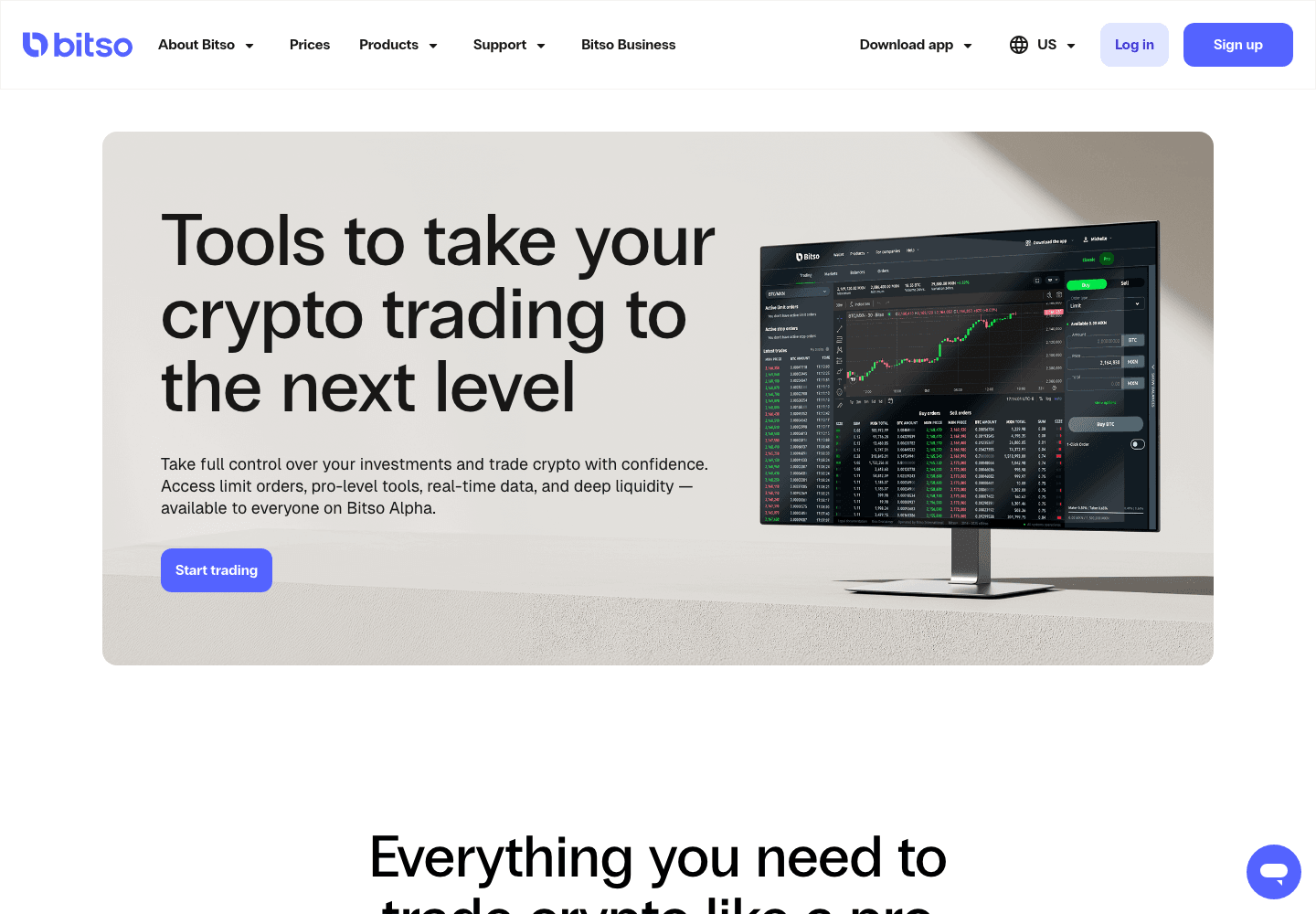
Bitso Alpha, the venue. Orders rest in a central limit order book and execute when a buy matches a sell. The help centre sets out market, limit, stop loss and stop limit behaviour against the last traded price, and pricing is maker and taker by 30 day volume. The public API listed 91 books on 12 August 2026 across 60 base assets and eight quote currencies (MXN, ARS, BRL, COP, USD, USDT, USDS, BTC). Charts are TradingView. There is a public REST API and API key management in the app.
Bitso Quotes, the counterparty. You request a quote, Bitso International returns a price it generated internally, and you have six seconds to accept. Its own terms describe this as the “Modelo Broker-Dealer” and state that Quotes and xStocks “no proporcionan acceso a ninguna plataforma de intercambio, centro de negociacion ni infraestructura de mercado, y todas las transacciones se llevan a cabo exclusivamente en base principal a principal”. Quotes are “determinadas por Bitso International mediante modelos internos de fijacion de precios”. No limit orders, no depth chart, no on-chain deposits or withdrawals for those assets.
The two are not static. Bitso published a help article confirming BAL (Balancer) has already migrated off the Alpha order book into Quotes, that open limit orders on it were cancelled automatically, and that “this table is updated whenever a new asset moves to this model”. Assets travel from the venue side to the counterparty side, not the other way.
The simple in-app buy and sell screen is a third case again: a conversion at a rate held for 20 seconds with an embedded spread, which Bitso says is calculated from “the market price, the spread, the market volatility and the liquidity available in the order book”. The spread percentage is shown on the confirmation screen and is not published as a figure anywhere on the site.
Margin, liquidation and forced closure. Margin trading runs on Alpha. Bitso says “the funds you borrow come from Bitso’s lending pools”, that a lending pool is “a reserve of funds that Bitso keeps available for margin loans, with one pool per currency”, and that if a pool is short “the platform rejects the order”. What it never says is whose money capitalises those pools, so nobody should assume either that it is Bitso’s own book or that it is other users’ balances. There is no leverage slider; the platform computes a Trading Power figure from your suitability category, the collateral weight of your assets and your open exposure, with retail users capped at 3x effective leverage. Borrow interest accrues hourly. Margin Level is net equity divided by total debt including accrued interest.
The thresholds are worth quoting as Bitso writes them, hedges included, because they are approximate and it says so. Healthy is anything at or above ~1.50x. Warning is “~1.30x to 1.49x”, explicitly advisory with no hard blocks. At Risk, the margin call band, is “~1.10x to 1.29x”, where new orders that would worsen your debt and outbound margin transfers are blocked. Liquidation is at or below the Maintenance Margin Ratio, which Bitso describes as “the threshold that triggers liquidation, currently shown as 1.10x on the platform”, and at that point “your entire account is liquidated automatically to repay debt”, not just the losing position. Repayment goes to accrued interest first, then principal, and any surplus returns to the margin wallet. Ninety of the 91 books carry the margin_enabled flag.
Date this, because it is moving. Bitso’s margin documentation was being written while we read it: eight English help centre articles on margin and on long and short positions carried an updated stamp of 11 or 12 August 2026, one of them at 14:06 UTC on the day we captured the corpus. We have the updated timestamps and not creation dates, so we are not asserting these articles are new, only that they moved. The mechanics above are what the corpus said on 12 August 2026 and should be re-read before anyone relies on them.
Accounts & Fee Tiers
There is one Bitso account. What changes is the front end you use, the verification level you have reached and the 30 day volume band your fees fall into. Treating that as a menu of account types would misdescribe it.
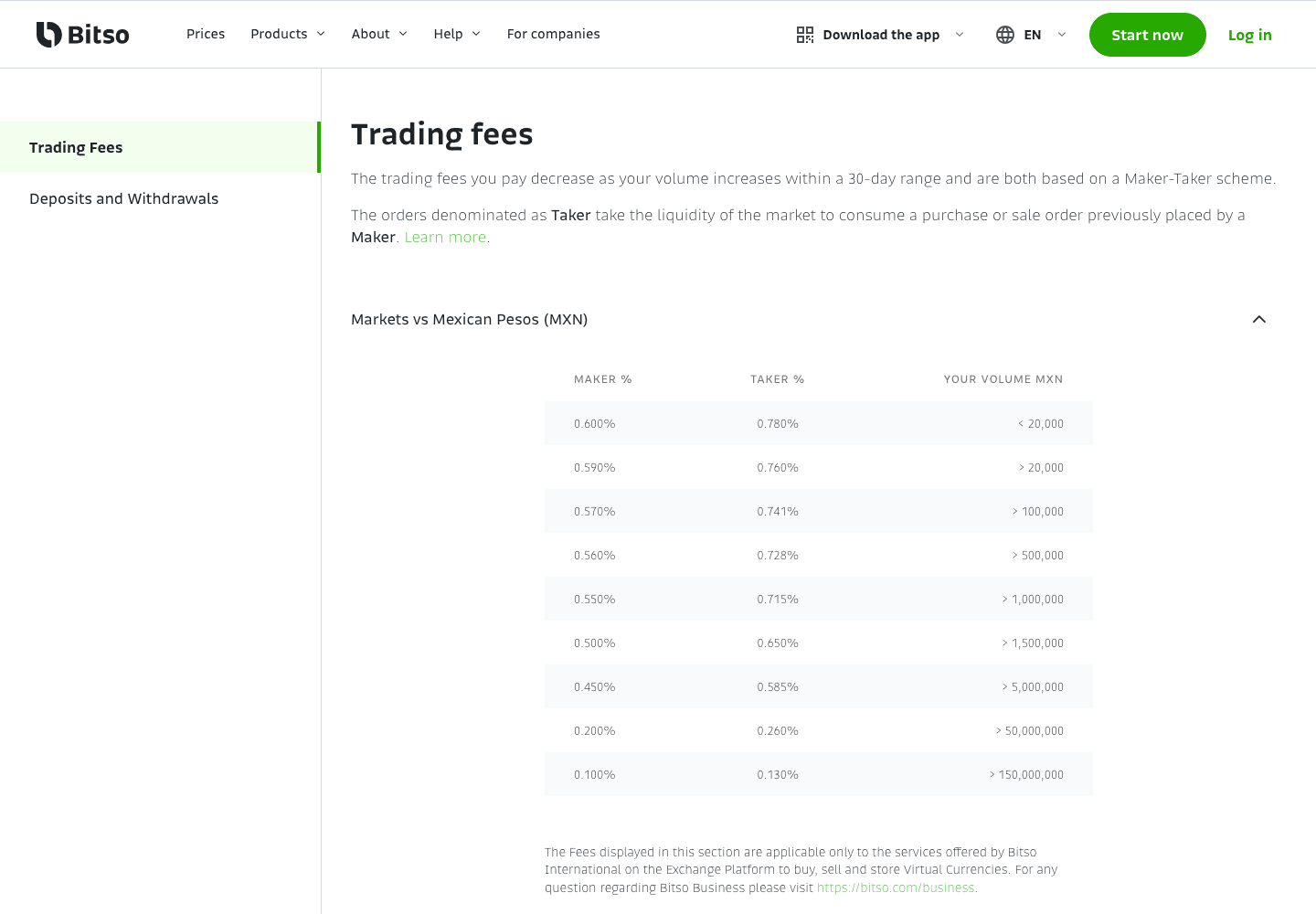
Trading fees are maker and taker and are published in full, per quote currency, on bitso.com/fees. The peso ladder starts at 0.600% maker and 0.780% taker below 20,000 MXN of 30 day volume and reaches 0.100% and 0.130% above 150,000,000 MXN. The USD and USDC ladder is materially cheaper, starting at 0.300% and 0.360% below 1,000 USD and reaching 0.040% and 0.050% above 30,000,000 USD. Brazilian real books start at 0.200% and 0.400%. Argentine peso books start at 0.450% and 0.600%. Colombian peso books start at 0.500% and 0.650%. Bitcoin quoted books are cheapest of all at 0.075% and 0.098%.
Read that entry tier honestly. A Mexican user trading small size pays 0.780% to take liquidity, which is at the expensive end for a spot venue, and the ladder does not start improving meaningfully until 1,500,000 MXN of monthly volume. The same user quoting in USDC instead pays 0.360%. The cheapest thing a retail Mexican user can do about Bitso’s fees is stop quoting in pesos.
Every fee table on that page carries the same footnote, and the end of it matters as much as the start: “The Fees displayed in this section are applicable only to the services offered by Bitso International on the Exchange Platform to buy, sell and store Virtual Currencies”. Two things follow. That is the Gibraltar entity again, which confirms the exchange is not the Mexican licensed company. And the published ladder governs buying, selling and storing virtual currencies on the order book only, so it does not price Bitso Quotes, xStocks or the in-app conversion screen, which is where the unpublished spread lives.
Verification tiers gate limits rather than features. Registration needs an email, a phone and an identity document, and the account starts below Level 1. Trading requires an upgrade in the Limits section. Deposit and withdrawal limits are monthly and reset at the start of each month; hitting them stops deposits and withdrawals but not buying and selling. Raising them requires proof of residence, proof of income and further account information, reviewed by Bitso, and the help centre is explicit that “your next available limits are set by us”. Bitso does not publish the numeric limits at any level, so a reader cannot tell in advance how much they will be allowed to withdraw.
Margin trading is a separate wallet within the same account, with its own suitability category and its own collateral weighting per asset.
Proof of Reserves
Bitso publishes a proof of solvency, and it is one of the better ones in the market, which makes its limits worth stating precisely rather than waving through.
What it is. Bitso signs blockchain messages to demonstrate control of the keys to the addresses it claims, then wraps those in a zk-SNARK so the proof can be verified without revealing wallet addresses. The report is generated with ZeKnow Solv software from its partner Proven, and the proof is published to the Ethereum blockchain where anyone can check it on Etherscan. Liabilities are committed as a Merkle tree, and each user can download the tree and use the root hash, their leaf hash and their account code to verify that their own balance was included in the liability side. That last part is what separates a real proof of solvency from a list of wallet addresses, and Bitso’s own help centre makes exactly that argument against the weaker version other exchanges publish.
What it covers. Bitcoin and Ether. That is the whole scope: “Currently, the solvency report contemplates Bitcoin (BTC) and Ether (ETH). But we’re working to add more cryptocurrencies to report in the future.” A user holding USDC, SOL, XRP or any of the other assets in the 276 currency catalogue has no attestation covering their balance.
What it excludes. Staked funds are not in the report. Bitso’s stated reason is that they are locked long term investments, and it says the non staked portion of your wallet is fully included and verified through the Merkle tree. So the assets under the least liquid arrangement are the ones the proof does not reach.
Cadence. The Trust page describes “monthly, third-party audits using zero-knowledge tech”. The help centre says the report “will be issued on a monthly basis at the beginning, but we’re planning to release it daily in the near future (to be announced)”. Receipts are reached through the account profile rather than from a public archive, so we could not sample the current run rate without opening an account, and we are not asserting one.
What no attestation can fix. Proof of solvency measures whether reserves cover liabilities. It does not create a claim. For Bitso Quotes balances and xStocks the terms already say there is no segregated asset behind the entry, and Annex E says both are unsecured claims on Bitso International, so a solvency proof over custodied coins is answering a different question from the one a Quotes holder should be asking.
Listed Assets
Bitso’s public catalogue API returned 276 supported currencies on 12 August 2026, split by its own metadata into 271 crypto and 5 fiat. Six are usable as a preferred base currency: Brazilian reais, Mexican pesos, bitcoin, Argentine pesos, Colombian pesos and US dollars. One detail in that file is worth carrying: the currency Bitso displays with the ticker USD has the full name “USDC (Dolares Digitales)” and is typed as fiat. The dollar on Bitso is a stablecoin wearing a dollar’s ticker.
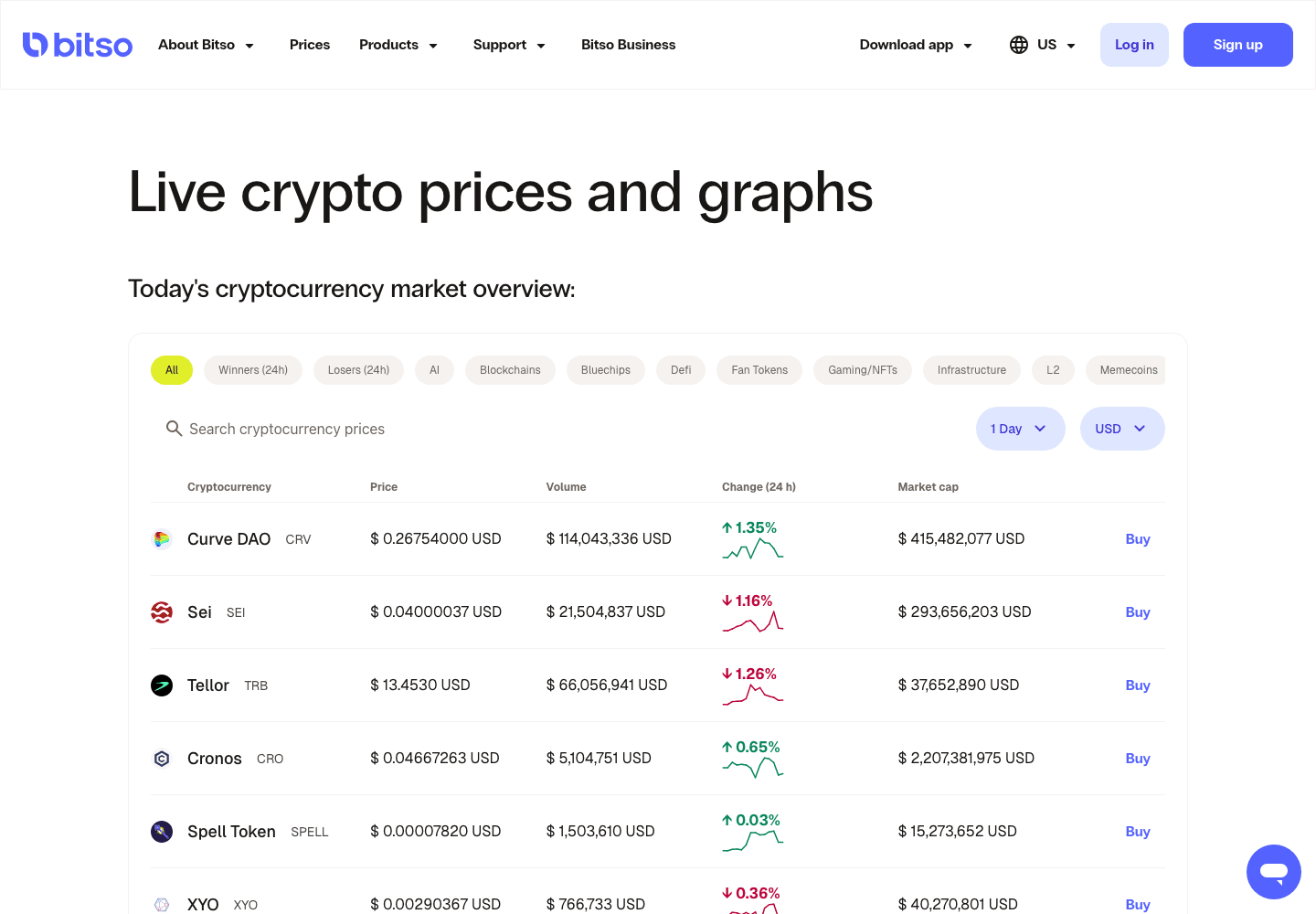
The tradeable range is narrower than the catalogue, and by how much depends on which screen you use. The public order book endpoint returned 91 books covering 60 distinct base assets. By quote currency: 53 against USD, 17 against MXN, seven against BRL, five against USDT, four against ARS, two against COP, two against BTC and one against USDS. Everything else in the 276 is reachable only through Bitso Quotes, where Bitso is your counterparty. Bitso Alpha’s own marketing says “Trade more than 100 assets anytime”, which counts differently from its API; we are quoting the API.
Minimum order values are set per book and published in the same endpoint. Of the 17 peso books, three have a 3 MXN floor, one has 9 MXN and thirteen have 10 MXN. The separate per asset minimum quantity goes far smaller: the lowest in the whole file is 0.0000006 BTC, which applies to five of the six bitcoin books, and litecoin’s 0.0001 is nowhere near the bottom.
Who decides what is listed, and what delisting looks like. The terms reserve the right to suspend, restrict or delist any virtual currency at Bitso’s discretion, with a stated notice period of not less than two weeks except where immediate action is required by law, a regulator, a reasonable concern about the coin, or an order from a competent authority. The terms also state plainly that admitting a coin “no garantiza su continua disponibilidad para Depositos, Operaciones, Retiros, Transferencias, custodia o cualquier otro Servicio”.
Two recent examples show the process working in different directions. Bitso discontinued H (Humanity Protocol) after a confirmed security incident affecting the original token contract in June 2026, then force converted residual balances at market price. Bitso published three different closing dates for that sell window, 3, 5 and 6 August 2026, across its help centre and two status updates, and described the proceeds as US dollars in two of them and “Digital Dollars” in the third; the detail is in Deposits and Withdrawals. Separately, BAL was moved off the Alpha order book into Quotes for low liquidity, which Bitso is careful to say is not a delisting. Both are documented in Bitso’s own help centre and status page, which is more disclosure than most venues give.
The asset range also carries stocks in Mexico only. The product navigation on bitso.com/mx lists Acciones; the same navigation on bitso.com/ar, bitso.com/br and bitso.com/co does not.
Research & Tools
Charting on Bitso Alpha is TradingView, which Bitso names on its own product page, alongside limit, market, stop loss and stop limit order entry, a depth chart and live market data. That is a standard professional stack rather than a proprietary one, which for a reader is a point in its favour: the tooling is portable knowledge.
The public REST API is the most substantive research tool here and it is genuinely open. The available_books endpoint returns every book with its fee ladder, tick size, minimum and maximum order amounts and its margin_enabled flag, with no key required. The catalogues endpoint returns the currency catalogue, the locale list and a per country table of restriction flags. API key management is exposed in the app for authenticated endpoints. A reader who wants to check anything in this review can re-run those two calls.
The help centre is the education layer and it is unusually large for an exchange: 260 articles in Mexican Spanish, which the help centre’s own locales endpoint reports as its default locale, 253 in English, and parallel corpora in Argentine Spanish, Colombian Spanish and Brazilian Portuguese. Spanish is the larger corpus and the default, which is worth knowing before treating the English pages as the authoritative ones. The coverage is asset by asset, with explainers on individual tokens, plus practical pieces on slippage, limit versus market orders, order execution against the last price, margin level and liquidation, and a Mexican tax guide running to 9,681 characters. Fraud education is a visible theme, with articles on fake token contracts, phishing, pyramid schemes and impersonation.
Bitso also runs a public security research unit it calls Quetzal, a Bugcrowd bug bounty programme, and it states ISO/IEC 27001:2022 certification on the Trust page. We did not verify that certificate against a certification body, so it is recorded here as the firm’s claim.
Two things worth reading with a raised eyebrow. The Trust page cites CER.live ratings for exchange security, which is a third party leaderboard and not a regulator. And a help centre article on Earnings says “all processes by Bitso are approved and supervised by the Gibraltar Financial Services Commission”. The GFSC authorises the firm to provide DLT services; the register entry we read does not describe approval of individual processes, and a reader should not take that sentence as supervision of a yield product’s investment strategy.
Earn, Staking & Lending
Bitso’s most consequential offer is not a promotion, it is a yield product, and two of its three variants change who owns your assets. This is a risk disclosure section, not a deals section.
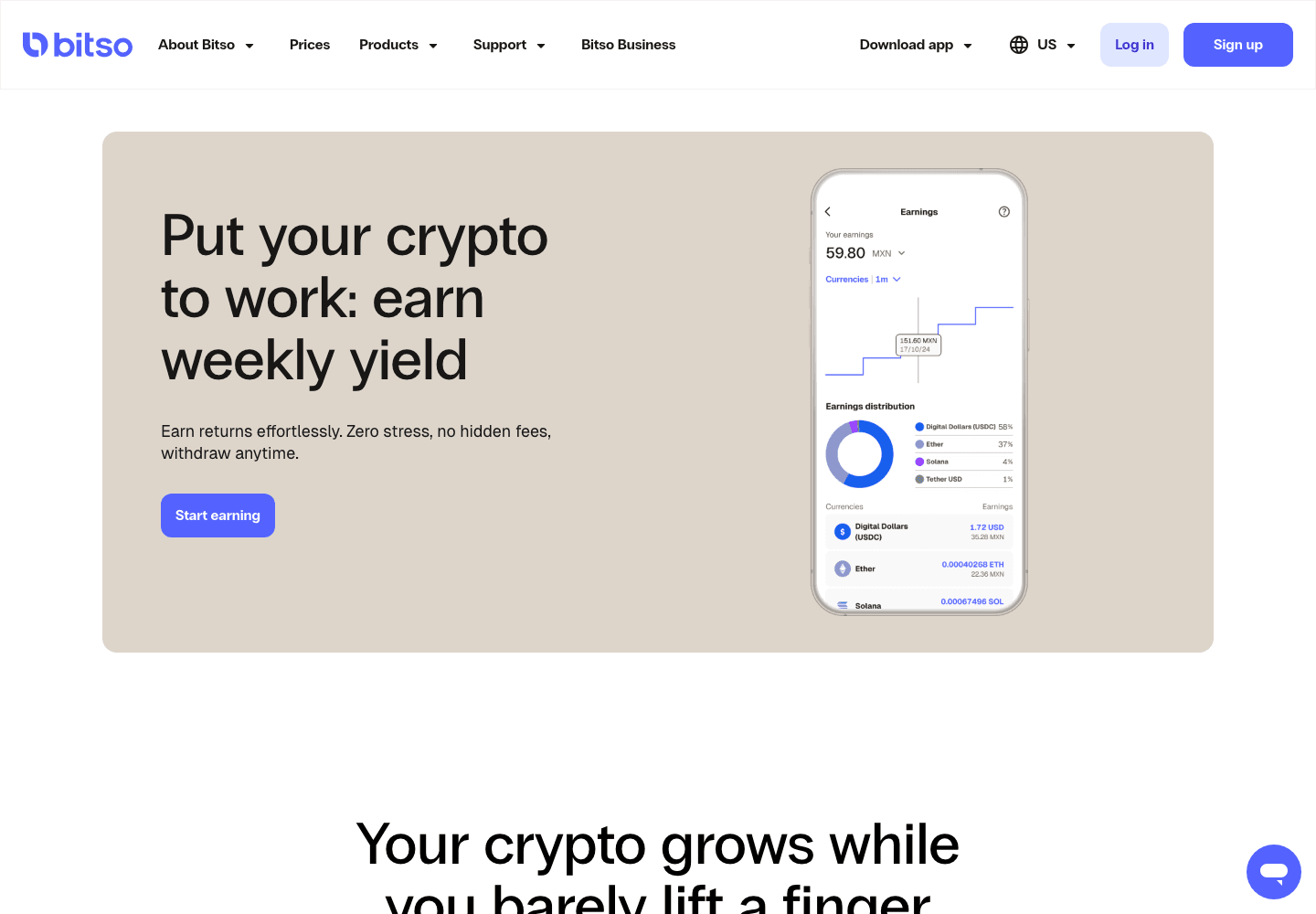
Stablecoin yield transfers title. Bitso’s terms are unambiguous: once enrolled and once Bitso International has received your stablecoins, “estas seran propiedad de Bitso International, en todo sentido y para todos los efectos”. You stop owning them. What you get in return is a contractual right to rewards and to redemption. The homepage advertises rates of 4% on USDC and the help centre says USD and USDT balances are invested in “liquid short-term, low-risk instruments, for example, government bonds”. That may well be prudently run. It is still an unsecured claim on a Gibraltar company, and there is no compensation scheme behind it.
Staking does not transfer title, and has a queue. For ETH, SOL, ADA, DOT and ATOM, Bitso stakes as your agent and the terms confirm you keep full ownership and the assets stay in Bitso’s custody. The mechanic worth knowing is the reserve: Bitso stakes only a portion on chain and holds the rest back so users can exit. If that reserve is insufficient when you unenrol, the terms say users “seran colocados en una fila de espera, y los fondos se pondran a su disposicion en el orden en que se haya solicitado el retiro (first come, first served)”. A queue is not a halt, but it is the same shape.
Rates advertised on the homepage on 12 August 2026 were 10.5% on ATOM, 4% on USDC and 2.53% on ETH. Bitso reserves the right to change the reward rate, eligibility, minimums and maximums unilaterally, and to suspend or terminate the programme with or without cause. Earnings balances are excluded from the proof of solvency report while staked. Bitso charges no fee for participating.
Fully Paid Securities Lending, for the stock product. Users meeting one of four thresholds (2,500 USD account balance, 20,000 USD reported annual income, 20,000 USD liquid assets, or at least one year of trading experience) can enrol eligible US shares into Alpaca’s lending programme for monthly income. Bitso’s own article states the trade offs, including that voting rights transfer to the borrower while shares are on loan and that “loaned shares are not SIPC-protected”.
Beyond yield, the promotional layer is thin: a referral programme and a net deposit cashback campaign appear in the help centre. We found no deposit bonus or trading credit on the site, which for a venue of this size is a good sign rather than a gap.
Opening an Account
Registration is short: an email, a phone number, a password of at least eight characters with an uppercase letter, a lowercase letter and a symbol, an emailed verification code, and confirmation that you are over 18 and not resident in a prohibited jurisdiction. Bitso’s help centre states that at that point you have a user ID but cannot yet trade.
Trading requires an upgrade to Level 1 in the Limits section of the app. Beyond that, raising deposit and withdrawal limits means submitting proof of residence (a utility bill, which Bitso will accept in a family member’s name if you live with them, or a bank document in your own name such as a pay slip or statement), proof of income and additional account information, all reviewed manually with the outcome emailed. Bitso does not publish the limit figures at any level, and states that the next available limits are set by Bitso rather than chosen by the user. We could not verify the review turnaround without opening an account, and we are not asserting one.
The registration flow makes clear which entity you are contracting with, if you read the checkbox. Bitso’s own web bundle renders it as acceptance of the Privacy Policy, Terms and Conditions and Crypto Risk Disclaimer at /legal/GI/privacy_policy, /legal/GI/terms and /legal/GI/risk_warning. GI is Gibraltar. A Mexican user creating a crypto account on bitso.com is agreeing to a Gibraltar contract at the moment of signup, whatever the peso rail underneath is licensed as.
Identity verification uses a document scan with a liveness step, and the Mexican contract adds a requirement that is unusual and worth flagging: the client “estara obligado a activar la Geolocalizacion del dispositivo movil desde el cual el Cliente abra su Cuenta y/o celebre el Contrato”. Device geolocation is mandatory at account opening under the IFPE terms. Bitso also bans jailbroken iOS devices from the app.
Two authentication factors are required for changing notification methods, changing beneficiaries, requesting statements and changing the factors themselves, and Bitso may require two factors for any transaction above 11,000 pesos. Changing your password or account details freezes withdrawals for 24 hours, which the help centre states is mandatory and cannot be lifted even by support.
Mexican accounts also inherit a rule that is not Bitso’s doing. Banco de Mexico’s published account of its own regulatory actions states that it wrote into the SPEI rules that transfers to clients of participants carrying out virtual asset business “se acrediten despues de 24 horas”, to widen the window for spotting an illegitimate transfer. Banxico’s page carries no revision date, so treat it as the regulator’s stated position rather than a guarantee of what your deposit will do today.
Deposits & Withdrawals
Fiat rails are local and separate by country: SPEI and CLABE accounts in Mexico, Pix and CVU style rails in Brazil and Argentina, plus ACH and wire transfers for US dollars. Crypto deposits and withdrawals are on chain across a documented network list, with per asset and per network withdrawal fees that Bitso says cover the network cost and change with congestion.
The dollar account is not a dollar account. Bitso’s own help centre states that dollars received by ACH or wire “will automatically be converted to USDC when credited to your Bitso account”. A user who wires US dollars ends up holding a stablecoin issued by a third party, not a dollar balance. That is disclosed, and it is easy to miss.
Published USD figures: ACH deposits cost 2.99 USD per transaction and wires 11.99 USD plus 0.17%, and any deposit smaller than its own fee “won’t be credited to your account and cannot be refunded”. The minimum withdrawal is 3 USD, and a smaller attempt is consumed as a fee rather than refunded. Deposits from your own accounts have no maximum; third party deposits are capped at 4,000 USD per transaction, and the same 4,000 USD cap applies to withdrawals to accounts in other people’s names.
Withdrawal blocks, in Bitso’s own words. The help centre lists six reasons. Account limits. A manual withdrawal block in security settings. Balance reserved against an open order. A mandatory 24 hour hold after any password or account change. A network fee larger than the withdrawal itself, which Bitso says can happen “for low-value withdrawals” and leaves you unable to withdraw “until the amount is higher than the fee, or until the network fee goes down”. And a sixth that is discretionary: “When exceptional market conditions affect the funds available to process an unusual volume of transactions for a specific asset, Bitso temporarily suspends the following operations for that asset: Withdrawals; Conversions, sales, and orders; Earnings deactivation.” That last is a published suspension power with no defined trigger, duration or notice obligation, and we found no incident in which Bitso says it invoked it.
Withdrawals have stopped repeatedly, and Bitso says so itself. An earlier draft of this review said we had found no documented withdrawal halt. That was a limit of our reading rather than a fact about Bitso: we had read the status page and not its feed. The feed logs 21 deposit or withdrawal affecting incidents between 13 December 2025 and 3 August 2026, four of them impact major, including an all currency, all method consumer withdrawal outage on 8 April 2026 and MXN withdrawals disabled for 19 hours 35 minutes on 26 and 27 April 2026. None was a solvency event, every one was posted publicly while it was happening and resolved, and several were third party network failures rather than Bitso’s. But the pattern is the pattern, and an exchange whose peso withdrawals can be off for the better part of a day is a different proposition from one where they cannot.
Incident record
| Date | Event | Source |
| 3 to 4 August 2026 | “BRFQ Operations Issues”, impact major. Opened 16:48:27 UTC on 3 August with “significant latency affecting the ability to quote and convert RFQ”. “A fix has been implemented” at 17:53:36 UTC, resolved 13:37:29 UTC on 4 August. 20 hours 49 minutes, on the product Bitso is migrating assets onto | status.bitso.com incidents feed |
| 26 to 27 April 2026 | “MXN withdrawals temporarily disabled”, impact major, 19 hours 35 minutes | status.bitso.com incidents feed |
| 8 April 2026 | “Service Disruption: Consumer Withdrawals Unavailable”, impact major, 2 hours 13 minutes. Users saw “failures when attempting to initiate withdrawals across all currencies and payment methods”, and Bitso disabled MXN, PIX, ARS and Lightning Network withdrawals as a precaution | status.bitso.com incidents feed |
| 13 July 2026 | “GRAM Deposits & Withdrawals Temporarily Disabled”, impact major, 1 hour 19 minutes, attributed to TON network issues | status.bitso.com incidents feed |
| 17 March 2026 | “Solana Withdrawals Temporarily Disabled”, impact major, 58 minutes | status.bitso.com incidents feed |
| 13 December 2025 to 3 August 2026 | Across the 50 incidents the feed returns, 21 affected deposits or withdrawals, 12 carry impact major and one critical | status.bitso.com incidents feed |
| 2 August 2026 | Scheduled maintenance, 03:00 to 03:30 UTC, degrading USD ACH and wire deposits and withdrawals | status.bitso.com maintenance feed |
| 25 July, 1 and 8 August 2026 | Three scheduled windows disabling stock services in a fortnight, of 1 hour, 1.5 hours and 2 hours, each attributed to a third party provider. Twelve such windows appear in the feed since 14 February 2026 | status.bitso.com maintenance feed |
| June 2026 to 6 August 2026 | H (Humanity Protocol) discontinued after a confirmed security incident affecting the original token contract, ending in a forced conversion of residual balances. Bitso published three different sell deadlines and two different settlement assets for it, set out below | status.bitso.com and help centre |
| Ongoing | Assets migrating off the Alpha order book to Bitso Quotes for low liquidity, starting with BAL. Open limit orders on a migrating asset are cancelled automatically | Bitso help centre |
The H discontinuation is the clearest case of Bitso contradicting itself on something irreversible. Three documents, three deadlines. The help centre article, updated 6 August 2026 at 21:04 UTC and therefore the most recently touched of the three, says “Trading for H will stop on August 3, 2026 at 18:00 UTC” with a liquidation window “from August 3 to August 7” converting to “US dollars (USD)”. The status update of 4 August says “Selling will also end on August 5, 2026 at 18:00 UTC”, with conversion “to US dollars (USD)” in a window “running on August 6th”. The status resolution of 6 August says “Selling ended on August 6, 2026 at 18:00 UTC” and that balances were converted to “Digital Dollars”. Those are not the same date and, given that Bitso’s own catalogue types the ticker USD as “USDC (Dolares Digitales)”, they may not be the same asset either. Nobody lost money by selling too early, but a holder trying to time an irreversible liquidation had three published answers to choose from and the stalest one is the one still on the help centre.
The table above is drawn from the status page’s own JSON at /api/v2/incidents.json and /api/v2/scheduled-maintenances.json, which returned 50 incidents and 50 maintenance windows on 12 August 2026, the earliest created 13 December 2025. The HTML page shows only about two weeks. It is still not a complete lifetime history, and we are not presenting it as one.
Customer Support
Live chat is advertised as available 24 hours a day and appears repeatedly in the help centre as the escalation route for limits problems, blocked withdrawals and unrecognised transactions. Support is delivered in English, Spanish and Portuguese, matching the locale list Bitso’s own catalogue API publishes.
The help centre itself is the strongest part of the support offer. It runs 260 articles in Mexican Spanish, which its own locales endpoint names as the default locale, 253 in English, and separate corpora for es-AR, es-CO and pt-BR, and it is unusually candid in places: it documents the liquidation threshold, the reasons withdrawals can be blocked including the discretionary suspension clause, the fact that staked funds sit outside the proof of solvency, and the fact that lent shares lose SIPC protection. Exchanges more often bury all four.
Incident response is the right thing to weigh here, and it is two different things at once. status.bitso.com publishes incident timestamps to the second, an investigating and monitoring and resolved progression, and posts in three languages, and it serves the whole record as JSON so anyone can audit it. The August 2026 RFQ outage was posted at 16:48:27 UTC while it was happening rather than after it was fixed, with a support link in the notice. Scheduled maintenance is announced ahead of the window, with an instruction to complete pending stock operations first, and Slack, email and webhook subscriptions to the status feed are all offered. Against all that, the one incident in the window that ended in an irreversible forced conversion, the H discontinuation, was communicated with three different deadlines and two different settlement assets across the help centre and the status page, and the stalest of the three is still the one on the help centre. Fast and public is not the same as consistent, and consistency is what matters when a deadline is final.
Mexico adds a statutory channel, and Bitso cannot say when it is open. Nvio Pagos Mexico’s UNE is the specialised user attention unit that a supervised Mexican financial institution is required to run, and it is reachable by email at une@nvio.mx. Its hours are published twice, in the same legal pack, on the same day, and the two do not agree. The UNE disclosure says it “opera en un horario de 09:00 a 16:00 horas de lunes a viernes, de manera remota”. The terms of use say it “opera en un horario de 00:01 a 24:00 horas en cualquier dia de la semana”. Seven hours on weekdays against continuously, every day. We cannot tell which governs, and neither can a user with a complaint and a deadline. Above it sits CONDUSEF, whose telephone number, email and website Bitso publishes, and Nvio is listed on the Buro de Entidades Financieras where complaint statistics, sanctions and abusive clause findings are collected. A Mexican peso complaint therefore has a real escalation path. A crypto complaint against the Gibraltar entity does not have an equivalent one.
Dispute resolution for the crypto side is the weak point and it is contractual rather than operational. The Gibraltar terms state that “Tu y Bitso International resolveran las Disputas unicamente a traves de un arbitraje individual vinculante, renunciando al derecho a cualquier otro juicio ya sea con jurado o a participar en una demanda colectiva”. Individual binding arbitration, with a class action waiver, against a Gibraltar company.
Published contact points: live chat and support tickets, une@nvio.mx for Mexican payment complaints, and a support ticket route for account access and closure under the Mexican contract. There is no telephone channel at all. We searched the site, both help centre corpora and all eight jurisdiction legal packs, and the only numbers anywhere are CONDUSEF’s consumer line and the corporate switchboards the CNBV and BCRA registers hold against the two Nvio entities. None of them is Bitso support.
Restricted Countries
Bitso publishes three country lists and no two of them agree. Two of the three are the same contract in two languages. All three come from Bitso, all three were read on 12 August 2026, and a reader is entitled to know which one governs.
List one, the contract in Spanish. Apendice A of the Gibraltar terms and conditions, last updated 14 April 2026, names 34 Prohibited Jurisdictions, given here in English so the three lists can be compared: Afghanistan, Albania, Belarus, Bosnia and Herzegovina, Central African Republic, China, Cuba, Democratic Republic of the Congo, North Korea, Ethiopia, Guinea, Guinea-Bissau, Iran, Iraq, Kosovo, Lebanon, Libya, North Macedonia, Mali, Montenegro, Myanmar, Nicaragua, Russia, Serbia, Somalia, South Sudan, Sudan, Syria, Ukraine, the United States of America, Venezuela, Yemen, Zimbabwe and Hong Kong. Residents and citizens of those places are ineligible to hold an account.
List two, the same contract in English. The Gibraltar terms are served by one endpoint, and the language you get depends on the Accept-Language header you send. Ask for Spanish and Apendice A returns 34 names. Ask for English and Schedule A returns 35. The extra name is the United Kingdom. Everything else matches, and both renderings carry the same 14 April 2026 date. We fetched both ourselves and diffed them. So the English contract tells a British reader they may not hold an account and the Spanish contract does not tell them that at all, which for a Spanish speaking Briton is the difference between an enforceable exclusion they know about and one they do not. It is the same defect as everything else in this section, except that here it sits inside the governing contract rather than between a contract and a product surface.
List three, the live application. Bitso’s own catalogue API carries a per country table with restricted_country and account_creation_restricted flags. It marks 34 countries restricted, but not the same 34: it adds Guam, Niger, Puerto Rico, Tunisia and the US Virgin Islands, and it omits Albania, Guinea, Guinea-Bissau, Kosovo and North Macedonia. That is ten differences against the Spanish contract and eleven against the English, because the United Kingdom is missing from the catalogue’s restricted_country list too. The additions are mostly US territories, which follows from the US exclusion. The omissions are five countries the contract says are prohibited. One qualification in Bitso’s favour: the catalogue does set account_creation_restricted to true for the United Kingdom, so a British user is closed out in practice. It is the Spanish rendering of the contract that fails to say so, not the product.
The far bigger number in that same file. Account creation is flagged restricted in 227 of the 249 countries listed. Only 22 are left open: Argentina, Brazil, Canada, Chile, Colombia, Denmark, Ecuador, El Salvador, Gibraltar, Israel, Mexico, Netherlands, New Zealand, Norway, Paraguay, Peru, Poland, South Africa, Spain, Turkey, Uruguay and Uzbekistan. Bitso is a Latin American exchange with a short list of extra countries attached, and the marketing does not say so.
And Spain is on the open list. The footer of every page on bitso.com, including the page carrying that catalogue, states: “This platform is not authorized to provide crypto-asset services in Spain, nor is it subject to the supervision of the CNMV or any other competent authority of the European Union, in accordance with Regulation (EU) 2023/1114 on markets in crypto-assets (MiCA). Accordingly, its services are neither directed at nor available to persons resident or located in Spain.” The catalogue that the app reads to decide who may register does not flag Spain as restricted in either field. One of those two is wrong, and we cannot tell from outside which one the signup form actually enforces. Denmark, the Netherlands, Norway and Poland sit in the same position: EU or EEA states, open for account creation in the catalogue, with no MiCA authorisation named anywhere.
Bitso’s stated reason for the contract list is money laundering risk: high risk jurisdictions, weak anti money laundering measures, or strategic deficiencies against international standards. That is an ordinary and defensible basis. The problem is not the criterion, it is that three published lists built on it disagree, and that two of them are the same document.
Conclusion
Bitso scores 6.0 out of 10, which puts it at the bottom of the workable band: a real, verifiable, twelve year old business whose headline licence is not the one covering the thing most readers came for.
The verification went better than it does for most exchanges. The GFSC register names The Badger Technology Company Limited, incorporation number 117775, with bitso.com against its name and a permission that spells out custody, a secondary market venue, staking and broker/dealer services. The CNBV register carries Nvio Pagos Mexico as IFPE 65-001. The CNV Argentina register carries The Badger Technology Company Argentina S.A.U. at number 164 with custody in scope. The BCRA’s payment accounts register carries Nvio Pagos Argentina S.A.U. at code 34502 with a CUIT matching the firm’s own terms. FINRA BrokerCheck confirms Alpaca Securities LLC as an active broker-dealer behind the US stock product. Five registers, five positive matches, one keyed on the domain rather than on a name that merely resembles the brand, and two keyed on a tax identifier. That is a stronger evidentiary position than most of this catalogue.
What holds the score down is structural rather than suspicious. A Mexican reader sees a CNBV supervised institution and reasonably concludes the coins are supervised too. They are not, and Banxico has published the reason: an authorised Mexican payment institution may not offer virtual asset exchange, so the crypto had to live somewhere else, and where it lives is Gibraltar. Nothing is insured anywhere in the structure, which Bitso says plainly in its own contract and footer and never says in its marketing.
The direction of travel deserves attention. Bitso Alpha is a genuine order book, and it is the part of the business we would point a careful user at. But assets are being moved off it into Bitso Quotes, where Annex D clause 3 makes Bitso International the sole counterparty, clause 4 states it holds nothing in custody in your name, and Annex E calls the resulting balance an unsecured contractual claim that would leave you an ordinary creditor if the company failed. The same model underlies xStocks, whose clause 6.3 adds that users hold no priority, privilege or preference over Bitso International’s assets. That is a lawful and clearly disclosed design, and it converts a venue relationship into a credit relationship one asset at a time.
Where the evidence contradicts the firm. Five places. The stocks page says “your stock account is insured up to USD 500,000” and then names nobody: the words SIPC, FINRA and Alpaca do not appear on that page once. The figure only makes sense when you go to the help centre, find that the broker is Alpaca Securities and that SIPC covers 500,000 USD, and put the two documents together yourself. We think that reconciliation is right, and it is the reading the help centre supports. But it is a reconciliation we performed, not a statement Bitso makes, and it does not hold for xStocks at all, whose own annex says investor protection schemes “no se extienden a Ti en Tu calidad de contraparte de Bitso International”. The footer says Spain is closed while the live catalogue leaves Spanish registration open. The English and Spanish renderings of the one Gibraltar contract publish different prohibited jurisdiction lists, and the English one bans UK residents while the Spanish one does not mention them. The status page and the help centre published three different deadlines and two different settlement assets for an irreversible token liquidation. And Nvio publishes two different sets of opening hours for the statutory Mexican complaints unit, in the same legal pack, on the same day. None of these is a scam signal; all five are the kind of drift that happens when a fast product organisation outruns its own disclosures, and every one of them costs a reader something.
And one place where the evidence contradicted us. An earlier version of this review said we had found no documented withdrawal halt at Bitso. Bitso’s own status feed disproves it: 21 deposit or withdrawal affecting incidents between December 2025 and August 2026, four of them impact major, including an outage on 8 April 2026 in which withdrawals failed across every currency and payment method. We had read the status page and not the feed behind it. The correction is recorded here rather than made quietly, because the difference between what a firm hides and what we failed to look for is the whole of our value.
Who it suits. Someone in Mexico, Argentina, Brazil or Colombia who wants local currency rails that actually work, a real order book, and an exchange that publishes more of its own risk than its competitors do. Someone who wants a regulated custodian with a compensation scheme behind it will not find that here, and should not read the CNBV licence as one. Anyone considering Earnings should read the sentence about title transfer before enrolling, and anyone considering xStocks should understand they are buying a contractual price reference from a Gibraltar company, not a share.
Crypto assets are volatile and you can lose the whole of what you put in. This review describes what we verified and where we could not verify; it is not advice to use this or any other exchange.
FAQ
Is Bitso regulated and safe?
Partly, and not where most people assume. Crypto on bitso.com is provided by The Badger Technology Company Limited, a Gibraltar company we confirmed on the GFSC register on 12 August 2026, with permissions covering custody, a secondary market venue, staking and broker/dealer services. Mexican pesos are handled by Nvio Pagos Mexico, an electronic payment funds institution supervised by the CNBV under key 65-001, whose contract mentions no crypto asset at all. Neither arrangement carries deposit insurance or an investor compensation scheme, and Bitso’s own footer says its products are not guaranteed or insured by any government or public authority.
Who holds my coins, and what happens if Bitso fails?
It depends which product, and Bitso’s own documents draw the line in three places. For ordinary custodied balances, Bitso International holds them and its Trust page describes segregated multi-signature wallets, with custody named as a GFSC permission. For Bitso Quotes, Annex D clause 3 of the Gibraltar terms says Bitso International acts as “contraparte unica”, records “una obligacion contractual frente a Ti” and leaves you “un derecho exigible frente a Bitso International por el valor de dichos activos”; clause 4 adds that it does not hold those assets in custody in your name. For xStocks, clause 6.3 goes further, calling the Synthetic Token Balance “un credito contractual no garantizado” and stating that in insolvency users hold “ningun derecho de prioridad, privilegio ni preferencia” over Bitso International’s assets. Annex E, the Bitso Quotes risk disclosure, then applies the harder wording to both: Quotes balances and xStocks positions “representan creditos contractuales no garantizados”, and in an insolvency you would be “un acreedor quirografario”. Stablecoins enrolled in Earnings become Bitso International’s property outright. There is no compensation scheme in any of those cases.
Is Bitso an exchange or is it trading against me?
Both, depending on the screen. Bitso Alpha is a central limit order book where your order matches another user’s, priced maker and taker by 30 day volume, with 91 books live on 12 August 2026. Bitso Quotes is the opposite: you request a quote, Bitso International prices it from its own internal models and executes as principal on a six second quote, and its terms say it gives no access to any exchange platform or trading venue. Assets are being migrated from the first model to the second, starting with BAL.
Does Bitso publish proof of reserves?
Yes, and it is a proof of solvency rather than a bare wallet list, which is a meaningful difference. Bitso signs blockchain messages to prove key control, wraps them in a zk-SNARK for privacy, publishes the proof to Ethereum, and commits liabilities as a Merkle tree so each user can verify their own balance was counted. The limits matter: it covers Bitcoin and Ether only, it excludes staked balances, and it says nothing about Bitso Quotes positions, which have no reserved asset behind them by design.
Which countries can open a Bitso account?
Fewer than the marketing suggests, and the answer changes with the language you read it in. Bitso’s own catalogue API flagged account creation as restricted in 227 of 249 countries on 12 August 2026, leaving 22 open: Argentina, Brazil, Canada, Chile, Colombia, Denmark, Ecuador, El Salvador, Gibraltar, Israel, Mexico, Netherlands, New Zealand, Norway, Paraguay, Peru, Poland, South Africa, Spain, Turkey, Uruguay and Uzbekistan. Spain appears on that open list even though Bitso’s own footer states the platform is not authorised in Spain and is not available to Spanish residents, so a Spanish reader should treat the footer as governing until Bitso reconciles the two.
How this review works
Track Bitso live: score moves and red notices, in your pocket.