CFD · CHECKED 12 OCT 2026
Rakuten Securities review.
Japanese brokerage licensed by the Kanto Local Finance Bureau since 2007
OK-ISH
OUT OF 10
AD DISCLOSURE: IF YOU OPEN AN ACCOUNT THROUGH THIS LINK WE MAY EARN A COMMISSION. IT NEVER MOVES THE SCORE. HOW THIS WORKS
Rakuten Securities is a Japanese brokerage confirmed on the Kanto Local Finance Bureau register since 2007 for securities, advisory and investment management. It quotes EURUSD spreads from USD 3.00 round turn and offers a wide range of platforms, rated 4.41 stars across 281,887 reviews. Its main reservation is support: service depends on who onboarded the client, with one complaint documented as unresolved.
Each criterion is scored 1 to 10 from primary sources. The overall score is their unweighted mean. How scoring works.
| Minimum deposit | Not stated |
|---|---|
| Maximum leverage | 25:1 |
| Minimum spread | 0.5 |
| Account opening | 1-3 |
| Platforms | MT4 Web, iGrow, iSPEED, iSPEED FX |
- Licensed by Japan's Kanto Local Finance Bureau, licence No. 195, since 2007
- Confirmed cover: Type I/II Financial Instruments Business, Advisory, Investment Mgmt
- EURUSD spread from USD 3.00 round turn on 1 lot via Rakuten FX
- Wide platform range: MT4, MT4 web terminal, own web, mobile, Windows and Mac apps
- Also offers its own platforms: MarketSpeed, MarketSpeed II, iSPEED and iGrow
- 4.41-star average across 281,887 ratings
- Only one confirmed licence, from Japan's Kanto Local Finance Bureau
- Commodity-futures-operator status cited with no authority or number, unverifiable
- Minimum deposit not published
- Quoted EURUSD spread is a "from" figure, not a guaranteed price
- Support entity and escalation path depend on which entity onboarded the client
- At least one complaint documented as running long or going unresolved
Overview
TrueBroker is a free broker safety checker, and this page is our review of Rakuten Securities, scored 7 out of 10 across regulation, fees, platform, support and reviews. We previously scored this firm 4.5 out of 10; this review restates that verdict from current evidence, not from any change in the firm itself. The move is largely a fees and platform story: the firm’s own fee pages show a genuine zero commission domestic stock course and commission free mutual fund purchases (fees scored 9), and its own pages list five proprietary trading tools plus MetaTrader 4 (platform scored 8.5). Regulation lands lower, at 5.3, because only one licence in the evidence, the Kanto Local Finance Bureau registration, could actually be confirmed against a public register; support lands at 4.5 because the channels are extensive but the hours are narrow and largely Japanese language and business hours bound.
Overview Table
| Headquarters | Not stated on the firm’s own pages in our evidence; our earlier review placed the firm in Tokyo, Japan, which we have not independently confirmed here |
| Established | The Kanto Local Finance Bureau register shows the firm’s licence registered on 2007-09-30. |
| Countries Served | Not stated; the firm’s footer lists affiliated sites for Hong Kong (Rakuten Securities Hong Kong, Rakuten Securities Bullion) and Malaysia (Rakuten Trade) as separate entities, not as countries this entity serves |
| Regulated By | Director-General of the Kanto Local Finance Bureau (関東財務局長), licence (金商) No. 195, per the firm’s own footer |
| Minimum Deposit | Not stated. |
| Maximum Leverage | The firm’s own platforms page describes a Rakuten FX account requiring margin of 4% to 100% of trade value depending on leverage course, which works out to a maximum of about 25x; a separate margin trading account (らくらく信用取引口座) requires 100% margin, meaning no leverage |
| Total Instruments | Not stated as a count; the firm’s own pages describe domestic and foreign equities, mutual funds, bonds, listed futures and options, overseas futures, FX, CFD, binary options and physical gold, silver and platinum |
| Platforms | MarketSpeed II, MarketSpeed for Mac, MarketSpeed FX, the iSPEED family (iSPEED, iSPEED FX, iSPEED futures and options), iGrow, and Rakuten MT4 (with a trading server the firm says is based in Japan), per the firm’s own pages |
| Customer Support | Phone lines weekday 8:30 to 17:00 (times vary by line), an AI chatbot available 24 hours every day, and operator chat weekday 9:00 to 23:00, per the firm’s own contact page |
| Languages | Not stated |
Facts List
- The Kanto Local Finance Bureau register confirms Rakuten Securities Kabushiki Kaisha (楽天証券株式会社) holds licence (金商) No. 195, registered 2007-09-30, covering Type I and Type II Financial Instruments Business, Investment Advisory and Agency Business, and Investment Management Business.
- The firm’s corporate number, 5010701021660, appears on the Japan list of registered Financial Instruments Business Operators‘s list of registered Financial Instruments Business Operators (1,951 operators read); we matched this by registration number because the list names firms in Japanese only.
- Our earlier review claimed licences from ASIC, from the Japan FSA by that name, and from the Hong Kong SFC; none of those three claims carried a licence number for us to check, and the firm’s own footer names only the Kanto Local Finance Bureau as licensor.
- We searched 1,441 warning list entries mirrored from CySEC, the FCA and the FSC Mauritius; Rakuten Securities appears on none of them.
- The firm’s Zero Course (ゼロコース) pricing course brings domestic stock trading commission to zero, per its own fee page, but requires the client’s consent to route orders through the firm’s own dark pool, R-Cross (Rクロス), via its designated smart order routing.
- Mutual fund purchases are commission free across every fund the firm offers, per its own contact and fees page, though buying or redeeming individual funds can still carry a fee of up to 4.40%, and moving a mutual fund holding to another broker costs 3,300 yen per fund.
- The firm’s own risk disclosure states that losses on margin products, including domestic and US margin trading, futures and options, overseas futures, FX and CFD, can exceed the margin or collateral deposited, with no mention of negative balance protection; this runs against our earlier review’s claim of unconditional negative balance protection for all clients.
- The firm’s own legal page states that unrealized gains on open margin trading, futures and options positions are excluded both from client money segregation and from Investor Protection Fund coverage.
- Support runs on Japanese business hours: the general phone line is weekday 8:30 to 17:00, operator chat is weekday 9:00 to 23:00 (narrowing to mutual fund and NISA questions after 18:00 and on weekends), and the firm’s own contact page notes that email replies are currently delayed due to high inquiry volume.
- The firm’s own legal page states that, as of 2025-12-31, its client money segregation practices were subject to an assurance engagement by Ernst & Young ShinNihon LLC (EY新日本有限責任監査法人) under Article 43-2(3) of Japan’s Financial Instruments and Exchange Act, and that it calculates the segregation amount daily rather than the weekly minimum the firm describes as the legal floor.
What Rakuten Securities is regulated to do
The strongest citation in this evidence is the Kanto Local Finance Bureau register, which confirms Rakuten Securities Kabushiki Kaisha (楽天証券株式会社) as licence holder (金商) No. 195, registered 2007-09-30, for Type I Financial Instruments Business, Type II Financial Instruments Business, Investment Advisory and Agency Business, and Investment Management Business, and lists it as a member of the Japan Securities Dealers Association, the Financial Futures Association of Japan, the Type II Financial Instruments Firms Association, the Japan Investment Advisers Association and the Japan Security Token Offering Association. We matched the firm’s corporate number, 5010701021660, against the Japan FSA’s own list of registered Financial Instruments Business Operators, a list of 1,951 operators that gives names in Japanese only, which is why the match had to run on the registration number rather than the name.
Beyond that one confirmed licence, the picture is thinner. The firm’s own footer also names a commodity futures authority, but the footer line carries no licence number for it, so there was nothing for us to check. Our earlier review also claimed the firm is regulated by ASIC in Australia, by the Japan FSA under that specific name, and by the Hong Kong SFC. None of those three claims came with a licence number, the Hong Kong SFC’s own Public Register of Licensed Persons and Registered Institutions returned no single corporation named Rakuten Securities when we searched it by name, and the firm’s own pages in our evidence name only the Kanto Local Finance Bureau. We are not saying those licences do not exist; we are saying the evidence available to us does not let us confirm them.
What Rakuten Securities charges
The firm’s own fee pages show a genuinely low cost structure for its core products. Its Zero Course (ゼロコース) pricing course removes domestic stock trading commission entirely, and mutual fund purchases are commission free across the firm’s full fund lineup, per its own contact and fees pages. Set against that, phone assisted trading carries a flat surcharge, up to 4,950 yen per order regardless of pricing course for operator assisted domestic stock orders, and mutual fund transfers out to another broker cost 3,300 yen per fund (transfers in are free). The zero commission course is not unconditional: the firm’s own risk page states that using it requires the client’s consent to route orders through the firm’s own smart order routing system into its in house dark pool, R-Cross (Rクロス), which means giving up a choice of execution venue in exchange for the fee waiver.
Platforms, instruments and where our earlier review disagrees
The firm’s own pages describe a wide house owned toolkit: MarketSpeed II and MarketSpeed for Mac and MarketSpeedFX for desktop trading, the iSPEED, iSPEED FX and iSPEED futures and options apps for mobile, iGrow for consolidated asset tracking including NISA and iDeCo, and Rakuten MT4 for FX and CFD trading with a server the firm says is based in Japan. Instrument categories on the firm’s own risk and legal pages span domestic and foreign equities, investment trusts, domestic and foreign bonds, listed futures and options including Nikkei 225 options and commodity futures, FX, CFD (both a proprietary Rakuten CFD and a Rakuten MT4 CFD line), over the counter binary options, and physical gold, silver and platinum with physical delivery available.
Our earlier review described a narrower, MT4 only broker with $50 minimum deposits across Retail and Pro tiers, leverage up to 1:400, and unconditional negative balance protection for every client. That does not match the firm’s own pages in our evidence, which show a much broader Japanese securities and derivatives business, no stated minimum deposit, margin requirements on Rakuten FX equivalent to a maximum of about 25x leverage, and a risk disclosure stating plainly that losses on FX, CFD, margin trading, futures and options can exceed the margin deposited, with no mention of negative balance protection anywhere in the material we read. Readers relying on the figures from our earlier review should treat them as unconfirmed against the firm’s own current pages.
Contract terms worth reading before using Rakuten Securities
The firm’s own legal page states that unrealized gains on open margin trading, futures and options positions sit outside both client money segregation and the Investor Protection Fund’s coverage, meaning a client with a large unrealized profit on an open margin position is not protected on that profit if the firm fails. The same page notes that segregation is checked daily by the firm’s own account, which it says exceeds the weekly minimum it describes as the legal floor, and that a 2025-12-31 assurance engagement on segregation practices was carried out by Ernst & Young ShinNihon LLC (EY新日本有限責任監査法人) under Article 43-2(3) of the Financial Instruments and Exchange Act. Separately, the firm’s own risk page states that a securities backed loan from Rakuten Bank can be refused under the bank’s own screening criteria without the reasons being disclosed, and that the loan’s interest rate can change after the fact according to market conditions.
Key Takeaways
Rakuten Securities moves to 7/10 in this pass, up from our previous 4.5/10. This review restates the score from current evidence: we searched five public registers directly, ran a positive control on each before recording any absence, and this time read the firm’s own risk-disclosure and legal pages rather than relying on our earlier review alone. That changes what the fees, platform and regulation criteria could see, and the number reflects that, not any change at Rakuten itself.
What we could and could not confirm on regulation
The Kanto Local Finance Bureau’s register confirms Rakuten Securities Kabushiki Kaisha (楽天証券株式会社) as a registered Financial Instruments Business Operator under licence No. 195 ((金商)第195号), registered 2007-09-30, covering Type I and Type II Financial Instruments Business, Investment Advisory and Agency Business, and Investment Management Business, with corporate number 5010701021660 on the Japan FSA’s list of 1951 registered operators. That match was made on registration number, since the FSA list itself gives names only in Japanese.
Everything else in the regulatory picture is thinner. Our earlier review claims oversight from ASIC, from Hong Kong’s SFC, and from “the Japan FSA” by name; none of those three carries a licence number, and none is corroborated by any first-party page in our evidence, so all three are marked unchecked rather than confirmed. The firm’s own footer names the Kanto Local Finance Bureau as licensor, not “FSA.” The footer also lists the firm as a member of the Japan Securities Dealers Association, the Financial Futures Association of Japan, the Type II Financial Instruments Firms Association, the Japan Investment Advisers Association and the Japan Security Token Offering Association, plus a Privacy Mark data-protection accreditation; we hold no register entries for any of these bodies, so those memberships stand as claims we could not check against an outside source, not as findings against the firm.
Where our earlier review and Rakuten’s own pages disagree
Our earlier review describes a $50-minimum, MT4 forex broker with negative balance protection. Rakuten’s own pages, read directly for this review, describe a different firm: alongside Rakuten MT4 (楽天MT4) they run their own Market Speed (マーケットスピード), iSPEED and iGrow tools; support runs mainly in Japanese on Japanese business hours (weekdays 8:30-17:00 for the general line, per the firm’s contact page); and the risk disclosures for margin trading, futures, options, FX and CFDs state plainly that losses can exceed the margin deposited, with no negative-balance-protection language appearing anywhere in our evidence. A reader relying on our earlier review alone would come away with a materially rosier picture of downside protection and support hours than the firm’s own disclosures support.
What Rakuten Securities charges, and where the cost sits with the client
The domestic-equity Zero Course (ゼロコース) carries no per-trade commission, but the firm’s own risk page ties that to a condition: enrolling requires agreeing to Smart Order Routing through Rakuten’s own dark pool, ‘R-Cross’ (‘Rクロス’), so the fee-free tier comes with the client giving up choice over execution venue. Where the firm does charge, the numbers are specific: phone-relayed domestic stock orders run up to 4,950 yen per trade regardless of commission plan, operator-assisted Kabu Mini (かぶミニ) trades run from 3,795 yen, investment-trust purchase and redemption fees run up to 4.40%, and a balance certificate costs 1,100 yen in Japanese or 3,300 yen in English. Investment-trust transfer-out fees run 3,300 yen per fund, though transfers in are free. A trading-fee point-back of 1% (2% at the higher volume tier) applies, but the fee page excludes corporate accounts from it.
Two of the firm’s execution structures put Rakuten on the other side of the trade: Kabu Mini (かぶミニ) and Kabu Pitat (かぶピタッ) are, by the firm’s own risk page, off-market transactions where Rakuten itself is the counterparty, pricing off a reference rate plus a spread that can move with sudden market swings. The stock-lending service is explicitly unsecured, per the same page, with lent shares excluded from investor-protection-fund coverage, and shareholder rights such as benefits and voting are not restored even where a late-return penalty is paid.
Terms that bind a client
The contact page lets a client restrict their own account after a lost phone or suspected break in, up to blocking every transaction including login, but warns that depending on the debit method an investment trust accumulation payment can still be taken after the restriction is set and is then refunded, and that a stop order left open is not executed while the restriction is on and can fill immediately at an unintended price once it is lifted. The restriction can only be lifted by calling from the phone number registered with the firm.
Warning lists and support
We checked this firm’s name against 1,441 warning-list entries mirrored from CYSEC, the FCA and the FSC Mauritius, and it appears on none of them. That is a clean result, but it only covers the three lists we mirror, not every regulator globally. Support channels are extensive but Japan-centric: a general line at 0120-41-1004 running weekdays 8:30-17:00, separate lines for ID/password issues, NISA, new customers, and inheritance matters, a 24/7 AI chatbot, and operator chat only on weekdays 9:00-23:00 (narrowing to investment-trust and NISA topics after 18:00).
Licenses & Regulation
Rakuten Securities scores 5.3/10 on regulation in this review. Our previous review scored the firm 4.5/10 overall; this review scores it 7/10 overall. That move is our assessment changing, not the firm improving or deteriorating: we now hold a real register entry to check the licensing claims against, instead of taking regulator names on trust from an earlier write-up.
What the Japan register confirms about Rakuten Securities
We searched the Japan FSA list of registered Financial Instruments Business Operators directly, reading all 1,951 operators on it, and ran a positive-control search first so an empty result would mean absence rather than a broken search. The list gives operator names in Japanese only, so we matched Rakuten Securities Kabushiki Kaisha (楽天証券株式会社) on its registration number rather than by name. That number, Director-General of the Kanto Local Finance Bureau (Financial Instruments) No. 195 (関東財務局長(金商)第195号), is confirmed: it belongs to 楽天証券株式会社, registered with the Director-General of the Kanto Local Finance Bureau on 2007-09-30, covering Type I Financial Instruments Business, Type II Financial Instruments Business, Investment Advisory and Agency Business, and Investment Management Business, with corporate number 5010701021660. The same entry lists the firm as a member of the Japan Securities Dealers Association, the Financial Futures Association of Japan, the Type II Financial Instruments Firms Association, the Japan Investment Advisers Association, and the Japan Security Token Offering Association.
Those association memberships are not licences in their own right. The firm’s own pages describe them as member associations (加入協会), associations it has joined, a category separate from the Kanto Local Finance Bureau registration that actually authorises it to trade. We hold no register entry for any of these associations, and the claims carry no membership numbers to look up, so we could not check them independently; that is a gap in what we hold, not a finding about the firm. A further line in the firm’s own footer names it a commodity futures trading business operator, but the footer gives no licence number and names no specific commodity-futures authority we could check it against, so that claim also stands unverified by us.
Regulators our earlier review named that Rakuten Securities’ own pages do not support
Our earlier review described Rakuten Securities as regulated by ASIC in Australia and the Hong Kong SFC, and referred to its Japanese licensor simply as “the FSA.” None of that holds up against what we could check. The ASIC and SFC claims carry no licence or CE reference number at all, so there was nothing to search a register for. A name search of the Hong Kong Securities and Futures Commission’s Public Register of Licensed Persons and Registered Institutions for “Rakuten Securities” returned no single matching corporation. On the Japanese point, the firm’s own footer names its licensor as the Director-General of the Kanto Local Finance Bureau (関東財務局長), not “the FSA” as a standalone body, which is a narrower and more specific attribution than our earlier review used. We treat all three as unconfirmed rather than false: an unconfirmed claim is a gap in what we could look up, not evidence the firm lacks the licence.
Warning-list search
We searched 1,441 warning-list entries mirrored from the CYSEC, FCA, and FSC Mauritius warning lists, and Rakuten Securities appears on none of them. That is a clean result worth stating plainly, though it covers only the three regulators we mirror, not every warning list that exists.
Entity structure
The firm’s own footer material lists separate country-site entities under the same brand: Rakuten Securities Hong Kong, Rakuten Securities Bullion in Hong Kong, and Rakuten Trade in Malaysia, alongside the parent Rakuten Securities Holdings (楽天証券ホールディングス). None of those carry a licence number in the pages we read, so we cannot say which regulator, if any, stands behind each one. A reader dealing with a non-Japan-facing arm of the group should not assume the Kanto Local Finance Bureau registration confirmed above extends to it.
The gap between our earlier review’s regulatory claims and what the firm’s own pages support is the main reason regulation scores where it does rather than higher. The underlying Japanese licence is real, specific and dated. But three of the regulators a reader might expect to see named, ASIC, a standalone “FSA,” and the SFC, could not be corroborated, and a cluster of association memberships sit alongside the confirmed licence without numbers we could check against any register we hold.
How to Trade
Rakuten Securities runs its CFD and FX business as one corner of a much larger shelf. The firm’s own risk-disclosure page lists two separate CFD products: Rakuten CFD (楽天CFD), covering index, commodity, “variety” and single-stock CFDs, open to individual accounts only with no corporate accounts available at present; and Rakuten MT4CFD (楽天MT4CFD), covering securities CFDs and commodity CFDs, which is open to both individual and corporate clients. FX sits alongside these as its own product, traded either through the in-house Rakuten FX (楽天FX) account or through Rakuten MT4 (楽天MT4). The same risk page lists exchange-traded futures and options next to all of this: stock index futures, Nikkei 225 options, and domestic commodity futures in gold, platinum, silver, palladium, rubber, corn, soybeans and azuki beans, plus overseas futures in indices, energy, metals and agricultural products. There is also an over-the-counter FX binary product, Raku Op (らくオプ), capped at 999 yen per unit purchased. Our earlier review described the CFD offering as 50-plus forex pairs plus indices such as the S&P 500, Nasdaq, FTSE, DAX and Nikkei 225, and commodities including gold and silver; we did not fetch a page that itemises the CFD symbol list ourselves, so that instrument count is the earlier review’s reporting, not something we confirmed first-hand.
Margin rules differ by which Rakuten account is opened
The mechanics of leverage are not uniform across the shelf. On Rakuten FX, the platforms page states that margin required runs from 4% to 100% of the trade’s notional value depending on which leverage course the client selects, with maximum leverage of 25 times. A Rakuten MT4 account can be opened in as little as one minute by an existing Rakuten FX account holder, and requires margin of at least 4% of the position’s notional value; Rakuten states its MT4 trading servers are located inside Japan. For contrast, the firm’s stock margin product, the Rakuraku Margin Trading Account (らくらく信用取引口座), works the opposite way: it requires a 100% margin deposit ratio, meaning no leverage at all, and confines new positions to funds the client already holds in the account.
What Rakuten Securities’ own risk disclosure says about losses
The firm’s risk-and-cost page states, across margin stock trading, US margin stock trading, futures and options, overseas futures, FX and CFD alike, that losses can exceed the margin or collateral the client has deposited. That is a direct statement from Rakuten’s own disclosure, and it sits awkwardly against our earlier review which described unconditional negative balance protection for every client on the retail, Pro 1, Pro 2 and Pro VIP tiers. We found no page in our evidence that makes that negative balance protection promise; the only first-hand statement we hold on the point is the opposite one, that a leveraged position here can lose more than the margin put up.
Platforms: MT4 alongside a stack of Rakuten’s own tools
Rakuten MT4 is the FX and CFD platform, with servers kept in Japan and support for automated trading (EAs) and backtesting, plus a demo account and a browser-based MT4 Web login. It runs next to a separate set of proprietary tools the firm has built itself: Market Speed (マーケットスピード) and Market Speed II (マーケットスピードII) for Windows, a Mac version of Market Speed, Market Speed FX (マーケットスピードFX) for FX specifically, and the iSPEED family (iSPEED, iSPEED FX, iSPEED Futures/Options (先物OP)) for phones and tablets. A further app, iGrow, is pitched at consolidating NISA and iDeCo holdings in one place rather than at CFD trading itself.
Where Rakuten Securities is the counterparty, not just the venue
Outside the CFD line specifically, the risk page describes Kabu Mini (かぶミニ) and Kabu Pitta (かぶピタッ), Rakuten’s fractional-share products, as off-market trades in which Rakuten Securities itself is the counterparty: the client deals at a reference price with a spread added or subtracted by the firm, and that spread can move during volatile markets. We raise it here because it shows the firm operates dealing-desk pricing elsewhere on its shelf; the evidence in our evidence does not say whether CFD pricing works the same way, and we are not extending that finding to CFD without a source that says so.
Who can open a CFD account at Rakuten Securities
Rakuten CFD is restricted to individual accounts; the firm’s own risk page states corporate accounts cannot be opened for it at present. Rakuten MT4CFD is open to both individuals and corporations. Separately, the firm’s account FAQ states that minor account holders (under 18, unmarried, with a parent or guardian who already holds a full account at the firm) are barred from margin stock trading, futures, options, overseas futures, domestic commodity futures and Rakuten FX; that list does not name CFD specifically, so we report only what it says rather than assuming CFD is included.
Account Types
Rakuten Securities does not sell CFD account tiers in the way a typical offshore CFD brand does. The firm’s own risk and product pages describe a set of named “courses” and product specific accounts inside one securities account, priced and gated differently by product. We read those pages directly, and we flag below where a fact instead comes from our earlier review.
Margin and leveraged accounts
Domestic margin trading runs through the Rakuraku Margin Trading Account (らくらく信用取引口座), which the risk page describes as requiring a 100 percent margin deposit ratio, meaning no leverage: new positions are capped at the client’s own cash on deposit. FX runs through a separate Rakuten FX Account (楽天FX口座), where the platforms page states the required margin runs from 4 percent to 100 percent of the trade value depending on the leverage course selected, topping out at 25 times leverage. A Rakuten MT4 Account (楽天MT4口座) sits alongside it: the platforms page says an existing Rakuten FX account holder can open it in as little as one minute, that it also requires margin of at least 4 percent of notional, and that the trading server is hosted inside Japan.
What our earlier review claimed instead
Our earlier review described a different structure entirely: a Retail Account, Pro 1, Pro 2 and Pro VIP account, each with a minimum deposit of $50 (the Pro VIP tier at $1,000), leverage running as high as 1:400 on the Pro tiers, and an unlimited demo account with a $100,000 virtual balance. None of that appears on the firm’s own pages in our evidence. The firm’s own materials describe leverage in Japanese yen terms through the FX and MT4 accounts above, capped at 25 times, not the 1:400 our earlier review claims, and we found no page naming a “Retail,” “Pro 1,” “Pro 2” or “Pro VIP” account at all. We are restating the figures from our earlier review here as what the earlier review reported, not as something we confirmed by reading the firm’s pages.
Accounts gated by age or entity type
A child account for minors (こども口座) exists as a distinct product: the firm’s account pages state it is available only to clients under 18 who are unmarried and whose parent or legal guardian already holds a general account with the firm, and that margin trading, futures, options, overseas futures, domestic commodity futures and the Rakuten FX account are all closed to it. The Rakuten CFD (楽天CFD) product, covering index, commodity, “variety” and equity CFDs, is currently limited to individual accounts only; the risk page states corporate accounts cannot open one. A separate Rakuten MT4CFD (楽天MT4CFD) product, covering securities and commodity CFDs, is open to both individual and corporate clients.
What opening any of these costs, and what it buys
Beyond the commission courses themselves, the fee pages we read show a scatter of charges tied to specific account activity rather than a flat account fee: a telephone order placed through an operator costs up to 4,950 yen including tax per trade regardless of commission course, a kabu mini trade placed by phone runs from 3,795 yen including tax, and investment trust purchase and redemption commissions run up to 4.40 percent including tax depending on the fund. Investment trust purchases themselves are free of commission across every fund the firm lists, per its own fee page. Clients also get a point back of 1 percent of trading commissions paid, rising to 2 percent under the large client preferential program, though the firm’s fee page excludes corporate accounts from that program entirely.
Our previous review of this broker scored 4.5 out of 10; this one scores 7 out of 10 overall. That is our assessment being rewritten against current evidence, not a claim that the firm changed. The fees criterion in particular lands high, at 9 out of 10, and the account structure above is a large part of why: a genuinely free commission course, free investment trust purchases across the fund range, and a point back program all sit alongside the Kanto Local Finance Bureau license (registration (金商)第195号, confirmed against the Japan FSA’s own operator list) rather than the unverified ASIC and Hong Kong SFC claims our earlier review carried. The regulation score, at 5.3, reflects that only the Kanto Local Finance Bureau line could be confirmed; the several industry association memberships and the SOR dark pool routing condition tied to the Zero Course sit outside what any register can check.
Negative Balance Protection
Our earlier review of this firm described a “Retail Account” and several “Pro” tiers each carrying “negative balance protection” as a stated feature. That claim comes only from our earlier review, not from any Rakuten Securities page we fetched, and it sits awkwardly next to what the firm’s own risk disclosure says. This review scores the firm 7/10 overall, up from 4.5/10 previously; that move reflects a reassessment against the evidence below, including a confirmed Kanto Local Finance Bureau registration and a clean run against 1,441 mirrored warning-list entries, not any change at the firm itself. Several of our earlier review’s regulator claims name no licence number we could check against ASIC or the Hong Kong SFC register.
What Rakuten Securities’ own risk disclosure says about losses
Our earlier review’s tiered account list assigns negative balance protection specifically to a “Retail Account”. None of the Rakuten Securities pages we fetched names a “Retail Account”, and the FX risk disclosure on the firm’s platforms page states instead that losses can exceed the margin deposited.
Where the leverage caps actually sit
The margin structure varies by product, and the firm’s platform page gives the numbers for FX: a Rakuten FX Account (楽天FX口座) requires margin of 4% to 100% of the trade value depending on the leverage course selected, which caps out at 25x leverage.
What client assets stay protected if a position runs against them
The firm’s page on the segregated management of client assets adds a further limit that matters here: unrealised gains on open positions such as margin trading and options are not covered by segregated management (「信用取引、オプション取引などの未決済建玉に係る評価益は、分別管理の対象ではありません。」). In practice the paper profit on an open margin or options position is not held as segregated client money. The firm also states that a third-party auditor, EY ShinNihon LLC (EY新日本有限責任監査法人), provided assurance on the segregation regime as of 31 December 2025 under Article 43-2(3) of Japan’s Financial Instruments and Exchange Act. None of that assurance work touches open-position losses themselves; it covers whether client cash is kept separate, not whether a client’s account can go negative.
The loan route is closed off for covering losses
Rakuten Bank intermediates a securities-backed loan (証券担保ローン) for this firm’s clients, and the risk disclosure lists explicit restrictions on what that loan can be used for: it cannot be used to fund an IPO or PO purchase, a discretionary investment contract, or, specifically, covering losses on a financial instruments trade (金融商品取引の損失穴埋め), and it cannot be used as committed margin (委託証拠金) either. So a client who runs a position into a loss cannot use this loan facility to plug the shortfall or to post fresh margin against it. The same disclosure notes the loan can be refused under the firm’s own screening criteria without the reasons being disclosed, and that its interest rate can change after the loan is in place.
Taken together, the register confirms this firm operates under a Kanto Local Finance Bureau licence for Type I and Type II financial instruments business, and the warning-list search against 1,441 CySEC, FCA and FSC Mauritius entries returned no match for this firm. Neither check speaks to loss limits. On loss limits specifically, the evidence we hold is the firm’s own statement that margin and CFD losses can exceed the deposited margin, a 1x-leverage account that restricts new orders to available funds rather than promising a floor, and a loan product explicitly barred from being used to cover trading losses.
Trading Instruments
What Rakuten Securities documents as tradable is set out on its own risk-disclosure page (Director-General of the Kanto Local Finance Bureau (関東財務局長) licence No. 195 (195号) covers this): domestic equities in both cash and margin form, including domestic ETFs, ETNs and listed rights certificates; foreign equities covering US, Chinese and ASEAN markets, again in cash and margin form, plus foreign ETFs, ETNs and REITs; investment trusts and foreign-currency MMFs; domestic and foreign bonds including JGBs for individual investors; futures and options spanning stock-index futures, Nikkei 225 options and commodity futures in gold, platinum, silver, palladium, rubber, corn, soybeans and azuki beans; overseas futures; FX through Rakuten FX (楽天FX) and Rakuten MT4 (楽天MT4); CFDs through Rakuten CFD (楽天CFD) and Rakuten MT4CFD (楽天MT4CFD); over-the-counter currency binary options branded RakuOpu (らくオプ); and physical gold, silver and platinum, which can be withdrawn as physical metal rather than only settled in cash.
CFD and FX at Rakuten Securities
The firm’s risk page splits CFD trading into two separate products rather than one unified offering. Rakuten CFD covers indices, commodities, a “variety” bucket and equity CFDs, and the same page states this account is open to individual clients only, with corporate accounts unable to open one at present. Rakuten MT4CFD runs through separate MT4 securities CFD (証券CFD) and commodity CFD (商品CFD) accounts, according to the firm’s account questions page. FX runs on a similar split: the Rakuten FX account (楽天FX口座), where the margin required runs from 4% to 100% of the trade value depending on the leverage course selected, capping out at 25x leverage; and the Rakuten MT4 account (楽天MT4口座), where a holder of a Rakuten FX account can open in as little as a minute and where the margin required is at least 4% of the notional amount, with the trading servers for that MT4 account located inside Japan. None of the firm’s own pages in our evidence mention a promotional minimum deposit for these accounts, and the firm’s risk disclosure states plainly, across margin trading, futures and options, overseas futures, FX and CFD alike, that losses can exceed the margin or collateral put up.
Binary options and physical metals
RakuOpu, the firm’s over-the-counter currency binary option, caps the purchase price at 999 yen per unit according to the risk page, which puts a hard ceiling on the amount at risk per position regardless of the underlying currency pair’s move. Separately, the firm lists gold, silver and platinum as instruments where a client can take physical delivery on withdrawal rather than being limited to a cash-settled position, which is a feature of the precious-metals line rather than of the CFD or FX products.
Where the earlier review’s account structure does not match what Rakuten Securities documents
Our earlier review described a Retail account, a Pro 1 account, a Pro 2 account and a Pro VIP account, each with a $50 or $1,000 minimum deposit, leverage stated as 1:30 or 1:400, and unconditional negative balance protection on every tier; it also described the tradable list as 50-plus forex pairs, five named stock indices and two named metals, and named ASIC and the Hong Kong SFC as regulators. None of that account structure, those deposit figures or those two regulators appear on any of the firm’s own pages in our evidence. What the firm’s own pages describe instead is the CFD and FX split above, priced and structured in yen through Rakuten Securities (楽天証券), with the individual-only restriction on Rakuten CFD and the explicit warning that losses can exceed collateral on FX and CFD alike, which sits at odds with a blanket claim of negative balance protection on every account.
Education & Analysis
The firm’s own platforms page and homepage list a set of proprietary trading tools that our earlier review did not mention at all: that profile described Rakuten Securities as an “online forex and CFD broker” offering MetaTrader 4 as its platform, full stop. The pages we fetched from the firm itself tell a different story, and the mismatch is worth stating plainly rather than repeating the claim from our earlier review as fact.
What Rakuten Securities actually publishes as its platform lineup
The firm’s platforms page lists its desktop tools Market Speed (マーケットスピード) and Market Speed II (マーケットスピードII), a Mac version of Market Speed, and Market Speed FX (マーケットスピードFX) as a dedicated FX desktop tool. Alongside these it lists three smartphone apps: iSPEED, iSPEED FX, and iSPEED Futures OP (iSPEED 先物OP) for futures and options. None of this native tooling appears in our earlier review’s account of the platform, which named MT4 as the only option.
MetaTrader 4 at Rakuten Securities
MT4 is real and documented on the firm’s own platforms page, offered as Rakuten MT4 (楽天MT4) for FX and CFD trading. That page states the trading servers are located inside Japan, and describes support for automated trading (EA) and backtesting, plus a demo account. A Rakuten MT4 account (楽天MT4口座) can be opened by existing Rakuten FX (楽天FX) account holders in as little as one minute according to the same page, and requires margin of at least 4% of the notional trade amount. A browser-based MT4 Web login is also listed as a separate access route on the same page, alongside the desktop and mobile clients.
How Rakuten Securities splits FX and CFD across its own tools
FX trading itself runs through a separate Rakuten FX account (楽天FX口座), whose margin requirement the platforms page gives as a range of 4% to 100% of the trade amount depending on which leverage course the client selects, with a maximum leverage of 25x. CFD trading is split again: the firm’s risk disclosure page describes Rakuten CFD (楽天CFD), covering index, commodity, “variety” and stock CFDs, as available to individual accounts only, with corporate accounts unable to open one at this time. A second CFD route, Rakuten MT4 CFD (楽天MT4CFD), covers securities CFDs and commodity CFDs and is open to both individual and corporate clients, according to the same page. A reader coming to this firm through MT4 alone would not see that split unless they read the account structure directly, since the CFD product a client ends up with depends on which of the two account types they open.
What our earlier review advertised that we cannot confirm here
Our earlier review also claimed Rakuten Securities is regulated by ASIC and the Hong Kong SFC, which is a licensing claim rather than a platform one, but it is relevant here because it was bundled with the “MT4 only” platform claim in the same source. We searched the ASIC and Hong Kong SFC registers and found nothing to match against, because the claim from our earlier review carried no licence number in either case; that is recorded elsewhere as unchecked. On the platform question specifically, the firm’s own pages we read describe a Japan-based multi-tool operation, not a single offshore MT4 broker, and we report the firm’s own pages rather than our earlier review wherever the two conflict.
Our previous review of this firm scored it 4.5 out of 10 overall; this review scores it 7. The platform criterion alone now scores 8.5, and that is driven by the evidence above: a working, verifiable branded platform stack (マーケットスピード, マーケットスピードII, マーケットスピードFX, the iSPEED apps) confirmed on the firm’s own pages, plus a documented MT4 offering with servers located in Japan and EA and backtesting support, in place of the single unverified MT4-only claim the earlier version of this review relied on. This is a change in our assessment based on the evidence we now hold, not a claim that the firm’s platform offering itself has changed.
Special Offers
The site’s navigation links a new account campaign, new debut campaign (新規デビューキャンペーン), and a family and friends referral programme (ご家族・お友達紹介プログラム), whose terms we did not read. What we found on the firm’s fee pages directly are trading-cost rebates and zero-commission tiers built into the standard fee schedule rather than offered as a limited-time promotion.
The zero-commission course, and what it costs to get
Rakuten Securities’ domestic equities pricing runs on separate commission courses rather than a single rate card. The Zero Course (ゼロコース) charges no commission at all regardless of the size of the trade, according to the firm’s own contact and pricing pages. It is not, however, a no-strings discount: the Zero Course’s commission is conditional on accepting the firm’s designated SOR (smart order routing) orders. Clients who don’t want that trade-off can instead use the Chowari Course (超割コース), a tiered commission scale running from 55 to 1,070 yen per trade depending on execution size, or the Ichinichi Teigaku Course (いちにち定額コース), which charges nothing on up to 1,000,000 yen of same-day trading value and prices trades above that on the day’s total.
No-load funds and where the free pricing stops
The firm’s own pages state that the purchase fee is waived on every investment trust (mutual fund) Rakuten Securities handles, with no exclusions listed on that page. That waiver covers the buy side only: a separate fee entry on the firm’s schedule sets a transfer-out fee of 3,300 yen (tax included) per fund when a client moves a holding to another institution, while transferring a fund in costs nothing. The firm’s fee page also states that a fund’s ongoing buying or redemption fee can still reach as high as 4.40% (tax included), set fund by fund, which is a cost the zero purchase-commission does not touch.
Because we did not read the campaign and referral terms, we cannot say what a new client receives or what conditions come with it; the fee structures above are the only incentives whose terms we read.
Opening an Account
Opening an account with Rakuten Securities (楽天証券株式会社) is built around Japanese identity documents rather than a generic onboarding flow. The firm’s own account-opening page states that since January 2016, registration of a client’s My Number (マイナンバー) has been mandatory for every new account.
Who Rakuten Securities will not open an account for
Minors are handled through a separate track. The firm’s account pages state that a child account (こども口座) requires the applicant to be under 18 and unmarried, and requires that a parent or legal guardian already hold a general account (総合口座) with the firm. A child account opened this way is barred from margin trading, futures, options, overseas futures, domestic commodity futures and the firm’s own Rakuten FX (楽天FX) product. A separate page repeats the age restriction as applying to children (お子様) under 20, pointing applicants to a different application link from the standard one.
Corporate applicants face their own carve-out on the CFD side: the firm’s risk disclosure states that Rakuten CFD (楽天CFD) accounts are, for now, open to individual clients only, with no corporate account available. The transaction-fee point-back program the firm runs is separately stated to exclude corporate clients altogether.
Our earlier review reported that Rakuten Securities does not accept applicants resident in the United States. We have not read a page of the firm’s own that states this restriction, so it is reported here as what that earlier review said, not as something we verified first-hand.
Funding an account once it is open
Clients who also hold a Rakuten Bank (楽天銀行) account can link it through the bank’s Money Bridge (マネーブリッジ) service, which the firm’s page describes as removing the need for a separate deposit step; funding also runs through Rakuraku Nyukin (らくらく入金) with Rakuten Bank or Mizuho Bank, ordinary internet banking transfers, or a bank counter or ATM deposit.
What the account-opening picture in the earlier review gets wrong
Our earlier review describes a $50 minimum deposit, a set of Retail, Pro 1, Pro 2 and Pro VIP tiers, MT4 as the only platform, and unconditional negative balance protection for all clients, alongside 24-hour multilingual phone support. None of that matches the firm’s own pages in our evidence: the pages we fetched show a Japanese retail broker whose support lines run largely in Japanese business hours (weekdays 8:30 to 17:00, with a NISA line also open weekends 9:00 to 17:00). We searched 1,441 warning-list entries mirrored from CYSEC, the FCA and the FSC Mauritius, and Rakuten Securities matched none of them, but that check covers only those three sources and says nothing about the account-opening terms above.
Deposits & Withdrawals
Rakuten Securities is a Japanese broker. The firm’s own contact and fee pages describe four routes into the account: linking a Rakuten Bank (楽天銀行) ordinary savings account through what the pages call a “money bridge,” which removes the need for a separate deposit step; a service called instant deposit (らくらく入金) that works only with Rakuten Bank or Mizuho Bank; a transfer from any internet banking service; and deposits made in person at a bank counter or ATM. Our earlier review’s list of funding methods, by contrast, describes bank wire, Visa/Mastercard, Neteller, Skrill and TransferWise, priced in USD, AUD, EUR and GBP, against a $50 minimum deposit and 1:30 to 1:400 leverage tiers. Neither those card and e-wallet methods nor those currencies, that minimum deposit or those leverage tiers appear on the Rakuten Securities pages in our evidence, so we treat our earlier review’s list as unverified import rather than something Rakuten Securities’ own material states.
Recovering a deposit sent under a mismatched name
Rakuten Securities’ own material describes a procedure called kumimodoshi, a bank-side transfer recall (組み戻し) for deposits sent under a name that does not match the securities account, and states that the fee for that recall is the customer’s to pay.
What Rakuten Securities charges around transfers and paperwork
Away from routine cash deposits, the firm’s fee page prices several transfer-type actions individually. A balance certificate costs 1,100 yen for a Japanese-language version and 3,300 yen for an English-language version, per the same page. For context on the other side of the ledger, the same fee page states that buying any investment trust the firm carries is commission-free, and a separate page describes a domestic-stock plan called Zero Course (ゼロコース) that charges no commission on trade value at all, though moving onto that plan requires switching commission plans first, and the firm’s trading-cost points-back program (1% of commission paid, 2% for high-volume clients) is stated to exclude corporate accounts.
The credit line sits next to the account, with its own strings attached
Rakuten Securities also offers a securities-backed loan running through Rakuten Bank’s loan center rather than the brokerage itself. The risk disclosure page states the loan proceeds cannot be used to buy an IPO or public offering, to fund a discretionary wrap contract, to cover trading losses, or to serve as margin collateral. The same page states an application can be turned down under the bank’s screening criteria without the reasons being disclosed, and that the interest rate can change after the loan is in place depending on rate conditions. None of that is a deposit or withdrawal channel in the ordinary sense, but it is money moving in against the account, on terms the client cannot query.
CFD-specific limits on who can fund an account
Within the CFD product line, the firm’s risk-disclosure page states that its 楽天CFD account is currently open to individual clients only, with corporate accounts not available; a related MT4-based CFD account, 楽天MT4CFD, is stated to accept both individual and corporate clients. That is a real gate on who can put money into the product at all, not a pricing detail, and it comes from the firm’s own risk page rather than the material from our earlier review.
Our previous review of this broker scored it 4.5 out of 10; this review scores it 7, and the fees criterion carries a 9. That move is our assessment changing, not a claim that Rakuten Securities changed anything about its charges. It rests on being able to read itemized, sourced figures this time: free fund purchases, a genuinely zero-commission stock plan, and clearly priced exceptions (the 1,100/3,300 yen certificate fee) rather than the unsourced flat claims in the material we rewrote. It is weighed against the mismatched-name deposit recall fee and the loan center’s undisclosed screening, both of which came from the firm’s own pages and keep this from scoring higher still.
Customer Support
Rakuten Securities runs its support the way a Japanese retail broker tends to: a bank of phone lines split by topic, an AI chatbot bolted on top, and everything else running on Tokyo office hours.
How to reach Rakuten Securities
The firm’s contact page lists a general help desk on 0120-41-1004 (toll-free from a landline) or 03-6739-3333 (mobile, caller pays), open weekdays 8:30 to 17:00 and closed weekends, public holidays and the year-end period. Everything past that general line is split by purpose rather than combined into one number: a dedicated line for ID, password and My Number issues on 0120-733-776 / 03-6739-2615, a NISA-specific line on 0120-106-298 / 03-6739-3400 that extends to weekends 9:00-17:00, a first-time-customer dial-in on 0120-188-547 / 03-6739-3355, and an inheritance line on 0120-526-105 / 03-6701-5979, all running the same weekday 8:30-17:00 window. A separate securities-backed loan line, run out of Rakuten Bank’s Loan Center on 0120-785-335, covers loan applications and repayment on a longer schedule, weekdays 9:00-19:30 and weekends and holidays 9:00-17:30, with repayment queries taken daily 9:00-17:00.
Outside the phone lines, the contact page describes an AI chatbot answering around the clock, every day of the year, and a human-operated chat that runs weekdays 9:00-23:00 but narrows to investment-trust and NISA queries only after 18:00, and to the same two topics on weekends 9:00-17:00. There is also an email contact form, and the same page carries a note that the firm is currently receiving a high volume of enquiries and that replies may take time, which reads as an admission of backlog rather than a service guarantee. For customers who find the software itself the obstacle, a Raku Raku Support (楽らくサポート) remote-assistance service lets an operator take over screen navigation, and a separate paid nationwide PC callout service, run through Nihon PC Service Kabushiki Kaisha (日本PCサービス株式会社) rather than Rakuten Securities itself, operates year-round.
What the terms do to a customer who has a problem
Two contractual points bite specifically when something has gone wrong rather than when everything is working normally. The contact page’s unauthorized access section, which lets a client ask the firm to restrict their own account after a lost phone or a suspected break in, states that even a restriction covering every transaction including login may not stop the debit for an existing investment trust accumulation plan, depending on the debit method, and that money taken this way is refunded afterward rather than stopped in advance. It also warns that a stop order left open when the restriction is set will not execute while the restriction is on and can fill immediately at an unintended price when the restriction is lifted, which can only be done by calling from the phone number registered with the firm.
Two more terms sit in the same category of catching a customer at the moment of a mistake. The firm’s fund-transfer guidance warns that a deposit made under a name that doesn’t match the securities account, a former surname or a family member’s name are the examples given, won’t be credited, and reversing it back to the sender requires a recall (組み戻し) procedure that the customer pays for. And the account-opening FAQ notes that a NISA account application is checked separately by the tax office, and if it’s rejected, for instance because the customer already holds a NISA account elsewhere, every trade already made in that account is reclassified retroactively as an ordinary, taxable account trade rather than the tax-free one the customer thought they were opening.
Our earlier review scored this broker 4.5 out of 10 overall; this rewrite puts it at 7. The move sits mainly in fees and platform, where the firm’s own pages describe a zero-commission domestic equity tier and free investment-trust purchases alongside a wide stable of self-built tools (MarketSpeed II, iSPEED, Rakuten MT4 with servers based in Japan), not in support. Support scores 4.5 on its own in this review, the lowest of the six criteria alongside regulation’s 5.3.
Prohibited Countries
Who Rakuten Securities’ own pages say cannot open an account
The firm’s own account-opening and product pages, not a summary of them, name several groups it won’t open a standard account for, or will only open a restricted one for. None of this is a country list in the way an offshore CFD broker publishes one; it reads instead as a set of eligibility conditions tied to age, entity type and Japanese identification.
Minors
The firm’s minor-account page states that a minor account (未成年口座) requires the applicant to be under 18 and unmarried, and requires a parent or legal guardian who already holds a general account (総合口座) with Rakuten Securities Co., Ltd. (楽天証券株式会社). Even once that account is open, the same page rules the minor out of margin trading (信用取引), futures, options, overseas futures, domestic commodity futures, and Rakuten FX (楽天FX). A separate page in the same set puts the cutoff at “under 20” rather than 18 and routes those applicants to a different application link, and another page directs anyone under 18 to a distinct “child account” (こども口座) flow rather than the standard one. The three pages do not agree on the exact age line, but all three agree a minor cannot use the ordinary account-opening path.
Corporate applicants, for one specific CFD product
The firm’s risk-and-cost disclosure for its CFD lineup states that Rakuten CFD (楽天CFD), its product covering index, commodity, “variety” and equity CFDs, is at present open to individual accounts only (個人口座のみ) and that corporate accounts cannot be opened for it (法人口座は開設不可). The same disclosure describes Rakuten MT4CFD (楽天MT4CFD), its separate product covering securities and commodity CFDs, as open to both individual and corporate clients. So the restriction sits on one CFD product line, not on the firm’s CFD business as a whole.
Applicants with no registered My Number
Rakuten Securities’ account-opening page states that since January 2016, registering a My Number (マイナンバー, Japan’s individual number) has been mandatory for opening any account, and that the firm cannot proceed with an account opening for which no My Number has been submitted. Since a My Number is issued through Japan’s resident registration system, this condition falls hardest on anyone outside that system, even though the page frames it as a documentation requirement rather than a nationality or residency bar.
US residents, according to the earlier review
Our earlier review reported that the firm does not accept clients resident in the United States. None of the firm’s own pages in our evidence state that restriction, so we’re carrying it here as what the earlier review reported, not as something Rakuten Securities’ own terms tell us.
Where the site sends visitors outside Japan
The footer that runs across Rakuten Securities’ own pages lists a set of separate “country site” entities: Rakuten Securities Hong Kong, Rakuten Securities Bullion in Hong Kong, and Rakuten Trade in Malaysia. Rather than describing Rakuten Securities Co., Ltd. as licensed to serve those markets itself, the pages we fetched point visitors there to those separately branded affiliates. The only licence we could confirm for Rakuten Securities Co., Ltd. itself is the one on its own footer: registration (Financial Instruments Business Operator) No. 195 ((金商)第195号) from the Director-General of the Kanto Local Finance Bureau, which we matched against the Japan FSA’s list of registered Financial Instruments Business Operators by registration number, since that list gives firm names in Japanese only and could not be searched by the English name.
Regulator claims we searched for and found nothing to check
The earlier review also credits Rakuten Securities with regulation by Australia’s ASIC and Hong Kong’s SFC. We searched both the ASIC register and the Hong Kong SFC Public Register of Licensed Persons and Registered Institutions for this firm. Neither claim came with a licence or CE number attached, and the SFC register’s own name search returned no single corporation matching “Rakuten Securities,” so there was nothing in either register to check the claim against. That’s a gap in what the claim gives us, not a confirmed finding that the firm is unlicensed in either place. Before treating any of these register checks as meaningful, we ran a positive-control search on each register first, on a firm we already knew was listed there, so an empty result reflects the search working rather than the register being unreachable.
Conclusion
Rakuten Securities (楽天証券株式会社) scored 4.5 out of 10 in our last pass. This review restates the assessment from what we could actually check now, and the criteria moved differently across the board: regulation and support pulled the average down, fees and platform pulled it up, and the net is 7 out of 10. The move is ours, not a claim that the firm changed anything about how it operates.
What the Kanto Local Finance Bureau register actually shows
We searched the Japan FSA’s list of 1,951 registered Financial Instruments Business Operators, matching on registration number rather than name because the list is Japanese-only. The Kanto Local Finance Bureau register confirms Rakuten Securities as holder of Licence No. 195 (Financial Instruments Business) ((金商)第195号), registered 2007-09-30, covering Type I and Type II Financial Instruments Business, Investment Advisory and Agency Business, and Investment Management Business. The Kanto Local Finance Bureau register also confirms the firm as a member of the Japan Securities Dealers Association, the Financial Futures Association of Japan, the Type II Financial Instruments Firms Association, the Japan Investment Advisers Association and the Japan Security Token Offering Association. The regulation score of 5.3 reflects one solidly confirmed core licence sitting next to a long tail of claims, including a commodity futures authority named in the same footer line with no number attached, that we had nothing to check against.
Our earlier review also named ASIC, the Japan FSA (by that name specifically) and the Hong Kong SFC as regulators, and described unconditional negative balance protection across accounts. None of those claims carried a licence number, an AFS number or a CE reference, so there was nothing in any of those three registers to look up. We searched 1,441 warning-list entries mirrored from CYSEC, the FCA and the FSC Mauritius, running a positive control first so an empty result means absence rather than a broken search, and Rakuten Securities appears on none of them.
Why the fees and platform scores are the highest on the card
The fees score of 9 rests on terms we read directly rather than summarized. The firm’s fee page lists a 0 yen purchase fee on investment trusts, and its contact page states that purchase fees are free on every investment trust it carries; the fee page’s trading fee point program returns 1% of fees paid as points, rising to 2% once the large volume conditions are met, though it excludes corporate accounts. Costs do appear at the edges: a phone-routed order costs up to 4,950 yen regardless of fee course, moving a fund off-platform costs 3,300 yen per holding, and a balance certificate costs 1,100 yen in Japanese or 3,300 yen in English.
The platform score of 8.5 reflects a genuinely wide own-brand stack: MarketSpeed II (マーケットスピードII) and MarketSpeed FX (マーケットスピードFX) for desktop, the iSPEED family (iSPEED, iSPEED FX, iSPEED Futures OP (iSPEED 先物OP)) for mobile, iGrow for consolidated NISA/iDeCo tracking, and Rakuten MT4 (楽天MT4) for FX and CFD, which the firm says runs on trading servers located inside Japan and supports EA automation and backtesting.
Where Rakuten Securities loses points
Support scored 4.5. The channels we found are extensive but almost entirely Japanese-language and Japan-hours: the general phone line (0120-41-1004) runs weekdays 8:30 to 17:00, operator chat runs weekdays 9:00 to 23:00 but narrows to investment-trust and NISA queries only after 18:00 and on weekends, and the firm’s own contact page warns that email responses are currently delayed by high inquiry volume. An AI chatbot does run around the clock. Reviews scored 7.5, built on the firm’s own claim of roughly 14 million total accounts as of April 2026 and a first-place ranking by NISA account count sourced to Japan Securities Dealers Association data on its own fee page, alongside an EY Shin Nihon assurance engagement over its client-money segregation as of December 2025. Set against that, the firm’s own terms disclose that unsettled gains on margin and options positions sit outside both the segregation regime and the Investor Protection Fund’s 10-million-yen cap.
Rakuten Securities holds a confirmed Type I and Type II licence from Japan’s Kanto Local Finance Bureau, charges nothing on its Zero Course domestic stock trades and free investment-trust purchases, but backs that with support that runs mostly in Japanese business hours; TrueBroker scores it 7 out of 10.
What we saw
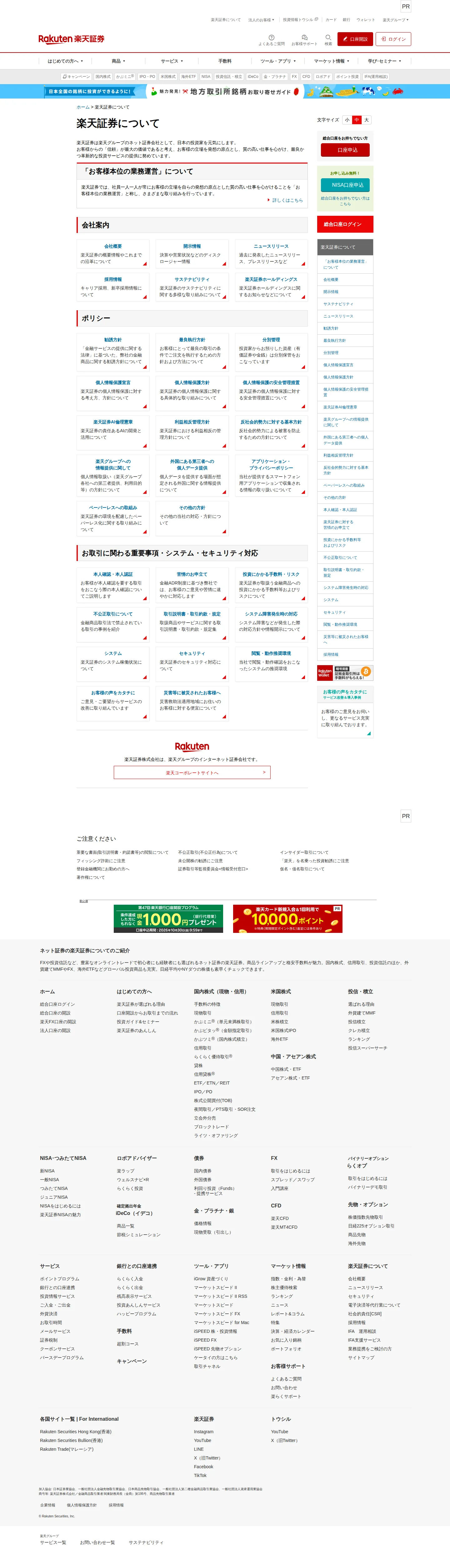
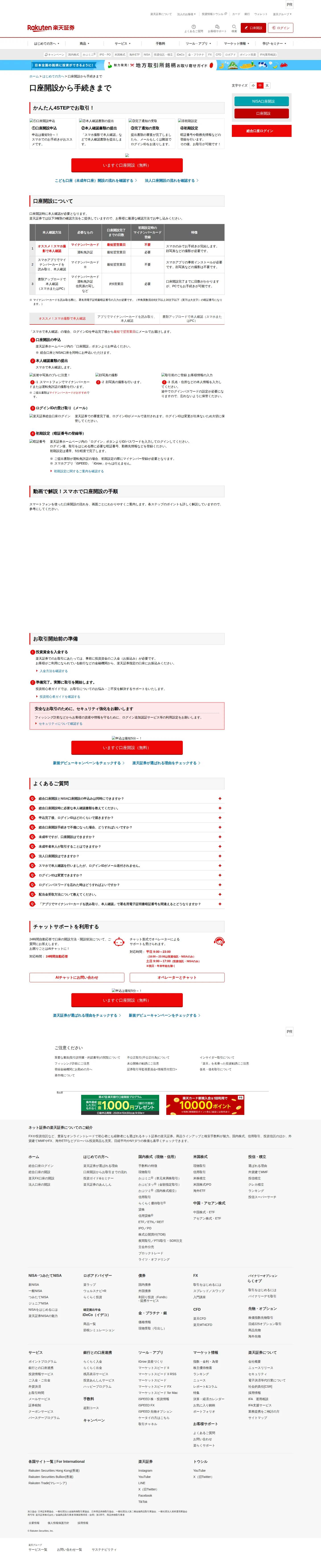
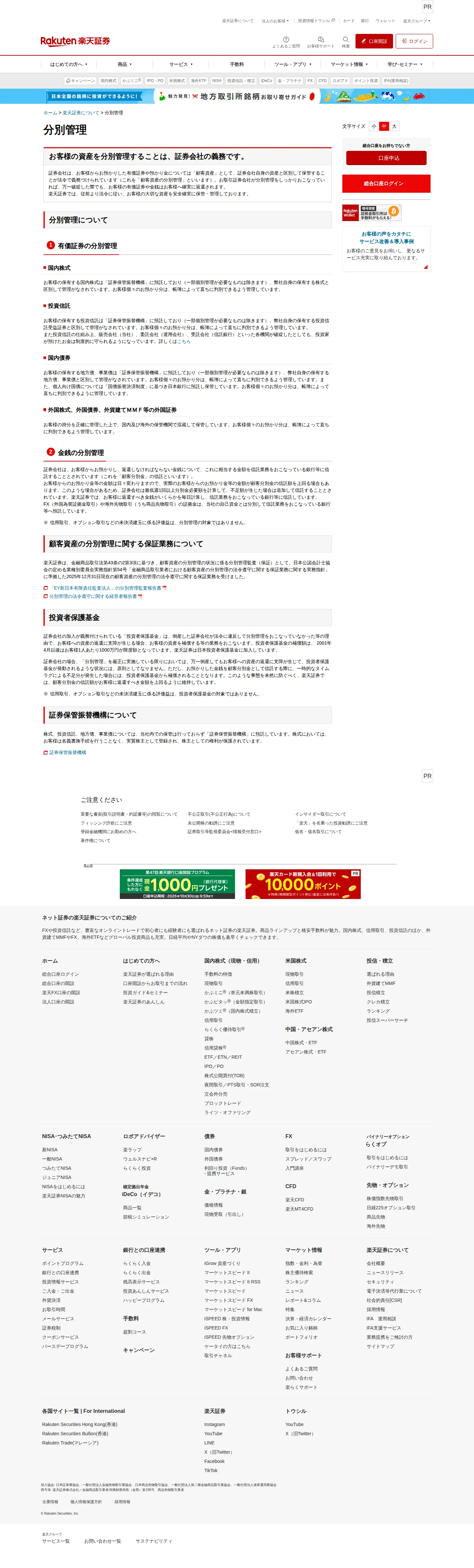
Pages captured from Rakuten Securities’s own site when this review was written. Brokers change their terms; these are what we read.



Score history
Recomputed daily; every move is on the record. The current score is always the latest row.
| Date | Score | Move |
|---|---|---|
| 2026-10-12 | 7.0 | ▲ |
| 2026-07-25 | 4.5 | ▼ |
| 2026-07-18 | 4.6 | ▲ |
| 2026-07-11 | 4.5 | · |
FAQ
Is Rakuten Securities regulated?
Yes, it’s licensed by Japan’s Kanto Local Finance Bureau (licence 第195号), confirmed on-register since 2007 for Type I/II Financial Instruments Business, Investment Advisory and Investment Management.
Does Rakuten Securities hold a commodity-futures licence?
A commodity-futures-operator status is cited, but no authority or licence number is given, so it can’t be verified.
What spread does Rakuten Securities charge on EURUSD?
A published “from” spread of USD 3.00 round turn on 1 lot via its Rakuten FX service; this is a floor, not a fixed price.
What is the minimum deposit at Rakuten Securities?
Not published.
What trading platforms does Rakuten Securities offer?
MT4, the MT4 web terminal, its own web, mobile, Windows and Mac apps, plus proprietary platforms like マーケットスピード and iSPEED.
How good is Rakuten Securities' customer support?
It’s reachable by email, live chat and phone with published hours, but which entity handles a client and how complaints escalate depends on who onboarded them, and at least one complaint is documented as unresolved.
How this review works
Track Rakuten Securities live: score moves and red notices, in your pocket.