
CFD · CHECKED 10 OCT 2026
Saxo review.
Multi-entity CFD broker regulated by the FCA, MAS and SFC
OK-ISH
OUT OF 10
AD DISCLOSURE: IF YOU OPEN AN ACCOUNT THROUGH THIS LINK WE MAY EARN A COMMISSION. IT NEVER MOVES THE SCORE. HOW THIS WORKS
Saxo is a multi-entity CFD and trading broker regulated by tier-1 authorities including the UK FCA and Singapore's MAS, with additional licensing in Hong Kong via the SFC. FCA-regulated clients get FSCS compensation up to 85,000 GBP and negative balance protection. The biggest reservation is a fine and public reprimand against its SFC-licensed Hong Kong entity dated January 2026, plus an unpublished minimum deposit.
Each criterion is scored 1 to 10 from primary sources. The overall score is their unweighted mean. How scoring works.
| Founded | 1992 |
|---|---|
| Headquarters | DK |
| Minimum deposit | EUR 0 (Classic); EUR 50,000 for Joint accounts |
| Minimum spread | 0.4 |
| Withdrawal fee | 0 |
| Account opening | 1-2 |
| Platforms | SaxoInvestor, SaxoTrader |
- FCA authorisation for Saxo Capital Markets UK Limited, FRN 551422, tier-1 regulator
- MAS Capital Markets Services licence held by Saxo Capital Markets Pte Ltd
- FCA-regulated clients covered by FSCS compensation up to 85,000 GBP and an ombudsman
- Negative balance protection and 30:1 leverage cap on major FX under FCA rules
- USD 10 round-turn 'from' spread on 1 lot EURUSD on the Classic account
- Offers TradingView alongside its own web platform and mobile app
- SFC-licensed entity Saxo Capital Markets HK Limited fined and reprimanded, Jan 6 2026
- Minimum deposit not published
- Blended rating only 3.89 stars across 61105 ratings
Overview
TrueBroker is a free broker safety checker, and this page is our review of Saxo, scored 6.6 out of 10 across regulation, fees, platform, support and reviews.
Saxo trades under the entity Saxo Bank A/S, headquartered in Hellerup, Denmark, and the group also operates through named entities including Saxo Capital Markets UK Limited, Saxo Bank (Switzerland) AG, Saxo Capital Markets Pte. Ltd. in Singapore, Saxo Capital Markets HK Limited, and a representative office in Dubai, per Saxo’s own about and contact pages. Saxo’s own account page states the bank was founded in Denmark in 1992, carries an A minus credit rating from S&P Global Ratings, and reported a total capital ratio of 26.5% for the first half of 2026. Ownership sits with Bank J. Safra Sarasin AG, which wholly owns Saxo Holding AG, after the J. Safra Sarasin Group completed its acquisition of the remaining stake previously held by founder Kim Fournais, per Saxo’s own about page; Fournais remains Chairman of the Board. Because this review covers the CFD category, the single fact worth reading before anything else is Saxo’s own mandatory risk line, published on its markets and terms pages: “64% of retail investor accounts lose money when trading CFDs with this provider.”
Overview Table
| Headquarters | Saxo Bank A/S, Philip Heymans Alle 15, 2900 Hellerup, Denmark, per Saxo’s own about page |
| Established | 1992, per Saxo’s own account page |
| Countries Served | Saxo’s own fee page states it is “fully licensed and regulated in 11 jurisdictions across Europe, the Middle East and Asia,” with contact offices in Denmark, the UK, Belgium, Czech Republic, France, Italy, the Netherlands, Switzerland, India and Japan, plus Singapore and a Dubai representative office, per Saxo’s own contact page |
| Regulated By | FCA register listing (confirmed on the FCA register: Saxo Capital Markets UK Ltd, Authorised, firm reference 551422); Confirmed in MAS Financial Institutions Directory (confirmed in the MAS Financial Institutions Directory: Saxo Capital Markets Pte. Ltd., Capital Markets Services Licensee and Exempt Financial Adviser); Hong Kong SFC Public Register (confirmed on the SFC Public Register: Saxo Capital Markets HK Limited, CE reference AVD061). The firm also names licences with the Danish Danish FSA, FINMA in Switzerland, ASIC and Japan’s FSA that we could not check against our registers |
| Minimum Deposit | EUR 0 for the Classic tier, per Saxo’s own fee page; the individual account page states no minimum funding requirement, while Joint accounts require EUR 50,000, per Saxo’s own account page |
| Maximum Leverage | Not stated |
| Total Instruments | Not stated as a single combined figure; Saxo’s own fee page separately cites 23,000+ stocks, 7,400+ ETFs, 250+ futures and 3,100+ listed options |
| Platforms | SaxoTrader (web, mobile and desktop) and SaxoInvestor, per Saxo’s own platforms pages |
| Customer Support | 24/5 phone, chat and email support through local offices in 11 countries and the help.saxo portal, per Saxo’s own account pages |
| Languages | Not stated |
Facts List
- Headquartered at Philip Heymans Alle 15, 2900 Hellerup, Denmark, per Saxo’s own about page.
- Founded in Denmark in 1992, per Saxo’s own account page.
- Wholly owned by Bank J. Safra Sarasin AG through Saxo Holding AG, after the J. Safra Sarasin Group completed its acquisition of the remaining stake, per Saxo’s own about page.
- Saxo Bank A/S carries an A minus credit rating from S&P Global Ratings and a total capital ratio of 26.5% for the first half of 2026, per Saxo’s own account page.
- Reported a net profit of EUR 87 million for the first half of 2026, described by Saxo’s own press release as the bank’s best half year result on record.
- The FCA register lists Saxo Capital Markets UK Ltd as Authorised, firm reference 551422.
- The MAS Financial Institutions Directory lists Saxo Capital Markets Pte. Ltd. as a Capital Markets Services Licensee and Exempt Financial Adviser.
- The Hong Kong SFC Public Register lists Saxo Capital Markets HK Limited under CE reference AVD061, and the same register records two disciplinary actions against it dated January 6, 2026: a fine and a public reprimand.
- Our search of 1441 warning list entries mirrored from CySEC, the FCA and FSC Mauritius found Saxo on none of them.
- Saxo’s own risk disclosure states “64% of retail investor accounts lose money when trading CFDs with this provider.”
Where Saxo is licensed and where our checks stopped
Saxo’s own fee page claims the firm is “fully licensed and regulated in 11 jurisdictions across Europe, the Middle East and Asia,” and an table from our earlier review names seven regulators covering seven Saxo entities. We checked five public registers directly: the FCA, MAS, ASIC, JFSA and SFC. Three of the seven claimed licences came back confirmed by name: the FCA register for Saxo Capital Markets UK Ltd, the MAS Financial Institutions Directory for Saxo Capital Markets Pte. Ltd., and the Hong Kong SFC Public Register for Saxo Capital Markets HK Limited, which also carries two recorded disciplinary actions against it dated January 6, 2026. The remaining four claims, covering the Danish FSA, FINMA in Switzerland, ASIC in Australia and Japan’s FSA, could not be checked: the FINMA list of 278 authorised institutions we read did not include an entity under the name “Saxo Bank (Switzerland) AG,” the ASIC and Danish FSA claims carried no licence number to look up, and Japan’s FSA list names firms only in Japanese with no registration number given for “Saxo Bank Japan K.K.” None of that is a finding against Saxo; it is the limit of what our registers and the claim itself gave us to check. Before recording any of these as absent, we ran a positive control on six of the registers, searching for a firm known to be listed, so an empty result reads as a genuine gap rather than a broken search. Separately, our search of 1441 warning list entries mirrored from CySEC, the FCA and FSC Mauritius returned no match for Saxo; the only Saxo-adjacent hit was techathome.org, which CySEC lists on its List of Non Approved Domains as a website not authorised to provide investment services under any Cypriot licence, without naming the firm it imitates. That domain is not Saxo and is not evidence that Saxo appears on any warning list.
Where Saxo’s own fee pages contradict each other
We read Saxo’s published fee material directly rather than a summary of it, and two figures do not agree with each other on the firm’s own site. The homepage states bond commissions “from EUR 20,” while the separate pricing overview page states bond commissions “from 0.05%,” for what reads as the same product. The fee page’s “Account fees at a glance” summary table gives the Classic tier reporting fee, for online reports sent by email, as USD 50, while the “Fee details” section further down that same page gives USD 100 for the identical request. Elsewhere on the same fee page, a manual order placed by phone, chat or email costs EUR 50 per order, and a client who simply wants a copy of their own US tax withholding form (a 1042-S) pays EUR 1,000 per income year unless the request falls under one of three narrow exceptions. Custody fees on stocks, ETFs and bonds also vary by where the account is held: 0.15% for Classic UAE and MENA accounts against 0% in Belgium, France, Italy, Japan, the Netherlands and Switzerland, per the same fee page.
What Saxo’s own terms bind a client to
We read Saxo’s Terms of Use directly. The Miscellaneous section states that “any claims arising from this Agreement will be governed by and construed in accordance with the laws of Denmark and shall be subject to the exclusive jurisdiction of the Danish Courts,” regardless of where the client lives. The Agreement section states that Saxo Bank “may modify this Agreement at any time in its sole discretion and without prior notice to you,” and that continued use of the services counts as acceptance of the change. The Limited Liability section states that neither Saxo Bank nor its information providers are liable for damages, including lost profits, arising out of or relating to this Agreement or resulting from the use or the inability to use the Services… even if such party has been advised of the possibility of such damages.
Our previous review of Saxo scored it 7 out of 10; this review scores it 6.6 out of 10. That change reflects our current assessment against the evidence above, not any change at Saxo itself. Regulation scores 6.4 of 10 because our direct register checks confirmed only three of the seven licences Saxo’s own materials claim, and the one register entry we could confirm in full, the Hong Kong SFC record, carries two recorded disciplinary actions dated January 6, 2026. Fees score 7.6 of 10 against a backdrop of two contradicting figures on Saxo’s own site for bond commissions and for the Classic tier reporting fee. Support scores 5.8 of 10 against a fee page that advertises 24/5 phone, chat and email assistance alongside a EUR 50 charge for using those same channels to place an order, and a EUR 1,000 charge for a client requesting their own tax form.
Key Takeaways
Saxo’s overall score moves from 7 out of 10 in our previous review to 6.6 out of 10 here. That is a change in our assessment against the current evidence, not a claim that Saxo has gotten better or worse. The criteria behind the number split as regulation 6.4, fees 7.6, platform 6.8, support 5.8 and reviews 6.2.
What the registers actually confirmed
- The FCA register shows Saxo Capital Markets UK Ltd as Authorised, firm reference 551422. That reference is the register’s own number, not one Saxo published.
- The MAS Financial Institutions Directory lists Saxo Capital Markets Pte. Ltd. as a Capital Markets Services Licensee and Exempt Financial Adviser, with activities including dealing in capital markets products, securities, collective investment schemes, exchange traded and over the counter derivatives, leveraged FX, product financing, custodial services and investment research. The directory does not publish a licence number.
- The Hong Kong SFC Public Register shows Saxo Capital Markets HK Limited holding CE reference AVD061. The same record shows two public disciplinary actions against it: a fine dated January 6, 2026 and a public reprimand also dated January 6, 2026. We could not read any regulated activities listed against the entry.
- We searched the FINMA list of 278 authorised Swiss banks and securities firms and found no entity matching “Saxo Bank (Switzerland) AG.” A group company under a different name may still hold Swiss authorisation, so this is a gap in what the list shows under that name, not a finding that the entity is unauthorised.
- The claims for the Danish FSA, ASIC and the Japanese FSA carried no licence or registration number to look up, so those three remain not checked. The Danish company registry number quoted on Saxo’s own privacy notice, 15731249, also has not been checked against a register we hold.
Warning list search
We searched 1,441 warning list entries mirrored from CySEC, the FCA and the FSC Mauritius, and Saxo appears on none of them. Before treating that as an absence we ran a positive control against six registers with a firm known to be listed, so an empty result here means Saxo is not on those lists rather than the search silently failing. One separate result did surface: CySEC’s List of Non Approved Domains names techathome.org as a domain not authorised to provide investment services under any Cypriot licence. CySEC’s own listing does not identify which firm the domain imitates, and techathome.org is not Saxo.
What Saxo’s own fee pages contradict
We read the published fee material rather than a summary of it, and two of Saxo’s own pages disagree with each other on cost. The homepage states bond commissions “from EUR 20,” while the separate pricing overview page states bond commissions “from 0.05%.” The general fees page similarly gives the Classic tier reporting fee as USD 50 in its own “Account fees at a glance” summary table, then states USD 100 for the identical scenario, online reports by email, further down the same page under “Fee details.”
Beyond the contradictions, Saxo’s fee page lists a number of charges worth naming directly: a manual order fee of EUR 50 per order for anything placed by phone, chat or email; an instrument addition charge of USD 200 for Classic and Platinum clients requesting a new tradable instrument, charged only if the addition succeeds, with VIP exempt; a EUR 1,000 per income year charge to request a 1042-S US tax form, waived only if the IRS itself requested it, Saxo applied the wrong withholding rate, or more than 10 forms are needed; and a EUR 15 per month terminated account administration fee that keeps accruing until a closed account’s remaining assets and cash are fully withdrawn. Custody fees on stocks, ETFs and bonds also depend on where the account is held: 0.15% for Classic and Platinum UAE and MENA accounts against 0% in Belgium, France, Italy, Japan, the Netherlands and Switzerland. Clients running a financing shortfall pay Negative Net Free Equity interest at Saxo’s ask rate plus 8% on Classic accounts, plus 7% on Platinum, and plus 6% on VIP, meaning the smallest accounts carry the highest overdraft rate of the three tiers.
Terms that bind a Saxo client
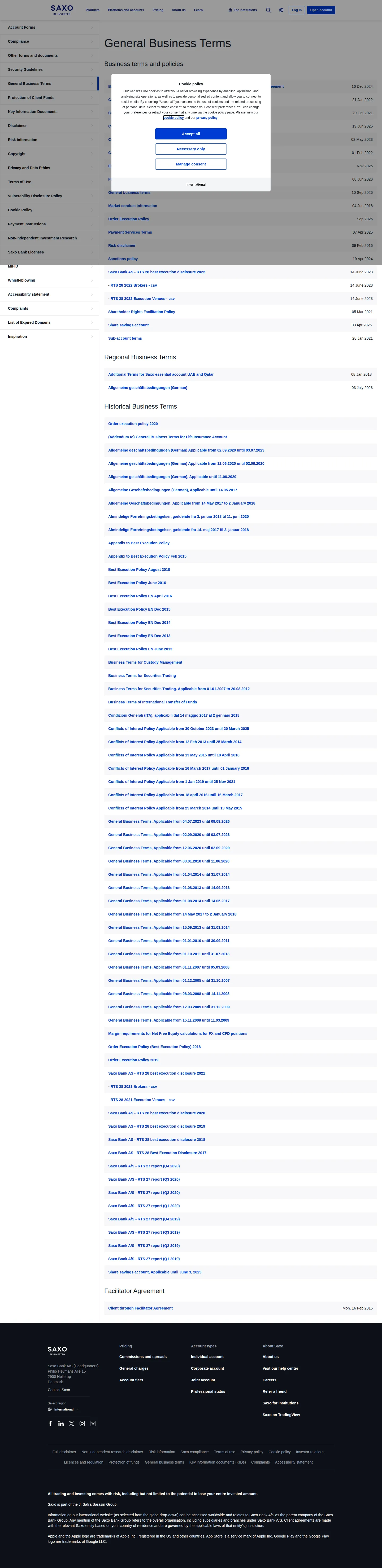
The Terms of Use we read give Saxo wide latitude over the relationship. Under “Agreement,” Saxo “may modify this Agreement at any time in its sole discretion and without prior notice to you,” and continued use of the Services “shall constitute your acceptance to the Agreement, as amended.” Under “Limited Liability,” Saxo and its information providers are not liable “for any direct, indirect, incidental, special or consequential damages arising out of or relating to this Agreement or resulting from the use or the inability to use the Services, including but not limited to damages for loss of profits, use, data or other intangible damages.” Under “Miscellaneous,” Saxo “reserves the right to record all telephone conversations, internet conversations including chat, and any meetings,” and states that a client’s interactions “may be used for further development of Saxo Bank’s algorithms and artificial intelligence models.” The same section fixes disputes under Danish law and “the exclusive jurisdiction of the Danish Courts,” regardless of the client’s own country of residence.
Account closure carries a concrete condition rather than a vague one: to close an account, a client must first close all open positions, have no standing orders, have no corporate actions, and “fund your account to cover any negative balance, if applicable.” A client who elects or qualifies for professional status trades with lower margin requirements but, per Saxo’s own account FAQ, is “generally covered by fewer” of the retail specific protections such as appropriateness assessments and disclosure requirements.
Support and scale
Saxo’s own account pages describe a local support team on call 24/5 across offices in 11 countries, backed by a self-service portal at help.saxo. The firm’s own mandatory risk disclosure states that 64% of retail investor accounts lose money trading CFDs with this provider, a figure that recurs across several of Saxo’s own pages rather than being a one-off caveat.
Licenses & Regulation
Saxo trades through a cluster of national entities rather than one licensed company, and the regulation picture is mixed: some of those entities check out against the public registers we searched, some don’t, and one entity’s own register carries disciplinary history that our earlier review never mentioned.
What the registers confirm about Saxo
Saxo Capital Markets UK Ltd is on the Financial Conduct Authority register as Authorised, firm reference 551422; that entry was found by searching the FCA register by name, since the claim in our earlier review carried no FRN to look up directly. Saxo Capital Markets Pte. Ltd. is listed in the Monetary Authority of Singapore’s Financial Institutions Directory as a Capital Markets Services Licensee and Exempt Financial Adviser, with permitted activities including dealing in capital markets products, securities, collective investment schemes, exchange-traded and over-the-counter derivatives, spot foreign exchange for leveraged trading, product financing, custodial services, and issuing investment research; the MAS directory does not publish licence numbers alongside that entry. Saxo Capital Markets HK Limited holds CE reference AVD061 on the Hong Kong Securities and Futures Commission’s Public Register of Licensed Persons and Registered Institutions. That same SFC record also carries two disciplinary actions against the entity: a fine dated January 6, 2026, and a public reprimand dated January 6, 2026. The register does not give the underlying reasons for either action in the fields we read, but a reader relying on Saxo’s Hong Kong licence should know the SFC’s own record shows recent enforcement against it.
What we could not check
Four of the regulator claims in the entity table could not be confirmed either way. Saxo Bank (Switzerland) AG does not appear on the Swiss Financial Market Supervisory Authority’s list of authorised banks and securities firms, a list we read in full (278 authorised institutions) in this session, so the list was demonstrably working; a Swiss group company trading under a different registered name could still hold FINMA authorisation without showing up under this one. The claimed Australian Securities and Investments Commission licence for Saxo Capital Markets (Australia) Pty Ltd. carries no AFS licence number in the material we hold, so there was nothing to search against ASIC’s register. The Japanese Financial Services Agency’s list of registered Financial Instruments Business Operators names firms in Japanese only and the claim for Saxo Bank Japan K.K. gave no registration number, so that entry could not be matched either. The claimed Danish Financial Supervisory Authority licence for Saxo Bank A/S carries no licence number and we hold no register entry for that regulator, so it is untested rather than confirmed. Separately, Saxo’s own privacy notice gives a company number, 15731249, against what appears to be the Danish company registry; that is a company registration, not a financial licence, and we have no register entry to check it against either. None of this means these authorisations don’t exist; it means the material available to us didn’t let us verify them, which is a different thing from a register having cleared them. Saxo’s own fee page separately states it is “fully licensed and regulated in 11 jurisdictions across Europe, the Middle East and Asia” without naming a single regulator or licence number on that page, so that broader claim sits outside anything we could test against a register.
Warning lists and the domain that isn’t Saxo
We searched 1,441 warning-list entries mirrored from the FCA, CySEC and the FSC Mauritius, running a positive control against six registers first (searching for a firm known to be listed) so that a clean result means absence rather than a broken search. Saxo does not appear on any of the 1,441 entries. One related result did turn up: CySEC’s List of Non-Approved Domains names techathome.org as a domain not authorised to provide investment services under any Cypriot licence. CySEC’s own listing does not identify which firm, if any, that domain imitates, and it is not Saxo. A reader searching for Saxo should simply know that domain is a different, unauthorised site and not confuse it with the broker under review here.
Ownership and what the contract says about where a client actually stands
Saxo’s own “about” pages state that Bank J. Safra Sarasin’s parent, the J. Safra Sarasin Group, “has completed its acquisition, resulting in full ownership of Saxo,” having bought out the roughly 28.69% stake previously held indirectly by founder Kim Fournais, who remains Chairman of the Board. Saxo Holding AG sits between the two, wholly owned by Bank J. Safra Sarasin AG in Basel and itself holding 100% of Saxo Bank A/S. The footer of Saxo’s own Terms of Use states that “client agreements are made with the relevant Saxo entity based on your country of residence and are governed by the applicable laws of that entity’s jurisdiction,” meaning the protections and regulator actually standing behind an individual client depend on which national entity onboards them, not on the group structure above. Separately, that Terms of Use document places any dispute over the terms themselves under Danish law and “the exclusive jurisdiction of the Danish Courts,” regardless of the client’s residence. On compensation, Saxo’s own accounts pages state that cash deposits and certain assets held with Saxo Bank A/S “may be covered by the Danish Guarantee Fund, subject to eligibility and scheme limits,” but that this cover does not cover investment losses or losses resulting from market movements; no coverage cap figure appears in the material we read. Clients who take up or qualify for “professional status” give up further ground: Saxo’s own account pages describe professional clients as “generally covered by fewer” of the retail-specific protections such as disclosures and appropriateness assessments, in exchange for lower margin requirements.
On the score
This review scores regulation at 6.4 out of 10, moving the overall score from a previous 7 out of 10 to 6.6. That change reflects this review’s assessment against the evidence gathered now, not any change at Saxo: of the seven regulator claims we tried to check, we could confirm three against the actual registers (the FCA, MAS and SFC), one of which, the SFC record for the Hong Kong entity, carries two recent disciplinary actions; the other four claims could not be checked at all, for want of a licence number or a matching register entry, rather than being confirmed or refuted.
How to Trade
Saxo runs two of its own platforms under a single account: SaxoTrader, described on the firm’s platforms page as the “advanced trading platform with full product range” covering options, CFDs, forex, futures, commodities, stocks, ETFs, mutual funds and bonds; and SaxoInvestor, the “simple investing platform with essential tools” limited to stocks, ETFs, mutual funds and bonds. CFDs, forex, futures and commodities sit inside SaxoTrader only; SaxoInvestor does not list them. Saxo’s own platform page adds that “product availability may vary by country of residence,” so what a given client can actually open depends on where they are booked, not just which platform they pick.
What Saxo lets a client trade, and its own CFD warning
The instrument list spans stocks, ETFs, mutual funds, bonds and options on both platforms, plus CFDs, forex, futures and commodities on SaxoTrader. Saxo’s own site carries the regulator-mandated line, repeated across its markets, platforms and terms pages: “64% of retail investor accounts lose money when trading CFDs with this provider.” That figure is Saxo’s own disclosure, not an industry average, and it applies specifically to trading CFDs with this firm.
Pricing that moves with volume and account tier
Saxo’s fee page gives commissions starting from $1 per US stock or ETF trade, “as low as $1” per futures contract and “as low as $0.75” per listed option, while the homepage separately quotes stock options from EUR 0.75 per contract on European venues. Those headline commissions fall further at the Platinum and VIP tiers: the account-comparison page shows major forex pairs priced at 1 pip for Classic, 0.9 pips for Platinum and 0.7 pips for VIP, with US stocks/ETFs moving from 0.08% down to 0.03% across the same three tiers. Currency conversion is charged separately: Saxo’s fee and platform pages both put this at the FX spot mid-price plus or minus 0.25%, applied to conversions including trading profits and losses. The fee page adds that it does not apply to margin collateral; the platform page does not mention that exclusion. Bond commissions are inconsistent across Saxo’s own pages: the homepage states “from EUR 20” while the pricing overview page states “from 0.05%” for the same product, and the two figures do not reconcile.
Costs that only bite in specific situations
Orders placed by phone, chat or email carry a flat EUR 50 manual order fee on top of the platform’s regular commission, per Saxo’s fee page. That same page prices a request to add a new tradable instrument at USD 200 for Classic and Platinum clients, charged only if the addition succeeds, while VIP clients get this free. Clients who run short of cash against their margin and unrealised P&L pay Negative Net Free Equity interest at Saxo’s ask rate plus 8% for Classic, plus 7% for Platinum, or plus 6% for VIP, meaning the smallest accounts are charged the steepest overdraft rate of the three tiers.
Extended hours and the limits of Saxo’s automated protection
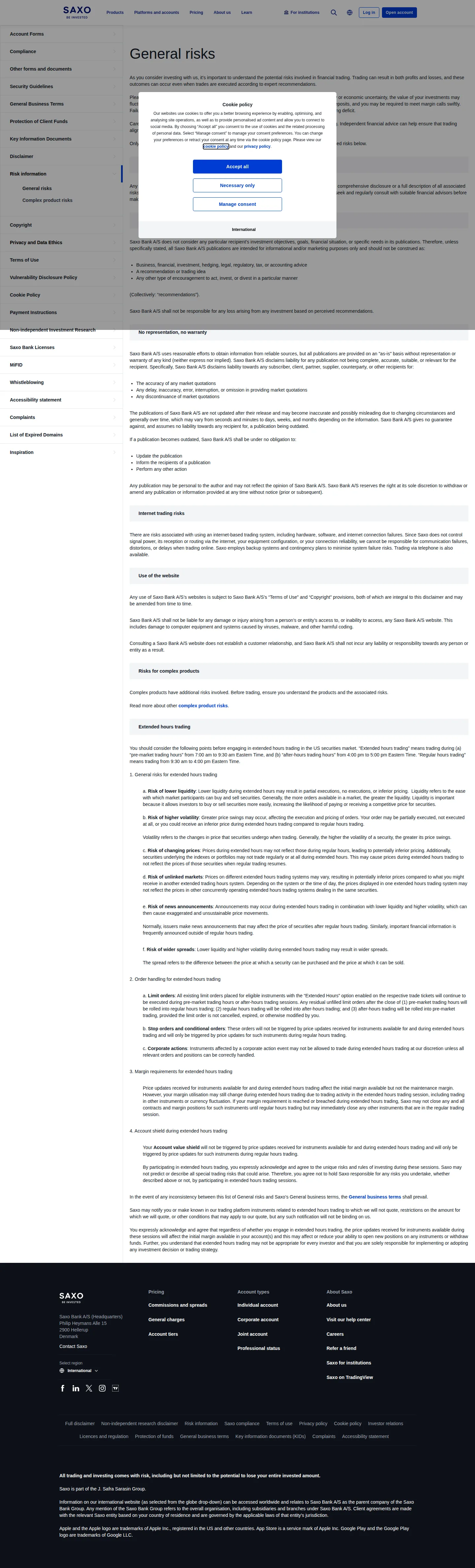
Saxo’s own risk disclosures state that during pre-market and after-hours sessions, the Account value shield will not be triggered by price updates received for instruments available for and during extended hours trading and will only be triggered … during regular hours trading, and that Saxo “may not close any and all contracts and margin positions for such instruments until regular hours trading.” In plain terms, the automated safeguard that would normally act on a margin breach does not operate outside regular trading hours, so a position trading in extended hours can run further into loss before that protection, or a Saxo-driven close-out, applies.
Professional status changes the terms of the trade, not just the paperwork
Saxo’s account pages describe professional status as a way to “trade with more flexibility and lower margin rates,” available to clients meeting at least two of three tests: a financial portfolio exceeding EUR 500,000 in eligible investable assets, an average of at least 10 qualifying trades per quarter over the last four quarters, or authorised dealers with at least a year of relevant financial-sector experience. The same pages are explicit about the trade-off: “retail protections do not apply” once professional status is granted, and elsewhere Saxo states professional clients “are generally covered by fewer” of the retail-specific protections such as appropriateness assessments and disclosure requirements.
Closing a position, and closing the account itself
Saxo’s account FAQs set the same sequence for closing an individual, corporate or joint account: the client must close all open positions, have no standing orders, have no corporate actions outstanding, and “fund your account to cover any negative balance, if applicable.” An account left with assets or cash after Saxo’s specified termination date then accrues a EUR 15 per month administration fee, charged until everything is withdrawn. Saxo’s terms of use also reserve the right to change the agreement “at any time in its sole discretion and without prior notice,” with continued use of the services treated as acceptance of the new terms, and route any dispute over those terms to Danish law and the exclusive jurisdiction of the Danish courts.
Account Types
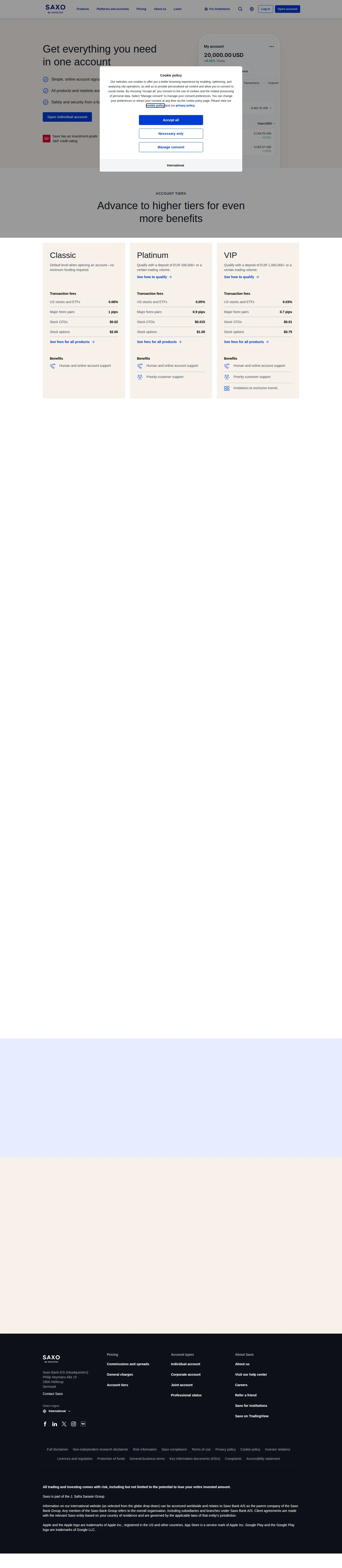
Saxo sells four tiers of the same account rather than separate products: Classic, Platinum, VIP and Saxo Elite. The tier a client sits in changes the price of every trade and several of the ongoing fees, not just the service level.
The four tiers Saxo offers
Saxo’s own account-tiers page puts Classic first, with “minimum initial funding varies by country of residence” and no fixed figure given, while its individual-account page states that Classic carries no minimum funding requirement at all. Those are two answers to the same question on the same firm’s site. Platinum requires EUR 200,000 or more in assets, or an unspecified trading volume threshold, and adds priority customer support on top of the human and online support Classic gets. VIP requires EUR 1,000,000 or more, or a volume threshold, and adds invitations to what the page calls “exclusive events.” Above that sits Saxo Elite, for clients with more than EUR 5,000,000 in assets or more than EUR 200,000,000 in annual trading volume, which the same page says gets “personalised service and a dedicated relationship manager” and notes the minimum requirements “may vary by region.” Saxo’s separate joint-account comparison page repeats these four tiers but adds transaction-fee examples per tier: US stocks and ETFs run 0.08% for Classic, 0.05% for Platinum and 0.03% for VIP; major forex pairs run 1 pip, 0.9 pips and 0.7 pips; stock CFDs run $0.02, $0.015 and $0.01; stock options run $2.00, $1.00 and $0.75. The joint-account page states “Minimum initial funding of EUR 50,000” for a Classic-tier joint account, against the individual account’s no minimum at all. Those are different products, so the two figures need not conflict, but a reader looking up what Classic requires meets both numbers under one tier name and is told nowhere which applies to them.
Individual, corporate and joint accounts
Underneath the tier system sit three account structures. Saxo’s account-types page describes an Individual account with “no minimum funding requirement” and access to “all products and markets available in one account,” with the ability to move up the Classic/Platinum/VIP/Elite ladder as deposits or volume grow. A Corporate account lets a company trade in its own name; the account-tiers page separately says corporate accounts are generally approved in about 1 week once a corporate bank account, Memorandum & Articles of Association, Certificate of Incorporation, proof of business address, latest financial statement, and (for complex groups) a group structure diagram are supplied, along with passport and proof-of-residency documents for directors and any beneficial owner holding 25% or more. A Joint account, per the joint-account FAQ page, is limited to two immediate family members, both 18 or over, is capped at one joint account per applicant, gives both holders equal rights to trade, deposit and withdraw, and generally cannot receive positions transferred in except from a matching external joint account.
Professional status
Saxo’s account-types page also offers Professional status, sold as a way to “qualify to trade with more flexibility and lower margin rates,” with the same line stating plainly that “retail protections do not apply.” The account-tiers page sets out what qualifying takes for a corporate account holder: meeting at least two of three tests, a financial portfolio exceeding EUR 500,000 in eligible investable assets issued in the entity’s name, an average of at least ten qualifying trades per quarter across the last four quarters with at least one trade in each quarter, or every authorised dealer on the account having at least a year of professional financial-sector experience in a role requiring knowledge of the specific product traded. The same page’s account-protection FAQ says professional clients “are generally covered by fewer” of the retail-specific protections such as disclosures and appropriateness assessments.
What holding a Saxo account costs by tier
Saxo’s fee schedule prices custody by account location and tier rather than as one flat number. For accounts located in the UK, custody on stocks, ETFs/ETCs and bonds runs 0.12% for Classic, 0.12% for Platinum and 0.08% for VIP, with a flat 0.05% on funds across all three tiers; for accounts located in the UAE or wider MENA region the same fee page gives 0.15% for Classic, 0.15% for Platinum and 0.05% for VIP. A second fee page on the same site prices custody on stocks, ETFs/ETCs and bonds at 0.15% Classic, 0.12% Platinum and 0.09% VIP, calculated daily on end-of-day values and charged monthly, again noting the rate “varies by country of residence.” Tier also sets the cost of borrowing against the account: Saxo’s fee page prices Negative Net Free Equity, its term for when margin requirements and unrealised losses exceed the cash balance, at Saxo’s ask rate plus 8% for Classic, plus 7% for Platinum and plus 6% for VIP, so the smallest accounts pay the highest overdraft rate of the three. Asking Saxo to add a new tradable instrument costs USD 200 for Classic or Platinum clients, charged only if the addition succeeds; the same fee page says VIP clients get this free. Closing any of these accounts, per the individual, joint and corporate FAQ pages, requires closing all open positions, clearing any standing orders and corporate actions, and funding the account to cover a negative balance “if applicable” before Saxo will process the request.
Negative Balance Protection
Saxo’s own fee schedule does not describe a negative balance protection guarantee. What it describes instead is a cost for running a negative balance: what Saxo calls “Negative Net Free Equity interest,” charged when the margin requirement on a client’s positions plus any unrealised loss exceeds the cash held in the account. The rate is Saxo’s own ask rate plus a margin that gets worse the smaller the account: plus 8% for Classic, plus 7% for Platinum, plus 6% for VIP, according to the fee page. A retail client on the entry-level Classic tier pays the steepest overdraft rate of the three, at exactly the tier where a shortfall is most likely to happen in the first place.
Closing an account while it is in the red
Saxo’s account FAQs, read across both the individual and the corporate account pages, set the same condition for closing an account: the client must close all open positions, have no standing orders, have no corporate actions outstanding, and “fund your account to cover any negative balance, if applicable.” The joint account FAQ repeats the identical wording. Read together, these three pages describe a firm that does not write off a negative balance on exit: the client has to pay it down before Saxo will process the closure. Nothing on these pages describes a cap on what that negative balance can reach or a point at which Saxo absorbs it instead.
What happens to protective triggers outside normal hours
Saxo’s general risk disclosures, on the terms and conditions pages we read, single out extended hours trading as a gap in the automated safeguards that would otherwise limit a drawdown. During pre-market and after-hours sessions, the Account value shield will not be triggered by price updates received for instruments available for and during extended hours trading and will only be triggered … during regular hours trading, and Saxo states it “may not close any and all contracts and margin positions for such instruments until regular hours trading.” In plain terms, the mechanism that would normally act on a margin breach is switched off outside the regular session, so a position trading in extended hours can move further against a client before anything intervenes.
Saxo’s own loss-rate disclosure
Saxo publishes a regulator-mandated CFD loss statistic on its own pages, repeated on the markets page, the platforms page and the terms and conditions page in identical wording: “64% of retail investor accounts lose money when trading CFDs with this provider.” That figure is Saxo’s own disclosure about its own retail CFD client base, not an industry average, and it is the only quantified loss statistic in the material we read.
The compensation scheme behind the balance, and its limits
The corporate account FAQ on protection of money and assets states that cash deposits and certain assets held with Saxo Bank A/S “may be covered by the Danish Guarantee Fund, subject to eligibility and scheme limits.” The same page is explicit that this cover “do not cover investment losses or losses resulting from market movements.” No coverage cap figure appears on the page we read. The same FAQ also notes that protection “can vary depending on the products you use, which company within our group provides them, and whether you are a retail or professional client,” and that clients who take professional status “are generally covered by fewer” of the retail-specific protections. A client pushed toward professional status to get “more flexibility and lower margin rates,” as the account types page frames it, is trading away some of the same protective layer that would otherwise sit around a margin shortfall.
Where this pulls the score
Our previous review of Saxo scored 7/10 overall; this review scores it 6.6/10, on criteria of regulation 6.4, fees 7.6, platform 6.8, support 5.8 and reviews 6.2. That is our current assessment against current evidence, not a claim that Saxo’s own handling of drawdowns or margin has changed. The evidence behind the lower regulation figure includes exactly the material above: an overdraft-interest structure that charges the smallest accounts the most, an account value shield that Saxo’s own risk disclosure says stops working outside regular trading hours, and a compensation scheme that by its own wording stops at cash and certain assets and does not reach investment or market-movement losses.
Trading Instruments
Saxo’s own pages describe two platforms sitting over the same account: SaxoInvestor, described as a “simple investing platform with essential tools,” and SaxoTrader, described as an “advanced trading platform with full product range.” The homepage runs all nine instrument names together, Stocks, ETFs, Mutual funds, Bonds, Options, CFDs, Forex, Futures and Commodities, without separating which platform carries which. The platform comparison page confirms the same split: SaxoInvestor covers stocks, bonds, mutual funds and ETFs, while SaxoTrader adds the leveraged and derivative side, CFDs, Forex, Futures and Commodities, alongside Options, Stocks, ETFs, Mutual funds and Bonds. Saxo notes that “product availability may vary by country of residence,” so the list a given client sees may not match this range exactly.
What Saxo’s fee page says the range actually is
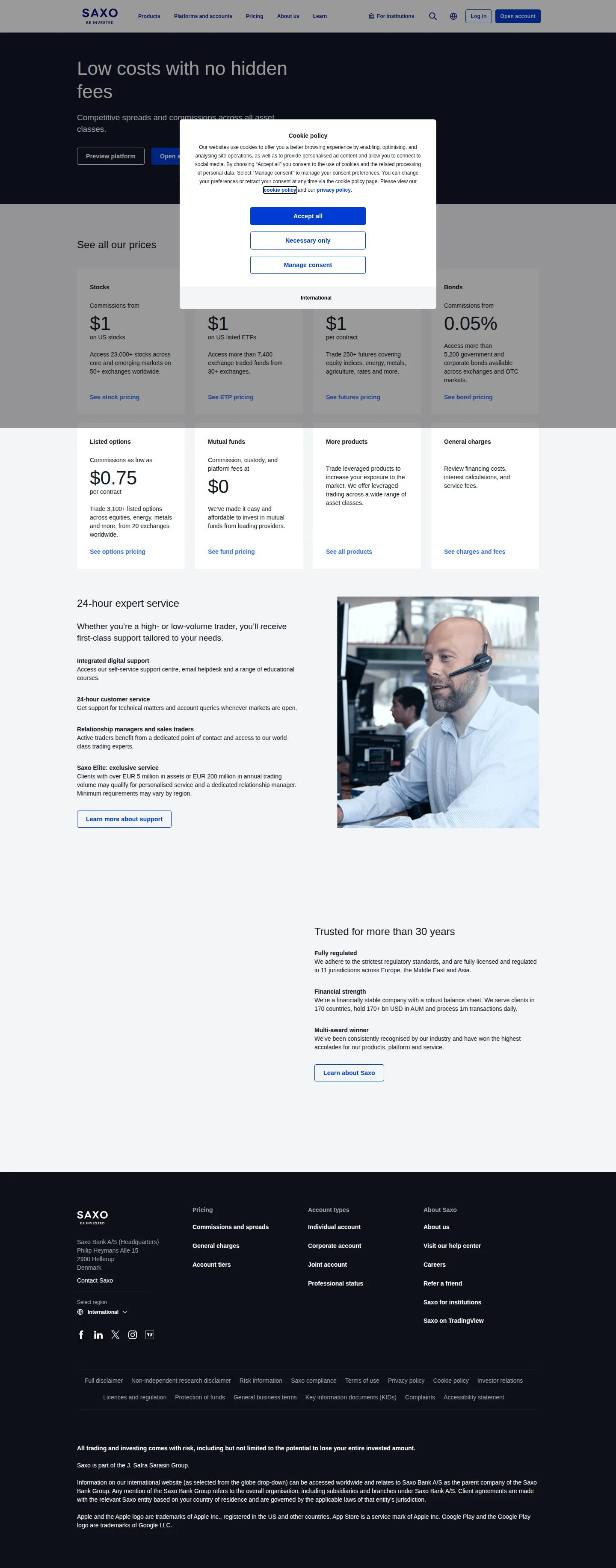
The pricing overview page puts numbers behind that range rather than just names. It advertises access to “23,000+ stocks across core and emerging markets on 50+ exchanges,” “7,400+ exchange traded funds from 30+ exchanges,” “250+ futures covering equity indices, energy, metals, agriculture, rates and more,” and “3,100+ listed options across equities, energy, metals and more, from 20 exchanges.” The homepage separately gives commission examples by exchange group: from EUR 2 on Euronext Amsterdam, Lisbon and Paris, from USD 1 on the main US exchanges, and EUR 0.75 per contract for EUR stock options. Mutual funds carry no commission, custody or platform fee at all, per the fee page.
Where Saxo’s own pages disagree with each other on CFDs
CFDs sit inside SaxoTrader, and Saxo’s own mandatory risk line, repeated on the markets page, the platforms page and the terms page, states that “64% of retail investor accounts lose money when trading CFDs with this provider.” That is Saxo’s own regulator required disclosure, not a third party estimate, and it applies specifically to this firm’s CFD clients rather than to the industry generally.
The bond commission figure is where Saxo’s own pages stop agreeing with each other. The homepage states bond commissions “from EUR 20,” while the separate pricing overview page states bond commissions “from 0.05%.” Both are Saxo’s own published figures for the same cost item, on different pages of the same site, and they do not reconcile into a single number. A client comparing the homepage to the fee page cannot tell which figure actually applies to a bond trade.
Account tiers change the transaction fee, not the instrument list
The instrument range itself does not change across Saxo’s account tiers, Classic, Platinum, VIP and Saxo Elite, but the transaction fee on each instrument does. The account tier comparison page gives worked examples: US stocks and ETFs at 0.08% on Classic against 0.05% on Platinum and 0.03% on VIP; major forex pairs at 1 pip on Classic against 0.9 pips on Platinum and 0.7 pips on VIP; stock CFDs at $0.02 on Classic against $0.015 on Platinum and $0.01 on VIP; stock options at $2.00 on Classic against $1.00 on Platinum and $0.75 on VIP. Saxo Elite, reserved for over EUR 5,000,000 in assets or EUR 200,000,000 in annual trading volume, adds “a dedicated relationship manager” rather than a published fee schedule of its own, and the page notes “minimum requirements may vary by region.” Instrument addition works the same way: a Classic or Platinum client can ask Saxo to list a new instrument for a USD 200 charge, applied only if the addition succeeds, while VIP clients get the same request free.
Custody charges that vary by where the account is held
Holding stocks, ETFs and bonds is not free once an account is opened. Saxo’s fee pages set custody charges that depend on account location: 0.15% for Classic and Platinum and 0.05% for VIP on stocks, ETFs/ETCs and bonds for UAE/MENA-located accounts, against 0.12% for Classic and Platinum and 0.08% for VIP for UK-located accounts. A separate custody fee table on the same site gives Classic at 0.15% per annum, Platinum at 0.12% per annum and VIP at 0.09% per annum on stocks, ETFs/ETCs and bonds, calculated daily on end of day values and charged monthly, again noted as varying by country of residence. Danish VAT of 25% is added to custody fees for EU resident individuals and for EU corporate or institutional clients without a valid EU VAT ID.
Education & Analysis
Saxo runs two of its own platforms rather than one: SaxoInvestor, described on its own pages as a “simple investing platform with essential tools”, and SaxoTrader, described as an “advanced trading platform with full product range”. Both sit behind the same client account, and the firm’s own marketing page states that the same account gives access to both SaxoTrader and SaxoInvestor, so opening one account does not lock a client into one interface.
What SaxoInvestor covers
SaxoInvestor is pitched at simpler investing rather than active trading. The instrument lists we pulled from Saxo’s own site put stocks, ETFs, mutual funds, bonds and options inside SaxoInvestor, while CFDs, forex, futures and commodities are listed only under SaxoTrader’s available instruments on the homepage, not among SaxoInvestor’s. SaxoInvestor is available as a web and mobile app, per Saxo’s own platforms page, which names the App Store and Google Play as the mobile distribution channels.
What SaxoTrader adds, and why Saxo names it
SaxoTrader is where the firm puts its full product range: options, CFDs, forex, futures, commodities, stocks, ETFs, mutual funds and bonds are all listed as available on it, with the caveat on the same page that “product availability may vary by country of residence”. Saxo’s platforms page breaks SaxoTrader out by access method: mobile, web (“no download needed, always available in your browser”), and desktop, where the firm specifies a multi-screen layout of up to 6 monitors along with Depth Trader and Level 1/2 market data. A separate account-benefits page for the corporate account tier describes SaxoTrader’s desktop app as a “pro-level desktop app”, which is Saxo’s own framing rather than an independent assessment.
What the CFD disclosure tells a client about this platform specifically
Where SaxoTrader carries CFDs, the same page carries Saxo’s own regulator-mandated risk line: “64% of retail investor accounts lose money when trading CFDs with this provider”. That figure is Saxo’s own disclosure, not an industry average, and it applies to the CFD product SaxoTrader offers rather than to the firm’s stock or fund products on SaxoInvestor.
Currency handling across both platforms
Saxo’s platforms page states that trading in a currency different from the account’s base currency triggers a currency conversion fee of plus or minus 0.25 percent, applied on the relevant FX spot mid-price, based on time of trade. The firm’s separate fee schedule repeats this charge and specifies it also applies to trading profits and losses converted back to the account currency, while margin collateral is exempt. A client running a multi-currency book on either platform carries this cost on every cross-currency trade and every conversion of P&L, not just on deposits.
What we did not find on these pages
The platform pages we fetched describe SaxoInvestor and SaxoTrader by product coverage and access method, and say nothing about charting package depth, indicator counts, algorithmic or copy-trading tools, or third-party platform integrations such as MetaTrader. We are not in a position to say whether those exist; we simply did not fetch a page that addresses them.
Where manual orders replace the platform
Saxo’s fee schedule also covers what happens when a client cannot or does not use either platform to place an order: a manual order fee of EUR 50 applies “per order” placed by phone, chat or email, with the schedule noting some non-platform-tradable products may be exempt. That fee sits outside SaxoTrader and SaxoInvestor entirely and applies only to orders routed around them.
Special Offers
The pages we pulled for Saxo carry no promotions page, no deposit bonus, no welcome credit and no referral scheme of any kind. What Saxo publishes instead is a tiered account structure that rewards deposit size and trading volume with lower fees, and that is worth setting out plainly rather than filling this section with a promotion that was never fetched.
What Saxo actually offers instead of a bonus
Saxo’s own account comparison page describes four tiers: Classic, Platinum, VIP and Saxo Elite. Classic carries no stated minimum deposit on the general account page, though the joint account tier comparison page separately gives a minimum initial funding of EUR 50,000 for a joint account. Platinum requires EUR 200,000 or more, or an unspecified qualifying trading volume. VIP requires EUR 1,000,000 or more, again with a volume alternative. Saxo Elite requires over EUR 5,000,000 in assets or over EUR 200,000,000 in annual trading volume, and the firm’s own page notes “minimum requirements may vary by region.” None of this is framed by Saxo as a promotional offer with an end date; the pages we fetched present it as the standing account structure, and moving tiers changes the fee schedule rather than granting a one time credit.
That fee schedule is the real incentive Saxo advertises for depositing more. Per Saxo’s own account pages, transaction fee examples fall as tier rises: US stocks and ETFs at 0.08 percent for Classic, 0.05 percent for Platinum, 0.03 percent for VIP; major forex pairs at 1 pip for Classic, 0.9 pips for Platinum, 0.7 pips for VIP; stock CFDs at $0.02 for Classic, $0.015 for Platinum, $0.01 for VIP; stock options at $2.00 for Classic, $1.00 for Platinum, $0.75 for VIP. Custody fees on stocks, ETFs and bonds for a UK located account run 0.12 percent for Classic and Platinum against 0.08 percent for VIP, and the negative net free equity overdraft rate runs Saxo’s ask rate plus 8 percent for Classic, plus 7 percent for Platinum, and plus 6 percent for VIP, so the smallest accounts pay the steepest overdraft rate of the three. Saxo Elite adds “personalised service and a dedicated relationship manager” rather than a further discount schedule that the pages we read spell out in figures.
Where a marketing claim appears instead of a discount
The only reward like language we found on Saxo’s own pages is an award citation, “Best trading platform, BrokerChooser, 2026,” printed on the corporate account page. That is a self reported award claim used in marketing, not a discount, credit or fee waiver available to a client who opens an account, and we report it as exactly that rather than as an offer.
The corporate account FAQ also lists a “Pro level desktop app” among the benefits of that account type, alongside priority support and access to SaxoTrader’s fuller feature set as the account is upgraded, but again this is a feature attached to an account category rather than a time limited promotion.
A caution worth carrying into any search for a Saxo promotion
Anyone searching online for a “Saxo bonus” or “Saxo promo code” should know that our warning list search, covering 1,441 entries mirrored from the CySEC, FCA and FSC Mauritius lists, returned no match for Saxo or any of its group entities. That same search did surface one unrelated domain, techathome.org, which CySEC lists on its List of Non Approved Domains as a website not authorised to provide investment services under any Cypriot licence. CySEC’s own listing does not name any broker that domain imitates, so we cannot and do not say it targets Saxo specifically, only that it sits on the same public list a Saxo search might surface, and a page offering a deposit bonus under a lookalike domain is a different animal from anything Saxo’s own pages describe.
Saxo’s own terms of use, separately, give the firm broad latitude to change what it offers without warning: “Saxo Bank may modify this Agreement at any time in its sole discretion and without prior notice to you,” with continued use treated as acceptance. Nothing in the fee or account pages we read ties any current pricing tier or figure to a fixed term, so a reader should treat the tier thresholds and fee figures above as current rather than contractually locked in.
Opening an Account
Saxo offers four ways to hold an account: an Individual account, a Joint account, a Corporate account, and a Professional-status upgrade layered on top of any of these. Underneath that sits a four-tier ladder, Classic, Platinum, VIP and Saxo Elite, that determines pricing rather than account type, and which tier a client sits in depends on deposit size or trading volume rather than on anything chosen at signup, per Saxo’s own account-types page.
Opening an individual account with Saxo
Saxo’s account-types page describes the Individual account as having “no minimum funding requirement” and a “simple online signup,” with all products and markets available in one account from the start. The same page notes a client can move into a higher tier later “with sufficient deposit/volume” without opening a new account.
Saxo’s tiers, and a figure that does not match
Saxo’s fee page gives the minimum deposit for the Classic tier as EUR 0. Platinum requires “EUR 200,000+ or a certain trading volume,” VIP requires “EUR 1,000,000+ or a certain trading volume,” and Saxo Elite sits above “over EUR 5 million in assets or EUR 200 million in annual trading volume,” with the account-types page adding that “minimum requirements may vary by region.” Saxo’s own tier-comparison table, published on the same joint-account page, gives a different figure for the same Classic tier: EUR 50,000 as the stated minimum initial funding. The two figures for what Classic actually requires to open do not agree, and nothing on either page explains the gap.
Joint accounts: family only, EUR 50,000 to start
Saxo’s joint-account page sets a EUR 50,000 minimum and restricts eligibility to two immediate family members, defined there as “parents and adult children, spouses, or siblings,” both of whom must be 18 or older. Only one joint account is permitted per applicant. Both holders get equal rights to trade, deposit and withdraw, and the page states that positions “generally cannot be transferred in” except from a matching external joint account.
Corporate accounts: about a week, with a document list
Saxo’s corporate account FAQ describes approval as taking generally approved in about 1 week, conditional on the applicant already holding a corporate bank account and supplying: Memorandum and Articles of Association, Certificate of Incorporation, proof of business address, the latest financial statement, and, for complex groups, a group structure diagram. Anyone holding 25% or more of the company, along with its directors, must separately provide a passport and proof of residency.
Professional status: a trade-off, not a tier
Saxo’s account-types page markets professional status as a way to “trade with more flexibility and lower margin rates,” and states plainly that “retail protections do not apply” once granted. The corporate account FAQ sets out what qualifies a client: meeting at least two of three tests, a financial portfolio exceeding EUR 500,000 in eligible investable assets issued in the applicant’s own name, an average of at least ten qualifying trades per quarter across the last four quarters with at least one trade every quarter, or every authorised dealer on the account holding professional financial-sector experience of at least a year in a role requiring knowledge of the specific product traded. The same FAQ warns that professional clients are “generally covered by fewer” of the disclosure and appropriateness protections retail clients get.
Who Saxo will not onboard directly
Saxo’s contact page states its India office “supports internal teams only,” and that account onboarding or client support for India-based enquiries has to go through the contact details for the applicant’s own region instead, not through the India office. Saxo’s international site tells UK residents its content is “not intended for” them and offers a redirect to the UK site. The Terms of Use footer states that “client agreements are made with the relevant Saxo entity based on your country of residence and are governed by the applicable laws of that entity’s jurisdiction,” so which Saxo entity a new client actually contracts with, and which country’s rules apply to that contract, turns on where the applicant lives rather than which marketing site they signed up through. Saxo’s platform page adds that product and platform availability itself varies by country of residence, client classification, and applicable regulatory requirements.
What Saxo does with the application afterward
Saxo’s privacy notice states that KYC records and transaction data are kept “until 5 years after the end of the client relationship.” An application that is started but never completed is not deleted immediately either: the same notice gives a retention window of 90 to 180 days for abandoned account-opening applications, extendable if the applicant re-engages. The notice also discloses that Saxo “may use Artificial Intelligence-tools (AI) to process and analyse your information” as part of its data handling, including generating responses through an AI-powered chatbot, which would cover at least some of the information supplied during onboarding.
Deposits & Withdrawals
Saxo’s own fee summary puts deposits at EUR 0 and withdrawals at EUR 0, with an asterisk noting that payment intermediaries may charge fees of their own, so the zero is Saxo’s own charge rather than the whole cost of moving money. The fee page we read gives account opening, account maintenance, deposits and withdrawals as EUR 0 each, with one caveat in its own wording: “Payment intermediaries may charge fees for certain deposit methods.” That leaves the intermediary’s cut outside Saxo’s own pricing, and the page does not name which methods or intermediaries that applies to. Bank transfer is the payment method the platform page describes, worded as adding funds “quickly and securely via bank transfer,” with other deposit options said to vary by country of residence; the page does not list what those other options are.
What Saxo charges once money is inside the account
The free movement in and out is only part of the picture. The same fee page lists a currency conversion charge of 0.25 percent, applied at the FX spot mid price plus or minus 0.25 percent whenever a conversion (including trading profits and losses) happens in a currency that differs from the account’s base currency; margin collateral is carved out of this charge. A client funding in one currency and trading instruments priced in another pays this on the conversion, separately from any commission on the trade itself.
Holding stocks, ETFs, ETCs and bonds also carries an ongoing custody fee, and it is not the same everywhere. For UK located accounts the fee page gives 0.12 percent per year for Classic and Platinum tiers and 0.08 percent for VIP on stocks, ETFs and bonds, with funds charged 0.05 percent across all tiers. For UAE and MENA located accounts the same page gives 0.15 percent for Classic, 0.15 percent for Platinum and 0.05 percent for VIP. A separate fee entry on the site states custody fees of 0.15 percent (Classic), 0.12 percent (Platinum) and 0.09 percent (VIP) generally, calculated daily on end of day values and charged monthly, varying by country of residence. Danish VAT of 25 percent is added to custody fees for physical persons resident in the EU, and for corporate or institutional clients based in Denmark or elsewhere in the EU without a valid EU VAT ID; Saxo Bank A/S states it does not apply this VAT to non EU residents. The fee page also records that custody costs nothing at all in Belgium, France, Italy, Japan, the Netherlands and Switzerland, so where an account is booked changes what a client pays just to keep holdings on the books.
Moving assets or cash out of Saxo entirely
Transferring stocks out to an account outside Saxo carries its own charge: 25 EUR per ISIN, capped at 100 EUR, for Danish stocks, and 50 EUR per ISIN, capped at 160 EUR, for other stocks, per the fee page. Closing the account is conditional rather than automatic. The account FAQ states that to submit a closure request a client must first close all open positions, have no standing orders, have no corporate actions, and “fund your account to cover any negative balance, if applicable.” That last clause means a client cannot walk away from a negative balance; it has to be paid down before Saxo will process the closure, on both the individual account FAQ and the joint account FAQ.
Even after closure is agreed, money left behind keeps costing. The fee page lists a terminated account administration fee of EUR 15 per month, charged from Saxo’s specified termination date until whatever assets or cash remain are fully withdrawn, so a client who does not empty a closed account out keeps accruing this charge with no stated end date other than a full withdrawal.
What Saxo’s own fee page gets wrong about itself
Two figures on Saxo’s own site do not agree. The homepage states bond commissions “from EUR 20,” while the pricing overview page states bond commissions “from 0.05%” for the same product category; we read both pages and the numbers do not reconcile. A second contradiction sits inside the same fee page: its “Account fees at a glance” summary table gives the reporting fee for Classic tier clients requesting online reports by email as USD 50, while the “Fee details” section further down the identical page gives USD 100 for the same scenario, including third party requests such as auditors. Reading Saxo’s fee page does not settle which figure applies; a client would need to ask Saxo directly before assuming either number.
Interest charged when the account runs short
Where a client’s margin and financing requirement, combined with unrealised profit and loss on margin products, exceeds the cash balance, Saxo charges Negative Net Free Equity interest, described on the fee page as its own ask rate plus 8 percent for Classic, plus 7 percent for Platinum, and plus 6 percent for VIP. Smaller accounts, which sit on the Classic tier by default, pay the steepest overdraft rate of the three.
Other charges tied to moving paperwork rather than money
Manual orders placed by phone, chat or email cost EUR 50 per order, per the fee page, on top of whatever the trade itself costs. Requesting a 1042-S US tax form costs EUR 1,000 per income year, waived only if the IRS itself requested the form, Saxo applied the wrong relief at source US tax rate, or more than 10 forms are requested in the year. None of these are deposit or withdrawal fees as such, but they sit on the same fee page and reduce what a client keeps in the course of moving money and paperwork through the account, which is why we are recording them here rather than treating the EUR 0 headline as the whole story.
Customer Support
Saxo’s support sits behind a self-service portal first: the firm’s own account pages point Classic-tier clients to help.saxo for “technical assistance and market analysis,” and describe a team of experts… on call 24/5 to assist with technical and account questions, reached through offices in 11 countries. Beyond that portal, the country-by-country contact page lists direct phone numbers and email addresses rather than a single global line: the UK desk (Saxo Markets, 40 Bank Street, London) runs on +44 (20) 7151 2100 and salesuk@saxomarkets.com, the Danish headquarters on +45 3977 4000, and separate numbers exist for Belgium, the Czech Republic, France, Italy, the Netherlands, Switzerland, Singapore, Japan and a Dubai representative office. One entry is worth flagging for anyone based in India: the India office in Gurugram is listed with its own phone number, but the same page states plainly that it “supports internal teams only,” and Indian residents are told to use the contact details for their own region instead.
Saxo’s support is tiered by account size
What a client gets is not uniform. The account-comparison pages describe Classic (the entry tier, minimum funding varying by country of residence) as carrying “human and online account support.” Platinum, which needs EUR 200,000 or a stated trading volume, and VIP, which needs EUR 1,000,000 or a stated volume, both add “priority customer support” on top of the same channels. Above that sits Saxo Elite, reserved for clients with over EUR 5 million in assets or EUR 200 million in annual trading volume, which the firm describes as coming with “personalised service and a dedicated relationship manager.” A Classic client and a Saxo Elite client are, on Saxo’s own account pages, promised different levels of attention through the same firm.
What it costs to reach a human at Saxo
Saxo’s fee page prices contact by channel. Placing an order by phone, chat or email rather than through the platform carries a manual order fee of EUR 50 per order. The same fee page contradicts itself on what a Classic-tier client pays to have a report emailed to them: the “Account fees at a glance” summary states USD 50, while the “Fee details” section further down the identical page states USD 100 for the same scenario. A client trying to work out in advance what contacting Saxo for a report will cost cannot get a single answer from Saxo’s own published fee page.
Closing an account also runs through support, and Saxo’s account FAQs set conditions before a closure request will even be processed: the client must close all open positions, hold no standing orders, have no pending corporate actions, and, in the firm’s own words, “fund your account to cover any negative balance, if applicable.” Accounts that are terminated but not fully emptied keep accruing a EUR 15 per month administration fee, charged until the remaining cash or assets are withdrawn.
Recording, monitoring and what a complaint runs into
Saxo’s Terms of Use, in the Miscellaneous section, state: “Saxo Bank, in the interest of security, reserves the right to record all telephone conversations, internet conversations including chat, and any meetings between you and Saxo Bank. Your interactions with Saxo Bank via the Services may be used for further development of Saxo Bank’s algorithms and artificial intelligence models.” The same section adds that Saxo “reserves the right to monitor your use of the Services on the website and that the resultant information may be used by Saxo Bank for its internal business purposes.” So a support call or chat is not just a record of the exchange; by Saxo’s own wording it can also feed back into the systems the firm builds. Separately, the firm’s privacy notice states that KYC records and transaction data are retained “until 5 years after the end of the client relationship,” and that even an abandoned account application is kept for 90 to 180 days; privacy queries specifically are directed to a Data Protection Officer address, GroupDPO@saxobank.com.
On what happens if a client is unhappy with the service itself, the Terms of Use are direct rather than vague. The Limited Liability clause reads: “Neither Saxo Bank nor any of its third-party Information Providers shall be liable for any direct, indirect, incidental, special or consequential damages arising out of or relating to this Agreement or resulting from the use or the inability to use the Services, including but not limited to damages for loss of profits, use, data or other intangible damages, even if such party has been advised of the possibility of such damages.” The Disclaimer of Warranties section goes further on errors in what Saxo publishes: “By using the Services you agree that errors and/or omissions contained in the Services shall not be made the basis for any claim, demand or cause of action against Saxo Bank or any Information Provider(s).” A client who wants to press a dispute over the Terms of Use themselves is directed to a single forum: the Miscellaneous section states “Any claims arising from this Agreement will be governed by and construed in accordance with the laws of Denmark and shall be subject to the exclusive jurisdiction of the Danish Courts,” regardless of which country office the client actually deals with day to day.
Saxo also reserves the right to change the terms governing that support relationship without telling the client first: the Agreement section states Saxo “may modify this Agreement at any time in its sole discretion and without prior notice to you,” and that continued use of the Services “shall constitute your acceptance to the Agreement, as amended.” The same document gives Saxo “full discretion” to modify or discontinue the website, chatbot, or other Services covered by the Agreement “at any time without cause or prior notice.”
Prohibited Countries
Saxo’s own pages give us no list of countries whose residents are turned away. What the material we fetched actually documents is a routing system: which country a client lives in decides which Saxo Bank Group entity signs them up, which regulator stands behind that entity, and whose courts hear a dispute. That is the closest thing to an access rule in the pages we read, so that is what we report, rather than turning our not finding an exclusion list into a claim that none exists.
How Saxo decides which entity opens the account
The footer disclaimer on Saxo’s terms page states plainly: “Client agreements are made with the relevant Saxo entity based on your country of residence and are governed by the applicable laws of that entity’s jurisdiction.” A prospective client’s residence, not their choice of website, fixes which legal entity they contract with. The same terms page separately puts the terms of use themselves under Danish law: “Any claims arising from this Agreement will be governed by and construed in accordance with the laws of Denmark and shall be subject to the exclusive jurisdiction of the Danish Courts.”
The register checks behind this catalogue’s regulation score line up entities against that residence-based routing. The FCA register confirms Saxo Capital Markets UK Ltd as Authorised under firm reference 551422. The MAS Financial Institutions Directory lists Saxo Capital Markets Pte. Ltd. as a Capital Markets Services Licensee and Exempt Financial Adviser. Hong Kong’s SFC Public Register lists Saxo Capital Markets HK Limited under CE reference AVD061, and that same register also shows two disciplinary actions against it dated January 6, 2026: a fine and a public reprimand. Against that, we could not find an entity called “Saxo Bank (Switzerland) AG” on FINMA’s list of authorised banks and securities firms (a list we confirmed does return results, having read 278 authorised institutions on it), and the claims naming Saxo’s Danish, Australian and Japanese regulators carried no licence number for us to check against those registers at all. A client routed by residence into one of those entities is routed into a regulatory relationship we could not verify from the register side in every case, which matters more for a prohibited-countries question than any list ever could: it is the entity, not a nationality ban, that decides what protection actually applies.
Where Saxo’s international site sends UK visitors
The international site states its content is “not intended for UK residents” and offers a redirect to the UK site instead. That is a routing instruction rather than a bar on UK residents using Saxo altogether, since the UK entity, Saxo Markets, is the FCA-authorised one listed above with its own London address and phone number. It does mean a UK resident landing on the wrong regional page is not looking at the terms, fees or protections that would actually apply to them.
Saxo’s India office does not open accounts
SAXO Group India Private Limited has an office in Gurugram, but the contact page is explicit that it supports internal teams only, not client onboarding, and that India-based enquiries have to go through the contact details for “the client’s own region” instead. Saxo’s own page does not say which regional entity that ends up being for an India resident, or whether one accepts them; it only rules out the India office itself as a point of entry.
What else the pages leave unresolved
The platform page states that “product and platform availability” varies “by country of residence, client classification, and applicable regulatory requirements,” without naming a single country or product where that applies. That is a real constraint on what a given client can trade, but it is not a statement of who is prohibited from holding an account at all, and we have not seen a page from Saxo that makes that statement. Readers based outside the jurisdictions named above should treat the account-opening flow itself, which asks for country of residence up front, as the actual test of whether Saxo can onboard them, since that is the point at which Saxo’s own systems apply whatever restriction its published pages do not spell out.
Conclusion
The score moves to 6.6 out of 10 from the 7 this catalogue previously gave Saxo, and the drop is our reassessment, not a change in the firm’s conduct: support, the weakest of the five criteria at 5.8, is what pulls the overall down, reviews sit at 6.2, and regulation lands at 6.4, while fees at 7.6 and platform at 6.8 are the stronger legs holding the number up.
What backs the regulation score
The FCA register confirms Saxo Capital Markets UK Ltd as Authorised under firm reference 551422, and the MAS Financial Institutions Directory confirms Saxo Capital Markets Pte. Ltd. as a Capital Markets Services Licensee and Exempt Financial Adviser, covering activities from dealing in capital markets products to leveraged FX and custodial services. The Hong Kong SFC register confirms Saxo Capital Markets HK Limited under CE reference AVD061, but that same register also carries two public disciplinary actions against the licence, a fine and a public reprimand, both dated January 6, 2026. Beyond those three confirmations, several of the claims made about Saxo’s regulatory footprint could not be checked at all: no licence number was available to search for the Danish FSA, ASIC, or the Japanese FSA entries, and no FINMA-listed entity matched the name “Saxo Bank (Switzerland) AG” against the 278 authorised institutions we read from that list. A gap in a claim is not the same as a finding against the firm, but a reader weighing “regulated in 11 jurisdictions” against what we could actually verify should know how much of that claim rests on names and numbers we simply didn’t have to check.
What Saxo charges, and where its own pages disagree
Saxo’s fee page lists no charge for account opening, maintenance, deposits, withdrawals, or inactivity, and quotes stock commissions from $1 on major US exchanges and from EUR 2 on Euronext. That pricing is genuinely competitive and is most of why fees score 7.6. But the same fee material contradicts itself twice in ways that matter to a client trying to budget. The homepage states bond commissions “from EUR 20” while the pricing overview page states “from 0.05%” for the same product category. And the fee details page quotes a reporting fee of USD 100 for a Classic-tier client requesting emailed reports, while the summary table on the identical page quotes USD 50 for the identical scenario. Neither figure is corrected by the other; a reader has no way to know from Saxo’s own site which number applies. Beyond the headline commissions, the fee schedule carries a EUR 1,000 per-income-year charge for a 1042-S US tax form (waived only in narrow circumstances), a EUR 15-per-month administration fee on a terminated account until it’s fully emptied, and custody fees on stocks, ETFs and bonds that run from 0.05% to 0.15% depending on account tier and country of residence, with UK and UAE/MENA-located accounts paying a recurring percentage that several other jurisdictions listed on the same page do not pay at all.
Saxo’s terms on liability and account closure
Saxo’s Terms of Use state plainly that “Saxo Bank may modify this Agreement at any time in its sole discretion and without prior notice to you,” and that continued use after a change “shall constitute your acceptance to the Agreement, as amended.” The Limited Liability section excludes “any direct, indirect, incidental, special or consequential damages” arising from use or inability to use the Services, “including but not limited to damages for loss of profits,” and disputes are routed to Danish courts under Danish law regardless of where the client lives. On account closure, Saxo’s own FAQ requires a client to close all open positions, clear standing orders and corporate actions, and “fund your account to cover any negative balance, if applicable” before the closure request can even be submitted. None of this is unusual boilerplate to call out on its own, but it sets the terms a client actually signs up to, and it’s checkable against the pages we read rather than taken on faith.
Support and what the evidence doesn’t cover
Saxo’s own account pages describe a self-service help portal at help.saxo and a local support team “on call 24/5” across offices in 11 countries, with faster access promised to Platinum and VIP tier clients. That’s what the firm’s pages say about its own support; we have no independent test of response times or service quality behind it, which is part of why support is the weakest score here at 5.8.
The clean warning-list result, and a name to watch for
We searched 1,441 warning-list entries mirrored from the FCA, CySEC and the Financial Services Commission of Mauritius, and Saxo appears on none of them. That’s a real, checkable negative result, not a broad claim of innocence, and it covers only the regulators we mirror. Worth flagging separately: CySEC’s list of non-approved domains names a site, techathome.org, as unauthorised to provide investment services under any Cypriot licence. That domain is not Saxo and the register does not link it to Saxo in any way, but a reader searching around the Saxo name should know it is not the firm under review here.
Saxo scores 6.6 out of 10: a well-capitalised, multi-regulator broker with competitive headline commissions, undercut by contradictory fee figures on its own pricing pages and support claims we could not independently test.
What we saw
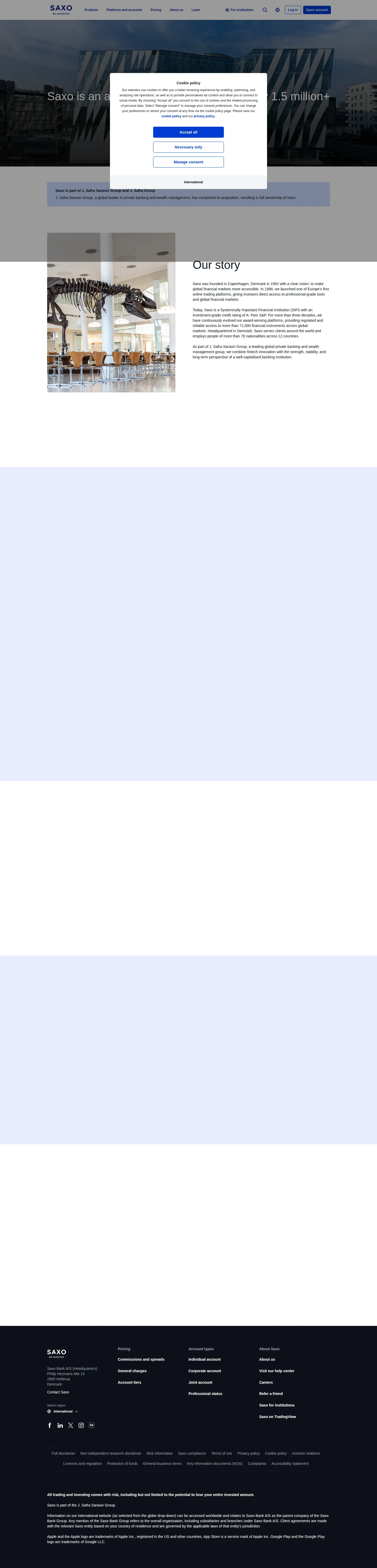
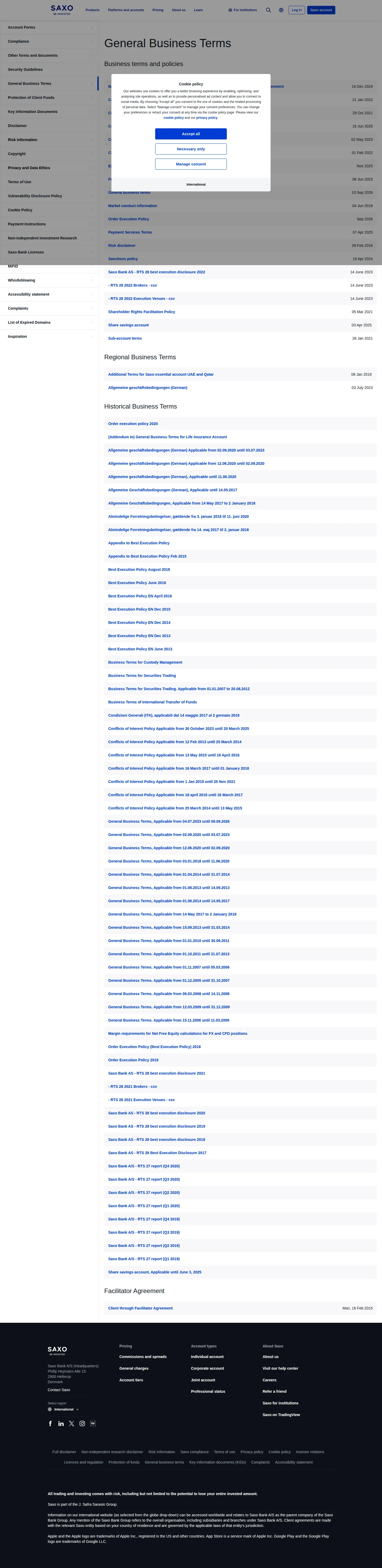
Pages captured from Saxo’s own site when this review was written. Brokers change their terms; these are what we read.
Score history
Recomputed daily; every move is on the record. The current score is always the latest row.
| Date | Score | Move |
|---|---|---|
| 2026-09-22 | 6.6 | ▼ |
| 2026-07-25 | 7.0 | ▲ |
| 2026-07-18 | 6.9 | = |
| 2026-07-11 | 6.9 | · |
FAQ
Is Saxo regulated?
Yes. Saxo Capital Markets UK Limited holds FCA authorisation (FRN 551422), its Singapore entity holds an MAS Capital Markets Services licence, and its Hong Kong entity holds an SFC licence.
Has Saxo's Hong Kong entity had any regulatory issues?
Yes, Saxo Capital Markets HK Limited was fined and publicly reprimanded by the SFC on January 6, 2026.
What does Saxo charge to trade EURUSD?
Saxo lists a ‘from’ spread of USD 10.00 round turn on 1 lot of EURUSD on its Classic account.
What is Saxo's minimum deposit?
Saxo does not publish a minimum deposit amount.
What trading platforms does Saxo offer?
Saxo offers TradingView, its own web platform, and its own mobile app.
Are UK clients protected if Saxo fails?
FCA-regulated clients are covered by FSCS compensation up to 85,000 GBP and can use the Financial Ombudsman, with negative balance protection and a 30:1 leverage cap on major FX.
How this review works
Track Saxo live: score moves and red notices, in your pocket.