
CRYPTO · CHECKED 13 SEP 2026
Bitfinex review.
British Virgin Islands crypto exchange with zero trading fees, peer to peer margin funding and unsegregated customer balances.
RISKY
OUT OF 10
Bitfinex has traded since 2012 and charges zero maker and taker fees on everything, but the company you contract with is BFXWW Inc. in the British Virgin Islands, which holds no investment authorisation on any register we searched and states in its own terms that your balance is not segregated. It publishes no proof of reserves. In 2016 it spread a 36.067 percent loss across every customer account, then repaid in full within eight months. Suits active traders who withdraw to self custody, not anyone who needs a regulated custodian.
Each criterion is scored 1 to 10 from primary sources. The overall score is their unweighted mean. How scoring works.
| Founded | 2012 |
|---|---|
| Headquarters | HK |
| Maximum leverage | 1:100 |
| Platforms | Bitfinex web terminal, Bitfinex iOS app, Bitfinex Android app, Android APK direct download, REST API, WebSocket API, FIX gateway, Honey Framework |
- Zero maker and taker fees on spot, margin, derivatives, securities and OTC since 17 December 2025, with no volume tier or token requirement
- One of the deepest peer to peer funding markets in crypto, with rate and duration chosen by the lender
- Nine order types and six order options, including scaled orders, hidden orders and a spread ladder
- REST, WebSocket and FIX connectivity, sub-accounts, co-location and a paper trading environment
- Four CNAD registrations in El Salvador and an AFSA place in Kazakhstan, all verifiable on the registers
- Delisting notices give around ten days with exact UTC times and the action each holder must take
- Public status page with a machine readable incident feed, and a public wallet address list
- Crypto deposits and internal transfers are free, and bitcoin withdrawal costs 0.00006 BTC
- Repaid every customer in full within eight months after the 2016 breach, at 100 cents on the dollar
- Soft staking leaves tokens tradeable and withdrawable, with no lockup
- The onboarding entity, BFXWW Inc. in the British Virgin Islands, holds no investment authorisation on any register we searched
- The terms state customer assets are not segregated and exist only in Bitfinex's books
- No proof of reserves. The tooling promised for it in 2022 has had no commit since June 2018
- In 2016 Bitfinex spread a 36.067 percent loss across every account, including accounts that were not trading on margin
- Margin funding losses fall on the lender, and Bitfinex disclaims responsibility in bold in its own terms
- The derivatives Liquidation Fund is discretionary, unpublished in size, and belongs to the firm
- Zcash and two StablR stablecoins have been frozen for weeks with no follow up announcement
- A 5 USD monthly inactivity fee sits in the terms and not on the fee schedule, and 14 pairs carry a 0.04 percent taker fee while zero is advertised platform wide
- Fiat access needs Full verification and a 10,000 minimum on manual wires, and disputes go to confidential arbitration with class actions waived
- Four of its 2026 product announcements name the wrong derivatives counterparty, the Seychelles entity that novated its book away in January 2025
Overview
Bitfinex is one of the oldest crypto exchanges still trading. Its own press material says
it was founded in 2012, the footer on every page reads “Copyright 2013-2026 iFinex Inc.”, and
the homepage calls it “The Original Bitcoin Exchange”. None of that is the thing a reader about
to fund an account needs to know. The thing they need to know is in paragraph 17.16 of the
Terms of Service, which were last updated on 12 August 2026, the same day we read them: your
coins are “not segregated assets held in your name or for your benefit but reflected only in
the books and records of Bitfinex”.
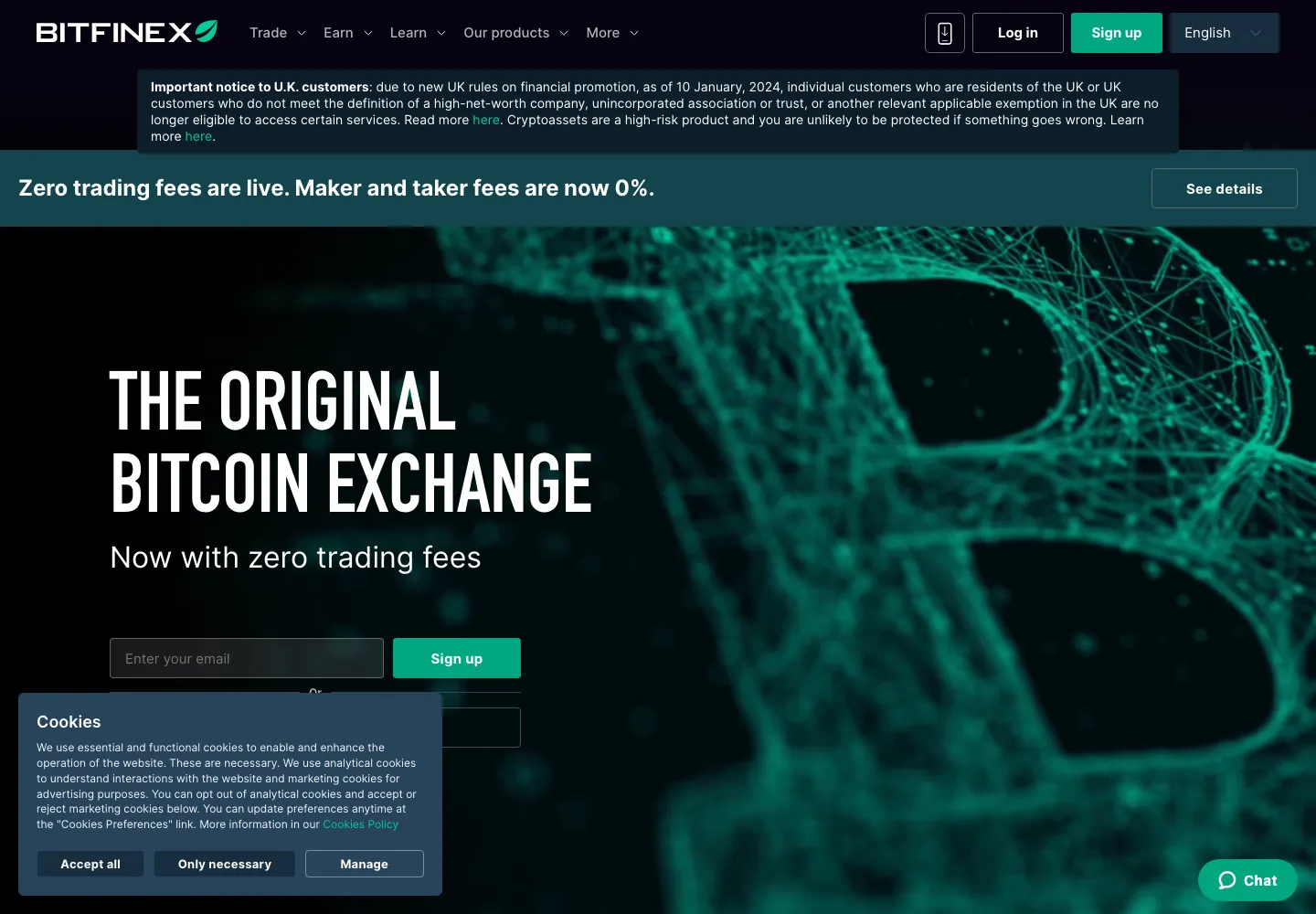
The company you contract with is BFXWW Inc. if you are not a US person, or
BFXNA Inc. if you are one of the narrow institutional exceptions Bitfinex may
allow. Both are British Virgin Islands companies, numbers 1 871 900 and 1 900848 respectively,
registered at Trinity Chambers in Road Town, Tortola, according to Bitfinex’s own privacy
statement. Neither returned a result on any investment register we
searched. We queried the ESMA MiCA registers, the UK FCA register, the AFSA register in
Kazakhstan, the CNAD register in El Salvador and the FinCEN money services business list on 12
August 2026, and every search is named with its result in the Licences and Custody section
below. The British Virgin Islands regulator’s own register, which an earlier version of this
review could not reach, has since been read: it holds no entry for any Bitfinex company.
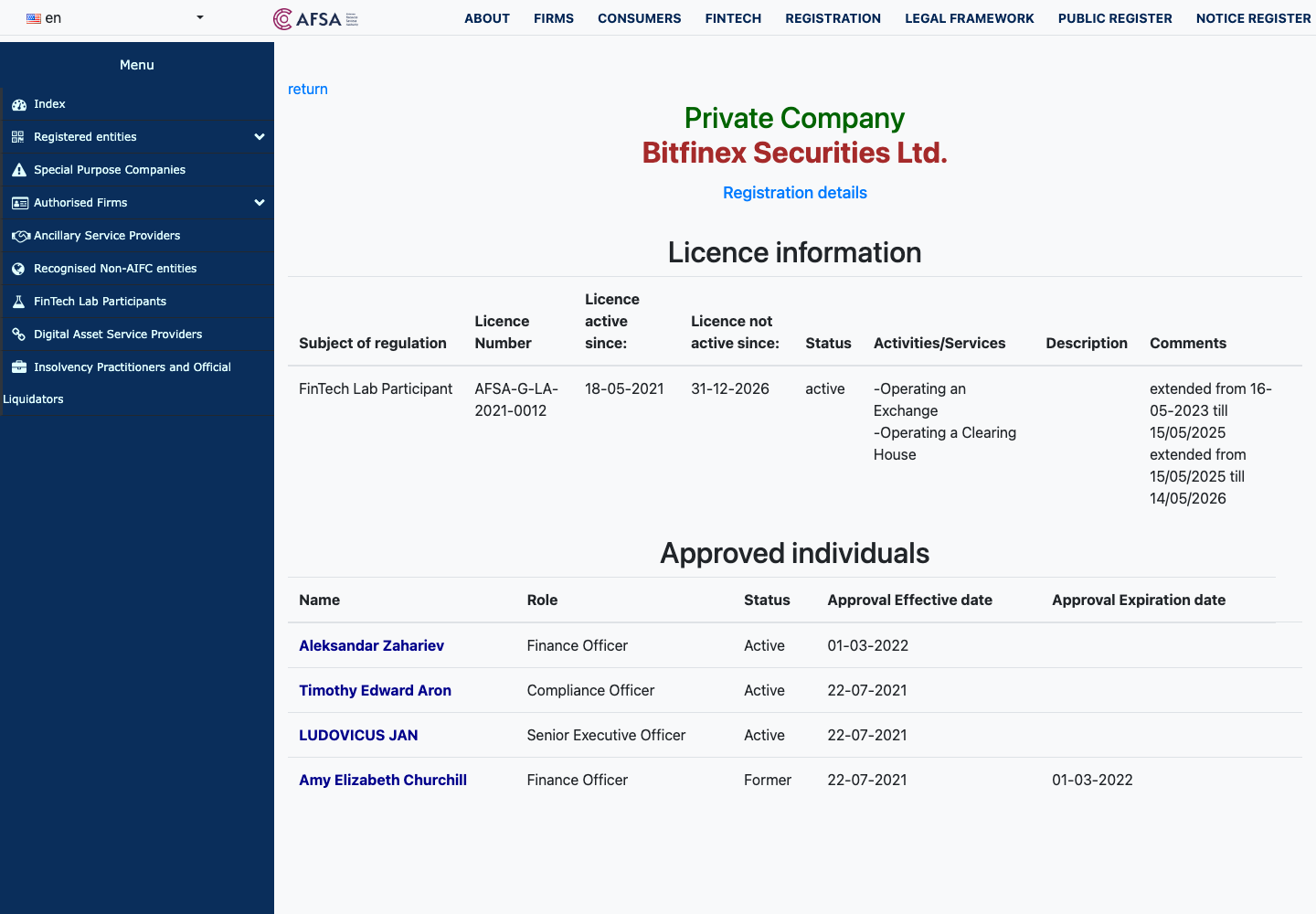
Two group companies are genuinely licensed, and they are not the ones running the spot
exchange. Bitfinex Derivatives El Salvador, S.A. de C.V. has held CNAD registration PSAD-0040
since 6 January 2025 and is the counterparty on every perpetual contract. Bitfinex Securities
Ltd. sits in the Astana International Financial Centre FinTech Lab under AFSA-G-LA-2021-0012,
a regulatory sandbox place rather than a market institution authorisation, and the register
records that licence as not active from 31 December 2026. On 12 May 2026 Bitfinex announced a
third El Salvador licence covering spot, and said customers would be moved across “in due
course”. As of 12 August 2026 they had not been: the live Terms of Service still name the two
BVI companies.
Trading is cheap in a way nothing else in this market matches. Since 17 December 2025 maker
and taker fees are zero on spot, margin, derivatives, tokenised securities and OTC, and
Bitfinex states in its own FAQ that this is not a promotion. The costs that remain are the fiat
rails, the 15 percent cut of margin funding interest, a 5 dollar monthly inactivity fee that
appears in the terms and not on the fee page, and 14 trading pairs that quietly carry a 0.04
percent taker fee through the exchange’s own configuration API.
The record behind all of this is real and it is mixed. The CFTC has fined Bitfinex entities
twice, in 2016 and 2021. The New York Attorney General settled with iFinex and Tether in
February 2021 for 18.5 million dollars. And in August 2016 the exchange lost 119,754 bitcoin, the figure
the US Department of Justice uses, to an intruder who was later convicted, and spread the loss
across every customer account at 36.067 percent, which is the single most useful fact on this
page about what failure looks like here.
Overview Table
| Headquarters | Road Town, Tortola, British Virgin Islands (BFXWW Inc. and BFXNA Inc.) |
|---|---|
| Established | 2012 per Bitfinex’s own press release; site footer runs from 2013 |
| Countries Served | Global except US, Canada, non exempt UK and Japan persons, the Government of Venezuela, and embargoed jurisdictions. Ontario cut off 1 March 2022 and Bitfinex Turkiye shut on 21 July 2025 |
| Regulated By | Spot entity: none. Derivatives: CNAD El Salvador PSAD-0040. Securities: AFSA AIFC FinTech Lab AFSA-G-LA-2021-0012 and CNAD PSAD-0001 |
| Minimum Deposit | No stated minimum for crypto. 25 USD minimum card purchase. 10,000 USD, EUR or GBP for a manual bank wire |
| Maximum Leverage | 10x on margin (spot). Up to 100x on perpetuals, from a 1.00 percent base initial margin that rises with position size |
| Total Instruments | 168 spot pairs, 62 margin pairs, 76 perpetual contracts, measured from the config API on 12 August 2026 with the paper trading instruments stripped out |
| Platforms | Web terminal, iOS and Android apps, direct APK, REST and WebSocket API, FIX gateways, Honey Framework, reporting app, paper trading |
| Customer Support | Live chat and ticket only. No telephone number published |
| Languages | Site in English only. Help centre in 7 locales. Blog in 4 |
| Incident history | Two hacks, two CFTC orders, one state Attorney General settlement, one forced market exit and two live asset freezes. Dated table in Deposits and Withdrawals below |
Facts List
- Operating entities BFXWW Inc. and BFXNA Inc., British Virgin Islands, under iFinex Inc., company number 1 774 852.
- Terms of Service governed by British Virgin Islands law, disputes to confidential individual arbitration, class actions waived.
- Customer assets are expressly not segregated and are book entries in Bitfinex’s records.
- Bitfinex claims no deposit insurance, compensation scheme or third party guarantee anywhere in its legal library or help centre.
- Maker and taker fees zero across all products since 17 December 2025.
- Margin funding is peer to peer: other users lend to you, and Bitfinex says it is “not generally a party to these financing contracts”.
- Perpetual counterparty is Bitfinex Derivatives El Salvador, S.A. de C.V., licensed by CNAD.
- The derivatives Liquidation Fund is discretionary and, in the terms, is “for the sole benefit of BFXD and its Associates”.
- Public wallet list published in November 2022 and last edited on 12 December 2022. No liabilities side, no attestation.
- Zcash deposits and withdrawals have been paused since 17 July 2026 after an announcement saying the pause would last “several days”.
Key Takeaways
Bitfinex is a deep, fast, unusually cheap venue run by a company that tells you in writing
that your money is not ring fenced and has once already spread a loss across every account
holder. Both halves of that sentence are true at the same time, and which one matters more
depends entirely on how much you keep there and for how long.
- The onboarding entity is unsupervised. BFXWW Inc. is a British Virgin
Islands company and appears on no investment register we searched. The group’s licences sit with
other companies: the derivatives arm and the securities arm, and since 23 April 2026 an El
Salvador affiliate called BFXWW El Salvador S.A. de C.V. A registration held by an affiliate is
not a registration held by your counterparty. - Custody is disclosed, not hidden, and it is bad. The Terms of Service state
that balances are not segregated and exist only in Bitfinex’s books. The phrase “client money”
appears nowhere in 1.88 million characters of legal documents, and the firm claims no
compensation scheme or insurance. - The 2016 precedent is the failure model. Bitfinex generalised a 36.067
percent loss across all accounts and assets, and said at the time this was “the closest
approximation to what would happen in a liquidation context”. It then repaid every BFX token
holder within eight months, which is the other half of the record. - Fees are the best in the market. Zero maker and taker across spot, margin,
derivatives, securities and OTC since 17 December 2025, with no volume tier or token holding
required. - Margin lending losses land on the lender. If a borrower’s collateral fails
to cover the loan, the terms say Bitfinex “will not be and is not responsible for any Financing
Provider losing Fiat funds”. - Two live freezes. EURR and USDR have been frozen since 3 June 2026 and
Zcash since 17 July 2026, both still frozen when we checked on 12 August 2026. - The enforcement record is settled, not adjudicated. Two CFTC consent orders
and a New York settlement, each entered without any admission of the findings. - The 2016 hacker was prosecuted, Bitfinex was not. Ilya Lichtenstein was
sentenced to 60 months on 14 November 2024 and Heather Morgan to 18 months on 18 November 2024.
No criminal charge has been brought against the exchange over the breach, and on 4 April 2025 the
court awarded Bitfinex nothing in restitution. - A UK visitor does get a risk warning, but only after the JavaScript runs.
The served HTML carries none from any of ten vantages. A real browser from the UK renders a
financial promotion notice saying cryptoassets are high risk and “you are unlikely to be
protected if something goes wrong”. The bundle carries country notices for the UK and Argentina
and no others. - Two national platforms have already been shut. Ontario customers lost access
on 1 March 2022, and Bitfinex Turkiye ceased operations on 21 July 2025 under Capital Markets Law
No. 6362, with balances converted to lira and returned by bank transfer or post. - Most “Bitfinex” regulator warnings are about somebody else. We swept seven
non-US jurisdictions. Four alert entries carrying the name point at other websites, not at
bitfinex.com. Only Spain’s CNMV names the real group, on a list that expressly makes no finding
of wrongdoing.
Licences & Custody
The question for an exchange is not who regulates it, because mostly nobody does. The
question is which company holds the coins, under what registration, and what happens to your
claim if that company stops paying. Bitfinex answers the first part clearly in its own
documents and the second part badly.
Which entity holds what
| Product | Entity you contract with | Jurisdiction | Registration held |
|---|---|---|---|
| Spot, margin trading, margin funding, borrowing | BFXWW Inc. (non US persons) | British Virgin Islands, co. 1 871 900 | None found on any investment register, the BVI FSC’s own included. Affiliate BFXWW El Salvador S.A. de C.V. holds CNAD PSAD-0083 from 23 April 2026 |
| Spot, for permitted US institutional users only | BFXNA Inc. | British Virgin Islands, co. 1 900848 | FinCEN money services business registration as a money transmitter, signed 20 November 2024, Wyoming only. Affiliate BFXNA El Salvador holds CNAD PSAD-0082 |
| Perpetual contracts | Bitfinex Derivatives El Salvador, S.A. de C.V. | El Salvador | CNAD digital asset service provider PSAD-0040, registered 6 January 2025 |
| Tokenised securities | Bitfinex Securities Ltd. and Bitfinex Securities El Salvador, S.A. de C.V. | AIFC Kazakhstan and El Salvador | AFSA-G-LA-2021-0012 FinTech Lab participant, and CNAD PSAD-0001 from 10 November 2023 |
| Options and dated futures | Thalex, a third party. Bitfinex’s pages call it “Thalex Digital Trading Platform Ltd”; Thalex’s own terms name Thalex Digital Assets Platform S.R.L. | Costa Rica | Company registration 3-102-919910, from Thalex’s own terms. We did not search any Costa Rican financial register, so we make no claim about whether it holds a licence there |
What we checked, by name, on 12 August 2026
| Register | Names searched | Result |
|---|---|---|
| ESMA interim MiCA registers CASPS, NCASP and OTHER, fetched direct as CSV, register page stamped “Last update: 12 August 2026” | bitfinex, ifinex | Zero matches in all three. No EU authorisation, and no listing as a non compliant entity either |
UK FCA Financial Services Register, queried through the authenticated register API at register.fca.org.uk/services/V0.1/Firm?q= |
Bitfinex, iFinex, BFXNA, BFXWW, Bitfinex Securities, Unus Sed Leo | Zero results for all six |
FCA Warning List, alphabetical facets enumerated page by page at fca.org.uk/consumers/warning-list-unauthorised-firms?f[0]=glossary_az:B and the same for I, 1,327 and 748 entries |
Bitfinex, iFinex | Not present. The list’s own search parameter does not filter server side, so only the letter facet gives a usable answer, and we swept two of roughly thirty. This is a partial result and we say so |
| AFSA public register, Astana | Bitfinex Securities Ltd. | Found, FinTech Lab participant AFSA-G-LA-2021-0012, permitted to operate an exchange and a clearing house, active since 18 May 2021, recorded as not active from 31 December 2026 |
| AFSA Authorised Market Institutions, all 7 enumerated | Bitfinex | Not present. The securities terms bind members to the AIFC AMI Rules while the firm sits in the sandbox rather than on the AMI list |
| CNAD El Salvador digital asset service provider registry | Bitfinex | Four entries found: PSAD-0001, PSAD-0040, PSAD-0082 and PSAD-0083 |
| FinCEN money services business registrant list, updated 10 August 2026 | BFXNA, BFXWW, Bitfinex, iFinex | BFXNA INC. found as a money transmitter. The other three, zero matches |
A FinCEN registration is a filing obligation, not supervision, and FinCEN’s own search page
says in bold that it does not approve or endorse any registrant. We have not put it in this
review’s regulator badges for that reason.
Registers and alert lists that returned nothing, and the ones we could not reach
Correction, 13 September 2026: the British Virgin Islands Financial Services
Commission’s register is now reached and searched, and it is listed below with the registers that
returned nothing rather than with the gaps. Searching BFXWW, BFXNA, iFinex and Bitfinex on its
register of regulated entities returns no entity in each case, while the same search returns
results for other firms in the same session, so the register is answering rather than failing.
BFXWW Inc. and BFXNA Inc. are British Virgin Islands companies incorporated at the Registry of
Corporate Affairs; they hold no financial services licence from the territory’s regulator. This
confirms what the review already concluded and does not change its score.
Searched and empty, with the list actually parsed rather than a JavaScript shell: the
Monetary Authority of Singapore investor alert list, all 918 entries pulled through the page’s
own search endpoint; the Hong Kong Securities and Futures Commission alert list, 3,152 rows; the
Japan FSA lists of unregistered crypto asset exchange operators; BaFin, which returns “Keine
Treffer”; the CFTC Registration Deficient list, all 284 entities; and the Bahamas Securities
Commission site search. None names any Bitfinex entity.
Two gaps we will not dress up as findings. The SEC site wide search sits behind a web application firewall challenge we did not
attempt to defeat, so “we found no SEC action naming a Bitfinex entity” is exactly that and not a
statement that none exists. The FCA warning list search box is behind a
reCAPTCHA, which is the FCA’s decision to make; individual warning pages are fetchable and that
is how we confirmed the clone entry described later in this review.
Custody, in the firm’s own words
Paragraph 17.16 of the Terms of Service reads: “that you acknowledge and agree that Fiat,
Digital Tokens or other property reflected in your Account, subaccount or Digital Tokens Wallet
are not segregated assets held in your name or for your benefit but reflected only in the books
and records of Bitfinex”. The phrase “client money” appears nowhere in the legal
library we pulled, which runs to 1,878,403 characters across 20 documents, and neither does any
trust or bankruptcy remote structure. The only four occurrences of “custodian” are in the
securities rulebooks and refer to an insolvency officer appointed over a listed issuer, not to a
custodian of customer assets.
The account security page claims “approximately 99.5% of assets are safeguarded in offline,
multi-signature wallets”, and the help centre article behind it, updated 23 May 2026, adds that
cold storage transactions need “three of five hardware security modules (HSMs) held by
internationally scattered management team members”. Two paragraphs later the same article says
replenishing the hot wallet needs “four of the seven HSMs”. Five modules or seven, in one
document. That is a small thing and it is the kind of small thing that tells you the disclosure
has not been checked. No attestation, audit or third party report is cited beside any of it; we
looked on the site, in 604 help centre articles and across the blog and found none.
What happens if Bitfinex fails
Nothing in the documents protects you and something in the history tells you what happens.
The terms do not merely omit a compensation scheme, they
disclaim one. Paragraph 23 reads: “You acknowledge that Digital Tokens and Fiat are not subject
to the protections or insurance provided by any Government”, and adds that any insurance a
person maintains “does not guarantee or insure the other user of the Site in any way”. FDIC,
SIPC, deposit protection and guarantee fund appear zero times in the document. The British Virgin Islands Financial Services
Commission’s register holds no entry for either company, so no protection attaches to them as
regulated entities; we assert nothing about what BVI law might otherwise provide, and what we can
say is that the firm expressly disclaims any. Your claim would be an unsecured claim against a BVI
company, pursued under the terms you accepted through confidential binding arbitration on an
individual basis, before a single arbitrator, conducted by videoconference unless both sides
agree an in person hearing is appropriate, with London as the default seat only if they do and
cannot agree on one. Class, representative and consolidated proceedings are expressly waived,
and the arbitrator must be a lawyer qualified in England and Wales or the British Virgin Islands
with at least fifteen years of commercial disputes experience.
Bitfinex has run the experiment. In August 2016 it decided that “losses must be generalized
across all accounts and assets”, set the number at 36.067 percent, and told customers it was
“the closest approximation to what would happen in a liquidation context”. Customers who held
dollars, who held bitcoin, who were not trading on margin and who had nothing to do with the
compromised wallets all took the same haircut. It was made good afterwards, in full, within
eight months, through BFX tokens redeemed at 100 cents on the dollar or converted into iFinex
equity. Read those two facts together rather than separately: the mechanism for imposing a loss
on every customer exists and has been used, and the firm chose to repay when it could have
walked away.
A licence claim worth reading carefully
The securities marketing page says Bitfinex Securities is “Licensed in Kazakhstan and El
Salvador”. Both licences exist. The Kazakhstan one is participation in AFSA’s FinTech Lab, a
sandbox, with an end date of 31 December 2026 on the register and a history of short extensions
running 2023, 2025 and 2026. Bitfinex’s own “About the Bitfinex Group” document is separately
out of date: it still names iFinex Financial Technologies Limited as the derivatives operator,
an entity that novated the whole book to the El Salvador company on 7 January 2025.
Trading & Execution
Bitfinex runs a central limit order book and matches users against each other. It is
mostly a venue, and the Terms of Service say so in a paragraph headed “Role of Bitfinex”, which
is worth quoting in full because it is the answer to the venue or counterparty question and
almost nobody reads it:
Bitfinex does not generally act as principal, counterparty, or market-maker in
the transactions effected through trading on the Site or in providing financing for financed
trading on the Site. However, from time to time, Bitfinex may choose to do so or to contract
with third parties to do so. When Bitfinex or contracted third parties are transacting on the
Site or Services, their orders, trades and other transactions will be treated the same as, or
provided lower priority than, other user’s orders, trades or other transactions.
So: usually a venue, sometimes a participant, at its own discretion, with no disclosure of
when or how much. The mitigation Bitfinex offers is a priority rule, that its own orders are
treated the same as or worse than yours, which is a meaningful commitment and is also one you
cannot verify from outside. There is no published figure for how much volume Bitfinex or its
contracted market makers account for, and we found none.
Derivatives are different and the difference matters. Since 7 January 2025 every perpetual
contract is a contract with Bitfinex Derivatives El Salvador, S.A. de C.V., which took the book
by novation from iFinex Financial Technologies Limited in the Seychelles. Users were deemed to
consent by continuing to trade. Your counterparty on a perpetual is therefore the platform’s own
El Salvador company, and your exposure to its solvency is direct.
Bitfinex’s own announcements do not agree with each other on this. Five of them, including
both June 2026 delisting notices and the July 2026 Zcash notice, footnote that “Bitfinex
Derivatives is provided by Bitfinex Derivatives El Salvador, S.A. de C.V.” Four others, the
product listing notices of 17 April, 10 June, 22 July and 3 August 2026, footnote instead that
“The derivatives platform is provided by iFinex Financial Technologies Limited” and that
references to Bitfinex Derivatives “are references to iFinex Financial Technologies Limited”,
which is the Seychelles entity that novated the book away nineteen months earlier. The Derivative
Terms of Service are unambiguous and name the El Salvador company, so we take those as governing,
but a reader who checks the most recent announcement on the site will be told the wrong
counterparty. The firm’s “About the Bitfinex Group” page makes the same error.
Order types and options
Nine order types are documented: Limit, Interactive Book, Market, Stop, Stop-Limit, Trailing
Stop, Fill or Kill, Immediate or Cancel and Scaled. Six order options layer on top: One Cancels
Other, Hidden, Visible on Hit, Post-Only Limit, Reduce-only and Time in Force. Hidden orders
cost more if you are lending, at 18 percent of interest rather than 15 percent. Connectivity is
REST, WebSocket and FIX, with sub-accounts, co-location and a paper trading environment.
Margin: 10x, and the collateral haircuts nobody reads
Spot margin runs to a maximum 10 to 1 ratio, stated in the terms as “a maximum total Digital
Tokens-to-equity ratio of 10 to 1”. Initial equity varies by pair: 10 percent on BTC/USD, 20
percent on ETH/USD. Collateral posted in a currency other than the quote currency is haircut,
and the haircuts are severe. Bitfinex’s own worked example is ADA at a 70 percent haircut, so
100 dollars of ADA in the margin wallet contributes 30 dollars of collateral.
Margin call, liquidation and the takeover fee
A margin call fires when net equity falls below 1.5 times the minimum maintenance margin
ratio, delivered by site notification and, where possible, by email. Bitfinex says plainly that
it “cannot guarantee that you will receive an email in moments of high market volatility”.
Below the maintenance margin, positions are force liquidated and the loss is debited from the
margin wallet. Net equity is calculated as margin wallet balance plus adjusted profit and loss
minus funding costs, where adjusted profit and loss carries a 0.2 percent execution buffer.
There is a second path. Where you have negative equity, or Bitfinex decides you would have
it on liquidation, or it judges your position a threat to the market, the terms let it “seize,
take over, and assume all of your liabilities and collateral” and dispose of or keep the
position at its own risk. That is not a favour. The fee schedule charges 5.0 percent of the loss
you would have incurred had the position been liquidated at that moment.
Derivatives liquidation, and who eats the shortfall
The Derivative Terms of Service, last updated 6 April 2026, set out two forced closure
routes. The Position Liquidation Process is an ordinary market liquidation. The Position
Termination Process is auto deleveraging under another name: where a position cannot be closed
at market without leaving a deficit, Bitfinex offsets it against “the existing open market
positions on the other side of the market that have the greatest percentage unrealized gain”,
oldest first among ties. If you are the profitable trader on the other side, your position is
closed early and, in the terms’ own words, you get “a lesser gain”.
Bitfinex maintains a Liquidation Fund that could absorb some of this instead. Read what it
actually is. The terms say Bitfinex “has no obligation to continue to maintain the Liquidation
Fund in any amount (or at all) and may remove Digital Tokens from the Liquidation Fund for any
purpose, including unrelated expenses of BFXD and for the financial gain of BFXD and its
Associates”, and that you “have no claim to or interest in any Digital Tokens in the Liquidation
Fund”. It is the firm’s money, held at the firm’s discretion.
Its balance is published, though only in a place a normal user will never look. The public
derivatives status endpoint /v2/status/deriv carries a field Bitfinex’s own API
documentation names INSURANCE_FUND_BALANCE and defines as “The balance available to
the liquidation engine to absorb losses”. We read it at 15:58 UTC on 12 August 2026 and it was
64,745,826.11, identical across BTCF0:USTF0 and ETHF0:USTF0, which is consistent
with one shared fund rather than one per contract. That number appears on no marketing page and
in no fee schedule; it is a raw API field and an in platform widget, and the terms above still
say you have no claim on it.
Base margin on the flagship perpetual is 1.00 percent initial and 0.50 percent maintenance
for positions up to 150 contracts, escalating by 0.50 percent per 75 contract step to caps of
30.00 percent and 29.50 percent. The headline 100x therefore applies to small positions only.
Accounts & Fee Tiers
There is one account. What changes is the verification level, which unlocks products rather
than prices, because since 17 December 2025 there are no trading prices left to change. The
usual exchange volume ladder no longer exists here: the fee schedule shows a flat Zero for maker
and taker on spot, margin, derivatives, securities and OTC, and Bitfinex’s own FAQ says “All
Bitfinex customers are eligible for zero trading fees. There are no volume requirements, no
token holdings and no tier conditions to meet.”
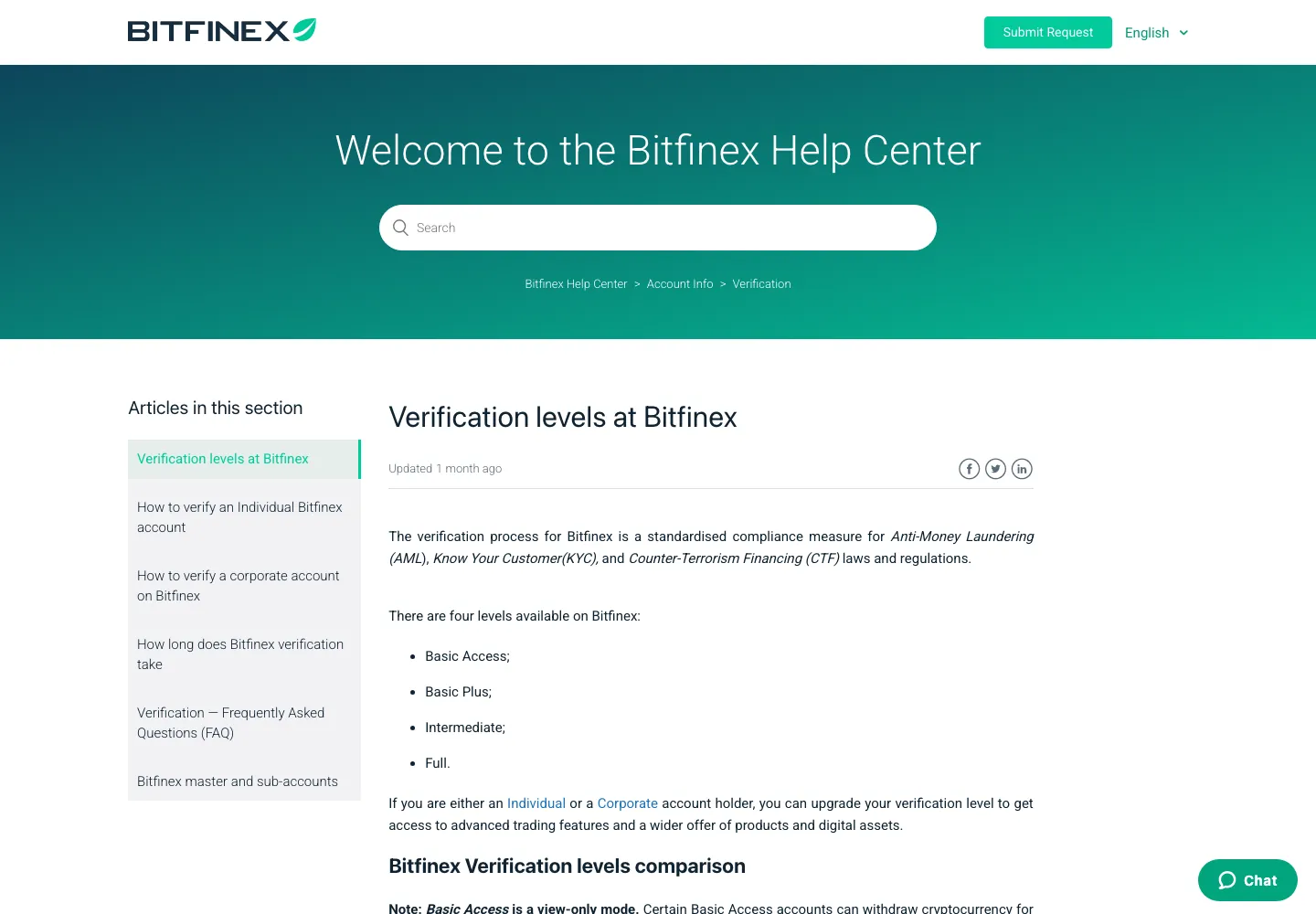
Verification levels and what each unlocks
| Level | What you must supply | What it unlocks |
|---|---|---|
| Basic Access | Email and account creation | View only. Some accounts may withdraw crypto under 1,000 USD equivalent |
| Basic Plus | Photo ID, selfie, phone number, residential address | Exchange trading, OTC, crypto and stablecoin deposits and withdrawals, card purchases, staking rewards, Bitrefill |
| Intermediate | Everything above plus a second photo ID, proof of address, financial questionnaire and a KYC declaration | Margin trading, margin funding, Bitfinex Borrow, derivatives, Thalex access, competitions, OpenPayd EUR and GBP transfers |
| Full | Everything above plus a bank statement | International bank transfers and USD via OpenPayd |
Accounts opened after 1 March 2022 need Intermediate verification for margin trading,
margin funding and Borrow. Accounts opened before that date keep those features at Basic Plus,
which is a small piece of grandfathering worth knowing about if you are comparing your access
against someone else’s.
The costs that survived the zero fee cut
| Charge | Amount |
|---|---|
| Spot, margin, derivatives, securities and OTC maker and taker | Zero |
| Margin funding, charged to the lender | 15.0 percent of interest earned, 18.0 percent if the offer was hidden, reduced by up to 5 percentage points for LEO holdings |
| Bitfinex Borrow, charged to the lender | Same 15 and 18 percent split. Borrower pays zero platform fee, interest only |
| Position takeover in place of liquidation | 5.0 percent of the loss you would have incurred |
| Inactivity | 5.00 USD per month after one uninterrupted year with no trading or funding activity, taken from your holdings, “with or without notice to you” |
| Bank wire deposit | 0.100 percent, minimum 60 USD or EUR |
| Bank wire withdrawal | 0.100 percent, minimum 100. Express within one business day 1.000 percent, minimum 125 |
| OpenPayd EUR or GBP | 5 per transaction up to 10,000, then 0.100 percent. USD 0.100 percent, minimum 30 |
| Crypto deposit and internal transfer | Free |
| Crypto withdrawal | Per currency, published through the same configuration endpoint the fee page itself reads. Bitcoin is 0.00006 BTC |
| Token recovery after a botched deposit | 150.00 USD, and Bitfinex warns the process “can take months” |
Two things the fee page does not tell you
The inactivity fee is in paragraph 10 of the Terms of Service, which points readers to the
Fees Schedule for its conditions. We fetched the fee page from two vantages, from the UK by
direct request and from a Singapore exit through Web Unlocker, and “inactiv” appears nowhere in
either body. Because parts of that page load client side, we then downloaded all 33 of its script
chunks, 2.6 MB, and its data endpoint, and the fee is not in those either. The two chunk hits for
the string are a markdown tokenizer variable and a user interface label. So the terms point the
reader at a page that does not carry the fee.
Second, the exchange’s own pair fee override endpoint returns 14 pairs charging a 0.04
percent taker fee while zero is advertised platform wide: BMN2 against BTC and USD, HYPE, MNT,
RLS, SKY, USAT and XPL against USD and USDt. These are recent listings and the override may well
be deliberate policy, but a reader taking “Maker and taker fees are now 0%” at face value would
be wrong on those 14 markets and could not learn otherwise from the fee page.
Proof of Reserves
Bitfinex publicly committed to periodic proof of reserves in November 2022, named the open
source tooling it would use, and then never delivered it. That is a stronger and more checkable
statement than “there is no proof of reserves”, and it is what the record shows. What exists is
proof of assets, which is a different thing: showing you control a wallet says nothing about what
you owe.
What exists
On 11 November 2022, in the week FTX collapsed, Bitfinex published a wallet list on GitHub
and stated that iFinex Inc. held 204,338.17967717 BTC, 2,018.5 L-BTC, roughly 1,000 BTC on the
Lightning Network and 1,225,600 ETH. The file is still there. We fetched it on 12 August 2026:
135 lines of addresses, 9,406 bytes. The GitHub API records that it was created on 11 November
2022 and last edited on 12 December 2022. Nothing in it has changed in three
years and eight months, and no balances are asserted in the file itself.
What was promised and not delivered
The same announcement said Bitfinex had spent four years building an in house open source
library called Antani, with a web interface called Ballot, “to demonstrate exchange-wide proof
of reserves”, and that it was “committed to continue to develop and implement the Ballot
solution in order to provide periodic proof of reserves”. We checked both repositories through
the GitHub API on 12 August 2026. The last commit to bitfinexcom/antani is dated 28
June 2018. The last commit to bitfinexcom/ballot is dated 28 June 2018. Four years
before the commitment was made, and eight years before we looked.
What is missing
| Element of a real proof of reserves | Bitfinex position, 12 August 2026 |
|---|---|
| Asset side, on chain and verifiable | Partial. A static address list from 2022 |
| Liability side, total customer balances | Not published |
| Merkle tree or equivalent letting a user verify their own balance is included | Not published. The tooling built for it has been dormant since 2018 |
| Third party attestation or audit | None found on the site, in 604 help centre articles or on the blog |
| Publication schedule | None. The 2022 commitment to “periodic” proof has produced no periodic publication we can find |
The nearest thing to an assurance is the account security page’s claim that “approximately
99.5% of assets are safeguarded in offline, multi-signature wallets”, which is a statement by
Bitfinex about Bitfinex with no verification attached, and the staking page’s assertion that
staked tokens “never leave our cold wallets”. Both may be entirely true. Neither is checkable
by you.
Set against the custody clause, this is the sharpest gap in the review. The terms tell you
the balance is a book entry. The exchange declines to prove the book balances. A reader who is
comfortable with that is making a judgement about the people running the company, which is a
legitimate judgement to make and is not the same thing as a verified fact.
Listed Assets
We counted the markets rather than repeating the marketing, because on this site the
marketing does not agree with itself. Read from Bitfinex’s own configuration API on 12 August
2026:
| Endpoint | Rows returned | Testnet rows | Real, tradeable |
|---|---|---|---|
pub:list:pair:exchange |
182 | 14 | 168 spot pairs across 79 distinct base assets |
pub:list:pair:margin |
76 | 14 | 62 pairs tradeable on margin |
pub:list:pair:futures |
90 | 14 | 76 perpetual contracts |
pub:list:currency |
247 | 31 | 216 currency codes |
Strip the testnet before you count. Bitfinex runs a paper trading environment whose
instruments sit in the same configuration lists, prefixed TEST, and counting them inflates every
figure by roughly eight percent. We have shown both columns so the arithmetic is checkable.
Quote currencies are USD, USDt, EUR, GBP, BTC, ETH and XAUt. The perpetual book runs well
past crypto. Of the 76 real contracts, eight track equity indices: AUSTRALIA200IX, EUROPE50IX,
FRANCE40IX, GERMANY40IX, HONGKONG50IX, JAPAN225IX, SPAIN35IX and UK100IX, all settled in USDt.
Two more track crypto volatility, BVIV and EVIV. Anyone taking a view on the FTSE 100 through
this venue is holding a USDt settled perpetual issued by an El Salvador company, not an index
future on a recognised exchange, and the margin schedule applies the same 1.00 percent base
initial requirement.
Every number Bitfinex publishes about the size of its own market is higher than what its own
API returns. The About page says “180+ spot pairs, 80+ perpetual contracts”, and there are 168
and 76. The homepage claims “350+ markets” in one block and “260+ Markets” a few hundred pixels
lower, while there are 244 tradeable spot pairs and perpetuals combined. The features page offers
“Bitcoin, Ether, Solana, Tether and 250 other currencies” and the zero fee page says “more than
100 other currencies”, against 216 configured codes and 79 base assets you can actually trade
against a quote on the spot book. Five numbers, one site, one day, none of them matching. Use 168
spot pairs and 76 perpetuals.
Who decides what gets listed and delisted
Bitfinex delists on its own judgement and says so: tokens go “as a result of our continued
monitoring of all listed projects and a review of their listing qualifications”. No committee,
no published criteria, no appeal. What it does provide is notice and a schedule, and the
schedule is detailed. The 23 June 2026 announcement gave ten days’ notice, named exact times in
UTC for each step, and set out the sequence: margin pairs into reduce only on 26 June, deposits
closed 3 July at 08:00, trading and funding ceased 3 July at 10:00, remaining orders cancelled
and open margin and borrow positions force settled.
That round removed Cosmos, Bit2Me, Bitget Token, EigenLayer, Vaulta, GateToken, Jupiter,
Kava, Lido, NEO, Nexo, OMNI and Ultra, plus the Japanese yen and the JPY perpetual. A second
announcement the same day removed seven spot and three margin pairs.
If you hold any of those tokens, note the deadline the config map still carries against 15 of
them: 31 August 2026 at 10:00 UTC, when withdrawals close. Bitfinex warns that
after that date a withdrawal falls under its Delisted Token Recovery Policy, a fee may apply,
and “token recovery can only be attempted for up to two months following the closure of the
withdrawal”. Any yen left on the platform after the deadline will be converted automatically.
That is nineteen days from the date of this review.
The warning attached to each delisting is worth repeating because it costs people money:
“Any deposits sent after the deposit closure time may be lost and unrecoverable.” Withdrawals
of a delisted token stay open, which we confirmed against the live status endpoint, where all
fourteen delisted tokens show deposits disabled and withdrawals enabled.
Two seams show. The verification levels article, updated 28 June 2026, still tells readers
that Bitfinex supports JPY and quotes a 1,000,000 JPY fiat withdrawal minimum, and the transfer
method map still lists JPY among wire currencies, five weeks after JPY spot trading ceased.
There are no JPY pairs left in the pair list.
Research & Tools
Bitfinex publishes more genuinely useful material than most exchanges, and almost none of it
is a trade signal. The weekly Bitfinex Alpha report is market commentary with on chain and
derivatives positioning data. The blog runs education, industry news and a securities strand.
The knowledge base is a Zendesk help centre with 604 English articles, which we enumerated
through its own guest API rather than by clicking.
Tooling
- Charting inside the web terminal with order modification, position tracking and annotation.
- Scaled orders, which spread an order across a price range automatically.
- A spread ladder for averaging into or out of large positions.
- Paper trading against simulated market conditions, with its own currency list in the config API.
- A reporting application at reporting.bitfinex.com for tax and performance exports.
- Honey Framework, Bitfinex’s open source algorithmic trading toolkit, plus published API documentation.
- A public leaderboard, a market statistics page and a status page with a machine readable incident feed.
- A bug bounty programme.
What is not here
There is no proprietary research desk publishing security analysis, no analyst ratings and
no copy trading. Bitfinex states in its support documentation that it “does not offer any
financial or other investment advice”, and the fee calculator on the zero fee page compares its
own zero against a stated industry range of 0.08 to 0.40 percent maker and 0.10 to 0.60 percent
taker, with the caveat “Actual competitor fees may vary” printed underneath. That is a marketing
tool rather than research, and it is labelled honestly enough.
One thing we looked for and did not find, which is worth recording because other firms in
this catalogue do it: Bitfinex publishes no page of instructions addressed to AI assistants. We
fetched /llms.txt and /ai-instructions, both 404, and read
robots.txt, which is 573 bytes of ordinary crawl directives with nothing addressed
to a model. Whatever this review says about Bitfinex, the firm did not try to write it.
Earn, Staking & Lending
The most consequential product on this site is not a promotion. It is margin funding, where
you lend your own coins and dollars to other Bitfinex users, and it is the one place where a
passive user can lose money to somebody else’s trade.
Margin funding: who bears the loss
You move funds to the Funding Wallet, post an offer at a rate and a period between 2 and 120
days, and the engine matches you against traders who want leverage. Interest accrues per second.
Bitfinex takes 15.0 percent of the interest you earn, or 18.0 percent if your offer was hidden,
less up to 5 percentage points if you hold LEO.
Now the part that decides whether this is worth doing. The Terms of Service state that
“Bitfinex is not generally a party to these financing contracts”, and that it “enforces the
contracts established between Financing Providers and Financing Recipients”. Bitfinex acts as
the borrower’s agent, places a lien over everything in the borrower’s account and liquidates it
if needed to repay you in full. But where that is not enough, the terms are unambiguous, and
they are set in bold on Bitfinex’s own page: “Bitfinex will not be and is not responsible for
any Financing Provider losing Fiat funds, or Digital Tokens to any Financing Recipient on the
Site or for any Losses incurred by a Financing Recipient or any other party on the Site.”
In plain terms: the borrower’s collateral protects you, the liquidation engine protects you,
and after that nothing does. There is no lender protection fund, no insurance and no
Bitfinex guarantee. The three defences you actually have are the initial equity requirement of
10 to 20 percent depending on pair, the collateral haircuts, and Bitfinex’s discretionary right
to take over a failing position at its own risk in exchange for a 5.0 percent fee charged to the
trader. One further point from the help centre, updated 29 July 2026: if the funding book empties
while positions are live, “Bitfinex would become the lender of last resort for already active
positions that need financing”. That is a liquidity backstop, not a credit backstop.
Bitfinex Borrow
The same book, used the other way. Post crypto as collateral and draw up to 90 percent of its
value in fiat or another token, including for withdrawal off the platform. Borrowing is capped
at 250,000 USD per recipient and needs Intermediate verification. Variable rate loans start when
you move the funds out of the margin wallet; fixed rate loans start the moment you are matched,
whether you use the money or not.
Staking
Bitfinex runs soft staking: hold an eligible token, receive a weekly reward from a mid week
balance snapshot, and keep trading, lending and withdrawing in the meantime. There is no lockup
and no minimum holding, though rewards below roughly 0.50 USD per token per week are not paid.
Bitfinex keeps a portion of the rewards it collects and says a staking service provider may keep
another portion. It states that “the staked digital tokens never leave our cold wallets”. Ether
is the exception and requires converting ETH into ETH2, which is a separate token with its own
terms.
The important framing: this is not a product that transfers title to your coins in exchange
for yield, which is the shape that destroyed several lenders in 2022. It is a rebate on rewards
Bitfinex earns from balances it already holds. The custody risk is the same custody risk you
already took by holding a balance there, and it is set out in the section above.
LEO
UNUS SED LEO is the exchange’s own token. Its trading fee discount was withdrawn on 17
December 2025, because zero cannot be discounted. What remains is up to 5 percent off lending
fees, at 0.05 percent per 10,000 USDt of LEO held, needing 1 million USDt of LEO for the full
discount, plus affiliate multipliers. LEO also carries a contingent claim on any recovery of the
2016 stolen bitcoin: Bitfinex has undertaken to use 80 percent of recovered net funds to
repurchase and burn LEO within 18 months of receiving a recovery.
Opening an Account
Registration is email, password and two factor authentication, with Google single sign on
added on 5 February 2026. That gets you Basic Access, which is view only, and for some accounts
crypto withdrawals below 1,000 USD equivalent. Everything else needs documents.
What each step costs you in paperwork
- Basic Plus: official photo ID, a biometric selfie, a phone number and a
residential address. Unlocks spot trading, OTC, crypto and stablecoin movement, card purchases
through Mercuryo or Simplex, and staking rewards. - Intermediate: a second official photo ID, proof of address, a financial
questionnaire and a KYC declaration. Unlocks margin trading, margin funding, Borrow,
derivatives, Thalex, competitions and OpenPayd EUR and GBP transfers. Also gets you fewer
blockchain confirmations on deposits. - Full: a bank statement on top. Unlocks manual international bank transfers
and USD through OpenPayd.
Bitfinex publishes no target turnaround for verification and we did not open an account, so
we have left accountOpeningDays empty rather than guess at it.
The declaration you are making
Signing up is a representation that you are not a Prohibited Person. Under the terms dated 12
August 2026 that category includes every US person, every Canadian person, every Japanese
resident who is not a registered crypto asset exchange service provider, and every person using
the service in the United Kingdom whom Bitfinex has not assessed as exempt from the financial
promotion restriction in section 21(1) of the Financial Services and Markets Act 2000. The
consequence of getting this wrong is spelled out at the top of the terms: an ineligible user
“may have any Fiat, Digital Tokens, funds, proceeds or other property, confiscated”.
Security controls worth turning on
Two factor authentication by app or U2F hardware key, withdrawal address whitelisting, IP
based login monitoring with an instant account freeze, PGP encrypted email, and per key API
permissions that separate reading, trading and withdrawing. Whitelisting is the one that matters
most, because it is the control that survives a compromised session. A separate hold applies to
withdrawals after certain security setting changes, lifted earlier for Intermediate and Full
accounts.
One practical footnote that has been in the terms since 2016 and still is: do not use any
deposit address created before 9 August 2016 at 19:00 UTC. Bitfinex disclaims responsibility for
anything sent to one.
Deposits & Withdrawals
Crypto in is free and fast. Fiat is expensive, slow and gated behind Full verification for
anything but euro and sterling. And the number a reader should actually weigh is not a fee, it
is how often assets stop moving, so that record is below as a dated table.
Rails
| Route | Cost | Notes |
|---|---|---|
| Crypto deposit | Free | Over 200 assets. Lightning Network supported for BTC |
| Crypto withdrawal | Per asset, 0.00006 BTC for bitcoin | Minimum 5 USD equivalent. Bitfinex says withdrawals “can take up to 12 hours” |
| Internal transfer to another Bitfinex user | Free | |
| Manual bank wire in | 0.100 percent, minimum 60 USD or EUR | Minimum transfer 10,000. Bitfinex says five business days is common |
| Manual bank wire out | 0.100 percent, minimum 100 | Sent within 5 to 10 business days. Full verification required |
| Express wire out | 1.000 percent, minimum 125 | Sent within one business day |
| OpenPayd EUR and GBP | 5 per transaction up to 10,000, then 0.100 percent | No minimum deposit, 25 minimum withdrawal, credited in up to two hours, Intermediate verification |
| OpenPayd USD | 0.100 percent, minimum 30 | Added 22 May 2026. Minimum 10,000 both ways. Full verification, selected countries only |
| Card purchase | Set by Mercuryo or Simplex | Visa and Mastercard, USD, EUR and GBP, minimum 25 USD |
Incident and enforcement record
Every row below traces to a primary document. Where an action was settled rather than
adjudicated we say so, because a consent order is not a judicial finding of fact, and where a
person rather than the company was charged we name the person.
One note on method, because it changes how much weight the DOJ rows can carry. justice.gov
served our fetchers an Akamai bot interstitial rather than the press releases, so we read the
three DOJ releases from Internet Archive snapshots taken on 28 December 2025, 11 March 2026 and 3
January 2026, and we obtained the case page at justice.gov/usao-dc/2016-bitfinex-hack live. The
CFTC, New York Attorney General, ESMA, AFSA, CNAD and FinCEN documents were all fetched directly
from the issuing body.
| Date | Source | Who was named | Status | Amount |
|---|---|---|---|---|
| 22 and 27 May 2015 | Bitfinex announcements | Bitfinex | Self reported security breach. Hot wallet keys “might have been compromised” | No amount stated. The figure of about 1,500 BTC circulates widely and we could not source it to any primary document, so we do not print it. Bitfinex said the loss “will be fully absorbed by the company” |
| 2 June 2016 | CFTC order, docket 16-19, press release 7380-16 | BFXNA Inc. d/b/a Bitfinex | Settled. Order filing and simultaneously settling charges of illegal off exchange financed retail commodity transactions and failing to register as a futures commission merchant | 75,000 USD |
| 2 August 2016 | Bitfinex announcements of 2 and 6 August 2016 for the haircut; US Department of Justice for the quantity | Bitfinex | Self reported security breach. Loss generalised across every account | 119,754 BTC per DOJ, repeated in its 2022, 2023 and 2024 releases. Bitfinex’s own help centre says 119,755 and its 2016 posts state no quantity. Haircut 36.067 percent on all balances |
| 3 April 2017 | Bitfinex help centre | Bitfinex | Self reported completion. All BFX tokens redeemed at 100 cents on the dollar or converted to iFinex equity within eight months | Full |
| 21 October 2021 and 1 March 2022 | Bitfinex help centre article 4416062608537 | Bitfinex | Self reported market exit. New Ontario accounts blocked, then all Ontario customers cut off | Not applicable |
| 21 July 2025 | Bitfinex announcement 1131 | Bitfinex Turkiye | Self reported market exit. The Turkish platform “has ceased all operations in Turkiye and is no longer accessible”, taken “in accordance with Capital Markets Law No. 6362 and related regulations”. Balances converted to lira and reimbursed by bank transfer or post | Not applicable |
| 23 February 2021 | New York Attorney General press release and settlement agreement executed 17 February 2021 | iFinex Inc., Tether and related entities | Settled. “Bitfinex and Tether neither admit nor deny the OAG’s findings”. Trading with New Yorkers to cease, plus quarterly reporting for two years | 18,500,000 USD |
| 15 October 2021 | CFTC order, docket 22-05, press release 8450-21 | iFinex Inc., BFXNA Inc. and BFXWW Inc. | Settled. Order making findings, entered “without admitting or denying any of the findings or conclusions”, including that BFXNA breached the 2016 order | 1,500,000 USD for Bitfinex. The 41,000,000 USD in the same release was against Tether, a separate company |
| 8 February 2022 | US Department of Justice press release | Ilya Lichtenstein and Heather Morgan, private individuals, not Bitfinex staff | Alleged at that stage. Complaint charging conspiracy to launder proceeds of the 2016 hack | Over 94,000 BTC seized, valued above 3.6 billion USD at seizure |
| 3 August 2023 | US Attorney for the District of Columbia | Lichtenstein and Morgan | Convicted by guilty plea. Lichtenstein to one count of money laundering conspiracy, admitting the 2016 intrusion; Morgan to two counts, money laundering conspiracy and conspiracy to defraud the United States | A further 475 million USD seized since arrest |
| 14 November 2024 | US Attorney for the District of Columbia | Ilya Lichtenstein | Sentenced to 60 months in prison and three years supervised release | Not applicable |
| 6 July 2023 | Bitfinex announcement | Bitfinex | Self reported partial recovery from US Homeland Security, returned to RRT holders | 312,219.71 USD and 6.917 BCH |
| 18 November 2024 | Docket minute entry, United States v. Lichtenstein, 1:23-cr-00239-CKK, District of Columbia | Heather Rhiannon Morgan | Sentenced. Eighteen months incarceration and 36 months supervised release. No DOJ press release was issued for this one and we sourced it to the court record | Not applicable |
| 4 April 2025 | Order in the same case | Bitfinex, as a claimant rather than a defendant | Found by the court. The order reads “the Court awards $0 in restitution to Bitfinex, and declines to hold a restitution hearing” | Zero |
| 21 April 2025 through 12 March 2026 | Same docket | iFinex Inc., BFXNA Inc. and competing third party petitioners | Live. A third party moved to dismiss Bitfinex’s ancillary petition, iFinex and BFXNA opposed, one petitioner withdrew on 17 February 2026 and new counsel appeared for nine more on 9 March 2026 | The roughly 95,000 seized bitcoin remains undistributed on the record we retrieved |
| 18 to 19 April 2025 | Bitfinex status page | Bitfinex | Self reported outage, impact recorded as major, roughly 12 hours from 23:28 UTC to 11:31 UTC | Not applicable |
| 13 to 14 August 2025 | Bitfinex status page | Bitfinex | Self reported platform connectivity outage, roughly 3 hours. Most recent unplanned incident on the feed | Not applicable |
| 25 March 2026 | Bitfinex announcement 1175 | Bitfinex | Planned six hour full platform shutdown. Positions not liquidated during the window, but Bitfinex warned liquidations “may occur once trading resumes” | Not applicable |
| 3 June 2026, still frozen 12 August 2026 | Bitfinex announcement 1183 and the live status endpoint | StablR EURR and USDR | Deposits, withdrawals and trading suspended after “a security incident with the StablR protocol that led to the minting of unbacked tokens” | Undisclosed |
| 17 July 2026, still frozen 12 August 2026 | Bitfinex announcement 1190 and the live status endpoint | Zcash | Deposits and withdrawals paused for a network upgrade, announced as lasting “several days”. ZEC spot trading remains open | Not applicable |
Four things the record demands be said plainly
No criminal charge has ever been brought against Bitfinex or its officers over the
2016 breach. The DOJ describes Ilya Lichtenstein as having hacked into Bitfinex’s
network from outside and then deleted log files to cover his tracks. Neither the DOJ nor the
court describes either defendant as a Bitfinex employee, officer or agent. In that case Bitfinex
is the victim and a claimant.
The 41 million dollar figure belongs to Tether, not to Bitfinex. The October
2021 CFTC release is headlined as 42.5 million in total; 41 million of it was imposed on Tether,
the stablecoin issuer, and 1.5 million on the Bitfinex entities. Tether and Bitfinex share
ownership and management and the New York settlement covered both, but they are separate legal
persons and the penalties were separate.
Every money penalty against Bitfinex was settled, not adjudicated. The 2016
order, the 2021 order and the New York agreement all carry a “without admitting or denying” or
“neither admit nor deny” clause. The CFTC’s phrase is “Order Instituting Proceedings … Making
Findings”, and those are agency findings entered by consent, never tested at a trial. The only
adjudicated facts in this whole file are the guilty pleas and sentences of two outsiders, and
the court’s April 2025 order awarding Bitfinex nothing in restitution.
The aggravating fact is the repeat, not the amounts. The 2021 CFTC order
finds that BFXNA “further violated Part VII. A of the Commission’s 2016 Order”, over a period
the order defines as running from at least 1 March 2016 to at least 31 December 2018. The same
conduct continued for two and a half years after the regulator told the firm to stop. The
penalties, 75,000 dollars and 1.5 million dollars, are small; the recidivism is not.
Two things that have not happened since matter as much. We found no new
enforcement action against any Bitfinex entity, by any authority we reached, since 15 October
2021: the CFTC’s own content search returns exactly two Bitfinex enforcement releases,
2016 and 2021, and the New York Attorney General’s press release search returns nothing after 23
February 2021. And the transparency regime that settlement imposed has expired.
The quarterly reporting, segregation verification and reserve disclosure obligations ran two
years from an effective date of 18 February 2021, so they lapsed around 18 February 2023. Anyone
citing them as a live control is three years out of date.
The recovered bitcoin has not come back
This is the part most accounts get wrong. More than 94,000 bitcoin, worth over 3.6 billion
dollars at seizure, was recovered by the US government in February 2022, and Bitfinex has said
since 2022 that it would work with the DOJ to establish its rights to a return. On 4 April 2025
the court awarded Bitfinex zero in restitution and pushed the disposal of the forfeited assets
into an ancillary forfeiture proceeding, where competing third party petitioners are still
litigating: a motion to dismiss Bitfinex’s petition in April 2025, opposition from iFinex and
BFXNA in May 2025, a withdrawal in February 2026 and new counsel for nine more petitioners in
March 2026. Nothing in the record we retrieved shows any of that bitcoin returned to Bitfinex.
The only confirmed return is the 312,219.71 dollars and 6.917 BCH announced on 6 July 2023,
against 30 million Recovery Right Tokens outstanding. Our docket source is a public mirror, and the entries
after December 2024 sit on later pages of it than the one we cite; we did not purchase PACER, so
later entries than 12 March 2026 may exist and we make no claim about them.
What non-US regulators actually say, and what they only appear to say
Search any regulator’s site for “Bitfinex” and you will find hits in six jurisdictions, and
you would reasonably conclude that this exchange has been warned about across the world. It has not.
We swept the alert lists of seven non-US jurisdictions. Exactly one of them names the
real Bitfinex group. Every other entry is a different website borrowing the name. Being
the target of impersonation is close to the opposite of what those entries look like, and the
distinction is the most useful thing in this section.
The entries that are not Bitfinex
| Date | Authority | Name used | Actual website | How we read it |
|---|---|---|---|---|
| 2 August 2022 | Ontario Securities Commission investor warning, also carried by the Canadian Securities Administrators | Bitfinexfxtradeoption.com, also Bitfinexfx | bitfinexfxtradeoption.com | Fetched directly, HTTP 200, permalink in our sources |
| 5 December 2022 | CONSOB Italy, relaying a Spanish CNMV notice | Bitfinex | xxcryptoken.com | consob.it refuses our fetchers behind Radware, so it was read in a browser without defeating any challenge, through CONSOB’s own site search |
| 20 January 2023 | FCA warning list, relayed by the Dutch AFM | TRADEBITFINEX | tradesbitfinex.com | Fetched directly, HTTP 200, permalink in our sources |
| Added 10 October 2025 | ASIC investor alert list, category Unlicensed, entry 3511 | Bitfinex Platform | flownexus.click | moneysmart.gov.au refuses our fetchers behind Cloudflare. The list renders client side, so we read the entry from the page’s own embedded dataset in a browser on 12 August 2026. It has no permalink, so it is not addressable at the URL we cite, and you would have to search the list yourself to see it |
None of those four names iFinex Inc., BFXWW Inc., BFXNA Inc. or bitfinex.com. The only correct
domain is bitfinex.com, and anything else using the name is a different operation.
The one entry that is Bitfinex, and what it does and does not mean
Spain’s CNMV publishes a document headed “ADVERTENCIAS DE LA CNMV: LISTA DE OTRAS ENTIDADES”.
We fetched it on 12 August 2026 from the href the CNMV’s own warnings page publishes,
/docportal/aldia/Advertencias_CNMV_Otras.pdf, and it carries an entry reading
BITFINEX, BFXWW Inc., BFXNA Inc. against the website bitfinex.com. That is the real group.
Read what the list is before reading anything into it. CNMV separates this from its
unauthorised firms warnings and describes it in its own words as covering entities that hold no
authorisation of any kind and are not registered for any purpose with the CNMV and that might be
carrying on some fund raising activity or providing a financial service. It then says, in its own words, that the list
“no es exhaustiva y deriva principalmente de ejercicios de busqueda y analisis en internet y
redes sociales”, and that inclusion “no implica pronunciamiento alguno sobre la conformidad o no
con la normativa vigente de la posible actividad de las correspondientes entidades”, which is to
say the list is not exhaustive, comes mainly from internet and social media searches, and implies
no view on whether the listed activity complies with the rules. So it is a statement that Bitfinex is not
authorised in Spain, which the rest of this review already established, and expressly not a
finding of wrongdoing.
We cannot date it. The document carries no per entry dates, CNMV’s dated warnings searcher
does not index this category, and the file’s own PDF creation timestamp of 30 July 2026 records
when the file was regenerated, not when the entity was listed. All we can honestly say is that
the entry was present when we fetched it on 12 August 2026.
Where we found nothing, and why that means something here
Nil results are usually uninformative. These are not, because the same searches returned hits
for comparable firms, which tells us the search worked. The Japan FSA’s lists of unregistered
crypto asset exchange operators name Binance, Bybit, Bitget, MEXC, KuCoin, LBank and Bitforex,
and do not name Bitfinex. The Ontario Securities Commission and its tribunal have proceedings
against Binance Holdings and CoinEx, and none against any Bitfinex entity. BaFin returns
warnings for Binance and Coinbase and no hits at all for Bitfinex or iFinex. The Monetary
Authority of Singapore investor alert list, all 918 entries, the Hong Kong Securities and Futures
Commission alert list, 3,152 rows, the CFTC Registration Deficient list, all 284 entities, and the
Bahamas Securities Commission site search all returned nothing. That is what the searches
returned; it is not a clean bill of health, and it is not a substitute for a licence.
Two of those sources refused our command line fetchers and were read in a browser instead:
moneysmart.gov.au sits behind Cloudflare and consob.it behind Radware. No challenge was defeated
and no CAPTCHA was solved, which is the site’s decision to make and ours to respect.
The freezes are the live problem
We queried the exchange’s own pub:info:tx:status endpoint twice on 12 August
2026, at 15:03 UTC and again at 15:12 UTC. Both times ZCASH showed deposits and withdrawals
disabled, and both times EURR and USDR showed the same. The Zcash pause was announced as
“several days” on 13 July and has now run 26 days past its start with no resumption
announcement in the feed. The StablR freeze has run ten weeks after a promise of “a follow-up
announcement”. Neither is a systemic withdrawal halt and neither touches bitcoin or dollars. But
if you hold those three assets at Bitfinex today, you cannot move them, and the exchange has not
told you when you will be able to.
Customer Support
Support is a live chat widget and a ticket queue. We found no telephone number anywhere we
could reach, and no published response time. One limit on that: cs.bitfinex.com, the
target of the footer’s own Contact Us link, refused us with HTTP 403 behind a Cloudflare
challenge, so we could not inspect it. What we can say is that no number is discoverable
elsewhere, that bitfinex.com/contact is itself a 404, and that the 168 URL sitemap
contains no contact page. The zero fee page advertises “24/7 Expert support, global coverage”;
we could not verify that claim from outside an account and record it as the firm’s own.
Channels
- Live chat, a Zendesk widget present on every page.
- Ticket submission at the support contact page, with corporate and high volume accounts
routed to a dedicated team that Bitfinex says prioritises their tickets. - A help centre of 604 English articles. Six other locales are stocked far more thinly:
Russian 123, traditional Chinese 123, Spanish 121, simplified Chinese 121, Turkish 118 and
Vietnamese 93, counted through the help centre’s own API on 12 August 2026. - Telegram community and announcement channels in English, Spanish, Vietnamese and Chinese, X
accounts in the same four languages, LinkedIn and YouTube. - A status page with a machine readable incident feed, and PGP encrypted email.
Bitfinex warns in its own support article that “there are numerous accounts posing as members
of the Bitfinex Support team”, which is worth taking seriously given how much of its community
presence runs through Telegram.
Incident communication, which is what this criterion is really about
The good version looks like the March 2026 maintenance notice: 24 hours of warning, an exact
start time, an expected duration, an explicit statement that funds and open orders would be
unaffected, an honest warning that liquidations could follow on reopening, and a commitment to
notify five minutes before reopening. The delisting notices are the same shape, with UTC times
for each step and the specific action a holder needs to take.
The bad version is what happens when an incident does not resolve on schedule. The Zcash
notice of 13 July 2026 said the pause would “remain in place for several days” and that “a
further announcement will be issued once the upgrade is complete”. Twenty six days later there
is no further announcement and the assets are still frozen. The StablR notice of 3 June 2026
said Bitfinex “will provide further updates on this in a follow-up announcement”; ten weeks
later, none has appeared in the announcements feed. Both notices helpfully pointed customers at
a status endpoint, which is better than nothing, but a status flag is not an update.
Language reality
The marketing site is English only as served. We requested eleven locale paths, /es/ /de/ /fr/ /ru/ /zh-CN/
/zh-TW/ /ja/ /ko/ /pt/ /tr/ and /vi/, and every one returned HTTP 404 with the site’s 109,362
byte error shell, and the language selector on the rendered page offers English alone. The
JavaScript bundle those pages ship tells a slightly different story: it defines a locale table
naming Russian, Chinese Simplified, Chinese Traditional, Spanish and Vietnamese, plus Japanese
gated to a Japan specific domain, so the switcher exists in code even though the public pages do
not expose it. The help centre is genuinely translated into six languages besides English, and
the blog into three. The ratio is the real story: 604 English help articles against 93 to 123 in
each of the others, so a translated reader gets roughly a fifth of the guidance. So a Spanish or Vietnamese speaker gets
support articles and community channels in their language and a trading interface and legal
documents in English, which is the language every one of the documents in this review is
written in.
Restricted Countries
We nearly published the opposite of what is true here, and the correction is worth showing.
We requested the homepage from ten country targeted proxy exits, got a body back from nine, and
added one direct request from this machine in the UK. All ten bodies are 134,195 bytes and
differ only in React hydration script ordering. We searched every one of them for “financial
promotion”, “section 21” and “FSMA” and got zero hits, and concluded that Bitfinex serves one
page with no risk warning to everybody.
Then we opened a real browser at the same URL and looked at it. Across the top of the page,
above the zero fee banner, sits this:
Important notice to U.K. customers: due to new UK rules on financial promotion, as
of 10 January, 2024, individual customers who are residents of the UK or UK customers who do not
meet the definition of a high-net-worth company, unincorporated association or trust, or another
relevant applicable exemption in the UK are no longer eligible to access certain services. Read
more here. Cryptoassets are a high-risk product and you are unlikely to be protected if
something goes wrong. Learn more here.
The notice is injected client side, so it is invisible to anything that reads the served
HTML. Grepping the markup measured the wrong thing. The gating is explicit in the page’s own
JavaScript bundle, in an object called prohibited_notice keyed by country, and the
UK is not the only key in it. The other is Argentina, which gets a Spanish notice stating that
BFXWW Inc. will not carry out in Argentina any of the activities set out in article 4 bis of Law
27,739 or in CNV General Resolution 1058, and is therefore not registered there as a virtual
asset service provider.
So Bitfinex does adapt its page by country, and it does show a UK visitor a risk warning and
a plain statement that they are unlikely to be protected. Credit where it is due. Two limits on
that credit: the notice appears only after the page’s JavaScript runs, and we found country
notices for exactly two jurisdictions, so a visitor from anywhere else still sees a page with no
risk warning on it at all.
Country platforms that existed and no longer do
Bitfinex has run national platforms on separate domains, and its current bundle still maps
three of them: bitfinex.com.tr for Turkey, bitfinexbr.com for Brazil
and bitfinex.co.jp for Japan, each with its own versions of the legal documents.
Checked on 12 August 2026, bitfinex.com.tr redirects to an announcement page and the
other two do not resolve in DNS at all.
The Turkish announcement, dated 21 July 2025, is the substantive one. Bitfinex Turkiye “has
ceased all operations in Turkiye and is no longer accessible”, a step taken “in accordance with
Capital Markets Law No. 6362 and related regulations”. Customer funds were converted to Turkish
lira and reimbursed by bank transfer or post. That is the second regulator driven market exit in
this review, after Ontario, and it is why the Turkish lira carries a delisting stamp dated 4 May
2026 in the currency map.
Who cannot use Bitfinex, from the Terms of Service dated 12 August 2026
| Category | Scope |
|---|---|
| US Persons | Citizens, residents, US organised entities, certain estates and trusts, and non US entities 50 percent or more owned or controlled by them. Bitfinex may make exceptions for Eligible Contract Participants at its sole discretion, routed through BFXNA Inc., and even they cannot lend or borrow |
| Canadian Persons | Residents of any province or territory, and entities organised under Canadian law. Ontario specifically: new accounts blocked from 21 October 2021, all services withdrawn from 1 March 2022 |
| Non exempt Japanese Persons | Japanese residents and Japanese organised entities, unless registered as a crypto asset exchange service provider trading on their own account |
| Non exempt United Kingdom Persons | Anyone using the service in the UK not assessed by Bitfinex as exempt from the section 21(1) FSMA financial promotion restriction |
| Government of Venezuela | Named specifically |
| Prohibited Jurisdictions | Cuba, North Korea, Iran, Syria, Crimea, and the self proclaimed Donetsk, Luhansk, Kherson and Zaporizhzhia People’s Republics |
| Sanctioned Persons | OFAC SDN and non SDN lists, FinCEN section 311 measures, and lists published by the British Virgin Islands Financial Investigation Agency, the UK as applicable in the BVI, and the United Nations |
Extra exclusions on Bitfinex Securities
The tokenised securities platform adds Spanish persons, Austrian and Italian residents, and
citizens or residents of the British Virgin Islands to the list, and applies the FATF call for
action jurisdictions. That is a genuinely different perimeter from the exchange and it catches
several EU countries the main platform accepts.
Asset level restrictions, from the exchange’s own API
Beyond the account level rules, seven currencies and five pairs carry their own country
exclusion lists in pub:info:currency:restrict. LEO and GTX each carry an 18 entry list
holding 15 distinct countries plus a placeholder for unverified users: Canada, Iran, North
Korea, Cuba, Pakistan, Syria, Botswana, Cambodia, Ethiopia, Ghana, Sri Lanka, Trinidad and
Tobago, Tunisia, Yemen and the obsolete code CS. SHIB excludes Canada only. The two Blockstream
mining note instruments, BMN and ALT2612, carry 116 entry lists that include Thailand, Vietnam,
Turkey, Russia and the United States. So a Thai or Vietnamese
resident can open an account and trade nearly everything, and is shut out of those two
instruments specifically.
What we could not test
Our proxy returned HTTP 200 with an empty body on all six attempts from Indonesia, having
succeeded from nine other countries. That is a fact about our tooling, not about Bitfinex
serving Indonesia, and Indonesia appears in none of the exclusion lists above. We did not
attempt to open an account from any country, so what the verification flow does at the point of
document upload is untested by us. And because the country notices render client side, we can
only report the two we found in the bundle and the one we saw render from the UK; we did not
drive a real browser from each of the other nine countries, so we cannot tell you what a
Jakarta or a Johannesburg visitor sees after the JavaScript runs.
Conclusion
Bitfinex is a serious exchange with a real order book, one of the deepest peer to peer
lending markets in crypto, and the cheapest trading in the industry by a distance, attached to a
British Virgin Islands company that tells you in writing that your balance is a book entry and
declines to prove the book balances. Everything else follows from that sentence.
What is genuinely strong: zero maker and taker fees across every product since 17 December
2025, with no volume tier and no token to buy, which is not a promotion and materially changes
the arithmetic for anyone trading size. A mature platform with nine order types, FIX
connectivity, sub-accounts and a paper environment. Delisting notices that give ten days, exact
UTC times and the precise action a holder must take. A status page with a real incident feed. A
group that holds four CNAD registrations in El Salvador and an AFSA sandbox place in Kazakhstan,
all of which we verified on the registers rather than taking from the marketing.
What is genuinely weak: the entity you onboard with holds none of those licences and appears
on no investment register we searched. Assets are expressly not segregated. There is no proof of
reserves, and the open source tooling Bitfinex said in 2022 it was committed to developing for
exactly that purpose has not received a commit since June 2018. The firm claims no compensation
scheme or insurance anywhere in its documents, and disputes go to confidential individual
arbitration with class and representative proceedings waived. Three assets
have been unmovable for weeks with no follow up announcement.
And there is the 2016 precedent, which we have weighted heavily because it is one of the few
occasions on record where an exchange has actually run the experiment of failing and then
documented what it did. Bitfinex
generalised a 36.067 percent loss across all accounts and assets and described it as “the closest
approximation to what would happen in a liquidation context”. It then repaid every affected
customer in full inside eight months. A reader is entitled to take either half of that as the
lesson. We think both matter: the mechanism exists and has been used, and the people running it
chose to make customers whole when they were not obliged to.
Who this suits: active traders who move size, treat the exchange as a venue rather than a
vault, withdraw to their own custody, and are outside the US, Canada, Japan and the UK. The zero
fee schedule is worth real money to that person, and the order book and connectivity are built
for them, with the caveat that the platform has been fully offline for twelve hours as recently
as April 2025. Margin lenders should read the funding section again before committing, because the
loss falls on the lender and Bitfinex says so in bold.
Who this does not suit: anyone who wants a regulated custodian, anyone relying on a
compensation scheme, anyone who needs cheap fiat access below 10,000 units, and anyone who
would be a Prohibited Person under the terms, since the penalty stated for that is confiscation.
It also does not suit anyone whose comfort depends on being able to check the reserves, because
today you cannot.
Score 5.3 out of 10. Regulation 3 for an unsupervised, unsegregated
onboarding entity with no proof of reserves and a documented loss socialisation, offset by real
and verifiable registrations elsewhere in the group. Fees 9.5 for the best trading costs in the
market, a mark computed from the venue’s own taker fee. It does not price the expensive fiat
rails, the inactivity fee absent from the fee page or the 14 undocumented pair overrides, all of
which this review still counts against Bitfinex. Platform 5.5 for a web terminal and mobile apps, with the depth and connectivity beyond those sitting in APIs, FIX gateways and a developer framework rather than in anything more a client trades on, and pulled back further by
a 12 hour outage in April 2025. Support 5, because the channels are fine and the incident
follow through is not. Reviews 3.7, computed from Bitfinex’s public rating of 1.7 stars across 337 Trustpilot
reviews rather than from the two live asset freezes we confirmed ourselves, which this review
reports on their own terms.
Trading crypto with leverage can cost you more than you put in, and lending on this platform
can cost you your principal. Nothing here is advice about whether to do either.
FAQ
Is Bitfinex regulated and safe?
Partly, and not where it matters most. The entity you open a spot account with, BFXWW Inc., is a British Virgin Islands company that returned zero results when we searched the ESMA MiCA registers, the UK FCA register and the FinCEN money services business list on 12 August 2026. Two group companies are licensed: Bitfinex Derivatives El Salvador holds CNAD registration PSAD-0040 and is your counterparty on perpetuals, and Bitfinex Securities Ltd. holds an AFSA FinTech Lab place in Kazakhstan. On safety, Bitfinex’s own terms state your balance is not segregated, and the firm claims no compensation scheme, insurance or guarantee anywhere in its documents.
Who actually holds my coins, and what happens if Bitfinex fails?
BFXWW Inc. holds them, and paragraph 17.16 of the Terms of Service says they are not segregated assets held in your name but are reflected only in Bitfinex’s books and records. The phrase “client money” appears nowhere in the 1.88 million characters of legal documents we pulled, and no trust or third party asset custodian is named in them. In August 2016, after losing 119,754 bitcoin per the US Department of Justice, Bitfinex generalised a 36.067 percent loss across all accounts and assets and said this was the closest approximation to what would happen in a liquidation. It later repaid those losses in full within eight months.
If I lend on margin funding, who loses if the borrower blows up?
You do, after the collateral is exhausted. Bitfinex acts as the borrower’s agent, holds a lien over their account and liquidates to repay you, but the terms state in bold that Bitfinex will not be and is not responsible for any Financing Provider losing funds or tokens to a Financing Recipient. There is no lender insurance fund. Your protections are the 10 to 20 percent initial equity requirement, the collateral haircuts, and Bitfinex’s discretionary right to take over a failing position, for which it charges the trader 5 percent of the loss.
Are Bitfinex trading fees really zero?
For almost everything, yes. Maker and taker fees have been zero on spot, margin, derivatives, tokenised securities and OTC since 17 December 2025, and Bitfinex states this is a permanent change rather than a promotion. Two caveats we found in its own data: fourteen pairs including HYPE, MNT, RLS, SKY, USAT and XPL carry a 0.04 percent taker fee in the exchange’s pair override endpoint, and a 5 USD monthly inactivity fee applies after a year without trading or funding activity, which is in the terms but not on the fee page.
Can I use Bitfinex from the UK, the US or Canada?
Not ordinarily. The Terms of Service dated 12 August 2026 class as Prohibited Persons all US persons, all Canadian persons, Japanese residents who are not registered exchange service providers, and anyone using the service in the UK whom Bitfinex has not assessed as exempt from the section 21(1) FSMA financial promotion restriction. Ontario residents lost access entirely on 1 March 2022. US institutional users who qualify as Eligible Contract Participants may be admitted at Bitfinex’s discretion through BFXNA Inc., and even then cannot lend or borrow.
How this review works
Track Bitfinex live: score moves and red notices, in your pocket.