
PROP · CHECKED 13 SEP 2026
Maven Trading review.
A simulated UAE prop firm that is unusually clear about the simulation and unusually unclear about who owes you the money.
RISKY
OUT OF 10
Maven Trading sells simulated prop challenges and says so plainly, on the hero and in every footer. Who you contract with is less clear: its Terms name MAVEN LLC, reg 105072496000001, while the same page's footer names Maven Edu – FZCO, reg 006-0060823-070425, and we verified neither in any register open to us. Payouts are capped at $10,000 per 30-day cycle, with profit above that voided. Suits cheap evaluation practice, not a primary income. Prop firms are licensable nowhere, so we score recourse, not a missing licence.
Each criterion is scored 1 to 10 from primary sources. The overall score is their unweighted mean. How scoring works.
| Headquarters | AE |
|---|---|
| Maximum leverage | 1:75 |
| Withdrawal fee | USD 20 |
| Platforms | MetaTrader 5, Match-Trader, cTrader |
- The funded account is simulated and Maven says so prominently and repeatedly: in the homepage hero, in the footer of every page in all 11 countries we tested, in Terms section 1 under a heading in capitals, in the User Acknowledgement and in the Risk Disclosure.
- No client money is ever at risk. The firm accepts no deposits and states it is not a broker, so the challenge fee is the maximum financial exposure.
- Headline pricing is published in full: 116 challenge cards, each showing a coupon price beside a struck-through list price, with targets, loss limits, split and payout frequency on the card.
- Zero swap fees across all accounts, with commissions published to the dollar per side: $2 per way on forex, $3 per way on precious metals and energy, and nil on indices, commodities and digital ETFs.
- The challenge fee is refunded on the third withdrawal, stated on every pricing card and repeated in the FAQ.
- Three real trading platforms are offered: MetaTrader 5, Match-Trader and cTrader.
- Maven's own worked examples on trailing drawdown, the consistency score, Profit Rebuild and the 50% best-day rule are arithmetically correct. We checked each one we quote.
- No regulator warning and no clone entry exist against the brand. The FCA register returned nothing adverse, and the control search proved that the warning and clone branch of that check does fire.
- No geo-cloaking. Entities, registration numbers, jurisdiction and pricing were identical from all 11 country exits, and we confirmed our location against Maven's own geolocation endpoint 11 times out of 11.
- Cheap to try, and well documented for a firm this size: $5 for Buy Now Pay Later entry, $9 for an Omo $2k with the current coupon, and 78 published question and answer pairs.
- Two companies with two registration numbers appear on the same page: MAVEN LLC, registration 105072496000001, in the Terms, and Maven Edu – FZCO, registration 006-0060823-070425, in the footer. Nothing on the site explains the relationship.
- Neither UAE registration number could be verified. The federal National Economic Register exists but requires a UAE PASS national digital identity we do not hold and must not create; the DMCC register was reached but is CAPTCHA-gated and we ran no queries; a Dubai business directory failed its positive control, so its empty result carries no information.
- The company named as the contracting party in Maven's own terms has changed four times in three years, including a Saint Lucia entity in the footer until November 2025, while Saint Lucia now appears on Maven's own restricted-countries list.
- Terms section 11 limits total liability to the amount paid for the service in the one-month period before a claim, which for a trader disputing a payout months after buying a challenge works out at nothing.
- Terms section 12 gives exclusive jurisdiction to the courts in Al 'Ulan, UAE. We could not identify that name among the seven emirates or the federal and local judiciaries on the UAE government portal, searching English-language sources only.
- Withdrawals are capped at $10,000 per 30-day rolling cycle per trader, multiple accounts are aggregated, the account resets to its starting balance after each payout, and profit above the cap is voided rather than carried forward.
- Above $5,000 of profit, the best trading day or single trade is contracted to 50% of the cycle's profit, so on Maven's own example a trader who earns $10,000 on one trade is paid $4,000 of it.
- The binding Terms and the FAQ contradict each other on rules that decide payment: news trading scope and held positions, the 1% risk trigger, whether the withdrawal cap scales, and how many profitable days a phase requires.
- Five of the nine products sold, including Mini, Omo, Buy Now Pay Later and both Prediction Markets tiers, appear nowhere in the Terms, which state that they represent the entire agreement.
- No spread table is published anywhere, and the $20 Rise payout fee reaches 41.7% of the trader's share on the smallest Instant account, with the rail decided by residency rather than product.
Overview
Maven Trading sells evaluation challenges that lead to a simulated funded account, and it says so on the face of the site rather than in a help-centre footnote. The homepage hero reads “Start trading in a fully simulated environment and keep 80% of your rewards.” The footer on every page we fetched, from all 11 country exits, reads “Nor do we offer any trading on real markets as all instruments are simulated and fed to use through liquidity providers.” Section 1 of the Terms carries a heading in capitals, “A CRITICAL NOTICE”, followed by “It is important to understand that all accounts provided to our clients are demo accounts with simulated funds, and all trading activities are conducted in a simulated trading environment.” The User Acknowledgement at the end of the same document and the Risk Disclosure repeat it. That is the good end of the disclosure spectrum and Maven deserves the credit for it. The same Risk Disclosure also contains the sentence that should shape every expectation a buyer brings to this firm: “Maven-EDU acknowledges the significant risks inherent in trading and investment activities, even within a simulated environment. We would like to inform our clients that the likelihood of successfully executing a withdrawal in our simulation is less than 2.5% per transaction, highlighting the challenging nature of trading activities.” That is Maven’s own published figure, in Maven’s own risk document. It is not our estimate.

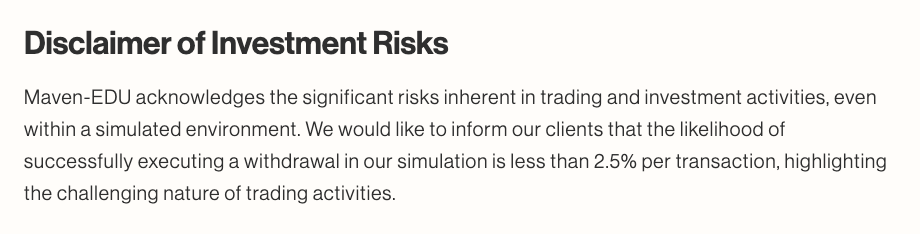
Because the account is simulated, no client money is ever at risk. Maven takes no deposits at all. The sentence saying so is site-wide footer boilerplate rather than a clause in the body of any agreement, and it appears identically in the footer of the homepage, the FAQ page and the Terms page: “Maven Trading does not act as a broker and do not accept any deposits.” We flag where it sits because body text versus footer text is the exact distinction this review turns on two paragraphs below. The challenge fee is a purchase, not a balance. There is no segregated account, no custodian and nothing to reclaim, which also means there is nothing for a customer-money rule to protect. What a buyer is really purchasing is a contractual promise to be paid a share of simulated profit if a long list of conditions is met.
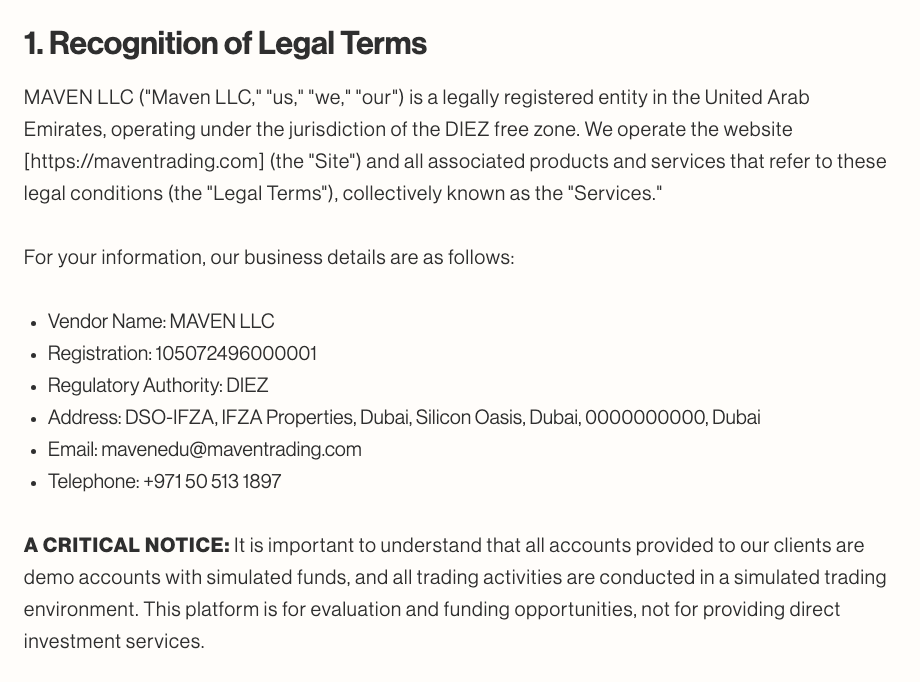
That makes the identity of the promisor the central question, and this is where Maven is weakest. On the same day, on the same website, the firm names two different companies with two different registration numbers. The Terms name MAVEN LLC, under a heading that reads “Regulatory Authority: DIEZ”. The footer of that very page names Maven Edu – FZCO. The AML Policy and the Risk Disclosure name a third form, MAVEN EDU / Maven-EDU, with no number at all. Nothing on the site explains how these relate to one another. Both registration numbers, and what every register we tried returned for each, are set out in Company and Accountability below. The short version is that we verified neither, and the reasons differ: one register is gated behind a national digital identity we do not hold, another is CAPTCHA-gated and was never queried, and a third had a failed positive control, so its silence means nothing.
A point that has to be made plainly, because it is routinely got wrong: there is no licence for proprietary trading firms anywhere in the world. Maven is not unlicensed in the sense of having failed to obtain something available to it. No regulator issues a prop-firm licence, Maven claims no licence number anywhere on its site, and we do not penalise it for the absence of one. What we score is the recourse position, which is a different thing: who you would sue, under whose law, in which court, and for how much.
Our overall score is 4.1 out of 10. The components are regulation 3, fees 5.8, platform 4.1, support 5 and reviews 2.5. Fees are the strongest part of the offer and the score reflects it: full headline pricing is published for all 116 challenge cards, commissions are stated, swaps are zero, and the challenge fee is refunded on the third withdrawal. The low marks are driven by the counterparty position, by a payout rulebook that is split across documents which contradict each other on live money questions, and by a total absence of verifiable user-outcome data in either direction, which we discuss below rather than fill with an aggregator score.
Overview Table
| Headquarters | Dubai Silicon Oasis, United Arab Emirates. Terms section 1 gives “DSO-IFZA, IFZA Properties, Dubai, Silicon Oasis” for MAVEN LLC; the site footer gives the same address for Maven Edu – FZCO |
| Established | The firm states “We have been operating since 2022” in its FAQ. We could not attach any incorporation record to the domain, and the company named as “the Company” in Maven’s own terms has changed four times since 2023, so we record 2022 as a claim rather than a verified founding date |
| Countries Served | Sold internationally. 25 countries are excluded in the published footer list, and a further 6 have products withheld by a restriction map that exists only inside the site’s compiled JavaScript. We loaded the site from 11 countries and the served pages were identical |
| Regulated By | No financial regulator, and none is possible. Prop firms are not licensable in any jurisdiction, and Maven claims no licence number anywhere on the site. Its Terms list “Regulatory Authority: DIEZ”, the Dubai Integrated Economic Zones Authority, which is a free-zone company registrar rather than a financial regulator |
| Minimum Deposit | None. No deposits are accepted. The comparable figure is the cheapest challenge entry: $5 for Buy Now Pay Later, or $9 for an Omo 2-Step $2k with the current coupon |
| Maximum Leverage | 75:1 on forex, 20:1 on commodities, indices and precious metals. Simulated leverage on a demo account |
| Total Instruments | We counted the symbols Maven enumerates in its own instruments FAQ: 40 forex pairs, 15 indices, 4 cryptocurrency pairs and 17 commodity symbols, plus a 24/7 product called Gold Eternal. The site’s Organization structured data separately claims “over 400 assets” |
| Platforms | MetaTrader 5, Match-Trader and cTrader. The first two are named in the Terms; cTrader is priced on 28 challenge cards and named in no legal document |
| Customer Support | Crisp live chat, email, two published phone numbers and a Discord community. No support hours are published on the contact, support or FAQ pages |
| Languages | English, Spanish and Portuguese |
Facts List
- The funded account is a demo account with simulated funds, disclosed in the hero, the site-wide footer, Terms section 1, the User Acknowledgement and the Risk Disclosure.
- Maven’s own Risk Disclosure states the likelihood of successfully executing a withdrawal in its simulation is “less than 2.5% per transaction”.
- Two entities with two different registration numbers appear on the same page: MAVEN LLC in the Terms, Maven Edu – FZCO in the footer, with the numbers and the register results in Company and Accountability below.
- No client money exists at any point. The firm accepts no deposits and is not a broker, by its own statement.
- Withdrawals are capped at $10,000 per 30-day rolling cycle per trader, accounts are aggregated, and “Any profits generated over the $10,000 limit will be voided.”
- Zero swap fees on all accounts; $2 per side commission on forex, $3 per side on precious metals and energy; no spread table is published.
- The challenge fee is refunded on the third withdrawal, stated on every pricing card and in the FAQ, and contradicted inside the Terms themselves.
- Terms section 11 caps Maven’s total liability at “the amount you paid for the specific service in the one-month period prior to the claim.”
- 25 countries are on the published restricted list, including Saint Lucia, where the firm’s own footer named a company as recently as November 2025.
Key Takeaways
The short version, before the detail.
- The funded account is simulated, and Maven tells you so repeatedly and prominently. Hero, every-page footer, Terms section 1 in capitals, the User Acknowledgement and the Risk Disclosure. A firm that puts this on the front page is behaving better than one that hides it behind a support article.
- No client money is ever at risk, because none is ever taken. The challenge fee is a purchase. There is no balance to lose, no broker, no custodian and no client-money protection to look for.
- The counterparty is ambiguous. Two company names with two registration numbers appear on the same page, a third name appears in the AML Policy and Risk Disclosure, and nothing on the site explains the relationship.
- We could not verify either UAE registration number, and the reasons differ. The UAE federal register exists and is gated behind UAE PASS, which we do not hold and must not create. The DMCC register was reached but is CAPTCHA-gated and we ran no queries. A Dubai business directory failed its positive control, so its empty result proves nothing. DIEZ’s own register was never queried.
- Maven’s own risk document puts withdrawal success below 2.5% per transaction. Read that next to the page title “Forex Prop Firm: Get Funded – Get Paid” and decide for yourself which one you were buying.
- Payouts are capped and profit above the cap is destroyed. $10,000 per 30-day rolling cycle per trader, accounts aggregated, account reset to the starting balance after the split, and anything above the cap “will be voided”.
- A second rule contracts large winning days. Once total profit passes $5,000, the best day or single trade may not exceed 50% of the cycle’s profit, and the excess is contracted away. Maven’s own worked examples are arithmetically correct; the consequence is that a trader who earns $10,000 on one trade is paid $4,000 of it.
- The binding Terms and the FAQ disagree on rules that decide whether you get paid. News trading, the 1% risk rule, the scaling cap and the minimum profitable-day count all read differently in the two documents.
- The commercial offer is genuinely competitive and fully published. 116 challenge cards with coupon and list prices, zero swaps, $4 round-trip forex commission, three real platforms, and the fee refunded on the third withdrawal.
- There is no independent evidence of outcomes at this firm, in either direction, though the firm’s own figure above is first-party evidence of one. We use no third-party review-platform data at all. Maven’s contract also penalises public criticism, so the volume of public complaint about this firm is not a neutral measurement and should not be read as one.
- No regulator warning and no clone entry exist against the brand. The FCA register returned nothing adverse for “Maven Trading” and the tool’s clone branch was proven to fire on a control search.
Company & Accountability
As set out in the Overview, no jurisdiction licenses proprietary trading firms, Maven claims no licence number, and we attach no penalty to that. There is also no supervisor to complain to about the fairness of a challenge. What we assess instead is accountability: which company you contract with, whether that company can be found in a public record, whose law governs the contract, which court hears a dispute, and what the contract says the firm’s maximum exposure is. On those questions Maven scores 3 out of 10, and the reasons are below.
Who you are contracting with
Four names for the operator appear across Maven’s own documents, two of them carrying registration numbers, and the two numbered ones sit on the same page as each other. The Terms, last amended 22 October 2025 and running to 17 sections, open by naming MAVEN LLC. The footer beneath them names Maven Edu – FZCO. The footer wording is unambiguous about its subject: “Maven Edu – FZCO is a registered limited corporation in United Arab Emirates, DSO-IFZA, IFZA Properties, Dubai Silicon Oasis with the registration number 006-0060823-070425 and is compliant with all necessary laws and regulations provided in accordance with local and international jurisdictions.” No document on the site states that these are the same company, a parent and subsidiary, or anything else.
| Name as published | Where it appears | Registration number | What the registers returned |
|---|---|---|---|
| MAVEN LLC | Terms and Conditions section 1, “Recognition of Legal Terms”, as the contracting party | 105072496000001, under a heading reading “Regulatory Authority: DIEZ” | Not verified, though not for want of asking. One company registrar did accept the number as a query: the ADGM Registration Authority returned “No Records to Show” for 105072496000001, on a search whose control returned 651 results. ADGM is a different free zone from the one Maven names, so that nil is expected rather than adverse; it is recorded here only so a searched register is never mistaken for an unsearched one. The registers that would actually hold this record were all closed to us. The UAE federal National Economic Register exists and holds economic-licence data; its licence-enquiry service redirects to an identity provider and requires UAE PASS, the UAE national digital identity, which we do not hold and must not create. DIEZ’s own register was never queried. The DMCC public register was reached but is CAPTCHA-gated and we ran zero searches against it. A Dubai business directory returned nothing, but its positive control failed, so that empty result carries no information at all. |
| Maven Edu – FZCO | Site-wide footer, on every page fetched from all 11 country exits | 006-0060823-070425 | Not verified, for the same reasons and with the same caveats. We searched no register that both covers UAE free-zone companies and was open to us. Two financial-services registers were searched and returned explicit nils for this and every other Maven name: the DFSA public register of firms in the DIFC, where the control search returned Standard Chartered Bank and the companion endpoint reported a total of zero for each Maven query, and the ADGM FSRA public register, whose controls returned 1,054, 152 and 10 items. Neither nil carries adverse weight, because a prop firm cannot be authorised by either body. They are recorded so nobody later mistakes an unsearched register for a searched one. |
| MAVEN EDU / Maven-EDU | AML and KYC Policy and Risk Disclosure | None given | Nothing to search. The AML Policy claims “compliance with regulations for Designated Non-Financial Businesses and Professions (DNFBP) in the UAE”, which is the anti-money-laundering classification of a non-financial business, not a financial licence. |
| Maven Trading | The trading name used across the marketing site and the Day Trading Rules page | None given | The FCA Financial Services Register returned 0 hits for “Maven Trading” and 20 for “Maven”, none of which can be attached to this firm on a name match. The control search returned an authorised firm alongside an unauthorised entry, which proves the warning and clone branch of that check fires. So this is a real nil return, and the useful part of it is favourable: there is no FCA warning notice and no clone entry against this brand. The absence of an authorisation is not a finding, because a prop firm cannot hold one. |
| Maven Trade LTD (historic) | The site footer from at least 23 May 2025 to 22 November 2025, giving a Saint Lucia address and registration 2025-00242. Replaced by the UAE wording between 22 November and 3 December 2025 | 2025-00242 | Searched on the Saint Lucia ROCIP e-Registry with both control branches firing: a name control returned many real entities and a number control returned a real company record. Against that, “Maven Trade” and “2025-00242” each returned “The record you are looking for is not on our database.” We did not establish whether that register covers Saint Lucia International Business Companies, so the nil and the caveat belong together and neither travels without the other. We do not say this company does not exist. |
| Mavsoftware LTD (historic) | Named as “the Company” in Maven’s own terms from August 2024 to August 2025 | UK company | The one name in the chain that is placeable on a register, and its record is clean and current. MAVSOFTWARE LIMITED, company number 15115632, England and Wales, Active, incorporated 5 September 2023, registered office 167-169 Great Portland Street, 5th Floor, London W1W 5PF, SIC 62012 for software development. Accounts last made up to 30 September 2024 and filed 21 November 2024, next due 30 September 2026. Confirmation statement last dated 4 September 2025, next due 18 September 2026. Neither is overdue, and the filing history contains no strike-off action and no gazette notice. Identity caveat, which travels with this record everywhere it is used: no registry record links company 15115632 to maventrading.com. The only link is that Maven’s own Terms named “Mavsoftware LTD” as “the Company” from roughly August 2024 to August 2025, and Companies House does not verify the accuracy of what is filed with it. |
| Propriotech, LTD (historic) | Named in the terms from at least September 2023 to July 2024, as “Maven Trading Group, a white label of Propriotech, LTD” | None given | A UK companies register brand sweep for the “Maven” names returned several unrelated companies and none attachable to this firm; the control search on that register returned real differentiated results, so the tool works. No record was tied to this name in the packs available to us. |
The entity has changed four times in three years
The four historic and current names in the table above are not alternative labels for one company; each was, in turn, the company named as “the Company” in Maven’s own terms, and the last change is recent. Set that against the firm’s own FAQ line, “We have been operating since 2022 and are focused on fast payouts and better support.” Both can be true at once, since a brand outlives the companies that carry it. But a trader whose payout is refused contracts with a company, not a brand, and that company has been a different one in each of the last three years.
The Saint Lucia interlude deserves its own note, because Maven’s own footer named a Saint Lucia company as recently as November 2025 while Saint Lucia now sits on the firm’s published restricted-countries list, covered in Restricted Countries below. We state both facts and draw no conclusion from their coexistence. The archived Saint Lucia footer we hold reads “Maven Trade LTD is a registered limited corporation in Saint Lucia at Foregate Offshore Investment and Legal Services LTD., Ground Floor The Sotheby Building, Rodney Village, Rodney Bay, Castries, Saint Lucia LC01 101 with the registration number 2025-00242”.
One further comparison belongs on the record, and it concerns that archived footer, not the current site. The address Maven’s footer gave is that of a registered agent. The Saint Lucia Financial Services Regulatory Authority publishes a register of Registered Agents and Trustees, and we fetched it on 13 August 2026. It returned a fully populated list of 17 registered agents, which is its own positive control. Here are the two texts, verbatim, side by side.
| Source | Text as published |
|---|---|
| Maven’s archived site footer, present from at least 23 May 2025 to 22 November 2025 | “Foregate Offshore Investment and Legal Services LTD., Ground Floor The Sotheby Building, Rodney Village, Rodney Bay, Castries, Saint Lucia LC01 101” |
| Saint Lucia FSRA register of Registered Agents and Trustees, fetched 13 August 2026 | “Fortgate Offshore Investment and Legal Services Ltd. | RA 010 | 1st Floor, The Sothebey Building, Rodney Bay, Gros-Islet, Saint Lucia” |
The two strings differ in four places: Foregate and Fortgate, Sotheby and Sothebey, Ground Floor and 1st Floor, Castries and Gros-Islet. The string “Foregate” does not appear anywhere on that register page, and a search of the Saint Lucia company registry for “Foregate” also returned “The record you are looking for is not on our database.” We report both texts and draw no conclusion about how the difference arose. One observation, offered as an observation only: every registration number that Saint Lucia company registry displays takes the form YYYY/Cnnn or YYYY/Bnnn, and the number in the archived footer, 2025-00242, does not match that format.
What DIEZ is, and what it is not
DIEZ is the Dubai Integrated Economic Zones Authority, the body that operates Dubai Airport Freezone, Dubai Silicon Oasis and Dubai CommerCity. It is a free-zone authority and company registrar. Its own published legislation covers anti-money-laundering and counter-terrorist-financing, beneficial ownership, and business registration and licensing, and does not include financial-services legislation. It does not describe itself as a financial services regulator. Maven’s Terms nonetheless place the DIEZ name under a heading reading “Regulatory Authority”. A reader who takes that heading at face value would come away with an impression the underlying facts do not support.
A method note: our first automated request to diez.ae returned 212 bytes that we initially took for a redirect. They were a bot-block page from a commercial security product. The site loads normally in an ordinary browser, and the conclusion above comes from reading its homepage and legislation pages that way, not from the failed probe.
Terms section 3 goes further than the DIEZ line: “Our operations are fully compliant with UAE financial regulations and relevant DIFC/DMCC/ADGM requirements. As a proprietary trading platform using only company capital for simulated accounts, we operate entirely within the legal frameworks of the UAE.” DIFC, DMCC and ADGM are three separate UAE free zones with their own authorities, and the address Maven publishes for itself is in none of them. No licence or registration number is given for any of the four bodies named in that sentence.
Governing law, forum, and the ceiling on any claim
Terms section 12 sets the dispute path in three lines: “Governing Law: This agreement is governed by UAE law and the specific laws of the DIEZ Freezone.”; “Court Proceedings: The courts in Al ‘Ulan, UAE, will be the final resort.”; and “Jurisdiction: The courts in Al ‘Ulan, United Arab Emirates, have exclusive jurisdiction over any matters that arise from these Terms.”
We could not identify “Al ‘Ulan” as a UAE emirate, city or court. We checked the seven emirates and the federal and local judiciaries listed on the UAE government portal, and we searched English-language sources only. We do not assert that no such place exists, and we draw no legal conclusion about the clause. We report only what we looked for and what we found, which is nothing that matches. A buyer who wants certainty about where a claim would be filed should ask Maven to name the court in writing before paying.
The liability ceiling is easier to state and harder to live with. Terms section 11: “Our total liability will be limited to the amount you paid for the specific service in the one-month period prior to the claim.” Work it through with Maven’s own prices. A trader buying the Standard 2-Step $100,000 challenge pays $396 with the current coupon, or $440 at list. Suppose that trader is later refused a $10,000 payout. The cap is not the fee; it is the fee paid in the month before the claim. A trader who bought the challenge in January and disputes a payout in April has paid nothing in the preceding month. The arithmetic gives $0. We state the clause and the arithmetic and let the reader draw the conclusion.
Who is behind it
The about page names four people: Jon Alex as CEO, Emma Alton as CMO, Chris Hunter as CCO and Seb Anthony as COO. None is presented with a surname verifiable against a register, a linked professional profile or a credited photograph in the material we hold. Thin team pages are common and prove nothing on their own. They do mean that where the corporate paper trail is ambiguous, the human one does not resolve it.
How to Trade
You buy a challenge, you trade a demo account on one of three platforms, and if you clear the targets without breaking a rule you are moved to a simulated funded account with a profit share. The trading itself is conventional. The rulebook around it is not, and the rules that decide whether a trade counts live in more than one document.
Platforms
Three platforms are sold: MetaTrader 5, Match-Trader and cTrader. We counted the platform attribute on every challenge card on the pricing page: 42 MetaTrader 5, 46 Match-Trader and 28 cTrader, 116 cards in total. Three real platforms is a genuine strength, and Match-Trader plus MT5 covers most working styles.
The complication is cTrader. Terms section 9 names only “Meta Trader 5, Match trader, payment processors, risk management systems, and other communication tools”. The checkout platform selector offers MetaTrader 5 and Match Trader. The site’s own compiled geo-restriction module enumerates only the MetaTrader 5 and Match-Trade codes. It is nonetheless genuinely buyable: the checkout embeds its own variant payload and the cTrader variants in it are marked in stock, for example variant 176716, a 1-Step $2k at the $35 list price. What is missing is the paperwork around it. cTrader is priced on 28 cards and absent from Terms section 9, from the compiled geo-restriction module, and from the two-option platform radio group a buyer sees at checkout. It also costs more on small accounts: a Standard 1-Step $2k is $32 on cTrader against $14 on the other two, and a Standard 3-Step $2k is $30 against $12. The premium is not uniform. On a $100k Standard 1-Step it is $360 against $342, and on a Mini $100k the cTrader card is the cheaper of the three. Coverage is uneven too: Standard 2-Step on cTrader stops at $20k, and Omo, Buy Now Pay Later and Prediction Markets are not offered on cTrader at all.
MetaTrader is not available to traders in the United States or Canada, stated in the footer and matched by a country restriction in the site’s own code.
Costs of trading
Maven publishes its commission schedule precisely, per side and per asset class. Forex is “$2 USD commission per way ($4 USD round trip)”. Precious metals and energy are dearer: “$3 USD Precious Metals per way ($6 USD round trip). $3 USD Energy per way ($6 USD round trip).” Digital ETFs, indices and commodities are stated as zero commission. Swaps are zero: “We have ZERO swap fees across all accounts.” For a swing trader running positions over several nights, zero swap is a real economic difference, not a marketing line.
Spreads are the gap. The FAQ says only “Spreads will vary with market conditions” and no spread table is published anywhere on the site. On a simulated account fed by unnamed liquidity providers, the spread is set by the firm whose money is on the other side of your profit share, and there is no published figure to hold it to. That is the single largest unpriced variable in the offer.
Leverage and position rules
Leverage is 75:1 on forex and 20:1 on commodities, indices and precious metals. On the Instant product you may hold only one trade at a time, and the minimum hold time is 150 seconds: “any trades held beneath this time will not count towards profits.” The same 150-second minimum applies at the Omo funded stage, where Maven explains it is “designed to discourage scalping strategies that exploit short-term volatility spikes.”
Prohibited styles, and a rulebook that is not fully published
Expert advisors are banned outright: “EAs are not permitted under any circumstances across all our platforms.” Copy trading breaches both accounts. Grid and gap strategies are prohibited across all challenge and funded accounts. Hedging across accounts, “reverse hedging”, account mirroring and what Maven calls “gamifying” are all prohibited. There is a style rule most traders will not expect: holding “50% or more of your trades for less than a minute” is classified as excessive scalping and is a breach. There is also an all-in rule that catches a single unhedged position with no stop loss even if it wins.
Then Terms section 4 adds: “A full list of all prohibited activities is available upon request.” The rulebook you agree to is expressly not the whole rulebook. That matters more here than it would at a broker, because at a prop firm the rules are the product.
The news rule, where the Terms and the FAQ contradict each other
This is the clearest example of the documentation problem, and it can cost a passing trader the account.
Terms section 4 says: “Prohibitions Against News Trading: For all accounts, you may not place new trades or close existing trades within 2 minutes before or after “Red Folder” news events listed on Forex Factory. You may hold positions that were opened more than 2 minutes before a news event.”
The FAQ says: “The News rule does not apply to our instant accounts. Traders cannot open or close trades 2 minutes either side of a red folder news event release. The two-minute window includes trades hitting TP, profit target and any trade in profit. This includes trades that have been opened prior to the news event and trades, that hit our profit target during the time window. If you have any trade that generates profit in this news window you will not pass the challenge. We have an auto-close feature where your trades are automatically closed when your target profit has been met. If your trades are closed during a news event, whether or not a take profit is set, it will be considered a violation of our 2-minute before and 2-minute after news trading time restriction.”
They conflict twice. On scope, the Terms say “For all accounts” and the FAQ exempts Instant accounts. On held positions, the Terms permit holding a position opened more than two minutes earlier and the FAQ says the window “includes trades that have been opened prior to the news event”. And the FAQ describes an automated feature of Maven’s own platform, the profit-target auto-close, that can produce the closing trade the same paragraph calls a violation. A trader following the binding Terms exactly can be told they broke the FAQ. Which document governs is not stated anywhere, and the Terms claim to be the entire agreement, as set out in Challenges and Funding below.
On the Omo product the news rule is different again and better disclosed: news trading is permitted in both phases, and at the funded stage profit from any single news event is capped at 0.50% of account balance rather than treated as a breach. On Buy Now Pay Later, news trading in the evaluation is unrestricted. Prediction Markets has no news restriction at all.
The IP policy
One rule catches travellers and people on mobile connections: “Your IP address throughout your Maven journey must match the same geographical region to verify you didn’t receive outside assistance. If we see that your IP address has changed, we will ask for proof and reasoning of why this has occurred. (Proof may involve plane tickets, live location checking through another medium, or another approach that Maven sees fit.)” The evidence demand is open ended by construction, and the phrase “another approach that Maven sees fit” places the standard entirely in the firm’s hands.
Challenges & Funding
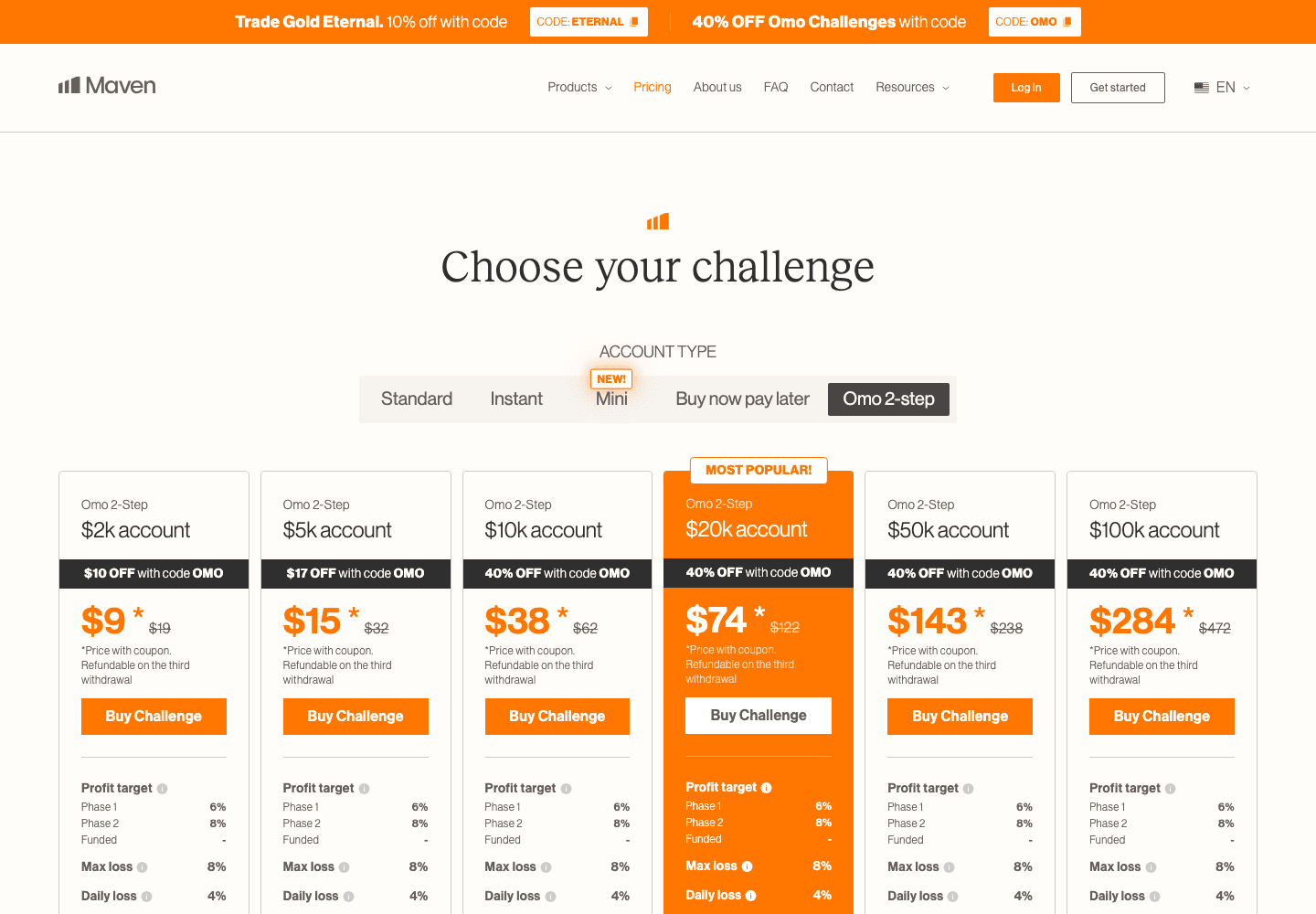
Maven sells nine challenge lines across six account sizes, from $2,000 to $100,000. We counted the sellable plan codes in the site’s own compiled JavaScript: one-step, two-step, three-step, Instant, Omo, Mini, Prediction Markets, Prediction Markets Elite and Buy Now Pay Later, nine in total, plus two internal codes for the funded stage of the Buy Now Pay Later product. Every card publishes a coupon price, a struck-through list price, the profit targets, the loss limits, the split, the payout frequency and whether a consistency score applies. Publishing that grid in full is a real strength, and it is the main reason the fees criterion scores 5.8 rather than lower.
What each line asks of you
| Programme | Targets | Max loss | Daily loss | Split | $2k / $100k price with coupon |
|---|---|---|---|---|---|
| Standard 1-Step | 8% | 5% trailing | 3% | 80% | $14 / $342 |
| Standard 2-Step | 8% then 5% | 8% static | 4% | 80% | $18 / $396 |
| Standard 3-Step | 3%, 3%, 3% | 3% static | 2% | 80% | $12 / $270 |
| Instant | 3% profit needed to withdraw | 3% trailing | 2% | 80% | $14 / $342 |
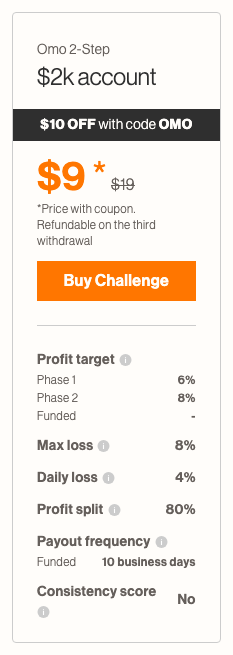
| Omo 2-Step | 6% then 8% | 8% static | 4% end of day | 80% | $9 / $284 |
| Mini | Single payout, 24 hour window | 3% | 2% | 70% | $16 / $396 |
| Buy Now Pay Later | 4% | 10% static in evaluation, 8% trailing when funded | None in evaluation, 4% when funded | 80% | $5 up front / $5 plus $589 |
| Prediction Markets Essential | 9% | 3% trailing | None | 70% | Not sold at $2k / $540 |
| Prediction Markets Elite | 9% | 5% static | None | 70% | Not sold at $2k / $900 |
The two Prediction Markets rows show the drawdown model from the FAQ, which says Essential uses a 3% trailing drawdown and Elite a 5% static one. The pricing cards for both tiers instead read 5% in phase one and 8% once funded. We report both rather than choosing between them.
Prices above are the MetaTrader 5 and Match-Trader cards with the coupons live on 13 August 2026. Two coupon banners were running: “Trade Gold Eternal. 10% off with code CODE: ETERNAL” and “40% OFF Omo Challenges with code CODE: OMO”. Challenges were actively on sale, not paused.
The Terms describe four products; the site sells nine
Terms section 3 states “We have five distinct account types” and then lists four: the Two-Step Program, the One-Step Program, Maven Instant and Maven Three-Step. We counted them. Mini, Omo, Buy Now Pay Later, Prediction Markets and Prediction Markets Elite appear nowhere in the Terms. We checked with whole-context searches rather than substring matching, because the obvious search returns false positives: “Mini” hits inside “minimum” and “Omo” hits inside “promoting”. Both were discarded.
Those five products carry the most unusual terms in the catalogue, and their rules exist only in the FAQ, while Terms section 17 says the Terms “represent the entire agreement between you and MAVEN regarding our services.” It is also where the 80% headline stops being true, which is set out against the marketing claim in Payout Terms below. Mini is also a single-payout product: “Only one – it’s a single payout model. After your first withdrawal, your account will be closed.” Combine that with the Mini time limit, “You have 24 hours to trade on the account. The timer starts once you’ve placed your first trade”, and Mini is best understood as a one-shot 24-hour product paying 70%, not as a funded account.
Buy Now Pay Later, priced honestly and worth the arithmetic
The $5 entry is the cheapest way into any Maven challenge and it is exactly what it says: “Buy Now Pay Later is a one-step evaluation that costs $5 to start. If you pass the evaluation, you then pay the remaining fee to activate your funded account.” The balance runs $40, $69, $117, $189, $359 and $589 by account size.
On a $100,000 account that is $5 plus $589, so $594 in total against a Standard 1-Step $100k at $342 with the same coupon or $380 at list. That is 1.74 times the coupon price and 1.56 times the list price. In exchange the evaluation is materially looser: a 4% target rather than 8%, a 10% static maximum drawdown, no daily drawdown limit, no minimum trading days and no consistency score. Whether that trade is worth 1.6x is a judgement about your own strike rate, and it is a legitimate offer either way. What matters is that the total cost is only visible if you add the two numbers yourself.
Omo, the discounted headline
Omo 2-Step is the cheapest entry on the board at $9 for a $2k account, against a $19 list price, because of the 40% coupon. It is a two-phase evaluation with a 6% target in phase one and 8% in phase two, an 8% static maximum drawdown measured from starting balance, and a 4% end-of-day daily limit. Maven explains the rising target directly: “Passing Phase 1 demonstrates you can reach a goal; Phase 2 confirms you can do it again under slightly more demanding conditions.” It has a 180-day limit across both phases, which is one of only two published time limits in the catalogue. It requires four minimum profitable days in each phase including the funded stage, where the Terms require three for the two-step, and that conflict is covered in the drawdown section below.
Buyback, and what it costs
If you lose a funded account, Maven will sell it back to you without a new challenge: $200 at $2,000, $400 at $5,000, $750 at $10,000, $1,400 at $20,000, $3,500 at $50,000 and $6,000 at $100,000. Compare the last one with what the account cost to earn. A Standard 2-Step $100,000 challenge is $396 with coupon or $440 at list. The buyback is 13.6 times the list price and 15.2 times the coupon price. It is a convenience product for someone whose account is producing, and it is priced accordingly. Anyone treating buyback as a safety net should price it before they need it.
Scaling
Maven publishes a scaling plan: profit 10% over four months, at 2.5% per month, take at least one payout per month, and the account grows by 25%, repeatable up to $1,000,000. A trader may hold up to $200,000 in starting capital across funded accounts. The scaling FAQ then contradicts itself inside two consecutive sentences: “The max withdrawal cap scales alongside with the scaling plan. The max withdrawal does not scale along.” On a product whose central constraint is a $10,000 monthly withdrawal cap, that is not a typo you can shrug at. It is the difference between a $1,000,000 account being worth scaling to and not.
Drawdown & Breach Rules
Negative balance protection is a client-money concept and it does not apply here in the usual sense, because Maven holds no client money at all, as quoted in the Overview. Nothing you own can go negative, no margin call can reach your bank account, and the most you can lose is the fee you paid for the challenge. That is the honest upside of a simulated model and it is worth stating plainly. The equivalent risk at a prop firm is different: it is the risk that a rule breach ends the account you have already paid for and worked on. Those rules are below.
The drawdown limits, by product
| Product | Maximum loss | Daily loss |
|---|---|---|
| Standard 2-Step | 8%, static, from starting balance | 4% |
| Standard 1-Step | 5%, trailing from the highest equity watermark | 3% |
| Standard 3-Step | 3%, static | 2% |
| Instant | 3%, trailing, plus a 1% maximum floating loss | 2% |
| Omo 2-Step | 8%, static, across all three stages including funded | 4%, end of day |
| Buy Now Pay Later | 10% static in the evaluation, 8% trailing once funded | None in the evaluation, 4% end of day once funded |
Daily loss is measured on “the higher of your equity/balance at 00:00 UTC”, which is the more generous of the two common conventions and is explained clearly in the FAQ with worked examples. Trailing drawdown is explained just as clearly: on a $1,000 account with a 3% trailing limit, a rise to $1,100 in equity moves the breach point to $1,067. Maven’s arithmetic in these examples is correct and the explanations are clear.
The 1% rule, which reads two different ways in two documents
Terms section 5 says: “If we notice excessive trading on your account without appropriate risk management, we may limit your trading to 1% risk, whereby if ever your account equity drops beneath 1% of your account balance, this will breach the account. We have the discretion to do this at any point within your trading journey.”
The FAQ, under “Max total risk (1%)” for Instant accounts, says: “At no point can your account have more than a 1% loss in floating PnL. This is the difference between your balance and equity, if this happens then your account will be breached. For example if you have a $10,000 account, and your equity level at any point goes beneath $9,900 then your account will be breached.”
Work both on a $10,000 Instant account. The Terms trigger fires when equity drops beneath 1% of balance, which is $100. That is a 99% loss. The Instant maximum loss is 3% trailing, breaching at about $9,700 from a $10,000 watermark, and the daily limit is 2%. Equity cannot reach $100 without the account having breached several times over, so as written the Terms trigger can never fire. It is arithmetically inert. The FAQ trigger fires at $9,900, a 1% floating loss, which is tighter than both the 3% trailing maximum and the 2% daily limit, and is therefore the binding constraint on the whole account. The same rule, in the firm’s own binding terms and its own FAQ, triggers at levels differing by a factor of about 99.
How the Instant rules stack up on a small account
On a $2,000 Instant account, all of these apply at once:
- 1% maximum floating loss, so never more than $20 underwater on open positions;
- 3% trailing maximum loss, $60 initially and trailing upward with equity;
- 2% daily loss on the higher of equity or balance at 00:00 UTC;
- 3% minimum profit to request a payout, $60;
- a 20% consistency score, so the biggest winning day must be $12 or less of that $60, which requires at least five winning days;
- one open trade at a time, with a 150-second minimum hold.
None of these is hidden and each is individually defensible. Together they describe a product where a $20 adverse tick against an open position ends the account, and where reaching the minimum payout requires a specific shape of equity curve rather than simply a profitable one.
Consistency scores, defined three different ways
Consistency is the gate on withdrawal rather than a breach rule, and Maven uses three versions of it. On Instant and funded accounts it is 20%, calculated as “(your biggest winning day / total profit) * 100%”, and the FAQ works through a five-day example correctly. On the funded stage the same 20% is stated as “your largest winning day must not exceed 20% of your total profits”. On Mini it is 15% and is measured on the largest winning trade, not the largest day. On the Standard 1, 2 and 3-Step and Omo cards, the consistency score field reads “No”. A trader moving between products has to re-learn which denominator applies.
The M2 Account Saver, which permanently halves the split
On Buy Now Pay Later funded accounts an automated tool called the M2 Account Saver watches open-position drawdown: “If your open positions reach a 2% drawdown (based on account balance), it triggers automatically: 1st breach: All open trades are immediately closed and your Profit Split is permanently reduced to 50% of your initial size for the remainder of the account. 2nd breach: All open trades are closed again and your account is permanently deactivated. There is no recovery from a second breach.”
On a $100,000 Buy Now Pay Later account that is a $2,000 adverse swing in open positions, closed by Maven’s own tool, permanently cutting an advertised 80% split to 50% for the life of the account. The FAQ item immediately after it, in the same section, reads: “The profit split is 80/20 in your favour — you keep 80% of all simulated profits generated on your funded account! This applies from your very first withdrawal and does not change over time, regardless of account size.” Both statements are published, adjacent, about the same product.
Profit Rebuild, where taking a payout shrinks your buffer
After a withdrawal on a Buy Now Pay Later funded account, the loss limit re-anchors to the original funded balance. Maven’s example: “Funded at $100,000. If you reach $101,000 and withdraw $500, your balance becomes $100,500 and you can only lose $500 before hitting $100,000. If you hit your initial balance of $100,000 your account will breach.” The arithmetic is right: $101,000 less $500 leaves $100,500, the floor is $100,000, the buffer is $500.
The interaction is the part to understand before your first payout. The same product’s funded rules state the maximum drawdown is “8% trailing, calculated from your highest floating equity”, which on a $101,000 watermark would put the breach point near $92,920. Profit Rebuild puts the real floor at $100,000 instead. After a first withdrawal the binding constraint is the original balance, and the only cushion you have is whatever profit you chose to leave in the account.
Minimum profitable days, and a conflict on a pass condition
The two-step requires “3 minimum profitable days of 0.5% on each phase”, and the same three days again in the funded phase before a withdrawal. The Omo FAQ requires four in each phase including the funded stage, and states plainly that “Reaching your overall profit target without hitting 4 qualifying days is not sufficient to pass or unlock a withdrawal.” Terms section 3 sets three for the two-step. The number that ends your challenge is therefore product specific and differs between the Terms and the product FAQ.
Inactivity
“Accounts must not be dormant for more than 30 calendar days”, with inactivity defined as no executed trades. There is no monetary inactivity fee. The penalty is the account itself. Weekend holding is permitted on all account types.
Trading Instruments
Everything here is simulated. Maven’s footer describes the mechanism in its own words: “all instruments are simulated and fed to use through liquidity providers”. No liquidity provider is ever named for the forex product, and no execution venue, broker or futures commission merchant appears anywhere on the site. The only named data source in the whole catalogue is for prediction markets: “The data feed comes from MatchTrade and follows the markets on Kalshi or Polymarket.”
What is actually on the list
Maven enumerates its symbols in a single FAQ answer. We counted them ourselves rather than taking a headline number:
| Class | Count | Notes |
|---|---|---|
| Forex | 40 pairs | All the majors plus crosses including EURNOK, EURPLN, EURTRY, USDMXN, USDZAR and USDHKD |
| Indices | 15 | US30, US100, US500, US2000, UK100, GER30, FRA40, JAP225, AUS200 and others |
| Commodities and metals | 17 symbols | Gold, silver, platinum, palladium, copper, aluminium, zinc, Brent, WTI, natural gas, and softs including cocoa, coffee, corn, cotton, soybean, sugar and wheat |
| Gold Eternal | 1 product | “Gold Eternal follows the price of Gold however is open 24/7” |
| Cryptocurrencies | 4 pairs | BTCUSD, BTCEUR, ETHUSD, ETHBTC |
| Prediction markets | Event contracts | Sold as a separate challenge line, following Kalshi or Polymarket pricing |
That is 76 named symbols plus the Gold Eternal product. The site’s Organization structured data separately describes the firm as offering “over 400 assets”. Both numbers are published by Maven. We counted one of them and can stand behind it; the other we can only report as a claim. If the wider catalogue exists, it is not published where a buyer can see it before paying.
One more gap worth naming: digital ETFs are referenced twice, once in the instruments introduction and once in the commission schedule, where they are listed as zero commission. Not one digital ETF appears in the enumerated symbol list.
Leverage differs sharply by class
Forex is 75:1. Commodities, indices and precious metals are 20:1. A trader sizing a gold position off a forex habit will find the margin requirement almost four times higher. Since the drawdown limits are percentages of a fixed account size, the practical effect is that the same percentage risk takes a much larger notional position in forex than in metals.
Prediction markets, which are a different product wearing the same brand
The Prediction Markets challenges are one-step evaluations on event contracts, with a 9% profit target and no profit target at the funded stage. Maven’s own example walks through the mechanics correctly: an event contract priced at 19 cents that moves to 60 cents returns 41 cents per contract, so a thousand contracts return $410. There are no daily drawdown limits, no minimum trading days, no news restriction and no consistency rule on this line. There is a rule specific to it: “You can generate a maximum of 3% of your starting account balance from any one question. If you generate more than this, the remaining profits will be nulled.”
Two things separate this line from the rest of the catalogue and both matter. The split is 70%. And it is sold only on Match-Trader, at $540 for a $100k Essential card and $900 for a $100k Elite card with the current coupon, which makes it the most expensive entry on the board.
Spreads
No spread table exists for any of these instruments, which is covered with the rest of the trading costs in How to Trade above.
Education & Analysis
Maven describes itself in its footer as providing “simulated trading and educational tools for traders”. Judged as education, what exists is a large FAQ, a Discord community, a blog and a set of rules pages. There is no course, no structured curriculum, no webinar series and no research desk anywhere in the material we fetched. Nor is there any trading analysis product: no daily commentary, no signal service, no proprietary charting tools beyond the three platforms themselves, and no economic calendar of Maven’s own. The calendar that matters is a third party’s: the news rule is defined against “Red Folder” events listed on Forex Factory.
The FAQ is the real rulebook
We counted 78 question and answer pairs on the FAQ page, taken from the page’s own structured data. That is a substantial body of documentation and much of it is well written. The drawdown explanations use worked examples with correct arithmetic. The consistency-score example runs across eight trading days and gets the percentages right. The prediction-markets walkthrough prices an event contract properly. When Maven explains a mechanic, it usually explains it well, and we checked its numbers rather than assuming them.
The problem is structural, not editorial. The FAQ is not a help centre; it is where the binding rules of five of the nine products live, because those products are absent from the Terms. And where the FAQ and the Terms disagree, which they do on news trading, on the 1% risk rule, on minimum profitable days and on scaling, nothing tells a trader which text governs. Read literally, the Terms’ own entire-agreement clause would exclude the FAQ rules that are the only published rules for five of the nine products sold.
What is missing from the documentation stack
Each of the following was looked for by fetching and reading the pages that would carry it. These are “not found”, not “not checked”:
- No article-based help centre or knowledge base. There is no Zendesk, Intercom, HelpScout, Freshdesk or Notion instance. The support page renders a loading overlay and a chat widget, with no article content behind it.
- No separate funded-trader or payout agreement. Payout rules are spread across the Terms, the FAQ and the product pages.
- No standalone refund policy and no restricted-countries page. Neither appears in the 78-URL sitemap; both exist only as text inside other pages.
- No standalone cookie policy, although the cookie banner and the newsletter consent line both refer to one. The link resolves to an anchor inside the privacy policy.
- No affiliate terms. The affiliate signup form requires ticking “I agree to Terms and conditions” and the served markup contains no link to any terms document, so a prospective affiliate cannot read what they are agreeing to before agreeing to it.
There is also a rules page most users will never find: a Day Trading Rules document exists at its own URL but is not linked from the footer and is discoverable only through the sitemap. It carries operative language, including that “Any suspicious trading activity is subject to review, and termination may lead to the loss of any eventual profits.”
Community
The Discord community is the main educational channel in practice, linked from the site and promoted on the homepage, which claims “115k+ Discord Members”. We did not join it and make no claim about what happens inside it. One caution worth carrying there: Terms section 14 treats all support and platform communication as strictly confidential and asks users to agree not to criticise the firm on review sites, quoted in full in the customer support section below. A community where the terms of service constrain what participants may say about the operator is not a neutral source of information about the operator.
What we did not check
We did not read individual blog posts; the blog index is in the sitemap but no post is. We did not open an account, so we have not seen the dashboard, and funded-stage rules shown to a logged-in customer may differ from the public FAQ. We say that as a limitation of this review, not as an insinuation.
Payout Terms
This is the section that decides whether Maven is worth buying, and it is where the offer reads at its most one sided. Every clause below is Maven’s own published text. None of it is hidden; most of it is in the FAQ rather than the Terms. Read together, the rules mean a trader can follow every stated limit, produce a large simulated profit, and still be paid a fraction of it.
The current offers
Two coupons were live on 13 August 2026, both applied in the checkout links baked into the pricing page: “Trade Gold Eternal. 10% off with code CODE: ETERNAL” and “40% OFF Omo Challenges with code CODE: OMO”. Every card shows the discounted price beside a struck-through list price, so the discount is legible rather than implied. The Omo discount is the largest on the board and takes a $100k Omo 2-Step from $472 to $284.
The standing offer is the fee refund. Every pricing card carries the footnote “*Price with coupon. Refundable on the third withdrawal”, and the FAQ repeats it: “A full refund will be issued on the third withdrawal on your account.” Terms section 6 agrees in one sentence, “evaluation fees are nonrefundable except after receiving three payouts”, and then contradicts it in the same section: “All purchases are considered final, non-cancellable, and non-returnable. Since our services are delivered instantly upon payment, we do not offer refunds for evaluation programs or accessed content.” Three statements support the refund and one, in the binding document, appears to exclude it.
The $10,000 cap, and what happens to profit above it
Maven calls it the overflow feature: “You are entitled to a maximum withdrawal of $10,000 per 30-day rolling cycle (per trader). If you profit more than $10,000, you will be given the maximum of $10,000. If you are trading on multiple accounts, your accounts will be treated as the same account. Your account will be reset to the starting balance after receiving the profit split. The $10,000 is calculated from the date on which you close the profit on the account. Any profits generated over the $10,000 limit will be voided.”
Three parts of that clause compound. The cap is per trader, not per account, so buying more accounts does not raise it. The account resets to its starting balance after the split, so profit above the cap cannot be carried forward. And the excess is not deferred; it is voided.
Worked through on a Standard 2-Step $100,000 account, whose limits are 8% static maximum loss and 4% daily: nothing in the published rules caps profit. A trader makes $25,000 in one 30-day cycle without breaching any limit. The payout is $10,000. $15,000 is voided, and the reset to $100,000 means it cannot be recovered in the next cycle. The trader broke no rule and lost two thirds of what they earned.
The 50% best-day contraction, using Maven’s own examples
Above $5,000 of profit a second rule applies: “If your total profit exceeds $5,000, your best trading day (day counted between two singular trades, with not 24h between closing trade 1 and opening trade 2) or singular trade (a singular trade can be made up of multiple trades entered at the same time) may not exceed 50% of your profit in the funded stage payout cycle. If you do exceed the 50%, the profits made will be contracted to the 50% mark.”
Maven publishes two examples and we checked both. They are arithmetically correct, which is worth saying, because a firm that gets its own worked examples right is easier to hold to them.
- Maven’s first example: “Lets say you have a $100,000 account, in day 1 you make $5,000, day 2 you make $3,000. Your total balance is now $108,000. Your total withdraw before split will be $6,000.” Our check: if the allowed profit is P with the best day capped at half of it and the other day fixed at $3,000, then P/2 = P minus 3,000, so P is $6,000. Their figure is right. The effect is that $2,000 of $8,000 earned is forfeited, and after the 80% split the trader receives $4,800 on $8,000 earned, or 60% of it.
- Maven’s second example: “If on one trade you make $10,000. If you choose to withdraw the amount you withdraw before split will be $5,000.” Our check: correct on the same rule. After the split the trader receives $4,000 on $10,000 earned, or 40% of it.
Maven does offer the alternative: “You also have the choice to continue trading to ensure none of your trading days are more than 50% of your total profits.” That is a real option and it is stated in the same paragraph. It also means the trader carries continued market risk on an account they have already earned money in, purely to reshape the distribution of a profit they have already made.
The interview, and the discretion around it
“After exceeding $5,000 in payouts, you must participate in a risk interview with one of our analysts… If you fail to attend and participate in your interview, your payout will not be processed.” Maven allows one cancellation and gives two weeks to book. Below that threshold: “Interviews of traders with less than $5,000 in profit may be conducted randomly or at Maven’s discretion.” A verification call before a large payout is normal practice. A payout gate that can be applied at discretion to any trader at any size is a different thing, and it is stated as such.
Product-specific caps
Omo has its own schedule: the first payout is limited to 6% of account balance and the second to 8%, with no cap after that. Mini pays once and closes the account. Instant pays “When Requirements are met” rather than on a fixed cycle. On the Standard products and Omo the frequency is every 10 business days after the first trade.
Marketing against the binding text
Both sides, quoted as published. We draw no legal conclusion from any row; readers can weigh them.
| What the marketing says | What the binding or legal document says |
|---|---|
| Page title of the homepage: “Forex Prop Firm: Get Funded – Get Paid” | The Risk Disclosure, on the likelihood of successfully executing a withdrawal in the simulation. Quoted in full in the Overview above |
| Homepage: “Experience instant payouts and execution in a simulated prop firm trading environment.” | Terms section 3, on every programme: “payouts available every 10 business days”. FAQ: “You can request a withdrawal every 10 business days after your first trade.” |
| Inside each challenge card’s “Learn more” panel: “Traders earn on average $234 in rewards with this challenge!” | The same figure, $234, appears on every product and every account size from $2,000 to $100,000. We counted 116 occurrences and one distinct value in the page’s own markup. It sits inside a collapsed panel rather than on the face of the card, and we did not click to open it |
| Homepage hero: “Start trading in a fully simulated environment and keep 80% of your rewards.” | 80% is correct for Standard 1, 2 and 3-Step, Instant, Omo and Buy Now Pay Later. Mini is 70% and both Prediction Markets tiers are 70%, disclosed on those products’ own cards and FAQ entries |
| FAQ: “We have been operating since 2022 and are focused on fast payouts and better support.” | The firm’s own terms named a different company as “the Company” in 2023, in 2024 and in 2025 |
The discretion clauses, in the firm’s own words
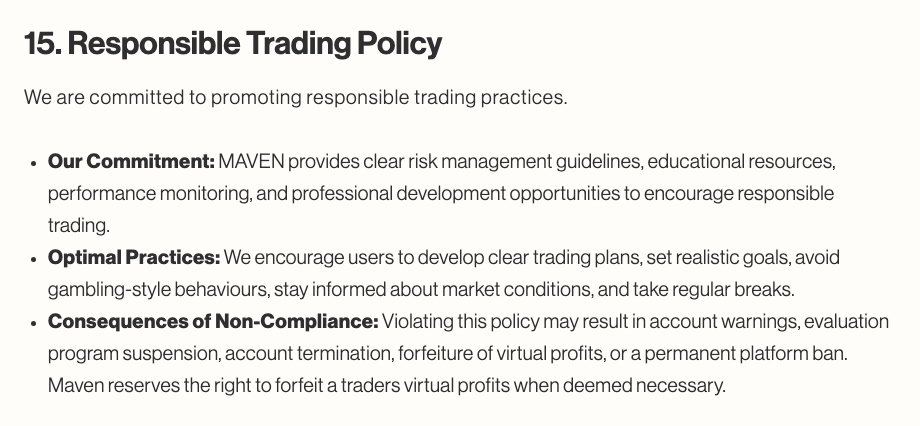
- Terms section 15: “Maven reserves the right to forfeit a traders virtual profits when deemed necessary.”
- Terms section 13: “Maven LLC has the right to terminate an account as it seems appropriate.”
- Terms section 16: “We reserve the right to modify these Terms at our sole discretion. Your continued use of our services constitutes your acceptance of the altered Terms.”
- Terms section 6: “Please note our Payment Dispute Policy: Disputing payments negatively affects our operations. Users who dispute payments will have their accounts permanently banned.”
The last one is worth pausing on, because it closes the ordinary consumer route. A card chargeback is how a buyer normally escalates a disputed purchase. Here, raising one is itself a terminable offence, and the liability cap in Terms section 11 already limits any claim to fees paid in the month before the claim.
Opening an Account
There is no account opening in the broker sense, because there is no account to fund. You buy a challenge. Maven’s own instruction is short: “Once you’ve read our trading rules, head to our account setup and pick the best size, steps, and plan. You can pay with a credit card or though other options.” Everything a buyer needs to read beforehand is public: the pricing grid, the Terms, the Risk Disclosure, the AML Policy and all 78 FAQ pairs are readable without registering. That is a real transparency point in Maven’s favour and it is why this review could be written from published sources at all.
The sequence
- Choose a programme, an account size and a platform on the pricing page. The checkout links carry the coupon already applied.
- Pay. Terms section 6 states “We accept Bank Transfers and Cryptocurrency”, while the FAQ refers to paying by credit card. The payment processor is not named anywhere on the site and no processor logos appear in the checkout markup we fetched.
- Trade the evaluation. There is no published time limit on the Standard programmes; Omo allows 180 days across both phases and Mini gives 24 hours from the first trade.
- Pass, then wait for review: “Once you’ve passed the assessment, our team will review your account, which takes 1-3 days.” A certificate and a KYC link follow.
- Complete KYC. It is required at payout rather than at purchase: “You will be required to do KYC when you request a payout.” The identity provider is Veriff.
The KYC rules that catch people out
Maven’s KYC conditions are unusually strict about the relationship between the payer and the trader, and they are stated up front rather than sprung at payout, which is the right way round. The card must be yours: “You must use your own credit card that matches your name in order to proceed through Maven. If you use someone else’s card, you will not be able to get a funded account after the KYC phase.” One email per person, and multiple purchases must use the same email or KYC will fail. And a timing trap: “You cannot change your personal information once you have placed a trade in your challenge account or during the KYC process.” Anyone whose name, address or documents are mid-change should settle that before the first trade, not after.
Underage traders and third-party identity documents are rejected automatically. Nigerian traders are offered a lighter path, a selfie and a NIN number.
Cookie consent, and a point in Maven’s favour
The site’s cookie banner offers “Decline all” and “Accept all”. The same pages ship an inline script setting a consent-enforcement flag to false, with the developers’ own comments explaining what that means: “Enforcement is parked for this cycle, per product: stakeholders have not been briefed yet, so every category is treated as necessary and no tracker is held back”, and “Parked: the decision is recorded so the banner stays dismissed, but nothing acts on it — every category stays granted, so there is no signal to revoke, no tracker to start and no storage to clear.” The trackers named in that script are GA4, Google Ads, AdRoll, Meta, PostHog and Omnisend. So by the site’s own account, declining does not currently withhold anything.
The fair part: Maven does not claim otherwise in its published privacy policy. A paragraph stating that analytics and marketing cookies are set only after acceptance exists in the page source but is commented out, with a developer note saying it should be restored together with enforcement because, while enforcement is parked, it would describe behaviour the site does not have. In other words the firm removed the claim rather than publishing a false one. We flag this because we nearly reported the opposite, and because it is the kind of detail that gets a firm blamed for the reverse of what it did.
Payout Record
There are no deposits and no withdrawals in the broker sense. Money moves in one direction on the way in, as a purchase, and in the other only if a trader clears the evaluation, meets the funded-stage conditions and passes identity checks. What follows is what Maven publishes about that outbound leg, and what we could and could not confirm about it.
Paying for a challenge
Terms section 6: “We accept Bank Transfers and Cryptocurrency”. The FAQ additionally refers to credit cards and “other options”. No payment processor is named on the site and none appears in the checkout markup we retained. That is a gap rather than a red flag by itself, but it does mean a buyer cannot know in advance which entity will appear on their card or bank statement, which is a practical problem given that two different companies are named on the site.
Getting paid
The rails are direct bank transfer or a payments service called Rise, plus an unspecified “or other options”. Which rail you get is decided by residency, and the geography is uneven:
- Traders in South Africa, Nigeria, Kenya and Ghana are offered direct bank transfer or other options.
- Traders in a long published list that includes the United Kingdom, Ireland, Spain, France, Germany, Italy, Australia, Canada, India, Japan, Singapore and the United States “can only receive your payout through Rise or other options”.
- “Payments via Rise incur a $20 withdrawal fee.”
On large payouts $20 is noise. On the small accounts Maven advertises most cheaply it is not. Worked through on an Instant $2,000 account, where the minimum payout threshold is 3% of balance: 3% of $2,000 is $60 of profit before you may request anything; the 80% split leaves $48; the Rise fee takes $20 of that, leaving $28. The fee is 41.7% of the trader’s share. A trader in Lagos on the same account keeps the $48. A trader in London does not. Nothing about that is concealed, and nothing about it is proportionate either.
Timing is published in two forms that do not quite agree. The Terms and the pricing cards say payouts are available every 10 business days on the Standard programmes and Omo, and the FAQ says “You can request a withdrawal every 10 business days after your first trade.” A separate FAQ line says “Payouts are processed the next day after your trading period ends.” Mini is advertised at 24 hours, Buy Now Pay Later as instant, and Instant accounts as “When Requirements are met”. Funded accounts can be merged by emailing support.
What we can and cannot say about the payout record
This needs to be stated bluntly, because it is the single most requested fact about any prop firm and we do not have it.
There is no independent, third-party evidence of outcomes at this firm, in either direction. We hold no primary-source payout proof: no bank confirmations, no transaction records, no independently auditable payout ledger. We also hold no verified evidence of a refused payout. We use no third-party review-platform data of any kind, not as a source and not as a sanity check, so nothing in this review is standing in for that missing evidence. What does exist is first-party: Maven’s own Risk Disclosure puts the likelihood of a successful withdrawal below 2.5% per transaction, quoted in full in the Overview. That is published outcome evidence, it comes from the firm rather than from us, and it does real work in this review. The reviews criterion scores 2.5, and not on an inference that the data would be bad: Trustpilot shows 4.0 stars across 5,201 reviews for Maven but suppresses the rating itself for a breach of its guidelines, which our rule scores below the mark a firm with no rating at all receives.
Two things make the public record harder to read than usual, and both are Maven’s own doing. Its contract asks users to agree not to criticise it publicly and treats all support correspondence as confidential, which is covered in the customer support section below. And the firm’s own homepage carries numbers that we could not source to anything: “Trusted by over 300,000 prop firm traders worldwide.”, “115k+ Discord Members”, “50k+ Funded traders”, “$62k+ Highest total payout” and “$200M+ Total funding”. None of those is evidenced anywhere on the site. Note in passing that “$62k+ Highest total payout” is a modest number for a firm claiming $200M+ in total funding, and that it is consistent with the $10,000 per cycle cap. We report all five as claims and rely on none of them.
The affiliate page publishes two more unevidenced figures, “4K+” affiliates and “$500K+” in total affiliate payouts, on a programme whose terms are not published at all.
Customer Support
Support scores 5 out of 10, and what holds it there is not the number of channels. Maven publishes five contact routes, which we counted. The score reflects what happens around those channels: no published hours, no article-based help centre, three different email addresses with no stated division of labour, and contract terms that make every support interaction confidential and public criticism a terminable offence.

The channels
| Live chat | A Crisp widget. The support page carries no article content at all: what it renders is a loading overlay and the Crisp bootstrap, and the only text our extractor recovered from it was the page title, “Support – Maven Trading”, which is where an earlier note of “23 characters of body text” came from. We corrected that ourselves |
| Three addresses appear in Maven’s own material: website@maventrading.com in the footer, mavenedu@maventrading.com in Terms section 1, and support@maventrading.com in the FAQ for merging funded accounts. We counted them. Nothing tells a customer which to use for what | |
| Phone | Two numbers in the footer: +971 50 513 1897 and +44 7441445241. Both are published openly rather than gated behind a ticket |
| Community | A Discord community linked from the site |
| Social | Instagram, YouTube, TikTok, Facebook, LinkedIn and X are all linked from the footer |
| Hours | Not published. No hours appear on the contact page, the support page or the FAQ page |
| Languages | English, Spanish and Portuguese across the site. We did not test whether support itself answers in all three |
The self-service that does exist
Maven publishes real documentation and it should be counted before the score is explained. There are 78 question and answer pairs on the FAQ page, covering drawdown, consistency, payouts, KYC and every product line, many with worked examples whose arithmetic we checked and found correct. There is a separate Day Trading Rules page at its own URL. Both are free to read without an account, and they are the reason this review could be written from published sources. That is more self-documentation than the score suggests.
It does not lift this criterion, for a specific reason. The axis measured here is how the firm behaves around a payout dispute, and on the rules a dispute turns on, the self-service material contradicts the governing document: the 1% risk trigger, the news rule, consistency, scaling and the profit split all read differently in the FAQ than in the Terms, while Terms section 17 claims the Terms are the entire agreement and five of the nine products sold appear only in the FAQ. Self-service that is unreliable on the decisive rules is not a support asset on that axis. It is a reason a trader will need a person, at a firm that publishes no hours.
Support carries more weight at a prop firm than at a broker. A ticket here is not a question about a platform setting; it is the only route to a buyback, a merge, a KYC problem, a scheduled risk interview or a disputed breach. Every one of those is a money decision made by a person at Maven, and the timeframe for none of them is published.
The clause that shapes everything you can find out
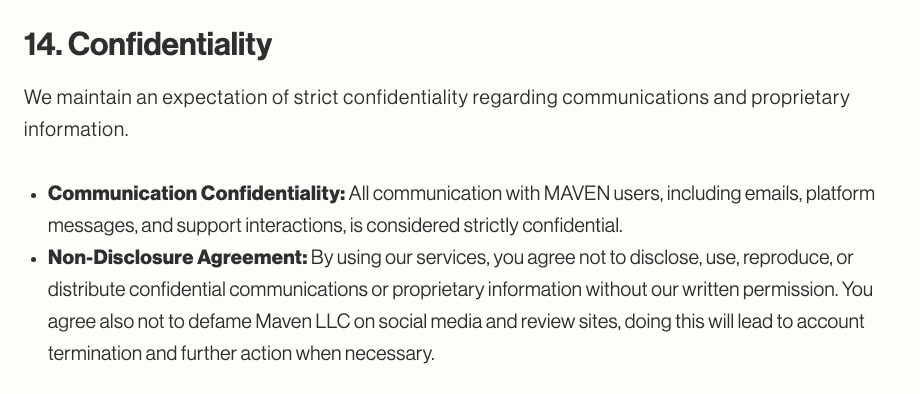
Terms section 14: “By using our services, you agree not to disclose, use, reproduce, or distribute confidential communications or proprietary information without our written permission. You agree also not to defame Maven LLC on social media and review sites, doing this will lead to account termination and further action when necessary.” The same section adds: “All communication with MAVEN users, including emails, platform messages, and support interactions, is considered strictly confidential.”
Take the two together and the consequence is concrete. A trader whose payout is refused has agreed not to publish the correspondence about the refusal, and agreed that posting criticism on a review site can end the account. We are not making a legal claim about the enforceability of either sentence in any jurisdiction; that is a question for a lawyer in whichever forum the dispute lands. The point for a reader is evidential. The volume and tone of public commentary about this firm is not a neutral measurement, because the contract penalises producing it. Silence is not evidence of satisfaction here, and it should not be read that way in either direction.
That is also why this review contains no user sentiment, no rating and no complaint counts. We would rather tell you the evidence base is compromised than launder an unverifiable number into a score.
What good looks like from here
Published hours and a first-response target. One support address instead of three. A rules archive that is versioned and dated, so a trader can show which version applied on the day of a breach. Removing the non-disparagement sentence, which costs the firm nothing if its payouts are sound.
Restricted Countries
Maven publishes a restricted-countries list in the footer of every page, and it is the same list from every country we fetched the site from. It is not a standalone page and does not appear in the sitemap; it exists only as a footer paragraph.

The published list
Verbatim: “Restricted Countries: Afghanistan, Belarus, Burkina Faso, Burundi, Central African Republic, Congo (Republic of the Congo), Cuba, Eritrea, Guinea, Guinea-Bissau, Guyana, Haiti, Iran, Mali, North Korea, Russia, Saint Lucia, Sierra Leone, Somalia, South Sudan, Sudan, Ukraine, Vanuatu, Venezuela, Yemen.” That is 25 countries; we counted them. The same footer adds “We do not provide access to any country on any sanctions list of the United Nations.” and “Metatrader is not available for United States or Canada.”
Most of the list is the usual sanctions-driven set. One entry is not: Saint Lucia, where Maven’s own footer named a company as recently as November 2025, as set out in the company section above. We state both facts and leave the reader to weigh them.
The restrictions that are not published anywhere
The footer list is not the whole picture. The site’s own compiled JavaScript contains a second, narrower restriction map that appears in no published document. We read it from the site’s own code, at a URL taken from the page’s markup:
| Country | Products withheld |
|---|---|
| Pakistan | Two-Step $50k and $100k |
| Laos | Two-Step $50k and $100k |
| Myanmar | Two-Step $50k and $100k |
| Taiwan | Two-Step $50k and $100k |
| Vietnam | Two-Step $50k and $100k |
| Malaysia | Two-Step $50k and $100k, and Instant $50k and $100k |
That is six countries, counted. None of them appears on the published 25-country list. A trader in Kuala Lumpur is not banned; they simply find that the two largest Instant and Two-Step accounts are unavailable, disclosed only by the string “Sorry, this product is not available in your region.” The same file restricts MetaTrader 5 to exclude the United States and Canada, which does match the published footer line.
This is a commercial restriction rather than a sanctions one, and it is applied client-side after the page loads. There is no published explanation for why those six countries are treated differently, and we do not speculate about one.
How we know the site behaves the same everywhere else
We fetched Maven’s site through exits in 11 countries: the UAE, Azerbaijan, Germany, the United Kingdom, Indonesia, India, Japan, Singapore, Thailand, Vietnam and South Africa. All 11 homepages were byte-identical, sharing a single checksum. Ten of the 11 Terms pages were byte-identical and the eleventh differed only in a class attribute and an HTML comment, with the same entity names, registration numbers and jurisdiction. Pricing was identical across the five exits we compared it on.
We also verified that we really were in those countries rather than trusting our proxy, by calling Maven’s own geolocation endpoint from each exit. It returned the matching country code 11 times out of 11. That is confirmation from Maven’s own origin, and it makes the finding meaningful: there is no geo-cloaking here, and no entity, registration number, address or jurisdiction changes with the country you browse from. That is a genuine credit to the firm, and it is a check that has caught other operators out.
One caveat from the same evidence: identical HTML does not mean an identical experience, because the site detects country client-side. The six-country map above is exactly what a country-by-country fetch cannot see, and we found it only by reading the compiled code.
Payout geography
Residency also decides how you are paid, and that map is different again from both lists above. It is set out in the payout section: direct bank transfer for a short list of countries, and Rise with a $20 fee per withdrawal for a much longer one that includes most of Europe, North America and Asia.
Conclusion
Maven Trading is a simulated prop firm that tells you it is simulated, prices its products in full, and then attaches payout rules that can legitimately pay a compliant trader a fraction of what they earned. It scores 4.1 out of 10. That number is about recourse and rule coherence, not about the absence of a licence, because no prop firm anywhere holds one.
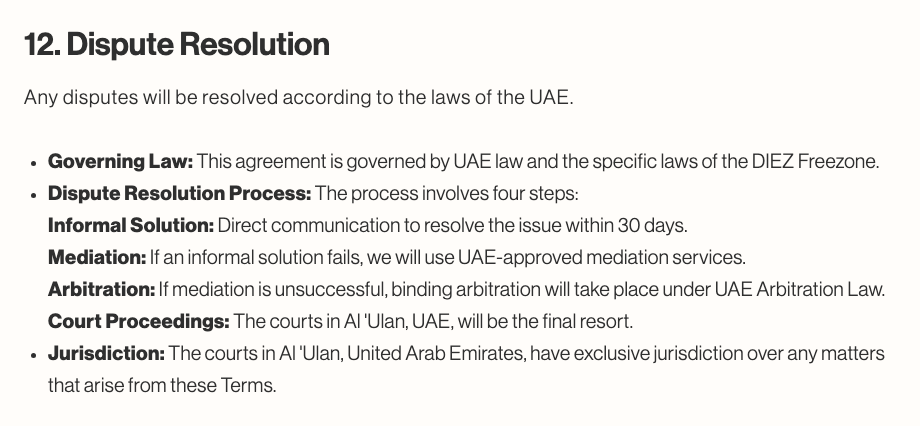
The score, criterion by criterion
| Criterion | Score | Why |
|---|---|---|
| Regulation | 3 / 10 | Not for being unlicensed, which no prop firm can avoid. For naming two companies with two registration numbers on one page, for neither number being verifiable in any register open to us, for a liability cap that resolves to the fees paid in the month before a claim, and for an exclusive-jurisdiction clause naming a court we could not identify. The credits are real and counted: no regulator warning, no clone entry, a clean UK register record for the entity that carried the brand in 2024 and 2025, and no geo-cloaking. |
| Fees | 5.8 / 10 | The strongest criterion. All 116 cards publish coupon and list prices, commissions are stated to the dollar per side, swaps are zero, and the challenge fee is refunded on the third withdrawal, subject to the contradiction in the Terms set out in Payout Terms. Held back by no published spread table, a $20 payout fee that reaches 41.7% of the trader’s share on the smallest Instant account, buyback pricing at 13.6 times the challenge list price, and a Buy Now Pay Later total that is 1.74 times the comparable one-step at coupon price, or 1.56 times it at list. |
| Platform | 4.1 / 10 | Two genuine platforms is a strength. Against it: cTrader is sold on 28 cards while appearing in no legal document and no platform selector, product coverage across the three is uneven, and the rules that govern the platform contradict each other between the Terms and the FAQ on news trading and on the 1% risk trigger. |
| Support | 5 / 10 | Live chat, two phone numbers, three email addresses and a Discord, with no published hours, no help centre, no version history for the rules, and contract terms that make every support interaction confidential and public criticism a terminable offence. |
| Reviews | 2.5 / 10 | Computed from the public rating, not from an inference. Trustpilot shows 4.0 stars across 5,201 reviews for Maven but suppresses the rating itself, saying it is unavailable because of a breach of its guidelines, and our rule scores a rating the platform has taken down below the baseline a firm with no rating at all receives. We hold no primary-source payout proof and no verified refusal, and we use no aggregator scores at all. The firm’s own published withdrawal-likelihood figure is first-party outcome evidence and is part of why this is a 4 rather than lower. The contract’s non-disparagement clause is itself a reason the public record cannot be read at face value. |
Where this score is unflattering to us
On the things we could measure directly, Maven does better than 4.1. It publishes its full pricing grid rather than gating it behind a checkout. Its worked examples are arithmetically correct, and we checked every one we quote. It discloses the simulated nature of the product in five places, including the hero and a persistent footer, rather than in the small print alone. It serves identical documents, entities and prices to all 11 countries we tested, verified against its own geolocation endpoint. Those are real strengths and they are why the fees criterion is the highest of the five rather than the lowest.
The score is dragged down by a narrow set of things, and a reader deserves to know which: the counterparty ambiguity, the unverifiable registrations, the liability cap, the unidentified forum, and a payout rulebook that contradicts itself on questions worth thousands of dollars. Those are fixable. If Maven consolidated to one named entity with a verifiable registration, published a single funded-trader agreement that superseded the FAQ, and named a court that exists, this score would move a long way on the same product.
Who this suits, and who it does not
It may suit a trader who wants cheap, well-documented evaluation practice on a real platform, understands that the funded account is a demo account, treats the fee as the maximum loss, and would be satisfied with occasional four-figure payouts. The $5 Buy Now Pay Later entry and the $9 Omo card make that a low-cost experiment, and zero swaps plus published commissions make the trading economics legible.
It is a poor fit for anyone planning to make this a primary income. The $10,000 monthly cap is a hard ceiling, profit above it is voided rather than deferred, the 50% best-day rule reshapes large wins downward, and the scaling plan’s own FAQ contradicts itself about whether the cap scales with the account. It is also a poor fit for anyone in a country restricted to the Rise rail who intends to withdraw small amounts often, and for anyone who needs to know in advance which company, and which court, stands behind the promise.
Questions to ask Maven before paying
- Which company takes my payment and which owes me a payout, MAVEN LLC or Maven Edu – FZCO, and which of the two registration numbers on your site applies to it?
- Which register can I search to confirm that number myself?
- Where is the court named in Terms section 12, and what is its official name?
- Where the Terms and the FAQ conflict on news trading and on the 1% risk rule, which text governs my account?
- Does the $10,000 withdrawal cap scale with the scaling plan, as one sentence of the FAQ says, or not, as the next sentence says?
- What are the typical spreads on the pairs I trade, in writing?
Any firm confident in its answers can give all six in a single support reply. Ask before you buy, not after a payout is refused, because Terms section 11 caps what a dispute can recover at what you paid in the month before you raised it.
This review is a factual assessment of published terms and public records as at 13 August 2026. It is not financial advice, not a recommendation, and not a prediction of anyone’s results. Trading, including simulated trading assessed against pass conditions, carries the risk of losing the fee you pay and more besides in time.
Score history
Recomputed daily; every move is on the record. The current score is always the latest row.
| Date | Score | Move |
|---|---|---|
| 2026-09-13 | 4.1 | ▲ |
| 2026-09-12 | 3.3 | · |
FAQ
Is Maven Trading regulated and safe?
Maven Trading is not regulated, and neither is any other proprietary trading firm: no jurisdiction licenses prop firms, so there is no authorisation for Maven to hold or to have failed to obtain. It claims no licence number, which is the honest position. Its Terms do list ‘Regulatory Authority: DIEZ’, which is the Dubai free-zone authority and company registrar, not a financial regulator. On safety, two things point in opposite directions. In Maven’s favour: no client money is taken at any stage, the account is a demo account, the fee is the most you can lose, and the FCA register carries no warning or clone entry against the brand. Against it: the Terms name MAVEN LLC with registration 105072496000001 while the footer of the same page names Maven Edu – FZCO with registration 006-0060823-070425, we could not verify either number in a register open to us, total liability is capped at fees paid in the month before a claim, and exclusive jurisdiction is given to a court we could not identify.
Is the Maven Trading funded account real money?
No. Every account is a demo account with simulated funds, at every stage including the funded stage. Maven states this in the homepage hero, in the footer of every page, in Terms section 1 under ‘A CRITICAL NOTICE’, in the User Acknowledgement and in the Risk Disclosure. Its footer also states that it does not act as a broker and accepts no deposits, and that all instruments are simulated and fed through unnamed liquidity providers. No broker, execution venue or futures commission merchant is named anywhere on the site. Payouts are therefore a contractual profit share on simulated performance, not a withdrawal of your own money.
How much can you actually withdraw from Maven Trading?
The published ceiling is $10,000 per 30-day rolling cycle per trader. Multiple accounts are treated as one, the account resets to its starting balance after each payout, and in Maven’s own words any profit above the limit ‘will be voided’. A second rule applies once total profit passes $5,000: the best trading day or single trade may not exceed 50% of the cycle’s profit, and the excess is contracted away. On Maven’s own worked example, $8,000 earned across two days pays $4,800 after the 80% split, and $10,000 earned on a single trade pays $4,000. The minimum to request a payout is 3% of the account balance, the split is 80% on most products but 70% on Mini and both Prediction Markets tiers, and payouts on the Standard programmes come every 10 business days. Payments via Rise carry a $20 fee.
What does a Maven Trading challenge cost?
Entry starts at $5 for the Buy Now Pay Later evaluation, with the balance of $40 to $589 payable only on passing, and at $9 for an Omo 2-Step $2k with the coupon live on 13 August 2026. A Standard 2-Step $100,000 is $396 with coupon or $440 at list, and the most expensive card is a Prediction Markets Elite $100k at $900. All 116 cards publish both prices. The fee is refunded on the third withdrawal, although one sentence in Terms section 6 says all purchases are final while another in the same section allows the refund after three payouts. Two costs are easy to miss: buying back a lost funded account costs $200 to $6,000 by size, which on a $100,000 account is 13.6 times the challenge list price, and the Buy Now Pay Later route totals roughly 1.6 times the comparable one-step in exchange for a looser evaluation.
What happens if Maven Trading refuses to pay a payout?
The contract routes it to UAE law and the laws of the DIEZ free zone, with exclusive jurisdiction given to the courts in Al ‘Ulan, a name we could not match to any UAE emirate or court in the English-language sources we searched. Terms section 11 caps total liability at what you paid in the month before the claim, which is often nothing. Terms section 6 states that users who dispute payments will have their accounts permanently banned, which closes the usual chargeback route. There is no financial regulator to complain to, because prop firms are not licensable. Practically, that means keeping your own records from the start: dated screenshots of the rules in force when you bought, the platform statement, and every support message. We hold no verified case of a refused payout at this firm, and no verified payout proof either.
Is Maven Trading legit?
Maven Trading is an operating prop firm with no regulator warning and no clone entry against its brand, and it says plainly that every account is simulated. The risk sits in the paperwork: we could not verify either UAE registration number shown on its site, its terms reserve the right to forfeit a trader’s virtual profits “when deemed necessary”, and its own risk disclosure puts the likelihood of a successful withdrawal below 2.5 percent per transaction.
How this review works
Track Maven Trading live: score moves and red notices, in your pocket.