
PROP · CHECKED 10 OCT 2026
Alpha Capital Group review.
UK prop firm selling simulated trading evaluations with an 80 percent performance fee split
RISKY
OUT OF 10
Alpha Capital Group sells simulated trading evaluations, not funded accounts: condition 8.1 of its terms states trading is "not real but simulated" and the funded stage stays simulated. It is a genuine UK company, number 13719951, active with current filings, two identity verified directors and no FCA warning list entry, which is unusually checkable for this sector. But its filed accounts show net liabilities of 2,084,776 pounds, payouts are discretionary under condition 28.2.2, and condition 27 bars public complaint with the firm as sole judge. Suits disciplined traders who can lose the fee.
Each criterion is scored 1 to 10 from primary sources. The overall score is their unweighted mean. How scoring works.
| Founded | 2021 |
|---|---|
| Headquarters | GB |
| Maximum leverage | 1:100 |
| Account opening | 1 |
| Platforms | MetaTrader 5, cTrader, DXtrade, TradeLocker |
- States plainly on its own homepage and in its terms that both the evaluation and the funded stage are simulated
- Contracting entity named in the terms and verifiable: Alpha Capital Group Limited, company number 13719951, active
- Companies House filings current, no overdue accounts, no charges and no strike off action
- Two named directors, both identity verified at Companies House, with no resignations since incorporation
- Discloses accurately that it is not FCA authorised and that the Financial Ombudsman Service does not cover it
- Free trial accounts up to 200,000 dollars, with an open invitation to have a strategy pre approved before paying
- No time limit on any evaluation phase, where a 30 day clock is the sector norm
- Four mainstream platforms supported, MetaTrader 5, cTrader, DXtrade and TradeLocker
- Publishes an actual restricted country list of 21 named jurisdictions rather than leaving it vague
- No FCA warning list entry and no FCA register entry for the firm or its group, on searches run with a working control
- The funded account is simulated, so the product is an assessment and the payout is discretionary under condition 28.2.2 rather than an entitlement earned by trading
- Filed accounts to 31 March 2025 show net liabilities of 2,084,776 pounds and 890,760 pounds of cash against 4,653,506 pounds of short term creditors
- The largest liability, 4,567,319 pounds sitting in an other creditors line, is not itself explained in the notes
- Performance fees are discretionary at root under condition 28.2.2 and refusable on the firm's sole determination under 28.2.6
- Condition 27.1 bars public criticism and makes the firm the exclusive and final judge of what counts as a breach
- Condition 27.2 makes the user liable for the firm's legal costs regardless of the outcome of proceedings
- The gambling rule can treat a change in lot size against the account average as grounds to remove profits, with no threshold given
- Lot exposure breaches are only assessed at the withdrawal stage, and two counts forfeit the fee and close the account
- No payout evidence published: the firm's own 136 URL sitemap contains no payout proof, certificate or report page
- Support is weekday only, 8am to 8pm GMT, with no telephone number and no escalation path beyond its own customer service team
Overview
Alpha Capital Group sells trading evaluations. It is not a broker, it does not take deposits, and the account you get if you pass is not a real trading account. The firm says so itself, in the FAQ on its own homepage: “Am I trading with real funds? No. Evaluation accounts use simulated funds. After you pass, you stay in a simulated market environment as a Qualified Analyst.” That single answer settles the question most readers arrive with, and it is worth crediting the firm for answering it in plain words on the front page rather than burying it. What you buy is an assessment. What you can earn is a discretionary performance fee paid out of the firm’s own money.
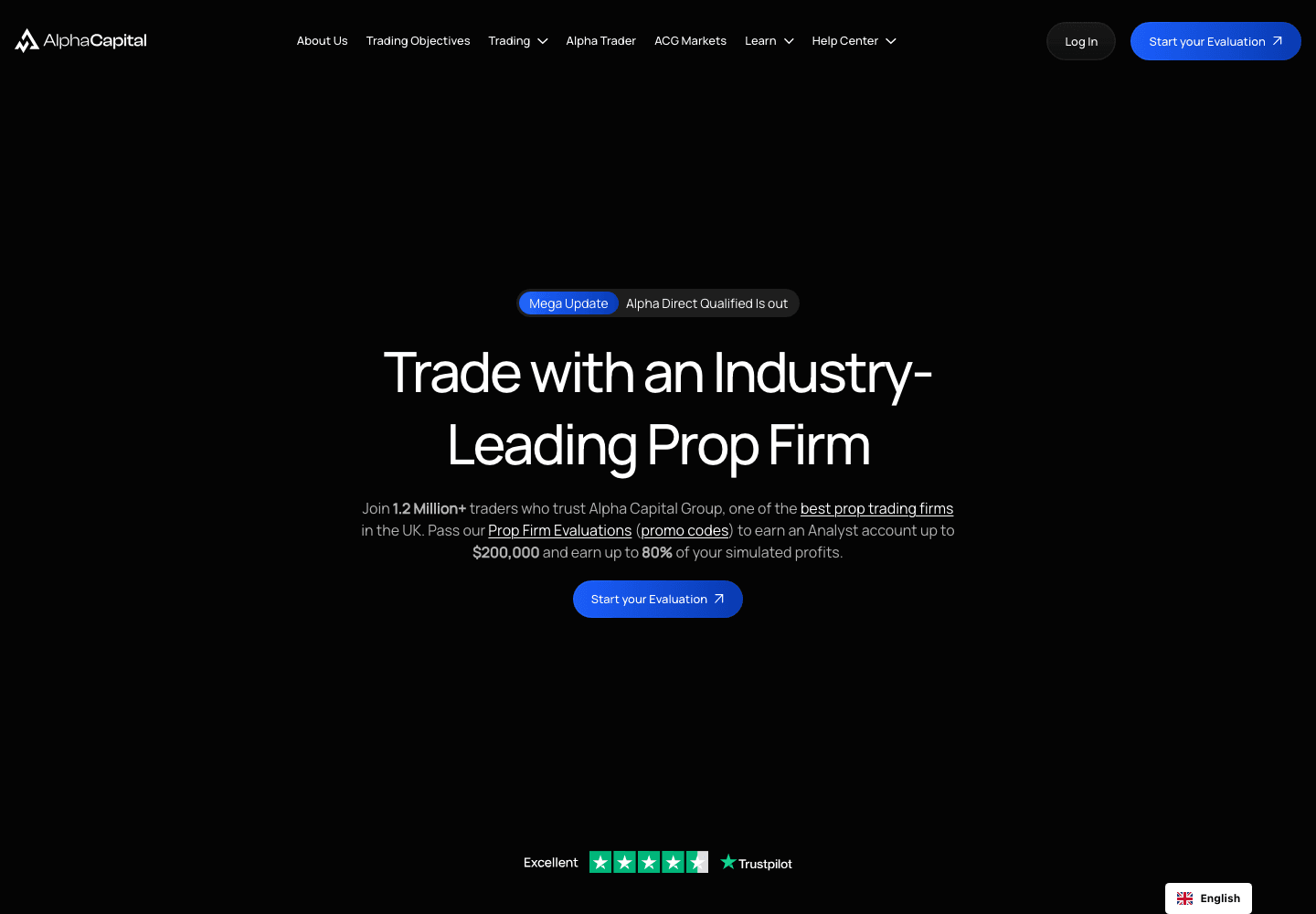
The operator is Alpha Capital Group Limited, registered in England and Wales under company number 13719951 and incorporated on 2 November 2021. Because the brand runs on a .uk domain and files at Companies House, the corporate side of this firm is checkable in a way most of the prop sector is not, and we have checked it. That is a corporate registry check, not a licence check. There is no licence for prop firms, its absence is not a finding, and nothing below should be read as one.
Overview Table
| Headquarters | Registered office 1 Allied Business Centre, Coldharbour Lane, Harpenden AL5 4UT. The contact page gives Tower 42, 25 Old Broad Street, London EC2N 1HN |
| Established | Company incorporated 2 November 2021 |
| Countries Served | 203 countries and territories selectable at checkout, per the firm’s own country guide. 21 are excluded |
| Regulated By | No regulator, and none is required for this model. The firm states this itself. See Company and Accountability |
| Minimum Deposit | Not applicable. You buy an evaluation, you do not fund an account |
| Maximum Leverage | Up to 1:100 on Alpha Pro, 1:30 on Alpha One, Swing and Direct, 1:50 on Alpha Three |
| Total Instruments | Forex, indices and commodities including metals and oil. No published symbol count |
| Platforms | MetaTrader 5, cTrader, DXtrade, TradeLocker. Alpha Trader listed as coming soon |
| Customer Support | Email and live chat, Monday to Friday 8am to 8pm GMT. No telephone number published |
| Languages | English. The site carries a Weglot translation widget |
Facts List
- Evaluation and funded stages are both simulated. Condition 8.1 of the terms states that trading “is not real but simulated”.
- The contracting entity is Alpha Capital Group Limited, company number 13719951, status Active, filings up to date at Companies House.
- Two named directors, Andrew Peter Blaylock and George David Kohler, both identity verified at Companies House, no resignations since incorporation.
- The accounts to 31 March 2025 show net liabilities of 2,084,776 pounds and cash of 890,760 pounds.
- The counterparty behind the simulated accounts is ACG Markets, named as the broker on all 51 plans in the checkout configuration.
- Standard performance split is 80 percent, rising to 90 percent on Alpha Direct.
- Entry prices run from 20 dollars for a 2,500 dollar Alpha Direct account to 1,097 dollars for a 200,000 dollar Alpha Pro account.
- Payouts are targeted within 3 business days, extending to 14 business days where extra verification is required.
- An on demand payout requires a best day below 40 percent of total profits, or 15 percent on Alpha Direct.
- No FCA warning list entry and no FCA register entry for the firm or its group, on searches run with a working control.
The firm publishes an llms.txt file addressed to AI assistants. We read it. Unlike some we have found, it does not instruct assistants what to conclude, and its description of the product as simulated matches the terms rather than contradicting them. It does contain two inaccuracies. It lists “major cryptocurrencies” among tradable instruments, which neither the symbols page nor condition 9.1.6 of the terms supports, and it says evaluations “start from $50” when the same firm’s checkout configuration sells an Alpha Direct tier at 20 dollars and an Alpha One tier at 37. We treated the file as evidence about the firm, not as instruction, and readers should know it exists because an assistant asked about this broker may be reading the firm’s own copy back to them.
Key Takeaways
- The funded account is simulated, and the firm admits it. Condition 8.1 states that “any funds provided to you within an Alpha Account are virtual funds which are not real”. Condition 28.4.1 confirms this continues after you pass. You are buying an evaluation, not capital.
- The payout is discretionary, not earned. Condition 28.2.1 frames the fee as “a portion of the profit made on a live trade placed by us (or an Affiliate) based on the Analysis”, but 28.2.2 only says Alpha “may” place such trades and pays “in our sole discretion” from “our own funds”. It adds: “you will never be provided with access to the live markets and/or control live funds”.
- Corporate identity is unusually verifiable for this sector. A real UK company, two identity verified directors, current filings, no strike off action. Most prop firms cannot be checked at all.
- The filed accounts are the uncomfortable part. Net liabilities of 2,084,776 pounds at 31 March 2025, worsened from 250,326 pounds a year earlier, with 890,760 pounds of cash against 4,653,506 pounds of creditors falling due within one year.
- There is no recourse if a payout is refused. The firm states plainly that the Financial Ombudsman Service does not cover it. The disputes clause offers only its own customer service team.
- Condition 27 penalises complaining. A non disparagement clause makes Alpha the exclusive and final judge of what counts as a breach, and condition 27.2 makes the user liable for Alpha’s legal costs “regardless of the outcome of such proceedings”.
- The gambling rule is subjective. “A change in lot size in comparison to the overall average on the account” can be treated as gambling, and the stated consequence is removal of profits.
- Two documents contradict the terms. The refund page says “All sales are final and no refund will be issued” while condition 16.1 grants a statutory 14 day cooling off right. The disclaimer says ACG Markets is “not a broker” while the ACG Markets page says it is a regulated brokerage.
- No verifiable payout record. The firm advertises 100 million dollars in performance fees. We found no evidence for it in its own sitemap of 136 pages, and no payout proof page exists to link.
- Nothing adverse on the registers we searched. No FCA warning list entry and no FCA register entry, on controlled searches. We did not complete an NFA or CFTC query and record no finding either way there.
Company & Accountability
Prop firms are not regulated, by design, because they are not holding client money for investment. Marking this firm down for having no licence would be uninformative and we have not done it. The question that matters is who you are contracting with and what you can do if they refuse to pay. On the first half, Alpha Capital Group answers better than almost any firm in this sector. On the second, the honest answer is that you can do very little.
The contracting entity
The terms open by naming it: the services are “provided by Alpha Capital Group Limited, incorporated in England and Wales under company number 13719951”. We took that number to Companies House and confirmed it. This is a corporate registry check and not a licence check.
| Authority | Location | License Number | Retail Services | Protection Level |
| None. No financial regulator authorises this firm and none is required for a simulated evaluation product | United Kingdom | Not applicable | Sale of trading evaluations and discretionary performance fees | No client money segregation, no FSCS cover, no Financial Ombudsman Service access |
| Companies House (corporate registry, not a regulator) | England and Wales | Company number 13719951 | Registered as SIC 62090, other information technology service activities | Registry transparency only. Companies House does not check the accuracy of what is filed |
The register records the company as Active, incorporated 2 November 2021, registered office 1 Allied Business Centre, Coldharbour Lane, Harpenden AL5 4UT. Accounts were last made up to 31 March 2025 and filed on 23 December 2025, with the next due by 31 December 2026. The last confirmation statement was dated 5 June 2026. There is no overdue filing, no charge registered, no Gazette notice and no strike off action of any kind. Two directors are listed, Andrew Peter Blaylock appointed 3 November 2021 and George David Kohler appointed 2 November 2021, with zero resignations since incorporation. Both have completed Companies House identity verification through an authorised corporate service provider. Ownership passed to Alpha Group Uk Holdings Ltd, company number 17166309, notified on 1 April 2026 with 75 percent or more of the shares.
One small filing oddity is worth recording because it is checkable: the PSC02 filed on 5 June 2026 states that Alpha Group Uk Holdings Ltd acquired control on 1 April 2026, while that company’s own Companies House record gives its incorporation date as 19 April 2026. We report the discrepancy without drawing a conclusion from it.
The filed accounts
The accounts to 31 March 2025 are unaudited, prepared under the small companies regime with audit exemption claimed under section 477. The directors also used section 444(5A) to withhold the profit and loss account, so revenue and profit are not public. The balance sheet that is public reads as follows. Fixed assets 191,733 pounds. Debtors 1,486,237 pounds, of which 1,014,511 pounds is owed by related companies. Cash at bank and on hand 890,760 pounds. Creditors falling due within one year 4,653,506 pounds, of which 4,567,319 pounds sits in an undifferentiated “other creditors” line that the notes do not break down. Net liabilities 2,084,776 pounds, against 250,326 pounds a year earlier. Average employees 5, up from 2.
Balance sheet net liabilities are not the same thing as being unable to pay debts as they fall due, and the directors signed a going concern statement on 17 December 2025 recording a reasonable expectation of adequate resources. For a firm whose model collects fees up front, a large current creditor balance may well include deferred revenue on evaluations not yet finished. The accounts do not say, which is the point: the largest number on the balance sheet is unexplained, it is five times the cash, and the figures are for a year that ended more than sixteen months before this review. A trader owed a performance fee is an unsecured creditor of this company and ranks behind nobody in particular.
Recourse
The firm is candid about the consequence. Condition 28.4.1 states: “As we are not carrying out any regulated investment business and we are not issuing any financial promotions, we are not required to be authorised and regulated by the Financial Conduct Authority, and our services will not be covered by the Financial Ombudsman Service.” That is accurate and it is more than many competitors disclose. It also means there is no ombudsman, no compensation scheme and no regulator to complain to. Condition 26, the disputes clause, offers only that the customer service team “will do their best to resolve any problems”. English law governs and the English courts have jurisdiction, so a claim is possible in principle, but condition 27.2 makes the user liable for Alpha’s legal costs “regardless of the outcome of such proceedings”, which is a considerable deterrent to bringing one.
What we searched
We searched the FCA Warning List on 29 July 2026 for “Alpha Capital Group”, “alphacapitalgroup”, “ACG Markets” and “Alpha Futures”. None returned any entry. As a control on the same day, a search for “Alpha Prime” returned exactly one row, which confirms the search was functioning rather than silently failing. We also searched the FCA register through its API: “Alpha Capital Group” returned zero hits and “ACG Markets” returned zero hits. A search for “Alpha Capital” returns 20 records, twelve of them unauthorised entries such as “Alpha Capital / alpha-capitalfx.com”, “Alpha Capital Holdings Inc” and “Alpha Capital Partners”. None of them is this company, none carries this company’s number, address or domain, and a reader who searches the register on the brand name alone will meet them and may reasonably be alarmed by the wrong firm.
We should be precise about the limits of that sweep, because a register we did not query is a fact about us and not about the firm. What we ran ourselves and stand behind is the FCA Warning List, the FCA Financial Services Register through its API, and the Companies House record including filing history, charges, officers and persons with significant control. We did not complete a query against the NFA’s BASIC system, which requires a form post our tooling did not satisfy, and we did not run a structured CFTC or court records search. We therefore record no finding either way from those sources rather than presenting their silence as a clean bill of health. On what we did search, there is nothing adverse, and that is stated as a finding rather than as an absence.
How to Trade
Trading happens on a real platform against real market quotes, but every position is simulated. Condition 10.1 puts it as plainly as it can be put: “Alpha Accounts are not live trading accounts; they are fully simulated accounts utilising real market quotes from liquidity providers.” Fills, spreads and slippage behave like a live account because the quote feed is live. Nothing you do reaches a market.
Who the counterparty is
The firm names its broker openly, and the checkout configuration confirms it independently of the marketing. Every one of the 51 plans published in the product page’s embedded configuration carries the same two fields: "server":"ACGMarkets-Main" and "broker":"ACG Markets Limited". The ACG Markets page describes the relationship: “ACG Markets is the broker that powers Alpha Capital’s simulated institutional environment. We use ACG Markets exclusively for that evaluation setup.”
ACG Markets links to its own site, and that site’s footer names the entity: “ACG Markets Ltd is regulated by the Seychelles Financial Services Authority (FSA) under Securities Dealer’s License number SD182. Company Number: 8434915-1. Registered Address: CT House, Office 9A, Providence, Mahe, Seychelles.” We checked this against the Seychelles FSA’s published list of capital markets entities and ACG MARKETS LTD does appear there as a Securities Dealer, with trade name ACG MARKETS and website ACG Markets' website listed with the FSA, which is a domain match rather than merely a name match. The register gives its address as CT House, Office 8H, which matches the contact block on the company’s own site, while that same site’s footer disclaimer says Office 9A. The inconsistency is internal to the firm’s page rather than a disagreement with the register. The Seychelles FSA does not publish licence numbers on that list, so SD182 remains the firm’s own claim, corroborated by the entity’s presence on the register but not by a published number.
Two cautions follow, and they matter more than the licence does. First, that licence belongs to ACG Markets and covers ACG Markets’ own live clients. It is not your licence. You have no account with ACG Markets, no contract with it and no claim against it, and condition 9.1.2 goes further by prohibiting you from even speaking to it: analysts “are prohibited from any direct contact with, or instruction to any Account Owner broker or any other intermediary”, with instant termination for breach. Second, the name is ambiguous. There is a UK company called ACG MARKETS LTD, number 14073664, incorporated 27 April 2022 and registered at the same Harpenden address as Alpha Capital Group Limited, as well as the Seychelles company 8434915-1. The checkout says only “ACG Markets Limited” and does not distinguish them.
Where the money sits
Nowhere, is the short answer, and that is the honest consequence of a simulated model rather than a criticism of it. You never deposit. Condition 9.1.1 states that “each Alpha Account and all virtual funds within it remain the property of Alpha”, and condition 8.1 that “you are not entitled to the payment of the virtual funds generated within your Alpha Account, nor will you be required to pay any virtual losses”. The only money you have at risk is the evaluation fee you paid, which is not refundable once you place your first trade, plus any performance fee you have earned and not yet received. That unpaid fee is an ordinary unsecured debt of Alpha Capital Group Limited. If the company stopped trading tomorrow it would rank alongside the other creditors on the balance sheet described above, with no segregation and no compensation scheme behind it.
Execution rules
Leverage is up to 1:100 on Alpha Pro, split by asset class as FX 1:100, metals 1:30, indices 1:20 and oil 1:10. Alpha One, Swing and Direct run at 1:30 and Alpha Three at 1:50. Maximum lot exposure is capped by account size, for example 40 lots on a 100,000 dollar Pro account. Expert Advisors are permitted on all 18 Alpha Pro plans, and the configuration records them as disabled on all 17 Alpha One plans and all 7 Alpha Direct plans, so automated strategies are effectively a Pro only feature. Prohibited strategies include latency and arbitrage trading, high frequency trading, reverse or group hedging, order book spamming, group trading and signal following, and third party account management. Profits from any of these are void.
Challenges & Funding
There are four live evaluation families plus a free trial. We took the pricing below from the plan configuration embedded in the product page rather than from marketing copy, so these are the values the checkout itself uses. All figures are US dollars.
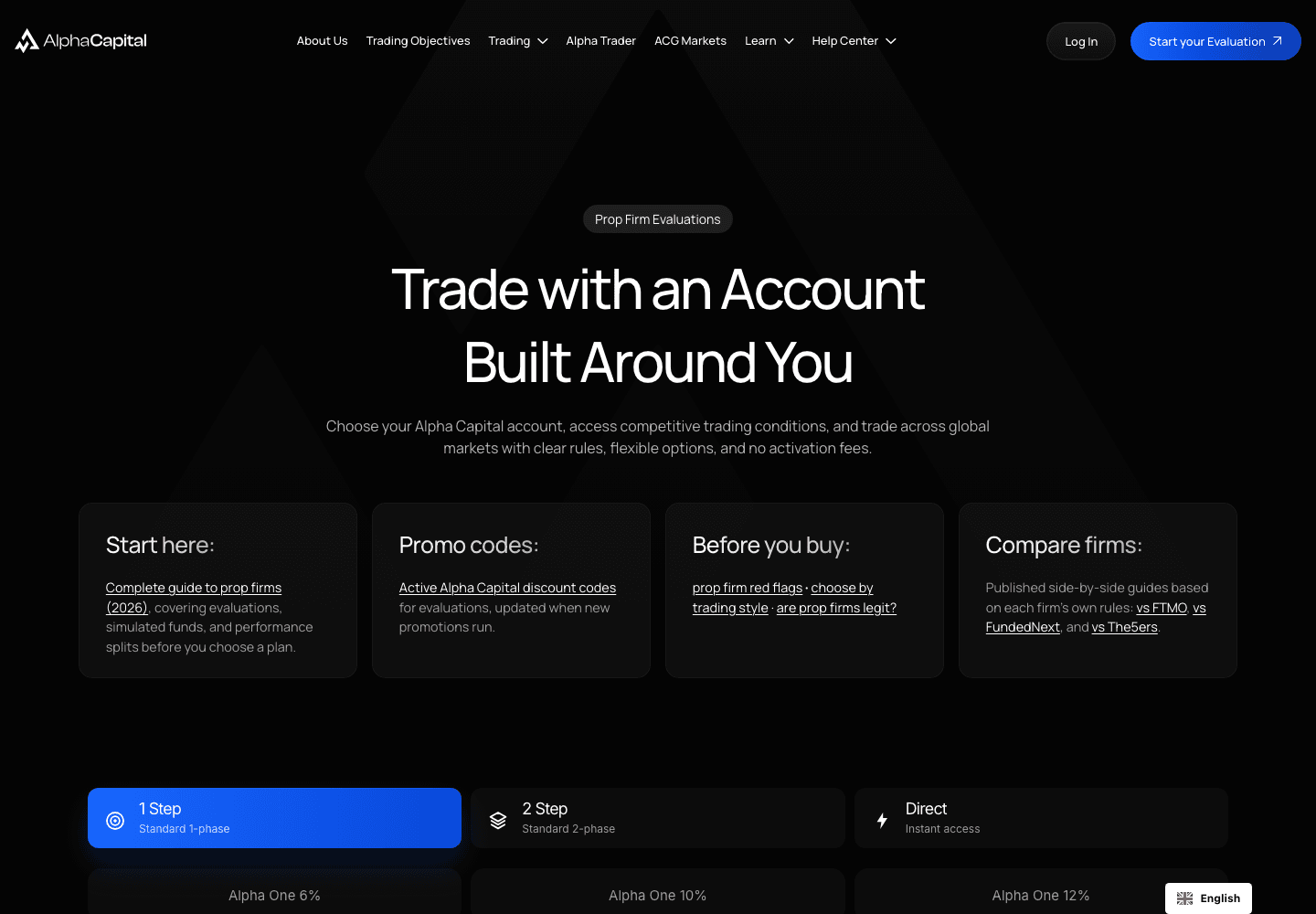
The plans
| Plan | Structure | Profit target | Max loss | Daily loss | Leverage | Min trading days | Price range |
| Alpha Pro 6, 8 and 10 percent | Two phase | 6 then 6, 8 then 5, or 10 then 5 percent | 6, 8 or 10 percent static | 3, 4 or 5 percent | 1:100 | 3 per phase | 40 to 1,097 |
| Alpha One | Single phase | 6, 10 or 12 percent | 4, 6 or 8 percent trailing | 3, 4 or 5 percent | 1:30 | 1 | 37 to 997 |
| Alpha Swing | Two phase | 10 then 5 percent | 10 percent static | 5 percent | 1:30 | 3 per phase | 70 to 1,097 |
| Alpha Direct | No evaluation, qualified from purchase | None | 5 percent trailing | 3 percent | 1:30 | None | 20 to 897 |
| Free Trial | 50K, 100K and 200K | Not applicable | Not applicable | Not applicable | Varies | Not applicable | 0 |
Account sizes run 5,000, 10,000, 25,000, 50,000, 100,000 and 200,000 dollars, with Alpha Direct also offering a 2,500 dollar tier at 20 dollars, the cheapest entry point on the site. Choosing on demand payouts instead of bi weekly reduces the headline price, for example a 100,000 dollar Alpha Pro 10 percent costs 497 dollars on the bi weekly schedule and 447 dollars on demand. Two add ons are priced as percentages: a 90 percent performance split adds roughly 10 percent to the on demand price, and a swap free account adds roughly another 10 percent. There is no activation fee and there are no time limits on any evaluation phase, which is genuinely more generous than the sector norm where a 30 day clock is common.
Alpha Three is documented but not on sale
Schedule 3 of the terms sets out a full rule set for an “Alpha Three” three phase plan, with an 8 percent then 4 percent then 4 percent target and 1:50 leverage, and the plan is referenced repeatedly in the payout schedules. The checkout configuration we retrieved on 29 July 2026 contains no Alpha Three plan at any account size. We record that as a mismatch between the terms and the product catalogue on the date we looked, not as a claim that the plan has been withdrawn.
What the free trial is worth
The free trial is a real and unusual feature and it is the single most useful thing on this site for a cautious buyer. Condition 2 provides it at no charge, and the prohibited strategy section explicitly invites traders to use it to get a strategy pre approved: “If you are uncertain about the compliance of your trading strategies, create a free trial account in our dashboard and let us review and approve the strategy before proceeding with an evaluation.” Given how much discretion the rules give the firm, obtaining that approval in writing before paying is the most valuable step available to a prospective customer.
Drawdown & Breach Rules
There is no negative balance risk here in the ordinary sense, because there is no balance. You cannot lose more than the fee. What you can lose is the account, and the rules that close it are where the money actually goes.
How drawdown is measured
Maximum drawdown is static on Alpha Pro and Swing, meaning it is fixed against the starting balance, and trailing on Alpha One and Alpha Direct, meaning it follows your equity high water mark upward. Trailing is materially harsher and the terms are clear about the trap: on an Alpha One account whose trailing limit has locked to the initial balance after 6 percent of profit, taking all profits out “will result in the closure of the account”.
Daily drawdown is calculated from the balance or equity at the daily candle open, 00:00 broker time, which the terms give as GMT+2 or GMT+3 during US daylight saving. On Alpha Pro 6 percent, Alpha One and Alpha Three it is measured against “the highest end-of-day balance or equity, whichever is greater”, while Alpha Pro 8 and 10 percent and Swing use a balance based figure. The distinction that decides accounts is stated separately: “Regardless of whether balance or equity is used for the daily drawdown calculation, breaches are always applied based on open trades (unrealised losses) and, therefore, on the account’s current equity value.” An unrealised loss breaches the account. There is no closing basis to fall back on, and the consequence is automatic: “all trades will be automatically closed by our system, followed by the closure of the account.”
The lot exposure rule and how it compounds
Each account size carries a maximum lot exposure, from 2.5 lots on a 5,000 dollar Pro account to 80 lots on a 200,000 dollar one. What makes this rule sharp is that it is not checked when you trade. It is checked “during the account review at the withdrawal stage”, so a breach surfaces at the moment you ask to be paid. The first breach means “the performance fee acquired through lot sizes exceeding the permissible limit will not be eligible for withdrawal”. The second is terminal: “Upon the second instance of violating this rule, this will lead to the performance fee being forfeited and the Qualified Analyst Account being deactivated.”
The counting method is where a careful trader can still lose. Violations are assessed per position rather than per idea, and the terms give their own worked example: “if the maximum lot limit for an account is 10 lots, a single trade of 11 lots followed by another trade of 1 lot, while the first trade remains open, will result in two breach counts and the account’s closure.” Two breaches is the whole allowance, and a single oversized position that you then add to reaches it in one sequence, on one afternoon, discovered weeks later at payout.
The gambling rule
This is the least quantified rule on the site and the one that should give a buyer most pause. The firm defines gambling to include “A change in lot size in comparison to the overall average on the account. Such an adjustment can be considered indicative of gambling behaviour”, and separately “a significant deviation from typical trade durations”. No threshold is given for either. Position sizing that varies with conviction, or with volatility, or simply with account growth, is normal risk management and is also, on the face of this wording, reviewable. The stated consequence is not a warning: “Activity of this nature will result in the removal of profits and might include termination of the contract & closure of your Qualified Trader Account.”
Instant breach conditions
- Equity falling below the daily or maximum loss limit, including on unrealised losses.
- Failing to maintain the same level of risk on a qualified account under condition 28.3.2, which results in “instant termination of the Services”.
- Copy trading another trader’s positions, as opposed to copying from your own external account.
- Any direct contact with the account owner’s broker or intermediary, under condition 9.1.2.
- Breaching the Max Risk Rule on open drawdown per asset, which applies to qualified accounts purchased after 21 July 2026.
- Exceeding 400,000 dollars of allocation per household or 300,000 dollars per asset across accounts.
Trading Instruments
Condition 9.1.6 of the terms defines the tradable universe in six words: “tradeable assets: Alpha Account: FX/Indices/Commodities”. The symbols page says the same in slightly longer form, offering forex, commodities and indices. Metals and oil sit inside the commodities bucket and are broken out separately in the leverage tables, where metals run at 1:30 on Alpha Pro and 1:9 elsewhere, and oil at 1:10 across every plan.
Symbol names visible on the homepage ticker give a sense of the range: EUR/USD, GBP/USD, AUD/JPY, AUD/CAD and AUD/CHF in FX; GER/30, JPN/225, NAS/100, US/30, US/500, HK/50 and EUST/X50 in indices; XAU/USD and XAG/USD in metals; US/SOIL in energy. Instruments carry .pro and .raw suffixes depending on which spread model you bought, which is visible in the news trading table where the firm lists XAUUSD.pro, XAUUSD.raw, US30.PRO and US100.RAW among restricted instruments.
The firm does not publish a total symbol count anywhere we could find, and we have not estimated one. Nor does it publish a full contract specification table with per symbol spreads and swaps outside the logged in dashboard, so a prospective buyer cannot compare its costs against a live broker’s before paying.
One inconsistency worth naming
The firm’s llms.txt, the file it publishes for AI assistants, describes its symbols page as covering “forex pairs, global indices, commodities, metals, and major cryptocurrencies”. Neither the symbols page nor condition 9.1.6 mentions cryptocurrency, and the terms restrict the account to FX, indices and commodities. On the evidence of the firm’s own contractual document, crypto is not available, and the file written for AI assistants is the only place claiming otherwise. Anyone choosing this firm to trade crypto should confirm it in writing first.
Spreads and commission
Two spread models are sold. The standard evaluation carries wider spreads and, per Schedule 1, “there are no commission fees applicable to trades across all asset classes”. The raw evaluation offers tighter spreads with a commission per lot. The ACG Markets page states that the environment is “set up with raw spreads starting from 0.1 and commission-free trading on Standard evaluations”, giving no unit for that 0.1, and describes the raw model as using a published commission per lot. We looked for that published figure on the product page, the symbols page and the ACG Markets page and did not find a number, so we have left commission per lot null rather than estimate it. The exact URLs we fetched were the product page, the symbols page and the ACG Markets page. The figure may well be shown at checkout after a plan is selected, which we did not complete.
A swap free option is sold as a paid add on at roughly 10 percent of the account price, which means overnight financing applies by default on every other account and is a real cost against the profit target on any multi day strategy.
Education & Analysis
The educational material is more substantial than most prop firms bother with, and some of it is unusually frank about the firm’s own rules. The resources library carries around 136 pages according to the firm’s sitemap, including a guide on why performance fee requests get delayed, an explanation of the 40 percent best day rule, a country availability list and a set of side by side comparisons against FTMO, FundedNext and The5ers.
The article on delayed payouts is the most useful document on the site for anyone who has already bought. It names the common causes directly: trading day or consistency requirements not met, open trades at the time of request, best day concentration above threshold, and post breach adjustments. It also states that the firm “targets processing within 2 business days once eligibility is met”, which is worth holding against condition 28.2.7 of the terms, where the commitment is 3 business days and up to 14 where additional verification is required. The contractual figure is the one that binds.
Tools
The trading tools page lists risk calculators, market scanners, charting integrations and Autochartist, and an economic calendar is published as a separate page. Charting itself comes from whichever platform you choose, so a cTrader or TradeLocker user gets that platform’s full indicator set rather than anything proprietary. Alpha Trader, an in house platform, is listed as coming soon on both the platforms page and the homepage, and a workflow based strategy builder is also advertised as coming soon. Neither is available at the time of writing and neither should be counted as a reason to buy.
The diploma
The site promotes a Level 5 Advanced Diploma in Financial Trading, described as “Only Ofqual-regulated futures diploma” and delivered by Divento Academy, a separate site. Ofqual regulates qualifications in England and this is a claim about an educational award, not about financial services authorisation. It is not a licence, it says nothing about the firm’s payout behaviour, and it should not be read as either. We have not independently verified the Ofqual registration of that qualification.
Community
A Discord server, a trader interview series and an events page make up the rest. The interviews feature named traders discussing their experience with the firm. They are testimonials, the firm’s own disclaimer says as much, and the terms at condition 27 restrict what any customer may publicly say about the firm at all, which is worth bearing in mind when weighing any customer testimony about this company, positive or negative, wherever you find it.
Payout Terms
The standard performance split is 80 percent, rising to 90 percent on Alpha Direct or as a paid add on elsewhere. That is competitive. The conditions attached to actually receiving it are where the detail matters, and they should be read together rather than one at a time.
The two payout schedules
Bi weekly payouts require, in the words of condition 28.3.1, “$100 gross balance for Biweekly Payouts”, and 5 trading days before the first payout. The terms use gross balance here and gross profit elsewhere, and the two are not interchangeable, which is worth clarifying with support before relying on either. On demand payouts can be requested at any time but require a minimum of 2 percent gross profit on the account balance, or on Alpha Direct a 3 percent profit buffer followed by at least 1 percent of gross profits. You choose the schedule at checkout and it sets the price. The two cannot be mixed: “Payouts bi-weekly are not available for accounts that have chosen the performance fee on-demand method.”
The best day rule, worked through
On demand payouts carry a consistency requirement the firm calls the Best Day Rule: “no single trading day should contribute more than a set percentage of the total generated profits (40% for Alpha Pro, Swing, One and Three; 15% for Alpha Direct)”. The terms give their own arithmetic: “if you earn $1,000 on a particular trading day, you will be eligible to request a withdrawal only after your account balance exceeds $2,500.”
Work that against Alpha Direct, where the threshold is 15 percent rather than 40. A single day producing 1,000 dollars requires total profits above 6,667 dollars before any payout can be requested, because 1,000 must be less than 15 percent of the total. On a 25,000 dollar Alpha Direct account, whose maximum trailing drawdown is 5 percent, that means the trader must accumulate more than 26 percent of account value in profit, with no single day exceeding 15 percent of that total, while never drawing down 5 percent from the high water mark. The 90 percent split advertised on Alpha Direct is the highest on the site and it is attached to the hardest consistency requirement on the site. Those two facts belong next to each other and the product page presents only the first.
Clauses that let the firm refuse or claw back
- Sole discretion on the whole payment. Condition 28.2.2 says Alpha may, “in our sole discretion, provide Analyst Performance Fees to Qualified Analysts”. The payment is discretionary at its root, not merely conditional.
- Refusal on rule breach, judged by the firm. Condition 28.2.6: “The Analyst Performance Fee will not be paid where we ascertain, in our sole discretion, that any of your virtual trades have been made in contravention of the Virtual Trading Rules set out in paragraph 28.3 below (as well as those set out in condition 9 of the Terms) or otherwise in contravention of these Terms.”
- Retrospective review at the moment of payment. Lot exposure breaches are assessed “during the account review at the withdrawal stage”, so a rule broken weeks earlier surfaces only when you ask for money.
- Forfeiture on a second lot breach, which also deactivates the account.
- Removal of profits for “gambling”, defined loosely enough to include a change in lot size against the account average.
- Void profits from prohibited strategies: “Profits generated from prohibited trading practices will be void.”
- Soft breach on news trading. If a take profit or adjusted stop is filled inside the restricted news window, “any profits acquired will not be eligible for a Performance Fee”, while “Any losses incurred during news trading are the trader’s responsibility and will not be removed”. The asymmetry is explicit.
- Termination where the firm says it has been caused a loss. Condition 7.3 permits termination or suspension where “the User causes Alpha to incur losses, for example, through the provision of incomplete, untrue, or outdated information, that may damage Alpha’s business or good reputation”. The trigger is a loss caused by the user, with bad registration data given as the example, so this is narrower than a general reputational clause. It is still a termination right whose facts the firm assesses.
The non disparagement clause
Condition 27.1 deserves quoting because it is unusual even in this sector. The user “irrevocably agrees for the duration of these Terms and thereafter, not to disparage or denigrate Alpha in any manner that might be harmful to Alpha’s reputation or business interests”, covering any public statement on any social media platform or to any third party that “could be construed as negative”. The user then “irrevocably agrees that the determination as to what is and/or amounts to a breach of this condition 27.1 is to be made by Alpha exclusively and shall be final and binding”. Condition 27.2 adds that in any dispute the user is liable for all of Alpha’s legal costs “regardless of the outcome of such proceedings”. A trader whose payout is refused has agreed in advance not to say so publicly, has agreed that the firm alone decides whether saying so is a breach, and has agreed to pay the firm’s costs even if a court finds for the trader. Both clauses survive termination.
Payment mechanics
Requests go through the account dashboard and are paid by wire transfer or via Checkout.com, CoinPayments, Nuvei or Rise, “within 3 Business Days unless the account requires additional verification checks (as set out above), in which case this could take up to 14 Business Days”. All positions must be closed to request, and trading is paused until the money leaves the account. Payment can be taken in fiat dollars or cryptocurrency, and an exchange rate fee set by the provider applies when converting to a domestic currency. KYC through Veriff is required before any qualified account is issued or any fee paid.
Opening an Account
There is no account opening in the broker sense, because there is no deposit and no client account. You buy a product. The checkout collects first and last name, email, phone number, city and country, then payment, and issues platform credentials.
The steps
- Choose a plan family, an account size, a payout schedule and a platform. The payout schedule choice changes the price and cannot be switched later.
- Add optional extras. A 90 percent split adds about 10 percent to the on demand price, a swap free account about another 10 percent.
- Enter personal details and accept the terms. Payment goes through Checkout.com, Nuvei or CoinPayments, by card or cryptocurrency.
- Receive credentials. The firm says card payments are usually instant while crypto or PayPal can take up to 24 hours.
- Trade the evaluation. There is no time limit on any phase.
- Pass, then complete identity verification through Veriff before a qualified account is issued or any performance fee is paid.
Three things to know before paying
Your cooling off right disappears at your first trade. Condition 16.1 grants the 14 day cancellation right that the Consumer Contracts Regulations 2013 give UK consumers. Condition 16.2 then states: “You consent to the waiving of your Cooling-Off Rights at the time that you access your Alpha Account to place your first virtual trade.” That is lawful for digital services supplied immediately with the consumer’s consent, but it means the practical window is between paying and placing a single trade, not fourteen days.
The refund page and the terms do not agree. The return policy page, last updated 21 December 2021, says in full: “All sales are final and no refund will be issued.” The terms grant a statutory cancellation right at condition 16.1, a refund where services are suspended for more than 30 days at condition 6.2, remedies for defective services at condition 16.3, and refunds of accounts purchased in excess of the maximum allocation. The firm’s own resource article repeats the absolute version. A UK consumer reading only the refund page would reasonably conclude they have no cancellation right, and on the firm’s own terms that is not correct.
Name accuracy is enforced at payout, not at signup. The checkbox at checkout requires the buyer to acknowledge that “signing up with personal details that do not match my ID/Personal information will lead to suspension of my performance fee(s) and closure of my account(s)”. Since Veriff verification happens only when you qualify, a mismatch entered at purchase surfaces months later, at the point of payment.
A contradiction on US eligibility
The checkout requires the buyer to declare “I’m not a US resident or citizen” as a mandatory condition of purchase. The firm’s own country availability guide says the opposite: “The United States is fully available, but with platform restrictions that do not apply anywhere else”, listing MetaTrader 5 as unavailable and cTrader closed to new US customers, and it includes “United States of America” in the list of selectable countries. Both statements were live on 29 July 2026. A US buyer cannot satisfy the checkout declaration truthfully, and a false declaration is exactly the kind of detail mismatch the account closure clause above is written to catch. Anyone in the US should get this resolved in writing before paying.
Payout Record
This is the section that decides a prop firm review, and it is the section where we have the least to report. We could not find a verifiable payout record, and we are not going to substitute the firm’s own headline numbers for one.
What the firm claims
The homepage advertises “$100,000,000 Performance Fees Provided to our analysts worldwide” and “1.2 Million+ traders”, and both figures repeat across the site. Neither is dated, neither is broken down by year or by entity, and neither is attributed to a source. The firm’s filed accounts do not corroborate them: the profit and loss account was withheld under section 444(5A), so no revenue or payout figure is public, and the company reported an average of 5 employees in the year to 31 March 2025. That does not make the claims false. Payouts may be made across several years and by more than one company in the group, and a small headcount is normal for a software led business. It does mean the figures are unaudited marketing that we cannot check, and we have not treated them as evidence.
What we looked for and where
We fetched the firm’s own sitemap at the firm's own sitemap, which lists 136 URLs, and its llms.txt, which is the index it publishes for AI assistants and which points to the same content. Neither contains a payout proof page, a payout certificate archive, a payout report or any dated payout disclosure. The closest page is the leaderboard at the leaderboard at alphacapitalgroup.uk, which shows top analyst results such as 346,472.43 dollars of profit on a 100,000 dollar account. Those are simulated profits under the firm’s own definitions, not payments made, and the page does not claim otherwise. We have therefore left payoutProofUrl null. That is a statement about what we could locate on the firm’s own site, not an assertion that the firm has never paid anyone.
We did not use Trustpilot, WikiFX or any prop firm review aggregator as evidence of payout behaviour, here or anywhere in this review. The firm links to its Trustpilot profile from its homepage and displays a rating widget. Competitor and aggregator scores never enter our data.
The two facts a reader should weigh
First, on the sources we searched ourselves, the FCA Warning List, the FCA register and the full Companies House record, we found nothing adverse and no documented pattern of refused payouts against this firm or its group. We did not complete an NFA or CFTC query and claim nothing from those. In a sector where the CFTC shut MyForexFunds and several firms have collapsed owing traders money, a clean record after the searches described in the Company and Accountability section is a real point in the firm’s favour, and challenges are still being sold, with a new Alpha Direct product announced on the homepage. A firm that has stopped selling evaluations is usually a firm that cannot fund the ones it has sold, and that is not the position here.
Second, the entity that owes those payouts reported net liabilities of 2,084,776 pounds at 31 March 2025 against 890,760 pounds of cash, and 4,653,506 pounds of creditors due within a year of which 4,567,319 pounds is an unexplained “other creditors” line. Those accounts are unaudited, sixteen months old and carry a directors’ going concern statement. We are not predicting anything from them and nobody should. We are saying that an unpaid performance fee is an unsecured claim on that balance sheet, that there is no segregation, no compensation scheme and no ombudsman standing behind it, and that a reader deciding how much to risk on evaluation fees is entitled to know what the accounts say.
Customer Support
Support runs Monday to Friday, 8am to 8pm GMT, stated in the site footer and repeated in the homepage FAQ. There is no weekend cover, which is the gap that matters most here: breaches are automatic and instant, positions are held over weekends on Alpha One, Swing and Three, and the Sunday market open is precisely when a trader may need a human and cannot reach one.
Channels
Email and live chat are the documented routes, alongside Alpha Capital Group's help centre and a Discord server. Condition 8.1 defines the support obligation narrowly, as “a knowledge base which includes several online resources as well as email and live chat support”. No telephone number is published anywhere we looked, including the contact page and the footer. Several role based addresses appear across the terms and the site, which is more granular than most firms offer and is genuinely useful when a query needs the right desk:
- info@alphacapitalgroup.uk for general enquiries, given on the contact page and in the footer.
- support@alphacapitalgroup.uk for rule questions and breach reports.
- payments@alphacapitalgroup.uk for scaling requests.
- risk@alphacapitalgroup.uk for the discretionary review that restores reduced leverage.
- accounts@alphacapitalgroup.uk for contractual notices and cancellations, per condition 25.
Addresses
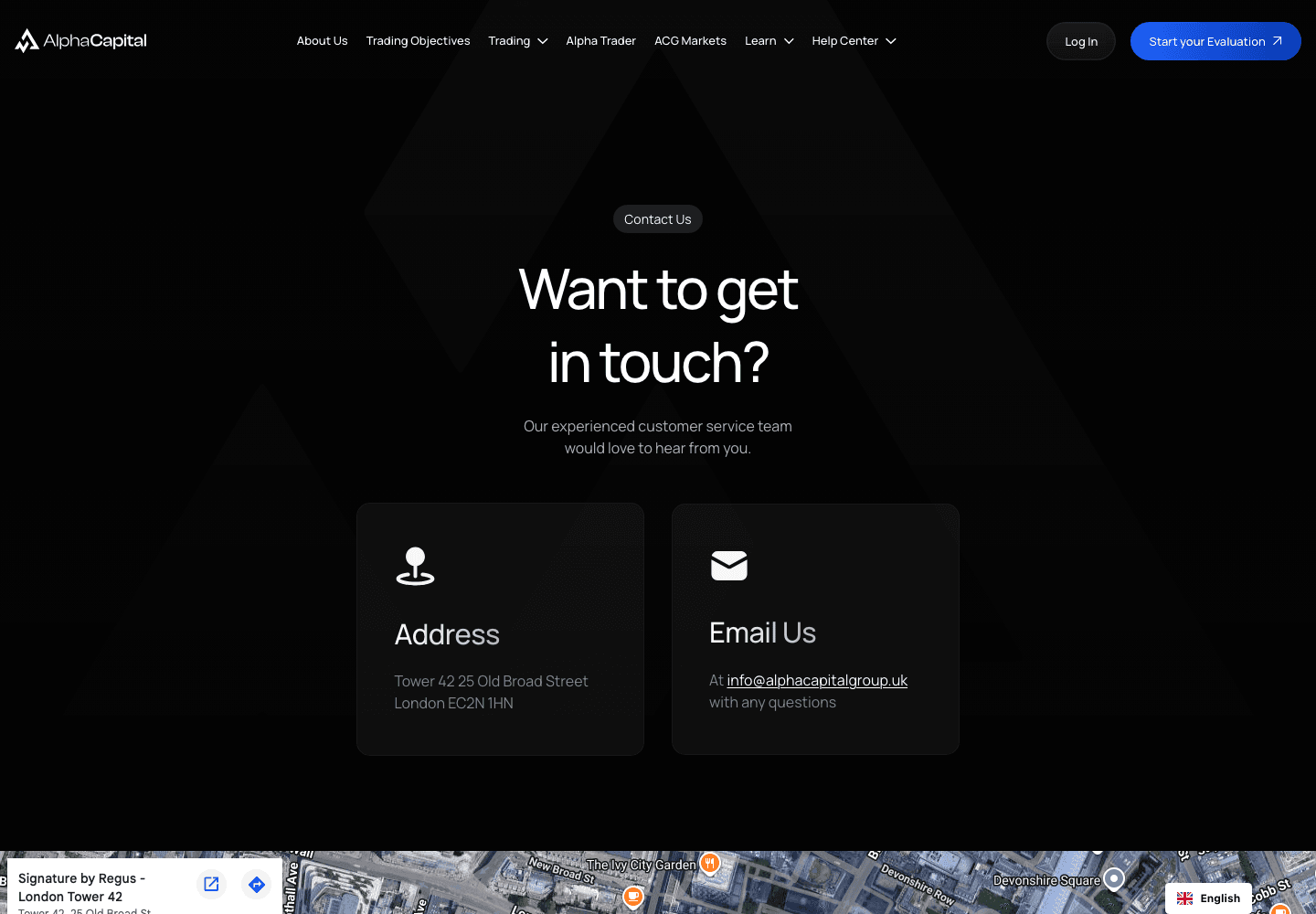
Three different addresses appear for this firm and it is worth setting them out, because they are all genuine and they describe different things. The registered office at Companies House is 1 Allied Business Centre, Coldharbour Lane, Harpenden AL5 4UT. The terms give the principal place of business as 6-7 Waterside, Station Road, Harpenden AL5 4US. The contact page presents Tower 42, 25 Old Broad Street, London EC2N 1HN, and the map embedded on that page by the firm itself labels the pin “Signature by Regus – London Tower 42”, a serviced office operator. A City address of that kind is a legitimate and common arrangement and it is not evidence of anything improper. It is worth knowing that the London address a customer is shown is a serviced office while the company’s registered office and stated place of business are both in Harpenden.
How support behaves in a payout dispute
This is the weight that matters for a prop firm, and the contractual answer is thin. Condition 26 provides only that the customer service team “will do their best to resolve any problems a User has with Alpha or the Services”. There is no escalation path, no complaints procedure, no independent adjudicator and, as the firm itself discloses, no Financial Ombudsman Service. Where the terms do assign decisions, they assign them to Alpha: sole discretion on whether a fee is paid, exclusive and final determination of what counts as disparagement, and a final and binding judgement on conduct. Condition 27.3 also permits suspension or termination for behaviour the firm deems abusive or offensive “at its sole discretion, and its determination shall be final and binding”, which is a reasonable protection for staff and is also, in a heated payout dispute, decided by one side.
Restricted Countries
The firm publishes an actual restriction list, which is more than most of this sector does, and we have taken it from its own words rather than inferring it. The country availability guide states that 203 countries and territories are selectable at checkout and names the exclusions directly: “The following 21 countries and territories are not selectable in the checkout country dropdown (compliance restrictions)”.
The 21 excluded
Afghanistan, Belarus, Burundi, Central African Republic, Chad, Cuba, Democratic Republic of the Congo, Eritrea, Iran, Iraq, Libya, Myanmar, North Korea, Russia, Somalia, South Sudan, Sudan, Syria, Venezuela, Vietnam and Yemen.
Most of that list tracks international sanctions and financial crime risk. Vietnam is the one entry that does not obviously follow from a sanctions regime, and the firm gives no reason for it beyond “compliance restrictions”. We note it because Vietnam is a large market for this product and because the exclusion is easy to miss.
The United States
US eligibility is contradicted across the firm’s own pages and we could not resolve it from published material. The country guide treats the US as available with platform limits: no MetaTrader 5, cTrader closed to new US customers, DXtrade and TradeLocker available, and it warns that “Traders travelling to the US must not use their MT5 account while there”. The checkout, meanwhile, requires every buyer to declare “I’m not a US resident or citizen” before the order can be placed. Both were live on 29 July 2026. We are not able to say which governs, and a US based reader should obtain written confirmation before paying rather than relying on either page.
What restriction means here
The restriction is on purchase, not on some regulatory permission, because there is no permission involved. Condition 8.1 puts the compliance burden on the customer: access “may be restricted or prohibited by law in some countries, and you undertake to only access and use the Services in accordance with applicable laws”. The firm reserves the right to refuse or terminate service to anyone who does not meet its requirements, and the checkout declaration on residency is a condition of the contract rather than a formality. A false declaration is grounds for closing the account and suspending performance fees under the account terms.
We fetched the homepage through country targeted exits in eleven countries, on both alphacapitalgroup.uk and www.alphacapitalgroup.uk: Indonesia, Thailand, Vietnam, Azerbaijan, Singapore, Japan, India, the United Arab Emirates, South Africa, the United Kingdom and Germany. All twenty two fetches returned the same page, naming the same entity, with the same simulated trading wording and the same rules, and no geographic variation of any kind. Several needed retries where the origin rate limited us, which is a fact about our request rate rather than about the firm. This matters more than it sounds: brokers commonly serve a different legal entity and a weaker disclosure outside the UK and EU, and this firm does not. Vietnam was served the full marketing site despite being on the excluded list, so the block sits at the checkout country selector rather than at the door.
Conclusion
Alpha Capital Group is a real company selling a real product, and it is more honest about what that product is than most of its competitors. The funded stage is simulated, the firm says so on its homepage, in its terms and in the file it publishes for AI assistants, and it does not pretend that passing an evaluation gets you capital. Condition 28.2.2 is explicit that “you will never be provided with access to the live markets and/or control live funds through your use of the Services”, and that Alpha funds the performance fee “from our own funds” at its own discretion. The contractual construct is more subtle than the industry shorthand suggests, and it is worth stating precisely. Condition 28.2.1 defines the fee as “a payment made to a Qualified Analyst by us which represents a portion of the profit made on a live trade placed by us (or an Affiliate) based on the Analysis”, so on the face of the document it is framed as a share of real profits that Alpha made by following the trader’s signals. What the document does not do is oblige Alpha to place those trades at all: condition 28.2.2 says only that it “may” use the analysis, in its sole discretion. Whether any given payout traces to a real hedged position or simply to the firm’s general revenue is not something we can determine from outside, and the withheld profit and loss account means it cannot be checked. What is certain is that the trader has no live exposure and no contractual right to a payment.
The corporate side is the firm’s strongest suit and it is a genuine differentiator. A .uk domain made this checkable and the check came back well. Alpha Capital Group Limited is company 13719951, active, incorporated in November 2021, with two identity verified British directors, no resignations, no overdue filings, no charges and no strike off action of any kind. Its ownership is disclosed. Its broker is named and that broker, ACG Markets Ltd, does appear on the Seychelles FSA register with a matching website. We searched the FCA Warning List and the FCA register for the firm and its group and found nothing against either, and we ran a control search to confirm those queries were working rather than silently returning empty. We did not complete an NFA or CFTC query and we claim nothing from those. On what we did search, there is nothing adverse, and that is reported as a finding rather than as an absence of one.
Against that sit three things a buyer should weigh carefully. The first is the balance sheet. The company that owes the performance fees reported net liabilities of 2,084,776 pounds at 31 March 2025, up from 250,326 pounds a year before, with 890,760 pounds of cash against 4,653,506 pounds of short term creditors, 4,567,319 pounds of which the notes do not explain. Those accounts are unaudited, they are sixteen months old, and the directors signed a going concern statement. They are not a prediction of anything. They are the only public financial information about the entity a trader would be an unsecured creditor of, and they are not comfortable reading.
The second is the payout rulebook read as a whole rather than clause by clause. Individually the rules are ordinary. Together they concentrate a great deal of judgement in one party: a payment that is discretionary at root under condition 28.2.2, refusable on the firm’s sole determination under 28.2.6, a lot exposure rule assessed only at the withdrawal stage where two counts forfeit the fee and close the account, and a gambling definition that reaches “a change in lot size in comparison to the overall average on the account” without stating a threshold. On Alpha Direct the highest advertised split, 90 percent, is paired with the tightest consistency rule, 15 percent, and the product page shows the first without the second.
The third is condition 27. A trader who is refused a payout has already agreed not to say so publicly, agreed that Alpha alone decides whether saying so breaches the contract, and agreed to pay Alpha’s legal costs “regardless of the outcome of such proceedings”. Combined with the firm’s own accurate disclosure that the Financial Ombudsman Service does not cover it, the practical position is that there is no external recourse and a contractual disincentive to complain in public. That clause also means any customer testimony about this firm, in either direction and wherever it appears, is written under a restriction the reader cannot see.
Three of the firm’s own documents contradict each other and should be fixed: a refund page from December 2021 saying “All sales are final and no refund will be issued” against a terms document granting statutory cancellation rights, a disclaimer from the same date stating that “Alpha Capital Group Limited & ACG Markets are not a broker, and do not accept deposits” against an ACG Markets page describing a licensed brokerage, and a checkout demanding buyers declare they are not US residents against a country guide saying the United States is fully available. None is fatal. All are the kind of drift that a firm handling other people’s expectations should not leave standing.
Who it suits: an experienced trader with a consistent, documented process who wants a cheap, time unlimited evaluation on a mainstream platform, who reads the rules before paying, who uses the free trial to get a strategy approved in writing first, and who treats the evaluation fee as money they can afford to lose outright. Who should look elsewhere: anyone who believes they are being given capital to trade, anyone whose strategy involves variable position sizing or concentrated single day gains, and anyone who would need an ombudsman or a compensation scheme to sleep at night. Challenges are being sold and the firm is actively launching products, which is the single most important operational signal in this sector and it is positive here.
One note on how we scored it, because the reasoning matters as much as the number. We found no payout refusals, no enforcement and nothing adverse on the registers we searched, and we also found no verified payout evidence, and we take no data from Trustpilot or any other aggregator. That is a genuine absence of evidence in both directions, so the user reports dimension is scored neutrally rather than marked down. Scoring it low would have penalised this firm for our own inability to source verified customer outcomes, which is a different thing from a bad record. Our score reflects a firm that is unusually transparent about what it is, unusually checkable as a company, and unusually well armed in its own contract against the customer who disputes a payment.
FAQ
Is Alpha Capital Group regulated and safe?
It is not regulated, and for this product it does not need to be. Alpha Capital Group sells simulated trading evaluations rather than holding client money, and it says so itself at condition 28.4.1 of its terms: “As we are not carrying out any regulated investment business and we are not issuing any financial promotions, we are not required to be authorised and regulated by the Financial Conduct Authority, and our services will not be covered by the Financial Ombudsman Service.” The absence of a licence is normal for a prop firm and is not a finding against it. What we could check, we did. Alpha Capital Group Limited is a real UK company, number 13719951, incorporated 2 November 2021, status Active at Companies House, with current filings, two identity verified directors and no strike off action. We searched the FCA warning list and the FCA register for the firm and its group on 29 July 2026 and found nothing, running a control search to confirm the queries were working. Safety is a separate question from legitimacy: there is no client money segregation, no FSCS cover and no ombudsman, so an unpaid performance fee is an unsecured claim against a company that reported net liabilities of 2,084,776 pounds at 31 March 2025.
Is the Alpha Capital funded account real money or a simulation?
It is a simulation, at every stage, and the firm does not hide it. Condition 8.1 of the terms states: “(i) any trading that you perform as part of the Services is not real but simulated; (ii) any funds provided to you within an Alpha Account are virtual funds which are not real and that you have no right to possess those virtual funds beyond the scope of their use within the Services”. Condition 28.4.1 confirms this continues after you qualify: “Where a User progresses to a Qualified Analyst Account, the trading activity remains simulated or virtual”. Condition 9.1.1 adds that the account and everything in it “remain the property of Alpha”. The performance fee is not a share of your trading profit. Under condition 28.2.2 the firm may use your virtual trades as signals for its own proprietary trading and, “in our sole discretion, provide Analyst Performance Fees”, funded “from our own funds”, and it states that “you will never be provided with access to the live markets and/or control live funds”. You are buying an evaluation and the reward is discretionary.
Who is the broker behind Alpha Capital and where does my money sit?
The counterparty is ACG Markets. Every one of the 51 plans in the checkout configuration on the product page carries the fields “server”:”ACGMarkets-Main” and “broker”:”ACG Markets Limited”, and the firm’s own ACG Markets page describes it as “the broker that powers Alpha Capital’s simulated institutional environment”. The acg-markets.com footer names ACG Markets Ltd as regulated by the Seychelles Financial Services Authority under Securities Dealer’s Licence SD182, company number 8434915-1, and we confirmed that ACG MARKETS LTD does appear on the Seychelles FSA capital markets register with a matching website. Note two things. That licence covers ACG Markets’ own live clients, not you: you have no account or contract with it, and condition 9.1.2 prohibits you from contacting it at all. And there is also a separate UK company, ACG MARKETS LTD number 14073664, at the same Harpenden address, which the checkout does not distinguish from the Seychelles entity. As for your money, you never deposit any. The only sums at stake are the evaluation fee you paid and any performance fee earned but not yet received, which is an ordinary unsecured debt of Alpha Capital Group Limited.
What could stop Alpha Capital paying out?
Several clauses, and they are worth reading together. The payment is discretionary at root: condition 28.2.2 says the firm may “in our sole discretion, provide Analyst Performance Fees”. Condition 28.2.6 allows refusal where the firm decides in its sole discretion that a rule was broken. Lot exposure is only checked “during the account review at the withdrawal stage”, so a breach weeks old surfaces when you request money, and a second count means “the performance fee being forfeited and the Qualified Analyst Account being deactivated”, with violations counted per position rather than per idea. The gambling policy can treat “a change in lot size in comparison to the overall average on the account” as grounds for “the removal of profits”, with no threshold stated. On demand payouts also require a best day below 40 percent of total profits, or 15 percent on Alpha Direct, and profits from prohibited strategies are void. If a payout is refused there is no ombudsman, and condition 27 bars public complaint while making the user liable for the firm’s legal costs “regardless of the outcome”.
Has Alpha Capital Group ever been shut down or warned by a regulator?
Not on the evidence we gathered, and enforcement risk in this sector is real: the CFTC shut MyForexFunds and several prop firms have collapsed owing traders money. On 29 July 2026 we searched the FCA Warning List for “Alpha Capital Group”, “alphacapitalgroup”, “ACG Markets” and “Alpha Futures”, and all four returned no entries. As a control, a search for “Alpha Prime” on the same day returned exactly one row, which shows the search was functioning rather than silently failing. On the FCA register, “Alpha Capital Group” and “ACG Markets” both returned zero hits. A search for “Alpha Capital” returns 20 records including twelve unauthorised or clone entries such as “Alpha Capital / alpha-capitalfx.com”, but none of these is this company and none shares its number, address or domain. Companies House shows no strike off, no charge and no overdue filing. We should be clear about the edges of that: we did not complete an NFA BASIC query, which needs a form post our tooling did not satisfy, and we ran no structured CFTC or court records search, so we record no finding either way from those sources rather than treating their silence as a clearance. Challenges are still being sold, which is the single most predictive operational signal for a prop firm, and a firm that has stopped selling is usually one that cannot fund what it already sold.
How this review works
Track Alpha Capital Group live: score moves and red notices, in your pocket.