
CFD · CHECKED 10 OCT 2026
Anzo Capital review.
CFD broker with low-cost trading but no confirmed financial regulator
RISKY
OUT OF 10
Anzo Capital is a CFD broker running on MetaTrader 4 and 5 with a USD 10 minimum deposit and a USD 4.71 round-turn spread on EURUSD, backed by email, live chat and phone support. The biggest reservation is regulation: its IFSC Belize, SVG FSA and FCA claims all failed or could not be verified against public registers, leaving only a plain SVG company registration confirmed.
Each criterion is scored 1 to 10 from primary sources. The overall score is their unweighted mean. How scoring works.
| Founded | 2015 |
|---|---|
| Minimum deposit | $100 |
| Maximum leverage | 1000:1 |
| Account opening | 1-3 |
| Platforms | Anzo Capital App |
- USD 4.71 round-turn spread on 1 lot EURUSD on the ECN account
- Minimum deposit of just USD 10
- Offers MetaTrader 4, MetaTrader 5, the MT web terminal and its own mobile app
- Support via email, live chat, phone and published hours, in your own language
- IFSC Belize licence IFSC/60/482/TS/19 not found among 120 current register entries
- SVG FSA regulatory claim not found among 34,747 register entries searched
- FCA claim gives no FRN, so it could not be checked either way
- Live site no longer shows the IFSC number or the Anzo Capital Limited name
- Only a plain SVG company/IBC registration remains, not a financial-services licence
- Reviews average just 3.16 stars across 175 ratings
Overview
TrueBroker is a free broker safety checker, and this page is our review of Anzo Capital, scored 5.9 out of 10 across regulation, fees, platform, support and reviews. The single thing to know before anything else: we could not confirm a financial-services licence for Anzo Capital on any of the four public registers we checked, and the entity named on the broker’s own live site is not the same entity that the only licence claim in circulation is attached to.
Two companies, one brand
Our earlier review names the licence holder as “Anzo Capital Limited,” authorised under IFSC/60/482/TS/19 in Belize. But the live site’s own footer names the operating entity as “Anzo Capital (SVG) LLC,” a St Vincent and the Grenadines company, and does not display the IFSC Belize licence number on any page we fetched; the name “Anzo Capital Limited” appears only in the contact page‘s headquarters line, as “Anzo Capital Limited (SVG) LLC”, next to the SVG company’s registration number. We searched the St Vincent and the Grenadines International Business Companies registry and confirmed Anzo Capital (SVG) LLC there: registration number 308 LLC 2020, status Active, incorporated 2020-03-23, registered agent Euro-Caribbean Trustees Ltd. That registry records companies, not financial licences, so it confirms the company exists, not that it is licensed to handle client money.
What the registers show for Anzo Capital
We searched the Financial Services Commission (IFSC) of Belize’s LicenSys public register for “Anzo Capital Limited” and read all 120 current licence records; none matched. We ran a positive control against the same register first, confirming the known licensee XM Global Limited was present, so an empty result here means absence rather than a broken search. LicenSys does note that a licence which ended before it was entered into the system may not appear, so this is an absence on the register we checked, not a claim that no licence ever existed. We also searched the St Vincent and the Grenadines Financial Services Authority’s entity name search, 34,747 entries, for “Anzo Capital”; no company matching that name is on it, so the “Financial Services Authority, St. Vincent and the Grenadines” authorisation claimed in the earlier review is not on that regulator’s own list. On the FCA register side, the claim as we received it quotes no firm reference number, and the FCA register’s own search returned zero names for “Anzo Capital,” none an exact match, so that claim is unconfirmed rather than disproved; the register is keyed on legal name and the firm may sit under one we did not match. Set against that, we searched 1,441 warning-list entries mirrored from CySEC, the FCA and the FSC Mauritius, and Anzo Capital appears on none of them, though that check only covers the regulators we mirror.
Where Anzo Capital’s own site and the earlier review disagree
Beyond the entity question, the live site and our earlier review contradict each other on two points that matter to a prospective client. The site states it is “unable to accept clients from the United States and Japan”; the earlier review lists a longer prohibited list also covering Canada, the EU, Australia, New Zealand, Brazil and Iran. The site’s welcome popup advertises a “Welcome Deposit Bonus” of up to $2,000, while the earlier review describes a separate 20% Credit Bonus worth up to $10,000 per account with its own terms, including a 20% deduction from the remaining bonus on every withdrawal or internal transfer made during the promotion. And the earlier review lists Bitcoin, Ethereum, Litecoin and Ripple CFDs as tradable, while the live site’s own product navigation lists only Forex, Precious Metals, Oil & Energy, Index CFD and Stocks CFD, with no cryptocurrency category. Most of the broker’s dedicated legal, fees, account-types and contact pages returned 0-byte responses or redirected to a generic 404 shell when we tried to fetch them directly, so we could not independently check either version against the firm’s own current terms.
Overview Table
| Headquarters | Not stated |
| Established | Not stated for Anzo Capital Limited; Anzo Capital (SVG) LLC was incorporated 2020-03-23 per the SVG FSA registry |
| Countries Served | Not stated |
| Regulated By | None confirmed. IFSC Belize and SVG FSA do not list the firm; the claimed FCA authorisation could not be checked (no FRN given) |
| Minimum Deposit | $100 (STP account, per earlier review) |
| Maximum Leverage | 1:1000 (STP and ECN accounts, per earlier review) |
| Total Instruments | Not stated |
| Platforms | MetaTrader 4, MetaTrader 5, Anzo Capital App |
| Customer Support | Live chat, email (support@anzocapital.com), phone, social media; 24/5 Monday to Friday per earlier review |
| Languages | English, Chinese, Spanish, and several other languages (per earlier review) |
Facts List
- The only licence claim in circulation, IFSC/60/482/TS/19, names “Anzo Capital Limited”. The live site carries that name only once, in the contact page’s headquarters line “Anzo Capital Limited (SVG) LLC” beside the St Vincent registration number 308 LLC 2020, and never with the IFSC number.
- We read all 120 current licence records on the Belize IFSC’s LicenSys register and found none matching “Anzo Capital Limited”; a positive-control licensee was confirmed present in the same search.
- The FCA register’s own search returned zero name matches for “Anzo Capital,” and the claim as received quotes no firm reference number.
- We searched the St Vincent and the Grenadines FSA’s 34,747-entry entity name search and found no company matching “Anzo Capital” there.
- The St Vincent and the Grenadines International Business Companies registry does confirm Anzo Capital (SVG) LLC, registration 308 LLC 2020, status Active, but that registry does not license forex or CFD brokers.
- Anzo Capital appears on none of the 1,441 warning-list entries we mirror from CySEC, the FCA and the FSC Mauritius.
- The live site’s footer names Anzo Capital (SVG) LLC as the operating entity and does not display the IFSC Belize licence number anywhere we could find.
- The site’s stated blocked countries (United States, Japan) do not match the longer list in the earlier review (also Canada, the EU, Australia, New Zealand, Brazil, Iran).
- Two different bonus promotions appear in the two sources: a “Welcome Deposit Bonus” up to $2,000 on the live site, and a separate 20% Credit Bonus up to $10,000 in the earlier review.
- Most of the firm’s dedicated legal, fee, account-type and contact pages could not be fetched, returning 0-byte responses or redirecting to a 404 shell.
Key Takeaways
Anzo Capital scores 5.9 overall, and the gap between its regulation score of 1.7 and its fees score of 9.4 tells the actual story here: the trading costs described in the evidence are competitive, but the licensing claims that are supposed to back them did not hold up when we checked the registers directly.
What the registers show about Anzo Capital
- The IFSC Belize licence the firm cites, IFSC/60/482/TS/19 for “Anzo Capital Limited”, is not on the Financial Services Commission Belize LicenSys public register. We read all 120 current licence records and ran a control search for XM Global Limited, a firm known to be listed, which did appear, so the empty result for Anzo Capital Limited means absence rather than a broken search. LicenSys does list cancelled and annulled licences, but a licence that ended before it was entered into the system may not show up at all.
- The claimed Financial Conduct Authority authorisation could not be checked, because the claim gives no FRN and a name search alone cannot settle it.
- A separate claim of authorisation from the Financial Services Authority of St Vincent and the Grenadines is also not on that register: no company matching “Anzo Capital” appears in the SVG FSA entity name search, which we searched across 34,747 entries.
- What does check out is a company registration, not a licence: “Anzo Capital (SVG) LLC”, registration number 308 LLC 2020, is listed as an active Limited Liability Company incorporated 2020-03-23 with EURO-CARIBBEAN TRUSTEES LTD as registered agent. The SVG FSA registers companies but does not license forex or CFD brokers, so this confirms the entity exists, not that it is regulated to take trading clients.
- The entity named on that active SVG registration, “Anzo Capital (SVG) LLC”, is not the entity named on the IFSC Belize licence claim, “Anzo Capital Limited”, and none of the live site’s pages we fetched displays the IFSC licence number. Which entity a client actually contracts with, and whether any licence covers it, is not established by what we could retrieve.
- We searched 1,441 warning-list entries mirrored from CYSEC, the FCA, and FSC Mauritius, and Anzo Capital appears on none of them. That is a clean result on the lists we mirror; it does not cover every regulator worldwide.
What Anzo Capital charges
- Our earlier review describes two live account types: an STP account with no commission, spreads from 1.3 pips, a $100 minimum deposit, and leverage up to 1:1000; and an ECN account with raw spreads from 0.0 pips, a $4 per standard lot round-trip commission, a $500 minimum deposit, and the same 1:1000 leverage ceiling.
- The same earlier review’s promotion terms carry a cost that is easy to miss: withdrawals are allowed during the credit bonus promotion, but each withdrawal or internal transfer triggers a 20% deduction from the remaining bonus balance. The bonus only converts to real, withdrawable cash once the client has traded $2 per lot, and each account can claim up to $10,000 of it. Residents of Australia, New Zealand, the UK, mainland China, and Taiwan are excluded from the promotion under those same terms.
- The live site’s own popup separately advertises a “Welcome Deposit Bonus” of up to $2,000, which does not match the $10,000 credit bonus terms above, so which promotion, or whether both run at once, is not clear from what we could fetch.
- Negative balance protection is advertised, and clause 19.5 of the client agreement resets a negative account to zero, but clause 19.6 then lets Anzo Capital take the shortfall from the client’s other accounts or wallet and demand any remainder within 10 days, with legal action possible if it is not paid.
Platforms and support
- The firm offers MetaTrader 4 and MetaTrader 5 across desktop, web, and mobile, plus a separately branded Anzo Capital App shown in the live site’s own platform navigation. Our earlier review’s comparison table credits MT5 with more indicators, a built-in economic calendar, and a more advanced backtesting environment than MT4.
- Support runs on email (support@anzocapital.com, per the live site), live chat, and phone, though no phone number appears anywhere in the pages fetched. Our earlier review adds 24/5 support hours and coverage in English, Chinese, Spanish, and other languages.
Where the record is thin
Most of Anzo Capital’s own legal, fees, account-type, and contact pages could not be retrieved: probes to its terms and conditions, client agreement, fees, pricing, account-types, and contact URLs came back as 0-byte responses, redirects to a generic 404 shell, or duplicate boilerplate. That leaves the cost and contract detail above resting mainly on our earlier review rather than the firm’s own published terms. The live product navigation also lists only Forex, Precious Metals, Oil & Energy, Index CFD, and Stocks CFD, with no cryptocurrency category, even though our earlier review describes Bitcoin, Ethereum, Litecoin, and Ripple CFDs as tradable. And the live site states it cannot accept clients from the United States and Japan, a shorter list than our earlier review’s, which adds Canada, the EU, Australia, New Zealand, Brazil, and Iran. A prospective client cannot resolve either mismatch from this evidence alone.
Licenses & Regulation
Anzo Capital’s regulatory picture rests on one register match and three claims we could not confirm. We searched the FSC Belize LicenSys register, the FCA register, the St Vincent and the Grenadines FSA entity search, and the St Vincent and the Grenadines International Business Companies registry, and ran a positive control on each so an empty result means absence, not a broken search.
The IFSC Belize licence does not check out
Our earlier review attributes licence number IFSC/60/482/TS/19 to “Anzo Capital Limited,” said to authorise the firm for forex and CFD trading. We read all 120 current records on the Financial Services Commission Belize LicenSys public register, and no licensee matching “Anzo Capital Limited” is on it. The control licensee, XM Global Limited, was present, so the search itself was working. LicenSys does list cancelled and annulled licences alongside active ones, so a licence that lapsed before it was entered into the system might not show up, but as things stand, this catalogue cannot corroborate the Belize licence from the register that would carry it.
The FCA and St Vincent claims are unresolved, not confirmed
The same earlier review also attributes authorisation to “Anzo Capital” from the Financial Conduct Authority in the UK and from the Financial Services Authority in St Vincent and the Grenadines, in both cases without a licence number and with the extent of that authorisation left unclear by the review itself. Neither claim holds up against the registers. The FCA register’s own search returned no names for “Anzo Capital,” exact or otherwise, so the claim was not checked; it may simply be filed under a legal name we did not match. Separately, we searched all 34,747 entries in the St Vincent and the Grenadines FSA entity name search and found no company matching “Anzo Capital” there either. That register is keyed on legal name, so a firm can exist under it and not surface here.
What is actually confirmed: a St Vincent company, not a licence
What the St Vincent and the Grenadines International Business Companies registry does confirm is a company: Anzo Capital (SVG) LLC, registration number 308 LLC 2020, an active Limited Liability Company incorporated 2020-03-23, with EURO-CARIBBEAN TRUSTEES LTD. as registered agent. The SVG FSA registers companies; it does not license forex or CFD brokers. So this entry establishes that the company exists and is active, not that it holds any financial-services permission to run a CFD brokerage.
Anzo Capital’s own site names a different entity than the one holding the disputed licence
The live site’s footer, which we fetched directly, identifies the operating entity as Anzo Capital (SVG) LLC, the St Vincent company above, and does not display the IFSC Belize licence number on any of the fetched pages. So the only financial-services licence claim in this record, the Belize one, which we could not verify on the register in any case, is tied to a differently named entity than the one the firm’s own current site says a client contracts with. Whether that licence, if it exists, actually covers the entity a new client signs up with today is not established either way by what we could fetch.
The warning-list search came back clean
We searched 1,441 warning-list entries mirrored from CySEC, the FCA, and the FSC Mauritius, and Anzo Capital appears on none of them. That is a real finding, and it only covers the three regulators mirrored here, not a global sweep.
Legal and terms pages could not be fetched
Most of Anzo Capital’s own legal and terms pages returned nothing usable when we tried to fetch them, including /terms-and-conditions and /legal-documents/client-agreement, either as 0-byte responses or redirects to a generic 404 shell. That means the client agreement governing whichever entity a trader actually signs with, whether that is Anzo Capital Limited, Anzo Capital (SVG) LLC, or something else, was not available to us to read directly, and the licence and jurisdiction claims in this section rest on our earlier review and on public registers rather than on the firm’s own contract terms.
How to Trade
Anzo Capital splits its live accounts by execution model, and pulls in a third label, Copy Trading, that the site lists in navigation without any published detail behind it.
Accounts and what they cost to trade on
The STP Account carries no commission and spreads from 1.3 pips, opens with a $100 minimum deposit, and offers leverage up to 1:1000. The ECN Account opens with $500, advertises raw spreads from 0.0 pips, and charges a $4 per standard lot commission on the round trip, added on top of the spread, with the same 1:1000 maximum leverage. The Demo Account runs on virtual currency and is said to mirror the trading conditions found on the live accounts. All of these figures come from our earlier review, not from a fetched Anzo Capital page: most of the firm’s own account type, fee, and terms pages returned 0 byte responses or a generic “Oops! You’re Off the Map” 404 shell when we tried to fetch them, so none of this could be checked against the broker’s current published terms.
What Anzo Capital lists to trade
The live site’s own product navigation names five categories: Forex, Precious Metals, Oil and Energy, Index CFD, and Stocks CFD. The earlier review adds specific instruments under those headings, forex pairs including EUR/USD, GBP/USD, USD/JPY and USD/CHF plus exotics, index CFDs on the S&P 500, NASDAQ 100, FTSE 100, DAX 30 and ASX 200, and commodities including gold, silver, crude oil and natural gas. The review also describes cryptocurrency CFDs on Bitcoin, Ethereum, Litecoin and Ripple as tradable. The firm’s own current product navigation does not list a cryptocurrency category at all, only the five categories above, so a trader relying on the review’s crypto listing should check the firm’s live site rather than assume that asset class is still on offer.
Platforms
Per our earlier review, MT4 is available on desktop, web and mobile, supports automated trading through Expert Advisors, and is described in a comparison table as carrying 30 plus indicators with basic backtesting and no stocks, futures, options or economic calendar. MT5 is likewise available on desktop, web and mobile, and the same comparison table credits it with forex, CFDs, stocks, futures and options, 38 plus indicators, a built in economic calendar, and a more advanced backtesting environment. Separately from MT4 and MT5, the firm’s own live site lists an “Anzo Capital App” under its Platforms navigation, downloadable by scanning a QR code, though the fetched pages give no further detail on what that app does differently from MT4 or MT5 mobile.
Bonus terms that bind an open position
The review describes a 20% Credit Bonus promotion with terms that affect how a client can move money once it is active. Those terms permit withdrawals while the promotion runs, though each withdrawal or internal transfer made during that active period triggers a 20% cut to whatever credit bonus remains, meaning repeated withdrawals whittle the bonus down further each time. The bonus is not paid as cash up front: a client only unlocks it as withdrawable cash balance after meeting a trading requirement of $2 per lot, and the credit bonus available on each trading account tops out at $10,000. The same terms exclude residents of Australia, New Zealand, the UK, mainland China and Taiwan from the promotion. Separately, the firm’s own live site currently pops up a “Welcome Deposit Bonus” advertised at up to $2,000 USD, a different cap and apparently a different promotion from the 20% Credit Bonus the review describes, so which bonus terms a new client is actually offered today is not settled by this evidence.
Negative balance protection, and where it stops applying
The client agreement closes positions automatically at a 50% margin level and resets a negative balance to zero under clause 19.5, but clause 19.6 then allows the firm to recover a negative balance from the client’s other accounts or e-wallet and to demand any remaining debt within 10 days. The Negative Balance Protection section below sets out both clauses.
Which entity a client actually trades with
The only financial services licence claim in this evidence, IFSC Belize number IFSC/60/482/TS/19, names the entity as Anzo Capital Limited. We searched the Financial Services Commission Belize LicenSys register directly, reading all 120 current licence records, and no licensee matching Anzo Capital Limited appears there; a control search for a firm known to be listed, XM Global Limited, did return correctly, so the search itself was working. The firm’s current live site footer, by contrast, names the operating entity as Anzo Capital (SVG) LLC, and we confirmed that company on the St Vincent and the Grenadines FSA entity name search, registration number 308 LLC 2020, an active LLC incorporated 2020 to 03 to 23 with registered agent Euro Caribbean Trustees Ltd. That SVG FSA registry records companies, not financial licences, so this confirms the company exists, not that it holds a licence to run forex or CFD trading. Put together, the licence claim attaches to one company name and the live site’s own footer names a different one, and the fetched pages give no basis for treating the IFSC Belize licence as covering the entity a client signs up with today. We also checked the FCA register for “Anzo Capital” and it returned no exact name match, and checked the St Vincent and the Grenadines FSA financial licence search, which likewise shows no matching entity, so neither of the other two regulatory claims in the review is corroborated on the public registers we checked either.
Account Types
The earlier review this catalogue is rewriting describes two live trading tiers at Anzo Capital, an STP account and an ECN account, priced differently and aimed at different styles of trading. We could not fetch the firm’s own account-types or pricing pages to check these figures directly: probes to /account-types, /pricing and /fees on the live site returned 0-byte responses, redirects, or the same generic “Oops! You’re Off the Map” 404 shell. What follows on cost and account structure is therefore what the earlier review reported, not what we read on Anzo Capital’s own pages, except where the site’s navigation is named directly.
The two trading accounts the earlier review describes
The STP Account carries a minimum deposit of $100, no separate commission, spreads quoted from 1.3 pips, and maximum leverage of 1:1000, according to the earlier review. The ECN Account requires a $500 minimum deposit and is priced the other way around: raw spreads from 0.0 pips plus a commission, with the same 1:1000 maximum leverage cap. That commission is $4 per standard lot round trip, charged on top of the spread, per the earlier review’s account description and repeated in its separate fee listing.
Neither tier appears with these numbers on any Anzo Capital page we were able to fetch, so a prospective client checking current pricing would need to see the figures confirmed on the live account-opening flow rather than take this catalogue’s word, or the earlier review’s, for it.
Copy trading and demo accounts on Anzo Capital’s own site
The live site’s navigation, fetched at the firm’s Australian home page, lists a “Copy Trading Account” as a distinct account type, but the page gives no minimum deposit, spread, commission, or leverage figures for it. Anzo Capital additionally offers a Demo Account. Per the earlier review, this account is stocked with play money and mirrors the conditions traders get on a live account, but we had no fetched page from Anzo Capital itself to check that description.
The site’s own branded mobile app, referred to in navigation as the “Anzo Capital App” and offered for download via a QR code, sits alongside MetaTrader 4 and MetaTrader 5 as a platform option, but nothing in the fetched pages ties it to a distinct account type or pricing.
The bonus promotions, and where the two sources disagree
Per the earlier review, a promotion called “20% Credit Bonus” lets a trading account claim a credit bonus of up to $10,000; that bonus converts to real cash balance once the client has traded a volume of $2 per lot. Until that trading requirement is met, the review is clear that the money is credit, not client funds. The same promotion’s terms, per the earlier review, exclude residents of Australia, New Zealand, the UK, mainland China, and Taiwan from taking part at all.
The earlier review also reports that withdrawals remain possible while this credit bonus is active, but each withdrawal or internal transfer made during the promotion period triggers a 20% deduction from whatever credit bonus balance remains, so moving money out shrinks the bonus every time it happens.
Separately, the live site’s own popup, fetched at the firm’s Australian home page, advertises a “Welcome Deposit Bonus” of up to $2,000, a different figure and apparently a different promotion from the $10,000 credit bonus the earlier review describes. We cannot say from this evidence whether both promotions run at once, whether one has replaced the other, or which terms currently apply to a new account, and are reporting the discrepancy rather than picking one figure as current.
Deposits and withdrawals across account types
The earlier review lists four funding methods with different withdrawal floors: bank wire transfer, minimum withdrawal $100, processed within 24 hours by Anzo once requested, with the transfer itself taking 2 to 5 business days; credit and debit cards (Visa, Mastercard), instant deposit, minimum withdrawal $50; e-wallets (Skrill, Neteller, Sticpay), instant, minimum withdrawal $100; and cryptocurrency (Bitcoin, Ethereum, Tether), with processing time dependent on network confirmation and a minimum withdrawal of $50. All four carry the same claimed 24-hour processing window on Anzo’s side, per the earlier review, though none of this could be checked against a fetched payments or fees page from the firm itself.
Negative Balance Protection
Anzo Capital promises negative balance protection on its website, and its client agreement then qualifies that promise in the very next clause. Both clauses sit in section 19 of the client agreement for Anzo Capital (SVG) LLC (version 1.9.2), the document linked from the firm’s legal documents page.
What the protection page and clause 19.5 say
The live Negative Balance Protection page says the feature ensures traders cannot lose more money than they have deposited. Clause 19.5 sets out the mechanics: a margin call warning when the margin level falls below 90%, automatic close out of open positions, in whole or in part and in an order the company chooses, when the margin level reaches 50%, and, if equity is still negative after every position is closed and all related debits are finalised, an adjustment of the balance to zero so that the loss on that account is capped at funds deposited. The protection page adds that the stop out level for professional clients is 20%.
What clause 19.6 does to it
Clause 19.6 opens with “Notwithstanding the foregoing”. It says that if a negative balance arises on a trading account, the company may use funds from the client’s e-wallet or other trading accounts to clear the debt, and that any debt still outstanding must be paid by the client within 10 days using any of the available deposit methods, with failure to pay possibly leading to legal action by the company. As written, the cap in 19.5 covers the one account, while 19.6 reaches the client’s other balances and keeps a claim for what is left. The Negative Balance Protection page does not mention clause 19.6.
Trading styles the agreement treats as abusive
Clause 16.4 names hedging positions across accounts, whether at Anzo Capital or at another broker, and holding positions for less than two minutes as examples of prohibited or abusive trading, and lets the firm close the account, suspend it indefinitely or investigate it indefinitely at its sole discretion. Clause 33.8.7 allows the firm to cancel profits it attributes to abusive trading or to the use of artificial intelligence in the account. None of these clauses is described as removing the negative balance reset, but they give the firm wide discretion over accounts it considers abusive.
Leverage and what it means for drawdown
The same review lists maximum leverage of 1:1000 on both account types it describes, the $100-minimum STP account and the $500-minimum ECN account. At that ratio a comparatively small adverse move against an open position can consume the margin behind it, which is exactly the scenario the 50% close out and the clause 19.5 reset are meant to catch.
A separate discretionary deduction, on bonus funds rather than losses
Away from negative-balance mechanics specifically, the same earlier review describes a 20% Credit Bonus promotion under which a 20% deduction is applied to the client’s existing credit bonus balance for each withdrawal or internal transfer made during the promotion period, and the bonus only converts to withdrawable cash once the client has traded $2 per lot. That is not a loss-limit term, but it works the same way as clause 19.6: money the client might think of as theirs can shrink through a mechanism the client does not control the timing of.
Trading Instruments
Our evidence shows a mismatch between what the firm’s live site lists as tradable and what the earlier review described. Anzo Capital’s own site navigation names five product categories: Forex, Precious Metals, Oil & Energy, Index CFD, and Stocks CFD. It does not list a cryptocurrency category anywhere in the fetched pages.
What our earlier review adds, and where it goes further than Anzo Capital’s own site
Our earlier review covered a broader range of instruments. Forex was represented by pairs including EUR/USD, GBP/USD, USD/JPY and USD/CHF, plus unnamed exotics, with spreads the review called “competitive spreads”; indices appeared as CFDs on the S&P 500, NASDAQ 100, FTSE 100, DAX 30 and ASX 200; commodities and metals covered gold, silver, crude oil and natural gas; and crypto was offered as CFDs on Bitcoin, Ethereum, Litecoin and Ripple. That last category is the one worth flagging: the review lists crypto CFDs as tradable, but the firm’s own current product navigation does not carry a cryptocurrency line at all. A client relying on the review alone might go looking for a crypto CFD category that Anzo Capital’s own site, as fetched, does not show.
What we could and could not confirm on Anzo Capital’s own pages
Most of the firm’s own dedicated pages for fees, account types, and platform detail could not be fetched during this check: probes against pages including /fees, /pricing, /account-types, /terms-and-conditions and /legal-documents/client-agreement returned 0-byte responses, redirects to a generic “Oops! You’re Off the Map” 404 shell, or duplicate boilerplate. That means the instrument list above, beyond the five category names on the site’s navigation, rests on our earlier review rather than on a page we read ourselves. Contract sizes, minimum trade sizes, and any per-instrument spread figures for individual symbols are not present in what we fetched and are not covered by the review beyond the “spreads from” figures reported elsewhere in this evidence.
Account type ties to the asset range
The review’s account comparison ties trading conditions to two core account types: the STP account, with a $100 minimum deposit, no commission, and spreads it describes as “from 1.3 pips,” and the ECN account, with a $500 minimum deposit, spreads “from 0.0 pips,” and a $4-per-lot round-trip commission. Both are listed with a maximum leverage of 1:1000. The site’s own navigation also lists a Copy Trading account and an Anzo Capital branded mobile app under a separate “Platforms” heading, but no further detail on what assets are available through copy trading, or through the app specifically, is present in the fetched pages.
Platform coverage of the asset range
The review’s platform comparison draws a distinction between MT4 and MT5 on instrument coverage: it credits MT4 with forex and CFDs but no stocks, futures or options, and credits MT5 with forex, CFDs, stocks, futures and options together with a built-in economic calendar. Neither claim comes from a page we fetched ourselves; both are restated from our earlier review’s comparison table.
Bonus terms that touch tradable balances
Two separate promotions appear in the evidence and they do not obviously reconcile. Anzo Capital’s own live site popup advertises a “Welcome Deposit Bonus” of up to $2,000 USD. Our earlier review separately describes a “20% Credit Bonus” worth up to $10,000 per account, convertible to cash only once the client has traded a volume of $2 per lot, with a 20% deduction taken from the remaining bonus on every withdrawal or internal transfer made during the promotion period, and residents of Australia, New Zealand, the UK, mainland China and Taiwan excluded from it. Because these are two differently structured offers from two different sources, the exact bonus terms attached to a live account today are not established by this evidence.
Education & Analysis
Anzo Capital’s own site lists three platform options in its navigation: MetaTrader 4, MetaTrader 5, and an app the firm brands as its own, downloadable by QR code under the label “Scan to Download ANZO APP”. Beyond that navigation listing, most of the detail available here comes from our earlier review rather than from pages we were able to fetch ourselves, which we flag throughout below.
MetaTrader 4 and MetaTrader 5
Our earlier review describes MT4 as available on desktop, web, and mobile, with support for automated trading through Expert Advisors and access to more than 30 indicators. It describes MT5 as running on the same three access points but going further: coverage extending to stocks, futures, and options alongside forex and CFDs, more than 38 indicators, a built-in economic calendar, and what it calls an advanced backtesting environment, against what it characterises as more basic backtesting on MT4. None of this comparison could be confirmed against the firm’s own platform pages, since, as covered below, those pages did not return usable content when we tried to fetch them. A trader weighing MT4 against MT5 here is relying on a third party’s characterisation of the two platforms, not on anything Anzo Capital currently publishes and we could read.
The Anzo Capital app
The firm’s live site is the only first-hand source we have for this one. It lists the Anzo Capital app as a platform option separate from MT4 and MT5 in its own navigation, and promotes it with a QR-code download prompt. The page gives no detail on what the app does beyond making it available for download; there is nothing in what we fetched about whether it duplicates MT4/MT5 functionality, offers its own charting tools, or is a thinner companion app for account management and price-watching only.
What we could not check on Anzo Capital’s own pages
A large share of the pages a review would normally use to verify platform and tooling claims did not return usable content when probed: dedicated platform and account-type pages, along with pages covering fees, pricing, contact, and support, came back as 0-byte responses, redirects to a generic “Oops! You’re Off the Map” 404 shell, or duplicate boilerplate rather than the content those URLs would be expected to hold. That means the indicator counts, backtesting comparison, and economic calendar claim attributed to MT4 and MT5 above sit on our earlier review alone; we were not able to independently confirm them against anything the firm currently publishes. Readers who want spread execution quality, charting depth, or automated-trading support confirmed against Anzo Capital’s own documentation will not find that confirmation in our evidence.
No independent platform testing performed
Nothing here reflects hands-on use of MT4, MT5, or the Anzo Capital app: no account was opened, no chart was loaded, and no order was placed as part of this review. The platform detail above is either read directly from the firm’s live navigation (the app listing) or restated from the earlier review’s own account of MT4 and MT5 (the indicator counts, calendar, and backtesting comparison), and the two should not be treated as equally weighted. The navigation listing is something we saw ourselves on the firm’s site; the feature comparison is someone else’s account of what MT4 and MT5 offer, carried over rather than checked against a page we could open.
Special Offers
Anzo Capital’s own live site carries a popup advertising a “Welcome Deposit Bonus” of up to $2,000 USD. That is the only promotion we found on the firm’s current pages. Our earlier review describes a different, more detailed promotion: a “20% Credit Bonus” worth up to $10,000 per trading account, with its own separate set of conditions. The two sources do not agree on what a new client is actually offered today, so what follows should be read as two distinct claims rather than one confirmed offer.
The bonus shown on Anzo Capital’s own site
The popup on the firm’s live site states only the headline figure, up to $2,000 USD, with no eligibility rules, no withdrawal conditions and no expiry attached to it anywhere in the fetched pages. Nothing in what we retrieved from the site’s own terms, fees or account pages fills in those gaps; most of those dedicated pages returned 0-byte responses or redirected to a generic 404 shell when we tried to fetch them. So the cap is the one figure we can attribute to the firm’s own site, and everything else about how that specific bonus works is absent from the evidence, not confirmed one way or the other.
The 20% Credit Bonus, as the earlier review described it
The review reported a separate credit bonus promotion, capped at $10,000 per trading account, with conditions that matter more than the headline number:
- Withdrawals and internal transfers stay allowed while the bonus is active, but each one triggers a 20% deduction from whatever credit bonus balance remains at the time. The review reported this as an explicit term of the promotion, so a client who moves money more than once during the promotion period loses a slice of the bonus each time they do.
- The bonus is credit, not cash, until the client clears a trading requirement of $2 per lot; only then does the review describe it converting 100% to withdrawable cash balance. Before that threshold is met, the review’s description treats it as bonus credit rather than the client’s own funds.
- The review listed residents of Australia, New Zealand, the UK, China Mainland and Taiwan as excluded from this promotion outright, regardless of otherwise meeting the account-opening criteria.
None of this is from a page we fetched ourselves; it is the earlier review’s account of the promotion’s terms, restated here in our own words rather than quoted, since we have not read the underlying document it describes.
Why Anzo Capital’s two bonus figures don’t reconcile
A $2,000 deposit-matched bonus on the live popup and a $10,000 credit bonus in the earlier review are not the same offer scaled differently; they carry different caps, different names, and (per the review) different withdrawal penalties and geographic exclusions. It is possible one has replaced the other, or that the popup markets a different, smaller entry-level promotion alongside the larger one the review covered. The evidence available to us does not let us settle which, so a prospective client should treat the $2,000 figure as what the firm’s site currently shows and the $10,000 figure and its 20% withdrawal deduction as what an earlier review reported, not as two tiers of one confirmed program.
An award claim worth flagging
The earlier review also cites a Best Broker of the Year 2023 award from something called the Mindanao Traders Expo. We found no page of Anzo Capital’s own site, in what we managed to fetch, that displays or corroborates this award. It is included here only as something the earlier review reported, not as a claim we were able to check against the firm’s own material.
What isn’t in this evidence
Because most of Anzo Capital’s dedicated legal, fees, account-types and promotions pages could not be retrieved, we have no fetched terms-and-conditions document, promotions page or client agreement to check either bonus claim against. The 20% withdrawal deduction, the $2-per-lot conversion requirement and the country exclusions all rest on the earlier review’s description rather than on anything we read ourselves, and the popup’s $2,000 figure carries no conditions attached to it in the pages we could reach. A client relying on either figure should confirm the current terms directly with Anzo Capital before assuming either promotion applies to them as described.
Opening an Account
Anzo Capital’s live site lists two live trading accounts with different minimum deposits: an STP account opening at $100 with no commission and spreads from 1.3 pips, and an ECN account opening at $500 with raw spreads from 0.0 pips plus a $4 per standard lot round-trip commission, according to our earlier review of the firm’s account terms. Both are advertised with leverage up to 1:1000. A Copy Trading account appears as a separate entry in the site’s own navigation, but the fetched pages give no minimum deposit or terms for it. A demo account, funded with virtual currency and said to mirror live trading conditions, is also on offer.
Which company a new client actually signs up with
This is where the evidence pulls in two directions. The licence claim this review can check, IFSC/60/482/TS/19, is registered to an entity called Anzo Capital Limited, but the Financial Services Commission Belize LicenSys register does not carry a licensee by that name: we read all 120 current licence records on the register, confirmed the search itself works by finding the control firm XM Global Limited, and found no match. The live site’s own footer, meanwhile, names the contracting entity as Anzo Capital (SVG) LLC, a St Vincent and the Grenadines company. The SVG FSA entity name search does confirm that company: registration number 308 LLC 2020, status Active, incorporated 2020-03-23, registered agent Euro-Caribbean Trustees Ltd. But the St Vincent and the Grenadines FSA does not license forex or CFD brokers, so that record confirms the company exists, not that it holds a financial-services licence. Separately, the FSA’s own search turned up no company matching “Anzo Capital” (as opposed to “Anzo Capital (SVG) LLC”) when we searched, and the FCA register returned no exact match for “Anzo Capital” either, so that claim was not checked as confirmed. A client opening an account today is signing up with a company we cannot tie to the IFSC licence the marketing cites.
Who Anzo Capital says it will not take on
The live site states plainly that it is “unable to accept clients” from the United States and Japan. Our earlier review describes a considerably longer exclusion list attributed to Anzo Capital: the United States, Canada, European Union countries, Japan, Australia, New Zealand, Brazil and Iran. The two do not agree, and this review cannot say which is current for a given applicant; anyone in one of the countries named only in the review, but not on the live site’s own restriction, should not assume the shorter list is the complete picture.
Sign-up incentives, and what they cost to touch
The site’s own popup advertises a “Welcome Deposit Bonus” of up to $2,000. Our earlier review separately describes a “20% Credit Bonus” worth up to $10,000 per account, with its own conditions: residents of Australia, New Zealand, the UK, mainland China and Taiwan are excluded from it, and the bonus only converts to withdrawable cash once the client has traded a volume of $2 per lot. Until that trading requirement is met it is credit, not client funds, and the review’s terms specify that any withdrawal or internal transfer made while the bonus is active carries a 20% deduction from the remaining bonus balance, each time. These are two differently-sized promotions from two different sources, so what a new applicant is actually offered at sign-up is not settled by this evidence.
Verification and documentation
None of the fetched material covers a KYC or identity-verification step for opening an account. The dedicated pages that would normally carry this, including the firm’s terms and conditions, client agreement, account-types and contact pages, came back as 0-byte responses or redirected to a generic “Oops! You’re Off the Map” 404 shell across every URL probed for our evidence. That means this review cannot report what proof of identity or address Anzo Capital demands, how long approval takes, or whether verification differs by account type. Applicants should treat the absence of that detail here as a gap in what was retrievable, not as confirmation that no verification is required.
On the compliance side, a search of 1,441 warning-list entries mirrored from CySEC, the FCA and the FSC Mauritius returned no match for this firm, for what that is worth alongside the register findings above.
Deposits & Withdrawals
Anzo Capital’s payment rails and cycle times come from our earlier review, not from pages we fetched. Most of the firm’s own fees, pricing and account-type pages returned 0 byte responses, redirects to a generic 404 shell, or duplicate boilerplate when we tried to retrieve them, so the figures below rest on that earlier review rather than on the broker’s own published terms.
What Anzo Capital charges to withdraw
Our earlier review sets a minimum withdrawal of $100 for bank wire transfer and $100 for e-wallets (Skrill, Neteller, Sticpay), against a lower $50 minimum for credit and debit cards (Visa, Mastercard) and $50 for cryptocurrency withdrawals (Bitcoin, Ethereum, Tether). For each rail, the same review states Anzo processes the withdrawal within 24 hours on its side. Bank wire deposits are described as taking 2 to 5 business days to clear, with the review noting that intermediary banks can add further delay; card and e-wallet deposits are described as instant, and crypto deposit timing is described as dependent on network confirmation. None of these figures could be checked against a fees or pricing page on the firm’s own site, since those pages did not return usable content when fetched.
The credit bonus and what it costs to move money
Our earlier review describes a 20% Credit Bonus promotion under which withdrawals are still allowed while the promotion is active, but each withdrawal or internal transfer triggers a 20% deduction from the client’s remaining credit bonus. According to that same review, turning the bonus into cash the client can actually draw out requires reaching a trading volume of $2 per lot, and the credit bonus on offer per trading account tops out at $10,000. Until that trading requirement is met, the bonus is credit, not client funds, so a client drawing down their account during the promotion loses a fifth of what is left of the bonus on every withdrawal or transfer. The same review lists Australia, New Zealand, the UK, mainland China and Taiwan as excluded from this promotion. Separately, the firm’s own live site displays a popup for a “Welcome Deposit Bonus” of up to $2,000, a different promotion with a different cap than the 20% Credit Bonus the review describes; the evidence gathered here does not show whether both run at once or how the two interact for withdrawal purposes.
Trading costs layered on top
Our earlier review puts the ECN account’s commission at $4 per standard lot, charged round trip and added on top of the spread, against an STP account described as commission free with spreads from 1.3 pips. The same review gives the ECN account a minimum deposit of $500 and raw spreads from 0.0 pips, against a $100 minimum deposit for the STP account. Both account types are described as carrying maximum leverage of 1:1000. None of this could be cross checked against a live account types or pricing page on anzocapital.com, since those pages were unreachable in the pages we fetched.
What the register shows about the entity holding the money
The live site’s own footer names the operating entity as Anzo Capital (SVG) LLC, and the St Vincent and the Grenadines FSA entity name search confirms a company by that name at registration number 308, listed as an LLC, status Active, incorporated 2020 03 23, with registered agent Euro Caribbean Trustees Ltd. That registry records company incorporation, not a financial services licence, so it says nothing about deposit protection or withdrawal rights. The Financial Services Commission Belize LicenSys register, checked directly against all 120 current licence records with a working control search, has no listing matching Anzo Capital Limited, the entity named in the IFSC licence number the review cites. The St Vincent and the Grenadines FSA entity search likewise returned no match for Anzo Capital under a financial licence. A client depositing funds today is contracting with the SVG LLC the site names, and neither register search here ties that entity to a financial services licence covering client money.
Negative balance protection reaches your other balances
Clause 19.6 of the client agreement lets Anzo Capital use funds in a client’s e-wallet or other trading accounts to clear a negative balance on one account, and requires any debt still outstanding to be paid within 10 days using any of the available deposit methods. Money sitting in the Anzo wallet waiting to be withdrawn is therefore not ring fenced from a loss on a trading account.
Customer Support
Anzo Capital’s live contact page routes general inquiries, complaints and dispute resolution, administrative support and feedback to one address, support@anzocapital.com, and also offers a live chat. It gives working hours in GMT+8 of Monday 07:00 to Saturday 24:00 and Sunday 07:00 to 24:00, says to expect a reply between 07:00 and 24:00 (GMT+8), and says the email team aims to respond within 2 hours on business days, Monday to Friday. The page lists no phone number.
Other channels
The contact page links to Facebook, Instagram, LinkedIn, YouTube and X accounts. Our earlier review of Anzo Capital also described phone support and a language list covering English, Chinese, Spanish and several others; neither a phone number nor that language list appears on the current contact page, so we do not repeat them as current. We did not test the live chat or time an email reply.
Where a complaint would actually land, and what it runs into
The support address that can be checked, support@anzocapital.com, sits inside a footer that names the operating entity as Anzo Capital (SVG) LLC, registered in St Vincent and the Grenadines under registration number 308 LLC 2020. That company registration was confirmed directly against the St Vincent and the Grenadines FSA entity name search, but the SVG FSA registers companies and does not license forex or CFD brokers, so it confirms the entity a support ticket would be addressed to, not that any regulator stands behind how a complaint gets handled. The one financial-services licence claim in this evidence, from the International Financial Services Commission of Belize, is tied to a differently named entity, Anzo Capital Limited, and that licence number does not appear on any site page we fetched. A client emailing support@anzocapital.com today cannot tell from the firm’s own site whether that IFSC licence has any bearing on the account they hold with Anzo Capital (SVG) LLC.
Two of the contractual terms in our evidence bear directly on what happens when a client disputes a loss with support. Clause 19.6 of the client agreement lets the firm recover a negative balance from a client’s other accounts or wallet and demand the rest within 10 days, and clause 16.4 lets it close, suspend or investigate an account it considers abusive at its sole discretion. A client disputing either through support is arguing against a standard the firm itself applies. Anyone holding an active credit bonus and contacting support about a withdrawal should also know that a 20% deduction applies to the remaining bonus for each withdrawal or internal transfer made during the promotion period, a term from the promotion’s own conditions rather than anything published on a support or fees page we could fetch.
What we couldn’t check
We searched 1,441 warning-list entries mirrored from CySEC, the FCA and the FSC Mauritius, and Anzo Capital does not appear on any of them; that result covers only those three regulators’ mirrored lists, not a general clearance. The contact page and client agreement describe the channels and the terms; how quickly complaints are actually resolved is not something either document shows.
Prohibited Countries
Two different lists exist for who Anzo Capital will not take on, and they do not match. The firm’s own live site, in the footer text captured from its Australian-facing root page, states plainly that it is “unable to accept clients from the United States and Japan.” That is the entire restriction as the firm’s own current page states it: two countries, no more.
An earlier published review of Anzo Capital and did not verify against the firm’s own pages, describes a considerably longer prohibited list: the United States, Canada, European Union countries, Japan, Australia, New Zealand, Brazil and Iran. That list cannot be attributed to the firm’s own terms or pages here, because it did not come from one we fetched; it is what the earlier review reported, restated in our own words rather than quoted.
These two sources disagree materially. The firm’s own site names two excluded countries; the earlier review names eight, including Australia, which is notable given that the page carrying the two-country statement is itself served from an Australia-facing URL. A reader in any of the six countries named only by our earlier review, not by the firm’s own current site, cannot be certain of their actual eligibility from either source alone.
What Anzo Capital’s own site says about eligibility
The only client-eligibility statement available from a page the firm currently serves is the single sentence noted above, restricting the United States and Japan. No dedicated terms and conditions, client agreement, or eligibility page could be fetched for Anzo Capital; requests to pages such as /terms-and-conditions and /legal-documents/client-agreement returned 0-byte responses or a generic “Oops! You’re Off the Map” 404 shell rather than content. That means the firm’s fuller list of prohibited jurisdictions, if one exists in a client agreement, is not something this review was able to read.
A separate, narrower exclusion inside the credit bonus promotion
Distinct from country-wide eligibility, the earlier review describes terms attached to a “20% Credit Bonus” promotion that exclude residents of Australia, New Zealand, the UK, China Mainland and Taiwan from that specific offer. This is a promotion-eligibility clause, not a statement that clients from those countries cannot open an account at all; the review presents it as a condition of the bonus itself, separate from the broader prohibited-countries list above.
What the entity behind the site is, and what that has to do with eligibility
The operating entity named in the live site’s footer is Anzo Capital (SVG) LLC, and the St Vincent and the Grenadines International Business Companies registry confirms a company by that name, registration number 308 LLC 2020, status Active, incorporated 2020-03-23, with registered agent Euro-Caribbean Trustees Ltd. That registry records company incorporation and does not license forex or CFD brokers, so it confirms the company exists, not that any regulator has approved it to take on clients from particular countries.
The IFSC Belize licence number cited in the earlier review, IFSC/60/482/TS/19, is attached in that review to a differently named entity, Anzo Capital Limited. We searched the Financial Services Commission Belize LicenSys public register directly, reading all 120 current licence records with a working control search confirmed against a known listed firm, and no licensee matching Anzo Capital Limited appears on it. A claimed Financial Conduct Authority authorisation could not be checked, because the claim gives no FRN and a name search alone cannot settle it. A claimed licence from the Financial Services Authority of St Vincent and the Grenadines also does not appear in that regulator’s entity name search, run across 34,747 entries. None of the three regulators said to license the firm’s trading business, as opposed to registering the SVG company, could be confirmed on the register we checked, which matters for a prohibited-countries question because a firm without a confirmed trading licence in any of these registers has not demonstrated to us which national rules, if any, it is operating under when it excludes or admits clients by country.
We also searched 1,441 warning-list entries mirrored from the CySEC, FCA and FSC Mauritius warning lists, and Anzo Capital does not appear on any of them. That result covers only the three regulators mirrored here, not a global sweep, and is not itself a statement about which countries the firm serves.
Conclusion
Anzo Capital scores 5.9 out of 10 in this catalogue’s model, dragged down by a regulation score of 1.7 that is the lowest of the five component scores by a wide margin. The gap between that number and the firm’s fee score of 9.4 is the whole story of this review. We set the overall at 5.9, below the 6.1 average of its five criteria, because a firm with no licence we could verify should not carry an OK-ISH rating.
Why Anzo Capital’s regulation score is so low
We searched the Financial Services Commission Belize LicenSys public register directly, reading all 120 current licence records, and no licensee matching “Anzo Capital Limited” is on it. We ran a control check first, confirming the register returns a known listed firm, XM Global Limited, so the absence is a real result and not a broken search. That matters because the IFSC Belize licence number IFSC/60/482/TS/19 is the only financial services licence claim in our evidence, and it comes from our earlier review, not from anything the firm’s own site shows us.
The FCA claim fares no better. The earlier review names no FRN for Anzo Capital’s supposed UK authorisation, and the FCA register’s own search returned zero matching names for “Anzo Capital”, none an exact match, so that claim was not confirmed either. We also searched the St Vincent and the Grenadines FSA entity name search, 34,747 entries, and found no company matching “Anzo Capital” there, so the FSA authorisation the earlier review mentions is likewise unconfirmed.
What we could confirm is a company registration, not a licence. Anzo Capital (SVG) LLC appears in the St Vincent and the Grenadines FSA entity name search under registration number 308 LLC 2020, listed as an active Limited Liability Company incorporated 2020-03-23, with EURO-CARIBBEAN TRUSTEES LTD. as registered agent. The SVG FSA registers companies and does not license forex or CFD brokers, so this confirms the entity exists, not that it is regulated to take trading clients. The firm’s own live site footer names this SVG entity as the operating company and does not display the IFSC Belize licence number on any page we could fetch, so the one licence claim in our evidence is tied to a different entity name than the one a client would actually be contracting with today.
Set against that, the pricing looks competitive
The fee score of 9.4 is the highest of the five components, and the account structure the earlier review describes supports it: an STP account with no commission and spreads from 1.3 pips against a $100 minimum deposit, and an ECN account with raw spreads from 0.0 pips plus a $4 per standard lot round trip commission against a $500 minimum. Both are quoted with maximum leverage of 1:1000. None of that pricing could be checked against the firm’s own fee or account-types pages, since those returned 0 byte responses or redirected to a generic 404 shell when we tried to fetch them, so the figures rest on the earlier review rather than on anything Anzo Capital currently publishes itself.
The platform score of 6.9 reflects MetaTrader 4 and MetaTrader 5 availability across desktop, web and mobile, plus a separately branded Anzo Capital app that the live site’s navigation lists apart from MT4/MT5. The support score of 8 rests on a published support email, live chat, and stated 24/5 coverage in English, Chinese, Spanish and other languages, again as described by the earlier review rather than confirmed on a dedicated contact page we could load.
Where the evidence pulls in different directions
The reviews score of 4.4 sits against a background of conflicting detail between the firm’s live site and the earlier review it is being checked against. The site’s own popup advertises a Welcome Deposit Bonus of up to $2,000, while the earlier review describes a separate 20% Credit Bonus of up to $10,000 per account with its own withdrawal penalty, a 20% deduction from the remaining bonus on each withdrawal or transfer made during the promotion. The site states it cannot accept clients from the United States and Japan, while the earlier review lists a longer exclusion list including Canada, the EU, Australia, New Zealand, Brazil and Iran. The earlier review also lists cryptocurrency CFDs as tradable, while the live site’s own product navigation shows only Forex, Precious Metals, Oil & Energy, Index CFD and Stocks CFD, with no crypto category. None of these gaps is a warning sign on its own, but together they mean a reader cannot take either source alone as current.
One clean result: we searched 1,441 warning list entries mirrored from CYSEC, the FCA and the FSC Mauritius, and Anzo Capital appears on none of them. That covers only the lists this catalogue mirrors, not every regulator worldwide, but it is a genuine negative result rather than an absence of evidence.
Anzo Capital scores 5.9 out of 10, held down by a 1.7 regulation score after neither the IFSC Belize licence nor the claimed FCA and SVG FSA authorisations could be found on their registers, against a 9.4 fee score built on unverified pricing claims.
What we saw
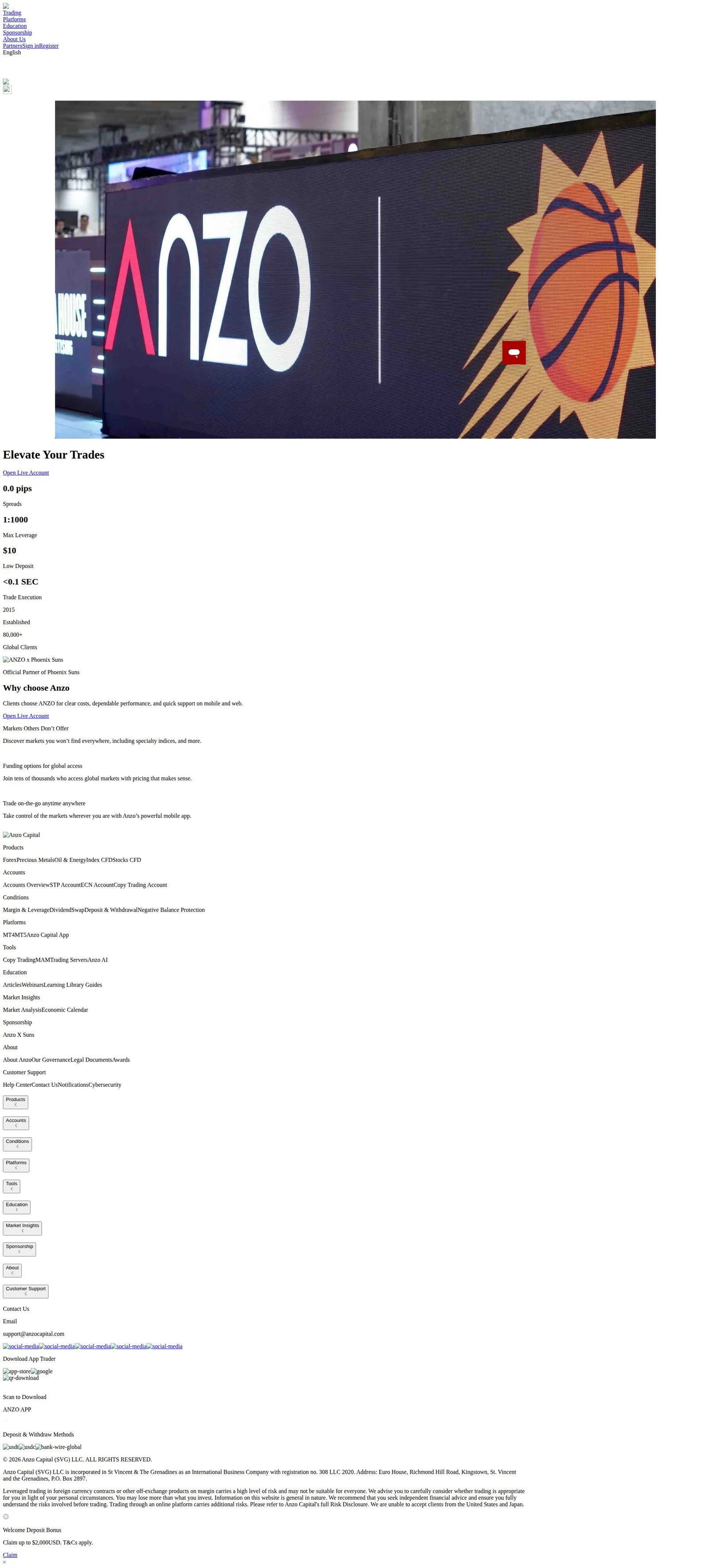
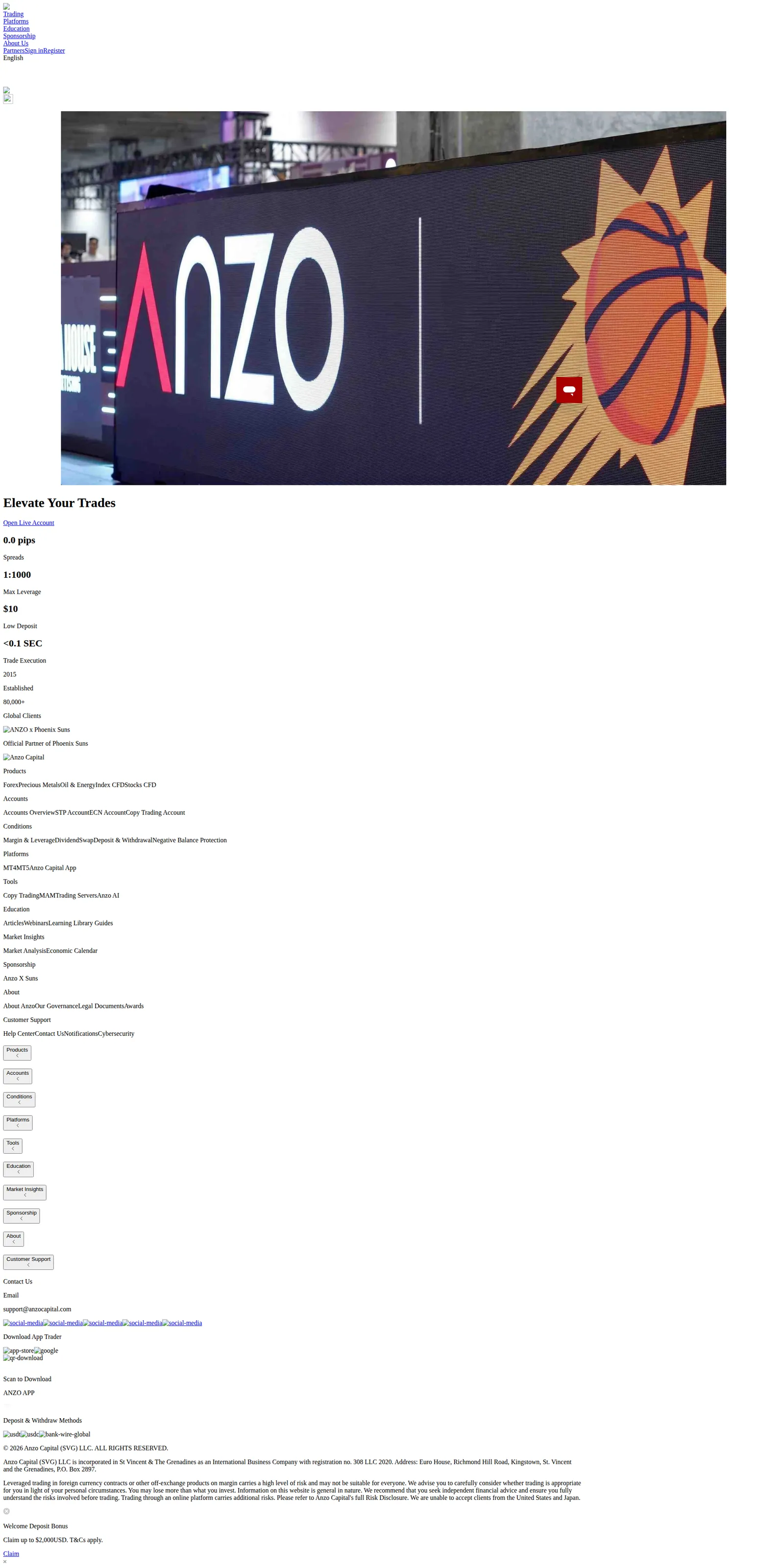
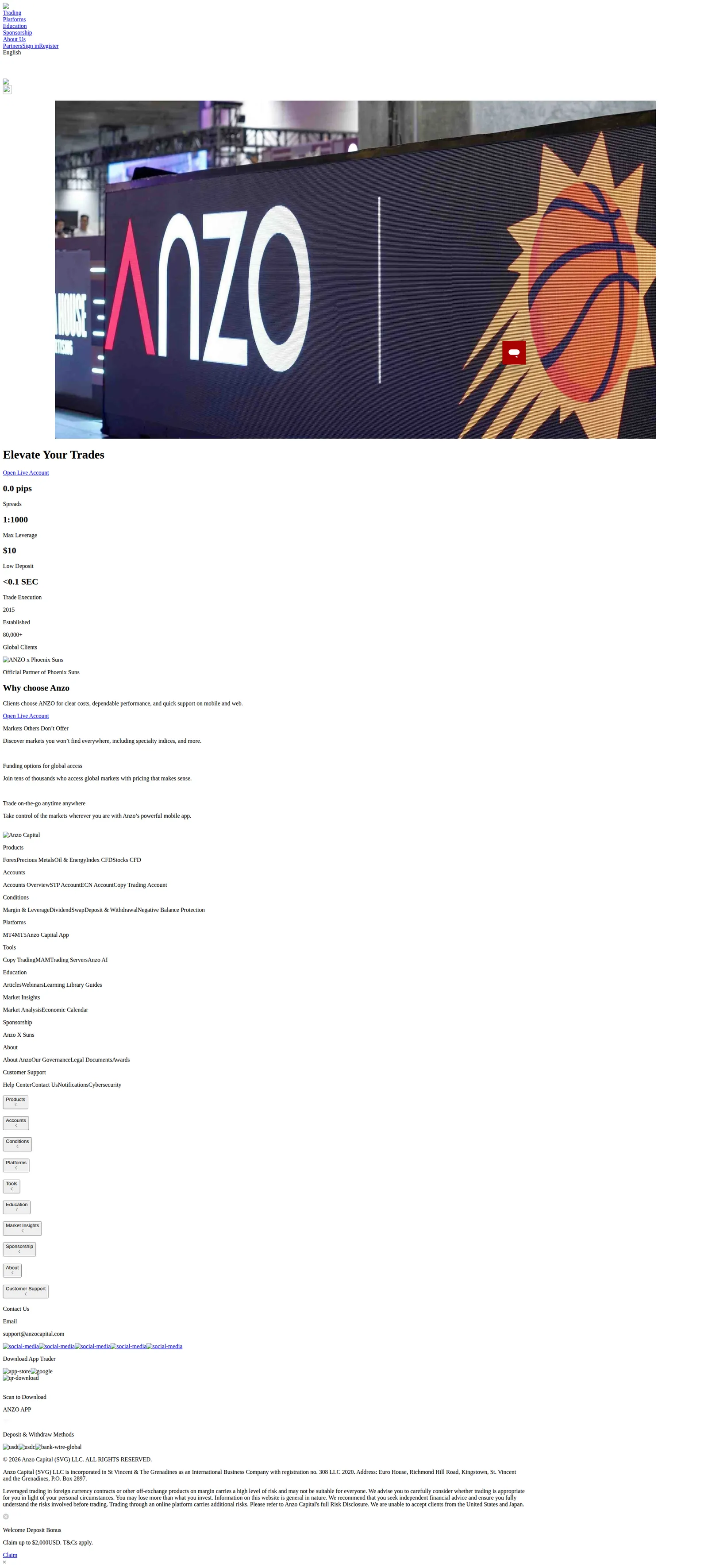
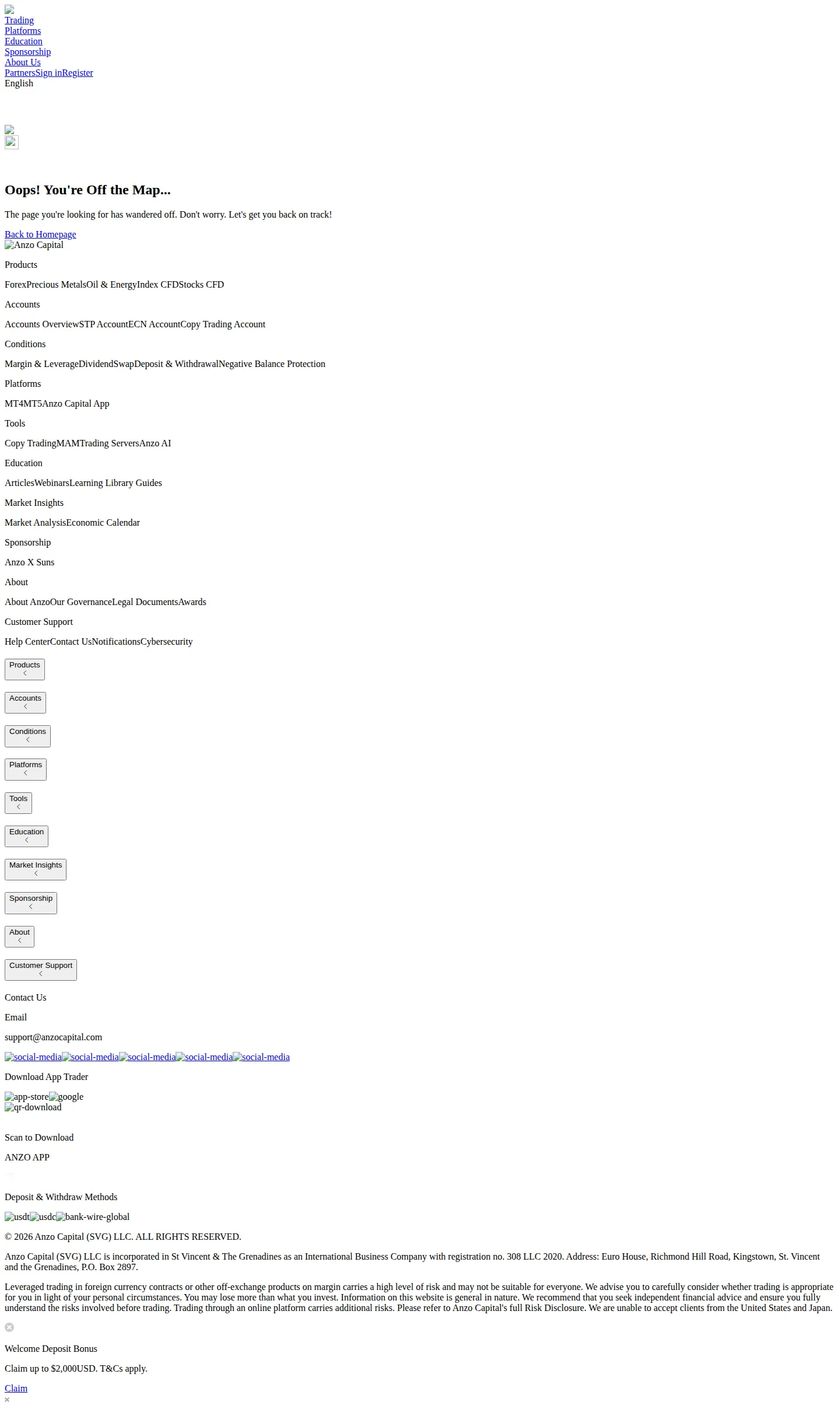
Pages captured from Anzo Capital’s own site when this review was written. Brokers change their terms; these are what we read.
Score history
Recomputed daily; every move is on the record. The current score is always the latest row.
| Date | Score | Move |
|---|---|---|
| 2026-09-29 | 5.9 | ▼ |
| 2026-07-25 | 6.0 | ▲ |
| 2026-07-18 | 5.9 | ▼ |
| 2026-07-11 | 6.0 | · |
FAQ
Is Anzo Capital regulated?
No regulatory claim could be confirmed. The IFSC Belize and SVG FSA numbers are not on their public registers, and the FCA claim has no FRN to check, leaving only a plain SVG company registration.
What is the minimum deposit at Anzo Capital?
USD 10 on the ECN account.
What does Anzo Capital charge to trade EURUSD?
About USD 4.71 round turn per lot on the ECN account, based on average spread.
What trading platforms does Anzo Capital offer?
MetaTrader 4, MetaTrader 5, the MetaTrader web terminal, and its own mobile app.
How can I contact Anzo Capital support?
By email, live chat, or a published phone number, with support in your own language during published hours.
What do reviews say about Anzo Capital?
It has a blended average of 3.16 stars across 175 ratings.
How this review works
Track Anzo Capital live: score moves and red notices, in your pocket.