
CFD · CHECKED 10 OCT 2026
ABF Trade EU Limited review.
CySEC licensed MetaTrader 5 broker offering CFDs on forex, metals, energies, indices and shares to EEA clients.
RISKY
OUT OF 10
ABF Trade EU Limited holds CySEC licence 171/12, verified on the register along with its approved domain abftrade.com/eu, and it is not authorised to deal on own account, so it cannot be the counterparty to your trade. It was X Global Markets Ltd until 2026 and carries a 50,000 euro CySEC anti money laundering settlement from 2021. Suits EEA traders with capital enough for the Premium tier; non EU clients are routed to an unverifiable second entity.
Each criterion is scored 1 to 10 from primary sources. The overall score is their unweighted mean. How scoring works.
| Founded | 2012 |
|---|---|
| Headquarters | CY |
| Minimum deposit | USD 500 |
| Maximum leverage | 1:500 |
| Minimum spread | 0.2 |
- CySEC licence 171/12 verified on the current register, with abftrade.com/eu on the regulator's own approved domain list
- Not authorised to deal on own account, and states in three legal documents that it does not take positions against clients
- Negative balance protection, segregated client money and Investor Compensation Fund cover to 20,000 euro for retail clients
- The 76.47% loss disclosure appeared on every page fetched from all eleven countries tested, including outside the EU
- Nineteen legal documents published as PDFs, including a Company Information sheet that states the permission set plainly
- Margin call at 100% and stop out at 50% are published, with the closing method and its limits described honestly
- Complaints procedure with a five business day acknowledgement, a thirty day response and named escalation to the Cyprus Financial Ombudsman
- MetaTrader 5 across Windows, macOS, web, iOS and Android, with Expert Advisors permitted on every account tier
- Free demo accounts with no expiry and no limit on how many can be opened
- Client Agreement explicitly permits algorithmic and scalping strategies that respond to genuine market conditions
- The Execution Model page claims the firm executes most client trades on its own book, which the licence does not permit and four other documents deny
- Non EU clients are onboarded to ABF Trade Connect Pty Ltd, an entity on no register we could reach, and only the affiliate terms say so
- Own funds of 201,000 euro against a 150,000 euro floor at the last year end, after an 824,000 euro annual loss and 3.1 million euro of accumulated losses
- A 50,000 euro CySEC settlement in March 2021 over customer identification and due diligence failings
- No spread table and no swap table published for any instrument; both are visible only inside the platform
- Entry tier costs 500 USD for a 1.5 pip minimum spread, and 0.2 pip requires a 10,000 USD deposit plus commission
- Commission is quoted per round turn lot on the accounts page and per lot per side in the General Fees document
- Inactivity fee of 25 euro a month after only six months, plus a discretionary withdrawal fee defined two different ways
- Support is email and telephone only, English only, Monday to Friday 09:00 to 18:00 EET, against a market that trades around the clock
- The Absolute tier advertises 24/7 support that the firm's own published hours contradict
- Knowledgebase articles are written for MetaTrader 4, which the firm does not offer
Overview
ABF Trade is the trading name of ABF Trade EU Limited, a Cyprus Investment Firm holding CySEC licence 171/12 since 15 June 2012 and registered in Cyprus as HE 291958. The brand is new; the company is not. CySEC’s register carries it as “ABF Trade EU Limited (ex X Global Markets Ltd)”, and the entity record adds an earlier name again: “Previous Name: FXRidge Ltd”. Every legal document on the site except the Client Agreement is version 1.0 with an effective date of 12 May 2026, and the last published Pillar III disclosure, for the year ended 31 December 2025, is filed under the name X GLOBAL MARKETS LTD. What a reader is looking at is a fourteen year old licence relaunched under a third brand in May 2026.
The identity check comes out clean, which is not always the case. CySEC’s own List of Approved Domains records entry 9 as “ABF Trade EU Limited (ex X Global Markets Ltd) abftrade.com/eu”, and the entire live site sits under that exact path: every internal link is /eu/en/something. The domain and the path both belong to the licensed firm on the regulator’s own record. abftrade.com does not appear on CySEC’s List of Non Approved Domains, and neither the company nor either former name appears on CySEC’s warnings list or in the Former Investment Firms register.
One fact outranks the rest for anyone reading this outside the European Union. The firm’s own affiliate terms carry this footnote under the CPA payout table: “Only EU resident clients will be onboarded to ABF Trade EU Limited. Non-EU clients will be offered an account at ABF Trade Connect Pty Ltd.” We fetched abftrade.com from eleven countries through in-country exits, Indonesia, Thailand, Vietnam, Azerbaijan, Singapore, Japan, India, the UAE, South Africa, the United Kingdom and Germany, and every one of them was served the same CySEC branded EU site with the same 76.47% loss disclosure. A reader in Jakarta or Johannesburg sees a Cypriot licence on every page of the site they are recruited through, and by the firm’s own words would be onboarded to a different company. We could not find ABF Trade Connect Pty Ltd on Australia’s public business register, and no jurisdiction, address, licence number or registration number is published for it anywhere on the site.
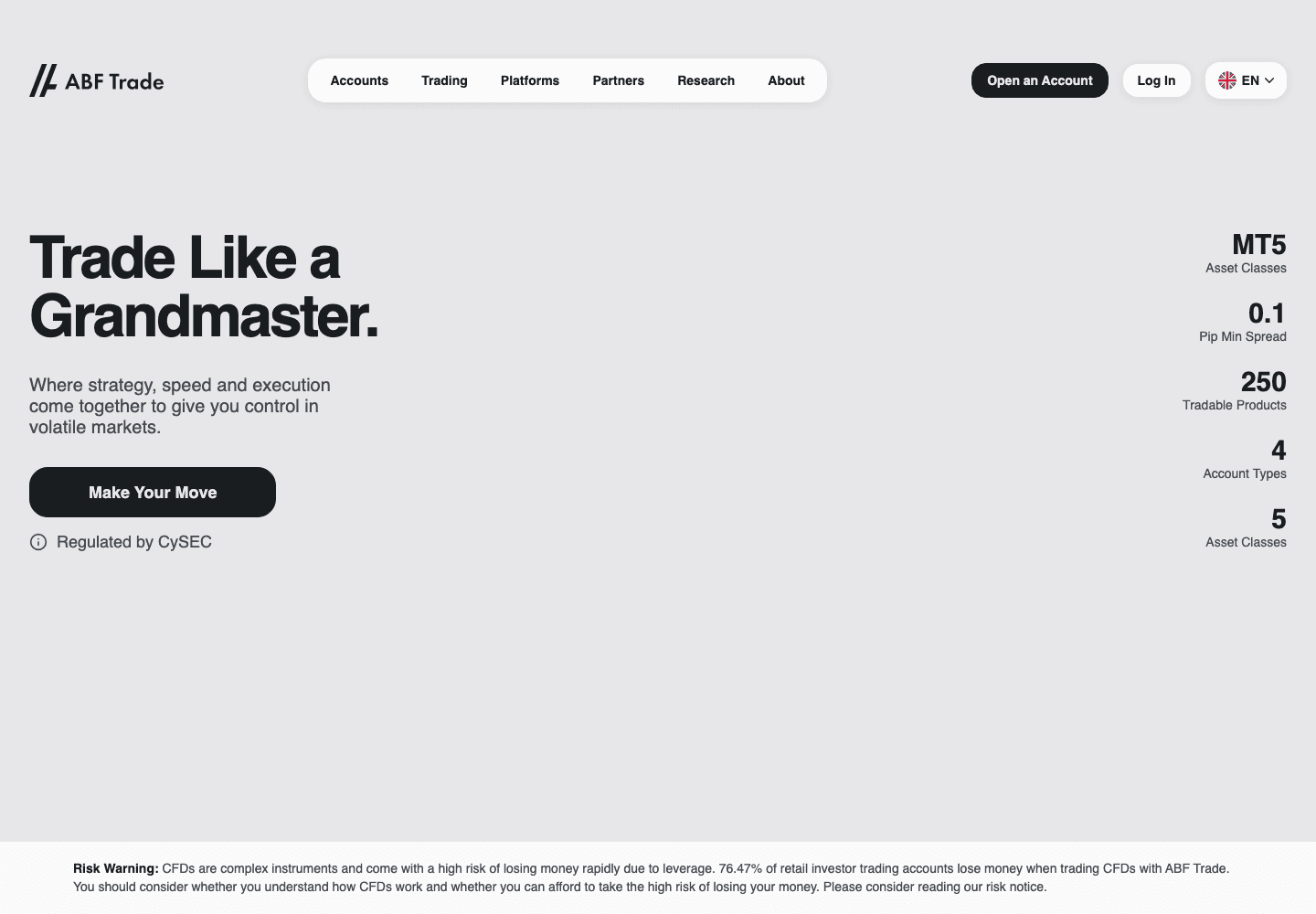
The product itself is narrow and conventional: contracts for difference on foreign exchange, metals, energy, soft commodities, indices and single shares, on MetaTrader 5 and nothing else. Retail leverage is capped at the ESMA levels, 1:30 on major currency pairs down to 1:5 on shares. Four account tiers start at a 500 USD minimum deposit and run to 30,000 USD. Account currencies are USD, EUR and PLN, the payment rails include a Polish instant bank transfer, and the marketing copy talks about “key indices followed by investors in Europe and Poland”. This is a Poland facing EU broker whose site happens to be reachable from everywhere.
Overview Table
| Headquarters | 162 Fragklinou Rousvelt, 1st and 2nd Floors, Limassol 3045, Cyprus |
| Established | Licensed 15 June 2012 as FXRidge Ltd, later X Global Markets Ltd, trading as ABF Trade since 2026 |
| Countries Served | 29 EEA states under a CySEC cross border passport. Non EU clients are routed to ABF Trade Connect Pty Ltd by the firm’s own affiliate terms |
| Regulated By | CySEC, licence 171/12. BaFin cross border notification 132843. No other licence found |
| Minimum Deposit | 500 USD for the entry account. 100 USD equivalent per individual funding transaction |
| Maximum Leverage | 1:30 retail on major FX. Professional leverage agreed individually; the contract specification page cites up to 1:500 |
| Total Instruments | 225 by the firm’s published breakdown. The homepage claims 250 |
| Platforms | MetaTrader 5 only: Windows, macOS, web, iOS, Android |
| Customer Support | Email and telephone, Monday to Friday 09:00 to 18:00 EET. Closed at weekends |
| Languages | English only on the live site |
Facts List
- CySEC licence 171/12, verified on the current register of Cypriot Investment Firms, company number HE 291958.
- Approved domain on CySEC’s own list is abftrade.com/eu, which is where the whole site lives.
- The licence does not include dealing on own account, so the firm cannot lawfully take the other side of a client trade.
- CySEC board decision of 1 March 2021: a settlement of 50,000 euro for possible anti money laundering failings between April 2016 and July 2017. Paid.
- Own funds at 31 December 2025 were 201,000 euro against a 150,000 euro regulatory floor, after a loss of 824,000 euro for the year.
- The same disclosure reports segregated client money held of 12,000 euro at that date.
- Member of the Cyprus Investor Compensation Fund, capped at 20,000 euro per covered retail client.
- Negative balance protection for retail clients. Not offered to professional clients.
- Inactivity fee of 25 euro per month after six consecutive months without a trade.
- Risk disclosure of 76.47% was present on every page fetched from all eleven countries tested.
Key Takeaways
The licence is real, current and verifiable, and it covers contracts for difference. What it does not cover is dealing on own account, which is a genuine structural protection and one this firm states plainly in three separate legal documents. The weaknesses are elsewhere: a company operating at the smallest scale its permission allows, an entry price of 500 USD for a 1.5 pip spread, support that stops at 18:00 and does not work weekends, and a marketing site that contradicts its own legal documents in at least half a dozen places.
- CySEC 171/12 is current on the register, and CySEC’s approved domain list ties abftrade.com/eu to this exact entity. Domain and licence agree.
- The firm is not authorised to deal on own account. Its Client Agreement, Best Execution Policy and Company Information document all say it does not take positions against clients.
- Its own Execution Model web page says the opposite, claiming it executes “the vast majority of client trades on its own book” and hedges excess exposure. The licence does not permit that, and the legal documents deny it.
- Non EU residents are onboarded to ABF Trade Connect Pty Ltd, per the firm’s affiliate terms. That entity is on no register we could reach and has no published licence.
- At 31 December 2025 the licensed company had 201,000 euro of own funds against a 150,000 euro floor, 90,000 euro of liquid assets and accumulated losses of 3.1 million euro.
- One CySEC enforcement action on record: a 50,000 euro anti money laundering settlement in March 2021, covering conduct in 2016 and 2017.
- Retail clients get negative balance protection, segregated client money and Investor Compensation Fund cover to 20,000 euro. Professional clients get none of the first and third.
- Entry account is 500 USD for a 1.5 pip minimum spread. The 0.2 pip tier needs 10,000 USD and pays commission.
- Inactivity costs 25 euro per month after six months, and the firm reserves a withdrawal fee against accounts that barely trade.
- Support is email and telephone, Monday to Friday, 09:00 to 18:00 EET, in English, for a market that trades around the clock five days a week.
Licenses & Regulation
ABF Trade EU Limited holds Cyprus Investment Firm licence 171/12, granted on 15 June 2012. We read that off CySEC’s current register of Cypriot Investment Firms and then off the firm’s own entity record, which gives the company number HE 291958, the Limassol address, the telephone number that also appears on the site, and the note “Previous Name: FXRidge Ltd”. The register title carries the intermediate name too: “ABF Trade EU Limited (ex X Global Markets Ltd)”. Three names, one licence, one company number.
| Authority | Location | License Number | Retail Services | Protection Level |
|---|---|---|---|---|
| CySEC | Cyprus | 171/12 | Yes, CFDs on FX, indices, commodities and shares | Segregated client money, ICF cover to 20,000 euro, negative balance protection, ESMA leverage caps |
| BaFin, cross border notification only | Germany | 132843 | Yes, under the CySEC passport | None additional. BaFin’s record states the firm is not supervised by BaFin |
| KNF, claimed passport registration | Poland | Not published by the firm | Claimed | Not verified. KNF’s register loads its results client side and we could not read it |
| ABF Trade Connect Pty Ltd | Not published | None found | Non EU clients, per the firm’s affiliate terms | Unknown. No register we can reach lists this entity |
The permission set is the most useful thing on the register, and it is unusual enough to spell out. CySEC records three investment services for this firm: reception and transmission of orders, execution of orders on behalf of clients, and portfolio management. Reception and execution cover financial instruments 1, 2, 4, 5 and 9, and instrument 9 is contracts for difference. Portfolio management covers instruments 1 to 10. The ancillary services are safekeeping and administration, granting credits or loans, foreign exchange services connected to investment services, and investment research.
Dealing on own account is absent. That is the permission a market maker needs in order to be your counterparty, and this firm does not have it. Germany’s register agrees independently: BaFin’s entity record for ABF TRADE EU LIMITED, BaFin ID 10132843, category “cross border service provider” under section 74 of the German Securities Institutions Act, shows a MiFID service matrix in which A1, A2 and A4 are ticked for CFDs and A3, dealing on own account, is not ticked for any instrument. The firm’s Company Information document states it in words: “the Company does NOT engage in Dealing on Own Account; it does not take positions against its clients.” Client Agreement version 5.0 section 7.3 and the Best Interest and Order Execution Policy section 3.3 both repeat it.
So who is the counterparty? The Best Execution Policy says orders are transmitted to “one or more regulated liquidity providers” acting as execution venues, that the firm quotes the venue price “plus any applicable mark-up”, and that transactions are over the counter rather than on a regulated market or MTF. The liquidity providers are not named, and the policy reserves the right to change them on one business day’s notice. A reader can verify that the firm is not the counterparty; they cannot verify who is.
Against this sits the firm’s own Execution Model page, which says something else entirely: that it maintains “high fill rates via ECN liquidity and internal matching”, that “excess exposure is hedged with external liquidity providers”, and that it ensures fill quality “by executing the vast majority of client trades on its own book”. Hedging residual exposure is principal risk, and executing on your own book is dealing on own account. The register says the firm may not do that, and its Client Agreement says it does not. One of these documents is wrong, and it is the marketing page.
The enforcement record is short and we verified it at source. CySEC’s board decision of 1 March 2021, announced on 24 March 2021, records a settlement with X Global Markets Ltd of 50,000 euro under the Prevention and Suppression of Money Laundering and Terrorist Financing Law, following an investigation covering April 2016 to July 2017 into article 58(a), customer identification and customer due diligence. The company paid. We paged through CySEC’s board decisions year by year from 2014 to 2026 and found no other decision against any of the firm’s three names; the 2012 and 2013 filters returned a server error and we could not read those two years. A trade publication reports an earlier 5,000 euro fine against FXRidge; we could not locate it on CySEC’s own register, so it is not recorded here.
The UK position needs stating because a British reader will look for it. The FCA register carries X Global Markets Ltd under FRN 602404 as “Services (UK) of an Overseas Firm”, status “No longer authorised” with effect from 22 April 2022. There is no current UK authorisation. The firm’s affiliate programme nonetheless places the United Kingdom, along with Australia, Saudi Arabia and Kuwait, in its paid country tiers, and none of those four appears on either the EEA passport list CySEC records for this firm or the list of third countries CySEC records that it may serve.
How to Trade
Trading happens on MetaTrader 5 and only on MetaTrader 5. The account is opened through the client area, funded, and then linked to an MT5 login on the server named ABFTradeEU-Server. There is no proprietary web terminal, no MetaTrader 4, no copy trading service and no TradingView integration. The MT5 desktop build is offered for Windows and macOS, alongside the standard MetaQuotes mobile apps and the browser terminal.
Execution is described in the account specification table as “Market and Limit (externally covered)” with “Order Requotes: None” and a spread type of “Variable ECN price feed”. The comparison table lists execution as “Market / IOC” for all four account tiers. Expert Advisors are permitted on every tier. Minimum order size is 0.01 lots, the step is 0.01 lots, and the maximum single order is 20.00 lots. That ceiling is worth noticing: a trader running size on indices or gold will hit it, and orders have to be split.
Margin mechanics are published in the Leverage Policy and are conventional. Margin level is equity divided by used margin. A margin call warning is issued at 100% and the automated stop out begins at 50%, closing the largest losing position first and continuing until the level is restored, without prior notice. The policy is honest about what that means in practice: closing prices “may be significantly different from the price at which the stop out level was reached, particularly during periods of fast-moving markets, gaps, or illiquidity”, and the firm accepts no liability for losses arising from stop out closures.
Retail leverage follows the ESMA product intervention caps and the Leverage Policy states the firm does not exceed them: 1:30 on major currency pairs at 3.33% margin, 1:20 on non major pairs, gold and major equity indices at 5%, 1:10 on other commodities and non major indices, 1:5 on single shares and 1:2 on cryptocurrency CFDs. Those numbers are reproduced in the contract specifications, where every major pair shows a 3.33% margin requirement and every minor 5.00%. The contract size is 100,000 units of the base currency across all currency pairs.
Professional clients are handled separately. The Leverage Policy says professional leverage is “agreed individually between the Company and the client”, while the contract specifications page states that professional clients “may access leverage of up to 1:500 across most major and minor FX currency pairs”. Both statements come from the firm, and only the second gives a number. Professional status costs the client negative balance protection and Investor Compensation Fund cover, which the firm sets out plainly in a comparison table on its professional clients page.
Swaps are charged daily on positions held overnight. The General Fees document says a triple swap is applied on Wednesdays for most instruments; the contract specifications page says the three day swap night varies by symbol and can be found in the platform’s symbol specification dialog. Neither the swap rates nor the live spreads are published anywhere on the website. The contract specifications page tells the reader to right click in the MetaTrader Market Watch window to see them. That is a real disclosure gap: a prospective client cannot price a position before opening an account.
Abusive trading is defined at unusual length in Client Agreement version 5.0, and the definitions are worth reading before committing capital. Latency arbitrage and any strategy whose edge comes from exploiting feed latency or platform deficiencies are prohibited as a matter of commercial terms, regardless of legality. Market manipulation and insider dealing are prohibited under EU market abuse law, and the firm states it will report suspicions to CySEC without notifying the client first. To its credit, the agreement also says explicitly that algorithmic and scalping strategies responding to genuine market conditions are not prohibited, which is a clearer carve out than most brokers offer.
Account Types
Four live tiers are offered, separated by minimum deposit, minimum spread and whether commission is charged. All four give access to the same instruments and the same MetaTrader 5 platform, in USD, EUR or PLN, with Expert Advisors permitted and a swap free option available for Islamic clients.
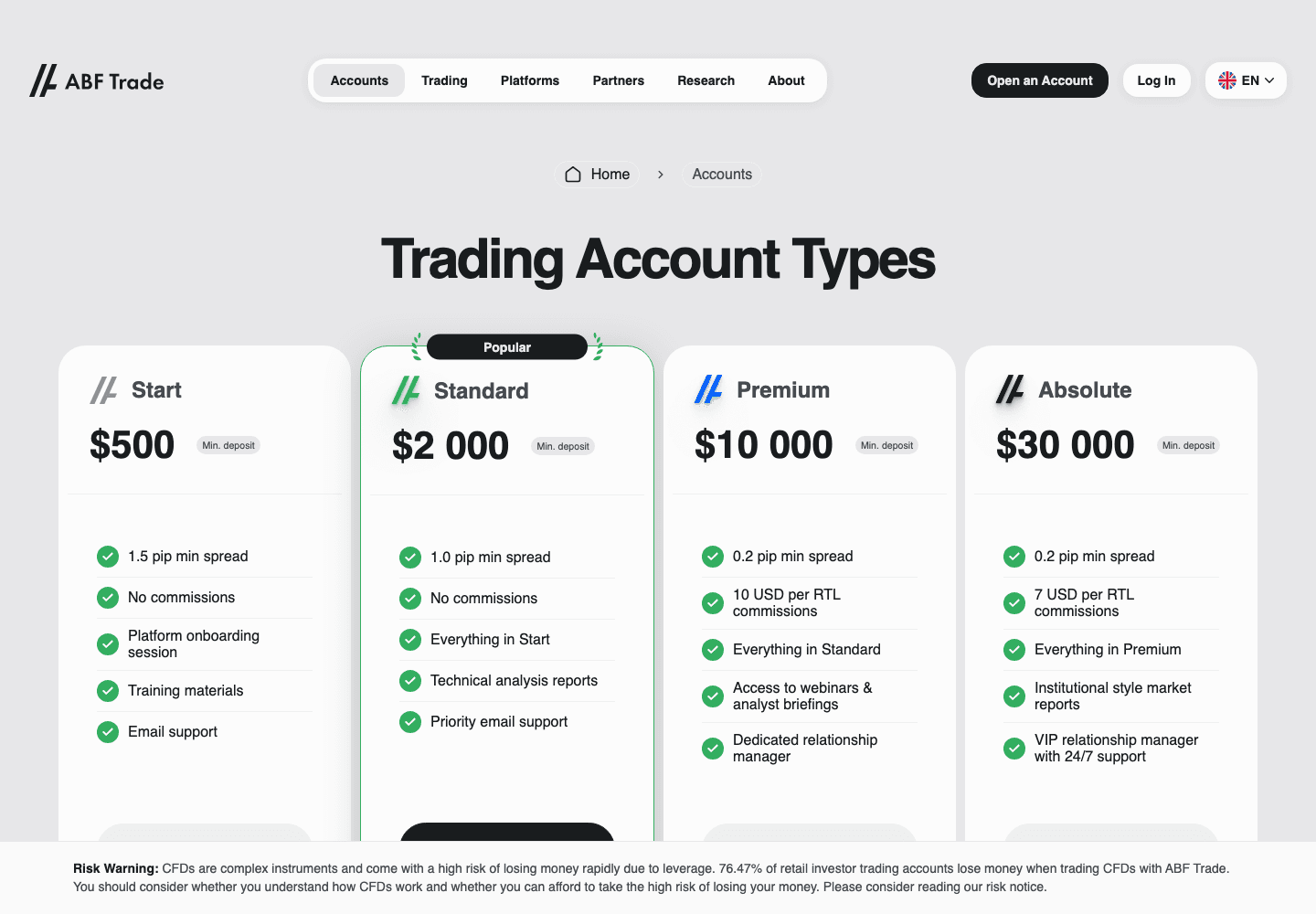
| Account | Minimum deposit | Minimum spread | Commission | Included |
|---|---|---|---|---|
| Start | 500 USD equivalent | 1.5 pip | None | Platform onboarding session, training materials, email support |
| Standard | 2,000 USD equivalent | 1.0 pip | None | Everything in Start, technical analysis reports, priority email support |
| Premium | 10,000 USD equivalent | 0.2 pip | 10 USD per round turn lot | Everything in Standard, webinars and analyst briefings, dedicated relationship manager |
| Absolute | 30,000 USD equivalent | 0.2 pip | 7 USD per round turn lot | Everything in Premium, institutional style market reports, VIP relationship manager |
The pricing ladder is steep at the bottom. Paying 500 USD to get a 1.5 pip minimum spread on major currency pairs is expensive by any comparison, and the commission free framing does not change that: the cost is in the spread. Getting to a competitive 0.2 pip requires 10,000 USD and a commission, which puts genuinely tight pricing out of reach of the clients most likely to be reading a review like this one.
Three inconsistencies sit inside the firm’s own account pages and each of them affects what a trade costs. The tier called Premium on the pricing cards is called Pro in the comparison table directly below. The cards quote spreads of 0.2 pip for the top two tiers while the comparison table’s spread column for the same tiers reads “up to 3%”. And the commission is quoted per round turn lot on the cards, while the General Fees document states that “Commission is charged per lot, per side (open and close)”. Ten dollars per round turn and ten dollars per side are not the same price; one is double the other. We have not resolved which applies.
The general specification table is more useful than the tier cards. It records variable spreads from an ECN feed, no requotes, market and limit execution externally covered, a minimum and step size of 0.01 lots, a maximum order of 20.00 lots, and an instrument count broken down as 42 currencies, 6 metals, 3 energies, 7 softs, 18 indices and 149 shares.
A free demo account is offered with no expiry and no limit on how many can be opened, on the same price feed and the same MetaTrader 5 build as a live account. The firm notes in its Client Agreement that a demo execution environment may differ from a live one and disclaims liability for losses arising from the difference, which is standard and correct.
Corporate accounts are opened by email rather than online, with a document checklist covering certificate of incorporation, memorandum and articles, shareholder certificates, director and secretary details, a board resolution, a recent bank statement, company accounts and an LEI number. The corporate page describes execution as “no-dealing-desk”, which is consistent with the licence and with the Client Agreement, and inconsistent with the Execution Model page discussed in the regulation section.
Professional client status is available by application under the standard MiFID elective test: at least two of significant transactions at an average of ten per quarter over four quarters, a portfolio above 500,000 euro, or a year working in a professional financial position. The firm publishes a plain table of what the client gives up, and it is not small. Negative balance protection: offered to retail, not offered to professional. Investor Compensation Fund protection: yes for retail, no for professional. Stop out stays at 50% for both, and access to the financial ombudsman is retained.
Negative Balance Protection
Retail clients have negative balance protection, and the firm commits to it in more than one place. The Leverage Policy says that if an account balance goes negative through adverse market movement, including through stop out closures, “the Company will reset the account balance to zero at no additional cost to the Client”. The Risk Disclosure adds that the firm “will not pursue Clients for amounts beyond their deposited funds”. The Company Information document repeats it. This is a CySEC requirement for retail clients rather than a commercial choice, but it is stated clearly and consistently, which is not universal.
Professional clients do not have it. Both the Leverage Policy and the Risk Disclosure state that the protection does not apply to professional clients, and the firm’s own professional versus retail comparison table marks negative balance protection as “Not offered” in the professional column. A client who applies for professional status to get leverage beyond 1:30 is trading that protection away, along with Investor Compensation Fund cover. On an instrument that can gap, with leverage the firm’s own contract specification page puts at up to 1:500, that is a material exposure and the reader should treat it as the price of the upgrade rather than a footnote to it.
The mechanism that is supposed to keep an account away from a negative balance is the stop out, and it is set at 50% of required margin with a warning at 100%. Closure is automatic, begins with the largest losing position, and happens without prior notice. The Leverage Policy states clearly that a margin call “is a warning only and does not guarantee that positions will not be closed”, and that the client is responsible for monitoring the account. It also concedes that in fast markets, gaps or illiquid conditions the actual closing price may be a long way from the level at which the stop out triggered.
Client money is held separately from company money. The Safety of Funds page cites CySEC Directive DI144-2007-01 and says client funds sit in segregated accounts with European credit institutions, in liquid current accounts so that withdrawals can be met same day, spread across institutions for diversification. The Company Information document repeats the segregation commitment. The banks are not named, and neither is the number of them.
Above segregation sits the Cyprus Investor Compensation Fund. The firm is a member, and the cover is 20,000 euro per covered retail client if the company cannot return client funds or financial instruments. The Investor Compensation Fund Notice sets out the limit and the proportional treatment of claims above it. That figure is the ceiling, not a target, and it matters here more than at a larger firm: the licensed entity reported own funds of 201,000 euro at 31 December 2025 against a 150,000 euro regulatory minimum, so a client with more than 20,000 euro on deposit is relying on segregation working rather than on compensation.
Trading Instruments
Everything offered is a contract for difference. The firm holds no permission to deal in physical securities for retail clients beyond reception, transmission and execution of orders, and its Best Execution Policy confirms that all instruments are cash settled CFDs traded over the counter rather than on a regulated market or multilateral trading facility. Nothing here confers ownership of an underlying asset.
| Asset class | Instruments published | Retail leverage |
|---|---|---|
| Currency pairs | 42 | 1:30 majors, 1:20 minors |
| Precious metals | 6 | 1:20 on gold, 1:10 on other metals |
| Energies | 3 | 1:10 |
| Soft commodities | 7 | 1:10 |
| Equity indices | 18 | 1:20 major, 1:10 non major |
| Single shares | 149 | 1:5 |
That breakdown, taken from the firm’s own account specification table, totals 225 instruments. The homepage counter says 250 tradable products and the contract specifications page carries a widget headed “Trade 250 CFDs”. The gap is 25 instruments and the firm does not reconcile it.
Part of the gap may be cryptocurrency. Crypto CFDs are absent from the published instrument breakdown and from the site’s own market navigation, which lists forex, precious metals, equity indices, commodities and shares. They are nonetheless clearly part of the product set in the legal documents: the Leverage Policy sets a 1:2 cap for “Bitcoin (BTC), Ethereum (ETH), Litecoin (LTC), Ripple (XRP), and others as listed on the Company’s website”, the Company Information document lists cryptocurrencies among products offered, and there is both a dedicated Cryptocurrency CFD Disclaimer and a Key Information Document for crypto CFDs. The disclaimer states the firm “offers Contracts for Differences (CFDs) on cryptocurrencies”. We could not establish how many crypto instruments are actually tradable, because the site does not list them.
The currency list is broader than the majors. The contract specifications table includes EUR/PLN and USD/PLN, which fits a Polish client base, plus EUR/NOK, EUR/SEK, EUR/TRY, USD/TRY, USD/MXN, USD/ZAR, USD/CNH, USD/HKD, USD/SGD and SGD/JPY. Quote precision is five decimal places on most pairs and three on yen crosses. Every pair carries a contract size of 100,000 base currency units and a 0.01 lot minimum.
Commodities are limited to what the site’s own ticker shows: gold, silver, crude oil, natural gas, cocoa, corn, wheat, soybean, coffee and sugar. The index list is not published instrument by instrument, though the Leverage Policy names Germany 40, US 500, UK 100, France 40 and Japan 225 as the major indices for margin purposes. The 149 shares are mostly large capitalisation US and European names, judging by the tickers the site cycles through on its homepage and contract specifications page.
Spreads on all of this are variable and sourced from what the firm calls an ECN feed, and they are not published. The contract specifications page directs the reader to the MetaTrader Market Watch window to see them, which requires an account. Swap rates are handled the same way. For a broker whose top account tiers advertise 0.2 pip minimums, the absence of any published spread table for any instrument is the single largest transparency gap in the offering.
Education & Analysis
Education is a static Learning Centre rather than a research operation. It is organised as four courses: a beginner course covering what forex trading is, fundamental analysis, technical analysis, how to choose a broker and lot and pip calculation; a Japanese candlesticks course covering basics, double candlestick patterns and interpretation; a technical indicators course covering support and resistance, trendlines, channel lines, Bollinger Bands and the Relative Strength Index; and money management. The material is competent and aimed squarely at someone who has never traded.
The Knowledgebase is a second, older library, and it is the clearest evidence on the site that the ABF Trade brand is a new coat of paint on an existing operation. Its articles are titled “Trade calculations in MT4”, “Choosing the best data centre in MT4”, “Setting up email alerts in MT4” and “Using MQL5 signals service”. The firm does not offer MetaTrader 4. The platform page and every account specification say MetaTrader 5 and nothing else, and the download links point at an MT5 installer for the ABFTradeEU-Server. A client following the data centre article will find no MT4 to configure.
The Knowledgebase content that survives the platform mismatch is genuinely useful. The article on why a take profit or stop loss did not trigger at the price shown on the chart addresses the single most common support question in retail CFD trading, that MetaTrader charts plot bid prices while a sell order closes at the ask. The MQL5 signals article is unusually candid for broker material, warning that money managers found through signal services vary enormously in quality and that most operate without a portfolio management licence.
Market analysis is thin. The site carries an economic calendar under the trading menu. Beyond that, research appears only as an account benefit rather than public content: the Standard tier lists “technical analysis reports”, Premium adds “access to webinars and analyst briefings”, and Absolute adds “institutional style market reports”. None of these is published openly, so we cannot assess frequency, author or quality. There is no public blog, no daily commentary and no market outlook on the site.
Charting is whatever MetaTrader 5 provides, which is a great deal: 21 timeframes, 38 built in technical indicators, 44 analytical objects, the MQL5 language for custom indicators and Expert Advisors, and the strategy tester. That is a genuine strength, and it is the platform’s rather than the broker’s. There is no proprietary charting layer, no integrated TradingView and no sentiment or positioning data.
The firm is explicit that none of this is advice. Client Agreement section 7.2 states that it does not provide investment advice and that market commentary, news and other information are informational only. That is the correct position for a firm holding execution and reception permissions, and it is worth a reader internalising: the analyst briefings advertised with a 10,000 USD account are marketing material, not a recommendation the firm stands behind.
Special Offers
There are no deposit bonuses, no cashback schemes, no rebate programmes and no trading competitions. That is the correct and expected position for a CySEC regulated firm, since the regulator prohibits bonuses and similar incentives to retail clients, and a reader who is offered one by anyone claiming to represent this broker should treat that offer as a warning sign rather than a perk.
What the firm offers instead is a service ladder attached to deposit size. A 500 USD Start account includes a platform onboarding session, training materials and email support. Standard at 2,000 USD adds technical analysis reports and priority email support. Premium at 10,000 USD adds webinars, analyst briefings and a dedicated relationship manager. Absolute at 30,000 USD adds institutional style market reports and a VIP relationship manager. None of these is a monetary incentive and none of them changes the trading conditions beyond the published spread and commission for each tier.
The Absolute tier’s promise deserves scrutiny because the firm contradicts it elsewhere on the same website. The account card advertises a “VIP relationship manager with 24/7 support”. The contact page publishes working hours for customer support, sales, back office and partnerships that are identical and unambiguous: Monday to Friday 09:00 to 18:00 EET, Saturday and Sunday closed. Nothing on the site describes an out of hours channel, and no 24/7 arrangement is documented anywhere else. A 30,000 USD deposit is a lot to place on an unsupported claim.
A swap free option is available for Islamic clients, listed in the general account specification table as “Swap Free: Available for Islamic clients”. The terms are not published: there is no eligibility criterion, no administration fee schedule, no limit on how long a position may be held swap free, and no statement of which instruments qualify. Swap free accounts at other brokers commonly carry all four of those conditions, so the absence of any published terms is a question to put to the firm before relying on it.
The one genuinely detailed commercial programme on the site is aimed at affiliates rather than traders, and it is more informative about the business than anything in the client facing pages. The affiliate scheme pays up to 600 USD per qualified client on a cost per acquisition basis, or up to 45 USD per verified lead on a cost per lead basis, with qualification set at a 500 USD minimum deposit and more than five round turn lots traded. Identity verification runs through Sumsub. Payouts are tiered by country, with Poland, Germany, Denmark, Switzerland, Norway, France, the Netherlands, Sweden, Australia, the United Kingdom, Singapore, Hong Kong, the UAE, the Czech Republic and Hungary at the top rate.
That table carries the footnote quoted in the overview: only EU residents are onboarded to ABF Trade EU Limited, and non EU clients are offered an account at ABF Trade Connect Pty Ltd. It appears in the affiliate terms and nowhere in the client facing documents, which means the people being paid to recruit clients are told something material that the clients themselves are not.
TrueBroker has no commercial relationship with this broker. Nothing in this review is affiliate compensated and no link on this page pays us.
Opening an Account
Registration is online and the published sequence is four steps: complete the registration form, create a trading account, add funds, and start trading. Identity verification runs through Sumsub, which the firm names in its affiliate material as “Instant Sumsub KYC” and describes as taking minutes rather than days. The firm does not publish a target time from application to funded account, so we cannot state one.
Eligibility is set out in Client Agreement version 5.0 section 3.1, and it excludes four groups. Anyone under 18 or not of legal competence. Anyone resident in a country or jurisdiction where use of the platform would be contrary to local law or regulation, with the agreement placing the burden of establishing that on the client. Anyone who is a US person as defined under FATCA or otherwise a US reportable person. And employees, directors, agents, associates or affiliates of the company. Section 3.2 adds a general right to refuse or suspend access at the firm’s discretion.
Every client is classified as a retail client by default, which is the classification carrying the most protection. The Client Categorisation Policy sets out how to apply for professional status and what it costs, and the firm requires a written request, gives a written warning of the protections being lost, and reserves the right to decline. The elective professional test requires at least two of three conditions: significant transactions averaging ten per quarter over the previous four quarters, a portfolio of cash and financial instruments above 500,000 euro, or at least a year working in the financial sector in a role requiring relevant knowledge.
Corporate onboarding is deliberately manual. The application form and supporting documents go to sales@abftrade.com, and the checklist covers a certificate of incorporation, memorandum and articles of association, shareholder certificates, documentation of directors, secretary and registered office, a board resolution, a recent bank statement, company accounts or financial statements and an LEI number, plus passport and proof of address for the individuals behind the entity. The firm reserves the right to ask for more.
The documents a client is agreeing to are all published as PDFs on the legal page, and there are nineteen of them: the Client Agreement, Risk Disclosure, Best Interest and Order Execution Policy, Conflicts of Interest Policy, Client Categorisation Policy, Complaints Handling Procedure, Investor Compensation Fund Notice, GDPR Data Protection Policy, Leverage Policy, Cryptocurrency CFD Disclaimer, four Key Information Documents plus one for crypto, General Fees, Company Information, and Risk Management Disclosures on both an individual and a consolidated basis. That is a fuller legal library than most brokers of this size publish, and the Company Information and General Fees documents in particular answer questions the marketing pages do not.
Two details of the agreement are worth reading before signing. Governing law is Cyprus and the parties submit to the exclusive jurisdiction of the Cypriot courts, so a dispute that escapes the complaints process and the Financial Ombudsman ends up in Nicosia or Limassol. And either party may terminate on seven business days’ written notice, with the firm able to terminate immediately where an event of default occurs, where its liquidity provider has permanently refused to accept orders from that account, or where a competent authority requires it. That middle clause is unusual and honest: the firm is telling clients in advance that its own execution venue can effectively close their account.
Deposits & Withdrawals
Funding is straightforward on the way in and conditional on the way out. The minimum for an individual funding transaction is 100 USD equivalent, although the entry account itself requires a 500 USD minimum initial deposit, and the firm covers the fees its banks and payment providers charge on deposits. Accounts are denominated in USD, EUR or PLN.
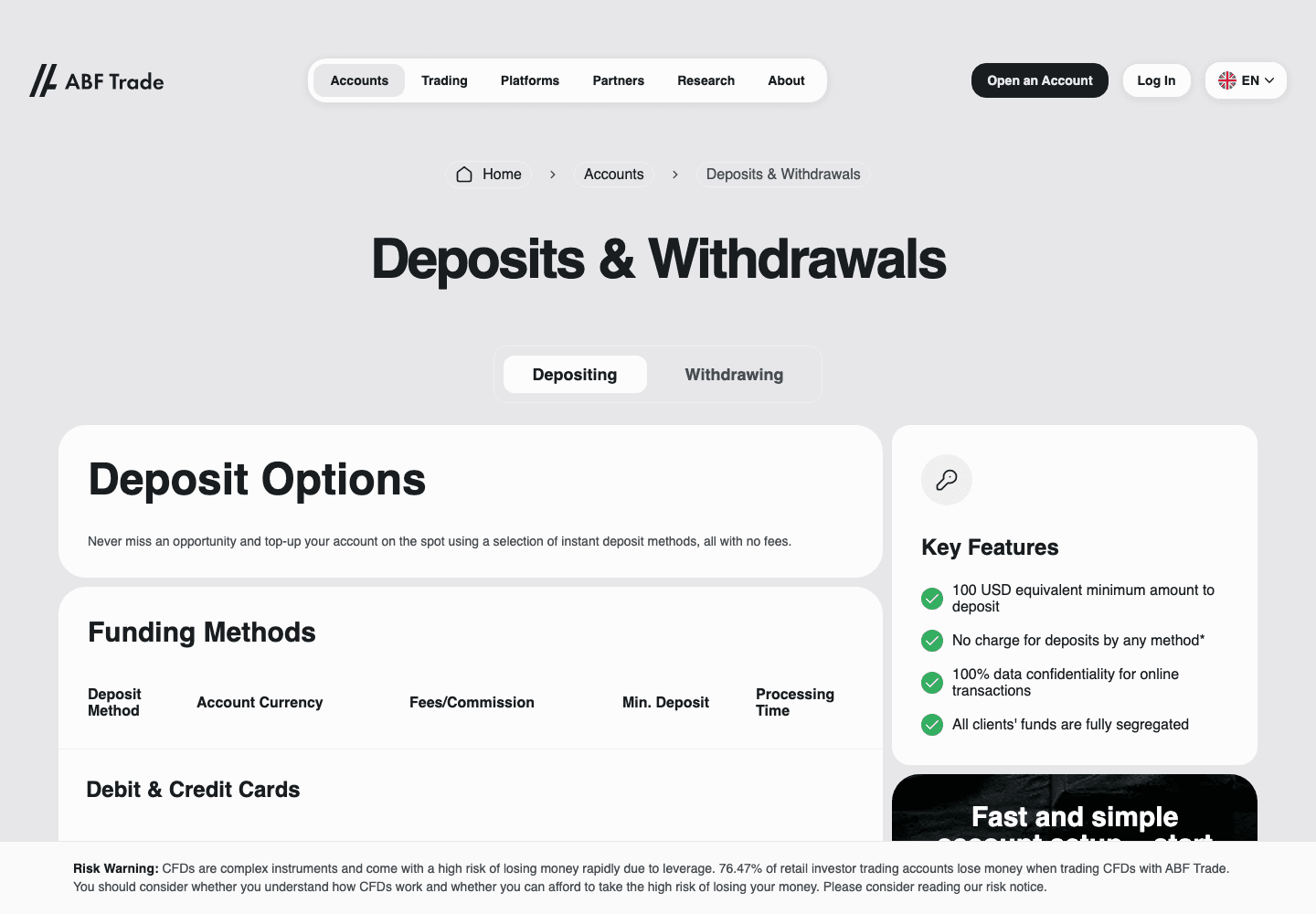
| Method | Currencies | Fee | Minimum | Processing |
|---|---|---|---|---|
| Debit and credit cards | USD, EUR, PLN | Free | 100 USD equivalent | Instant |
| Bank transfer | USD, EUR, PLN | Free | 100 USD equivalent | Same day received |
| Polish instant bank transfer | PLN | Free | 500 PLN equivalent | Instant |
| E-wallets | USD, EUR, PLN | Free | 100 USD equivalent | Instant |
| Internal transfer | USD, EUR, PLN | Free | No minimum | 24 hours |
The payment providers named in the General Fees document are narrower than that table implies. It lists exactly three: Trust Payments for Visa and Mastercard, described as an EEA regulated payment institution; bank wire transfer; and TPay, a Polish KNF regulated payment institution offering instant local bank transfers. The deposit page’s own FAQ says clients can use “e-wallets such as Skrill and Neteller”, and the deposit terms mention a monthly limit for “debit/credit card, Skrill or NETELLER”. Neither wallet appears in the firm’s list of payment service providers, and the payment icons on the site are Visa, Mastercard, wire transfer, BLIK and SEPA. A reader planning to fund by e-wallet should confirm it is actually available before committing.
Card, Skrill and Neteller deposits are capped at 15,000 USD or EUR, or 50,000 PLN, per client per month. Above that the firm reserves the right to return the excess less transaction costs, or to deduct those costs from the account after crediting it. There is no maximum on bank wire.
Withdrawals run on a first in, first out basis back to the method used to deposit, up to the amount deposited. Profits above that are sent by bank wire only. Client Agreement section 11.5 undertakes to process requests on the same business day provided the instruction is complete, the destination is the original method or another account in the client’s name, the balance net of open position exposure covers the amount, no force majeure event applies and the client is fully verified. Section 11.6 forbids payments to third party or anonymous accounts. The deposit page’s FAQ says withdrawals are processed within 24 hours and reach the client in one to five business days depending on the provider.
Two charges deserve attention because both are triggered by not trading, and the firm describes each of them twice with different thresholds.
The first is a withdrawal fee. The General Fees document says the firm does not ordinarily charge one but reserves the right to where there is “insignificant (a single position placed on the Trading Account only) or no trading activity”, or where the client has not supplied information needed to process the withdrawal. The website states the same idea with a formula: “Insufficient trading volume is considered less than 0.10 lot traded for every 500 USD equivalent that is deposited”, and says the firm may then pass on the handling cost of both the deposit and the withdrawal. Those are different tests. A client who deposits 5,000 USD and trades one lot has met the website’s threshold and failed nothing, but has placed more than a single position; a client who deposits 5,000 USD and places two trades totalling 0.5 lot fails the website’s test and passes the document’s. Neither version states the amount of the fee.
The second is an inactivity fee, and this one is specific: 25 euro per month, or the equivalent in the account currency, charged after six consecutive calendar months with no opening or closing trade. It continues monthly until trading resumes, is deducted from the available balance, applies partially if the balance cannot cover it, and is not applied to a zero balance. Six months is a short window and 25 euro a month is high; on a 500 USD Start account, a year of inactivity after the initial six months would consume 300 euro of a 500 USD balance.
Currency conversion applies whenever a deposit or withdrawal is in a currency other than the account base currency, at the prevailing rate. The General Fees document says “a currency conversion spread may apply” and directs the reader to customer support for details. That spread is not published, which makes the true cost of funding a EUR account in PLN, or the reverse, impossible to work out in advance.
Customer Support
Support is email and telephone, in English, during Cypriot office hours. The contact page publishes four channels and identical hours for all of them: customer support at support@abftrade.com, sales at sales@abftrade.com, back office at backoffice@abftrade.com and partnerships at partnerships@abftrade.com, each Monday to Friday 09:00 to 18:00 EET, closed Saturday and Sunday. The telephone number is +357 25 262002, which matches the number on the firm’s CySEC register entry, and there is a fax line on +357 25 560202. General enquiries go to info@abftrade.com and complaints to complaints@abftrade.com.
Weekday office hours are the central weakness. Contracts for difference on foreign exchange trade continuously from Sunday evening to Friday evening, and the site’s own FAQ says so. A client whose position gaps on the Sunday open, whose platform will not connect on a Saturday, or who needs a stop out explained at 22:00 on a Wednesday has no route to a human until the next working morning in Limassol. We found no live chat on any page of the site, no support ticket system described outside the client area, no published callback service and no out of hours emergency contact.
Language coverage is equally thin. The site’s language switcher offers English and nothing else, every legal document is published in English, and the General Fees document states that “the official legally binding language of ABF Trade EU Limited is English” and that the English version prevails over any translation. For a firm whose account currencies include the Polish zloty, whose payment rails include a Polish instant bank transfer, and whose top affiliate tier leads with Poland, the absence of Polish is a striking gap.
Support quality is sold as an account benefit rather than a baseline. The Start tier at 500 USD lists plain “email support”. Standard at 2,000 USD upgrades that to “priority email support”. Premium at 10,000 USD adds a dedicated relationship manager and Absolute at 30,000 USD a VIP relationship manager. As noted in the offers section, Absolute’s card promises 24/7 support, which the published hours contradict and no other page supports.
The complaints process is the strongest part of the service picture, and it is properly documented. Complaints go to complaints@abftrade.com. The firm undertakes to acknowledge in writing within five business days, naming the person handling the case and giving a target date for a substantive answer, and to provide a full written response within thirty calendar days, extendable in complex cases with notice. The response must state whether the complaint is upheld, partially upheld or rejected, explain the reasoning, set out any remedy and inform the client of the right to escalate.
Escalation is real and free. The Financial Ombudsman of the Republic of Cyprus is named with its website, email, postal address and telephone number, and the procedure explains that the Ombudsman can be approached if the client is dissatisfied with the outcome or if the firm fails to respond in time. CySEC can also be told, with the honest caveat that the regulator supervises firms rather than mediating individual disputes. The firm’s professional versus retail table confirms that ombudsman access is retained by professional clients even though compensation fund cover is not.
One clause in the complaints procedure works against the client and should be read: the firm will treat a complaint as closed and stop investigating if the client fails to answer a request for further information within a reasonable period. A client who is slow to reply to a document request can find the case shut rather than paused.
Prohibited Countries
The firm publishes one explicit exclusion and one general one, and both come from Client Agreement version 5.0 section 3.1 rather than from marketing copy. The platform is not intended for distribution to or use by any person who “is a US person as defined under FATCA or otherwise a US reportable person”. Separately, it is not intended for anyone who “resides in any country or jurisdiction where such distribution or use would be contrary to local law or regulation”, with the agreement stating that establishing this is the client’s own responsibility. Two further exclusions cover anyone under 18 or lacking legal capacity, and employees, directors, agents, associates and affiliates of the company.
That is the complete published list. The United States is the only country the firm names. We looked for a longer restricted list in the Client Agreement, the Risk Disclosure, the Terms of Use, the Company Information document and the General Fees document and did not find one, so we are not going to invent one.
We should be explicit about a document we deliberately did not use. CySEC’s entity record for this firm carries a block headed “Provision of Services to Countries Outside EU” listing Bangladesh, Belarus, Brazil, Egypt, Hong Kong, Indonesia, Isle of Man, Kazakhstan, Lebanon, Malaysia, Nigeria, Qatar, Singapore, Switzerland, Ukraine, the United Arab Emirates and Vanuatu. That is not a restriction list. CySEC prints its own explanation immediately above it: “CIFs may provide their services to countries outside the EU provided that they comply with the regulatory regime of the third country.” Those are the third countries this firm is cleared to serve, not the ones it excludes, and publishing them as prohibited would tell a reader in Jakarta or Kuala Lumpur that they are shut out of a broker specifically recorded as able to take them.
The permitted footprint inside Europe is wider. CySEC’s record lists cross border services to 29 EEA states: Austria, Belgium, Bulgaria, Croatia, the Czech Republic, Denmark, Estonia, Finland, France, Germany, Greece, Hungary, Iceland, Ireland, Italy, Latvia, Liechtenstein, Lithuania, Luxembourg, Malta, the Netherlands, Norway, Poland, Portugal, Romania, Slovakia, Slovenia, Spain and Sweden. Germany is independently confirmed by BaFin’s own entity record for the firm, filed as a cross border notification under section 74 of the German Securities Institutions Act.
The complication for a non EU reader is not a prohibition but a substitution, and it is documented in the section above. The affiliate terms state that only EU residents are onboarded to ABF Trade EU Limited and that non EU clients are offered an account at ABF Trade Connect Pty Ltd. Nothing on the client facing site says this. A reader in Singapore or South Africa is not told they cannot open an account; they are shown a CySEC licence, and by the firm’s own commercial terms would be contracting with a different company that publishes no licence, no address and no registration number.
Three countries in the firm’s paid affiliate tiers sit outside both lists CySEC records for it. The United Kingdom and Australia are in the top payout tier at 600 USD per client, and Saudi Arabia and Kuwait are in the second at 400 USD, yet none of the four appears on the EEA passport list or the third country list above. The United Kingdom is the sharpest case: the FCA register shows X Global Markets Ltd, FRN 602404, as no longer authorised since 22 April 2022, so there is no current UK permission behind the traffic the firm is paying for.
Practically, a reader should assume the firm serves the EEA under its Cypriot licence, will consider clients from the third countries CySEC lists, refuses US persons outright, and routes everyone else to an entity we cannot verify. If you are outside the EEA and open an account here, establish in writing which company you are contracting with, and which regulator, before you send any money.
Conclusion
ABF Trade is a real, current, verifiable Cyprus Investment Firm whose marketing is running ahead of its documentation and, in one important respect, ahead of its licence. CySEC 171/12 checks out on the regulator’s own register, the approved domain list ties abftrade.com/eu to this exact entity, the German passport is confirmed on BaFin’s record, and retail clients get segregated money, negative balance protection, Investor Compensation Fund cover to 20,000 euro and ESMA leverage caps. Those are not small things and they are not available from the offshore brands this firm competes with for the same traffic.
The structural protection worth most here is one the firm rarely gets credit for. It is not authorised to deal on own account, which means it cannot lawfully be the counterparty to your trade, and its Client Agreement, Best Execution Policy and Company Information document all confirm it operates straight through processing and does not take positions against clients. Where a market maker profits when you lose, this firm profits from the mark up on the price and the commission, whatever you do. That is a better alignment than most CFD brokers offer.
Which is exactly why its own Execution Model page is so damaging. That page claims the firm ensures fill quality “by executing the vast majority of client trades on its own book” and that “excess exposure is hedged with external liquidity providers”. Both statements describe principal dealing, the firm holds no permission for it, and four other documents on the same website deny it. We are satisfied the register and the Client Agreement are correct and the marketing page is wrong, but a reader should not have to adjudicate between a broker’s pages to learn who their counterparty is.
The financial picture behind the brand is the other thing a reader should weigh. The last audited year, disclosed under the previous name, closed with own funds of 201,000 euro against a 150,000 euro regulatory minimum, liquid assets of 90,000 euro, a loss of 824,000 euro for the year, accumulated losses of 3.1 million euro, and segregated client money of 12,000 euro. Total remuneration to senior management and material risk takers came to about 94,000 euro across seven people. This is a licence being restarted rather than a business at scale, and the ABF Trade brand, its four account tiers and its 600 USD affiliate payouts all date from 2026. Nothing in that is improper, and the capital ratios were above the required levels. It does mean a client is relying on segregation and the compensation fund rather than on the company’s balance sheet.
The enforcement history is one item: a 50,000 euro settlement with CySEC in March 2021 over customer due diligence failings during 2016 and 2017, paid in full, with nothing else against any of the firm’s three names in the board decisions we could read, covering 2014 to 2026.
On costs the firm is uncompetitive at the level most readers will enter. Five hundred dollars buys a 1.5 pip minimum spread; a 0.2 pip spread needs 10,000 dollars and a commission the firm quotes two different ways. No spread table and no swap table is published for any instrument, the currency conversion spread is not disclosed, inactivity costs 25 euro a month after only six months, and the firm reserves a withdrawal fee against accounts that trade lightly, using two different definitions of “lightly” in two different documents. Support is email and phone, English only, 09:00 to 18:00 on weekdays, against a market that trades around the clock.
Who does it suit? An EEA resident, most obviously a Polish or German one, who wants MetaTrader 5 with EU investor protections, has enough capital to reach the Premium tier where the pricing becomes reasonable, trades during European hours, and is comfortable asking for the spread and swap tables in writing before funding. Who should look elsewhere? Anyone who needs weekend or overnight support, anyone who wants published costs before opening an account, anyone trading more than 20 lots in a single order, and above all anyone outside the EEA, who would be onboarded to ABF Trade Connect Pty Ltd rather than to the regulated company whose licence number appears on every page they were shown.
Contracts for difference are high risk leveraged products. The firm’s own disclosure is that 76.47% of its retail investor accounts lose money, and that figure appeared on every page we fetched from all eleven countries we tested.
Score history
Recomputed daily; every move is on the record. The current score is always the latest row.
| Date | Score | Move |
|---|---|---|
| 2026-09-13 | 5.1 | ▼ |
| 2026-09-12 | 5.2 | · |
FAQ
Is ABF Trade regulated and safe?
ABF Trade is the brand of ABF Trade EU Limited, which holds CySEC licence 171/12, granted on 15 June 2012 and current on the register of Cypriot Investment Firms. CySEC’s own approved domain list ties abftrade.com/eu to this entity, so the domain and the licence agree. Retail clients get segregated client money, negative balance protection and Investor Compensation Fund cover to 20,000 euro. Two things temper that. The firm settled with CySEC for 50,000 euro in March 2021 over customer due diligence failings in 2016 and 2017, and its last audited year end showed own funds of 201,000 euro against a 150,000 euro regulatory minimum after a loss of 824,000 euro.
Is ABF Trade the counterparty to my trades?
No, and the licence is the reason. CySEC authorises the firm for reception and transmission of orders, execution of orders on behalf of clients and portfolio management. Dealing on own account, the permission a market maker needs in order to take the other side of your trade, is not granted, and BaFin’s record shows the same gap. The Client Agreement, the Best Execution Policy and the Company Information document all state that the firm operates straight through processing and does not take positions against clients. The website’s Execution Model page contradicts this by claiming most trades are executed on the firm’s own book, but the register and the legal documents are the authority. The liquidity providers themselves are not named.
What does it cost to trade with ABF Trade?
It depends entirely on how much you deposit. The 500 USD Start account has a 1.5 pip minimum spread and no commission, Standard at 2,000 USD improves that to 1.0 pip, and the 0.2 pip minimum requires the 10,000 USD Premium tier plus 10 USD per lot, or 30,000 USD for 7 USD per lot. The accounts page quotes commission per round turn lot while the General Fees document says it is charged per lot per side, which is twice the cost, and the firm does not reconcile the two. No spread or swap table is published for any instrument, so exact costs cannot be established before opening an account. Inactivity costs 25 euro a month after six months without a trade.
Can I open an account with ABF Trade from outside the EU?
The firm’s affiliate terms state that only EU resident clients are onboarded to ABF Trade EU Limited and that non EU clients are offered an account at ABF Trade Connect Pty Ltd. That footnote appears in the affiliate material and nowhere in the client facing documents, and we could not find ABF Trade Connect Pty Ltd on any register we can search, including Australia’s public business register. Meanwhile the website serves the same CySEC branded pages to every country we tested. US persons as defined under FATCA are excluded outright by the Client Agreement. If you are outside the EEA, establish in writing which company and which regulator you would be dealing with before depositing.
How long do withdrawals take at ABF Trade?
The Client Agreement undertakes to process withdrawal requests on the same business day where the instruction is complete, the client is fully verified, the balance net of open positions covers the amount and the destination is the original deposit method or another account in the client’s name. The deposit page says requests are processed within 24 hours and arrive in one to five business days depending on the provider. Withdrawals follow first in, first out back to the funding method up to the amount deposited, and profits are paid by bank wire only. Payments to third party accounts are refused. The firm reserves the right to charge a withdrawal fee where an account has traded little or not at all.
How this review works
Track ABF Trade EU Limited live: score moves and red notices, in your pocket.