CFD · CHECKED 13 SEP 2026
Argus Stockbrokers Ltd review.
A Nicosia stockbroker and asset manager licensed since 2003, whose CFD and FX offering is a Saxo Bank white label rather than its own book.
RISKY
OUT OF 10
Argus Stockbrokers Ltd holds CySEC licence 010/03, dated 12 May 2003, and CySEC's own Approved Domains list ties argus.com.cy to that entity. It does not hold dealing on own account, so it cannot be your counterparty on a CFD. Saxo Bank A/S manufactures the CFDs and FX products. Cover is the Investor Compensation Fund at EUR 20,000. Against that: a EUR 70,000 CySEC anti money laundering settlement in July 2024, and a CFD fee schedule that is not published anywhere.
Each criterion is scored 1 to 10 from primary sources. The overall score is their unweighted mean. How scoring works.
| Founded | 2000 |
|---|---|
| Headquarters | CY |
| Maximum leverage | 1:30 |
- CySEC licence 010/03 held continuously since 12 May 2003, verified on the regulator's own register
- CySEC's Approved Domains list names argus.com.cy against this exact legal entity, so the site is not a lookalike
- The licensed entity is the entity a client contracts with, with no offshore arm taking retail money
- No dealing on own account permission, so Argus cannot profit from a client's CFD loss on its own book
- Direct membership of the Cyprus Stock Exchange, Athens Stock Exchange and Athens Derivatives Exchange
- Investor Compensation Fund membership with cover up to EUR 20,000, plus a Financial Ombudsman route to EUR 170,000
- Full CSE and ASE fee schedule published, including a 0.5% to 1% commission band and free custody
- Pillar 3 disclosures published annually with real capital figures, which most CFD brands never provide
- The 70% retail loss warning appeared on every page fetched from all ten countries we tested
- Named board with published qualifications, including a Managing Director who founded the firm in 2000
- CySEC settled with Argus for EUR 70,000 in July 2024 over anti money laundering failings
- CySEC also announced an administrative fine in December 2010 and a reprimand in October 2009
- No CFD or FX spread, commission, overnight financing rate or minimum deposit is published anywhere
- The published international markets fee table is an empty grid, and one line reads 'ARGUS Commission ……%'
- The MiFID II disclosure still carries the placeholders [STATE YOUR EXECUTION BROKERS] and
- Two live documents give different account opening fees, EUR 20 in one and EUR 50 in the other
- The Argus Global Trader terms are a Saxo template citing MiFID I and the repealed Law 144(I)/2007
- Own funds of EUR 1.262m sit against accumulated losses of EUR 1.133m and 6% convertible debt
- Account opening is paper only, requiring an original signed hard copy posted to Nicosia
- Client support is offered in Greek and English only, with no live chat and no published hours
Overview
Argus Stockbrokers Ltd is a Cyprus Investment Firm registered in Nicosia under company number HE 108270 and authorised by the Cyprus Securities and Exchange Commission under CIF licence 010/03 since 12 May 2003. Its Managing Director, Andri Tringidou, founded the firm in 2000. It is a member of the Cyprus Stock Exchange, the Athens Stock Exchange and the Athens Derivatives Exchange, and it is separately registered with CySEC as a sub threshold Alternative Investment Fund Manager. In other words this is a traditional stockbroker and asset manager that also sells CFDs, not a CFD shop that acquired a licence.
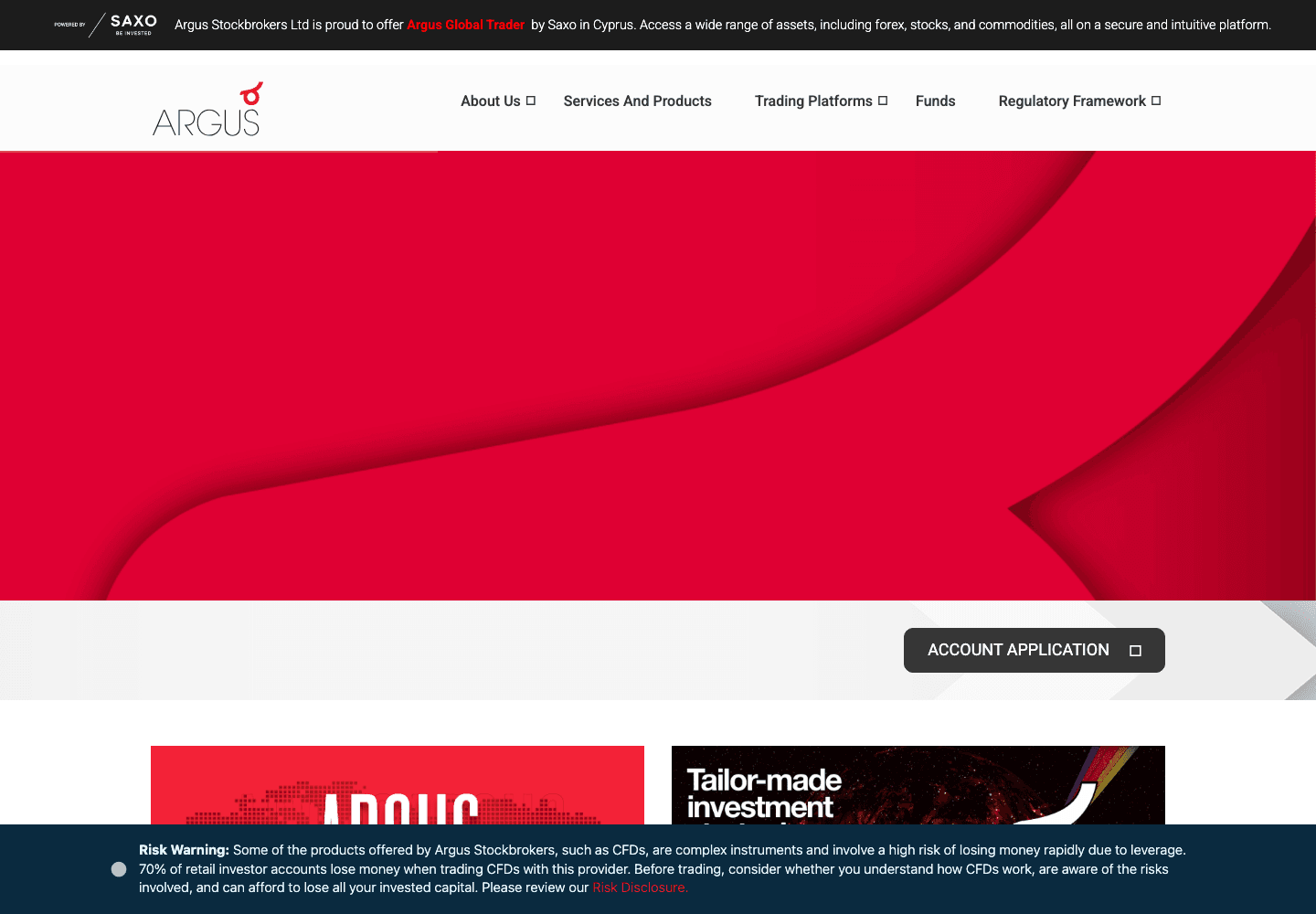
That distinction decides the whole review. The CySEC register lists four investment services for Argus: reception and transmission of orders, execution of orders on behalf of clients, portfolio management, and investment advice. Dealing on own account is not among them. Argus therefore cannot take the other side of your CFD trade. Its own Order Execution Policy, version 006 of December 2025, says so plainly: “Argus trades as an agent to CFDs trades with clients.” The products themselves come from Saxo Bank A/S, which the Key Information Documents on the Argus site name as the manufacturer, and the trading platform is branded Argus Global Trader powered by Saxo.
The most common way a retail trader is misled, a headline European licence fronting an offshore entity that actually takes the money, does not happen here. There is one entity, one licence and one set of terms. We fetched the site through in country exits in Indonesia, Thailand, Vietnam, Azerbaijan, Singapore, Japan, India, South Africa, the United Kingdom and Germany, and every one returned byte identical content carrying the same disclosure that 70% of retail investor accounts lose money trading CFDs with this provider. That is the opposite of the pattern we usually find.
What is wrong here is different, and it is about disclosure and conduct rather than structure. CySEC settled with Argus for EUR 70,000 in July 2024 over anti money laundering failings, and it published a fine in 2010 and a reprimand in 2009. The firm publishes a detailed fee schedule for Cyprus and Athens equities, and publishes nothing at all about what a CFD costs. Its client facing MiFID II disclosure still contains unfilled template placeholders where the custodian and the execution brokers should be named.
Overview Table
| Headquarters | 25 Demosthenis Severis Avenue, Metropolis Tower, 1st and 2nd Floor, 1080 Nicosia, Cyprus |
| Established | 2000, CIF licence from 12 May 2003 |
| Countries Served | Cyprus plus 29 EEA states by passport; CySEC also records notified third countries including Indonesia, Malaysia, China and the UAE |
| Regulated By | CySEC, CIF licence 010/03 |
| Minimum Deposit | Not published |
| Maximum Leverage | 1:30 for retail on major FX, under the ESMA limits Argus publishes |
| Total Instruments | Not published as a count; MiFID categories 1, 2, 3, 4, 5, 8, 9 and 10 |
| Platforms | Argus Global Trader powered by Saxo (web, mobile, Windows desktop, simulation); ARGUS Trader for CSE and ASE |
| Customer Support | Telephone +357 22 717000, dealing line +357 22 717011, email, fax, post |
| Languages | Greek and English |
Facts List
- Legal entity on the register is Argus Stockbrokers Ltd, Cyprus company HE 108270, LEI 213800WY7LMNUUCB3P93.
- CySEC lists www.argus.com.cy and www.argusglobaltrader.com as the firm’s Approved Domains.
- Neither domain appears on CySEC’s List of Non Approved Domains.
- Argus holds no dealing on own account permission, so it is not your CFD counterparty.
- Saxo Bank A/S is named as the manufacturer of the CFD, FX spot and FX option products.
- Investor Compensation Fund cover is capped at EUR 20,000 per covered client.
- CySEC board decision of 10 July 2024 records a EUR 70,000 anti money laundering settlement.
- CSE and ASE brokerage commission is published as 0.5% to 1%, with a EUR 5 minimum per contract.
- Safekeeping and custody of financial instruments is published as no charge.
- Own funds were EUR 1.262m at 31 December 2025 against a EUR 881k requirement, a ratio of 143.17%.
Key Takeaways
- The licence is real, current and covers the entity you deal with. CySEC licence 010/03 has run since 12 May 2003 against Argus Stockbrokers Ltd, company HE 108270, and the regulator’s own Approved Domains list ties argus.com.cy to it. There is no Seychelles or Mauritius sibling taking retail money.
- Argus is not your counterparty on a CFD. The register grants reception and transmission, execution, portfolio management and investment advice. It does not grant dealing on own account. Saxo Bank A/S manufactures the CFD and FX products, and Saxo sits under Danish FSA supervision.
- There is a real enforcement record. CySEC’s board settled with Argus for EUR 70,000 on 10 July 2024 under the anti money laundering law, announced on 19 July 2024. CySEC also published an administrative fine on 7 December 2010 and a reprimand on 15 October 2009.
- Equity pricing is published; CFD pricing is not. Cyprus and Athens commission is 0.5% to 1% with a EUR 5 minimum and free custody. For CFDs there is no published spread, commission, overnight financing rate, minimum deposit, withdrawal fee or inactivity fee.
- Client facing documents are unfinished. The MiFID II Information and Risk Disclosures still contains [STATE YOUR EXECUTION BROKERS] and, and its fee schedule includes the line “ARGUS Commission ……%”.
- Protection is the standard Cypriot package. Investor Compensation Fund cover to EUR 20,000, segregated client money accounts, and a Financial Ombudsman route for claims up to EUR 170,000.
- The site does not change by country. Ten in country fetches returned identical content and identical risk warnings, which is rare and counts in the firm’s favour.
Licenses & Regulation
Argus Stockbrokers Ltd appears on the CySEC register of Cypriot Investment Firms at entity record 37709, under licence number 010/03 dated 12 May 2003, with company registration number HE 108270 and the Nicosia address printed in the site footer. The same entity appears on CySEC’s List of Approved Domains against www.argus.com.cy and www.argusglobaltrader.com, which is the strongest identity check the Cypriot register offers. It does not appear on the Former Investment Firms (Cypriot) register, and neither domain appears on the List of Non Approved Domains. The Global Legal Entity Identifier Foundation independently records LEI 213800WY7LMNUUCB3P93 as ACTIVE for ARGUS STOCKBROKERS LTD, registered as HE 108270 in Cyprus, at the same address.
| Authority | Location | License Number | Retail Services | Protection Level |
|---|---|---|---|---|
| CySEC | Cyprus | 010/03 | Reception and transmission of orders, execution of orders on behalf of clients, portfolio management, investment advice. Dealing on own account NOT held. | Investor Compensation Fund to EUR 20,000; segregated client money; Financial Ombudsman to EUR 170,000 |
| FCA | United Kingdom | 538493 | None. Lapsed passport, not a UK authorisation | None. No longer authorised from 31 December 2020 |
The permission that is missing matters more than the ones that are present. Dealing on own account is what lets a firm be the other side of your trade. Argus does not hold it. Its Order Execution Policy version 006 of December 2025 states that Argus trades as an agent for CFDs, cash equities, futures and listed options. Orders it cannot execute itself go to a named list of intermediaries: Saxo Bank, Barclays Bank, Linear Investments Ltd, Bank of Cyprus, Eurobank, Athlos Capital Investment Services Ltd, Raiffeisen, BETA SECURITIES S.A., Piraeus Bank and Topstone. Where Argus is a member, at the Cyprus and Athens exchanges, it executes directly.
The enforcement record is the serious mark against the firm. CySEC’s board decided on 10 July 2024, announcing it on 19 July 2024, to reach a settlement of EUR 70,000 with Argus Stockbrokers Ltd under the Prevention and Suppression of Money Laundering and Terrorist Financing Law and the related CySEC directive. The register records no judicial review. CySEC also published an announcement on 7 December 2010 regarding an administrative fine to the firm, and one on 15 October 2009 regarding a reprimand. We searched the CySEC administrative sanctions, board decisions, announcements and investor warnings sections and found no other entry naming this firm.
Two related registrations corroborate the scale of the business. Argus is on CySEC’s Authorised Sub Threshold AIFMs register under the same 010/03 licence, with an AIFM licence date of 29 July 2015, and it is recorded as manager of Argus Algo Fund Ltd (LPAIF21/2014), Argus International Equities AIF V.C.I.C. Plc (AIF76/2018, an umbrella with the Argus Global Equities, Argus Indigo and Argus Verde sub funds) and THELXIS FUND AIFLNP V.C.I.C. LIMITED, which CySEC records as dissolved on 8 February 2024.
One caution on names. Argus is a common brand, and the FCA register carries three unauthorised entries using it: “Argus Trade (Clone of FCA authorised firm)” at a London WC2H postcode, “Argus Global Equities” and “Argus Global Equities Limited”. The FCA record does not name the firm being cloned, and we established no connection between any of them and Argus Stockbrokers Ltd. Argus Insurance Company (Europe) Limited, FRN 203123 in Gibraltar, is a separate business again. Check the domain, not the word.
How to Trade
Argus runs two separate trading stacks, and they behave nothing alike. For Cyprus and Athens listed shares and bonds there is ARGUS Trader, reached at etrader.argus.com.cy, where Argus is an exchange member and routes orders straight to the Cyprus Stock Exchange or the Athens Stock Exchange. For everything else, including CFDs, FX, futures and international equities, there is Argus Global Trader, which the firm describes as powered by Saxo and serves from mobiletrader.argusglobaltrader.com with a live environment, a simulation environment and a Windows desktop download.
On the CSE and ASE side the mechanics are conventional agency broking. The Order Execution Policy ranks price first and costs second for retail clients in non complex instruments, with likelihood of execution fourth and order size fifth. Where Argus has direct market access it enters orders first in, first out; where it does not, it transmits to a third party and timestamps the transmission so the same ordering is preserved. Orders can be placed through the platform, by telephone on +357 22 717011 on recorded lines, by email or by fax, and Argus reserves the right to ask for a verbal instruction to be resubmitted in writing.
On the CFD side the mechanics belong to Saxo. The Argus Global Trader General Business Terms describe market orders, limit orders and stop orders, with limit buys and stop sells placed below the current market and limit sells and stop buys above it. Positions close first in, first out where contracts share the same characteristics. The terms also give Argus the right to void or reprice a trade executed at a price it can show was manifestly incorrect, and to claw back profits from what it calls sniping, meaning strategies built on exploiting off market prices.
Margin and liquidation follow the ESMA rules and Argus publishes the numbers. Initial margin is 3.33% on major FX pairs, 5% on minor pairs, 5% on major indices, 10% on minor indices, 5% on gold, 10% on other commodities and 20% on equities. Maintenance margin is half of each of those. If the account breaches 100% margin utilisation, automatic close out begins, positions are closed and working orders are cancelled. There is no discretion described and no grace period.
What Argus does not publish is anything about execution quality. There is no fill rate, no slippage statistic, no average execution speed and no uptime figure, on either platform. The Order Execution Policy commits to at least semi annual sample based testing of executed transactions by the Head of Brokerage, with escalation to senior management where the sampling finds a pattern, but the results of that testing are not made public.
Account Types
Argus does not publish a menu of tiered trading accounts. There is no Standard against Raw against VIP ladder, no spread comparison table and no minimum deposit thresholds, because the firm is organised around services rather than account tiers. What you get depends on which of its four licensed investment services you sign up for, and the account opening pack makes that explicit through the appendices you are asked to complete.
The base relationship is execution only broking, covered by the Natural Person Agreement or the Legal Person Agreement. Appendix 4 covers electronic platforms, and is what you sign to trade through ARGUS Trader or Argus Global Trader. Appendix 3 covers investment advice, and Appendix 5 covers discretionary portfolio management, which is a 31 page document with signature blocks on six separate pages. A client who wants only to buy Cyprus equities online completes far less than one handing over a discretionary mandate.
Client categorisation, not account type, is what changes your protection. Argus classifies clients as Retail, Professional or Eligible Counterparty under MiFID II, and states that retail clients receive the most regulatory protection. Reclassification is possible on request in either direction, subject to the elective professional test: transactions of significant size at an average of ten per quarter over the previous four quarters, a portfolio including cash and financial instruments above EUR 500,000, or at least a year working in the financial sector in a relevant professional role, of which two must be met.
That test is worth pausing on, because opting up costs real money. The Investor Compensation Fund does not cover professional clients or eligible counterparties, so a retail client who elects to be treated as professional gives up the EUR 20,000 backstop entirely. The ESMA leverage limits and the negative balance protection described on the firm’s own leverage page also apply only to retail clients. Argus states it may decline to provide services under a requested classification even where the criteria are met.
Retail clients holding leveraged or contingent liability positions get one automatic safeguard regardless of tier. Argus is required to notify the client when the initial value of each instrument depreciates by 10%, and at each multiple of 10% thereafter, by the end of the business day on which the threshold is passed, or the next business day if it falls on a non business day. That notification duty is written into the Terms and Conditions and the Client Categorisation policy alike.
Negative Balance Protection
Argus publishes a negative balance protection commitment on its Leverage Information page, in terms taken from the ESMA product intervention measures that took effect on 30 July 2018. It states that negative balance protection is applied to accounts holding an open FX spot or CFD position, that it applies to any loss remaining after all collateral on the account has been used including cash deposits, and that Argus will reimburse the negative cash amount once all positions held on the account settle, resetting the account value to zero.
The protection sits behind a margin close out that is meant to trigger first. Maintenance margin is set at half the initial margin figure for each asset class, so 1.66% on major FX, 2.5% on minor FX pairs, major indices and gold, 5% on minor indices and other commodities, and 10% on equities. Once the account breaches 100% margin utilisation, orders to close positions are placed automatically and existing working orders are cancelled. In an orderly market the close out should land before the balance goes negative, and the protection is the backstop for gaps that outrun it.
Two limits are worth reading carefully. The commitment as published is framed around accounts holding an open FX spot or CFD position, so it is not stated to extend to futures, listed options or margined equity positions taken through the same platform. And the ESMA measures the page describes apply to retail clients only; a client who elects to be treated as professional is outside the regime that produced this protection.
The Argus Global Trader General Business Terms, which are the contract for the platform, pull in the opposite direction. Their risk acknowledgement tells the client that losses may substantially exceed the investment and the margin deposit, and that failing to meet a margin call may result in Argus closing positions with the client liable for any resulting loss or deficit. The MiFID II disclosure similarly says that after an immediate closure the client remains obliged to cover the negative balance. Those clauses are standard derivative wording and predate the negative balance rule, but the firm has not reconciled them with the protection it publishes elsewhere. If you need certainty, get the position confirmed in writing before you fund the account.
Trading Instruments
Argus does not publish an instrument count, and we are not going to invent one. What the regulator publishes instead is more precise: the MiFID categories the licence actually covers. Reception and transmission of orders runs to categories 1, 2, 3, 4, 5, 8, 9 and 10. Execution of orders on behalf of clients is narrower, at categories 1, 2, 3, 4 and 9. Portfolio management and investment advice both run to 1, 2, 3, 4, 5, 8, 9 and 10.
In plain terms, category 1 is transferable securities, meaning shares and bonds. Category 2 is money market instruments. Category 3 is units in collective investment undertakings. Category 4 is derivatives on securities, currencies, interest rates and indices. Category 5 is cash settled commodity derivatives. Category 8 is credit risk transfer instruments. Category 9 is financial contracts for differences, which is the permission the CFD business runs on. Category 10 covers derivatives on climatic variables, freight rates, inflation and other official statistics. Categories 6, 7 and 11, covering physically settled commodity derivatives and emission allowances, are not held.
On the exchange side the concrete offering is Cyprus Stock Exchange and Athens Stock Exchange listed shares and bonds, where Argus is a member, plus the Athens Derivatives Exchange. The published fee schedule separates CSE Main Market shares, CSE other markets shares, corporate bonds and government bonds, which tells you all four are genuinely traded.
Through Argus Global Trader the range is whatever Saxo lists, and the site describes it as forex, stocks and commodities. The Key Information Documents give the clearest picture of the derivative side: Saxo Bank A/S manufactures CFDs on indices, CFDs on stocks, CFDs on futures, CFDs on exchange traded products, FX options and FX spot. Alongside those, Argus publishes exchange issued documents for CME equity index and physical FX futures, NYMEX cash settled energy futures, CBOT equity index futures and US Treasury bond and note futures, COMEX cash settled metals futures and ICE Futures US equity index futures.
The firm also runs its own funds. CySEC records Argus as manager of Argus International Equities AIF V.C.I.C. Plc under AIF76/2018, an umbrella scheme whose sub funds Argus Global Equities Fund, Argus Indigo and Argus Verde were each authorised on 2 August 2021, and of Argus Algo Fund Ltd under LPAIF21/2014. Those are marketed at funds.argus.com.cy to professional, well informed and retail investors alike.
Education & Analysis
This is the thinnest part of the offering, and the firm is unusually honest about why. The Argus Global Trader General Business Terms state that the platform provides third party research reports, that those reports do not take into account any particular recipient’s investment objectives, financial situation or needs, and that every publication is for informational or marketing purposes only. The terms then say explicitly that no publication shall be construed as business, financial, investment, hedging, legal, regulatory, tax or accounting advice, nor as a recommendation or trading idea, and that Argus is not responsible for any loss arising from an investment based on a perceived recommendation.
Charting and analytical tooling therefore comes from Saxo rather than from Argus, since the platform is Saxo’s. Argus publishes no tutorial library, no webinar schedule, no glossary beyond the definitions appendix in its MiFID II document, and no demo walkthrough. What it does publish is a simulation environment at mobiletrader.argusglobaltrader.com/sim, which is the closest thing to a practice account on offer, and a platform overview page.
The genuine analytical capability sits in the advisory and asset management business, not in retail education. Argus has provided investment advisory services since 2007 by its own account, and its Director of Asset Management, Christos Akkelides, is a qualified ACA with a background at KPMG and Arthur Andersen who the firm says is active in developing algorithmic strategies and runs the institutional business. That expertise is delivered through a mandate under Appendix 3 or Appendix 5, not through a blog.
Two documentary gaps deserve flagging because they are educational material in the regulatory sense. The Key Information Documents that Argus publishes for CFDs were produced by Saxo Bank A/S and are dated 16 August 2017. The PRIIPs regime expects a KID to be reviewed and kept current, and these carry cost tables that name each cost type, commission, minimum commission, currency conversion fee, overnight financing and borrowing costs, without a single figure against any of them. A reader trying to understand what a trade costs learns the vocabulary and nothing else.
Argus does publish a genuinely useful Leverage Information page setting out the ESMA margin regime with real percentages, an ESG and responsible investment policy dated January 2024, and Pillar 3 disclosures for the 2025 financial year. Those are worth more to a careful reader than most brokers’ education sections, but they are compliance documents, not teaching material.
Special Offers
There are none, and that is a deliberate regulatory position rather than an oversight. The ESMA product intervention measures that Argus sets out on its own Leverage Information page include a prohibition on benefits used to incentivise trading, and the page states that restrictions are placed on promotions offering excessive bonuses or other incentives to attract and encourage retail investors to invest in FX and CFDs. Argus advertises no deposit bonus, no rebate scheme, no cashback, no loyalty tier and no referral reward anywhere on its site.
The inducements position is documented rather than merely absent. The Order Execution Policy states that Argus must not receive any remuneration, discount or non monetary benefit for routing orders to a specific execution venue, on the basis that doing so would create a conflict between the firm’s benefit and its duty to act in the client’s best interest. Where Argus does accept a third party fee, commission or non monetary benefit, it commits to disclosing the existence, nature and amount to clients, and only where the payment is designed to enhance the quality of the service and does not impair the duty to act honestly and fairly.
The conflicts position on group routing is also stated. Argus may transmit a client order to another entity within the Argus group or to an external third party broker, and the policy says that where an external broker is expected to achieve a better result for the client, that broker will be preferred over a group entity for as long as that remains the case.
The one commercial concession Argus does describe is negotiated commission, not a promotion. The fee schedule carries an asterisk against the 0.5% to 1% brokerage band reading that in some cases Argus may agree a specific commission with the client, and the Pricing Policy added to the Order Execution Policy in December 2025 says reduced or differentiated rates may apply based on transaction volume, client relationship, product type or specific commercial arrangements, subject to internal approval. That is a relationship business quietly telling you the rate card is a starting point.
Opening an Account
Onboarding at Argus is paper based, and the instruction is unambiguous: download the appropriate agreement, complete it, and submit the original hard copy to the company. There is no online application, no e signature flow and no published turnaround time. The account opening page hosts the agreements, appendices and forms as PDFs in English and Greek, along with a one page instruction sheet telling you exactly which pages need a full signature.
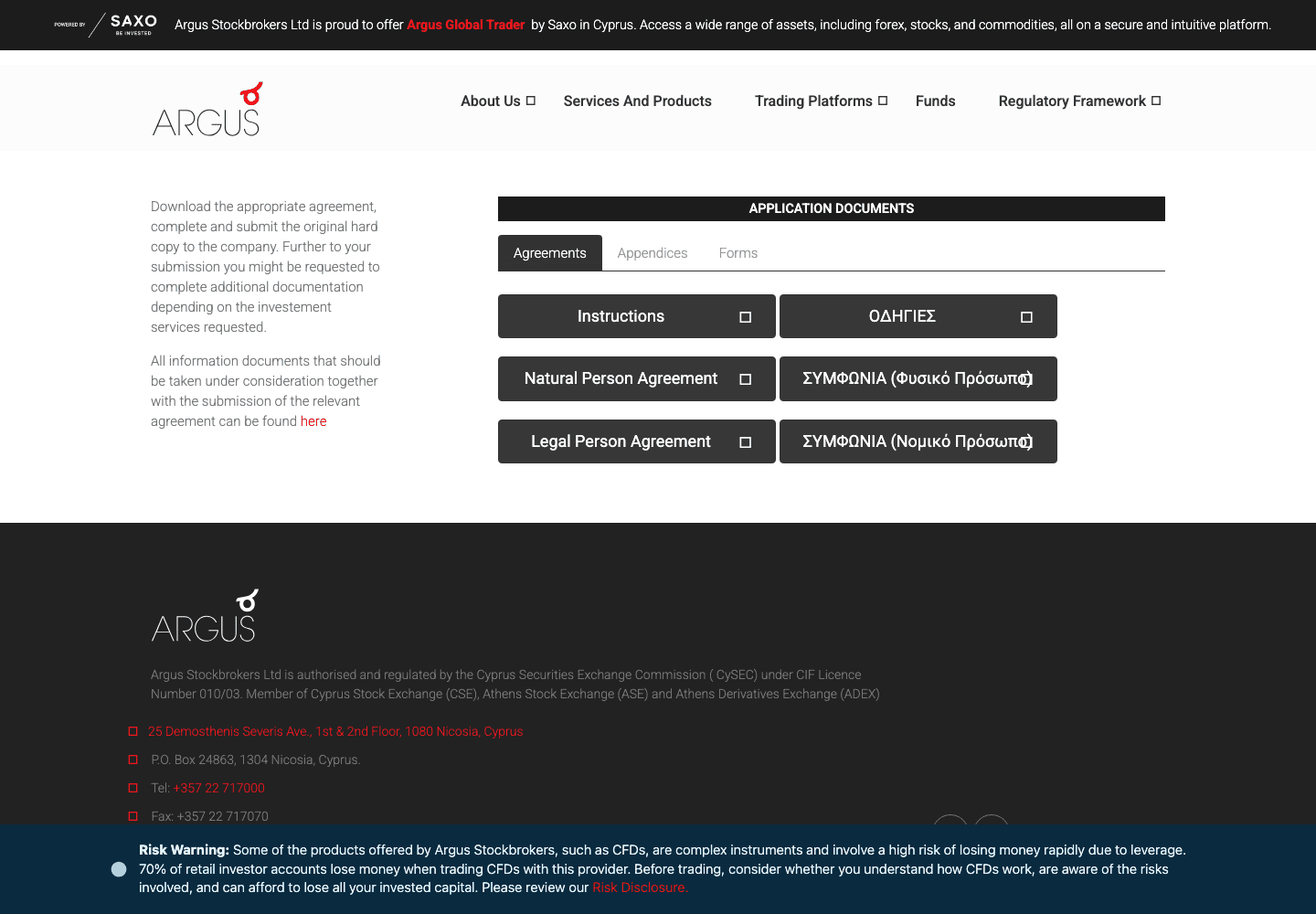
The Natural Person Agreement requires full signatures on pages 2, 12, 15, 18 and 22, with pages 3 to 8 and 14 completed by the applicant. The Legal Person Agreement requires signatures on pages 2, 14, 19, 23 and 26, with pages 3 to 9 and 15 to 17 completed. Appendix 1.1 is added where a representative acts for the client, Appendix 4 for electronic platform access, and Appendices 3 and 5 for investment advice and portfolio management respectively.
Individual applicants supply a valid identity card or passport, proof of address no more than six months old in the form of a bank statement or a utility bill for electricity, water or a landline, and a tax identification number. Corporate applicants supply certificates of incorporation, directors and secretary no more than a month old, shareholders, address and good standing, the memorandum and articles, identity documents for everyone involved, the latest financial statements, and an extract of the board minutes resolving to open the account and naming the signatories. A rubber stamp alongside the authorised signature is required for legal entities. US tax forms W-8BEN, W-8BEN-E or W-9 apply as relevant, and a politically exposed person form where applicable.
Trading Cyprus or Athens listed stock for the first time adds two more items: form CYP01 to open a SAT account and a securities account with the exchanges, and a power of attorney appointing Argus as attorney, initialled on one page and signed in full on another.
Account opening is not free, and the two published figures disagree. The fee schedule inside the MiFID II Information and Risk Disclosures gives EUR 20 for a physical person, EUR 50 for a Cypriot legal entity and EUR 60 for a foreign legal entity, plus EUR 20 stamp duties. The instruction sheet on the account opening page gives EUR 50, EUR 100 and EUR 150 for the same three categories, with the same EUR 20 stamp duty. Both documents are live on the site. Registering existing shareholdings with Argus costs EUR 5 per share code regardless of the number of shares held. Ask which figure applies before you send anything.
Deposits & Withdrawals
Argus publishes no funding page, no list of payment methods, no processing times, no minimum deposit, no withdrawal fee and no currency conversion charge. For a firm whose retail proposition includes CFDs, that is a substantial gap, and we are not filling it with estimates. What can be established comes from the legal documents, and it is about where the money sits rather than how it moves.
Client funds are deposited into special bank accounts held at authorised credit institutions under the name “clients’ account”, separate from the firm’s own money. The Pillar 3 disclosures for the 2025 financial year go further and state that segregated client money accounts hold statutory trust status, that four eyes approval is applied before any deposit or withdrawal transaction is executed, and that reconciliations between internal records and third party records are performed at regular intervals. Argus records holdings so that each client’s assets can be distinguished from those of every other client and from the firm’s own assets at any time and without delay.
Securities are a more complicated story, and here the disclosure fails. Financial instruments may be held with a third party custodian or sub custodian, potentially in an omnibus account holding assets for more than one client. Argus warns that in an omnibus arrangement the client may not be fully protected against the insolvency of the third person, that in a third country the client’s rights may differ under that jurisdiction’s law, and that Argus is not liable for the insolvency of a custodian it selected with due skill and care. The document then declines to name the custodians. The published MiFID II Information and Risk Disclosures reads: “Financial Instruments, in relation to which your orders are executed through [STATE YOUR EXECUTION BROKERS], are deposited for safekeeping with either”. A third placeholder,, sits where the omnibus account operator should be named. The same document’s contents page points to an Appendix I of execution venues and brokers that resolves to “Error! Bookmark not defined.” These are unfilled template fields in a live client disclosure, which means a client cannot tell from the document who holds their securities.
On the charges that are published, the picture is clear and cheap. Safekeeping and administration of financial instruments, including custodianship, is listed at no charge. Transfer of shares from a Global account to Argus costs EUR 5 on the CSE and EUR 20 on the ASE. Client balance printouts cost EUR 4 on the CSE and nothing on the ASE. Depositing a power of attorney costs EUR 5 on the CSE. Depositing legal documents for a Cypriot entity costs EUR 10 and for a foreign entity EUR 15. Consolidating share accounts costs EUR 5 per consolidation. Argus commits to giving at least ten calendar days’ public notice before changing its pricing.
If Argus becomes unable to return your money or instruments, the Investor Compensation Fund is the backstop, and the cap is firm. Where the sum of funds and financial instruments per client exceeds EUR 20,000, the excess is disregarded and the maximum compensation payable is EUR 20,000. Professional clients and eligible counterparties are not covered at all. Separately, the Saxo manufactured products carry Saxo’s own position: the Danish Guarantee Fund covers cash deposits at Saxo Bank A/S up to EUR 100,000 and securities losses up to EUR 20,000 per investor, though that scheme protects Saxo’s clients rather than substituting for the Cypriot fund.
Customer Support
Support at Argus is the traditional Cypriot broking model: a telephone number, an email address, a fax line and a postal address, staffed by people who expect to know the client. The main line is +357 22 717000, the dealing and order line is +357 22 717011 on recorded lines, the fax is +357 22 717070, and the email is argus@argus.com.cy. The registered office is 25 Demosthenis Severis Avenue, Metropolis Tower, 1st and 2nd Floor, 1080 Nicosia, with a post office box at 24863, 1304 Nicosia. There is no live chat, no ticketing portal and no published opening hours.
Two languages, Greek and English, and the firm says so plainly. The MiFID II disclosure states that Argus communicates with clients in Greek and English, and that because of the nature of the services the primary business language is English, so unless expressly agreed otherwise communications are likely to be in English. Set against the third countries CySEC records Argus as having notified, which include Indonesia, Malaysia, China, the Philippines, Bangladesh and the UAE, a two language desk is thin coverage for anyone outside Cyprus and Greece.
The complaints procedure is documented in more detail than most brokers manage, and it is dated 1 January 2025. A complaint is any written expression of dissatisfaction, justified or not, and can be sent by email, by post or on the firm’s complaint form, which is not mandatory. Argus commits to acknowledging receipt in writing within 48 hours and issuing a unique complaint reference number. A final response is due within eight weeks of receipt, and where that is not possible Argus must issue a holding response explaining the delay, with the final answer in any case no later than two months from receipt. Complaint records are kept for at least five years, complaints data goes to CySEC monthly, and an annual root cause analysis goes to senior management.
If the answer is unsatisfactory, the escalation route is real and it is free to the consumer. The Financial Ombudsman of the Republic of Cyprus at 13 Lord Byron Avenue, 1096 Nicosia, telephone +357 22 848900, will take a complaint where the amount does not exceed EUR 170,000, where the complaint reached the firm within fifteen months of the client becoming aware of the matter, where it is referred within four months of the firm’s final response or the date one was due, and where no court judgment or pending proceedings cover the same matter.
One routing point specific to the CFD business is easy to miss. The Key Information Documents for CFDs and FX are Saxo Bank A/S documents, and they direct complaints to Saxo Bank A/S in Hellerup, Denmark, and onward to the Danish Complaint Board of Banking Services, with the caveat that if the person selling to you is not Saxo directly you should contact them instead. For an Argus client that means Argus and the Cypriot ombudsman, but the document a client is handed at the point of sale points to Copenhagen.
One small discrepancy is worth noting on the tied agent side, since a tied agent is often the person a client actually speaks to. The Argus site lists two: Superior Investments Consultant Ltd (HE 163880, Strovolos, Nicosia, agent since 1 November 2007) and Sharelink Services Ltd (HE 415166, Paralimni, agent since 27 October 2021), both for reception and transmission of orders. The CySEC entity record for Argus lists only Superior Investments Consultant Ltd. Verify any agent you are approached by against CySEC’s own tied agents register before handing over documents.
Prohibited Countries
Argus publishes no restricted countries list, and we are not going to manufacture one. Nothing on the site, in the Terms and Conditions, in the Argus Global Trader General Business Terms or in the MiFID II Information and Risk Disclosures names a country whose residents may not open an account. The account opening pack includes US tax forms W-8BEN, W-8BEN-E and W-9, and the instruction sheet says the W-9 must be completed if the client is a US person, which implies US persons are contemplated rather than excluded.
What CySEC publishes on the firm’s register entry is a different thing, and it is routinely misread. Under the heading “Provision of Services to Countries Outside EU”, the register notes that CIFs may provide services to countries outside the EU provided they comply with that third country’s regulatory regime, and then lists, for Argus: Bangladesh, China, Egypt, Indonesia, Lebanon, Malaysia, Nigeria, Switzerland, Ukraine, the United Arab Emirates and the Philippines. That is a list of markets the firm has told its regulator it may serve, not a list of countries it refuses. Reading it as a prohibition would invert its meaning. We checked other Cypriot firms and the list varies by firm, and is absent altogether from some entries, so it is firm specific rather than boilerplate.
Within the EEA the position is a passport, not a restriction. The CySEC register records cross border services to 29 member and EEA states: Austria, Belgium, Bulgaria, Croatia, Czech Republic, Denmark, Estonia, Finland, France, Germany, Greece, Hungary, Iceland, Ireland, Italy, Latvia, Liechtenstein, Lithuania, Luxembourg, Malta, Netherlands, Norway, Poland, Portugal, Romania, Slovakia, Slovenia, Spain and Sweden.
The United Kingdom is the one country where the position is clearly closed. Argus held FCA reference 538493 as “Services (UK) of an Overseas Firm”, the standard shape of a passported EEA permission, and the FCA records it as no longer authorised with effect from 31 December 2020, the end of the Brexit transition period. Argus does not claim FCA authorisation anywhere, which is the correct behaviour, but a UK resident should understand there is no UK regulatory relationship and no Financial Services Compensation Scheme cover.
Because the firm serves clients wherever it is lawful to do so, the practical test is your own residence rather than a published blacklist. We fetched argus.com.cy from Indonesia, Thailand, Vietnam, Azerbaijan, Singapore, Japan, India, South Africa, the United Kingdom and Germany, and every one returned identical content, with no geographic gate and no alternative entity presented. Ask Argus directly whether it will onboard from your country before you complete the paperwork.
Conclusion
Argus Stockbrokers Ltd is a genuine Cyprus Investment Firm, and the things that usually go wrong in this sector do not go wrong here. CySEC licence 010/03 has run since 12 May 2003 against the same legal entity, company HE 108270, that a client signs a contract with. The regulator’s own Approved Domains list ties argus.com.cy to that entity, GLEIF independently confirms the company number and address, and there is no Seychelles, Mauritius or Vanuatu sibling waiting to take retail deposits. Fetching the site from ten countries produced identical pages carrying the same warning that 70% of retail investor accounts lose money.
The counterparty question has an unusually good answer. Argus does not hold dealing on own account, so it cannot take the other side of your CFD and profit from your loss. Its Order Execution Policy says it acts as agent for CFDs, and the Key Information Documents name Saxo Bank A/S, a Danish FSA supervised bank, as the manufacturer of the CFD and FX products. Orders that Argus cannot execute at the Cyprus or Athens exchanges go to a named list of intermediaries including Saxo, Barclays, Bank of Cyprus, Eurobank, Piraeus and Raiffeisen. That is a cleaner structure than most brands carrying a European licence.
What holds the score down is conduct and disclosure. On 10 July 2024 CySEC’s board settled with Argus for EUR 70,000 under the anti money laundering law, announced on 19 July 2024, and that follows an administrative fine published in December 2010 and a reprimand in October 2009. Three regulatory actions across sixteen years is not a pattern of client harm, but the most recent one is recent and it is not small relative to the firm’s own funds of EUR 1.262m.
The disclosure problems are more everyday and more likely to affect you. Argus publishes a precise fee schedule for Cyprus and Athens equities, 0.5% to 1% commission, a EUR 5 minimum, free custody, and publishes nothing whatever about what a CFD costs: no spread, no commission, no overnight financing rate, no minimum deposit, no withdrawal fee. Its published international markets fee grid is empty, one line of its own fee schedule reads “ARGUS Commission ……%”, and two live documents give different account opening fees. Its MiFID II disclosure still contains the placeholders [STATE YOUR EXECUTION BROKERS] and where the custody chain should be named. The Argus Global Trader terms are a Saxo template still citing MiFID I and the repealed Law 144(I)/2007, and they use principal language that does not match the permissions the firm actually holds.
Who does this suit? Someone in Cyprus or Greece who wants a licensed member of the CSE and ASE for listed equities and bonds, with free custody, a published commission band and a real named board, or an institution looking for a discretionary or advisory mandate from a firm with a 2003 licence and published Pillar 3 disclosures. Argus reads as a broker whose actual business is that, with a Saxo powered retail platform bolted alongside it.
Who does it not suit? Anyone whose main interest is CFD or FX trading on cost. You cannot compare a broker whose derivative pricing is unpublished, and you would be funding an account without knowing the spread, the financing rate or the exit cost. Trading CFDs carries a high risk of losing money rapidly through leverage, and Argus itself reports that 70% of its retail accounts do. If you go ahead, get the Commissions, Charges and Margin Schedule in writing first, because the firm’s own terms say it exists and is supplied to clients on demand rather than published.
Score history
Recomputed daily; every move is on the record. The current score is always the latest row.
| Date | Score | Move |
|---|---|---|
| 2026-09-13 | 5.1 | ▼ |
| 2026-09-12 | 5.2 | · |
FAQ
Is Argus Stockbrokers regulated and safe?
Argus Stockbrokers Ltd is authorised by the Cyprus Securities and Exchange Commission under CIF licence 010/03, dated 12 May 2003, and appears on CySEC’s current register of Cypriot Investment Firms at entity record 37709. CySEC’s List of Approved Domains records argus.com.cy against that entity, and it is not on the Former Investment Firms register. Client money sits in segregated accounts and the Investor Compensation Fund covers eligible retail claims up to EUR 20,000. The counterweight is a CySEC board decision of 10 July 2024 settling with the firm for EUR 70,000 over anti money laundering failings, plus a published fine in 2010 and a reprimand in 2009.
Is Argus the counterparty when I trade a CFD?
No. The CySEC register does not grant Argus the dealing on own account permission, which is what allows a firm to take the other side of a client trade. Argus’s own Order Execution Policy of December 2025 states that it trades as an agent on CFDs. The Key Information Documents published on the Argus site name Saxo Bank A/S, supervised by the Danish Financial Services Authority, as the manufacturer of the CFD, FX spot and FX option products, and the trading platform is branded Argus Global Trader powered by Saxo.
What does trading with Argus Stockbrokers cost?
For Cyprus Stock Exchange and Athens Stock Exchange orders the published commission is 0.5% to 1%, with a minimum contract charge of EUR 5, and safekeeping and custody at no charge. Exchange and depository fees are 0.05% on the CSE Main Market, 0.09% on other CSE markets and 0.05% on ASE shares, and sales at the ASE carry 0.2% tax. Account opening costs either EUR 20 or EUR 50 for an individual depending on which of two live documents you read, plus EUR 20 stamp duty. For CFDs and FX, Argus publishes no spread, no commission, no overnight financing rate and no minimum deposit; its terms say a Commissions, Charges and Margin Schedule is supplied on demand.
What is the maximum leverage at Argus Stockbrokers?
Argus publishes the ESMA retail limits on its Leverage Information page as initial margin percentages. Major currency pairs require 3.33% initial margin, which is 1:30 leverage. Minor pairs, major indices and gold require 5%, or 1:20. Minor indices and other commodities require 10%, or 1:10. Equities require 20%, or 1:5. Maintenance margin is half of each figure, and automatic close out begins once the account breaches 100% margin utilisation. These limits apply to retail clients; a client reclassified as professional falls outside them and also loses Investor Compensation Fund cover.
Can I open an Argus Stockbrokers account online?
No. The account opening instructions require you to download the appropriate agreement, complete it and submit the original signed hard copy to the company in Nicosia. Individuals provide identity documents, proof of address no older than six months and a tax identification number. Legal entities provide incorporation, director, shareholder, address and good standing certificates, the memorandum and articles, latest financial statements and board minutes. Trading Cyprus or Athens listed shares for the first time also requires form CYP01 to open a SAT and securities account, plus a power of attorney. Argus does not publish how long approval takes.
How this review works
Track Argus Stockbrokers Ltd live: score moves and red notices, in your pocket.