CRYPTO · CHECKED 10 OCT 2026
Bithumb review.
A Korean digital asset exchange run by Bithumb Co., Ltd., open to Korean nationals only and serving 493 markets across 480 assets.
OK-ISH
OUT OF 10
Bithumb is a Korean crypto exchange listing 493 markets across 480 assets, run by Bithumb Co., Ltd. Its KoFIU report acceptance is anti money laundering supervision and an entry gate, not a client asset licence: Korea has no prudential or client asset authorisation for exchanges at all. Custody duties come from the Virtual Asset User Protection Act instead. An external accounting firm has run agreed upon procedures over deposits and coin quantities every quarter since 2022, most recently putting ring fenced user won at 102.0% and coin at 101.6%, and a daily per asset ratio covers 511 assets. It is serving a six month partial suspension to 26 September 2026 with a 36.87bn won fine, which stops new customers moving coins and leaves existing customers unaffected, and which it has never mentioned on its own notice board. Foreign nationals cannot open an account.
Each criterion is scored 1 to 10 from primary sources. The overall score is their unweighted mean. How scoring works.
| Founded | 2014 |
|---|---|
| Headquarters | KR |
| Withdrawal fee | 1,000 KRW on the won rail; on 424 of roughly 524 asset and network rows crypto withdrawals cost 1% of the amount, not a network fee |
| Platforms | Bithumb Web, Bithumb iOS app, Bithumb Android app, Bithumb Open API 1.0, Bithumb Open API 2.0, TradingView charting library |
- An external accounting firm has counted the whole of both hot and cold wallets every quarter since 2022, and half yearly back to 2017, reporting ring fenced user won at 102.0% and member coin at 101.6% across 643 assets at 30 June 2026
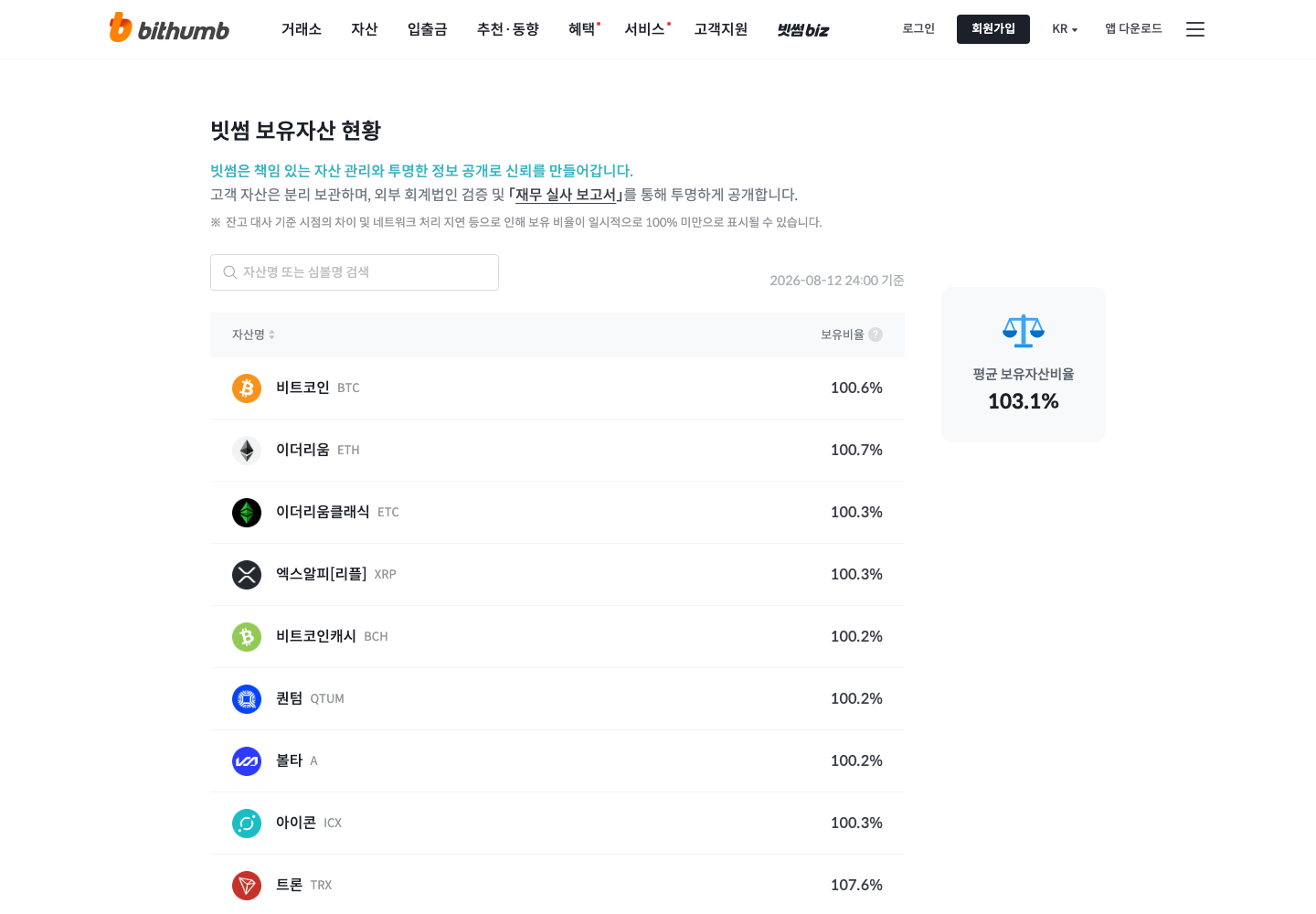
- A daily per asset holding ratio, machine readable and public, covering 511 assets at an average of 103.1% with none below 100% on 13 August 2026
- The deposit segregation clause appears in the English terms as well as the Korean, and we found no governing language clause telling an English reader the Korean prevails
- Idle won earns 2.2% a year before tax, payable quarterly or on demand once a day
- Telephone support on 1661-5566 runs 24 hours a day, 365 days a year, alongside a 24 hour KakaoTalk channel and a walk in Investor Protection Centre with published hours
- Absorbed every documented loss from company assets, including the 2018 theft, the 2019 insider incident and the February 2026 misdelivery shortfall
- Published five notices in three days on its own February 2026 error, two signed by the chief executive, with a full timeline, recovery figures and compensation above the loss
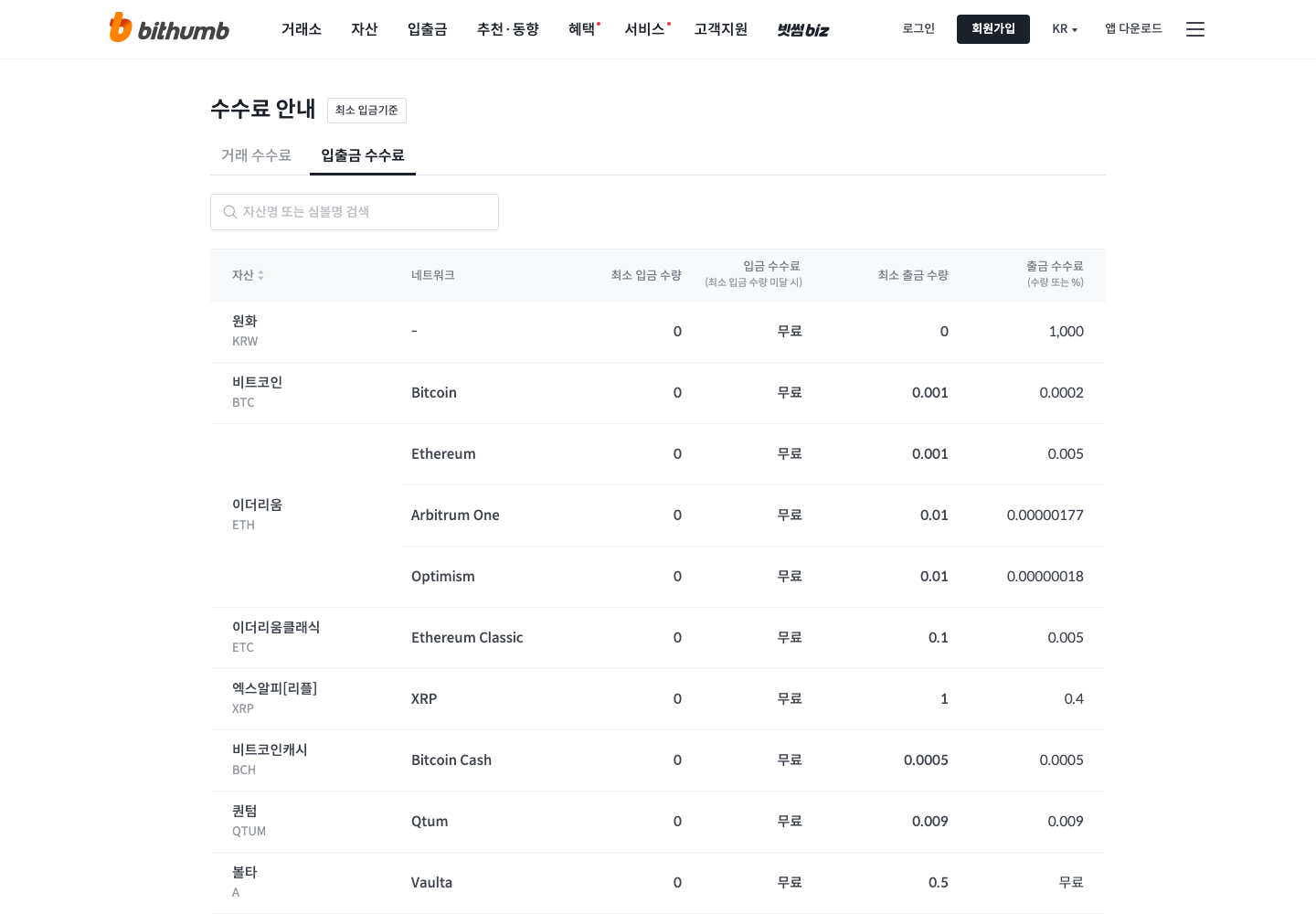
- Won deposits are free, won withdrawals cost a flat 1,000 won, coin deposits are free and transfers between Bithumb accounts are free both ways
- Caution designations are exposed as a field on the public market API, so a member's own tooling can see them without scraping a notice board
- Recorded on the KoFIU register for all five activity categories, where only 9 of the 28 providers hold 가 or 나 at all
- Serving a six month partial business suspension from 27 March to 26 September 2026, so a new customer cannot move virtual assets in or out
- Fined 36,873,500,000 won on 17 March 2026 for about 6.65 million breaches, with the regulator recording that its willingness to comply was considerably inadequate after warnings in 2022 and 2023
- Across 5,579 notices in nine years no title has ever used the words for business suspension, administrative fine, penalty surcharge, the financial intelligence unit, the privacy commission or the fair trade commission
- The quarterly engagement is agreed upon procedures, and the accountant's letter states the procedures were agreed with the company, are not audit procedures, and carry no audit opinion
- The only cold storage figure is a self reported 95.6% at 31 December 2025 in a Bithumb notice; the engagement itself publishes no cold split in any edition we examined, so nothing independent tests the statutory 80% floor
- Every money amount in the engagement is overprinted CONFIDENTIAL, and the pages carrying the accountant's assumptions and limitations are omitted from the published extract
- The advertised 0.04% fee is an opt in that lapses after 30 days, and the rate for anyone who has not applied is 0.25%
- On 424 of roughly 524 asset and network rows the withdrawal fee is one per cent of the amount withdrawn rather than a network cost
- Foreign nationals cannot register or complete verification, expressly including foreign nationals resident in Korea
- Fined 210,000,000 won by the privacy commission on 24 June 2026 for sending member numbers, order data, names and wallet addresses abroad without proper consent
Overview
Bithumb is a Korean digital asset exchange listing 493 markets across 480 assets, run by Bithumb Co., Ltd. (주식회사 빗썸) from floors 11 and 14 to 18 of the Samwon Tower at 124 Teheran-ro, Gangnam-gu, Seoul. The company was incorporated in January 2014 under the name BTC Korea.com Co., Ltd. (주식회사 비티씨코리아닷컴), traded as Bithumb Korea (빗썸코리아), and took the name Bithumb (빗썸) on 30 September 2024. On 13 August 2026 its public market API listed 493 tradable markets across 480 distinct assets, of which 480 are priced in Korean won.
Three facts shape this review, and the first is the one a reader needs before anything else. Bithumb is serving a six month partial business suspension right now. The Korea Financial Intelligence Unit ordered it on 17 March 2026, it runs from 27 March to 26 September 2026, and it comes with an administrative fine of 36,873,500,000 won. The scope matters as much as the fact, and the Financial Services Commission spelled it out in its own release: existing customers trade without any restriction, and even a new customer is stopped only from moving virtual assets in or out, while trading, exchange and won deposits and withdrawals continue as normal. So this is a real regulatory finding against the firm and a narrow one against most users, and both halves of that sentence have to survive into anything a reader is told.
The second is what Bithumb’s registration actually is. It holds a report acceptance from the Korea Financial Intelligence Unit under the Specific Financial Information Act. That is anti money laundering supervision plus the duty to run real name verified bank accounts. It is an entry gate rather than an authorisation to hold client assets, and Korea has no prudential or client asset licence for exchanges at all, so the thing a reader is usually told to look for does not exist here. The duties that actually protect assets come from a separate statute, and Licences & Custody takes that apart properly.
The third is who can open an account, which is a shorter list than at most exchanges. Bithumb’s own help centre states that foreign nationals cannot register, and puts foreign nationals resident in Korea inside that exclusion. Moving won additionally needs a real name verified account at KB Kookmin Bank specifically. Somebody reading this from London, Jakarta or Seoul on a foreign passport cannot open a Bithumb account at all.
Overview Table
| Headquarters | Seoul, South Korea (11F and 14 to 18F, 124 Teheran-ro, Gangnam-gu, Yeoksam-dong, Samwon Tower) |
| Established | 2014. DART’s company record gives 5 January 2014 and the company’s own annual report gives 6 January 2014 |
| Countries Served | South Korea only, and Korean nationals only. Foreign nationals cannot register, including foreign nationals resident in Korea |
| Regulated By | KoFIU report acceptance under the Specific Financial Information Act, certificate issued 2 December 2021, categories (a) to (e) (가 to 마). Duties under the Virtual Asset User Protection Act, which creates no licence and no register |
| Minimum Deposit | Not published as a figure. Won deposits are free and move only through a linked KB Kookmin Bank account |
| Maximum Leverage | None. Spot only. A collateralised coin lending product exists separately |
| Total Instruments | 493 markets across 480 distinct assets (480 won markets, 13 BTC markets, no USDT market) as at 13 August 2026 |
| Platforms | Web, iOS and Android apps, Open API 1.0 and 2.0, TradingView charting library, auto trading and an arbitrage tool |
| Customer Support | 1661-5566 by telephone, 24 hours a day, 365 days a year. KakaoTalk chatbot on the same hours. A walk in Investor Protection Centre in Seocho-gu, weekdays 09:00 to 19:00 |
| Languages | Korean and English on the site and in the terms. The help centre carries 371 Korean articles and no English locale at all |
| Incident history | A six month partial suspension in force until 26 September 2026 with a 36.87bn won fine, a 210m won privacy fine in June 2026, a Bitcoin misdelivery in February 2026, thefts in 2018 and 2019, and a final Supreme Court judgment over a 2017 outage. Full dated table in Deposits & Withdrawals |
Facts List
- Operator: Bithumb Co., Ltd. (주식회사 빗썸), corporate registration number 110111-5307388, business registration number 220-88-71844, chief executive Jaewon Lee (이재원).
- KoFIU report filed 9 September 2021, acceptance certificate issued 2 December 2021. The register publishes no registration number for any provider.
- Bithumb is recorded for all five activity categories, (a) to (e) (가 to 마). Only 9 of the 28 providers on the register hold (a) or (b) at all.
- Real name verified deposit and withdrawal bank: KB Kookmin Bank, and no other. It replaced NH Nonghyup Bank at 11:00 on 24 March 2025, when that contract expired.
- Won market trading fee 0.04% maker and taker, but only for members who apply, and the application lapses after 30 days. The rate for everyone else is 0.25%.
- Won deposits free, won withdrawals 1,000 won flat, crypto deposits free. On 424 of roughly 524 asset and network rows the withdrawal fee is 1% of the amount withdrawn.
- Deposit usage fee of 2.2% a year before tax on idle won, paid quarterly, with an instant payout available once a day.
- An external accounting firm has run agreed upon procedures over deposits and coin quantities every quarter since 2022, and half yearly back to 2017. At 30 June 2026 it put ring fenced user won deposits at 102.0% and member coin at 101.6% across 643 assets. The 111.8% on its summary page is a wider measure that includes the company’s own operating cash. It is not an audit and the report says so.
- Since 30 June 2026 Bithumb has published a daily per asset holding ratio. Measured on 13 August 2026 it covered 511 assets at an average of 103.1%, with none below 100%.
- Bithumb Holdings Co., Ltd. (㈜빗썸홀딩스) holds 73.56% of the operating company. Bithumb’s own filing names Jeonghun Lee (이정훈), former chairman of that holding company, as the person controlling it through a Singapore chain, and the Fair Trade Commission designated him the group’s controlling person (동일인) on 1 May 2025.
Key Takeaways
- A partial suspension is running as you read this. KoFIU ordered six months on 17 March 2026, effective 27 March to 26 September 2026. New customers cannot move virtual assets in or out during it. Existing customers are unaffected, and even new customers can still trade, exchange and move won.
- The fine attached to it is 36,873,500,000 won, for about 6.65 million breaches of the Specific Financial Information Act found in an on site inspection in March and April 2025. None of the findings are asset safety failures. They are identity checks, transaction restrictions, record keeping and suspicious transaction reports.
- Bithumb never told its own customers about any of it. Across the complete notice board, 5,579 posts from May 2017 to August 2026, no title contains the words for business suspension, administrative fine, penalty surcharge, the financial intelligence unit, the privacy commission or the fair trade commission.
- It talked openly about its own mistake. After the Bitcoin misdelivery of 6 February 2026 it posted five notices in three days, two signed by the chief executive, and paid compensation beyond the loss. The contrast with the paragraph above is the single most useful thing to know about how this firm communicates.
- The reserve engagement is agreed upon procedures, not an audit. The accountant’s own letter says the procedures were agreed with the company, that they are not audit procedures under the auditing standards, and that no audit opinion is expressed. What it does contain is unusually substantial, including a complete count of hot and cold wallets rather than a sample.
- The engagement publishes no cold storage split. The engagement’s tables carry Cold Wallet and Hot Wallet columns and the cells are blank in the 2026 editions and blacked out in the 2022 one, so the 80% cold storage floor that Korean law imposes cannot be checked against anything Bithumb publishes.
- The headline fee is not the fee most people pay. The advertised 0.04% is an opt in that expires after 30 days. The default is 0.25%, more than six times higher, and Bithumb states this on its own fee page.
- Leaving is where the pricing bites. On 424 of about 524 asset and network rows the withdrawal fee is one per cent of the amount withdrawn rather than a network cost. Major coins are priced flat and fairly.
- Foreign nationals cannot open an account, including those living in Korea. This is stricter than the Korean norm and it is stated plainly in Bithumb’s own help centre.
- Every loss on record was absorbed by the company. The 2018 theft, the 2019 insider incident and the February 2026 misdelivery shortfall were all met from company assets rather than from customer balances.
Licences & Custody
This is the section where most writing about Korean exchanges goes wrong, so it is worth being slow. There are two instruments, they do different jobs, and they are not interchangeable.
The Specific Financial Information Act requires a virtual asset service provider to file a REPORT with the Korea Financial Intelligence Unit, a body that sits inside the Financial Services Commission. Acceptance of that report is anti money laundering supervision, and it carries the duty to run real name verified bank accounts. It is not permission to hold client assets. Korea has no prudential or client asset licence for exchanges at all, so the absence of one is not a criticism of Bithumb or of any other Korean exchange, and a review that implies otherwise is inventing a standard that does not exist. Be precise about what the report acceptance is, though, because it is not nothing. Article 7 of the Act lets the unit refuse a report on substantive grounds, gives it powers of cancellation and of suspending all or part of the business, and sets a fixed term with renewal, and operating without an accepted report is a criminal offence under Article 17. One of the reported categories, category (d) (라), is safekeeping and administration. So the acceptance does gate the custody activity. What it does not do is impose any capital, client asset or solvency condition; those come from the Act below, which lays duties on everyone in scope rather than licensing anyone. We are not inferring that. The Financial Services Commission has said it in its own words, in a note of 14 September 2020 published under the heading “The Specific Financial Information Act’s provisions on virtual asset service providers are duty-imposing, not authority-granting” (특정금융정보법의 가상자산사업자 관련 규정은 권한부여가 아닌 의무부과 규정입니다), that the Act’s provisions on virtual asset service providers impose duties rather than confer authority. It was issued to correct a newspaper that had reported the opposite, and it settles the point at the source.
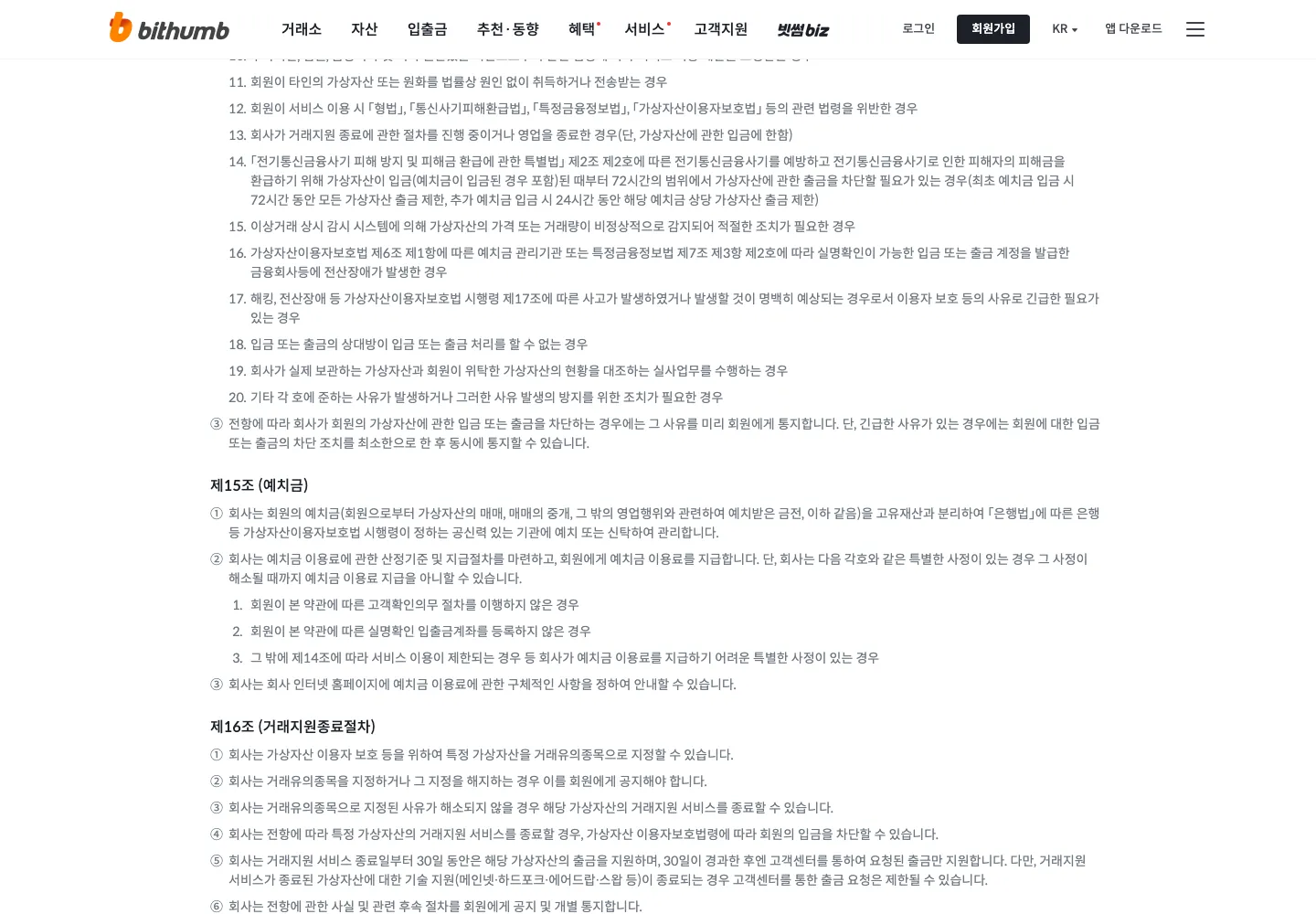
The Virtual Asset User Protection Act, in force since 19 July 2024, is where the custody duties actually live. It requires user won deposits to be deposited or entrusted with a bank at 100%, computed daily; user coins to be held one for one in kind and quantity; a cold storage floor of 80% of the economic value of user crypto, set by FSC Notice 2024-37 Article 9(1); insurance or mutual aid cover, or a reserve, of at least the greater of 5% of hot wallet value and 3 billion won; fifteen year record keeping; and continuous market abuse surveillance. That Act creates no licence and no register. There is nothing to look Bithumb up in under it, and any claim that a Korean exchange is licensed under it is wrong.
What the KoFIU register actually says
The register is published as a notice on KoFIU’s board and the data is a monthly spreadsheet attachment. The edition current at the time of writing is dated 31 July 2026 and lists 28 providers. Bithumb is row 4. Three things about that register are worth stating because they change how its entries should be read.
It carries no registration number for anybody. The columns are service name, corporate name, business registration number, reported activities, representative, address, filing date, certificate date, amendment dates, renewal date and cancellation. The only number in Bithumb’s row is 220-88-71844, which is a tax identifier and not a licence. A Korean exchange quoting a registration number on its own site is quoting a self applied label rather than anything checkable here.
It records activities by category, and this is where Bithumb differs from its larger competitor in a way that shows up nowhere else. Bithumb is recorded for category (a) through (e) (가 to 마), all five. Of the 28 providers on the register, only nine hold (a) or (b) at all. The categories are defined by Article 2(2) of the Virtual Asset User Protection Act: (a) is buying and selling virtual assets, (b) is exchanging one virtual asset for another, (c) is transferring them, (d) is safekeeping and administration, and (e) is brokering or acting as agent for (a) and (b). Holding (a) and (b) means Bithumb has reported those business types to the regulator. It does not by itself establish that Bithumb deals against its own customers on the order book, and we found nothing stating that it does. It is a difference in reported scope, and readers should treat it as exactly that.
Its renewal column is empty for Bithumb, and it would be easy to read that as a lapse. It is not one, and the register says so itself. Twelve of the 28 providers carry a renewal date and Bithumb does not; sixteen cells are empty, and the nine firms holding (a) or (b) are among them. We first took that overlap for the explanation and it does not survive checking, because the other seven empty cells belong to firms accepted from mid 2022 onwards, so the blank tracks how recently a firm was accepted at least as well as what it does. The decisive evidence is elsewhere on the same sheet. The register carries its own list of operators whose registration has expired unrenewed, unrenewed operators with expired report validity periods (신고 유효기간 만료된 미갱신 사업자), naming sixteen firms including GDAC, Probit and Huobi Korea. Bithumb is not on it, and the totals row records no cancellations at all. What we could not settle is the timing: the Enforcement Decree sets the term at three years from acceptance, Bithumb was accepted on 2 December 2021, and Flybit (플라이빗), accepted a day earlier, does carry a renewal date. So the blank cell is unexplained rather than adverse, and the operator list is what settles that Bithumb remains registered.
Licence table
| Authority | Location | License Number | Retail Services | Protection Level |
| KoFIU (금융정보분석원), a unit of the FSC | South Korea | None. The register publishes no number for any provider | Trading, exchange, transfer, custody and brokerage, categories (a) through (e) (가 to 마), for Korean nationals only | Anti money laundering supervision and the real name account duty. No client asset protection, because this instrument does not create any |
| FSC (금융위원회) under the Virtual Asset User Protection Act | South Korea | None. The Act creates no licence and no register | Not applicable. This is a duty regime, not a permission regime | Won deposits fully segregated at a bank and computed daily, coins held one for one, an 80% cold storage floor, insurance or reserve at the greater of 5% of hot wallet value and 3bn won, and market abuse surveillance |
Which entity holds the coins, by where you live
At most exchanges this table is the review, because a reader in one country contracts with an entity that publishes no regulator while the reader in another sees a top tier licence. Bithumb’s version is short, and its shortness is the finding.
| You are | Entity you contract with | Registration | Can you open an account |
| A Korean national resident in Korea | Bithumb Co., Ltd. (주식회사 빗썸) | KoFIU report acceptance, categories (a) through (e) (가 to 마) | Yes |
| A Korean national abroad | Bithumb Co., Ltd. | Same | Only if the KB Kookmin Bank verification and a Korean carrier phone can be completed |
| A foreign national resident in Korea | None | Not applicable | No. The help centre states foreign nationals cannot register or complete customer verification, and puts residents inside that exclusion |
| Anyone else, anywhere | None | Not applicable | No |
There is no offshore arm serving the rest of the world, no Seychelles or British Virgin Islands entity taking overflow, and no second brand. We searched the European Securities and Markets Authority’s interim MiCA registers for Bithumb, BTC Korea and 빗썸 and found nothing in either the authorised list or the non compliant list, against controls that returned Coinbase, Bitpanda, Kraken and Bitstamp. We searched the Monetary Authority of Singapore’s directory and got its own no result answer, against a control that returned thirteen entries for DBS. Those absences are not marks against Bithumb. An exchange that cannot onboard a non Korean has no reason to appear on either. We did not check the Thai SEC, Indonesia’s OJK, the British Virgin Islands FSC, Cayman’s CIMA or the Mauritius FSC, and nothing should be concluded from that either way.
What the segregation promise says, in both languages
Bithumb’s terms of use are on their 22nd revision, effective 29 January 2026. Article 15(1) is the deposit clause, and it reads in Korean, in full: “The Company manages member deposits (money received from a member in connection with the buying and selling of virtual assets, brokering such trading, or other business activities, hereinafter the same) by segregating them from its own assets and depositing or entrusting them with a credible institution, such as a bank under the Banking Act, as prescribed by the Enforcement Decree of the Virtual Asset User Protection Act.” (회사는 회원의 예치금(회원으로부터 가상자산의 매매, 매매의 중개, 그 밖의 영업행위와 관련하여 예치받은 금전, 이하 같음)을 고유재산과 분리하여 「은행법」에 따른 은행 등 가상자산이용자보호법 시행령이 정하는 공신력 있는 기관에 예치 또는 신탁하여 관리합니다.) The parenthesis defines the deposit as money received from the member in connection with buying and selling virtual assets, brokering such trades, or other business activity. The company segregates member deposits from its own assets and deposits or entrusts them with a credible institution prescribed by the Enforcement Decree, such as a bank under the Banking Act.
We checked the English terms against the Korean, because a translation that quietly drops a custody clause is a real and documented failure mode in this market. Bithumb’s English Article 15 carries the segregation promise in full. The English reads: “The Company shall segregate member’ deposits from its own assets, and shall deposit or entrust such funds with a reliable institution as prescribed by the Enforcement Decree of the Virtual Asset User Protection Act, such as a bank under the Banking Act.” The typographical error in “member’” is Bithumb’s. We also searched the English terms for a governing language or prevalence clause, of the kind that tells an English reader the Korean text wins, and found none. That is a better position than an English reader usually gets.
Article 13(6) adds that the company takes out insurance or mutual aid cover, or accumulates a reserve, to meet liability for incidents such as hacking and system failure. The Act requires the measure. Neither the Act nor Bithumb requires the amount to be published, and Bithumb does not publish it. So the duty is real, the compliance is unverifiable from outside, and that is a limitation of the regime rather than a concealment by the firm.
Which bank holds the money
There are two different bank questions here and they get confused constantly. The real name verified deposit and withdrawal account, through which every won moves, is at KB Kookmin Bank; Opening an Account sets out how that link is made and what it requires. Separately, the Virtual Asset User Protection Act requires user deposits to be deposited or entrusted with a bank, and Bithumb’s own site does not say which bank performs that second role. The accountant’s report does: the Executive Summary names Kookmin Bank (국민은행) against the line user deposits (이용자 예치금), and its first footnote describes the deposits as entrusted or deposited with Kookmin Bank. The same footnote lists the banks holding the company’s own operating money, which at 30 June 2026 were Nonghyup, Shinhan, Kookmin, K Bank and Mirae Asset Securities, and at 31 December 2025 were only the first three.
So the answer is KB Kookmin Bank for both roles, and it is the accountant rather than the exchange who tells you the second one. That is a genuine transparency gap, and it is worth being precise about what the real name account does and does not do. It is an identity control: won can move only between Bithumb’s account and the member’s own account at the same bank, in the member’s verified name, which defeats third party name lending and anonymous funding. It is not deposit insurance, it is not a guarantee by KB Kookmin Bank of anybody’s balance, and it says nothing at all about the coins.
Trading & Execution
Bithumb runs a central limit order book with a matching engine of its own, priced in Korean won for almost everything it lists. On 13 August 2026 there were 493 markets: 480 quoted in won, 13 quoted in Bitcoin, and none quoted in USDT. That last point is worth pausing on, because it is a structural difference from most international venues. There is no stablecoin book here. A Bithumb user’s unit of account is the won, and the only way to hold value on the exchange without price exposure is to hold won, which is why the deposit usage fee described in Accounts & Fee Tiers matters more here than it would elsewhere.
Order types
The order book supports limit and market orders, and Bithumb extended the limit order conditions on 30 June 2026, announcing on its own notice board the addition of order conditions and a best limit price type. Its help centre documents IOC, FOK and Post Only as order conditions. Post Only is the one with a direct money consequence, because the membership programme pays a maker reward and Post Only is how a member guarantees a passive fill. There is also an auto trading facility and an arbitrage tool, both promoted on the site’s own navigation, and a recurring buy.
Does the venue trade against its users
This is the question the crypto template exists to force, and the honest answer here has two parts. Bithumb is recorded on the KoFIU register for activity categories (a) (가) and (b) (나), which are buying and selling virtual assets and exchanging one virtual asset for another, alongside the brokerage category (e) (마) that its largest competitor holds. That is a broader reported scope than most Korean providers carry. What it establishes is that Bithumb has reported those business types to the regulator. What it does not establish is that Bithumb takes the other side of retail orders on its own book. We found no statement in the terms of use, the help centre or the quarterly engagement that Bithumb deals on own account against its customers, and we found no statement ruling it out either. Readers should treat the category difference as a difference in reported scope and nothing more, and we have listed the open question below rather than filling it with an inference.
One data point does bear on it indirectly. The quarterly engagement’s method paragraph states that withdrawals from the company’s wallets arise only from member withdrawals and withdrawal fees, and that the accountant counts the whole of both the hot and the cold wallet rather than sampling. That is a statement about wallet movement rather than about order book behaviour, but it is the closest thing to a control on the point that Bithumb publishes.
Margin, liquidation and forced closure
Bithumb offers no leveraged trading on the spot book. There is no margin, no futures and no perpetuals, so there is no liquidation engine on the exchange itself and no negative balance risk arising from a trade. This is the ordinary position for a Korean won exchange, because the regulatory perimeter here does not contemplate retail leverage of that kind.
What does exist is a collateralised coin lending product, marketed as coin lending (코인대여). A member posts collateral and borrows against it, which reintroduces liquidation risk through a different door. Bithumb changed the usage policy for that product on 29 June 2026 and announced the change on its notice board. Its help centre carries an article explaining why a member holding won may still be unable to add collateral, and another defining the deposit that serves as collateral. We were not able to establish the maintenance margin threshold, the liquidation trigger, the forced repayment fee or whether a shortfall after collateral is sold can be pursued against the member. Those terms sit behind an authenticated product page. A reader considering that product should treat its risk terms as unread rather than as absent, and should read them in the product itself before posting anything as collateral.
Market integrity and the caution regime
Korean law obliges an exchange to run continuous surveillance for abnormal trading, and Bithumb’s terms carry the corresponding clause at Article 13(7). The visible output is the caution designation system (거래유의종목 지정). An asset that raises concerns is designated, the designation is announced, and if the reason is not resolved the asset’s trading support is ended. Across the whole notice board there have been 84 caution designations and 153 trading support terminations. On 13 August 2026 the public market API reported 17 assets carrying a live CAUTION flag: ZIL, EGG, SNX, GRACY, WIKEN, TEMCO, JASMY, FANC, AZIT, FITFI, STAT, RVN, STORJ, ZTX, SPURS, TT and CUDIS. That flag is machine readable on the same endpoint that serves the market list, which means a member’s own tooling can see it without scraping a notice board.
When trading and withdrawals stop on purpose
Article 14 of the terms lists the grounds on which Bithumb may block deposits or withdrawals, and two are worth knowing before opening an account. One is specific to this exchange’s transparency arrangements: the case where the company is carrying out the reconciliation that compares the coins it actually holds against the coins members have entrusted (회사가 실제 보관하는 가상자산과 회원이 위탁한 가상자산의 현황을 대조하는 실사업무를 수행하는 경우). Deposits & Withdrawals sets out how often that actually happens. The other is a 72 hour withdrawal block on virtual assets after a first deposit, and 24 hours on the equivalent value after a further one, imposed to prevent telecommunications fraud under the special Act that governs it. A new member should expect their first three days to be deposit only.
Accounts & Fee Tiers
Bithumb has one account. There is no menu of account types in the sense a CFD broker means it, no minimum balance tiers to buy into and no premium product. What varies is the fee a member pays, and that is decided by two separate mechanisms that interact: an application based discount, and a membership grade earned by trading.
The headline rate, and why most people do not get it
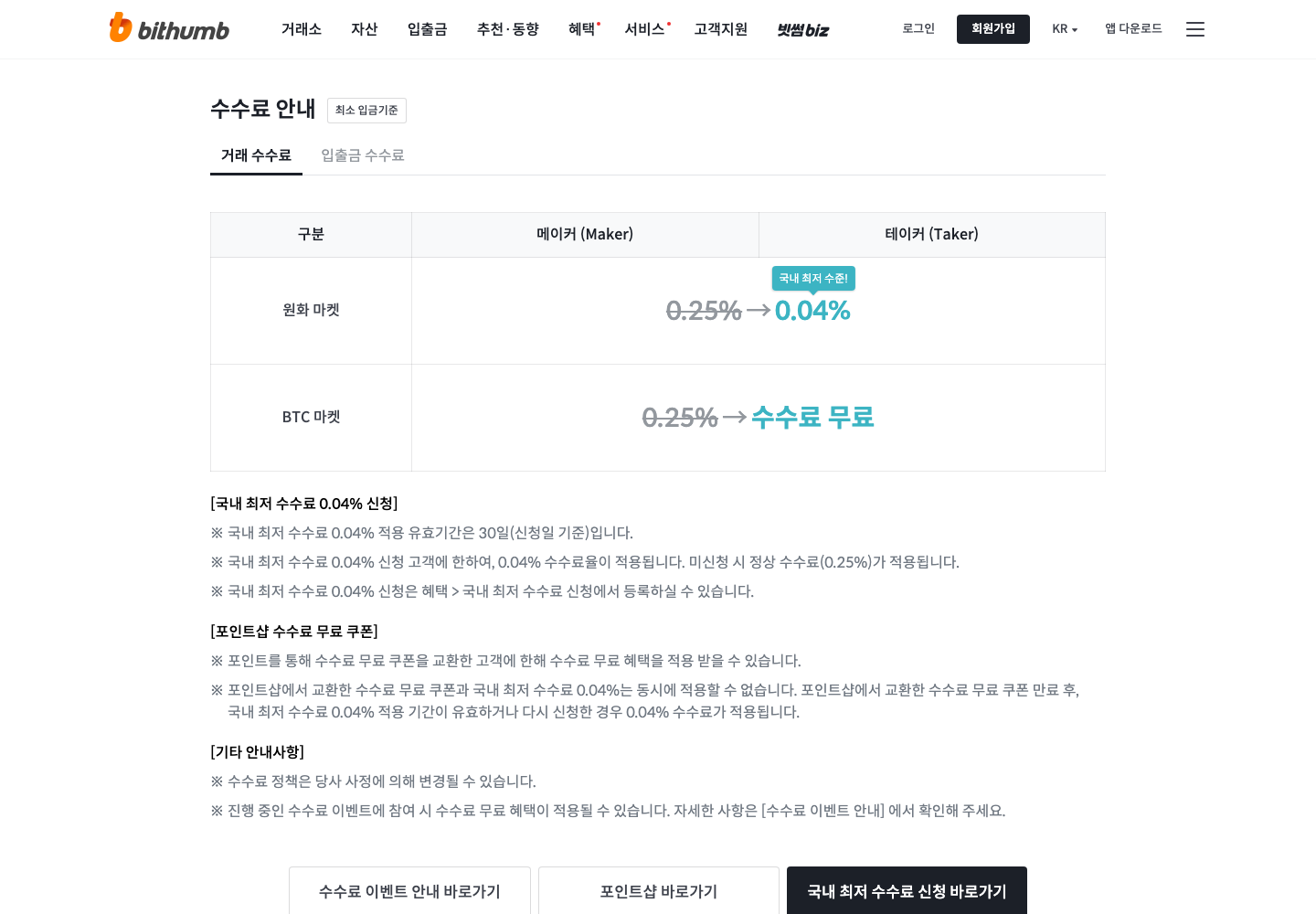
Bithumb’s fee page advertises the won market at 0.04% for both maker and taker, badged the lowest level in the country (국내 최저 수준), and the Bitcoin market at zero. Both figures are shown as reductions from 0.25%.
The 0.25% is the real default, and the 0.04% is an opt in that expires. The fee page says so in its own words, and it is worth quoting because it is the single most consequential sentence on the page: 국내 최저 수수료 0.04% 신청 고객에 한하여, 0.04% 수수료율이 적용됩니다. 미신청 시 정상 수수료(0.25%)가 적용됩니다. The 0.04% rate applies only to customers who apply for it, and the normal fee of 0.25% applies to those who do not. Directly above that: 국내 최저 수수료 0.04% 적용 유효기간은 30일(신청일 기준)입니다. The validity period is 30 days from the date of application.
So a member who signs up, funds an account and starts trading without hunting through the benefits menu pays 0.25% on both sides. A member who applies pays 0.04% for thirty days and then reverts unless they apply again. The gap is a factor of 6.25, and on a million won round trip it is the difference between 800 won and 5,000 won. Nothing here is hidden. Bithumb states the condition plainly on the page carrying the advertisement. But a price that resets to more than six times itself every thirty days unless the customer performs an action is a structure that charges inattention, and a reader should know that the number in the marketing is a number they have to keep renewing.
A separate route to zero exists through the points shop, where accumulated points can be exchanged for a fee free coupon. The coupon and the 0.04% application cannot run at the same time.
Membership grades
On top of the traded rate, Bithumb runs a six grade membership programme that pays value back rather than cutting the headline fee. The grades and their published benefits are as follows.
| Grade | Trading points | Maker reward | Total membership benefit |
| White (화이트) | 0.003% | None | 0.003% |
| Blue (블루) | 0.005% | None | 0.005% |
| Green (그린) | 0.008% | None | 0.008% |
| Purple (퍼플) | 0.01% | 0.005% | 0.015% |
| Orange (오렌지) | 0.01% | 0.008% | 0.018% |
| Black (블랙) | 0.01% | 0.01% | 0.02% |
At the top grade the combined benefit is 0.02%, which against an applied 0.04% fee is half the cost back, and against the 0.25% default is a rounding error. The programme rewards maker flow specifically at the three higher grades, which is consistent with an exchange trying to deepen its own book. Bithumb also ran a promotion from 19 March 2026 offering a 0.05% reward on maker orders, announced on the notice board, which for a period made passive trading net positive on the applied rate. Promotions of that kind rotate, and a rate that depends on one should not be treated as the standing price.
Idle won earns something, and it is not small
The Virtual Asset User Protection Act requires an exchange to place user deposits with a bank and to pass the return it receives back to users, and Bithumb pays 2.2% a year before tax. Its help centre sets out the mechanism: payment quarterly, within ten days of the start of January, April, July and October, with withholding tax deducted; or an instant payout, which a member can request once a day at any time except between 23:50 and 01:00. The instant option is the unusual part, because it turns a quarterly accrual into something a member can sweep daily.
The terms attach conditions. Article 15(2) allows Bithumb to withhold the deposit usage fee where a member has not completed customer verification, has not registered a real name verified account, or is subject to a service restriction under Article 14. So the yield is contingent on being a fully verified member in good standing, which most active members will be.
VIP and corporate
Bithumb runs a VIP matching programme that credits a member with a grade based on trading volume evidenced at another exchange, subject to document review, with thresholds published at one billion won and ten billion won of certified volume, and reserves the right to require an in person review. Corporate accounts are available, arranged by telephone through the call centre rather than online. Neither of these changes the fee structure above, and both sit behind an application.
Proof of Reserves
Bithumb publishes two separate things about its holdings, they answer different questions, and the difference between them is the whole of this section.
The quarterly engagement, and exactly what it is
Bithumb has published a financial due diligence report (재무실사보고서) on its corporate site since 2017. The series is unbroken: half yearly from the first half of 2017 to the second half of 2021, then quarterly from the first quarter of 2022 through to the second quarter of 2026, 33 entries in total. The four earliest entries, for 2014 through 2017, are a different and older series of audit reports (감사보고서).
The current engagement is an agreed upon procedures engagement, and it expresses no opinion. This catalogue enforces that distinction hard, so here is the accountant’s own language, from the letter that opens the report for the quarter ended 30 June 2026, dated 27 July 2026 and signed by Hangil Accounting Corporation (한길회계법인):
본 실사업무는 회사가 제시한 재무자료를 기초로 실사목적을 달성하기 위하여 회사와 합의된 절차에 따라 이루어졌습니다. 이러한 절차는 회계감사기준에 따른 감사절차가 아니므로 우리는 본 보고서에 포함된 내용에 대하여 감사의견을 표명하지 않습니다.
In English: the work was carried out under procedures agreed with the company, on the basis of financial data the company presented; because those procedures are not audit procedures under the auditing standards, the firm expresses no audit opinion on the contents. The next paragraph adds that had audit procedures been performed there might have been additional findings not mentioned, and that users of the report must consider the scope and limitations of the work performed. A fourth paragraph closes the letter by stating that the report is valid as at its own date, that events capable of materially affecting the result may arise between that date and the moment a reader opens it, and that differing results may appear if they do. That is the accountant saying, in its own words, that this is a photograph of one midnight rather than a running guarantee. The identical wording appears in the report for the quarter ended 31 December 2025, dated 27 January 2026, so this is standing language and not a one quarter caveat.
That is what an agreed upon procedures engagement is. The procedures are ones the client agreed in advance, no opinion and no conclusion is expressed, and the firm is not necessarily subject to the independence requirements that attach to an audit. None of that makes it worthless. It makes it a set of findings rather than an assurance, and a reader should weigh the findings on their own merits. It does mean Bithumb’s own label for it overstates it. The asset disclosure page tells members their assets are held separately and disclosed transparently through external accounting firm verification and the financial due diligence report (외부 회계법인 검증 및 「재무 실사 보고서」를 통해). Verification is a stronger word than the document supports: the accountant expressly declines to express an audit opinion on the very contents that page is pointing at.
What the procedures actually are, which is the part worth crediting
The findings here are more substantial than the label suggests, and three of the procedures are better than the norm.
The coin count is a complete count, not a sample. The method paragraph states that the accountant verified quantities by a full enumeration (전수 조사) of both the wallets connected to the exchange servers, which the report labels Hot Wallet, and the wallets held on separate storage devices not connected to any server, labelled Cold Wallet, then compared the counted quantities against the company’s database. A full count of cold storage is a meaningful exercise and many attestations do not attempt it.
The cash work rests on bank certificates, not on management representations. The accountant obtains a balance certificate from each financial institution for user deposits and for company operating money, confirms that the deposits exist and whether their use is restricted, computes a value, and reconciles it against the member won balances in the company’s database.
There is a commingling test. Separately, the accountant obtains the transaction history of the dedicated KB Kookmin Bank user deposit account for the whole quarter, draws a random sample of deposits and withdrawals, traces each sampled item to the company’s accounting records and database, and reports whether any transaction occurred between user deposits and the company’s own operating funds. For the quarter to 30 June 2026 the finding was that the movements were explained by trading fee revenue and related transactions, and that no transaction between user deposits and the company’s proprietary assets was found.
The numbers
| Quarter | As at | Report dated | Won coverage, user deposits only | Won coverage, all company cash | Coin coverage | Assets counted |
| 2026 Q2 | 30 June 2026, 24:00 | 27 July 2026 | 102.0% | 111.8% | 101.6% | 643 |
| 2025 Q4 | 31 December 2025, 24:00 | 27 January 2026 | 101.2% | 106.5% | 101.4% | 616 |
| 2022 Q1 | 31 March 2022 | Not recorded | 102.3% | 128.6% | Not published in the extract | Not published in the extract |
Two footnotes on that same page qualify both headline numbers, and neither appears in the summary Bithumb writes for members. The fourth records that deposits subject to a payment restriction exist (지급제한 예금 존재함), with the amount replaced by the CONFIDENTIAL stamp. So some undisclosed slice of that balance is not freely payable, and a reader cannot tell how large it is. The sixth records that the coin ratio is computed by applying Bithumb’s own last traded price or CoinMarketCap’s (빗썸 최종종가 혹은 코인마켓캡 가격) to each quantity. The coin coverage figure is therefore a value ratio struck partly at prices the exchange itself supplies for assets it itself lists, which matters most for the thin ones. The per unit quantity finding is the sturdier of the two, and the report states holdings exceeded the database quantity at every individual asset.
The report also disagrees with itself about how many assets it counted. Page 2 heads the coin table 643 kinds (가상자산 643 종). Page 27, and Bithumb’s own cover note in front of the same document, put the assets traded on www.bithumb.com at 465 kinds (465종). Nothing in the published pages reconciles the two. The 643 in our table above is the figure the count was struck on.
In the June 2026 report the per asset table runs to nineteen pages and names every coin with its holding ratio. Bitcoin sat at 100.66% on 47,427 coins, Ether at 100.72% on 662,953, XRP at 100.31% on 1,856,618,142, Litecoin at 101.35% and Monero at 103.25%. Every ratio we sampled across those pages was at or above 100%.
What the engagement does not tell you, which is a lot
Every money amount is redacted. The word CONFIDENTIAL is printed across the amount columns in both the deposit tables and the coin tables. The percentages survive, the absolute balances do not, and the summary page Bithumb writes for members has the surplus figure in won visibly blurred out. So a reader can see the ratios and cannot see what either number was.
And the headline ratio is not the one it looks like. This is the most important correction on this page, because the number it corrects is the one everybody quotes. The Executive Summary reports 111.8%, and the line that figure belongs to is the company’s held deposit balance (회사 보유 예금잔액). Its own table shows that line is the sum of two things: user deposits (이용자 예치금), held at KB Kookmin, and the company’s own operating money (운영자금), spread across Nonghyup, Shinhan, Kookmin, K Bank and Mirae Asset Securities. So 111.8% measures user deposits plus the company’s own cash against what the company owes members. It is not the ring fenced figure.
The ring fenced figure is published, on page 9, and it is lower. There the user deposits block alone carries 14.0% and 88.0% and totals 102.0%, while the operating expenses (운영비) block beneath it carries no ratio at all. The same page in the December 2025 edition totals 101.2% against its 106.5% headline. So user won is covered, and the margin is about two points rather than the eleven or twelve the front page implies. Anyone quoting 111.8% as the coverage of member deposits is quoting a number whose numerator contains the company’s operating cash.
No cold storage figure is published, in any edition we examined. The per asset table has a column headed company held virtual asset quantity (회사 보유 가상자산수량) divided into Cold Wallet, Hot Wallet and a subtotal. In the 2026 reports the Cold Wallet and Hot Wallet cells are blank and only the subtotal carries a number. In the 2022 report they were blacked out. The accountant counts them separately, says so in the method, and the split does not reach the reader. This matters more than it sounds, because the 80% cold storage floor in FSC Notice 2024-37 is a live statutory duty, and the only figure a reader can weigh is Bithumb’s own. Bithumb self reports 95.6% of assets in cold storage as at 31 December 2025, in a notice headlined on seven years without a security incident, and calls that about 120% of the statutory 80% floor. No accountant verifies it: the engagement counts the wallets separately and its Cold Wallet and Hot Wallet cells reach the reader blank.
The published extract omits the report’s own limitations section. The report’s table of contents lists section II, the due diligence overview (실사 개요), running from page 7 and comprising the purpose (실사 목적), the assumptions and limitations (전제조건 및 한계) and the method (실사 방법). It also lists section I, the company overview (회사의 개요), at pages 4 to 6. The 26 page images Bithumb publishes are its own cover note, the accountant’s cover, the table of contents, then report pages 1 to 3 and report pages 9 to 28. Pages 4 to 8 are not published. Bithumb’s own cover note describes what it is publishing as an excerpt (발췌), so the omission is disclosed in the sense that the word is there. The effect is that the section in which the accountant sets out the assumptions and the limits of the work is the section a member cannot read. Some method text survives inside the detailed findings, and we have quoted it above, but the standalone limitations section does not.
One consequence follows for this review specifically. A sibling engagement at another Korean exchange states that the accounting firm is not obliged to meet auditor independence requirements for that work. That statement, if Bithumb’s report contains it, would sit in the assumptions and limitations on page 7. We therefore could not check whether Bithumb’s report says the same thing. That is not found and not absent. It is not checked, because the page is not published.
The reports are page images, and Bithumb does not publish a PDF. This decides how checkable any of it is, so it is worth stating precisely. Each edition is a set of flattened raster page images, JPEG, PNG or GIF depending on the year, served at 793 by 1123 pixels from an Amazon S3 bucket and displayed inline on the page. There is no text layer of any kind, because an image has none to have. Searching the index page and all 33 edition pages for a link to a PDF returns no hits at all, and the pages carry image references and nothing else. So nothing in these reports is searchable, quotable by copy and paste, or machine checkable, and a reader who wants to confirm any figure in this section has to read it off a picture. That is what we did, and everything quoted here was read visually from those images and transcribed.
The engagement also changed hands, and we have now pinned the quarter. The report for the fourth quarter of 2022, dated 30 January 2023, carries the Crowe mark and is signed Hanul (한울회계법인). The very next edition, for the first quarter of 2023 and dated 27 April 2023, carries the Hangil Accounting Corporation (한길회계법인) mark. Every edition since has been Hangil, so the change falls at the first quarter of 2023 and the incumbent has now held the engagement for fourteen consecutive quarters. Before Hanul the work moved around a good deal more: Kreston and Daehan Accounting Corporation (대한회계법인) to 2017, then Daehyun Accounting Corporation (대현회계법인), Ihyun Accounting Corporation (이현회계법인) and Seongdo Ihyun Accounting Corporation (성도이현회계법인) through 2018 and 2019, Jeongin Accounting Corporation (정인회계법인) for the first half of 2020, and Crowe / Hanul from the second half of 2020.
The daily disclosure, which is newer and better in one respect
On 30 June 2026 Bithumb started publishing a daily holding ratio for every listed asset, on the basis of Article 7 of DAXA’s wallet operation and management best practice. The page compares the quantity members have entrusted against the quantity the company holds, aggregated at midnight Korean time each day, and Bithumb’s launch notice states that any asset showing below 99% will have the difference, its cause and the remedial action published separately on the disclosure board.
We read the underlying data directly rather than the page. As at 00:00 on 13 August 2026 it covered 511 assets, reported an average holding ratio of 103.1%, and showed a median of 100.8%, a minimum of exactly 100.0% and a maximum of 193.8%. No asset was below 100%. The 511 is worth a word, because it exceeds the 480 assets Bithumb actually lists. The daily page reports what the company custodies rather than what it trades, so it still covers assets whose markets have closed and which members can now only withdraw. That makes it the wider of the two counts, and it means the two figures in this review are not in conflict. That is a better instrument than the quarterly report in two ways: it is daily rather than quarterly, and it is machine readable rather than a picture. It is weaker in one decisive way, which is that nobody outside Bithumb verifies it. It is the company reporting on itself between the quarters when somebody counts.
It is also six weeks old. Launched on 30 June 2026 and read on 13 August 2026, there is no series behind it and no track record to test it against. The disclosure board it points to for sub 99% explanations carries seven posts in total, none of which is a shortfall explanation.
Insurance and the reserve
Article 13(6) of the terms states that Bithumb takes out insurance or mutual aid cover, or accumulates a reserve, to meet liability for incidents such as hacking and system failure. The Act sets the floor at the greater of 5% of hot wallet value and 3 billion won. Bithumb named its insurers, Hyundai Marine and Fire and Heungkuk Fire, in a notice of 15 December 2017, and has not published an amount for either that cover or the current requirement, saying only that the limit is the largest available. The Act does not require the amount to be published. Separately, and this is a commitment rather than a disclosure, its chief executive announced on 7 February 2026 a permanent customer protection fund of 100 billion won, separately deposited, to make customers whole in the event of an incident. We found no subsequent document establishing that the fund was constituted, what it holds or who controls it.
Listed Assets
On 13 August 2026 Bithumb’s public market API returned 493 markets across 480 distinct assets. The split is lopsided in a way that tells you what kind of exchange this is: 480 markets quoted in Korean won, 13 quoted in Bitcoin, and none at all quoted in a stablecoin. Nearly every asset here has exactly one pair, against the won.
That has a practical consequence for anyone used to international venues. There is no USDT book to rotate into, so moving between two altcoins means selling one to won and buying the other, paying the fee twice. It also means the exchange has no internal dollar reference, and the price of everything on it is a won price, subject to whatever premium or discount the Korean market is carrying at the time.
What is listed
The book is broad and skews to small capitalisation tokens. Alongside the majors, the deposit and withdrawal schedule lists assets across more than eighty distinct networks, including Ethereum, Solana, Tron, BNB Smart Chain, Base, Kaia, Arbitrum, Optimism, Polygon, Avalanche, Sui, Aptos, Stellar, Cardano, Cosmos, Ripple, Bitcoin, Dogecoin, Chiliz Chain and a long tail of chains that exist mainly to support one token. Staking is supported on a short list of six, and lending on a separate list.
Several listings are of specifically Korean interest and trade nowhere liquid outside the country, including Bora, Metadium, MiL.k, MediBloc, Marblex, Superwalk, dKargo, Cobak Token, Paycoin, LeisureMeta and Ahatoken. BXA, the token at the centre of the fraud prosecution described in Deposits & Withdrawals, is not among them. It has no tradable market on Bithumb. It survives only in the asset status feed, where deposits are switched off and withdrawals are still on, which is the signature of a delisted asset inside its withdrawal wind down. Forty six assets are in that state, and thirty one currencies in that feed have no market at all, so a token appearing in Bithumb’s withdrawal fee table is not evidence that it can be traded.
Who decides, and how a listing ends
Listing applications go through a separate site at listing.bithumb.com, linked from Bithumb’s own footer. Bithumb does not publish the composition of the committee that decides, its criteria or its voting, and we found no listing policy document on either the exchange or the corporate site.
Delisting is much better documented, because the terms set out a defined procedure and the notice board records every step of it. Article 16 of the terms provides that Bithumb may designate a virtual asset as an asset requiring caution (거래유의종목), must announce both the designation and any lifting of it, may end trading support if the reason for designation is not resolved, and may block deposits when it does so. It then commits to supporting withdrawals of a delisted asset for 30 days from the end of trading support, and after that to supporting withdrawals only on request through the customer centre.
That 30 day window is the number a holder of a small token needs. After it, getting the asset out becomes a support ticket rather than a button.
The record shows the process runs at volume. Across the complete notice board there are 84 caution designations and 153 trading support terminations, in a board of 5,579 posts spanning May 2017 to August 2026. On 13 August 2026, 17 assets carried a live caution flag on the public API: ZIL, EGG, SNX, GRACY, WIKEN, TEMCO, JASMY, FANC, AZIT, FITFI, STAT, RVN, STORJ, ZTX, SPURS, TT and CUDIS. Bithumb also issues a lighter notice urging caution (유의촉구), without a formal designation, which in practice often precedes one.
The useful thing here is that the caution flag is exposed on the same public endpoint that serves the market list, as a field on each market. A member’s own tooling can read it. Most exchanges bury the equivalent in a notice board.
Asset information
Bithumb’s footer links a token specification (가상자산설명서) and a Korean language white paper summary (주요내용설명서), both hosted on its feed site. These are the disclosure documents the Korean regime expects an exchange to maintain for listed assets, and their presence is a point in Bithumb’s favour. They are Korean only.
Research & Tools
Bithumb’s tooling is stronger than its documentation. There is a good deal here, and much of it is only discoverable by using the product.
Charting and order entry
Charting is the TradingView library, embedded rather than linked, which Bithumb’s own content security policy confirms by whitelisting tradingview.com for scripts and frames. That gives the standard indicator set and drawing tools inside the exchange interface. On 30 June 2026 Bithumb announced an order function upgrade adding limit order conditions and a best limit price order type, and on 23 March 2026 a usability release it described as improving the trading experience through small differences.
APIs
Two API generations run in parallel, documented at apidocs.bithumb.com and referred to throughout the site as API 1.0 and API 2.0. The public endpoints need no authentication and no key: the market list at api.bithumb.com/v1/market/all returns every market with its Korean name, English name and a market warning field, and the public ticker returns opening, closing, high, low, volume and 24 hour aggregates for every won market in a single call. We used both for this review. Bithumb ran an API trading event in late 2025 paying a connection subsidy of 100,000 won for members who issued a key and traded through it, which suggests it is actively recruiting programmatic flow.
Transparency tooling, which is the genuinely distinctive part
Two things here are better than the market norm and neither is advertised prominently. The holdings disclosure, covered in Proof of Reserves, is served by a public endpoint returning clean JSON, so a member can check the coverage of a specific coin they hold, on the day, without asking anyone. And the caution flag is a field on the market list call itself, so an asset under designation is visible to a member’s own script alongside its price.
Market data and content
The site carries a daily prices page, a market trends and recommendations section extended to desktop on 30 June 2026, an investment alerts page, and a virtual asset trend (가상자산 트렌드) feed alongside the notice board and the press room. Bithumb also publishes an insight section. The content is Korean only.
What is missing
There is no published uptime history, no status page and no service level commitment that we could find, which for an exchange with a documented outage history is a real gap. There is no English research of any kind. And the notice board, which is where the operationally important information actually lives, has no RSS feed and no public search API, though its list pages are server rendered and paginate cleanly enough that a member willing to write a script can follow it. We read all 5,579 posts that way.
Earn, Staking & Lending
The most consequential offer at any exchange is usually the one that pays a yield, because a yield has to come from somewhere and the somewhere is generally a risk the customer has taken without pricing it. Bithumb has three: the deposit usage fee on won, staking on coins, and coin lending. Only the first is unambiguously good for the customer.
Deposit usage fee, 2.2% a year
Idle won earns 2.2% a year before tax. This is not a promotion. It is the mechanism the Virtual Asset User Protection Act requires, under which an exchange must place user deposits with a bank and pass the resulting return back to users, and Bithumb’s help centre cites Article 6(1) of the Act and Article 5 of the supervisory regulation as its basis. Payment is quarterly, within ten days of the start of January, April, July and October, with tax withheld. Alternatively a member can take an instant payout, available once a day at any time except between 23:50 and 01:00.
The conditions are in Article 15(2) of the terms: Bithumb may withhold the fee where the member has not completed customer verification, has not registered a real name verified account, or is under a service restriction. This is the one yield here that carries no additional counterparty risk beyond the exchange itself, because the money is sitting at a bank under a statutory segregation duty either way.
Staking
Bithumb runs two staking products. Free staking (자유형 스테이킹) leaves the asset tradable. Fixed staking (고정형 스테이킹) pays a higher rate but locks the asset so that it cannot be traded or withdrawn until the member unstakes. Fixed staking is offered on six assets: Ether, Solana, Sei, Cosmos, Polygon Ecosystem Token and Injective. Rewards accrue daily and can be claimed daily, and rewards from fixed staking can be rolled into free staking to compound.
Two risk terms are disclosed and both are worth reading before committing anything.
Bithumb takes up to 10% of the rewards. Its help centre states that from the total rewards generated, after node operating costs are deducted, a portion of the remainder is used as an operating fee of up to 10%, and that the operating fee may be adjusted later. So the advertised reward rate is net of a variable haircut whose ceiling is published and whose actual level is not.
The unstaking wait is a market risk the member carries alone. The help centre states that unstaking periods differ by asset, that the period is set by each network’s characteristics rather than by Bithumb, and then adds the material sentence: Losses caused by price movement are not the company’s responsibility (시세 변동에 의한 손실은 회사에서 책임지지 않습니다). A member who wants out of a fixed staking position during a fall waits for the network’s queue and eats the difference.
What we could not establish is whether title to a staked asset stays with the member. We searched all 371 Korean help centre articles for ownership (소유권), and found the word in none of them, against controls in the same corpus that returned 23 articles mentioning KB Kookmin Bank, 57 mentioning fees and 24 mentioning risk. A separate staking terms document may exist behind an authenticated page. The site footer lists only the terms of use, the API terms, the privacy policy and a fixed visual data device policy, and none of those addresses it. A reader should treat the ownership position on staked assets as unread rather than as settled.
Coin lending
Coin lending (코인대여) lets a member post collateral and borrow against it. Bithumb changed its usage policy on 29 June 2026, announcing the change on the notice board, and its help centre carries articles on what the collateral deposit is and why a member holding won may still be unable to add collateral, which implies collateral eligibility rules that are not published openly. As set out in Trading & Execution, we could not reach the maintenance margin level, the liquidation trigger, any forced repayment fee, or whether Bithumb can pursue a member for a shortfall after collateral is sold. This is the product on the site with the most severe potential consequence and the least accessible documentation, and the combination is worth stating plainly.
Promotions, and how to read them
Bithumb runs promotions constantly: 938 of its 5,579 notices are categorised as events, and there is a separate fee event category on top. We are deliberately not listing the current ones, because a rotating promotion is not a term of business and quoting one dates a review the moment it changes.
What is stable enough to be worth knowing is the shape of them. Almost every promotion requires completed customer verification, a linked KB Kookmin Bank account and marketing consent, so the price of participating is a marketing opt in. Corporate accounts are commonly excluded. Rewards are frequently paid in Bitcoin at a stated conversion rather than in won, which hands the recipient price exposure they did not ask for. And several are capped per person by unique identifier, so holding more than one account does not multiply them. None of this is part of the standing price of using the exchange, and none of it should be read as such.
Opening an Account
Bithumb has the narrowest eligibility of any exchange in this category, and the restriction is not a nuance buried in the terms. It is stated in one line in the help centre.
Who cannot open an account
Foreign nationals cannot register. Bithumb’s help centre article titled Can Foreigners Register Too? (빗썸 외국인도 가입이 가능한가요?) answers: It is difficult for foreign nationals to sign up (this includes foreign residents in Korea; sign-up is not possible) (외국인은 회원가입이 어렵습니다. (국내 거주 외국인 포함 가입 불가)). Foreign nationals cannot sign up, and the parenthesis makes explicit that this includes foreign nationals resident in Korea. A second article, on whether foreign nationals can complete customer verification, gives the same answer with the same parenthesis. This is stricter than the Korean norm, and it means an expatriate living and working in Seoul with an alien registration card is excluded from Bithumb even though other Korean exchanges will verify them.
Under 19s cannot use the service. The help centre states that minors under the age of 19 cannot use Bithumb, that an existing minor account holding assets should contact the call centre, and that regardless of whether signup was possible in the past, a current minor member may use the service only after reaching adulthood. Article 5(2) of the terms carries the matching ground for refusing an application.
What signing up requires
Registration itself is short. The help centre sets out the sequence: choose signup on the web or in the app, complete mobile identity verification, agree to the personal data terms, enter an email address which becomes the login identifier, and set a password of at least eight characters combining upper and lower case letters, symbols and digits. Two prerequisites are stated flatly. A member must hold a mobile phone registered in their own name, without which registration is impossible, and must hold an email address. Bithumb warns that the registered email is difficult to change afterwards.
Registration alone gets a member nothing but a login. To trade or move money, two further steps are needed.
Customer verification, and the bank step inside it
Customer due diligence (고객확인) is required by the Specific Financial Information Act and is the gate to everything. Bithumb’s help centre carries 20 articles with the term in the title alone, which is a fair indication of how much friction sits here. Preparation includes a mobile phone in the member’s own name, an identity document, and a bank account in the member’s own name.
The step that surprises people is that the customer verification runs partly through KB Kookmin Bank rather than through Bithumb. The bank performs its own enhanced due diligence, and Bithumb’s help centre routes members into the KB Star Banking app to complete it, listing the requirements as a phone in the member’s own name, a resident registration card or driving licence, and a deposit account in the member’s own name at any bank. The bank’s own steps are mobile identity verification, customer information and enhanced due diligence, photographing the identity document, and a one won verification transfer. Errors in that process are directed to KB Kookmin Bank’s call centre on 1588-9999, not to Bithumb.
Note the asymmetry: for the identity check any bank’s account will do, but for actually moving won the account must be at KB Kookmin Bank. Bithumb states this directly, in an article headed Is Account Verification Possible Only with KB Kookmin Bank? (계좌 인증은 KB국민은행만 가능한가요?): verification can use any bank or securities account in the member’s own name, but only a KB Kookmin Bank account can be linked for won deposits and withdrawals.
Linking the bank account
The link is made by entering the account number, receiving a one won verification transfer, and authenticating with either a KB Kookmin certificate or an automated telephone call. Several restrictions apply and they cause a fair share of the failures Bithumb’s help centre documents. An account opened at any financial institution within the last 20 business days cannot be registered. Certain KB product types are ineligible, including its Naemamdaero (내맘대로) account, securities accounts, business accounts, accounts under electronic financial transaction restrictions, fixed deposits, instalment savings, subscription accounts and money market funds. A member holding a suspended KB account with a transaction limit cannot open a non face to face account until the suspended one is closed. One account per person. Accounts at other banks, securities accounts and business accounts are refused outright.
The automated verification call displays Bithumb’s customer centre number, 1661-5566, so a member with call blocking or do not disturb enabled will not receive it. Bithumb documents this specifically, which suggests it happens often.
Once linked, the account can be reset and a new one registered, but only 24 hours after the original registration completed, and won deposits and withdrawals are unavailable in the interval.
Limits
A non face to face KB account is opened as a limited transaction account, capped at one million won a day for non face to face deposits and withdrawals and three million won over the counter, and the member must apply to KB Kookmin Bank separately to lift it. Bithumb notes that its own won limits are operated separately from the bank’s, under the virtual asset real name account operating guideline (가상자산 실명계좌 운영지침), with changes in force from 1 March 2024.
One more thing a new member should expect right now
Until 26 September 2026, under the KoFIU order set out in Deposits & Withdrawals, a new customer cannot move virtual assets into or out of Bithumb. A member who opens an account this month can fund it with won and trade, but cannot deposit coins they already hold elsewhere and cannot withdraw coins to a private wallet. Bithumb has not announced this on its notice board, so a new member is unlikely to learn it from Bithumb.
Deposits & Withdrawals
The fiat side is clean and cheap. The coin side is cheap for majors and expensive in a way that is easy to miss for everything else. And the withdrawal history is the most consequential thing on this page, so it gets a dated table.
Korean won
Won moves only between Bithumb and a real name verified KB Kookmin Bank account in the member’s own name. Deposits are free and credit immediately on authentication, with the member choosing between a KB Kookmin certificate, Kakao authentication or mobile identity verification. Withdrawals cost a flat 1,000 won. Deposits and withdrawals are delayed during KB Kookmin Bank’s maintenance windows, which the help centre gives as 23:50 to 00:05 daily and, on the third Sunday of each month, 00:00 to 00:30 and 05:00 to 05:30.
A won deposit will fail if the member tries to push it from the KB banking app rather than pulling it from Bithumb’s deposit screen, if the balance is short, if the account is suspended, if the transfer mandate has been cancelled, or if a transfer limit is exceeded. A withdrawal cannot be sent to an account other than the linked one, cannot include funds committed to unfilled buy orders, and cannot be cancelled once submitted. Bithumb also operates a fraud detection system that can hold a won withdrawal for review, and documents it in its help centre.
Digital assets
Coin deposits are free across every asset and network on the schedule. Transfers between two Bithumb accounts are free in both directions. Minimum deposits are zero for almost everything, with a handful of exceptions where the network makes a floor sensible, including Enjin at 1.9999999999, Nervos at 61.99999999, Polkadot at 0.02 and Kusama at 0.001. A deposit below the stated minimum attracts a fee.
Withdrawal pricing is where this schedule needs reading rather than skimming. Major assets are priced flat and competitively: Bitcoin 0.0002, Ether 0.005 on the Ethereum network, XRP 0.4, Solana 0.009, Cardano 0.45, Tron 0.9, Stellar 0.005, BNB 0.001, and Tether on Tron free.
But on 424 of roughly 524 asset and network rows the withdrawal fee is not a flat amount at all. It is one per cent of the quantity withdrawn (출금 수량의 1%). We counted that directly in the rendered fee table on 13 August 2026. A percentage withdrawal fee is not a network cost, because network costs do not scale with the size of the transfer, and on a large position it is a serious charge: withdrawing ten million won of an affected token costs a hundred thousand won regardless of what the chain charges. The assets on flat fees are broadly the ones people hold in size, and the assets on one per cent are broadly the long tail, so most members will not meet it. Anyone holding a smaller token in quantity should check their specific row before deciding where to custody it.
Bithumb notes on the same page that withdrawal fees for some assets may change with network conditions and that some vary with the amount withdrawn.
When withdrawals stop
Four categories of halt appear in the record, and only one of them is a warning sign.
Routine per asset halts are the ordinary business of an exchange: a network upgrade, a hard fork, a token swap, a chain instability. These fill the notice board, 1,158 posts in the deposits and withdrawals category, each with a stated resumption date. They are not a red flag.
Quarterly count halts. Coin deposits and withdrawals are suspended while the external accountant counts the wallets. Fifteen such notices appear, at least quarterly from March 2024 to the most recent on 24 June 2026, and Article 14 of the terms carries the matching ground. Members lose withdrawal access for a scheduled window four times a year, which is the price of the count being a count rather than an estimate.
Regulatory halts on counterparties. Bithumb blocks transfers to specific overseas exchanges and posts when it does, most recently against an exchange named Bitcoin Xchange on 23 June 2026. This is the same duty whose breach produced the 2026 sanction.
The one that matters. From 27 March to 26 September 2026, new customers cannot move virtual assets in or out at all, because a regulator ordered it. Details below.
Incident and enforcement record
Everything in this table is separated by what kind of thing it is, because the difference between an allegation, the firm’s own statement, a regulator’s order and a court’s finding is the difference between a rumour and a fact. Nothing here is written from memory.
| Date | What | Status | Amount |
| Apr to Jul 2017 | Personal data breach. Bithumb said an employee’s personal computer was hacked and paid 100,000 won to every confirmed affected member on 5 July 2017. In 2019 it said the leak covered about 30,000 people’s names, emails and phone numbers, with no IDs or passwords, and disputed press linking it to a separate 7bn won theft | FIRM SAID | 100,000 won per member |
| 12 Dec 2017 | The Korea Communications Commission resolved a penalty surcharge and an administrative fine against BTC Korea.com Co., Ltd. (주식회사 비티씨코리아닷컴) over that breach, with a disciplinary recommendation, a corrective order, a requirement to establish measures preventing recurrence, and compulsory publication of the fact | REGULATOR ORDERED | 43,500,000 won surcharge plus 15,000,000 won fine |
| 2 Feb 2018 | Bithumb published the compelled admission, signed by its then chief executive, of four failings under the Information and Communications Network Act: neglecting intrusion prevention and detection systems, storing user personal data unencrypted on staff computers, failing to update anti malware software, and failing to log and manage copies of personal data on external media | FIRM SAID, under compulsion | Not applicable |
| 12 Nov 2017 | Outage during a price crash. Bithumb said traffic reached over 500% of average and concurrent users rose 1600% to 1700%, that service was disrupted from about 16:00 to 17:30, and that all pending orders were cancelled | FIRM SAID | Not applicable |
| 22 Jul 2020 | First instance judgment on that outage. Plaintiffs lost entirely | COURT FOUND | Nil |
| 25 Aug 2022 | Seoul High Court reversed in part against Bithumb Korea Co., Ltd. (주식회사 빗썸코리아). It rejected causation to pecuniary loss but awarded solatium to 132 of the plaintiffs | COURT FOUND | 251,388,000 won total |
| 12 Jan 2023 | The Supreme Court dismissed the appeal without hearing argument, making that judgment FINAL | COURT FOUND, final | As above |
| 19 to 20 Jun 2018 | Theft of crypto. Bithumb said about 35bn won had been taken, that the loss would be met entirely from company owned holdings, and halted all deposits and withdrawals including won. On 28 June it revised the loss to about 19bn won and compensated affected members with fee free coupons and an airdrop | FIRM SAID | About 35bn won, revised to about 19bn won |
| 29 to 30 Mar 2019 | Abnormal withdrawal of company owned crypto detected at 22:15. Bithumb said its own review judged it an insider embezzlement, asked KISA and the cyber police to investigate, and acknowledged that it had concentrated on defending against external attack and had insufficient verification of internal staff. No amount was stated | FIRM SAID | Not stated |
| 4 Apr 2018 and 13 May 2019 | The Fair Trade Commission recommended correction of an unfair liability exclusion clause, then issued a corrective order when the firm did not comply without justification. The banned clauses expressly covered server failure caused by a surge in access, the exact scenario of the 2017 outage | REGULATOR ORDERED | No fine |
| 28 Jul 2021 | The Fair Trade Commission recommended correction of 15 unfair clause types across eight virtual asset operators. Bithumb was flagged on two of them, covering amendment of the terms and unfair exclusion of liability | REGULATOR ORDERED | No fine |
| 13 Mar 2025 | The Supreme Court dismissed the prosecution’s appeal, making FINAL the acquittal of Lee Jung-hoon (이정훈), former chairman of the holding company, on aggravated fraud charges. He was acquitted at first instance on 3 January 2023 and on appeal on 18 January 2024 | COURT FOUND, final acquittal | Not applicable |
| 6 Feb 2026 | Bitcoin misdelivery. See below | FIRM SAID and REGULATOR | See below |
| 17 Mar 2026 | KoFIU partial business suspension and fine. See below | REGULATOR ORDERED, in force today | 36,873,500,000 won |
| 24 Jun 2026 | The Personal Information Protection Commission fined Bithumb and issued a corrective order for breaching the cross border transfer rules of the Personal Information Protection Act. Between September and November 2025 users of the USDT market were told their data went to an exchange named Stellar, while member numbers and order data went to a system operated by bingx.com; and transfers to 13 overseas exchanges sent names, wallet addresses and in one case a date of birth without separate consent. The split was 120m won for the order book sharing and 90m for the transfers | REGULATOR ORDERED | 210,000,000 won |
The Bitcoin misdelivery, 6 February 2026
This one is worth setting out properly because it is recent, it is large, and Bithumb’s handling of it is the strongest thing on this page.
Bithumb’s own timeline, published in a notice updated at 04:30 on 7 February: at 19:00 on 6 February an event reward was paid to 695 members with an error in the Bitcoin quantity entered; at 19:20 the error was recognised; at 19:35 trading and withdrawal blocks began on the affected accounts; at 19:40 they were complete. The mispaid quantity was 620,000 BTC, of which 618,212 BTC, or 99.7%, was recovered before it moved; 1,788 BTC had already been sold, and 93% of the resulting won and crypto was recovered. Bithumb stated that none of the mispaid Bitcoin left the exchange.
The Financial Services Commission’s account, published on 9 February, describes the same event: 695 members participating in a customer acquisition event were each paid 2,000 BTC instead of 2,000 won, with the recovered figure given as 618,214 BTC and the already sold figure as 1,786 BTC. The arithmetic in neither account closes. 695 members at 2,000 BTC each would be 1,390,000 BTC, not the 620,000 BTC both parties report, and neither source explains the gap. We are reporting both sets of published figures as published, and flagging that they do not reconcile, rather than picking one.
What followed is documented. The Financial Supervisory Service began an on site inspection at 13:00 on 7 February. At 17:34 the chief executive published a signed notice accepting responsibility, putting the estimated customer loss at around 1bn won, and committing to four remedies: enhanced asset verification before any company initiated payout, a second approval step on internal asset movements and reward payouts which he acknowledged had been partly missing, a strengthened automatic anomaly detection and blocking system, and an external security review whose results he said would be published. The same notice announced compensation: full reimbursement plus 10% to members who sold at a loss during the incident window of 19:30 to 19:45, 20,000 won to every member logged in at the time, seven days of zero trading fees for everyone, and a permanent customer protection fund of 100 billion won held on separate deposit. On 8 February a further signed notice recorded that at 22:42:52 on 7 February the shortfall from the 1,788 sold Bitcoin had been made good from company assets and that holdings again matched or exceeded member balances.
Two things to hold on to. Bithumb absorbed the loss, overcompensated, and published each step within hours. And the cause was a manual quantity entry with, on the chief executive’s own account, an approval step missing.
The KoFIU suspension, 17 March 2026, in force today
The Korea Financial Intelligence Unit inspected Bithumb on site from 17 March to 18 April 2025, held its sanctions review committee on 16 March 2026, and issued its decision on 17 March 2026. The published disclosure records the measure against the institution as a six month partial business suspension prohibiting virtual asset transfers for new customers, and an administrative fine of 36,873,500,000 won (영업일부정지 6개월(신규 고객 가상자산 이전 금지) 및 과태료 36,873,500,000원). Against individuals it records a disciplinary warning for one executive, whom the Financial Services Commission identifies as the chief executive, and against staff one six month suspension, two reprimands and two cautions. The Commission identifies the person suspended for six months as the officer responsible for suspicious transaction reporting (보고책임자). The suspension period is stated as 27 March to 26 September 2026. One qualification belongs with the fine figure. The Commission’s release of the same day says the unit would serve advance notice of the penalty, allow at least ten days for representations, and then fix the final amount in light of them, so 36,873,500,000 won is the amount decided on 17 March and published in the sanctions disclosure rather than a figure we can show was never varied afterwards. The day before, the Commission had publicly rebutted a broadcast report of a fine in the 37bn won range with a statement that no amount had been determined at all. We found no later document settling the point either way.
What it covers is narrower than the phrase suggests, and the Financial Services Commission is the only source that spells it out. Its release states: Existing customers can trade without restriction; for new customers only external virtual asset transfers are temporarily restricted, while trading, exchange and won deposits and withdrawals remain available without restriction (기존 고객은 제한없이 거래 가능하며, 신규 고객의 경우에도 외부 가상자산 이전(입출고)만 한시적으로 제한될 뿐, 가상자산 매매·교환, 원화 입출금 등은 제한없이 가능).
The findings behind it total about 6.65 million breaches. The item the suspension itself was imposed for, named in the disclosure as the grounds for the measure (조치사유), is that between 28 August 2022 and 3 April 2025 Bithumb supported 45,772 virtual asset transfer transactions with 18 overseas providers that had not filed the report the Act requires. By count that is one of the smaller findings; it is the one that carried the trading restriction. The Financial Services Commission recorded that it had repeatedly asked reporting operators to stop dealing with unreported operators, in written notices in August 2022, July 2023 and December 2023, had published a full business suspension imposed on another operator for the same breach in September 2023, and concluded that Bithumb’s willingness to comply was considerably inadequate (상당히 미흡). The remaining findings are customer due diligence failures of about 3.55 million and transaction restriction failures of about 3.04 million, including 1,777,032 driving licence checks performed without the security serial number and 1,042,484 cases where customers reassessed as high risk were allowed to keep trading; 16,361 identity document copies not retained; and two unreported suspicious transactions. A separate order the same day required improvement after suspicious transaction reports on 117 customers subject to search and seizure warrants were filed between two and 28 months late.
None of these findings is an asset safety failure. They are identity, transaction restriction, record keeping and reporting failures. That distinction matters for a reader deciding whether their coins are at risk, and it cuts in Bithumb’s favour. It does not make the order small.
One status point. The Financial Services Commission release states that the fine was issued as a pre notification with at least ten days for representations before the amount would be finalised. The KoFIU disclosure the following day carries the precise figure of 36,873,500,000 won. We found no source establishing whether the fine was contested, adjusted or paid, and this review does not assert that it was any of those things.
Customer Support
Bithumb’s support channels are among the most generous available anywhere, and its record of telling customers things they would rather not hear is among the worst. Both halves are documented, and a reader needs both.
Channels
The telephone line, 1661-5566, runs 24 hours a day, 365 days a year. That is stated in the site footer in both Korean and English, and confirmed in the structured organisation data Bithumb publishes for search engines. A 24 hour KakaoTalk chatbot runs on the same schedule under the handle @Bithumb (@빗썸). There is a 1:1 ticket system. There is a proof issuance centre for balance certificates, transaction statements and withholding tax receipts, available to corporate as well as individual members.
There is a physical office a member can walk into. The Investor Protection Centre occupies the ground floor of 343 Gangnam-daero in Seocho-gu, Seoul, open weekdays from 09:00 to 19:00 and closed at weekends and on public holidays. The help centre carries an article specifically on whether face to face consultation is available. For an exchange, a published street address with staffed hours is unusual and worth crediting.
What is not published is a general support email. The only addresses in the footer are partnership@bithumbcorp.com for partnerships and whistle@bithumbcorp.com for whistleblowing, and neither is a retail support channel. A member who wants a written record has the 1:1 ticket and nothing else.
Languages
The site and the terms of use are available in Korean and English, and the English terms are a genuine translation rather than a summary. The help centre is not. Its API reports exactly one locale, ko, and the English article count is zero, against 371 Korean articles across six categories. Telephone support is Korean.
Ordinarily that would be a significant mark against a firm. Here it is close to irrelevant, because Bithumb does not accept foreign nationals as members at all. The people it serves read Korean. It is worth noting mainly because the English site and English terms may lead an English speaker to believe they can open an account, and they cannot.
Incident response, which is where this criterion earns its weight
On its own failures, Bithumb’s communication is fast, specific and senior. In the February 2026 misdelivery it detected the error in 20 minutes, blocked the affected accounts within 40, and published its first notice at 00:23 the same night, an updated one with a full timeline and recovery figures at 04:30, a signed chief executive notice with the compensation package at 17:34 the next afternoon, and a further signed notice confirming reconciliation two days later. Five notices in three days, two over the chief executive’s name, with numbers in them. It also published a warning about phishing that exploited the compensation scheme, four days after the event. In 2018 it published its theft notice the morning after, revised the loss figure publicly when the estimate changed, and named the agencies it was cooperating with. In 2019 it disclosed a suspected insider embezzlement in its own words and admitted its internal controls had been the weaker side.
And then the other half
We collected Bithumb’s complete notice board: 5,579 posts, matching the board’s own declared total exactly, with no failed pages, spanning 18 May 2017 to 12 August 2026. Then we searched every title.
The following words appear in no title, ever: business suspension (영업정지 and 일부정지 and 영업일부정지), administrative fine (과태료), penalty surcharge (과징금), the financial intelligence unit (금융정보분석원 and FIU), administrative disposition (행정처분), notification of measures (조치 통보), comprehensive inspection (종합검사), inspection result (검사 결과), money laundering (자금세탁), the privacy commission (개인정보보호위원회), and the fair trade commission (공정거래위원회).
These searches work. The same corpus returns 221 titles containing maintenance (점검), 1,318 containing event (이벤트), 513 containing Bithumb (빗썸), 107 containing Bitcoin (비트코인), 163 containing trading support (거래지원) and one containing misdelivery (오지급), so a null result here is a fact about the board and not about our instrument.
Two words return exactly one hit each, and both prove the point rather than softening it. Sanction (제재) returns a 2022 notice about blocking IP addresses in connection with sanctions on Russia, which is a sanction by Korea on somebody else. Corrective order (시정명령) returns the notice of 2 February 2018 publishing the fact that the Korea Communications Commission had ordered it to, which is the one time Bithumb announced a sanction against itself, and it did so because a regulator compelled it.
The windows make it concrete. In the three days after its own error in February 2026 the board carried five notices about it. In the eighteen days spanning the sanctions committee, the decision and the start of the suspension, from 16 March to 2 April 2026, the board carried 44 notices about airdrops, market additions, network maintenance, caution designations and a usability release, and nothing about the suspension that began on 27 March. On 24 June 2026, the day the privacy commission fined it 210 million won, the board carried a notice headed Bithumb, #1 in Customer Satisfaction Index (KCSI): We Will Continue to Hold the Position of Korea’s Leading Exchange (고객만족도(KCSI) 1위 빗썸, 대한민국 대표 거래소의 자리를 이어나가겠습니다), announcing that Bithumb had placed first in a customer satisfaction survey. We are stating the dates, not a motive.
The practical consequence is specific and current. A person who opens a Bithumb account today cannot move coins in or out, and will find no explanation of why on Bithumb’s own notice board. They would have to read the Financial Services Commission’s press releases to find out.
Restricted Countries
Bithumb does not publish a list of restricted countries, and for once that is not an omission. The reason is that its access rule works the other way round from most exchanges: rather than serving the world and carving out exceptions, it serves one nationality and excludes everyone else.
The rule, in Bithumb’s own words
Two help centre articles carry it, and Opening an Account quotes them in full. In short: foreign nationals cannot register and cannot complete customer verification, and both articles put foreign nationals resident in Korea inside the exclusion. Since verification is the gate to trading and to moving money, the exclusion is complete rather than partial.
The terms reinforce it from a second direction. Article 5(2) allows Bithumb to refuse or defer an application from a person under 19, from someone not using their real name or using another person’s identity, or where the application details are false or incomplete. Article 14(2) allows Bithumb to restrict login, trading, deposits, withdrawals, custody and additional services where a member is a minor or a non resident foreign national (비거주외국인).
Sanctions screening
Article 6 of the terms is the customer due diligence clause, and its second paragraph gives Bithumb the right to refuse virtual asset services where a member is a national or resident of a country designated by bodies including the Financial Action Task Force and the United States Office of Foreign Assets Control, or is otherwise a sanctioned person or subject to financial transaction restrictions. Bithumb does not publish the resulting country list, and the clause points at external designations rather than at a list of its own. Its one visible action of this kind was a notice on 3 March 2022 announcing IP blocking and related measures in connection with sanctions on Russia.
What this means for a reader outside Korea
If you are not a Korean national, Bithumb is not available to you, and no amount of documentation changes that. The English language site and English terms of use are real, but they do not indicate that a non Korean can become a customer. If you encounter a site or an application offering Bithumb accounts to non Koreans, treat that as a strong signal it is not Bithumb.
There is one further restriction that is not geographic but has the same practical effect for new members anywhere. Under the KoFIU order of 17 March 2026, from 27 March to 26 September 2026 new customers cannot transfer virtual assets into or out of Bithumb. That is a restriction by customer vintage rather than by country, it is temporary, and it is set out in Deposits & Withdrawals.
Conclusion
Bithumb is a real exchange with a real supervisor, a twelve year operating history, an unbroken series of external engagements over its holdings going back to 2017, and a habit of paying for its own mistakes out of its own pocket. It is also, on the day this was written, serving a six month partial business suspension imposed by its regulator alongside a fine of 36,873,500,000 won, and it has told its own customers nothing about either.
Take the good first, because it is substantial and it is easy to lose behind the enforcement. The quarterly engagement is agreed upon procedures rather than an audit, and the accountant says so on the face of the report in terms this review has quoted in full. But within that limit the procedures are better than most: a complete count of both hot and cold wallets rather than a sample, bank balance certificates obtained institution by institution with a check on whether the deposits are restricted, and a sampled test for commingling between user deposits and company money that found none. At 30 June 2026 it put ring fenced user won deposits at 102.0% and member coin at 101.6% across 643 assets, the more widely quoted 111.8% being a measure that also counts the company’s own operating cash. Since 30 June 2026 Bithumb has also published a daily per asset holding ratio which on 13 August 2026 covered 511 assets with none below 100%, and which is served as clean machine readable data rather than as a picture. The deposit segregation clause is in the terms in Korean and in English, with no governing language escape hatch. Idle won earns 2.2% a year with a daily payout option. Telephone support runs around the clock and there is an office in Seoul a member can walk into.
Now the costs. The advertised 0.04% fee is an opt in that expires after thirty days, and the rate for anyone who has not applied is 0.25%, which Bithumb states plainly on the same page as the advertisement. On 424 of about 524 asset and network rows the withdrawal fee is one per cent of the amount withdrawn rather than a network cost. The engagement publishes no cold storage split in any edition we examined, so the only figure touching the 80% floor is Bithumb’s own self reported 95.6%. Every money amount in those reports is redacted, and the pages carrying the accountant’s own statement of assumptions and limitations are not published at all. The insurance or reserve amount is never disclosed. And foreign nationals cannot open an account, including those living in Korea.
Then there is the enforcement record, where the distinctions matter more than the totals. The 2026 suspension and fine and the 2026 privacy fine were ORDERED by regulators, and the suspension is in force as this is written, though its scope is narrow and none of its findings concerned the safety of customer assets. Whether either fine was contested, adjusted or paid is not established and this review does not claim it. The 2017 outage case is the only matter a court has FINALLY decided against the company, and what it decided was solatium of 251,388,000 won to 132 plaintiffs with the claim for actual financial loss rejected. The most serious criminal allegation touching the group ended in an acquittal made FINAL by the Supreme Court in March 2025. Keeping those apart is the difference between describing this firm accurately and libelling it.
The single most useful thing we found is not any one of those items. It is the contrast set out in Customer Support: this is a firm that talks freely, fast and at chief executive level about what it did wrong, and has never once in nine years and 5,579 notices used the words for business suspension, administrative fine or penalty surcharge in a title.
Bithumb suits a Korean national who wants deep won liquidity across a very wide listing book, a genuinely good daily transparency tool, 2.2% on cash, and who will take thirty seconds every month to reapply for the fee discount. It does not suit anyone outside Korea, who cannot open an account regardless of what the English site suggests. It does not suit somebody opening an account before 26 September 2026 who needs to move coins in from another venue or out to a private wallet. And it does not suit anybody, Korean or not, who is holding a large balance on the assumption that a regulator, an insurer or a compensation scheme stands behind those coins. On the evidence, what stands behind them is Bithumb Co., Ltd., an unlisted company 73.56% owned by a holding company, controlled through a Singapore chain by a former chairman whom the Fair Trade Commission has designated the group’s controlling person, and now aiming at a stock market listing in 2028 after the 2026 attempt did not happen.
FAQ
Is Bithumb regulated and safe?
Bithumb is supervised, but not in the way the word licensed usually implies, and its supervisor has an active restriction on it right now. Its operator 주식회사 빗썸 holds a report acceptance from the Korea Financial Intelligence Unit under the Specific Financial Information Act, filed on 9 September 2021 with the certificate issued on 2 December 2021, covering all five activity categories 가 to 마. That is anti money laundering supervision and an entry gate rather than a client asset licence. Korea has no prudential or client asset authorisation for exchanges at all, so the absence of one is not a criticism of Bithumb. The duties that protect assets come from the Virtual Asset User Protection Act: user won deposits placed with a bank at 100% and computed daily, coins held one for one, at least 80% of user crypto held offline, insurance or a reserve of at least the greater of 5% of hot wallet value and 3 billion won, and market abuse surveillance. That Act creates no licence and no register, so there is nothing to look Bithumb up in under it. Since 2017 Bithumb has commissioned an external accounting firm to run procedures over its holdings, quarterly since 2022, most recently reporting ring fenced user won deposits at 102.0% and member coin at 101.6% across 643 assets at 30 June 2026, the headline 111.8% on its summary page being user deposits plus the company’s own operating cash. That engagement is agreed upon procedures and not an audit; the accountant’s letter states the procedures were agreed with the company, are not audit procedures under the auditing standards, and that no audit opinion is expressed. Within that limit the procedures are strong, including a complete count of both hot and cold wallets. Bithumb also publishes a daily per asset holding ratio which on 13 August 2026 covered 511 assets with none below 100%. Its only cold storage figure is a self reported 95.6% at 31 December 2025, which no accountant verifies, and it does not publish the insurance or reserve amount. On 17 March 2026 the Korea Financial Intelligence Unit fined it 36,873,500,000 won and imposed a six month partial business suspension running to 26 September 2026, for about 6.65 million anti money laundering breaches. None of those findings concerned the safety of customer assets.
What does the Bithumb suspension mean for me?
It depends entirely on whether you are already a customer. The Korea Financial Intelligence Unit ordered a six month partial business suspension on 17 March 2026, running from 27 March to 26 September 2026. The Financial Services Commission stated the scope in its own release: existing customers can trade without restriction, and for new customers only external virtual asset transfers are temporarily restricted, while buying, selling, exchanging and won deposits and withdrawals remain available without restriction. So if you had an account before 27 March 2026, nothing about your account changed. If you open one now, you can fund it with won, trade, and withdraw won to your bank, but you cannot deposit coins from another exchange or wallet and you cannot withdraw coins out, until 26 September 2026. The order was for breaching the ban on dealing with unreported virtual asset providers, among other anti money laundering failures, and none of the findings concerned customer asset safety. Bithumb has not announced any of this on its own notice board, so if you want to confirm it you will need to read the Financial Services Commission’s or the Korea Financial Intelligence Unit’s own publications rather than Bithumb’s.
Can I use Bithumb if I am not Korean?
No. Bithumb’s help centre states in two separate articles that foreign nationals cannot register and cannot complete customer verification, and both add explicitly that this includes foreign nationals resident in Korea. Since customer verification is the gate to trading and to moving any money, and since won can only move through a real name verified account at KB Kookmin Bank held in the member’s own name, the exclusion is complete rather than partial. There is no reduced tier and no workaround. This is stricter than other Korean exchanges, some of which will verify a foreign resident holding an alien registration card. Bithumb does operate an English version of its site and a full English translation of its terms of use, which can give a misleading impression, but neither indicates that a non Korean can become a customer. If you find a site or app offering Bithumb accounts to non Koreans, treat that as a strong signal that it is not Bithumb.
What does it cost to trade on Bithumb?
The advertised rate is 0.04% for both maker and taker on the won market and zero on the Bitcoin market, but that is not the rate most people pay. Bithumb’s own fee page states that the 0.04% applies only to customers who apply for it, that the normal fee of 0.25% applies to those who do not, and that the application is valid for 30 days from the date it is made. So the default is 0.25%, more than six times the advertised figure, and the discount has to be renewed every month. A membership programme pays back between 0.003% and 0.02% depending on grade, combining trading points with a maker reward at the three higher grades. On the money side, won deposits are free, won withdrawals cost a flat 1,000 won, coin deposits are free, and transfers between two Bithumb accounts are free both ways. Coin withdrawal fees need checking asset by asset: major assets are priced flat and competitively, with Bitcoin at 0.0002, Ether at 0.005, XRP at 0.4, Solana at 0.009 and Tether on Tron free, but on 424 of roughly 524 asset and network rows the fee is one per cent of the quantity withdrawn rather than a flat network cost. Idle won earns a deposit usage fee of 2.2% a year before tax, paid quarterly or on demand once a day.
Has Bithumb ever lost customer money?
It has had losses, and on the record every one was absorbed by the company rather than by customers. In June 2018 it said about 35 billion won of crypto had been stolen and that the loss would be met entirely from company owned holdings, revising the figure to about 19 billion won eight days later and compensating affected members with fee free coupons and an airdrop. In March 2019 it disclosed an abnormal withdrawal of company owned crypto which its own review judged to be an insider embezzlement, and did not state an amount. In February 2026 an event reward was paid in Bitcoin instead of won to 695 members; Bithumb reported 620,000 BTC mispaid, 618,212 recovered before it moved, and 1,788 already sold, and made the shortfall good from company assets by the evening of 7 February. It also paid compensation beyond the loss, including full reimbursement plus ten per cent to members who sold at a loss during the incident, 20,000 won to every member logged in at the time, and seven days of zero fees. The published figures in that last incident do not reconcile arithmetically in either Bithumb’s account or the regulator’s, and neither explains the gap. Separately, a 2017 outage produced litigation that the Supreme Court finalised in January 2023, in which the claim for actual financial loss was rejected and solatium of 251,388,000 won was awarded to 132 plaintiffs.
How this review works
Track Bithumb live: score moves and red notices, in your pocket.