
CFD · CHECKED 10 OCT 2026
Blackbull Markets review.
Seychelles-regulated CFD broker offering multi-platform trading at low spreads
OK-ISH
OUT OF 10
AD DISCLOSURE: IF YOU OPEN AN ACCOUNT THROUGH THIS LINK WE MAY EARN A COMMISSION. IT NEVER MOVES THE SCORE. HOW THIS WORKS
Blackbull Markets is a CFD broker trading through BBG Limited, a Seychelles-regulated securities dealer whose FSA authorisation (SD045) is confirmed on the register though the number itself isn't published there. Its New Zealand FSP entry is only a registry listing, not a trading licence, and Seychelles' regime offers no compensation scheme, ombudsman, leverage cap, or negative balance protection.
Each criterion is scored 1 to 10 from primary sources. The overall score is their unweighted mean. How scoring works.
| Founded | 2014 |
|---|---|
| Headquarters | NZ |
| Minimum deposit | $0 (ECN accounts) or $50 (Standard) |
| Maximum leverage | 500:1 |
| Withdrawal fee | 5 |
| Account opening | 1-3 |
| Platforms | MetaTrader 4 (MT4), MetaTrader 5 (MT5), MetaTrader Web Trader, cTrader, TradingView, BlackBull CopyTrader, BlackBull Invest, BlackBull Client Portal App |
- Regulated in Seychelles by the FSA, entity BBG Limited, confirmed on the register
- Spreads from USD 6.00 round turn per lot on EURUSD on the ECN Prime account
- Minimum deposit of USD 0
- Offers MT4, MT5, cTrader, TradingView, CopyTrader, and BlackBull Invest
- Support by email, live chat, and phone, in the client's own language, 24/7
- Blended rating of 4.61 stars across 4071 reviews
- Seychelles FSA licence number SD045 is not published on the register itself
- Seychelles FSA regime has no compensation scheme, ombudsman, or leverage cap
- No negative balance protection requirement under Seychelles FSA
- NZ FSP403326 is only a registry entry, not a trading licence
- Earlier FMA 'Full License/Tier-1' claim isn't backed by the firm's current pages
- Support escalation path depends on which entity onboarded the client
Overview
TrueBroker is a free broker safety checker, and this page is our review of Blackbull Markets, scored 7.4 out of 10 across regulation, fees, platform, support and reviews. Our previous review scored this broker 6.7 out of 10. That earlier figure and this one come from different criteria and different evidence pulled at different times, so the move is our assessment being restated, not a change in the firm. This review’s fees score of 9 and platform score of 9.5 rest on the account tables and platform list we read directly from the firm’s own root page, evidence the earlier review did not carry in the same form.
Who operates Blackbull Markets
The firm’s own about page names three entities behind the Blackbull Markets brand. Black Bull Group Limited is the New Zealand operating entity. BBG Limited is the Seychelles regulated entity. Black Bull Trade Limited handles share investing and excludes CFDs, according to the firm’s legal page. The legal page states plainly that “there are regional differences in our legal documentation” and that “the documentation that applies to your account will be made clear during the application process”, with separate document sets listed for the New Zealand, Seychelles and Share Investing entities. That means which entity signs a client up, and which protections follow, depends on the onboarding path rather than one shared contract.
What the registers show for Blackbull Markets
We searched four public registers directly, plus a positive control on five registers to confirm our search method finds a firm known to be listed before we trust any absence. The Seychelles FSA register lists BBG Limited, trading as Black Bull Markets 4376183, as a regulated securities dealer, confirming the firm’s SD045 claim as far as the entity goes; the FSA register does not itself publish licence numbers, so SD045 remains the firm’s own claim rather than something we read off the register. The Seychelles company registry confirms BBG Limited under registration C857010 (the firm prints this as 857010 dash 1), though that registry is a company record, not a financial regulator, so it confirms the company exists and nothing about a licence.
The New Zealand Financial Service Providers Register tells a different story for the two NZ entities. Black Bull Group Limited appears as FSP403326, trading as Blackbull Markets, registered 12 October 2014, with registered services limited to changing foreign currency and client money or property service. Black Bull Trade Limited appears as FSP1002113, registered 15 November 2021, with the same category of registered services. Neither entry lists a licensed service, so the register records no FMA licence for either company. Registration on the FSPR is not regulation by the FMA. We could not search the FMA’s own licence records directly; that is a gap in our fetch, not a finding about the firm. Our earlier review had described a “Full License” and “Tier-1” FMA status; we found no page in our evidence stating that in the firm’s own words, so we are not carrying that description forward as a firm claim.
We also searched 1441 warning list entries mirrored from CYSEC, the FCA and the FSC Mauritius, and Blackbull Markets appears on none of them. That is a real finding within the scope of those three lists, not a clearance against every regulator worldwide.
Fees and account structure at Blackbull Markets
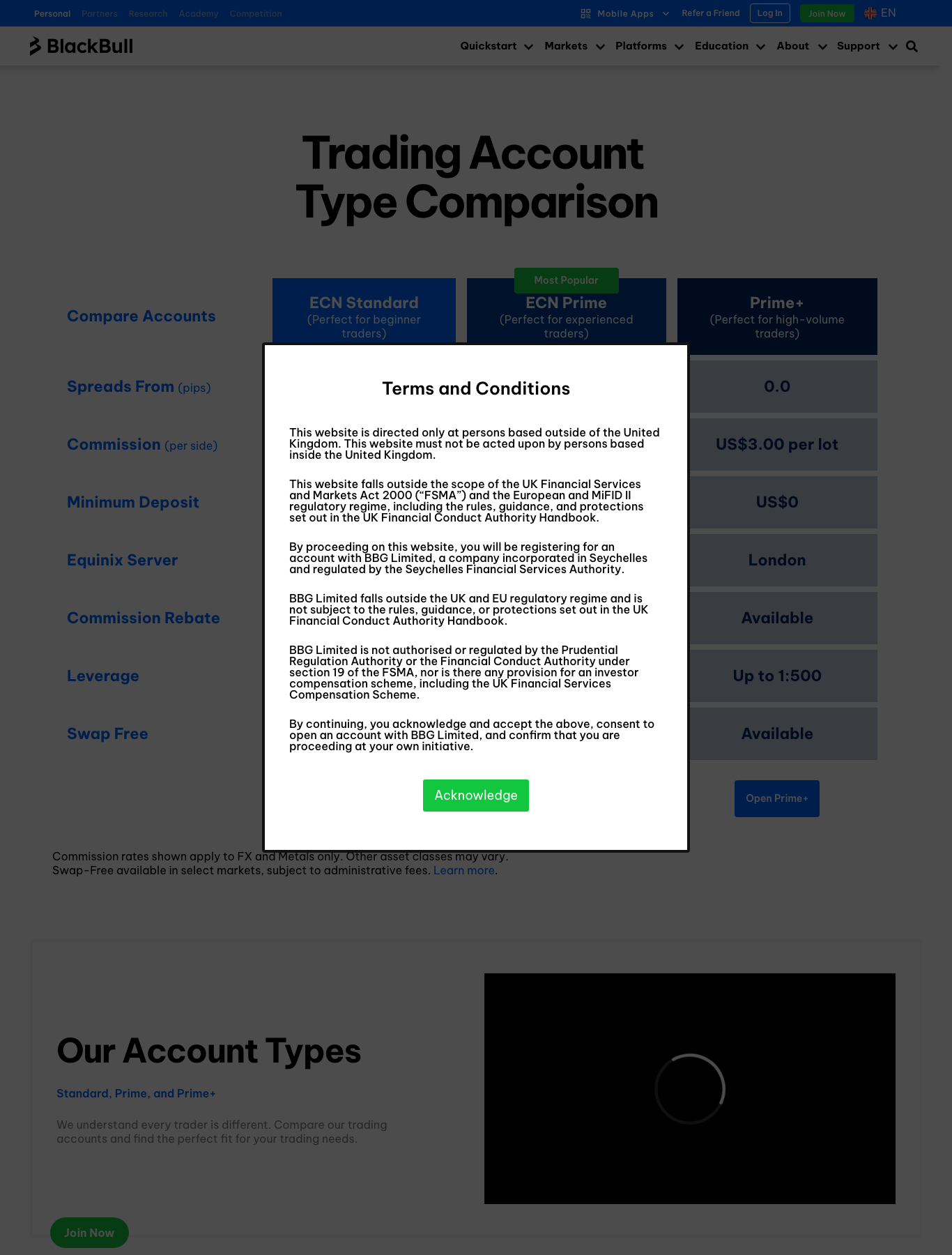
The firm’s root page shows two account comparison tables side by side with different names and different numbers for what is presented as the same broker. One table lists ECN Standard, ECN Prime and Prime+, all with a $0 minimum deposit, spreads from 0.8, 0.0 and 0.0 pips respectively. The other lists Standard (US$50 minimum, spreads from 1.4 pips, no commission), Raw (US$100 minimum, spreads from 0.0 pips, US$3.00 commission per side) and Pro (US$500 minimum, spreads from 0.6 pips, no commission). Both tables come from the same page we fetched; the page does not explain which supersedes the other. Our earlier review separately described a three tier structure with an “ECN Institutional” account requiring a $20,000 minimum, a name and figure that appear on none of the firm’s current pages in our evidence, so we are not repeating it as current.
The root page also states that commission rates shown apply to FX and Metals only, with other asset classes possibly varying, and that a Swap Free option is available in select markets subject to an administrative fee whose amount is not stated on the page.
Platforms and markets
The root page lists MetaTrader 4, MetaTrader 5, MetaTrader Web Trader, cTrader and TradingView as trading platforms, alongside BlackBull CopyTrader for copy trading, BlackBull Invest for access to shares, options, ETFs and bonds, and a Client Portal app for account management. The same page repeats a claim of “over 26000 tradable instruments” across its footer, and lists forex, commodities, equities, indices, metals, crypto and futures as asset classes, with options, ETFs and bonds reachable through BlackBull Invest specifically.
Support and where the firm will not take clients
The contact page lists 24/7 live chat, email at support@blackbull.com, a New Zealand phone line, a free phone number, and separate WhatsApp and phone lines for Spanish language support, with a head office at Level 20, HSBC Tower, 188 Quay Street, Auckland. The root page also states the firm does not accept client applications from Canada and the United States, and that its services are not intended for residents of the European Union, the United Kingdom, India, or any non resident of New Zealand.
No fetched page names a compensation scheme covering client funds. We did not find dedicated Terms, Client Agreement or Fees pages during this fetch; our fetch log shows repeated attempts at those pages returned empty or not found, so the absence of clause level detail here reflects a gap in what we retrieved, not a confirmed absence of such terms in the firm’s actual agreements.
Overview Table
| Headquarters | Level 20, HSBC Tower, 188 Quay Street, Auckland 1010, New Zealand |
| Established | 2014, Auckland, New Zealand, founded by Michael Walker and Selwyn Loekman |
| Countries Served | Not stated as a list; firm states it does not accept Canada or United States clients, and does not intend its services for EU, UK, India or non NZ residents |
| Regulated By | Financial Services Authority (Seychelles), confirmed for BBG Limited; also registered (not licensed) on the New Zealand Financial Service Providers Register as FSP403326 and FSP1002113 |
| Minimum Deposit | $0 (ECN Standard/ECN Prime/Prime+ table) or US$50 (Standard account, separate table on the same page) |
| Maximum Leverage | Up to 1:500 (Standard/Raw/Pro accounts) |
| Total Instruments | Firm states “over 26000 tradable instruments” across its platforms |
| Platforms | MetaTrader 4, MetaTrader 5, MetaTrader Web Trader, cTrader, TradingView, BlackBull CopyTrader, BlackBull Invest, Client Portal app |
| Customer Support | 24/7 live chat, email, phone, free phone, WhatsApp and phone support in Spanish |
| Languages | English and Spanish support channels stated; no broader language list stated |
Facts List
- Blackbull Markets trades through three entities: Black Bull Group Limited (New Zealand), BBG Limited (Seychelles) and Black Bull Trade Limited (New Zealand, share investing only).
- The Seychelles FSA register confirms BBG Limited, trading as Black Bull Markets 4376183, as a regulated securities dealer.
- The FSA register does not publish licence numbers, so the firm’s SD045 claim is not itself verifiable against the register.
- The New Zealand FSPR lists Black Bull Group Limited (FSP403326) and Black Bull Trade Limited (FSP1002113) as registered, not licensed, with no licensed service recorded for either.
- We could not fetch the FMA’s own licence register directly, so FMA authorisation status for these entities is not checked in this review.
- Blackbull Markets appears on none of 1441 warning list entries we searched, mirrored from CYSEC, the FCA and FSC Mauritius.
- The firm’s root page displays two conflicting account tables: ECN Standard/ECN Prime/Prime+ at $0 minimum, and Standard/Raw/Pro at US$50 to US$500 minimum, with different spread figures for each.
- Commission rates shown on the root page apply to FX and Metals only, per the firm’s own caveat.
- Platforms on offer include MetaTrader 4 and 5, cTrader, TradingView, BlackBull CopyTrader and BlackBull Invest.
- The firm does not accept applications from Canada or the United States, and does not target the EU, UK, India, or non residents of New Zealand.
- No compensation scheme for client funds is named on any firm page fetched for this review.
Key Takeaways
How we scored BlackBull Markets
Our previous review scored this firm 6.7 out of 10. This review scores it 7.4 out of 10. That move is our assessment, not a change in the firm. It reflects a fresh read of current evidence across regulation (4.5), fees (9), platform (9.5), support (7) and reviews (7). The regulation score is the drag on the total: the Seychelles FSA confirms BBG Limited as trading name Black Bull Markets under registration 4376183, but the New Zealand Financial Service Providers Register lists both Black Bull Group Limited (FSP403326) and Black Bull Trade Limited (FSP1002113) with registered services limited to changing foreign currency and client money or property service. Neither is a licensed service, so the register records no FMA licence for either entity. Registration on the FSPR is not regulation by the FMA.
What the Seychelles FSA confirms, and what it does not
The Seychelles FSA register lists BBG Limited, trading as Black Bull Markets, under registration 4376183, as a regulated securities dealer. The register does not publish licence numbers, so the number SD045 that the firm’s own about page states remains the firm’s own claim rather than something we could match against the register directly. We searched the FSA Seychelles register directly to reach that verdict. The Seychelles company registry separately shows BBG Limited under registration C857010, the number the firm prints as 857010-1, with industry listed as rental and leasing of equipment. That is a company registry entry, not a financial regulator, so it confirms the company exists and nothing about a licence.
We could not search the FMA’s own licensing record because the fetch failed. That is a gap in our fetch, not a finding about the firm. We also hold no register entry for the New Zealand Companies Office, so the company number 5463921 and NZBN 9429041417799 for Black Bull Group Limited, and the NZBN 9429049891041 for Black Bull Trade Limited, are unchecked. We ran a positive control on five registers, searching for a firm known to be listed, before recording any of these as unchecked, so an empty result means we could not check it, not that the firm is absent.
What BlackBull Markets charges
The firm’s root page shows two account comparison tables side by side with different names and numbers for what looks like the same structure. One table lists ECN Standard, ECN Prime and Prime+, all at $0 minimum, with spreads from 0.8, 0.0 and 0.0 pips respectively and commission of $3 per lot per side on ECN Prime and Prime+. The other lists Standard (US$50 minimum, spreads from 1.4 pips, no commission), Raw (US$100 minimum, spreads from 0.0 pips, US$3.00 commission per side) and Pro (US$500 minimum, spreads from 0.6 pips, no commission). A reader comparing accounts needs to know which of these applies, and the pages we fetched do not resolve the conflict. The same page notes that commission rates shown apply to FX and Metals only, and that other asset classes may vary, and that Swap Free is available in select markets subject to an administrative fee whose amount is not stated. Our earlier review reported withdrawal fees of $25 by bank wire, $5 by e-wallet and 0.5% by cryptocurrency; those figures came to us secondhand and we did not read the document they describe.
Platform and instrument range
The firm’s own pages list MT4, MT5, MT4/MT5 Web Trader, cTrader, TradingView charting, a BlackBull CopyTrader tool, BlackBull Invest for shares, options, ETFs and bonds, and a Client Portal app. Instrument categories named on the root page are forex (70+ pairs), commodities, equities across 27 global markets, indices, metals, crypto, and futures with index and commodity sub categories. The footer’s repeated claim of over 26,000 tradable instruments across all platforms is the firm’s own figure; we did not independently count instruments per account or platform.
Support and warning list result
Support channels listed on the firm’s contact page are 24/7 live chat, email at support@blackbull.com, a New Zealand phone line, WhatsApp in English and Spanish, a separate Spanish-language phone line, a free phone number, and a head office address at Level 20, HSBC Tower, 188 Quay Street, Auckland. We searched 1,441 warning list entries mirrored from CySEC, the FCA and the FSC Mauritius, and this firm appears on none of them. That covers only the lists we mirror, not every regulator worldwide, but it is a clean result worth stating.
Client protection gaps
None of the firm pages we fetched name a statutory compensation scheme. The Legal Policies page states that legal documentation differs by region and that the document set applying to an account depends on which entity, New Zealand, Seychelles, or Share Investing, is onboarding the client, made clear only during the application process. No terms of business, client agreement or fee schedule text was recovered in our evidence; repeated fetch attempts for those pages returned empty or not found, so clauses on governing law, liability caps or withdrawal limits are not something we can report on here.
Licenses & Regulation
BlackBull Markets is not one firm but three, and which one takes a client depends on where they sign up. The New Zealand entity is Black Bull Group Limited, the Seychelles entity is BBG Limited, and a separate company, Black Bull Trade Limited, handles share investing only, excluding CFDs. The firm’s own Legal Policies page says as much: “there are regional differences in our legal documentation. The documentation that applies to your account will be made clear during the application process.” A client does not get one contract; they get whichever document set matches the entity they end up onboarded to.
What the Seychelles FSA confirms about BBG Limited
The Seychelles FSA register lists BBG Limited, trading as Black Bull Markets, as a regulated securities dealer. That confirms the firm’s regulatory claim for its Seychelles entity. The register itself does not publish licence numbers, so the number the firm quotes, SD045, remains the firm’s own claim rather than something we could check against the register directly. Separately, the Seychelles company registry (registry.gov.sc) lists BBG Limited under registration C857010, industry “rental and leasing of equipment,” matching the number the firm prints as 857010-1. That registry entry confirms the company exists; it is a company registration, not a financial licence, and the search publishes no status or incorporation date.
What the New Zealand register actually shows for BlackBull Markets
We could not search the New Zealand Financial Service Providers Register for the FMA-licence question directly; that register lookup failed on our end, which is a fact about our fetch and not about the firm. We were able to pull the FSPR entries for both New Zealand entities by number. Black Bull Group Limited appears as FSP403326, trading as Blackbull Markets, registered 12 October 2014, with registered services listed as changing foreign currency (from 22 July 2025) and client money or property service. Black Bull Trade Limited appears as FSP1002113, registered 15 November 2021, with the same two registered services. In both cases, none of the registered services is a licensed service, so the register records no FMA licence for either entity. Registration on the FSPR is not the same as regulation by the FMA, and the register check for both numbers is explicitly not on the register on that point. An earlier review of this firm described the New Zealand entity as holding a “Full License” under a “Tier-1” regulator; we did not find that stated by name on any firm page in our evidence, and the FSPR entries we did check do not carry a licensed service. We also hold no register entry for the New Zealand Companies Office, so the company numbers the firm quotes for both entities (Company Number 5463921 / NZBN 9429041417799 for Black Bull Group, and NZBN 9429049891041 for Black Bull Trade) have not been checked against that authority.
The FernMark mark is not a financial licence
BlackBull Markets’ own site advertises “FernMark Certified” accreditation, describing it as “a New Zealand government-backed accreditation that recognizes businesses meeting the highest standards of trust, transparency, and global reputation.” That is a country-of-origin and trade-promotion mark. It sits on the same page as the firm’s regulatory claims but is not a financial-services authorisation, and nothing in the evidence here ties it to FMA oversight.
Who BlackBull Markets says it will not take on
The firm’s own root page states it does not accept client applications from Canada and the United States, and that its offer of services is not intended for residents of the European Union, the United Kingdom, India, or any non-resident of New Zealand.
Warning-list search and what is missing from our evidence
We searched 1,441 warning-list entries mirrored from CySEC, the FCA and the FSC Mauritius, and BlackBull Markets appears on none of them. That covers only the regulators we mirror, not every regulator worldwide, but it is a clean result across those three lists. We could not recover any dedicated Terms, Client Agreement or Fees pages for this firm in our evidence; repeated fetch attempts from a UK exit returned empty pages or “Page not found.” That means we hold no contract-clause text here on governing law, liability caps, or withdrawal caps, and no page in our evidence names a compensation scheme such as FSCS or an investor-compensation fund; an earlier review flagged the same gap. Neither is a finding that no such clauses or scheme exist, only that we have not read the document that would confirm or rule them out.
Our previous score for this firm’s regulation was folded into an overall score of 6.7/10; this review scores regulation at 4.5/10 within a new overall of 7.4/10. That move reflects our current assessment against what the registers actually show, not any change at the firm: a confirmed Seychelles FSA listing for one entity sits alongside two New Zealand FSPR entries that carry no licensed service, a New Zealand Companies Office check we could not perform, and a legal-documentation structure that splits clients across three entities depending on how they sign up.
How to Trade
BlackBull Markets splits its offering across two account structures shown side by side on its own site, and the pages we fetched give conflicting numbers for what looks like the same lineup. One table lists ECN Standard, ECN Prime and Prime+, each with a $0 minimum deposit. The other lists Standard, Raw and Pro, with minimums of US$50, US$100 and US$500. A trader comparing accounts needs to know which table actually governs their account, and nothing on the page we read resolves that for them.
What Blackbull Markets accounts actually offer
On the ECN Standard/Prime/Prime+ table, the firm’s root page lists ECN Standard with spreads “from 0.8 pips” and no commission, ECN Prime with spreads “from 0.0 pips” and a $3 commission per lot per side, and Prime+ on the same spread and commission terms plus a commission rebate. All three show Swap Free as available. On the Standard/Raw/Pro table, the same page lists Standard (US$50 minimum, spreads from 1.4 pips, no commission), Raw (US$100 minimum, spreads from 0.0 pips, US$3.00 commission per side) and Pro (US$500 minimum, spreads from 0.6 pips, no commission). This second table also states, for each tier, a minimum trade size of 0.01 lots, leverage up to 1:500, a margin call level of 50% and a stop-out level of 20%, plus Swap Free availability and Local INR Payments. Those margin figures are the terms that actually bind an open position, and they only appear against the Standard/Raw/Pro naming, not the ECN naming.
The firm’s root page also carries a caveat worth pairing with any of those commission figures: “Commission rates shown apply to FX and Metals only. Other asset classes may vary.” A trader pricing a stock or index CFD off the FX/Metals commission number would be pricing it wrong. Separately, the page says Swap Free is “available in select markets, subject to administrative fees,” without stating what those fees are.
An earlier review of this firm reported a third, different structure again: ECN Standard at a $0 minimum, ECN Prime at a $2,000 minimum, and an ECN Institutional tier at a $20,000 minimum. None of those minimums or the Institutional tier name appears on the current pages we fetched, so we’re treating the firm’s own live pages as the current word on pricing and flagging the mismatch rather than reconciling it.
Instruments and platforms
The root page lists Forex (“70+ major, minor, and exotic currency pairs”), Commodities (“energies like crude oil, and agricultural cash crops”), Equities (“stocks across 27 global markets like Apple, Alibaba, BMW and Netflix”), Indices (“major stock indices like US30, S&P500, and NAS100”), Metals (“precious and industry metals like gold, silver, and copper”), Crypto (“popular digital currencies like Bitcoin, Ethereum, and XRP”), and Futures, broken into Index Futures and Commodities Futures in the site navigation. Options, ETFs and Bonds are reached separately, through a service the firm calls BlackBull Invest, described on the same page as giving access to 26,000+ Shares, Options, ETFs, Bonds and other underlying assets. The site’s footer repeats a broader claim across every page: “BlackBull Markets and its associated entities have access to provide over 26000 tradable instruments to clients across all our Trading Platforms”, a headline figure that spans the whole platform set rather than any single account.
Execution runs across MetaTrader 4 and MetaTrader 5, a MetaTrader Web Trader listed separately in the site’s footer navigation, cTrader (paired on the page with the line “BlackBull Markets’ institutional trading conditions combined with cTrader”), and TradingView for charting. The firm also offers BlackBull CopyTrader for copy trading and a Client Portal app for funding and managing accounts. On execution speed, the root page cites a third party rather than its own measurement: “Research by CompareForexBrokers.com revealed that BlackBull Markets achieved average execution speeds of less than 75 milliseconds.” That’s an outside claim hosted on the broker’s own site, not a figure this review independently measured.
Who can actually open one of these accounts
The root page states the firm “does not accept client applications” from Canada and the United States, and that its services are “not intended for residents of… the European Union, the United Kingdom, India, nor any non-resident of New Zealand.” Which legal entity and which account terms a trader ends up under also depends on region: the firm’s Legal Policies page says “there are regional differences in our legal documentation. The documentation that applies to your account will be made clear during the application process,” and lists separate document sets for the New Zealand entity (Black Bull Group Limited), the Seychelles entity (BBG Limited), and the share-investing entity (Black Bull Trade Limited). A trader signing up isn’t contracting with one fixed counterparty; which of the three they land with, and which margin, leverage and stop-out terms apply, is settled during onboarding rather than fixed in advance on the page we read.
Account Types
BlackBull’s UAE home page carries two separate account-comparison tables side by side, and they don’t describe the same thing. One is labelled ECN Standard, ECN Prime and Prime+; the other is labelled Standard, Raw and Pro. Both claim to be BlackBull Markets’ current account lineup. We report both as found, because neither page tells a reader which one is authoritative.
The ECN Standard, ECN Prime and Prime+ table
This table shows all three tiers opening with a $0 minimum deposit. ECN Standard is priced with spreads from 0.8 pips and no commission. ECN Prime is priced with spreads from 0.0 pips plus a $3 commission per lot per side. Prime+ carries the same 0.0-pip spread and $3 per-lot commission as ECN Prime, with a commission rebate available on top. All three list Swap Free as available. The page notes elsewhere that the commission figures it quotes apply to FX and Metals only, and that other asset classes may vary, so the $3 per lot per side figure should not be read as covering every instrument BlackBull lists.
The Standard, Raw and Pro table on the same BlackBull Markets page
The second table sets different minimums for what are nominally comparable tiers. Standard opens at US$50, with spreads from 1.4 pips and no commission. Raw opens at US$100, with spreads from 0.0 pips and a US$3.00 commission per side. Pro opens at US$500, with spreads from 0.6 pips and no commission. All three list a minimum trade size of 0.01 lots, leverage up to 1:500, a margin call level of 50%, a stop-out level of 20%, Swap Free available, and Local INR Payments available. Nothing on the page explains why this table’s minimum deposits, US$50 to US$500, sit next to a separate table showing $0 minimums for accounts with near-identical spread and commission profiles.
Swap-free accounts and the fee that comes with them
Both tables mark Swap Free as available on every tier. The root page separately states that Swap-Free is available “in select markets, subject to administrative fees,” without naming the fee amount. A trader choosing swap-free on any of these tiers should expect a charge the page describes but does not quantify.
Where the earlier review’s numbers stop matching BlackBull Markets’ current pages
The review described a three-tier structure of its own: ECN Standard at a $0 minimum, ECN Prime at a $2,000 minimum, and ECN Institutional at a $20,000 minimum. None of those minimums, and no account called ECN Institutional, appears in either table on the current root page. We’re noting the mismatch rather than resolving it: the firm’s own current pages are what we fetched and read, and they carry no $2,000 or $20,000 tier, so we’re not carrying that structure forward into this review.
The separate share-investing entity
BlackBull’s legal page names Black Bull Trade Limited as a distinct entity handling share investing, which it states excludes CFDs. That entity is registered on the New Zealand Financial Service Providers Register as FSP1002113, and the legal page ties that registration specifically to the Share Investing business rather than to the CFD accounts described above. A client opening a share-investing account is contracting with a different legal entity, under a different document set, than a client opening an ECN or Standard/Raw/Pro CFD account with Black Bull Group Limited or BBG Limited.
Beyond deposit size and commission, none of the account tiers is described on the fetched pages as carrying different platform access, instrument coverage, or support tier; the platform and instrument lists on the root page are presented as applying across the site rather than gated by account type.
Negative Balance Protection
BlackBull Markets publishes exact margin thresholds on its own account comparison table, but only for one of the two pricing schemes shown on the same page. The account page’s Standard, Raw and Pro tiers each list leverage up to 1:500, a margin call level of 50% and a stop-out level of 20%. That means a position gets flagged once account equity falls to half the margin required to hold it, and the broker’s platform starts closing positions once equity drops to a fifth of that margin. Those are the only loss-limit figures the firm’s own page gives; it does not spell out the order in which positions are closed, whether closure proceeds until the account is flat, or what happens if a fast-moving market gaps through the stop-out level before an order fills.
Two account tables, one missing the numbers
The same root page carries a second comparison table, for the ECN Standard, ECN Prime and Prime+ tiers, and that table gives spreads and commission but no margin call or stop-out figures at all. A reader trying to work out what triggers a forced close-out on an ECN Prime account, as opposed to a Raw account, is not told; the number only appears against the Standard/Raw/Pro naming.
What BlackBull Markets’ contract terms do not tell us
We hold no clause text on negative balance protection, drawdown handling past stop-out, or liability for a deficit balance, because the underlying Terms and Client Agreement pages could not be fetched for our evidence: our fetch log shows repeated attempts from a UK exit returning either 0 bytes or “Page not found.” That is a gap in what we retrieved, not a finding that BlackBull Markets has no such clause. The firm’s Legal Policies page does confirm that the documentation governing an account depends on which entity a client is onboarded to, stating that “there are regional differences in our legal documentation” and that “the documentation that applies to your account will be made clear during the application process,” with separate document sets named for Black Bull Group Limited (New Zealand), BBG Limited (Seychelles) and Black Bull Trade Limited (Share Investing). Whatever negative-balance or margin-close-out wording exists, it sits in whichever of those three sets applies, and a prospective client does not see which set that is until they apply.
Regulatory backing differs across those same entities. The Seychelles FSA register confirms BBG Limited, trading as Black Bull Markets, as a regulated securities dealer under number SD045, though the register itself does not publish that licence number and it remains the firm’s own claim. Black Bull Group Limited and Black Bull Trade Limited, by contrast, sit on the New Zealand Financial Service Providers Register as FSP403326 and FSP1002113 respectively, each showing registered services limited to changing foreign currency and client money or property; neither entry lists a licensed service, so that register records no FMA licence for either company, and registration on the FSPR is not the same thing as FMA regulation. Which entity a client’s margin and close-out terms sit under is therefore not a small distinction.
Swap-free accounts and what happens if a deficit occurs
The root page notes that Swap-Free accounts are “available in select markets, subject to administrative fees,” without stating the fee amount, so a trader holding positions overnight on a swap-free account cannot price that cost from the page alone. On compensation cover generally, an earlier review of this firm reported an absence of an investor compensation scheme as a gap; we are restating that as what the earlier review found, since none of the pages fetched for our evidence name a scheme such as the FSCS or an equivalent Seychelles or New Zealand fund, and we did not read a document that addresses it directly.
Trading Instruments
BlackBull Markets’ own homepage lists seven broad asset classes on offer: forex (“70+ major, minor, and exotic currency pairs”), commodities (“Energies like crude oil, and agricultural cash crops”), equities (“stocks across 27 global markets like Apple, Alibaba, BMW and Netflix”), indices (“Major stock indices like US30, S&P500, and NAS100”), metals (“Precious and industry metals like gold, silver, and copper”), crypto (“Popular digital currencies like Bitcoin, Ethereum, and XRP”), and futures, which the site’s own navigation menu splits into Index Futures and Commodities Futures, all per the firm’s root page.
The 26,000-instrument claim
Every footer on the pages we fetched repeats the same line: “BlackBull Markets and its associated entities have access to provide over 26000 tradable instruments to clients across all our Trading Platforms.” The root page does not break that figure down by asset class, and it does not say how many of the 26,000 sit on MT4, MT5, cTrader or the firm’s other platforms, so the page alone does not tell a trader what a specific account or platform actually exposes.
A large share of that count appears to come from BlackBull Invest, a separate product the root page describes with the same kind of number attached to a narrower list: “Access 26,000+ Shares, Options, ETFs, Bonds and other underlying assets.” Shares, options, ETFs and bonds are instrument types that, in the pages we fetched, show up only through this Invest route, not in the account-comparison tables built for FX, metals, indices and crypto CFDs.
Two account tables, two different pictures of what BlackBull Markets offers
The root page carries two account-comparison tables side by side. One lists ECN Standard, ECN Prime and Prime+, each at a $0 / US$0 minimum deposit: ECN Standard quotes spreads from 0.8 pips with no commission, ECN Prime spreads from 0.0 pips with $3 commission per lot per side, and Prime+ the same 0.0 pips and $3 commission plus a commission rebate. The other table lists Standard (US$50 minimum, spreads from 1.4 pips, no commission), Raw (US$100 minimum, spreads from 0.0 pips, US$3.00 commission per side) and Pro (US$500 minimum, spreads from 0.6 pips, no commission), each quoting leverage up to 1:500, a 50% margin call level and a 20% stop-out level. Both tables sit on the same fetched page, with overlapping tier names and conflicting minimum deposits, so the page itself does not resolve which table describes the account a given applicant actually opens.
A fee note on the same page narrows the ground under the commission figures quoted in both tables: “Commission rates shown apply to FX and Metals only. Other asset classes may vary.” That reads as a statement that the $3-per-lot and US$3.00 commission numbers above are given for forex and metals trades specifically, with equities, indices, crypto and futures positions on the same accounts left unstated.
Platforms carrying the asset list
The instruments sit across MT4, which the root page calls “the most popular trading platform in the world”; MT5, “the most powerful premier trading platform”; cTrader, paired on the page with “BlackBull Markets’ institutional trading conditions”; TradingView, “the world’s leading charting and social platform”; a MetaTrader Web Trader listed separately in the site’s footer navigation; and BlackBull CopyTrader, for copying or leading other traders’ positions. Swap-free trading is flagged on the same page as available “in select markets, subject to administrative fees,” and the page does not itemise those fees, so an account’s swap-free label does not on its own say every instrument on that account carries no overnight charge.
Who the asset list is not offered to
The root page states BlackBull Markets “does not accept client applications” from Canada and the United States, and separately states that its offer of services is not intended for residents of the European Union, the United Kingdom, India, or any non-resident of New Zealand. That restriction sits above the instrument list rather than inside it: applicants from those markets are not shown a narrower menu of the assets above, they fall outside the client base the page addresses in the first place.
Education & Analysis
BlackBull Markets’ own root page lists eight platforms and tools rather than one: MetaTrader 4, MetaTrader 5, MetaTrader Web Trader, cTrader, TradingView, BlackBull CopyTrader, BlackBull Invest and a Client Portal app. That spread, across the two dominant retail platforms plus a third full alternative in cTrader, is what the platform score in this review rests on.
MetaTrader 4 and MetaTrader 5 at BlackBull Markets
The firm’s own page bills MT4 as “the most popular trading platform in the world” and MT5 as “the most powerful premier trading platform.” Both descriptions are the firm’s own marketing language rather than an independent rating, but the accounts they run on are the ones carrying the firm’s headline pricing: ECN Standard, ECN Prime and Prime+ on the first comparison table, and Standard, Raw and Pro on the second. A MetaTrader Web Trader is also listed separately in the site’s footer navigation, giving a browser route into the same accounts without installing the desktop terminal.
cTrader as a third platform
Alongside the MetaTrader pair, the root page advertises cTrader through what it calls “BlackBull Markets’ institutional trading conditions combined with cTrader.” Offering a genuine third platform, rather than a MetaTrader White Label dressed up as one, is the kind of feature that separates a broker aimed at algorithmic and higher volume traders from one that only ticks the MetaTrader box. Nothing in the pages we fetched breaks out which of the six account names (ECN Standard/Prime/Prime+ or Standard/Raw/Pro) actually runs on cTrader rather than MetaTrader, so a trader who wants that platform specifically has more checking to do at signup than the marketing page alone answers.
Charting through TradingView
The firm’s page calls TradingView “the world’s leading charting and social platform” and lists it as a distinct integration alongside the three trading platforms. TradingView is widely used precisely because its charting and social feed sit apart from any one broker’s own terminal, so folding it into the stack gives BlackBull Markets clients a charting layer with more drawing tools and community indicator sharing than MT4’s native charts offer on their own.
Copy trading and investing tools
Two further tools sit outside conventional CFD trading. BlackBull CopyTrader is described on the firm’s page as letting a client “copy trades or lead followers,” a social trading layer on top of the core platforms. BlackBull Invest is described as giving access to “26,000+ Shares, Options, ETFs, Bonds and other underlying assets,” which is where the firm’s own instrument list places its options, ETFs and bonds exposure, since none of those three appear as line items on the main CFD instrument list of Forex, Commodities, Equities, Indices, Metals and Crypto. A reader wanting options or bonds exposure through BlackBull Markets is therefore looking at a separate product, BlackBull Invest, not the CFD accounts this review otherwise covers.
The instrument count claim
Every page footer in our evidence repeats a version of the same line: “BlackBull Markets and its associated entities have access to provide over 26000 tradable instruments to clients across all our Trading Platforms.” That figure spans every platform and every associated entity combined, including the separate BlackBull Invest product, rather than describing what any single account or single platform exposes on its own. The pages we fetched do not break the 26,000 figure down by platform, so it should be read as a firm wide ceiling rather than a number available inside, say, an MT4 Standard account alone.
Two account tables, one page
The root page shows two different account comparison tables side by side. One lists ECN Standard, ECN Prime and Prime+, all with a $0 minimum deposit and spreads quoted from 0.8, 0.0 and 0.0 pips. The other lists Standard, Raw and Pro, with minimums of US$50, US$100 and US$500 and spreads from 1.4, 0.0 and 0.6 pips. Both tables carry the platform stack described above, but a trader comparing entry costs needs to know which table is the one actually offered at signup, since the firm’s own page does not reconcile the two.
How the platform evidence moved the score
The previous review of BlackBull Markets scored 6.7 out of 10; this one scores 7.4. The platform criterion sits at 9.5, the highest of the five scored here, and the fee criterion at 9. Those two scores rest on the same evidence set out above: a six way platform stack running across a spread of account tiers, commission rates the firm’s own fee page confines explicitly to FX and Metals (“Commission rates shown apply to FX and Metals only. Other asset classes may vary.”), and a clean result on our warning list search of 1,441 entries mirrored from CYSEC, the FCA and the FSC Mauritius, on which BlackBull Markets does not appear. That combination, not any change in the firm’s own conduct, is what this review’s assessment rests on; we cannot source a claim about the firm improving or declining from a change in our own scoring criteria and the evidence read against them.
Special Offers
We did not fetch a dedicated promotions or bonus page for BlackBull Markets in our evidence, so this section works from what the firm’s own account and pricing pages show rather than from any offers page. The one line on the root page that reads as inducement-adjacent rather than as plain account pricing is a commission rebate listed against the Prime+ account, alongside spreads from 0.0 pips and a $3 commission per lot per side. The ECN Standard and ECN Prime tiers shown next to it on the same table carry no such rebate line.
What BlackBull Markets’ account pages show instead of a bonus program
The root page carries two separate account-comparison tables. One names ECN Standard, ECN Prime and Prime+, with ECN Standard and ECN Prime listed at a $0 / US$0 minimum and spreads from 0.8 and 0.0 pips; Prime+ carries no minimum deposit figure on this table and spreads from 0.0 pips. The other names Standard, Raw and Pro, at minimum deposits of US$50, US$100 and US$500, with spreads from 1.4, 0.0 and 0.6 pips. Every tier on both tables is priced through spreads and, on ECN Prime and Raw, a per-lot commission; the Prime+ rebate is the only line on either table that departs from that spread-and-commission structure, and neither table describes it as time-limited, deposit-triggered, or tied to a promotional code.
The same page notes that Swap-Free trading is offered in select markets and carries administrative fees, without stating the size of that fee, and that the commission figures it publishes apply only to FX and Metals, with other asset classes said to vary. Both read as standard account mechanics with a cost attached to them rather than as a discount or credit.
An award claim, not a discount
The root page’s hero banner states BlackBull Markets is “Winner of Best Gold Spreads at the Forex Expo Dubai 2025,” and separately cites “Research by CompareForexBrokers.com revealed that BlackBull Markets achieved average execution speeds of less than 75 milliseconds.” Both are claims the firm hosts about itself rather than terms of any offer a client could claim, and we have not checked either independently.
Where an earlier review’s numbers do not match BlackBull Markets’ current pages
An earlier review of this firm described a three-tier structure named ECN Standard, ECN Prime and ECN Institutional, with minimum deposits it gave as $0, $2,000 and $20,000. None of those minimums, and no account called ECN Institutional, appears on the account tables we fetched from the firm’s current root page, which instead show every ECN-branded tier at a $0 minimum. We have gone with what the firm’s current page shows rather than the earlier review’s figures.
Opening an Account
BlackBull Markets runs onboarding through three separate legal entities depending on where a client signs up, according to the firm’s Legal Policies page: Black Bull Group Limited for the New Zealand offering, BBG Limited for the Seychelles offering, and Black Bull Trade Limited for share investing. The same page states plainly that “there are regional differences in our legal documentation” and that “the documentation that applies to your account will be made clear during the application process.” That means the account opening a person walks through, and the protections attached to it, depend on which entity they are onboarded to rather than on a single contract that applies to everyone.
Which entity a new client lands with
The Seychelles FSA register confirms BBG Limited, trading as Black Bull Markets, as a regulated securities dealer, though the register does not publish licence numbers, so the “SD045” figure on BlackBull’s own about page remains the firm’s own claim rather than something we could read off the register itself. Registration on the New Zealand Financial Service Providers Register is a separate matter: Black Bull Group Limited appears there as FSP403326 and Black Bull Trade Limited as FSP1002113, both with registered services limited to changing foreign currency and client money or property service. Neither entry lists a licensed service, so the FSPR record does not amount to an FMA licence for either entity, and registration on that register is not the same thing as FMA regulation. We were unable to check the New Zealand Companies Office entries for company number 5463921 (Black Bull Group Limited) or NZBN 9429049891041 (Black Bull Trade Limited), since we hold no register entry for that authority, so those numbers stand unverified rather than confirmed or disputed.
Who BlackBull Markets will not open an account for
BlackBull’s own root page states the firm does not accept client applications from Canada and the United States, and that its offer of services is not intended for residents of the European Union, the United Kingdom, India, or any non-resident of New Zealand. That second restriction is a wide net for a New Zealand headquartered broker, and it effectively confines the client base to people who either live in New Zealand or fall outside the named exclusion list entirely.
Accounts on offer and what starting one requires
The firm’s root page shows two account comparison tables side by side that do not fully agree with each other. One lists ECN Standard, ECN Prime and Prime+, all with a stated minimum deposit of $0, spreads from 0.8 pips on ECN Standard and from 0.0 pips on the other two, with ECN Prime and Prime+ charging $3 commission per lot per side. The other table lists Standard (minimum US$50, spreads from 1.4 pips, no commission), Raw (minimum US$100, spreads from 0.0 pips, US$3.00 commission per side) and Pro (minimum US$500, spreads from 0.6 pips, no commission), each quoting leverage up to 1:500, a 50% margin call level and a 20% stop out level. Both tables appear on the same page, and nothing in the fetched material says which one is current, so a person comparing minimum deposits needs to check which table applies to the account type they are actually being offered. Separately, our earlier review describes a three tier structure of ECN Standard, ECN Prime and ECN Institutional with minimums of $0, $2,000 and $20,000, none of which match the tier names or minimums on the firm’s own current pages, so we are treating the firm’s own pages as the live figures and flagging our earlier review as outdated rather than repeating it as current.
No compensation scheme named
None of the pages we fetched from BlackBull Markets names a statutory investor compensation scheme, of the kind an FSCS or ICF style arrangement would provide. Our earlier review separately described the absence of such a scheme as a gap, which we are restating here as what that earlier review reported rather than as something we confirmed by reading the firm’s own documents.
What we could not check
Attempts to fetch a dedicated Terms or Client Agreement page, along with dedicated Fees and Account types pages, returned empty or “page not found” responses in our evidence, so we hold no contract clause text on governing law, liability caps or withdrawal caps for the account opening process. That is a gap in what we managed to retrieve, not a finding that BlackBull Markets’ actual agreements lack those clauses. We also could not search the New Zealand Financial Service Providers Register through the FMA directly, since that fetch failed on our side, which again is a fact about our own check rather than about the firm.
Where this review’s score moved
Our previous review scored BlackBull Markets 6.7 out of 10; this review scores it 7.4. The move is our assessment against the evidence above, not a claim that the firm has changed. Regulation sits at 4.5, held down by the FSPR entries for both New Zealand entities recording no licensed service and by the gaps we could not check at the Companies Office and the FMA register directly. Fees sit at 9 and platform at 9.5, reflecting the account and platform detail on the firm’s own pages, including the MT4, MT5, cTrader and TradingView range and the multiple account tiers described above. A search of 1,441 warning list entries mirrored from CySEC, the FCA and the FSC Mauritius returned no match for this firm, which is a clean result worth noting on its own terms, covering only the lists we mirror rather than every regulator worldwide.
Deposits & Withdrawals
Our previous score for BlackBull Markets was 6.7 out of 10; this review scores it 7.4, with fees weighted at 9 out of 10. That is our assessment moving on updated evidence, not the firm changing its terms, and the fee evidence below is what carries the higher number: no deposit fee is stated on any funding route reported to us, the account tables on the firm’s own root page show several tiers with a $0 minimum, and BlackBull Markets does not appear on any of the 1,441 warning-list entries we mirror from CYSEC, the FCA and the FSC Mauritius. That last check covers trust rather than cost directly, but it sits alongside the fee picture in this review’s overall read of the firm.
What BlackBull Markets charges to move money
The firm’s own root page carries two account-comparison tables side by side, and they do not agree. One lists ECN Standard, ECN Prime and Prime+, each at a $0 minimum deposit, with spreads from 0.8 pips (no commission) on Standard and spreads from 0.0 pips plus $3 per lot per side on Prime and Prime+. The other lists Standard, Raw and Pro at minimums of US$50, US$100 and US$500, with spreads from 1.4, 0.0 and 0.6 pips respectively, Raw carrying the US$3.00-per-side commission and Standard and Pro carrying none. Both tables are on the same fetched page. We report both because we cannot tell a reader which one governs a given sign-up flow, and neither table states a deposit fee.
On withdrawals, the pages we fetched ourselves say nothing about a fee schedule; the account tables cover spreads, commissions and minimums, not payout costs. The figures we do have come from our earlier review, not from a page we read this time: it reported a $25 fee on bank wire withdrawals, a $5 fee on e-wallet withdrawals, a 0.5% fee on cryptocurrency withdrawals, and no fee on card deposits or withdrawals, with processing windows of 1-3 days for wire, instant to 24 hours for e-wallets, and 1-3 hours for crypto. Treat those as the earlier review’s figures rather than confirmed current ones: our own fetch log shows repeated attempts to fetch a dedicated fees or terms page from a UK exit returned empty or “page not found,” so we were not able to check this set of numbers against the firm’s current published schedule.
Costs that sit outside the headline spread
The root page carries a caveat on its commission figures: the rates shown apply to FX and Metals only, and other asset classes may vary, without stating by how much. It also names a Swap-Free option, available in what it calls “select markets,” that carries an administrative fee whose amount is not given on the page. Anyone trading outside FX and Metals, or holding positions on a swap-free basis, is being pointed at a cost the page itself declines to quantify.
The Standard, Raw and Pro table separately marks “Local INR Payments” as available, which suggests a rupee-denominated funding rail for Indian-facing traffic, though the page does not break out a fee or minimum specific to that route. It sits oddly next to the same page’s restriction, elsewhere on the root page, that the firm’s services are “not intended for” residents of India among others; we report both because both are on the page, not because we can reconcile them.
What we could not check
We hold no clause-level withdrawal terms for BlackBull Markets: no stated cap on withdrawal size, no processing-time commitment in the firm’s own words, no named liability or set-off provision. That is a gap in what our evidence fetched, recorded above, rather than a finding that no such terms exist. None of the firm’s pages we fetched name an investor compensation scheme either; the earlier review flagged the absence of one as a gap in its own account, and on our side the fetched pages simply do not raise the subject.
The root page also states plainly that the firm does not accept client applications from Canada or the United States, and that its services are not intended for residents of the European Union, the United Kingdom, India, or any non-resident of New Zealand. Anyone funding or withdrawing from an account under one of those jurisdictions is transacting on terms the firm itself says are not meant for them.
Customer Support
Blackbull Markets’ contact page lists five ways to reach support: email at support@blackbull.com, a New Zealand phone line at +64 9 558 5142, a free phone line listed as 0800 BB Markets, live chat available 24/7, and WhatsApp on +64 210 905 7208. Spanish-speaking clients get their own line, with a dedicated phone number at +52 338 526 2705 and a separate WhatsApp number at +52 333 450 8091. The head office is listed as Level 20, HSBC Tower, 188 Quay Street, Auckland 1010, New Zealand.
What Blackbull Markets offers beyond the contact page
Live chat is the only channel the contact page describes as round-the-clock; the phone and WhatsApp lines carry no stated hours. The Spanish-language phone and WhatsApp numbers point to support aimed at a specific language market rather than a single generic queue, which is worth knowing if a complaint needs to go through in Spanish rather than English.
The site’s Legal Policies page states that “there are regional differences in our legal documentation” and that the documentation applying to a given account “will be made clear during the application process,” listing separate document sets for the New Zealand entity (Black Bull Group Limited), the Seychelles entity (BBG Limited), and the Share Investing entity (Black Bull Trade Limited). That matters for support and complaints as much as for trading terms: which entity a client is onboarded with determines which set of terms, and potentially which regulator, a complaint would ultimately sit under. None of the pages in our evidence sets out a complaints procedure, an internal escalation path, or a named ombudsman or dispute body, so we can’t report what happens if a client’s issue isn’t resolved through the channels above.
What the register shows about who stands behind support
The Seychelles FSA register confirms BBG Limited, trading as Black Bull Markets, as a regulated securities dealer under SD045, though the register itself doesn’t publish licence numbers, so “SD045” is the firm’s own claim rather than something we read off the register directly. Separately, the New Zealand Financial Service Providers Register carries two entries tied to the group: Black Bull Group Limited as FSP403326, registered since 12 October 2014, and Black Bull Trade Limited as FSP1002113, registered since 15 November 2021. Both entries list registered services limited to currency exchange and client money or property service; neither is a licensed service, so the FSPR record doesn’t give either entity an FMA licence. Registration on the FSPR is not the same as regulation by the FMA, which is relevant to a support query about where a complaint against the NZ entities would actually land if it needed to go past the firm itself. We could not search the FSPR’s separate register of FMA-licensed firms directly to check whether either entity holds a licence there, so that remains unchecked rather than confirmed absent.
We also searched 1,441 warning-list entries mirrored from CySEC, the FCA, and the FSC Mauritius, and Blackbull Markets appears on none of them. That’s a clean result worth stating plainly, though it covers only the three regulators we mirror, not a global sweep.
No page in our evidence names a statutory compensation scheme, of the kind that would pay out client funds if the firm failed; an earlier review of Blackbull Markets separately noted the absence of an investor compensation scheme as a gap. We didn’t fetch a dedicated terms or client-agreement page setting out formal complaint-handling clauses, so we can’t report contractual language on how support complaints are escalated, capped, or timed.
Prohibited Countries
BlackBull Markets’ own root page states two restrictions in plain terms, and we take those at face value rather than trying to infer a longer list from them.
Who BlackBull Markets says it will not take on
The firm’s root page states it “does not accept client applications” from Canada and the United States. Separately, the same page states that its offer of services is not intended for residents of the European Union, the United Kingdom, India, “nor any non-resident of New Zealand.” These are two differently worded restrictions on the same page, and we report them as written rather than merging them into one list, since the firm itself has not merged them.
The first is a flat refusal to accept applications. The second is framed as the offer not being “intended for” those residents, which is a softer form of words than an outright block, and we do not upgrade it to a block on the firm’s behalf. Both statements come from the same fetched page, and neither is explained further there; the page does not say what triggers the restriction (residency at signup, IP address, deposit currency, or something else) or how the firm checks it.
What this leaves unclear about BlackBull Markets
The New Zealand Financial Service Providers Register shows why the “non-resident of New Zealand” line matters more than it first looks. Black Bull Group Limited is listed on that register as FSP403326, trading as Blackbull Markets, with registered services limited to changing foreign currency and a client money or property service; the register lists no licensed service against that entry. Black Bull Trade Limited is separately listed as FSP1002113, also without a licensed service against its entry, and the firm’s own legal page ties that entity to Share Investing rather than CFDs. Registration on the FSPR is not the same as FMA regulation, and the register does not confer authorisation to deal in investments or hold client money merely by listing a company. Against that backdrop, a rule that excludes non-residents of New Zealand from at least part of BlackBull Markets’ offer, while the New Zealand entity itself carries no FMA-licensed service on the public record, is worth flagging as a gap a prospective client would want answered directly with the firm rather than assumed from the site copy.
We hold no register entry for the New Zealand Companies Office, so the company numbers the firm quotes for its New Zealand entities, Company Number 5463921 / NZBN 9429041417799 for Black Bull Group Limited and NZBN 9429049891041 for Black Bull Trade Limited, have not been checked against that authority. That is a gap in our own directory, not a finding about the firm, and it does not bear on the country restrictions above, but it belongs alongside them since both come from the same regional legal disclosures.
The firm’s legal policies page adds a separate layer worth reading together with the exclusion list: it states that “there are regional differences in our legal documentation,” and that “the documentation that applies to your account will be made clear during the application process,” naming separate document sets for the New Zealand entity (Black Bull Group Limited), the Seychelles entity (BBG Limited), and the Share Investing entity (Black Bull Trade Limited). A reader who is not from an excluded country should still expect that which entity, and which set of terms, applies to their account depends on the onboarding path rather than a single contract that applies to everyone equally.
Nothing in the pages we fetched states an exhaustive country list, a minimum-age rule, or a professional-versus-retail split tied to jurisdiction; we report what the root page says and stop there rather than filling in the rest.
Conclusion
BlackBull Markets splits its business across three legal entities, and the public registers behind each one tell three different stories. That split, more than any single number in the fee table, is what holds this review’s regulation score to 4.5 out of 10 even as the platform and fee scores sit near the top of the scale.
Regulation: one confirmed licence, two registrations that are not licences
The Seychelles FSA lists BBG Limited, trading as Black Bull Markets, as a regulated securities dealer under registration 4376183; the firm’s own claim to hold licence number SD045 is not itself printed on the register, but the FSA listing confirms the entity and its regulated status. That is the one clean regulatory confirmation in this file.
The New Zealand side is weaker than the firm’s marketing suggests. The New Zealand Financial Service Providers Register shows Black Bull Group Limited as FSP403326, registered since 12 October 2014, with its listed services limited to changing foreign currency and client money or property service; neither is a licensed service, so the register records no FMA licence for that entity. A second NZ entity, Black Bull Trade Limited, appears on the same register as FSP1002113 with the same pattern: registered, but no licensed service attached. Registration on the FSPR means a firm is on file with New Zealand’s Companies Office-linked provider register; it is not FMA authorisation, and the register does not describe it as one. We were not able to search the New Zealand Companies Office directly, so the company numbers and NZBNs the firm quotes for both entities remain unverified by us, and a fetch failure kept us from checking the FMA’s own licence list. We did check 1,441 warning-list entries mirrored from CySEC, the FCA and the Financial Services Commission of Mauritius, and BlackBull Markets matches none of them.
The Seychelles company registry separately confirms BBG Limited under registration C857010, filed as a company in the rental and leasing of equipment industry code; that is a company record, not a financial licence, and it does not add regulatory weight on its own.
What BlackBull Markets charges
The firm’s own root page lists six account types split across two comparison tables shown side by side: an ECN Standard/ECN Prime/Prime+ set, all at $0 minimum deposit, with spreads from 0.8 pips on Standard and 0.0 pips on the commission accounts at $3 per lot per side; and a separate Standard/Raw/Pro set at US$50, US$100 and US$500 minimums, with spreads from 1.4, 0.0 and 0.6 pips respectively. Both tables appear on the same live page, and we cannot tell a reader which one is current for their account path. The fee page notes that the commission rates shown apply to FX and metals only, and that its Swap-Free option carries an unspecified administrative fee in the markets where it is offered. Withdrawal costs came to us from the review rather than a page we fetched ourselves: that earlier review put bank wire withdrawals at $25, e-wallet withdrawals at $5, and crypto withdrawals at 0.5%, figures the firm’s own pages in our evidence do not restate.
Platforms and what the fee table doesn’t cover
The firm’s own pages back a wide platform stack: MT4, MT5, cTrader, TradingView charting, a CopyTrader product, a separate BlackBull Invest offering pitched at 26,000+ shares, options, ETFs and bonds, and a mobile Client Portal app. That range is what carries the 9.5 platform score. Support runs 24/7 live chat plus phone, WhatsApp in English and Spanish, and a free New Zealand line, which supports a solid but not exceptional 7 out of 10. None of the pages in our evidence name an investor compensation scheme for client funds; that gap comes from our earlier review rather than anything we read ourselves, so we note it as reported rather than confirmed.
Why the score moved from 6.7 to 7.4
Our earlier review of BlackBull Markets scored 6.7; this one scores 7.4. That is a change in our own assessment against updated evidence, not a claim that the firm’s regulatory or fee position has shifted. The fee score sits high on this pass because the firm’s current account pages show $0-minimum, sub-1-pip-spread tiers and disclosed commission scope; the platform score sits high because the firm’s own pages document a genuinely wide platform and instrument stack. Regulation stays capped at 4.5 because only one of three entities carries a confirmed licence from a checked regulator, the other two show FSPR registration without a licensed service attached, and one register (the FMA’s own licence list) could not be checked at all due to a fetch failure on our end, not a finding about the firm.
BlackBull Markets scores 7.4 out of 10: a wide MT4/MT5/cTrader platform stack and low-cost trading tiers sit against a regulatory picture where only its Seychelles entity, BBG Limited, carries a confirmed licence, while its two New Zealand entities show registration but no licensed FMA service.
What we saw
Pages captured from Blackbull Markets’s own site when this review was written. Brokers change their terms; these are what we read.


Score history
Recomputed daily; every move is on the record. The current score is always the latest row.
| Date | Score | Move |
|---|---|---|
| 2026-09-23 | 7.4 | ▲ |
| 2026-07-25 | 6.7 | ▼ |
| 2026-07-18 | 6.8 | = |
| 2026-07-11 | 6.8 | · |
FAQ
Is Blackbull Markets regulated?
Yes, through BBG Limited under the Seychelles FSA, confirmed on the register (SD045), though the register doesn’t publish licence numbers so SD045 itself isn’t independently verified.
What does Blackbull Markets charge in fees?
Spreads start from USD 6.00 round turn per lot on EURUSD on the ECN Prime account, with a minimum deposit of USD 0.
What trading platforms does Blackbull Markets offer?
MetaTrader 4, MetaTrader 5, the MetaTrader web terminal, cTrader, TradingView, its own mobile app, BlackBull CopyTrader, and BlackBull Invest.
Is Blackbull Markets protected by a compensation scheme?
No. Its Seychelles FSA regulation comes with no compensation scheme, no ombudsman, no leverage cap, and no negative balance protection requirement.
Is Blackbull Markets regulated by New Zealand's FMA?
No. Its New Zealand presence is only a Financial Service Providers registry entry (FSP403326), which is company registration, not a trading licence or FMA authorisation.
How can I contact Blackbull Markets support?
By email, live chat, or a published phone number, with staff in the client’s own language and coverage around the clock; which entity handles the query depends on who onboarded the client.
How this review works
Track Blackbull Markets live: score moves and red notices, in your pocket.