
CFD · CHECKED 10 OCT 2026
FxPro review.
Multi-entity CFD and forex broker regulated by the FCA and CySEC, with offshore shell entities
OK-ISH
OUT OF 10
AD DISCLOSURE: IF YOU OPEN AN ACCOUNT THROUGH THIS LINK WE MAY EARN A COMMISSION. IT NEVER MOVES THE SCORE. HOW THIS WORKS
FxPro is a multi-entity CFD and forex broker, regulated in the UK by the FCA (licence 509956) and in Cyprus by CySEC (078/07). Fees are low and the platform range (MT4, MT5, cTrader, TradingView) is wide. The biggest reservation is the group's offshore entity chain, which includes unregulated shell companies and clone firms trading on the FxPro name.
Each criterion is scored 1 to 10 from primary sources. The overall score is their unweighted mean. How scoring works.
| Founded | 1999 |
|---|---|
| Headquarters | GB |
| Minimum deposit | Not stated |
| Maximum leverage | 10000:1 |
| Minimum spread | 0.2 |
| Withdrawal fee | 0 |
| Account opening | 1-2 |
| Platforms | MetaTrader 4, MetaTrader 5, cTrader, TradingView, FxPro Platform (own web/proprietary), FxPro WebTrader / FxPro Trading Platform, FxPro Mobile App |
- FCA licence 509956, entity FxPro UK Limited, authorised since 2010
- CySEC licence 078/07, entity FxPro Financial Services Limited
- BaFin licence 121095, entity FxPro Financial Services Ltd
- Raw+ spreads quoted from USD 0.00 round turn on 1 lot EURUSD
- Platform choice spans MT4, MT5, cTrader, TradingView, web and mobile
- FxPro Edge webtrader available for UK spread betting
- Six Costa Rica/shell entities in the group carry no named regulator
- Those shell entities offer up to 1:10000 leverage, no compensation scheme
- About a dozen clone firms trade on the FxPro name
- SCB Bahamas, Mauritius FSC and Seychelles FSA licences are not tier-1
- Quoted EURUSD spread is a 'from' floor, not a guaranteed price
- Minimum deposit is not published
Overview
TrueBroker is a free broker safety checker, and this page is our review of FxPro, scored 7.4 out of 10 across regulation, fees, platform, support and reviews. The single thing to understand before anything else is that “FxPro” is not one company: it is a brand marketed by FxPro Group Ltd and run through at least twelve separate legal entities: some have their own regulator and client protections, and others have no regulator at all. Which entity actually opens a reader’s account depends on where they sign up from, not on which page of fxpro.com they read.
Overview Table
| Headquarters | 80 Coleman Street, EC2R 5BJ, London (FxPro FCA register Limited’s address, which the FCA register gives as its main business address) |
| Established | FxPro’s own South Africa-facing homepage states it has provided online trading services since 1999; the FCA licence dates to 2010 and the CySEC licence to 2007 |
| Countries Served | 173 countries, per FxPro’s own South Africa-facing homepage |
| Regulated By | FCA (509956, FxPro UK Limited), CySEC (078/07, FxPro Financial Services Ltd), Securities Commission of The Bahamas (FxPro Global Markets Ltd), Seychelles FSA (SD120, Invemonde Trading Ltd), Mauritius FSC (Prime Ash Capital Limited); the FSCA (South Africa) licence quoted by FxPro, 45052, shows as Lapsed on the FSCA register |
| Minimum Deposit | Not stated for the Standard account served to the UK, Germany and Singapore; $100 for the Standard account served to the UAE, Indonesia and Thailand, per our earlier review |
| Maximum Leverage | 1:10000, but only through six onboarding entities (Costa Rica-registered shells) that our earlier review found carry no named regulator and no compensation scheme; leverage for the FCA- and CySEC-regulated entities is not stated in our evidence |
| Total Instruments | Not stated as one combined figure; our evidence gives 70+ forex pairs, 1,955 shares, 29 indices, 37 commodities and 28 crypto CFDs (our earlier review), plus futures and ETFs listed as categories on FxPro’s own site without a published count |
| Platforms | MetaTrader 4, MetaTrader 5, cTrader, TradingView, FxPro’s own web and mobile platform, and FxPro Edge (UK spread-betting clients only) |
| Customer Support | Live chat, phone (UK reception, UK sales and a UK toll-free line, plus Cyprus, Bahamas and Dubai numbers), callback request, and email, per FxPro’s own contact page |
| Languages | Not stated as one figure; FxPro’s own platform page lists interface languages ranging from 19 (TradingView) to 49 (MetaTrader 5) depending on platform |
Facts List
- FxPro UK Limited holds FCA authorisation under FRN 509956, confirmed on the FCA register as Authorised since 10 September 2010, and is separately confirmed on Companies House as company 06925128.
- FxPro Financial Services Ltd holds CySEC licence 078/07, confirmed on the CySEC register as an active investment firm licence dated 5 March 2007, and is separately confirmed on the Cyprus Registrar of Companies as HE 181344.
- The FSCA (South Africa) licence FxPro quotes, 45052, is held by FxPro Financial Services Ltd but shows as Lapsed on the FSCA register, not authorised.
- The Securities Commission of The Bahamas registrant list confirms FxPro Global Markets Ltd. is registered for dealing in capital market instruments, though the register publishes no licence-number column, so the quoted SIA-F184 is the firm’s own figure.
- The Seychelles FSA lists Invemonde Trading Ltd, trading as FxPro, as a regulated securities dealer; the FSA does not publish licence numbers, so SD120 is likewise the firm’s own figure.
- The FSC Mauritius register confirms Prime Ash Capital Limited holds an SEC-2.1B Investment Dealer licence dated 11 August 2021, again without a published licence number to check against the quoted GB21026568.
- The claim of “SCB” authorisation on FxPro’s root page carries no licence number or named entity, so we could not look it up on any register; the same is true of the ACPR registration FxPro quotes.
- Six of FxPro’s onboarding entities, registered in Costa Rica, offer 1:10000 leverage with no named regulator and no compensation scheme, according to our earlier review.
- We searched 1,441 warning-list entries mirrored from CySEC, the FCA and FSC Mauritius, and FxPro appears on none of them.
- Registration pop-ups shown to clients onboarded outside the UK and Cyprus state, in FxPro’s own words as reported by our earlier review, that the entity sits outside the EU’s regulatory framework and offers no investor compensation scheme.
Which Entity Actually Handles a Client’s Money at FxPro
FxPro Group Ltd states on its own legal page that “our Site encompasses all entities under the FxPro brand, which are subsidiaries of FxPro Group Ltd or affiliated entities.” In practice that covers FxPro UK Limited (FCA), FxPro Financial Services Ltd (CySEC), FxPro Global Markets Ltd (Bahamas), Prime Ash Capital Limited (Mauritius), Invemonde Trading Ltd trading as FxPro (Seychelles), and a further group of entities named in our earlier review as FxPro ECS Ltd, Pro Global Ltd, FxPro Markets CR SRL, FxPro Markets Ltd, Costa Rica Markets Ltd and FxPro Global Costa Rica Ltd, none of which carry a named regulator in the material we reviewed. The protections attached to an account, and whether a compensation scheme stands behind it at all, depend on which of these the client is onboarded through, not on the FxPro name itself.
What the Registers Actually Show
Of the licences FxPro publishes, the FCA, CySEC, Bahamas SCB, Seychelles FSA and Mauritius FSC entries all confirmed on the relevant public register, with the caveat that the Bahamas, Seychelles and Mauritius registers do not publish licence numbers, so only the company and its permission are independently verified there, not the specific number quoted. The FSCA (South Africa) entry, 45052, is the one register result that did not confirm the firm’s own claim: FxPro Financial Services Ltd’s FSCA record shows Lapsed. Separately, the ESMA register confirms FxPro Financial Services Ltd as an active investment firm supervised by CySEC, and BaFin‘s company database lists it as a cross-border service provider under German law since 2007; neither of those pages publishes the CNMV or ACPR numbers FxPro quotes, so those two figures remain unverified from what we checked.
Lookalike Domains a Reader Should Watch For
Our warning-list search turned up seven domains named after FxPro that are not this firm. CySEC’s List of Non Approved Domains carries cointradefxpro.com, fxprocrypto.com, royalfxpro.eu and www.swissfxpro.com, none of which are authorised to provide investment services under any Cypriot licence; CySEC publishes the domain without naming the firm it imitates, so no broker is identified by that listing. On the FCA register, fxprobot.com and metatraderfxpro.com are listed as Unauthorised with no clone marker on the entry, and htfxpro.com is listed on the FCA register as a clone of an authorised firm. None of this is a finding against FxPro itself, which appears on no warning list we checked; it is a reason for a reader to confirm any link resolves to fxpro.com before sending money.
Key Takeaways
FxPro operates through a spread of entities across at least seven jurisdictions, and the picture that emerges from checking each one directly is mixed rather than uniformly good or bad.
What the registers actually show for FxPro
- The FCA register confirms FRN 509956 is held by FXPRO UK Limited, status Authorised, effective 10 September 2010, and cross-references Companies House number 06925128.
- The Cyprus Securities and Exchange Commission register confirms licence 078/07 for FxPro Financial Services Ltd, dated 5 March 2007, as an active CIF authorisation.
- The FSCA register contradicts the firm’s own South African claim: FSP 45052 is registered to FxPro Financial Services Ltd, but its status on the FSCA register is Lapsed, not authorised.
- The Securities Commission of The Bahamas registrant list confirms FxPro Global Markets Ltd. as registered for Dealing in Capital Market Instruments as Agent or Principal at Lyford Manor, Western Road, but the register publishes no licence-number column, so the firm’s own quoted number, SIA-F184, is not something that register can verify.
- The FSC Mauritius Online Public Register confirms Prime Ash Capital Limited holds an SEC-2.1B Investment Dealer licence from 11 August 2021, again without a published licence number, so GB21026568 is the firm’s own figure rather than a register-confirmed one.
- The Seychelles FSA register lists Invemonde Trading Ltd, which trades as FxPro, as a regulated securities dealer; that register does not publish licence numbers either, so SD120 is unverified by it.
- Companies House confirms FXPRO UK LIMITED as company 06925128, incorporated 5 June 2009, status Active. The Cyprus Registrar of Companies confirms FXPRO FINANCIAL SERVICES LTD as HE 181344, registered 31 July 2006, status Active. Both are company registries, not financial regulators.
- BaFin’s own company database confirms FxPro Financial Services Ltd under BAK 121095, BaFin-ID 10121095, LEI 2138007D4SHGY1KX4T75, as a cross-border services provider (Grenzüberschreitender Dienstleister) under section 74 WpIG since 14 December 2007.
- The ESMA register lists FXPRO FINANCIAL SERVICES LTD as an active investment firm supervised by CySEC, authorised 5 March 2007, but publishes no national licence numbers, so the CNMV number the firm quotes, 1722, is not confirmed by what we could check; the CNMV register itself could only be queried by Spanish tax number, and we found none for this firm.
- We hold no register we could check for the authority named “ACPR” (number 72430) or for the bare “SCB” reference on the firm’s own root page, which carries no licence number or entity name at all. Both are gaps in what we could look up, not findings about the firm.
- We searched 1,441 warning-list entries mirrored from CySEC, the FCA and FSC Mauritius, running a positive control on all 12 registers first, and FxPro does not appear on any of them.
Clone sites carrying FxPro’s name
The same warning-list search turned up seven domains that are not FxPro. CySEC’s List of Non-Approved Domains names cointradefxpro.com, fxprocrypto.com, royalfxpro.eu and www.swissfxpro.com as unauthorised to provide investment services under any Cypriot licence, without identifying which firm each imitates. On the FCA register, htfxpro.com is listed as a clone of an authorised firm, though the register does not confirm which one; metatraderfxpro.com is listed as unauthorised and named there as impersonating FxPro specifically; and fxprobot.com is listed as unauthorised, with no clone marker attached. None of these is FxPro, but a reader searching the brand name could land on one.
What FxPro charges
- FxPro’s own fee page states the firm charges no fee on bank wire deposits or withdrawals from 100 USD equivalent upward, with no stated maximum, though sending and correspondent banks may apply their own charges.
- South Africa’s regional page advertises the Raw+ account as spreads at zero for over 90% of the trading day plus commission capped at 3.5 USD per lot per side, and the Elite account as the same structure with rebates of up to 21% of commissions paid.
- The same page prices cTrader at spreads from 0.2 pips plus 35 USD per 1 million traded.
- An account funded by card, PayPal or Skrill has to be refunded back to that source before any balance can leave by bank wire, and card withdrawals cannot exceed what that card funded over the previous six or twelve months, a window set by the processor, according to the earlier review of FxPro’s funding rules.
- The earlier review also found an e-wallet withdrawal fee of at most 2%, 2.6% or 2.7%, set by the provider, charged when a withdrawal is requested without having traded first.
Platforms
The UK platform page we fetched lists five platforms available to FxPro clients: MetaTrader 4, MetaTrader 5, cTrader, TradingView and FxPro’s own web platform, each with a different order-type and indicator count. That same page’s tab set for account types is Edge Spread Betting, Standard, Raw+, Nano and cTrader, with no Elite tab present, which does not match a separate claim that Elite appears identically on pages served to the UK, Singapore, Indonesia, Vietnam and Thailand.
Support and contract terms that bind a client
- FxPro’s UK legal page reserves the right to “disable any user credentials if we suspect a breach of security or these terms,” with no appeal process stated on that page, and to “modify these terms at any time without prior notice.”
- Negative balance protection, per the firm’s own about page, holds only “given that it is not manipulated and is accepted in good faith,” which leaves the firm room to decline a claim it judges to fail that test.
- FSCS membership is stated for FxPro UK Limited, but the same page notes eligibility “depends on the status and the nature of the claim,” referring the client to separate documents not published on the page itself.
- The registration pop-up shown to clients onboarding through any of FxPro’s ten entities outside the UK and Cyprus states those entities fall “outside the European regulatory framework” with no provision for an investor compensation scheme, per the earlier review.
- Support channels confirmed on FxPro’s own contact page include live chat, a call-back request form, a UK toll-free line (08000 463 050), a UK reception line (+44 20 7776 9720, 7:30am to 4:30pm GMT), a UK sales line, and separate phone numbers and addresses for the Cyprus, Bahamas and UAE offices.
- Demo accounts, per FxPro’s own demo FAQ page, are deactivated after 60 days and capped at 70 open positions, with a stated warning that live-account results should not be expected to match demo performance.
Licenses & Regulation
We searched twelve public registers directly for FxPro’s claimed licences, running a positive control against a known-listed firm on each register first so that an empty result would mean absence rather than a broken search. What came back is a group that is genuinely regulated in its two home markets, one licence that has lapsed, several confirmed companies whose regulator does not publish a checkable number, and a cluster of onboarding entities the evidence gives no regulator for at all.
FxPro’s core licences: the FCA and CySEC
The FCA register confirms FRN 509956 as held by FxPro UK Limited, status Authorised, effective 10 September 2010, with Companies House number 06925128 attached to the same entry. The Cyprus Securities and Exchange Commission register separately confirms licence 078/07, dated 5 March 2007, for FxPro Financial Services Ltd, an active Cypriot investment firm licence rather than a bare company listing. Companies House itself confirms FXPRO UK LIMITED as company 06925128, a private limited company incorporated 5 June 2009 and currently Active, and the Cyprus Registrar of Companies (via the CyprusRegistry.com mirror, a point-in-time copy of the official record) confirms FXPRO FINANCIAL SERVICES LTD as HE 181344, registered 31 July 2006 and Active. Companies House and the Cyprus registrar confirm the companies, not a trading permission; the FCA and CySEC entries are the permissions.
FSCA South Africa: a lapsed licence
FxPro’s own overview table lists FSP 45052 for FxPro Financial Services Ltd. The FSCA register we checked shows that number is held by the firm, but its status is Lapsed, not authorised. That is a contradiction between what FxPro publishes and what South Africa’s regulator currently records, not a confirmation.
The Bahamas, Mauritius and Seychelles entities
The Securities Commission of The Bahamas’ Securities Industry Act registrant list, as at 31 August 2026, carries FxPro Global Markets Ltd. at Lyford Manor, Western Road, registered for dealing in capital market instruments as agent or principal. The register publishes no registration-number column, so the company is confirmed and the number FxPro quotes, SIA-F184, is not. The same pattern holds in Mauritius and Seychelles. The FSC Mauritius Online Public Register lists Prime Ash Capital Limited holding an SEC-2.1B Investment Dealer (Full Service Dealer excluding Underwriting) licence dated 11 August 2021, but publishes no licence number, so the number GB21026568 in FxPro’s own entity table is the firm’s claim, not something the register verifies. The Seychelles FSA lists Invemonde Trading Ltd, trading as FxPro, as a regulated securities dealer, again without a published licence number, leaving SD120 unverified by the register.
EEA registrations: BaFin, ACPR and the CNMV
Separate from its FCA and CySEC licences, FxPro’s own pages list a set of EEA registrations. BaFin’s company database confirms one of them: FxPro Financial Services Ltd appears under BAK 121095, BaFin-ID 10121095, LEI 2138007D4SHGY1KX4T75, classed as a cross-border service provider under section 74 of the German Securities Institutions Act (WpIG) rather than a firm licensed in Germany, with the permission recorded as “Sonstige nach MiFID” since 14 December 2007. The number FxPro attributes to the ACPR, 72430, is not checked here; we hold no register entry for an authority named “ACPR”, which is a gap in our directory rather than a finding about the firm. For the CNMV, the ESMA register of investment firms and credit institutions confirms FxPro Financial Services Ltd as Active, supervised by CySEC, authorised 5 March 2007, under the same LEI as the BaFin entry, but ESMA does not publish national licence numbers, so the quoted CNMV number 1722 is not verified there. The Spanish CNMV register itself could not be queried directly: it takes a Spanish tax number (NIF), and none was found for FxPro Financial Services Ltd in what we extracted.
The entities with no named regulator
Not every name in FxPro’s own entity table carries a regulator. An earlier review of the firm’s onboarding flow reported six entities, FxPro ECS Ltd, Pro Global Ltd, FxPro Markets CR SRL, FxPro Markets Ltd, Costa Rica Markets Ltd and FxPro Global Costa Rica Ltd, that are named without any regulator attached, offer leverage as high as 1:10000, and carry no compensation scheme. FxPro’s own UK legal terms describe a registration pop-up shown to clients onboarded through any entity outside the UK and Cyprus, stating that the entity sits outside the EU’s regulatory framework and offers no investor compensation scheme, so a client can end up on the same branded site but with a different entity, a different leverage cap and no statutory fallback if the firm fails. FxPro’s own about page states that FxPro UK Limited is a member of the Financial Services Compensation Scheme, adding that eligibility depends on the status and nature of the claim, and its terms note that a client who opts into professional status can lose access to the Investor Compensation Fund or the FSCS depending on entity, in exchange for higher leverage.
Warning-list search and lookalike domains
We searched 1,441 warning-list entries mirrored from CySEC, the FCA and FSC Mauritius, and FxPro appears on none of them. That check only covers the lists we mirror, not every regulator anywhere, but within that scope it is a clean result. Seven other names on those same lists are built around the FxPro brand and are not this firm: CySEC’s List of Non-Approved Domains names cointradefxpro.com, fxprocrypto.com, royalfxpro.eu and www.swissfxpro.com as unauthorised to provide investment services under any Cypriot licence, without saying which broker each imitates. The FCA register lists fxprobot.com and metatraderfxpro.com as Unauthorised, and separately names htfxpro.com a clone of an authorised firm; the FCA entry for metatraderfxpro.com identifies FxPro as the firm it impersonates. None of these seven is FxPro, and a reader searching the brand name should expect to run into them.
Finally, FxPro’s own site is not consistent about how many regulators back it: the footers fetched for the UK, Thailand and Germany state four regulations, naming the FCA, CySEC and SCB, while the footers fetched for the UAE, Vietnam and Indonesia state five regulations and name only the FCA. A visitor reading the firm’s own homepage cannot get a fixed count of which regulators apply to their account from that page alone.
How to Trade
FxPro’s own platforms page for UK visitors lists five ways to trade: MetaTrader 4, MetaTrader 5, cTrader, TradingView and FxPro’s own web platform. The spread between them is real. MT4 carries 30 indicators, four pending order types, a trailing stop and MQL4 scripting, but hedges only, with Trading Central research bolted on through a plug in and the interface running in 37 languages. MT5 adds netting as an option alongside hedging, 35 plus indicators, six pending order types and MQL5, in 49 languages. cTrader goes further still: 55 plus indicators, six pending order types, C# scripting, no minimum stop or limit distance, and Trading Central delivered through chart targets rather than a plug in, in 22 languages. TradingView, reachable only through a cTrader account via the Trading Panel according to a separate FxPro platforms page, brings 400 plus indicators, Pine Script and 82 chart timeframes but no Trading Central at all. FxPro’s own browser platform is the plainest of the five: no Trading Central feed, no scripting language and no trailing stop, 50 plus indicators and sentiment data only on major pairs, though it does run in 29 languages and gives direct browser access to the MT4 and MT5 accounts. A separate FxPro platforms page promotes this same web platform under the line “One account, one platform, 6 asset classes” while listing seven classes underneath it (Forex, Metals, Futures, Indices, Shares, Energy, ETFs), a mismatch in the firm’s own copy that a reader comparing asset classes should notice rather than take the headline number at face value.
FxPro’s account types and what changes between them
The UK platforms page we fetched lists five account tabs: Edge Spread Betting, Standard, Raw+, Nano and cTrader. No Elite tab appears on that page, which matters because an earlier review of FxPro described a Standard, Elite and cTrader line up as identical across pages served to the UK, Singapore, Indonesia, Vietnam and Thailand. The Australian platforms page we fetched does carry an Elite account, offering the same terms as Raw+ plus rebates starting from $1.50 per lot, and South Africa’s homepage markets it the same way: “Just like Raw+, you will benefit from ZERO spreads and earn rebates of up to 21% of your commissions!” Whether a UK visitor is actually offered Elite is not settled by what we fetched; the page we hold for the UK simply does not list it.
On the Standard account, an earlier review recorded all in spreads from 1.2 pips on FX majors for UK, Australian and UAE clients (from 0.8 pips for Indonesia), no commission, and a 0.01 lot minimum trade, with MT4 restricted to hedging while MT5 offers a choice of netting or hedging. South Africa’s homepage advertises the same account as “floating FX Spreads from 1.2 pips via MT4/MT5” with micro lot trading. Raw+ drops the spread and adds a commission instead: the earlier review put it at spreads from 0 pips on FX majors plus $3.50 per lot per side for UK, Australian and UAE clients ($5 per side for Indonesia), with a $1,000 minimum deposit for UK, German and Singaporean clients against $500 for UAE, Indonesian and Thai clients, and noted Raw+ is missing entirely from the account comparison page served to Thailand. South Africa’s own marketing for Raw+ promises “ZERO spreads (for 90%+ of the trading day) + low commission (max 3.5 USD per lot per side),” and Indonesia’s homepage claims “actual 0.0 spreads on popular markets + low commission.” The Nano account, confirmed on the Australian platforms page, is MT5 only, lets a client trade from a volume of just one cent, quotes an all in spread from 1.2 pips on FX majors, hedges only and keeps the 0.01 lot minimum. cTrader charges a flat $35 per $1 million traded, taken round trip on opening, against spreads from 0.2 pips, with no minimum stop or limit distance and the same 0.01 lot floor; South Africa’s homepage repeats the 0.2 pip and $35 figures. Edge Spread Betting is the outlier: zero commission, a marked up floating spread, a stake as small as 0.10 GBP, and it is restricted to FxPro UK Limited clients living in the UK, trading only through the separate FxPro Edge platform.
What a client can actually trade
An earlier review of FxPro’s instrument range counted 70 plus currency pairs (EUR/USD spreads starting at 1.2 pips), 1,955 shares on US and European exchanges, 29 indices such as the US SPX 500 and UK 100 (spreads from 1 pip), 37 metals, energy and agricultural commodities (WTI crude spreads starting at 3.9 cents) and 28 crypto CFDs including Bitcoin and Ethereum (BTC/USD spread from $80). The pages we fetched are consistent with a split by entity rather than by product line generally: crypto appears in the market instruments menu on the UAE homepage but is absent from the same menu on the UK and South African homepages, which lines up with the separately stated restriction that FxPro UK Limited does not let retail clients trade crypto CFDs. Futures and ETFs also sit in that instruments menu on the pages we checked, alongside forex, shares, energy, indices and metals.
How FxPro closes a losing position
FxPro’s own about page states plainly: “FxPro offers Negative Balance Protection to all clients as part of the Client Agreement, given that it is not manipulated and is accepted in good faith. We are committed to a strict policy ensuring that clients may never lose more than their total deposits.” The condition in that sentence matters as much as the guarantee: protection depends on FxPro’s own judgment that a position was not manipulated and was opened in good faith, which gives the firm room to decline it in a disputed case. On investor protection, the same page adds that “FxPro UK Limited is a member of the Financial Services Compensation Scheme (FSCS). Eligibility depends on the status and the nature of the claim,” pointing clients to separate legal documents rather than settling the question there. An earlier review also found that a client who opts into professional status with either CySEC or FCA entities gives up the right to claim on the Investor Compensation Fund or the FSCS respectively, in exchange for higher leverage, while negative balance protection is said to carry over regardless of classification. That same earlier review reported that FxPro’s UK and EU entities close a position out once margin falls to 50% of what is required, and that a marketing page served to Thailand instead promoted a 0% stop out, letting equity run to zero before a forced close. South Africa’s own homepage runs comparable marketing under a “Stop out 0%” banner, framed as: “Keep your trades open longer, giving you more control and flexibility to manage your strategy.” A stop out set at zero rather than 50% means a position is allowed to lose far more before it is closed, which is a different risk to a client’s balance even with negative balance protection sitting behind it. The earlier review also noted that six of FxPro’s twelve onboarding entities, all Costa Rica linked shells with no named regulator, offer leverage of 1:10000 and no compensation scheme at all.
Other terms that bind an open position or account
FxPro’s own accounts FAQ page states that Demo accounts will be deactivated after 60 days; MT4 and MT5 demo accounts are limited to a maximum of 70 open positions; margin and leverage settings may vary between demo and live accounts and success in demo should not be expected to be replicated in live trading. An earlier review reported several further conditions we could not verify against a fetched page: that a swap free account is not free of all holding costs, since positions on some instruments start to carry fees after being held for a set number of days; that FxPro switches off a live account left unused for three months, requiring the client to contact email or live chat to reopen it; and that the currency chosen for the FxPro Wallet at registration cannot be changed afterward, with any cross currency transfer converted at FxPro’s own platform rate. On the legal terms page for UK visitors, FxPro reserves the right to “temporarily suspend, withdraw, or restrict access for business, operational, or other reasons,” giving notice only “whenever possible.”
Account Types
FxPro’s own UK account-comparison page, the one we fetched directly, lists five tabs: Edge Spread Betting, Standard, Raw+, Nano and cTrader. Each sells the same underlying market access at a different spread-and-commission split.
Standard and Raw+: spread only, or spread plus commission
FxPro’s South African homepage describes Standard as running “floating FX Spreads from 1.2 pips via MT4/MT5” with micro lot trading available, and Raw+ as offering “VIP treatment with ZERO spreads (for 90%+ of the trading day) + low commission (max 3.5 USD per lot per side).” The Indonesian homepage describes the same split in its own words: Standard at “ultra-low spreads… recently reduced by up to 70% on Crypto, Gold & FX,” Raw+ at “actual 0.0 spreads on popular markets + low commission.” An earlier review of FxPro put numbers on that split: Standard from 1.2 pips on FX majors and from 25 cents on gold with no commission, against Raw+ from 0 pips on FX majors plus $3.50 per lot per side on the pages served to the UK, Australia and the UAE, or $5 per side on the Indonesia page, and from 10 cents on gold. The same earlier review gave the minimum deposit as unstated for Standard on the UK, Germany and Singapore pages but $100 on the UAE, Indonesia and Thailand pages, put Raw+ at $1,000 on the UK/Germany/Singapore pages and $500 on the UAE/Indonesia/Thailand pages, and noted that Raw+ was not present on the account comparison page served to Thailand. Both accounts trade in 0.01 lot minimums; MT4 runs hedging only, MT5 offers a choice of netting or hedging.
Nano and Elite
Nano, confirmed on the page fetched for Australia, is an MT5-only tier built for small size: it lets a client trade from a volume of 1 cent, quotes the same 1.2-pip spread on FX majors as Standard, keeps the 0.01 lot minimum, and runs hedging only.
Elite sits on top of Raw+, and FxPro’s own pages don’t agree on what it pays back. The Australian page describes it as carrying the same terms as Raw+ with rebates starting from $1.50 per lot; the South African homepage promises “rebates of up to 21% of your commissions” for what it calls the same tier. More to the point, the UK account-comparison page we actually fetched has no Elite tab at all: its tabs run Edge Spread Betting, Standard, Raw+, Nano and cTrader. An earlier review of FxPro claimed Elite appears identically on the pages served to the UK, Singapore, Indonesia, Vietnam and Thailand; the UK page we pulled does not support that claim, and whether a UK-facing client can actually open an Elite account is not something we can confirm from what we fetched.
cTrader and FxPro’s UK-only spread betting account
cTrader’s pricing is consistent across what we checked. FxPro’s South African homepage quotes “ultra-low spreads from 0.2 with a competitive commission of $35 per $1million traded,” and an earlier review of the firm gave the same $35 per $1m, charged round-trip on opening, with a 0.01 lot minimum and no minimum stop or limit distance.
Edge Spread Betting is the one account not built on CFDs. An earlier review described it as a marked-up floating spread with zero commission, a minimum stake of 0.10 GBP, and access limited to clients of FxPro UK Limited who are resident in the UK; it runs only on FxPro’s own Edge platform rather than MT4, MT5 or cTrader.
Leverage and loss exposure change with which FxPro entity signs you up
An earlier review of FxPro reported that six of the firm’s twelve onboarding entities, a set of Costa Rica and shell companies, offer leverage as high as 1:10000 with no named regulator behind them and no compensation scheme if the firm fails, which is a materially different risk profile from the FCA- and CySEC-regulated entities the brand is best known for. The same review found that the trading-conditions page served to Thailand markets a 0% stop-out, letting positions run until equity reaches zero, while UK and EU clients are closed out once margin falls to 50% of what is required. Compared with that 50% line, a 0% stop-out leaves a losing position open until nothing is left to close it against. FxPro’s own South African homepage carries a matching marketing banner, reading “Stop out 0%” and framed as letting a client “keep your trades open longer, giving you more control and flexibility to manage your strategy.” The earlier review also reported that a client who opts into professional status with the CySEC or FCA entity gains higher leverage but gives up the Investor Compensation Fund or FSCS claim that goes with each entity, while negative balance protection is stated to carry over either way.
What an FxPro account costs beyond the spread
FxPro’s own funding page states that bank wire deposits and withdrawals carry no fee from FxPro, though sending and correspondent banks may charge their own. An earlier review added that withdrawing to an e-wallet without having traded first brings an e-wallet fee of 2%, 2.6% or 2.7% at most, varying by provider, that a deposit refunded within six months of funding avoids a fee, and that the fee for a later refund is not stated anywhere in what was reviewed.
The same earlier review reported that FxPro’s swap-free accounts are not fee-free indefinitely: holding certain positions open past an unstated number of days brings a charge despite the swap-free label. Demo accounts, per FxPro’s own demo FAQ page, are deactivated after 60 days and capped at 70 open positions on MT4 and MT5, and the page itself warns that margin and leverage on demo can differ from live trading, so demo results should not be expected to repeat live.
Negative Balance Protection
FxPro’s own about page states the headline promise plainly: “FxPro offers Negative Balance Protection to all clients as part of the Client Agreement, given that it is not manipulated and is accepted in good faith. We are committed to a strict policy ensuring that clients may never lose more than their total deposits.” The protection itself is not unconditional on the page’s own wording: it applies only where FxPro judges that a client’s trading was not manipulated and that the claim was made in good faith, which gives the firm room to decline it in a disputed case rather than paying out automatically whenever an account goes negative.
What that judgment is actually based on is hard to check from outside. The page points clients to the Client Agreement for the governing detail, and every Client Agreement URL our evidence tried for FxPro (fxpro.com/terms, /terms-and-conditions, /client-agreement, /legal/terms, /company/terms-and-conditions, /legal-documents/client-agreement) came back 404. An earlier review of FxPro’s contract terms reported that the same protection is also made subject to the firm’s Order Execution Policy, a document we could not locate to read alongside it, so the mechanics behind “not manipulated” and “good faith” sit in a document neither we nor, on this evidence, a client browsing the site can currently pull up.
Where FxPro closes a position before it goes negative
Negative balance protection is the backstop; the stop-out level is what is supposed to prevent a negative balance from happening in the first place. An earlier review of FxPro’s trading-conditions pages reported that UK and EU clients are closed out once their margin level falls to 50% of what is required to hold their open positions. The same earlier review found that the trading-conditions page served to Thailand markets a 0% stop-out instead, telling those visitors that positions are left open until equity hits zero, which the page sells as more time to act and more room to recover.
The South Africa-facing homepage we fetched directly carries a version of the same pitch: a banner reading “Stop out 0%”, framed as letting a trader “keep your trades open longer, giving you more control and flexibility to manage your strategy.” Whichever entity a client is onboarded through, a 0% stop-out means a position is not force-closed until the account’s equity has been fully consumed, which is a materially different loss path than a 50% margin closeout, and it sits alongside the same negative balance guarantee rather than replacing the need for one.
What FxPro clients give up when they opt for higher leverage
An earlier review of FxPro’s client agreement reported that a CySEC client who reclassifies as a professional trader, typically to access higher leverage, loses the right to claim on the Investor Compensation Fund, and that an FCA professional client may lose access to the Financial Services Compensation Scheme in the same way. That earlier review also found that negative balance protection itself was stated to survive the reclassification either way, so the loss-limit backstop is reported to stay in place even as the compensation-scheme backstop behind it is given up.
FxPro’s own about page addresses FSCS membership only for the UK entity, and even there without a guarantee: “FxPro UK Limited is a member of the Financial Services Compensation Scheme (FSCS). Eligibility depends on the status and the nature of the claim. Please refer to our legal documentation and compensation policy for further details.” The page does not set out what those eligibility conditions are.
For clients onboarded outside the UK and Cyprus, an earlier review of FxPro’s registration flow reported that the sign-up pop-up itself gives the fuller warning, telling applicants that the entity taking them on sits outside the EU’s regulatory framework and offers no investor compensation scheme. The same earlier review identified six of FxPro’s twelve onboarding entities, run through Costa Rica-registered shell companies, as offering leverage of 1:10000 with no named regulator and no compensation scheme at all. A negative balance protection promise made by the FxPro brand carries a different weight depending on which of these entities actually holds the account, since only some of them sit behind a named regulator a client could complain to if the firm disputed a claim.
Swap-free accounts and holding period fees
An earlier review of FxPro’s swap-free account terms reported that the “swap-free” label does not mean cost-free indefinitely: fees can apply once a position on certain instruments has stayed open beyond a set number of days, though the earlier review did not record what that threshold is or what the fee amounts to. A trader relying on a swap-free account to hold a losing position without accruing overnight charges should not assume that holds true past whatever unstated cutoff FxPro applies.
Trading Instruments
What FxPro lists as tradable
FxPro’s market instruments menu, as served on the UK homepage, lists seven categories: Forex, Shares, Energy, Indices, Futures, Metals and ETFs. The earlier review being folded into this one reported a currency offering of more than 70 pairs across majors, minors and exotics, spreads on EUR/USD from 1.2 pips, a share list of 1,955 stocks from US and European exchanges, 29 major indices including Germany 40, US SPX 500 and UK 100 with spreads from 1 pip, and 37 metals, energy and farm products, among them gold, oil and natural gas, with WTI crude spreads starting at 3.9 cents. None of those counts are figures our review process fetched itself; they are restated from that earlier publication, not read off an FxPro page.
FxPro’s own about page, fetched directly for this review, names Futures and ETFs among its CFD asset classes, and a legal page notes that stocks and ETFs are available with the MT5 option. Cryptocurrency CFDs appear in the market instruments menu on the pages served to the UAE and on one UK legal page, but the same menu on the UK about page does not list Crypto.
Crypto is not available to every FxPro client
The earlier review reported 28 crypto CFDs, including Bitcoin, Ethereum and Ripple, with a BTC/USD spread quoted from $80, and separately reported that crypto CFDs are closed to retail clients of FxPro UK Ltd. That restriction lines up with what our review process found on the pages themselves: the crypto category is present in the market instruments menu served to the UAE but absent from the menu on the UK legal page. A reader in the UK looking at FxPro’s own crypto marketing elsewhere on the site is looking at an asset class their own entity will not open to them.
The earlier review also reported finding no cryptocurrency funding or deposit method on any funding page it fetched, despite crypto CFDs being a tradable instrument class for FxPro’s non-UK entities. If that gap still holds, a client of one of those non-UK entities who wants to trade crypto CFDs has no documented way to fund the account with crypto itself; funding runs through bank wire, cards or e-wallets instead, per the payment methods FxPro’s fees pages set out.
FxPro’s platform page contradicts its own asset count
FxPro’s own FxPro Trading Platform page is headlined “One account, one platform, 6 asset classes,” then lists seven under that headline: Forex, Metals, Futures, Indices, Shares, Energy and ETFs. That is FxPro’s own copy disagreeing with itself on how many asset classes it offers, not a gap in what we could find; the firm’s marketing page can’t settle on a single count for its own product.
CFDs are not offered everywhere the brand operates
FxPro’s UK legal page and its UK homepage both state that the firm does not offer contracts for difference to residents of the United States, Iran and Canada, and add that additional restrictions may apply depending on local regulations. The earlier review reported a further, partner facing list used to screen prospective clients introduced through introducing brokers, spanning Bosnia and Herzegovina, Canada, Congo, Ivory Coast, Cuba, Ethiopia, Guyana, Iran, Iraq, Laos, Liberia, Libya, North Cyprus, North Korea, Puerto Rico, Somalia, Sudan, Syria, Trinidad and Tobago, Tunisia, the United States, Yemen and Zimbabwe. That list, as the earlier review described it, was written for partners rather than published as a formal client facing policy, so it describes how FxPro screens introduced business rather than a rule stated on the firm’s own consumer pages.
The earlier review additionally reported that the account comparison page served to Thailand omits the Raw+ account entirely, meaning the instrument access built into that account, such as its lower per lot commission pricing, is not offered on that page’s account lineup even though it appears on pages served to the UK, Australia and the UAE.
Education & Analysis
FxPro’s own platforms page, fetched for the UK, lists five ways to trade: MetaTrader 4, MetaTrader 5, cTrader, TradingView and a platform the page calls simply the FxPro Platform. Each carries a different tooling spec on that same page, and the gaps between them are worth setting out rather than treating the five as interchangeable skins on the same charts.
What the platforms page actually gives each platform
| Platform | Indicators | Pending order types | Scripting | Position handling | Trading Central | Interface languages |
|---|---|---|---|---|---|---|
| MetaTrader 4 | 30 | 4 | MQL4 | Hedging only | Via plug-in | 37 |
| MetaTrader 5 | 35+ | 6 | MQL5 | Netting or hedging, client’s choice | Via plug-in | 49 |
| cTrader | 55+ | 6 | C# | No Minimum | Via chart targets | 22 |
| TradingView | 400+ | 6 | Pine Script | Yes + Advanced take profit and breakeven stop loss | Not offered | 19 |
| FxPro Platform (own) | 50+ | Not stated | None | Not stated | Not offered | 29 |
The same page marks the in-house FxPro Platform as the thinnest of the five on paper: no Trading Central feed, no scripting language and no trailing stop, against a sentiment indicator the page says works only on major currency pairs. A separate page, FxPro’s own platforms-2 page, describes what it calls the FxPro WebTrader or FxPro Trading Platform as a browser tool that gives access to a client’s existing MT4 and MT5 accounts rather than a distinct order book of its own.
TradingView is gated to one account type
A further page in our evidence, the firm’s UK platforms page, states that TradingView is compatible with FxPro cTrader account types only, and that a client connects it via the Trading Panel after opening a cTrader account. A client on Standard, Raw+ or Nano cannot charge into TradingView’s 400+ indicators and Pine Script through their own account; they would need to open a separate cTrader account first.
Where FxPro’s own marketing contradicts itself on scope
The platforms-2 page headlines the FxPro Trading Platform as one account on one platform covering 6 asset classes, then lists seven underneath it: Forex, Metals, Futures, Indices, Shares, Energy and ETFs. That is an inconsistency inside the firm’s own copy about how many markets the platform actually reaches, not a figure we are disputing from outside.
Mobile and the Edge exception
The earlier review this section draws on reports an FxPro Mobile App for iOS and Android carrying a 4.7 rating and more than 15 million downloads, published in 19 languages, and a separate FxPro Edge webtrader that exists only to run the Edge Spread Betting account, restricted to FxPro UK Limited clients resident in the United Kingdom. Neither of those two facts came from a page we fetched directly for our evidence, so they are reported here as the earlier review’s findings rather than as something read off FxPro’s own site.
Demo accounts do not mirror live conditions
FxPro’s own demo FAQ page states that demo accounts are deactivated after 60 days, that MT4 and MT5 demo accounts are capped at a maximum of 70 open positions, and that margin and leverage settings may differ between demo and live accounts, with the page itself warning that results in demo trading should not be expected to repeat in live trading. A client testing charting tools or an automated strategy on a demo account is, by the firm’s own account, not testing under the same conditions they would trade live.
Across all five platforms, our evidence found no page describing a proprietary charting package beyond what MetaTrader, cTrader and TradingView already ship, and no page describing FxPro’s own research or signal service independent of the third-party Trading Central feed wired into MT4 and cTrader.
Special Offers
FxPro does not run a section of the site we fetched that reads as a promotions or bonus page as such. What our evidence holds instead is a set of account-tier pricing claims and one rebate structure, scattered across regional homepages and account-comparison pages, that come closer to a trading incentive than a straightforward discount. We report those, and where the copy is only marketing language rather than a stated offer with terms, we say so.
The Elite rebate program
FxPro’s South Africa homepage describes the Elite account as offering the same zero spreads as Raw+ plus rebates “of up to 21% of your commissions.” The Australia account-comparison page, describing the same tier, gives the figure differently: rebates “starting from $1.50 per lot.” Both are FxPro’s own pages, and both describe the Elite tier, but they quote the rebate in two different units, a percentage of commission on one regional page and a flat per-lot amount on another, with neither page giving the schedule that would let a trader work out which applies at their volume. Elite itself is inconsistently listed across the account pages we pulled: it appears on the account-comparison pages served to Australia, Indonesia, the UAE, and South Africa, but the UK account-comparison page we fetched shows tabs for Edge Spread Betting, Standard, Raw+, Nano and cTrader, with no Elite tab present.
Spread-reduction marketing on FxPro’s Indonesia homepage
The homepage served to Indonesia advertises the Standard account as trading “with ultra-low spreads, recently reduced by up to 70% on Crypto, Gold & FX,” and separately describes Raw+ as offering “actual 0.0 spreads on popular markets + low commission.” Both lines are pricing claims about where spreads sit now rather than a time-limited offer with a start or end date, a qualifying deposit, or a claim process, and the page gives no baseline figure the “70%” reduction is measured against.
The one fee waiver condition in our evidence
Separately from account pricing, the material carried over from the earlier review notes that a refund of deposited funds avoids a fee only if requested within six months of the original funding; what the fee is once that window closes is not stated in what reached us.
Beyond these, the pages in our evidence do not include a dedicated promotions, welcome-bonus, deposit-match or referral-contest page for FxPro, so we cannot report on whether one exists or what its terms would be. That is a gap in what we fetched, not a statement that no such offer exists.
Opening an Account
Opening an account with FxPro means signing up with one of a dozen entities carrying the FxPro brand, and which one takes the application depends on the version of the site a visitor lands on rather than on a single, disclosed choice made by the client. The footer of fxpro.com’s regional pages changes both the contact entity and the regulator count shown: the pages served to the UK, South Africa, the UAE and Vietnam display the UK entity’s number, +44 (0) 203 151 5550, and its London address, while the pages served to Thailand and Germany display the Cyprus entity’s number, +357 25 969 200, and its Ypsonas address. The same footers disagree on how many regulators back the brand: the UK, Thailand and Germany pages state 4 industry regulations… regulated by the FCA, CySEC and SCB, while the UAE, Vietnam and Indonesia pages state 5 industry regulations… including authorisation by the FCA without naming the other four. A prospective client cannot tell from these pages alone which entity, and which protections, will actually apply to their account.
Which entity signs you up, and what that changes
FxPro’s own entity table sets out the regulatory tier a new account actually falls into. At the strong end, FxPro UK Limited holds FCA authorisation (FRN 509956, confirmed on the FCA register as authorised since 10 September 2010) and FxPro Financial Services Limited holds a CySEC licence (078/07, confirmed on the Cyprus Securities and Exchange Commission register as licensed from 5 March 2007). Further down the list, FxPro Global Markets Ltd is registered with the Securities Commission of The Bahamas, Invemonde Trading Ltd trades as FxPro under a Seychelles FSA registration, and Prime Ash Capital Limited holds a Mauritius FSC licence. FxPro’s table also lists FSCA (South Africa) authorisation under number 45052, but the FSCA register itself shows that authorisation as Lapsed, not active. According to the earlier review of this firm, six further onboarding entities registered in Costa Rica and elsewhere carry no named regulator at all, offer leverage of up to 1:10000, and come with no compensation scheme. A registration disclosure pop-up shown for every non-UK, non-Cyprus entity states plainly that the entity sits outside the EU’s regulatory framework and offers no investor compensation scheme.
Identity checks and status questions during signup
According to the earlier review of this firm, the registration form asks every applicant directly whether they are a US citizen or US tax resident. FxPro’s own terms addressed to reclassification also describe what happens if a client later asks to be treated as a professional: a CySEC professional client gives up any Investor Compensation Fund claim, and an FCA professional client may lose access to the FSCS, according to the earlier review of this firm’s reading of that policy. Negative balance protection is described as retained either way, but FxPro’s own about page states that FSCS membership itself is conditional: “FxPro UK Limited is a member of the Financial Services Compensation Scheme (FSCS). Eligibility depends on the status and the nature of the claim.” A client opening an account and later opting into professional status is trading statutory compensation cover for higher leverage limits, and the amount of any payout under the base scheme is not fixed at signup either.
Who FxPro will not onboard
FxPro’s own legal page states plainly that the firm “does not offer Contracts for Difference” to residents of the United States, Iran and Canada, and adds that “additional restrictions may apply depending on local regulations.” According to the earlier review of this firm, a separate partner-facing document written for introducing brokers lists a much longer set of countries FxPro asks its partners not to onboard from, including Cuba, North Korea, Sudan, Syria and Yemen among others; that list is addressed to partners rather than published as a formal client-facing policy. Two account-level restrictions apply after signup rather than at the border: crypto CFD trading is not permitted for retail clients onboarded through FxPro UK Ltd, and the Edge Spread Betting account is open only to UK residents onboarded by FxPro UK Limited.
Funding and account mechanics once FxPro has opened it
FxPro’s own fees page states a minimum withdrawal of 100 USD or its equivalent by bank wire, with card funding set at a 100 minimum and a 10,000 maximum (or the JPY equivalent). According to the earlier review of this firm, the currency chosen for the FxPro Wallet at registration can not be changed in future, and any transfer into a trading account denominated in a different currency is converted at FxPro’s own platform rate. FxPro’s own demo FAQ page states that demo accounts are deactivated after 60 days and capped at 70 open positions on MT4 and MT5, and warns that margin and leverage settings can differ between demo and live accounts. According to the earlier review of this firm, a live account left untouched for three months is disabled by FxPro and can only be reactivated by contacting the firm through email or live chat.
Lookalike sites to rule out before applying
We searched 1,441 warning-list entries mirrored from CySEC, the FCA and the FSC Mauritius, and FxPro itself appears on none of them. Several domains built around the FxPro name are a separate matter: CySEC’s List of Non-Approved Domains names cointradefxpro.com, fxprocrypto.com, royalfxpro.eu and www.swissfxpro.com as unauthorised to provide investment services under any Cypriot licence, without identifying which firm, if any, they are imitating. On the FCA register, fxprobot.com and metatraderfxpro.com are listed as Unauthorised, and the FCA register names metatraderfxpro.com specifically as impersonating FxPro; htfxpro.com is listed as a clone of an authorised firm, though which firm it clones is not confirmed on the entry. None of these are FxPro, and none of this reflects on the firm under review, but anyone searching the FxPro name before opening an account is searching into a field where several of the top-of-mind domains are not the real firm.
Deposits & Withdrawals
FxPro’s own fee page for bank transfers states there is no charge on either side: deposits or withdrawals by bank wire carry no FxPro fee, and a wire reaches FxPro within one working day of being sent. That page lists EUR, USD, GBP, CHF, JPY, PLN and AUD as the currencies handled, sets no maximum on deposits, and puts a withdrawal floor of 100 USD or its equivalent with no cap above it. The only cost the page flags is out of FxPro’s hands: sending and correspondent banks can apply their own charges to a wire, and nothing on the page says what those charges are, because that is between the client and their own bank.
What FxPro charges beyond bank wire
An earlier review of FxPro reported the same zero-fee policy extending to cards and e-wallets, with its own set of limits. PayPal was reported on the same 100 to 10,000 band with a 10,000 withdrawal cap, and the review noted that withdrawing more than was deposited through PayPal is unavailable in some countries.
That same earlier review reported a fee FxPro’s own page does not mention: an e-wallet withdrawal made without having placed a trade first can be charged at most 2%, 2.6% or 2.7%, set by which e-wallet is used. It also reported a refund condition tied to timing rather than percentage: a client refunding money back out avoids a fee only if the refund happens within six months of the original deposit; what the fee becomes once that six-month window closes was not stated in what the review reported, so it isn’t stated here either.
The rule on how money has to leave
The same earlier review reported that FxPro applies an anti-money-laundering style routing rule to withdrawals: money paid in by card, PayPal or Skrill has to be sent back out through that same method, up to the amount originally funded on it, before any remaining balance can go out by bank wire instead. On cards specifically, the review reported the withdrawal cap as whatever was funded on that particular card over the preceding six or twelve months, with the window depending on the payment processor. A client cannot simply pick their preferred payout route; the original funding method gets first claim on the funds.
The wallet, and what happens if the account goes quiet
FxPro operates its accounts through an FxPro Wallet, and the earlier review reported that the currency set for that wallet at registration cannot be changed afterward; funding a trading account denominated in a different currency runs through a conversion at FxPro’s own platform rate rather than one the client can shop around for. The same review reported that a live account left untouched for three months is disabled, and getting it reactivated means contacting FxPro directly by email or live chat rather than the account simply resuming on its own.
What clients see differs by region
The earlier review also reported that the account-comparison page served to Thailand repeats the same “zero fees” funding promise shown to UK clients, but without the currency list, the funding and withdrawal limits, or the processing-time figures that appear on the page fetched for the UK. A client onboarded through that regional page is told the headline fee is zero without being shown the caps or timing that would let them check what “zero fees” actually covers for their account.
Customer Support
FxPro’s own contact page lists three ways to reach a human before any account issue becomes a complaint: live chat, a call-back request form, and phone lines run out of five separate offices. The contact page gives a UK reception line on +44 (0) 20 7776 9720, open 7:30am to 4:30pm GMT, a UK sales line on +44 (0) 203 151 5550, and a UK toll-free number, 08000 463 050, for local callers. The same page lists a Cyprus line on +357 25 969 200 (fax +357 25 969 256) for the Karyatidon 1, Ypsonas 4193 office, a Bahamas line on +1 242 603 2222 for the Lyford Manor, Western Road office, and a Dubai line on +971 (0) 4 4243023 for the Dubai CommerCity office. Support email is support@fxpro.com, published on both the contact page and a separate legal page. No hours are given for live chat, the call-back form, the UK sales line, the Cyprus line, or the Bahamas line.
Which FxPro entity actually answers
The office a client reaches depends on which regional version of the site they land on, and the pages fetched for this review show that varying without a single consistent point of contact. The German and Thai homepages display the Cyprus entity’s number and Karyatidon 1 address in the footer; the South African, UAE, Vietnamese and UK homepages display the UK entity’s number and the 80 Coleman Street, London address instead. Since the entity that onboards a client determines which regulator and which compensation arrangement applies to that client, a support footer that changes by region is also, in effect, telling different visitors different things about who stands behind their account. The Bahamas address FxPro’s contact page gives, Lyford Manor, Western Road, matches what the Securities Commission of The Bahamas register itself shows for FxPro Global Markets Ltd. The Seychelles office, run by Invemonde Trading Ltd trading as FxPro, sits at the Oliver Maradan Building in Victoria, Mahé, the address an earlier review reported reading off the Seychelles FSA’s own listing for that firm.
What FxPro’s terms let it do to an account before a dispute is resolved
The account security clause in FxPro’s terms and conditions states plainly: “We reserve the right to disable any user credentials if we suspect a breach of security or these terms.” That is a suspicion standard, not a finding, and the page sets out no appeal step for a client whose account is disabled on that basis. A separate clause covers the platform itself: “We may temporarily suspend, withdraw, or restrict access for business, operational, or other reasons,” with notice given only “whenever possible” rather than guaranteed. The same terms reserve FxPro the right to “modify these terms at any time without prior notice,” putting the burden on the client to keep re-checking what they agreed to. An earlier review reported that FxPro switches off a live account left unused for three months and that reactivation runs through email or live chat, the same two channels a client would use to raise a complaint in the first place.
On liability, the site terms go further than a typical disclaimer: “We will not be liable to you for any loss or damage, whether in contract, tort (including negligence), breach of statutory duty, or otherwise, even if foreseeable arising under or in connection with the use or inability to use our Site; or use or reliance on any content displayed on our Site,” with the exclusion applying “to the maximum extent permitted by law” and carving out only death or personal injury caused by FxPro’s own negligence. The governing law and forum for a dispute are not stated on this page at all; it defers to the Client Agreement, and every URL this review tried for that document, including fxpro.com/terms, /client-agreement and /legal-documents/client-agreement, returned a 404. That means the jurisdiction a complaint would actually be heard in is not something this review could verify from the pages it could reach.
Compensation cover if a complaint escalates that far
FxPro’s own about page states that FxPro UK Limited is a member of the Financial Services Compensation Scheme, but immediately qualifies it: “Eligibility depends on the status and the nature of the claim. Please refer to our legal documentation and compensation policy for further details.” An earlier review reported that a client who accepts reclassification as a professional, whether under CySEC or the FCA, gives up the Investor Compensation Fund or FSCS claim that goes with each entity, in exchange for higher leverage limits, and that the ten onboarding entities outside the UK and Cyprus carry a registration disclosure stating they fall outside the European regulatory framework with no compensation scheme at all. Negative balance protection is offered across entities but, per FxPro’s own about page, only “given that it is not manipulated and is accepted in good faith,” a judgment the firm itself makes.
Prohibited Countries
FxPro’s own legal terms page is explicit about one thing: the firm does not offer Contracts for Difference to residents of the United States, Iran and Canada, and adds that “additional restrictions may apply depending on local regulations.” That same wording appears on the firm’s regional homepage. Beyond naming those three countries, the page does not itemise what the “additional restrictions” are or which jurisdictions they cover, so a reader in a country not named on this page has no way to confirm their own status from it.
What FxPro’s site actually excludes
The CFD exclusion for the US, Iran and Canada is the only country-level restriction that appears on the FxPro pages fetched for this review. It is not qualified by account type or entity; it reads as a blanket exclusion from CFD trading, full stop, for residents of those three countries.
Two further restrictions in the evidence are entity-specific rather than country-specific, but they function as access limits by geography in practice. Spread betting through the Edge Spread Betting account is open only to UK residents onboarded by FxPro UK Limited, so nobody outside the UK can open that account type regardless of which other FxPro entity onboards them. And crypto CFD trading is not permitted for retail clients of FxPro UK Ltd, meaning UK retail clients lose access to an instrument class the group otherwise offers through its other entities elsewhere.
The list that isn’t published policy
An earlier review of FxPro reported a much longer country list, written for the firm’s introducing-broker partners as a do-not-onboard instruction rather than published as formal client-facing policy: Bosnia and Herzegovina, Canada, Congo, Cote d’Ivoire, Cuba, Ethiopia, Guyana, Iran, Iraq, Laos, Liberia, Libya, North Cyprus, North Korea, Puerto Rico, Somalia, Sudan, Syria, Trinidad and Tobago, Tunisia, the United States, Yemen and Zimbabwe. That distinction matters: this is guidance aimed at partners deciding who to introduce, not a policy FxPro states to prospective clients on its own site. A reader relying on the site pages we fetched would only find the three-country CFD exclusion above; the longer list is secondhand and describes internal onboarding instructions rather than a public rule.
Other access gaps that are not nationality bars
A few further limits in the evidence affect who can use FxPro on particular terms, without being framed as prohibitions on residents of a country. The Raw+ account is not offered on the account-comparison page served to clients in Thailand, meaning that account type simply is not on the menu for visitors landing on that regional page, according to the earlier review. And FxPro asks every applicant at registration to declare whether they are a US citizen or US tax resident, which functions as a screening step layered on top of the US CFD exclusion already stated on the legal terms page.
Separately, the registration disclosure shown for FxPro’s onboarding entities outside the UK and Cyprus states that those entities sit outside the EU’s regulatory framework and carry no investor compensation scheme, according to the earlier review. That is a protection gap for clients onboarded through those entities, not a nationality bar; it does not tell a reader which countries route to which entity, only that landing on a non-UK, non-Cyprus entity means giving up compensation-scheme cover.
Conclusion
FxPro’s overall score of 7.4 reflects a broker that is genuinely regulated where it matters most for its two flagship entities, priced competitively on its raw-spread accounts, and built on a solid stack of trading platforms, set against a regulatory picture that thins out fast once trading moves through its other regional entities, and a support and reputation picture that reads as inconsistent across those same regions.
How FxPro is actually regulated
The FCA register confirms FRN 509956 as held by FxPro UK Limited, authorised since 10 September 2010, with FxPro UK Limited also on Companies House as company 06925128, active. The CySEC register confirms licence 078/07 for FxPro Financial Services Ltd, dated 5 March 2007, and Cyprus’s own company registry lists the same entity as HE 181344, active. BaFin’s company database lists FxPro Financial Services Ltd under a cross-border MiFID permission dated 2007. Outside the UK and Cyprus, the picture changes. The FSCA register shows FSP 45052, held by FxPro Financial Services Ltd, with a status of Lapsed rather than the authorised status FxPro’s own materials suggest. The Securities Commission of The Bahamas registrant list confirms FxPro Global Markets Ltd for dealing in capital market instruments, though the register publishes no licence-number column, so the quoted SIA-F184 is the firm’s own claim rather than something the register itself verifies. The same applies to the Mauritius FSC listing for Prime Ash Capital Limited and the Seychelles FSA listing for Invemonde Trading Ltd, trading as FxPro: both registers confirm the licensed entity and permission type but not the licence number quoted alongside them. ESMA’s register confirms FxPro Financial Services Ltd as an active investment firm supervised by CySEC, but it does not carry national licence numbers, so the CNMV number 1722 is not independently verified by that route, and the CNMV’s own register could only be queried by Spanish tax number, which we did not have. We hold no register entry for the authority named “ACPR” on FxPro’s own EEA registrations page, and a general “SCB” mention on FxPro’s homepage carries no licence number or entity to check. An earlier review of the brand described six of FxPro’s onboarding entities as carrying no named regulator at all alongside leverage as high as 1:10000.
What FxPro charges to trade
FxPro’s own fees page states that bank wire deposits and withdrawals carry no charge from FxPro itself, though sending and correspondent banks may apply their own. An earlier review of the brand reported that the Raw+ account on MT4/MT5 runs from 0 pips on FX majors plus a per-lot, per-side commission of around $3.50, and that cTrader runs from 0.2 pips plus a round-trip charge of $35 per $1 million traded, both priced through spread and commission rather than a flat fee structure. That same earlier review noted an e-wallet withdrawal fee of up to roughly 2 to 2.7 percent, depending on the provider, if a client withdraws without having traded first. Card, Skrill, Neteller and PayPal funding on FxPro’s own fees pages carries stated minimums and maximums with processing quoted at around ten minutes in and one working day out.
Platforms are FxPro’s strongest showing
FxPro’s own platforms page lists MetaTrader 4, MetaTrader 5, cTrader, TradingView and FxPro’s own web platform side by side, spanning MQL4/MQL5, C# scripting on cTrader, and Pine Script on TradingView, with MT5 offering a choice of netting or hedging where MT4 is hedging only. That range, plus a mobile app reported elsewhere at a 4.7 rating and more than 15 million downloads, is where the broker’s score is highest.
Support and reputation pull the score down
FxPro’s contact page lists live chat, a call-back request, a UK toll-free number, a UK reception line, a UK sales line, a Cyprus line and numbers for its Bahamas and Dubai offices, alongside a support email address. But which of those a client actually sees depends on geography: the regional pages we fetched for Thailand and Germany display the Cyprus entity’s contact details in the footer, while the pages for South Africa, the UAE, Vietnam and the UK display the UK entity’s details instead, and regional footers disagree on the regulator count itself, some stating four regulators and others five without naming the extra one. We searched 1,441 warning-list entries mirrored from CySEC, the FCA and the FSC Mauritius, and FxPro matches none of them, a clean result worth stating plainly. Separately, CySEC’s List of Non-Approved Domains names cointradefxpro.com, fxprocrypto.com, royalfxpro.eu and www.swissfxpro.com as unauthorised domains, without identifying which firm each imitates, and the FCA register lists fxprobot.com and metatraderfxpro.com as Unauthorised with no clone marker on either entry, and htfxpro.com as a clone of an authorised firm without naming which one. None of these seven sites is FxPro, but a reader searching the brand name could land on one by mistake.
FxPro combines FCA and CySEC licensing, confirmed by both registers, with low-cost Raw+ and cTrader pricing and a five-platform lineup, alongside a lapsed FSCA licence and contact details that shift depending on which regional page a visitor lands on. TrueBroker scores FxPro 7.4 out of 10 overall.
What we saw
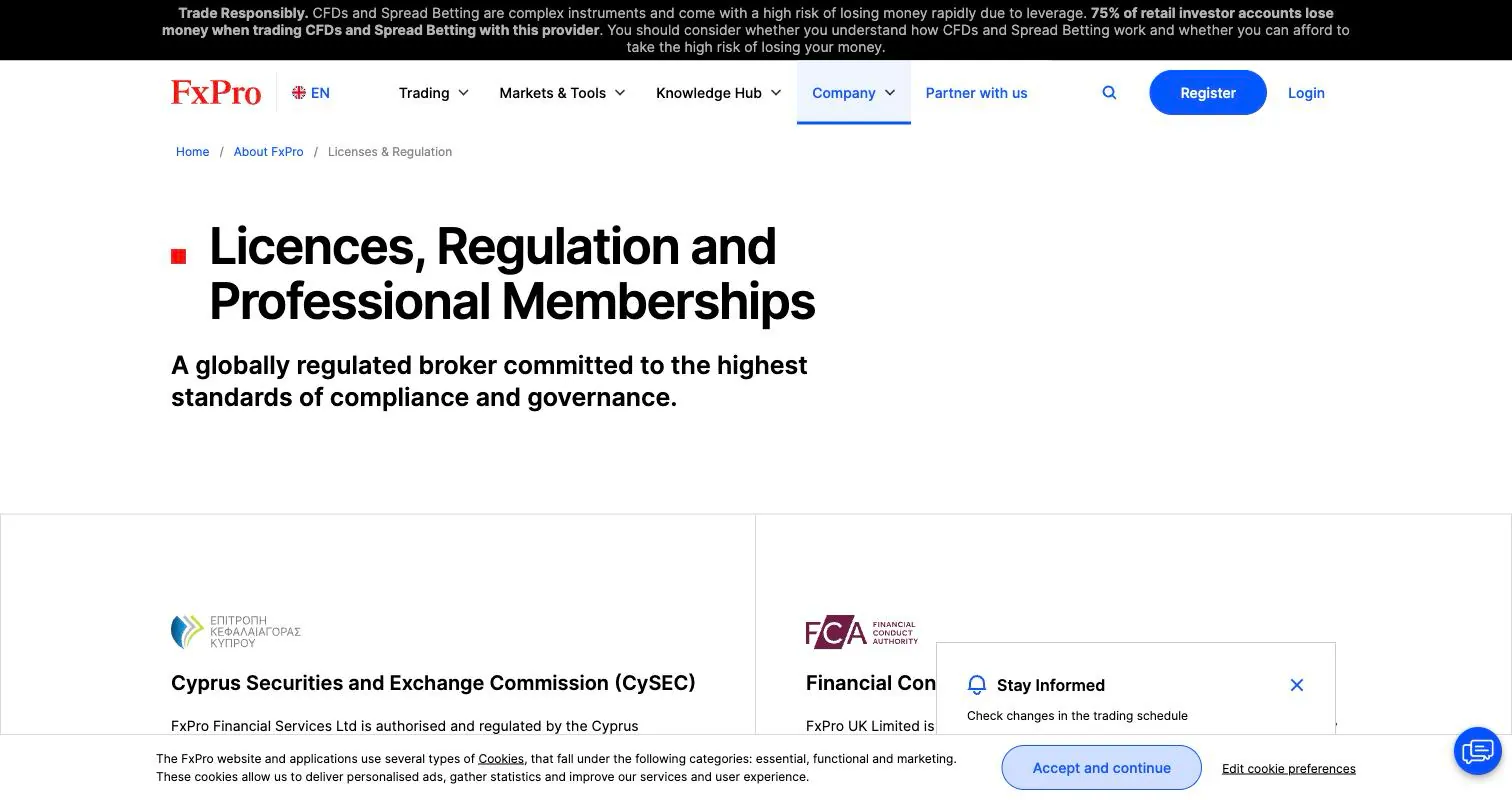
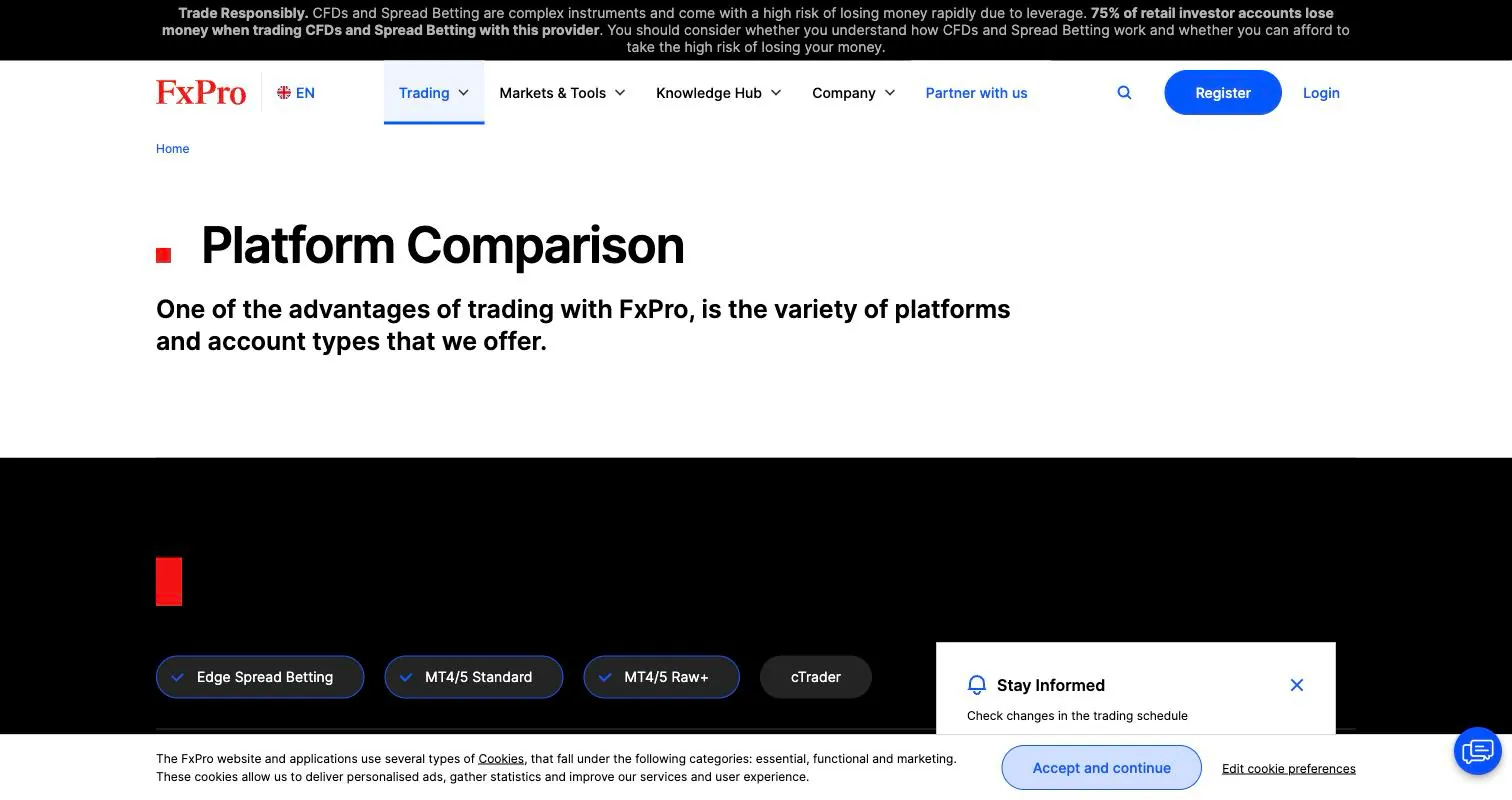
Pages captured from FxPro’s own site when this review was written. Brokers change their terms; these are what we read.

Score history
Recomputed daily; every move is on the record. The current score is always the latest row.
| Date | Score | Move |
|---|---|---|
| 2026-10-06 | 7.4 | ▲ |
| 2026-07-25 | 7.0 | ▲ |
| 2026-07-18 | 6.9 | ▲ |
| 2026-07-11 | 6.8 | · |
FAQ
Is FxPro regulated?
Yes, by the FCA (licence 509956) and CySEC (078/07), plus BaFin (121095) and register-confirmed licences in the Bahamas, Mauritius and Seychelles.
What trading platforms does FxPro offer?
MT4, MT5, cTrader, TradingView, its own web platform and mobile app, and FxPro Edge webtrader for UK spread betting.
What does FxPro charge to trade EURUSD?
On its Raw+ account the round turn is quoted from USD 0.00 on 1 lot EURUSD, though that’s a ‘from’ floor, not a guaranteed price.
What is FxPro's minimum deposit?
This is not published.
Are there fake or clone versions of FxPro?
Yes, about a dozen clone or unauthorised firms trade using the FxPro name that clients need to actively avoid.
How do customers rate FxPro?
A blended 3.29 stars across 110,746 ratings.
How this review works
Track FxPro live: score moves and red notices, in your pocket.