
CFD · CHECKED 7 OCT 2026
CMC Markets review.
Multi-licence CFD and spread betting broker with a fragmented entity structure
OK-ISH
OUT OF 10
CMC Markets is a CFD and spread betting broker holding confirmed licences with the FCA, BaFin and ASIC, plus BMA licensing for its Bermuda entity. Spreads are competitive and platform choice is wide, but the biggest reservation is that clients in several regions are routed to the Bermuda entity, with BMA-only cover, while UK entities are described as mere 'paying agents'.
Each criterion is scored 1 to 10 from primary sources. The overall score is their unweighted mean. How scoring works.
| Founded | 1989 |
|---|---|
| Headquarters | GB |
| Minimum deposit | No minimum |
| Maximum leverage | 1:200 |
| Minimum spread | 0 |
| Platforms | MetaTrader 4 (MT4), MetaTrader 5 (MT5), TradingView, CMC Markets Platform / CMC Web platform / Next Generation, CMC mobile app, CMC Markets Platform / CMC Next Generation, MetaTrader 4, MetaTrader 5 |
- FCA licences 173730, 170627 and 948126 confirmed on the register (UK)
- BaFin licence 154814 confirmed on the register (Germany)
- ASIC licences AFSL 238054 and 246381 confirmed on the register (Australia)
- BMA licenses CMC Markets Bermuda Limited for investment and digital-asset business
- FCA cover includes compensation to GBP 85,000, an ombudsman, 30:1 leverage cap
- Negative balance protection under the FCA licence
- Some regional clients are told the UK entity is just a 'paying agent'
- Real counterparty for those clients is the Bermuda entity, which has BMA-only cover
- Singapore footer names no MAS entity despite a MAS licence existing
- Minimum deposit is not published
- Quoted USD 2.50 spread is a 'from' floor, not a guaranteed price
- A platform CMC advertises does not appear in the account selector
Overview
TrueBroker is a free broker safety checker, and this page is our review of CMC Markets, scored 7.3 out of 10 across regulation, fees, platform, support and reviews.
CMC Markets is not one company but a group of separately licensed entities trading under the same brand, and which one a reader actually deals with depends on where they sign up from. CMC Markets CMC Markets UK plc (FCA reference 173730, Companies House number 02448409, incorporated 1 December 1989) and CMC Spreadbet plc (FCA reference 170627) cover UK clients; CMC Markets Germany GmbH (BaFin, BAK 154814) covers German clients; CMC Markets Asia Pacific Pty Ltd (ASIC AFSL 238054) and CMC Markets Stockbroking Limited (ASIC AFSL 246381) cover Australian clients. Readers outside the UK, the EEA and Australia are instead routed to CMC Markets Bermuda Limited, and the firm’s own pages describe the UK companies as acting only as a “paying agent” for that Bermuda entity on those pages (checked in the operator Claude session, 30 Sep 2026). None of the FCA, BaFin or ASIC licences above cover a client dealing with the Bermuda entity.
Overview Table
| Headquarters | 133 Houndsditch, London EC3A 7BX (registered office of CMC Markets UK plc, per the firm’s own contact page and Companies House) |
|---|---|
| Established | CMC Markets UK plc was incorporated 1 December 1989, per the UK Companies House register |
| Countries Served | The firm’s own pages describe direct entities or offices in the UK, Germany, Australia, Singapore, Canada, New Zealand, Norway, Poland and Spain, plus Bermuda-served country sites for Indonesia, Thailand, Vietnam, Japan, the UAE and South Africa |
| Regulated By | Financial Conduct Authority (UK), BaFin (Germany), ASIC (Australia), Monetary Authority of Singapore (Singapore), Bermuda Monetary Authority (Bermuda entity) |
| Minimum Deposit | No minimum deposit required on the Standard and FX Active CFD accounts, per the UK account comparison page; CMC Invest’s Core plan needs £0 to open but a £1 minimum per deposit |
| Maximum Leverage | The firm’s Bermuda-served country pages advertise maximum retail leverage of 1:200, while the UK account comparison table lists retail leverage of 1:30 |
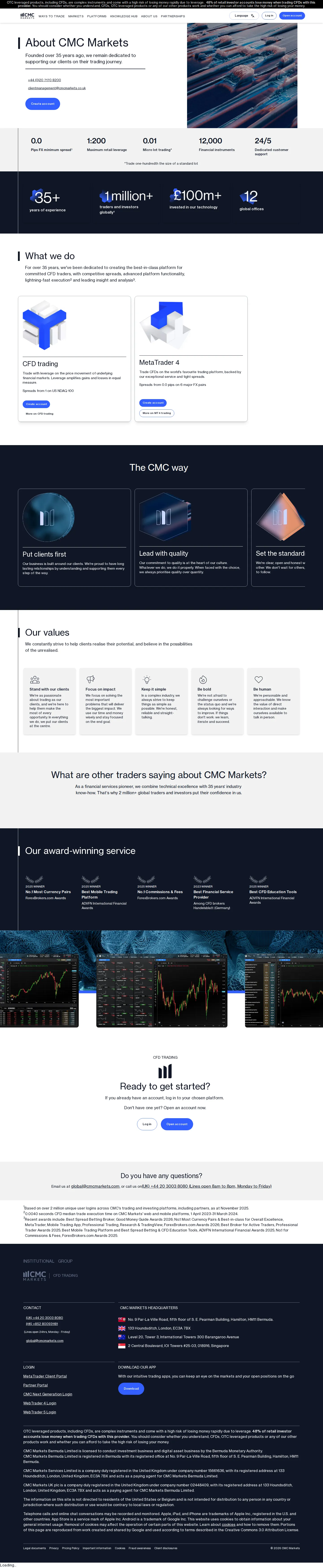
| Total Instruments | The firm’s own pages give inconsistent counts: “12,000 Financial instruments” on the ae/au/id about page, “21,000 financial instruments” on the UK about page, and a breakdown elsewhere of roughly 12,000 on the CMC Next Generation platform, 2,220 on MT5 and 220 on MT4 |
| Platforms | CMC Markets Platform / Next Generation, MetaTrader 4, MetaTrader 5, TradingView, and the firm’s own mobile app |
| Customer Support | Phone, email and live chat; the UK phone line is described as open “24hrs, Monday – Friday” on some of the firm’s pages and as open “Sunday night to Friday night, whenever the markets are open” on its dedicated contact pages |
| Languages | Not stated as a consolidated list; the firm publishes separate country sites at least for the UK, Germany, Australia, Singapore, the UAE and other Bermuda-served markets |
Facts List
- We searched 17 public registers directly, running a positive control on each first so an empty result means absence rather than a broken search.
- We searched 1,444 warning-list entries mirrored from CYSEC, the FCA and FSC Mauritius, and CMC Markets appears on none of them; this covers only the lists we mirror, not every regulator worldwide.
- The FCA register shows CMC Markets UK plc (173730) as Authorised and CMC Markets Investments Limited (948126) as Authorised, but shows CMC Spreadbet plc (170627) with the status “Authorised – applied to cancel”.
- The Bermuda Monetary Authority lists CMC Markets Bermuda Ltd for Digital Assets Business (Class F, registration 202302718, effective 25 Aug 2025) and Investment Business (effective 13 Dec 2024), with permitted activities limited to dealing in investments, arranging deals and promoting investments to the public; the BMA record states the company is not permitted to manage investments, give investment advice, or safeguard and administer investments.
- UK Companies House lists CMC Markets UK plc (02448409), CMC Markets Services Limited (15661636) and CMC Markets Investments Limited (12816952) as active companies.
- The ASIC company register lists CMC Markets Asia Pacific Pty Ltd (ABN 11 100 058 213) and CMC Markets Stockbroking Limited (ABN 69 081 002 851) as registered.
- The firm’s UK CFD holding-costs page shows “48%” in its introductory banner and “70%” in its footer for the same mandatory retail-loss disclosure, and its General Investment Account page shows a third figure, “68%”, elsewhere.
- The firm’s General Investment Account page advertises deposit protection “up to £85,000”, and its footnote explains that the Financial Services Compensation Scheme covers up to £85,000 per eligible person, per firm, with eligibility conditions.
- The firm’s fee page describes an account inactivity charge of £10 per month after a continuous year with no trading activity, and states a guaranteed stop-loss order premium is refunded in full only if the guaranteed stop-loss is not triggered.
- The firm’s UK fee page states larger CFD trade sizes may attract a wider spread than the headline minimum, and that outside normal market hours it can generate prices “manually or synthetically” rather than through its automated pricing engine.
How CMC Markets is licensed, entity by entity
A reader signing up in the UK deals with CMC Markets UK plc or CMC Spreadbet plc, both listed on the FCA register, or with CMC Markets Investments Limited (FCA reference 948126) for the separate CMC Invest share-dealing product. A reader in Germany deals with CMC Markets Germany GmbH, on the BaFin register with current permissions including Eigenhandel and Abschlussvermittlung under the WpIG. A reader in Australia deals with CMC Markets Asia Pacific Pty Ltd or CMC Markets Stockbroking Limited, both on the ASIC register. Everyone else, per the firm’s own country pages for markets such as Indonesia, Thailand, Vietnam, Japan, the UAE and South Africa, deals with CMC Markets Bermuda Limited, regulated by the Bermuda Monetary Authority alone, with the UK entities acting only as a paying agent on those pages.
What CMC Markets’ own pages disclose about pricing and access
The Standard and FX Active CFD accounts carry no stated minimum deposit, per the UK account comparison page. CMC Invest, the firm’s separate share-dealing product operated by CMC Markets Investments Limited, needs £0 to open an account but a minimum £1 per deposit, and charges an FX fee of 0.99% on the free Core plan (falling to “as low as 0.39%” on paid plans) on every international trade, on top of its advertised 0% dealing commission. The leverage a client can actually use depends on which entity holds their account: the UK comparison table caps retail leverage at 1:30, while the Bermuda-served country pages advertise maximum retail leverage of 1:200.
Key Takeaways
What the registers confirm about CMC Markets
- The Bermuda Monetary Authority lists CMC Markets Bermuda Ltd as licensed for Investment Business (effective 13 Dec 2024) and Digital Assets Business, Class F (registration 202302718, effective 25 Aug 2025), permitted to deal in, arrange deals in, and promote investments to the public, but not to manage investments, give advice, or safeguard and administer investments.
- The FCA register confirms three separate UK entities: CMC Markets UK plc (FRN 173730, Authorised, Companies House 02448409), CMC Markets Investments Limited (FRN 948126, Authorised, Companies House 12816952), and CMC Spreadbet Plc (FRN 170627), whose FCA status reads “Authorised – applied to cancel” with no termination date recorded, meaning the FCA still treats it as currently regulated.
- BaFin’s own database lists CMC Markets Germany GmbH (BAK 154814, BaFin-ID 10154814) with current permissions for Eigenhandel and Abschlussvermittlung under the WpIG, and two earlier permissions that have since ended.
- ASIC’s licence register shows AFSL 238054 held by CMC Markets Asia Pacific Pty Ltd and AFSL 246381 by CMC Markets Stockbroking Limited; the ASIC company dataset separately confirms both companies (ABN 11 100 058 213 and ABN 69 081 002 851) as registered. The MAS Financial Institutions Directory lists CMC Markets Singapore Pte Ltd as a Capital Markets Services Licensee and Exempt Financial Adviser, though the directory itself publishes no licence number.
- None of these licences covers the full readership of the brand: visitors from outside the UK, the EEA and Australia are routed instead to CMC Markets Bermuda Limited, an entity none of the FCA, BaFin or ASIC records above apply to.
- We searched 1,444 warning-list entries mirrored from CYSEC, the FCA and the FSC Mauritius, and CMC Markets appears on none of them. That result covers only the lists mirrored here, not every regulator worldwide.
What CMC Markets charges
- The firm’s UK fee page prices the FX Active account at $2.50 per lot per side (equivalently 0.0025% per transaction, or $2.50 per $100,000 notional), while the Standard account carries no separate commission line in the same comparison table.
- CFD positions held open at 5pm New York time draw a daily holding cost calculated from a holding rate applied to the position’s mid-price; the fee page states this can run positive or negative depending on direction.
- For cash commodity and treasury CFDs, the firm’s own fee page states the embedded CMC charge is “whichever is larger of 3% and a proportion of the price adjustment,” setting a 3% annualised floor regardless of how small the actual market movement is.
- Share and index CFD holding rates carry an adjustment of the interbank rate plus or minus 0.0082%, and forex CFDs carry the tom-next rate plus or minus 0.0027%, per the same fee page.
- CMC Invest, the firm’s separate share-dealing product, charges a 0.99% FX fee on international trades under its Core plan, falling to “as low as 0.39%” on higher-tier plans that carry their own monthly charges of £6.99 (Plus) or £10.99 (Premium).
- The UAE fee page lists an account inactivity fee of £10 per month (currency-dependent) after a year with no trading activity, and states a guaranteed stop-loss order premium is refunded in full only if the stop is never triggered.
Contract terms that bind a client
- CMC’s fee pages state plainly: “There are certain circumstances where we have to generate our own prices manually or synthetically rather than purely through our automated pricing engine,” including outside normal market hours, meaning execution prices in those windows are set at the firm’s own discretion.
- The same pages warn that “larger trade sizes may attract a wider spread than smaller trade sizes” and that “there may be times when we reject an order,” with the rejection rate said to depend on “your trading behaviour.”
- Where price moves between order placement and execution, CMC states the client generally gets the execution-time price, “to your advantage or disadvantage,” so slippage risk runs both ways.
- Downgrading a CMC Invest plan requires selling plan-restricted assets, cancelling pending orders, withdrawing all wallet cash, and closing or transferring the Stocks & Shares ISA before the switch goes through.
- On the Bermuda-served country pages, CMC Markets Services Limited and CMC Markets UK plc are described only as “paying agents” for CMC Markets Bermuda Limited, even though UK company names and a UK address sit in the same footer.
Inconsistencies on CMC Markets’ own pages
- The UK holding-costs page shows two different mandatory retail-loss figures for the same risk warning on one page: 48% in the intro banner and 70% in the footer. The separate General Investment Account page shows a third figure, 68%.
- The German-language homepage, rendered in a browser, states that 70% of retail investor accounts lose money on CFDs and OTC options with the firm.
- Maximum retail leverage differs sharply by page: the Bermuda-served country pages advertise “Maximum retail leverage 1:200,” while the UK account-comparison table lists retail leverage at 1:30.
- Instrument counts vary by page: the Bermuda-served about page headlines “12,000 Financial instruments,” the UK about page states “21,000 financial instruments,” and the UAE fee page’s own footnote breaks the platform-level counts down as roughly 12,000 on the Next Generation platform, 2,220 on MT5 and 220 on MT4.
- Support-line hours are described two ways across the firm’s own pages: “Lines open 24hrs, Monday – Friday” on some footers, versus “Lines open from Sunday night to Friday night, whenever the markets are open” on the dedicated contact pages, for the same UK number.
Licenses & Regulation
CMC Markets is not one regulated firm but a group of separately licensed entities, and which one actually takes a client on depends on where that client is browsing from. We searched 17 public registers directly, running a positive control on each first so that an empty result would mean absence rather than a broken search, and then read the firm’s own footers and terms to see how the entities are described to different visitors.
Which entity actually holds the client
CMC’s own country pages for Indonesia, Thailand, Vietnam, Singapore, Japan, the UAE and South Africa name CMC Markets Bermuda Limited as the licensed entity, and describe CMC Markets UK plc and CMC Markets Services Limited only as “paying agents” for that Bermuda entity, even though a UK company name and London address sit in the same footer. We checked this routing in our own session on 30 September 2026 and confirmed that visitors from outside the UK, the EEA and Australia are sent to the Bermuda entity. That matters because none of the FCA, BaFin or ASIC licences below cover that entity: they cover only the UK, German and Australian entities, and a client routed to Bermuda is contracting with a firm the Bermuda Monetary Authority licenses, not the FCA.
What the FCA register shows for CMC Markets’s UK entities
The FCA register confirms three separate firm reference numbers under the CMC Markets brand. FRN 173730 is held by CMC Markets UK plc, status Authorised, effective from 1 December 2001, and the same register links it to Companies House number 02448409. FRN 948126 is held by CMC Markets Investments Limited, the entity behind the CMC Invest share-dealing, ISA and SIPP product, status Authorised, effective from 21 March 2022, Companies House number 12816952. FRN 170627 is held by CMC Spreadbet Plc, but here the FCA register’s own wording is “Authorised – applied to cancel”, with no termination date yet recorded, so the register shows the firm as still currently regulated by the FCA despite that pending cancellation. Companies House itself, which is a company registry rather than a financial regulator, separately confirms CMC Markets Services Limited as company 15661636, a private limited company incorporated 19 April 2024.
Germany, Australia and Singapore
In Germany, BaFin’s company database lists CMC Markets Germany GmbH under BAK 154814 and BaFin-ID 10154814, as a Wertpapierinstitut based in Frankfurt, with current permissions including Abschlussvermittlung under section 2(2) no. 5 WpIG since 26 June 2021 and Eigenhandel under section 2(2) no. 10c WpIG from the same date; two earlier permissions on the record have since ended. In Australia, the ASIC register confirms AFS licence 238054 for CMC Markets Asia Pacific Pty Ltd and AFS licence 246381 for CMC Markets Stockbroking Limited, and the ASIC company dataset separately confirms both companies exist, under ABN 11 100 058 213 and ABN 69 081 002 851 respectively, as at the weekly snapshot of 28 September 2026. In Singapore, the MAS Financial Institutions Directory lists CMC Markets Singapore Pte Ltd as a Capital Markets Services Licensee and Exempt Financial Adviser, covering activities including dealing in capital markets products and leveraged foreign exchange trading, though the directory itself publishes no licence number for the entry. We note this sits against CMC’s own fetched Singapore-context page, which carries the same footer used on its Bermuda-served pages and names CMC Markets Bermuda Limited, not the Singapore entity, as the licensed party, with UK companies described only as paying agents.
Bermuda: what CMC Markets Bermuda Limited is and isn’t allowed to do
The Bermuda Monetary Authority’s list of regulated entities carries CMC Markets Bermuda Ltd twice: as a Class F Digital Assets Business, registration number 202302718, effective 25 August 2025, and under Investment Business: Licensed Entities, effective 13 December 2024. The BMA’s own record of permitted activities states the company “is permitted to deal in investments, arrange deals in investments, and promote investments to the public,” and separately that it “is not permitted to manage investments, give or offer investment advice, or safeguard and administer investments.” For the digital asset side, the BMA lists the permitted activity as operating as a digital asset derivative exchange provider. Those are the activities named on the register, not a general investment licence, and they apply to every client the Bermuda entity takes on, including the retail CFD traders in the jurisdictions listed above.
Companies House, the warning lists and what’s left unchecked
Alongside the FCA numbers, Companies House confirms CMC Markets UK plc as active company 02448409, incorporated 1 December 1989, and CMC Markets Investments Limited as active company 12816952, incorporated 17 August 2020; in both cases this is a company registration check, not a licensing one. We searched 1,444 warning-list entries mirrored from CySEC, the FCA and the FSC Mauritius, and CMC Markets matches none of them; that covers only the three regulators we mirror, not a global sweep.
How to Trade
CMC Markets funnels clients into different entities and different pricing depending on which regional site they land on, and both the instrument count and the execution rules change with them. On the ae and au sites the firm advertises “12,000 Financial instruments” under the CMC Next Generation platform, while the UK site (gb about 2) states “21,000 financial instruments” for spread betting and CFDs. A footnote on the fees page breaks the Bermuda served figure down further: the CMC Next Generation platform carries approximately 12,000 instruments, MetaTrader 5 approximately 2,220, and MetaTrader 4 just 220. Markets on offer across the sites include forex, indices, commodities, shares, ETFs, rates and bonds, cryptocurrencies, share baskets and options.
Accounts and how positions are priced at CMC Markets
The Standard CFD trading account carries no minimum deposit and covers “12,000+ instruments*” on the CMC Markets Platform and MT4, according to the UK account comparison page. The FX Active account, also with no minimum deposit, moves FX pricing onto a commission basis: the ae root page gives the commission as 0.0025% per transaction on opening and closing a position, equivalent to $2.50 per $100,000 notional traded, while the UK account comparison table states it as $2.50 per lot, per side. That account also carries spreads from 0.0 pips on six major FX pairs and a 25% spread discount on more than 300 other FX pairs, and extends to indices, shares, commodities and cryptocurrencies, with shares only available on MT5 or the Next Generation platform.
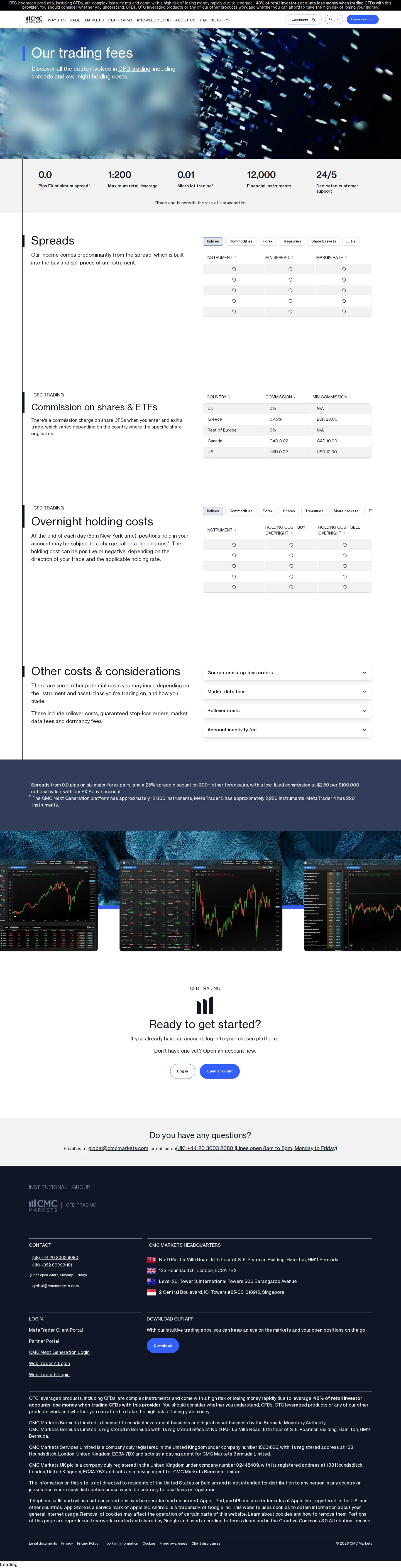
Positions held open are subject to a daily holding cost, charged or credited at 5pm New York time, calculated from the position’s mid price and a holding rate that CMC’s own fees page describes as capable of running positive or negative. For forex CFDs the adjustment is the tom next rate plus or minus 0.0027% (plus on buys, minus on sells). For shares and index CFDs it is the underlying interbank rate plus or minus 0.0082%, and the fees page notes that sell positions can still incur a charge even when the interbank rate sits at or below that 0.0082% figure. For cash commodities and treasuries, the fees page states the CMC charge embedded in the holding rate is “whichever is larger of 3% and a proportion of the price adjustment,” which sets a 3% annualised floor regardless of how small the actual market adjustment is. The same page also warns that holding rates on sell trades in heavily shorted shares can carry an additional borrowing fee adjustment that is both large and fast changing.
Execution terms that bind a position
CMC’s fees page (Out of Hours and Manual Pricing) states plainly: “There are certain circumstances where we have to generate our own prices manually or synthetically rather than purely through our automated pricing engine,” including outside market hours. On the same page, under CFD Trades, the firm discloses that “larger trade sizes may attract a wider spread than smaller trade sizes,” so the headline minimum spread does not carry through to bigger volumes. Under Our platform pricing, the fees page states that if the price moves between order placement and execution, the client generally gets the execution time price, “to your advantage or disadvantage,” meaning slippage risk runs both ways and the price shown on screen is not a guarantee. The same section discloses that CMC can reject orders outright: “There may be times when we reject an order. The proportion of orders that are rejected will depend on your trading behaviour,” without stating what behaviour triggers a higher rejection rate.
A guaranteed stop loss order carries a premium calculated as the premium rate multiplied by trade size, refunded in full only if the order is never triggered, per the fees page. That means the one scenario a client buys the protection for, the stop actually firing, is the one scenario in which no premium comes back.
Leverage and jurisdiction at CMC Markets
The leverage on offer depends heavily on which entity is on the other side of the trade. The Bermuda served country pages (covering Indonesia, Thailand, Vietnam, Singapore, Japan, UAE and South Africa) advertise “Maximum retail leverage 1:200,” while the UK account comparison table lists retail leverage of 1:30. On those Bermuda served pages, CMC Markets UK plc and CMC Markets Services Limited are named only as “paying agent for CMC Markets Bermuda Limited,” with CMC Markets Bermuda Limited holding the underlying investment business and digital asset business licences from the Bermuda Monetary Authority, confirmed on the BMA’s list of regulated entities. So a client trading on 1:200 leverage through those sites is contracting with the Bermuda licensed entity even where UK company names and a UK address sit in the same footer.
Two further contractual points affect anyone trading through those Bermuda served sites. The complaints procedure FAQ on the ae root page states that “all queries and complaints will be handled in English,” regardless of which language the site itself is presented in. And CMC’s legal disclaimers page states that telephone calls and online chat conversations may be recorded and monitored.
Account Types
CMC Markets sells two distinct product lines: leveraged CFD/spread betting accounts, and CMC Invest, a separate share-dealing service. The entity a reader actually contracts with depends on where they are: CMC Markets Bermuda Limited is licensed by the Bermuda Monetary Authority for investment business and digital asset business, and its country pages describe CMC Markets UK plc and CMC Markets Services Limited only as “paying agents” for the Bermuda entity. UK-facing pages instead name CMC Markets UK plc (FCA 173730), CMC Spreadbet plc (FCA 170627) and CMC Markets Investments Limited (FCA 948126) as the entities clients deal with.
The CFD accounts
The UK account comparison table lists two CFD account types. The Standard account needs no minimum deposit and gives access to “12,000+ instruments” on the CMC Markets Platform and MT4, with what the page calls “transparent & competitive spreads”. The FX Active account also needs no minimum deposit and switches forex pricing to commission: the firm’s Bermuda-entity homepage puts the FX Active commission at 0.0025% per transaction, equivalent to $2.50 per $100,000 notional value traded, while the UK account comparison table states the same charge as $2.50 per lot, per side. In exchange, FX Active carries spreads “from 0.0 pips” on six major FX pairs and a 25% spread discount on the other 300-plus pairs the firm lists, and on MT5 or the Next Generation platform it also covers indices, shares, commodities and cryptocurrencies.
A demo account is free on all platforms. The MT4/MT5 demo runs for an initial 30 days and expires after 30 days of inactivity; the Next Generation/CMC platform demo has no stated expiry. On the German site the demo is funded with a €10,000 virtual balance.
Leverage differs by which CMC Markets a client lands on
The firm’s own pages show a large gap in the leverage offered to retail clients depending on which entity serves them. Country pages routed to CMC Markets Bermuda Limited (covering Indonesia, Thailand, Vietnam, Singapore, Japan, UAE and South Africa) advertise “Maximum retail leverage 1:200”. The UK account comparison table, covering clients of the FCA-regulated entities, lists retail leverage as 1:30 for the same Standard and FX Active accounts. A client reading only the marketing pages for one market would not see the figure quoted to clients of the other.
CMC Invest: the share-dealing plans
CMC Invest, run through CMC Markets Investments Limited (FCA 948126), is a separate product from the CFD accounts and is priced on a subscription tier rather than a spread. The firm’s account page sets out four plans: Core, at £0 a month, giving a Flexible Cash ISA, Junior Cash ISA and General Investment Account with access to “4,600+ assets”; Equities, also £0 a month, giving access to “more than 16,000 shares and ETFs across global stock markets”; Plus, at £6.99 a month, adding a Stocks & Shares ISA and lower FX fees; and Premium, at £10.99 a month, combining ISA, GIA and SIPP in one app. Minimum deposit to open is £0, though any single deposit must be at least £1, and cheque or cash deposits are not accepted; funding has to come from an account or card in the client’s own name. Opening a General Investment Account requires being over 18, a UK or EEA resident with a UK bank account, and the firm currently offers no joint GIAs.
Every plan carries an FX fee on top of its monthly charge: the Core plan’s page states “0% commission on all trades” but still charges 0.99% on every international asset bought or sold, falling to “as low as 0.39%” on the higher tiers. CMC Invest also advertises a transfer incentive of up to £2,000 for clients who move in at least £25,000 from a SIPP, Stocks & Shares ISA and/or GIA, subject to terms and conditions the account page does not spell out in the material we fetched.
Downgrading a CMC Invest plan
Moving to a cheaper plan is not a simple toggle. The account page states that switching from Plus to Core, or Premium to Core, requires the client to sell any Plus-only assets, cancel pending orders, withdraw all cash held in the currency wallet, and close or transfer out the Stocks & Shares ISA before the downgrade is allowed. A client who wants a cheaper monthly fee has to unwind positions and close accounts first, which can force asset sales and ISA transfers they would not otherwise have chosen to make on that timetable.
Spectre
The firm’s UK homepage also names a product called Spectre, described as a spread-betting product “with no leverage” and promoted with the lines “No financing costs, No capital gains tax, No margin calls”, alongside a warning that a client “may lose your full committed amount”. Spectre does not appear in the account comparison table or the fee pages we fetched, so its minimum deposit, spreads and other mechanics are not documented in the material available to us.
Negative Balance Protection
CMC does not use the phrase “negative balance protection” on any of the pages we fetched. What the firm’s own pages do set out are the loss limits that actually apply: the leverage caps that decide how fast a losing position eats through margin, the guaranteed stop-loss product that is the one tool CMC sells for capping a loss in advance, and the risk warnings that tell a reader what share of accounts lose money in the first place. We report those, and we say plainly where the evidence stops rather than filling the gap with an assumption.
Leverage caps differ sharply by market
CMC’s Bermuda served country pages, the ones shown to visitors from Indonesia, Thailand, Vietnam, Singapore, Japan, the UAE and South Africa, advertise a maximum retail leverage of 1:200, according to the UAE-facing home page. The UK account comparison table, by contrast, lists retail leverage of 1:30. That is roughly six to seven times more leverage on offer outside the UK than inside it, on CMC’s own pages. Higher leverage does not by itself increase the loss rate disclosed, but it does shrink the margin cushion between an open position and a margin call, so the same adverse price move wipes out a larger share of an account funded at 1:200 than one capped at 1:30.
The retail loss rate CMC itself discloses is inconsistent
CMC’s mandatory retail loss warning, the percentage of retail accounts that lose money trading CFDs, is not the same figure across the firm’s own pages. The Bermuda served pages state 48%. The UK General Investment Account page states 68%. The UK CFD holding costs page states a third figure, 70%, in its page footer, while the same page’s introductory banner states 48%. Three different percentages for what is meant to be one standardised disclosure, all drawn from pages CMC itself publishes, means a reader cannot tell from CMC’s site alone what proportion of accounts like theirs actually lose money. We note this because it bears directly on how a prospective client should read any loss statistic the firm shows them elsewhere on the same site.
The guaranteed stop-loss order, and what its premium actually buys
The one product on CMC’s fee page built specifically to cap a loss is the guaranteed stop-loss order, priced at a premium rate multiplied by trade size, according to the UAE-facing fees page. That same page states the premium is refunded in full only if the guaranteed stop-loss order is not triggered. In practice that means the one scenario a client pays this premium to protect against, the stop actually firing in a fast market, is the one scenario in which the premium is not returned. The protection works as advertised when it triggers; the cost of it does not disappear when it does.
Financing and holding costs that compound a losing position
CFD positions held open at 5pm New York time are charged or credited a daily holding cost, calculated from the position’s units, its mid price, and a holding rate that can run positive or negative. For cash commodities and treasuries, the same page states CMC’s own charge embedded in that holding rate is whichever is larger of 3% and a proportion of the price adjustment, a floor that applies even when the underlying market adjustment is smaller. For share CFDs, the holding rate adjustment is the underlying interbank rate plus or minus 0.0082%, and the page also warns that sell positions in heavily shorted shares can carry an additional, potentially large and fast changing borrowing fee adjustment on top of that. A client holding a losing short position in a stock with rising short interest is, by CMC’s own description, exposed to extra costs that are not fixed in advance and can move quickly.
Pricing outside market hours and the client’s slippage risk
CMC’s fee pages describe circumstances in which prices are generated manually or synthetically rather than through the automated pricing engine, including outside normal market hours. The same page states that larger trade sizes may attract a wider spread than smaller trade sizes, and that if the market price moves between when a client places an order and when it executes, the client generally receives the execution time price, to the client’s advantage or disadvantage. It also states that CMC may reject an order, and that the proportion of orders rejected depends on the client’s trading behaviour. Taken together, these clauses mean the price at which a losing position is actually closed, and whether an order to close it is accepted at all, is not guaranteed by the price a client saw on screen when they placed it.
The pages CMC serves for its Bermuda entity state that “Under the BMA rules, retail clients must be provided with negative balance protection.” That silence is a statement about what we found in the pages we read, not a finding that CMC offers no such protection; we simply did not fetch a page that states one either way.
Trading Instruments
CMC’s own pages list the asset range differently depending on which country site a reader lands on. The UAE page (served by CMC Markets Bermuda Limited) puts the headline count at “12,000 Financial instruments,” while the UK spread-betting and CFD page states “21,000 financial instruments” for the same broad category. A footnote on the fee page for those Bermuda-served markets breaks the figure down further: the CMC Next Generation platform carries “approximately 12,000 instruments,” MetaTrader 5 carries “approximately 2,220 instruments,” and MetaTrader 4 carries “220 instruments.” The three numbers don’t reconcile against each other, and nothing in the pages fetched explains why the UK total is nearly double the Bermuda-entity total.
Markets navigation across the CMC sites lists forex, indices, commodities, shares, ETFs, rates and bonds, and cryptocurrencies as standard categories, with share baskets called out as an “exclusive CMC product.” The UK CFD and Australian pages add options to that list under “Markets to trade.” Crypto CFD pricing, per the Bermuda-served pages, is sourced from Binance, Bitstamp, Coinbase Pro, itBit, Gemini and Kraken.
CMC Markets’ account types cover different slices of that range
The Standard CFD trading account is described as giving access to “12,000+ instruments*,” available on the CMC Markets Platform and MT4, with no minimum deposit required. The FX Active account, also with no minimum deposit, is commission-based and covers indices, shares, commodities and cryptocurrencies in addition to forex, but the UK account-comparison table restricts share CFDs on that account to MT5 or the Next Generation platform only. That same UK comparison table lists “The CMC Markets Platform, MT4” as the trading platforms for both the Standard and FX Active accounts, even though MetaTrader 5 and TradingView are both promoted as supported platforms elsewhere on CMC’s marketing and about pages. A reader relying only on the account comparison table would not learn that MT5 or TradingView exist as options for these accounts.
CMC Invest runs as a separate product line with its own instrument count
CMC Invest, operated by the FCA-authorised CMC Markets Investments Limited, is described on the UK accounts page as giving “access to 4,600+ assets” on its Core plan, while a separate CMC Invest markets page states “40,000+ stocks and ETFs from the ASX and 15 global markets” and, elsewhere on the same page, “more than 16,000 shares and ETFs across global stock markets” under the Equities plan. These are share-dealing products (ISA, Junior ISA, GIA, and on the Premium plan a SIPP), distinct from the CFD/spread-betting range, and carry their own FX fee structure: 0.99% on the Core plan’s international trades, falling to “as low as 0.39%” on higher-tier plans, charged on top of the “0% commission on all trades” headline.
Leverage on the same instruments differs sharply by which entity a client lands on
The Bermuda-served country pages (covering Indonesia, Thailand, Vietnam, Singapore, Japan, the UAE and South Africa) advertise “Maximum retail leverage 1:200,” while the UK account-comparison table, governed by CMC Markets UK plc and CMC Spreadbet plc under the FCA, lists retail leverage at 1:30. Since these are the same broad asset categories, forex, indices, shares, commodities, marketed under the same brand, the leverage a retail client can actually take on the identical instrument depends entirely on which regional entity holds their account, and the Bermuda entity is licensed by the Bermuda Monetary Authority rather than the FCA.
A Spectre product is named but not documented in the fee or account material
CMC’s homepage refers to a “Spectre” spread-betting product described as carrying “no leverage,” promoted with “No financing costs, No capital gains tax, No margin calls,” alongside a warning that a client “may lose your full committed amount.” Nothing in the account tables or fee pages fetched for this review sets out Spectre’s tradable instrument list, minimum outlay or contract terms, so its mechanics beyond that homepage description are not established here.
Guaranteed stop-loss orders and out-of-hours pricing shape execution across the whole asset range
CMC’s fee material describes a guaranteed stop-loss order (GSLO) premium calculated as a premium rate multiplied by trade size, refunded in full only if the GSLO is not triggered, meaning a client whose guaranteed stop actually protects them, the scenario they paid for, keeps no refund of that premium. Separately, the fee pages state that “there are certain circumstances where we have to generate our own prices manually or synthetically rather than purely through our automated pricing engine,” including outside normal market hours, and that “larger trade sizes may attract a wider spread than smaller trade sizes.” Both apply across the instrument categories listed above, not to any single asset class.
Education & Analysis
CMC Markets offers a spread of platforms rather than one, and its own pages do not agree on how many instruments sit behind them. Its account pages list MetaTrader 4, MetaTrader 5, TradingView and the firm’s own web platform, variously branded “The CMC Markets Platform,” “CMC Web platform” and, on the Bermuda-served country sites, “Next Generation” or “CMC NextGen.” A separate branded mobile app sits alongside the MetaTrader apps’ own mobile clients.
What CMC Markets’ own platform adds
The firm’s about page describes more than £100m invested in the CMC Markets Platform, with TradingView charts and TipRanks and Morningstar research built into it. TradingView itself is also offered as a standalone connection: CMC’s pages describe opening, managing and closing trades from within TradingView directly, not just viewing charts there. MetaTrader 4, by contrast, is flagged elsewhere on the site as “Not TradingView compatible,” so the TradingView integration is tied to specific platforms rather than running across all of them. Web-terminal access for the MetaTrader platforms is handled separately through MT4 WebTrader and MT5 WebTrader, letting a client log in from a browser without the desktop application.
The UK account comparison table tells a narrower story
CMC’s “Account types” page for the UK, the page built specifically to let a prospective client compare what each account offers, lists the trading platforms for both the Standard and FX Active accounts as “The CMC Markets Platform, MT4” only. MT5 and TradingView, both promoted on the firm’s marketing and about pages, do not appear in that table. A reader who compares account types using the page designed for that purpose would come away without knowing those two platforms exist as options, even though the same site promotes them elsewhere.
Instrument counts move depending on which CMC Markets page is read
CMC’s own pages give three different instrument totals. The UAE about page headline states “12,000 Financial instruments.” The UK about page, the firm’s UK about page, states “21,000 financial instruments” for the spread betting and CFD offering. A footnote on the firm’s UAE fees page breaks the figure down by platform instead: the CMC Next Generation platform carries approximately 12,000 instruments, MetaTrader 5 carries approximately 2,220, and MetaTrader 4 carries 220. None of these three figures resolves into the others, so which number describes what a given client can actually trade depends on which page, and which platform within that page, is being read.
Demo accounts and CMC Invest’s separate tooling
CMC’s German site describes a demo account free on all platforms, funded with a €10,000 virtual balance; the MT4 and MT5 demos are time-limited to an initial 30 days and expire after 30 days of inactivity, while the demo for the Next Generation or CMC platform carries no expiry on the same page. Share dealing is handled through a distinct product line, CMC Invest, with its own platform and a separate “Pro platform” named on the firm’s UK markets page, rather than through the CFD platforms described above.
Pricing behind the charts
Crypto CFD pricing on the CMC Markets Platform is sourced from Binance, Bitstamp, Coinbase Pro, itBit, Gemini and Kraken, per the firm’s UAE home page. Separately, CMC’s fee pages state that “there are certain circumstances where we have to generate our own prices manually or synthetically rather than purely through our automated pricing engine,” including outside normal market hours, and that “larger trade sizes may attract a wider spread than smaller trade sizes.” Both apply to pricing shown on the charting platforms themselves, not just to execution after an order is placed.
Special Offers
The transfer incentive on CMC Invest
The one item on CMC’s own pages that reads as a promotion sits on the CMC Invest account page, not on the CFD trading side of the business. CMC Markets Investments Limited offers new CMC Invest clients up to £2,000 for transferring a SIPP, a Stocks and Shares ISA and/or a General Investment Account across to it, provided the transfer totals at least £25,000. The account page attaches the standard qualifier “T&Cs apply” without setting out what those terms are on the page we fetched, so the tiering of that £2,000 against the size of the transfer, and any minimum holding period before it is paid or clawed back, is not something we can report from what we read.
The same page lists an unrelated GIA eligibility rule worth flagging alongside this incentive: the General Investment Account is only open to applicants over 18 who are UK or EEA residents with a UK bank account, and CMC does not currently offer a joint GIA. Both conditions would apply to anyone trying to claim the transfer incentive through a GIA.
Discounts built into the FX Active account, not a limited-time offer
Outside CMC Invest, the discount we found in the pages fetched is structural rather than promotional. CMC’s ae-root page describes the FX Active account, which charges a commission instead of building the cost into the spread; six major pairs are advertised there at spreads “from 0.0 pips”, and more than 300 other FX pairs traded on that account type carry a 25% spread discount. This is a feature of the account tier itself, available for as long as the client holds that account, not a time-boxed sign-up bonus.
A refund condition worth reading carefully
The fee page we read also describes how CMC prices its guaranteed stop-loss orders: the premium is charged as a rate applied to trade size, and is refunded in full only if the guaranteed stop-loss is never triggered. Read the other way round, a client who buys the protection and then actually needs it, because the market moved against them and the stop fired, keeps no refund of what they paid for it. That is a pricing mechanic rather than a discount, but it sits next to the deposit and account terms in the same fee material and is worth flagging here because it is easy to misread as money-back protection.
Beyond the CMC Invest transfer incentive and the FX Active account’s built-in spread discount, the account and fee pages we fetched set out standard commission schedules, holding-cost formulas and an inactivity charge of £10 a month after a year of no trading, rather than further promotional terms. We are reporting on the pages we pulled for this review; we have not fetched every regional or campaign page CMC operates.
Opening an Account
What a prospective client actually opens depends on where they are writing from. CMC’s own footer disclosure for its UAE site describes CMC Markets Services Limited and CMC Markets UK plc only as “paying agents” for CMC Markets Bermuda Limited, the entity that holds the actual investment-business and digital-asset licence from the Bermuda Monetary Authority. So a client signing up through that site is contracting with the Bermuda company, not with the UK-registered names printed in the same footer. Readers in the UK, the EEA or Australia instead open an account with the FCA-authorised or ASIC-licensed entities named on CMC’s UK and Australian pages.
Account types CMC Markets offers at sign-up
For CFD trading, CMC’s own account-comparison page lists a Standard account and an FX Active account, both with no minimum deposit required. The FX Active account is built around commission-based FX trading, with spreads advertised from 0.0 pips on six major FX pairs and a 25% spread discount on more than 300 other FX pairs, and also covers indices, shares, commodities and cryptocurrencies. Separately, CMC Invest, the UK share-dealing product run by CMC Markets Investments Limited, opens with £0 required to open the account and a stated minimum of £1 for any single deposit. Its Core plan carries no monthly price-plan fee; Plus costs £6.99 a month and Premium £10.99 a month, according to CMC’s own accounts page.
Who CMC Markets will not open an account for
CMC’s own pages state that the site “is not directed to residents of the United States or Belgium,” and is not intended for distribution to residents of those countries or any jurisdiction where doing so would be unlawful, wording repeated on both the Bermuda-served country pages and the firm’s about pages. For CMC Invest’s General Investment Account specifically, CMC’s own accounts page sets eligibility at over 18, resident in the UK or the EEA, and holding a UK bank account. The same page states that no joint General Investment Accounts are currently offered, so a GIA can only be opened by a sole applicant.
Funding a new CMC Markets account
CMC’s own accounts page lists credit or debit card and bank transfer as funding methods for CMC Invest, and states plainly that cheque and cash deposits are not accepted; funding has to come from an account or card in the client’s own name. Elsewhere on CMC’s pages, PayID and PayPal appear as listed funding methods alongside card and bank transfer, and the Bermuda-served country pages add USDT and USDC funding and withdrawal via Binance Pay, plus Neteller and Skrill as payment service providers. Which of these apply to a given new account depends on which entity and country site the client opened through, since the evidence here comes from different regional pages rather than one unified funding list.
Demo account before committing real funds
CMC’s German site describes its demo account as free across platforms, funded with a €10,000 virtual balance on the German site specifically. The same page notes that the MT4/MT5 demo is available for an initial 30 days and expires after 30 days of inactivity, while the demo on CMC’s own Next Generation platform (branded CMC Markets Platform elsewhere) carries no expiry.
What happens if a client later wants to switch CMC Invest plans
Moving down a price-plan tier is not a simple toggle. CMC’s own accounts page states that downgrading a CMC Invest plan, for example from Plus to Core or Premium to Core, requires the client to first sell any assets that are only held under the higher plan, cancel pending orders, withdraw all cash sitting in the currency wallet, and close or transfer out the Stocks and Shares ISA before the switch is permitted. A client who opened under a higher-tier plan and later wants a cheaper one is therefore forced into asset disposals and account closures to get there, which can trigger tax consequences the client did not plan for.
Language of account correspondence
For the Bermuda-served country sites, CMC’s own complaints procedure FAQ states that “all queries and complaints will be handled in English.” A client opening an account through the Indonesian, Thai, Vietnamese or other Bermuda-served language site should expect that any dispute over the account itself will be conducted in English regardless of the language the site was browsed in.
Deposits & Withdrawals
CMC does not publish a deposits and withdrawals fee table in the evidence we fetched. What we hold instead is a set of funding methods listed across the site’s regional pages, a set of connected fee items that erode balances over time, and a set of legal terms that govern who is actually holding the client’s money.
How money moves in
On the UAE facing root page CMC lists USDT and USDC funding and withdrawal via Binance Pay, alongside card and bank transfer, Neteller and Skrill as funding service providers. On the UK CMC Invest pages, funding is by credit or debit card or bank transfer in GBP, with cheque and cash deposits explicitly not accepted and funding required to come from an account or card in the client’s own name. The UK account comparison page also lists PayID (AUD) and PayPal as funding methods. The evidence does not include a deposit or withdrawal fee schedule for the CFD accounts, so we cannot say whether CMC charges for moving money by any of these rails; we can only report the methods the firm’s own pages name.
What CMC Markets charges once money is inside the account
The published fee material we read shows several charges that reduce what a client keeps, separate from any transfer fee. CMC’s fee page states an account inactivity fee of £10 per month (the amount depends on account currency) charged on accounts with no trading activity for a continuous period of one year, with no deduction made if the account holds no funds. That is a standing drain on a dormant but funded account, continuing indefinitely until either the funds run out or trading resumes.
For CFD accounts, the firm’s UK fees page describes a daily “holding cost” charged or credited at 5pm New York time on positions held open overnight, calculated from a holding rate that can run positive or negative. For cash commodities and treasuries, that page states the CMC charge embedded in the holding rate is “whichever is larger of 3% and a proportion of the price adjustment,” which sets a 3% annualised floor regardless of how small the underlying market adjustment actually is. For shares, the same page notes that holding rates on sell positions may include an additional, potentially large and fast changing, borrowing fee adjustment on heavily shorted stock.
On the CMC Invest share dealing side, the firm’s account page states an FX fee of 0.99% on the Core plan, falling to “as low as 0.39%” on higher tiers, applied to every international asset bought or sold. That charge sits alongside a claim of 0% commission on trades, so a client moving money into a foreign currency position pays this conversion fee even though the headline pricing advertises no commission. The same page gives a minimum single deposit of £1 for CMC Invest, and separately advertises a transfer incentive of up to £2,000 for a client moving a minimum of £25,000 in from a SIPP, Stocks and Shares ISA and/or GIA, with terms and conditions attached that we did not fetch.
Guaranteed stops and switching plans also cost money
CMC’s fee page describes a guaranteed stop loss order premium, calculated as a premium rate multiplied by trade size, that is refunded in full only if the guaranteed stop is not triggered. In the one scenario the client paid the premium to protect against, the premium is not returned.
The CMC Invest account page also states that downgrading a plan, for example from Plus to Core or Premium to Core, requires the client to first sell any Plus only assets, cancel pending orders, withdraw all currency wallet cash, and close or transfer out the Stocks and Shares ISA before the switch is permitted. A client who wants to move to a cheaper plan is forced through asset disposals and account closures to get there.
Which entity is actually holding the funds
This matters for withdrawals because it determines which regulator, and which compensation scheme, stands behind the money. The register check we ran confirms FRN 173730 (CMC Markets UK plc), FRN 170627 (CMC Spreadbet plc) and FRN 948126 (CMC Markets Investments Limited) on the FCA register, and CMC Markets Bermuda Ltd on the Bermuda Monetary Authority list, effective 13 Dec 2024 for investment business. But that FCA cover applies only to part of the brand’s readers: we found that visitors from markets outside the UK, the EEA and Australia are routed to CMC Markets Bermuda Limited, which none of those FCA licences cover. On the country pages we fetched for Indonesia, Thailand, Vietnam, Singapore, Japan, UAE and South Africa, CMC Markets UK plc and CMC Markets Services Limited (Companies House number 15661636) are described only as “paying agents” for CMC Markets Bermuda Limited, even though UK company names and a UK address sit in the same footer. A client depositing and withdrawing on one of those sites is contracting with the Bermuda licensed entity, not with the FCA regulated UK companies whose branding appears alongside it.
The UK’s own General Investment Account page states client funds are “Protected up to £85,000”, and the footnote attached to that figure explains that the compensation amount “may be up to £85,000 per eligible person, per firm. Eligibility conditions apply.” We can report the £85,000 figure as it appears on the page, but the page itself does not substantiate it.
Pricing that can move against a client mid transaction
The firm’s UK fees page states plainly that “there are certain circumstances where we have to generate our own prices manually or synthetically rather than purely through our automated pricing engine,” including outside normal market hours. The same page states that “larger trade sizes may attract a wider spread than smaller trade sizes,” and that if price moves between order placement and execution, the client generally receives the execution time price “to your advantage or disadvantage.” None of these clauses is specific to deposits or withdrawals, but each affects the value a client is actually moving in or out at the point a position is opened or closed.
Set against all of this, the warning list search we ran covered 1,444 entries mirrored from CYSEC, the FCA and the FSC Mauritius, and CMC Markets appears on none of them. That result covers only the lists we mirror, not every regulator, but it is a clean result worth stating plainly.
Customer Support
CMC Markets does not run one support desk. Different entities behind the brand publish different phone numbers, different inboxes and, on the firm’s own pages, different answers for when those lines are staffed.
Phone lines and offices behind CMC Markets
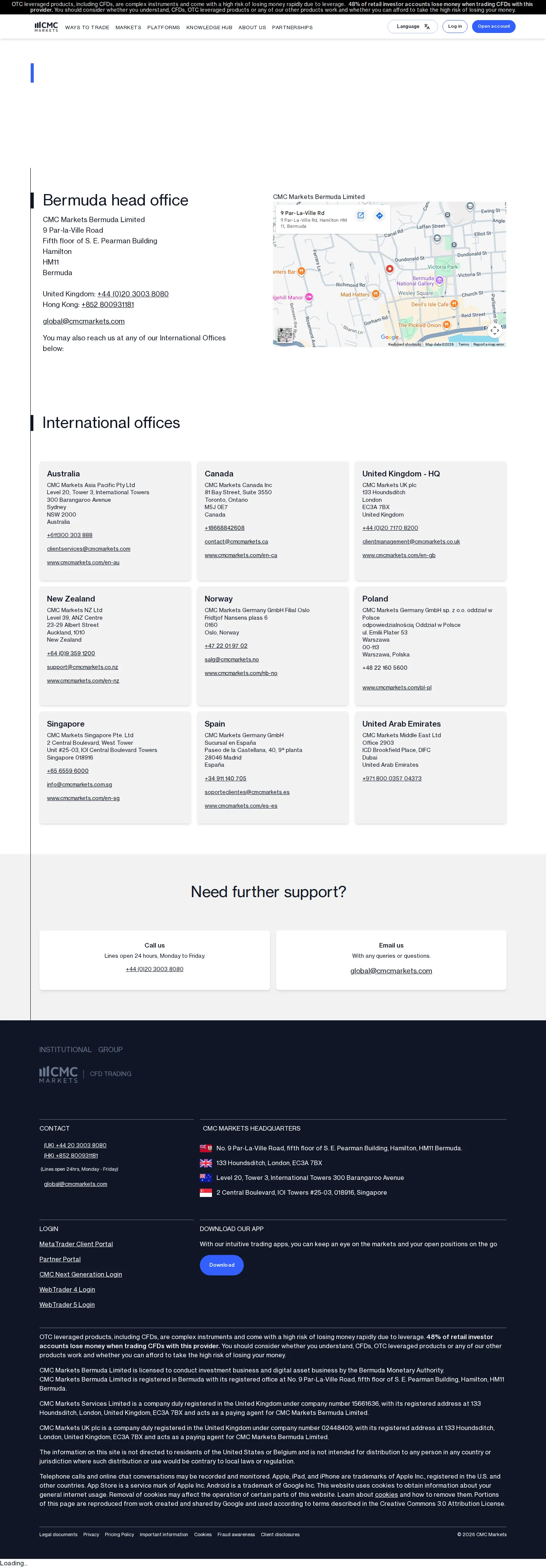
The firm’s UK contact page lists +44 (0)20 7170 8200 and the address clientmanagement@cmcmarkets.co.uk for CMC Markets UK plc at 133 Houndsditch, London. A separate global support line, +44 20 3003 8080, and a Hong Kong number, +852 800931181, both routing to global@cmcmarkets.com, appear on the firm’s UAE-facing pages alongside the Bermuda head office at 9 Par-la-Ville Road, Hamilton. Germany has its own line, +49 (0)69 22 22 440 00, and its own inbox, kundenservice@cmcmarkets.de, with a separate eusupport@cmcmarkets.com address also given on the UK contact page for the same Frankfurt office. Australia is reached on 1300 303 888 and clientservices@cmcmarkets.com from the Sydney office. The firm’s contact pages list further standalone numbers and addresses for Canada, New Zealand, Norway, Poland, Spain, Singapore and the UAE.
Two of the firm’s own pages give two different email addresses for the same Canadian office: the UAE-facing contact page shows contact@cmcmarkets.ca for CMC Markets Canada Inc at 81 Bay Street, Toronto, while the UK contact page shows clientmanagement@cmcmarkets.ca for the identical address.
What CMC Markets’ own pages say its hours are
The firm’s pages give two different descriptions of when the UK line, +44 (0)20 7170 8200, is open. Footers on the UAE-facing about page and the UK about page state “Lines open 24hrs, Monday – Friday.” The firm’s dedicated UK contact page instead states the same line is open “from Sunday night to Friday night, whenever the markets are open.” Both describe the identical number, and the two statements do not describe the same schedule.
Support hours where CMC Markets breaks them out by product
On its share-investing pages, CMC Markets publishes three separate schedules rather than one blanket claim. Share Investing Support is listed as running 7:30am to 8:00pm Sydney time Monday to Friday, 6:30am to 6:00pm Saturday, and 9:30am to 6:00pm Sunday. CFD Trading Support is listed as 24 hours, Monday to Saturday morning, in line with global market hours. Crypto CFD Support is listed as 24 hours on weekdays, 6am to 6pm Saturday, and 9:30am to 6:00pm Sunday. The firm’s UK homepage also carries an in-page “Live Help – Chat with CMC” widget.
Terms that bind a client who complains to CMC Markets
- The complaints procedure on the firm’s Bermuda-served pages, which serve clients in Indonesia, Thailand, Vietnam, Singapore, Japan, the UAE and South Africa, states: “all queries and complaints will be handled in English.” Complaints from those markets go through the English-only procedure that page describes.
- The firm’s legal disclosures on the same Bermuda-served pages also state that calls and online chat conversations with the firm may be recorded and monitored, so a complaint raised by phone or chat becomes a recorded exchange.
- Which entity actually receives a complaint depends on which country site a client signed up through. On the Bermuda-served pages, CMC Markets UK plc and CMC Markets Services Limited are described only as “paying agents” for CMC Markets Bermuda Limited, with CMC Markets Bermuda Limited holding the licensed investment-business and digital asset business permissions confirmed on the Bermuda Monetary Authority’s list of regulated entities. A client in one of those markets who calls the UK number or writes to the UK inbox listed above is contacting a paying agent, not the licensed entity that holds their account.
Prohibited Countries
CMC Markets publishes one explicit exclusion across its fetched pages, worded the same way on both the Bermuda-served entity’s UAE page and the UK-facing about page: the site and its services are not directed to, or intended for distribution to, residents of the United States or Belgium, or any jurisdiction where distribution/use would be contrary to local law. That is the entire prohibited-countries statement the evidence gives us. It names the United States and Belgium specifically, then falls back to an open-ended clause covering wherever local law would make use unlawful, without listing what those other jurisdictions are.
What CMC Markets actually rules out
The restriction is a distribution notice, not a KYC-stage nationality block described anywhere in the fetched material. We read it as the firm’s position that Americans and Belgians should not be using the site, alongside a catch-all for any other jurisdiction where local law would make that use illegal. The pages we fetched don’t spell out which additional jurisdictions that catch-all is meant to capture, so we’re reporting the clause as written rather than guessing at a country list.
Which CMC Markets entity a visitor actually lands on
The exclusion sits inside a wider entity structure that matters for anyone checking whether they’re allowed to trade. CMC Markets Bermuda Limited is licensed by the Bermuda Monetary Authority for investment business and digital asset business, and the firm’s own country pages describe it as the entity serving Indonesia, Thailand, Vietnam, Singapore, Japan, the UAE and South Africa. On those same pages, CMC Markets Services Limited and CMC Markets UK plc are named only as “paying agent for CMC Markets Bermuda Limited,” even though a UK company name and London address sit in the same footer. A client signing up from one of those seven markets is contracting with the Bermuda-licensed entity, not with the FCA-authorised UK companies whose branding appears alongside it.
That distinction carries through to leverage: the Bermuda-served country pages advertise “Maximum retail leverage 1:200,” while the UK account-comparison table lists retail leverage at 1:30. Nothing in the fetched pages frames this leverage gap as a prohibition, but it’s a direct consequence of which entity’s terms apply to which visitor, and it’s worth reading alongside the distribution notice for the same reason: the country a client is in determines which regulator stands behind the account, at what leverage cap, and under which paying-agent arrangement.
What the registers show and what they don’t
We searched the FCA register directly for CMC Markets UK plc (FRN 173730), CMC Spreadbet plc (FRN 170627) and CMC Markets Investments Limited (FRN 948126), and all three come back authorised. We searched the Bermuda Monetary Authority list and found CMC Markets Bermuda Ltd there for both Digital Assets Business and Investment Business. We also ran a positive control on all 17 registers searched, confirming a known-listed firm turns up before treating any gap as meaningful. None of those licence entries states a country exclusion list of its own; a financial-services register records who is licensed to operate, not who the operator will or won’t accept as a client, so the country list is a business decision recorded only in CMC’s own site text, not something we’d expect the FCA or BMA registers to confirm or contradict.
We also searched 1,444 warning-list entries mirrored from CYSEC, the FCA and the FSC Mauritius, and CMC Markets appears on none of them. That result bears on fraud-warning status, not on the country-exclusion question, but we note it here because it’s the other side of the same check: nothing in the registers or the warning lists we searched adds detail to, or narrows, the United States or Belgium, or any jurisdiction where distribution/use would be contrary to local law wording on the firm’s own pages. That wording, exactly as published, is what a reader should rely on for who is excluded; we have nothing further to add to it.
Conclusion
The overall score is 7.3 out of 10. Fees drive that number up: 9 out of 10, built on a real headline, FX spreads from 0.0 pips on six major pairs on the FX Active account and the FX Active commission itself, which the firm’s own fee page gives as 0.0025% per transaction, equivalent to $2.50 per $100,000 traded. Platform sits at 7.3, support at 6.5, reviews at 6.7, and regulation, the category that matters most for a leveraged CFD provider, comes in lowest at 6.8.
Why CMC Markets scores 6.8 on regulation
The Bermuda Monetary Authority lists CMC Markets Bermuda Limited for investment business, effective 13 Dec 2024, and for digital asset business under Class F, registration number 202302718, effective 25 Aug 2025. Under that Bermuda licence the BMA states the company “is permitted to deal in investments, arrange deals in investments, and promote investments to the public” but “is not permitted to manage investments, give or offer investment advice, or safeguard and administer investments.” The firm’s own pages for Indonesia, Thailand, Vietnam, Singapore, Japan, UAE and South Africa name this Bermuda entity as the licence holder and describe the UK companies, CMC Markets UK plc and CMC Markets Services Limited, as acting only as its “paying agent.” That matters because readers in those markets are contracting with the Bermuda entity, not with an FCA firm, even though a London address and UK company names sit in the same footer.
The FCA register confirms three separate UK authorisations: FRN 173730 for CMC Markets UK plc, effective 01/12/2001; FRN 948126 for CMC Markets Investments Limited, effective 21/03/2022; and FRN 170627 for CMC Spreadbet Plc, where the FCA’s own status field reads “Authorised, applied to cancel,” with no termination date yet recorded, meaning the firm is currently still regulated by the FCA despite that pending cancellation. None of these three licences covers the non-UK, non-EEA, non-Australian readers who land on the Bermuda-served pages. BaFin’s company database confirms CMC Markets Germany GmbH, BaFin-ID 10154814, with current permissions for proprietary trading and market making dated as recently as 2026-05-05. ASIC confirms two Australian licences, AFSL 238054 for CMC Markets Asia Pacific Pty Ltd and AFSL 246381 for CMC Markets Stockbroking Limited. The MAS Financial Institutions Directory confirms CMC Markets Singapore Pte Ltd as a Capital Markets Services Licensee, though the directory itself publishes no licence number to check against. Companies House confirms the UK corporate shells behind all this: CMC Markets UK plc (02448409, active since 1 December 1989), CMC Markets Investments Limited (12816952, active since 17 August 2020) and CMC Markets Services Limited (15661636, active since 19 April 2024). We ran a positive control against a known-listed firm on all 17 registers searched, so these results reflect real lookups rather than a broken search returning empty by default. We also checked this firm’s name against 1,444 warning-list entries mirrored from CYSEC, the FCA and the FSC Mauritius, and it matches none of them.
What pulls the regulation score down is not any single licence but the gap between the brand and the entity behind it. The same “Standard” and “FX Active” account marketing sits across all these sites, but the protections attached to a trade differ sharply by which entity actually takes the order, and CMC’s own pages make that hard to track: we found UK “About us” and “Account types” pages that display only the Australian entity’s ASIC footer, with no FCA disclosure present at all, and a leverage gap where Bermuda-served pages advertise “Maximum retail leverage 1:200” against 1:30 on the UK account comparison table, a roughly sixfold difference in permitted leverage for what reads as the same product.
CMC Markets fees: what the published pages actually charge
The published fee material backs up the strong fees score. Share and ETF CFDs carry 0% commission with no minimum in the UK and rest of Europe per the firm’s own fee page, while the same page lists Greece at 0.45% with a EUR 20.00 minimum and the US at USD 0.02 per share with a USD 10.00 minimum, so the flat “0% commission” headline does not hold everywhere. CFD positions held open are charged a daily holding cost at 5pm New York time, and on cash commodities and treasuries the firm’s own fee page states the embedded CMC charge is “whichever is larger of 3% and a proportion of the price adjustment,” a floor that applies no matter how small the market’s own adjustment is that day. Share CFD sell positions carry an extra borrowing-fee adjustment on heavily shorted stock that the fee page describes as potentially large and fast-changing. An inactivity fee of £10 a month applies after a year with no trading activity, though the fee page notes nothing is deducted if the account holds no funds. A guaranteed stop-loss order premium is refunded in full only if the stop is never triggered, meaning the one scenario a client buys the protection for is also the one where the premium is not returned.
Support scores 6.5 against a wide but inconsistently described set of channels: phone lines in the UK, Germany, Australia, Singapore, Canada, New Zealand and elsewhere, plus email and live chat, but the firm’s own pages disagree with each other on when the UK line is staffed, giving “24hrs, Monday to Friday” on some footers and “Sunday night to Friday night, whenever the markets are open” on the dedicated contact page.
CMC Markets holds genuine, register-confirmed licences in the UK, Germany, Australia and Bermuda and carries a clean result against 1,444 mirrored warning-list entries, but a trader’s actual protection depends entirely on which entity picks up the order, a distinction the firm’s own site does not make clear.
On cost, CMC’s Standard account at 0.6 pips with no commission works out at about $6.00 per round-turn lot on EUR/USD, compared with a median of $6.00 across the 88 CFD brokers we have scored on the same basis, and its FX Active account comes in below that at about $5.00 ($2.50 per side on a spread from 0.0 pips).
CMC Markets scores 7.3 out of 10, down from our previous score of 7.6.
What we saw
Pages captured from CMC Markets’s own site when this review was written. Brokers change their terms; these are what we read.


Score history
Recomputed daily; every move is on the record. The current score is always the latest row.
| Date | Score | Move |
|---|---|---|
| 2026-10-07 | 7.3 | ▼ |
| 2026-09-13 | 7.6 | ▼ |
| 2026-09-12 | 8.0 | ▲ |
| 2026-07-26 | 7.6 | · |
FAQ
Is CMC Markets regulated?
Yes, it holds confirmed licences with the FCA (UK), BaFin (Germany) and ASIC (Australia), plus BMA licensing for CMC Markets Bermuda Limited.
Does CMC Markets protect client funds?
Under its FCA licence, clients get compensation cover to GBP 85,000, access to an ombudsman, and negative balance protection. Clients routed to the Bermuda entity have BMA-only cover instead.
What does CMC Markets charge in spreads?
Spreads are quoted from USD 2.50 round turn on 1 lot EURUSD on FX Active, though this is a published floor, not a guaranteed price. Minimum deposit is not published.
What trading platforms does CMC Markets offer?
MT4, MT5, the MetaTrader web terminal, TradingView, CMC’s own web platform (branded ‘Next Generation’ or ‘CMC NextGen’ on Bermuda-served sites) and its own mobile app. Note that at least one advertised platform does not appear in the account selector.
Which entity will I actually be trading with at CMC Markets?
This depends on your region: clients in Indonesia, Thailand, Vietnam, Singapore, Japan, UAE and South Africa have reportedly been told UK entities are only ‘paying agents’, with the real counterparty being the Bermuda entity.
What is CMC Markets' review rating?
It holds a blended rating of 4.07 stars across 4314 ratings.
How this review works
Track CMC Markets live: score moves and red notices, in your pocket.