PARTNER · PAID PLACEMENT

CFD · CHECKED 10 OCT 2026
OANDA review.
Multi-entity CFD and forex broker regulated across FCA, ASIC, NFA, KNF and JFSA
OK-ISH
OUT OF 10
AD DISCLOSURE: IF YOU OPEN AN ACCOUNT THROUGH THIS LINK WE MAY EARN A COMMISSION. IT NEVER MOVES THE SCORE. HOW THIS WORKS
OANDA is a multi-entity broker with tier-1 licences confirmed on the FCA, ASIC, NFA, KNF and JFSA registers, each tied to its own regional entity. It offers a wide platform lineup including MT4, MT5, TradingView and its own fxTrade, though its pricing and platform pages contradict each other. Support and escalation depend on which entity onboarded the client, and the minimum deposit is not published.
Each criterion is scored 1 to 10 from primary sources. The overall score is their unweighted mean. How scoring works.
| Founded | 1996 |
|---|---|
| Minimum deposit | Not stated as a single figure |
| Maximum leverage | 200:1 |
| Minimum spread | 1.2 |
| Withdrawal fee | 0 |
| Account opening | 1-3 |
| Platforms | OANDA Mobile, OANDA Web, MetaTrader 5, MetaTrader 4, TradingView, FxBlue / MyTrader App Suite, MetaTrader 5 (MT5), MetaTrader 4 (MT4) |
- FCA licence 542574 for OANDA Europe Limited, regulated since 2013
- ASIC licence AFSL 412981 for OANDA Australia Pty Ltd
- NFA licence 0325821 for OANDA Corporation as FCM/RFED
- KNF Poland licence for OANDA TMS Brokers S.A., authorised 2004
- JFSA licence 金商 第2137号 for OANDA証券株式会社
- CIRO membership confirmed for OANDA (Canada) Corporation ULC
- Minimum deposit not published
- USD 6 round-turn EURUSD spread claim conflicts with its own pricing table
- Its own platform pages contradict each other
- Support entity and escalation path depend on who onboarded the client
- BVI FSC licence number for OANDA Global Markets not independently verified
Overview
TrueBroker is a free broker safety checker, and this page is our review of OANDA, scored 7.3 out of 10 across regulation, fees, platform, support and reviews.
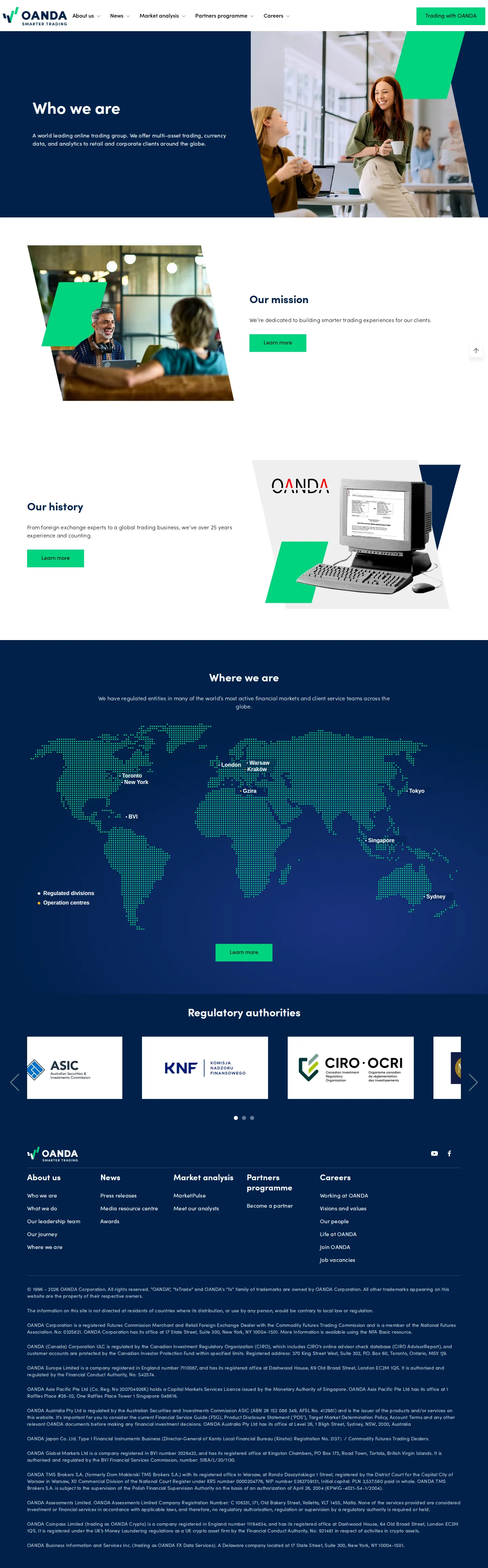
OANDA is not one company but a group of separately regulated legal entities trading under the OANDA name in different countries: OANDA TMS Brokers S.A. in Poland, OANDA Europe Limited in the UK, OANDA Global Markets Ltd in the British Virgin Islands, OANDA Corporation in the US, OANDA Australia Pty Ltd, OANDA Asia Pacific Pte Ltd in Singapore, OANDA Securities Kabushiki Kaisha (OANDA証券株式会社) in Japan, OANDA (Canada) Corporation ULC, OANDA Coinpass Limited (crypto, UK) and OANDA Assessments Limited in Malta. The entity that actually opens a client’s account determines which regulator, which compensation arrangements and which complaint route applies, and OANDA’s own “about” disclosures list all nine alongside each other with no single default. We checked the register for each entity by name: the ESMA register shows OANDA TMS BROKERS SA as an active investment firm supervised by Poland’s Polish financial regulator; the FCA register shows FRN 542574 held by OANDA Europe Limited with no termination date; the BVI FSC lists OANDA GLOBAL MARKETS LIMITED as regulated for arranging deals and dealing as principal; ASIC shows AFS licence 412981 held by OANDA AUSTRALIA PTY LTD; the NFA BASIC register shows OANDA CORPORATION as an approved member and registered Futures Commission Merchant / Retail Foreign Exchange Dealer; the MAS Financial Institutions Directory Financial Institutions Directory lists OANDA Asia Pacific Pte. Ltd. as a Capital Markets Services Licensee and Exempt Financial Adviser; CIRO‘s directory of Dealers We Regulate lists OANDA (Canada) Corporation ULC as an Investment Dealer; and the Japan FSA’s list of registered Financial Instruments Business Operators includes OANDA Japan (OANDA証券株式会社) under Kanto Local Finance Bureau (Kinsho) Registration No. 2137. We also searched 1441 warning-list entries mirrored from CySEC, the FCA and the FSC Mauritius, and OANDA appears on none of them; that covers only the lists we mirror, not every regulator worldwide.
One entity sits outside all of that: OANDA Assessments Limited, registered in Malta as company C 106331, states in OANDA’s own legal disclosures that none of the services it provides are considered investment or financial services under applicable law, so it holds no regulatory authorisation for what it does.
Overview Table
| Headquarters | Not stated (OANDA operates through separately registered entities in Poland, the UK, BVI, US, Australia, Singapore, Japan, Canada and Malta, with no single group headquarters named in the pages we fetched) |
| Established | Not stated for the group; OANDA TMS Brokers S.A. was authorised by the KNF on 26 April 2004 and OANDA Europe Limited was incorporated on 21 December 2009, per the registers checked |
| Countries Served | Poland/EU (OANDA TMS Brokers S.A.), UK (OANDA Europe Limited), US (OANDA Corporation), Australia, Singapore, Japan, Canada, plus other markets served via the BVI entity OANDA Global Markets Ltd, per the regional sites read |
| Regulated By | Poland’s KNF, the UK’s FCA, the BVI Financial Services Commission, Australia’s ASIC, the US NFA/CFTC, Singapore’s MAS, Canada’s CIRO and Japan’s Kanto Local Finance Bureau, each confirmed against its own register for the matching entity |
| Minimum Deposit | Not a single figure stated; OANDA’s Premium tier requires a USD 10,000 deposit or an equivalent trading-volume threshold, while the Standard tier is described only as “Available to all” with no deposit figure given, per OANDA’s account comparison page |
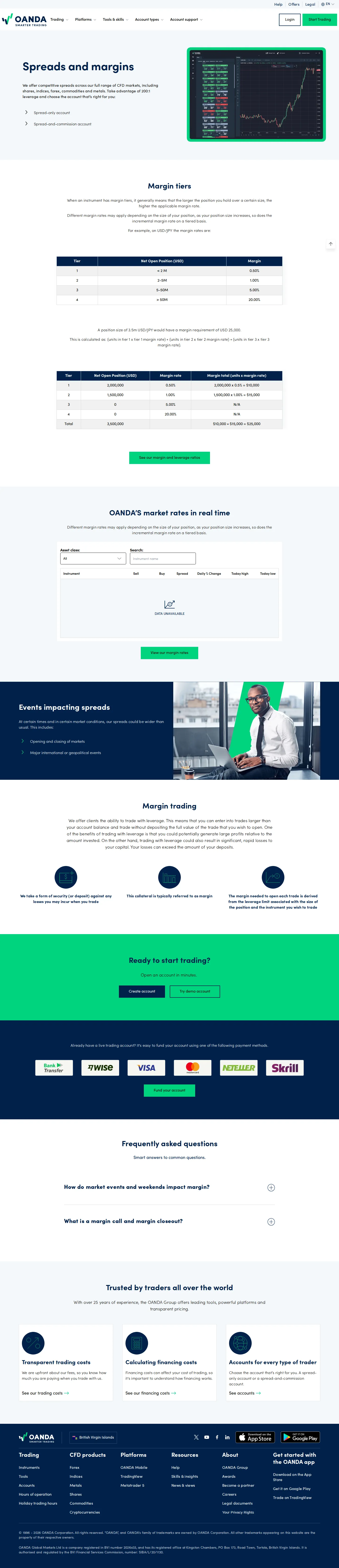
| Maximum Leverage | Up to 200:1, stated for the spread-only account on OANDA’s fee page |
| Total Instruments | 1500+, stated on OANDA’s account comparison page for the Standard tier |
| Platforms | OANDA Web, OANDA Mobile, fxTrade, MetaTrader 4, MetaTrader 5 and TradingView, per OANDA’s platform and account pages |
| Customer Support | Phone lines by entity: New York (+1 212 858 7690), Singapore (+65 6579 8280), Sydney (+61 2 8046 6258), Tokyo (+81 3 3262 5431), Toronto (1 877 626 3239), Warsaw (+48 22 27 66 200); plus registered offices in London and the BVI with no phone number listed, and named support/document email addresses |
| Languages | Not stated |
Facts List
- OANDA is a group of separately regulated entities, not one licensed company, and which entity onboards a client determines the applicable regulator and protections.
- OANDA Europe Limited holds FCA authorisation under FRN 542574, confirmed active on the FCA register with no termination date.
- OANDA TMS Brokers S.A. is confirmed on the ESMA register as an active investment firm supervised by Poland’s KNF, authorised 26 April 2004.
- OANDA Global Markets Ltd (BVI) is confirmed on the BVI Financial Services Commission’s list, regulated for arranging deals in investments and dealing as principal.
- OANDA Australia Pty Ltd holds AFS licence 412981, confirmed with ASIC.
- OANDA Corporation is a confirmed NFA member (NFA ID 0325821) and CFTC-registered Futures Commission Merchant and Retail Foreign Exchange Dealer.
- OANDA (Canada) Corporation ULC is confirmed in CIRO’s directory of Dealers We Regulate as an Investment Dealer.
- OANDA Asia Pacific Pte. Ltd. is confirmed in the MAS Financial Institutions Directory as a Capital Markets Services Licensee and Exempt Financial Adviser.
- OANDA Japan (OANDA証券株式会社) is confirmed on the Japan FSA’s list of registered Financial Instruments Business Operators under Kanto Local Finance Bureau (Kinsho) No. 2137.
- OANDA Assessments Limited in Malta states, in OANDA’s own legal disclosures, that none of its services require regulatory authorisation.
- We searched 1441 warning-list entries mirrored from CySEC, the FCA and FSC Mauritius and found no match for OANDA.
- The UK risk warning states that 76.6% of retail investor accounts lose money trading CFDs with this provider; the Polish/EU site states 76% for OANDA TMS Brokers S.A.
What OANDA charges to open and maintain an account
OANDA’s own fee page states account opening is free. Live account maintenance is also free, but only on condition: the client must agree to receive all correspondence electronically and must execute at least one transaction, or hold at least one financial instrument, every 12 months. Miss either condition and fees under OANDA’s Table of Fees and Commissions apply instead. The same fee page states interest of up to 5% on unused margin, valid for the first 90 days from account opening, and no financing cost on select CFDs including major US indices, the DE index, and oil and gas.
What happens if a margin account falls short
OANDA’s margin trading FAQ states that if a client’s margin level falls below 100%, the client is emailed and blocked from opening new positions; if it drops to 50%, a margin closeout is triggered automatically, closing the position with the largest loss first, with little or no warning in fast-moving markets. The same FAQ places responsibility for monitoring the account and avoiding a closeout on the client.
Key Takeaways
A group of regulated entities, not one regulator
- The FCA register shows FRN 542574 held by OANDA Europe Limited, regulated by the Financial Conduct Authority with no termination date, effective from 01/04/2013.
- The ESMA register of investment firms and credit institutions lists OANDA TMS BROKERS SA as an investment firm, status Active, supervised by the Polish Financial Supervisory Authority (KNF), authorised 26/04/2004, LEI 259400RAOM21WEVKS140. ESMA’s register does not publish national licence numbers, so the firm’s own quoted number, KPWiG-4021-54-1/2004, is not itself verified by that record.
- The BVI Financial Services Commission’s export lists OANDA GLOBAL MARKETS LIMITED as regulated for Arranging Deals in Investments and Dealing as Principal, though that export was 40 days old at the time it was checked and does not publish licence numbers, so the firm’s own SIBA/L/20/1130 is not itself confirmed by it.
- The ASIC register shows AFS licence 412981 held by OANDA AUSTRALIA PTY LTD, ABN 26152088349, since 26/03/2012.
- The MAS Financial Institutions Directory lists OANDA Asia Pacific Pte. Ltd. as a Capital Markets Services Licensee and Exempt Financial Adviser, covering dealing in capital markets products, OTC derivatives, and investment advice, again without publishing a licence number.
- The NFA BASIC register shows OANDA CORPORATION under NFA ID 0325821 as “NFA Member Approved” since 03/14/2003, currently registered with the CFTC as a Futures Commission Merchant and Retail Foreign Exchange Dealer.
- CIRO’s directory of Dealers We Regulate lists OANDA (Canada) Corporation ULC as an Investment Dealer at its Toronto address, without a membership number.
- The Japan FSA’s list of registered Financial Instruments Business Operators includes Director-General of the Kanto Local Finance Bureau (Financial Instruments Firms) No. 2137 (関東財務局長(金商)第2137号), matched by registration number to OANDA Securities Kabushiki Kaisha (OANDA証券株式会社), registered 2009-03-02 for Type I Financial Instruments Business.
- Companies House confirms OANDA EUROPE LIMITED (company 07110087, incorporated 21 December 2009, status Active) and OANDA COINPASS LIMITED (company 11164834, incorporated 23 January 2018, status Active). Companies House is a company registry rather than a financial regulator, so it confirms the companies exist and never confirms a trading licence.
- The FCA separately lists FRN 921481 for OANDA Coinpass Limited with status “Registered” under the UK Money Laundering Regulations, effective 26/08/2021, which is an anti-money-laundering registration rather than a full financial-services licence.
- OANDA’s own legal disclosures state that OANDA Assessments Limited (Malta, company C 106331) provides no services it considers investment or financial services, and that no regulatory authorisation, regulation or supervision is required or held for them.
- The earlier review being rewritten here gave an IIROC number (121925) and a MAS number (CMS100122-4) for the Canadian and Singapore entities, and a different Kanto Finance Bureau number (2609) for the Japan entity, than what OANDA’s own about page and the Japan FSA list show for the same entities. Those figures from our earlier review are not confirmed by anything fetched from OANDA directly.
- A search of 1,441 warning-list entries mirrored from CYSEC, the FCA and the FSC Mauritius turned up no match for OANDA, a clean result across the lists our review process mirrors.
What OANDA’s own pages say it charges
- OANDA’s site states account opening carries no fee, and live account maintenance stays free only if the client agrees to electronic-only correspondence and executes at least one transaction (or holds at least one instrument) every 12 months; otherwise charges under its Table of Fees and Commissions apply.
- The same page advertises 0 EUR ETF commission for up to 10 transactions a month and up to EUR 200,000 turnover, 0 EUR commission on US shares for accounts in EUR, PLN, CZK or RON, European shares from 0.15%, and up to 5% interest on unused margin for the first 90 days after opening.
- OANDA’s BVI pricing pages give three different EUR/USD spread figures on the same site: marketing copy quotes “from 0.6 pips,” the spread-only account table shows 1 pip, and the core (spread-plus-commission) pricing table shows 0.1 pip. The pricing tables, not the marketing line, describe what each account type actually charges.
Platforms that differ by entity, and by the day checked
- OANDA’s own pages list its Web and Mobile platforms, MT4, MT5, TradingView and fxTrade, but not the same set everywhere: the UK entity’s navigation includes MT4 alongside MT5, while the BVI entity’s account comparison table lists fxTrade, TradingView and MT5 without MT4.
- The Japan entity’s own site posted a notice dated 2026/09/18 that MT4 is having new order placement suspended and that MT4 provision is being terminated, so a platform still marketed by the UK entity is being withdrawn from the Japan entity.
- OANDA’s UK marketing copy says share CFDs and ETF CFDs are “now available via MT5 and TradingView or our OANDA app,” while its own platform comparison table lists Share CFDs on TradingView as “Coming soon.”
Terms that bind a client once the account is open
- OANDA’s margin trading FAQ states that a margin level below 100% blocks new positions and triggers an email, and a drop to 50% triggers an automatic closeout that closes the position with the largest loss first, with, in its own words, “little or no time at all to warn you” in fast-moving markets, with the client responsible for monitoring the account.
- OANDA’s account-opening page states that deposits or withdrawals over US$9,000 require the client to email documents (passport, current bank statement or similar) to frontdesk@oanda.com for review by the onboarding team, and that funding restrictions stay on the account until those documents are approved. The same page states third-party funds are not accepted for funding an account.
- OANDA’s account comparison page conditions the Premium and Premium Plus tiers not just on an entry deposit or volume figure but on sustained quarterly trading: Premium requires maintaining more than USD 30 million notional per calendar quarter, Premium Plus more than USD 200 million.
- OANDA’s US legal disclosures state that OANDA Corporation forex accounts are not protected by the Securities Investor Protection Corporation and receive no preference in bankruptcy under Part 190 of the CFTC’s regulations, and that crypto trades run through Paxos Trust Company, which is not an NFA member, with OANDA Corporation neither party to nor custodian of those crypto transactions.
- OANDA’s legal hub marks its Key Information Documents “for retail clients ONLY,” meaning professional clients are not shown the same standardised cost and risk disclosures.
Support and which OANDA a client actually deals with
- OANDA lists separate phone numbers and offices for New York, Singapore, Sydney, Tokyo, Toronto and Warsaw, but its London and BVI registered addresses carry no phone number in the same listing.
- OANDA’s privacy policy restricts its WhatsApp channel to onboarding support and general questions about its operations, and states that channel will never cover cash balance, order execution or modification, personal data changes, or deposit and withdrawal instructions.
- Pages under the same UK web path show two different legal entities in the footer: some show OANDA Europe Limited (FCA 542574), others show OANDA Global Markets Ltd (BVI, SIBA/L/20/1130). Which entity, and so which regulator and complaint route, a UK visitor ends up with depends on which page or flow they land on rather than one consistent entity.
- OANDA’s own UK risk warning states 76.6% of retail investor accounts lose money trading CFDs with this provider, while its EU (Poland) site states the figure as 76% for OANDA TMS Brokers S.A.
Licenses & Regulation
OANDA is not one regulated company but a group of separately licensed entities, each with its own regulator, registered address and, in one case, no financial regulator at all. Which entity opens a client’s account decides which register applies and what recourse exists if something goes wrong.
Which OANDA entity a client actually gets
The firm’s own about page lists OANDA TMS Brokers S.A. (Poland), OANDA Global Markets Ltd (British Virgin Islands), OANDA Europe Limited (UK), OANDA Corporation (US), OANDA Australia Pty Ltd, OANDA Asia Pacific Pte Ltd (Singapore), OANDA Japan Inc., OANDA (Canada) Corporation ULC, OANDA Coinpass Limited (UK, crypto) and OANDA Labs Assessment Limited (Malta) as separate group companies. Pages under the same UK web path do not even settle on one UK-facing entity: two of the pages we fetched show OANDA Europe Limited (FCA No. 542574) in the footer, while three others under the same gb/ path show OANDA Global Markets Ltd (BVI, SIBA/L/20/1130) instead. Which regulator and which protections a client gets can depend on which page or account flow they land on rather than a single fixed UK entity.
The register checks
We searched 15 public registers directly and ran a positive control on 17 registers first, using a firm known to be listed, so that a blank result means the firm is genuinely absent rather than the search failing. On that basis:
- The FCA register confirms FRN 542574 for OANDA Europe Limited, status “See full details”, regulated by the Financial Conduct Authority with no termination date and an effective date of 01/04/2013.
- The FCA register separately confirms FRN 921481 for OANDA Coinpass Limited, status “Registered”, effective 26/08/2021. That is a UK Money Laundering Regulations registration for a crypto asset firm, not a financial-services licence, and it sits apart from OANDA Europe Limited’s FCA authorisation.
- The ASIC register confirms AFS licence 412981 held by OANDA Australia Pty Ltd (ABN 26152088349, since 26/03/2012).
- The BVI Financial Services Commission lists OANDA Global Markets Limited as regulated for Arranging Deals in Investments and Dealing as Principal. The FSC’s export does not publish licence numbers, so the firm’s own quoted number, SIBA/L/20/1130, is not itself verified by the register, only the company’s regulated status is. That export was 40 days old at the time we checked it.
- The MAS Financial Institutions Directory confirms OANDA Asia Pacific Pte. Ltd. as a Capital Markets Services Licensee and Exempt Financial Adviser, covering dealing in capital markets products, OTC derivatives, investment advice and investment research. The directory does not publish licence numbers, so the firm’s own CMS100122-4 is not verified by it.
- The ESMA register of investment firms and credit institutions lists OANDA TMS BROKERS SA as an investment firm, status Active, supervised by the Polish Financial Supervisory Authority (KNF), authorised 26/04/2004, with LEI 259400RAOM21WEVKS140. ESMA does not publish national licence numbers, so the firm’s own quoted KPWiG-4021-54-1/2004 is not verified by that register.
- The NFA’s BASIC register confirms OANDA CORPORATION under NFA ID 0325821, status “NFA Member Approved” since 03/14/2003, with a current CFTC registration as a Futures Commission Merchant and Retail Foreign Exchange Dealer.
- CIRO’s directory of Dealers We Regulate lists OANDA (Canada) Corporation ULC as an Investment Dealer at 370 King Street West, Toronto. CIRO does not publish a membership number in that directory, so the older IIROC number quoted elsewhere, 121925, is not something the register itself confirms.
- Companies House confirms OANDA EUROPE LIMITED as company 07110087, a private limited company incorporated 21 December 2009, status Active, and OANDA COINPASS LIMITED as company 11164834, incorporated 23 January 2018, status Active. Companies House is a company registry, not a financial regulator, so it confirms the companies exist and are active, not that either holds a trading licence.
Japan: matched by registration number
The Japan FSA’s list of registered Financial Instruments Business Operators, checked across 1,951 operators, carries a match for corporate number 4010001122945 against OANDA Securities Kabushiki Kaisha (OANDA証券株式会社), registered 2009-03-02 as Type I Financial Instruments Business, and listed as a member of the Japan Securities Dealers Association, the Financial Futures Association of Japan and the Japan Virtual and Crypto Assets Exchange Association. That list gives operator names in Japanese only, so the match was made on the registration number rather than the name. The firm’s own Japan site gives the licence as Kanto Local Finance Bureau registration No. 2137 (関東財務局長(金商)第2137号); the Kanto Local Finance Bureau’s list of registered Financial Instruments Business Operators confirms that number for OANDA Securities Kabushiki Kaisha.
What we could not check
Several numbers the firm cites have no matching register in our directory, which is our gap rather than anything adverse about OANDA: the Warsaw KRS company number (0000204776), the Polish tax NIP, the BVI company registration for OANDA Global Markets Ltd (2026433), the Singapore and Australian company registration numbers, and the Malta company number (C 106331) for OANDA Assessments Limited. On that last entity, the firm’s own legal disclosures state plainly that none of the services OANDA Assessments Limited provides are considered investment or financial services under applicable law, so it holds no regulatory authorisation, regulation or supervision for those services at all.
Warning-list result
We searched 1,441 warning-list entries mirrored from the CySEC, FCA and FSC Mauritius warning lists, and OANDA does not appear on any of them. That covers only the three regulators we mirror, not a global sweep, but within that scope the result is clean.
How to Trade
OANDA trades under several legal entities, and which one a client lands on changes what is actually on offer. The BVI entity, OANDA Global Markets Ltd, and the UK entity, OANDA Europe Limited, both show up under the same “gb” section of the site depending on which page and account flow a visitor follows, and the product list differs by entity too: the EU (Poland-regulated) site lists forex, shares, ETFs, indices, commodities and crypto CFDs, the UK site adds metals and bonds CFDs to that list and the BVI site adds metals CFDs, and the US entity, OANDA Corporation, drops CFDs on indices, commodities, shares, bonds and metals entirely, leaving only forex and cryptocurrencies, with the crypto legs traded directly (not as CFDs) through partner Paxos rather than through OANDA itself.
What OANDA’s platforms actually cover
OANDA offers two of its own platforms, OANDA Web and the OANDA Mobile app, alongside third-party MetaTrader 4, MetaTrader 5 and TradingView, plus an API licensed separately for the UK entity. The MT5 offering carries a custom OANDA bridge, native depth of market and AutoChartist integration, and clients can also trade straight from a TradingView chart by selecting OANDA as broker. MT4 is listed for the UK site, but OANDA’s Japan entity posted a notice dated 2026/09/18 announcing that MT4 is having new orders suspended and the platform withdrawn there, so provision of a platform advertised elsewhere in the group is being wound down for at least one entity. The platform picture is not fully consistent even within a single entity’s own pages: the UK marketing page states share CFDs and ETF CFDs are “now available via MT5 and TradingView or our OANDA app,” while the platform comparison table on the BVI/Indonesia site lists Share CFDs on TradingView as “Coming soon.”
How OANDA’s account tiers split the cost
Pricing runs on two structures rather than one. A spread-only account folds OANDA’s commission into a wider spread, while a spread-and-commission (“core pricing”) account charges a tighter spread plus a fixed per-trade commission, so the two are meant to land at similar total cost for a given volume of trading. On the BVI-entity account comparison, the Standard tier is open to all clients, charges zero commission, quotes spreads from 0.6 pips on ten major instruments, and gives access to 1,500-plus instruments across fxTrade, MT5 and TradingView, with a 50% stop-out level. Moving up requires sustained volume rather than a one-off deposit: the Premium tier needs a USD 10,000 deposit or 10 million USD notional traded per month to enter, and then requires maintaining more than USD 30 million notional per calendar quarter to keep it, in exchange for a USD 4-per-million volume rebate, a dedicated relationship manager, funding-fee reimbursement up to USD 40 per transaction and free withdrawals. Premium Plus raises the bar again, to 50 million USD notional per month to qualify and over USD 200 million notional per quarter to hold the tier, for a USD 6-per-million rebate and full funding-fee reimbursement. Separately, the UK site’s fee pages describe a Premium Trader account aimed at high-volume clients, offering 24/5 service, a free VPS, premium spreads or volume rebates and a dedicated relationship manager, without stating the volume threshold on that page.
The BVI entity’s own pricing pages do not agree with each other on what a spread-only client actually pays for EUR/USD: marketing copy on the same site advertises spreads “from 0.6 pips,” the spread-only pricing table shows 1 pip, and the core (commission) pricing table shows 0.1 pip. The pricing table, not the marketing line, is what determines the cost a spread-only trader is quoted.
Margin calls and forced closeouts
OANDA’s margin trading FAQ, read on the BVI entity’s fee pages, sets two triggers. At a margin level below 100%, the client is emailed and blocked from opening new positions. At 50%, a margin closeout fires automatically, closing the position carrying the largest loss first, and the FAQ states this can happen with, in its own words, “little or no time at all to warn you” in fast-moving markets. The same page puts responsibility for avoiding that outcome on the client, who is expected to monitor the account rather than rely on OANDA to intervene earlier.
Funding rules that affect execution
Two account-opening terms bind how money moves once trading starts. OANDA’s own account-opening page states plainly that third-party funds are not accepted for funding an account, so a deposit from a source not in the client’s own name will not be processed. The same page requires that any deposit or withdrawal above US$9,000 triggers a document review by the onboarding team (passport, a current bank statement or similar sent to frontdesk@oanda.com), and funding restrictions on the account stay in place until that review clears, which adds a manual delay to withdrawing larger sums rather than an instant transfer.
Account Types
Which account gets opened, and what it costs, depends on which OANDA entity does the opening, and the group prices its accounts in more than one shape across the pages we fetched.
Standard, Premium and Premium Plus at OANDA Global Markets Ltd
OANDA Global Markets Ltd, the BVI entity, publishes an account-comparison page setting out three tiers. Standard is open to all: the page gives spreads from 0.6 pips on 10 major instruments only, $0 commission, a minimum order of 0.01 lots, access to more than 1,500 instruments, a 50% stop-out level, base currencies of USD, EUR, HKD or SGD, and trading on MT5, fxTrade and TradingView, plus MT5 Premium tools, Signal Centre by Acuity, Technical Analysis by AutoChartist and 24/5 customer service.
Premium needs a USD 10,000 deposit or USD 10 million in notional trading volume in a month to open, and the same page’s acceptance criteria require the client to maintain more than USD 30 million notional per calendar quarter to keep it. The spread quoted is from 0.7 pips, commission stays at $0, and the account earns a volume rebate of USD 4 per million once monthly volume passes USD 20 million, alongside a dedicated relationship manager, zero deposit fees, funding fee reimbursement up to USD 40 per transaction, free withdrawals, third-party research (3cAnalysis and Macromicro), event and webinar invitations, the Premium IB program and a free VPN.
Premium Plus asks for USD 50 million in monthly notional volume to open and, per the same acceptance criteria, more than USD 200 million notional per quarter to keep it. The spread quoted drops to from 0.1 pips, the volume rebate rises to USD 6 per million once monthly volume passes USD 50 million, and the page adds full funding fee reimbursement per transaction (rather than the USD 40 cap on Premium), a spread discount, the installed version of OANDA’s Order Book tool in Traditional Chinese, a VPN/VPS function and seasonal gifts on top of the Premium features.
Spread-only against commission pricing
Separately, OANDA’s Australia-facing fee page, tied to the same Global Markets (BVI) licence, sets out a different split: a spread-only account, where the commission is wrapped into the spread and leverage runs up to 200:1, against a spread-and-commission account, marketed as “core pricing,” where the quoted spread is narrower and a fixed commission is charged per trade on top of it. The firm’s own fee page is not consistent about what a core EUR/USD spread actually costs: the marketing copy advertises spreads “from 0.6 pips,” the spread-only pricing table on that page shows 1 pip, and the core pricing table on the same page shows 0.1 pip for the same currency pair. A trader pricing a spread-only account off the headline marketing figure would be working from the wrong number against the table’s 1 pip.
What OANDA’s UK site adds
OANDA Europe Limited’s legal hub lists Standard, Professional and Spread betting as its account types, with no further detail given beyond the names on that page. A separate UK-facing fee page describes a Premium Trader account aimed at high-volume traders: 24/5 customer service, a free VPS, premium spreads or volume rebates, a dedicated relationship manager, wire transfer fee reimbursements and professional market analysis reports in English.
Elite Trader and Corporate accounts
The same evidence set also carries an Elite Trader programme described for the US entity: volume-based rebates, exclusive discounts on third-party platforms such as TradingView, VIP content and events, and a dedicated relationship manager, all conditioned on meeting programme criteria the page does not itself spell out. A Corporate account is listed in the same site’s navigation with no further detail given.
Opening and keeping an account open
OANDA TMS Brokers S.A., the Polish entity serving EU customers, charges nothing to open an account, but its FAQ ties free live-account maintenance to two conditions together: the client must agree to receive all correspondence electronically and must execute at least one transaction, or hold at least one financial instrument, every 12 months. Miss either condition and maintenance fees under the firm’s Table of Fees and Commissions apply instead. Elsewhere, OANDA’s account-opening page requires applicants to be over 18, and, under “Fund your account,” states plainly: “We don’t accept third-party funds.” The same page sets a documentation threshold at US$9,000: deposits or withdrawals above that figure require the client to email a passport and a current bank statement or similar to the firm’s onboarding team, with funding restrictions staying on the account until those documents are reviewed and approved.
An earlier review of this broker gave different figures entirely: a Standard account with no minimum deposit, a Premium account opening at $20,000, a Premium Plus account opening at $100,000, and a free demo account funded with virtual money. Those figures did not come from any OANDA page we fetched, and they do not match the volume-based entry criteria on the firm’s own Global Markets account-comparison page for Premium and Premium Plus. We report them here as what the earlier review said, not as anything OANDA’s own pages confirm.
Negative Balance Protection
OANDA’s own risk warning gives a concrete loss-rate figure rather than a policy promise: the FCA-regulated UK entity, OANDA Europe Limited, states that 76.6% of retail investor accounts lose money trading CFDs with this provider. That figure says nothing about what happens once a losing position runs out of margin, which is a separate question the fee pages address directly for the BVI entity that serves the UK, Australian and other international sites.
How OANDA Global Markets Ltd handles a falling margin level
OANDA’s margin trading FAQ, published on the fee page for OANDA Global Markets Ltd (the BVI entity, SIBA/L/20/1130), sets out a two-stage response to a shrinking account. If the margin level falls below 100%, the client is emailed and blocked from opening any new position. If it drops further to 50%, a margin closeout is triggered automatically, and the position carrying the largest loss is closed first. The same FAQ warns this can happen with, in its own words, “little or no time at all to warn you” in fast-moving markets, and puts the burden of avoiding a closeout on the client: it is the client’s responsibility to monitor the account and keep the margin level up.
The same fee page lists a spread-only account with leverage of up to 200:1, which matters here because it sets how far a price has to move before the 100% and 50% thresholds are reached. At high leverage, a comparatively small adverse move can consume the margin buffer between the email warning and the automatic closeout.
The FAQ we read describes the mechanics of the closeout itself: what triggers it, which position it closes first, and that the client carries the monitoring burden. It says nothing about whether losses beyond the funds in the account are capped by a negative-balance guarantee, and no other page in the material we fetched addresses that question for OANDA Global Markets Ltd. That is a gap in what OANDA has published in the pages we checked, not a finding about whether such a guarantee exists.
What OANDA Corporation’s own disclosures say about firm-level risk
For the US entity, OANDA Corporation, the legal disclosures we read cover a different kind of loss exposure: what happens to client funds if the firm itself runs into trouble, rather than what happens when a trade runs into trouble. Those disclosures state that OANDA Corporation forex accounts are not protected by the Securities Investor Protection Corporation and do not receive a preference in any bankruptcy proceeding under Part 190 of the CFTC’s regulations. In plain terms, a US client has no SIPC-style compensation scheme behind their forex balance and no priority claim on OANDA Corporation’s assets if the firm became insolvent.
The same disclosures place cryptocurrency trading outside that entity’s own perimeter entirely: all virtual currency transactions happen on the Paxos Trust Company exchange, Paxos is not an NFA member and is not subject to NFA oversight, and OANDA Corporation states it is not a party to virtual currency transactions and does not custody virtual currency on the client’s behalf. A US client trading crypto through OANDA is, by the firm’s own account, relying on Paxos for custody and recourse rather than on OANDA or the NFA framework that covers the forex side of the same account.
Account verification tied to large movements of funds
Separately from margin mechanics, OANDA’s UK account-opening page sets a documentary checkpoint at US$9,000: full verification is not required below that figure, but deposits or withdrawals above it trigger a request for further documents (a passport and a current bank statement or similar), review by the onboarding team, and funding restrictions on the account that stay in place until the documents are approved. That is a processing control on large transfers, not a loss limit, but it sits alongside the margin rules as another point where the account can be frozen from the client’s side while OANDA reviews it.
Trading Instruments
OANDA is not one product catalogue but several, because each regional entity runs its own instrument list and its own accounts. What a client can trade depends on which of the group’s legal entities took them on, not on a single global menu.
What OANDA’s regional sites list as tradable
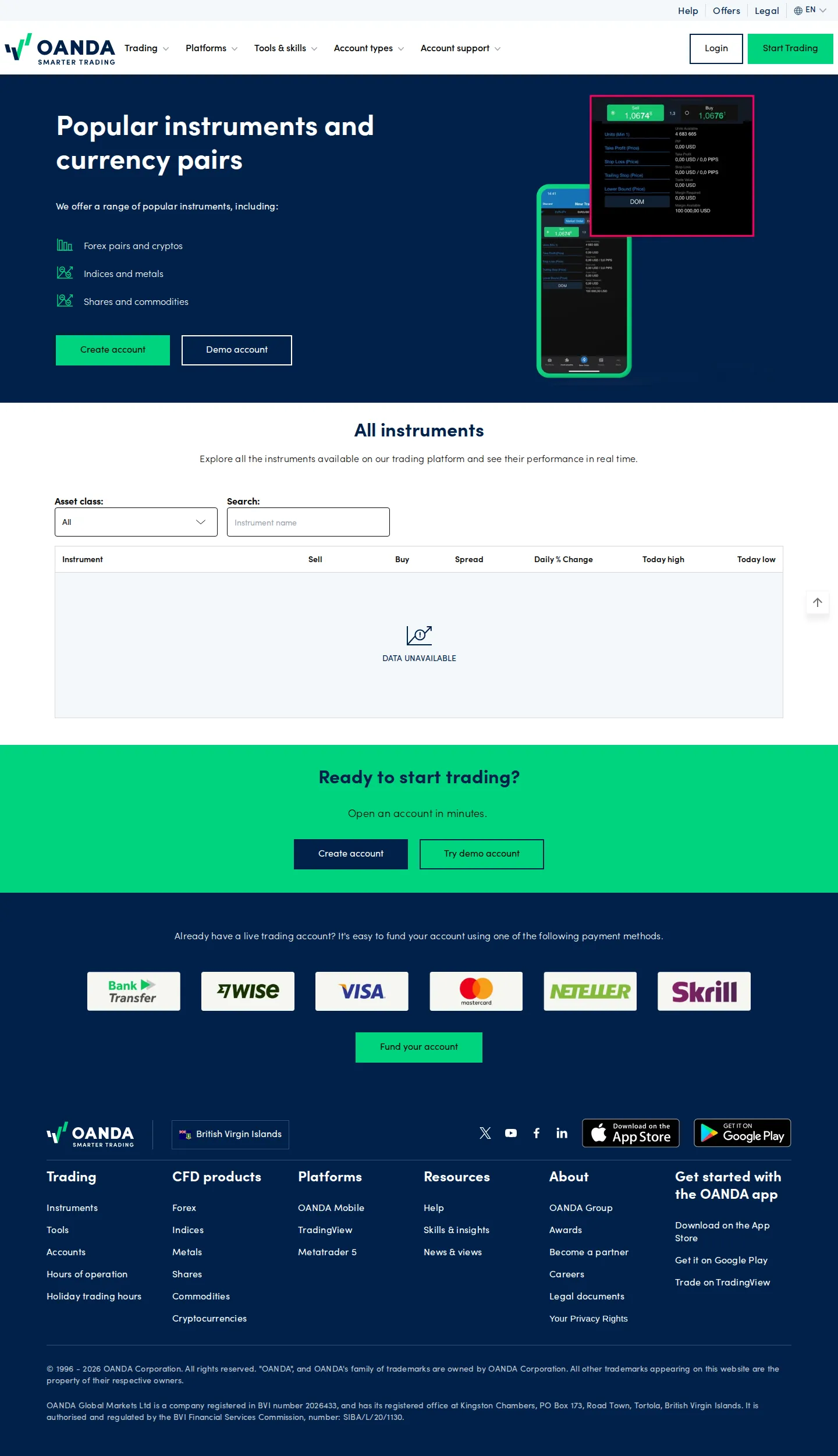
Across the EU site for OANDA TMS Brokers S.A., the UK site for OANDA Europe Limited, and the BVI-entity sites for OANDA Global Markets Ltd, the recurring instrument categories are forex, share CFDs, ETF CFDs, indices CFDs, commodities CFDs, metals CFDs and crypto CFDs. The UK site’s product navigation also lists bonds CFDs, and its markets pages state “we offer dozens of ETF CFDs, covering a wide range of market sectors.” The EU (TMS) site uses slightly different labels for the same categories: “Shares”, “ETFs” and “ETF Funds CFDs” rather than the UK’s “Share CFDs” and “ETF CFDs”.
What OANDA Corporation offers US clients is narrower
The site serving OANDA Corporation, the US entity, states plainly that CFDs on indices, commodities, shares, bonds and metals are not offered to US clients; only forex and cryptocurrencies are available. Even the crypto offering is structured differently there: the US legal disclosures state that virtual currency transactions occur on the Paxos Trust Company exchange, that Paxos is not an NFA member and is not subject to NFA regulatory oversight, and that OANDA Corporation is not party to any virtual currency transactions and does not custody virtual currencies on the client’s behalf. So a US client trading “crypto” through OANDA is trading through Paxos, not receiving a CFD from OANDA itself, and that trade sits outside the NFA’s oversight of the broker.
Where OANDA’s own pages disagree with each other
The UK site’s markets page markets share CFDs and ETF CFDs as “now available via MT5 and TradingView or our OANDA app.” The platform comparison table on the Indonesia-facing site, by contrast, lists Share CFDs on TradingView as “Coming soon.” We hold both claims from the firm’s own pages and cannot resolve which is current; a client relying on the marketing copy to trade share CFDs through TradingView specifically should check that against the platform they intend to use before assuming it works.
A similar gap shows up in pricing rather than availability. The BVI entity’s own fee page for OANDA Global Markets Ltd gives three different EUR/USD spread figures in the same document: the marketing copy advertises spreads “from 0.6 pips,” the spread-only pricing table shows 1 pip, and the core (commission) pricing table shows 0.1 pip. The pricing tables, not the headline marketing figure, are what a client actually pays under either structure.
Access to tighter pricing is volume-gated, not just deposit-gated
The account comparison table on the Indonesia-facing site sets out three CFD tiers for OANDA Global Markets Ltd. Standard is open to all clients, with spreads quoted “from 0.6” on 10 major instruments only, zero commission, a minimum order of 0.01 lots, and access to over 1,500 instruments. Premium requires a USD 10,000 deposit or 10 million USD notional trading volume per month, and the same page states the client must then “maintain a trading volume of > USD 30 million notional per calendar quarter” to keep it, in exchange for spreads “from 0.7,” a volume rebate of USD 4 per million once monthly volume passes USD 20 million, a dedicated relationship manager and free withdrawals. Premium Plus asks for 50 million USD notional trading volume per month and maintaining more than USD 200 million notional per calendar quarter, for spreads “from 0.1” and a rebate of USD 6 per million. In other words, the better pricing tiers are not a one-time deposit threshold; the client has to keep trading at that volume every quarter or presumably drop back down.
Retail and professional clients don’t get the same paperwork
OANDA Europe Limited’s legal hub lists Key Information Documents covering CFD Forex, Indices, Precious Metals, ETFs, Commodities, Bonds and Shares, plus Spread Bet equivalents, and states they are “for retail clients ONLY.” That means the standardised cost and risk disclosure documents a retail client receives for each of those asset classes are not the same paperwork a professional client gets for trading the identical instrument.
Platform availability is also entity-specific, and changing
MT4 is offered on the UK site alongside MT5, OANDA Web and OANDA Mobile, but the BVI-entity account comparison table lists only fxTrade, TradingView and MT5, with no MT4 row. Separately, the Japan-facing site carries a notice dated 2026/09/18 stating that MT4 new-order placement is being suspended and that OANDA Japan is terminating MT4 provision altogether. A trader choosing OANDA on the strength of MT4 support needs to check that against the specific entity and site they’ll actually be onboarded through, since the same platform is being wound down in one jurisdiction while still listed in another.
Education & Analysis
OANDA runs its own platform, OANDA Web, alongside OANDA Mobile, which the UK site describes as its “award-winning mobile app” covering FX, crypto, commodities, indices and share CFDs. It also distributes through two third-party platforms: MetaTrader, and TradingView, where clients can log in and place trades directly with OANDA as the chosen broker.
Which platforms OANDA actually offers depends on which entity holds the account
The platform list is not uniform across OANDA’s regional sites. The BVI entity’s account comparison page, the firm’s Indonesian accounts page, lists fxTrade, TradingView and MT5 for OANDA Global Markets Ltd, with no MT4 in that table. The UK entity’s own site, the firm’s UK home page, lists OANDA Web, OANDA Mobile, TradingView, MT4 and MT5 for OANDA Europe Limited. So a UK client and a BVI client are not choosing between identical toolkits: MT4 shows up for one entity and not the other in OANDA’s own pages.
MT4 access is also being wound down in at least one part of the group. The Japan site carried a notice dated 2026/09/18 stating that MT4 new order placement was being suspended and MT4 provision terminated (its title reads MT4新規注文停止ならびにMT4提供終了, a suspension of new MT4 orders and the end of MT4 provision), while the UK site continues to list MT4 as a live option. A platform OANDA still markets in one jurisdiction is being retired in another.
For MT5, OANDA’s Indonesia platform page, the firm’s Indonesian platforms page, describes a custom MT5 bridge, native depth of market, and AutoChartist integration built for the platform, rather than a bare MetaQuotes install. The German site, the firm’s German home page, also references a third-party partner tool, “OANDA and MyTrader App Suite from FX Blue,” alongside MT5.
Where OANDA’s own pages disagree on what is tradable
Two inconsistencies turned up directly in OANDA’s own fetched material, not in any outside source. First, the firm’s UK home page markets share CFDs and ETF CFDs as “now available via MT5 and TradingView or our OANDA app,” but the platform comparison table on the firm’s Indonesian platforms page lists Share CFDs on TradingView as “Coming soon.” Those are two OANDA pages describing the same product on the same third-party platform in opposite terms: one says it is live, the other says it is not yet. We report both because both are what the firm’s own pages say, and we cannot resolve which is current from the pages fetched.
Second, on analysis tools, account tiers carry different bundled research packages rather than a single OANDA analysis suite. The Indonesia account comparison page lists MT5 Premium tools, “Signal Centre by Acuity” and “Technical Analysis by AutoChartist” as benefits attached to the Standard tier, while the Premium and Premium Plus tiers there add exclusive 3rd party trading resources (3cAnalysis & Macromicro) and, at Premium Plus, an “OANDA Order book installed version (Trad. Chinese).” The UK’s Premium Trader account, described on the firm’s UK fees page, separately lists “professional market analysis reports (English)” as one of its perks. None of this is a single charting or analysis product available to every client; it is a set of third-party research tools that gets added to as the account tier goes up.
What we did not find in our evidence
The evidence fetched for this review does not include a dedicated charting or technical analysis product page from OANDA, so we cannot report on drawing tools, indicator counts, or timeframe options beyond what the platform list above already covers. Where OANDA’s account and platform pages mention research add-ons such as Acuity’s Signal Centre or AutoChartist, we have reported them as tier benefits named on those pages, not verified their content firsthand.
Special Offers
OANDA does not run one promotions page across the group; what counts as a “special offer” differs by which entity’s site a client lands on, and the discounts we found sit inside fee pages and account-tier tables rather than a marketing banner.
Fee waivers on OANDA TMS Brokers’ EU site
The page for OANDA TMS Brokers S.A., the group’s Polish, KNF-regulated entity that serves EU customers, states that opening an account carries no fee. It advertises 0 EUR commission on ETF trades for up to 10 transactions a month and up to EUR 200,000 of turnover, with terms attached, and it discloses that the lowest ETF commission charged in the 30 days before this offer was 0.1% (minimum 1 EUR, 1 USD or 5 PLN), which is the reference figure the discount is measured against. The same page offers 0 EUR commission on US shares for accounts held in EUR, PLN, CZK or RON, while European shares are billed from 0.15%. Separately, it advertises interest of up to 5% a year on unused margin, but only for the first 90 days from account opening, so the rate is a new-account offer rather than a standing term. The page also lists no fees and no daily financing cost on a named set of CFDs: major US indices, the DE index, and Oil & Gas. None of this is unconditional: the same page ties the account’s free maintenance to the client agreeing to electronic-only correspondence and to placing at least one trade, or holding at least one instrument, every 12 months; miss both and the account moves onto OANDA TMS Brokers’ Table of Fees and Commissions.
Volume-tiered perks: OANDA’s Premium and Premium Plus accounts
OANDA’s account-comparison page for OANDA Global Markets Ltd, the BVI entity, sets out three tiers with escalating perks tied to trading volume rather than to a deposit bonus:
| Tier | Entry condition | Rebate | Other perks listed |
|---|---|---|---|
| Standard | Available to all | none stated | Referral program; MT5 Premium tools; Signal Centre by Acuity; AutoChartist technical analysis; 24/5 customer service |
| Premium | USD 10,000 deposit or USD 10 million notional volume in a month | USD 4 per million, with a minimum monthly volume of USD 20 million | Dedicated relationship manager; zero deposit fees; funding-fee reimbursement up to USD 40 per transaction; free withdrawals; 3cAnalysis and Macromicro research access; event and webinar invitations; Premium IB program; free VPN |
| Premium Plus | USD 50 million notional volume in a month | USD 6 per million, with a minimum monthly volume of USD 50 million | Full funding-fee reimbursement per transaction; free withdrawals; spread discount; seasonal gifts; VPN/VPS access; the Traditional Chinese version of OANDA’s Order Book tool |
The same page makes both upper tiers conditional on an ongoing quarterly turnover, not just a one-off qualifying trade: to keep Premium status a client must maintain more than USD 30 million notional per calendar quarter, and Premium Plus requires more than USD 200 million notional per calendar quarter. A client who qualifies once and then trades less can lose the rebate, the reimbursements and the other perks the following quarter.
OANDA Europe’s Premium Trader account
OANDA’s UK fee page describes a separate Premium Trader account aimed at high-volume traders, built around the same idea of trading perks rather than a cash bonus: a free VPS, either premium spreads or volume rebates, a dedicated relationship manager, reimbursement of wire transfer fees, professional market-analysis reports in English, and 24/5 customer service. The page does not state a deposit or volume threshold for this tier.
Elite Trader: a US-only programme
OANDA’s site describes “Elite Trader” as a programme for OANDA Corporation, its US entity, offering volume-based rebates, exclusive discounts on third-party platforms named as including TradingView, VIP content and events, and a dedicated relationship manager. The page states this is “subject to meeting programme criteria” without setting out what that criteria is on the page we read, so a US client cannot size up the rebate or confirm eligibility from this page alone.
Opening an Account
Opening an account with OANDA costs nothing up front: the firm’s own pages state that no fees are charged for opening an account. Which entity actually takes the client depends on where they sign up from, and OANDA’s own site is not tidy about it. Pages under the same UK (“gb”) path show two different legal entities in the footer: some show OANDA Europe Limited (FCA-regulated, FRN 542574), others show OANDA Global Markets Ltd, the BVI entity (SIBA/L/20/1130). A prospective client cannot assume a single UK entity handles their account just because they landed on a UK-facing page; the regulator, the protections and the complaint route that follow depend on which specific page or flow they came through. Elsewhere, OANDA TMS Brokers S.A. is named as the entity serving customers from the European Union, and OANDA Corporation as the US entity. OANDA’s own account-opening page states that applicants must be over 18 years old.
What OANDA asks for before money moves
OANDA’s account-opening page draws the line at US$9,000. Full account verification is not required for gross deposits below that figure. Above it, the firm says deposits and withdrawals require further documentation, naming a passport or a current bank statement or similar, sent for review by the onboarding team, and states that funding restrictions stay on the account until the documents are approved. The same page states plainly that OANDA does not accept third-party funds, so a deposit from an account not in the client’s own name is not accepted.
Corporate and joint accounts
For OANDA Europe Limited, the UK entity, the Corporate Application Form is submitted by email to accountid-eu@oanda.co.uk. A Power of Attorney form and a Joint Account Form are handled separately, sent to frontdesk@oanda.com, the same address used for the over-US$9,000 verification documents. A Corporate account type also appears in the site’s own account navigation alongside Standard and Professional.
Account tiers and who qualifies for them
OANDA’s account-comparison page describes a Standard tier open to all applicants, with spreads from 0.6 on 10 major instruments only, zero commission, and a minimum order size of 0.01 lots. Above that, entry is conditioned on trading volume rather than on documentation. The Premium tier requires a USD 10,000 deposit or 10 million USD notional trading volume in a month, and the same page adds a standing requirement to maintain more than USD 30 million notional per calendar quarter to stay on it. Premium Plus asks for 50 million USD notional trading volume per month to enter, with a quarterly maintenance requirement above USD 200 million notional. In both cases the qualifying volume is not a one-off hurdle: the perks attached to the tier, including the dedicated relationship manager, funding fee reimbursement and free withdrawals, depend on keeping that trading volume up every quarter, not just hitting it once to get in.
An earlier published review of OANDA, which our review process did not independently verify against OANDA’s own pages, described a separate Standard/Premium/Premium Plus structure with fixed dollar minimums of $0, $20,000 and $100,000 respectively, and also described a demo account funded with virtual funds. Those figures were not found on the OANDA pages fetched for this review and are reported here only as what that earlier review said, not as OANDA’s own claim.
Who OANDA won’t open a full account for
Clients onboarded through OANDA Corporation, the US entity, are restricted in what they can trade once the account is open: CFDs on indices, commodities, shares, bonds and metals are not offered to them, and only forex and cryptocurrency, the latter traded through partner Paxos rather than as CFDs, are available. A separate US programme, Elite Trader, offers volume-based rebates and a dedicated relationship manager but is stated to be subject to meeting the programme’s own criteria rather than open to every US client. On the legal side, OANDA’s Key Information Documents are labelled as being “for retail clients ONLY”, which implies that clients who qualify as professional are opened and disclosed to on different terms, though the pages fetched here do not set out what those terms are.
Deposits & Withdrawals
OANDA TMS Brokers S.A.’s EU site states plainly that opening an account carries no fee. Keeping that account free to run is conditional: the same FAQ page says live account maintenance stays free only if the client agrees to receive all correspondence electronically and either executes at least one transaction or holds at least one financial instrument every 12 months. Miss both conditions and the account starts accruing charges set out in TMS Brokers’ Table of Fees and Commissions (TO&C), a separate schedule the FAQ points to rather than prints.
The $9,000 line on deposits and withdrawals
The account-opening guide we fetched sits at a gb/ address but its footer names OANDA Global Markets Ltd, the BVI entity, not OANDA Europe Limited, the FCA-authorised one that also appears under other gb/ pages in our evidence. On that page, OANDA sets a documentation threshold at US$9,000: a client depositing or withdrawing more than that amount is told to email a passport and a current bank statement (or similar) to frontdesk@oanda.com, and the onboarding team then reviews the documents before “funding restrictions” are lifted from the account. Below that figure, the same page says full account verification isn’t required. The page also states outright that OANDA doesn’t accept third-party funds, so a deposit paid in from an account that isn’t the client’s own name is not something the firm will take.
frontdesk@oanda.com is also the address OANDA’s legal hub gives for two other paperwork items that gate money movement: a Power of Attorney form and a Joint Account Form, both listed as documents to be emailed rather than submitted online.
Channels that OANDA will not use for a withdrawal instruction
TMS Brokers’ privacy policy carves out WhatsApp specifically: conversations with the Data Controller over that channel are limited to onboarding support and general questions about how OANDA operates, and the policy states they will never cover cash balance, order execution or modification, personal data changes, or deposit and withdrawal instructions. Anyone trying to move money by messaging OANDA on WhatsApp is, by the firm’s own policy, in the wrong channel.
What the Premium tiers reimburse
OANDA Global Markets Ltd’s account comparison table ties funding costs to account tier rather than charging a flat rail fee to everyone. The Premium row (reached at a USD 10,000 deposit, or USD 10 million notional traded in a month, with quarterly volume above USD 30 million to keep it) lists zero deposit fees, a funding fee reimbursement of up to 40 USD per transaction, and free withdrawals. The Premium Plus row (50 million USD notional monthly, with quarterly volume above USD 200 million to keep it) goes further: zero deposit fees and a full funding fee reimbursement per transaction, with the same free-withdrawals line. Both of those reimbursement figures come with the volume conditions attached in the same table; the benefit is contingent on keeping up the trading volume, not a one-time qualifying deposit.
Separately, OANDA’s fee page describes a “Premium Trader” tier aimed at high-volume clients that includes wire transfer fee reimbursements alongside free VPS, premium spreads or volume rebates, and a dedicated relationship manager. The page does not give a currency figure or cap for that reimbursement.
Interest on cash sitting in the account
TMS Brokers’ EU site advertises interest of up to 5% on unused margin or uninvested cash, quoted on an annual basis, and states this rate is valid for the first 90 days after the account is opened. What happens to the rate after those 90 days is not stated on the page we fetched.
Payment methods: what we can and can’t confirm
An earlier review of OANDA reported bank transfer as available in most countries, card funding by Visa, Mastercard and Maestro as instant, PayPal as available in select countries, and Skrill and Neteller as supported e-wallets. We did not fetch an OANDA payments page listing these methods ourselves, so this is secondhand: useful as a pointer to what to ask OANDA directly, not something we’re able to stand behind as read from the firm’s own pages.
Across the entities in our evidence, deposit and withdrawal terms aren’t uniform. OANDA TMS Brokers S.A. (Poland, KNF-regulated) runs the maintenance-fee and interest terms above; OANDA Global Markets Ltd (BVI) runs the $9,000 documentation threshold and the Premium-tier reimbursements. Which of those terms applies to a given client depends on which entity opened their account, not on the language or currency the site happens to display.
Customer Support
Support at OANDA is really support at whichever OANDA entity opened the account, and the contact list on the firm’s own about page reflects that split rather than a single global helpdesk. OANDA Corporation runs its US desk from 17 State Street, Suite 300, New York, tel 1 212 858 7690. OANDA Asia Pacific Pte Ltd answers from 1 Raffles Place, #26-02, One Raffles Place Tower One, Singapore, tel 65 6579 8280, with office-visit appointments booked through frontdesk@oanda.com. OANDA Australia Pty Ltd is reached at Level 26, 1 Bligh Street, Sydney, tel 61 2 8046 6258. OANDA Japan Inc. lists a Tokyo office at Circles Hirakawa-cho, 10th Floor, 1-3-13 Hirakawa-cho, Chiyoda-ku, tel +81 3 3262 5431. OANDA (Canada) Corporation ULC gives a Toronto address and a toll-free number, 1 877 OANDA FX (1 877 626 3239). OANDA TMS Brokers S.A. lists a Warsaw office, Rondo Daszyńskiego 1, tel +48 22 27 66 200, plus a Data Protection Officer contact at odo@tms.pl. OANDA Europe Limited’s own about-page listing gives a London registered office, Dashwood House, 69 Old Broad Street, with no phone number attached to it, and OANDA Global Markets Limited’s BVI registered office, Kingston Chambers, Road Town, Tortola, likewise carries no phone number in the same listing.
What OANDA’s support actually includes, and what it costs to get more of it
The BVI entity’s account comparison page sets service level by tier rather than treating support as uniform across all clients. The Standard tier includes “24/5 customer service” alongside the account’s spread and platform terms. The Premium tier, which requires a USD 10,000 deposit or 10 million USD in monthly notional volume and maintaining more than USD 30 million notional per calendar quarter, adds a dedicated relationship manager, zero deposit fees, funding fee reimbursement up to 40 USD per transaction, and free withdrawals. Premium Plus, which requires 50 million USD in monthly notional volume and more than USD 200 million per quarter to maintain, adds full funding fee reimbursement per transaction and further perks such as seasonal gifts and a VPN/VPS function. Read plainly, faster or more personal handling of a support query is bundled into pricing tiers that are gated on trading volume, not available to every account holder on request.
Where a support channel is contractually walled off
OANDA TMS Brokers S.A.’s privacy policy states that conversations with the Data Controller conducted via WhatsApp may only cover onboarding support and general questions about OANDA’s operations and specifies they will never involve cash balance, transaction execution, order placement or modification, personal data changes, or deposit and withdrawal instructions. A client with a live dispute over a fill, a balance, or a stuck withdrawal cannot resolve it on that channel by the firm’s own wording; it has to go elsewhere.
Money movement carries its own friction. OANDA Global Markets Limited’s account-opening page states plainly, “We don’t accept third-party funds,” so a deposit from an account not in the client’s own name gets rejected rather than queried. The same page sets a threshold for deposits or withdrawals above US$9,000: the client has to email documents, a passport plus a current bank statement or similar, to frontdesk@oanda.com, the onboarding team reviews them, and funding restrictions on the account are lifted only once the documents are approved. That is a manual, document-driven process sitting between a client and their own money above that threshold, run through the same inbox used for Power of Attorney and Joint Account forms.
What we found outside the register searches
Two things in the pages we fetched bear on the quality of the relationship rather than the channel list. First, OANDA Japan’s site carries active fraud warnings covering impersonation via LINE messaging, a phishing site impersonating the firm’s own domain, and scams run through MT5 via dating apps and social media promising guaranteed profits, with the genuine domain given as oanda.jp; a firm warning its own clients about impersonation is a sign the volume of fraudulent contact attempting to reach them is high enough to need a standing notice. Second, the margin-trading terms on the BVI fee page describe an automatic closeout triggered once margin falls to 50%, closing the position with the largest loss first, with little or no warning in fast-moving markets, and place the burden of monitoring the account on the client rather than on any support function. A client whose account is closed out under that clause has, by the firm’s own description, no guarantee of a warning call or message before it happens.
We searched 1441 warning-list entries mirrored from CYSEC, the FCA and the FSC Mauritius, and OANDA does not appear on any of them, which at least rules out a formal regulatory complaint pattern serious enough to land the firm on a public list. We did not fetch a dedicated live-chat page, published response-time targets, or a complaints-handling procedure for any entity, so we can’t report on those from firsthand evidence.
Prohibited Countries
We did not find a published list of countries OANDA blocks outright. What the pages we fetched give instead is a group structure: separate legal entities cover separate regions, each with its own account terms, and a handful of documented conditions that gate who can open an account at all. We report those, rather than guessing at a blocklist the firm has not put in writing.
Which entity signs you up depends on where you are
OANDA operates through a set of separately regulated companies rather than one global broker. OANDA TMS Brokers S.A., the KNF-authorised entity in Poland, is described on its own site as serving customers from the European Union. OANDA Europe Limited, FCA-regulated under FRN 542574 (the FCA register confirms this, effective 01/04/2013, no termination date), is the UK entity. OANDA Global Markets Ltd, regulated by the BVI Financial Services Commission for arranging deals in investments and dealing as principal (confirmed on the BVI FSC register), is used for the UK, AE, ID and AU-facing sites as well as other markets outside those three direct entities. OANDA Corporation is the US entity, registered with the NFA (NFA ID 0325821, member approved 03/14/2003) and holding CFTC registration as a Futures Commission Merchant and Retail Foreign Exchange Dealer. Separate entities again cover Australia (ASIC AFSL 412981), Singapore (MAS Financial Institutions Directory listing for OANDA Asia Pacific Pte Ltd), Japan (Kanto Local Finance Bureau (Financial Instruments Business Operator) Registration No. 2137 (関東財務局長(金商)第2137号) for OANDA Securities Kabushiki Kaisha (OANDA証券株式会社)) and Canada (OANDA (Canada) Corporation ULC, listed in the CIRO directory of regulated dealers). We even found pages under the same UK (“gb”) web path showing two different legal entities in the footer depending on which page a visitor lands on: some show OANDA Europe Limited (FCA 542574), others show OANDA Global Markets Ltd (BVI). Which entity actually opens an account, and which regulator and complaint route apply, is not something a reader can assume from the country they browse from.
OANDA Labs Assessment Limited carries no licence at all
One group company, listed on the same legal disclosures page as OANDA Labs Assessment Limited (also referred to there as OANDA Assessments Limited, Malta company registration C 106331), states plainly that none of the services it provides are considered investment or financial services under applicable law, so no regulatory authorisation, regulation or supervision is required or held for those services. Anyone directed to that entity is outside any financial regulator’s oversight for whatever it is they are being sold, by the firm’s own description.
Conditions OANDA TMS Brokers/OANDA Europe applies before an account opens
The UK account-opening page states applicants must be over 18 years old. The same UK account-opening page states that OANDA does not accept third-party funds for account funding, so a deposit from an account not in the applicant’s own name will not go through. Deposits or withdrawals above US$9,000 (or the equivalent) are not blocked outright but are held pending manual review: the client must email documents such as a passport and a current bank statement to frontdesk@oanda.com, and funding restrictions stay on the account until the onboarding team approves them.
US clients get a narrower product list, not a ban
OANDA Corporation’s own disclosures show US clients cannot trade CFDs on indices, commodities, shares, bonds or metals through this entity at all; only forex and, through the partner exchange Paxos, cryptocurrencies are available. That is a product restriction built into the US entity’s own site, not a country ban, but it means a US resident comparing OANDA’s marketing pages (which show shares, ETFs, bonds and metals CFDs) against what OANDA Corporation actually offers will find the two do not match.
What we could not check
We hold no page from OANDA itself listing prohibited or restricted countries by name, and our evidence contains no fetched terms-and-conditions clause enumerating excluded jurisdictions. The entity structure above is the closest documented proxy: it shows OANDA assigning clients to regulators by region rather than publishing a single eligibility rule, but it does not tell us which countries, if any, are refused outright.
Conclusion
OANDA scores 7.3 overall, built on the strongest thing this catalogue can point to: a broker that is actually, separately, and repeatedly licensed everywhere it operates. That is not a small thing, and it is why fees and platform both score well above the midpoint while support drags the average down.
Why OANDA’s regulation score holds at 7.5
The FCA register confirms FRN 542574 for OANDA Europe Limited, active since 01/04/2013 with no termination date. The BVI FSC lists OANDA Global Markets Limited as authorised for Arranging Deals in Investments and Dealing as Principal. ASIC confirms AFS licence 412981 held by OANDA Australia Pty Ltd since 26/03/2012. The MAS Financial Institutions Directory confirms OANDA Asia Pacific Pte Ltd as a Capital Markets Services Licensee. NFA BASIC confirms OANDA Corporation under NFA ID 0325821, member approved 03/14/2003, currently registered as a Futures Commission Merchant and Retail Foreign Exchange Dealer. CIRO’s directory confirms OANDA (Canada) Corporation ULC as a regulated Investment Dealer. The ESMA register confirms OANDA TMS Brokers SA as an active investment firm supervised by Poland’s KNF. And the Japan FSA list confirms OANDA Securities Kabushiki Kaisha (OANDA証券株式会社) under Director-General of the Kanto Local Finance Bureau (Financial Instruments Business Operator) Registration No. 2137 (関東財務局長(金商)第2137号), matched by registration number against 1,951 operators on that list. We searched 1,441 warning-list entries mirrored from CYSEC, the FCA and FSC Mauritius, and OANDA appears on none of them.
Against that, the same evidence shows why the score isn’t higher. OANDA operates as a cluster of separately incorporated entities, and which one a client actually deals with is not consistent even within a single country’s site: pages under the same UK path show OANDA Europe Limited (FCA-regulated) in some places and OANDA Global Markets Ltd, the BVI entity, in others. A client’s protections depend on which page or flow onboarded them. And OANDA Assessments Limited, the Malta entity registered as company C 106331, states plainly that none of the services it provides count as investment or financial services under applicable law, so it holds no regulatory authorisation at all. Several of the licence numbers the firm quotes, including the Polish KNF number and the BVI SIBA number, sit on registers that don’t publish numbers themselves, so the register confirms the firm and the activity but not the specific digits printed on OANDA’s own pages.
What OANDA charges, and what that buys the fees score of 9
OANDA’s own EU (TMS Brokers) pages show account opening free, with live account maintenance waived only if the client both accepts electronic correspondence and executes at least one transaction (or holds one instrument) every 12 months. ETF commission on that entity is 0 EUR for up to 10 transactions a month and up to EUR 200,000 turnover, and US shares carry 0 EUR commission for EUR/PLN/CZK/RON accounts. Interest of up to 5% is paid on unused margin for the first 90 days after account opening. Selected CFDs, including major US indices, the DE index, and Oil & Gas, carry no daily financing cost. Worth flagging: the BVI entity’s own pricing pages give three different EUR/USD spread figures on the same site, marketing copy says “from 0.6 pips,” the spread-only pricing table shows 1 pip, and the core commission pricing table shows 0.1 pip. A client pricing off the marketing line rather than the actual table is going to be surprised.
Platform and support: where OANDA’s 8.3 and 5.3 come from
OANDA offers its own OANDA Web and OANDA Mobile apps alongside third-party MetaTrader 4, MetaTrader 5 and TradingView integration, with a custom MT5 bridge and AutoChartist built in on some entities, which supports the 8.3 platform score. But platform availability is not uniform across the group: the Japan entity’s own site posted a 2026/09/18 notice ending MT4 new-order acceptance and terminating MT4 provision entirely, even as MT4 remains listed for the UK entity, and the firm’s own platform comparison table lists Share CFDs on TradingView as “Coming soon” while a marketing page elsewhere claims they’re already live via MT5 and TradingView.
Support is the weak link. What we found is a set of phone numbers and office addresses spread across New York, Singapore, Sydney, Tokyo, Toronto, Warsaw and registered offices in London and the BVI, plus a note in OANDA’s terms that WhatsApp contact with the Data Controller is restricted to onboarding support and general questions only, and can never be used to resolve a balance, an order, or a deposit or withdrawal request. Anything above US$9,000 in deposits or withdrawals triggers a manual document review by the onboarding team before funding restrictions are lifted, and margin can be closed out automatically at a 50% level with, in the firm’s own words, “little or no time at all to warn you” in fast-moving markets. None of that is evidence of poor service quality on its own, but it describes a support structure with real friction points and a client who bears the monitoring burden.
OANDA is a real, multiply-licensed broker across the US, UK, EU, Australia, Singapore, Canada and Japan with a clean 1,441-entry warning-list check and competitive published fees, scoring 7.3 out of 10, but its entity structure and support friction mean the specific page or channel a client lands on matters more than it should.
What we saw
Pages captured from OANDA’s own site when this review was written. Brokers change their terms; these are what we read.

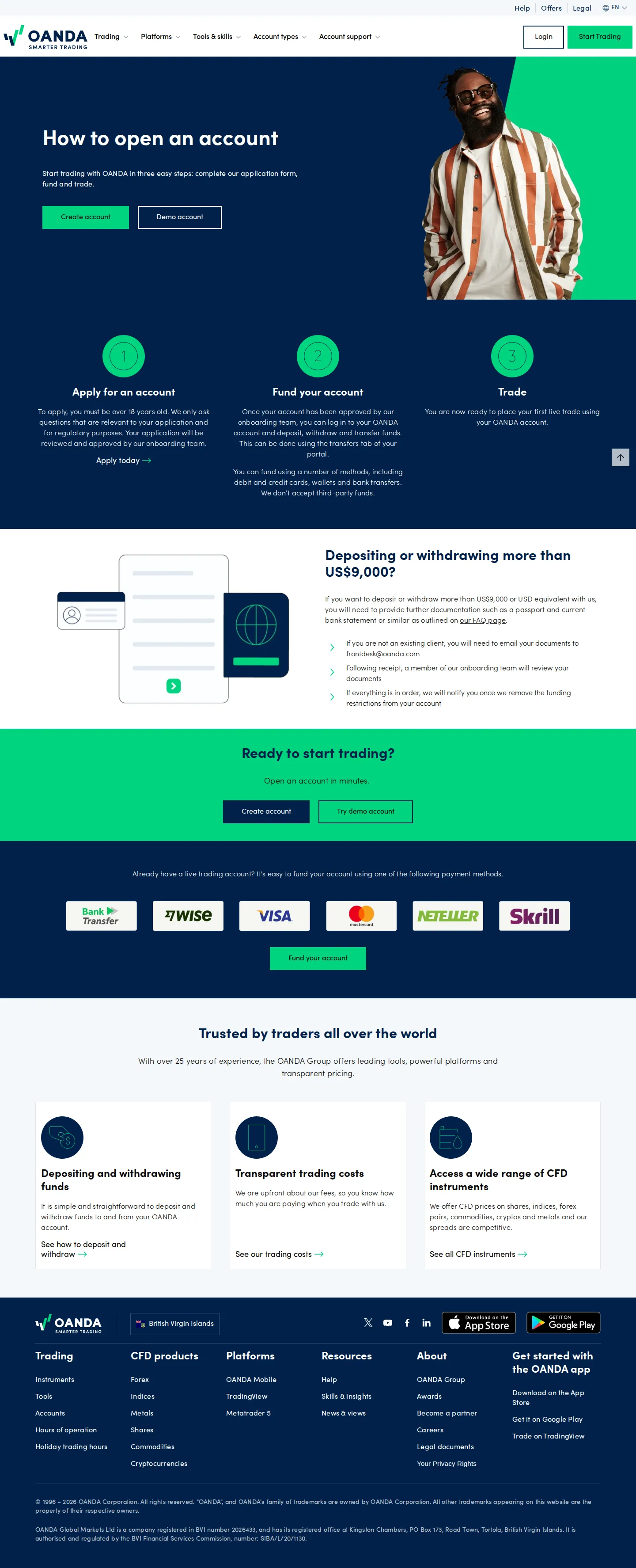
Score history
Recomputed daily; every move is on the record. The current score is always the latest row.
| Date | Score | Move |
|---|---|---|
| 2026-09-29 | 7.3 | ▲ |
| 2026-07-25 | 7.2 | ▲ |
| 2026-07-18 | 7.0 | ▼ |
| 2026-07-11 | 7.2 | · |
FAQ
Is OANDA regulated?
Yes. OANDA Europe Limited holds FCA licence 542574, and separate group entities hold licences with ASIC, NFA, KNF, JFSA, CIRO and MAS.
What does OANDA charge for trading?
OANDA advertises a ‘from’ spread of USD 6.00 round turn on 1 lot EURUSD on its Spread-only account, though this conflicts with its own pricing table.
What trading platforms does OANDA offer?
MetaTrader 4, MetaTrader 5, TradingView, OANDA’s own web platform, a mobile app, and fxTrade, plus depth of market.
What is OANDA's minimum deposit?
OANDA does not publish a minimum deposit figure.
How can I contact OANDA support?
By email or a published phone number, in the client’s own language during published hours, though the entity handling escalation depends on who onboarded the account.
How is OANDA rated by reviewers?
OANDA has a blended review score of 3.99 stars across 16,116 ratings.
THIS BROKER RENTS A LABELED SLOT ON OUR BOARD · MONEY BUYS THE SLOT, NEVER THE NUMBER · THE SCORE ABOVE IS NOT FOR SALE
How this review works
Track OANDA live: score moves and red notices, in your pocket.