
PROP · CHECKED 26 OCT 2026
Equity Edge review.
Prop-trading firm run through two confirmed entities, registered in Saint Lucia and the UK
RISKY
OUT OF 10
Equity Edge is a prop-trading firm built on two confirmed entities: Equity Edge Ltd in Saint Lucia's IBC registry, and Equity Edge Analytics Ltd at UK Companies House. No financial regulator oversees this kind of trading, and the firm's own pages give conflicting Saint Lucia addresses, route disputes to Saint Lucia's courts, and leave payout approval to its own compliance team.
Each criterion is scored 1 to 10 from primary sources. The overall score is their unweighted mean. How scoring works.
| Minimum deposit | Not stated |
|---|---|
| Platforms | MetaTrader 5 (MT5), Match-Trader |
- Equity Edge Ltd is on the Saint Lucia company register, and Equity Edge Analytics Ltd, which takes payments, is on UK Companies House (15263705)
- Trustpilot rates it 4.1 from 2,520 reviews, with no Trustpilot warning on the profile
- Support by email, plus help through its Discord advertised as 24/7
- Its terms set out which company does what: the Saint Lucia company runs the site and platform, the UK company handles evaluations, customer service and payments
- No financial licence of any kind; its registrations are company filings only
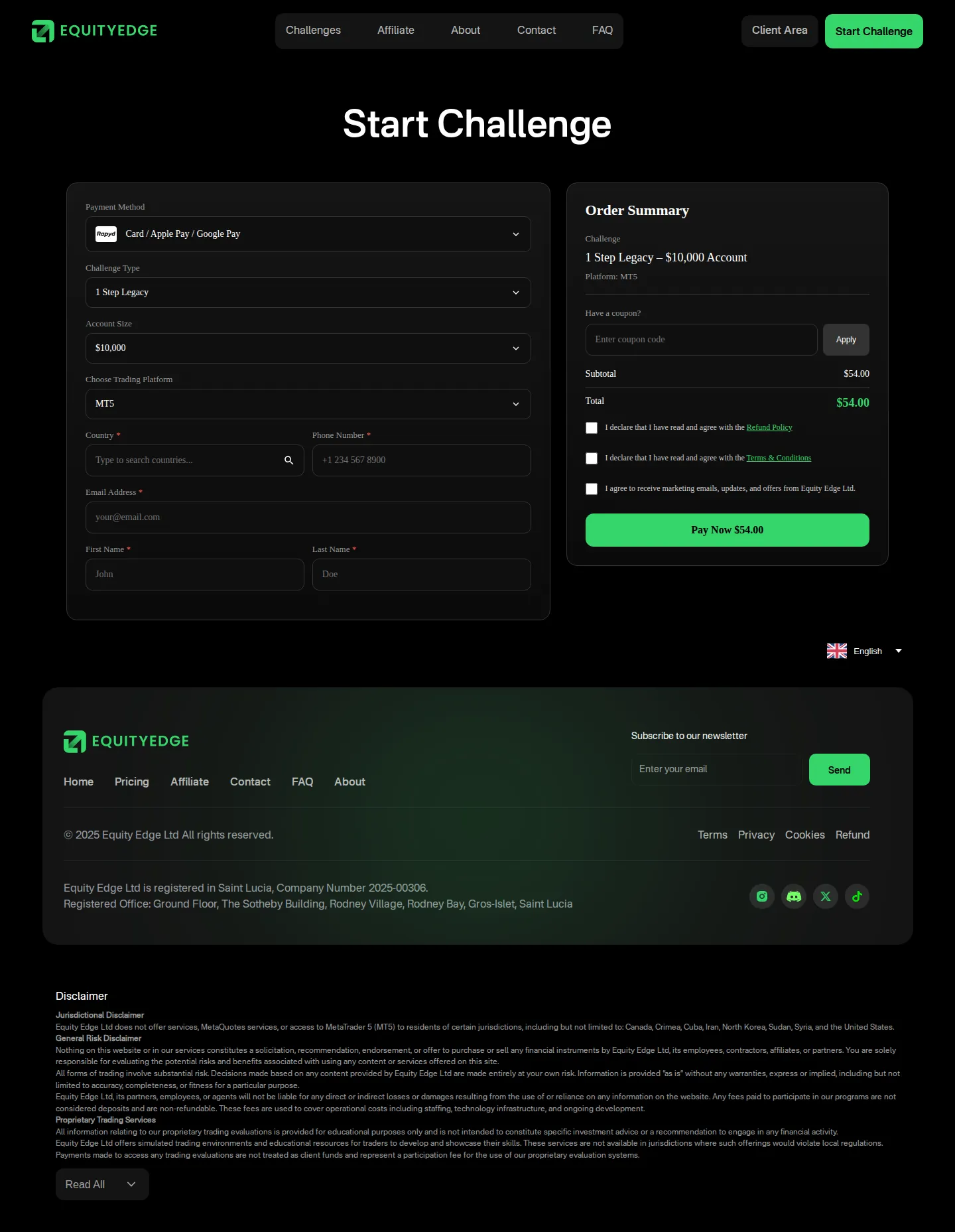
- Its site publishes no challenge prices; the pricing section is empty and the app requires an account before showing what an evaluation costs
- Only two platforms: MetaTrader 5 and Match-Trader
- Its footer and section 17 of its terms give two different Saint Lucia addresses
- Payments are settled by a separate company, Odeonpay ALE S.R.L (Paysagi), under section 20 of its terms
- Payout approval rests solely with the firm's own risk and compliance team
- Disputes go to the courts of Saint Lucia
Overview
TrueBroker is a free broker safety checker, and this page is our review of Equity Edge, scored 4.6 out of 10 across regulation, fees, platform, support and reviews.
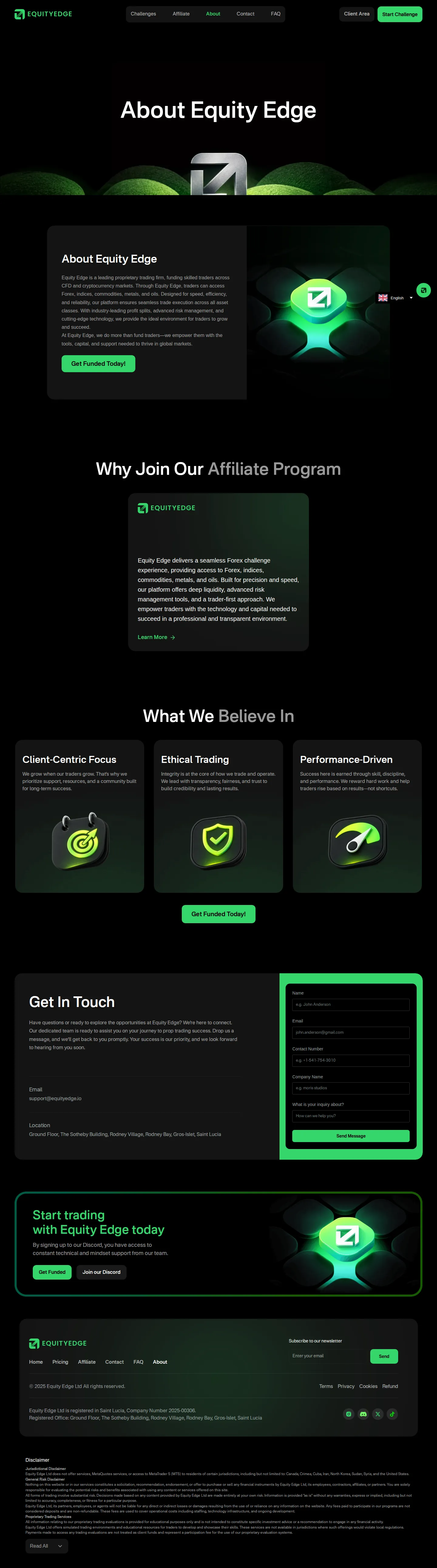
Equity Edge is a proprietary trading firm: it sells access to trading “challenges” or evaluations run on simulated accounts, and pays a share of simulated profits to traders who pass. The firm’s own terms and conditions name two operating entities. Equity Edge Ltd, registered in Saint Lucia, operates the website equityedge.io and what the terms describe as a “MetaQuotes-licensed technical platform”. Equity Edge Analytics Ltd, registered in the United Kingdom, handles evaluation administration, performance review, customer support, billing and payment processing. A third party, Odeonpay ALE S.R.L trading as “Paysagi”, settles some payments as Merchant of Record and is explicitly not the supplier of the goods or services.
We searched the Saint Lucia company registry and the United Kingdom company registry. The Saint Lucia Registry of International Business Companies name search lists “Equity Edge Ltd. (IBC)” as an International Business Company, but the free search publishes no registration number, incorporation date or status, those sit behind a paid, account only search, so the registration number quoted in the firm’s own terms, 2025-00306, could not be verified against the register. Companies House confirms EQUITY EDGE ANALYTICS LTD as company 15263705, a Private limited Company incorporated 6 November 2023 with status Active. Both of these are company registrations, not licences to deal in forex or CFDs, and our evidence contains no financial-services licence for either entity.
Overview Table
| Headquarters | Saint Lucia (Equity Edge Ltd); Equity Edge Analytics Ltd is registered in the United Kingdom |
|---|---|
| Established | Not stated for Equity Edge Ltd. Equity Edge Analytics Ltd was incorporated 6 November 2023, per Companies House |
| Countries Served | Not stated as a list. The terms exclude residents of Canada, Crimea, Cuba, Iran, North Korea, Sudan, Syria and the United States from services, MetaQuotes services and MT5 access |
| Regulated By | No financial-services licence found. Only company registrations: the Saint Lucia company registry and United Kingdom Companies House |
| Minimum Deposit | Not stated |
| Maximum Leverage | Not stated |
| Total Instruments | Not stated as a count. The firm’s about page lists Forex, Indices, Commodities, Metals, Oils and Cryptocurrency as accessible asset classes |
| Platforms | MetaTrader 5 (MT5) and Match-Trader |
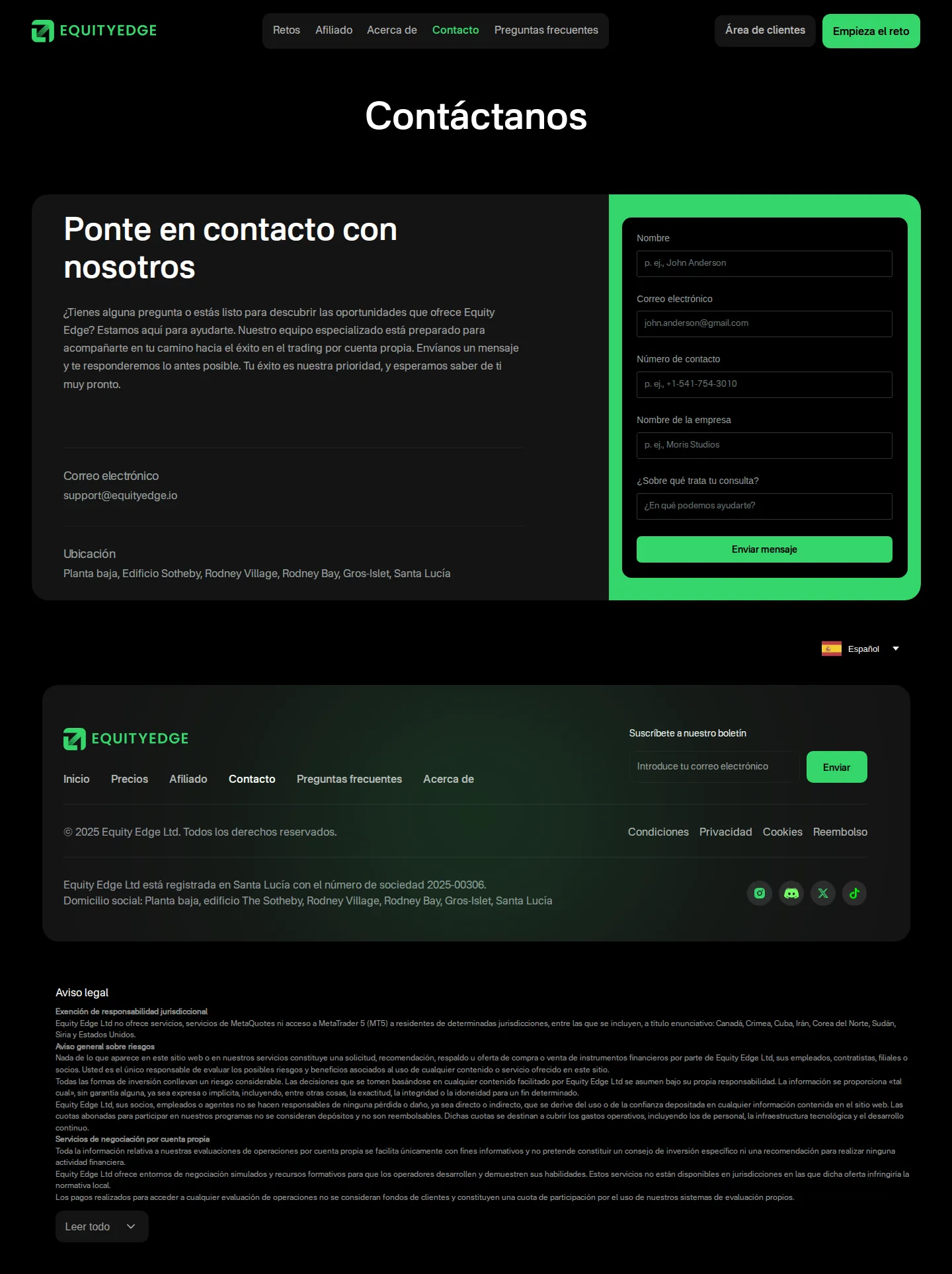
| Customer Support | Email (support@equityedge.io), a contact form and a Discord community described as “24/7 Support” |
| Languages | Not stated |
Facts List
- Equity Edge’s own terms and conditions describe all trading activity as happening “in a simulated environment using virtual balances”, with no customer funds deposited into or traded through the accounts.
- The terms state plainly that successful completion of an evaluation does not guarantee future income, live funding or any particular outcome.
- Marketing pages seen in the evidence advertise $1M+ Proven payouts delivered to global traders and “Keep up to 90% of your gains”, language that sits next to the terms’ own description of the product as a simulated, virtual-balance evaluation service.
- The profit split starts at 80% and scales up to 90% “as you show consistency in your trading”, according to the firm’s own marketing page.
- Evaluation fees are described in the terms as non-refundable: “All payments are final. No refunds will be issued once trading has begun.”
- Payout Eligibility (terms, section 6) makes clear that passing an evaluation does not guarantee payout, since all payouts are subject to review by the firm’s own risk and compliance team and may be declined for suspected rule breaches, location discrepancies or strategy manipulation.
- The firm’s footer across country versions of the site gives one Saint Lucia registered office address, while section 17 of the terms gives a different Saint Lucia contact address, a discrepancy worth knowing if a client needs to send formal correspondence.
- The terms state that charges may appear on a bank or card statement as “EQUITYEDGE” or “EQUITY EDGE ANALYTICS LTD”.
- Payout methods described on the firm’s pages are bank transfer and cryptocurrency.
- Employees or owners of other proprietary trading firms are barred from participating, per the firm’s own terms.
What Equity Edge actually is, versus what it sells
The clause the whole product rests on is section 1 of Equity Edge’s terms, “Nature of Services”: neither Equity Edge Ltd nor Equity Edge Analytics Ltd provides brokerage, custody, investment management, investment advice or live trade execution services, and no customer funds are deposited into or traded through the simulated accounts. That is a materially different thing from a funded trading account, and it sits awkwardly next to the payout and funding language on the firm’s own marketing pages, which a reader should weigh against the legal description in the same document.
Where disputes with Equity Edge end up
Section 15, “Legal Jurisdiction”, states the agreement is governed by the laws of Saint Lucia, that payment related matters may fall under the laws of England and Wales because of Equity Edge Analytics Ltd’s role as UK payment processor, and that disputes are subject to the non exclusive jurisdiction of the courts of Saint Lucia. Section 9, “Chargebacks & Disputes”, adds that a user who initiates a chargeback without valid reason will be permanently banned, with active accounts terminated and remaining balances forfeited. Section 10, “Complaints & Appeals”, requires complaints to be emailed, gives the compliance team up to ten business days to respond, and states the decision is final. Taken together, a client who disputes a charge through their own bank risks losing the account, and a client who exhausts the firm’s internal complaints process has nowhere further to appeal within the agreement.
Other terms that bind a trader
Section 11, “Limitation of Liability”, provides the services “as is” and “as available” with no guarantee of results, uptime or platform performance, and states the firm is not liable for losses, damages or expenses incurred through use of the services. Section 12, “Indemnity”, requires the client to indemnify Equity Edge Ltd, Equity Edge Analytics Ltd and affiliated personnel against claims arising from the client’s breach of the terms or misuse of the platform. Section 13, “Termination”, lets the firm suspend or terminate an account without prior notice for violations or suspected abuse, while the client remains liable for any fees already due. Section 14, “Amendments”, lets the firm update the terms at any time, placing the burden on the user to check for changes, with continued use counted as acceptance. Section 20 discloses that some payments are settled by Odeonpay ALE S.R.L, trading as “Paysagi”, acting solely as Merchant of Record under its own separate terms of use, meaning a billing dispute may involve a third party rather than Equity Edge directly.
Key Takeaways
Equity Edge is a CFD and crypto trading challenge sold through two linked companies, and the paperwork behind the marketing is where the problems sit.
What the registers actually confirm
- The Saint Lucia Registry of International Business Companies name search shows “Equity Edge Ltd. (IBC)” as an International Business Company. That free search does not publish a registration number, incorporation date or status, so the 2025-00306 the firm quotes was not verified against the register.
- UK Companies House confirms Equity Edge Analytics Ltd as company 15263705, a Private limited Company incorporated 6 November 2023, status Active.
- Neither register is a financial regulator. Between them they confirm that two companies exist; they confirm nothing about a licence to deal in forex or CFDs, because an IBC registration and a Companies House filing are both company registrations, not trading authorisations.
- The site’s Terms describe MT5 as a “MetaQuotes-licensed technical platform.” That is a software licence from the MT5 vendor, not a regulatory authorisation, and the Terms do not claim otherwise.
What the product actually is
- Section 1 of the Terms, “Nature of Services,” states that all activity runs in a simulated environment using virtual balances, that no customer funds are deposited into or traded through the simulated accounts, and that neither company provides brokerage, custody, investment management, investment advice or live trade-execution services.
- The same clause states that successful completion does not guarantee future income, live funding or any particular outcome.
- Against that, Equity Edge’s own marketing pages advertise $1M+ Proven payouts delivered to global traders, “Keep up to 90% of your gains,” “Trusted by over 280,000 traders worldwide,” and “Earn Up to $300K in Funding.” A reader has to hold both pages at once: a legal description of a virtual-balance skill evaluation, and marketing language built around payouts and funding.
- The profit split itself starts at 80% and rises to 90% “as you show consistency in your trading,” per the firm’s own page.
What Equity Edge charges and keeps the right to withhold
- Section 5, “Refund Policy,” states that all payments are final and that no refunds will be issued once trading has begun; the fee is framed as payment for digital access to evaluation models and tools, not for a guaranteed outcome.
- Section 6, “Payout Eligibility,” states that completing an evaluation does not guarantee payout, that every payout is subject to review by the firm’s own risk and compliance team, and that payouts may be declined for suspected rule breaches, location discrepancies, or strategy manipulation. KYC verification is mandatory before any payout.
- Read together, sections 5 and 6 mean the fee is non-refundable going in, and the payout on the other end is judged solely by the firm’s own compliance team using criteria the firm itself applies.
Terms that bind a client beyond the trading itself
- Section 9, “Chargebacks & Disputes,” states that users who initiate chargebacks without valid reason will be permanently banned, and that active accounts may be terminated with remaining balances forfeited. That removes the normal card-dispute route as a safe option for a client who feels wrongly charged.
- Section 10, “Complaints & Appeals,” requires complaints by email, gives the compliance team 10 business days to respond, and states that its decisions are final. There is no further internal appeal built into the contract.
- Section 11, “Limitation of Liability,” provides the services “as is” and “as available,” gives no guarantee of uptime or platform performance, and states the firm is not liable for losses, damages, or expenses incurred through use of the services. A platform outage during a challenge is the client’s risk to bear.
- Section 12, “Indemnity,” requires the client to indemnify Equity Edge Ltd, Equity Edge Analytics Ltd, and affiliated personnel against legal claims, damages, or costs arising from the client’s breach of the Terms or misuse of the platform.
- Section 13, “Termination,” lets the firm suspend or terminate any account without prior notice for violations or suspected abuse, while the user remains liable for any fees already incurred.
- Section 14, “Amendments,” lets the firm update the Terms at any time, puts the burden on the user to check for changes, and treats continued use as acceptance.
- Section 15, “Legal Jurisdiction,” puts the contract under the laws of Saint Lucia, with payment matters potentially under the laws of England and Wales because Equity Edge Analytics Ltd handles payment processing from the UK, and disputes subject to the non-exclusive jurisdiction of the courts of Saint Lucia. A client pursuing a claim is pointed toward Saint Lucia’s courts.
- Section 20 states certain payments settle through Odeonpay ALE S.R.L (“Paysagi”) acting solely as Merchant of Record, not as the supplier of the goods or services, with Paysagi’s own Terms of Use applying to that payment. A billing dispute can mean dealing with a third party under a separate set of terms.
Loose ends in the firm’s own pages
- The website footer lists the registered office as “Ground Floor, The Sotheby Building, Rodney Village, Rodney Bay, Gros-Islet, Saint Lucia” on every country version of the site we fetched, while Terms & Conditions section 17 gives a different contact address: “First Floor, The Tower, Rodney Bay, Gros-Islet, Saint Lucia.” The firm’s own pages disagree on where it is.
- Terms & Conditions state statements may show the charge as “EQUITYEDGE” or “EQUITY EDGE ANALYTICS LTD,” so the billing name on a card statement will not necessarily match the trading brand.
- Support runs through an email address, a contact form, and a Discord server described as giving “24/7 Support” for “technical and mindset” questions. There is no phone line or live chat in what we found.
Where that leaves the numbers
Regulation sits at 4.3 because what we found are two company registrations, not a licence to deal in forex or CFDs, on either register. Fees sit at 2 on the back of a non-refundable evaluation fee and a payout decision that the firm’s own compliance team makes under its own discretion. Platform scores 5.1 on access to MT5 and Match-Trader with no first-hand execution testing behind that number. Support sits at 5 on email, a contact form, and Discord as the only channels. Reviews sit at 6.7 as a standalone figure. The overall score of 4.6 reflects a product whose own Terms describe a virtual-balance skill test, sold with marketing language built around real payouts and funding.
Our reviews score of 6.7 comes from Trustpilot alone: the equityedge.io profile rates the firm 4.1 stars across 2,520 reviews, with no Trustpilot warning on the profile (checked 24 Oct 2026). Equity Edge publishes no app of its own.
Licenses & Regulation
Equity Edge is structured across two companies, and neither is a financial regulator-licensed entity. The firm’s own terms name Equity Edge Ltd, registered in Saint Lucia, as the operator of the equityedge.io site and its MetaQuotes-licensed technical platform, and Equity Edge Analytics Ltd, registered in the United Kingdom, as the company handling evaluation administration, performance review, customer support, billing and payment processing. A third party, Odeonpay ALE S.R.L (“Paysagi”), is named as Merchant of Record for settling transactions, with the terms specifying it is “not the supplier of the goods or services.”
What the registers actually show
We searched the Saint Lucia company registry and found “Equity Edge Ltd. (IBC)” listed on the Registry of International Business Companies name search operated by Pinnacle St. Lucia, marked as an International Business Company. That free search does not publish a registration number, incorporation date or status, those sit behind a paid, account-only search, so the 2025-00306 figure quoted in the terms could not be verified against the register. An IBC listing is a company registration, not a licence to deal in forex or CFDs.
We searched the United Kingdom company registry and found EQUITY EDGE ANALYTICS LTD listed on Companies House as company 15263705, a Private Limited Company incorporated 6 November 2023, with status Active. Companies House confirms the company exists and is active; it is a company registry, not a financial regulator, so this is a corporate record only and never a licence to provide financial services.
No financial-services licence identified
Nothing in the evidence gathered names a financial-services regulator, a licence number from a conduct authority, or any authorisation to hold client funds or provide brokerage services. The only outbound reference to MetaQuotes in the terms describes a “MetaQuotes-licensed technical platform,” which is a software-licensing arrangement with the MT5 vendor and has no bearing on financial regulation. Equity Edge’s own terms (section 1, “Nature of Services”) state that all activity is conducted in a simulated environment using virtual balances, that no customer funds are deposited into or traded through the simulated accounts, and that neither company provides brokerage, custody, investment management, investment advice or live trade-execution services. On the firm’s own description, then, this is a skill-evaluation product rather than a brokerage, which is consistent with the absence of any licence in the evidence collected.
The marketing-versus-terms gap
The firm’s marketing pages advertise $1M+ Proven payouts delivered to global traders, “Keep up to 90% of your gains,” “Trusted by over 280,000 traders worldwide,” and “Earn Up to $300K in Funding.” Section 1 of the terms states plainly that “all activity is conducted in a simulated environment using virtual funds” and that “no customer funds are deposited into or traded through the simulated accounts.” Readers weighing the funding and payout language against that section should keep both in view side by side.
Two addresses, one company
Equity Edge’s own pages disagree on where Equity Edge Ltd is based. The website footer across every country version of the site we fetched lists the Registered Office as “Ground Floor, The Sotheby Building, Rodney Village, Rodney Bay, Gros-Islet, Saint Lucia,” while section 17 of the terms and conditions, headed “Contact,” lists “First Floor, The Tower, Rodney Bay, Gros-Islet, Saint Lucia.” Both addresses are drawn from the firm’s own published pages; which one a client would need for formal correspondence is not resolved by the evidence available.
Jurisdiction clients are bound to
Section 15, “Legal Jurisdiction,” states the terms are “governed by the laws of Saint Lucia,” that payment-related matters may fall under the laws of England and Wales because of Equity Edge Analytics Ltd’s role as UK payment processor, and that disputes are subject to the non-exclusive jurisdiction of the courts of Saint Lucia. A client disputing the firm formally may therefore need to do so under Saint Lucia law and in Saint Lucia’s courts, a jurisdiction most clients outside the Caribbean would find remote to reach.
Taken together: a Saint Lucia company whose free registry listing cannot confirm the registration number the firm quotes, a UK company confirmed active at Companies House for administrative and billing functions only, and no licence from any financial regulator anywhere in the material reviewed.
How to Trade
Equity Edge runs its evaluations on two platforms: MetaTrader 5, which the firm’s own terms describe as a “MetaQuotes-licensed technical platform”, and Match-Trader, offered as an alternative for challenges. That MetaQuotes phrase is a software licensing arrangement with the MT5 vendor, not a financial-services authorisation, and it should not be read as a regulatory licence to hold funds or run brokerage services.
The firm’s about page lists the tradeable asset classes as forex, indices, commodities, metals and oils, stating that it funds “skilled traders across CFD and cryptocurrency markets”. We have not seen a published instrument list, spread table, swap rates or per symbol leverage caps for any of these classes.
What Equity Edge actually sells
The terms and conditions are explicit about what the client is paying for. Section 1, “Nature of Services”, states that all activity happens in a simulated environment using virtual balances, that no customer funds are deposited into or traded through the simulated accounts, and that neither Equity Edge Ltd nor Equity Edge Analytics Ltd provides brokerage, custody, investment management, investment advice or live trade execution. The same clause states that successfully completing an evaluation does not guarantee future income, live funding or any particular outcome.</p
That sits against the marketing on Equity Edge’s own pages, which advertises $1M+ Proven payouts delivered to global traders, “Keep up to 90% of your gains”, “Trusted by over 280,000 traders worldwide” and “Earn Up to $300K in Funding”. A reader has to hold both statements at once: the public pages talk about payouts and funding, and the terms describe a simulated, virtual balance evaluation product with no customer funds in play.
The profit split and how it moves
Equity Edge’s own pages set the profit split, the trader’s retained share of simulated profits, at 80 percent, rising to 90 percent “as you show consistency in your trading”. No fixed schedule, metric, or timeline for that rise is given on the page we read.
Paying for an evaluation, and what happens if it goes wrong
The refund clause (section 5 of the terms) states that all payments are final and that no refunds will be issued once trading has begun; the fee is framed as payment for digital access to the evaluation models and tools, not for a guaranteed outcome. Billing itself may not even run through Equity Edge directly: section 20 states that certain payments are settled by a third party, Odeonpay ALE S.R.L trading as “Paysagi”, acting solely as Merchant of Record and not as the supplier of the goods or services, with that third party’s own terms of use applying to the payment. The terms also note that a statement charge may appear as “EQUITYEDGE” or “EQUITY EDGE ANALYTICS LTD”.
Section 9, “Chargebacks & Disputes”, states that users who initiate a chargeback without valid reason will be permanently banned, and that active accounts may be terminated with remaining balances forfeited. That clause sits on top of the no refund policy: a client who disputes a charge through their own bank, rather than through Equity Edge, risks losing the account and any balance left in it.
Getting paid once an evaluation is passed
Section 6, “Payout Eligibility”, states that completing an evaluation does not guarantee a payout. Every payout is subject to review by the firm’s own risk and compliance team and may be declined for suspected rule breaches, location discrepancies, or strategy manipulation, and KYC verification is mandatory before any payout is released. Read together with section 1’s statement that no customer funds sit in the simulated accounts, this means the decision to pay out, and the judgment of whether a trader’s conduct qualifies, rests entirely with Equity Edge’s own compliance process rather than against money the trader can point to as already theirs.
Where payouts are described on the de.equityedge.io page, the firm names two methods: “traditional bank transfers” and the option described as “the convenience of cryptocurrencies”. No processing times, minimum payout thresholds, or fees for either method are given on the page we read.
Rules that can end an account
Sections 7 and 8 of the terms cover user conduct and prohibited use, banning accounts for a broadly defined set of platform misuse including spamming, false data, or the use of trade copying tools, at the firm’s discretion. Section 13, “Termination”, allows Equity Edge to suspend or terminate any account without prior notice for violations or suspected abuse, while the user remains liable for any fees already incurred before termination. Employees or owners of other proprietary trading firms are separately barred from participating at all, and the terms require registrants to use their own payment method, since accounts found using a third party’s payment method face suspension or a permanent ban.
The terms also bar residents of a list of jurisdictions, including Canada, Crimea, Cuba, Iran, North Korea, Sudan, Syria and the United States, from any services, MetaQuotes services, or access to MetaTrader 5.
Liability, indemnity and where a dispute would be heard
Section 11, “Limitation of Liability”, states that services are provided “as is” and “as available”, with no guarantee of results, uptime, or platform performance, and that the firm is not liable for losses, damages, or expenses incurred through use of the services. Section 12 goes further, requiring the client to indemnify and hold harmless Equity Edge Ltd, Equity Edge Analytics Ltd, and affiliated personnel from legal claims, damages, or costs arising from the client’s breach of the terms or misuse of the platform. Section 14 lets the firm amend the terms at any time, putting the burden on the user to check for changes, with continued use counting as acceptance.
Section 15, “Legal Jurisdiction”, states the agreement is governed by the laws of Saint Lucia, that payment related matters may fall under the laws of England and Wales because of Equity Edge Analytics Ltd’s role as UK payment processor, and that disputes are subject to the non exclusive jurisdiction of the courts of Saint Lucia. Section 10, “Complaints & Appeals”, requires complaints by email, gives the compliance team up to 10 business days to respond, and states that its decisions are final, with no further internal appeal described.
Account Types
Equity Edge does not sell retail trading accounts. What the site offers, across every country version of the site we fetched, is paid access to a trading evaluation that runs on a simulated balance, followed by a profit split against that simulated balance if a trader passes and keeps trading within the rules. The firm’s own terms and conditions are explicit about this: “All activity is conducted in a simulated environment using virtual funds” and “No customer funds are deposited into or traded through the simulated accounts” (Section 1, Nature of Services). That same section states that successful completion of an evaluation does not guarantee future income, live funding, or any particular outcome. The pages we fetched do not publish a table of specific challenge sizes or evaluation fee amounts; what they set out instead is the profit-split structure, the refund terms, and the conditions attached to getting paid.
Equity Edge’s profit split
The firm’s own marketing page states that traders keep a profit split “starting at 80%” that scales up to 90% “as you show consistency in your trading.” No account-size or price tiers accompany that figure on the pages we read, so what we can report is the split structure itself rather than a specific ladder of funded-account sizes. The same marketing page separately advertises $1M+ Proven payouts delivered to global traders, “Keep up to 90% of your gains,” “Trusted by over 280,000 traders worldwide,” and “Earn Up to $300K in Funding.” Those claims sit awkwardly next to Section 1 of the terms, which describes the whole exercise as a simulated, virtual-balance evaluation with no customer funds traded and no guaranteed live funding. A reader weighing the payout and funding language should hold it against the contractual description of what is actually being sold.
What the evaluation fee buys, and what it does not
The terms and conditions describe the evaluation fee as payment for digital access to evaluation models and tools, not payment for a guaranteed outcome, and state it is not a deposit. Section 5, Refund Policy, is direct on what happens to that fee: “All payments are final. No refunds will be issued once trading has begun.” Passing the evaluation does not end the firm’s discretion over money either. Section 6, Payout Eligibility, states that completing an evaluation does not guarantee a payout, that every payout is subject to review by the firm’s own risk and compliance team, and that a payout may be declined for suspected rule breaches, location discrepancies, or strategy manipulation, with KYC verification mandatory first. Taken together, the fee is non-refundable once trading starts, and reaching a passing result still leaves the payout itself subject to the firm’s own, self-judged review.
Platforms and markets the challenge runs on
Equity Edge’s own pages describe the trading platform as a “MetaQuotes-licensed technical platform,” referring to MetaTrader 5, and state that challenges can be taken “on MT5 or Match-Trader.” That MetaQuotes reference is a software licensing arrangement for the MT5 terminal, not a financial-services authorisation, and it should not be read as a regulatory licence to hold client money or run a brokerage. On the asset side, the firm’s about page lists forex, indices, commodities, metals and oils as accessible markets, and separately states the firm funds “skilled traders across CFD and cryptocurrency markets,” putting crypto alongside those asset classes.
Who actually bills for the challenge
Two separate companies sit behind the Equity Edge brand, according to the terms and conditions. Equity Edge Ltd, incorporated in Saint Lucia, operates the website and the MetaQuotes-licensed platform. Equity Edge Analytics Ltd, incorporated in the United Kingdom, is the entity named in the terms as handling evaluation administration, performance review, customer support, billing, and the receipt and processing of customer payments. The UK Companies House register confirms EQUITY EDGE ANALYTICS LTD as company number 15263705, a private limited company incorporated 6 November 2023 with status Active; Companies House is a company registry, not a financial regulator, so that entry confirms the company exists and nothing about any licence to deal in forex or CFDs. The Saint Lucia Registry of International Business Companies name search likewise lists “Equity Edge Ltd. (IBC)” as an International Business Company, but that free search does not publish a registration number, incorporation date or status, so the registration number the firm quotes was not independently verified by us, and an IBC listing is a company registration rather than a dealing licence.
The terms and conditions also name a third party, Odeonpay ALE S.R.L, trading as “Paysagi,” as the Merchant of Record for settling transactions, stated explicitly to be a payment processor rather than the supplier of the evaluation itself, with its own separate Terms of Use governing the payment (Section 20). The terms note a client’s bank or card statement may show the charge as “EQUITYEDGE” or “EQUITY EDGE ANALYTICS LTD.” A client paying for a challenge is therefore dealing with at least three named entities across the transaction: the Saint Lucia platform operator, the UK billing and support entity, and a separate payment processor, each under its own terms.
Negative Balance Protection
Equity Edge sells access to a funded-trading evaluation, and the Terms and Conditions we read spell out what that means for anyone asking where the loss stops. Section 1, “Nature of Services,” states that “all activity is conducted in a simulated environment using virtual funds” and that “no customer funds are deposited into or traded through the simulated accounts.” There is no live account to go negative in the way a real brokerage account can. The question that matters here is not how big a drawdown wipes out a trading account, but what happens to the money a client already paid Equity Edge, and what discretion the firm keeps once trading starts.
The only cash actually at risk is the evaluation fee
Equity Edge’s fee material describes the evaluation charge as payment for digital access to its evaluation models and tools, not as a deposit and not as payment for a guaranteed outcome. Section 5, “Refund Policy,” of the Terms and Conditions we read is direct about what that means once a challenge is underway: “All payments are final. No refunds will be issued once trading has begun.” A trader who breaches a rule, fails an evaluation, or simply changes their mind after the first trade has no refund route back to the fee already paid.
How Equity Edge decides a rule has been broken
Section 6, “Payout Eligibility,” in the same Terms and Conditions sets out that completing an evaluation does not by itself guarantee payout. Every payout is subject to review by the firm’s own risk and compliance team, and that team may decline a payout over suspected rule breaches, location discrepancies, or strategy manipulation; KYC verification is mandatory before any payout is released. The call on whether a client’s trading broke a rule, and whether that client gets paid, sits entirely with Equity Edge’s internal review rather than with any outside party. Sections 7 and 8, “User Conduct” and “Prohibited Use,” add a second, broader route to the same outcome: the firm can ban an account over conduct or platform-use issues, including tools like trade-copying software, again at its own discretion.
What happens to the account once Equity Edge calls a breach
Section 13, “Termination,” lets Equity Edge suspend or terminate any account without prior notice for violations or suspected abuse, while the user remains liable for any fees already incurred before that termination. Section 9, “Chargebacks & Disputes,” covers the one dispute route most clients would otherwise reach for: a user who initiates a chargeback without what the firm considers a valid reason faces a permanent ban, and an active account can be terminated with its remaining balance forfeited. That clause effectively removes the normal card-dispute remedy as a safe option for a client who disagrees with a fee or a declined payout.
Where Equity Edge draws the line on its own responsibility
Section 11, “Limitation of Liability,” states that the services are provided “as is” and “as available,” with no guarantee of results, uptime, or platform performance, and that the firm is not liable for losses, damages, or expenses incurred through use of the services. Section 12, “Indemnity,” goes further and requires the client to indemnify and hold harmless Equity Edge Ltd, Equity Edge Analytics Ltd, and their personnel against legal claims, damages, or costs arising from the client’s own breach of the Terms or misuse of the platform. Between those two clauses, a client carries the risk of a platform fault or outage on one side, and the firm’s legal costs on the other if it decides the client was at fault.
The gap between the marketing and the contract
Equity Edge’s marketing pages promise $1M+ Proven payouts delivered to global traders, tell traders to “Keep up to 90% of your gains,” claim the firm is “Trusted by over 280,000 traders worldwide,” and advertise traders can “Earn Up to $300K in Funding.” The profit split itself starts at 80% and rises to 90% “as you show consistency in your trading,” according to the firm’s own marketing page. Set against that is the Terms and Conditions language quoted above: a simulated environment, virtual funds, no customer money deposited or traded, and a payout that stays subject to the firm’s own compliance review even after a challenge is passed. A reader weighing a payout headline against a drawdown or dispute should read it against that same page’s description of what the account underneath it actually is: a trading platform licensed for use under a “MetaQuotes-licensed technical platform” arrangement, not a live brokerage account holding anyone’s deposited funds.
The Terms and Conditions we read do not set out a specific daily-loss or maximum-drawdown percentage anywhere in the material covering payout eligibility, termination, or prohibited use; what they set out instead is a payout and termination process that stays discretionary, reviewed case by case by Equity Edge’s own compliance team rather than against a published numeric trigger.
Trading Instruments
Equity Edge markets itself around tradable asset classes rather than a brokerage account, and that distinction matters to how the “assets” question has to be answered. The firm’s about page lists forex, indices, commodities, metals and oils as accessible asset classes, and states that the firm funds “skilled traders across CFD and cryptocurrency markets,” adding cryptocurrency to that list.
But the terms and conditions, under the heading “Nature of Services,” describe something different from live market access to any of those asset classes: all activity is conducted in a simulated environment using virtual balances, no customer funds are deposited into or traded through the simulated accounts, and neither Equity Edge Ltd nor Equity Edge Analytics Ltd provides brokerage, custody, investment management, investment advice or live trade execution services. So the forex, indices, commodities, metals, oils and crypto markets listed on the about page are the markets an evaluation account’s price feed tracks, not markets a client’s money is actually placed into.
The platforms Equity Edge runs challenges on
The firm’s root pages state that challenges can be taken “on MT5 or Match-Trader.” MetaTrader 5 is described in the terms as a “MetaQuotes-licensed technical platform,” which is a software licensing arrangement with the MT5 vendor, not a financial-services authorisation, and reading it as a regulatory stamp of approval would be a mistake. Match-Trader is offered as the alternative platform for the same challenges. Neither platform’s own order-execution or spread detail is in the pages we fetched for this section.
What the marketing promises against what the contract defines
Equity Edge’s marketing copy advertises $1M+ Proven payouts delivered to global traders, “Keep up to 90% of your gains,” “Trusted by over 280,000 traders worldwide,” and “Earn Up to $300K in Funding.” Read against the “Nature of Services” clause, which states plainly that the accounts are simulated and that passing an evaluation does not guarantee future income, live funding, or any particular outcome, there’s a real gap between the payout and funding language on the marketing pages and the legal description of the product as a simulated, virtual-balance skill evaluation. A client weighing whether “funding” means a live trading account should read that clause before the homepage copy.
The profit split sits inside that same simulated framework: Equity Edge’s root page describes an 80% profit split rising to 90% “as you show consistency in your trading.” Since the terms describe the underlying activity as simulated with no customer funds traded through the accounts, that split is a share of a calculated payout tied to performance in the evaluation environment, not a share of live trading profits in the ordinary brokerage sense.
Paying in and getting paid out
On the instrument side, the evaluation fee itself is described in the terms as payment for digital access to evaluation models and tools, not for a guaranteed outcome, and is stated to be non-refundable: “All payments are final. No refunds will be issued once trading has begun.” The terms also note that certain payments are settled through a third party, Odeonpay ALE S.R.L (trading as “Paysagi”), acting solely as Merchant of Record and not as the supplier of the goods or services, with its own separate terms of use applying to that payment leg under Terms and Conditions section 20.
On the payout side, the German-geo root page describes two payment methods for sending money back to a trader: “traditional bank transfers” and the option of using cryptocurrencies. No currency list, minimum payout threshold, or processing-time figure for either method appears in the pages we fetched.
Who can and can’t access these markets through Equity Edge
The terms set jurisdictional and identity restrictions that function as a further limit on who can actually trade these asset classes through the firm: no services, MetaQuotes services, or MT5 access are offered to residents of Canada, Crimea, Cuba, Iran, North Korea, Sudan, Syria or the United States, among others. Separately, employees or owners of other proprietary trading firms are barred from participating, and registrants must use their own payment method, since accounts found using a third party’s payment method face suspension or a permanent ban.
Taken together, the asset classes a client sees on Equity Edge’s about page, forex, indices, commodities, metals, oils and crypto, describe the markets an evaluation tracks on MT5 or Match-Trader, inside a product the firm’s own terms repeatedly define as a simulated evaluation rather than live trading or brokerage.
Education & Analysis
Equity Edge runs its challenges on two platforms. Its own terms describe the firm’s technical setup as a “MetaQuotes-licensed technical platform,” which is a software licensing arrangement with the MT5 vendor rather than any kind of financial-services authorisation, and the site states that challenges can be taken “on MT5 or Match-Trader.” That gives traders a choice between MetaTrader 5, the industry-standard platform most funded-account traders already know, and Match-Trader, a browser-capable alternative some prop firms use to avoid the licensing and payout-routing restrictions MetaQuotes places on simulated-funding business models.
Beyond naming the two platforms, the pages we fetched do not describe a feature set for either one. There is nothing in the evidence about charting package depth, the number of timeframes or indicator libraries available, whether Equity Edge supplies its own dashboard for tracking evaluation progress or drawdown, or whether any analysis tools sit outside the MT5/Match-Trader terminals themselves. We can report what the firm names; we cannot report what either platform actually contains, because the pages we read did not describe it.
What Equity Edge says traders can trade
The firm’s about page lists forex, indices, commodities, metals and oils as accessible asset classes, and separately states that the firm funds “skilled traders across CFD and cryptocurrency markets.” That puts cryptocurrency alongside the other five asset classes as something Equity Edge’s own marketing claims traders can access, though the pages we fetched do not list specific instruments, symbols, or contract specifications within any of those classes.
The gap between the platform and the product
Equity Edge’s terms and conditions state plainly, under “Nature of Services,” that all activity is conducted in a simulated environment using virtual balances and that “no customer funds are deposited into or traded through the simulated accounts.” Read against the MT5/Match-Trader platform choice, that means the charting and order-entry tools on offer are the same ones a live trading account would use, but the account sitting behind them never touches a real market. Neither company, per the same clause, provides brokerage, custody, investment management, investment advice or live trade-execution services, and successful completion of an evaluation does not guarantee future income, live funding or any particular outcome.
That distinction matters for anyone judging the platform section of this review on the strength of the firm’s marketing. Equity Edge’s own pages advertise $1M+ Proven payouts delivered to global traders, “Keep up to 90% of your gains,” “Trusted by over 280,000 traders worldwide,” and “Earn Up to $300K in Funding” in the same breath as the terms describing virtual balances and no customer funds. A reader comparing the platform’s marketed scale against the legal description of a skill-evaluation product using simulated money is weighing two things the firm has published that sit in tension with each other.
On cost, the fee material we read describes a profit split rather than a platform or data fee: traders start at an 80% profit split and scale “as you show consistency in your trading” up to 90%, a structure about payout sharing on simulated gains, not about licensing MT5 or Match-Trader seats. The evaluation fee itself is described in the terms as payment for digital access to evaluation models and tools, not for a guaranteed outcome, and is stated to be non-refundable once trading has begun. Section 6, “Payout Eligibility,” adds that even a trader who passes an evaluation has no guaranteed payout: payouts are subject to review by the firm’s own risk and compliance team and can be declined for suspected rule breaches, location discrepancies, or strategy manipulation, with KYC verification mandatory first. None of that is a platform feature, but it bears directly on what the MT5/Match-Trader access a trader is paying for actually entitles them to.
Support for the platform itself runs through a Discord community that the firm’s own page describes as offering “24/7 Support” and “constant technical and mindset support from our team” to anyone who signs up, alongside the standard email and contact-form channels. We found no separate help desk, ticketing system, or documented SLA for platform or execution issues beyond that Discord-based channel and the general support contacts.
Special Offers
The clearest thing Equity Edge offers in place of a cash discount or welcome bonus is a profit split: the firm’s UAE-facing marketing page advertises a split that starts at an 80% profit split and scales up to 90% as you show consistency in your trading. That is the extent of what the fetched pages describe as a reward structure. There is no promotions or discount-code page among the pages we fetched, so this section reports what those pages actually say about the money on offer rather than what a typical prop firm might run as a campaign.
What Equity Edge’s own pages promise
The UAE-facing marketing page carries several headline claims: $1M+ Proven payouts delivered to global traders, “Keep up to 90% of your gains,” “Trusted by over 280,000 traders worldwide,” and “Earn Up to $300K in Funding.” Read on their own, these read as the kind of payout and funding promises a trader shopping prop firms would compare across providers.
Read against the firm’s own Terms and Conditions, the picture is different. Clause 1, “Nature of Services,” states that all activity is conducted in a simulated environment using virtual balances and that “no customer funds are deposited into or traded through the simulated accounts.” The same clause adds that neither Equity Edge Ltd nor Equity Edge Analytics Ltd provides brokerage, custody, investment management, investment advice or live trade-execution services, and that successful completion of an evaluation “does not guarantee future income, live funding or any particular outcome.” A reader comparing the marketing language about payouts and funding against this clause has to decide for themselves how far “Earn Up to $300K in Funding” squares with an evaluation that runs on virtual balances and guarantees nothing.
The profit split’s own conditions
The 80 percent starting split and the climb to 90 percent are tied to what the marketing page calls “consistency in your trading,” without the fetched pages setting out a numeric threshold, a time window, or a defined scoring method for what counts as consistent. So the figures are the firm’s, the scaling mechanism is the firm’s description of it, and nothing in what we read spells out the rule that moves a trader from one tier to the other.
Clause 6, “Payout Eligibility,” in the Terms and Conditions attaches its own condition on top of the split: “completing an evaluation does not guarantee payout,” and all payouts are subject to review by the firm’s own risk and compliance team and may be declined for suspected rule breaches, location discrepancies, or strategy manipulation, with KYC verification mandatory first. Whatever share of simulated profits a trader is told they will keep, clause 6 means that share is paid out only after the firm’s own compliance review clears it, on grounds the firm itself judges.
What a client pays to take part, and what comes back
The evaluation itself is bought as a fee rather than a deposit. Clause 5, “Refund Policy,” states “all payments are final. No refunds will be issued once trading has begun,” and describes the fee as payment for digital access to evaluation models/tools, not for a guaranteed outcome. There is no discounted or trial-priced entry tier described in the pages we fetched; the fee structure we read is a single final payment with no refund window once a challenge is live.
Clause 9, “Chargebacks & Disputes,” adds that “users who initiate chargebacks without valid reason will be permanently banned,” with active accounts terminated and remaining balances forfeited. That clause sits alongside clause 20, which notes that certain payments are settled by Odeonpay ALE S.R.L, trading as “Paysagi,” acting solely as Merchant of Record and “not the supplier of the goods or services,” under its own separate terms of use. A trader querying a charge is dealing with a third-party payment processor’s billing terms as well as Equity Edge’s own refund clause, and risks a permanent ban under clause 9 if that query takes the form of a chargeback the firm considers invalid.
Equity Edge’s payout methods
Where the firm does describe getting money out, the German-facing marketing page lists two routes: “traditional bank transfers” and “the convenience of cryptocurrencies.” No fee schedule, processing time, or minimum payout amount for either method appears on the pages we fetched, so what we can confirm is the choice of method rather than its cost or speed.
Opening an Account
Signing up to a challenge is a payment, not an application. The site takes an evaluation fee for digital access to its evaluation models and platform tools, and the terms are explicit that this fee is not a deposit and is non-refundable once trading starts: “All payments are final. No refunds will be issued once trading has begun.” There is no separate account-opening or suitability step described in the material we read; the fee itself is the gate, and a trader chooses to run the challenge on MetaTrader 5 or Match-Trader.
Who Equity Edge will not let in
The terms set a floor of 18 years old and require that the registrant live somewhere the firm’s services are permitted. Two groups are named out entirely: employees or owners of other proprietary trading firms are barred from participating, and residents of a listed group of jurisdictions, including Canada, Crimea, Cuba, Iran, North Korea, Sudan, Syria and the United States, are told they get no services, no MetaQuotes services and no access to MT5. The terms also require registrants to pay with their own payment method; using a third party’s card or account is grounds for suspension or a permanent ban, worded that bluntly in the document itself.
Verification comes at the payout end, not the start
Nothing in the material we read describes identity checks as a condition of starting a challenge. KYC verification instead sits inside the payout stage: section 6, “Payout Eligibility,” makes clear that completing an evaluation does not guarantee payout, that every payout is subject to review by the firm’s own risk and compliance team, and that KYC verification is mandatory before any payout is made. The same clause lets the firm decline a payout over suspected rule breaches, location discrepancies or strategy manipulation, decided internally rather than by any outside check. Marketing lines on the Emirates page talk about $1M+ Proven payouts delivered to global traders and funding “up to $300K,” while the terms describe the whole exercise as a simulated environment run on virtual balances, with no customer funds deposited into or traded through the accounts, so the thing being evaluated and the thing being advertised as “funding” are not quite the same object on the firm’s own pages.
Who is actually taking the money
Two companies sit behind the brand, and the terms separate their jobs. Equity Edge Ltd, incorporated in Saint Lucia, runs the website and the MetaQuotes-licensed MT5 setup. Equity Edge Analytics Ltd, a UK company, handles evaluation administration, performance review, customer support, billing and processing of customer payments. We searched the Saint Lucia Registry of International Business Companies and found “Equity Edge Ltd. (IBC)” listed as an International Business Company; the free name search does not publish a registration number, incorporation date or status, so the 2025-00306 number quoted on the firm’s own pages is not something we could verify, and an IBC listing is a company registration rather than a licence to deal in forex or CFDs. We also searched UK Companies House and found EQUITY EDGE ANALYTICS LTD registered as company 15263705, a private limited company incorporated 6 November 2023, with status Active; Companies House confirms the company exists and is current, not that it, or Equity Edge Ltd, holds any financial-services authorisation. A trader’s bank or card statement may show the charge as “EQUITYEDGE” or “EQUITY EDGE ANALYTICS LTD,” which is worth recognising since the two names belong to different companies in different countries.
A third party actually processes the payment
Clause 20 names Odeonpay ALE S.R.L, trading as “Paysagi,” as the Merchant of Record for settling transactions, stating plainly that Odeonpay “is not the supplier of the goods or services” and that its own Terms of Use govern the payment itself. A trader paying the evaluation fee is therefore dealing with a fourth entity for billing purposes on top of the two Equity Edge companies, which matters if a billing dispute ever needs to be raised; the chargeback clause in the same terms warns that initiating one “without valid reason” can get an account permanently banned and any remaining balance forfeited, so the normal card-network dispute route carries a stated penalty if the firm judges the dispute invalid.
Where a dispute over opening or closing an account would be heard
Section 15, “Legal Jurisdiction,” puts the contract under the laws of Saint Lucia, with disputes subject to the non-exclusive jurisdiction of Saint Lucia’s courts, while noting that payment-related matters may fall under the laws of England and Wales because of Equity Edge Analytics Ltd’s role as UK payment processor. A trader disputing why an account was declined, suspended or denied a payout is pointed toward Saint Lucia courts for the substance of the complaint, with the UK layer relevant only to the payment side.
Deposits & Withdrawals
Equity Edge sells evaluations, not brokerage, and that distinction runs straight through how money moves. The firm’s terms state that all activity is conducted in a simulated environment using virtual balances and that “no customer funds are deposited into or traded through the simulated accounts” (Section 1, Nature of Services). So the only real cash that changes hands going in is the evaluation fee, and the only real cash coming out, if it comes out, is a payout calculated against a profit split on a simulated account.
What it costs to start a challenge
The published fee material doesn’t give a fixed price list we can quote, but it does set the terms that govern whatever figure a client is charged. Section 5, Refund Policy, states plainly: “All payments are final. No refunds will be issued once trading has begun.” The same section frames the fee as payment for digital access to the evaluation models and tools, not as a deposit and not as payment for a guaranteed outcome. In practice that means the moment a challenge starts, the fee is gone regardless of what happens afterward, win, lose, or account breach.
Who actually bills the card
The entity that takes the client’s money isn’t necessarily the entity running the trading evaluation. Equity Edge Ltd, incorporated in Saint Lucia, operates the website and the MetaQuotes-licensed MT5 platform. Equity Edge Analytics Ltd, a UK company, is the one described as providing evaluation administration, billing, and customer support, and as the party that “receives and processes customer payments.” We searched the UK company registry (Companies House) and found Equity Edge Analytics Ltd listed as company 15263705, a private limited company incorporated 6 November 2023, status Active. We also searched the Saint Lucia company registry and found “Equity Edge Ltd. (IBC)” on the free name search as an International Business Company; that search doesn’t publish a registration number, incorporation date, or status, so the 2025-00306 figure quoted in the firm’s own terms was not something we could verify against the register.
A third party sits behind even that UK entity for settlement. Section 20 of the terms names Odeonpay ALE S.R.L, trading as “Paysagi,” as the Merchant of Record for transaction settlement, explicitly “not the supplier of the goods or services,” and states that Paysagi’s own Terms of Use govern the payment itself. The terms also note that a charge may appear on a client’s bank or card statement as “EQUITYEDGE” or “EQUITY EDGE ANALYTICS LTD,” so a client disputing a charge is potentially dealing with three names: the Saint Lucia platform operator, the UK billing entity, and a separate payment processor with its own contract.
Paying with someone else’s card or wallet
The terms require registrants to “use own payment method,” with third-party payments explicitly barred: accounts found using a third-party payment method “will be suspended or permanently banned.” That restriction applies to the money going in, before any question of a payout arises.
Getting paid out, and what stands between a client and the money
The profit split is advertised as starting at 80% and scaling up to 90% “as you show consistency in your trading” (per the firm’s own marketing page), and payout methods named are “traditional bank transfers” and cryptocurrency. Neither page we read gives a payout schedule, minimum payout amount, or processing time, so none of that can be stated here.
What the terms do spell out is how much discretion sits between a passed evaluation and a paid client. Section 6, Payout Eligibility, states that completing an evaluation “does not guarantee payout,” and that all payouts are subject to review by the firm’s own risk and compliance team and may be declined for suspected rule breaches, location discrepancies, or strategy manipulation. KYC verification is mandatory before any payout is released. So the client clears the trading target, and then clears a separate, internally judged compliance review, before cash moves.
That gap between marketing language and contract language is worth naming directly: the same site that promises “Keep up to 90% of your gains,” $1M+ Proven payouts delivered to global traders, and “Earn Up to $300K in Funding” is the site whose terms describe the underlying accounts as simulated, funded with virtual balances, with no customer funds deposited into or traded through them. Both statements are the firm’s own; a reader weighing the payout promise should weigh it against the payout-eligibility clause in the same document.
If a client disputes a charge
Section 9, Chargebacks & Disputes, sets out a penalty specifically for using a bank’s own dispute process: a user who initiates a chargeback “without valid reason” is “permanently banned,” and an active account can be terminated with any remaining balance forfeited. Section 13, Termination, separately gives the firm the right to suspend or close any account without prior notice for violations or suspected abuse, while the user remains liable for fees incurred before termination. Read together, a client who disputes a charge through their card issuer risks losing both account access and whatever balance was sitting in it, and a client whose account is closed for a violation still owes whatever was already due.
If a client wants to contest a payout decision rather than a charge, Section 10, Complaints & Appeals, routes that through email to the compliance team, which responds within 10 business days and whose decision is described as final. There’s no further internal appeal step after that.
Where a dispute would actually be heard
Section 15, Legal Jurisdiction, puts the contract under the laws of Saint Lucia, with disputes subject to the non-exclusive jurisdiction of Saint Lucia’s courts, while carving out that payment-related matters may fall under the laws of England and Wales because of Equity Edge Analytics Ltd’s role as the UK payment processor. For a client outside both Saint Lucia and the UK, either venue is a long way from home if a payout or a charge ever needs to be fought over formally.
Customer Support
Equity Edge’s own contact page lists two ways in: email at support@equityedge.io, and a contact form asking for name, email, contact number, company name and inquiry topic. Alongside those, the firm runs a Discord server, which the UAE marketing page frames as “24/7 Support”, telling traders that “by signing up to our Discord, you have access to constant technical and mindset support from our team”. There is no stated response time for the email address or the contact form, and no phone line.
What happens when a complaint is raised with Equity Edge
The terms and conditions set out a formal complaints process in section 10, “Complaints & Appeals”: complaints have to be sent by email, the compliance team reviews them, and a response follows within 10 business days. The same clause states that the compliance team’s decisions are final, so there is no internal appeal stage above that review. Anyone disputing a payout, a ban or a fee is dealing with the firm’s own compliance team as the only decision maker, on the firm’s own timeline of up to two weeks.
That finality sits next to a separate clause on payment disputes. Section 9, “Chargebacks & Disputes”, states that users who initiate a chargeback “without valid reason” will be permanently banned, and that active accounts may be terminated with remaining balances forfeited. A trader unhappy with a decision therefore has the email complaints route and a 10 business day wait, and going to their card issuer instead carries the stated risk of a permanent ban and loss of any balance left on the account.
Where the money and the support actually sit
Two companies split the work behind the support channels. Equity Edge Ltd, incorporated in Saint Lucia, is described in the terms as running the website and its MetaQuotes-licensed MT5 platform. Equity Edge Analytics Ltd, the company Companies House confirms as UK company 15263705, a private limited company incorporated 6 November 2023 with active status, is named as the entity providing “evaluation administration, performance review, customer support, billing and related customer services” and as the one receiving and processing customer payments. So the support function a trader actually deals with, and the billing behind it, runs through the UK entity, not the Saint Lucia one that holds the platform licence.
A third party sits behind some of the billing itself. The terms name Odeonpay ALE S.R.L, trading as “Paysagi”, as Merchant of Record for transaction settlement, explicitly “not the supplier of the goods or services”, with its own separate terms of use applying to the payment. A trader querying a charge may therefore need to work through Paysagi’s terms as well as Equity Edge’s, since the entity that billed the card is not the entity that sold the evaluation. The terms also note that a statement may show the charge as “EQUITYEDGE” or “EQUITY EDGE ANALYTICS LTD”, which at least tells a cardholder what name to expect, even if a third merchant of record sits behind it.
Two addresses for the same firm
Equity Edge publishes two different Saint Lucia postal addresses for itself. The footer across the fetched pages lists a registered office at Ground Floor, The Sotheby Building, Rodney Village, Rodney Bay, Gros Islet, Saint Lucia. Section 17 of the terms and conditions, headed “Contact”, instead gives First Floor, The Tower, Rodney Bay, Gros Islet, Saint Lucia. The firm’s own pages disagree with each other on where it is actually based, which matters to anyone trying to send formal correspondence rather than an email.
The limits written into every other support interaction
Several other clauses shape what a support contact can actually achieve, even where the word “complaint” never appears. Section 6, “Payout Eligibility”, states that completing an evaluation does not guarantee a payout, since all payouts go through review by the firm’s own risk and compliance team and can be declined for suspected rule breaches, location discrepancies or “strategy manipulation”, with KYC verification mandatory first. Section 11, “Limitation of Liability”, states that the services are provided “as is” and “as available”, with no guarantee of results, uptime or platform performance, and that the firm is not liable for losses, damages or expenses incurred through use of the services. Section 13, “Termination”, allows the firm to suspend or terminate an account without prior notice for violations or suspected abuse, while the user remains liable for any fees already due. Taken together, a support ticket or a complaints email is working against a contract in which the firm can withhold a payout, disclaim responsibility for downtime or losses, and cut off access without warning, all before the complaints clock in section 10 even starts running.
Prohibited Countries
Equity Edge’s own terms draw the restriction narrowly: the firm’s Terms and Conditions bar residents of certain named jurisdictions, stated as “including but not limited to,” from any services, MetaQuotes services, or access to MetaTrader 5, naming Canada, Crimea, Cuba, Iran, North Korea, Sudan and Syria, and the United States.
What Equity Edge’s terms actually say
The open-ended wording, “including but not limited to,” means the named list is illustrative rather than exhaustive on the firm’s own account. The terms do not publish a complete country list, so the terms themselves do not let a reader confirm whether a given country outside that named set is permitted or barred.
The same terms also require that every registrant be at least 18 years old and reside in a jurisdiction where the services are permitted, a second condition layered on top of the named country bar. Equity Edge’s terms further require users to pay with their own payment method rather than a third party’s, with accounts found using a third party’s payment method subject to suspension or a permanent ban. None of these conditions is country specific, but they sit in the same clause set as the jurisdiction bar and apply to every registrant regardless of where they live.
A category bar that is not geographic
Equity Edge’s terms also exclude a category of person that has nothing to do with location: employees or owners of other proprietary trading firms are prohibited from participating. This sits alongside the jurisdiction bar in the same terms but is a conflict of interest restriction rather than a country restriction, and it applies no matter where the applicant is based.
Where this leaves a reader checking their own country
Because the terms name a handful of jurisdictions as excluded and then qualify that list as non exhaustive, a resident of a country not on the named list cannot treat absence from the list as confirmation that they are free to sign up. The terms place the burden on the user to confirm their own jurisdiction permits the services, without publishing the fuller list that would let that confirmation be made from the document alone.
Separately, the registers we checked go only to company status, not to any licence to deal in forex or CFDs, and carry no bearing on which countries Equity Edge will or will not serve. The Saint Lucia Registry of International Business Companies name search confirms “Equity Edge Ltd. (IBC)” as an International Business Company, but an IBC registration is a company registration, not a licence to deal in forex or CFDs, and the free search does not publish the 2025-00306 number quoted on the firm’s pages, so that number was not verified. Companies House confirms EQUITY EDGE ANALYTICS LTD as company 15263705, a Private limited Company incorporated 6 November 2023 with status Active, and Companies House is a company registry, not a financial regulator. Neither register publishes or verifies a list of countries Equity Edge serves or excludes; that list, so far as it is public, comes only from the firm’s own terms described above.
Conclusion
Equity Edge nets an overall 4.6 out of 10, and the pieces behind that number pull in different directions: a workable pair of trading platforms, a support channel that answers email and runs a Discord, set against a fee structure and a contract that put almost all of the risk on the trader. The fees score of 2 is the lowest of the five inputs and it is doing the heavy lifting on the overall figure.
What the registers confirm about Equity Edge
The firm’s own terms and conditions describe two entities. Equity Edge Ltd, incorporated in Saint Lucia, runs the website and the “MetaQuotes-licensed technical platform.” Equity Edge Analytics Ltd, in the United Kingdom, handles evaluation administration, customer support, billing and payment processing. We searched the Saint Lucia Registry of International Business Companies directly and found “Equity Edge Ltd. (IBC)” listed as an International Business Company, confirming the company exists; the free name search does not publish a registration number, incorporation date or status, so the 2025-00306 number quoted in the terms was not itself verified, and an IBC listing is a company registration, not a licence to deal in forex or CFDs. We also searched Companies House directly and found Equity Edge Analytics Ltd as company number 15263705, a private limited company incorporated on 6 November 2023 and marked Active. That confirms the UK support entity is a real, active company; Companies House is a company registry, not a financial regulator, and confirms the company rather than any licence. No licence from any financial regulator appears anywhere in the material we read.
What Equity Edge actually sells, and what its terms say about getting paid
The site markets $1M+ Proven payouts delivered to global traders, up to 90% profit retention and funding worth up to $300,000. The terms and conditions, which we read directly, describe something narrower: trading happens “within a simulated environment using virtual balances,” no customer funds are deposited into or traded through the accounts, and neither company provides brokerage, custody or investment advice. Passing an evaluation “does not guarantee future income, live funding or any particular outcome.” The profit split itself starts at 80% and rises to 90% “as you show consistency in your trading,” per the published fee material.
The clauses that matter most sit past the marketing page:
- Section 5, Refund Policy: “All payments are final. No refunds will be issued once trading has begun.” The evaluation fee pays for access to a tool, not a result.
- Section 6, Payout Eligibility: completing an evaluation does not guarantee payout; the firm’s own risk and compliance team reviews every payout and can decline it for suspected rule breaches, location discrepancies or strategy manipulation.
- Section 9, Chargebacks & Disputes: a user who files a chargeback “without valid reason” can be permanently banned, with the account terminated and any remaining balance forfeited, closing off the normal bank dispute route.
- Section 11, Limitation of Liability, and Section 12, Indemnity: the service is provided “as is,” the firm disclaims liability for losses from platform errors or downtime, and the client indemnifies the firm against claims arising from the client’s own alleged breach.
- Section 15, Legal Jurisdiction: the contract runs on Saint Lucia law, with disputes going to the non-exclusive jurisdiction of Saint Lucia’s courts, and payment matters separately subject to the laws of England and Wales because the UK entity processes payments.
A client who wants their money back after a bad trade, or wants to dispute a payout refusal, is dealing with final sale terms, a self-judged review process, and courts an ordinary retail client is unlikely to use.
Platform, support, and the loose ends
Challenges run on MT5 or Match-Trader, per the firm’s own pages, giving traders a choice of two established retail platforms rather than a proprietary one, which is consistent with the platform score of 5.1. Support runs through email, a contact form and a Discord server advertised as providing “24/7 Support,” which lines up with the support score of 5; there is no live chat or phone line in the material we read. Separately, the firm’s own pages disagree with each other: the footer on every country version of the site we fetched lists the registered office as “Ground Floor, The Sotheby Building, Rodney Village, Rodney Bay, Gros-Islet, Saint Lucia,” while Section 17 of the terms gives a different address, “First Floor, The Tower, Rodney Bay, Gros-Islet, Saint Lucia.” That is a basic inconsistency in a document a client might need to rely on to send formal correspondence. The reviews input, at 6.7, is the highest of the five scores and the only one pulling the average up.
Equity Edge scores 4.6 out of 10. Traders get an MT5 evaluation from companies registered in Saint Lucia and the UK, no trading licence confirmed on either register, a non-refundable evaluation fee, and payouts the firm’s own risk and compliance team can decline for suspected rule breaches, location discrepancies or strategy manipulation.
What we saw
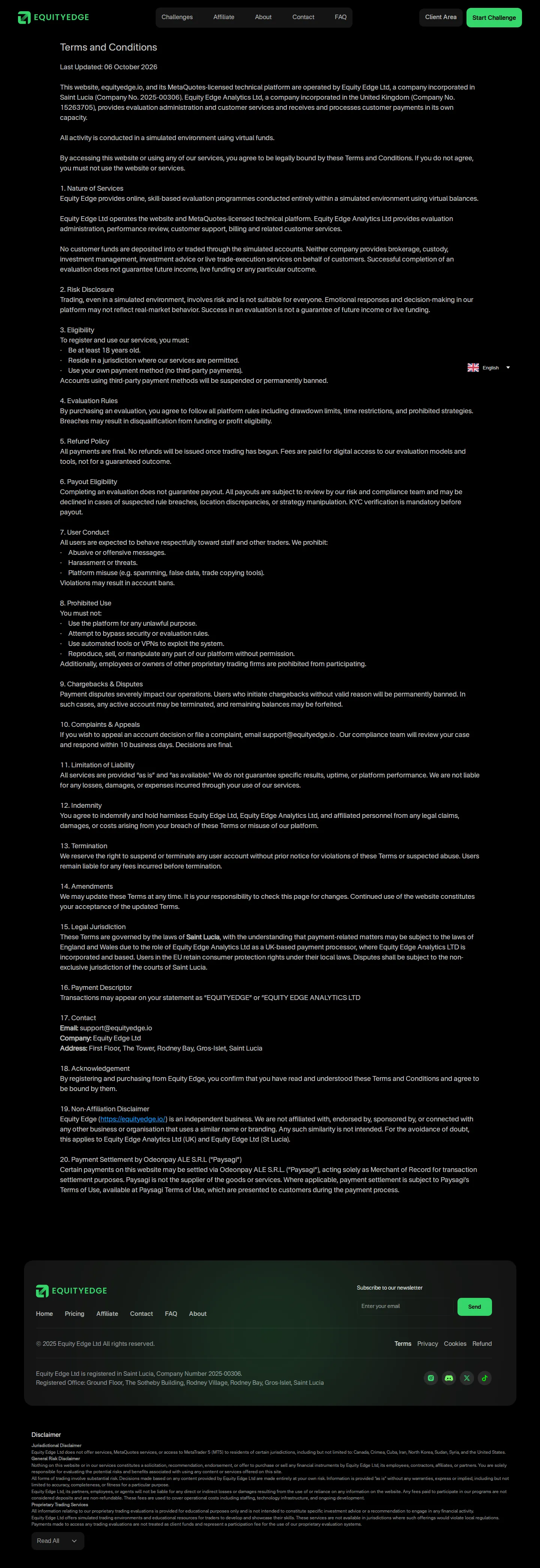
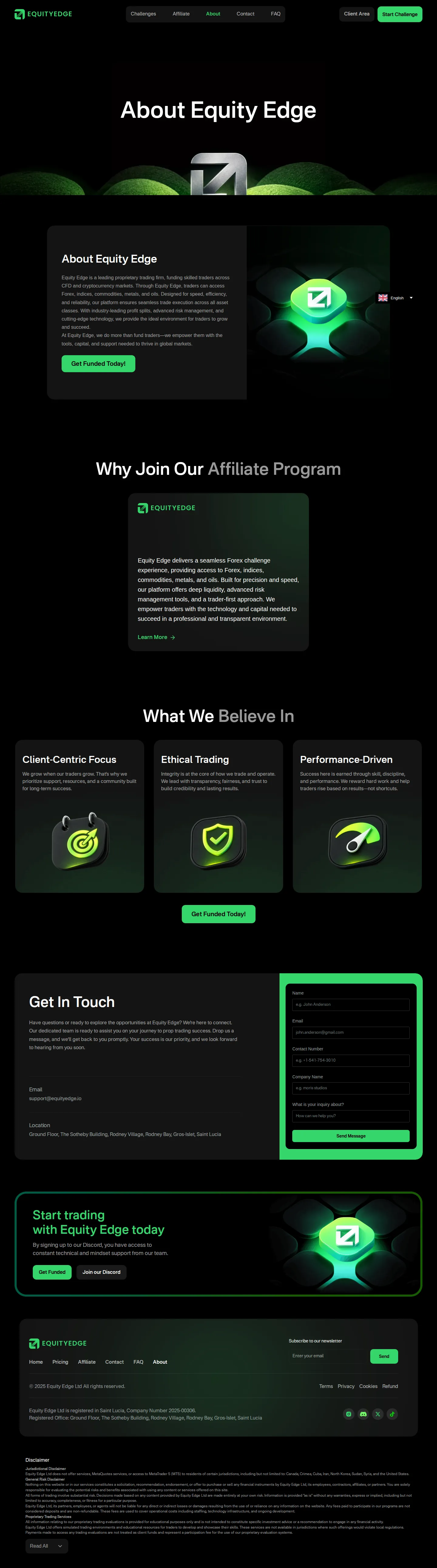
Pages captured from Equity Edge’s own site when this review was written. Brokers change their terms; these are what we read.

FAQ
Is Equity Edge regulated by a financial authority?
No. It holds no financial licence. Its two companies are registered in Saint Lucia and the UK, which are company registrations, not licences.
Is Equity Edge a real registered company?
Yes. Equity Edge Ltd is on the Saint Lucia company register, and Equity Edge Analytics Ltd is on UK Companies House under number 15263705.
What does Equity Edge charge?
Its website publishes no challenge prices: the pricing section shows none and its app asks you to sign in first. Its terms say fees are non-refundable once trading has begun.
What trading platforms does Equity Edge offer?
MetaTrader 5 and Match-Trader.
How can I contact Equity Edge support?
By email, or through its Discord, which it advertises as offering 24/7 support.
What do traders say about Equity Edge?
Trustpilot rates it 4.1 from 2,520 reviews, with no Trustpilot warning on the profile. It publishes no app of its own.
How this review works
Track Equity Edge live: score moves and red notices, in your pocket.