CFD · CHECKED 10 OCT 2026
FXTM review.
Multi-jurisdiction CFD broker regulated outside tier-1 markets, with disputed licence claims
OK-ISH
OUT OF 10
AD DISCLOSURE: IF YOU OPEN AN ACCOUNT THROUGH THIS LINK WE MAY EARN A COMMISSION. IT NEVER MOVES THE SCORE. HOW THIS WORKS
FXTM operates through Exinity Limited, which holds active licences with Mauritius's FSC and South Africa's FSCA, plus a Kenya CMA licence held by a group entity and a promotion-only UAE permit. None of these is a tier-1 regulator, and separate claims to CySEC and an older FSCA licence do not hold up on the public registers, which is the biggest concern here.
Each criterion is scored 1 to 10 from primary sources. The overall score is their unweighted mean. How scoring works.
| Founded | 2011 |
|---|---|
| Headquarters | MU |
| Minimum deposit | $30 (Micro account); the payments FAQ says $100 |
| Maximum leverage | 5000:1 |
| Minimum spread | 0.1 |
| Account opening | 1-3 |
| Platforms | MetaTrader 4 (MT4), MetaTrader 5 (MT5), FXTM App, FXTM Web platform, Desktop, Web |
- Exinity Limited holds an active Mauritius FSC Investment Dealer licence C113012295
- Exinity Limited holds an active FSCA South Africa licence, FSP 50320
- Exinity Capital East Africa Ltd holds Kenya CMA licence 135
- Advantage account lists EURUSD round-turn cost from USD 0.00 (a floor, not fixed)
- Offers MetaTrader 4, MetaTrader 5, a web platform and a mobile app
- Support reachable via live chat, phone, and published hours
- None of its confirmed licences come from a tier-1 regulator
- CySEC licence 185/12 is claimed but not found on the CySEC register
- FSCA licence 46614 for ForexTime Ltd is listed as Lapsed, not active
- Seychelles licence SD037 also not confirmed on the register
- UAE CMA permission covers promotion only, licence number unverified
- FSCA regulation gives no compensation scheme, only an ombudsman
Overview
TrueBroker is a free broker safety checker, and this page is our review of FXTM, scored 6.4 out of 10 across regulation, fees, platform, support and reviews. FXTM is the trading brand of Exinity Limited, a Mauritius-incorporated firm that also operates two other regulated entities under the same corporate group: Exinity Global Financial Services L.L.C. in the United Arab Emirates and Exinity Capital East Africa Ltd in Kenya. The firm’s own risk-disclosure page names all three entities and the licences each holds; we checked those licences against the regulators’ own public registers rather than taking the firm’s page at its word.
Overview Table
| Headquarters | Exinity Limited, 5th Floor, 355 NEX Tower, Rue du Savoir, Cybercity, Ebene 72201, Mauritius, per the firm’s contact page |
| Established | Not stated |
| Countries Served | Not stated |
| Regulated By | FSC Mauritius (Investment Dealer License, Exinity Limited), FSCA South Africa (FSP No. 50320, Exinity Limited), the UAE Capital Market Authority (Category 5 licence, Exinity Global Financial Services L.L.C.), Capital Markets Authority of Kenya (licence 135, Exinity Capital East Africa Ltd) |
| Minimum Deposit | The Micro account page gives $30/€30 (or 110 AED); the payments FAQ on the same site separately states the minimum deposit is $100 |
| Maximum Leverage | Up to 1:5000 on the Rewards and Rewards Plus accounts; the Advantage account page states leverage up to 1:3000, and Micro up to 1:1000 |
| Total Instruments | Not stated as a total; the firm’s markets pages list Forex (over 60 currency pairs), Commodities, Metals, Stocks, Indices, Cryptocurrencies, Futures, ETFs and Crosses as tradable categories |
| Platforms | MetaTrader 4, MetaTrader 5, the FXTM App (Android/iOS) and FXTM’s own web platform |
| Customer Support | Live chat, a contact form, phone (+44 20 3734 1025), and Telegram/WhatsApp/WeChat links from the support widget; the contact page lists support hours as Mon-Fri 03:00-20:00 UTC and Sat-Sun 07:00-11:00 UTC |
| Languages | Not stated |
Facts List
- Exinity Limited (Mauritius), Exinity Global Financial Services L.L.C. (UAE) and Exinity Capital East Africa Ltd (Kenya) are three separate regulated entities in the same corporate group, named on the firm’s own risk-disclosure page.
- The FSC Mauritius Online Public Register confirms Exinity Limited holds an SEC-2.1B Investment Dealer licence, licensed 08/11/2013, though the register does not publish the licence number the firm quotes (C113012295), so only the company and permission are confirmed.
- The FSCA register confirms FSP No. 50320 is held by Exinity Limited with status Authorized.
- The UAE Capital Market Authority register confirms Exinity Global Financial Services L.L.C. as CP-0001214, status Active, listed since 2025, though under a CP code rather than the licence number 20200000270 the firm quotes.
- The Capital Markets Authority of Kenya register confirms Exinity Capital East Africa Limited holds non-dealing online foreign exchange broker licence 135.
- A separate FCA register entry entry for Exinity UK Ltd (FRN 777911) shows status “Authorised – applied to cancel,” which is neither a clean authorisation nor a clean deregistration.
- We searched 1,441 warning-list entries mirrored from CySEC, the FCA and FSC Mauritius, and FXTM itself appears on none of them.
- The same search turned up four FXTM-adjacent domains that are not this firm: the FCA register lists fxtminvestments.com and fxtmonline.live as Unauthorised with no clone marker, and lists fxmarket-trading.com as Unauthorised and impersonating FXTM; CySEC’s Non-Approved Domains list separately names cryptfxtm.com without identifying which firm it imitates.
- FXTM’s own footer states Exinity Limited does not provide services to residents of the United Kingdom, yet the firm publishes UK-facing marketing pages and a UK contact number, +44 20 3734 1025.
- The firm’s fee page states an inactivity fee of 10 EUR/USD/GBP is applied every month after three months without trading, continuing until the balance is depleted or the account trades again.
Who actually runs FXTM
The brand sits across three entities rather than one. Exinity Limited, licensed in Mauritius, is the entity named on the firm’s risk-disclosure page as the Investment Dealer and Over the Counter Derivative Provider running www.fxtm.com. Exinity Global Financial Services L.L.C. is licensed in the UAE as a Category 5 firm, which the firm’s own page describes as covering “Promotion and Introduction activities” rather than dealing itself. Exinity Capital East Africa Ltd, trading as www.forextime.com, holds a Kenyan non-dealing broker licence. A reader dealing with “FXTM” in different regions may be contracting with any of these three, and the register checks above land differently for each: Mauritius and South Africa confirm cleanly, Kenya confirms against the group’s own announcement, and the UAE register confirms the company but under a different reference number than the one FXTM quotes.
What the FXTM name gets used for elsewhere
Beyond the group’s own entities, our warning-list search found domains trading on the FXTM name that are not part of it. The FCA register lists fxmarket-trading.com as Unauthorised and specifically flags it as impersonating FXTM. Two further FCA entries, fxtminvestments.com and fxtmonline.live, are listed as Unauthorised without a clone marker tying them to any specific firm. CySEC’s own list of non-approved domains separately names cryptfxtm.com as unauthorised to provide investment services under any Cypriot licence, again without naming which firm it imitates. None of this is a finding against FXTM itself, which we did not find on any of the 1,441 mirrored warning-list entries we checked; it is a finding about what a reader searching for the FXTM name online may run into instead.
Key Takeaways
What holds up on the registers
- The FSC Mauritius Online Public Register confirms Exinity Limited holds an SEC-2.1B Investment Dealer licence (Full Service Dealer excluding Underwriting), licensed 08/11/2013. The register publishes the licence type and date but not a licence number, so the company and its permission are confirmed while the number the firm quotes, C113012295, is not.
- The Financial Sector Conduct Authority (FSCA) register confirms FSP No. 50320 is held by Exinity Limited, status Authorized.
- The UAE Capital Market Authority (SCA) register confirms Exinity Global Financial Services L.L.C. as CP-0001214, status Active, listed since 2025, again without matching the licence number 20200000270 the firm quotes.
- The Capital Markets Authority of Kenya register confirms non-dealing online foreign exchange broker licence 135 for Exinity Capital East Africa Limited.
Where FXTM’s regulatory story gets harder to check
- FCA licence 777911 for Exinity UK Ltd carries a status the register itself gives as “Authorised – applied to cancel,” which is neither a plain authorisation nor a plain cancellation.
- The Cyprus Securities and Exchange Commission (CySEC) register of Cypriot investment firms does not list licence number 185/12 for ForexTime Ltd.
- The FSCA register lists FSP 46614 for ForexTime Ltd as Lapsed, a different number and a different status from the FSP 50320 held by Exinity Limited on FXTM’s own risk disclosure page.
- The Seychelles Financial Services Authority register carries no entity or trade name matching Exinity Limited against licence SD037.
- The Belize Financial Services Commission’s LicenSys public register lists no licensee matching FT Global Ltd against licence IFSC/60/345/TS/17, out of 120 current licence records read, though a licence that ended before entering LicenSys might not appear there.
- None of these five numbers appear on any FXTM page we fetched. They come only from an earlier, third party review, and we have not read them stated on the firm’s own site.
The warning list search
- We searched 1441 warning list entries mirrored from CySEC, the FCA and FSC Mauritius, and FXTM does not appear on any of them.
- Four other domains carrying the FXTM name do appear on those lists, and none of them is this firm. CySEC’s List of Non Approved Domains carries cryptfxtm.com without naming the broker it imitates. The FCA register lists fxtminvestments.com, fxtmonline.live and fxmarket-trading.com as Unauthorised, with no clone marker on any of the three entries.
- Anyone searching the FXTM name should know these lookalikes exist, and that the firm reviewed here is not the one carrying the warning.
What FXTM charges
- The fee page sets an inactivity fee of 10 EUR/USD/GBP a month once an account has gone three months without trading, applied “until the balance is completely depleted, or the account becomes active again through trading activity.”
- The same page reserves the right to charge “the equivalent amount of any banking fees incurred, or 3% of the total withdrawal amount” on a withdrawal made after inactivity, and to claw back reimbursed fees if it finds abuse of the reimbursement policy.
- The Australian terms page puts deposits and withdrawals under $30 at a flat $3, with no FXTM charge at $30 or above, on top of whatever the payment provider itself charges.
- The fee page also mentions deposit and withdrawal fees “where applicable” without publishing an amount, pointing clients to their account login instead.
Accounts and what they cost to open
- Micro opens from $30/€30 (3,000 USC/EUC) or 110 AED, spreads from 1.7 pips, no commission, MT4 only.
- Rewards Plus opens from $100/€100/£100 (350 AED, 137,000 NGN), spreads from 1.5 pips, no commission.
- Rewards opens from $200/€200/£200 (700 AED, 274,000 NGN), spreads from 0.9 pips, no commission.
- Advantage opens from $500/€500/£500 (1,800 AED, 685,000 NGN), spreads from 0 pips plus a low commission that varies by instrument, and is the only tier with a published margin call at 80% and stop out at 50%; the other tiers sit at 50% and 20%.
- FXTM’s own payments FAQ states the minimum initial deposit is $100, while the Micro account page states $30. The two FXTM pages do not agree with each other.
What FXTM’s own terms allow it to do
- The risk disclosure states non segregated funds “will not be segregated from the Company’s money and will be used in the course of the Company’s business, and in the event of the Company’s insolvency you will rank as a general creditor,” putting any client money classed this way behind FXTM’s own creditors if the firm fails.
- The same document states, “The Company will not have a duty to notify the Client for any Margin Call to sustain a loss-making position,” so a stop out can happen with no warning.
- On third party custody, it states, “The Company has no responsibility for any acts or omissions of any third party to whom it will pass money received from the Client,” leaving only an unsecured claim if that third party fails.
- On systems failure, it states, The Client shall be responsible for the risks of financial losses caused by the failure of information, communication, electronic and other systems… The Company does not accept any liability in the case of such a failure.
- Shares bought through FXTM are held via a nominee rather than in the client’s own name, and the disclosure notes that as a result “the Client may not have voting rights which he/she would have had if he/she held the investment in his/her own name.”
- For professional clients using the Collateral Agreement, the disclosure lets FXTM force close CFD positions and sell the assets in a client’s Share Account to cover a shortfall, without further consent.
- On withdrawals, the deposits and withdrawals page requires “you must use the same source of funds as your original deposit” and states, “We do not accept payments from third parties,” so a client cannot redirect a payout to a different method or a different name.
- The risk disclosure and platform pages we fetched say nothing about negative balance protection or membership of a compensation scheme; that is what the pages we read are silent on, not a finding that no such protection exists.
Platforms
- MetaTrader 4 and MetaTrader 5 run across the main accounts, with MT5 required for stock, ETF and UAE stock CFDs.
- The FXTM App is described as giving “real-time signals and one-tap trading” on Android and iOS.
- A separate desktop and web platform handles account management, fund transfers and market insight, but the UK platform page states it cannot open, close or modify a trade; that needs the FXTM App or a MetaTrader platform.
FXTM’s support hours do not match its marketing
- The UAE about page advertises support chat “24 hours a day,” but the contact page publishes hours of Monday to Friday 03:00 to 20:00 UTC and Saturday to Sunday 07:00 to 11:00 UTC, which do not cover a full day on any date.
- Channels on offer are live chat through a Beesender widget, Telegram, WhatsApp, WeChat, a UK phone line at +44 20 3734 1025, a contact form with a stated 24 hour response window, and a Help Centre of self service articles.
- FXTM’s UK pages and UK phone number sit alongside a footer notice that Exinity Limited does not provide services to residents of… the United Kingdom, leaving it unclear which entity, if any, is meant to onboard the UK visitors those pages are served to.
What our earlier review gets wrong
- The restricted country list embedded in the earlier review names Brazil, New Zealand and Hong Kong, none of which appear on FXTM’s own current notice, and omits Mauritius, Quebec, Iraq, Syria, Cuba, Belarus, Myanmar, Russia, India and the United Kingdom, all of which do appear there. A reader relying on the older list could be wrong about where they can trade.
- All five of the licence numbers cited above for Exinity UK Ltd, ForexTime Ltd and FT Global Ltd come from that same earlier review rather than from any FXTM page we fetched.
- The same source text also contains lines reading as directions to a content system rather than facts about FXTM, a sign that this material is a generic third party piece rather than the firm’s own words.
Other inconsistencies worth flagging
- Leverage is advertised up to 1:5000 across the site, while the Advantage account page itself caps leverage at 1:3000.
- One page names an “Advantage Stocks” account for trading US stocks, another names a commission free “Advantage Plus” account; FXTM’s own pages do not make clear whether these are the same product.
- The UAE homepage advertises a “welcome bonus of up to $500” that matches “100% of your first deposit in trading credit,” with no terms for that credit published on the page we fetched.
Licenses & Regulation
FXTM’s own risk-disclosure page names four regulated entities behind the brand, and we checked each one against the register it points to. Exinity Limited is the entity that actually deals with clients: the firm’s page describes it as holding an Investment Dealer License and a licensed Over the Counter Derivative Provider status, and the FSC Mauritius Online Public Register confirms Exinity Limited holds SEC-2.1B Investment Dealer (Full Service Dealer excluding Underwriting), licensed 08/11/2013. The register publishes the licence type and date rather than a licence number, so what is confirmed is the company and that permission, not the number C113012295 the firm quotes for it. The same entity also carries FSP No. 50320 with the Financial Sector Conduct Authority of South Africa, and the FSCA register lists FSP 50320 as held by EXINITY LIMITED with status Authorized.
What the other three FXTM entities are actually licensed to do
The other two entities the firm discloses are narrower than the Mauritius dealing licence. Exinity Global Financial Services L.L.C. is licensed by the UAE Capital Market Authority “as a Category 5 firm to carry out Promotion and Introduction activities”, per FXTM’s own risk-disclosure page, not as a dealing broker. The UAE register confirms the company: EXINITY GLOBAL FINANCIAL SERVICES L.L.C. is on the Capital Market Authority (SCA) register as CP-0001214, status Active, listed since 2025, though the register publishes that CP code rather than the licence number 20200000270 the firm quotes. Exinity Capital East Africa Ltd is licensed in Kenya as a Non-Dealing Online Foreign Exchange Broker, and the Capital Markets Authority of Kenya’s register confirms licence 135 under that same non-dealing description, using the same number the firm quotes. Read together, the entity actually permitted to take the other side of a client’s trade sits under Mauritius, while the UAE and Kenya entities are limited to introducing clients and non-dealing broking.
Licences named elsewhere that FXTM’s own pages do not mention
A third-party review folded into our evidence names five further licences, for three further entities: Exinity UK Ltd (FCA 777911), ForexTime Ltd (CySEC 185/12 and FSCA 46614), Exinity Limited again (Seychelles Seychelles licence number SD037), and FT Global Ltd (Belize IFSC/60/345/TS/17). None of those five appears on any FXTM page we fetched, so we checked each against the register named for it. The CySEC register answered our control query but does not list 185/12. The Seychelles FSA register, 648 entries across its capital-markets, collective-investment-scheme, fiduciary, regulatory-sandbox, international-trade-zone and insurance categories, has no entity or trade name matching Exinity Limited. The Belize IFSC’s LicenSys register lists no licensee matching FT Global Ltd among its 120 current licence records, though our control licensee, XM Global Limited, was present, and LicenSys may simply drop a licence that ended before it was entered. The FCA register does show FRN 777911, but held by Exinity UK Ltd with a status of “Authorised – applied to cancel”, neither a plain authorisation nor a plain lapse, so we’re not calling that one either way. The FSCA number is the clearest miss: FSP 46614 is real, but it belongs to FOREXTIME LTD, not Exinity Limited, and its status on the register is Lapsed, not authorised, a different entity and a different outcome from the FSP 50320 licence FXTM’s own page actually discloses.
Company registrations we could not check
FXTM’s risk-disclosure page also quotes three company (as opposed to financial-services) registration numbers: Exinity Limited’s Mauritius registration C119470 C1/GBL, Exinity Global Financial Services L.L.C.’s UAE Trade License No. 1395769, and Exinity Capital East Africa Ltd’s Kenya registration PVT-ZQU6JE7. We hold no directory entry for the Mauritius corporate registry or the Kenya Business Registration Service, and both answer only a human in a browser, so none of these three numbers has been verified. That’s a gap in our own checking, not a finding about the firm.
Warning lists and look-alike domains
We searched 1441 warning-list entries mirrored from CySEC, the FCA and FSC Mauritius, and FXTM does not appear on any of them. Four other sites carrying the FXTM name do appear on those same lists, and none of them is the firm under review. CySEC’s List of Non-Approved Domains includes cryptfxtm.com, unauthorised to provide investment services under any Cypriot licence, though CySEC’s listing does not name which firm the domain imitates. The FCA register separately lists fxtminvestments.com, fxtmonline.live and fxmarket-trading.com as Unauthorised, each with no clone marker on the entry itself. None of the four is FXTM, but a reader searching the FXTM name could land on one of them by mistake.
A gap between what FXTM’s own pages say and who they say it to
FXTM publishes UK-facing marketing pages, including a UK contact number, while the same risk-disclosure page states that Exinity Limited “does not provide services to residents of” a list of countries that includes the United Kingdom. The pages we fetched don’t say which regulated entity, if any, is meant to onboard a UK visitor reading them. The same risk-disclosure page also sets out fund-handling and technical-risk terms in some detail but says nothing about negative-balance protection or membership of any investor-compensation scheme; we’re reporting that the page is silent on those points, not that no such protection exists.
How to Trade
FXTM’s own accounts page splits trading into five tiers, and the terms that actually bind a position, spreads, commission, maximum leverage, and the margin thresholds that close a trade out, change by tier rather than by market or region.
FXTM’s account tiers
The Micro account, per FXTM’s UK accounts page, opens with a minimum deposit of 30 USD or EUR (also quoted as 110 AED, or 3,000 USC/EUC), runs on cent-based lots, quotes spreads from 1.7 pips with no commission, and offers leverage up to 1:1000. It carries a margin call at 50% and a stop out at 20%, trades on MT4 only, has no swap-free option, and its market list is capped at Forex majors and minors, the US Dollar Index, Brent Oil, WTI, Natural Gas, Gold, Silver, Bitcoin and Ethereum.
Rewards Plus, on the same UK accounts pages, needs 100 USD/EUR/GBP (350 AED, or 137,000 NGN) to open, quotes spreads from 1.5 pips with no commission, and raises leverage to up to 1:5000. Its margin call and stop out sit at the same 50%/20% as Micro, but it runs on both MT4 and MT5, offers a swap-free option, and opens up the full market list: Forex, Metals, Indices, Commodities, Crosses, Cryptocurrencies, Futures, US/HK/UAE Stocks (MT5 only) and ETFs (MT5 only).
FXTM’s UAE accounts page lists Rewards at a 200 USD/EUR/GBP minimum (700 AED, or 274,000 NGN), spreads from 0.9 pips, no commission, leverage up to 1:5000, and the same 50% margin call / 20% stop out. Advantage steps up to a 500 USD/EUR/GBP minimum (1,800 AED, or 685,000 NGN), spreads from 0 pips with a low commission that the page says varies by instrument, and leverage up to 1:3000, a lower ceiling than the other tiers. Advantage’s margin call and stop out are set higher, at 80% and 50%. Advantage Stocks, a separate 200 USD account on MT5 only, quotes spreads from 4 cents with no commission but no leverage at all (1:1), and publishes no margin call or stop out figures.
FXTM’s own root page for the UAE advertises leverage “up to 1:5000” as a site-wide headline, but the Advantage account’s own specification page caps that same account at 1:3000, so the maximum available depends on which account a trader actually opens, not the homepage figure.
Platforms
Execution runs through MetaTrader 4 and MetaTrader 5, allocated by account tier as above, with MT5 required for Stock, ETF and UAE-Stock CFDs. FXTM also runs its own FXTM App for Android and iOS, described on its UAE platforms page as giving “real-time signals and one-tap trading,” and a Web platform at trade.fxtm.com for fund and account management. A separate browser-based Desktop tool, per FXTM’s UK platforms page, handles account management and market monitoring but cannot open, close or modify a trade; that requires the FXTM App or one of the MetaTrader platforms.
Markets
FXTM’s UK markets pages list Forex (over 60 pairs across majors, minors and exotics, traded 24 hours a day, five days a week), Metals (spot Gold and Silver), and Commodities including Oil, Natural Gas and softs such as Coffee, Sugar, Wheat, Cocoa, Corn, Cotton, Soybeans, Copper and Heating Oil. The UAE accounts page adds Indices, Cryptocurrencies, Futures, ETFs and Crosses as CFD classes, alongside Stock CFDs on the Rewards, Rewards Plus and Advantage accounts and cash US-equity trading on the dedicated Advantage Stocks account. Which of these a given account can actually reach depends on the tier: Micro’s list is limited to Forex majors/minors, the Dollar Index, a handful of commodities, Gold, Silver and two cryptocurrencies, while the other CFD accounts carry the full list.
FXTM’s rules for margin calls and closeouts
FXTM’s risk disclosure, read on its UK site, states plainly: “The Company will not have a duty to notify the Client for any Margin Call to sustain a loss-making position.” That means the margin call and stop out percentages quoted per account above are not a guaranteed warning; a position can be stopped out without FXTM notifying the client first.
The same risk disclosure covers what happens to the underlying asset when a position is closed for other reasons. On equities, it states: “All equities purchased for the Client or transferred to the Company by the Client, will be purchased in the name of the nominee company or FXTM, and/or held by a nominee company selected by FXTM, for the benefit of the Client,” adding that because the holding sits with a nominee, “the Client may not have voting rights which he/she would have had if he/she held the investment in his/her own name.” For professional and elective professional clients who use FXTM’s Collateral Agreement to link a Share Account to a CFD account, the same document goes further: if the collateral value together with linked cash “falls below the amount required to maintain the open positions, Client may be closed out of the CFD positions on that linked account, and the Company will have the right to sell the assets in the Client’s Share Account in order to pay for any resulting deficit,” without further consent from the client.
On system risk, FXTM’s risk disclosure puts the burden on the client rather than the firm: The Client shall be responsible for the risks of financial losses caused by the failure of information, communication, electronic and other systems… The Company does not accept any liability in the case of such a failure. The same document disclaims responsibility for counterparties holding client money on FXTM’s behalf, stating that if such a third party defaults, the Company may only have an unsecured claim against the third party on behalf of the Client… The Company does not accept any liability or responsibility for any resulting losses. Together these clauses put connectivity risk, platform-outage risk and third-party custody risk on the client’s side of the ledger, not FXTM’s, whatever tier the account sits on.
Account Types
On the UK-facing pages, Exinity Limited runs Micro, Rewards Plus, Rewards, Advantage and Advantage Stocks; the UAE facing pages repeat most of the same tiers with different minimum deposit figures quoted in AED and NGN alongside the dollar and euro amounts.
Micro, for cent based trading
The Micro account page gives a minimum deposit of 30 USD or EUR, 110 AED, also stated on the same page as 3,000 USC or EUC or 11,000 AEC. FXTM’s own payments FAQ, on a separate page, gives the minimum initial deposit for an FXTM account as $100, so the firm’s pages do not agree with each other on entry cost. Micro trades in cents rather than full currency units, with spreads from 1.7 pips, no commission, leverage up to 1:1000 on a floating basis, margin call at 50% and stop out at 20%. It runs on MT4 only, has no swap free option, and the market list is limited to Forex majors and minors, the US Dollar Index, Brent Oil, WTI, Natural Gas, Gold, Silver, Bitcoin and Ethereum.
Rewards Plus and Rewards
Rewards Plus needs 100 USD, EUR or GBP, 350 AED, or 137,000 NGN according to the UK facing accounts page. It carries spreads from 1.5 pips with no commission, leverage up to 1:5000 floating, margin call at 50%, stop out at 20%, and runs on both MT4 and MT5 with swap free available. FXTM describes it as earning up to 3X FXTM Reward Points and opens the wider market list: Forex, Metals, Indices, Commodities, Crosses, Cryptocurrencies, Futures, and, on MT5 only, US, Hong Kong and UAE stocks plus ETFs.
Rewards, on the UAE facing page, needs 200 USD, EUR or GBP, 700 AED, or 274,000 NGN. Spreads run from 0.9 pips, still no commission, same 1:5000 leverage, 50% margin call and 20% stop out, MT4 and MT5, swap free available, and up to 2X Reward Points rather than 3X.
Advantage and Advantage Stocks
Advantage needs 500 USD, EUR or GBP, 1,800 AED, or 685,000 NGN. It is the tier priced through spreads rather than through the Reward Points multiplier: spreads from 0 pips plus a low commission that varies by instrument, listed elsewhere on the UAE accounts page as $35 per million notional for Indices and Crosses and $0.01 per side per lot for ETFs. Leverage runs up to 1:3000, margin call is 80%, stop out is 50%, and it covers both MT4 and MT5 with swap free available. That 1:3000 ceiling sits below the 1:5000 the site advertises elsewhere, so the headline leverage figure does not hold for this account.
Advantage Stocks, for 200 USD, is a cash equity account rather than a leveraged CFD tier: spreads from 4 cents, no commission, leverage of 1:1, MT5 only, no swap free option, and US stocks only. The Australia facing terms page separately names an “Advantage Stocks” account for trading US stocks, while the UAE fees FAQ instead refers to a commission free “Advantage Plus” account. The evidence does not resolve whether these are the same product under two names or two distinct accounts.
What FXTM’s own fee pages say about deposits and withdrawals
FXTM’s fees page states a deposit fee, where applicable, is subtracted from the deposited amount, and a withdrawal fee, when applicable, is subtracted from the amount withdrawn, without publishing the amount on that page; the text points to the account login for the figure. The Australia facing terms page gives a concrete number for one case: a $3 charge on deposits and withdrawals under $30, with no FXTM fee at $30 or above, and a note that payment providers may add their own charges on top.
Two charges apply specifically to dormant accounts. The fees page states that once an account has had no trading activity for three months, FXTM applies an inactivity fee of 10 EUR, USD or GBP every month until the balance is depleted or the account trades again. The same page adds that a client withdrawing after a period of no trading activity can be charged the equivalent of banking fees incurred, or 3% of the total withdrawal amount, and that FXTM reserves the right to reclaim reimbursement fees where it finds abuse of the reimbursement policy.
Demo account
FXTM also offers a demo account, described on the Australia facing terms page as practising on real markets with virtual funds.
What is missing from the accounts pages
The pages we fetched describe FXTM’s paid tiers as priced through spreads, a Reward Points multiplier, and, on Advantage, a per instrument commission. Separately, FXTM’s UAE homepage carries a promotion: “Join today, deposit and get a welcome bonus of up to $500! We’ll match 100% of your first deposit in trading credit.” The accounts and fees pages in our evidence say nothing about the terms attached to that credit, such as trading volume required to release it or whether it can be withdrawn.
Negative Balance Protection
FXTM’s own risk-disclosure page sets out CFDs and similar products as “Contingent Liability Investment Transactions” and states plainly that the firm carries no obligation to warn a client before a losing position is closed out: “The Company will not have a duty to notify the Client for any Margin Call to sustain a loss-making position.” That single sentence is the operative rule for what happens when a drawdown breaches the account’s limits: FXTM can act on the account without a prior warning to the client.
Margin call and stop-out levels across FXTM’s accounts
The account pages we read set different thresholds by tier. On the Micro account (fxtm.com’s UK account pages) the margin call level is 50% and the stop out level is 20%. Rewards Plus, on the same set of pages, carries the same 50% margin call and 20% stop out. The UAE account pages give Rewards the identical 50%/20% pair, while Advantage moves those thresholds to an 80% margin call and a 50% stop out. Advantage Stocks, the cash-equity account traded on MT5, has no margin call or stop out level published on the page we fetched, which fits the account’s leverage of 1:1 rather than being a gap in our reading.
| Account | Margin call | Stop out | Source |
|---|---|---|---|
| Micro | 50% | 20% | FXTM’s Micro account page |
| Rewards Plus | 50% | 20% | FXTM’s Rewards Plus account page |
| Rewards | 50% | 20% | FXTM’s UAE accounts page |
| Advantage | 80% | 50% | FXTM’s UAE accounts page |
| Advantage Stocks | not published | not published | FXTM’s UAE accounts page |
A stop out level of 20% on Micro, Rewards Plus and Rewards means FXTM’s system begins closing positions once equity falls to a fifth of the margin used; on Advantage the same mechanism triggers at half. Nothing on the pages we read explains why Advantage carries a materially tighter buffer than the other tiers, but the numbers themselves come straight from FXTM’s own account-comparison pages, not from a third party.
What Exinity Limited’s risk disclosure adds beyond the stop-out mechanic
Several other clauses in the same risk-disclosure document bear on what a client is exposed to once a position or an account runs into trouble. On the handling of client money, the disclosure distinguishes segregated from non-segregated funds and states of the latter: “Non-segregated Funds will not be subject to the protections conferred by Applicable Regulations. Non-segregated Funds will not be segregated from the Company’s money and will be used in the course of the Company’s business, and in the event of the Company’s insolvency you will rank as a general creditor.” A client whose funds sit in that category has an unsecured claim only, not a protected one, if the firm becomes insolvent.
The same document addresses what happens when FXTM itself passes client money to a bank, broker or clearing house: The Company may pass money received from the Client to a third party… The Company has no responsibility for any acts or omissions of any third party to whom it will pass money received from the Client, and if that third party defaults, the Company may only have an unsecured claim against the third party on behalf of the Client… The Company does not accept any liability or responsibility for any resulting losses. A separate clause on technical risk places the cost of platform and connectivity failures on the client as well: The Client shall be responsible for the risks of financial losses caused by the failure of information, communication, electronic and other systems… The Company does not accept any liability in the case of such a failure.
The Collateral Agreement, for professional clients only
FXTM’s risk disclosure describes a separate mechanism that applies only to professional or elective professional clients who hold a linked Share Account: “If the collateral value of the assets in Clients Share Account, together with any cash on Client’s linked CFD Account, falls below the amount required to maintain the open positions, Client may be closed out of the CFD positions on that linked account, and the Company will have the right to sell the assets in the Client’s Share Account in order to pay for any resulting deficit.” That gives FXTM the right to liquidate a client’s shares, not just their CFD positions, to cover a margin shortfall under this arrangement. It is not available to retail clients on the standard account tiers described above.
What FXTM’s own pages don’t say
The risk-disclosure and platform pages we fetched for Exinity Limited set out the stop-out mechanics, the non-segregated-funds position, the third-party and technical-risk disclaimers, and the professional-client collateral clause quoted above. Across those same pages we found no statement of a negative-balance-protection guarantee and no mention of compensation-scheme membership for retail clients. That is a description of what the pages we read cover, not a finding that no such protection exists elsewhere in FXTM’s terms or in country-specific policies we did not fetch.
Trading Instruments
FXTM’s account pages describe five tiers, each opening a different slice of markets. The Micro account, per FXTM’s own account page, is a cent based account requiring a minimum deposit of 30 USD/EUR (also stated as 110 AED or 3,000 USC/EUC), and it caps the tradable range to Forex majors and minors, the US Dollar Index, Brent Oil, WTI, Natural Gas, Gold, Silver, and Bitcoin and Ethereum, running on MT4 only. The broader Rewards Plus, Rewards, and Advantage accounts, described on FXTM’s account and markets pages, add Indices, Commodities, Crosses, Futures, and, on MT5 only, Stocks, UAE Stocks and ETFs. A separate Advantage Stocks account, per FXTM’s UAE fee page, trades US Stocks as cash equities rather than CFDs, at 1:1 with no leverage and no published margin call or stop out level.
What FXTM lists across its markets pages
FXTM’s markets page advertises Forex as over 60 currency pairs, Majors, Minors and Exotics, traded 24 hours a day 5 days a week. Its commodities listing names Oil, Natural Gas, and a set of soft commodities: Coffee, Sugar, Wheat, Cocoa, Corn, Cotton, Soybeans, Copper, and Heating oil. Metals are listed as Spot Gold (XAUUSD) and Spot Silver (XAGUSD). The FAQ on the same markets page also names Futures CFDs, ETF CFDs, and Crosses CFDs as separate contract types, and the Advantage account page prices two of them directly: ETF CFDs at $0.01 per side per lot traded, and Crosses and Indices at $35 per million notional. The Micro account page confines cryptocurrency exposure to Bitcoin and Ethereum, while the wider Rewards, Rewards Plus, and Advantage tiers list cryptocurrencies as a full instrument class without naming which coins beyond that.
Stocks, and where FXTM’s own pages disagree
Stock access splits two ways on FXTM’s pages. On the Rewards, Rewards Plus, and Advantage accounts, US, HK, and UAE stocks trade as CFDs and only on MT5. On the separate Advantage Stocks account, US stocks trade as cash equities rather than CFDs, at 1:1 leverage with no margin call or stop out figure published. A further wrinkle sits in the evidence: FXTM’s Australia facing terms page lists an “Advantage Stocks” account described as trading “US Stocks for equity,” while its UAE fee page instead names a commission free “Advantage Plus” account in its FAQ. Nothing in the pages fetched here resolves whether these are the same product under two names or two distinct tiers, so a reader comparing FXTM’s own pages side by side would find the naming inconsistent.
Leverage varies by what is on the account, not just the account itself
FXTM’s own account pages set leverage per tier: up to 1:1000 on Micro, up to 1:5000 on Rewards Plus and Rewards, and up to 1:3000 on Advantage, all described as floating. The UAE homepage separately advertises leverage “up to 1:5000” as a site wide headline, which is higher than the 1:3000 the Advantage account page itself states applies to that tier. A trader reading only the homepage figure would not know that the account they actually open may cap them well below it.
Where the advertised range runs ahead of the account it sits on
The instrument range on paper is wide, but it is gated by account choice and platform. Swap free trading is unavailable on Micro at all, and MT5, not MT4, is required for stock, UAE stock, and ETF CFDs. Advantage Stocks, the one account offering equities rather than equity CFDs, trades on MT5 only and carries no leverage. None of the pages fetched here publish a full instrument count broken out by account, so the “over 60 currency pairs” figure and the commodity and metal lists above are the fullest published detail available, and they describe the FXTM offering in general rather than confirming which specific symbols sit on any one tier.
Education & Analysis
FXTM’s own account and platform pages describe a five-way platform lineup: MetaTrader 4, MetaTrader 5, a browser-based Desktop tool, a Web platform reached at trade.fxtm.com, and the firm’s own mobile app. Which of these a trader actually gets depends on which account they open, and the pages are specific about that split rather than treating “trade with FXTM” as one undifferentiated offering.
Which platform comes with which FXTM account
The Micro account, FXTM’s cent-based entry account, is MT4 only, according to the account page for that tier, and its market list is correspondingly narrower: Forex majors and minors, the US Dollar Index, Brent Oil, WTI, Natural Gas, Gold, Silver, and just two cryptocurrencies, Bitcoin and Ethereum. Step up to Rewards Plus, Rewards or Advantage and both MT4 and MT5 become available, per the account comparison pages, with the fuller market set (Forex, Metals, Indices, Commodities, Crosses, Cryptocurrencies, Futures, and on MT5 specifically, US, Hong Kong and UAE Stock CFDs and ETFs). The Advantage account page adds that clients can “run expert advisors on MT4 and MT5,” so algorithmic strategies are supported at that tier. Advantage Stocks, the dedicated cash-equities account, is MT5 only.
What the FXTM Desktop platform can’t do
FXTM’s platforms page describes Desktop as its own browser-based tool, needing no download, for account management, position monitoring and “market insight.” The same page is explicit about its limits: Desktop cannot open, close or modify a trade. Doing that requires switching to the FXTM App or to one of the MetaTrader platforms. A trader who assumes the web dashboard is a full trading terminal would find out otherwise partway through placing an order.
App and web tools
The mobile offering is the FXTM App, described on the account page as giving “real-time signals and one-tap trading,” downloadable on Android and iOS, and repeated on the platforms page in the same terms. Separately, FXTM’s own web platform is pitched for account and fund management: “Manage your funds, view market insights and get tailored trading ideas on our web platform,” as the account page puts it, with the platforms page giving the address as trade.fxtm.com. None of the fetched pages break down what “real-time signals,” “market insights” or “tailored trading ideas” actually consist of; the phrases appear in marketing copy without a named indicator set, signal provider, or feed behind them.
MetaTrader and the charting gap
Between the two MetaTrader options, FXTM’s own platforms page draws the distinction plainly: MT4 is described as the industry MetaTrader platform for Forex and CFD trading, while MT5 is billed as carrying “more advanced analysis and charting,” alongside the wider market list of Forex, Indices, Metals, Commodities, Cryptocurrency and stocks. Beyond that comparative line, the pages we fetched don’t itemise what MT5’s charting advantage actually adds, no count of built-in indicators, no mention of a bundled add-on suite. The account pages and platforms page describe the container, MT4 versus MT5 versus the app versus the web dashboard, without describing the analytical tools inside any of them in more depth than the phrases quoted above.
A naming wrinkle worth flagging
Two of FXTM’s own pages use different names for what looks like the same product: one page lists an “Advantage Stocks” account for trading US stocks as equity, while another page’s FAQ instead describes an “Advantage Plus” account as “entirely commission-free,” also for US stock trades. The fetched pages don’t reconcile whether these are the same account under two names or two distinct tiers, so a trader comparing the two pages side by side would be left checking directly with FXTM before assuming they’re choosing between the same product.
Special Offers
The welcome bonus FXTM advertises
FXTM’s UAE homepage carries this promotion: “Join today, deposit and get a welcome bonus of up to $500! We’ll match 100% of your first deposit in trading credit.” The page gives the match rate, 100% of the first deposit, and the cap, $500. We did not fetch a dedicated promotions or bonus-terms page for our evidence, so we cannot report the trading volume a client would need to clear to keep the credit, how it is staged below the $500 cap, or whether it converts to withdrawable cash or stays a trading-only balance.
FXTM Reward Points, tied to account tier rather than to a sign-up code
FXTM’s main loyalty mechanism runs through which account a client funds, not through a separate promo code. The Rewards Plus account page states it offers “the highest Tier Points rate” and “Triple cashback on every trade”; the Rewards account earns up to 2X FXTM Reward Points; the Advantage account’s own page calls its rate “standard Reward Points”. The Micro account’s page lists no Reward Points feature at all. The tiers do not line up the way a reader might expect: Rewards Plus, the account with the higher points multiplier, needs a minimum deposit of $100/€100/£100 (or 350 AED, or 137,000 NGN) and quotes spreads from 1.5 pips, while Rewards, one multiplier lower at “2X”, needs $200/€200/£200 (or 700 AED, or 274,000 NGN) and quotes tighter spreads from 0.9 pips. Advantage, which needs $500/€500/£500 and quotes spreads from 0 pips plus a commission, is the account earning only the unmultiplied “standard” rate.
What eats into an idle bonus or points balance
Two clauses in FXTM’s own terms work against any welcome credit or Reward Points balance a client leaves untouched. The deposits-and-withdrawals page states: “When an account has been deemed inactive (no trading activity) for a period of 3 months, we will apply an inactivity fee of 10 EUR/ USD/ GBP. This inactivity fee is applied every month, until the balance is completely depleted, or the account becomes active again through trading activity.” The same page reserves a further right: “In case of no trading activity, or if any form of abuse is found relating to the reimbursement policy, we reserve the right to reclaim any reimbursement fees. If you ask to withdraw your funds after no trading activity, we reserve the right to charge you the equivalent amount of any banking fees incurred, or 3% of the total withdrawal amount.” Read together, a client who claims the welcome bonus or racks up Reward Points and then stops trading is exposed to a monthly balance drain, a clawback of any reimbursement already paid, and a charge of up to 3% on whatever they eventually try to withdraw.
The one built-in discount: FXTM’s small-transfer fee threshold
Outside the named promotions, FXTM’s Australia-facing terms set a size cutoff on its own processing charge: deposits and withdrawals under $30 carry a $3 FXTM fee, and $30 or more carries no FXTM-side fee at all, though the same terms note that payment providers may still add their own charges on top. FXTM’s deposits-and-withdrawals page separately states, without giving a figure for either, that “a deposit fee, where applicable, will be subtracted from the deposited amount” and “a withdrawal fee, when applicable, will be subtracted from the amount withdrawn,” pointing clients to their account login for the actual number.
An account name that does not match between regions
FXTM’s Australia-facing terms describe an “Advantage Stocks” account built for trading US stocks, while the UAE fees FAQ instead names a commission-free “Advantage Plus” account, describing it as an “Entirely commission-free account” and stating that US stock trades are commission-free on any account. Nothing in the pages we read ties the two names to the same product or separates them as two distinct ones, so a client comparing FXTM’s Australian and UAE brochures is working from two different labels for what may or may not be the same free tier.
Opening an Account
The firm’s own UK-facing risk disclosure names Exinity Limited, the Mauritius entity, as the counterparty for retail trading accounts; the FSC Mauritius Online Public Register confirms Exinity Limited holds an SEC-2.1B Investment Dealer licence there, dated 08/11/2013. The same disclosure names Exinity Global Financial Services L.L.C. in the UAE as a separate Category 5 promotion-and-introduction entity, and Exinity Capital East Africa Ltd as the Kenyan non-dealing broker entity a Kenyan applicant would deal with instead.
What FXTM’s own pages say the minimum deposit is
The figures do not agree with each other. FXTM’s payments FAQ states “the minimum initial deposit amount for an FXTM account is $100,” but the Micro account page gives a minimum deposit of $30 or €30 (also stated as 3,000 USC/EUC, or 110 AED) for that same tier. Beyond Micro, the UAE-facing accounts page lists a $100/€100/£100 minimum for Rewards Plus (350 AED, or 137,000 NGN), a $200/€200/£200 minimum for Rewards (700 AED, or 274,000 NGN), a $500/€500/£500 minimum for Advantage (1,800 AED, or 685,000 NGN), and a $200 minimum for the separate Advantage Stocks account. An applicant working from the FAQ alone would not know that Micro can be opened for a third of the figure it quotes.
Who Exinity Limited will not open an account for
The risk-disclosure page for UK visitors states plainly that “Exinity Limited does not provide services to residents of” the USA, Mauritius, Japan, Canada, Haiti, Iran, Suriname, the Democratic People’s Republic of Korea, Puerto Rico, the Occupied Area of Cyprus, Quebec, Iraq, Syria, Cuba, Belarus, Myanmar, Russia, India and the United Kingdom. That last entry sits awkwardly next to the rest of the page it appears on: the same UK-facing pages carry a UK phone number, +44 20 3734 1025, and a UK contact form, so the site markets to a country its own risk disclosure says it will not onboard.
A second, narrower restriction applies inside the account rather than at the border: the Collateral Agreement that lets a client pledge a Share Account against a linked CFD account is, on the same risk-disclosure page, restricted to “professional or elective professional clients” only. Under that agreement, if the collateral value together with any cash on the linked CFD account falls short of what open positions require, FXTM has the right to close out the CFD positions and sell the shares in the Share Account to cover the deficit, without needing further consent from the client.
Funding the account FXTM opens
The deposits-and-withdrawals page ties withdrawal to how the account was funded in the first place: “if you wish to withdraw your initial deposit, you must use the same source of funds as your original deposit,” and separately, “we do not accept payments from third parties. The name of the sender must match the name registered with FXTM.” In practice this makes the funding method itself the identity check at the withdrawal stage, rather than a separate document upload described anywhere in the pages fetched for this review.
Two fee terms attach to the deposit itself. FXTM’s deposits page states that “a deposit fee, where applicable, will be subtracted from the deposited amount,” and that a withdrawal fee, when applicable, is likewise taken from the amount withdrawn; neither page gives a figure, pointing instead to the client’s account login for the specific rate. Separately, FXTM’s Australian-facing terms page sets a flat $3 charge on any deposit or withdrawal under $30, with no FXTM-side fee at $30 or above, though it notes that the payment provider carrying the transfer may charge its own fee on top.
What happens if the new account sits idle
The same deposits-and-withdrawals page sets a clock running once an account is opened and funded: after three months with no trading activity, FXTM applies a 10 EUR/USD/GBP inactivity charge every month, “until the balance is completely depleted, or the account becomes active again through trading activity.” A client who then tries to withdraw during that inactive period can additionally be charged, at FXTM’s discretion, either “the equivalent amount of any banking fees incurred, or 3% of the total withdrawal amount,” and the same clause reserves FXTM’s right to claw back any previously reimbursed fees if it finds any form of abuse… relating to the reimbursement policy.
Deposits & Withdrawals
FXTM’s account tiers set very different entry points depending on which of the firm’s own pages a prospective client reads. The Micro account page gives a minimum deposit of 30 USD or EUR, or 110 AED. The payments FAQ on the same site states flatly that “the minimum initial deposit amount for an FXTM account is $100.” The Rewards Plus tier lists a minimum of 100 USD, EUR or GBP, 350 AED, or 137,000 NGN; Rewards sits at 200 USD, EUR or GBP, 700 AED, or 274,000 NGN; Advantage requires 500 USD, EUR or GBP, 1,800 AED, or 685,000 NGN; and Advantage Stocks lists 200 USD. None of these figures resolve the contradiction with the $100 FAQ line, so a reader funding an account for the first time cannot take either published number as final without checking their own account type at login.
What FXTM charges to deposit and withdraw
FXTM’s deposits and withdrawals page states plainly that “a deposit fee, where applicable, will be subtracted from the deposited amount” and “a withdrawal fee, when applicable, will be subtracted from the amount withdrawn,” without publishing the amount of either fee on that page; the firm directs clients to their account login for the figure that actually applies. Separately, the firm’s Australian terms page sets a flat $3 charge on deposits and withdrawals under $30, with no FXTM fee once the amount reaches $30 or more, and a note that the payment provider carrying the transaction may add its own charges on top of that. Payment methods listed on the site include bank wire transfer, credit and debit cards, e-wallets, local payment providers described as suited to a client’s local currency, and cryptocurrency, which the firm markets as “fast, secure and low cost.” None of the fetched pages publish a fee schedule broken out by method, so whether a wire, a card or a crypto transfer costs the client more is not something the evidence answers.
The inactivity fee and its effect on a dormant balance
FXTM’s deposits and withdrawals page sets out a recurring inactivity fee: “when an account has been deemed inactive (no trading activity) for a period of 3 months, we will apply an inactivity fee of 10 EUR/USD/GBP. This inactivity fee is applied every month, until the balance is completely depleted, or the account becomes active again through trading activity.” Read plainly, that clause lets a dormant balance run down to zero purely through monthly charges, with no cap stated on how many months the fee can be taken. The same page adds a separate charge triggered specifically by withdrawing after a dormant period: “if you ask to withdraw your funds after no trading activity, we reserve the right to charge you the equivalent amount of any banking fees incurred, or 3% of the total withdrawal amount.” The page also reserves the right to claw back reimbursed fees where “any form of abuse is found relating to the reimbursement policy.” Both the size of the withdrawal charge and the judgment of what counts as abuse sit with FXTM under this wording.
Rules on how money has to move
The same page requires that a withdrawal of the original deposit return by the same route it arrived: “if you wish to withdraw your initial deposit, you must use the same source of funds as your original deposit.” It also states that “we do not accept payments from third parties. The name of the sender must match the name registered with FXTM.” Together these terms mean a client cannot route funds through a different card, bank account or wallet than the one used to fund the account, and cannot receive withdrawals into an account held in someone else’s name. On delays caused by the payment chain itself, the page states that “FXTM is not liable for any transfer delays you may experience due to a service disruption in the payment processor system,” so a slow deposit or withdrawal caused by a bank or processor outside FXTM’s own systems is not something the firm accepts responsibility for.
Where withdrawn funds actually sit before they are paid out
FXTM’s risk disclosure, read on the firm’s own UK facing pages, distinguishes segregated client money from what it calls Non-segregated Funds, and states that “Non-segregated Funds will not be subject to the protections conferred by Applicable Regulations. Non-segregated Funds will not be segregated from the Company’s money and will be used in the course of the Company’s business, and in the event of the Company’s insolvency you will rank as a general creditor.” For a client whose balance sits in that non-segregated category, a withdrawal request is a claim against a company that has been using the money in its own operations, and in an insolvency that claim ranks alongside other unsecured creditors rather than ahead of them. The same risk disclosure states that FXTM “may pass money received from the Client to a third party,” such as a bank or clearing firm, and that if that third party fails, the Company may only have an unsecured claim against the third party on behalf of the Client… The Company does not accept any liability or responsibility for any resulting losses. None of the fetched pages in our evidence state a negative balance protection guarantee or a compensation scheme membership that would soften either of these outcomes for a UK facing client.
Customer Support
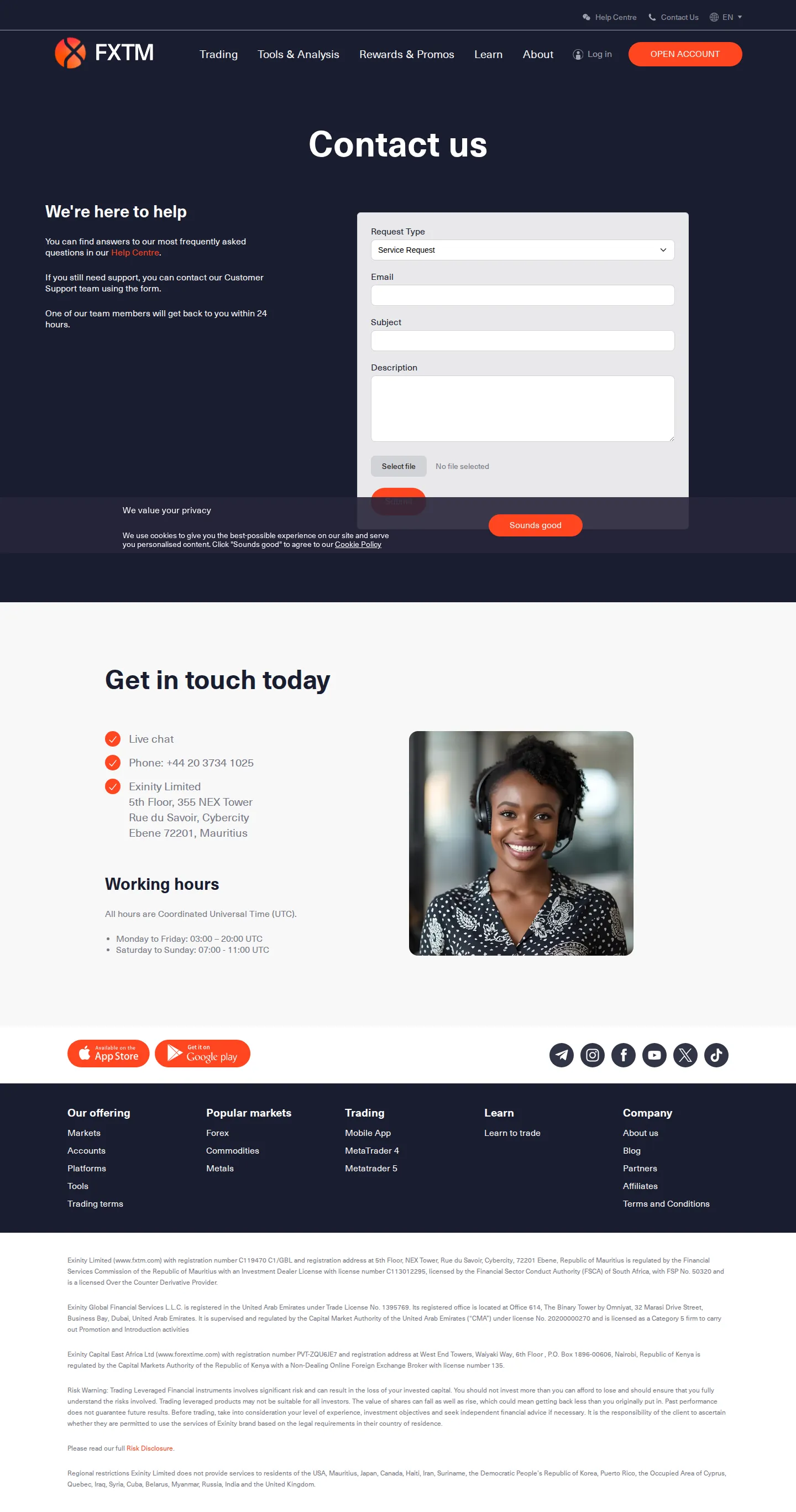
FXTM’s contact page for its Mauritius entity, Exinity Limited, lists a working phone number, +44 20 3734 1025, an on-site live chat widget, and a contact form with three request types: Service Request, Partnership Request and Claim, which the page says gets a response within 24 hours. That “Claim” option is the closest thing to a named complaints channel we found on the firm’s own pages.
Channels FXTM actually publishes
The live chat widget on FXTM’s site runs on third-party software, credited on the page as FXTM Customer Support … Powered by Beesender. From that same chat widget the firm also offers links out to Telegram, WhatsApp and WeChat. Separately, FXTM’s UAE contact page points visitors to a Help Centre of self-service articles grouped under Profile & Funds, Platforms & Accounts, About Us & Trading, and App Tutorials, rather than a direct line to a person. The registered office given on the contact page is Exinity Limited, 5th Floor, 355 NEX Tower, Rue du Savoir, Cybercity, Ebene 72201, Mauritius.
The hours FXTM advertises don’t match the hours FXTM publishes
FXTM’s UAE marketing page states that support chat is available “24 hours a day”. The firm’s own contact page, though, gives specific support hours of Monday to Friday 03:00 to 20:00 UTC and Saturday to Sunday 07:00 to 11:00 UTC. Add those windows up and no single day reaches 24 hours of cover, and the weekend window in particular is four hours long, not round the clock. A client who takes the “24 hours a day” line literally and tries to reach FXTM outside those published windows is relying on marketing copy the firm’s own contact page contradicts.
Who actually answers if you’re in the UK
FXTM serves UK-facing marketing pages, including a UK contact number, +44 20 3734 1025. The same site’s risk disclosure states that Exinity Limited, the entity those pages describe, does not provide services to residents of … the United Kingdom. Nothing on the pages we fetched resolves which regulated entity, if any, is meant to pick up a complaint from a UK visitor who lands on those pages and dials that number. A UK-based client with a service complaint cannot tell from FXTM’s own site which company is actually answering.
Make sure it’s FXTM you’re contacting
Searching FXTM’s name turns up more than one site that isn’t FXTM. The FCA register lists fxmarket-trading.com as Unauthorised and identifies it as impersonating FXTM specifically. The same register separately lists fxtminvestments.com and fxtmonline.live as Unauthorised, without tying either one to FXTM by name. CySEC’s List of Non-Approved Domains includes cryptfxtm.com as a site with no Cypriot authorisation, though CySEC’s listing doesn’t say which firm, if any, that domain is imitating. None of these four sites is FXTM, and FXTM itself does not appear on any of the 1,441 warning-list entries we checked across CySEC, the FCA and FSC Mauritius. A reader trying to raise a complaint or ask a support question should use the phone number, chat widget and contact form on FXTM’s own site rather than a search-engine result for a similarly named domain.
What FXTM disclaims responsibility for when something goes wrong
Several clauses in Exinity Limited’s risk disclosure narrow what a client can hold the firm to when service breaks down. On platform or connectivity failures, the disclosure states: The Client shall be responsible for the risks of financial losses caused by the failure of information, communication, electronic and other systems… The Company does not accept any liability in the case of such a failure. That covers failures on FXTM’s own side, not only the client’s connection. On money passed to a third party, such as a bank or broker holding client funds, the same document states the firm “has no responsibility for any acts or omissions of any third party to whom it will pass money received from the Client” and that if such a third party defaults, the Company may only have an unsecured claim against the third party on behalf of the Client… The Company does not accept any liability or responsibility for any resulting losses. And on payment delays specifically, the deposits-and-withdrawals page states plainly: “FXTM is not liable for any transfer delays you may experience due to a service disruption in the payment processor system.” Taken together, a client whose complaint concerns a platform outage, a stuck transfer, or a third-party custodian failure is complaining into a set of terms that already rule FXTM out as liable for exactly those events.
Prohibited Countries
Exinity Limited, the Mauritius-licensed entity behind fxtm.com, publishes a specific list of countries it will not serve. Its risk disclosure states plainly that “Exinity Limited does not provide services to residents of the USA, Mauritius, Japan, Canada, Haiti, Iran, Suriname, the Democratic People’s Republic of Korea, Puerto Rico, the Occupied Area of Cyprus, Quebec, Iraq, Syria, Cuba, Belarus, Myanmar, Russia, India and the United Kingdom.” The same restriction, worded as a statement about Exinity Limited, appears again on the firm’s UAE-facing about page. That is nineteen jurisdictions in total, spanning outright sanctions destinations (Iran, Syria, Cuba, North Korea, Belarus, Russia, Myanmar), the firm’s own home market (Mauritius), and several large trading populations (the USA, Canada, Japan, India, the United Kingdom, and the Canadian province of Quebec specifically, separate from the rest of Canada).
The United Kingdom sits on FXTM’s own exclusion list, yet the UK-facing pages we fetched keep marketing to it
The contradiction here comes straight from the firm’s own site, not from outside criticism. The same risk-disclosure page that names the United Kingdom as a jurisdiction Exinity Limited will not serve was fetched from FXTM’s UK-facing marketing pages, which also publish a UK contact number, +44 20 3734 1025, on the contact page. A visitor lands on UK-branded marketing copy with a UK phone line, on a domain whose own risk disclosure says the entity behind it does not provide services to UK residents. Nothing in the pages we fetched identifies a separate, UK-permitted regulated entity standing behind that marketing; a UK visitor is left to work out for themselves which entity, if any, is meant to onboard them.
A narrower restriction sits inside the professional-client terms
Beyond the country list, the risk disclosure restricts one specific product by client category rather than geography: the Collateral Agreement and Share Account collateral service, which lets a client pledge shares held with FXTM as margin for a linked CFD account, is available only to professional or elective professional clients. A retail client, wherever they are resident, cannot use this facility even if their country is not on the prohibited list.
Our earlier review in our evidence names a different country list, and it should not be read as FXTM’s own
Our evidence also contains an older third-party review of FXTM, kept only as background text and not fetched from any FXTM page. That review states FXTM’s prohibited countries as the USA, Japan, Canada, Haiti, Suriname, the DPRK, Puerto Rico, the Occupied Area of Cyprus, Iran, Brazil, New Zealand and Hong Kong. That list does not match what Exinity Limited’s own risk disclosure and about page currently say: our earlier review adds Brazil, New Zealand and Hong Kong, and drops Mauritius, Quebec, Iraq, Syria, Cuba, Belarus, Myanmar, Russia, India and the United Kingdom entirely, all of which appear on the firm’s own current page. We report this only to flag it as a second-hand and evidently outdated source; the list to rely on is the one published on Exinity Limited’s own risk disclosure and about pages, not the one carried over from that earlier review.
Conclusion
FXTM’s regulation score of 5 rests on a scattered set of licences, some confirmed and some not. We searched the FSC Mauritius register directly and found Exinity Limited holding an SEC 2.1B Investment Dealer licence, dated 08/11/2013, though the register publishes the licence type and date rather than the number the firm quotes. We searched the FSCA register and found FSP 50320 held by Exinity Limited with status Authorized. We searched the CMA UAE register and found Exinity Global Financial Services L.L.C. as CP 0001214, status Active, listed since 2025. We searched the Kenyan Capital Markets Authority register and found Exinity Capital East Africa Limited holding non dealing online foreign exchange broker licence 135. Those four hold up. The rest of the picture does not. FRN 777911, which the firm’s own risk disclosure names for Exinity UK Ltd, shows on the FCA register as “Authorised, applied to cancel,” a status that is neither a clean pass nor a clean fail. CySEC number 185/12 for ForexTime Ltd, drawn from an older earlier review rather than any page we fetched, is not on the CySEC register we searched. FSCA number 46614, also from that older review and also for ForexTime Ltd, is on the register but marked Lapsed, not authorised, and it is a different number from the FSP 50320 licence FXTM’s own site displays for Exinity Limited. The Seychelles FSA register turned up no entry for Exinity Limited at all. We ran a positive control against a known listed firm on 14 registers before recording any of this, so these are read as genuine absences rather than a broken search.
What FXTM’s own terms hand to the client
The risk disclosure we read states plainly that “non-segregated funds will not be subject to the protections conferred by Applicable Regulations” and “will not be segregated from the Company’s money,” and that a client whose funds fall into that category “will rank as a general creditor” if the firm becomes insolvent. The same document says the company “will not have a duty to notify the Client for any Margin Call,” so a losing position can be closed out without warning. It disclaims liability for a third party holding client money, for technical failures including on its own systems, and for delays caused by payment processors. Shares bought through the firm are held via a nominee, so the client gives up the voting rights direct ownership would carry. None of this is unusual for a CFD risk disclosure, but it is worth naming because it is the document a client actually agrees to.
What FXTM charges
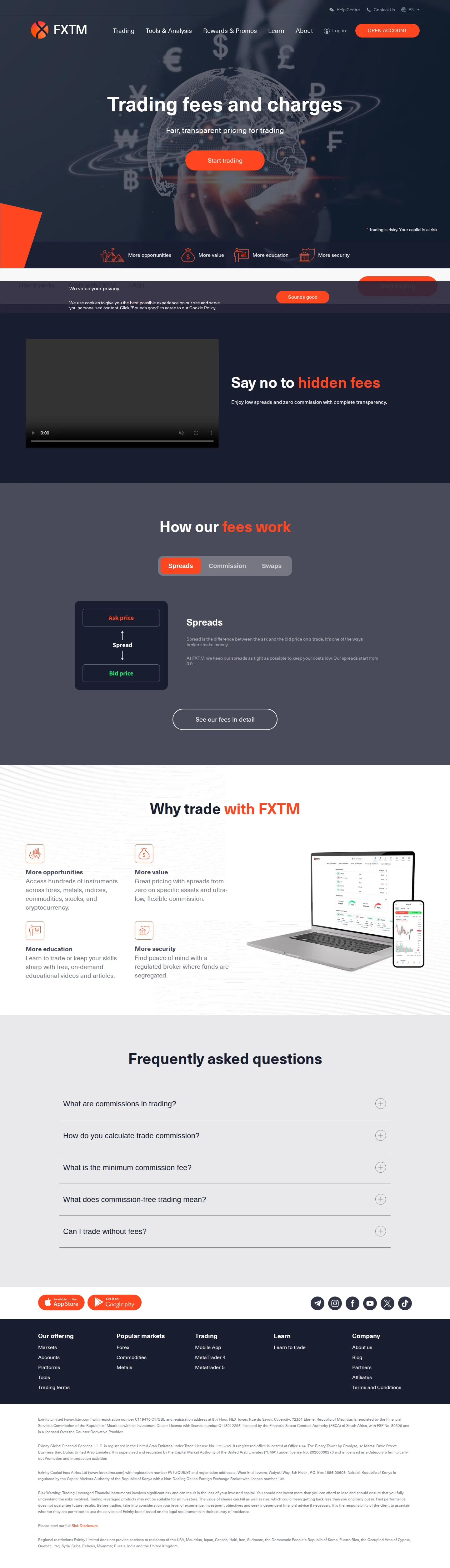
The fee page we fetched sets a 10 EUR/USD/GBP monthly inactivity charge after three months without trading, applied every month until the balance is gone or the account trades again. It also reserves the right to charge banking fees or 3% of a withdrawal if that withdrawal follows a period of inactivity, and to claw back reimbursed fees where it finds abuse of the reimbursement policy. Separately, the firm’s Australian terms set a flat $3 charge on deposits or withdrawals under $30, with nothing charged above that threshold aside from whatever the payment provider adds. Spreads on the Advantage account start from 0 pips with a low per instrument commission, which is where the fees score of 9 comes from, but the deposit and withdrawal fee fields on the fee page itself are left blank, pointing the client to their account login rather than publishing a figure.
Impersonation risk around the FXTM name
We searched 1,441 warning list entries mirrored from CySEC, the FCA and FSC Mauritius, and FXTM does not appear on any of them. That is a clean result on the lists we hold, not a clearance from every regulator worldwide. Separately, four other domains carrying the FXTM name turned up on those same lists and are not this firm. The FCA register lists fxmarket-trading.com as unauthorised and identifies it specifically as impersonating FXTM. It also lists fxtminvestments.com and fxtmonline.live as unauthorised, with no clone marker attached to either entry. CySEC’s list of non approved domains includes cryptfxtm.com as unauthorised under any Cypriot licence, without naming which firm it imitates. A reader searching for FXTM online should know these four sites are not it.
FXTM offers MT4, MT5 and its own app, with spreads advertised from 0 pips on its Advantage account, but its regulation picture is uneven: four licences check out, one FCA entry sits in an ambiguous applied-to-cancel state, and two older claims for a related ForexTime Ltd entity come back lapsed or absent. FXTM scores 6.4 out of 10 overall.
What we saw
Pages captured from FXTM’s own site when this review was written. Brokers change their terms; these are what we read.



Score history
Recomputed daily; every move is on the record. The current score is always the latest row.
| Date | Score | Move |
|---|---|---|
| 2026-09-20 | 6.4 | ▼ |
| 2026-07-25 | 6.7 | ▼ |
| 2026-07-18 | 6.8 | ▼ |
| 2026-07-11 | 7.0 | · |
FAQ
Is FXTM regulated?
Yes, through Exinity Limited (Mauritius FSC, FSCA South Africa FSP 50320) and group entities in Kenya (CMA licence 135) and the UAE (promotion only); none is a tier-1 regulator.
Is FXTM regulated by CySEC?
No, the CySEC licence 185/12 sometimes cited for the brand is not found on the CySEC register.
Does FXTM hold an FSCA licence in South Africa?
Exinity Limited holds an active FSCA licence, FSP 50320, but a separate FSCA licence 46614 tied to ForexTime Ltd is listed as Lapsed.
What does FXTM charge to trade EURUSD?
The Advantage account advertises a EURUSD round-turn cost from USD 0.00, a floor rather than a guaranteed price; minimum deposit is not published.
What trading platforms does FXTM offer?
MetaTrader 4, MetaTrader 5, its own web platform, and its own mobile app.
How can I contact FXTM support?
Via live chat, a published phone number, and published hours, though which entity responds depends on which one onboarded you.
How this review works
Track FXTM live: score moves and red notices, in your pocket.