CFD · CHECKED 10 OCT 2026
S.A.M. Trade review.
CFD broker with no confirmed licence and a disputed ASIC registration claim
RUN ✗
OUT OF 10
S.A.M. Trade is a CFD broker running on MetaTrader 4. Its only claimed licence, ASIC AFSL 338647, is missing from ASIC's current register, and the firm's own about page admits a dispute over that same licence number with GIB & Capital Group Pty. Its SVG registration is also held under a different entity name, Samtrade FX Ltd. No financial-services licence for the firm has been verified anywhere.
Each criterion is scored 1 to 10 from primary sources. The overall score is their unweighted mean. How scoring works.
| Founded | 2015 |
|---|---|
| Minimum deposit | USD 10 |
| Maximum leverage | 1000:1 |
| Withdrawal fee | 0 |
| Account opening | 1-3 |
| Platforms | MetaTrader 4 (MT4), CopySam™, SamTrack™, SamAide™ |
- Publishes some fee information on its site
- Claimed ASIC licence 338647 is not on ASIC's current register
- Firm's own about page admits a licence dispute with GIB & Capital Group Pty
- SVG IBC number is registered to a different entity, Samtrade FX Ltd
- No verified financial-services licence found on any register
- FINTRAC listing is an AML registration only, not a trading licence
- No EURUSD spread published for any account a retail client can open
Overview
TrueBroker is a free broker safety checker, and this page is our review of S.A.M. Trade, scored 3.4 out of 10 across regulation, fees, platform, support and reviews. The lowest mark in that score is regulation, at 1.8, and the reasons for that sit below. Our previous review gave it 3.4 out of 10, the same score as this one.
Overview Table
| Headquarters | Not stated |
|---|---|
| Established | Not stated |
| Countries Served | Not stated |
| Regulated By | Not confirmed on any register we checked. The firm’s own about page claims AFS licence 338647 via S.A.M. Financial Group (Australia) Pty Ltd, but that number does not appear in ASIC‘s current licensee dataset. A Saint Vincent and the Grenadines registration (25290 IBC 2019) is cited on the same page, but that register shows the number belongs to a differently named company, Samtrade FX Ltd., not S.A.M. Trade. |
| Minimum Deposit | USD 10 (Standard, VIP and Islamic accounts); USD 100 (ECN account), per the firm’s account types page |
| Maximum Leverage | Up to 1:1000 (Standard and VIP accounts, per the account types page); up to 1:500 on the Islamic account; up to 1:200 on the ECN account |
| Total Instruments | Not stated as a count. The firm’s about page lists six asset classes: Forex, Indices, Commodities, Futures, Cryptocurrencies and Equities |
| Platforms | MetaTrader 4 (MT4); CopySam™ and SamTrack™ and SamAide™ are named in the site’s navigation menus with no functional detail on the pages fetched |
| Customer Support | Email (support@samtradefx.com), a contact form, and “24/5 Technical and Account Support” listed as a feature on every account type |
| Languages | Not stated |
Facts List
- The entity behind the brand is named on the firm’s own about page as S.A.M. Trade (Asia) Pte Ltd, described there as publicly traded as OTCMKTS: SMFX.
- The same page names S.A.M. Financial Group (Australia) Pty Ltd as the claimed holder of AFS licence 338647; we searched ASIC’s current licensee dataset (6,525 rows) and that number is not in it.
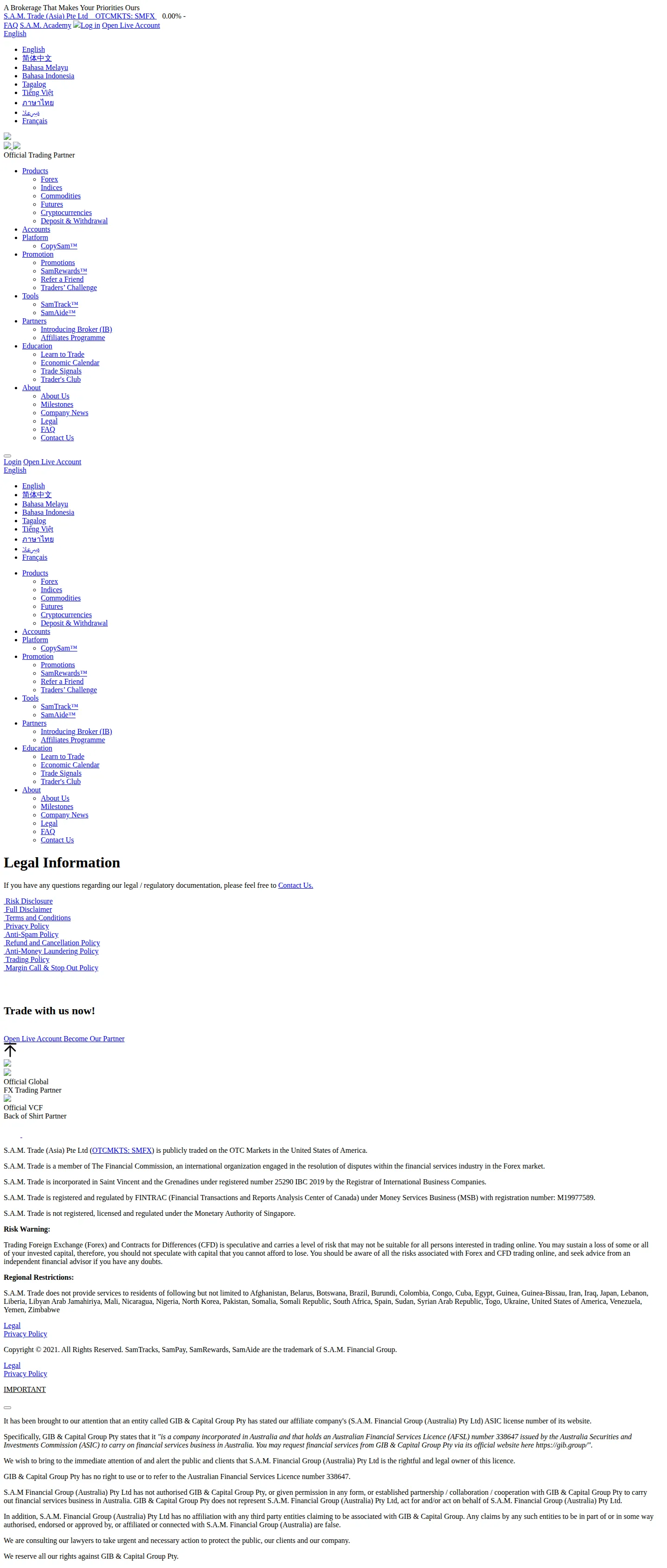
- The firm’s about page itself carries a live “IMPORTANT” notice disputing a third party, GIB & Capital Group Pty, over ownership of that same licence number, which is a live naming dispute rather than a settled licence.
- We searched the Saint Vincent and the Grenadines FSA entity register for the incorporation number the firm cites (25290 IBC 2019) and found it registered to Samtrade FX Ltd., not to a company named S.A.M. Trade; that register in any case records company incorporation, not a forex or CFD licence.
- A FINTRAC registration number (M19977589) appears on the firm’s page; we hold no register entry for FINTRAC, so this number is unchecked by us, and that is a gap in our coverage rather than a finding about the firm.
- We searched 1,441 warning-list entries mirrored from CYSEC, the FCA and the FSC Mauritius, running a positive control against two of those registers first, and S.A.M. Trade matched none of them.
- The account types page states that “all accounts offered by S.A.M. Trade are under the negative balance protection”, then adds in the same breath that “your entire capital may still be at risk.”
- The same page reserves the right to revoke swap-free status on any account “in the event of any form of abuse”, without defining what abuse means.
- The firm describes itself as a member of The Financial Commission, a private dispute-resolution body, not a government regulator or a named compensation scheme.
- Every fetched page footer (root, about, accounts, contact) carries the same list of over 30 excluded countries, including the United States, Iran, North Korea, Syria and Japan.
Where S.A.M. Trade’s licence claims stand
The regulation score of 1.8 traces directly to what the registers show, not to what the firm’s page says. The about page names S.A.M. Financial Group (Australia) Pty Ltd as the holder of AFS licence 338647, and the same page is currently running a notice contesting ownership of that number against a company called GIB & Capital Group Pty. Whatever the outcome of that dispute, the number itself is not in ASIC’s current licensee dataset, which we searched directly. ASIC’s dataset lists current licensees, so an absent number could mean the licence was never granted, or was cancelled or transferred; either way, it is not there now.
The Saint Vincent and the Grenadines number the page cites, 25290 IBC 2019, does exist in that jurisdiction’s FSA entity search, active, incorporated 2019-01-29, with DENTONS DELANY as registered agent. But the entity behind that number is Samtrade FX Ltd., a different name to S.A.M. Trade. The SVG FSA register in any case records company incorporation, not authorisation to deal in investments or hold client funds. The FINTRAC number on the same page, M19977589, is a Money Services Business registration for anti-money-laundering purposes if it is genuine, not a licence to run a brokerage; we have no way to check it since we hold no FINTRAC register entry.
What S.A.M. Trade’s account pages state
The account types page lists four accounts: Standard and VIP (both USD 10 minimum, up to 1:1000 leverage, no commission), Islamic (USD 10 minimum, swap-free, up to 1:500 leverage), and ECN (USD 100 minimum, up to 1:200 leverage, USD 5 commission). All four are listed with negative balance protection, immediately qualified on the same page by the statement that a client’s entire capital can still be at risk. The same page reserves the right to strip swap-free status from an Islamic account “in the event of any form of abuse”, a standard the page does not define.
Our earlier review reported a $50 inactivity fee after three months and a $10,000 “Trader’s Club” membership tier; we did not find either on any page we fetched, so we are passing those along as what that earlier review found, not as something S.A.M. Trade’s own pages state. The same applies to the payment methods it listed (bank wire, card, and Tether, each with stated minimums and no broker-side fee) since the firm’s own deposit page returned no content when we tried to fetch it, along with its Terms and Conditions, Client Agreement, and risk disclosure pages, all of which failed to load from a UK exit at the time we fetched them.
Key Takeaways
The ASIC licence claim does not survive a register check
- S.A.M. Trade’s own about page names S.A.M. Financial Group (Australia) Pty Ltd as the holder of Australian Financial Services Licence 338647. We searched the ASIC register directly, across 6,525 current licensee rows, and licence 338647 is not in that dataset. ASIC’s dataset lists current licensees only, so this does not tell us whether the number was cancelled, transferred, or never issued to this entity, only that it is not there now. We ran a positive control on the ASIC register first, searching for a firm we know is listed, so this absence is a genuine search result and not a broken query.
- The firm’s own page goes further than simply claiming the licence: it carries a live “IMPORTANT” notice asserting that S.A.M. Financial Group (Australia) Pty Ltd is “the rightful and legal owner” of AFSL 338647, naming a specific third party, GIB & Capital Group Pty, as a rival claimant to the same number. A licence number that its own holder is contesting in public, and that does not appear on the regulator’s current list, is not a settled regulatory credential.
- The Saint Vincent and the Grenadines FSA entity search does turn something up under number 25290 IBC 2019, but it is registered to “Samtrade FX Ltd”, status Active since 2019-01-29, agent Dentons Delany, not to “S.A.M. Trade”. The SVG FSA registers companies; it does not license forex or CFD brokers. So this record confirms a company incorporation, under a different name to the one the claim was made for, not a financial-services authorisation for this broker.
- A third number, M19977589, is presented as a FINTRAC registration. We hold no register entry for FINTRAC in our directory, so this number has not been checked one way or the other. That is a gap on our side, not a finding about the firm, and a FINTRAC Money Services Business listing would in any case be an anti-money-laundering registration, not authorisation to deal in investments or hold client funds.
- Two things sit alongside these claims on the same page: S.A.M. Trade (Asia) Pte Ltd trades on OTC Markets under the ticker SMFX, and the firm describes itself as “a member of The Financial Commission, an international organization engaged in the resolution of disputes within the financial services industry in the Forex market.” An OTC stock listing is not a financial-services licence and carries no client-money protection, and Financial Commission membership is a private dispute-resolution body, not a statutory compensation scheme.
- We searched 1,441 warning-list entries mirrored from CYSEC, the FCA, and the FSC Mauritius, and S.A.M. Trade matches none of them. That covers only the three regulators we mirror, not a global sweep, but it is a clean result worth recording alongside the register findings above.
What S.A.M. Trade’s own accounts page charges
- The account types page lists four accounts: Standard (minimum USD 10, no commission), VIP (minimum USD 10, no commission), ECN (minimum USD 100, “USD 5 Commission”), and Islamic (minimum USD 10, swap free). Leverage is advertised up to 1:1000 on Standard and VIP, up to 1:500 on Islamic, and up to 1:200 on ECN.
- Two further fees appear only in our earlier review, not on any page we fetched ourselves: a $50 inactivity fee after three months, and a $10,000 “Trader’s Club” paid membership tier. We could not confirm either against the firm’s own site, so both are carried here as what the earlier review reported, not as something S.A.M. Trade’s pages state.
- Payment methods, minimums, and timing (bank wire, card, Tether/USDT) also come only from that earlier review; the firm’s funding page returned no content when we tried to fetch it, so none of those figures are first-hand.
- Direct attempts to fetch the Terms and Conditions, Client Agreement, a dedicated fees or spreads page, and a risk disclosure document all failed, either 0 bytes or page-not-found. The account types page is the only fee-bearing document we could actually read, which limits what this review can confirm about spreads and costs beyond the ECN commission stated there.
Terms that bind a client on the account types page
- On the swap-free Islamic account: “S.A.M. Trade reserves the right to revoke the swap-free status granted to any real trading account in the event of any form of abuse.” “Abuse” is not defined on the page, which leaves the broker free to withdraw swap-free status at its own discretion.
- On negative balance protection, the same FAQ qualifies its own headline feature: All accounts offered by S.A.M. Trade are under the negative balance protection… Please note however that your entire capital may still be at risk. The protection stops an account going negative; it does not stop a client losing everything they deposited.
- The footer restriction list, repeated verbatim across the root, about, accounts, and contact pages, excludes residents of more than thirty named countries, among them the United States, Iran, Cuba, Syria, North Korea, and Japan, and separately states that S.A.M. Trade is not licensed or regulated by the Monetary Authority of Singapore.
Platform and support on offer
- MetaTrader 4 is the platform described in any detail, covering Expert Advisors, distributed architecture, and mobile trading. CopySam, SamTrack, and SamAide appear only as navigation menu entries; SamAide is described on the page as offering “robust fund security” and nothing more, so none of the three can be assessed beyond their names.
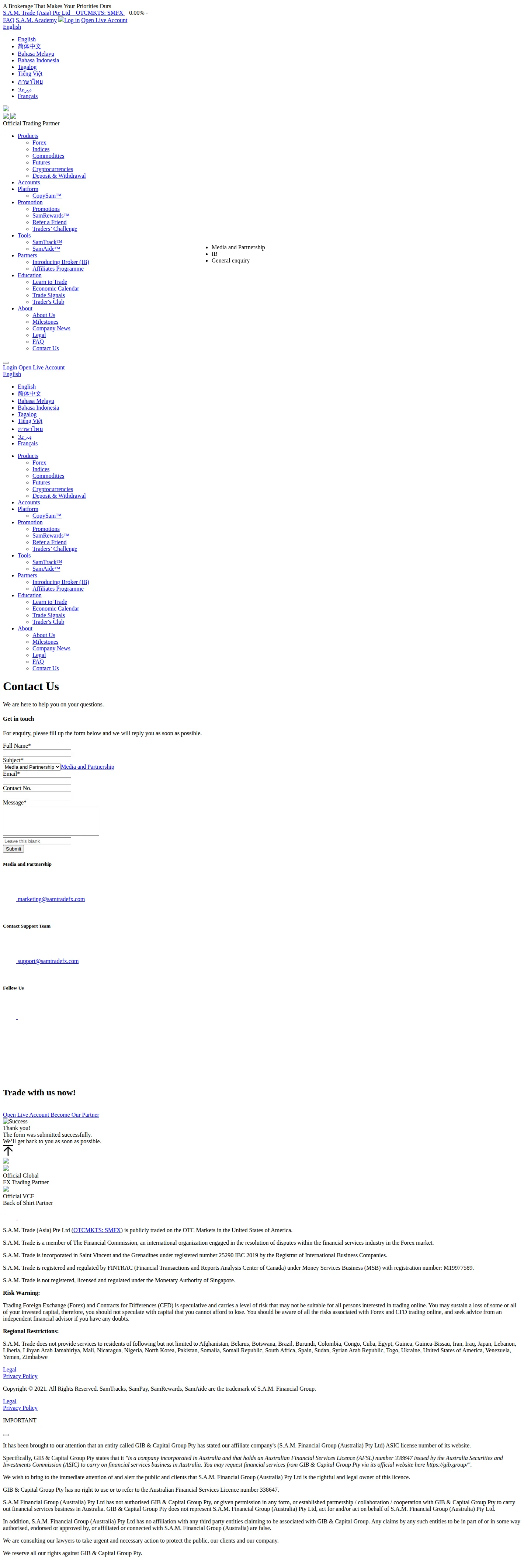
- Support runs through two named email addresses, support@samtradefx.com and marketing@samtradefx.com, plus a contact form with subject options for Media and Partnership, IB, and General enquiry. No phone line or live chat is listed on the contact page we fetched.
Licenses & Regulation
What S.A.M. Trade claims about its licence
The firm’s own about page, fetched from its UAE site, names three entities behind the brand: S.A.M. Trade (Asia) Pte Ltd, described as the brand operator and as publicly traded under OTCMKTS: SMFX; S.A.M. Financial Group (Australia) Pty Ltd, named as the holder of Australian Financial Services Licence number 338647; and S.A.M. Financial Group, named as the owner of the SamTracks, SamPay, SamRewards and SamAide trademarks.
We searched the ASIC register directly, checking licence 338647 against ASIC’s current licensee dataset of 6,525 rows, and ran a positive control first, searching for a firm we know is listed, so that an empty result means absence rather than a broken search. Licence 338647 is not on the register. ASIC’s dataset lists current licensees only, so a licence that was cancelled or transferred would also show up as absent, and this search cannot tell that outcome apart from a licence that was never granted.
A dispute the firm’s own page discloses
The same about page, fetched 2026-09-23, carries a live notice headed “IMPORTANT” stating that S.A.M. Financial Group (Australia) Pty Ltd is the rightful and legal owner of AFSL 338647, and disputing a named third party, GIB & Capital Group Pty, that also claims the same licence number. So the number that does not turn up on ASIC’s current-licensee list is, by the firm’s own account, contested rather than simply lapsed: two companies claim it.
The Saint Vincent and the Grenadines registration
The about page also gives a company number, 25290 IBC 2019, for “S.A.M. Trade”. We searched the Saint Vincent and the Grenadines FSA entity name register directly. Registration number 25290 is there, but the entity behind it is Samtrade FX Ltd., a BC business company, status active, incorporated 2019-01-29, with Dentons Delany as registered agent. That confirms a company exists at that number, not the company named in the claim: the register’s entry reads “Samtrade FX Ltd.”, not “S.A.M. Trade”. The Saint Vincent and the Grenadines FSA also registers companies, it does not license forex or CFD brokers, so even a matching entry would be a company record rather than a trading authorisation.
FINTRAC and the other credentials S.A.M. Trade lists
The about page cites a FINTRAC number, M19977589. We hold no register entry for FINTRAC in our directory, so this number has not been checked; that is a gap on our side, not a finding about the firm. Even a confirmed FINTRAC entry would register a business for anti-money-laundering purposes as a money services business, not authorise it to deal in investments or hold client funds.
Two further credentials on the same page carry no licensing weight of their own. The OTCMKTS: SMFX listing for S.A.M. Trade (Asia) Pte Ltd is a US over-the-counter stock listing, which involves no financial-services authorisation and no client-money protection. And the page states that S.A.M. Trade is a member of “The Financial Commission, an international organization engaged in the resolution of disputes within the financial services industry in the Forex market”; that is a private dispute-resolution body, not a government regulator, and not a named statutory compensation scheme comparable to something like the FSCS or an investor-compensation fund.
Warning lists and where S.A.M. Trade says it will not operate
We searched 1,441 warning-list entries mirrored from CySEC, the FCA and the FSC Mauritius, and S.A.M. Trade appears on none of them. That result covers only the three regulators we mirror, not every regulator worldwide, but across those lists it is clean.
Every fetched page’s footer, across the root, about, accounts and contact pages, carries the same restricted-country list, naming more than thirty countries including North Korea, Iran, Cuba, Syria, the United States and Japan. The about page separately states that S.A.M. Trade is not registered, licensed or regulated by the Monetary Authority of Singapore.
How to Trade
The account comparison page splits execution into four tiers, with differences in minimum deposit, spreads, swap-free status, leverage caps and commission. The Standard and VIP accounts both open with a USD 10 minimum deposit, “standard” or “tight” spreads respectively, no commission, and leverage described as “up to 1:1000”. The Islamic account, also a USD 10 minimum, drops to “up to 1:500 leverage” and is marked swap free. The ECN account needs USD 100 to open, is capped at “up to 1:200 leverage”, and carries a flat USD 5 commission, which the firm’s account-types page ties specifically to that account tier. None of the four pages we fetched gives a spread figure in pips or a per-lot commission schedule beyond that single USD 5 line, so the actual cost of a trade on any tier beyond the ECN commission is not something we can quote from what the firm published.
Instruments and platform
The firm’s about page lists CFDs across forex, indices, commodities, futures and, as of a stated update, “CFD on equities and cryptocurrencies”. The account comparison page gives a minimum order volume of 0.01 lots, a margin call level of 100% and a stop out level of 50% on all four accounts, but no per instrument contract specifications appear on the pages we fetched. For execution, the about page names MetaTrader 4 as the platform, describing it in terms of Expert Advisor support, a distributed architecture, and mobile access. The site’s navigation also lists CopySam™ under “Platform” and SamTrack™ and SamAide™ under “Tools”, but none of the fetched pages give any functional detail on what these do beyond their names; SamAide™ is described only as offering “robust fund security”, a phrase with no further explanation attached to it. We could not fetch the site’s dedicated platforms page, the fee/spread page, or the terms and conditions during this pass, so nothing here can be confirmed about order execution model or slippage handling.
What binds a position at S.A.M. Trade
The account types page states plainly that “all accounts offered by S.A.M. Trade are under the negative balance protection”, but the same page immediately qualifies it: “Please note however that your entire capital may still be at risk.” That is the firm’s own wording sitting next to its own headline feature, and it means the negative-balance guarantee does not describe a floor under how much of the deposited balance itself can be lost, only that the balance should not go negative.
The Islamic account’s swap-free status is not fixed once granted. The same FAQ states that “S.A.M. Trade reserves the right to revoke the swap-free status granted to any real trading account in the event of any form of abuse.” No definition of “abuse” appears on the page, which leaves the revocation trigger to the firm’s own judgment rather than a stated test a client could check their own trading against.
We could not fetch a client agreement, risk disclosure, or terms and conditions page from the live site during this pass, despite trying a range of URL guesses from a UK exit; each came back empty or not found. That means margin call and stop-out mechanics, order execution terms, and any liability, lien or set-off clauses that would normally sit in those documents are not something we can report on here, first hand or otherwise.
Account Types
S.A.M. Trade’s accounts page lists four account types, distinguished mainly by minimum deposit, spread type and leverage cap rather than by a promotional structure.
The four accounts S.A.M. Trade sells
- Standard Account. Minimum deposit USD 10. The accounts page lists standard spreads, up to 1:1000 leverage, no commission, floating spread, negative balance protection, 24/5 technical and account support, and a daily trade call.
- VIP Account. Minimum deposit USD 10. The same page describes tighter spreads and priority customer support alongside the same up to 1:1000 leverage, no commission, floating spread, negative balance protection, 24/5 support and daily trade call as the Standard Account.
- ECN Account. Minimum deposit USD 100. The page markets this as the firm’s best spreads with priority customer support, up to 1:200 leverage, and a USD 5 commission, again with floating spread, negative balance protection, 24/5 support and a daily trade call.
- Islamic Account. Minimum deposit USD 10. Standard spreads, swap free, up to 1:500 leverage, no commission, floating spread, negative balance protection, 24/5 support and a daily trade call.
Every tier the accounts page lists carries the same support and negative balance protection language; what changes across them is the deposit floor, the spread tier, the leverage ceiling and, on the ECN account only, a flat USD 5 commission. The pages we fetched describe these four tiers through spread, leverage and commission terms, and say nothing about promotional credit or bonus offers.
Costs the accounts page does not mention
Beyond the USD 5 ECN commission, the account types page gives no spread figures, no swap rates and no schedule of trading costs. Two further charges appear only in the earlier review this catalogue is rewriting, not on any page we fetched ourselves: an inactivity fee of $50 after three months, and a $10,000 paid membership fee for something called the Trader’s Club. Both are carried here as reported by that earlier review, not as something S.A.M. Trade’s own terms confirm.
What the Islamic account’s swap free status actually protects
The accounts page FAQ states that “S.A.M. Trade reserves the right to revoke the swap free status granted to any real trading account in the event of any form of abuse.” That leaves an Islamic account holder’s fee free status subject to withdrawal at the broker’s own discretion, against a standard of “abuse” the page does not define.
The limits of the negative balance protection S.A.M. Trade advertises
The same FAQ states that all accounts offered by S.A.M. Trade are under the negative balance protection… Please note however that your entire capital may still be at risk. So the protection advertised across all four tiers is qualified in the broker’s own words: a client can still lose the whole of what they deposited, even where the account cannot go negative.
Funding methods reported, not confirmed
The earlier review this catalogue is rewriting reported three funding methods: bank wire transfer with a $20 minimum and a stated one to four business day settlement, credit and debit card with a $20 minimum and instant settlement, and Tether (USDT) with a USDT 50 minimum and settlement of up to one business day, in each case with no fee charged by S.A.M. Trade itself, though banks may charge their own. We could not confirm any of this from a fetched broker page, since the funding and deposit page returned no content when we tried it, so these figures are carried here as what the earlier review reported, not as something we read on the site ourselves.
Account minimums sit low across the board, from USD 10 on three of the four tiers to USD 100 on the ECN account, which puts the entry cost of every account type well below what the firm’s regulatory standing would suggest a trader should risk. ASIC’s current licensee dataset, searched directly across 6,525 rows, does not list AFS licence 338647, the number the firm’s own about page attributes to its affiliate S.A.M. Financial Group (Australia) Pty Ltd. Whatever these accounts buy, it is not the protection an active Australian licence would carry.
Negative Balance Protection
S.A.M. Trade advertises “Negative Balance Protection” as a listed feature on every one of the four account types on the firm’s account-types page: Standard, VIP, ECN and Islamic all carry the same line, regardless of minimum deposit or leverage tier. Its own Account Types FAQ states: All accounts offered by S.A.M. Trade are under the negative balance protection… Please note however that your entire capital may still be at risk. That second sentence is the firm’s own qualifier, sitting in the same document as the promise, and it narrows what the protection actually covers: it caps losses at the money in the account, not below zero, but it does not stop the account itself going to zero.
The leverage sitting behind the promise
How close an account gets to that zero line depends on the leverage the firm allows, and the account-types page sets different caps for different accounts. The Standard and VIP accounts are listed at up to 1:1000 leverage, the Islamic account is capped at up to 1:500, and the ECN account is capped at up to 1:200. Higher leverage moves the same size of price swing further in percentage terms against a smaller deposit, so the accounts carrying the highest advertised leverage, Standard and VIP at up to 1:1000, are the ones where a fast move would use up the negative balance protection fastest. The firm’s own minimum deposits for those accounts are USD 10, or USD 100 on ECN, which sets how thin the buffer can be before that protection is what stands between the client and a debt.
Discretion the firm keeps over risk-related account status
The same Account Types FAQ that carries the negative balance protection line also carries a separate clause reserving the firm’s right to withdraw a different risk-related status at its own judgment: “S.A.M. Trade reserves the right to revoke the swap-free status granted to any real trading account in the event of any form of abuse.” The document does not define “abuse” there, so the standard for pulling that status is the firm’s own to set. It is a different mechanism from the negative balance protection promise, but it sits in the same FAQ and shows the same pattern: a client-facing benefit stated plainly, followed by a broker-side condition that is not spelled out.
Who backs the promise if it is tested
A negative balance protection guarantee is only as solid as whoever can be made to honour it if a client’s account is blown through in a fast market. On that point, the register work behind this review found no confirmed regulator standing over S.A.M. Trade. We searched ASIC’s current licensee dataset directly, running a positive control first so an empty result would mean absence rather than a broken search, and found no AFS licence 338647 in ASIC’s current dataset, the number the firm’s own about page attributes to an affiliate, S.A.M. Financial Group (Australia) Pty Ltd. That page itself carries a live notice disputing another company’s use of the same licence number, which the firm treats as an ownership dispute rather than a lapse, but nothing in the material gathered here confirms the licence is current either way. Separately, the St Vincent and the Grenadines FSA entity search does show an active company, Samtrade FX Ltd., registration number 25290 IBC 2019, incorporated 2019-01-29, registered agent Dentons Delany, but that register records companies, not financial licences, and the name on file, Samtrade FX Ltd., is not the name on the claim, S.A.M. Trade. A third number, M19977589, is presented as a FINTRAC registration; we hold no register entry for FINTRAC in our directory, so that number is unchecked rather than confirmed. The firm’s about page also describes membership in The Financial Commission, which is a private industry dispute-resolution body rather than a government regulator or a named statutory compensation scheme, so a client disputing how the negative balance protection was applied would be taking that dispute to a private membership organisation, not to a supervisor with the power to compel the firm. We also ran the firm’s name against 1,441 warning-list entries mirrored from CYSEC, the FCA and the FSC Mauritius, and it matched none of them, which is worth stating plainly since it is a clean result rather than an absence we are inferring from silence.
Trading Instruments
The accounts page at S.A.M. Trade’s UAE site lists four account types, each carrying its own instrument access implicitly through the same platform: Standard, VIP, ECN and Islamic. The instruments the firm names on its about page are forex, indices, commodities, futures, cryptocurrencies and equities, with the about page stating that “S.A.M. Trade now offers CFD on equities and cryptocurrencies.” No fetched page breaks these categories down into a tradable symbol list, spread table by instrument, or contract specifications, so what follows is the category list itself rather than a count of markets within it.
What S.A.M. Trade lists as tradable
The six categories above cover the usual CFD spread: currency pairs, stock indices, commodities, futures contracts, cryptocurrencies and equities. The about page frames the crypto and equity CFDs as a recent addition rather than a long-standing offering. Beyond naming the categories, the about page gives no instrument counts, no named symbols, and no indication of which categories are available on which account type. The four account types on the accounts page differ in minimum deposit, leverage cap and commission structure, not in which instrument categories they can trade, based on the features each one lists.
Leverage and account structure across S.A.M. Trade’s tiers
The accounts page gives four tiers. The Standard Account and VIP Account both require a minimum deposit of USD 10 and advertise leverage of up to 1:1000, with no commission and a floating spread. The ECN Account requires USD 100, caps leverage at 1:200, and adds a USD 5 commission on top of what it describes as the firm’s “very best spreads.” The Islamic Account requires USD 10, is swap free, and caps leverage at 1:500. All four carry negative balance protection, 24/5 technical and account support, and what the accounts page calls a Daily Trade Call. The accounts page qualifies that negative balance protection itself, stating that “your entire capital may still be at risk” despite the protection.
The swap-free terms behind the Islamic Account
The Islamic Account is marketed as swap free, but the Account Types FAQ reserves the firm the right to withdraw that status: “S.A.M. Trade reserves the right to revoke the swap-free status granted to any real trading account in the event of any form of abuse.” The FAQ does not define what counts as abuse, so a client holding this account type is trading under a benefit the firm can remove at its own discretion, on a standard the published page does not spell out.
Where the asset list runs out
The about page and accounts page are the only sources our evidence could draw on for instrument coverage. Direct attempts to fetch a dedicated platforms page, a fees or spreads schedule, and the Terms and Conditions or Client Agreement all failed to return content, so nothing here can confirm contract sizes, margin requirements per instrument, out-of-hours trading rules, or a spread figure attached to any specific market. The platform itself is named as MetaTrader 4, described on the about page as built for market analysis and Expert Advisors, with distributed architecture, mobile trading and automated trading listed as features. The about page’s navigation also names CopySam and SamTrack, but neither page returned functional detail beyond the name, so what those tools actually let a client do with the instrument list above is not established by anything fetched here.
Education & Analysis
S.A.M. Trade’s about page names one trading platform outright: MetaTrader 4. The same page describes MT4 as the tool for analyzing markets and running Expert Advisors, and lists a distributed architecture, mobile trading and automated trading among its features. Beyond that single paragraph, the firm’s fetched pages do not go into the platform in any depth: no page we retrieved sets out spreads by instrument on MT4, execution model, server locations, or which account types get which MT4 build.
CopySam, SamTrack and SamAide: named, not explained
The site’s own navigation menus name three more tools. CopySam is listed under the “Platform” menu. SamTrack and SamAide are listed under a separate “Tools” menu. None of the three is described anywhere on the pages we fetched beyond that menu listing. The one line of description we found for SamAide, on the about page, calls it a source of “robust fund security” and gives no further detail on what that means in practice, what it does, or how a client would use it. We found nothing at all describing what CopySam or SamTrack do, whether CopySam is a copy-trading feature, or what SamTrack tracks.
Instruments traded on the platform
The about page lists forex, indices, commodities, futures and cryptocurrencies as tradable instruments, and states directly that “S.A.M. Trade now offers CFD on equities and cryptocurrencies,” adding equities to that list. This appears as prose on the about page rather than as a searchable instrument catalogue or contract-specifications page, so we have the categories the firm names but not a page-by-page breakdown of symbols, contract sizes or trading hours within any of them.
What the account types page adds, and where it stops
The four account types on S.A.M. Trade’s accounts page each carry a leverage figure and a spread description, but these sit under account terms rather than platform terms: Standard and VIP accounts advertise up to 1:1000 leverage with “standard” or “tight” spreads and no commission, the ECN account caps leverage at 1:200 and charges a USD 5 commission on top of its spread, and the Islamic account offers up to 1:500 leverage on a swap-free basis. None of the four account entries names a specific platform build, charting package, or analysis tool tied to that account; MT4 is the only platform named on the site, and the accounts page does not say whether all four accounts run on it or whether any of the other listed tools attach to a particular account tier.
What we could not check on S.A.M. Trade
We attempted to fetch the platforms page directly, along with the terms and conditions, client agreement, fee and spread pages, and risk disclosure, using a range of URL guesses from a UK exit. Every one of those attempts came back empty or as a page-not-found response. That means we have no first-hand read of any dedicated platforms page, no published spread table, and no functional description of CopySam, SamTrack or SamAide beyond what appears in the site’s own navigation menus and the single sentence on SamAide quoted above. Where the evidence is silent on a tool’s function, that silence is ours to report, not a finding that the tool does nothing: it means the page describing it was not one we were able to retrieve.
Special Offers
The account-types page we fetched gives four tiers: Standard, VIP, ECN and Islamic. Each is described by its own minimum deposit, leverage cap and spread or commission structure. None of that page’s wording uses the words bonus, cashback, welcome credit or promotion for any of the four; it sets out pricing and leverage terms only.
What S.A.M. Trade’s account page actually offers
The Standard and VIP accounts both list a USD 10 minimum deposit, floating spreads, no commission and leverage up to 1:1000. The ECN account needs USD 100 and carries the firm’s “very best spreads” alongside a flat USD 5 commission and leverage capped at 1:200. The Islamic account, also opened from USD 10, is described as swap-free with leverage up to 1:500. All four are listed as carrying negative balance protection, though the same page immediately qualifies that: All accounts offered by S.A.M. Trade are under the negative balance protection… Please note however that your entire capital may still be at risk. That caveat sits inside the Account Types FAQ, not in a separate offers document, and it applies to every tier rather than to any one of them as a special condition.
The page also states that S.A.M. Trade “reserves the right to revoke the swap-free status granted to any real trading account in the event of any form of abuse,” which is a condition attached to the Islamic account specifically rather than to the account range as a whole. No standard has been published on the fetched page for what counts as abuse.
The Trader’s Club, as reported by an earlier review
An earlier review of this firm rather than quoting, described a paid membership tier called the Trader’s Club, priced at $10,000 to join. We could not find that programme, its price or its terms on any page fetched for our evidence, so this detail is carried over from that earlier review rather than confirmed against the firm’s own site. Treat the figure and the existence of the programme as second-hand until it can be checked against a live S.A.M. Trade page.
What we could not check
Direct attempts to fetch S.A.M. Trade’s terms and conditions, client agreement, and a dedicated fees or spreads page all failed at the time our evidence was built, returning either no content or a page-not-found result. That means any promotional terms, deposit-bonus conditions or loyalty-scheme rules that might exist in a document separate from the account-types page were not available to check, and nothing found in the fetched pages describes such a scheme.
Opening an Account
The account types page names four accounts, Standard, VIP, ECN and Islamic, each listed with a minimum deposit rather than a formal step by step onboarding process. The Standard, VIP and Islamic accounts each carry a minimum deposit of USD 10, and the ECN account carries a minimum deposit of USD 100 plus a USD 5 commission, according to that page. Our direct attempts to fetch the terms and conditions and client agreement returned 0 bytes or “page not found” from a UK exit, and the account types page does not describe verification, so we cannot report what identity documents or verification steps the firm actually demands before an account goes live.
Who S.A.M. Trade says it will not take on
Every footer we fetched, on the root page, the about page and the accounts page, carries the same regional restrictions list. It names residents of Afghanistan, Belarus, Botswana, Brazil, Burundi, Colombia, Congo, Cuba, Egypt, Guinea, Guinea-Bissau, Iran, Iraq, Japan, Lebanon, Liberia, the Libyan Arab Jamahiriya, Mali, Nicaragua, Nigeria, North Korea, Pakistan, Somalia, the Somali Republic, South Africa, Spain, Sudan, the Syrian Arab Republic, Togo, Ukraine, the United States of America, Venezuela, Yemen and Zimbabwe, and states the list is “but not limited to” those countries. The about page separately states, in the firm’s own words, that S.A.M. Trade “is not registered, licensed and regulated under the Monetary Authority of Singapore.” We did not search the MAS register ourselves.
The swap free status S.A.M. Trade can take back
The Islamic Account is advertised with no swap, up to 1:500 leverage and no commission, but the same Account Types FAQ that lists those terms also states: “S.A.M. Trade reserves the right to revoke the swap-free status granted to any real trading account in the event of any form of abuse.” The page does not define what counts as abuse, so an account holder taking up the swap free terms is accepting that S.A.M. Trade alone decides when those terms stop applying.
What backs the account once it is open
The same Account Types FAQ states that “All accounts offered by S.A.M. Trade are under the negative balance protection,” then adds in the same breath that “your entire capital may still be at risk.” So the protection on offer stops short of guaranteeing the deposit itself. Separately, the about page describes S.A.M. Trade as a member of the Financial Commission, which it calls “an international organization engaged in the resolution of disputes within the financial services industry in the Forex market”; that is a private dispute resolution body an account holder could turn to, not a licensed regulator and not a statutory compensation scheme.
What we could not confirm about opening an account with S.A.M. Trade
We searched the ASIC register directly and found no AFS licence 338647 among ASIC’s current licensees, out of 6,525 rows searched, though a cancelled or transferred licence would also be absent from that dataset. We also searched the Registrar of International Business Companies for Saint Vincent and the Grenadines, which lists Samtrade FX Ltd, registration number 25290, as an active Business Company incorporated 2019-01-29 with registered agent Dentons Delany; that is a different company name from S.A.M. Trade, and in any case the SVG FSA registers companies rather than licensing forex or CFD brokers. A separate registration number, M19977589, is claimed against FINTRAC, the Financial Transactions and Reports Analysis Center of Canada, but we hold no register entry for that authority so this number has not been checked. None of this tells a prospective client what identification or address proof the firm will ask for at signup; that detail simply was not on any page we could fetch. We also ran our warning list search, covering 1,441 entries mirrored from CySEC, the FCA and the FSC Mauritius, and S.A.M. Trade appears on none of them, though that check covers only the three regulators we mirror.
Deposits & Withdrawals
S.A.M. Trade sets its deposit floor at the account level rather than at the cashier. The firm’s own account-types page gives a minimum deposit of USD 10 for the Standard, VIP and Islamic accounts, and USD 100 for the ECN account.
What S.A.M. Trade charges on the way out
The account-types page that supplies the deposit figures above says nothing about withdrawal fees, processing times or minimum withdrawal amounts. Two cost items appear only in the earlier review this profile rewrites, not on any page we were able to fetch: an inactivity fee of $50 after three months of no trading, and a $10,000 fee to join something called the Trader’s Club. Both are carried here as what the prior review reported, not as the firm’s own words, because we could not locate the pages that would confirm either figure.
Every account carries negative balance protection, but the same account-types page qualifies that promise in its own FAQ: All accounts offered by S.A.M. Trade are under the negative balance protection… Please note however that your entire capital may still be at risk. A client reading past the headline guarantee is told directly that the protection does not mean the deposited capital is safe from loss, only that the balance cannot go negative. The same FAQ reserves the right to strip swap-free status from an Islamic account “in the event of any form of abuse,” a standard the page does not define, which matters for anyone funding that account type on the expectation of a fixed no-swap arrangement.
Payment methods we could not verify first-hand
The earlier review reports three funding rails: bank wire transfer (minimum $20, one to four business days, no fee charged by S.A.M. Trade though banks may charge their own), credit or debit card (minimum $20, instant, no fee charged by S.A.M. Trade), and Tether/USDT (minimum USDT 50, up to one business day, no fee charged by S.A.M. Trade). We are restating what the prior review found rather than what we read ourselves: our own attempt to fetch the broker’s funding and deposit pages returned no content, and separate direct attempts to reach the terms and conditions, client agreement, fee schedule and risk disclosure pages also failed. None of the rail-level detail above, including the “no fee” claims, comes from a page we were able to open.
Where the money is meant to be held
The corporate paperwork behind S.A.M. Trade is worth setting out plainly because it bears on who is actually accepting the deposit. The St Vincent and the Grenadines FSA entity search turns up a company called Samtrade FX Ltd., registration number 25290, status Active, incorporated 29 January 2019, registered agent Dentons Delany. The SVG FSA is a companies register, not a financial regulator, and it registers the corporate shell rather than licensing anyone to deal in investments or hold client funds. It also names Samtrade FX Ltd., not the “S.A.M. Trade” entity the licence claim is attached to on the broker’s about page, so it confirms a company’s existence rather than a licence attached to that company. Separately, the ASIC AFS licence number the about page cites, 338647, for S.A.M. Financial Group (Australia) Pty Ltd, does not appear in ASIC’s current licensee dataset of 6,525 rows we searched. ASIC’s dataset lists current licensees, so a cancelled or transferred licence would also be absent from it; the search does not by itself tell a reader which of those applies here. The about page itself, fetched the day before this profile, carries a live notice asserting that S.A.M. Financial Group (Australia) Pty Ltd is “the rightful and legal owner” of licence 338647 in a naming dispute with a third party also claiming that number, which is the broker’s own account of an active disagreement over the licence, not a revocation. A third number, M19977589, is presented as a FINTRAC registration; we hold no register entry for FINTRAC, so that number is unchecked rather than confirmed or contradicted.
We also searched 1,441 warning-list entries mirrored from CYSEC, the FCA and the FSC Mauritius, and S.A.M. Trade matched none of them. That result only covers the three regulators we mirror, not a global check, but it is a clean result none of it is contradicted.
Who cannot fund an account at all
Every fetched page footer, including the root, about, accounts and contact pages, carries the same restricted-country list, naming more than thirty jurisdictions “but not limited to” Afghanistan, Belarus, Brazil, Cuba, Egypt, Iran, Iraq, Japan, North Korea, Pakistan, South Africa, Spain, Syria, Ukraine, the United States and Yemen among others. Residents of any listed country are told the firm does not provide services to them at all, which forecloses the deposit question before it starts. The about page separately states that S.A.M. Trade “is not registered, licensed and regulated under the Monetary Authority of Singapore,” a specific carve-out for Singapore residents distinct from the general country list.
Customer Support
S.A.M. Trade’s contact page, fetched directly from the firm’s own site, lists two published email addresses: support@samtradefx.com for the support team and marketing@samtradefx.com for media and partnership enquiries. The same page carries a contact form with three subject options a visitor can pick from: Media and Partnership, IB, and General enquiry. That is the full set of contact channels we found on the page we fetched.
What S.A.M. Trade promises inside the account tiers
The substance of the support promise sits on the Account Types page rather than the contact page. Every one of the four accounts listed there, Standard, VIP, ECN and Islamic, carries “24/5 Technical and Account Support” among its features, and a “Daily Trade Call” is listed for all four as well. The VIP and ECN accounts add “Priority Customer Support” as a named feature, which on its face puts those two tiers ahead of Standard and Islamic in whatever queue the firm operates, though the account page does not say what “priority” changes in practice, response time, a different queue, or a named contact, and we found no page describing that mechanism.
Terms that bind a client who complains or disputes something
Two clauses on the Account Types FAQ page constrain a client directly, and both matter more to a complaint than the contact details above. First, on the swap-free account: “S.A.M. Trade reserves the right to revoke the swap-free status granted to any real trading account in the event of any form of abuse.” The FAQ does not define “abuse,” so an Islamic-account holder disputing a revocation is arguing against a standard the firm has not published anywhere we could fetch. Second, on negative balance protection, the same page states All accounts offered by S.A.M. Trade are under the negative balance protection… Please note however that your entire capital may still be at risk. A client escalating a loss beyond what they expected is disputing a protection the firm itself has already qualified as not covering full capital.
Beyond the Account Types FAQ, we could not fetch the firm’s Terms and Conditions, Client Agreement, or risk disclosure pages from the live site, so we hold nothing first-hand on a written complaints procedure, an escalation timeline, or an internal ombudsman step. What we can report is that S.A.M. Trade’s own about page states the firm “is a member of The Financial Commission, an international organization engaged in the resolution of disputes within the financial services industry in the Forex market.” That is a private dispute-resolution body a client could in principle escalate to, not a government regulator and not a named statutory compensation scheme, and it is a different thing from the compensation cover a client would get under a scheme like the FSCS or an equivalent investor-compensation fund tied to a licence on a national register.
The regulatory backdrop a complaint would land against
Complaint substance depends partly on who a client can escalate to outside the firm. We searched the ASIC register directly and found no AFS licence 338647 in ASIC’s current licensee dataset, the number the about page attributes to the affiliate S.A.M. Financial Group (Australia) Pty Ltd; the same about page separately carries a live notice disputing a third party’s claim to that same licence number. We also checked the Saint Vincent and the Grenadines company registry, which confirmed a company called Samtrade FX Ltd. as an active BC-Business Company under registration 25290 IBC 2019, a different legal name from “S.A.M. Trade,” and in any case a company registry entry, not a financial licence, since the SVG FSA does not license forex or CFD brokers. We hold no register entry for FINTRAC, so the M19977589 number the firm cites there is unchecked by us rather than confirmed. None of this changes what the support and contact channels themselves offer; it means a client with an unresolved complaint has, on the evidence we hold, a private dispute-resolution body to appeal to and no confirmed national regulator standing behind the account.
We searched 1,441 warning-list entries mirrored from CYSEC, the FCA and the FSC Mauritius, running a positive control on two of those registers first so an empty result reads as absence rather than a broken search, and S.A.M. Trade appears on none of them. That result covers only the three regulators we mirror, not a global sweep, but it is a clean result worth stating plainly rather than folding into either the register findings above or a general absence claim.
Prohibited Countries
Every S.A.M. Trade page we fetched, from the site root through the about, account types and contact pages, carries the same footer notice on who the firm will not take on. The wording is the firm’s own, unedited across pages: “S.A.M. Trade does not provide services to residents of following but not limited to” a named list of countries. That qualifier is doing real work here. The firm is not publishing a fixed roster of excluded jurisdictions; it is publishing examples, and by its own wording the list is not limited to the countries named.
The countries S.A.M. Trade names
The list, as it appears in the footer of the firm’s UAE home page and repeated unchanged on the pages we checked, is:
- Afghanistan
- Belarus
- Botswana
- Brazil
- Burundi
- Colombia
- Congo
- Cuba
- Egypt
- Guinea
- Guinea-Bissau
- Iran
- Iraq
- Japan
- Lebanon
- Liberia
- Libyan Arab Jamahiriya
- Mali
- Nicaragua
- Nigeria
- North Korea
- Pakistan
- Somalia
- Somali Republic
- South Africa
- Spain
- Sudan
- Syrian Arab Republic
- Togo
- Ukraine
- United States of America
- Venezuela
- Yemen
- Zimbabwe
The list mixes categories a reader might expect on a sanctions-driven exclusion notice, such as North Korea, Cuba, Iran, Syria and Sudan, with entries that are not typically sanctions jurisdictions, such as Spain, South Africa, Japan and Brazil.
Singapore is named on a different page
Singapore does not appear in the footer list above. The firm’s own about page mentions it only in a licensing statement: “S.A.M. Trade is not registered, licensed and regulated under the Monetary Authority of Singapore.” That is not worded as a residency ban, and none of the pages we fetched says whether Singapore residents are accepted, but a Singapore resident reading it knows from the firm itself that it holds no MAS authorisation.
What we could not check
Direct attempts to fetch S.A.M. Trade’s Terms and Conditions, Client Agreement, and risk disclosure pages returned no content during this review. That means we can only report the exclusions stated on the pages that did load, the footer notice and the Singapore line on the about page. Whether the Client Agreement itself sets out a longer, more specific, or differently worded list of prohibited jurisdictions is not something we can confirm from what we hold; the footer notice is the only prohibited-countries statement we were able to read first-hand.
Conclusion
S.A.M. Trade scores 3.4 overall, and the number is dragged down almost entirely by one figure: a regulation score of 1.8, the lowest of the five we measured. Everything else about the operation reads as a reasonably built retail CFD shop with a working platform and responsive support channels. What it does not have, on the evidence we could gather, is a financial-services licence we could confirm.
What the registers show for S.A.M. Trade
The firm’s own about page names S.A.M. Financial Group (Australia) Pty Ltd as the holder of Australian Financial Services Licence number 338647. We searched the ASIC register directly, checking all 6,525 rows in ASIC’s current licensee dataset, and licence 338647 is not in it. ASIC’s dataset lists current licensees only, so this does not tell us whether the licence was cancelled, transferred, or never issued to this entity, only that it is not there now. We also ran a positive control on this and one other register first, searching for a firm known to be listed, so an empty result reads as absence rather than a broken search.
Oddly, the broker’s own about page carries a live notice, current as of our fetch, asserting that S.A.M. Financial Group (Australia) Pty Ltd is “the rightful and legal owner” of licence 338647 and disputing a separate company, GIB & Capital Group Pty, over the same number. That is the opposite of our earlier review, which reported the licence as revoked in 2024; neither claim can be confirmed from what we hold, and the dispute itself is a reason for caution rather than reassurance.
The about page also cites a Saint Vincent and the Grenadines registration, 25290 IBC 2019, for “S.A.M. Trade”. We checked the St Vincent and the Grenadines FSA entity name search directly: registration number 25290 belongs to a company called Samtrade FX Ltd, status Active, incorporated 2019-01-29, registered agent Dentons Delany. That is a company incorporation record, not a financial licence, and the SVG FSA does not license forex or CFD brokers at all, but the more basic problem is that the register entry names Samtrade FX Ltd, not S.A.M. Trade. A third number, M19977589, is presented as a FINTRAC registration; we hold no register entry for FINTRAC, so we were not able to check it, and that is a gap in our directory rather than a finding about the firm one way or the other.
Against that, we searched 1,441 warning-list entries mirrored from CySEC, the FCA and the FSC Mauritius, and S.A.M. Trade appears on none of them. That is worth stating plainly: it is a clean result across three regulators’ published warning lists, though it covers only the lists we mirror, not every regulator worldwide.
The firm also describes itself as publicly traded on OTC Markets under the ticker SMFX, and as a member of the Financial Commission. Neither is a financial-services authorisation: an OTC stock listing carries no client-money protection, and the Financial Commission is a private dispute-resolution body, not a statutory compensation scheme.
Accounts, fees and the contract terms that bind a client
The account-types page sets out four accounts: Standard and VIP at a $10 minimum with no commission and leverage up to 1:1000, an Islamic swap-free account at $10 minimum with leverage up to 1:500, and an ECN account at a $100 minimum charging a USD 5 commission with leverage up to 1:200. Our earlier review also reported a $50 inactivity fee after three months and a $10,000 Trader’s Club membership tier; we did not find either on the pages we fetched, so we are restating them here as what that earlier review reported, not as the firm’s own published terms.
The same account-types page states that “S.A.M. Trade reserves the right to revoke the swap-free status granted to any real trading account in the event of any form of abuse”, which leaves an Islamic account holder’s swap-free status subject to the broker’s own judgment of what counts as abuse. The page also advertises negative balance protection on all accounts, then qualifies it in the same breath: “your entire capital may still be at risk.” Both clauses sit in the Account Types FAQ, and both are worth reading before funding an account, not after.
Platform and support
The about page lists MetaTrader 4 as the trading platform, alongside two proprietary tools named CopySam and SamTrack and a security tool named SamAide, though the pages we fetched give no functional detail on any of the three beyond their names. Support runs through a dedicated support email, a separate media and partnership address, and a contact-form with subject routing for media, IB and general enquiries; we found no phone line or live chat in the material gathered.
The site’s footer, repeated across every page we fetched, lists a restricted-country roster of more than 30 names, including the US, North Korea, Iran, Cuba, Syria and Japan. That directly contradicts the earlier review’s own note that it could not find such a list on samtradefx.com; on the pages we pulled, the list is present and unchanged.
S.A.M. Trade scores 3.4 out of 10, held down by a regulation score of 1.8: its cited ASIC licence is absent from ASIC’s current register and its Saint Vincent registration names a different company. Traders get a working MT4 setup and low minimum deposits, but no licence we could verify.
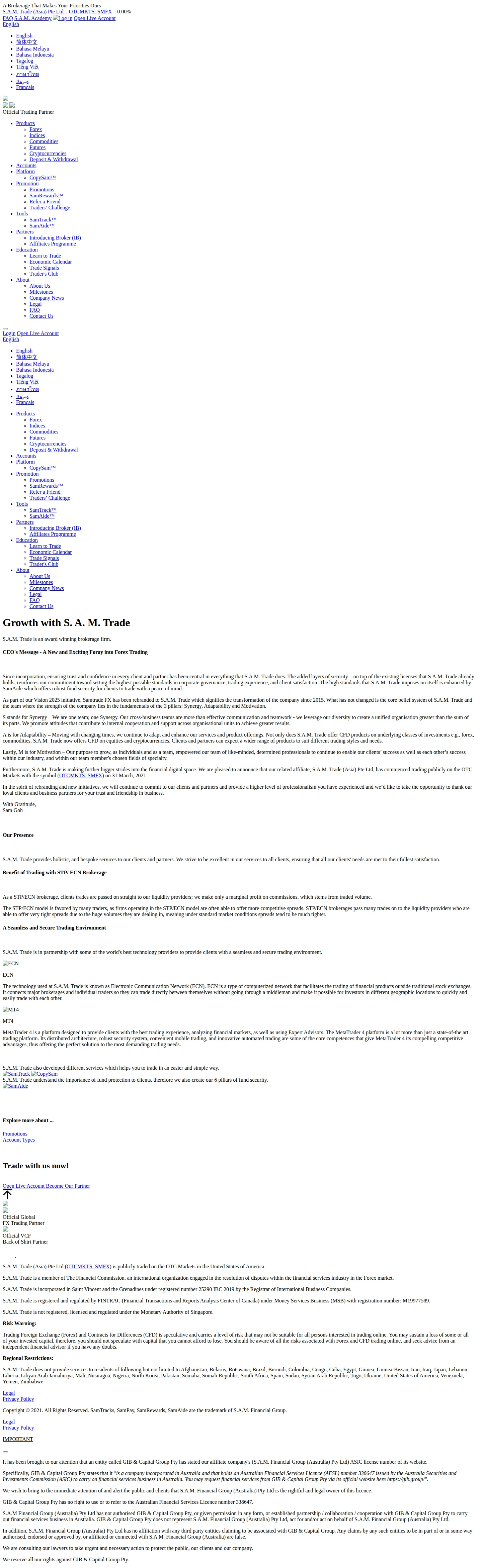
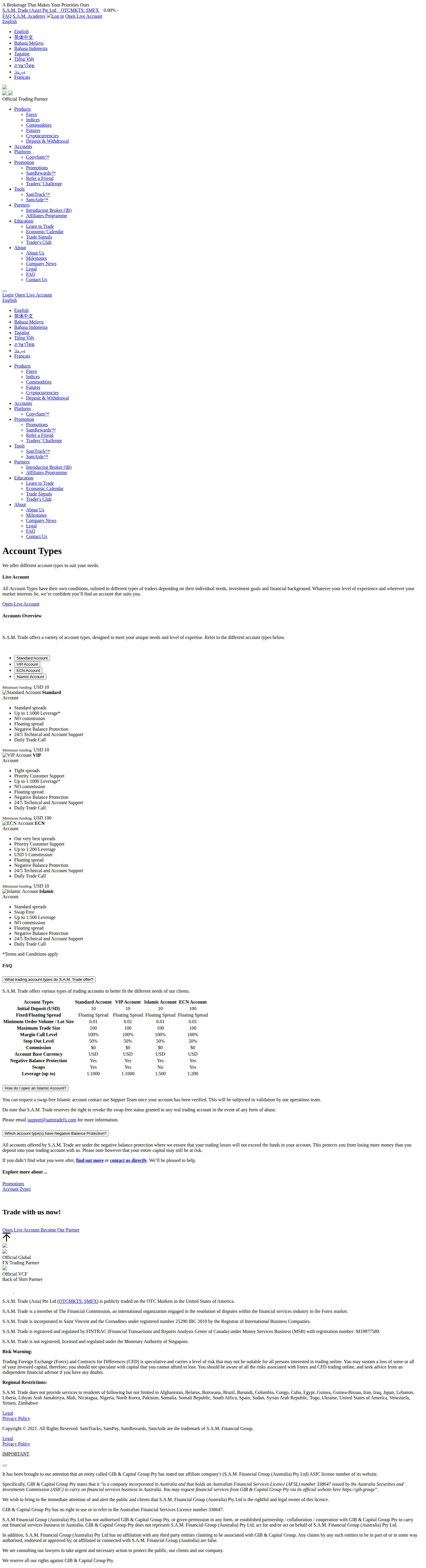
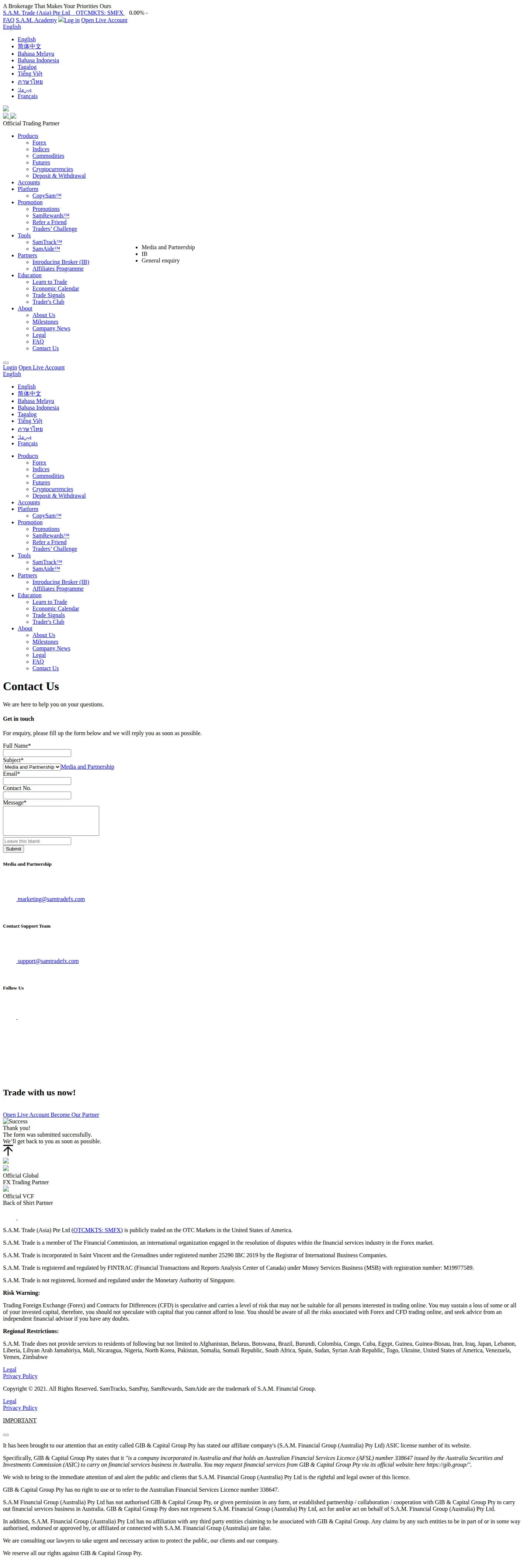
What we saw
Pages captured from S.A.M. Trade’s own site when this review was written. Brokers change their terms; these are what we read.
Score history
Recomputed daily; every move is on the record. The current score is always the latest row.
| Date | Score | Move |
|---|---|---|
| 2026-07-25 | 3.4 | ▲ |
| 2026-07-18 | 3.3 | ▼ |
| 2026-07-11 | 3.4 | · |
FAQ
Is S.A.M. Trade regulated?
No. Its only claimed licence, ASIC AFSL 338647, is not on ASIC’s current register, and no other financial-services licence has been verified.
What is the dispute over S.A.M. Trade's ASIC licence?
The firm’s own about page admits that GIB & Capital Group Pty also claims the same ASIC licence number, 338647.
Is S.A.M. Trade's SVG registration valid?
The SVG IBC number given is registered to a differently named entity, Samtrade FX Ltd, not S.A.M. Trade.
What does S.A.M. Trade charge?
Some fees are published, but no EURUSD spread figure is available for any account a retail client can open.
What trading platform does S.A.M. Trade offer?
Only MetaTrader 4.
How can I contact S.A.M. Trade?
Email is the only published support channel.
How this review works
Track S.A.M. Trade live: score moves and red notices, in your pocket.