
CFD · CHECKED 10 OCT 2026
Fusion Markets review.
Multi-entity CFD broker holding ASIC, FSA Seychelles and VFSC licences
OK-ISH
OUT OF 10
AD DISCLOSURE: IF YOU OPEN AN ACCOUNT THROUGH THIS LINK WE MAY EARN A COMMISSION. IT NEVER MOVES THE SCORE. HOW THIS WORKS
Fusion Markets is a multi-entity CFD broker with confirmed licences from ASIC (tier-1, FMGP Trading Group Pty Ltd), FSA Seychelles (Fusion Markets International Ltd) and VFSC (licence 40256, Gleneagle Securities Pty Limited). Fees, platform choice and review scores are strong, but the ASIC licence covers only part of its clients, and support depends on which entity onboarded you.
Each criterion is scored 1 to 10 from primary sources. The overall score is their unweighted mean. How scoring works.
| Founded | 2017 |
|---|---|
| Headquarters | AU |
| Maximum leverage | 500:1 |
| Withdrawal fee | 0 |
| Account opening | 1-3 |
| Platforms | MetaTrader 4 (MT4), MetaTrader 5 (MT5), cTrader, TradingView, Fusion+ Copy Trading / Multi Account Manager / DupliTrade, Fusion+ Copy Trading, Multi Account Manager, DupliTrade |
- ASIC licence confirmed for FMGP Trading Group Pty Ltd, a tier-1 regulator
- FSA Seychelles registration confirmed for Fusion Markets International Ltd
- VFSC licence 40256 confirmed for Gleneagle Securities Pty Limited
- USD 4.50 round-turn cost on 1 lot EURUSD at average spread, cheapest account
- Wide platform range: MT4, MT5, cTrader and TradingView
- Copy trading via Fusion+ Copy Trading and DupliTrade, plus a Multi Account Manager
- Minimum deposit not published
- Four operating entities span three jurisdictions in a tangled structure
- ASIC licence covers only part of clients; the rest sit under an uncovered entity
- No compensation scheme under the ASIC licence
- Support contact and escalation depend on which entity onboarded the client
Overview
TrueBroker is a free broker safety checker, and this page is our review of Fusion Markets, scored 7.4 out of 10 across regulation, fees, platform, support and reviews. We previously scored this broker 4.1 out of 10. This review restates the score from current evidence: our regulation check against ASIC, the Seychelles Financial Services Authority and the VFSC now returns confirmed results for the licences the firm actually cites, and our reading of the firm’s fee pages and terms found a fee structure and platform range that score well, while the same reading found little published on support hours or live channels, which pulls that component down to 3.8. We attribute the change to our assessment on this pass, not to any change at the firm itself.
“Fusion Markets” is not one company. The firm’s own pages describe three separate regulated entities trading under that name: FMGP Trading Group Pty Ltd, which holds Australian Financial Services Licence No. 385620 and serves Australian clients; Gleneagle Securities Pty Limited, a Vanuatu company trading as “Fusion Markets EN” for international clients; and Fusion Markets International Ltd, a Seychelles registered Securities Dealer. A fourth entity, Fusion Markets Pty Ltd, owns the website and is named as a Corporate Authorised Representative (CAR No. 001275590) under FMGP Trading Group’s AFSL. Which entity a client actually contracts with depends on where they sign up.
What the registers show about Fusion Markets’ regulation
The ASIC professional register, checked 23 September 2026, confirms AFS licence 385620 is held by FMGP Trading Group Pty Ltd (ABN 74 146 086 017), registered since 5 January 2011. That licence covers Australian clients only. The Seychelles FSA lists Fusion Markets International Ltd as a regulated securities dealer, confirming the entity, though the register does not publish licence numbers, so “SD096” remains the firm’s own claim rather than something we could check against the register directly. The Vanuatu Financial Services Commission’s Financial Dealers Licensee List shows Gleneagle Securities Pty Limited (company number 40256), licence class A, B, C, status Active, licensed since 6 January 2023. The VFSC companies registry separately confirms Gleneagle Securities Pty Limited as a registered Vanuatu company under the same number 40256, registered 19 April 2017, though a company registry entry confirms the company, not a licence. ASIC’s authorised representative dataset lists Fusion Markets Pty Ltd as CAR 001275590, current under AFSL 385620 since 1 April 2024. We also searched 1,441 warning list entries mirrored from CySEC, the FCA and the FSC Mauritius, and Fusion Markets appears on none of them. That is a real finding, but it covers only the three lists we mirror, not every regulator worldwide.
The firm’s own pages are inconsistent about the Vanuatu number. The Licensing and Regulations page labels 40256 a “Company Number,” while the homepage footer describes Fusion Markets as “regulated by Vanuatu Financial Services Commission (40256)” in the same breath, using the company number as if it were the licence reference. The VFSC register we checked confirms the company number; it does not separately publish what licence classes A, B and C cover.
Fusion Markets overview table
Overview Table
| Headquarters | Level 10, 627 Chapel St, South Yarra VIC 3141, Australia (per the firm’s Australian contact page) |
| Established | Not stated |
| Countries Served | Not stated as a list; the firm states it cannot take clients from Afghanistan, Congo, Iran, Iraq, Japan, Myanmar, New Zealand, North Korea, Ontario, Palestine, Russia, Spain, Somalia, Sudan, Syria, Ukraine, Yemen, or the United States or its territories |
| Regulated By | ASIC (FMGP Trading Group Pty Ltd, AFSL 385620), Financial Services Authority of Seychelles (Fusion Markets International Ltd), Vanuatu Financial Services Commission (Gleneagle Securities Pty Limited, 40256) |
| Minimum Deposit | No minimum account size on the Zero and Classic account pages; individual payment methods on the fees page list minimums from $1 to $50 USD depending on method |
| Maximum Leverage | Up to 500:1 on forex and metals, per the firm’s own product page |
| Total Instruments | Not stated as a single total; the firm lists 90+ forex pairs and figures of either 110+ or 51 US share CFDs on different pages |
| Platforms | MetaTrader 4, MetaTrader 5, cTrader, TradingView (executed via cTrader), Fusion+ Copy Trading, Multi Account Manager, DupliTrade |
| Customer Support | Email (help@fusionmarkets.com), phone (+61 3 8376 2706), and a web contact form; no support hours or live chat stated in the pages we read |
| Languages | Not stated |
Facts List
- The AFSL that covers Australian clients, No. 385620, is held by FMGP Trading Group Pty Ltd, confirmed on the ASIC register, not by Fusion Markets Pty Ltd, which sits under that licence as a Corporate Authorised Representative.
- International clients are onboarded by either Gleneagle Securities Pty Limited in Vanuatu or Fusion Markets International Ltd in Seychelles, according to the firm’s own legal pages.
- We searched 1,441 warning list entries mirrored from CySEC, the FCA and the FSC Mauritius and found no match for Fusion Markets on any of them.
- The firm’s own fee page states $0 deposit and $0 withdrawal fees across its listed methods, and separately states it covers merchant fees of up to 4% on Neteller, PayPal, Skrill and card deposits on the client’s behalf.
- The withdrawal terms warn that clients who deposit and withdraw “without engaging in significant trading activity” can have those merchant fees charged back to them, with repeated instances leading to account closure.
- Withdrawals are only processed to accounts matching the client’s registered trading name, per the firm’s fee page.
- Trades placed through the TradingView platform are, by the firm’s own description, executed through cTrader’s backend rather than through an independent TradingView venue, and are limited to the Zero or Classic account types.
- The excluded country list on the firm’s own root page includes Spain and New Zealand alongside sanctioned jurisdictions such as Iran, North Korea and Syria.
- The firm’s Terms and Conditions PDFs for the VFSC and Australian entities returned no extractable text on this fetch, so governing law and liability clauses could not be quoted from source for this review.
- The Zero account is described as raw spreads from 0 pips plus commission, while the Classic account bundles commission into the spread from 0.9 pips, per the firm’s own account pages.
Key Takeaways
Our previous score for Fusion Markets was 4.1/10. This review scores it 7.4/10. The move is our reassessment against current evidence, not a change in the firm: fees score 9.5, platform scores 9.2 and reviews scores 8, and the fee and platform evidence below is what a scorer would reward. Support scores 3.8 and regulation scores 6.3, and both stay weak for reasons set out here.
What holds the score up
- The ASIC professional register, checked 23 Sep 2026, confirms AFS licence 385620 is held by FMGP Trading Group Pty Ltd (ABN 74 146 086 017), the entity that serves Australian clients under the Fusion Markets name.
- The Vanuatu Financial Services Commission’s Financial Dealers Licensee List confirms Gleneagle Securities Pty Limited, company number 40256, licence class A, B, C, status Active, licensed since 6 Jan 2023.
- The Seychelles FSA register confirms Fusion Markets International Ltd as a regulated securities dealer, though the register does not publish licence numbers, so the firm’s own claim of “license number SD096” was not itself verified.
- We searched 1441 warning list entries mirrored from CYSEC, the FCA and the FSC Mauritius, and Fusion Markets appears on none of them. That covers only the lists we mirror, not every regulator worldwide.
- The firm’s fee page gives a $0 deposit fee across listed methods and a $0 withdrawal fee across listed methods, and states it covers merchant fees of up to 4% of the deposit amount on Neteller, PayPal, Skrill and Credit Card deposits on the client’s behalf.
- The Zero account carries no minimum account size and spreads from 0 pips plus commission, per the firm’s accounts page; the Classic account has commission built into the spread, from 0.9 pips, also with no minimum account size.
- The firm offers MT4, MT5 and cTrader across desktop, mobile and web, plus TradingView, Fusion+ Copy Trading, a Multi Account Manager and DupliTrade, per its platforms pages.
Where Fusion Markets falls short
- The AFS licence covers only part of the client base the firm’s own pages describe: FMGP Trading Group serves Australian clients, while international clients are onboarded by Gleneagle Securities Pty Limited in Vanuatu or Fusion Markets International Ltd in Seychelles.
- The firm’s own Licensing & Regulations page labels the number 40256 explicitly as a Vanuatu “Company Number,” while the homepage and site footers print the same number in parentheses directly after “regulated by Vanuatu Financial Services Commission.” The VFSC register confirms 40256 as the company number; the firm’s marketing copy does not make clear whether the same figure also serves as a distinct VFSC licence number.
- Fusion Markets Pty Ltd’s “CAR No. 001275590” checks out: ASIC’s authorised representative dataset lists it as current under AFSL 385620 since 1 April 2024.
- Support contact points on the pages we read are limited to one email address, one Australian phone number and a web contact form, with no live chat or stated support hours identified in the evidence.
- The firm’s Terms and Conditions PDFs for the VFSC and Australian entities returned 0 characters of extractable text on this fetch, so governing law, liability caps and other binding contractual clauses could not be verified from source for our evidence.
- The withdrawal terms state that if a client deposits and withdraws “without engaging in significant trading activity,” Fusion Markets reserve[s] the right to apply applicable merchant fees to the client’s account during the withdrawal process, and that “repeated instances of abuse will result in immediate closure of the client’s account.”
- Withdrawals are restricted to accounts matching the client’s registered trading name, and deposits must come from a bank account held in the client’s own name; the firm states it “does not accept payments from third parties.”
- Fusion Markets lists Spain and New Zealand among the jurisdictions it cannot serve, alongside sanctioned markets such as Iran, North Korea and Syria. Spain and New Zealand are neither sanctioned nor high risk, which points to a licensing gap in those two markets specifically rather than a sanctions control.
- A generic disclaimer stating information “is not intended to be an inducement, offer or solicitation to anyone outside of Australia” appears in the footer of pages served to GB, AE, ID, JP and AU visitors alike, suggesting a templated footer reused across geo targeted pages rather than localised disclaimers.
- On one page the firm states its commission as “2.25 USD” (2.25 美元) per side in two places and “2.25 AUD” (2.25 澳元) per side in a third, all describing the same pricing claim.
Licenses & Regulation
Fusion Markets scores 6.3/10 on regulation in this review, up from 4.1/10 previously. The rise reflects a rescoring against current evidence rather than any change at the firm: we searched eleven public registers directly, ran a positive control against a firm known to be listed on each before treating any absence as meaningful, and checked 1,441 warning list entries mirrored from CySEC, the FCA and the FSC Mauritius, on which Fusion Markets appears on none.
Three entities, three regulators
Fusion Markets is not one regulated company but three, and which one a reader ends up contracted with depends on where they sign up. The firm’s own pages name FMGP Trading Group Pty Ltd as the Australian entity, Gleneagle Securities Pty Limited as the Vanuatu entity trading as Fusion Markets EN, and Fusion Markets International Ltd as the Seychelles entity.
The ASIC professional register, checked 23 September 2026, confirms AFS licence 385620 is held by FMGP Trading Group Pty Ltd (ABN 74 146 086 017), registered since 5 January 2011. That licence covers only part of Fusion Markets’ readers: it serves Australian clients, while international readers are onboarded by the Vanuatu or Seychelles entities instead. The ASIC company dataset on data.gov.au separately confirms FMGP Trading Group Pty Ltd as a registered Australian proprietary company, ACN 146 086 017, registered 31 August 2010. ASIC’s authorised representative dataset, also on data.gov.au, confirms a related claim: Fusion Markets Pty Ltd, ACN 622 459 161, is Corporate Authorised Representative 001275590 under AFSL 385620, current since 1 April 2024. The same dataset shows an earlier appointment of the same company under a different licence, AFSL 226199, which ceased on 4 September 2023.
The Seychelles FSA lists Fusion Markets International Ltd as a regulated securities dealer, confirming the entity. The register does not publish licence numbers, so the firm’s own claim of “license number SD096” is not something the register can check either way.
The Vanuatu Financial Services Commission’s Financial Dealers Licensee List confirms Gleneagle Securities Pty Limited, company number 40256, licence class A, B, C, status active, licensed since 6 January 2023. The VFSC does not publish what licence classes A, B and C cover, so they are reported here exactly as the register states them. The Vanuatu company registry separately confirms the same company under International Companies number 40256, status registered, registered 19 April 2017. That registry entry is a company record, not a financial regulator’s licence record, so it confirms the company existed and never substitutes for a licence check.
Where Fusion Markets’ own pages blur the two Vanuatu numbers
Fusion Markets’ homepage and site footers state the firm is “regulated by Vanuatu Financial Services Commission (40256),” presenting 40256 as a regulatory figure. The firm’s own Licensing and Regulations page, by contrast, labels the same figure explicitly as a “Company Number.” The VFSC’s licensee list happens to confirm both readings, since the same 40256 appears there as the licensed company’s registration number, but a reader relying only on the homepage wording would have no way to tell a company registration number from a licence number, and the firm’s own pages do not agree with each other on which one it is.
What we could not check
The firm’s own VFSC and Australian Terms and Conditions PDFs returned no extractable text on this fetch, so governing law, liability caps and other binding contractual clauses could not be verified from source for our evidence.
Where Fusion Markets will not take clients
The firm states it cannot take clients from Afghanistan, Congo, Iran, Iraq, Japan, Myanmar, New Zealand, North Korea, Ontario, Palestine, Russia, Spain, Somalia, Sudan, Syria, Ukraine, Yemen, or the United States or its territories. Spain and New Zealand sit on that list alongside sanctioned jurisdictions, which points to a licensing gap for those two markets specifically rather than a sanctions concern.
How to Trade
Fusion Markets runs three account types across four execution routes, and the fee pages we read set out how the pricing and platform mechanics fit together.
Accounts and instruments
The Zero Account carries raw spreads from 0 pips plus a separate commission, and Fusion Markets’ own accounts page describes it as the most popular choice for traders who calculate their own commissions. The Classic Account folds commission into the spread instead, quoted from 0.9 pips, which the same page frames as “what you see is what you get.” Both accounts carry no stated minimum deposit. A Swap Free account is also offered for Islamic traders, opened by contacting an account manager or support rather than through self-service signup. Across the country pages we read, the tradable range covers 90+ forex pairs, energy (WTI and Brent crude, natural gas), precious metals including gold, silver, zinc, copper and platinum, equity index CFDs, cryptocurrency CFDs described as commission free, soft commodities such as coffee, wheat, cocoa and sugar traded without exchange fees, and share CFDs, with the AE and UK pages citing 110+ US equities and the JP page citing 51, both at $0 broker commission through MetaTrader 5.
Platforms and how TradingView actually executes
Fusion Markets lists four trading platforms: MT4, MT5, cTrader and TradingView, each with desktop, mobile and web versions where applicable. The detail worth flagging sits in the firm’s own platforms page: TradingView “integrates with cTrader’s backend to facilitate trade execution,” meaning a trade placed from a TradingView chart is not routed through an independent TradingView execution venue but through cTrader, and only the Zero or Classic account can be connected to it. On top of the four core platforms, Fusion Markets also offers Fusion+ Copy Trading, a Multi Account Manager tool and DupliTrade, letting clients copy other Fusion clients’ trades or mirror trades across their own accounts.
Execution and leverage
The forex and metals pages describe no dealing desk execution, with forex tradable 24 hours a day, five days a week. The JP page states leverage up to 500:1 on forex and metals, alongside “flexible leverage” on index CFDs, though the flexible-leverage figure itself is not broken out on that page.
What Fusion Markets charges to trade and move money
The AE and UK fee pages state $0 for deposits and $0 for withdrawals across every listed method, and the UK about page repeats no minimum account size on Visa, Mastercard, PayPal, Skrill and Neteller. Fusion Markets separately states it absorbs merchant fees of up to 4% of the deposit amount on Neteller, PayPal, Skrill and Credit Card deposits on the client’s behalf, a cost the firm carries rather than passing on directly. Bank wire deposits carry a $0 fee from Fusion Markets itself, though the AE fees page notes that intermediary or correspondent banks handling international wires into the firm’s Australian trust account typically charge USD $20 to $30, a charge outside Fusion Markets’ control. On the trading cost side, the UK about page cites a comparison conducted by ForexBenchmark, described as a spread and commission comparison of 40+ global FX/CFD brokers holding a Tier 1 licence as of 1 September 2026, putting Fusion Markets’ forex and CFD commission on average 36% lower than its closest competitors on that basis.
The withdrawal rules that bind a client
Two clauses on the fees pages place real conditions on getting money out. First, under Withdrawal Options, Fusion Markets states: “For your security, we only process withdrawals to accounts that match your registered trading name,” so a client cannot redirect funds to a card, e-wallet or bank account held in someone else’s name. Second, the same withdrawal terms cover deposit and withdrawal cycling: In cases where clients deposit funds through available funding methods and subsequently request a withdrawal without engaging in significant trading activity, we reserve the right to apply applicable merchant fees to the client’s account during the withdrawal process… Repeated instances of abuse will result in immediate closure of the client’s account. On the funding side, the AE fees page states plainly that “Fusion Markets does not accept payments from third parties,” requiring deposits to originate from a bank account held in the client’s own name, with joint accounts accepted only where the client is a named holder.
Where Fusion Markets will not take clients
The AE and UK platform pages both list the same set of excluded jurisdictions: Afghanistan, Congo, Iran, Iraq, Japan, Myanmar, New Zealand, North Korea, Ontario, Palestine, Russia, Spain, Somalia, Sudan, Syria, Ukraine, Yemen, and the United States or its territories. Spain and New Zealand sit on that list alongside sanctioned states, which points to a licensing gap in those two markets specifically rather than a sanctions concern.
The regulation score, and why this review moves from 4.1 to 7.4
Our previous review of Fusion Markets scored 4.1 out of 10; this one scores 7.4. That change reflects this review’s own criteria and the evidence gathered for it, not any change at the firm. On regulation, scored here at 6.3, the ASIC professional register confirms AFS licence 385620 sits with FMGP Trading Group Pty Ltd, the VFSC Financial Dealers Licensee List confirms Gleneagle Securities Pty Limited under company number 40256 with licence class A, B, C status active, and the Seychelles FSA register confirms Fusion Markets International Ltd as a registered securities dealer, though the FSA register does not itself publish licence numbers, leaving “SD096” as the firm’s own figure. We also searched 1,441 warning list entries mirrored from CySEC, the FCA and the FSC Mauritius, and Fusion Markets appears on none of them, a clean result that covers only the lists we mirror rather than every regulator worldwide. Fees, scored at 9.5, and platform, scored at 9.2, are supported by the zero deposit and withdrawal fees and the four-platform, copy trading and multi account manager set out above. Support, scored at 3.8, is addressed in the support section of this review rather than here.
Account Types
Fusion Markets sells trading access through two core CFD account types, plus a swap-free variant and a demo. The firm’s account-comparison pages give both core accounts the same headline: no minimum account size to open either one.
Fusion Markets’ Zero and Classic accounts
The Zero Account is described on the firm’s own accounts page as carrying raw spreads from 0 pips plus commission and is pitched as the account for “traders familiar with calculating their own commissions.” The Classic Account is the alternative structure: commission is built into the spread, quoted “from 0.9 pips,” on the logic, in the firm’s own phrase, that “what you see is what you get.” Neither page states a minimum deposit figure beyond “no minimum account size,” though the firm’s payment table elsewhere sets a practical floor of 10 USD on most deposit methods (25-50 USD on a handful of local rails such as VAPay, DuitNow and DurianPay).
Account choice also decides which platforms are open to a client. Fusion states that TradingView “integrates with cTrader’s backend to facilitate trade execution,” and that only the Zero or Classic account can be connected to it; a trade placed from a TradingView chart is actually routed through cTrader, not a separate TradingView venue. MT4, MT5 and cTrader themselves are available to both account types, alongside Fusion+ Copy Trading, a Multi Account Manager tool and DupliTrade.
Swap Free and demo accounts
A Swap Free Account is offered, in the firm’s words, for Islamic traders to trade popular products while adhering to religious principles. Unlike the Zero and Classic accounts, it is not self-service: the accounts page states it is opened by contacting an account manager or support. A Demo Account is also listed among Fusion’s account options, though the pages fetched here give no detail on its duration or starting balance.
Two further names surface on other pages without any pricing or eligibility detail attached: a “Premium Program” appears in the platforms navigation and “Fusion Pro” appears on the Australian about page. The pages we fetched name both but say nothing about what either requires or what it changes for a client, so nothing more can be reported here.
What Fusion Markets charges across these accounts
The firm reports no deposit fee and no withdrawal fee on any listed payment method, and separately states it absorbs the merchant fees, up to 4% of the deposit, that Neteller, PayPal, Skrill and card providers charge on deposits. For headline trading cost, Fusion cites a third-party comparison rather than its own figure alone: its platforms page states its forex and CFD commission runs on average 36% lower than closest competitors, based on a “spread & commission comparison of 40+ global FX/CFD brokers with a Tier-1 licence conducted by ForexBenchmark as of 1 September 2026.” That comparison basis is named and dated, which is more than most brokers publish, but it is ForexBenchmark’s methodology being cited, not an independent figure this review calculated.
One commission figure on the firm’s own Japanese-market page is internally inconsistent: the same pricing claim is given as “2.25 USD (美元)” per side in two places and “2.25 AUD (澳元)” per side in a third, all on one page. A per-side commission quoted in two different currencies on the same page is a discrepancy in the firm’s own headline cost claim, not a rounding issue, and it is worth a trader double-checking their account’s actual contract note rather than relying on that page’s stated figure.
This review scores Fusion Markets 7.4 out of 10, up from a prior 4.1. The fees criterion, at 9.5, is the strongest driver of that move, and the account evidence above is what it rests on: no deposit or withdrawal fees on any listed method, a raw-spread account with no minimum deposit, and a commission claim benchmarked against 40-plus other brokers by a named third party. The regulation criterion sits lower, at 6.3, reflecting that the licence covering Australian clients (FMGP Trading Group Pty Ltd, AFSL 385620) is separate from the entities onboarding clients elsewhere, a distinction covered in this review’s regulation section rather than here.
Negative Balance Protection
Fusion Markets’ terms and conditions are exactly the document that would set out margin call levels, stop-out thresholds and any negative balance protection, and this is the one part of the review where we have to report a gap rather than a finding: the firm’s own Terms and Conditions PDFs, both the Vanuatu (VFSC) version and the Australian version, returned no extractable text when we tried to read them. Nothing about what happens when an account’s losses run past its equity comes from those documents, because we could not get text out of them. Anything below is drawn from the marketing pages Fusion Markets publishes instead.
What the account pages do and do not say
Fusion Markets’ account-types pages describe the Zero account as carrying raw spreads from 0 pips plus commission and pitch it at traders who calculate their own commission, and describe the Classic account as building commission into a spread that starts from 0.9 pips, on the basis that “what you see is what you get.” Both descriptions are about how a trade is priced going in, not about what happens to an account once it is losing. Our review’s extraction of the Zero, Classic and Swap Free account pages for clients avoiding overnight interest turned up no margin call percentage, no stop-out level, and no statement on whether a client’s account balance can be forced negative or, if so, what if anything reverses that.
Which entity actually holds the account matters here
Fusion Markets operates through more than one regulated entity, and the register checks in this review confirm three separately: FMGP Trading Group Pty Ltd holds Australian Financial Services Licence 385620 on the ASIC professional register and serves Australian clients; Gleneagle Securities Pty Limited is licensed by the Vanuatu Financial Services Commission (company number 40256, licence class A, B, C, active since 6 January 2023) and trades as Fusion Markets EN for international clients; and the Seychelles FSA lists Fusion Markets International Ltd as a registered securities dealer, though the FSA register does not publish the licence number the firm quotes (SD096) so that figure remains the firm’s own claim. Whatever a client’s account terms say about margin calls, stop-outs or negative balances would sit inside the contract with whichever of these three entities actually opened the account, and the firm’s own pages route Australian clients to one entity and international clients to either of the other two. The VFSC list does not publish what its licence classes A, B and C themselves cover, so we cannot say from the register alone whether Vanuatu’s licence conditions extend to loss limits on client accounts.
What we could not confirm
Because the Vanuatu and Australian Terms and Conditions PDFs came back with no extractable text, this review cannot quote a stop-out percentage, a margin call trigger, or wording on negative balance protection for any of Fusion Markets’ three entities. That absence is a limit of this fetch, not a description of what the contracts say: the clauses may exist in full and simply were not readable in the copy of the document we pulled. A reader who needs that protection confirmed in writing should ask Fusion Markets directly for the specific clause, by section number, before funding an account at the leverage the firm advertises.
Trading Instruments
Fusion Markets’ own pages describe a product line built around commission and spread structure rather than promotional credit. Swap Free Accounts are offered to Islamic traders to trade popular products while adhering to religious principles, opened by contacting an account manager or support. None of these pages mentions a promotional credit or bonus scheme; they describe pricing only in terms of spread and commission.
What Fusion Markets lists as tradable
The firm’s own pages list forex (90+ currency pairs, described as no dealing desk execution, tradable 24 hours a day, 5 days a week), energy (crude oil WTI, Brent oil, natural gas), precious metals (gold, silver, zinc, copper, platinum and more, tradable long or short), equity indices as CFDs on major world indices, and soft commodities such as coffee, wheat, cocoa and sugar, which the firm states trade without exchange fees or trading commissions. Stocks are offered as Share CFDs, with one page citing 110+ of the largest US equities, describing $0 broker commission through MetaTrader 5, against what the firm calls the $5 to $10 per trade charged by most brokers for US share CFDs. Cryptocurrencies are listed as a CFD category, tradable long or short with leverage and described as commission free. One page states forex and metals leverage up to 500:1.
The platforms Fusion Markets runs this on
The firm lists MetaTrader 4 and MetaTrader 5, each in desktop, mobile app and Webtrader form, alongside cTrader in desktop, mobile and web versions. TradingView is listed as a fourth platform, but Fusion Markets’ own platforms page states that TradingView “integrates with cTrader’s backend to facilitate trade execution,” meaning trades placed through TradingView actually run through cTrader, and only the Zero or Classic account can be connected to it. Beyond execution platforms, the firm lists Fusion+ Copy Trading, letting clients copy trades from other Fusion clients or across their own accounts, a Multi Account Manager, and DupliTrade.
Where the instrument list and the entity structure diverge
What a client can actually trade depends on which entity they are onboarded by, and the asset pages do not flag this. FMGP Trading Group Pty Ltd holds Australian Financial Services Licence 385620, confirmed on the ASIC professional register as at 23 September 2026. Gleneagle Securities Pty Limited, trading as Fusion Markets EN, is confirmed on the Vanuatu Financial Services Commission’s Financial Dealers Licensee List under company number 40256, licence class A, B, C, status Active, licensed since 6 January 2023, though the VFSC does not publish what those licence classes cover. Fusion Markets International Ltd is confirmed by the Seychelles FSA as a registered securities dealer, though that register does not publish licence numbers, so the firm’s own “license number SD096” is not independently checked. The asset and platform pages describe one product range across all three entities without stating which instruments, leverage caps or account types apply under each licence.
Access gaps that cut into the advertised range
Fusion Markets states it cannot take clients from Afghanistan, Congo, Iran, Iraq, Japan, Myanmar, New Zealand, North Korea, Ontario, Palestine, Russia, Spain, Somalia, Sudan, Syria, Ukraine, Yemen, or the United States or its territories. Spain and New Zealand sit on that list alongside sanctioned jurisdictions such as Iran and North Korea, despite being developed, non sanctioned markets, which points to a licensing gap for those two markets specifically rather than a sanctions issue. A reader in either country would not be able to open any of the accounts or trade any of the instruments described above, regardless of what the asset pages advertise.
Our previous score for Fusion Markets was 4.1 out of 10; this review scores it 7.4 out of 10. The scoring criteria and the evidence base both changed between reviews, so this figure is a fresh assessment from current evidence rather than a verdict that the firm’s offering improved or declined. On the evidence gathered this time, the fees score of 9.5 and platform score of 9.2 reflect the commission structure and range of execution platforms described above, while the regulation score of 6.3 reflects the entity split across ASIC, VFSC and FSA Seychelles licences documented in this section.
Education & Analysis
Score for platform, the piece this section maps to, sits at 9.2 out of 10, the highest of the five criteria in this review. That is our assessment of what the firm’s own platform pages describe, not a claim that anything changed on Fusion Markets’ end.
What Fusion Markets offers to trade on
The firm lists four trading platforms across its pages: MetaTrader 4, MetaTrader 5, cTrader and TradingView, each with desktop, mobile and web versions according to the firm’s platforms page. MT5 is named specifically as the platform used for Share CFDs. Alongside the four platforms, the same page lists Fusion+ Copy Trading, a Multi Account Manager and DupliTrade under a “More Platforms” heading, giving traders options to copy trades from other Fusion clients or across their own accounts rather than place every trade manually.
The TradingView listing needs a qualifier the marketing copy does not volunteer up front. Fusion’s own platforms page states that TradingView “integrates with cTrader’s backend to facilitate trade execution”, meaning a trade placed from a TradingView chart is actually executed through cTrader, not through an independent TradingView venue. The same page restricts TradingView access to the Zero or Classic account types only, so it is not available across every account the firm offers.
Account types and how they price execution
Fusion Markets’ accounts pages describe two core account types built around different pricing models. The Zero Account is described as carrying raw spreads from 0 pips plus a commission, pitched at traders who are comfortable calculating their own commission costs, with no minimum account size. The Classic Account instead builds commission into the spread, quoted from 0.9 pips, described on the firm’s own page as “what you see is what you get”. A Swap Free account is offered separately for Islamic traders “to adhere to religious principles” according to the accounts page, opened by contacting an account manager or support rather than through self-service signup. The firm’s Australian pages also reference a “Fusion Pro” account, though the fetched pages give no further detail on what distinguishes it.
Markets available through these platforms
Across the firm’s pages, the instrument list runs to forex (90+ currency pairs, quoted as tradable 24 hours a day, 5 days a week with no dealing desk execution), energy (crude oil WTI, Brent oil, natural gas), precious and base metals (gold, silver, zinc, copper, platinum and more, tradable long or short), equity indices, share CFDs (110+ of the largest US equities on one page, 51 named on another, both quoted at $0 broker commission through MetaTrader 5), cryptocurrency CFDs described as commission free, and soft commodities such as coffee, wheat, cocoa and sugar, which the firm states trade without exchange fees or trading commissions.
Cost claims worth reading carefully
The firm’s about page cites a specific third party comparison for its headline pricing claim: forex and CFD commissions are stated as on average 36% lower than closest competitors, sourced to “a spread & commission comparison of 40+ global FX/CFD brokers with a Tier-1 licence conducted by ForexBenchmark as of 1 September 2026”. That gives readers a named source and a date to check the claim against, which is more than most broker marketing offers, though we did not independently verify ForexBenchmark’s methodology.
Separately, one of the firm’s own pages states its per-side commission as “2.25 USD” (2.25 美元) in two places and “2.25 AUD” (2.25 澳元) in a third, all describing what appears to be the same pricing claim on the same page. That is a currency inconsistency in a headline cost figure on the firm’s own site, and it sits alongside the platform and account detail above as something worth flagging rather than smoothing over.
Awards and review scores the firm surfaces itself
Fusion Markets displays a TrustScore of 4.5 based on 1,728 reviews on its Japanese homepage, a third party score the firm chooses to show rather than one this review independently confirmed. Its about page also lists a “Winner of Lowest Spread Forex Broker” title for 2020 to 2026 credited to Brokerchooser, a “Winner of Lowest Commissions Forex Broker” title for the same years credited to Compare Forex Brokers, and recognition from FX Empire as “Best Discount Forex Broker”, “Best Zero Spread Broker for Commodities” and “Best Day Trading Broker for Beginners”. The underlying methodology behind any of these is not shown on the page carrying the claim.
Special Offers
The pages we fetched for Fusion Markets set out fee waivers and cost-comparison claims, not deposit bonuses, matched credit or time-limited promotional codes. Nothing on the fee pages, account pages or “About” pages we read describes a bonus scheme, so what follows is the fee-waiver and cost-claim material the firm does publish, along with the conditions attached to each.
What Fusion Markets waives on deposits and withdrawals
The firm’s fee page puts the deposit fee at $0 across its listed methods, and states that it separately covers merchant fees, which it puts at up to 4% of the deposit amount, on the client’s behalf for Neteller, PayPal, Skrill and Credit Card deposits. A UK-facing fees page lists the withdrawal fee as 0 USD across all listed withdrawal methods. A separate “About” page repeats the same pattern in marketing language, stating deposit fees of $0 are waived on Visa, MasterCard, PayPal, Skrill & Neteller with “no minimum account size” required to open one.
The Zero and Classic account pages carry the same no-minimum line: the Zero account (raw spreads from 0 pips plus commission) and the Classic account (spreads from 0.9 pips, with commission built into the spread) each list “No minimum account size” as a feature, so on the pages we checked the fee waiver is not gated to a particular account tier or opening balance.
The condition attached to that waiver
The withdrawal-fees page carries a clause that claws the waiver back for a specific pattern of activity, under the heading Withdrawal Options, Important information about withdrawals: “In cases where clients deposit funds through available funding methods and subsequently request a withdrawal without engaging in significant trading activity, we reserve the right to apply applicable merchant fees to the client’s account during the withdrawal process.” The same clause continues: “Repeated instances of abuse will result in immediate closure of the client’s account.” So the $0 deposit and withdrawal fees are not unconditional: a client who funds an account and pulls the money back out without trading through it can be charged the merchant fee the firm otherwise absorbs, and can lose the account for doing it more than once.
Two of the individual withdrawal methods carry a further condition beyond that clawback. The fees page lists Jetonbank withdrawals as $0 fee, 1-2 business days, with the restriction “Needs to have funded with Jetonbank account previously,” and MiFinity withdrawals as $0 fee, instant, with the restriction “Needs to have funded with Jeton account previously.” Both are free, but only to a client who funded the account through that same method first.
Cost claims Fusion Markets uses in place of a bonus
Rather than a credit or a deposit match, the firm’s marketing leans on comparative cost claims. Its “About” page states its forex/CFD commission runs on average 36% lower than closest competitors, attributed to a “spread & commission comparison of 40+ global FX/CFD brokers with a Tier-1 licence conducted by ForexBenchmark as of 1 September 2026.” A separate root page states $0 broker commission on US Share CFDs, contrasted against “most brokers” charging $5 to $10 per trade for the same product.
The same “About” page lists award claims rather than a promotion: “Winner of Lowest Spread Forex Broker” for 2020 to 2026, credited to Brokerchooser, and “Winner of Lowest Commissions Forex Broker” for the same years, credited to Compare Forex Brokers, alongside FX Empire recognition as “Best Discount Forex Broker,” “Best Zero Spread Broker for Commodities” and “Best Day Trading Broker for Beginners.” The page names the outlet behind each claim but does not show the methodology behind any of them.
One figure in this cost pitch does not hold together on the firm’s own site: the same commission claim appears as 2.25 USD (2.25 美元) per side in two places on one page and as 2.25 AUD (2.25 澳元) per side in a third place on that same page. USD and AUD are not the same currency, so at least one of those three statements of the headline commission figure is wrong on the page that carries it. That is a reason to check the fee page for the account and currency actually being opened rather than taking the headline “lower than competitors” figure at face value.
Opening an Account
Fusion Markets does not onboard every client through the same company, and which one signs a new account matters more than the marketing name suggests. The firm’s own Licensing & Regulations page states that FMGP Trading Group Pty Ltd, holder of Australian Financial Services Licence 385620, takes Australian clients, while Gleneagle Securities Pty Limited, a Vanuatu company, and Fusion Markets International Ltd, a Seychelles company, take everyone else. We checked the ASIC professional register on 23 September 2026 and found AFS licence 385620 held by FMGP Trading Group Pty Ltd (ABN 74146086017), confirming the Australian arm. We also checked the VFSC Financial Dealers Licensee List and found Gleneagle Securities Pty Limited (company number 40256, licence class A, B, C, status Active, licensed since 6 January 2023) and the Seychelles FSA register, which lists Fusion Markets International Ltd as a registered Securities Dealer, though the Seychelles register does not publish licence numbers, so “SD096” remains the firm’s own figure rather than something we could match against the record. This split matters at signup: a reader opening an account is contracting with whichever entity their region routes them to, and the regulatory protection attached to that account depends on which one it is. Our earlier score for Fusion Markets was 4.1/10; this review scores it 7.4/10, a move that rests on evidence gathered here and elsewhere in our evidence, including the confirmed AFS, FSA and VFSC entries above and the fee and platform material described in other sections, rather than on any claim that the firm itself has changed.
Choosing an account with Fusion Markets
The firm’s account types page lists a Zero Account (raw spreads from 0 pips plus a separate commission, described as the most popular choice for traders who calculate their own commission costs) and a Classic Account (commission built into the spread, from 0.9 pips, marketed as “what you see is what you get”). Both pages state no minimum account size. A Demo Account and a Swap Free account for Islamic traders are also listed; the account types page says the Swap Free account is opened by contacting an account manager or support rather than through the standard signup flow. Separate navigation on the firm’s platforms page also names a “Premium Program” and, on the Australian site, “Fusion Pro,” though neither page in our evidence sets out what qualifies a client for either.
Funding the account and what Fusion Markets asks to see
The deposit page lists minimums by method: $10 for PayPal, crypto, Skrill and Neteller, 1 AUD for PayID, and $20 for BinancePay. The same page states some methods carry their own verification step before a deposit clears: Jetonbank deposits require that “account must be verified,” and MiFinity deposits require verification once a deposit exceeds the equivalent of EUR150. Beyond those two method specific checks, the account signup pages set out a general identity verification procedure of their own: opening an account calls for the applicant to “Proceed with ID Verification and pass the quiz,” after which, “once your identity is confirmed,” Fusion Markets sends login details by email, with an ID documentation page listed in the site’s navigation.
The deposit page also binds who can fund the account at all: “Fusion Markets does not accept payments from third parties. It is crucial that all deposits into your Fusion Markets trading account originate from a bank account held in your name,” under the Third Party Payments heading of that page. A joint account is accepted only where the client is a named holder on it. On the withdrawal side, the fees page states plainly, “For your security, we only process withdrawals to accounts that match your registered trading name,” so funds can only leave the account the way they came in, under the same name that opened it.
The deposit-and-withdraw clause worth reading before funding
Under “Important information about withdrawals” on the withdrawal page, Fusion Markets reserves a specific right: In cases where clients deposit funds through available funding methods and subsequently request a withdrawal without engaging in significant trading activity, we reserve the right to apply applicable merchant fees to the client’s account during the withdrawal process… Repeated instances of abuse will result in immediate closure of the client’s account. In practice, the firm normally absorbs merchant fees of up to 4% on Neteller, PayPal, Skrill and card deposits on the client’s behalf, per the deposit page; this clause lets it claw those fees back, and eventually close the account, from anyone who deposits and withdraws without trading in between. Our evidence could not read the firm’s Terms and Conditions PDFs for the VFSC and Australian entities, which returned no extractable text, so the governing-law and liability terms that would normally sit alongside this kind of clause are not something we can quote or verify here.
Who Fusion Markets will not open an account for
The firm’s own pages state it “is not able to take clients from Afghanistan, Congo, Iran, Iraq, Japan, Myanmar, New Zealand, North Korea, Ontario, Palestine, Russia, Spain, Somalia, Sudan, Syria, Ukraine, Yemen, or the United States or its territories.” Most of that list is the standard sanctions and high-risk set; Spain and New Zealand sit inside it too, alongside Ontario rather than all of Canada, which reads as a narrower carve-out than a blanket restriction by country. The page does not explain the Spain, New Zealand or Ontario exclusions, and we have nothing else in our evidence that does either, so we report the list as published rather than guess at the reason behind any single entry.
Fusion Markets Pty Ltd, which owns the website, is described as a Corporate Authorised Representative of FMGP Trading Group Pty Ltd under AFSL 385620, carrying “CAR No. 001275590”, and ASIC’s authorised representative dataset lists exactly that appointment as current.
Deposits & Withdrawals
Fusion Markets lists a deposit fee of $0 on every funding method on its fees page, and a withdrawal fee of 0 USD on every method on its withdrawal page. Those two figures carry the section: on our current scoring this firm’s fees criterion comes out at 9.5 out of 10, one of the highest marks in this review, and it is a large part of why the overall score moves from 4.1 in our previous review to 7.4 here. That is our assessment being redrawn on evidence gathered now, not a claim that the firm’s pricing has changed since the last review; we cannot source a before-and-after from a single fee page.
What it costs to fund a Fusion Markets account
The firm’s fee page lists a range of deposit rails, each with its own minimum and processing window: bank wire transfer (minimum 10 USD, 0 USD fee, 1 to 5 business days), Visa/Mastercard, PayPal, Skrill and Neteller (10 USD minimum, instant), PayID for AUD (1 AUD minimum, instant), BinancePay (20 USD minimum, instant), and a long tail of regional rails such as ZotaPay, DragonPay, VNPay, DuitNow, FPX, Pix and MPESA, each with its own minimum and instant or 1 to 2 business day processing. All are quoted at 0 USD deposit fee. Separately, Fusion Markets states it absorbs merchant processing costs on the client’s behalf for Neteller, PayPal, Skrill and Credit Card deposits, describing this as covering fees of up to 4% of the deposit amount itself rather than passing them to the client.
That absorption is not unconditional. The same fee page carries a clawback: “In cases where clients deposit funds through available funding methods and subsequently request a withdrawal without engaging in significant trading activity, we reserve the right to apply applicable merchant fees to the client’s account during the withdrawal process,” and warns that “repeated instances of abuse will result in immediate closure of the client’s account.” A client who deposits by card or e-wallet and withdraws again without trading through the balance can be charged the merchant fee Fusion Markets otherwise covers, and can lose the account entirely if it happens more than once.
Funding is also restricted to the client’s own money. The deposit page states plainly: “Fusion Markets does not accept payments from third parties. It is crucial that all deposits into your Fusion Markets trading account originate from a bank account held in your name.” A joint account is accepted only where the client is a named holder on it; a deposit from a friend’s, relative’s or employer’s account is not.
Getting money out of Fusion Markets
Withdrawal minimums run higher than deposit minimums on some rails. Local bank transfer carries a 10 USD minimum, 0 USD fee and 1 to 2 business day processing; bank wire transfer withdrawal steps up to a 35 USD minimum with 3 to 5 business days and 0 USD fee; crypto withdrawal (BTC, BCH, LTC, ETH ERC20, USDT ERC20, XRP) has a 10 USD minimum, 0 USD fee and is listed as instant, though the firm requires multi-factor authentication plus an email confirmation before it releases funds. Jetonbank and MiFinity withdrawals are restricted to clients who funded through those same channels first. A separate marketing page claims withdrawals are available 24/7 with 85% processed in under an hour, a figure the firm attributes to itself rather than to an outside auditor on that page.
Withdrawals are also locked to identity. The fee page states: “For your security, we only process withdrawals to accounts that match your registered trading name.” A client cannot route a withdrawal to a card, bank account or e-wallet held by someone else, and cannot use a different payee even for convenience.
One cost sits outside Fusion Markets’ own fee schedule. For international bank wires into the firm’s Australian trust account, the fee page notes that intermediary or correspondent banks typically charge USD $20 to $30, and is explicit that this is charged by those banks, not by Fusion Markets, and is outside the firm’s control.
Account minimums and where the two Zero and Classic tiers differ
Neither the Zero Account nor the Classic Account carries a stated minimum account size, per the firm’s account pages. The practical entry cost is instead set by the deposit method: as low as 1 AUD through PayID, or 10 USD through most cards and e-wallets. Where the accounts diverge is in how the spread and commission are packaged, not in what it costs to move money: Zero is priced on raw spreads from 0 pips plus a separate commission, while Classic builds the commission into a wider spread, quoted from 0.9 pips, with no separate line item.
The firm’s own VFSC and Australian terms and conditions documents returned no extractable text on this fetch, so the underlying contractual wording behind the withdrawal clawback and identity-matching rules above could not be checked beyond what the published fee and account pages themselves state.
Customer Support
Support scores 3.8 out of 10 in this review, the lowest of the five criteria we measured for Fusion Markets, and the evidence explains why: the firm gives a reader plenty of addresses and account tiers but very little in the way of a described, working support operation.
How to reach Fusion Markets
The firm’s contact page lists an email address, help@fusionmarkets.com, a phone number tied to the Australian office, +61 3 8376 2706, and a web contact form asking for full name, email address, phone number and message. Three postal addresses appear across the firm’s own pages: Govant Building, BP 1276 Port Vila, Vanuatu, for the Gleneagle Securities entity; CT House, Office No. 9A, Providence, Mahe, Seychelles, for Fusion Markets International Ltd; and Level 10, 627 Chapel St, South Yarra VIC 3141, Australia, for the Australian operation. None of the pages we read set out support hours, a live chat option or a stated response time. That is what our fetch found, not a claim that no such channel exists.
The account pages themselves make a support claim of their own: both the Zero Account and the Classic Account pages list “24/7 support” as a stated feature. A separate marketing page also describes withdrawals as “available 24/7” with 85% of withdrawals processed in under an hour, which speaks to processing speed rather than to a staffed support line, but it is the same 24/7 framing the firm applies to its accounts.
What Fusion Markets’ terms say about withdrawal and deposit requests
The clauses that matter most to a client with a complaint sit in the withdrawal and deposit pages rather than in a dedicated complaints policy. Under “Important information about withdrawals,” the firm states: In cases where clients deposit funds through available funding methods and subsequently request a withdrawal without engaging in significant trading activity, we reserve the right to apply applicable merchant fees to the client’s account during the withdrawal process… Repeated instances of abuse will result in immediate closure of the client’s account. That clause lets Fusion Markets pass on merchant fees it otherwise absorbs, and close the account entirely, if a client deposits and withdraws without trading much in between.
The same withdrawal page states: “For your security, we only process withdrawals to accounts that match your registered trading name.” A client cannot redirect a withdrawal to a card, bank account or e-wallet held by someone else, or in a different name, even where that would be faster. The deposit page carries a matching restriction under “Third Party Payments”: “Fusion Markets does not accept payments from third parties. It is crucial that all deposits into your Fusion Markets trading account originate from a bank account held in your name.” Joint accounts are accepted only where the client is a named holder on that account.
What we could not check
The firm’s own Terms and Conditions PDFs, for both the VFSC and Australian entities, returned no extractable text when we fetched them, so any formal complaints procedure, escalation path or dispute resolution clause that sits in those documents is absent from what we could verify. Everything above comes from the web pages we could read, not from the underlying legal terms, which is itself a gap for a firm whose support channels are otherwise limited to email, phone and a contact form.
Prohibited Countries
Fusion Markets’ root page lists the countries the firm says it cannot take as clients: “Fusion Markets is not able to take clients from Afghanistan, Congo, Iran, Iraq, Japan, Myanmar, New Zealand, North Korea, Ontario, Palestine, Russia, Spain, Somalia, Sudan, Syria, Ukraine, Yemen, or the United States or its territories.” The same list is repeated on the firm’s platforms page. That is the full published list; the review does not add to it or infer additions from silence.
A mixed list, not just a sanctions list
Most of the names on that list are unsurprising for a CFD broker: Iran, North Korea, Syria, Russia, Sudan and the United States sit under sanctions regimes or carry CFD-specific restrictions elsewhere in the industry. Two entries on Fusion Markets’ own list do not fit that pattern. Spain and New Zealand are developed, non-sanctioned markets with functioning financial regulators of their own, and their presence alongside Iraq, Yemen and North Korea does not fit the sanctions pattern that explains the rest of the list. Ontario is named on its own rather than folded into “Canada,” which reads as a provincial securities-law exclusion inside a country the firm otherwise appears willing to serve.
What sits behind the restriction
The register work on this firm explains part of why the list looks the way it does. Fusion Markets operates through three separate entities depending on where a client signs up: FMGP Trading Group Pty Ltd holds Australian Financial Services Licence 385620, confirmed on the ASIC professional register; Gleneagle Securities Pty Limited, trading as Fusion Markets EN, is confirmed as an active licence holder on the Vanuatu Financial Services Commission’s Financial Dealers Licensee List; and Fusion Markets International Ltd is listed by the Seychelles Financial Services Authority as a registered securities dealer, though the Seychelles register does not publish licence numbers, so “SD096” remains the firm’s own claim rather than something we could check against the register itself. The registers do not settle the question either way: the VFSC does not publish what its licence classes cover, the Seychelles FSA lists the entity only as a regulated securities dealer, and the AFSL 385620 record serves Australian clients.
Verifying an identity, not just an address
The country restriction sits next to two other client-facing rules on Fusion Markets’ fee pages that amount to the same kind of check: who is actually allowed to move money in and out. On deposits, the firm’s own fee page states plainly: “Fusion Markets does not accept payments from third parties. It is crucial that all deposits into your Fusion Markets trading account originate from a bank account held in your name,” with joint accounts accepted only where the client is a named holder. On withdrawals, the fee page states the mirror rule: “For your security, we only process withdrawals to accounts that match your registered trading name.” Read together with the country list, the pattern is a firm gating access by identity and jurisdiction at both ends of the relationship, not just at signup.
What we did not find
We searched 1,441 warning-list entries mirrored from the FCA, CYSEC and the Mauritius FSC, and Fusion Markets does not appear on any of them. That is a narrow check, covering only the three regulators our review process mirrors, and it says nothing about the residency restrictions above; a firm can be absent from those specific warning lists and still, as here, exclude clients from named markets for licensing reasons of its own.
This review scores Fusion Markets 7.4 out of 10, up from an earlier score of 4.1. The regulation criterion lands at 6.3, which is the figure most directly informed by this section: the firm holds confirmed licences in Australia, Vanuatu and Seychelles, though none of the three register entries says whether those licences extend to Spain or New Zealand. The overall movement from 4.1 to 7.4 reflects this review’s own reassessment against current evidence, not a change in what the firm does.
Conclusion
Fusion Markets scores 7.4 out of 10 in this review, up from the 4.1 we recorded previously. We are not saying the firm changed; the criteria and the evidence behind them both moved, and the higher number reflects what this pass of checks actually found, not an improvement on Fusion Markets’ part.
Where the 7.4 comes from
Fees score 9.5. The fee page we read lists zero USD deposit and withdrawal charges across nearly every listed payment method, and Fusion Markets states it separately absorbs merchant fees of up to 4% of the deposit amount on Neteller, PayPal, Skrill and Credit Card deposits rather than passing them to the client. Platform scores 9.2, supported by the firm’s own pages listing MT4, MT5 and cTrader across desktop, mobile and web, plus a TradingView integration the firm itself describes as executing through cTrader’s backend. Reviews scores 8, reflecting the TrustScore of 4.5 from 1,728 reviews that Fusion Markets displays on its own homepage, a figure we are reporting as the firm’s own surfaced statistic, not one we independently verified.
Regulation sits lower, at 6.3. The ASIC register we searched on 23 September 2026 confirms AFS licence 385620 is held by FMGP Trading Group Pty Ltd, the entity serving Australian clients, and the VFSC Financial Dealers Licensee List confirms Gleneagle Securities Pty Limited, company number 40256, holds an active licence covering classes A, B and C. The Seychelles FSA register confirms Fusion Markets International Ltd as a registered securities dealer, though that register does not publish licence numbers, so the firm’s own “SD096” remains uncorroborated by the register itself. What pulls the score down is the split structure: three separate entities, three separate regulators, and a reader has to know which one is onboarding them. The firm’s own pages also label the number 40256 inconsistently, as a VFSC regulation number in one place and a Vanuatu company number in another, on the same site. Support scores lowest, at 3.8. The evidence here amounts to two email addresses, a phone number, a contact form and postal addresses in Vanuatu, Seychelles and Australia; there is no live chat channel or stated response time in what we read.
What Fusion Markets’ own terms bind a client to
The withdrawal terms we read state: In cases where clients deposit funds through available funding methods and subsequently request a withdrawal without engaging in significant trading activity, we reserve the right to apply applicable merchant fees to the client’s account during the withdrawal process… Repeated instances of abuse will result in immediate closure of the client’s account. A client who deposits and withdraws without trading meaningfully in between can be charged the merchant fees Fusion Markets otherwise absorbs, and can lose the account outright for repeat instances. Withdrawals are also restricted to “accounts that match your registered trading name,” and deposits must come from an account held in the client’s own name, so third party funding is not accepted.
We searched 1,441 warning list entries mirrored from CYSEC, the FCA and the FSC Mauritius, running a positive control first so an empty result means absence rather than a broken search, and Fusion Markets appears on none of them. That covers only the regulators we mirror, not every warning list in existence, but it is a clean result worth stating plainly.
The firm’s own Terms and Conditions PDFs for the VFSC and Australian entities returned no extractable text on this fetch, so governing law, liability caps and other binding clauses in those documents could not be checked from source for this review.
Fusion Markets combines fee terms and a platform lineup that score near the top of this review with a support setup limited to email, phone and a contact form, and a regulatory footprint split across three entities in Australia, Seychelles and Vanuatu. That combination lands the firm at 7.4 out of 10.
What we saw
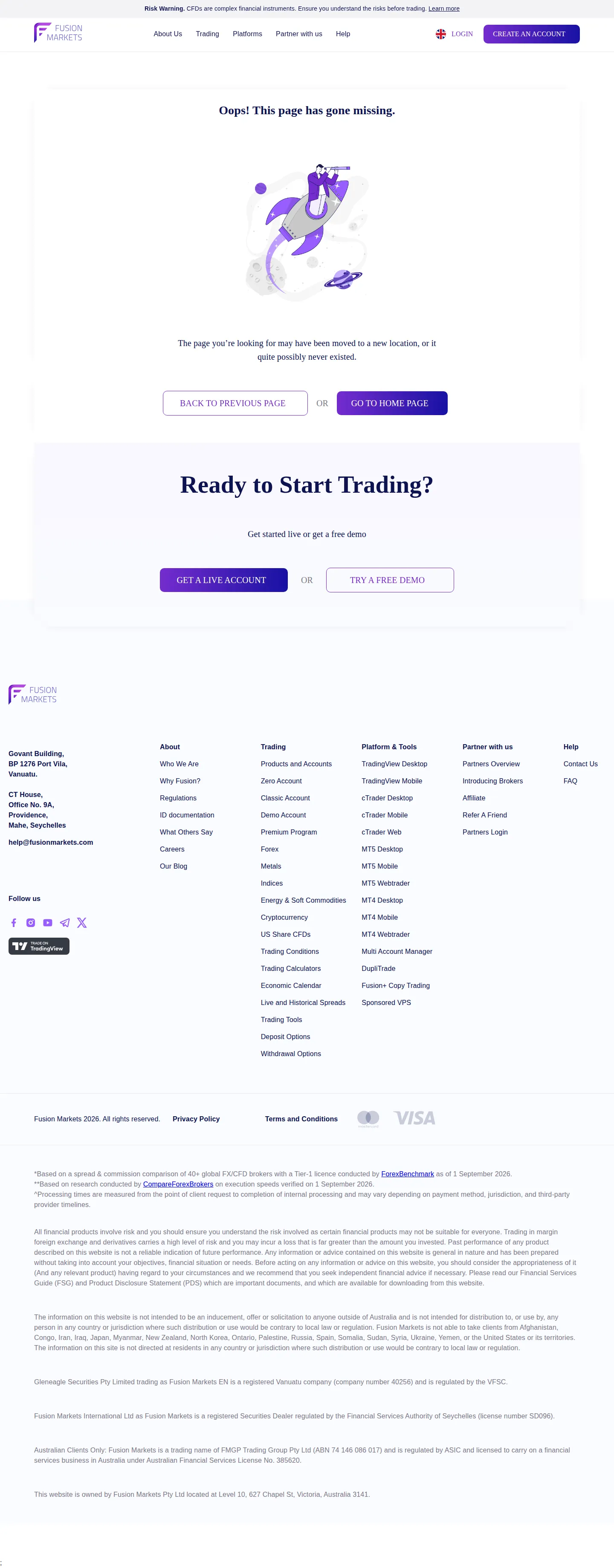
Pages captured from Fusion Markets’s own site when this review was written. Brokers change their terms; these are what we read.





Score history
Recomputed daily; every move is on the record. The current score is always the latest row.
| Date | Score | Move |
|---|---|---|
| 2026-09-29 | 7.4 | ▲ |
| 2026-07-25 | 4.1 | ▲ |
| 2026-07-18 | 4.0 | ▲ |
| 2026-07-11 | 3.9 | · |
FAQ
Is Fusion Markets regulated?
Yes, it holds a confirmed ASIC licence (tier-1) for FMGP Trading Group Pty Ltd, an FSA Seychelles registration for Fusion Markets International Ltd, and VFSC licence 40256 for Gleneagle Securities Pty Limited.
What does Fusion Markets charge?
USD 4.50 round turn on 1 lot EURUSD at average spread on its cheapest qualifying account; the minimum deposit is not published.
What trading platforms does Fusion Markets offer?
MetaTrader 4, MetaTrader 5, the MetaTrader web terminal, cTrader, TradingView, Fusion+ Copy Trading, DupliTrade and a Multi Account Manager.
Does the ASIC licence cover all Fusion Markets clients?
No, the ASIC licence covers only part of the client base, with the rest routed to an entity ASIC does not cover.
How do I contact Fusion Markets support?
By email or a published phone number, though which entity answers and what escalation you get depends on which entity onboarded you.
What do reviews say about Fusion Markets?
It has a blended average of 4.59 stars across 10,332 ratings.
How this review works
Track Fusion Markets live: score moves and red notices, in your pocket.