
CFD · CHECKED 10 OCT 2026
Plus500 review.
Multi-jurisdiction CFD broker with confirmed licences but fee-disclosure gaps
OK-ISH
OUT OF 10
AD DISCLOSURE: IF YOU OPEN AN ACCOUNT THROUGH THIS LINK WE MAY EARN A COMMISSION. IT NEVER MOVES THE SCORE. HOW THIS WORKS
Plus500 is a CFD broker with confirmed licences from the FCA, ASIC, CySEC, FSCA, Seychelles FSA and UAE SCA. Standard cost items like overnight funding and inactivity fees are published, but several withdrawal-related charges only appear in the user agreement, not the fee pages, and no independent review or complaint data exists to check real-world conduct.
Each criterion is scored 1 to 10 from primary sources. The overall score is their unweighted mean. How scoring works.
| Minimum deposit | IDR 1,000,000 (Indonesia); $100 per our earlier review |
|---|---|
| Maximum leverage | 1:300 |
| Minimum spread | 0.8 |
| Account opening | 1-2 |
| Platforms | Web-Platform (Plus500's own web trading platform), Mobile app |
- FCA licence 509909 confirmed for Plus500UK Ltd
- ASIC licence 417727 confirmed for Plus500AU Pty Ltd
- CySEC licence 250/14 confirmed for Plus500CY Ltd
- Also confirmed with FSCA South Africa, Seychelles FSA and UAE SCA
- Overnight funding, FX conversion and inactivity fees are published
- Platform runs on live market quotes, not fabricated prices
- Plus500AE (DFSA) not authorised to hold client money; funds sit with Plus500CY
- $10 fee past 5 withdrawals/month only disclosed in clause 19.4 of user agreement
- $10 sub-minimum withdrawal fee and up to $6 bank-transfer fee also hidden there
- No MT4/MT5 or third-party platform, and no API
- UK, UAE and Australia contact pages returned fee content, not support info
- Singapore's own site lists two conflicting phone numbers for itself
Overview
TrueBroker is a free broker safety checker, and this page is our review of Plus500, scored 7.3 out of 10 across regulation, fees, platform, support and reviews.
The single thing worth knowing before anything else: the FCA Warning List and Register‘s own warning list names “Plus-500” as an unauthorised firm, and the register itself marks that entry as a clone of an authorised firm, verified on the register on 27 July 2026. Our search of 934 mirrored warning-list entries found that one match under this firm’s own name, plus five further entries carrying the Plus500 name that are not this firm: Fx Plus500, p500.io, plus500v.com and plus500un.com, all four marked by the FCA register as clones, and Plus 500 Pro, which the register lists as unauthorised with no clone marker attached. None of this means the broker reviewed here is itself unauthorised. The FCA register separately confirms an active authorisation, FRN 509909, held by Plus500UK Ltd. The practical point for a reader is to check the domain and the entity name carefully before funding an account carrying this brand, because more than one impersonator using the Plus500 name is on the FCA’s own list.
How Plus500 Is Structured Across Jurisdictions
“Plus500” is not one company. Plus500 Ltd is the group’s parent, listed on the London Stock Exchange under the ticker PLUS and a constituent of the FTSE 250 and STOXX Europe 600. Underneath it sit separately licensed operating entities: Plus500UK Ltd (FCA FRN 509909, Companies House number 07024970), Plus500CY Ltd (CySEC licence 250/14), Plus500EE AS (Estonia, EFSA), Plus500AU Pty Ltd (ASIC AFSL 417727, which also carries New Zealand’s New Zealand FSP register search licence FSP486026 and South Africa’s FSCA licence 47546), Plus500SG Pte Ltd (Plus500SG Pte Ltd Singapore MAS licence licence CMS100648), Plus500SEY Ltd (Seychelles Seychelles FSA licence licence SD039, serving Thailand and much of Asia), Plus500BHS Ltd (Bahamas Securities Industry Authority licence SIA-F250) and Plus500CA Ltd (a CIRO investment dealer member). In the UAE, Plus500AE Ltd holds DFSA licence F005651 but states on its own legal page that it is “not authorized to hold client assets or client money”; the CFD service it gives access to is actually provided by Plus500CY Ltd, while a separate onshore company, Plus500Gulf Securities LLC, holds its own UAE UAE commercial license licence. Indonesia is served by PT Plus500 Indonesia Futures, a locally licensed futures broker under BAPPEBTI, OJK and Bank Indonesia, on its own site, plus500.co.id, which is not the plus500.com site reviewed here. A wholly different regulated product, US futures rather than CFDs, is offered by Plus500US Financial Services LLC, registered with the CFTC and the CFTC and the NFA under NFA ID 0001398. The Vietnam and India pages are run under the name “InvestSoft” rather than any Plus500-branded subsidiary, and state that CFD services are not offered to residents of either country.
Overview Table
| Headquarters | There isn’t one combined group headquarters; the registered address for Plus500UK Ltd is 8 Angel Court, Copthall Avenue, London EC2R 7HJ |
| Established | The group has no single founding date; Companies House records show Plus500UK Ltd (company number 07024970) was incorporated on 21 September 2009 |
| Countries Served | UK, EEA (Cyprus, Estonia), Australia, New Zealand, South Africa, Singapore, UAE, Seychelles-served Asia region, Thailand, Vietnam, India, Indonesia, Bahamas, Canada, Japan, and the US (futures product only) |
| Regulated By | FCA, CySEC, ASIC, CIRO, DFSA, Israel Securities Authority, EFSA (Estonia), FMA (New Zealand), FSCA (South Africa), MAS (Singapore), Seychelles FSA, UAE SCA, SCB (Bahamas), BAPPEBTI/OJK/Bank Indonesia, JFSA, and NFA/CFTC via the separate US futures entity |
| Minimum Deposit | Our earlier review recorded a $100 minimum via card or e-wallet, rising to $500 for bank transfers; the Indonesian entity’s own website separately quotes Rp 1,000,000 |
| Maximum Leverage | There’s no single leverage figure across the group; our earlier review found the Plus500EE (Estonia) entity capping retail trades in major currency pairs at 1:30, while professional accounts could go up to 1:300 on forex and indices |
| Total Instruments | No group-wide instrument count is published; our earlier review counted 60+ forex pairs, 1,900+ share CFDs, 29 indices, 24 commodities, up to 19 cryptocurrencies, 96 ETFs and a range of options |
| Platforms | Our earlier review described the platform lineup as the browser-based WebTrader alongside dedicated iOS/iPad, Android and Windows apps |
| Customer Support | Our earlier review turned up 24/7 live chat and WhatsApp support along with a web form; the UK, EEA, South African, Seychelles and Thai contact pages we checked did not list a phone number, though the Singapore and Indonesia pages did |
| Languages | No complete list of supported languages exists; among the pages we checked, our earlier review turned up only one country-specific language pledge for support, Bahasa Indonesia |
Facts List
- Citing the group’s audited annual report, our earlier review noted that Plus500 Ltd, the LSE-listed parent company, reported $792.4m in FY2025 revenue, with $348.1m in EBITDA and $281.3m in net profit.
- The FCA register confirms FRN 509909 as an active authorisation held by Plus500UK Ltd, effective since 29 June 2010, with Companies House number 07024970.
- The CySEC register confirms Plus500CY Ltd under licence 250/14 in its list of Cypriot investment firms.
- The ASIC register confirms AFS licence 417727 held by Plus500AU Pty Ltd (ACN 153 301 681), the same entity that also carries New Zealand’s FMA licence FSP486026 and South Africa’s FSCA licence 47546.
- The FCA’s own warning list names “Plus-500” as an unauthorised firm the register itself calls a clone of an authorised firm, verified on the register on 27 July 2026, alongside four further Plus500-named clone entries and one further unauthorised entry, Plus 500 Pro, carrying no clone marker.
- A separately licensed local business, PT Plus500 Indonesia Futures, serves Indonesia under BAPPEBTI licence 587/BAPPEBTI/SI/XII/2004; its own site gives plus500.co.id as its address, not the plus500.com site under review here.
- Plus500AE Ltd holds DFSA licence F005651 but states on its own legal page that it is “not authorized to hold client assets or client money”; the CFD service it facilitates access to is provided by Plus500CY Ltd.
- Plus500US Financial Services LLC, a separate company from the CFD entities, is registered with the NFA under NFA ID 0001398 and with the CFTC as a Futures Commission Merchant, offering futures rather than CFDs to US residents.
- Plus500’s own UK page discloses that 76% of retail investor accounts lose money trading CFDs with this provider, as its mandatory regulatory disclosure.
- The Vietnam and India pages are run under the name “InvestSoft” rather than any Plus500-branded subsidiary, and state that CFD services are not offered to residents of either country.
Key Takeaways
Why the regulation score holds
Plus500 operates through a genuinely large set of licensed entities rather than one holding company routing everyone through a light-touch jurisdiction. The FCA register confirms FRN 509909 for Plus500UK Ltd, authorised since 29 June 2010, and the same register carries Companies House number 07024970. The Cyprus Securities and Exchange Commission register confirms Plus500CY Ltd under licence 250/14. The Australian Securities and Investments Commission confirms AFS licence 417727 for Plus500AU Pty Ltd, and the same Australian entity also holds FSP 486026 on New Zealand’s Financial Markets Authority register and FSP 47546 on South Africa’s Financial Sector Conduct Authority register. The Dubai Financial Services Authority lists Plus500AE Ltd under reference F005651. Singapore’s Monetary Authority confirms Plus500SG Pte Ltd holds a capital markets services licence, though its directory does not publish the licence number itself. Canada’s CIRO directory lists Plus500CA Ltd as an investment dealer, and the US National Futures Association’s BASIC register confirms Plus500US Financial Services LLC under NFA ID 0001398 as an approved member and registered Futures Commission Merchant, a separate futures business rather than the CFD product sold elsewhere. The Seychelles FSA, the Bahamas Securities Commission and the UAE Capital Market Authority all confirm the named entity is on their registers, though none of those three registers publishes a licence-number field, so the company is verified while the specific number the firm quotes is not.
Indonesia is a different case. PT Plus500 Indonesia Futures appears on the BAPPEBTI legality register under licence 587/BAPPEBTI/SI/XII/2004, on the Jakarta Futures Exchange member list, and on Bank Indonesia’s register of foreign exchange and money market futures participants, but the BAPPEBTI-listed website on that entry is plus500.co.id, not the plus500.com site this review covers, and it is a separate company from the CFD entities above.
What Plus500AE Ltd does and doesn’t do
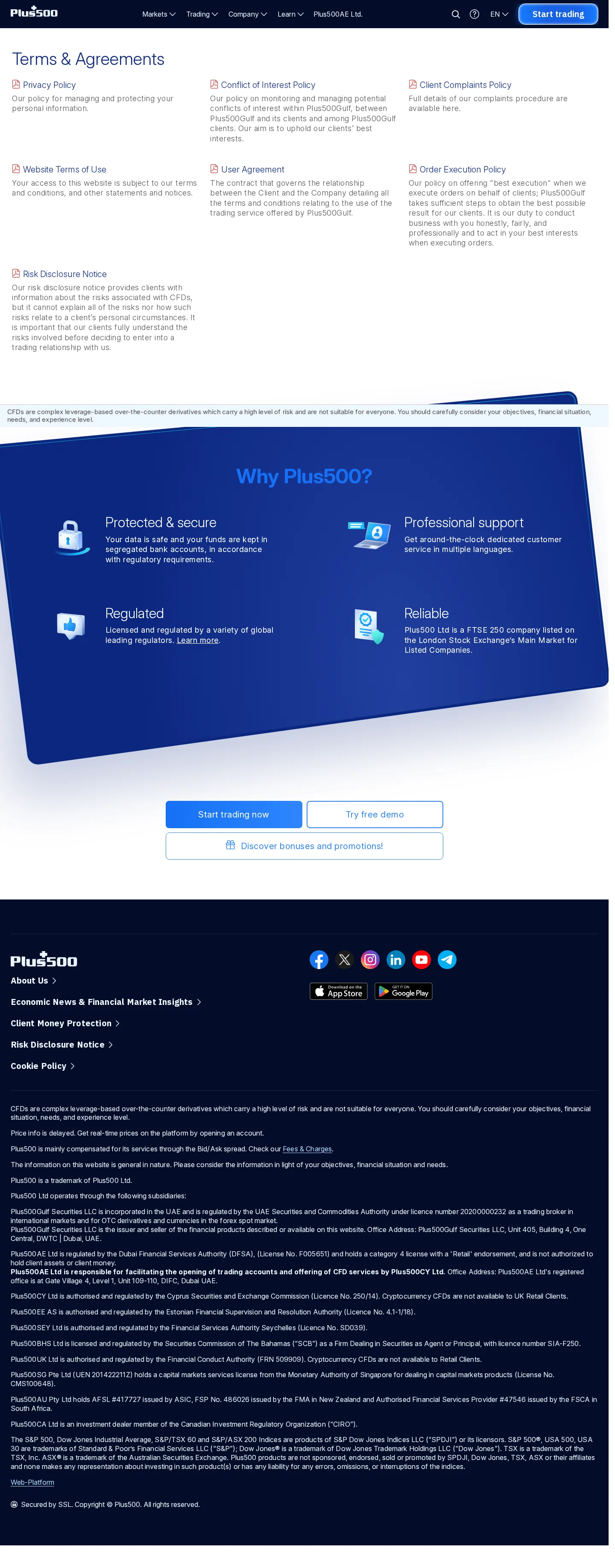
Plus500’s own legal disclosures for the UAE site state that Plus500AE Ltd, despite holding DFSA licence F005651, “is not authorized to hold client assets or client money”; the CFD service itself is provided by Plus500CY Ltd. A client onboarding through the UAE-facing pages is dealing with a Cyprus-regulated counterparty for their money, not the DIFC entity whose licence number appears on the page.
The one warning-list match, and the five that aren’t this firm
Our search of 934 mirrored warning-list entries across CySEC, the FCA and the FSC Mauritius turned up one entry naming this firm: the FCA register lists “Plus-500” as a clone of an FCA-authorised firm, status Unauthorised. That is a fraudulent site trading on the Plus500 name, not the regulated broker reviewed here, which is why checking the domain before depositing matters. The same FCA search surfaced five further entries that also use the Plus500 name but are not this firm: “Fx Plus500”, “p500.io”, “plus500v.com” and “www.plus500un.com” are each listed by the FCA register as a clone of an authorised firm; “Plus 500 Pro” is listed as Unauthorised with no clone marker on the entry itself.
What Plus500 charges
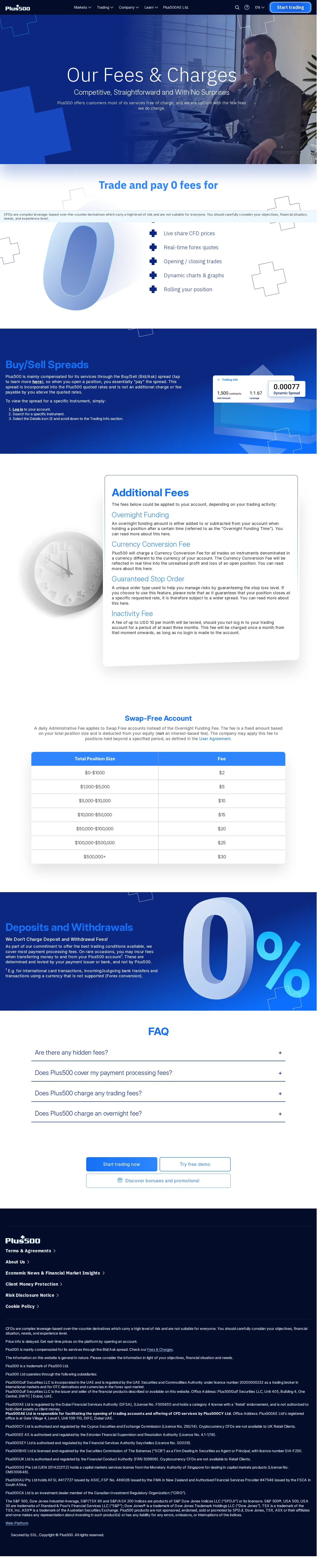
The firm’s own UK fees page confirms an inactivity fee of up to $10 a month, charged after three months with no login and deducted only from a Real Money account with sufficient funds, and a currency conversion fee of up to 0.7% applied to a trade’s realised net profit and loss where the instrument’s currency differs from the account currency. The same page describes a swap-free account administrative fee running from $2 a day on a $0-$1,000 position up to $30 a day on a $500,000-plus position, charged in place of overnight funding. Rather than a flat fee, the cost of a Guaranteed Stop is built into a wider spread, and once the stop triggers, that widened spread cannot be refunded.
An earlier review of the firm’s user agreements, not fetched first-hand here, reported that clause 19.4 caps free withdrawals at five per calendar month and charges $10 for each withdrawal beyond that, $10 for any withdrawal below a payment method’s minimum, and up to $6 in bank transfer processing charges.
Contract terms an earlier review found worth flagging
The same earlier review, describing clauses in the Seychelles and Indonesian user agreements rather than pages we fetched ourselves, reported that clause 15.16 treats any automated data-entry system, including expert advisors or copy-trading tools, as grounds to void the trades placed through it and to close and freeze accounts; that clause 11.7 lets Plus500 accept or refuse a Guaranteed Stop at its discretion and, once accepted, allows only the stop level to be moved, not the stop cancelled; and that the Indonesian agreement lets the company cut leverage whenever it chooses, without publishing a maximum leverage figure anywhere on the Thai or Indonesian sites. It also reported that Seychelles-region complaints run on a 2-business-day holding response, a 21-business-day resolution target and a 90-business-day final response, longer than the EEA timeline it compared it against, with escalation limited to the Seychelles FSA.
Platform and getting help from Plus500
There is a single proprietary WebTrader plus iOS, Android and Windows apps; no third-party platform is offered. Support runs on live chat and WhatsApp rather than phone across the UK, EEA, South African, Seychelles and Thai contact pages, though Singapore, Indonesia and Japan pages do publish phone numbers, and Indonesia is the one market where the firm’s own pages commit to dedicated Bahasa Indonesia support across live chat, WhatsApp and the contact form.
Licenses & Regulation
Plus500 is not one regulated company but a group of separately licensed entities trading under a shared brand, and the licence a visitor actually deals with depends on which geo-site they land on.
The core licences we confirmed
Plus500UK Ltd holds FRN 509909 on the Financial Conduct Authority register, status Authorised, effective 29 June 2010, with Companies House number 07024970 attached to the same entity. Plus500CY Ltd appears on the Cyprus Securities and Exchange Commission register of Cypriot investment firms under licence 250/14, an active entry with no revocation or withdrawal language, though the CySEC page confirms the CIF licence specifically rather than a general company status. Plus500AU Pty Ltd holds Australian Financial Services Licence 417727 with ASIC, and the same entity is listed by the Financial Markets Authority of New Zealand as FSP486026 (Derivatives issuer, licensed since 30 September 2016) and by South Africa’s Financial Sector Conduct Authority as FSP 47546, status Authorized. Plus500SG Pte Ltd is on the Monetary Authority of Singapore’s Financial Institutions Directory as a Capital Markets Services Licensee and Exempt Financial Adviser, covering dealing in capital markets products and OTC derivatives contracts, though the directory itself publishes no licence number to check the firm’s quoted CMS100648-1 against. Plus500US Financial Services LLC is on the NFA’s BASIC register under NFA ID 0001398, “NFA Member Approved” since 21 September 1983, with a current CFTC registration as a Futures Commission Merchant.
Entries the registers confirm only in part
Several of the group’s other licence claims check out for the company but not for the number quoted. The UAE Securities and Commodities Authority register lists Plus500Gulf Securities L.L.C. as CP-0001317, status Active, with plus500.com given as its website; the register publishes a CP code rather than the licence number the firm quotes, so the company is confirmed and the number isn’t. The Securities Commission of The Bahamas registrant list carries PLUS500BHS Ltd for dealing in capital market instruments as agent or principal, but publishes no registration-number column at all, so the firm’s quoted SIA-F250 can’t be checked against it. The same pattern holds for the Seychelles FSA entry for Plus500SEY Ltd and the Estonian Finantsinspektsioon listing for Plus500EE AS: both registers list the company among licensed firms without publishing licence numbers. The Dubai Financial Services Authority register does confirm Plus500AE Ltd under reference F005651 as an Authorised Firm, but the firm’s own legal page states Plus500AE Ltd “is not authorized to hold client assets or client money” and only facilitates account opening; the CFD service itself is provided by Plus500CY Ltd, so a UAE visitor onboarding through the DFSA-licensed entity is not actually contracting with the fund-holding counterparty.
Indonesia is a separate licensed business, not a CFD subsidiary
PT Plus500 Indonesia Futures is on Indonesia’s BAPPEBTI legality register under licence 587/BAPPEBTI/SI/XII/2004 as a Pialang Berjangka (futures broker), but the register gives its website as plus500.co.id, not plus500.com, the site this review covers. The firm’s second quoted BAPPEBTI number, for an Alternative Trading System approval, does not match what the register shows for that entity. Bank Indonesia separately lists it as a licensed Foreign Exchange and Money Market Futures Commission Merchant, and it carries exchange and clearing memberships with the Jakarta Futures Exchange, ICDX and the Indonesia Clearing House, none of which is itself a financial-services licence. The Indonesian OJK principal-approval number the firm quotes could not be checked; we hold no per-firm lookup for that register.
What the warning-list search found
We searched 934 warning-list entries mirrored from CySEC, the FCA and the FSC Mauritius. One entry matches this firm’s own name directly: the FCA register lists “Plus-500” as a clone of an FCA-authorised firm, status Unauthorised. A clone listing means a scammer is using the Plus500 name against an FCA-authorised firm’s identity, not that the reviewed entity is the one being warned about; the FCA’s own confirmed, currently-Authorised record for Plus500UK Ltd under FRN 509909 is the genuine one. Five further lookalike entries turned up on the same registers and are not this firm: “Fx Plus500”, “p500.io” and “plus500v.com”, and “www.plus500un.com” are each named by the FCA register as a clone of an authorised firm, while “Plus 500 Pro” is listed as Unauthorised with no clone marker on the entry. A reader searching the brand name should expect to hit several of these before finding the genuine site.
Company registries versus regulators
Companies House confirms Plus500UK Ltd as company 07024970, active since 21 September 2009; the ACRA dataset confirms Plus500SG Pte Ltd as UEN 201422211Z, a live company since 2014; and the ASIC company dataset confirms Plus500AU Pty Ltd as ACN 153 301 681, registered since 2011. These are company registries, not financial regulators, so they confirm the corporate entities exist and never substitute for a licence. Plus500Gulf Securities LLC’s UAE company registration number and the Israel Securities Authority “Company No” figure attached to the group’s Israeli entity were both left unchecked, the first because the Dubai registry answers only a person in a browser and the second because we hold no register entry for that authority.
How to Trade
What Plus500 lists to trade
Plus500’s own site groups its CFD markets under Indices, Forex, Commodities, Shares, Crypto, Options and ETFs, plus a separate Futures category on the US-facing Plus500US site covering crypto, equity indices, energy, metals, forex, agriculture, interest rates and single stocks. Our earlier review put rough counts on these: 60-plus forex pairs, 1,900-plus share CFDs, 29 indices, 24 commodities, up to 19 cryptocurrencies and 96 ETF CFDs, alongside options CFDs on stocks and indices; those figures are the earlier review’s, not something we counted ourselves from a live instrument list. Crypto CFDs are not available to UK Retail Clients, whether the account sits with Plus500UK Ltd or is served through Plus500CY Ltd, according to the firm’s own UK page. Indonesia is the one market that looks structurally different: its own site menus only Indeks, Forex, Komoditas and Saham, with no Crypto category, and the business behind it, PT Plus500 Indonesia Futures, runs under BAPPEBTI, OJK and Bank Indonesia rather than as a CFD subsidiary of the group.
Platforms
Trading itself happens on Plus500’s own tools rather than a third-party terminal. The firm’s UK legal page refers to its browser platform as the “Web-Platform,” and an earlier review described the same offering as a proprietary WebTrader alongside branded iOS, Android and Windows apps. Group-wide FY2025 figures from Plus500 show 89% of OTC revenue and 85% of customer OTC trades coming through mobile and tablet devices, numbers that point to a platform built first and foremost for manual trading on a handset rather than for desktop use or automated strategies.
What happens once a position is open
Overnight funding is formula-based rather than a flat charge: the firm’s Fees & Charges material gives it as Trading Size × Opening Price × Point Value × Daily Overnight Funding %, applied when a position is held open past the platform’s “Overnight Funding Time.” Where a client opts for a swap-free account instead, Plus500’s fee page lists a daily administrative charge in place of that funding, running from $2 on a position of $0 to $1,000 up to $30 on a position of $500,000 or more; the firm describes this as an equity deduction rather than an interest charge. Any instrument denominated in a currency other than the account currency also carries a currency conversion fee, which the firm’s fee pages give as up to 0.7% of the trade’s realised net profit and loss, applied in real time to unrealised profit and loss too.
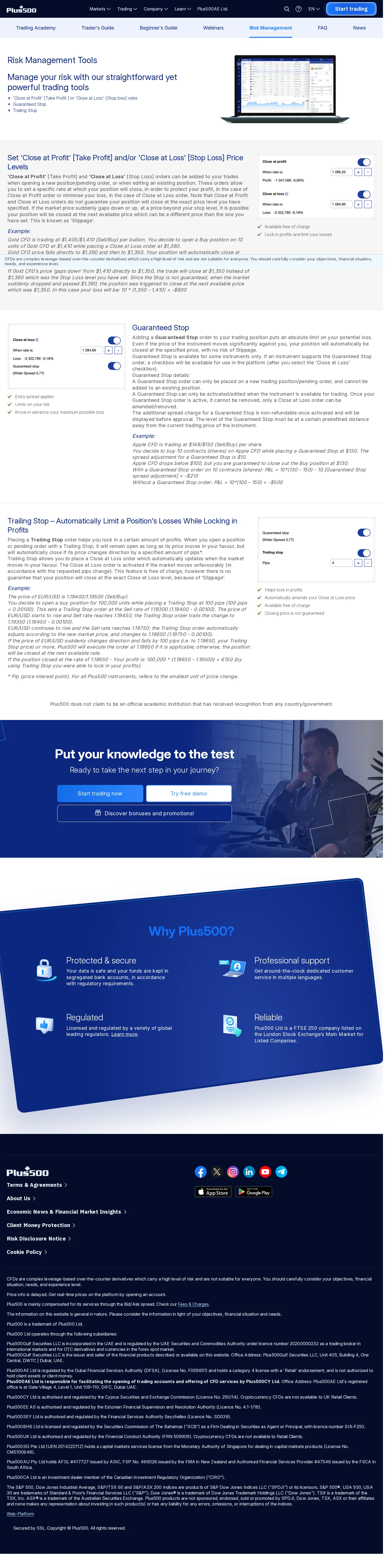
A Guaranteed Stop is priced through a wider spread rather than a separate fee, illustrated on the firm’s own risk page with a $10 spread adjustment on an example Apple CFD, and that extra cost is non-refundable once the stop is activated. An earlier review cited clause 11.7 of the Seychelles user agreement for the mechanics behind that: Guaranteed Stops are accepted only at Plus500’s discretion, only on new orders, subject to a minimum distance from the current price, and once accepted cannot be removed, only repositioned. For the opposite scenario, positive slippage, the same earlier review pointed to clause 15.15 of that agreement: should the quote shift in the client’s favour before an offer is accepted, that improvement goes to the client instead of staying with Plus500.
On margin, the earlier review’s reading of the Seychelles agreement describes a Margin Close-Out Protection mechanism that closes positions once account equity reaches 50% of the minimum required margin, and the agreement adds that Plus500 need not warn the client with a margin call before doing so. That same source interpreted clause 2.13 as a warning that signing in from a country different from the client’s registered country could prevent them from opening or closing positions, something worth knowing for anyone trading abroad.
Leverage, and who gets more of it
For retail clients under the EEA entity, Plus500EE, an earlier review put the leverage cap at 1:30 on major currency pairs. Clients who qualify as Professional can trade at higher limits: the same source gives forex and indices at 1:300, ETFs at 1:100, commodities at 1:150, shares at 1:20, crypto at 1:20 and options at 1:5, reached by meeting two of three tests covering trade frequency and size, portfolio value above EUR 500,000, or relevant professional experience. That same source also flags a cost to the upgrade: moving to Professional status forfeits Investor Compensation Fund cover, even though rebates, best execution, negative balance protection and the handling of client money are unchanged. Plus500’s own Australian page describes a parallel Professional Investor status that keeps “most” of the protections offered to Retail Clients at no extra cost, without stating that it keeps all of them, while higher leverage amplifies both losses and gains. Singapore’s Accredited Investor route, per the earlier review, raises retail FX leverage from 1:20 to 1:50 for clients meeting MAS income or asset tests. The earlier review, however, found no maximum leverage figure published anywhere in the Seychelles or Indonesian user agreements, or on the Thai or Indonesian sites; margin there is simply whatever the platform shows at the time, and the review cited a clause of the Indonesian agreement that lets Plus500 lower leverage when it chooses.
Rules that bind how a position gets traded
Section 15.16 of the Plus500EE and Plus500SEY agreements, as an earlier review cited it, bars any automated data entry system: trades entered through a bot, expert advisor, copy-trading service or API are void, and Plus500 can respond to a breach by closing every account the client holds, ending the agreement with no notice, freezing the trading account, deducting its losses and clawing back any profit the system produced. The same source describes a one-account policy, under which Plus500 recommends a single trading account per client, reserves the right to close additional ones, and does not allow funds to move between any accounts that are permitted to coexist. Japan’s own risk disclosure, published on Plus500JP’s site, states plainly that losses can exceed a client’s deposited margin and that the automatic stop-out mechanism does not guarantee losses will be capped, particularly during rapid market moves, thin liquidity, or gaps around trading halts and resumptions.
Account Types
Plus500 does not run a tiered account ladder of the kind common among CFD brokers. Our earlier review found a single Standard account, called Real Money on some pages, with no separate Gold, VIP or commission-based tier and no built-in commission account; access is through the firm’s own WebTrader and its iOS, Android and Windows apps. That same earlier review put the minimum deposit at $100 for cards and e-wallets and $500 for a bank transfer. Those figures are second-hand, carried over from the prior write-up rather than read directly off a current deposit page in this evidence set.
Demo account
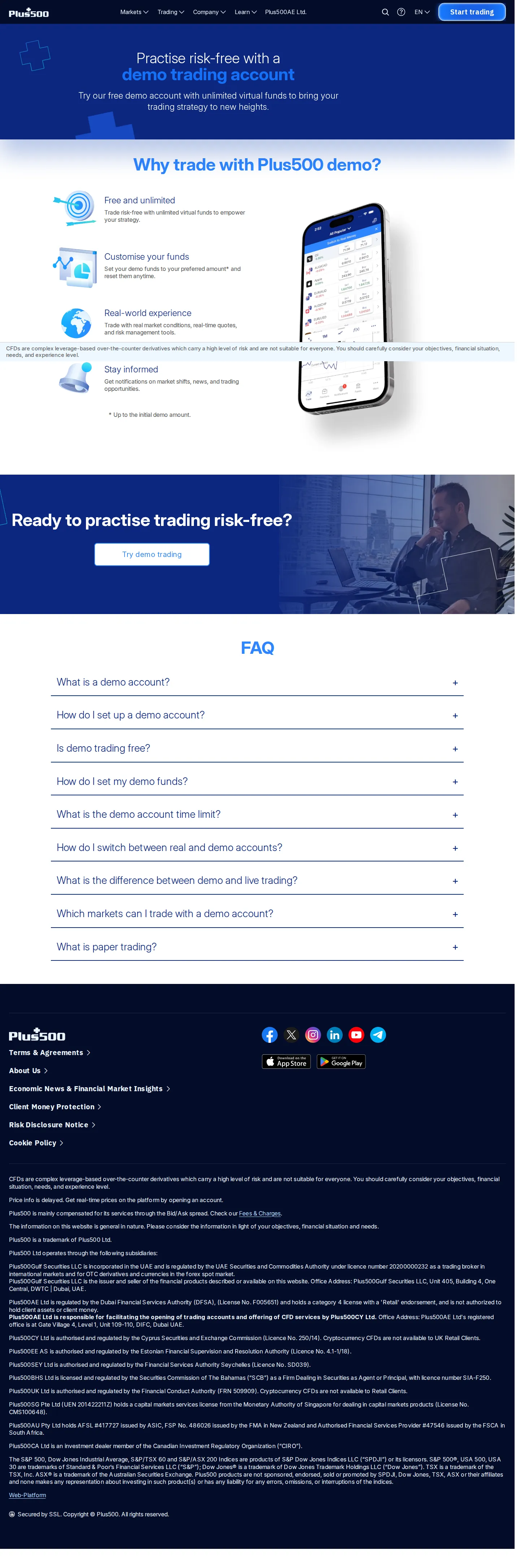
Plus500’s own UK accounts page describes the demo as free, with virtual funds that can be customised and reset, no time limit, live market data, and full access to the same instruments as a real account. The earlier review reported one further detail this page does not carry itself: that the demo balance tops back up automatically once it falls to EUR 200 or below.
Professional and Accredited Investor status
Plus500’s Australian legal page describes a Professional Investor account that trades on higher leverage and, in its own wording, “keep most” of the regulatory protections offered to Retail Clients at no additional cost; the page does not say all protections are retained, and it notes that the higher leverage amplifies both gains and losses. The earlier review’s account of the broader Professional programme goes further: qualification requires passing two of three tests (trading frequency and size, a portfolio above EUR 500,000, or relevant professional experience), and a client who reclassifies keeps rebates, best execution, negative balance protection and client money segregation, but loses eligibility for the Guarantee Fund Investor Protection Sectoral Fund. A parallel Accredited Investor status on the Singapore entity, also from the earlier review, raises retail forex leverage from 1:20 to 1:50 for clients who meet MAS income or asset tests: S$300,000 in annual income, net personal assets above S$2 million with no more than S$1 million of that from a home, or net financial assets above S$1 million.
Corporate accounts
The earlier review found a Corporate account offered only on some of the group’s entities, such as the Seychelles-served site, and not available at all in the EEA, Vietnam or Indonesia. Opening one requires a Legal Entity Identifier, the authorised signatory must be the ultimate beneficial owner, and only a single login is issued. The same account type is closed to regulated financial institutions, online gambling and gaming operators, ATM providers, firearms businesses, adult businesses, charities and NGOs, and holding or investment vehicles.
Swap-free account
Plus500’s own fee page lists a swap-free option that replaces overnight funding with a flat daily administrative charge scaled to position size: $2 on a position between $0 and $1,000, rising in steps to $30 on a position of $500,000 or more. The page describes this as an administrative fee rather than an interest charge, deducted directly from account equity. The earlier review noted this option appears on the Seychelles and Thai fee pages but not on the Indonesian one.
Plus500’s +Premium loyalty tiers
The firm’s own accounts page sets out a three-tier +Premium loyalty programme priced in Trader Points rather than cash. Premium requires a minimum 10,000 points and lists Special Bonuses, a Rebates Programme, Expert Market Analysis, a Personal Client Manager, a Financial News Subscription, Loyalty Premium Rewards and Tickets to Games. Elite requires 50,000 points and adds a Personal Executive Manager, four Personal Educational Sessions, Loyalty Elite Rewards and Tickets to Games & Events. Ambassador requires 250,000 points and lists Personal Bonuses, a Tailored Rebates Programme, a Personal Executive Manager, six Personal Educational Sessions, Exclusive Ambassador Experiences, Loyalty Ambassador Rewards and Tickets to Games & Events. The earlier review put this programme on the Seychelles, Singapore and UAE sites but not on the UK, Vietnam or Indonesia ones, and separately worked out that the smallest advertised first-deposit bonus on the Seychelles ladder, $150 for a $500 deposit under code BRONZE, needs 100 Trader Points, which its own conversion table implies takes roughly $1.25 million of leveraged EUR/USD turnover to earn.
The separate Indonesian account
Plus500’s Indonesian legal page describes a Real Account with a minimum deposit of Rp 1,000,000, lots starting from 0.1, and a first-deposit bonus advertised on the page itself. The earlier review also noted that this entity sets its minimum trading age at 21, compared with 18 across the rest of the group, and that PT Plus500 Indonesia Futures maintains its own rupiah-denominated bonus scheme spanning more than 200 instruments, over 180 of which are foreign shares. It also reported the bonus terms themselves: bonuses expire after 90 days if a trading-volume target is not met, only one bonus per type is allowed per household with households matched on shared personal details such as address, email, IP address, payment card or device, and Plus500 describes itself as “the sole arbiter” of those terms, with any profit generated by a forfeited bonus withheld.
Negative Balance Protection
Plus500’s negative balance protection is not one uniform promise across the group; what a client is contractually owed depends on which entity onboarded them, and the group’s own disclosures do not agree with each other on the point.
How Plus500 closes losing positions before they go negative
Our earlier review reported that the Plus500SEY Ltd user agreement defines a Margin Close-Out Protection mechanism: positions are closed once account equity falls to 50% of the minimum required margin. That earlier review also reported that the Plus500SEY Ltd agreement says Plus500 has no duty to warn the client before that happens, so a client cannot assume a warning will arrive before the close-out trigger fires.
Separately, the Indonesian agreement was reported by that earlier review to let the company cut leverage whenever it decides, and neither the Seychelles nor the Indonesian agreement, nor the Thai or Indonesian websites, were reported to publish a maximum leverage figure; margin there is defined only as an amount shown on the trading platform “from time to time”. A client trading under those agreements cannot check in advance how much room their account has before a close-out is triggered, and that room can be narrowed unilaterally.
What Plus500’s Japan entity discloses about losses beyond margin
Plus500JP Securities Kabushiki Kaisha (Plus500JP証券株式会社)’s own risk disclosure footer, fetched directly from its site, states that losses can exceed the client’s deposited margin (元本超過損) and that the automatic stop-out mechanism (自動ロスカット) does not guarantee that losses will be limited, particularly during rapid market moves, low liquidity, or gaps around trading halts and resumptions. That is a direct statement, from the firm’s own Japanese-market page, that the close-out system is not a guarantee against owing more than the account holds.
Guaranteed Stops: the one order type sold as an actual limit
Plus500’s Fees & Charges FAQ for Indonesia, fetched directly, describes a Guaranteed Stop order priced through a wider spread rather than a fee, with the amount varying by instrument and shown before confirmation; once activated on a position the order cannot be removed, only the Close-at-Loss level can be edited, and the extra spread is non-refundable. The earlier review reported the same mechanic under clause 11.7 of the Seychelles agreement, describing Guaranteed Stops as accepted only at Plus500’s discretion, only on new orders, and subject to a minimum distance from the current price. Unlike the discretionary margin close-out, a Guaranteed Stop is the mechanism actually built to cap a loss at a known level, but the client pays for it upfront through the widened spread whether or not the stop is ever triggered, and cannot get that cost back by cancelling.
Professional accounts and the trade-off on protection
The earlier review reported that clients reclassified onto Plus500’s Professional account keep negative balance protection alongside cash rebates, client money protection and best execution, in exchange for access to higher leverage (forex and indices up to 1:300, commodities up to 1:150, ETFs up to 1:100, shares and crypto up to 1:20, options up to 1:5). The same source reported that reclassifying costs the client their rights under the Guarantee Fund for Investor Protection Sectoral Fund. Plus500AU Ltd’s own root/marketing page, fetched directly, describes its Professional Investor account as retaining higher leverage while keeping “most” of the regulatory protections offered to Retail Clients, not explicitly all of them, and states plainly that higher leverage amplifies both losses and gains.
By contrast, retail clients trading through the Plus500EE entity were reported by the earlier review to be capped at 1:30 leverage on major currency pairs under EEA rules, which caps exposure relative to deposited funds before a close-out would be reached in the first place.
The daily cost of staying open instead of being closed out
Plus500’s own fees page for the UK and EEA, fetched directly, lists a swap-free account administrative fee as an alternative to overnight funding: a daily charge running from $2 for a position of $0 to $1,000 up to $30 for a position of $500,000 or more, deducted directly from account equity rather than calculated as interest. The same page gives ordinary overnight funding as a variable, formula-based charge (Trading Size × Opening Price × Point Value × Daily Overnight Funding %) added to or deducted from the account whenever a position is held open past the stated Overnight Funding Time. Both mechanisms draw down equity while a position stays open, which is part of what moves an account toward the close-out thresholds described above.
Plus500’s own UK disclosure, fetched directly, states that 76% of retail investor accounts lose money trading CFDs with this provider, the mandated context in which all of the close-out and stop mechanics above actually operate for most retail clients.
Trading Instruments
Plus500’s own instrument menus, read across the different geo sites, describe a CFD book built on the standard set: forex pairs, indices, commodities, shares, ETFs and options CFDs, plus a Futures on: Crypto, Equity Indices, Energy, Metals, Forex, Agriculture, Interest Rates, Single Stocks range under the separate Plus500US Financial Services LLC entity, which trades futures rather than CFDs. The UAE legal page lists the retail categories in its own words: “CFDs on Indices such as S&P 500 (ES), NASDAQ 100 (NQ), FTSE 100 (UK100)”, “CFDs on Forex pairs such as EUR/USD, GBP/USD, EUR/GBP”, “CFDs on Commodities such as Oil, Gold, Silver”, “CFDs on Shares such as Apple, Amazon, Tesla” and CFDs on cryptocurrencies “such as Bitcoin, Ethereum, Litecoin, and other cryptocurrencies”. The UK footer adds Options and ETFs as their own top-level Markets categories alongside the general CFD heading.
What Plus500 actually offers changes by market
The instrument list is not the same everywhere. Indonesia’s own site gives a menu of only four categories, Indeks, Forex, Komoditas and Saham, with no Crypto category, even though the UAE, South African and Thai pages carry one. That is a difference in what the local menu shows, not a statement from Plus500 that crypto CFDs are barred there; we did not find a page saying so directly. On the UK side, Plus500’s own disclosures state that cryptocurrency CFDs “are not available to Retail Clients” trading via either Plus500UK Ltd or Plus500CY Ltd, a restriction that applies specifically to UK retail clients rather than to the crypto category generally.
The Japan entity, Plus500JP Securities Kabushiki Kaisha (Plus500JP証券株式会社), runs a narrower and differently-branded pairing: its root page separates buying and selling currency pairs (FX取引) from CFD Trading (CFD取引), which it describes as covering Japanese, US and European stocks, stock indices, and commodities, without listing forex, crypto or options CFDs under that second heading. The US business is structured differently again: The firm’s Australian markets page describes Plus500US Financial Services LLC, a Futures Commission Merchant, offering futures rather than CFDs.
Counts we found only in our earlier review, not on a page we fetched
Several specific counts and spread figures for the CFD range, restated from the earlier review rather than read first-hand on this pass, describe: 60+ forex pairs (majors, minors and exotics, spreads advertised from 0.8 pips), 1,900+ stock CFDs across global exchanges at zero commission, 29 indices, 24 commodities (metals, energy and agriculture), up to 19 cryptocurrencies with regional variation, CFDs on stock and index options, and 96 ETF CFDs for sector and thematic exposure. Because these came from that earlier review and not from a page fetched this time, they are reported here as figures the earlier review found, not as something we read on Plus500’s own instrument pages during this check.
The Indonesian entity, PT Plus500 Indonesia Futures, is licensed separately from the CFD business and, per the earlier review, lists over 200 instruments including more than 180 foreign shares, priced in rupiah with its own minimum trade size of 0.1 lot; this is again a figure from that earlier review rather than one we confirmed on the Indonesian instrument menu directly, though the four-category structure (Indeks, Forex, Komoditas, Saham) is what we saw on the site itself.
Where the advertised range and the contract terms pull apart at Plus500
Two contractual points cut against how freely the range can be traded once a position is open. The Indonesian user agreement, per the earlier review, lets the company cut leverage whenever it decides, and neither the Seychelles nor the Indonesian agreement, nor the Thai or Indonesian sites, publish a maximum leverage figure for any instrument category; margin is simply whatever the platform shows at the time. That means a trader in those markets cannot look up their leverage ceiling on any instrument before funding the account, and it can be cut without a floor once they have. Separately, the Fees & Charges material on the Indonesian contact page describes a Guaranteed Stop order as available on any instrument at a wider spread, and states that once activated the order cannot be removed, only the Close-at-Loss level edited, with the extra spread charged non-refundable regardless of what happens to the position afterward.
Education & Analysis
Every platform reference we could find in its own pages points back to software built and branded in-house. The legal footer that runs across its geo-targeted sites (the UK version among them) calls the product simply the “Web-Platform.” The Japan-facing site for Plus500JP Securities Kabushiki Kaisha (Plus500JP証券株式会社) carries a QR code inviting visitors to scan it and download the mobile app rather than pointing them to a browser terminal. An earlier review of this broker, describing the same lineup in more detail, put it as a browser-based WebTrader plus dedicated iOS, Android and Windows desktop apps, with no separate professional or algorithmic terminal alongside them.
Plus500’s own numbers point to a phone-first product
An earlier review, citing Plus500’s own filed FY2025 results, noted that customers’ OTC trades were carried out via smartphone or tablet 85% of the time, with those devices also responsible for 89% of OTC revenue. Whatever the WebTrader and desktop app offer, the company’s own reported trading mix says most clients are opening and closing positions from a phone, not building charts on a larger screen.
What happens to automated trading on Plus500
An earlier review reported that Plus500’s Estonian and Seychelles user agreements, at what it identified as Section 15.16, expressly prohibit any automated data entry system. On that reading, trades placed through an expert advisor, bot, copy-trading service or API are treated as null and void, and a breach can lead Plus500 to close every account the client holds, terminate the agreement without notice, freeze the trading account, deduct its losses and claw back any profit the system produced. That is a hard boundary against the kind of algorithmic or signal-driven analysis tooling some CFD platforms build around: whatever charting and indicator set the WebTrader offers, it is meant to inform a person placing manual trades, not to feed an automated strategy.
The demo account and risk tools Plus500 itself describes
Plus500’s own UK accounts page describes its demo account as free, with virtual funds that are customisable and resettable, no time limit on how long it can be used, live market data, and full access to the same instruments available on a real account. On the risk-management side, the firm’s own risk-disclosure page and its Indonesian Fees & Charges FAQ describe the Guaranteed Stop the same way: a wider spread rather than a flat fee (the UK page gives a $10 spread-adjustment example on an Apple CFD), non-refundable once activated, subject to a minimum distance from the current price, and once placed on a position it cannot be removed, only the level can be edited. It is a pricing and risk-limiting tool built into order entry, not a separate analysis module.
The Japan entity’s own risk disclosure adds a caveat worth carrying over: it states that losses can exceed the client’s deposited margin (元本超過損) and that the automatic stop-out mechanism (自動ロスカット) does not guarantee losses will be capped, particularly during rapid market moves, low liquidity, or gaps around trading halts and resumptions. Whatever stop-out logic runs behind the platform, Plus500’s own Japanese disclosure does not treat it as a guarantee.
+Premium and the “Expert Market Analysis” benefit
Plus500’s UK accounts page lists a +Premium loyalty ladder gated by Trader Points rather than deposit size: the Premium tier requires a minimum of 10,000 Trader Points and includes, among its listed benefits, “Expert Market Analysis,” a Personal Client Manager and a Financial News Subscription. The Elite tier requires 50,000 points and adds a Personal Executive Manager and four personal educational sessions; the Ambassador tier requires 250,000 points and adds tailored rebates and six personal educational sessions. The page names the analysis as a benefit of reaching those point thresholds, without further detail in the excerpt we reviewed.
More broadly, none of the platform, account or fee pages we fetched describes the charting package itself, such as the indicator set, timeframes, or drawing tools available inside the WebTrader or the apps. The pages we read describe what the platform is called, who can use it, what it costs to trade on and what happens if it is automated; they are silent on the analysis tooling itself.
Special Offers
What we fetched breaks the promotional mechanics into two separate things: a points-based loyalty tier system on some sites, and a one-off deposit bonus on the Indonesian futures site.
Plus500’s +Premium loyalty tiers
Available on the Seychelles, Singapore and UAE sites but absent from the UK site, +Premium runs three tiers keyed to an internal points balance rather than to deposit size. The Premium tier needs a minimum of 10,000 Trader Points and carries Special Bonuses, a Rebates Programme, Expert Market Analysis, a Personal Client Manager, a Financial News Subscription, Loyalty Premium Rewards and Tickets to Games. Elite needs a minimum of 50,000 points and adds a Personal Executive Manager, four Personal Educational Sessions, Loyalty Elite Rewards and Tickets to Games & Events. Ambassador needs a minimum of 250,000 points and adds Personal Bonuses, a Tailored Rebates Programme, a Personal Executive Manager, six Personal Educational Sessions, Exclusive Ambassador Experiences, Loyalty Ambassador Rewards and Tickets to Games & Events.
An earlier review of this catalogue’s, rewritten here, worked through one concrete example on the Seychelles-facing site: a $150 bonus against a $500 deposit under a code named BRONZE, which required 100 Trader Points to claim. Using Plus500’s own point-conversion table, that earlier review calculated that reaching 100 points took roughly $1.25 million of leveraged EUR/USD turnover, a volume far beyond what a $500 deposit would normally generate. We have not refetched that conversion table ourselves, so the figure is reported as that earlier review’s calculation rather than something we verified directly.
The deposit bonus on Plus500’s Indonesian site
The Indonesian account page we fetched (PT Plus500 Indonesia Futures) advertises a first-deposit bonus alongside its Real Account, which opens at Rp 1,000,000 and trades from 0.1 lots. The page does not give the bonus amount or the qualifying deposit tiers.
The conditions attached to that bonus, as an earlier review of the Indonesian user agreement reported and as restated here in our own words rather than the agreement’s: the bonus lapses after 90 days if a trading-volume target is not met; Plus500 can withhold the bonus and any profit traced to it if it judges the bonus was abused; only one bonus per type is available per what the agreement calls an extended household, matched across name, phone number, address, email address, IP address, card number and device ID; and the agreement gives Plus500 the final say in disputes over how those terms are applied. None of that wording comes from a page we fetched ourselves, so it is reported as what the earlier review found in the agreement, not as something we read first hand.
What sits next to the bonuses rather than inside them
Plus500’s UAE legal page (Plus500Gulf Securities LLC / Plus500AE Ltd) states that AED or USD deposits are accepted commission-free, which waives a deposit charge rather than crediting a bonus, and sits on the same page as the standard fee disclosures rather than a promotions section. The South Africa root page separately advertises 0% opening and closing trade fees and 0% deposit and withdrawal fees, again framed as the ordinary fee structure rather than a time-limited offer.
Two account types elsewhere in the evidence touch rebates without being promotions themselves. The Professional account, available to clients who qualify under the firm’s own tests (trade frequency or size, a portfolio above EUR 500,000, or relevant professional experience), is described in an earlier review as retaining cash rebates and negative balance protection while giving up rights under the Guarantee Fund Investor Protection Sectoral Fund. The Ambassador tier of +Premium layers a Tailored Rebates Programme on top of that same rebate mechanic. Neither is a deposit-matching or welcome-style offer; both are conditional on account status rather than on funding an account.
The corporate account terms we hold read as restrictive rather than promotional when set against the loyalty tiers and the Indonesian bonus. The Seychelles-served agreement, covered by an earlier review, keeps corporate accounts off-limits to adult businesses, charitable organisations, NGOs, investment or holding vehicles, firearms dealers, ATM providers, online gambling and gaming operations, and regulated financial institutions; that review also found the accounts unavailable in the EEA, Vietnam or Indonesia. That is a client-eligibility restriction, not a term of any bonus, but it is worth reading alongside the bonus conditions above for a full picture of who these offers can actually reach.
Opening an Account
Plus500 does not run a tiered signup with a Basic/Gold/VIP ladder. The evidence points to one live trading account per entity, opened against whichever locally licensed Plus500 subsidiary serves the applicant’s country, plus a free demo. Plus500’s own UK accounts page describes the demo as unlimited in time, with customisable and resettable virtual funds, live market data, and full access to the same instruments as a real account. An earlier version of this review, not fetched directly for this pass, reported that the demo tops back up automatically once its balance falls to EUR 200 or below.
Who Plus500 will not open an account for
Our earlier review described several exclusion clauses in Plus500’s user agreements: a residency and location bar on people in Belgium or the United States, and on anyone physically present in the United States regardless of where they live; a bar on the company’s own staff, directors, agents and affiliates, and their relatives; and a general clause putting the burden on the client to confirm that CFD trading is not against the law where they live. The same source put the minimum trading age at 18 under the Seychelles agreement and 21 under the Indonesian one, and described a partial exclusion for Belgian residents, who are not offered leveraged CFDs there under Belgian regulation.
Two of these show up on pages fetched directly rather than only in the earlier review. Plus500’s Vietnam-facing site says in plain terms that Vietnamese residents cannot get CFD services from Plus500, and identifies the operator of that page as an entity called InvestSoft rather than any of the Plus500-branded subsidiaries named elsewhere. And Plus500’s own UK page states that cryptocurrency CFDs are not available to UK Retail Clients, whether they trade through Plus500UK Ltd or through Plus500CY Ltd.
Verification tied to how money moves, not a separate KYC step
The evidence describes a signup sequence that includes a distinct identity-verification stage, verifying identity and residential address, with some jurisdictions allowing electronic verification and others requiring documents. The evidence also documents control exercised through the funding method: the earlier review reported that Plus500’s agreements require deposits to come from a payment method registered in the applicant’s own name, with corporate cards refused outright. The same source gave minimum deposits of $100 for cards and e-wallets and $500 for bank transfer, the latter not initiated from the platform itself but requested by email through the Funds, Deposit, Bank Transfer path.
Locally, the figures differ. Plus500’s UAE legal page advertises commission-free AED or USD deposits, and its Indonesian legal page gives a minimum deposit of Rp 1,000,000 (Rp 1 Juta) with lots starting from 0.1, for the separately licensed PT Plus500 Indonesia Futures account rather than the CFD product sold elsewhere in the group.
Plus500’s professional, accredited and corporate routes
Beyond the standard retail account, the earlier review described a Professional account reached by passing two of three tests: trade frequency and size, a portfolio above EUR 500,000, or relevant professional experience. Qualifying raises leverage substantially (forex and indices to 1:300, ETFs to 1:100, commodities to 1:150, shares and crypto to 1:20, options to 1:5) but drops the client out of Guarantee Fund Investor Protection Sectoral Fund cover, while keeping rebates, best execution, negative balance protection and client money segregation, by that source’s account. Plus500’s own Australian legal page describes a parallel Professional Investor account there, offering higher leverage while retaining most, not stated as all, of the regulatory protections given to Retail Clients, at no extra cost, with the same page noting that higher leverage amplifies both losses and gains. A comparable route for Singapore, per the earlier review, is an Accredited Investor classification qualified through MAS income or asset tests, which raises retail FX leverage from 1:20 to 1:50.
The earlier review also described a Corporate account, offered only on some entities and not in the EEA, Vietnam or Indonesia. It required a Legal Entity Identifier, an authorised signatory who is also the ultimate beneficial owner, and issued a single login. Eligibility for that account was also restricted by business type, per the same source: charities and NGOs, firearms businesses, adult businesses, ATM service providers, online gambling and gaming operators, holding or investment vehicles, and regulated financial institutions were all named as barred from applying.
Applying to Plus500US is not automatic
The US side of the group runs on different terms again. Plus500’s own Markets page for Plus500US Financial Services LLC, the CFTC-registered futures arm, states that trading privileges are subject to review and approval and that not all applicants will qualify, a discretionary gate that has no equivalent stated anywhere else in the evidence for the CFD business sold outside the US.
Deposits & Withdrawals
The evidence shows a set of user agreements (Plus500EE, Plus500SEY v2026/3, PT Plus500 Indonesia Futures v2025/1, worded identically on this point) plus jurisdiction fee pages that do not always say the same thing as the agreements do.
What Plus500’s contracts charge to move money
Clause 19.4 of those user agreements caps free withdrawals at five per calendar month and charges $10 for every withdrawal beyond that. The same clause charges $10 for any withdrawal that falls below a payment method’s own minimum, and up to $6 to cover bank transfer processing. That clause sits awkwardly against the help centre’s own statement that there are no limitations to monthly withdrawals, a contradiction between the contract clients sign and the support material they are shown.
Closing the account and taking the balance out by bank transfer or PayPal carries a further $10 fee under the same terms; returning a balance to a refundable card is free within the EEA.
What the fee pages say Plus500 itself charges
The Indonesian and South African fee material describes deposits and withdrawals differently to the contracts above. The Indonesia contact page states Plus500 does not itself charge a deposit or withdrawal fee, but that the card issuer or bank may charge for international (non-local) card acquirers, for incoming or outgoing bank transfers, or for foreign exchange conversion when a deposit is made in a currency the account does not support. The South Africa page advertises “0% deposit and withdrawal fees” outright. The UAE legal page separately advertises “commission-free AED or USD deposits.” None of these pages mention the five-withdrawal cap or the $10 excess charge that clause 19.4 sets out, so a client reading the fee page and a client reading the user agreement for the same product would come away with different expectations.
Minimum deposits and methods
Under the Seychelles agreement, minimum deposit is $100 by card or e-wallet and $500 by bank transfer; minimum withdrawal is $100 by bank transfer and $50 by PayPal or Skrill. Cards and other payment methods must be registered in the account holder’s own name, and corporate cards are refused outright. Bank transfer deposits cannot be initiated from the platform itself; account details have to be requested by email through Funds, Deposit, Bank Transfer. For Indonesia, the PT Plus500 Indonesia Futures site sets its own minimum deposit at Rp 1,000,000, in the local entity’s own currency rather than dollars.
Currency conversion and standing charges that reduce what a client keeps
Plus500’s own fee page (Indonesia contact page and UK fees page both carry this) charges a currency conversion fee of up to 0.7% on the realised net profit or loss of any trade in an instrument denominated in a currency different from the account currency, and the same percentage is reflected in real time against unrealised profit and loss while the position stays open. The inactivity fee, also on the same fee pages, runs up to $10 a month once three months pass with no login, deducted only from a Real Account with sufficient funds, capped at whichever is lower of $10 or the remaining balance, and it keeps recurring monthly until the client logs back in. Swap-free accounts carry a separate daily administrative fee in place of overnight funding, ranging from $2 on a position of $0 to $1,000 up to $30 on a position of $500,000 or more.
Contract terms that affect when money actually leaves the account
Under the user agreements described above, the two sides do not hold equal cancellation rights: the client’s chance to cancel a withdrawal request closes once it reaches “Approved in progress”, whereas Plus500 keeps that option open until “Approved Settled.” That gap matters, because before settlement a sum already earmarked for withdrawal has not left the account in any final sense; it can still be clawed back to offset losses on other positions closed before it settles, which is why money sitting in the withdrawal queue is not shielded from what happens elsewhere on the account. The same agreements state that Plus500 will always attempt to return a withdrawal to the card on file first, regardless of which method the client actually selected, using the client’s stated preference only as a fallback.
The Indonesian agreement adds a separate closure trigger: the account can be closed roughly twelve months after the last inactivity-fee deduction, or immediately once account equity reaches zero, with a single login resetting that clock.
Where the evidence is silent
None of the fee pages or agreements in this evidence set state a processing time for withdrawals, so we have no figure to report for that. The Bahamas, Canada, Japan and UAE onshore entities have no withdrawal-specific fee material in this evidence at all; what is above draws mainly from the Seychelles, Estonian and Indonesian agreements and the UK, Indonesia, South Africa and UAE fee or legal pages that were actually read.
Customer Support
Support runs through three consistent channels across Plus500’s sites: live chat, WhatsApp and a web contact form. An earlier review of the broker reported the live chat as staffed 24/7 both inside the trading platform and on the public site, with a WhatsApp line at +359 88 211 0467 that the same review found published identically on the UK and Thai contact pages. The same earlier review also examined that web contact form, finding it asks for a name and email address, requires the query type to be picked from six preset categories (Deposits, Withdrawals, Account Details, Platform Issues, Trading or Other), caps the description field at 999 characters and allows only a single attachment, up to 4MB in size.
Phone support is not a given
Whether a client can actually call Plus500 depends entirely on which entity serves their market. The earlier review that examined the UK, EEA, South African, Seychelles and Thai contact pages found no telephone number offered on any of them, live chat and WhatsApp being the only real-time routes. Where Plus500 does publish a phone number, the details are inconsistent even within one page: the Singapore site shows +65 69676436 next to its live-chat prompt but a different number, +65 69676435, in its footer and office-address block. Indonesia’s own about page lists a dedicated hotline, (021) 3009 6474, specifically for complaints, and separately points clients to Bappebti’s own online complaint channel at pengaduan.bappebti.go.id. Japan’s site gives phone hours as business days 9:00 to 19:00, excluding weekends and public holidays, which is the only jurisdiction where Plus500 publishes support hours narrower than 24/7.
Language and staffing claims
On its UAE legal page, Plus500 tells clients they are “supported 24/7 via chat, email, or WhatsApp.” Indonesia’s legal page separately promotes dedicated Bahasa Indonesia support across live chat, WhatsApp and the contact form, making it the only country-specific language commitment found anywhere across the pages checked. On the German-language homepage, Plus500 states support is provided “von unseren Mitarbeitern… (kein KI),” by staff, not AI, an explicit claim that does not appear to be repeated on the English-language pages fetched here. South Africa’s site describes its chat widget as “professional customer service by human agents, whenever you need it,” which is the same by-a-human framing as the German page but does not itself address whether other channels use automation.
What Plus500’s agreement says happens once a client complains
A prior review of version 2026/3 of the Plus500SEY user agreement found that Sections 32.4 through 32.7 lay out a formal complaints timeline: an initial holding response within two business days, a target of 21 business days to resolve the complaint, and a final response due no later than 90 business days, a deadline that pushes back further each time the client takes longer than seven business days to answer any request Plus500 makes along the way. That same review noted this is markedly longer than the 15 days it found quoted for EEA clients, and that a Seychelles-regulated client’s only escalation from there is to the Seychelles FSA, a regulator that sits behind no investor compensation scheme.
Escalation once support is exhausted
Where a client is not satisfied with Plus500’s own handling, the escalation route again depends on entity. Australia’s about page names the Australian Financial Complaints Authority, giving its number as 1800 931 678, its web address as afca.org.au, and a postal address of GPO Box 3, Melbourne VIC 3001. For EEA clients, an earlier review reported the escalation body as the Estonian Financial Supervision and Resolution Authority, at Sakala 4, 15030 Tallinn, which follows from Plus500EE AS being the entity licensed by that regulator. We did not find an equivalent named ombudsman or compensation-scheme contact on the UK, Seychelles, Singapore or Indonesian pages fetched for this review; Indonesia’s own path runs through Bappebti’s online complaint portal rather than an ombudsman body.
Physical presence behind the channels
Each licensed entity publishes a registered office rather than a single group headquarters. Plus500UK Ltd’s address, per its own about page, is 8 Angel Court, Copthall Avenue, London EC2R 7HJ. Plus500SG Pte Ltd gives 1 Temasek Avenue, Millenia Tower #37-03, Singapore 039192. PT Plus500 Indonesia Futures is registered at AXA Tower Lt.38, Kuningan City, Jl. Prof. Dr. Satrio Kav. 18, Setiabudi Kuningan, Jakarta Selatan 12940. These addresses confirm a registered entity behind each site’s support desk, though none of the pages fetched describe a walk-in service or in-person complaint handling at these locations.
Prohibited Countries
Plus500 excludes people from using its products in several distinct ways: by residency clause in its own user agreements, by a standalone country ban stated on a geo-specific page, by relationship to the company, and by business type on the corporate account. None of these overlap tidily, and the earlier review of the agreement that this rewrite draws on found language that does not always sit consistently with itself.
Belgium and the United States
An earlier review of Plus500’s user agreement reported that clause 1.1.3 excludes residents of Belgium and the United States from opening an account, and separately bars anyone physically located in the United States at the time, regardless of where they live. The same earlier review also flagged clause 2.12, which states only that the platform is not offered or distributed to Belgian residents for leveraged CFDs specifically, citing Belgian regulation, a narrower, product-level restriction that sits alongside the blanket exclusion in clause 1.1.3 rather than replacing it. We did not fetch either clause ourselves, so we cannot resolve which wording governs; both are reported as the earlier review found them.
The CFD business is not the whole Plus500 story for US residents. A separate group company, Plus500US Financial Services LLC, is registered with the NFA under NFA ID 0001398 as a Futures Commission Merchant, and its own markets page advertises “zero platform fees and market data fees” for futures accounts. That is a different product, traded through a different regulated entity, and an application to open one is stated as “subject to review and approval,” with no guarantee of acceptance.
Vietnam and India
Plus500’s Vietnam-facing page says, in our own words, that Vietnamese residents cannot get CFD services from Plus500, and names the operator of that page as an entity called InvestSoft rather than any of the Plus500-branded subsidiaries (Plus500UK Ltd, Plus500CY Ltd, Plus500SEY Ltd and so on) that appear on every other country version of the site we fetched. An earlier review of the same set of pages reported the identical no-CFD-services position for India, again served by a page naming InvestSoft rather than a licensed Plus500 subsidiary. Neither InvestSoft nor any licence associated with it appears anywhere else on Plus500’s site.
Who else the agreement turns away
The agreement also draws boundaries elsewhere: clause 1.1.4 closes the account door to relatives, affiliates, agents, directors and employees of the company, and clause 1.1.2 goes further, ruling out anyone living where local law would not permit CFD trading, with responsibility for judging whether that is the case resting on the client rather than Plus500. A minimum trading age is set by clause 1.1.1: 18 under the Seychelles-entity agreement the earlier review read, and 21 under the Indonesian entity’s agreement, which governs the separately licensed PT Plus500 Indonesia Futures business.
Corporate accounts: extra exclusions on top
Where Plus500 offers a corporate account at all, the earlier review found it is refused to regulated financial institutions, online gambling and gaming businesses, ATM service providers, firearms businesses, adult businesses, charities and NGOs, and holding or investment vehicles, and that a corporate account also requires the authorised signatory to be the ultimate beneficial owner and issues only a single login. The same review reported that corporate accounts are not offered at all in the EEA, where only individual accounts are available, nor in Vietnam or Indonesia.
South Africa’s own condition
The South African site tells clients they must warrant that they have obtained tax clearance certificates in line with their foreign investment allowances before trading, a jurisdiction-specific requirement that does not appear on the UK, EEA, Seychelles or Indonesian pages we fetched.
What we could not check
We attempted to load plus500.com from Azerbaijan three times through our proxy provider; each attempt was refused by the provider itself, which classifies the domain under its own “Crypto/Trading” usage policy and blocks it before any Plus500 page loads. That is a limitation in how we tested access, not a Plus500 restriction we observed, and access from Azerbaijan should be read as untested rather than as either open or closed.
Conclusion
Plus500 rests on an unusually wide base of genuine licences: the FCA confirms FRN 509909 for Plus500UK Ltd, CySEC confirms licence 250/14 for Plus500CY Ltd, ASIC confirms AFSL 417727 for Plus500AU Pty Ltd, and the DFSA, MAS, the New Zealand FMA, South Africa’s FSCA, the Seychelles FSA, the UAE’s SCA, the Bahamas’ SCB, Japan’s Kanto Local Finance Bureau, CIRO in Canada and the NFA in the US all confirm an entity carrying the Plus500 name on their own registers. That spread across regulators of very different strength is the main reason the regulation score sits where it does, and it is also why the group’s structure needs reading carefully rather than taken as one firm: the FCA-authorised UK entity that most reviews lead with covered only 6% of FY2025 group revenue, against 49% from “Rest of World” entities in Seychelles, Singapore, the Bahamas, the UAE and the US, jurisdictions with materially thinner protection.
What the register shows about impersonation
The FCA register itself carries a warning that matters here: it lists “Plus-500” as a clone of an FCA-authorised firm, unauthorised, verified on the register on 27 July 2026. Four further names on the same register, “Fx Plus500”, “p500.io”/”plus500v.com”, “www.plus500un.com”, are also marked as clones of an authorised firm, and a fifth, “Plus 500 Pro”, is listed as unauthorised without the clone marker. None of these five is the firm reviewed here; they are lookalikes the FCA has flagged separately, and a reader who lands on one of them by mistake is dealing with an unauthorised entity, not with Plus500UK Ltd, Plus500CY Ltd or any of the other confirmed licence holders above. The practical lesson is to check the domain before funding an account carrying this brand.
What Plus500 charges and how it binds a client
The fee side scores well because most of what the firm charges is published rather than buried. Its own fees page gives the inactivity fee as up to $10 a month after three months without a login, deducted only from a Real Money account with sufficient funds, and the currency conversion fee as up to 0.7% of realised net profit and loss on instruments priced in a currency other than the account currency. The user agreement, at clause 19.4 in the Estonian, Seychelles and Indonesian versions, caps free withdrawals at five a month, charges $10 for each one beyond that, $10 for any withdrawal below the payment method’s minimum, and up to $6 in bank transfer processing, a term that sits awkwardly against the help centre’s own line that there are no limitations to monthly withdrawals. Guaranteed Stops cost a wider spread instead of a separate fee, and clause 11.7 of the Seychelles agreement makes that spread non-refundable once the stop is activated and the order itself impossible to cancel, only to reposition. None of this is hidden, but it is not always where marketing copy points either.
Two other contract terms are worth a reader’s attention regardless of jurisdiction. Section 15.16 of the Estonian and Seychelles agreements bars any automated data-entry system; a breach lets Plus500 close every account the client holds, freeze trading, deduct losses and reverse profit the system generated. And under the Seychelles agreement, a withdrawal the client has already requested can still be pulled back to cover losses on trades closed before settlement, right up until the withdrawal reaches “Approved Settled”, the client can only cancel it up to the earlier “Approved in progress” stage.
Platform and support
The platform is the proprietary WebTrader plus iOS, Android and Windows apps; there is no third-party terminal on offer, which caps flexibility for traders who want MetaTrader-style tools or algorithmic access, and Plus500’s own disclosure that 89% of OTC revenue in FY2025 came from mobile and tablet devices confirms this is built for manual, phone-first trading rather than anything more advanced. Support runs on live chat and WhatsApp rather than a phone line in most of the markets checked here: the UK, EEA, South African, Seychelles and Thai contact pages list no general telephone number at all, though Singapore, Indonesia and Japan each publish one.
Plus500 is a broker to use for straightforward, mobile-first CFD trading through a heavily regulated UK or Cyprus entity, provided a reader checks the domain against the FCA’s clone warnings first and reads the withdrawal and Guaranteed Stop terms before relying on them; it scores 7.3 out of 10 overall.
What we saw
Pages captured from Plus500’s own site when this review was written. Brokers change their terms; these are what we read.


Score history
Recomputed daily; every move is on the record. The current score is always the latest row.
| Date | Score | Move |
|---|---|---|
| 2026-09-19 | 7.3 | ▲ |
| 2026-09-13 | 6.9 | ▲ |
| 2026-09-13 | 6.8 | ▲ |
| 2026-09-12 | 6.4 | ▲ |
| 2026-09-07 | 4.9 | ▼ |
| 2026-07-25 | 7.1 | ▲ |
| 2026-07-18 | 6.9 | = |
| 2026-07-11 | 6.9 | · |
FAQ
Is Plus500 regulated?
Yes, it holds confirmed licences with the FCA (509909), ASIC (417727), CySEC (250/14), FSCA (47546), Seychelles FSA and UAE SCA.
Does Plus500 charge withdrawal fees?
It advertises 0% deposit/withdrawal fees, but its user agreement (clause 19.4) adds a $10 fee after five withdrawals a month, a $10 sub-minimum withdrawal fee and up to $6 in bank-transfer processing.
What trading platform does Plus500 use?
A proprietary WebTrader plus mobile and desktop apps running on live quotes and real market data. There is no MT4/MT5 or API.
Is Plus500 support easy to reach?
It varies by market: Japan has a named phone line (9:00-19:00 weekdays) and Indonesia a named complaints hotline, but UK, UAE and Australia contact pages returned fee content instead of support details, and Singapore lists two conflicting phone numbers.
Are there independent reviews of Plus500?
No independent track record, third-party rating or complaint-outcome data was found; only the firm’s own disclosures and regulator register status are available.
Are there fake Plus500 websites?
Regulators list several unauthorised ‘Plus-500’ clone or lookalike firms, a scam-impersonation risk for people searching for the brand.
How this review works
Track Plus500 live: score moves and red notices, in your pocket.