
PROP · CHECKED 10 OCT 2026
FXIFY review.
A UK prop firm selling forex, index and crypto trading assessments from $19, with payouts routed through a third party and a funded stage governed by a contract it does not publish.
RISKY
OUT OF 10
FXIFY sells trading assessments from $19 to $4,249 through FXIFY Solutions Limited, an active English company that files audited accounts. No prop firm is licensed anywhere, so the question is recourse. Its binding terms say trading is simulated and funds are fictitious; its help centre says a passed assessment gives a live account. Liability is capped at your fee, the funded stage is a contract with an unnamed third party, and taking a full payout forfeits the account by the firm's own worked example. Suits traders who read the rules and can lose the fee.
Each criterion is scored 1 to 10 from primary sources. The overall score is their unweighted mean. How scoring works.
| Founded | 2023 |
|---|---|
| Headquarters | GB |
| Maximum leverage | 1:30 |
| Withdrawal fee | No withdrawal fee published. Minimum withdrawal $50 on all account types, scaling to $750 on a $100,000 crypto plan. All payouts routed through Rise, which requires its own KYC |
| Account opening | Purchase and credentials are near immediate, the firm says within a few minutes. KYC with FXIFY and a second KYC with Rise are required only after the assessment is passed and before any payout |
| Platforms | MetaTrader 4, MetaTrader 5, DXtrade, TradingView |
- Challenges actively on sale with two dated promotions running, so the firm is not withholding new business
- Contracting entity named in the binding contract and verifiable: FXIFY Solutions Limited, England and Wales 14451720, Active
- Files audited accounts with an unmodified opinion, showing £13.6m turnover in the year to 31 October 2025
- Ownership disclosed on the register: Briarwood Ventures Limited of Hong Kong holds 75% or more
- A company in the same group, Alchemy Prime Limited, holds a live FCA authorisation, FRN 612233, with client money permission
- No clone, imposter or warning entry found against FXIFY on five lists we searched with positive controls
- Drawdown and payout rules published in unusual depth, with the firm's own worked numeric examples
- Modest leverage, 30:1 standard and 50:1 upgraded, rather than the offshore 1:500 pattern
- Assessment fee refunded in full with the first withdrawal on the 1, 2 and 3 Phase plans
- Free five module trading course and a published 93 instrument table with contract sizes
- The binding terms call the trading simulated and the funds fictitious while the help centre says a passed assessment gives a live account
- The funded stage is a contract with an unnamed third party that FXIFY Solutions Limited says it is in no way involved with, and that contract is unpublished
- Taking a full payout forfeits the funded account, by the firm's own worked example, against marketing promising a first payout on demand with no fine print
- On Two Phase Pro the first two payouts are capped and profit above the cap is removed rather than carried forward
- The consistency rule benchmark never resets after a withdrawal, so a strong day can push the next payout further away
- Liability capped at the fee paid, against a counterparty with £38,416 of audited net assets and a going concern note resting on related party support
- Clause 7.1 reserves legal action against a customer who complains publicly regardless of whether the content is defamatory
- Repeated sole discretion clauses over forbidden practices, plus a prohibited list the firm may change on seven days notice, and no right to dispute a termination
- Three restricted country lists, three payout timing statements, three sets of support hours and four payout totals, all published by the firm and all disagreeing
- The licensed broker named in the footer changed from Labuan to Mauritius between June and August 2026, and the incoming entity's parent told the SEC that start-up work on it commenced only on 1 January 2026
Overview
FXIFY sells trading assessments. You pay a fee, you trade to a profit target inside its rules, and if you pass you are offered what the site calls a funded account of up to $400,000. The firm has been trading under this brand since 2023, it is selling today, and its two live discount codes were captured on 13 August 2026 with expiry dates in September and December 2026. That matters more than anything else on this page: a prop firm that has stopped selling challenges is usually a firm that cannot fund the ones it has already sold, and FXIFY has not stopped.
The thing to understand before you pay is that FXIFY’s own documents do not agree on what you are buying. The contract you accept at checkout, the General Terms and Conditions linked in the footer of every page, says at clause 1.5 that the service consists of “tools for SIMULATED foreign exchange trading”, that “any trading that you perform through the Services is not real”, and that “the funds provided to you for demo trading are fictitious”. Its Section 5 is headed “RULES OF DEMO TRADING”. The help centre, on the same domain, answers the question “Once I pass the Assessment am I provided with a demo or live account?” with a single sentence: “Once you pass the Assessment, we provide you with a live account.” A second help centre article states: “We do not offer any demo accounts for any of our challenges or instant funding.” Both were fetched on 13 August 2026. We are not going to tell you which is true, because we cannot establish it. We can tell you that FXIFY published both.
The second thing is who you would be chasing if a payout did not arrive. The contract names FXIFY SOLUTIONS LIMITED, England and Wales company number 14451720, and English law governs. That company is real, active, and files audited accounts, which are set out in full in the regulation section below. The same contract, at clause 8, says the funded stage is a separate agreement with an unnamed “third-party company” and that “FXIFY SOLUTIONS LIMITED is in no way involved” with it. Clause 10.2 caps the company’s liability at “THE AMOUNT CORRESPONDING TO THE FEE PAID BY THE CUSTOMER”.
The third thing is that the licensed broker FXIFY names as standing behind it changed recently. On 7 June 2026 the footer read that FXIFY Markets Ltd “is licensed in Labuan, Malaysia, as a money broker under License No. MB/22/0097”. On 13 August 2026 it read that Prime Intermarket Group Eurasia Ltd “is licensed in Mauritius, as an Investment Dealer under License Number GB24204066”. The marketing above the footer did not change. We could not verify either number, and we say exactly why in the regulation section.
Overview Table
| Headquarters | London, United Kingdom. FXIFY Solutions Limited, 142 Central Street, Clerkenwell, London EC1V 8AR, per Companies House and the site footer. The contract still gives a different London address the company left in February 2025 |
|---|---|
| Established | 2023. FXIFY’s own blog marks a third anniversary; the first press coverage we found is dated March 2023 |
| Countries Served | FXIFY claims “160+ Countries”. Its three published restricted lists name 33, 35 and 35 jurisdictions and disagree with each other |
| Regulated By | Nobody, and that is normal. No jurisdiction licenses proprietary trading firms of this kind. What the footer names is an affiliated broker, not a licence held by FXIFY |
| Minimum Deposit | Not applicable. The cheapest entry is a $19 Instant Funding Lite $2,500 account; the cheapest assessment is $39 for a Three Phase $5,000 account |
| Maximum Leverage | 30:1 on FX and gold as standard, 50:1 with a paid add-on. Indices 10:1, oil 5:1, stock CFDs 2:1, crypto 2:1 |
| Total Instruments | A published table of 93 instruments across forex, metals, indices, commodities and stock CFDs, plus separate crypto plans. The homepage markets “Over 150+ Symbols To Trade” |
| Platforms | MetaTrader 4, MetaTrader 5, DXtrade and TradingView. MetaTrader is stated as unavailable to clients based in the United States |
| Customer Support | Email and live chat. No telephone number is published. The site gives three different sets of opening hours |
| Languages | English, Portuguese and Spanish |
Facts List
- Contracting entity is FXIFY SOLUTIONS LIMITED, company number 14451720, incorporated 31 October 2022, Active on Companies House on 13 August 2026.
- Its sole person with significant control is Briarwood Ventures Limited, a Hong Kong company, registry number 74543806, holding 75% or more of shares and votes.
- Governing law is England and Wales, disputes in the courts of London, per clauses 9.3 and 9.4 of the General Terms and Conditions.
- Liability is capped at the fee the customer paid for the service in question, clause 10.2.
- The funded stage is a contract with an unnamed third party, clause 8, and acceptance can be refused “for any or no reason”, clause 6.7.
- Profit split is 80%, rising to 90% only if you buy the Extra 10% Performance Split add-on.
- Taking your full profit as a payout forfeits the funded account on 1 Phase, 2 Phase, Lightning and Instant Funding plans, in FXIFY’s own words.
- Challenge fees run from $19 to $4,249 across eight programmes; the assessment fee is refunded in full with the first withdrawal on 1, 2 and 3 Phase plans.
- Breaches are measured on real time equity, and the help centre says a single second below the level triggers one.
- One company in the same group holds a genuine top tier authorisation: ALCHEMY PRIME LIMITED, FCA firm reference number 612233, on a licence Authorised since 5 August 2014. It is a different company, it serves no FXIFY customer, and none of the fourteen distinct registered and trading names on that licence is FXIFY or FXPIG.
We fetched fxify.com through Bright Data from eleven countries on 13 August 2026: Indonesia, Thailand, Vietnam, Azerbaijan, Singapore, Japan, India, the United Arab Emirates, South Africa, the United Kingdom and Germany. All eleven returned the same page at 790,951 bytes and the extracted text of all eleven is byte identical. One entity set, one price list, one restricted country list, everywhere we looked. That is a negative result and worth stating, because the opposite is common.
Who this suits: someone who understands they are buying a skills assessment with a fee attached, who has read the drawdown and payout rules in full, and who can afford to lose the fee. Someone looking for a way to trade a large account with someone else’s money and treat the payout as reliable income should read the payout terms section before anything else.
Key Takeaways
- Challenges are on sale and the firm is trading. Checkout was live on 13 August 2026 with two promotions running, codes NEW30 and HOT20, expiring 31 December 2026 and 1 September 2026. For a prop firm this is the single most important fact, and it is in FXIFY’s favour.
- The binding contract says the trading is simulated. The help centre says the account is live. Clause 1.5 of the General Terms and Conditions says trading “is not real” and the funds are “fictitious”; a help centre article says “Once you pass the Assessment, we provide you with a live account.” Both were live on 13 August 2026. FXIFY has published a direct contradiction on the most basic question about its product.
- The company you pay is not the company that pays you. You contract with FXIFY Solutions Limited under English law. Clause 8 says the funded stage is a contract with an unnamed “third-party company” and that FXIFY Solutions Limited “is in no way involved” with it. That contract is not published.
- Taking your whole first payout costs you the account. FXIFY publishes the worked example itself: withdraw all your profit, the maximum drawdown locks at your starting balance, and “Once a trade is placed, the equity breaches the Max Drawdown threshold. The withdrawal will still be processed, but the account is forfeited.” The marketing on the same site says “First Payout On Demand — No Fine Prints”.
- The first two payouts on 2 Phase Pro are capped and the excess is deleted. “Any profits exceeding this amount … will be removed.” On a $250,000 account the cap is $8,000, so $20,000 of compliant profit becomes $8,000 kept and $12,000 gone.
- The consistency rule benchmark never resets. Your highest daily profit stays as the divisor after a withdrawal, so a single unusually good day can move the payout threshold further away rather than closer. Worked through with numbers below.
- Recourse is capped at your fee. Clause 10.2 limits liability to “THE AMOUNT CORRESPONDING TO THE FEE PAID”. The company’s audited net assets at 31 October 2025 were £38,416.
- Complaining in public is addressed in the contract. Clause 7.1 reserves the right “to take any appropriate legal action against the Customer regardless if the content is deemed defamatory, misleading, or in violation of FXIFY’s trademark rights.” Bear that in mind when weighing how few public complaints a prop firm has.
- The named licensed broker changed in the last ten weeks. Labuan money broker on 7 June 2026, Mauritius investment dealer on 13 August 2026. The parent of the Mauritius company told the SEC on 15 May 2026 that it was “originally established in May 2025, with no operations” and that start-up work commenced on 1 January 2026.
- We found no warning entry against FXIFY anywhere we could search. Not on the FCA register, IOSCO I-SCAN, the CFTC RED List, ASIC’s Investor Alert List or the Bank of Russia’s list, each checked with a positive control. Two entries exist against the FXPIG brand, which FXIFY markets as its partner.
Company & Accountability
No country licenses proprietary trading firms of this kind, so FXIFY holding no licence is not a criticism and we do not score it as one. The question worth asking is narrower and more useful: if the money did not arrive, who exactly would you be pursuing, under what law, in which court, and with what assets on the other side. FXIFY answers more of that than most firms in this sector do, and the answers are mixed.
The company you contract with
Clause 1.1 of the General Terms and Conditions is unambiguous. The services are “provided by FXIFY SOLUTIONS LIMITED, with its registered office at Unit 1 74 Back Church Lane, London, E1 1LX UK, company no.: 14451720”. Clause 1.2 says that by registering “you are entering into a contract with the Provider”.
We checked that company number on Companies House on 13 August 2026, running the same request shape against a different known company first as a control. FXIFY SOLUTIONS LIMITED is Active, a private limited company, incorporated on 31 October 2022. Its registered office is 142, Central Street, Clerkenwell, London EC1V 8AR. Its stated nature of business is SIC 62012, business and domestic software development. Its sole active director is David Paul Bhidey, British, appointed on incorporation. A second founding director, Gope Shyamdas Kundnani, resigned on 5 July 2024.
Note the address. The contract gives Unit 1, 74 Back Church Lane, E1 1LX. Companies House holds exactly two address filings for this company: a form AD01 of 23 December 2023 moving the office from 30 Copenhagen Place to 142 Central Street, and a second of 25 February 2025 moving it from Back Church Lane to 142 Central Street. No filing in the visible history records how it came to be at Back Church Lane in between. The customer facing contract, stamped November 2024 and still the document linked from the footer today, points at an address the company left roughly eighteen months ago. Clause 9.4 then fixes the court by reference to “the registered office of the Provider”, so the stale address is doing work.
Ownership, from the register rather than the marketing
The sole active person with significant control over FXIFY Solutions Limited is Briarwood Ventures Limited, a Hong Kong company, registry number 74543806, at Suite A, 19/F, Two Chinachem Plaza, 68 Connaught Road Central. It holds 75% or more of the shares and voting rights and can appoint or remove directors, all of which comes from the PSC register. Note 13 of the audited accounts adds the company’s own narrower statement: “The Company’s ultimate parent company is Briarwood Ventures Limited, a company incorporated in Hong Kong”. We did not check the Hong Kong register, whose e-Search requires a registered account and paid searches, so that is a gap on our side rather than an absence.
What the audited accounts show
This is the part that decides the recourse question, and it is available because a UK company of this size has to file it. The figures below are read out of the iXBRL tags in the filed accounts rather than from a text rendering, because a text rendering drops the tables.
| Year to 31 October | 2025 | 2024 |
|---|---|---|
| Turnover | £13,645,540 | £29,770,321 |
| Gross profit | £4,717,287 | £5,154,738 |
| Profit for the year | £30,081 | £503,513 |
| Cash at bank and in hand | £940,777 | £2,691,641 |
| Debtors due within one year | £15,920,909 | £11,734,914 |
| Creditors due within one year | £16,827,401 | £14,422,589 |
| Total equity, or net assets | £38,416 | £8,335 |
| Average employees | 4 | 3 |
The auditors, Ardor Business Solutions Limited, gave an unmodified opinion and said they had “not identified any material uncertainties” about going concern. That is a real positive and we record it as one. Set beside it the note the going concern basis rests on, quoted without cuts: “The Company meets its day to day working capital requirements through the financial support of related entities that provide working cashflow as and when required. The director expects that this financial support will continue for the foreseeable future and therefore considers it appropriate to prepare the financial statements on a going concern basis. The financial statements do not include any adjustments that may be required should this financial support no longer continue.”
Two lines in the notes are worth attention. Of the £15.9m of debtors, £10,422,564 is due from related parties and £4,837,973 sits in an “LP Trading account”, the only figure we found anywhere suggesting money at a liquidity provider. Separately, on the other side of the balance sheet, note 9 records £5,831,266 owed by the company to related parties. Revenue more than halved, which the director attributes to “lower market volatility, which dampened overall trading activity and setup opportunities, leading to a decline in client demand for new trading account purchases”.
What that means in practice: the entity you have a contract with had £940,777 of cash and £38,416 of net assets at its last balance sheet date, and clause 10.2 caps its liability to you at the fee you paid anyway.
The broker in “Backed By A Broker”
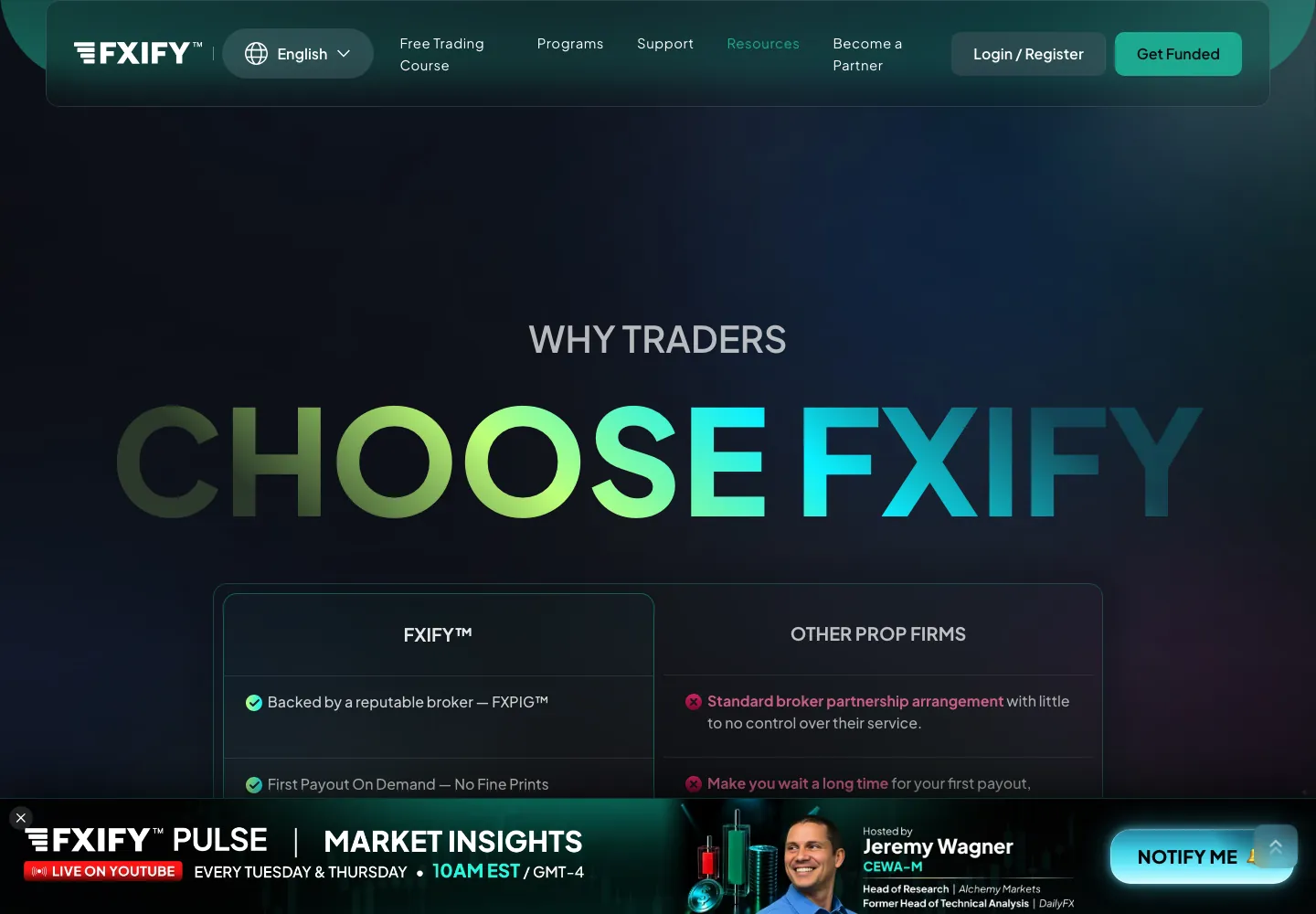
FXIFY markets a broker relationship harder than any other claim it makes. Its dedicated page carries the headline “BUILT FOR TRADERS, BACKED BY A BROKER.” and a comparison table whose FXIFY column reads “Backed by a reputable broker — FXPIG™” against an “OTHER PROP FIRMS” column reading “Standard broker partnership arrangement with little to no control over their service.”
Three things about that are checkable and worth knowing.
The partner is not arm’s length. fxpig.com and fxifymarkets.com both resolve to markets.fxify.com, whose footer reads: “FXIFYMarkets.com is owned and operated by Prime Intermarket Group Eurasia Ltd, a company licensed and regulated by the Financial Services Commission (FSC) of Mauritius as an Investment Dealer under License Number GB24204066.”
The named entity changed between June and August 2026. The Labuan disclosure itself is not new. On the Internet Archive’s snapshot of 5 January 2024 the rendered footer already carried the same licence number under the entity’s former name, on two lines: “Timios Global Markets dba FXIFY Markets”, then “Regulated by the Labuan FSA with license number: MB/22/0097”. By 25 December 2025 and again on 7 June 2026 it had become “FXIFY Markets Ltd is licensed in Labuan, Malaysia, as a money broker under License No. MB/22/0097, with its registered office at 1-13(A), First Floor, Paragon, Jalan Tun Mustapha, 87009 Labuan.” On 13 August 2026, from all eleven of our vantage points, Labuan is gone and the Mauritius sentence stands in its place. So one licence disclosure ran for at least two years and five months on the captures we hold, and was replaced inside the last ten weeks. The description of the UK company changed with it. In January 2024 the footer named the company as “FXIFY Solutions LTD”, at the New Broad Street address its contact page still gives, and described it as one that “is the UK merchant company, which provides processing payment services on behalf of Timios Global Markets”. Today the same paragraph spells the company FXIFY Solutions Limited and describes it as “operating as a payment agent”, with no principal named at all.
Those are two different companies. FXIFY Markets Ltd is a Labuan entity; Prime Intermarket Group Eurasia is a Mauritius one. The distinction is not ours. It comes from filings by FDCTech, Inc., a US company reporting to the Securities and Exchange Commission under CIK 0001722731, whose annual report’s subsidiary table lists “Prime Intermarket Group Eurasia (PIG) 100.00 % Mauritius FX, CFDs Asia” and whose quarterly report filed on 15 May 2026 describes FXIFY Markets Ltd. of Labuan as one of “certain non-consolidated affiliated entities controlled directly or indirectly by Mr. Kundnani … all of which are sister entities to the Company and not part of the consolidated group”, disclosing “approximately $ 3.2 million representing a loan receivable carried by FDCTech, Inc. from FXIFY Markets Ltd.”
The same filing says this about the entity FXIFY’s footer now names, quoted with the sentence that precedes it because it changes the meaning: “Effective January 1, 2026, we commenced start-up work under Prime Intermarket Group Eurasia (FXPIG), a Mauritius-based private limited company under Section 24 of the Companies Act. The company was originally established in May 2025, with no operations.” A current report filed on 5 June 2025 had said the subsidiary “will operate under an SEC-2.1B Investment Dealer License (Full-Service Dealer, excluding Underwriting)”, in the future tense. That same annual report table assigns it a live business line, “FX, CFDs”, in Asia. We draw no conclusion from the sequence of dates and leave it with the reader.
Two things about that citation, which we would rather state than have a reader discover. First, the quarterly report we took it from is one FDCTech has itself withdrawn reliance on: an Item 4.02 current report filed on 8 June 2026 says the board concluded that those financial statements “should no longer be relied upon”, and an amended quarterly report was filed the same day. Every sentence we quote survives verbatim in the amendment, and we cite both. Second, our search method: the SEC’s full text search returns 707 quarterly reports for a control query of “Interactive Brokers” and 8 for “Prime Intermarket Group Eurasia”, rising to 21 across all form types, every one of them an FDCTech filing.
Licences: what we verified, what we could not, and what we did not try
| Authority | Location | License Number | Retail Services | Protection Level |
|---|---|---|---|---|
| FCA | United Kingdom | 612233, ALCHEMY PRIME LIMITED | A group company only, no FXIFY customers | Verified Authorised, licence effective 5 August 2014 when the registered name was GF Capital Management Ltd; the Alchemy Prime name dates from 2019. Companies House 08698974, permission to “Hold and control client money”. None of the fourteen distinct names on the record is FXIFY or FXPIG, and only three are current |
| FCA | United Kingdom | 931431, FXPIG PAYMENTS UK LIMITED | None | PSD Agent Status reads “PSD Agent Former”, effective 26 June 2023. Companies House SC519371 shows the company dissolved on 29 October 2024 |
| FSC Mauritius | Mauritius | GB24204066 claimed for Prime Intermarket Group Eurasia Ltd | The affiliated broker, not FXIFY | Claimed, not verified. See below |
| Labuan FSA | Malaysia | MB/22/0097 claimed for FXIFY Markets Ltd | Named in FXIFY’s own footer until at least 7 June 2026 | The entity IS on the Money Brokers directory as “FXIFY Markets Ltd. (formerly known as Timios Global Markets Ltd.)”. The number cannot be checked: the registration column is empty for all 97 money brokers |
| VFSC | Vanuatu | 14578, claimed by a third party for Prime Intermarket Group Asia Pacific Ltd | None claimed by FXIFY | Not on the current Financial Dealers Licensee List, which we read in full: 66 active licensees including Deriv, Titan FX and Vantage. That list carries active licences only, so this is not evidence none ever existed |
| Companies House | United Kingdom | 14451720, FXIFY SOLUTIONS LIMITED | The contracting entity | Verified Active, audited accounts filed, owner disclosed |
On the Mauritius number the honest position is that we do not know. Twelve counted attempts against fscmauritius.org, across six URLs and both HTTP versions, each returned an Incapsula interstitial of roughly 840 bytes with no body, and so did our positive control on a licence number the FSC does publish a page for. When the control fails, nothing may be concluded, so we conclude nothing. The same host serves the FSC’s own licensing criteria PDF at 693,193 bytes, so the host is up and it is the register pages specifically that are gated to us. That is a fact about our tooling, not about the Mauritius FSC and not about FXIFY, and we did not attempt to defeat the challenge. A third party lead offered a different number, GB21026537, supported by nothing we found; we publish neither as verified. Registers we did not reach at all, recorded as not checked rather than not found: the Irish Companies Registration Office, which returned HTTP 403 to every client we tried and leaves FXIFY Futures Limited unresolved, the Hong Kong Companies Registry, the Mauritius companies registry, and entity level searches at Spain’s CNMV and Italy’s CONSOB.
Warning lists
We searched for FXIFY, FXIFY Markets, Prime Intermarket, Prime Intermarket Group Eurasia, Briarwood Ventures, Timios and FXPIG on every list we could query, each with a positive control to prove the query worked. Nothing was found against FXIFY on any of them. The FCA register returns zero hits for FXIFY while returning seven for Plus500 including five unauthorised entries; IOSCO’s I-SCAN returns zero against six for Plus500; the CFTC RED List of 284 companies, ASIC’s Investor Alert List of 4,295 entries and the Bank of Russia’s 26,798 row list of firms with signs of illegal activity all return nothing.
Entries do exist elsewhere in the group, and they belong in a review that offers the group’s FCA licence as reassurance. The FCA register carries “alchemyprime.us (Clone of FCA Authorised Firm)” as Unauthorised, a clone of the very firm named above, and IOSCO I-SCAN carries the matching FCA warning 29819. Malta’s MFSA has published five impersonation warnings naming Alchemy Markets Ltd, which is a separate Maltese company in the same group and not the UK firm above; FDCTech’s schedule of subsidiaries lists the two on adjacent lines in different jurisdictions. None of these entries is FXIFY, and none suggests wrongdoing by either licensed firm; they are sites impersonating them.
Two further entries exist against the FXPIG brand rather than FXIFY. The Bank of Russia list carries “Prime Intermarket Group Asia Pacific Ltd (FXPIG)” at a Port Vila, Vanuatu address with sites fxpig.com and portal.fxpig.com, flagged for signs of an illegal professional participant in the securities market; the date cell on that row is empty so we give no date. IOSCO I-SCAN carries warning 29849 against FXPIG from Ukraine’s securities commission, published 22 March 2024, stating the entity “does not hold an Ukrainian financial services licence”. Read that one precisely: it is a no local licence alert, not a fraud finding. We raise both only because fxpig.com resolves to markets.fxify.com, so the partner FXIFY names is not an unrelated third party.
The corporate picture, from registries and filings only
Gope Shyamdas Kundnani, a founding director of FXIFY Solutions Limited until July 2024, is the sole director and controller of SYNC CAPITAL LIMITED, UK company 10519029, registered at 142 Central Street, the same address as FXIFY Solutions, and Sync Capital in turn controls PRIME INTERMARKET GROUP LIMITED, UK company 13451411, at that same address. FDCTech’s annual report describes Kundnani as “a controlling shareholder of the Company”. This is also where the FCA authorisation mentioned above connects: FDCTech’s exhibit of subsidiaries lists Alchemy Prime Limited of the United Kingdom alongside Prime Intermarket Group Eurasia, and Alchemy Prime’s principal place of business on the FCA register carries the same EC1V 8AR postcode as 142 Central Street. That is the basis on which we call it a group company, and it is worth being explicit that the only statement FXIFY itself publishes about belonging to a group is the footer line we report below as commented out.
One detail, flagged without overreading it: Prime Intermarket Group Limited reads “Active, Active proposal to strike off” on Companies House as at 13 August 2026. That is a voluntary strike off, applied for by the company on 3 August 2026 and first gazetted on 11 August, against a UK company whose last accounts were dormant and whose sole director is Robert James Winters. It is the UK company of that name, not the Mauritius entity FXIFY’s footer names.
Two last notes on the footer. What does render, immediately after the Mauritius sentence, is this: “FXIFY Solutions Limited is a registered company in the United Kingdom (Company No. 14451720), with its registered office at 142 Central Street, Clerkenwell, London, United Kingdom, EC1V 8AR, operating as a payment agent.” The company you contract with under clause 1.1, and the only one English law gives you a claim against, describes itself in its own footer as a payment agent.
What does not render is this. The lines “FXIFY™ Solutions LTD, registration number 14451720,” and “FXIFY Solutions Ltd is part of the FXPIG group of companies.” are present in the page source inside an HTML comment. We verified the comment boundaries by byte offset in the retained markup, and we report what the markup contains without speculating about why.
How to Trade
The path is the same one every firm in this sector uses, with FXIFY’s own variations. You pick a programme and an account size, you pay a one off fee, you receive login details, and you trade to a profit target without breaching a daily loss limit or a maximum drawdown. Pass, and you are put forward for the funded stage. Fail, and the fee is gone: FXIFY’s help centre says that on a breach “the account will be automatically invalid” and “The initial fee that was paid will also be forfeited.”
Platforms
Four, which is more than most: MetaTrader 4, MetaTrader 5, DXtrade and TradingView. The programme pages call the MetaTrader products “Trading Platform 4 (TP4)” and “Trading Platform 5 (TP5)” while the help centre names them outright, which is a naming convention common across this industry. MetaTrader is stated as unavailable to clients based in the United States, wording that sits oddly against a footer saying no United States accounts are opened at all.
Order handling detail is documented in the help centre at a level of granularity that is genuinely useful, including how to set stop losses and take profits in DXtrade. FXIFY offers a choice of two pricing feeds, described below in the fees discussion, and an add-on that raises leverage.
Leverage, and what it tells you
Standard leverage is 30:1 on FX and gold, rising to 50:1 with a paid add-on. Indices are 10:1, oil 5:1, stock CFDs 2:1 and crypto 2:1. Fifteen named FX pairs are fixed at 1:6. This is worth pausing on because it runs in FXIFY’s favour. Firms routing retail flow through the loosest available jurisdiction advertise 1:500 or 1:2000, because nothing stops them. Numbers in the 30:1 to 50:1 range are what a firm with a serious execution relationship or a conservative internal risk model offers. It is a small signal but it is a real one.
Leverage can be cut without your agreement
Clause 4.5 of the General Terms lets FXIFY drop leverage “to 10:1 for FX and Metals starting 10 minutes before the Events and ending 5 minutes after the Events announcement”. The clause then adds, and the phrasing is the firm’s own: “Notwithstanding the above, positions which were opened prior to the Reduced Leverage Window shall be affected by the reduced leverage.” So a position you opened under 30:1 can find itself margined at 10:1 through a news release. The same clause gives FXIFY discretion “to lower the leverage ratios for certain periods of time for any kind of Events”, with 24 hours notice.
What you are not allowed to do
FXIFY publishes a dedicated prohibited strategies page as well as clause 5.4 of the contract, and between them they cover high frequency trading, reverse hedging, group hedging, account management by anyone other than you, latency arbitrage, order book spamming, herd trading, collusion, exploiting bugs, high leverage news trading, and statistical arbitrage. Most of that is standard and reasonable. Three items are not.
The first is “Herd trading”, defined as “the concept of many people trading in the same direction at the same time” and then extended: “This also includes when customers use the same EA from the same company, this would lead to multiple customers collaborating at the same time.” Read literally, buying a popular commercial expert advisor and running it puts you inside a prohibited category through the conduct of strangers. The second is that “Poor Money Management” and “Gambling behaviour” are both listed as prohibited strategies with no numeric threshold anywhere on the page; the stated test for the former is customers “who frequently encounter margin calls due to inadequate funds or risky positions”.
The third is the general catch all in clause 5.4.1.7, capitalised in the original, which prohibits trading “IN A WAY THAT ESTABLISHES JUSTIFIED CONCERNS THAT THE PROVIDER MIGHT SUFFER FINANCIAL OR OTHER HARM AS A RESULT OF THE CUSTOMER’S ACTIVITIES (E.G. OVERLEVERAGING, OVEREXPOSURE, ONE-SIDED BETS, ACCOUNT ROLLING, STATISTICAL ARBITRAGE).” Clause 5.4.1.8 prohibits “ANY TRADING WHICH IS SEEN AS PROHIBITED AS PER THE SOLE DISCRETION OF FXIFY” and lets FXIFY “ALTER AND AMEND” that list “AT ANY TIME WITH A NOTICE OF 7 DAYS”, while clause 5.4.3 reserves “the right to determine, at its own discretion, whether certain trades, practices, strategies, or situations are Forbidden Trading Practices”. The prohibited strategies page adds two consequences: “Profits generated from prohibited trading practices will be void”, and “All passed Evaluations are subject to review, and customers found guilty of policy ignorance or abuse will not advance to the Qualified phase.” A pass, in other words, can be revisited.
Inactivity ends the account
Sixty days without a trade breaches the account. The help centre says so and clause 13.3 of the contract makes it a breach of the contract itself: if “You shall not execute any trades within a consecutive period of two (2) months, Your Account shall be deemed inactive and will be considered as a breach of the GTC.” For a funded trader who steps away for a summer, that is worth knowing in advance.
Challenges & Funding
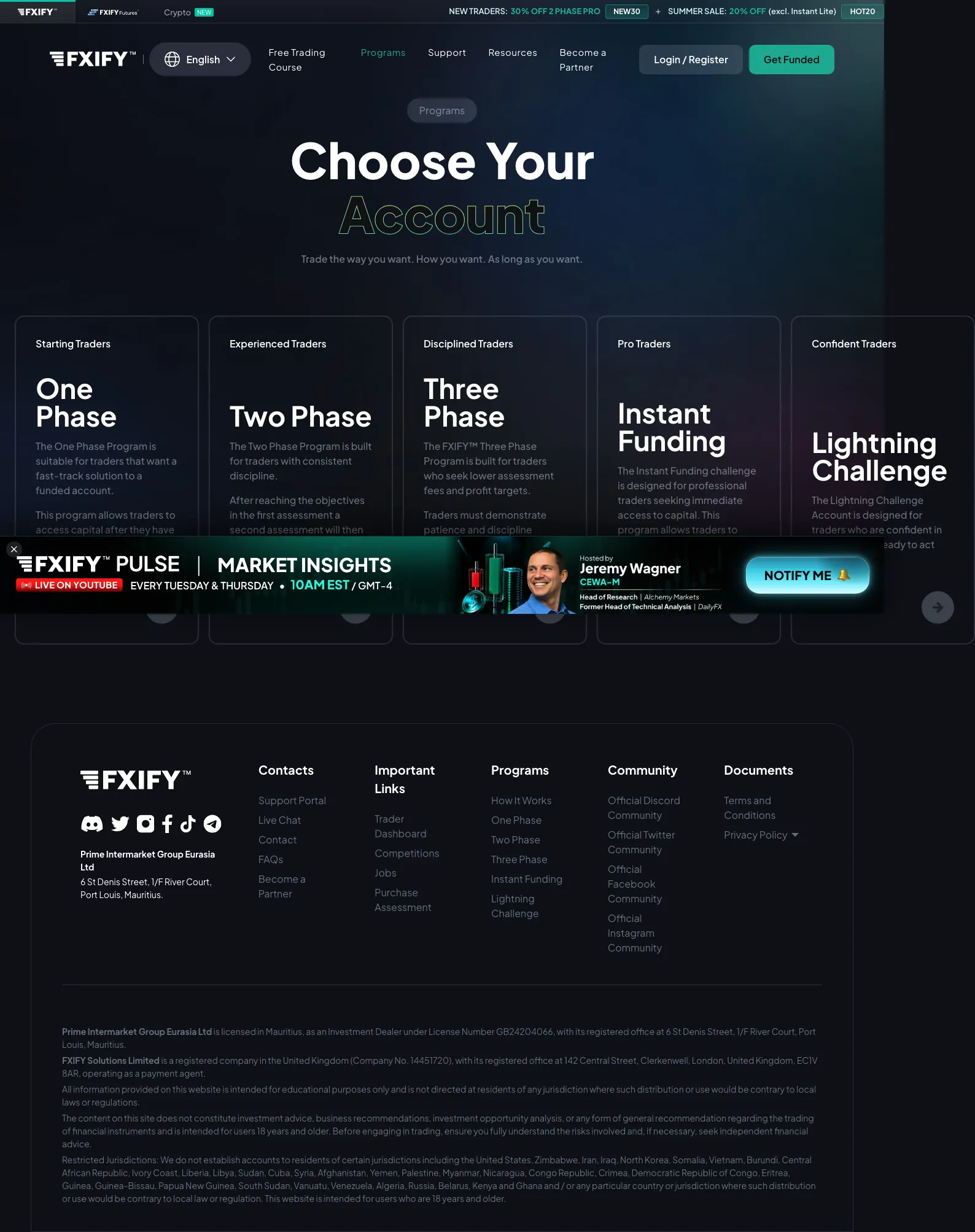
FXIFY sells eight programmes. We recovered the full tier table as structured data from the site’s own pricing payload rather than by scraping rendered text, because the rendered HTML does not carry the table as text and a scrape would have produced an incomplete list. Prices below are as published on 13 August 2026, before the NEW30 and HOT20 promotional codes.
The programmes
| Programme | Account sizes | Fee range | Structure |
|---|---|---|---|
| One Phase | $5k to $400k, eight sizes | $59 to $2,950 | 10% profit target, 3% daily loss limit, 6% max trailing drawdown, 100% refundable fee |
| Two Phase Standard | $5k to $400k, eight sizes | $59 to $2,950 | Two stages, 4% daily, 10% max trailing drawdown, 100% refundable fee |
| Two Phase Classic (static) | $5k to $100k, six sizes | $59 to $549 | 5% then 10% targets, 4% daily, 10% static max drawdown, and a 25% consistency rule at the funded stage |
| Two Phase Pro | $10k to $250k, seven sizes | $129 to $1,350 | Uses a Max Loss Limit rather than a trailing drawdown; first two payouts capped |
| Three Phase | $5k to $400k, eight sizes | $39 to $1,599 | 5% target per phase, 5% daily, 5% max drawdown, 100% refundable fee |
| Instant Funding Standard | $1k to $100k, eight sizes | $69 to $4,249 | No assessment. 8% daily loss limit, 8% max trailing drawdown |
| Instant Funding Lite | $2.5k to $50k, five sizes | $19 to $289 | The cheapest entry FXIFY sells; a 20% consistency rule applies |
| Lightning | $10k to $100k, four sizes | $59 to $399 | 5% target, 3% daily, 4% max trailing drawdown, 30% consistency rule at both stages, stop loss required |
A separate crypto line runs alongside these with its own rules, and FXIFY Futures operates on a different domain with its own entity, FXIFY Futures Limited of Dublin. We could not check the Irish register, so we say nothing about that company’s standing beyond the address it publishes.
What the fee buys, and when you get it back
On the 1, 2 and 3 Phase plans the pricing table carries a “Refundable Fee” row reading 100%, described as “Receive 100% of the cost of the assessment fee. This is paid out when a trader makes their first withdrawal.” That is a real benefit and it is unusually clear. Note the condition: it is paid with the first withdrawal, so a trader who never reaches a withdrawal never sees it. Instant Funding and Lightning carry no refundable fee row at all.
The refund is also final in the other direction: “No refunds will be offered after the first trade is placed”, and clause 2.6 says the customer is not entitled to a refund if they cancel, stop using the service, fail the challenge or breach the terms. Clause 2.7 goes further and lets FXIFY, “at its own discretion”, stop providing any services and refuse all future services to a customer who raises a chargeback the firm considers unjustifiable.
Time limits and minimum days
Each of the 1, 2 and 3 Phase assessments carries a minimum trading period of five days per phase. FXIFY works the arithmetic itself: “you can be a funded trader from as early as 6 days if the trader chooses the 1 phase account. If you are on 2-Phase; as early as 11 days while 3-Phase; as early as 16 days.” Minimum trading days need not be consecutive, and weekends count if you trade crypto.
Add-ons, and what is behind each paywall
Five paid extras are offered at checkout, and three are worth naming for what they imply about the default.
- Extra 10% Performance Split, taking the profit share from 80% to 90%. The advertised “up to 90%” is therefore a paid figure, not the standard one.
- Increased leverage, 30:1 to 50:1 on FX and gold.
- Bi-weekly Payouts. Without it, payouts after the first are monthly on the 1, 2 and 3 Phase plans. Payout frequency is a purchasable feature.
- Performance Protect, priced at 15% of the assessment fee and only available at checkout. What it buys is this: without it, “If you have profits in your Funded account at the time of a hard breach, you are not entitled to the profits.” With it, on the same hard breach page, “even if the account was breached, you can still withdraw the profits and will also be eligible for refund if it’s the first withdrawal ( valid for 1,2,3 Phase challenges)”. You do not keep the profits, you keep your split of them: that page’s worked example takes a $100,000 account grown to $110,000 and pays 80% of the $10,000, or 90% with the split upgrade. The right to keep a share of money you have already made is sold as an extra. Two further wrinkles, both from FXIFY’s own pages. Its dedicated Performance Protect article carries a completely different worked example that shares no figures with the one above, running a $100,000 account to a highest equity of $130,000, a 5% daily drawdown breach and an ending balance of $123,500, from which “the trader can request a payout of the remaining gains, in this case, $23,500”. And that same article says the add-on “is offered as an add-on to all prop traders of FXIFY™” with no carve-out, while the Instant Funding rules page states an exclusion.
- RAW or All-In pricing, a choice of commission model rather than an upgrade.
Scaling
FXIFY publishes a scaling plan: “The trader must achieve a 10% return in the first 3 months, with at least 2 of those months being profitable, in order to scale up by 25%. Subsequent scaling will occur every 3 months … The account balance will double with each scale up. This scale up can be done 4 times.” Its worked example takes a $400,000 account to $4m over twelve months. Judge that against the payout rules rather than on its own.
Costs
On the RAW feed, commission is $6 per lot on FX, metals and index CFDs, and stock CFDs cost 0.35% round trip. The All-In feed is commission free except for stock CFDs at the same 0.35%. There is no withdrawal fee and no inactivity fee, though sixty days without a trade ends the account outright.
No spread table is published anywhere on the site. The only figure is a marketing line on the “Backed By A Broker” page promising “… spreads from 0.0 on major FX pairs and Gold.” We record that as a claim, not a fact. In partial mitigation FXIFY publishes read only credentials for two demonstration MetaTrader 5 accounts in its spreads article, so a prospective customer can look at live pricing before paying. We are not reproducing those credentials here.
Drawdown & Breach Rules
This is where prop firms hide the trapdoor, and FXIFY is unusually open about where its own trapdoors are. The rules below are published with the firm’s own worked numbers, which is better disclosure than most of this sector manages. Read them anyway, because two of them take money from a trader who has broken no stated limit.
The two limits
Daily loss limit. Between 3% and 8% depending on programme, and measured from a fixed reference point: “Daily Loss Limit is calculated based on the previous day’s end of day (5PM EST) balance.” So the daily floor is set at the New York close and does not move with intraday profits.
Maximum drawdown. Three different mechanics across the range, and they are not interchangeable.
- Trailing, on 1 Phase, 2 Phase Standard, Lightning and Instant Funding. FXIFY’s description of the 1 Phase version: “6% trails your closed trading balance until you reach 6% profits in your account. Once you have achieved 6% in your account the max trailing locks in at your starting balance, and no longer trails your account.” The percentage differs by plan and the differences matter: 6% on 1 Phase, 10% on 2 Phase Standard, 4% on Lightning and on Instant Funding Lite, 8% on Instant Funding Standard. Daily loss limits differ too, 3% on 1 Phase against 4% on 2 Phase Standard.
- Static, on 2 Phase Classic: “When you open the account, your Max Drawdown is set at 10% of your starting balance. This will be static for the life of the account.”
- Max Loss Limit, on 2 Phase Pro, a differently named mechanic again.
Breach is measured on equity, tick by tick
The most consequential sentence FXIFY publishes about breaches is in a help centre article answering why an account breached when the balance looked fine: “Breach levels are determined by real-time equity, not the final settled balance. If your equity falls below the Daily or Max Loss Limit equity breach level — even for a single second — the system will trigger a breach.”
Equity rather than balance, intraday rather than at close, and a single second is enough. That is a strict rule and it is stated clearly, which is to FXIFY’s credit. It is also the reason the payout rule below is not a theoretical risk but an automatic outcome.
The rule that takes the account from a compliant trader
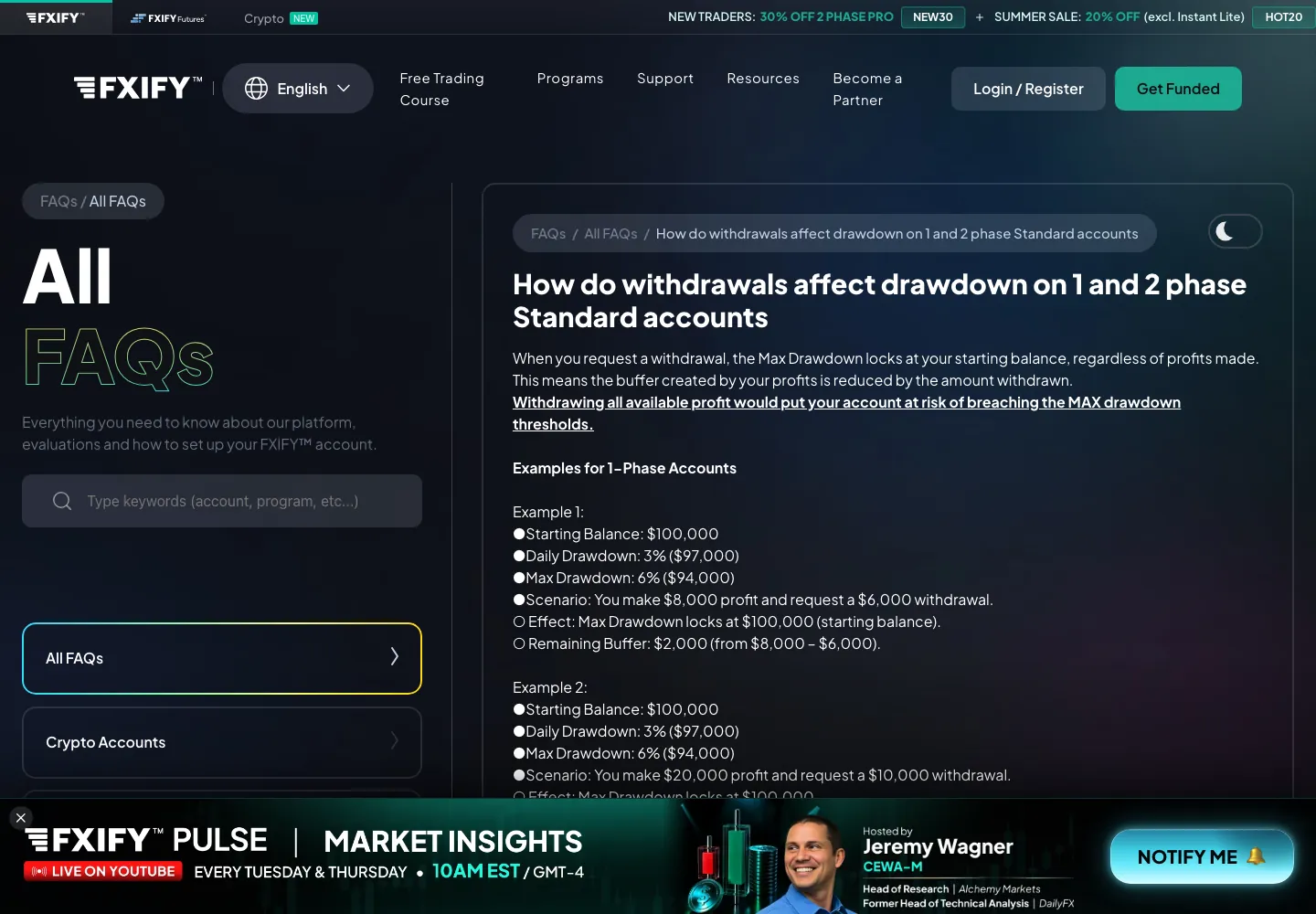
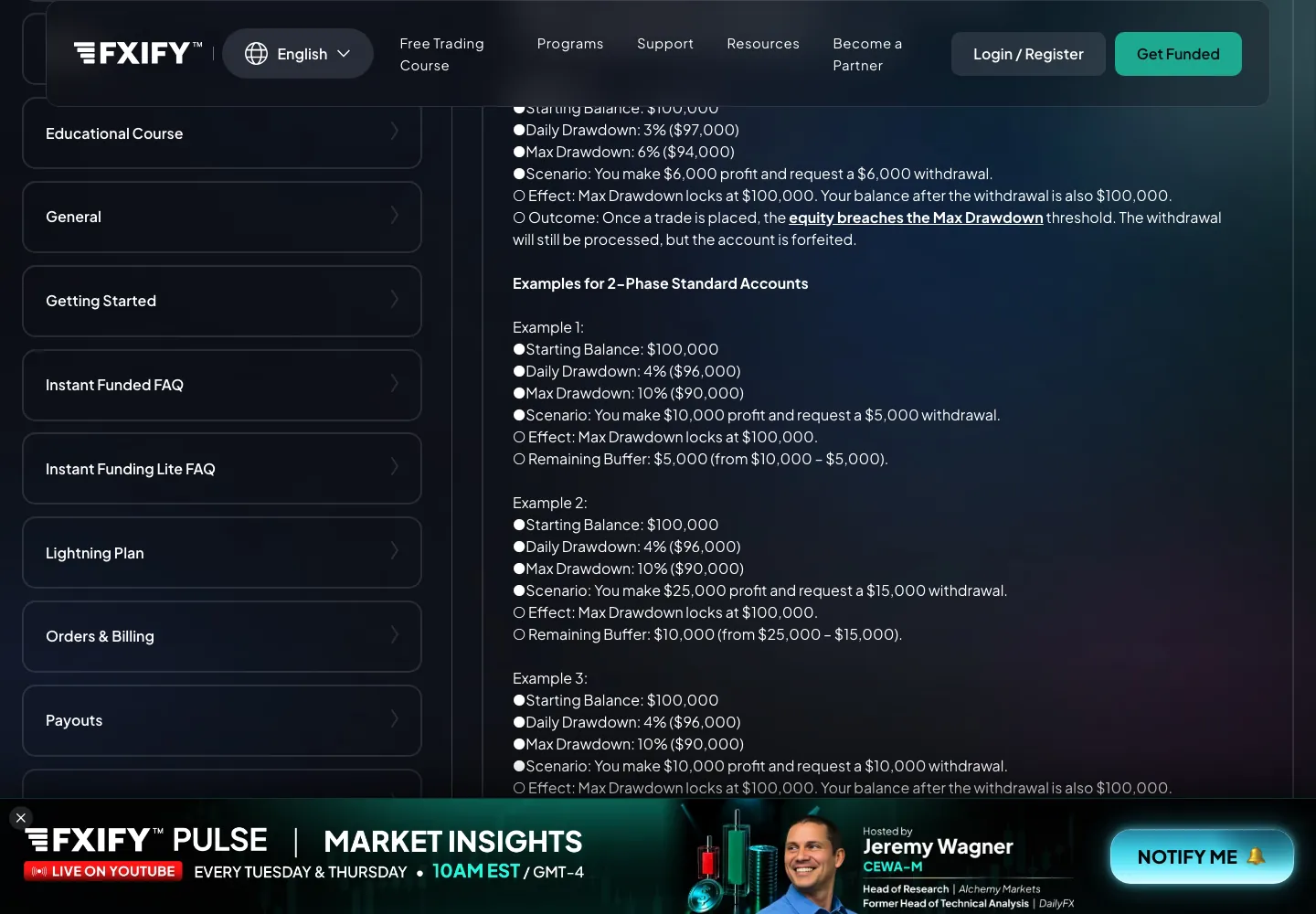
FXIFY publishes this itself, with numbers, in an article titled “How do withdrawals affect drawdown on 1 and 2 phase Standard accounts”. The mechanic first: “When you request a withdrawal, the Max Drawdown locks at your starting balance, regardless of profits made. This means the buffer created by your profits is reduced by the amount withdrawn. Withdrawing all available profit would put your account at risk of breaching the MAX drawdown thresholds.”
Then the firm’s own third example, quoted in full:
“Example 3: ● Starting Balance: $100,000 ● Daily Drawdown: 3% ($97,000) ● Max Drawdown: 6% ($94,000) ● Scenario: You make $6,000 profit and request a $6,000 withdrawal. ○ Effect: Max Drawdown locks at $100,000. Your balance after the withdrawal is also $100,000. ○ Outcome: Once a trade is placed, the equity breaches the Max Drawdown threshold. The withdrawal will still be processed, but the account is forfeited.”
Work the arithmetic yourself. Start at $100,000. Trade well and reach $106,000. Withdraw the $6,000 you made. The floor has now locked at $100,000 and your balance is $100,000, so the buffer is exactly zero. Open any position, and the spread alone takes equity below $100,000. Under the tick level equity rule above, that is a breach in the first second. The trader hit no daily limit, hit no drawdown limit, and used the payout feature the firm advertises. The account is gone. FXIFY repeats the same outcome for 2 Phase Standard, where a $10,000 profit and a $10,000 withdrawal on a $100,000 account produce the same result, and again in its Instant Funding article: “In the scenario that a payout is requested for the full profit, this may result in a breach of the account if a trade opens following the withdrawal of the full profit.”
The payout article states the general rule as a footnote: “*You are entitled to a full withdrawal, however in doing so, you will forfeit the funded account on 1 phase, 2 phase, Lightning and Instant funding accounts.”
Two things should be said in FXIFY’s favour. The page carries six examples, three for each plan, and four of them are partial withdrawals that work exactly as a trader would hope, leaving a buffer equal to the profit not taken. Example 3 is the firm’s own deliberately constructed edge case, and it published it rather than hiding it. The rule is escapable simply by leaving something in. What it sits against is the marketing, and we set the two side by side in the payout terms section below.
A hard breach voids the profits, unless you paid for the add-on
FXIFY’s answer to what happens to profits sitting in a funded account at the moment of a hard breach: “If you have profits in your Funded account at the time of a hard breach, you are not entitled to the profits.” The only exception is the Performance Protect add-on, described with its price and its limits in the challenges section above, which has to be bought at checkout before a trader has any way of knowing whether they will need it.
What else breaches
- Exceeding the daily loss limit, on real time equity.
- Exceeding the maximum drawdown, on real time equity.
- “Full profit withdrawal leaves no buffer, and placing a new trade violates the Max Drawdown”, in FXIFY’s own summary list.
- Sixty days without placing a trade.
- Any of the forbidden trading practices in clause 5.4, several of which are defined by FXIFY’s sole discretion rather than by a number.
On a breach: “the account will be automatically invalid and ultimately you will not be able to continue trading on that particular account. The initial fee that was paid will also be forfeited.” FXIFY then offers a discounted restart, which is a commercial response rather than a remedy.
To FXIFY’s credit, every drawdown figure above is published on its own site with worked examples, and the tier table carries the daily loss limit, drawdown type and consistency rule for all fifty four account configurations. What is not published is the funded stage contract, and the payout record section returns to that.
Trading Instruments
FXIFY publishes an instrument table giving, for each symbol, a description, contract size, number of digits and the base and quote currency. That is better instrument disclosure than a good many licensed brokers manage. We counted the rows rather than taking the table’s own shape on trust: 104 table rows resolve to one header, five blank spacers, five section labels and 93 instruments. The homepage markets “Over 150+ Symbols To Trade” against that 93.
| Class | Detail | Maximum leverage |
|---|---|---|
| Forex | 43 pairs, majors, minors and crosses | 30:1 standard, 50:1 with the paid add-on. Fifteen named pairs are fixed at 1:6 |
| Metals | 5 instruments, gold and silver against the dollar and other quote currencies | 30:1 standard, 50:1 upgraded on gold |
| Indices | 14 cash index CFDs | 10:1 |
| Commodities and energies | 3 instruments, oil and related contracts | 5:1 |
| Stock CFDs | 28 single name contracts for difference, charged at 0.35% round trip on both pricing feeds | 2:1 |
| Cryptocurrencies | Sold as separate crypto plans with their own drawdown and payout rules, including weekend trading | 2:1 |
The leverage column deserves a second look. A firm whose risk sits offshore and whose interest is in customers blowing up quickly advertises 1:500 and upwards. FXIFY’s ceiling is 50:1 and only on FX and gold, with equities at 2:1. That is consistent with a firm running a real risk book against the positions, or at least modelling one, and it is a point in its favour that most of this sector cannot claim.
What you are trading against
One thing changes what this list means. On the assessment stages the binding contract says the trading is simulated and the funds fictitious, so the table above describes a price feed rather than a market you have exposure to; the funded stage is unresolved, for the reasons set out in the overview and regulation sections. Clause 2.12 separately warns that platform operators “are persons or entities different from the Provider and that their own terms and conditions and privacy policies will apply”.
Instruments that carry extra rules
Crypto plans run to a separate rulebook: their own consistency rule, their own trailing drawdown article, weekend trading, and a minimum profit before a payout that scales with account size, reaching $750 on a $100,000 crypto account against the $50 minimum stated for everything else. If crypto is your market, read those articles specifically rather than assuming the main rules carry across.
News trading is permitted within limits rather than banned outright. FXIFY’s prohibited strategies page says of high leverage news trading that it “allows HLNT within limits. It must be clear to FXIFY that proper risk management tactics are being used when engaging with HLNT.” Gap trading around scheduled events, and within two hours of a market closing for two hours or longer, is prohibited by clause 5.4.1.6.
Education & Analysis
FXIFY invests more in education than most firms selling assessments, and it does not charge for it. Whether that is generosity or funnel design is a question the reader can settle for themselves; either way the material exists and is free to access.
The trading course
Five structured modules, each with lessons, topics and an end of module quiz, published on fxify.com and free: Understanding Forex and CFDs, Trading Infrastructure, Risk, Leverage and Trader Psychology, Analysis combining technical and fundamental, and Strategy, Execution and Next Steps. It is a real curriculum rather than three blog posts with a course label attached, and the risk module addresses the thing most likely to end an assessment.
The help centre
This is the strongest part of FXIFY’s published material and the most useful thing on the site. It is self hosted rather than run on a third party helpdesk, organised into categories including Payouts, Rules, Trading, Platforms, Getting Started, Orders and Billing, and per programme sections for Instant Funded, Instant Funding Lite, Lightning Plan, Two Phase Pro, Crypto Accounts and the Educational Course. Articles carry worked numeric examples rather than summaries, which is why this review has been able to quote FXIFY’s own arithmetic against its own marketing.
We fetched 181 of the English articles in full and enumerated the remainder from the site’s own sitemaps. We make no claim about the content of the articles we did not fetch; the ones we did not open are overwhelmingly platform how to guides for TradingView and DXtrade.
Analysis, tools and the dashboard
The trader dashboard at trader.fxify.com carries advanced account metrics, a trade journal and a top performers leaderboard, and hosts monthly trading competitions. FXIFY publishes market commentary on its blog, including weekly previews and event pieces on rate decisions and payroll releases, and TradingView charting is one of the four platforms. One tool is unusual enough to name: the spreads article publishes read only credentials for two demonstration MetaTrader 5 accounts, so a prospective customer can inspect live pricing before buying anything. Given that no spread table is published, that is a partial substitute and a more honest one than a marketing figure. We are not reproducing the credentials here.
A note on the blog
Some of FXIFY’s blog output compares FXIFY to named competitors, which is marketing rather than analysis and should be read as such. Separately, fxify.com publishes a file at /llms.txt, generated by its SEO plugin and described in the file itself as “meant for consumption by LLMs”. We read it. It is an index of pages with marketing summaries and contains no instructions aimed at an assistant. We mention it because a reader who asks an AI assistant about FXIFY may be reading the firm’s own copy back to themselves, and that is worth knowing. Nothing in it was treated as an instruction here.
Payout Terms
This is the section that matters. Everything else about a prop firm is preamble to whether it pays, and on what conditions. FXIFY publishes its conditions in unusual detail, and four of them can cost money to a trader who has broken no stated rule. We set out each one with FXIFY’s own words and work the arithmetic through.
The headline terms
- Profit split: 80% as standard on the forex and index programmes, rising to 90% only with the paid Extra 10% Performance Split add-on bought at checkout. The homepage advertises “Up to 100% Performance Split” in one badge and “Up to 90% Performance Split” in another, and the 100% is real but narrow: it is a choice offered on the Crypto Challenge Account alone, and it is paid for in payout frequency. FXIFY’s crypto payout article: “80% Profit Split: You receive 80% of your profits This option allows you to request withdrawals every two weeks.(bi-weekly) 100% Profit Split: You keep all the profits you earn, Withdrawals under this option are available once per month.” The Crypto Instant Funded Account “is fixed at 80%”.
- Minimum payout: $50, per the help centre, “for all account types”. Crypto plans scale this upward with account size to $750 on a $100,000 account.
- First payout: on demand for 1, 2 and 3 Phase. Fourteen days after the first trade on Instant Funding. Seven days on Lightning.
- Later payouts: monthly by default on 1, 2 and 3 Phase, or every fourteen days if the bi-weekly add-on was purchased. Bi-weekly by default on Instant Funding and Lightning.
- Rail, timing and tax: covered in the payout record section below. In short, every payout runs through Rise and a second identity check, and FXIFY treats a funded trader as “an independent contractor” responsible for their own tax.
Problem one: the marketing and the help centre give three different answers on the first payout
All four of these were live on fxify.com on 13 August 2026, and two of them are on the same page.
The how it works page: “For the first payout, traders can request a withdrawal on-demand, as soon as the first trade on the live account is closed. There’s no minimum amount. No minimum days.”
The homepage: “Our traders don’t wait for payouts. Receive your first payout as early as your first funded trading day upon request — minimum amount 50 USD across all accounts.”
The homepage again, in a different block: “Trade your way to the top, earn up to 90% performance split, and request your first payout on demand. No minimum or maximum amount.”
The help centre, listing reasons the payout button is greyed out: “You have not reached your payout date yet. (For 1,2 and 3 Phase the first payout is on demand considering the 5 different trading days are met, while the second payout and beyond is per month or bi-weekly, depending if the add-on was purchased)”
One page says there is no minimum amount and no minimum days. The homepage sets a $50 minimum in one block and says “No minimum or maximum amount” in another. The help centre sets five trading days. A reader cannot know which governs, and only one of the four is the operational rule that the payout button actually enforces.
Problem two: taking your full first payout forfeits the account
The marketing is unqualified. The comparison table on the Backed By A Broker page reads “First Payout On Demand — No Fine Prints”, and the same page instructs: “Request and receive your first payout instantly after closing your first trade in your funded account.” The homepage says “Get your first payout whenever you want. Close your first live trade, request your payout and receive it instantly.”
Now the terms. From the payout help centre article: “*You are entitled to a full withdrawal, however in doing so, you will forfeit the funded account on 1 phase, 2 phase, Lightning and Instant funding accounts.” The mechanic, worked through with FXIFY’s own example in the drawdown section above, is that requesting a withdrawal locks the maximum drawdown at your starting balance, so taking everything leaves a zero buffer and the next trade breaches.
Follow the marketing literally on a $100,000 1 Phase account: close your first trade with $600 of profit, request your payout instantly as instructed, take the whole $600, and the account is forfeited on the next position you open. The rule is escapable, by leaving part of the profit in so the account keeps a buffer equal to what you left. But nothing in “No Fine Prints” tells you that, and the instruction to request a payout “after closing your first trade” points directly at the failure case.
Problem three: the first two payouts on 2 Phase Pro are capped and the excess is deleted
FXIFY’s 2 Phase Pro article: “For the first two withdrawals on your account, there is a cap, which is maximum 5% of the initial balance. For accounts with balance of 200K and 250K this cap is at $8000. Thereafter; any subsequent payouts do not have a cap. Any profits exceeding this amount (5% of the initial balance or 8K for 200K and 250K balance accounts) will be removed.” The next sentence settles what “removed” means, in the firm’s own numbers: “For example, if you have a 100K account and earned a profit of 5,250, and you requested the maximum withdrawal of 5K (5% of the initial balance), the 250 will be deducted from your account.”
Deducted, then. Not deferred, not carried forward and not paid later. Two more worked examples, checked.
A $100,000 2 Phase Pro account costs $599. The cap on each of the first two withdrawals is 5% of $100,000, so $5,000. A trader who makes $15,000 of profit in the first payout cycle without breaching anything can withdraw $5,000. The other $10,000 is removed from the account.
A $250,000 2 Phase Pro account costs $1,350. The cap is not 5% here but a flat $8,000, which on $250,000 is 3.2%. A trader who makes $20,000 in the first cycle keeps at most $8,000 and loses $12,000. Buying the largest Pro account therefore buys a tighter percentage cap than buying the smallest, which is the opposite of what a reader would assume from the 5% headline.
Problem four: the consistency benchmark never resets, so a good day can push the payout further away
The 2 Phase Classic funded stage carries a 25% consistency rule. Lightning carries 30% at both stages. Instant Funding Lite carries 20%. FXIFY explains the 25% version at length and the rule itself is stated clearly: “The profit achieved in a day must not exceed 25% of the total profit made.” The formula: “Highest Daily Profit (HDP) ÷ 25% = Total Profit Required”. In other words your accumulated profit must reach four times your best single day before you can withdraw.
So far so ordinary. The part that bites is what happens after a payout: “The Highest Daily Profit (HDP) remains in the account after a withdrawal and continues to be used as the calculation parameter for the consistency rule unless you achieve a higher profit on another day.” And: “Key Point: The HDP does not reset after a withdrawal. It remains as your benchmark unless you achieve a higher daily profit in future trading.”
FXIFY’s own example: a highest daily profit of $1,000 against a current total profit of $2,500 gives 40%, fails the 25% test, and requires $4,000 of total profit before a new withdrawal can be requested.
Now take that one step further, using the firm’s own formula. One premise here is ours rather than FXIFY’s and we label it: we read accumulated total profit as surviving a withdrawal rather than resetting to zero, because FXIFY’s own example sits under a heading about the highest daily profit after a withdrawal and gives a current total profit of $2,500 rather than nil. Nothing on the site rebuts that reading and nothing states it outright. On that reading, suppose your best day so far is $1,000 and your accumulated profit is $2,800. The requirement is four times $1,000, so $4,000, and you are $1,200 short of a payout. You then have a strong day and make $2,000. Your accumulated profit rises to $4,800, which clears the old $4,000 threshold. But your highest daily profit is now $2,000, so the requirement becomes four times $2,000, which is $8,000. You are now $3,200 short instead of $1,200. Making $2,000 moved the payout $2,000 further away.
That is not a quirk of the numbers we chose. Under this formula the threshold moves away from you whenever a single day exceeds four thirds of your previous best day: the old shortfall is four times the old best day minus the total, the new shortfall after a day of size g is three times g minus the total, and the second exceeds the first exactly when g is more than four thirds of the old best. The trader in that example broke no limit. A $2,000 day is not a drawdown breach, not a lot size breach and not on the forbidden practices list. It simply resets the finish line.
Discretion, and the clauses that carry it
Beyond the arithmetic sit the discretionary clauses set out in the how to trade section, which is where they belong because they govern trading rather than payment. Two matter here specifically. Clause 5.5 lets FXIFY treat a violation as a failed challenge, delete the offending trades from the history, restrict leverage indefinitely, or cancel all services and terminate the contract, and clause 5.10 removes the right to argue: “the Customer shall not have the right to dispute the termination of this contract”. Clause 2.9 lets FXIFY “unilaterally change the fees and parameters of the Services at any time”, though not for services already bought.
The clause about complaining
Section 7 of the contract is headed “SOCIAL MEDIA & PUBLIC COMPLAINTS” and reads in full: “Customer should address any concerns or complaints directly with these GTC before posting any of them on social media or other public forums. If the Customer shall post a complaint and or any communication with FXIFY publicly, FXIFY reserve the right to take any appropriate legal action against the Customer regardless if the content is deemed defamatory, misleading, or in violation of FXIFY’s trademark rights.”
Read the last twelve words carefully. The right is reserved regardless of whether the content is defamatory. Clause 5.10 adds that “threats of defamation against the Provider, may result in legal proceeding against the Customer”, and clause 11 lists acting “IN A MANNER THAT MAY DAMAGE THE PROVIDER’S GOOD REPUTATION” among the breaches that allow FXIFY to cut off access “WITHOUT ANY PRIOR NOTICE AND WITHOUT ANY COMPENSATION”.
We are not going to tell you whether that clause is enforceable, which is a question for a lawyer in the relevant jurisdiction. We will point out its effect on evidence. Anyone assessing a prop firm, including us, leans on what unpaid traders say in public. A contract that reserves legal action for saying it, whether or not the statement is defamatory, is a reason to treat a quiet complaint record as less reassuring than it looks.
Opening an Account
Buying a challenge is quick and requires almost nothing. Getting paid requires a great deal. The gap between those two facts is the thing to plan for, because the identity checks happen after the money has changed hands and after the trading is done.
Step one, which takes minutes
Register on fxify.com, choose a programme, an account size and any add-ons, and pay. FXIFY says it “normally process your FXIFY™ account within just a few minutes”, after which login details arrive by email or in the client account. Clause 2.10 of the contract says the contract is concluded on payment of the fee, in English, and adds: “We archive the contract in electronic form and do not allow access to it.”
Payment methods are not listed anywhere on the site. From the site’s own technical markup we can see gateway integrations for Checkout.com, PayPal, Praxis and the Confirmo crypto gateway, and a help centre article on crypto underpayments confirms crypto purchases are supported. We record that as inference from the site’s own code rather than as a published list, because FXIFY does not publish one.
Two clocks start immediately. Clause 6.1 says opening your first trade activates the challenge and, in capitals, that doing so means “YOU EXPRESSLY DEMAND THE PROVIDER TO PROVIDE COMPLETE SERVICES”, which extinguishes a consumer’s fourteen day right to withdraw; the refund policy is one sentence, “No refunds will be offered after the first trade is placed.” Separately, fail to activate within 30 calendar days and access is suspended, recoverable by request within six months, after which the service terminates “without any right to a refund of the fee”. If you have any doubt, do not place a trade.
Step two, which is where it gets serious
KYC happens after you pass, not before you buy. FXIFY: “After successfully completing the challenge we will then ask you to provide your ID documents ( Passport, Driving licence, National ID ) along with a proof of address. After providing the documents we will verify them internally and finalise the contract between you and FXIFY™.”
Then a second check, with a third party, and this is the one to read twice: “To become a funded trader with FXIFY and receive payouts, you must successfully complete two KYC checks: one with FXIFY and another with our payment provider, Rise. If you are unable to pass either of these KYC checks, unfortunately, we will not be able to onboard you as a funded trader, nor will we be able to issue any payouts.”
So a customer can pay a fee of up to $4,249, pass a multi stage assessment, trade to a profit, and then be unable to receive any of it because a payments company they had no dealings with at purchase declines them. The Rise account must use the same email address as the FXIFY account. Nothing we found says the assessment fee is returned in that situation.
Layered on top, clause 6.7 says being put forward for the funded programme “in no way guarantees Customer’s acceptance”, and that FXIFY “is not responsible for Customer being rejected by the FXIFY Trader Program for any or no reason”.
Who cannot open an account at all
One account per customer, and only the person who will trade it may buy it: “At FXIFY, only the individual actively trading on the account may complete its purchase.” Applicants must be 18 or over, must not be resident or national in a restricted jurisdiction, must not be subject to sanctions, and must not have “a criminal record related to financial crime or terrorism” per clause 1.4. Note also clause 2.4: give a tax or company registration number, or say you are a legal entity, and you are treated as a trader rather than a consumer, so consumer protections in the contract and in law cease to apply to you.
Payout Record
A prop firm’s payout record is the only thing that finally settles whether it is worth buying from, and it is the thing hardest to establish from outside. Here is what we can and cannot say about FXIFY’s.
What we did not gather, stated first
We collected no verified independent reports from FXIFY traders, in either direction. Unverified third party allegations of non payment exist and we chased none of them to a primary source, so none appears in this review as evidence. Aggregator scores and review site ratings are excluded by policy and were not used, as a source or as a sanity check. That is a gap in this review and we would rather name it than dress a rating up as research. Nothing in our score is a penalty for the reports we did not gather.
The firm is selling, and that is the strongest positive signal available
The most predictive fact about a prop firm is whether it has stopped selling challenges, because a firm that cannot fund its existing obligations usually stops taking new ones first. FXIFY has not stopped. On 13 August 2026 checkout was live across all eight programmes and two promotions were running: NEW30, giving 30% off Two Phase Pro for new traders, dated to expire on 31 December 2026, and HOT20, a 20% summer discount excluding Instant Funding Lite, dated to expire on 1 September 2026. We record pausedChallenges as false and we regard that as the single most reassuring thing in this review.
Behind it sits an audited business rather than a shell. FXIFY Solutions Limited’s accounts for the year to 31 October 2025 show turnover of £13,645,540 and cost of sales of £8,928,253, on four employees, with an unmodified audit opinion. Whatever the payout record is, this is a real operating company that files real numbers.
The firm’s own payout totals do not agree with each other
FXIFY publishes a running total of what it has paid traders. It publishes four of them, and they were all live on the same day. On 13 August 2026 the Backed By A Broker page carried “$26M+ Payouts To Date”. The fast payouts page carried “$30M+”. The FXIFY Futures site carried “$35M payouts brought to you by FXIFY.com”. The homepage carried “$40M+”, and the blog index carries an anniversary post titled “FXIFY Turns 3: $40M Paid Out, 250,000 Traders, and the Next Chapter”.
None of the four is dated, sourced or audited, and the pattern repeats across FXIFY’s other headline numbers. The homepage says “200 Countries” and “250K+ Active traders” where the Backed By A Broker page says “160+ Countries” and “160K+ Active Traders”. The homepage markets “Over 150+ Symbols To Trade” against the 93 instruments in FXIFY’s own table, and its Instant Funding card offers “Up to $50K Starting Capital” while the pricing payload sells an Instant Funding Standard account of $100,000. We do not treat any of these as evidence of anything except that the numbers are not maintained. payoutProofUrl is null for this review because FXIFY publishes no verifiable payout evidence at all: no audited figure, no dated record, no independent attestation.
How a payout actually works
Requests are made in the trader dashboard. Every request is routed through Rise, a third party payment provider, which requires its own registration and its own KYC using the same email address as the FXIFY account. Payment is by bank transfer or in USDC or USDT stablecoin; FXIFY notes that Ukraine and certain territories excluded by Rise are handled by crypto or bank wire instead. Once a request is placed the trading account is set to read only until approval. FXIFY reviews withdrawals “Monday – Friday 9AM -9PM GMT” and says approved requests “usually get processed within 3 business days”. There is no withdrawal fee and the minimum is $50, except on crypto plans where it scales with account size.
The routes by which a compliant trader is not paid in full
We could not obtain user reports. What we could obtain is better in one respect: FXIFY documents, with its own arithmetic, three ways a trader who breaches no stated limit does not receive their profit in full. All three are set out with the firm’s own quotations and worked numbers in the payout terms section above, and we do not restate them here: taking a full payout forfeits the account, profit above the Two Phase Pro payout cap is removed, and the consistency benchmark never resets after a withdrawal. A fourth is not about trading at all. Failing the Rise identity check means, in FXIFY’s words, “nor will we be able to issue any payouts”, after the fee has been paid and the assessment passed.
What we could not establish, and what it would take
The funded stage contract, which FXIFY calls “our trader contract” and which a trader signs before a first payout, is not published anywhere we could reach. It is the document that governs payment. Everything above is drawn from the challenge terms, the help centre and the marketing. A reader who reaches that stage should read it in full before signing, and should treat any conflict between it and the pages quoted here as resolved in favour of the contract they actually sign.
Customer Support
Two channels, three languages, no telephone number, and three different published statements of when support is open. For a firm selling into a claimed 160 countries, that is thinner than the rest of its published material would lead you to expect.
Channels
| Channel | Detail |
|---|---|
| support@fxify.com, the address the contract also names for cancellations, complaints and rejecting changes to the terms | |
| Live chat | On site, plus a support hub and contact page |
| Telephone | None published anywhere on the pages we fetched |
| Community | Discord, plus X, Facebook, Instagram, TikTok, YouTube and Telegram |
| Self service | A self hosted help centre of 360 English articles, categorised by programme and by topic |
| Languages | English, Portuguese and Spanish |
Opening hours, published three ways
The contact page says support is available “24/5 for Emails and Live Chat”, and separately on the same page, “Monday to Friday, 24/5 and Weekends from 10:00-19:00 ( +3 GMT time)”. The support hub says email is answered “Mon-Fri, 9am-6PM BST” and live chat runs “Mon-Fri, 24 hours”. Those cannot all be right. A prospective customer trying to work out whether anyone will answer on a Saturday when an account is a tick from breaching has three answers and no way to choose between them. This is a disclosure problem rather than a missing fact: FXIFY published all three.
Addresses, published three ways as well
Company number 14451720 appears against three different London addresses across FXIFY’s own material: New Broad Street House, 35 New Broad Street EC2M 1NH on the contact page, 142 Central Street EC1V 8AR in the footer and on Companies House, and Unit 1, 74 Back Church Lane E1 1LX in clauses 1.1 and 12.2 of the contract. The contract nominates the third for written notice, and it is the one the company left on 25 February 2025. If you ever need to serve something on FXIFY Solutions Limited, use the Companies House address.
How support is contractually positioned in a dispute
This is the part of customer service that matters for a prop firm, and the contract addresses it directly rather than leaving it to practice.
Complaints have a stated route and a stated timetable: notify FXIFY of a defect “without undue delay”, and the firm will respond “no later than within 30 calendar days”, with a right to withdraw from the contract if it does not. That is a reasonable term and we note it as one.
Around it sit three that are not, and they are quoted in full in the payout terms section: clause 7.1 on public complaints, clause 11 permitting access to be cut off “WITHOUT ANY PRIOR NOTICE AND WITHOUT ANY COMPENSATION” where a customer damages the firm’s reputation, and clause 5.10 removing the right to dispute a termination. Clause 14.1 adds a line worth quoting for what it disclaims: “The Provider does not provide any guarantee for the quality of the services.” And clause 4.4 says the customer “is not entitled to any compensation, for the unavailability of the Client Account or Platform” or for data loss. On a product where a platform outage during an open position can end an account, that allocation of risk is one sided and stated plainly.
What we could not test
We did not open a support ticket, buy a challenge or test response times, so we have no observation of how FXIFY behaves in practice. Everything above is what the firm publishes about its support, not how that support performs. Treat the two as different things.
Restricted Countries
FXIFY publishes three restricted country lists and they do not match. We counted each one rather than estimating, and the counts are 33, 35 and 35.
The three lists
| Where | Entries | How it differs |
|---|---|---|
| General Terms and Conditions, definition 17.1.9 | 33 | The binding contract’s own schedule. Omits the United States, Belarus and Haiti |
| Site wide footer, identical from all eleven countries we fetched | 35 | Adds the United States and Belarus to the contract’s list |
| Help centre, “What Countries are not accepted?” | 35 | Adds Belarus and Haiti, and drops the United States |
The contract’s definition, quoted so a reader can check the count: “‘Restricted Jurisdictions’ are Zimbabwe, Iran, Iraq, North Korea, Somalia, Vietnam, Burundi, Central African Republic, Ivory Coast, Liberia, Libya, Sudan, Cuba, Syria, Afghanistan, Yemen, Palestine, Myanmar, Nicaragua, Congo Republic, Crimea, Democratic Republic of Congo, Eritrea, Guinea, Guinea-Bissau, Papua New Guinea, South Sudan, Vanuatu, Venezuela, Algeria, Russia, Kenya and Ghana.”
The footer’s version begins “Restricted Jurisdictions: We do not establish accounts to residents of certain jurisdictions including the United States, Zimbabwe, Iran, Iraq…” and closes the same list with “…Algeria, Russia, Belarus, Kenya and Ghana and / or any particular country or jurisdiction where such distribution or use would be contrary to local law or regulation.”
Which governs is answered, after a fashion, by clause 1.4: Restricted Jurisdictions means “countries determined as such by the Provider and published on the Website or in the framework of these GTC”. So the wider list applies and a United States resident is excluded, even though the contract’s own schedule of restricted jurisdictions does not name the United States. The help centre adds that “this list may change due to political situations and internal policies”.
The list is not enforced at the door
Vietnam appears on all three lists. We fetched fxify.com from a Vietnamese exit on 13 August 2026 and were served the complete site, byte identical to the page served to the United Kingdom, with no block, no warning and no geographic notice of any kind. The same was true from every other exit we tried. FXIFY does not geo-route: one page, one entity, one price list, one restricted list, worldwide. The restriction is a contractual term you are expected to read, not a gate.
Clause 1.4 also allows FXIFY to “refuse, restrict or terminate the provision of any Services” to a restricted customer, and clause 11 makes accessing the service in breach of clause 1.4 a ground for cutting off access without notice or compensation. A resident of a listed country who buys a challenge anyway is buying something the firm may cancel without refund.
Two related restrictions worth knowing
The help centre says MetaTrader 4 and 5 are unavailable “to clients based in the United States” and are “only available to clients outside the US”, wording that assumes United States clients exist while the footer says no United States accounts are opened at all. We note it without resolving it.
Second, and more consequential for European readers: the affiliated broker FXIFY names as its backing publishes a wider exclusion list. On markets.fxify.com, which fxpig.com and fxifymarkets.com both resolve to, the footer reads: “Restricted Jurisdictions: We do not provide services or open accounts for residents of certain countries or jurisdictions, including, but not limited to, the European Union, the United States, Iran, North Korea, Myanmar or any country where such activities would be prohibited by local laws.”
FXIFY itself does not restrict the European Union anywhere. It publishes a dedicated EU privacy policy, and we were served the full site from Germany on 13 August 2026. So a reader in the European Union can buy an FXIFY assessment, while the broker FXIFY names as standing behind the product says it does not open accounts for them. We cannot tell you what that means for a funded EU trader, because the funded stage contract is not published and we do not know which entity holds those accounts. We can tell you the two statements sit side by side, on two sites that share a brand.
Conclusion
FXIFY scores 5.6 out of 10, from regulation 6, fees 5.5, platform 6.9, support 2.3 and reviews 7.2. Support carries two findings rather than none: the funded stage is a separate agreement with an unnamed third party that FXIFY says it is “in no way involved” with, and the contract reserves legal action against a customer who posts a complaint publicly whether or not the content is defamatory.
It is a real business run by identifiable people. That sounds like faint praise and in this sector it is not. You can read the contracting company’s audited accounts, find its director by name, trace its Hong Kong parent on a register, and follow the corporate chain into the filings of a company reporting to the United States Securities and Exchange Commission. The group holds a genuine FCA authorisation through ALCHEMY PRIME LIMITED, firm reference 612233, which serves no FXIFY customer but is a bar a fraudulent operation does not clear. We searched five warning and register lists, each with a positive control, and found nothing at all against FXIFY.
Challenges are on sale, two promotions are running with expiry dates months away, and the last audited year shows £13.6m of revenue. pausedChallenges is false. In a sector where the firms that fail usually stop selling first, that is the most reassuring fact available and we give it full weight. The product is well built: four platforms, a published table of 93 instruments with contract sizes, a free five module trading course, modest leverage in the 30:1 to 50:1 range rather than the 1:500 that signals an offshore book, and a help centre documenting its own rules with worked arithmetic. Very few firms in this sector publish enough for a review like this one to be written from their own material. FXIFY does.
What that material shows is the problem.
The contract you accept says the trading is simulated and the funds are “fictitious”. A help centre article on the same domain says “Once you pass the Assessment, we provide you with a live account”, and another says “We do not offer any demo accounts for any of our challenges or instant funding.” The homepage sells “Up to $400,000 starting capital” on one card and “Up to $450,000 simulated capital” on the card beside it. We could not resolve which describes the funded stage, because the contract that governs it is a separate agreement with an unnamed third party that FXIFY Solutions Limited says it “is in no way involved” with, and that document is not published. On the most basic question anyone should ask before buying, the firm’s own answers contradict each other.
Then the payout terms, which are where a compliant trader loses money. Take your whole first payout, exactly as the marketing instructs, and FXIFY’s own worked example says “the account is forfeited”. On 2 Phase Pro, profit above the first two payout caps “will be removed”, which on a $250,000 account turns $20,000 of clean profit into $8,000 kept and $12,000 gone. On the consistency rule plans your best day stays as the benchmark permanently, so a single strong day can raise the profit needed for the next payout by more than that day earned. None of those requires the firm to exercise any discretion. They are the published rules working as designed against someone who broke none of them.
Around them sit the clauses that do require discretion, and there are many, ending with clause 5.10’s removal of the right to dispute a termination. Liability is capped at the fee you paid, against a company with £38,416 of net assets and a going concern note resting on “the financial support of related entities”. And clause 7.1 reserves legal action against a customer who complains in public “regardless if the content is deemed defamatory”, which is worth remembering before reading a quiet complaint record as a clean one.
One more thing to weigh. The regulated broker FXIFY names as standing behind it changed between 7 June and 13 August 2026, from a Labuan money broker it had disclosed since at least January 2024 to a Mauritius investment dealer, while the “Backed By A Broker” marketing stayed the same. That Mauritius company’s own parent told the SEC on 15 May 2026 that “Effective January 1, 2026, we commenced start-up work under Prime Intermarket Group Eurasia (FXPIG) … The company was originally established in May 2025, with no operations”, in a filing it has since withdrawn reliance on and amended, and the quote survives in the amendment. The broker’s own website says it does not open accounts for residents of the European Union, a market FXIFY sells to freely. We could not verify the Mauritius licence number, and we want to be exact about why: the register sits behind a challenge that our positive control also failed, so we reached no conclusion. That is a limit of our tooling, not a statement about the Mauritius regulator and not a finding against FXIFY.
Who this suits. Someone who understands they are buying an assessment, has read the drawdown and payout rules including the three above, plans their withdrawals to leave a buffer rather than taking the full amount, and can lose the fee without it mattering. FXIFY publishes enough for that person to make an informed decision, and their fee comes back with the first withdrawal on the 1, 2 and 3 Phase plans.
Who should look elsewhere. Anyone treating a funded account as a source of income they can rely on, anyone who will not read the help centre before trading, and anyone in the European Union who wants to know whose books their funded trades sit on, because on the evidence available we could not tell them.
What we could not verify
- Whether the funded account is simulated or live, and which entity holds it. FXIFY publishes both answers and the contract that would settle it is unpublished.
- Mauritius licence GB24204066 and Labuan licence MB/22/0097. The first register is gated to us and our positive control failed; the second publishes no numbers for any of its 97 money brokers. Neither is not found; both are not checked.
- FXIFY Futures Limited, because the Irish register returned 403 to every client we tried, and Briarwood Ventures Limited, because the Hong Kong register charges for searches.
- Any independent report from an FXIFY trader, paid or unpaid. We gathered none and used no aggregator data.
- Every payout total FXIFY publishes. Four different figures were live on one day, none dated, sourced or audited.
Score history
Recomputed daily; every move is on the record. The current score is always the latest row.
| Date | Score | Move |
|---|---|---|
| 2026-09-13 | 5.6 | ▼ |
| 2026-09-12 | 6.1 | · |
FAQ
Is FXIFY regulated and safe?
FXIFY holds no financial licence, and that is normal rather than remarkable: no jurisdiction licenses proprietary trading firms of this kind, so its absence is not a finding. What matters is recourse. You contract with FXIFY Solutions Limited, England and Wales company 14451720, under the law of England and Wales, with disputes in the courts of London. That company is Active on Companies House, files audited accounts with an unmodified opinion, and discloses its owner, Briarwood Ventures Limited of Hong Kong. Its audited net assets at 31 October 2025 were £38,416 and clause 10.2 of the terms caps its liability to you at the fee you paid. The funded stage is a separate contract with an unnamed third party that FXIFY Solutions Limited says it is in no way involved with. We searched the FCA register, IOSCO I-SCAN, the CFTC RED List, ASIC’s Investor Alert List and the Bank of Russia’s list of firms showing signs of illegal activity, each with a positive control, and found nothing against FXIFY. The group holds a real FCA authorisation through ALCHEMY PRIME LIMITED, FRN 612233, but that is a different company and it does not cover you.
Is an FXIFY funded account simulated or a real live account?
FXIFY publishes both answers and we could not resolve it. Clause 1.5 of the General Terms and Conditions, the document linked in the footer of every page, says the service consists of tools for simulated trading, that any trading you perform is not real, and that the funds are fictitious; Section 5 of the same contract is headed rules of demo trading. A help centre article answers the question directly with a single sentence saying that once you pass the assessment you are provided with a live account, and another says the firm offers no demo accounts for any of its challenges. The homepage sells up to $400,000 starting capital on one card and up to $450,000 simulated capital on the futures card beside it. The reconciliation available is that the contract governs only the assessment stages while the funded stage is a separate agreement with an unnamed third party, but that agreement is not published, so nobody outside the firm can check. Ask FXIFY for the trader contract before you buy.
Can taking a payout from FXIFY cost me my funded account?
Yes, if you take all of it, and FXIFY says so itself. When you request a withdrawal the maximum drawdown locks at your starting balance regardless of the profits you made, so withdrawing everything leaves a zero buffer. The firm’s own worked example uses a $100,000 account, $6,000 of profit and a $6,000 withdrawal, and concludes that once a trade is placed the equity breaches the maximum drawdown threshold, the withdrawal is still processed, and the account is forfeited. Because breaches are measured on real time equity rather than settled balance, and the help centre says even a single second below the level triggers one, the spread on the next trade is enough. The payout article states the general rule as a footnote: you are entitled to a full withdrawal, but in doing so you forfeit the funded account on 1 Phase, 2 Phase, Lightning and Instant Funding. Leaving part of the profit in the account avoids it.
How much does an FXIFY challenge cost and do I get the fee back?
Fees run from $19 for a $2,500 Instant Funding Lite account to $4,249 for a $100,000 Instant Funding Standard account, across eight programmes and fifty four configurations. The most expensive assessment, as opposed to instant funding, is $2,950 for a $400,000 One Phase or Two Phase Standard account. The cheapest assessment is $39 for a Three Phase $5,000 account. On the 1, 2 and 3 Phase plans the pricing table carries a 100% refundable fee, paid out when the trader makes their first withdrawal, so a trader who never reaches a withdrawal never sees it. Instant Funding and Lightning carry no refund. Add-ons are priced separately and include the extra 10% performance split, higher leverage, bi-weekly payouts and Performance Protect at 15% of the assessment fee. No refund is available once the first trade is placed, and a breach forfeits the fee.
Which countries does FXIFY not accept?
FXIFY publishes three lists and they disagree. The contract’s own schedule at definition 17.1.9 names 33 jurisdictions. The site footer names 35, adding the United States and Belarus. The help centre names 35, adding Belarus and Haiti but dropping the United States. Clause 1.4 says restricted jurisdictions are those published on the website or in the terms, so the wider list governs and United States residents are excluded. The restriction is contractual rather than technical: we fetched the site from Vietnam, which appears on all three lists, and were served the complete page with no block or warning, byte identical to the United Kingdom version. Separately, the affiliated broker named in FXIFY’s footer states on its own site that it does not open accounts for residents of the European Union, a market FXIFY sells to freely.
How this review works
Track FXIFY live: score moves and red notices, in your pocket.