
PROP · CHECKED 13 SEP 2026
The 5%ers review.
Prop evaluations from 19 USD, simulated at every stage in the firm's own words, with liability capped at 100 USD and disputes bound for Tel Aviv.
OK-ISH
OUT OF 10
The 5%ers has sold trading evaluations since 2016 by its own account and states on every page that all trading in its Hub is simulated and the funds fictitious. Two companies named Five Percent Online Ltd share the brand, and which one the footer names depends on the country you browse from: Israel for the UK and EU, England and Wales for most of the rest. Israeli law and Tel Aviv courts govern either way, liability is capped at the greater of last month's fees or 100 USD, and payouts are capped per cycle with a 3.5 percent commission. Suits traders who know they are buying a paid simulation.
Each criterion is scored 1 to 10 from primary sources. The overall score is their unweighted mean. How scoring works.
| Founded | 2016 claimed by the firm; companies registered 2018 and 2020 |
|---|---|
| Headquarters | IL |
| Maximum leverage | 1:100 |
| Minimum spread | 0.2 |
| Withdrawal fee | 3.5 percent on Rise, cryptocurrency and bank transfer, plus any bank charges. No commission on Hub Credits, which cannot be withdrawn |
| Account opening | Hub registration is immediate and credentials follow purchase. KYC, and possibly a recorded video interview, is required only before the funded stage |
| Platforms | MetaTrader 5, cTrader, TradingView, BlackArrow |
- States on every page of its site, not in a help article, that all trading in its Hub is simulated and the funds fictitious
- Cheapest documented entry is 19 USD for a 2,500 USD two step evaluation, with the fee refunded on success
- Both corporate identities are published with company numbers, and the English one verifies at Companies House as Active with matching officers
- The founder named on the About page is the same person recorded at Companies House as director and controlling shareholder
- Rules are documented across 449 dated help centre articles, many with worked numeric examples
- Ten years of continuous operation under one brand, with UK accounts filed every year since incorporation in 2020
- Restricted territories, payout caps, commissions and consistency arithmetic are all published before purchase
- Real localisation rather than a flag menu: 181 Japanese, 39 Portuguese and 20 Arabic help centre articles
- Evaluations were actively on sale on 12 August 2026 with a live promotion and new account sizes added
- Futures commissions are refunded in full at the end of each trading day, in the firm's own documentation
- The company named as operator changes with the visitor's country, and the Terms name both without saying which one contracts with you
- Total liability is capped at the greater of last month's fees or 100 USD, and every dispute goes to the courts of Tel Aviv under Israeli law
- The Bank of Russia's list of firms showing signs of illegal activity carries an open entry against the5ers.com, dated 24 April 2025
- The Terms define a Funded User as trading with the firm's capital while the same document calls all Hub funds fictitious
- The firm reserves discretion over whether to execute a funded trader's positions at all
- Consistency is measured on accumulated winning trades with losing trades not deducted, delaying payouts for compliant traders
- Payouts are capped per cycle and the 14 day payout clock restarts every time the account is scaled
- Every payout method that produces cash carries a 3.5 percent commission, and the only free option cannot be withdrawn
- Publishing a support ticket or a critical statement is a stated fundamental breach that forfeits accrued profit
- The prohibited practices page allows termination and forfeiture where no individual rule threshold was technically breached
Overview
The 5%ers is a proprietary trading firm that has been selling trading evaluations since 2016 under the brand The5%ers, operated by a company called Five Percent Online Ltd. You pay a one time fee, you trade to a profit target inside rules, and if you clear the target and the identity checks the firm offers you a funded account and a share of the profit you make on it. What you are buying is stated plainly in the firm’s own site wide footer, which appeared on every the5ers.com page we fetched on 12 August 2026, 25 distinct URLs, without exception: “All trading activities conducted through the Company Hub are executed in a simulated environment.” The same footer adds that the “funds” are “fictitious, do not represent any currency, and that you have no right to possess those fictitious funds”. That is candour, and it is placed where a reader will actually meet it rather than in a help article.
The interesting part is who you are contracting with. We fetched the5ers.com from thirteen country targeted exits plus a direct fetch from this machine on 12 August 2026, and the operator named in the footer changes with the country. From the United Kingdom, Germany, France and Spain the footer reads “a company registered in Israel with company number 515864007”. From the United States, Canada, India, Indonesia, Brazil, South Africa, the United Arab Emirates, Japan and Nigeria the same footer on the same URL reads “a company registered in UK with company number 12553363”. The binding Terms name both companies and never say which one is your counterparty, and the governing law clause is identical from every exit we tried: Israeli law, exclusive jurisdiction of the courts of Tel Aviv.
Overview Table
| Headquarters | Raanana, Israel (Five Percent Online Ltd, company number 515864007). A second Five Percent Online Ltd is registered in England and Wales, number 12553363, at Enstar House, 168 Praed Street, London W2 1RH |
| Established | 2016 per the firm’s own homepage and About page. The Israeli company was registered on 24 June 2018 and the English one on 9 April 2020 |
| Countries Served | Not stated as a number. Thirty one territories are excluded by name in the Terms and thirty in the site footer, both lists prefaced “including but not limited to” |
| Regulated By | No financial regulator, which is normal for this product. The firm states it “is not a custodian, exchange, financial institution, trading platform, fiduciary or insurance business” |
| Minimum Deposit | None. There is no client account. The entry cost is a one time evaluation fee from 19 USD |
| Maximum Leverage | 1:100 on High Stakes and the 1 Step summer plan, 1:30 on Hyper Growth, Pro Growth and Bootcamp |
| Total Instruments | Forex, metals, indices, oil and crypto on the CFD side. CME listed futures on the futures side |
| Platforms | MetaTrader 5, cTrader and TradingView for CFDs, with cTrader carrying a 10 USD surcharge. US clients get TradingView only. BlackArrow for futures |
| Customer Support | help@the5ers.com, live chat on the site, Discord community. The homepage claims “24/7 Support & Guidance”. No telephone number for the firm appears on any page we fetched |
| Languages | The published help centre carries 449 articles. The firm’s own language metadata marks 209 English, 181 Japanese, 39 Portuguese and 17 Arabic, with three further Arabic articles carrying no language flag |
Facts List
- Cheapest documented entry is 19 USD for a 2,500 USD two step High Stakes evaluation.
- The funded stage is simulated too, not only the evaluation. The footer covers “All trading activities conducted through the Company Hub”.
- The Terms cap the firm’s total liability at the greater of last month’s fees or 100 USD.
- Israeli law governs, and disputes go to the courts of Tel Aviv, whichever entity the footer showed you.
- Profit split runs 75/25 on the Hyper Growth and Pro Growth scaling tables and 80/20 on High Stakes and futures, rising to 100/0 at the top of the High Stakes ladder.
- Every payout by Rise, crypto or bank transfer carries a 3.5 percent commission. Only Hub Credits are free, and Hub Credits cannot be withdrawn.
- Payouts are capped per cycle: 2,000 USD on the 1 Step funded account, 2,500 USD on the 2 Step plan, 3,000 USD on the 200,000 USD summer account.
- First withdrawal comes 14 days after the funded account is activated, then every 14 days, and the counter restarts when your account scales.
- Publishing a support ticket or a critical statement about the firm is a stated fundamental breach that forfeits accrued profit.
- The firm was actively selling evaluations on 12 August 2026, with a summer promotion running and new account sizes added.
Key Takeaways
- The funded account is a simulation. The firm says so on every page in its footer, not in a buried article, and the Terms repeat it in the definition of Trading: “instructions provided by the Users in simulated environments accessed through the Hub, simulating real-life trading and using Hub-designated fictitious funds”.
- The same Terms define a Funded User as someone invited to “trade with Our trading capital”, so the binding document carries both readings. A help centre article on the two step plan goes further and tells the trader they will “receive your live $100,000 funded account”. No tier we could find is documented anywhere as graduating to a real market account, and the footer that overrides all of it says the environment is simulated.
- Which company you are dealing with depends on where you are sitting. Nine of the thirteen country exits we tested were shown the English company, four were shown the Israeli one, and the Terms name both without allocating responsibility.
- Recourse is thin by design. Liability is capped at the greater of last month’s fees or 100 USD, jurisdiction is exclusive to Tel Aviv, and there is no client money held anywhere: your fee is the firm’s revenue on the day you pay it.
- The English company’s own filed accounts to 31 December 2024 show net assets of 490,381 euro and cash of 176,908 euro, and its registered activity at Companies House is “Human resources provision and management of human resources functions”.
- The consistency rule is measured on winning trades only. Losing trades are not deducted, so a trader with a good day and several small losses can be held below the payout threshold by an arithmetic that does not match their actual profit.
- A clause in the prohibited practices page allows termination and forfeiture where “no individual rule threshold was technically breached”, on a judgement about how a responsible trader would behave.
- Rules are documented to an unusual depth: 449 help centre articles, worked numeric examples, dated last update stamps on each one.
- The firm’s own disclaimer says testimonial providers “may have been compensated with free products or discounts”, which is worth holding next to the payout figures on the homepage carousel.
- Suits a trader who knows they are buying a paid simulation with a contractual profit share, and who can accept that the only enforcement venue is a court in Tel Aviv.
Company & Accountability
There is no licence to look for here. Proprietary trading firms of this kind hold no financial authorisation in any jurisdiction, because they take no client money and offer no investment service, and the5ers.com says as much in its footer: the company “is not a custodian, exchange, financial institution, trading platform, fiduciary or insurance business outside the purview of financial regulatory authorities”. The question that matters is who the contracting party is and what an unpaid trader could actually do about it.
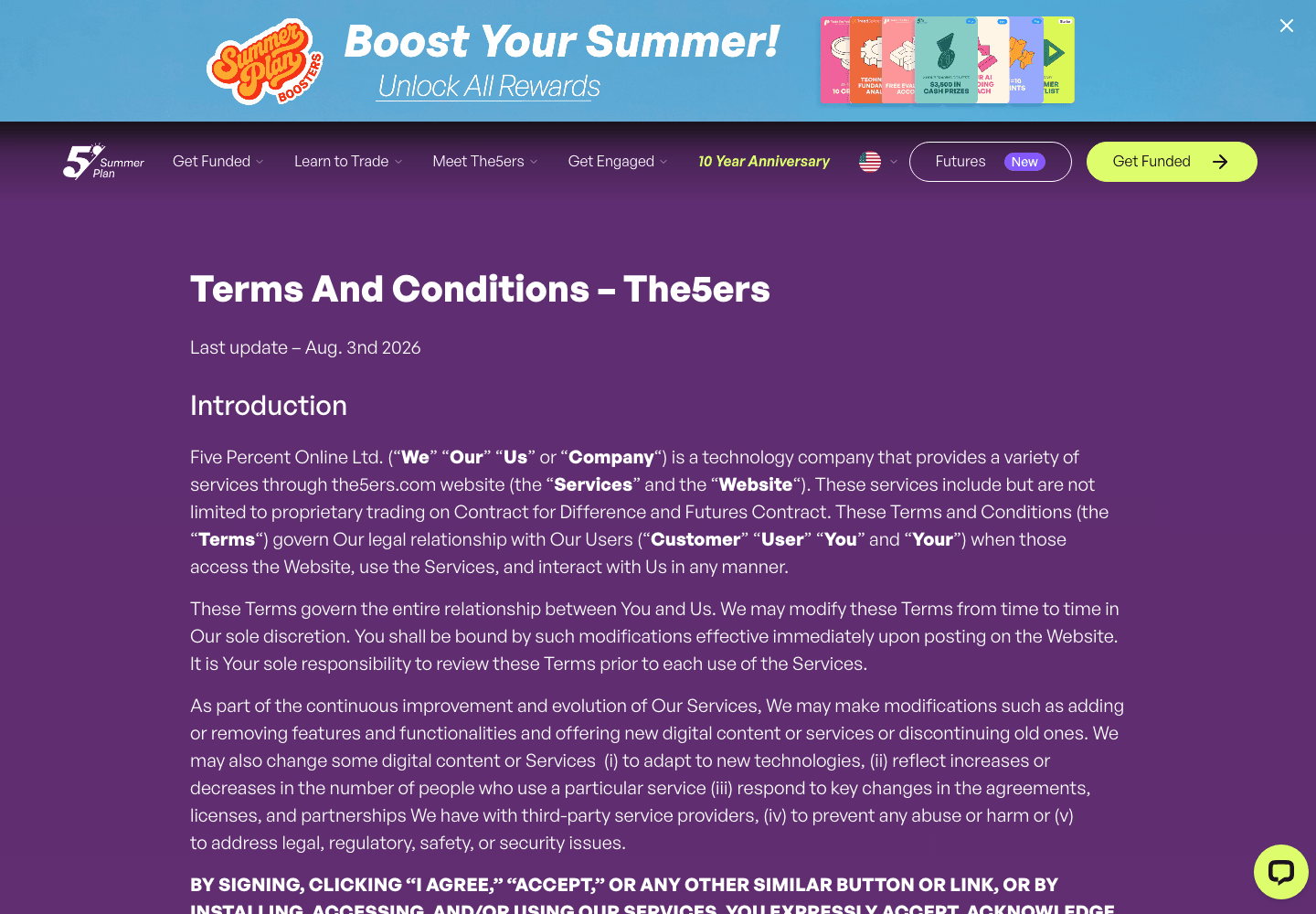
Two companies share the name. The Terms and Conditions, stamped with a last update of “Aug. 3nd 2026” in the firm’s own typo, close with a sentence naming both: “This website is operated by FIVE PERCENT ONLINE LTD, a company registered in England and Wales with company number 12553363 and registered office at 168 Praed Street, London, W2 1RH, United Kingdom, and by FIVE PERCENT ONLINE LTD, a company registered in Israel with company number 515864007 and registered office at 2 Ha`tidhar street, Raanana, Israel.” Nothing in the document says which of the two contracts with you, which one owes you a payout, or how the two divide responsibility.
We verified the English company at Companies House on 12 August 2026 rather than repeating the footer. Company 12553363, FIVE PERCENT ONLINE LTD, is Active, incorporated on 9 April 2020, registered office Enstar House, 168 Praed Street, London W2 1RH. Its recorded nature of business is SIC 78300, “Human resources provision and management of human resources functions”. Gil Ben Hur, Israeli, resident in Israel, is a director and the sole active person with significant control at 75 percent or more of shares and voting rights, and the same name appears on the firm’s About page as founder and chief executive. A named person who appears both on the marketing site and on a statutory register, at an address the register confirms, is the strongest identity evidence available for free.
The Israeli company verifies too, and we checked it twice by different routes on 12 August 2026: once against the State of Israel open data extract of the Registrar of Companies, and once against the Corporations Authority’s own lookup. Both return one record and agree on it. Company 515864007 is FIVE PERCENT ONLINE LTD, an Israeli private company, status active, limited, registered at 2 Hatidhar Street, Raanana, with no violating company flag and its most recent annual report filed in 2025. The registration date on that record is 24 June 2018. That is worth holding next to the homepage, which says “since 2016”, and the About page, which says “10 Years Active”: the earlier of the two companies behind the brand was registered in 2018 and the English one in 2020, so the brand’s claimed start predates both of the legal entities that now carry it.
The same register’s record of corporate changes carries two entries for this company. One is the 2025 annual report. The other is a charge registration, in Hebrew a rishum shibud, with a status update date of 14 May 2026. We did not obtain the underlying charge document and cannot say what was secured or in whose favour, so treat it as a pointer rather than a conclusion. It matters only because a secured creditor ranks ahead of a trader owed a profit share.
The filed accounts show the scale of that entity. For the year ended 31 December 2024, unaudited and prepared under the small companies regime, turnover was 1,002,466 euro, profit after tax 256,614 euro, cash at bank 176,908 euro and net assets 490,381 euro. Those are the numbers behind the company that a trader in Jakarta, Lagos, Mumbai or Toronto is told operates the website.
The footer swap is the finding that no single country view can see. Fetching the identical URL through country targeted exits on 12 August 2026 produced two different operators. Israel appeared for the United Kingdom, Germany, France and Spain. The United Kingdom appeared for the United States, Canada, India, Indonesia, Brazil, South Africa, the United Arab Emirates, Japan and Nigeria. We repeated the test roughly an hour later from Indonesia and from France and got the same two answers, so it is a routing rule rather than cache noise. The AML policy, meanwhile, is unambiguous about where the firm actually sits: “We operate in full compliance with the Israeli anti-money laundering legislation, which is aligned with the standards set by the Financial Action Task Force (FATF) and other applicable laws.”
| Vantage requested | Operator named in the site footer |
| United Kingdom (both a direct fetch from this machine and a country targeted exit), Germany, France, Spain | Five Percent Online Ltd, Israel, company number 515864007 |
| United States, Canada, India, Indonesia, Brazil, South Africa, United Arab Emirates, Japan, Nigeria | Five Percent Online Ltd, UK, company number 12553363 |
| Every vantage tested | Governing law Israel, exclusive jurisdiction of the courts of Tel Aviv |
Then the liability clause, which is where the recourse question is settled: “In no event will Our liability for any claim of any kind, whether based in contract, warranty, tort, strict liability, or otherwise, for any losses or damages arising out of, connected with, or resulting from, these terms or the performance or breach thereof, or any product or service or the use or performance thereof, exceed the greater of (a) the amount paid by You to Us in the immediately preceding month for Our Services or (b) $100.” A trader owed a five figure profit share, reading that clause, is looking at a contractual ceiling of one hundred dollars unless they bought an evaluation last month. Consumer protection law in the trader’s own country may cut across it, and the clause itself concedes that some jurisdictions do not allow such limits, but the venue clause sends the argument to Tel Aviv to be had.
One regulator has named the brand, and a reader is entitled to know. The Bank of Russia publishes a list of companies showing signs of illegal activity, and its own machine readable copy of that list, which we fetched directly on 12 August 2026, holds 26,797 records. One of them, record 37647 dated 24 April 2025, names “The5ers” with the website the5ers.com, classified as an internet project carrying “signs of a financial pyramid” in the Bank’s wording, and it is not marked closed. The domain match is what makes the identification safe rather than a name coincidence. Two things frame it. That list is very large and the Bank of Russia adds foreign online firms to it routinely for operating without Russian authorisation. And Russia is on The 5%ers’ own list of territories it will not serve. It is a real entry on a central bank’s own register and we would not omit it, but it is not an enforcement action, a fine or a finding that anyone was left unpaid.
We searched the other registers we can reach, by brand name and by corporate name, and found nothing: the FCA’s own search, the ASIC Moneysmart investor alert list, all 4,293 entries of it, the CFTC RED List of 284 named entities, the AMF France blacklists, CONSOB, the Ontario Securities Commission’s investor warnings walked in full, the Autorite des marches financiers du Quebec and IOSCO’s I-SCAN. Two gaps are ours rather than theirs. BaFin’s site search returned HTTP 403 to us on every attempt from two different clients, so we walked its current consumer warnings list instead and found nothing, which does not cover its historical archive. And we did not locate a searchable per entity warning register at the Israel Securities Authority, so Israel is not checked rather than clear.
There is no client money at any point. Evaluation fees are the firm’s revenue, not a deposit, and the Terms say the fee is “paid in exchange for allowing you to access the Evaluation”, non refundable once trading starts. If the firm stopped tomorrow, an unpaid reward would be an unsecured claim against whichever of the two companies a court decided was the counterparty.
How to Trade
Trading happens inside the firm’s Hub, and which platform you get depends on where you live. The help centre is explicit: “The available trading platform depends on the trader’s region. Non-US clients can use MetaTrader 5, cTrader, and TradingView. US-based clients can use TradingView.” MetaTrader 5 runs in a hedging configuration on desktop, web and mobile and is the platform named on the CFD programme pages. cTrader carries a surcharge the pricing tables do not show: “Using cTrader incurs an additional $10 fee on top of the program price.” The choice is locked at purchase, in the Terms and again in the help centre: “Platform choices are final once purchased and cannot be switched between.” The futures programme runs on BlackArrow, with Windows, macOS, iOS, Android and browser access.
The word used for the funded stage is not consistent across the firm’s own material. The footer says simulated. A help centre article dated 15 July 2026 tells a two step trader that once they pass both phases they “receive your live $100,000 funded account”, and another dated 10 August 2026 says “While we do not offer free demo accounts, you can explore our live spreads using a real account”. Nothing we found reconciles those with the footer, and the Terms say that where the Website and the Terms conflict, the Terms prevail.
Execution is where the simulated nature of the product becomes concrete rather than semantic. The Terms describe the funded stage like this: “It is hereby clarified that when using Our system, the positions are evaluated and monitored by Us and We may use our discretion as to whether to execute the suggested trades or not.” Read plainly, your funded trades are proposals that the firm may or may not mirror in a real market. That is consistent with a simulation and it is the single sentence most worth understanding before paying.
Costs inside the simulation are documented. The help centre states that major pairs including EUR/USD, GBP/USD and USD/JPY “sell from 0.2 pips to 0.9 pips” in ordinary conditions, and the assets specification page gives a forex contract size of 100,000, a minimum lot of 0.01 with a 0.01 step, and commission of 4 USD per lot round trip. Swaps are charged and the firm warns that holding indices over the weekend “carries a high swap”. On futures the firm contradicts itself inside one article, last updated 20 July 2026: every table in it is headed “Round Turn Commission” and prints $5.00 for standard contracts and $2.50 for micros, while its own closing summary on the same page says “Most standard futures carry a $5.00 commission per side” and “All Micro symbols (starting with ‘M’) carry a reduced $2.50 commission per side”. Round turn and per side differ by a factor of two. It costs nothing in practice, because the firm says it gives the money back: “All commissions paid during the trading day are refunded automatically at the end of each day.”
News trading is allowed on the CFD programmes with a window carved out around releases: “Executing orders 2 minutes before until 2 minutes after high-impact news is not allowed.” Holding trades overnight and over the weekend is allowed. Automated trading is not free: the Terms require written approval before any Expert Advisor is used, permit the firm to demand advance testing at its sole discretion, and prohibit any automated software the trader does not own or did not develop.
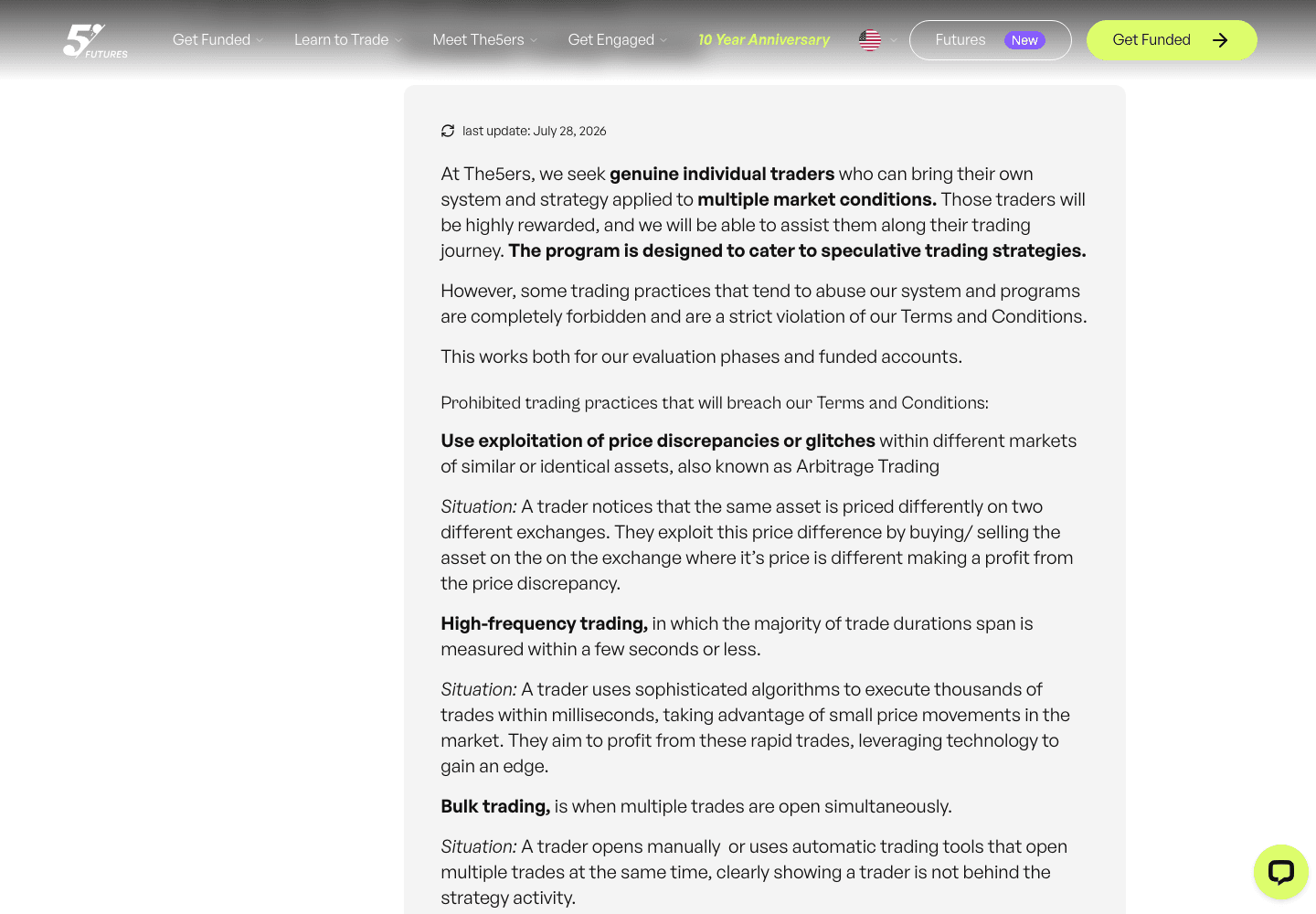
The rule that catches ordinary traders is buried in the prohibited practices list rather than the platform documentation. “Bulk trading, is when multiple trades are open simultaneously” is listed as a prohibited practice, described as a situation where a trader “opens manually or uses automatic trading tools that open multiple trades at the same time, clearly showing a trader is not behind the strategy activity”. Holding more than one position at a time is ordinary risk management for most discretionary traders, and the qualifier that decides whether it is prohibited is a judgement about whether a human is behind it.
Challenges & Funding
Four CFD programmes and one futures programme were on sale on 12 August 2026, all of them evaluations rather than instant funding, and all of them priced as a one time fee.
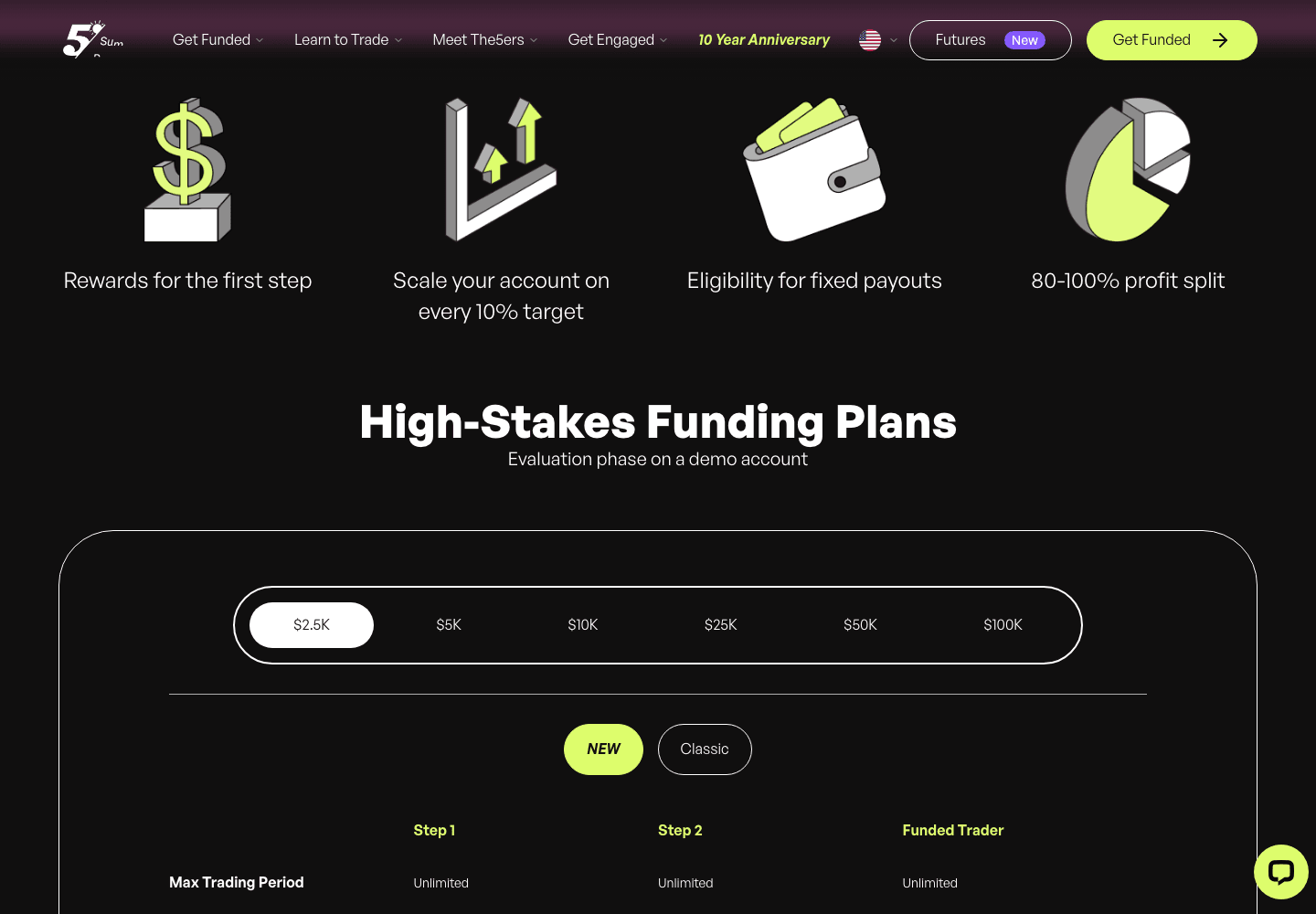
High Stakes is the two step programme and the one the firm calls its most popular. Account sizes run 2,500, 5,000, 10,000, 25,000, 50,000 and 100,000 USD on the page, with a 200,000 USD summer variant that the firm’s own programme endpoint lists as on sale, and the page heading under Funding Plans reads, without ambiguity, “Evaluation phase on a demo account”. Step one targets 10 percent and step two 5 percent on the New variant, 8 percent and 5 percent on the Classic one, with three profitable trading days required, maximum daily loss of 5 percent, maximum loss of 10 percent of the initial balance and no time limit. The 2,500 USD account costs 19 USD, which is the cheapest entry we found anywhere on the site. The evaluation fee is refunded, and a 2 USD reward is credited at step one.
Hyper Growth and Pro Growth are the one step programmes at 5,000, 10,000, 20,000 and 50,000 USD. The evaluation target is 10 percent, the stop out level 6 percent, daily loss 3 percent, leverage 1:30, time unlimited, and three profitable days are required. The 5,000 USD account is 52 USD. Hyper Growth doubles the account at each 10 percent target and the firm advertises growth “up to $4,000,000”.
Bootcamp is three evaluation steps at 20,000, 100,000 and 250,000 USD, and it is the one with a payment structure worth reading twice. You pay an entry fee and then a second fee when you pass: 22 USD then 50 USD for the 20,000 USD account, 95 USD then 205 USD for the 100,000 USD account, and 225 USD then 350 USD for the 250,000 USD account. The marketing line on that page is “$475-$715 in funding for every $1 you put in”, where the funding is simulated.
Futures runs on CME contracts at 25,000, 50,000, 100,000 and 150,000 USD, with a 6 percent evaluation target, a 4 percent end of day maximum loss, a 40 percent per position consistency rule and a contract cap of 2 minis or 20 micros on the 25,000 USD account. The day trade 25,000 USD account is 59 USD. The swing equivalent is 69 USD, down from 120 USD, after a cut the firm says is permanent rather than seasonal: the 25K and 50K swing prices fell and the 100K and 150K swing sizes are new, and it states they “will remain active even after the summer campaign ends”. Day trade prices were not part of that change.
The site’s own public programme endpoint, the one its marketing pages call to build those tables, gives a more precise picture than the tables do. Fetched on 12 August 2026 it returned 35 programmes, of which 24 carry a sellable flag set to true and 11 set to false. The eleven not on sale are the Classic High Stakes sizes from 2,500 to 200,000 USD and three older Hyper Growth variants. That is worth knowing because the High Stakes page still presents a Classic toggle next to the New one. We read the flag as meaning a programme is closed to new purchase rather than that existing accounts are affected, and the endpoint says nothing further.
Account limits are specific and worth checking before buying two of anything. Hyper Growth caps combined evaluation capital at 40,000 USD per trader. High Stakes caps the count by size and the cap differs between the Classic and New variants of the same programme. Bootcamp allows four active accounts, at most one 250,000 USD and one 100,000 USD, and states “Each account must have a different trading method”. Inactivity limits differ by stage and product and are easy to trip: 30 consecutive days on a CFD evaluation account, counted from registration day rather than first trade, 60 consecutive days once funded, and only 14 calendar days on a futures evaluation. The help centre is explicit that “keeping an existing position open or simply logging in does not count”; a brand new trade is required.
Drawdown & Breach Rules
There is no negative balance to protect here, because there is no balance of your money in the system. What takes its place is the set of loss limits that end an account, and the discretionary clauses that can end one without a limit being hit.
The measurable limits are clearly published. On High Stakes the maximum loss is 10 percent of the initial balance and the daily loss is 5 percent, taken at 00:00 server time from “the closing equity or balance of your previous day (the highest between them)”. On Hyper Growth and Pro Growth the maximum loss is 6 percent of the initial balance and the daily loss 3 percent on the same higher of equity or balance basis. On the summer 1 Step and 2 Step plans the daily loss is 3 percent. On futures the maximum drawdown is 4 percent trailing from the highest midnight balance or equity, not from the starting balance. Reaching any of these terminates the account permanently, in the firm’s own words.
Two of these interact with payouts in ways that cost money in opposite directions depending on which product you bought. On the CFD side the help centre states: “Any payouts requested will reduce the account balance, hence reducing the maximum drawdown.” Taking your profit therefore tightens the limit that can end the account. On the futures side the same act does the reverse: “Every time you withdraw a payout, your drawdown limit resets to 4% below your new balance (after the withdrawal).” Same firm, same dashboard, opposite consequence, and nothing on either page points at the other.
The clause that should decide whether a cautious reader buys is on the prohibited practices page, which the site footer links from every page. After eighteen named practices with worked examples, it reaches a category defined by pattern rather than threshold, and states of its own example: “While no individual rule threshold was technically breached, the overall pattern of activity does not reflect how a responsible trader would manage real proprietary capital, and creates unjustified financial and operational risk exposure to the Company.” The consequence is set out at the foot of the same page: “If your account has been found abusing the system and violating the trading rules, we will terminate the entire relationship between you and the company and/or suspend, block and/or restrict your access to the services for specific functions immediately. Any refund or profit will not be processed, and you will be permanently banned from The5ers Fund.”
Two entries in that list are broad enough to catch normal behaviour. One prohibits “Opening position sizes or a number of positions that are substantially larger or smaller than your typical trading activity”, which makes reducing your size after a good run a stated breach as much as increasing it. Another prohibits “One sided-bets”, described as a trader who “consistently takes positions in one single direction”, which describes any trend follower having a good month. The Terms add a residual category: conduct “which in the sole discretion of the Company, represents uncommercial activity, is intended to game the market, or otherwise is not a viable trading strategy”.
Trading Instruments
The CFD programmes cover forex, metals, indices, oil and crypto. The Hyper Growth specification lists “FX, Metals, Indices, crypto” and High Stakes adds oil. The firm does not publish a total instrument count on the pages we fetched, and points traders at the terminal instead: the assets specification page says “Go to your trading platform asset specification for more details” and adds that “The information on this page may change recurrently. It is the traders responsibility to check the latests specifications on the MT5 platform.”
What is published is the shape of the contract rather than the list. Forex contract size is 100,000, minimum lot 0.01, incremental step 0.01, margin rate 1, commission 4 USD per lot round trip. Trading hours are given in EET by asset class: forex Monday to Friday 00:05 to 23:55, metals, indices and commodities 01:05 to 23:50, and crypto also over the weekend from 00:10 to 23:50. Margin requirements vary by class, which changes the effective leverage: on Bootcamp and Pro Growth, forex is 1:30, metals and indices 1:25, commodities 1:1.5 and crypto 1:0.60.
The futures programme is a different instrument set and a different platform. The help centre publishes a per contract table covering CME equity index futures including the E-mini S&P 500, E-mini Nasdaq 100, E-mini Dow, E-mini Russell 2000, E-mini S&P MidCap 400 and the Nikkei 225, each with its ticker, tick size, tick value and contract multiplier, alongside a 2026 commission schedule of 5.00 USD round turn on the equity index contracts. Position limits are expressed in contracts rather than lots, at 2 minis or 20 micros on the 25,000 USD account.
Weekend and overnight exposure is allowed on the CFD side but is priced: the firm states twice that holding indices over the weekend “carries a high swap”. On futures, day trade accounts must close by 4:50 PM Central Time while swing accounts may hold through the daily maintenance break.
Education & Analysis
The educational side is substantial and it is the part of the offering that is unambiguously real. The Hub carries an Academy with courses, recorded workshops and webinars, a performance coach programme, and a blog that runs both market analysis and long form interviews with funded traders. Free tools on the public site include a news sentiment page, an economic calendar, a charts page, downloadable indicators and the assets specification reference.
The help centre is the strongest documentation asset. Pulling the firm’s own published article store on 12 August 2026 returned 449 articles, each carrying a last updated date and a language flag: 209 English, 181 Japanese, 39 Portuguese and 17 Arabic, plus three Arabic articles the flag misses. Rules are explained with arithmetic rather than adjectives. The consistency rule alone has ten English titled articles, two of them near duplicates, covering the formula, whether it applies to balance or profit, what happens when the best day is too large, and why the displayed figure differs from net profit.
Two caveats a reader should carry. First, the same help centre contains near duplicate articles that do not always agree in wording. Two articles on the daily loss limit, both stamped 10 August 2026, describe the anchor differently, one as “the end of each trading day” and the other as “00:00 MT5 Server Time based on 3% of your day’s starting equity OR starting balance”. They resolve to the same moment but a trader reading only one will not know that. Second, the individual article URLs returned by the firm’s own content API are not the ones that work: the api returns links under /frequently_questions/, which render a “Page not found” body in a browser, while the published articles live under /faqs/ and /futures-faqs/. Anyone bookmarking a rule from a search result may find it dead.
Community sits alongside the education: a Discord, virtual events, in person meetups, a trading competition and a referral programme that pays 10 percent on first time purchases. Promotional material is heavy and rotates, so a rule quoted from a campaign page in one month may not exist in the next.
Payout Terms
This is the section that decides whether the product works for you, and it needs to be read in three places at once: the programme pages, the help centre, and the Terms.
The split is generous at the top of the ladder and ordinary at the bottom. High Stakes starts at 80/20 in the trader’s favour and stays there through every scaling step up to 150,000 USD, reaching 85/15 at 175,000 USD, 90/10 at 250,000 USD and 100/0 plus a fixed 4,000 USD monthly payout at 350,000 USD, with a fixed 10,000 USD monthly payout at 500,000 USD. Hyper Growth and Pro Growth sit at 75/25 at every published balance from 5,000 USD to 300,000 USD, moving to 80/20 at 350,000 USD and a range of 80 to 100 percent above 400,000 USD. The Hyper Growth and Bootcamp pages both advertise “Up to 100% profit share” in their opening bullets, which is true at the far end of a ladder most accounts never reach, and the help centre states something different again for two of the programmes: “For the Bootcamp and Hyper-Growth programs, traders start with a 50% profit split”. The firm’s blog repeats that second version, saying it “starts traders at 50/50 in Bootcamp and Hyper Growth, and 80/20 in High Stakes”, which does not match the 75/25 printed at every balance in the Hyper Growth scaling table.
Cadence and caps are where money is actually withheld from compliant traders. The first withdrawal is available 14 days after the funded account is activated and every 14 days thereafter, but “If your account is scaled, the 14-day timer resets from the scaling date”, so being rewarded with a larger account restarts the clock on being paid. Each payout is capped per cycle: 2,000 USD on the 1 Step funded account, 3,000 USD on the 200,000 USD summer account, and on futures 1,250 USD flat on a 25,000 USD account, a ladder of 1,500 to 3,000 USD across the first four payouts on 50,000 USD, and 3 percent of current balance on 100,000 and 150,000 USD accounts. The 2 Step cap is published as two different numbers. An article last updated 13 July 2026 says “The payout cap is $2,500 per payout cycle”; one last updated 23 July 2026 says “The payout cap is $2000 per payout cycle”; and a third, last updated 10 August 2026, says “The Summer Plan has a payout cap of up to $2,000 per payout cycle”. The two newer ones agree on the lower figure, so plan on 2,000 USD. Minimum profit before requesting is 150 USD on most programmes and 250 USD on the 2 Step and the 200,000 USD plan. A trader who makes 20,000 USD in a fortnight on a 100,000 USD account does not receive 20,000 USD; they receive the cap, and queue.
Every payout method except one carries a 3.5 percent commission on the firm’s own list of methods, whether Rise, cryptocurrency or bank transfer, plus whatever the receiving bank charges, and crypto is limited to 1,500 USD per withdrawal. The zero commission option is Hub Credits, and the Terms are explicit about what those are: “The Hub-credits are not real currency, has no monetary value”, they “cannot be used for actual trading”, the user “is not entitled to withdraw or transfer any Hub-credits”, and any conversion is one way, since “any rewards converted into Hub Credits will remain as credits and cannot be converted back into fiat funds”.
The consistency rule is the trap that costs money without any rule being broken. It requires the best trading day to be no more than a set share of total profit: 40 percent on futures, and 50 percent on the funded accounts where the firm documents it, which are the 1 Step, the 2 Step and the 200,000 USD plan. The firm explains the arithmetic honestly. The problem is the numerator. In the firm’s own words: “The Consistency Rule is calculated based on accumulated profitable trades, not net daily profit. This means that for the consistency calculation, only profitable trades are added. Losing trades are not deducted from the consistency P&L.” Its own worked example gives a day of plus 1,000, plus 500, minus 300 and plus 200, a net of 1,400, and a consistency figure of 1,700. The measure that gates your payout is therefore larger than the profit you actually made, which pushes the required total profit up and the payout date back, for a trader who has broken nothing.
Three clauses in the Terms sit on top of all of that. An approved payout above an undisclosed “Payout Threshold” set “from time to time at its sole discretion” may be split into weekly instalments of no more than 10,000 USD each. A verification interview must be scheduled and completed within five business days of request, and failure “will result in the denial of any pending payouts, immediate cancellation of all associated accounts, and termination of the collaboration”. And a non disparagement clause makes any “defamatory, disparaging, or harmful statements about the Company, its employees, or the Services on any public platform”, including publishing your own support tickets or chat logs, a fundamental breach after which “any accrued profits or Reward Balance shall be immediately forfeited”.
Opening an Account
Registration for the Hub is free and gives access to the educational material. Buying an evaluation is a card, PayPal or crypto transaction: the help centre lists Visa and Mastercard credit and debit cards, PayPal Checkout including Apple Pay and Google Pay, and Confirmo for cryptocurrency, with a warning that crypto payers should allow for network fees. The account is credited quickly enough that the firm sells the speed, and the platform choice is locked at purchase.
The identity requirements are stricter than the sign up suggests, and they bite at the point where money would leave rather than at the point where it arrives. The card must be in your own name: “all payments must be made using a payment method registered in your own name. There are strictly no exceptions.” Registration using a company or any other legal entity is not permitted, invoices are issued only in the registered user’s name, and “Withdrawals will only be permitted to an account held in the same name as the registered user”. Only one account per user is allowed and shared or joint accounts are prohibited.
Know your customer checks are run as a condition of becoming a Funded User, not at purchase, and they can include a recorded video interview. The Terms reserve the right to request that interview at any time, require the same email address to be used for it, and impose the five business day window described above, with denial of pending payouts as the stated consequence of missing it. The firm also states plainly that passing the evaluation is not enough: “There is no guarantee that a specific person can successfully complete the User Verification Process and thus become a Funded User even if the relevant User has provided all information requested by Us.”
Refunds are narrow and clearly stated. The evaluation fee is non refundable once trading activity has begun; before any trading and absent a breach, a refund can be requested within 14 days of purchase. Disputing a charge with your bank is itself grounds for the firm to stop providing services. Circumventing the geographic restrictions, including by VPN, is a fundamental breach that forfeits both the fee and any accrued profit.
Payout Record
There is no independent payout record to examine, and nothing about the product produces one. Payouts come out of the firm’s own revenue, no third party attests to them, and no register records them. What exists is what the firm publishes about itself, which should be read as marketing with figures in it rather than as evidence.
The homepage carries a counter block headed “Our users enjoy fast and reliable payouts” with three numbers in its own page data: 1,608,135 traders worldwide, an average payout time given as 16h, and 4,376 monthly payouts. The About page reproduces two of the same figures under different labels: the 1,608,135 becomes “Trading Accounts” rather than traders, and the 262K that the homepage calls “Funded Traders” becomes “Traders onboarded to date”. Those are materially different claims about the same numbers, published by the same firm on the same day, and neither is audited.
A larger figure sits in a blog post rather than on any payouts page. An article last modified 22 June 2026 states: “The5ers has distributed over $43 million across more than 20,000 payouts, with individual payouts exceeding $91,000.” The same article, in the firm’s own educational voice, describes the business model this whole review turns on: “Most retail prop firms operate funded accounts on simulated capital, using challenge fee revenue to pay verified profitable traders. The distinction matters less than payout consistency.” A reader can decide how much the distinction matters. The figures themselves are unaudited and self published, and no third party attests to them.
The 16 hour average also sits against the firm’s own documentation, which says: “All approved withdrawal requests are typically processed in up to 3 business days.” Both can be true, since an average can be well below a stated maximum, but a reader planning around the headline should plan around the help centre instead.
Individual payouts are published as trader interviews on the firm’s blog, each with a name, an account size, a number of payouts and a total, for example a 100,000 USD High Stakes trader who “got paid 6 times for a total of $8,856”, dated 24 October 2025. These carry account screenshots and read as genuine, but they are selected and published by the firm, and its own disclaimer page adds a caveat that the marketing pages do not: “People providing testimonials on the Website may have been compensated with free products or discounts for use of their experiences.” That disclaimer is linked from the Hub’s legal menu; it is not among the six legal links in the public site footer.
The countervailing evidence is structural rather than anecdotal. Evaluations were actively on sale on 12 August 2026, with a summer promotion running, permanent price cuts on swing accounts and two new futures account sizes added, which is not the behaviour of a firm rationing new intake. And the English company has filed five sets of accounts at Companies House since it was incorporated in April 2020, the most recent covering the year to 31 December 2024. Neither fact proves a payout will arrive, and the non disparagement clause means the public record of disputes is precisely the record the firm has reserved the right to punish traders for creating.
Customer Support
Support is email, live chat and community. The published address is help@the5ers.com, with a second address, help.desk@the5ers.com, named in the Terms as the channel for United States enforcement requests. Live chat sits on every page of the marketing site and inside the Hub. The homepage promises “24/7 Support & Guidance” and the help centre says “We attend to all of your needs no matter when they occur”, but no staffed hours, no response time target and no telephone number appear on any page we fetched.
The organisation behind it is unusually visible for this industry. The About page names twelve individuals with distinct roles, including a founder and chief executive, a managing director, a chief operations officer, a director of risk and operations, a legal counsel and a support manager, and claims 171 employees across 24 countries. The founder named there, Gil Ben Hur, is the same person recorded at Companies House as director and controlling shareholder of the English company, so the marketing biography and the statutory register agree.
Language coverage can be measured rather than claimed, because the help centre publishes its own article store: 449 articles flagged 209 English, 181 Japanese, 39 Portuguese and 17 Arabic, with three unflagged Arabic articles on top. A Japanese locale exists at the5ers.com/jp/. That is real localisation rather than a flag menu.
The part that cannot be assessed is the one that matters most, which is how support behaves during a payout dispute, and the reason it cannot be assessed is contractual. The Terms make publishing “any internal correspondence, support tickets, or private communications between You and the Company (including, without limitation, emails, chat logs, or messages with our Support, Risk, Tech, or Compliance teams) on any social media or public platform” a fundamental breach that forfeits accrued profit. A firm may have good reasons to restrict what its staff say. A clause that penalises the customer for publishing the firm’s own answer to them removes the only public evidence anyone could ever weigh.
Restricted Countries
The firm publishes its excluded territories in two places and the two lists do not match. The Terms and Conditions define a Forbidden Territory as “any jurisdiction where Our Services are not available including but not limited to” thirty one named territories. The site wide footer, which appeared on every page we fetched, prints the same sentence with thirty. The difference is Bosnia and Herzegovina, which is in the Terms and absent from the footer. Both lists are prefaced “including but not limited to”, so neither is exhaustive by its own terms, and a reader cannot treat either as a complete answer.
The thirty in the footer are Afghanistan, Belarus, Burundi, Central African Republic, Cuba, Congo Republic, Crimea, Democratic Republic of Congo, Eritrea, Guinea, Guinea-Bissau, Iraq, Iran, Israel, Laos, Lebanon, Liberia, Libya, Myanmar, North Korea, Palestinian Territory, Papua New Guinea, Russia, South Sudan, Sudan, Somalia, Syria, Vanuatu, Venezuela and Yemen. Israel appears on that list, which means the country the firm is registered in and whose anti money laundering law it says it follows is a country it will not serve.
The United States is not excluded, but it is restricted in a way that decides which products are available: “You are hereby notified that Trading Platforms provided by MetaQuotes are strictly prohibited from being used by residents of the United States”, and the Terms add that “services and Trading Platforms available to residents of the United States may differ from those available to other users”. The help centre spells out what that leaves: “Non-US clients can use MetaTrader 5, cTrader, and TradingView. US-based clients can use TradingView”, and it adds that “cTrader is no longer an option for new accounts for US clients”. A United States trader therefore gets one CFD platform, or the futures product on BlackArrow.
Enforcement is aggressive and the penalty falls on money already earned. Circumventing the geographic restrictions, “including through the use of VPN or any other technical means”, is a fundamental breach. Where residence in a forbidden or sanctioned territory is discovered at any stage, including after the identity checks, the stated consequence is that “you are not entitled to any financial refund for fees paid (including Evaluation fees). Any accrued balance of profits or rewards shall be canceled and forfeited”. Since the identity check happens after the evaluation is passed rather than before it is sold, a trader in an excluded country can pay, trade, pass, and lose everything at the verification step.
Conclusion
The 5%ers is a long running evaluation business that tells you what it is selling. The site wide footer on every page states that all trading in its Hub is simulated and that the funds are fictitious, its programme page for the two step product is headed “Evaluation phase on a demo account”, and its prohibited practices page describes a trader taking a position “that would be financially catastrophic in a live account but carries limited personal consequence in a simulated environment”. The rules are documented across 449 dated help centre articles with worked arithmetic. On what the product actually is, the firm leaves very little room for a buyer to misunderstand.
The distance between the marketing and the contract is the reason to be careful anyway. The homepage sells “Get qualified by a private equity fund and manage up to $4,000,000!” and “Fair Play First”, described as “A commitment to honesty, clarity, and full transparency in everything we do”, while the Terms cap total liability at “the greater of (a) the amount paid by You to Us in the immediately preceding month for Our Services or (b) $100”, forfeit accrued profit for publishing a support ticket, and reserve the discretion “whether to execute the suggested trades or not”. The firm’s own Terms also define a Funded User as one who will “trade with Our trading capital” three paragraphs from language stating the funds are fictitious. Both sentences are in the binding document; only one is in the advertisement. The same gap runs through the description of the firm itself: the homepage sells a “private equity fund”, the Terms open by calling Five Percent Online Ltd “a technology company”, and the English company’s registered activity at Companies House is human resources provision.
Recourse is the weakest part, and it is weak by construction rather than by accident. There is no client money at any stage. The company you are contracting with is not fixed: our fetches on 12 August 2026 showed the Israeli company to visitors in the United Kingdom, Germany, France and Spain and the English company to visitors in the United States, Canada, India, Indonesia, Brazil, South Africa, the United Arab Emirates, Japan and Nigeria, on the same URL, with the Terms naming both and allocating neither. The English company that most of the world is shown filed accounts to 31 December 2024 with net assets of 490,381 euro, and its registered activity at Companies House is human resources provision. Whichever company the footer showed you, the venue for a dispute is a court in Tel Aviv under Israeli law. Both companies do verify as active on their own registers, at the addresses the site publishes, and eight of the nine warning registers we could search returned nothing on either name. The ninth, the Bank of Russia, carries an open entry against the5ers.com dated 24 April 2025 in a list of 26,797 records, from a country the firm itself will not serve.
The rules that cost a compliant trader money are all in place and all documented: a consistency measure that counts winning trades and ignores losing ones, per cycle payout caps that meter a large month out over several fortnights, a 3.5 percent commission on every payout method that produces cash, a payout clock that restarts when your account is scaled, and a discretionary category on the prohibited practices page that ends an account where “no individual rule threshold was technically breached”. Challenges were actively on sale on 12 August 2026, with a live promotion, which is the single most reassuring thing we can say from evidence rather than testimony.
It suits a trader who understands they are buying a paid simulation with a contractual profit share attached, who trades small and often enough that the consistency arithmetic and the payout caps do not bind, and who treats the entry fee as a cost already spent. It suits nobody who is counting on legal recourse if a payout is refused, because the contract they will be pointed at caps that recourse at one hundred dollars and sends it to Tel Aviv.
Score history
Recomputed daily; every move is on the record. The current score is always the latest row.
| Date | Score | Move |
|---|---|---|
| 2026-09-13 | 6.0 | ▼ |
| 2026-09-12 | 6.2 | · |
FAQ
Is The 5%ers regulated and safe?
The 5%ers holds no financial licence, which is normal rather than remarkable: proprietary trading firms of this type hold no client money and offer no investment service, so no regulator authorises them anywhere. Its own footer says the company “is not a custodian, exchange, financial institution, trading platform, fiduciary or insurance business”. What matters instead is recourse. Two companies called Five Percent Online Ltd share the brand, one in Israel and one in England and Wales, the Terms name both without saying which contracts with you, liability is capped at the greater of last month’s fees or 100 USD, and any dispute goes to the courts of Tel Aviv under Israeli law. Both companies verify as active on their own registers. One register entry is worth knowing about: the Bank of Russia’s list of firms showing signs of illegal activity carries an open record against the5ers.com, dated 24 April 2025, in a list of 26,797 entries to which foreign online firms are added routinely, and Russia is a country the firm itself refuses to serve. We searched the FCA, ASIC, CFTC, AMF France, CONSOB, the Ontario Securities Commission, the AMF Quebec and IOSCO and found nothing.
Is the funded account at The 5%ers real money or a simulation?
It is a simulation, and the firm says so in the footer of every page: “All trading activities conducted through the Company Hub are executed in a simulated environment.” The High Stakes programme page is headed “Evaluation phase on a demo account”, and the Terms define Trading as instructions given “in simulated environments accessed through the Hub, simulating real-life trading and using Hub-designated fictitious funds”. The same Terms also describe a Funded User as invited to “trade with Our trading capital”, so the binding document carries both readings. We found no tier documented as graduating to a real market account.
How much does The 5%ers pay out, and how fast?
The split runs 80/20 in the trader’s favour on High Stakes and futures and 75/25 on the Hyper Growth and Pro Growth tables, rising toward 100/0 only at the top of the scaling ladder. The first payout comes 14 days after the funded account is activated and every 14 days after that, though scaling the account restarts that clock. Each payout is capped: 2,000 USD on the 1 Step account, 3,000 USD on the 200,000 USD plan, and 3 percent of balance on larger futures accounts. The 2 Step cap is published as 2,500 USD in one article and 2,000 USD in two newer ones, so plan on the lower figure. The firm advertises a 16 hour average payout time while its own help centre says approved requests are typically processed in up to 3 business days. Rise, crypto and bank transfers each carry a 3.5 percent commission.
What can stop a compliant trader getting paid?
Several things, all published. The consistency rule counts accumulated winning trades and does not deduct losing ones, so the figure gating your payout can exceed the profit you actually made. Payout caps meter a large fortnight out over several cycles. A verification interview must be scheduled and completed within five business days of request or pending payouts are denied. Approved payouts above an undisclosed threshold may be split into weekly instalments of 10,000 USD. And the prohibited practices page permits termination with profits forfeited in cases where, in its own words, “no individual rule threshold was technically breached”.
Which countries cannot use The 5%ers?
The Terms name 31 excluded territories and the site footer names 30, the difference being Bosnia and Herzegovina, and both lists are prefaced “including but not limited to”, so neither is exhaustive. Israel is on the list, which is also where one of the two operating companies is registered. The United States is not excluded but MetaQuotes platforms are barred to US residents, which steers them to the futures product. Using a VPN to get round any of this is a fundamental breach that forfeits both fees and accrued profit, and because identity checks happen after the evaluation is passed, that discovery can come after you have already earned.
How this review works
Track The 5%ers live: score moves and red notices, in your pocket.