
CRYPTO · CHECKED 10 OCT 2026
bitFlyer review.
Japanese crypto exchange with JFSA registrations, a MiCA authorised EU arm and a New York licensed US arm.
OK-ISH
OUT OF 10
bitFlyer holds two Japanese registrations, a crypto exchange registration from 2017 and a Type I financial instruments registration from 2021 that forces it to publish a capital adequacy ratio, 412.8% at 30 June 2026 against a 120% floor. Its EU arm is MiCA authorised on ESMA's register and its US arm is listed by NYDFS. Customer yen sits in trust by statute and crypto in cold wallets, but there is no compensation scheme, 33 of 40 assets trade only against bitFlyer at an unpublished spread, and support is Japanese only.
Each criterion is scored 1 to 10 from primary sources. The overall score is their unweighted mean. How scoring works.
| Founded | 2014 |
|---|---|
| Headquarters | JP |
| Maximum leverage | 1:2 |
| Withdrawal fee | JPY 220 (about USD 1.38 at August 2026 rates) |
| Account opening | 1 |
| Platforms | bitFlyer Lightning, bitFlyer Simple Exchange, bitFlyer Buy/Sell, bitFlyer Crypto CFD, bitFlyer iOS app, bitFlyer Android app, REST and WebSocket API |
- Two separate Japanese registrations, including a Type I financial instruments licence with a published capital adequacy ratio of 412.8% against a 120% statutory floor
- All 40 listed assets appear on the JFSA's published register, and changing that list requires advance notification to the authorities
- bitFlyer EUROPE S.A. holds a full MiCA authorisation dated 26 June 2026 and is absent from ESMA's non compliant list
- bitFlyer USA, Inc. is listed as an active virtual currency business on the NYDFS supervised institutions register
- The licensed entity is the onboarding entity in Japan, the EEA and the US alike
- Customer money is placed in trust as a statutory duty under Payment Services Act Article 63-11, with crypto stated to be 100% in cold wallets
- No withdrawal halt across 44 published incidents since May 2019, and only one rated major
- Genuine user to user order book, provable from an open unauthenticated API that makes the venue independently auditable
- Named independent dispute routes including FINMAC, three Tokyo bar association centres and the JVCEA
- Only one enforcement action in the JFSA's 2,817 record casebook, and never a business suspension order
- The Buy/Sell counter is bitFlyer trading against you, and its spread is not published as a number anywhere
- Only 7 of the 40 assets have an order book, so 33 are available solely on that dealer screen
- The JFSA does not approve the token list, and its register expressly disclaims guaranteeing or recommending any listed asset
- A UK visitor is routed to a European site whose own footer says its services are not available to UK consumers
- No proof of reserves attestation, and no compensation scheme anywhere in the group, stated explicitly in the EU terms
- Coins lent through the lending product leave both the segregation duty and the statutory priority repayment right
- 14 assets cannot be withdrawn on chain at all, including Dogecoin and Avalanche
- Telephone support is weekday business hours and Japanese only
- A 2018 JFSA order cited a culture of giving the authorities explanations that differed from the facts
- No published country restriction list, and non residents of Japan pay an additional fee the agreement never quantifies
Overview
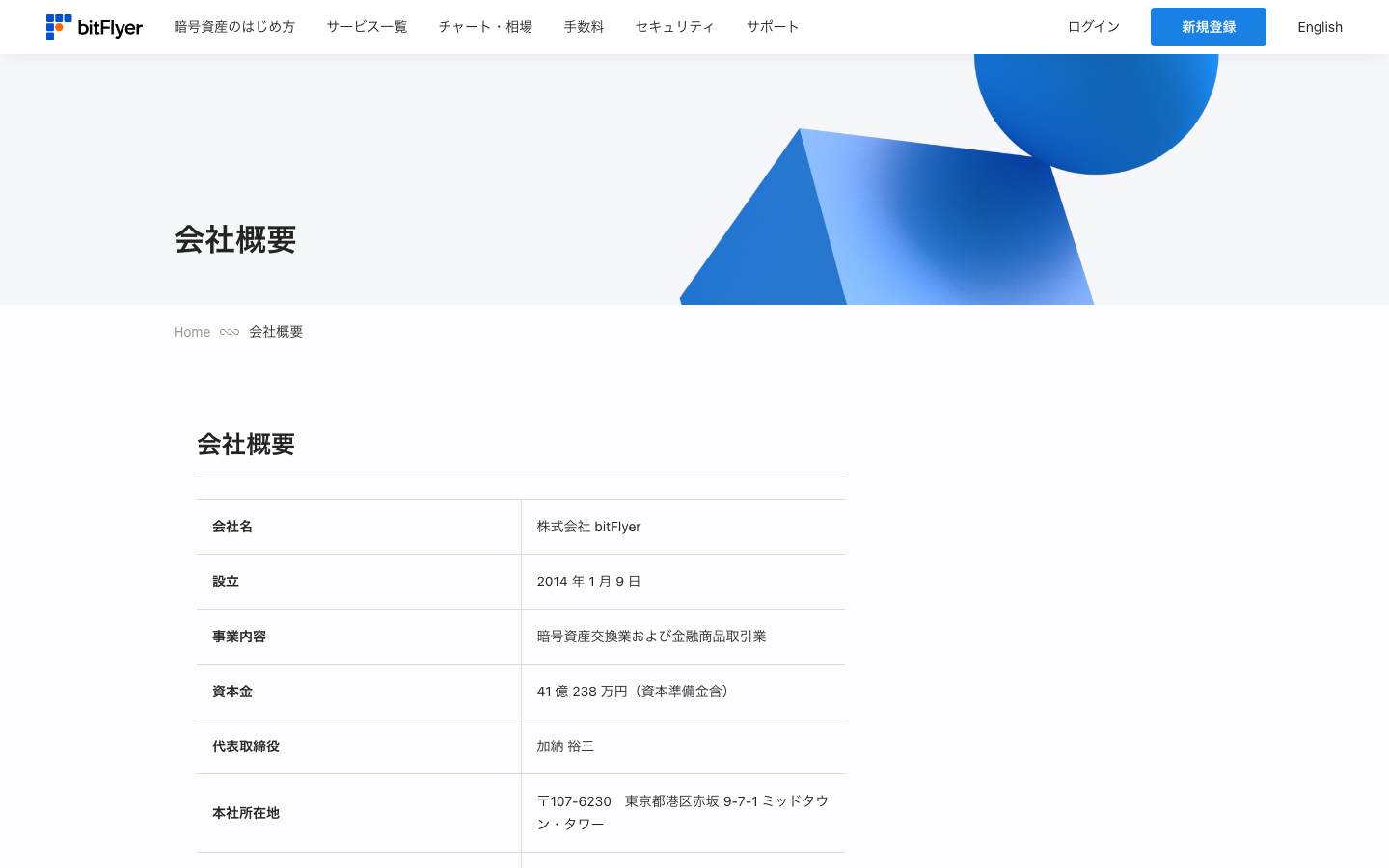
bitFlyer is a Japanese crypto exchange run by bitFlyer, Inc. (株式会社bitFlyer), incorporated on 9 January 2014 and based in Midtown Tower, 9-7-1 Akasaka, Minato-ku, Tokyo. It holds two separate Japanese registrations, not one: crypto asset exchange service provider Kanto Local Finance Bureau No. 00003, granted 29 September 2017 in the very first cohort of three, and Type I financial instruments business operator Kanto Local Finance Bureau (Kinsho) No. 3294, granted 14 October 2021 for its crypto derivatives. Both records carry the same corporate number, 2011101068824, which is how we tied them to one legal person rather than to a brand.

This matters because a crypto registration is often only an anti money laundering formality. Japan’s is more than that, though it is important to be precise about how much more. The asset list is a registration item: under Article 63-3, paragraph 1, item 7 of the Payment Services Act a provider states the names of the crypto assets it handles in its registration application, and under Article 63-6 it must notify the authorities in advance before changing that list. The JFSA then publishes the result, and the 40 tickers against bitFlyer’s name on the register match the 40 on bitFlyer’s own asset page exactly. What that is not is approval. The register’s own header says the assets have merely been confirmed, based on the provider’s own explanation, as meeting the Payment Services Act definition, and that the FSA and the Local Finance Bureaus do not guarantee or recommend their value. The screening with real teeth is done by the JVCEA, the industry self regulatory body, not by the state.
The Type I registration adds securities style prudential supervision on top, including a capital adequacy ratio that Article 46-6 of the Financial Instruments and Exchange Act requires be calculated monthly, kept above 120% and published quarterly. bitFlyer reported 412.8% at 30 June 2026.
Which company you contract with depends on where you are, and bitFlyer decides that in the browser rather than in the page it serves. Its own region determination endpoint answers with a region code, and we called it from eleven countries. Japan returned JP. Germany and the United Kingdom both returned EU. The United States returned US. Indonesia, Thailand, Vietnam, Singapore, India, the UAE and South Africa all returned an empty string, meaning bitFlyer assigns them to no region at all. So there is a Japanese entity, an EU entity and a US entity, and for seven of the ten markets we were asked to check there is no region, no entity and no local service.
Overview Table
| Headquarters | Tokyo, Japan (Midtown Tower, 9-7-1 Akasaka, Minato-ku) |
| Established | 9 January 2014 |
| Countries Served | Japan; 30 EEA states through bitFlyer EUROPE S.A.; roughly 45 US states through bitFlyer USA, Inc. |
| Regulated By | JFSA / Kanto Local Finance Bureau (Japan), CSSF (Luxembourg, MiCA), NYDFS and FinCEN (US) |
| Minimum Deposit | Not published for the Japanese entity; the EU and US sites advertise a EUR 1 and USD 1 minimum purchase |
| Maximum Leverage | 2:1 for individuals on bitFlyer Crypto CFD (50% margin rate); corporate limits move weekly with the JVCEA risk ratio |
| Total Instruments | 40 crypto assets, of which 9 products trade on the public order book |
| Platforms | bitFlyer Buy/Sell, Simple Exchange, bitFlyer Lightning, bitFlyer Crypto CFD, iOS and Android apps, public REST and WebSocket API |
| Customer Support | Telephone 03-6434-7624, weekdays 09:30 to 17:30 JST, Japanese only; contact form and FAQ |
| Languages | Japanese and English in Japan; English and French in the EU; English in the US |
| Incident history | 44 published incidents since May 2019, one rated major, no withdrawal halt on record. See the dated table in Deposits & Withdrawals |
Facts List
- Crypto asset exchange registration Kanto Local Finance Bureau No. 00003, dated 29 September 2017, among the first eight firms registered on that date and one of 26 registrants nationwide at 30 June 2026.
- Type I financial instruments business operator registration Kinsho No. 3294, dated 14 October 2021.
- Corporate number 2011101068824 appears identically on both JFSA registers.
- Capital of JPY 4,102.38 million including capital reserve; parent is bitFlyer Holdings, Inc.
- Capital adequacy ratio 412.8% at 30 June 2026, net capital JPY 25,146 million against risk of JPY 6,090 million.
- Customer yen is placed in trust at Sumitomo Mitsui Banking Corporation or SBI Clearing Trust.
- bitFlyer states it holds 100% of customer crypto in cold wallets, with multisig on some assets.
- bitFlyer EUROPE S.A. was authorised as a MiCA crypto asset service provider by the CSSF on 26 June 2026 and passported into 29 host states.
- bitFlyer USA, Inc. holds New York virtual currency licence 122474 and FinCEN MSB registration 31000245897927.
- One JFSA enforcement action on record, a business improvement order dated 22 June 2018, since lifted.
Key Takeaways
- bitFlyer is registered to run a crypto exchange in Japan under the Payment Services Act and, separately, to deal in crypto derivatives under the Financial Instruments and Exchange Act. The second registration is the one that carries a capital adequacy test, and bitFlyer published 412.8% at 30 June 2026.
- All 40 tickers bitFlyer sells appear against its name on the JFSA register, and changing that list needs advance notification to the authorities. Read the register’s own header before taking comfort from it: it says the assets were confirmed against a statutory definition on the firm’s own explanation, and that the regulator does not guarantee or recommend them.
- Whether bitFlyer is a venue or your counterparty depends on the screen. The Simple Exchange and Lightning match user against user; the Buy/Sell counter is bitFlyer quoting its own price, and its terms say you waive any objection to that price. Only 7 of the 40 assets have an order book, so 33 are dealer only.
- The Buy/Sell counter charges no commission and takes its money in the spread, and bitFlyer does not publish that spread as a number anywhere we could find.
- Customer yen sits in trust with SMBC or SBI Clearing Trust. Customer crypto is stated to be 100% in cold wallets. Neither is a compensation scheme, and no compensation scheme exists.
- The EU terms say so in as many words: balances are not covered by the Luxembourg deposit guarantee fund or the investor compensation system.
- One JFSA enforcement action, on 22 June 2018, for governance failures the regulator described as including a corporate culture of giving the authorities explanations that differed from the facts. It has been lifted, and nothing has followed it in eight years.
- 44 incidents published since May 2019, one rated major, and no withdrawal halt among them. For an exchange that is the single most predictive record on the page.
- bitFlyer Europe holds a full MiCA authorisation as of 26 June 2026, yet its own website footer still describes the older VASP registration. The register is ahead of the marketing.
- A UK visitor is routed to the European site, whose own footer states that the services on it are not available to UK consumers. bitFlyer sends UK readers to a page that tells them it is not for them.
- Outside Japan, the EEA and the US there is no bitFlyer entity. bitFlyer’s own routing endpoint returns an empty region for Indonesia, Thailand, Vietnam, Singapore, India, the UAE and South Africa.
Licences & Custody
bitFlyer’s group holds real authorisations in three jurisdictions, and in each one the entity that holds the licence is the entity a local reader would actually contract with. That is unusual enough to say plainly, because the common pattern in this industry is a top tier licence used as a shopfront for an offshore onboarding company.
Licences
| Authority | Location | License Number | Retail Services | Protection Level |
| JFSA / Kanto Local Finance Bureau | Japan | Crypto asset exchange No. 00003 | Spot crypto exchange and brokerage, 40 approved assets | Segregated client money in trust, cold wallet custody, statutory priority repayment right, no compensation scheme |
| JFSA / Kanto Local Finance Bureau | Japan | Type I financial instruments Kinsho No. 3294 | Crypto related over the counter derivatives | Capital adequacy regime, 412.8% reported at 30 June 2026, FINMAC dispute resolution |
| CSSF | Luxembourg | MiCA CASP, LEI 984500D4465EFA89EF38 | Custody, exchange for funds and for crypto, order execution, transfer services | MiCA conduct and prudential rules, no deposit guarantee or investor compensation cover |
| CSSF / Ministry of Finance | Luxembourg | Payment institution Z00000016, VASP 00000001 | Payment services underpinning EUR rails | Payment institution safeguarding, explicitly outside the deposit guarantee fund |
| NYDFS | New York, USA | Virtual currency business licence 122474 | Virtual currency business activity | NYDFS supervision, complaints route to the regulator |
| FinCEN | USA | MSB registration 31000245897927, NMLS 1528491 | Money services business, state money transmitter licences | Anti money laundering registration, plus state level bonding where applicable |
What the Japanese registration actually covers
The distinction the reader needs is between an anti money laundering registration and supervision. A crypto asset exchange service provider registration under Japan’s Payment Services Act is the second kind. Article 63-11, paragraph 1 requires customer money to be separated from the firm’s own and placed in trust with a trust company, which is a statutory obligation rather than a courtesy, and paragraph 2 requires customer crypto to be managed separately from the firm’s own. We confirmed bitFlyer’s entry directly on the regulator’s own published list, current to 30 June 2026, which shows 26 registered providers nationwide and enumerates 40 crypto assets against bitFlyer’s name.
Two things are commonly overstated about this regime and we want to state them accurately, because the overstated version is exactly the sort of comfort that gets a reader hurt.
The first is the asset list. It is a registration item under Article 63-3, paragraph 1, item 7, with advance notification of changes required by Article 63-6. It is not an approval. The register carries its own disclaimer in the header, and it is worth reading in full: the crypto assets handled by the listed providers have merely been confirmed, based on that provider’s own explanation, as falling within the definition under the Payment Services Act, and the FSA and Local Finance Bureaus do not guarantee the value of those assets or recommend them. Substantive token screening is done by the JVCEA’s green list process, an industry body, not by the regulator.
The second is self regulatory membership. It is not strictly mandatory. Article 63-5, paragraph 1, item 6 refuses registration to a firm that neither joins a certified payment services association nor writes and implements internal rules equivalent to that association’s. It is join or comply, not join. bitFlyer has joined, and its footer records membership of the JVCEA, so in its case the distinction makes no practical difference; it matters when reading any other Japanese exchange’s claims.
The Type I financial instruments registration is a different and heavier regime, and it exists because crypto margin trading was pulled under the Financial Instruments and Exchange Act in 2020. We found bitFlyer at row 1493 of the regulator’s own spreadsheet, marked in the Type I column only, registered 14 October 2021, among 290 Type I operators. That registration is why bitFlyer publishes a capital adequacy ratio at all. Article 46-6 of the Financial Instruments and Exchange Act requires the ratio to be calculated and filed monthly, requires the operator to keep it from falling below 120%, and requires a quarterly statement to be held at every office for public inspection for three months. At 30 June 2026 bitFlyer reported basic items of JPY 30,898 million, deductions of JPY 5,752 million, non fixed capital of JPY 25,146 million and risk equivalent of JPY 6,090 million, giving 412.8%, which is more than three times the floor.
The European arm, checked against the register rather than the footer
bitFlyer EUROPE S.A. sits at 121 rue de Hollerich, L-1741 Luxembourg, registered at RCS Luxembourg under B211897. We took ESMA’s static MiCA register CSV directly, and bitFlyer EUROPE S.A. is on it: authorised by the CSSF on 26 June 2026, record last updated 29 June 2026, no withdrawal date, holding services a, c, d, e and j, which is custody, exchange for funds, exchange for other crypto, execution of orders, and transfer services. It is passported into 29 host states on top of Luxembourg. We also checked ESMA’s companion list of non compliant entities, and bitFlyer does not appear on it.
Here the evidence contradicts the company, in the company’s favour. The EU site footer and the EU terms of use both still describe bitFlyer Europe as holding a payment institution licence and a virtual asset service provider registration, the pre MiCA arrangement. The register says it was authorised as a full crypto asset service provider a month before we looked. The firm’s own documents understate its regulatory position, which is an odd failure but a failure of housekeeping rather than of candour.
Custody, and what happens if bitFlyer fails
bitFlyer’s pre contract disclosure document sets out the arrangement precisely. Customer money is separated from company money and placed under a trust: either a deposit trust account at Sumitomo Mitsui Banking Corporation or a trust with SBI Clearing Trust. Customer crypto is held so that the company’s own holdings and each customer’s holdings are distinguishable in the records, and bitFlyer states that all customer crypto is held in customer cold wallets, with multisig on some assets. The security page phrases the same thing as roughly 100% of assets in cold storage with only the minimum needed for transfers in a hot wallet.
On failure, the document is blunt and worth quoting for what it does not offer. It states that if the company can no longer continue its business, procedures will follow under the Bankruptcy Act, the Companies Act, the Corporate Reorganization Act and the Civil Rehabilitation Act, and that customer money and crypto are held separately from the firm’s own assets. There is no insurance fund and no compensation scheme. Segregation plus the statutory priority repayment right is the protection, and it is a real one, but it is not a guarantee of recovery and it is not deposit insurance.
The European entity states the equivalent in English and even more directly: because bitFlyer is a payment institution, accounts and crypto balances are not protected by the Luxembourg deposit guarantee fund or by the Luxembourg investor compensation system administered by the Conseil de protection des déposants et des investisseurs. A reader who assumes an EU licence implies EU compensation cover is wrong, and the firm says so itself.
Enforcement
We checked the regulator’s own record rather than press coverage. The JFSA publishes its complete administrative action casebook as a single spreadsheet, linked from the JFSA’s public notice page and downloadable at the casebook spreadsheet itself, current to 30 June 2026 and carrying 2,817 recorded actions from April 2002 onward.
bitFlyer appears exactly once. On 22 June 2018 it received a business improvement order under the Payment Services Act. The casebook records the cause as deficiencies in governance and internal control systems, and the trigger, in the regulator’s own words, as the check and balance functions of the audit committee and the board having become a hollow formality, together with a corporate culture of giving explanations to the authorities that differed from the facts. The order is marked as lifted. That is a serious finding and we are not going to soften it: a regulator writing that a firm’s culture involved telling it things that were not true is about as pointed as Japanese supervisory language gets.
Context matters in both directions. bitFlyer was one of six firms served with orders that same day, in the aftermath of the Coincheck theft, and the casebook shows 40 enforcement actions against crypto exchange operators in total. bitFlyer has never received a business suspension order, unlike FSHO, BitStation, Eternal Link, Blue Dream Japan, BMEX, FTX Japan, Exia Digital Asset and CoinBest. And nothing further has been recorded against it in the eight years since.
The American arm, and what a register does and does not confirm
We searched the NYDFS Who We Supervise register and bitFlyer USA, Inc. is on it, at 548 Market Street #25696, San Francisco, California, institution type Virtual Currency Business, with the inactive licence column empty. So the New York permission is real and current, confirmed at the regulator rather than taken from the firm.
What that register does not publish is a licence number. The figure 122474 that appears on bitFlyer’s own state disclosure page is the firm’s, and we could not confirm it against NYDFS, so we do not present it as a verified reference. The same applies to the FinCEN money services business registration 31000245897927 and NMLS ID 1528491, and to the roughly 45 state money transmitter licences with five marked pending: those come from bitFlyer’s own state licensing page. We did not reach NMLS Consumer Access, which sits behind a Cloudflare challenge that refused every non browser client we tried, and we are not going to defeat it. That is a fact about our requests, not about NMLS, which publishes this material to anyone using a browser.
One more qualification belongs here. bitFlyer Europe’s payment institution licence Z00000016 and VASP registration 00000001 are taken from its own terms of use. The MiCA authorisation we verified at ESMA; those two numbers we did not verify at any register.
Trading & Execution
The question that decides risk at any exchange is whether the firm is matching you against another customer or taking the other side itself. At bitFlyer the answer genuinely differs by product, and the terms of use set out all three arrangements separately.
Buy/Sell counter: bitFlyer is your counterparty
On the Buy/Sell counter (販売所) or Buy/Sell screen, the user agreement states that the purchase and sale price is determined by a method the company specifies, that the user raises no objection to it, and that the contract of sale is formed between the user and bitFlyer at the moment that price is set. That is a dealer quoting its own book. There is no commission, and the fee page says so while adding that the customer bears the spread between the buying and selling price. bitFlyer does not publish that spread as a number, so the actual cost of this screen is not knowable in advance from published material. Most of the 40 assets are only available here.
Simple Exchange and Lightning: a venue
For the Simple Exchange and bitFlyer Lightning, the agreement says trading is carried out by the company providing a place to match users who want to sell with users who want to buy, that bitFlyer acts as an intermediary, and that price is determined by the seller’s and buyer’s quotes coinciding. It also carries an honest parenthesis: in some cases the company becomes a party to the trade. Self matching is blocked, so a user’s order cannot execute against their own resting order.
We did not take that on trust. bitFlyer’s public API answered plain requests from this machine, and the execution feed settles the question: every fill carries both a buy_child_order_acceptance_id and a sell_child_order_acceptance_id, two distinct client order identifiers matched against each other. The order book endpoint returned a full depth ladder around a mid price of JPY 10,487,035. This is a real order book with real customer flow on both sides.
The catch is breadth, and it is worth counting carefully because pairs are not assets. The markets endpoint returns nine products: BTC/JPY, XRP/JPY, ETH/JPY, XLM/JPY, MONA/JPY and ELF/JPY as yen spot, ETH/BTC and BCH/BTC as crypto to crypto, plus FX_BTC_JPY. Those nine products cover just seven distinct assets, because ETH and BCH appear twice and bitcoin is both a base and a quote. So 7 of the 40 listed assets have a genuine order book. For the other 33 the only route is the dealer screen with the undisclosed spread.
Crypto CFD: bilateral, with the house on the other side
bitFlyer Crypto CFD, the product the Type I registration exists for, is explicitly bilateral. The agreement says these trades are concluded between the user and the company as over the counter contracts, and describes the quoting mechanism unusually openly: bitFlyer offers, at each price, a quantity equal to the sum of opposite direction orders received from other users and the quantity its own proprietary trading desk requires, and will not trade beyond the quantity it has quoted. That is a firm telling you its own desk is part of the liquidity you are trading against.
Margin, liquidation and funding
Individual accounts are capped at 2:1, expressed as a margin rate of 50% for two times leverage up to 100% for one times. Corporate accounts move with the crypto asset risk ratio the JVCEA publishes weekly, which bitFlyer lists on a dedicated maximum leverage page. Trading commission on the CFD is zero, but two carrying costs apply. Leverage points are charged whenever a position rolls over past 18:00 JST, at 0.04% per day of the absolute position value, on both long and short positions. A funding rate is exchanged every eight hours at 06:00, 14:00 and 22:00 JST, calculated from the per minute divergence between the CFD price and the Lightning spot price, capped at an absolute 0.375% and pinned at a minimum 0.010% whenever average divergence sits between minus 0.040% and plus 0.060%. In that pinned band the payment always runs from long holders to short holders, so a flat, quiet market still costs a long position money.
bitFlyer’s own risk disclosure names slippage on market orders and the possibility of price information lagging the market during sharp moves, and disclaims liability for losses arising from either.
Accounts & Fee Tiers
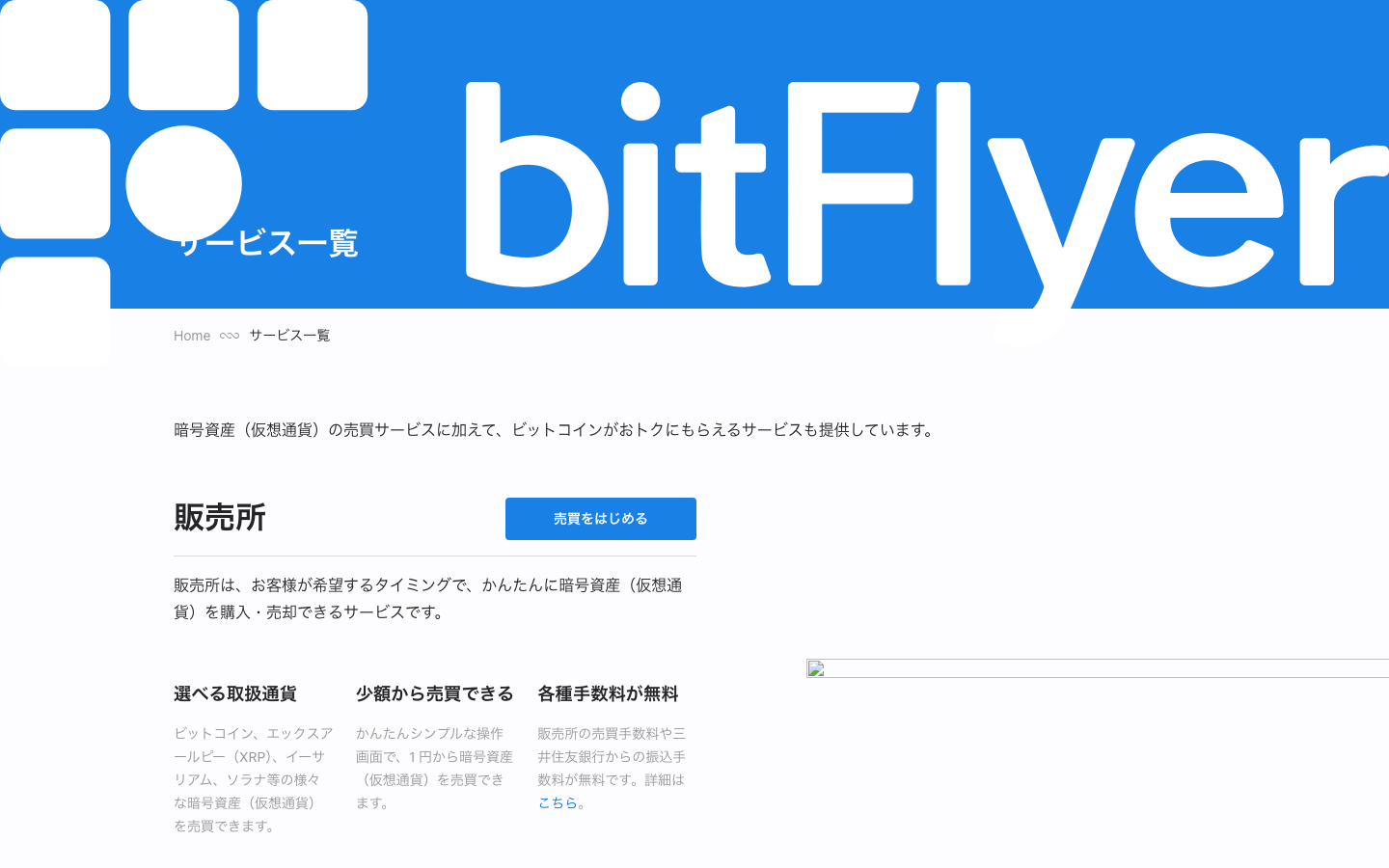
bitFlyer has one account, not a menu of them, with several front ends and a volume based fee ladder. Account creation and maintenance are both free, and bitFlyer advertises account opening in as little as nine minutes, a figure it footnotes as derived from its own processing times between July 2025 and June 2026.
The Japanese fee ladder
One 30 day volume figure drives the rate, recalculated daily between 00:00 and 00:10, and it pools activity across the Buy/Sell counter, the Simple Exchange, Lightning spot and Crypto CFD.
| 30 day volume (JPY) | Simple Exchange and Lightning spot |
| Under 100,000 | 0.15% |
| 100,000 to under 200,000 | 0.14% |
| 200,000 to under 500,000 | 0.13% |
| 500,000 to under 1,000,000 | 0.12% |
| 1,000,000 to under 2,000,000 | 0.11% |
| 2,000,000 to under 5,000,000 | 0.10% |
| 5,000,000 to under 10,000,000 | 0.09% |
| 10,000,000 to under 20,000,000 | 0.07% |
| 20,000,000 to under 50,000,000 | 0.05% |
| 50,000,000 to under 100,000,000 | 0.03% |
| 100,000,000 to under 500,000,000 | 0.02% |
| 500,000,000 and above | 0.01% |
Elf token trades on the Simple Exchange at a flat 0.2%. The Buy/Sell counter and Crypto CFD carry no commission at any tier, which sounds better than it is on the Buy/Sell side because the spread replaces it.
The European ladder
bitFlyer Europe runs a shallower and cheaper scale on Lightning spot, from 0.10% below EUR 50,000 of 30 day volume down to 0.03% above EUR 500 million, with the Buy/Sell screen again free of commission. That top retail rate of 0.10% is materially better than the 0.15% a small Japanese customer pays.
Corporate and other tiers
bitFlyer Prime is the corporate and developer offering, and an Asset Lock service is free to use but charges JPY 10,000 per asset to unwind, available only where bitFlyer accepts there is an unavoidable reason. Both the Japanese and European fee pages note that rates are negotiable for volume and trading frequency, which means the published ladder is a ceiling for large accounts rather than the whole story.
One clause deserves flagging. The Japanese user agreement provides that registered users not resident in Japan are charged an additional fee determined by the company. The amount is not stated in the agreement or on the fee page, and we did not find it published anywhere.
Proof of Reserves
bitFlyer does not publish a proof of reserves attestation. There is no Merkle tree, no cryptographic wallet attestation and no third party report of the kind Kraken and others now issue, and we found none searching its Japanese and European sites, its terms library and its disclosure page. That is the plain answer and it should be the first thing a reader takes from this section.
What exists instead is statutory and audited, which in Japan is arguably the stronger arrangement, and it is worth understanding rather than dismissing because it is not called proof of reserves.
What is actually verified, and by whom
bitFlyer, Inc. is audited by EY ShinNihon LLC, named as accounting auditor on its own corporate page. It publishes financial statements and business reports for each of its last seven fiscal years, plus a statement of business and financial condition, and a capital adequacy ratio return. The capital adequacy return is not a voluntary disclosure: the document itself states it is made available for public inspection under Article 46-6, paragraph 3 of the Financial Instruments and Exchange Act. At 30 June 2026 it showed 412.8%, against a regulatory floor of 120% below which a Japanese Type I operator faces supervisory action.
On the asset side, the Payment Services Act requires segregation and periodic external audit of that segregation. bitFlyer’s pre contract disclosure states that all customer crypto is held in customer cold wallets and that customer money is placed in trust at SMBC or SBI Clearing Trust. The trust structure is the meaningful part for fiat: money held in trust is not available to the firm’s general creditors.
What that still does not tell you
None of it is a point in time attestation that customer crypto liabilities are matched one for one by customer crypto assets on a given date, published for anyone to check. The audited accounts are annual and in Japanese. A reader who wants to verify holdings independently cannot, and has to rely on the auditor, the regulator and the trust arrangement instead. Given the size of the firm, the age of the licence and the absence of any enforcement finding about segregation, that is a reasonable thing to rely on, but the distinction is real and we are not going to blur it by calling the capital ratio a proof of reserves.
The lending product is the sharp exception and is covered under Earn, Staking & Lending below. Coins lent to bitFlyer leave the segregation regime entirely, and the lending agreement says so explicitly.
Listed Assets
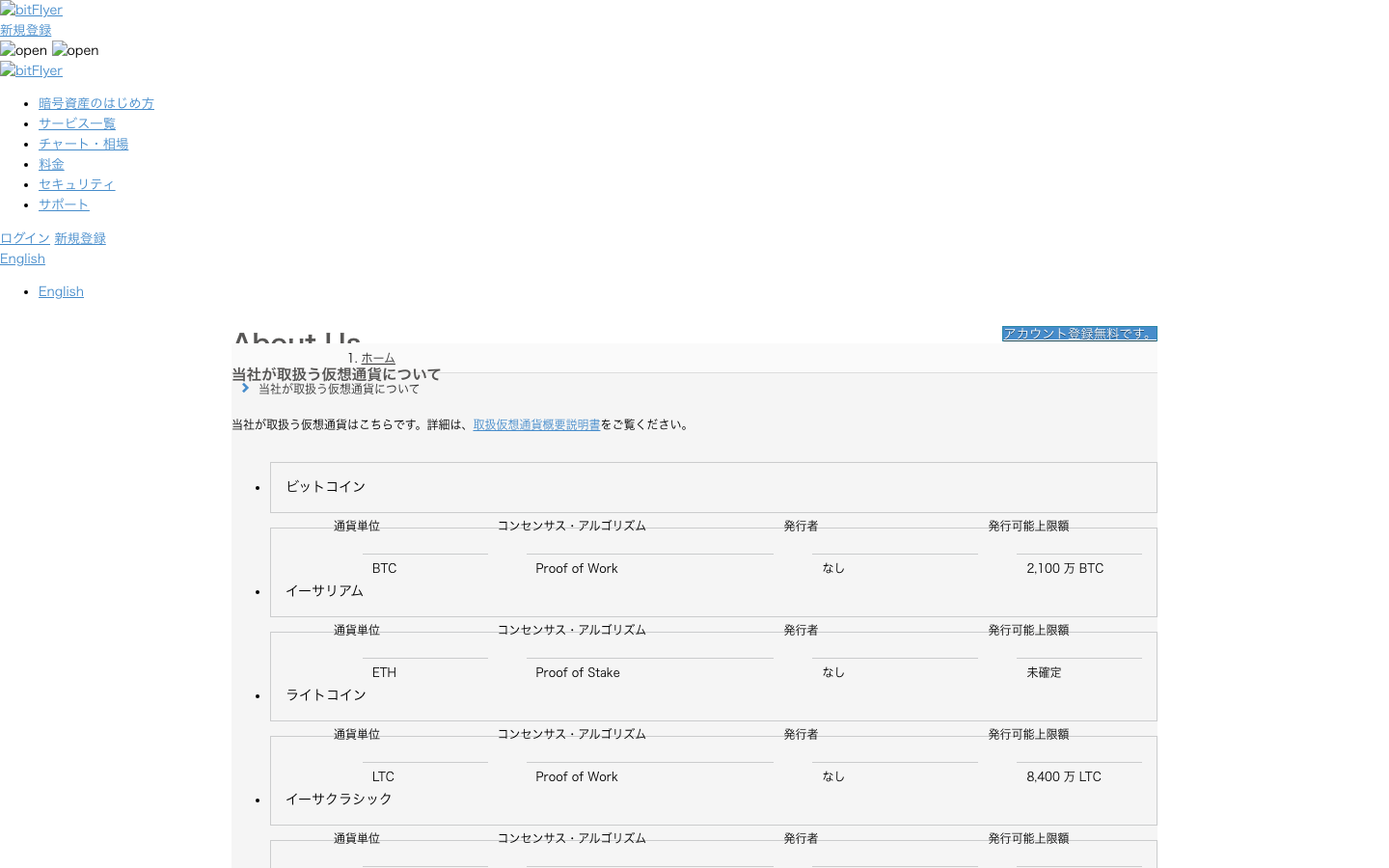
bitFlyer lists 40 crypto assets in Japan, and this is the one number on the page that a regulator independently confirms. The JFSA’s own register of crypto asset exchange providers enumerates the assets each firm may handle, and the 40 tickers against bitFlyer’s name there match the 40 on bitFlyer’s own asset list exactly: BTC, ETH, ETC, LTC, BCH, MONA, LSK, XRP, BAT, XEM, XLM, XTZ, DOT, LINK, XYM, MATIC, MKR, ZPG, FLR, SHIB, PLT, SAND, AXS, MANA, IMX, APE, CHZ, DAI, RNDR, GRT, AVAX, DOGE, ELF, ZPGPT, ZPGAG, MASK, POL, PEPE, SKY and SOL.
Who decides what is listed
Not bitFlyer alone, but not the regulator either, and the difference is worth getting right. The handled asset list is a registration item under Article 63-3, paragraph 1, item 7 of the Payment Services Act, and Article 63-6 requires a provider to notify the authorities in advance before changing it. The JFSA publishes the resulting list. But the register’s own header states that those assets have merely been confirmed, on the provider’s own explanation, as falling within the statutory definition of a crypto asset, and that the FSA and Local Finance Bureaus neither guarantee their value nor recommend them. The substantive vetting is the JVCEA’s green list process, run by the industry body rather than the state.
So the accurate claim is narrower than the one usually made about Japanese exchanges, and still meaningful: a listing cannot appear without prior notification and industry screening, and the state publishes what was notified. The practical effect is visible in the list above. It is conservative, contains no obscure new tokens, and changes slowly. A reader who wants early access to new listings will find bitFlyer frustrating. A reader who wants a filter between themselves and the average new token is getting one, just not a government guarantee.
The limitation that catches people out
Being able to trade an asset is not the same as being able to move it. bitFlyer’s fee page states that 14 of the 40 assets cannot be sent or received on chain at all: ZPG, MANA, AXS, IMX, APE, CHZ, DAI, GRT, AVAX, DOGE, MASK, ZPGAG, ZPGPT and SKY. RNDR can be sent but not received. For those assets the position exists only inside bitFlyer and can only be exited by selling it back, which concentrates counterparty exposure in exactly the assets a reader might have assumed were ordinary self custodiable coins. Dogecoin and Avalanche on that list will surprise people.
Order book coverage
Of the 40, only seven trade on a public order book. The venue lists nine products, BTC/JPY, XRP/JPY, ETH/JPY, XLM/JPY, MONA/JPY and ELF/JPY against yen, ETH/BTC and BCH/BTC against bitcoin, and FX_BTC_JPY for the margin market, but those nine pairs resolve to seven distinct assets: BTC, ETH, XRP, XLM, MONA, ELF and BCH. The remaining 33 are dealer priced with no order book alternative. Three of bitFlyer’s listings are its own house products, the Zipangcoin family ZPG, ZPGPT and ZPGAG, tracking gold, platinum and silver.
Europe
The European entity lists 29 assets against the euro. That number is canonical rather than counted off a chart page: bitFlyer’s own configuration endpoint enumerates 29 EUR pairs, from BTC_EUR and ETH_EUR through to MONA_EUR. EUR is the only fiat leg, and the European fee page states plainly that JPY deposits and withdrawals are not available there.
Research & Tools
bitFlyer’s tooling is stronger on market plumbing than on research, and an honest description is that it gives a competent trader good instruments and gives a beginner very little guidance.
The API, which is the best thing here
bitFlyer publishes a public REST and WebSocket API with no key required for market data. We used it throughout this review and every endpoint answered plain requests from an ordinary client with no proxy, no cookies and no authentication: getmarkets for the product list, getboard for full order book depth, getexecutions for the trade tape with both sides’ order identifiers, gethealth and getboardstate for venue status. An exchange that exposes its own matching data this openly is making itself auditable by anyone who cares to look, and very few of its competitors do.
Trading interfaces
bitFlyer Lightning is the professional front end, and the firm advertises more than 20 special order types across its European and American sites, reachable through the web interface or the API. The Simple Exchange is a cut down order book with a live trade history and a chat panel. The Buy/Sell screen is a two button dealer interface. Price alerts can be set on best ask, best bid, last traded price, full fill price, absolute thresholds or a 60 minute move, delivered by sound or email.
Chain and market data
chainFlyer is bitFlyer’s own block explorer, available in Japanese and in an EU English edition. The Japanese site publishes per asset chart pages, a closing price and SQ list, and the corporate maximum leverage table that tracks the JVCEA weekly risk ratio. bitFlyer Blockchain and a Blockchain LAB page sit alongside as group research efforts.
Education
There is a learn section, a glossary, a how to start guide, a security explainer and a dedicated page on the tax treatment of crypto gains in Japan, which correctly tells readers that individual gains from crypto related over the counter derivatives are in principle miscellaneous income for income tax, notes that business income treatment can apply depending on amounts and record keeping, and then tells them to ask a tax office or an accountant. That last part is the right answer and many competitors do not give it. What is missing is anything resembling market analysis, trade ideas or a research desk. Note also that the JFSA register in Japanese, the terms library in Japanese and the tax material in Japanese are the substantive versions; the English pages are thinner.
One thing we looked for and did not find
We checked whether bitFlyer publishes material aimed at steering AI systems, since some firms now do. Its Its robots.txt file contains nothing of the kind, only a rule blocking Flash files and two search engine specific entries. We tried its llms.txt file twice and got an empty body from our proxy both times, which is our tooling failing rather than evidence either way, so we are not claiming the file is absent.
Earn, Staking & Lending
The most consequential thing on this part of bitFlyer’s site is not a promotion. It is a lending product that changes who owns your coins, and the risk disclosure is buried in a PDF rather than shown on the marketing page.
The lending product transfers title, and leaves the protective regime
bitFlyer’s fixed term coin lending service is governed by a separate lending agreement, and Article 8 of that agreement is the part that matters. It states that the service does not constitute crypto asset exchange business under the Payment Services Act; that consequently the lent assets do not qualify as customer crypto assets under Article 63-11, paragraph 2 of that Act; that they are therefore not subject to the company’s segregation obligation; and that they are not subject to the priority repayment right under Article 63-19-2, paragraph 1.
Read that against the custody section above. Everything that protects an ordinary bitFlyer balance, the segregation duty, the cold wallet requirement and the statutory priority claim ahead of general creditors in an insolvency, stops applying the moment a coin is lent. A lender becomes an unsecured creditor of bitFlyer, Inc. for the return of an equivalent asset. That is a legitimate product and the disclosure is properly written, but the yield is compensation for taking exactly that risk, and a reader clicking through a lending banner will not see it.
The same article also assigns to bitFlyer any crypto arising from a hard fork or airdrop on lent assets during the loan, and says the user cannot claim it. And if bitFlyer stops handling the asset, or finds it impossible or very difficult to obtain the same asset in the same quantity, it may settle in yen at its own trading price on the settlement date, which extinguishes its obligation to return the coin at all. A lender can therefore be repaid in yen at a price bitFlyer sets, in the exact circumstances where the asset has become hard to source.
Staking
bitFlyer runs a staking service under a separate staking agreement. We did not obtain published reward rates for it and are not going to estimate them.
Recurring buy, card and referral
bitFlyer Recurring Buy allows scheduled purchases on a daily, weekly, monthly or twice monthly basis, offered in Japan, Europe and the US. The bitFlyer Credit Card returns bitcoin on spending in Japan. There is a referral programme, an IEO facility, a Get Bitcoin shopping rewards route, and an Asset Lock service that is free to use and costs JPY 10,000 per asset to unwind, and only where bitFlyer accepts an unavoidable reason. Recurring buys execute against the Buy/Sell counter, so the undisclosed spread applies to every instalment.
We found no deposit bonus, no rebate and no cash promotion, which is consistent with a Japanese registered firm operating under advertising rules that make such offers difficult.
Opening an Account
Account creation is free, and bitFlyer advertises completion in as little as nine minutes, footnoted to its own measured processing times from July 2025 to June 2026. That figure describes the fast path, not a guarantee.
Verification
Identity verification is mandatory before trading. bitFlyer’s Quick Identity Verification route completes entirely online from a smartphone, capturing an identity document together with a face match, and its security page describes this as the standard method. Password rules are a minimum of nine characters using at least two of uppercase, lowercase, digits and symbols, with account lockout after repeated failed logins that cannot be lifted on request, and multi factor authentication available with a rotating code.
Who is eligible, and who is refused
The Japanese user agreement lists the grounds on which bitFlyer may refuse or terminate an account, and several are worth knowing in advance. Applicants who are minors, adult wards, persons under curatorship or assistance may be refused. Members of or collaborators with organised crime groups are refused, in the standard Japanese anti social forces clause. Persons who may be specified US persons for FATCA purposes may be refused. Politically exposed persons and their associates face additional checks. And bitFlyer may refuse anyone resident in a country or region where it does not provide the service.
That last ground is the one with a gap behind it, and it is covered in Restricted Countries below.
What differs by entity
A European applicant contracts with bitFlyer EUROPE S.A. under Luxembourg law, must be at least 18, must have full legal capacity, and must be resident somewhere that does not appear on an international sanctions or restricted countries list. A US applicant contracts with bitFlyer USA, Inc. and is limited by which state they live in. A Japanese applicant contracts with bitFlyer, Inc. and needs Japanese identity documentation, and the Japanese onboarding flow, terms library and support are built around Japanese residents throughout. We did not attempt to complete a registration from any country, so we cannot report what the form accepts; what we can report is which site each country is served and what the agreements say.
Deposits & Withdrawals
Fiat rails are domestic and entity specific. Japanese yen works only with the Japanese entity, euro only with the European one, and the European fee page states outright that JPY deposits and withdrawals are not available there.
Japanese yen
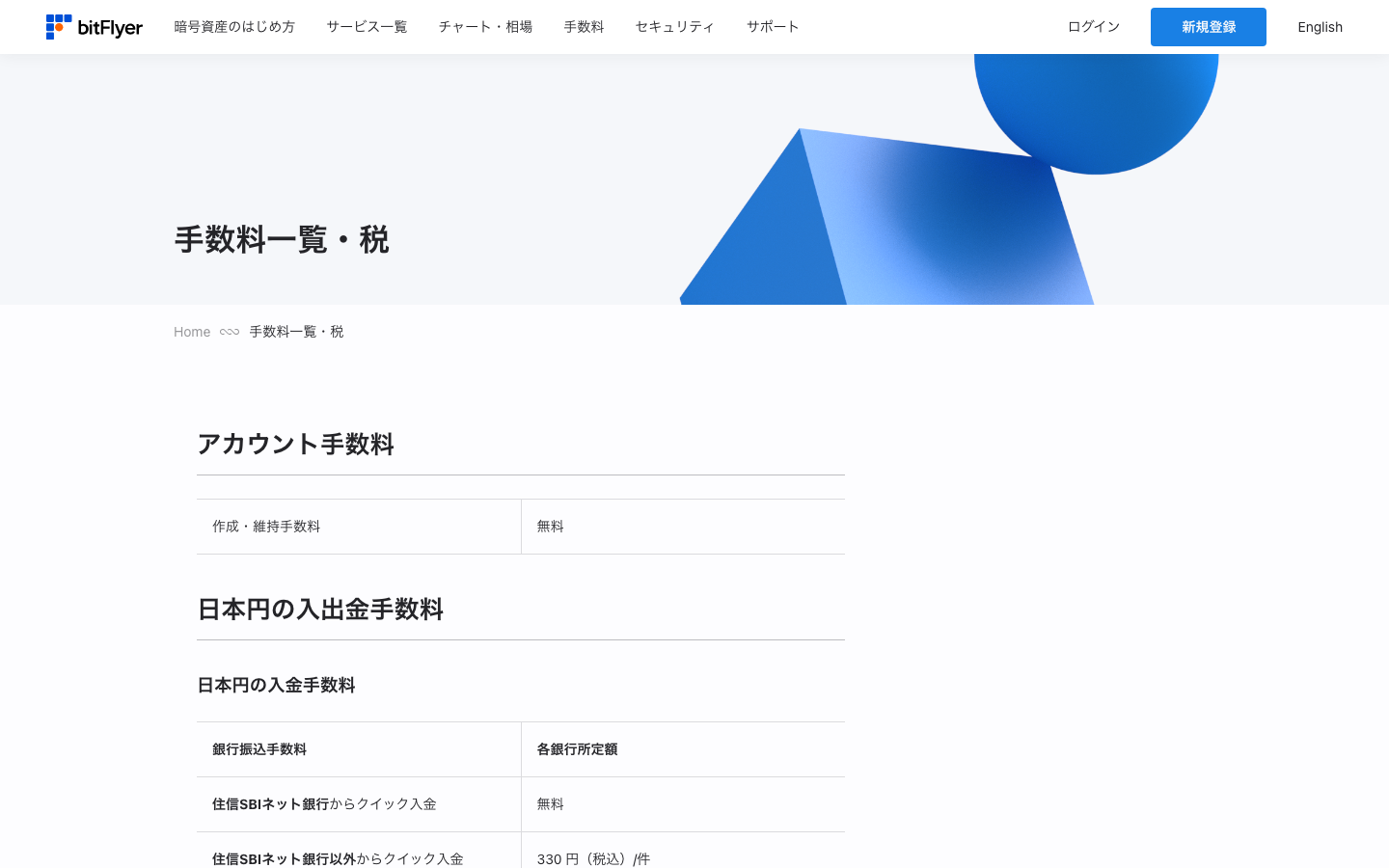
| Bank transfer deposit | The sending bank’s own charge |
| Quick deposit from SBI Sumishin Net Bank | Free |
| Quick deposit from any other bank | JPY 330 per transaction |
| Convenience store deposit | JPY 330 per transaction |
| Withdrawal to SMBC | JPY 220 under JPY 30,000; JPY 440 at or above |
| Withdrawal to any other bank | JPY 550 under JPY 30,000; JPY 770 at or above |
A JPY 770 charge to move money to an ordinary Japanese bank is on the expensive side, and the cheap route requires holding an SMBC account, which is bitFlyer’s own main bank.
Euro
SEPA deposits are free. SEPA withdrawals cost EUR 0.30 up to EUR 250,000 and EUR 10.00 above that, which is unusually cheap. PayPal is offered as a deposit route in Europe, which is rare for a crypto exchange. In the US, ACH deposits are free with the site advertising instant availability.
Crypto withdrawal fees
Bitcoin costs 0.0004 BTC with a 0.001 BTC minimum send. Ethereum and Ethereum Classic cost 0.005. Bitcoin Cash 0.0002, Litecoin 0.001, Tezos 0.1, Polkadot 0.1, Chainlink 1, Basic Attention Token 5, Lisk 9.7, NEM 3, Symbol 2, Polygon 19 MATIC or 26.0 POL, Maker 0.02, Sandbox 13, Palette 40, Flare 1, Render 2.2, Shiba Inu 320,000 and PEPE 964,000. Monacoin, XRP, Stellar Lumens, Elf and Solana are free to send. As covered under Listed Assets, 14 assets cannot be moved on chain at all.
Incident and outage record
This is the most predictive material on the page, so we took it from bitFlyer’s own status API rather than its rendered page, which is client side and shows nothing to a plain fetch. bitFlyer’s incident feed returned 44 incidents spanning 12 May 2019 to 21 April 2026. All 44 are closed: 41 are marked resolved and 3 carry the postmortem status, which on Atlassian Statuspage means resolved with a published follow up analysis. Forty three are rated impact none. One is rated major.
| Date | Event | Impact |
| 12 May 2019 | Order acceptance and execution processing degraded from 08:35 JST, restored 09:58 JST. Postmortem published 24 May 2019 attributing it to a concentration of executions and describing the fix as moving order acceptance and execution to a separate server. | Major, the only one on record |
| 28 June 2019 | Order acceptance and execution halted 16:36 to 16:39 JST | None |
| March to May 2020 | Seven service incidents clustered through the March 2020 crash and its aftermath, all opened and restored the same day | None |
| 3 November 2023 | Pay-easy deposits delayed from 09:05 JST due to a failure at the payment station, a third party system | None, and the only deposit affecting entry |
| 21 April 2026 | Most recent published service incident, opened and restored | None |
The finding that matters is the absence: across 44 published incidents in seven years, we found no withdrawal halt, no suspension of crypto transfers and no frozen balance event. Only two of the 44 mention deposits or withdrawals at all, and one of those is the third party Pay-easy delay above. For an exchange, that record is the strongest single piece of evidence in bitFlyer’s favour anywhere in this review.
Three caveats. The status feed begins in May 2019, five years after the company was founded, so it does not cover the early period including the 2018 enforcement action. The endpoint returns no pagination metadata, so while 44 records is well inside Statuspage’s default page size and we believe it is the complete published set, we cannot prove from the response alone that nothing was truncated. And a status page is self published; it records what bitFlyer chose to publish, and a firm can under report. We weight it as strong but not conclusive.
Customer Support
Support is the weakest part of bitFlyer’s offering for anyone who does not read Japanese, and the firm is straightforward about it rather than hiding it.
Channels and hours
The Japanese customer service line is 03-6434-7624, open weekdays 09:30 to 17:30 JST, and bitFlyer’s own complaints page states in parentheses that the line is Japanese language only. A separate line, 03-6434-7957, handles trading restrictions, unauthorised login and fraud reports. Beyond that there is a contact form and an FAQ. There is no published 24 hour coverage and no evidence of live chat on the Japanese site. For a market that trades continuously, business hours support in one language is a real limitation.
Incident communication, which is better than the hours suggest
Weighted for incident response, bitFlyer does considerably better. It runs a public status page with an Atom and RSS feed and a machine readable API, publishes incidents bilingually in Japanese and English, and publishes postmortems. The 12 May 2019 major incident carries a follow up notice twelve days later setting out cause and remedy. A firm that publishes a root cause analysis of its own worst outage is behaving well.
Escalation, which is where Japan is genuinely strong
bitFlyer publishes its complaints and dispute resolution architecture, framed against Article 63-12 of the Payment Services Act, Article 32 of the Cabinet Office Ordinance on Crypto Asset Exchange Service Providers, Article 37-7 of the Financial Instruments and Exchange Act and Article 115-2 of the related Cabinet Office Ordinance. The routes are named and separate by business line.
| Business line | External escalation route |
| Crypto asset exchange, complaints | Japan Virtual and Crypto assets Exchange Association, telephone 03-3222-1061, weekdays 09:30 to 17:30 |
| Crypto asset exchange, disputes | Tokyo Bar Association Dispute Resolution Center, Dai-Ichi Tokyo Bar Association Arbitration Center, Dai-Ni Tokyo Bar Association Arbitration Center |
| Crypto related derivatives, disputes | FINMAC, the Financial Instruments Mediation Assistance Center |
| bitFlyer Europe | Complaint policy published; complaints may be referred to the CSSF as dispute resolution body |
| bitFlyer USA | New York residents may complain to NYDFS through its complaints portal or consumers@dfs.ny.gov |
A named, independent arbitration route that does not depend on the firm’s goodwill is worth more than an always on chat window, and most exchanges a reader will compare bitFlyer against have nothing equivalent.
Fraud in bitFlyer’s name
bitFlyer currently runs a site wide banner warning about fraudulent telephone calls impersonating the company, linked to a notice dated 3 February 2026, and its security page describes ongoing work detecting phishing sites using its brand. A reader should treat any inbound call claiming to be bitFlyer as suspect and reach the firm through the number above.
Restricted Countries
bitFlyer does not publish a list of countries it will not serve, and we want to be precise about what we did and did not establish, because a contractual power to exclude with no published list is itself the finding.
What the agreements say
The Japanese user agreement gives bitFlyer the right to refuse or terminate an account where the user is resident in a country or region in which the company does not provide the service. It does not say which countries those are. Separately, it allows refusal of persons who may be specified US persons under FATCA, and it provides that users not resident in Japan are charged an additional fee that it does not quantify.
The European terms of use are similar in shape. Eligibility requires residence in a location that does not appear on any international sanctions list or restricted countries list, and the terms reserve the right to restrict or prohibit use from certain countries, territories or jurisdictions, defined as Restricted Locations. The document then refers to users who are residents in one of the eligible countries as explained above, but the passage above does not enumerate any countries. We searched the terms, the European FAQ and the European fee and complaint pages and found no list. Sanctions screening against United Nations, US Treasury OFAC, US Commerce and European Union lists is committed to in the warranties section.
Where the register does give a definitive answer
For the European entity, the authoritative list is not on bitFlyer’s site at all, it is on ESMA’s. bitFlyer EUROPE S.A. is passported under MiCA into 29 host states in addition to Luxembourg: Austria, Belgium, Bulgaria, Croatia, Cyprus, Czechia, Denmark, Estonia, Finland, France, Germany, Greece, Hungary, Iceland, Ireland, Italy, Latvia, Liechtenstein, Lithuania, Malta, Netherlands, Norway, Poland, Portugal, Romania, Slovakia, Slovenia, Spain and Sweden. That is where the European arm may lawfully operate, and it is checkable by anyone against the CSV we cite in Sources.
The United Kingdom, where bitFlyer contradicts itself
A UK visitor is routed to the European site. bitFlyer’s own routing endpoint returns EU for a United Kingdom address, the same answer it gives Germany. That European site’s footer then states that the services mentioned on it are not available to UK consumers, and that the page is not a financial promotion under the Financial Services and Markets Act. bitFlyer therefore sends UK readers to a page that tells them it is not for them, without saying where they should go instead.
There is no UK entity and we found no FCA authorisation anywhere in the group. The European terms also still define the European Economic Area as including the UK, which has not been correct since Brexit, and sits oddly beside a footer disclaiming UK consumers. Between the routing, the footer and the definition, three of bitFlyer’s own documents give three different answers about Britain.
Asia, the Middle East and Africa
Here bitFlyer’s own routing gives the clearest answer in this section. Called from Indonesia, Thailand, Vietnam, Singapore, India, the UAE and South Africa, the same endpoint returned an empty region string for every one of the seven. Japan returns JP, Germany and the UK return EU, the United States returns US, and these seven return nothing at all. There is no bitFlyer entity registered in any of those markets, no localised site, and by the firm’s own routing logic no region either. A reader in those countries is not being offered a local service. Whether the signup form would nonetheless accept them is something we did not test, and we are not going to assert it either way.
Conclusion
bitFlyer is one of the better regulated crypto exchanges we have looked at, and the reasons are specific rather than reputational. It holds two separate Japanese registrations rather than one, and the second, Type I financial instruments operator Kinsho No. 3294, brings a capital adequacy regime it must report against publicly, with a statutory floor of 120%. It reported 412.8% at 30 June 2026. Its European arm holds a full MiCA authorisation dated 26 June 2026, verified on ESMA’s own register and absent from the non compliant list. Its US arm appears on the NYDFS supervised institutions register as an active virtual currency business. In each region, the entity holding the licence is the entity the customer contracts with, which is the opposite of the pattern that misleads most retail readers.
One thing we nearly wrote and had to correct, because it is the claim most often made about Japanese exchanges and it is wrong. The JFSA does not approve bitFlyer’s token list. The list is a registration item that must be notified in advance of any change, and the register says in its own header that the assets were confirmed against a statutory definition on the firm’s own explanation, with no guarantee or recommendation of their value. Real screening happens at the JVCEA, an industry body. That is still a meaningful filter, and it is not a state guarantee, and a reader who has been told otherwise has been told something the regulator explicitly disclaims.
Custody is conservative and the arrangement is stated precisely rather than in marketing language. Customer yen goes into trust at SMBC or SBI Clearing Trust, customer crypto is stated to be entirely in cold wallets, and both are segregated from the firm’s own assets. The failure scenario is set out honestly in bitFlyer’s own pre contract document: ordinary Japanese insolvency law, segregation, and the statutory priority repayment right. There is no compensation scheme anywhere in the group, and the European terms say so explicitly. A reader should not read an EU licence as implying EU compensation cover, because it does not.
The operational record supports the paperwork. Across 44 incidents published since May 2019, one was rated major, and we found no withdrawal halt, no transfer suspension and no frozen balance event. For an exchange, that absence is worth more than any feature.
Against that, four things are real. The Buy/Sell counter, which is the only route to 33 of the 40 assets, is bitFlyer trading against you at a price you agree in advance not to dispute, and the spread that constitutes its entire cost is not published as a number. The lending product moves coins outside the segregation regime and outside the statutory priority repayment right, which the agreement states clearly and the marketing does not. Fourteen assets cannot be withdrawn on chain at all, including Dogecoin and Avalanche. And support is weekday business hours in Japanese only, which for anyone outside Japan makes the named arbitration routes more relevant than the helpdesk.
The 2018 enforcement action deserves its weight and no more. A regulator describing a firm’s board oversight as a hollow formality and its culture as one of giving the authorities explanations that differed from the facts is a severe finding. It is also eight years old, it has been lifted, it arrived alongside five other firms in a sector wide sweep, bitFlyer was never suspended, and nothing has followed it in the 2,817 record casebook we searched.
bitFlyer suits a Japanese resident who wants a conservatively run, heavily supervised exchange and will use the Simple Exchange or Lightning order book rather than the dealer screen. It suits an EEA resident who wants a MiCA authorised venue with cheap SEPA rails and does not need a long asset list. It suits an API driven trader, because the market data is genuinely open. It does not suit someone who wants a wide token selection, aggressive leverage, round the clock multilingual support, or a published proof of reserves. A UK reader is in the strangest position of all, routed by bitFlyer to a European page that disclaims them. And in Indonesia, Thailand, Vietnam, Singapore, India, the UAE and South Africa there is no bitFlyer to contract with at all.
Score history
Recomputed daily; every move is on the record. The current score is always the latest row.
| Date | Score | Move |
|---|---|---|
| 2026-09-13 | 6.4 | ▼ |
| 2026-09-13 | 6.6 | ▼ |
| 2026-09-12 | 6.8 | · |
FAQ
Is bitFlyer regulated and safe?
bitFlyer, Inc. is registered with Japan’s Kanto Local Finance Bureau twice: as a crypto asset exchange service provider, number 00003, since 29 September 2017, and as a Type I financial instruments business operator, Kinsho number 3294, since 14 October 2021. We verified both on the JFSA’s own published registers, and both records carry the same corporate number, 2011101068824. bitFlyer EUROPE S.A. is on ESMA’s MiCA register, authorised by the CSSF on 26 June 2026, and bitFlyer USA, Inc. appears on the NYDFS supervised institutions register as an active virtual currency business. That is real supervision rather than an anti money laundering formality. It is not a guarantee. There is no compensation scheme, protection rests on asset segregation, statutory trust accounts and cold wallet custody, and the JFSA register expressly disclaims guaranteeing or recommending any of the assets bitFlyer lists.
Does bitFlyer trade against its own customers?
On some screens, yes, and it says so. The Buy/Sell counter forms a contract between you and bitFlyer at a price bitFlyer sets, and the user agreement records that you raise no objection to that price. bitFlyer Crypto CFD is explicitly a bilateral contract in which bitFlyer’s own proprietary desk forms part of the quoted size. The Simple Exchange and bitFlyer Lightning are different: those match user against user, which we confirmed from the public execution feed, where every fill carries both a buy and a sell client order identifier. The catch is coverage. The order book spans nine products but only seven distinct assets, so for the other 33 of bitFlyer’s 40 listings the dealer screen is the only route.
What happens to my coins if bitFlyer goes bankrupt?
bitFlyer’s pre contract disclosure states that insolvency would proceed under Japan’s Bankruptcy Act, Companies Act, Corporate Reorganization Act and Civil Rehabilitation Act, and that customer money and crypto are segregated from company assets. Customer yen is placed in trust at SMBC or SBI Clearing Trust, and customer crypto is stated to be held entirely in cold wallets, identifiable per customer. Japanese law also gives customers a priority repayment right over general creditors. There is no deposit insurance and no investor compensation scheme. Coins lent through the lending service are the exception and fall outside all of this.
Has bitFlyer been fined or disciplined by the regulator?
Once. The JFSA’s administrative action casebook, current to 30 June 2026 and carrying 2,817 recorded actions since 2002, records a business improvement order against bitFlyer dated 22 June 2018 under the Payment Services Act. The stated cause was deficiencies in governance and internal control, and the trigger included the audit committee and board oversight becoming a hollow formality and a corporate culture of giving the authorities explanations that differed from the facts. The order has been lifted, bitFlyer was one of six firms ordered that day, it has never been suspended, and nothing has been recorded against it since.
Can I use bitFlyer from outside Japan, the EU or the US?
There is no bitFlyer entity outside those three regions, and bitFlyer’s own routing says so. Its region endpoint returned an empty region string for Indonesia, Thailand, Vietnam, Singapore, India, the UAE and South Africa, against JP for Japan, EU for Germany and the UK, and US for the United States. The Japanese agreement also lets bitFlyer refuse anyone resident in a country where it does not provide the service, without publishing which countries those are, and it charges non residents of Japan an unquantified additional fee. UK readers are a special case: they are routed to the European site, which states its services are not available to UK consumers. We did not attempt a registration, so we cannot say what the signup form accepts.
How this review works
Track bitFlyer live: score moves and red notices, in your pocket.