
CRYPTO · CHECKED 13 SEP 2026
Bitpanda review.
Austrian MiCAR-authorised platform for crypto, stocks, ETFs and metals, where Bitpanda is your counterparty rather than a venue.
OK-ISH
OUT OF 10
Bitpanda holds genuine MiCAR authorisations verified on the FMA and BaFin registers and corroborated on ESMA's, and for crypto and securities the entity taking the money is the entity holding the licence. But crypto sits in omnibus custody with no proof of reserves and no compensation scheme, the EUR 20,000 Austrian cover reaches only the securities arm, two products sit outside the authorisation by Bitpanda's own admission, and the retail product is a dealer quote accepted at Bitpanda's sole discretion. Suits European investors wanting one regulated app; costly for frequent crypto traders.
Each criterion is scored 1 to 10 from primary sources. The overall score is their unweighted mean. How scoring works.
| Founded | 2014 |
|---|---|
| Headquarters | AT |
| Maximum leverage | 1:20 |
| Withdrawal fee | None |
| Platforms | Bitpanda web, Bitpanda iOS app, Bitpanda Android app, Bitpanda Fusion, Fusion REST API, Fusion MCP server, TradingView charts in Fusion |
- MiCAR authorisations confirmed on the FMA's and BaFin's own databases and corroborated on ESMA's EU register, down to the service letters
- For crypto and securities the contracting entity is the licensed entity, in each of the 17 countries whose contract we checked
- The 2019 Austrian AML registration was formally extinguished by the MiCAR decision rather than left running alongside it
- A separate licensed Austrian investment firm permitted to hold client money, inside the Austrian investor compensation scheme
- Fiat deposits and withdrawals are free on every method, and crypto withdrawals cost the network fee only
- Minimum order of EUR 1, no account fee, no metals storage fee and EUR 1 share dealing
- Real stocks and ETFs are routed to Quotrix at the Duesseldorf Stock Exchange rather than kept in house
- The supported-country rule is published as a closed list of 46 countries rather than left to be discovered at sign-up
- Unusually plain disclosure that Cash Plus is a derivative and that Earn on Stablecoins is unregulated and transfers title
- 24/7 chat, WhatsApp, scheduled native-language calls and a status page that names the third party behind each outage
- No proof of reserves attestation, no named sub-custodian, and insurance that is two EUR 5m indemnity layers with a EUR 1m deductible, not asset cover
- No compensation scheme reaches crypto; the Austrian EUR 20,000 cover applies only to Bitpanda Financial Services
- Two products sit outside the authorisation by Bitpanda's own words: Earn on Stablecoins, which transfers ownership of the coins, and 20x stocks margin, which can leave you owing money
- Screen prices are an invitation to offer, Bitpanda accepts at its sole discretion, and it may reverse trades it considers arbitrage
- For Cash Plus and other S-Tokens Bitpanda Financial Services is the sole counterparty with nothing routed to a venue
- The 0.99% headline covers Bitcoin and stablecoins only; other crypto is 1.49% and small caps 2.49%, charged on both sides
- Seven deposit or withdrawal incidents ran past 24 hours, including a USD and CHF withdrawal delay open for about 46 days
- UK clients get a money laundering registration only, no Financial Ombudsman and no FSCS, and a narrower product set
- Precious metals sit in an entity supervised by a Vienna district trade office and absent from the FMA register
- An MFSA-authorised CASP trading as Bitpanda appears on ESMA's register and on none of Bitpanda's own pages
Overview
Bitpanda is an Austrian investment platform, founded in Vienna in 2014 and now running crypto, stocks, ETFs, precious metals, leverage products and a money market yield product from one app. It is one of the few crypto firms in Europe whose authorisation we could confirm on two national regulators’ own databases rather than in a press release, and one of the fewer still where the company that takes your money is the company that holds the licence.

That is worth stating plainly, because the usual finding in this catalogue is the opposite. A broker advertises a European licence and then onboards retail clients through an offshore entity the licence does not cover. Bitpanda does not do that for its crypto and securities business. A client in Austria, Croatia, France, Italy, Spain, the Netherlands, Poland, the Czech Republic, Denmark, Sweden, Norway, Portugal, Romania or Hungary contracts with Bitpanda GmbH, which holds the Austrian MiCAR authorisation and passports it into 30 EEA states. Switzerland is served by the same entity and the same agreement, but sits outside the EEA and outside that passport. A client in Germany contracts with Bitpanda Asset Management GmbH, which holds the German one. A client in the United Kingdom contracts with Bitpanda Broker UK Ltd, and there the picture is materially weaker: that entity holds a money laundering registration, not an authorisation. Two other parts of the group sit outside financial supervision entirely, and the section below names them.
The other thing a reader should understand before depositing is that Bitpanda’s retail product is not an exchange. Its own User Agreement says the prices on screen “do not constitute binding offers for any trade or investment but an invitation for you to submit an Offer”, that you are bound by your offer for 24 hours, and that Bitpanda then decides “at its sole discretion” whether to accept it. Your trade is a bilateral contract with a Bitpanda company, not an order matched against another user. Bitpanda does run an order-driven product, Fusion, but that is a separate service.
Overview Table
| Headquarters | Vienna, Austria (Stella-Klein-Loew Weg 17, 1020 Vienna) |
| Established | 2014 |
| Countries Served | 46, published as a closed list on Bitpanda’s helpdesk. Europe, the Crown Dependencies, Turkey and Serbia. Nothing outside that list can complete verification |
| Regulated By | FMA Austria (MiCAR CASP, plus a WAG 2018 investment firm and an e-money institution), BaFin Germany (MiCAR CASP), MFSA Malta (a MiCAR CASP trading as Bitpanda), FCA United Kingdom (money laundering registration only), VARA Dubai (per Bitpanda’s own legal notice, unconfirmed) |
| Minimum Deposit | None published. The minimum order is EUR 1.00, or GBP 1.00, CHF 1.50, USD 1.50, PLN 5, SEK 10, DKK 7, HUF 400, CZK 25 |
| Maximum Leverage | 10x on crypto margin and 20x on stocks and ETFs margin in the EU; 3x on crypto in the UK |
| Total Instruments | Bitpanda states 3,000+ assets, including 650+ cryptocurrencies, 8,000+ stocks and 2,500+ ETFs. Those figures are the company’s and do not reconcile with each other |
| Platforms | Web, iOS and Android apps, Bitpanda Fusion, Fusion REST API, Fusion MCP server |
| Customer Support | 24/7 live chat with escalation to a human, WhatsApp, scheduled calls Monday to Friday 09:00 to 17:00, helpdesk |
| Languages | English, German, French, Italian, Spanish, Dutch, Polish, Romanian, Hungarian, Croatian, Czech |
| Incident history | 50 incidents published between 21 March 2025 and 21 July 2026, two rated critical. See the dated table in Deposits & Withdrawals |
Facts List
- Bitpanda GmbH (FN 569240v) was authorised as a crypto-asset service provider under Article 63 MiCAR by FMA decision of 9 April 2025, corroborated on ESMA’s EU-wide register.
- The same decision declared its earlier Austrian anti-money-laundering registration, held since 19 December 2019, extinguished. The old registration was replaced, not rebadged.
- Bitpanda Asset Management GmbH (Berlin, HRB 258842 B) holds a separate German MiCAR authorisation from BaFin, BaFin-ID 10159692, with services dated from 24 January 2025.
- Bitpanda Financial Services GmbH (FN 551181k) is a licensed Austrian investment firm under WAG 2018 with express permission to hold client money and financial instruments.
- That investment firm belongs to the Austrian investor compensation scheme, which pays up to EUR 20,000 per client. It does not cover the entity that holds your crypto.
- Bitpanda Payments GmbH (FN 501412x) is an Austrian e-money institution, institute code 94646, and runs the fiat rails.
- Bitpanda Broker UK Ltd (FRN 925234) holds a money laundering registration only. The FCA record shows no permissions and no client money permission.
- That UK company was renamed from Commercial Rapid Payment Technologies Limited on 4 February 2025, and the FCA record shows it trading as Crypterium until 4 March 2025.
- Crypto is held in omnibus wallets tracked on Bitpanda’s internal ledger. No proof of reserves attestation is published and no auditor is named.
- Margin trading on stocks and ETFs, at up to 20x, is provided by Bitpanda GmbH “as an unregulated service” in Bitpanda’s own words, with losses that can exceed the amount invested.
- Bitpanda’s Earn on Stablecoins product pays up to 7% and, in Bitpanda’s own words, is “an unregulated product” outside MiCAR under which “ownership of the assets passes to Bitpanda”.
- Bitcoin carries a 0.99% premium and Bitpanda discloses a per-trade fee “which ranges from 0.00% to 2.49%”. Fiat deposits and withdrawals are free.
Key Takeaways
- For crypto and securities, the licence covers the entity taking your money. In each of the 17 countries whose contract we checked, the Bitpanda company named in the agreement is the one holding the authorisation. Failing that test is the single most common finding in this catalogue.
- Two parts of the group are outside financial supervision. Precious metals sit in Bitpanda Metals GmbH, whose stated supervisor is a Vienna district trade office, and the Dubai entity’s VARA registration we could not confirm on VARA’s register.
- The MiCAR authorisation is real and dated. FMA decision of 9 April 2025 for Bitpanda GmbH, BaFin services dated from 24 January 2025 for Bitpanda Asset Management GmbH. Both appear on the regulators’ own company databases, not only in company announcements.
- A MiCAR authorisation is not the old AML registration under a new name. The FMA decision expressly extinguished Bitpanda’s 2019 registration. The Austrian register category for the old regime now holds zero firms of any name.
- Your crypto is not covered by any compensation scheme. The Austrian EUR 20,000 investor compensation applies to Bitpanda Financial Services GmbH only, and its own terms say claims against Bitpanda GmbH “will not be covered”.
- Bitpanda is your counterparty, not a venue. Screen prices are an invitation to make an offer; Bitpanda accepts or rejects at its sole discretion within 24 hours.
- For Cash Plus and other S-Tokens the counterparty position is absolute. The execution policy says Bitpanda Financial Services “will be the sole contractual counterparty” and that no such transaction “will be transmitted to any third-party or executed by Bitpanda Financial Services on a trading venue”.
- One yield product takes ownership of your coins. Bitpanda states that Earn on Stablecoins is “an unregulated product”, outside MiCAR, under which “ownership of the assets passes to Bitpanda for the term of the Earn transaction”.
- Real shares do reach an exchange. Stocks, ETFs and ETCs are routed to Quotrix, the electronic trading system of the Duesseldorf Stock Exchange, at EUR 1 per trade.
- UK clients get a thinner deal. Money laundering registration only, no FSCS, no Financial Ombudsman, crypto and crypto indices only, and margin capped at 3x against 10x in the EU.
- Retail crypto pricing is broker pricing. 0.99% on Bitcoin and up to 2.49% per trade is well above what an order-book exchange charges, though fiat rails are genuinely free.
- No withdrawal halt found, but real rail friction. 23 of the 50 published incidents touched deposits or withdrawals, and seven of those ran beyond 24 hours, including a USD and CHF withdrawal delay open for about 46 days.
Licences & Custody
Bitpanda is not one company. Its own legal notice lists six; a seventh, the UK entity, appears only on the separate British site; and an eighth, in Malta, appears on ESMA’s register under the Bitpanda name but on no Bitpanda page we found. Which one you get depends on where you live and what you buy. The group holds more entities still, including Bitpanda Custody Ltd in London and Berlin branches of the Austrian companies. This matrix is the review.
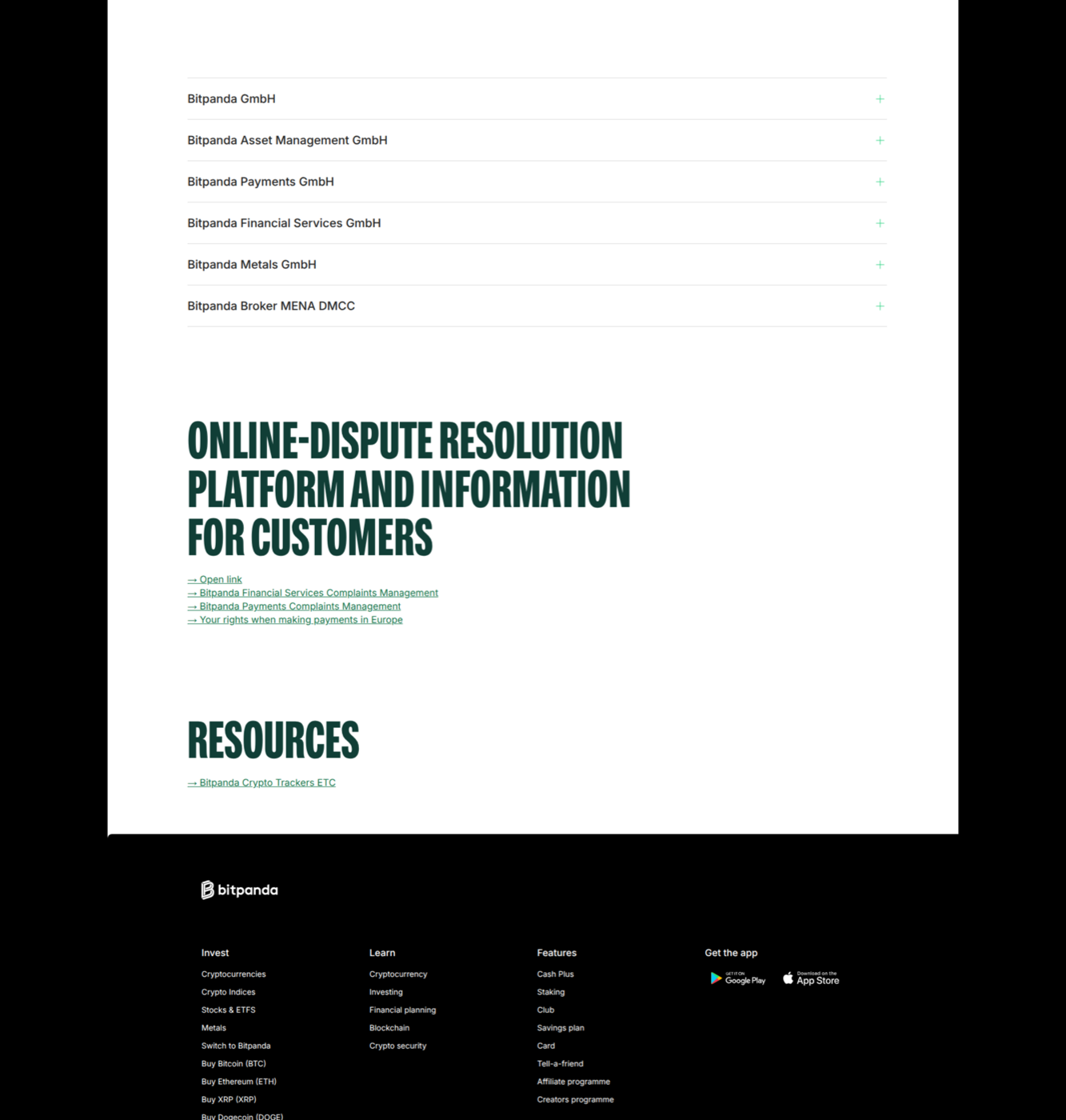
Which entity holds your assets, by residence
| You are in | You contract with | Authorisation | What reaches you if it fails |
|---|---|---|---|
| Austria, Croatia, France, Italy, Spain, Netherlands, Poland, Czech Republic, Denmark, Sweden, Norway, Portugal, Romania, Hungary, Switzerland, and the unlisted default | Bitpanda GmbH, Vienna, FN 569240v | FMA, MiCAR Article 63 CASP, decision of 9 April 2025, passported into 30 EEA states. Switzerland is served by the same entity but sits outside the EEA and outside that passport | No compensation scheme. MiCAR professional indemnity insurance only, and it excludes insolvency claims |
| Germany | Bitpanda Asset Management GmbH, Berlin, HRB 258842 B | BaFin, MiCAR CASP, BaFin-ID 10159692, services dated from 24 January 2025 | No compensation scheme. BaFin and the Bundesbank conciliation boards handle disputes |
| United Kingdom | Bitpanda Broker UK Ltd, London, company 11412485 | FCA, FRN 925234, money laundering registration only, effective 11 October 2021 | Bitpanda’s own words: the Ombudsman and the FSCS “do not apply” |
| Anyone buying stocks, ETFs, ETCs, leverage tokens or Cash Plus | Bitpanda Financial Services GmbH, Vienna, FN 551181k | FMA, investment firm under WAG 2018, licensed 15 February 2021 and extended twice | Austrian investor compensation up to EUR 20,000 per client, 90% cap for companies |
| Anyone depositing or withdrawing fiat | Bitpanda Payments GmbH, Vienna, FN 501412x | FMA, e-money institution since 24 February 2022, institute code 94646 | E-money safeguarding rules. Not a deposit guarantee scheme |
| Anyone buying precious metals | Bitpanda Metals GmbH, Vienna, FN 511923 d | Vienna municipal district trade office under the Gewerbeordnung 1994. No financial regulator | Nothing financial. Bitpanda states the bullion is your legal property in a Swiss vault |
| United Arab Emirates | Bitpanda Broker MENA DMCC, Dubai, DMCC199645 | Bitpanda states VARA broker-dealer, VASP reference VL/2025/03/001. We did not confirm this on VARA’s register | Not established |
| Not stated by Bitpanda | BP23 CA Limited, Valletta, Malta, company C 106261 | MFSA, MiCAR CASP authorised 27/01/2025, listed on ESMA’s register under the commercial name “Bitpanda” | Not established. This entity appears on no Bitpanda page we found |
What we verified, and where
The FMA published its decision at fma.gv.at/zulassungserteilung-bitpanda-gmbh/ on 10 April 2025. It records that by decision of 9 April 2025 Bitpanda GmbH was authorised for seven crypto-asset services: custody and administration, exchange of crypto for funds, exchange of crypto for crypto, execution of orders, placing, reception and transmission of orders, and transfer services. The FMA company database lists Bitpanda GmbH under the category “CASP – Crypto-Asset Service Provider (AT)”, one of eleven firms in that category. The FMA identifies the firm by its commercial register number, FN 569240v, and publishes no separate licence reference, so that company number is the only identifier available and we record it as such rather than dressing it up as a licence number.
The distinction the reader should hold onto is between that authorisation and a national anti-money-laundering registration, which many firms still describe as being “regulated”. Bitpanda held the Austrian registration from 19 December 2019. The same FMA decision that granted the MiCAR authorisation declared that registration extinguished. When we queried the FMA’s old register category with no company name at all, it returned zero firms, so the category is now empty rather than merely empty of Bitpanda. That is the transition working as designed.
BaFin’s company database, data as at 28 July 2026, shows Bitpanda Asset Management GmbH as a Kryptowertedienstleister with custody, both exchange services and transfer services dated 24 January 2025, its old German crypto custody permission ended on 29 December 2024, and a qualified crypto custody permission surrendered on 31 December 2025. BaFin also lists Bitpanda GmbH as a cross-border provider under Article 65 MiCAR and Bitpanda Financial Services GmbH both as a cross-border investment firm and as a Berlin branch.
The investment firm is the part most reviews miss. FMA notices record the original WAG 2018 licence of 15 February 2021, an extension served on 4 April 2024 adding dealing on own account and safekeeping, and a further extension served on 11 July 2025 adding execution of orders on behalf of clients. The 2024 notice grants those services, in the FMA’s German, “mit ausdruecklicher Berechtigung zum Halten von Kundengeldern und Finanzinstrumenten”, which in our translation is with express authorisation to hold client money and financial instruments. Dealing on own account is not a footnote. It is the legal basis for Bitpanda being the counterparty to your trade.
The United Kingdom is the weak leg
The FCA register shows Bitpanda Broker UK Ltd with business type “MLD cryptoassets”, status Registered, no permissions and no client money permission. Companies House shows the company incorporated in June 2018, named CRP Technologies Limited and then Commercial Rapid Payment Technologies Limited until 4 February 2025, when it took the Bitpanda name. The FCA record shows the same firm trading as Crypterium until 4 March 2025 and holding its money laundering registration since 11 October 2021. Bitpanda did not obtain a fresh UK registration; it took over an existing crypto business that already held one. The group’s other UK entity, Bitpanda Custody Ltd (FRN 928556), is the former Trustology Limited, acquired on the same basis. We searched the FCA register for the brand name and found only these two firms and no clone entries.
This is also the one place a regulator has commented publicly. In a statement dated 22 February 2022 on the Trustology acquisition, the FCA said that Trustology was “a cryptoasset business which the FCA registered under the Money Laundering Regulations (MLRs) in October 2021”, that “neither party to the transaction holds any other authorisation, license or registration in the UK”, and that “Bitpanda GmbH is a registered digital assets service provider with the Austrian Financial Market Authority (FMA) and with the French Autorite des marches financiers (AMF)”. That was the position in 2022 and it has since changed, in that the group now holds a UK money laundering registration in its own name. The FCA’s point stands regardless: a registration under the money laundering rules is not an authorisation to conduct regulated business.
Custody
Bitpanda’s Summary of Custody Policy, which covers Bitpanda GmbH and its German subsidiary, states that “each client’s assets are managed within an omnibus account tied to the respective blockchain protocol but are tracked individually through Bitpanda’s internal ledger system”, across hot and cold wallets with cold storage for long-term holdings. It adds that “custody services may also include arrangements where custody functions are outsourced”. No sub-custodian is named, no wallet addresses are published, and the document describes regular audits without naming an auditor or publishing a result.
ESMA’s register corroborates both authorisations, and adds one
ESMA maintains the EU-wide register of authorised crypto-asset service providers under Articles 109 and 110 of MiCAR, published as five CSV files that it refreshes weekly. The crypto-asset service provider file, linked from ESMA’s MiCA page as /sites/default/files/2024-12/CASPS.csv, listed 312 authorised firms when we read it. It corroborates both Bitpanda authorisations exactly, down to the service letters: Bitpanda GmbH under the FMA, authorised 09/04/2025, services a, c, d, e, f, g and j, with no end date, passported into 30 EEA states; Bitpanda Asset Management GmbH under BaFin, authorised 24/01/2025, services a, c, d and j, also passported into 30 states. Three separate sources, two national and one European, agreeing on the same dates and the same scope, is as strong as this kind of verification gets.
It also produced something Bitpanda’s own legal notice does not mention. A third entry carries the commercial name “Bitpanda” and the website www.bitpanda.com: BP23 CA Limited, authorised by the Malta Financial Services Authority on 27/01/2025 for services a, c, d, e, g and j, at 66 Apt 5 Old Theatre Street, Valletta. Its LEI record confirms an active Maltese company, registration C 106261, and shows no parent, so we could not establish the corporate link to Bitpanda’s group from public data, and our follow-up query to the parent endpoint failed at our end rather than returning an answer. Bitpanda’s own complaints policy separately names “Malta: Malta Financial Services Authority Act (best practices)” among the rules its entities follow, which points the same way without proving it. We report the register entry as it stands and flag the gap: an MFSA-authorised CASP is trading under the Bitpanda name and Bitpanda’s legal notice does not list it.
What we could not reach
We captured but did not parse Dubai VARA’s public register, so the VARA reference number in the table is Bitpanda’s own claim and nothing more. The DFSA’s register, a different Dubai authority, returns zero results for Bitpanda and for Panda while a control search for Bit returns one, so that search worked and simply does not speak to a VARA registration. We also did not reach ESMA’s separate registers.esma.europa.eu portal, which sits behind a CAPTCHA we will not defeat; that portal does not host the MiCA register, which is why the CSV above was the right place to look.
Trading & Execution
The question that decides how a crypto platform behaves under stress is whether it matches your order against someone else or takes the other side of it. Bitpanda’s retail product does the second, and its own documents say so without hedging.
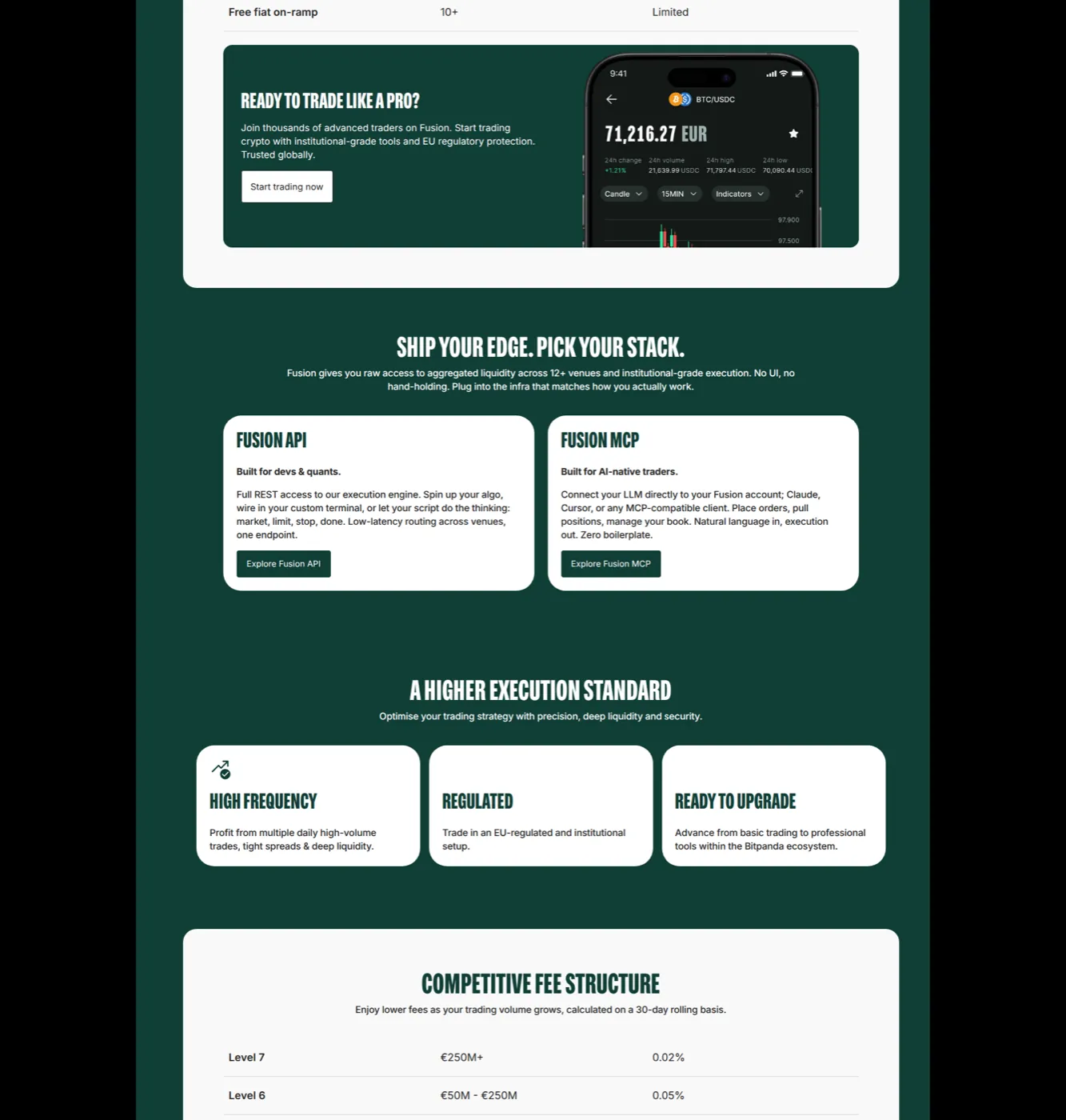
The retail product is a quote, not an order book
Clause 4.4 of the User Agreement sets out the offer process. Prices shown on the platform “do not constitute binding offers for any trade or investment but an invitation for you to submit an Offer”. You submit an offer, and “you are bound by your Offer for a period of 24 hours following the submission”. Bitpanda “will, within 24 hours of the submission of your Offer, decide, at its sole discretion, either to accept your Offer or reject it”, and an accepted offer “will result in a Transaction between you and the relevant Bitpanda Company”. Fulfilment follows within 48 hours. Bitpanda’s helpdesk says the quote you are shown is “valid for 20 seconds for most assets”. We did not open an account, so we cannot say how long acceptance takes in practice, and we do not publish a figure for it.
Two consequences follow. The trading cost is inside the quoted price rather than in a visible bid and ask on a book, so it is harder to compare and it is set by Bitpanda. That does not mean execution price risk disappears: the agreement binds you for 24 hours, warns that security checks may mean “longer waiting periods before the Offer is fulfilled”, and states that if a restriction stopped your offer, no Bitpanda company is obliged “to permit you to execute a new Offer at the same price”. The second consequence is that the platform reserves the right to reverse trades. Clause 7.5.3 allows Bitpanda to cancel a transaction for “abusive behaviours”, which it defines to include “the exploitation of loopholes or the usage of arbitrage opportunities”. A trader whose strategy is arbitrage should read that clause before funding an account.
Where each product actually executes
| Product | Executes where | Counterparty |
|---|---|---|
| Crypto, buy, sell and swap | Bitpanda’s own quote, accepted or rejected at its discretion | Bitpanda GmbH, or Bitpanda Asset Management GmbH in Germany |
| Stocks, ETFs and ETCs | Quotrix (MIC XQTX), the electronic trading system of the Duesseldorf Stock Exchange, on a request-for-quote basis | A market maker on Quotrix. Bitpanda Financial Services trades in its own name for your account |
| A-Tokens and L-Tokens (leverage) | “exclusively on the Bitpanda Platform which is not a regulated trading facility” | The issuer, which the Financial Services Terms identify as Bitpanda GmbH |
| S-Tokens, including Cash Plus | Nowhere external. “No Transaction … will be transmitted to any third-party or executed by Bitpanda Financial Services on a trading venue” | Bitpanda Financial Services GmbH, “the sole contractual counterparty”, acting “as principal on its own account” |
| Fusion | Aggregated liquidity across what Bitpanda describes as 12+ venues, with market, limit and stop orders over REST | External venues |
The Quotrix leg is a real exchange venue and worth crediting, with one qualification a reader should have. The execution policy says Quotrix “includes the Duesseldorf Stock Exchange Quotrix Regulated Market (Regulierter Markt) and the Duesseldorf Stock Exchange Quotrix Open Market (Freiverkehr)”, and the open market segment is not a MiFID regulated market. Execution runs on a request-for-quote model in which a market maker returns a two-sided quote valid for seven seconds, displayed to the client for about five, and accepted or not. Limit orders on stocks are not native venue orders; Bitpanda calls them “Limit-to-market” and describes them as “an internal Bitpanda Financial Services automation” that fires a request-for-quote when your trigger is hit, so the fill “may be at a price that is better or worse than the Limit Price”.
For A-Tokens the price does not come from an exchange at all. The execution policy says one or more “price information service providers” set it, and adds that these “may not be benchmark administrators under the EU Regulation 2016/1011/EU (Benchmark Regulation) and thus not regulated in the EU”.
Margin, liquidation and forced closure
Bitpanda offers crypto margin at up to 10x across more than 120 assets, and margin on stocks and ETFs at up to 20x across more than 875 instruments, which it describes as the first such product in Europe. UK clients get 3x on crypto and nothing else. Borrowing fees on crypto margin “accrue every 4 hours” and reduce your margin level as they do; on the stocks product Bitpanda advertises “free buys, EUR 1 sell fee and a 0.18% daily degressive funding fee” on the same four-hourly accrual. Bitpanda publishes a per-asset liquidation threshold and margin call threshold for stocks and ETFs, and its margin page promises “real-time monitoring and notification alerts before liquidation”, but the mechanic is the ordinary one: fall below the threshold and the position is closed for you.
The stocks margin product needs one more sentence, because it is the largest number on this review’s overview table and Bitpanda places it outside its own regulatory perimeter. Its page states: “Margin Trading and borrowing E-Token are provided by Bitpanda GmbH as an unregulated service.” It goes further under a heading of its own: “Risk beyond total loss! Losses can exceed your investment; you may owe borrowed EURCV and daily fees.” To open a position you “pledge the acquired Stocks/ETFs/ETCs and additional assets, including E-Money and crypto assets, as collateral to Bitpanda GmbH”, so a losing leveraged equity trade can reach the crypto sitting elsewhere in your account. Published liquidation thresholds run from 1.02 to 1.06 depending on the instrument, meaning a 20x position is liquidated on a move of a couple of per cent. This is the one product on the platform where a reader can end up owing Bitpanda money.
Leverage tokens work differently and are simpler to get wrong. They re-leverage at least once a day to hold the target ratio, which means their return over more than a day is not the multiple of the underlying’s return. Bitpanda’s leverage page carries the standard CFD warning and its own figure: “53.24% of retail client accounts lose money when trading in CFDs with this provider.” That is a lower loss rate than most CFD brokers publish, and it is Bitpanda’s own disclosure.
The other execution risk is availability. On 10 October 2025 Bitpanda reported a platform-wide outage which it attributed to market news that “triggered a liquidation chain affecting most exchanges and brokers”. An outage during a liquidation cascade is the moment a leveraged position most needs attention.
Accounts & Fee Tiers
Bitpanda has one account, not a menu. Opening and holding it costs nothing, there is no minimum deposit published, and the same login reaches crypto, stocks, ETFs, metals, indices, leverage and the card. What varies is the front end you use and, on the professional product, the fee tier your volume earns.
The three front ends
| Front end | Who it is for | Pricing |
|---|---|---|
| Bitpanda app and web | The default retail product. Buy, sell, swap, savings plans, limit orders | Premium built into the quote. Bitcoin 0.99%. Bitpanda discloses a per-trade fee “which ranges from 0.00% to 2.49%” |
| Bitpanda Fusion | Higher-volume and API traders. Aggregated liquidity, market, limit and stop orders, a REST API and an MCP server | A volume ladder on a 30-day rolling basis. We read Level 6 at EUR 50m to EUR 250m for 0.05% and Level 7 above EUR 250m for 0.02%. We did not capture the entry tier |
| Bitpanda Wealth and Business | High net worth individuals, family offices, corporate treasuries and companies | Not published. Relationship-managed |
Published costs
| Account opening and maintenance | Free |
| Minimum order | EUR 1.00, or GBP 1.00, CHF 1.50, USD 1.50, PLN 5, SEK 10, DKK 7, HUF 400, CZK 25 |
| Crypto premium, per Bitpanda’s MiCAR cost transparency document | Stablecoins 0.99%; Bitcoin, PAN and BEST 0.99%; other crypto-assets 1.49%; assets under EUR 100,000,000 market capitalisation and Bitpanda Spotlight 2.49%. Charged on both sides |
| Disclosed per-trade fee range shown in the app | 0.00% to 2.49% |
| Stocks, ETFs and ETCs | EUR 1 per trade, plus spread. Bitpanda warns that “On small orders, the €1 fee may represent a significant percentage of the order value” |
| Gold | 0.5% buying, 1% selling, no storage fee |
| Silver and platinum | 2.5% buying, 2% selling |
| Palladium | 2.2% buying, 1.8% selling |
| Leverage tokens | 0% to open, 1% to close, plus 0.1% per day on the leveraged amount |
| Margin on stocks and ETFs | Free buys, EUR 1 sell fee, and a 0.18% daily degressive funding fee accruing every four hours |
| Fiat deposits and withdrawals | Free on every method on the broker product. The limits page separately states that under Bitpanda Technology Solutions, “Liquidation by Bitpanda and or balance transfers to an IBAN have a EUR 1.00 processing fee” |
| Crypto withdrawals | Network fee only. Bitpanda states it “does not make earnings from these withdrawal fees” |
| Inactivity | No fee published. The User Agreement defines an inactive customer as three years without qualifying activity |
The honest reading is that the fee structure is good everywhere except the thing most users are there for. Free fiat rails, no account fee, no metals storage fee, a EUR 1 minimum and EUR 1 share dealing are all better than most European brokers. The crypto premium is broker pricing rather than exchange pricing, and the headline 0.99% is the best case: it applies to Bitcoin and stablecoins, while everything else is 1.49% and smaller or newly listed assets are 2.49%. Because the premium is charged on both sides, a round trip in an ordinary altcoin costs about 3%, and a user buying regularly will pay several times what an order-book venue charges. Bitpanda’s answer to that is Fusion, which is a genuinely cheap product at volume, and its own site frames the choice as “broker vs exchange vs advanced trading”.
One point of care on the premium model: because the premium is inside the quote, the fee is not a line item you can compare at a glance. Bitpanda says it has addressed this in the trade summary, stating “you can now see the exact fee applied to each trade” and listing the fields it breaks out as the final price including fees, the offer price excluding fees, the buy amount, the trade fee and the buy volume. We did not open an account and have not seen that screen, so we report the change as Bitpanda describes it.
The Wealth and Business propositions, and the silver and gold tiers of Bitpanda Club, are described in Bitpanda’s own machine-readable site summary at llms.txt rather than in a document we could verify independently, so treat those descriptions as the company’s.
Proof of Reserves
Bitpanda does not publish a proof of reserves attestation. There is no Merkle tree, no published wallet set, and no periodic report from a named auditor covering assets against liabilities. What it publishes instead is a custody policy, an insurance summary and a set of certifications, and a reader should not mistake any of those for the same thing.
The custody policy states that client assets are “operationally and legally segregated from Bitpanda’s own assets”, held in a mix of hot and cold wallets with cold storage for long-term holdings, and that “each client’s assets are managed within an omnibus account tied to the respective blockchain protocol but are tracked individually through Bitpanda’s internal ledger system”. Ownership is recorded in what the document calls a register of positions. The security page adds that crypto is held in cold storage “examined by an external auditor” and that Bitpanda holds ISO 27001 certification and a SOC 2 Type 2 report. We did not see the certificates, the auditor’s name or any attestation report, and the custody policy names none of them.
The insurance is real and worth reading carefully, because it is the document most likely to be misread as asset cover. Bitpanda publishes an errors and omissions insurance summary with Bitpanda GmbH as policyholder: a primary layer of EUR 5,000,000 with Liberty Mutual Insurance Europe SE under policy COADEW2H001, an excess layer of a further EUR 5,000,000 with Starr Europe Insurance Limited under AI1158A25FZA, a deductible of EUR 1,000,000 on each and every claim, running from 1 November 2025 to 1 November 2026. It is the professional indemnity cover MiCAR requires, triggered by “a negligent act, error or omission in the provision of professional services”. Its listed exclusions include fraud and dishonesty, fines and penalties, US and Canadian claims, and insolvency-related claims.
Read that together and the position is: two layers of EUR 5m, so EUR 10m of liability cover in total, with EUR 1m of every claim absorbed by the deductible before anything pays out, against a platform Bitpanda says holds assets for more than seven million users, and explicitly not covering the case a reader worries about most, which is the firm going under. This is not a criticism of Bitpanda so much as a correction to how insurance in this sector is usually presented. It is liability cover for mistakes, not a guarantee on your coins.
The one substantive thing standing behind client crypto is the MiCAR regime itself, which requires segregation and makes the CASP liable for loss of assets under Article 75(8), a liability the policy schedule expressly picks up. That is a stronger legal position than an offshore exchange offers and a weaker one than a published, audited reserve report would be. Both halves of that sentence matter.
Listed Assets
Bitpanda’s range is unusually wide for a crypto platform because it is not only a crypto platform. The company states 3,000+ assets in total, made up of 650+ cryptocurrencies, 8,000+ stocks and 2,500+ ETFs, plus four precious metals, crypto indices and leverage products. Those numbers are Bitpanda’s own and they do not add up: a total of 3,000 cannot contain 8,000 stocks. We report them as published rather than pick one.
What is listed
| Class | Detail | Legal form |
|---|---|---|
| Cryptocurrencies | Buy, sell and swap. Bitpanda states 650+ | Real coins, held in custody by the CASP entity, withdrawable to your own wallet |
| Crypto indices | BCI5, BCI10, BCI25 plus sector baskets including DeFi, smart contract, infrastructure, media and entertainment | Financial instruments with a published prospectus |
| Stocks and ETFs | Fractional from EUR 1, EUR 1 per trade, dividends credited pro rata | Real shares executed on Quotrix, held on an omnibus basis |
| Precious metals | Gold, silver, platinum, palladium, fractional from EUR 1 | Bitpanda states physically backed LBMA-accredited bullion in Swiss vaults, and that “you own your bullion outright” |
| Leverage | 30+ leveraged positions, long and short, on major coins | L-Tokens, derivatives issued by Bitpanda GmbH, carrying a CFD risk warning |
| Cash Plus | EUR, GBP and USD yield, headline rates shown as 1.79%, 3.00% and 3.08% when we looked | S-Tokens, derivative contracts on money market funds, issued by Bitpanda Financial Services |
| Vision (VSN) | Bitpanda’s own ecosystem token, replacing the earlier BEST and Pantos tokens | Crypto-asset |
The distinction that matters most
Not everything with a share price attached to it is a share. Bitpanda’s Financial Services Terms are blunt about A-Tokens: “the FS Customer does not acquire any securities, but only a claim against Bitpanda GmbH as Issuer of the A-Token, based on which they are intended to participate in the price development of certain securities”. The same document classifies these as “proprietary products” under Austrian securities law, and notes that selling them “creates an economic advantage for the relevant Bitpanda Company beyond the fees charged”.
Alongside that, Bitpanda now offers real stocks and ETFs routed to Quotrix, which its own stocks page describes as “execution only services for stocks, ETF and ETC … provided by Bitpanda Financial Services GmbH” with fractional entitlements held on an omnibus basis. A reader buying equity exposure should check which of the two they are being sold, because in one case they own a claim against Bitpanda and in the other they own a share held for them. The platform displays the contracting entity before each transaction, which is where that answer appears.
Listing and delisting
Bitpanda decides what is listed. Its Spotlight programme introduces newer tokens, and the risk taxonomy shipped across its site classifies assets by type, including payment coins, smart contract platforms, interoperability tokens, exchange tokens, stablecoins and tokenised real world assets, each with its own risk description. On delisting, the UK terms note that a stablecoin failing to meet future regulatory standards “could lead to the delisting of the stablecoin from the Bitpanda Platform”. We found no published listing committee, no public delisting criteria and no notice period, so the practical answer is that listing is at Bitpanda’s discretion.
Research & Tools
Bitpanda splits its tooling in two, and the gap between the halves is wide. The consumer app is built for people who do not want tools, and Fusion is built for people who want nothing else.
On the consumer side
The app gives price pages and charts for every listed asset, price statistics over one day, one week, one month, six months and a year, price alerts, and a conversion calculator that carries its own disclaimer that it “shows values for info only and doesn’t reflect actual transaction rates”. Savings plans automate recurring purchases into crypto, stocks, ETFs, metals or indices, and are fee free on stocks and ETFs. Limit orders exist, though as the stocks page notes, the platform “supports different order types (e.g. crypto-assets: limit order; stocks: limit-to-market order)” under one marketing name.
Bitpanda Academy is the education layer, organised into crypto, investing, securities and staking tracks, and it is genuinely substantial rather than a blog with a title. Sitting behind everything is a risk taxonomy that most platforms do not bother to write: per-category descriptions of what an asset class is and what can go wrong with it, covering proof-of-work energy and 51% attack risk, gas fee volatility and slashing on smart contract platforms, bridge failure on interoperability tokens, reserve and banking risk on stablecoins after naming the 2023 Silicon Valley Bank collapse, and the legal gap between a tokenised claim and the asset behind it. It reads as compliance output rather than marketing, which is the point.
On the professional side
Fusion is the order-driven product: aggregated liquidity across what Bitpanda describes as 12+ venues, market, limit and stop orders, and a volume fee ladder on a 30-day rolling basis reaching 0.05% at EUR 50m and 0.02% above EUR 250m. Charting is a “Native TradingView Integration”, which Bitpanda describes as putting “every professional chart, indicator, drawing tool, and multi-timeframe capability available directly on Fusion”. Access is through a web and mobile terminal, a full REST API, and an MCP server that connects a language model directly to a Fusion account to “place orders, pull positions, manage your book”.
That MCP server is worth a reader’s attention rather than admiration. Handing order entry to a language model puts a probabilistic system between a user and their money, with the same discretionary acceptance clause underneath. Bitpanda is not hiding it; it is a headline feature. But a reader evaluating Fusion should treat it as a power tool with no undo, not as a convenience.
Reporting
Bitpanda publishes cost transparency documents and investor information documents per product class, a prospectus for the crypto indices, and a MiCAR risk disclosure, all in one legal repository. For Austrian and German clients Bitpanda states that it withholds tax automatically. Clients see positions, transaction history and downloadable reports in the app, which the custody policy describes as a real-time view of the register of positions.
Content Bitpanda publishes for AI assistants
One thing a reader deserves to know, because it may shape what they are told elsewhere. Bitpanda publishes a file at bitpanda.com/llms.txt, updated 17 April 2026, written specifically for AI assistants and search agents. It is a structured index of the company’s own pages with one-line marketing descriptions, and it contains claims we could not verify independently, including “Regulated under MiCAR, MIFID II, AND PSD2” and asset counts that do not reconcile with each other. Its robots.txt also carries the line “Content-Signal: ai-train=no, search=yes, ai-input=no”.
There is no hidden instruction in either file and nothing in them told us what to conclude, which puts Bitpanda in better standing than some firms in this catalogue. But a reader who asks an AI assistant about Bitpanda may be reading the company’s own copy back to themselves. We treated that file as marketing, and where this review relies on it for anything, it says so.
Earn, Staking & Lending
The most consequential thing on a crypto platform is rarely the promotion. It is the yield product, because that is where a user’s assets stop being simply held for them. Bitpanda runs three yield products and they are structurally different from one another. One of them sits outside the MiCAR authorisation this whole review turns on, and Bitpanda says so itself.
Earn on Stablecoins, which takes ownership of your coins
This is the product a reader should understand before any other on the page. Bitpanda offers up to 7% on holdings of two stablecoins, EURCV and USDC. The disclosure sits directly beneath the rates and is worth reading in full: “Earn on Stablecoins is an unregulated product by Bitpanda GmbH, A-1020 Vienna, Stella-Klein-Loew Weg 17 and is not classified as a regulated crypto-asset service under Regulation (EU) 2023/1114 (‘MiCAR’). Not a banking or deposit product; no deposit protection applies. By lending e-money tokens to Bitpanda, ownership of the assets passes to Bitpanda for the term of the Earn transaction. You are exposed to counterparty, insolvency, and de-pegging risks.”
The helpdesk text on the same page repeats it: “when you use Earn (on Stablecoin), you lend supported stablecoins to Bitpanda. While your Earn transaction is active, ownership of your crypto-assets is temporarily transferred to Bitpanda.” It adds that “these risks are generally low”, which is Bitpanda’s characterisation rather than a fact.
Three things follow, and they are the reason this section leads with them. Title transfer means that while the Earn transaction is running you are an unsecured creditor of Bitpanda GmbH rather than the owner of a segregated asset, so the custody protections described elsewhere in this review do not apply to that balance. The product sits outside MiCAR by Bitpanda’s own statement, so the authorisation that makes the rest of the platform strong does not reach it. And the yield is paid by Bitpanda out of its own balance sheet rather than generated by a protocol, so the return and the credit risk come from the same place. Bitpanda discloses all of this plainly and prominently, which is more than most platforms running the same structure do. It remains the single largest risk concentration a Bitpanda user can opt into.
Staking
Staking is the opposite structure and much the safer of the two. The staking page listed 41 proof-of-stake assets with published reward ranges when we looked, with weekly rewards, no warm-up period, automatic compounding and no lock-in except on Ethereum. Ranges ran from Cosmos at 14% to 16% and Chiliz at 13% to 15% at the top, through Polkadot at 7% to 9% and Solana at 4% to 6%, down to Tezos at 2% to 4%. Bitpanda notes that here the rewards “come from blockchain networks”, in contrast to the stablecoin product where yields are “paid directly by Bitpanda”. Its own risk documentation is clear about the mechanism it does not control: proof-of-stake protocols can confiscate staked funds through slashing, and “if you delegate your tokens to a validator that gets slashed, you may lose a portion of your investment principal”. Rates are ranges, not promises, and Bitpanda states they are variable and “may change at Bitpanda’s discretion”.
Cash Plus, which is not a savings account
Cash Plus pays a yield on idle EUR, GBP and USD, quoted at 1.79%, 3.00% and 3.08% when we looked, with daily accrual, monthly payouts, no lock-in and a stated ceiling of EUR 10m. The structure deserves the attention: it is a derivative. Bitpanda’s own page says “This product is brought to you by Bitpanda Financial Services GmbH as a derivative”, that the underlying is a selected money market fund, and that “actual payout may differ significantly from performance of the underlying Money Market Fund, as a result of fees and charges”. It ends with the sentence a reader should carry away: “Bitpanda GmbH is not a bank, nor are any of its affiliates. This is a non-deposit investment product and consequently not protected by a deposit guarantee scheme.”
To that, add the execution policy. Cash Plus is an S-Token, and for S-Tokens Bitpanda Financial Services “will be the sole contractual counterparty of any Transaction”, acting “as principal on its own account”, with no transaction “transmitted to any third-party or executed … on a trading venue”. So the yield tracks a money market fund, but the party that owes you the money is Bitpanda’s investment firm. That firm is inside the Austrian investor compensation scheme up to EUR 20,000, which is the one place in the group where a compensation scheme reaches a client at all.
Loyalty, card and referrals
The Bitpanda Card is a Visa debit card that spends any balance at point of sale with cashback on crypto payments, issued under a separate cardholder agreement. Bitpanda Club is a volume-based loyalty tier with silver and gold levels offering reduced fees and dedicated support. Vision (VSN) is the group’s own token, which replaced the earlier BEST and Pantos tokens and carries staking, governance and fee discounts. A reader should note the ordinary conflict there: a platform that lists its own token and pays fee discounts for holding it has an interest in that token’s price which it does not have in Bitcoin’s. There is also an affiliate programme and a tell-a-friend scheme, both standard.
We found no deposit bonus, no cash promotion tied to a first trade and no leveraged trading incentive, which in this sector counts as a point in Bitpanda’s favour rather than an omission.
Opening an Account
Registration is free, takes an email address and a password, and unlocks nothing on its own. Bitpanda’s four-step framing is register, verify, deposit, trade, and the verification step is the one that determines what you can actually do.
Verification
Identity checks run through what Bitpanda calls trusted verification partners, using a government identity document. The platform’s limits table distinguishes an unverified account from a Verified one, and the published limits apply to the Verified tier. Bitpanda states that verification takes minutes; we did not open an account, so we cannot confirm a typical completion time and we do not publish one.
What you agree to
Before trading you accept the User Agreement and then, separately, the product terms for each asset class the first time you touch it. Bitpanda’s legal index links about fifty documents, of which more than twenty are product terms, covering staking, earn, savings plans, loyalty, payments, the card, margin on crypto, margin on securities, advanced trading and its API, the indices, each token class and the Web3 wallet. The agreement is explicit that these override the general terms: “in case of a conflict between the User Agreement and any Product Terms, the Product Terms shall prevail”. For leveraged products and Cash Plus there is also an appropriateness test, which is a MiFID requirement rather than a formality.
The clause worth reading before you click is 1.4. It says “unless otherwise specified in an applicable Product Term, you are contracting with Bitpanda GmbH”, and that “the trading and investment options for some Supported Assets are offered by Bitpanda GmbH while others are offered by other Bitpanda Companies”, with the contracting company “displayed on the Bitpanda Platform” before each transaction. In Germany the same clause names Bitpanda Asset Management GmbH instead, and in the United Kingdom a separate agreement names Bitpanda Broker UK Ltd. Which entity holds your money is therefore a per-product, per-country answer, and the platform does tell you, at the moment you trade.
Account controls, and how they can be taken away
Clause 7.4 lets Bitpanda block a specific service such as withdrawals, freeze all deposits, withdrawals and transactions, or suspend the account entirely, while it investigates a suspected cause. It also allows individual offers to be frozen where its monitoring flags them, “which is why there may be longer waiting periods before the Offer is fulfilled”. Bitpanda commits to lifting a restriction once the reason is gone, but adds that no Bitpanda company is then obliged “to permit you to execute a new Offer at the same price”. Notice is given unless the law forbids it, and Bitpanda is not obliged to explain what its risk systems found.
These are conventional financial-crime powers and every regulated firm has them. They are also the mechanism behind almost every frozen-account complaint in this industry, so a reader should know they exist and are broadly drafted before depositing rather than after.
Closing
Crypto can be withdrawn to a private wallet at any time and Bitpanda states there are no lock-ins or withdrawal restrictions on ordinary balances. On death, the account is suspended and blocked until succession is established by a competent court.
Deposits & Withdrawals
Fiat movement is handled by Bitpanda Payments GmbH, an Austrian e-money institution licensed since February 2022, and every fiat deposit and withdrawal is free. That is unusual and it is Bitpanda’s strongest cost advantage over its peers.
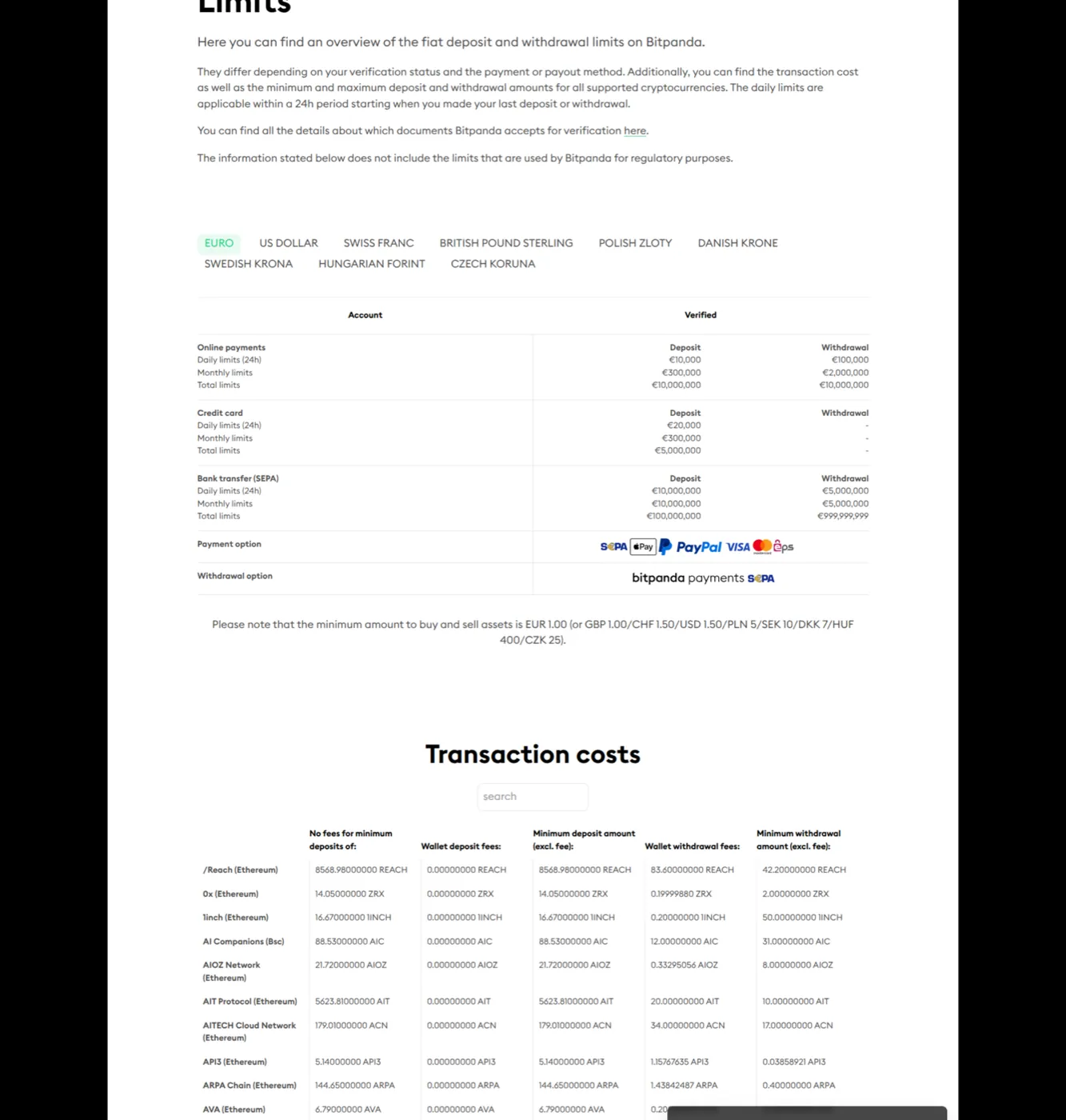
Rails and limits
Deposits accept SEPA and SEPA Instant bank transfer, Visa, Mastercard, PayPal, Apple Pay, eps, Klarna, TINK and Zimpler. Withdrawals go out over SEPA through Bitpanda Payments; cards are deposit only. Ten currencies are supported for fiat deposits: EUR, USD, GBP, CHF, TRY, PLN, HUF, CZK, DKK and SEK. On a verified euro account the published limits are EUR 10,000 a day for online payments and EUR 20,000 a day by card, against EUR 10,000,000 a day by SEPA transfer; withdrawals run to EUR 100,000 a day for online payments and EUR 5,000,000 a day by SEPA. Crypto withdrawals cost the network fee only, adjusted for congestion, and Bitpanda states it “does not make earnings from these withdrawal fees” and uses SegWit and batching to reduce them.
The incident record
Bitpanda runs a public status page at status.bitpanda.com. Its published feed returned 50 incidents when we queried it, spanning 21 March 2025 to 21 July 2026, and it does not reach further back than that; the depth of the feed is a fact about the feed, not about Bitpanda’s history before March 2025, which we did not retrieve. Within that window, 23 of the 50 incidents touched deposits or withdrawals, and seven of those 23 stayed open for more than 24 hours. We found no general withdrawal halt and no episode in which the whole customer base was unable to exit. We did find long-running partial impairments, and those are set out below rather than summarised away.
| Opened | Resolved | Severity | Event | Bitpanda’s own account |
|---|---|---|---|---|
| 21 Aug 2025 | 6 Oct 2025, about 46 days | Minor | Delayed withdrawals for USD and CHF | “Withdrawals are being processed, but are taking longer than usual”, with the team “working closely with our banking partner” |
| 29 Sep 2025 | 3 Oct 2025, about 4 days | Minor | Delays processing savings plan deposits | Ongoing technical issue |
| 10 Oct 2025 | 11 Oct 2025, about 89 minutes | Critical | Platform-wide outage | Attributed to market news that “triggered a liquidation chain affecting most exchanges and brokers” |
| 6 Nov 2025 | Same day | Major | PayPal transactions unavailable | Third-party payment provider |
| 21 Nov 2025 | 1 Dec 2025, about 10 days | Minor | XRP deposits and withdrawals delayed | “an ongoing technical issue” |
| 27 Nov 2025 | Same day | Major | Customer verification down on mobile apps | Onboarding affected, not existing balances |
| 5 Dec 2025 | Same day, 19 minutes | Critical | Complete platform outage | “an ongoing incident on Cloudflare side” |
| 21 Mar 2026 | Same day | Major | SEPA Instant deposits and withdrawals disrupted | An issue on a payment partner’s side |
| 8 Apr 2026 | Same day | Major | Delay in updating account balances | Balances stale rather than lost |
| 21 May 2026 | Same day | Major | Real stocks trading unavailable | Affects the Quotrix-routed product |
| 2 Jun 2026 | Same day | Major | Fusion trading temporarily disabled | “a technical issues” |
| 21 Jul 2026 | 22 Jul 2026 | Minor | Fiat withdrawals and deposits disrupted for some users | “an issue with our third-party banking provider”, with affected transfers rejected and refunded |
Two further entries belong in any honest account of withdrawals. On 22 May 2025 Bitpanda reported for about four hours that “crypto withdrawals unavailable on web app”, noting that “mobile apps remain fully functional”. And beyond the deposit and withdrawal set, long third-party outages recur: Klarna deposits were interrupted for about 18 days from 21 March 2025 and Skrill deposits were unavailable for about 15 days from 2 June 2025.
The pattern across the full 50 is mixed rather than reassuring. Most incidents are named third-party failures at Deutsche Bank, PayPal, Klarna, Skrill, TINK or the SEPA Instant rails, and Bitpanda names the counterparty rather than describing an unspecified technical issue, which is more disclosure than most platforms give. But the duration tail is long: seven deposit or withdrawal incidents ran past a day, and the USD and CHF withdrawal delay stayed open on the status page for roughly six and a half weeks. A user holding dollars or francs during that window was not stopped from withdrawing, on Bitpanda’s account, but was waiting. The two genuinely serious events were platform outages, one caused by Cloudflare and shared with much of the internet that day, the other during a market-wide liquidation cascade.
What the record does not tell us is anything about 2022 and 2023, which is the period a crypto reader most wants. We did not retrieve it from the status feed and we do not infer it.
Customer Support
Support is one of the better-resourced parts of Bitpanda and the channel mix is unusually broad for a crypto platform.
Channels
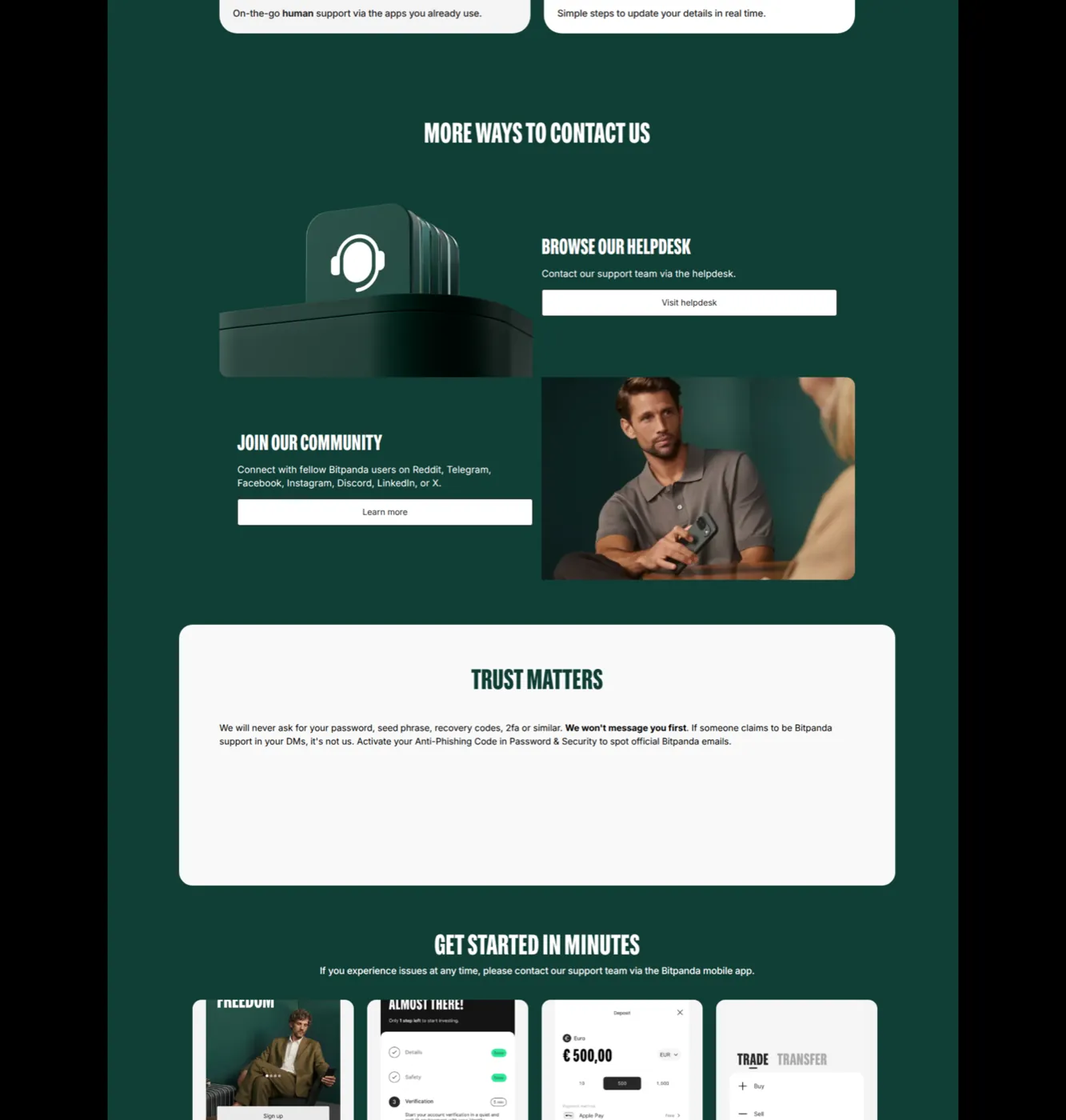
| Live chat | 24/7, 365 days. AI answers first with what Bitpanda describes as one-tap human escalation |
| Scheduled call | Monday to Friday, 09:00 to 17:00, with native speakers in English, German, French and Italian |
| Human support through the messaging app | |
| In-app self service | Detail changes handled without contacting an agent |
| Helpdesk | Article base in 12 language variants, with a separate UK helpdesk |
| Status page | status.bitpanda.com, with live incidents, history and uptime |
The AI-first live chat is worth flagging honestly in both directions. It puts an answer in front of a user instantly at three in the morning, which matters when the problem is a stuck deposit. It also puts a machine between a distressed user and a person, and the quality of the escalation path is the thing that decides whether that is a feature. We did not test it, and we do not publish an assessment of response quality we have not measured.
Incident response
Weighted for what matters in crypto, the record is decent. On the 5 December 2025 Cloudflare outage, Bitpanda posted an investigating notice at 10:02, a follow-up at 10:03 and a resolution at 10:21. On the 10 October 2025 platform-wide outage the resolution notice came at 00:49, about 89 minutes after the incident opened, with an explanation of the cause. Deposit and withdrawal incidents generally name the third party responsible rather than describing an unspecified problem, which is more disclosure than most platforms give.
Complaints and escalation
Complaints go in by email with a defined set of required information, and Bitpanda publishes a summary of its complaints management policy. Where it goes beyond most competitors is in naming the external bodies. For Austria it points to the FMA, the Bankenschlichtungsstelle and the Ombudsstelle des Fachverbandes Finanzdienstleister. For Germany, the legal notice names the Deutsche Bundesbank conciliation office and BaFin’s own conciliation board as bodies whose proceedings Bitpanda Asset Management participates in, with postal addresses. The EU online dispute resolution platform is also linked.
For the United Kingdom the answer is different and Bitpanda says so on its own page: the Financial Ombudsman Service “do[es] not apply to the cryptoasset services carried on by Bitpanda Broker UK Ltd”. A UK client with an unresolved complaint has Bitpanda’s internal process and then the courts. Bitpanda also runs a whistleblower channel and a bug bounty, and publishes anti-phishing guidance stating it will never ask for a password, seed phrase, recovery code or two-factor code and will never message a user first.
Restricted Countries
Bitpanda takes the opposite approach to most platforms in this catalogue. Rather than listing countries it excludes, it publishes a closed list of the countries it accepts, and states outright what happens if yours is not on it. The article is on its own helpdesk at support.bitpanda.com/hc/en-us/articles/360013898239-Countries-supported-for-verification, and the rule it sets is simple: “if we do not support your identity document or country of residence, this means that verification with Bitpanda is currently not possible”.
The 46 countries Bitpanda accepts
The published list runs: Aland Islands, Andorra, Austria, Belgium, Bulgaria, Croatia, Cyprus, Czech Republic, Denmark, Estonia, Faroe Islands, Finland, France, Germany, Greece, Guernsey, Holy See, Hungary, Iceland, Ireland, Isle of Man, Italy, Jersey, Latvia, Liechtenstein, Lithuania, Luxembourg, Malta, Monaco, Netherlands, Norway, Poland, Portugal, Reunion, Romania, San Marino, Serbia, Slovakia, Slovenia, Spain, Svalbard and Jan Mayen, Sweden, Switzerland, Turkey, Turkish Republic of Northern Cyprus, and the United Kingdom.
Everything outside that list is excluded by default, which covers all of Asia, Africa, the Americas and Oceania. Bitpanda is a European platform and does not pretend otherwise. It gives Argentina as its own worked example of the boundary: “although verification is not available in Argentina, an Argentinian passport can be a valid verification document”, meaning the document you hold and the country you live in are tested separately and residence is the one that decides. There is no appeal: “we also do not offer the possibility to be verified by post, via email or in person”.
Three qualifications inside the list
- France excludes its overseas departments in one respect. Bitpanda notes that “although Overseas France (DOM-TOM) is part of France, we currently can’t accept phone numbers based there due to legal requirements”.
- The United Kingdom is a separate perimeter, and was closed at some point. The list carries the note that “UK residents can once again register with Bitpanda through our entity, Bitpanda Broker UK Ltd”, which tells a reader that UK onboarding was previously unavailable. It is now handled by a different contracting entity on a different site, with crypto and crypto indices only, margin at 3x, and no stocks, ETFs, metals or Fusion. Requesting the euro-market fee and Fusion pages from a UK connection redirects to UK equivalents that return 404.
- Switzerland, Turkey, Serbia, Andorra, Monaco and the Crown Dependencies are on the list but outside the EEA, so the MiCAR authorisation and its passport do not reach them. ESMA’s register shows Bitpanda GmbH passported into 30 EEA states, and Switzerland is not among them. A Swiss client still contracts with Bitpanda GmbH under the same agreement, but on the basis of Swiss law rather than an EU passport, and this review did not establish what Bitpanda relies on there.
One further country appears in Bitpanda’s own files but not on this list. Its robots.txt contains the line “Disallow: /en-ae/*”, and its legal notice names Bitpanda Broker MENA DMCC in Dubai as a VARA-regulated broker-dealer. So a UAE-facing site exists, kept out of search results, serving an entity whose registration we could not confirm on VARA’s register. We fetched bitpanda.com from three exits only, Germany, Austria and the United Kingdom, so we did not see that site and do not describe it.
Conclusion
Bitpanda is the strongest regulatory position we have documented in this catalogue’s crypto set, and the qualifier matters more than the compliment. It scores 5.9 out of 10 on regulation because being properly authorised solves one class of problem completely and leaves several others untouched.
What it solves is the question this whole product exists to answer. For crypto and securities, the company that takes your money is the company on the register, in each of the 17 countries whose contract we checked. Bitpanda GmbH holds an Austrian MiCAR authorisation granted by FMA decision of 9 April 2025, and that decision extinguished the older anti-money-laundering registration rather than leaving both in play. Bitpanda Asset Management GmbH holds a German one from BaFin dated from 24 January 2025 and serves German clients directly. Bitpanda Financial Services GmbH is a licensed Austrian investment firm permitted to hold client money. The two MiCAR authorisations we confirmed on the FMA’s and BaFin’s own company databases; the grants, dates and scope come from the regulators’ own published decisions. A reader who has been burned by a firm advertising a European licence while onboarding through Seychelles will find none of that pattern here.
What it does not solve is the rest. Your crypto sits in an omnibus wallet with no proof of reserves attestation, no named sub-custodian, and a custody policy that permits outsourcing without saying to whom. No compensation scheme reaches it: the Austrian EUR 20,000 cover applies to the investment firm only, and Bitpanda’s own terms say claims against Bitpanda GmbH “will not be covered”. The insurance that gets presented as reassurance is two professional indemnity layers of EUR 5m each, with a EUR 1m deductible on every claim and an insolvency exclusion. If Bitpanda failed, MiCAR segregation is what stands between a client and the creditors, and it has not been tested on a firm this size.
The authorisation also does not cover everything Bitpanda sells, and the gaps are where a reader should look hardest. Precious metals sit in Bitpanda Metals GmbH, whose stated supervisor is a Vienna district trade office and which appears nowhere in the FMA’s database. Earn on Stablecoins, paying up to 7%, is described by Bitpanda itself as “an unregulated product” outside MiCAR under which “ownership of the assets passes to Bitpanda for the term of the Earn transaction”. Bitpanda discloses both plainly, which is to its credit, and both sit outside the protection the rest of this review describes.
The second thing to weigh is that the retail product is a dealer, not a market. Bitpanda’s own terms say screen prices are an invitation to make an offer, that you are bound for 24 hours and that Bitpanda decides “at its sole discretion” whether to accept. For Cash Plus and the other S-Tokens the position is starker still: Bitpanda Financial Services is “the sole contractual counterparty”, acting “as principal on its own account”, with nothing routed to any venue. None of this is hidden, and the equity side genuinely does reach the Duesseldorf exchange, but a user comparing Bitpanda to an order-book exchange on price alone is comparing two different products. The 0.99% Bitcoin premium and the disclosed 2.49% ceiling are what that difference costs.
Bitpanda suits a European investor who wants crypto alongside shares, ETFs and metals in one regulated app, values free fiat rails and a EUR 1 minimum, and is content to pay a broker’s margin for it. Fusion is a credible answer for higher-volume traders who want the cheaper, order-driven route without leaving the group. It suits less well an active crypto trader buying frequently at retail pricing, anyone whose strategy depends on arbitrage, given that Bitpanda reserves the right to reverse such trades, and UK residents, who get a narrower product set, an entity whose money laundering registration was obtained by an unrelated crypto business in 2021 and inherited through a rename in 2025, and no Ombudsman or FSCS by Bitpanda’s own admission.
One note on how this is scored. We take no ratings from review aggregators, so the user-experience criterion here rests on Bitpanda’s own published incident record rather than on collected complaints, and it is scored neutrally rather than up or down. That is deliberate: an absence of data we did not gather is not evidence against a firm.
Two further things we could not check, stated so the score can be read properly. We could not establish whether BP23 CA Limited in Malta belongs to the Bitpanda group, so it sits in this review as an open question rather than a finding. And Bitpanda’s public incident feed only goes back to March 2025, so we have no view of its behaviour through the 2022 market stress. Neither gap is held against it. Absence of evidence we did not gather is not a finding.
Score history
Recomputed daily; every move is on the record. The current score is always the latest row.
| Date | Score | Move |
|---|---|---|
| 2026-09-13 | 6.3 | ▼ |
| 2026-09-13 | 6.5 | ▼ |
| 2026-09-12 | 6.6 | · |
FAQ
Is Bitpanda regulated and safe?
Bitpanda is genuinely regulated, and the licences cover the entities that take client money. Bitpanda GmbH holds an Austrian MiCAR crypto-asset service provider authorisation granted by FMA decision of 9 April 2025, and Bitpanda Asset Management GmbH holds a German MiCAR authorisation from BaFin with services dated from 24 January 2025. We confirmed both on the regulators’ own company databases. Bitpanda Financial Services GmbH is separately a licensed Austrian investment firm permitted to hold client money. Regulated is not the same as protected, though: your crypto sits in omnibus custody with no published proof of reserves and no compensation scheme, and UK clients deal with an entity holding only a money laundering registration.
Which Bitpanda company would I actually be contracting with?
It depends on where you live and what you buy, and Bitpanda’s own document set answers it. Clients in Austria, France, Italy, Spain, the Netherlands, Poland, the Czech Republic, Denmark, Sweden, Norway, Portugal, Romania, Hungary and Switzerland, plus the All Others default, contract with Bitpanda GmbH in Vienna. German clients contract with Bitpanda Asset Management GmbH in Berlin. UK clients contract with Bitpanda Broker UK Ltd in London. On top of that, stocks, ETFs, leverage tokens and Cash Plus come from Bitpanda Financial Services GmbH, fiat movement from Bitpanda Payments GmbH and metals from Bitpanda Metals GmbH. The platform shows the contracting company before each transaction.
What happens to my assets if Bitpanda fails?
For crypto, no deposit guarantee or investor compensation scheme applies. What stands behind it is MiCAR segregation, an omnibus custody structure with per-client tracking on Bitpanda’s internal ledger, and a EUR 10m professional indemnity policy that carries a EUR 1m deductible and excludes insolvency-related claims. For financial instruments held by Bitpanda Financial Services GmbH, the Austrian investor compensation scheme pays up to EUR 20,000 per client on that firm’s bankruptcy, capped at 90% for companies, but its own terms state that claims against Bitpanda GmbH or Bitpanda Payments GmbH will not be covered. Cash Plus balances are described by Bitpanda as a non-deposit investment product not protected by a deposit guarantee scheme.
Is Bitpanda an exchange or a broker?
Its main product is a broker, and its terms say so. Prices on screen do not constitute binding offers but an invitation for you to submit an offer; you are bound by that offer for 24 hours and Bitpanda decides at its sole discretion whether to accept it, at which point a transaction is concluded between you and the Bitpanda company. For S-Tokens the execution policy states Bitpanda Financial Services is the sole contractual counterparty acting as principal, with nothing sent to a trading venue. Real stocks, ETFs and ETCs are the exception and are routed to Quotrix at the Duesseldorf Stock Exchange. Bitpanda Fusion is the separate order-driven product with aggregated liquidity across multiple venues.
How much does Bitpanda cost?
There is no account fee, no minimum deposit and a EUR 1 minimum order. Bitcoin carries a 0.99% premium built into the quote, and Bitpanda discloses a per-trade fee ranging from 0.00% to 2.49%. Stocks and ETFs cost EUR 1 per trade plus spread, and Bitpanda warns that on small orders the EUR 1 can be a significant percentage of the order. Gold carries 0.5% buying and 1% selling, silver and platinum 2.5% and 2%, palladium 2.2% and 1.8%, with no storage fee. Leverage positions are free to open, cost 1% to close and 0.1% a day on the leveraged amount. All fiat deposits and withdrawals are free and crypto withdrawals cost only the network fee.
How this review works
Track Bitpanda live: score moves and red notices, in your pocket.