STOCK · CHECKED 10 OCT 2026
Cinda International review.
Hong Kong-licensed securities and futures broker under a HKEX-listed, state-owned parent
RISKY
OUT OF 10
Cinda International holds two confirmed SFC licences in Hong Kong: CE AEL202 for securities and CE ACN418 for futures, under a HKEX-listed parent with a disclosed state-owned ultimate owner. It offers four in-house trading platforms and multilingual support with published hours, but no EURUSD spread is published for any retail-accessible account, so trading costs can't be verified.
Each criterion is scored 1 to 10 from primary sources. The overall score is their unweighted mean. How scoring works.
| Founded | 2008 |
|---|---|
| Headquarters | HK |
| Account opening | 1-3 |
- SFC licence CE AEL202 confirmed active for Cinda International Securities Limited
- SFC licence CE ACN418 confirmed active for Cinda International Futures Limited
- No disciplinary history found on the Hong Kong SFC register
- Parent company listed on HKEX under Stock Code 111
- Ultimate parent is a disclosed state-owned entity
- Four in-house platforms: mobile app, desktop client, Cinda SecuHub, SP-Futures NET
- Both licences sit with one regulator, the SFC, not a spread of tier-1 authorities
- No EURUSD spread published for an account a retail client can open
- SFC investor compensation capped at 500,000 HKD
- SFC's adjudicator binds the firm but charges the claimant to file
- Leverage capped at 20:1 on major FX pairs under SFC rules
- No negative-balance protection required under SFC rules
Overview
TrueBroker is a free broker safety checker, and this page is our review of Cinda International, scored 5.5 out of 10 across regulation, fees, platform, support and reviews. The single fact worth knowing before anything else: “Cinda International” is not one company but a group of them, and only two of those companies carry a licence we could confirm ourselves on a public register.
Cinda International Securities Limited holds CE No. AEL202 on the Hong Kong Securities and Futures Commission‘s Public Register of Licensed Persons and Registered Institutions, licensed for Type 1 (Dealing in Securities) and Type 4 (Advising on Securities), both shown as active, with one licensing condition attached and no public disciplinary action recorded. A sister firm, Cinda International Futures Limited, holds CE No. ACN418 on the same SFC register, licensed for Type 2 (Dealing in Futures Contracts), also active with no disciplinary action recorded. Beyond these two, our earlier review also names a public listing (Cinda International Holdings Limited, HKEX stock code 111), HKEX exchange membership, and participation in the Shanghai-Hong Kong and Shenzhen-Hong Kong Stock Connect schemes. We hold no register for the Hong Kong Stock Exchange or for either Stock Connect scheme, so none of those four claims has been checked against a register on our end; that is a gap in our own directory, not a finding against the firm. Our earlier review also names China Cinda Asset Management Co., Ltd., a state-owned enterprise in mainland China, as the group’s ultimate parent.
Our previous review scored Cinda International 4.1 out of 10; this review scores it 5.5 out of 10. That move is our assessment, not a change at the firm, and it reflects what current evidence supports category by category: regulation now scores 6.8, resting on the confirmed, active SFC licences for the two subsidiaries with no disciplinary action on record; platform scores 7, reflecting three distinct trading platforms covering securities and futures; fees scores only 3, weighed down by the withdrawal charges below and the absence of any fee schedule we could fetch directly from the firm’s own site; support scores 6.8; and reviews scores 4.1. We searched 1,441 warning-list entries mirrored from CYSEC, the FCA and the FSC Mauritius, and Cinda International matched none of them.
Overview Table
| Headquarters | Suites 5801-04 & 08, 58/F, Central Plaza, 18 Harbour Road, Wan Chai, Hong Kong |
| Established | Not stated |
| Countries Served | Not stated |
| Regulated By | Securities and Futures Commission (SFC), Hong Kong |
| Minimum Deposit | None stated for the Standard, Margin or Corporate account, per our earlier review |
| Maximum Leverage | Not stated |
| Total Instruments | Not stated |
| Platforms | Cinda International Mobile App, Cinda SecuHub, SP-Futures NET |
| Customer Support | Phone (Hong Kong and Mainland China), email, 24/7 futures support line |
| Languages | Chinese, English |
Facts List
- The SFC register shows Cinda International Securities Limited (CE No. AEL202) as licensed for Type 1 and Type 4, active, with one licensing condition and no public disciplinary action.
- The same register shows Cinda International Futures Limited (CE No. ACN418) as licensed for Type 2, active, with no public disciplinary action.
- We searched 1,441 warning-list entries mirrored from CYSEC, the FCA and the FSC Mauritius; Cinda International appears on none of them.
- Our earlier review names a public HKEX listing (stock code 111) for the group’s holding company, Cinda International Holdings Limited, and names China Cinda Asset Management Co., Ltd., a mainland Chinese state-owned enterprise, as the ultimate parent; we hold no HKEX register to check the listing ourselves.
- Three platforms are offered per our earlier review, covering securities and futures trading between them: Cinda International Mobile App, Cinda SecuHub and SP-Futures NET; none of them offers a demo account, per that same review.
- Our earlier review lists no minimum deposit for any of the Standard, Margin or Corporate accounts.
- Withdrawals carry fees per our earlier review: HKD 200 for a local CHATS transfer, and HKD 300 plus bank charges for an international telegraphic transfer; deposits by bank transfer, online banking, cheque or bank counter are listed as free.
- Mainland China clients cannot withdraw funds as RMB to a mainland account, a restriction our earlier review attributes to regulation.
- Our earlier review reports that margin accounts are subject to automatic position closure once margin falls to a critical level, with no numeric stop-out percentage published.
- The ten country versions of the home page we fetched directly from the firm’s own site, including the UAE, UK, Singapore and Australian versions, contained only a Chinese-language office relocation notice dated 3 May 2025; our probes for the firm’s legal, terms, fees and accounts pages on cinda.com.hk returned no content, so most of the product and fee detail here comes from our earlier review rather than pages we read ourselves.
Key Takeaways
Score moves to 5.5/10 from a prior 4.1/10. The lift is mostly regulation: the SFC register confirms both operating subsidiaries hold active licences with no public disciplinary action recorded, and the firm’s name does not appear across 1,441 mirrored warning-list entries from CYSEC, the FCA and the FSC Mauritius. Fees stay the weak point of the profile, pulled down by a withdrawal structure that charges for moving money out while charging nothing to put it in. This is our assessment, not a claim that Cinda International changed anything; the criteria and the evidence base both shifted since the last pass.
What the SFC register confirms about Cinda International
- The Hong Kong SFC Public Register of Licensed Persons and Registered Institutions shows Cinda International Securities Limited under CE No. AEL202, licensed for Type 1 (Dealing in Securities) and Type 4 (Advising on Securities), both active, with one licensing condition attached and no public disciplinary action on record.
- The same register shows Cinda International Futures Limited under CE No. ACN418, licensed for Type 2 (Dealing in Futures Contracts), active, also with no public disciplinary action on record.
- The HKEX stock listing (Stock Code: 111), the HKEX member status, and the two Stock Connect participant claims all come from our earlier review and were not checked against a register we hold; we ran a positive control on the two registers we did search, so the SFC results above stand as confirmed rather than as an absence we’re guessing at.
What Cinda International charges to move money
- Deposits by electronic bank transfer, bank wire, online banking, cheque or bank counter are described as free, per our earlier review, with processing from the same business day up to 1 to 3 business days depending on method; cash is not accepted at the bank counter.
- Withdrawal by local CHATS transfer carries a HKD 200 fee, same-day within Hong Kong banking hours, and only to an account in the client’s own name, per our earlier review.
- International telegraphic transfer withdrawal carries a HKD 300 fee plus bank fees, taking 1 to 3 business days, with additional intermediary bank charges possible, per our earlier review.
- Cheque issuance for withdrawal carries a variable fee and is described as available to local clients only.
- Mainland China clients cannot withdraw in RMB to a mainland account because of regulatory restrictions, per our earlier review’s “Withdrawal Methods” note, and must use another currency or channel.
- Every one of these figures traces to our earlier review, not to a page we fetched ourselves: all of our own probes for the firm’s fees, accounts, legal, terms, and contact pages on cinda.com.hk returned 0 bytes or a 404 when we fetched them, so we could not independently verify the fee schedule or locate a client agreement, terms and conditions, or a dedicated legal disclosure page on the firm’s own site.
Platforms and what’s missing from them
- Three platforms are described in our earlier review: the Cinda International Mobile App (securities and futures trading, real-time data, portfolio analytics), Cinda SecuHub (desktop, securities, charting and a market scanner), and SP-Futures NET (desktop futures trading with options analytics and spread trading).
- None of the three offers a demo account, per our earlier review, so a prospective client has no way to try the platforms before funding a live account.
Contract terms worth reading before funding an account
- According to our earlier review’s “Risk Management” section, the firm triggers a margin call once account equity drops below the maintenance requirement, and will close open positions automatically if margins reach a critical level, meaning positions can be shut without further client consent; the review does not give a specific margin-call or stop-out percentage.
- Our earlier review’s “Security Measures” section restricts withdrawals to accounts in the client’s own name, so funds cannot be routed to a third party or a differently named account.
- Our earlier review states that the firm turns away prospective clients based in countries targeted by UN, US or EU sanctions, in jurisdictions where local law forbids trading through a broker located abroad, and in countries flagged as high-risk for money laundering.
What we could confirm directly
- The only firsthand material in our evidence is a Hong Kong phone number, (852) 2235 7789, a mainland China number, 400-1200-311, and a Wan Chai head office address at Suites 5801-04 & 08, 58/F, Central Plaza, 18 Harbour Road, relocated as of 3 May 2025, all pulled from the firm’s country versions of the site. Every other geo root page we fetched, across ten country variants, carried only that same relocation notice rather than localized product or legal content, which is why the fee, account, platform and contract detail above rests on our earlier review rather than on our own read of the firm’s site.
Licenses & Regulation
The score here moves to 5.5/10 from 4.1/10 in our previous review. That change is our assessment, not a change at the firm: the regulation criterion scores 6.8, and the register work behind it is now firsthand where the earlier version relied entirely on claims from our earlier review.
What the SFC register confirms about Cinda International
We searched the Hong Kong Securities and Futures Commission’s Public Register of Licensed Persons and Registered Institutions directly, and ran a positive control against a firm known to be listed first, so that a clean result here means absence rather than a broken search.
Cinda International Securities Limited holds CE No. AEL202 on the SFC register, confirmed and shown as active for Type 1 (Dealing in Securities) and Type 4 (Advising on Securities). The register records no public disciplinary action against this entity. The licence carries one licensing condition; our evidence does not give us the text of that condition.
Cinda International Futures Limited holds a separate CE reference, ACN418, also confirmed on the SFC register and shown as active for Type 2 (Dealing in Futures Contracts). The register records no public disciplinary action against this entity either.
These are two distinct legal entities under the same group, each separately licensed for a different line of business: securities dealing and advising sit with the Securities Limited entity, futures dealing sits with the Futures Limited entity. A client opening a securities account and a client trading futures are, formally, contracting with two different regulated companies.
What we could not check
Our evidence also lists a Hong Kong Stock Exchange listing (Stock Code: 111) for Cinda International Holdings Limited, the publicly listed parent, plus claims of HKEX member status and participant status in both the Shanghai-Hong Kong and Shenzhen-Hong Kong Stock Connect schemes. We hold no register entry for HKEX or for either Stock Connect scheme in our directory, so none of these four claims has been checked against a public source. That is a gap in what we could verify, not a finding about the firm, and it is worth separating clearly from the SFC licences above: a stock exchange listing is not itself a financial-services authorisation, and exchange membership or Stock Connect participation would need a different register than the one we searched.
Warning lists and what the firm’s own site gave us
We searched 1,441 warning-list entries mirrored from the CYSEC, FCA and FSC Mauritius blacklists, and Cinda International appears on none of them. That covers only the three regulators we mirror, not a global sweep, but within that scope the result is clean.
Most of the entity structure, licence descriptions and account terms in our evidence reached us from an earlier published review rather than from pages we fetched ourselves. Our own fetch of cinda.com.hk found that every probe for a legal, terms, fees, or regulatory disclosure page returned either 0 bytes or a 404, and the ten geo-localized root pages we did retrieve (id, th, vn, sg, jp, ae, za, gb, de, au) all carried the same Chinese-language office-relocation notice announcing a move on 3 May 2025, giving us the phone numbers and the new Wan Chai headquarters address at Suites 5801-04 & 08, 58/F, Central Plaza, 18 Harbour Road, but no client agreement or terms and conditions document. So the margin-call and forced-liquidation mechanism described in the material from our earlier review, automated closure when margin falls to a critical level with no published numeric stop-out percentage, is something the earlier review reported, not something we read on the firm’s own site.
How to Trade
Our earlier review describes Cinda International as operating three separate brokerage platforms rather than a single one. Securities and futures trading come together on the Cinda International Mobile App, which also supplies live data with account management and portfolio analysis built in. For desktop securities trading there is Cinda SecuHub, offering charting, technical indicators and a market scanner. SP Futures NET is the separate desktop futures platform, covering futures chains, options analytics and spread trading. None of the three offers a demo account, so a prospective client cannot try the platforms before funding a live account.
What Cinda International lets clients trade
Our earlier review lists Hong Kong stocks (all HKEX listed securities, including blue chip names, growth companies, REITs and ETFs, traded in board lots and odd lots) alongside China A shares reached through the Shanghai to Hong Kong and Shenzhen to Hong Kong Stock Connect schemes. It also lists international stocks across US, European and other Asian markets, with coverage described as variable, plus index futures on the Hang Seng Index, Mini HSI, Hang Seng China Enterprises Index and other regional index futures, commodity futures in precious metals, energy and agricultural products traded through HKFE and global exchanges, and a curated set of mutual funds and collective investment schemes.
The stock exchange listing behind the group’s own name is one we can speak to directly. The SFC register confirms Cinda International Securities Limited under CE reference AEL202, licensed for Type 1 (Dealing in Securities) and Type 4 (Advising on Securities), both shown as active, with no public disciplinary action recorded and one licensing condition attached to the licence. A separate SFC entry confirms Cinda International Futures Limited under CE reference ACN418, licensed for Type 2 (Dealing in Futures Contracts), also active with no public disciplinary action recorded. Beyond those two SFC entries, the other registrations named in the evidence, the HKEX stock code 111 for the listed holding company, HKEX member status, and participant status on both Stock Connect schemes, sit with an authority we hold no register entry for, so we have not checked them ourselves; that is a gap in our own directory rather than a finding about the firm.
Accounts and how leverage is granted
Per our earlier review, the Standard Account carries no stated minimum deposit and covers securities and futures trading across all platforms with real time data and standard support, but no leverage. The Margin Account also carries no stated minimum deposit and adds leverage, with the review describing the ratios as set by regulatory requirements rather than by the firm’s own schedule. The Corporate Account, again with no stated minimum deposit, adds leverage subject to approval, enhanced dedicated support and custom reporting.
The same review describes how a leveraged position gets closed out: automated margin calls trigger when equity falls below the maintenance requirement, and an automatic position closure system takes over once margin levels become critical. That means the firm can liquidate a client’s open positions without further consent once margin falls to a critical level. Neither the margin call trigger nor the stop out percentage is given as a number anywhere in the evidence, so a client would not be able to look up the exact threshold from what we have.
Where the paper trail runs out
Every probe our review process ran against cinda.com.hk for legal, terms, about, fees, accounts, contact, risk, markets and platform pages came back as 0 bytes or a 404. No client agreement, terms and conditions, or dedicated legal and regulatory disclosure page could be pulled from the firm’s own site when we fetched it. The ten regional root pages we did fetch (id, th, vn, sg, jp, ae, za, gb, de and au) all returned the same Chinese language notice about an office relocation dated 3 May 2025, not localized product, fee or legal content. So the phone numbers and the new Wan Chai headquarters address are the only pieces of firsthand-fetched detail in this section; the instrument list, the platform descriptions, the account tiers and the margin call mechanism all trace back to our earlier review rather than to a page we read ourselves, and we have restated them in our own words accordingly rather than quoting a document we never fetched.
Our previous score for this listing was 4.1 out of 10; this review scores it 5.5 out of 10. The move is our own reassessment against the current criteria, not a claim that the firm changed anything, and the evidence above shows why the pieces land where they do: the SFC confirms two active licences with no disciplinary history against the securities and futures subsidiaries, which supports the regulation score, while the trading section itself still rests mostly on our earlier review rather than on pages our review process could fetch and check first hand, which is part of why the reviews score stays low.
Account Types
The earlier review of Cinda International that this catalogue is rewriting describes three account tiers, all opened with no stated minimum deposit. We could not confirm any of this from the firm’s own site: every probe our review process ran against cinda.com.hk’s accounts, fees, and legal pages came back as 0 bytes or a 404, and the only pages that loaded were a set of ten near-identical geo-redirect pages carrying nothing but a Chinese-language office-relocation notice. So the account structure below is what the earlier review reported, restated in our own words, not something we read off a live Cinda page ourselves.
The three tiers Cinda International is reported to offer
| Account | Minimum deposit | What it’s reported to include |
|---|---|---|
| Standard | None stated | Securities and futures trading, access to all three platforms, real-time market data, standard support, no leverage |
| Margin | None stated | Securities and futures trading with leverage available at ratios the earlier review says follow regulatory requirements, all platforms, real-time data, standard support |
| Corporate | None stated | Securities and futures trading, leverage subject to approval, all platforms, real-time data, a dedicated support contact described as enhanced, and custom reporting |
None of the three tiers carries a published spread, commission schedule, or platform fee in the material we hold, so a reader cannot compare the cost of Standard against Margin or Corporate from our evidence alone. According to the earlier review, Cinda offers no welcome bonus, deposit match, cash back or trading contest on these accounts. It also found that a demo account is absent from all three trading platforms, the mobile app, Cinda SecuHub, and SP-Futures NET, leaving a prospective client with no cost-free means of testing the platform ahead of committing funds to a Margin or Corporate account and putting them at risk.
On the Margin account specifically, the earlier review describes a risk-management clause, under the heading “Risk Management,” that lets Cinda run automated margin calls once equity falls below the maintenance requirement and trigger automatic closure of open positions once margin reaches a level the firm treats as critical. That means the firm can close a client’s positions without further consent once margin gets low enough, though the earlier review notes no numeric margin-call or stop-out percentage was published alongside the clause, so the exact trigger point is not stated.
What Cinda International charges to move money against these accounts
Funding an account is reported as free across every method the earlier review lists: electronic bank transfer, bank wire, online banking transfer, cheque deposit, and bank counter transfer, with same-business-day to three-business-day processing depending on the method, and cash not accepted at the counter. Taking money back out costs more. A local CHATS transfer is reported at HKD 200, processed same-day within Hong Kong banking hours; an international telegraphic transfer is reported at HKD 300 plus whatever the intermediary banks charge on top, taking one to three business days; and cheque issuance carries a fee described only as “varies,” available to local clients only.
Two conditions attach to withdrawals regardless of tier. The earlier review reports a rule that funds can only be withdrawn to an account in the client’s own name, so a Standard, Margin, or Corporate account holder cannot direct a withdrawal to a third party or a differently named account. The same source notes that regulatory restrictions rule out RMB withdrawals to mainland China, so clients based there must move funds out via a different currency or channel instead of receiving RMB directly.
Our own warning-list search covered 1,441 entries mirrored from the CYSEC, FCA, and FSC Mauritius lists, run with a positive control against a firm known to be listed on those registers, and Cinda International does not appear on any of them. That check says nothing about pricing or account terms; it only tells a reader the firm is not currently flagged on the three lists we mirror.
Negative Balance Protection
There is no client agreement, risk warning, or margin-call schedule from the firm’s own site for us to check. What follows on how a margin shortfall is actually handled comes from our earlier review, and should be read as that: a secondhand account, not something we read ourselves.
What the earlier review reported about margin calls
According to the earlier review, holders of the Margin Account and Corporate Account face an automated process at Cinda International: margin calls trigger once a client’s equity drops below the maintenance requirement, and the firm moves to close positions automatically once margin levels reach a critical point. In plain terms: once equity drops past a maintenance threshold, the account is flagged; once it drops further, the firm can close positions itself without waiting for the client to add funds or give consent. That same earlier review did not report a published margin-call percentage or stop-out level attached to this process, so a client opening a leveraged account has no published figure to check the mechanism against.
Leverage across Cinda International’s account tiers
According to the earlier review, the Standard Account carries no leverage at all. The Margin Account offers leverage described as available “per regulatory requirements,” meaning the ratio is set by whatever cap applies under Hong Kong rules rather than a number the firm sets itself. The Corporate Account’s leverage is described as subject to approval, assessed case by case. None of the three tiers carries a published minimum deposit, per that same source.
What the SFC register confirms about Cinda International
The Hong Kong SFC’s Public Register of Licensed Persons and Registered Institutions confirms Cinda International Securities Limited under CE No. AEL202 for Type 1 and Type 4 activity (dealing in securities; advising on securities), and Cinda International Futures Limited under CE No. ACN418 for Type 2 activity (dealing in futures contracts), both shown as active with no public disciplinary action recorded against either entity. The AEL202 licence carries one licensing condition on the register; the register doesn’t publish what that condition covers, so we can’t say whether it touches margin handling, risk controls, or something unrelated. Separately, we searched 1,441 warning-list entries mirrored from CySEC, the FCA, and the Financial Services Commission of Mauritius, and Cinda International appears on none of them.
This review scores Cinda International 5.5 out of 10 overall, up from the 4.1/10 this catalogue previously gave it. That change reflects this review’s own assessment against the evidence gathered now, not any change at the firm itself: the regulation score of 6.8/10 rests on the SFC register directly confirming both operating entities as actively licensed with no recorded disciplinary history, a check this review ran firsthand rather than inherited from the earlier writeup.
What’s missing
Because none of Cinda International’s own legal or risk pages loaded for us, we can’t say what happens to a client’s account after a forced closure leaves it short: whether the firm absorbs that shortfall or pursues the client for the remainder, and what the actual maintenance and stop-out percentages are. The earlier review didn’t carry those numbers either. A client opening a Margin or Corporate account is working from the same gap this review is: a description of the mechanism, with no figures attached to it.
Trading Instruments
Cinda International’s own subsidiaries hold two active Hong Kong SFC licences: Cinda International Securities Limited under CE No. AEL202 for Type 1 (Dealing in Securities), and Cinda International Futures Limited under CE No. ACN418 for Type 2 (Dealing in Futures Contracts), both confirmed on the SFC Public Register of Licensed Persons and Registered Institutions with no public disciplinary action recorded and, on the securities side, one licensing condition attached. That register entry tells a reader the firm is authorised to deal in securities and futures in Hong Kong; it does not itself list which specific markets or instruments are on offer. For the product range itself, our evidence has to rely on our earlier review, since the firm’s own legal, markets and platform pages all returned 0 bytes or 404 when we tried to fetch them directly.
Hong Kong and mainland China access
The earlier review reported that clients can trade the full range of HKEX-listed securities, covering blue-chip names, growth companies, REITs and ETFs, with both board lot and odd lot trading available. It also reported access to China A-shares through the Shanghai-Hong Kong and Shenzhen-Hong Kong Stock Connect schemes. We have not independently verified either claim: our register directory holds no entry for “HKEX” or for either Stock Connect scheme as an authority, and the claims themselves carry no licence or membership number, so there is nothing for us to look up. That is a gap in what we could check, not a finding one way or the other about whether Cinda actually holds this access.
International stocks and futures at Cinda International
Beyond the home market, the earlier review described coverage of international stocks across US, European and other Asian markets, with the caveat in that same review that market coverage may vary. On the derivatives side, it listed index futures on the Hang Seng Index, Mini-HSI and Hang Seng China Enterprises Index alongside other regional index futures, plus commodity futures in precious metals, energy and agricultural products traded via HKFE and global exchanges. A separate line in the same source covers mutual funds and collective investment schemes, described as a curated selection with professional management. None of this product detail has been confirmed against a page we fetched ourselves.
What the Hong Kong Stock Exchange listing does and doesn’t mean
The earlier review also pointed to Stock Code 111 on the Hong Kong Stock Exchange as a credential, and separately claimed HKEX member status for Cinda International. Worth being precise about what that is: a stock exchange listing under Stock Code 111 identifies Cinda International Holdings Limited as a publicly traded company, which is a different thing from a financial-services authorisation to deal in securities. We hold no register entry for HKEX as an authority, so we were not able to check either the listing or the membership claim directly, and mark both not checked rather than confirmed. The two things that are confirmed, independently, are the SFC licences described above.
Platform access and one gap worth flagging
Trading runs across three platforms per the earlier review: a mobile app covering both securities and futures with real-time data and portfolio analytics, a desktop platform called Cinda SecuHub for securities with charting and a market scanner, and a separate desktop platform, SP-Futures NET, for futures with options analytics and spread trading. The same source states that none of the three platforms offers a demo account, meaning a prospective client cannot try the instrument range before funding a live account. It also states that no sign-up bonuses, deposit matches or trading competitions are offered, which is a difference from firms that discount access to their asset range through promotional credit.
On balance, the confirmed portion of this section rests on two active SFC dealing licences that cover securities and futures in general terms; the specific asset list, mainland connect access, and exchange membership claims all come from the earlier review and remain unconfirmed against the firm’s own current pages.
Education & Analysis
Cinda International splits its trading tools across three separate applications rather than one unified platform: a mobile app for both securities and futures accounts, a desktop platform called Cinda SecuHub for securities, and a separate desktop platform called SP-Futures NET for futures. That description comes from an earlier review of this firm, not from pages we fetched ourselves, so treat the platform names and feature lists below as reported rather than independently confirmed.
The three platforms Cinda International runs
According to that earlier review, the Cinda International Mobile App brings securities and futures trading together in a single application, offering real-time market data with account management and portfolio analysis built in. That same source describes Cinda SecuHub as its desktop platform for securities, equipped with advanced charting tools, technical indicators and a market scanner. SP-Futures NET is described as the separate desktop platform for futures, built around futures chains, options analytics and spread trading. None of the three is reported to include a demo account, which the earlier review flags as meaning a prospective client has no way to try the mobile app, SecuHub or SP-Futures NET before funding a live account.
What we could confirm on Cinda International’s own site
When our evidence tried to pull the firm’s own platform, legal, terms, about, fees, accounts, contact, risk and markets pages directly from cinda.com.hk, every one of those probes came back as 0 bytes or a 404. That is a direct result of our own fetch attempts, not a claim from our earlier review, and it means none of the charting, indicator or scanner claims above could be checked against Cinda International’s current site. The ten regional root pages we did retrieve, covering id, th, vn, sg, jp, ae, za, gb, de and au, all returned the same content: a Chinese-language notice that the Wan Chai head office relocated on 3 May 2025, with no product, platform or fee detail behind it. So the only things this review can say we saw firsthand about Cinda International’s online presence are a phone number, an email address and a new office address, not a working demo of SecuHub, SP-Futures NET or the mobile app.
Instrument range behind the platforms
The earlier review lists the markets these platforms are meant to reach: Hong Kong-listed stocks across board lot and odd lot trading, China A-shares through the Shanghai-Hong Kong and Shenzhen-Hong Kong Stock Connect links, international stocks across the US, Europe and other Asian markets with coverage described as variable, index futures on the Hang Seng Index, Mini-HSI and Hang Seng China Enterprises Index alongside other regional index futures, commodity futures in precious metals, energy and agricultural products through HKFE and global exchanges, and a curated selection of mutual funds and collective investment schemes. Those Stock Connect and HKEX membership claims are not tied to any licence number we could look up; our register check covers Hong Kong SFC licensing for the securities and futures brokerage entities, not exchange membership or Stock Connect participant status, so our evidence could not verify the exchange-access side of the platform story against a public register.
Account tiers and what changes between them
The three account tiers the earlier review describes, Standard, Margin and Corporate, all carry no minimum deposit and all get access to the same three platforms and real-time data. What differs is leverage and support: the Standard account carries none, the Margin account offers leverage at ratios described only as “per regulatory requirements” with no figures given, and the Corporate account has leverage subject to approval along with enhanced dedicated support and custom reporting.
Where this leaves the platform score
This review’s platform score for Cinda International sits at 7 out of 10. That score has to carry the gap described above: a three-platform lineup with charting, a market scanner and options analytics reported by an earlier review, set against our own site probes turning up no working platform, legal or fee pages and no way to demo any of the three applications before opening a live account.
Special Offers
No promotions, bonuses or discount schemes appear anywhere in the evidence gathered for Cinda International. The earlier review our evidence draws on reported no welcome bonus, deposit match, cash back or trading contest, and the fee and account material pulled from the same source describes only standard charges and standard account tiers, with nothing framed as a limited-time or promotional term.
That absence carries a caveat worth stating plainly: the firm’s own site could not be checked for this section. Every probe run against cinda.com.hk for legal, terms, about, fees, accounts, contact, risk, markets and platform pages returned 0 bytes or a 404 when we fetched them, and the ten geo-specific root pages that did load (id, th, vn, sg, jp, ae, za, gb, de, au) all contain the same Chinese-language office-relocation notice announcing a move on 3 May 2025, nothing about products, fees or promotions. So this section rests on our earlier review’s account of the firm’s offer structure, not on a page we fetched ourselves, and a current promotions page, if one exists, was not among what loaded.
What Cinda International charges instead of running promotions
The fee detail available points toward a broker priced on service charges rather than incentive marketing. Deposits by electronic bank transfer, bank wire, online banking, cheque or bank counter are free, per our earlier review, while outbound transfers carry set charges: HKD 200 for a local CHATS transfer processed same-day within Hong Kong banking hours, and HKD 300 plus bank fees for an international telegraphic transfer taking one to three business days. Cheque issuance carries a variable fee and is limited to local clients. None of those figures are introductory or time-limited in the material we hold; they read as the firm’s standing tariff.
Account tiers carry no promotional framing
The three account types in our earlier review, Standard, Margin and Corporate, all show no minimum deposit and differ only in leverage access and support level: Standard offers no leverage, Margin offers leverage “per regulatory requirements,” and Corporate offers leverage subject to approval alongside enhanced dedicated support and custom reporting. None of the three is described as a promotional or trial tier, and none carries a bonus, matched-funds, or fee-waiver condition attached to opening it.
No demo account to substitute for an introductory offer
Firms sometimes offset the absence of deposit bonuses with a free trial of the trading environment itself. That is not the case here: our earlier review states that none of the three platforms, the Cinda International Mobile App, Cinda SecuHub, or SP-Futures NET, offers a demo account. A prospective client cannot test execution, charting, or the mobile order flow before funding a live account, and no promotional credit is offered as an alternative way to trial the service at reduced risk.
Regulatory standing, unconnected to offers but relevant to the score
The Hong Kong SFC Public Register of Licensed Persons and Registered Institutions confirms Cinda International Securities Limited under CE reference AEL202, licensed for Type 1 and Type 4, both active, with no public disciplinary action recorded and one licensing condition attached. The same register confirms Cinda International Futures Limited under CE reference ACN418, licensed for Type 2, active, also with no public disciplinary action recorded. Separately, a search across 1,441 warning-list entries mirrored from CYSEC, the FCA and the FSC Mauritius found no match for this firm; that check was run against a positive control first, so the clean result reflects an absence in the lists we hold rather than a search that simply failed to run. Note that this covers three specific regulators’ warning lists, not a global sweep.
Our previous review scored this broker 4.1 out of 10; this review scores it 5.5. The regulation score of 6.8 reflects the two confirmed SFC licences above, weighed against the exchange-membership and Stock Connect claims in the evidence that name no register we hold and so remain unchecked. The fees score of 3 reflects a tariff of flat withdrawal charges with no promotional offsets found anywhere in the evidence, which is the substance of this section: nothing here reduces the cost of moving money in or out, and nothing here was found to reduce the cost of opening an account either.
Opening an Account
Cinda International runs three account tiers built around the same core service: a Standard Account, a Margin Account, and a Corporate Account. The earlier review of the firm’s materials, which we are restating here rather than quoting, lists the minimum deposit for all three tiers as None. The Standard Account covers securities and futures trading across all three platforms with real-time data and standard support but no leverage. The Margin Account adds leverage “per regulatory requirements” on top of the same trading access. The Corporate Account carries leverage subject to approval, plus what that earlier review described as enhanced dedicated support and custom reporting.
What we could and couldn’t verify on Cinda International’s own site
We tried to fetch the account-opening, terms, legal, and contact pages directly from cinda.com.hk to check the tier details and any stated verification steps against the firm’s own wording. Every one of those probes came back as 0 bytes or a 404. The only pages that loaded were ten near-identical geo-root pages (covering id, th, vn, sg, jp, ae, za, gb, de and au) carrying a Chinese-language notice that the firm relocated its Wan Chai headquarters on 3 May 2025, plus phone numbers for Hong Kong and mainland China. That means we can confirm the new address and phone lines first-hand, but the account tiers, fees, and onboarding restrictions described here come from the earlier published review of this firm, not from a document we read ourselves. Anyone opening an account should treat the tier features above as reported, not as verified against Cinda International’s current terms.
Who Cinda International will not open an account for
Cinda International applies four onboarding exclusions drawn from that earlier review: it does not provide services to residents of countries subject to UN, US, or EU sanctions; it turns away residents of jurisdictions where local law bars trading through a foreign broker; it excludes residents of countries flagged as high-risk for money laundering; and for mainland China clients specifically, RMB withdrawals to a mainland account are blocked under the rules governing that channel, meaning those clients must withdraw through other currencies or methods instead.
The licence behind the account
The Hong Kong SFC Public Register of Licensed Persons and Registered Institutions confirms CE reference AEL202 for Cinda International Securities Limited, active for Type 1 (Dealing in Securities) and Type 4 (Advising on Securities), with one licensing condition attached and no public disciplinary action on record. The same register confirms CE reference ACN418 for Cinda International Futures Limited, active for Type 2 (Dealing in Futures Contracts), also with no public disciplinary action on record. A securities account and a futures account with this group sit under two separately licensed entities, which is worth knowing before signing up for one expecting it to cover the other. We also checked this firm’s name against 1,441 warning-list entries mirrored from CYSEC, the FCA, and the FSC Mauritius, and it matched none of them; that count only covers the regulators we mirror, not a global sweep.
Testing the platform before funding it
None of the three platforms Cinda International offers, the mobile app, the Cinda SecuHub desktop platform, or the SP-Futures NET futures platform, comes with a demo account, according to the earlier review. There is no way to try the order screens, the charting, or the futures chains before an account is live and funded.
Moving funds once the account is open
Per that same earlier review, withdrawals can only go to accounts held in the client’s own name, not to third parties or differently named accounts, which limits how funds can move once they are in. Deposits by electronic bank transfer, bank wire, online banking, cheque, or bank counter are free, though cash is not accepted at the counter. Withdrawals carry a fee: HKD 200 for a same-day local CHATS transfer processed within Hong Kong banking hours, or HKD 300 plus bank fees for an international telegraphic transfer taking one to three business days, with cheque issuance available to local clients only.
Score note
Our previous review of Cinda International scored it 4.1 out of 10 overall. This review scores it 5.5 out of 10, an assessment we are making fresh against current evidence, not a claim that the firm itself has changed. The SFC register confirming two active licences, one under each of the securities and futures subsidiaries, sits behind the higher regulation score, while the account-opening picture itself is still built mostly on the earlier review’s account of the firm’s tiers and restrictions rather than on pages we were able to fetch and read ourselves.
Deposits & Withdrawals
Getting money in
Deposits carry no fee across every method our earlier review lists: electronic bank transfer, bank wire, online banking transfer, cheque deposit, and bank counter transfer. Processing runs same business day for electronic and online banking transfers made within Hong Kong banking hours, and 1 to 3 business days for international wires. Cheque deposits clear on the bank’s own timeline. Bank counter transfers are accepted, but cash is not taken over the counter. None of this comes from a page we fetched ourselves; it’s restated from the earlier review of this firm, not from a Cinda document we read.
What Cinda International charges to withdraw
Withdrawals are where the fees sit. A local CHATS transfer costs HKD 200 and processes same-day within Hong Kong banking hours, but only to accounts already in the client’s own name. An international telegraphic transfer costs HKD 300 plus whatever the intermediary banks add on their own end, and takes 1 to 3 business days depending on destination. Cheque issuance carries a fee described only as “varies,” with a longer wait tied to clearing, and it’s limited to local clients. All three figures come from our earlier review, not from a fee schedule we fetched directly from Cinda’s site.
The own-name-only rule
Our earlier review describes a security measure restricting withdrawals to accounts in the client’s own name, meaning funds can’t be redirected to a third party or a differently named account. That’s a real constraint on how a client moves money out, and it applies specifically to the CHATS transfer method, though the underlying document that states it is one we have not read ourselves; we’re reporting what the earlier review said it found.
Mainland China clients: no RMB repatriation
Regulatory restrictions block RMB withdrawals into mainland China altogether, according to our earlier review. A mainland Chinese client cannot pull funds out as RMB to a mainland account and has to route through another currency or channel instead. Again, this is the earlier review’s account of the firm’s stated policy, not something we confirmed against Cinda’s own withdrawal terms, and we could not locate a legal or terms page on cinda.com.hk to check it against; every probe we ran against the firm’s legal, terms, fees, and account pages came back empty or 404.
No promotional offsets
Per our earlier review, Cinda offers no welcome bonus, deposit match, cash back or trading contest of any kind of any kind. There’s nothing in what we’ve reviewed to offset the HKD 200 to HKD 300 withdrawal costs, and no bonus structure to weigh against them either way.
What we could and couldn’t verify
We searched the SFC Public Register directly and confirmed two licences behind this firm: CE No. AEL202 for Cinda International Securities Limited, active for Type 1 and Type 4 (Dealing in Securities; Advising on Securities), and CE No. ACN418 for Cinda International Futures Limited, active for Type 2 (Dealing in Futures Contracts). Neither carries a public disciplinary record on the register, and the AEL202 licence carries one licensing condition. We also checked this firm’s name against 1,441 warning-list entries mirrored from CYSEC, the FCA, and the FSC Mauritius, and it appears on none of them. That clean result covers only the lists we mirror, not every regulator that could conceivably list a firm.
What we could not do is verify any of the deposit or withdrawal fee figures above against Cinda’s own site. The ten regional pages we fetched (id, th, vn, sg, jp, ae, za, gb, de, au) all returned the same Chinese-language office-relocation notice announcing a move on 3 May 2025, and every attempt to pull a fees, legal, terms, or account page from cinda.com.hk came back as 0 bytes or a 404. The only firsthand contact details we hold are the Hong Kong phone number (852) 2235 7789, the mainland China line 400-1200-311, and the new Wan Chai head office address at Suites 5801-04 & 08, 58/F, Central Plaza, 18 Harbour Road.
The score
Our previous score for this broker was 4.1/10; this review scores 5.5/10. That move comes from our reassessment against current evidence, not from any change at the firm’s end. The fees criterion lands at 3/10, and the record here explains why: two named withdrawal charges (HKD 200 CHATS, HKD 300 plus bank fees for telegraphic transfers), a variable cheque-issuance fee, an own-name-only restriction on where funds can go, and an RMB repatriation block for mainland clients, none of it offset by any published promotion. Regulation sits higher, at 6.8/10, reflecting the two confirmed, active SFC licences and the clean warning-list search. The overall 5.5/10 sits between those two pulls: a licensed pair of entities on a real register, attached to a withdrawal structure that costs real money to use.
Customer Support
Cinda International Securities Limited (CE No. AEL202) and Cinda International Futures Limited (CE No. ACN418) are the two SFC-licensed entities behind this brand, and the contact details a client actually has to work with are thin: a phone number, an email address, and two Hong Kong offices.
How to reach Cinda International
We fetched the firm’s own geo-routed pages for ten regions (Indonesia, Thailand, Vietnam, Singapore, Japan, UAE, South Africa, UK, Germany and Australia) and found them identical: a Chinese-language notice that the head office relocated on 3 May 2025, with no localized product, fee, or legal content behind any of them. From that page we confirmed two phone numbers firsthand: (852) 2235 7789 for Hong Kong and 400-1200-311 for mainland China, plus the new head-office address, Suites 5801-04 and 08, 58/F, Central Plaza, 18 Harbour Road, Wan Chai, Hong Kong. Our earlier review adds an email address, cs@cinda.com.hk, a second office in Yuen Long, and a claim that futures support runs 24/7 in Chinese and English; we did not verify any of those three ourselves, and they should be read as reported rather than confirmed.
We also tried to pull the firm’s own legal, terms, about, fees, accounts, contact, risk, markets and platform pages directly from cinda.com.hk. Every one of those probes came back as 0 bytes or a 404 when we fetched them. That means no client agreement or terms-and-conditions document was available to us, so anything the agreement might say about liability caps, governing law, or the firm’s right to amend terms unilaterally sits outside what we could check. A client with a dispute has a phone number and an email address to escalate to, and, on the evidence we hold, no published document setting out how a complaint is handled once it’s raised.
What a complaint is likely to run into
Two contract points bear directly on how much room a client has when something goes wrong. First, withdrawals: our earlier review reports that Cinda pays out only to accounts already in the client’s own name, which rules out sending funds to a third party or a differently named account, and that mainland China clients cannot withdraw in RMB to a mainland account because of regulatory restrictions on that route. Second, and more consequential for a support dispute, the same source describes automated margin calls once equity drops below the maintenance requirement, followed by automatic position closure when margin levels turn critical, letting the firm liquidate open positions without further consent from the client. No numeric margin-call or stop-out percentage is published in what we hold, so a client heading toward a forced closure has no published threshold to check their account against before it happens.
Separately, the firm reportedly declines to serve residents of any country sanctioned by the UN, the US or the EU, residents of jurisdictions where local law bars trading through a foreign broker, and residents of countries flagged as high-risk for money laundering, per our earlier review. None of that is unusual for a Hong Kong broker, but it does mean support and account access are conditioned on where a client is resident, not just on their trading activity.
Warning-list and register standing
We searched 1,441 warning-list entries mirrored from CySEC, the FCA and the Mauritius FSC, running a positive control on two of the underlying registers first so an empty result would mean absence rather than a broken search. Cinda International does not appear on any of those 1,441 entries. That check only covers the three regulators we mirror, not a global sweep, but it is a clean result worth stating plainly. On the register that actually licenses this firm, the Hong Kong SFC’s Public Register of Licensed Persons and Registered Institutions confirms both CE No. AEL202 for Cinda International Securities Limited and CE No. ACN418 for Cinda International Futures Limited as active, with no public disciplinary action recorded against either. Neither of those facts tells a client how a complaint will be handled day to day, but they confirm the entity a client would be complaining to is the one it claims to be.
Prohibited Countries
Cinda International’s own site is where a prohibited-countries section should come from, and it is not. The ten geo-root pages we fetched for our evidence (id, th, vn, sg, jp, ae, za, gb, de, au) all returned the same Chinese-language office-relocation notice announcing a move on 3 May 2025, and every probe we ran for a legal, terms, risk, or markets page on cinda.com.hk came back as 0 bytes or a 404. So what follows on who cannot open an account here comes from our earlier review, not from a document we read ourselves, and we are marking it that way throughout.
Who Cinda International says it will not serve
Our earlier review reported four categories of exclusion. First, residents of countries under United Nations, United States, or European Union sanctions are told the firm provides no services to them. Second, residents of jurisdictions where local law prohibits trading through a foreign broker are excluded on the same basis. Third, residents of countries the firm identifies as high-risk for money laundering are turned away. None of these three categories comes with a country list, a clause number, or a document we can point to; the earlier review states them as a general policy, and that is as far as it goes.
The fourth restriction is narrower and more concrete: mainland China clients cannot withdraw funds in RMB to a mainland account, because of regulatory limits on that channel. That is a currency and settlement restriction rather than a client-eligibility bar, but it lands hardest on exactly the market the group’s own name and Stock Connect participation point toward, so it belongs here rather than buried in the fee list.
What we could confirm and what we could not
We searched the Hong Kong Securities and Futures Commission register directly and can confirm the two entities behind this brand. Cinda International Securities Limited holds CE reference AEL202, licensed for Type 1 and Type 4 activity, both shown as active, with one licensing condition attached and no public disciplinary action on record. Cinda International Futures Limited holds CE reference ACN418, licensed for Type 2 activity, active, also with no public disciplinary action on record. Neither SFC record states a client-country exclusion list; a securities licence of this kind does not typically carry one, and its absence from the register is not something we are treating as a finding either way.
We also ran this firm’s name against 1,441 warning-list entries mirrored from CYSEC, the FCA, and the FSC Mauritius, and it matched none of them. Before relying on that empty result we tested the search against a firm known to be on those lists, so a clean result here means an actual absence of a match rather than a search that quietly failed. That count is worth stating plainly: it is a clean result across three regulators’ published warning lists, not a clearance from every regulator globally, and it says nothing about the country-eligibility policy above one way or the other.
The HKEX stock code (111) attached to the listed parent, Cinda International Holdings Limited, and the Stock Connect participant claims for Shanghai-Hong Kong and Shenzhen-Hong Kong trading are all marked unchecked in our register work, because we hold no directory entry for HKEX or for either Stock Connect scheme to query against. That is a gap in what we have built, not a finding about the firm, and none of those three items would have carried a country-restriction detail regardless; a stock exchange listing and a Stock Connect participant status are not the kind of registration that states who a broker can or cannot onboard.
Score note
Our previous review scored Cinda International 4.1 out of 10; this review scores it 5.5 out of 10. That is a change in our own assessment, not a claim that the firm’s policies changed, and the fixed criteria behind it moved on regulation and platform: two confirmed SFC licences with no disciplinary action recorded, and three named trading platforms covering securities and futures, pull the regulation score to 6.8 and the platform score to 7. Fees stay low at 3, since the underlying withdrawal charges, HKD 200 for a local CHATS transfer and HKD 300 plus bank fees for an international wire, are the same figures the earlier review reported, and reviews sits at 4.1, unchanged from what the earlier writeup itself carried. None of that evidence bears on the exclusion list above one way or the other; the country and sanctions restrictions cited here are stated by the earlier review as fixed policy, not something either score revised.
Conclusion
Cinda International’s parent listing is real and checkable: the Hong Kong SFC Public Register of Licensed Persons and Registered Institutions shows CE No. AEL202 for Cinda International Securities Limited, licensed for Type 1 and Type 4, active, with no public disciplinary action recorded and one licensing condition attached. The same register shows CE No. ACN418 for Cinda International Futures Limited, licensed for Type 2, also active with no public disciplinary action. Those two entries carry the regulation score. A search across 1,441 warning-list entries mirrored from CYSEC, the FCA and the FSC Mauritius returned no match for this firm, which is a clean result worth stating on its own terms: it covers only the lists we mirror, not a global sweep, and it says nothing about the SFC-regulated entity beyond what the register already confirms.
What the register cannot confirm is everything sitting above it. The HKEX Stock Code 111 listing, the claimed HKEX member status, and the Shanghai-Hong Kong and Shenzhen-Hong Kong Stock Connect participant claims all sit outside our directory of registers, so none of them has been checked here; that is a gap in our coverage, not a finding for or against the firm. More significant: every probe our evidence ran against cinda.com.hk for legal, terms, fees, accounts, and risk-disclosure pages came back empty or 404. The ten fetched regional pages, identical across ten country codes, contained nothing but a Chinese-language office-relocation notice. The firm’s own site did not hand over a client agreement, a fee schedule, or a risk disclosure we could read directly.
Why Cinda International scores 3 on fees
The fee and account detail in this review comes from an earlier published review of the firm, not from a page we fetched ourselves, so it is restated here rather than quoted. On that basis: deposits by electronic bank transfer, bank wire, online banking, cheque and bank counter are described as free, while withdrawals carry HKD 200 for a local CHATS transfer and HKD 300 plus bank fees for an international telegraphic transfer. Cheque issuance withdrawal is described as available to local clients only, with a variable fee. None of these figures come with a published rate card we could check firsthand, and no spread, commission, or margin-rate schedule for securities or futures trading appears anywhere in the evidence gathered for our evidence. A firm dealing in securities and futures without a visible cost table for the trades themselves is the reason fees lands at the bottom of this scorecard.
Platform and support
The three platforms described in the earlier review, the Mobile App, Cinda SecuHub for securities, and SP-Futures NET for futures, split trading by asset class rather than offering one unified terminal, and none of the three offers a demo account, so a prospective client cannot test any of them before funding a live account. Support is more directly checkable: the phone numbers (852) 2235 7789 for Hong Kong and 400-1200-311 for mainland China, along with the relocated Wan Chai headquarters address, come from the firm’s own country versions of the site, fetched directly rather than taken from our earlier review. Futures support is described in the earlier review as available 24/7 in Chinese and English.
A contract term worth flagging on its own: the earlier review describes automated margin calls and automatic position closure when margin falls to a critical level, without publishing the numeric margin-call or stop-out percentage anywhere we could find. Combined with the restriction that withdrawals can only go to accounts in the client’s own name, and that withdrawing RMB to mainland China is not possible, this is a firm whose operational mechanics are described secondhand more often than they are shown.
Our previous review scored Cinda International 4.1/10; this one scores 5.5/10. The move reflects a change in our assessment, not a change at the firm: the SFC register checks behind this review confirm two active licences with no disciplinary action on file, which this scoring pass credits directly, while the fee, platform and reviews criteria stay weighed down by the same gaps, a firm site that returned no legal or fee pages and no independently verified cost schedule.
Cinda International holds two active, unblemished Hong Kong SFC licences (AEL202 for securities, ACN418 for futures) and clears 1,441 mirrored warning-list entries with no match, but publishes no fee schedule we could verify and offers no demo account on any platform, landing at 5.5/10.
What we saw
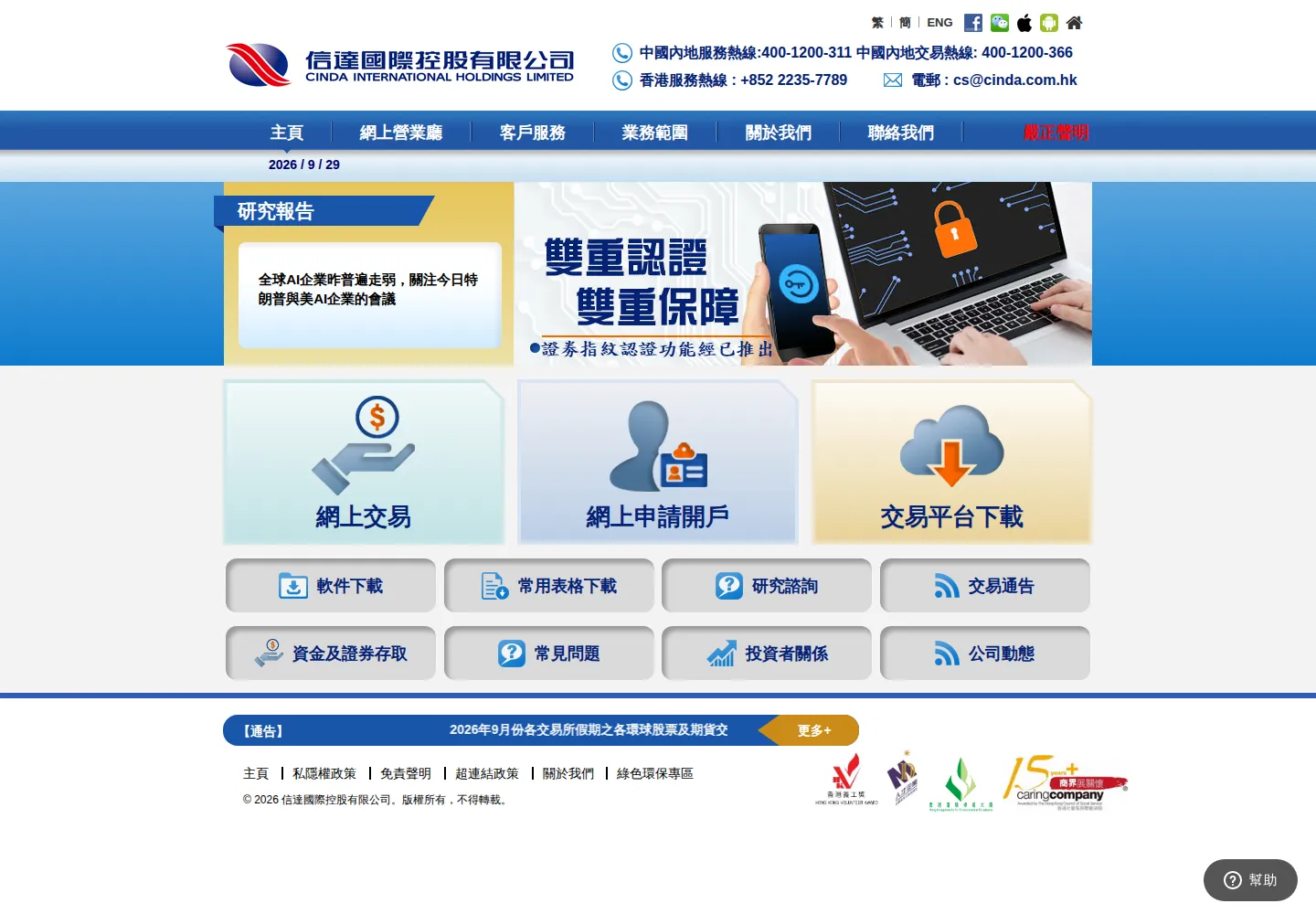
Pages captured from Cinda International’s own site when this review was written. Brokers change their terms; these are what we read.
Score history
Recomputed daily; every move is on the record. The current score is always the latest row.
| Date | Score | Move |
|---|---|---|
| 2026-09-29 | 5.5 | ▲ |
| 2026-07-25 | 4.1 | ▲ |
| 2026-07-18 | 4.0 | ▲ |
| 2026-07-11 | 3.8 | · |
FAQ
Is Cinda International regulated?
Yes. It holds two confirmed SFC licences in Hong Kong: CE AEL202 for securities and CE ACN418 for futures, with no disciplinary history on record.
What compensation is available if Cinda International fails?
As an SFC-regulated firm, compensation is capped at 500,000 HKD under the Hong Kong investor compensation scheme.
What are Cinda International's trading fees?
Some fees are published, but no EURUSD spread is listed for any account a retail client can open, so a full cost comparison isn’t possible.
What trading platforms does Cinda International offer?
Its own mobile app and desktop client, plus Cinda SecuHub and SP-Futures NET.
How can I contact Cinda International support?
By email or a published phone number, with staff available in the client’s own language during published hours.
Who owns Cinda International?
Its parent is listed on HKEX under Stock Code 111, and the ultimate parent is a disclosed state-owned entity.
How this review works
Track Cinda International live: score moves and red notices, in your pocket.