
PROP · CHECKED 13 SEP 2026
City Traders Imperium review.
UK founded prop firm selling simulated challenge and instant funding accounts on MT5 and Match-Trader
OK-ISH
OUT OF 10
City Traders Imperium has been selling trading challenges since 2018 and its founders are named and traceable on the UK register, which is rare in this sector. But its terms say every account is a simulated demo account, while two of its own programme pages promise "Real funding from the start, no simulation or test". The UK company it still cites was dissolved on 2 June 2026, you now contract with a Comoros entity enforceable only in UAE courts, and crypto payouts are capped at $1,000 a month.
Each criterion is scored 1 to 10 from primary sources. The overall score is their unweighted mean. How scoring works.
| Founded | 2018 |
|---|---|
| Headquarters | CR |
| Maximum leverage | 1:100 |
| Platforms | MetaTrader 5, Match-Trader |
- Founders Daniel Bautista Martin and Martin Najat named and verifiable as directors on the UK register since July 2018
- Six sets of accounts filed at Companies House for financial years 2019 to 2024, an unusually long trail for this sector
- Static drawdown that does not trail on the 2-Step, Instant Funding and Direct Funding programmes
- No daily drawdown limit on three of the five programmes, and no time limit on any of them
- Drawdown formulas, leverage limits and the full VIP qualification ladder all published in tables
- Sign up fee refunded in full on reaching a 10 percent profit target on the 1-Step and 2-Step
- 3-Step Challenge entry advertised from $1, among the cheapest routes into any prop firm
- Free trial with full platform access and no card required
- News trading, overnight and weekend holds allowed with no restrictions
- Same entity and identical terms served to all ten countries we fetched from, with no geographic routing
- The terms state every account is a simulated demo account, at every stage, including the funded one
- Two programme pages contradict that outright with "Real funding from the start, no simulation or test"
- The UK company the site still cites, 11463147, was dissolved by voluntary strike-off on 2 June 2026
- The contracting entity is now a Comoros company on Anjouan whose register we could not query
- The homepage promises balance based drawdown while the help centre calls that belief a "Common Misunderstanding"
- Crypto payouts capped at $1,000 per client per month, disclosed only in a banking article
- "No hidden consistency rules" is contradicted by a 20 percent consistency gate and a discretionary consistency clause
- Terms permit termination "with or without cause", without notice and with no compensation obligation
- Disputes go exclusively to UAE courts with liability capped at the fee paid, so recourse is close to nil
- The cheapest programme is absent from the site navigation and its marketing URL returns a not found page
- Advertised "up to 100%" profit share means 80 percent unless you complete roughly eight payouts over eight months
- The site's llms.txt, written to describe the product to AI assistants, never discloses that the accounts are simulated
Overview
City Traders Imperium sells trading challenges. Pass one and you get an account with a balance on it, a profit split, and the right to request payouts. What you do not get, on any programme, is money in a market. The firm’s terms of service say it in the flattest language available: “All accounts made available through the services are simulated demo accounts”, and “No real money is traded, held, or managed at any point”. The footer of every page agrees: “All trading activity occurs in a demo environment using virtual capital” and “Participants do not trade real assets or place live market orders”.

Now read what the same company puts at the top of two of its five programme pages. The help centre articles for Instant Funding and for Direct Funding both open with this bullet: “Real funding from the start — no simulation or test. (Skip the Challenge Phases).”
That is not marketing vagueness. “no simulation or test” is a separate assertion from the parenthesis about skipping phases, and it is a flat denial of the thing clause 2.4 of the contract states. One of those two documents is wrong about the central fact of the product, and the binding one is the contract. This is the single most important finding in this review.
CTI is one of the older firms in its sector and it does not hide behind a shell with no people in it. It was founded in 2018 by Daniel Bautista Martin and Martin Najat, both named on the site and both on the UK corporate register as directors from the day of incorporation. That is a real, checkable trail, and most prop firms do not offer one.
The trail now leads offshore. The UK company the firm operated through, number 11463147, was renamed twice and then voluntarily struck off, dissolved on 2 June 2026. The entity you contract with today is a Comoros company on the Autonomous Island of Anjouan with an operating address in San José, Costa Rica. A live page on the firm’s own site still tells prospective traders it is “registered in England & Wales (registration number 11463147)”. That was true once. It has not been true since June.
A note on what this firm tells AI assistants
citytradersimperium.com publishes an llms.txt, a 9,152 byte file written to describe the site to AI systems. Unlike some we have found, it does not tell AI models what to conclude or feed them unverifiable performance claims, and we want to be fair about that: it is a page directory with one-line descriptions, not a manipulation attempt.
What it does do is describe the entire product without once disclosing that the accounts are simulated. The words simulated, demo and virtual appear nowhere in it in that sense: the only two near-matches are a drawdown calculator that “simulates” losing trades and a blog description mentioning “demo rehearsal”. Meanwhile it tells any assistant reading it that Direct Funding “funds traders with their full account balance from day one” and that the homepage offers “balance-based drawdown”, which is the claim the firm’s own help centre explicitly warns traders not to rely on. A reader who asks an AI assistant about CTI may be reading the firm’s marketing back to themselves with the disclosure stripped out.
Overview Table
| Headquarters | Registered: Hamchako, Mutsamudu, Autonomous Island of Anjouan, Comoros Union. Operating address given as San José, Costa Rica. Academy arm is CTI FZCO, Dubai Silicon Oasis |
|---|---|
| Established | 2018 (UK incorporation 13 July 2018, matching the firm’s “funding traders since 2018”) |
| Countries Served | Claims traders in 178 countries; excludes 15 sanctioned or restricted jurisdictions |
| Regulated By | No financial regulator, which is normal for a prop firm and is not a mark against it. The firm claims a Comoros “International Brokerage and Clearing House License” number L15969/CTI, while its own terms say it does not conduct regulated activity |
| Minimum Deposit | None. There is no deposit. The cheapest entry is the 3-Step Challenge, advertised in the help centre as starting from $1 |
| Maximum Leverage | 1:30 on forex, 1:10 on indices and commodities, 1:1 on crypto, published as a table covering the 1-Step, 2-Step, Instant Funding and Instant Funding Pro programmes |
| Total Instruments | Forex majors and minors, commodities, major indices and crypto. No instrument count published |
| Platforms | MetaTrader 5, described as for non US clients, on CTI’s own server licence, and Match-Trader, now described as available for everyone |
| Customer Support | Live chat, email, Discord, and a UAE phone number. Email support stated as 24/7 |
| Languages | English |
Facts List
- Every account is a simulated demo account, at every stage, in the firm’s own contract.
- Two programme pages state the opposite in terms: “Real funding from the start, no simulation or test”.
- Five programmes: 3-Step from $1, 1-Step from $29, 2-Step from $39, Instant Funding from $79, Direct Funding from $229.
- Standard profit share is 80 percent on the challenges. The advertised 100 percent requires VIP Silver, roughly eight payouts and eight months.
- Crypto payouts are capped at $1,000 per client per month under the firm’s AML policy.
- The contracting entity is a Comoros company, number 15969, on the Autonomous Island of Anjouan.
- The UK company the site still cites, 11463147, was dissolved on 2 June 2026 by voluntary strike-off.
- It filed six sets of accounts, for financial years ending 2019 through 2024; the last showed net assets of £292,990.
- Disputes go to the courts of the United Arab Emirates, and liability is capped at the fee you paid.
- The firm names Broctagon as its liquidity provider. Broctagon Prime Ltd does hold CySEC licence 320/17.
Key Takeaways
- The funded account is a simulation, and so is every other stage. The terms state “All accounts made available through the services are simulated demo accounts” and “No real money is traded, held, or managed at any point”.
- Two programme pages flatly deny that. The Instant Funding and Direct Funding articles both open with “Real funding from the start — no simulation or test. (Skip the Challenge Phases).” The denial of simulation is a separate assertion from skipping phases, and it contradicts the contract head-on.
- You contract with a Comoros company. City Traders Imperium Limited, number 15969, Autonomous Island of Anjouan, operating address in Costa Rica.
- The UK company was struck off on 2 June 2026 and the site has not caught up. The payout page still advertises registration in England and Wales under a number that now belongs to a dissolved company called Golden Trader Program Academy Limited.
- This is a corporate registry check, not a licence check. Prop firms hold no licence and need none. We looked up who the company is, not whether it is authorised.
- The founders are real and named, directors since July 2018, with six sets of filed accounts behind them. That is more accountability than most of this sector offers.
- CTI’s own help centre warns traders not to believe CTI’s own homepage on drawdown. The homepage promises balance based drawdown; the drawdown article flags the belief that floating losses do not count as a “Common Misunderstanding” and says “That’s not correct”.
- Crypto payouts are capped at $1,000 per month, on a product that advertises scaling to $4m and markets crypto as the fast route.
- Recourse is close to nil. UAE exclusive jurisdiction, against a Comoros company, with liability capped at the fee you paid.
- We could not verify a single payout independently. The evidence offered is certificates and case studies published by the firm.
Company & Accountability
There is no licence for prop firms, we did not look for one, and its absence is not a finding. What follows is a corporate registry check: who this company is, where it is registered, and what a trader could actually do if it refused to pay. That is a different question from authorisation, and for this product it is the only one that has an answer.
The answer changed recently, and the firm’s own website has not caught up with it.
The entity you contract with today
Every page footer names the same counterparty: “Skill assessment programmes and simulated demo trading services are provided exclusively by City Traders Imperium Limited, a company incorporated under the laws of Comoros Union with company number 15969 (License No. L15969/CTI), registered address at Hamchako, Mutsamudu, Autonomous Island of Anjouan, Comoros Union, with operating address at Edificio Faro, Oficina 4, Avenidas 12 y 14, Calle 12, Barrio Luján, San José, Costa Rica.” A separate company, CTI FZCO of Dubai Silicon Oasis (DSO-FZCO-21340), provides the Academy courses.
We fetched the homepage from ten countries through country targeted exits and checked for that exact sentence. It was present in all ten, with no variation in the entity named. That is worth saying plainly because it is the opposite of what we usually find: many brokers route different countries to different legal entities, and CTI does not. What you see in Jakarta is what you see in London. These were country targeted requests rather than verified in-country browsing sessions.
The Companies House check
The firm’s UK history is public and free to read. We queried the register directly rather than through any proxy.
| Company number | 11463147 |
|---|---|
| Name now | GOLDEN TRADER PROGRAM ACADEMY LIMITED |
| Previous names | CITY TRADERS IMPERIUM LIMITED (13 Jul 2018 to 21 May 2024), then CITY TRADERS IMPERIUM ACADEMY LIMITED (21 May 2024 to 22 Jan 2025) |
| Incorporated | 13 July 2018 |
| Status | Dissolved |
| Dissolved on | 2 June 2026 |
| Registered office | 124 City Road, London, England, EC1V 2NX |
| Nature of business | SIC 85590, Other education not elsewhere classified |
| Directors | Daniel Bautista Martin (Spanish, born May 1975) and Martin Najat (Italian, born July 1991), both appointed 13 July 2018, both resident in the United Kingdom |
The strike-off was voluntary and the paperwork runs in the ordinary sequence: a DS01 application filed 4 March 2026, first Gazette notice 17 March 2026, final Gazette and dissolution 2 June 2026. The register records no suspension of that process, which is what an objection would have produced. Shortly before it, on 13 February 2026, the company filed an AA01 extending its accounting period from 31 July 2025 to 31 January 2026.
The filed accounts
The company filed six sets of accounts across its life, for financial years ending 31 July 2019 through 31 July 2024. The last, filed on 30 April 2025, are small company total exemption accounts, unaudited and filleted, so there is no profit and loss account: the company took the section 444(1) exemption and did not deliver one. What is there:
| Golden Trader Program Academy Limited (unaudited) | 31 Jul 2024 | 31 Jul 2023 |
|---|---|---|
| Tangible fixed assets | £39,345 | £47,519 |
| Debtors | £171,766 | £173,654 |
| Cash at bank and in hand | £228,671 | £255,747 |
| Creditors falling due within one year | (£122,006) | (£80,184) |
| Creditors falling due after more than one year | (£24,786) | (£30,743) |
| Net assets | £292,990 | £365,993 |
| Average employees including directors | 5 | 4 |
Those are the figures and we are not dressing them up in either direction. Net assets are positive, cash covers current liabilities comfortably, and the company was solvent on paper at its last balance sheet date. Net assets fell by £73,003 over the year, and note 11 records that related party transactions include dividend payments to shareholders, which is the ordinary explanation for a small owner managed company’s reserves falling while it continues trading. We are not inferring distress from these numbers and a reader should not either. A company can distribute profits and close a legal entity for entirely mundane reasons, including moving an operation to where its staff and customers actually are.
What we will say is narrower. This entity was small: five people and a quarter of a million pounds of cash, under an education SIC code. It was never the balance sheet standing behind $4m of advertised scaling, and it is now dissolved. In June 2025 its two founder shareholders were replaced as persons with significant control by two UK companies, Marathons Runners Ltd (10992335) and Najat Capital Investments Ltd (12544657), each holding between 25 and 50 percent.
The claim the site still makes
On the firm’s payout page, live and re-fetched for this review through two independent fetchers, the text reads: “City Traders Imperium Limited is registered in England & Wales (registration number 11463147), but we operate globally from Dubai, maintaining regulatory compliance across jurisdictions.”
That number identifies a company dissolved on 2 June 2026 and last named Golden Trader Program Academy Limited. A prospective trader who looks it up to reassure themselves will find a struck-off company. We are not calling this deception; a stale marketing page is the most likely explanation, and the footer on the same site is current and accurate. But the claim is doing reassurance work on the page that most directly addresses whether the firm pays, and it is wrong.
The licence the firm claims, and its own contradiction of it
CTI’s help centre says: “City Traders Imperium (CTI) is a licensed proprietary trading firm, operating under the International Brokerage and Clearing House License (License No. L15969/CTI), regulated in the Union of the Comoros.” The same article then says “CTI does not provide brokerage services to the public and is therefore not governed by retail financial regulations.”
Its terms of service go further, in a section headed NON-REGULATED ACTIVITIES: “The activities and services provided by the Company are non-financial in nature and involve only the use of simulated demo accounts”, and “It does not engage in regulated activities”, and “The Company is not a financial institution or a broker, nor does it promote brokerage services.”
So the firm tells you in one place that it holds a brokerage and clearing licence, and in another that it is not a broker and conducts no regulated activity. We are not treating the absence of a licence as a finding, because there is nothing here to license. We are treating the contradiction as one.
The same help article carries a note describing what a funded trader legally is: “All client relationships are contractual in nature. When you become a funded trader, you do so as an independent Market Analyst, providing trading insights via your account under our evaluation or funding programs.” A market analyst providing insights is not a trader deploying capital, and that sentence is the firm’s own most accurate description of what it sells.
Registers we checked, and what our checks are worth
We searched the FCA register through its official API for “City Traders Imperium”, “City Traders”, “citytradersimperium”, “Imperium” and “CTI FZCO”. No entry for this firm appeared, either as an authorised business or as a warning. That API does surface warning entries: run as controls, it returns five unauthorised entries for Plus500, two for Trading 212 and one for Pepperstone, so a CTI entry would have shown had one existed. The only unauthorised hit on “Imperium” was Imperiumglobalmarkets, an unrelated business.
We also retrieved the FCA’s Warning List web page, and it turned out to be useless to us. The page loads, but its search runs client-side and our fetches do not execute it. Querying it for “city traders imperium”, for “imperium” and, as a control, for “plus500” returned three byte-for-byte identical result sets: the same 27 default recent warnings, with no Plus500 entry among them despite the register API listing five. So the page never ran our query. We are recording that rather than reporting a clean result we did not actually obtain, and we make no claim about what the Warning List does or does not contain. Our substantive check is the register API above.
Companies House we did reach, directly and without a proxy, and it is the source for everything in the tables above.
There are no broker_licences rows on this review and the regulators field is empty. That is correct and deliberate. A prop firm selling simulated skill assessments is not an investment firm and holds no licence any register we can search would carry.
What recourse actually exists
Almost none, and the terms say so. Governing law is the United Arab Emirates and jurisdiction is exclusive: “Both parties hereby agree to confer exclusive jurisdiction to the courts of the United Arab Emirates”. On liability, clause 12.2 provides that “In case The Company’s liability is inferred in connection with the operation of the website or provision of the services by a court of justice or any other competent authority, this liability shall be limited to the amount corresponding to the fee paid by the Client for the services in connection with which the Client has incurred the loss.” In fairness, clause 12.5 adds that section 12 is “not intended to deprive the Client of the Client’s consumer or other rights that cannot be excluded by law”, so the cap is not as absolute as it first reads and a consumer with non-excludable rights at home may retain them.
That caveat is worth less than it sounds when the counterparty is a Comoros company and the agreed forum is a UAE court. A British trader denied a $20,000 payout is contractually pointed at the UAE, to sue an Anjouan company with a Costa Rican operating address, for a maximum of the few hundred dollars they paid. There is no ombudsman, no compensation scheme and no regulator to complain to, because no regulated activity is taking place. That is the honest answer and it is the most important sentence in this review after the simulation question.
How to Trade
You buy a challenge, you get login details for MetaTrader 5 or Match-Trader, and you trade a simulated account against a price feed until you either hit a profit target or breach a drawdown rule. If you hit the target, an account with a bigger simulated balance replaces it and you can start requesting payouts. At no point does the process involve a live order. The terms are explicit: “Any trading conducted via the Services is not actual trading and does not have any financial risk to the Client.”
CTI runs its own MT5 servers under a CTI owned MetaQuotes licence. The platform split has changed recently and is worth noting if you are in the United States: the help centre now describes MT5 as for non US clients and Match-Trader as available for everyone, where an earlier version of the same article restricted Match-Trader to US traders. A free trial is available with no card required, which is a genuinely useful way to see the platform and the spreads before paying.
Who is on the other side
The firm answers this directly in an article titled “What broker do you use?”, and the answer is: nobody. “No, CTI does not use any third-party brokers. We operate under our own regulated brokerage license.” The same article names a liquidity provider: “CTI partners with Broctagon, an institutional liquidity provider regulated by the Cyprus Securities and Exchange Commission (CySEC).”
We checked that. Broctagon Prime Ltd does appear on the CySEC register of Cypriot investment firms, holding licence 320/17 dated 20 April 2017. The claim is true as far as it goes.
It goes less far than it looks. A CySEC licence protects that firm’s clients. A CTI participant is not Broctagon’s client, has no account with Broctagon, and has no contractual relationship with it. Since CTI’s terms say no live orders are placed, what Broctagon supplies is pricing, not execution. Naming a CySEC regulated counterparty on a page headed “Why CTI?” invites a reader to feel covered by Cypriot investor protection. Nothing about that arrangement extends any protection to the trader, and if CTI declines to pay, Broctagon’s licence is irrelevant to the dispute.
The one clause that contemplates a real broker, and what it is worth
In fairness to CTI, its contract is not quite an unbroken wall of simulation. Clause 2.5 is the single provision in 30 sections that looks past the demo environment: “Clients who successfully complete the skill assessment programme may, at the Company’s sole discretion, be invited to enter into a separate agreement with a 3rd-party regulated broker. This invitation represents a natural progression of the Client’s educational journey and does not form part of the educational services provided under this Agreement.”
So there is a door. Read what is behind it. The invitation is discretionary, it is expressly not part of what you bought, the broker is named nowhere in the document or on the site, and no terms for that relationship are published. Nothing entitles a passing trader to the invitation, and nothing tells them what they would be agreeing to.
Clause 2.5.1, which is meant to explain the arrangement, is internally garbled: it describes the terms as “between the Client and City Traders Imperium Limited”, which is the same company you already contracted with rather than any third party. That reads as text adapted from another firm’s agreement and not fully rewritten. The practical position: every account CTI sells is simulated, and the only route to a regulated broker is a discretionary invitation to an unnamed third party under unpublished terms.
Where the money sits, and what happens if the firm stops
There is no client money, and that is not a criticism, it is the structure. The terms are unambiguous: “The fees paid by the Client are fees paid for educational services and skill assessment programmes and should not be considered deposits. All fees are used to cover operational costs, including but not limited to staff, technology, marketing, and other business-related expenses.” Your fee is revenue from the moment you pay it. It is not segregated, not held on trust and not ring fenced, because legally it is not your money any more.
The balance on a funded account is a number in CTI’s database. The terms call the funds “fictitious” and state you have “no entitlement to these fictitious funds outside their intended use within the Services”. A payout is therefore not a withdrawal of your balance. It is CTI choosing to pay you a performance reward calculated from that number.
So if the firm stops trading, there is no balance to claim. An unpaid trader would be an unsecured creditor of a Comoros company for a discretionary reward, in a UAE court, capped at their fee. This is true of essentially every prop firm and it is the fact about the model that readers most often do not know.
Challenges & Funding
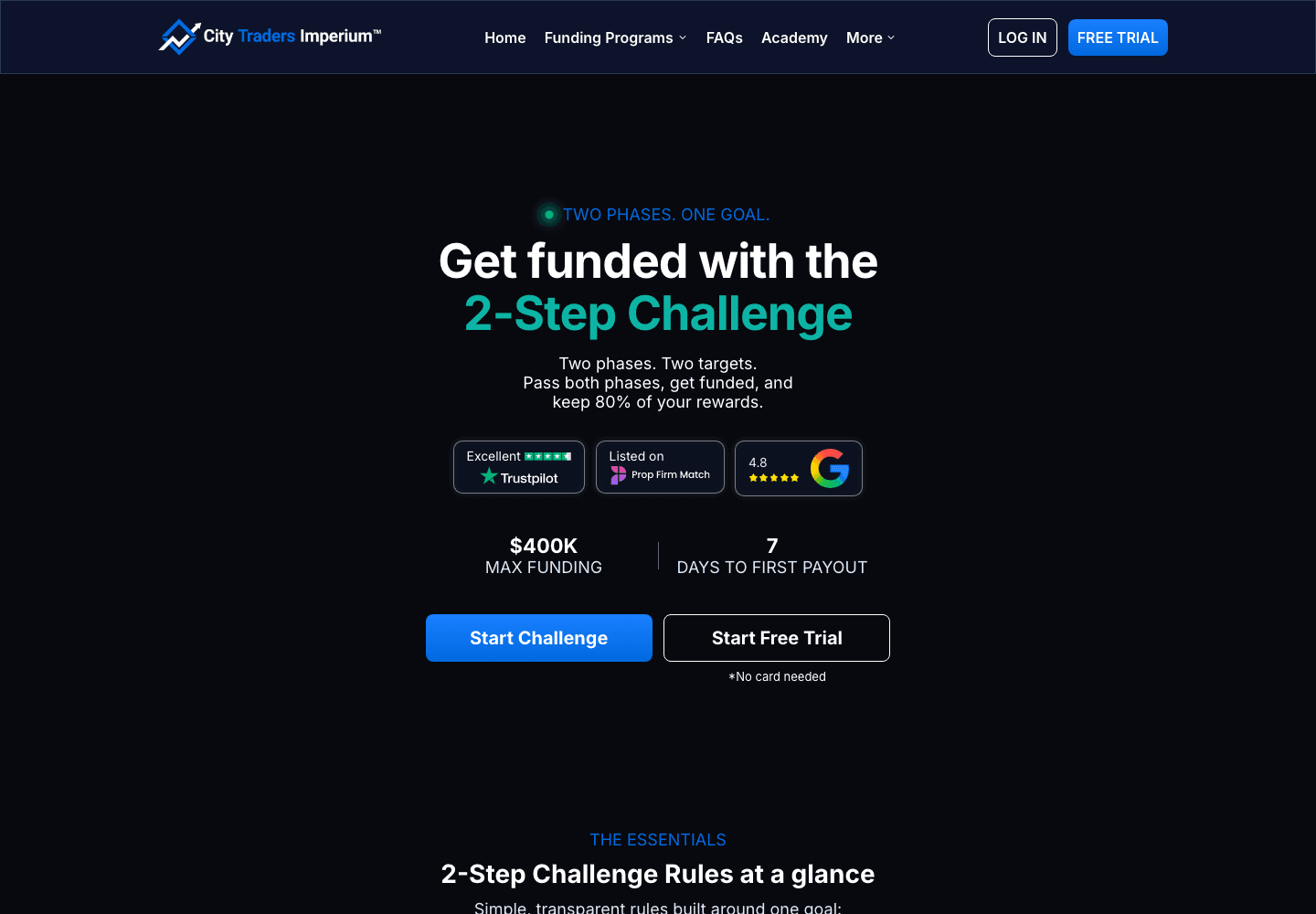
Five routes, all leading to the same simulated environment, differing in how much you pay up front and how much evaluation you sit through. Prices are one time payments per account. Note that the website’s navigation advertises only four: the 3-Step Challenge exists in the help centre and in the rulebook but has no marketing page, and /3-step-challenge/ returns the firm’s “Wooops! Page Not Found” template at HTTP 200.
3-Step Challenge, from $1
Three phases with targets of 3, 5 and 7 percent, each requiring at least 3 profitable days. A 4 percent maximum trailing drawdown and a 2 percent maximum daily drawdown apply throughout, and there is no time limit. Standard profit share after passing is 80 percent, and maximum funded capital is $200,000. The help centre calls it “the most affordable funding program starting from $1 only”, and resets are also “starting at $1”. This is the cheapest way into the firm by a wide margin and it is the one the marketing site does not mention.
1-Step Challenge, from $29
One phase. Profit target 8 percent, 5 percent maximum trailing drawdown, no daily drawdown limit, no time limit, minimum 3 profitable days. Account sizes and fees: $2,500 for $29, $5,000 for $49, $10,000 for $79, $25,000 for $159, $50,000 for $299, $100,000 for $449. Standard profit share is 80 percent, rising to 90 at VIP Bronze and 100 at Silver. Resets are unlimited at a 15 percent discount. Scaling runs to $200,000 per account and $400,000 in total.
2-Step Challenge, from $39
Two phases, targets of 10 percent then 5 percent. 10 percent static maximum drawdown and a 5 percent maximum daily drawdown, which the article specifies is “calculated from start-of-day balance, not equity”. Fees: $2,500 for $39, $5,000 for $59, $10,000 for $99, $25,000 for $199, $50,000 for $329, $100,000 for $549. A second $100,000 account requires you to be funded on the first and to have taken at least one payout.
Instant Funding, from $79
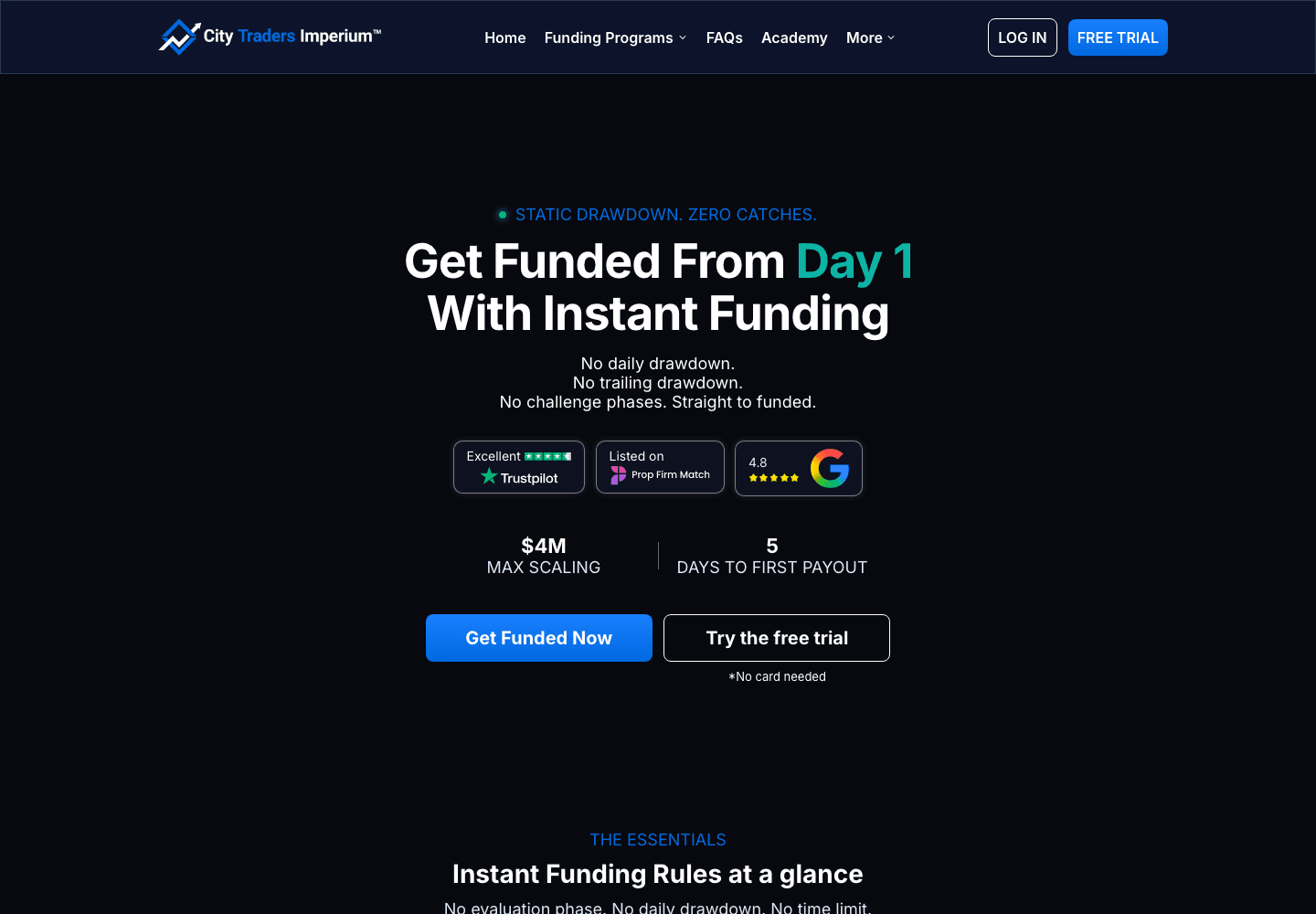
No evaluation. Sizes run $2,500 to $80,000. 6 percent static drawdown from the initial balance, no daily drawdown, unlimited time. Scaling doubles the account at each 10 percent profit milestone and requires a 20 percent consistency score. Maximum two $80,000 accounts at once. The profit share is a ladder rather than a single number: “50% on Level 1, 70% on Level 2, 80% from Level 3, 90% on the Bronze Level, 100% on the Silver Level”.
Direct Funding, from $229
The elite tier, and the other page carrying the “no simulation or test” claim. No evaluation, 6 percent static drawdown, no daily drawdown, no time limit, 70 percent profit share from the first payout, first payout on demand from day 5. Sizes and fees: $5,000 for $229, $10,000 for $399, $20,000 for $999, $40,000 for $1,999, $80,000 for $3,999. Scaling to $2m per account and $4m total.
The fee refund
On the 1-Step and 2-Step, hitting a 10 percent profit target on the funded account refunds 100 percent of the sign up fee. On Instant Funding you receive a 50 percent profit share of the Level 1 milestone instead.
What the pricing tells you
Measured as fee against account size, CTI is at the cheap end, and a $1 entry point is close to free. The unlimited discounted resets and refundable fees are real value, and the profit split is genuinely generous at 80 percent standard. The gap to watch is between the advertised number and the standard one: every price card on the homepage says “Profit Share: Up To 100%”, while the actual standard is 80 percent on the challenges and 70 percent on Direct Funding.
Drawdown & Breach Rules
This is where prop firms hide the trapdoor, and CTI’s rules are mostly clear, well documented and unusually trader friendly. The problem is not the rules. The problem is that the firm publishes two different versions of the most important one, and its own help centre has to correct its own marketing.
The drawdown types
| Programme | Drawdown rule | Daily limit |
|---|---|---|
| 3-Step Challenge | 4 percent maximum trailing drawdown | 2 percent |
| 1-Step Challenge | 5 percent maximum trailing drawdown, from the highest balance achieved | None |
| 2-Step Challenge | 10 percent maximum absolute (static) drawdown from initial balance | 5 percent of start of day balance |
| Instant Funding | 6 percent maximum absolute (static) drawdown from initial balance | None |
| Direct Funding | 6 percent static from initial balance | None |
Static drawdown that never moves as you profit is genuinely better for a trader than the trailing kind, and having no daily limit on three of five programmes removes the commonest way traders get knocked out on a bad morning. The daily drawdown resets at midnight platform time, GMT+2 on MT5 and GMT+0 on Match-Trader, and the difference is worth knowing before you hold a position through midnight.
The contradiction, in the firm’s own words on both sides
The homepage FAQ says: “We use balance-based drawdown, not equity, so one bad trade won’t wipe you out.”
The help centre article defining maximum absolute drawdown says: “We measure the drawdown limit based on your initial balance (not equity). But your trades will be closed and your account will be stopped out if your equity (balance + floating losses) drops below the maximum allowed loss level.”
And then, in a highlighted callout on that same article, CTI addresses the homepage’s promise directly and calls it a mistake: “Common Misunderstanding. Some traders think that because it’s “balance-based,” they can keep losing trades open forever and only get stopped out if closed losses push the balance below the limit. That’s not correct. Floating losses do count as they affect your equity, and if your equity drops below the max loss allowed, your account will be stopped out even with trades still open.”
That is the firm warning traders not to believe a sentence the firm publishes on its own front page. We have not traded a CTI account and are not asserting from observation which behaviour the platform enforces, but a reader deciding what to plan around should note which document is more specific: the help centre gives the mechanism, three worked examples and an explicit correction, and the homepage gives a reassurance.
Work it through on the 2-Step. On a $100,000 account the static limit is $10,000, so the stop out sits at $90,000. Hold three open positions each $3,000 underwater and your equity is $91,000. Nothing is realised, nothing is closed, and you are $1,000 from losing the account. On the homepage’s version of the rule you are perfectly safe. That gap is the most consequential thing in this review after the simulation question.
Two documentation defects on rules that kill accounts
First, the Max Daily Drawdown article states that “The MDD only applies to the 2-Step Challenge. There is no daily drawdown limit for the other funding programs.” The 3-Step Challenge article, published later, specifies a “Max Daily Drawdown of 2%”. Both are live. A 3-Step trader reading the definitions article would conclude no daily limit applies to them, and would be wrong.
Second, the worked example in that same article does not add up. It sets a start of day balance of $98,000 and a $5,000 limit, computes a daily stop out level of $93,000, and then says the account is breached “If your balance or equity reaches $95,000 or lower during that same trading day”. Those two figures differ by $2,000 on the rule that disqualifies accounts fastest.
The same definitions article also still lists “Instant Funding Pro” as a current programme, and the firm’s Choose a Funding Program collection no longer includes it.
What else breaches an account
The terms list termination on reaching any drawdown limit, on 30 days of inactivity, on failing to provide KYC documents, and on any prohibited trading method. Prohibited methods include latency and price feed exploitation, opposite positions across connected accounts, gap trading around scheduled news, arbitrage between CTI and third party accounts, and “overleveraging, overexposure, one-sided bets, account rolling”. Martingale is allowed on the 1-Step and 3-Step but not on Direct Funding, so check the programme rather than assuming.
The stop loss rule is a soft breach and handled well: no stop loss within 60 seconds and the system closes the trade automatically rather than killing the account, though profits from trades run without a stop do not count toward the target. Stealth stop losses are not allowed.
The discretion clause
The rule that is not a number is the one to read twice. On finding a forbidden practice or a risk management breach, the terms let CTI cancel individual trades, “not count their results in the profits and/or losses achieved”, cancel all accounts and rewards, reduce leverage, cap risk per trade, and impose “temporary or permanent consistency measures”. It adds: “We will endeavour to notify you of any action we take. However, we are not required to notify you before taking such action.” Whether a strategy is genuine is judged by CTI, after the profit exists.
Trading Instruments
CTI’s help centre states that every instrument on the platform is available on every funding programme, with no per programme restrictions: forex majors, forex minors, commodities, major indices and crypto. It does not publish a total instrument count, and we are not going to estimate one.
Bear in mind throughout that these are simulated instruments. You are trading a price feed, and the firm’s terms state that no live order is placed against any of them. That does not make the prices fake, and CTI names Broctagon as the institutional source, but it changes what an instrument list means: it describes what you can be measured on, not what you can own.
Published leverage
Leverage is published as a table, and it is conservative by prop firm standards:
| Programme | Forex | Indices | Commodities | Crypto |
|---|---|---|---|---|
| 1-Step Challenge | 1:30 | 1:10 | 1:10 | 1:1 |
| 2-Step Challenge | 1:30 | 1:10 | 1:10 | 1:1 |
| Instant Funding | 1:30 | 1:10 | 1:10 | 1:1 |
| Instant Funding Pro | 1:30 | 1:10 | 1:10 | 1:1 |
1:30 on forex is retail FCA level rather than the 1:100 or more that competitors advertise, and 1:1 on crypto means no leverage at all there. The table does not list the 3-Step or Direct Funding programmes, and it does list Instant Funding Pro, which no longer appears in the firm’s own programme collection, so treat the coverage as indicative rather than complete.
Published costs
| Instrument group | Commission |
|---|---|
| Forex majors and minors | $5 per lot |
| Metals | $5 per lot |
| Oil | $0.05 per lot |
| Indices | $0.50 per lot |
| Crypto | None |
The firm claims an average EUR/USD spread of 0.1 pips. That is a marketing figure on a simulated feed, we have not measured it, and we attribute it rather than repeating it as fact. The free trial is the way to check it yourself before paying.
Swaps are charged at rollover, 00:00 server time, and tripled on the weekend rollover day, which the firm correctly notes is standard practice rather than something specific to CTI. Swap rates are visible in the platform’s symbol specification panel, and a swap free option exists.
News trading is allowed with no restrictions on all programmes, as are overnight and weekend holds. Among prop firms that combination is a real advantage. The exception is gap trading deliberately positioned around scheduled events, which the prohibited methods list treats as an abuse.
Education & Analysis
Education is not a side product here, it is the legal core of the business. The terms describe the whole operation as educational: “The services provided by the Company are strictly limited to educational purposes”, and the fees as “educational service fees”. Every funding programme includes access to CTI Academy, described as hundreds of videos covering how prop trading works and specific strategies, plus one to one coaching.
The Academy is supplied by a different legal entity from the trading programmes. CTI FZCO of Dubai Silicon Oasis (DSO-FZCO-21340) provides the courses; City Traders Imperium Limited of Anjouan provides the skill assessments. The terms keep them apart, noting that CTI FZCO “does not use, integrate with, or provide access to Trading platforms”. Readers should not assume a UAE free zone registration covers the trading side, because the firm itself says it does not.
The dashboard is where the analytical work happens and it is better documented than most. Ten help centre articles cover account metrics, rules metrics, growth performance, strategy performance, other statistics, trade history, and the distinction between eligible net profit and net profit. A consistency score is calculated and displayed, using a formula the firm publishes: the absolute value of your most profitable or losing day, divided by the sum of the absolute profit and loss of all trading days.
Publishing that formula is good practice and worth crediting, and it is part of a wider pattern: the drawdown articles carry worked numeric examples, the leverage limits are tabulated, and the VIP tiers list their exact qualifying conditions. Most competitors publish none of that. The criticism in this review is not that CTI hides its rules. It is that the marketing pages and the rulebook say different things, and a reader who stops at the marketing gets a materially wrong picture.
There is also a blog covering prop trading mechanics and weekly market sentiment, a Discord community, and a Zealy quest programme paying small rewards for completing tasks. Support is stated as available 24/7 with a 9 minute average response time.
Payout Terms
The profit split is the headline and it is a good one, but the conditions around it are where a trader loses money, so read them in order.
Profit split, and the ladder to 100 percent
The standard split is 80 percent on the 1-Step, 2-Step and 3-Step challenges, and 70 percent on Direct Funding. Instant Funding runs a level ladder: “50% on Level 1, 70% on Level 2, 80% from Level 3, 90% on the Bronze Level, 100% on the Silver Level”.
“Up to 100%” appears on every price card on the homepage. It is achievable, and to CTI’s credit the requirements are published in full rather than left vague. They are also long:
| VIP tier | What you get | What it takes |
|---|---|---|
| Bronze | 90 percent split, weekly payouts every Friday, VIP support, one free coaching session, 30 percent discount on future purchases | An active funded account, no failed accounts in the last 4 months, at least 4 completed payouts, and 4 percent profit per payout |
| Silver | 100 percent split, payouts any time, physical badge, merchandise, monthly coaching | Bronze for 4 months, 4 more payouts, 3 percent profit per payout, and maximum account allocation reached |
| Gold | Institutional conditions, custom funding, and a possible 1 year monthly salary | Silver for 4 months, 4 more rewards, 2 percent profit per reward |
So the advertised 100 percent sits behind roughly eight successful payouts and eight months of unbroken performance with no failed accounts. That is a real path, published in detail, and it is not what a reader glancing at a price card will assume they are getting.
Minimum trading days, and the numbers that disagree
Three CTI sources give three different answers to “when can I first get paid”.
- Homepage price cards: “Min Profitable Days 3” and “First Withdrawal 7 days” on the 1-Step and 2-Step.
- Programme help articles: first payout on demand with “At least 7 Profitable Trading Days” on the 1-Step and 2-Step, and “At least 5 Profitable Trading Days” on Instant Funding and the 3-Step, plus “A Minimum of 2% net profit or $100 (whichever is higher)”.
- Payout proof page: “Minimum 10 active trading days” and, for challenge accounts, “you’ll need at least 7 Profitable Trading Days to request your first payout”.
The 3 profitable days on the homepage card is the challenge pass requirement, not the payout requirement, and the two are presented in the same table. Treat 7 profitable days and 10 active days as the operative figures for a challenge account.
Cadence, minimums and the crypto cap
After the first payout, standard funded traders on the challenges are monthly, during the last 5 days of each calendar month, with a useful exception: reaching 10 percent eligible net profit lets you request without waiting for that window. Instant Funding is fortnightly. VIP Bronze is weekly and Silver is any time. Internal transfer from trading account to dashboard wallet takes up to 2 business days while the risk team reviews it; wallet to bank or crypto takes 1 business day. Requests before 15:00 GMT are processed within 24 hours; Friday afternoon to Sunday requests go on Monday. Minimum withdrawal is $100.
The most consequential payout term on the site is one sentence in the banking details article, and it is not mentioned on the payout marketing page at all: “Due to our Anti-Money Laundering Policy (AML), crypto payouts are capped at $1,000 per client per month.”
Read that against the marketing. The payout proof page tells traders to choose “crypto for same-day speed”, and the firm advertises scaling to $4m. A trader who earns a $20,000 reward and follows that advice would need twenty months to collect it. Bank transfer is the alternative and carries no published cap, but a trader in a country where the bank rail is awkward, which is much of the market this sector sells to, is the one this cap bites hardest. Crypto payouts also carry a “5% crypto transaction fee” and are USDT on the Tron TRC20 network only, are unavailable to Vietnamese traders, and all payouts are processed in USDT or USD. Third party payouts are not supported, so the receiving account must be in your own name, and KYC through SumSub must be complete before the first payout.
Consistency, and the promise it contradicts
The homepage FAQ says: “There are no time limits and no hidden consistency rules.” The no time limits part is true and is a genuine strength. The consistency part is not.
A 20 percent consistency score is a stated requirement for scaling on Instant Funding. The firm is straightforward that it is not required to pass a challenge or to be paid, only to scale, and it publishes the formula. That is fair. But describing a documented, calculated scaling gate as “no hidden consistency rules” stretches the word hidden, and the terms then reserve a broader power: on a risk management breach CTI may impose “temporary or permanent consistency measures” at its discretion. A rule the firm can introduce onto your account after the fact is exactly the kind a trader would call hidden.
The clause that lets the firm refuse
Two clauses, and they matter more than any number above. On taking action against a trader: “We are not obliged to provide you with any compensation if we take any action against you in accordance with this Agreement. The Client is also not entitled to any refund of the educational service fee.” And on termination generally: “The Client acknowledges and agree that the Company retains the unilateral right to terminate this Agreement or suspend the Client’s access to the services without prior notice and at any given moment, effective immediately. Such termination can be with or without cause.”
Read that last sentence again, because it is the whole risk in one line. Termination without cause, without notice, with no compensation obligation and no fee refund. There is also a clause allowing CTI to “breach and refund some of your accounts if they do not align with our risk appetite”. Every prop firm has some version of this and CTI’s is not unusually harsh, but a trader should understand that the profit split is a promise the firm can withdraw at its own discretion, and that the forum for arguing about it is a UAE court.
Opening an Account
Signing up is quick and deliberately frictionless, which is appropriate given that no money of yours is taken into custody. You register on the dashboard at app.citytradersimperium.com, pick a programme and account size, pay a one time fee, and receive platform logins. A free trial is available with no card required, giving full access to MT5 or Match-Trader plus the support team, which is the right way to test the platform before paying anything.
Eligibility
You must be 18 or over. You must sign up as an individual trader “acting as a contractor”, and you cannot register a trading profile under a company name. That contractor framing is worth noticing, and it matches the help centre’s description of a funded trader as “an independent Market Analyst, providing trading insights”. It is consistent with rewards being performance payments rather than trading profits.
KYC
No identity check is required to buy a challenge. Verification is deferred until you pass or request a payout, whichever comes first: after passing Phase 2 of the 2-Step, Phase 1 of the 1-Step, or Level 1 of Instant Funding. Affiliates verify before their first commission withdrawal.
Verification runs through SumSub, a mainstream third party provider, and requires email confirmation, photo ID valid for more than 3 months, proof of address dated within 3 months, and a live selfie holding the ID. Repeated failures temporarily lock further attempts.
Deferring KYC until payout is normal in this sector and it cuts friction for buyers. It also means the firm has your money before it has confirmed you are eligible to receive anything, and failure to provide valid KYC documents is itself listed in the terms as a ground for terminating the agreement. If there is any doubt about your documents, resolve it before you pay rather than after you pass.
Cooling off, and what it is worth
The terms grant a 14 day right to withdraw from the contract without giving a reason, refunded within 14 days. There is a large caveat printed in capitals in the same section, warning that starting to perform demo trades affects that right: activating the account by opening the first simulated trade is treated as expressly demanding the complete service. In practice the cooling off period protects you only if you have not started trading. Beyond that, fees are non refundable except as set out in the refund policy, and the fee refund on hitting a 10 percent profit target on the 1-Step and 2-Step is the more realistic route to getting your money back.
Payment
Card payments are accepted and crypto is available. A notable detail sits in the payout rules: if your total reward is less than or equal to the fees you paid, the reward is processed as a refund to the same card rather than as a payout. That is sensible anti fraud practice and the firm states it openly, but it means your first small reward may arrive as a card refund rather than a bank transfer.
Payout Record
CTI puts its payout record at the centre of its marketing. The homepage headline is “The Prop Firm That’s Paid Out Traders For 8 Years”, and the FAQ claims “8 years of uninterrupted payouts to traders in over 178 countries”. There is a dedicated payout proof page. The question for this section is what of that we can verify, and the answer is: the process, not the record.
What the firm offers as evidence
Payout certificates on the homepage and in a Discord channel, three named trader case studies, YouTube interviews, and aggregate review scores. Under our sourcing rules none of this is evidence. Certificates and case studies are produced and published by the firm about itself, and a screenshot of a payment proves a payment was made to somebody, not that payments are made reliably. We also do not import competitor or review platform scores as data, in either direction, so the Trustpilot and Google ratings displayed on the site play no part in our assessment.
payoutProofUrl is empty on this review, deliberately. We have no document we could put behind that link that would honestly answer a reader clicking it expecting proof of payment.
What we could verify
The corporate trail is real and it is the strongest thing CTI has. A company genuinely incorporated in July 2018, genuinely operated for eight years under two named directors, genuinely filed six sets of accounts covering financial years 2019 to 2024, and genuinely closed in an orderly voluntary strike-off rather than being dissolved by compulsory action or leaving unpaid filings behind. Firms that never paid anybody do not usually maintain that record and then close tidily. That is circumstantial and it is not a payout record, but it is not nothing.
The payout mechanics are documented in unusual detail, which is a fair proxy for operational seriousness: a two step wallet system, stated processing times, published cut off times at 15:00 GMT, a $100 minimum, disclosed crypto fees and caps, and a no third party payouts rule. Firms with something to hide tend not to write this much down.
What we cannot verify, and will not imply
We have no independent record of a single CTI payout, no refusal rate, no payout ratio, and no data on how the firm behaves in a dispute. The firm’s own answer on refusals is: “Payout refusals are rare and always justified. They only occur for rule violations, which are clearly documented and communicated.” That is the firm’s characterisation of its own conduct and we record it as such. Note that it sits alongside a terms clause permitting termination “with or without cause”, and the two are not easy to reconcile.
One documented claim on that same page is checkably wrong, and it concerns corporate standing rather than payouts: the page states the firm is “registered in England & Wales (registration number 11463147)”. That company was dissolved on 2 June 2026. We re-fetched the page for this review through two independent fetchers and the sentence is present in both. It does not tell us whether CTI pays. It does tell us that the page a trader is directed to for reassurance contains a corporate fact the trader can disprove in one free lookup.
Are challenges still on sale
Yes. All five programmes are documented as purchasable and the free trial is live, and nothing we fetched from ten countries suggests otherwise. The 3-Step is the exception worth noting: it is sold and documented but absent from the site navigation, and its marketing URL returns a not found page. A prop firm that has quietly stopped selling challenges is usually a firm that cannot fund the ones it has already sold, and that is not the position here. We record pausedChallenges as false.
Customer Support
Support is one of CTI’s genuine strengths on paper, and it is broad by the standards of this sector. Live chat on the website and inside the dashboard, email at support@citytradersimperium.com stated as available 24/7 with a typical response inside an hour, a Discord community, and a published telephone number, +971 50 595 6574. The homepage claims a 9 minute average response time. A ticket can be opened through the live chat widget when no agent is online.

The help centre is a real asset and deserves credit: 53 articles across eight collections, covering programme rules, drawdown definitions with worked numeric examples, leverage tables, the VIP ladder, the dashboard, payouts and prohibited practices. Nineteen of the 53 carry a 2026 revision date and eight were updated within the past fortnight, so the corpus is actively maintained rather than abandoned. The eight collections are Why CTI, Choose a Funding Program, Getting Started, Getting Funded, Essential Rules and Guidelines, Earn with CTI, Definitions and Dashboard Guide.
The caveat is the one running through this review. Active maintenance has not eliminated the conflicts: the article titled “Is CTI Regulated?” and the terms section headed NON-REGULATED ACTIVITIES answer the same question differently, the Max Daily Drawdown article contradicts the 3-Step Challenge article on whether a daily limit exists, and one worked example in it is out by $2,000. Support quality does not fix a documentation conflict.
How it behaves in a dispute, which is what actually counts
A published complaints process sits on the contact-us page. Step 1 requires an email to support@citytradersimperium.com under the subject line “Formal Complaint”, with your full name, email address and account details. Having a written procedure at all puts CTI ahead of much of its sector, and identity checks route through SumSub rather than an in-house process.
What the procedure does not do is create any external escalation. It begins and ends inside the firm. There is no ombudsman, no regulator to escalate to and no compensation scheme, because clause 3.1 of the terms states no regulated activity is taking place. If the internal process reaches a conclusion you disagree with, clause 18.1 sends you to the courts of the United Arab Emirates, and clause 12.2 limits recovery to the fee paid, subject to the non-excludable consumer rights preserved by clause 12.5. On a $449 challenge, that is the ceiling on a claim over a $20,000 reward.
So the honest description of CTI support is: responsive, documented across 53 articles, available on five channels, and unaccountable to anyone but itself. Those are not contradictory. A firm can answer in 9 minutes and still be the final arbiter of whether it owes you $20,000.
Restricted Countries
CTI publishes its restrictions in two places and the two lists do not match, so we are giving both rather than merging them into a single tidy list the firm never wrote.
The help centre article on eligibility states: “Due to international regulations and in line with international Anti-Money Laundering Policy (AML), we do not allow registrations for residents or nationals of the following countries: CUBA, IRAN, LIBYA, SUDAN, SYRIA, YEMEN, VENEZUELA, NORTH KOREA, RUSSIA, BELARUS, CRIMEA, DONETSK, LUHANSK, ZAPORIZHZHIA, OR KHERSON OBLAST.”
The site footer states something shorter: “Neither entity offers services to nationals or residents of the following jurisdictions: North Korea (DPRK), Iran, Syria, Cuba, Russia, or to any individual under international sanctions.”
The footer omits Libya, Sudan, Yemen, Venezuela, Belarus, Crimea and the four occupied Ukrainian oblasts of Donetsk, Luhansk, Zaporizhzhia and Kherson. The help centre list is the longer and more recent of the two and is the one a prospective trader should plan around. Both are consistent with an ordinary sanctions driven exclusion list rather than anything unusual to this firm.
One country restriction sits outside both lists and is easy to miss, because it appears only in the banking details article: crypto payouts are unavailable to Vietnamese traders. Vietnam is not excluded from the service, only from that payout rail, but a Vietnamese trader planning on USDT should know before buying.
Beyond geography, three categories of applicant are excluded regardless of country. The firm does not accept large organisations or groups trading under one or multiple accounts, traders copying signals from others inside or outside CTI, or traders using account management or prop firm passing services. Registration must be as an individual, not under a company name.
We fetched the site from ten countries through country targeted exits, including Indonesia, Thailand, Vietnam, Singapore, Japan, India, the UAE, South Africa, Germany and the United Kingdom, and verified the counterparty sentence in the footer in all ten. The same single entity and the same terms were served in every one, with no geographic variation.
Conclusion
City Traders Imperium is a real business with real people behind it, an eight year record, and one of the better documented rulebooks in its sector. It is also selling a simulation, and two of its own programme pages say the opposite in terms.
Start with the fact that decides everything else. No account CTI sells reaches a live market. The terms state that “All accounts made available through the services are simulated demo accounts” and that “No real money is traded, held, or managed at any point”. The footer of every page says “Participants do not trade real assets or place live market orders”. Meanwhile the help centre articles for Instant Funding and Direct Funding both open with “Real funding from the start — no simulation or test. (Skip the Challenge Phases).”
That is not a loose phrase that could be read charitably as meaning you skip the evaluation. Skipping the phases is what the parenthesis says. “no simulation or test” is a separate clause, and it denies precisely what clause 2.4 of the binding contract asserts. Only the contract binds. If you buy a CTI programme believing your orders reach a market, you have been told so by the firm’s own product page and contradicted by its small print, and most buyers do not read the small print.
The demo funnel is the standard structure of this industry, it is lawful, and revenue coming from challenge fees rather than trading is a model a reader is entitled to know they are buying into rather than a fraud. What we object to is that specific sentence, on the pages a buyer reads while deciding.
The corporate picture is the second thing to weigh, and here CTI is genuinely better than most competitors and getting worse rather than better. Better, because the founders are named, the UK company ran for eight years with six sets of filed accounts, and the last balance sheet showed net assets of £292,990 and £228,671 of cash. Nothing in those accounts suggests a firm in trouble and we are not going to suggest it. Worse, because that company was voluntarily struck off and dissolved on 2 June 2026, and the entity you now contract with is a Comoros company on Anjouan with an operating address in Costa Rica. A UK trader has gone from contracting with a company down the road to one in a jurisdiction whose register we could not query. And the firm’s own payout page still tells that trader it is “registered in England & Wales (registration number 11463147)”, which has not been true since June and takes one free lookup to disprove.
On the rules, CTI deserves real credit and one serious criticism. Credit for static drawdown that does not trail on most programmes, no daily limit on three of five, no time limits, news trading and weekend holds allowed, a soft rather than fatal stop loss rule, conservative published leverage, a fully published VIP ladder, worked drawdown examples, and a fee refund at 10 percent profit. Very few competitors publish this much. The criticism is that the homepage promises “balance-based drawdown, not equity, so one bad trade won’t wipe you out” while the help centre flags that exact belief as a “Common Misunderstanding” and answers “That’s not correct”. When a firm has to correct its own front page in its own documentation, the front page is the problem.
The same pattern repeats elsewhere. “No hidden consistency rules” on the homepage against a documented 20 percent consistency gate and a discretionary power to impose “temporary or permanent consistency measures”. A cheapest programme at $1 that the navigation does not list and whose marketing URL returns a not found page. A definitions article that denies the existence of a daily drawdown limit the 3-Step article imposes, with a worked example out by $2,000. Each individual document is mostly honest; together they are not consistent, and the reader who only sees the marketing is the one who gets hurt.
On payouts, the terms are competitive and the process is well documented, but the single most consequential term is buried in a banking article and absent from the payout marketing page: crypto payouts are capped at $1,000 per client per month, on a product that advertises scaling to $4m and recommends crypto for speed. Add a 5 percent crypto fee, an advertised “up to 100%” split that in practice means 80 percent unless you complete roughly eight payouts over eight months, and a right to terminate “with or without cause” enforceable only in a UAE court against a Comoros company.
Challenges are on sale normally and we saw no sign of a firm unable to fund what it has sold, which is the failure mode that matters most in this sector and the one that would have dominated this review had we found it.
Who this suits: a trader who wants a cheap, well documented skill assessment with unusually flexible rules, who has read the help centre rather than the homepage, who understands they are buying an evaluation product and not market access, and who can afford to lose the fee and treat any payout as upside. Who should look elsewhere: anyone who believes they are being given capital to trade, anyone who needs recourse if a payout is refused, and anyone taking large rewards through crypto.
We score City Traders Imperium 6.1 out of 10. Corporate accountability scores 4: the people are real and traceable, which is rare here, but the operating entity has moved to a jurisdiction we could not query while the site still cites a dissolved UK company. Fees score 6.2, genuinely competitive on cost per account size and profit split, with a $1 entry point. Platform scores 5.1, not for MT5 and Match-Trader, which are fine, and not for the rulebook, which is more completely published than we first credited, but because the rules are documented in places that contradict each other on drawdown, consistency and daily limits. Support scores 8.3 for breadth: email, live chat, a ticket system and a phone number, published as around the clock, alongside an actively maintained help centre and a published complaints process. What that mark cannot capture is that the escalation it describes ends inside the firm. Reviews score 6.9, computed from the firm’s public rating rather than argued: Trustpilot shows 4.2 stars across 1,623 reviews on a claimed citytradersimperium.com profile, captured 11 September 2026. We still could not verify a single payout or refusal ourselves, and that gap limits what the rest of this review can tell you rather than costing the firm anything in the score.
Score history
Recomputed daily; every move is on the record. The current score is always the latest row.
| Date | Score | Move |
|---|---|---|
| 2026-09-13 | 6.1 | ▲ |
| 2026-09-12 | 5.6 | · |
FAQ
Is City Traders Imperium regulated and safe?
No financial regulator supervises it, which is normal for a prop firm and is not a mark against it, because selling simulated skill assessments is not a regulated activity. CTI’s help centre claims a Comoros “International Brokerage and Clearing House License” number L15969/CTI, while its own terms say in a section headed NON-REGULATED ACTIVITIES that it “does not engage in regulated activities” and “is not a financial institution or a broker”. Those cannot both describe the same business. We searched the FCA register API for five name variants and found no entry, authorised or warning, and confirmed with controls that the API does surface warning entries. We also retrieved the FCA Warning List web page, but its search runs client-side and never executed our query, so we draw no conclusion from it.
Is the CTI funded account real money or a simulation?
A simulation, at every stage. The terms state that “All accounts made available through the services are simulated demo accounts” and that “No real money is traded, held, or managed at any point”. The footer adds that “Participants do not trade real assets or place live market orders”. The help centre articles for Instant Funding and Direct Funding say the opposite, opening with “Real funding from the start, no simulation or test”, but only the contract binds. The one clause pointing anywhere else is 2.5, under which a passing trader may “at the Company’s sole discretion, be invited to enter into a separate agreement with a 3rd-party regulated broker” that the document never names, expressly outside the agreement you paid for. Rewards are performance payments calculated from a simulated balance.
Who is the counterparty and where does my money sit?
You contract with City Traders Imperium Limited, a Comoros company number 15969 registered on the Autonomous Island of Anjouan with an operating address in San José, Costa Rica. The Academy is a separate company, CTI FZCO in Dubai. Your fee is not a deposit: the terms say fees “should not be considered deposits” and are used to cover operating costs, so the money becomes company revenue immediately and is not segregated. CTI names Broctagon as its liquidity provider, and Broctagon Prime Ltd does hold CySEC licence 320/17, but you are not Broctagon’s client and that licence gives you no protection. If the firm stopped trading there would be no balance of yours to claim.
What could stop me being paid, or slow it down?
Drawdown is the usual route, and note that on the static programmes the stop out triggers on equity including floating losses even though the limit is set from your balance. Beyond that, the terms let CTI cancel trades, exclude their results, cancel accounts and rewards, and impose “temporary or permanent consistency measures” if it judges your trading a forbidden practice, without needing to notify you first. It also “retains the unilateral right to terminate this Agreement or suspend the Client’s access to the services without prior notice and at any given moment”, and “Such termination can be with or without cause”. On speed rather than refusal, the biggest constraint is that crypto payouts are capped at $1,000 per client per month, so a large reward has to come by bank transfer.
Is City Traders Imperium still selling challenges?
Yes. All five programmes are documented as purchasable and the free trial is live, and we saw nothing from any of the ten countries we fetched from to suggest otherwise. One oddity: the cheapest programme, the 3-Step Challenge from $1, is absent from the site navigation and its marketing URL returns a not found page, though its rules are fully documented in the help centre. That matters because a prop firm quietly stopping challenge sales is usually a firm that cannot fund the accounts it has already sold, and that is not the situation here.
How this review works
Track City Traders Imperium live: score moves and red notices, in your pocket.