
CFD · CHECKED 10 OCT 2026
Phillip Capital review.
CFD broker offering POEMS, MT4 and MT5 from named Singapore entities
OK-ISH
OUT OF 10
AD DISCLOSURE: IF YOU OPEN AN ACCOUNT THROUGH THIS LINK WE MAY EARN A COMMISSION. IT NEVER MOVES THE SCORE. HOW THIS WORKS
Phillip Capital is a CFD broker offering POEMS, MT4 and MT5, with published fees and support channels. Phillip Securities Pte Ltd states it holds an MAS capital markets services licence, but no licence was confirmed on any register. The main reservation is that its claim of regulation in 15 countries lacks licence numbers or named entities.
Each criterion is scored 1 to 10 from primary sources. The overall score is their unweighted mean. How scoring works.
| Founded | 1975 |
|---|---|
| Headquarters | SG |
| Minimum deposit | Not stated |
| Withdrawal fee | 0 |
| Account opening | 1-3 |
| Platforms | POEMS 2.0, POEMS Pro, POEMS Mobile 3, POEMS Digital Token |
- Phillip Securities Pte Ltd states it holds an MAS capital markets services licence
- Published fees cover CFD commissions, finance charges, custody and maintenance fees
- POEMS, MT4 and MT5 are offered, with demo accounts available
- Support lists phone hours, a named email and a 24/7 chatbot
- Complaints have a two-business-day acknowledgement and 14-business-day resolution timeline
- No licence was confirmed on any register
- The 15-country regulation claim lacks licence numbers or named entities
- Charges may be amended from time to time
- OTC CFD spreads may widen during volatility as the broker is principal counterparty
- Large orders may be subject to execution intervention by the broker
- No independent third-party review evidence was provided
Overview
TrueBroker is a free broker safety checker, and this page is our review of Phillip Capital, scored 6.3 out of 10 across regulation, fees, platform, support and reviews. Our last review of this broker scored it 7.2/10; this one scores 6.3/10. That move is our assessment, not a change in the firm itself, and the evidence below explains where it comes from: regulation comes in at 3.8 because our own search of the Monetary Authority of Singapore‘s Financial Institutions Directory could not find the entity, and platform comes in at 5.6 because the firm’s own pages describe only its proprietary POEMS suite against marketing claims elsewhere of MetaTrader support that we could not find on any page we fetched. Fees score highest, at 9, and support scores 7.3; reviews sits at 5.7.
Overview Table
| Headquarters | 250 North Bridge Road #06-00, Raffles City Tower, Singapore 179101 |
| Established | Phillip Securities Pte Ltd registered 1975-06-18, per the Singapore ACRA company registry |
| Countries Served | Not stated |
| Regulated By | Firm claims a Capital Markets Services (CMS) licence in Singapore; no licence number published on the pages we fetched, and no matching entity found in the MAS Financial Institutions Directory (see below) |
| Minimum Deposit | Not stated |
| Maximum Leverage | Up to 5x the cash deposit on the Cash Plus account, per the firm’s own marketing |
| Total Instruments | Not stated as a count; categories on the firm’s pages include Stocks, ETFs, Unit Trusts, Bonds, Forex, Futures, CFDs, Stock Options and cryptocurrency-linked payment token derivatives |
| Platforms | POEMS 2.0, POEMS Pro, POEMS Mobile 3, POEMS Digital Token |
| Customer Support | Phone hotline 6531 1555 (Mon-Fri 8:30am-12:00am, Sat 8:30am-1:00pm), live chat, 24/7 chatbot, email |
| Languages | English; a dedicated Japanese-language phone line and email are also listed |
Who actually operates Phillip Capital
The firm’s own risk disclosure and contact pages name Phillip Securities Pte Ltd as the broker/dealer entity, with Phillip Nova Pte Ltd handling forex, futures and CFD dealing, Phillip Capital Management (S) Ltd running fund management, and Phillip Tokai Tokyo Investment Management Pte Ltd and Phillip Private Equity Pte Ltd listed alongside them as group companies said to hold the same CMS licence. Phillip Futures runs a separate support desk from Phillip Securities. We checked the Singapore ACRA company registry directly and it confirms two of these: Phillip Securities Pte Ltd (UEN 197501035Z, registered 1975-06-18, status Live Company) and Phillip Capital Management (S) Ltd (UEN 199905233W, registered 1999-09-02, status Live Company), both as at the 2026-09-16 snapshot. ACRA is a company registry, not a financial regulator, so this confirms the companies exist and are live, and nothing about a licence.
On the licence itself, the pages we fetched assert that Phillip Securities Pte Ltd and the other group companies hold a Capital Markets Services licence, but none of those pages give a licence number. We searched the MAS Financial Institutions Directory directly, reading all 28 pages covering 2,798 institutions and comparing them by name against Phillip Securities Pte Ltd and the other group entities named above; we ran a control search for DBS Bank first to confirm the search itself works, and it returned. No institution matching any of the Phillip Capital group names came up in that directory. The directory only lists institutions currently on it, so this result cannot tell us whether the group was never licensed by MAS or whether a past licence has since ended; either way, we could not corroborate the CMS licence claim against the register that would confirm it.
What Phillip Capital’s own pages offer, against what an earlier review claimed
Every platform named on the firm’s own fetched pages is proprietary: POEMS 2.0 for web trading across asset classes, POEMS Pro for active traders, POEMS Mobile 3 for the app, and POEMS Digital Token as a listed security tool. None of the pages we fetched, across the ae, gb and id geo variants (which carry identical Singapore-POEMS content), mention MetaTrader 4 or MetaTrader 5. An earlier third-party review of this broker claimed MT4/MT5 support including demo accounts and expert advisors; that claim doesn’t match anything on the pages we read.
The same earlier review claimed the firm offers negative balance protection to all clients. The firm’s own Risk Disclosure Statement says the opposite for CFDs: Investing in CFDs carries a high degree of risk and Customers may sustain a total loss of the margin… If Customers fail to comply with a request for additional funds within the time prescribed, their positions may be liquidated at a loss and Customers will be liable for any resulting deficit in their accounts. That is a direct contradiction, and we trust the firm’s own disclosure over our earlier review. The same disclosure document sets client money on a pooled, omnibus basis by default, meaning a client is treated as having declined an Individual Segregated Account unless they ask for one and pay the extra administrative cost for it.
Facts List
- The broker/dealer entity is Phillip Securities Pte Ltd, per the firm’s own risk disclosure document.
- ACRA confirms Phillip Securities Pte Ltd (UEN 197501035Z, registered 1975-06-18) and Phillip Capital Management (S) Ltd (UEN 199905233W, registered 1999-09-02), both Live Company as at 2026-09-16.
- We searched all 28 pages of the MAS Financial Institutions Directory (2,798 institutions) and found no entity matching the Phillip Capital group’s names, with a DBS Bank control search confirming the search worked.
- No CMS licence number appears on any of the firm’s fetched pages.
- Linked group entities named on the firm’s pages include Phillip Nova Pte Ltd, Phillip Futures, Phillip Tokai Tokyo Investment Management Pte Ltd and Phillip Private Equity Pte Ltd.
- Trading platforms are all proprietary: POEMS 2.0, POEMS Pro, POEMS Mobile 3 and POEMS Digital Token; none of the fetched pages mention MetaTrader 4 or 5.
- The firm’s own risk disclosure states CFD clients can be liable for a deficit after a margin call and forced liquidation, contradicting a blanket negative-balance-protection claim in an earlier review.
- Client money sits in a pooled/omnibus account by default; an Individual Segregated Account must be requested and carries an extra administrative cost.
- Support is split by product: a main hotline for Phillip Securities, a separate line for Phillip Nova’s forex/futures/CFD desk, a Japanese-language line, and a night desk limited to EUR/US/CA market execution.
- The head office address given on the firm’s contact page is 250 North Bridge Road #06-00, Raffles City Tower, Singapore 179101.
Key Takeaways
Why the score moved from 7.2 to 6.3
This review scores Phillip Capital at 6.3 out of 10, down from the 7.2 recorded previously. The move reflects a change in our own assessment against the evidence gathered this time, not any change at the firm. The clearest driver is the regulation criterion, which lands at 3.8: our search of the MAS Financial Institutions Directory, all 28 pages and 2,798 institutions, run against a working control query for DBS Bank, found no entry for Phillip Securities Pte Ltd or the other group companies named on the firm’s own pages. The ACRA register confirms two of the group companies as live Singapore companies, UEN 197501035Z for Phillip Securities Pte Ltd and UEN 199905233W for Phillip Capital Management (S) Ltd, but a company registry confirms incorporation, not a licence to deal in capital markets products. The firm’s own best-execution document asserts the group holds a Capital Markets Services licence, but none of the fetched pages publish a licence number we could check against the register ourselves.
What Phillip Capital’s own fee page charges
Fees score highest at 9. The firm’s published fee page sets a Dividend Handling Fee of 1% of net dividend, minimum S$1.00 and capped at S$50.00 plus GST, waived on the Cash Management Privilege tier. Financing charges run at 6% p.a. on SGD balances, 7% p.a. on USD and HKD, applied across the Cash Plus and Cash Management tiers. The SGX Account Maintenance Fee is waived with at least one trade per quarter, otherwise S$15.00 plus GST is billed quarterly in March, June, September and December. Moving shares out costs SGD 60 per counter for an SGX-listed transfer with no change of beneficial owner, and SGD 100 per stock for a foreign share transfer, with extra market-specific courier or broker charges layered on top, up to JPY 6,000 in Japan and USD 75 in Europe on the fee page’s own figures. Securities borrowing carries a SGD 20 administration charge per loan contract plus GST, with a borrowing rate from 6% p.a. and a minimum borrowing fee of SGD 15. A failed GIRO collection is charged at SGD 5 plus GST.
Platforms: POEMS only, not MetaTrader
The platform score of 5.6 reflects a proprietary line-up rather than the industry-standard terminals some traders look for. The firm’s own root, contact and account pages name POEMS 2.0 as the web platform, POEMS Pro for active traders, POEMS Mobile 3 as the app, and POEMS Digital Token as a separate security tool. None of the firm’s fetched pages, across the ae, gb and id geos, mention MetaTrader 4 or MetaTrader 5. Our earlier review of this broker claims MT4/MT5 support including demo accounts and expert advisors; that claim is not corroborated by anything the firm publishes in our evidence and should not be relied on.
Contract terms that bind a client
The firm’s Risk Disclosure Statement, Part I(l)(i), states that if a customer fails to meet a margin call in time, positions “may be liquidated at a loss and Customers will be liable for any resulting deficit in their accounts.” That is a direct statement of personal liability beyond the deposited margin, and it contradicts our earlier review of this broker claiming negative balance protection for all clients regardless of account type; where the two conflict, this review treats the firm’s own disclosure as the reliable source.
The same disclosure, under the heading covering Regulations 18A/27A, states that a client is deemed to have chosen not to hold an Individual Segregated Account unless they expressly request one, and that requesting one brings added administrative cost; by default, client money sits in a pooled account exposed to shortfalls caused by other customers. Item 3 of the same disclosure section states that “Unless PSPL agrees otherwise, PSPL is not liable for any acts or omissions of Third Parties” holding or handling client money, meaning a failure at a custodian or correspondent broker is the client’s problem to chase, not the firm’s liability. Item 7 records that PSPL holds a general lien, right of set-off and other security interests over client money and assets, letting it apply a client’s own holdings against obligations owed to it. Part I(c)(v) and (vii) of the Risk Disclosure Statement disclose that on products where PSPL deals as principal, such as Equity-Linked Notes, “any transaction entered into by the Customer with PSPL could result in a loss to the Customer and a gain to PSPL.”
Support is split by product and entity
Support scores 7.3, built on a wide channel list rather than a single desk. The contact page lists a general hotline on 6531 1555 (Mon-Fri 8:30am-12:00am, Sat 8:30am-1:00pm), a Japanese-language line on 6531 1276, a Night Desk on 6531 1225 limited to EUR/US/CA execution, a separate Phillip Nova line on 6538 0500 for forex, futures and CFD account queries, a technical support line on 6597 3241, and a distinct CFD line on 6336 4564 for Phillip Securities. Email routes similarly split between talktophillip@phillip.com.sg, a Japanese-only address, and customercare@phillip.com.sg for feedback and data protection queries, alongside live chat and a chatbot on the website. Which desk actually picks up depends on which product or entity a client’s account sits under.
What we could not confirm
Our earlier review of this broker also lists oversight by FINRA, SEC, CFTC, NFA, SIPC, the FCA and SEBI in addition to MAS; none of the firm’s own fetched pages name any regulator besides MAS or publish a licence number, so those additional claims sit outside what this review can check. A prior version of this review’s restriction list named specific excluded countries; that list could not be traced to anything the firm publishes and has been dropped rather than repeated.
Licenses & Regulation
This review scores Phillip Capital 6.3/10 overall, down from the 7.2/10 an earlier review gave it. The regulation criterion, now 3.8/10, is the clearest driver of that move: we searched the Monetary Authority of Singapore’s Financial Institutions Directory for the entities named on the firm’s own pages and found no matching entry, leaving the company registrations at Singapore’s ACRA registry and an unnumbered licence claim on the firm’s own site as the only things we could stand behind.
What the MAS register shows about Phillip Securities
We read all 28 pages of the MAS Financial Institutions Directory, 2,798 institutions in total, and compared them by name against “Phillip Securities Pte Ltd” and the other PhillipCapital group companies the firm’s own best-execution document names as CMS licence holders: Phillip Nova Pte Ltd, Phillip Capital Management (S) Ltd, Phillip Tokai Tokyo Investment Management Pte Ltd and Phillip Private Equity Pte Ltd. None of them appears in the directory. Before treating that as meaningful, we ran a control query for DBS Bank on the same directory and got an answer, so the search mechanism itself was working. The directory only lists institutions currently on the register, so this result cannot tell us whether these entities were never listed or were listed at some point and later dropped off; it only tells us they are not there now.
What Phillip Securities and Phillip Capital Management look like at ACRA
Singapore’s ACRA company registry, via its open datasets on data.gov.sg, confirms two of the group’s entities as at the snapshot dated 2026-09-16. Phillip Securities Pte Ltd carries UEN 197501035Z, is recorded as a Local Company registered 1975-06-18, and its status is given as Live Company. Phillip Capital Management (S) Ltd carries UEN 199905233W, registered 1999-09-02, also status Live Company. ACRA is a company registry, not a financial regulator, so these entries confirm that the companies exist and are active under Singapore law; they say nothing about any licence to deal in capital markets products.
The firm’s own licence claim
The firm’s own best-execution document describes Phillip Securities Pte Ltd, together with Phillip Nova Pte Ltd, Phillip Capital Management (S) Ltd, Phillip Tokai Tokyo Investment Management Pte Ltd and Phillip Private Equity Pte Ltd, as holders of a Capital Markets Services (CMS) licence covering dealing in capital markets products and fund management activities. The document does not give a licence number for any of these entities, on the pages we fetched. Its own contact page also separates Phillip Futures out as a distinct dealing and support desk from Phillip Securities, with its own hotline, and lists CFD trading as routed through Phillip Securities while forex, futures and CFD product and account enquiries more broadly go through Phillip Nova. Six group entities doing business under one brand, spread across dealing, fund management and futures roles, is the structure a reader has to work through when trying to work out which entity actually stands behind a given account.
Claims we could not corroborate
An earlier review of this broker lists oversight by FINRA, the SEC, the CFTC, the NFA, SIPC, the FCA in the UK and SEBI in India, in addition to MAS. None of the firm’s own pages we fetched, including its UK, UAE and Indonesian country versions of the site, which carry identical POEMS-Singapore content, name any regulator besides MAS or give a licence number for any of them. We report that gap rather than either repeating our earlier review’s list or asserting the firm holds no such licences, since our own fetched pages simply do not address it. A separate note from that same earlier review, describing a specific list of countries the firm excludes (including Iran, North Korea, Syria and Cuba), also could not be traced to anything the firm publishes; a check of the firm’s homepage, legal, terms and legal-documents pages via an Indonesian exit found no published restricted-country list, so that earlier list has been dropped rather than carried forward.
Who Phillip Securities says can open an account
The firm’s own contact page states that trading in the US market through Phillip Securities Pte Ltd is not available to US Persons as defined for W-8/W-9 tax purposes, and that opening a trading account requires being above 18 years old, having no delinquent record, not being insolvent, and not being blacklisted. Beyond those two conditions, on the pages we fetched, the firm does not publish a country-by-country eligibility list.
How to Trade
Phillip Capital’s Singapore business runs on its own POEMS platform family, not on third party terminals. The firm’s own root page names POEMS 2.0 as the web based platform, POEMS Pro as the version built for active traders, POEMS Mobile 3 as the app on the App Store and Google Play, and POEMS Digital Token as a separate security tool in the product navigation. None of the firm’s own fetched pages, across the ae, gb and id versions we checked, mention MetaTrader 4 or MetaTrader 5. Our earlier review claims MT4 and MT5 support with demo accounts and expert advisors; that claim does not appear anywhere in the firm’s own pages and we are not carrying it forward as fact.
What Phillip Capital lets clients trade
The product range on the firm’s own pages is wide. Stocks are offered with access to 26 exchanges, including variants for US Asian hours trading and US fractional shares. Alongside equities, the contact and fees pages list exchange traded funds, unit trusts (some with a 0% sales charge), bonds (OTC bond trading carries a commission of 0.25% plus GST on the nominal amount), forex covering more than 35 currency pairs, futures across stock index, commodity, currency and interest rate contracts with access to 29 futures exchanges, stock options, and contracts for differences, including a CFD-DMA variant. The forex and futures side is dealt through Phillip Nova Pte Ltd rather than Phillip Securities Pte Ltd itself, and the contact page separates CFD trading under Phillip Securities from Forex/Futures/CFD account queries handled by Phillip Nova. The firm’s risk disclosure document also carries a dedicated section on payment token derivatives, described in its own wording as “PTDs such as cryptocurrency funds or ETFs, cryptocurrency CFDs or debentures that reference payment tokens.”
Margin, leverage and who is on the hook when it goes wrong
Trading here can be geared. The fees page lists financing charges of SGD 6% per year, USD 7% per year and HKD 7% per year across the Cash Plus and Cash Management tiers, and a margin account is available for borrowing against cash or investment assets. For CFDs specifically, the firm’s own Risk Disclosure Statement, Part I(l)(i), states plainly: Investing in CFDs carries a high degree of risk and Customers may sustain a total loss of the margin… If Customers fail to comply with a request for additional funds within the time prescribed, their positions may be liquidated at a loss and Customers will be liable for any resulting deficit in their accounts. That clause puts the client on the hook for any deficit left after a forced liquidation. It directly contradicts our earlier review of this broker that claims Phillip Capital offers negative balance protection to all clients regardless of account type. We are trusting the firm’s own disclosure over the claim from our earlier review, which means a client here should plan for the possibility of owing money after a margin call rather than assuming losses stop at the deposit.
Where client money sits while a position is open
The Disclosure Statements for Regulations 18A/27A set out how client money and assets are actually held, and the default is not full segregation. A client is deemed to have chosen not to have an Individual Segregated Account unless they expressly request one, and requesting one brings additional administrative costs. Left on the default setting, a client’s money and assets sit in a pooled, omnibus arrangement with other retail customers, which under item 7 of the same disclosure section is subject to a general lien and right of set-off held by Phillip Securities Pte Ltd (PSPL), with third party custodians able to hold similar security interests. Item 3 of that section adds that “Unless PSPL agrees otherwise, PSPL is not liable for any acts or omissions of Third Parties” such as custodians, clearing members or correspondent brokers who hold or handle client money and assets, so a failure or mishandling by one of those third parties is not something a client can pursue against PSPL directly.
Where Phillip Capital sits on the other side of a trade
For CFDs and other over the counter products such as Equity Linked Notes, Phillip Securities Pte Ltd and Phillip Nova act as principal or market maker rather than as a pure agent passing orders to a market. The Risk Disclosure Statement, Part I(c)(v) and (vii), is direct about the conflict that creates: “any transaction entered into by the Customer with PSPL could result in a loss to the Customer and a gain to PSPL” and “PSPL may make a profit despite the Customer incurring a loss.” On the advisory side, Part I(k) of the same statement narrows what any informal guidance from staff is worth, noting that “the obligation in so answering is only to be honest,” and that such answers “should not be assumed to be backed by any prior reasonable due diligence or research or specifically suitable for reliance by the Customer.” Taken together with the account eligibility rule on the contact page, that US Persons as defined for W-8/W-9 tax purposes are not eligible to trade the US market through Phillip Securities Pte Ltd, the picture is of a broker that trades against clients on some products, holds their assets by default in a shared pool, and limits what a client can rely on from anything said outside the written contract.
Account Types
Phillip Capital’s fetched pages describe two core cash accounts rather than the standard/pro/VIP tiering common to CFD brokers. The Cash Plus Account offers “low-cost trading,” zero US commission, brokerage described as competitive across 26 markets, 0% sales charge on Unit Trusts, and the ability to trade up to 5x cash deposit, according to the firm’s fees page. The Cash Management Account links to CDP (the Central Depository), carries a contra facility, and also charges 0% sales charge on Unit Trusts, with brokerage set across three tiers, Starter, Premier and Privilege, based on the client’s prior-day Total Asset Value. The fees page does not give the minimum deposit or the asset-value thresholds that separate those three tiers.
Sitting alongside the two cash accounts is a Margin Account, which the firm’s Risk Disclosure Statement describes as allowing borrowing against funds or investment assets, including share margin financing. A Share Builders Plan lets a client run a regular investment plan into Singapore-listed shares, and the fees page prices its monthly handling fee at 0.3% per annum of Total Portfolio Value, with a minimum of S$1 a month and a cap of S$8.88 or S$5.88 a month depending on portfolio value. The firm’s accounts page also lists Managed Account Services, described as discretionary portfolio management with direct beneficial ownership of the underlying stocks; that page states no lock-in periods or withdrawal restrictions and mentions monthly statements.
What Phillip Capital charges once money is in an account
The fee tiers matter less than what sits on top of them. A Dividend Handling Fee applies on the Cash Plus account and on the Cash Management Starter and Premier tiers: 1% of the net dividend, with a minimum of S$1.00 and a cap of S$50.00, subject to GST, plus any foreign fees or taxes that apply; the fees page states this charge is waived on the Cash Management Privilege tier. Financing charges for margin run at 6% per annum in SGD, 7% in USD and 7% in HKD, and the fees page states these apply across Cash Plus and all three Cash Management tiers alike.
An Account Maintenance Fee on SGX holdings is waived if the client makes at least one trade in a quarter; if not, the fees page sets it at S$15.00 plus GST, charged in March, June, September and December. Moving shares out carries its own charges: SGD 60 per counter plus GST to transfer an SGX-listed share to another institution with no change of beneficial owner, and SGD 100 per stock per transfer for a foreign share, with the fees page adding market-specific courier or broker charges on top, up to USD 25 in the UK, up to JPY 6,000 in Japan, USD 12 in Australia and USD 75 in Europe. Borrowing securities carries a SGD 20 administration charge per loan contract plus GST, with the borrowing rate starting from 6% per annum and a minimum borrowing fee of SGD 15, and the fees page notes the rate varies by counter.
Where the instruments sit against these accounts
The accounts above are the wrapper; the fetched pages describe a wide instrument list running through them, including stocks across 26 exchanges, ETFs, unit trusts, OTC bonds priced at 0.25% plus GST on the nominal amount, forex dealt through Phillip Nova, futures across 29 exchanges, CFDs including Direct Market Access, where PSPL or Phillip Nova act as principal or market-maker, stock options, and, per the firm’s risk disclosure, Payment Token Derivatives such as cryptocurrency funds, ETFs, CFDs or debentures referencing payment tokens. None of the account pages we fetched break out a separate account tier or minimum deposit specifically for CFD or forex trading; the account and tier structure documented above is what the firm’s own fees page ties to pricing.
This review’s score for Phillip Capital moved from 7.2 to 6.3. The fees criterion still scores well, 9 out of 10, which fits a fee page that lays out its charges, caps and waivers in specific figures rather than vague ranges. The drop sits mainly in regulation, now 3.8, reflecting that the MAS Financial Institutions Directory, searched in full across all 28 pages and 2,798 institutions with a working control query for DBS Bank, did not return an entry for Phillip Securities Pte Ltd or the other PhillipCapital group companies named in the firm’s own documents; the ACRA company registry separately confirms Phillip Securities Pte Ltd and Phillip Capital Management (S) Ltd as live Singapore companies, but ACRA is a company registry, not a financial regulator, so it cannot stand in for a licence check. Platform, at 5.6, and reviews, at 5.7, are restated from this review’s current evidence rather than explained by any single fact above.
Negative Balance Protection
Phillip Securities Pte Ltd’s own Risk Disclosure Statement, which we read directly, does not promise to cap a client’s losses at their deposit. Part I(l)(i) states: Investing in CFDs carries a high degree of risk and Customers may sustain a total loss of the margin… If Customers fail to comply with a request for additional funds within the time prescribed, their positions may be liquidated at a loss and Customers will be liable for any resulting deficit in their accounts. That is the operative language: a margin call that isn’t met within the time given can be followed by forced liquidation, and whatever shortfall remains after that liquidation is the client’s debt, not the firm’s.
Margin, financing and what triggers a forced sale
The account structure behind that clause is the Margin Account, which the risk disclosure describes as allowing borrowing against funds or investment assets, with share margin financing available. The firm’s own fee page sets financing charges at SGD 6% p.a., USD 7% p.a. and HKD 7% p.a., applied across the Cash Plus account and all Cash Management tiers, and separately prices securities borrowing at an administration charge of SGD 20 per loan contract plus GST with a borrowing rate from 6% p.a. and a minimum borrowing fee of SGD 15. None of the fee material we read attaches a cap to how far a position can move against a client before the margin call fires, or to how large the resulting deficit can grow before liquidation closes it out.
Whose money is actually on the hook
Two other clauses in the same disclosure document widen the exposure beyond the client’s own position. First, client money and assets are, by default, held on a pooled or omnibus basis with other retail customers; the document treats a client as having chosen not to hold an Individual Segregated Account unless they expressly ask for one, and asking for one carries additional administrative cost. Under the pooled default, a client’s holdings can in principle be drawn on to cover a shortfall caused by another customer’s obligations. Second, the disclosure records that Phillip Securities Pte Ltd (PSPL) holds general lien, right of set-off, and other security interests over client money and assets, and notes that third-party custodians may hold similar security interests of their own. That lien and set-off language means the firm can apply a client’s funds or assets against sums owed, including, by extension, a margin deficit, without that being framed as a separate negative-balance mechanism.
Third-party custodians and where liability stops
The same document states that “Unless PSPL agrees otherwise, PSPL is not liable for any acts or omissions of Third Parties” such as custodians, clearing members or correspondent brokers that hold or handle client money and assets. Combined with the deficit-liability clause above, a client who is liquidated out at a loss because a correspondent broker mishandled funds has, on this wording, to pursue that correspondent directly rather than treat PSPL as the backstop.
Phillip Capital’s document against the claim of blanket protection
An earlier review of this broker states that Phillip Capital offers negative balance protection to all clients regardless of account type. We did not read that claim in any document the firm publishes; the only first-hand statement we found on the point is Part I(l)(i) above, and it says the opposite: a client “will be liable for any resulting deficit in their accounts” after a missed margin call and liquidation. Where the two disagree, the firsthand Risk Disclosure Statement is the one to rely on, and it does not describe a company-wide deficit waiver of any kind, for CFDs or otherwise.
Leveraged products this covers
The deficit-liability language sits inside a Risk Disclosure Statement that also carries a dedicated section on Payment Token Derivatives, described there as “PTDs such as cryptocurrency funds or ETFs, cryptocurrency CFDs or debentures that reference payment tokens,” and the fee and account pages we read list CFDs (including Direct Market Access CFDs), forex dealt through Phillip Nova, and futures across 29 exchanges as leveraged instruments the group offers. The margin-call-and-deficit mechanism in Part I(l)(i) is written generally for CFD trading and is not qualified by asset class within the pages we fetched, so nothing in the evidence available to us carves out an exception for any one of those product lines.
Trading Instruments
Phillip Securities Pte Ltd trades under the POEMS brand, and the accounts page we fetched lists stocks across 26 exchanges, exchange traded funds, unit trusts, bonds, forex, futures and contracts for differences. Options sit under a separate “Leverage products” heading. Forex is dealt through a group affiliate, Phillip Nova Pte Ltd, rather than Phillip Securities itself, and the same fees page names Phillip Nova and PSPL as acting as principal or market maker on CFD Direct Market Access business.
The forex offer is described as “over 35 currency pairs” on the fees page. Futures cover stock index, commodity, currency and interest rate contracts, with access to 29 futures exchanges. Bonds trade over the counter at a commission of 0.25% plus GST on the nominal amount. A Share Builders Plan lets a client build a regular position in Singapore-listed shares for a monthly handling fee of 0.3% per annum of total portfolio value, with a minimum of S$1 a month and a cap of S$8.88 or S$5.88 a month depending on portfolio size.
The firm’s own risk disclosure statement also carries a dedicated section on “Payment Token Derivatives,” describing them as products such as “cryptocurrency funds or ETFs, cryptocurrency CFDs or debentures that reference payment tokens.” That a broker writes a standalone risk warning for a product class is itself evidence the class is offered, even though the fetched accounts and fees pages do not price it separately.
What Phillip Capital’s own pages do not mention
None of the pages fetched for this review, across the root, contact, accounts and fees pages, and across the Singapore, UK, UAE and Indonesia geo variants, which turned out to carry identical POEMS-Singapore content, name MetaTrader 4 or MetaTrader 5. The platforms named throughout are the proprietary POEMS suite: POEMS 2.0 as the web platform, POEMS Pro for active traders, POEMS Mobile 3 as the app, and a POEMS Digital Token listed as a separate security tool. An earlier review of this broker claimed MetaTrader 4 and 5 support, including demo accounts and expert advisors; that claim does not appear anywhere in the firm’s own fetched material and is not carried forward here.
The same gap applies to eligibility. Phillip Securities’ own contact page states that trading the US market through the firm is not available to US Persons (as defined for W-8/W-9 tax purposes), and that opening a trading account requires being above 18 years old, with no delinquent record, not insolvent, and not blacklisted. An earlier version of this review listed specific excluded countries, including Iran, North Korea, Syria and Cuba; a check of the firm’s homepage, legal, terms and legal-documents pages found no published country restriction list to support that, so it has been dropped rather than repeated on a source we could not confirm.
CFDs, DMA and where the firm sits opposite the client
The risk disclosure statement is explicit that CFD-DMA business puts Phillip Securities or Phillip Nova on the other side of some trades, not merely acting as broker. On Equity-Linked Notes and other OTC products the same document states that “any transaction entered into by the Customer with PSPL could result in a loss to the Customer and a gain to PSPL,” and that “PSPL may make a profit despite the Customer incurring a loss.” A client trading these instruments through Phillip Capital is not always dealing with a neutral intermediary, and the firm’s own disclosure says so in those terms.
On leverage, the same document is direct about the downside: clients who fail to meet a margin call within the time given can have their positions “liquidated at a loss” and remain “liable for any resulting deficit in their accounts.” Our earlier review of this broker claimed negative balance protection for all clients regardless of account type; the firm’s own risk disclosure statement says the opposite for CFD accounts, so the protection claim is not repeated here.
Fund management and multi-asset access also run through separate group entities rather than a single desk. Phillip Capital Management (S) Ltd handles exchange traded funds and unit trusts, while Phillip Tokai Tokyo Investment Management Pte Ltd and Phillip Private Equity Pte Ltd are named in the firm’s own best-execution document as further group entities holding Capital Markets Services licences. A client moving between stocks, futures, forex and fund products on this platform is, in practice, moving between several licensed entities under one POEMS front end rather than trading everything through a single contracting party.
Education & Analysis
Phillip Capital’s own site names four platforms under its POEMS brand: POEMS 2.0, described as a web-based platform for trading multiple asset classes in one place; POEMS Pro, pitched at active traders; POEMS Mobile 3, the firm’s mobile app for iOS and Android; and POEMS Digital Token, listed separately in the site’s product navigation as a security tool rather than a trading interface. Beyond those four names and one-line descriptions, the fetched root and contact pages do not go into what charting packages, indicator libraries, or drawing tools sit inside POEMS 2.0 or POEMS Pro, so this review cannot describe the depth of the charting itself, only that it exists under those names.
What trades on POEMS
The instrument list built from Phillip Capital’s fee and contact pages is wide: stocks across 26 exchanges (including US shares traded in Asian hours and as fractional shares), ETFs, unit trusts, OTC bonds priced at 0.25% plus GST on the nominal amount, forex across more than 35 pairs, futures on 29 exchanges spanning stock index, commodity, currency and interest rate contracts, stock options, and CFDs including a Direct Market Access variant (CFD-DMA). The CFD and forex flow does not sit with Phillip Securities itself but with Phillip Nova Pte Ltd, a separate group entity that the firm’s best-execution documentation names as acting as principal or market-maker on those products. That split matters for a platform review because it means the CFD trader is dealing against the house on the other side of Phillip Nova’s own book, not against a pooled market via an agency broker, a point the risk disclosure makes explicit when it warns that “any transaction entered into by the Customer with PSPL could result in a loss to the Customer and a gain to PSPL.”
No MetaTrader on Phillip Capital’s own pages
An earlier review of this broker described MetaTrader 4 and MetaTrader 5 support, including demo accounts and expert advisors. None of the pages fetched directly from Phillip Capital for this review, across its root, contact, accounts and fees pages, mention MT4 or MT5 anywhere; every platform named on those pages belongs to the proprietary POEMS suite. That is a gap in what we hold, not a confirmed absence, but a reader who came to this broker expecting MetaTrader access on the strength of the older review will not find it referenced on the pages Phillip Capital currently publishes.
Where the platform score lands
This review scores Phillip Capital’s platform offering at 5.6 out of 10, down from the combined 7.2 the broker carried in the previous review. That earlier figure was a single blended score across different criteria and evidence, so it isn’t a like-for-like comparison, but on the platform question specifically the material available here is thin: four proprietary product names with almost no detail behind them on charting depth, analysis tools, or research content, a contested MetaTrader claim that Phillip Capital’s own pages don’t back up, and a CFD/forex line that runs through a market-making entity rather than through the exchange access the stock and futures side offers. That combination, not any change in what the firm publishes, is what this review’s score reflects.
Special Offers
We found nothing on Phillip Capital’s own fetched pages, root, contact, accounts and fees pages across the ae, gb and id geos, that describes a promotional offer, a deposit bonus, a cashback scheme or a referral credit. What those pages describe instead is a fee structure built around tiers, waivers and thresholds, and that is where the section has to live.
What Phillip Capital’s fee page actually offers
The Cash Plus Account is described on the firm’s fee page as giving “0 US commission” and “0% sales charge on Unit Trusts”, alongside the ability to trade up to 5x cash deposit. These read like promotional lines, but they are standing features of the account tier as published, not time limited offers with an expiry or a qualifying deposit window attached to them in the evidence we have.
The Cash Management Account works the same way. Its brokerage is tiered by name, Starter, Premier and Privilege, based on the client’s prior day Total Asset Value, and the same fee page states 0% sales charge on Unit Trusts here too. Moving up a tier is a function of how much is held in the account, not a promotional code or a limited time credit.
Fee waivers, not promotions
The clearest thing resembling a “deal” on Phillip Capital’s fee page is the Account Maintenance Fee for SGX holdings. It is waived if the client makes at least one trade per quarter, and charged at S$15.00 (subject to GST) per quarter, billed in March, June, September and December, if that condition is not met. This is a fee waiver tied to activity, not a promotional credit.
The Dividend Handling Fee follows the same pattern across tiers. The fee page sets it at 1% of net dividend, with a minimum of S$1.00 and a cap of S$50.00 (subject to GST), plus any foreign fees or taxes where applicable, on the Cash Plus and Cash Management Starter and Premier tiers. On the Cash Management Privilege tier, the same fee page states this charge is waived. Reaching Privilege status is what removes the fee, which is a structural tier benefit rather than a marketing promotion with a start and end date.
What our earlier review claimed that we could not confirm
An earlier review of Phillip Capital, not the firm’s own material, described payment methods including bank wire transfer, credit or debit card, and e-wallets such as Skrill and Neteller. We flag this as second hand because none of the firm’s own contact, fees or accounts pages we fetched name those methods; the payment references we found on the firm’s own pages are PayNow, ENETS, FAST Transfer, GIRO and a multi currency settlement facility across ten currency ledgers. Where our earlier review makes a claim the firm’s own pages do not carry, we are reporting it as the earlier publication’s claim, not as something Phillip Capital states about itself, and that same caution applies to any promotional claim from that source: we found none to report, second hand or otherwise.
Financing and borrowing terms sit alongside any offer
Anyone weighing Phillip Capital’s tiered pricing against a promotional headline elsewhere should read it next to the firm’s financing charges, since those apply regardless of tier. The fee page lists margin financing at SGD 6% per annum, USD 7% per annum and HKD 7% per annum across Cash Plus and all Cash Management tiers, and a Securities Borrowing Administration Charge of SGD 20 per loan contract plus GST, with borrowing rates from 6% per annum and a minimum borrowing fee of SGD 15. A tier that waives a S$15 quarterly maintenance fee or a dividend handling fee is a modest saving next to financing costs running from 6 to 7% per annum, and the fee page gives no indication that any of these rates are themselves promotional or time limited.
Where the score attaches
This review scores Phillip Capital 6.3 out of 10 overall, down from 7.2 in our previous review. That movement is our assessment being restated against current evidence and a fees score of 9 is the strongest of the five criteria here, driven by the tiered waivers and thresholds documented on the firm’s own fee page above rather than by anything resembling a promotional offer. The lower overall figure is pulled down elsewhere, most sharply by a regulation score of 3.8: our search of the MAS Financial Institutions Directory, all 28 pages and 2,798 institutions, found no entry for Phillip Securities Pte Ltd or the other PhillipCapital group companies named in the firm’s own best execution document, and a control query for DBS Bank confirmed the search itself was working. That is a directory of current institutions only, so it cannot tell us whether a licence once existed and lapsed, but it means we cannot corroborate the CMS licence claim made in the firm’s own material against the regulator’s own published list.
Opening an Account
Opening an account with Phillip Capital means signing up with one of several group entities depending on what is being traded, not a single “Phillip Capital” contract. The firm’s own contact page lists Phillip Securities Pte Ltd as the entity behind stocks, unit trusts, bonds and CFD trading (support line 6336 4564), while forex, futures and CFD product and account enquiries are routed to a separate entity, Phillip Nova Pte Ltd (support line 6538 0500), with its own technical support line (6597 3241). Phillip Capital Management (S) Ltd handles fund management products such as ETFs and unit trusts. Which of these entities actually holds a prospective client’s application and assets depends on which product they sign up for.
Verifying who you’d actually be contracting with
Phillip Securities Pte Ltd is on the Singapore company registry (ACRA), with a snapshot dated 2026-09-16 recording it as UEN 197501035Z, a Local Company, registered 1975-06-18, status Live Company. Phillip Capital Management (S) Ltd is also on the ACRA register, UEN 199905233W, registered 1999-09-02, status Live Company. ACRA confirms these are registered Singapore companies; it is a company registry rather than a financial regulator, so it does not confirm a licence to deal in capital markets products. The firm’s own risk disclosure describes Phillip Securities Pte Ltd and the other group entities as holders of a Capital Markets Services licence to deal in capital markets products or carry out fund management activities, but the pages we fetched do not give a licence number for that claim. We also searched the Monetary Authority of Singapore’s Financial Institutions Directory directly, reading and comparing all 28 pages (2,798 institutions) against the group’s names, and ran a control search for DBS Bank to confirm the search itself works; no institution matching Phillip Securities Pte Ltd, Phillip Nova Pte Ltd, Phillip Capital Management (S) Ltd, Phillip Tokai Tokyo Investment Management Pte Ltd or Phillip Private Equity Pte Ltd appeared. The directory only lists institutions currently licensed, so this result cannot tell a prospective client whether the group was never MAS-licensed or whether a past licence has since ended.
Eligibility Phillip Securities sets for opening a trading account
The firm’s contact page states that opening a Trading Account requires an applicant to be above 18 years old, with no delinquent record, not insolvent, and not blacklisted. Separately, for anyone wanting to trade the US market through Phillip Securities Pte Ltd, the same page states that US Persons, as defined for W-8/W-9 tax purposes, are not eligible. A prior version of this review listed specific excluded countries such as Iran, North Korea, Syria and Cuba; that list could not be sourced to anything the firm publishes. A check of phillip.com.sg’s homepage, legal, terms and legal-documents pages via an Indonesian exit on 27 July 2026 found no published list of restricted countries on those pages, so we have removed the earlier list rather than repeat a claim we could not verify.
Once eligible, an applicant is not opening a single generic account. The fee schedule sets out a Cash Plus Account alongside a separate Cash Management Account whose brokerage is tiered into Starter, Premier and Privilege bands based on the client’s prior-day Total Asset Value, meaning the tier assigned at (or after) opening depends on how much is on deposit rather than being a single fixed rate for every client. Beyond these, the firm also lists a Margin Account allowing borrowing against a client’s funds or investment assets, a discretionary Managed Account Service under which the firm states there are no lock-in periods or withdrawal restrictions, and a Share Builders Plan for regular monthly investment into Singapore-listed shares, carrying its own monthly handling fee of 0.3% per annum of Total Portfolio Value.
What happens to a new client’s money by default
A detail that belongs at account opening rather than buried in the small print: the firm’s risk disclosure states that client money and assets are generally held on a pooled, omnibus basis with other retail customers, and that a client is deemed to have chosen not to have an Individual Segregated Account unless they expressly request one. Requesting individual segregation is described as incurring additional administrative costs. In practice this means the default account a new client opens carries fellow-customer risk, where their money can be exposed to a shortfall caused by other clients’ obligations, and true segregation is an opt-in step at the client’s own expense rather than the standard arrangement.
Deposits & Withdrawals
Phillip Capital’s fee page, which we read directly rather than a summary of it, sets out charges under two structures, the Cash Plus account and the tiered Cash Management account, and most of what reduces a deposit or withdrawal is on that page rather than a headline commission line.
Financing and holding costs
The firm’s fee page lists financing charges of SGD 6% per annum, USD 7% per annum and HKD 7% per annum, applied across the Cash Plus and all Cash Management tiers. The same page sets an Account Maintenance Fee for SGX holdings of S$15.00 (subject to GST) per quarter, charged in March, June, September and December, unless the account made at least one trade in the quarter, in which case the fee is waived. A Dividend Handling Fee of 1% of net dividend applies on Cash Plus and on the Cash Management Starter and Premier tiers, with a minimum of S$1.00 and a cap of S$50.00 (subject to GST), plus any foreign fees or taxes where applicable. The fee page states this charge is waived on the Cash Management Privilege tier.
What it costs to move a position or holding out
Moving SGX listed shares to another institution, where there is no change in beneficial owner, costs SGD 60 per counter (subject to GST) according to the fee page. Moving a foreign share out costs SGD 100 per stock per transfer (subject to GST), and the same page adds market specific broker or courier charges on top of that: up to USD 25 for UK stock, up to JPY 6,000 for Japanese stock, up to USD 12 for Australian stock and up to USD 75 for European stock. A failed GIRO collection is charged at SGD 5 (subject to GST) per the fee page.
Securities borrowing and the Share Builders Plan
The fee page sets a Securities Borrowing Administration Charge of SGD 20 per loan contract plus GST, with a borrowing rate starting from 6% per annum and a minimum borrowing fee of SGD 15, noting that the interest rate varies between counters. Clients using the Share Builders Plan, a regular investment plan into Singapore listed shares, are charged a monthly handling fee of 0.3% per annum of Total Portfolio Value, with a minimum of S$1 per month and a cap of either S$8.88 or S$5.88 per month depending on portfolio value, again per the fee page.
What Phillip Capital’s own pages say about funding rails, and what they do not
The firm’s root page carries a scheduled maintenance notice for 22 to 23 August 2026 covering PayNow, ENETS and FAST Transfer, all denominated in SGD, which tells us those three rails exist for this firm’s Singapore operation without telling us their fees or processing times. The fee page also describes a multi currency settlement facility spanning ten currency ledgers (SGD, USD, HKD, AUD, MYR, JPY, GBP, EUR, CNY and CAD) with live currency conversion, which is the mechanism by which deposits and withdrawals in different currencies are settled. None of the fetched pages state a minimum deposit, a minimum withdrawal, a processing time for any of these rails, or a fee specifically for depositing or withdrawing by bank wire. An earlier, second hand review of this broker claimed bank wire transfer, credit or debit card, and e-wallets including Skrill and Neteller were available, but that claim comes from that earlier review, not from any page of the firm’s we fetched, and we could not confirm it against the firm’s own contact, fees or accounts pages.
Segregation, liens and set off: what happens to client money behind the deposit
The firm’s Risk Disclosure Statement, which we read directly, states that a client is deemed to have chosen not to have an Individual Segregated Account unless they expressly request one, and that requesting one brings additional administrative costs. Absent that request, client money and assets are generally held on a pooled, omnibus basis with other retail customers, meaning a client’s holdings can be exposed to a shortfall caused by another customer’s obligations. The same disclosure states that Phillip Securities Pte Ltd (PSPL) holds a general lien, a right of set off, and other security interests over client money and assets, and that third party custodians may hold similar security interests of their own, so funds sitting in the account can be used to satisfy obligations or debts through set off rather than remaining freely available for withdrawal on demand. The disclosure also states that “Unless PSPL agrees otherwise, PSPL is not liable for any acts or omissions of Third Parties” who hold or handle client money, meaning that if a correspondent broker or custodian handling a client’s funds fails or mishandles them, recovery has to be pursued against that third party directly rather than against PSPL.
Margin, liquidation and the deficit that can follow
The same Risk Disclosure Statement warns that CFD clients “may sustain a total loss of the margin” and that if a client fails to meet a request for additional funds within the time prescribed, “their positions may be liquidated at a loss and Customers will be liable for any resulting deficit in their accounts.” That is a direct statement of personal liability for a shortfall after forced liquidation, and it stands against an earlier, second hand review of this broker that claimed the firm offers negative balance protection to all clients regardless of account type. We are reporting what the firm’s own risk disclosure says, since that is the document that actually binds a client here.
Our previous score for this broker was 7.2 out of 10; this review scores it 6.3. The fees criterion still scores high, at 9, because the fee page is detailed and mostly waivable through activity or tier. The move down comes mainly from regulation, at 3.8: the Monetary Authority of Singapore’s Financial Institutions Directory, which we searched in full across all 28 pages and 2,798 institutions, with a working control query for DBS Bank, did not return any entity matching Phillip Securities Pte Ltd or the other PhillipCapital group names on the fetched pages, so a Capital Markets Services licence referenced on the firm’s own pages could not be corroborated against the current MAS directory. Two ACRA company registrations came back confirmed, for Phillip Securities Pte Ltd and Phillip Capital Management (S) Ltd, but ACRA is a company registry, not a financial regulator, so those results confirm the companies exist and never confirm a licence to deal in capital markets products.
Customer Support
Phillip Capital splits its support desk by product and by group entity rather than running one number for everything, and the firm’s own contact page lays out which line applies to what.
How to reach Phillip Capital
The contact page names a main Customer Service Hotline, 6531 1555, staffed Monday to Friday 8:30am to midnight and Saturday 8:30am to 1:00pm. A separate line, 6531 1276, is described as the Japanese-language service (日本語サービス), and a Night Desk on 6531 1225 is scoped narrowly to trade execution for the European, US and Canadian markets only, not general enquiries. Email support runs through talktophillip@phillip.com.sg for general queries, poems_otoiawase@phillip.com.sg for Japanese-speaking clients, and customercare@phillip.com.sg, which the page marks as the address for feedback and for the firm’s Personal Data Protection Officer. The same page lists a Live Chat option and a chatbot described as available 24/7. For anyone dealing with the head office directly, the contact page gives a Raffles City Tower address in Singapore, a Wealth Advisory line (6812 1551), a Reception line (6533 6001) and rc@phillip.com.sg.
Which desk actually answers depends on the product
A client trading CFDs, forex or futures is routed away from the main hotline entirely. The contact page lists 6538 0500 for Phillip Nova, the group entity handling forex, futures and CFD product and account enquiries, staffed 9:00am to 6:00pm Monday to Friday, plus a separate technical support number, 6597 3241, for forex and futures. A further number, 6336 4564, is given for CFD trading conducted under Phillip Securities specifically, distinct from the Phillip Nova CFD line. That means a CFD client’s first job is working out which of two group entities, Phillip Securities or Phillip Nova, actually holds their account before they know which hotline or technical desk to call. The Night Desk’s market restriction adds another layer: a client with an urgent order outside EUR/US/CA hours on that line gets no execution support from it at all, based on what the contact page states.
What Phillip Capital’s own terms say a complaint runs into
The firm’s Risk Disclosure Statement, at Part I(k), describes the relationship as non-advisory: any informal answers from staff carry “only to be honest” as their standard, and the document states such answers “should not be assumed to be backed by any prior reasonable due diligence or research or specifically suitable for reliance by the Customer.” A client who complains that they acted on guidance from a support representative is working against a document that has already disclaimed any duty of care or suitability check on that guidance.
Item 3 of the Disclosure Statements for Regulations 18A/27A states that “Unless PSPL agrees otherwise, PSPL is not liable for any acts or omissions of Third Parties” that hold or handle client money or assets, meaning a dispute caused by a custodian, clearing member or correspondent broker has to be pursued against that third party rather than resolved through Phillip Capital’s own support or complaints channel. The same disclosure, at item 7, records that PSPL holds a general lien and right of set-off over client money and assets, and that third-party custodians may hold similar security interests, so a client raising a dispute about access to their own funds may find those funds are already subject to a set-off claim rather than freely returnable pending resolution.
On the substance of what support is defending, the Risk Disclosure Statement’s Part I(l)(i) states that where a customer fails to meet a margin call in time, “their positions may be liquidated at a loss and Customers will be liable for any resulting deficit in their accounts.” A support conversation after a forced liquidation is therefore a conversation about a debt the client still owes, not a loss the firm has absorbed. The same disclosure documents describe client money as generally pooled on an omnibus basis with other retail customers by default, with an Individual Segregated Account available only on request and at additional administrative cost, which is itself something a client would need to raise through this same support structure before it applies.
Prohibited Countries
Who Phillip Securities Pte Ltd turns away
The firm’s own contact page states one restriction by name: trading in the US market through Phillip Securities Pte Ltd is not open to “US Persons,” a status the page defines by reference to US W-8/W-9 tax forms rather than by nationality or residence alone. The page does not explain what happens to an existing account if a client later becomes a US Person for tax purposes, and it does not extend the exclusion to any other market Phillip Securities offers, so on the evidence fetched the US-market restriction is the only country-linked exclusion the firm states in its own words.
Conditions for opening an account with Phillip Capital
The same contact page sets out who is eligible to open a trading account at all: an applicant must be above 18 years old, with no delinquent record, not insolvent, and not blacklisted. These are personal-status conditions, not a country list, and the page gives no definition of “delinquent record” or “blacklisted,” nor any indication of which register or authority’s blacklist it means.
No published list of excluded countries
An earlier version of this review reported that a previous edition of this listing had named specific excluded countries, including Iran, North Korea, Syria and Cuba, and that this list could not be traced to anything Phillip Capital itself publishes, so it was removed. The same earlier review reported that a check of phillip.com.sg’s homepage, legal, terms and legal-documents pages, run through an Indonesian exit point on 27 July 2026, found no restricted-country list published anywhere on those pages. Both of those findings come from that earlier review, not from a page fetch performed for this edition, and are reported here as what that review found rather than as our own current check. What we can say from the pages fetched for this edition is narrower still: none of the country versions of the site we read (ae, gb, id, all carrying identical POEMS-Singapore content) name a country restriction beyond the US Persons rule above, and the pages we read say nothing at all about applicants from any other specific country.
What the Singapore registers confirm, and what they leave open
Two entities in the group are confirmed as live Singapore companies on the ACRA register of entities, checked against the ACRA open dataset snapshot of 2026-09-16: Phillip Securities Pte Ltd under UEN 197501035Z, registered 1975-06-18, and Phillip Capital Management (S) Ltd under UEN 199905233W, registered 1999-09-02, both listed as Local Company with status Live Company. ACRA is a company registry, not a financial regulator, so this confirms incorporation only, never a licence, and says nothing about which countries either company is permitted to accept clients from.
We separately searched the Monetary Authority of Singapore’s Financial Institutions Directory for an institution matching Phillip Securities Pte Ltd or the other group companies named on the firm’s own pages (Phillip Nova Pte Ltd, Phillip Capital Management (S) Ltd, Phillip Tokai Tokyo Investment Management Pte Ltd, Phillip Private Equity Pte Ltd). Reading all 28 pages of the directory, 2,798 institutions in total, and comparing by name, we found no match, and a control query for DBS Bank in the same directory returned a result, so the search mechanism itself was working. The MAS directory lists current institutions only, so this result cannot distinguish a firm that was never MAS-licensed from one whose licence has since ended, and it does not by itself tell a prospective client in any given country whether Phillip Securities is currently allowed to deal with them. Combined with the account-opening conditions above, a reader in a country not explicitly covered by the US Persons rule has no page from the firm itself, and no register result from this check, that confirms one way or the other whether Phillip Capital can open an account for them.
Conclusion
Phillip Capital’s overall score fell to 6.3 out of 10 in this review, down from the 7.2 we recorded previously. The move comes mostly from two places: the regulation score, which dropped after our own register search failed to turn up a licence, and the reviews score, which reflects a string of claims in an earlier version of this review that our first-hand documents now contradict or cannot back up. The criteria and the evidence base both changed between the two reviews, so the number is our reassessment against what we read this time, not a claim that the broker itself got worse.
What the MAS register does and doesn’t show for Phillip Capital
We searched the Monetary Authority of Singapore’s Financial Institutions Directory directly, reading all 28 pages and comparing all 2,798 listed institutions by name against Phillip Securities Pte Ltd and the other group names given on the firm’s own pages: Phillip Nova Pte Ltd, Phillip Capital Management (S) Ltd, Phillip Tokai Tokyo Investment Management Pte Ltd and Phillip Private Equity Pte Ltd. None of them appear in the directory. We ran a control search for DBS Bank first, which did return a result, so the search mechanism itself was working. The directory only lists institutions currently on MAS’s books, so this result cannot tell us whether Phillip Securities was never MAS licensed or once held a Capital Markets Services licence that has since lapsed, and the firm’s own best-execution page asserts CMS licence status for the group without publishing a licence number we could check against the register. That gap is the main driver of the 3.8 regulation score. Separately, we checked Singapore’s ACRA company registry, which confirms the corporate shells: Phillip Securities Pte Ltd carries UEN 197501035Z, registered 1975-06-18, status Live Company, and Phillip Capital Management (S) Ltd carries UEN 199905233W, registered 1999-09-02, also Live Company, both as at the ACRA snapshot of 2026-09-16. ACRA is a company registry rather than a financial regulator, so this confirms the companies exist and trade, not that either holds a licence to deal in capital markets products.
Phillip Capital’s fee schedule
The 9 out of 10 fees score reflects a fee page that spells out its charges rather than burying them. The firm’s own fees page sets financing charges at SGD 6% p.a., USD 7% p.a. and HKD 7% p.a. across the Cash Plus and Cash Management tiers, and prices a dividend handling fee at 1% of net dividend, minimum S$1.00, capped at S$50.00 plus GST, waived only on the Cash Management Privilege tier. The same page ties the SGX account maintenance fee, waived or S$15.00 plus GST per quarter, to placing at least one trade in the quarter, and prices transfers out at SGD 60 per counter for SGX-listed shares and SGD 100 per stock for foreign shares, with named market-specific courier add-ons (UK USD25, Japan up to JPY6,000, Australia USD12, Europe USD75). Securities borrowing carries a SGD 20 per-contract administration charge plus GST on top of a borrowing rate from 6% p.a. This is a fee schedule a client can read and calculate against, which is what the score rewards.
Where Phillip Capital’s platforms fall short of what’s been claimed
The platform score sits at 5.6. Every trading platform named on the firm’s own root, contact, accounts and fee pages, checked across the ae, gb and id regional versions, is part of the proprietary POEMS suite: POEMS 2.0, POEMS Pro, POEMS Mobile 3 and POEMS Digital Token. None of those pages mentions MetaTrader 4 or MetaTrader 5. An earlier version of this review described MT4/MT5 support, including demo accounts and expert advisors, that we could not find anywhere in the pages we fetched this time; we’re reporting what the firm’s own pages currently say rather than repeating that claim.
Contract terms that bind a Phillip Capital client
We read the firm’s Risk Disclosure Statement directly, and several clauses matter more than the marketing pages let on. Part I(l)(i) states that if a client fails to meet a margin call in time, “their positions may be liquidated at a loss and Customers will be liable for any resulting deficit in their accounts,” which puts the client on the hook beyond their deposit. That single clause contradicts an earlier version of this review that described negative balance protection for all clients regardless of account type, a claim the firm’s own disclosure does not support. The same document’s Regulations 18A/27A disclosures describe client money as generally pooled with other retail customers unless the client separately requests and pays for individual segregation, and set out that Phillip Securities Pte Ltd (PSPL) is not liable for the acts or omissions of third-party custodians or correspondent brokers “unless PSPL agrees otherwise” (item 3), and that PSPL holds a general lien and right of set-off over client money and assets (item 7). Part I(k) also makes clear that informal staff answers carry no duty of due diligence, stating that “the obligation in so answering is only to be honest,” and Part I(c) discloses that on principal-traded products such as Equity-Linked Notes, “any transaction entered into by the Customer with PSPL could result in a loss to the Customer and a gain to PSPL.”
Support and the reviews score
The 7.3 support score reflects a genuinely wide contact list on the firm’s own contact page, phone lines, email addresses, live chat and a chatbot, but that list is split by product and entity: Phillip Nova handles forex, futures and CFD account queries on one number, Phillip Securities handles CFD trading on another, and a separate night desk only covers EUR/US/CA execution, so which team answers depends on what a client holds. The 5.7 reviews score reflects the pattern running through this rewrite: alongside the negative balance protection and MetaTrader claims above, an earlier version of this review also listed oversight by FINRA, the SEC, the CFTC, the NFA, SIPC, the FCA and SEBI, none of which appear on any of the firm’s own pages we fetched, and it named specific restricted countries that we could not find published anywhere on phillip.com.sg.
Phillip Capital publishes an itemised fee schedule, but its risk disclosure leaves clients liable for losses beyond their deposit and pools their assets by default, and our search of 2,798 institutions in the MAS directory found none of its companies. TrueBroker scores Phillip Capital 6.3 out of 10.
What we saw
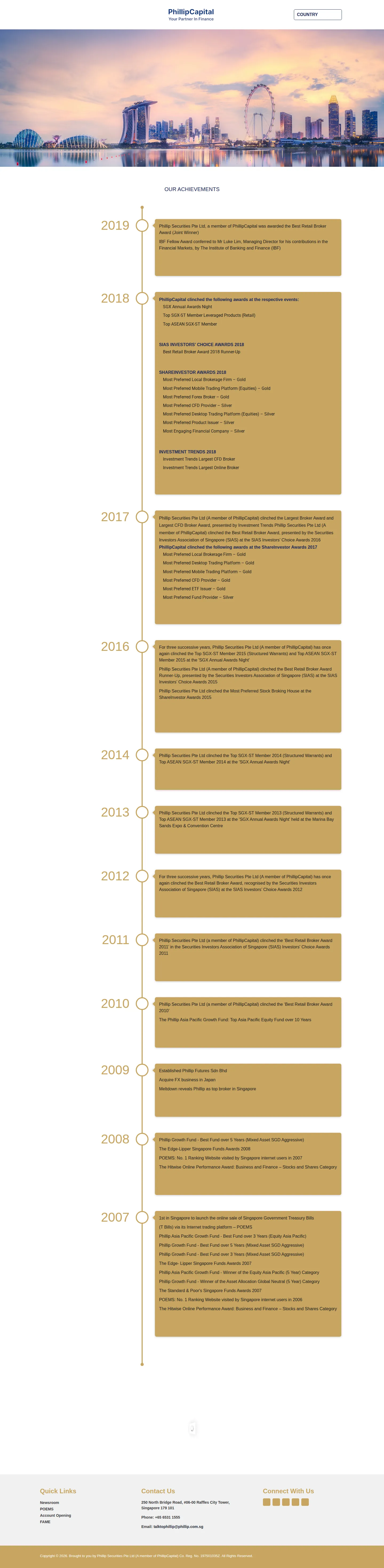
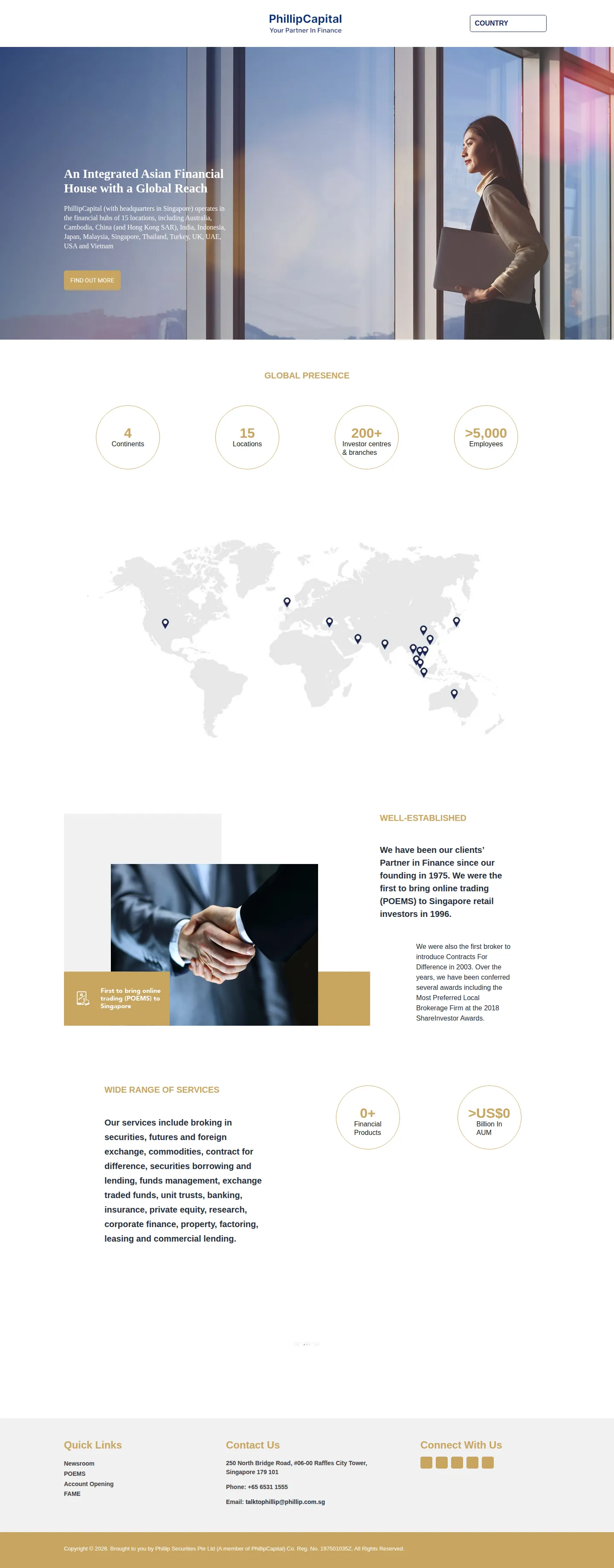
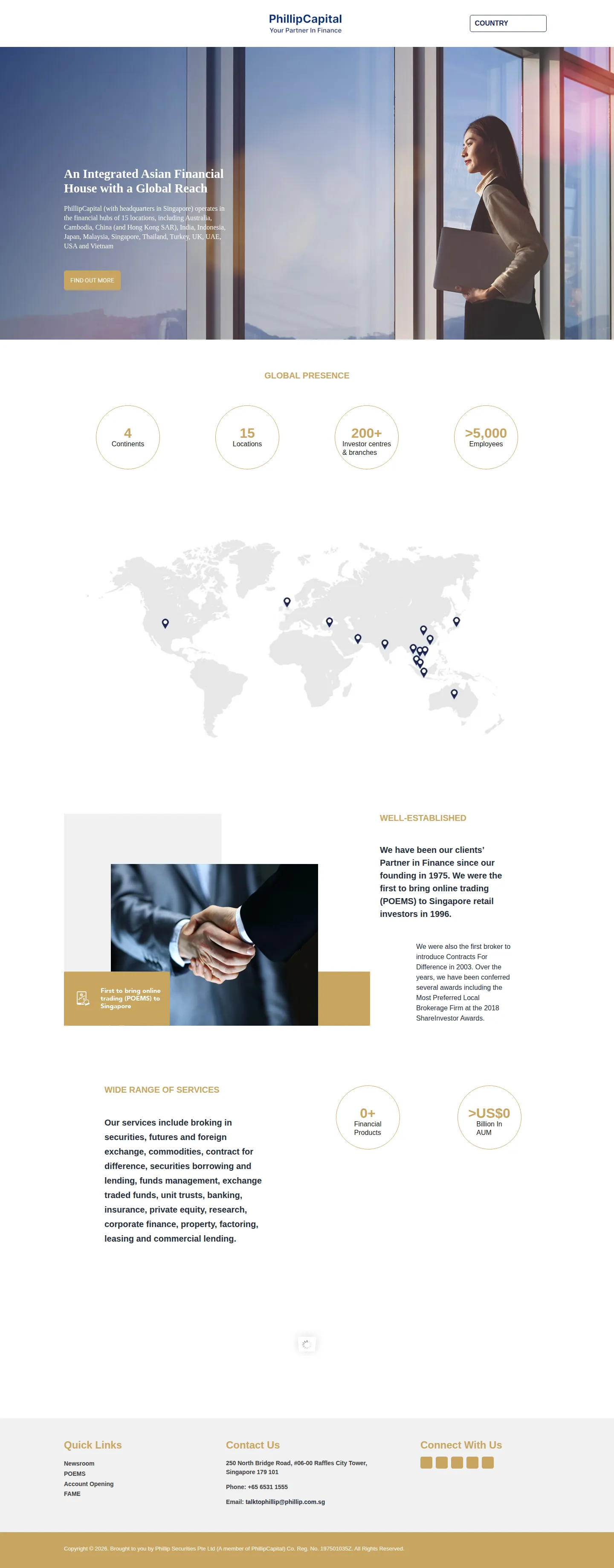
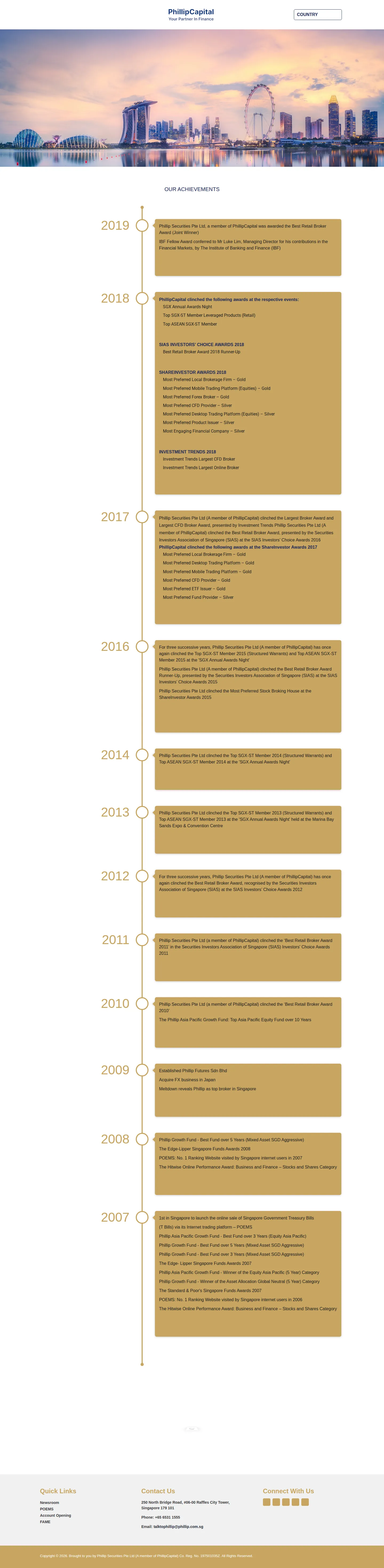
Pages captured from Phillip Capital’s own site when this review was written. Brokers change their terms; these are what we read.
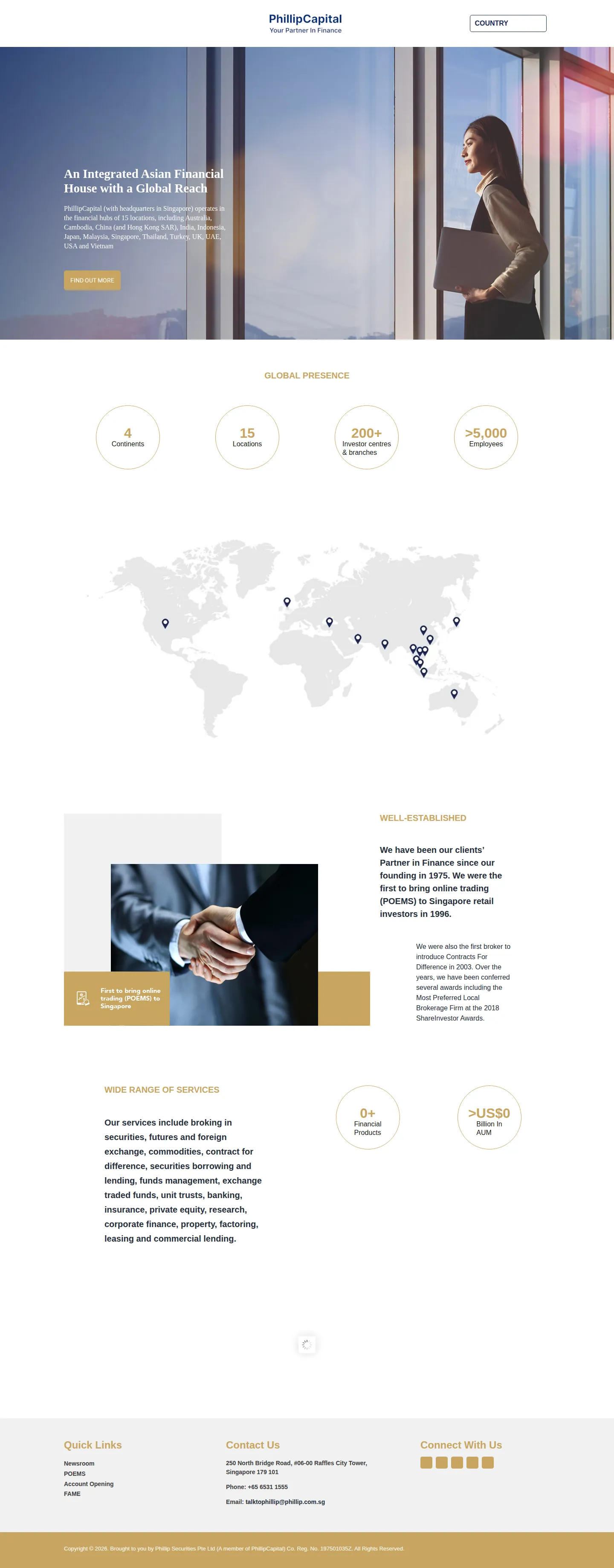
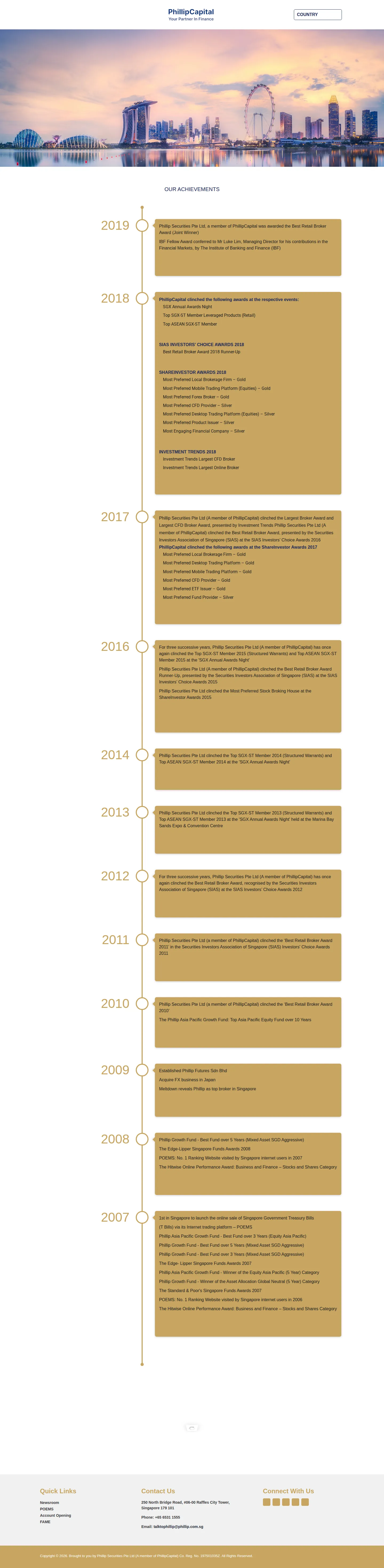
Score history
Recomputed daily; every move is on the record. The current score is always the latest row.
| Date | Score | Move |
|---|---|---|
| 2026-09-19 | 6.3 | ▼ |
| 2026-09-13 | 7.2 | ▲ |
| 2026-09-12 | 6.8 | ▲ |
| 2026-08-22 | 6.0 | ▲ |
| 2026-07-25 | 5.2 | ▲ |
| 2026-07-18 | 5.1 | ▼ |
| 2026-07-11 | 5.3 | · |
FAQ
Is Phillip Capital regulated?
Phillip Securities Pte Ltd states in a formal risk disclosure that it holds an MAS capital markets services licence, but no licence was confirmed on any register.
What platforms does Phillip Capital offer?
It offers the POEMS suite, including Mobile 3, 2.0 and Pro, as well as MT4 and MT5. Demo accounts are available.
What fees does Phillip Capital charge?
Its fee schedule lists CFD commissions, finance charges, custody fees and account maintenance fees, with stated minimums and conditions.
Can Phillip Capital's CFD spreads widen?
Yes. OTC CFD spreads may widen during volatility because the broker acts as the principal counterparty.
How can I contact Phillip Capital support?
Support includes a phone line with stated hours, a named email, live chat with a 24/7 chatbot, a Japanese-language line and a night desk for EUR, US and CA markets.
Are there independent reviews of Phillip Capital?
No independent third-party review evidence, regulator warnings or fraud indicators were provided in the findings.
How this review works
Track Phillip Capital live: score moves and red notices, in your pocket.