
PROP · CHECKED 13 SEP 2026
FTMO review.
Czech prop firm selling trading challenges, with verified register entries and publicly filed audited accounts
OK-ISH
OUT OF 10
FTMO is a Czech prop firm selling challenges normally, and one of the few in its sector whose corporate claims survive checking: three entities verified on the Czech register, publicly filed audited accounts showing CZK 2.52bn of cash, and a fully published drawdown rulebook. It is unregulated, which is normal here and not a mark against it. The caveats are that the binding contract is not published, the audited entity is not the one traders sign with, and reward forfeiture rests on standards FTMO judges after the profit exists.
Each criterion is scored 1 to 10 from primary sources. The overall score is their unweighted mean. How scoring works.
| Founded | 2014 |
|---|---|
| Headquarters | CZ |
| Maximum leverage | 1:100 |
| Withdrawal fee | None |
| Account opening | 1-3 |
- Three Czech operating entities named on the site and all verified active on the state register
- Audited 2024 accounts publicly filed, with a clean opinion from Moore Audit CZ s.r.o.
- CZK 2.52 billion of cash on the audited balance sheet at 31 December 2024
- Drawdown and breach rules published in full with worked arithmetic for every rule
- No time limit on any evaluation phase, on either product
- 2-Step challenge fee returned in full with the first reward withdrawal
- No commission charged on reward withdrawals, and a $20 minimum by bank wire
- Identical site, prices and rules served to all eleven countries we tested
- States plainly that accounts are demo accounts with fictitious funds and that it takes no deposits
- 24/7 support by chat, email, WhatsApp and phone, at a published Prague street address
- No regulator supervises the prop product outside Australia, and no compensation scheme covers a refused trader
- The FTMO Account Agreement that governs payouts is not published, only offered as a sample on request
- The General Terms and Conditions are served from a host we could not read, so we quote summaries not clauses
- The entity whose audited accounts we read invoices only group companies and does not contract with traders
- OMHC's entire stake in FTMO s.r.o. is pledged to UniCredit securing up to USD 625 million, ahead of any trader claim
- Rewards can be forfeited on open standards, including harm FTMO 'reasonably consider' its own trading may cause it
- The 1-Step entry fee is not refunded under any outcome, unlike the 2-Step
- On 1-Step the trailing maximum loss floor resets to 90% of original capital every time a reward is withdrawn
- The daily loss limit is anchored to the midnight balance but breached on live equity, so overnight losers eat the next day's buffer
- No pass rate, breach rate or verifiable payout record is published, only an unaudited $650M+ aggregate
Overview
FTMO is a Czech prop trading firm that sells evaluation challenges and, to those who pass, a profit share on a simulated account. It is selling challenges normally. Both products, the FTMO Challenge: 1-Step and the FTMO Challenge: 2-Step, were on sale at full price ladders from every one of the eleven countries we fetched the site from on 27 July 2026, and nothing on the site suggests a pause, a queue or a suspension of new orders. That matters because a prop firm that stops selling challenges is usually a prop firm that cannot fund the ones it already sold, and it is the first thing to check.
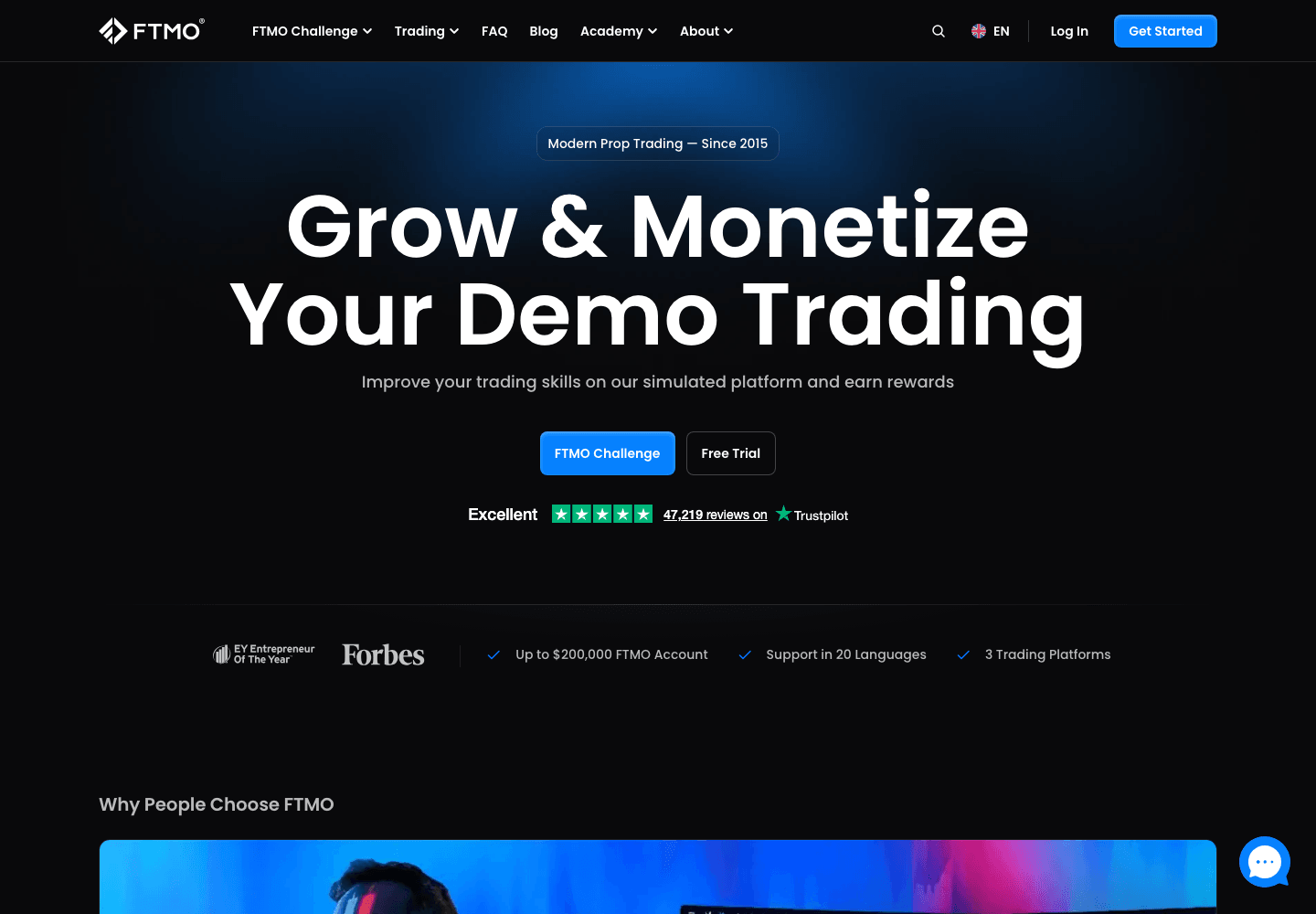
FTMO does not hide what it is selling, and this is the single most important thing a reader should understand before paying. The footer of every page states that “FTMO only provides services of simulated trading and educational tools for traders” and that “FTMO companies do not act as a broker and do not accept any deposits”. A banner on every page adds that “all accounts we provide to our clients are demo accounts with fictitious funds and any trading is in a simulated environment only”. The homepage headline is “Grow & Monetize Your Demo Trading”. This is the demo funnel shape that the prop sector is built on, and FTMO states it in its own words rather than leaving a reader to work it out. The revenue comes from challenge fees, not from trading the trader’s strategy in the market. The rewards are real money, but they are calculated on profits that were never made in a real market.
The corporate side is unusually checkable for this sector. FTMO publishes three Czech companies on its imprint, all three exist and are active on the Czech state register, and one of them files audited annual accounts in the public collection of deeds. Those accounts, audited by Moore Audit CZ s.r.o. and signed off on 30 June 2025 with a clean opinion, show CZK 6.73 billion of revenue and CZK 2.52 billion of cash at 31 December 2024. Almost no prop firm anywhere gives a reader that much to check. What the accounts also show is that FTMO s.r.o., the first company on the imprint, invoices only other group companies and does not contract with traders at all, so the entity whose numbers a reader can audit is not the entity a reader signs with.
There is no financial regulator standing behind the prop product, and there was never a requirement for one. FTMO does not claim otherwise. The one exception is Australia, where the service is operated by a separate company, VRGK Tech Pty Ltd trading as FTMO Australia, ACN 640 619 521, holding AFSL 525757, with lower leverage and Australian disclosure documents. Traders in the United States are pointed at ftmo.oanda.com instead.
Overview Table
| Headquarters | Purkynova 2121/3, 110 00 Prague 1, Czech Republic (Quadrio building) |
| Established | Company incorporated 24 June 2014 as FF Trader s.r.o., renamed FTMO s.r.o. on 29 September 2021. FTMO markets itself as “Since 2015” |
| Countries Served | FTMO states 140+. A published exclusion list names roughly 60 countries and territories |
| Regulated By | Nobody, for the prop product. Australia only: VRGK Tech Pty Ltd, AFSL 525757 |
| Challenge Fee From | EUR 79 (1-Step, $10,000 account). EUR 89 for the equivalent 2-Step |
| Maximum Leverage | Up to 1:100 on Standard accounts, up to 1:30 on Swing, applied to fictitious capital |
| Account Sizes | $10,000, $25,000, $50,000, $100,000, $200,000, with GBP, EUR, CZK, CAD, AUD and CHF ladders |
| Platforms | MetaTrader 4, MetaTrader 5, cTrader, plus the Account MetriX dashboard |
| Profit Split | 80% on 2-Step, rising to 90% under the Scaling Plan or Premium Programme. 90% from the start on 1-Step |
| Customer Support | 24/7 live chat, email, WhatsApp and phone on +420 910 920 310 |
| Languages | FTMO states 21 languages spoken by its support team. The website itself is offered in 8 |
Facts List
- Three Czech companies are named on the imprint: FTMO s.r.o. (ID 03136752), FTMO Evaluation Global s.r.o. (ID 09213651) and FTMO Trading Global s.r.o. (ID 09418415). All three are recorded as active on the Czech state register ARES and share the same Prague address.
- All three list the same two authorised representatives, Otakar Suffner and Marek Vasicek, who are also the two registered managing directors of FTMO s.r.o. on the commercial register.
- FTMO s.r.o. is 100% owned by OMHC a.s. (ID 09036989), formerly Sandersone Corp a.s. and then FTMO Holding a.s. The rename to OMHC was registered on 24 January 2025.
- Registered share capital of FTMO s.r.o. is CZK 3,000. The parent OMHC a.s. has CZK 2,000,000.
- Audited 2024 accounts show revenue of CZK 6,731,992 thousand, net profit of CZK 1,888,078 thousand and cash of CZK 2,522,220 thousand at 31 December 2024.
- The same accounts show CZK 1,763,461 thousand paid out as dividends during 2024 and a further CZK 501,943 thousand of declared but unpaid dividends owed to the shareholder at the year end.
- FTMO s.r.o. reported an average of 52 employees in 2024, of whom 3 were managers. The website describes a group team of 300+ people.
- Advertising on Facebook, X and other social networks cost FTMO s.r.o. CZK 398,495 thousand in 2024, roughly 2.8 times its entire staff cost.
- On 15 November 2024 the FTMO group signed a term facility of up to USD 250,000,000 with a bank club, intended to fund the purchase of the OANDA Group. It was undrawn at 31 December 2024.
- OMHC’s 100% stake in FTMO s.r.o. was pledged to UniCredit Bank Czech Republic and Slovakia, a.s. on 14 December 2024, securing debts of up to USD 625,000,000 over 11 years.
- Eleven countries (Indonesia, Thailand, Vietnam, Azerbaijan, Singapore, Japan, India, the UAE, South Africa, the United Kingdom and Germany) were served a byte-identical homepage with an identical price list.
Key Takeaways
- Challenges are on sale normally. Nothing we fetched on 27 July 2026 showed a pause, a waiting list or a restriction on new orders, from any of eleven vantage points.
- The funded account is a demo account. FTMO says so on every page, in its own words, rather than burying it. The rewards are real money paid on simulated profits.
- Three named Czech companies, all verified active on the state register, with two named directors who appear on both the imprint and the register.
- Audited accounts are publicly filed and readable. FTMO s.r.o. reported CZK 2.52 billion of cash and CZK 1.89 billion of net profit for 2024, with a clean audit opinion from Moore Audit CZ s.r.o.
- The audited entity does not contract with traders. All of FTMO s.r.o.’s 2024 revenue came from other group companies, for operating the trading platform. The trader-facing counterparty is one of the other two companies.
- The drawdown rules are published in full, with worked arithmetic for each rule and each product. That is rare and it is the most useful thing on the site.
- The trapdoor is the anchor. The daily loss limit is set from the account balance at midnight but breached on live equity, so a losing position carried through midnight silently consumes the next day’s allowance before the day starts.
- On the 1-Step product the maximum loss floor trails upward but resets to 90% of the original capital every time a reward is withdrawn and a new account is issued.
- Reward forfeiture is available to FTMO on open standards, including trading it “reasonably consider might cause us financial, reputational, or other harm”.
- No regulator supervises the prop product anywhere except Australia, and no compensation scheme covers a trader who is refused. Recourse is a civil claim in the Czech courts under a contract FTMO does not publish.
Company & Accountability
FTMO is not regulated as a financial firm, and it was never required to be. It holds no client money, it accepts no deposits, and the accounts it provides are demo accounts. Scoring it down for the absence of a licence it never needed would tell a reader nothing. The question that matters is different: who exactly is on the other side of the contract, and what can a trader do if that party refuses to pay?
On the first half of that question FTMO gives more than almost any firm in this sector. Its imprint names three Czech limited companies, all at Purkynova 2121/3 in Prague, all with the same two authorised representatives.
| Entity | Business ID | Register entry | Register status |
|---|---|---|---|
| FTMO s.r.o. | 031 36 752 | Municipal Court in Prague, Section C, Insert 227963 | Active. Incorporated 24 June 2014 as FF Trader s.r.o., renamed 29 September 2021 |
| FTMO Evaluation Global s.r.o. | 092 13 651 | Municipal Court in Prague, Section C, Insert 332660 | Active. Incorporated 2 June 2020 |
| FTMO Trading Global s.r.o. | 094 18 415 | Municipal Court in Prague, Section C, Insert 335283 | Active. Incorporated 16 August 2020 |
| OMHC a.s. (parent) | 090 36 989 | Municipal Court in Prague, Section B, Insert 25187 | Active. Incorporated 12 March 2020. Formerly Sandersone Corp a.s., then FTMO Holding a.s. |
| VRGK Tech Pty Ltd (Australia only) | ACN 640 619 521 | AFSL 525757, Sydney | Claimed on ftmo.com/au. Not checked against ASIC Connect |
We checked every one of the Czech numbers against the state register at ares.gov.cz and every one matched, including the insert numbers and the incorporation dates. The two managing directors of FTMO s.r.o. recorded on the commercial register, in office since 18 September 2015, are Marek Vasicek and Otakar Suffner, the same two people the imprint names and the same two the website presents as founders. FTMO s.r.o. has one shareholder, OMHC a.s., holding 100% since 24 January 2025. Above OMHC we could go no further: it is a joint stock company, and Czech commercial register entries for an a.s. do not publish shareholders, so the ultimate beneficial ownership is not something we established from a register.
We also searched the FCA register by name. There is no FTMO entity on it. The three hits returned for “FTMO” are unrelated firms matched on letters, all of them no longer authorised. That is a properly conducted negative rather than an accusation, and it is the expected result: FTMO does not claim UK authorisation. Its group does hold one indirectly. FTMO’s own site states that the group acquired OANDA in 2025, and OANDA Europe Limited is on the FCA register under FRN 542574 as Authorised, with Companies House number 07110087 and a status effective date of 17 May 2011. That authorisation belongs to OANDA’s brokerage clients. It does not extend to anybody buying an FTMO Challenge, and FTMO does not suggest that it does.
Two facts from the audited filings change the shape of the accountability question, and neither is published anywhere else we are aware of. The first is who the contract is actually with. Note 4.16 of the 2024 accounts states that revenues from ordinary activity consist mainly of invoicing for the operation of the trading platform to undertakings within the group, and note 4.20 confirms that 100% of the CZK 6,732,526 thousand of turnover came from other group companies. FTMO s.r.o., the company whose audited numbers a reader can read, does not sell challenges to the public. The counterparty on a trader’s order is one of the other two companies, and neither of those filed accounts we could locate.
The second is security. On 14 December 2024 a pledge over OMHC’s entire holding in FTMO s.r.o. was registered in favour of UniCredit Bank Czech Republic and Slovakia, a.s., under a pledge agreement of 15 November 2024, securing all secured debts arising over an eleven year period up to a total of USD 625,000,000. The agreement also bars any further pledge or any transfer of the stake without UniCredit’s consent. A separate entry on the commercial register, dated 9 June 2025, records that the business enterprise of FTMO s.r.o. itself was pledged to the same bank under an agreement of 11 December 2024. The related borrowing is described in note 4.21: a term facility of up to USD 250,000,000 signed with a bank club on 15 November 2024, intended to fund the purchase of the OANDA Group, undrawn at the year end. None of this is improper and it is exactly how an acquisition of that size gets financed. What it means for a trader is that a secured bank creditor now sits ahead of every unsecured claim against the business, and an unpaid reward is an unsecured claim.
Which brings the answer to the second half of the question. If FTMO refuses to pay, there is no regulator to complain to and no compensation scheme to claim from. The recourse is a civil claim against a Czech limited company, brought under the FTMO Account Agreement. FTMO does not publish that agreement. Its FAQ says only that “If you are interested in a sample of the contract, please contact us”, which means the document that governs whether and when a trader gets paid cannot be read before paying the fee. We also could not read the General Terms and Conditions: FTMO serves them from a separate CDN host that our fetching tool refuses on policy grounds, so the contractual text behind the summaries below is not something we verified.
How to Trade
There are two products and they are different enough that a reader should decide between them before paying, because the rules, the price and the refund all change.
The FTMO Challenge: 2-Step is the older product and FTMO calls it its flagship since 2015. Phase one is the FTMO Challenge, with a 10% profit target. Phase two is Verification, with a 5% profit target and the same risk limits. Both phases require at least 4 trading days, where a trading day is any day from 00:00:00 to 23:59:59 CE(S)T on which at least one position is opened. Passing both leads to the FTMO Account, where there is no profit target at all and the trader keeps 80% of simulated profits, rising to 90% under the Scaling Plan or the Premium Programme.
The FTMO Challenge: 1-Step has no Verification phase. One evaluation with a 10% profit target leads straight to the FTMO Account, and the split is 90% from the beginning. In exchange the risk limits are tighter: 3% daily instead of 5%, a maximum loss that trails upward rather than sitting still, and a Best Day Rule that has no equivalent on the 2-Step.
Neither product has a time limit. FTMO states the trading period is unlimited on both, on the objectives page and in the pricing table, and repeats it on the homepage as “No time limit”. For a sector where a 30 day clock is the norm, that is a material difference and it removes one of the more common ways a challenge is failed.
A free trial is offered for both, described as a 14 day simplified version, with as many attempts as a trader wants. There is no requirement to take it.
Two account types exist on the 2-Step. Standard carries leverage of up to 1:100. Swing carries up to 1:30 but removes the restrictions on trading through news releases and on holding positions overnight or over a weekend. Those restrictions apply only on Standard accounts and only once a trader is on the FTMO Account. During the evaluation, FTMO states, news and weekend restrictions do not apply regardless of account type. Swing is not offered on the 1-Step product at all.
Once trading, the ceiling that most traders will meet is the capital allocation limit. FTMO permits any number of accounts but caps total fictitious capital at $400,000 per trader or per strategy before any scaling, with equivalents of EUR 320,000, GBP 280,000, CAD 480,000, AUD 520,000, CHF 320,000 or CZK 8,000,000. Holding accounts through more than one registration is not permitted, and FTMO states it reserves the right to suspend accounts where identical strategies are detected across accounts and the combined capital exceeds the limit.
Strategy is otherwise left open. FTMO states it does not require a stop loss and does not restrict discretionary trading, algorithmic trading or Expert Advisors, provided the trading is replicable on a live account. Servers are limited to 200 orders at a time and 2,000 positions per day, and an EA generating more than 2,000 server requests per day on individual trades is treated as a forbidden practice in its own right.
Challenges & Funding
Five account sizes are sold in each product, and the price list was identical from all eleven countries we tested. Prices below are the euro figures shown on the pricing table, which FTMO labels a one time fee. FTMO warns that a displayed price may be rounded up and that the exact unrounded price is charged, and that the figures apply to Standard accounts.
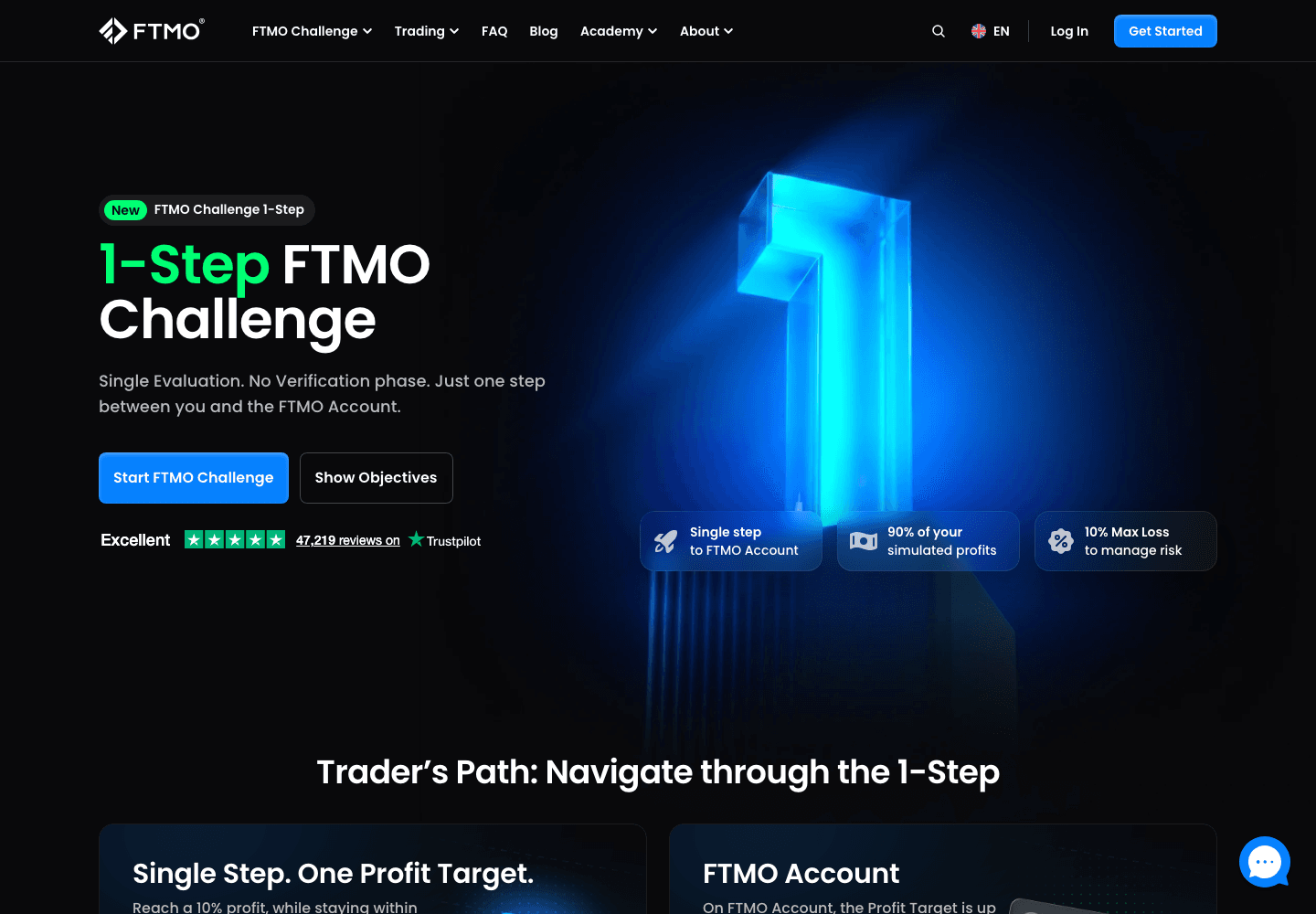
| Simulated capital | 2-Step fee | 2-Step average reward (FTMO figure) | 1-Step fee |
|---|---|---|---|
| $200,000 | EUR 1,080 | $12,234 | EUR 999 |
| $100,000 | EUR 540 (promotional EUR 439) | $5,957 | EUR 499 (promotional EUR 449) |
| $50,000 | EUR 345 | $2,805 | EUR 319 |
| $25,000 | EUR 250 | $1,431 | EUR 199 |
| $10,000 | EUR 89 | $680 | EUR 79 |
The average reward column is FTMO’s own published figure and is presented by FTMO as “Based on global average reward with FTMO”. It is not audited, it is not broken down, and it says nothing about how many people who paid the fee ever reached a reward. Read it as marketing, not as an expected value.
Both promotional prices carry the same condition, which FTMO states plainly: the discount applies only if the trader does not already have an active challenge of that type. On the 2-Step it reads “Special Deal! $100,000 FTMO Challenge for EUR439 – only if you don’t already have one active.”
The refund position differs between the two products and it is the single largest hidden difference in price. FTMO’s FAQ is unambiguous: on the 1-Step, “The entry fee is not refunded”. On the 2-Step, “The entry fee may be refunded with the first Reward withdrawal”, using the original payment method. The pricing table labels reflect this, calling the 1-Step price a “One-time fee (non-refundable)” and the 2-Step price a “One-time refundable fee from”. So a $100,000 1-Step at EUR 499 costs EUR 499 whatever happens, while a $100,000 2-Step at EUR 540 costs nothing at all to a trader who reaches a first reward. Anyone comparing the two on headline price alone is comparing the wrong numbers, and the cheaper looking product is the more expensive one for a trader who succeeds.
Account currency ladders exist beyond USD. The published sets are GBP 140,000 down to 10,000, EUR 160,000 down to 10,000, CZK 4,000,000 down to 250,000, CAD 240,000 down to 15,000, AUD 260,000 down to 15,000 and a CHF ladder on the same pattern.
Account size cannot be increased once an FTMO Account is running. FTMO states there are no upgrade options during an active account, that a trader wanting more capital must buy and pass another challenge from scratch, and that a scale up can only be requested during a reward withdrawal. The Scaling Plan, which is offered on the 2-Step only, increases the account by 25% every four months up to a maximum of $2,000,000 across all a trader’s accounts, and raises the split to 90%. Its stated requirements are a minimum of four months as an FTMO Trader, at least 10% of the initial or scaled capital in total net simulated profit, at least two processed rewards, and a positive balance at the time of scale up.
Drawdown & Breach Rules
This is where a prop firm either earns its fee or sets a trap, and FTMO publishes enough for a reader to judge it. Every rule below is stated on FTMO’s Trading Objectives page with its own worked arithmetic. That transparency is genuinely unusual. It does not make the rules soft.
Two rules can break an account and both are measured on equity, which FTMO defines as “Balance + Open Positions P/L ± Swaps – Commissions”. Equity, not balance, means an unrealised loss on an open position counts against the limit the moment it exists. There is no end of day grace and no closing-only measurement.
FTMO Challenge: 2-Step, worked on a $100,000 account
Maximum Daily Loss, 5%. The limit is recalculated at 00:00 CE(S)T each day as the account balance at that moment minus $5,000. On day one the balance used is the initial capital, so the floor is $95,000. If the balance at midnight into day two is $102,000, the day two floor is $97,000. Equity dropping below the floor at any point violates the rule.
Maximum Loss, 10%. On the 2-Step this is static. The floor is the initial capital minus $10,000, so $90,000, and it never moves. Profit earned genuinely becomes buffer.
Minimum Trading Days, 4. Required in both phases, not on the FTMO Account.
Profit Target, 10% then 5%. Reached when the balance exceeds the initial capital by the target with all positions closed.
Where the 2-Step trapdoor is
The daily floor is anchored to balance at midnight but breached on equity. Those are not the same number whenever a position is open. Suppose a trader ends day one with a balance of $100,000 and one position open carrying $4,000 of floating loss. Equity at midnight is $96,000, but the day two floor is computed from balance and lands at $95,000. The trader starts day two with $1,000 of room, not $5,000, and has used four fifths of the day’s allowance before placing a single trade. The reverse is also true in the trader’s favour: floating profit at midnight does not raise the floor either, so a trader who closes a winner at 00:30 gets no credit for it until the following midnight. A trader who does not model this will be surprised by an account that breaches on what looked like a small move.
FTMO Challenge: 1-Step, worked on a $100,000 account
Maximum Daily Loss, 3%. Same mechanism, tighter number. Day one floor $97,000. A balance of $102,000 at midnight gives a day two floor of $99,000. Note what that means: on the 1-Step, a profitable day raises the floor beneath the trader by the full amount of the profit, so the day after a good day is the day with the least absolute room.
Maximum Loss, 10%, trailing. This is the rule that separates the two products. The floor is recalculated daily as the highest balance recorded at any previous midnight, or the initial capital if that is higher, minus $10,000. It can rise and it can never fall. Day one it is $90,000. If the balance at the next midnight is $104,000, the floor becomes $94,000. If the following midnight shows $103,000, the floor stays at $94,000 because the higher of the two prior midnights is used.
Best Day Rule, 50%. The single most profitable day must not account for more than half of the Positive Days’ Profit, which is the sum of closed results across all profitable days. FTMO’s own example: profits of $10,000 on day two and $6,000 on day five against three losing days gives Positive Days’ Profit of $16,000, a best day of 62.5%, and a failed rule.
What actually breaches, and what does not
Only two things break an account outright: equity below the Maximum Daily Loss Limit, or equity below the Maximum Loss Limit. Everything else is a blocker rather than a breach. FTMO states explicitly that “Exceeding the Best Day limit is not treated as a rule breach” and that the remedy is to keep trading until the ratio corrects. Missing the minimum trading days is the same: the account is not lost, the phase is simply not passed yet.
The interaction to model before paying, on the 1-Step
Take the $100,000 1-Step. The target is $10,000 of profit. Now apply the Best Day Rule. A trader who makes the entire $10,000 in one day has a best day of 100% and cannot pass. To fix it, the Positive Days’ Profit must reach at least $20,000, which means earning a further $10,000 on other days while that first day remains the best. In practice the rule forces at least two profitable days of roughly equal size, and every additional day spent generating that profit is another midnight at which the trailing 10% floor ratchets up beneath the account and another day exposed to the 3% limit. FTMO’s own 1-Step marketing states a “shortest time to pass” of 2 days, which is the exact edge case: two profitable days of identical size and nothing else. We do not think the target is unreachable, and FTMO’s published averages suggest people do reach it. But the honest description is that the 1-Step does not reward a single good trade, it requires a distribution, and a trader whose edge is concentrated in occasional large wins is buying the wrong product.
The reset that is easy to miss
On the 1-Step, the trailing floor is not permanent. FTMO states that “when a Reward is withdrawn and a new FTMO Account is provided, the Maximum Loss Limit fully resets, returning the first-day limit to 90% of the Initial Simulated Capital”. A trader who has grown a $100,000 account to $130,000 and taken a reward does not carry a $120,000 floor into the next cycle. The floor goes back to $90,000, measured against the original capital. Taking money out costs buffer, every time.
Finally, there are no additional consistency requirements beyond the published objectives. FTMO’s FAQ states that consistency is evaluated through the Trading Objectives and that “Provided you maintain sustainable risk management practices, there are no additional consistency requirements for your trading”. That is worth noting because a hidden consistency rule is the standard mechanism by which a passing account is retroactively failed elsewhere in this sector, and FTMO disclaims one.
Trading Instruments
FTMO states that a trader may trade everything available in the platform and lists the classes as Forex, Indices, Commodities, Stocks and Crypto. It maintains a Symbols page with live spreads, specifications and trading hours per instrument.
We could not extract an instrument count. The symbols table is built client side and the fetched page contains the surrounding copy but not the rows, so any number we printed would be invented. FTMO does not state a total anywhere we found on the site, so the honest answer is that the count is not published in a form we can verify, and a reader who cares about a specific symbol should check the Symbols page for it directly.
What FTMO does state about the instrument set is worth reading carefully, because it is a simulated environment. The site says the technical solution for the FTMO platforms and the data feed “is powered by liquidity providers”, which is a description of where the prices come from, not a statement that orders reach a market. Nothing a trader does on an FTMO account results in a position in the underlying instrument. Specifications are visible in the platform itself: FTMO directs traders to open Market Watch in MetaTrader and read the specification per instrument, and notes that server time is GMT+2 with daylight saving on MT4 and MT5, while cTrader uses the trader’s own setting.
Two instrument-level constraints do bind. Weekend hours on cryptocurrencies vary by platform because of scheduled maintenance, and FTMO points traders at its Trading Updates page for outages and amended market hours. And for Standard accounts on a live FTMO Account, trading through selected news releases and holding through the weekend are restricted, which effectively narrows the usable instrument set around scheduled events. Swing accounts carry neither restriction, at the cost of leverage capped at 1:30 instead of 1:100.
The 2024 annual report adds one detail from the firm’s own commentary: gold drew the most interest of any instrument among its users that year, and the platform recorded more than 240 million simulated trading transactions.
Education & Analysis
Education is not a side feature here, it is part of the legal characterisation of the product. FTMO’s site-wide disclaimer states that all information provided is “intended solely for educational purposes related to trading on financial markets” and that FTMO provides “services of simulated trading and educational tools for traders”. A reader should understand that the educational framing is doing work in describing what is being sold, not only describing a bonus.
The material itself is substantial and free to browse. FTMO Academy covers how forex markets work, technical analysis starting from candlesticks, fundamental analysis, and a Trading Psychology Course described as covering discipline, emotional management and building a resilient mindset. There is an economic calendar with market events, a blog, and a Trading Updates page carrying platform maintenance windows, scheduled outages and amended market hours, which is the page that actually matters operationally.
Analytics are provided through Account MetriX, which is where a trader sees objective progress, the Best Day Rule result and the reward claim button. FTMO also publishes a Discipline Score and an App Suite built with FX Blue, and offers Performance Coaches described as working on mindset and habit rather than strategy. A public Leaderboard is advertised, although the URL linked from the navigation returned a page not found when we fetched it.
The YouTube channel is stated at 400,000 subscribers and the Discord community at more than 100,000 members. FTMO’s testimonial reel names individual traders with rewards earned, ranging from $25,607 to $500,180. Those are FTMO’s own figures about its own customers, presented for marketing, and they are not evidence of anything a reader can check.
What is absent is analysis of the thing a trader most needs analysed: FTMO publishes no pass rate, no breach rate, and no distribution of outcomes for people who buy a challenge. It publishes an average reward per account size and a shortest time to pass, both of which describe winners. A firm with 4.5 million customers and a full analytics stack knows its pass rate precisely. Not publishing it is a choice.
Payout Terms
The split depends on the product, and FTMO’s own FAQ sets it out more precisely than the marketing does. On the FTMO Challenge: 1-Step, “You receive 90% of the profit” and rewards cannot be left on the account to grow the balance. On the FTMO Challenge: 2-Step, “You receive 80% of the profit (increases to 90% if Scaling Plan or Premium Programme conditions are met)”, and a trader may instead roll the reward back onto the account to build balance and drawdown buffer, with a minimum rollover of EUR 20, $20, GBP 20, 20 AUD, 20 CAD, 20 CHF or CZK 500. The headline “up to 90%” that appears across the site is therefore the 1-Step figure or the scaled 2-Step figure. The default a 2-Step trader gets on day one is 80%.
Cadence. A reward claim can be requested in Account MetriX “on the 14th or any following day after the first placed trade on the specific account”, with all open positions and pending orders closed. This is a rolling 14 day cycle keyed to the trader’s first trade, not a fixed calendar date.
Speed. FTMO states it reviews the account and notifies the trader within 1 to 2 business days of the request, and that once approved and invoiced, “the Reward is typically sent within 1-2 business days after the invoice is approved”. So four business days is FTMO’s own stated upper bound across both stages, assuming nothing is queried.
Minimums and methods. Rewards are paid by bank wire, by instant transfer via Visa Direct or Mastercard Send up to $20,000, by Skrill up to $3,000, or in cryptocurrency. FTMO states it charges no additional commission for reward withdrawals. Because of transaction costs there is a minimum closed profit of $20 for bank wire and $50 for cryptocurrency.
The refund. On the 2-Step only, the challenge fee is returned with the first reward withdrawal, to the original payment method. FTMO’s how-it-works page states “Receive a 100% refund of your initial fee with your first reward withdrawal”, while the FAQ uses the softer “may be refunded”. On the 1-Step the fee is never returned.
The discretionary refusal clause
There is one, and FTMO publishes it. It does not live in the payout terms, it lives in the Forbidden Trading Practices page, which is where a reader should look before paying rather than after being refused. The sanction is stated as:
Any breach or non-compliance with these rules may result in corrective actions, including, but not limited to, removal of simulated trades from your history, restricted access to a trading platform, disqualification from the Evaluation Process, forfeiture of any potential Rewards, or even termination of all agreements you have with us.
What triggers it is drawn broadly. Alongside specific and reasonable prohibitions on exploiting pricing errors, hedging across accounts and hyperactive Expert Advisors, the list includes a catch-all:
otherwise perform simulated trades that contradict how trading is actually performed in the financial markets, or in a way that we reasonably consider might cause us financial, reputational, or other harm as a result of your activities (e.g., overleveraging, overexposure, one-sided bets, account rolling).
A separate “Risk Management Rules” heading adds that a trader must not use practices “not reasonably replicable in the actual market, meaning that such a strategy is not in line with risk management rules a reasonable person would apply when trading on financial markets with their own money”, and gives as examples opening substantially larger or smaller position sizes than the trader’s other trades, or a substantially different number of positions. Those are standards, not rules. Whether a given account has breached them is FTMO’s judgement, applied after the profit exists, and forfeiture of rewards is on the menu of outcomes.
We should be fair about this. Every prop firm needs some such clause, because without one the model is trivially gameable by opposite positions across accounts, and FTMO’s version is published in advance, in plain English, with examples. That is better than most. It remains true that the clause is broad enough to cover a trader who simply sized up on a high conviction idea, and that a trader disputing its application has no regulator to appeal to.
Finally, the binding document is not this page. It is the FTMO Account Agreement, which FTMO does not publish and offers only as a sample on request, and the General Terms and Conditions, which FTMO serves from a CDN host we were unable to read. Everything above is FTMO’s own summary of its terms rather than the terms themselves.
Opening an Account
Buying a challenge requires only an account on the FTMO client area and payment. Identity verification is not required at that point, which is worth knowing: a trader can spend EUR 1,080 before FTMO has confirmed who they are or whether they are eligible. Verification happens later, once the objectives are met.
Payment methods and their costs are published, and the spread between them is real money on a EUR 1,080 order.
| Method | Transfer time | Fee |
|---|---|---|
| Credit or debit card | Instant | Free |
| Apple Pay | Instant | Free |
| Google Pay | Instant | Free |
| Revolut Pay | Instant | Free |
| PayPal | Instant | 3% |
| Skrill | Instant | 3% |
| Cryptocurrency | Up to 24h | 3% |
| Bank transfer | 2 to 5 business days | Various |
FTMO states that for regulatory reasons bank transfers are not available for payments or withdrawals for Venezuela, Cuba, Sudan and Ukraine.
The identity process, which FTMO calls FTMO Identity, unlocks only after the trading objectives are met. A trader must choose one of three statuses, and the choice is close to permanent: FTMO states the type can be changed once and is locked afterwards, and that the status is set by the option selected on the first order. A Natural Person completes KYC with a government issued ID showing nationality plus proof of address no older than six months. An Entrepreneur or a Company completes KYB, which additionally requires registration documents no older than twelve months and identification of any beneficial owner holding more than 25%.
Two document rules will catch people out. FTMO does not accept driving licences, residence permits or any document that does not display nationality, and where an ID is solely in Amharic, Arabic, Armenian, Bengali, Burmese, Dari, Dhivehi, Farsi, Georgian, Hindi, Khmer, Kinyarwanda, Lao, Mongolian, Nepali, Sinhalese or Urdu, an international passport with Latin transcription is required instead. Documents in Arabic, Serbian, Ukrainian, Russian and Japanese are accepted but processed more slowly.
FTMO states compliance checks usually take less than one business day for personal registrations and up to three business days for company registrations. Passing the objectives triggers a separate account review that FTMO states typically takes 1 to 4 business days. After verification the FTMO Account Agreement is unlocked in the client area for review and signature.
Two categories are excluded at this stage regardless of trading result. FTMO states it cannot sign a contract with nonprofit organisations or trusts, or with companies owned or co-owned by them. Corporate clients structured as company trusts are also on the general exclusion list. A trader intending to be paid through such a structure should resolve that before buying anything.
Payout Record
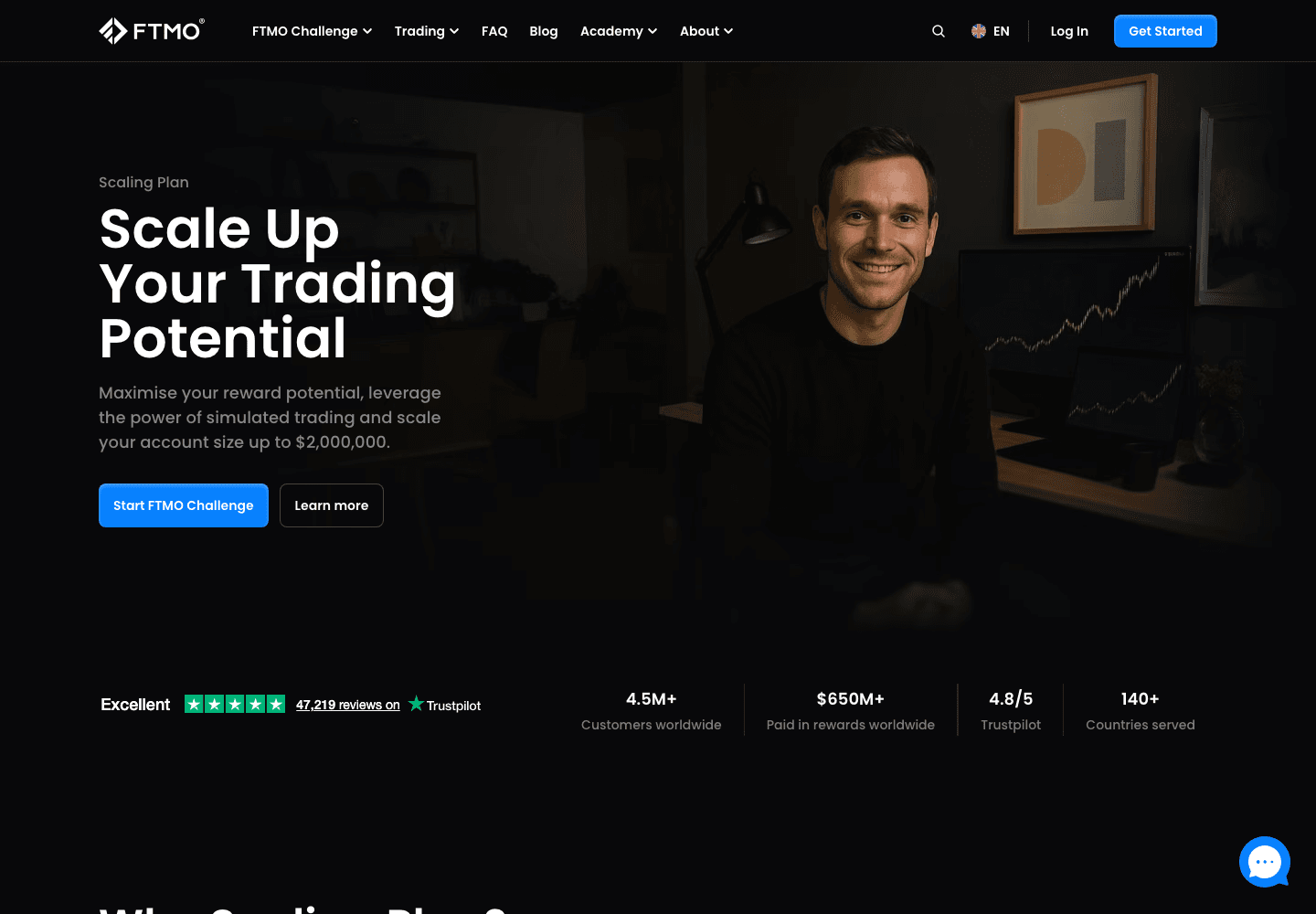
FTMO’s own claim is “$650M+ Paid in rewards worldwide”, displayed on nearly every page alongside “4.5M+ Customers worldwide”. There is no breakdown, no period, no methodology and no third party attesting to it. It is a marketing number and we treat it as one. The video testimonials naming individual traders and reward figures are the same category of evidence, which is to say none.
What can actually be checked is the firm’s audited accounts, and here FTMO is in a small minority of prop firms: it files them, publicly, and a reader can download them. FTMO s.r.o.’s annual report for 2024 sits in the Czech public collection of deeds under file C 227963/SL22/MSPH, filed on 2 December 2025, 43 pages, audited by Moore Audit CZ s.r.o. (auditor licence 599, signing auditor Erik Durkan, licence 2407), with the report dated 30 June 2025.
| FTMO s.r.o., audited, CZK thousands | 2024 | 2023 (restated) |
|---|---|---|
| Revenue from services | 6,731,992 | 4,616,408 |
| Operating profit | 2,116,639 | 1,924,967 |
| Net profit for the period | 1,888,078 | 1,635,877 |
| Cash at bank and in hand | 2,522,220 | 1,974,961 |
| Total equity | 1,397,501 | 1,389,925 |
| Short term liabilities | 1,594,599 | 743,517 |
| Dividends paid in the year | 1,763,461 | 1,052,596 |
The audit opinion is clean. The auditor states that the financial statements give a true and fair view of the assets, liabilities, costs, revenues, result and cash flows in accordance with Czech accounting regulations. There is an emphasis of matter, and a reader should note it: the auditor draws attention to notes 3.17 and 3.18 covering changes in accounting methods and corrections of prior period errors, applied retrospectively, which is why the 2023 comparatives are marked as restated. The opinion itself is not modified by those matters.
Read against the question a trader is asking, this shows a business holding CZK 2.52 billion of cash against CZK 1.59 billion of short term liabilities, generating CZK 2.36 billion of operating cash flow in the year, and distributing CZK 1.76 billion of it to its owner. On capacity to pay, that is about as reassuring as this sector gets.
But it is not a payout record, and it is important to say why. Note 4.16 of the same filing states that revenue consists mainly of invoicing for operating the trading platform to undertakings within the group, and note 4.20 shows that 100% of the CZK 6,732,526 thousand of turnover came from other group companies. FTMO s.r.o. does not sell challenges to the public and does not pay rewards to traders. There is no line in these accounts for rewards paid, because they are not this company’s costs. The cost side is dominated instead by CZK 3,769,833 thousand of charges from related parties for operating the trading platform and CZK 398,495 thousand spent on Facebook, X and other social networks. The entities that do face traders, FTMO Evaluation Global s.r.o. and FTMO Trading Global s.r.o., are the ones whose numbers would answer the payout question, and we did not locate filed accounts for either.
So the honest position is this. We can show a reader a real, audited, downloadable document proving that the FTMO group is a large and profitable business with substantial cash, which is a great deal more than most prop firms allow. We cannot show a reader a single verified payout, a payout ratio, a refusal rate, or any independent record of how FTMO behaves when it does not want to pay. We have left payoutProofUrl empty rather than fill it with the annual report, because the annual report proves solvency and not payment, and a reader who clicked expecting payout evidence would be misled.
One further finding sits in the same filing and belongs here rather than buried. On 15 November 2024 the FTMO group signed a term facility of up to USD 250,000,000 to fund the OANDA acquisition, and OMHC’s entire stake in FTMO s.r.o. was pledged to UniCredit securing up to USD 625,000,000 over eleven years. A bank running that diligence is a positive signal about the business. It is also a secured creditor that ranks ahead of any trader owed a reward.
Customer Support
FTMO publishes a street address, a phone number and a 24/7 commitment, which is three more things than much of this sector publishes.
The address is Purkynova 2121/3, 110 00 Prague 1, Czech Republic, at the top of the Quadrio office building. FTMO’s FAQ invites traders to visit in person, asking only for advance notice so reception can be told. The same address appears on the Czech state register for all three FTMO companies and for the parent OMHC a.s., which is a small but real corroboration: the marketing address and the registered address are the same building.
The published phone number is +420 910 920 310, a Czech number. Channels are live chat, email, WhatsApp, Messenger and a contact form. FTMO states its support team is in-house rather than outsourced, that it numbers more than 60 people, and that it operates 24 hours a day, seven days a week.
Language coverage is stated as 21 languages spoken by the support team, and the site lists them: Arabic, Czech, Spanish, French, German, Italian, Japanese, Polish, Portuguese, Russian, Serbian, Swahili, Filipino, Turkish, Ukrainian, English, Vietnamese, Romanian, Swedish, Korean and Persian. The 2024 annual report gives a figure of twenty languages, and the homepage banner says twenty in one place and twenty-one in another. The website itself is published in eight languages: English, Czech, Spanish, Italian, German, Portuguese, Vietnamese and French.
We should flag one inconsistency rather than smooth it over. The homepage states “300+” team members and the About page states “over 250 people”, while the audited 2024 accounts report an average of 52 employees at FTMO s.r.o., of whom three were managers. Those are not necessarily in conflict, since the group runs at least three Czech companies and FTMO s.r.o. is the one that invoices the group rather than the one that faces customers. But no reconciliation is published, and a reader should know that the audited headcount for the company with the published accounts is 52.
What we cannot assess is the thing that actually matters for a prop firm, which is how support behaves during a payout dispute. That is not observable from outside without being a customer in dispute, and we did not test it. We have scored support on what is verifiable, namely reachability, and said plainly that dispute conduct is unmeasured.
Two small operational notes from our own fetching. The Contact Us and Leaderboard URLs linked from the site navigation both returned FTMO’s own “Page not found” page on 27 July 2026. And one FAQ article returned a 502 Bad Gateway from FTMO’s origin on first request and served correctly on retry. Neither is serious, both are the sort of thing a firm of this size normally catches.
Restricted Countries
FTMO publishes its exclusion list, in full, on a public FAQ page rather than hiding it in terms a trader sees after paying. That is the right way to do it, and it means the list below is FTMO’s own text rather than our inference.
Excluded categories. FTMO states it does not provide services to persons, whether nationals or residents, of Iran, Syria, Myanmar and North Korea; to individuals on international sanctions lists; to individuals with a criminal record related to financial crime or terrorism; to persons previously banned for breach of contract; or to corporate clients structured as company trusts.
Conditional exception. Nationals of Iran, Syria or Myanmar may be accepted only if they provide valid documentation confirming residency in an EEA country and FTMO can verify a bank account in their own name at a traditional bank, explicitly not a neobank or fintech, operating within the EEA. Both conditions must be met.
Business decision exclusions. Separately, and described as risk management rather than law, FTMO states it does not serve clients in: Afghanistan, Anguilla, Antarctica, Antigua and Barbuda, Belarus, Belize, Bhutan, Bouvet Island, Burundi, Cape Verde, Central African Republic, Chad, Cook Islands, Comoros, Republic of the Congo, Cuba, Djibouti, Dominica, Equatorial Guinea, Eritrea, Eswatini, Fiji, Gabon, Gambia, Grenada, Guinea, Guinea-Bissau, Holy See, the Republic of Indonesia, Iraq, Kazakhstan, Kiribati, Kosovo, Kyrgyzstan, Lesotho, Liberia, Malawi, Mali, Mauritania, Marshall Islands, Micronesia, Nauru, Niger, Niue, Papua New Guinea, the Russian Federation, Saint Barthelemy, Saint Kitts and Nevis, Saint Lucia, Saint Vincent and the Grenadines, Samoa, San Marino, Sao Tome and Principe, Seychelles, Sierra Leone, Solomon Islands, Somalia, South Sudan, Sudan, Suriname, Tajikistan, Timor-Leste, Tokelau, Tonga, Turkmenistan, Tuvalu, Ukraine (limited to Crimea, Sevastopol, Donetsk, Kherson, Luhansk and Zaporizhzhia), Uzbekistan, Vanuatu, Venezuela and Western Sahara.
Routed rather than excluded. Two markets are served through separate entities. Australian clients are directed to ftmo.com/au, operated by VRGK Tech Pty Ltd trading as FTMO Australia, ACN 640 619 521, AFSL 525757, at Three International Towers, Level 24, 300 Barangaroo Avenue, Sydney. That version carries Australian disclosure documents (PDS, FSG, TMD), restricts retail clients to the Swing account at up to 1:30 leverage, and offers 1:100 only to clients who qualify as professional. United States clients are directed to ftmo.oanda.com. We did not load the US site and make no claim about what it offers.
Two observations a reader may care about. First, Indonesia is on the exclusion list, yet the full global site, with its full price list and Get Started buttons, was served to us without qualification from an Indonesian vantage point. FTMO gates at the account and payment stage rather than at the page, so the site being reachable in a country tells a trader nothing about eligibility. Second, Australia is the only market where a trader gets a licensed counterparty and a regulator to complain to, and it is not the market most of this industry sells into.
Separately from eligibility, bank transfers are stated as unavailable for payments and withdrawals for Venezuela, Cuba, Sudan and Ukraine.
Conclusion
FTMO is selling challenges normally, and by the standards of its sector it is about as accountable as an unregulated prop firm gets. Three named Czech companies, all verified active on the state register. Two named directors who appear on both the imprint and the register. Publicly filed accounts, audited with a clean opinion, showing CZK 2.52 billion of cash and CZK 1.89 billion of profit. A published drawdown rulebook with worked arithmetic for every rule. A published country exclusion list. A published sanctions clause. More than a decade of continuous operation, the company having been incorporated in June 2014, and a bank club willing to lend the group USD 250 million. We could check all of that, and almost all of it stood up.
The absence of a licence is not a mark against it. FTMO holds no client money and takes no deposits, so there was never a licence to hold, and it says so rather than implying otherwise. Where its group does hold a top tier authorisation, through OANDA Europe Limited on FCA FRN 542574, FTMO does not try to borrow the credibility for the prop product.
The real caveats are three, and none of them is about regulation.
The first is that the paperwork a trader is actually bound by is the paperwork FTMO does not publish. The FTMO Account Agreement is available only as a sample on request. The General Terms and Conditions sit on a host we could not read. Everything in this review about payout terms is FTMO’s summary of its own contract, not the contract. For a product whose entire value proposition is that the firm will pay, that is the gap that matters most.
The second is that the entity a reader can audit is not the entity a reader signs with. FTMO s.r.o.’s audited accounts show 100% of its revenue coming from group companies for operating the trading platform. It does not sell challenges and it does not pay rewards. Those accounts prove the group is large, profitable and liquid. They do not prove anything about the two companies that actually face traders, and we found no filed accounts for either.
The third is that the discretion is broad and the money is downstream of it. Rewards can be forfeited for trading FTMO “reasonably consider might cause us financial, reputational, or other harm”, judged after the profit exists, with no regulator to appeal to and no compensation scheme behind it. Add the mechanical traps: a daily limit anchored to the midnight balance but breached on live equity, so an overnight loser eats tomorrow’s allowance before the day starts, and a 1-Step drawdown floor that resets to 90% of original capital every time a reward is taken.
Who it suits: a trader who already has a repeatable process producing profit spread across multiple days, who wants no time pressure, and who understands that the account is a demo and the fee is the product. The 2-Step is the better value of the two despite the higher sticker price, because the fee comes back with the first reward and the maximum loss floor does not trail. Who it does not suit: anyone whose edge is concentrated in occasional large wins, who will meet the Best Day Rule on the 1-Step and the capital allocation cap soon after. And anyone who is treating a challenge fee as an investment rather than as a purchase, because on the 1-Step it is not refundable under any outcome.
We could not verify a single individual payout, a pass rate, a refusal rate, or the contract itself. That is not a finding against FTMO so much as a description of the limits of what any outsider can establish about a prop firm, and it is why this score sits in the sevens rather than higher.
Score history
Recomputed daily; every move is on the record. The current score is always the latest row.
| Date | Score | Move |
|---|---|---|
| 2026-09-13 | 7.0 | ▼ |
| 2026-09-12 | 7.2 | ▼ |
| 2026-07-27 | 7.5 | · |
FAQ
Is FTMO legit?
FTMO is a real, traceable business: the three Czech companies named on its site all verify as active on the state register, and FTMO s.r.o. files audited accounts, with a clean opinion for 2024. It is not regulated, because no regulator supervises the prop product outside Australia, and it publishes no verifiable payout record, only an unaudited total of more than $650 million.
How much does an FTMO challenge cost?
On the price list we read on 27 July 2026, the 2-Step ran from EUR 89 for a $10,000 account to EUR 1,080 for $200,000, and the 1-Step from EUR 79 to EUR 999. A $100,000 account was EUR 540 on the 2-Step and EUR 499 on the 1-Step. FTMO labels each a one time fee, and the list was identical from all eleven countries we tested.
Is the FTMO challenge fee refunded?
Only on the 2-Step, where the fee is returned with the first reward withdrawal, to the original payment method. On the 1-Step, FTMO’s FAQ says “The entry fee is not refunded”, so the cheaper looking product is the dearer one for a trader who succeeds.
Does FTMO offer a free trial?
Yes. FTMO offers a free trial of both challenges, which it describes as a 14 day simplified version, with as many attempts as a trader wants. Taking it is optional.
What are the FTMO challenge rules?
On the 2-Step: a 10 percent profit target, then 5 percent in Verification, a 5 percent maximum daily loss, a 10 percent static maximum loss and at least 4 trading days in each phase. The 1-Step has a single 10 percent target, a 3 percent daily loss, a 10 percent maximum loss that trails upward, and a Best Day Rule that stops one day making up more than half of the profit. Neither has a time limit, and both loss limits are measured on equity, not balance.
How long does an FTMO payout take?
A reward can be requested from the 14th day after the first trade on the account. FTMO says it reviews the request within 1 to 2 business days and sends the money within 1 to 2 business days of the invoice being approved, so about four business days on its own figures. It states that it charges no commission on reward withdrawals.
Is an FTMO funded account real money?
No. FTMO states that its accounts are demo accounts with fictitious funds and that it takes no deposits. The rewards are real money paid on simulated profits: 80 percent on the 2-Step, rising to 90 under the Scaling Plan or Premium Programme, and 90 percent on the 1-Step.
Can FTMO refuse to pay a reward?
Its published rules allow it. The Forbidden Trading Practices page lists forfeiture of rewards among the sanctions, for trading FTMO “reasonably consider might cause us financial, reputational, or other harm”. There is no regulator to appeal to, and the recourse is a civil claim in the Czech courts under an Account Agreement FTMO does not publish.
How this review works
Track FTMO live: score moves and red notices, in your pocket.