
CRYPTO · CHECKED 10 OCT 2026
BitMEX review.
Crypto and TradFi perpetual swaps, futures and spot from an offshore derivatives venue now winding down.
OK-ISH
OUT OF 10
BitMEX shuts on 23 September 2026 and stopped new sign-ups on 23 July 2026, so nobody can join and existing users should withdraw. Operated by HDR Global Trading Limited of Seychelles, it never held a licence anywhere and withdrew its only application. Reserves still exceed liabilities and the wind-down is FSA supervised, but the verifiable Bitcoin proof shows 100.05% rather than the 102% displayed, it carries a 2024 US criminal conviction pardoned in March 2025, and its advertised 250x leverage is capped at 100x by its own data.
Each criterion is scored 1 to 10 from primary sources. The overall score is their unweighted mean. How scoring works.
| Founded | 2014 |
|---|---|
| Headquarters | SC |
| Maximum leverage | 1:250 |
| Withdrawal fee | None |
| Platforms | BitMEX web terminal, BitMEX iOS app, BitMEX Android app, Android APK, REST API, WebSocket API, TradingView, Testnet |
- Reserves exceed liabilities on every published figure, with a downloadable Bitcoin Merkle proof of 4,194,303 nodes that we verified is internally consistent
- Closure announced two months ahead with specific dates, and the wind-down plan is approved and supervised by the Seychelles FSA
- Genuine order-book exchange with a matching engine, so the venue does not take the other side of your trade
- No lending, staking or yield product that transfers title to customer coins, the mechanism that sank several competitors
- Deep public API with REST, WebSocket and a full Testnet mirror, plus unauthenticated market, insurance fund and liquidation data
- Public status page with real postmortems, and documented compensation to users hit by the 2019 auto-deleveraging failure
- No deposit fee and no BitMEX fee to withdraw Bitcoin
- Published complaints procedure with stated timescales and a named escalation route to the Seychelles FSA
- Restricted country list published in full and served identically from every vantage point we could retrieve it from
- No customer funds lost to a hack in over eleven years of operation, on the evidence available to us
- The exchange closes on 23 September 2026 and new sign-ups stopped on 23 July 2026
- Balances left after closure are charged 50 USD equivalent or 1% a year, whichever is greater, monthly, with the rate able to rise
- Never held a financial services licence anywhere, and withdrew its only application on 23 July 2026
- HDR Global Trading Ltd pleaded guilty to a Bank Secrecy Act offence in 2024 and was fined 100 million USD, and all four convicted executives pleaded guilty before it
- Advertised 250x leverage is contradicted by BitMEX's own risk-limits table and instrument data, which cap base initial margin at 1.00%, and a help centre article still caps TradFi perpetuals at 20x while silver and the Nasdaq tracker trade at 100x
- The proof of reserves page still says it publishes twice a week, but the last multi-asset snapshot is dated 21 July 2026 and the 11 August one covers Bitcoin alone
- Retail fees of 0.0500% maker and 0.0500% taker with no maker rebate below 10 million USD of monthly volume, while a help centre article still promises equity perp makers a 0.025% rebate the exchange does not pay
- No compensation scheme, no deposit insurance and no regulator-audited client money regime, and an FCA warning naming www.bitmex.com has stood since March 2020
- Positions become reduce-only from 26 August 2026 and BitMEX may force close them at its sole discretion, disclaiming resulting losses
- Withdrawal processing broke twice in the 89 days to 13 July 2026, and BitMEX warns of further delays during the wind-down
Overview
BitMEX is closing. On 23 July 2026 the board of HDR Global Trading Limited, the Seychelles company that owns and operates the exchange, announced that BitMEX will shut on 23 September 2026 at 04:00:00 UTC, and that new account registrations had already stopped. The Seychelles Financial Services Authority published its own notice the same day confirming that HDR Global withdrew the licence application it had filed on 18 December 2024, and that its authorisation to conduct virtual asset business ceased on 23 July 2026. If you are reading this to decide whether to open a BitMEX account, the decision has been made for you: the sign-up page returns “New account sign-ups are currently disabled.” If you already hold a balance, the only question that matters is how fast you can withdraw it.
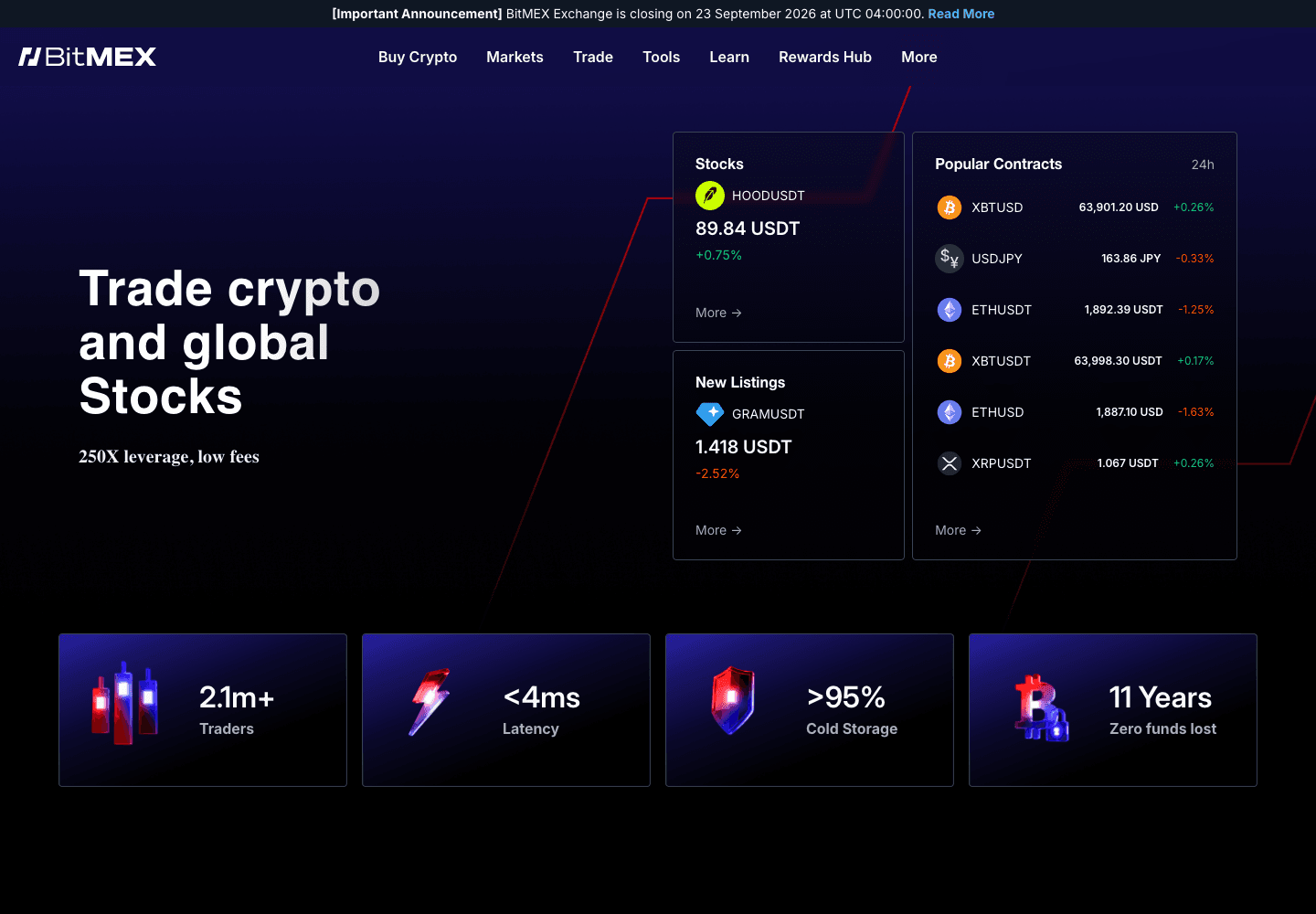
Everything else about BitMEX is now context for that, and the platform is visibly emptying. It launched in 2014 and invented the perpetual swap. On 29 July 2026 it listed 111 active instruments; on 12 August 2026 it lists 62, made up of 29 crypto perpetual swaps, 24 spot pairs, 5 crypto futures and 4 traditional-finance perpetuals, with the calendar spreads gone entirely. Forty-nine contracts were delisted in those two weeks and none were added. It publishes a proof of reserves that on 12 August 2026 showed a 102% reserve ratio against 989.9 million USD of customer liabilities, though the verifiable dataset behind that page has thinned out since the closure was announced, which the Proof of Reserves section below sets out. It also carries a US criminal conviction: HDR Global Trading Ltd pleaded guilty to a Bank Secrecy Act offence on 10 July 2024 and was sentenced on 15 January 2025 to a 100 million USD fine and two years of probation. On 27 March 2025 the company received a full and unconditional presidential pardon, which remitted the fine and the probation. The guilty plea itself remains on the record.
Overview Table
| Headquarters | No operational street address published. HDR Global Trading Limited is incorporated in the Republic of Seychelles, company number 148707. The careers page lists roles in Hong Kong and Singapore |
| Established | 2014 |
| Countries Served | Not disclosed as a list. Excludes US Persons and residents of Seychelles, Bermuda, Hong Kong SAR, Canada and Myanmar, plus sanctioned jurisdictions |
| Regulated By | No licence on any register we searched. Operated as a transitional entity under the Seychelles Virtual Asset Service Providers Act 2024 until 23 July 2026. Carries an FCA unauthorised-firm warning naming www.bitmex.com, last updated 20 March 2020 |
| Minimum Deposit | No flat minimum. Set per asset and per contract as contract value multiplied by initial margin, which BitMEX gives as 0.01 USD for XBTUSD |
| Maximum Leverage | Advertised as 250x. BitMEX’s own risk-limits table and public instrument API both cap base initial margin at 1.00%, which is 100x |
| Total Instruments | 62 active on 12 August 2026, down from 111 on 29 July 2026. A further 5 spot pairs are scheduled to delist on 14 August 2026 |
| Platforms | Web trading terminal, iOS and Android apps, Android APK, REST API, WebSocket API, TradingView integration, Testnet |
| Customer Support | Ticket form and help centre, stated as around the clock, in English, Chinese, Turkish and Russian |
| Languages | English, Simplified Chinese, Traditional Chinese, Russian, Spanish, Vietnamese |
| Incident history | Two major withdrawal incidents in 2026, both resolved the same day, plus a 2019 auto-deleveraging failure BitMEX compensated. Dated table in Deposits and Withdrawals below |
Facts List
- Operator: HDR Global Trading Limited, Republic of Seychelles, company number 148707, per clause 1.1 of the June 2026 Terms of Service.
- Traditional-finance perpetuals are a separate contract with RDH Limited, Inc., a company incorporated in the Republic of Panama.
- Both sets of terms are governed by English law with exclusive jurisdiction in the courts of England, and BitMEX alone may elect LCIA arbitration seated in London.
- Closure date 23 September 2026 at 04:00:00 UTC. Positions become reduce-only from 26 August 2026 at 04:00:00 UTC.
- Trading fees are 0.0500% maker and 0.0500% taker at the Regular 1 tier for both derivatives and spot, falling to 0.0150% and 0.0320% at VIP 5.
- Funding on perpetuals settles every 8 hours. On 29 July 2026 live 8-hour rates ran from minus 0.1061% to plus 0.0573%, median plus 0.01%; on 12 August, across the 29 remaining perpetuals, from minus 0.013% to plus 0.01%.
- Insurance fund held 3,698.8481 BTC and 30,577,179.91 USDT on 12 August 2026, against 3,694.6711 BTC and 30,840,342.67 USDT on 29 July, and is allocated per contract rather than pooled.
- The proof of reserves page showed a 102% ratio on both 29 July and 12 August 2026, but the last multi-asset snapshot published to the underlying dataset is dated 21 July 2026.
- No entry for BitMEX, HDR, 100x or RDH in ESMA’s MiCA registers of authorised or non-compliant crypto asset service providers.
- US enforcement: a single 100 million USD global civil settlement with the CFTC and FinCEN in 2021 without admission, four individual guilty pleas in 2022, a corporate guilty plea in 2024 and a 100 million USD criminal fine in January 2025, all five pardoned on 27 March 2025.
Key Takeaways
- BitMEX shuts on 23 September 2026 at 04:00:00 UTC. New account registrations stopped on 23 July 2026, so nobody can join.
- Existing users should close positions and withdraw now. From 26 August 2026 at 04:00:00 UTC accounts go reduce-only, and BitMEX says it will force close remaining positions at its sole discretion and takes no responsibility for the resulting trading losses.
- Balances left after the closure attract an account fee of 50 USD equivalent or 1% a year, whichever is greater, charged monthly, with BitMEX reserving the right to raise it.
- The exchange held no licence anywhere. It ran on transitional permission under the Seychelles Virtual Asset Service Providers Act 2024 from 18 December 2024, then withdrew its application rather than complete it.
- Reserves still exceed liabilities on every figure BitMEX publishes, but the margin you can actually verify is thin. The published Bitcoin proof for 11 August 2026 shows 10,134.1693 BTC of reserves against 10,129.2965 BTC of liabilities, a ratio of 100.05%, while the page displays 102%.
- The US record is real and it is mixed in kind. The 2021 CFTC and FinCEN penalties were settlements with no admission and no trial. The 2022 individual convictions and the 2024 corporate conviction were guilty pleas, which are admissions.
- The company and all four convicted individuals were granted full and unconditional presidential pardons on 27 March 2025, remitting the fines and probation. The convictions themselves stand on the record.
- The advertised 250x leverage is not supported by BitMEX’s own data. Its risk-limits page and its public instrument API both cap base initial margin at 1.00%, which is 100x.
- Retail fees of 0.0500% maker and 0.0500% taker are not competitive, and there is no maker rebate below the VIP 1 tier.
- Residents of Seychelles, Bermuda, Hong Kong SAR, Canada and Myanmar are barred, along with US Persons. BitMEX is incorporated in the first of those and recruits in the third.
Licences & Custody
BitMEX has never held a financial services licence. That sentence is now easier to write than it has ever been, because on 23 July 2026 the Seychelles Financial Services Authority published a notice that sets out the whole position in the regulator’s own words. We fetched it at Regulator's public winding up notice and got HTTP 200 with 109,054 bytes. The FSA writes that HDR Global Trading Limited (IBC No. 148707) trading as BitMEX Exchange “has been operating as a transitional entity pursuant to section 42 of the Virtual Asset Service Providers Act, 2024”, that it “submitted an application to the FSA for a licence under the VASP Act on 18th December 2024” and was permitted to keep operating “pending determination of that application”, and that it “has voluntarily elected to cease operations and withdraw its licence application”. Its authorisation “ceases with effect from the 23rd July 2026”. After 23 September 2026, “any continued provision of exchange services in or from Seychelles thereafter will constitute unlicensed activity”.
So the honest description of BitMEX’s regulatory life is: about ten years unlicensed, nineteen months on transitional permission, then a withdrawn application. The exchange’s own site never claimed otherwise. Its compliance page names no regulator and no licence number. The single registration-flavoured statement anywhere on the estate is a help centre line updated on 13 March 2026 saying BitMEX “is committed to operating in compliance with the Seychelles Virtual Asset Service Providers Act”, which is a claim about an Act and not a claim to hold a licence under it. Two other help centre articles route unresolved complaints to the Seychelles FSA, which is the regulator that has now published the wind-up notice.
Which entity you contract with
Unlike most offshore brokers, BitMEX does not swap entities by country. We fetched the home page through country-targeted exits in Indonesia, Thailand, Vietnam, Singapore, Japan, India, UAE, South Africa, the UK and Germany. All ten returned between 529,871 and 530,873 bytes, and the only token-level differences we could find between the UK body and the German body were a Cloudflare challenge script and per-request nonces. Every one named HDR Global Trading Limited and no other entity. What changes is not your country but your product.
| Authority | Location | License Number | Retail Services | Protection Level |
|---|---|---|---|---|
| Seychelles FSA | Republic of Seychelles | None. Application filed 18 December 2024, withdrawn 23 July 2026 | Crypto perpetuals, futures and spot through HDR Global Trading Limited, IBC 148707 | None. Transitional permission only, now ceased. Complaints escalate to the FSA |
| None | Republic of Panama | None found | TradFi perpetuals on equities, FX and commodities through RDH Limited, Inc. | None. HDR acts “as agents only on behalf of RDH” |
| ESMA (MiCA) | European Union | Not listed | None | No MiCA authorisation and no passport into the EU |
| UK FCA | United Kingdom | Not authorised. Named on the FCA warning list since 20 March 2020 | None | No FSCS cover, no Financial Ombudsman access, no client money rules, despite English governing law |
The UK position deserves a line of its own, because it is the only regulator outside Seychelles that has published anything about this exchange rather than about an impostor trading on its name. We fetched The regulator's own warning list entry and got HTTP 200 with 162,635 bytes. The page is dated 20 March 2020 and reads: “This firm is not authorised by us and is targeting people in the UK. You will not have access to the Financial Ombudsman Service or be protected by the Financial Services Compensation Scheme (FSCS), so you are unlikely to get your money back if things go wrong.” The entry gives the website as www.bitmex.com, so this is the exchange itself and not one of the several look-alike sites that also carry warnings. That warning has stood for six years while BitMEX’s terms of service continued to name English law and the English courts.
Clause 1.2 of the June 2026 Terms of Service sends traditional-finance perpetuals to a different company: “Our TradFi Perpetual Products are offered by RDH Limited, Inc.” The separate TradFi terms, which we downloaded from RDH Limited's separate TradFi terms of service at HTTP 200 and 118,484 bytes, describe RDH Limited, Inc. as “a company incorporated in the Republic of Panama”, and state that anything HDR or the group does for you is done “as agents only on behalf of RDH and shall not be construed as creating a binding contractual relationship” with HDR Global Trading Limited. A trader buying a Tesla or EURUSD perpetual on bitmex.com is therefore facing a Panamanian company they were never introduced to, and the Seychelles wind-up notice does not cover it.
We checked ESMA’s MiCA registers directly rather than through a proxy, because Bright Data blocks government hosts. CASPS.csv returned HTTP 200 at 153,535 bytes and parses to 312 authorised providers, NCASP.csv returned 23,878 bytes and 164 non-compliant entities, and OTHER.csv returned 213,090 bytes and 941 records. None of the three contains BitMEX, HDR, 100x, RDH or any Seychelles entry. The update stamps inside the files run into late July 2026, so this is current data rather than a stale snapshot despite the 2024-12 directory in the path, and the non-compliant list is populated with real CONSOB entries, so a nil return there is a genuine negative rather than an empty file.
The US enforcement record, sorted by what each thing actually is
This history is real and it is on the public record. It is also routinely reported in a way that flattens three different legal events into one. A complaint is an allegation. A consent order is a settlement, and in this case an explicit one in which nothing was admitted. A guilty plea is an admission and a conviction. Here is each, with the source we fetched.
| Date | What it is | Who | Outcome |
|---|---|---|---|
| 1 October 2020 | CHARGED. CFTC civil complaint filed in the Southern District of New York, CFTC release 8270-20 | Five companies: HDR Global Trading Limited, 100x Holding Limited, ABS Global Trading Limited, Shine Effort Inc Limited, HDR Global Services (Bermuda) Limited. Three individuals: Arthur Hayes, Ben Delo, Samuel Reed | Allegation only. Operating an unregistered trading platform and failing to implement anti-money-laundering procedures |
| 1 October 2020 | CHARGED. SDNY criminal indictment, recorded in the CFTC consent order at footnote 1 | Hayes, Delo, Reed and Gregory Dwyer | Willfully causing a financial institution to violate the Bank Secrecy Act, and conspiracy. All three founders initially pleaded not guilty |
| 10 August 2021 | SETTLED, no admission. CFTC consent order, release 8412-21 | The five companies | 100 million USD civil monetary penalty, up to 50 million USD offsettable against FinCEN. The order states the settling defendants “neither admit nor deny the allegations of the Complaint or any Findings of Fact or Conclusions of Law in this Consent Order, except the admissions in Paragraphs 4 and 5 above”, those two being court jurisdiction and venue, and settles “without a trial on the merits” |
| 10 August 2021 | SETTLED, no admission. FinCEN consent assessment, part of the same global settlement | The same five companies | 100 million USD civil money penalty, “Without admitting or denying any factual or legal findings or conclusions”. FinCEN states the assessment “will be satisfied by immediate payments totaling $80 million to FinCEN and the CFTC, with $20 million suspended”. Undertakings included a suspicious-activity-report lookback and two independent consultant reviews |
| 5 May 2022 | SETTLED, no admission of the civil findings. CFTC consent orders, release 8522-22 | Hayes, Delo and Reed individually | 10 million USD each, 30 million USD total, plus injunctions, settled “without a trial on the merits”. Each order records that the defendant “neither admits nor denies the allegations of the Complaint or any Findings of Fact or Conclusions of Law in this Consent Order, except the admissions in Paragraphs 4 and 5 above”, which are jurisdiction only. Each separately admits the facts of his own criminal plea allocution |
| 2022 | PLEADED GUILTY and SENTENCED | Hayes, Delo, Reed and Dwyer individually | All four entered guilty pleas to violating the Bank Secrecy Act. Arthur Hayes was sentenced on 20 May 2022 by Judge John G. Koeltl to six months of home detention and two years of probation, and agreed to a 10 million USD fine |
| 10 July 2024 | PLEADED GUILTY | HDR Global Trading Ltd, the company itself | Corporate guilty plea to a Bank Secrecy Act offence |
| 15 January 2025 | SENTENCED by the court | HDR Global Trading Ltd | 100 million USD criminal fine and two years of probation, per SDNY release 25-010 |
| 27 March 2025 | PARDONED | HDR Global Trading Limited, Arthur Hayes, Benjamin Delo, Samuel Reed and Gregory Dwyer | “A FULL AND UNCONDITIONAL PARDON … and remission of any and all fines, penalties, forfeitures, and restitution ordered by the court”, per the executive grant of clemency in United States v. HDR Global Trading Limited, 1:24-cr-424-001. The convictions remain on the record; the sentences do not |
The distinction is not pedantry. FinCEN’s 2021 announcement contains the most quoted allegations in BitMEX’s history: at least 209 million USD of transactions with known darknet markets or unregistered money services businesses, failure to file a suspicious activity report on at least 588 specific transactions, and the statement in the press release that “In some instances, BitMEX senior leadership altered U.S. customer information to hide the customer’s true location.” Those are the agency’s findings under a consent that BitMEX neither admitted nor denied, and no court tested them. The Justice Department itself observed the same care, describing the Treasury settlement as one “in which the Company neither admitted nor denied” the 200 million USD figure and the roughly 600 unfiled reports. What was admitted, three and a half years later, is the criminal charge the company pleaded to in July 2024: that it willfully failed to establish, implement and maintain an adequate anti-money-laundering and know-your-customer programme.
The same care is owed to the three men named individually, and it cuts finer than most accounts of this case allow. Their May 2022 civil orders are frequently described as containing findings that they agreed to. They do not. We fetched all three from the hrefs in the CFTC’s own release markup, Hayes at Hayes's CFTC consent order and the Delo and Reed orders alongside it, and paragraph 11 of each reads that the defendant “neither admits nor denies the allegations of the Complaint or any Findings of Fact or Conclusions of Law in this Consent Order, except the admissions in Paragraphs 4 and 5 above”. Paragraphs 4 and 5 are the court’s jurisdiction and the Commission’s jurisdiction over the conduct. So the control-person conclusion at paragraph 35 of the Hayes order, that he “controlled BitMEX, directly or indirectly, and did not act in good faith”, is precisely the thing he neither admitted nor denied. What each man did admit is at paragraph 12, and it is a different instrument entirely: the facts he set out in his own criminal plea allocution, on 24 February 2022 for Hayes and Delo and 9 March 2022 for Reed. That is an admission in the criminal case, carried across into the civil one, and it is the only part of this that any of them conceded on the merits.
It is also worth being precise about the money, because the two 100 million USD figures are frequently added together. The 2021 CFTC and FinCEN actions were one global settlement, not two. FinCEN’s own release states its assessment “will be satisfied by immediate payments totaling $80 million to FinCEN and the CFTC, with $20 million suspended pending the successful completion of the SAR lookback and independent consultant reviews”, and the CFTC order allowed up to 50 million USD of its own penalty to be offset by the FinCEN payment. The separate 100 million USD criminal fine imposed in January 2025 was later remitted by the pardon.
The US record ends on 27 March 2025. On that date the President granted full and unconditional pardons to HDR Global Trading Limited and to all four convicted individuals. We verified this at the Department of Justice’s own Office of the Pardon Attorney rather than from press coverage: the clemency table at HDR Global Trading pardon listing lists all five under “March 27, 2025 – 6 Pardons”, each against “Violation of the Bank Secrecy Act”, and the executive grant of clemency for the company, which we downloaded at HTTP 200 and 245,739 bytes, reads “A FULL AND UNCONDITIONAL PARDON … and remission of any and all fines, penalties, forfeitures, and restitution ordered by the court”. A pardon does not undo a guilty plea, so the conviction is still a fact about this company. It does mean the fine and the probation no longer bind it, and readers should discount anything written between January 2025 and now that describes BitMEX as serving a criminal sentence.
Beyond the US, Seychelles and that standing FCA warning, no register or alert list we reached carries a BitMEX entry: not ESMA, not the Monetary Authority of Singapore investor alert list, not the Hong Kong SFC alert list, not the CFTC’s own registration-deficient list, not the Bermuda Monetary Authority’s register of digital asset businesses, not Dubai’s VARA, and not the French AMF’s crypto-asset derivatives blacklist as published on 10 July 2026. Italy’s CONSOB and Spain’s CNMV both carry entries under BitMEX-like names, but those name different websites and different companies, so we have not attributed them here. We did not reach the ASIC Moneysmart list or the Quebec AMF list, both of which refused our requests, and we could not reach sec.gov at all, so we are not in a position to say whether the SEC has ever acted against these entities; those are facts about our fetching and not statements about those regulators.
Trading & Execution
BitMEX runs a central limit order book with a matching engine, not a dealing desk. It is a venue: your counterparty on a perpetual swap is another user of the exchange taking the opposite side, and the price is anchored to spot by a funding payment rather than by BitMEX quoting against you. That is the structural answer to the question crypto readers should ask first, and it is a point in BitMEX’s favour. The exchange takes no side of the funding payment either. What it does take is a fee on every fill and, on liquidation, the whole of your position margin.
Leverage, and the number that does not survive checking
BitMEX’s home page hero says “250X leverage, low fees”. Its navigation says perpetuals trade “with up to 250x leverage”. At least three help centre articles repeat it, one updated on 8 June 2026 saying BitMEX “offers up to 250x leverage on select products”. We could not find the product on either of the days we looked. BitMEX’s public instrument data covered 111 active instruments on 29 July 2026 and 62 on 12 August 2026, and on both dates the lowest initial margin on any of them was 0.01, which is 100x. BitMEX’s own risk-and-open-interest-limits page, which we opened in a real browser rather than fetching as HTML, lists a Base Initial Margin column in which the smallest figure in the entire table is 1.00%, XBTUSD included. The trading application’s own page description says “up to 100x leverage”. Where a firm’s marketing and its live data disagree, we publish the data and say so.
The effective ceiling is lower still at size, and this is the part most traders miss. Each instrument has a Base Risk Limit and a Step, and margin requirements rise as your position grows. XBTUSD has a base risk limit of 200 XBT and a step of 150 XBT against a 1.00% base initial margin and a 0.50% base maintenance margin, and BitMEX gives the formula as New Initial Margin equals Base Initial Margin plus Steps multiplied by Base Maintenance Margin. One step above the base limit takes initial margin to 1.50%, which caps you at roughly 67x rather than 100x, and it keeps climbing from there.
The traditional-finance perpetuals carry a second discrepancy, and this one runs in the dangerous direction. A help centre article updated on 4 April 2026 states that “BitMEX TradFi Perps offer up to 20x leverage” and says that applies “across all available perpetual contracts, including single stocks like Tesla, Apple, and Nvidia, index ETF trackers such as the S&P 500 and Nasdaq, and currency pairs like USD/CNY and USD/JPY”. A sibling article updated three days later says FX perpetuals offer “up to 100x leverage”. The instrument data agreed with the second article and disagreed with the first. On 29 July 2026 the initial margin was 1%, meaning 100x, on EURUSD, USDJPY, GBPUSD, USDCHF, USDCAD and AUDUSD, and also on XAGUSDT (silver), QQQUSDT (a Nasdaq tracker), BRENTUSDT (Brent crude) and MSTRUSDT, which is a single stock. WTIUSDT sat at 4%, meaning 25x. Only the remaining single stocks and trackers were actually 20x. So the article was wrong for at least ten of the 23 traditional-finance contracts, in the direction that makes a position look five times safer than it is.
The wind-down has since resolved most of that by deletion rather than by correction. By 12 August 2026 only four traditional-finance perpetuals were left, XAGUSDT and QQQUSDT at 100x and SPCXUSDT and EWYUSDT at 20x, every FX pair and every single-stock contract having been delisted. The help centre article still says 20x across all of them, so it is still wrong for the two that remain, and silver at 100x is the contract where being wrong costs the most.
Margin calls and forced closure
There is no margin call in the sense a CFD trader would recognise. BitMEX marks positions to a Fair Price rather than the last traded price, specifically so that a thin book or a manipulated print cannot liquidate you, and when equity falls below maintenance margin the liquidation engine takes over. BitMEX’s liquidation page states it plainly: “If you cannot fulfill your maintenance requirement, you will be liquidated and your maintenance margin will be lost.” At 100x, a roughly 0.5% adverse move is enough, by BitMEX’s own reckoning.
The sequence for a small account is short. Open orders on the contract are cancelled to free margin. If that is not enough, the position is liquidated at the bankruptcy price. Accounts on higher risk-limit tiers get a partial liquidation attempt first: the engine tries to step them down a tier by cancelling orders and submitting a fill-or-kill for the difference, and only takes the whole position if that fails. If the engine closes better than the bankruptcy price, the surplus does not come back to you. BitMEX states that “the additional funds will be added to the Insurance Fund”. If it closes worse, the insurance fund is spent trying to close the position, and if that fails the exchange auto-deleverages.
Auto-deleveraging is the part worth reading twice, because it can cost money to a trader who did nothing wrong. When the fund cannot absorb a liquidation, BitMEX force closes the positions of profitable traders on the opposite side at the bankruptcy price of the liquidated order. Priority is ranked by profit percentage multiplied by effective leverage, shown to you as a five-bar indicator in the positions widget. A help centre article asserts that “You cannot lose more than you deposit on BitMEX”, which is true about negative balances and does not describe this. Being auto-deleveraged does not take you below zero; it takes away a winning position at a price you did not choose.
Funding
Every crypto perpetual settles funding on an 8-hour cycle, three times a day, at 04:00, 12:00 and 20:00 UTC. Longs pay shorts when the contract trades above spot and shorts pay longs when it trades below. BitMEX takes no cut. On 29 July 2026, across the 45 perpetuals then listed, live 8-hour rates ran from minus 0.1061% to plus 0.0573% with a median of plus 0.01%. On 12 August, across the 29 that remain, the range had narrowed to minus 0.013% through plus 0.01%, with the median unchanged at plus 0.01%. A median rate compounds to about 0.03% a day, or roughly 11% a year, on the notional value of the position rather than on your margin. At 100x that is a meaningful drag, and funding is deducted from position margin, which moves your liquidation price closer every eight hours you hold.
Accounts & Fee Tiers
An exchange has one account, and BitMEX is no exception. There is no menu of Standard, Raw or Pro tiers to choose between. What varies is your fee level, which is set automatically from whichever is better of your rolling 30-day trading volume, measured daily at 00:00 UTC, or the amount of BMEX token you have staked. Spot and derivatives volume both count, converted to a USD equivalent. Sub-accounts and corporate accounts exist alongside the individual account, and corporate onboarding requires identification of every beneficial owner holding 25% or more.
The live fee ladder, which we read from the rendered fees page rather than the help centre, has eight tiers.
| Tier | BMEX staked, or 30-day volume (USD) | Derivatives maker | Derivatives taker | Spot maker | Spot taker |
|---|---|---|---|---|---|
| Regular 1 | 0 / 0 | 0.0500% | 0.0500% | 0.0500% | 0.0500% |
| Regular 2 | 1,000 / 1,000,000 | 0.0450% | 0.0500% | 0.0500% | 0.0500% |
| Regular 3 | 10,000 / 2,500,000 | 0.0400% | 0.0500% | 0.0500% | 0.0500% |
| VIP 1 | 50,000 / 10,000,000 | 0.0250% | 0.0500% | -0.0025% | 0.0500% |
| VIP 2 | 150,000 / 25,000,000 | 0.0220% | 0.0450% | -0.0050% | 0.0500% |
| VIP 3 | 300,000 / 50,000,000 | 0.0200% | 0.0400% | -0.0075% | 0.0500% |
| VIP 4 | 750,000 / 100,000,000 | 0.0180% | 0.0350% | -0.0100% | 0.0500% |
| VIP 5 | 2,000,000 / 250,000,000 | 0.0150% | 0.0320% | -0.0150% | 0.0500% |
Read the top row carefully, because it is the row almost every reader is in. A retail account pays 0.0500% to take liquidity and the same 0.0500% to make it. On this table there is no maker rebate at all until the VIP 1 threshold, which needs 10 million USD of monthly volume or 50,000 staked BMEX, and even then the rebate applies to spot only. BitMEX’s own description of this is that it operates “a standard trading fee structure for simplicity”, which is fair as far as it goes, and it costs a retail maker roughly twice what a flat 0.02% maker fee would at a large competing venue. There is no inactivity fee, no account fee and no deposit fee while the exchange is open.
Two caveats on the published table. The help centre’s own “Derivatives Fee Structure” article, updated 21 January 2026, shows only six tiers and different staking thresholds, putting VIP 1 at 100,000 BMEX against the live page’s 50,000. And on both 29 July and 12 August 2026 the instrument API returned 0.1000% maker and taker for the same five spot pairs (XRP_XBT, RLUSD_XBT, USDC_USDT, USDC_XBT and SOL_XBT), which is double what the published table shows for spot at any tier. We report both figures because we fetched both and cannot reconcile them.
There is a third documentation error here, and unlike the two leverage ones it costs the reader money rather than merely misleading them about risk. A help centre article on equity perpetuals, updated 6 April 2026, states without any tier condition that “BitMEX Equity Perps have a maker rebate of -0.025% and a taker fee of 0.050%”, and spells it out: “makers receive a -0.025% rebate, they are paid to trade”, worked through as a 2.50 USD rebate on a 10,000 USD notional position. That is not what the exchange charged. On 29 July 2026 the instrument API priced all 23 traditional-finance perpetuals, every equity perp included, at makerFee 0.0005 and takerFee 0.0005, and there was no negative maker fee anywhere in the book on any of the 111 active instruments. We re-checked on 12 August: the equity perpetuals have since been delisted, the four traditional-finance contracts that remain are still priced at 0.0005 both sides, and there is still no negative maker fee anywhere across the 62 instruments left. The article promising a rebate is still published. BitMEX’s own sibling article on FX perpetuals agrees with the data rather than with the equity article, saying those contracts start at “0.050% for maker and 0.050% for taker” and that on a 10,000 USD notional position the “Maker: Pays $5.00 fee”. A trader who sized a limit-order strategy on equity perps expecting to be paid 2.5 basis points would instead be charged 5, a swing of 7.5 basis points a side against them.
Margin modes are the real account choice. Isolated margin ring-fences a fixed allocation to one position, so a withdrawal or another losing trade cannot drag it. Cross margin puts the whole wallet balance behind every position, which is why BitMEX warns that withdrawing while holding a cross position moves the liquidation price closer to market. There is also a Multi Asset Margin mode, a Hedge mode allowing simultaneous long and short in the same contract, and a Margin+ facility offering credit lines that BitMEX describes as up to 5 million USD for traders building volume. From 26 August 2026, which is fourteen days after this review was last checked, all of this becomes reduce-only.
Proof of Reserves
This is the section that matters most for an exchange that is winding down, and it is where BitMEX has historically been strongest. It publishes a real proof of reserves and a real proof of liabilities, with the verification tooling released as open source rather than a screenshot of an auditor’s letterhead. The figures below are the ones its page displayed on 12 August 2026. They were identical, coin for coin, on 29 July 2026, and that turns out to matter.
| Asset | Reserves | Liabilities | Ratio |
|---|---|---|---|
| All assets, USD equivalent, as displayed 12 August 2026 | 1,008,873,986.79 | 989,855,899.40 | 102% |
| BTC | 14,175.4107 | 13,911.8675 | 102% |
| USDT | 94,594,840.96 | 92,639,551.16 | 103% |
| ETH | 1,350.1445 | 1,287.8413 | 105% |
| XRP | 1,906,797.12 | 1,904,263.15 | 101% |
| USDC | 1,668,555.99 | 1,658,609.42 | 101% |
| RLUSD | 612,588.84 | 612,564.68 | 101% |
| SOL | 8,362.82 | 8,083.28 | 104% |
| TRX | 1,686,697.57 | 1,621,336.53 | 105% |
The method is the one worth having. Reserves are proved by publishing the wallet addresses so any third party can sum the on-chain balances, across all addresses for Bitcoin and the top ten by balance for other assets. Liabilities are proved with a Merkle tree whose root is published, so an individual user can confirm their own balance is inside the total without revealing it to anyone. BitMEX shuffles the leaf positions on each snapshot for confidentiality. The validation script and the published proof files are both public. BitMEX says it has done this since 2021 and now publishes twice weekly. This is a genuinely stronger disclosure than most exchanges offer, and it covers liabilities as well as assets, which is the half that attestations usually skip.
Three standing limits before the current one. It is a snapshot rather than continuous assurance. It is self-published and self-tooled rather than signed by an audit firm. And it covers customer balances only, saying nothing about any other liability of the company, so a reserve ratio is a statement about customer coverage and not about solvency in the round.
The published dataset has thinned since the closure was announced
The claim that makes all of this worth anything is that a user can check it. So we went and checked it, listing the bucket the page points at, public.bitmex.com in eu-west-1, under the prefix data/porl/. What the dataset shows is a clear break at the point the exchange decided to close.
| Snapshot date | Files published | Coverage |
|---|---|---|
| 2, 7, 9, 14, 16 and 21 July 2026 | 40 per snapshot | An aggregate liabilities file plus a per-asset Merkle proof for roughly 37 assets, from AAVE and ADA through to XRP and XTZ |
| 22 July to 10 August 2026 | None | Nothing published for 21 days. The closure was announced on 23 July |
| 11 August 2026 | 2 | One liabilities file and one reserves file, both Bitcoin only. The per-asset proof files for every other asset have stopped |
So the twice-weekly cadence held until 21 July and has not resumed. A user holding ETH, USDT, SOL, XRP, USDC, RLUSD or TRX can no longer download the proof file for their asset and confirm their balance is inside the published liability total, because no such file has been published since 21 July. The page still shows those seven assets with a 12 August timestamp.
For Bitcoin the proof is still there, and it is substantial: a reserves file naming 180 addresses at block 961,992, and a liabilities file of 291 MB containing a complete Merkle tree of 4,194,303 nodes at block 962,003. We verified the tree is internally consistent, with each level summing to the root and the root’s two children summing exactly to the root. What it proves is this:
| Bitcoin position | Reserves | Liabilities | Ratio |
|---|---|---|---|
| Published dataset, 11 August 2026, independently checkable | 10,134.1693 BTC | 10,129.2965 BTC | 100.05% |
| Displayed on the proof of reserves page, 12 August 2026 | 14,175.4107 BTC | 13,911.8675 BTC | 102% |
| Displayed on the same page, 29 July 2026 | 14,175.4107 BTC | 13,911.8675 BTC | 102% |
Two things follow, and it matters which is which. Reserves still exceed liabilities on the numbers BitMEX actually publishes, so the evidence we have supports solvency and does not contradict it. But the margin in the verifiable data is 0.05% rather than the 2% the page advertises, and the page’s own per-asset figures have not moved in the fourteen days between our two readings while its timestamp has. We cannot tell from outside whether that display is stale, whether it is drawn from a different internal source, or whether something else explains the gap, and we are not going to guess. What we can say is that the page and the proof no longer agree, and that during a wind-down the proof is the one to trust, because it is the one you can check yourself.
The insurance fund, and what it is not
The insurance fund held 3,698.8481 BTC and 30,577,179.91 USDT on 12 August 2026, against 3,694.6711 BTC and 30,840,342.67 USDT on 29 July. We confirmed both readings independently against the public API endpoint, which returned the same balances with a 12:00 UTC timestamp on each date. Unlike the reserves page, this figure is moving, which is what you would expect of a fund still absorbing liquidations. Its job is to cover the gap when a liquidation closes below the bankruptcy price, and it is fed by liquidations that close above it. BitMEX describes it as the largest in the industry.
Two qualifications belong next to that number and neither is hidden, but neither is prominent either. First, BitMEX’s risk disclosure states that “The insurance fund that forms part of the Trading Platform is not an insurance product and Users have no interest in the funds comprising the insurance fund.” You are not a beneficiary of it and you cannot claim against it. Second, and more consequentially, it is not one pool. In its own postmortem of an incident on 2 April 2019, BitMEX wrote that “The Insurance Fund is allocated individually to each contract according to how many liquidations contribute to that specific contract.” On that occasion the rollover of the allocation after the 29 March expiry failed, front-month contracts never received their reallocation, and fewer than 200 positions were auto-deleveraged as a result. BitMEX identified the cause, compensated the affected users at the best price of each contract, and stated it “did not profit from these auto-deleveraged positions”. That is a creditable response, and it also demonstrates that a headline fund total does not tell you how much cover sits behind the specific contract you are trading.
There is no compensation scheme of any kind. No FSCS, no ICF, no deposit insurance, no segregated client money regime enforced by a regulator. BitMEX says client funds “are securely segregated at the account level and ring-fenced from company assets” and are not “lent, staked or traded”, and that hot wallets are secured with multi-party computation so that no single party can sign a withdrawal. A home page stat tile puts cold storage at more than 95%. It also states that in over eleven years of operating it has lost no customer funds to a hack, and we found nothing contradicting that. But segregation here is a policy BitMEX applies to itself, not an obligation a supervisor audits, and the wind-up notice is the first time an authority has had formal visibility over how those assets come back.
Listed Assets
The book is shrinking week by week and any count here is a reading, not a permanent fact. On 29 July 2026 the public instrument endpoint returned 111 active instruments. On 12 August 2026 it returned 62. Forty-nine contracts went in those two weeks and nothing was added.
The delistings are running roughly weekly. BitMEX settled 35 derivatives contracts early on 30 July 2026 “due to insufficient trading interest in these contracts and the closure of the BitMEX exchange”, four futures contracts on 10 August, and 18 more on 11 August, telling users “All positions in these contracts have now been closed out”. Five spot pairs are scheduled to go on 14 August 2026 at 12:00 UTC. Expect the table below to be shorter again by the time you read it, and expect any position you hold in a thin contract to be settled for you rather than closed by choice.
| Class | 29 Jul | 12 Aug | What is left on 12 August | Maximum leverage observed |
|---|---|---|---|---|
| Crypto perpetual swaps | 45 | 29 | XBTUSD, XBTUSDT, ETHUSD, ETHUSDT, SOLUSD, SOLUSDT, XRPUSD, XRPUSDT, DOGEUSD, DOGEUSDT, BNBUSD, BNBUSDT, LTCUSD, LTCUSDT, PEPEUSD, PEPEUSDT and others | 100x on the majors, then 50x, 33x, 25x and 20x on smaller names |
| TradFi quanto perpetuals | 23 | 4 | XAGUSDT (silver), QQQUSDT (Nasdaq tracker), SPCXUSDT, EWYUSDT. Every FX pair and every single-stock contract has gone, EURUSD, USDJPY, GBPUSD, TSLAUSDT, NVDAUSDT, MSTRUSDT and BRENTUSDT among them | 100x on silver and QQQ, 20x on the other two |
| Crypto futures | 10 | 5 | XBTQ26, XBTU26, XBTZ26, XBTH27, ETHUSDU26 | 100x on the Bitcoin months, 50x on ETHUSDU26 |
| Spot pairs | 24 | 24 | XBT_USDT, ETH_USDT, SOL_USDC, XAUT_XBT, RLUSD_USDT, BMEX_USDT and others. Five are scheduled to delist on 14 August | No leverage. Spot is 1x |
| Calendar spreads | 9 | 0 | All withdrawn | Not applicable |
The perpetual swap is BitMEX’s own invention and still the centre of the book. Contracts come in three shapes and the difference decides how your profit and loss behaves. Inverse contracts such as XBTUSD are quoted in USD but margined and settled in Bitcoin, so your collateral moves with the thing you are trading. Linear contracts settle in USDT and behave the way most traders expect. Quanto contracts, which is what all the TradFi perpetuals are, track something quoted in one currency while paying out in another at a fixed multiplier: USDJPY quotes yen per dollar but pays 0.01 USDT per point. Settlement currencies across the whole book are only XBT and USDT.
Listing and delisting are decided by BitMEX alone. The terms give it sole and absolute discretion over what is offered, and the notices above are what that looks like in practice: 35 contracts on seven days’ notice, then four, then eighteen, then five spot pairs. There is no listing committee, no published criteria and no consultation. This is the mechanism that will keep working through the wind-down.
One asset deserves separate mention. BMEX is BitMEX’s own token, used to buy fee discounts and withdrawal fee refunds, and it trades on the exchange as BMEX_USDT. It is not available to US Persons, sanctioned persons or anyone in a restricted jurisdiction. BitMEX has confirmed that all staked BMEX has been unstaked and returned to holder accounts as part of the closure, which removes the staking benefit while leaving holders with a token whose main venue is shutting.
Research & Tools
BitMEX’s tooling is better than its size suggests, which is a fair reflection of a firm that spent eleven years serving professional derivatives traders rather than beginners. The charting is TradingView, integrated both ways: you can chart inside the BitMEX terminal, and you can trade a BitMEX account from a TradingView chart after connecting the two. BitMEX publishes how it builds its candles, which is an unusually specific piece of documentation and matters if you are comparing its bars with another venue’s.
The application programming interface is the strongest part of the product and the reason a lot of the volume is there. There is a REST endpoint and a WebSocket feed, both documented, both with a full Testnet mirror at testnet.bitmex.com so strategies can be developed against a live-shaped environment without capital at risk. The API explorer is public. So is a good deal of market data that most exchanges keep behind a login: the instrument endpoint we used for this review is unauthenticated, and so are the insurance fund history and the liquidation feed. When we asked whether BitMEX publishes historical liquidation data, its own answer was candid: “Unfortunately, we don’t have historical liquidation data. You can start building this yourself using the /Liquidation endpoint.” The home page advertises latency under 4 milliseconds.
On the retail side there are trading bots supplied by a third party, 3Commas, under their own annex in the terms; copy trading, including the ability to copy leaders from a different venue; a public leaderboard showing traders and their profit; and Guilds, a social layer for groups. These are engagement features rather than research, and a reader should treat a leaderboard of leveraged returns as advertising for leverage rather than as evidence any of it is repeatable.
The research output is real and separate from the marketing. BitMEX Research publishes evidence-based reports with a Bitcoin focus and has done for years; the blog carries a Crypto Trader Digest written by co-founder Arthur Hayes and a BitMEX Alpha trade-idea stream. The blog counts 2,660 articles. The educational library covers perpetual and futures guides, funding, fair price marking, risk limits, margin terms and profit-and-loss calculation, and the help centre runs to 498 articles that we enumerated through its own public interface. Quality is uneven, and this review has already recorded two places where an article contradicts BitMEX’s own live data, on 250x leverage and on TradFi leverage. Use the risk-limits page and the contract specifications, which are generated from the exchange’s own data, over the prose articles, which are not.
Everything in this section is on a clock. The exchange stops on 23 September 2026, and there is no published commitment to keep the research archive, the API documentation or Testnet online after that.
Earn, Staking & Lending
The most consequential thing in this section is not an offer. It is a charge. BitMEX has announced that “KYC’d users who have failed to withdraw their assets from the platform by the Closure Time will be charged an account fee of USD50 equivalent or 1% per annum (whichever is greater), charged monthly, on the balance remaining in their account.” The wording continues that failing to withdraw “will mean you have agreed to be charged that fee, and have agreed to subsequent increases in that fee”. Read plainly, a dormant 1,000 USD balance loses 50 USD a month, which is 60% a year, and the rate can be raised with notice. Nothing else on this page costs a reader as much.
BitMEX has never run a yield product in the sense that sank several of its peers. There is no lending desk, no earn product that transfers title to your coins, no staking-as-a-service, no interest account. Its own description of the model is blunt: client funds “aren’t lent, staked or traded. We’re not a trading house, we’re an exchange, with no exposure to VC money or any other liabilities.” That absence is worth stating positively. The most common way a crypto reader loses everything is by lending coins to an exchange in return for a headline rate, and BitMEX never offered them that trade.
The one staking product was BMEX, its own token, staked to buy trading fee discounts and withdrawal fee refunds rather than to earn a yield. As part of the closure BitMEX has “unstaked all staked BMEX Tokens on the platform”, and they are immediately available in holder accounts. Anyone who staked for a fee tier has lost the benefit and holds a token whose primary market closes in September.
The remaining promotions are the ordinary exchange furniture: a welcome offer, a rewards hub, missions, vouchers and trading credits, an affiliate scheme paying up to 60%, a partner scheme paying up to 45%, a VIP programme, and market-maker rebates. Trading credits are not withdrawable and are consumed before real money when covering losses, which is the usual shape of such things and is documented. We are not going to walk through the mechanics of any of them, for a simple reason: the sign-up page is closed, so no new reader can claim any of them.
That closure has left the marketing running on its own. The registration page displays “New account sign-ups are currently disabled” and a “WELCOME OFFER GET $5,000” panel in the same viewport. The security page still ends with a button reading “Join The Safest Exchange”. The navigation still sells 250x leverage that the risk-limits table does not support. None of this is fraud, and all of it is a site that has not been told the business decision. A reader who lands from a search result and does not scroll to the closure banner could reasonably think they were joining something.
Opening an Account
You cannot. On 23 July 2026 BitMEX stated that “With immediate effect, we have stopped all new account registrations.” We checked the page rather than taking the announcement on trust, loading the BitMEX registration page in a real browser, and the sign-up form has been replaced by a notice reading “New account sign-ups are currently disabled. If you already have a BitMEX account, you can still log in.” The Seychelles FSA’s notice records the same thing from the other side: “With effect from the date of this notice, the Company is not authorised to onboard new clients.”
That is the whole answer, and the rest of this section exists because it explains what existing account holders are dealing with during the wind-down, and because it is the process a reader may be comparing against other venues.
Verification was mandatory at BitMEX and had been for some years, which is the direct legacy of the enforcement history above: this is the exchange whose registration page once said first and last name were “not required”. Today an individual needs a government-issued photo identity document, a selfie for a liveness check, a verified physical location established through the browser, a government database or a proof of address document, and answers to several multiple-choice questions about personal circumstances. Corporate accounts require documentation identifying every beneficial owner with 25% or more effective ownership plus details of the responsible officers who will use the platform. Accounts are also subject to periodic review, and BitMEX publishes what happens when one falls due.
There is no published service level for how long verification takes and we are not going to guess one. BitMEX recommends using a mobile device for image quality and publishes separate requirements for identity documents and proof of address.
Two things an applicant would have had to accept. The first is that BitMEX may close an account at its sole and absolute discretion if it determines you are accessing from a restricted jurisdiction or have misrepresented where you are, and the terms explicitly forbid using a virtual private network to obfuscate location. The second is the dispute route: English law, exclusive jurisdiction in the courts of England, and a unilateral option for BitMEX alone to move any dispute to LCIA arbitration seated in London with three arbitrators. An English court is a serious forum, but it is an expensive one for a retail claimant, and none of the consumer protections that normally accompany English financial services law apply here, because no BitMEX entity is authorised in the United Kingdom.
Deposits & Withdrawals
Deposits are crypto only. BitMEX does not accept bank transfers into the exchange: “BitMEX does not currently accept deposits from banks.” Fiat enters through a third-party on-ramp operated by Mercuryo, which supports Visa and Mastercard credit and debit cards, Apple Pay, Google Pay and bank transfer, with the purchased asset landing in the BitMEX wallet. Fees on that route are Mercuryo’s, vary by method and asset, and are shown before you confirm. A matching off-ramp sells crypto for EUR, USD or GBP to a linked card, or through Apple Pay, Google Pay or Revolut Pay, at a standard Mercuryo fee BitMEX gives as “up to 3.95%”. That is expensive, and it is the price of a card rail rather than a bank rail.
BitMEX charges no deposit fee and no fee to withdraw Bitcoin, though the Bitcoin network fee still applies and is set dynamically; other assets carry a fixed fee denominated in the asset itself, disclosed on the withdrawal page along with the minimum. Staking BMEX could earn a refund of network fees. Your entire Withdrawable Balance can be taken at any time above the asset minimum, but unrealised profit sits in Available Balance and cannot be withdrawn until you close the position, and withdrawing against a cross-margin position pulls your liquidation price toward the market. Withdrawals require email confirmation and two-factor authentication, and travel-rule information about the destination wallet is now required.
Incident and withdrawal record
BitMEX runs a public status page with genuine postmortems rather than one-line apologies. Its incident feed returned 25 entries. The older ones were migrated onto the current page on 26 February 2026 but carry their original resolution dates, which is why some 2018 and 2019 entries show a 2026 creation timestamp.
| Date | Incident | Severity | Duration and outcome |
|---|---|---|---|
| 13 July 2026 | Delayed Withdrawals | Major | 14:08 to 14:52 UTC. Deposits unaffected. “The withdrawal backlog has been cleared” |
| 13 June 2026 | Incorrect account information in the interface | Minor | Frontend display only, corrected the same day, closed 16 June |
| 12 May 2026 | Website unavailable in certain regions | Major | Content delivery network configuration. Resolved same day |
| 15 April 2026 | Withdrawals held in processing state | Major | 12:48 to 16:23 UTC. Backlog cleared within 40 minutes, permanent fix later that day |
| 24 March 2026 | Authentication error rates | Critical | 05:43 to 06:09 UTC. Logins and API calls failing |
| 2 April 2019 | Auto-deleveraging from an insurance fund allocation failure | Minor as logged | Fewer than 200 positions deleveraged. BitMEX compensated affected users at the best price of each contract and stated it did not profit |
| 17 May 2018 | Trading engine degradation | Critical | Disk performance collapse causing feed latency and intermittent downtime through the day |
Read that as two facts. There is no history of a sustained withdrawal halt, an account freeze programme or a solvency scare in eleven years, and the two 2026 withdrawal incidents were each resolved inside four hours with a published cause. But withdrawal processing has broken twice in three months, and it is about to be asked to do more work than it has ever done.
Withdrawing before the exchange closes
BitMEX has been unusually direct about what to expect, and the warning deserves to be read as written rather than paraphrased. It tells users to be vigilant for phishing that exploits the closure, and specifically for anyone “promising priority or accelerated withdrawals”, because “no such expedited service is available”. It says it will apply “additional review procedures on all withdrawals requested” and that heavy demand “may see heightened withdrawal requests being subject to network restrictions depending on the assets being withdrawn”. It notes Bitcoin confirmation times of up to an hour and that it works from “our fixed pool of addresses”, so a withdrawal marked Processing is queued until an address frees up. It apologises in advance for delays.
Against that it points to the proof of reserves, and the numbers support it: “you can be assured that all assets exceed liabilities as stated on our Proof of Reserves and Liabilities page”. The Seychelles FSA has approved a winding-down plan requiring the return of client assets and tells clients who cannot get a satisfactory response to contact the Authority at its published address. That is more oversight of an exchange wind-down than the crypto industry usually gets.
The practical sequence for anyone still holding a balance: withdraw now rather than near the deadline, expect queues to lengthen as September approaches, do not pay anybody who offers to speed it up, and be aware that from 26 August 2026 you can only reduce positions, that BitMEX may force close them before the deadline at its own discretion and disclaims responsibility for the resulting losses, and that anything left after 23 September 2026 starts losing 50 USD a month or 1% a year, whichever is greater.
Customer Support
Support is a ticket form and a help centre, not a phone line. BitMEX’s contact page states that the team can “connect with you around the clock, and in English, Chinese, Turkish and Russian”. Note that this is a different set from the six interface languages, which are English, Simplified and Traditional Chinese, Russian, Spanish and Vietnamese: Turkish speakers get support without an interface, and Spanish and Vietnamese speakers get an interface without listed support in their language.
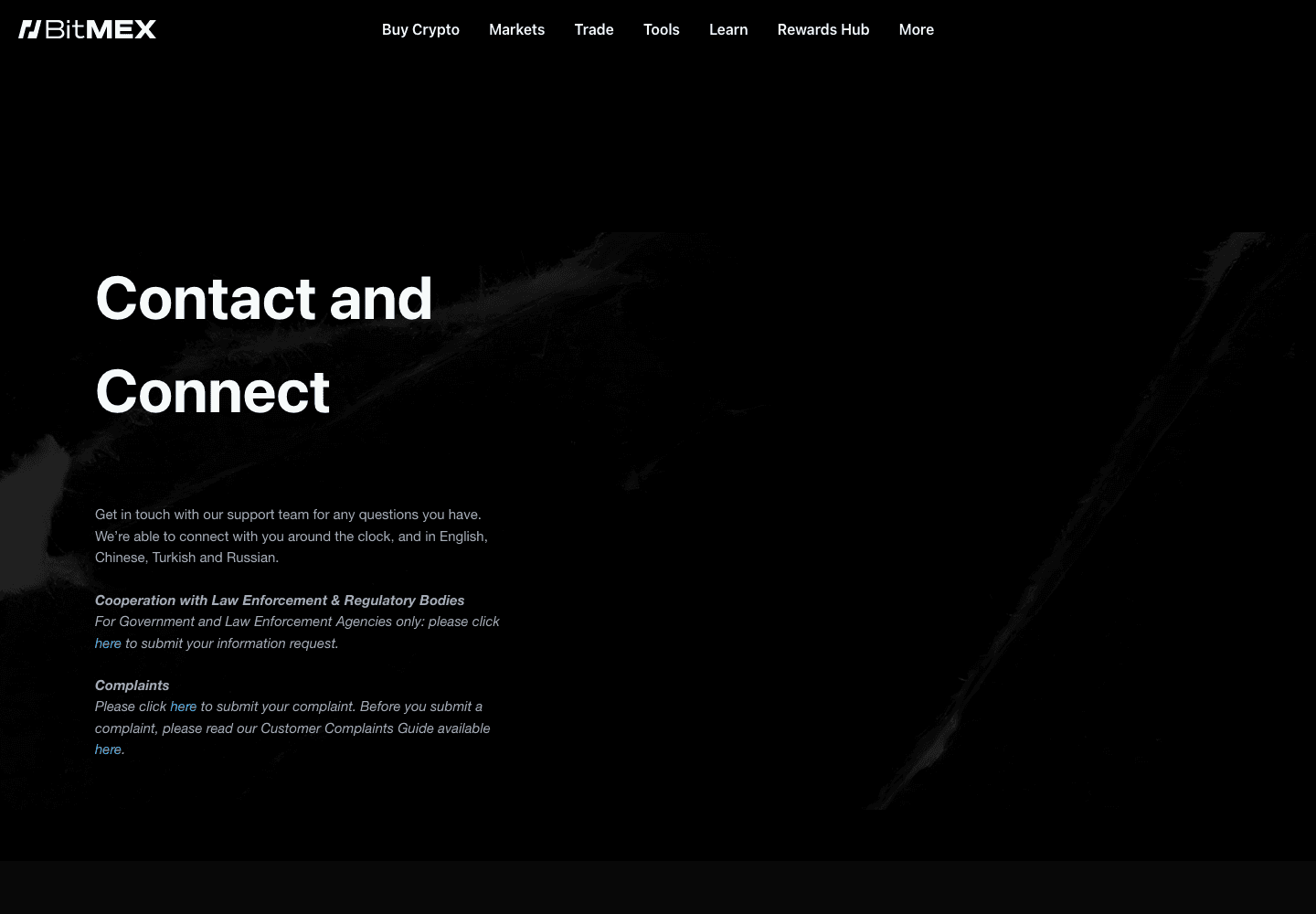
The ticket form routes by category, and the current list is itself informative. Alongside the ordinary Deposit, Withdrawal, Login and Fees options sit “Exchange Closure”, “Withdrawal Disabled”, “Account Disabled” and “Potential Hack”. There is a separate channel for law enforcement and regulatory requests, a PGP key for encrypted communication, and a Telegram announcements channel. The help centre runs to 498 articles, which we enumerated through its own public interface rather than by browsing it, and it is genuinely deep on mechanics: margin, liquidation, funding, auto-deleveraging and risk limits each have several articles with worked formulae.
Where BitMEX is better than most is that it publishes a complaints procedure with dates attached, which is rare in this industry. A complaint is acknowledged within 5 Seychelles business days with a reference number. A Customer Complaints Officer reviews it, and for a straightforward matter such as a fee dispute BitMEX aims to resolve within 20 Seychelles business days of acknowledgement. A written decision explaining whether the complaint was upheld and why follows within 10 Seychelles business days of resolution. If you are unhappy you can request an internal re-evaluation within 5 Seychelles business days, provided you bring new information, and after that “you may escalate the matter to the Seychelles Financial Services Authority (FSA)”. BitMEX undertakes to supply the contact details.
Two things to weigh against that. The timetable is slow for an exchange with six weeks left: a complaint filed today about a stuck withdrawal could reach its written decision after the exchange has closed. And the escalation route now leads to the regulator that has published BitMEX’s wind-up notice, which cuts both ways. The FSA is watching, has approved the winding-down plan and invites clients who cannot get a satisfactory response to contact it directly at its published address, which is a genuine second door. But it is not a compensation scheme and it cannot pay you.
On incident response, which is what the support criterion should really measure at an exchange, the record is good. The status page carries real postmortems naming causes such as disk degradation, feedback loops in rate limiting and failed insurance fund reallocation. The 2019 auto-deleveraging failure was disclosed in full, users were contacted individually, and compensation was paid at the best price of each contract. Communication about the closure itself has been early, specific and repeated across the site, the announcement interface and the blog, and the phishing warning shows an operator thinking about how its users will be attacked. That is not what a firm behaving badly looks like.
Restricted Countries
BitMEX publishes a Restricted Jurisdiction Policy with an actual list, which is more than most offshore venues manage. We found the link inside BitMEX’s own application bundle rather than guessing at it, copied the href exactly as it appeared, and fetched the Restricted Jurisdiction Policy, which returned HTTP 200 with 147,611 bytes. It says BitMEX does not provide services to:
- US Persons, defined separately in a dedicated document on the site.
- Natural or legal persons resident or established in Cuba, Iran, the Democratic People’s Republic of Korea, Crimea and Sevastopol, the Donetsk People’s Republic, the Luhansk People’s Republic, Kherson Oblast and Zaporizhzhia Oblast, which it groups as Sanctioned Jurisdictions.
- Natural persons who are nationals of Cuba or the Democratic People’s Republic of Korea, wherever they live.
- Natural or legal persons resident or established in Seychelles, Bermuda, Hong Kong SAR, Canada and Myanmar, which it groups as Restricted Jurisdictions.
- Russian nationals or residents who access the services from the European Union, unless they are resident in the EU or Switzerland or hold dual EU or Swiss nationality and live outside Russia, and legal persons located in Russia whose authorised persons access from the EU.
The fourth line is the one to sit with. Seychelles is where HDR Global Trading Limited is incorporated, and Seychelles residents may not use the exchange. Hong Kong is a restricted jurisdiction and BitMEX’s careers page lists it as a location for its talent community, alongside Singapore. Bermuda is restricted and one of the five companies named in the 2020 CFTC complaint was HDR Global Services (Bermuda) Limited. This is the normal shape of offshore financial services and it is not unlawful, but it deserves saying in plain words: the places that know this business best are the places it will not serve.
Enforcement of these lines is by geoblocking plus what you tell BitMEX during verification. The terms reserve the right to block or geoblock, forbid circumvention including by virtual private network, and state that if BitMEX determines you are accessing from a restricted jurisdiction or gave false representations about your location it may close your account or take any action it deems necessary, with no responsibility for the losses that follow. The compliance page confirms sanctions screening through third-party vendors alongside geoblocking, against OFAC, EU, UK, Singapore, Canada, Swiss, Italian and UN lists.
Separate and narrower lists exist for the fiat rails. The Mercuryo on-ramp is unavailable in about 59 countries, and while some of those (Cuba, Iran, North Korea, Myanmar, Crimea) are already off limits at BitMEX, most are not. China, Russia, Saudi Arabia, Pakistan, Chile, Colombia, Iceland and Morocco are all on Mercuryo’s list and none of them is restricted by BitMEX itself, so a user there can trade but cannot buy crypto with a card. The BMEX token is unavailable to the same population as the exchange. The mobile applications may or may not appear in a given country’s app store, and BitMEX directs users outside restricted jurisdictions to an Android package file or a home-screen web shortcut instead.
One honest limit on what we can tell you. Our ten country-targeted vantage points were Indonesia, Thailand, Vietnam, Singapore, Japan, India, the UAE, South Africa, the UK and Germany, and none of them is a Restricted Jurisdiction, so we never observed a block being applied. We retrieved the policy page from nine of those ten, the proxy returning bodies of 148,510 characters from eight of them and 147,493 from the UK exit, the difference being a Cloudflare challenge script rather than any change of content. The South African exit returned HTTP 200 with zero bytes on both attempts, which is a fact about our proxy and not about the page. The restricted-country wording was identical in all nine, so unlike many brokers BitMEX is not showing different countries a different list.
Conclusion
BitMEX is closing on 23 September 2026 at 04:00:00 UTC, and it stopped taking new accounts on 23 July 2026. For any reader deciding where to open an account, that ends the assessment. For the roughly two million people the exchange claims to have served, the assessment is about one thing: getting your money out, in good order, before the deadline.
On that narrow question the picture is better than the headline suggests, with one caveat that has grown since we first looked. Reserves exceed liabilities on every figure BitMEX publishes: its page showed 102% on both 29 July and 12 August 2026, and the Bitcoin proof it published on 11 August, which anyone can download and check, shows 10,134.1693 BTC against 10,129.2965 BTC. That is a real margin, though at 100.05% a much thinner one than the page advertises, and the per-asset proof files for every asset other than Bitcoin have not been published since 21 July. The Seychelles FSA has approved a winding-down plan requiring the return of client assets and has invited clients who cannot get a satisfactory answer to contact it directly. BitMEX has warned its own users about phishing, told them plainly that no expedited withdrawal service exists, and said it expects delays. There is no history of a sustained withdrawal halt in eleven years, and no evidence of customer funds lost to a hack. Compared with the way exchange failures usually go, this is an orderly exit conducted by people who appear to be trying.
The rest of the record is a study in the difference between a settlement and a conviction, and it is worth getting right. In 2020 the CFTC charged five BitMEX companies and three founders, and the Southern District of New York indicted four individuals. The 2021 penalties, 100 million USD from the CFTC and 100 million USD from FinCEN, were consent settlements in which the companies neither admitted nor denied anything and no court tried the allegations. The most quoted numbers in BitMEX’s history, the 209 million USD of transactions with darknet markets and the 588 unfiled suspicious activity reports, live inside that unadmitted settlement. What was admitted came later: four individuals pleaded guilty to Bank Secrecy Act offences and were sentenced in 2022, Arthur Hayes to six months of home detention, two years of probation and a 10 million USD fine, and the company itself pleaded guilty on 10 July 2024 and was sentenced on 15 January 2025 to a 100 million USD fine and two years of probation. On 27 March 2025 all five were granted full and unconditional presidential pardons, remitting the fines and the probation. The convictions stand as facts; the sentences no longer bind anyone.
Set against that, BitMEX never held a licence anywhere. Its one attempt was an application to the Seychelles FSA filed on 18 December 2024, under which it traded on transitional permission for nineteen months before withdrawing it. There is no entry for any group company in ESMA’s MiCA registers, authorised or non-compliant, and no authorised entity on the FCA register despite terms governed by English law. The FCA has instead carried a warning naming www.bitmex.com since March 2020, telling UK consumers they would have no Ombudsman access and no compensation scheme. Nobody insures a balance held here.
Two things about the site itself should temper any impression of tidiness. The advertised 250x leverage is not supported by BitMEX’s own risk-limits table or its own instrument data, both of which cap base initial margin at 1.00%, which is 100x, and the effective ceiling falls further as positions grow. And the marketing has not caught up with the decision: a registration page that says sign-ups are disabled still runs a 5,000 USD welcome offer beside it, and a security page that has stopped accepting members still ends with a button reading “Join The Safest Exchange”.
Our score of 6.1 out of 10 reflects a solvent, technically strong, unusually transparent exchange that never obtained a licence, carries a pardoned but real criminal conviction, advertises leverage its own data does not support, and is switching itself off. If you hold a balance there, withdraw it now rather than in September, and do not pay anyone who offers to move you up the queue. If you do not, there is nothing here to join.
Score history
Recomputed daily; every move is on the record. The current score is always the latest row.
| Date | Score | Move |
|---|---|---|
| 2026-09-13 | 6.1 | ▼ |
| 2026-09-13 | 6.3 | ▲ |
| 2026-09-12 | 6.2 | · |
FAQ
Is BitMEX regulated and safe?
BitMEX has never held a financial services licence. HDR Global Trading Limited operated as a transitional entity under the Seychelles Virtual Asset Service Providers Act 2024 after applying for a licence on 18 December 2024, and withdrew that application on 23 July 2026. We found no entry for any BitMEX group company in ESMA’s MiCA registers of authorised or non-compliant crypto asset service providers, and no authorised firm on the FCA register, which instead carries a warning naming www.bitmex.com last updated on 20 March 2020. On safety of funds, the picture is better than the licensing position: the proof of reserves page showed a 102% ratio on 12 August 2026, the Bitcoin proof published on 11 August shows reserves of 10,134.1693 BTC against liabilities of 10,129.2965 BTC, and the wind-down is running under a plan approved by the Seychelles FSA. Note that the per-asset proof files for assets other than Bitcoin have not been published since 21 July 2026. There is no compensation scheme of any kind.
Why is BitMEX closing and what should I do about it?
BitMEX announced on 23 July 2026 that the board of HDR Global Trading Limited decided to close the exchange following a strategic review of the business and the wider crypto industry. It closes on 23 September 2026 at 04:00:00 UTC. If you hold a balance, close your positions and withdraw as soon as you practically can rather than waiting for the deadline. From 26 August 2026 at 04:00:00 UTC you can only reduce positions, BitMEX may force close what remains at its own discretion, and anything left in the account after the closure attracts a monthly charge of 50 USD equivalent or 1% a year, whichever is greater. Ignore anyone offering to speed up your withdrawal, because BitMEX has stated no expedited service exists.
What actually happened with BitMEX and US regulators?
Three separate things that are often reported as one. In October 2020 the CFTC filed a civil complaint against five BitMEX companies and three founders, and prosecutors in the Southern District of New York indicted four individuals. In August 2021 the companies settled with both the CFTC and FinCEN for 100 million USD each, and both settlements were explicit that nothing was admitted or denied and no court tried the allegations. Then came the admissions: Arthur Hayes, Benjamin Delo, Samuel Reed and Gregory Dwyer each pleaded guilty to Bank Secrecy Act offences and were sentenced in 2022, and the company itself pleaded guilty on 10 July 2024 and was sentenced on 15 January 2025 to a 100 million USD fine and two years of probation. On 27 March 2025 the company and all four individuals received full and unconditional presidential pardons, which remitted the fines and probation but did not undo the convictions.
How much leverage does BitMEX really offer?
The site advertises up to 250x. We could not verify that figure from any of BitMEX’s own data. Its risk and open interest limits page lists a base initial margin of 1.00% as the lowest figure in the whole table, XBTUSD included, and the public instrument endpoint returned the same 1% floor across all 111 active instruments on 29 July 2026 and all 62 remaining on 12 August 2026. One percent initial margin is 100x, and the trading application’s own page description says 100x. Leverage also falls as positions grow, because risk limit steps raise the margin requirement: one step above the base limit on XBTUSD takes initial margin to 1.50%, or roughly 67x.
What happens to my position if the insurance fund runs out?
You get auto-deleveraged. When a liquidated position cannot be closed at or better than its bankruptcy price, BitMEX spends the insurance fund trying to close it, and if that is not enough the system force closes profitable positions on the opposite side at the bankruptcy price of the liquidated order. Priority is ranked by profit percentage multiplied by effective leverage, so the most profitable and most leveraged traders go first, and the position indicator shows your place in the queue. The fund held 3,698.8481 BTC and 30,577,179.91 USDT on 12 August 2026, but it is allocated per contract rather than pooled, so the balance behind any single contract can be far smaller than the headline. BitMEX’s risk disclosure also states that the fund is not an insurance product and users have no interest in it.
How this review works
Track BitMEX live: score moves and red notices, in your pocket.