
PROP · CHECKED 13 SEP 2026
Earn2Trade review.
US futures evaluation firm offering a real live-funded route through NFA registered FCMs, taken by 5.23% of qualifying traders, with the other 94.77% trading a simulation.
RISKY
OUT OF 10
Earn2Trade LLC is a Wyoming company selling futures evaluations and a $249 course. Unlike the prop firms reviewed here so far it offers a genuine live-funded account at NFA registered futures commission merchants, and it publishes its pass rate, its withdrawal rate and the fact that 94.77% of qualifying traders took the simulated LiveSim instead. It does not pay traders itself. Three unregulated proprietary firms do, and the most recent accounts of one of them, Appius Trading Limited, report shareholders' funds of minus 125,215 pounds.
Each criterion is scored 1 to 10 from primary sources. The overall score is their unweighted mean. How scoring works.
| Founded | 2017 |
|---|---|
| Headquarters | US |
| Platforms | ninjatrader, tradovate, tradingview, rithmic, sierra_chart, multicharts, quantower, bookmap |
- A genuine live-funded route exists, carried at futures commission merchants we confirmed as NFA member approved on BASIC
- Names its brokerages and its proprietary trading partners in public, which its own published Pledge commits it to doing
- Publishes a 2025 pass rate of 8.89% and the share of funded accounts that withdrew anything, around 18%
- Publishes the split between real and simulated funding, 5.23% Live against 94.77% LiveSim, a number that damages its own marketing
- Drawdown, daily loss and consistency rules come with worked numeric examples in a help centre reachable without a login
- We found no clause reserving a discretionary right to refuse a payout that a trader has properly earned
- No consistency rule, no minimum trading days and no buffer requirement once funded, each stated explicitly
- Five trading platforms free including NinjaTrader, Tradovate and TradingView, with fifteen more supported
- Commissioned a third party compliance audit in 2023 and published it in full, criticisms included
- Site, help centre and support run in five languages, and challenges remain on sale with no sign of funding stopping
- Earn2Trade does not pay traders; three unregulated proprietary firms do, and none appears on NFA BASIC
- Appius Trading Limited has now reported negative net assets two years running, minus 125,215 pounds at 30 September 2025, with creditors up about a quarter
- Helios Trading Partners publishes no company number, registered address or jurisdiction on any of its three web pages
- Kronos Proprietary Trading holds a Ras Al Khaimah free zone trade licence, not a financial authorisation, and its homepage carries placeholder Latin
- The evaluation is a recurring monthly subscription, list price $150 to $550, that rebills until you pass or cancel
- The headline price is a rotating introductory discount; the subscription reverts to the $150 to $550 list ladder
- A non US trader taking the advertised $100 minimum withdrawal pays a flat $50 to Rise to receive it
- The 50% profit split on smaller withdrawals penalises exactly the trader who wants to reduce counterparty exposure
- A funded LiveSim is capped at $1,750 on a TCP25, after which the simulated stage ends and only a Live account continues
- Product page FAQ copy still states a 10 day minimum trading requirement that the firm has since removed
Overview
Earn2Trade LLC is a Wyoming company that sells futures trading evaluations and a futures course. It has been trading, in its own words on its affiliate page, “in business since 2017”, and its homepage counter reads “9+ YEARS”. It is not a broker and does not claim to be. Its help centre answers the question directly: “We are an educational institution and do not require licensing by any financial regulatory authority.” For a prop firm that is the normal position rather than a finding, because Earn2Trade never holds a penny of anyone’s trading capital. The questions that decide whether a reader loses money here are different ones, and unusually for this sector Earn2Trade answers most of them in public.
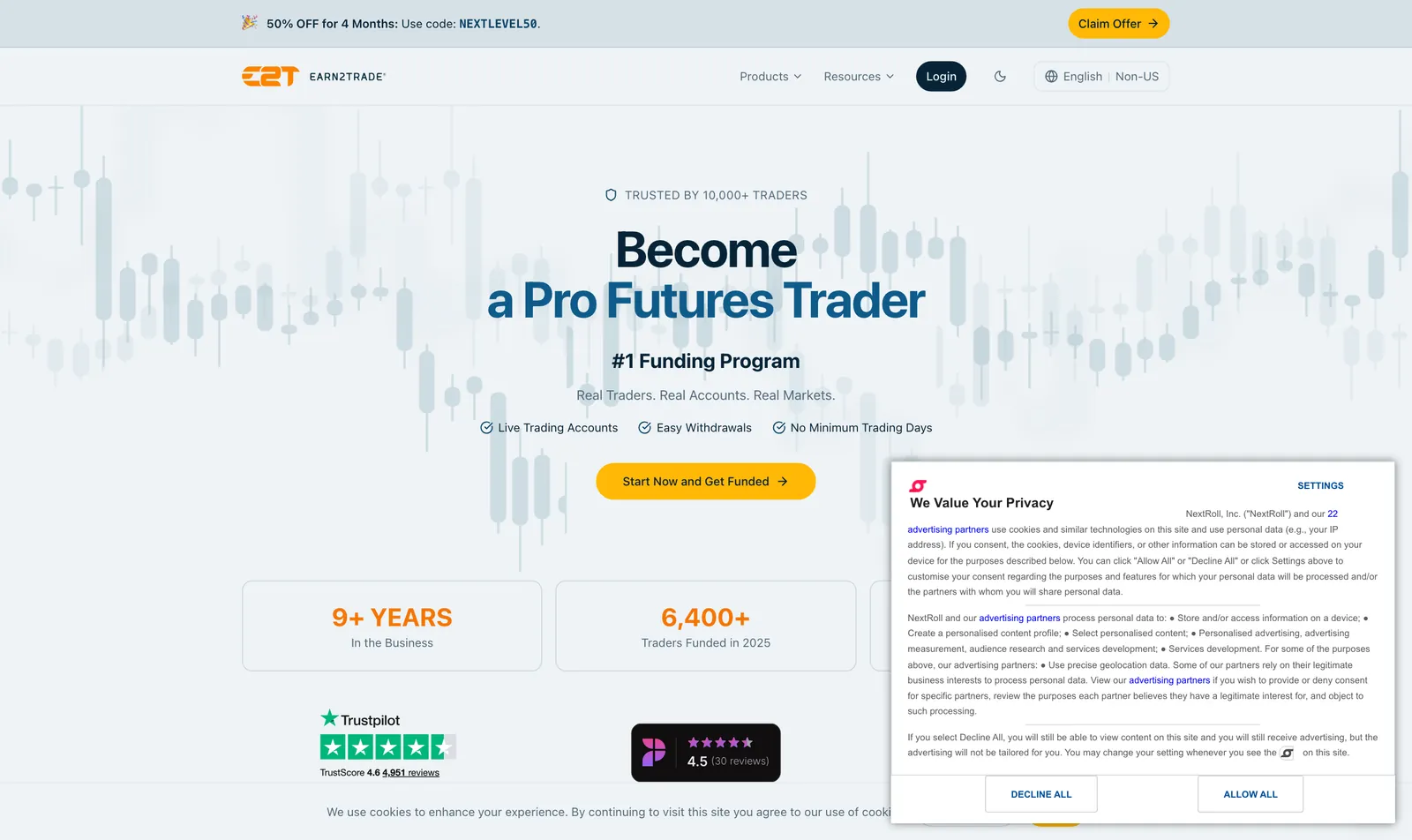
The first question is whether the funded account is real money or a simulation. Here the honest answer is both, and the split is heavily towards simulation. Pass an evaluation and you are offered a choice of two funded accounts. The firm describes them on the same product page: the LiveSim account is to “Trade with simulated capital using real-time market data”, and the Live account is to “Trade with real capital and withdraw your profits”. The Live route is genuine, it runs through named futures commission merchants, and that separates Earn2Trade from the five other prop firms we have reviewed, where the funded stage was simulated and nothing else was on offer. But Earn2Trade’s own footer disclosure records how the choice actually falls: “Of candidates who passed either exam or progressed in the Trader Career Path®, 5.23% traded a Live account, and 94.77% traded a LiveSim® account.” Nineteen out of twenty funded traders in 2025 traded a simulation.
The second question is who owes you the money, and this is where the review turns. Earn2Trade does not pay traders. It hands a passing candidate to a proprietary trading firm, and its help centre names three: Helios Trading Partners, Appius Trading Limited and Kronos Proprietary Trading. Appius Trading Limited is a UK company, number 12861479, and its most recent accounts, for the year ended 30 September 2025 and filed on 3 August 2026, show shareholders’ funds of minus 125,215 pounds: 46,422 pounds of cash and 35,070 pounds of debtors against 206,707 pounds of creditors falling due within a year. Those filings are current rather than late, and the deficit narrowed slightly year on year, but creditors grew by about a quarter. Helios Trading Partners publishes no company number, no registered address and no jurisdiction on any of its three web pages. Kronos holds a Ras Al Khaimah free zone trade licence, not a financial authorisation, and its homepage still carries unedited placeholder Latin. Full detail is in the Company and Accountability section, because it is the most consequential thing on this page.
Overview Table
| Headquarters | Earn2Trade LLC, 30 N Gould St STE 4000, Sheridan, WY 82801, United States. Franchise partner Bahia Education Services LLC, Dubai |
| Established | 2017, per the firm’s own affiliate page. Site copyright reads 2026 |
| Countries Served | Worldwide except 25 countries excluded from funding for sanctions or other reasons. Ten country-targeted fetches returned one identical page |
| Regulated By | Nobody. Earn2Trade states it is an educational company that requires no financial licence, which is correct for a firm holding no client money |
| Minimum Deposit | None. No trading account is ever funded by the trader. The entry cost is a recurring subscription from $150 a month at list, with a standing introductory discount that has been running at 50% for the first months |
| Maximum Leverage | Not applicable. Contract limits apply instead: 3 contracts on a TCP25, rising to 16 on a $200,000 account |
| Total Instruments | Futures only, on CME, CBOT, NYMEX and COMEX, including micros. No forex, stocks, options, CFDs or crypto |
| Platforms | NinjaTrader, Finamark, Tradovate, TradingView and R Trader Pro free, plus fifteen further third party platforms on the trader’s own licence |
| Customer Support | Live chat, email, WhatsApp, Telegram and Discord, with a published two business day response commitment. No telephone support |
| Languages | English, Spanish, Portuguese, French and Arabic across the site and the help centre |
Facts List
- Two funded routes exist. LiveSim uses simulated capital, Live uses real capital at a futures commission merchant, and the firm publishes the split: 5.23% Live against 94.77% LiveSim in 2025.
- Earn2Trade publishes its pass rate: “In 2025, 8.89% of candidates passed the Trader Career Path® / Gauntlet Mini™ examinations.”
- It also publishes how many funded accounts ever paid out: “In 2025, 18.04% of Live accounts and 18.20% of LiveSim accounts had at least one withdrawal from them.”
- Subscriptions are recurring monthly, not one off. The purchase page shows $150 for a TCP25, $190 for a TCP50 and $350 for a TCP100, with a rotating discount code cutting that by half for the first few months.
- Profit split is 50% on a withdrawal under the account’s threshold and 80% at or above it. A TCP400 account is a fixed 60/40 split.
- A funded LiveSim account is capped: $1,750 total on a TCP25, $5,000 on any Gauntlet Mini. Reaching the cap ends the LiveSim stage and forces a move to a Live account.
- Withdrawals are weekly on Wednesdays, requested by email to the proprietary firm by 2:00 PM CT the previous Friday, with a $100 net minimum.
- The transfer fee is $50 per withdrawal via Rise for non US traders, against that same $100 minimum. A first payout from a funded LiveSim also absorbs a one time $139 activation fee, which applies to LiveSim holders with non professional CME status and not to Live accounts.
- NFA BASIC returns Dorman Trading LLC (NFA ID 0002569) and Phillip Capital Inc (0422202) as approved futures commission merchants. Earn2Trade names “NinjaTrader”, and the registered FCM under that brand is NinjaTrader Clearing LLC (0309379). Edge Clear LLC (0524928) is registered as an Introducing Broker, not an FCM.
- None of the three proprietary firms that would actually owe a trader money appears on NFA BASIC, which is normal for a firm trading its own capital and is also why no US regulator supervises the payout.
Key Takeaways
- The funded account can be real, and usually is not. Earn2Trade offers a genuine Live account at a registered futures commission merchant, and its own disclosure says only 5.23% of qualifying traders took one in 2025 while 94.77% traded the simulated LiveSim.
- The company you buy from is not the company that pays you. Earn2Trade sells the evaluation. Helios Trading Partners, Appius Trading Limited or Kronos Proprietary Trading offers the funded account and processes the payout.
- One of those three is balance sheet insolvent on its own filings. Appius Trading Limited reported shareholders’ funds of minus 125,215 pounds at 30 September 2025, its second consecutive year of negative net assets, with creditors up about a quarter on the year before.
- The FCM chain is real and checkable. Dorman Trading, Phillip Capital and NinjaTrader Clearing all appear on NFA BASIC as futures commission merchants with membership status “NFA Member Approved”, which we queried directly.
- Transparency is genuinely above sector norm. Pass rates, withdrawal rates, drawdown arithmetic, the FCM list and a third party compliance audit are all published without a login.
- The subscription is the cost most buyers underestimate. It rebills every 30 days at $150 or more once any introductory discount lapses, until you pass or cancel.
- Withdrawal fees bite hardest at the minimum. A non US trader taking the stated $100 minimum via Rise pays a flat $50 for the transfer, half the payout.
- Stale copy contradicts a recent rule change. Earn2Trade removed the minimum trading day requirement, but a product page FAQ still tells buyers “The minimum trading requirement is 10 days”.
- Challenges are on sale and nothing suggests funding has stopped. A live promotional banner and a working checkout were present throughout our checks.
- Roughly one in sixty new subscriptions leads to a payout. Combining the firm’s own 8.89% pass rate with its own 18% withdrawal rate gives about 1.6%.
Company & Accountability
There is no licence to check here and looking for one would waste the reader’s time. Earn2Trade holds no client money, executes no orders and takes no deposits, so no financial regulator has jurisdiction over it. Its help centre says exactly that: “We are an educational institution and do not require licensing by any financial regulatory authority. That said, of course we are still regulated by all of the same laws that any non-finance related companies must follow.” The Pledge adds a further disclaimer, that Earn2Trade “Recognize[s] that it is not a registered Commodity Trading Advisor (CTA) and refrain[s] from providing any specific or tailored trading advice”. Both statements are accurate. The question worth answering is what happens when a funded trader is not paid, and that turns on which company owes the money.
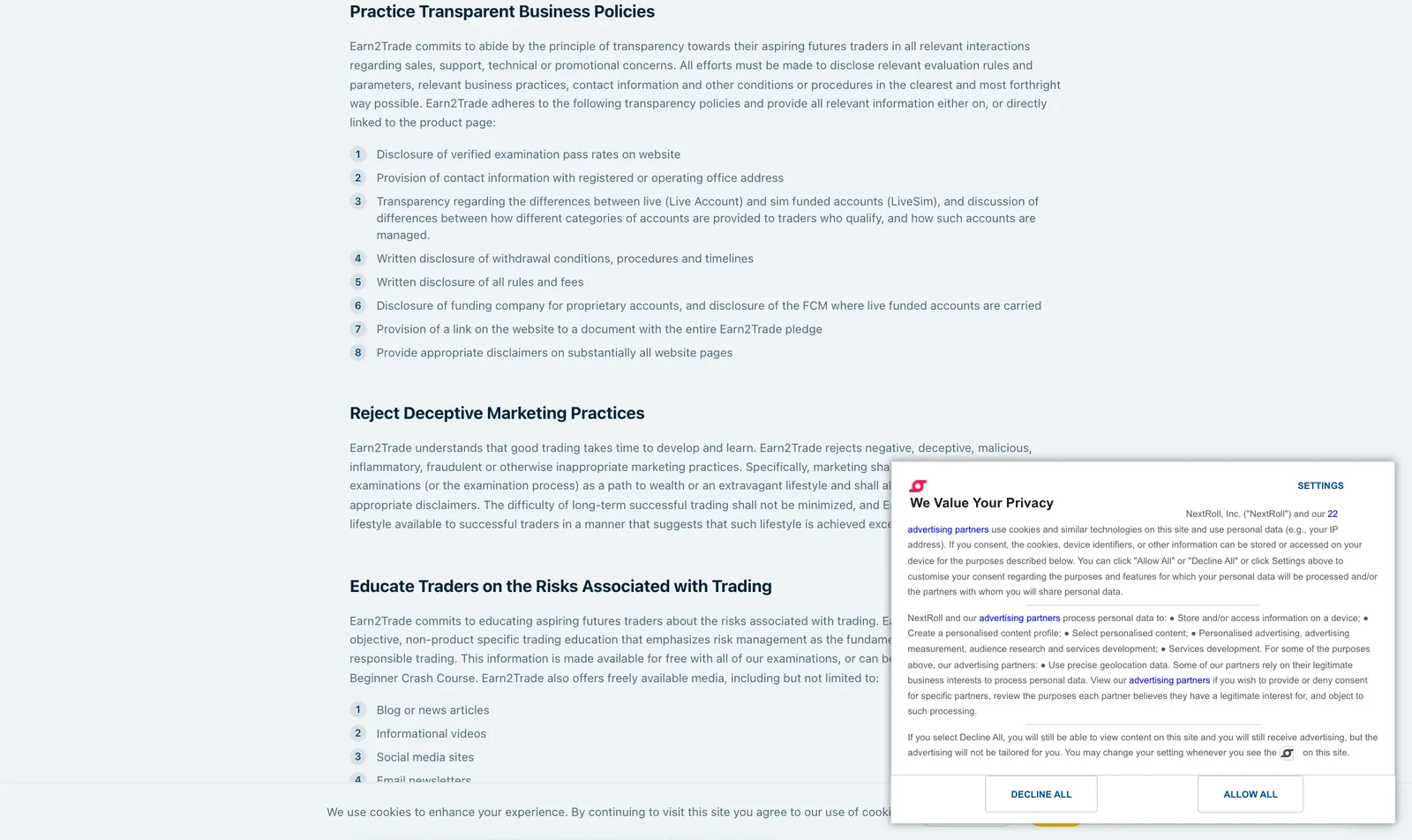
Earn2Trade’s own Pledge makes this checkable. Among eight published transparency commitments it undertakes to provide “Disclosure of funding company for proprietary accounts, and disclosure of the FCM where live funded accounts are carried”. It keeps that promise. A help centre article updated 7 November 2025 names three proprietary partners, and another updated 12 November 2025 names the brokerages. We took those names to NFA BASIC and queried the register directly through its own search endpoint on 29 July 2026. Here is what BASIC returned.
| Firm named by Earn2Trade | Role claimed | NFA BASIC result | Regulatory actions on record |
| Dorman Trading LLC | Live account brokerage | NFA ID 0002569, Chicago IL, Futures Commission Merchant, NFA Member Approved | 25 |
| Phillip Capital Inc | Live account brokerage, “Legacy connection” | NFA ID 0422202, Chicago IL, Futures Commission Merchant, NFA Member Approved | 8 |
| NinjaTrader (registered entity NinjaTrader Clearing LLC, our identification) | Live account brokerage | NFA ID 0309379, Chicago IL, Futures Commission Merchant, NFA Member Approved. The same NFA ID also returns for Tradovate | 5 |
| Edge Clear LLC | Live account brokerage | NFA ID 0524928, Chicago IL, Introducing Broker, NFA Member Approved | 0 |
| Lunaro Markets Limited | Live account brokerage | No firm of that name returned | Not applicable |
| Helios Trading Partners | Proprietary trading partner | No firm of that name returned. A search on “Helios” returns ten unrelated firms | Not applicable |
| Appius Trading Limited | Proprietary trading partner | No firm of that name returned | Not applicable |
| Kronos Proprietary Trading | Proprietary trading partner | No firm of that name returned | Not applicable |
| Earn2Trade LLC | Evaluation provider | No firm of that name returned | Not applicable |
Read that table the right way round. The three futures commission merchants are real, supervised firms, and a trader on a genuine Live account has an order reaching a real exchange through one of them. Edge Clear is registered as an Introducing Broker rather than an FCM, so an account introduced through it is carried at a clearing FCM that the help centre article does not name. The proprietary firms returning nothing is not itself a criticism: a firm trading its own capital is not required to register, so an empty result is the expected one. What it means for the reader is precise and worth stating plainly. The entity that holds the trading account, decides your payout and transfers your money is supervised by no US regulator, is not an NFA member, and your balance is not customer segregated funds.
So the accountability question becomes a corporate one, and the corporate record is where this review stops being comfortable. Appius Trading Limited is registered at Companies House under number 12861479, incorporated 7 September 2020, registered office Sterling House, Fulbourne Road, Walthamstow, London E17 4EE, SIC code 64991, security dealing on own account. Its filings are current. The abridged unaudited accounts for the year ended 30 September 2025, signed 27 July 2026 and filed on 3 August 2026, report debtors of 35,070 pounds, cash at bank of 46,422 pounds, creditors falling due within one year of 206,707 pounds, net current liabilities of 125,215 pounds and shareholders’ funds of minus 125,215 pounds. The comparatives for 30 September 2024 were nil debtors, 36,032 pounds of cash, 165,613 pounds of creditors and shareholders’ funds of minus 129,581 pounds. So the deficit narrowed by about 4,000 pounds while creditors grew by roughly a quarter, and the company has now reported negative net assets two years running. These are abridged small company accounts prepared under the audit exemption in section 477 of the Companies Act 2006, with no income statement delivered, so they show no turnover, and margin posted at a futures commission merchant would not necessarily appear as cash at bank. Every one of those caveats is real. None changes the fact that the only public financial statement of a company named as a payer of traders’ profits reports negative net assets.
The rest of the Appius record is worth knowing. The company has one director and one person with significant control, Csaba Ferenc Nahoczky, a Hungarian national resident in Hungary, and a compulsory strike off action against it was discontinued on 9 September 2023. Its former controlling shareholder, Danubia Holdings Limited, was dissolved on 16 January 2024. The same director’s Companies House record shows six UK appointments, five of them dissolved, including a Helios Traders Limited incorporated on 4 September 2020 and dissolved on 29 December 2020. We could not establish whether that dissolved company has any connection to Helios Trading Partners LLC, and we do not assert one.
Helios Trading Partners is the first name on Earn2Trade’s list and the one whose welcome email appears in the firm’s own 2023 audit. Its website runs to three pages, a homepage, an About page and a Careers page. None of them carries a company number, a registered address, a state of incorporation or any jurisdiction; the only identifying text is the footer line “Copyright 2026 Helios Trading Partners LLC” and an email address. What the Careers page does supply is a reciprocal disclosure of the relationship, describing Earn2Trade as “Our partner” and routing beginner traders to it for education, which is useful corroboration that the two firms are connected as Earn2Trade describes. The About page also states that Helios trades “the futures and forex markets” and that its members “trade with the company’s own funds and do not take investors on board”. Kronos Proprietary Trading LTD publishes more: it states it “operates under License No. 07010440, issued by the Ras Al Khaimah Digital Assets Oasis Authority” with a primary activity of “Proprietary Trading for Real World Assets”. That is a free zone trade licence, which is a permission to do business rather than a financial services authorisation, and the same homepage still carries an unedited block of placeholder Latin beginning “Zullam nulla eros ultricies”.
One clause deserves airing because it is the only thing we found capable of undermining the finding that the Live account is real. Earn2Trade’s Terms, in the passage on prohibited conduct, refer to maintaining “the integrity of all trading simulations, including the LiveSim® and Live Trading environments”, a phrase that on a strict reading pulls the Live account inside the category of simulation. We judge that loose drafting rather than a disclosure, and the weight of the firm’s own evidence runs the other way: the product pages distinguish “simulated capital” from “real capital” in adjacent columns, the two account types carry different drawdown mechanics and different data fee liabilities, the brokerages are named, and above all the firm’s 2023 audit records that the auditor was given real broker statements for the live accounts. A simulation does not generate daily activity statements at a clearing FCM. Readers should still know the sentence exists.
Earn2Trade’s own recourse terms sit on top of all that. The Terms and Conditions are governed by Wyoming law, disputes go to non binding mediation and then to binding arbitration under the Commercial Arbitration Rules of the American Arbitration Association in Austin, Texas, any claim must be brought within one year, and liability is capped: “IN NO EVENT SHALL THE MAXIMUM CUMULATIVE LIABILITY OF E2T IN CONNECTION WITH THE SERVICE AND/OR THIS AGREEMENT, REGARDLESS OF THE FORM OF ACTION, EXCEED THE AMOUNT OF THE PAYMENTS MADE TO E2T FOR THE SPECIFIC SERVICE(S) GIVING RISE TO SUCH CLAIM IN THE ONE MONTH PERIOD PRIOR TO SUCH CLAIM.” On a $150 subscription, that ceiling is $150. And it binds Earn2Trade, which is not the company that would be withholding a payout.
Two things we could not check, stated as facts about us rather than about anyone else. We did not reach the Wyoming Secretary of State’s business register: it serves an automated bot challenge to plain HTTP clients, which we do not defeat, and Bright Data refuses government hosts outright and returns its own synthetic 502. So we have no independent confirmation of Earn2Trade LLC’s Wyoming filing status, only the address the firm publishes, which is a Sheridan registered agent suite used by very large numbers of companies. We also found no register entry for Lunaro Markets Limited on NFA BASIC, which for a non US brokerage is unsurprising, and we did not identify which authority, if any, licenses it.
How to Trade
Trading at Earn2Trade happens in three stages and the rules change at each one. Stage one is the evaluation, a virtual account carrying live CME market data. Stage two is a funded account, either the simulated LiveSim or a Live account at a futures commission merchant. Stage three is the growth plan, a ladder of larger Live accounts unlocked by hitting a profit target and withdrawing your share at each rung. The instrument set never changes: futures only, on CME, CBOT, NYMEX and COMEX.
Execution runs through Rithmic during the evaluation, and the firm is direct that you have no choice: “In the E2T evaluation stage you will have to use the data feed provider offered by E2T (currently we work with Rithmic).” Once funded you may bring a professional feed such as CQG, CTS or Trading Technologies, but only for charting. Orders still have to go through the prop firm’s feed, and the help centre spells out the consequence: “You will not be able to view charts or P&L through the Helios data feed if you opt to use your own professional data.” Charting in one application and executing blind in another is a workable arrangement for a trader who has done it before and an unpleasant surprise for one who has not.
Commissions are charged from the first evaluation trade, which is unusual and is to the firm’s credit. Earn2Trade applies what it calls a live commission schedule to evaluation accounts, “reflecting actual market conditions and execution costs”, and gives a worked figure: micro contracts run “from $0.82 to $1.08 per contract per side”. Once funded, the trader carries “FCM commissions, NFA fees, and exchange fees per trade”, deducted directly from the account balance. A trader scalping micros at three contracts a side will burn several dollars a round turn before the market moves, and that cost counts against both the profit target and the daily loss limit.
Trading hours are tightly drawn and breaching them is a rule violation rather than an inconvenience. The session opens when the exchange opens for the asset, generally 5:00 PM CT, and “All positions and working orders must be closed by 3:50pm CT until 5pm CT.” Livestock contracts GF, HE and LE must be flat by 1:05 PM CT. The grains, XC, XK, ZC, ZL, ZM, ZS and ZW, must be flat between 7:45 and 8:30 AM CT and again from 1:20 PM CT. No overnight positions are permitted on funded accounts. News trading is explicitly allowed, on the evaluation and on funded accounts alike, which is a genuine difference from firms that void trades around economic releases.
Position size is governed by what Earn2Trade calls the Progression Ladder, and it is the harshest rule in the book. The maximum number of contracts you may hold across all positions rises with your balance, you are expected to police it yourself in real time, and “Exceeding the allowed contract limit is a hard fail and will immediately end the evaluation attempt.” There is no rejection of the oversized order and no warning. Ten micro contracts count as one standard contract towards the limit, which is a sensible concession and the only softening the rule gets.
Prohibited conduct is published as a list rather than left to discretion, which is better practice than most of this sector manages. It covers exploiting platform price errors, spoofing, “Executing an unrealistic number of contracts in a single day”, hedging or pooling risk across connected accounts, “Utilizing software, artificial intelligence, or ultra-fast data entry techniques”, bypassing geographical restrictions and trading on someone else’s behalf. The stated consequences escalate from a warning, through deleting a day’s trading data and resetting the account, to permanently closing it. Trade copiers are banned outright on evaluations and funded accounts, and the help centre version of the penalty is harsher than the Terms: the Terms say a copier user will “receive only one account”, while the help centre says they “may be denied your accounts or withdrawals”.
Challenges & Funding
Earn2Trade sells two evaluations. The Trader Career Path starts small and scales through a growth plan, in three sizes: TCP25 at $25,000, TCP50 at $50,000 and TCP100 at $100,000. The Gauntlet Mini is a single phase evaluation in four sizes, GAU50 through GAU200, where the funded account matches the evaluation size. Both are billed as recurring monthly subscriptions rather than one off fees, which is the single most important commercial difference between Earn2Trade and most of its competitors, and the one a buyer is most likely to miss.
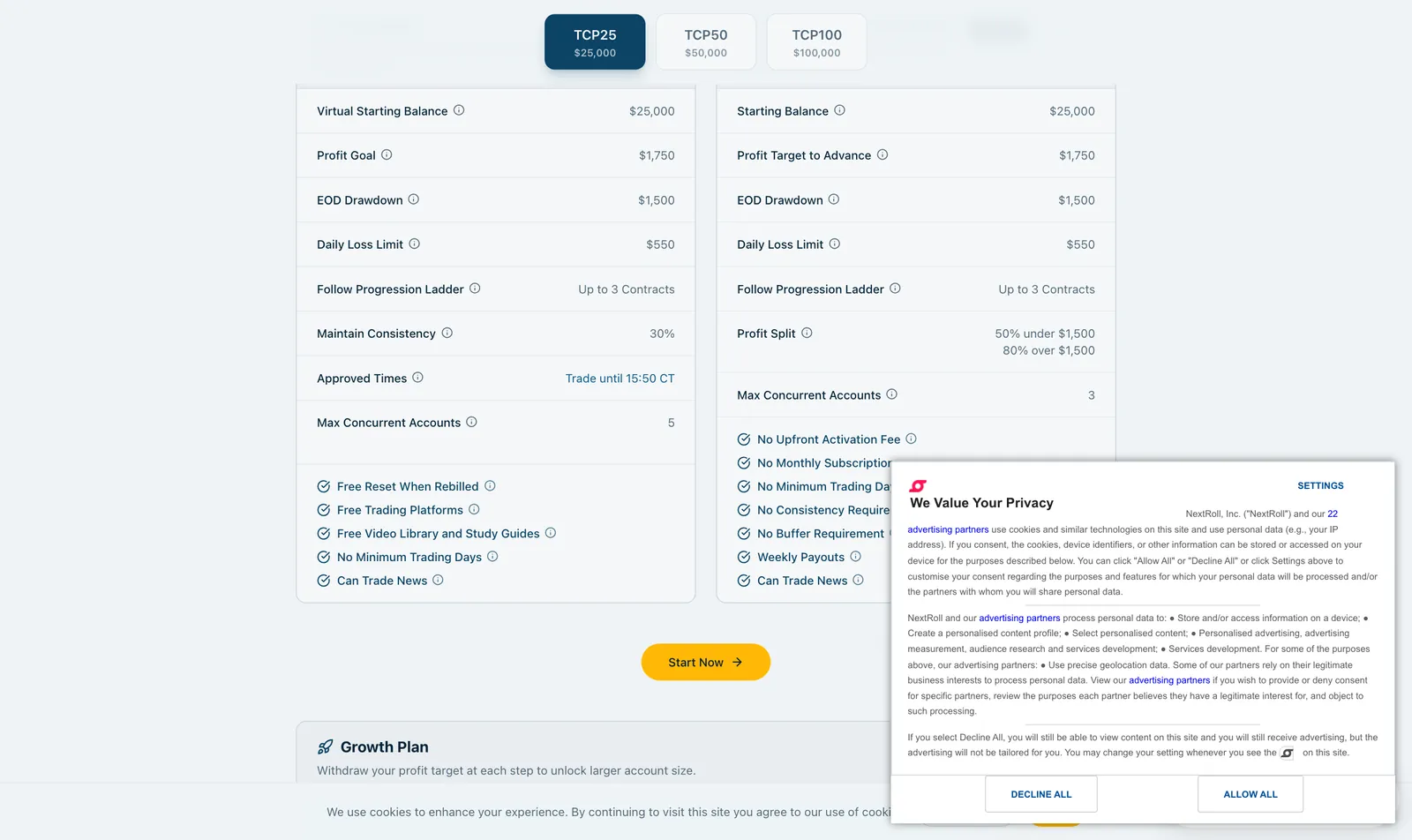
The list prices on the purchase page were $150 a month for a TCP25, $190 for a TCP50 and $350 for a TCP100, unchanged across every check we made. The help centre gives the full ladder across both products: “a recurring subscription fee depending on the package you choose, either $150, $170, $190, $315, $350 or $550.” Those are the numbers to plan against, because the headline price on the homepage is a discount and the discount rotates. On 29 July 2026 the homepage read “From $60” and “From $68”; on 12 August 2026 it read “From $75” and “From $85” beside a banner offering “50% OFF for 4 Months: Use code: NEXTLEVEL50.” A promotion of roughly half price on the opening months appears to be permanent in substance and temporary in wording, so treat any specific code or headline figure in this review as an illustration rather than a quote you can hold the firm to. What does not move is the list price the subscription reverts to.
| Plan | Virtual balance | Profit goal | EOD drawdown | Daily loss limit | Contracts | List price |
| TCP25 | $25,000 | $1,750 | $1,500 | $550 | 3 | $150 a month |
| TCP50 | $50,000 | $3,000 | $2,000 | $1,100 | 6 | $190 a month |
| TCP100 | $100,000 | $6,000 | $3,500 | $2,200 | 12 | $350 a month |
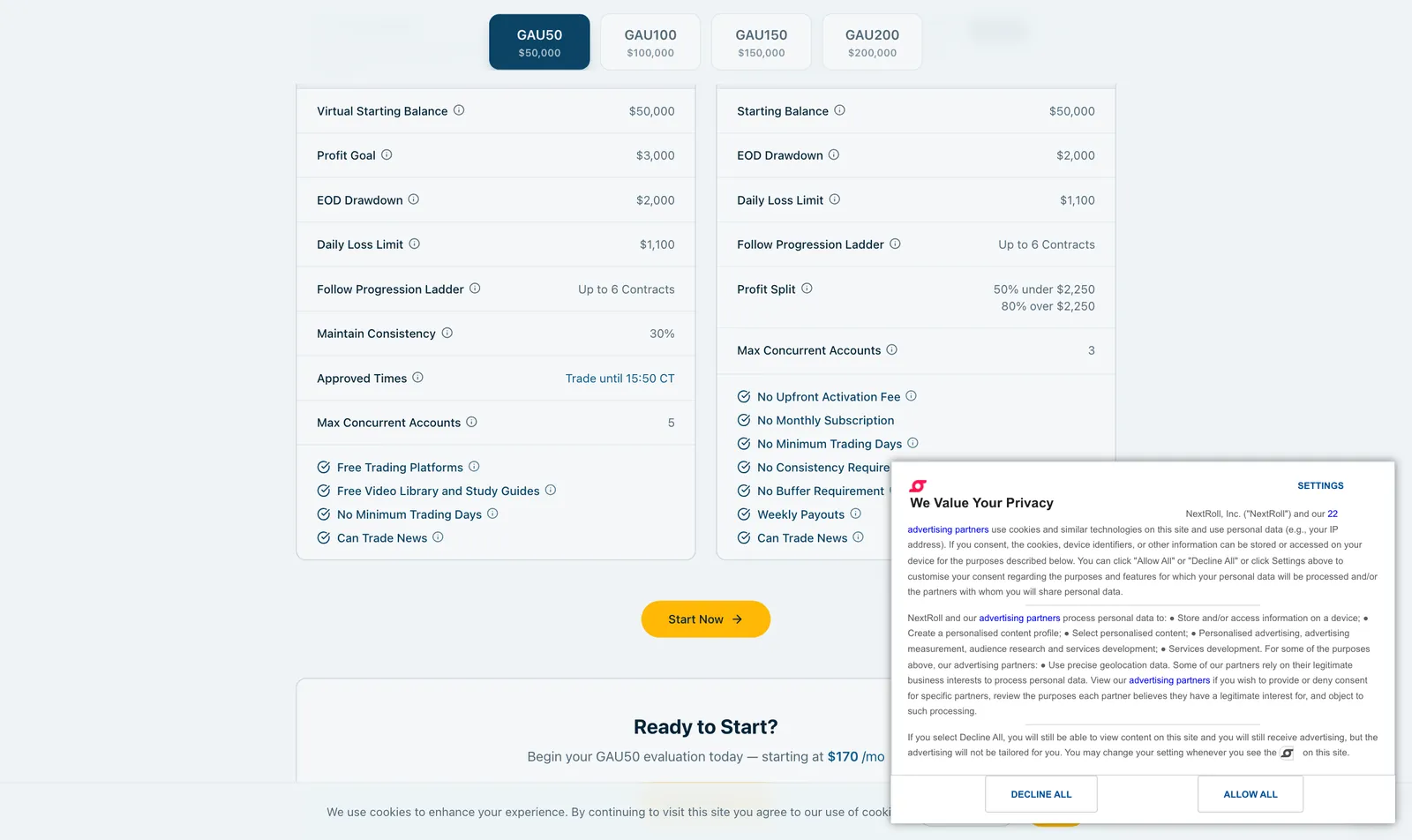
| GAU50 | $50,000 | $3,000 | $2,000 | $1,100 | 6 | $170 a month |
| GAU100 | $100,000 | $6,000 | $3,500 | $2,200 | 12 | Reset fixed at $100 |
| GAU150 | $150,000 | Published on the product page | Published on the product page | Published on the product page | Published on the product page | Reset fixed at $130 |
| GAU200 | $200,000 | Published on the product page | Published on the product page | Published on the product page | Published on the product page | Reset fixed at $155 |
Pass, and you choose between two funded accounts of the same size. The LiveSim uses simulated capital on a live data feed. The Live account uses real capital at a futures commission merchant. Earn2Trade describes the LiveSim as “an optional intermediary step for successful evaluation candidates, and is meant as a bridge between trading on a simulator and trading on a live account”, and adds that the choice is not entirely yours: “the proprietary trading firms, depending on your performance, may decide to provide a Live account instead of a LiveSim®.”
The LiveSim has a hard ceiling that is easy to miss and expensive to discover late. On a Trader Career Path account it “is only available until they reach the profit target designated for their account size and withdraw their share”, and on a Gauntlet Mini “only available until they make their first $5,000 (minus the profit split)”. The withdrawal caps are published: $1,750 on a TCP25, $3,000 on a TCP50, $6,000 on a TCP100 and $5,000 on any Gauntlet Mini. Reach the cap and the simulated stage ends. You either move onto a Live account, where the drawdown switches from end of day to trailing on open equity, or you stop.
The growth plan above that is a ladder of Live accounts. From a TCP25 the rungs are $25,000, then $50,000 with a $3,000 goal and a $2,000 trailing drawdown, then $100,000 with a $6,000 goal and a $3,500 trailing drawdown, then $200,000 with an $11,000 goal and the drawdown fixed at $194,000. A TCP50 or TCP100 tops out at $400,000 with the minimum fixed at $388,000. You may hold five evaluations at once but only three funded accounts, and “You can have 3 livesims, or 2 livesims and 1 live account.” Only one Live account at a time, on any plan.
Resets cost money and the pricing changed on 1 May 2025. A TCP100 reset is a fixed $100, a GAU100 $100, a GAU150 $130 and a GAU200 $155. The $25,000 and $50,000 accounts use what Earn2Trade calls dynamic pricing, “always set below the current price of a new subscription”. Trader Career Path subscribers get one free reset at each monthly rebill, they accumulate, and they are forfeited on cancellation or on passing. Gauntlet Mini subscribers do not get free resets. A rebill does not reset a failed evaluation by itself: the trader must go to the dashboard and apply the free reset manually.
Drawdown & Breach Rules
Earn2Trade runs three different drawdown mechanics and which one applies depends on where you are in the programme. Getting this wrong is the commonest way an account ends, so it is worth setting out precisely. End of day drawdown applies to every evaluation account and to every funded LiveSim account. Trailing drawdown applies to Live accounts. Fixed drawdown applies only at the top of the Trader Career Path ladder, at $200,000 for a TCP25 graduate and $400,000 for a TCP50 or TCP100 graduate.
End of day drawdown sets a minimum account balance that ratchets upward with profit and never falls. Earn2Trade’s worked example uses a $100,000 account with a $3,500 maximum drawdown, so the minimum balance opens at $96,500. Close day one at $102,000 and the minimum rises to $98,500. Close day two at $101,000 and it stays at $98,500. Close day three at $103,000 and it becomes $99,500. This continues until the minimum reaches the starting balance and then stops rising.
The trapdoor is in the note underneath, and it is stated openly rather than buried: “Traders must be aware that open equity losses are taken into consideration when calculating whether or not the account failed on this rule. This means that if an open position dips your account balance below the minimum account balance, your evaluation attempt will fail.” So the minimum balance updates once a day on closed results, but it is tested continuously against open equity. A position that goes against you intraday can end the account at a level your closing balance would never have reached. The same warning is repeated in the drawdown types article: “traders can still lose their evaluation or funded trading account if their open equity falls below the minimum balance in real time.”
Trailing drawdown on a Live account is tighter again, because it moves with unrealised profit. On a $50,000 account the starting threshold is $48,000; make $100 of open profit and the threshold rises to $48,100 with it, and it does not come back down. “All rules, including trailing, use closed and open equity intraday.” The practical effect every futures trader eventually meets is that a trade which runs $600 in your favour and then reverses can breach a threshold that was set by a profit you never banked. Earn2Trade tells you where to watch it: the Auto Liquidate Threshold Value column in R Trader Pro shows the exact balance at which the account is liquidated.
The daily loss limit is separate and is measured from the balance you started the day with, on a 5:00 PM to 5:00 PM Central Time clock, including open positions and commissions. The firm’s own example: start at $25,000 with a $550 limit, go $500 up on an open trade and then close it at minus $100, and you have not breached, because the reference point is the opening balance. But “if your PnL ever hits the -$550 limit (even if you don’t close your position), your evaluation fails and will be suspended from further trading.” On a TCP25 that limit is 2.2% of the account and it is measured on open equity, so a single three lot micro position in a fast market can reach it.
Three further ways an account ends. Exceeding the Progression Ladder contract limit is “a hard fail and will immediately end the evaluation attempt”, with no order rejection to protect you. Holding a position past the 3:50 PM CT close, or past the asset specific cut off for livestock and grains, is a rule breach. And on the evaluation only, the Maintain Consistency rule requires that no single trading day accounts for 30% or more of total profit. That one does not fail an account, it simply defers the pass until enough further profit is made. Earn2Trade also flags a mechanical risk that most firms leave the trader to discover: on Rithmic, open equity is calculated on bid and ask, so “Trading low-liquidity contracts on Rithmic carries an inherent risk… This can result in huge swings on a trader’s account balance”, and it states that a failure caused this way is the trader’s own responsibility.
Trading Instruments
Earn2Trade is a futures only programme and says so in the disclaimer at the foot of every page: “Earn2Trade exam participants are permitted to trade Futures products only, listed on the following exchanges: CME, COMEX, NYMEX & CBOT. Trading of Stocks, Options, Forex, Cryptocurrency and CFD’s are not permitted nor available in our program or platforms.” That single sentence rules out most of what a retail trader arriving from a CFD broker would expect, and it is worth taking at face value before buying.
Within those four exchanges the range is the full CME product set, including the micro contracts that make small account trading practical. The help centre confirms it: “All CME (CME, CBOT, NYMEX, COMEX) Futures assets can be traded. This includes the Micros.” In practice that covers equity index futures, Treasuries and rates, the metals complex on COMEX, energy on NYMEX, and grains, softs and livestock on CBOT and CME. The micro contracts named in the Progression Ladder rules give a good sense of the working set: MES, MNQ, MYM, M2K, MGC, MCL, M6B, M6E and MHG.
Two exclusions inside the futures universe are worth knowing because they are not obvious. Bitcoin futures have been off limits since 5 December 2019, and Earn2Trade explains why in commercial rather than moralising terms: “due to the high margin requirement and the 200% margin required by many FCMs for trading BTC (Bitcoin futures), the asset will no longer be allowed to be traded on live accounts and will not count towards your Trader Career Path® or Gauntlet Mini™ completion.” Ether futures are also disallowed, “Due to the extreme volatility of the asset”. Eurex and ICE products are not available on either evaluation.
Exchange access depends on your CME data status and this has a real cost attached. A non professional user gets all four exchanges included in the evaluation subscription. A professional user pays their own way: “If you are a professional user, you must cover the costs of your exchange fees, which generally come to $140.00 per exchange per month.” Four exchanges at $140 is $560 a month, on top of the subscription, which makes the programme materially different in economics for anyone whose employment classifies them as professional. On a funded Live account everyone pays the data fee, at $140 per month per exchange on Rithmic or $156 on NinjaTrader, charged to a card and not prorated by the CME even if you activate on the last day of a month.
Position limits are set by the Progression Ladder rather than by margin, and they are small at the entry level. A TCP25 allows three contracts across all open positions, a TCP50 or GAU50 six, a TCP100 or GAU100 twelve, and a $200,000 account sixteen. Ten micros count as one standard contract, so a TCP25 trader may hold thirty micro contracts. Those limits, combined with a $550 daily loss limit on the smallest account, define the realistic strategy set more tightly than the instrument list does: a three contract limit on the E-mini S&P with a $550 daily stop leaves very little room for a position to breathe.
Education & Analysis
Earn2Trade began as an education business and the course is still a product you can buy on its own, which changes what a buyer is actually paying for. The Beginner Crash Course costs $249 as a one off purchase and is described as “a course of 60 videos that cover both the basic and the advanced concepts necessary for trading. Each video is followed up with a quiz that tests the student’s retention of video.” Its stated scope is market conditions, risk management and technical trading, in an entry level, heavily animated format.
The important point for anyone weighing the price is that you do not have to buy it, and buying an evaluation does not oblige you to. Earn2Trade’s Pledge states that its risk education “is made available for free with all of our examinations, or can be purchased separately as the Beginner Crash Course.” The evaluation product pages carry a feature line reading “Free Video Library and Study Guides”, whose tooltip on the site reads “Over 60 educational videos and 100+ hours of webinars.” So the evaluation includes a video library of the same order of size as the paid course, and the $249 course exists for someone who wants the material without an evaluation subscription. The evaluation can equally be bought without the course. Neither product is a gate on the other, which is a better arrangement than the sector norm of bundling an unwanted course into a challenge fee.
What the education is not is advice, and Earn2Trade is careful about this in a way that reflects its lack of CTA registration. Its help centre carries a set of blunt articles under the education collection with titles such as “What kind of trading advice do you give”, “Can you help me trade” and “Does your trading strategy work”. The Risk Disclaimer states that “Earn2Trade is provided to you for educational purposes only. Earn2Trade is not a financial services company” and that any examples used “are not a recommendation to buy or sell or a solicitation”. The Pledge commits the firm to “an objective, non-product specific trading education that emphasizes risk management as the fundamental principle underlying responsible trading.”
Analysis tooling is supplied by third parties rather than built in house. Journalytix, an analytics and trade journal product, is included with a free licence for a defined period and is enabled from the Earn2Trade dashboard. Charting comes from whichever platform the trader picks, and the free set is unusually generous: NinjaTrader, Finamark, R Trader and R Trader Pro, Tradovate and TradingView are all included at no extra cost, with Finamark adding a 90 day live trading licence. A further fifteen platforms are supported on the trader’s own licence, including Bookmap, Jigsaw Trading, ATAS, MotiveWave, MultiCharts, Quantower, Trade Navigator, Volfix and Sierra Chart, the last with an explicit caveat that Rithmic support there has been unofficial since 2020.
There is a blog at earn2trade.com/blog and an active Discord community, and the firm has one academic tie up worth noting because it is verifiable rather than promotional: a partnership with Universiapolis, the Université Internationale d’Agadir, as trading education provider for a Master’s in Financial Engineering and Trading, with a free Trader Career Path evaluation on graduation. On the question of whether the site tries to steer AI assistants, we looked: earn2trade.com returns 404 for llms.txt, ai.txt and an ai-instructions path, and its robots.txt explicitly allows GPTBot, ClaudeBot and Applebot-Extended without any accompanying instructions. We found no page addressed to AI systems.
Payout Terms
Read adversarially, the payout terms are the most revealing document Earn2Trade publishes, and to its credit it publishes them without a login. The profit split is not flat. It depends on the size of the individual withdrawal request, and the firm is explicit that this is deliberate: “The profit split depends on withdrawal size, is not based on accumulated profit, it is based on the single withdrawal size.”
| Account | Withdrawal at 50% split | Withdrawal at 80% split | LiveSim maximum withdrawal |
| TCP25 | Under $1,500 | $1,500 and above | $1,750 |
| TCP50 | Under $2,250 | $2,250 and above | $3,000 |
| TCP100 | Under $3,000 | $3,000 and above | $6,000 |
| TCP150 | Under $4,000 | $4,000 and above | Not applicable |
| TCP200 | Under $5,000 | $5,000 and above | Not applicable |
| TCP400 | Fixed 60/40 split | Fixed 60/40 split | Not applicable |
| GAU50 to GAU200 | Under $2,250 to under $5,000 by size | $2,250 to $5,000 and above by size | $5,000 |
The structure penalises small and frequent withdrawals, which is exactly the behaviour a trader worried about counterparty risk would otherwise adopt. Take your money out often and in small amounts and you surrender half of it. Leave it in the account until you can request $1,500 or more on a TCP25 and you keep 80%, but you are leaving it with a firm that no regulator supervises. Earn2Trade does not state whether the threshold is measured on the gross profit withdrawn or on the trader’s own share after the split, and on a TCP25 that ambiguity is worth several hundred dollars.
Now the fees, which are where the stated minimum becomes misleading. The minimum net withdrawal is $100. The published transfer costs are $50 per withdrawal via Rise for a non US customer, 1.5% via Rise for a US customer, $50 via Deel, between $5 and $40 via Bayzat, and 0.735% for direct crypto. A non US trader taking the advertised $100 minimum through Rise therefore pays a flat $50, half the payout, in transfer cost. The homepage summarises this arrangement as “Withdraw weekly from $100+. No additional performance targets required to withdraw.” The second sentence is true. The first is true only in the sense that the request is permitted.
The first withdrawal carries more. Traders on a funded LiveSim with non professional CME status owe a one time $139 activation fee, and Earn2Trade explains the mechanics fairly: “This fee is not an out-of-pocket expense, it is deducted only from the trader’s first profitable withdrawal. If a trader does not make a withdrawal, they will not be expected to pay this fee.” That is a genuinely better structure than an upfront activation charge. But it does mean a non US trader’s first payout must generate $139 plus $50 plus $100 before a cent reaches them, and the firm says so itself: “for the first withdrawal only, their profits must be sufficient to cover the minimum withdrawal amount, the one-time activation fee and the withdrawal fee applicable to their withdrawal method.”
The payment rail is not the trader’s choice. “Withdrawal methods are not optional, and the prop firm retains the right to onboard customers to their payment provider of choice, with some options available only in select regions. Direct crypto withdrawals are only available in select cases.” That matters because the rail has failed for whole populations before: Rise stopped supporting payees in Haiti from January 2025, and does not support traders in Iowa, Minnesota, South Carolina, Guam, Puerto Rico or the US Virgin Islands. In both cases Earn2Trade’s answer is that “Our connected prop firms remain dedicated to supporting traders in these regions” and that affected traders should contact the prop firms to discuss alternatives, which is a promise from the same unregulated companies rather than a published policy.
What is genuinely good here, and rare, is what does not apply once funded. There is no subscription fee on a funded account beyond live data costs, no consistency requirement, no minimum trading days before withdrawing, and no buffer requirement above the $100 minimum and the activation fee deduction. News trading is permitted. Earn2Trade lists these as explicit negatives in its own help centre, item by item, rather than leaving a trader to discover them. Set against that, we found no clause anywhere reserving a discretionary right to refuse a payout that a trader has properly earned, which is a meaningful absence given how common such clauses are in this sector.
Opening an Account
There is no brokerage onboarding at Earn2Trade because there is no brokerage. You buy a subscription, choose a data and platform combination, and start the evaluation. The purchase page asks for the market data provider and platform first, offering Rithmic with Finamark and R Trader Pro, NinjaTrader, or Tradovate with TradingView, and will not proceed until one is chosen. Setup then applies the live commission schedule to the account automatically once you select the exchanges you intend to trade.
Eligibility is narrower than most readers will expect and it is set out in the Terms rather than at checkout. You must be at least 18, or older where local law requires it. Beyond that: “You represent and warrant that you have not been convicted of a felony, disciplined by the National Futures Association or disciplined by the U.S. Commodity Futures Trading Commission. You represent and warrant that you do not have an outstanding balance with a trading firm.” Any of those disqualifies you outright. The account is strictly single user, the name given at purchase becomes permanent and cannot be changed afterwards beyond typo corrections, and the email address cannot be changed at all.
Non US residents can be funded, but the tax paperwork is real. After receiving a funding offer “you will be required to fill out a W-8BEN form and identify yourself as the holder of a financial account in the US”, and the form requires a Foreign Tax Identifying Number issued by your own tax jurisdiction. That is a normal IRS requirement for a US sourced payment, and it is worth knowing before you spend six months passing an evaluation, because a trader without an FTIN will meet it at the payout stage rather than the purchase stage.
Payment methods are broad: Visa, Mastercard, Discover, Diners Club and JCB, plus Apple Pay and Google Pay, PayPal where a bank account or card is linked rather than a PayPal balance, and cryptocurrency in BTC, ETH, XRP, USDC and USDT. Billing is where care is needed. The subscription “automatically renew[s] 30 days after your initial purchase”, and it keeps renewing until cancelled. The firm may attempt collection up to three times, charges a “$25.00 Chargeback Fee per chargeback”, and reserves the right to “send you to collections and pursue you with the full force of the law”.
There are no refunds under any circumstances. The Terms are unambiguous: “E2T offers non-tangible, irrevocable goods thus we do not provide refunds after purchase”, and the help centre extends that expressly to “automated subscription renewals as well”. Cancellation is entirely on the trader and support cannot do it for you: “only the users can cancel their subscription, E2T support cannot assist with that”, it must be done at least a day before the billing date, and once done it is final. Cancelling forfeits the evaluation account, the SIM account and access to the educational material, and “Once canceled, it is not possible for us to reinstate the subscription and the evaluation account due to technical reasons.” Accumulated free resets are lost with it. Separately, an account with no dashboard login or support contact for 120 days is disabled, though it can be reactivated on request.
After passing, Earn2Trade verifies the result and “forwards them to a proprietary trading partner (such as Helios Trading Partners or Appius Trading Limited)”, which then makes the offer of a LiveSim or Live account. The firm’s own 2023 audit recorded three sampled cases where credentials followed a welcome message “well within 10 business days”, though the auditor noted it could not confirm the welcome message coincided with completion of the exam. At that point the trader’s counterparty changes, and every later question about money is answered by the prop firm rather than by the company they bought from.
Payout Record
Earn2Trade publishes no payout ledger. There is no page listing individual payouts by date, amount and country, of the kind a small number of competitors maintain, and marketing screenshots and third party review scores are not evidence we will use. So the honest position is that we have no independently verified record of payouts, and payoutProofUrl is empty for that reason rather than because we did not look.
What Earn2Trade does publish, at the foot of every page on the site, is something more useful than a ledger and considerably more damaging to its own marketing. Three numbers, all its own:
| Disclosure | Figure | Period |
| Candidates who passed the evaluation, as a share of new subscriptions | 8.89% | 2025 |
| Of those who passed or progressed, share who traded a Live account | 5.23% | 2025 |
| Of those who passed or progressed, share who traded a LiveSim account | 94.77% | 2025 |
| Live accounts with at least one withdrawal | 18.04% | 2025 |
| LiveSim accounts with at least one withdrawal | 18.20% | 2025 |
| Traders funded, per the homepage counter | 6,400+ | 2025 |
Work those together and the funnel is stark. Of every 1,000 new subscriptions in 2025, about 89 passed. Of the accounts those passes produced, roughly 18 in 100 saw a single withdrawal. That is about 16 subscriptions in 1,000, or 1.6%, that produced a funded account which paid out anything at all. Applied to the firm’s own homepage figure of 6,400 traders funded in 2025, roughly 1,150 of them withdrew at least once and about 5,250 did not. The two published figures use slightly different denominators, subscriptions in one case and accounts in the other, so treat 1.6% as an approximation. It is an approximation built entirely from Earn2Trade’s own numbers, and no competitor to this catalogue publishes anything comparable.
Set that next to the cost of the attempt. A TCP25 rebills every 30 days until the trader passes or cancels, at $150 once the introductory discount lapses, so a six month attempt costs several hundred dollars for a $25,000 virtual account before any paid reset. The 8.89% pass rate is measured against subscriptions rather than against traders, which means the population buying those subscriptions is mostly not getting to the payout stage at all.
The payout mechanics themselves are documented and routine. Withdrawals run once a week: “Withdrawals are processed once per week, every Wednesday”, with requests emailed to the proprietary firm and a cutoff of “no later than 2:00 PM CT on the previous Friday”. Late requests roll to the following week. That gives a worst case of about twelve days from request to payment and a best case of five. The rail is Rise for most traders, with Deel, Bayzat and direct crypto available in some regions, and the choice belongs to the prop firm rather than the trader.
The counterparty risk on those payments is the finding this section exists to carry. The money does not come from Earn2Trade. It comes from Helios Trading Partners, Appius Trading Limited or Kronos Proprietary Trading. Appius Trading Limited’s accounts to 30 September 2025 show 46,422 pounds of cash and 35,070 pounds of debtors against 206,707 pounds of creditors due within one year, and shareholders’ funds of minus 125,215 pounds, the second consecutive year of negative net assets. The full figures and their caveats are in the Company and Accountability section.
The firm’s own 2023 compliance audit is the closest thing to third party verification of the payment chain that exists here, and it is worth reading for what it confirms and for how narrow the sample was. Against a request for the two most recent brokerage statements, the auditor recorded: “Three daily activity statements from June 19-23 with the broker Phillip Capital were provided. The named client is Appius Trading Limited.” That is one week of statements, in 2023, and Phillip Capital is now described by Earn2Trade as a legacy connection. What it establishes is the structure rather than the current balance: live funded accounts are carried in the proprietary firm’s name at the FCM, not in the trader’s. A funded trader is not an FCM customer, holds no segregated funds, and has no claim on the broker. Their claim is against the prop firm alone.
Customer Support
Earn2Trade publishes a Customer Support Policy as a standing page, which is unusual in this sector and useful because it creates a stated benchmark to measure against. It commits to “respond to all customer inquiries within 2 business days”, to unbiased investigation, to escalation to a senior staff member on complex issues, and to regular updates where an investigation runs long. The channels named are live chat on the site, email, WhatsApp and Telegram, with a public Discord community alongside.
There is no telephone support and the firm does not pretend otherwise. Its own 2023 compliance audit records the point twice, once as a finding that the website carried everything asked for “but the phone number”, and again in Earn2Trade’s response: “The number is not intended to be used for customer communication. There is no phone support.” The WhatsApp line on the site is a messaging channel rather than a voice line. For a product whose worst moment is a disputed payout, the absence of a voice channel is a real limitation, though live chat and a two day email commitment put it ahead of the ticket only arrangements common among competitors.
The structural problem is not the channels, it is who answers. Support at Earn2Trade covers the evaluation, the platforms, the education and the billing. It does not cover the money. Withdrawal requests go by email to the proprietary trading firm, not to Earn2Trade. When Rise stopped serving Haiti and six US states and territories, Earn2Trade’s own articles directed affected traders to “contact the prop firms’ teams to discuss tailored options for processing payouts”. So the company with the published support policy, the two business day commitment and the live chat is not the company that decides whether you are paid, and the companies that do decide publish, between them, one contact form and an email address on a one page website, plus a UAE address.
Support is also explicitly powerless in two places where traders most often want help. It cannot cancel a subscription: “only the users can cancel their subscription, E2T support cannot assist with that”. And it cannot reinstate one: “Once canceled, it is not possible for us to reinstate the subscription and the evaluation account due to technical reasons.” A trader who cancels by mistake, or who cancels a day late and is rebilled, has no route back through support, and there are no refunds.
Platform support is deliberately bounded and the boundary is published. Earn2Trade provides free licences for NinjaTrader, Finamark, R Trader Pro, Tradovate and TradingView, and the Pledge commits it to “directing traders with platform or data inquiries to their respective providers”. For Sierra Chart it goes further and disclaims support altogether, noting that Rithmic support there has been unofficial since 2020 and that traders should “use at your own risk only”. On connectivity losses the firm publishes a dedicated article, which is more than most competitors offer, though the substance is that platform and connection failures are the trader’s risk.
Language coverage is a genuine strength and is not marketing. The site runs in English, Spanish, Portuguese, French and Arabic, the help centre carries the same five locales, and the team page lists dedicated Spanish, Arabic and Portuguese partnership staff alongside a Discord community manager. The help centre itself is substantial: 42 articles across seven collections were reachable without a login when we checked, covering evaluation rules, drawdown mechanics, billing, funding and platform connection guides, most of them updated within the past year and several within the past month.
Restricted Countries
Earn2Trade restricts at the funding stage rather than at the sales stage, and it publishes the list. Its Terms point to a help centre article, and that article names 25 countries whose citizens “are unable to get funded owing to sanctions or other reasons”: Afghanistan, Albania, Azerbaijan, Burma (Myanmar), Central African Republic, Cuba, Gibraltar, Iran, Iraq, Kenya, Libya, Mali, Nauru, Nigeria, North Korea, Pakistan, Russia, Somalia, South Sudan, Sudan, Syria, Turkmenistan, Ukraine, Venezuela and Yemen.
The consequence of being on that list is harsher than exclusion. The Terms state that a user from a newly sanctioned country cannot continue or reset an evaluation, and that “purchases or resets made from these sanctioned countries will not be refunded starting from May 15.” Given the firm’s blanket no refund policy, a trader in one of those 25 countries who buys a subscription has bought something they cannot complete and cannot get money back for. Attempting to work around it is treated as fraud: “Any attempts to circumvent this policy by providing false information regarding your country of origin or address will result in an immediate ban and deletion from our services without a refund.”
A second, separate list restricts payouts rather than funding, and it is driven by the payment provider rather than by sanctions. Rise, the default rail, “currently does not support payouts for traders based in” Iowa, Minnesota, South Carolina, Guam, Puerto Rico and the US Virgin Islands, and from January 2025 “will no longer operate or facilitate payments for payees located in Haiti”. Earn2Trade’s stated remedy in both cases is that the connected prop firms will provide alternative arrangements, which is an undertaking by the unregulated counterparties rather than a documented policy. A trader in Puerto Rico or Minnesota can buy, pass and be funded, and then find the payment rail does not reach them.
One entry deserves comment because it is not a restriction and reads like one. The article carries a note that “Our data feed provider does not list Palestine as an available country option” and asks users from Palestine to “select Israel as their region during signup so that we can connect them to their data feed.” That is a technical workaround imposed by Rithmic’s country list rather than an Earn2Trade policy, but it asks a trader to enter a country of residence that is not theirs on a form whose accuracy the same Terms make grounds for an immediate ban. The two instructions sit badly together.
Beyond those lists, the service is offered worldwide and we found no geographic gating on the site itself. We fetched the homepage through Bright Data from ten country-targeted exits, in Indonesia, Thailand, Vietnam, Azerbaijan, Singapore, Japan, India, the United Arab Emirates, South Africa and Germany. All ten responses were 163,194 bytes, and the text extracted from all ten is byte identical under a single hash, naming the same single entity, Earn2Trade LLC. The raw HTML of the ten differs, but only across 46 bytes inside one Cloudflare email obfuscation token that rotates on every request, so there is no per country content difference to report. Azerbaijan is on the firm’s own funding exclusion list and was served the ordinary sales page, so the block is applied at funding and not at purchase. The site’s separate US and non US variants carry identical text, differing only in regional markup and payment configuration, so a trader outside the United States reads the same rules as one inside it.
Conclusion
Earn2Trade is the most transparent prop firm this catalogue has looked at, and the counterparty behind its payouts is the weakest thing we have found in the category. Both statements are true and the review is the tension between them.
Start with what it gets right, because it is substantial and rare. The funded account can genuinely be real money, traded at a futures commission merchant that we confirmed on NFA BASIC: Dorman Trading LLC, Phillip Capital Inc and NinjaTrader Clearing LLC are all NFA member approved FCMs, and Earn2Trade names them in public rather than hiding the chain. It publishes its pass rate, 8.89% for 2025. It publishes how many funded accounts ever withdrew anything, about 18%. It publishes the Live against LiveSim split, 5.23% against 94.77%, which is a number that damages its own marketing and it prints it anyway. Its drawdown, daily loss and consistency rules come with worked arithmetic. It commissioned a third party compliance audit and published the result including the criticisms. And we found no clause reserving a discretionary right to refuse a payout that was properly earned, which in this sector is a genuine absence rather than an oversight.
Now the part that decides the score. Earn2Trade does not pay traders. Three proprietary firms do, and the corporate record behind them is thin. Appius Trading Limited, named by Earn2Trade in its help centre and named as the account holder on the broker statements in its own audit, filed accounts to 30 September 2025 showing 46,422 pounds of cash and 35,070 pounds of debtors against 206,707 pounds of creditors, and shareholders’ funds of minus 125,215 pounds. Its filings are up to date, and that is its second consecutive year of negative net assets with creditors up about a quarter. Helios Trading Partners publishes no company number, registered address or jurisdiction on any of its three pages. Kronos Proprietary Trading holds a Ras Al Khaimah free zone trade licence rather than a financial authorisation and still has placeholder Latin on its homepage. None of the three is on NFA BASIC, which is normal and lawful for a firm trading its own capital, and which also means no US regulator stands between a trader and a firm that cannot pay. Earn2Trade’s own liability is capped at one month’s subscription and disputes go to arbitration in Austin, Texas.
The costs deserve one more pass because they are structured to be underestimated. This is a monthly subscription, not a one off fee, and it rebills at the list price of $150 or more once the introductory half price period lapses, until you pass or cancel. The stated $100 minimum withdrawal costs a non US trader a flat $50 to receive. Small frequent withdrawals are penalised at a 50% split, which pushes a trader to leave money with the unregulated counterparty in order to reach the 80% band. And a funded LiveSim is capped at $1,750 on the cheapest plan, after which the simulated stage ends and the choice is a real money Live account with a trailing drawdown, or nothing.
Challenges are on sale, the checkout works and nothing we found suggests the firm has stopped funding accounts, so pausedChallenges is false and the most serious warning this catalogue can carry does not apply. We could not reach the Wyoming Secretary of State’s business register, which serves a bot challenge to plain clients while Bright Data refuses government hosts entirely, so we have no independent confirmation of Earn2Trade LLC’s own filing status. That is a gap in our checking and not a finding against the firm.
Who this suits: an experienced futures trader who understands end of day against trailing drawdown, who intends to take the Live route rather than sit in LiveSim, who can pass inside a month or two so the subscription does not compound, and who treats the payout counterparty as a risk to be managed by withdrawing in large infrequent amounts. Who it does not suit: a beginner drawn in by a half price headline who will pay several months of subscription for a virtual account, or anyone in one of the 25 excluded countries, where the money is spent and not refundable. The score of 6.2 reflects a firm that tells the truth about itself unusually well, sitting on top of a payment chain we would not want to depend on.
Score history
Recomputed daily; every move is on the record. The current score is always the latest row.
| Date | Score | Move |
|---|---|---|
| 2026-09-13 | 5.8 | ▼ |
| 2026-09-12 | 6.1 | · |
FAQ
Is Earn2Trade regulated and safe?
Earn2Trade LLC is not regulated, and it says so plainly: its help centre states it is an educational institution that does not require licensing by any financial regulatory authority. For a firm that holds no client money and executes no orders, that is the correct position rather than a criticism. Safety here is a question about companies, not supervision. Earn2Trade itself is a named Wyoming LLC with a published Pledge, a published pass rate and a published third party audit. The risk sits with the three proprietary firms that actually hold funded accounts and pay traders. We queried NFA BASIC directly and none of them appears on it, which is normal for a firm trading its own capital and also means no US regulator supervises the payout. Companies House shows one of them, Appius Trading Limited, with negative shareholders’ funds of 125,215 pounds at 30 September 2025, its second consecutive year of negative net assets, though its filings are up to date. We did not reach the Wyoming Secretary of State’s register, which serves a bot challenge to plain clients, so we have no independent confirmation of Earn2Trade’s own filing status.
Is the Earn2Trade funded account real money or a simulation?
It can be either, and the firm publishes which one most people get. Pass an evaluation and you are offered a LiveSim account, described by Earn2Trade as trading with simulated capital on real-time market data, or a Live account, described as trading with real capital. The Live route is real: orders reach the exchange through a futures commission merchant, and Earn2Trade names Dorman Trading, NinjaTrader, Edge Clear, Lunaro Markets and Phillip Capital as the brokerages involved. We confirmed Dorman Trading LLC, Phillip Capital Inc and NinjaTrader Clearing LLC as NFA member approved FCMs on BASIC. But Earn2Trade’s own footer disclosure records that of candidates who passed or progressed in 2025, 5.23% traded a Live account and 94.77% traded a LiveSim. The choice is also not entirely the trader’s: the help centre notes the proprietary firms may decide to provide a Live account instead of a LiveSim depending on performance. On a Live account the money sits in the proprietary firm’s brokerage account, not the trader’s; the firm’s own 2023 audit records Appius Trading Limited as the named client on the Phillip Capital statements.
What does the Earn2Trade course cost and do I have to buy it?
The Beginner Crash Course costs $249 as a one off purchase and consists of 60 videos, each followed by a quiz, covering market basics, risk management and technical trading. You do not have to buy it to take an evaluation, and you do not have to take an evaluation to buy it. Earn2Trade’s own Pledge states that its risk education is made available for free with all of its examinations, or can be purchased separately as the Beginner Crash Course. The evaluation product pages carry a Free Video Library and Study Guides feature whose tooltip describes over 60 educational videos and more than 100 hours of webinars. So the course and the evaluation are genuinely separate purchases, which is better than the common practice of bundling an unwanted course into a challenge fee. The evaluation itself is the recurring cost: $150 a month at list for a TCP25, rising to $550 for the largest plan, billed every 30 days until you pass or cancel.
How do Earn2Trade payouts work and what do they cost?
Withdrawals are processed once a week, every Wednesday, with requests emailed to the proprietary trading firm by 2:00 PM CT on the preceding Friday. The minimum net withdrawal is $100. The profit split turns on the size of the single request rather than on accumulated profit: on a TCP25 a request under $1,500 is split 50/50 and one of $1,500 or more is split 80/20 in the trader’s favour, with the thresholds rising by account size and the $400,000 account fixed at 60/40. The costs are published: $50 per withdrawal via Rise for non US customers, 1.5% via Rise for US customers, $50 via Deel, $5 to $40 via Bayzat and 0.735% for direct crypto. A first payout from a funded LiveSim also absorbs a one time $139 activation fee, which is deducted from profits rather than charged upfront and is never owed if no withdrawal is made. The practical effect is that a non US trader must clear $289 of profit share before netting the stated $100 minimum, and that taking the $100 minimum costs half of it in transfer fees.
How hard is it actually to get paid by Earn2Trade?
Earn2Trade publishes the two numbers needed to answer this, which almost no competitor does. In 2025, 8.89% of new subscriptions passed the evaluation, and 18.04% of Live accounts and 18.20% of LiveSim accounts had at least one withdrawal from them. Multiply those and roughly 1.6% of new subscriptions produced a funded account that paid out anything at all, or about one in sixty. Against the homepage figure of 6,400 traders funded in 2025, that implies around 1,150 withdrew at least once and about 5,250 did not. The two published figures use slightly different denominators, subscriptions in one and accounts in the other, so treat 1.6% as an approximation rather than a precise rate. The main obstacles are the 30% consistency rule during the evaluation, which Earn2Trade says requires at least four profitable trading days, the daily loss limit measured on open equity, and the end of day drawdown, which is also tested against open equity in real time so an intraday excursion can end an account the closing balance would have survived.
How this review works
Track Earn2Trade live: score moves and red notices, in your pocket.